Tag Archives: Walk the Plank!

28th July 2015

We started the evening splitting into three groups, the first of which played Machi Koro.  This was the “Feature Gamea couple of months back when it received a nomination for the coveted German Game of the Year, or Spiel des Jahres Award.  In essence, it is an engine building game with elements taken from The Settlers of Catan and Dominion.  Like Settlers, on their turn players first roll one or two dice, which yield resources, in this case money.  Players then use their money to buy cards like Dominion.  Each card is numbered and provides money, sometimes when the owner rolls, sometimes when someone else does, with the amount sometimes depending on the other cards a player has.

Machi Koro
– Image used with permission of BGG reviewer EndersGame

Players have five special buildings costing varying amounts and the winner is the first player to build all of them.  Red, Yellow, Orange and Cyan started setting up while people finished eating, but Red emigrated to play the hidden traitor game, Saboteur, with Teal and Violet when they arrived.  This is one of those little games that everyone always enjoys playing and plays lots of people well.  With only three players, it’s possible to have one bad dwarf, or none at all which makes everyone very twitchy, and as usual, accusations abounded.  After three rounds, Teal ran out the winner with five gold.

Saboteur
– Image used with permission of BGG contributor mothertruckin

Machi Koro and Saboteur finished together to the two groups coalesced to play Colt Express.  This had been the “Feature Game”, last time, however, none of this group had been available to play.  Red was particularly keen to give it a go as it has a lot in common with one of her favourite games, Walk the Plank!.  This style of game is sometimes refereed to as a “programming game” because players play all the cards and only after everyone has played cards, do they get to action the cards.  The effect of this is semi-organised chaos as players try to make plans to take care of all eventualities, and then find that by the time they get round to carrying out the actions the situation has completely changed and is nothing like they would have predicted.  This time, Orange took the $1,000 for the sharpest shooter and Cyan took the strongbox.  Despite this, the best thief turned out to be Yellow who finished with $2,700 some way ahead of Cyan in second place.

Colt Express
– Image used with permission of BGG contributor henk.rolleman

Meanwhile, everyone else had been playing the “Feature Game”, which was Last Will.  This is basically the boardgame equivalent of the 1985 film “Brewster’s Millions”.  The story goes that in his last will, a rich gentleman stated that all of his millions would go to the nephew who could enjoy money the most.  In order to find out who that would be, each player starts with a large amount of money, in this case £70, and whoever spends it first and declares bankruptcy is the rightful heir, and therefore the winner.

Last Will
– Image used with permission of BGG contributor PaulGrogan

The game is played over a maximum of seven rounds each comprising three phases.  First, starting with the start player, everyone chooses the characteristics of their turn for the coming round from a fixed list.  These include the number of cards they will get at the start of the round, the number of “Errand Boys” they will be able to place, the number of Actions they will get and where they will go in the turn order.  For example, a player may choose to go first when placing Errand Boys, but will then only get one card at the start of the round and crucially, only one Action.  On the other hand, a player may choose to sacrifice position in the turn order, draw no cards, only place one Errand Boy, but receive four Actions.  Since all but two cards are discarded at the end of the round and Actions must be used or lost, this decision is critical.

Last Will
– Image used with permission of BGG contributor Toynan

Next, in the revised turn order, players take it in turns to place one Errand Boy before placing their second if applicable.  Errand Boys are important as they allow players to control the cards they are drawing as well as manipulate the housing market and increase the space on their player board.  The heart of the game is the cards, however, which are played in three different ways:  as a one off (white bordered cards); on a player’s board (black bordered cards) or as a modifier (slate bordered cards) which enable players to spend more when black or white bordered cards.  Thus, White bordered cards are event cards which cost a combination of money and Actions to play, but once played, are discarded.  Black bordered cards cost at least one Action to play, but are kept and can be activated once in each round.

Last Will
– Image used with permission of BGG reviewer EndersGame

Black bordered cards come in three different types: “Expenses” which allow players to spend money; “Helpers” which additionally allow give players some sort of permanent bonus, and “Properties” which are by far the most complex cards in the game.  Properties are an excellent way of spending money as they are bought for a given amount and will either depreciate every round, or will require maintenance which can be expensive. Unfortunately, players cannot declare bankruptcy if they have property and must sell them.  This is where the property market comes in:  one of the possible errands is to adjust the property market, so if a property is bought when the market is high and sold when it is low, this is another possible avenue for losing money.

Last Will
– Image used with permission of BGG contributor bswihart

At the end of the round, everyone reduces their hand to just two cards and loses any left-over actions, which puts players under a lot of pressure as it makes it very hard to plan.  So the game is an unusual mixture of timing, building card combinations, strategy and tactics.  Only Blue had played it before and that was a long time ago, so it took a long time to explain the rules and make sure that everyone understood how the cards worked.  Even then, there were a lot of misunderstandings.  Burgundy had also read the rules quite carefully as well though and mostly managed to keep everyone on track.

Last Will
– Image used with permission of BGG contributor Toynan

Green (as the last person to the bar and therefore the last person to buy something) went first and started out with an “Old Friend” which gave him an extra action.  Burgundy went for a “lots and lots of cards which don’t cost an Action to activate” strategy while Black and Purple went into the properties market.  Meanwhile, Blue’s starting cards favoured buying farms, but by the end of the first round it was becoming clear that the cards she needed weren’t there and an Events strategy would probably be better.

Last Will
– Image used with permission of BGG reviewer EndersGame

Towards the end of the fourth round it was becoming obvious that Burgundy’s preparation (reading the rules) was paying dividends as he was systematically spending more than £12 per round – the amount needed to force an early finish to the game.  Blue on the other hand was trying to work out why her pile of poker chips didn’t seem to be decreasing.  By the end of the fifth round it was clear that Green was pressing Burgundy hard and there would only be one more round.  A quick bit of maths also suggested that there had been a “banking error”.  Although it would normally be in Blue’s favour, unfortunately, as this is game where players are trying to lose money, it didn’t help her.  Since she had been in charge of the poker chips though, it could only have been her own fault.

Poker Chips
– Image by boardGOATS

The game came to an end in round six when Green ran out of chips.  This left him with a final total of zero and everyone else trying to make the best of the final round.  Black and Purple tried selling off their properties and Blue held another couple of expensive parties, but it was Burgundy who spent £20 to finish the winner with £13 of debt.  As we put the game away, we agreed that it was quite an unusual game, though quite complicated, especially on the first play.  We also all felt that it was the sort of game that would benefit from the familiarity with the cards that comes from repeated plays, so it is quite likely that we’ll play it again soon.

Last Will
– Image used with permission of BGG contributor CellarDoor

With everyone else gone, there was just time for a few quick rounds of Love Letter.  This is a game we played a lot a year or so ago, but not so much recently.  The first of the so-called “micro games” it is played with just sixteen cards.  Each player starts with one card and on their turn, draws a second card and then plays one of them.  Each card has a value (one to eight) and an action (discard a card, swap cards with another player, compare cards, etc. etc.).  The object of the game is to have the highest card when the deck has been exhausted or, be the last person remaining, which ever is soonest.  For variety, we played with Green’s much loved, very battered, previously lost but recently re-found, home-made, “Hobbit” themed deck, complete with tiny gold rings.  So, the first problem was remembering what all the cards did and then trying to match them to the new characters…  With five, we played until the first player had two rings – everyone got one except Burgundy before Black won a second round and finished as the winner.
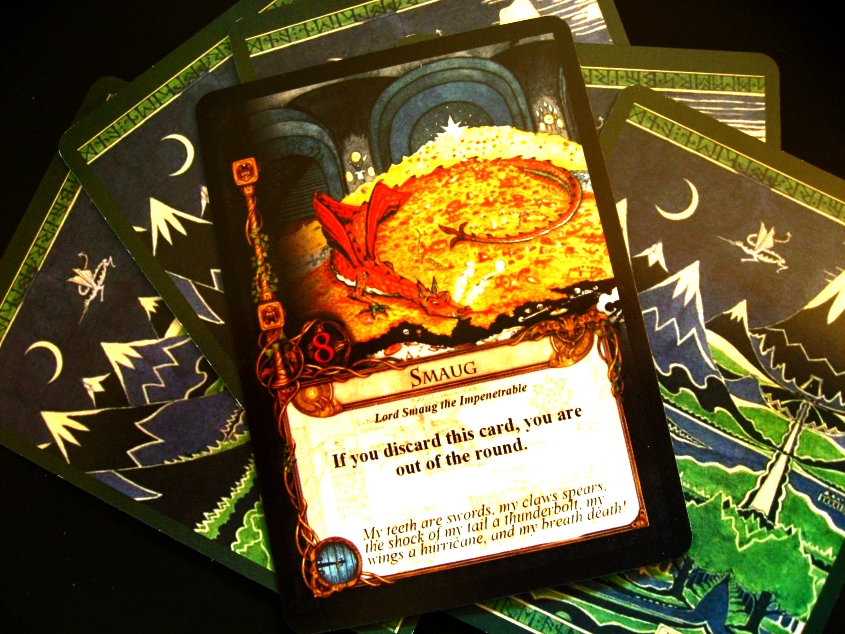
Love Letter
– Image by boardGOATS

Learning Outcome:  Spending money is not quite as easy as you think.

19th May 2015

With more new people, most of the regulars and a few less regulars, it was always going to be a busy evening.  So, as it was, we started out with three games.  The first group began with Eight-Minute Empire, a game that we’ve played before on a Tuesday, however, not with this group – only one person playing this time was familiar with it.  It is a quick little area control and set collecting game, though in truth, it only plays in eight minutes if everyone really knows what they are doing and nobody suffers from “Analysis Paralysis”.  On their turn, the active player starts by picking up a card:  they can choose whether to take the first available card which has no cost, or take another and pay the appropriate number of coins from their limited supply.  Each card is a resource which provides points at the end of the game, the number depending on how many of that resource the player has;  each card also has an action associated with it, which can be place armies on the map, move them about, ship them across the sea, build a city etc.  Players score points for having the majority in a countries and controlling the most countries in each continent, as well as for sets of resources.

Eight-Minute Empire
– Image used with permission of BGG contributor henk.rolleman

Cyan started heading over the seas, Yellow went in the other direction and Green ominously began amassing armies in the start region. Orange and White started with a mixture of expansion and growth.  As the game progressed, Cyan was spreading himself thinly over two continents while Orange headed north leaving the main continent behind and Yellow, White and Green fought over the regions in the middle.  White was also doing a fine trade in rubies while Cyan was collecting anvils.  This gave Cyan a dilemma when a double anvil turned up:  although he had the money to pay the two it would cost, he was playing a miserly game and decided to let it pass.  As it happened, it stayed on the table for nearly the full round until White swiped it from under Cyan’s nose.  Everyone saw the mass of Green in the middle, and, thinking he was an experienced player, decided to gang up on him.  With three players going after Green in the last round they did a good job of removing his dominance in the centre, leaving White the winner with eleven points, though the rubies really helped Yellow in second place just two points behind.

Eight-Minute Empire
– Image by BGG contributor lhapka

After a brief drinks break, the group then went on to play Salmon Run.  This was another game that we had played before, but was new to the majority of the players this time so it took a while to remember how it worked.  In essence, it is a race game that uses a hand-drafting mechanism, so players have their own personal draw piles a bit like Dominion.  The game is modular with a range of possible river sections.  This time the group opted for a short game with only four boards, which was enough to give everyone a flavour of the game, ready to give it a proper run through next time.  After a couple of rounds, everyone started to get the hang of it and salmon were zig-zagging their way up stream dodging bears, eagles and rapids, jumping waterfalls and trying to be the first to get to the spawning pool without being too tired.  Throughout the game the group remained uncertain of the the rules though, and at one point Green got himself blocked with no cards in his hand to help him.  After checking, he realised he could in fact play a card and do nothing (the fish banging its head against the wall). Unfortunately this meant he ended up way behind the others.  Before long, Cyan leapt the last waterfall and landed in the spawning pool with a splash.  It was a tight game with three other players teetering on the brink and ready to make the final jump, but in the end no-one else managed to get across leaving Cyan the clear winner.

Salmon Run
– Image used with permission of BGG contributor kilroy_locke

The second group started out with a repeat of a quick game we played last time, called Yardmaster.  This little train themed card game is turning out to be surprisingly popular with our group, partly at least because it packs a surprising amount of punch for such a simple filler game that plays so quickly.  This time, it was just Burgundy turned the tables on Blue who failed to get the luck of the cards.  Then Purple and and Black turned up to join them for the the “Feature Game”, Machi Koro, which has just been nominated for the Spiel des Jahres.  This card game is a sort of cross between The Settlers of Catan and Dominion, where players take the role of mayor and roll dice and choose cards in order to make it the most successful town.  On their turn, the active player rolls the die (or dice if appropriate) and anyone who owns a card gets money in a similar way to the resource allocation in The Settlers of Catan.  Then, the active player can use their money to buy cards, building up their portfolio in a similar way to Dominion.  The winner is the first player to build all four of their land-mark buildings.

Machi Koro
– Image used with permission of BGG reviewer EndersGame

There are two ways of setting up:  all the cards can be available in separate stacks at the start of the game, alternatively, the cards can be shuffled together and dealt out until there are ten different buildings available (others become available when a pile is exhausted).  The latter makes for a more strategic and interesting game, but when learning it is easier to see how the card combinations work by dealing out all the cards.  With so many people new to the game, all the cards were laid out at the start so everyone could see what their options were.  Blue was the only one who had played it before, so to off-set some of that advantage, she decided to try buying a building she had not bought before.  In her previous games, the Café (which rewards the owner with $2 from the active player when they roll a three) had been fairly ineffective, so she bought one.  Purple promptly rolled a three, and had to hand over some cash.  When this happened a second time, suddenly everyone started building Cafés and the gloves were off.

Machi Koro
– Image used with permission of BGG reviewer EndersGame

Blue built her Station first which allowed her to roll both dice and go for the higher number and value buildings and Purple and Burgundy were quick to follow.  Black was obviously not enjoying himself as much as the rest, and didn’t seem to be building much.  Eventually, he build a handful of Restaurants and Cafés, but otherwise just sat and accrued cash.  Blue and Purple had built their third landmark before Black had built one and it was looking like he wasn’t really focussing on the game at all.  Eventually, Blue built her Radio Tower winning the game.  Since there is nothing in the rules about what happens next, the rest of the group played on.  Burgundy managed to build his third and fourth landmarks in quick succession to take second place leaving Black and Purple to fight it out.  When Black suddenly completed his set (much to Purple’s disgust) his strategy became clear:  by building his most expensive landmarks first, he got a larger benefit from them, which enabled him to quickly complete the smaller ones.  Without two dice, his income was reduced, but since he had the majority of the red cards, he picked up money on when others rolled nines.  Although it hadn’t paid off this time, it looked like an interesting approach, though it was clear that Black was not terribly keen to play it again since, as he commented later, he is not keen on dice as a randomising factor, though he is quite happy to use cards.  Perhaps we’ll try a “dice deck” of cards next time and see if he likes it more…

Coloretto
– Image by BGG contributor SergioMR

Meanwhile, the third group had played an assortment of quicker games beginning with Coloretto.  This cute little set collecting game has been getting played a lot recently on Tuesdays, and, as Teal and Violet were new to the group, Red thought it would be a nice gentle game to start with.  Teal began by collecting a few choice colours, but quickly amassed a positive rainbow of chameleons.  Violet was much more selective and her favouritism for yellow chameleons proved to be particularly sensible in such a close fought game, and gave her clear victory over Red and Teal.  After briefly licking his wounds, Teal then regrouped and proceeded to thrash Red and Violet in a quick game of Dobble.

Dobble
– Image used with permission of BGG contributor msaari

Red had been enviously watching Blue and Burgundy playing Yardmaster across the room (which might explain her poor showing in Dobble).  So, as soon as they had finished, she decided to introduce Teal and Violet to it.  As the most experienced player, Red was in a good position to get revenge for getting beaten in Coloretto and her complete drubbing in Dobble.  The game was quite close, but a crucial coup of a green number one at the very last minute swept her sorting yard into play, making Red the clear winner.

Yardmaster
– Image used with permission of BGG contributor moonblogger

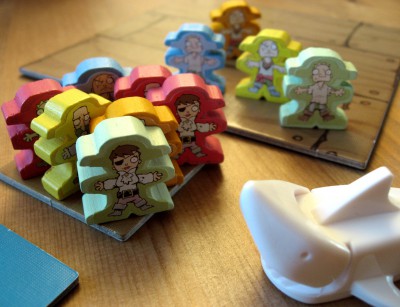
With one victory each, Red got out another of her favourite games, Walk the Plank!.  This is a very simple if silly game, with a lot of opportunity to attack the others playing.  One of the big successes in the group, it has really earned it’s keep as one of the few genuinely popular KickStarter games.  This time was no different to previous games and everyone engaged whole-heartedly in trying to force their opponents off the plank and into the murky depths of the ocean.  Since it had been one game all, this could be seen as the groups tie-breaker and it was Teal who’s pirates managed to resist the temptation to jump into the shark-infested water the longest giving him two wins to Red and Violet’s one.

Walk the Plank!
– Image by boardGOATS

With the second group still playing Machi Koro, Red Teal and Violet joined Cyan, Green and White for a quick game of Pick Picknic.  Like Walk the Plank!, Pick Picknic uses simultaneous card selection, but adds negotiation and a dash of chance and “double think”.  The idea is that there are six yards of different colours, if someone plays the only chicken card of a given colour, they get all the grain at that coloured farm.  If multiple players go for the same coloured yard, then players can either agree to share the corn in any way that is mutually acceptable or roll the die for all of it.  Foxes don’t eat corn, however, they only eat chickens, so if someone plays a fox card, they will eat any chicken cards of that colour.  The game was really close and much hilarity ensued when when Cyan and Green, fighting over a yard managed to roll a tie five times in a row.  In the final count, White finished the winner, just four corn ahead of Green and six clear of Violet.

Pick Picknic
– Image used with permission of BGG contributor kilroy_locke

With people beginning to head off and everyone else reluctant to make it a late night, the remaining players began to look for something short-ish and fun.  Purple suggested Plague & Pestilence again, but when that wasn’t greeted enthusiastically, she proposed 6 Nimmt! instead.  Having had an outing last time, as well as at the Didcot group a few days ago, it is starting to become a bit of a regular.  In this case however, it was clear that everyone had fond memories of Burgundy collecting handfuls of cards and wanted to see if he was going to do it again.  Sadly, that was clearly not his intent and he finished the first round with just eight, only one behind the leader, Green.  Green didn’t keep the lead for long though as he was repeatedly forced to pick up high scoring cards finishing with a nice round forty.  Purple improved on her relatively poor first round, but still had quite a few more than Burgundy, Black and Blue.  It was fitting perhaps then, that it was Burgundy who, despite having a terrible hand played a blinder to finish just one point ahead of Black and two ahead of Blue.

6 Nimmt
– Image by boardGOATS

Learning Outcome:  A long game can be very satisfying, but lots of little games can be lots of fun.

BoardGOATS @ “The Mix” – Saturday 18th April 2015

The Mix in Wantage town centre is holding a drop-in gaming session on Saturday from 10.30 am until 2.30 pm.  Members of the club are providing games and will be teaching people how to play them.

The Mix
– Image from thewantagemix.wordpress.com

There isn’t an awful lot of space so the idea is to encourage people to drop in and play a short game or two.  We are planning to bring a few eye-catching games like PitchCar, Riff Raff, Bamboleo, Toc Toc Woodman, and Saturn, but most of the gaming will be smaller filler games like Dobble, Turf Horse Racing, No Thanks!, Walk the Plank!, The Great Balloon Race and some of our other light favourites.  We will also be bringing some classic gateway games like Carcassonne, Ticket to Ride, The Settlers of Catan and Jamaica as well as a small number of deeper games, just to show people what else is out there.

Round and About - The Mix
– Image by boardGOATS

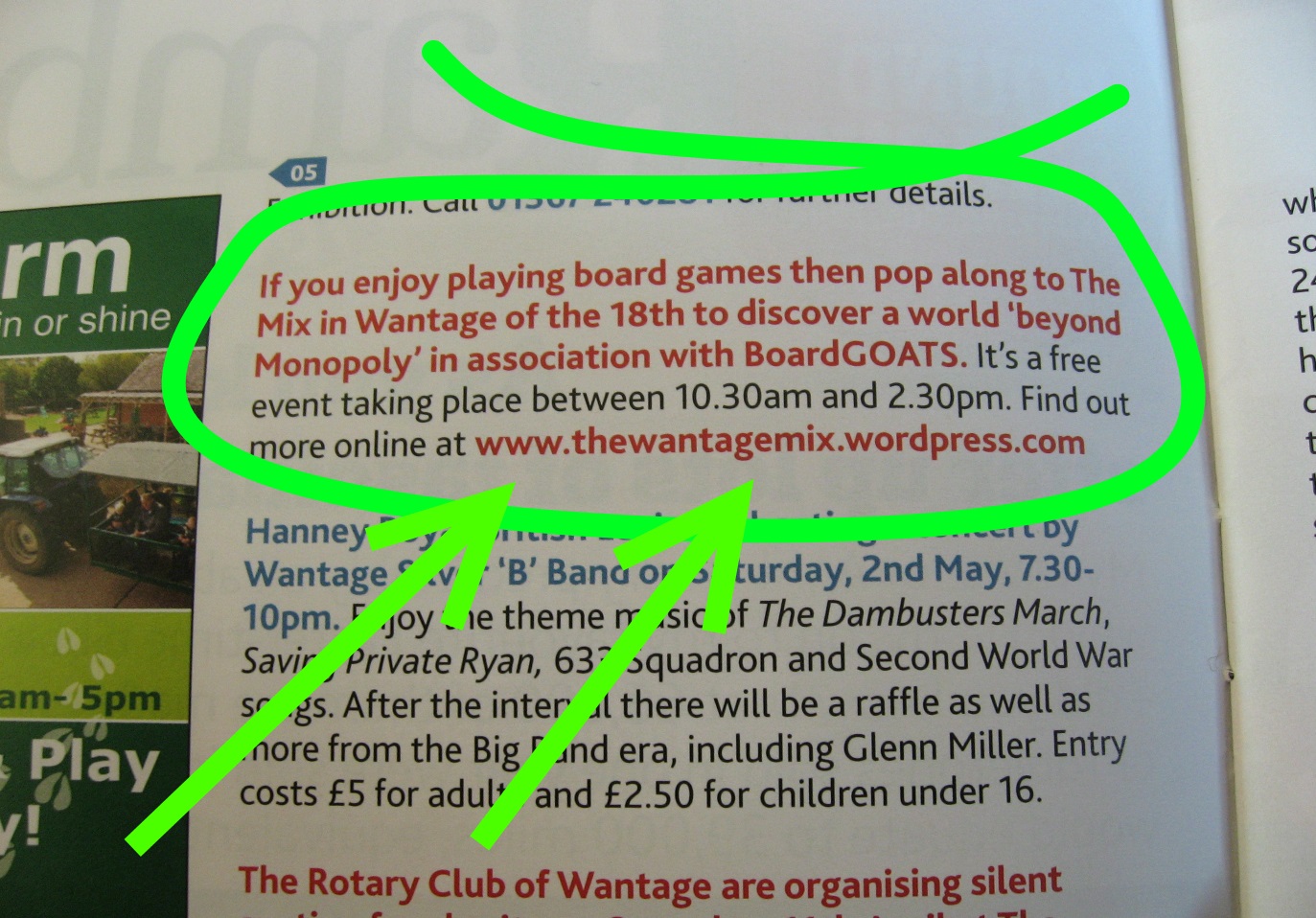
The event has been well advertised and was mentioned in the Ramblings section of the April edition of the local magazine, “Round and About”, so we are hoping for a decent turn-out.  Please pop in if you are in the area on Saturday.

Save the Date: Mixing it in Wantage

The Mix in Wantage town centre is a community space that can be booked for use by local groups, organisations, businesses and individuals for activities, fund-raising, meetings, workshops, and presentations etc.  For four days a week The Mix is used as a ‘hot desk’ area for local people to use as a space to work from in town, however, Saturdays and evenings are available for local groups and community events.

The Mix
– Image from thewantagemix.wordpress.com

We will be holding a gaming session from 10.30 am until 2.30 pm on April 18th 2015.  There isn’t an awful lot of space so the idea is to encourage people to drop in and play a short game or two, so we will be bringing along things like PitchCar, Riff Raff, Dobble, Turf Horse Racing, No Thanks!, Walk the Plank!, The Great Balloon Race and some of our other favourite filler games.

Riff Raff
– Image used with permission of
BGG contributor punkin312

13th January 2015

With several new people, we started with two sets of parallel games.  The first group began with Zombie Dice, a very quick dice game where players are zombies and the dice are their victims.  On each turn, players first roll three dice:  a brain symbol is worth one point at the end of the round, while footsteps allow that die to be re-rolled.  On the other hand, shotgun blasts are bad, and collecting three ends the players turn and they forfeit any points they’ve collected. After rolling their first three dice, players can then decide if they want to score their current set of brains or whether they fancy pushing their luck by grabbing a new set of three dice and rolling again.

Zombie Dice
– Image used with permission of BGG contributor zombiegod

With Grey taking his first win, Red convinced the group to play one of her favourite games, Walk the Plank!.  This is a very silly game that we’ve played a lot over the last year and everyone seems to enjoy.  There were the usual hoots of delight as kamikaze pirates committed mass suicide and everyone enjoyed it so much, that after Grey had taken his second win, they played it again.

Walk the Plank!
– Image by boardGOATS

While Cerise was chalking up her first victory, the second group were finishing their game of King of Tokyo, the “Feature Game”.  This was a “Black Friday Special” and is another fun dice rolling game.  The idea is that players are mutant monsters, gigantic robots, and strange aliens – all of whom are destroying Tokyo and attacking each other in order to become the one and only King of Tokyo.  Each player has a stand-up monster, a counter and everyone sits round a board depicting Tokyo.  On their turn, players roll the six oversized dice with four possible outcomes: numbers (potentially leading to points), attack (a paw print), healing (a heart) and energy (lightening bolts).  In order to score victory points, the active player must roll at least three of the same number.  Thus, three “twos” will score two points, but each additional “two” will deliver an extra point (so four “twos” would score three points etc.).

King of Tokyo
– Image used with permission of BGG contributor henk.rolleman

Any attacks rolled are delivered to the monster who is currently in Tokyo unless that is the active player, in which case, everyone else receives the damage.  Each player starts with ten lives and each attack die costs one.  Whenever the player in the middle is attacked, they have to take the damage, but can then chose to leave the middle, to be replaced by the player who attacked them.  Moving into Tokyo has its advantages and disadvantages:  players score a point on going in (with two more if they are still there at the start of their next turn) and they can cause everyone else a lot of damage, however, they cannot using healing dice while in Tokyo which makes it risky to stay.

King of Tokyo
– Image by BGG contributor rothkorperation

Finally players can also collect energy tokens which are a sort of currency and allow players to buy cards which give their monster special powers.  The winner must either destroy Tokyo (by collecting twenty victory points), or be the only surviving monster once all the fighting has ended and all the others have died.  Green started off well, with Burgundy and Indigo in hot pursuit.  Blue seemed unable to get anything she wanted, so took great delight in seeing everyone else reduced to a very small number of lives.  Burgundy was two points ahead of Green, but it was Green’s turn and he ended the game with a gambol rolling five “threes” and finish as the King of Tokyo.

King of Tokyo
– Image used with permission of BGG contributor dekedagger

With the end of both games and the arrival of Purple and Black, we had a quick shuffle of seats and Cerise replaced Green to play another game that has been popular recently, Splendor.  This is a simple set collecting game where players collect gems that they can then use to buy cards which in turn allow them to buy more cards which are worth points and help them to collect “nobles” which give even more points.  The game started slowly with all the basic cards gone and nobody looked close to winning.  However, Blue knew she’d done something right when there was a chorus of disappointment from Cerise and Burgundy when she reserved a high scoring opal card, a trick she repeated the following round.  Buying one of the opal cards enabled her to win two nobles giving her nine points in one turn and putting her over the finishing line, with Indigo finishing just one point behind after a last minute surge.

Splendor
– Image used with permission of BGG contributor henk.rolleman

Meanwhile, the other group were playing Stimmt So!.  Although we’ve not played this for a while, we have played the closely related game, Alhambra which uses the same mechanic.  The idea is that players have a choice of actions:  they can buy commodities, or they can go to the bank for money.  There are four different legal tenders and the cost of each commodity must be paid in the specified currency.  When making purchases (of shares in Stimmt So! or of buildings in Alhambra), players can always over-spend, but if they pay the exact amount they can have an extra turn.  Thie extra turn can be used to either buy another item or to take money from the bank.  If they chose to make a second purchase, they can again pay the exact amount and get another turn.  Play continues in this way until the player no-longer qualifies for another turn or all the available stock has been purchased after which, the stock is refilled for the next player.  Thus, the game is a balance between collecting small denominations of the different currencies (which are more versatile) and collecting larger denominations (that are worth more).  The points are awarded at stages during the game to players with the most of each commodity.

Stimmt So!
– Image by boardGOATS

It was a slow start as people built a stock and cash and very few shares were bought. Then, as each person built up a usable amount of money the game took off.  Black quickly took control of the Petrol market with three shares and everyone else built a small portfolio. Grey followed Black’s lead and went for an early lead in Banking.  The first scoring round came along quite quickly and with almost nothing in it and then the game was really afoot.  Purple decided to challenge Black’s dominance in Petrol and Grey added to his Banking stocks.  Airlines, Computing and Entertainment were all hotly contested, but Automobiles remained obstinately absent despite an interim shuffle!  The second scoring came with a range of winners and losers and Black, Grey and Red stretched a small, but significant lead over Yellow and Purple with Green at the back who had been refusing to overpay for anything, plenty of cash, but few shares!  Going into the last round, there were several cards that nobody wanted as they could no longer even share the lead, but eventually people started buying and Automobiles finally made an appearance.  This got the game moving and the final shares came and went in short order.  Black managed to shrug off falling oil prices and finish just ahead of Red, a canny second, demonstrating that not putting all your eggs in one basket can be a good idea.  Grey was not far behind demonstrating that putting all your eggs in one basket is still a not a bad strategy though!

Stimmt So!
– Image by boardGOATS

Splendor finished first, and Indigo was persuaded to play one more game before she had to leave.  As we wanted something fairly quick, we opted for a card game and chose Coloretto.  This is a cute little set-collecting game that inspired, the perhaps better known, Zooloretto.  The aim of the game is to collect sets of cards with the largest three sets scoring positively, and the reset all giving negative scores.  Thus, on their turn, the active player can either draw a coloured chameleon card, or take a “truck” and all the chameleons on it.  If they draw a card, they have to choose which truck to put the chameleon on, trying to make the trucks contain a combination of colours that suit them, but not everyone else.  Alternatively, they can choose take a truck, trying to match the colours on the truck with the sets they already have and  minimise their losses.  This was quite a close game until suddenly, in the final round Indigo drew an orange chameleon which we hadn’t realised had been hitherto missing from the game.  We inevitably blamed the shuffler as all the orange cards turned up together.  Blue managed to avoid picking any up however, and finished just two points ahead of Burgundy.

Coloretto
– Image by BGG contributor SergioMR

In the meantime, Green, Grey, Black and Purple started a game of Click & Crack.  This is one of last year’s “Essen Specials” and has proven to be a fantastic little filler game.  Each player has two penguin counters.  They take in turns to place them on an ice floe made from twenty-five tiles arranged to form a five by five array.  Each player also has two tiles depicting an arrow.  Once the penguins have been placed, players choose a direction for their arrow tiles and reveal them simultaneously. Then, starting with the first player, each player picks a penguin and applies one of their direction tiles.  They can either move the chosen penguin in the specified direction, or the penguin stamps on the ice and causes the floe to crack in the specified direction.  When a crack has been completed so that it divides the floe into two, the player who played the final crack wins the smaller piece of ice and takes the tiles and any penguins caught on it.  Each floe tile is worth one point at the end of the game and each trapped penguin is worth minus one point.

Click & Crack
– Image by BGG contributor thir_teen_

The game ends when one player has at least seven points, or when the main floe is less than seven tiles in size or if there are three penguins left on the floe.  The game went all Purple’s way.  First she broke off a massive piece of ice and trapped a few penguins in the process.  Then before anyone else could do very much, she broke off another large piece capturing a few more penguins and finished the game with eight points and only Black scoring: a paltry two.

Click & Crack
– Image by BGG contributor smn1337

While the penguins were busy finishing up, Cerise (aided by Burgundy), gave Blue a sound thrashing at Dobble (an old favourite that we’ve not played for ages) before the late night brigade started the last game of the evening, Lancaster.  As it was his new game, Green had been absolutely desperate to play it, so despite the lateness of the hour, we gave it a go.  The game is a worker placement game themed around the House of Lancaster, played over five rounds, each consisting of several phases.  First, players take it in turns to place their knights.  Knights can be placed in the counties, or in the a player’s private castle or they can be sent off to fight against the French.  Knights have a rank (one to four).

Lancaster
– Image used with permission of BGG contributor henk.rolleman

When knights are placed in the counties, this rank can be augmented by the addition of squires, but once a knight has been placed, it can be usurped by a higher ranking knights (or a knight with sufficient squires to give it a higher rank).  In this case, the knight is returned to the player, but any squires are returned to the supply.  This means that players might be quite cavalier about knights, but tend to be much more parsimonious when assigning squires.  Winning a county enables players to choose either to recruit a noble, or to perform a one off action associated the county, or, alternatively, on payment of three coins, they can do both.

Lancaster
– Image used with permission of BGG contributor Toynan

If they win a war, the knights sent off to fight the French win points, with the largest contributors (highest combined rank) scoring most heavily.  However, they also receive an immediate benefit which can be monetary or in the form squires or nobles etc..  Knights placed within the castle also give a one off benefit, although it is received later.  The knight’s rank is immaterial for castle placements (as they cannot be usurped) and there is no possibility of victory points.

Lancaster
– Image used with permission of
BGG contributor kopernikus

Once all the knights have been placed, it is time for Parliament to vote on changes to the laws.  The laws basically provide scoring bonuses and other benefits.  At the start of the game there are three laws in place and three new laws that players will vote on.  These three new laws are considered one at a time and the group votes on whether they should be kept (pushing out one of the old ones) or rejected.  Players get one vote each for each law, but can reinforce their vote with votes provided by nobles (and via other means).  After the voting, the other rewards are handed out:  for occupying the counties, for knights placed in castles and for winning wars.

Lancaster
– Image used with permission of BGG contributor punkin312

Although everyone broadly understood what they could do, nobody really fathomed how everything fitted together.  So, different players tried different strategies.  Blue decided that the she couldn’t turn down the thirty-six points awarded at the end of the game for a complete set of nobles, so went for that.  Burgundy was more canny, however, he also went for the nobles, but picked up a lot of them through the one off reward provided by going to war with the French.  This way he also got victory points as he went along.  Green also tried to pick up points in the battles, but focused on trying to build up the strength of his knights and manipulate parliament. Black tried to reinforce his castle to deliver regular rewards with little input, while Purple tried a little bit of everything, just doing as much as she could on each turn.

Lancaster
– Image used with permission of BGG contributor kilroy_locke

Burgundy led the charge with Green, Black and Purple close behind.  Since Blue was focusing on collecting her set of nobles, she hardly shifted from zero for the first four rounds.  Going into the final round however, it was suddenly everything to play for.  Everyone had got the hang of how to use their knights and how the laws worked and knew what they wanted in the final round, but that did not mean they were going to get it!  Knights were placed and then unceremoniously stomped on by more powerful knights with several high ranking knights being placed with four or five squires in reinforcement. Blue and Burgundy both picked up their full compliment of nobles (just) and Green was outvoted when he tried to get his preferred law through.  Black scored for his castle and Purple managed to change the law to convert her mass of coins into points so that she scored heavily.  With her full set of nobles, Blue surged forward into second place, just ahead of Purple, but it was all way too little too late; nothing could match Burgundy’s commanding lead and he finished nearly sixteen points clear of the field.  Although there were a number of rules that we played incorrectly and a number of points that need clarifying, it was Burgundy’s superior strategy, played out to perfection that won the game.

Lancaster
– Image used with permission of BGG contributor kilroy_locke

Learning Outcome:  We really need to learn how to shuffle.

16th December 2014

This week we stuck to “old favourites” and started off with the quick fun and very silly game that is Walk the Plank!.  We’ve played this a few times before, and we always play to the “last pirate standing”.  Since Red had chosen the game and White had not played it before, Blue started off by shortening the plank and pushing Red off the end.  This set the tone for the game with Red taking her revenge on Blue and then White joining in the fray.  A few rounds in and with one Blue and a couple of Red pirates down, it was Blue’s turn to start.  All three of White’s pirates were perched precariously on the end of the plank with Red’s one remaining pirate, so the game ended suddenly with a very loud splash when Blue inevitably shortened the plank…

Walk the Plank!

With the arrival of Purple and Black (and their pizza), we decided to play another of Red’s favourite games, Bohnanza. It’s amazing how a game that so many people feel is such good fun, sounds so totally uninteresting when it’s explained.  True, as White pointed out, this applies to quite a few games, but Bohnanza is definitely the “poster child”.  After a quick rundown of the rules, we began. Purple was very generous, offering beans for free at regular intervals, though of course she had an ulterior motive. However, otherwise, as Black commented, “It’s a tough crowd tonight,” as deals were pushed and even turned down.  It was fitting therefore, that such a tight game should end with a draw, with Red and Blue sharing the honours.

Bohnanza

Next, we decided to play something a little deeper and, after some discussion, we opted for one of this years most popular games: Ivor the Engine. Although we’ve played “Ivor” a lot at games night, Red and White were both new to it. It’s a cute little game, though it has a sharp edge if you want to play it that way. With a full compliment of players, it was always going to be a fairly tight game, and although Blue started well with a couple of jobs at Mrs Porty’s House, everyone else struggled as Purple got in their way.  Blue was promptly penalised for her good start though, when the first event card came out and caused the leader to lose sheep.   Since everyone else had now cleared sheep from the locations that corresponded to their cards, Blue was then suddenly left behind.  As everyone galloped on, Red, managed to pick up eleven sheep with one visit to Tewyn!  Black was closing in on the finishing line, when Blue managed to complete a couple of jobs at Dinwiddy’s Goldmine and use the gold to buy a couple of event cards.  That tipped the balance in her favour and she finished just ahead of Black.

Ivor the Engine

We finished the evening with a few rounds of No Thanks!.  This is another game we used to play quite a bit, but hadn’t played for six months.  It is such a simple, push your luck game that experience isn’t necessary, and it really brought out White’s vindictive streak.  After three games, honours finished about even and it was home time.

No Thanks!

Learning Outcome:  Old favourites are still favourites, and for a good reason.

1st July 2014

Pizza was the order of the day, so while we were waiting for it to arrive, we played a quick game of Walk the Plank!.  This is a very short game of kamikaze pirates that we’ve played a few times before and is great fun so long as everyone plays it in the right spirit.  We started by shortening the plank, so everyone had no choice…  Very quickly, most people had lost a pirate and the plank was only one square long.  Red had all three of her pirates perched precariously on the end of the plank when the inevitable happened and in they all went and out went Red.  Yellow quickly followed, then Green,  leaving Orange and Blue to fight it out with their last remaining pirates (although the rules say the last two players share the victory, we play hard-core and stick it out to the end).  Blue had the advantage of going first, but with both Pirates on the ship one remaining piece of plank between them and certain doom, it needed a bit of thought before she could finally secure victory.

Walk the Plank!

By this time, pizza had arrived and so had more players, so we decided to play our “Feature Game”, Spanish Bohnanza which we could do while munching.  We’ve played this a lot before and always enjoy it, even though it sounds really unpromising when you explain it.  With two players new to the game, we played nicely and before long everyone was happily planting “Judías” and trading “Cafeterías” for “Hippies” and “Bills” for “Booms” – and we had all thought the names were funny in English!  It was a very tight game with Blue finishing only one point ahead of Black and Red who were joint second.  Whenever there are new players in a game, we usually let the experienced players go first as it takes the pressure off a little and means that they get to see how it is done.  Unfortunately, this meant that the last two players, who were also new to the game got one fewer turn which could have made quite a large difference given how close it was and, on reflection, it was an effect that was exaggerated with so many players.  So, if we remember, perhaps we’ll house rule it in future and turn over the draw pile one last time and make sure everyone gets the same number of turns.

Bohnanza

An early start for work the next day meant a few players left early and the rest played Ivor the Engine.  This is a clever little game that features the iconic art-work from the Ivor cartoons as drawn by Peter Firmin.  We’d not played it before in the group, although several players had played it at the UK Games expo where it was first released and we talked about it a few of weeks ago.  The idea is that players are travelling round Wales collecting sheep and the person with the most sheep at the end of the game is the winner.  A single sheep can be collected whenever you start your turn on a town or village with sheep in it, however, more sheep can be collected if you are in a town or village with NO sheep and perform a task to “help Ivor”.  Helping Ivor comes at a price, however, as in order to do this you have to play one of the dual-purpose cards from your hand, which means you cannot use it to help you in other ways.  At the end of your turn you add one card to your hand from the face up displayed cards, however, when the chosen card is replaced from the draw-pile, the game has a sting in the tail:  mixed in with the errand cards are event cards, and these can be nice, or nasty…

Ivor the Engine

Once the game had been set up and sheep sprinkled liberally over the Welsh hillside, players carefully chose the starting points for their waggons.   Within two turns however, the first event card came out and moved everyone to Tewyn.  As almost nobody had any sheep, most of us had no choice, much to the chagrin of Green who had chosen to start in Tewyn and, by the time his turn came round, all the sheep had gone and everyone else’s waggons were in his way.  Nevertheless, Green started well with a couple of very lucrative errands, followed by Black.  Purple meanwhile, was the only player who had been able to avoid the enforced relocation to Tewyn, and was making good progress in the “Grumbly” area of the board.  Blue was feeling more than a little hard-done-by, when she found herself stuck in Ivor’s shed by a nasty, vindictive move from Green, who helped himself to a couple of “lost sheep she’d been eyeing up at the same time.  He couldn’t afford to stick about for long though, and eventually Blue managed to cash in three errands, finally getting going at last.

Ivor the Engine

As the game progressed it became clear that the excellent start made by Green was gradually being eroded by Black who, with extra experience, was clearly the player to beat.  Purple picked up a very lucrative event card giving her lots of extra sheep at the end of the game and Blue carried out a couple of errands and Mrs. Porty’s House, keeping them both in the game.  Green meanwhile got in Black’s way and managed to prevent him from picking up his critical twenty-fifth sheep, thus prolonging the game for an extra round, giving everyone else a chance to play that last card.  That last turn made the game very close, but Green and Blue failed to catch Black and who won on a tiebreak.  Next time…

Ivor the Engine

Learning Outcome:  Spanish judías and German böhns are funnier than English beans.

20th May 2014

This week we started out with our “Feature Game”, Walk the Plank!.  This is a fun, light-hearted little game with a lot of chaos and not a few kamikaze pirates.  The board is set up with a “ship”, three plank segments and “the sea” and each player starts with three pirate meeples on the ship.  At the start of a round, everyone chooses three cards from their hand and places them face down, in front of them.  Each card has an action:  “Shove Anybody”, “Retract the Plank” and “Extend the Plank”, for example, enable a player to push another persons meeple closer to the sea, shorten and extend the plank respectively.  Each round then consists of each player taking it in turns to turn over the top card and do what card says.  Because players choose the cards and the order they will play them in at the start of the round, by the end of the round everyone is just trying to make the best of an increasingly worsening situation, and rounds often end with a lot of pirates perched on the end of the plank waiting for the last card to seal their fate.

Walk the Plank!
– Image by BGG contributor TheBoardGameFamily

Blue and Green’s fate was sealed first in a manic pirate suicide pact, shortly followed by Red.  With a two pirates to one advantage, newcomer Orange always had the advantage over Yellow.  As Yellow shortened the plank, the end became inevitable and, although Yellow took one of Orange’s meeples with him, Orange chalked up her first victory.

Walk the Plank!
– Image by BGG contributor onorc

After a lot of debate about what to play next, Blue suggested Ra, as she’d never played it and it is a classic and is supposed to be one of the best (if not the best) of the auction games available.  Green said he’d played it once, a very, very long time ago and hadn’t liked it, but was happy to give it another go and see if that opinion was justified.

Ra
– Image by BGG contributor Stas

This game is an unusual and very clever auction game.  Basically, players take it in turns to pull tiles from a bag and tiles can be good, bad, or they can be “Ra” tiles which start an auction.  The auctions themselves are curious affairs: each player has three tokens that they use for bidding, each with a unique number.  Thus, the person with the highest value can always win if they choose to, but once the auction is over, the token is placed in the middle and effectively becomes part of the stash for the next auction.  The game comprises three rounds, each with ten to twenty auctions, however, each player can only win a maximum of three  in each round (i.e one with each token).

Ra
– Image by BGG contributor blakstar

Those who had played it before had a better appreciation of the importance of the high value tokens.  Blue didn’t and squandered the higher tokens she started with.  With little or no choice in the auctions, she resorted to “turtling”, which in this context involved trying to minimise the effect of the higher tiles.  Instead of drawing a tile from the bag, the active player can also call “Ra!” and start an auction and this is what Blue did.  A lot.  An awful lot.  As the bidding starts with the next player, this meant blue would bid last, but Blue was committed to bidding if no-one else did.  With some of the lowest tokens, she had little to lose if forced to bid, and set her sights low, going for a “try not to loose points” strategy coupled with a small number of river tiles and trying to stay ahead with green Pharaoh tiles.

Ra
– Image by BGG contributor Stas

Moving into the final round, Red was collecting monuments, Yellow had built up a sizeable river, Green was going for Civilisation tiles and Orange was trying to do a little bit of everything.  Meanwhile, Blue was still calling “Ra!” at almost every opportunity, hoping to win something useful with her “one”.  Thanks to Yellow failing to get a “flood” tile to activate his enormous river (there was one left in the bag at the end), Yellow didn’t accrue the massive score expected and surprisingly, Blue nearly made it.  However, although her strategy had overall not been a bad one, on reflection, the game was probably ruined by Blue’s repeated small auctions.  Although Green was slightly more enamoured by the game than he was the first time he played it, the overwhelming opinion seemed to be in favour of not playing it again soon.

Ra
– Image by BGG contributor usagi-san

We cheered ourselves up by finishing with an old favourite, Bohnanza.  Also universally known as “The Bean Game”, we’ve played this quite a bit, so it was relatively quick to get started.  Only Orange was new to it, and as the rest of us know it so well, it was a very close game.  Blue started off strongly but slowed towards the middle of the game when Orange got the hang of it and Yellow and Red started trading efficiently.  The game finished with only a couple of points between the places and Green ran out the winner, only one point ahead of Red and Orange who tied for second.

Bohnanza
– Image by boardGOATS

Learning Outcome:  Sometimes an otherwise good strategy can ruin a game for everyone.