Author Archives: nannyGOAT

Next Meeting, 5th April 2022

From the start of April, we are moving back to Tuesday nights, so our next meeting will be on TUESDAY 5th April 2022.  As usual, we will start playing shorter games from 7.30pm as people arrive, until 8pm when we will start something a little longer (table is booked from 6.30pm for those who would like to eat first).

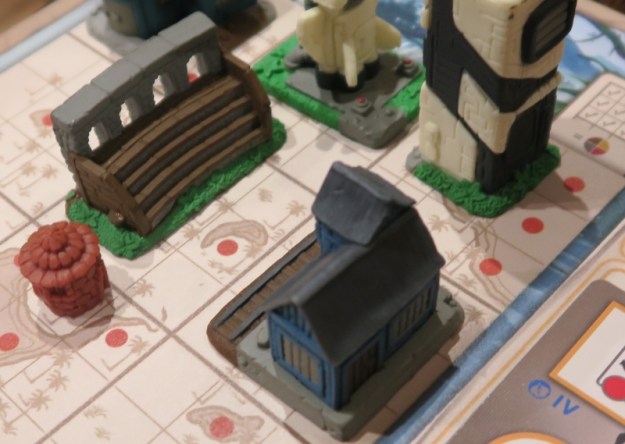
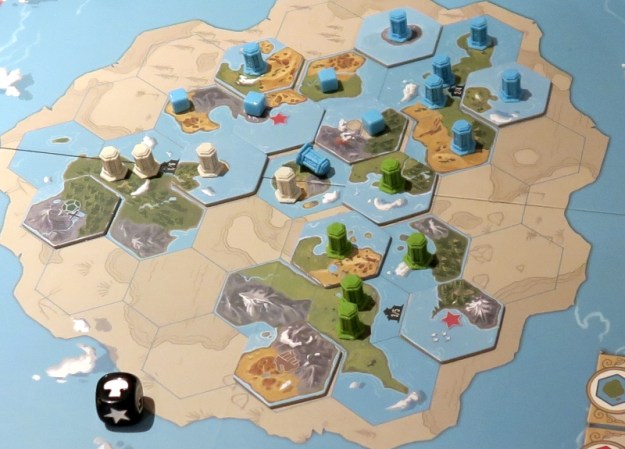
This week, the “Feature Game” will be the Prelude expansion (rules & review) for Terraforming Mars (rules & how to play video).  Terraforming Mars is a card-driven engine builder game based round a central player board.  Players take the roles of corporations sponsored by the World Government on Earth to initiate huge projects to raise the temperature, the oxygen level, and the ocean coverage until the environment on Mars is habitable.  Players work together on the terraforming process, but compete for victory points.  The Prelude expansion accelerates the start of the game and provides a boost to players’ engines by the addition of Prelude cards at the start of the game.

Terraforming Mars
– Image by boardGOATS

And talking of outer space…

Joe was telling his cousin Jeff about his recent journey – he had just come back from the USA and was very proud of his new-found travel experience.

“Yeah,” replied Jeff, “I love to travel too.  Last year I went to Turkey and next year I’m going to India.”

Not to be out-done, Joe responded, “I’m saving up for a flight on the new Virgin Galactic space flight, I’ve already put my name down for it.  I want to fly to the moon!”

“Cool,” answered Jeff.  Determined to go one better, he added, “I’m waiting for the flights to the sun though.”

“How does that work?” asked his cousin, “Won’t you get all burnt up from the heat and stuff?”

Jeff paused for a moment.  “No,” he said thoughtfully, “We’ll just fly at night…”

24th March 2022

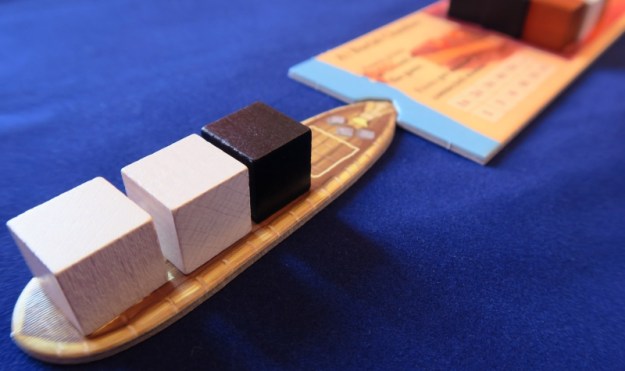
The evening began with Pine arriving first and wondering if he’d got the wrong night as it was gone 7pm before anyone else arrived.  While Blue ate her supper, Pine shared some “worm porn” (a video of a penis fencing flatworm) and Green shared his exploits on Board Game Arena.  Apparently he’d been playing Imhotep and had been doing rather well, rising to thirty-fifth.  After a lot of discussion about which game he was talking about, it turned out that by pure chance, a copy of Imhotep had made it to The Jockey.  In spite of Green’s enthusiastic request for someone to beat him, nobody looked keen to take him up on the offer.

Imhotep
– Image by boardGOATS

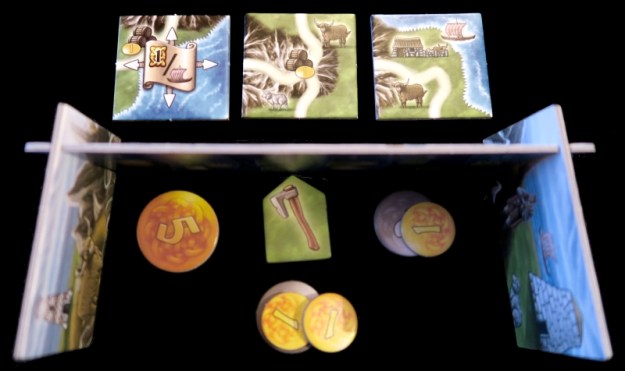
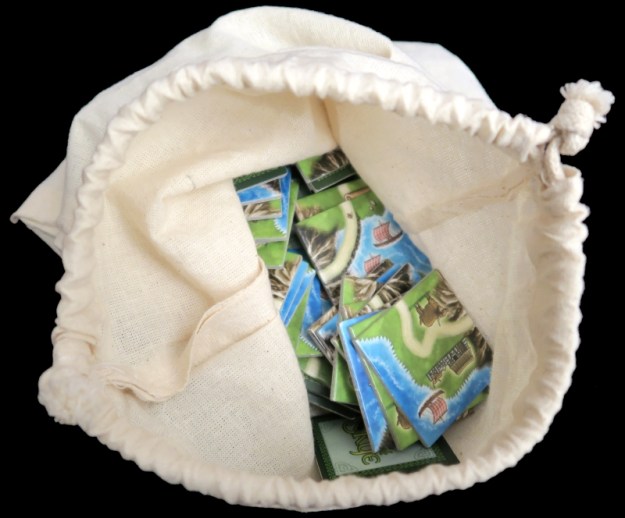
While the others discussed the options, Purple and Black joined Blue and Pine setting up the “Feature Game“.  This was the Druids expansion for an old favourite, the 2016 Kennerspiel des Jahres winner, Isle of Skye.  The base game is a tile laying game similar in nature to the popular gateway game, Carcassonne, but with an auction of tiles and objectives that give points. The auctions are extremely clever:  each player draws three tiles from a bag and privately decide how much two are worth, selecting one to be discarded.  Players use their own money to indicate the value and therefore the cost of the tiles.

Isle of Skye: From Chieftain to King
– Image by boardGOATS

After the values are revealed, each player then takes it in turns to buy one tile.  The clever part is that the money used to indicate the cost of each tile is reserved to pay for it until someone else buys it.  Any tiles that have not been bought after everyone has chosen and paid for one, must be paid for by their owner.  The reason this is clever is because of the effect it has on the amount of money that players have to spend.  For example, the first player in the round must make sure they have sufficient uncommitted funds if they want to be able to buy a tile.

Isle of Skye: From Chieftain to King
– Image by boardGOATS

On the other hand, the player at the end of the round has a different calculation to make:  if their tiles are priced to give good value they should sell at least one which will provide them with liquidity to buy other tiles.  However, being last in the round, their choice will be reduced, and if their tiles don’t sell, the fact the other tiles might be on the expensive side, could leave them unable to make a purchase.  It is not compulsory to buy a tile, but players that don’t have enough tiles are unlikely to score as well.  Thus valuing tiles is key—overvaluing their tiles is costly as nobody will buy them leaving their owner with a big bill and less money in the next round, while undervaluing them gives good tiles to an opponent and will leave their owner with less money and fewer tiles.

Isle of Skye: From Chieftain to King
– Image by boardGOATS

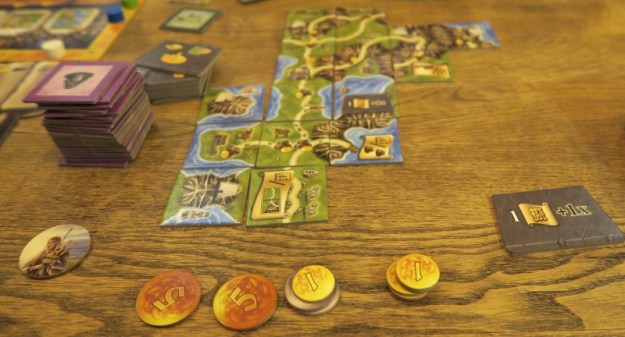
Once the tile auction is complete, players add the tiles to their own personal fiefdom.  At the end of the round, one or more of the objectives are scored.  Similar to Cartographers, there are four scoring objectives.  In the early rounds only one scores, with three scored in later rounds, but each one is scored the same number of times during the game.  Although this is an important source of points, it is not the only one as some tiles feature scrolls that score at the end of the game.  Players receive income at the start of each round, with players getting additional funds for each player that is in front of them, with the amount increasing as the game progresses.  As well as being a catch-up mechanism, this also importantly provides an additional channel for money to enter the game.

Isle of Skye: From Chieftain to King
– Image by boardGOATS

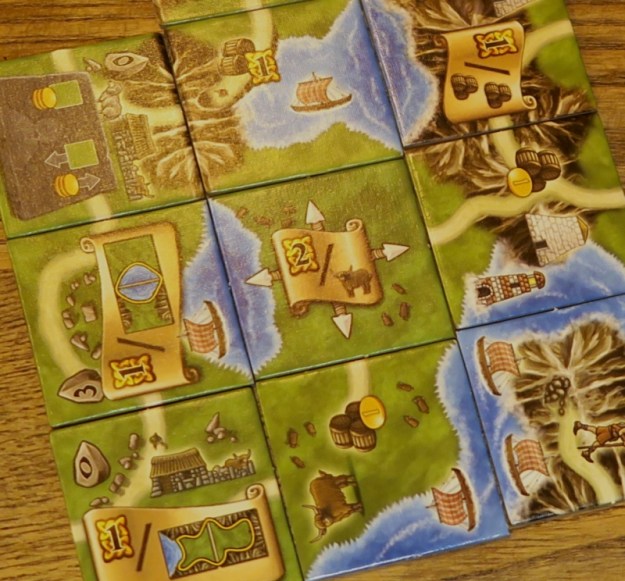
In addition to the auctions and the objectives, there are other ways Isle of Skye differs from Carcassonne.  There are no meeples, and players have their own maps instead of sharing one central one.  Even the tile placement rules are slightly different as terrain must match, but not roads (though it is generally useful if they do as it can increase players’ income).  Thus, although there is a superficial similarity with Carcassonne, Isle of Skye is distinctly more complex.  Unlike the first, Journeyman expansion (which we have not yet played), the second, Druids expansion doesn’t really increase the complexity.  It adds more strategy options though, with more scoring opportunities and additional ways to spend money (should you have any spare).

Isle of Skye: Druids
– Image by boardGOATS

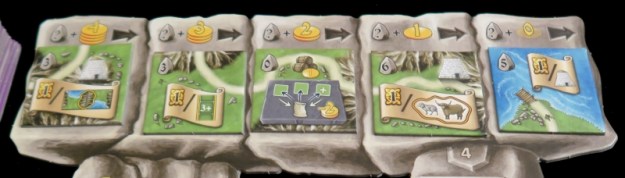
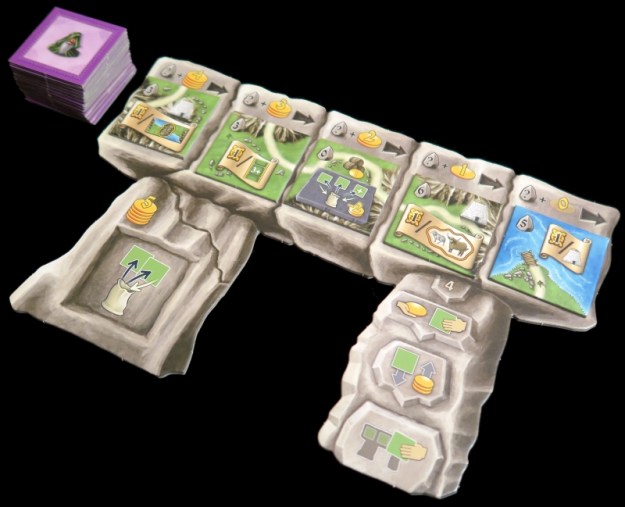
The Druids expansion adds a second part to the auction phase where players can choose to buy one from the five displayed on the dolmen board.  These are more powerful as they generally include scoring opportunities or special powers, but are correspondingly more expensive.  The end of round scoring tiles gave A) two points for each tile in players’ largest completed lake; B) a point for each cow or sheep on on or adjacent to a tile with a farm; C) two points for each set of four tiles arranged in a square, and D) one point for each row and column containing a Broch.

Isle of Skye: From Chieftain to King
– Image by boardGOATS

Pine took the first player token and Purple’s first draw gave her one of the promo tiles from the Themenplättchen mini expansion which was immediately thrown back for causing too much brain pain to work out what it did.  Pine and Blue took an early lead at the end of the first round scoring for their lakes, but it was only a handful of points and there was a long way to go.  Purple started building her long thin, rectangular kingdom prioritising income.  It wasn’t until the third round that the importance of this shape became apparent to everyone else however:  since tiles could be used to score multiple times for (C), this meant Purple picked up lots of points.

Isle of Skye: From Chieftain to King – Tunnelplättchen
– Image by boardGOATS

There was a bit of a debate about the Tunnelplättchen tiles from the two mini expansions.  Black checked on Board Game Geek and confirmed that tunnels going into the same mountain range connected together.  This helped Pine considerably, as otherwise he was in a bit of a mess.  Blue bought an exciting looking scroll tile that gave lots of points for enclosed pasture, but when Blue noticed that Black had it too, he commented that it was actually really difficult to enclose pasture, Blue took it as a challenge. It was shortly after this, about half way through the game that the group realised that they’d forgotten about the catch-up mechanism.

Isle of Skye: Druids
– Image by boardGOATS

From the third round, during the income phase at the start of the round, players get gold for every player that is ahead of them on the score track.  The amount of gold they get increases as the game progresses, so in the final round players get four gold for every player ahead of them—for the player at the back in the four player game, this comes to twelve gold, and for a player at the back until the start of the last round this comes to a total of thirty gold more than a player at the front.  Unfortunately, the group remembered this a couple of rounds too late, so everyone who wasn’t in the lead (i.e. everyone but Blue) received a nice little windfall that they could use to increase the price of their tiles or spend on the Dolman.

Isle of Skye: From Chieftain to King
– Image by boardGOATS

Black was making good use of the Dolman board and had some really juicy scoring scrolls in his tidy little kingdom and looked the one to beat, especially as he had plenty of cash too (helped by his windfall).  Pine, on the other hand was struggling to find anything useful and was resorting to using the alternative Dolman option: draw two tiles from the bag and keep one.  Unfortunately despite trying attempts, he wasn’t getting anything he wanted.  It was at the end of round five that things suddenly changed and Purple, hitherto drifting about in third and and fourth leapt forward, landing just one point behind Blue.

Isle of Skye: Druids
– Image by boardGOATS

Blue, having led throughout, knew she didn’t really have enough end-game points to challenge and was expecting Black to catch and overtake.  In the event, it was extremely tight at the front with Purple finishing with one hundred and two points, six more than Blue who just managed to hold on to second, two points ahead of Black.  All in all though, everyone liked what the Dolman board added to the game, as it gave people larger, more exciting kingdoms with something to spend money on (when they had it).

Isle of Skye: From Chieftain to King
– Image by boardGOATS

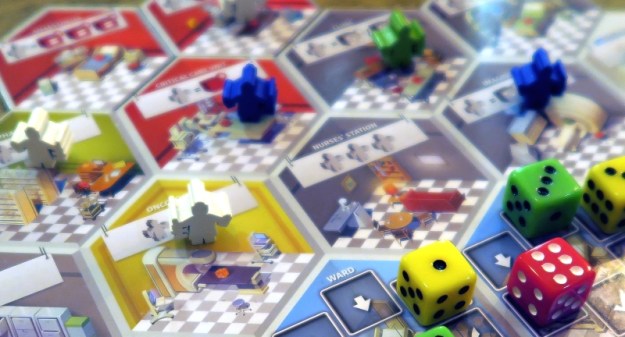
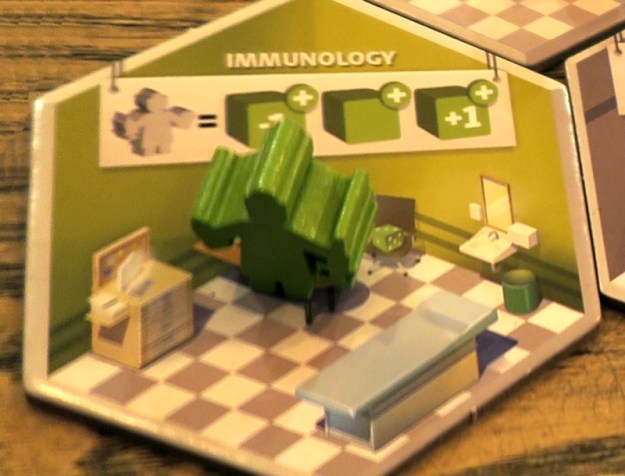
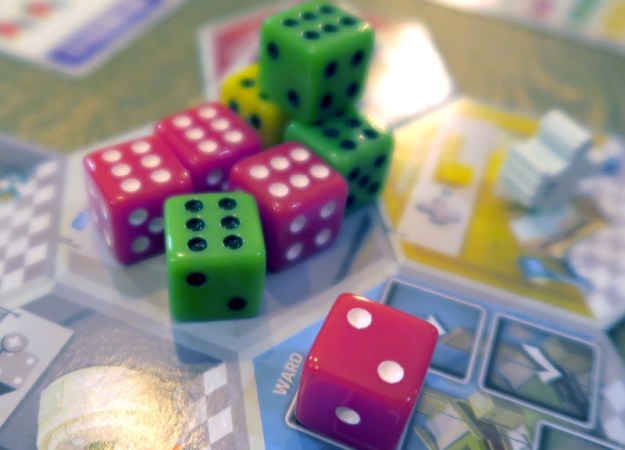
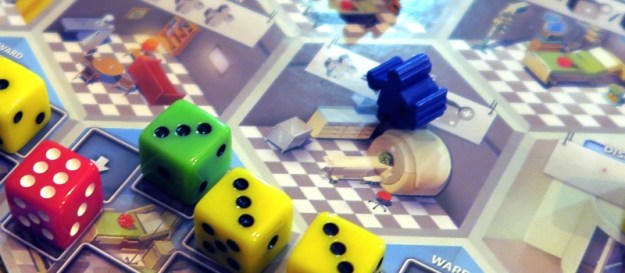
Meanwhile, the other group started by discussing what to play.  Imhotep was on the table, but Ivory spotted Dice Hospital in a bag and Green was happy to play that instead; as Lilac was familiar with it too she was happy with the switch, as was Teal, though he had not played it.   The explanation of the rules and game play took a little longer than the game itself would indicate.  The idea is that each play is the owner of a hospital and starts with an administrator which gives them a special power, three nurses, and three patients—dice drawn at random from a bag.  The colour of the dice represents their illness and the number on the face shown its severity:  six indicates they are healthy but if the number falls below one, the patient dies.

Dice Hospital
– Image by boardGOATS

At the start of each round, players take an ambulance with new patients – if there aren’t enough beds available, another patient must make space by moving to the morgue (where each body-bag is a negative point at the end of the game).  Players can then augment their own hospital by adding specialist medics and wards and finally, their medics can visit each patient and improve their health.  Different specialisms can only “heal” certain colours or numbers. Any patients not treated are “neglected” and their health deteriorates with any that fall below one moving to the morgue. In contrast, anyone who exceeded six is discharged at the end of the round, but the more that are discharged at the same time, the more points the player scores.

Dice Hospital
– Image by boardGOATS

As the game progresses, players continue to improve their hospital getting more specialists and acquiring blood bags to help treat their patients.  The game ends after eight rounds and the player with the most points is the winner.  When the group finally got underway it became clearer how to play and what actions were available.  The key to the game is knowing which specialists to get and which ambulance of patients to take – admitting healthier patients gives less choice of ward/doctor (and potentially get something which is of little use) , while curing the sickest patients is more difficult, but gives first dibs specialisms.

Dice Hospital
– Image by boardGOATS

The administrators dealt out at the start of the game can provide players with a direction for their strategy.  Teal and Green had ones that meant that they could leave one patient of a specific colour untreated per round without them declining. Teal was able to use his a few times, but Green found that he just could never seem to get enough red dice to make use of it.  Lilac was trying to get at least two red patients healed each turn as her administrator privilege gave her an extra point if she did; she managed it a few times (which was where the red dice kept going).  Ivory’s administrator would give him an extra point if he healed at least one patient of each colour which he managed to good effect several times.

Dice Hospital
– Image by boardGOATS

After a couple of rounds Green commented that he had found it was best to keep a balance of Ward’s and medics otherwise there either wasn’t enough staff to treat the number of patients, or there weren’t enough usable wards to send the your doctors to. Teal and Lilac were quite good at regularly healing patients, but at one at a time they were scoring only one point per round.  Each subsequent patient healed in a round scored an extra two points each With more than six worth three points extra.  Thus holding on to heal more per round, meant more points.  There was also a five point bonus for completely clearing the hospital, but nobody got close to that, except Ivory in the final round.

Dice Hospital
– Image by boardGOATS

Throughout the game, Teal and Lilac kept healing a steady trickle of patients. Green however was having all sorts of trouble:  he found himself with ward’s he couldn’t use, his hospital filing up rapidly, and started losing patients (minus two points)—his was definitely a Failing Trust!  Ivory, however, was romping away, keeping his hospital from getting over crowded and kept amassing points.  Although his start had been slow start and he didn’t score anything until the third round, he made up for it after that.  In the end Ivory proved to have run the best hospital trust, while Teal’s slow steady trickle worked out quite well as his hospital was the second best with Lilac was a close third.

Dice Hospital
– Image by boardGOATS

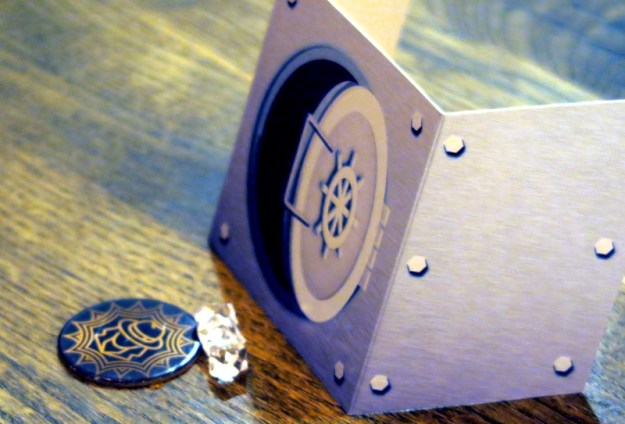
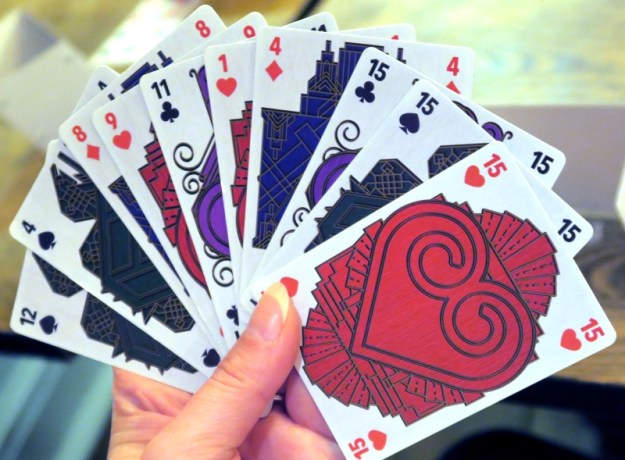
Ivory left for home, but Isle of Skye had not yet finished and, although there wasn’t time for Imhotep, there was still time for something quick.  So Teal introduced Green and Lilac to a game they’d not played before, called Diamonds.  This is a trick-taking game played with normal suited cards from one to fifteen where players are trying to win diamonds—not the suit, but the gemstones.  When players cannot follow suit they get to do a “Suit Action” based on what suit they actually play.  For example, playing a Diamond card gives one diamond gem from the supply placed into the player’s safe while playing a Heart gives one diamond from the supply to the pile in front of their safe.

Diamonds
– Image by boardGOATS

Similarly, playing a Spade allows the player to move one diamond from outside their safe into it, and on playing a Club the player steals one diamond from outside someone else’s safe and places it in front of their own. Additionally, at the end of the round of ten tricks, the player that won the most tricks in each suit gets to do that Suit Action one more time (in the case of a tie no-one does it).  With the game taking six rounds there is plenty of chances to gain diamonds.  It did not take long for the group to understand the game, although the for first few tricks the group were a little uncertain.

Diamonds
– Image by boardGOATS

Several times players found that although they had won, they couldn’t do anything as either the person they were supposed to steal from did not have any diamonds or, when they could move one diamond into their safe (from in front of it), they didn’t have any.  Plus, several times they found they had to steal from themselves so nothing happened.  The group also found that when they started to win tricks, they got control and were able to lead in suits the others didn’t have and so kept winning.  It proved to be a clever little game, but the group felt it probably plays much better with more people, so we might try it with a larger part of the group in future.  At the end of the game, however, Teal was the master diamond merchant with Green the apprentice.

Diamonds
– Image by boardGOATS

Learning Outcome:  A career in diamond trading is not for everyone.

Goats in the News: Kids Help with Hospital Stress

Baby goats are adorably cute.  Even watching just a few seconds of kidding around makes people smile and that alleviates stress.  It should be no surprise then that in a trial in Portland Oregon, baby goats have been found to help to relieve stress of staff an patients as reported by the BBC this week.  Hospitals are noisy, chaotic places which doesn’t help patients to recover or staff perform at their best.  They have designed gardens to reduce stress levels and, from time to time, a flock of two-week old baby goats come to visit.  Staff and patients alike report finding it very soothing and relaxing cuddling the little kids, even the video is cheering.  And the kids seem to like the attention too.

Baby Goat at Hospital in Portland Oregon
– from bbc.co.uk

– from twitter.com

Next Meeting, 24th March 2022

We are moving back to Tuesday nights from the end of the month, but our next meeting will be on THURSDAY 24th March 2022.  We will start playing shorter games from 7.30pm as people arrive, until 8pm when we will start something a little longer (table is booked from 6.30pm for those who would like to eat first).

This week, the “Feature Game” will be the Druids expansion for an old favourite, Isle of Skye (base game rules and expansion rules; video review of the base game).  Isle of Skye is a tile laying game similar in nature to to the popular gateway game, Carcassonne, but with an auction of tiles and objectives that give points.  The expansion adds a second set of tiles displayed on a dolmen that are more powerful, but are correspondingly more expensive.

Isle of Skye: Druids
– Image by boardGOATS

And speaking druids…

Jeff was out for a walk when he saw a Druid was worshiping on the river bank.  Jeff interrupted the Druid and asked why he was worshiping there.

The Druid explained, “I worship river tributaries. That way I get my powers before they become mainstream…”

10th March 2022

Green and Lilac were first to arrive followed by Blue, Black, Purple and Pine with Pink late to arrive as he was enjoying the seemingly random deployment of variable speed limits along the M42 (30 mph, really?).  The others had finished their supper and Pink was still dealing with his Ham, Egg & Chips, by the time everyone else had arrived and the great “who’s playing what” debate began.  Several people were interested in playing the “Feature Game“, the first Tapestry expansion, Plans and Ploys, but it proved difficult to confirm a group.  Despite enjoying the game, Blue was not up for something too thinky after a long week at work, and Jade (putting in a welcome return six weeks after his first visit) fancied something different.  In the end, Green joined Ivory and Teal over the other side of the room.

Tapestry
– Image by boardGOATS

Playing explanations were relatively quick, and even set up did not take as long as some heavier weight games. It turned out everyone was a relative novice with Ivory having played it twice, Teal only once (and that was online at Board Game Arena), and Green not at all.  Functionally, the game is quite straight forward, indeed the rules consist of just four, well illustrated pages.  On their turn, players either advance along one of the advancement tracks, or begin an era by taking Income.  The clever part is that the game ends at different times for each player — each player ends their game when they finish their final, fifth Income turn.  Thus, prolonging their eras means more turns which means more time to generate points.

Tapestry
– Image by boardGOATS

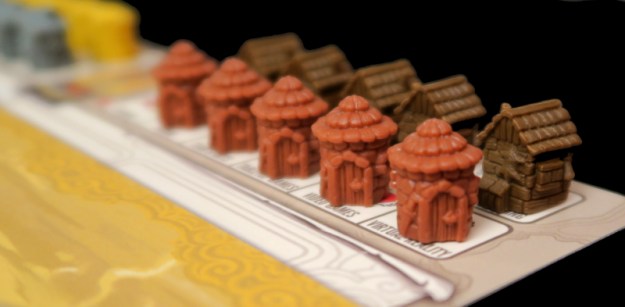
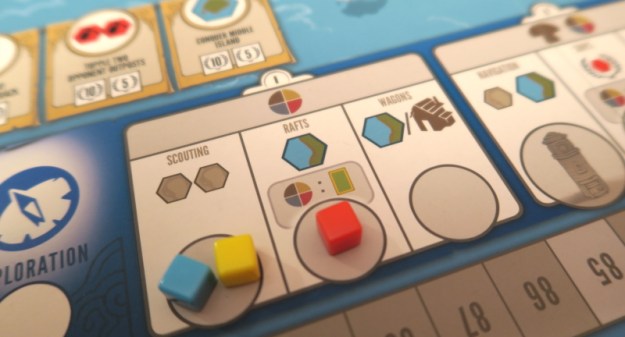
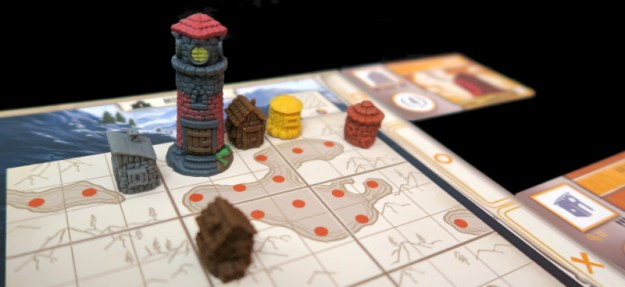
Otherwise the game basically proceeds with players paying the fee for the space they move to and then doing whatever the space they move to dictates, sometimes with an optional bonus action.  Often the action involves getting resources, but the four different tracks also allow players to claim space on the central map, gain technology cards (which give end game points as well as in-game bonuses), and build fabulous resin buildings in their capital city.  Although this is quite simple in concept, the depth of the game is in the cards and the asymmetry in the special powers associated with the Civilisations that players get at the start of the game.

Tapestry
– Image by boardGOATS

The expansion mostly just adds more of the same with new Civilisations, Tapestry Cards and space tiles.  The biggest difference is the addition of Landmark Cards which are designed to give each player a personal short-term goal in the first part of the game, in the form of buildings that only they can claim.  The first few turns required a little help from Ivory, but very soon everyone had got the hang of it.  The game is deceptively simple with only a few choices on each turn.  As a result, turns were very quick and the group soon felt comfortable.

Tapestry: Plans and Ploys
– Image by boardGOATS

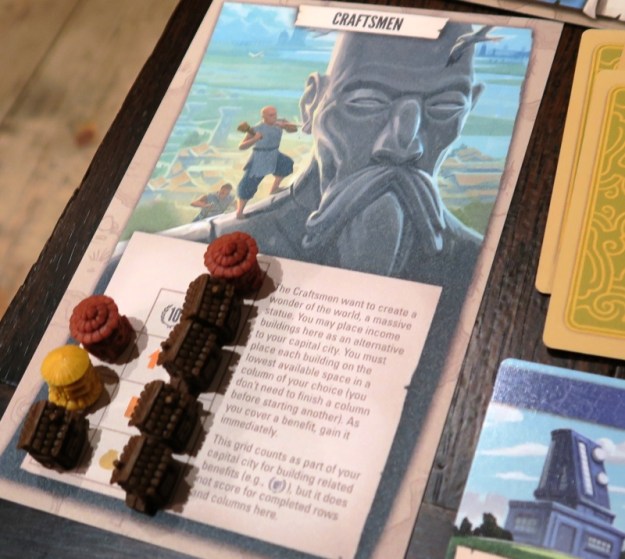
Teal started on the Exploration Track, just ahead of Green who also wanted to go down that route. Ivory started on Science, which also got him going on the Military Track.  Green had a plan and found Teal being one step ahead on the Exploration Track quite frustrating.  In no time players started taking their second Income turns. Teal snatched the first Exploration Building and concentrated on developing his island on the central board. Green was using the Explore options to build his little huts onto his Craftsmen Civilisation Card instead of on his capital city board, gaining benefits on the way.  Ivory was trying to get several different small buildings onto his city, and being the only one in Science he was unhindered in getting these to his board as well.

Tapestry
– Image by boardGOATS

Then much to Green’s delight, Teal changed tack and started on Military expansion.  Now that his island had grown, Teal needed to expand if he wanted to it to grow any more. His collection of unused land tiles then enabled him to gain him his personal Landmark, making him the first to do this. By now his score was racing ahead of the others even though Ivory had started with a twenty point boost thanks to the civilisation adjustments.  Green continued to concentrate on the Explore track and gained the next building and then revealed that his Landmark for the game had been to get the launch pad (third building on the Explore Track) and make it in to space. That had been Ivory’s strategy for his very first game too… “To get Meeples into Space!”

Tapestry: Plans and Ploys
– Image by boardGOATS

Teal’s island empire was ever growing and he was the first to get to the central island.  He was further helped by his Islanders Civilsation that enabled him to conquer an extra tile each Income round.  He wanted to make sure he kept a buffer to everyone else’s islands though as he did not want any toppling.  Ivory was flying up the Science Track by this time, getting other bonuses on other Tracks too, and his capital city was beginning to look a little crowded as well.  Ivory had also got a couple of Technology Cards to Green’s one while Teal eschewed Technology entirely.

Tapestry
– Image by boardGOATS

As the game looked like it might be drawing to a close, Teal had raced well ahead on points, although Green was starting to catch him while Ivory was trailing well behind. Ivory completed the Science Track, then just into his final era, Green made his final trip into space reaching the top of the Explore Track. Teal, for his last action, played an extra Tapestry Card and declared an “Alliance of Peace” between Green and himself, which instigated much spluttering and muttering from Green who had just settled on growing his empire with a plan to topple Teal in the centre island for his final turns.  With his carefully worked out plan in tatters he scrambled around to maximise the last few points, but probably lost some on the way.

Tapestry
– Image by boardGOATS

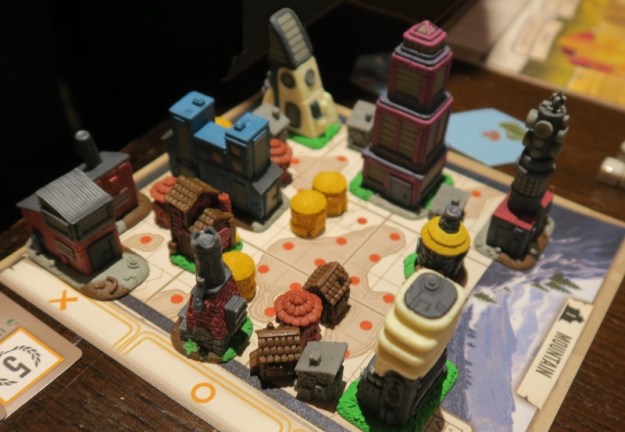
It was about at this point, Teal and Green realised that Ivory had still to collect his fourth Income round.  So with Green and Teal finished, Ivory started his “attack run” and was left playing alone.  His fourth Income gave him more than fifty points and he shot past both Green and Teal; both knew that they were going to be well beaten. This of course turned out to be the case, as in final income scoring Ivory lapped both his opponents and kept going lapping them a second time.  Although it had been an extremely dominant victory by Ivory (winning by over a hundred points), everyone had thoroughly enjoyed the game.  Although the game play is good, the icing on the cake really is the fabulous 3D buildings that come with it; cardboard counters would have been cheaper, but nowhere near as pretty or as satisfying.

Tapestry: Plans and Ploys
– Image by boardGOATS

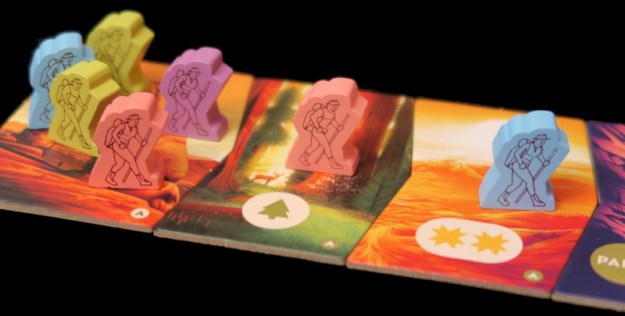
Meanwhile, after the game of PARKS last time, Lime had requested the chance to play it again, so Pink, Black and Jade joined him.  The game is reasonably simple, with players taking it in turns to choose one of their two hikers to move along the track, and then carry out the action dictated by the location.  The aim is to collect “memories” (or “resources” as most players think of them) to buy “trips to National Parks” (or Park Cards).  Lime and Pink ran through the rules as they had played it the previous week, discovering as they did so, a few deviations that had crept into the previous game.  These included the fact that the trail gets longer each round and a misinterpretation of one of the icons.  As last time, to keep it simple, the group decided not to include the personal bonuses, though they included the Parks Cards from the Nightfall expansion.

PARKS
– Image by boardGOATS

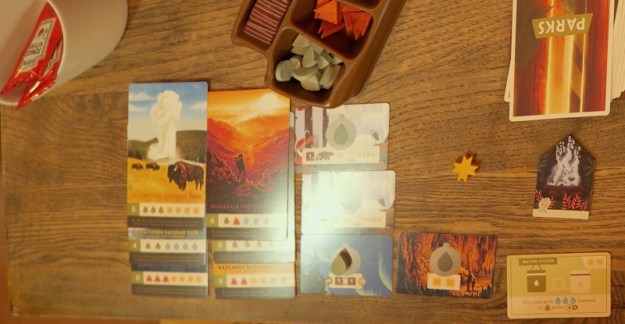
This time, Pink (playing what he thought was pink this time, not what he thought was orange, like last time), was fortunate in acquiring the Sunscreen gear card. This replaces Mountain tokens with Sun tokens when buying in Parks Cards and along with the canteen that provided two Suns, gave him a formidable points generating engine.  There was much conversation about whether sunscreen could let you replace ALL the Mountains with Suns for a single Parks Card, or just one. Based on the use of the plural in the rules, the former seemed more likely. However, it was an important point, so a drinks break was instituted whilst Jade consulted the the rules forum on the Board Game Geek website.

PARKS
– Image by boardGOATS

Results were inconclusive, so the decision stood (or to quote Pink who had been watching too much rugby, “On field decision is ‘Try’ — is there any reason why I cannot award the Try?”).  As last time, Lime went for a “reserve Parks Card and then work towards it strategy”, whilst Black, Jade and Pink only reserved cards occasionally.  This time, nobody seemed to want to take the camera: Pink got it at the start of the game, and despite him trying persuade people to take it, no one was having it, and he kept it until the end of the game, taking only the occasional photo (worth one point each at the end of the game).

PARKS
– Image by boardGOATS

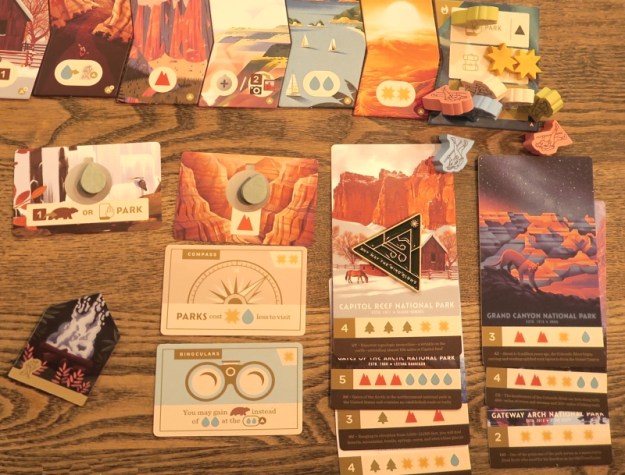
Jade picked up the compass Gear Card which came in very useful for collecting Parks Cards, while Black collected a store of emergency ketchup sachets.  Lime almost kept the start player marker from start to finish until Jade decided at the very end of the game, that he fancied that extra point and took it off him.  In the end, the Sunscreen strategy did it for Pink who won by a healthy margin of seven points, but otherwise it was really tight with just one point between everyone else and Lime and Jade tied for second place.

PARKS
– Image by boardGOATS

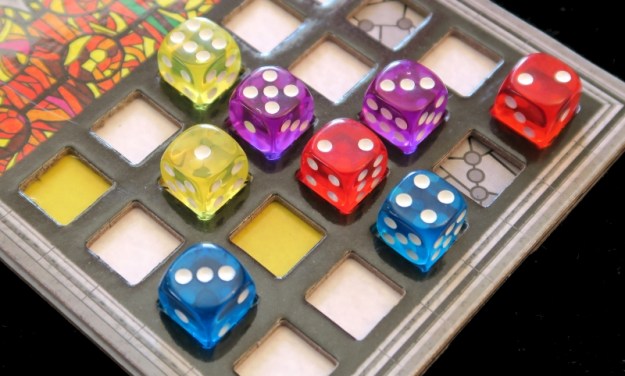
The third table were slow to get going with nobody being very decisive.  Eventually Blue suggested playing Sagrada and everyone else concurred.  We’ve played this quite a bit in the group since it was released five years ago, but it has been a little while and we were rusty on the rules and details of setup.  The idea of the game is very simple though:  In “Settlers Style”, players draft dice and add them to their player board.  Each die must be added according to the placement rules:  next to another die (orthogonally or diagonally) while not orthogonally adjacent to  a die of the same colour or number.  Additionally, at the start of the game, each player chooses a “window card” which dictates the numbers and colours of dice in some of the positions.

Sagrada
– Image by boardGOATS

The game is completed by Tool Cards which allow players to pay one of their limited number of tokens to briefly break the rules, and public and private objective cards.  Sagrada ends after ten rounds (twenty dice).  The group started with a lot of discussion about the private objective cards as some had snuck in from an expansion and confused everyone.  Once everyone was mostly happy with what they were trying to do, Pine started with the first draw.  Although he wasn’t aware of it at the time, his first placements turned out to be sub-optimal, as for the next few turns he had little or no choice in his placement and used up a lot of his most flexible spaces in the process.

Sagrada
– Image by boardGOATS

Purple and Blue tried to focus on the public objectives which were Shade Variety, Colour Variety and Row Colour Variety.  The latter pair fitted together very well since one gave points for each set of five different colours, while the other gave points for five different colours in the same row. Given that people were trying to go for sets of different colours and numbers, it was particularly amusing when the random nature of dice drawn from a bag and rolled gave a very limited selection, which only added to Pine’s woes.  The Tools cards weren’t terribly helpful either, especially as everyone was trying to save them for later.

Sagrada
– Image by boardGOATS

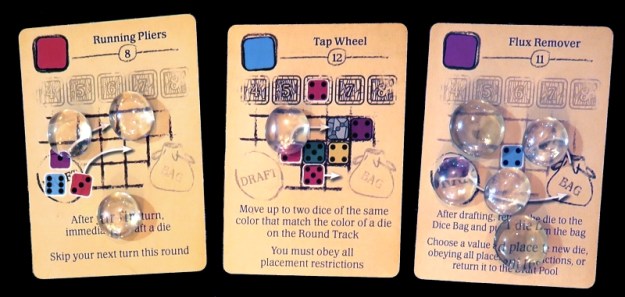
Lilac was the only one new to the game, but she got to grips with it quite quickly despite the fiddlyness of some of the rules.  When she realised she had got herself into a little bit of a tangle, she managed to extricate herself using the Tap Wheel tool which allowed her to move dice.  Lilac was very disappointed when she was unable to complete her window and had to leave a couple of spaces blank, but empty spaces only cost one point and the additional flexibility can often mean more points elsewhere.  Indeed, only Purple actually managed to complete her window.

Sagrada
– Image by boardGOATS

The dice just rolled right for Purple and Blue was able to use the Running Pliers to ensure she got what she needed in the penultimate round.  So, aside from poor Pine who had struggled throughout, everyone got what they wanted.  When Lilac took the only “red three” in the final round, however, it cost Pine twelve points .  With ten points for each complete row containing five different colours, it was clear it was between Blue and Purple.  Blue just had the edge though with more points from the Shade Variety and pushed Purple into second by nine points.  Pine took an early bath, but as the others were still playing, the remnants of the group looked for something else to play and grabbed the nearest quick game, which was Abandon all Artichokes.

Abandon All Artichokes
– Image by boardGOATS

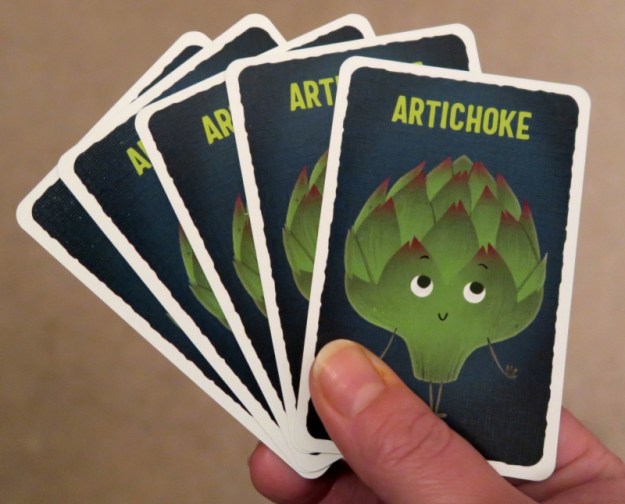
Abandon all Artichokes is a very silly little deck-builder, which is somehow different to almost anything else.  Players start with a deck of ten artichoke cards from which they draw a hand of five.  The aim of the game is to shed all their artichoke cards so that when they draw their new hand of five at the end of their turn, there are no artichoke cards in it.  To do this, on their turn, the active player chooses one card from the face up market and, unlike most other deck builders, adds this to their hand (rather than their discard pile)  They then play as many cards as they can/want before discarding any leftover cards into their personal discard pile and drawing again.

Abandon All Artichokes
– Image by boardGOATS

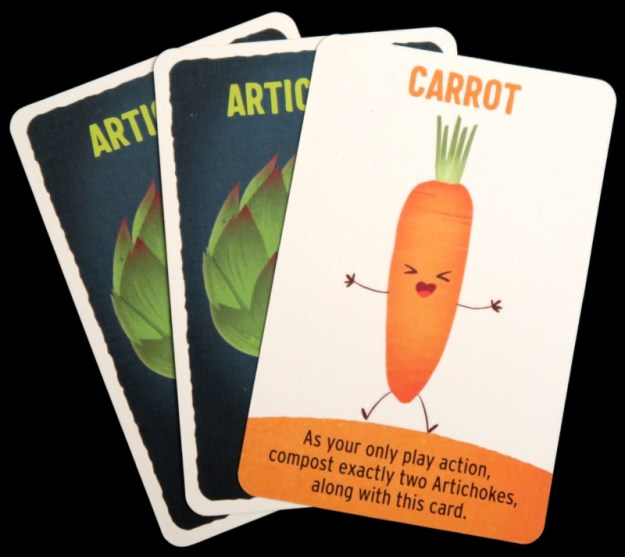
Artichoke cards are basically hand blockers, with no practical use, but all the other cards (including the Rhubarb Promo cards) have an action that allow players to do things.  These include swapping cards with other players, discarding cards onto other players’ discard piles and placing artichokes onto the compost heap (a communal discard pile) which takes cards out of the game.  It took a while for everyone to get to grips with the rhythm of the game, but before long everyone was down to their last couple of artichokes.

Abandon All Artichokes
– Image by boardGOATS

You could hear the anticipation as people drew their five cards and disappointment when they found it still contained an artichoke.  PARKS had finished so, Pink and Black came over to see what was going on, and they were soon joined by Teal and Green who left Ivory to play with himself (the last era of Tapestry).  Eventually, after each player had had several hands where they’d hoped to finish and hadn’t, Purple finally put everyone out of their misery and ended the game.  Her obvious delight was in victory, rather than because of any dislike for the game, so although it is a strange little game, it will likely get another go soon.

Abandon All Artichokes
– Image by boardGOATS

Learning Outcome:  If you arrive late, you might not get the dinner of your choice.

Next Meeting, 10th March 2022

We are meeting on Thursdays until the end of March, so, our next meeting will be on THURSDAY 10th March 2022.  We will start playing shorter games from 7.30pm as people arrive, until 8pm when we will start something a little longer (table is booked from 6.30pm for those who would like to eat first).

This week, the “Feature Game” will be the first Tapestry expansion, Plans and Ploys (links to rules and rules videos).  Tapestry is a beautiful civilisation game, with just four pages of rules that combine to form a surprisingly deep game. The expansion gives players the opportunity to pursue individual achievements as well as adding more variety with new civilisations and landmarks.

Tapestry
– Image by boardGOATS

And speaking of tapestries and other needlework…

Jeff’s mum was cooking Sunday Lunch of roast spring lamb.  Jeff had contributed the joint, but his mother was not impressed with his purchase.

“That leg of lamb shrank by six inches when I cooked it,” Jeff’s mum scolded her son.

“That’s funny,” said Jeff, “You know that jumper you knitted me for Christmas?  It shrank by six inches, when you washed it.  It must have been from the same sheep…!”

24th February 2022

Blue, Pink and Pine arrived early and while they waited for dinner to arrive, they had a quick game of Ticket to Ride Demo.  This is one of the “cut down” Ticket to Ride games which play in the same way as the full-sized versions, but are a lot shorter and often tighter.  As in the parent, players take it in turns to collect cards, or spend them to place trains on the board.  The Demo game has a double-sided map, but with events in Europe so much in the news, the Europe map was chosen.

Ticket to Ride Demo
– Image by boardGOATS

Pink and Pine began competing for the train-lines through the Benelux countries down to Bucharest, while Blue joined Warsaw to Madrid in the south east via a roundabout route. It was a really tight game, so much so that once the points for the tickets had been added, it was a three-way tie.  With just the Longest Continuous Path bonus to add, it was between Blue and Pine, with Blue just nicking it, to give her thirty-four points and victory.  There wasn’t time to dwell on it as Pine’s enormous platter of cheese had arrived and in that, he was definitely the victor.

Ticket to Ride Demo
– Image by boardGOATS

Sage was next to arrive, quickly followed by Purple and Black.  Expecting a quiet night (with lots of people away for half term) we were just deciding who was going to play what, when Lime arrived, so we split into two groups, a three and a four, with the larger group playing the “Feature Game“, PARKS.  The Nightfall expansion includes the seventeen National Parks cards that were omitted from the original base game, so these were added to the deck, though none of the other features were included in the game this time.  This is a game that Burgundy wanted to play, but sadly never quite managed to, so it we wanted to play it in his memory.

PARKS
– Image by boardGOATS

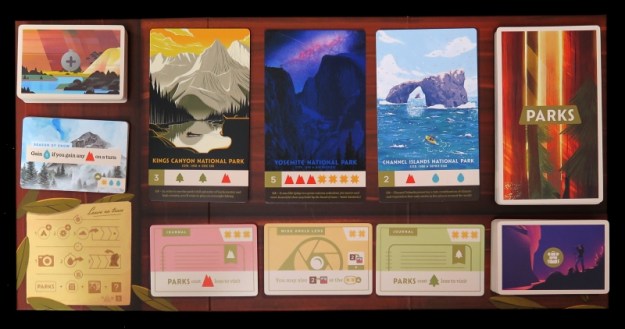
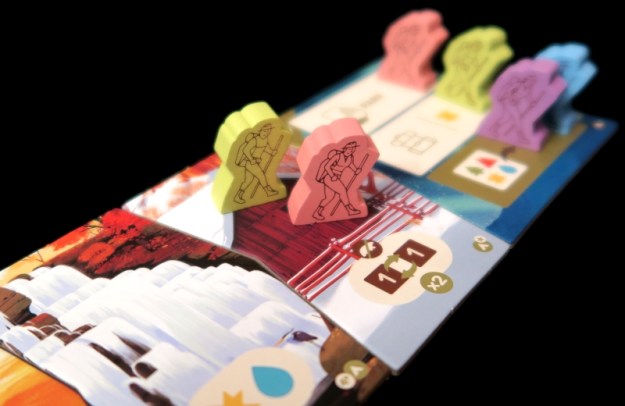
During the game, players take on the role of two hikers as they trek through the countryside over four rounds, or “hikes”.  Whilst on the trail, the hikers take actions and collect memories of the places they visit.  At the end of each hike, players can trade them in for a visit to a National Park.  Each round is set up with six basic trail tiles (five with fewer players) and one advanced trail tile shuffled together and laid out to make a path from the trail head to the trail end.  Players can move either of their hikers towards along the trail to any unoccupied space and then carry out the action on that space.

PARKS
– Image by boardGOATS

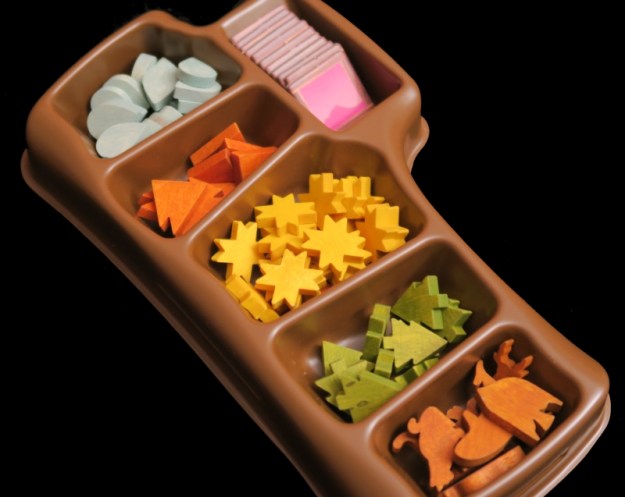
The basic locations are the mountains, forest, the valley, the sea, and a waterfall, visiting these give players wooden mountain, tree, sun or water tokens that can be exchanged for National Park cards at when their hiker reaches the end of the trek.  At the start of the round, the trail tiles are also seeded with additional tokens giving the first person to visit each one a bonus. The final basic location is the vista, which allows players to either take a new canteen card, or take the Camera token.  Canteen cards are special cards that players have that enable them to convert water into other resources or actions, once per round.

PARKS
– Image by boardGOATS

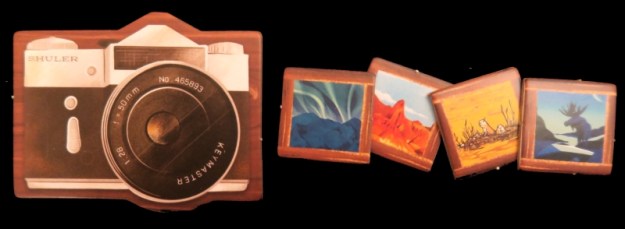
The Camera allows people to take photos, which are worth a point each at the end of the game.  When initially taking the Camera, a photo costs two wooden tokens, but thereafter, photos only cost the holder of the Camera one token, and the player holding the camera at the end of the round gains an additional photo opportunity. There are a couple of other “rule-breaking” rules, for example, each player has a single opportunity per round (or “hike”) to join another hiker at a location by putting out their campfire (turning the token over).  Additionally, players can also buy camping gear cards which alter actions or provide discounts when buying National Park cards at the end of the round.

PARKS
– Image by boardGOATS

There are additionally “Year Cards” which provide players with personal objectives, however, the group did not use these this time as Blue wasn’t making a great job of the rules explanation and it had taken quite long enough without adding more.  The round end is triggered when the penultimate hiker reaches the end of the trail.  The last hiker then moves directly to the trail end and, as usual can: reserve a National Park card from the market (and, if they are the first hiker to do so, take the First Hiker Marker); buy camping gear cards, or claim a National Park card (either from the market, or one reserved earlier in the game).  The game ends after four hikes, and players sum the total of their Parks points and photos to determine the winner.

PARKS
– Image by boardGOATS

The game started slowly as somehow it felt a little unintuitive.  Although play seemed very simple, it wasn’t immediately obvious how to excel and score lots of points.  Although they aren’t the only source, most points come from National Park cards.  As each player has two hikers and Parks cards are acquired at the end of each round, players have only eight opportunities to buy them.  With such a limited number of cards available, players have to try to maximise their takings by going for the most valuable cards.  If these are not reserved, however, there is a risk that someone else will take a desired/planned for card.  This is particularly perilous, as it can leave a player without a possible option and unable to take one of their very limited opportunities to take a Park card.

PARKS
– Image by boardGOATS

Pink started by asking what colour he was, and Blue pointed to the light purple campfire in front of him and explained it was the closest to pink.  Pointing to Lime’s “peach-coloured” pieces, he replied “Apart from the actual pink ones…”  And then there followed a heated debate as to which colour was “more pink”.  Eventually, Pine started tentatively, followed by Lime and then Pink (with his purple pieces) and finally Blue.  As the group felt their way, they realised that mountain tokens were valuable and difficult to come by.  So, after Lime had been unable to afford the camping gear card that gives a mountain discount, Blue snapped it up.  It took a while to understand the value of the Canteen cards, and some were definitely more useful than others.

PARKS
– Image by boardGOATS

Pink had a Canteen that gave him mountain tokens, which meant joining the battle for the mountain space wasn’t quite as necessary.  Lime had a canteen that allowed him to reserve Parks cards which was useful in terms of planning.  It also had the additional advantage of messing up other people’s plans, in particular, Pine’s who got caught several times.  During the second round, everyone started to get the hang of things, and began to work out what they were trying to do while keeping an eye on what everyone else was doing.  But then the “hand limit” of twelve tokens began to bite.  Some of the most valuable Parks cards need six or more tokens, so targeting these while keeping the ability to be flexible became increasingly difficult.

PARKS
– Image by boardGOATS

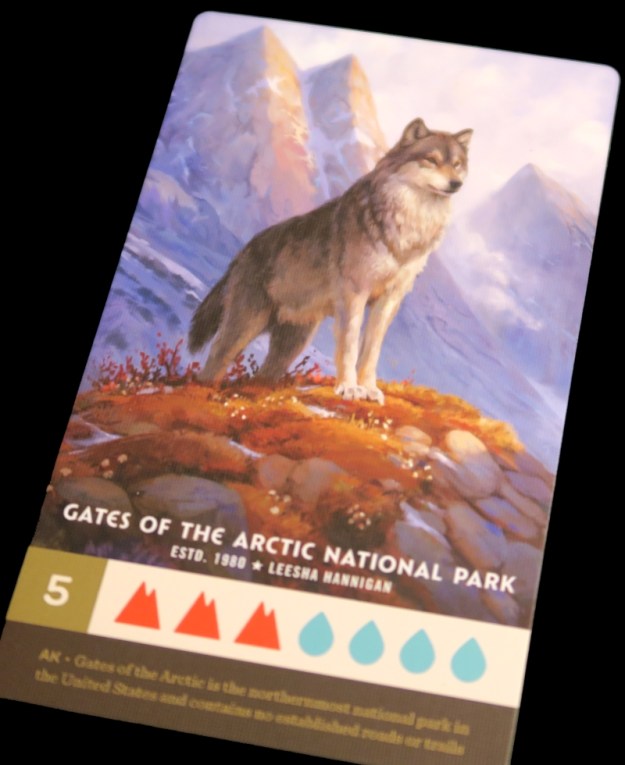
By the third round, Pink was questioning how Blue had managed to get “so many” cards, implying she was doing something that the others, in particular Pink, weren’t.  She had just managed to take every opportunity though, where others had been less fortunate.  Lime had a canteen that allowed him to reserve cards, which was a good use for excess water tokens.  Unfortunately, didn’t quite get the rest of his tokens right to make the most of it, and finished with lots of reserved, but unfulfilled National Parks cards.  Pine was unlucky and had Parks cards he was targeting taken at the last moment.  Still he managed to get a card with a nice picture of a wolf on it, which delighted him at the time.

PARKS
– Image by boardGOATS

It was close for second place with just two points separating three players—Pine, tied for second place with Pink, decreed that his lovely wolf card was the tie-breaker and gave him the edge.  There was no question that Blue was the winner though, with thirty-two points, eight more than Pine.  Meanwhile, on the next table, Sage, Purple and Black had been playing Puerto Rico.  This is a much older game, once ranked the best game on the BoardGameGeek website, but now often forgotten.  We’ve played it a few times, but not since the global pandemic hit, and Sage was keen to play it again.

Puerto Rico
– Image by boardGOATS

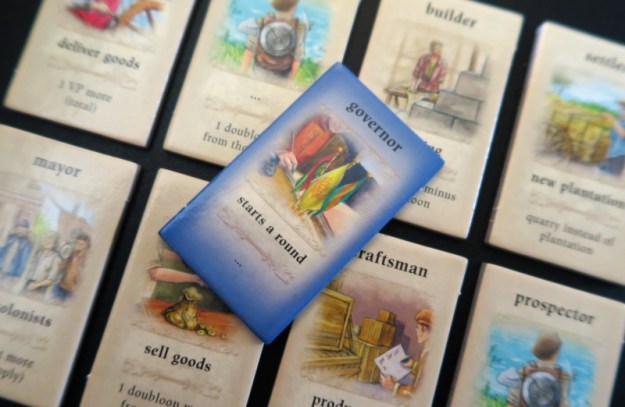
In many ways, Puerto Rico is the archetypal Euro game.  The idea of the game is quite simple in that on their turn, the active player chooses a “role” then everyone takes it in turns to carry out the action associated with that role.  Each role has a “privilege” which the active player gets which gives them a little bonus (as well as the opportunity to take the action first.  Once everyone has chosen a role, the remaining role cards are “improved” by the addition of money, the used role cards are returned to the pool and the start player (The Governor) moves one player to the left before the new Governor starts the next round.

Puerto Rico
– Image by boardGOATS

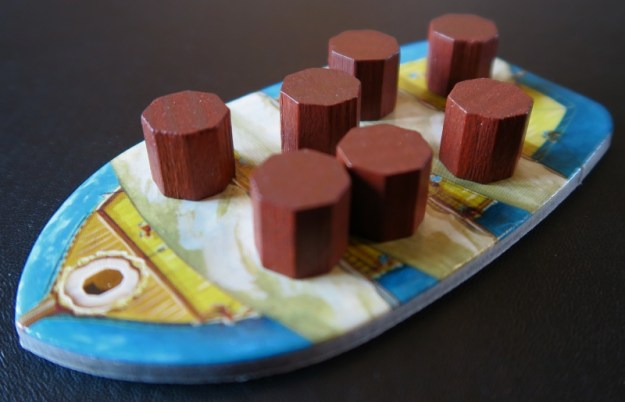
The aim of the game is to get victory points which are awarded for buildings and for shipping goods. However, to build, players need money, and before they can ship goods, players need to be able to produce the goods with a plantation (and where necessary process them in the appropriate building).  Each building/plantation has a special bonus, but for a player to receive this, the building needs to be occupied by a “colonist”. All these activities are carried out through the role cards. For example, the Builder enables players to construct a building, but the player who chooses the role gets the privilege of paying one doubloon less than they would have done otherwise.

Puerto Rico
– Image by boardGOATS

Other roles include the Craftsman (enables players to produce); the Captain (enables players to ship goods); the Trader (allows players to sell goods for money); the Settler (players can take a plantation tile and add it to their island); the Mayor (the ship of “colonists” arrives and they are divided amongst the players), and the Prospector (everyone does nothing except the person with the privilege who takes a doubloon from the bank).  The game ends when there are not enough colonists to fill the colonist ship, the supply of victory points is exhausted, or a player fills their twelfth building space in their city.

Puerto Rico
– Image by boardGOATS

Black was clearly an early front-runner, but while Sage was slightly slower to get his engine going, he was coming up fast on the inside rail when the game came to an end.  As a result, the end-game building scoring was critical.  Purple had built the Guild Hall giving her extra points for her production buildings while Sage built the Residence providing additional points for the plantations and quarries he had placed on his island.  Black had built and occupied a two large civic buildings:  a City Hall giving him points for his civic buildings, and a Customs House which increased his the victory points he had acquired during the game by twenty percent.

Puerto Rico
– Image by boardGOATS

Unfortunately for Sage, it turned out that the game had ended a few rounds too early for him to overtake Black who finished with sixty points, five more than Sage in second place.  It had been fun though, and demonstrated that while some older games show their age, others still have it.  Puerto Rico and PARKS finished at much the same time, and although Lime left to make sure he got across the river before the drawbridge was lifted (commenting he’d like to give PARKS another go some time), everyone else was keen to play something light and quick.

Puerto Rico
– Image by boardGOATS

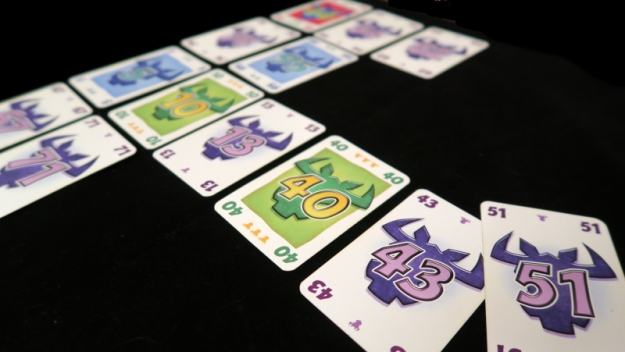
Despite Blue’s inevitable enthusiasm, Pine ruled out Bohnanza as too long, and with six players, 6 Nimmt! was the obvious choice.  We played this loads online, but it doesn’t seem to have dampened our enthusiasm for it, though we’ve mostly played the simple version in person since.  The idea is that players simultaneously choose cards from their hand which are then added in sequence to the four rows on the table.  In the original version, cards are added to the end of the row with the highest card that is lower than the card played.  In the professional version, cards can also be played on the low end of rows, upsetting other players’ plans (if players can claim to have plans in this game).

6 Nimmt!
– Image by boardGOATS

Although we all decided that it was too late for the complex maths that comes with the professional version.  Pine and Blue immediately commented that they regretted that decision when they looked at their hands.  It seemed most people struggled a bit in that round as everyone picked up points.  Blue and Pine were high scorers, but Pink managed twenty-seven nimmts off just nine cards, albeit very colourful ones.  Pink did better in the second half with a clear round, but the damage had already been done.  Purple and Blue top scored overall, with thirty-seven and thirty-nine respectively, but the winner was the very constant Black with just five from each round.

6 Nimmt!
– Image by boardGOATS

Learning outcome:  Not all games are a walk in the PARK.

Boardgames in the News: Kickstarter, Blockchain, Discord, Ravensburger, & Gamefound

Crowdfunding is the practice of project funding using a large number of investors, usually with many small financial contributions.  Although it is often thought of as a modern practice, it actually has a long history, with its roots dating back centuries to a time when printing was very expensive and people were encouraged to subscribe or otherwise commit to buying a publication in advance.  In 1697, Dryden’s “Works of Virgil” was published like this, and with staggering parallels to modern crowdfunding, there were two editions, including an “exclusive limited edition”.  Over the last twenty years, however, the practice has become more and more popular with entrepreneurs increasingly put in touch with investors through online platforms like Kickstarter.

ArtistShare Logo
– Image from artistshare.com

The first commercial crowdfunding platform was artistShare in 2001, this was soon followed by IndiGoGo (2008) and in particular Kickstarter (2009), which have had a massive impact on board game production.  In 2016, Gamefound was launched, initially as a “pledge manager” to support crowdfunded board game projects at the fulfillment stage when it is necessary to manage details of large numbers of backers and ensure they are sent the correct “rewards”.  In 2021, however, Gamefound itself moved into crowdfunding, becoming a one-stop crowdfunding shop targeted at board games and board gamers.

Ravensburger Logo
– Image from ravensburger.org

This takes money of course, which is presumably the reason for the recent announcement of an investment by the German toy and games manufacturer, Ravensburger.  Ravensburger are well known in the board game world, in particular for their production of the Alea range of games.  However, they are much more than that, and are one of the biggest jigsaw produces, and indeed were literally the producers of the world’s largest jigsaw in 2016 (though this record has since been broken).  They also acquired the Swedish toy company BRIO in 2015, and as such are one of the world’s largest suppliers of trains too.

Brio Train
– Image from brio.us

The slightly curious aspect of this is that, unlike Queen Games for example, Ravensburger have not hitherto engaged in crowdfunding board games, so it is unclear what is driving Ravensburger’s interest.  It is unquestionably a great move for Gamefound, however, especially at a time when arguably their most significant competitors, Kickstarter, has recently encountered a very negative response to their intention to use Blockchain technology.  According to Kickstarter’s blog:

As a first step, we’re supporting the development of an open source protocol that will essentially create a decentralized version of Kickstarter’s core functionality. This will live on a public blockchain, and be available for collaborators, independent contributors, and even Kickstarter competitors, from all over the world to build upon, connect to, or use. … We’re establishing an independent organization that will kick off the development of the protocol. Kickstarter PBC will provide this new independent organization with some funding, appoint an initial board, and commit to being one of the protocol’s earliest clients, meaning Kickstarter.com will be built on top of the protocol. As a user, the Kickstarter experience you’re familiar with will stay the same. You won’t “see” the protocol, but you will benefit from its improvements.

Blockchain is a data-sharing security technology where blocks of data are encrypted in a way that depends on other blocks in the chain.  Thus, if one of these blocks is illicitly changed, it will (to quote Fleetwood Mac) “Break the Chain”.  With many participants in each chain and the same data being stored multiple times via multiple chains, data integrity is maintained.  The whole procedure is carried out in “The Cloud”, which minimises the infrastructure needed at each step, but the redundancy and nature of repeated complex operations means there is a significant environmental impact.

Kickstarter Logo
– Image from kickstarter.com

Although Blockchain is typically associated with crypto-currencies, Kickstarter have been clear that normal credit/debit cards can still be used for pledges and creators would receive funds in the normal way.  Kickstarter have been clear that they intend to make it “carbon-negative”, but that has not stopped a lot of project creators and backers expressing their concern.  Even the designer of Wingspan and Mariposas, Elizabeth Hargrave, who has not hitherto used Kickstarter to produce one of her games, has commented.

Wingspan
– Image by boardGOATS

The nature of this concern is not always entirely clear, though the root seems to be the environmental aspect, with many creators additionally concerned that their projects will be tarnished by association.  In November, Discord reportedly abandoned plans to integrate a cryptocurrency wallet on the platform after reports of supporters cancelling their subscriptions.  The development of Gamefound as a crowdfunding platform, however, means that even if Kickstarter continue down this route, game producers will at least have a choice.

Gamefound Logo
– Image from gamefound.com

Next Meeting, 24th February 2022

We are meeting on Thursdays until the end of March, so, our next meeting will be on THURSDAY 24th February 2022.  We will start playing shorter games from 7.30pm as people arrive, until 8pm when we will start something a little longer (table is booked from 6.30pm for those who would like to eat first).

This week, the “Feature Game” will be PARKS.  In this game, players take on the role of two hikers as they trek through different trails. Whilst on the trail, the hikers take actions and collect memories of the places they visit. Collecting memories in sets allows players to trade them in for a visit to a National Park at the end of each hike.

PARKS
– Image by BGG contributor kalchio

And speaking of hiking…

Jeff and his mate Joe were out hiking when Jeff looked down and saw some tracks.
“Hey Joe, look! Deer tracks!” he exclaimed.

Joe looked over and answered, “Those aren’t deer tracks, those are rabbit tracks!”

After about ten minutes of bickering about what type of tracks they were, they got hit by a train…

10th February 2022

It was just Blue and Pink for food, so while they waited, they killed time with a very quick game of Ticket to Ride: London.  The little, city versions of Ticket to Ride make great appetisers, and this one is no exception.  The game play is essentially the same as in the full-sized versions (collect coloured cards and play them to buy routes), except they have fewer pieces, a much smaller map and take a lot less time to play.  In terms of strategy, there usually isn’t really time to do much, so it’s typically a case of doing one thing and doing it well.
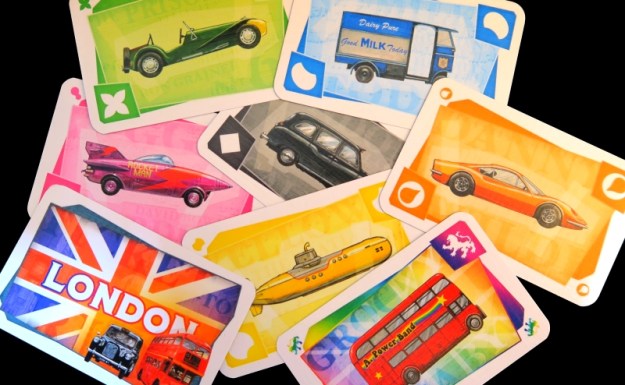
Ticket to Ride: London
– Image by boardGOATS

This time, Blue decided to really challenge herself.  The London game gives bonus points for connect for players that collect certain locations together.  Blue worked out that if she managed to complete her longer ticket (Buckingham Palace to Brick Lane), going via the “ring road”, she could also complete her shorter ticket (Hyde Park to St Paul’s), and pick up lots of bonus points too, with just one bus left over.  Unfortunately for her, Pink managed to end the game just one turn too soon, leaving her with a gap between Regent’s Park and King’s Cross, no bonuses, no tickets and almost no points.  When it came to sparing her blushes, food couldn’t arrive too soon.
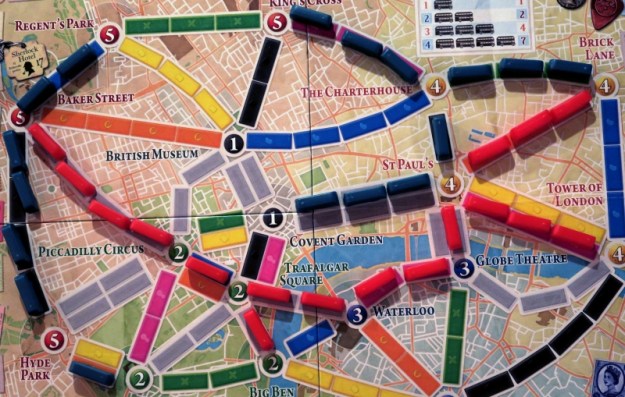
Ticket to Ride: London
– Image by boardGOATS

With Green bringing his parents (Saffron & Sapphire), the “Feature Game” was a light, hand-management, double-think fox and chickens game that we’ve played a few times before, called Pick Picknic.  It looked like three games were going to be needed, so Pink suggested Altiplano (in lieu of Orléans which didn’t quite make it last time), and took it to the other side of the room along with Ivory, Sage and Teal.  Pick Picknic plays six, but with eight foxes to fight over the chickens, two games of four seemed the best way to set things up.  Green suggested breaking up his family unit, so Blue instigated a trade and swapped Lilac and Sapphire for Lime and Purple.
Pick Picknic
– Image by boardGOATS

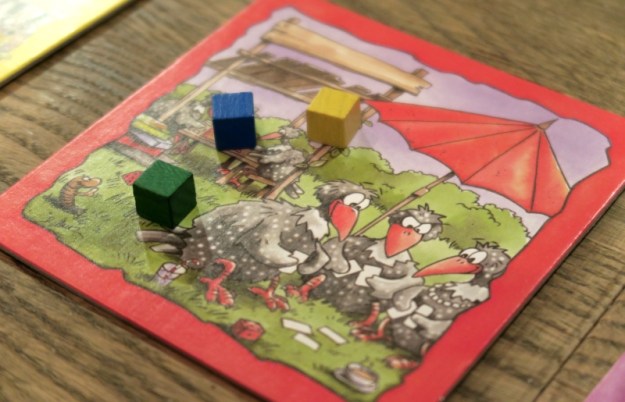
So, after a quick game of Musical Chairs, Green, Saffron, Lime and Purple settled down to play Pick Picknic.  At the start of each round, the six coloured farm yards are seeded with a random corn (worth one, two or three points).  Players then simultaneously choose a card from their hand and play it.  If their card is the only card of that colour and is a chicken, it gets all the corn.  If there is more than one chicken of that colour, they can either come to an agreement to share the corn, or fight for it.  If there is a fox amongst the chickens, the fox has a good feed and the corn remains till the next round.  If someone plays a fox card and there are no chickens, the fox goes hungry.

Pick Picknic
– Image by boardGOATS

The game started in an amicable manner sharing out the corn instead of fighting for it when the need arose, until half way through when Lime decided he no longer wanted to share. He won, but the scene was now set and squabbles broke out over corn more often.  In the meantime, Lime’s foxes were getting fat from eating everyone else’s birds and corn was building up, uneaten.  The others’ foxes were usually not so lucky, and Purple’s foxes were hungriest of all.  Towards the end of the game peace finally broke out once again and sharing was order of the day once more.  In the final tally, Lime proved the wiliest of us finishing first with fifty points and Saffron and Green close behind with forty-four and forty-five respectively.

Pick Picknic
– Image by boardGOATS

On the neighbouring table, Blue, Lilac, Black and Sapphire were a little slower to get going as they had to choose a game, but eventually decided on Coloretto.  While we’ve played it a lot, it was new to both Lilac and Sapphire so there was a recap of the rules first.  Blue explained that on their turn players have a simple decision:  turn over the top card in the deck and choose a “cart” to add it to, or take the cards from one of the carts.  Lilac commented that it was similar to Zooloretto, which of course it is, as Coloretto was it’s predecessor and they share the same basic mechanism.

Coloretto
– Image by boardGOATS

Players are trying to collect sets of the coloured chameleon cards, but there are two clever features.  Firstly, the largest three sets score positively and scores for the others are subtracted from a player’s total.  Secondly, for each set, the first card is worth a single point, but the second is worth two, the third is worth three and so on (up to a maximum of six cards).  Thus, it is better to get six cards of one colour, rather three in each of two suits.  Sapphire, took this to heart, focusing solely on red and green, and often taking nearly empty trucks as a result.
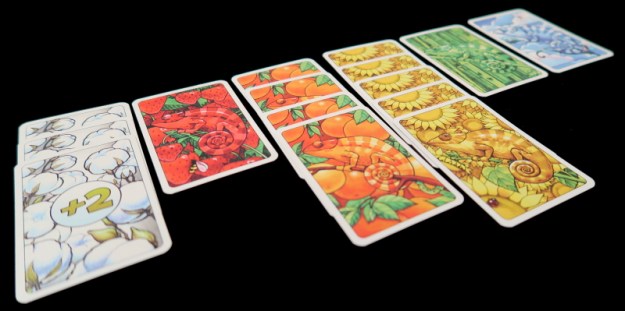
Coloretto
– Image by boardGOATS

Lilac was more adventurous and pushed her luck a bit, ending up with a bit of a rainbow, but with a couple of strong suits and a few bonus point cards.  Blue commented that, although players need to avoid negative points, players who don’t take cards generally don’t do well, and promptly took lots of cards and ended up with lots of negative points as a result.  Black, very experienced at this game, played smart and took an early lead which he held right until the last round when Blue got lucky and drew cards in her longest suit and with it, took victory, pushing Black into second.  Lilac and Sapphire were not far behind and separated by a single point.
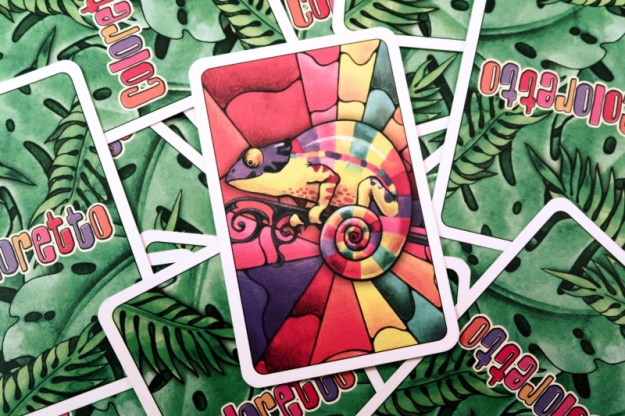
Coloretto
– Image by boardGOATS

Pick Picknic and Coloretto finished at much the same time.  Purple then requested a game of Azul, so we preceded it with another quick game of Musical Chairs as Blue swapped places with Green.  Then, after a little discussion, Green, Lilac, Black and Sapphire chose to play Draftosaurus.  This is a fun little drafting game like Sushi Go!, but instead of drafting cards, players are drafting little wooden dinosaurs.  The dinomeeples are placed on the player’s board with different areas on the board scoring points in different ways.  For example, the “Meadow of Differences” can only hold one of each type of dinosaur, but will score twenty-one points if it contains all six (using the same scoring scheme as Coloretto).

Draftosaurus
– Image by boardGOATS

The game is played over two rounds (drafting clockwise and then anti-clocwise), before all the parks are scored.  Players also score an extra point for each Tyrannosaurus rex they have in their park, as well as extra points if they have if they have the most dinosaurs of the type they put in their “King of the Jungle” pen.  Everyone knows there is only one King of Jurassic Park and Black was looking like the winner with his T-rex strategy. He not only got several bonus points for pens with T-rex’s he also got seven points for having the most T-rexes too.  However it was Green’s more general approach to his dinosaur park that pipped Black to the post.

Draftosaurus
– Image by boardGOATS

All the scores were close though: Green finished with thirty-seven with Black in second with thirty four, and Lilac and Sapphire were just behind.  As everyone else was still playing, the group carried on together and moved on to the fun little push-your-luck game, Port Royal.  This (like its little cousin “Unterwegs“) is a very simple game: on their turn, the active player chooses to “twist” and turn over the top card of the deck, or “stick” and keep the current card set.  The deck of cards consist of coloured ship cards and character cards.  The first decision is to decide whether to risk a “twist” because if second ship card of a colour is drawn the player goes bust and their turn ends.
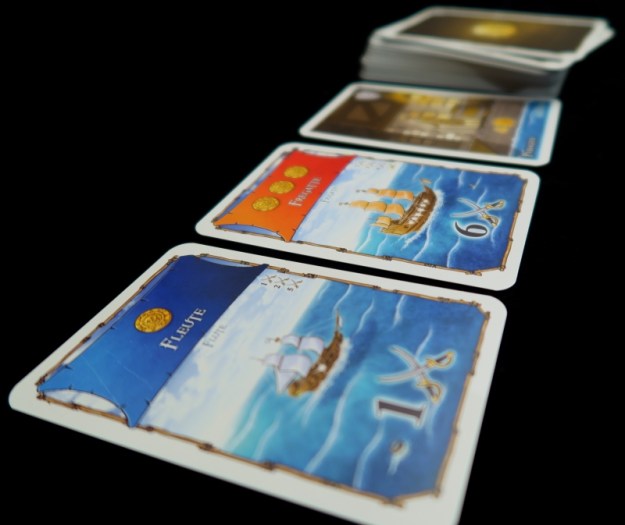
Port Royal
– Image by boardGOATS

If a player “sticks” they can take a ship and add its treasure to their stash, or they can use their gold to buy the support of characters.  These give players victory points and special powers, but also can be used to claim contracts and give more points.  The cards are double-sided like those in San Juan or Bohnanza, so in the same way, keeping an eye on the discard pile and the money in players’ hoard is key.  Once the active player has taken a card, players round the table can take a card too, but they must pay the active player for the privilege.  The game ends when one player has twelve points or more, that triggers the end of the game and the winner is the player with the most points.
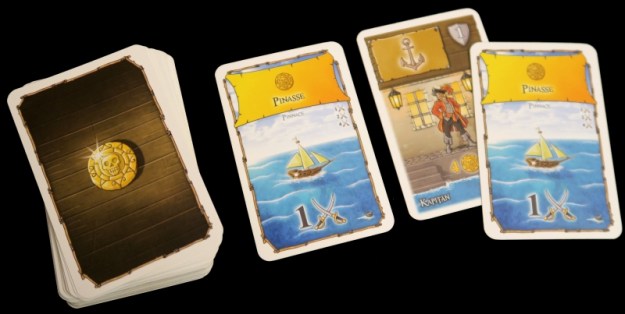
Port Royal
– Image by boardGOATS

Black, once again, got off to a fighting start, collecting arms to help him ward off the pirates while Lilac had her eye on the contract symbols. Sapphire went for the Admiral, which gave him a bonus for drawing at least five cards and would give others an increased chance to buy and pay him even more.  Green started out with Green Trader bonus, but then got consistently hit by the black pirates before he could barely draw any cards, so his game was hampered from the very start.  With his fighting force at strength, Black was able to haul the cards out and start raking in the points.  Lilac managed to convert high value contracts before anyone else, gaining her more coins to buy more cards.

Port Royal Unterwegs
– Image by boardGOATS

Sapphire built up a “Jack of all Trades” hand, but it only steadily gained him points.  Green managed to finally rid himself of the scourge of the black pirates by stopping draws early, and started collecting symbols, but it was too late as Black reached the twelve points before anyone else. Everyone had one more turn, and Lilac was able to convert her final contract to also reach twelve. Both Lilac and Black managed one more purchase to finish on thirteen points each, but Lilac won took the tie break by virtue of having one more coin left than Black.  Sapphire and Green were also tied on points (on nine-points), but Sapphire completed the podium places with four coins more.

Port Royal
– Image by boardGOATS

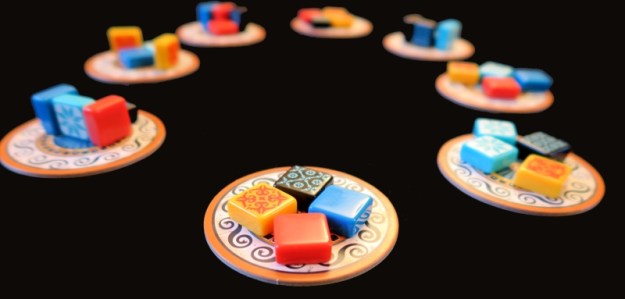
Meanwhile, Blue, Saffron, Purple and Lime were playing Azul.  We’ve enjoyed the recent versions of these (Stained Glass of Sintra and Summer Pavillion), but this time the original was the game of choice.  All three use the same market mechanism where players either take tiles of one colour from one of the small markets and put the rest in the central pool, or take all the tiles of one colour from the central pool.  In this original version of Azul, players add these tiles to the channels on the left of player board, and at the end of the round if any of these are full, they move one tile to their mosaic and recycle the rest.

Azul
– Image by boardGOATS

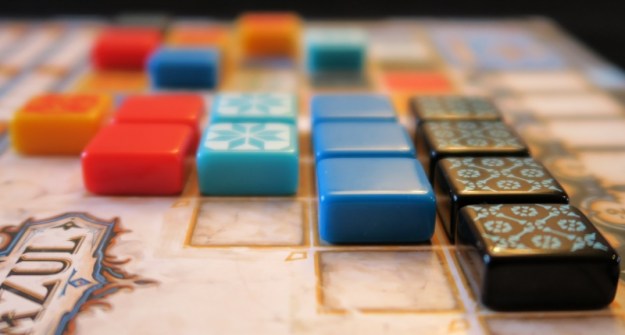
Players score points for placing tiles such that they are part of a row and/or a column in the mosaic and at the end of the game, players score bonus points for completed rows and columns and also for placing all five tiles of any one colour.  There is a catch, however.  When a player takes tiles, all the tiles must go into a single tile channel, and must be of the same colour as any that are already there.  Any left overs score negative points and, as the more left over tiles a player has, the more negative points each one will score.  This has the potential to leave one player picking up lots of tiles and scoring lots of negative points.
Azul
– Image by boardGOATS

This time, that player was Lime.  Having scored a few points during the first round, he was unimpressed when all his negative points at the end of that round pushed him straight back to zero.  This wasn’t the only time that happened though, to the point that it became a bit of a running joke, especially as he made it a point every round to take the first player token (which counts as another negative tile).  One of the key tactics of the game is to try to complete tile channels at the end of the round because these are then emptied leaving the maximum amount of flexibility for the next round.
Azul
– Image by boardGOATS

And this is exactly what Saffron did.  Despite never having played the game before, by focusing on completing her tile channels she was always able to dig herself out of any difficulties.  Although the game was longer than Draftosaurus, it didn’t seem like very long before Purple triggered the end of the game by completing a row, the only one to do so.  It was quite close, but Blue just edged it from Saffron who took an excellent second.  With that, Lime headed off (before the drawbridge was raised) and Blue left Purple and Saffron chatting while she went to watch the last few rounds of Altiplano on the other side of the room.

Azul
– Image by boardGOATS

Altiplano is a much longer game and one that we are very fond of in the group.  Indeed, it was the first winner of the Golden GOAT award (in 2018), though we haven’t really been able to get it to the table since then.  For a while, it had been in the plan to play The Traveler expansion, however, we wanted to play the base game again first and with both Teal and Sage new to the game only the Sunny Days mini expansion was included.  The basic mechanism of the game is quite simple:  on their turn, players carry out the action based in the location their meeple is in, and optionally, moves their meeple either before or after, if they can.

Altiplano
– Image by boardGOATS

The game is a “bag building” game, so a bit like its predecessor, Orléans, or even deck builders like Dominion, players need the correct resources to be available when they carry out the actions.  So, at the start of each round, players draw resource disks out of their bag and place them on their player board to be used in the locations they plan to visit.  Mostly the game trots along quite merrily as this stage of the game is carried out simultaneously and everyone does their planning at the same time so the action phase is quite rapid.  Pink explained what all the different locations did and that there were two main sources of points:  Contracts and Resources.
Altiplano
– Image by boardGOATS

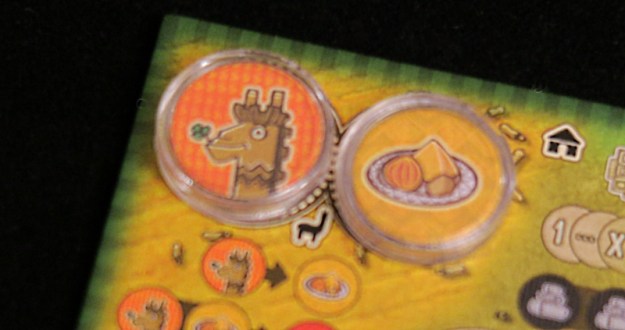
At the end of the game, the resources give points with the amount depending on what it is: primary resources score one point (wood, stone, fish etc.) while advanced processed materials (like cloth and glass) can score up to three or four points.  These will score even more points if they are stored in the Warehouse.  When a resource is used it is places into the players recycling box and goes back into their bag when their bag is empty.  In this way, instead of relying on probability/luck as in Orléans where used resources are returned straight to the bag, all resources are used before they are recycled.

Altiplano
– Image by boardGOATS

Players can leave unwanted resources on their player board, but this can obstruct their plans, so another option is to move them to the Warehouse.  Once in the Warehouse, they cannot be removed, but each full shelf (which can only store one type of resource), gives more points at the end of the game.  Only completely full shelves score in this way, which cost Pink some valuable points when he realised Ivory had pinched the last available fish just before he got there.

Altiplano
– Image by boardGOATS

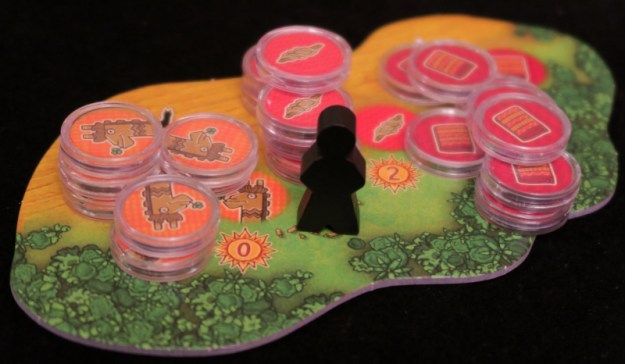
The other main route to scoring points is through completing Contracts.  Players can only have one on the go at any one time, but when complete, they are worth points and also provide the player with a corn which goes straight in the warehouse and can act as a space-filler too.  As well as getting resources from the Wood, Mines, Seafront etc., players can also buy Contracts, build Carts (to provide them with additional travel options), build Boats or Huts (which provide resources and increase their resource scoring), or buy Board Extensions which give them enhanced abilities.  These Extensions also act as a timer triggering the game end.
Altiplano
– Image by boardGOATS

The game was really tight and despite the fact that all four protagonists employed different strategies, a postage stamp would have covered the final scores.  Pink, despite having carefully explained the importance of Contracts as a means to get points, decided to see how he could do by avoiding them completely—the only one to do so.  He concentrated instead on getting resources, especially high value ones, and storing them in his Warehouse.  Teal’s strategy was driven by the fact he started with the Woodcutter which allowed him to turn food into wood, so he concentrated on building Canoes, lots of Canoes.  This was not a strategy anyone had seen before, but it provided him with a lot of resources.

Altiplano
– Image by boardGOATS

Ivory went for Contracts in a big way, taking a massive fifty-five points for them alone.  Since resources on Contracts don’t score in and of themselves, however, this meant he scored fewer points elsewhere.  Sage went for a more “all round” strategy, picking up a lot of points for his contracts too, but also building a lot of Huts to enhance his resource score.  As the game came to a close there was the inevitable checking what the final Extension tiles and then everyone took their shoes and socks off for the complex final scoring.  The winner, on his first time out was Teal, his unconventional Canoe strategy netting him eighty-six points.  Pink finished second with eighty-three and Ivory was just one point behind that, in what had been a very tight game.

Altiplano
– Image by boardGOATS

Learning outcome: Teach a man to fish, and he’ll swap them for a pile of stones.