Author Archives: nannyGOAT

Golden GOAT Award Winners – 2019

The second Golden GOAT Award was announced at the boardGOATS 2019 “Un-Christmas Dinner” on Tuesday.  As last year, we also gave an award acknowledging our least favourite game of the year, known as the “GOAT Poo” prize.  Only games played at a GOATS games night since the 2018 Un-Christmas Dinner could be nominated, and, in a slight change to the rules from last year, everyone had three points to hand out for the Golden GOAT Award (plus a bonus if wearing Festive Attire), and everyone could nominate up to two individual games for the GOAT Poo Prize.

Boom Boom Balloon
– Image by boardGOATS

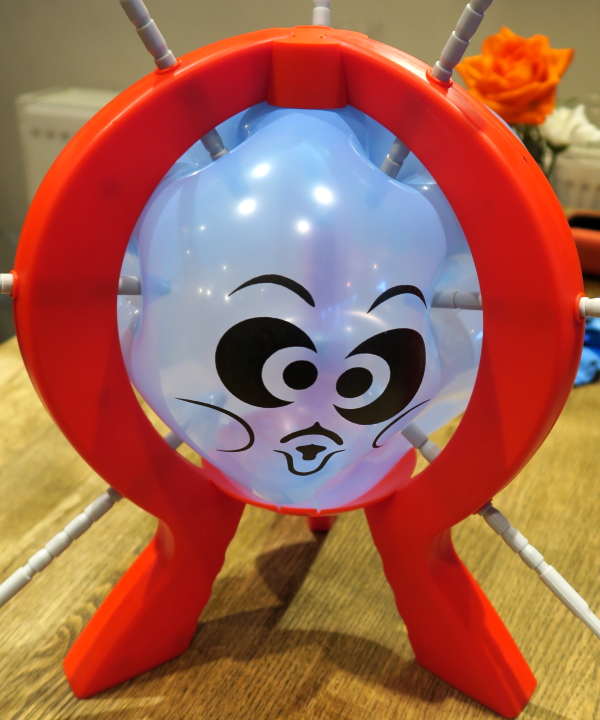
This year there were a number of popular nominees, including Gingerbread House, Lords of Vegas, Villagers and Tokaido, with Boom Boom Balloon getting several honourable mentions for being very silly, but a lot of fun.  There was some surprise that Terraforming Mars, Keyflower and last year’s Golden GOAT winner, Altiplano, had all not been played (we must make sure we rectify  that next year).  This was perhaps a measure of how strong the field was, and many people commented that there wasn’t a stand-out “bad game” for them.  Tapestry was a strong candidate for the unofficial “GOAT Marmite-factor” Award receiving nominations for both prizes and added controversy, with a suspicion that its nomination for the GOAT Poo Prize was based purely on the appearance of complexity rather than any actual experience.

Tapestry
– Image by boardGOATS

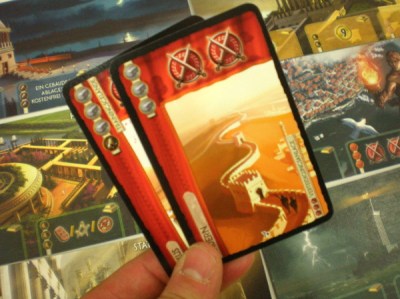
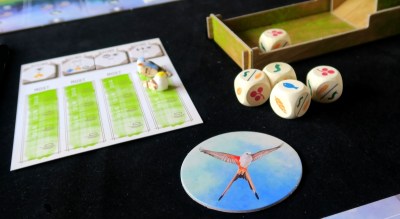
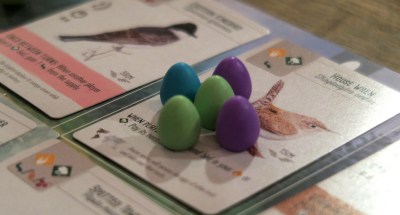
The winner of the “GOAT Poo” award was 7 Wonders, with nearly a third of the group nominating it; it is clearly another Marmite game though as there were plenty of people keen to jump to its defense.  The clear winner of the Golden GOAT 2019, however, was Wingspan, with Key Flow an equally clear second (the Silver GOAT perhaps?).  Both are excellent games and very deserving choices; we look forward to playing them more next year.

Golden GOAT - 2019
– Image by boardGOATS

Next Meeting – 10th December 2019

Our next meeting will be on Tuesday, 10th December, at the Horse and Jockey pub in Stanford-in-the-Vale.

As this is our last meeting before Christmas
we will be meeting early at 7pm for pizzas and Christmas festivities.

This week, the “Feature Game” will be Christmas Penguins followed by a range of Christmas and winter themed games like Christmas TreeSnow Tails, Carcassonne: Winter Edition, Giftmas at Dungeon Abbey, Gingerbread House and Ticket to Ride: Nordic Countries.   Christmas Penguins is a tactical dice game where players take the role of thieving evil penguins, trying to steal presents from Father Christmas.

Christmas Penguins
– Image by boardGOATS

And speaking of Christmas…

Jeff wasn’t in a festive mood.  He was in a lot of pain, so he went to see his doctor to get the problem looked at.

“What seems to be the problem?” Jeff’s GP asked.

Jeff looked a bit shifty and uncomfortable, and not just due to his ailment.  “I’ve, er… got um…” he mumbled.

“Speak up, I can’t help you if I don’t know what’s the matter,” interrupted the doctor.

Jeff tried again, “I’ve, um…” but again his voice faded away to silence.

The doctor took pity on him and gently coaxed him on, “Is it something to do with an intimate area?  You know there’s nothing to be ashamed of, we’re all the same really.  Now what’s bothering you? You can tell me.”

Jeff took a deep breath “Doctor…” then he blurted out, “I seem to have a mince pie stuck up my bottom!”

“Oh, you’re in luck,” answered the Doctor, “I’ve got some cream for that!”

26th Movember 2019

There were lots of people feeding and with a bit of a queue, so the non-eaters, Ivory, Mulberry and Lime, decided to play something while they waited.  There were lots of options, but it was a long time since we’d played The Game and it ticked all the boxes, so unusually, a decision was made really quickly.  This is a simple cooperative card game (in our case, played with a copy of The Game: Extreme, but ignoring the special symbols), but new to Mulberry and Lime.  The team have a deck of cards from two to ninety-nine and they must play each card on one of four piles, two where the card played must be higher than the top card, and two where it must be lower.

The Game: Extreme
– Image by boardGOATS

There are just three rules:  on their turn, the active player can play as many cards as they like (obeying the rules of the four piles), but must play at least two cards before replenishing their hand, and players can say anything they like but must not share “specific number information”.  Finally, there is the so-called “Backwards Rule” where players can reverse a deck as long as the card they play is exactly ten above or below the previous card played on that pile.  This time, it went a bit wrong early on, but the trio managed to pull it back.  Lime got stuck with fifty-six and sixty-four that he couldn’t play, and eventually the game came to a halt with six cards still to play.

The Game: Extreme
– Image by boardGOATS

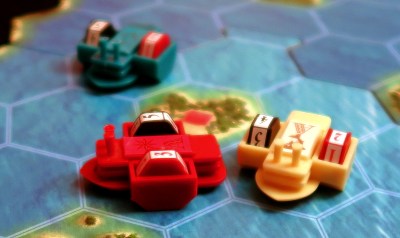
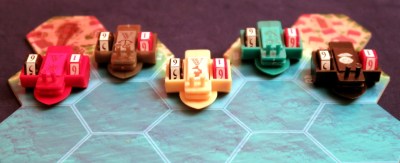
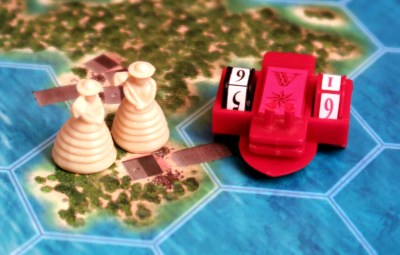
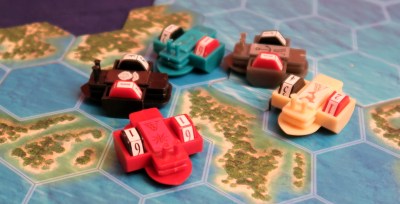
By the time The Game was over, the eaters had just about finished as well and the group split into two, one five to play the “Feature Game”, Mississippi Queen.  This is an older game that won the Spiel des Jahres award in 1997, but has recently been re-released in a new edition having been out of print for many years.  In this game, players race their paddle steamers down the Mississippi, picking up passengers along the way.  Onboard, coal supplies are limited, so each ship’s acceleration and manoeuvrers must be carefully planned.  The key to the game are the cool little plastic paddle steamers which have two numbered paddle wheels – one to track coal and the other to record the speed.

Mississippi Queen
– Image by boardGOATS

The five riverboats start at jetties and then set sail along the river, which is made up of a hexagonal grid.  At the start of their turn, the active player can adjust their speed by one and then move that number of hexagonal spaces, turning a maximum of once before, during or after the move.  The player can increase or decrease their speed by more or make extra turns by burning coal.  Everyone starts with just six coal though and there is no source of coal during the game, so when it’s gone it’s gone.

Mississippi Queen
– Image by boardGOATS

The game has a lot in common with Powerships, a mad spaceship racing game we played about six months ago, but there are a couple of key differences.  Firstly, each player has to pick up two passengers from the islands during the race, which means they must arrive at a jetty at a speed of one.  There is a more subtle difference which is nevertheless important to the way the game plays.  In Powerships, the map is modular, but is set out before the start of the game, where it is built as play progresses in Mississippi Queen.

Mississippi Queen
– Image by boardGOATS

In Mississippi Queen, after the first turn, play proceeds according to position in the race (like PitchCar).  The advantage of this is that players at the front don’t obstruct players moving up from behind, however, it can lead to a run-away leader problem instead.  In Mississippi Queen though, the river is “built” as the game progresses; when the leader moves onto the final space, they draw a new river tile and roll the die to determine placement (left, right or straight ahead).  The fact that the player in the lead has less time to plan has the additional effect of off-setting the advantage of less obstruction, helping to prevent the leader running away with the game.

Mississippi Queen
– Image by boardGOATS

This time, Lime stormed into the lead, but overshot the first island allowing Blue to sneak in behind him and grab a passenger.  There are plenty of islands though, so Lime had plenty of other opportunities.  Unfortunately, he overshot the second island as well as he was going too fast.  By the third island, Lime was starting to get desperate, but hadn’t got his speed and position right and ended up burning almost all his coal and doing a full circuit of the island to rectify things.  This, and almost sinking gave everyone else a chance to catch up and Blue managed to snatch another passenger putting her in a position to make a run for the finish.

Mississippi Queen
– Image by boardGOATS

Although she was able to move into the lead, Blue was hampered by an inability to plan and was forced to burn some of her carefully hoarded pile of coal.  Mulberry wasn’t far behind, and had the advantage of being able to see slightly further down the river so was better able to plan and could therefore carry more speed.  Purple and Pine got into a tangle over picking up a beautiful lady, delaying them both as Blue and Mulberry puffed off into the distance.  Lime bravely fought his way back, but it was between Blue and Mulberry with Mulberry rapidly eating into Blue’s lead.  Blue just managed to make it to the jetty burning the last of her coal to drift in gently, just ahead of Mulberry.  Lime limped in next, leading the others in.  Meanwhile, on the next table, everyone else was playing one of the archetypal card-drafting games 7 Wonders.

7 Wonders
– Image used with permission of boardgamephotos

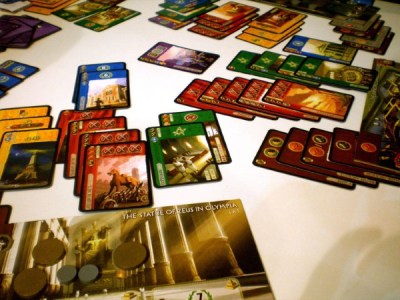
Players start each round with a hand of cards, and everyone simultaneously chooses one and plays it.  The remains of the hands are then passed on to the next player who chooses a card and plays it.  Play continues like this until each player has two cards at which point one is discarded.  The game is distinguished from simpler card-drafting games like Sushi Go! by the civilisation and engine building aspects.  In 7 Wonders, the players are the leader of one of the seven great cities of the Ancient World. They use the cards to gather resources, develop commercial routes, and affirm their military supremacy.  Some cards have immediate effects, while others provide bonuses or upgrades later in the game. Some cards provide discounts on future purchases, some provide military strength to overpower your neighbors and others give nothing but victory points.

7 Wonders
– Image used with permission of BGG contributor  punkin312

After three rounds (or Ages), the player with the most points has the most advanced city and is the winner.  The player boards are chosen at random at the start of the game.  In this case, Green got Halicarnassus, and chose Side B so would be looking to build extra cards from the discard deck in the second and third rounds. Black got Ephesus and also went with Side B and so was only going for victory points and extra money.  Ivory got Babylon and again Side B was favoured, giving him the second tier bonus of being able to build both his final two cards.  Red received Alexandria and was also going to use Side B which would provide her extra resources and victory points.

7 Wonders
– Image used with permission of boardgamephotos

Green’s game was one of building resources in order to build the pyramid enabling him to  build the extra cards.  He started building up his military, and although he was joined at the same level by both his neighbours (Ivory and Black), he began to pull ahead of Ivory after the second round and by the end of the third round had amassed an unassailable army. In the process though, he had neglected green science cards and purple guilds.  Building extra cards from the discard pile is perhaps not as helpful as it might seem as the cards in the discard pile are there because they are the least useful cards. Maybe with more players there would be more to choose from and this bonus would work more favourably, on thee other hand, it might just end up with more duplicates.

7 Wonders
– Image used with permission of
BGG contributor punkin312

On the opposite side of the table was Red.  She, in contrast (and not under threat from the growing armies of Green) mostly ignore the fighting, but still managed to win one battle. With the extra resources available from her pyramid she did not need as many resource cards and decided to concentrate on the other cards.  She invested heavily in the yellow bonus cards and also managed to get a full complete set of science cards.  These she managed to combine with the purple guild which gave her an extra science symbol of her choice.  She also managed to build a second purple guild, which gave her extra points for all brown, grey and purple cards. She also managed to acquire a very large pile of money which netted a fair few points too.

7 Wonders
– Image used with permission of boardgamephotos

Ivory’s game was built around trying to get to the second pyramid level quickly, so initially he took a lot of resource cards. Unfortunately he didn’t get to the second level until the end of the second round, but having looked at the card he then decided the extra money would be more useful. He managed to build both his last cards in the final round, but like Green found, that extra card is not always that useful. He did manage to collect some high scoring blue cards, but  although he tried, he failed to get a full set of science cards. He did get a couple of purple guilds though with one scoring the yellow cards belonging to neighbours, Red and Green who had both gone quite heavily into those. The other gave him points for every battle lost by his neighbours. He got nothing from Green for this, but scored quite nicely from Red.  His resource heavy early game meant that he was left trying to catch up on the other later cards and abandoned his attempts to build a strong army and just took the beating.

7 Wonders
– Image used with permission of BGG contributor punkin312

Black’s game was concentrated on the blue victory point cards and his pyramid build.  A smattering of yellow bonus cards aided his end game score because he scored for all the brown cards built by both himself and his neighbours (Green and Red). He collected some science, but not a complete set.  Although beaten by Green in the final battle, he avoided defeat in the first two and took a clean sweep of victories over Red.  So although everyone had had a strong game in one area, these were more than offset by less strong elements elsewhere.  It turned out that the strongest games were had by Black and Ivory who finished level on fifty-one, some way ahead of Red in third.  The tie break was won by Black who had the more money at the end of the game.

7 Wonders
– Image used with permission of boardgamephotos

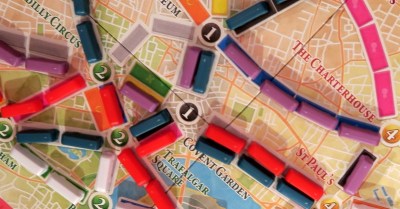
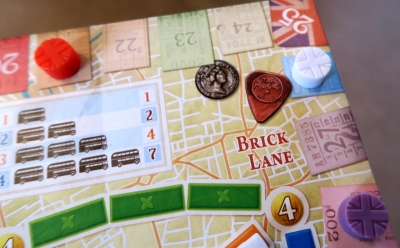
Mississippi Queen was still going, but coming to an end so something quick was needed and Ticket to Ride: London hit the spot.  This is one of the new, smaller versions of the popular route-building game, Ticket to Ride.  These are reduced in size and designed be quicker to play although the game play is very similar.  Players take it turns to draw coloured cards or use them to place pieces, but in this version the Train pieces are replaced by Routemaster Buses.  As usual, players also start with a selection of ticket cards and successfully fulfilling these give more points, but woe betide any player who fails to complete a ticket as the points become negative, which can be very costly indeed.  In addition to these features, this new light version of the game also gives bonus points to players who manage to connect all the locations in an area.

Ticket to Ride: London
– Image by boardGOATS

The action started around central London, (Covent Garden, Piccadilly Circus and Trafalgar square) as Red, then Black and Ivory laid buses around the area, all concerned that the other may block their paths. Green went further out to Kings Cross and Regents Park.  As the game progressed, Ivory, Red and Black continued to challenge each other around central, East and Southern London. Green happily laid his buses round to the East unopposed.

Ticket to Ride: London
– Image by boardGOATS

Black, who had only kept one ticket, was the first to complete his ticket and go for more.  He was closely followed by Red (who had also only kept the one), and then Ivory (who had kept two).  Green never took new tickets, concentrating on his two and connecting all the stations in the five point district. Black, Red and Ivory continued to take new tickets, but it looked like Green might end the game as he was soon down to only three buses.  Ivory checked around the table to see who had buses and how many cards they had left and decided that he had time.  Even though he had missed the fact that Green had only a single card in hand, he still managed to lay his last buses first; one turn too early for Green who had to settle for a two length route instead of the three he was aiming for (and close to getting).

Ticket to Ride: London
– Image by boardGOATS

Black placed one last bus, but Red decided to gamble on new tickets as she had nothing she could claim.  Ivory still had one final turn, but with no more buses to lay, he decided against the ticket gamble.  In the final scoring, Ivory was way ahead of everyone else, due to claiming four “long” routes (threes and fours) and completing some high scoring tickets.  Red, Black and Green were all within two points of each other. Red’s final ticket gamble failed and cost her a clear second place, and Green’s gamble on connecting all the stations in the five point district (and the stations in the two point district as well) did not pay off either.

Ticket to Ride: London
– Image by boardGOATS

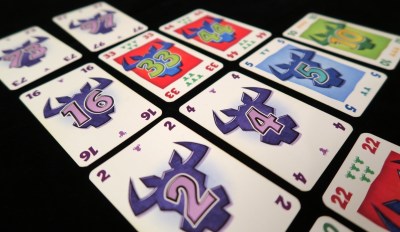
Some left for an early night and those that were left decided to play one last quick game.  Pine was adamant that Bohnanza and Las Vegas weren’t “quick” so in the end, 6 Nimmt! got the nod.  This is one of our most popular games, and frequently gets played in circumstances like this.  It is very simple and there is something almost magical about playing well:  simultaneously everyone chooses a card from their hand and places it face down in front of them.  Once everyone has picked a card, they are all revealed and, starting with the lowest card, the cards are added to one of the four row, the row where the end card has the highest value that is lower than their card.  The point is that the row a card is played on changes as players place cards.

6 Nimmt!
– Image by boardGOATS

The player who places the sixth card, takes the five cards and scores the number of bulls’ heads shown.  The winner is the player with the fewest bulls’ heads.  We play the game in two rounds, and this time the first round was mostly pretty even with everyone taking twelve to fifteen Nimmts except Blue who somehow scraped a clear round.  This meant it was all to play for in the second round, especially with the tendency for a good round to be followed by a bad one.  Unusually, nobody had a terrible game:  Pine top scored with forty, followed by Purple with thirty-one, and everyone else was quite closely grouped. Blue’s clear first round gave her a head-start and she finished with fourteen, just two ahead of Ivory and three ahead of Black in what was an unusually close game.  And with that, it was home-time.

6 Nimmt!
– Image by boardGOATS

Learning  Outcome:  Neglect end game bonuses at your peril.

Next Meeting – 26th Movember 2019

Our next meeting will be on Tuesday 26th Movember, at the Horse and Jockey pub in Stanford-in-the-Vale.  As usual, we will be playing shorter games from 7.30pm as people arrive, until 8pm when we will start something a little longer.

This week, the “Feature Game” will be Mississippi Queen which is an old game that won the Spiel des Jahres award in 1997, but has recently been re-released in a new edition having been out of print for many years.  In this game, players race their paddle steamers down the Mississippi, picking up passengers along the way. Onboard, the coal supplies are limited, so each ship’s acceleration and manoeuvrers must be carefully planned…

Crappy Birthday
– Image by BGG contributor garyjames

And speaking of riverboats…

Jeff was on a boat with a priest and a rabbi.  The weather was hot and humid and the trio had been fishing there nearly all day without a nibble.  Eventually, the rabbi said he was thirsty, so carefully, he climbed over the side of the boat, walked across the water to the bank where they’d left supplies.  He took a cold bottle of water and drank thirstily.  A couple of moments later, the priest gave a deep sigh and said, “I’m not getting anything here either, I think I’m going to join him.”  And with that, he climbed over the gunwale and followed his friend.

Jeff had had enough too by this time, but didn’t fancy the hard work involved in rowing the boat back to the bank.  So, thinking to himself, “If God lets them walk on water, he’ll let me too,” he left the boat.  Inevitably, Jeff being Jeff, he sank like a stone.  Bedraggled, he climbed back in to the boat, raised the anchor, and dejectedly started to row.

On the riverbank, the rabbi turned to the priest and said, “I guess he didn’t know where the stepping stones are then.”

12th Movember 2019

The combination of Illness, work and jet-lag meant we were really low on numbers, despite having a new player, Emerald.  Blue arrived first followed by Pine and both ordered food.  Green arrived shortly after and ordered the mushroom tagliatelle as he was suffering with toothache and he thought it would be nice and soft.  Blue’s scampi arrived lightening fast, quickly followed by Green’s tagliatelle, much to Pine’s chagrin.  Despite his head-start, Green was still last to finish, partly due to his toothache making him eat slowly, but mostly because he was busy texting.  When called out on it, he explained that it was important – he was helping some friends at a quiz.

Google
– Image from google.com

Green denied it, but that didn’t stop everyone from was roundly chastising him for aiding and abetting cheaters.  That was until Ivory pointed out that it was strange anyone would choose to ask Green when it would be just as easy to ask “Mr. Google”, and “Mr. Google” would probably be better!  Eventually, as Green mopped up the last of his sauce, Blue suggested people started shuffling seats so games could be started.  Blue, Pine and Lime had all had a fairly long week and fancied an easy night, and the “Feature Game”, The Voyages of Marco Polo which Green was leading, was always going to be right up Ivory’s street, and it turned out, Emerald’s too.  So after a little prompting, the groups sort of formed themselves.
The Voyages of Marco Polo
– Image by boardGOATS

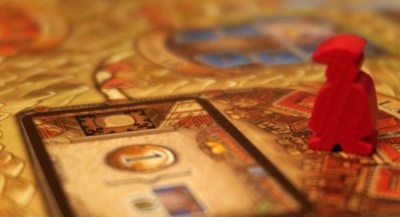
Although we’ve played The Voyages of Marco Polo a couple of times before on a Tuesday, the last time was over a year ago.  In the game, players recreate the journey from Venice to China undertaken by seventeen year-old Marco Polo, his father and older brother.  During their voyage, they travelled through Jerusalem and Mesopotamia and over the “Silk Road” until they reached the court of Kublai Khan in 1275.  In the game, each player has a different character and special power. The game is played over five rounds with players rolling their five personal dice and using each one to perform one action per turn with them.

The Voyages of Marco Polo
– Image by boardGOATS

The actions include:  gathering resources, gathering camels, earning money, buying purchase orders and travelling.  The game ends with players receiving victory points for arriving in Beijing, fulfilling the most purchase orders, and having visited the cities on the secret city cards that each player gets at the start of the game.  With only three people playing the group decided not to use the Agents of Venice, but did use the New Characters mini-expansion.  It took quite a while to set up and explain the game as it is one of those where the rules explanation is far heavier than the game itself:  after only a round or two it all becomes quite clear how to play. However, the trick is to work out what are the best actions to take and when.

The Voyages of Marco Polo
– Image by boardGOATS

The main game board is divided into two parts with the upper part showing a map of Marco Polo’s travels from Venice to Beijing.  On the routes there are oasis-spaces as short stops and fourteen cities.  When a traveller stops at a city, they mark that with a trading post and may use the special action of that city for the rest of the game (these are allocated during setup). The first player reaching a city also gets an additional bonus. Travelling costs a varying amount of camels and money depending on the route taken and whether it is over land or sea.
The Voyages of Marco Polo
– Image by boardGOATS

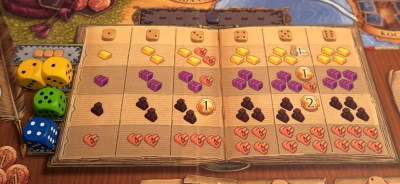
The bottom part of the board shows the five main actions, which are triggered by the placing of dice. Each player has five personal dice in their player colour and may purchase one additional black die per turn.  The actions are the guts of the game.  The first action is purchasing Resources/Camels and the table on the board indicates how many dice must be placed for different numbers of a given resource.  Players need Camels to travel, and Gold , Silk and Pepper to fulfil orders.  The first player at each Resource gets them for free, with each subsequent player paying as much as the lowest result he placed next to the table.  For the next action, Players can instead take one Resource of their choice and two Camels, and again, each player sets the cost for subsequent players.
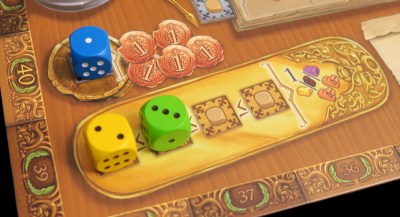
The Voyages of Marco Polo
– Image by boardGOATS

The next action is getting money:  the first player can take five coins in exchange for any die, but the later players must also pay the dice value for doing so.  As an action, Players can also purchase Orders.  These are placed on six “double dice” spaces at the beginning of each round.  The value of one die unlocks the orders up to that number (shown on the spaces) and allows the player to buy one or two of those orders.  The Orders are refreshed and replaced at the beginning of each round. The orders are placed on the player’s individual player board and can be fulfilled at any time as an additional action by returning the resources needed back to the supply.  The completed Order cards are then turned face down and placed in the player’s “drawer”, and the player gets victory points, money, camels, another order, etc. as a reward.
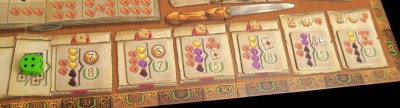
The Voyages of Marco Polo
– Image by boardGOATS

Finally, players can travel.  To do this, they place two dice are to “unlock” the distance they want to move on the map.  Each traveller starts in Venice and can decide between several possible routes eastward, towards Beijing. Each player also gets two “city cards” with two cities on each of them, which they keep secret. At the end of the game, they get additional victory points depending on how many of these cities they have visited by the end of the game.
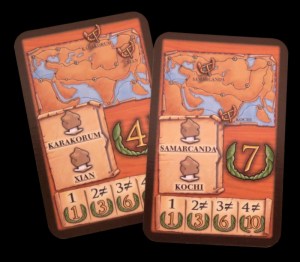
The Voyages of Marco Polo
– Image by boardGOATS

This is one of those games where players want to do lots of things but can’t do everything, need lots of Resources way more than they have, and therefore want to be first to do all the actions, but can’t.  Despite the dice, the luck factor is relatively low; high rolls are usually better, but low ones are also usable in many ways.  With city cards, Orders and attractive special actions in the cities, players usually have clear primary and secondary targets as well as an overall strategy.  At the same time they have the freedom to do what they want.
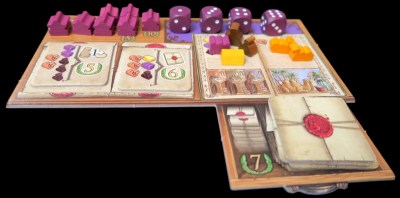
The Voyages of Marco Polo
– Image by boardGOATS

The winner is usually the player who makes best use of their character’s special ability, however, so it is this that usually drives strategies.  The characters are very different, for example, with one character the player doesn’t roll their dice, instead turning them to the result they need before each placement.  With another, the player always gets one of the resources from the supply, whenever another player purchases any resource.  As a result of these differing abilities, each player generally follows a totally different path with a very different approach.
The Voyages of Marco Polo
– Image by boardGOATS

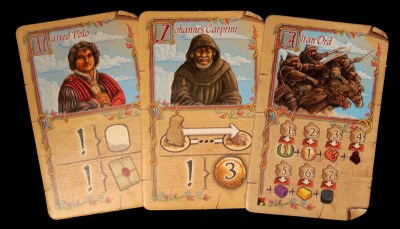
Following the group’s usual policy of the player with the least experience of the game going last, Emerald took that position, but that meant choosing his character first.  Fortunately, he only had four to choose from and they did not take much explaining.  Emerald chose Johannes Carprini which allowed him to jump between oasis points on the travel map; handy to get to those hard to reach bonuses. Ivory then chose Alton Ord (from the New Characters mini-expansion) which gave him extra cumulative bonuses every time he placed a trading station.  This had the potential to become quite lucrative if he could get around the map fast enough.  This left Green with a choice of two. He didn’t favour the extra trading posts, so went for Matteo Polo which gave him a new contract and resource at the beginning of every round; clearly the contract strategy was the way to go for him.

The Voyages of Marco Polo
– Image by boardGOATS

As ever in this (and many) game resources were tight, camels all too rare and players could never get the dice rolls they needed.  Emerald quickly got the hang of it and was doing his best to move around the travel map while also keeping an eye on completing contracts. Even with the oasis hop, it still took him a few rounds to get to the far side of the board and the triple action city, but once there, he started using the extra actions to his advantage.  Ivory also went travelling and managed to place a number of trading posts and so collect more and more bonuses on the way.  The small city bonus card which allows a player to choose any other small city bonus at the beginning of each round was located near to Venice.  So this was an early target for Ivory and Emerald who both got there early and used it to broadened their options and give them room for manoeuvre.

The Voyages of Marco Polo
– Image by boardGOATS

Green hardly travelled at all, and found himself somewhat at a dead-end which was compounded by making a free move in the wrong direction, so he only managed to place two trading posts in total.  This wasn’t his game plan anyhow though, and he mostly stuck to the bottom part of the board, hoovering up contracts and hunting down resources to complete them: not bothering with travelling gave him extra dice to do it all with.  He also made use of the favours two or three times and by the end of the game had a huge lead and a pile of completed contracts far higher than either of the other two.  Ivory, in particular, had a lot of bonus points to come from his travels though.
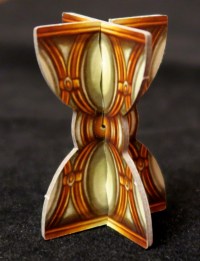
The Voyages of Marco Polo
– Image by boardGOATS

Everyone thought it would be a tight game, and indeed it was.  When all the points were in, Ivory and Green tied on sixty-seven points with Emerald not far behind.  A quick check of the rules for tie breakers gave it to Green thanks to the fact he had two Camels left over.  meanwhile, on the next table, while Ivory and Emerald helped set up Marco Polo and Green began his rules explanation, Pine pointed out the long and unpronounceable title of “Weltausstellung 1893” on the German box.  So, before long Blue was explaining the rules to World’s Fair 1983.

World's Fair 1893
– Image by boardGOATS

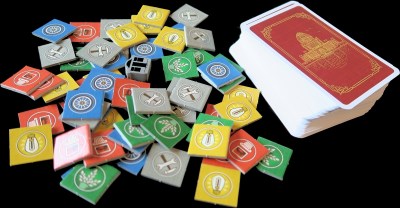
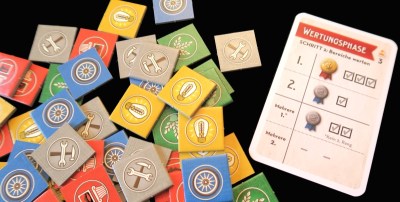
This is a fairly simple little game that is now a few years old and flew under the radar a bit at the time.  Reviews generally seemed to be complimentary though, referring to it as a bit of a “Hidden Gem”.  So, having been on the look out for it at a reasonable price for nearly three years, Blue and Pink had finally picked up a German copy at Essen.  The game is a set-collecting dame with an area majority mechanism where players are proposing exhibits for the fair in the five different areas (Fine Arts, Transportation, Manufacturing, Electricity and Agriculture).  The game is played on an eye-catching, modular, Ferris-wheel shaped board surrounded by sections for each of the five areas.
World's Fair 1893
– Image by boardGOATS

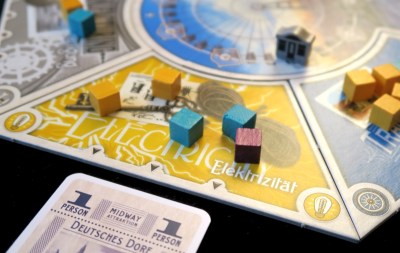
The actions are simple enough, making the decisions that players have to take theprimary  focus of the game.  On their turn, the active player places a Supporter cube on one of the five coloured areas, taking all the cards in the area.  They then place three cards drawn from the top of a deck around the wheel, the first going in the now empty area the player chose, and one going in each of the next two areas round the wheel.  There are three types of cards:  Exhibit cards associated with each of the five areas, Medway tickets and Influential People.  The Medway Tickets are the timer, with the Ferris wheel turning one step each time a Ticket is taken.  The round ends after the Ferris wheel has made one full revolution.
World's Fair 1893
– Image from google.com

At the end of the round, the Tickets are cashed in for a dollar each and the player with the most gets a couple of dollars bonus.  Each area is also evaluated, and the player with the most supporters in that area gets a monetary reward worth three dollars in the three-player game.   In addition the winner is also able to exchange three exhibit cards for that area, for tokens.  The player who comes second receives a smaller remuneration and can exchange one card for a token of the same colour/area.  The game ends after three rounds, and sets of tokens scored, with larger sets worth increasing numbers of points.
World's Fair 1893
– Image by boardGOATS

Perhaps the thing that makes the game is the Influential People cards.  These must be played the turn after they are taken, after the player places their influence token, but before they take the cards.  If a player has more than one influential person card on their turn they have to play them all at this point too.  These allow players to mess with the distribution of Supporter cubes slightly, either by adding an extra one in a given space, or moving one.  As a result, these add a thin layer of complexity to the decision space, making it that bit more interesting.  Thought processes go something along the lines of, “Placing a Supporter here will give these cards, but this person card means this Supporter can be moved giving the majority in that area, but there’s little point in winning that without any cards of that colour, so perhaps it would be better to try something else…”

World's Fair 1893
– Image by boardGOATS

Although the game is not terribly difficult, Blue had only played it once and was a bit flaky with the rules, but it wasn’t long before the game got going.  Half-way through the first round, Blue had a pile of tickets, Lime had a pile of Exhibit cards, and Pine had worked through a pile of Influential Person cards.  Blue took the Medway Ticket bonus, but Pine turned a lot of his now substantial pile of Exhibit cards into a significant pile of coloured tokens.  Blue picked up a few, but Lime took a round to really get the hang of things.  The second round when much the same way with Blue and Lime struggling to edge out Pine.

World's Fair 1893
– Image by boardGOATS

The third round was a tight affair with everyone needing certain colours to get full sets of five in order to be even vaguely competitive.  The key was having enough cards as well as gaining the majority in the necessary area.  As the game drew to a close, Lime decided to go for Fine Arts letting Pine place his Supporter in the Electricity area, take a Medway ticket, get the majority he needed, and end the game as well.  In truth, the writing had been on the wall from the start—it was clear this had been a game that had just clicked for Pine and he romped home with eighty-five points leaving Blue and Lime some way behind fighting it out for second.

World's Fair 1893
– Image by boardGOATS

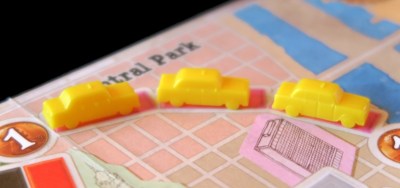
As World’s Fair 1983 was coming to an end, The Voyages of Marco Polo was only just beginning and it was becoming clear that it was going to last most of the night, so Pine suggested a game of Ticket to Ride: New York.  Like the London version played a few of weeks ago, this is one of the new, smaller versions of the popular route-building game, Ticket to Ride.  These are reduced in size and designed be quicker to play although the game play is very similar.  The New York version is set in the city, with players placing Taxis instead of train carriages.

Ticket to Ride: New York
– Image by boardGOATS

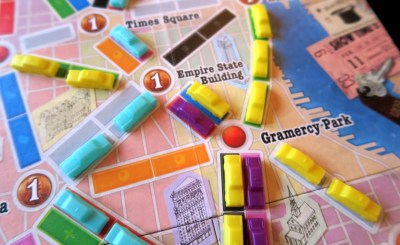
Players also start with two ticket cards (which they must keep one of) and successfully fulfilling these give more points.  Similar to the original games, on their turn, the active player can take coloured cards from the market or play cards to place Taxis.  There is no end-game bonus for the longest route, most completed tickets or similar, instead, bonus points are awarded for each of the landmarks a player builds a route from.
Ticket to Ride: New York
– Image by boardGOATS

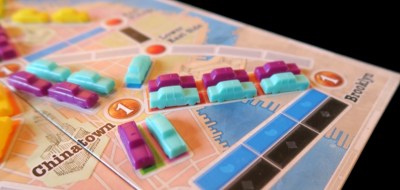
Lime started and claimed one of the double track route from The Empire State Building to Gramercy Park.  Pine went next and took the other track leaving Blue stymied before she had even taken a turn, specially given the tiny number of taxis each player had to place.  Not one to give up, she started a detour, very glad that she had decided to keep only one of her starting tickets.  Matched step for step by Pine, she built a route from The Empire State Building to Brooklyn via Chelsea.  Pine on the other hand was building what he later referred to as the “Beckham” route going from Chelsea to Brooklyn.
Ticket to Ride: New York
– Image by boardGOATS

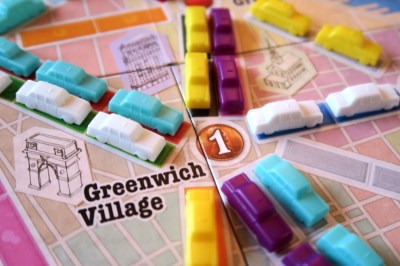
Blue was the first to pick up tickets and, after checking she had enough Taxis, decided to gamble, keeping both, as she had only kept the one from her starting pair.  Lime quickly followed and also kept his, as did Pine, who then drew another second set.  Lime claimed two tracks going from Central Park to Gramarcy Park, then suddenly looked crest-fallen having just realised he didn’t have enough Taxis to do what he wanted to.  It wouldn’t have mattered anyhow, as Blue promptly triggered the end of the game.  That only left the scoring.
Ticket to Ride: New York
– Image by boardGOATS

These little versions of Ticket to Ride are always really tight affairs where things can go horribly wrong. In this case, Blue scored most for claiming routes.  Pine would have scored most for tickets except he’d just failed to complete an eight point ticket from The United Nations Building to Wall Street giving him a brutal sixteen point swing.  Lime discovered that he’d not made the mistake he’d thought he had, as he’d actually gone from Midtown to Central Park by the long route, via Gramarcy Park.
Ticket to Ride: New York
– Image by boardGOATS

In the end, the opening play from Lime and Pine taking the two sides of the single Taxi double route from The Empire State Building to Gramercy Park might have been critical.  In forcing Blue to take a detour, she had been able to visit almost all of the eight tourist destinations giving her a very valuable seven points.  This coupled with completing all three of her tickets (including two long ones) and placing all fifteen of her Taxis gave her a final score of forty-four, five more than Lime in second.

Ticket to Ride: New York
– Image by boardGOATS

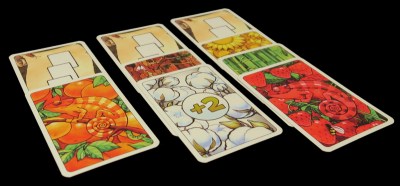
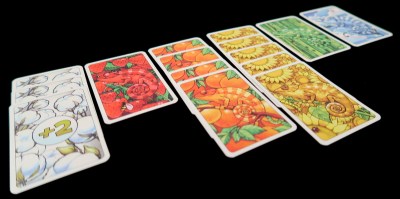
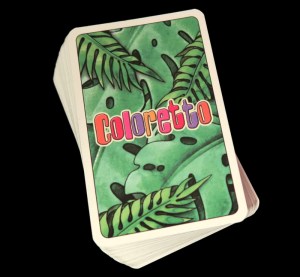
By this time, The Voyages of Marco Polo were progressing, but it was clear it wasn’t going to finish soon.  With Pine flagging after his trip up to Edinburgh, and Blue and Lime fending off colds, Blue suggested Coloretto as a light game that didn’t take too long or need a lot of thought.  Although it’s been played a lot within the group, it was new to Lime, so Blue gave him a run-down of the rules while Pine shuffled.  The game is really simple: on their turn, the active player either takes a coloured chameleon card and places it on one of the trucks, or takes a truck.
Coloretto
– Imageby boardGOATS

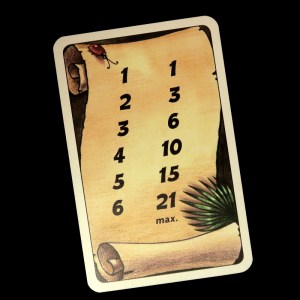
Each truck has a maximum of three chameleons, and there is one truck per player.  Once a player has taken a truck, they are out of the game until everyone has taken a truck and the next round starts.  At the end of the game (when the deck is mostly depleted and the end of game card is drawn), players score sets of chameleons.  The three largest sets are scored positively and everything else gives negative points.  The clever part is the triangular number sequence (one point for the first card, three points for two cards, six points for three cards etc.), which means that one more card in a large group is worth a lot more than a singleton or the second card in a pair.
Coloretto
– Image by boardGOATS

Lime picked it up quickly, but not quite quickly enough given that Blue and Pine had played the game many times before.  Served two wild Joker cards by Pine, Blue was able to put together two sets of six, giving her a total score of forty-eight, a healthy advantage over the other two.  Lime had enjoyed playing though, and suggested a second game as it would save getting something else out.  With lethargy playing its part, Pine and Blue were very happy to give it another shot.  This time, Lime was quicker out of the blocks this time, as Blue started to go off the boil.  He wasn’t quite quick enough though, and Pine took the second game with forty-four points, seven ahead of Lime.
Coloretto
– Image by boardGOATS

Lime doesn’t give up easily, however.  As The Voyages of Marco Polo was finally coming to an end, and Coloretto is quite quick, Lime suggested a third game.  This time, Lime started very strongly with obvious determination.  Ultimately Lime made a killing picking up a massive fifty-three points, more than ten points clear of Blue in second.
Coloretto
– Image by boardGOATS

Learning Outcome: You can never have too many camels.
Christmas GOATS 2019

Christmas 2019
– Image from vectorstock.com

The Calendar has been updated, but here is a quick summary of the key dates for GOATS and Didcot Gamers:

Christmas 2019
Tuesday 10th December 2019
(Last normal meeting of the year)
“Un-Christmas Dinner” meeting at 7pm;
Festive and Wintery games from 8.00pm(ish) at the
Horse and Jockey pub in Stanford-in-the-Vale.
Friday 20th December 2019
(Didcot Gamers)
Games at The Loop in Didcot
(as normal).
Tuesday 24th December 2019
(Unofficial boardGOATS?)
As it is games night and there is no quiz
this year, some people might meet up
from 7.00pm for food and a game or two.
Thursday 26th December 2019
(GOATS do the Quiz – CANCELLED)
No Quiz Night at the Horse and Jockey pub
this year as the pub is closed on Boxing Day.
Sunday 29th December 2019
(Monster Games)
Something longer in the
afternoon at Barney’s House.
Tuesday 31st December 2019
(New Year Party)
Games and food from 7pm until
the early hours at Barney’s House.
Friday 3rd January 2020
(Didcot Gamers)
Games at The Loop in Didcot
(back to normal).
Tuesday 7th January 2020
(boardGOATS)
Games from 7.30pm at the Horse and Jockey pub
in Stanford-in-the-Vale (back to normal).

Next Meeting – 12th Movember 2019

Our next meeting will be on Tuesday 12th Movember, at the Horse and Jockey pub in Stanford-in-the-Vale.  As usual, we will be playing shorter games from 7.30pm as people arrive, until 8pm when we will start something a little longer.

This week, the “Feature Game” will be The Voyages of Marco Polo, a game where players recreate the journey the seventeen year old Marco Polo took to China with his father and older brother.  The long and grueling journey led through Jerusalem and Mesopotamia, and over the “Silk Road”, reaching the court of Kublai Khan in 1275.  In the game, with each player takes the role of a different character with a special power.  The game only plays five, but we have the Agents of Venice expansion which adds an extra player.

The Voyages of Marco Polo
– Image used with permission of boargamephotos

And speaking of travelling…

Jeff and Joe were driving through Wisconsin. As they were approaching Oconomowoc, they started arguing about the pronunciation of the town’s name. They argued back and forth until they stopped for lunch.

As they stood at the counter, Jeff asked the blonde employee, “Before we order, could you please settle an argument for us? Would you please pronounce where we are… very slowly?”

The blonde girl looked at him, and then leaned over the counter and said, “Burrrrrr-gerrrrrr Kiiiing.”

29th October 2019

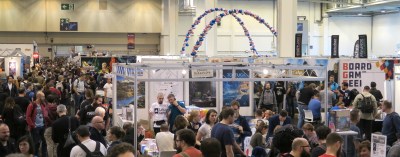
Blue and Pink were first on the scene, armed with special deliveries from Essen and some new exciting toys to play with.  Burgundy, Pine, Lime and Green weren’t far behind and soon those that hadn’t eaten earlier were tucking in.  Inevitably, the conversation was all about the games fair in Essen and how much it had grown – this year, according the organisers, there were over 209,000 participants, ten percent more than last year.  There were also one thousand two hundred exhibitors from fifty-three nations, occupying six large halls, around twice the hall space when Green last went.

Essen 2019
– Image by boardGOATS

As people arrived, they received their consignments.  Purple and Black got their sadly rather squished copy of the new release, Fast Sloths complete with Expansion and Chameleon promo, a copy of the new portable set of Settlers of Catan (“Catan Traveller“) and a several bags of German lebkuchen biscuits.  Burgundy got his annual Concordia expansion (the Balearica/Cyprus map) and the European Birds expansion for Wingspan.  This last game was one of the sell-out games at Essen, and Blue and Pink had been at the front of what became a very long queue to get it.  That said, the length was probably more to do with the fact that it was also the queue to get a hand on one of the fifty English language copies of Tapestry at the show. Given the fact that Wingspan is very popular at the moment and it would need very little learning, the new expansion was “Feature Game” for the night.

Wingspan
– Image by boardGOATS

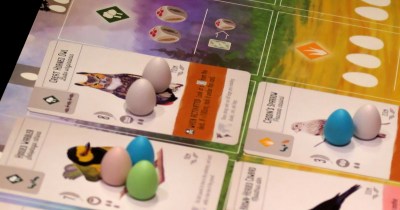
The game is relatively simple, with players collecting birds for their reserves.  On their turn, the active player chooses one of four actions/habitats, and then starting with the card furthest to the right in that habitat, activating each card in turn.  The actions associated with the habitats are spending food to play cards; getting food; laying eggs, and more drawing bird cards.  Players start with eight possible actions per turn, which gradually reduces to five over the course of the four rounds of the game.  All the bird cards in the game have actions that fit with their real-life behaviour.  For example, the food needed to play cards closely resembles their diet, the number of eggs each bird has in their nest is proportionately correct and bonus actions are associated with birds that flock and birds of prey.

Wingspan
– Image by boardGOATS

The European Expansion adds more birds that mostly do more of the same thing, but includes birds that have new end of round powers.  There were enough copies for everyone to play, so we set up two games in tandem.  Blue, Green and Pink helped Burgundy christen his new copy, while Black, Purple, Ivory, Pine and Lime gave Blue and Pink’s copy it’s first outing.  After making sure all the new cards were thoroughly shuffled into the deck, Burgundy’s group were first to get started.  The end of round objectives were particularly awkward as the final round rewarded players with the most birds without eggs on nests (one of the new objective tiles).

Wingspan
– Image by boardGOATS

Blue started off very well, but then her game stalled as she struggled to find useful cards.  Burgundy wasn’t far behind and his very hungry Griffon Vulture seemed to be very effective when it came to catching mice.  Blue’s Barred Owl was also successful on almost every occasion it went hunting while Green’s Northern Harrier repeatedly went hungry.  Meanwhile, Pink was building a very fine reserve with lots of high value birds, although he felt they didn’t give him such effective actions.  With Blue struggling to get anything she could play and Green muttering about not understanding the game, it was left to Pink and Burgundy to fight it out.  In the end, although Pink had far more interesting birds, Burgundy did much better with his personal objectives and end of round objectives, giving him a total of seventy-three points, nine more than Pink in second place.

Wingspan
– Image by boardGOATS

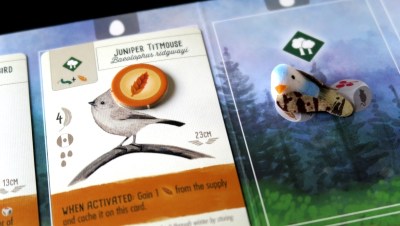
On the neighbouring table, everyone started off slowly.  Black grabbed one of the new European birds that allowed him to steal food which he used to great effect.  Black and Lime also took one of the new end of round bonus cards each which allowed them both to tuck cards.  Pine played a Long-tailed Tit, one of the new double space birds, allowing him to get lots of food. Ivory focused on cards with activation powers and in the second round, he and Lime built egg laying engines, with Lime making good use of his Fish Crow which allowed him to exchange eggs for food. Purple struggled due to the lack of fish, clearly having an eye on the last round objective (most birds in wetlands).

Wingspan
– Image by boardGOATS

Both Pine and Lime struggled seeing and understanding the cards, but despite this, both managed to get effective engines going, particularly Lime.  By the end, Black had lots of valuable birds and did well on his objectives and Pine missed out on a seven point objective bonus by just by one corn eating bird (getting three points instead). Black also did well on tucked cards, as did Lime.  Everyone drew for the first end of round objective (most birds in any row), with Ivory followed by Lime for the second (most birds with “brown powers”).  Lime managed to win the third round objective battle (most grassland birds), edging Ivory into second place, but the final round (most wetland birds), was a three-way tie between Ivory (again!), Pine and Purple who all had the maximum number of birds in their wetland.

Wingspan
– Image by boardGOATS

Although he did well on objectives, in the final round Ivory’s primary focus was on getting as many eggs laid as possible and he finished with a massive twenty-seven, a significant contributor to his final, winning score of seventy-nine, seven more than Black in second place and ten more than Lime in third.  There was the inevitable comparisons between the two games, and when Ivory asked whether people felt the expansion had made much difference to the game, opinions seemed divided.  Having birds he could see in his garden had made a big difference to Pine, though to those people who were less interested in our feathered friends and more interested in the game play, the expansion had made less of an impact.  For those that have it though, the European expansion will no-doubt remain a permanent feature.

Wingspan
– Image by boardGOATS

The four-player game including Burgundy, Pink, Blue and Green finished first by some margin, giving them time to play something else.  With Blue and Pink having exchanged last year’s variant on the 2018 Spiel des Jahres winner, Azul (Azul: Stained Glass of Sintra), for this Essen’s latest model, Azul: Summer Pavilion, this seemed a good time to give it an outing.  All three games are based round a clever “market” mechanism:  players take all the tiles of one colour from one of the stalls and put the rest in the central pool, or take all the tiles of one colour from the central pool.  In the original game and in the second iteration, these are placed straight away in a tableau, with the original representing a mosaic and the second a stained glass window.

Azul: Summer Pavilion
– Image by boardGOATS

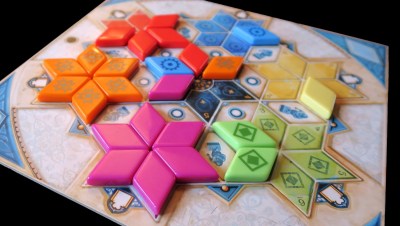
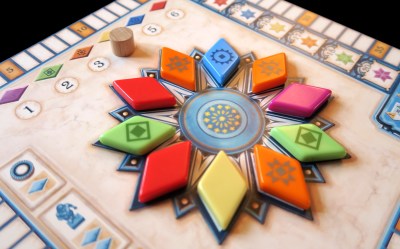
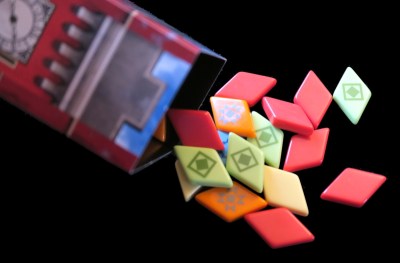
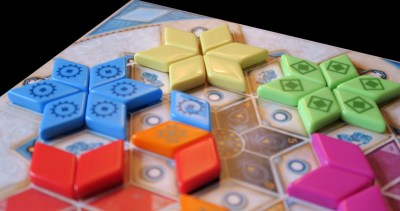
In the new, Summer Pavilion variant, tiles taken from the market are put to one side for the second phase when players take it in turns to place them on their personal player board.  Where the tiles in the first two versions are square (opaque and clear plastic respectively), in the new edition, they are rhombus-shaped.  Instead of rows, each player’s tableau consists of stars made  up of six rhombi.  In this game, as they add pieces players score points for the size of the block.  For example, adding a piece to an existing partial star consisting of two pieces gives three points.  Thus, increasing the size progressively yields increasing amounts of points.  Although this is an obvious difference, the biggest difference in the game play is the cost of placing tiles and the use of “Wilds”.

Azul: Summer Pavilion
– Image by boardGOATS

Each space on a player’s tableau has a number on it: one to six.  This is the cost to place a tile in that space.  So, placing on a six-space means they place one tile on the board and five in the tile tower.  The tiles must all match the colour being placed, however, every round, one of the six colours is “Wild” and this can be used as a substitute.  The Wild colour affects the tile drawing phase too:  Wilds cannot be chosen from the market, however, if there is are Wilds present in the market, one (and only one) must be taken as well.  For example, if there are two blue tiles, a red and a green (which is Wild), the player can take the two blues and the green, or the red and the green, but cannot take the green alone.

Azul: Summer Pavilion
– Image by boardGOATS

There are several bonuses, both in game and end game.  Players who surround certain features on their tableau get to take extra tiles from a second, special market.  This helps grease the wheels and makes the decision space a little more interesting too.  At the end of the game, players get bonus points for completing stars and for covering all the “ones”, all the “twos” etc..  The stars give different numbers of points depending on the colour.  Each tableau has one of each colour available and one central multicolour star in which every tile must be a different colour.  At the end of the game, the player with the most points is the winner.

Azul: Summer Pavilion
– Image by boardGOATS

Although Blue had found time to punch the pieces in advance, she had not been able to read the rules properly so did it on the fly – the rules are not long, nor are they complex.  That said, this version certainly adds strategic depth compared with the original, without the fiddliness of the second version.  Without any experience, there were no clear strategies.  Blue targeted the bonus points for the must lucrative, purple star and the central star as “low hanging fruit”, while Pink went for the in-game bonus tiles and picked up the extras for completing all the “ones” and “twos”, but didn’t quite make the “threes”.  Burgundy played for some of the less valuable stars and Green struggled to get anything to work at all.  It was really close, with only one point between Blue and Burgundy, and Pink just a handful of points behind him.

Azul: Summer Pavilion
– Image by boardGOATS

This was a brand new game, never played by anyone round the table, so inevitably, something got missed in the rules.  In both the base game, Azul, and the follow-up, Stained Glass of Sintra, the first person to take tiles from the central pool in each round takes the first player marker and a penalty for doing so.  The same is true here, but unlike the base game, the size of the penalty depends on the number of tiles taken with the first player token.  Everyone played by the same rules, so nothing was “unfair” and nobody noticed any balance issues, however, in such a close game it is very likely to have made a difference.  We’ll get it right next time!

Azul: Summer Pavilion
– Image by boardGOATS

Learning Outcome:  Essen is Awesome!

Next Meeting – 29th October 2019

Our next meeting will be on Tuesday 29th October, at the Horse and Jockey pub in Stanford-in-the-Vale.  As usual, we will be playing shorter games from 7.30pm as people arrive, until 8pm when we will start something a little longer.

This week, the “Feature Game” will be the new European Birds, Wingspan expansion, fresh from the Internationale Spieltage in Essen.  As well as the European bird cards the expansion also includes some new purple eggs.  We’ve chosen this game expansion because it is very new flying off the Essen shelves very quickly, needs minimal teaching, and plays in a reasonable amount of time giving everyone plenty of opportunity to look at their new arrivals and perhaps play some of the other hot new games.

Wingspan: European Expansion
– Image by boardGOATS

And speaking of eggs…

Jeff walked into a bar with a fried egg on his head.

The landlord was puzzled and asked, “Why have you got a fried egg on your head?”

“Well,” replied Jeff, “You see, boiled eggs fall off…”

Essen 2019 – Update

Sunday was the last day of this year’s Internationale Spieltage, the largest games fair in Europe (and arguably the world), known to gamers worldwide simply as “Essen”.  Although there was a lot of buzz about some of the hot games like Maracaibo and Cooper Island, it is the smaller, less well-known games that really make the fair what it is.  For example, Firefly Dance, is a fun little memory game with gorgeous little light-up fireflies activated with a wooden magic wand.

Firefly Dance
– Image by boardGOATS

Some games sold out within minutes: the last copy of Tapestry went in less than half an hour, and other early sell-outs included Alubari: A Nice Cup of Tea, A Fistful of Meeples and Point Salad.  There were lots of good deals to be had, including Passing Through Petra, one of the hot games from last year which was reduced from €60 to just €15.  Part of this might have been to attract attention to the Renegade Games stand because according to staff their entire supply of this year’s releases were “stuck in customs”.  This included their copies of Paladins of the West Kingdom (the sequel to last year’s smash hit, Architects of the West Kingdom).

Ticket to Ride Map Collection: Volume 7 – Japan & Italy
– Image by boardGOATS

There were also a number of other unusual games available, for example, Wsiąść do Pociągu: Polska, the new Poland map for Ticket to Ride, as well as the more widely available new Japan/Italy Map Collection.  There were other expansions as well, including the European Birds expansion to Wingspan, Sagrada: The Great Facades – Passion and Terraforming Mars: Turmoil.  In addition to expansions, there were several stand-alone re-implementations of old favourites, including the new 6 Nimmt! Brettspiel (boardgame), Glen More II: Chronicles and Azul: Summer Pavilion.

Azul: Summer Pavilion
– Image by boardGOATS

Games fairs are also about demonstrations of games that have not yet been released.  There were many of these, but one of the highlights was perhaps Namiji which is the sequel to Tokaido and will be the subject of a crowd-funding campaign in a month’s time.  So there is much to look forward to  from the Essen haul, old games as well as new, which will make the coming months very exciting indeed.

Namiji
– Image by boardGOATS