Author Archives: nannyGOAT

9th August 2016

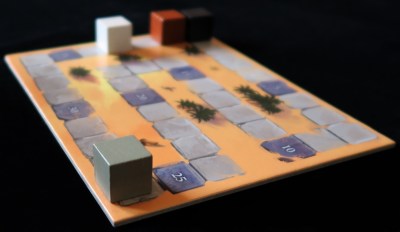
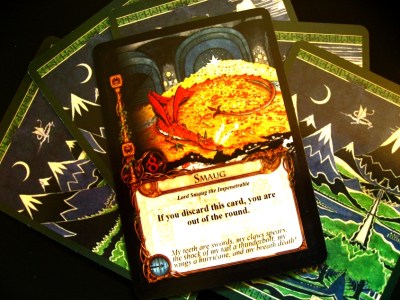
While they were waiting for people to finish their supper, Green, Grey, Red and Violet warmed up with a quick game of Love Letter.  One of the first of the “micro-games” this is a tiny gem, played with just sixteen cards.  Each card has a value (one to eight) and an action; players start with one card and add a second to their hand before playing one of them and enacting the action.  The round goes to the player with the highest value at the end and the player who wins the most rounds wins the game.  This time we were playing with a print-and-play Hobbit version, with players trying to finish with the Smaug card and winning a tiny gold ring if they do.  This time, although he was dealt cards, Grey didn’t really get the chance to play as he was out before his turn each time.  Red, on the other hand, took the game winning two rounds, one more than Violet.
Love Letter
– Image by boardGOATS

With everyone fed we moved onto our “Feature Game”, Orléans.  This is a “bag building” game set in medieval France.  The idea is that each player has a bag and, at the start of the round draws workers from it.  Players then place their workers on it their market which has a maximum of eight spaces, before moving as many as they want onto their personal player board which dictate the actions they can carry out.  Once everyone has placed their pieces, players take it in turns to carry out their actions.  There are a variety actions, but most of them involve taking another worker that is added to the bag along with any workers that have been used.  Thus, the game is mechanically very simple: draw workers from a bag, plan which actions to do and then do them with points awarded at the end of the game.  This simplicity belies the depth of the game and the complexity that comes as a result of combining the different actions though.

Orléans
– Image used with permission of BGG contributor bkunes

In addition to taking a worker, the most actions come with a bonus; some of these help players manage their game, while others give players scoring opportunities.  For example, going to the Castle will give a player an extra “Knight”, but will also enable them to take an extra worker out of the bag on subsequent turns.  Similarly, a trip to the Village to get a “Craftsman” will also yield a technology tile which can be placed in a location and stays there for the rest of the game, acting as a permanent worker.  On the other hand, players who go to the Farm House will get an extra “Farmer” but also an extra resource and an extra “Boatman” comes with money.  Both money and resources score points at the end of the game.  Each of the Character actions has an associated track on the communal player board and the players move one step along these tracks each time they carry out an action; the bonus received on each step is marked just above the track, and in general they increase the further along the track players are.

Orléans
– Image used with permission of BGG contributor jsper

The biggest source of points, however, comes from a combination of travelling around France building Trading Stations, collecting “Citizens” and travelling along the development track.  Travelling can either be carried out along rivers or roads and, if there is no-one else has already built there, they are able to place one of their ten little wooden houses in the town (all using the appropriate actions of course).  Citizens can be acquired by being the first player to fulfil certain requirements (e.g. get the maximum number of Knights or Boatmen).  Along the bottom of the main player board, there is also a Development Track and at intervals Coins and Citizens are available (only the first player get the Citizens though every player gets money).  There are also Status Markers at intervals along the track – these are critical:  at the end of the game, players score points equal to the sum of the number of Trading Stations built and Citizens acquired multiplied by the total number of Status Markers.

Orléans
– Image by boardGOATS

There are a range of ways to move along the Development Track, for example, choosing the University action comes with a Development Point bonus, and the Scriptorium and Town Hall can both also give Development Points, though perhaps less efficiently.  One thing is clear though, this aspect of the game is a bit like collecting Nobles in Lancaster in that players neglect the Development track at their peril.  This is particularly important as as the number of each type of worker is strictly limited, so when they are all gone, that action is no-longer available to any player.  Thus, players who neglect the University action in the early part of the game may find it is no longer available when they want to use it later.  One of the most important aspects of the game for players is controlling the contents of their bag as this dictates what actions they will be able to take.  Since the Development Track is so important, it might be thought that a good way to start is to make repeated visits to the University.  This will fill the player’s bag with Scholars, though, which might not be such a good thing unless players can find another way to use them effectively.
Orléans
– Image by boardGOATS

Scholars are not very useful for travelling or building Trading stations and can really only be used in the Scriptorium or Cloister (to get highly versatile “Monks”) in partnership with another worker, so are of limited use.  This means that players need to vary the actions they take so that their bag remains balanced.  Even so, probability can play tricks and players can end up with a very unrepresentative handful of workers.  It takes a very courageous player to then forfeit actions in the current turn in the knowledge that the workers they need will likely come out next time enabling the player to carry out twice as many actions later.  This approach will cause the player to delay their turn which can be a disadvantage though it can also give them a better chance to plan a larger more complex sequence of actions.

Orléans
– Image by BGG contributor styren

Another way a player can control what they draw from their bag is for a player to ensure their bag stays small.  Players cannot just throw workers away, so once a player has a worker in their bag a player they have only two practical ways of getting rid of them.  The first is to park them on an action they don’t intend to use.  This works well if there is a suitable action available, but is not always possible and each action can only be occupied by one worker at a time, though it does allow players to recover them if necessary.  The other option is the Town Hall action.  Each player has two of these on their player board and, workers placed here are moved to the Beneficial Deeds board where they earn a one-off reward (either money or Development Points) and then remain there for the rest of the game.  There are two  problems with this:  firstly, there are a finite number of spaces on the Beneficial Deeds board, so if they are filled up that is that and secondly, they can never be recovered.

Orléans
– Image used with permission of boardgamephotos

This last point is significant as players can change their strategy during the game and find that they need more of a particular type of worker.  For example, the Village action allows players to collect a black Trader and the bonus is a free choice of a Place Tile.  These are essentially extensions to player’s individual board providing them with extra possible actions, however, they also require workers of a given type.  Thus, adding one of these may provide a use, for example, for all the Scholars that they had previously disposed of.  As the number of workers available is strictly limited, the desired Scholars may also no longer be available rendering the additional Place Tile much less useful than initially thought.  There is a get-out as the Cloister action gives “Monks” which are effectively “wild and can generally be used as a substitute for any other worker.  However, these are also limited in number of course and tend to disappear early so the wise player will try to grab a few of these early to help keep their options open.

Orléans
– Image used with permission of boardgamephotos

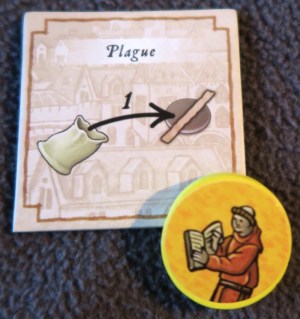
This is all very well, but it is almost certain that a well balanced bag will suffer the full consequences of the Plague.  At the start of each of the eighteen rounds, an event tile is drawn at random which takes effect at the end of the round.  There are six different events each of which occurs three times and they variously have good or bad consequences, including additional income, a visit from the tax man and harvest.  Probably the worst of these, however, is the Plague, though the most serious effects of this can be mitigated to some degree with a bit of care and a little sacrifice.  When the Plague comes, it kills one worker drawn at random from each player’s bag, but if they draw one of their key starting workers it survives.  Thus the smart player will try to ensure their most precious pieces don’t go back into their bag during a Plague round, while stuffing it full of their starting workers and hoping probability does the right thing.
Orléans
– Image by boardGOATS

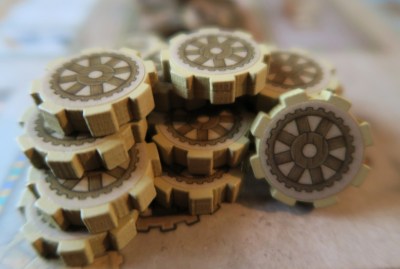
With seven players, we had to play two games, and they could both be the same since we had two copies of Orléans available (one the original Anglo-German version enhanced with fancy pieces and the other the Deluxe US version with different fancy pieces).  Green was the least keen to play Orléans as he had played it several times recently, but as everyone else seemed keen he graciously joined in with Grey, Red and Blue to make up the first group.  Blue had only played the game as a two player game and Grey and Red were completely new, so the game started fairly slowly, but Green showed the way by getting himself an early Knight and using it to go travelling, building Trading Stations as he went.  In contrast, Blue and Red began by taking Craftsmen and using the associated Technologies.  These are effectively permanent workers once placed on the board, which can make them very powerful if gained early enough.  Grey began by taking the University action and progressing along the Development Track and being the first he managed to pick up a few early Citizens.
Orléans
– Image by boardGOATS

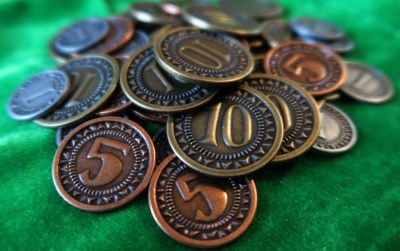
Red then moved onto collecting Farmers – not only do these give resources (worth points at the end of the game), but the person who gets ahead in this gets an extra coin at the start of the round (and if someone gets left behind, they lose a coin).  It was about this point that we suddenly ran out of Scholars leaving everyone a long way from where they wanted to be on the Development Track and starting a rules debate as to whether players could continue to take the action for the bonus without getting a worker.  This was a situation that hadn’t arisen in Blue’s two-player games and wasn’t helped by the fact that Burgundy (on the next table) had the first edition of the rules and Blue had the second.  It turned out that Blue had got confused by a rules clarification by the author which explains that although players can’t perform actions that give a worker if they have reached the end of the track or there are no workers left; resources and Technologies on the other hand are a bonus and the actions are still possible if they run out.  This left everyone a little bit stuck, but since Green was the only one who could have really seen it coming and was the most affected having neglected the Development Track for travelling and building Trading Stations, everyone carried on.
Orléans
– Image by boardGOATS

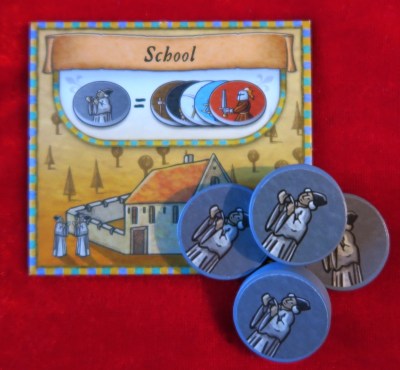
Blue tried to mitigate the problem by taking the Library extension tile which she could use to get two Development Points each time she used it.  Similarly, Grey took the Apothecary extension which enabled him to buy Development Points up to a maximum of three per turn.  By this time we had also run out of Craftsmen, so Blue picked up the Library extension which gave her extra access to the Technologies, though unfortunately for her this was a bit of a waste as it was too late in the game to really make use of it and she ended up only getting the one Technology from it.  As the game progressed into the final stages, everyone suddenly seemed to discover the advantage of the extensions, so Red took the School (so that she could use Scholars as other workers); Grey took the Sacristy (to protect him from the negative effects of events), and Green took the Gunpowder Tower (which expands the market by two and can also be used to place extra workers on the Beneficial Deeds board).  Green was probably the most effective as he was able to use it to pick up extra Development Points and make up for a lot of his shortfall.  In the last turn Blue managed to get her final Sailor and with it an extra Citizen; this proved very effective as it gave her lots of extra points as well as a lot of money and made the game much closer than it would otherwise have been.  It wasn’t quite enough however, and Green won by just four points.

Orléans
– Image by boardGOATS

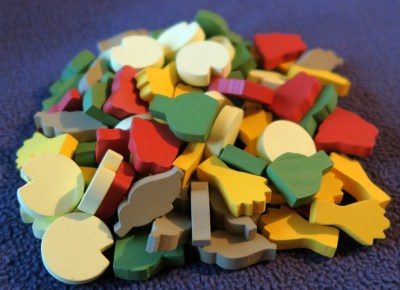
On the next table, Burgundy, Pine and Violet were engaged in a three player game of Orléans.  Only Burgundy had played it before and he took great pains to explain it very carefully and try to help everyone avoid some of the most gruesome pit-falls early on.  Pine started off like Green, by travelling and building Trading Stations until Burgundy pointed out that he had been neglecting the Development Track.  Meanwhile, Violet shot up the farming track, picking up lots of resources and the extra coin at the start of each round as an added bonus.  Once she had got the maximum number of Farmers, Violet moved onto travelling and collected even more resources, and building the occasional Trading Station when she could.  While all this was going on, Burgundy concentrated on collecting Citizens and building a quality bag. Pine tried stuffing his bag with monks, but they seemed very shy and didn’t seem to want to come out to play when he needed them.  Everyone took an expansion tile:  Burgundy took the Wool Manufacturer early in the game and, as a result and ended up with piles of the stuff, while Violet (like Red on the next table) took the School which enabled her to use Scholars in place of other workers, something she used a lot.
Orléans
– Image by boardGOATS

Pine took the controversial Bathhouse expansion tile which has been the subject of two rules re-writes.  In the first edition of the rules, the player had to place one Farmer on the tile to activate it and then, when it was chosen as an action, the player draws three workers from the bag and chooses two of them to place on appropriate actions which can be used straight away if appropriate.  When the game was first released some players seemed to find this overly powerful, so the designer suggested a modification to the rules such that only two tiles are drawn and only one is kept.  When TMG brought out their edition, they altered the rules again.  In this third version, it is not necessary to place a Farmer to activate the tile, but the additional two workers are drawn from the bag after the others and one is returned, but for this to be useful, there must be sufficient space in the player’s market to hold the extra worker. Each of these has advantages and disadvantages with the requirement for a Farmer to activate it being used to give an extra worker during the round allowing players to leave planning till later in the game and potentially enabling them to use an action twice.  In this game, however, we played by the rules as originally written.

Orléans
– Image by boardGOATS

As the game progressed, everyone struggled a bit on the Development Track and everyone was pretty much dead level.  Burgundy (like Blue on the next table) decided to make a move on the oft-neglected Sailors.  Since the bonus isn’t immediately useful, players tend not to bother about them, however, they provide a lot of money (a total of fourteen for a player who gets everything available) and money equals points at the end of the game.  There is also a Citizen for the player who gets the maximum first, so getting ahead can be quite lucrative, especially as there is often no real competition for it.  Meanwhile, Burgundy was struggling with the Beneficial Deeds board.  He was after the citizens, but as the only one using it, he was struggling and ended up with fewer of some workers than he really wanted.  Eventually Pine and Red gave him a hand, but it was all a bit late in the game for Burgundy.  That said, he had a huge pile of money and finished nearly thirty points ahead of Pine who just sneaked into second place.

Orléans
– Image used with permission of BGG contributor punkin312

Despite the fact that the two games had different numbers of player, they finished at much the same time, with the four-player game actually beginning scoring first.  Even though the number of resources and workers are adjusted the game plays very differently with different numbers:  with fewer players there is more space to move around France and there is a lot less to take on-board.  Red in particular found it very difficult to absorb all the information and options available in the four-player game so perhaps it is easier to grasp what is going on as a two or three player game the first time.  We all struggled to get the workers we wanted at key times.  Monks (especially Pines) appeared to hide in a closet reading their scriptures for most of the game.  Until there was a plague that is, at which time they all came out to find out what all the screaming was for, at which point they were immediately struck down.  That said, Orléans is a great game with a good balance of frustration and a remarkable amount of depth for what are otherwise very simple rules.  Perhaps the biggest issue is the number of tiny rules exceptions (e.g. the first Technology must replace a Farmer), which complicate teaching a bit, but that’s a small criticism in what is otherwise an unusual worker placement game.

Splendor
– Image used with permission of BGG contributor henk.rolleman

Red, Green, Grey and Violet all headed off, leaving Burgundy, Blue and Pine with some three-quarters of an hour to play something.  After a short chat about the future of the “Feature Game”, and how we choose what to play, the group settled down to a quick game of Splendor.  We’ve played this little chip-collecting and card development “engine building” game quite a bit, but we all still seem to quite like it when we are looking for a light filler game.  The idea is that players collect chips to buy gem cards which can, in turn, be used in lieu of chips.  More expensive cards are also worth points and the game end is triggered when one player reaches fifteen points (and the round is completed to give everyone the same number of turns).  Points are also awarded for “nobles” which go to the first player to get a specific combination of gem cards and the player with the most points at the end is the winner.

Splendor
– Image used with permission of BGG contributor henk.rolleman

This time, Blue started really well, and before long was eight points clear of everyone else.  Burgundy couldn’t get what he wanted at the start, so just picked up lots of ruby cards while Pine found that everyone else nicked the cards he was after just before he could get to them.  Maybe it was because Blue relaxed, or maybe it was because she and Pine took their eye off the ball, but suddenly, the cards seemed to fall right for Burgundy and Blue and Pine let him take what he wanted.  Before long, Burgundy had picked up two nobles in very quick succession and needed only one point to end the game (as the last player in the round).  Blue managed to pick up two points but it wasn’t enough and Burgundy pipped her to the final win of the evening by just one point.

Splendor
– Image used with permission of BGG contributor henk.rolleman

Learning Outcome:  Tight games are some of the most interesting.

Next Meeting – 9th August 2016

Our next meeting will be on Tuesday 9th August, at the Horse and Jockey pub in Stanford-in-the-Vale.  As usual, we will be playing shorter games from 7.30pm as people arrive, until 8pm when we will start something a little longer.

This week the “Feature Game” will be Orléans, which is a “bag-building” game where players are trying to gain supremacy through trade, construction and science in medieval France.  It is not a terribly difficult game to understand, though it has quite a bit of depth.

Orléans
– Image used with permission of BGG contributor punkin312

And speaking of the Orléans…

When Jeff was a little boy he would say his prayers before he went to sleep.  Every night he would kneel by his bed and say, “Please God, bless mummy and Daddy and all the other children, Amen.”

Then one night, as his father walked past his bedroom door he heard Jeff say, “Please God, bless mummy and Daddy and all the other children and make Orléans the capital of France, Amen.”

Jeff’s father couldn’t resist, so he went into his son’s bedroom and asked, “Jeff, why do you want Orléans to be the capital of France?”

Jeff replied, “Because that’s what I wrote in my geography test…”

26th July 2016

To celebrate Codenames winning the Spiel des Jahres Award, this week it was our “Feature Game”.   Although the game seems to be very, very popular, it definitely has the “Marmite Factor” amongst our group.  It also really needs a group of a reasonable size.  Since it is relatively quick, even the most reluctant agreed to give it a go, especially as Cerise had made it for the first time in ages and it was a game she had really enjoyed last time we played it.  It was also Turquoise’s first visit, so a team game seemed a good way of starting.  The idea of the game is that there are two rival teams of Spies, each with a leader or Spymaster.  The Spies are trying to locate their Agents, but these are only known by their Codenames, and only the Spymasters have the key to who is on which team.  The Codenames are laid out on the table in a five by five array where everyone can see them together with some innocent bystanders and an Assassin.  The Spymasters then take it in turns to give clues to their team so that the Spies can identify their own team’s Agents by pointing at them.

Codenames
– Image by boardGOATS

Clues are of the form “word; number”, where “word” is a clue that connects several cards and “Number” is the number of connected cards.  For example, the clue “bird; three” might connect “sparrow”, “beak” and “Naomi Campbell”.  The team then discuss the clue and point to code cards, one at a time.  If they get it wrong, their turn ends straight away, so ideally they should start with the answers they think are most obvious.  If the Codename corresponds to one of their agents, then the team can guess again, and keep trying until they have exhausted their theoretical maximum number cards that match the clue (three in the example).  Importantly, the only measure of “correct” is whether the Codename is one of the Agents, the agent chosen does not actually have to match the current clue.  So, a team who can’t make sense of a clue or identify all the Codenames may decide point to a Codename that matches a clue given earlier in the game.  For this reason, when a team get all their theoretical maximum number of Codenames for that turn right, they also get one extra chance.

Codenames
– Image by boardGOATS

So, the trick is for the leader to come up with clues that cover multiple correct answers so that the rest of the team can identify the complete set before the opposition identify all theirs. Unfortunately, we had a particularly unconnected set of words and two Spymasters, Blue and Burgundy, who were particularly useless at this sort of thing.  Consequently there were lots of clues like “continent; one”, and when Blue got adventurous and went for “music; two” she totally confused her team and was perilously close to a hint that could lead to the Assassin (Codename “Snowman”) and bring the game to an abrupt end.  “Zooloretto; two” also fell on stony ground since nobody on Blue’s team had actually played it (where everyone in Burgundy’s team had).  The game remained finely balanced as Blue continued to try to give slightly more adventurous clues which her team didn’t always get, while Burgundy played safe with smaller clues that his team understood.

Codenames
– Image by boardGOATS

It all came to a head when, with only two Agents left to find, Burgundy decided to be adventurous and gave the clue “film; two”.  His team quickly got one of them, “Alien”, but the second was more tricky.  Green thought it was probably “forest” (as in “The Forest Moon of Endor”), but could also be several other things.  Cerise, on the opposite team leant a hand and suggested that it could be “wind” as in “Gone with the…”  or maybe “snowman”.  Meanwhile, Burgundy remained stony-faced, in what were very trying circumstances.  Eventually the team ignored Cerise (who had managed to suggest both the correct answer and the Assassin), which gave Blue and her team one last chance.  With only one Agent left to guess, there was only a short pause before they finished the game.  There was a big sigh of relief all round as everyone was put out of their misery, particularly Blue and Burgundy who had found the whole clue-giving experience very stressful indeed.  Unquestionably, with the right crowd Codenames could be great fun, but sadly, we just aren’t it, so it is unlikely to get another outing in the near future – definitely not our group’s Spiel des Jahres this year.

Codenames
– Image by boardGOATS

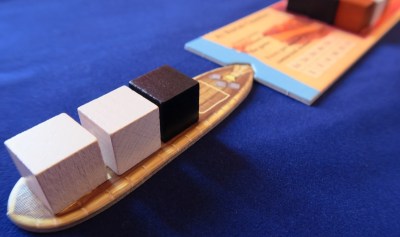
With that over, we decided to split into two groups.  Black and Purple were keen to give Imhotep a try (one of the other Spiel des Jahres Award nominees), as they had wanted to play it at the UK Games Expo, but it had been constantly booked out of the games library.  Burgundy had played it (also at Expo, with Blue and Pink), had enjoyed it and was happy to give it another go, so Green made up a group of four.  As well as being the key protagonist in the film, “The Mummy”, Imhotep was also a priest and a great architect.  So in this game, players take the role of builders in Egypt who are trying to emulate Imhotep.  The premise of the game is very simple.  On their turn, the active player chooses one of four actions:  procure new stones; load stones on a boat; sail a boat to a monument; or play an action card.  Players can only store a maximum of five stones and when they procure stones they can collect a maximum of three.  Stones are loaded onto ships one at a time, but which of the five possible destinations the boats end up at and the order they are unloaded in is vital, so timing and planning is everything.

Imhotep
– Image by boardGOATS

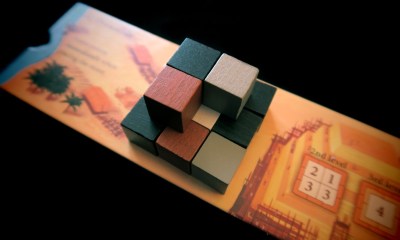
Admittedly the lovely big wooden blocks make this game feel like a “junior” board game, but Imhotep is anything but.  It is one of those games that is easy to learn but difficult to master. Although players have a range of options, trying to decide which one is best depends on what has already transpired, what opponents do and how the game will develop.  What makes it particularly tricky is that the best plans in the world can be crushed by opponents with one small action: when they take a boat to the “wrong place”.  It turns out the cubes are large for a good reason:  stacking cubes is a key part of the game and anything smaller would make a very wobbly obelisk.  There are four ships and five building locations, so one doesn’t get visited and the round ends when all four boats have sailed.  There are six rounds in total with points scored in different ways for the different buildings; the player with the most points at the end is declared the best builder in Egypt.

Imhotep
– Image by boardGOATS

Once everything was set up, the game got under way, but then almost stalled. Nobody had any idea what should be a good opening gambit.  Placing a cube on a ship was the easy choice, but which ship and in which position?  After some head scratching, everyone began placing cubes on boats, making plans where wanted the ships should go, waiting for them to be full, when suddenly, Purple jumped the gun and sent the first boat on its way.  She chose a boat with one cube of each of her competitors and sent it build an Obelisk, catching everyone by surprise.  It wasn’t a particularly bad place to go, but the obelisk doesn’t score until the end and since the highest scores are for the tallest towers, it might not actually be the most efficient use of a cube, especially so early in the game.

Imhotep
– Image by boardGOATS

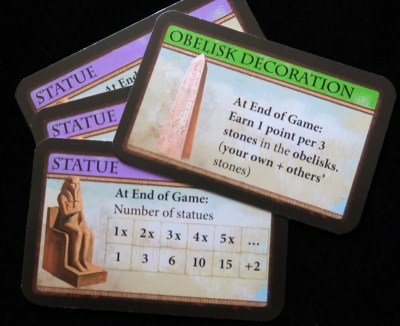
The rest of the first round continued to be a lesson in frustration as each of the other boats ended up somewhere other than where players had planned. The next boat went to the Burial Chambers (another scoring at the end of the game), the third to the Wall (scored at the end of the round, but only one point per cube) and the last went to the Market to get cards. As Green was first on the boat he had the first choice of the cards available and based on that first boat he chose the card that gave him an extra point for every 3 cubes in the Obelisk (any three cubes, not just his own).  Now no-one other than Green wanted a boat to go to the Obelisk.

Imhotep
– Image by boardGOATS

The second round began a little more cautiously.  Everyone had a better idea of how the round would go and began placing their cubes in particular positions on the ships.  The game continued to frustrate everyone as the ships just wouldn’t go where players wanted them to go.  This is frustration is similar to that in Zooloretto where players place animals on trucks, but have to wait until the next turn to collect them, if someone else hasn’t got there first, of course.  In Imhotep, it was usually pretty obvious where players wanted the boat to go, so someone else almost always got there first to send it somewhere else!

Imhotep
– Image by boardGOATS

The unusual scoring of the Pyramid (not steadily increasing or decreasing points) meant that everyone tried to position themselves carefully for that optimum high scoring space, but no-one ever managed to get the boat set up quite how they wanted.  As a result, again no boat went to the pyramid.  The obelisks grew, and the pattern of the Burial Chamber was going in Black and Burgundy’s favour and the Wall scored a few more points, mostly for Purple. The Wall was beginning to show its strength as a cube placed there can score round after round until it is covered – potentially scoring well.  The market cards were dolled out, with Burgundy and Black both taking a blue extra action cards for later use. Green wasn’t sure what to take and ended up with a purple end game scoring card which would only come into it’s own if he could collect a few more.  In the third round the pyramid finally got started, in Black’s favour. The game continued in much the same way, individual plans were more and more obvious and as a result became harder and harder to fulfil.  The trouble was, in taking an action to scupper someone else it often helped a different player or upset their own plans.

Imhotep
– Image by boardGOATS

By the end of the game nobody was sure who the winner was going to be.   Before adding all the end-game scores, Burgundy was ahead of Black and Purple, with Green trailing behind.  Everyone had managed a couple of areas in the Burial Chamber, but despite best efforts to scupper him, Burgundy still had the largest area.  The Obelisks had become a fraught battle field at the end.  Black had thrown down the gauntlet to take a boat there which only had two of his cubes and pushed him into the lead, but in the penultimate round Green had sailed a sneaky little single cube boat which made his tower equal.  By making sure that he placed a cube in any boat that Black had used, Green then ensuring that he would at least share the Obelisk spoils. The presence of a single cube boat in that last round, was interesting, but no-one wanted to use it as it was guaranteed that the cube would get taken to the least useful dock, so in the end the Obelisk scores for first and second place were shared between Black and Green with Purple and Burgundy sharing the scores for third and fourth place.

Imhotep
– Image by boardGOATS

With Black now several points ahead, Burgundy and Green were vying for second with only the the green and purple end-game scoring cards left, though only Black and Green had any.  Black scored points for every three cubes in the burial chamber, which extended his lead and now looked unassailable.  Green got his Obelisk cubes score, which proved to be the same as Black took for the burial chamber, but with three purple cards giving him another six points he leap-frogged over Black to win by one point.  It was an incredibly close game which suggests that where cubes go may not matter as much as it feels like it should.  On one hand, this seems like a good thing as it relieves the pressure of all those boats going to the “wrong place”, but on the other hand it may suggest the game is a little too balanced making strategy play is less important, which would be a great shame.  Everyone really enjoyed it, however, and would definitely play it again especially as it plays quickly and the alternative tile options look as though they would add variety and new challenges to the game keeping it fresh.  For our group, from the nominations list, this would definitely have been our choice of Spiel des Jahres.

Colt Express
– Image used with permission of boardgamephotos

Meanwhile, everyone else was engaged in a brutal game of Colt Express, the worthy winner of last year’s Spiel des Jahres.  This is a programming game, where players take it in turns to choose the cards to they will play, but only action them after everyone has chosen.  Since everyone then takes it in turns to carry out their actions, the game is full of unforeseen consequences.  The game has a Western theme and is played on a fabulous three-dimensional train.  The idea is that each player is a bandit attacking the train trying to move about to pick up cash and jewels while avoiding the Marshall and shooting each other.  Although we’ve played this a few times, we had a couple of people who hadn’t played it before so we had a quick run-down of the rules first.  Each player starts with the same deck of action cards and six bullet cards.  A round card dictates how many cards will be played and how (face up or down; in pairs or singly) and players each shuffle their action deck and draw six cards.

Colt Express
– Image used with permission of boardgamephotos

Players then take it in turns to play the action cards.  At the beginning of a round everyone can see where everyone else is and it is easy to choose which card to play and predict its outcome.  Before long, however, things begin to become unpredictable and by the time players have to choose a second card it is highly likely that plans will have gone awry, though of course, nobody know this yet.  Once the cards have all been played, the pile of cards is turned over and the cards are actioned in the order that they were played.  It is only at this point that people realise the mistakes they’ve unwittingly made, shooting nobody or the wrong person, trying to pick up jewels that aren’t there or finding they’ve got nowhere to go because the Marshal is in the way and has screwed up their plans.  As the game progresses, things get worse too since shooting someone involves passing them a bullet card.  This is added to their action deck, but is a dead card and gives no possible actions.  Multiple bullet cards means the chance of drawing them increases making the action cards drawn all the more precious and adding pressure to make the maximum use of them.

Colt Express
– Image used with permission of BGG contributor punkin312

Colt Express is a light, fun game and inevitably, someone gets picked on.  This time Blue was the victim (playing the character Django).  Magenta (playing the innocent looking Belle) started using Blue for target practice, but Cerise (Doc) was very quick to join in the fun.  Blue did her best to escape and briefly managed to grab the $1,000 strongbox (gold bar in our version of the game) before Magenta biffed her soundly on the nose and nabbed it.  Meanwhile, Cerise and Turquoise were doing an excellent job of gathering up the loot and robbing the passengers blind, before they decided to try to empty their revolvers.  Obviously, this was mostly at Blue’s expense and with so many bullet cards she struggled to do anything, but that didn’t put people off of course.  Before long even the Marshall was getting in on the act and, much to her disgust, Blue finished the game with more bullets than action cards and no money or gems at all.

Colt Express
– Image used with permission of BGG contributor punkin312

For everyone else, however, the game was quite close.  Magenta had managed to hang onto the gold bar (aka strongbox) and one gem, but it wasn’t enough to compete with Turquoise and Cerise.  Turquoise had picked up a massive five money purses while Cerise added the Sharp Shooter bonus to her one gem and single purse.  Much to our surprise, both totalled $1,850 which meant we had to check the rules for a tie-breaker.  It turned out this was the number of bullets received, which meant that even though she was a long way from competing, Blue had an influence on the result.  As well as being a bullet-magnet, Blue had just about managed to fire a couple of shots in return.  Cerise had been one of the main attackers, so she had caught a few of Blue’s bullets as well as a couple of Magenta’s.  Since Turquoise had rarely fired at anyone, she had picked up just two bullets and with it, her second win of the evening, with Cerise getting her comeuppance.

Colt Express
– Image used with permission of BGG contributor lacxox

With it nearing “pumpkin time” for Magenta and Turquoise, there was just time for one last quick game and, almost inevitably, that was 6 Nimmt!.  How this game is still interesting for our group, is a bit of a mystery.  It is short, everyone is always happy to play it and, since it has such a small footprint, it gets brought every week which means it is there when the occasion is right, the mystery though is why people haven’t got bored when other games have long since fallen off the radar.  This time Purple started badly picking up twenty Nimmts in the first round while Turquoise began with a clean sheet.  Burgundy started well with just two Nimmts, but since he always has one good round and one bad, everyone was just waiting for him to start collecting cards in the second round.  Magenta and Blue both had consistently low scores, but they weren’t low enough, and while Purple also made a virtue of consistency, that’s not so good when the scores are both high.  Sadly, Turquoise was forced to pick up a couple of high-scoring of cards while Burgundy, very unusually managed to string two good rounds together.  With a clear round for his second, Burgundy took the game with a total of just two Nimmts, beating Turquoise into second place.

6 Nimmt!
– Image by boardGOATS

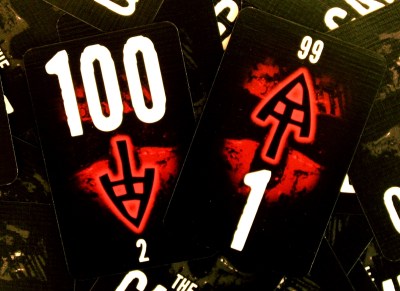
With Cerise, Magenta and Turquoise heading off, that left a short hour for something else.  Black was keen to play Isle of Skye, the winner of this year’s Kennerspiel des Jahres, but Green somehow hadn’t played it and we debated whether it would overrun.  Before long we’d prevaricated enough to definitely rule it out due to lack of time and we started hunting round for something else.  In the end we settled on The Game, a nice little cooperative card game that was nominated for last year’s Spiel des Jahres.  We played this quite a bit for a while, but somehow it has fallen out of favour a little of late, but for no very good reason.  The rules are simple: on their turn, the active player lays a minimum of two cards on any of the four piles following the appropriate trend – two piles must always increase, two decrease; the exception to this is if you can play a card where the interval is exactly ten in the wrong direction (known as “The Backwards Rule”).  Players can talk about anything so long as there is no specific number information given and the aim is to cooperatively get rid of all ninety-eight cards by playing them on to the four piles.

The Game
– Image used with permission of boardgamephotos

The Game started badly and then it got worse.  Before long we were wondering whether we were even going to get through the deck.  Our excuse was that the game is harder with five, but that may or may not actually be the case.  Eventually, we finally managed to exhaust the draw deck, leaving just the cards in hand, but it was inevitable that we weren’t going to be able to place every card as several players had lots of very low cards in a run.  In the end we finished with eight unplayable cards.  We felt we might have been able to place a couple more with a bit more planning, discussion and thought at the end, but everyone was tired and it was home time, so our collective competitive streak had deserted us.  Maybe it will come back for next time…

The Game
– Image by boardGOATS

Learning Outcome:  Prize-winning games can be a little bit hit and miss and depend strongly on the group too.

Summer 2016 Oxford Meeples Big DoG

On Saturday, August 6th, Oxford Meeples is again opening the doors of Wolvercote Village Hall to the general public once more and inviting people to join them for another Big Day of Gaming.  As usual, the Oxford Meeples will be bringing a large number of their games, but everyone is welcome to bring their own too.  The hall opens at 10 am with gaming starts from about 10.30 am and continuing ’til late.  Entry is free, although donations towards rent of the hall and refreshments will be appreciated.  Children are welcome when accompanied by an adult.  Several of the GOATS are hoping to attend, but that will depend on weather and other commitments as usual.

Oxford Meeples Summer DoG '16
– Image from oxfordmeeples.org

Boardgames in the News: Asmodee on the March Again?

It’s been quite quiet recently, but summer is now here and with it, the silly-season of take-overs and mergers, which inevitably means Asmodee are at it again.  Asmodee, (originally known as Siroz), started out as a small French game publishing and distribution company, specialising in the family market.  Their best-known product was probably Dobble, though there were others too.  In 2007, the investment firm, Montefiore acquired 60% of the company and invested €120 million to finance Asmodee’s international growth.  Their expansion history began a bit like this:

Meanwhile, the Canadian F2Z Entertainment, the parent of company of Pretzel Games, also own Filosofia Éditions (who bought Z-Man Games in 2011) and bought the U.S. company Plaid Hat Games last year.  Then, in January 2014, the private equity company Eurazeo bought 83.5% of Asmodee and the mad expansion began all over again, but this time in earnest:

Last summer we speculated how long it would be before Asmodee turned their attention to F2Z Entertainment with their enticing range of games including Pandemic and  Carcassonne.  Well, last week, Asmodee announced that it has entered into exclusive discussions to acquire F2Z Entertainment with closure of the acquisition expected to take place in the coming months.  Who will be next, Rio Grande Games perhaps?

Asmodee Logo
– Image from escapistmagazine.com

Next Meeting – 26th July 2016

Our next meeting will be on Tuesday 26th July, at the Horse and Jockey pub in Stanford-in-the-Vale.  As usual, we will be playing shorter games from 7.30pm as people arrive, until 8pm when we will start something a little longer.

This week, to celebrate it winning the Spiel des Jahres Award, the “Feature Game” will be Codenames.   This is a very popular word-based deduction game played in teams of “Spies” who are trying to identify the other spies on their side.  The idea is that the team leader gives clues to the rest of their team who are trying to choose particular word-cards (code-names)  from an array.  The trick is for the leader to come up with a clue that covers multiple correct answers so that the rest of the team can identify the complete set before the opposition identify all theirs.  It is very quick to play so we can move onto something a little heavier, possibly even Isle of Skye, the winner of this year’s Kennerspiel des Jahres, or one of the other nominees, like Imhotep or Karuba.

Codenames
– Image used with permission of boardgamephotos

And speaking of Spies…

Jeff was working as an intern for MI5 when, after a month doing some very tedious paperwork, he was summoned to his bosses office on the top floor.

“It’s all very funny,” his boss explained, “The CIA have asked for our help – seems they’ve lost track of an operative in Ireland, chap by the name of ‘Murphy’, do you think you would be able to find him?”

Jeff was very, very excited and very keen to get out of the office – his very own secret mission – Wow!  The chief spy continued, “All I can tell you is that his name is Murphy and that he’s somewhere in Ireland.  If you think you’ve located him, tell him the code words, ‘The weather forecast calls for mist in the morning.’ If it’s really him, he’ll answer, ‘Yes, and for mist at noon as well’.”

So Jeff got on the next plane to Ireland and stopped in a bar in a small town. He casually said to the bartender, “Maybe you can help me. I’m looking for a guy named Murphy.”

The bartender replied, “You’re going to have to be more specific because, around here, there are lots of guys named Murphy. There’s ‘Murphy the Baker’ who runs the pastry shop on the next block; ‘Murphy the Banker’ who’s president of our local savings bank; ‘Murphy the Blacksmith’ who works at the stables, and, as a matter of fact, my name is Murphy, too.”

Hearing this, Jeff figured he might as well try the code words on the bartender, so he said, “The weather forecast calls for mist in the morning.” To which the bartender replied, “Oh, you’re looking for ‘Murphy the Spy’ – he lives just down the street.”

12th July 2016

The hungry were feeding when an itinerant gamer from the north-west wondered in to join us.  In the area for work, Yellow has been visiting several local game groups recently and was nice enough to come and join us for the evening.  In addition, Grey made another unexpected appearance; apparently Cerise was away with the little one, so he was free to come out and play with us.  Unfortunately for them though, our start was delayed a little while Blue and Burgundy scoffed their supper as quickly as they could and everyone else talked politics.  Normally politics is a topic of conversation people avoid for fear of arguments, but it is amazing how everyone in the group seems to agree at the moment.  In fact, as the evening wore on, it felt like history was being made as we watched: news come in that the Labour NEC had decided that Jeremy Corbyn should be able to stand as leader without needing the usual support from members of the Parliamentary Party, and the Petitions Committee had decided to schedule a referendum debate for 5th Sept, following the petition that garnered over four million signatures.

Puerto Rico
– Image by boardGOATS

Eventually, we decided to get on with it with Blue and Magenta keen to play the “Feature Game”, Puerto Rico.  Surprisingly (as Puerto Rico is Green’s favourite game and it was with him in mind that we chose it), Green was keen to play Amerigo instead.  He had missed out on playing it on Friday night with the Didcot group and it had clearly been playing on his mind over the weekend.  By the same token, Burgundy and Black were less keen to play Amerigo as they had played it on Friday and they quite fancied Puerto Rico instead.  Purple had played it on Friday, but was keen to play again, so the group naturally split into two with Pine joining those playing Puerto Rico and Grey and Yellow joining the Amerigo group.

Puerto Rico
– Image by boardGOATS

Puerto Rico is an older game, and in many ways the archetypal Euro game.  The idea of the game is quite simple in that on their turn, the active player chooses a “roles” then everyone takes it in turns to carry out the action associated with that role.  Each role has a “privilege” which the active player gets which gives them a little bonus (as well as the opportunity to take the action first.  Once everyone has chosen a role, the remaining role cards are “improved” by the addition of money, the used role cards are returned to the pool and the start player (The Governor) moves one player to the left before the new Governor starts the next round.  The aim of the game is to get victory points which are awarded for buildings and for shipping goods. However, to build, players need money, and before they can ship goods, players need to be able to produce the goods with a plantation (and where necessary process them in the appropriate building).

Puerto Rico
– Image by boardGOATS

Each building/plantation has a special bonus, but for a player to receive this, the building needs to be occupied by a “colonist”.  All these activities are carried out through the role cards.  For example, the Builder enables players to construct a building, but the player who chooses the role gets the privilege of paying one doubloon less than they would have done otherwise.  Similarly, the Craftsman is used to produce, but the privilege allows the player who chose the role to produce one extra item (of those they had already been able to produce).  Other roles include the Captain (enables players to ship goods); the Trader (allows players to sell goods for money); the Settler (players can take a plantation tile and add it to their island); the Mayor (the ship of “colonists” arrives and they are divided amongst the players), and the Prospector (everyone does nothing except the person with the privilege who takes a doubloon from the bank).

Puerto Rico
– Image by boardGOATS

The “colonists” arrive by ship, are dark brown and work on the plantations, so many gamers have assumed the term is a pseudonym for African slaves and in the USA this means some people have refused to play the game.  We are not like that in our group and, though we have no problem talking about slaves, we had far more fun talking about “colonists” in a way that everyone knew what we really meant.  What with that and the references to the Big Meerkat (that’s in the centre of Newcastle you know), the Orifice building (otherwise known as the Office), Worf (Son of Mogh), and the Big and Little Whorehouses (or perhaps they were really warehouses), much of the game was carried out in a sort of code.  This special group understanding was continued in the game play too where Magenta kept getting in Burgundy’s way, much to everyone else’s obvious delight, though Magenta insisted that it was all purely accidental.

Puerto Rico
– Image by boardGOATS

Burgundy started, so he, Blue and Black began the game with an indigo plantation while Magenta and Pine started out with a corn field.  Pine found it quite hard to see what we needed to do, but he soon got past that and, as the game wore on, he quickly monopolised the tobacco market.  He remained the only player dealing in tobacco for most of the game which was quite important due to the way shipping works: when a player chooses the Captain role, players take it in turns to place goods on one of the three ships.  Each ship can only carry one type of cargo and they all have a finite space.  As the only player shipping tobacco, whenever Pine was able to transport some of his tobacco he simultaneously prevented others from shipping their goods.  Since this is the key way to get victory points, before long, Pine had built a sizeable pile and looked to be romping away with it.  Meanwhile, Black, then Magenta and Burgundy moved into sugar which made them uneasy allies, sometimes working together to get sugar into a ship, but otherwise competing to get their goods into the last space on a ship.

Puerto Rico
– Image by boardGOATS

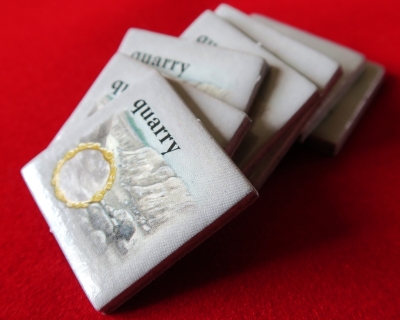
While everyone else was engaged in building a productive plantation, Burgundy began by by using his land for quarries, lots of quarries.  These make building cheaper, but don’t provide goods when someone chooses the Craftsman role.  Seeing where he was going, Magenta picked up a Construction Hut which enabled her to choose a quarry instead of a plantation each time anyone chose the Settler role.  Blue managed to pick up one quarry, but otherwise, between them, Burgundy and Magenta were in danger of getting all of them.  Burgundy got round the potential for a lack of plantations by building a Hacienda which gave him an extra plantation every time anyone else Settled.  He then coupled this with Hospice which meant that one of these plantations/quarries arrived complete with a “colonist” – a very powerful combination.  For a long time Black havered over whether to try to get in on the quarry game or not.  To begin with he decided not before picking one up anyhow.

Puerto Rico
– Image by boardGOATS

Pine was sat next to Magenta quietly coveting her Construction Hut, but it was pointed out that it wasn’t a good time to buy it and there were better things he could do, advice he took.  It obviously rankled a little though because every time after that when quarries were mentioned he added, “Though I’m not allowed a quarry…”.  Eventually, Blue decided she was struggling from a lack of both cash and victory points and needed to do something drastic to get back into the game.  So, taking a leaf out of Pine’s book, she expanded into coffee and then screwed everyone else up by starting a coffee ship which took several rounds to fill.  Eventually, she was joined by Pine who then variously helped her and got in her way.

Puerto Rico
– Image by boardGOATS

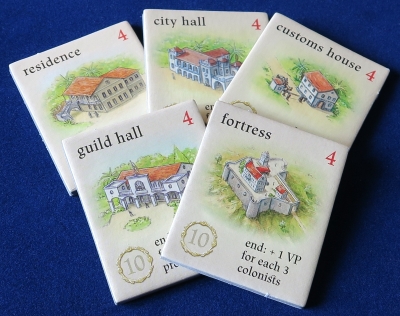
Blue and Black both made a hash of their timing with the crafting and shipping, and when Blue finally worked out what she was doing and planned what she needed for a large building she lost the plot and failed to choose the Builder role when she had the chance.  So, when Magenta took the builder a couple of turns later, everyone had enough for a large building and Blue was left without her first or second choice.  Magenta who had filled less than half her plantation spaces took the Residence just to stop Burgundy and Blue who had been able to fill theirs and would have been able to get maximum points for it (thanks to their Haciendas).  So, Burgundy took the Fortress (which gave him one point for every three “colonists”) and Blue took the Customs House (which gave one extra victory point chip for every four already held).  This left Black with the dregs from which he took the Guild Hall (giving him points for his production buildings).  Meanwhile, Pine ominously kept producing vast amounts of tobacco and shipping it.

Puerto Rico
– Image by boardGOATS

By this time, Blue and Black were convinced that Pine was miles ahead, and everyone else was playing for the minor places.  Pine in turn was convinced Magenta had a healthy lead; Magenta was certain she was losing, but continued to innocently obstruct Burgundy and the game turned nasty as everyone began to struggle to ship what they wanted.  With the number of victory point chips available dwindling faster than the number of “colonists”, everyone scrabbled to build that last utility and ship those final crates.  It turned out that it was a very close game: Magenta had a misleadingly large pile of singleton victory point chips; Pine probably would have won if the game had the game ended a round or two earlier, and Burgundy may well have won had it gone on another for another couple of rounds.  In the end though, despite being quite convinced she was nowhere close, Blue finished in first place with fifty-six, just three points ahead of Pine with Black taking third on a tie-break.

Puerto Rico
– Image by boardGOATS

Meanwhile, on the next table, Amerigo was going full steam ahead.  In this game players are exploring the islands of South America, securing trading routes, and building settlements.  The game board is made up of a four by four grid of large tiles that make an archipelago.  Players then have two ships each which they sail through the maze of islands, mooring at natural harbours to build trading posts, and then expanding settlements.  The actions available to players are determined through the use of a special cube tower that contains lots of buffers and buttresses. The idea is that each of the seven actions has an associated set of coloured cubes:  blue for sailing, black for loading cannon, red for buying buildings, green for settling etc.  At the start of the game, all the cubes are put into the top of the tower a small number get stuck and remain inside the tower to be potentially knocked out at a later point in the game.

Amerigo
– Image used with permission of
BGG contributor punkin312

There are four rounds and each round consists of seven phases, corresponding to each action where all the cubes available of that colour are poured into the tower.  Most of these cubes come out again, but some dislodge cubes previously caught in the baffles, while others others get stuck themselves.  Of the cubes that come out, the colour that is in the majority dictates the number, while all the colours dictate the actions.  Thus, if five blue, one green and one black come out, players can choose between sailing, building settlements or loading cannon, and in each case, they have five “action points”.  So, the actions that are available are largely predictable, with a slightly random element meaning there is a tactical element (taking advantage of the actions currently available in the best way possible) as well as a strategic (long term plan) element to the game.

Amerigo
– Image by BGG contributor mcfer

Points are available throughout the game for all sorts of things, including being the first person to land on an island and establish a trading post; building settlements on an island; completing an island by settling on its last available space; collecting gold, and moving along the progress and special action paths.  At the end of each round, however, the pirates attack and players have to fire their cannon to repel boarders.  Anyone who has not loaded sufficient cannon to fend off the pirates, loses points which is particularly nasty, because these players lose as many points as they would if they’d had no cannon at all, and they also have to fire the cannon they had loaded!

Amerigo
– Image used with permission of BGG contributor punkin312

Inevitably we all started off sailing to islands near to us, and generally we all did the main colour action in the first round. Grey toyed with the idea of not doing Cannon’s, but in the end decided to copy the more experienced players.  So an easy and simple, first round, in a game that gradually became a more cut throat battle.   Purple concentrated on running up her brown track and gaining the bonus action chits and spread across to a few islands. This strategy seemed to leave her struggling for points as the game went on.  Yellow was unsure how best to approach the game, so tended to stick to the action colour sequence, but got hold of the red equals green equals red bonus chit, which he used to good effect to build up on his several islands. This strategy netted him a good haul of points as the game progressed.

Amerigo
– Image used with permission of BGG contributor jsper

Grey was running an expansionist policy, getting to as many islands as he could. On top of this he, quite slyly, built over the extra empty trading post spaces, thus rendering them useless and gaining a monopoly on several islands, however, his score also seemed to suffer for this.  Meanwhile, Green carried out a number of red planning actions to build up a large backlog of buildings to place. This meant he always had something to place in those tricky corners, but he lost out on his big islands by leaving it too late to place them. Early on, he nabbed the big six neutral tile (the only one in the game) and then realised that he was on the wrong side of the big island to be able to place it, so had to make a quick trip to the other side to develop a new trading post before he could place it for a whopping eighteen points. This strategy was proving quite productive and he and Yellow were regularly vying for the lead.

Amerigo
– Image used with permission of BGG contributor Oceluna

In the last part of the game, while Purple and Yellow continued their general strategy, Grey decided he had enough islands and started to place his tiles on them to gain the resources. Green, having built as much as he could, was left wondering what to do next. He had lots of tiles still to place, but nowhere to place them without a new trading post. There were four left, all on the other side of the board and they were disappearing fast, so green started sailing.  By using his gold and going round the outside he was able to get to the area in just one move.  By this time, there were only two trading posts left as everyone else worked together to stop Green. With no more gold, Green was not quite able to get to a trading post and ended just one space away.  Yellow took his turn and he built on the other trading post leaving Green to sail once more and place his trading post.

Amerigo
– Image used with permission of BGG contributor punkin312

With only two single spaces left on this last island, there was a bit of a stand-off between Yellow and Green:  whoever built first would gain a single point, but leave the other to get the three point bonus for finishing the island.  Meanwhile, there was a total of eight pirates on the board which everyone had covered until Purple took the two-plus pirate attack bonus token.  Purple was aright of course, but everyone else needed another two cannon if they weren’t going to end up with an eight point penalty. More turns were sacrificed to gain cannon which also sent players to the top of the line and provided extra gold.  Purple and Green found themselves with no actions to do, so ended up trading action cubes for gold, while Grey and Yellow mopped-up island bonuses.

Amerigo
– Image used with permission of BGG contributor punkin312

In the very last action everyone swapped their gold for extra spaces on the white turn order track, just to get to that extra scoring location.  With the game coming to an end and neither Green nor Yellow prepared to give quarter on the last island, neither took the final three points.  Before the final scoring began, Yellow was in the lead, a few points clear of Green.  As the final scoring phase began, it became apparent that everyone except for Purple had misunderstood the scoring the resource bonuses. We thought the number on the yellow action chits was its multiplier value, however, this number is irrelevant to the scoring, it only means it costs more to obtain. Grey was particularly annoyed as he had deliberately been going for the high value action tokens and had been choosing the resource tokens appropriately.

Amerigo
– Image used with permission of BGG contributor punkin312

In the end, it was very close with Grey and Purple catching up however, it wasn’t quite enough, and Yellow and Green remained several points ahead, tied on a hundred and thirty-one.  The tie-breaker gave it to Yellow, as he was at the end of the turn order track and Green was five spaces farther back. On reflection though, Green later realised that he could have taken it had he known the rules better as he’d finished with six gold.  He could easily have spent the surplus gold to move along the track, but had decided against it as, although it would have given him an extra five points, the gold was worth one point each so there had seemed no point.

Om Nom Nom
– Image by BGG contributor jancis

Puerto Rico was still underway, and with Grey deciding he could do with an early night (while the Cat’s away, the Mice will play – and it seemed this Mouse had been playing quite a bit!), Purple, Green and Yellow opted for some quick, light-hearted fun with Om Nom Nom.  This is one of our more popular games, and we’ve played it a few times on a Tuesday evening.  Purple loves it and it was new to Yellow though, so despite his conviction that it’s completely random, Green joined in.  The idea is quite simple, each player has a hand of “Predator” cards, and the dice represent “Prey”.  Players simultaneously choose a card to play and then Prey is divided up accordingly.  If there is enough Prey for all the Predators to eat, then players take their share of the appropriate dice.  If not, the Predator(s) go hungry and the cards are discarded.  The catch is that some cards are both Predator and Prey, which is where the game descends into double-think (or Luck as Green prefers to think of it).

Om Nom Nom
– Image by BGG contributor jancis

Green has tried a variety of “methods” to beat the “luck”, but much like an inveterate gambler, a “technique” that works a couple of times almost always fails in the end, and so it proved this time too.  In the first card of the first round, Green decided to change his card just before everyone revealed theirs which proved fortuitous as his hedgehog ended up with a bunch of frog dice and cards. So, Green swapped his second and third cards at the last second and he picked up Prey on both occasions. As the round progressed, Purple and Yellow also achieved some success and Green took another card, but by the end of the round, the scores were very even with Purple ahead by just one point.  Probability can be a funny thing, but it was still quite a shock to roll nine carrots, each with a probability of one-in-six.  And so  began a little game of cat & mouse, literally with everyone trying to  second guess each others choices and all ending up feeling that the carrots looked too good to be true and there was bound to be a fox hanging around.

Om Nom Nom
– Image used with permission of BGG contributor msaari

At the second attempt, Yellow found he couldn’t resist temptation and went for the carrots only to find Purple’s fox was waiting to pounce.  Then, somehow (and nobody could work out exactly how), Purple ended up with the entire haul of carrots all to herself.  By this time, Green had reverted to type and scored nothing for the round, Yellow produced a creditable showing, but Purple took an amazing twenty-nine points. The final round was a much more even spread of dice and scores. Yellow was getting better and better and won the round while Green got lucky and took a few more points.  Purple was not so successful this time out, but it didn’t matter, as her massive score in the second round gave her a record-breaking forty-eight, according to the scoring card, a new high score!

Om Nom Nom
– Image by BGG contributor jancis

Learning Outcome:  Don’t ascribe to luck what others might call skill.

Spiel des Jahres Winners – 2016

The 2016 winner of the coveted German Game of the Year or Spiel des Jahres award is Codenames.  Codenames is which is a word-based deduction game played in teams.  Each team has a leader who gives clues to the rest of their team who are trying to choose particular word-cards from an array.  The trick is for the leader to come up with a clue that covers multiple correct answers so that the rest of the team can identify the complete set before the opposition.  It’s not really a game that really suits our group as several of the regulars aren’t very keen on social deduction games, but it is very quick to play, so, although we would probably have given the award to one of the two other nominees, Imhotep (manipulating large wooden blocks) or Karuba (“boardgame Bingo“), it may well end up as the “Feature Game” next week.

Codenames
– Image used with permission of boardgamephotos

At the same time the Kennerspiel des Jahres was awarded, which honours more challenging games.  It was introduced in 2011 to replace the jury’s habit of intermittent special awards for games too complex for the Spiel des Jahres (notably Agricola which was awarded a special “Complex Game” prize in 2008).  This year the Kennerspiel des Jahres award went to Isle of Skye: From Chieftain to King, which is one of our favourite games.  This year was a bit of a “Marmite” year for us as there were a lot of games on the lists that don’t really fit our group, including the two other Kennerspiel des Jahres nominees (Pandemic Legacy and T.I.M.E Stories).  The Kinderspiel des Jahres award was announced last month and went to Stone Age Junior (aka My First Stone Age), which is a simpler version of the family worker placement game Stone Age.

Stone Age Junior
– Image used with permission of boardgamephotos

Boardgames in the News: What Britain Buys

The Channel 4 series “What Britain Buys” has turned its attention towards our hobby with a ten minute piece by Mary Portas.  Episode two includes interviews with Ben Drummond and Dean Tempest, founders of Big Potato (which produced John Lewis‘ top selling game last year, Linkee), as well as a visit to Oxford’s own boardgame café, Thirsty Meeples.  There they speak to some of the customers and “Games Sommeliers” as well as the owner, John Morgan.  There are lots of shots of gaming goodness including people playing Settlers of Catan, Riff Raff, Star Wars X-Wing, Takenoko and much more besides.  The program is available to watch on demand from channel4.com and the interesting bit starts 37:15 mins in.

Mary Portas
– Image from channel4.com