Author Archives: nannyGOAT

18th April 2015 @ “The Mix”

The drop in gaming session at The Mix in Wantage was a great success.   It started quietly, but there were lots of new people there and lots of games were played.  Green arrived first and was setting up tables when Blue and Pink arrived.  By the time the first punters arrived PitchCar, Riff Raff and Camel Up had been set up and other games were out ready to be tried.  Before long Purple and Black had also arrived and there was a steady stream of games being played including Toc Toc Woodman, Escape: The Curse of the Temple and Cube Quest, and a steady stream of pieces flying across the room.  Old favourites like Dobble, Incan Gold, The Great Balloon Race and Carcassonne also got an outing as well as the Lego game, UFO Attack.

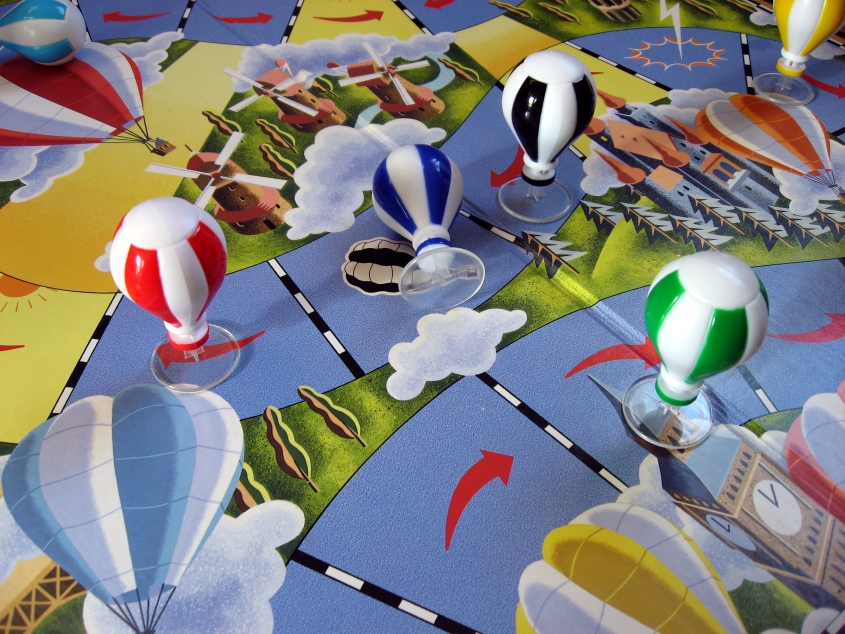
The Great Balloon Race
– Image by boardGOATS

Thanks to everyone who came, both visitors and gamers – it was great to see it so well attended.  Everyone seemed to enjoy themselves, so it’s definitely something we’d be interested in doing again in a few months time.

BoardGOATS @ “The Mix” – Saturday 18th April 2015

The Mix in Wantage town centre is holding a drop-in gaming session on Saturday from 10.30 am until 2.30 pm.  Members of the club are providing games and will be teaching people how to play them.

The Mix
– Image from thewantagemix.wordpress.com

There isn’t an awful lot of space so the idea is to encourage people to drop in and play a short game or two.  We are planning to bring a few eye-catching games like PitchCar, Riff Raff, Bamboleo, Toc Toc Woodman, and Saturn, but most of the gaming will be smaller filler games like Dobble, Turf Horse Racing, No Thanks!, Walk the Plank!, The Great Balloon Race and some of our other light favourites.  We will also be bringing some classic gateway games like Carcassonne, Ticket to Ride, The Settlers of Catan and Jamaica as well as a small number of deeper games, just to show people what else is out there.

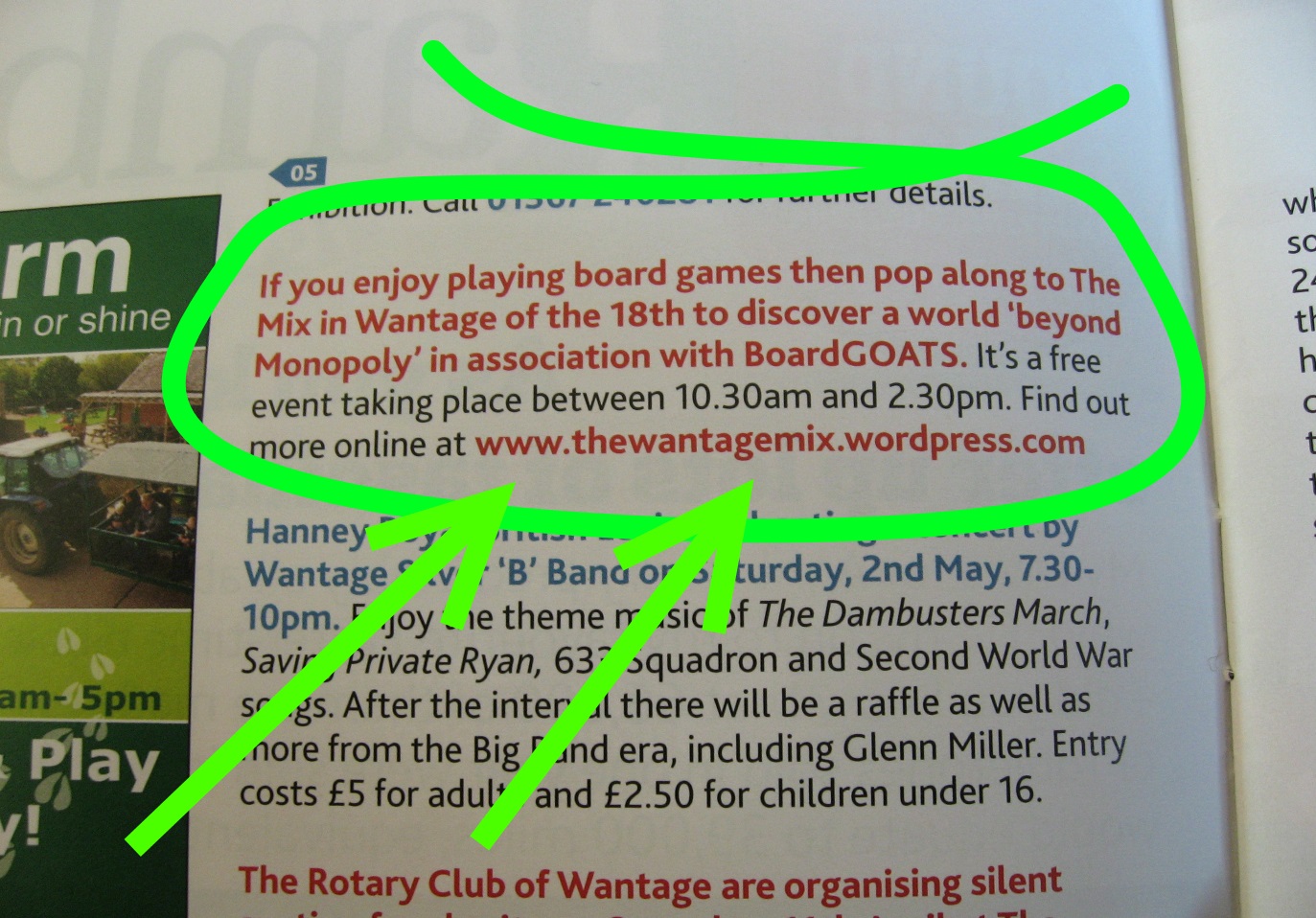
Round and About - The Mix
– Image by boardGOATS

The event has been well advertised and was mentioned in the Ramblings section of the April edition of the local magazine, “Round and About”, so we are hoping for a decent turn-out.  Please pop in if you are in the area on Saturday.

7th April 2015

Blue and Pink arrived very early and decided to play a quick game of Onirim before their food arrived.  This is a cooperative, two player game with an unusual theme:  players are Dreamwalkers, lost in a mysterious labyrinth – they must discover the eight oneiric doors before dreamtime runs out trapping them forever.

Onirim
– Image used with permission of BGG contributor zombiegod

The idea is that both players have a hand of five cards, three that are their own, and two which are shared and kept face up on the table.  On their turn the players can do one of two things:  play a card, discard a card.  Cards are played one at a time face up in front of the player.  The aim is to play a three cards of the same colour in succession, which allows the player access to the oneiric door of the corresponding colour.  The important thing about the cards is that in addition to a colour suit, they also have a symbol – a sun, a moon or a key.  When played, adjacent cards must not have the same symbols (regardless of colour).  This is much more tricky than it sounds as sun cards are most abundant and key cards have special powers, which means you don’t want to waste them.  For example, if a key card is discarded, the player triggers the prophecy which means they can look at the next five cards, discard one and return the rest in any order.

Onirim
– Image by boardGOATS

Once a player has played or discarded their card, they replenish their hand with a card from the draw deck.  There are seventy-six cards in the deck, including eight doors and ten nightmare cards.  Nightmare cards are a problem, when they are drawn, players have to deal with them in some way.  Players can mitigate the effects of a nightmare by discarding a key card, discarding a gained door or by discarding the whole of their hand (i.e. all five cards, including the two shared cards).  If the player cannot do any of these (or chooses not to), then they must discard the next five cards.  This is bad because the deck is like a ticking clock and the game ends when there are no cards left to play.  Worse, nightmare (and door cards) are not truly discarded as they are returned to the deck once the five cards have been drawn, so their effect does not go away.  On the plus side, if you are replacing a card and you draw a door card, if you have a key card of the same colour, you get to keep it.

Onirim
– Image by boardGOATS

Like Hanabi, this is a cooperative game that can be played with a lot or a little “table talk”.  Since it is quite a tough game, we decided to play with all the cards face up, but with no talking.  We had just started and the game was going unusually well when food turned up.  Sadly, we were very easily distracted and quickly lost focus which led to inevitable defeat as we finished just one door short.  Once we’d finished eating, we gave it another go, but quickly regretted squandering our good beginning in the first game as the second game had a terrible start.  Things picked up, but we still didn’t get close, finishing with six doors.  We were just finishing when Grey and Cerise wandered in clutching a new game called Slavika.

Slavika
– Image by BGG contributor cnidius

Slavika is a card game of heroes and monsters with really beautiful artwork.  Each player is the head of a household and has two hands of cards, one of heroes and one of monsters.  On their turn each player plays three cards, the first card must be a hero, the last card must be a monster and the second card can be either a hero or a monster.  Each player starts with six heroes in their family and five monsters, each with a strength; although monsters are replenished once played, heroes only return when they have finished being heroic.  The idea is that there are a number of regions that players are fighting to protect from the monsters.

Slavika
– Image by BGG contriutor cnidius

Each region is different and has a maximum number of heroes and a maximum number of monsters:  when world is over-run with monsters, the battle is concluded and the combined strength of the monsters is compared with the combined strength of the heroes.  If the heroes win, then the player who contributes the most to the battle (the most heroic player) wins the points and also the treasure stored on the island and the heroes fighting for that world are returned.  If there is also a thief, however, then the most heroic player wins the points but the thief runs off with the treasure.  If the monsters win, then nobody wins anything, the monsters leave, the heroes return home and another treasure card is added to the region and the fighting begins again.  Blue had no idea what was going on, and Pink was not much wiser, but after a couple of rounds they got the hang of it a little and everyone realised that if people insisted on thinking before playing cards, it was going to take way longer than the stated thirty minutes!

Slavika
– Image by BGG contributor MacTele

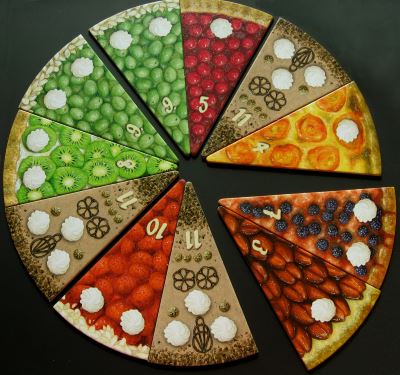
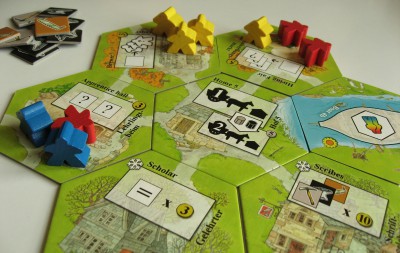
By this time, Red, Yellow and Orange had also arrived and had riffled through the bags and chosen …Aber Bitter Mit Sahne (aka Piece o’ Cake).  This is a cute little set collecting game that we first played a few weeks back.  The idea is that one player divides the cake and then the others choose which slice to take and how much of it to eat.  Points are scored at the end of the game for the player with the most of each type of cake and for the number of “blobs” of cream on cake that has been eaten.  In case of a draw, all parties win the pints, but no points are scored for sets that aren’t the largest.  Thus, the player dividing needs to try to make sure that they are left with something useful after everyone else has chosen, but at the same time, they don’t want to give away anything too enticing.  Similarly, players choosing have to be careful to take something that is useful, and keep something they think they can build a large set of while maximising the number of blobs of cream they eat.

…Aber Bitte Mit Sahne
– Image by boardGOATS

Red ran away with the first game, but the second was much closer and came right down to the wire with Orange just beating Red by two points.  Meanwhile, Blue, Pink, Grey and Cerise were still playing Slavika, so Red, Yellow and Orange decided to give Tsuro a try.  This is a bit of an old favourite as it is fairly quick, plays up to eight, is very easy to teach, and has a nice healthy dose of tension.  In summary, players start with a hand of three tiles each depicting track and a stone on the edge of the board.  On their turn, the active player plays one tile in their chosen orientation and then moves their stone along the track.  Players must try to stay on the board unless they have no choice and if two stones collide both players are out.  Hands are replenished until there are no tiles left, and when people are knocked out, they redistribute their tiles amongst the remaining players.  Last player on the board wins.

Tsuro
– Image by BGG contributor jeremiahlburns

With only three players, it was slow to get going, but before long  Yellow and Orange had fallen off the board leaving Red to take her second win of the evening.  Just as Red was finishing off her competitors, Pink was trying to use his thief to steal two treasure cards only to find that they were both “moon” cards.  As two moon cards had already been found, that finally brought Slavika to a very abrupt end with Cerise the clear winner.  This left time for another quick game of Tsuro, this time with all seven players joining in.  With Pink’s help, Blue managed to run out of space after just a few turns and spent the rest of the game egging Orange into pushing Red off the board.  Before long Cerise, Yellow and Red had all joined Blue spectating and the game was hanging in the balance with it unclear whether Grey, Pink and Orange would come out on top.  Unfortunately for them, neither Grey nor Orange had useful tiles and Pink ran out the clear winner.

Slavika
– Image by BGG contributor cnidius

The evening finished as it began with just Blue and Pink.  Tempted though they were to have another go a finding the oneiric doors, they decided instead to play the “Feature Game”, Harbour.  This is a recent successful KickStarter project and is a neat little worker placement game with a market manipulation twist.  The idea is that each player has a single worker and can place them on one of the central buildings or a building owned by one of the players (at a cost if it is not their own).  Each building enables players to buy goods or exchange goods they already have for other goods.  Alternatively, some buildings allow players to sell goods and buy a building, and this is where the dynamic market comes in.  There are four types of merchandise, and each has a value, but each can only be sold if a minimum quantity is reached.  For example, players may get $5 for shipping fish, but they must have a minimum of five fish in order to be able to sell them.  Meanwhile, wood may only yield $2, but players will only need two in order to be able to sell.  When someone sells something in the market, demand changes the values at market, with the values of unsold goods increasing and the value of items just sold dropping.

Harbour
– Image used with permission of BGG reviewer EndersGame

Each player can store a maximum of six of each item, and unless they have a building that allows them to store goods when selling, if they sell, they must sell everything.  Thus, the game is all about timing and selling goods before other players and when the price is right.  The game ends when one player has built four buildings, leaving the other players with one final turn.  Blue and Pink had played the game once before and Pink was of the opinion that the person who managed to build four buildings first would win.  Blue was less convinced as she felt that that player could get once less turn and that would allow other players to buy more valuable buildings.  This wasn’t an opportunity to test these theories, however, as Blue quickly bought three high value buildings and Pink’s less profitable buildings were sufficiently undervalued to ensure that Blue’s commanding lead was insurmountable.  It is definitely an interesting little game though and will get another outing soon.

Harbour
– Image used with permission of BGG contributor kladan

Learning Outcome:  Don’t get distracted by food.
Boardgames in the News: International TableTop Day 2015

International TableTop Day was founded three years ago as a way for the world to celebrate tabletop gaming together. Every spring, gamers host thousands of events all over the world  and every year, the event grows.  Last year over 3,000 events were held in 80 countries, over all 7 continents.

International Tabletop Day Logo
– Image from tabletopday.com

Although boardGOATS are not doing anything specifically for International Tabletop Day this year, we will be holding a gaming day next Saturday at The Mix in Wantage.

Next Meeting – 7th April 2015

Our next meeting will be on Tuesday 7th April, at the Horse and Jockey pub in Stanford-in-the-Vale.  As usual, we will be playing shorter games from 7.30pm as people arrive, until 8pm when we will start something a little longer.

This week the “Feature Game” will be Harbour.  This is a market driven card game where the players are building up an inventory of goods to sell which can be used to buy buildings.  The innovative part of the game is the market which is constantly changing.

Harbour
– Image used with permission of BGG contributor landofhov

And talking of investing in the markets…

Jennifer and Josephine were walking through the forest when they hear this voice from under a log. Investigating, they discovered the voice was coming from a frog.  “Help me!  I am an investment banker who, through an evil witch’s curse, has been transformed into a frog. If one of you will kiss me, I’ll be returned to my former state!”

Josephine grabbed the frog, and stuffed it inside her handbag. Jennifer was aghast, “Didn’t you hear him?” she asked.  “If you kiss him, you can change him back!”

Josephine replied, “Of course I did, but a talking frog is worth so much more than an investment banker!”

Boardgames in the News: Thirsty Meeples on Radio 2

The growing interest in boardgames continues with an item on the Chris Evans Breakfast show on Radio 2 featuring Simon Read from Thirsty Meeples (starts at 1:47:30).  Sara Cox was sitting in for Chris Evans and conducted the short telephone interview discussing the Oxford games Cafe.  Unfortunately she was a bit obsessed with “classics” like Monopoly, Scrabble, Cluedo, Connect 4 and Mouse Trap.  Simon did his best to talk about Survive:  Escape from Atlantis! and The Settlers of Catan, but in truth, while it was a nice little bit of advertising for the Thirsty Meeple, Sara was too determined to move onto Cold Play…

Sara Cox
– Image from bbc.co.uk

Boardgames in the News: What is the Influence of KickStarter?

The rise of the internet has changed everything.  When UK designers like Alan R. Moon and Richard Breese first started publishing their small numbers of “designer games”, these were often mostly advertised through magazines and by word of mouth.  Now we have  boardgamegeek.com (or BGG for short), which provides an extensive database of boardgames as well as an active community of users who discuss, argue about, buy, sell, trade and play board games. Their database contains over 76,000 board games each with its own entry that includes general information about the game, user ratings, forums for discussion and user reviews amongst other things. There are also websites devoted to online versions of boardgames, where players can try new games to see if they like them (before spending money) and hone skills by playing against other people from all over the world.

BGG Corner Logo
– Image from boardgamegeek.com

The UK boardgamer also now has a wealth of possible vendors:  they might start with Amazon to get a baseline price, then perhaps try one of the excellent specialist online sellers like BoardGameGuru, Games Lore, or Infinity Games.  Importing games is also an option:  many international editions are cheaper in continental Europe than here, even when shipping is factored in.  Alternatively, there are a number of excellent UK shops which also have an online presence like Shire Games and Spirit Games.  People in the Oxford area also have a couple of local choices that they can visit too, including Thirsty Meeples and The Gameskeeper.  And this is before you include the fact that high street stores like Waterstones and WHSmith often stock a small selection and even The Works has has some Rio Grande Games available recently.

Indiegogo Logo
– Image from indiegogo.com

In the last few years though, there has also been the internet phenomenon of crowd funding.  There are several crowd funding websites that enable designers of all sorts of things to propose projects, however, the two main sites used by boardgamers are Indiegogo and KickStarter.  These provide an entirely new model where a designer advertises their design and anyone can pledge to support them financially.  Typically this works through a system of pledges and associated rewards.  For example, if a supporter pledges $5 they may be rewarded with a novelty meeple, whereas if they pledge $50 they are rewarded with the whole game and for $500 they might get the signed first copy.  This is distinct from a pre-order as there is no contract between the designer and supporter.  Also, each project is usually advertised for a set period time with a given financial target, if this is not reached, then the project is cancelled.  If it exceeds its goal, then additional “stretch goals” may be set out which can lead to improvements in the game when it is produced.

KickStarter
– Image from iconfinder.com

So, the advantage of this approach is that the risk is spread out amongst all the supporters enabling many people to produce games in a way that would not otherwise be possible.  There are also a number of disadvantages of crowd funding, however.  There are very long delays involved, with some games taking eighteen months to two years or more longer than projected.  There are also a lot of gamers who admit that they have become addicted to supporting projects which has led to a lot of people paying over the odds for rubbish.  Primarily though, the biggest problem is that supporters feel a sense of entitlement:  they are used to buying a game and if their reward does not materialise, they feel aggrieved.  Most projects end with supporters getting a reward of some kind even if it is not as originally envisaged.

Zombicide Season 3: Rue Morgue
– Image used with permission of BGG contributor The Carmen

Some games have been hugely successful, raising eye-watering sums of money.  For example, Zombicide Season 3: Rue Morgue yielded nearly $3 million with over 12,000 backers.  However, there have been a number of high profile “problem projects”.  For example, when costs spiraled for the production of Glory to Rome, most backers got their game, but the project leader, Ed Carter lost his house. In the case of Up Front, the boot was on the other foot, though.  This was a remake of an old card-based WWII war game and 2,407 backers pledged a total of $339,848 to get it made, more than ten times its modest $30,000 funding goal.  Unfortunately, the companies involved in its production, Valley Games and Radiant Gaming, became mired in a legal dispute with their financier, so their assets were frozen and all other sources of funds were used to line the lawyers’ pockets.  Although the case is still making its weary way through the courts, it seems unlikely that there will be enough money or inclination to actually make the game once everything has been resolved.  There have also been cases that appear to be blatant theft, for example Seth Nemec allegedly took over $20,000 to produce a reprint of the Kosmos game, Odin’s Ravens, and then disappeared.  Fraudulent cases have become such a concern that in the case of Asylum, the Washington State Attorney General Bob Ferguson stepped in, filing a law suit against the producer.

Up Front
– Image used with permission of BGG contributor
Lord_Prussian

These are not the only crowd funded projects that have had problems by any stretch of the imagination, however, the vast majority end happily, with happy supporters happily playing their rewards (if a little late).  But is the boom in crowd funding here to stay or just a flash in the pan?  Well, to date, there have been over 16,000 projects listed in the “games” category on KickStarter alone, with a success rate of about 1/3, raising over $334 million.  “Games” is one of the largest categories on the site and is the most lucrative, however, it includes much more than just boardgames.  In 2014, there were 454 successful board and card games on KickStarter raising a total of $26.1million dollars.  This is a 40% increase in the number of games, but is accompanied by a 10% drop in the total spent from the previous year.  It is hard to draw any meaningful statistics from something that has been going for such a short amount of time and is highly cyclical, but it would seem that these statistics reflect a change that many backers have been feeling.

Tiny Epic Galaxies
– Image used with permission of
BGG contributor mgcoe

With prices increasing, gamers are getting more cautious about spending over $100 on a game that they won’t see for months and may never see at all.  So the number of the really expensive (mostly miniatures) games is decreasing, and even the medium sized games are becoming less  abundant.  Postage is also undoubtedly a factor and the games that are most successful now tend to be the mini and micro games where costs are much lower.  For example, Tiny Epic Kingdoms and Tiny Epic Defenders raised $440,000 between them last year and Tiny Epic Galaxies (their sequel) raised over $400,000 alone when it funded last month.  Thus, although the total amount raised is falling, the number of backers and games produced is increasing.

– Image from
queen-games.de

There is much more to this however.  There are a number of companies that are using KickStarter as glorified pre-order system that allows the backers to shoulder the burden of risk.  These proven companies are not seen as risky by gamers and are still proving highly productive.  For example, Queen Games (who are also part of the ever growing Asmodée group) raised over $100,000 earlier this year on their Lancaster: Big Box project and most of their smaller projects fund successfully at around $30,000.  It is clear why the KickStarter model is appealing to such companies as it allows them to sell directly to their consumers enabling them to pass some of the savings on.  However, these are quite controversial as most of these projects have very little in the way of stretch goals and are often seen simply as a way to sideline distributors and game stores.

Lancaster: Big Box
– Image used with permission of BGG contributor dukelander

It is undeniable that KickStarter has had an impact on the way people purchase games, but hitherto it has only affected a small part of the market.  However, if the “Queen model” continues to grow and is taken up by other companies, then KickStarter will begin to have a much more significant impact on gamers as it could start to put games vendors out of business and that is bad news  for everyone.

10th March 2015

Since Blue was late ordering her pizza we were late starting our first game.  It was a relatively quiet evening, but we began splitting into two groups, the first of which played the “Feature Game”, Dominion.  This is a card drafting game where the players are monarchs, ruling a small pleasant kingdom of rivers and evergreens trying to build a bigger and more pleasant kingdom, with more rivers and a wider variety of trees – a Dominion in fact.

Dominion
– Image by BGG contributor Filippos

Basically, each player starts with an identical, very small deck of cards from which they draw a hand of five.  On their turn, players do three things:  play an action card, buy cards, then discard any cards they have left and draw an new hand of five cards.  The aim of the game is to have the most points at the end.  Experience is clearly a big advantage, as the balance of the deck is critical to a player’s success.  It was no surprise, therefore, that Burgundy and Green were fighting it out for first place.  Green squeaked in ahead having picked up a lot of duchy cards in the last few rounds.

Dominion
– Image used with permission of BGG contributor garyjames

Meanwhile, Purple and Black played Patchwork.  This is a cute little two-player game that was first played on a Tuesday in January.  The idea is that players compete to build the most aesthetic (and high-scoring) patchwork quilt, buying Tetris-like patches with buttons.  The last time Black won, so Purple was hoping to redress the balance, but sadly, it was not to be.

Patchwork
– Image used with permission of BGG contributor greetingsfrombergen

Both games finished pretty much simultaneously, leaving us with the decision: play one six player game, or two three player games.  There was only one real six player option and that was Keyflower.  Green offered the decision to Grey who, much to Blue’s obvious delight, opted for the large group game.  We’ve played Keyflower an awful lot (especially considering it is one of the heavier games that we play), but only once with the full six players.  On that occasion, Blue had managed to squander a winning position when she misjudged Green’s strength – something she was determined not to do again.

Keyflower
– Image by boardGOATS

Winter tiles were handed out and Green announced that he was just going to play what came up rather than play to a strategy.  Everyone else said that that was what they always did because there was always someone else who broke any strategy they had.  And that is pretty much exactly what happened  to most players this time too.  Grey went for the Green Keyples in a big way and Black went for tiles.  Purple tried to control the game with the start meeple while Burgundy ended up with a glut of yellow Keyples so decided to try to do something useful with them by turning them into more Keyples.  Green meanwhile was struggling to do anything and Blue, who was the only person with any supply of iron, managed to pick up the Blacksmith to go with it and quietly began producing iron and moving it onto the Blacksmith tile.

Keyflower
– Image by boardGOATS

As we moved into winter, everyone was so mesmerised by Grey who managed to completely exhaust the supply of green Keyples and Burgundy who was amassing a huge number of points, that nobody spotted Blue and her Blacksmith or Black and his tile collecting.  Eventually, Burgundy stopped pulling Keyples out of the bag and we moved into scoring, and it turned out to be a surprisingly close game.  Blue’s iron meant she finished six points clear of Burgundy who took second place with Black and Grey close behind.

Keyflower
– Image used with permission of BGG contributor ilogico

Learning Outcome:  If you usually win, don’t be surprised if you lose when you change the way you play.

Next Meeting – 10th March 2015

Our next meeting will be on Tuesday 10th March, at the Horse and Jockey pub in Stanford-in-the-Vale.  As usual, we will be playing shorter games from 7.30pm as people arrive, until 8pm when we will start something a little longer.

This week the “Feature Game” will be Dominion.  This is a card game where the players are monarchs, ruling a small pleasant kingdom of rivers and evergreens trying to build a bigger and more pleasant kingdom, with more rivers and a wider variety of trees – a Dominion in fact.  In all directions lie fiefs and freeholds, all small bits of land, controlled by petty lords and verging on anarchy.  Each player is trying to bring civilization to these people, uniting them under their banner hiring minions, constructing buildings, sprucing up their castle, and filling the coffers of their treasury.

Dominion
– Image used with permission of BGG contributor Ceryon

And talking of Kings squabbling over kingdoms…

There were three medieval kingdoms on the shores of a lake.  There was an island in the middle of the lake, over which the kingdoms had been fighting for years.  Finally, the three kings decided that they would send their knights out to do battle, and the winner would take the island.  The night before the battle, the knights and their squires pitched camp and readied themselves for the fight.

The first kingdom had 12 knights, and each knight had five squires, all of whom were busily polishing armor, brushing horses, and cooking food.  The second kingdom had twenty knights, and each knight had 10 squires.  Everyone at that camp was also busy preparing for battle.

At the camp of the third kingdom, there was only one knight, with his squire. This squire took a large pot and hung it from a looped rope in a tall tree. He busied himself preparing the meal, while the knight polished his own armor.

When the hour of the battle came, the three kingdoms sent their squires out to fight (it was far too trivial a matter for the knights to join in).  The battle raged, and when the dust had cleared, the only person left was the lone squire from the third kingdom, having defeated the squires from the other two kingdoms.

Thus it was proved that the squire of the high pot and noose is equal to the sum of the squires of the other two sides…