Author Archives: nannyGOAT

Next Meeting – 7th April 2015

Our next meeting will be on Tuesday 7th April, at the Horse and Jockey pub in Stanford-in-the-Vale.  As usual, we will be playing shorter games from 7.30pm as people arrive, until 8pm when we will start something a little longer.

This week the “Feature Game” will be Harbour.  This is a market driven card game where the players are building up an inventory of goods to sell which can be used to buy buildings.  The innovative part of the game is the market which is constantly changing.

Harbour
– Image used with permission of BGG contributor landofhov

And talking of investing in the markets…

Jennifer and Josephine were walking through the forest when they hear this voice from under a log. Investigating, they discovered the voice was coming from a frog.  “Help me!  I am an investment banker who, through an evil witch’s curse, has been transformed into a frog. If one of you will kiss me, I’ll be returned to my former state!”

Josephine grabbed the frog, and stuffed it inside her handbag. Jennifer was aghast, “Didn’t you hear him?” she asked.  “If you kiss him, you can change him back!”

Josephine replied, “Of course I did, but a talking frog is worth so much more than an investment banker!”

Boardgames in the News: Thirsty Meeples on Radio 2

The growing interest in boardgames continues with an item on the Chris Evans Breakfast show on Radio 2 featuring Simon Read from Thirsty Meeples (starts at 1:47:30).  Sara Cox was sitting in for Chris Evans and conducted the short telephone interview discussing the Oxford games Cafe.  Unfortunately she was a bit obsessed with “classics” like Monopoly, Scrabble, Cluedo, Connect 4 and Mouse Trap.  Simon did his best to talk about Survive:  Escape from Atlantis! and The Settlers of Catan, but in truth, while it was a nice little bit of advertising for the Thirsty Meeple, Sara was too determined to move onto Cold Play…

Sara Cox
– Image from bbc.co.uk

Boardgames in the News: What is the Influence of KickStarter?

The rise of the internet has changed everything.  When UK designers like Alan R. Moon and Richard Breese first started publishing their small numbers of “designer games”, these were often mostly advertised through magazines and by word of mouth.  Now we have  boardgamegeek.com (or BGG for short), which provides an extensive database of boardgames as well as an active community of users who discuss, argue about, buy, sell, trade and play board games. Their database contains over 76,000 board games each with its own entry that includes general information about the game, user ratings, forums for discussion and user reviews amongst other things. There are also websites devoted to online versions of boardgames, where players can try new games to see if they like them (before spending money) and hone skills by playing against other people from all over the world.

BGG Corner Logo
– Image from boardgamegeek.com

The UK boardgamer also now has a wealth of possible vendors:  they might start with Amazon to get a baseline price, then perhaps try one of the excellent specialist online sellers like BoardGameGuru, Games Lore, or Infinity Games.  Importing games is also an option:  many international editions are cheaper in continental Europe than here, even when shipping is factored in.  Alternatively, there are a number of excellent UK shops which also have an online presence like Shire Games and Spirit Games.  People in the Oxford area also have a couple of local choices that they can visit too, including Thirsty Meeples and The Gameskeeper.  And this is before you include the fact that high street stores like Waterstones and WHSmith often stock a small selection and even The Works has has some Rio Grande Games available recently.

Indiegogo Logo
– Image from indiegogo.com

In the last few years though, there has also been the internet phenomenon of crowd funding.  There are several crowd funding websites that enable designers of all sorts of things to propose projects, however, the two main sites used by boardgamers are Indiegogo and KickStarter.  These provide an entirely new model where a designer advertises their design and anyone can pledge to support them financially.  Typically this works through a system of pledges and associated rewards.  For example, if a supporter pledges $5 they may be rewarded with a novelty meeple, whereas if they pledge $50 they are rewarded with the whole game and for $500 they might get the signed first copy.  This is distinct from a pre-order as there is no contract between the designer and supporter.  Also, each project is usually advertised for a set period time with a given financial target, if this is not reached, then the project is cancelled.  If it exceeds its goal, then additional “stretch goals” may be set out which can lead to improvements in the game when it is produced.

KickStarter
– Image from iconfinder.com

So, the advantage of this approach is that the risk is spread out amongst all the supporters enabling many people to produce games in a way that would not otherwise be possible.  There are also a number of disadvantages of crowd funding, however.  There are very long delays involved, with some games taking eighteen months to two years or more longer than projected.  There are also a lot of gamers who admit that they have become addicted to supporting projects which has led to a lot of people paying over the odds for rubbish.  Primarily though, the biggest problem is that supporters feel a sense of entitlement:  they are used to buying a game and if their reward does not materialise, they feel aggrieved.  Most projects end with supporters getting a reward of some kind even if it is not as originally envisaged.

Zombicide Season 3: Rue Morgue
– Image used with permission of BGG contributor The Carmen

Some games have been hugely successful, raising eye-watering sums of money.  For example, Zombicide Season 3: Rue Morgue yielded nearly $3 million with over 12,000 backers.  However, there have been a number of high profile “problem projects”.  For example, when costs spiraled for the production of Glory to Rome, most backers got their game, but the project leader, Ed Carter lost his house. In the case of Up Front, the boot was on the other foot, though.  This was a remake of an old card-based WWII war game and 2,407 backers pledged a total of $339,848 to get it made, more than ten times its modest $30,000 funding goal.  Unfortunately, the companies involved in its production, Valley Games and Radiant Gaming, became mired in a legal dispute with their financier, so their assets were frozen and all other sources of funds were used to line the lawyers’ pockets.  Although the case is still making its weary way through the courts, it seems unlikely that there will be enough money or inclination to actually make the game once everything has been resolved.  There have also been cases that appear to be blatant theft, for example Seth Nemec allegedly took over $20,000 to produce a reprint of the Kosmos game, Odin’s Ravens, and then disappeared.  Fraudulent cases have become such a concern that in the case of Asylum, the Washington State Attorney General Bob Ferguson stepped in, filing a law suit against the producer.

Up Front
– Image used with permission of BGG contributor
Lord_Prussian

These are not the only crowd funded projects that have had problems by any stretch of the imagination, however, the vast majority end happily, with happy supporters happily playing their rewards (if a little late).  But is the boom in crowd funding here to stay or just a flash in the pan?  Well, to date, there have been over 16,000 projects listed in the “games” category on KickStarter alone, with a success rate of about 1/3, raising over $334 million.  “Games” is one of the largest categories on the site and is the most lucrative, however, it includes much more than just boardgames.  In 2014, there were 454 successful board and card games on KickStarter raising a total of $26.1million dollars.  This is a 40% increase in the number of games, but is accompanied by a 10% drop in the total spent from the previous year.  It is hard to draw any meaningful statistics from something that has been going for such a short amount of time and is highly cyclical, but it would seem that these statistics reflect a change that many backers have been feeling.

Tiny Epic Galaxies
– Image used with permission of
BGG contributor mgcoe

With prices increasing, gamers are getting more cautious about spending over $100 on a game that they won’t see for months and may never see at all.  So the number of the really expensive (mostly miniatures) games is decreasing, and even the medium sized games are becoming less  abundant.  Postage is also undoubtedly a factor and the games that are most successful now tend to be the mini and micro games where costs are much lower.  For example, Tiny Epic Kingdoms and Tiny Epic Defenders raised $440,000 between them last year and Tiny Epic Galaxies (their sequel) raised over $400,000 alone when it funded last month.  Thus, although the total amount raised is falling, the number of backers and games produced is increasing.

– Image from
queen-games.de

There is much more to this however.  There are a number of companies that are using KickStarter as glorified pre-order system that allows the backers to shoulder the burden of risk.  These proven companies are not seen as risky by gamers and are still proving highly productive.  For example, Queen Games (who are also part of the ever growing Asmodée group) raised over $100,000 earlier this year on their Lancaster: Big Box project and most of their smaller projects fund successfully at around $30,000.  It is clear why the KickStarter model is appealing to such companies as it allows them to sell directly to their consumers enabling them to pass some of the savings on.  However, these are quite controversial as most of these projects have very little in the way of stretch goals and are often seen simply as a way to sideline distributors and game stores.

Lancaster: Big Box
– Image used with permission of BGG contributor dukelander

It is undeniable that KickStarter has had an impact on the way people purchase games, but hitherto it has only affected a small part of the market.  However, if the “Queen model” continues to grow and is taken up by other companies, then KickStarter will begin to have a much more significant impact on gamers as it could start to put games vendors out of business and that is bad news  for everyone.

10th March 2015

Since Blue was late ordering her pizza we were late starting our first game.  It was a relatively quiet evening, but we began splitting into two groups, the first of which played the “Feature Game”, Dominion.  This is a card drafting game where the players are monarchs, ruling a small pleasant kingdom of rivers and evergreens trying to build a bigger and more pleasant kingdom, with more rivers and a wider variety of trees – a Dominion in fact.

Dominion
– Image by BGG contributor Filippos

Basically, each player starts with an identical, very small deck of cards from which they draw a hand of five.  On their turn, players do three things:  play an action card, buy cards, then discard any cards they have left and draw an new hand of five cards.  The aim of the game is to have the most points at the end.  Experience is clearly a big advantage, as the balance of the deck is critical to a player’s success.  It was no surprise, therefore, that Burgundy and Green were fighting it out for first place.  Green squeaked in ahead having picked up a lot of duchy cards in the last few rounds.

Dominion
– Image used with permission of BGG contributor garyjames

Meanwhile, Purple and Black played Patchwork.  This is a cute little two-player game that was first played on a Tuesday in January.  The idea is that players compete to build the most aesthetic (and high-scoring) patchwork quilt, buying Tetris-like patches with buttons.  The last time Black won, so Purple was hoping to redress the balance, but sadly, it was not to be.

Patchwork
– Image used with permission of BGG contributor greetingsfrombergen

Both games finished pretty much simultaneously, leaving us with the decision: play one six player game, or two three player games.  There was only one real six player option and that was Keyflower.  Green offered the decision to Grey who, much to Blue’s obvious delight, opted for the large group game.  We’ve played Keyflower an awful lot (especially considering it is one of the heavier games that we play), but only once with the full six players.  On that occasion, Blue had managed to squander a winning position when she misjudged Green’s strength – something she was determined not to do again.

Keyflower
– Image by boardGOATS

Winter tiles were handed out and Green announced that he was just going to play what came up rather than play to a strategy.  Everyone else said that that was what they always did because there was always someone else who broke any strategy they had.  And that is pretty much exactly what happened  to most players this time too.  Grey went for the Green Keyples in a big way and Black went for tiles.  Purple tried to control the game with the start meeple while Burgundy ended up with a glut of yellow Keyples so decided to try to do something useful with them by turning them into more Keyples.  Green meanwhile was struggling to do anything and Blue, who was the only person with any supply of iron, managed to pick up the Blacksmith to go with it and quietly began producing iron and moving it onto the Blacksmith tile.

Keyflower
– Image by boardGOATS

As we moved into winter, everyone was so mesmerised by Grey who managed to completely exhaust the supply of green Keyples and Burgundy who was amassing a huge number of points, that nobody spotted Blue and her Blacksmith or Black and his tile collecting.  Eventually, Burgundy stopped pulling Keyples out of the bag and we moved into scoring, and it turned out to be a surprisingly close game.  Blue’s iron meant she finished six points clear of Burgundy who took second place with Black and Grey close behind.

Keyflower
– Image used with permission of BGG contributor ilogico

Learning Outcome:  If you usually win, don’t be surprised if you lose when you change the way you play.

Next Meeting – 10th March 2015

Our next meeting will be on Tuesday 10th March, at the Horse and Jockey pub in Stanford-in-the-Vale.  As usual, we will be playing shorter games from 7.30pm as people arrive, until 8pm when we will start something a little longer.

This week the “Feature Game” will be Dominion.  This is a card game where the players are monarchs, ruling a small pleasant kingdom of rivers and evergreens trying to build a bigger and more pleasant kingdom, with more rivers and a wider variety of trees – a Dominion in fact.  In all directions lie fiefs and freeholds, all small bits of land, controlled by petty lords and verging on anarchy.  Each player is trying to bring civilization to these people, uniting them under their banner hiring minions, constructing buildings, sprucing up their castle, and filling the coffers of their treasury.

Dominion
– Image used with permission of BGG contributor Ceryon

And talking of Kings squabbling over kingdoms…

There were three medieval kingdoms on the shores of a lake.  There was an island in the middle of the lake, over which the kingdoms had been fighting for years.  Finally, the three kings decided that they would send their knights out to do battle, and the winner would take the island.  The night before the battle, the knights and their squires pitched camp and readied themselves for the fight.

The first kingdom had 12 knights, and each knight had five squires, all of whom were busily polishing armor, brushing horses, and cooking food.  The second kingdom had twenty knights, and each knight had 10 squires.  Everyone at that camp was also busy preparing for battle.

At the camp of the third kingdom, there was only one knight, with his squire. This squire took a large pot and hung it from a looped rope in a tall tree. He busied himself preparing the meal, while the knight polished his own armor.

When the hour of the battle came, the three kingdoms sent their squires out to fight (it was far too trivial a matter for the knights to join in).  The battle raged, and when the dust had cleared, the only person left was the lone squire from the third kingdom, having defeated the squires from the other two kingdoms.

Thus it was proved that the squire of the high pot and noose is equal to the sum of the squires of the other two sides…

24th February 2015

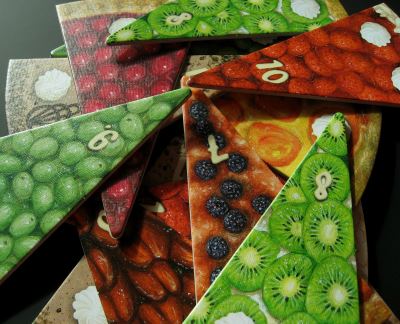
We started out with a game that was new to the group, …Aber Bitte Mit Sahne (which means “…But Please, With Cream”, although the game is also known as “Piece o’ Cake” in English).  This is a quick little set collecting game we’ve not played before with very simple rules.  The game uses an “I divide, you choose” mechanism with points awarded to players with the most slices of the each different types of cake.

…Aber Bitte Mit Sahne
– Image by boardGOATS

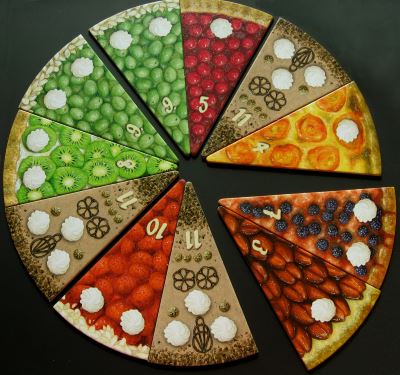
The first player (the Baker) bakes a cake with the types determined at random.  Each slice has a number of blobs of cream on it and a numeral demonstrating how many of that type there are in the game.  The Baker then divides the cake up (usually so that there are sufficient pieces for everyone to have one), with each piece containing any number of slices of any type.  Next, the player to the left of the Baker selects a piece of cake and chooses what to eat and what to keep.  They can eat or keep as many slices they want.  Any cake they choose to eat is turned face down and the total number of blobs of cream in the pile contributes that number of points to the the final score.  Thus, each player takes a piece of cake and chooses what to eat and what to keep, finishing with the Baker.  Then the next player takes a turn as the Baker and so on.  The game continues for five rounds.
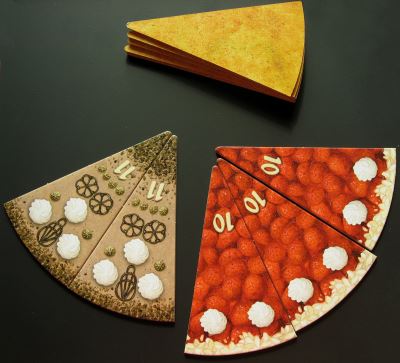
…Aber Bitte Mit Sahne
– Image by boardGOATS

At the end of the game, each type of cake is assessed and the player who has collected the most slices of a variety receives points.  The number of points obtained is the same as the number of slices in the game and is written on each slice of that type of cake.  For example, there are eleven pieces of chocolate cake in the game and the player with the most slices will win eleven points at the end.  Crucially, in case of a tie, all tied players score the points.  In general, players can only eat fresh cake (i.e. cake just served), the exception is that they can forfeit the opportunity to take fresh cake and instead eat all the stale cake of one type in front of them.  This might be a good idea if a player can see that they cannot win a category and the number of blobs of cream will give them more points than they would get from the fresh cake.
…Aber Bitte Mit Sahne
– Image by boardGOATS

Burgundy started off as the Baker.  Blue began modestly keeping a slice of apricot cake and eating her chocolate cake (having given up chocolate and cake for Lent, this was very appealing).  Meanwhile, Cerise began collecting strawberry and chocolate, Grey went for gooseberry leaving Red and Burgundy to fight it our for cherry, blackberry and plum.  In the second round, Burgundy set the tone by pinching the a slice of apricot cake from under Blue’s nose handing her a load of relatively worthless slices in the process.  From then on, it was more about stopping other people from getting what they wanted than about collecting something useful, which meant that those who had picked up the start of a set in the first round were in the best position.  The game ended with players sharing the top spot for a lot of the categories, but the strawberry and chocolate that Cerise had picked up early on gave her a massive number of unshared points.  The title of Master Baker went to Burgundy, however, winning by a single point.

Niagara
– Image used with permission of BGG contributor GeoMan

By this time, Green, Black and Purple had arrived, so we split into two groups with the first starting off with the “Feature Game”, Niagara.  This is one of the first games we played in the group back in October 2012, and it was certainly long overdue another outing.  The idea of the game is that players are travelling up and down the Niagara River in canoes collecting gems.  The river is the feature of this game as it is made up of plastic discs that actually move during the game carrying the players boats towards the falls.  Each player has a set of “paddle cards” with numbers 1-6 and a cloud on them and each card must be played one can be reused.

Niagara
– Image used with permission of BGG contributor Marsh

Simultaneously, all players choose a paddle card, then they take it in turns to resolve their card.  Each player has two canoes which can either be on the bank or on the river.  Any boat on the river must be moved and a boat on the bank can be moved if the player wants to (though if they are both on the bank, only one can be moved).  Movement is exactly the number shown on the chosen paddle card, no more and no less (except when bring a boat home with a gem on board) and the boats cannot change direction during the turn.  In addition to moving, players can also load or unload a canoe, which costs two movement points and must be done at the start or end of a move.  An empty boat that is travelling up-stream and lands on a space occupied by another boat laden with a gem may also steal it for no charge.

Niagara
– Image used with permission of BGG contributor erfalucho

At the end of the round, after everyone has taken their turn moving their boats, then the river moves.  It’s movement is dictated by the smallest canoe movement, modified by the weather.  Each player has a weather paddle card and as one of their options, they can alter the weather setting from sunny (-1) to very rainy (+2).  Thus if the lowest paddle card played was a three and the weather was very, very wet, the river would move five spaces.  The winner is the player who has either four gems of the same colour, five of different colours or seven of any colour at the end of the game.

Niagara
– Image used with permission of BGG contributor William Hunt

The game started well, and “just to demonstrate to everyone how it was done”, Blue nicked one of Burgundy’s gems and then increased flow rate of the river.  She got her comeuppance since she promptly ended up with two yellow gems.  Meanwhile, Cerise had collected two clear gems and Red followed Blue’s example and increased the weather flow to it’s maximum.   By the time everyone had been through their paddle cards once, everyone had moved on to trying to get the difficult pink and blue gems that are perilously close to the cataract.  The inevitable happened then, when everyone played a “6” and one of Cerise’s precious canoes went sailing over the waterfall.  Despite turning one of her boats into match-wood, she was still the first to get a complete set of five different coloured gems, giving her the win.

Niagara
– Image used with permission of BGG contributor cmessenger

Meanwhile, the other group were showing no signs of finishing, so since Cerise had never played it, the group moved on to one of Red’s favourite games, Bohnanza.   Cerise was very generous which meant everyone else followed suit and the game wasn’t as tough as it has been when we’ve played it recently.  Burgundy went for the “high value” market, but suffered and Red and Blue’s mixed bean strategy and Blue finished just two coins ahead of Red.

Bohnanza
– Image used with permission of BGG contributor spearjr

The other group were still what seemed like hours from finishing, so the first group tried decided to move onto their third game.  Burgundy expressed an interest in playing Blueprints, a cute little dice stacking game.  However, just as Blue was getting it out, Black suddenly commented that their game was coming to an end.  Blueprints can be a little lengthy, so it was quickly replaced with Tsuro, which turned out to be just the right length.

Tsuro
– Image used with permission of BGG contributor aleacarv

Tsuro is a very simple tile laying, path making game, that has the advantages of playing a range of numbers reasonably well, as well as being very quick to play and extremely easy to teach.  The idea is that players have a stone which is located on the board and a hand of three tiles.  On their turn, they have to place one of the tiles on the board next to their stone such that it extends it’s path and remains on the board, then they replenish their hand.  Players continue until their stone collides with another player’s stone or it is forced off the board (by another player or because they have no choice because of the tiles they have), in which case they are out.  The game started slowly, but Red was the first to go, when she lost a tussle with Burgundy.  Burgundy didn’t last much longer, leaving just Cerise and Blue to tough it out.  Blue was forced to place a tile that left her at the mercy of Cerise, but Cerise had no choice and collided with Blue, ending the game.

Village
– Image used with permission of BGG contributor henk.rolleman

By this time, the other group were just adding up their scores, but what was it that they had been playing that took so long?  Well, they had been playing Village with The Port expansion.  In Village, each player takes the reins of a family striving for fame and glory.  The game is full of difficult decisions, however, it feels like it moves quite quickly.  What is particularly unique though, is the way the game uses the delicate subject of death as a natural and perpetual part of life in the village and a mechanism for dictating the flow and duration of the game.

Village
– Image used with permission of BGG reviewer EndersGame

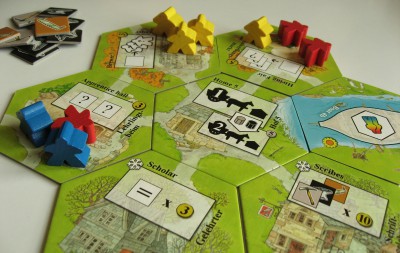
Each player starts the game with a personal farmyard board and the four members of the first generation of their family.  There is also a central village game board which depicts the different locations players can go to carry out different actions.  At the start of the game/round influence cubes are drawn at random from a bag and placed on these locations.  During the round, players take it in turns choosing a location and taking one of the cubes and then (optionally) carrying out the action. There are a range of actions, from “building a family”, to “crafting goods” or “going to market”.  Some of these (like visiting the “well”) give resources of some kind, while others (like going “travelling” or “entering the church”) are primarily a means to obtain points.

Village
– Image used with permission of BGG reviewer EndersGame

While the action is optional, taking a cube is mandatory.  If there isn’t a cube available at the location, then the action cannot be taken.  Cubes are then used to pay for some of the actions.  In addition to the cube cost, some actions also have a “time” cost:  around the edge of the players farmyard, there is a time track and once a player’s token has been round the board one of their meeples dies.

Village
– Image used with permission of BGG reviewer EndersGame

When one of their meeples dies, the player has to choose one of their oldest generation family members (i.e. those numbered “1”, or in the event that they are all deceased, one numbered “2”) kill them off.  These meeples are then either laid to rest in the Village Chronicle or in one of the anonymous graves behind the church.  Family members placed in the Chronicle will score victory points at the end of the game, however, if there is no room in the relevant section of the Chronicle, the family member is placed anonymously in the unmarked graves behind the church where they do not score.  The game will end when either the last empty space in the Village Chronicle is filled, or the last anonymous grave is filled.  The winner is the player with the most points at the end.

Village
– Image by BGG contributor jardeon

It took a little while to set up and revise the rules and to work out how the new Port expansion fitted in.  Basically this replaces the original travelling option with the ability to board ship and travel the seven seas. Players hire a captain, and then use the ship to sell domestic goods and pick up foreign commodities. Family members can be sent as missionaries to far away islands and dig up treasure chests.

Village Port
– Image by BGG contributor Grovast

Eventually the game began.  Black started out collecting green cubes, aiming for a market based strategy.  Grey was attracted by the large number of points provided by the expansion and decided to pop down to the port and start sailing almost immediately.  Meanwhile, Purple and Green were a little less certain of their initial direction and just built up a small stock of tiles (namely ox and plough to maximise wheat production).  By the end of the first round, both Purple and Green had sent family members into the church bag, and, by pure chance, both Green’s came out.  In the second round Purple joined yellow at sea, Green fumbled over getting his first meeple to work a second time in the craft halls without dying while Black (a hard task master) worked his first meeple into an early grave without shedding a tear!

Village
– Image used with permission of BGG contributor Club Amatent

Blue was also heading deeper into the town hall, piling up extra bonus green cubes and tiles to enhance his market buying opportunities.  Grey continued a balancing act at home while slowly filling his boat.  Green joined Grey and Purple and took to the seas with the highest level captain and rapidly made his way round to collect the various goodies. Purple decided that she did not like the apparent slight by the God(s) and placed even more into the church, and paying for them to be taken out and so gaining the end of round church bonus.

Village
– Image used with permission of BGG reviewer EndersGame

Everything was looking rosy for Black, producing quite a pile of market chips, until the sailors began to return, and were able to swap their bounty for lots of points, saoring into the lead on the victory point track. Black was still confident, if a little nervous now, especially since Green had managed to plant one of his meeples in the far corner of the sea for a huge haul of points at the end.  The books of remembrance were slowly filling, as was the grave yard.  Black then took a late plunge into the waters, while Green started sending family members to join the local council in the Town Hall.  Purple collected cubes a plenty (enabling her to make some free actions of her own choice to her advantage) and Grey was really getting to grips with the game and was making good use of his second trip to sea and happily killing meeples left, right and centre, like mad despots!

Village
– Image used with permission of BGG contributor henk.rolleman

There was a close finish in the final round.   Initially everyone thought it was going to be the last round, but then it started to look like the grave spaces would not be filled after all and another round would ensue.  Then, out of the blue, Green used three cubes to visit the market place, which had otherwise been empty of action cubes.  Buying twice killed off another meeple, which filled the last space in the graveyard and the game was suddenly over (leading the other group to change from Blueprints to Tsuro).  With one last turn each, only Black was able to do anything to increase his score at this point.  Before the final scoring it was very unclear who had won:  Green and Grey were far in front on the victory point track, but Black had a lot of market chips.  It turned out, Black had just done enough, pipping Green by a couple of points with Grey and Purple not far behind in what had been a very close and enjoyable game.

Village
– Image used with permission of BGG reviewer EndersGame

Learning Outcome:  Killing meeples is great fun, if a little time consuming!

The Passing of a Little Friend

Anyone who came to meetings while the pub was closed (due to the fire), will remember Susie.  She was the grumpy little cat who grudgingly put up with our visits and, in time became almost friendly with people.  Sadly, Susie passed away this morning, at home in the arms of her faithful servant.

Susie
– Image by boardGOATS

Boardgames in the News: Are Asmodée Taking Over the World?

Asmodée is the French translation for Asmodeus, and according to Binsfeld’s classification of demons, Asmodeus is the demon of lust and is therefore responsible for twisting people’s sexual desires.  In the boardgame world though, Asmodée (originally known as Siroz) are a small French game publishing and distribution company, specialising in the family market. For example, they are well known for Dobble, Dixit, Time’s Up! and Ca$h ‘n Guns, but they also publish some more challenging games including Snow Tails, Mr. Jack, Formula D, Takenoko and 7 Wonders.

Jungle Speed
– Image used with permission of BGG contributor kilroy_locke

Asmodée was started in 1995 by Marc Nunès, a self-trained entrepreneur developing role-playing games, but quickly became France’s foremost games publisher and distributor.  One of the big early successes was Jungle Speed, launched in 1998, which has since gone on to be one of the top-selling titles in France, rivalling Monopoly, Trivial Pursuit and Pay Day.  The real turning point came in 2003, however, when Asmodée obtained the French licence to distribute Pokémon collector cards, which opened up the mass retail sector.  This development led to an 18% investment from Naxicap in 2005.  Naxicap’s stake was bought out two years later by Montefiore who acquired 60% of the company as part of a deal with management worth €40-50 million.  Montefiore invested €120 million to finance Asmodée’s international growth, funding the acquisition of the Belgian game distributor Hodin in 2008, the Spanish games developer Cromola and the German Proludo in 2009, followed by the purchase of a 60% stake in the UK-based distributor, Esdevium Games in 2010.  Asmodée also strengthened it’s portfolio with the acquisition of Abalone and partnership with Libellud (leading to the distribution rights for Dixit) in 2010.

Abalone
– Image used with permission of BGG contributor msaari

In 2012, Asmodée branched out further, setting up a subsidiary in Shanghai, China,  with the intention of expanding “into a new market taking advantage of Asmodee’s extensive line-up of games and the existing relationships with partners, thus promoting the brand in mainland China, Hong Kong and Taiwan”.  This ambition brought Asmodée to the attention of the Eurazeo, a European investment company and a deal was announced in November 2013 that valued Asmodée at €143 million.   In January, 2014, almost exactly a year ago now, Eurazeo bought 83.5% of Asmodée through an equity investment of €98 million while Asmodée’s management team and original founders reinvested €14 million of their own money.

Ticket to Ride
– Image used with permission of BGG contributor garyjames

With the backing Eurazeo provided, Asmodée then went big:  in August last year it was announced that Days of Wonder would be “merging into the Asmodée Group of game companies”.   Days of Wonder are one of the biggest names in modern boardgaming, and are often credited with the growth of the modern boardgame industry, thanks largely to their flagship Ticket to Ride games, which have sold well over two million copies to date.  This is not the only “big game” in their catalogue either, they are also responsible for Memoir ’44 and Small World, both of which are popular games, demonstrated by the number of expansions they support and which take Days of Wonder’s total number of games sold to over five million since their founding in 2002.

Small World
– Image used with permission of BGG contributor crosenkrantz

According to Forbes, Days of Wonder generates between $10 million and $20 million in revenue annually, not bad in such a niche market.  From Eurazeo/Asmodée’s point of view, such an acquisition makes sound financial sense, not just because of the commercial value, but because they already provided a lot of the distribution for Days of Wonder games.  This wasn’t enough for Asmodée however, and three months later, they acquired the U.S. publisher Fantasy Flight Games.

– Image used with permission of BGG contributor adamfeldner

This was a bit of a change of direction for Asmodée:  hitherto, all the acquisitions had been firmly in the family boardgame and distribution markets.  Fantasy Flight games are a very different animal and their headline games, Twilight Imperium and Arkham Horror are much less family friendly.   Even their X-Wing Miniatures Game which is very popular with fathers and sons, is a long way outside the normal scope of Asmodée, since it is essentially a two-player war game with a Star Wars theme.  However, there are considerable benefits for both parties, since the merger will enable Fantasy Flight to improve its distribution in Europe, while simultaneously giving the growing Asmodée Group access to Fantasy Flight’s North American sales and marketing teams.

Black Fleet
– Image used with permission BGG contributor Toynan

Asmodée weren’t stopping there, however, with Ystari Games, Asterion Press and Pearl Games also becoming “part of the Asmodée family” late last year.  The link with Ystari Games almost certainly comes from their mutual interest in Space Cowboys.  Space Cowboys is a game creation studio created in 2013 by Marc Nunès (who started Asmodée way back in 1995, remember?), Philippe Mouret and Croc (both of Asmodée), Cyril Demaegd (Ystari) and Sébastien Pauchon (GameWorks).  Space Cowboys is a very small outfit, but already has one Spiel des Jahres nomination under its belt in Splendor and looks to be trying for a second with Black Fleet, the gorgeous pirate game released at Essen last year.

Asmodee Publishing 2015
– Image from eurazeo.com

So, what are Asmodée up to?  The concern is that gamers generally like the current diversity in the market and fear that this succession of mergers and partnerships will mean a homogenisation of the games available.  The November 2014 Eurazeo “Investor Day” report spelled out the current state of Asmodée in detail and the good news is that this does not seem to be Eurazeo/Asmodée’s intention.  The report states, “Each studio has its own DNA,” and goes on to say, “Repeated success lies in the full independency granted to these studios, to keep innovating.”  So it seems the diversity is valued, however, by acquiring mid-sized publishers like Days of Wonder and Fantasy Flight, Asmodée is positioning itself to compete more effectively with multinational toy giants like Hasbro and Mattel, who publish top board game brands including Monopoly and Scrabble.

Asmodee Organisation 2015
– Image from eurazeo.com

So, is it a good thing that Asmodée are setting themselves up to rival the big boys?  Well, Asmodée is not the only company to engage in mergers:  in 2011 Filosofia purchased the U.S. publisher Z-Man Games, and U.S. publisher FRED Distribution (which releases games under the Eagle Games and Gryphon Games brands), acquired U.S. publisher Face2Face Games.  More recently, in late 2013, Mayfair Games (the U.S. partner for Catan) bought a controlling interest in Lookout Games (the company who first brought Agricola, Caverna, Le Havre and Ora et Labora to the market).

Asmodee Logo
– Image from escapistmagazine.com

Clearly a large stable company provides security for designers, as well as providing support for the individual studios who know that one poor decision is no-longer likely to bring about the end of the company, both of which have to be A Good Thing.  However, companies like Eurazeo invest for only one reason:  financial return.  With an effective monopoly, Asmodée are now in a position to squeeze the market, indeed we may already be seeing the evidence of this in the price rises announced at the start of the year.  With this in mind, it will become clear in due course whether Asmodée is good for boargaming in the UK or whether it is genuinely the demon of lust responsible for twisting our gaming desires…

Next Meeting – 24th February 2015

Our next meeting will be on Tuesday 24th February, at the Horse and Jockey pub in Stanford-in-the-Vale.  As usual, we will be playing shorter games from 7.30pm as people arrive, until 8pm when we will start something a little longer.

This week the “Feature Game” will be Niagara. This is a slightly more in-depth “pick-up and deliver” type game with players constantly fighting the movement of the river as well as each other.  Basically, players are trying to collect gems by travelling up and down the river, however, they must beware of the ever-changing flow of the river, which can carry little canoes over the falls and turn them into match-wood…

Niagara
– Image used with permission of BGG contributor William Hunt

And talking of Niagara Falls…

Jeff and his cousin Joe were on holiday together in the USA, and decided to go and see Niagara Falls.  During the day they had a ride in a little boat and admired the spectacular cataract and they finished the day in a bar.  After a few drinks, Jeff issued his cousin a challenge, “I bet you £500 that you can’t carry me across the falls using a tightrope.”  Now Joe never could resist a challenge and, since he had been learning to tight-rope walk (and he’d also had a few drinks of course), he accepted the challenge.

The next morning, still hung-over, Jeff and Joe got up early to make the crossing.  After a bit of head-scratching, they managed to set up the tight-rope and Joe began to carry Jeff across the river.  After a very scary half hour, Joe managed to stagger safely across carrying Jeff, and Jeff grudgingly paid the £500.

“That was very close,” Jeff said. “When you wobbled at about halfway, I was sure I’d won; the car is on the other side of the river, double or quits?”