Author Archives: nannyGOAT

It’s the Year of the Goat – Happy New Year!

Although China has used the Gregorian calendar since 1912, Chinese New Year is based on the ancient Chinese lunar calendar, and it falls on the second new moon after winter solstice – somewhere between 21st January and 19th February (which means it changes from year to year).  So, Thursday was the first day of the new Chinese year, and 2015 is the year of the goat!

The Year of the Goat
– Image from feng-shui-consultants.com

So, Happy New Year, or “Gong Hey Fat Choy”!

10th February 2015

Getting into the mood for Saturday (St. Valentine’s Day), we started out with just a couple of quick hands of the old favourite, Love Letter.  Blue took the first hand and Grey the second, however, we were still expecting a few more, so we decided to play another quick game and after a little discussion, we went for Coup.

Love Letter
– Image used with permission of BGG contributor henk.rolleman

This is a light little card game with a lot of similarities to Mascarade, which we played last time:  on their turn, players declare they are going to take an action and other players can either claim they are a specific character and counter or challenge the active player to prove that they are who they say they are.  Basically, the actions are either: take money in various different amounts (with different risks); spend money to assassinate or perform a coup, or trade a card with the deck.  Players have two character cards face down in front of them, and when challenged correctly or assassinated/subjected to a coup, they turn one face up.  When both of a player’s cards are face up, they are out;  the winner is the last man standing.

Coup
– Image by BGG contributor jerome75

Unfortunately, Blue, who had played it quite a bit in the past got horribly muddled with the rules, largely due to the similarity between this and Mascarade, so consequently, forgot a small but quite critical rule:  when a challenge is made and the challenge is unsuccessful, the player should exchange their card with one from the deck.  Although this obviously had an impact, since everyone was playing by the same rules, it wasn’t too drastic.

Coup
– Image used with permission of BGG reviewer EndersGame

Before long, Cerise and Grey were outed as Dukes and Indigo was claiming to be a Captain and was stealing from Cerise.  “Burgundy the Brave” kept challenging, but unfortunately was wrong more than right and was soon out of the game.  When Cerise claimed to be the yet another Duke nobody believed her.  Meanwhile, Indigo was building up quite a store of cash, so Green decided it was imperative that her money supply should be cut off and assassinated Cerise proving that she had been holding two Dukes at the start.  Green’s unsuccessful attempt to assassinate Blue (who was the Contessa) left just Indigo, Grey and Blue in the game.  Indigo’s successful coup was rewarded by a prompt assassination of her final character by Blue, leaving just Blue and Grey.  Grey, as a captain was trying to collect enough money for a coup, while Blue needed just one more coin for the assassination.  So, Blue kept taking two coins in Foreign Aid and Grey immediately stole them.   It looked like Grey had it, but since Blue still had two character cards, that gave her an extra chance to collect money the game ended when she mercilessly stabbed Grey’s captain in the back.

Takenoko
– Image used with permission of BGG contributor nad24
and nonsensicalgamers.com

We then split into two groups with the first playing the “Feature Game”, Takenoko.  The back-story for this game is that a long time ago, the Chinese Emperor offered a giant panda bear as a symbol of peace to the Japanese Emperor.  Since then, the Japanese Emperor has entrusted the members of his court (the players) with the difficult task of caring for the animal by tending to his bamboo garden.  So the players have to cultivate the different plots of land, irrigate them and grow one of the three species of bamboo (Green, Yellow and Pink) with the help of the Imperial Gardener.  The winner is the player who grows the most bamboo, managing his land plots best while feeding the Panda.

Takenoko
– Image by BGG contributor woodenbricks

The play area starts with one single hexagonal “pond” tile with two characters on top:  the Imperial Gardener and the Panda.  On their turns players first determine the weather, then perform their actions.  The weather is determined by a roll of the weather die, which give the active player some sort of bonus.  For example, when the sun shines, the payer gets an extra action, and rain stimulates the bamboo of their choice to grow.

Takenoko
– Image used with permission of BGG contributor Oceluna

Once the weather has been determined, the player can perform two actions.  These must be different and the player can choose freely from the five available.  Firstly, the player can add a new bamboo plot, by drawing three hexagonal tiles from the face down stack and choosing one to place.  This tile must be placed next to the starting “pond” tile or adjacent to two plots already in play.  There are also “improvements” which are sometimes built into the plot, but can also be obtained by rolling the weather die and can be played at any time.  The second option is to take an irrigation channel.  These can be played straight away or stored for later use, but bamboo only grows on irrigated plots.  The main way to irrigate a plot is by connecting them to the pond via channels.

Takenoko
– Image by BGG contributor woodenbricks

Alternatively, a player can move one of the characters, either the Imperial Gardener or the Panda.  Both move over any number of plots, in a straight line, but when they reach their destination, their action is different.  The Panda cannot resist bamboo, so will eat one segment of bamboo from the plot he lands on (the pieces are stored on the player’s individual board); the Imperial Gardener encourages the bamboo to grow, and the bamboo on the plot he lands on grows by one segment as does every adjacent tile growing bamboo of the same colour (as long as they are irrigated).

Takenoko
– Image used with permission of BGG contributor lacxox

Finally, the active player can draw an objective card and add it to their hand;  there is a hand-limit of five and these are the only way to score points.  There are three types of objectives, those related to Plots, the Gardener and the Panda.  Plot objective cards yield points to players when certain plot configurations are irrigated; Gardener cards are achieved when bamboo of given height are grown in the right spaces and points for Panda cards are awarded when a player has managed to encourage the Panda to eat the requisite number of coloured bamboo segments.

Takenoko
– Image used with permission of BGG contributor ObeyMyBrain

When a player completes one of their objectives, they show everyone and the card is placed face up in front of them.  They can complete as many objectives as they like on their turn and end of the game is triggered when one player full-fills a set number of objectives, after which, everyone gets one last turn.  The game was really tight from start to finish and every time one player got a nose in front, the others seemed to catch up and over-take, only to be leap-frogged themselves.  The game finished with just three points separating first and last place, with Burgundy just pipping Indigo.

Lancaster
– Image used with permission of BGG contributor punkin312

While half the group were Playing with Pandas, Green persuaded everyone else to give Lancaster another go.  This is a longer game which embodies a few very clever ideas and that we played for the first time a few weeks ago.  The basics of the game are that players take it in turns to place their knights in the shires, in their castle or send them off to war.  They then vote on and evaluate “the Laws” which give players a benefit.  They then get their their rewards for knight placement.  After five rounds, the player with the most points wins.

Lancaster
– Image used with permission of BGG contributor kilroy_locke

One of the clever things about the knight placement is the way that players can usurp a knight that has already been placed, by supplementing him with a number of squires.  So, a knight of level two can be replaced by a night of level one with two squires.  However, squires are “single use”, so should the original player decide to respond with a level four knight, the other player’s squires are lost.  This is a very clever way of speeding up the bidding.  For example, in Keyflower, two players can keep bidding in increments of one which means it may take several turns for the outcome to be resolved.  In Lancaster, a failed bid that is repeated at a higher level may turn out to be considerably more costly than bidding higher the first time round.  This encourages players to be a smarter about their bidding and changes the dynamics a little too.

Lancaster
– Image used with permission of BGG contributor punkin312

One of the key parts of Lancaster is “the Laws” and managing them.  On our previous play, we didn’t really get to grips with them at all.  Although it is now clear to us how important they are, we are still only just getting to grips with them.  The game starts with a set of three Laws, with three to be voted on during the round.  Since there is a conveyor-belt system, it is possible that some Laws will remain in place for several rounds.  This means even if a particular Law does not reward a player during the round it becomes active, they may benefit in subsequent rounds.

Lancaster
– Image used with permission of BGG contributor kilroy_locke

This game was quite different to the last:  firstly, as a group, we had a better idea of rules, and secondly, there were only three of us compared with five before.  Blue was too busy worrying about the game on the next table to concentrate on the rule-reminder, and paid for it in the first round when her plan relied on the rewards coming before the Laws.  Green tried to increase his force and then generate benefits by fighting the French, however, with fewer players, it is much more difficult to win the battles which means your knights are tied up for a lot longer.  Having screwed up the first round, Blue didn’t bother trying to increase all her knights to full force and tried to be a bit more canny about how she used them instead and pick up upgrades by other means.  Meanwhile, Grey, who had not played the game before, tried to build up his stack of noblemen and played the laws.  Blue and Green were far too bothered with their own games to notice, but Grey managed to get the eight point Law for having three knights in the shires voted in.  More importantly, he managed to keep it there, and this combined with a respectable number of nobles and a few uncontested visits to Somerset (giving him six victory points each time) eventually gave him the game by a sizeable margin from Blue.

Coloretto
– Image used with permission of BGG contributor punkin312

Meanwhile, the Panda Players had finished so Burgundy and Cerise squeezed in a quick two player game of Coloretto.  Cerise and Burgundy had played this last month with Blue and Indigo, but it is not generally thought of as a good two player game.  Nevertheless, they gave it a go and found it much more enjoyable than expected.

Taluva
– Image used with permission of BGG contributor Bizowikc

With Grey and Cerise’s departure, that left just time for one last, shortish game, Taluva. This is a fairly simple tile laying game with a surprising amount of depth.  The idea is that on their turn, players place their tile, then place a building then replenish their hand.  This procedure is to that of Carcassonne, but that is where the comparison ends.  The tiles are a strange dodecagon made of three hexagonal regions or fields, one of which is always a volcano.  When placing tiles, they can be adjacent or on top of other tiles so long as the volcano sits on top of another volcano (the tile must also cover more than one tile and there cannot be an overhang).

Taluva
– Image by BGG contributor Purple

Buildings can be placed anywhere, provided that they obeys certain rules.  Unfortunately, although the game is beautiful, the theme is a bit sparse making these rules appear very arbitrary which has the consequence that they are quite difficult to remember.  A hut can be built on any unoccupied level one terrain that isn’t a volcano.  On the other hand, an existing settlement can be expanded by placing huts on all adjacent terrains of one type, with more huts placed on the higher levels (two on the level two etc.).  There are also three temples and two towers to place which can only be added to existing settlements:  temples must be added to settlements covering at least three fields, while towers must be placed on a level three field adjacent to a settlement of any size.

Taluva
– Image by BGG contributor Moviebuffs

The game ends when there are no tiles left and the winner is the player to have placed the most temples at the end of the game.  In case of a tie, the number of towers built counts and then the number of huts.  However, if a player succeeds in building all buildings from
two out of the three different types before the game end, then he immediately wins the game.  On the other hand, any player who squanders his building pieces and is unable to build any more is immediately eliminated.

Taluva
– Image used with permission of BGG contributor punkin312

We played this a while ago as a two player game, so it was interesting to see how it played with more.  As last time, we had a thorough going through of the rules with all the weird exceptions and special cases (e.g. players cannot build a temple in a settlement that already has one, however, it is OK to join two settlements with temples together; you can place a tile on top of huts, but not towers or temples etc.).  The game was very close and it looked like Blue was going to make it, however, Green and Burgundy ganged up on her and Green managed to sneak the win with the last tile.

Taluva
– Image by BGG contributor Moviebuffs

Learning Outcome:  Two three-player games are sometimes better than one six-player game.

Boardgames in the News: 20 Years of Catan and El Grande

It seems to be the year for anniversaries: arguably 2015 celebrates significant anniversaries for two of the greatest games in boardgaming history.  We are not talking about Monopoly here (though there has been a lot written about the 80th anniversary of the brand).  The games in question were both released in Germany in 1995:  The Settlers of Catan and El Grande.   The first of these, Klaus Teuber’s The Settlers of Catan, is widely known amongst gamers and many non-gamers, and is often cited as being responsible for the “gaming revolution”.  The base game of “Settlers” (or “Die Siedler”) and its expansions have appeared in thirty languages and sold more than twenty-two million copies worldwide.  At Spielwarenmesse, The International Toy Fair at, Nürnberg, Kosmos and Mayfair unveiled a new look for the entire line of Catan games.

The Settlers of Catan
– Image used with permission of BGG contributor kilroy_locke

The press release explains, “The new look will strengthen the Catan brand both domestically and internationally.  The new cover art utilized by all partners will provide a visual continuity throughout the world.  This new look is more vibrant and alluring with overall improved presentation and splendidly clean branding. The new packaging cries out… CATAN!”  It goes on to say, “As part of the growing expansion of the Catan® family of products, the base game will simply be called CATAN® in all countries and languages, along with a unification of the game’s graphic design in all territories and languages.”

The Settlers of Catan
– Image by BGG contributor herman_the_german

There are a couple of curious things about this, firstly, when Kosmos released the game twenty years ago, it was just going to be called “The Settlers” (or rather “Die Siedler” since it was released in German first).  That was until Blue Byte published a computer game by the same name, so Kosmos decided they wanted something more unique and identifiable and made up “Catan”.  Secondly, aside from the the editions released in English by Mayfair Games (who went its own way with original art and component design), the brand has already been “unified” in its look!

The Settlers of Catan
– Image by BGG contributor degamer

The second of the games mentioned above is El Grande, which was first published in Germany by Hans im Glück.   Like “Settlers” the year before (or “Catan” as we must now call it), in 1996, Wolfgang Kramer and Richard Ulrich’s El Grande was awarded both the Spiel des Jahres and the Deutscher Spiele Preis.  Although it is less widely known than its predecessor, El Grande is hugely respected by gamers often cited as “still the best area control game”.  It is so highly thought of that it continues to be higher on the BoardGameGeek ranking than The Settlers of Catan and many other well known and hugely popular games including Carcassonne, Ticket to Ride, Pandemic and Dominion.  These games are all continuously reprinted, but sadly, the nature of boardgames means that many good titles go out of print.  Unfortunately, El Grande is one such game; it had fallen out of favour with its publishers and has not been reprinted in English or German since the Decennial Edition, ten years ago.

El Grande
– Image used with permission of BGG contributor garyjames

There are a number of reasons why games like this go out of print.  Firstly, much as we hate to admit it, boardgaming is a niche market:  Hasbro recently proudly announced that Monopoly has sold 275 million copies over the eighty years, but compare this with the estimated 450 million Harry Potter books sold in a fraction of the time.  In turn, these make Catan’s 22 million copies look positively paltry by comparison and for games that fail to make the jump to the wider market, the first print run is often only a few thousand.  Whether or not one of these games gets a second print run depends on demand and sale-speed of the first impression, and ultimately, whether or not the publisher thinks it can secure a good return.  Factors that affect this, obviously include the mark-up and the Recommended Retail Price (or RRP, sometimes known as Manufacturer’s Recommended Sale Price or MRSP).  Games that have language dependent components usually suffer here.

El Grande
– Image used with permission of BGG contributor DrGrayrock

There are two main markets:  Germany and USA.  We in the UK benefit from the fact that the USA nominally speak the same language as us, but otherwise, the UK boardgame market is relatively small-fry.  Anyhow, for this reason, games are commonly released primarily in English and German, however, the margins are clearly much larger if the same game can be released to both markets with minimal reworking, and companies like Z-Man Games have made a name for themselves translating the best European games for the English market.  Other companies (e.g. Zoch, Queen and R&D Games) release games as “international” editions which include language independent components and rule booklets in multiple languages.

El Grande
– Image by BGG contributor Domostie

Obviously, it is much more difficult to release a multi-lingual edition if key components include significant text.  It is also much easier to translate a game if the only change needed is the box and the rules; El Grande clearly fell foul of this.  However, so did The Settlers of Catan, and that didn’t do so badly.  So there are obviously other factors, including game play, accessibility, approachability, appearance and marketing.  There is no question that the trading dynamic and controlled randomness in Catan are key parts of its success as they keep everyone involved between turns, but timeliness is probably the real key:  it was perhaps just the right time for a family game that felt a bit different.  So, by the time El Grande came along, well, everyone was playing Settlers, and as a result, El Grande didn’t make quite the same impact.

El Grande
– Image by BGG contributor Bernaar

That doesn’t mean it is less of a game though, so it is great news that Hans im Glück has recently announced the long-awaited return of El Grande, this time in the form of a Big Box with upgraded components.  The Big Box is a collection that, like the Decennial Edition ten years ago, will contain all the expansions that have been officially released over the years.  Z-Man Games has also confirmed that it will release a parallel Big Box in English; Dutch publisher 999 Games will be doing the same in Dutch and have also mentioned a “Jubileumuitbreiding”, or “anniversary extension”.  Clearly anniversaries are to be celebrated, especially if it means older, well-loved games become available once more.

Next Meeting – 10th February 2015

Our next meeting will be on Tuesday 10th February, at the Horse and Jockey pub in Stanford-in-the-Vale.  As usual, we will be playing shorter games from 7.30pm as people arrive, until 8pm when we will start something a little longer.

This week the “Feature Game” will be Takenoko. The story goes that the Chinese Emperor offered the Japanese Emperor a giant panda bear as a symbol of peace, so the Japanese Emperor entrusted his court (the players) with the difficult task of caring for the animal by tending to his bamboo garden.  So players have to cultivate and irrigate land and grow bamboo with the help of the Imperial gardener.  The winner is the player who manages the land best and grows the most bamboo to satisfy the panda’s appetite.

Takenoko
– Image used with permission of BGG contributor nad24
and nonsensicalgamers.com

And talking of Pandas…

Jeff walked into a bar with his pet panda. It was about 5 pm, but Jeff liked his drink and was ready for a good night. They started off slowly, watching the sport on the TV, drinking beer and eating peanuts.  As the night went on, they moved on to mixed drinks, and then shots, one after the other.

Finally, the Landlord called, “Last orders!” So, Jeff asked for one last drink for himself and one for his panda.  The landlord duly set them up and Jeff and the panda knocked them back.  Suddenly, the panda staggered and dropped down dead.  Jeff, more than a little tipsy, threw some money on the bar, put on his coat and started to leave.

The bartender, yelled, “Hey, you can’t just leave that lyin’ there.”

Jeff replied, “That’s not a lion, that’s a panda.”

Save the Date: Mixing it in Wantage

The Mix in Wantage town centre is a community space that can be booked for use by local groups, organisations, businesses and individuals for activities, fund-raising, meetings, workshops, and presentations etc.  For four days a week The Mix is used as a ‘hot desk’ area for local people to use as a space to work from in town, however, Saturdays and evenings are available for local groups and community events.

The Mix
– Image from thewantagemix.wordpress.com

We will be holding a gaming session from 10.30 am until 2.30 pm on April 18th 2015.  There isn’t an awful lot of space so the idea is to encourage people to drop in and play a short game or two, so we will be bringing along things like PitchCar, Riff Raff, Dobble, Turf Horse Racing, No Thanks!, Walk the Plank!, The Great Balloon Race and some of our other favourite filler games.

Riff Raff
– Image used with permission of
BGG contributor punkin312

27th January 2015

We started off with our “Feature Game”, which was the card game, SaboteurWe’ve played it a few times before, but basically the idea is that the group is split into two teams:  Dwarves and Saboteurs.  The aim of the game for the Dwarves is to lay cards forming a tunnel that leads to the gold, whereas the Saboteurs job is to stop them.  So players take it in turns to play cards.  These cards could be tunnel cards, which are added to the play area and, although they generally extend the tunnel, there are also dead-ends which can be used by Saboteurs to upset the Good Little Dwarves’ plans.  Alternatively, there are action cards, which come in several types.  There are broken tool cards, which allow players to prevent other players from laying path cards (useful if you suspect there is a Saboteur about); mended tools which are used to repair broken tools (useful when a Saboteur has been trying to slow everyone down by smashing up their tools); map cards (useful when a nasty Saboteur has been misleading everyone telling them the gold is in the wrong place), and rock-fall cards which can be used to remove tunnel cards (useful when an evil Saboteur has been causing havoc).  The round ends when the draw deck is depleted and gold cards are allocated to the winning side.

Saboteur
– Image used with permission of BGG contributor mikehulsebus

As people arrived, Blue explained the game to the people unfamiliar with it and pointed out that, despite his protestations, Green was always a Saboteur.  At which point, in walked Green, commenting, “Whatever Blue may have said, I’m NOT always the Saboteur…!”  Needless to say, it quickly became apparent that Green was very definitely a Saboteur, but despite his best efforts (assisted by Yellow and Cerise), the dwarves found the gold, though it was pretty close at the end, coming down to the last few cards.  The second round was under-way with Burgundy indicating that the central target card was gold (a fact disputed by Grey) when Black and Purple arrived.  Since they’d missed the start they began a game of Patchwork.  This is a recently released two-player game where players compete to build the most aesthetic (and high-scoring) patchwork quilt, buying Tetris-like patches with buttons.  The patches are laid out in a circle round the central time board, with a cotton reel marking the start.  On their turn players can purchase one of the three patches immediately following the cotton reel; they then pay the cost in buttons shown on the patch, and then add it to their personal “quilt board”.  In addition to the cost in buttons, the player must also advance their time token on the central time track: if the active player’s time token is behind or on top of the other player’s time token, then they take another turn, otherwise play passes to the opponent.

Patchwork
– Image used with permission of BGG contributor Percatron

Instead of purchasing a patch, players can also pass, in which case, they move their time token to the space immediately in front of their opponent’s time token and take one button from the bank for each space moved.  Players can place their patches anywhere on their quilt so long as it doesn’t overlap any other patches.  This is not the only way to get buttons; in addition to a button cost and a time cost, each patch also features 0-3 buttons.  When a player moves their time token past a button marker on the time track, they sum the number of buttons on their quilt and get this number of buttons from the bank.  The game ends when both players are in the centre of the time track.  Each player then loses two buttons for each blank square on his game board and whoever has the most buttons wins.

Patchwork
– Image used with permission of BGG contributor
greetingsfrombergen

Meanwhile, on the first table, the second and final (third) round of Saboteur had both finished with the Saboteurs making almost no impact on Dwarves’ ability to find the gold.  When the teams are drawn, there is always one card more than there are players, so one card is always left out.  The idea is that this introduces an element of ambiguity, however, we felt that this also unbalanced the teams.  For example, with eight players, the teams go from five Dwarves and three Saboteurs to six Dwarves and two Saboteurs, making it almost impossible for even a vaguely competent team of Dwarves to lose.  We discussed the options including whether it would be better to have a set-up phase where the everyone closes their eyes and the Saboteurs open them and look at each other (similar to Werewolf or The Resistance), but we felt this would give a large team of Saboteurs too much power.  In the end, we decided it would be better to remove the spare card and ensure there was the maximum number of Saboteurs.  Since Black and Purple were still going, we decided to play one extra round.  This worked much better, and thanks to a horrid distribution of cards for the Dwarves and some brilliant play by the team of Saboteurs led by Burgundy, there was nothing the Dwarves could do.  It was fitting therefore, that Burgundy finished one gold ahead of his closest competition.  On reflection, we decided there were definitely a couple of House Rules we would implement next time we play.  Firstly, we would remove the extra card when allocating players to teams, this definitely seemed to create a much more balanced game.  Secondly, we would probably also play several separate rounds and not worry about allocating gold at the end of the game.  This way, we could play one or two rounds and stop when the game had outstayed its welcome, rather than feeling that we should play to the end.

Saboteur
– Image by BGG contributor ckhiew

Patchwork was also coming to a close; scores there were quite close until the final scoring, when it turned out that Purple had more “gaps” in her quilt which lost her more points, leaving Black to take the victory.  With both games finishing we had a slight shuffling of seats, with the first group playing Mascarade.  This is a “micro” game, albeit with big cards.  The idea is that each player begins the game with a character card, but after a brief spell with them face up, everyone turns them face down and that’s the way they remain for the rest of the game.  So, the game is all about deducing which player everyone is, while trying to collect enough money to win the game.

Mascarade
– Image used with permission of BGG contributor henk.rolleman

After some initial trading, on their turn, each player can do one of three things.  Firstly, the active player can declare that they are a particular character, say, The King.  If nobody objects they can then carry out the action associated with The King, unmolested (in this case, take three coins).  On the other hand, another player may protest and claim that they are actually The King, in which case all players claiming to be The King must show their cards and whoever is correct, gets to take three coins from the bank, and all the others pay a fine of one gold coin.  A player’s second option is to “swap” their card with that of another player; since the actual exchange is done under the table, it is possible that there is no swap at all, and only the active player will know either way (or not, since everyone always seems to immediately forget which card is which).  The final option a player has, if all is complete confusion, is to look at their own card.

Mascarade
– Image used with permission of BGG contributor henk.rolleman

It always takes a little while to get the hang of the characters in play, and with people unfamiliar with the game, it was slow to get going. Orange was happy to be The Queen and collect her two gold each round, as did The King.  After a couple of turns, however, Red realised the power of The Witch and swapped her somewhat diminished fortune with that of Blue, who, as The King had managed to build a reasonably sized pile.  Meanwhile, the fines had built up and then the Judge became of interest and suddenly, the game clicked with everyone around the table, and people tried to manipulate the card they got and call others on their declarations.  Gradually, some of the piles started to get perilously close to the magic thirteen coins, especially since The Cheat was in play (if declared correctly, that player needs only to have ten coins to win).  The game finished somewhat abruptly, when Red declared that she was The Bishop and, as everyone knew she was right, there was nothing we could do.  And then it was home time for some.

Mascarade
– Image used with permission of BGG contributor pan_satyros
and pelnapara.znadplanszy.pl

Meanwhile, the second game was still going.  They were playing Colors of Kasane, one of our “Essen Specials”, but one we’ve not got round to playing until now.  It is a Japon Brand game, and they have a bit of a reputation for creating little, yet interesting games:  as Black commented, “They have a different way of thinking.”  They also have a bit of a reputation for rules that are difficult to understand; even when they seem clear, it often turns out that they aren’t, and we’ve fallen foul of this one before, most noticeably with Secret Moon (the sequel to Love Letter).  Colours of Kasane was no exception in this regard which may go some way to explaining why its taken so long to play it!

Colors of Kasane
– Image used with permission of BGG contributor punkin312

Nevertheless, the game itself is reasonably simple and beautifully rendered with pretty little Japanese fabric buttons used as player markers, reflecting the theme of a festival held at the Emperor’s court for which the players must make their own beautiful robe.  The game play is a mix of hand management and set collection.  The idea is that players take one card from the four available, and then, from their hand the active player may lay cards.  However, the cards can never be rearranged (similar to Bohnanza) and sets can only be laid from the most recent end (i.e. a “last in, first out” system) and may also include the last card laid.  Any cards laid must meet the requirements shown on one of the target cards, which also indicate the amount scored:  the more challenging the target, the more it is worth.  These target or scoring cards allow players to place of groups of even numbered cards, groups of odd numbered cards, melds with the same number, ascending or descending sets of cards, cards summing to ten etc. etc..  The key thing is that once a specific combination has been played, a glass bead is placed on it and no other player can score it.  This means it becomes increasingly difficult to play cards and score points, worse, someone else might claim something you have been building towards and render all the hard-work useless.  This is one way that players can mess with each-other’s plans, another is when picking up cards:  cards are laid out in columns so that players can see all the cards, but only the card at the bottom of each column is available to take.  Since the cards laid must necessarily include the card just picked up, a player’s plans can easily be blown out of the water by an opponent who watches carefully.  The winner is the player with the most points, with bonuses awarded for players who succeed in playing more than eight cards and either used a lot of different colours or who colour coordinated their “robe” and also for any players who managed to play all twelve of their cards.

Colors of Kasane
– Image used with permission of BGG contributor punkin312

The game began with everyone groping their way through the the first round trying to get an idea of how the game played and how players and cards interacted and what strategies should be employed.  By the time Blue joined to sneeze and spectate, it was clear that all the best plans had gone horribly awry.  Black, who had brought the game and taught everyone the rules, was struggling, but he was not alone in that.  Green and Purple were also finding other players obstructing their plans, and even Burgundy (the eventual winner) was having difficulty placing the cards he wanted.  The challenges posed by the game were reflected in the fact that nobody got the bonus for playing all twelve cards:  definitely a game that requires a second try.

Colors of Kasane
– Image by BGG contributor matador

We finished with Istanbul, a game we’ve played a couple of times recently, so didn’t require too much in the way of rule revision.  Since Burgundy was the only person who  had not played it before and everyone else had previously played it with the “short track layout”, this time we used the “large number layout”.  This puts all the Warehouses together and a long way from the Mosques, and puts the money making a long way from the Wainwright.  Black started and went straight to the Post Office before expanding his cart with a trip to the Wainwright.  Purple also made several visits to the Post Office, coupled with a few trips to the Warehouses while Burgundy and Blue attempted to improve their success rates with visits to the Mosques.  Green on the other hand, paid several trips to the Caravansary to collect bonus cards in the hope that a few of these would help him out later on.  It is unquestionably a more interesting game with five players and useful things further apart, but that didn’t stop Black delivering the rest of us a sound thrashing.  All of a sudden, he ended the game as he collected his fifth gem when nobody else had more than two.  On inspection, other players were closer than it seemed:  Green collected his third gem on his final turn, Burgundy had loads of Lira and everyone else was well on the way to getting everything they needed, however, they needed several more turns to do it.

Istanbul
– Image used with permission of BGG contributor duchamp

Learning Outcome:  It’s true, Green always IS a Saboteur!

Boardgames in the News: How Old is Monopoly Really?

There have been a number of articles in the popular press regarding the 80th Anniversary of Monopoly this year, but what are the origins of Monopoly and how old is it really?

Monopoly
– Image used with permission of
BGG reviewer EndersGame

The boardgame, Monopoly is actually based on a 1904 game called “The Landlord’s Game” designed by Elizabeth J. Magie.  Magie was inspired by American political economist Henry George, who championed progressive property taxes and the game was meant to illustrate the harm caused by land monopolies.  The game, which Magie released herself, spread by word of mouth, becoming popular in the Delaware community of Arden.

The Landlord's Game
– Image by BGG contributor sfessy

Thus, Upton Sinclair and Scott Nearing came across the game and introduced it to others throughout the north-east USA.  Nearing began calling it “Monopoly”, later writing, “the game was used to show the anti-social nature of monopoly.”  The Landlord’s Game continued to sell, and concurrently, Monopoly spread as well, with other players players making changes along the way.  For example, in the 1920s, after buying miniature houses on a trip to the Ukraine, Daniel Layman and brothers Ferdinand and Louis Thun at Williams College in Massachusetts, introduced the idea of using physical houses to mark one’s ownership.  They had a go at marketing their version of the game which they called “Finance”.  Charles Darrow heard about it from his friend Charles Todd, and further developed the game.  Darrow eventually released his version of “Monopoly“, in 1933, using materials from his own home for the pieces:  cards were handwritten, a piece of oilcloth covered the board and the original houses and hotels were made from wooden molding scraps.

Monopoly
– Image by BGG contributor zitt

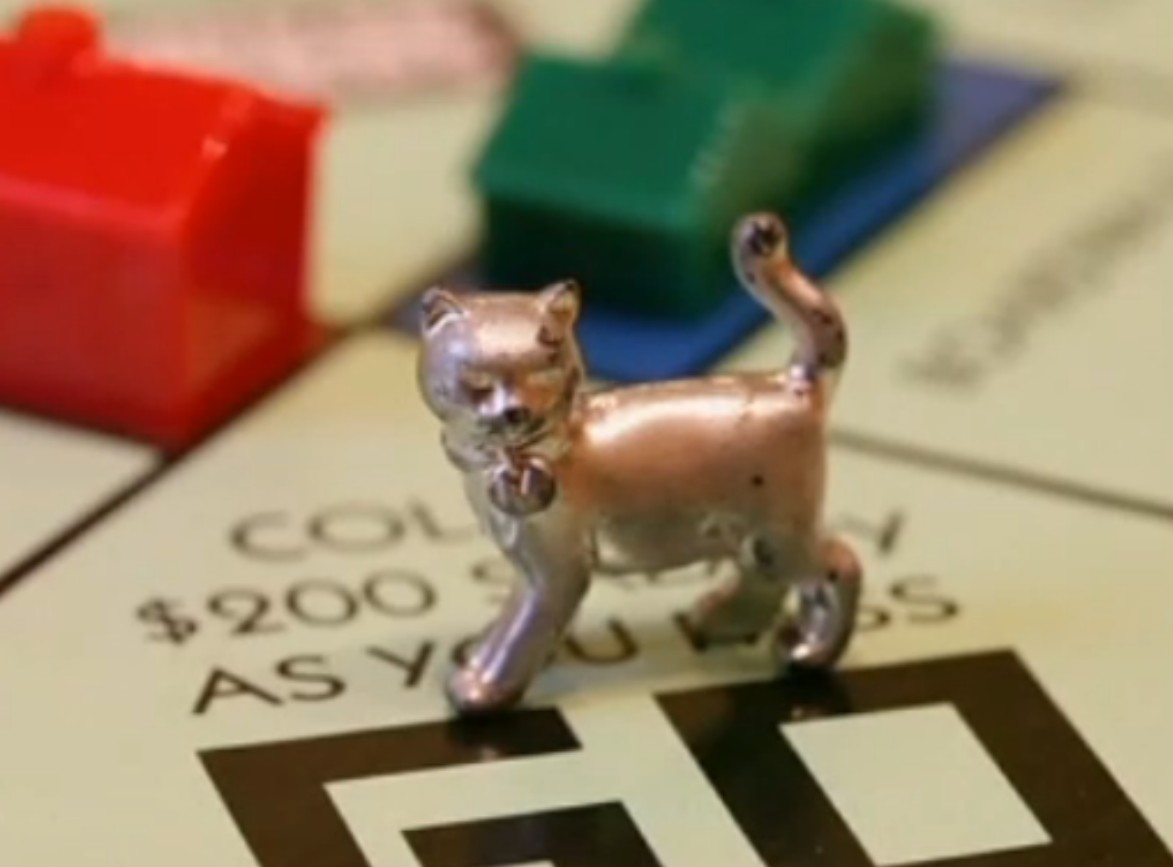
Die-cast tokens were suggested by Darrow’s niece who recommended that charms from a metal charm bracelet were used instead.  The original set included ten tokens:  the iron, the purse, the lantern, the racing car, the thimble, the shoe, the top-hat, the battleship, the cannon, and the rocking horse.  Since then, there have been more than twenty different tokens with the cat the most recent addition.

Monopoly Cat Token
– Image of unknown origin

In the early 1930s, in need of money with a young son left brain-damaged by scarlet fever, Charles Darrow presented the game to Parker Brothers.  Parker Brothers promptly rejected it because of its length, theme, and complexity, but reconsidered their decision to purchase rights to market the game after its success in local Philadelphia stores over Christmas period of 1934.  Parker Brothers acquired the rights to the game on March 19th, 1935 and their first editions were published later that year.  Almost immediately, their investment was rewarded as, within a year, they were making 35,000 copies of the board game per week.

Monopoly Flyer
– Image by BGG contributor loopoocat

In 1935, Waddingtons, received the license to distribute Monopoly in Britain who released the well known London edition.  Perhaps a more interesting edition was manufactured by Waddingtons during the second world war.  Paper maps wear out quickly and someone in MI5 suggested printing maps on silk as it’s durable, can be screwed-up folded and unfolded as often as necessary making no noise at all.  At the time, Waddingtons was the only company that had the ability to print on silk.  Since “games and pastimes” was a category of item qualified for insertion into Red Cross parcels, a plan was then hatched to mass-produce escape maps that could be folded so small that they would actually fit inside a Monopoly playing piece.  While they were at it, they also added a two piece metal file hidden in the board, a playing piece containing a tiny magnetic compass and significant amounts of genuine high-denomination German, Italian, and French currency, hidden within the piles of Monopoly money.  These special sets could be identified by a tiny red dot, one cleverly rigged to look like an ordinary printing glitch, located in the corner of the Free Parking square.

Monopoly
– Image of unknown origin

Parker Brothers secured the Monopoly trademark and Darrow became rich and famous as Monopoly’s creator;  Elizabeth Magie and the others who contributed were all but forgotten.  Then, in the 1970s, Ralph Anspach, an economics professor, brought out Anti-Monopoly. When Parker Brothers sued, the resulting lawsuit required Anspach to track down the game’s past.  After almost ten years of legal warfare, an appeals court eventually ruled in Anspach’s favour, rejecting the Monopoly trademark.  As a result, Parker Brothers lobbied the United States Congress leading to a revision of trademark legislation.

Monopoly
– Image of unknown origin

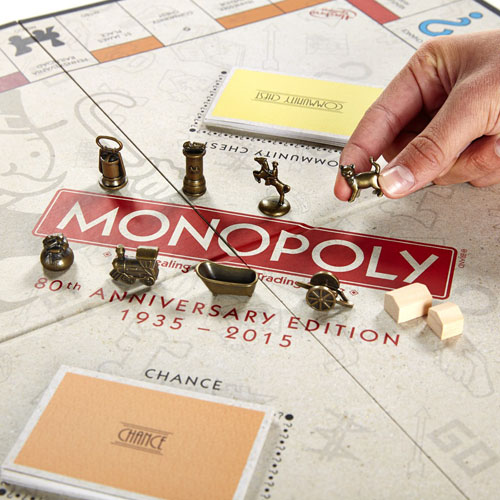
So the Monopoly Brand  is 80 this year the though the game itself is older and in turn is based on games that are much older still.  In any case, to celebrate the 80th Anniversary of the Monopoly Brand, Hasbro (who now own it) have released a list of “80 things you didn’t know about Monopoly“, as well as the inevitable special edition.


boardGOATS: Round & About in Oxfordshire

First published in April 1994, Round & About is a free monthly magazine that covers within seven counties: Berkshire, Buckinghamshire, Gloucestershire, Hampshire, Oxfordshire, Surrey and West Sussex.  Their editorial objective is to bring as much local information as possible to the reader.  In addition to their “Ramblings” column, each edition carries features on food, fashion, health, eating out and walks and more.  It also supports a range of charities, providing an outlet for information on their events, activities and fund-raisers.

Round & About
– Image from roundandabout.co.uk

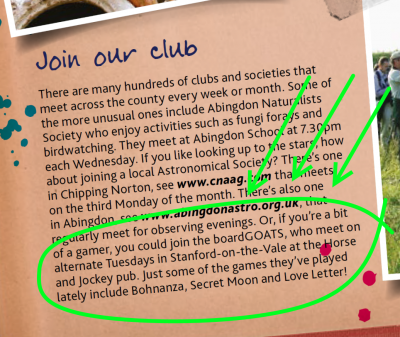
The January edition main feature is a two-page article on hobbies.  They comment on five things to try in 2015, including musical theatre, painting, volunteering, exercise and joining clubs.  So, we were absolutely thrilled to find that at the bottom of the second page of the Oxfordshire edition, our little game group gets a mention – fame at last!

Round & About
– Image by boardGOATS

Next Meeting – 27th January 2015

Our next meeting will be on Tuesday 27th January, at the Horse and Jockey pub in Stanford-in-the-Vale.  As usual, we will be playing shorter games from 7.30pm as people arrive, until 8pm when we will start something a little longer.

This week the “Feature Game” will be the card game Saboteur. This is a quick game that we’ve played before, where players are dwarves working together digging tunnels to find gold.  But there is a catch – there is a saboteur in their midst…!  The game is quite quick and great fun with a crowd, so chosen this game so that we can play something a little longer afterwards.

Saboteur
– Image used with permission of BGG contributor mothertruckin

And talking of tunnels…

Tenders were invited from various construction companies for the building of a replacement for the Channel Tunnel.  Jeff had been working in construction and, as his workload was light, when he came across an advert, he decided apply.

On the day of opening the tenders everybody was surprised to find Jeff’s tender was the lowest.  Other tenders were quoting billions of pounds, but Jeff had offered to do the job for just £10,000.  Under EU ruling, the tender had to go to the lowest bidder, which put Jeff in the hot seat.  However, before giving the works order to Jeff, the civil servant in charge asked Jeff as to how he could afford to work at such a low budget.

Jeff said,”Look, there’s me and there’s my brother Joe.  We will take two shovels and I will start digging from English bank and Joe will start digging from French bank. The moment we meet, you get a tunnel.”

The dumbstruck officer asked with courage,”And if you don’t meet?”

Jeff replied,”Then you will get two tunnels for the same price.”