Category Archives: Games Night

30th October 2018

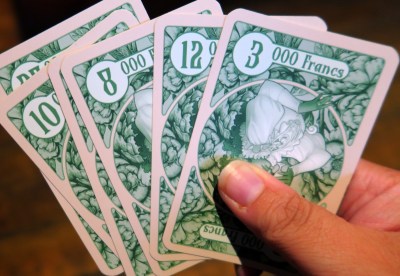
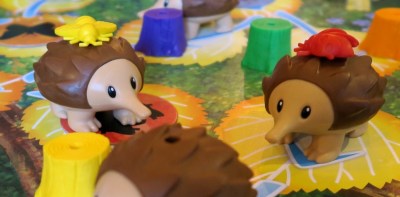
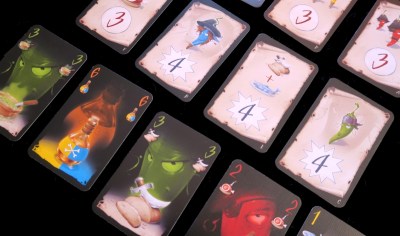
The evening began with the inevitable post-Essen chit-chat and games-mule deliveries (though most of it hadn’t been unpacked so that’s something to look forward to next week too).  Burgundy was very pleased with his substantial pile of Concordia expansion maps though (including the new Venus expansion and older Britania/Germania, Gallia/Corsica packs), and Pine was thrilled to hear there was a copy of Echidna Shuffle on its way for him too.  With food delayed, and a lot of people already arrived, we decided to get going with the  “Feature Game”.  Prior to Essen, we had planned to play Key Flow, however, that was still packed and there hadn’t  been time to learn the rules, so instead the “Feature Game” chosen was Peppers of the Caribbean.  This is  a cute little set collecting card game with a very loose pirate theme.  Each card features a number, a colour and a type of food.  The idea is that there is a face up market and on their turn, players can either take cards from the market, or play cards.
Peppers of the Caribbean
– Image by boardGOATS

To take cards from the market the active player must first discard a card and can then take all the cards of that colour or all the cards of that food type into their hand (discarding down to seven if necessary).  Alternatively, they can play a set of three or four cards where all the cards have different colours and different food types.  Of these, two cards are discarded and the remaining cards are kept for scoring.  At the end of the game, players sum up the face value of the cards in their pile of kept cards, and the highest score is the winner.  There are one or two fine details, for example, as well as “chilli cards” there are also rum cards which feature two colours and no food.  These have a high value (six, compared with one to four for the chilli cards) and can help people make sets more quickly.  However, as they have two colours, this means there can only be one rum card in a set and the maximum set size is then three, so only one card can be kept reducing the scoring opportunity.  There are also bonus points cards which are drawn largely at random from a pile—some of these are end-game bonuses and others reward the first player to reach a goal (e.g. be the first player to have all four different food types in front of them).

Peppers of the Caribbean
– Image by boardGOATS

Blue and Pink had played the game a couple of times in their hotel bar at Essen and on the train home.  They had found it a diverting little game with two players and had wondered how it would play with more people.  Somehow it is one of those games that is slightly confusing at the start and things were made more challenging as we began with three players and ended up with five as more people arrived, meaning the rules got explained several times from different points.  As a result there were slow starters and “fast twitch” players.  It was close at the top though with Burgundy and Ivory some way ahead in a tight finish which Ivory took by just three points.  Although everyone would probably play it again, it was clear that the game would be better with fewer players where there would be less fluctuation in the market and everyone would have more of a chance to get what they want.  It only became clear some time later that there had been a mix-up somewhere along the line and although the side of the box said it was suitable for five, the bottom and the website indicated that the game was only intended to play a maximum of four anyhow…

Peppers of the Caribbean
– Image by boardGOATS

Just as the game was coming to an end, Black and Purple arrived in need of some R&R after what had been a trying day.  They had also brought some of their Essen Loot (including a copy of Las Vegas for Red), and the Essen discussion began again.  Black and Purple had been at the fair for the full four days and felt that a minimum of two was needed to see everything, but three days was a more realistic time.  Blue and Pink had been there for just two days as they can’t cope with the crowds for more than that.  Even they are considering a Thursday-Friday-Sunday strategy for next year though as there are now six halls (some very large indeed), and they felt they had missed a lot of things that they had wanted to see this year.  That said, a lot of games sold out including the expansions for Altiplano and Great Western Trail (Altiplano: The Traveler and Great Western Trail: Rails to the North), Mini Rails (again!), Hanamikoji, Food Chain Magnate, Roll to the Top, Majolica, Spirit Island, Echidna Shuffle, Ceylon and headline releases Teotihuacan: City of Gods, Architects of the West Kingdom, Newton, The River and Everdell.  Some of these went ridiculously fast, for example Everdell apparently sold out in six minutes on Saturday despite its not insubstantial price tag of €70.

Essen 2018
– Image by boardGOATS

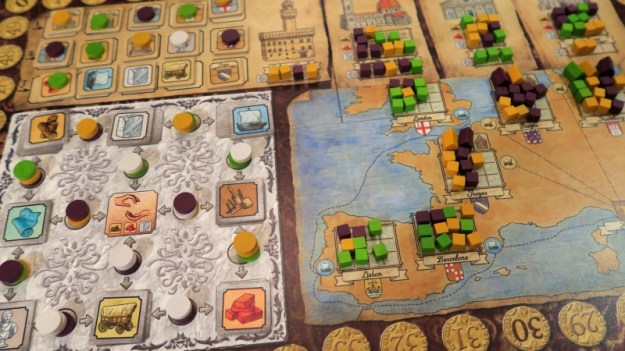
Purple and Black were particularly pleased with Solenia, which they had played at the fair and then managed to grab one of the last few copies available.  A beautiful game with a totally over-produced large yellow airship and cards with a hole in the middle, it wasn’t long before it became clear that it was going to be one of the games to make it to the table. The pretext is that several millennia ago, the tiny planet Solenia lost its day-and-night cycle:  its northern hemisphere was forever plunged into darkness, and its southern hemisphere was eternally bathed in bright sunlight. Players travel the world delivering the rarest gems and stones to the “Day People” and take wood and wheat to the “Night People” who need them to survive. In return players receive gold stars and the player with the most of these at the end of the game is the winner.

Solenia
– Image by boardGOATS

In each round, players take it in turns to play one card from their hand onto an empty space on the five-by-five game board. Cards can be played either on a “Floating Island” or a “Floating City”.  Cards played on Floating Islands will give as many resources as the value of the card played of the type corresponding to the City.  Cards played on Floating Islands enable players to fulfil a delivery tile by delivering the resources depicted on it.  Cards must be played adjacent to the airship in the centre of the playing area or adjacent to one of the players previously played cards.  When someone plays a zero card, the airship advances one space along the modular board.  At the end of that turn, the back piece of the game board is removed and players receive resources based on the cards they have on this strip of the playing area.  This strip is then turned over (turning night to day / dawn to dusk or vice versa), and it is placed on the front edge of the game board, and thus the airship moves across the planet.  This constantly changing board rolling from day to night and back to day again gives the game a unique feel.

Solenia
– Image by boardGOATS

Although resources were far from scarce (unlike other resource management games), it still has quite a bit of resource management thanks to a strict resource limit on a players personal board.  Thus, the real problem came in deciding which were the most important resources to keep, a little bit of area control/route planning, and a few paths to victory points. The constantly changing nature of the game doesn’t lend itself to a developing narrative though having played it before, Black and Purple had an edge over Green.  This wasn’t helped when Green misunderstood one of the cards and tried to do something clever to multiply his points.  The first attempt failed, but on the second try he thought he had achieved more points and then the misunderstanding came to light—the bonus points only applied to the card itself not to all types of terrain he had cards on.  It would not have changed the placings though.  It was very tight between Black and Purple until Black managed to gather together three pairs of day and night bonus chits, which hadn’t been looking likely until the last couple of turns.  With that, he just sneaked his nose in front, winning by three points.  Overall Solenia is a clever game that takes a run through to get a feel for how it works and then you then just want to play again—it certainly won’t be long before it gets another outing.

Solenia
– Image by boardGOATS

Meanwhile the other four were giving Azul: Stained Glass of Sintra a try.  This was another Essen release, and one  that had generated a lot of “buzz” in advance as it was produced by the same team that originally published this year’s double award winner, Azul.  Blue, Purple, Black and Pink had all tried it while in Germany and found the scoring sufficiently different and interesting that they had collectively come back with two copies.  Initially the conversation centred around the clear plastic tiles that, largely dependent on age, reminded some people of Spangles (“The sweet way to go gay”) and others of “Tunes” (“Help you breath more easily” and thus “Book a second-class ticket to Nott-ing-ham”) .  Once the subject had moved away from 1980s confectionery, attention focussed on the new game and its similarity and contrast with the original Azul.  As in the original, players take all the tiles of one colour from a “factory” and put the rest in the middle, or they take all the tiles of one colour from the middle.  Tile placement and scoring is rather different however.  All the tiles taken in a turn are placed in a single column of the player’s personal player board.  This board is modular with the double-sided strips laid out  at random so everyone has a different starting setup.

Azul: Stained Glass of Sintra
– Image used with permission of boardgamephotos

Above the board each player has a figure, their Glazier, who marks one strip.  Tiles must be placed in the strip immediately below the Glazier, or in a strip to the right of the Glazier.  The Glazier gives players another option on their turn too, as players can choose to reset his position to the left most strip (instead of taking tiles).  Scoring is very different, with players getting points when strips are completed. The number of points scored is the sum of the score depicted below the strip, plus the score for any strips to the right that have already been completed.  There is also a colour bonus—each round has a colour drawn at random at the start of the game, and any tiles that match the colour for the round score extra.  Once a strip has been completed, it is flipped over; after it has been filled a second time it is removed, reducing the players placement options.  This provides a subtle catch-up mechanism that takes effect towards the end of the game.  Any left over tiles that cannot be placed yield a penalty (as in the original Azul game), but this is also different.  In addition to the positive score track, there is also a negative score track where the steps start off small and then get larger; penalties are accrued for left-over tiles and also for being first to take a tile from the middle (and with it the Start Player token). There are also end-game bonus points with two variants available, one colour dependent and the other rewarding completing adjacent strips. All in all, the game is definitely a step up in complexity, making it more of a challenge for those who have played Azul extensively.

Azul: Stained Glass of Sintra
– Image used with permission of boardgamephotos

As most of the group fall into that category, we had high hopes that Stained Glass of Sintra would be a good fit.  It certainly offers a new challenge, though it was clear that the fact Blue had played it before gave her a significant advantage.  For example, the timing of repositioning the Glazier is very critical.  It doesn’t necessarily prevent a player getting a load of tiles they don’t want (as everyone can reposition their Glazier and the problem will come back round), but players don’t want to be stuck with their Glazier far to the right at the start of a new round as that limits their choice when the options are at their best.  Similarly, player don’t want to reposition their Glazier too frequently as this reduces the number of tiles they take and therefore affects their score.  Behind Blue it was very tight for second place with just five points covering Pine, Burgundy and Ivory.  It was Pine who got his nose in front though, by keeping his negative score down and concentrating on his end-game bonuses.  Unfortunately, the game is not as nicely produced as the original: the broken glass tower is made of very thin card (more like thick paper) as is the score board.  The “glass” pieces are also somehow not as nice as the resin tiles in the original and the colours are less distinct as well.  These negatives are a real shame as they take the edge off what would otherwise be a excellent reimplementation of the superb original game.

Azul: Stained Glass of Sintra
– Image used with permission of boardgamephotos

Green and went home for an early night leaving five others plus Pine who wanted to play something “in about forty-five minutes”.  Deciding what to play took so long that there nearly wasn’t time to play anything at all, but after three new games, everyone was in the mood for something “comfy”, and eventually Bohnanza appeared.  Pink’s new “Fan Edition” was still packed, as was the Jokerbohnen mini-expansion that Blue had acquired.  She had not brought her Spanish copy either, so it was the “boring” Rio Grande Games edition.  Familiarity sometimes has its place though, and this was one of those times. Nobody needed a reminder of the rules (plant the first bean in hand; optionally plant the second; turn over two cards and plant or trade them; trade from hand, and draw cards placed at the back of the hand), but the setup varies for different numbers.  It wasn’t long before we were underway, however, and Purple quickly began to amass a  crazy number of Red Beans.  It felt like nobody else could really compete although Black came very close finishing with thirteen coins, one behind Purple.

Bohnanza
– Image by boardGOATS

Learning Outcome:  New is very exciting, but that comfy pair of old slippers still has its place.

16th October 2018

Blue was late after an unscheduled nap, so Burgundy consumed the first half of his supper alone.  Blue was quickly followed by Ivory and Pine and then a new visitor, Navy.  With Cobalt last week (who was busy moving house this week so couldn’t come) that makes two new people in two weeks.  Navy is a more experienced gamer and is into slightly more confrontational games than those we normally play, but that’s good as it might encourage us to leave our comfort-zone of cuddly Euros set in medieval Germany.  As we were all introducing ourselves, Green, and then Black and Purple turned up and the discussion moved on to how we choose the “Feature Game” (Blue suggests something to Green who mostly replies that he’s never heard of it, but it sounds quite interesting…).  Recent discussions have centred round the new Key Flow (aka “Keyflower the card Game”) for the next meeting and maybe Imaginarium (or, “The One With The Elephant on the Front” as Navy referred to it).  With that, Green started getting out this week’s “Feature Game“, which was Greed, a card drafting game where players are crime lords trying to earn more money than anyone else through clever use of their cards.

Imaginarium
– Image by BGG contributor W Eric Martin

At it’s heart, Greed is a quite simple, card-drafting game with a healthy dose of “take that” and a gangster theme.  Players start with a hand of twelve cards and “draft” three cards  (i.e. choose a cards and pass the rest on, three times).  Players then simultaneously choose one card then together reveal this card and action it before the it is replaced with another drafted card.  A total of ten cards are played in this way per person before the players tally their holdings and the player with the highest value is the winner.  Obviously, the game is all about the cards and there are three types, Thugs, Holdings and Actions, but it is the combination of these that is critical.  Actions have a unique effect associated with them while Thugs and Holdings typically also have a cost or a condition associated with them (e.g. cash paid to the bank or a collection of symbols on cards held).  Holdings are the key however.  When a Holding is played a token is placed on that card for each symbol on it and an additional token for each symbol of that type already possessed. These tokens are worth $10,000 each at the end of the game which is added to the value of cash collected through card plays.

Greed
– Image from kickstarter.com

Although it was Green’s game he had only played it once and that was over a year ago, while Burgundy had read up on it.  Pine and Navy had joined them to make the foursome.  The game takes a few rounds to understand how it really works.  After that, it’s quite easy to play, but working out which card to take and which to play is much harder, as they all seem to be really good. Unfortunately Navy struggled a bit at the beginning and made mistakes in his first couple of plays as he either found he couldn’t actually play his chosen card and had to just ditch it, or wasn’t able to get the indicated bonus. However, as he had not accumulated any wealth early on, it also meant he didn’t lose any when Green played a couple of cards which meant everyone else lost dollars, which leveled the scores a little.  Burgundy’s preparation really helped when he played a Holding card and proceeded to place six tokens on it, so by the half way mark it was looking like a two horse race between Burgundy and Green with both Navy and Pine looking short on cards.

Greed
– Image used with permission of BGG contributor punkin312

Through the second half of the game, Pine really got the hang of it and started raking in the dollars and had quite a pile of cash. Green then played a Holding card which enabled him to add chits equaling the same number as the maximum on another players cards, which meant he was able to gain from Burgundy’s excellent earlier play.  In the final rounds, Green played another card which removed one of his holdings only to be able to play it again the following round with even more tokens than it had previously. There was a brief discussion as to whether he should get the usual amount for it as well as the removed ones and two extras, a decision that went in Green’s favour, but the real question was whether it would be enough to beat Burgundy.  In the end, it was close, but the answer was no and Green finished with $30,000 behind Burgundy’s winning total of $235,000.

Roll for the Galaxy
– Image used with permission of BGG contributor punkin312

Meanwhile, on the next table everyone was being indecisive, but in the end the decision was made in favour of Roll for the Galaxy.  This is a game that really fascinated the group for a while because somehow it behaves differently to everything else we play and we really struggled to get to grips with it.  At the time, we concluded that our struggles were probably because we weren’t playing it enough so effectively had to learn it afresh every time we played.  For this reason we went through a phase of playing it quite a bit, but that was some months ago now and it was definitely time for another outing.  In principle, it is not a difficult game and the core mechanism is similar to the so-called “deck builders” (like Dominion) or “bag builders” (like Orléans or Altiplano), except instead of building a deck of cards or a bag of action tokens, players are building their supply of dice.  In Roll for the Galaxy, each different die colour reflects the different distributions of the dice, so for example, white “Home” dice feature each of the symbols for Develop, Settle, Produce and Ship once and Explore twice.  On the other hand, the yellow “Alien Technology” dice have three faces that depict the asterisk (“Wild”) and one each of Develop, Settle and Produce.  Thus, where probability affects which cards or tokens are drawn in the other games, in Roll for the Galaxy, players have more control over which dice they are using, but chance affects how those dice roll.

Roll for the Galaxy
– Image used with permission of BGG contributor punkin312

In principle, Roll for the Galaxy is not a difficult game and the basic mechanism is similar to that in Dominion or Orléans/Altiplano, except instead of building a deck or a bag of action tokens, players are building their supply of dice.  Each different die colour reflects the different distributions of the dice, so for example, white “Home” dice feature each of the symbols for Develop, Settle, Produce and Ship once and Explore twice.  On the other hand, the yellow “Alien Technology” dice have three faces that depict the asterisk (“Wild”) and one each of Develop, Settle and Produce.  Thus, where probability affects which cards or tokens are drawn in the other games, in Roll for the Galaxy, players have more control over which dice they are using, but chance affects how those dice roll.  Although the dice are important, like Greed, the game is really all about the special powers the players’ tableau, in this case made up of World tiles rather than cards.  Ultimately the game is really a race to trigger the end of the game is when the victory point chip pool runs out or a player builds their twelfth World.

Roll for the Galaxy
– Image used with permission of BGG contributor punkin312

Game play is mostly simultaneous:  players roll their dice and  allocate them to their phase strip.  Each player can choose one phase that they guarantee will happen, so in a four player game there is a maximum of four phases per round and where players choose the same phase there will be fewer, sometimes even only one.  The phases are:  Explore, Develop, Settle, Produce & Ship which correspond to draw Worlds from a bag; “spend” dice to build development Worlds;  “spend” dice to build production Worlds; place dice on production Worlds, and move dice from production Worlds in exchange for either victory points or money (which in turn can be used to speed up recycling of dice).  While we were setting up Ivory regaled us with the first few pages of Julia Donaldson’s “The Gruffalo”.  We will miss him and his stories when he takes his paternity leave in the new year.

Roll for the Galaxy
– Image by BGG contributor The Innocent

Blue began with the poor starting combination of a level six development World and a level one settlement, or a a level one development World and a level six settlement so began by rectifying the problem by exploring.  The game rocked along at a merry lick, with Black and Purple building and Ivory thrilled that he finally managed to build his first ever “Alien Technology World”, a feat he quickly followed with his second. Blue was slower building, but had a few high value developments and made good use of these before she began collecting some victory points.  This started a sudden cascade of Black and Ivory collecting points as well.  As a result, everyone focused on the number of victory point chips as the end game trigger, so much so that nobody, spotted that Purple had built her twelfth World.  As the group was just about to start the next round and everyone likes seeing their plans fulfilled, they played on anyhow.

Roll for the Galaxy
– Image by BGG contributor dodecalouise

Although it was a very tight game and everyone added to their scores, the extra round probably didn’t make any difference to the final placings.  Black and Ivory took over twenty victory points in chips alone, but they were offset by Blue’s high value Worlds and bonus points which gave her fifty-six points, just three more than Black in second place.  Everyone enjoyed the game, but there was one non-game highlight: Green’s sad little face when he looked across and broke off from setting up Greed with the sad comment, “Oh, They’re playing Roll for the Galaxy…”  Well, as everyone had a good time and with players getting quicker at it, it’s less of a labour than it used to be, so it surely won’t be long before he gets a chance to play it again.

Roll for the Galaxy
– Image by BGG contributor haslo

Greed finished first and as it was still early there time for another game, but nobody wanted to have a late night so the group picked something shorter and settled on this year’s Spiel des Jahres winner, Azul.  This was another game that was new to Navy, but it is very popular in the group and we’ve played it a lot.  Players are tiling a wall, taking tiles of one colour either from one of the factories (putting the rest in the central pool) or from the central pool.  Tiles are added to rows on the players’ boards and at the end of the round one tile from each full row is transferred to the players’ mosaics.  The aim is obviously to fill all the rows to transfer the maximum number of tiles, however, any excess tiles score negative points.

Azul
– Image used with permission of boardgamephotos

Navy quickly got the hang of this one and all the scores were close for a lot of the game, though it was noted how neat Green’s mosaic was looking as he managed to fill the first left hand vertical row and nearly completed the second as well before placing anywhere else.  Burgundy and Pine were both less tidy, but was still picking up extra points for connecting tiles when placing them. Although Navy’s board was a little more scattered, but that would help him to catch up later.  Everyone thought they were entering what would be the final final round with  three players with at least one row just one tile from completion, amazingly nobody completed them and everyone get one extra round.  This meant the group actually ran out of tiles to place on the central discs, triggering the end game in different way.  After this final round and final scoring, Pine finished on top of the podium, ahead of Burgundy in  second place with Navy in a very respectable third in a close game.

Azul
– Image by BGG Contributor styren

While Roll for the Galaxy was finished, there was a bit of chit-chat about strategy and it was clear that to do well at the game, you also need to keep a close eye on what everyone else is doing too. This can be tricky when you are struggling to work out what to do on your own board however.  Winning or losing though, Azul is a nice game that always delivers a challenge; it will be interesting to see how the new stand-alone version of the game, Stained Glass of Sintra compares and if it is as good or better than the original, or whether it “does a Queendomino or Tsuro of the Seas“.  No doubt we will find out in due course.  With that, those that wanted an early night headed for home, leaving Black, Purple, Burgundy and Blue with time for one last, shortish game.  Black suggested San Juan which had been played at the last Didcot Games Club meeting, and everyone else concurred.

San Juan
– Image used with permission of BGG contributor EndersGame

Essentially, San Juan is sometimes referred to as “Puerto Rico the Card Game”, but in truth they are very different games although the artwork and roll selection is similar.  In practice, it is actually a simpler version of the card version of Roll for the Galaxy, Race for the Galaxy.  The game uses the same multi-purpose card mechanism seen in games like Bohnanza, though in this case, cards can be buildings, goods, or money.  The idea is that players take it in turns to choose a “role” and then everyone carries out the action associated with that role, though person who chose it carries out with the “privilege”, a slight advantage.  The roles are Councillor; Prospector; Builder, Producer and Trader.  Players have a hand of cards and can use the Builder to build these cards to paying for them with other cards from their hand.  Hands are replenished directly using the Councillor or Prospector.  However, it is much more efficient to build an engine using production buildings.  These take cards from the deck and turns them into goods when a player chooses the Producer role; when the Trader role is chosen, these goods can be traded for cards according to the current value depicted on the tally stick.  The game end is triggered when someone builds their twelfth building.

San Juan
– Image by BGG contributor Aldaron

Black and Burgundy were quick out of the traps building their efficient production engine, with high value coffee and silver producers.  Purple started with “purple buildings” before also moving into sugar production and then Monuments.  Blue on the other hand started with a hand full of nice looking purple civic buildings that she didn’t want to part with and after three rounds hadn’t seen a production building, so decided to try something different and built a Tower (to increase her hand limit from seven to twelve) and started building.  Elsewhere on the table Burgundy was stealing a march on everyone else, adding a Well, Smithy, Aqueduct and Market Hall to his high value buildings.  When he added a Library which enabled him to use his privilege twice, he began turning over cards at a phenomenal rate and it looked like the writing was on the wall.  Everyone was keeping a careful eye on everyone else, trying to make sure they didn’t fall behind in the number of buildings they had, and before long, the game end was triggered and it was the final round then the scores were added up.

San Juan
– Image used with permission of BGG contributor EndersGame

After the scores had been added up, Black bemoaned the lack of the endgame scoring bonus cards that rewarded the production buildings and monuments that he had been collecting (Guild Hall and Triumphal Arch).  It was then that Blue explained that she had been stashing them under her Chapel as she had no use for them and didn’t want the others to have them.  It was possible that this tactic made the difference, as despite having only two production buildings, her City Hall and Chapel delivered a massive thirteen bonus points, just enough to offset the cheaper buildings she had been forced to build.  Remarkably, Blue finished with thirty-one points, four ahead of the “Production King” Burgundy.

San Juan
– Image used with permission of BGG contributor thatmadgirl

Learning Outcome:  Though difficult, it is important to keep a close eye on what everyone else is doing.

2nd October 2018

Blue was the first to arrive with Pink, who had come specially to celebrate our sixth birthday.  While they were waiting for food they managed a quick game of NMBR 9.  This is a very simple game, almost like Tetris where players try to tessellate tiles, building layers on top of layers, with the higher layers scoring more points.  It is almost a year since Blue and Pink picked it up at Essen, and since then it has been played repeatedly, an average almost once a month (or every other games night).  Mostly we aren’t so keen on multiplayer solitaire games like this, but NMBR 9 is the exception largely because it is so very fast to set up and games are quick to play too making it a great filler.  It is a shame it only plays four, because there is no real reason that it couldn’t play a few more.  Food arrived really quickly, and we were still placing the final tiles.  It was quite close with similar values for the “first floor”, but Blue edged it with a four and a nine on the next layer compared with Pink, who only managed a six.

NMBR 9
– Image by boardGOATS

Burgundy arrived soon after, and attacked his ham, eggs ‘n’ chips, eventually followed by Pine, Ivory, Green, and Cobalt (a friend of Green’s who will be moving into the village in a few weeks time).  As it was exactly six years since the first games night, we couldn’t let the night pass without some sort of small celebration.  So this year we had chocolate brownie cupcakes adorned with meeples to go with the now traditional, the “Birthday Feature Game”, Crappy Birthday.  This is a very silly game that we now play exactly once a year at the beginning of October, with some house rules to make it slightly more palatable as it really isn’t our sort of game at all.  Strangely though, everyone seems to really enjoy playing it once a year on our birthday.  The idea is very simple:  everyone has a hand of gift cards, and everyone takes it in turns to “celebrate their birthday”.  On a player’s “birthday” they receive a gift from everyone else.  These are shuffled, and the “birthday boy” picks the best and worst – the players who gave these get a point and after one year (i.e. after everyone has had a “birthday”), the player or players with the most points win.

Crappy Birthday
– Image by boardGOATS

It is the cards that “make” the game for us:  they are brilliant with fantastic comments.  For example, Pink was tickled, well, pink, by the “pet vulture” that he gave to Pine, which was “very friendly, but stares at you while you are sleeping”.  Pine was quite taken with it too and picked it to be his favourite gift, to go with the “fresh turkey” which was always going to be unpopular with a vegetarian (though might have given him something to feed to the vulture).  Burgundy showed an unexpected desire for a set of fluffy dice (thought that might have been more due to the nature of the other gifts than their actual desirability), and Ivory returned the “thoughtful gift” of a set of “camera scales”, which he felt would have been off-putting.  Despite his love of Star Wars, Green decided he’d rather have “a suit of armour” than a complete collection of memorabilia .  Star wars wasn’t in favour with Cobalt either as he unceremoniously returned the gift of “a Star Wars themed wedding” (though it wasn’t completely clear whether it was the Star Wars theme or the wedding that he was rejecting).

Crappy Birthday
– Image by boardGOATS

There was a brief hiatus while Ivory entertained everyone with a complete rendition of Rod Campbell’s “Dear Zoo” story.  Despite being written over thirty-five year ago, nobody else seemed very familiar with the story and everyone was spell-bound as Ivory explained, “I wrote to the zoo to send me a pet.  They sent me an elephant, but he was too big, so I sent it back.”  A very long list of animals later, we established that the puppy was just perfect and Crappy Birthday continued.  The game finished with Pink who fittingly received a real birthday card (it really IS his birthday soon).  Blue then tried to persuade him that Chernobyl was now a safe place to visit and full of lots of interesting wildlife, but he wasn’t convinced and much to everyone’s surprise, rejected a visit (and possible nuclear suntan) in favour of “twenty tanning sessions”.  With Crappy Birthday done and people just licking the last of the icing off the meeples from the cupcakes, it was time to decide what to play next.

Cupcakes!
– Image by boardGOATS

Pink was very keen to play either Altiplano or Clans of Caledonia and Ivory and Burgundy were very keen to join them.  Time was short and the games are similar lengths, however, Blue, Pink and Burgundy had all played Altiplano, and with it’s similarity to Orléans, it was felt that it would be easier for Ivory to pick up quickly.  On the next table, everyone else was trying to decide what to play.  With Cobalt new to the group and not able to stay late, they needed a short game that was quick and easy to explain that might be a good introduction to gaming, so in the end, the group settled on Coloretto.  The game is very simple, with players drawing a card and adding to one of the available “trucks”;  each truck can take a maximum of three cards.  Instead of drawing a card players can take a truck and the round is over when everyone has taken a truck.  The aim of the game is to collect sets of cards, but while the three largest sets score positive points, everything else gives negative points.  The really clever part is the score which is based on the triangular number series, so sets score increasingly well as they get larger (or badly if they score negative points of course) .

Coloretto
– Image used with permission of BGG contributor punkin312

Cobalt  quickly got to grips with the game, but played it safe by taking the bonus score cards. Pine went for a specific set of colours and Green ended up with several that he could build on.  As the game progressed, Cobalt continued to play cautiously and kept the number of colours he had small. Green had several colours, but a few sets were building to a significant number.  Meanwhile Pine’s attempt to keep to specific colours was failing and although had lots of one colour, just couldn’t get the others he wanted.  The final round featured a golden joker which took a little while to work out the rules for.  Despite being very pretty, it turned out that it wasn’t such such a good thing after all, especially at the end of the game. Pine ended up with it and took another random card, which didn’t help him, but didn’t hurt him either.  It was very close, but in the final scoring, Cobalt’s cautious approach kept his negative points down to just one, but his positive score had also suffered. It was Green that topped the podium though, with five points more than Pine.

Coloretto
– Image used with permission of BGG contributor punkin312

Cobalt and Green were chatting while Pine was side-tracked by the eye-catching alpaca on the neighbouring table.  Eventually Cobalt called it a night, and Green and Pine contemplated playing something and had just decided to play a quick game, when Black and Purple arrived. They were delighted to find that cakes had been saved for them (with suitably coloured meeples), and the foursome settled down to a game of Splendor.  This is another light, set collecting game that we’ve played a lot.  With simple choices, we find it a relatively relaxing game to play and perfect in the circumstances.  The idea is that players use gem tokens to buy cards, which in turn provide permanent gems that can be used to buy other cards.  Some of the high value cards also give points and players who collect enough of the right gems may earn a visit from a Noble giving them more points – first player to fifteen points is the winner.

Splendor
– Image by BGG contributor zapata131

Everyone followed their own strategy, but it looked like opal (black) and diamond (white) gem cards were the ones that everyone would need due to the Nobles and very few blue sapphires and green emeralds. Purple managed to corner the market for diamonds causing everyone difficulties.  Green was building up red rubies and opals and also going for high scoring cards and Black was managing to gain lots of opals and was quietly beavering away. Pine seemed to find himself in all sorts of trouble as he just couldn’t get the cards he needed with everyone else nabbing them just before him.  It was beginning to look like Black was going to win, but suddenly Purple’s hoarding of diamond gems paid dividends as she was able to grab nobles one after the other and reached the magic fifteen points before anyone else, and exactly one turn ahead of Black as it turned out.

Splendor
– Image used with permission of boardgamephotos

Meanwhile, on the neighbouring table, Altiplano had been going for some time.  It had been the “Feature Gamea few weeks back and everyone had really enjoyed it as it gave a new spin on the “bag building” mechanism used in another game we are very familiar with, Orléans. The games are similar in that each player has their own player board, draws “workers” out of their bag and then plays them onto their board before everyone takes in it in turns to carry out the associated actions (one at a time).  The biggest fundamental difference between the two games is that in Altiplano, when tokens are used, they don’t go straight back in the bag as in Orléans, instead, they go into a separate box.  The tokens then only go back into the bag once everything has been used and the bag is empty.  This reduces the lottery element and as a result the game is a lot less forgiving to a poorly controlled bag, but players have much more control if they can find a way of using it.

Altiplano
– Image used with permission of BGG contributor JackyTheRipper

The games are visually very different too, with everything set out on a central player board in Orléans, which also features a map which players are trying to navigate and build on.  There is no map, in Altiplano, but there is still a spacial element to the game:  the central play area is made of locations arranged in a circle and only certain actions can be carried out in each one.  For example, if players want to sell goods, they must be at the Market, and must have the relevant goods placed in the Market spaces on their player board.  Before or after their action, players can move, but movement is very restricted.  Players begin with one card that can move up to three spaces in either direction, but they can also “buy” additional moves. And this is where we got the rules wrong.  The correct rules are that players can place a food token onto one of the movement spaces allowing the player to travel just one space (recycling the food into their box).  When these spaces are upgraded with carts, there is still a cost of one food, but now players can move up to three spaces. The rules error was that players couldn’t use the extra movement spaces until they had got a cart, and then they could only travel one space.

Altiplano
– Image used with permission of boardgamephotos

Blue was sure something wasn’t right, but was too busy checking other things and answering questions that she didn’t get to find what the problem was until the game was nearly finished.  At this point, Pink informed everyone that he hadn’t been listening to the rules outline and had just been “playing correctly”.  The problem with this is that in a game as tight as Altiplano, even the smallest of changes can have unpredictable consequences.  Last time, Green had been taking a token when he bought Cottage Cards (in effect using them as Canoe Cards); although he had only benefited from a couple of extra tokens, he would have been able to use them several times, and as one of them was Stone it would have helped him to get extra tokens out of his bag, and taking the last Glass token ended the game prematurely etc.  Thus, in this game in particular it is impossible to unravel mistakes and try to work out what effect it might have had, though both Blue and Burgundy felt they would have benefited hugely had they been able to take those extra moves.

Altiplano
– Image used with permission of boardgamephotos

Aside from that, the game was mostly played according to the rules.  Pink went for a warehouse strategy concentrating on trying to obtain high value goods, in particular Silver and Wool. Burgundy really struggled at the start and in the end just tried to get hold of any resources he could, and then send them off to his warehouse.  Blue started off really well, but her game stalled in the second half when she ended up with a lot of stuff in her bag that ended up blocking spaces she wanted to use and slowed down the rate she was drawing the tokens she wanted.  While trying to sort out the mess she commented, “I’m going to stuff my whorehouse,” which gained a lot of sniggers from the neighbouring table.  The game was a bit of a mystery to Ivory and he kept saying that he could see how the game worked, but not where he was going to get any points from.  That said, he managed to get nearly a hundred of them giving him a very creditable score for a first try especially given the rules error and the haste they had been explained in.  He probably raised the biggest laugh of the night as well when he sighed deeply and announced, “I think I’m just going to have to get my wood out!”

Altiplano
– Image used with permission of BGG contributor JackyTheRipper

Blue had fulfilled more contracts than anyone else and had the vast majority of the glass, but it wasn’t enough.  It was very tight between Pink and Burgundy in first and second place though—Burgundy had more goods in his warehouse, but Pink’s were generally of a higher value.  In fact it was so close that it called for a recount, just in case.  It turned out that the scores had been correct though and Burgundy’s hundred and fifty-two, just edged out Pink who finished three points behind.  Comparing the totals to those achieved last time showed how much everyone has improved since the winning score for that game was a hundred and three.  The reason for that is probably largely the fact that everyone is getting better at controlling the contents of their bag.  As Pink pointed out, it really is critical to get rid of things that aren’t wanted, otherwise you end up in the mess Blue got herself into.

Altiplano
– Image used with permission of boardgamephotos

Learning Outcome:  Don’t put wooden meeples on cakes, they are too chewy…

18th September 2018

While Blue and Burgundy finished their tea, Pine, Black and Purple squeezed in a quick game of Coloretto.  This is a simple little game and inspiration for the more popular (though arguably not better), Zooloretto.  A set collecting game, the idea is that on their turn, the active player either takes a truck, or turns over the top card of the deck and places it on one of the trucks.  Each truck has three spaces and players are trying to stack the trucks so that when it is their they can get what they want.  In practice, the game doesn’t work like this at all, and players spend most of the time trying to avoid giving everyone else a combination they want.  At the end of the game, players choose three sets to score positively, while all the others score negatively.

Coloretto
– Image used with permission of BGG contributor of punkin312

The clever part is that the score (positive or negative) depends on the number of cards, according to the Triangular series.  This means that one card only scores one point (positive or negative), but a set of six will score twenty-one points.  This players generally don’t mind lots of cards that aren’t part of their three top sets, so long as they are all different colours; the problem comes when they have sets of a significant size…  Purple started off best as Black ended up with too many negatively scoring cards.  Pine put up quite a fight, but in the end Purple was too strong and won the game with forty-seven points, ten more than Pine in second place.

Coloretto
– Image used with permission of BGG contributor SergioMR

Once food had been dealt with, the usual debate as to who wanted to play what began.  Aside from Pine and Purple, everyone was keen to play the “Feature Game”,  Endeavor: Age of Sail, the new, deluxe edition of Endeavor, a game we’ve enjoyed a few times. The new edition is particularly shiny with lots of KickStarter exclusives, including a new game element, “Exploits”.  Pine and Purple were a bit reluctant as they thought it would be very “thinky”, but everyone who had played it before tried to reassure them that it although it was a little challenging, it wasn’t a long game and was usually over in an hour or so.  Things were complicated by the fact that it was a quiet night and with only six people, we didn’t want to leave the “two Ps” in a pod by themselves as that’s a bit unfriendly.  We had two copies of the game, so Blue, who was a little under the weather volunteered to teach them the basic game (i.e. without the “Exploits”).

Endeavor: Age of Sail
– Image used with permission of boardgamephotos

There are seven rounds, each with four phases which roughly correspond to the four progress tracks on each individual player’s board.  In the first phase, Building, each player chooses a building from one of five levels, depending on their position on their industry (Building) attributes track.  Everyone starts at zero, so everyone has to pick level one buildings in the first round.  The buildings give players abilities and/or actions as well as helping them along the other attribute tracks, In the first game, Blue went first and started by picking a Workshop, which gives two extra industry points (and she hoped might let he build more exciting buildings earlier); Purple followed and also took a Workshop.  Pine decided to go for something different and picked a Shipyard which gave him one step on the Culture (Population) track and additionally gave him a shipping action.

Endeavor: Age of Sail
– Image used with permission of boardgamephotos

The second phase can be carried out simultaneously and each player moves population tokens form their supply into their Harbour space where they need to be so they can use them later.  At the start of the game, everyone could take two population disks, even Pine with his Shipyard as it only added one step along the Culture track and it needed two before he could take an extra.  That was to change quickly though, as Pine concentrated on building up his Culture and the number of population tokens he could take as he felt this would give him extra actions.  In order to make best use of it though, he would also need the buildings and the ability to vacate them so he could use them again.  Buildings are vacated in the third phase, where the player’s Wealth is used to pay the population and move markers off the buildings back to the Harbour.  Again all players can do this simultaneously and obviously nobody could do anything on the first round though this aspect becomes  increasingly important as the game progresses.

Endeavor: Age of Sail
– Image used with permission of boardgamephotos

The final phase is the Actions.  This is the guts of the  game, and is also the most complicated part.  The idea is players take it in turns to carry out actions by either placing Population discs onto their buildings or playing action tokens they have picked up during a previous round.  There are five basic actions:  Ship, Occupy, Attack, Pay workers and Draw a card from one of the colonies.  At the start of the game the only action available was really Occupy, through the Colonial House that everyone started with.  This enabled Purple, Blue and Pine to place a second population disk in one of the cities and take the Asset disk that was placed there at the start of the game.  In the first round, there really doesn’t seem to be much in the way of decision making in this game, but those few decisions are really critical as everything builds on them.  For example, each city has an Asset disk placed at random during set up.  These enable players to progress along the Asset tracks and the associated abilities enable them to build and carryout more actions.

Endeavor: Age of Sail
– Image used with permission of boardgamephotos

Shipping for example, involves placing more population disks, this time on shipping routes to the colonies.  These also give Asset disks, but the real benefit comes when they are completed and the region is “open”.  At this point, players can Occupy cities in the region, and also Draw cards from the associated deck, giving more Asset points as well as Glory (Victory) points.  At the end of the game each city is worth one (or in some cases two) points, but if a player controls two connected cities, they also control the link between them, each of which is worth another point.  For this reason, players might want to Attack a city occupied by another player.  This is expensive (war always causes collateral damage) and both players lose a population disk as a result, but fighting can be worth while.  Both Blue and Pine had the wherewithal for attacking, but thanks to  mutually assured destruction, they just sat and watched each other for a round or so until Blue decided she really wanted one of Pine’s cities and used her Fortress to pounce.

Endeavor: Age of Sail
– Image used with permission of boardgamephotos

Pine got his revenge shortly after, with his Barracks, but the battles had been costly (even to Pine with his large population), and the protagonists retreated and licked their wounds.  While the others were playing “Tit for Tat”, Purple had been making progress on the shipping track in the Far East and had started in South America.  The fighting wasn’t over yet though, and Purple had a go at Pine who promptly got his own back.  Before the game Blue, Green and Burgundy had all agreed that Endeavor was a surprisingly short game, but it was clear that Purple and Pine weren’t really convinced.  Before they knew it though, it was time to add up the final scores.  Points were available for progress on the Asset tracks, for occupying cities, for occupying linked cities, and on some of the cards.  The catch though is that at the end of every round, players have to check they are far enough along the Influence track to be able to keep all their cards.  The problem is, that for every card that is returned, all the assets it provides are lost as well.  As Blue and Pine had cards to return, there was a bit of Maths to be done to work out which was the best card to lose.  Given that Pine and Purple had never played before (and Blue had been a bit under the weather so her explanation wasn’t the greatest), it was a remarkably close game.  Experience told, however, and Blue finished in first place a little ahead of Pine who was just very pleased that nobody had taken advantage of the slavery option.

Endeavor: Age of Sail
– Image used with permission of
boardgamephotos

Meanwhile on the next table they were still playing, though the final round was just coming to an end.  Everyone in this game had played it before (though Black needed a reminder of the rules), so they chose to play with the new Exploits.  By random selection  the “Imperialism” (some routes “blocked” and give bonuses points if they are opened); “The Haitian Rebellion” (enables cards to be removed from the deck either to stop others getting them, or to clear the way for a better card; points are awarded if enough cards are removed), and “The Jesuit Missionary” (in exchange for attributes players can build churches in cities for extra points, or even in empty cities and then immediately occupy them, with extra points for each church built).  Burgundy chose to start the game with the new Merchant Dock building on the other reverse of the Colonial House starting tile.  This gave him an extra coin and a shipping action, while Black and Green opted to stick with the traditional building which gives an occupy action.  Burgundy used his alternate strategy to steal a march on shipping into Africa, while the others began building a presence in Europe.  Both Black and Burgundy quickly went for the extra bricks from the buildings to move up the Building track while Green tried to expand his Shipping options.

Endeavor: Age of Sail
– Image used with permission of boardgamephotos

With his Merchant Dock, Burgundy was able to quickly build some of the bigger buildings and take a controlling stake in Africa, although both Black and Green managed to sneak in and maintain a presence.  Green concentrated on linking European cities gaining a lot of population bonuses and so always had enough people to do all his actions, especially when he built a Bank giving him an “coin” so could always pay his workers.   Burgundy was the first to be nasty by attacking Black in taking the linking token. By the middle of the game Black and Burgundy were able to build level three and level four buildings, while Green was still stuck level two buildings only.  His population was soaring though and and the on/off war between Black and Burgundy was keeping their holding back their populations somewhat.   Burgundy and Green went on to open two new regions (Caribbean and South America), followed shortly by Black trying for North America.

Endeavor: Age of Sail
– Image used with permission of boardgamephotos

During the latter part of the game, Green was the only player in South America, while everyone had a presence in all the other regions.  Burgundy dominated in the Caribbean though and Black had a strangle-hold on North America and India, and soon followed them with Asia.  As a result of these regions being opened, the Exploits became “open” as well.  Burgundy and Green were first up with the “Hiatian Revolution”, but initially only Burgundy took the opportunity to utilise it.  Later Green opened “The Jesuit Missionary” and then used that to great effect and suddenly he had cities and connections all over the board.  Although he could not get a particular link he wanted as someone else was occupying the city, he suddenly realised that he did have a spare cannon token and could actually make use of his (by now) vast population and claim the city for himself.  Black was the only one who was able to use the ‘Imperialism’ exploit and managed to clear a couple of blockages in the last couple of rounds.

Endeavor: Age of Sail
– Image used with permission of boardgamephotos

And then suddenly the game was over.  It looked like a Green was home and dry as his board presence was very high, but Black had a large number of points from his cards and Burgundy had progressed well along his Asset tracks.  In the end, however, it was Green that scored the most by a reasonable margin (even after removing the four extra Wealth points he had forgotten to discard in the last round, due to card losses).  But what about the exploits?  They had not come into play until the last couple of rounds and seemed to be of varying impact.  The “Jesuit Missionary” had clearly been used to great effect by Green, not so much for the points for the churches (a maximum five), but for the ability to claim cities and their respective tokens and the link tokens, which of course enabled even more scoring.  Maybe if someone else had been able to get a presence in South America and also use it, it might not have felt quite so powerful.

Endeavor: Age of Sail
– Image used with permission of boardgamephotos

The “Haitian Rebellion” was sometimes helpful to remove unwanted lower point cards, but it was worth nothing when it came to end game scoring. Only Black was able to make use of the “Imperialism”, but it was so late in the game it only gave him a couple of extra points and not really enough extra tokens, though it may have had a more positive effect had it been earlier in the game.  Overall though, the Exploits were a nice addition that did not detract from the feel and essence of the base game, but changed it enough (in the end) to notice their presence and draw them into the game.  With fifteen in total and only three used per game, there are a lot to try (and there is also the extra mini expansion with some extra useful buildings as well).  In conclusion, with nice pieces and something new, this KickStarter edition has really breathed new life into a old great game, and we are likely to be playing it for a little while longer yet.

Bohnanza
– Image by boardGOATS

With Endeavor over, Green wanted an early night, but there was still time for one more game.  As Blue had picked up Pink’s new Spanish copy of Bohnanza from last time, there was really only one  game to play.  The first challenge was getting the setup right for five – it turns out that the Spanish edition is a little different and the question was whether Blue’s Spanish was up to the job.  She muddled through and everyone was only slightly confused by the different bean names.  Nobody needed reminding of the rules once we’d got going (plant one bean, and another if you like before turning over two cards from the deck and planting or trading them, make any extra trades you can from your hand and draw cards from the deck, but DON’T rearrange your hand!).  Unusually, it wasn’t as tight as this game often is; Burgundy and Pine did well and made the podium, but in the absence of Red, Blue finished in front with twenty two.

Bohnanza
– Image by boardGOATS

Learning Outcome:  boardGOATS don’t approve of Slavery.

4th September 2018

Blue, Red, Burgundy and newcomer, Mulberry, were finishing their food when Pink arrived after a long drive from the north-east.  While he was waiting for his food he opened a very special present Red had brought back from Spain for him.  Pink and Blue have quite a few games and for various reasons there are one or two that they have multiple copies of.  However, there is one game that they have many, many copies of.  Ironically it is a game Pink doesn’t even like playing very much, and yet, it has become a bit of “a thing” that every time Pink goes to Essen he comes back with yet another copy (ideally in a different language, but often just another German copy).  Red has strong opinions about this particular game though, and believes that by far the best language to play it in is Spanish, so kindly brought Pink a copy back from Spain to add to his burgeoning collection.  As he began to unwrap it, Pink took a few moments to realise what it was, but was really touched by this very special gift of Bohnanza.

Bohnanza
– Image by boardGOATS

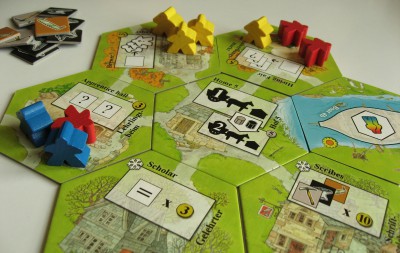
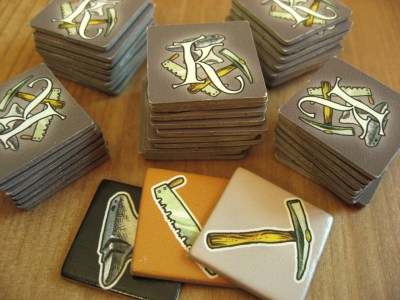
There wasn’t time to play it before food arrived, then everyone else was turning up and the “who’s going to play what” debate began.  The “Feature Game”, Keyflower with the Farmers expansion had been Pink’s request and Keyflower is one of Blue’s favourite games, so they were a bit of a foregone conclusion.  They were quickly joined by Burgundy who is also very fond of the game, and Ivory who was keen to see if the expansion changed the balance and the strategies available.  Since that was likely to be the long game, they got on with it while everyone else sorted themselves out.  Keyflower itself is not a complicated game mechanistically, though it has an awful lot of depth.  Over four seasons, players are simply taking it in turns to bid for tiles to add to their village or use tiles available in the villages or the central display.  The clever part is that bidding and using tiles are both done with meeples as currency and players must “follow suite”, that is to say, use the same colour if the tile has already been activated.

Keyflower: The Farmers
– Image by boardGOATS

In Keyflower, the depth is generated by the actions available on from the tiles and their interaction, added to the fact that except when playing with a full compliment of six, only a subset are used, and these are drawn at random.  This means that one of the most important aspects of game play is to keep as many options open as possible since everything is likely to change in the final round.  This is not only because some tiles don’t appear, but also the fact that there is always someone who will make it their business obstruct even the best laid plans.  Thus it is vital to have at least two ways ways out.  Adding The Farmers expansion exacerbates this as it introduces lots more tiles so each one is less likely to be revealed.  This is a potential problem when trying to “play with the expansion” as it is perfectly possible that none of the Farmer tiles are introduced into the game.  To prevent this, some tiles were drawn explicitly from the Farmers set.

Keyflower
– Image by boardGOATS

The Farmers expansion doesn’t change game play much, it just adds depth by the addition of farm animals as another means to score points.  The idea is that animals are kept in the fields that are formed by the roads in a village.  Each field that is occupied scores points depending on the type of animal or animals in it.  Thus each field with sheep in it scores one point, each field with pigs scores two and each with with cows scores three points.  These scores are increased for villages with special tiles, like the Weaver, which increases the sheep score to three per field.  Animals in a field another of the same type breed at the end of each season and can be moved in a similar way to resources.  The expansion also introduces Corn to the game, which allows players to enhance their movement actions.  Otherwise, the game with the expansion plays in much the same way as the basic Keyflower game, takes a similar amount of time and requires a similar blend of tactical decision making and strategic planning.

Finca
– Image used with permission of BGG contributor garyjames

Meanwhile, everyone else had divided themselves into two groups of three and had begun to play.  Pine joined Red and Mulberry in a game of Finca.  Pine had played it before, but a long time ago so Blue took time out from setting up Keyflower to explain how to it worked.  It’s a very simple game of set collection with beautiful wooden fruit that’s now nearly ten years old.  At its heart is an interesting rondel mechanism.  On their turn, players choose one of three possible actions:  move around the rondel and collect fruit; use a donkey cart to deliver fruit; or carry out an action with one of the special, single use tokens that each player starts the game with.  There are some lovely features about the game.  For example, players move as many spaces round the rondel as there are workers on the space they started on and the number of fruit they get depends on the number of workers on the space they finish on.  As players have four workers each, there are lots of factors to consider when choosing which worker to move.

Finca
– Image by BGG contributor kneumann

Investing wisely is the key to the game, and Pine went for variety while Mulberry specialised more, particularly in figs and oranges.  It was the figs and oranges that won the day with Mulberry finishing with fifty-one points, just four ahead of Red who’d had lots of fruity fun with Finca.  With that finished, Red spotted Yardmaster in a bag, one of her favourite games, and decided to introduce Mulberry to it.  It is quite a simple game and was described by Mulberry as “UNO with trains”.  Players are building a locomotive by drawing cargo cards and using them to buy railcar cards from the four face up cards in the middle.  The game was very close, but it was Red’s experience that was key, giving her a two-point winning margin over Mulberry in second place.  With that done, they moved onto another old favourite, 6 Nimmt!.

Yardmaster
– Image used with permission of BGG contributor moonblogger

6 Nimmt! gets played a lot, but it’s unusual that we play it with so few players.  The idea is that everyone chooses a card and then players add them to one of the rows, in ascending order adding them to the row ending in the highest card that is below the card they are playing.  The catch is that when a sixth card is added to a row, that player picks up the first five cards.  The game really is at its best with more players where the simultaneous card selection adds mayhem.  They just played the one round; perhaps Mulberry misunderstood and thought the idea was to collect “nimmts”, but either way, she top scored with twenty-one – quite an achievement with only three players and only one round!  Red did rather better and finished the winner with just two “nimmts”.

6 Nimmt!
– Image by boardGOATS

On the neighbouring table, Green had joined Black and Purple and they started out with this year’s Spiel des Jahres winner, Azul.  This is a really an abstract game with only a loose theme of tiling a palace, but unusually, nobody seems to mind and we’ve played the game a lot with multiple copies in the group.  The game is really just a set collection game, similar to Finca and Yardmaster, but with an added spacial factor as tiles have to be placed to score points.  Tiles are chosen from “factories” with those that aren’t taken going into a central pool.  Since players can only take one colour at a time and must always take all the tiles of that colour in that location, they can easily end up with not quite enough, or even too many scoring negative points. Although it is not really an aggressive game, it is remarkable how much damage players can do to each other.  Landing too many tiles is bad, but it is arguably worse to get “not quite enough” as it inhibits options in the next round too and therefore can affect the whole game.  As we’ve played it a lot, we all have a good understanding of how to play, so unless someone gets things very wrong, games are often close, making them quite tense affairs.  This was no exception, with Purple just taking the honours with sixty-three points.

Azul
– Image used with permission of boardgamephotos

To alleviate the stress of Azul, the trio moved on to play Om Nom Nom, a light “dice-chucker”  This needs a similar sort of double think to 6 Nimmt!.  The idea is that the board is seeded with dice populating the lower levels of three separate food chains.  Then players simultaneously select an animal card to play, populating the higher levels of the food chains.  The idea is that cards played at the top of a food chain will eat those immediately beneath it.  So if there is a juicy bunch of carrots rolled, is it best to play the rabbit and risk getting eaten by a fox, or is it better to play a fox and gamble on everyone else being tempted to play rabbit cards?  Often the wisest move is not to get involved, but if everyone adopts that approach, the carrots get left and everyone is now playing in the more confined space of two food chains.  Sometimes the game is very tight, but this was not one of those times.  Black took five cheeses in one round and finished some twenty points ahead of everyone else.

Om Nom Nom
– Image used with permission of BGG contributor msaari

The other games were still going and nobody fancied anything particularly taxing, so after a brief hiatus, Splendor got the nod.  Yet another set collecting game, it is also very simple and surprisingly popular in our group.  There is a remarkable amount of thought necessary for the apparently simple choose three different tokens or buy a card.  Many people seem to think it is a trivial game, but for us, it has the right balance of strategy and tactical thinking to make it the perfect game when people are tired but still want something that provides a little bit of interest.  We’ve played it a lot, and almost inevitably, Burgundy wins.  One of the factors in choosing the game was the guarantee that he wouldn’t win this time as he was engaged elsewhere.  In the event, it was another close game, with Green and Black very close to finishing, but Purple just getting to fifteen points first and ending the game before they could catch her – her second win of the night.

Splendor
– Image used with permission of boardgamephotos

We were about an hour into our respective games and Blue was concentrating deeply on her next turn in Keyflower, when her village was suddenly and unexpectedly improved by the addition of a very fine chocolate cake complete with candles.  Much to her embarrassment, it was also accompanied by singing.  There was a brief interlude while Blue blew out her candles and cut up the cake, admired her quite a-llama-ing card, everyone consumed the really rather delicious cake (Waitrose finest no less), and Burgundy made sure there wasn’t even a pattern left on his plate.  And with all that done, the games continued.

Cake!
– Image by boardGOATS

Keyflower continued after cake and the strategies were beginning to become clear.  Ivory, Blue and Pink were going for animals, while Burgundy’s plans had been undermined by both Blue and Ivory and was trying to make something from his very, very small village.  With the arrival of Winter, players had to put in their choice of the tiles they’d been given at the start.  Much to Ivory’s disgust, someone had put in the Dairy which increases the score for fields with cows in them.  Since neither the Cow Shed tile nor the Ranch tile had been drawn in Autumn, nobody had any cows so the Dairy was a waste of a Winter tile.  This meant there was even more competition for the other tiles, and there weren’t many of those as players can put only one tile into the mix.  Burgundy got his Key Market which nobody else had any real interest in, Blue took the Hillside, but lost out on the lucrative Truffle Orchard to Pink.

Keyflower
– Image by boardGOATS

Ivory took the Mercer’s Guild and the Scribes after a brief tussle with Blue.  It was quite tight with everyone getting points from different places and it was clear the tiles everyone picked up in the final round made all the difference.  Ivory, Blue and Burgundy had spread their points about, while Pink put all his eggs (or rather pigs) in one basket, but it paid off, giving him a massive forty points and seventy-three points overall, four more than Blue in second place.  Everyone had enjoyed playing with the expansion, particularly Ivory who felt it had added more depth.  Although Ivory had to go, there was just time for a quick game of 6 Nimmt!, so Pine took his place and the foursome played a couple of hands.  In the first round Burgundy and Pine competed for the highest score with twenty-five and twenty-seven points respectively.  In the second round, Pine picked up what might be a record score of forty-five.  At the other extreme, Blue managed to keep her score down to eleven, and added to the three in the first round that gave her a clear victory—just in time for her birthday at the end of the week.

An Empty Plate!
– Image by boardGOATS

Learning Outcome:  Sometimes a pig strategy brings home the bacon!

21st August 2018

Amid fears of a shortage of people, Burgundy dined alone until he was joined by Green who (unusually) also ordered some food.  While discussing likely numbers Pine appeared, shortly followed by Green’s food and then Ivory.  Once Burgundy had finished his meal he joined Pine and Ivory in a short game of Love Letter.  This is the archetypal micro game where players draw a card to give them a hand of two and then choose which one to play, with the aim of knocking everyone else out and/or being the last player remaining or the one with the highest card.  With only sixteen cards in the deck and each round taking only a couple of minutes, it provides an excellent little filler that can be stopped at almost any time.

Love Letter
– Image by boardGOATS

In the first round Pine was knocked out early, but Ivory caught Burgundy holding the Princess. In the second round, Burgundy was knocked out early leaving Pine and Ivory to try to outwit each other.  It all went to pot for Ivory though when he got confused as to which cards were played and thought he had to reveal his hand showing everyone that that he had been caught with the Princess.  He didn’t have to discard his hand, but what’s been seen, can’t be unseen, so when Pine drew a Guard, it was inevitable that he would “guess” correctly that Ivory had the Princess. There was just time for one last round (which Pine won) before Green disposed of his empty platter and Black and Purple arrived. So Love Letter ended with Pine the winner.

Love Letter
– Image used with permission of boardgamephotos

With six players and the “Feature Game”, Lancaster, playing a maximum of five, the group split into two, with Ivory and Burgundy joining Green for a little medieval fun.  Although Burgundy and Green had played it quite a lot over the last two and a half years, Ivory was new to the game so rules run-down was needed.  The idea is that players take it in turns to place their knights in one of three places:  in the shires; in their castle, or in the wars in France.  Once the knights have been placed, players then vote on and evaluate “the Laws” which give players a benefit just before they get their their rewards for knight placement.  After five rounds, the player with the most points wins.

Lancaster
– Image used with permission of boardgamephotos

Once the game was set up and rules explanation was over, we started – the first time we have played it with three, and it did play slightly differently.  With only two Nobles per County it was going to be a real scrap to get them.  Ivory went for a castle improvement strategy, Green tried to bag those few Nobles and Burgundy went for conflicts in France.  Overall there was not a huge amount of conflict in the counties with so few players.  In round one Green ended up with two upgrades and took his level two Knight straight to level four which gave him access to higher level counties that were out of the reach of the other two.  This helped him gain the nobles he wanted, but in the next round he sent the valuable level four Knight off to the wars in France, to help in a level seven & eight conflict that needed the firepower.

Lancaster
– Image used with permission of BGG contributor kilroy_locke

There still wasn’t much conflict in the Shires, except for one where Burgundy knocked Ivory’s level one Knight out with another level one Knight and a squire. Ivory just accepted it and went elsewhere.  There was a little more conflict during rounds three and four, but not much.  Again it was Burgundy picking on Ivory, although Ivory put up more of a fight this time. Green did not make effective use of his voting influence and Burgundy was becoming a threat.  By regularly taking the ‘free’ Noble bonus when entering conflict in France, he had started to catch Green in the total number of Nobles.

Lancaster
– Image used with permission of BGG contributor aleacarv

Finally, in round there more conflict, though still not as much as we usually get in four and five player games.  Every one had managed to increase the number and value of their Knights. Ivory had also managed to gain three castle improvements and no longer needed to place any Knights there.  Burgundy and Ivory entered into a savage battle over a level four County which would give the victor the chance to gain two nobles, and lost several squires in the process. It didn’t stop there either as they fought over a couple of other counties that seemed a good benefit in this final round.  Just when it all seemed settled with Ivory coming out on top, Green placed his last Knight with a whole bunch of squires in the level four county.  Neither Burgundy nor Ivory had the “squire-power” remaining to dislodge him, so instead they entered into a new round of conflict in other Counties.

Lancaster
– Image used with permission of
BGG contributor punkin312

In the end we realised that all the current Laws would benefit everyone all equally, and the new ones were not much help either, but we voted anyway.  When it came to dishing out the rewards, both Burgundy and Green realised they had made a mistake, forgetting that they wouldn’t get the Knight upgrades they needed for the reward until after reward had been evaluated.  Not that it made a huge difference as the scores were all quite well spaced already.  During the reward taking in the counties Ivory realised he had taken both Nobles from one county, which was against the rules (all nobles must be from different counties). There wasn’t a lot that could be done, but he insisted on putting it back and so the others suggested he take back his three coins as well. Burgundy did point out that he and Green may have done something different as they had both wanted this one too.  These things happen sometimes though, and it is “only a game” after all.

Lancaster
– Image used with permission of BGG contributor punkin312

In final scoring Ivory won the points for the most improved castle, Green won the points for the most powerful Knights, and Burgundy and Green both had one more Noble than Ivory (who had grabbed a load in that final round).  Packing up, we discovered that three of the laws had been left in the bags (one of each of two, three & four class). We had commented how we had seem to get to the last round quickly, and now a check of the rules showed that we should not have taken any laws out and it should have gone on for another round.  The scores were pretty comprehensive though with Green nearly ten points clear of Ivory in second place.  But Ivory had enjoyed it though, so it will no doubt we’ll play it again in the not too distant future.

Lancaster
– Image used with permission of BGG contributor punkin312

Meanwhile, on the next table, Pine, Black and Purple were playing Calimala.  This got an outing only a few weeks back, but Black and Purple have played it quite a bit since Yellow introduced it to them a six months ago at Didcot Games Club.  Calimala is an area-influence driven, worker-placement game set in the Republic of Florence during the Late Middle Ages.  The action is all centred round the unusual action board, where  place one of their workers on one of the twelve worker spaces.  Each one of these is adjacent to two of the nine action spaces and the active player gets to carry out both actions.  If there is already a worker disk present on the space when a disk is added, the owner of the other disk gets another turn.  This continues until a player places the fourth disk on a stack which triggers scoring.  In addition to worker disks of their own colour, each player also gets a small number of white disks:  coloured disks give players a maximum of two actions on three occasions (i.e. a total of six), while white disks give four actions when played, but none later in the game.

Calimala
– Image by boardGOATS

The fifteen scoring phases are built on the actions, rewarding players for the amount of cloth they have shipped to a given city or combination of cities for example, or for their contribution to a specific building, or their contribution to the building effort of a given resource.  In each case, the player with the most scores three points, the player in second place scores two and the player in third gets just one point.  In case of a tie there is a complicated series of tie-breakers.  The game ends when either all fifteen tiles have been scored, or everyone has placed all their workers (in which case any remain tiles are scored).

Calimala
– Image by boardGOATS

This time Pine led the way in points, pretty much from the start.  He managed to give the impression that he had no idea what was going on though, as he kept asking questions.  It was really close at the end, however.  Black had the Barcelona scoring card, Purple had Troyes and Pine got close to the Lord, with the Cathedral of Santa Maria del Fiore.  It was all largely academic in the end though; as is often the case in this game, there were lots and lots of tie breaks when scoring the districts.  Gradually, as Black kept winning the tie-breaks, he began to catch up with Pine.  The question was, would he make it?  He did, just, beating Pine into second place by a measly three points.

Calimala
– Image by boardGOATS

Learning Outcome:  Nobody is indispensable.

7th August 2018

Largely due to holidays and work, for the first time in months, we only had enough players for one game.  Blue and Pink were first to arrive and, while they were waiting for their pizzas, they played a quick game of Honshū.  This is a game that Blue had played with Black and Purple about a year ago when Black and Blue agreed it was a very, very clever game.  Somehow though, it hadn’t got another outing until last week at the Didcot Games Club, when Blue introduced Pink to it.  He really enjoyed it and was keen to give it another go.  It is a trick taking game, so it plays a bit differently with two.  The idea is that players start with a hand of six cards; two cards are drawn at random from the deck to make one pool, and the players play a card each to make the second pool.  Each card features six districts and a number – the player who wins the trick by playing the highest number chooses one pool and then chooses a card from that pool.  The other player does the same with the second pool.

Honshū
– Image used with permission of
BGG contributor  HedgeWizzard

The players then add the cards to their city. Each card is divided into six districts, each of which scores in a different way at the end of the game. For example, every district in their largest city, players score a point. Similarly, all forest districts score two points. More interestingly, a single water district is worth nothing, but water districts connected to it after that are worth three points each. Perhaps the most interesting are the factories which only score if they are supplied with the appropriate resources, wooden cubes that are placed on resource producing districts.  These resources can also be used increase the value of cards when they are played, in the two-player game this is only by the losing player who can guarantee a win by paying a resource.  One of the biggest challenges is choosing the cards though. When the cards are placed, players must take care to make sure that they either partially cover (or are covered by) at least one other card. This, together with the fact that players are trying to expand their largest city and any lakes makes choosing and placing a card really difficult as there are many options to explore.

Honshū
– Image used with permission of BGG contributor msaari

Despite playing it a couple of times, neither Blue nor Pink have really understood how the game plays which is probably what makes it interesting.  After the first three rounds, in the two-player game, players swap their remaining three cards and are supposed to add another three (repeating this after the sixth and ninth rounds).  Unfortunately, Blue misunderstood the rules for some reason, so instead, they swapped hands after three tricks, refreshed their hands to six cards at half-way and swapped hands again after nine.  This simplifies the game a lot, as the obvious strategy is to play high cards early and then hand all the dross over to the other player who is forced to play them.  It also introduces a lot of luck, and while we like luck in the right place, the game would definitely be more interesting with the rules as written.  Blue won, but it is definitely one to play again, and correctly this time.

Honshū
– Image used with permission of BGG contributor bkunes

With Burgundy’s arrival and then Green’s, and food out of the way, we moved onto the “Feature Game”, Altiplano.  This is a bag building game that re-implements some of the mechanisms found in one of our more popular games, Orléans.  Like Orléans, Altiplano has two phases: planning and carrying out.  The idea is that players start off with a handful of resource tokens and, on their turn can draw a number of these out of their bag, placing them on their personal worker board.  Simultaneously, players then place them on the action spaces on their board.  This usually takes a little time as everyone is trying to maximise their return.  And this is where it differs significantly from Orléans where everyone can more or less do whatever they want, whenever they want.  In Altiplano, there is a central circle of locations, and actions can only be carried out when player’s meeple is in the appropriate area.  There are seven locations and players get one movement of a maximum of three spaces for free on each turn.  This means it is possible to get to any location, but only one of them, unless they pay a food token which will allow them another move, but only a single space.  Thus getting the planning right is essential.

Altiplano
– Image used with permission of boardgamephotos

In the action phase, players must take an action, or pass.  Once they’ve passed, they cannot have another turn.  Before or after they take an action, players may move if they are able to.  This effectively means that players can carry out actions in two locations per turn, unless they pay for more.  Once a token has been spent, it it goes into a little cardboard crate where it stays until the player’s bag is empty.  This means that unlike Orléans, every token must come out of the bag and be placed; there is no element of chance except in the timing.  Thus, instead of playing with probability, the game is now all about controlling what’s in the bag and knowing what can come out and when.  Anyone who’s played Orléans and felt that their Monks have entered a closed order in the corner of their bag will really appreciate this.  However, it also means rubbish can be even more costly as it WILL come out and must be used.  Worse, any rubbish will will eventually go back in the bag and have to be dealt with again, and again and again…

Altiplano
– Image used with permission of boardgamephotos

It is possible to get rid of resources:  they can be placed into the player’s personal warehouse. Once they are in the warehouse though, they can’t be taken out again and as all resources are limited, it may not be possible to obtain a replacement.  Placing resources in the warehouse is done by visiting the Village and is a useful thing to do as it is one of the ways to score points.  Most resources are worth points at the end of the game, but in addition to this, full shelves in the warehouse score bonus points.  Each shelf can only hold one type of resource, and the higher shelves score more points.  Getting resources is therefore important, but they have to be the right resources as the warehouse isn’t the only strategy available.  At the Village location, players can also buy Hut cards which depict one resource and give players extra points for that resource at the end of the game (as well as a little bonus).  In the Market, it is possible to “sell” goods (they still go back into circulation though), and buy Contract cards which give points when completed.  Players can only work on one Contract at a time, but once they are finished, they can be worth a lot of points.

Altiplano
– Image used with permission of boardgamephotos

The Market will probably be one of the most visited locations as players can also buy “Extensions” to their player board.  These are really key to playing the game well, as without them there are lots of resources that are difficult to get.  In addition to the Village and Market, there are five other locations to visit:  the Farm, the Forest, the Mines, the Harbour and the Road.  The first four of these are mostly about using one sort of resource to get another (e.g. using an alpaca and some food to get wool, or using two fish to get stone).  All resources acquired in this way go into the recycling crate to be used on a later turn.  The Road is slightly different as it features a track similar to the Knights track in Orléans, and players’ position on the road dictates how many resource tokens they are allowed to place in the planning phase.  Like Orléans, players don’t have to place their full quota of tokens on action spaces, but these will block spaces for their next turn if they don’t (which can be doubly damaging as it prevents more useful things coming out of the bag).  The Road has to be built though, and it costs a wood and a stone to travel along the path.  Some steps give Corn instead, and this has to be placed in the warehouse, but it can be very useful as it is “wild”, so can help fill those difficult rows where resources are scarce.

Altiplano
– Image used with permission of BGG contributor JackyTheRipper

The game is not terribly complicated in itself, but there is a surprising amount of thinking to be done and, like all great games, players always want to do many more things than they are able.  Blue had played Altiplano with Pink a couple of times, and Burgundy had read the rules and watched a video, so the rules explanation was really for the benefit of Green.  Unfortunately, he was too interested in playing with his phone to pay attention, which might explain why he made such a mess of things later on.  To be fair, everyone was interested in the difference between an alpaca and a llama (apparently llamas have long banana-shaped ears and are roughly twice the size of an alpaca, but alpacas have softer fleece and are a bit more skittish).  We all had a good laugh at the jumping alpaca footage too, but even after all that and everyone else focussed on the game, it was clear Green’s attention was elsewhere.

Altiplano
– Image used with permission of BGG contributor Mouseketeer

At the start of the game, everyone gets a character card which dictates their starting resources and gives them a special action.  Green was the Woodcutter, Blue was the Shepherd, Pink was the Miner and Burgundy was the Farmer, giving them access to Wood, Wool, Ore and Alpacas respectively.  Blue and Green started with only three resources (and an extra coin), which didn’t seem to bother Green much.  Blue felt it was a big disadvantage though, especially as it wasn’t clear to her what strategy the Shepherd encouraged.  In the absence of anything better, she started off going to the Market and buying an Extension, and using her Alpaca to make some Wool in the hope that things would become clearer in time.  Green on the other hand, began with the obvious tactic and used his Woodcutter to get some wood.  For Burgundy, the priority was to increase the number of resources he was able to place in each round, so he began by trying to get the stone he needed to start building his road.

Altiplano
– Image used with permission of boardgamephotos

Pink had a two-pronged strategy, planning to go for the three point resources  (especially Silver as he had the Miner which meant he could get plenty of Ore).  This was because they were less difficult to get than Glass, but were still worth a lot, especially if augmented with a Hut bonus.  So that was the second part of his plan: get lots of Hut cards from the Village as they give a small bonus anyhow, and by taking them he was depriving everyone else.  As Burgundy started to build his road, Blue and then Pink decided to join him.  Eventually Green followed suit, but it wasn’t until he was several steps along the road that it became clear that he hadn’t actually been visiting the road to build it.  He explained that he didn’t think it was necessary as the road was different and it had been positioned very slightly out of the line of the circle due to the slightly cramped space.  Everyone else had been visiting properly though, so if he’d been concentrating on the game and watching what others were doing (instead of playing with his phone), it probably wouldn’t have happened.

Altiplano
– Image used with permission of boardgamephotos

Meanwhile, Pink was continuing to collect Huts and Silver, and Blue had another Extension, was buying lots of Cocao and using it to get Glass (or occasionally Food or Cloth).  It was around this time that Green began to join Pink collecting Huts.  Burgundy was just beginning to get his game off the ground when he got into a bit of a tangle.  He had positioned himself to move onto his third step along the Road, but that gives Corn and he really didn’t want to take it yet as it would have to go into his Warehouse.  Since he didn’t have any resources in his Warehouse yet, it would mean he would have to start a shelf with Corn.  The problem with this is that any corn he got later would have to go on that shelf too, rather than padding out any other, scarce resource.  Eventually, Burgundy managed to sort out his problem, but it took a couple of turns and set him back just long enough for Blue to buy the Extension he had his eye on (again).

Altiplano
– Image used with permission of BGG contributor JackyTheRipper

The game was entering its final stages and Blue began filling her Warehouse, trying to keep the size of her bag down.  She was helped by the Extension she’d grabbed from under Burgundy’s nose which allowed her to place an extra item in the Warehouse on each visit.  Everyone else followed, and began worrying about what they needed to maximise their bonus points.  Everyone that is except Green, who was still fiddling with his phone despite the fact that his friend had apparently gone to bed.  The game end is triggered when either there aren’t enough Extensions left to fill the Extension Strip, or one of the locations is completely exhausted.  When Green took the last Glass token, everyone had just one more round to maximise their bonus points.  Blue and Burgundy fought to try to get the last Extension that allows players to draw an extra ten tokens out of their bag and put them straight in the Warehouse at the end of the game.  This time Burgundy won, as Blue discovered that she didn’t need it anyhow because she could use Corn to do the job, and as she didn’t have the right resources in her bag it wouldn’t have helped her in any case.

Altiplano
– Image used with permission of boardgamephotos

Eventually, the game petered out as there was nothing more people could do and players began adding up their scores.  Burgundy had struggled throughout and Pink’s experience and Hut strategy had worked well.  It was very, very close at the front though with just three points in it, and much to everyone’s surprise given how much attention he wasn’t paying, Green finished just ahead of Blue with a hundred and six to her hundred and three.  He was obviously pleased and professed to have liked the game despite not really focusing on it.  It was when Burgundy commented on all the Wood and the Glass that he had, that someone asked where Green had got all the Glass from.  As Green explained that he’d got one from a Hut, it all came out.  Every time he’d taken a Hut card, he’d taken a resource (perhaps confusing them with Boat cards).  He said it wouldn’t really have made much difference, although he wouldn’t have won as he’d have had fewer resources and therefore maybe ten points less, leaving him in second place.  Burgundy pointed out that the advantage he got from all those resources during the game was incalculable, added to which, taking the last Glass ended the game early preventing others from scoring more.  Normally nobody would have minded as everyone makes mistakes from time to time, but as Green had been playing with his phone all evening and not concentrating, we decided there was no cause for a llama, and just disqualified him.

Altiplano
– Image used with permission of boardgamephotos

Learning Outcome:  Playing with your mobile phone means you make mistakes which upset the balance of the game.

24th July 2018

It was a quiet night, and the atmosphere was slightly subdued as our thoughts were with Green who had had a very rough day and therefore wasn’t with us.  Burgundy and Blue were still eating, so Pine, Red and Ivory began punching out Pine’s brand-spanking, new copy of the “Feature Game”, AzulThis week, Azul won the Spiel des Jahres Award, but despite the fact that it only came out at Essen last year, and has been difficult to get hold of for much of the time, we’ve still managed to play it a lot.  Even so, Red seemed to have managed to miss out, so an explanation of the rules was in order.  It is quite simple to play, if a little abstract.  The idea is that players are tile laying artists decorating a wall in the Palace of Evora with “azulejos”.  On their turn, the active player can either take all the tiles of one colour from one of the factory displays (putting the rest in the central market) or take all the tiles of one colour from the market in the centre of the table.  They then place the tiles in one of the five rows on their player board.

Azul
– Image used with permission of BGG contributor JackyTheRipper

Each row can only contain one colour, but players may have more than one row with any given colour.  The catch is that each player only has five rows, each with a set number of spaces, one to five.  Players can add tiles to a row later in the round, but once a row is full, any left-overs go into the negative scoring row.  Once all the tiles have been picked up, players evaluate their board, and, starting with the shortest row, one of the tiles from each full row is added to the player’s mosaic and scored. Players score one point for a tile that is not placed adjacent to any other tile, whereas tiles added to rows or columns score the same number of points as there are tiles in the completed row (or column).  The game continues with players choosing tiles from the factory displays and then adding them to rows, the catch is that as the mosaic fills up, it is harder to fill the rows as each row can only take each colour once.

Azul
– Image used with permission of boardgamephotos

End game bonuses, keep everyone guessing right up to the end which adds interest and occasionally it can be really nasty when someone ends up with a pile of tiles they can’t use.  Red, Ivory and Pine got going quickly, and once Burgundy and Blue had finished with their supper, they moved to a table near the door to make the most of the draught and started a second game with Black and Purple.  Having played the game quite a bit, nobody pulled their punches:  It was only the second round when Blue had to pick up ten yellow tiles netting her fourteen negative points.  She was fortunate that she didn’t have fourteen to lose, but when Black picked up seven yellow tiles a couple of rounds later he was less lucky.  On the next table Ivory was being nasty to Pine, leaving him with Hobson’s Choice and minus ten points either way.  Playing “dirty” clearly worked for Ivory as he won the first game, though there was some confusion of the scoring, which Pine blamed on his over-hot head.

Azul
– Image by BGG contributor JackyTheRipper

In the other game, there had been a lot negative points and a lot of bonuses, it was all surprisingly close.  In the last round, Purple took the tiles she needed for a full set of reds and Blue had scotched a ten point bonus for Burgundy.  Despite that, Burgundy still picked up a massive twenty-seven points in end-game bonuses, but much to everyone’s surprise he didn’t quite manage to catch Black who finished with a eighty-five.  It had been quite a stressful game, but as usual, we’d all enjoyed it, and discussion moved on to the new release coming in October: Azul: Stained Glass of Sintra, which we are all looking forward to, as long as it doesn’t “do a Queendomino“.*

Azul
– Image used with permission of BGG contributor Toynan

Red, Pine and Ivory had started their game first, and with only three players compared with four on the other table, it was no surprise that that also finished first.   As they were looking round for something to play, Red spied Yardmaster, one of her favourite games, in Blue’s bag.  Neither Pine nor Ivory had played it before, but it wasn’t difficult for Red to persuade them to give it a go.  Unlike most other train games, in Yardmaster, players are building a locomotive rather than routes.  On their turn players can do two from the three possible actions:  draw a cargo card (either blind or from the face up discard pile); buy a railcar card from the four face up cards in the middle, or swap their “Exchange Token” with any other one around the table.  To buy a railcar, players pay using sets of cargo cards, so a yellow number three railcar will cost three yellow “oil” cards.  The exchange tokens allow players to use other cargo cards at a rate of two-to-one, however, if a player only had two yellow oil cards but also had two blue “coal” cards and the blue exchange token, they would still be able to buy the yellow number three railcar.

Yardmaster
– Image used with permission of BGG contributor joeincolorado

When buying a railcar, if the number or colour match the previous car, then it must be added to the end of their locomotive.  If not, then players can park it in their personal sorting yard and add it later, when another railcar is being bought and added to the locomotive.  This is the clever part of the game as it allows players to “stack” points in their personal train yard enabling them both to take some risks and strategically remove railcars from the grasping hands of their opponents.  Players score is the total of the numbers of the on the railcars making up their locomotive at the end of the game.  Ivory started out with a really clever move, using a discarded “extra move” cargo card to take another “extra move” card and Pine and Red thought it was all over before it had begun.  It wasn’t though, and despite it being a very short game, Ivory quickly got bogged down trying to buy a high value, “Purple Four”, which gave both Red and Pine the chance to get past him.  Although he was new to the game, it was clearly one that made sense to Pine who finished four points ahead of Red.

Yardmaster
– Image used with permission of BGG contributor moonblogger

As both games finished Blue, Burgundy, Black and Purple moved back to the group’s usual table and the options were discussed.  With seven players and Red present, Bohnanza was always a possibility, but with the heat sapping everyone’s strength, nobody fancied playing anything too strenuous and the deal was sealed.  Everyone is very familiar with this, even Ivory who has played it the least, so as Burgundy shuffled the deck and removed the cocoa and garden beans, everyone else reminded each other of the rules:  must plant the first card in hand, may plant the second as well; turn over two cards from the deck which must be planted before any other deals can be finalised; trading can only be with the active player; draw four cards at the end of a turn; two coins for a third bean field; fields with only one card can’t be ploughed in unless they all have only one card, and don’t forget – you can’t rearrange your hand!

Bohnanza
– Image used with permission of BGG contributor spearjr

As usual with a large number of players, it was a tight game and everyone spent most of it telling people not to trade with everyone else as they were winning.  Three times through the deck doesn’t take long and people don’t get many turns, but it was Blue, Black and Purple who stood on the podium at the end with everyone else within a point of each other.  It was Blue who made up for her dire showing in Azul though, beating Black into second place by a massive two points.  There was still time to play something else, but the heat had clearly got to everyone as the conversation degenerated into a discussion about everyone’s favourite childhood cartoons and how many had inspired boardgames.  The late, great Peter Firmin‘s Ivor the Engine and Noggin the Nog both got a mention, but then age and nationality created a bit of a divide, and the evening ended with Pine crowing, “My name’s Pig and I like cream cakes!”  His head was definitely over-hot.

Pipkins
– Image taken from youtube.com

Learning Outcome:  Children’s TV programs were very weird in the 1970s.

* Queendomino is the follow-on to the 2017 Spiel des Jahres winner, KingdominoWhen the group played it, we found the new game replaced the smooth elegance of the original with a more clunky, complex, long-winded game that was no where near as good as the games it was trying to compete with (much like Tsuro of the Seas a couple of years before).

10th July 2018

While those eating finished, we welcomed an old friend from the Didcot Games Club on his first visit, and began the evening began with a quick game of an old classic, High Society.  Designed by Reiner Knizia, this is a light bidding game with a catch, in the mold of games like For Sale, No Thanks!, Modern Art, and perhaps our old favourite, Las Vegas.  First released over twenty years ago in the designer’s heyday, a beautiful new edition has recently been published by the Cumnor Hill-based company, Osprey Games.  In High Society, everyone starts with the same set of money cards, each numbering from 1,000 up to 25,000 Francs.  The game is all about correct valuations. Players take it in turns to bid for the luxury objets d’art for sale, however, when they increase their bid, they add money cards to their personal bidding pile, and there is no concept of change.  Thus, as the game progresses, players have fewer and fewer bidding options  as they spend their money cards, and are increasingly forced to big large amounts potentially for relatively low value items.  Some of the objects for sale are not so much art, as artless, and can halve a player’s score, lose them points, or even cause them to discard something they purchased previously and the first person to withdraw, “wins”, while everyone else pays whatever they wagered.

High Society
– Image by boardGOATS

The other twist is at the game end which occurs abruptly when the fourth “end game” card comes out.  At this point, the player with the least money at the end is eliminated regardless of the value of their luxurious objects.  Despite the age of the game, a lot of people were new to it, and as the valuation of the luxuries is the key, some people found knowing how much to bid challenging.  As is the case with this sort of game though though, until the scores were actually calculated nobody knew who was winning, especially as the money was tight at the bottom.  Purple and Black (or “The Dark Destroyer as Ivory called him”) had pots of cash, but Red was just eliminated ahead of Yellow.  That left the final count:  Black was by far the most efficient, with a score of fourteen, two more than ivory – quite remarkable given the amount of cash he had left at the end.  It was Yellow though, who having just escaped elimination, finished some way in front with nineteen points.

High Society
– Image by boardGOATS

With everyone fed and High Society over, we split into two groups: one to play the “Feature Game” (which was to be Keyflower) and the rest to play something else.  As always, the issue was what the other game was to be and almost everyone was happy to play Keyflower, but for some, the final decision depended what the other game was to be.  The problem was that the choice of the second game depended on who was going to play it.  Eventually, Purple broke the deadlock when she said she would be happy not to play Keyflower.  With Red having requested it in the first place, and it being Blue’s favourite game, it was just a matter of who would fill the remaining seats.  In the end, Pine, Burgundy and Ivory joined Red and Blue, leaving Yellow, Black and Purple to play Calimala, an area-influence driven, worker-placement game set in the Republic of Florence during the Late Middle Ages.

Calimala
– Image by boardGOATS

This is an unusual game with variable setup to keep it fresh.  The idea is that on their turn, players place one of their workers on one of the twelve worker spaces.  Each one of these is adjacent to two of the nine action spaces. If there is already a worker disk present on the space, once the active player has carried out their actions, then the other player gets another turn.  This continues until a player places the fourth disk on a stack: actions are carried out for the top three disks and the fourth is placed on the first available scoring tile which is then triggered.  Each player has some worker disks in their own colour and a small number in white.  Coloured disks give players a maximum of two actions on three occasions (i.e. a total of six), while white disks give four actions when played, but none later in the game.  The actions include acquiring resources (brick, wood or marble), building (ships, trading houses or workshops), create artwork, produce cloth, transport cloth, and contribute to the building of the churches.

Calimala
– Image by boardGOATS

The fifteen scoring phases are built on the actions, rewarding players for the amount of cloth they have shipped to a given city or combination of cities for example, or for their contribution to a specific building, or their contribution to the building effort of a given resource.  In each case, the player with the most scores three points, the player in second place scores two and the player in third gets just one point.  In case of a tie there is a complicated series of tie-breakers.  The game ends when either all fifteen tiles have been scored, or everyone has placed all their workers (in which case any remain tiles are scored).  It was another close game:  “The Dark Destroyer” scored heavily for the cloth in the Port Cities (Barcelona, Lisbon and London), while Purple scored for the trading cities (Troyes, Bruges and Hamburg).  Calimala is one of those games that rewards players who score “little and often”, and it was Yellow who managed to score most frequently.  There were a lot of tie-breaks however, particularly between Yellow and Black and it was probably the fact that Yellow did better in these that tipped the balance, as he finished just ahead of Black with a winning score of forty-five points.

Calimala
– Image by boardGOATS

Keyflower was still under way, so the players looked around for something quick to play and picked one of Yellow’s favourite games, Red7.  On the surface, this is a fairly simple game, but underneath it is much more complex.  The game is played with a deck of forty-nine cards, numbered one to seven and in seven different colour suits.  Each player starts with seven cards in hand and one face up on the table.  The player with the highest value card is “winning” because the rule at the start is that the highest card wins.  On their turn, each player can play one card from their hand into their tableau in front of them, or play a card into the centre which changes the rules of the game (a little like Fluxx), or they can do both.  If they cannot play a card or choose not to, they are out of the round.    In the event that there is a tie and the highest face value is displayed by more than one player, the tie is broken by the colours with red higher than orange and so on through the spectrum to violet.

Red7
– Image used with permission of BGG contributor punkin312

The colours also dictate the rules, so any red card played in the centre will change the rules to “the highest” wins.  Similarly, any orange card played in the centre changes the rules so that the winner is the person with the most cards of the same number.  In each case, if more than one player satisfies the rules, the tie is broken by the card that is highest (taking into account both number and colour).  Thus, if the rule is “the most even cards” and there are two players with the same number of even cards in front of them, the player with the highest even card is the winner.  At the end of their turn, the active player must be in a winning position, or they are out of the round. The round continues until there is only one player left.

Red7
– Image used with permission of BGG reviewer EndersGame

We last played this a few years back when we made rather heavy weather of it.  Part of the problem was that there were several of us and we were all new to it.  This meant we struggled without someone to lead the way.  With Yellow very familiar he was able to show everyone else how to play.  Inevitably, this meant he won (giving him a hat-trick).  The game was played over five rounds and at the end of each round the player who was left at the end kept their highest cards.  With Yellow so much more familiar with the game than anyone else, it was inevitable that he would be able to build on this, and he made the most of it.

Red7
– Image used with permission of BGG contributor punkin312

By this time, the next table were just coming to the end of their game of Keyflower, and we had all found it unusually hard going, that is to say we all struggled to find anywhere to score points.  The premise of the game is quite simple:  over four rounds (or seasons) tiles are auctioned using meeples (or Keyples) as currency.  The clever part is that to increase a bid, players must follow with the same colour.  Keyples can also be used to perform the action associated with a tile, any tile, it doesn’t have to be their own, but each tile can only be used three times in each round and, again, players must follow the colour.  The aim of the game is to obtain the maximum number of victory points at the end.  However, the highest scoring tiles aren’t auctioned until the last round (Winter), so players have to keep their options open.  On the other hand, the tiles that are auctioned in Winter are chosen by the players from a hand of tiles dealt out at the start, so players can choose to take a steer from that, or, if things go badly wrong, decide not to include certainly tiles.

Keyflower
– Image by boardGOATS

These games are nearly always memorably epic and this was definitely no exception.  The game started of with Ivory declaring that while he loved it, he thought it was maybe “a bit broken” because in his experience, there was one winter tile that would guarantee a win to the player that got it.  Blue and Burgundy thought they knew he was referring to “The Skill Tile Strategy” and agreed it was powerful, but felt it wasn’t over-powerful.  Blue said she thought it was only a guaranteed win if everyone else allowed it.  Pine suggested that playing the game would give Ivory another opportunity to gather evidence to see if this was the case.  As soon as the winter tiles were dealt out, it was clear that Ivory had one of the tiles that rewarded players with lots of Skill Tiles, and everyone knew what his strategy was going to be.

Keyflower
– Image by boardGOATS

Spring started and it quickly became clear that it was going to be a fight.  Initially, Blue went for the Peddler which converts yellow Keyples into Green ones, but Pine thought that sounded good, and outbid her.  Next she went for the Miner which gives two coal, upgradable to three, but Red outbid her on that.  Somewhat in error she tried to get the Woodcutter which gives two wood (upgrading to a wood and a gold), but Burgundy outbid her.  Ivory also got in on the act, beating her to the Keystone Quarry, which meant Blue finished spring with no Village tiles at all.  At least she didn’t over-pay for anything though, and it meant she had plenty of Keyples to bid with for Summer, at least in theory.  The lack of tiles meant she didn’t have a strategy though, while everyone else was beginning to build theirs.

Keyflower
– Image by boardGOATS

With summer came a whole new set of interesting tiles, for Ivory, that included the Hiring Fair which gives two tiles in exchange for one (upgradable to three tiles for one).  Given that Ivory had telegraphed his plans, and that Burgundy took one for the team during Concordia last time (when he took the Weaver and gave everyone else a chance), Blue felt it was her turn and she made it her business to outbid him, even though this gave her a tile she had very little use for.  As the only one with any meeples to speak of, Blue managed to pick up three boats relatively cheaply too.  She didn’t have it all her own way though, as Pine took the Farrier (extra transport and upgrade ability) and Ivory took the Brewer who turns skill tiles into Keyples.

Keyflower
– Image by boardGOATS

Unusually, there had been a lot of bidding for the end of season tiles and it came to a peak in autumn with everyone jostling for position for the final round.  The other tiles were generally less popular, however, and most people were trying to keep their Keyples to themselves where possible, hoarding them for the final round.  And it was in the final round that it all came to a head.  Everyone had to put in at least one tile, but nobody seemed terribly keen to put any in.  Blue had contrived to win the start Keyple at the end of autumn, and started by bidding for the Key Guild tile which had been put in by Ivory.  Inevitably this descended into a bidding war, which Blue won.  The Key Guild tile gives ten points for any five skill tiles, so Blue was finally able to use her Hiring Fair to get points. Having had his plans scuppered, Ivory moved on to messing with Pine’s plans, while Red engaged Burgundy in a bidding war for the Jeweller tile (which increases the value of gold from one point to two), and lost.

Keyflower
– Image by boardGOATS

It had been a  really tough game with points really hard to get hold of, and that was visible in the scores.  It was very tight with just six points covering Red, Burgundy, Ivory and Pine and all of them in the low to mid forties.  Blue finished with sixty-one however, thanks largely to her twenty points for her skill tiles and sixteen for her boats.  It had been a very stressful game, that led to a considerable amount of discussion.  Ivory felt the fact that Blue had won using skill tiles confirmed that they were over-powered, but Pine and Burgundy were less certain, so the jury is still out.  Blue said that every game was different and the point was that it was up to other players to stop the person who is making a beeline for skill tiles, in fact, that was exactly what she had done to Ivory, as he put that tile out in winter.  The discussion would have continued, however, it was getting late and people began to leave.

Keyflower
– Image by boardGOATS

Pine, Burgundy and Blue felt there was just time for a quick game of NMBR 9.  This little game has been a real success within the group, mostly at the start as a warm-up game, but occasionally as filler too.  Pine took the deck of cards and began turning them over, with everyone else taking the number shaped tiles and adding them to their tableau.  It was another tough, tight game, but Blue managed to squeeze one of her eights on to the fourth level giving her twenty-four points for that tile alone.  Aside from that, the levels and therefore the scores were very similar, so Blue took victory by twenty-one points from Pine in second place.

NMBR 9
– Image by boardGOATS

Learning Outcome:  Sometimes it is better to keep your plans to yourself.

26th June 2018

It was an remarkable evening from the very start:  Burgundy had a drink at the pub for the first time in known history, Blue eschewed her usual pizza and chips in favour of the ploughman’s special (both consequences of the heat), and to top it all, a new gamer, Viridian, turned up.  Inspired, while food was still being consumed, we quickly sorted out who was going to play what, and the first game got started with another outing for Echidna Shuffle.  This was a game some of us played at the UK Games Expo and was such a success that Purple and Black brought a copy home.  The game is a very simple, pick up and deliver type game with beautiful pieces.  Basically, each player has a set of three coloured insects and three matching tree stumps.  On their turn, the active player rolls a die and moves the fabulously large echidnas around, trying to use them to pick up their insects and drop them off on their stumps.

Echidna Shuffle
– Image by boardGOATS

We played Echidna Shuffle last time as the “Feature Game”, but instead of taking the expected  half an hour, it took nearer two!  Although it dragged a little towards the end, everyone had enjoyed it, but it was felt that it might not take quite so long when played with fewer people and with the alternative board: the “Winter Snowball Fight” side, rather than the pretty “Summer Leaf” side.  The “Snowball Fight” board is considerably more complex, with arrows going in lots of different directions giving players more options and opportunities to mess up other’s plans.  The game was tight, but didn’t go on anywhere near as long as last time and was all the better for it.  Everyone managed to get home their first bug reasonably easily, and Pine (the winner last time) was the first to get his second bug home with Purple just behind.  With the more complex patterns on this board it was much harder to keep people away from their third tree stump and despite everyone else’s best efforts, Purple managed to ease her way to her third stump and win the game.

Echidna Shuffle
– Image by boardGOATS

On the next table the “Feature Game”, Concordia had started, but still had a long way to go, so the group looked for something else to play, and attention fell on Lanterns: The Harvest Festival.  This is a light, pretty, tile-laying game with the tenuous theme of decorating the palace lake with floating lanterns and competing to become the most honoured artisan.  On their turn, players choose a tile from their hand of three and add it to the central palace lake.  Each tile is divided into four quarters, each of which has a colour, red, orange, blue, green, purple, black and white.  Every player then receives a lantern card corresponding to the color on the side of the tile facing them, with the active player receiving bonus cards for any edges where the colours of the new tile match those of the lake.  At the start of their next turn, players can gain honour tiles by dedicating sets of lantern cards, three pairs, four of a kind or seven different colours. Each tile is worth honour points and the player with the most points at the end of the game wins.

Lanterns: The Harvest Festival
– Image used with permission of boardgamephotos

We’ve played this a few times, so in order to spice things up a little, we added the pavillions from the expansion, The Emperor’s Gifts.  This introduces the concept of the emperor’s pavilion;  players can place up to three pavilions during the game, on “unimproved” lantern tiles.  If the players make a colour match on a pavilion, they earn a gift from the emperor.  Two emperor cards are revealed at the start of each game, so at the start of their turn players can redeem two gifts to activate one of the cards and perform the special action associated with it.  Some of these gifts allow players another avenue to earn more honour whereas other gifts allow players to modify the state of the playing area.  Black, Purple and Pine all went after the highest scoring honour tiles requiring seven cards of different colours, while Green tried to maximise the efficiency of his cards taking the lower scoring combinations instead, but getting more of them.  The addition of The Emperor’s Gifts was a little controversial:  Black in particular was of the opinion that they made a nice little game unnecessarily complicated, while Green felt the base game was quite simple and benefited from the additional elements.

Lanterns: The Emperor's Gifts
– Image by boardGOATS

In the end the scoring was close, with a tie between Black and pine on fifty-three, and another tie between Purple and Green on sixty-one.  Even though the others were scornful of Green’s strategy, it nearly worked, but it was Purple, who had managed to get both her temples out and used the extra bonuses to good effect in the last few turns who won the tie-breaker with two favours to Green’s one.  And with it, she took her second victory of the night.  The “Feature Game” was still going on the next table, but Pine was finding it difficult going as he didn’t have his glasses.  Apparently he’d left them on the roof of his car and only realised once he’d got home and discovered them missing (possibly another consequence of the hot weather).  Green also wanted an early night so the group ended up chatting and Black took to spectating the game on the neighbouring table.  This was Concordia, a longer, strategy game of economic development in Roman times,  We’ve played it a few times on Tuesdays and Fridays (at the Didcot Games Club), and enjoyed both the base game and the Salsa expansion.  This time we used the Egypt map from Concordia: Ægyptus / Creta, the latest expansion.

Concordia: Ægyptus / Creta
– Image by boardGOATS

It was Viridian and Ivory’s first game of Concordia, and it was a while since Blue had played it too, so Burgundy explained the rules. Mechanistically, the game is quite simple:  players have a deck of cards and, on their turn, they play one and do what it says.  That’s all there is to it, but how the cards work together is the key.  Each player begins with a hand of Character cards (the same cards), six colonists and a handful of resources. The game is one of resource production and exploration. Notable cities are connected via land and (in the case of the Egypt map) river routes and each produces one resource.  These cards allow players to move colonists and build settlements, trigger production for all settlements in a given region, introduce more colonists etc., however one of the cards enables players to buy extra cards from the market (a face up display). The cards are played into a personal discard pile where they remain until the player plays their “Tribune” card to get all their cards back.

Concordia
– Image used with permission of BGG contributor Space Trucker

Each player also has a warehouse of a fixed size which will hold a maximum of only twelve items, which at the start of the game includes four of their six colonists (two ships and two “Elvis-meeples” – the third ship and third “Elvis-meeple” start the game in Memphis, Uh-huh). So, managing resources and finances is one of the key parts of the game and it is essential that players have the right resources when they need them as there isn’t space to store excess. Another “pinch-point” is the cards; players can only play each card once before picking them all up. They also get income when they play their Tribune card to recover their cards, but as it is dependent on the number of cards they pick up, it is in the player’s interest to play as many cards as possible before collecting them all again – this also needs planning.

Concordia: Ægyptus / Creta
– Image by boardGOATS

One of the characteristics of the Egypt map is how tight it is, making the game a bit of a knife-fight in a telephone box.  For this reason, it is imperative players get a good start and Ivory did just that, quickly commandeering two of the cities that produced fabric.  Before long he had engaged in a cycle of produce and sell, produce and buy and it was clear that everyone else was in danger of a sever trouncing.  Meanwhile, Viridian was building a strong-hold in the Oasis province and was also looking to be very competitive.  Blue had started off well too, heading for the Red Sea.  This is a new feature specific to the Egypt map, which has the ability to generate five Sestertii every time one of the Red Sea ports produce. In a game where money is so tight, this seemed like a really good idea, but Blue was keen to use her ship to build on all the Red Sea harbours first and needed resources to do that which meant she delayed to long to make best use of it and it took Burgundy to show her how to do it.

Concordia: Ægyptus / Creta
– Image by boardGOATS

All the while though, Ivory was getting ever stronger with his vast amount of cloth and then the Weaver card appeared in the card row.  This enables the owner to produce all their cloth at the same time, rather than having to produce them one province at a time.  There was a flurry of people buying cards and suddenly it was quite cheap, though nobody had any use for it except Ivory, as nobody else had any cities producing cloth.  And so, the Weaver sat there, unloved, until Burgundy took one for the team and bought it, much to Ivory’s disgust.  It was expensive though and cost Burgundy dearly.  Ivory couldn’t believe Burgundy had taken the Weaver, and lamented his failure to get it when he had the chance, possibly due to an uncharacteristic misjudgement, or maybe the heat was getting to him too.

Concordia
– Image used with permission of BGG contributor bkunes

The game continued with players building up their production heartlands; Burgundy had a stronghold in the Valley of the Nile, while Viridian took the Farmer and Smith cards enabling him to produce with his wheat and silver cities.  It was about this point that the other game finished, and Black began spectating.  Ivory asked him how he thought he was doing and Black replied he had no idea, “You can never tell with Concordia.”  Ivory pressed some more and Black took a look at his cards and eventually said no.  The most challenging part of the game is the end-game scoring, which is tied up in the Character cards. In addition to a name and an action, each card is dedicated to a Roman God. Each God rewards the card’s owner with victory points at the end of the game.

Concordia: Ægyptus / Creta
– Image by boardGOATS

For example, Mars delivers points for colonists placed on the board. Each Character dedicated to Mars gives two points per colonist, so a player with all six colonists on the board at the end of the game and five Characters devoted to Mars will score thirty points. Thus, since the cards are effectively multipliers, in general, the strategy is to try to excel in one area rather than try to do a little bit of everything, but that is something that is definitely easier said than done.  Black’s intervention sparked a massive spell of card buying.  Burgundy went for “Mercurius” cards that reward players for having different types of production, while Ivory went for “Saturnus” cards which gave points for each populated province or region.  Blue on the other hand, noticed she already had a few “Jupitus” cards and there were lots on the table so made a beeline them and then started building in as many cities as she could.

Concordia: Ægyptus / Creta
– Image by boardGOATS

When Black came back for a second look and Ivory again asked whether he thought he would win, Black was less negative, but still not exactly positive.  And shortly after that, Blue took the last card (and with it the seven point bonus) and everyone tried to eek out what they could from their last turn.  It was tight, and as the scores for each card type were calculated, the lead changed repeatedly.  It turned out that Black’s reticence was well placed.  Although Ivory’s position looked good it was soon clear that his one hundred and twenty-nine wasn’t enough and the loss of the Weaver card had cost him dear.  Burgundy finished with one hundred and forty-five, scoring highly despite not having one really strong area (unusual in this game).  It was Blue who top scored though, with one hundred and fifty-four, thanks largely to her massive seven “Jupitus” cards.

Concordia
– Image by boardGOATS

Learning Outcome:   Hot weather can have some strange effects…