Next Meeting – 17th April 2018

Our next meeting will be on Tuesday 17th April, at the Horse and Jockey pub in Stanford-in-the-Vale.  As usual, we will be playing shorter games from 7.30pm as people arrive, until 8pm when we will start something a little longer.

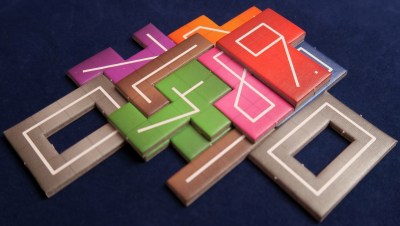
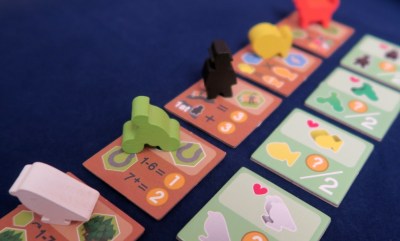
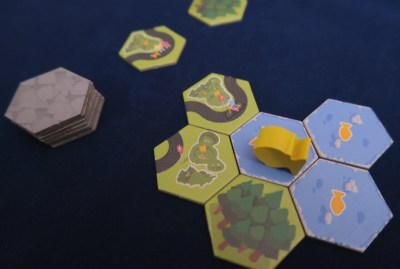
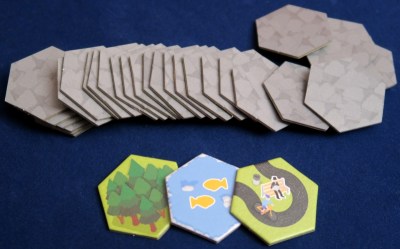
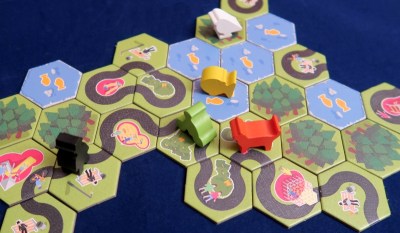
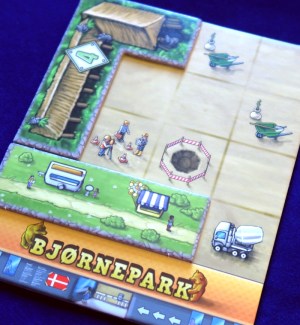
This week the “Feature Game” will be Mini Park.  This is a very quick, light tile-laying game from Taiwan that was popular at Essen last year.  Players take on the role of architects designing a new park, taking it in turns to either place a tile or add a character.

Mini Park
– Image by used with permission of boardgamephotos

And speaking of architects…

An architect named Jeff and an Engineer named Joe, went on a camping trip together.  It had been a long day and both of them were tired so they pitched their tent, and went to sleep.

Some hours later, Joe woke his mate and said, “It is a beautiful night, Jeff, look up at the sky and tell me what you see.”

Jeff replied, “I see millions of stars.”

Joe asked, “What does that tell you?”

The young architect thought for a moment and then said, “Astronomically speaking, it tells me that there are millions of galaxies and potentially billions of planets. Astrologically speaking, it tells me that Saturn is in Leo. Time wise, it appears to be approximately a quarter past three. Theologically, it’s evident the Lord is all-powerful and we are small and insignificant. Meteorologically, it seems we will have a beautiful day tomorrow.”  Then he paused before he continued, “Why, what does it tell you?”

His engineer friend was silent for a moment, and then said, “Practically speaking, it seems someone has stolen our tent…”

3rd April 2018

Blue and Pink arrived first and, as they were early, they decided to get in a quick game of NMBR 9, while they waited for food and more people.  This is a game which is rapidly becoming one of our go-to fillers primarily thanks to it’s almost non-existent setup time.  This time, Blue turned over the cards, and Pink scratched his head a lot as he tried to work out what to do with his tiles.  Once a few tiles have been placed to form a base layer, then tiles can be placed on top of other tiles as long as there are no overhanging parts, and the tile sits squarely on more than one other tile.  This is essential as the higher the tiles are placed the more they score.  Unfortunately, the rule Pink forgot about was that tiles must be placed such that at least one edge touches a previous tile on that level.  “Cheating” didn’t do him much good though, as Blue won by more than thirty finishing with a massive eighty-one thanks largely to placing a seven on the fourth tier.

NMBR 9
– Image used with permission of BGG contributor punkin312

Although a few of our regulars were missing (Green, Red and Ivory), they were ably replaced by a couple of our irregulars in Pink and Turquoise.  So while we made sure there were no more stragglers and Burgundy finished his inch thick slice of ham, we played another quick filler game, this time of 6 Nimmt!.  This has long been a favourite in the group, thanks to the fact that it plays a lot of people coupled with the hilarious way that a tenuous control of the game can catastrophically turn into chaos.  It is one of those games that is more difficult to explain than to play, but essentially each player has a hand of cards and simultaneously everyone chooses one to play.  Simultaneously, everyone then reveals their card and each card is added in turn to the end of one of the four rows of cards on the table.  Beginning with the lowest each card is added to the row with the highest number that is still lower than the active card.  The snag is, if anyone’s card is the sixth to be placed in a row, the first five are “won” and and the card becomes a new starting card.

– Image by boardGOATS

As well as a face value (one to a hundred and four), each card also has a “nimmt” value: most are one, but there are some as high as seven.  The player with the fewest nimmts at the end is the winner.  It has been somewhat neglected of late though, and has only been played once this year by the group, and then only just (it was the early hours of New Year’s Day), so it was definitely time for another outing.  Normally we play two rounds, dealing out approximately half the deck each time, but with so many of us all wanting to play, we decided to go for a single round and deal ten cards each.  This time Black and Purple were fighting it out for the unofficial wooden spoon, but that honour was reserved for Turquoise with a quite fantastic thirty-one.  At the other end, both Burgundy and Blue thought they might have got it with just three and one respectively, but it was Pink with a nice round zero who pipped them to it.

– Image by boardGOATS

Once the food and the nimmts had been dealt with and it was clear that no-one else was coming, the inevitable squabble began over who wanted to play the “Feature Game”.  This week it was Fabled Fruit, a very light worker-placement and set collecting card game with a “Legacy” element to it.  As such, the game is very simple, but develops as you play.  The idea is that the game starts with six “Locations”, each of which is formed by a deck of four cards.  On their turn the active player moves their meeple to one of the locations and either carries out the action shown on the cards in the deck or buys one card for the amount shown.  The locations provide access to “fruit cards”, which are the currency in the game and are used to buy the location cards.  Each location has a different action, for example, the first location enables the active player to draw two cards from the top of the fruit deck.

Fabled Fruit
– Image by boardGOATS

On the other hand, Location Five allows the active player to draw cards until they have a hand of three—useful if they started with no cards, but not so helpful if they had a handful. At Location Six, the active player can turn over as many cards as they like, keeping all the unique cards they turn over, but go bust in a Port Royal sort of way if they turn over a duplicate card.  Since there are five different fruits, this action quickly becomes increasingly risky.  There are other actions, some of which add a bit more interaction, like giving a player a banana card and getting two cards in return or drawing one card from the fruit deck and then exchanging three fruit cards with another player.  A little more interaction comes from the fact that visiting an occupied location costs a fruit card: since location cards typically cost four or five fruit cards, this is expensive, especially with low player counts, but playing with the full complement makes this almost unavoidable from time to time.  Aside from this though, there is very little interaction and the actions for the starting locations are quite mild.

Fabled Fruit
– Image by boardGOATS

The interesting part is how the game develops, since a new card is added to the game every time a location card is bought.  Each location holds just four cards, so for every cards that are bought, a new location is introduced, and once all the cards for one location have been bought, that location and therefore that action is no longer available.  The really clever part of the game is the “Legacy” element:  the end game condition, becomes the start condition for the next game.  For this reason, we decided to play the game three times so we could see and appreciate how it evolves.  The rules were easy enough to explain and Turquoise, Magenta and Burgundy were keen to give it a go, so they joined Blue and Pink leaving Black, Purple and Pine to find something else to play.  It wasn’t long before the Fabled Fruit players were happily collecting fruit cards and occasionally turning them into juice by buying location cards.

Fabled Fruit
– Image by boardGOATS

It is a game of very fine margins, though and it wasn’t long before almost everyone had two Location cards tucked away and were fighting for one more to win.  In truth it wasn’t a long fight as Pink made his experience with the game tell and took the first round.  Then instead of resetting the game, we checked we still had the right number of cards out, and started again with the new set up.  So this time, we started with the market which had been introduced during the first round.  This is a face up display of five cards that players can interact with.  The Locations that were available allowed players to trade cards with the market, but also trade one strawberry, for any three non-strawberry fruit cards in the market.  This hugely increased the value of strawberries and, with the high value of pineapples (which could be traded for five from the deck) and bananas (which could be used to take cards off another player), it meant that players were holding more and more cards.

Fabled Fruit
– Image by boardGOATS

This all changed in the third round, however, when Location Ten appeared which allowed the active player to take two fruits from the player with the most cards.  Nobody liked falling victim to that one very much, but everyone took advantage where they could.  With just Pink taking the second round as well as the first, it was all about trying to stop him taking a clean sweep.  In the end it was really tight.  Everyone gets the same number of turns, so when it was clear that Pink was once again in a position to trigger the end by purchasing his third card, it was a question of whether anyone could stop him.  Although Turquoise who started the round had been steadily improving, there was nothing she could do, nor Burgundy who went next.  As Pink then played his master-move and picked up third Location card, the question changed to whether Blue and Magenta would be able to join him.  Both had enough cards, but but Magenta, was unfortunately standing on the only card she could buy, so in the end, the final round was shared by Blue and Pink.

Fabled Fruit
– Image by boardGOATS

Meanwhile, on the next table, Black, Purple and Pine had started off with Azul.  This, like NMBR 9, has been an immensely popular game since it first appeared on the group’s radar at Essen last year.  The game is almost entirely abstract, with a very loose “artists decorating a wall in the Palace of Evora” theme, but somehow, that doesn’t seem to matter as the game play is good and the production values very high.  In summary, the active player can either take all the tiles of one colour from one of the factory displays (putting the rest in the central market) or take all the tiles of one colour from the market in the centre of the table.  They then place the tiles they took in one of the five rows on their player board.  The catch is that although they can add more tiles to a row later in the round, once a row is full, any left-overs go into the negative scoring row. The round ends when all the tiles have been picked up, and one tile from each full row is added to the player’s mosaic and scored.

Azul
– Image used with permission of boardgamephotos

Tiles placed singly score just one point, but if they become part of a row or column, they pick up points for each tile in the row or column, so clever players can make tiles score over and over again.  The game ends when one player gets a complete row, so it takes at least five rounds, and then bonus points are awarded for completed columns or rows and full sets of five of a colour.  Purple wasn’t concentrating, so failed to get any bonus points, while Black and Pine picked up a few negative points.  Pin had a disastrous final round when he was forced to pick up six red tiles but could only place two of them meaning the rest all scored negative points, a total of minus thirteen for that round.  It didn’t do him too much damage though as he finished with thirty-eight, ten points clear of the others who were in a battle for second that Black won by a single point.

Azul
– Image used with permission of BGG contributor Toynan

Next the trio moved on to Sagrada.  This is another popular “game of the moment”, with very similar feel to Azul, but this time using dice and players are building a stained glass window by placing dice on a grid of dice on their player board.  Each board has some restrictions on where certain coloured or numbered dice can be placed there and players take it in turns to take dice from a pool and add them to their window.  Depending on the difficulty of the starting grid, players start with a small number of favour tokens which act as “get out of jail free” options and allow them to use special tools to manipulate some of the dice, either during the “drafting” phase, or sometimes those already in their “window”.  Points are awarded for fulfilling certain criteria, depicted on cards drawn at random at the start of the game.  Although completing the window can be challenging in its own right if the dice don’t roll well, it is the objective cards that are the key to the game.

Sagrada
– Image used with permission of BGG contributor punkin312

Each player has their own private objective which scores for the number of pips displayed on dice of a given colour in that player’s window. There are also three public objectives which everyone can use to score points; this time these gave points for complete sets of all five different colours, complete sets of all six numbers, and for columns that contained different numbers.  The game starts with each player choosing a window from two double-sided cards dealt at random.  The hard ones come with a lot of favour tokens and these can be critical as they can be used to move and re-roll dice or other special actions depending on what special tools are available.  This time they were particularly important, as everyone kept rolling sixes which wasn’t what they really needed.  Purple in particular made full use of all her favour tokens which helped keep her in the game.  When it came to scoring, it was quite close, with players taking similar scores on the separate public objectives. The small differences added up, however, and Pine finished in front with a nice round fifty, a handful of points ahead of Black in second place.

Sagrada
– Image used with permission of boardgamephotos

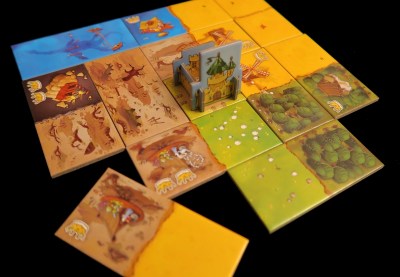
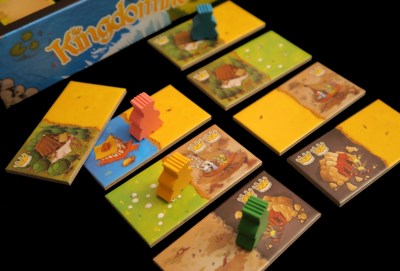
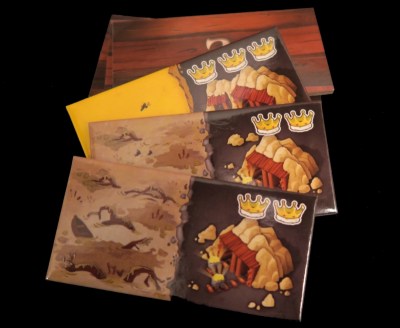
Fabled Fruit still hadn’t finished, but was well into its third round, so Purple, Black and Pine, looked round for something familiar and quick to play, and their collective eye fell on Kingdomino.  The rules didn’t need much recap: take a domino and add to the kingdom and then place a meeple on one of the dominoes on display for the next round.  When placing the dominoes, one of the two ends must connect to terrain of the same type already in the kingdom, or connect directly to the start tile.  Points are awarded at the end of the game by multiplying the number of tiles in an area of terrain by the number of crowns in the area.  All dominoes must fit in a five-by-five space (or be discarded) and bonus points are awarded for successfully placing all tiles and finishing with the start tile in the centre.

Kingdomino
– Image used with permission of boardgamephotos

It is a very clever little game, and tile placement is clearly critical, but one of the most important aspects is the trade off between turn order and tile value.  Each domino has a numerical value and they are set out and taken, from low to high, so players going for the more valuable tiles are trading this value against their position in the turn order.  This was key for Pine who failed to get the crowns he needed and when he did couldn’t add them to the terrain he wanted.  This was exacerbated by the fact that with only three players, some tiles never appear which can upset the balance of the game.  All in all, Pine had a complete “mare” of a game, crowned by the fact that he failed to place all his tiles and didn’t get his castle in the centre of the kingdom either.  It was a game he wanted to forget, but was close between Black and Purple.  Black had the edge though and finished with a grand total of seventy.

Kingdomino
– Image used with permission of boardgamephotos

Nobody wanted a late night, but everyone fancied finishing with something light, and with so many people Las Vegas is always a good option.  This light dice game is really easy to play and doesn’t require much in the way of concentration, so is great to wind down with.  On their turn, each player begins by rolling their dice, then assigning some of them to one of the six casinos.  Each casino is numbered one to six and has a jackpot drawn at random from a deck of money;  the catch is that to place a “bet”, the player must use all the dice of one number that number.  Once everyone has placed all their dice the player who placed the most dice on a casino takes the highest value currency card. The really clever bit is that before any money is handed out, any “draws” are removed, which leads to a lot of barracking.

Las Vegas
– Image used with permission of BGG contributor joeincolorado

We also always add the Slot Machine from the 2015 Brettspiel Advent Calendar, which is like a seventh casino, except that it can hold dice of any number, but each number can only be added once (though a player must add all the dice they have of that number).  We also add some elements from the Boulevard expansion, including extra high value money cards, the “biggun” (which replaces one die per person with a larger, double weight die worth two of the little ones) and extra dice so more people can play.  Finally, we always house rule the game so we only play three rounds instead of four—although we love it, with four rounds it can outstay it’s welcome for those who feel they can’t catch up.

Las Vegas
– Image by boardGOATS

It’s never easy to tell how people are doing as the money is stored face down and the denominations vary from $10,000 to $100,000, so someone with a large pile may be very rich or just have a lot of “notes”.  And Purple certainly had a lot of notes as she popped out to the conveniences and came back to find a massive money pile.  Everyone was so impressed that several others optimistically tried the same trick, but unfortunately they didn’t quite have the knack.  It was an exciting game though; with so many people playing there were a lot of draws and lots of bids ended up cancelling out others, often with three people involved and a fourth very lucky “loser” picking up the spoils.  In the final counting, Pink proved that while he was good at collecting fruit, he was rubbish at collecting money.  At the other end of the scale meanwhile, Black and Purple were again fighting it out for first place, but a tie on $340,000 each was eventually resolved in Purple’s favour.

Las Vegas
– Image used with permission of BGG contributor ckirkman

Learning Outcome:  Aesop doesn’t have a monopoly on Fables.

Next Meeting – 3rd April 2018

Our next meeting will be on Tuesday 3rd April, at the Horse and Jockey pub in Stanford-in-the-Vale.  As usual, we will be playing shorter games from 7.30pm as people arrive, until 8pm when we will start something a little longer.

This week the “Feature Game” will be Fabled Fruit.  This is a very light, but innovative little card game with elements of worker placement and set collection.  The interesting part of the game is the “Legacy” element where new cards are introduced during the game and the end state becomes the starting state for the next game.  These keep the game fresh and interesting as the game changes as it is played.  For this reason, we plan to play this a few times so that everyone gets a chance to see how the game evolves.

Fabled Fruiit
– Image by BGG contributor Hasematzel

And speaking of fruit…

Jeff and his two friends got captured by native Americans who wanted to kill them, but the Europeans begged to have their lives spared. After some discussion, the natives agreed to not kill them on one condition: the Europeans must go into the forest and bring back a fruit and they would be informed what to do with it on their return.

So the first of Jeff’s friends came back with a peach. On his return, the native said “Shove it up your bottom, if you laugh we kill you.”

So, he shoved the peach where the sun wouldn’t shine and, as he did so, he couldn’t help laughing, so the natives killed him.

The second of Jeff’s friends came back with a grape. On his return, the native told him the same thing. Jeff’s friend couldn’t help himself and laughed so again, the natives killed him.

Jeff’s two friends met at the pearly gates and Jeff’s first friend said to the second, “I had a peach and peaches are furry, so that’s why I laughed, but you had a grape, what went wrong?”

The second friend replied, “Oh, well, I was doing just fine until I saw Jeff coming back with a pineapple!”

20th March 2018

Unfortunately, ordering dinner was delayed due to a birthday party on the other side of the room, so Blue, Pine and Burgundy decided to get in a quick game of NMBR 9 while they waited.  Despite the fact that it isn’t a top game for anyone and takes up a lot of room in the bag, it is is rapidly becoming a very popular filler.  This is because it is nice and short, has a enough bite to keep everyone interested for the duration and, as it has almost no set-up time, the activation energy barrier is particularly low (find and open the box, take out the deck of cards and turn over the top one…). The game is a bingo-type tile-laying game where each person plays a total of twenty tiles, numbered zero to nine, with each one appearing twice. The deck of cards dictates the order they appear in and tiles must be placed such that at least one edge touches a previous tile. Tiles can be placed on top of other tiles as long as there are no overhanging parts, and the tile sits squarely on more than one other tile. At the end of the game the number of the tiles are multiplied by the level they sit on minus one. So, a five on the third tier scores ten points (5 x (3-1)).

NMBR 9
– Image used with permission of BGG contributor punkin312

This time, everyone started off with the same placements albeit in a different orientation.  It wasn’t long before first Burgundy and then the other two diverged though, with slightly different strategies.  There is a bit of knack to the game with two basic competing requirements: getting strong continuous layers without gaps, and placing numbers, ideally high numbers, on the highest tiers possible so they score more.  Blue and Burgundy concentrated on getting a really solid zero level with Burgundy even sacrificing his first “nine” to the cause.  Pine on the other hand, succeeded in placing both his “eights” on his third tier scoring a thirty-two points for those tiles alone.  It was a very close game, but the difference was when, towards the end of the game, Burgundy managed to squeeze a “three” onto the fourth layer.  This gave him nine points and victory with a total of sixty-three points, just five points ahead of Blue and Pine, who tied for second place.

NMBR 9
– Image used with permission of BGG contributor punkin312

By the time NMBR 9 was finishing, everyone else was arriving and the group split into two, with one group playing the “Feature Game”, Boomtown and the other playing Yokohama, a game which Ivory had been hankering after playing since he first saw it long before Christmas.  With food due for Blue and Burgundy at anytime, Ivory had to wait another twenty minutes or so, and to try to keep his mind off the delay, the trio decided to squeeze in another filler, Coloretto.  This is a light set-collecting card game that everyone in the group is familiar with: on their turn, players can either pick up a chameleon card from the face down deck and add it to a truck, or take a truck (passing for the rest of the round).  The innovative part of the game is the scoring which uses the triangular number sequence (one point for the first card, three points for two cards, six points for three cards etc.), with positive points for three sets and negative for the rest.

Coloretto
– Image by BGG contributor SergioMR

We’d  just started when food arrived and it quickly became apparent that Blue was concentrating more on her pizza than the game as she just stared collecting almost anything that came her way.  Everyone started collecting light blue/white cards and this was a mistake because it meant that everyone was going to struggle to get lots of them.  In the end, three things made the difference: the jokers that Blue picked up;  the bonus point cards that Blue and Ivory collected, and the negative points that Burgundy ended up with.  As a result, despite her lack of concentration, Blue finished with forty-four points and a sizeable lead, with Ivory in second place.  Meanwhile, the next table had started the “Feature Game”, Boomtown, which is a fairly light card game where players are mining moguls and each round is divided into three parts, auction, selection, and production.

Boomtown
– Image by boardGOATS

At the start of the round one card is drawn per person and placed face for bidding. Players then, in clockwise order, take turns bidding for who gets to choose a card first. Bidding continues round the table; when a player passes then they are out of the bidding and the auction continues until there is one person left.  While the auctions are fun, the real twist in the game is what happens as a result of the auction.  Winning the bidding has two consequences:  first pick from the cards available, but also payment of the bid to the other players.  So, the winner of the auction pays his winning bid to the player on his right who then gives half of that sum to the player on his right who, in turn, gives half of that amount to the player on his right, and so on in anticlockwise order, stopping just before the player who won the bidding.  The winning bidder chooses first and selection then passes to the player on his left and continues in clockwise order (i.e. opposite to the order of the money route).

Boomtown
– Image by boardGOATS

There are two types of cards in Boomtown, mine cards and special cards.  The special cards typically provide a one off action that must be used straight away while others can be saved for later in the game.  Some help the owner, but most target one, several or all of the other players destroying or stealing mines, changing dice rolls or the order of a result of an auction.  Mine cards provide victory points and can also be a source of income throughout the game (especially valuable as  money enables players to take control during the auctions).  Each mine card has a number of gold coin symbols on it as well as a number between two and twelve. The gold coin symbols correspond to the number of victory points the card is worth at the end of the game and the number of chips a player will receive should the card’s number be rolled during the production phase (like in The Settlers of Catan).

Boomtown
– Image by boardGOATS

Each mine card also has a colour and these can be critical as the player with the most cards takes the mayor who is worth five points at the end of the game.  Perhaps more importantly, the player who owns the mayor receives payment from the other players when they take (build) a mine of that colour.  Mayors can also be a deciding factor in how one bids for first choice in a round and some of the special cards can provide an edge in the contest for mayors, as well.  This means that fights over mayors can get very, very nasty indeed.  The game ends when the deck is exhausted and everyone then adds their number of chips to the value of their mines and any mayor bonuses, the player with the highest total wins.

Boomtown
– Image by boardGOATS

It was a slow start with no-one really bidding very high. Most people were not sure quite how the game would work so did not want to commit too much at this early stage. In the very first round, the “aggressive” nature of the game quickly reared its ugly head when four of the five cards in the auction were mines and one was Dynamite.  Green won the bid and since Red was sitting on his right, she was left with the final card, the Dynamite.  There was really only ever one choice as to who’s mine would go…the person who had played it many times before, Green.  A couple more rounds on and the players were still only tentatively feeling their way. Red had chosen to diverge from the other player’s tactics slightly by going for a Saloon rather than mines and before long she was able to add the Saloon Girls to double its effect.

Boomtown
– Image by boardGOATS

When Pine won a bid and started the next round of bidding, he did not know what to choose, not really wanting to win the bid at all. So he bet one, When nearly everyone had passed and he looked like he would win the bid on one, he commented that it seemed unfair that he would be forced to pay some money, thinking that if everyone passed he would be the winner anyway.  A quick check of the rules confirmed that indeed the player starting didn’t have to bid and could pass, and in the unlikely event that everyone passed, they would win.  So everyone agreed to start the round again. Pine passed, Red Passed, Green, with an eye to the main chance then bid one—Oh the shouts of disgust that followed—he had passed last time so why bid this time?  Well, it wasn’t worth two, but it might be worth one, and with that he won the auction.

Boomtown
– Image by boardGOATS

About a third of the way through the game, there were a couple of Mayors out and Red’s yellow Saloon was bringing in some income from Pine’s growing number of yellow mines.  It was about this time when Pine decided he’d had enough and took the next dynamite card and, much to her disgust, blew up Red’s Saloon, taking the girls with it!  In the meantime, Purple was trying to corner the green and red mines, while Black was settling himself strongly into purple mines.  At this point Red decided that she was so far behind in the mining stakes there was little point in switching to that route so decided to stick to the “money by other means” strategy. She managed to get a second saloon and this time chose Black’s purple mines to be the target for her custom.  This seemed to regularly provide income, but without the girls it was only two gold at a time, barely enough to cover costs.

Boomtown
– Image by boardGOATS

As the game drew to a close, it was looking like a two horse race between Green’s extensive pile of cash and Black’s almost as large pile and growing number of mines.  Pine decided he wanted a piece of the action and chose to hold up Black opting for a 50/50 and said he’d try to roll a seven or higher.  He failed, as did Red when she tried the same thing, with Black again the target.  As everyone tallied up the scores, it became apparent that the failed hold-ups had had a significant impact on the outcome. Red’s strategy had totally failed and Purple had been unlucky with the mine production rolls, but it was quite close between the other three.  In the end, Black finished just five points ahead of Pine who pipped Green to second by two points—if Black had lost those hold-ups the game could have gone to Pine…

Boomtown
– Image by boardGOATS

On the next table, Yokohama had barely started, so the group found something a little longer to play in Jórvík.  This is a viking re-themed version of The Speicherstadt, which was a very popular game with the the group a few years ago.  Last time we played the expanded version (corresponding to the original game with the Kaispeicher Expansion), but this time we did not want it to go on too long, so played the base game rather than the fully expanded one.  Pine remembered it as the game where Vikings queue up, and called it “The Queuing Game”, and that sums it up pretty well.  Players take it in turns to place their meeples in queues next to the laid out cards.  Once everyone has placed their cards, each card is “sold” and the first player who placed their meeple next to the card has first dibs.

Jórvík
– Image by boardGOATS

The snag is that the cost depends on the number of players who joined after them.  So, if the queue consists of three people, the first player can pay two for it, but if they turn it down, the next player can pay one.  This makes the game evil.  It is an auction game in which players can increase the value and, once the other person drops out, can drop out as well, no strings attached. A kind of, “Well, I didn’t want it, but I just didn’t want you to have it…”  This lack of control didn’t go down well with Ivory, who saw the game and commented, “If we were playing “Snog, Marry, Avoid”, that would definitely be “Avoid”!”  Curious, Blue asked him whether Yokohama would be “Snog” or “Marry”, to which Ivory emphatically responded, “Snog” and added, “”Marry” would require investment…”

Jórvík
– Image by boardGOATS

The cards come in varying types, starting with contracts and goods – contract cards give victory points, but only if they have been fulfilled by collecting the correct goods.  On the other hand, Market Cards allow players to sell goods and get a better return than usual, enabling the owner to build a supply of cash giving them power in the “auctions”.  One of the most important cards are the viking fighter cards.  When the “Attack of the Picts” come up at the end of each season, the player with the most viking fighters gets a bonus, but woe betide the player that has the fewest viking fighter cards as they will lose points in a “Devil take the hindmost” mechanism.  The game ends when all the cards have been auctioned and the player with the most points is the winner.  It only took one round for everyone to take up their differing strategies.  Red, having not played the game before, had gone for a couple of market cards, enabling her to sell goods for one coin each rather than the usual two goods for one coin. Green had started a collection of Viking fighters to ward off the Pict raiders, Black collected the only artisan card, Purple went for the feast and Pine wasn’t really sure where he was going so had taken another market card.

Jórvík
– Image by boardGOATS

By the end of the second round Red had acquired three of the market cards, Green another fighter, Black and purple both had artisans, and Pine had taken the valuable warehouse.  Black was dubious of Red’s strategy for so many market cards, as experience had shown that these cards were generally not that valuable as you did not often have the required resource to sell. Green was reserving judgement thinking that with three she could almost guarantee being able to sell something.  Then  the goods started to arrive.  Everyone seemed frustrated at what they could actually get and money soon ran very low, except for Red however, who always seemed to have more than anyone else; those markets were beginning to prove useful.  Pine’s warehouse seemed pretty empty however and although Green’s defense of the Picts was mighty, there wasn’t a lot he was defending in the early stages.

Jórvík
– Image by boardGOATS

As the game wore on, Green inched up the score track as Pine, Purple and Red slipped back, due to Pict raids.  By the last round, almost everyone was spent up with no more than one or two coins each, except Red who seemed to have a stash of seven or eight. This meant that she was able to hoover up both the end game scoring bonus cards (the ships and the coins) and this left an odd position that didn’t seem to be covered in the rules.  The very last card in the Winter deck was the attack of the Picts card, which meant that all the other cards had been out and selected, and only two cards remained, both attack of the Picts cards.  Normally, the Attack of the Picts card would have been enacted as soon as it was revealed and then discarded, which is why the cards fit the slots perfectly.  Pine felt the game should end there without activating them, but since we did need to have the final attack card everyone else felt that the game probably meant both attacks should happen, one after the other.  Considering that there is a one in fifteen chance of this happening, it really should have been mentioned in the rules.

Jórvík
– Image by boardGOATS

It quickly became clear why Pine wasn’t keen on activating the Pict cards:  he had seven points to lose and Green had seven to gain!  It didn’t matter though, because in the final scoring Red trounced everyone, proving that some cards are more powerful than we could ever imagine. Black and Green were tied in second place, much to their chagrin, as both had thought it would be one of them in first place; checking the tie breaker, it was Green took a somewhat Pyrrhic victory.  While all this was going on, after some four or five months, Ivory was finally getting personal with Yokohama, and it seamed he was finding that it had been worth the wait.  It had taken quite a while to set up and was quite a “table-hog”, but it looked much more complex than it appeared to the players on the neighbouring table.

Yokohama
– Image used with permission of BGG contributor punkin312

Yokohama has a lot in common with Istanbul—although it is unquestionably a deeper game, the principle is very similar.  In Istanbul, players take it in turn to move their Merchant around the bazaar to locations where he can carry out specific actions.  Merchants can only carry out actions at locations where there is one of their Assistants or where they can drop off one of their Assistants.  Yokohama has a similar travelling Merchant mechanism, but before he moves, the active player places Assistants, three in different locations or two together at the same location.  The difference is that in Istanbul the distance the Merchants can travel is limited, whereas in Yokohama, they can travel as far as they like, but can only travel through locations that are occupied by one or more of their Assistants.

Yokohama
– Image by BGG contributor cmarie

One of the most significant differences between the two games is that the action a player can take depends on the “Power” they have at their Merchant’s location.  The Power is the sum of the number of number of Assistants, Stores and Trading Houses present, plus one for the Merchant.  The nature of the locations are more complex too, some just provide resources or money, but others provide opportunities to get Contract cards, victory points or even technology cards that can be used during the game.   Another key difference is that each player is provided with a small number of Assistants at the start of the game.  Although any Assistants are returned when their Power is used to carry-out out an action, players inevitably need more, which they must obtain by visiting the Employment agency (where players can also buy Stores and Trading Houses).

Yokohama
– Image used with permission of BGG contributor punkin312

Despite the similarities, the games have a very different feel about them, though they are both very smooth to play with very little down-time.  Yokohama has a number of end conditions, including drawing the last contract card, filling a given number of spaces in the Church, or Customs locations, or if one or more players has built all their Trading houses or Stores.  In this way, it is up to the players how long the game goes on, which was definitely something that affected the way Blue, Burgundy and Ivory played.  The game began with Blue picking off the highest scoring Contracts while Ivory decided to build some technology, in particular the ability to place a fourth Assistant, something that proved it’s worth as he used it extensively throughout the game.  Burgundy followed Blue with the Contracts, but was generally beaten to the most valuable cards.

Yokohama
– Image used with permission of BGG contributor HedgeWizzard

As the game developed, all three players began to get into their stride a bit more, and when pine looked on in horror at all the pieces and commented that it definitely looked like an “Ivory sort of game”, all three agreed that it was no where near as complex as it looked.  And that was just as well, because Yokohama has a lot of fiddly pieces and does look especially complicated.  Up to this point though, everyone had been hitting the Contract cards quite hard, when Burgundy suddenly pointed out that there weren’t many left and if we continued that way, the game would be over quite soon. Clearly nobody wanted that, because everyone switched their attention to other sources of points.  It quickly became clear that all three players had spotted the value the Customs house could provide, and since everyone was beginning to build up a small stack of valuable “Import” crates, it became a race to get there first.

Yokohama
– Image by BGG contributor Roger_Jay

Inevitably, Ivory got to the Customs house first, followed by Blue and Burgundy.  Blue had more Import crates though and was able visit several times and hold the majority.  Ivory spotted that there were points to be had by visiting the Church, which the others had completely neglected and Burgundy took one of the achievement bonuses for having built in three commercial and two production areas.  This was something that everyone had tried to go for, but had been sidetracked from.  Ivory snaffled the bonus for being the first to achieve six bundles of silk with an extremely clever move, while Blue who had always had more money than anyone else picked up the bonus for being the first to have ten Yen.  It was clear that the game wasn’t going to go on much longer, but everyone was concentrating on trying to eke out those last few points in what felt like a close game.

Yokohama
– Image used with permission of BGG contributor HedgeWizzard

It was about this point that Red asked to borrow Blues car keys, only to return a few minutes later, much to everyone’s amusement, asking how to use them as she had been pushing the car boot open button without success.  Obviously that wasn’t the right button, so with new instructions she tried again, only to return after another couple of minutes still defeated.  In the end, Green went to her rescue, though even he took several tries to get it to work.  On their return Yokohama was coming to a close and the players were working out the final scores.  It was close, but despite Blue’s obstructive tactics at the end, Ivory still finished five points clear with one-hundred and twenty-two.  It was clear that everyone had enjoyed the game:  Burgundy’s comment was that he’d struggled from start to finish, but loved every minute.  Ivory had clearly enjoyed it too, and was making appreciative comments about variable setups as he helped pack away, though it remains to be seen whether he will invest in an engagement ring…

Yokohama
– Image used with permission of
BGG contributor punkin312

Learning Outcome: Some games are worth the wait.

Boardgames in the News: So, What’s the Big Deal with “Legacy Games”?

Legacy games were the latest, greatest thing in boardgames in 2011, when the first “Legacy Game”, Risk Legacy, was first published.  Although Risk Legacy, was the first of this style of games, it was the arrival on the scene of Pandemic Legacy: Season 1, four years later, that really raised their profile, and with it’s arrival, there was a lot of debate.  Legacy games are board games where changes are made as players play; think “Choose Your Own Adventure“, only with a boardgame instead of a book.  The difference is that the changes that are made are permanent and affect game play the next time.  Examples of these changes include permanently marking cards, adding stickers to the board, destroying components, opening sealed envelopes, and so on.

Risk Legacy
– Image used with permission of BGG reviewer EndersGame

These changes are designed to be permanent and are typically part of a campaign that can only be played through once.   And this is where the controversy lies:  hitherto, boardgames have been toys that provide entertainment time and time and time again, and have a resale value, Legacy Games can only played through once and have little or no resale value once the campaign has been started.  There are other issues too, for example, for the best experience, these games need to be played with the same group every time, and as such, are not ideal for games groups where different people attend each time.  Designing them is considerably more complex than normal games as well, as all the alternate paths have to be balanced and every possible eventuality play-tested.

Pandemic Legacy: Season 1
– Image by BGG contributor Six8

There has been a lot of demand for the development of Legacy Games with a reset capability, and games like Fabled Fruit and Charterstone have been produced with this in mind.  Unfortunately, this completely misses the point:  the excitement of the true Legacy Games generate is precisely because they cannot be reset.  This is not to say that “Fabled Games” and other reset-able “Legacy-style” games are poor games, in fact, because they need more play-testing than most games, the opposite is often true.  And these games still have the feeling of exploring the unknown, but there is something they cannot reproduce.  The fact is, boardgames are very precious to gamers, and as a society people are taught to take care of games, so permanently damaging them is something everyone is taught not to do, a bit like permanently damaging a book.  For this reason, there is a frisson of excitement that comes with permanently changing a game and that is the true mark of a Legacy Game; love it or loath it, the knowledge that the game can be reset removes this defining aspect.

Pandemic Legacy: Season 1
– Edited from image by BGG contributor Muse23PT

Next Meeting – 20th March 2018

Our next meeting will be on Tuesday 20th March, at the Horse and Jockey pub in Stanford-in-the-Vale.  As usual, we will be playing shorter games from 7.30pm as people arrive, until 8pm when we will start something a little longer.

This week the “Feature Game” will be Boomtown.  Although we’ve played this before, it was a very long time ago and we thought we’d give it another outing.  The game is set in the Wild West, where players are prospectors bidding for mining concessions.  It is a fairly quick game, which should give us plenty of time decide what longer games we would like to play once everyone has arrived.

Boomtown
– Image by boardGOATS

And talking of the Wild West…

The swing doors of the Wild West saloon crashed open and in came Jeff, black with fury.  “All right!” he raged, “All right! Who did it? What darned varmint painted my horse bright blue?”

The huge figure of Black Jake, a notorious gunfighter and town baddie rose from a chair by the door. “It was me, shrimp,” he drawled, bunching his gigantic fists, “What about it?”

“Oh, well, er,” stammered Jeff wretchedly, “All I wanted to say was… er… when are you going to give it another coat please?”

6th March 2018

Food had been ordered by those who intended to eat, but there seemed to be a bit of wait so we decided to play our “Feature Game”, Plague & Pestilence.  This game had been chosen as it was Purple’s birthday and she had enjoyed playing it in the past.  A fairly simple card game, everyone felt it wouldn’t be too difficult to play around when food arrived, added to which, there weren’t many other options available that would play six in a short time.  The game is played in two phases, the first is the “Prosperity Phase” and the second is the “Plague Phase”, but both are played the same way.  During their turn, the active player rolls a pair of purple six-sided dice which indicate how much their population increases by, and takes population cards accordingly.  The active player then draws Prosperity cards to refill their hand and plays one, which allow players to attack others and build their own protections for later in the game.

– Image by boardGOATS

A special Death Ship card is shuffled into the Prosperity deck and when it appears, it triggers the start of the second phase, the “Plague Phase”.  This is played exactly the same as the first phase, but now the dice rolls indicate how much the active player’s population decreases by.  As the game progresses, the plague ravages the populations and players are eliminated; the last player standing is the winner.  The game started fairly benignly as most players either built improvements or had bumper harvests. There was the odd pestilence played and a Mongol raid, however, Green upped the ante when he played the mass migration card and gained five citizens off every other player.  This released the inevitable retribution when he then found himself beset with wars, famines and pestilence.  With two Pied Pipers up his sleeve (metaphorically of course) he was then able to pick on Ivory, and did so twice since Ivory had twice hit Green hard with a major war, and had also caught Pine with Viking raids. Meanwhile, Burgundy tried to build defences, and but they fell to earthquakes and other attacks before he could actually make use of their benefits.

– Image by boardGOATS

The game had not seemed to be going on long when Green drew the Death Ship and the game  entered the Plague Phase. A quick run round the table while everyone tried to bolster their dwindling populations and then food started to arrive.  After a brief interlude, play resumed with Black and his seemingly never-ending stream of Trade Centres.  Before long, a fatal blow was dealt to Burgundy when Purple started a war between him and Green. With three ties in a row, both suffered heavy losses. Although Burgundy did eventually win the war, he suffered some poor dice rolls and soon found himself to be the first without citizens. By now, Green was struggling and Black’s own mass migration had put both him and Pine on the edge as well. The inevitable backlash against Black gave Green and Pine a reprieve, but it was short lived and both toppled very quickly.

– Image by boardGOATS

It was looking like a fight between Ivory and Black as Purple’s pile of people was also looking decidedly dodgy, but then Black tried to start a war between the other two.  Ivory brought out his “Negotiated Peace” card though and all was well. It was a race of attrition that Purple couldn’t win and she was the next to drop out with an empty city.  In the end there was still little Ivory could do and he finally bowed out leaving Black the winner. It was then that Black revealed his hand to have several military advantages that he never used as he was the only one who had not been at war; everyone else had been wondering where those tactical advantages had disappeared to as they really needed them!  With the death and destruction over, we quickly decided to split into two threes.  As it was Purple’s birthday and she wanted to play Cat Lady, Pine and Black joined her.

– Image used with permission of
BGG contributor HedgeWizzard

Cat Lady is a card drafting game, similar in feel to Sushi Go!, though the drafting mechanism is very different.  At the start of the game nine cards from the cat deck are laid out in a three by three array.  On their turn, the active player takes all thee cards in one row or one column and then replaces the cards from the draw deck marking the row they took with a kitty meeple so the next player knows they can’t take that row.  Any cat cards go in front of the owner (or should that be staff?) and these must be fed by the end of the game or they score minus two.  Any food cards give cubes which can then be placed on the face-up cat cards to show they are being fed.  Similar to Sushi Go!, there are also cards that score for the player with the most cards (cat “costumes”) and give players with the fewest negative points and sets that players can collect (toys).  Players can also collect catnip cards which score minus two if the player only has one at the end of the game, or one or two points per cat if they have more.  There are also lost cat cards, and discarding a pair allows players take a two victory point token or one of the three stray cat cards which are particularly useful because they have special powers.

– Image used with permission of BGG contributor HedgeWizzard

The tricky part is making sure that the food a player gets matches the cards, because cats are fussy creatures and some like tuna, while others will only eat chicken…  At the end of the game, players score points for each happy well-fed cat and for their toy collection with extras if they have the most cat costumes.  Unfed cats, having the fewest costumes, and the largest surplus of food will give players negative points.  The game began with Purple going for costumes and toys while Black and Pine tried to get catnip to add extra points for their fed cats.  Perhaps Purple concentrated too much on the accoutrements for her pets because she ended up with so many cats that should couldn’t feed them all.  In her defence, it wasn’t that she had no food, it was that her cats were fussy eaters and turned their noses up at the fresh chicken, preferring to starve.  Unfortunately, this meant she lost points for having unfed cats, but also for having the largest surplus of food.  In contrast, the others had well fed cats and were level in almost every department, finishing with only three points between them, and Pine just a whisker in front of Black.
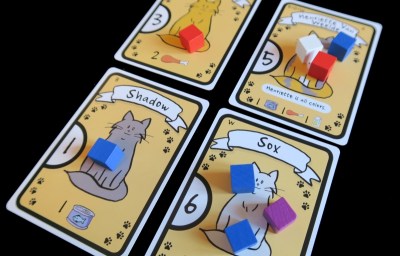
– Edited from video on youtube.com

Meanwhile, on the next table, Burgundy, Green and Ivory opted for NMBR 9. Only Burgundy had played it before, but the rules are simple enough so didn’t take long to explain.  The idea is that players will play a total of twenty tiles, numbered zero to nine, with each one appearing twice. One player turns over a card and calls the number and players each take one tile of that number and add it to their tableau. Tiles must be placed such that at least one edge touches a previous tile. Tiles can be placed on top of other tiles as long as there are no overhanging parts, and the tile sits squarely on more than one other tile. At the end of the game the number tiles are multiplied by the level they sit on minus one. So, a five on the third level scores ten points (5 x (3-1)).  This time, Ivory and Green matched each other for several turns before making a slight different placement which then ballooned into big differences.

NMBR 9
– Image used with permission of BGG contributor punkin312

Ivory and Green were quite pleased early on when they were able to place the eight on the, then highest level when Burgundy had to be content with adding it to his “ground floor”. In the end, Burgundy proved cannier than the others, however, and even managed to get a fourth level by the end of the game, while both Ivory and Green could only manage three tiers. In the final scores, it was Burgundy’s experience that showed through and his score dwarfed that of Ivory and Green, who finished with only a point between them.  Chatting about the game afterwards, everyone was surprised how quick it had been and how easy it was to learn (helped by the zero setup time).  So much so in fact, that even though the game was not to everyone’s taste, everyone felt it made a very handy little filler game and with a nice little bit of challenge. Having played it once though, both Ivory and Green felt they had a better understanding of the challenges and were more familiar with the tessellation possibilities and looked forward to doing better next time.

NMBR 9
– Image used with permission of BGG contributor punkin312

On the other table, Cat Lady was still underway, so the Green, Ivory and Burgundy opted for another of the hits from Essen 2017, Azul.  Despite the number of times we have now played this in the group, Ivory had somehow missed out.  The idea of the game is that players are tile laying artists decorating a wall in the Palace of Evora with “azulejos”.  On their turn, the active player can either take all the tiles of one colour from one of the factory displays (putting the rest in the central market) or take all the tiles of one colour from the market in the centre of the table.  They then place the tiles in one of the five rows on their player board.  The catch is that each player only has five rows, each with a set number of spaces (up to five). Players can add tiles to a row later in the round, but once a row is full, any left-overs go into the negative scoring row. Once all the tiles have been picked up, players evaluate their board, and, starting with the shortest row, one of the tiles from each full row is added to the player’s mosaic and scored.

Azul
– Image by BGG contributor JackyTheRipper

Players score just one point for a tile that is not placed adjacent to any other tile, whereas tiles added to rows or columns score the same number of points as there are tiles in the completed row (or column). The game continues with players choosing tiles from the factory displays and then adding them to rows, the catch is that as the mosaic fills up, it is harder to fill the rows as each row can only take each colour once. At the end of the game, players score bonus points for completed columns, completed rows and complete sets of five of the same colour.  The game is actually much more complex to explain than to actually play and Ivory appeared to pick it up very quickly, successfully completing a column and two full coloured sets.  Green, on the other hand, had managed only one column and one colour set as he had got stuck with a single blue on the bottom row for at least two turns as there weren’t enough of that colour drawn from the bag which stopped him placing the colours he really wanted to.  It was Burgundy who romped home in the lead though, with two full columns and two complete colour sets and ninety-eight points, just three ahead of Ivory.

Azul
– Image used with permission of boardgamephotos

While Azul was going on, Cat Lady had finished and the group also fancied playing Azul.  Unfortunately, we only had one copy between us so they settled on Sheep & Thief instead.  This is another light abstract that has proven quite popular in the group.  Each player has a board divided into a four by four grid, and starts with their home card and two sheep in the top left hand corner.  Each round is played in two halves: first players draft cards then they play them, taking it turns to place one card per turn.  It is a strange little “point salad” of a game with players trying to connect their home card to the other three corners while also trying to keep their sheep safe and trying to catch other players sheep with their fox as well as attempting to navigate their black sheep to the town in the bottom right corner of their board.

Sheep & Thief
– Image by boardGOATS

With points for sheep captured, sheep retained, long rivers, connecting the home card to the other corners of the board as well as for moving their black sheep as far from home as possible, it is hard to see who has the most points and get an idea of who is in the lead and it is astonishingly hard to do well at everything.  During this game, there almost seemed to be a lack of sheep and not much movement around the fields either.  The black sheep only moved a space or two and the foxes mostly sat and watched.  Everyone managed to connect their home card to at least one town, but it was Black who managed to collected a huge number of points when he managed to mastermind a huge river system giving him a completely unassailable lead.

Sheep & Thief
– Image by boardGOATS

Meanwhile, Azul was over, but as Sheep & Thief wouldn’t be long, Green, Ivory and Burgundy settled on a quick game of Love Letter with Green’s home printed Hobbit cards.  It is a while since we last played Love Letter, but nobody had forgotten how as it is simple enough:  draw a second card and chose one to play then action it trying to knock everyone else out—last player standing is the winner.  This time, Burgundy was caught out first as he had been forced to discard the Elvenking, leaving Green with a fifty/fifty guess at Beorn or the Great Eagle (the mutterings on placing the Elvenking suggested he wasn’t Smaug).  Although he guessed right, Ivory played a Troll to compare hands and Green could not match Ivory’s eagle. In the second round, history repeated itself for Burgundy as the first card he played was an Elvenking and the Great Eagle guess proved correct.  It was Green’s Troll card that forced the compare this time and took out Ivory.

– Image by boardGOATS

In the third round, Green started off by keeping himself out of harms way with Elrond, but he drew Smaug as his next card and knew that the writing would be on the wall—it’s very hard to keep that quiet for long. The inevitable happened when Ivory forced Green to reveal his card, but it didn’t do Ivory much good as Burgundy was then able to beat him on another comparison.  With one golden ring apiece and Sheep & Thief being scored on the next table, it was all or nothing on the final round.  Burgundy was knocked out first, but Green and Ivory took it to the final cards, a compare hands. Much to the dismay of Green who had accused Ivory of being Smaug earlier in the round, Ivory had subsequently drawn the dragon card, and with it took the game.  It wasn’t all that late, but nobody really wanted to start anything else.  With Green and Ivory making for home, Black, Burgundy and Pine waited on the birthday girl’s decision, but she also wanted to head off—she’d had a busy day.

Love Letter
– Image by boardGOATS

Learning Outcome:  Don’t be a fussy pussy or it could be fatal!

Sad News of a Little Friend

Anyone who has been to a Monster Games event or one of the group’s New Year’s Parties over the last three years will be sad to hear of the passing of our little grey host this morning.  Always very chilled out, chatty and exceptionally friendly, courteous and good natured, he will be much missed by both his guests and staff.

Barney
– Image by boardGOATS

Next Meeting – 6th March 2015

Our next meeting will be on Tuesday 6th March, at the Horse and Jockey pub in Stanford-in-the-Vale.  As usual, we will be playing shorter games from 7.30pm as people arrive, until 8pm when we will start something a little longer.

This week the “Feature Game” will be Plague & Pestilence.  This is a slightly older card game with a nasty cut-throat edge.  We picked it because it is Purple’s birthday and it is one of her favourite games (or at least we think it is!).

Plague & Pestilence
– Image by boardGOATS

And speaking of the plague…

Jeff had been ill for a couple of days, so, convinced he was dying he went to the doctor.  The doctor ran a whole battery of tests and then him down and said, “I’m afraid you have bubonic plague.”

Jeff was shocked, but after a moment or two, he hopefully asked, “Doctor, can you do something?”

The doctor answered, “Well, you’ll have to stay in the hospital… and we’ll put you on a special diet of flounder, pizza, and pancakes.”

Jeff thought that didn’t sound so awful, but he was curious, “How is that diet going to cure me?”

The doctor replied, “Well, it isn’t, but those are the only foods we can slide under the door!”

20th February 2018

As food was being dealt with, Red introduced a new gamer, Olive.  Olive is not new to Eurogames, but was unfamiliar the “Feature Game”, Colt Express: Marshal & Prisoners.  This is the second expansion to the train robbing game, Colt Express, and one nobody around the table had tried before.  Pretty much everyone said, “I really like the game, but I wouldn’t mind playing something else depending what that is…”   This inevitably led to a lot of debate as to who would play what, but in the end, Blue, Magenta, Pine, Black and Olive settled down to play Colt Express.

Colt Express
– Image used with permission of BGG contributor lacxox

Colt Express is a programming game where players take it in turns to choose the cards they are going to play (sometimes in the open, sometimes in secret) and then, after all the cards have been chosen, players take it in turns to action the cards.  The cards enable players to move their robbers along the train, onto the roof of their carriage, shoot or punch each other and pick up loot, the ultimate aim of the game.  The thing is, by the time players come to actioning the cards they chose, they have forgotten what their plan was, and usually the game state is completely different to what they thought it would be.  This ends up with lots of people taking a wild swing at empty space, or shooting someone they hadn’t intended to target.  The Marshal & Prisoners expansion makes things even more complicated as one of the players is the train Marshal instead of a robber, and has different objectives during the game.

Colt Express
– Image used with permission of BGG contributor Punkin312

Black took the role of the Marshal, who starts the game with five objective cards.  Two of these are to capture other players (drawn at random), and all of them are placed face down to be revealed to the Marshal one at a time, one per round.  He also got a hand of special action cards and two clips of bullets.  Everyone else got the same action cards as in the base game, but additionally got a Brilliant Ideas card.  This card affects how players interact with the other new component, the Prison Car. Basically, its effect depends on the character’s location:  if they are not in the prison car then they repeat the previous robber’s actions, otherwise they have a choice of freeing a captured robber or rescuing a prisoner who will then work for them.

Colt Express
– Image used with permission of boardgamephotos

It took us a little while to remember some of the finer details and also get to grips with the changes caused by the expansion.  Marshal Black quickly captured Olive, a move everyone felt was a bit harsh on her fist visit.  Fortunately for her, Pine was in a chivalrous mood so instead of freeing a prisoner (and getting the associated special power), he liberated Olive from her cell, at a cost of course.  Meanwhile, Magenta had started out as she clearly meant to carry on, by being violent and shooting Blue.  Inevitably, she retaliated in the next round and from there bullets flew in all directions.  Magenta wasn’t only busy being a brutal murdering psychopath, she was also busy collecting.  Pine was slightly more gentlemanly about it, but was also making free with the available loot.  Blue’s game ended when she too was caught by Marshal Black and nobody saw fit to let her out.

Colt Express
– Image used with permission of BGG contributor Punkin312

Eventually the game came to an end, and Marshal Black was first to declare whether he had achieved his goals.  To win, he had to succeed in four of the five challenges, but unfortunately for him, he’d only managed three of them.  He’d managed to shoot all four people and capture Olive (which was one of his goals), but he’d failed to nab Pine and one of his other tasks was nearly impossible.  This meant everyone had to reveal their stash.  While locked in her prison cell, Blue had been reading the rules and discovered that the Brilliant Idea card would enable her to escape on her own, but by that time, the game was nearly over and the damage was done.  Magenta, Pine and Blue had all managed to empty their clips so scored $1,000 as gunslingers.  Pacifist Olive had managed to pick up the strong box and some other loot, but getting captured cost her $500.  Pine finished second with an excellent $2,200, but it was a long way behind Magenta who finished well ahead with $3,150.

Colt Express
– Image used with permission of boardgamephotos

Meanwhile, after some discussion, everyone else settled on playing Port Royal (with the extra cards from the Expansion).  This is a very simple game; on their turn the active player turns over the top card of the deck.  If it is a Ship that they want, they can take it to give them income, alternatively, they can repel the Ship if they don’t want it and have sufficient cutlass cards to do so.  If it is a Character card that they want and can afford, they buy it and put it in front of them.  If they do not want the card they place it face up in the display in front of the draw-deck and draw another card.  The active player continues in this way until they have taken a card, or a Ship is drawn that is the same colour as a ship already in the display and cannot be repelled, in which case, they go bust and play passes to the next player.

– Image by boardGOATS

The clever part of the game is that it uses the same dual use cards trick as Bohnanza, where the cards have one meaning when face up and are coins when face down.  This means some cards get buried in the money piles and may never appear face up, making each game slightly different.  The other clever part of the game is that if the active player buys or takes a card, then everyone else has the chance, in turn, to take or buy a card until there are none left in the row, however, it will cost them one coin, paid to the active player.  In general, each Character card has a special power, but is also worth victory points at the end of the game which is triggered when someone reaches twelve points.

Port Royal
– Image used with permission of BGG contributor msaari

It had been a little while since we last played this and we all felt a little rusty, and Ivory was entirely new to it.  So, the first few rounds were a little tentative but as we got into it, Burgundy opted for his tried and trusted strategy of gaining the Admiral Character card that would give him two extra coins (taken from the draw deck) if there were at least five cards in the row when it was his turn to choose. This worked very well for him initially, so that when the option to get a second came along he took it for a potential gain of four coins when there were five cards in the row just be fore he could choose one.  Whether it was just luck or that the rest of us made an extra special effort, he immediately stopped getting his five card chance after this and only rarely managed his four coins.

Port Royal
– Image used with permission of BGG contributor Punkin312

After the first couple of rounds we were still finding our feet and everyone really needed more money so we were all trying to get some higher scoring pirate ships. Green was the first to go bust when the third he pulled out was a second green pirate.  Tom was next up and he also bust and so it went on round the table for an (almost) fully busted round, with only Burgundy bucking the trend.  The game was generally bereft of the Expedition Cards (which allow players to exchange some people for more points), and unusually there were only two available in the whole game.  This meant that for Green, Purple and Red who were pursuing and Expedition card based strategy it was a real struggle.  Despite Burgundy’s frequent large haul of coins, it was actually Purple that fell foul of the Tax Man first, and Burgundy (by way of having a solitary soldier), kept winning the extra coin for largest defense force when the taxes were due.

– Image by boardGOATS

In the past, Green had done well with Pirate and Sailor strategy, but unfortunately this time he struggled to get the fighting cards he needed.  Ivory was getting a feel for the game and took two red Trader cards that would add to his coin haul whenever he took a red ship.  However, these cards are not as powerful in this game as they at first appear, as it’s rare that you get to choose which colour ship you take. Since he had this double bonus, the rest of us made sure he didn’t get to use it.  In the end Burgundy made his strategy work and as everyone else struggled to gain traction he sailed to victory finishing with twelve points with everyone else in a very tight game for second place.  It was not clear how long Colt Express was going to go on, but as they were about half way through, a shorter five player game was in order.  This was not an easy choice with the games available which were either way too long or rather too short.  It ended up being Red’s favourite, Bohnanza.

Bohnanaza
– Image used with permission of BGG contributor spearjr

Bohnanza is a very popular game within the group, but somehow Ivory had managed to avoid playing it.  Everyone else were old hands with it though, so after a quick summary of the rules we had a discussion of the key points of the game.  As far as the rules go, the key part is for everyone to suppress all natural instinct and NOT sort their hand of cards.  This is something that is surprisingly difficult given the OCD nature of most gamers, but is is the crux of the game as the cards must be played in the order they are received.  The only way to work round this is to trade away the cards in hand, which means they must be played straight away, but by another player.  There was a short discussion on this point as the fun of the game is in the trading and if people refuse to trade it becomes tedious.  That wasn’t going to happen here though.  Our group are usually fairly free and easy with our trades, but that’s not to say we are push-overs. We trade, but we trade hard. Occasionally we might let someone have an exceptionally good deal, but only on the condition that they remember for next time!

– Image by boardGOATS

In many ways this was fairly typical game of Bohnanza.  Green was the first to go for a third bean field (often none of us do), and that was because he wanted to plant his Garden Bean while not getting in the way of his normal game.  There are only six Garden Beans in the game, but if you can get at least two, that gives you a point per bean card.  Although Ivory had already planted and harvested three Garden Beans, Green felt it was worth the gamble that at least one of the others was going to turn up sometime.  He was right about that.  They both turned up in Burgundy’s hand and he wasn’t trading!  Ivory followed shortly after planting his third bean field, largely for the same reason: he did not want to harvest an incomplete field just yet for a low yield, high scoring bean.  Like Green however, ultimately, the strategy failed.

Bohnanaza
– Image used with permission of BGG contributor spearjr

By this time, Colt Express had finished and since Bohnanza was going with such a swing the “train robbers” decided to join in with their own “Game of Beans” using a second copy.  In many ways it was a mirror of the first game; a case of different people, same game.  So, Blue picked up a third bean field quite early in the hope that it would ensure she could capitalise on some of the rare, but valuable beans she had in her hand, in particular her Garden Bean.  Everyone else tried to manage without, though Olive decided to pick one up in the late stages—a controversial decision in the eyes of the spectators.  Like Green and Ivory, the third bean field didn’t help them either though, in Blue’s case, largely because it spent the almost the whole game with one solitary bean in it because the rest all ended up in Pine’s coin stash. Both games were quite tight, so much so that when the first group couldn’t find someone to trade with, they tried to see if anyone on the next table could help.  Red, The Bean Queen, came out on top in the first game with sixteen, with Ivory finishing in second with fifteen and each place thereafter one coin behind the one above.  The winner on the second table also finished with sixteen and was a tie between Pine and Black who’d had a quiet, but obviously effective game.

Bohnanza
– Image by boardGOATS

Learning Outcome: Sometimes violence pays.