3rd September 2024

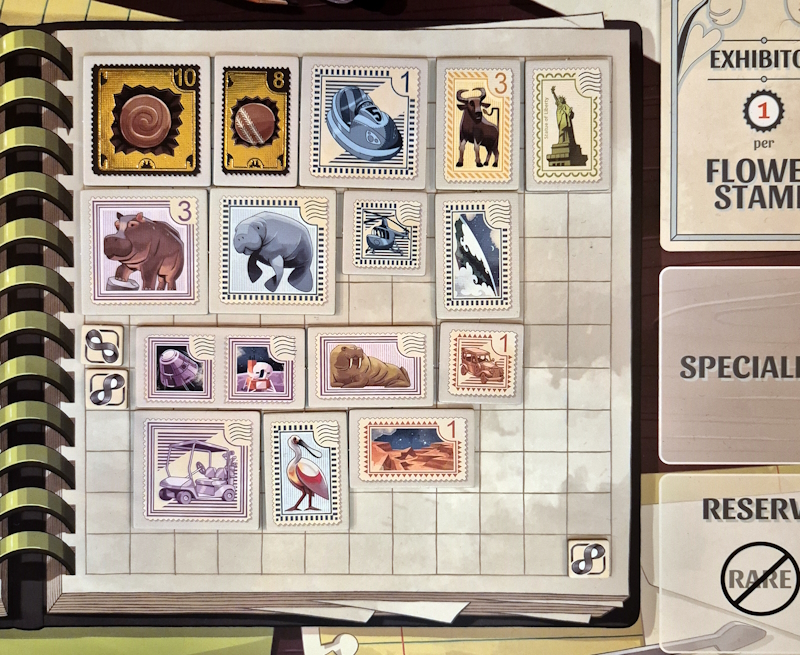
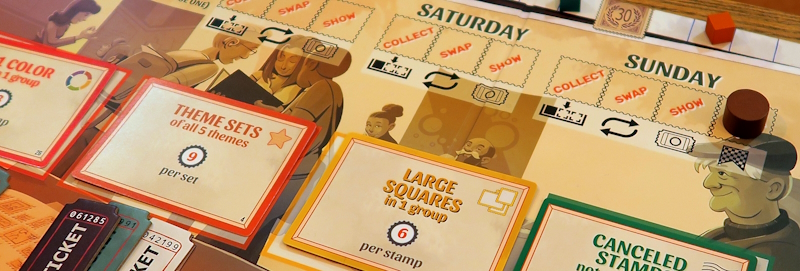
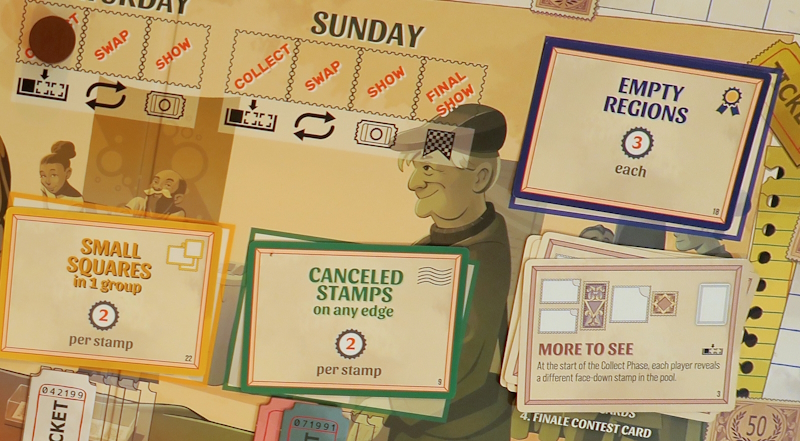
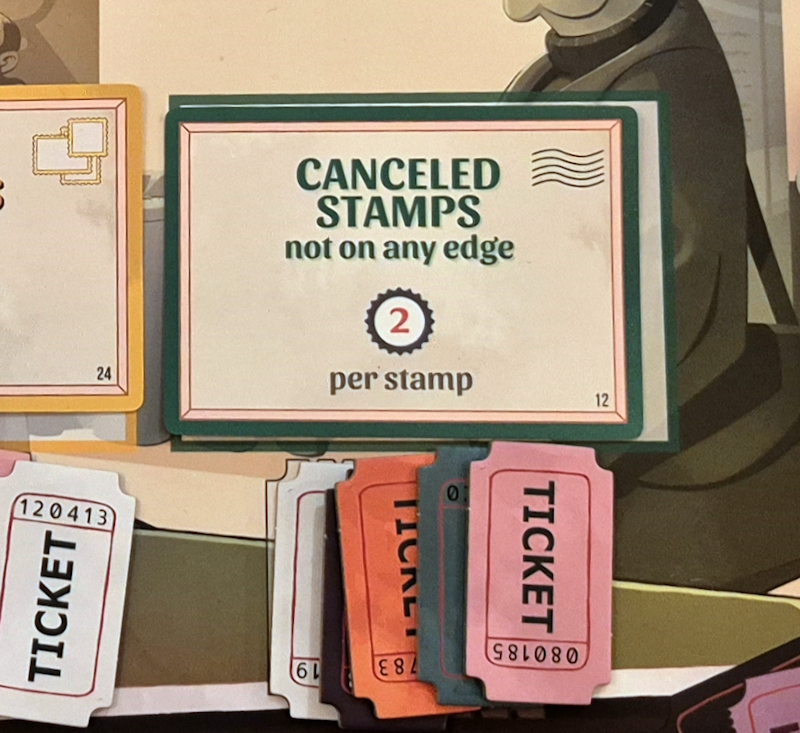
By the time Blue, Purple and Pine arrived, Cobalt was already half-way through a solo game of Isle of Cats: Explore & Draw, a “roll and write” version of the card-drafting, polyomino cat-tile-placing game, Isle of Cats.  In Explore & Draw, instead of drafting cards before choosing tiles, players choose a set of cards each turn and then draw their “discoveries” on their boats.  In this version of the game, players simultaneously choose a column from the Island (the central market) and action all three cards in it in order.  These could be three cards from the Cat deck, two Cat cards and one Lesson card, or two Lesson cards and card from the Cat deck.
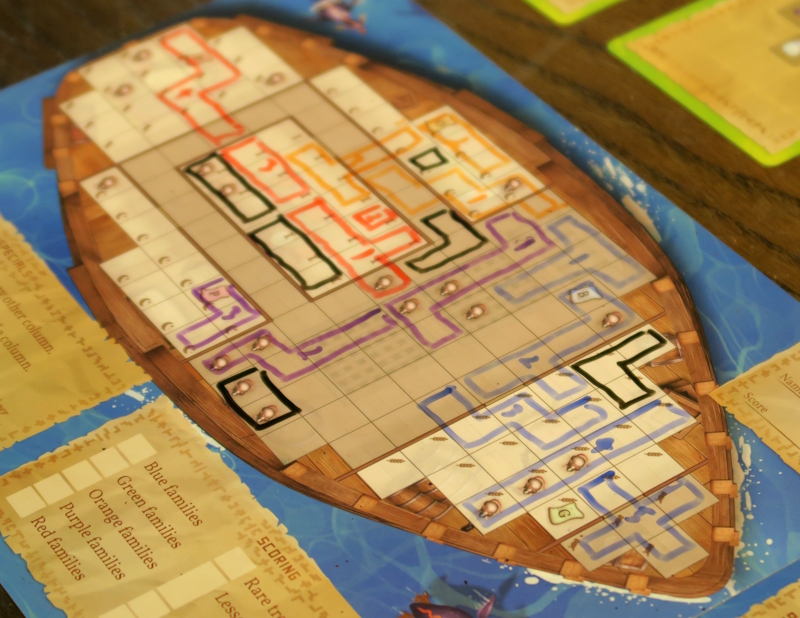
Isle of Cats: Explore & Draw
– Image by boardGOATS

Cat cards are polyomino cards, Lesson cards are scoring cards and special Oshax and Treasure cards can be found in both decks.  Cats, Oshax and Treasures are all drawn directly on the boat on the worksheet, while lessons are ticked off and scored at the end of the game.  In the solo game, Cobalt was playing against his “Sister” who reveals a Cat Colour and a Lesson, every round and at the end of the game scores for the different Colours in that order and then the Lessons in turn.  This time cobalt made mincemeat of the Automa beating it by seventy-one points to forty-three.

Isle of Cats: Explore & Draw
– Image by boardGOATS

With everyone arrived by this time, it was just the “simple” matter of deciding who was going to play what.  Blue started off leading the “Feature Game“, which was Kavango.  This is a card drafting game where players are building an animal reserve by collecting tags and adding animals to their tableau.  As such, it takes familiar elements from games like Sushi Go!, 7 Wonders, Wingspan, Meadow, Ark Nova and Terraforming Mars, but has a different feel to all of them.  In each round players draft and play ten cards (from an initial hand of twelve), that is to say they choose a card and pass the rest of the cards on to the next player.
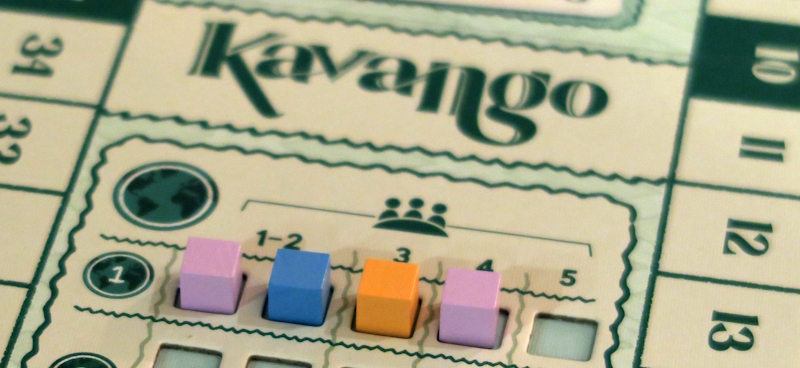
Kavango
– Image by boardGOATS

After each card has been chosen, it is added to the player’s tableau.  Then players have the option of claiming money for achieving Research Goals and/or spending money on Poaching, Habitat and Climate protections.  These are required for some of the animals especially the more interesting and lucrative ones.  The clever part about the game is the way the decks progress.  In the first round, the deck is mostly made up of Producers (Grassland, Trees, Invertebrates and Fish) and small animals while the second has mostly medium, but some small and some larger sized animals.  The third and final deck contains almost exclusively larger animals like Zebras, Lions, and Elephants.

Kavango
– Image by boardGOATS

This makes it harder to get Producers in the final round (though it is still possible by paying for Rewilding), but players can often just play cards directly as they already have prerequisites that they acquired earlier in the game.  Throughout, the rules and mechanisms are rooted in reality.  For example, players are responsible for their own Poaching and Habitat protections, but Climate protection is everyone’s concern and players have to work on that together.  Similarly, before a player can have a Puff Adder, for example, they have to have enough small mammals and birds to feed it.  Likewise, if a player wants a White Rhino or an Elephant, they need sufficient Grassland and/or Trees to support them.

Kavango
– Image by boardGOATS

Each round, there are four Research Goals, each with several levels.  The Goals can each only be claimed once, so players generally have the choice of claiming Goals early to get money they can spend straight away, or waiting and getting more money, which may delay progress.  These Research Goals also progress during the game, so early on, they tend to reward players with lots of Producers and Small Mammals etc., while later in the game they reward players with lots of Protections and bigger animals.  At the end of the game, players add bonus points for Biodiversity, Climate Protection and Habitat and Poaching Protection, to the points they got for each animal in their Reserve and the points they acquired during the game for achieving their Research Goals; the player with the most points is the winner.

Kavango
– Image by boardGOATS

Nobody had played the game before, but Indigo had done her homework and had watched the “how-to-play” video, and Blue had done a decent job of reading the rules for a change.  The fact that the rules all made sense helped too, and for the most part everyone had a reasonable handle on what they were trying to do. The first challenge was to try to get all four of the player boards on the table with the score-track/Research board and Climate in the middle.  The boards were so huge that it wasn’t actually possible, so the side of Indigo’s and Navy’s boards were hanging off the edge of the table, and Pines and Blue’s corners were all overlapping or had a flying free-hold.  Still, everyone could just about see what they needed to and could place the cards they had to, and it was all stable so long as nobody moved…
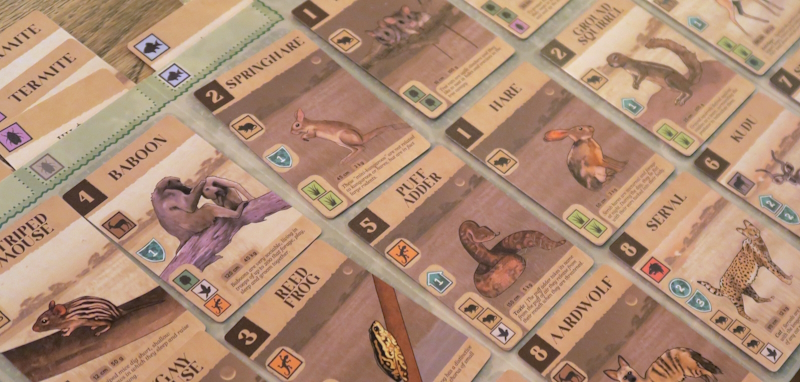
Kavango
– Image by boardGOATS

Pine (the Ecologist), started off really well adding a lot of Small Mammals to his Reserve and achieved early Research Goals as a result.  Early in the game, Indigo (the Investor) started contributing to Climate protection.  Navy (the Botanist) and then Blue (the Researcher) helped her out later in the game, though Pine never had enough money to contribute enough to gain the Climate Protection bonus.  Blue took an early lead in Research Goal points, but Navy soon caught up and by the end of the third round, he had an eight point lead with Indigo holding a three point lead from Pine.  That is only a very small proportion of the points available in the game.

Kavango
– Image by boardGOATS

The Lion’s share of the points come from the animals, including Lions, of course (which Navy had one of).  Pine really struggled in the latter part of the game since he had loads of Small Mammals, but not a lot else. His problems had begun in the second round when he struggled to generate any money as none of the Research Goals fitted after his highly effective first round.  Even so, he still got a over a hundred points for his menagerie and was one measly bird of prey short of getting the Biodiversity Award.  Indigo had a slightly more valuable Reserve, while Blue and Navy tied for the most animal points.

Kavango
– Image by boardGOATS

Indigo, Blue and Navy all picked up the bonus points for Climate Protection, Poacher/Habitat Protection and Biodiversity, which meant that Navy took victory by virtue of his eight point lead from the Research Goal points.  It had been a very enjoyable game though and there was much discussion as the group carefully dismantled the precariously balanced player boards.  Pine took an interest in the other animals in the deck, and there was much hilarity when he found the Sausage Tree—Google convinced him that it was not related to the infamous Spaghetti Tree, and was in fact real.  Nobody could convince him that the fruit wasn’t ideally suited to coaxing Trouser Snakes out of their lair’s though.
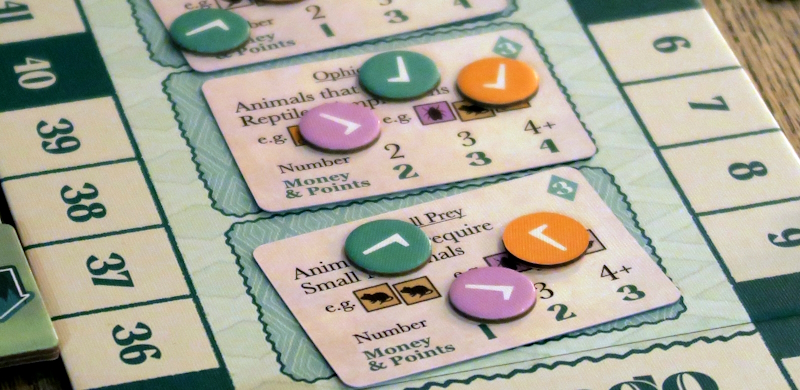
Kavango
– Image by boardGOATS

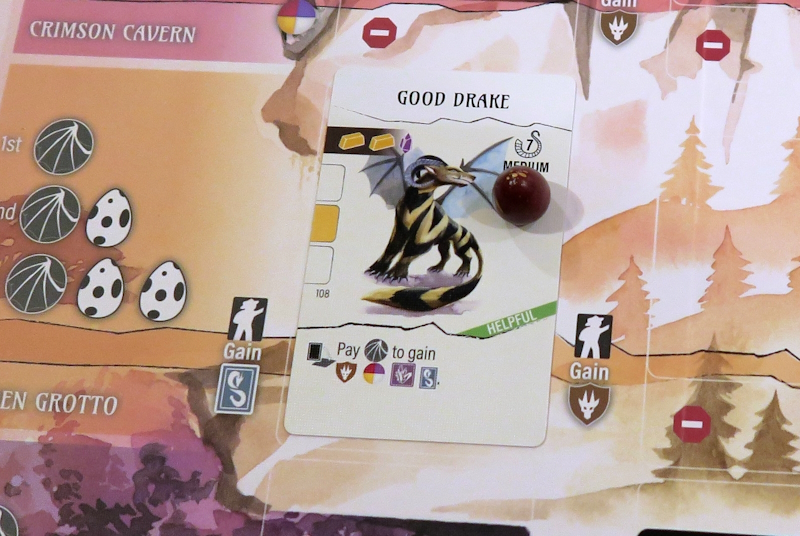
On the next table, Black and Pink were leading a rather ill-fated game of Wyrmspan.  This is a variant of Wingspan with Dragons instead of Birds.  So, like the original, players are playing cards from their hand onto a player board, and activating the habitats in turn. The differences are more than simply cosmetic, however. Firstly, before a Dragon card can be played, it is necessary to explore the cave it will be played in, which involves playing a card (and claiming a Bonus).  In Wingspan, if a player needs a resource, they activate their Woodland habitat and visit the Birdfeeder, claiming the resource they want and a couple of extras, whereas in Wyrmspan, players only get resources one at a time so they don’t have any extras.
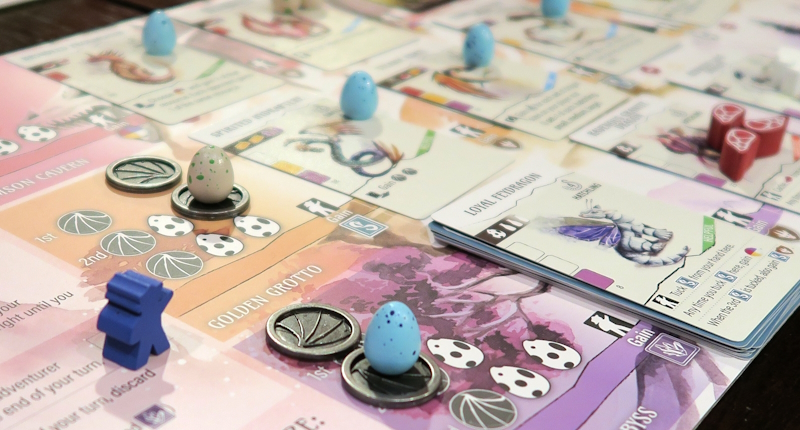
Wyrmspan
– Image by boardGOATS

This is critical as “Planting Dragons” requires a lot of Resources and can be difficult to do, so it is important that the Dragon planted is then exploited as much as possible.  Players also need to make the most of the new Dragon Guild.  A step around this Rondel typically gives a Resource as a reward, with a more valuable bonus half-way round and after a full circle.  The distribution of cards is different too:  in Wingspan, the majority of the cards have an effect when the terrain is activate, but in Wyrmspan, these are in the minority with most card effects happening when played or at the end of the round/game.  In Wyrmspan, the rounds are also different.

Wyrmspan
– Image by boardGOATS

Players get a set number of coins at the start of each and an action typically costs one coin.  Some cost more however, and occasionally players can pickup extra coins, which can lead to variable length rounds.  Thus, although Wyrmspan is very definitely Wingspan at its core there are lots of differences.  Blue suggested the group played it, as she had played it with Black and Pink a few months back and they had found it played easily given that they all knew how to play Wingspan.  Thinking Purple, Teal and Lime were also very familiar with Wingspan, Blue rashly assumed it would work, but she underestimated how different it was, how long it was since that last game, and how much longer the game would take with five.
Wyrmspan
– Image by boardGOATS

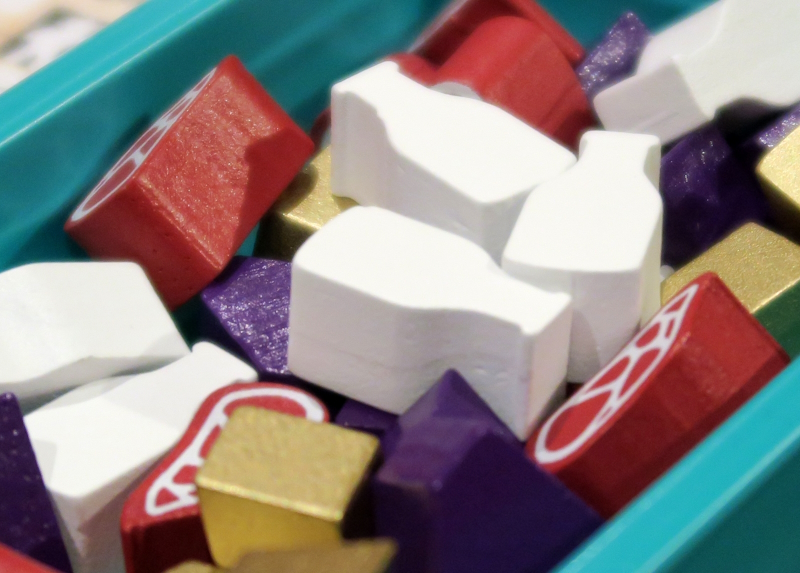
So, Black patiently explained the rules, while Pink tried to help others muddle through.  Teal focused on simply achieving the end of round goals and “planted” his Dragons accordingly while working on the top row of caves to generate resources—the equivalent of the “woodland”, which works for both Wingspan and for Wyrmspan.  After fighting through one round though, the group agreed to curtail the game after the second round.  In such a short game, the scoring was always going to be skewed, but ultimately the player with the most valuable Dragons, Pink, was the victor, with Teal taking second thanks to him taking the points for winning both the end of round goals.
Wyrmspan
– Image by boardGOATS

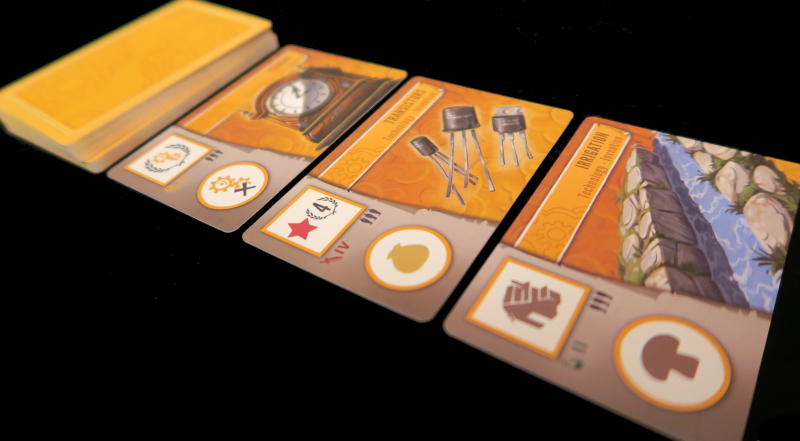
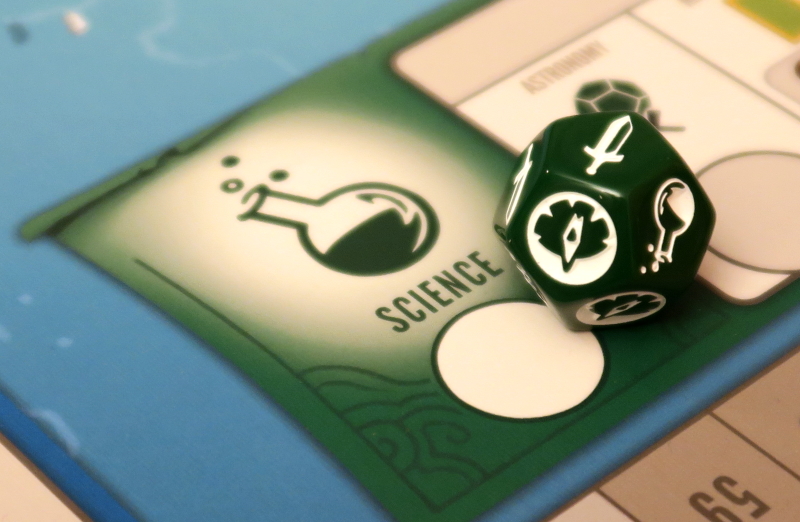
Across the other side of the room, the final game was Tapestry, with the Plans and Ploys expansion.  On the surface, Tapestry has simple mechanisms, but they combine to make a complex game.  On their turn, players move one step along one of the four Civilisation tracks around the board: Science, Exploration, Military, Technology and carry out the action (or actions) associated with it.  Each space requires payment of resources, and the further along the track, the more expensive the spaces become.  If a player cannot afford to pay (or chooses not to), then they instead take income, which gives them more resources.  They also gain points and play a tapestry card, which usually provides a power for the next round.

Tapestry
– Image by boardGOATS

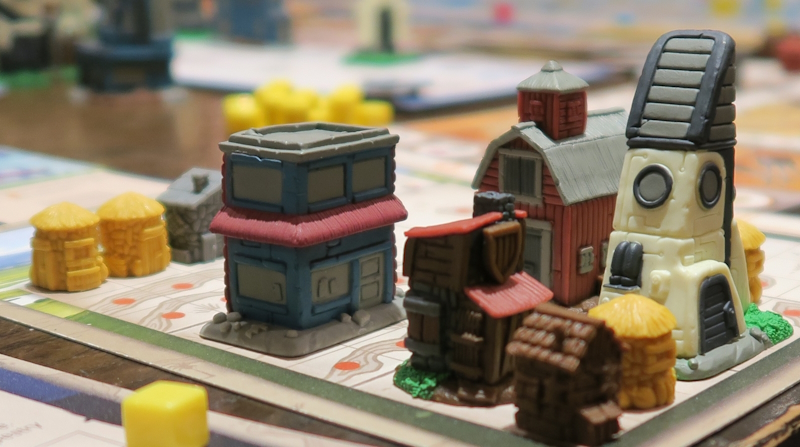
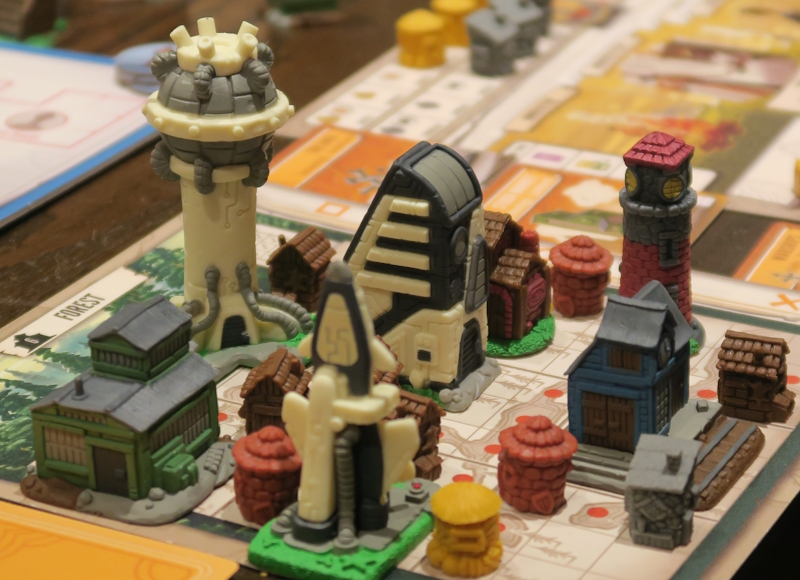
So, at its heart, Tapestry is an engine building and resource management game:  players carry out actions and get resources so they can get more resources and ultimately, points.  The Plans and Ploys expansion mostly just adds more of the same with new Civilisations, Tapestry Cards and space tiles.  The biggest difference is the addition of Landmark Cards which are designed to give each player a personal short-term goal in the first part of the game, in the form of buildings that only they can claim. Everyone was familiar with the game, so the rules explanation was minimal.  Byzantium started (Spies/Grassland) and there was an initial general rush towards the Technology track,
Tapestry
– Image by boardGOATS

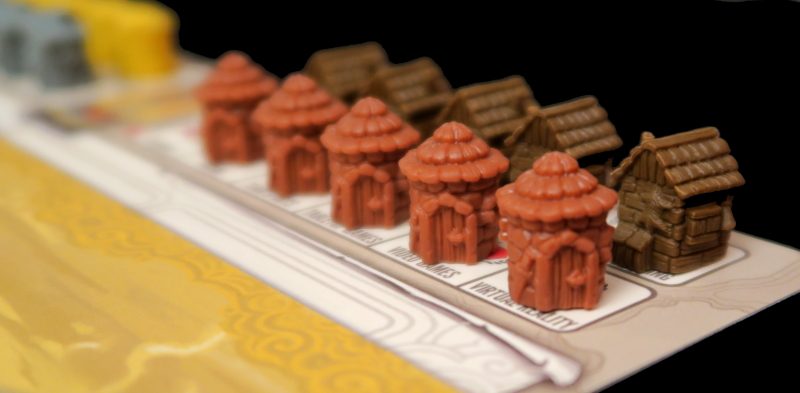
Ivory (Islanders/Forest), always one for doing something different, instead went in for Exploration as this linked in with his Civilization.  As the first round went on, Byzantium and Cobalt (Aliens/Tropical) stuck to Technology, whereas Plum (Riverfolk/Wetland) diversified slightly into Science and Exploration. Her primary plan was to exploit her Civilisation and then try to get to six island hexes to trigger her personal bonus Landmark.  Byzantium was first to move to the Income phase, closely followed by Plum and then Cobalt. Ominously, Ivory did what he usually did and managed to stretch my first era out, putting himself in a good position to grab the first Exploration Landmark and also making progress on Military.
Tapestry
– Image by boardGOATS

Byzantium went for Technocracy as his first Tapestry card, sticking with his technology theme. He also managed to grab the first Technology Landmark and completed his Architecture card (appropriately the Game Shop). Plum also went for a Tapestry card, Terraforming, that linked her with her strategy, giving her five points for building on impassable plots, something her Riverfolk Civilization wanted her to do and gave her additional resources of.  Although her alternative Civilisation had looked more interesting, it involved knowing what other people’s options were so she had chosen the simpler Riverfolk and made good use of it.  She was also still fairly diverse in her track focus. Cobalt went for Socialism, to keep pace with Byzantium on the Technology track.

Tapestry: Plans and Ploys
– Image by boardGOATS

Cobalt also gained Landmarks from his Technology cards, helping him build his Skyscraper Architecture card. Having only taken his Income whilst everyone else was half way through their second Era, Ivory could see Cobalt was focusing on Technology, so he used the State Marriage Tapestry card to gain befits on this track whenever Cobalt did.  Having the Military track to himself and a good head start on Exploration, Ivory managed to grab a couple of Landmarks quite quickly. Everyone was also getting Income from buildings on their mats too.  Again, Byzantium Plum and Cobalt all moved into their third Era in quick succession, leaving Ivory half way through his second Era.
Tapestry
– Image by boardGOATS

Cobalt managed to grab the third Era Technology Landmark, but he struggled to fit it on his Capital board and it had to overhang.  At this point, Plum used the Dictator Tapestry Card (with associated comments from Byzantium) to move up the Technology track while restricting everyone else’s progress on the same track for one turn.  Byzantium had been  plotting a move as he was next in line for a Landmark, but Plum’s Dictatorial behaviour only slightly delayed him getting it. This, plus the State Marriage benefited Ivory and competition with Byzantium meant Cobalt used the Militarism Tapestry card to switch his focus to Exploration and Military.

Tapestry: Plans and Ploys
– Image by boardGOATS

Although Cobalt had changed tack to avoid competition with Byzantium, Ivory had a health head-start on both of these tracks, grabbing the Landmarks as he went and also conquering the centre island just before Cobalt could.  To add insult to injury, when Cobalt tried to conquer the island and topple Ivory, he was ready with a Trap card, foiling his plan. Cobalt quickly got revenge paying Ivory back in kind when he tried to do the same thing to one of his territories. However, that wasn’t going to discourage Ivory, and with the Military track encouraging him to conquer, he got the final word in, conquering one of Cobalt’s territories and gaining a double topple bonus.
Tapestry: Plans and Ploys
– Image by boardGOATS

Moving into the final era, again, Ivory was characteristically some way behind everyone else. Byzantium picked up extra resources from the “Age of Wonder” and used these to good effect being the first to reach the end of a track.  Plum, hosted the Olympic Games with her final Tapestry card (and presumably moved to Paris to do so).  This gave her ten points in exchange for a Worker Resource, and additionally a bonus building if any other player took up the offer of doing the same.  Byzantium was the only one who did, as Cobalt wasn’t able to and Ivory had other plans.

Tapestry: Plans and Ploys
– Image by boardGOATS

Cobalt and Plum were both still fairly diverse in their track focus, although Plum had made good progress on the Science track, which was mostly ignored by everyone else.  Byzantium also switched focus to some of the other tracks now he had completed the Technology track. Ivory stuck to Military and Exploration, completing the former (although there was not enough time to gain the second Civilization).  He was sorely tempted by one of his favourite strategies, sending his Meeples into Space by completing the Exploration track, but instead, Ivory switched focus to the other tracks to get as many income buildings in his Capital as possible to maximize the final scoring.
Tapestry: Plans and Ploys
– Image by boardGOATS

Again, everyone finished in quick succession except Ivory, who, as usual, had about five or six turns to go after everyone else had finished.  Plum started with an additional thirty-five points at the beginning of the game thanks to her Riverfolk which gave her points for each territory in her City that had at least two unpassable spaces, but everyone caught up throughout the game. In the end, in Ivory’s final Income round scored him well over fifty points, overtaking everyone and winning and giving him victory.  It had been a good game, enjoyed by all, and although he’d won Ivory hadn’t given everyone as much of a trouncing as he had in the past.  Cobalt felt that the advantages of going first were not mitigated for those going last, so maybe next time that could be used as a slight handicap for Ivory.

Tapestry
– Image by boardGOATS

Learning Outcome:  Animal games are a lot of fun—And that’s not Lion!
Next Meeting, 3rd September 2024

Our next meeting will be on Tuesday 3rd September 2024.  As usual, we will start playing shorter games from 7.30pm as people arrive, until 8pm when we will start something a little longer.  The pub is doing food, and the table is booked from 6.30pm for those that would like to eat first.

This week, the “Feature Game” will be Kavango (rules, review, how to play video, rules summary video), which is a card drafting game where players are building an animal reserve by collecting tags and adding animals to their tableau.  As such, it takes element from games like Sushi Go!, 7 Wonders, Wingspan, Meadow, Ark Nova and Terraforming Mars, but has a different feel to all of them.

Kavango
– Image from kickstarter.com

And speaking of animals…

On a recent holiday to Africa Jeff went on a wildlife safari. It was fantastic seeing all the animals in their natural habitat, until he found the biggest elephant he’d ever seen lying dead on the ground. Sitting on top of the elephant was a pygmy.

Shocked, Jeff exclaimed, “That’s the biggest elephant I’ve ever seen!”

“Yes, I’ve just killed it,” answered the Pygmy.

Jeff was curious, and asked, “How on earth did someone of your size kill a beast like that?”

The Pygmy replied, “I killed it with my club.”

Jeff was astounded. “Wow, how big is your club?”

“Well,” said the Pygmy, “There’s over two hundred of us now…”

20th August 2024

Cobalt was first to arrive.  Pink and Blue weren’t far behind though, and had just ordered their supper when Indigo and her son Navy arrived followed by Jade and Sapphire, then Ivory, Purple, Black, Pine and Teal.  While the others chatted and got drinks, Cobalt began teaching Indigo and Navy Akropolis.  This is a quick little game where each player is building their own acropolis. On their turn, players first take a tile the market. The first tile in the market display is always free, the one after costs one stone (the only resource in the game) the next one two stone and so on.  The tiles comprise three conjoined hexes each either a Quarry (which provide Stone when built over), a Plaza, or a District tile.

Akropolis
– Image by boardGOATS

Plazas and District tiles are in different colours, representing Houses, Markets, Barracks, Temples and Gardens.  Tiles are freely added to the player’s display, either on the base layer or on top of other tiles, so long as any Districts meet the their conditions and as long as there is a matching Plaza present.  At the end of the game, players score for the largest District of each type—each visible hex scores a point for the level it is on (one point for the base layer, two for the first floor etc) multiplied by the number stars shown on the Plazas they have visible.  The game is a sort of cross between Taluva and Cascadia, taking the conjoined triple-hex tiles and layered stacking from Taluva and the tile-placement and individual tableau from Cascadia.

Akropolis
– Image by boardGOATS

The game was quite tight between Cobalt and Navy, but Navy had the edge, winning his first game in the group with a hundred and eighteen points to Cobalt’s hundred and five.  As the game came to an end, the rest of the group began trying to work out who was going to play what.  In the end, there were two groups setting up to play the “Feature Game” which was Ticket to Ride: Rails & Sails.  This is a variant of the popular train game, Ticket to Ride, but with a considerable step up in complexity. In the original game, players take it in turns to carry out one of three actions:  take train cards, pay train cards to claim Routes on the map by placing train pieces, or take Tickets.  Points are scored for claiming Routes and for successfully connecting the two places shown on their Tickets with negative points scored for failing to complete Tickets.

Ticket to Ride: Rails & Sails
– Image by boardGOATS

In Rails & Sails, however, players build two connected networks, one on land and one on sea covering the whole globe.  Players build these with two separate sets of train cards, giving them two hands to manage, making it a more complex version of the game.  In addition to the usual four possible actions, on their turn, players can also build a Harbour into a city that they have already claimed a route into. To do this, players spend two Train cards and two Ship cards that are all the same color and all have Harbour symbols on them.  At the end of the game, players gain points for each Ticket that lists their Harbour, with players scoring for each Harbour when more than one features on their Ticket.

Ticket to Ride: Rails & Sails
– Image by boardGOATS

Another thing that adds to the complexity is the tension between Ships and Trains:  at the start of the game, players have a set total number of Ship and Train pieces, and choose choose how many of each they will have.  During the game, instead of a normal turn, they can exchange Ship pieces for Trains or vice versa, but at a cost of one point per piece swapped.  There are two different maps in the game, one covering the Great Lakes, and the other covering the whole World—the total number of Ships/Trains players have depends on which of these is used.  This time, both groups used the World map.  In addition to these major rules changes, there are also a couple of minor tweaks.

Ticket to Ride: Rails & Sails
– Image by boardGOATS

For example, there are Double cards in the Ship deck, which allow players to place up to two Ships per card.  There are also Tour Tickets, which feature more than two destinations—these will score a higher number of points if the locations are connected in the right order (and of course, will score negatively if one of the destinations in not connected at all).  On the World map, there are Pair Routes too.  These require the player to place two train cards of the same colour per space, but the whole Route doesn’t have to be the same colour.  There are the usual Double Routes as well, which come into play with four or five players, and multi-colour “Wild” cards which can be used as either Ship or Train cards of any colour.

Ticket to Ride: Rails & Sails
– Image by boardGOATS

Jade, Ivory, Sapphire and Pine made up the first group.  In their game, Jade and Ivory started by focusing on Trains while Pine and Sapphire began with Ships giving them both taking an early lead with Ships generally giving more points. Sapphire went to the front and stayed there for the majority of the game.  There was an initial scrabble in Asia/south east Asia as well as along the east coast of north and central America, and apart from some early commitments from Pine and Sapphire in the latter, in general there was no major “blocking” and everyone at least tried to play nicely.  That said, by the end of the game the board was very congested, perhaps due to the wrap around nature where Routes could fall off one side and come back on on the other.

Ticket to Ride: Rails & Sails
– Image by boardGOATS

Ivory was the first to take more Tickets and it was some time before Jade joined him.  Ivory went for Tickets considerably more times than anyone else and by the end of the game, he had significantly more completed Tickets than anyone else, though his were of lower value.  Pine in particular started with much more ambitious Tickets and happily declared that he had finished his first ticket about half through the game.  That was until Jade pointed out a potential gap in his track which Pine then hurried to fill.  Sapphire was following a similar strategy to Pine with bigger, higher risk Tickets and also focused on long Routes (hence his throughout the game).  It looked like he was going to trigger the end the game, but in the end, that was Pine.

Ticket to Ride: Rails & Sails
– Image by boardGOATS

Jade and Ivory both had shorter scoring Routes, but with more Tickets, predominantly located in Asia, whereas Sapphire and Pine were mapping the rest of the World.  Everyone except Ivory had to take advantage of the Ships/Trains swap and although this cost points and a turn it didn’t feel like it had a large impact on the game.  Both Jade and Ivory had cards at the end allowing for a late grab of high scoring Shipping lanes, but the game ended a little early for Sapphire.  That said, everyone completed all their tickets, including a very complex and high scoring Tour Ticket.  Pine and Sapphire eschewed Harbours, while Jade built just one.  Ivory, on the other hand, went built all three in the south east, despite the fact they were challenging to place.

Ticket to Ride: Rails & Sails
– Image by boardGOATS

After placing the Ships/Trains and scoring the Tickets, the scores were fairly even, but those extra Harbours really made a difference.  Sapphire and Pine took a twelve point penalty for not having any while Jade picked up twelve (an eight point penalty for not using two and twenty points for having one Ticket ending in his Harbour.  Ivory, however, scored a massive ninety points from his, with each of his three Harbours having two of his Tickets finishing in them.  This ultimately give him a total of two hundred and seventy-five eighty-five more than Pine who took second place. On reflection, there was a minor rules malfunction—when the group recounted the Route scoring, they failed to take account of the penalties for swapping Ships for Trains, but this was only a handful of points and wouldn’t have affected the final standings.

Ticket to Ride: Rails & Sails
– Image by boardGOATS

The game on the next table was not as highly scoring, but there was still quite a large spread in the scores.  While Black reacquainted himself with the rules, the others chatted and counted pieces, eventually they got going though.  Pink started in Australia because he liked it there when he visited almost exactly a year ago.  Then, he traveled north to east Asia, visiting exotic places like Bancock, Jakarta, Hong Kong and Tokyo, before crossing the Pacific to Winnipeg.  As the game came to a close, he also traversed the south Pacific to Valparaiso and took the southern coastal route to Rio de Janeiro.  Black also more or less circumnavigated the globe traveling from the UK, east across Europe to Tehran then on to Mumbai.

Ticket to Ride: Rails & Sails
– Image by boardGOATS

From there, he crossed the Pacific to Lima from where he traveled north, around the top of South America also making it to Rio before crossing the  Atlantic to Cape Town.  Part of the reason for Black and Pink choice of Routed (aside from their Tickets of course) was the fact that Teal was monopolising the Atlantic crossings, making it no fewer than five times!  From his Atlantic ports, he spread into North America and across Africa to Dar es Salaam.  Purple in contrast, focused her efforts on a single extended trip across the USA, found one of the few Routes across the north Atlantic not taken by Teal, journeyed across Europe following Black through Iran to the far East.

Ticket to Ride: Rails & Sails
– Image by boardGOATS

There was an unfortunate “Rules malfunction” when it came to scoring Harbours, which would have had quite a large impact on the game, but as everyone played by the same rules, it was at least fair.  Instead of scoring for each Ticket into each Harbour, they simply scored ten points for their first Harbour, twenty for the second and so on.  With this scoring, Pink, with his eight completed Tickets was the victor with two hundred and five points, fifteen points ahead of Teal in second and Black in third.  Both groups had really enjoyed the longer and bigger challenge of Rails & Sails.  The mix of boat and train cards did cause more grumbling than usual about the wrong colours being available, especially when there was an imbalance in favour of trains over boats or vice versa, but that’s just Ticket to Ride.

Ticket to Ride: Rails & Sails
– Image by boardGOATS

Meanwhile, the remaining group of four, Cobalt, Indigo, Navy and Blue, should really have been playing Azul (!), but after some dithering, Cobalt encouraged them to try The Artemis Project.  This is a game where players are trying to develop colonies on Europa.  The idea is that players roll dice and place them on action spaces to carry out actions.  There are seven Regions and players take it in turns to place their dice in them.  They are: Basecamp, Vents, Quarry, Gantry, Doorstep and Outfitter. At Basecamp, players go on Expedition to earn Expedition Badges and other Rewards. These are a bit like the Quests in the game Lancaster, and like the Squires in that game, dice can be augmented by Colonists.

The Artemis Project
– Image by boardGOATS

Also similarly, Expeditions are unsuccessful if a certain number of pips isn’t reached, which leaves players without their desired Rewards. In such cases, players don’t come away with nothing, instead they move their Token along the Relief Track and pick up a lesser reward.  However, there is a fixed number of spaces available along the Relief Track for each person, so when they are gone, they are gone.  The Vents and the Quarry provide players with Energy and Minerals respectively.  The level of the action depends on the value of the dice, however, the dice are activated from the lowest to the highest.  So, for example, placing a high value die like a six, will yield six Minerals, but if there are only ten available and two other players place fives, these will be activated first leaving nothing.

The Artemis Project
– Image by boardGOATS

The Gantry provides Buildings, which provide players with long term benefits during the game and points towards the end of the game.  Players bid for these and if they win, they must pay the bid amount in Minerals (the value of dice placed), to build them.  Both the Doorstep and the Academy deal with Colonists.  The Doorstep provides players with Colonists, but like the Vents and the Quarry, players who bid high, go last and may not get what they want (or even anything) while the Academy allows players to upgrade their Colonists if required.  Finally, the Outfitter allows players to gain Toolkits which grease the wheels a little by allowing players to alter the values of their dice.  Once all the dice have been placed, these different Regions are activated in order.

The Artemis Project
– Image by boardGOATS

Thus, for example, Minerals collected can be used later in the same round to build Buildings, however, it is wise not to rely on that as another player can play a lower value die, easily scuppering plans.  In this way, the game can be quite aggressive with intentional and unintentional conflict when players get in each other’s way.  It is played over six rounds marked by Event cards associated with the Regions which are resolved before the relevant Region is activated.  At the end of the game, it is a bit of a “point salad” in that players score for left-over Energy and Minerals, for Fully Staffed Buildings, for the number of Buildings, for each complete set of four different Colonists, for any Colonists not part of a set, for Expedition Badges and for having the most unused Toolkits.

The Artemis Project
– Image by boardGOATS

Indigo clearly found the number of Regions a little bit bewildering and was keen to learn by playing, but The Artemis Project is not really a game that lends itself to that.  Indeed, in spite of understanding what each Region does, there is still an element of learning by playing in order to see how things fit together.  As the only one who had played it before, Cobalt stole a march by targeting the Basecamp early and grabbing one of the Expeditions, and because nobody joined him, taking both Rewards.  Navy opted for the sensible choice and went for Buildings in order to get an engine going.  Blue and Indigo weren’t so quick off the mark and took a little longer to work out how to put a strategy together.

The Artemis Project
– Image by boardGOATS

As the game progressed, Indigo became the Queen of the Resources gathering piles and pales, making god use of the multiplier tokens.  Blue made her way up the Relief Track after rolling some higher numbers and not using them well.  This was a problem made worse by Cobalt trying to muscle in on one of her Expeditions leaving her to walk away with nothing, leaving him with nothing too.  As the game came to a close, Navy had more buildings than anyone else and, as Blue and Cobalt both made a bit of a mess of things, he sailed gracefully into the lead finishing with sixty-eight points, while Blue just pipped Cobalt to second place.

The Artemis Project
– Image by boardGOATS

Learning Outcome:  Who needs Planes when you have Ships and Trains?

Next Meeting, 20th August 2024

Our next meeting will be on Tuesday 20th August 2024.  As usual, we will start playing shorter games from 7.30pm as people arrive, until 8pm when we will start something a little longer.  The pub is doing food, and the table is booked from 6.30pm for those that would like to eat first.

This week, the “Feature Game” will be Ticket to Ride: Rails & Sails which is a variant of the popular train game, where players build  two connected networks, one on land and one on sea covering the whole globe.  Players build these with two separate sets of cards, making it a more complex version of the game.  Other, less complex versions will also be available, as well as a variety of other games.

Ticket to Ride: Rails & Sails
– Image by BGG contributor Phreekshow1,
adapted by boardGOATS

And speaking of global travel…

Jeff called his travel agent with a question about the documents he needed for his up-coming flight to China. After a lengthy discussion about passports, the travel agent politely reminded Jeff that he needed a visa.

“Oh no I don’t,” replied Jeff, “I’ve been to China many times and never had to have one of those.”

The travel agent I double checked and sure enough, the stay required a visa. When the this was explained, Jeff answered, “Look, I’ve been to China four times and every time they have accepted American Express.”

6th August 2024

Blue and Pink were just finishing their supper when Pine arrived, soon followed by the rest of the posse.  Despite missing Ivory, Teal and Cobalt, we still made it into double figures and everyone was particularly pleased to welcome back Green who has been missing in action for most of the year.  Jade had declared an interest in giving the France map for Ticket to Ride a go.  Ticket to Ride is always popular, so he quickly gathered Sapphire, Pine, Lime and Pink to make an enthusiastic group of five.  He explained the rules differences, to comments of, “Lizen very carefully, I shall say zis only once!”

Ticket to Ride Map Collection: Volume 6 – France & Old West
– Image by boardGOATS

Ticket to Ride is well known in the group and the basic rules needed no explanation (take cards from the market, or use them to claim routes while trying to complete Tickets).  All the maps have their own little unique tweak to the rules.  In the case of the France map, most of the tracks on the board start “uncoloured”.   Whenever anyone draws cards, they take a colored tile that’s two to five train cars long, and place it onto an uncoloured track bed.  After that, any player can claim that route in the usual way (by paying the appropriately coloured cards from their hand).

Ticket to Ride Map Collection: Volume 6 – France & Old West
– Image by boardGOATS

Although anyone can claim a route “coloured” by another player, this time, in practice, most people didn’t build on tracks placed by others.  This was partly because messing with someone else’s plans is usually at the expense of your own, but also because of the “mutually assured destruction” effect—that is to say, interfering with someone else is likely to encourage them to do the same in return.  So on the one occasion when Pine DID “steal” a route that Sapphire had set up, everyone (especially Sapphire) was really shocked! Pine and Sapphire both picked up tickets in the very closing stages of the game and both got very lucky with the tickets matching the routes they had already built.

Ticket to Ride Map Collection: Volume 6 – France & Old West
– Image by boardGOATS

The game was quite close and relatively high scoring, with all five finishing in a twenty point range, but that was before bonuses.  With the France map, there are two bonuses:  ten points for the longest continuous route and fifteen points for the player with the most completed tickets.  With seven, Pine had the most tickets and leap-frogged Jade and Pink (who was playing with his pink “Cancer Awareness” train set), into third place.  That left Lime and Sapphire, but with Sapphire taking the longest route bonus, he finished with a hundred and twenty-nine points, extending his lead over Lime to fifteen points to give him a comfortable victory.  It had been a really enjoyable game, however, so much so that Jade and Sapphire added it the France map to their wish list.

Ticket to Ride Map Collection: Volume 6 – France & Old West
– Image by boardGOATS

At the other end of the table, that left Blue, Plum, Green, Byzantium, Purple and Black.  Nobody seemed keen to play the “Feature Game” (which was to be Montmartre), partly because that would have required splitting into two groups.  Instead, inspired by the Olympics, the group opted for the Heptathlon variant of Reiner Knizia’s Decathlon.  Decathlon is a print-and-play game consisting of a series of ten different, mostly push-your-luck, dice games loosely themed around the ten sports featuring in the Olympic event.  The Heptathlon Variant is slightly shorter and is based on the women’s equivalent.

Reiner Knizia's Decathlon (Heptathlon Variant)
– Image by boardGOATS

Normally both variations are played with a maximum of four, but this time, the group played the “Championship Variant” where players play together and the winner of an event scores three points, the runner up gets two points and the person placing third gets one point.  The rules say that tied players get the better rank, but the group used count-back to break ties in the first instance.  Blue had brought an enormous pile of printouts and Las Vegas, from which the group got the dice, and started, slightly tentatively with the 100 m Hurdles.  In this game, players have two sets of three dice and throw one until they are happy then throw the other with a total of seven tries.  The catch is that each “one” that is re-rolled scores minus one.

Reiner Knizia's Decathlon (Heptathlon Variant)
– Image by boardGOATS

Green went first and achieved a total of twenty-three.  By the time he had finished though, everyone had got bored watching someone else roll dice and had got on with their own.  It was then that the group realised that, as the 100 m Hurdles was a race, rolling simultaneously was more in keeping with the theme.  Blue crossed the line first (with twenty eight) followed by Byzantium and then Green.  And it was on to the High Jump, a much simpler game where players rolled five dice together to achieve an ever increasing total (with three attempts at each height).  Purple was the first out, failing to achieve eighteen, followed by Blue at the next height.

Reiner Knizia's Decathlon (Heptathlon Variant)
– Image by boardGOATS

The “springiest” was Plum, who sailed over twenty-two, but failed at twenty-four.  She actually tied with Green, but beat him on count-back, with Byzantium taking third.  Next was the Shot Put, where players roll eight dice, one at a time, with a one being a fault.  Players can stick whenever the like, but because of a rules malfunction, the group only played with a maximum of six dice.  The best score after three attempts was again Plum with Black in second and Blue in third.  From here the games got a bit more complex, starting with the 200 m Sprint, which was played with eight dice rolled in a group of four dice, followed by two rolls of two.  Players have a total of eight throws and sixes count negatively.

Reiner Knizia's Decathlon (Heptathlon Variant)
– Image by boardGOATS

Plum tripped over her own feet (or maybe Byzantium tied her laces together), but Green demonstrated a remarkable turn of speed to cross the line first, followed by Blue and then Purple.  More than half-way through, it was a three-way tie between Blue, Green and Plum and others not far behind.  So, the second day started with the Long Jump, a five dice game played in two parts.  First there was the run-up, which dictates how many dice the player gets to use for the actual jump.  For the run-up, players roll all five, freeze at least one and roll the rest, but if the total exceeds eight, it is a foot-fault.  Then, for the jump itself, players use the frozen dice and roll all of them, again freezing at least one per throw.

Reiner Knizia's Decathlon (Heptathlon Variant)
– Image by boardGOATS

The best total after three attempted jumps was Byzantium’s twenty-seven.  Green’s turn of speed obviously helped him as he came second while Blue and Plum tied for third, but Plum took the honours thanks to her second longest jump.  Staying in the field, the next and penultimate event was the Javelin.  This six dice game involved players freezing at least one die per turn, but this time only odd dice could be kept.  Green’s first throw threatened to skewer one of the stewards, and things didn’t get much better from there.  Black faulted on his first throw, but was consistent with his second and third taking third with twenty-two.

Reiner Knizia's Decathlon (Heptathlon Variant)
– Image by boardGOATS

First and second went to Purple and Byzantium (respectively), with both failing to improve on an excellent first attempt.  So, going into the final event, the 800 m Race, most people were going for Gold, while everyone was in with a chance of a medal.  This race was an eight dice game with players rolling two dice, then two dice and then the four remaining dice one at a time.  Players have a total of eleven rolls (i.e. just five re-rolls) and the player with the highest total wins, but with the catch that sixes count negatively.  It was a tight race, but Blue crossed the line first which put her in gold medal position, just until Green crossed the line in second and overtook her.  Purple took third, but for her it was too little, too late.

Reiner Knizia's Decathlon (Heptathlon Variant)
– Image by boardGOATS

So, stood on top of the final podium with his gold medal round his neck, Blue with silver and Byzantium who took bronze just ahead of Plum and then Purple, stood either side.  It had been a lot of fun though, and as people often say, it is the journey that counts.  The games have a bit of a feel of Ganz Schön Clever/Doppelt So Clever/Clever Hoch Drei, but sort of stripped back to their raw essence.  The individual events were quite simple and with a sheet each, players could keep their own score and recheck the rules as required.  The questions, “Do I stick or keep going, what have other people done, and do I need to gamble to win?” in a large group add interest, and everyone enjoyed it so much that there was no difficulty getting people to take home the left-over sheets.

Reiner Knizia's Decathlon (Heptathlon Variant)
– Image by boardGOATS

From there, the group of six split into two groups of three and everyone moved from athletics themed games to Paris themed games.  With the best will in the world, there wasn’t time to play Paris, so Blue promised to bring it again another time, and they opted instead to stick with “Roll and Write” type games in the form of Next Station: Paris.  This is the latest variant on Next Station: London, a simple little route planning game with a really clever twist.  The idea is that each station has one of five symbols; a card is turned over depicting one of these symbols and players must extend their route by connecting one end to a station with this symbol without crossing an existing track and following the grid shown on the map.

Next Station: Paris
– Image by boardGOATS

At the end of each round, players score for the number of Districts visited multiplied by the number of Stations in the most visited District.  At the end of the round players get bonus points for Interchange Stations (where two or more lines meet).  However, like the Ticket to Ride maps, each each city comes with a slight variation to the rules as well as a different arrangement of stations.  In London, players score points for crossing the Thames and for the total number of Visitor Attractions visited during the game.  In Paris, these are replaced with scores for visiting Parisian Monuments at the end of each round and using the level crossings marked on the map.

Next Station: Paris
– Image by boardGOATS

The clever part of the game is the fact it is played over four rounds, but each round is played with a different coloured pencil with players swapping pencils between rounds.  This means that while everyone gets the same cards in the same order, they start in different places so are forced to do different things (unlike for example, NMBR 9, where players often play the first few rounds the same).  The Paris version is supposed to be easier than the London variant, but as nobody had played it before, everyone struggled at the start.  The trick though, is, for each line, players need to try to get the same number of Districts as Stations in the most visited District.

Next Station: Paris
– Image by boardGOATS

This is similar to the mechanism in Orléans, where players receive victory points equal to their position on the Development Track multiplied by the number of Trading Stations they have on the map plus the number of Citizen Tiles they have collected.  In both cases, players want these numbers to be as large as possible to give the biggest total.  It is more important that both are significant, however, rather than having one large and one small.  For example, a two times three gives more than one times four, thus it is important to concentrate on both parts equally and not neglect either one of them.

Next Station: Paris
– Image by boardGOATS

Although nobody had played a “Next Station” game before, Blue explained the rules and had got her head round this element of the scoring, where it took the others a little time to get to grips with it. The game suited Plum’s puzzle brain and she liked trying to see where she might get to the level crossings and so on. By the third line, both she and Byzantium were beginning to get the hang of thing (or perhaps the cards just came out better) and then for the final round everyone found their space was more restricted.  It was very close, but Blue’s consistency throughout just gave her the edge and victory by a mere five points.

Next Station: Paris
– Image by boardGOATS

Meanwhile, Green, Black and Purple opted for a quick game of the Paris version of Ticket to Ride.  This is the newest of the smaller, city versions of the game, and one that had not been played within the group hitherto.  In general, these play exactly the same way as the bigger ones, but have fewer pieces and shorter tracks (so play a lot quicker) and have a little rules tweak to keep people interested.  There had been a little bit of chat about it as people arrived and Blue, who had only read the rules was quite scathing about the new rule which felt very bolted on, and as there are now several of these little games, there were comments about the sound of barrels being scraped.

Ticket To Ride: Paris
– Image by boardGOATS

The new rule is that when players claim a red, white, or blue track, they get a card, when they get all three colours they get four “Tricolore” bonus points—this didn’t feel terribly imaginative.  After the game, however, Green commented that it was much better than it sounded.  After he had completed his starting Tickets, he realised they only gave low points, so rather than taking more, he opted to go for Tricolore bonus points instead as the red, white and blue Routes are all short making them easy to get (one, two and one carriage long respectively).  Simpler to achieve than extra Tickets they give an extra four points, though Green only got a total of two Tricolores.

Ticket To Ride: Paris
– Image by boardGOATS

Black and Purple only took one Tricolore each as they were using it as a bonus rather than a target, so missed out on a few opportunities by laying trains on a colour they already had a card for.  In the dying moments of the game, Purple took Tickets—of course she had no way of knowing that Green was about to trigger the final round, but even Black commented that it was a brave move.  And Green ended the game on his very next turn, leaving poor Purple with a couple of uncompleted Tickets.  That extra four point Tricolore bonus Green had taken made all the difference in the final scoring as that was the margin of his victory over Black.

Ticket To Ride: Paris
– Image by boardGOATS

As Green went home (along with Jade, Sapphire, Byzantium and Plum), they passed the copy of Ticket to Ride: Paris along the table to Lime, Pine and Pink who also fancied giving it a go.  They concurred that the Tricolore Bonus was much better in practice than it sounded.  This game was also quite tight with six points between the first and last.  Lime was particularly peeved however, as Pink edged him out by a single point.  With that, and some residual chatter, it was time for home and everyone slowly drifted off.

Ticket To Ride: Paris
– Image by boardGOATS

Learning Outcome:  When you take away the sport, you still have France.

Mike and the Perseid Meteor Shower

High pressure tends to give clear skies which makes it great for star gazing, and especially for spotting Perseid Meteors.  These are small objects, in this case from the tail of the Swift-Tuttle Comet that appear as shooting stars.  They are called Perseids because they come from the general direction of the Perseus Constellation and appear annually, in July/August.

Perseid Meteor Shower
– Image by Flickr user slworking2,
adapted by boardGOATS

However, for some of us, the appearance of the Perseids will always be associated with the much missed, Mike Parker (aka Burgundy), after we spent too long standing in the pub car park after one games night, getting a crick in the neck.  Mike was taken from us much too soon; later this month would have been his sixty-sixth birthday.  This year, the peak of the Perseid Meteor Shower is expected to be from the evening of the 11th August to the morning of 14th August, so tonight, just after midnight should be a good time to find a dark spot and watch.  And for those of use who remember him, to think of Mike.

Mike Parker
– Image by Pushpendra Rishi

Goats in the News: Banksy

Everyone loves a goat, even, it would seem, Banksy, the street artist.  Last week, he stenciled a goat perched on a buttress in Kew Green, Richmond, a work he claimed using his Instagram account.  This has since been followed by several more works in and around London.  Banksy has been known to produce a series of pieces over the summer before, in particular his “Great British Spraycation” in 2021 when he decorated Norfolk and Suffolk.  His art usually has a message and is always controversial with some saying it is brilliant while others think it is mindless vandalism.   There has been a lot of discussion about the meaning of the Goat and the significance of the CCTV camera, but Banksy, of course, has kept his opinions on it himself, and will no doubt continue to do so.

Banksy's Goat
– Image from instagram.com,
adapted by boardGOATS

Next Meeting, 6th August 2024

Our next meeting will be on Tuesday 6th August 2024.  As usual, we will start playing shorter games from 7.30pm as people arrive, until 8pm when we will start something a little longer.  The pub is doing food, and the table is booked from 6.30pm for those that would like to eat first.

This week, to mark the Olympics in Paris, we will be playing sport and Parisian-themed games. The “Feature Game” will be Montmartre which is a tactical game of numbers, where players take on the role of a painter and you’ll let their muse inspire them to become a famous artist!  Montmartre is a fairly quick game (rules, review, “How to Play” video), so there should be plenty of time to play other French and Parisian themed games, like Ticket to Ride: Paris, Next Station: Paris, or even Paris, or some sport themed games like Reiner Knizia’s Decathlon/Heptathlon, 6-Tage Rennen, Um Reifenbreite or Flamme Rouge.

Montmartre
– Image by boardGOATS

And speaking of Olympics…

Jeff and his mate Joe had volunteered as “Games Makers” for the Olympics in Paris 2024 and had been assigned help out at the athletics. They’d had a great day, and although they’d been marshals, they’d been delighted to be able to watch Keely Hodgekinson win the 800 m for Team GB.

As the session ended, all the spectators left, but once they were gone, Joe felt quite suddenly overcome and commented, “I don’t know why it is so hot in the stadium after the events are over.”

Jeff replied, “That’s because all the fans have left…”

23rd July 2024

Blue and Pink were still eating when everyone else rolled in and seemed quite content to chat.  It took Blue two attempts to get the first game rolling, with Jade leading Cobalt, Crimson and Plum to the other side of the room.  Pink moved to join Pine who wanted to play his new acquisition with Black and Purple, which left Blue and Lime to lead Byzantium, Sapphire and Cyan in the “Feature Game“, the Alpine expansion for Forest Shuffle.  This is was chosen to mark the announcement of the Spiel des Jahres Awards, as Forest Shuffle, featured on the recommended list and has been popular with the group.

Forest Shuffle
– Image by boardGOATS

Blue made a bit of a meal of explaining the rules, but really they are very simple.  On their turn, players either take two cards from the market and add them to their hand (with a hand limit of ten), or play a card from their hand into their tableau.  There are three different types of cards.  Tree cards are the central cards around which Critter cards are played.  Then there is the first set of Critter cards which are divided into two, left and right with an animal on each half.  Finally, there are Critter cards which are divided into two, the canopy at the top and the undergrowth at the bottom.  The Critter cards are half-tucked under the Tree cards, so only one animal, flora or fauna is visible.

Forest Shuffle
– Image by boardGOATS

The difficult part of the game is getting the cards to work together efficiently to give extra actions and, ultimately, points.  The Alpine expansion doesn’t change the game significantly, just adding more variety to the cards, adding more opportunities for scoring.  For example, it adds an extra Butterfly which give players more points if they have a complete the set.  This time, Blue started with a hand full or Hares, making her initial strategy obvious.  Sapphire was less fortunate, so Blue and Lime suggested that starting with Trees was always a good way to go as players can’t do anything without them.  He also had some Butterflies, so that was where he went next.

Forest Shuffle: Alpine Expansion
– Image by boardGOATS

Lime built up a collection of Birds, and since he advertised his strategy to the group, everyone else was able to take cards he wanted.  This is a key part of the game:  some cards give points for the number of something you have, so having more of both multiplies the score.  For example, Hares give one point for every Hare a player has.  Thus, one Hare gives one point, but Blue’s seven Hares mean that first Hare scored seven points.  More to the point, every other Hare also scored seven points giving her forty-nine points just for her Hares.  Meanwhile, Byzantium was going Bats, and Cyan was experimenting with Deer.

Forest Shuffle: Alpine Expansion
– Image by boardGOATS

The game ends when the third Winter card is drawn from the deck, so after the second, everyone got very nervy as they tried to complete all their plans and play all the cards they wanted to.  Each time someone drew a card from the deck, it was with bated breath.  The final stage seemed to last forever, and although the third Winter card wasn’t the last card in the deck, it was close, and when it was drawn the game ended immediately. And then it was time for the scores:  everyone assumed that Blue’s husk of Hares would give her victory, but it was actually quite much closer than they thought.  Although Blue finished with a hundred and sixty-five, Byzantium was only twenty points behind.

Forest Shuffle: Alpine Expansion
– Image by boardGOATS

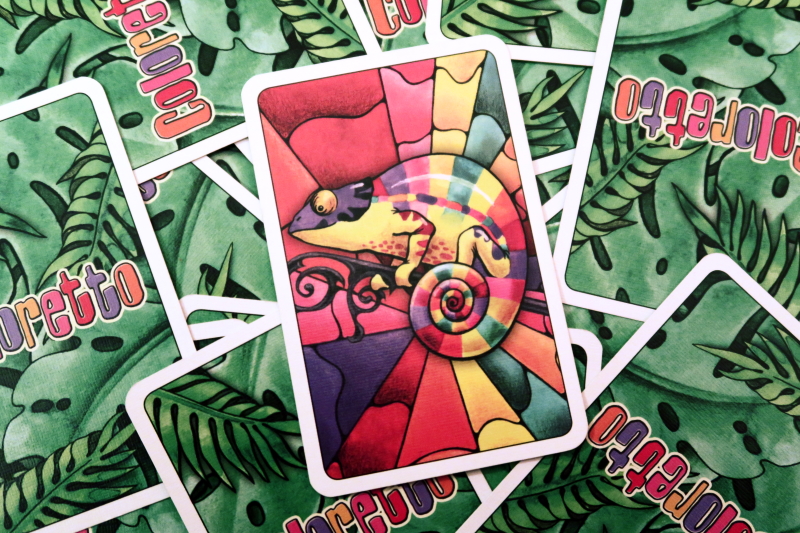
Byzantium was ready to leave, but for everyone else there was just time for something really quick.  So as everyone else was still playing, the remaining four decided on a quick game of Coloretto.  This is an old game, but one that was on the Spiel des Jahres Award “Recommended List” in 2003.  Remarkably, Cyan and Sapphire were new to it, but it is a super easy and quick game to play, but with tactical decisions to make.  It is also one that can essentially be taught as you go:  either turn over the top Chameleon card and add it to one of the Trucks, or take one Truck.  Each Truck can contain a maximum of three Chameleons and once everyone has taken a Truck, the round ends.

Coloretto
– Image by boardGOATS

At the end of the game, players score each group of coloured Chameleons, with the largest three groups giving positive points and any others scoring negatively.  There are a small number of cards that just give straight points and balancing these with Chameleons is part of the challenge.  The end is triggered when the end of game card is drawn and then the round is played to completion.  This time, everyone kept their negative scores down, while Cyan went for the pure point cards, collecting fourteen points, more than half his score, by that route.  The winner was Lime, however, who was imperious and won by some distance with a total of thirty-three.

Coloretto
– Image by boardGOATS

Meanwhile, on the next table Jade was teaching Cobalt, Crimson and Plum the Spiel des Jahres 2024 nominee, In the Footsteps of Darwin.  The premise of this is that players are naturalists aboard the Beagle helping Charles Darwin finish his book On the Origin of Species, studying animals, carrying out cartographic surveys, publishing their findings, and developing theories. On their turn, players study an animal or take inspiration from a character by choosing one of the three tiles in the row or column marked by the Beagle, and placing it onto their naturalist’s Notebook. This may be an animal to study or a character from the Beagle’s previous journey and will give an immediate bonus or a scoring bonuses.

In the Footsteps of Darwin
– Image by boardGOATS

After placing the tile, the Beagle is moved round the market, with the distance dependent on the tile chosen and a new tile is drawn to fill the empty space on the journey board.  At the end of the game, the player who contributed the most to On the Origin of Species wins.  At it’s heart, In the Footsteps of Darwin is a fairly simple set collection and “make the most of what’s available” game. Players obtain an additional scoring objective when they place a tile on top of a previous one, covering up any icons, so a key part of the game is the conflict between points being gained verses points being lost.

In the Footsteps of Darwin
– Image by boardGOATS

There’s also quite a bit of luck invoiced, as a player may need one or two specific tiles that don’t come out, or that get taken by someone else before they have the opportunity to do so.  The group found it was very quick to play, taking just forty minutes including teaching.  Plum’s  starting goal was points for tiles in the upper right quadrant, but in the absence of tiles that fitted that criteria she focused instead on collecting Charts and Compasses as these score points equal to the number of these multiplied together.

In the Footsteps of Darwin
– Image by boardGOATS

One advantage of these is that once a Compass has been collected, the tile can be covered without loosing any points. Cobalt didn’t worry about that at all, covering loads of tiles to get more Theories banners which give points.  Ultimately, everyone’s score was pretty similar at the end of the first game but Jade took victory as he was most effective with the Chart/Compass scoring.  As it was so quick, the group decided to give it a second try—this the scores all improved.  This time the victor was Crimson, who was again the most effective with the Charts/Compasses, but also scored well in other areas, as did Cobalt who came second again.

In the Footsteps of Darwin
– Image by boardGOATS

From there, the group moved on to a game of Looot, which is too recent a release to have been acknowledged in the Spiel des Jahres awards.  It has been popular amongst the members of the group that have played it so far, however, and may well get an award next year.  In this game, players gain points by gathering resources and capturing buildings to try to develop their Fjord, fill their long ships and complete buildings. The winner is the player with the most riches and is crowned Jarl of the Vikings. The game is played over several rounds until each player has played all their Vikings, giving a maximum of thirteen turns, each with a simple structure.

Looot
– Image by boardGOATS

Players start by placing their Viking on a Resource tile on the central board adjacent to another Viking of any colour.  They then take the associated Resource and place it on their personal board.  If possible, they then use their Resources to capture a Building and place that on their board, take a Long Ship and also place it on their board, use a Shield, or complete a Construction Site and finally grab a Trophy.  Looot is quite a light game, but with enough decision space to be interesting.  Last time was a three-player game, but this time, with four, players get another map area, which the group arranged to give a wide play area.

Looot
– Image by boardGOATS

The board layout made it easier to get to more areas of the map relatively early in the game, but there was still plenty of competition for the Towers.  Like last time, Plum decided not to worry about all the home tiles and focused on gold, which was good, but not enough on its own.  Cobalt scored massively for Castles by getting plenty of them plus the equivalent Long Boats.  Cobalt started on that strategy largely by accident, before he had got a real understanding of game-play and a full appreciation of how they increased the Castle scoring and matched the requirements he could fulfill.

Looot
– Image by boardGOATS

Crimson had a nice balance of increased score for Towers and Houses, while Jade built up a huge pile of Wood.  Unlike last time, things didn’t just come together at the end for Plum, and nobody else could compete with Cobalt’s Castles and he took victory with one hundred and twenty-one, fourteen points ahead of Crimson in second.  It had been a good game though, and as players become more experienced, they will be increasingly able to determine the best scoring opportunity from the start and how to optimise the mini game that is building their Fjord. With experienced players, this could be quite ruthless with players trying to block each other and prevent objectives.

Looot
– Image by boardGOATS

In the third group, meanwhile, Pine was introducing his new acquisition, the old game, Tonga Bonga, to Pink, Black and Purple.  This is a sailing race game a bit like the 2008 Spiel des Jahres recommended Jamaica.  In Tonga Bonga, players pilot their ship around the archipelago with the goal of visiting four of the five remote islands and returning to Tonga Bonga Bay.  Each player has room for three sailors on their ship, each of which represented by dice and indicate how fat the ship will move.  At the start of the round, players decide how much they are prepared to pay for the sailors who will serve as their captain and first mate that round (the Cabin Boy always works for nothing).

Tonga Bonga
– Image by boardGOATS

Players then simultaneously roll their dice, and take it in turns assign their dice to the other players’ ships, in return for the money offered.  In a mechanism vaguely reminiscent of that in the really rather vicious game, Vanuatu, if a player tries to place a higher value die where someone has already assigned a die, the lower value one is displaced and bumped to a lesser and usually less lucrative role.  Thus, all things being equal, the ship offering the most money will get the highest value dice and the most moves, though of course, players can work together to disrupt this behaviour. One side of each die has a Seasick Sailor (effectively zero), so the maximum value dice are five.

Tonga Bonga
– Image by boardGOATS

Once all the dice have been assigned, players move their ships racing to reach the islands, leaving one of their tokens there.  Landing on an island, earns $25 from the bank, but the player has to pay $5 to each player who landed there ahead of them.  Pine explained the rules and before long, everyone was sailing.  Pink got a bit of a lead by using his winnings to buy more moves and visit more islands.  He had been feeling that the game was maybe a bit “broken”, but as is usually the case when a game feels like that, it was all down to the “rules malfunction”, but it wasn’t until the final round that the rules were “clarified”.

Tonga Bonga
– Image by boardGOATS

Instead of the winner being the player to cross the line first with any left over money used as a tie-breaker, once a player has visited four islands they return to Tonga Bonga Bay and trigger the game end—and whoever has the most money wins.  Pink crossed the line and claimed the moral victory, as he was playing by the original rules.  Everyone else was quite happy with the “updated rules” though, which left Pine the victor with Purple in second and Black just behind.  Pink blamed “Evil Pine” for the mishap, but was eventually won round with a bottle of dubiously flavoured cider.

Tonga Bonga
– Image by boardGOATS

Although the debate had been audible by the players at the neighbouring tables, ultimately it was all taken in good part and the game had been a lot of fun and showed its age less than Lifeboats that was played a few weeks back and was only five years older.  From there though, the group moved on to a game of the 2021 Spiel des Jahres winner, Kingdomino.  This is a clever little game where players are building a kingdom made out of double-headed, domino-like tiles.  As in Dominoes, the ends of the tiles have to match, or at least it has to match with one tile tile already in the player’s kingdom.

Kingdomino
– Image by boardGOATS

The really clever part of the game is the double market, where the tiles are taken in reverse order of value.  The double market means that when a player takes the tile for the current round, they choose which tile they will get in the next round.  Thus, taking the lowest value tile this round means they will have first choice next round.  Players score for each contiguous area of Terrain—the number of points is equal to the number of squares multiplied by the number of Crowns featuring in it.  This time, Pink concentrated on Wheat Fields and Sea, Pine focused on Sea and Meadow while Black concentrated on Woodland with a smattering of points from Marsh, Mountain and Wheat fields.

Kingdomino
– Image by boardGOATS

In contrast, Purple prioritised her four contiguous areas forfeiting the “Harmony” and “Middle Kingdom” bonus points for using all the tiles to give a square kingdom with a central castle.  Pine took victory with a massive seventy-three with Pink and Black tying for second with sixty points.  This group wasn’t done by any means and swiftly moved on to a quick game of Sushi Go!.  This is one of those games that takes a mechanism that is a relatively minor part of other games and distills it into its purest form in the game.  Coloretto does the same for the central market mechanism used in the 2007 Spiel des Jahres winner, Zooloretto, and Sushi Go! does it for the card drafting mechanism in the 2011 Kennerspiel des Jahres winning game, 7 Wonders.

Sushi Go!
– Image by boardGOATS

In Sushi Go!, players start with a hand of cards, keep one and pass the rest on, repeating until all the cards have been distributed.  As well as being a core mechanism in 7 Wonders, this “Card Drafting” is also often used to try to reduce the luck of the draw at the start of games like Terraforming Mars and Agricola (both also acknowledged by the Spiel des Jahres committee).  In Sushi Go!, players are using the card drafting to collect sushi and, most importantly Pudding!  The game is played over three rounds, with cards drafted to the left, then right and then left again, scoring points at the end of each round.

Sushi Go!
– Image by boardGOATS

This time, Pink and Black tied for the high-scoring first round, with Pine just behind.  Pine made up for it on the second round by taking it convincingly, however, with everyone else scoring very badly.  The third round was more even again, this time won by Black with Purple taking second.  That resulted in a three-way tie between Black, Pink and Pine, but at the end of the game, the player with the most Pudding cards gains six points, with the one with the fewest losing six points.  Unusually for Pink (as he has quite a sweet tooth), he had eschewed Puddings, while Black had the most giving him what ended up being a quite convincing victory.

Sushi Go!
– Image by boardGOATS

There was just time for a single round of Love Letter (a game from the 2014 Spiel des Jahres recommended list).  This is a sixteen card game where players start with a card, draw a second and then play one.  The idea is to try to be the last play in or the player with the highest value card when the deck runs out.  The theme is all about getting as close as possible to the Princess card, which has the highest value.  This led to a discussion about real princesses and how close people had been to them.  It turns out that Purple has met a real one, Princess Nina who lives in a massive house in Cheltenham.  During the game, Pink was the Princess, but was spotted and knocked out, leaving Black to take another win.

Love Letter
– Image by boardGOATS

Learning Outcome:  The Spiel des Jahres committee may reward lighter games, but they are good games.

Boardgames in the News: Monopoly Takes Over in Leeds

Monopoly was developed from The Landlord’s Game in 1933 and launched in the USA in 1935.  It was introduced to the UK in the following year when Norman Watson (the then Managing Director of John Waddington Ltd playing card division) played a game at his home in Horsforth, Leeds. That led to Waddingtons being granted a licence to manufacture the game, which it did from its factory on Wakefield Road, Hunslet, Leeds. To mark this connection to the city, “Monopoly Leeds Takeover“, a city-wide version of the iconic board game started this weekend, organised by “Welcome to Leeds“.

Monopoly
– Image of unknown origin

According to their website, “Monopoly Leeds Takeover” is “a free, family friendly immersive experience brings the best-selling property trading game to life, using key locations and landmarks as the gameboard with life-size tokens, clues and puzzles.”  In addition to the game, there will be various Monopoly/Waddingtons-related exhibitions, board-game-design workshops for kids, and a blue plaque will be placed on the former home of Norman Watson to mark the location of that first game of Monopoly in the UK.

Monopoly Leeds Takeover
– Image from monopolyleeds.com

The events, will be running from 27th July until 1st September and details of the Monopoly Leeds Takeover Game are available online.