Tag Archives: 6 Nimmt!

28th June 2016

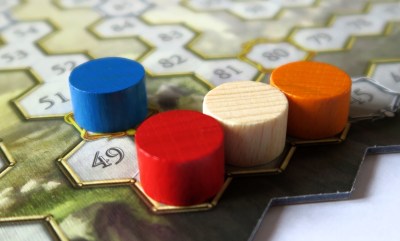
Blue and Red arrived first, so once they had ordered food, they settled down to a quick game of Mijnlieff (pronounced “Mine-Leaf”).  This is basically Noughts and Crosses or Tic-Tac-Toe with a bit of added strategy and some beautiful wooden pieces.  We’ve played it a couple of times before on a Tuesday, but as it is an independently produced game (by Hopwood Games), it is difficult to get hold of and Blue had taken the chance to pick up a copy at Expo.  The aim of the game is to form lines of three or four, but the different types of pieces force your opponent to control where you can play.  For example, when a Greek cross (or “+” symbol) is played, the next player must place their piece on an empty square in an orthogonal line from the piece just played.  Similarly, playing a saltire (or “×” symbol) forces the next player to place their piece in a diagonal line from the piece just played.

Mijnlieff
– Image used with permission of BGG contributor thepackrat

Unfortunately, Blue forgot to mention that if there was nowhere a player could go, they were forced to pass giving their opponent a free move, so when this arose, Red cried “foul” and Blue offered to concede the game.  It didn’t really matter much anyhow as Burgundy had arrived and so had food, so everyone’s attention was drawn elsewhere.  As other people arrived, we moved on to the inevitable post-Brexit referendum discussion:  the group consists of several continental European Union gamers (Denmark, Poland and Ireland), so we have a natural pro-Europe stance.  Consequently, the group as a whole has been pretty horrified at occurrences of the last week, and its long term consequences (not least of which is the increase in the cost of games!).  Before we depressed ourselves too much, however, we decided to play something to take our mind off it.  Since we were unsure of who was coming and with Pine wanting an early night, we decided to begin with something short, and with two possible games it seemed appropriate to have a quick referendum on the subject…  Saboteur went the way of the “Remain” campaign and lost by a tiny margin as we decided to turn the evening on its head and begin with 6 Nimmt! a game which we often finish and one that is guaranteed to cheer us all up.

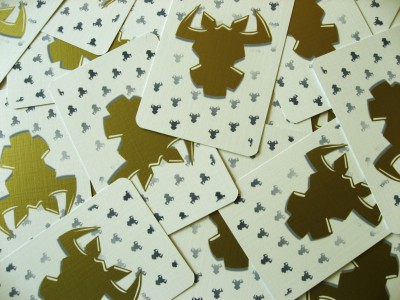
6 Nimmt!
– Image by boardGOATS

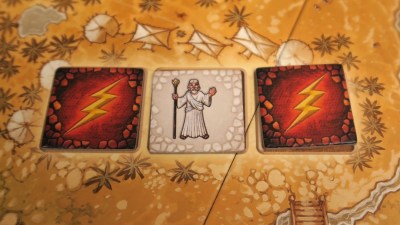
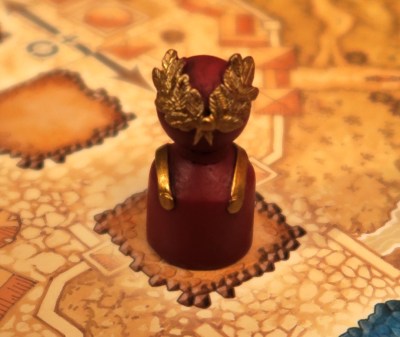
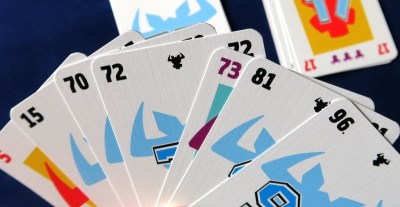
The game lived up its usual standard of chaotic fun, with Burgundy, Black, Pine and Green vying to collect as many high cards as possible.  After our usual two rounds, Purple finished with eight, but Blue took it with just six nimmts, all garnered in the first round.  With the fun over, it was on to the serious game and Pine left as he was “cream-crackered”.  The rest of us split into two groups for our “Feature Game”, Concordia, a strategic game of economic development in Roman times.  The game takes at least half an hour per person and with set-up and teaching, it was always going to take most of the rest of the evening.  Played on a beautiful map, Concordia is a game of resource production and exploration.  Notable cities which are connected via land and shipping routes, each produce one resource (indicated by tokens placed on the map allowing for variable set-up).  Each player begins with a hand of Character cards and six colonists and a handful of resources. Everyone begins the game with the same set of cards; on their turn, the active player chooses a card to play, and then carries out the associated action.

Concordia
– Image used with permission of BGG contributor Space Trucker

These cards allow players to move colonists and build settlements, trigger production for all settlements in a given region, introduce more colonists etc., however one of the cards enables players to buy extra cards from the market (a face up display).  The cards are played into a personal discard pile where they remain until the player plays their Tribune card to get all their cards back. Each player also has a warehouse of a fixed size which will hold a maximum of only twelve items, which at the start of the game includes four of their six colonists (two ships and two “Elvis-meeples”).  So, managing resources and finances is one of the key parts of the game and it is essential that players have the right resources when they need them as there isn’t space to store excess.  Another “pinch-point” is the cards; players can only play each card once before picking them all up.  They also get income when they play their Tribune card to recover their cards, but as it is dependent on the number of cards they pick up, it is in the player’s interest to play as many cards as possible before collecting them all again – this also needs planning.

Concordia
– Image used with permission of BGG contributor Space Trucker

The most difficult part of the game is the scoring, however, which is tied up in the Character cards.  In addition to a name and an action, each card is dedicated to a Roman God.  Each God rewards the card’s owner with victory points at the end of the game.  For example, Mars delivers points for colonists placed on the board.  Each Character dedicated to Mars gives two points per colonist, so a player with all six colonists on the board at the end of the game and five Characters devoted to Mars will score thirty points.  Thus, since the cards are effectively multipliers, in general, the strategy is to try to excel in one area rather than try to do a little bit of everything, but that is something that is definitely easier said than done.

Concordia
– Image by boardGOATS

With two copies of the game available and everyone keen to play it, we decided to split into two groups, both playing Concordia and both adding the Salsa expansion.  This is “Salsa” as in “Salt” rather than the Spanish “Sauce” or the Latin dance, so in addition to the standard resources of brick, wheat, tools, wine and cloth, we also had salt.  Salt is “wild”, so can be used as anything and adds some peculiarities to the scoring, but otherwise doesn’t make a huge difference to the game.  Both groups also chose to use the new Hispania board which includes the Iberia peninsula as well as the North Africa and Italian coast.  The biggest change to the base game, however, was the introduction of the Forum and associated Forum tiles.  These tiles come in two flavours, blue, which are perpetual, and green, which offer an instant, one-off reward.  Each player can choose one from a starting hand of two at the beginning of the game, but otherwise, these are taken when players play the Tribune card.  Since players have a larger choice of available cards if they are picking up more cards, and these Forum tiles can be quite powerful, this is another driver towards efficient use of Character cards.

Concordia: Salsa
– Image by boardGOATS

Burgundy, Blue and Red  got going first.  Burgundy chose the Claudius Pompeius Forum tile (which gave him an extra opportunity to sell whenever he was playing the Prefect card); Blue chose Gaius Mercellus (who yielded an extra sestertii for every item she sold), and Red kept Titus Valerius (who enabled her to exchange any other commodity for salt when she played her Tribune card).  Burgundy went first and moved one of his colonists inland north-east settling in a brick producing city.  The close proximity of the two nearest brick sources meant that this made it very difficult for anyone else to get into brick production.  Consequently, when Blue went next, she headed north-east into Gallia, where there was wine and cloth to be had, and eventually brick, though that would take a few turns.  This left Red to head towards the sun in the south of Spain.

Concordia
– Image used with permission of BGG contributor henk.rolleman

Blue started out with lots of cash, but no idea what to do with it, on the other hand, Burgundy knew exactly what he wanted to do but couldn’t find the money to do it.  Red and Blue were relatively unfamiliar with the game so opted for the scatter-gun approach, while Burgundy was picking up as many cards as he could.  Before long Red and Blue got away from the congestion of the Iberian peninsula, with Red taking over North Africa and Blue spreading to Corsica and Sardinia and across to the Amalfi Coast.  This race to place settlements eventually dried up when Red found more fun activating Africa to pick up lots of goods.  Since one of the end game triggers is a player running out of “houses”, Blue had to decide whether to end the game early by placing her last few “houses” or whether to try to push forward on other frontiers.  Something told her that she was too far behind in collecting cards, so she decided to take a break from building and try to maximise points elsewhere, starting by buying as many cards as she could and then getting all her colonists onto the board.

Concordia: Salsa
– Image by boardGOATS

With only a couple of cards left in the market, Blue placed her final houses and triggered the end of the game.  As suggested in the rules, we went through each of the Gods in turn, though with Burgundy’s enormous pile of cards, it all looked like it was going to be more a measure of how much he was going to win by.  As we added together the totals, every time Blue picked up points, Burgundy took more and Red languished at the back.  Before long, Burgundy had what appeared to be an insurmountable lead.  When Mercurius was scored Blue’s large number of settlements began to tell, and with a lot of Character cards devoted to Mars and all six colonists on the board, Blue finally took the lead.  With only Minerva to  go, Blue looked to have taken it, then we all realised how many Specialist cards Red had.  With all her high scoring Specialist cards and a lot of settlements in high value production cities (inc. lots of Salt which counted for each of them) it looked like she would take it the lead.  In that final scoring phase Red picked up a massive thirty-nine points, but sadly it wasn’t quite enough, and with Blue taking the extra seven points for placing all her settlements, she was the clear winner, though there was just four points between second and third place.

Concordia: Salsa
– Image by boardGOATS

Meanwhile, on the next table, set-up and rules explanation took a little longer, but they were soon under way too.  Coincidentally, two of the Forum tiles chosen were the same –  Claudius Pompeius (chosen by Burgundy and Green which gave them an extra opportunity to sell goods) and Gaius Mercellus (chosen by Purple and Blue and which gave an extra sestertii for every item sold).  Black, on the other hand, took Appius Arcadius which gave him the ability to move three spaces instead of two – potentially very powerful, especially in the early part of the game.  Purple began followed by Black, leaving Green with a much more restricted choice, but gradually all three began their expansion across the board producing and trading as they went.

Concordia: Salsa
– Image by boardGOATS

In contrast to the game on the next table, the players used their Forum tile powers only rarely.  Green made good use of his bonus tile several times early in the game, but he used it much less later on, when having the goods was more important than having the money.  Purple used her bonus only a small number of times and Black did not use his bonus tile until almost the very end of the game, but then he used it to good effect to jump two spaces and build in a city that Green had his eye on.  The game was probably about two thirds through when Green moved his ship and, unintentionally he claims, blocked Purple.  And there he left it until the end of the game as his card collection action enabled him to buy a new ship which was much better placed to move efficiently to the other side of the board.

Concordia: Salsa
– Image used with permission of BGG contributor henk.rolleman

Green took every opportunity to encourage his “Elvis-meeples” to leave the warehouse, but while Purple occasionally added colonists to the board, black persisted with only his starting two throughout the entire game.  Eventually, Green ended the game by buying the remaining character cards.  While Purple found she could do nothing in her final turn to increase her score, Black pulled a master stroke and used a special card to buy all four of his remaining colonists in one go, thus increasing each of his Mars scoring cards by eight, and since he had three of them this gave him a massive twenty-four points more from just one turn.  It wasn’t enough though; the scores were all close, but Green finished twenty-four points ahead of Black largely thanks to the fact that he’d managed to get a settlement in each region and had plenty of scoring cards to go with it.

ConcordiaSalsa005
– Image by boardGOATS

While Black, Purple and Green put everything away, Burgundy, Blue and Red began the inevitable discussion of the game.  We all enjoyed the game, but Concordia is probably one of Burgundy’s all-time favourites, as a result he has played it quite a bit.  There is no question that this familiarity helped when choosing which character cards to buy and when,.  This is unquestionably an advantage as it is clear that the only real strategy in the game is to try to match the Character cards to the cities and perhaps specialise in one direction.  That said, there are many ways that this can be done and in practice, it is really quite difficult to it do well.  Although for Blue theme is not the most important factor in a game, she feels it should be there to help players remember the rules.  In Concordia, however, Blue felt that the scoring was a little arbitrary making the game feel just a little bit abstract.  Red also enjoyed the game, but felt that the game was slow to get started and with such a beautiful map, it seemed a shame that it took so long before really exploring it.  On the whole though, we were all in agreement that it was a very good game that needed playing several times, and we were all very willing to give it another go soon.

Concordia
– Image by boardGOATS

Learning Outcome:  Sometimes experience pays, sometimes less so.
3rd May 2016

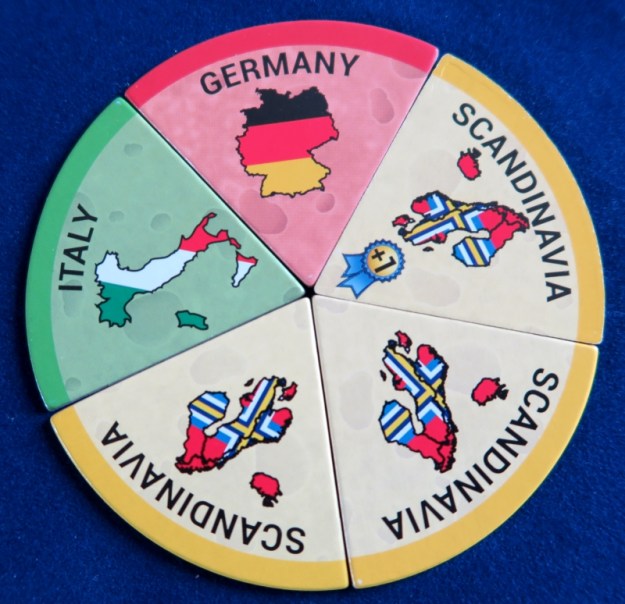
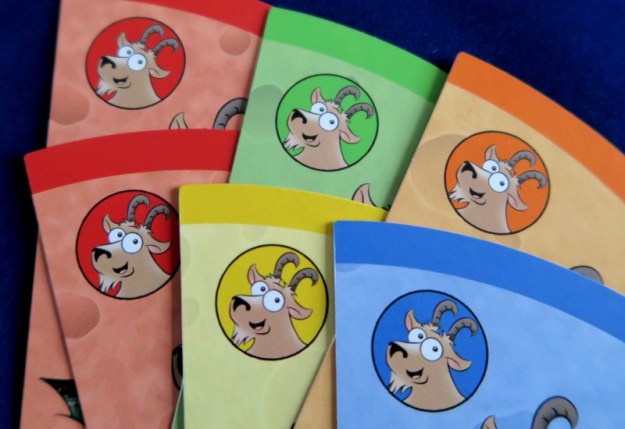
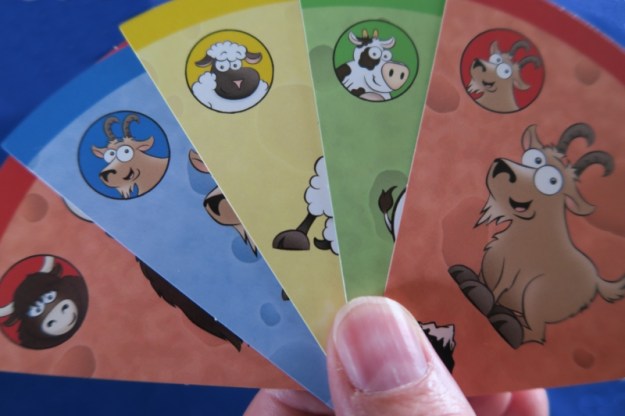
Pine, Magenta, Red and Burgundy were all keen to give the “Feature Game”,  Cheesonomics a go, especially when they saw the eye-catching truckle shaped box.  Pine was especially enthusiastic when he realised that it featured both cheese and goats!  The game itself is a fairly simple, set-collecting and hand management card game based on controlling and manipulating supply and demand of various types of cheese, all seasoned with a sprinkling of dreadful puns.  Players have a hand of five “wedge-shaped” cheese cards each with a colour suit (corresponding to country) and an animal suit (milk type).  On their turn, the active player can carry-out one of three possible actions:  churn, produce or sell.  Churning is a way a player can improve their hand.  First they declare a suit (colour or animal) and everyone else has to pass a matching card to the active player.  Once all the cards are in, the active player chooses five to keep and hands one card back to each player.
Cheesonomics
– Image by boardGOATS

Players can then place a matching set of cards in front of them to produce cheese; the cards must either have the same colour or the same animal.  The last possible action is to sell cheese:  a maximum of three cheese wedges can be sold at any one time and they must all be the same country (colour).  The cheese is valued at the market rate which is calculated from the number of wedges of that colour displayed in the market.  These wedges are different on both sides, so once a sale has been made, one market “share” is turned over (the market is “mooved”), which reduces the value for the next sale.  The clever part of the game is the scoring:  in addition to money made from selling cheese, players also get bonus points at the end of the game.  The players who sold the most of each cheese type (i.e. animal) get extra points equivalent to the number of wedges sold.  So, cheese is sold by colour, but bonus points are awarded for animals.

Cheesonomics
– Image by boardGOATS

Only Blue had played Cheesonomics before and that was a two-player game, so nobody really had a feel for how it would play.  Red went first and churned, followed by Pine who asked for goats.  Burgundy got a good starting hand and was able to produce a large batch of German cheese on his first turn, but otherwise we all got carried away churning cheese.  The problem was that since everyone was churning cards furiously, we were all disrupting each other’s hands which meant we ended up having to churn again on the next turn too.  Eventually, this seemed to dawn on us collectively and we all started producing what we had rather than trying to get the perfect hand first.  With a couple of good hands early on Burgundy was also the first to sell and everyone else struggled to catch up.

Cheesonomics
– Image by boardGOATS

Pine eventually managed to sell some of his goats and Blue, the last to convert cheese to cash, shifted a large batch of Scandinavian (yellow) cheese and take a massive fifteen curds.  It was all way too little and much too late though:  the game suddenly ended and Burgundy’s excellent start coupled with the fact that he’d managed to focus almost solely on both reindeer and yak yielded huge bonuses at the end.  Pine and Red had eventually spotted this and made a concerted effort to catch him, but Burgundy had just got too far ahead and won by two points with Pine in second.

Mijnlieff
– Image used with permission of BGG contributor thepackrat

Black and Purple had eschewed the opportunity to play Cheesonomics and settled down instead to play Mijnlieff (pronounced Mine-Leaf).  This “fancy noughts and crosses” game is played with beautiful little wooden tiles on a four by four wooden board.  the aim of the game is to form lines of three, but since there are different types of pieces and your opponent controlling where you can play it is much more strategic.  Each Player has eight pieces with two each of four different symbols where the different pieces dictate where the other player can put their next piece.  For example, when a Greek cross (or “+” symbol) is played, the next player must place his piece on an empty square in an orthogonal line from the piece just played.  Similarly, playing a saltire (or “×” symbol) forces the next player to place his piece in a diagonal line from the piece just played.

Mijnlieff
– Image used with permission of BGG contributor thepackrat

Black managed to get a line of three, but Purple took the game with two lines of three and one of four giving her a total of four points to Black’s one.  Since the supposedly quick little “Feature Game” was still going, Black and Purple moved onto another game we know quite well, Splendor.  This is a game of chip-collecting and card development where players collect chips to buy gem cards which can then be used in lieu of chips.  More expensive cards are also worth points and the game end is triggered when one player reaches fifteen points and the round is completed to give everyone the same number of turns.  Points are also awarded for “nobles” which go to the first player to get a specific combination of gem cards and the player with the most points at the end is the winner.

Splendor
– Image used with permission of BGG contributor henk.rolleman

The game was incredibly tight, but when Black was declared the winner, Purple looked slightly crest-fallen.  On closer inspection, they realised that they’d missed scoring one of her nobles.  Purple had managed to take two of the three available picking up both Isabel of Castille (awarded for four each of opals and diamonds) and Anne of Brittany (awarded for three each of emeralds, sapphires and diamonds).  This left them on sixteen all and a draw, though on closer inspection there is a tie-breaker, so arguably Black took it as he had the fewest cards in his display.

Splendor
– Image used with permission of BGG contributor henk.rolleman

Since Cheesonomics had finally come to an end as well, we had a lot of options on what to play next.  Half the group weren’t staying late, so we decided to play something short as a group before splitting up again into two groups (one of “light-weights” and one of “dirty late-night stop-outs”).  Looking for something to play seven, our choices were limited, and as is often the case in our group, we settled on our old favourite, 6 Nimmt!.  In the first round Black and Magenta were vying for the wooden spoon taking a total of twenty-four nimmts each.  Unusually, Burgundy, though high scoring, was some way behind the race for the bottom, only taking fifteen points.  Both Red and Blue kept a clean sheet so the question was which of them were going to be able to keep their score down in the second round too.  In the end though, both quickly started picking up cards and it was Purple who took the glory, finishing with just three nimmts over the two rounds, her second win of the evening (and only robbed of a third by a tie-breaker nobody knew existed).

6 Nimmt
– Image by boardGOATS

With the fun filler over, the “light-weights” looked for a similarly light game to finish, but in the end, settled on Splendor, as it was still out and Magenta and Red were very familiar with it.  This game was a very difficult one as all the cards in the second row needed lots of sapphires which were scarce throughout.  Magenta tried to work round the problem by collecting nobles, but everyone struggled.  For several rounds, Red was very close to the fifteen points needed to end the game and Magenta had four points available on a reserved card, but could not get the last ruby to buy it.  In the end, but it was Pine, who was new to the game, who finally put everyone out of their misery, ending the game with seventeen points, three points clear of Red.

Splendor
– Image used with permission of BGG contributor henk.rolleman

On the neighbouring table, after a short debate, the “late-night stop-outs” settled on Isle of Skye: From Chieftain to King as their longer game.  We’ve played it a couple of times before and it is hugely popular with the group.  Borrowing heavily from tile-laying games like Carcassonne, Isle of Skye is a much deeper game without adding an awful lot to the rules.  The idea is that players draw three tiles from a bag and and then secretly choose one to discard and set prices for the other two.  This is done by placing the tiles in front of a screen and a discard token and money for the player’s stash behind.  The money remains in place for the duration of the round, unless the corresponding tile is purchased by another player.  This mechanism is very clever as if nobody else wants the tile, then the player uses the money to purchase it themselves.  Thus, it is critically important to correctly evaluate the worth of the tile, depending on whether it is most desirable to sell it or keep it.

Isle of Skye: From Chieftain to King
– Image used with permission of BGG contributor henk.rolleman

The other clever part of the game is the scoring:  This is mostly carried out at the end of each of the six rounds.  At the start of the game, four scoring tiles are drawn at random and these are used in different combinations at the end of the rounds in such a way that each appears a total of three times, but only one is used in the first round while three are used in the last.  We included the the extra tiles from the 2015 Brettspiel Advent Calendar in the draw mix and one of them  came up. The four tiles were:  points for animals next to farms (A), extra scroll scoring from the Advent Calendar (B), points for each tile with a road that is connected to a castle (C) and points for each enclosed region (D).  Inevitably, everyone started out desperate for animals and farms, but since these scored in rounds one, three and five, all of a sudden they fell out of favour.

Isle Of Skye: From Chieftain to King
– Image by boardGOATS

Despite having loads of cash, Burgundy really struggled to get the tiles he wanted particularly as everyone else kept buying them off him.  In contrast, Blue didn’t do too badly for tiles, but always seemed to be running out of money.  This was exacerbated by the fact that she didn’t get any of the “catch-up cash” given out from the start of round three.  It is only the number of players in front of them that dictates how much money players get (not how far behind they lag), but the amount can really add up: a player who is consistently at the back in a four player game will net an extra thirty sovereigns over the course of the game compared with a player who leads throughout.  Theoretically, the difference in position between the first and last player could remain just one point throughout, so there is an art to being “just behind”, in the same way as there is an art to being at the back in Colosseum (which was our “Feature Gamelast time).  Clearly this time Burgundy had the knack, and Blue didn’t.

Isle of Skye: From Chieftain to King
– Image used with permission of BGG contributor henk.rolleman

While Burgundy and Blue were struggling with their respective finance issues, Purple quietly plugged away collecting barrels and brochs, while Black ended up with ships and when the corresponding scrolls turned up, they looked to be well placed, until Black ran out of money and a critical tile was taken from him in the final round.  Despite her lack of money, however, Blue didn’t over-reach herself and managed to enclose her scrolls early giving her extra points at the end, but also for the Brettspiel Advent Calendar scoring tile during the game.  Nearly bankrupting herself in the early rounds for those animals now proved worth it as she raked in the points for the scrolls she had enclosed.  Enclosing scrolls was the key in this game as the other player to succeed in this area was Purple who finished a highly creditable second after a barn-storming evening.

Isle of Skye: From Chieftain to King
– Image used with permission of BGG contributor henk.rolleman

We had a little over half an hour left, so we decided we could fit in one last game.  We couldn’t afford to spend too long thinking about it.  Since Black expressed an interest in Karuba as he’d heard good things about it and Blue assured everyone that it wouldn’t take the forty minutes claimed on the box, we decided to give it a go.  This is a game that Blue and Pink bought at Essen last year and is very similar to Das Labyrinth des Pharao which they picked up at the same time on behalf of Black and Purple.  In the event, Karuba did take just about forty minutes, but that included setting up and teaching.  The game is a bit of a cross between bingo and a tile-laying solitaire.  The idea is that every player has the same number of numbered tiles which the players simultaneously place when the number is called.  Unlike Das Labyrinth des Pharao, the tiles the orientation is fixed, which narrows down the number of possibilities and helps to reduce “analysis paralysis”.  Both games are loosely themed with explorers, but in Karuba they are crossing the jungle to find treasure rather than exploring a pyramid.

Karuba
– Image used with permission of BGG contributor punkin312

Each player has set of four coloured explorer meeples and matching coloured pyramids, with the aim being to get the explorers to the corresponding pyramids by laying tiles to make a path.  Everyone begins with the same layout (chosen collectively) and players score points for getting their meeples to their matching temples first.  Everyone draws the tiles in the same order, since the “caller” (Blue, in this case), draws their tiles at random and calls out the number for everyone else to play too.  Once the number has been called, each player can either place the tile on the board or discard it and move an explorer along a path where the distance corresponds to the number of exits on the tile discarded (i.e. two, three or four squares).  Some tiles have crystals or gold nuggets next to the path and an explorer who stops on the tile gets to pick up the treasure which are worth points at the end of the game.

Karuba
– Image used with permission of BGG contributor henk.rolleman

Our explorers all ended up a long way from their pyramids, so sharing a common route was essential and it was just the logistics of how to do it that everyone had to work out.  With time at a bit of a premium, Blue didn’t hang about and kept the tile drawing moving quickly.  Burgundy got a bit carried away picking up crystals before getting his explorers in a tangle (the paths are too narrow for meeples to pass each other).  Purple, for whom spacial awareness does not come naturally, unfortunately managed to completely cut off one of her explorers and Black got into a bit of a tangle too before he managed to extricate himself from the mess and bring them home safely.  Blue, the only one to have experience with the game neglected picking up crystals and got three of her explorers home first netting an unassailable fifteen points, in a game that definitely benefits from experience of how to balance crystals and getting to temples.  While packing up, we discussed the game and the fact that it is likely to be one of the nominees for the Spiel des Jahres award this year given the lack of other good competition.

Karuba
– Image used with permission of
BGG contributor henk.rolleman

Learning Outcome:  GOATS like cheese, but they like whisky more…

19th April 2016

Our “Feature Game” was to be Colosseum, which several people were keen to play, but there were two issues:  it plays better with four than three, and always seems to take a lot longer than it should so we wanted to get going.  We knew that Green was going to be late, but we didn’t know how late and that made a huge difference to our game plans for the evening; with six present already, should four get going and risk leaving two to play on their own all night if Green couldn’t make it at all in the end, or should we play something short together first and risk not having enough time for Colosseum?  Texts were sent and there was much discussion including the inevitable mention of 6 Nimmt!, but aside from that we seemed to have few genuinely short fillers that would play six.  Before we could actually make a decision, Green turned up and solved the problem for us and Burgundy and Blue started setting out Colosseum eventually joined by Blue, Pine and Magenta.

Colosseum
– Image used with permission of BGG contributor Toynan

The idea of the game is that each player is a Roman impresario, producing great spectacles in his or her arena in the hopes of attracting the most spectators.  As such, the game comprises elements of auction, trading and planning with the ultimate goal of set collecting, where the sets represent groups of performers that have to match the program chosen.  A complete program will attract its maximum number of spectators, where an incomplete program can cost players severely.   There are several unusual aspects of the game, but the most obvious is the scoring; rather than summing the points during the game, a player’s final score is the number of points they scored for their most successful production, i.e. their most successful of the five rounds.  Each round is broken down into several phases.  First players can invest capital in improving their production, by for example, buying season tickets (which give a guaranteed five additional spectators for each subsequent round) or perhaps investing in a more expansive program which might increase the number of points available if it is completed successfully.  Once all the players have improved their infrastructure, next they attend the market and bid for performers.

Colosseum
– Image by boardGOATS

The auctions are unusual in that each player has an opportunity to initiate an auction (i.e. choose which of the five sets are going to sold) and if they win, then the market is restocked, otherwise the next auction is chosen from fewer options.  We decided to play what we thought was the original variant where each player can only win one auction; once they have won, they are then not able to bid on any later sales.  However, on later inspection we discovered that thanks to the different variants available we had scrambled it slightly.  Rereading the rules indicates that if a player loses an auction they initiated, they have the opportunity to try again, but with a smaller pool to choose from.  In our auctions, each player was able to initiate just one auction, and if they won, the market was restocked and the next player had a go, whereas if they lost, they had to fight it out in a later auction.  Auctions lead to all sorts of interesting dilemmas: is it better to bid and try to force someone to pay more, or is the risk of ending up with unwanted tiles too great?  With our variant, we found that it was also sometimes better to let the initiator win because a better batch of tiles might come out, but failure to win an auction after initiating it was also a problem as it risked getting left with a choice of paying for unwanted tiles or getting nothing, which really added pressure.

Colosseum
– Image by boardGOATS

Given the relative shortage of tiles in the game, coming away with nothing is not really an option, but with a minimum bid of eight, the wrong tiles can be expensive.  That said, the next phase is an opportunity to trade, and occasionally trading away something that is highly prized by others can turn out to be particularly productive.  Like Settlers and Bohnanza, trades do not have to be symmetrical and must go through the active player, but in addition to trading tiles, money can also be used to sweeten a deal, or even buy an unwanted tile outright.  Finally, players take it in turns to produce their spectacle.  In order to do this, they roll a die (annotated with Roman numerals, obviously) which they can use to move one of the dignitaries, the Emperor, two Senators and three Consuls.  These increase a players total for that round if they are in the arena when it is scored.  If on the other hand, a player can move one of these characters onto a special “resting space” they get an “Emperor’s medal” as a reward. These can be traded in for money, the chance to move a dignitary forwards or backwards up to three spaces, three extra spectators or two can be used to get an extra investment opportunity at the start of the round.

Colosseum
– Image by boardGOATS

There are lots of components to the score of each production.  Firstly there is the basic score associated with the program:  this has a maximum potential value with points deducted for missing performers.  To this, bonuses are added for season tickets, podiums (obtained for winning a round), star performers, dignitaries, previously completed event programs and Emperor medals.  If this score is higher than the player’s previous highest total, their marker is moved to this new maximum and they receive that total in money.  Once every player has completed their spectacle, a podium is handed out to the player who is in the lead and the player who is at the back takes a performer of their choice from the leading player’s pool.  Finally, every player discards one performer token used in the round as “natural wastage”.

Colosseum
– Image by boardGOATS

Each player begins the game with two programs, a small one and a larger one.  Pine started out with no performers that matched either of his and some that weren’t even available in the market, but everyone else had at least a small degree of overlap.  The first round was a little tentative and Blue ended up as start player, so went first and invested in a season ticket.  The early investments are critical as they continue to have an effect throughout the rest of the game.  Magenta decided to do something different and expanded her arena, while Pine also picked up a season ticket and Burgundy opted for an Emperor’s Loge (pronounced “Lowj”).  The Loge is an interesting investment as it doesn’t directly yield points.  Instead, it allows the player to roll two dice and move one or two dignitaries just before producing their spectacle, potentially enabling players to gain more points that way.  Burgundy had another plan though and forfeited the opportunity to take extra points, taking an emperors medal instead.  As the most experienced player, he was of the opinion that the medals are really important.

Colosseum
– Image used with permission of BGG contributor kilroy_locke

Blue was forced to produce the larger of her two programs in the first round which gave her a podium to add to her arena, but also cost her one valuable performer – a mistake she decided not to make again.  The other consequence was that she was forced to produce the lower value production in for the second round as her arena wasn’t large enough (she had bought a season ticket in the first round rather than enlarging her auditorium).  In the second round, one of the market stalls unusually had two of the rare “wild” tiles in it.  These are very powerful as they don’t need to be assigned as a particular artist giving players much more flexibility and two was very enticing.  In the first round Blue had got herself into a real mess having gone first and not won her own auction resulting in a messy scrabble to get tiles at the end of the round (a consequence of the rules change).  Having seen this, everyone else decided to play safe and opted to choose a market they needed and then won largely uncontested leaving Blue to go last and take the wilds very cheaply.  Despite this, Pine took the lead which he retained for the next couple of rounds as well.  It was at about this point that Pine commented that he thought there would have been more “gladiatorial fighting”, to which Burgundy replied that there would be plenty of that by the final round…

Colosseum
– Image by boardGOATS

In the third and fourth rounds everyone was trying to get in a position for a big push in the final round. Magenta bought a season ticket instead of expanding her auditorium in the third round and therefore ended up in the same pickle that Blue had found herself in at the start.  With only the one medal Magenta was unable to buy an extra investment opportunity which mean she was forced reproduce a medium event in the final round rather than buy a new large event.  She went into the final round with the most money though which had the potential to guarantee her a good auction.  Blue eschewed a new program in the fourth round, opting for another season ticket instead to try and set herself up for a big final round.  Pine was very keen for a trade with Blue in the penultimate round, but as she had completed her program and still didn’t know what she was going to do in the final round she declined much to his disgust.  Repeating a lower value production in the fourth round also ensured that Blue just finished last and was able to add insult to injury taking a valuable token from Pine who was well in the lead with a massive fourty-nine.

Colosseum
– Image by boardGOATS

With one round to go, Blue questioned whether Burgundy thought the Emperor’s Loge had been worth buying in the first round.  He replied that the wisdom on boardgamegeek.com is that the medals are essential and because the Loge allows players to roll two dice they really help with that strategy.  By this time, the value of the medals was becoming very obvious as trading in pairs enabled both Burgundy and Blue to make an extra investment which enabled Blue (start player again in the final round), to buy the most expensive, largest program (No. 30). Pine promptly followed by taking No. 28 and with his star performers and having so many podiums from the earlier rounds he looked in a good position, though he needed a lot of acts to complete his show.  Blue was in a slightly better position with three “wilds”, but had very few bonuses.Blue went for the market she fancied most and Magenta decided to bid against her.  Having not bought a large program in the final round, Magenta had far more money than anyone else and therefore the upper hand.  Eventually, as money is only significant in a tie-breaker, Blue bid everything she had.  Magenta, seeing other options of at least as great an interest to her decided to let her have it and Magenta took what she fancied, uncontested.

Colosseum
– Image by boardGOATS

While Pine and Burgundy were trying to work out which markets to take in order to do themselves the best favours, Blue looked at her options and Magenta’s.  Since she Pine and Burgundy’s discussions were getting complex and could not involve her, Blue got bored and decided to see if Magenta would be interested in trading one of Blue’s “wilds” and an otherwise superfluous lion for one of her “green men” and a chariot.  This would give both players one extra performer overall, and complete Magenta’s program, so she agreed.  Thus, when Pine and Burgundy had finished thrashing out all the options, Blue and Magenta’s trade went through on the nod and it was only when Pine and Burgundy came to trying to further optimise their situations that they realised that Magenta had things they wanted, but nothing to offer her in return.  Pine tried his best to get Magenta to trade, but she was steadfast that she wasn’t going to help him without getting something useful in return.  Burgundy’s offer of two horses initially looked promising as he thought it would enable Magenta to take the star-turn bonus from Blue, but it would only give a tie, so ultimately, that trade was also unsuccessful.

Colosseum
– Image by boardGOATS

Blue moved a Senator into her arena and scored a total of eighty-two setting the bench-mark for everyone else.  Although it sounded a lot, Blue didn’t think it would be quite enough and indeed it was very, very close, much closer than anyone had thought it would be.  In the end, the Blue just had enough to finish four points ahead of Burgundy who was just two ahead of Pine who came in third.  With the scores so very close, we had the inevitable review of the game and concluded that the the key moment was probably Blue taking the two wilds so cheaply in the second round, which would not have happened without the unintended rules revision.  The other key moment was in the final round of negotiating when Blue and Magenta agreed their critical trade.  Pine was verging on indignant that after playing for two and a half hours, it was essentially up to Magenta to choose the winner and suggested that should be the learning outcome for the week.

Colosseum
– Image by boardGOATS

Meanwhile, on the neighbouring table, Black and Purple had persuaded Green to join them playing one of their old favourites, Vikings.  This is a fast economic game, but despite the nominal “Viking” theme there is  none of the usual Norse Gods, exploration or pillaging involved.  Black and Purple had come across it again recently after a long break and fancied giving it another outing. It is a game that we’ve not really played before in the group and Green was new to it too, but was willing to give it a ago. It is one of those games where the gameplay is not complicated and yet the explanation took ages.  In summary, the game consists of six turns and on each turn, twelve tiles and twelve meeples are randomly drawn, paired together around a rondel. in each round, players take turns selecting a meeple/tile combination until they’re all taken.

Vikings
– Image used with permission of BGG reviewer EndersGame

The tiles are pieces of islands and there are left ends, right ends and middle pieces.  As players acquire these tiles, they are considering which sort of meeple would be placed on that tile, as each tile can hold only one meeple.  The rules for placing these tiles are fairly straightforward, for example, a partial island can’t connect directly to open water, etc.  The meeples come in five different colors and these colors denote their function in the game. For example, the yellow meeples are miners and they bring in money every turn; the red miners are nobles and they bring in two points apiece every time you score points, and so on.  Once the tile selection and placement has been carried out, all the yellow meeples will make the players some money. On even turns, VP will be scored. At the end of the game, players can gain bonus points for completing the most islands and/or completing the largest island.

Vikings
– Image used with permission of BGG reviewer EndersGame

It took Green a couple of rounds to work out how it all worked and ended up making a couple of little errors when laying out of his islands, which included not having an island space to place his gold Viking on and which meant he was able to get income, which was compounded by the bonus tile he had picked up which would enable him to gain an extra two coins for each gold Viking.  In the meantime, Purple had a fair few noblemen who would not only score her well, but also enabled scoring for the large number of gold Vikings and fishermen below. She managed to avoid any ships in the first couple of rounds and so gained all the bonuses available to her.  Black did have a number of ships, but he also had the warrior Vikings placed to combat them, so also gained a healthy bonus income.  Green had a ship and a warrior, but both his scoring and income were low.

Vikings
– Image used with permission of BGG reviewer EndersGame

After the first couple of rounds, the game progressed in pretty much the same pattern, except this time Green had sussed out what he was trying to do and regularly collected boatmen to redistribute his Vikings in time for scoring.  However he was hampered by a lack of funds in the middle rounds, but when he finally got the gold guys out, he suddenly started to rake in the cash.  This meant he was able to buy just what he needed in the final round, much to the others annoyance.  By the end, Purple had a very red and yellow looking board and the longest island (six tiles long giving her five bonus points). Black had a huge fleet of ships, but most were covered by warriors and those that weren’t were not powerful enough to do much damage. He also had the most complete islands (seven which gave him a seven point bonus). Green had a relatively low scoring board, but he did have the most boatmen (giving ten bonus points). It had been a very poor game for fishermen, in fact, almost all the Vikings left in the bag were fishermen, so everyone was underfed, but Purple was less underfed than Black and Green.

Vikings
– Image by BGG contributor dinaddan

So in the final scoring Black had won through, beating Purple into second place (the first time she had not won this game for some time) and Green came in third, though much closer than he thought he would be.  It was then that Black realised that Purple had forgotten to score her bonus island tile, which gave her a massive extra nine points, and with it, the win!  We discussed the bonus tiles after the game and although the rules were not clear, we felt we had probably played it wrong. We only replaced the tiles that had been taken each round, rather than swiping them all and laying out a new lot. Since there were four tiles per round for six rounds and we had two piles of twelve, it looked like what was meant to happen was a new set each round.  This would have made more choices available (and more bonus fishermen which would have been handy).  Green decided that he liked this game very much and would be happy for Black and Purple to bring it again.

Vikings
– Image used with permission of BGG contributor punkin312

The shows were still going on on the next table, so we needed another medium weight game and decided upon the cute Panda game, Takenoko.  While setting up there was a short discussion on the evolutionary dead-end of the Panda and how on earth did such a creature ever evolve in the first place. Although since they are such cute creatures, we were glad they did and they had led to the clever little game.  The play area starts with one single hexagonal “pond” tile with two characters on top:  the Imperial Gardener and the Panda.  On their turns players first determine the weather by a roll of the weather die, then perform their two actions.  These actions must be different and the player can choose freely from the five available:  add a new bamboo plot; take an irrigation channel (which can be played or stored for later use); move one of the characters (either the Imperial Gardener or the Panda), or draw an objective card and add it to their hand.  The aim of the game is to earn points by completing objectives.  When a player completes one of their objectives, they show everyone and the card is placed face up in front of them.  Players can complete as many objectives as they like on their turn and end of the game is triggered when one player full-fills a set number of objectives.

Takenoko
– Image used with permission of BGG contributor nad24
and nonsensicalgamers.com

This game was a slightly unusual one as we all placed tiles in such a way that there was only ever one large field of each of the three colours and by half way, we all had mostly stopped laying tiles at all. In typical British style, the weather was mostly awful; wind; cloud; and rain. It was ages before the sun came out, but thereafter it made enough of an appearance to keep us all happy. Purple was the first to complete a mission card and Green wasn’t far behind, both tile pattern cards. The Panda and Gardener were mostly travelling between the pink and yellow fields, leaving the largely un-irrigated green fields untouched.  This enabled Green and Purple to get some tower and bamboo chomping bonus cards, but Black was beginning to fall behind. His problem was that all his bonus cards were low scoring. He kept using his actions to take more bonus cards, but they always seemed to be low scoring, and unless he could get more points out of it he wasn’t going to win.  He completed a few objectives on the way, but didn’t want to fill all of his eight with low scoring objectives so held back on claiming some.  In the meantime, Green was rapidly claiming bonuses, mostly towers giving a healthy haul of points. Purple made a few miscalculations on which bamboos would grow and by how much and thus failed to get a card or two that she had planned.

Takenoko
– Image used with permission of BGG contributor Oceluna

As the game approached the end, Green and Purple both had claimed six bonus cards and Black still only had four.  But then with a flourish, suddenly Black finished the game.  He had given up on getting higher scoring objectives and decided the best bet would be to get the ones he had got down and stop Green winning any more points, also picking up the two point bonus for finishing first in the process.  Everyone else got one more go which was enough to give Green a seventh and Purple her eighth objectives.  Totalling up the scores showed that Black had been right about not winning with low scoring cards.  That honour went to Green, who finished nearly ten points ahead, with Black just taking second place.  In the post game discussions, Blue commented that although she had always wanted to like the game she felt it just lacked something.  Black said that he had always felt that the game was very Luck based, although Green did point out that if Black had just gone with the low scorers he would not to have wasted as many actions gaining the cards and could have finished the game earlier, before Green was able to amass all his points. However, Green and Burgundy both agreed that the tile layout bonus cards were the weakest as the points were usually low and yet did not seem any easier to get. This debate will probably run and run, much like the one about the Panda’s evolutionary dead-end…

Takenoko
– Image used with permission of BGG contributor ObeyMyBrain

Learning Outcome:  Even after playing for two and a half hours, sometimes Magenta still gets to choose the winner.

22nd March 2016

Red, Magenta, Blue, Burgundy and Green were first to arrive and decided to get the evening going with a quick light filler.  After a quick debate, we decided that the best fit to the number of players and the time we wanted to fill was …Aber Bitte Mit Sahne (which means “…But Please, With Cream”, though the game is known as “Piece o’ Cake” in English).  This is a cute little set collection game coupled with the “I divide, you choose” mechanic.  The game starts with “The Baker” taking a pile of cake slices showing a selection of different types, and then arranging them in random order to form a wheel of eleven pieces which they then divide into five slices.  Then the idea is that the other players take it in turns to choose which slice to take and how much of it to “eat”.  Points are scored at the end of the game for the player with the most kept pieces of each type of cake and for the number of “blobs” of cream on cake that has been eaten.

…Aber Bitte Mit Sahne
– Image by boardGOATS

In case of a draw, all parties win the pints, but any set that has been not been eaten and is not the largest scores nothing.  Thus, the player dividing needs to try to make sure that they are left with something useful after everyone else has chosen, but at the same time, they don’t want to give away anything that helps the opposition too much.  After dealing out the piles for each round we realised that we’d inadvertently included the wild card slice from the mini expansion, but Blue couldn’t remember the rules, so we decided to take it out and do it again. In the event, the game itself was quite close with Red and Magenta fighting it out for first place and for the most strawberry gateau.  In the end, Red took first place with thirty-two, three points ahead of Magenta with everyone else some way behind.

…Aber Bitte Mit Sahne
– Image by boardGOATS

We were just deciding what filler to play next when Black and Purple wondered in, so we decided to get on with playing something with a bit more bite.  First on the table was the  “Feature Game”, Glen More, which is a tile laying game set in the seventeenth century highlands. Black wasn’t keen as he’d played it before and had felt it was very random.  Blue said she hadn’t got that sensation from reading the rules, but she did think that it had some very different elements to it and had no feel for how to go about playing it.  Magenta and Red commented that they weren’t really selling it and wondered what the alternative might be.  Black suggested The Voyages of Marco Polo and Green was torn as he really wanted to play both.  Although Blue was very interested in playing Marco Polo too it has a reputation for being monstrously long and she has a very strong dislike for leaving games incomplete.  Burgundy had read up on Glen More, so was keen to give it a try as was Blue, so despite its poor billing, Red and Magenta joined them to make a four and they quickly got going.

Glen More
– Image by boardGOATS

Glen More is a strange mixture of mechanisms and it is initially hard to see how they fit together.  The game has an unusual turn order mechanism (similar to that in Tokaido), where the player at the back goes first moving their token along the circular track, choosing a tile the fancy and replacing it with their marker.  They then add the tile to their village and draw a new tile which is placed at the front of the row of tiles (keeping the number available the same throughout the game).  When a player adds a tile to their village they must obey two basic rules:  any road or river on the tile must connect with their existing road or river and the tile must be next to a clansman.  Tiles cannot be rotated and each player starts with a village tile comprising a clansman, a road running vertically and a river running horizontally.

Glen More
– Image by boardGOATS

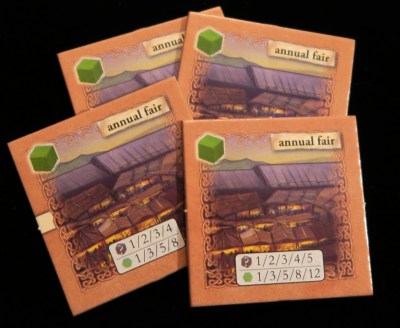
Once the tile has been placed, all orthogonally and diagonally neighbouring tiles can be activated.  Each tile gives the village some kind of benefit:  yellow and green tiles provide resources, fairs and the like allow players to trade resources for victory points, village tiles allow the clansman to be moved, while distilleries allow the conversion of grain into whisky.  Resources are essential because, as well as the potential to trade them for points, about half of the tiles also have purchasing costs that has to be payed before a tile can be added to a village. Resources can be bought and sold at any time during a players turn, but any that are bought must be used straight away and the cost will depend on the Market which reflects demand.  When a player buys a resource, they place a coin on the market space and the next player must pay one more than the last up to a maximum of three after which, that resource is no longer available.  A player selling resources takes the last available aliquot until there is no money available, after which they can no-longer sell, making currency circulation a contained system.

Glen More
– Image by boardGOATS

Tiles can be activated in any order and then the new “last player” gets a turn.  Since players can move as far forward as they like, jumping lots of tiles if they choose, it is quite possible that a player may have several consecutive turns, alternatively, they may decide to sacrifice turns in order to get a particular tile that is nearer the front of the track.  There are three piles of tiles and interim scoring occurs every time one of the stacks is emptied.  Scoring is also unusual as players score based on the difference between their position and that of the person in last place in that category.  There are three scoring categories:  locations, chieftains  and whisky.  The locations are special tiles which give some special powers that have an impact during the game, but are also a a source of points.  At scoring time, players evaluate how many special tiles they have and then subtract the number of locations held by the weakest player in that category.  This difference is then compared with a scoring table and points are awarded accordingly.  Larger differences return a proportionately larger number of points.  Chieftains and whiskey are scored in a similar way, with chieftains being clansmen that players moved off the board.

GlenMore007
– Image by boardGOATS

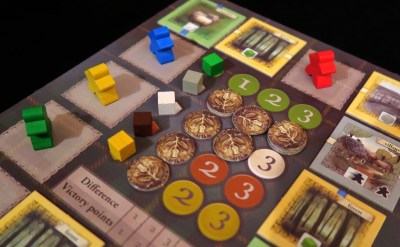
For example, in a four player game, if the players have six, five, three and one barrel the “differences” will be five, four, two and zero which translate into eight, five, two and one victory points.  Thus, as the player in last place, picking up a distillery, may actually have a bigger impact on the scores than adding to the scoring category that they are strongest in.  This is because it reduces the number of points held by all the other players, where the difference is large, it can hurt players more efficiently too.  At the end of the game, players also get points for any remaining money, but also lose three points for every tile they have more than than the player with the smallest village.  So, when choosing which tile to take, each one has to earn its keep, in other words, the winning village has to be efficient as well as effective.

Glen More
– Image by boardGOATS

Having explained the rules, everyone was still not much the wiser.  We could all see what the mechanics did, but connecting them together was more tricky and we all felt we could only find out more by playing.  Red went first, but as she had no clue what she was trying to do, she picked a nice looking grain tile that was some way down the track and went for it.  Burgundy and Blue queried it as it meant she was likely to miss a couple of turns, but she said she was happiest that way as she didn’t feel she could make a better, more meaningful decision.  By the next turn she wasn’t  much wiser, but added a distillery to her village, no doubt making her clansmen very happy indeed as she started her whisky production.  Meanwhile, Magenta’s village was already very resource rich and Burgundy had a couple of valuable Fair tiles that he could use to convert resources into points.  Blue had no idea what she was doing, but was certain she wasn’t doing it very well whatever it was.

Glen More
– Image by boardGOATS

By the first scoring round, Red was way out in front with a handful of whisky barrels and a very small village full of very merry Scotsmen.  The lean nature of her village meant that everyone else was feeling the pressure to make every tile count as they knew it would cost them three points at the end.  Despite her huge number of resources, Magenta was  struggling to score points and Burgundy and Blue weren’t doing much better, slightly mesmerised by Red who appeared to be winning by miles despite spending most of it watching everyone else make bad decisions.  Things hadn’t changed much by the end of the second round though it was clear that Burgundy was starting to make his Fairs count by activating them frequently and buying the resources he needed if he didn’t have them.  Blue had picked up a couple of Special Location tiles and had distilled a couple of barrels of whisky, but with nothing like the efficiency of Red.  In the third and final round, Magenta now had the maximum number of resources on most of her tiles and had finally started picking up a brown tiles so that she could make use of them.  Blue managed to get herself in a mess, wanting to pick up a Special Location, but not being able to place it because her clansmen weren’t in the right place.  In trying to fix the problem she tried to be clever and discard a tile, but quickly realised she should have played it instead.  People were starting to run short of money as Magenta starved everyone else of cash by selling only the resources that were in highest demand.  In the corner, Burgundy had finally got his engine working, but it still looked like it was too late to challenge the efficiency of Red.

Glen More
– Image by boardGOATS

With just enough tiles left for one turn each, Blue promoted most of her clansmen to chieftains, Magenta managed to use her Fair to trade five resources for a massive twelve points, Burgundy picked up yet another Special Location and Red asked whether she should have been scoring three points every time she placed something next to her Tavern (which she should, and so should Blue…).  Before the final end of game scoring, Burgundy was some way out in front, but as he also had the largest village he was going to lose an awful lot of points.  Surprisingly, Blue wasn’t far behind, so it all came down to how many points people were going to lose.  In the end there was just one point between Burgundy and Blue, but Burgundy took it with forty-four points.  In the end, Red was some way behind, but as we discussed the game, we felt she had left a lot of points on the table in the final few turns, and it was certainly possible to make a lean village strategy work.  Similarly, if Magenta had been able to activate her Fair just once or twice more, she could have been way out in front.  Nobody disliked the game, but we all felt a little bit non-plused about the experience, as we’d really struggled finding a path through the maze on the first visit (though we didn’t feel it was the luck-fest that Black had described).  In the end, we decided that it definitely needed to be played again now we had a better idea of what was going on and it certainly was different to most other games we play.

Glen More
– Image by boardGOATS

Meanwhile, the other group had settled down to play The Voyages of Marco Polo, which won the Deutscher Spiele Preis last year and was designed by the same pairing that put together Tzolk’in: The Mayan Calendar.  It took a while to set up and explain the rules, especially as Black was the only one that had played it before, and even that was on-line. The game is played over five rounds with players recreating Marco Polo’s journey to China via Jerusalem and Mesopotamia and over the “Silk Road”.  Each player has a different character and special power in the game.  Each round, the players roll their five personal dice and can perform use them to perform one action each per turn.  The actions include:  gathering resources, gathering camels, earning money, buying purchase orders and travelling.  The game ends with players receiving victory points for arriving in Beijing, fulfilling the most purchase orders, and having visited the cities on secret city cards that each player gets at the start of the game.

The Voyages of Marco Polo
– Image used with permission of BGG contributor henk.rolleman

Eventually we were all kitted out with merchants, camels, currency, houses, a contract and a couple of city (mission) cards; all that was left was to choose a character. There are eight different characters to choose from providing a range of different benefits, all relating to different strategies. Black gave a quick run-down of the character abilities, quickly dismissing two of them:  Kubilal Kahn who starts in Beijing as opposed to Venezia where everyone else starts and Raschid ad-Din Sinan who can set the dice to whatever numbers he chooses at the start of the round instead of rolling them.  He dismissed Kubilal Kahn, because he does nothing else for the player, although he does guarantee ten points for placing the first house in Beijing. Raschid ad-Din Sinan was dismissed as Black explained it “broke the game”.  By that he meant that half the fun of the game is based on dealing with the dice players roll, not only must choosing the dice numbers take an age to decide, it also removes an element of luck and challenge.

The Voyages of Marco Polo
– Image used with permission of
BGG contributor bovbossi

Pine, the start player, got to choose first and went for Mercator ex Tabriz, who we had all made positive, “Oooh! That’s nice!” noises about when it was explained.  This would give Pine one resource every time someone else collected something in the market, quite handy. He thought that this would push him to a contract completing strategy.  Green was next and went for Kubilal Kahn, despite Black’s dismissal. He felt that being on the other side of the board to the others would mean he was not in competition for the bonuses, and the neighbouring city would give him a free choice bonus at the beginning of the round, a handy one to have at the start of the game. He wasn’t too sure about his plans, but placing would help gain the city-mission bonuses, so a bit of travelling looked likely.  Purple decided that the ability to teleport across the board from oasis to oasis would really help her complete her city missions and took Johannes Carprini. Since the board layout is very much east/west with very little north/south crossovers, all the pairs of cities on the mission cards were on different east/west tracks so being able to jump around the board almost at will looked to be very very useful for this strategy.  In addition, the extra three coins at the beginning of each turn was a nice little sweetener.  The experienced Black felt he was up for a challenge and chose Wilhelm von Rubruk which would allow him to place houses in every city he crossed (normally players have to finish in a city to place a house there).  As an additional goal this gave him two extra houses to place after he had exhausted his personal supply for an extra ten points, if he could manage it.  Clearly Black was also going to be doing quite a bit of travelling.

The Voyages of Marco Polo
– Image used with permission of BGG contributor henk.rolleman

Finally the game got underway with the satisfying sound of twenty dice being rolled, then studious silence as we each tried to work out what actions we could do with the different combinations we had rolled.  A reasonable first goal seemed to be to gain the resources necessary to complete our starting contracts.  The first dice placements were benign affairs. Pine was happy as collecting resources from the market proved popular and he quickly completed his first contract. Green also made use of his “free choice” bonus for reaching the small city to enable him to complete a contract.  It was about half way through the first round that the true heart of this game revealed itself:  how to place all your die actions on spaces already occupied by others.  There is cost involved in placing second, and suddenly it seemed that money (or rather the lack of it!) could be a key factor.  In most games, rolling a set of five’s and sixes would be met with squeals of pleasure – not this one.  High dice rolls might unlock some tasty options, but at a price. Finding that you had only a four and a five to place down on the travelling track when you only wanted to move once, was very annoying.  Such a move increases the cost from four (or three if you’re lucky enough to go first) for placing a single pip die to seven, and if you did decide to make use of the extra moves, that will be sixteen in total, and we’ll not consider the cost of three movements!

The Voyages of Marco Polo
– Image used with permission of BGG contributor punkin312

In the early rounds Black and Purple kept rolling fewer than fifteen in total, which gave them extra camels and/or coins to make up the difference, but it did also mean that their outlay was much less than Pine and Green who kept rolling, fours, fives and sixes.  This meant that when there was something they wanted to do, they could at least afford it. While Pine and Green were left scratching their heads as to how on earth they were to use their remaining six. Pine often just placed it “in the purse” for a measly three coins. Although Green was having similar issues, he did at least have the advantage of gaining some decent first visit bonuses, to keep his game alive. Black and purple were making rapid progress across the board, although perhaps not quite as rapid as their respective characters might suggest was possible. Pine and Green, meanwhile, kept a steady pace on wrapping up the contracts to roar into the lead on the points track.

The Voyages of Marco Polo
– Image used with permission of BGG contributor henk.rolleman

Black commented how we did not seem to be using the black dice very much. In the online games they disappear very quickly (there are only five per turn). It was only during the last part of the last round that we realised that we had not fully understood the implications of the black dice rules. We had thought players could only have one black die per round (i.e. a maximum of five all game distributed over the five rounds), but they could actually have one per turn making them a good way of increase the number of action choices. The camel cost associated with them would reduce the ability to travel, but there are plenty of other ways to trade your way to victory in the game.

The Voyages of Marco Polo
– Image used with permission of BGG contributor jsper

In the last round or two, Black and Purple really wound up their travelling elastic bands and went flying round the board, ultimately completing both of their city-mission bonus cards, which neither Pine nor Green could manage. Green did eventually complete one, but Pine had barely moved at all, preferring to concentrate on completing contracts.  When the final tally came, Green had romped away, proving Black wrong about the Kahn character. Black’s final speed-demon dash across the board netted him enough bonuses (although not his extra two house bonus) to bring him home in second place. Purple was just behind, proving that the teleportation device of the ancient east was a good way to get your presence felt, but she had neglected the contracts and did not manage to net quite enough extra points to sneak past Black. Pine’s contract strategy hadn’t been as successful as he’d hoped and we realised that his special bonus of receiving a resource every time someone else bought in the market, dwindled in later rounds as we all found other ways to get resources.

The Voyages of Marco Polo
– Image used with permission of BGG contributor henk.rolleman

In the end, despite our initial opinions we concluded that the characters are more balanced than we first thought.  Our first game also called into question the widely held BGG opinion that contracts are a better way to gain points than travelling, though we will have to see if this opinion holds over time.  Overall it was a really interesting game, with much variety in it from play to play and the dice action mechanism was also really clever and satisfying.  It did take a long time to play, but next time should be quicker, and there will certainly be a next time as we all enjoyed its first outing and others are also keen to give it a go.  Meanwhile, Glen More had long since finished, so rather than condemning Blue and Burgundy to a two player game, Red and Magenta suggested playing something quick.  Near the top of Blue’s bag was 11 Nimmt!, a game so far only released in German that Blue had picked up last year at Essen.  Designed by Wolfgang Kramer, the same person who brought us one of our favourite, 6 Nimmt!, we were keen to see if this really was five nimmts better…

11 Nimmt!
– Image by boardGOATS

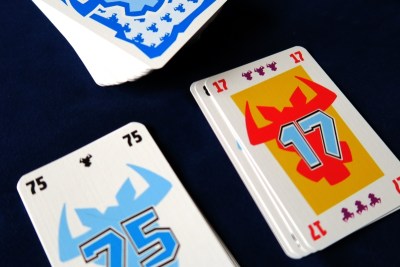
The game is played with a deck of cards numbering one to a hundred, each also with some number of bulls heads, or Nimmts on it (much like 6 Nimmt!, though the distribution is different).  Each player starts with a hand of ten cards and the aim of the game is to be the first person to get rid of them all, or (since the game is played over several rounds) at least finish with a low scoring hand, i.e. as few Nimmts as possible.  In contrast to 6 Nimmt!, the game is played in turns rather than simultaneously and the game starts with one card pile.  On their turn, the active player must discard a card that is above the top card on the pile, but within ten of its face value.  If they do not have a suitable card (or choose not to play it) then they must take the stack into their hand and replace it with two new face up cards drawn from the draw deck making two new piles.  If a player takes a stack comprising three or more cards, then the player also takes a Bull Card which allows that player to play more than one card at a time on one stack so long as they are all within ten of the top card.  Should they end up with a second Bull Card, then they can play on more than one pile, and this is where it becomes an advantage to pick up lots of cards, because with several Bull Cards, players can discard a lot of cards very quickly and have more control over the game.

11 Nimmt!
– Image by boardGOATS

From the start it was apparent that 11 Nimmt! is very different to our much loved 6 Nimmt!.  There is a lot less gratuitous glee at other people’s misfortune when they are forced to take fists full of cards, but this is replaced by strategy and planning.  The lack of simultaneous play also makes it feel a lot more solitaire than 6 Nimmt! and, though there was plenty of opportunity to scupper someone else’s plans, without knowing the contents of their hand it was hard to do it in a constructive way.  It took us a few rounds to get the hang of it, but before long we were starting to see the strategic advantage of picking up cards as well as getting rid of them.  The rules suggested playing the same number of rounds as there are players, but we ended up playing six rounds just to fill time.  Despite Red and Blue both winning rounds, Magenta was the clear winner after four rounds thanks to her consistency and she added just one to her total in the extra rounds compared to everyone else’s ten and, as a result, she finished the clear winner.  Although we all enjoyed it and could see that it was probably a better game with lower player counts, we all felt that it hadn’t usurped 6 Nimmt!, which would retain its special place thanks to its fast play and generally chaotic fun.

11 Nimmt!
– Image by boardGOATS

Learning Outcome:  Sometimes subtle changes to a game make a huge difference.

8th March 2016

While Burgundy finished his ham, egg ‘n’ chips, the rest of us continued our political discussions from two weeks ago.  This time we discussed the length and timing of the school day, the inevitability of double-parent working households, the cost of childcare and whether or not parents should be paid to stay at home and look after their little ones.  We were expecting Black and Purple, but eventually, someone suggested playing a quick game, to which Blue commented that you could guarantee that they would arrive just as we finished setting up.  A brief debate about what to play followed before we settled on one of our old favourites, Walk the Plank!, a simple pirate themed “programming” game where players try to push each other along a plank and off the ship.

Walk thePlank!
– Image by boardGOATS

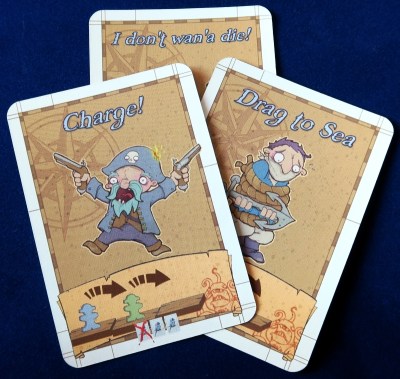
Since everyone had played Colt Express fairly recently, the rules were quick to reprise:  everyone simultaneously chooses three cards and the order in which they are going to play them, placing them face-down; starting with the first player, players then take it in turns to play one card until everyone has played all three.  With lots of aggressive options the game is always quick and fun, and the last pirate standing is the winner.  We had just finished the summary when Black and Purple arrived, but since it is only a short game we carried on.  Blue started the game by immediately shortening the plank and before long there was no plank left (a situation we allow through a “house rule”).  When Green Green played a “Drag to Sea) with only one pirate left which was perched precariously on the edge of the boat, it was inevitable that he would take Blue’s only pirate with him for company, leaving everyone else with two pirates each.

Walk the Plank!
– Image by boardGOATS

It didn’t last, however, and before long Magenta’s last pirate received the Big E from Burgundy and joined the others watching the goings on from Davy Jones’ Locker.  With all the carnage in the first round (eleven pirates down in just fifteen cards), there were just two players left with two pirates each all on the ship.  Although the rules say the last two players share the victory this seems strangely friendly end for an otherwise savage little game, so we always play to the death. The second round began a little cagily with both players extending the plank, but then Burgundy was paid out for his treachery to Magenta when, in a moment of stupidity, one of his two remaining pirates dragged his pal off the end of the plank, leaving Pine the clear victor with two pirates still standing.  It was an exceptionally short game thanks to the early vindictiveness, but in truth, it is a much more fun game when it is played that way.

Mijnlieff
– Image used with permission of BGG contributor thepackrat

Despite the compressed nature of Walk the Plank!, Black and Purple still managed to squeeze in a little two-player abstract game called Mijnlieff (pronounced “Mine-Leaf”).  This is a beautiful little game made out of wood and designed by the designer of Dodekka, Andy Hopwood (Hopwood Games).  Black described the game as “fancy Noughts and Crosses” since the aim of the game is to form lines of three, but since there are different types of pieces and your opponent controlling where you can play it is much more strategic.  The game is played by placing wooden tiles on a four by four board.  Each Player has eight pieces with two each of four different symbols where the different pieces dictate where the other player can put their next piece.  For example, when a Greek cross (or “+” symbol) is played, the next player must place his piece on an empty square in an orthogonal line from the piece just played.  Similarly, playing a saltire (or “×” symbol) forces the next player to place his piece in a diagonal line from the piece just played.

Mijnlieff
– Image used with permission of BGG contributor thepackrat

Game play is really quick, so much so that despite Walk the Plank! finishing in record time, with Purple taking it by three points to Black’s two.  With everyone finished, we had a quick show of hands as to who would like to play the “Feature Game”, Kingdom Builder.  When seven hands went up, Green asked who was very keen to play it and nobody looked interested.  The most enthusiastic was Burgundy who had played it before, so Magenta swapped seats with Green to make a foursome with Blue and Pine.  On the face of it, Kingdom Builder is also a simple game, played by placing small wooden huts (Settlements) on a board made up of different terrains laid out using a fine hexagonal grid.

Kingdom Builder
– Image used with permission of BGG contributor msaari

At the start of the game, each player is dealt a terrain card and on their turn, they have to place three settlements on that terrain type.  As far as possible, the Settlements must be adjacent.  At the end of their turn, the player discards their card and draws a replacement.  Play proceeds in clockwise order until one player has run out of Settlements, then the round is completed and scores are tallied up.  While these are the basic rules, there are also specific rules that change for each game, and since the board is made up of four modules chosen at random from a set of eight, the number of possible layouts is vast. Each module board also has three special hexes on it: two with a gold scroll-work border (Locations) and one with a silver scroll-work border (Castles).  The Castles give points for players with an adjacent building at the end of the game while the Locations give an in-game benefit.

Kingdom Builder
– Image used with permission of BGG contributor SpaceTrucker

At the start of the game, each Location has two hexagonal chits on it which are taken by the first two players to build next to it.  These chits give players extra actions that they can take on their turn, but the nature of the Location and corresponding action is dependent on the boards chosen.  In this game we had the Tower, the Tavern, the Barn and the Paddock.  These allowed players to add an extra Settlement along the edge of the board; add an extra Settlement to where a player had a row of three or more Settlements; move an existing Settlement to a space matching the active player’s current terrain tile, and move one Settlement two spaces in a line from its current position (i.e. jump).

Kingdom Builder
– Image used with permission of BGG contributor kilroy_locke

Points are awarded at the end based on the rules cards and a subset of three are drawn from a total of ten at the start of the game.  For this game, we draw the Knights, Discoverers and Citizens cards which gave two points for each settlement a player built in the horizontal row where they had the most Settlements; one point for each horizontal row in which they had at least one settlement, and one point for every two Settlements in each player’s largest settlement area.  Thus, to score one well, you needed a horizontal line, a vertical line and a clump, all with a limited number of huts.  To make the problem even more challenging the board layout had a large mountain range across the middle with a couple of awkwardly positioned rivers.  We all blamed Burgundy for his awful “choice” of boards and layout…

Kingdom Builder
– Image by BGG contributor pphh

Although the rules are prima facie quite simple we got into a bit of a tangle with the modifications caused by the Locations.  Blue kept forgetting that the Tower and the Barn were subject to adjacency restrictions and Pine struggled to see the point of the Barn at all.  Blue made an appalling start, while Burgundy’s best laid plans were stymied first by Blue and then by Magenta.  Meanwhile, Pine had got two groups of Settlements and was trying to build a vertical ribbon development to connect the two.  As Burgundy’s supply of Settlements dwindled faster than anyone else’s, Pine desperately needed to draw a desert terrain card, but kept drawing woodland cards which were nearly useless for him.  In the final round everyone tried to make the best of their limited number of remaining Settlements before totalling up the scores.  It was very, very close, but Blue finished with a round fifty, just two points ahead of Magenta, with Pine and Burgundy both within two points of her.

Kingdom Builder
– Image by boardGOATS

Kingdom Builder isn’t a long game, so Black, Green and Purple decided to opt for something short and light so settled on another old favourite, Splendor.  This is a fairly simple card game with a very loose gem merchant theme.  On their turn, a player can either collect chips (gems), or use chips to buy gem cards.  Most of the gem cards are effectively just a permanent source of chips, i.e. can be used to buy other cards, but the higher value ones also provide victory points.  Nobles can also give players points and these are claimed by the first player to collect certain combinations of gem cards (e.g. three each of onyx, sapphire and diamond).  The game finishes at the end of the round when one player gets to fifteen points, and the winner is the person with the most points.

Splendor
– Image used with permission of BGG contributor henk.rolleman

Three of the four randomly selected Noble cards required a set of three green emerald cards as part of their requirements, with differing selections of the other colours; white diamonds, red rubies, blue sapphires and black onyx. The fourth Noble required four cards of each white diamonds and black obsidian.  With the first card selections it was clear that both Black and Green had studied the distribution of cards required to win Nobles tiles and were fighting hard to get the green emeralds that were available. Unfortunately, the number available was quite small, but nothing compared to the scarcity of rubies. The first of these was nabbed by Purple and Green, who failed to get the second was left unable to get the remaining one which was an expensive, high scoring, level three card.  Early on Black marked his intentions by reserving a level three (taking the bonus “wild” gold chip).  Meanwhile Purple was busy building a large supply of diamonds while Green concentrated on the low level emeralds and sapphires. With half a dozen cards each, scores were low and close, but quick glance across to Kingdom Builder showed they were still going through the rules…

Splendor
– Image used with permission of BGG contributor henk.rolleman

Black reserved another high value card, Purple had managed a large haul of diamonds, both cards and chips and green had got his three green emeralds, now joined with three sapphires. Rubies still refused to come up with any kind of regularity which meant that players priorities usually changed quickly when one did come up.  Green was the first to obtain a noble when he got his third diamond card.  He did this with mostly non-scoring cards and so this only put his score on a par with the others.  The game entered a new tenser phase when Green quickly picked up his second noble after taking a third ruby card, though even he couldn’t quite believe he had managed to get three of them.  Black finally paid up for one of his put away cards and now the points were close to the end.

Splendor
– Image used with permission of BGG contributor henk.rolleman

Black was just two points from getting the fifteen needed to trigger the end-game, and a study of the available cards showed Green that Black could get it with a diamond card on his next turn. Green persuaded Purple that she needed to take the diamond card using her gold chip (she couldn’t afford it otherwise) as she would not get another go if she didn’t and could not afford the high value one she was saving for anyhow.  Luckily the replacement card was not one which Black could afford so he had to take chips instead pushing the game into another round.  Green grabbed a high value level three card taking the bonus gold chip (giving him all he needed to buy it on his next turn) and Purple bought her high value card. Black bought his last reserved card, which put him on sixteen points giving Green one last turn. With a flourish he paid for his reserved card card which gave him three points and claimed the final noble for another three, giving him a winning total of seventeen points.  It was a few moments, before Green noticed and the others didn’t spot it at all, but Green’s last card was not a black onyx, but a fourth ruby – he had not got the noble after all.  Perhaps it was a touch of colour blindness from the excitement of the end-game, but Black was the winner after all with Green and Purple finishing in joint second.

Splendor
– Image used with permission of BGG contributor henk.rolleman

Kingdom Builder should only take thirty to forty minutes, but for some reason it took nearly twice that, so Green, Black and Purple moved on to play Tobago, a really pretty game in which the players possess different parts of treasure maps and try to use narrow down the possible locations faster than everyone else in order get to the treasure first.  The idea is that on their turn, players can either can either play a card on one of the four Treasure Maps or move their little 4×4 truck up to three “legs” (a leg being anywhere within the current terrain, or a move from one terrain to another).  Playing a card narrows down the number of possible places that the Treasure could be, for example, “in the jungle”, “not next to a hut” or “in sight of a statue” etc..  Each clue card placed must narrow down the possible locations by at least one hex, cannot contradict a previous Clue, and cannot eliminate all possible locations for the Treasure.  Eventually there will only be one possible location, after which, the first player to get there retrieves the Treasure.

Tobago
– Image used with permission of BGG contributor Lord Warlock

When a Treasure is retrieved, everyone who helped narrow down the treasure location by playing a card gets a share proportional to the amount of effort they put in.  Initially, each player gets a Treasure card for each clue card they contributed.  They look at the card(s) secretly before they are shuffled together with one drawn blindly from the deck. A card is then drawn at random and, starting with the player who found the Treasure, it is offered to each player in turn until someone takes it.  The order corresponds to the order they made their contribution, so some players may have made multiple contributions and therefore may get multiple chances to take a Treasure card.  Once a player has taken a treasure, that contribution is considered fulfilled.  The Treasure varies in value, but there are also two “Cursed Treasure” cards (also known as “Baad Treasure”).  If one of these is turned over, the remaining Treasure cards are not distributed and anyone left in loses an amulet (if they have no Amulet, they lose their most valuable Treasure card instead).  The appearance of Amulets is triggered every time a Treasure has been found and they can be collected by players moving their 4×4.  The player with the most Treasure at the end of the game wins.

Tobago
– Image used with permission of BGG contributor Toynan

Green’s strategy was to contribute as many Clues as possible, Black went for a drive to dig up treasure and Purple complained of having a terrible set of clue cards (to be fair she had a lot of “not in …” cards, which did prove difficult to place on the “in play” Treasure maps, but for some reason she was reluctant to start a new one). It was a slow start, but after the first treasure had been found and the Amulets started to appear we got into our stride a little more.  About half way through the game, Green checked the rules on what to do with the discarded Clue cards and instead found a small rule which stated that the one who takes the last Treasure card immediately places the first Clue on the now empty treasure “map”. We felt that this might have speeded the game up a little and implemented the rule.

Tobago
– Image used with permission of BGG contributor Lord Warlock

Green and Purple were the first casualties of the “Baad Treasure”. They both had Amulets, but annoyingly a six point and a five point treasure were both lost.  The second time round we were all affected and everyone lost an Amulet, but the lost cards were not high value so it felt less of a loss somehow.  With only three treasure cards left in the deck (game ends when they are exhausted) placing Clues was quite tricky. Only one of the treasures would be found, and placing your clues on the others would result in nothing, but which one would be “found” first?  In the end it was a treasure only Green and Purple benefited from.  In the final scoring, Purple came out the richest finishing with thirty-eight, and Black came in second just four behind. So for all her complaining about her hand, she had made it work to her advantage. It also looked like Green’s strategy to spread clues thinly across all Treasure maps and let others do the actual finding, had failed as it made him almost certain to lose out when the “Baad Treasures” came up.

Tobago
– Image used with permission of BGG contributor jayboy

By the time Kingdom Builder finally finished, Tobago was well under way, with no sign of finishing soon.  Magenta took an early night, so while Pine was at the bar, Burgundy and Blue discussed the options.  Given the time available, it was a toss-up between two games that Burgundy said he couldn’t get the hang of: Isle of Skye and Blueprints. Blue gave him the choice and in the end, he chose the latter as we’d not played it for a while.  This is a clever little building game where players are architects who must use different coloured dice (representing different materials) to build different structures from their blueprints.  The idea is that on their turn, each player chooses a die from the central pool and adds it to their building.  Each die must have the same value or higher than any it is placed on top of.  At the end of their turn, they roll a replacement from a bag, thus replenishing the dice supply.  Once each player has placed six dice, their building is evaluate depending on the colour of the dice they used, how many they are and their position etc.  For example, black dice score more if they are placed high up, whereas orange dice score more if they are surrounded by lots of other dice.

Blueprints
– Image used with permission of BGG contributor kilroy_locke

The person with the best building wins the round winning the Gold Award which is worth three points at the end of the game.  Points are also available for Silver and (depending on the number of players) Bronze.  There are also Special Awards (which are worth two points at the end) which go to players who fulfil other specific criteria, such using five dice out of the six in the same colour or having a building with a height of five or more.  In the first round, Burgundy demonstrated exactly how he couldn’t get the hang of the game, but failing to make the Special Award he was trying for and also not scoring highly enough to take either the Gold or Silver awards.  The second round was notable for the number of black fours that were rolled, and how, despite that, Pine somehow managed to take the Special Award for using four dice with the same number, but with fives while Blue failed to do the same with fours.  Going into the last round, both Burgundy and Pine tried to collect green dice, leaving Blue the pick of the rest, her third Gold Award, second Special Award and a clear win with thirteen points.

Blueprints
– Image used with permission of BGG contributor dotKeller

With the evening coming to a close, there was just time for a quick filler.  Black commented that there was always “the old favourite” and since Pine claimed he’d not actually played it (though the logbook proved he had), there was no opposition to a quick closing game of 6 Nimmt!.  We reminded Pine of the rules:  players simultaneously choose a card, then simultaneously reveal them before playing them in ascending order placing each on on the highest card that is lower than the card being played.  When the sixth card is added to a row, the first five are taken and the number of heads contributes to the player’s score, lowest score wins.  The thing that makes the game so compelling is that any grip is incredibly tenuous and once it begins to go wrong it tends to escalate horribly.  In the first round, Green seemed to pick up everything and in the second it was Burgundy’s turn.  Black and Pine had two mediocre rounds and Purple made the only clean sweep.  It was Blue who got lucky this time though with two very good rounds totaling just two and four, so she took the game with a combined total of six, slightly ahead of Purple with twelve.

6 Nimmt
– Image by boardGOATS

We tend to play a variant over two rounds with half the deck in each round and not resetting the table in between.  This led to a bit of discussion as to why things tend to cascade.  The problem is that there are always some rows that get blocked off as they pick up a couple of high scoring cards as well as a finishing with a high face value card.  This means the chance of a player being forced to add something to (and take the row) is small, and nobody will take it voluntarily as the hit is too great.  In our game, three rows got blocked off early on in the first round which meant we spent nearly the whole game playing cards on one row.  The problem is that once a player has used, say, a low card that card is no-longer available, so the player is likely to be in the same position next time  too.  In the case of a six player game, things are exacerbated because it is the sixth card that triggers the pick up.  Thus, in our game, the first first player would take the singleton, leaving the next four players to add to the row and the player with the highest card to take the row and no better off for next time.  That doesn’t really detract from the fun though and it is still wonderfully stressful in a good way, so justifiably one of our favourite fillers.

6 Nimmt
– Image by boardGOATS

Learning Outcomes:  Sometimes some games just take much longer than expected.

31st December 2015

As people arrived, we began setting up the “Feature Game”.  This, as has become traditional at these New Year events, was the gorgeous, dexterity car-racing game, PitchCar. Burgundy and Pink built a fantastic figure-of-eight track that made good use of the ⅛ turns from the second expansion and made a really fast compact circuit. Before long, Black and Purple had arrived and had introduced themselves to the furry host, followed by Grey and Cerise who were armed with Champagne and Polish delicacies.

PitchCar
– Image by boardGOATS

The game is quite simple, players take it in turns to flick their small wooden cars once, starting with the player at the front of the pack. If the car leaves the track or rolls over, the player forfeits stroke and distance (though any collateral gains by other players stand).  We usually have a single solo lap to determine the order on the start grid and to allow new players to get their eye in, before racing two laps of the track.  While Blue and Pink occupied themselves in the kitchen, everyone else began their practice run.

PitchCar
– Image used with permission of
BGG contributor kilroy_locke

Cerise went first and set a very competitive bench-mark of ten flicks mastering the bridge from the first expansion on her second attempt. Asked whether she’d played it before, she replied, not since she was tiny, playing with bottle-tops. It turned out that Grey had also had a similarly mis-spent childhood and this with his competitiveness made him a formidable opponent. Black and Burgundy gave them a run for their money, but Grey took the lead and held off the competition to take first place, with Cerise close behind, a worthy second.

PitchCar
– Image used with permission of BGG contributor garyjames

With pizza already over-cooked, everyone helped to quickly pack up and then sat down for dinner. Once everyone had eaten their fill, Pink began tidying while everyone else began the next game, Ca$h ‘n Guns. This game combines gambling with a little chance and a dash of strategy, based round the theme of gangsters divvying up their ill-gotten gains by playing a sort of multi-player Russian Roulette. For some reason, setting up degenerated into a discussion about the offensive weapons act and Tony Martin and the debate was still going by the time Pink had finished what he was doing, so he joined in.

Ca$h 'n Guns
– Image used with permission of BGG contributor punkin312

Black, (playing “The Hustler”), chose to enact his special power by trading a bullet card for one of Blue’s blanks, much to her delight. Then, Pink (playing “The Doctor”), started as the Godfather, so acted as caller. So, once everyone had “loaded” their weapon with blanks or bullets, on, the count of three, everyone pointed their foam gun at someone. Pink chose to invoke the Godfather’s Prerogative and decided Purple looked most threatening, so directed her to point her gun at Burgundy.  The Godfather then counted to three to give everyone a reasonable chance to withdraw from “The Game”, but also relinquish their claim to a share of the loot for that round.

Ca$h 'n Guns
– Image used with permission of BGG contributor punkin312

Throughout, everyone was feeling quite brave, but it was Burgundy (“The Cute”) who had a particularly strong incentive to stay in, as his special power allowed him to take $5,000 before anyone else got a look in.  It was a power he used to great effect taking an early obvious lead.  Meanwhile, Blue (“The Vulture”) was the first to draw blood, defending her property against Grey (“The Greedy”).  Like The Vulture she was, when Grey picked up a second wound, Blue finished him off and took two pictures from his still warm, lifeless hands. With, Burgundy clearly in the lead, Blue had help taking him down, and Pink got caught in the cross-fire.

Ca$h 'n Guns
– Image used with permission of BGG contributor punkin312

Picking the pockets of two corpses in the same round made her something of a target and in the next round she found the staring down all three remaining barrels which effectively put her out of the game.  Purple (“The Collector”), began collecting diamonds, but, it was Cerise (“The Lucky Man”)’ who picked up the $60,000 for getting the most diamonds.  As “The Collector”, Purple managed to score a staggering five pictures netting her $100,000 giving her a cool $156,000, $6,000 ahead of Black in second place, with Cerise a close third with $146,000.

Ca$h 'n Guns
– Image used with permission of BGG contributor punkin312

With seven of us, we’d normally split into two groups, but the party atmosphere had got to us a little, and with limited table space we were keen to stick together.  With the majority of Blue and Pink’s not inconsiderable game collection at our disposal, we eschewed the usual go-to seven player game, Bohnanza, and decided to play play Between Two Cities. We played this a few weeks ago, but in essence, it is a draughting game, but one that has the depth of 7 Wonders, but with the simplicity of Sushi Go!.  As before, we didn’t use any of the seating randomisers, but since we were all sat in different places and three players were new to it, this didn’t matter.

Between Two Cities
– Image by boardGOATS

Burgundy and Black began to build up a large number of factories and thought they were in with a chance of scoring heavily with them, but didn’t notice that Grey and Pink, had more, as did Blue and Pink. Blue and Black began with a complete row of shops, and followed it with extensive white collar employment opportunities, but were unable to expand the park as much as they wanted.

Between Two Cities
– Image by boardGOATS

Meanwhile, Grey and Cerise had developed a retail outlet centre with no fewer than seven shops and a number of conveniently situated houses and office blocks. Cerise’s other city, shared with Purple began as a paradise with parks and entertainments, until they added a factory to increase the value of their housing stock. Parks had been popular at the start of two other cities too, with Purple starting her other city the same way with Burgundy, and Blue and Pink doing something very similar.

Between Two Cities
– Image by boardGOATS

After three rounds we began the complicated matter of the scores. It was quite close, but Blue and Pink’s City was disproportionately ahead, a problem that was rectified with a quick recount that left two cities jointly leading on sixty. In the normal way, the winning city can only ever be important as a tie-breaker since it is the city with the fewer points that makes each players’ score. In this case, however, Pink owned both, with Blue and Grey. Since Blue’s other city (shared with Black) had fifty-nine points, that put her a close second.

Between Two Cities
– Image by boardGOATS

A quick interlude followed for non-alcoholic Champagne, alcoholic Prosecco, white chocolate, pistachio and Diaquiri fudge, with the chimes of Big Ben and fireworks. Once the New Year greetings were complete, it was onto the important matter of what to play next. Such a large number of players meant the choices were limited, so we went with a couple of old favourites.  Tsuro was first, a quick fun game that we all know well and that featured on our list of ten great games to play with the family at Christmas.

Tsuro
– Image used with permission of BGG contributor kilroy_locke

A game that anyone can play, in Tsuro each player has a “stone” dragon and on their turn places a tile in front of it and moves the dragon along the path. As the board becomes increasingly crowded, the tiles form a maze of paths that the stones must navigate, staying on the board without colliding with anyone else while trying to eliminate everyone else.  Grey and Cerise were the first to go out by collision, followed by Burgundy who was ejected from the board by Purple. Black eliminated both Pink and Blue with one tile, before winning the game by dealing with the only remaining competitor, Purple.

Tsuro
– Image used with permission of BGG contributor zombiegod

With that over, there was just time for another of our favourite games of 2015, 6 Nimmt!.  For a reason none of us understand, this mixture of barely controlled chaos is strangely compelling, so it is a game we keep coming back to again and again. Despite the number of times we’ve played it as a group, somehow Grey had missed out, so we had a quick summary of the rules: players simultaneously choose a card, then starting with the lowest value card the players take it in turns to add their card to the four rows on the table in ascending order. The player who adds a sixth card, instead takes the first five cards to score and the sixth becomes the first card in the new row. As well as the face value of the cards, they also have a number of bulls’ heads (Nimmts) mostly one or two, but some as many as five or even seven.

6 Nimmt
– Image by boardGOATS

The aim is to minimise the number of Nimmts picked up, so things went horribly wrong from the start, with everyone picking up plenty in the first round, though it remained close aside from Purple who picked up nearly twice what anyone else took. The second round was made especially difficult by the fact that three of the four rows were effectively out of commission. Blue struggled with four cards with a value below ten as well as the highest card in the deck. Purple managed to exceed her score in the first round, giving her a near record- breaking fifty-one. Grey and Burgundy both managed a clean sheet in the second round, so it was Burgundy’s better score of just seven, that gave him the win. So with 2016 started in fine style, we decided it was time for bed.

6 Nimmt
– Image by boardGOATS

Learning outcome:  Although seven is a difficult player count, there are some excellent games available when everyone is in the right mood.

3rd Movember 2015

Like last time, we started out messing about with the dexterity game, Bellz!.  With Blue, Magenta and Burgundy all familiar with it, it was a very tight game.  As the only person who hadn’t played it before, it took Red a couple of turns to get the hang of it before she developed a devastating new technique and came storming from the back to snaffle first place.  Next time there might be a new house rule…

Bellz!
– Image used with permission of BGG contributor W01FVF

Despite the original prognosis of an hour’s wait for food, the pub kindly rushed us through so while we munched we played a quick game of Turf Horse Racing on a very lumpy course.  It was a while since we last played it, so Green reminded us of the rules.  The idea is very simple, players have three counters to use for betting, two small and one large, double weight one.  In the first stage, players take it in turns to use these counters to bet on horses.  In the second stage, players take it in turns to roll the die and move a horse to determine the outcome of the race.  The game works because the die has three horses heads with one of each of the other icons, and each horse moves a different amount depending on what is rolled.  Since each horse has to move before a horse can be moved again, players can choose to make a positive move for one of their own horses, or nobble someone elses.

Turf Horse Racing
– Image used with permission of BGG contributor franchi

Silver Blaze had a fantastic start so for the next few rounds, but from then on, his progress was slowed by everyone who hadn’t bet on him.  Once the rest of the field had caught him up, the pack stayed together for the rest of the race until Roamin’ Emperor finally broke free with the finishing line in sight.  Then suddenly, Magenta played king-maker giving Red Baron a sudden spurt to win bringing the game to an abrupt finish with Roamin’ Emperor coming in second and Mosstown Boy third, bringing home the rest of the field.  Although Magenta had an investment in Mosstown Boy, Burgundy was the real winner as he had his double bet on the green horse and he finishing ahead of Magenta by several lengths.

Turf Horse Racing
– Image used with permission of BGG contributor franchi

With the arrival of a new player during the game, that gave us six, so we decided to play our the  Halloween-inspired “Feature Game”, Witch’s Brew.  This is a role selection card game with aspects of set collecting and bluffing that has recently been reimplemented as this year’s Kennerspiel des Jahres, Broom Service.  Each player begins each round with a deck of twelve character cards from which they choose five.  The start player then selects a card and places it on the table and declares they are that character by saying, for example, “I am the witch”.  The next player examines their hand of five chosen cards, and if they don’t have the same card, they pass.

Witch's Brew
– Image used with permission of BGG reviewer EndersGame

Play continues until there is a player who is holding the current character card, in which case they then have a choice.  They can object and declare that they are the character instead, saying, for example, “No, I am the Witch”.  In this case, they replace the first player as “the Witch” – the player who is the Witch at the end of the round gets the richest pickings and starts the next round, while everyone else gets nothing.  Alternatively, they can take the “cowardly” option and acquiesce, instead saying “so be it”.  In this case, they immediately take a lesser reward.  Although the decision is a simple binary one, the ramifications are potentially complex and far-reaching, added to which it is a lot of fun to watch player after player declaring their character only to be shouted down by their neighbour.

Witch's Brew
– Image used with permission of BGG reviewer EndersGame

The aim of the game is to collect ingredients for potions and then prepare them.  The more complex the potion, the more it is worth at the end of the game.  Thus, players might use the Snake Hunter to collect snake venom and the Herb Collector to provide them with herb juice which can then be used together to brew a potion in a silver cauldron using the Druid.  Players can also pick up points for potion shelves, but the characters used to claim these (the Cut Purse and the Begging Monk), force all the other players to pay a tithe, which will be used to cover the cost.

Witch's Brew
– Image used with permission of BGG contributor Toynan

Nobody had played it before, but Blue, having read the rules, started out well while everyone else was still working out what to do.  Pine was unlucky just failing to get enough gold/ingredients to pick up potion shelves on several occasions.  Burgundy also struggled to make the game work for him, and when he eventually succeeded in brewing his first potion it felt like a real success.  Working steadily, Blue gradually built up an unassailable lead though Green came from nowhere with his last couple of cards, finishing in second, by just a couple of points.

Colt Express
– Image by boardGOATS

The next game up was Colt Express, newly pimped out with fancy gems, purses and a new large start “poppel” from Essen.  The game itself is quite straight forward, but it usually takes at least  round to see how it works.  The idea is that game play is in two phases:  first players take it in turns to chose which cards they are going to play, then players take it in turns to action the cards they chose in the order they chose them.  Although we’ve played Colt Express quite a bit recently, with Pine new to the game, and the chaotic nature of it, it seemed a little unfair to drop him in the deep end and include the expansion as it adds quite a bit more complexity.  So, after admiring the wooden horses and 3D stagecoach, and discussing the DeLorean mini-expansion, we decided to stick with the base game.

Colt Express
– Image used with permission of BGG contributor sdetavern

The game started out with bullets flying every where and, unusually, mostly finding their targets.  As the game progressed, even the marshal joined in the fun making Ghost (played by Magenta) a real spook for Halloween.  Burgundy (playing Belle) and Red (Cheyenne) started out well with some valuable pickings.  Magenta, starting to look like a piece of Swiss cheese, was seriously hampered by the nine bullet holes she had picked up, and Pine (Doc) was not far behind with seven, though he was giving as well as taking.  Somehow Green (playing Django) who we normally take care to make sure can’t get ahead in games like this, had largely managed to avoid being shot.  This gave him a significant advantage added to which, everyone else  foolishly left him to play his own game.  Before long he was getting away with the strong box (now upgraded to a gold bar) worth $1,000.  This, with the Sharp Shooter Bonus gave him the win, $750 ahead of Blue in second (playing Tuco) who also picked up the bonus for emptying her magazine.

Colt Express
– Image used with permission of BGG contributor punkin312

Magenta and Red were determined that Blue should get an early night to nurse her cold, but she managed to persuade them to one last quick game of one of our current favourites, 6 Nimmt!.  The first round all went according to plan with Burgundy once more picking up more Nimmts than anyone else.  As usual, he did much better in the second round, but couldn’t match Blue and Red who finished in joint first place with a total of just eight each.

6 Nimmt
– Image by boardGOATS

Learning outcome:  Organised chaos is a fun part of lots of different games.

6th October 2015

This week we started out debating the poor performance of the England Rugby team compared with Ireland who had hitherto failed to beat a team in the top ten, but were still likely to go through to the quarter final stage of the world cup (thanks largely to the vagaries of the draw).  While Blue and Pink finished their pizza Magenta, the Dobble Queen, schooled everyone else in a quick round of Dobble, before we split into two groups.

Dobble
– Image used with permission of BGG contributor msaari

The first group played Grog Island.  This is an unusual game that it quite hard to get your head round because a lot is going on.  The theme centers on retiring pirates who are trying to work out how to spend their ill-gotten gains. The game is played on a board that represents the five peninsulas of “Grog Island”, which is where pirates that have survived to retirement can go to invest their spoils by buying pirate-like properties.  The key feature however is the innovative bidding mechanism.

Grog Island
– Image used with permission of BGG contributor henk.rolleman

On their turn, the active player rolls five coloured dice, and then places their first bid.  Bids are placed by selecting any number of the dice with the value of the bid equal to the sum of the number of pips on the upper-most face of the dice.  The bid must be less than the players total amount of gold.  The clever part of the bidding is that the dice that form the bid are placed in descending order, with each dice placed in one of the five available spaces, starting on the left with the highest value dice. If they can afford it, the next player may increase the bid, by increasing the total number of pips visible on the dice.  To do this they can add dice, replace dice, even completely rearrange the order of the dice, so long they do not change the number on any die and the dice remain arranged in descending order starting from the left.  The position and colour of the dice have a number of consequences, both for the eventual winning bidder, and for players who withdraw from the round early.

Grog Island
– Image used with permission of BGG contributor Wout

The player who eventually wins the bid gets to carry out the actions associated with the dice according to their final position.  These include placing pirates on the island and blocking spaces on the island, but the peninsula is restricted to the colour of the die placed in the location associated with that action.  Pirates’ positions on the island are important, because these are the primary way players get points during the game, but since those points depend on the victory cards handed out at the start, everyone has a different combination of goals.

Grog Island
– Image used with permission of BGG contributor PZS69

Losing a bid can be useful too, however, as players who drop out of the bidding early get resources corresponding to the colours of the dice in the current bid.  Thus, if the current bid is comprised of the yellow, blue and green dice, the player receives lemons (yellow), fish (blue), and coconuts (green).  These resources can then be used to carry out one of the options on the shipping track.  Black and Purple had played the game before, though always with four players.  Red on the other hand was new to it and felt a bit overwhelmed trying to get her head round everything that was going on.  For this reason, while Black and Purple began collecting victory point cards and planning a strategy, Red kept it simple and played tactically, gathering resources and using them as best she could.  It was really close and it went right down to the wire, Red finishing with thirty-three, with Black and Purple two and five points behind respectively.  The discussion at the end suggested that different tactics might be necessary with different player counts.  On the other hand, the winner was was the player who had no idea what she was doing last time we played too, so maybe keeping it simple is the way forward with this game.

Grog Island
– Image used with permission of BGG contributor Wout

Meanwhile, everyone else played the “Feature Game”, Tokaido.  This is a game where players take the role of pilgrims crossing the Japanese “East sea road”, meeting people, tasting fine meals, collecting beautiful items, discovering great panoramas, and visiting temples.  It had been Pink’s choice as he lives so far away that he rarely makes it to games nights and was able to come this time as he was on his way to Essen.  He chose the game because he had played it a couple of times with two and wanted to see how it played with more as he felt it was probably very different.

Tokaido
– Image used with permission of BGG contributor henk.rolleman

The game is quite simple with fairly straightforward actions, but despite this there is a surprising amount to think about.  The idea is that players are travelling along a path, but only one player can stop on each space.  Each space allows the active player to carry out a predefined action which will usually give them some combination of money and/or victory points.  Since the player at the back goes first they have to choose whether to move to the closest available space and get the maximum number of moves, or whether to pick a space for its action, either to improve their own position or to obstruct someone else’s plans.  In practice of course, it is inevitably a compromise but one that is often based on marginal decisions.

Tokaido
– Image used with permission of BGG contributor kilroy_locke

There are a number of possible actions, some of which involve drawing cards from one of the available piles with players scoring more for collecting sets.  Players can also donate money to at the temple in return for victory points, but as money is quite scarce, this can be quite difficult.  At intervals along the route there are also inns, where players have to try to buy a meal, which are worth six points, however, each meal must be different.  The first player to arrive draws a hand of meal cards which have varying costs, and they get to select which meal to buy giving them the chance to to make live very difficult for everyone else.

Tokaido: Eriku
– Image used with permission of BGG
contributor changeling

At the start of the game, each player draws a character card:  Burgundy took Sasayakko; Pink got Zen-Emon, Magenta took Umegae and Blue got Eriku.  Since nobody could work out what Eriku did (he was a promotional item and came without rules), Blue drew a second card and ended up with Hiroshiga.  Sasayakko and Zen-Emon both had special powers allowing the cheaper purchases of souvenirs from the village, which meant that Burgundy and Pink were fighting for the same spaces on the path.  Umegae allowed Magenta to take an extra point and coin every time she drew an encounter card, while Hiroshiga gave Blue a free panorama card at the three intermediate inns, which ultimately gave her two of the panorama bonuses.

Tokaido
– Image by BGG contributor asdoriak

Since the character cards drive the strategy, Burgundy and Pink both started out collecting souvenirs while Blue went for panoramas.  Magenta was the only one who was completely new to the game and, as it is very different to anything else we’ve played, she struggled to find a strategy in the first few turns.  As Umegae ensured that she had an extra source of money, Magenta managed to avoid getting into financial difficulties and quickly built up an unassailable lead at the temple and, by buying the expensive meal cards, managed to secure that bonus too.  Money was much more of an issue for Blue as she started out with less than everyone else and really struggled to ensure she had enough to buy a meal at each of the inns.  Burgundy also had a bit of a cash-flow crisis as he was buying souvenirs at every possible opportunity, but at least he was doing well picking up points.

Tokaido
– Image used with permission of BGG contributor henk.rolleman

Pink didn’t escape financial worries either and, as he was losing out to Burgundy for the village spaces, he wasn’t picking up as many points.  The game finished with a clear win for Burgundy who’s souvenir buying strategy clearly paid off giving him a lead of ten points over second place.  It was much closer than it had looked earlier in the game however, and only two points separated Pink in second and Blue at the back.  It was a game we all enjoyed though, and it does indeed play very differently with two and “lots”, for two main reasons.  Firstly, with two players, controlling the dummy player is a key part of the game, but he is not used with three or more people.  Secondly, with more than three, some of the spaces have a sort of “siding” that can be used by a second player.  This second player is remains behind the first person to arrive, which messes with the turn order and takes a little getting used to.

Tokaido
– Image used with permission of BGG contributor henk.rolleman

Tokaido finished first, so we played a quick game of Love Letter with the winner decreed as the person with the most points when Grog Island finished.  The usual hilarity ensued as one player managed to take out another by shear blind chance using the guard, or occasionally by clever deduction.  It was all level with one hand each, when Grog Island came to an end and it all came down to the last hand which was taken by Burgundy.

Love Letter
– Image by BGG contributor thatmadgirl

Red and Magenta were preparing to leave, but we managed to persuade them to stay for a quick game of one of our current favourite fillers, 6 Nimmt!.  This is such a silly game:  clearly there is more to it than just chance, but none of us can really work out what, which is why it continues to keep us intrigued.  We usually play this in two rounds, each with half a deck, and typically, whoever does really well in the first round (generally Burgundy) does appallingly badly in the second.  Everything went according to the script with Burgundy winning the first round taking just the one “nimmt”, and then starting the second round picking up cards.  However, that’s where it stopped and Burgundy finished with just eight, the clear winner.

6 Nimmt
– Image by boardGOATS

With the departure of Red and Magenta, and Blue and Pink wanting an early night because they were travelling the next day, we decided to play another short game and opted for one of our current “go-to fillers”, The Game.  We’ve played this a lot recently, but only actually won once.  This time we started very, very badly indeed with nobody really having any very high or very low cards.  Then the inevitable happened and about half of us only had very high or very low cards.  We’ve known for some time that this game is a lot more difficult with more players and with five it is especially challenging.  Nevertheless, despite doing so appallingly badly at the start, the end result was not as bad as we expected and we finished with three cards left.

The Game
– Image used with permission of BGG contributor henk.rolleman

Learning Outcome:  Some games play very differently with different numbers of players.

8th September 2015

We were late starting and, since we were expecting more, we decided to split into two groups and play something quick and light to start.  By coincidence, both groups began with cooperative card games.  Green, Grey and Cerise started with Hanabi – winner of the Spiel des Jahres a few years ago.  At the time we played it quite a bit, but Grey and Cerise had never been involved.  The idea of the game is very simple:  collectively, the players have to lay five cards in each of five colour-suits in numerical order.  The catch is that players are unable to see their own cards and instead turn their hand round so everyone else can see it.  As a group they then have to use deduction to work out which cards to play and in what order.

Hanabi
– Image used with permission of BGG reviewer EndersGame

On their turn, a player can do one of three things, play a card, give a clue or discard a card.  The number of clues is finite, though discarding cards buys extras.  When a card is played, the player doesn’t have to know what it is they are playing, so long as it can be added to one of the suits.  If it can’t, the group lose one of their three lives.  We have never been able to successfully complete the challenge of laying all twenty-five cards, so the group score is the sum of the highest card placed in each suit, or current maximum being twenty.   As a group we gelled well and through judicious use of efficient clues we were able to get lay all five cards for three colours and three cards for the other two.  This gave a total score of twenty-one, a new club record – definitely deserving of a “Very good! The audience is enthusiastic!”.

Hanabi
– Image used with permission of BGG contributor bovbossi

Meanwhile, Red, Blue, Cyan and Burgundy were playing the altogether less stressful, but equally puzzling, strangely eponymous, The Game.  Similarly, everyone has a hand of cards and they have to be played in numerical order, but in this case every card as to be played on one of four piles, two ascending and two descending.  There are two additional rules:  Players can say anything they want so long as they don’t give specific number information, and if they have a card exactly ten more or less than the top card of the pile they are playing it on, they can ignore the ascending/descending rule.  On their turn, players must play at least two cards before replenishing their hand, but can play as many as they want.

The Game
– Image used with permission of BGG contributor henk.rolleman

This was nominated for Spiel des Jahres this year and we’ve played it a few times since then.  Our best result was in a two player game a couple of months ago, when we had one solitary remaining card, however, we felt at the time that it might have been slightly easier with just two as you can plan better.  This time, it seemed were were doomed from the start with first Red, then Blue having nothing but really, really low cards and no-where to play them.  We managed to survive that though, and with a couple of really effective uses of the “Backwards Rule”, we managed to exhaust the draw deck.  Blue checked out first, quickly followed by Cyan and Burgundy leaving Red to play her last few cards and close out our first victory.  Next time we will have to play with one less card in hand…

The Game
– Image used with permission of BGG contributor joeincolorado

The games finished pretty much simultaneously and then a great debate began as to what to play next and how to split the group given that there were people who didn’t want to stay late.  Green proposed Eketorp, but this is one of Blue’s least favourite games, so she was looking for an alternative when Grey asked whether we had anything that would play everyone.  Blue mentioned Bohnanza, but although Red’s eyes lit up and Cerise looked interested, this time Green was not keen.  Grey wanted to play something with “fighting” and eventually, Green and Grey got fed up with the discussion and decided to play a head-to-head game of Carcassonne.

Carcassonne
– Image by BGG contributor ldaponte

Carcassonne is probably one of the best known of the modern, Euro-games, and is often considered to be “nice” – this is not true when it is played with just two however.  The idea of the game is that players take it in turns to draw and place tiles on an ever-growing map.  They can then add a meeple to any features on that tile before scoring any features that have been completed as a result of placing it.  Players have a finite number of meeples and, with two players, muscling in on someone else’s city is just as effective as building one yourself, making it very definitely, “nasty”.  And so it proved.  Playing with the first expansion, Inns & Cathedrals, Grey started with a few meeples on roads while Green placed a couple of early farmers. Green then took an early lead by completing a city with a cathedral, but then seemed to stutter. Grey continued to plug away eventually catching and passing Green nearly lapping him.  Green was hoping to reap the rewards of the early farmers, but with his last two tiles Grey placed a cheeky farmer and then joined it to the big field.  This cancelled out the huge farm bonus and put the game beyond doubt by sharing Green’s massive thirty-three point farm, finishing forty-one points ahead.

Carcassonne
– Image by BGG contributor Hayzuss

On the other table, discussion had finally ceased an everyone had settled down to one of our current favourite filler games, 6 Nimmt!, another “laying cards in the right order” game.  Somehow, this is a really confusing game, but it is this feeling that you sometimes have control but not being sure why that makes it so compelling.  The game is played with a deck of cards numbered from two to one hundred and four, each of which features a number of “Bulls Heads” (mostly just one, but some have as many as seven).  The idea is that everyone then simultaneously chooses and reveals a card from their hand.  Then, starting with the player who played the lowest card, players add their cards to the four rows on the table.

6 Nimmt
– Image used with permission of BGG contributor punkin312

Each card must be added to the row which has the highest card that is lower than the one to be played, i.e. if rows end with ten, twenty, thirty and forty, then card thirty-five should be added to the row containing number thirty.  If the card played would be the sixth card in that row, then the player “wins” all the cards and the played card becomes the first card in the new row.  The winner is the player with the fewest “Bulls Heads” or “Nimmts” at the end of the game.  We generally play the game in two rounds with half the cards dealt out at the start of the first round and the rest for the second.

6 Nimmt
– Image used with permission of BGG contributor punkin312

With two players new to the game, chaos was inevitable, however, it was Blue who ended most out of synch, collecting twenty-four Nimmts in the first round, and Burgundy who managed to keep it together and escape without picking up a single card.  Roles were reversed in the second round with Blue winning with just six Nimmts while Burgundy picked up thirty-two!  Overall though, it was consistency that won through for Red who finished with a total of nineteen, five ahead of Cyan in second place.

Coloretto
– Image used with permission of BGG contributor punkin312

Carcassonne was still going on the next table, so Cerise mugged Grey for the house keys and headed off with Red and Cyan, leaving Burgundy and Blue to play a quick game of Coloretto.  This push-your-luck set-collecting game has had a few outings recently, and although three or four are much better numbers, we feel it plays surprisingly well with just two.  The idea is very simple, either you draw a coloured chameleon card and add it to a truck, or take a truck.  Players score positively for three sets and negatively for the rest, so the idea is to try to load trucks with coloured cards you want.  This time Blue started badly and from there it just got worse, finishing with Burgundy giving her a comprehensive thrashing, winning by more than twenty points.

Port Royal
– Image used with permission of BGG contributor jsper

Carcassonne and Coloretto finished together and Burgundy, Green and Blue decided there was time to give Port Royal another go.  We played it about a month ago, when it took a surprisingly long time for a quick filler, everyone said they’d like to try it again, and Green worked out a strategy based on Expedition cards that he was keen to try.  In summary, the game is played in turns with the active player turning over cards.  They can keep turning over cards until either they choose to stop or they draw a second ship card that they cannot repel.  Assuming they choose to stop, they can then take a ship card or buy a character card before the remaining cards are offered round the table with players paying the active player one doubloon if they choose to buy/take a card.

Port Royal
– Image used with permission of BGG contributor punkin312

Last time we had found some issues with the rules which we had not really been able to resolve.  The question was, since the Admiral allows a player to take two cards, does that mean they apply the Jester/Governor special powers twice?  On reflection, after the last game we had felt that the way we played (by a strict reading of the rules) was incorrect as it meant the combination was exceptionally powerful.  So for our second try we didn’t allow this and subsequent checking online appears to suggest that we played the way the designer intended this time.

Port Royal
– Image used with permission of BGG contributor punkin312

Another question we’d had was, could a player repel a card if it was the first of a colour to be drawn, or is it only the second card that can be repelled?  Strict reading of the rules appeared to allow this, so this time we played this way.  Blue was the main beneficiary of this rules “change”, as she quickly added not one, but two Admiral cards to her earlier Sailor.  The ability to repel cards before it was essential makes it much more likely that a player is going to be able to draw five cards without going bust.  Since this gave Blue four doubloons every time, it meant she was never short of cash to buy the high value cards. Meanwhile, Green struggled to get his strategy to work with three (partly due to the lack of Expeditions) and Burgundy, who had wiped the floor with everyone else last time round, couldn’t get the cards he needed to get going quickly (not helped by the fact that he initially didn’t use the full power of his Jester).

Port Royal
– Image used with permission of BGG contributor punkin312

This time with just three it was a much, much quicker game and it played quite differently.  In the first couple of hands almost all the tax cards came out giving everyone extra money and it wasn’t until near the end that any of the mission cards were drawn.  It quickly seemed like Blue had the game in the bag although in the event, it wasn’t quite that cut and dried.  Blue brought the game to an end, but Green and Burgundy couldn’t quite get the cards they needed.  The game finished with Blue winning by five points and Burgundy taking second place on a tie-break.

Port Royal
– Image used with permission of BGG contributor msaari

Since Port Royal had played so quickly, we decided to give Zooloretto: The Dice Game a quick go.  This is a game that we’ve got out a couple of times, but then decided not to play because other people have arrived.  It was a while since we’d actually played it so we had to have a quick read through of the rules.  Each player rolls two dice, and like Coloretto or Zooloretto, they then place these on the trucks.  Alternatively, players can take a truck and tick off animals on their score sheet.  Bonuses are awarded for being the first player to complete an animal collection, but if the maximum is exceeded, then players lose points.  The game ends when one player has completed four of their animal collections and have only one space left in the last enclosure.

Zooloretto: The Dice Game
– Image used with permission of BGG contributor kilroy_locke

Burgundy started off well, with Blue and Green struggling to get any really helpful dice.  Burgundy both completed most sets first and also brought the game to a close, so the writing was on the wall:  he finished six points clear.  It was only when we were scoring, however, that we realised that Green hadn’t quite understood – he’d been going for lions assuming the bonus was lots more as you needed more of them to get the set.  Oops; blame the person explaining the rules…

Zooloretto: The Dice Game
– Image used with permission of BGG contributor henk.rolleman

Learning Outcome:  We like deep games, but little games can be a lot of fun too.

Boardgames in the News: Spiel des Jahres Awards

This week, Colt Express won the Spiel des Jahres Award.  Although it may seem strange, this German award is highly sought after and is the most coveted award in the world-wide world of boardgames.  The reason for this goes back nearly forty years when the “English” market was dominated by companies like Milton Bradley (who made Scrabble) and Parker Brothers (who made Cluedo and Monopoly).  These concentrated on producing a few top sellers, however, in Germany there was no such dominance.  So, the German market consisted of a large number of small manufacturers producing more varied products.  This, coupled with the traditionally strong German toy industry, encouraged the growth of a culture of families playing games together on a Sunday afternoon.

Spiel des Jahres
– Image from spieldesjahres.de

It was in this environment that the annual German Game of the Year, or Spiel des Jahres Award, began in 1978, with the stated purpose of rewarding excellence in game design, and promoting top-quality games in the German market.  The red pawn of the Spiel des Jahres logo, has since become a mark of quality, and for many German families, buying the game of the year is something they do every Christmas.  Thus, the award has been such a success that it is said a nomination can increase sales from a few hundred to tens of thousands and the winning game can be expected to sell up to half a million copies or more.

El Grande
– Image by BGG contributor Domostie

Over the last fifteen years, years, the Spiel des Jahres has generally gone from highlighting games like El Grande, Tikal and Torres (1996, 1999 & 2000), to rewarding lighter games like Dixit, Qwirkle and Camel Up (2010, 2011 & 2014).  The problem was particularly brought to light in 2002 when Puerto Rico, arguably one of the best games ever made was not rewarded because it was perceived as too complex.  The problem reared its ugly head again in 2008, but this time the jury awarded Agricola a special “Complex Game” award.  These two games are widely considered to be the pinnacle of “Euro-Games”: between them they’ve held the top position on the BoardGameGeek website for the best part of ten years, yet neither were awarded the top prize. The problem was that these games were not mainstream enough for the German family game market:  they were too complex for those families making their annual purchase. On the other hand, for frequent and dedicated boardgamers, these Spiel des Jahres games are too light.  So, for this reason, the Kennerspiel des Jahres or “Connoisseurs’ Game of the Year” was introduced in 2011 and for more serious gamers, this has largely superseded the Spiel des Jahres.  This year it was awarded to Broom Service, a reimplementation of Witch’s Brew which was itself nominated for the Spiel des Jahres in 2008.

Adel Verpflichtet
– Image by BGG contributor Henco

The Kennerspiel des Jahres is not the only prestigious award available to strategy games however.  In 1990, the German magazine “Die Pöppel-Revue”, introduced the Deutscher Spiele Preis or “German Game Prize”.  This is announced in October every year at the Internationale Spieltage in Essen.  In contrast to the Spiel des Jahres, the Deutscher Spiele Preis has gone from rewarding lighter games like Adel Verpflichtet (aka Hoity Toity, in 1990) and our group’s current favourite filler, 6 Nimmt! (winner in 1994) , to highlighting games like Russian Railroads and Terra Mystica (in the last two years).

Deutsche Spiele Preis
– Image from wikimedia.org