Tag Archives: 6 Nimmt!

28th April 2020 (Online)

People started to arrive online from about 7pm with Mulberry briefly joining the party to say that she was going to have to work and sadly couldn’t join in the game.  It wasn’t long before everyone was once again sharing their stuffed toys, including Burgundy who’s new friend “Bunny” was watching over him from on high.  While Blue and Burgundy set up the game, Lime proudly showed off his new haircut that Mrs. Lime had done for him, only for someone to comment that it made him look like a bit like Tin Tin…

Bunny
– Image by Burgundy

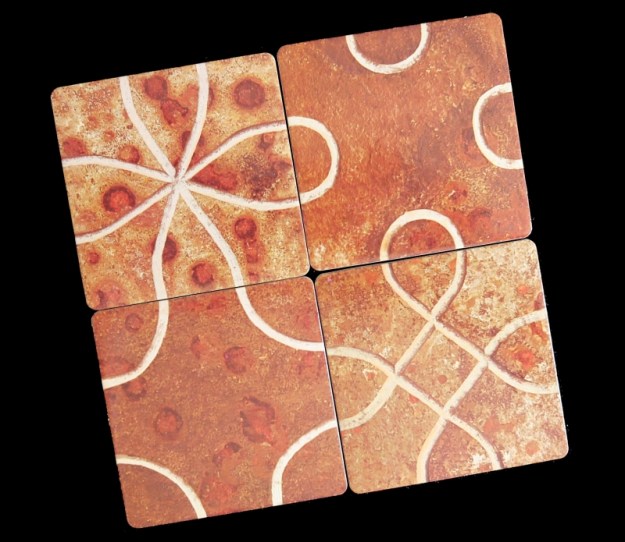
The “Feature Game” was to be Tsuro, a very simple game of tile laying.  The idea is that on their turn, the active player placed a tile in the space next to their stone and moves their stone along the path.  The last player left on the board is the winner.  The game plays lots of people, so was thought to be ideally suited to these online game sessions, but unfortunately, has hidden information in that each player has a secret hand of tiles that they play from.  In order to accommodate this playing online (using Tabletop Simulator to visualise, shared through Microsoft Teams), we simply displayed two tiles and on their turn each player picked one.

Tsuro
– Image by boardGOATS

This reduces the amount of planning possible, making the game less strategic, more tactical and, potentially, more random.  So to compensate a little and make it fairer, when any tiles with four-fold symmetry were drawn, they were put to one side as an extra option, a third tile, available until someone picked it.  As there were a lot of players, we also decided to use the slightly larger board from Tsuro of the Seas, and modify the pieces to suit our purposes.  Aside from this, the rules were the same as the original:  players can rotate the pieces (or ask someone to do it for them), but they must place them in the space next to their piece.

Tsuro
– Image by boardGOATS

Once a tile has been placed on the board, all stones must be moved along any paths extended, and any that collide or go off the board will be eliminated.  Burgundy started in the bottom left corner followed by Black, Purple and Lime, who was joined in the early stages by Little Lime who was keen to help.  Pine with his special friend, Beige assisting, followed by Pink, Blue and Green with Lilac and his “pet” sloth in support.  Everyone was fairly well spaced out around the edge of the board, so the game began quite slowly.  That was OK though as everyone had to get a feel for the graphics and what they were doing.

Tsuro on Tabletop Simulator
– Image by boardGOATS from Tabletop Simulator on Steam

As the game progressed, people started to get entangled with each other.  The first to come a cropper was Black with Pink not too far behind.  Burgundy and Blue got stuck and went off together followed by Green who ran out options and then ran out of road.  When Lime was eventually forced off the board by a lack of space, there were just two left.  As Purple had to move into the space around Pine (playing on behalf of Beige), giving him the opportunity to push her off the board and claim the first victory for his little Gremlin.

Tsuro on Tabletop Simulator
– Image by boardGOATS from Tabletop Simulator on Steam

That had gone quite well and hadn’t taken very long, so as setting up has some overhead, we decided it would be quickest to just play it again.  Blue and Burgundy re-stacked all the tiles and everyone chose their start positions.  For some reason, this time Green ended up surrounded by lots of empty space while everyone else was bunched together.  Green quickly put up a barrier and then went off to play with Lilac to play together alone in the corner, leaving everyone else to fight for space.

Tsuro on Tabletop Simulator
– Image by boardGOATS from Tabletop Simulator on Steam

Pine commented that Blue hadn’t moved far, but when she commented that she’d just been round in a circle, Pine objected inciting Pink to call him a “Boardgame Pedant”.  Pine took this mantle with pride and said he might add it to his CV as it already said he was a “Bird-watching Pedant”.  Blue queried this with “Bird-watching Pheasant?” and Pink upped the ante with “Bird-watching Peasant?”  Pine concurred, “Yeah, that too…”

Tsuro on Tabletop Simulator
– Image by boardGOATS from Tabletop Simulator on Steam

As the game plodded on, Pink was the first to go off, soon followed by Lime and Black.  Then there was a bit of a hiatus though as players got tangled up.  Pine was the first who kindly eschewed the opportunity to expel Blue from the game (or maybe he had no choice); and then Blue returned the favour (also with no other option).  Somehow, the paths kept getting entwined bring everyone to the same place, while Pine played with himself in the top corner, ominously.

Tsuro on Tabletop Simulator
– Image by boardGOATS

It was during this second game that the technology started to struggle a little and Teams kept freezing as the load on the network began to exceed the capacity of the village carrier pigeon.  The game just about kept moving though, with Pink, bored having been the first to leave the game, started intimidating Blue with his large Panda.  Blue and Pine were next off, thanks to Purple, who had to choose who was going to stay in the game with her.  In the end, her choice of Burgundy proved to be unfortunate as he ruthlessly dispatched her on his next turn.  It didn’t make much difference though, and Green with lots of space and no competition was the winner.  Although his second tile had been crucial to his success, it was really the unintentional assistance from Pine when he played a convenient blocking tile in E5 that clinched it.

Tsuro on Tabletop Simulator
– Image by boardGOATS from Tabletop Simulator on Steam

With that over, there was a little bit of chit chat about other game options that would work online:  Finstere Flure was an option on the Simulator, but 6 Nimmt! on Board Game Arena was discussed, as was Take it Easy! with pieces delivered by Blue and Pink.  That didn’t last long though as the evening degenerated into comparing soft toys again (“Is that Kingston Bagpuss?!?!”) accompanied by renditions of songs by The Eagles.  As Green, Lilac and Pine melted away, Blue, Pink, Purple, Black and Burgundy played a few turns to get to the end of Spring in their Keyflower rematch.  But that’s another story…

Keyflower on boardgamearena.com
– Image by boardGOATS from boardgamearena.com

Learning Outcome:  With all this “working from home”, the Stanford Carrier Pigeon needs a good feed.

4th February 2020

Blue and Pink were first to arrive and, while they waited for others and their pizzas to arrive, they tried to squeeze in a quick game of Ganz Schön Clever (a.k.a. That’s Pretty Clever).  This is a “Roll and Write” game, that is to say, players roll dice and use the values they roll to fill in spaces on their score sheet.  So, it is an abstract game where the active player, rolls all six coloured dice and chooses one to keep and use, discarding all dice with lower pip values.  They then roll any remaining dice, again keeping and using one and discarding the rest before rolling the rest one last time keeping and using one final die.  The other players can then use one of the discards, before play passes to the left.

Ganz Schön Clever
– Image by boardGOATS

Filling in some of the boxes gives a bonus action, enabling players to fill in other boxes or gain the opportunity to re-roll their dice or even use an extra die.  The player who wins is therefore the player who makes the best use of the dice they roll and usually, the player who manages to build the most combinations to take advantage of the bonuses available. This time both Blue and Pink started off slowly, but as they were coming to the last couple of rounds, both food and people arrived and their focus drifted a bit.  Pink managed to keep it together better though and as a result finished with a nice round hundred and fifty, some twenty more than Blue.

Ganz Schön Clever
– Image by boardGOATS

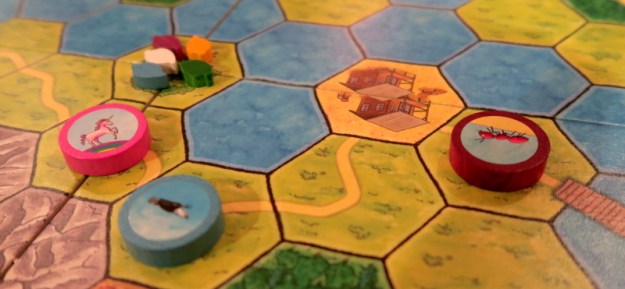
As they finished eating, Green, tried to organise players in an effort get a group together to play Terraforming Mars.  It was quickly clear that it was not going to happen, as Burgundy, Black, Pink, Pine and Mulberry expressed an interest in playing the “Feature Game”, Fast Sloths.   This is a race game where players are sloths travelling around a holiday resort on the backs of other animals.  The rules are quite straight forward:  on their turn the active player takes cards from the face up piles that make the market; optionally play cards, and then discard down to conform to the hand-limit (which varies depending on how players are progressing).  When taking cards, they must all be different animals, and the number they can take depends on their position in the race.

Fast Sloths
– Image by boardGOATS

The game is a pick-up-and-deliver type of game, but unusually the sloths are the cargo being delivered.  Movement on the central board is the heart of the game and each player must try to optimize their movement to win.  When playing cards, they must all be of the same animal – the player then moves the animal corresponding to the cards played towards their sloth, so they can pick it up and drop it somewhere else on the map.  Each animal has their own characteristics, the type of terrain they can cross and how they move etc..  The aim of the game is to collect leaves and the first sloth that can gather eight leaves wins.

Fast Sloths
– Image by boardGOATS

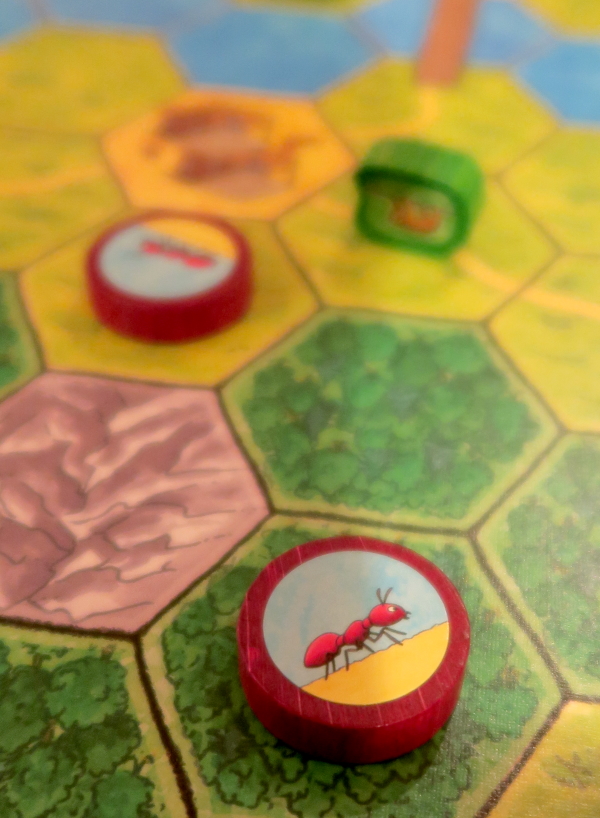
Burgundy got off to a flying start – by both playing first and (even though he was last to pick) securing a good corner tree as his starting location, with a ready-made parade of ants he could bounce over on his way to the next tree.  It was a very tight game, which, after the first few turns while people built up their hand of cards, progressed rapidly with players aiming for a new leaf every turn, or at worst every two turns.

Fast Sloths
– Image by boardGOATS

There was much discussion about the accuracy of the terrains allocated to each transport animal. Donkeys, for example – in Fast Sloths they can’t travel in the mountains or through water, but surely the reasons why donkeys make such good pack animals is that they are great at climbing mountains and wading rivers?  Pink suggested that as this was a “game” perhaps such comparisons weren’t relevant?  However, this suggestion was not received well and went down like a donkey in a river…  Attention then turned to “how true to life” was the representation of unicorn transport.

Fast Sloths
– Image by boardGOATS

The game carried on, with only an occasional call of “Summon the Eagles!” from Mulberry (just imagine Brian Blessed in the film Flash Gordon).  Despite being the first time most people had played the game, all players had clearly got to grips with the mechanism and made speedy progress through the forest – a compliment to the designer it was felt.  In the end, with everyone so closely matched, it came down to marginal differences and Burgundy, after his initial flying start, stayed out in front to win after collecting eight leaves. Hot on his heals were Mulberry, Black and Pine with seven.

Fast Sloths
– Image by boardGOATS

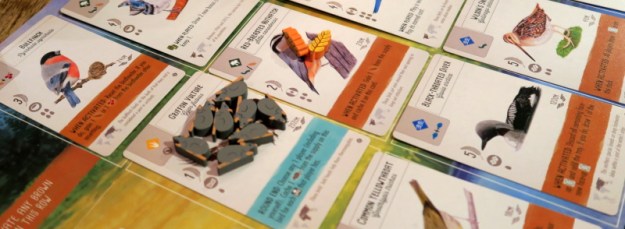
Meanwhile, on the next table, Green and Ivory had settled on Wingspan, and were eventually joined by Purple and Blue.  Since it won the Kennerspiel des Jahres award last year, this has proved a very popular game within the group.  The copy belonged to Burgundy, and he had integrated the European Expansion and Swift-Start Cards, as well as “pimped his bits”; the artwork on the cards is beautiful and the additional pieces just add to the aesthetics.  The game is  functionally very simple, though playing well requires planning and just a little bit of luck.

Wingspan
– Image by boardGOATS

On their turn, the active player can place an action cube to do one of two things:  pay food to play a bird card from their hand, or activate one of their three habitats and all the birds in it.  The three habitats, allow players to collect food, lay eggs or add more bird cards to their hand.  At the end of each round there are bonus points available for players who are most successful with the targets set out; at the end of the game players score points for each bird card they’ve played (value dependent on the bird), food and eggs on their cards, and flocking birds.   The difficult part is to efficiently build combinations of birds with synergistic special powers that will ultimately yield the best score.

Wingspan
– Image by boardGOATS

This time, Blue started by playing a White Wagtail in her Wetland, which gave the opportunity to place a bird card at the end of the round so long as she had activated all three habitats and placed a card during the round.  She still had to pay the food needed, so she concentrated on making sure she had all the bits required to make it work for her every round.  Ivory focused on first playing his Savi’s Warbler and then using it to acquire a lot of cards, many from the face-down draw pile, hoping to draw something good.  Green struggled a bit from the start, partly because he was arguably the player with the least experience, but the fact he was distracted by a bird of a different sort tweeting by phone certainly didn’t help.  Purple on the other hand, quietly concentrated solely on her game, and made excellent use of her Double-Crested Cormorant which allowed her to tuck two cards in exchange for one fish.

Wingspan
– Image by boardGOATS

As the game progressed, Green increasingly needed prompting to take his turn, and explained that he was getting side-tracked because Blue, playing immediately before him, was taking so long on her turn.  While it was true that Blue’s turns were getting longer, this was almost entirely because the number of birds in her reserve was increasing faster than anyone else’s, largely thanks to her White Wagtail which she was busy putting to good use.  The contrast was quite stark Green’s rather meager reserve and Blue’s, although by this time, both Ivory and Purple, also had a good sized reserves.  As the game entered the final round, Fast Sloths was coming to an end and those players wondered over, so the last few turns were played with an audience.

Wingspan
– Image by boardGOATS

At this point, the Wingspan players were putting the finishing touches to reserves.  Green kept commenting how he knew he was coming last and it was clear who had won, but Ivory was not so sure.  In the final accounting every bird in Purple’s reserve had a good point value adding to her points from the tucked birds and Ivory did best in the end of round goals.  Blue had the most birds giving her the same amount of points as Purple (though the individual cards were not as good) and she scored slightly fewer points that Ivory in the end of round goals.  In every other area, however, Blue led the pack giving her the lead overall with ninety-eight points.   Ivory was twenty points behind, and just pipped to second place by Purple.

Wingspan
– Image by boardGOATS

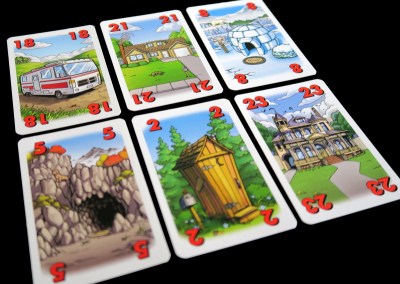
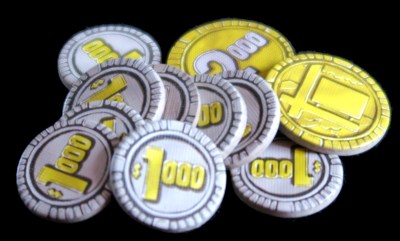
Mulberry, Pine and Ivory Ieft to get an early night, leaving everyone else to play something short;  the game that fitted the bill and was on the top of the pile was For Sale.  This is a very clever property auction game that we played for the first time in years at New Year. The game comes in two parts:  buying properties and then selling them.  So, each player starts the game with $14,000 to spend on property cards.  There are thirty properties, numbered to reflect their relative value and these are auctioned in groups equal in size to the number of players.  The clever part of the auction is that when a player passes and withdraws, they pay half the value of their final bid and take the property with the lowest value; the winner takes the most valuable property, but pays their final bid in full.

For Sale
– Image by boardGOATS

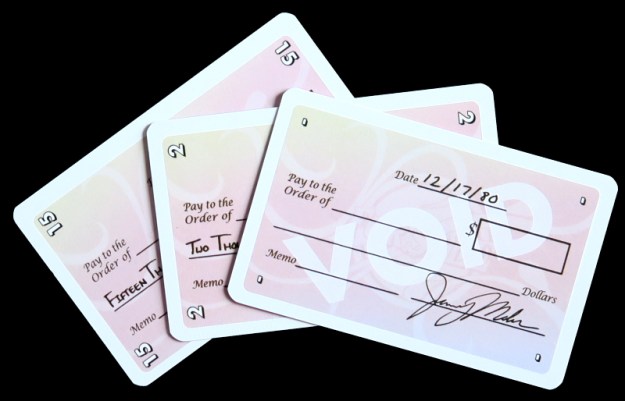
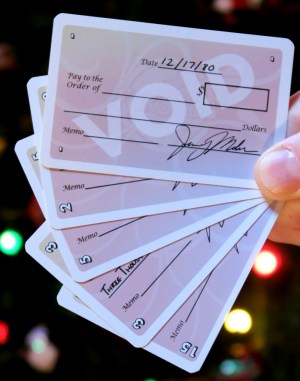
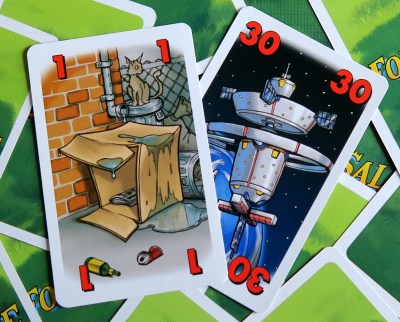
In the second part of the game, cheque cards equal in number to the number of players are laid out, with values from zero to $15,000.  Each player then chooses one property card from their supply and everyone reveals them simultaneously: the highest value property earns the highest value cheque with the second most valuable property earning its owner the second largest cheque and so on.  The winner is the player with the highest total from the sum of their cheques and any left-over cash.  This time, Black took the most valuable property, the space station and with it, on of the $15,000 cheques while Burgundy took the other.

For Sale
– Image by boardGOATS

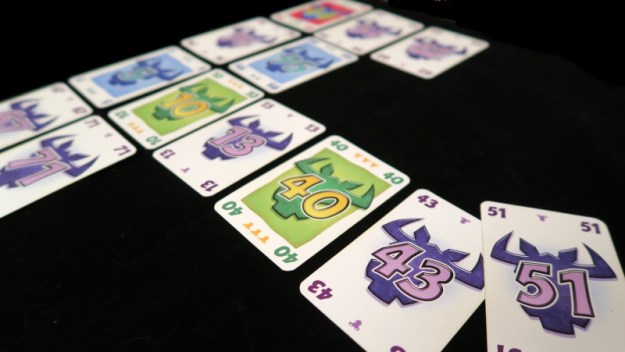
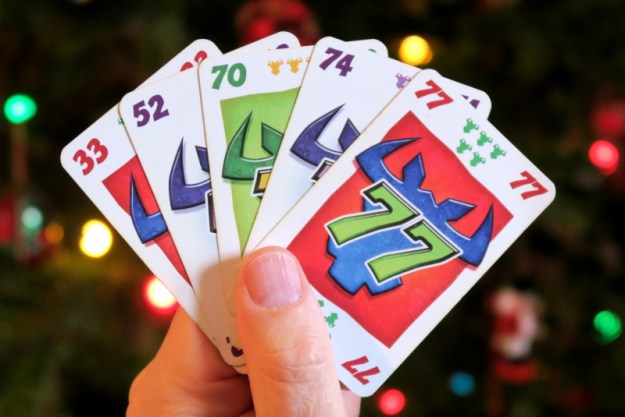
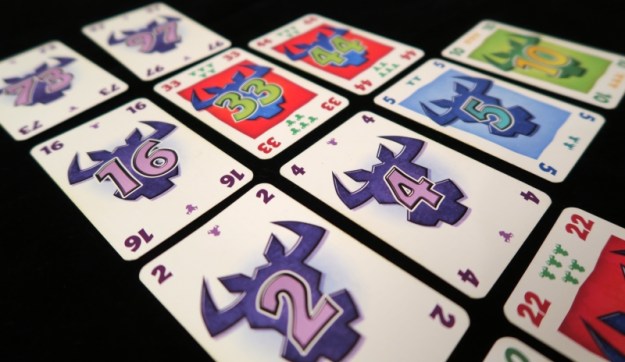
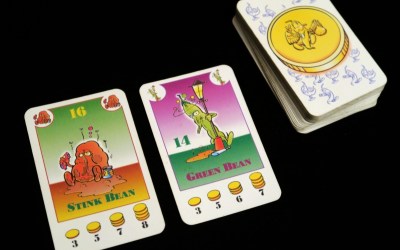
At the other end of the scale, Pink took both the void cheques, but despite this still managed $33,000 for the rest of his properties.  This was nothing compared to the winner, Green, who finished with $53,000, $2,000 more than Burgundy in second.  The night was still young, however, and there was still time for one of our favourite games, 6 Nimmt!.  Although this is often derided as a game of chance, it is clear that it is not pure luck.  The idea is that everyone has a hand of cards from a deck numbered one to a hundred and four.  Simultaneously, everyone chooses a card from their hand, and, starting with the lowest value card, these are then added to one of the four rows of cards.

6 Nimmt!
– Image by boardGOATS

Each card is added to the row with the highest end card that is lower than the card they have played.  If the card is the sixth card, they take the five cards in the row and their card becomes the first card in the new row.  Each card has a number of bull’s heads on it—this is the number of points they score.  The player with the fewest points at the end of the game wins.  We play with a variant that half the cards are dealt out for the first hand and the rest for the second, which gives us a score at half-time.

6 Nimmt!
– Image by boardGOATS

This time Burgundy and Black were in the lead at the half-time with a single nimmt, with Blue a couple of points behind.  Pink set the competitive high score of thirty-one.  Black picked up a handful of cards in the second half, indeed, only Purple, Blue and Burgundy managed to keep their second half scores to single figures.  In the end, it was Blue who just had the edge, beating Burgundy by three nimmts.  At the other end, however, Pink had no competition finishing with a very respectable high score of forty-five, not a record, but a substantial total nonetheless, and a good end to a fun evening.

6 Nimmt!
– Image by boardGOATS

Learning Outcome:  Donkeys are not as versatile as you might think.

31st December 2019

Burgundy was the first to arrive and he was quickly joined by Purple, Black and Lime.  As the first to arrive, together, they began to set up the “Feature Game“, the now traditional, car-racing game, PitchCar.  When Pine joined the party, discussion turned to the “Monster Games” session which featured Bus, Ecos: First Continent and the very silly Happy Salmon, all of which had been very enjoyable in their own way and most of which will come out again soon.  Before long, an exciting-looking racing track was set up around an obstacle course of snacks and drinks.

PitchCar
– Image by boardGOATS

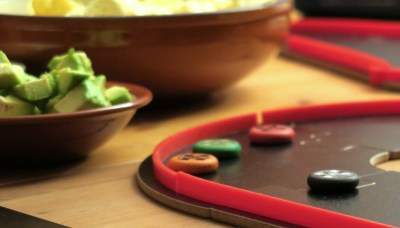
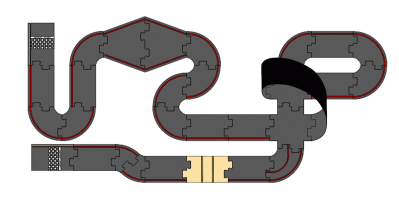
As we’ve done a few times recently, instead of a circuit, we set up a single section track with separate start and finish lines.  This year we included the new Loop (which got it’s first outing at Pink’s sPecial Party in October) and Upsilon expansions as well as the bridge from the first expansion.  As usual, much fun was had by all concerned, especially with the new challenge that the Loop added.  There is clearly a knack with this: it is essential to hit the puck hard and in the middle, but some have the skill naturally, while others apparently just don’t.  Lime is one who clearly does, and as a result, his car traveled the furthest in the “flick-off”, so started at the front of the grid and finished way out in front too.

PitchCar Track 31/12/19
– Image by boardGOATS

Pine, Pink and Purple, clearly don’t have the knack, and we never really found out about Burgundy either, as someone helped him largely avoid it, resulting in him to taking second place.  Elsewhere, having successfully escaped from the Loop, Black shot round the chicane and made the bridge look easy, inspiring Pink to comment that we always used to get stuck at the bridge, but now we have the Loop, the bridge is easy!  That said, stopping over the line without falling off the end of the track proved to be quite challenging.  So much so, that after half a dozen mini-flicks, Black was in danger of getting caught by Pine, who eventually made it round in fourth place.

PitchCar
– Image by boardGOATS

That just left Pink and Purple, taking it in turns to try to get round the Loop.  Eventually, Purple hit the sweet spot and started off towards the finish.  Unfortunately, after a superb single shot that took her round the ring, she ended up pointing in the wrong direction and tried to go  round the Loop backwards.  Pink meanwhile was still stuck and thanks to the way the track looped back on itself creating an intersection, managed to very effectively obstruct Purple in her quest to get to the end.

PitchCar
– Image by boardGOATS

As Purple’s and Pine’s antics entertained, everyone else consumed crudites, Devils on horsebacks, stuffed mini peppers, and large quantities of pigs in blankets (Lime commented that he now knew why JD Wetherspoon had a shortage).  When Purple and Pink finally crossed the line, it was time for supper – spicy vegetable chili, beef chili, rice and corn on the cob.  As people finished dinner we realised we’d forgotten the crackers and Christmas pressies. Unusually, this year there was desert too, so Black was given a special rolling-pin shaped knife to “cut” it, leaving everyone to wonder, before Pink delivered a Christmas pudding-shaped chocolate piñata.

New Year 2019
– Image by boardGOATS

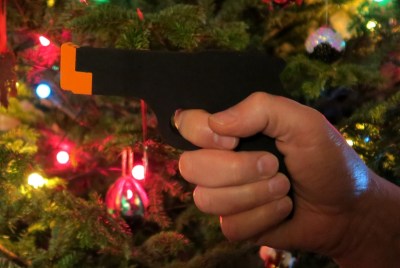
The “Pud” resisted all Black’s initial blows, until he decided a side-swipe might have more effect.  Eventually a dent became a crack and the crack became a hole revealing the sweets inside.  As everyone picked at the chocolate, we decided to start another game, Ca$h ‘n Guns, because there’s nothing better at Christmas than pointing foam guns at each other.  This is a very simple, but very fun party game where players are gangsters dividing up their loot by a sort of controlled Russian Roulette.

Ca$h 'n Guns
– Image by boardGOATS

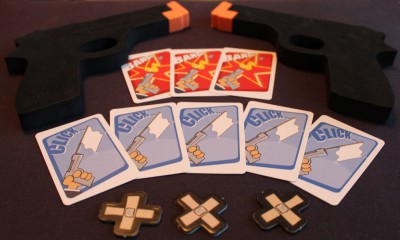
Each player starts the round by loading their gun with one bullet from their deck of eight bullet cards, or “clip”.  Each bullet can be used only once during the game, and three are live, while the other five are blanks.  Once everyone has chosen their bullet card, the Godfather counts to three and everyone points their weapon at someone.  The Godfather can then use his privilege to ask one player to point their gun away from him (there was some discussion as to whether a real gangster would use “please”), then there is a second count of three.  This time, players can back out, which means they won’t get shot, but they also won’t get any loot.

Ca$h 'n Guns
– Image by boardGOATS

All the remaining players then reveal their bullet cards and anyone who is shot picks up a plaster and also won’t get any loot at the end of the round.  This leaves a hard-core of gangsters to take it in turns to collect cards from the loot pool that was revealed at the start of the round.  In each round, all the loot cards are taken, so when it is a particularly brutal round, players can take several cards.  The loot includes diamonds, artworks and cash, as well as the occasional medipack or additional bullet and the opportunity to become the Godfather.  Unusually, this final option was taken several times so the Godfather changed hands quite frequently, with Burgundy, Pink, Lime, Blue, and Pine all taking the role at some point.

Ca$h 'n Guns
– Image by boardGOATS

Blue was Boris, so Pink suggested that she should be the target.  This is fairly usual in this game, so Blue rarely wins.  However, it seems people didn’t like being told what to do by Pink, even if he was the Godfather, so remarkably, she survived the first round.  After a couple more rounds she’d still only picked up one plaster, while Pine, had acquired two so a third would put him out of the game.  As he had pointed out at the start, an injury tends to make you a target, but somehow, Pine managed to get himself a medipack.  Burgundy and Purple, however, were not so lucky and bought it in round six.

Ca$h 'n Guns
– Image by boardGOATS

Going into the final round, Black commented on how many painting cards Blue had picked up—the first is worth $4,000, but these score an ever increasing amount so a player with ten scores $500,000.  At that point, Blue didn’t feel she had enough, but as Pine’s final bullet proved to be a blank, she was able to stay in for the final round and pick up a couple more.  It surprised even her when she counted up and found she had seven paintings giving a total of $250,000 when her cash was added in.  Black took the $60,000 bonus for the most diamonds and with it, second place with $133,000, and not a scratch, just ahead of Pink ($110,000) who was also unharmed.

Ca$h 'n Guns
– Image by boardGOATS

With midnight fast approaching, we replaced the guns with glasses to toast the New Year and watch the fireworks (in both London and the village).  And then we had the very important decision to make: what to play for the first game of 2020.  In the end,  we decided to go for our old favourite, 6 Nimmt!.  Everyone knows how to play this by now:  players simultaneously choose a card from their hand and then, starting with the player that revealed the lowest value card, players add their cards to one of the four rows.  The player who adds the sixth card to a row, instead takes the first five into his scoring pile, where the number of bulls’ heads indicates the score.  The winner is the player with the fewest “nimmts”.

6 Nimmt!
– Image by boardGOATS

We played with our usual variant where a game takes two rounds, each played with one half of the deck.  In the first round, Pine top-scored with twenty-two closely followed by Lime with eighteen, while Pink kept a clean sheet and Purple remarkably (especially for her), had only the one card with just a single “nimmt”.  So, going into the second half, it was all to play for.  As is usually the case, those that do well in the first round typically do badly in the second.  That was exactly the way it panned out for Pink who picked up the most “nimmts” in the second round with twenty-five, almost catching up with Pine and Lime.  Purple, however, managed to buck the trend, and pulled out a clear round giving her a final total of just one and with it, clear victory—the first of the new year.

6 Nimmt!
– Image by boardGOATS

Lime suggested a second game, and as the only other game being suggested was Bohnanza, apathy from everyone else meant we played 6 Nimmt! again.  Again, Pink ended the first round with “zip”, followed by Black and Burgundy with five; again Pine had the highest score of twenty-four.  Also again, Pink failed in the second round, taking more than anyone else and finishing with a total of twenty.  Blue managed a zero in the second round, but had picked up too many points in the first to do better than second place.  It was consistency that won the game though, and Burgundy, the only one to say in single figures for both rounds, finished with thirteen and took first place.

6 Nimmt!
– Image by boardGOATS

By this time was well gone 1am, and there was some chatter before Lime decided that it was past his bedtime and left everyone else to it.  With six, there were slightly more options, and when Pink appeared with For Sale, nobody objected.  This is an older game, that we haven’t played in the group since it was the “Feature Game” nearly seven years ago, but it is a bit of an “ever-green” game that still pops up on recommendation lists from time to time.

For Sale
– Image by boardGOATS

The game is very simple: players buy properties in the first part of the game and then sell them in the second half, and the player who has the most money at the end wins.  Buying properties is through auction.  Players start with $14,000 to last the whole game and take it in turns to bid for one of the property cards available on the table.  These have a nominal rating of one to thirty with fantastic pictures that reflect their value.  In each round, the bidding is continuous with players either increasing the bid by at least $1,000 or passing.  When a player passes, they take the lowest value property card and pay half their bid.  Thus, the winning player gets the highest value card, but has to pay the full amount bid.

For Sale
– Image by boardGOATS

In the second part of the game, cheque cards with a value of $2,000 to $15,000 (or void) are revealed and players simultaneously select a card to play and then reveal.  The property card with the lowest numerical value takes the cheque with the smallest value.  This time, the property cards came out in bunches so it was mostly a case of players trying to avoid getting the real rubbish, and some inevitably failing.  It was such a long time since we had played the game, that it took a couple of rounds for players to really get the feel of valuing the properties and the best way to bid, by which time, in some cases, the damage had already been done.

For Sale
– Image by boardGOATS

It also took a round or two to get the hang of selling properties as we weren’t sure exactly how the money on the cheques was distributed.  In addition, the cheques came out with low values first, then high values and finally, both voids in the last round.  This meant that although Blue took the maximum return for her Space Station, she didn’t take out any of the other high value buildings.  It also meant that Burgundy and Pink got saddled with the voids in the final round.

For Sale
– Image by boardGOATS

Despite this, it was a very close game.  In the final accounting, Black won with a total of $50,000, just ahead of Burgundy in second with $47,000, the void possibly making all the difference.  By this time, it was gone 2am and although nobody was keen to leave, it was definitely pumpkin-o’clock.  So everyone headed home to bed for the first time in 2020.

New Year 2019
– Image by boardGOATS

Learning Outcome:  Thick chocolate is surprisingly hard to break.

26th Movember 2019

There were lots of people feeding and with a bit of a queue, so the non-eaters, Ivory, Mulberry and Lime, decided to play something while they waited.  There were lots of options, but it was a long time since we’d played The Game and it ticked all the boxes, so unusually, a decision was made really quickly.  This is a simple cooperative card game (in our case, played with a copy of The Game: Extreme, but ignoring the special symbols), but new to Mulberry and Lime.  The team have a deck of cards from two to ninety-nine and they must play each card on one of four piles, two where the card played must be higher than the top card, and two where it must be lower.

The Game: Extreme
– Image by boardGOATS

There are just three rules:  on their turn, the active player can play as many cards as they like (obeying the rules of the four piles), but must play at least two cards before replenishing their hand, and players can say anything they like but must not share “specific number information”.  Finally, there is the so-called “Backwards Rule” where players can reverse a deck as long as the card they play is exactly ten above or below the previous card played on that pile.  This time, it went a bit wrong early on, but the trio managed to pull it back.  Lime got stuck with fifty-six and sixty-four that he couldn’t play, and eventually the game came to a halt with six cards still to play.

The Game: Extreme
– Image by boardGOATS

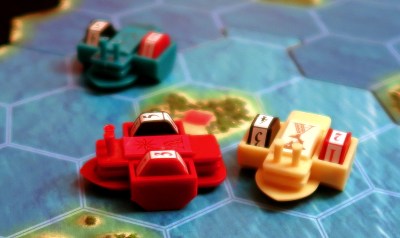
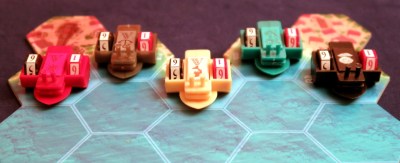
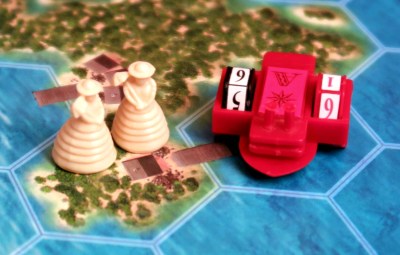
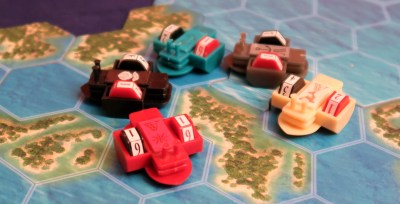
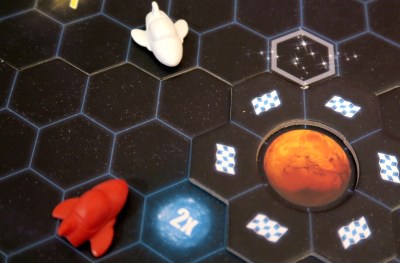
By the time The Game was over, the eaters had just about finished as well and the group split into two, one five to play the “Feature Game”, Mississippi Queen.  This is an older game that won the Spiel des Jahres award in 1997, but has recently been re-released in a new edition having been out of print for many years.  In this game, players race their paddle steamers down the Mississippi, picking up passengers along the way.  Onboard, coal supplies are limited, so each ship’s acceleration and manoeuvrers must be carefully planned.  The key to the game are the cool little plastic paddle steamers which have two numbered paddle wheels – one to track coal and the other to record the speed.

Mississippi Queen
– Image by boardGOATS

The five riverboats start at jetties and then set sail along the river, which is made up of a hexagonal grid.  At the start of their turn, the active player can adjust their speed by one and then move that number of hexagonal spaces, turning a maximum of once before, during or after the move.  The player can increase or decrease their speed by more or make extra turns by burning coal.  Everyone starts with just six coal though and there is no source of coal during the game, so when it’s gone it’s gone.

Mississippi Queen
– Image by boardGOATS

The game has a lot in common with Powerships, a mad spaceship racing game we played about six months ago, but there are a couple of key differences.  Firstly, each player has to pick up two passengers from the islands during the race, which means they must arrive at a jetty at a speed of one.  There is a more subtle difference which is nevertheless important to the way the game plays.  In Powerships, the map is modular, but is set out before the start of the game, where it is built as play progresses in Mississippi Queen.

Mississippi Queen
– Image by boardGOATS

In Mississippi Queen, after the first turn, play proceeds according to position in the race (like PitchCar).  The advantage of this is that players at the front don’t obstruct players moving up from behind, however, it can lead to a run-away leader problem instead.  In Mississippi Queen though, the river is “built” as the game progresses; when the leader moves onto the final space, they draw a new river tile and roll the die to determine placement (left, right or straight ahead).  The fact that the player in the lead has less time to plan has the additional effect of off-setting the advantage of less obstruction, helping to prevent the leader running away with the game.

Mississippi Queen
– Image by boardGOATS

This time, Lime stormed into the lead, but overshot the first island allowing Blue to sneak in behind him and grab a passenger.  There are plenty of islands though, so Lime had plenty of other opportunities.  Unfortunately, he overshot the second island as well as he was going too fast.  By the third island, Lime was starting to get desperate, but hadn’t got his speed and position right and ended up burning almost all his coal and doing a full circuit of the island to rectify things.  This, and almost sinking gave everyone else a chance to catch up and Blue managed to snatch another passenger putting her in a position to make a run for the finish.

Mississippi Queen
– Image by boardGOATS

Although she was able to move into the lead, Blue was hampered by an inability to plan and was forced to burn some of her carefully hoarded pile of coal.  Mulberry wasn’t far behind, and had the advantage of being able to see slightly further down the river so was better able to plan and could therefore carry more speed.  Purple and Pine got into a tangle over picking up a beautiful lady, delaying them both as Blue and Mulberry puffed off into the distance.  Lime bravely fought his way back, but it was between Blue and Mulberry with Mulberry rapidly eating into Blue’s lead.  Blue just managed to make it to the jetty burning the last of her coal to drift in gently, just ahead of Mulberry.  Lime limped in next, leading the others in.  Meanwhile, on the next table, everyone else was playing one of the archetypal card-drafting games 7 Wonders.

7 Wonders
– Image used with permission of boardgamephotos

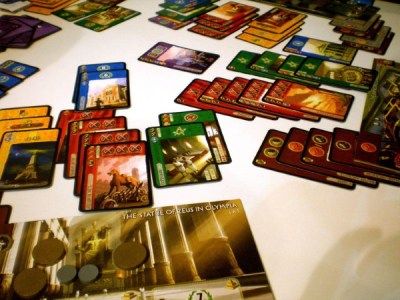
Players start each round with a hand of cards, and everyone simultaneously chooses one and plays it.  The remains of the hands are then passed on to the next player who chooses a card and plays it.  Play continues like this until each player has two cards at which point one is discarded.  The game is distinguished from simpler card-drafting games like Sushi Go! by the civilisation and engine building aspects.  In 7 Wonders, the players are the leader of one of the seven great cities of the Ancient World. They use the cards to gather resources, develop commercial routes, and affirm their military supremacy.  Some cards have immediate effects, while others provide bonuses or upgrades later in the game. Some cards provide discounts on future purchases, some provide military strength to overpower your neighbors and others give nothing but victory points.

7 Wonders
– Image used with permission of BGG contributor  punkin312

After three rounds (or Ages), the player with the most points has the most advanced city and is the winner.  The player boards are chosen at random at the start of the game.  In this case, Green got Halicarnassus, and chose Side B so would be looking to build extra cards from the discard deck in the second and third rounds. Black got Ephesus and also went with Side B and so was only going for victory points and extra money.  Ivory got Babylon and again Side B was favoured, giving him the second tier bonus of being able to build both his final two cards.  Red received Alexandria and was also going to use Side B which would provide her extra resources and victory points.

7 Wonders
– Image used with permission of boardgamephotos

Green’s game was one of building resources in order to build the pyramid enabling him to  build the extra cards.  He started building up his military, and although he was joined at the same level by both his neighbours (Ivory and Black), he began to pull ahead of Ivory after the second round and by the end of the third round had amassed an unassailable army. In the process though, he had neglected green science cards and purple guilds.  Building extra cards from the discard pile is perhaps not as helpful as it might seem as the cards in the discard pile are there because they are the least useful cards. Maybe with more players there would be more to choose from and this bonus would work more favourably, on thee other hand, it might just end up with more duplicates.

7 Wonders
– Image used with permission of
BGG contributor punkin312

On the opposite side of the table was Red.  She, in contrast (and not under threat from the growing armies of Green) mostly ignore the fighting, but still managed to win one battle. With the extra resources available from her pyramid she did not need as many resource cards and decided to concentrate on the other cards.  She invested heavily in the yellow bonus cards and also managed to get a full complete set of science cards.  These she managed to combine with the purple guild which gave her an extra science symbol of her choice.  She also managed to build a second purple guild, which gave her extra points for all brown, grey and purple cards. She also managed to acquire a very large pile of money which netted a fair few points too.

7 Wonders
– Image used with permission of boardgamephotos

Ivory’s game was built around trying to get to the second pyramid level quickly, so initially he took a lot of resource cards. Unfortunately he didn’t get to the second level until the end of the second round, but having looked at the card he then decided the extra money would be more useful. He managed to build both his last cards in the final round, but like Green found, that extra card is not always that useful. He did manage to collect some high scoring blue cards, but  although he tried, he failed to get a full set of science cards. He did get a couple of purple guilds though with one scoring the yellow cards belonging to neighbours, Red and Green who had both gone quite heavily into those. The other gave him points for every battle lost by his neighbours. He got nothing from Green for this, but scored quite nicely from Red.  His resource heavy early game meant that he was left trying to catch up on the other later cards and abandoned his attempts to build a strong army and just took the beating.

7 Wonders
– Image used with permission of BGG contributor punkin312

Black’s game was concentrated on the blue victory point cards and his pyramid build.  A smattering of yellow bonus cards aided his end game score because he scored for all the brown cards built by both himself and his neighbours (Green and Red). He collected some science, but not a complete set.  Although beaten by Green in the final battle, he avoided defeat in the first two and took a clean sweep of victories over Red.  So although everyone had had a strong game in one area, these were more than offset by less strong elements elsewhere.  It turned out that the strongest games were had by Black and Ivory who finished level on fifty-one, some way ahead of Red in third.  The tie break was won by Black who had the more money at the end of the game.

7 Wonders
– Image used with permission of boardgamephotos

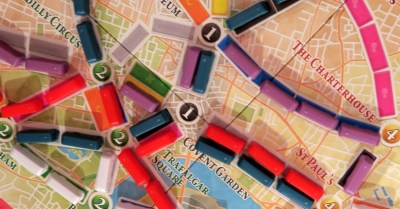
Mississippi Queen was still going, but coming to an end so something quick was needed and Ticket to Ride: London hit the spot.  This is one of the new, smaller versions of the popular route-building game, Ticket to Ride.  These are reduced in size and designed be quicker to play although the game play is very similar.  Players take it turns to draw coloured cards or use them to place pieces, but in this version the Train pieces are replaced by Routemaster Buses.  As usual, players also start with a selection of ticket cards and successfully fulfilling these give more points, but woe betide any player who fails to complete a ticket as the points become negative, which can be very costly indeed.  In addition to these features, this new light version of the game also gives bonus points to players who manage to connect all the locations in an area.

Ticket to Ride: London
– Image by boardGOATS

The action started around central London, (Covent Garden, Piccadilly Circus and Trafalgar square) as Red, then Black and Ivory laid buses around the area, all concerned that the other may block their paths. Green went further out to Kings Cross and Regents Park.  As the game progressed, Ivory, Red and Black continued to challenge each other around central, East and Southern London. Green happily laid his buses round to the East unopposed.

Ticket to Ride: London
– Image by boardGOATS

Black, who had only kept one ticket, was the first to complete his ticket and go for more.  He was closely followed by Red (who had also only kept the one), and then Ivory (who had kept two).  Green never took new tickets, concentrating on his two and connecting all the stations in the five point district. Black, Red and Ivory continued to take new tickets, but it looked like Green might end the game as he was soon down to only three buses.  Ivory checked around the table to see who had buses and how many cards they had left and decided that he had time.  Even though he had missed the fact that Green had only a single card in hand, he still managed to lay his last buses first; one turn too early for Green who had to settle for a two length route instead of the three he was aiming for (and close to getting).

Ticket to Ride: London
– Image by boardGOATS

Black placed one last bus, but Red decided to gamble on new tickets as she had nothing she could claim.  Ivory still had one final turn, but with no more buses to lay, he decided against the ticket gamble.  In the final scoring, Ivory was way ahead of everyone else, due to claiming four “long” routes (threes and fours) and completing some high scoring tickets.  Red, Black and Green were all within two points of each other. Red’s final ticket gamble failed and cost her a clear second place, and Green’s gamble on connecting all the stations in the five point district (and the stations in the two point district as well) did not pay off either.

Ticket to Ride: London
– Image by boardGOATS

Some left for an early night and those that were left decided to play one last quick game.  Pine was adamant that Bohnanza and Las Vegas weren’t “quick” so in the end, 6 Nimmt! got the nod.  This is one of our most popular games, and frequently gets played in circumstances like this.  It is very simple and there is something almost magical about playing well:  simultaneously everyone chooses a card from their hand and places it face down in front of them.  Once everyone has picked a card, they are all revealed and, starting with the lowest card, the cards are added to one of the four row, the row where the end card has the highest value that is lower than their card.  The point is that the row a card is played on changes as players place cards.

6 Nimmt!
– Image by boardGOATS

The player who places the sixth card, takes the five cards and scores the number of bulls’ heads shown.  The winner is the player with the fewest bulls’ heads.  We play the game in two rounds, and this time the first round was mostly pretty even with everyone taking twelve to fifteen Nimmts except Blue who somehow scraped a clear round.  This meant it was all to play for in the second round, especially with the tendency for a good round to be followed by a bad one.  Unusually, nobody had a terrible game:  Pine top scored with forty, followed by Purple with thirty-one, and everyone else was quite closely grouped. Blue’s clear first round gave her a head-start and she finished with fourteen, just two ahead of Ivory and three ahead of Black in what was an unusually close game.  And with that, it was home-time.

6 Nimmt!
– Image by boardGOATS

Learning  Outcome:  Neglect end game bonuses at your peril.

Pink’s sPecial Party

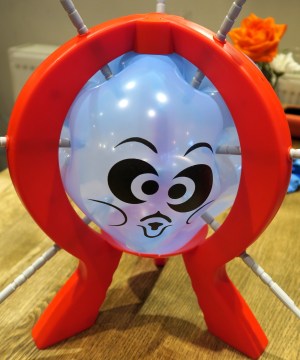
It being a very special day for Pink, he decided he wanted to spend it playing games with friends and family at the Jockey.  The early arrivals set up PitchCar, including the new “Loop” expansion and others played Loopin’ Louis, Patchwork Express, Dobble and the surprise hit, Boom Boom Balloon.  Little-Lime won PitchCar (perhaps flicking talent runs in the family as Lime himself managed to complete the  loop at least three times), and almost everyone managed to lose Boom Boom Balloon at least once.  Late in the afternoon, a game of Scotland Yard was started with Pink as the fugitive, and finished almost before it was begun when he was quickly captured.  It was then restarted with Mrs. Lime as the fugitive and turned into an epic game that went on for a couple of hours with a brief break as people tucked into the buffet supper and amazing sticky-toffee pudding cake-desert provided by the Jockey Kitchen.

Boom Boom Balloon
– Image by boardGOATS

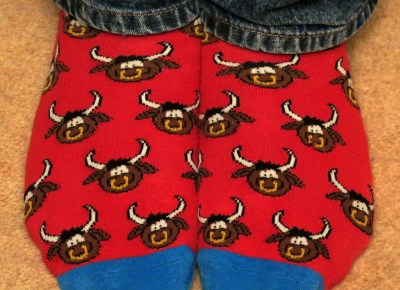
The evening continued with more games including No Thanks!, Finstere Flure (a.k.a. Fearsome Floors), Saboteur, …Aber Bitte mit Sahne (a.k.a. Piece o’ Cake) and Ice Cool.  The team of five eventually managed to corner Mrs. Lime, freeing up Pink to play his special request, Captain Sonar, which his team fittingly won, twice.  This was followed by a game of Ca$h ‘n Guns (it is always fun entertaining the bar staff by waving foam pistols about and threatening to shoot each other), before finishing with 6 Nimmt!, a game to match Pink’s socks.  It was a great day, and we all went home tired, but very happy, with Pink and Blue keen to thank everyone for sharing Pink’s sPecial day.

6 Nimmt!
– Image by boardGOATS

9th July 2019

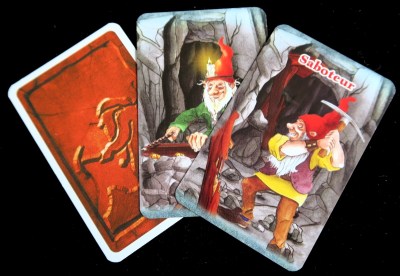
The pub was madly busy thanks to a boisterous party and a couple of large groups in the bar area, so we decided to start with a game while we waited for food.  The “Feature Game” was to be Forbidden Desert, but as most people were waiting for food, we decided to start with something we could play as a group.  6 Nimmt! was the first suggestion, but in keeping with the cooperative game theme of the Feature, we decided to start with Saboteur.  In this game, players are either Dwarves or Saboteurs, where Dwarves are collectively trying to dig a tunnel to find the Gold, while the Saboteurs are trying to stop them.

Saboteur
– Image by boardGOATS

On their turn players can play a tunnel card to extend the network, play an action card or discard a card and pass. Action cards come in several flavours.  There are red and green tool cards, with red broken tool cards stopping others from digging and green “fixed” tool cards that repair broken tools.  There are map cards that allow players to peek at one of the three target cards to see if it holds the gold, and rock-fall cards that enable players to remove a single card  from the tunnel network.  All the action cards can be used by Dwarves and Saboteurs alike to impede the other team.

Saboteur
– Image by boardGOATS

Black was the first to play and began ditching all his rubbish blocking tunnel cards while Pine started off by explaining how Burgundy was always a Saboteur and generally made Burgundy’s life a misery by besetting him with broken tools and reminding everyone how last time we played Burgundy was a Saboteur three times running.  This time, we had more players, but it wasn’t long before it became clear that Burgundy was indeed a Saboteur, along with Lime, who was playing it for the first time and was not at all secretive of his position.  Eventually, Red found the Gold on behalf of the Saboteurs, and Black was outed as the third and final Saboteur and had apparently all the cards he had been discarding had been good tunnel cards not bad ones.

Saboteur
– Image by boardGOATS

The rules as written state that there should be three rounds and players pass gold cards around in an effort to determine who will be the overall winner.  We don’t think the game needs a winner in this way, so we play with a “house-rule” that treats each round as a game in its own right.  This way, we can stop at two games if it is beginning to outstay its welcome, or carry on and play three or even four rounds, giving more people to join Burgundy as Saboteurs.  Everyone had really enjoyed the first round and was keen to go again, so cards were handed out and Pine once again accused Burgundy of a “Saboteury” first move.  Blue had loads of blocking cards, but after Black had spent almost all the previous round dumping cards, didn’t dare pass for fear that she would be accused of being a Saboteur.

Saboteur
– Image by boardGOATS

Blue asked everyone else for advice and Red suggested that the one thing she could do to convince her that she was a Good Little Dwarf was play a blocking card on Burgundy, which she obligingly did.  It didn’t work, however, and it wasn’t long before Red declared Blue a Saboteur.  In frustration Blue showed Red all the blocking cards she had and that seemed to stem the tide of accusations, at least for a few turns.  With Burgundy buried under a pile of broken tool cards, his delight was evident when Blue revealed her true colours and played a disruptive blocking card.  It was just a smidge too late though and Black brought the round to an end by finding the Gold.

Saboteur
– Image by boardGOATS

By this time food had been ordered, but was not looking like it was going to arrive immediately, so we decided to see if Burgundy could make it three in a row again.  Inevitably, we were only a couple of turns in, therefore, when food turned up and the tunnel network was obstructed by Purple’s enormous bowl of mushroom tagliatelle.  Pine confused everyone by indicating his position early, playing a blocking card right in the middle of the map.  Perhaps it was the difficulty of playing round a plate of pasta, or perhaps her mind was just elsewhere, but a very curious card placement quickly led to Purple being labeled as a Saboteur joining Burgundy and Pine.  Flying well under the radar, if only the real Saboteurs had had helpful cards to play then they might have won, however, it was not to be.

Saboteur
– Image by boardGOATS

It turned out that Blue and Black were once again the real Saboteurs (along with the more obvious Pine), but frustratingly there was nothing they could do and Red once again finished the round by finding the Gold for the Dwarf team.  By this time everyone was very hungry, so food mostly disappeared quite rapidly and while Black, Purple and Burgundy dealt with their last few mouthfuls, Blue, Lime, Pine and Mulberry took themselves off to the table by the door (ostensibly to get space to play, but partly to take advantage of the respite the cooling draught offered from the humidity), to play the “Feature Game”, Forbidden Desert.

Forbidden Desert
– Image by boardGOATS

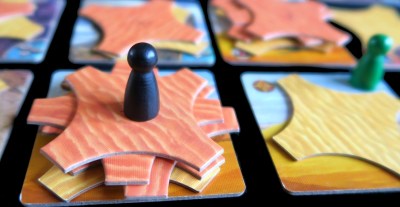
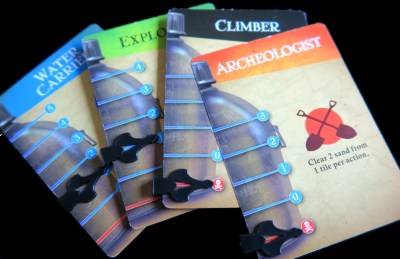
Where Saboteur is a “semi-cooperative” game because it has a traitor mechanic, Forbidden Desert is a fully cooperative game.  This means everyone plays together against the game, with the same goal.  The story is that a helicopter has crash-landed in the desert, and the survivors, in our case, an Archaeologist, a Climber, an Explorer and a very well behaved, cooperative, er, camel (“Water Carrier”), must try to find the buried, missing pieces of a historic air-ship, in order to escape.  This, with minimal water, the sun beating down and the growing sand-storm, means that players have to be quick in their hunt, and smart in keeping the keeping the storm from getting out of hand.

Forbidden Desert
– Image by boardGOATS

The game is played on a five by five grid made of twenty-four tiles and one gap.  The tiles all start face down and must be excavated to reveal their other side.  Some tiles will yield clues as to where the missing air ship parts are, others hide potentially useful equipment, while excavating others will yield a launch pad or the entrance to a tunnel.  Everything is useful, but all four pieces of the ship must be found together with the launch pad, before the players can escape.  On their turn players have four action points per turn which they can use freely to move, remove sand from the tile they are on (or an adjacent one), excavate a cleared tile, or pick up a piece of airship.

Forbidden Desert
– Image by boardGOATS

Once all four actions have been completed cards from the storm deck are turned over and tiles are moved in the direction indicated into the eye of the storm reflecting the shifting dunes.  As they are moved, sand tiles are placed on each one, building up the dunes and burying the antiquities in sand.  There is a finite number of sand tiles and running out triggers the end of the game with the team losing.  Running out of sand is only one way to lose however.  If any player runs out of water, the whole team loses, and the storm level increasing to its maximum also spells doom.  On the other hand, if the team manage to find all the parts and the launch pad, they will be able to escape from the desert.

Forbidden Desert
– Image by boardGOATS

One of the problems with cooperative games is “quarter-backing” also known as the “alpha gamer problem”, where one player takes control and tells everyone else what to do.  With Blue the only player to have played it before (though Lime had played Forbidden Island some time ago), it would have been easy for her assume the role of Colonel, but that sucks all the fun out of the game.  So there was a little discussion as to how we should approach the game (primarily trying to make the best use of our characters’ special abilities and trying to work quickly to excavate tiles) and then we started, with the storm level on “normal”.

Forbidden Desert
– Image by boardGOATS

The game began badly, when two of the first tiles we excavated were tunnel tiles.  These are very useful because players can use them to shelter from the sun and thus preserve water when a Sun Beats Down card is revealed.  They also enable players to travel from one part of the board to another in a single move.  Unfortunately, the tiles were adjacent which meant they were much less helpful than usual.  Prioritising, digging in order to find parts of the airship, the team found a lot potentially useful equipment, but it seemed ages before the first clue came up, a hint to where the propeller was buried.

Forbidden Desert
– Image by boardGOATS

The team soon found the second clue to the location of the propeller which turned out to be relatively conveniently located so Pine, the Climber, quickly picked it up.  It was then that Lime pointed out that the number of sand tiles available was getting critical, and something had to be done.  A couple of turns and concentrating on the sand problem and use of Mulberry’s Dune Blaster, helped, but a couple of Sun Beats Down cards in the meantime meant there was now a water shortage. so Pine and Blue (the Water Carrier), set out to rectify the situation.  Unfortunately, the first of the possible springs turned out to be a mirage.  While it didn’t lead to anyone running out of water immediately, valuable time and moves had to be used to excavate another tiles.

Forbidden Desert
– Image by boardGOATS

Once a spring had been found, Blue was able to top up her water supply and share water with Pine, before taking some back to the Lime and Magenta (who by this time was hiding in a tunnel to conserve her dwindling water supply).  With everyone settling into their roles and assuming the duties associated with their special abilities, it wasn’t long before the second part of the airship had been located.  Everyone had water and the sand situation was more or less under control, but it was all taking too long.  The storm had picked up and with it, the Sun Beats Down cards were coming round at an increasing speed.

Forbidden Desert
– Image by boardGOATS

Worse, the rate of sand deposition was also increasing. and it wasn’t long before the situation was getting desperate again, and clues to the location of the missing parts of the airship were proving impossible to find.  Forced into making difficult decisions, Pine and Lime started to take risks.  To begin with they seemed to pay off, but it wasn’t long before there was a succession of bad cards, culminating in two Sun Beats Down cards, and Pine and Lime who were left out in the sun ran out of water and sadly perished.  It had been good fun though and everyone had enjoyed playing, even though the team had ultimately failed to escape.

Forbidden Desert
– Image by boardGOATS

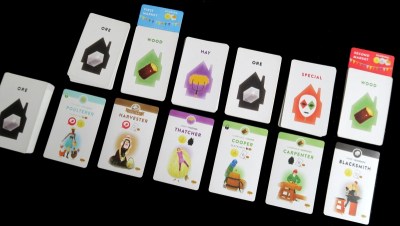
Meanwhile, the other group had been playing Villagers.  This is a new card drafting and tableau building game that first got an outing a few weeks ago and was so successful that Lime immediately bought himself a copy. The idea is that players take it in turns to take villager cards from the “road”, then add them to their village tableau.  Different villager cards have different advantages; some give money at the end of the game, while others enable players to draw more cards from the road per round or place more cards in their village per round.  The clever part of the game is the interplay between the cards caused by the conditions required before they can be played.

Villagers
– Image by boardGOATS

For example, a Blacksmith cannot be added to a village unless there is a Miner already present.  The cards are then played in a tree structure such that the Blacksmith is placed over the Miner card, superseding any icons depicted on it.  Many villager cards, especially the more valuable ones, also require a payment of two gold to another specific villager.  The money then sits on that villager card until a scoring round.  Ideally, the payment would be made to a villagers in the player’s own village, so that the money ultimately remains theirs, but if the active player does not have the necessary villager and someone else does then the money is paid to the opponent.

Villagers
– Image by boardGOATS

Like a lot of card games, there is a lot of luck in the game and there is a knack to surfing it.  Although many of the the group have played it before, Black had missed out, and he struggled waiting for a Grazier to become available.  In general, everyone went for a range of different types of villagers, everyone except Burgundy who went mad for Mining, because it “seemed like a good idea at the time”.  He started with a Seeker and then when he added an Ore Muler his income increased spectacularly and he looked like he was going to romp away with it.  Red and Black eventually managed to play Monks which helped to grease the wheels for them, but it was too late. Burgundy had the edge over Red in almost every department beating her into second place by twenty gold.

Villagers
– Image by boardGOATS

Villagers and Forbidden Desert finished at about the same time, and as time was getting on, Mulberry took Red home, and Pine and Lime didn’t want a late night so went their separate ways too.  That just left Blue, Burgundy, Black and Purple; Purple fancied a game of Bosk, and, as there wasn’t time to debate it, everyone else went along with her suggestion without debate.  This is a really pretty game, and although Black and Purple have played it quite a bit since they picked it up at the UK Games Expo, Blue and Burgundy were new to it.

Bosk
– Image by boardGOATS

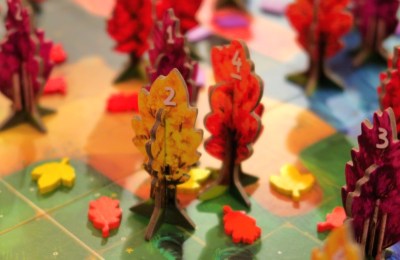
The game is played in two parts:  first players place their trees in the forest on a grid, then each tree sheds its leaves and players try to control where the leaves fall to give them the most leaves in each of the areas of the forest.  The first phase is really just an hors d’oeuvre; the second phase is the guts of the game.  At the end of the first phase, players score for having the majority in each row or column.  Purple was at the back, so went first in the second phase, and more importantly, the direction the wind goes in.  This is important because if the wind is in the wrong direction, any player with trees of the same number wedged up against the same edge  will find their options severely restricted.

Bosk
– Image by boardGOATS

An awful lot of time was spent by all staring at the board, but this is no hardship as it really is a very picturesque game.  Blue and Burgundy were feeling their way, but it was always advantage to Black with his greater experience.  In the end, it was surprisingly close, though that was possibly due to Blue confused by the “S-shaped” score board, screwing up the scoring.  The margin of victory was still significant though as Black finished with thirty-five points while Blue and Burgundy tussled for second place with thirty-one and thirty respectively.  It was then that the group realised the half hour game had taken twice that and everyone quickly left before they out-stayed their welcome and the landlord threw them out.

Bosk
– Image by boardGOATS

Learning Outcome:  Working together is fun, though it helps to know who is on  your side.

25th June 2019

It was lovely to see Burgundy back after his long lay-off, and the staff at The Jockey were thrilled to provide him with his ham, egg and chips once more.  While people finished eating there was a bit of chit chat, which extended into lots and lots of chit chat after people had finished eating.  Green explained that this was likely his last visit until September, while Lime commented that he had enjoyed Villagers so much last time that he’d bought a copy for himself.  He hadn’t realised that it had only just been released, and this led into a discussion about KickStarter and why people might be prepared to support a project months, possibly years in advance of its arrival.  This encouraged Ivory to show off his latest acquisition, Tiny Epic Mechs, a cool little game with meeples that can hold weapons or wear mech suits, and came with some KickStarter exclusive content.
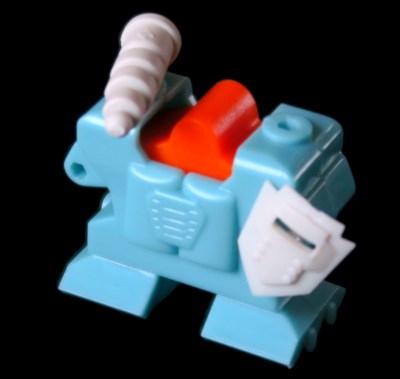
Tiny Epic Mechs
– Image by boardGOATS

Eventually, after several attempts to get people playing games, Blue made an executive decision.  She split the group into a three and a four, with the four playing the “Feature Game”, Hook! and left the remaining three to sort themselves out.  Hook! is a very, very silly game where players are trying to place square cards over other cards, orienting them so that the holes pick out certain features and not others.  The game is played simultaneously, with each player first drawing a “target” card, taking a look at it and placing it in the middle.  Each player then chooses one of their three “aim” cards, each with a different arrangement of three holes, and places it over one of the target cards.

Hook!
– Image by boardGOATS

Cat-like, each player starts with nine lives, and, for every picture of their character that someone picks out with their aim card, they lose a life.  If they manage to hide behind a barrel or a crate, that protects them from cannon fire, but not from a grenade, which destroys all barrels and crates and causes everyone to lose a life.  Catching a “black pirate” in their sights allows the player to choose which of their opponents suffers.  Rum, on the other hand, helps to deaden the pain and restores a life, even bringing a pirate back from the brink of death if they lose their last life, but manage to take a swig of grog in the same round.  There are two aims to the game:  firstly, a player needs to survive till the end, and secondly finish with the most parrots—any target card where a parrot was visible through the sights is kept and the parrots added up at the end of the game.

Hook!
– Image by boardGOATS

The pirates come in three colours, red, blue and yellow, and two types (“sailors” and “captains”), with the colour distinction being much, much more obvious than the difference between sailors.  Thus, with the stress induced by the time pressure of the game, the potential for picking out a captain instead of a sailor is much larger than picking red instead of yellow for example.  This means that with more than three players, it is better to play with pairs of colours and team play is recommended.  Therefore, Blue and Lime played as one team, and Mulberry and Pine played as the other.  Pine commented, “I thought we didn’t do cooperative games,” which led to a discussion of what these were and the promise that one would be the “Feature Game” next time (probably Forbidden Island or maybe Flash Point: Fire Rescue).

Flash Point: Fire Rescue
– Image by BGG contributor aldoojeda

As the group played the first few rounds of Hook!, it quickly became apparent that Blue was more of a hazard to herself and her team-mate than the opposition, dropping several cannon balls on her foot and accidentally catching Lime a couple of times too.  Lime, it turned out, was quite good at catching parrots, while Mulberry and Pine had a bit of a thing for making Mojitos.  As it was the game’s first outing, it took a bit to get the hang of game play.  The idea that everyone looks at their card first and then plays meant that everyone ended up playing on their own cards.  We tried to fix this with a simultaneous count of three:  “Draw, One, Two, Three, Place!” but while that was more successful, it wasn’t perfect.

Hook!
– Image by boardGOATS

Playing again, we’d probably just skip the “preview target cards” phase and simultaneously place them in the middle without looking.  The vagaries of the game didn’t stop us having a ball though, as everyone attacked everyone in mad chaos.  Then Blue suddenly looked in real danger as her number of lives tumbled (mostly due to self-inflicted wounds).  Realising that she was at serious risk of an unscheduled visit to Davy Crockett and that Parrots aren’t known for hanging around corpses, she prioritised staying alive over parrots.  Before long, Pine was in a similarly precarious state, and he was not so lucky as Lime unceremoniously stabbed him in the back and dumped his body overboard.  As Pine’s parrots flew away, that left Mulberry with a titanic battle, the more-so as she was now also getting low on lives.

Hook!
– Image by boardGOATS

Although both Blue and Mulberry survived till the end, the winner was undoubtedly Lime who not only had more lives left than anyone else, but also had almost as many parrots as the other two put together, giving his team glorious victory.  With all the fight taken out of her and citing jet-lag, Mulberry was making noises about finding her bed, but Blue twisted her arm a little and she agreed to give Ticket to Ride: London a go before she left.  This is a cut-down version of the Spiel des Jahres winning, train game, Ticket to Ride.  This game has spawned a whole family of games and expansions, including maps of Europe, Asia, India and Africa, but the most recent are the two city specials, New York and London.

Ticket to Ride: Europe
– Image by boardGOATS

The game is very simple: on their turn, players can do one of three things, draw coloured travel cards, spend travel cards to place pieces on the board, or pick up tickets.  Points are scored for placing pieces (usually scored during the game) and for connecting the two places shown on the ticket cards (scored at the end of the game).  Any unfulfilled tickets score negative points.  Each of the variants has some other little feature, for example, Pennsylvania includes a stocks and shares element, Märklin includes passengers and Nederland includes bridge tolls that players have to pay.  The new city titles, have fewer trains (less than half), players draw two tickets instead of three, and, in the case of London, bonus points for connecting all the places in a district.
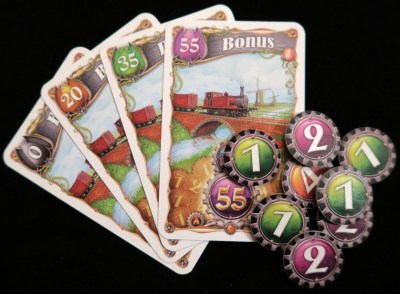
Ticket to Ride Map Collection: Volume 4 – Nederland
– Image by boardGOATS

Only Blue had played this new version of the game before, but Pine had played other versions many times and Lime had also played one of them before, though it was a while ago and he wasn’t sure which it was.  The London game is really cute though and has a lot of UK references.  For example, for those of a certain vintage the box features John Steed and Mrs Peel, and the travel cards include yellow submarines and black cabs.  Perhaps the best though are the pieces where trains have been replaced with really high quality miniature Routemaster buses.  As ever, there have been lots of online criticisms, but we just liked spotting the obvious references and trying to guess what the orange car was meant to be (a Lamborghini Miura?).

Ticket to Ride: London
– Image by boardGOATS

Pine went first and started quickly by placing a couple of Routemasters.  Blue, Mulberry and Lime were a bit slower, building up their collection of cards.  With some versions of Ticket to Ride, the game is all about planning routes, gathering the necessary cards and then playing all these cards in quick succession so others don’t have a chance to block.  In other versions, this strategy doesn’t work so well as the key parts of the network are taken early in the game.  The shorter games, especially those with short routes tend to fall more into the latter camp, so Mulberry looked to be playing a dangerous game as she fell behind with the number of pieces she’d placed and amassed a huge pile of cards.

Ticket to Ride: London
– Image by boardGOATS

Pine, always one to play this game close to the wire, was the first to chance it with some tickets, drawing two and keeping one.  Then, he drew another two and kept one.  Lime and Mulberry were still working on their existing routes, but Blue decided to follow Pine’s example and drew two tickets, but kept both.  As Pine, pushed his luck once more, it turned out he’d pushed it too far this time, drawing two tickets that were almost impossible to complete.  Blue learning from Pine’s mistake (rather like last time she had played Ticket to Ride with Pine), decided not to draw any more tickets and instead, brought the game to a swift end by placing all but one of her remaining Routemasters to connect Piccadilly Circus to Baker Street.
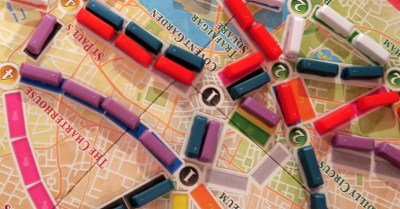
Ticket to Ride: London
– Image by boardGOATS

Checking the scores proved that most people had managed to more or less keep on top of their scoring during the game and it was just tickets and district bonuses.  Inevitably, the bonuses were minimal, so as is common in this game, it was all about tickets.  Lime and Mulberry had both completed their tickets, so the question was whether drawing more had been a good bet for Blue and Pine.  Pine had more than Blue, but unfortunately, he’d failed to complete the last one, leaving Blue some way in front with forty-one points.  In the battle for second place, Pine had come off best demonstrating that drawing more tickets can be a good move, but only if you can complete them.
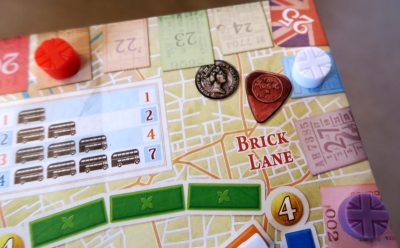
Ticket to Ride: London
– Image by boardGOATS

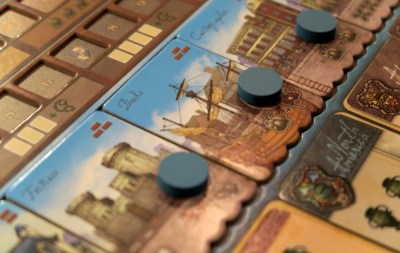
Meanwhile, on the next table, the trio of Burgundy, Green and Ivory had decided to give Endeavor: Age of Sail another outing.  Perhaps it was because Green wanted revenge for last time, or maybe Burgundy had missed out, or possibly it was just because Green wanted to play the game again while considering whether or not to commit to getting the new Age of Expansion buildings, but whatever the reason, out it came for the second time on the bounce.  The game is a simple game of exploration in the age of Captain Cook, played over eight rounds.  Players first build, then populate and remove workers from their buildings, all according to how far they have progressed along the associated technology track.

Endeavor: Age of Sail
– Image by boardGOATS

The guts of the game are the actions, however, which allow players to colonise cities on the central map board, engage in shipping, attack occupied cities, plunder and become slave masters. Last time, it was the “Feature Game”, specifically including the Exploits expansion.  The really change the game, giving players a different aspect to work on.  This time Exploits were included again, though different ones to last time: “The Sun Never Sets”, “Globalization”, and “Underground Railroad”.  Between them they covered most of the continents, requiring India & the Caribbean; the Far East & the Caribbean, and Africa & North America to be opened (respectively) for the three Exploits to take effect.

Endeavor: Age of Sail
– Image by boardGOATS

As before, Ivory started building a robust network of connected cities while Green once again used tried to use the Exploits as a target.  In contrast, Burgundy largely ignored the Exploits and played a traditional game concentrating on building up his technology tracks giving him a strong foundation from which to build in the colonies.   Playing with the new three-player map meant that all regions were opened up by the end of the game, though it was a bit late for Green to capitalise on the Exploits as he’d hoped.  Worse, Ivory’s city network meant he was able to sneak a hat-full of points from the “Sun Never Sets” and “Globalization” Exploits as well.

Endeavor: Age of Sail
– Image by boardGOATS

Ivory and Burgundy managed to build one of the Charter Company buildings from the mini expansion and, like Blue last time, both ended up with too many cards and had to choose what to cull.  This problem was exacerbated by the number of Governor cards they picked up.  As the game drew to a close, the last of the continents were opened up activating the final Exploit, but it was too late for anyone to occupy any of the stations on the Underground Railroad.  With the last round coming to an end, all that was left to count up the points.  Although it wasn’t actually a tie like last time, it was still a very close game.  This time, honours went to Burgundy who finished with seventy points,  just three more than Ivory who, in turn, was three ahead of Green.
Endeavor: Age of Sail
– Image by boardGOATS

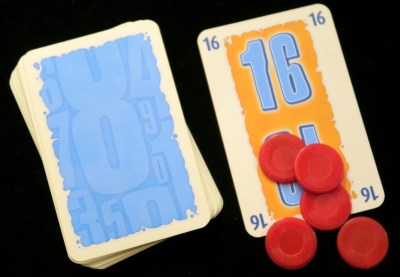
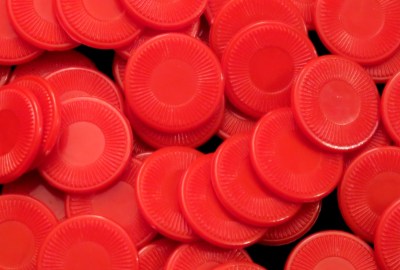
As Endeavor was just coming to an end, so Blue, Pine and Lime looked round for something quick to play.  Ivory excitedly suggested that when they were finished everyone could play Bohnanza, but Pine vetoed that and in the meantime, Blue’s beady eye moved from Biblios to settle instead on No Thanks!.  This is an old favourite, but one that Lime had not been introduced to yet.  As a really quick game, both to teach and play, this was ideal.  Everyone starts with eleven red chips, and the first player turns over the top card in the deck (which runs from three to thirty-five).  They can then either take the card or pay one chip to pass the problem on to the next player who then has the same choice.
No Thanks!
– Image by boardGOATS

The clever part is the scoring—the winner is the player with the lowest total face value once the deck has been exhausted (offset by any remaining chips).  There is a catch though, if a player has continuous sequence of cards (e.g. seven, eight, nine, ten), they only count the first card (i.e. they score seven not thirty-four).  The real gamble comes because some of the cards are removed from the pile at the start of the game.  Lime started by collecting lots and lots chips, while Blue helped by pointing out some of the things to look out for.  Although having chips is a must, and having most chips gives control of the game, once one player runs out, that control is largely lost.  This is because any player with no chips is forced to take whatever comes along.  Lime finished with a massive ninety points with Pine some way behind, with Blue cruising to victory with forty-one.
No Thanks!
– Image by boardGOATS

Although Endeavor was now finished, they were still packing up, Lime was keen to give it another go while Pine insisted he wasn’t coached this time, so the trio squeezed in another quick round.  Lime tried the same trick, and hoarded lots of chips, again putting Pine under a lot of pressure as he ran out of chips.  He managed to keep his total down though by making a very fortuitous run, and ended with two points less than Lime.  This time, Blue concentrated more on her own game and was able to just hold on to enough chips to see out the deck, while avoiding picking up too many cards, giving her a second victory.  It was much closer in the battle for second place though, with Pine taking it by just two points.

No Thanks!
– Image by boardGOATS

With Endeavor finally over and packed away, Ivory (perhaps more boisterous than usual as it was exactly six months to Christmas), once again suggested Bohnanza.  Pine once again vetoed it, this time even more grumpily following the suggestion that we should all sing some festive hits to get us in the mood.  Blue diplomatically suggested 6 Nimmt! as an alternative as everyone loves it and Lime had not yet played that either.  6 Nimmt! is a great game that gives players the illusion of control right up until the point when it all goes horribly wrong.  The idea is that everyone has a hand of cards and simultaneously chooses one to play.
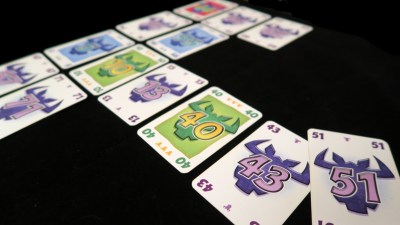
6 Nimmt!
– Image by boardGOATS

Starting with the card with the lowest face value, these cards are added to one of four rows, specifically the row with the highest value that is lower than the card played.  When a sixth card is added to the row, the five cards already on the table are taken and the new card restarts the row.  As well as a face value, each card has a number of Bulls’ Heads, most only one, but some as high as seven.  At the end of the game, the player with the fewest “nimmts” is the winner, with a special “wooden spoon” shout-out for the person whose plans went most awry landing them with a huge pile of bull.  As a group we usually play in two rounds, each with approximately half the deck (numbered one to a hundred and four).
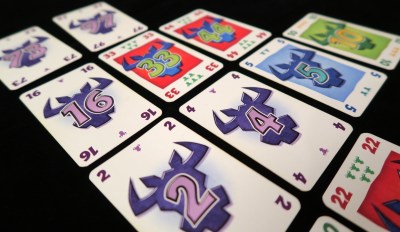
6 Nimmt!
– Image by boardGOATS

Blue top-scored in the first round, with twenty-four nimmts, but everyone else had a far more respectable total and Green led the way with just two.  This is a game where everything can fall apart spectacularly in the second round, so there was everything to play for.  The second time round time, Lime beat Blue’s score from the first round taking twenty-five nimmts, giving him a total of thirty-two.  This was nothing compared to Pine though, who took thirty-five in the second round alone, giving him a a sizeable forty-eight.  Blue made a clear round, but for her the damage had already been done, so the honours fell to Green who was consistency itself, taking just three in the second round giving a total of five – the only one to finish in single figures.  Lime was keen to play again, but as others were leaving, it was time to pack up. There was still time for a long gossip though before we sadly said goodbye to Green after what was likely to be his last meeting until September.
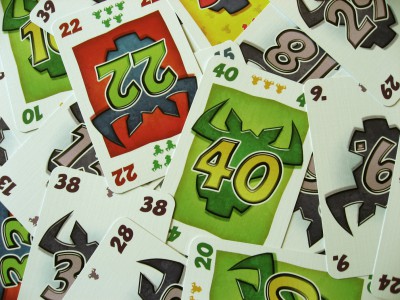
6 Nimmt!
– Image by boardGOATS

Leaning Outcome:  You don’t have to play a game correctly to have fun.
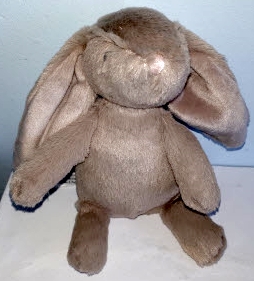
14th May 2019

A lot of the usual suspects weren’t about, so it looked like it was going to be a really quiet  night.  This was due to be offset by Pink, who was putting in one of his rare appearances from the frozen north, but at 6pm he was stuck at Leicester Services with a “limping” car.  While Pink’s arrival looked in doubt, he also lost the unofficial title of “furthest traveled” with Mulberry bringing along her other-half, newly arrived from California.  He had been awake for some forty hours traveling, so was reluctant to actually play anything, but we really appreciated his company all the same.  We were just starting the “Feature Game” when Pink arrived (thanks to a couple of very nice AA men), so as he scoffed his pizza we went through the rules for Powerships.

Powerships
– Image by boardGOATS

Powerships is not a complex game:  Black described it as “roll and move”, which is a little harsh if arguably accurate.  The game is played on a hexagonal grid representing the solar system and featuring the planets.  On their turn, players may take or return a single die, and then re-roll as many of their dice as they choose.  They may then rotate their space ship sixty degrees left or right and then move it the total number of spaces shown on their dice.

Powerships
– Image by boardGOATS

The movement rules are slightly more complex.  A crash is hitting a planets, a dust cloud or the “Trumpian” wall surrounding the solar system (there is a problem with alien immigrants in 2345 apparently).  Players may only crash if they have no choice, and if they crash, the penalties are severe: they must go in the direction that means they travel the furthest (even if that is unfavourable), they lose all their dice, and they move their damage maker left by a space for every unused movement (leading to a reduction in the maximum number of dice they can have).

Powerships
– Image by boardGOATS

Although ships can pass others, spaces cannot be occupied by more than one ship—they don’t crash though (fortunately), they just pull-up short, just behind. There are a number of special spaces:  yellow chevrons apply drift to a ship as they pass; space currents cause ships to change direction and warp speed and hyperspace enable ships to briefly go twice as fast.  What really makes the game, however, is the course:  players have to travel round three planets in a specific order and in a particular direction as marked by three orange bollards, before arriving at the finishing planet.

Powerships
– Image by boardGOATS

This time, as it was Tuesday, Mercury was the  starting planet. Random chance selected Purple as start player, but as spaceship placement is in reverse player order, Mulberry chose pole position and Blue placed her ship next.  Perhaps it was because he was still focusing on his pizza or maybe he decided to be a gentleman, but Pink placed his ship on the opposite side of the starting planet and just for good measure pointed it away from the first corner on Venus so that he was not forced to crash into Mercury on his first turn.  Green, Lime, Black and Purple placed their ships in turn order, with their start positions increasingly obstructed until Purple was left with no choice but to start on the planet itself surrounded by everyone else, and hope to avoid rolling a one on her first turn.

Powerships
– Image by boardGOATS

Purple was lucky and managed to escape from the ring of ships, parking herself squarely in front of Mulberry.  As everyone else rolled their first die and moved towards the first corner, the unfortunate consequences of Pink’s initial position became apparent.  Rolling a three, forced him to move his ship away from the first bollard and directly towards the walled edge of the solar system, where he stayed for the next few turns, trapped between some space dust, Saturn and a hard place, shuffling about in a strange many-point turn.

Powerships
– Image by boardGOATS

The rest of the fleet made good progress towards the first check-point, Venus, and then Blue foolishly rolled an extra dice and was forced to head off-course.  Green and Mulberry were pulling away a little as the pack headed into the farthest reaches of the solar system and approached the second corner located on Uranus, and that was where the mayhem really began. Purple went the wrong way round the bollard, so had to go back for a second shot; Mulberry hit the planet head on at full speed and was forced to maneuver slowly, and carryout repairs before she could build up speed again; Lime overshot and had to pirouette to get back on course while Black carefully dodged the debris, but struggled to find a clear course.

Powerships
– Image by boardGOATS

Meanwhile, Green sailed on serenely, finding the unobstructed path to the third marker on Pluto, on his first attempt.  It was perhaps just as well, as he was so busy advising Lime and fiddling with his phone that he missed his turn.  He suddenly realised he had missed out, but as everyone else unanimously agreed that turn order had been scrupulously observed and it was all in his imagination, he had no choice to but to acquiesce.  When Pink was about to taking his next move there was much hilarity when Green suddenly noticed he had missed out again! It was much harder for everyone to deny him a second time, and Green paid more attention for the rest of the game.

Powerships
– Image by boardGOATS

Pink had finally escaped from the combined gravitational pull of the starting planet and the  wall and Blue was moving back up the field as everyone else struggled to avoid calamity.  As Green headed towards the finish at Neptune, Black and Blue engaged in fierce struggle for second place (which Blue ultimately won by one turn) and Lime led the rest of the pack round the final corner.  It was coming into the home straight that Lime snatched defeat from the jaws of victory when he failed to decelerate and careered off for what looked like a second lap.  Mulberry was the beneficiary closely followed by Purple, with Pink and Lime bringing up the rear in what had been a mad, chaotic race, but a lot of fun.

Powerships
– Image by boardGOATS

With Powerships taking more than an hour longer than the advertised half-hour, Mulberry signed Pine’s birthday card and then took her jet-lagged husband home leaving six.  Inevitably as Pink was around, someone raised the subject of Bohnanza.  Other games were discussed, including 6 Nimmt! and Saboteur, but someone pulled a face for all of them, and in the end as Lime hadn’t played it, “Beans” won the day. This is one of our all-time favourite games, and everyone else was very familiar with it, especially Pink who claims to dislike the game while owning several copies of it in multiple languages.

Bohnanza
– Image by boardGOATS

Black explained the rules to Lime as everyone else tried to work out the game set up for six.  The game itself is actually very simple: each player starts with two bean fields in front of them.  On their turn, the active player must plant the first card in their hand and may plant a second before turning over the top two cards from the draw deck.  These two bean cards must be planted before play can continue, but they can be planted in the active player’s field or in someone else’s if a trade can be agreed.  Once these cards have been dealt with, the active player can freely trade as many cards as they want from their hand (all of which must be planted) before drawing cards and ending their turn.
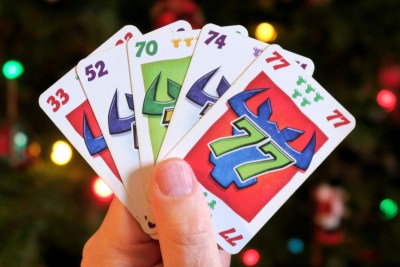
Bohnanza
– Image by boardGOATS

At any time, a player can harvest a field of beans, at which point some of the beans are retained with the cards turned face down, becoming “money”.  The player with the most money after three trips through the deck is the winner.  There are two key rules: firstly, players cannot rearrange their hand – it has a front and a back and cards are played from the front and arrive at the back.  Thus the game is all about manipulating the order of the cards in hand by trading the unwanted ones for something more helpful.  Secondly, although players can harvest a field whenever they want, they cannot harvest a field with only one bean card unless all that player’s fields are singletons.  While the rules of the game are not difficult, things were complicated considerably by the fact that the only version available was in Spanish – a special gift from Red to Pink.
Bohnanza
– Image by boardGOATS

Although Blue’s Spanish was up to the job, the fact that everyone else (familiar with the English version) used the English names for the beans instead of those on the cards, confused Lime utterly.  Despite that, Lime got stuck in to what turned out to be a very tight game.  Green, Pink and Purple bought a third bean field; Green was adamant that he gained no advantage from his though Purple and her “Judías Colora” may have done a little better and Pink thought he might have got an extra coin out of it.  In the end, Blue and her seemingly never-ending stream of “Pochas” had the edge and she finished in first place with a total of fifteen coins, some way ahead of a five-way, eleven-point tie for second place.

Bohnanza
– Image by boardGOATS

Learning Outcome:  Pay attention or you might miss a turn (or two).

19th March 2019

Yet again, the evening began with a discussion of everyone’s ailments: Pine had spent the last fortnight visiting Swindon for a daily dose of intravenous antibiotics; Green’s absence was explained by his contagious skin condition, and Blue was feeling particularly blue thanks to a nasty cold (a present from Pink).  The general itchiness of the group was increased by the addition of everyone’s favourite nit-nurse stories.  Perhaps it was the general malaise, but there seemed to be a lot of food eaten, including several helpings of ice-cream, but eventually we got down to playing games, beginning with the “Feature Game”, Botswana (aka Wildlife Safari).  Unusually, this was very, very popular, and Mulberry drew the short straw, so she was promised a chance to play it soon.
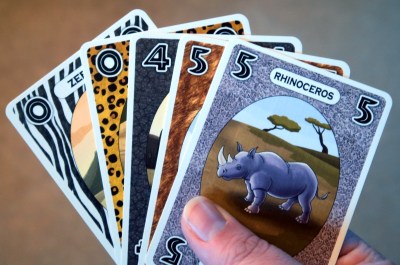
Botswana
– Image by boardGOATS

Botswana is deceptively simple:  Players have a hand of cards and take it in turns to play one card onto central set piles and then take any one of the plastic animals.  There are five “animal suits” and six cards in each, numbered zero to five.  At the end of the round, players multiply the number of plastic animals they have in each suit by the face value of the last card played in that suit.  Thus, a player with three plastic elephants where the last card played was a four would score twelve for that suit.  The game is played over as many rounds as there are players.

Botswana
– Image by boardGOATS

It took a round for people to get a feel for the game, but it quickly became clear how clever it is.  A bit like 6 Nimmt!, Botswana has a feeling of luck about it, but it is also very tactical.  Players want to make sure they play the high value cards that they have and get as many animals as possible in those suits, but play them early and someone else may subsequently play a zero making them worthless.  On the other hand, waiting to the end to play high cards risks someone else ending the game and failure to maximise the score.  So the game is all about timing and second guessing everyone else.

Botswana
– Image by boardGOATS

Blue and Pine took the first round, and while the second and third were more level, going into the final round, Black commented to Burgundy that it was clearly a two horse race.  Blue’s answer that it was surely a “two zebra race”, was met by Pine’s response that he’d rather ride an elephant as they are generally better tempered and can be trained to carry people.  After a  discussion about whether the plastic, model elephants were African or Asian, the appearance of the leopards and their spots, and the collective noun for rhinoceros, the game continued.  Like a crush of rhino, Pine could barely contain his pride as he trampled over the rest of the herd in his stubbornness.  In a bit of a dazzle, Blue came in second with a late leap.

Botswana
– Image by boardGOATS

Meanwhile, on the next table, Ivory, Mulberry and Purple were playing Splendor. Although we’ve played this very extensively, somehow Mulberry had missed out.  The game is very simple however:  on their turn, players either take three different coloured gem-chips or use gem chips to buy cards.  The cards are effectively permanent gems that can be reused without loss, but some of them give victory points as well.  The other source of points are Nobles: players who collect a given number of cards featuring certain gems get a visit from a noble and a bunch of points as a result.  Despite Burgundy being occupied with the safari on the next table, it was still a bit of a landslide.  Diamonds were scarce, and Purple had a bit of a melt-down.  With Mulberry new to the game, the way was clear for Ivory who took two of the Noble tiles and finished the game with an unassailable sixteen points.

Splendor
– Image by boardGOATS

Everyone was feeling a bit washed out, and nobody was particularly enthusiastic about suggesting games to play.  Ivory was the most proactive suggesting Altiplano, Dice Forge, Dinosaur Island and Bohnanza, but nobody looked terribly interested.  After a discussion about which throat sweets people preferred (where Fisherman’s Friends were equated to “Toilet Duck Pastels”, eventually the inevitable happened and the whole group settled down to a  game of Bohnanza.  This is one of our most popular games when everyone’s a bit tired and can’t be bothered with anything more complex, and often gets an outing when everyone wants to play together.

Bohnanza
– Image by boardGOATS

The game is quite simple and everyone in the group knows it well now, but the game always starts with everyone chorusing “Don’t rearrange your cards!” as the habit is so ingrained.  On their turn, the active player must play the first bean card into a field in front of them, playing a second if they wish.  Two cards are turned over from the central deck which can also be planted or traded, but must be planted by someone before the active player can trade cards from their hand with anyone else round the table and finally draw cards into the back of their hand.

Bohnanza
– Image by boardGOATS

As a group, we usually “play nice”, that is to say, players trade positively rather than negatively and gratefully accept freebies if offered (by players keen to get unwanted cards out of their hand).  With a full compliment of players, the game is always tight, often coming down to luck and this was no exception, and no less enjoyable as a result.  With only three points between first and sixth place it looked like it was going to be a three way tie between Pine, Purple and Ivory who all finished with eleven points.  Suffering with a think head though, Blue was slow counting and they were all disappointed when, after a couple of recounts (just to check) she pipped them to first place.

Bohnanza
– Image by boardGOATS

With Ivory and Mulberry wanting an early night, we were looking for something short before they went.  Not many games play seven well, but 6 Nimmt! is always popular and this was no exception.  People often claim 6 Nimmt! is a game of luck, but in reality it is one of walking a tightrope of perfect timing:  get it wrong and everything falls apart, but get it right and with Lady Luck in support a perfect round is possible.  Indeed, Ivory managed just such a perfect round, not once, but TWICE, last time we played, and everyone was determined he wasn’t going to manage the same this time.  Ivory’s “ivory tower” quickly fell, as he picked up nine points; Pine and Blue did well  taking a single point each, but Mulberry managed to keep a clean sheet.  We play over two rounds, so the question is usually not so much who manages to do well in the first round as who manages to sustain it over both rounds.

6 Nimmt!
– Image by boardGOATS

Ivory’s game went completely to pot in the second round when he top scored with twenty-five, leaving him to fight for the dubious honour of the Wooden Spoon.  That was close between Purple, Burgundy and Ivory, but this time, Burgundy won the race for the bottom with forty-three.  Black managed a clear round at the second attempt, but it couldn’t make up for his fourteen in the first round.  It was very tight at the front, with all three of the lowest scorers maintaining their timing for the second round; Mulberry followed her clean sheet with five, but Pine went one better finishing with a total of four.  Normally either of these scores might have been expected to be enough to secure a win, but Blue, despite her lurgy, added a second single point round to her first, ending with the lowest score, with just two.

6 Nimmt!
– Image by boardGOATS

Once Ivory and Mulberry had said their farewells, the rest of the group were looking for something light that would play five.  Coloretto was an option, but …Aber Bitte Mit Sahne (aka Piece o’ Cake) was on top and hadn’t had an outing for a while and with general laziness and lethargy the order of the day it was inevitable that Coloretto was going to lose out this time.  …Aber Bitte Mit Sahne is just about the simplest game to use the “I divide, you choose” mechanic, but simple is sometimes simultaneously very clever and in this case, it is also very well rendered.  The game consists of a pile of fifty-seven pieces of “cake”, each one an eleventh of a complete cake, randomly shuffled to form five stacks (with two left out).  As well as artwork showing the type of cake, each piece also has a number on it (the number in the deck), and some have a blob of cream as well.

…Aber Bitte Mit Sahne
– Image by boardGOATS

On their turn, the “Master Baker” take one of the piles of face down pieces and turns them over one at a time to make a complete cake.  They then divide this into “slices”.  The player to the Master Baker’s left chooses a slice, and for each individual piece they can either keep it, putting it face up in front of them, or eat it, turning it face down and putting it to one side.  At the end of the game, each player scores points if they have kept the most slices of a particular type, and scores points foe each blob of cream they have eaten.  It was quite a cagey game and was very close as a result.  Blue was the only one not to eat any of her cake, not due to any dairy or low fat diet, simply because her head was too fuzzy to deal with the extra option.  Somehow though, she got lucky and nearly everything she kept scored her points.

…Aber Bitte Mit Sahne
– Image by boardGOATS

Learning Outcome:  It’s possible to win, even with a bad cold.

5th March 2019

The evening started with lots of chit-chat including discussions about the smell of weed (the cheap stuff is called skunk for good reason apparently), a Czech bloke who was eaten by his illegally kept lion and the fact that Pine was feeling very poorly (which ultimately turned out to be a nasty case of cellulitis rather than man-flu). Meanwhile, lots of pancakes were eaten and there was a mix-up between Blue’s and Green’s leading to much hilarity.  The return of Ivory after a a couple of months on “sabbatical” heralded the long awaited Key Flow, as the “Feature Game”.  Key Flow is a card game version of one of our favourite games, Keyflower, and before Ivory left we promised we would save it for his return.

Key Flow
– Image by boardGOATS

Purple and Black quickly excused themselves from playing Key Flow, and with Blue, Burgundy and Green joining Ivory, the group divided into two with unusual alacrity.  Blue and Burgundy explained the rules, which though related to Keyflower (and by extension, Key to the City: London) with familiar iconography and similarly played over four seasons, give the game a very different feel.  Key Flow is a very smooth card drafting game, so players start with a hand of cards and choose to one to play and hand the rest on to the next player.  The cards come in three flavours:  village buildings, riverside buildings and meeples.  Village cards are placed in a player’s village, in a row extending either side of their starting home card.  Riverside tiles are placed in a row below, slightly off-set.  Meeple cards are used to activate Village cards by placing them above the relevant building.

Key Flow
– Image by boardGOATS

As in Keyflower, buildings provide resources, skill tiles, transport and upgrades.  They also provide meeple tokens which can be used to increase the power of meeple cards or activate a player’s own buildings at the end of the round.  Arguably the clever part is how the meeple cards work.  At the centre of each card there are a number of meeples which dictate the power of the card.  A single meeple card can be played on any empty building; a double meeple card can be played on an empty building or one where one other card has already been played.  If two cards have already been played, a triple meeple card is required to activate it a third and final time.  Alternatively, a lower power meeple card can be played with one of the meeple tokens, which upgrade a single meeple card to a triple meeple card.  Double meeple cards can also be upgraded, but each building can only be activated a maximum of three times per round.

Key Flow
– Image by boardGOATS

The really clever part is that the meeple cards have arrows on them indicating where they can be played:  in the player’s own village, in the neighbouring village to the right, the village to the left, or some combination.  In the four player game, this means everyone has access to the buildings in three of the villages, but not the fourth (located opposite).  And in this game that was critical for Blue.  As in Keyflower, players begin the game with a small number of winter scoring tiles (cards in Key Flow), which can be used to drive their strategy.  In Key Flow, each player additionally chooses one at the start of the final round, so they know they are guaranteed to keep one of these and can invest more deeply in one strategy.  As a result, Blue was caught in a difficult situation.  As the game developed, Burgundy and Ivory both collected a lot of skill tiles; Blue was also interested as she had received the Scribe winter card at the start which gives seven points for every set of three different skill tiles.

Key Flow
– Image by boardGOATS

Unfortunately for Blue, she could only get pick-axe skill tiles and Green sat opposite, had the Hiring Fair which would have allowed her to change some of them, but the seating position meant she couldn’t use it.  Ivory had other plans, however, and was busy picking up pigs and sheep.  Burgundy was producing gold and Green was producing wood.  Everyone was hampered by a paucity of coal as the Key Mine and miner cards were among those removed at random at the start of the game.  The game progressed through the seasons, and the game is very smooth, with more restrictions on the decisions and less of the negative, obstructive bidding that often features in Keyflower, making it a bit quicker to boot, though the setup is a little tedious.

Key Flow
– Image by boardGOATS

Blue and Green were not in the running which was notable as they usually both do well with Keyflower, but both had struggled to get the cards or skill tiles they needed for their strategies.  In truth, though the theme is similar and the iconography and some of the mechanisms are the same, the two games are really very different, so perhaps it was not so surprising after all.  It was very, very close between Ivory and Burgundy at the front though, with just two points in it.  Ivory had no points from autumn cards, but a lot of upgrades and lots of points from his winter tiles.  In particular he scored well for his Truffle Orchard, which rewards players for having a lot of pigs and skill tiles, that he coupled with the marvelously named Mansfield Ark which allows pigs to be replaced with sheep.  In contrast, Burgundy had fewer upgraded buildings, but a lot of autumn cards that scored points for him, especially his Stoneyard.  It wasn’t enough though, and despite Green dumping his winter tile to try to limit Ivory’s scoring options, Ivory just beat Burgundy into second place—Welcome back Ivory!

Key Flow
– Image by boardGOATS

While Blue and Burgundy explained the rules to Key Flow and set up the decks of cards, the other debated what to play.  Auf Teufel komm raus came out of the bag and then went back into the bag when Purple decided she didn’t want to play it, only for it come back out again in response to the chorus of protests, and this time make it onto the table.  This is a game we played for the first time a few weeks ago and enjoyed though we struggled with constantly making change due to a shortage of poker chips that make up the currency.  Thanks to the very kind people at Zoch Verlag, now furnished with a second pack of chips, it was time to play again.  The game uses “push your luck” and bidding in combination to make a simple but fun game.

Auf Teufel komm raus
– Image by boardGOATS

Everyone simultaneously places bets on the maximum value of coal that will be drawn out of the fire by one player in the round. Players then take it in turns to draw coals, either stopping when they choose or going bust if they draw a piece.This time, despite her reluctance to play it, Purple started very quickly and held the lead for most of the game.  Like last time, Mulberry skulked at the back, and abused this position to overtake Pine at the end by making a pact with the Devil.  Black stayed hidden in the pack for the majority of the game and then, in the final round pushed the boat out and gambled big.  In this game going large can lead to a spectacular win or equally spectacular loss.  This time, the gamble paid off and Black raked in a massive three-hundred and eighty points taking him just ahead of Purple in the dying stages of the game.

Auf Teufel komm raus
– Image by boardGOATS

With Auf Teufel komm raus over and Key Flow still underway, Purple was able to choose a game she wanted to play, and picked Hare & Tortoise.  This is an old game, the first winner of the Spiel des Jahres award, forty years ago. The game is a very clever racing game where players pay for their move with Carrots, but the further they move the more it costs.  The icing on the cake are the Lettuces though:  each player starts with a bunch of Carrots and three Lettuces—players cannot finish until they have got rid of all their Lettuces and nearly all of their Carrots.  On their turn the active player pays Carrots to move their token along the track; each space has a different effect including enabling them to eat Lettuces, but each will only hold one player’s token at a time.

Hare & Tortoise
– Image by boardGOATS

Competition for these Lettuce spaces is always fierce, but that’s not the only stress, as efficiency is key, players who move too fast consume their Carrots too quickly and have to find a way to get more, which slows them down.  The winner is the first player to cross the finishing line, but that’s only possible if they’ve eaten all their Lettuces and almost all of their Carrot cards.  Last time we played Hare & Tortoise, it was six-player mayhem and a real scrabble as a result.  This time with just four, it was still a scrabble, but not quite as intense.  Black got his nose in front and managed his timing very effectively so was first to cross the line.  Pine and Mulberry were close behind, the latter just two turns from crossing the line herself.

Hare & Tortoise
– Image by boardGOATS

Hare & Tortoise finished at about the same time as Key Flow; Pine had looked like death all night and Mulberry had an important meeting in the morning so both left early.  Ivory, on the other hand, said he would stay for another game so long as it was short, so the rump of the group settled down to an old favourite, 6 Nimmt!.  Everyone knew the how to play: players simultaneously choose a card, then simultaneously reveal them before playing them in ascending order placing each on the row ending with the highest card that is lower than the card being played.  When the sixth card is added to a row, the first five are taken and the number of heads contributes to the player’s score, lowest score wins.  We tend to play a variant over two rounds with half the deck in each round and not resetting the table in between.

6 Nimmt!
– Image by boardGOATS

This time, Blue continued her poor run of form and top-scored in the first round with twenty-six, closely followed by Purple with twenty-two.  With a round to go, Burgundy, Ivory, Green and Black were all still in with a shout though.  Unusually, the second round went very similarly to the first, with Purple top-scoring with thirty-one (giving her a grand-total of fifty-three), Burgundy and Ivory getting exactly the same score as they had in the first round, and Green finishing with a similarly low score.  Only Black and Blue had significantly different scores, and while Black’s second round score destroyed his very competitive position from the first round, nothing was going to put Blue in with a chance of winning.  It was Ivory, again, who was the winner though, with a perfect zero in both rounds—two games out of two on his return (while we are very pleased to see him back again, we’ll have to put a stop to this run!).

6 Nimmt!
– Image by boardGOATS

Ivory decided to quit while he was ahead, leaving five to play Sagrada with the expansion.  Sagrada is a similar game to Azul, using dice instead of tiles and with a stained glass theme (which was slightly controversially also used in the recent Azul sequel, Stained Glass of Sintra). In Sagrada, each player has a grid representing a stained glass window.  At the start of the round, a handful of dice are rolled, and players take it in turns to choose one and place it in their window.  Once everyone has taken one die, everyone takes a second in reverse order (a la the initial building placement in Settlers of Catan).  This leaves one die which is added to the Round Track—the game ends after ten rounds, i.e. when after the tenth die has been placed on the Round Track.

Sagrada
– Image by boardGOATS

When players place dice, they must obey the restrictions on the window pattern card selected at the start of the game.  This time we played as well as two cards from the main decks (Gravitas for Purple and Firmitas for Black), we also used three promos: Vitraux (Blue), International Tabletop Day (Burgundy), and Game Boy Geek (Green; ironic as he’d never had a Game Boy in his life!).  This doesn’t score any points they come from the objectives:  public, which are shared and private which are personal.  This time, the public objectives awarded points for columns with different colours, rows with different colours and columns with different numbers.  The original game only included enough material for four players, but the recent expansion provided the additional pieces for the fifth and sixth, and four of the five private objectives came from there, giving those players the total face value of dice played in specific places.

Sagrada
– Image by boardGOATS

In addition to the private objectives, the group also decided to use the private dice pools.  When these are used, players only take one die from the draft (instead of two), taking the second from a pool rolled at the start of the game.  The final part of the game is the tool cards, three of which are drawn at random.  These can be used by players to help manipulate dice after they’ve been rolled or placed.  This time the tools were the Grinding Stone, Lens Cutter and Tap Wheel which enabled players to rotate dice to the opposite face, swap a drafted die with one from the Round Track and move two dice of the same colour that matches one of the dice on the Round Track.  To use these Tools, players must pay in tokens that are allocated at the start of the game according to the difficulty of their window pattern card.  Any of these left over at the end of the game is worth a point, but otherwise, points can only be scored by completing the objectives, and any dice that cannot be placed score negative points.

Sagrada
– Image by boardGOATS

The problem with this game is that it is extremely easy to get into a pickle and end up placing dice illegally.  Blue, who was a bit all over the place due to a night shift on Monday thought she would be the culprit, but it was Black who fell foul of the rules, and several times too.  Each mistake only cost him one point though, and in some respects it is better to have to remove dice than compromise plans.  Although she didn’t make any mistakes, Purple was concentrating so hard on placing all her dice she completely forgot to work on the objectives.  Misplaced dice tend to be indicative of other problems though and Blue was absolutely determined not break the rules this time, having made a complete pig’s ear of the game just over a year ago at New Year.  As a result she concentrated so hard that she gave herself a headache.

Sagrada
– Image by boardGOATS

In the end, arguably it was worth the sore head as Blue not only avoided any illegal die placements, but also managed to get sets of different colours for all five columns in her window. Green managed four out of his five columns though and did well on some of the other objectives too.  Burgundy hadn’t done so well on that objective, but had done better on others, especially his own private objective.  It was very close for second, with Burgundy just one point behind Green’s sixty six, but Blue, headache and all was well in front with over eighty.  As they packed up, the group discussed the inclusion of the private dice pools and the effect of the extra player.  Blue felt the dice pools gave a better chance to plan, while Black felt they made the decision space more complex and slowed the game down.  Certainly, with five there’s a lot of thinking time and it can be very frustrating to see others ahead in the turn order take all the “best” dice, something that seemed worse with more players.

Sagrada
– Image by boardGOATS

Learning Outcome:  It’s great to welcome people back when they’ve been away!