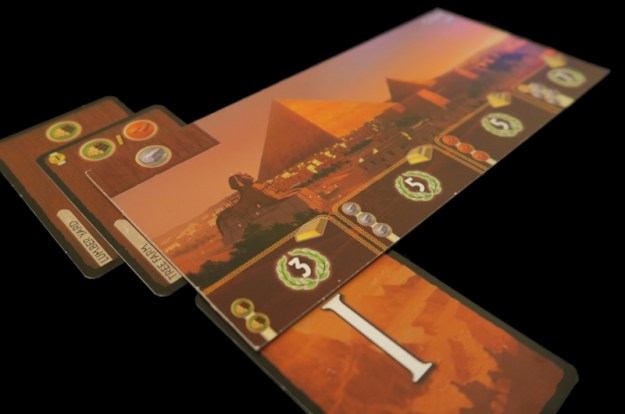
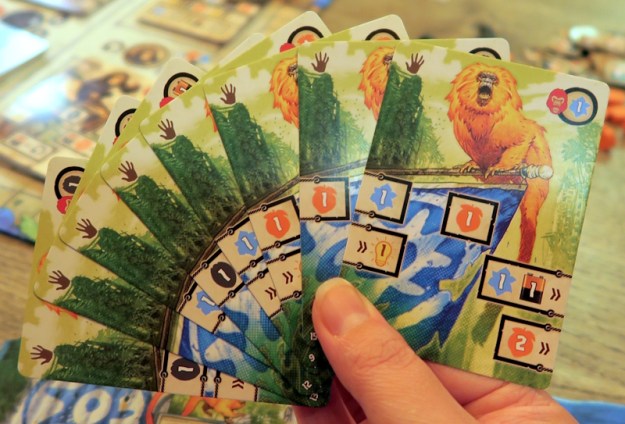
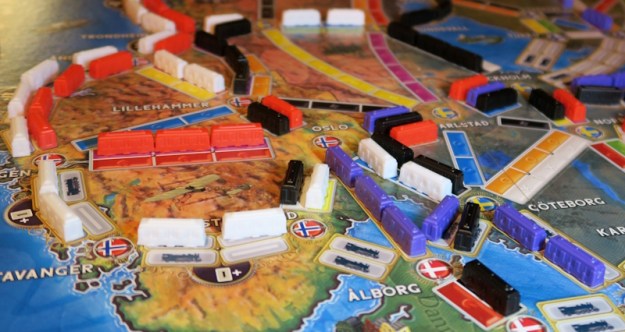
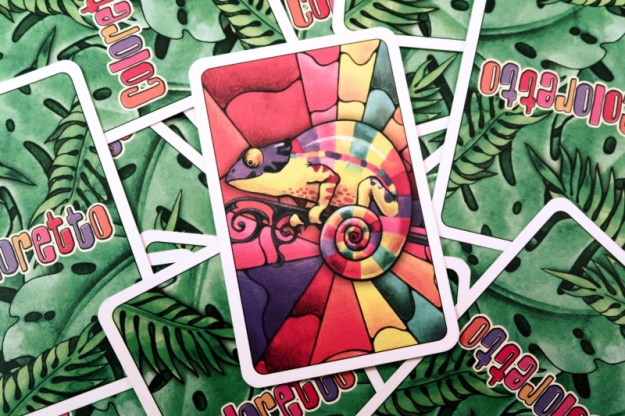
Tag Archives: 7 Wonders

4th February 2025

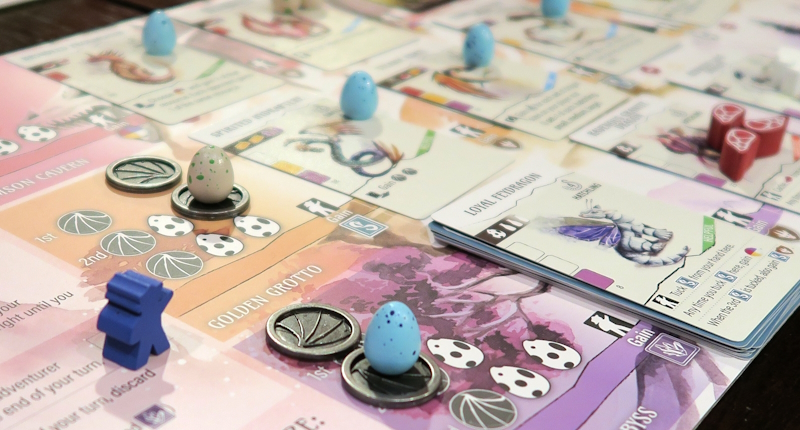
Blue and Pink were just finishing their supper when not one, but three copies of Ark Nova walked in, escorted by Ivory, Cobalt and Green.  This was because the “Feature Game” was to be its Marine Worlds expansion and, as Ark Nova is a substantial game that doesn’t get as many outings as it deserves, everyone was keen to give their copy a bit of an airing.  The game is much longer than those we usually play on a Tuesday so everyone who was keen to play was early and started setting up promptly.  Given the length, we also erred on the lower end of the player count, with just Ivory, Cobalt and Green playing.  The game is all about planning and designing a modern, scientifically managed zoo, but the game-play is more like Terraforming Mars with animals, than Zoo Break or Zooloretto.

Ark Nova
– Image by boardGOATS

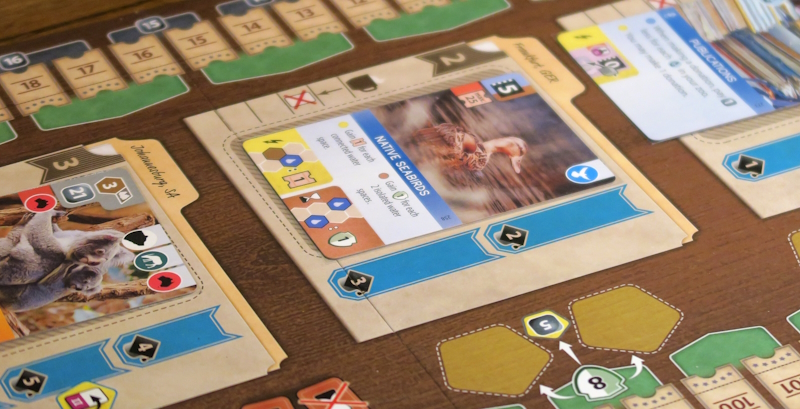
Although it is quite a complex game, functionally it is not difficult to play on a turn by turn basis, though there is quite a lot to manage and keep a track of.  On their turn, players take one of six possible actions:  activating one of the five action cards (Cards, Build, Animals, Association and Sponsor) with a strength equal to the number above the card.  When activating a card players perform the action based on its power level which is dictated by its position in the row.  During the game, players can upgrade and turn over the action cards to a more powerful second side using various Bonuses.  The Marine Worlds expansion introduces several new elements to the game.
Ark Nova: Marine Worlds
– Image by boardGOATS

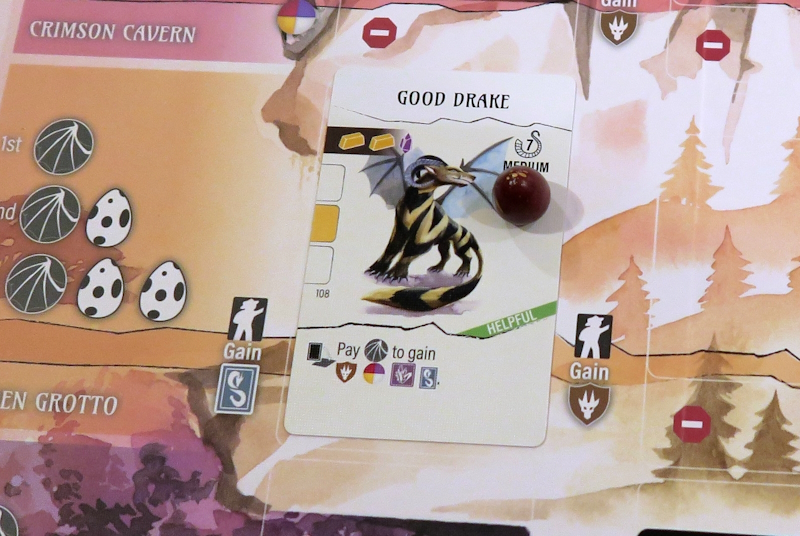
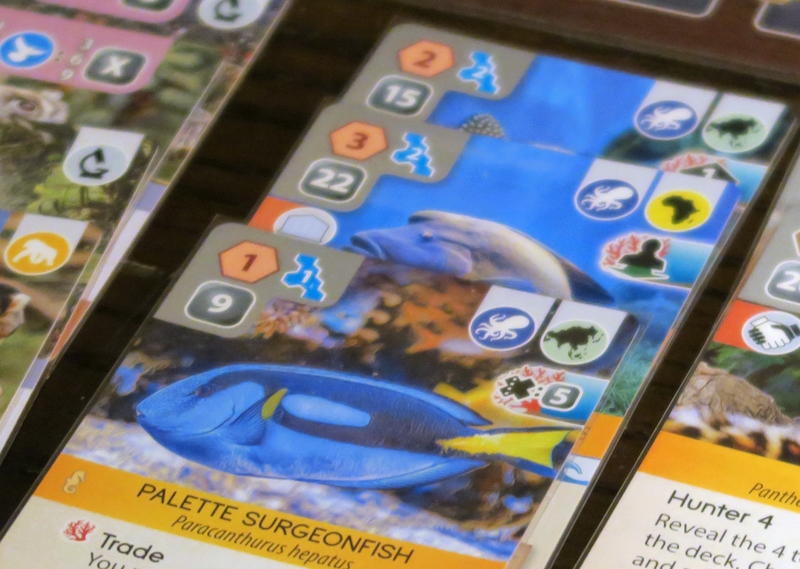
Firstly, there are sea animals that have to be played in new special enclosures that must be built adjacent to water.  Roughly half the sea animals are reef dwellers, and whenever a player adds a reef dweller to their zoo, they trigger the ability of all reef dwellers in that zoo. To deal with the dilution of the deck (caused by adding more cards), all sea cards feature a wave icon, and whenever it is revealed in the display, you discard the first card in the row, then replace it.  For each of the five Action cards there are four alternate versions with a little twist. Players draft these action cards at the start of play, replacing two of their standard action cards with these new ones, increasing the asymmetry in the game.
Ark Nova: Marine Worlds
– Image by boardGOATS

A new fourth University option is also available on the Association board.  If a player takes it, they claim one of six special Universities from the Reserve that feature one Research icon and one of six animal icons.  When a player takes this, they reveal Cards from the top of the deck and keep the first revealed card with an animal icon that matches their chosen University.  There are also new bonus tiles and other little bits and pieces to smooth out the game play.  Although the Marine Worlds expansion comes is modular, the group chose to play with all the components (Marine animals, asymmetric maps and drafted action cards).

Ark Nova: Marine Worlds
– Image by boardGOATS

Ivory took a Sponsor Card that gave him extra money for breaks and an Association Card that gave him the ability to hire workers.  This coupled with the lake map which gave extra money for building around the lake meant Ivory had access to lots of cash as the game developed.  Both Cobalt and Green took a Sponsor and an Animal Card, with Cobalt taking a map that allowed him to discard cards for money while Green had the map with the park restaurant.  While Cobalt was also able to build up a lot of cash, Green spent most of the game playing the poor relation, just scraping by.  The game started slowly, with initial conservation projects devoted to Australian animals, Birds, and African Animals.
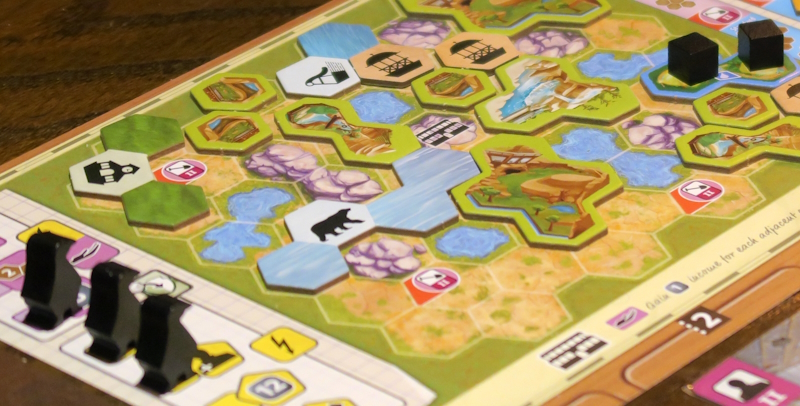
Ark Nova: Marine Worlds
– Image by boardGOATS

Both Green and Ivory wound up spending all their early money, trying to get Animals out, whereas Cobalt focused on the Association board and playing Sponsor cards.  After struggling with money for the first couple of rounds, Ivory managed to get two Australian animals, allowing him to put a token on the conservation card, giving an additional Zoo Dollars at each break/income step and from then on, money wasn’t too much of an issue for him. Green however, struggled for money for most of the game, where Cobalt continued to focus on Sponsor Cards and Association Actions, and as a result, he took an early lead on the Research track which gave him a much greater card choice. Cobalt did build an early aquarium, however, and started filling it up with fish.
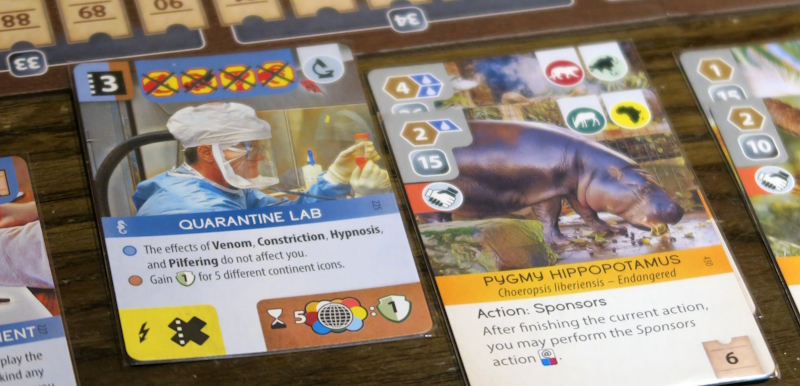
Ark Nova: Marine Worlds
– Image by boardGOATS

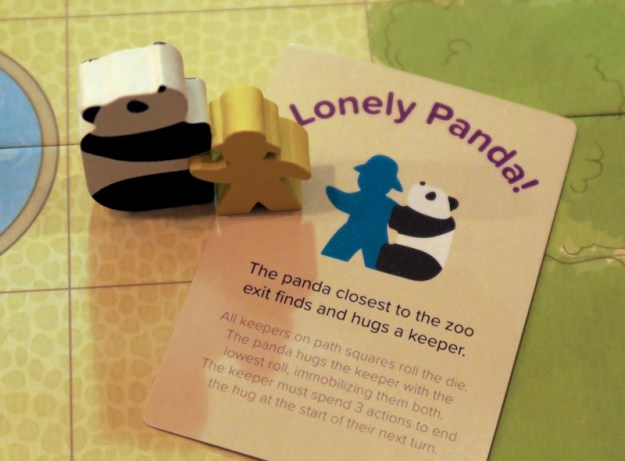
After a quick start, both on the conservation track and appeal track, Ivory’s game slowed down significantly—he was too focused on animals, compared to Green and Cobalt.  They had both spent time taking Association actions, leading them to Upgrade cards and progress up the Reputation track. Cobalt was able to significantly move up the Conservation track in the middle game using his Sponsor Cards, whereas Green focused on one big move by having lots of birds in his zoo.  Much to Pink’s disgust, although the panda was an option at one point in the game, the “wave” added by expansion pushed it on, so nobody got the Panda.  Instead, by the end of the game, Ivory had quite a collection of monkeys, Green had a few some birds and Cobalt had a lot of fish.
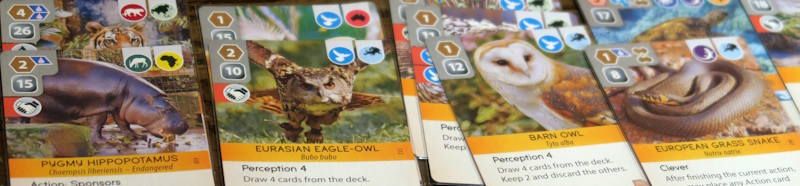
Ark Nova: Marine Worlds
– Image by boardGOATS

Going into the end game, Cobalt some way ahead on the Conservation track, followed by Green, while Green and Ivory were fairly similar in Appeal.  Cobalt then started playing lots of animals in his zoo and managed to completely fill it moving rapidly along the Appeal track.  It was clear he was soon going to bring the game to a close, due in part to both his (and Green’s) ability to make donations by upgrading the Association card. Green was also moving forwards on both tracks while Ivory was lagging behind albeit with three conservation cards in hand. Fortunately, Ivory had lots of “x tokens”, allowing him to play all his conservation cards (and gain the additional worker he needed, shooting up the conservation track, though sadly, it was too little too late.  From there, It wasn’t long before Cobalt’s Tokens to crossed, ending the game.
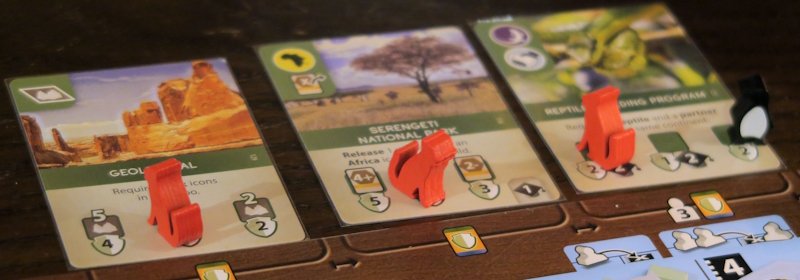
Ark Nova: Marine Worlds
– Image by boardGOATS

Everyone had made some mistakes reading their cards and/or abilities which cost a little bit, but was probably fairly balanced out.  Everyone managed to get the full four Conservation points on their personal scoring cards, but Green picked up quite a few extra points from the Sponsorship cards leaving him level with Cobalt.  Inevitably, this led to a hunt for tie-breakers—the rules state that the tied player who supported the most Conservation Projects wins the game.  As Green and Cobalt had also supported the same number of Conservation projects the rules dictated they should share the victory.  That said, Green magnanimously said he felt Cobalt had the edge by virtue of having way more coin at the end of the game.

Ark Nova: Marine Worlds
– Image by boardGOATS

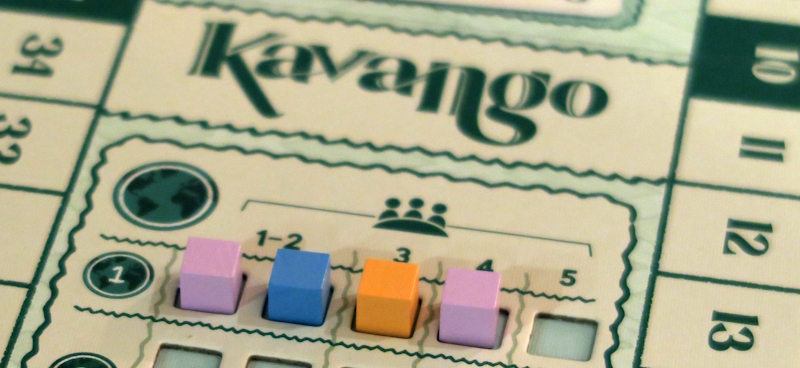
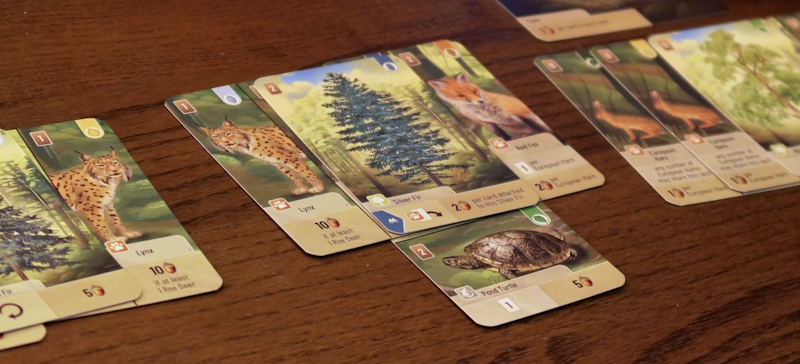
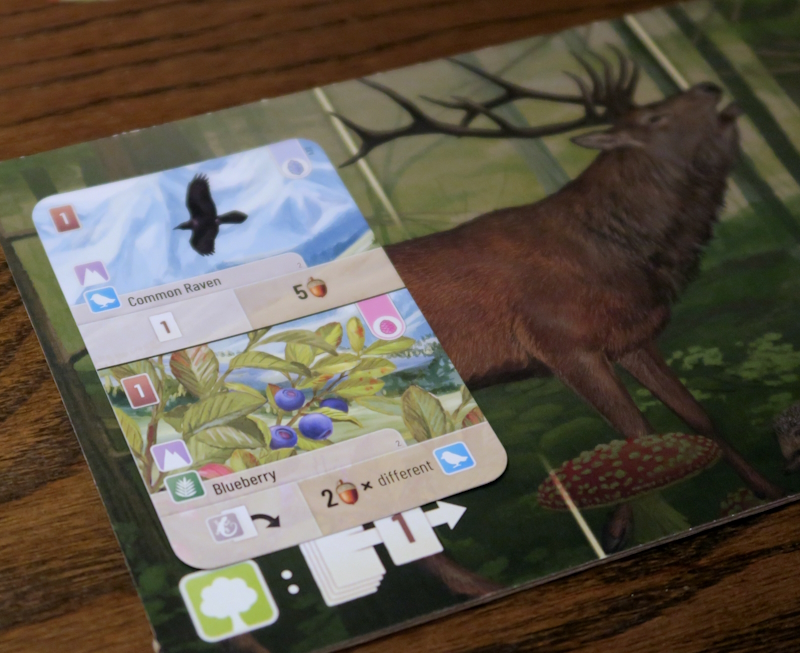
On the next table, Blue, Pink and Mint had finally got underway playing Kavango.  This is a conservation, card-drafting game.  A bit like games like Sushi Go! and 7 Wonders, players draft cards to build their Reserve.  Like games like Terraforming Mars, however, cards can only be added to a player’s Reserve if they have its requirements.  These might be the food supply, or enough protection (environmental, poaching or climate).  Climate protection is unique because, as in real life, players have to work on that together.  At the end of the game, after three rounds, players add up the value of their animals, and any bonuses together with any points scored during the game for Research, and the player with the most points is the winner.

Kavango
– Image by boardGOATS

Pine joined them briefly and expressed an interest in playing another time, but decided this week he would take himself home to better acquaint himself with his C-vitamins and avoid unnecessarily sharing his bugs.  Mint was the nominal first player, though mostly the game is played simultaneously.  Blue started hard and fast building up lots of income, however, she was forced to invest heavily in Climate protection—honourable, but not necessarily lucrative.  Pink and Mint were a little slower to start, but made good progress.  Both got caught out by a very minor rules malfunction that had a significant impact:  Cards not used at the end of the round are supposed to go into a discard pile, but instead were returned to their decks.

Kavango
– Image by boardGOATS

Towards the end of the game, this suddenly became significant as some types of card are not available in the final rounds.  So, those that needed, for example, termites (like Mint), were unable to get them.  Pink and Mint were most obviously affected, though everyone got caught in some way or another.  The card draw hindered Blue as she struggled to find any migratory animals at all and had to abandon her personal objective as unachievable.  In contrast, Mint and Pink both did really well with theirs (birds and toxic creatures respectively), making the result much closer than it would otherwise have been with Blue the victor with a hundred and seventy-one, a single point more than Mint.

Kavango
– Image by boardGOATS

Meanwhile, Plum and Byzantium had kindly agreed to take Lime to the other side of the room to play the Golden GOAT Award 2024 Winner, Stamp Swap.  Somehow, despite the flurry of outings it received towards the end of last year, Lime had missed out on playing it.  This is also a drafting-type game, but this time with stamps (mostly).  The game takes place over three rounds, each split into two parts:  Firstly players take it in turns to choose from a central pool, then players divide their pile into two and the first player chooses one pile from another player to take, who keeps their other pile and chooses one from another play—and thus the piles of stamps are swapped.

Stamp Swap
– Image by boardGOATS

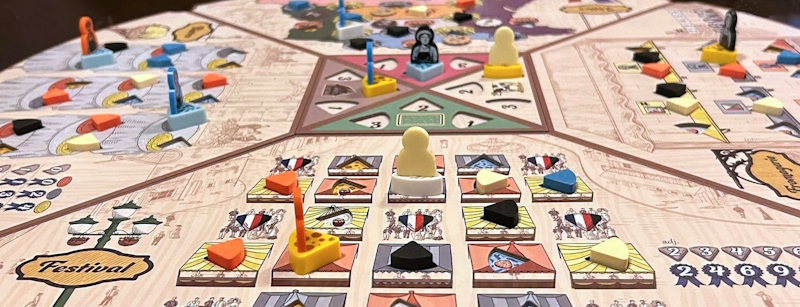
On previous outings, Byzantium had managed to annoy Blue by just beating her.  It had been his birthday at the weekend, so the question was whether he would get another, albeit slightly belated, birthday gift in the form of another victory.  Sadly for Byzantium, it was not to be though.  Plum took ten more points than him during the game and another ten more in the end game scoring between them, giving poor Lime quite a trampling on his first game.  Stamp Swap wasn’t the only popular new game to get an outing this evening.  On the next table, Jade and Sapphire were introducing Purple and Black to Fromage, a sort of cheesy worker placement game with simultaneous play and a time component, not completely unlike Tzolk’in.
Fromage
– Image by boardGOATS

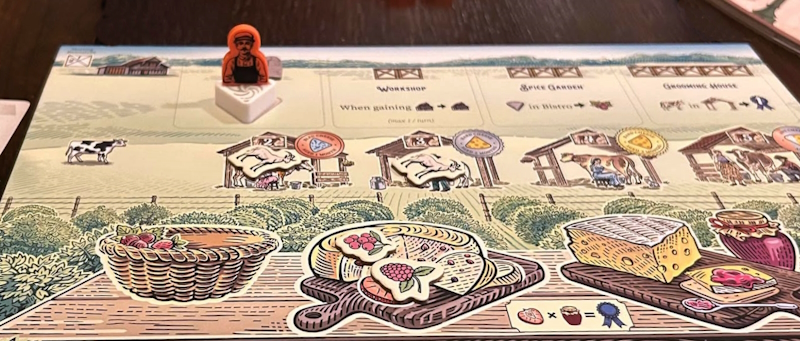
The actions are tied up in four “mini-games” which players take it in turns to participate in.  It has proven quite a popular little game because once everyone knows how to play, there is relatively little down time and despite playing different areas at different times, quite a lot of interaction.  Players simultaneously choose where to place their workers, in their quadrant of the board, and once everyone is done, the board is turned and then players retrieve any workers they can and then place workers on their next quadrant.  Players score points for occupying tables in the Bistro quadrant, holding the majority in regions in the Villes quadrant, filling different tables in the Fromagerie quadrant, occupying contiguous areas in the Festival quadrant, and for fulfilling Orders.
Fromage
– Image by boardGOATS

This time, Purple and Jade made a bit of a killing in the bistro taking nearly thirty points each, while Sapphire took twenty-two points in the Villes.  Black’s strategy was somewhat different, picking up points more evenly across the board and focusing particularly on fruit.  In the end, despite the differences in approaches, the scores were very similar, with only three points covering second to fourth.  The winner was Jade, however, some twenty points clear of Sapphire, who just nicked second, but a single point.  The game had been well received, and the group ended up “Doing a Lime” and playing it a second time.

Fromage
– Image by boardGOATS

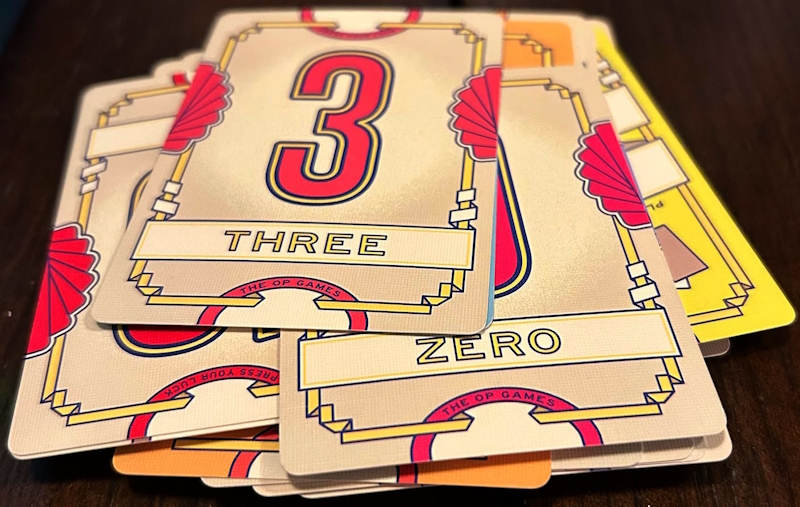
The second game was also tight, although everyone was much more even in where they scored their points.  Sapphire just edged it though, again by a single point, again from Black, pushing Jade into third.  There was still time after the second game for something else, something new, something quick—Flip 7.  This is a really simple “Push your Luck” game reminiscent of Port Royal, where players simply turn over cards and gamble on not revealing the same number twice.  The catch is that each numbered card appears in the deck that number of times (i.e there is one one, two twos and so on).  Flipping over seven in a row gives fifteen bonus points.

Flip 7
– Image by boardGOATS

There are also some action cards in the deck, “Flip Three”, “Freeze”, “Second Chance” and modifier cards which give extra points.  Players take it in turns to decide whether they want to “flip” or ” stick”.  The game ends when players have reached the pre-agreed total (two hundred, according to the rules, though games can easily be made longer or shorter as desired).  In the first round, three players scored well, but the rest of the game did not go so well.  In fact, the only player who managed to score in every round was Black with a fairly consistent total around thirty.  It was no surprise that he was the first to pass two hundred and was therefore the winner, ahead of Sapphire and Purple, who were joint second with a hundred and seventy-six.
Flip 7
– Image by boardGOATS

Learning Outcome:  Zoos are even more fun with sea creatures.
Boardgames in the News: HandyCon Games Theft

HandyCon is a board game convention that takes place, roughly quarterly, in Milton Keynes.  Unlike other board gaming events like UK Games Expo and SPIEL, HandyCon is not a trade fair, but a convention where hundreds of people meet to play games together.  While many people bring their own games, one of the highlights is the Games Library which included over five hundred games and expansions.  The last event took place two weeks ago, 17th-19th January, but last Monday night while, he was playing football in Luton, the organiser, Paul Frohnsdorff-Harris had his car broken into and £700-800 of games stolen.  As is often the case with theft, the replacement value is one thing, but more important is the sentimental value.

Stolen Games
– Image from facebook.com

The games were all from Paul’s collection but were used as part of the HandyCon Games Library, and therefore almost all have HandyCon stickers on the lid.  The missing games comprise a wide variety, everything from classics like Dominion, Takenoko and 7 Wonders to new games like SETI, Shackleton Base, and Arcs.  There are also some rarities, like one of the first copies of Misheard Lyrics which was the first published game credited to Paul Frohnsdorff-Harris himself.  This morning the theft featured on BBC Beds Herts & Bucks Radio with an accompanying article on the BBC News website.  Although it is unlikely, it would be great if gamers could find these games and reunite them with their owner (and maybe even catch the thief in the process).

Stolen Games
– Image from facebook.com

3rd September 2024

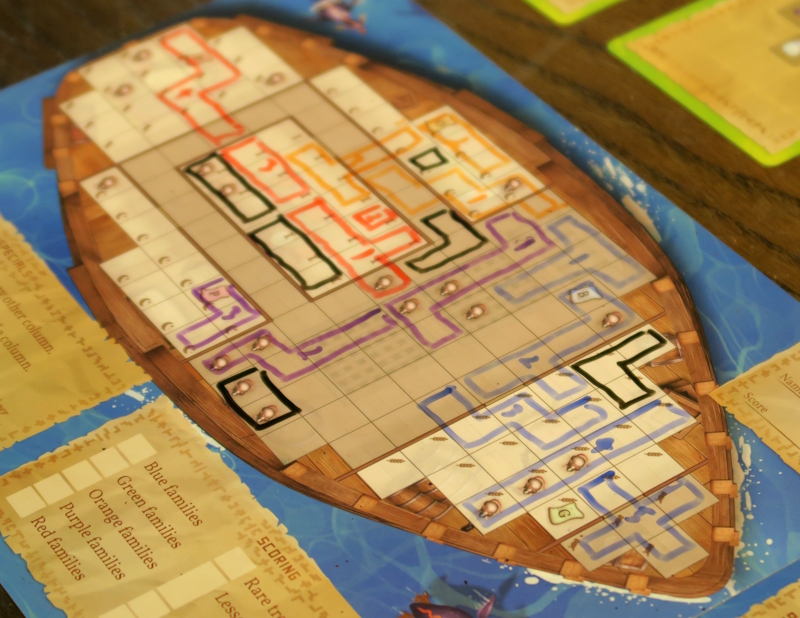
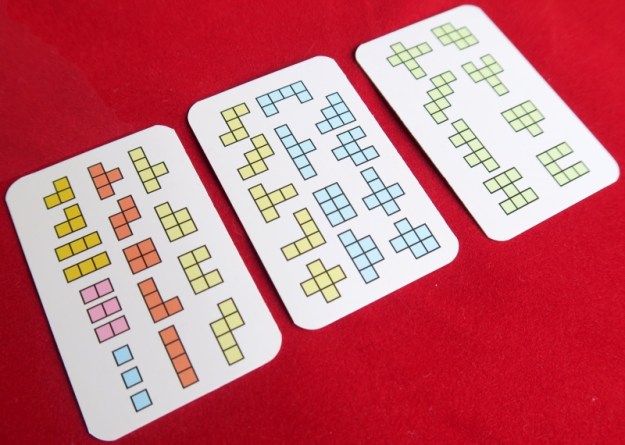
By the time Blue, Purple and Pine arrived, Cobalt was already half-way through a solo game of Isle of Cats: Explore & Draw, a “roll and write” version of the card-drafting, polyomino cat-tile-placing game, Isle of Cats.  In Explore & Draw, instead of drafting cards before choosing tiles, players choose a set of cards each turn and then draw their “discoveries” on their boats.  In this version of the game, players simultaneously choose a column from the Island (the central market) and action all three cards in it in order.  These could be three cards from the Cat deck, two Cat cards and one Lesson card, or two Lesson cards and card from the Cat deck.

Isle of Cats: Explore & Draw
– Image by boardGOATS

Cat cards are polyomino cards, Lesson cards are scoring cards and special Oshax and Treasure cards can be found in both decks.  Cats, Oshax and Treasures are all drawn directly on the boat on the worksheet, while lessons are ticked off and scored at the end of the game.  In the solo game, Cobalt was playing against his “Sister” who reveals a Cat Colour and a Lesson, every round and at the end of the game scores for the different Colours in that order and then the Lessons in turn.  This time cobalt made mincemeat of the Automa beating it by seventy-one points to forty-three.

Isle of Cats: Explore & Draw
– Image by boardGOATS

With everyone arrived by this time, it was just the “simple” matter of deciding who was going to play what.  Blue started off leading the “Feature Game“, which was Kavango.  This is a card drafting game where players are building an animal reserve by collecting tags and adding animals to their tableau.  As such, it takes familiar elements from games like Sushi Go!, 7 Wonders, Wingspan, Meadow, Ark Nova and Terraforming Mars, but has a different feel to all of them.  In each round players draft and play ten cards (from an initial hand of twelve), that is to say they choose a card and pass the rest of the cards on to the next player.

Kavango
– Image by boardGOATS

After each card has been chosen, it is added to the player’s tableau.  Then players have the option of claiming money for achieving Research Goals and/or spending money on Poaching, Habitat and Climate protections.  These are required for some of the animals especially the more interesting and lucrative ones.  The clever part about the game is the way the decks progress.  In the first round, the deck is mostly made up of Producers (Grassland, Trees, Invertebrates and Fish) and small animals while the second has mostly medium, but some small and some larger sized animals.  The third and final deck contains almost exclusively larger animals like Zebras, Lions, and Elephants.

Kavango
– Image by boardGOATS

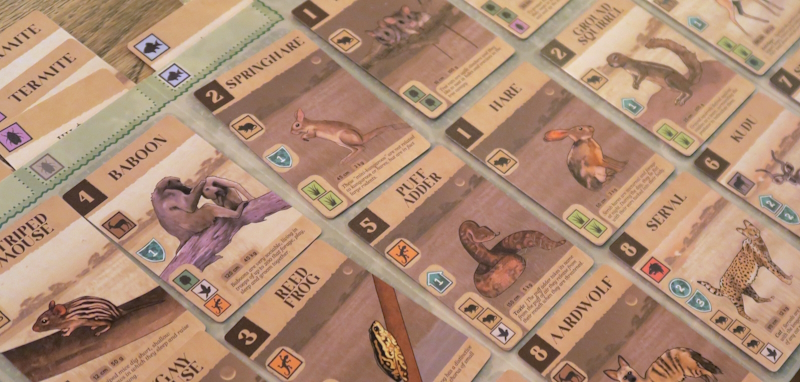
This makes it harder to get Producers in the final round (though it is still possible by paying for Rewilding), but players can often just play cards directly as they already have prerequisites that they acquired earlier in the game.  Throughout, the rules and mechanisms are rooted in reality.  For example, players are responsible for their own Poaching and Habitat protections, but Climate protection is everyone’s concern and players have to work on that together.  Similarly, before a player can have a Puff Adder, for example, they have to have enough small mammals and birds to feed it.  Likewise, if a player wants a White Rhino or an Elephant, they need sufficient Grassland and/or Trees to support them.

Kavango
– Image by boardGOATS

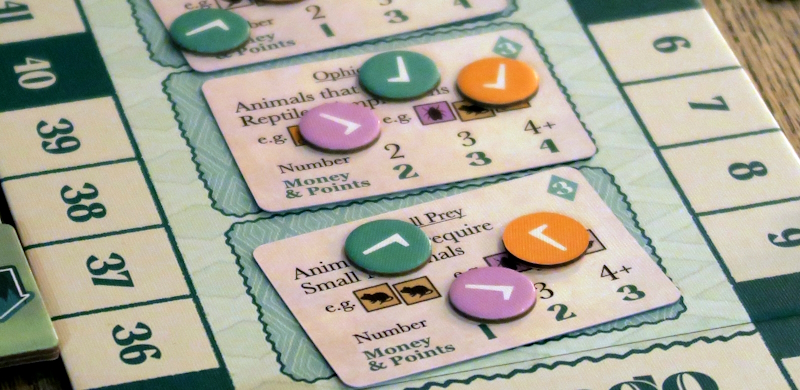
Each round, there are four Research Goals, each with several levels.  The Goals can each only be claimed once, so players generally have the choice of claiming Goals early to get money they can spend straight away, or waiting and getting more money, which may delay progress.  These Research Goals also progress during the game, so early on, they tend to reward players with lots of Producers and Small Mammals etc., while later in the game they reward players with lots of Protections and bigger animals.  At the end of the game, players add bonus points for Biodiversity, Climate Protection and Habitat and Poaching Protection, to the points they got for each animal in their Reserve and the points they acquired during the game for achieving their Research Goals; the player with the most points is the winner.

Kavango
– Image by boardGOATS

Nobody had played the game before, but Indigo had done her homework and had watched the “how-to-play” video, and Blue had done a decent job of reading the rules for a change.  The fact that the rules all made sense helped too, and for the most part everyone had a reasonable handle on what they were trying to do. The first challenge was to try to get all four of the player boards on the table with the score-track/Research board and Climate in the middle.  The boards were so huge that it wasn’t actually possible, so the side of Indigo’s and Navy’s boards were hanging off the edge of the table, and Pines and Blue’s corners were all overlapping or had a flying free-hold.  Still, everyone could just about see what they needed to and could place the cards they had to, and it was all stable so long as nobody moved…

Kavango
– Image by boardGOATS

Pine (the Ecologist), started off really well adding a lot of Small Mammals to his Reserve and achieved early Research Goals as a result.  Early in the game, Indigo (the Investor) started contributing to Climate protection.  Navy (the Botanist) and then Blue (the Researcher) helped her out later in the game, though Pine never had enough money to contribute enough to gain the Climate Protection bonus.  Blue took an early lead in Research Goal points, but Navy soon caught up and by the end of the third round, he had an eight point lead with Indigo holding a three point lead from Pine.  That is only a very small proportion of the points available in the game.

Kavango
– Image by boardGOATS

The Lion’s share of the points come from the animals, including Lions, of course (which Navy had one of).  Pine really struggled in the latter part of the game since he had loads of Small Mammals, but not a lot else. His problems had begun in the second round when he struggled to generate any money as none of the Research Goals fitted after his highly effective first round.  Even so, he still got a over a hundred points for his menagerie and was one measly bird of prey short of getting the Biodiversity Award.  Indigo had a slightly more valuable Reserve, while Blue and Navy tied for the most animal points.

Kavango
– Image by boardGOATS

Indigo, Blue and Navy all picked up the bonus points for Climate Protection, Poacher/Habitat Protection and Biodiversity, which meant that Navy took victory by virtue of his eight point lead from the Research Goal points.  It had been a very enjoyable game though and there was much discussion as the group carefully dismantled the precariously balanced player boards.  Pine took an interest in the other animals in the deck, and there was much hilarity when he found the Sausage Tree—Google convinced him that it was not related to the infamous Spaghetti Tree, and was in fact real.  Nobody could convince him that the fruit wasn’t ideally suited to coaxing Trouser Snakes out of their lair’s though.

Kavango
– Image by boardGOATS

On the next table, Black and Pink were leading a rather ill-fated game of Wyrmspan.  This is a variant of Wingspan with Dragons instead of Birds.  So, like the original, players are playing cards from their hand onto a player board, and activating the habitats in turn. The differences are more than simply cosmetic, however. Firstly, before a Dragon card can be played, it is necessary to explore the cave it will be played in, which involves playing a card (and claiming a Bonus).  In Wingspan, if a player needs a resource, they activate their Woodland habitat and visit the Birdfeeder, claiming the resource they want and a couple of extras, whereas in Wyrmspan, players only get resources one at a time so they don’t have any extras.

Wyrmspan
– Image by boardGOATS

This is critical as “Planting Dragons” requires a lot of Resources and can be difficult to do, so it is important that the Dragon planted is then exploited as much as possible.  Players also need to make the most of the new Dragon Guild.  A step around this Rondel typically gives a Resource as a reward, with a more valuable bonus half-way round and after a full circle.  The distribution of cards is different too:  in Wingspan, the majority of the cards have an effect when the terrain is activate, but in Wyrmspan, these are in the minority with most card effects happening when played or at the end of the round/game.  In Wyrmspan, the rounds are also different.

Wyrmspan
– Image by boardGOATS

Players get a set number of coins at the start of each and an action typically costs one coin.  Some cost more however, and occasionally players can pickup extra coins, which can lead to variable length rounds.  Thus, although Wyrmspan is very definitely Wingspan at its core there are lots of differences.  Blue suggested the group played it, as she had played it with Black and Pink a few months back and they had found it played easily given that they all knew how to play Wingspan.  Thinking Purple, Teal and Lime were also very familiar with Wingspan, Blue rashly assumed it would work, but she underestimated how different it was, how long it was since that last game, and how much longer the game would take with five.

Wyrmspan
– Image by boardGOATS

So, Black patiently explained the rules, while Pink tried to help others muddle through.  Teal focused on simply achieving the end of round goals and “planted” his Dragons accordingly while working on the top row of caves to generate resources—the equivalent of the “woodland”, which works for both Wingspan and for Wyrmspan.  After fighting through one round though, the group agreed to curtail the game after the second round.  In such a short game, the scoring was always going to be skewed, but ultimately the player with the most valuable Dragons, Pink, was the victor, with Teal taking second thanks to him taking the points for winning both the end of round goals.

Wyrmspan
– Image by boardGOATS

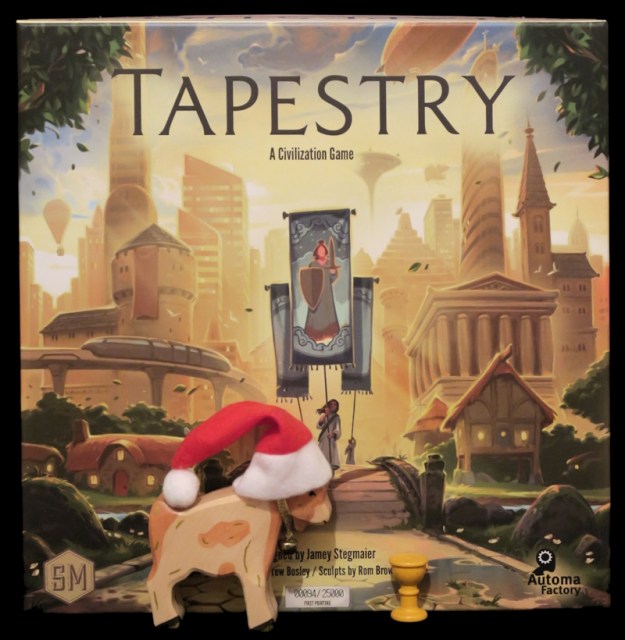
Across the other side of the room, the final game was Tapestry, with the Plans and Ploys expansion.  On the surface, Tapestry has simple mechanisms, but they combine to make a complex game.  On their turn, players move one step along one of the four Civilisation tracks around the board: Science, Exploration, Military, Technology and carry out the action (or actions) associated with it.  Each space requires payment of resources, and the further along the track, the more expensive the spaces become.  If a player cannot afford to pay (or chooses not to), then they instead take income, which gives them more resources.  They also gain points and play a tapestry card, which usually provides a power for the next round.

Tapestry
– Image by boardGOATS

So, at its heart, Tapestry is an engine building and resource management game:  players carry out actions and get resources so they can get more resources and ultimately, points.  The Plans and Ploys expansion mostly just adds more of the same with new Civilisations, Tapestry Cards and space tiles.  The biggest difference is the addition of Landmark Cards which are designed to give each player a personal short-term goal in the first part of the game, in the form of buildings that only they can claim. Everyone was familiar with the game, so the rules explanation was minimal.  Byzantium started (Spies/Grassland) and there was an initial general rush towards the Technology track,

Tapestry
– Image by boardGOATS

Ivory (Islanders/Forest), always one for doing something different, instead went in for Exploration as this linked in with his Civilization.  As the first round went on, Byzantium and Cobalt (Aliens/Tropical) stuck to Technology, whereas Plum (Riverfolk/Wetland) diversified slightly into Science and Exploration. Her primary plan was to exploit her Civilisation and then try to get to six island hexes to trigger her personal bonus Landmark.  Byzantium was first to move to the Income phase, closely followed by Plum and then Cobalt. Ominously, Ivory did what he usually did and managed to stretch my first era out, putting himself in a good position to grab the first Exploration Landmark and also making progress on Military.

Tapestry
– Image by boardGOATS

Byzantium went for Technocracy as his first Tapestry card, sticking with his technology theme. He also managed to grab the first Technology Landmark and completed his Architecture card (appropriately the Game Shop). Plum also went for a Tapestry card, Terraforming, that linked her with her strategy, giving her five points for building on impassable plots, something her Riverfolk Civilization wanted her to do and gave her additional resources of.  Although her alternative Civilisation had looked more interesting, it involved knowing what other people’s options were so she had chosen the simpler Riverfolk and made good use of it.  She was also still fairly diverse in her track focus. Cobalt went for Socialism, to keep pace with Byzantium on the Technology track.

Tapestry: Plans and Ploys
– Image by boardGOATS

Cobalt also gained Landmarks from his Technology cards, helping him build his Skyscraper Architecture card. Having only taken his Income whilst everyone else was half way through their second Era, Ivory could see Cobalt was focusing on Technology, so he used the State Marriage Tapestry card to gain befits on this track whenever Cobalt did.  Having the Military track to himself and a good head start on Exploration, Ivory managed to grab a couple of Landmarks quite quickly. Everyone was also getting Income from buildings on their mats too.  Again, Byzantium Plum and Cobalt all moved into their third Era in quick succession, leaving Ivory half way through his second Era.

Tapestry
– Image by boardGOATS

Cobalt managed to grab the third Era Technology Landmark, but he struggled to fit it on his Capital board and it had to overhang.  At this point, Plum used the Dictator Tapestry Card (with associated comments from Byzantium) to move up the Technology track while restricting everyone else’s progress on the same track for one turn.  Byzantium had been  plotting a move as he was next in line for a Landmark, but Plum’s Dictatorial behaviour only slightly delayed him getting it. This, plus the State Marriage benefited Ivory and competition with Byzantium meant Cobalt used the Militarism Tapestry card to switch his focus to Exploration and Military.

Tapestry: Plans and Ploys
– Image by boardGOATS

Although Cobalt had changed tack to avoid competition with Byzantium, Ivory had a health head-start on both of these tracks, grabbing the Landmarks as he went and also conquering the centre island just before Cobalt could.  To add insult to injury, when Cobalt tried to conquer the island and topple Ivory, he was ready with a Trap card, foiling his plan. Cobalt quickly got revenge paying Ivory back in kind when he tried to do the same thing to one of his territories. However, that wasn’t going to discourage Ivory, and with the Military track encouraging him to conquer, he got the final word in, conquering one of Cobalt’s territories and gaining a double topple bonus.

Tapestry: Plans and Ploys
– Image by boardGOATS

Moving into the final era, again, Ivory was characteristically some way behind everyone else. Byzantium picked up extra resources from the “Age of Wonder” and used these to good effect being the first to reach the end of a track.  Plum, hosted the Olympic Games with her final Tapestry card (and presumably moved to Paris to do so).  This gave her ten points in exchange for a Worker Resource, and additionally a bonus building if any other player took up the offer of doing the same.  Byzantium was the only one who did, as Cobalt wasn’t able to and Ivory had other plans.

Tapestry: Plans and Ploys
– Image by boardGOATS

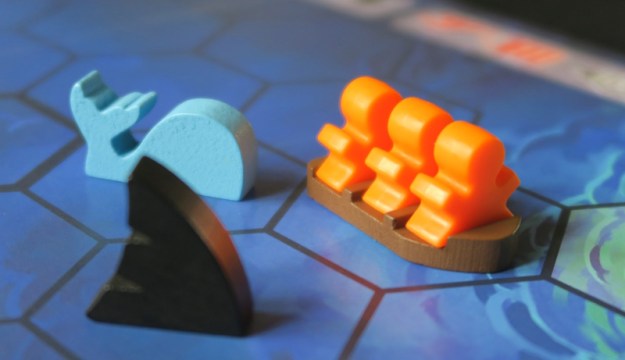
Cobalt and Plum were both still fairly diverse in their track focus, although Plum had made good progress on the Science track, which was mostly ignored by everyone else.  Byzantium also switched focus to some of the other tracks now he had completed the Technology track. Ivory stuck to Military and Exploration, completing the former (although there was not enough time to gain the second Civilization).  He was sorely tempted by one of his favourite strategies, sending his Meeples into Space by completing the Exploration track, but instead, Ivory switched focus to the other tracks to get as many income buildings in his Capital as possible to maximize the final scoring.

Tapestry: Plans and Ploys
– Image by boardGOATS

Again, everyone finished in quick succession except Ivory, who, as usual, had about five or six turns to go after everyone else had finished.  Plum started with an additional thirty-five points at the beginning of the game thanks to her Riverfolk which gave her points for each territory in her City that had at least two unpassable spaces, but everyone caught up throughout the game. In the end, in Ivory’s final Income round scored him well over fifty points, overtaking everyone and winning and giving him victory.  It had been a good game, enjoyed by all, and although he’d won Ivory hadn’t given everyone as much of a trouncing as he had in the past.  Cobalt felt that the advantages of going first were not mitigated for those going last, so maybe next time that could be used as a slight handicap for Ivory.

Tapestry
– Image by boardGOATS

Learning Outcome:  Animal games are a lot of fun—And that’s not Lion!

23rd July 2024

Blue and Pink were still eating when everyone else rolled in and seemed quite content to chat.  It took Blue two attempts to get the first game rolling, with Jade leading Cobalt, Crimson and Plum to the other side of the room.  Pink moved to join Pine who wanted to play his new acquisition with Black and Purple, which left Blue and Lime to lead Byzantium, Sapphire and Cyan in the “Feature Game“, the Alpine expansion for Forest Shuffle.  This is was chosen to mark the announcement of the Spiel des Jahres Awards, as Forest Shuffle, featured on the recommended list and has been popular with the group.

Forest Shuffle
– Image by boardGOATS

Blue made a bit of a meal of explaining the rules, but really they are very simple.  On their turn, players either take two cards from the market and add them to their hand (with a hand limit of ten), or play a card from their hand into their tableau.  There are three different types of cards.  Tree cards are the central cards around which Critter cards are played.  Then there is the first set of Critter cards which are divided into two, left and right with an animal on each half.  Finally, there are Critter cards which are divided into two, the canopy at the top and the undergrowth at the bottom.  The Critter cards are half-tucked under the Tree cards, so only one animal, flora or fauna is visible.

Forest Shuffle
– Image by boardGOATS

The difficult part of the game is getting the cards to work together efficiently to give extra actions and, ultimately, points.  The Alpine expansion doesn’t change the game significantly, just adding more variety to the cards, adding more opportunities for scoring.  For example, it adds an extra Butterfly which give players more points if they have a complete the set.  This time, Blue started with a hand full or Hares, making her initial strategy obvious.  Sapphire was less fortunate, so Blue and Lime suggested that starting with Trees was always a good way to go as players can’t do anything without them.  He also had some Butterflies, so that was where he went next.

Forest Shuffle: Alpine Expansion
– Image by boardGOATS

Lime built up a collection of Birds, and since he advertised his strategy to the group, everyone else was able to take cards he wanted.  This is a key part of the game:  some cards give points for the number of something you have, so having more of both multiplies the score.  For example, Hares give one point for every Hare a player has.  Thus, one Hare gives one point, but Blue’s seven Hares mean that first Hare scored seven points.  More to the point, every other Hare also scored seven points giving her forty-nine points just for her Hares.  Meanwhile, Byzantium was going Bats, and Cyan was experimenting with Deer.

Forest Shuffle: Alpine Expansion
– Image by boardGOATS

The game ends when the third Winter card is drawn from the deck, so after the second, everyone got very nervy as they tried to complete all their plans and play all the cards they wanted to.  Each time someone drew a card from the deck, it was with bated breath.  The final stage seemed to last forever, and although the third Winter card wasn’t the last card in the deck, it was close, and when it was drawn the game ended immediately. And then it was time for the scores:  everyone assumed that Blue’s husk of Hares would give her victory, but it was actually quite much closer than they thought.  Although Blue finished with a hundred and sixty-five, Byzantium was only twenty points behind.

Forest Shuffle: Alpine Expansion
– Image by boardGOATS

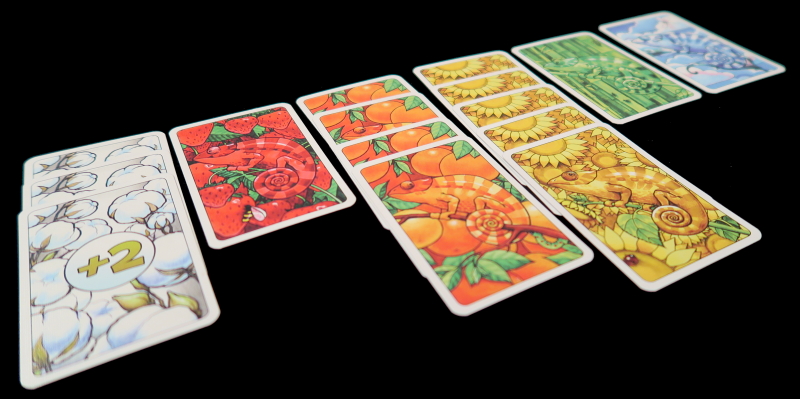
Byzantium was ready to leave, but for everyone else there was just time for something really quick.  So as everyone else was still playing, the remaining four decided on a quick game of Coloretto.  This is an old game, but one that was on the Spiel des Jahres Award “Recommended List” in 2003.  Remarkably, Cyan and Sapphire were new to it, but it is a super easy and quick game to play, but with tactical decisions to make.  It is also one that can essentially be taught as you go:  either turn over the top Chameleon card and add it to one of the Trucks, or take one Truck.  Each Truck can contain a maximum of three Chameleons and once everyone has taken a Truck, the round ends.

Coloretto
– Image by boardGOATS

At the end of the game, players score each group of coloured Chameleons, with the largest three groups giving positive points and any others scoring negatively.  There are a small number of cards that just give straight points and balancing these with Chameleons is part of the challenge.  The end is triggered when the end of game card is drawn and then the round is played to completion.  This time, everyone kept their negative scores down, while Cyan went for the pure point cards, collecting fourteen points, more than half his score, by that route.  The winner was Lime, however, who was imperious and won by some distance with a total of thirty-three.

Coloretto
– Image by boardGOATS

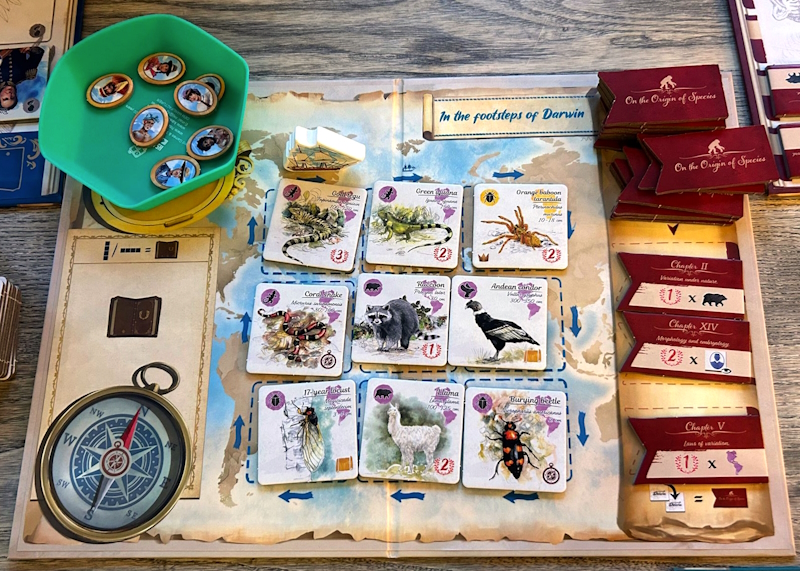
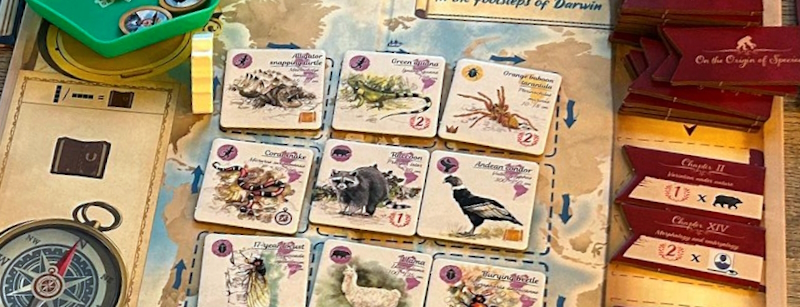
Meanwhile, on the next table Jade was teaching Cobalt, Crimson and Plum the Spiel des Jahres 2024 nominee, In the Footsteps of Darwin.  The premise of this is that players are naturalists aboard the Beagle helping Charles Darwin finish his book On the Origin of Species, studying animals, carrying out cartographic surveys, publishing their findings, and developing theories. On their turn, players study an animal or take inspiration from a character by choosing one of the three tiles in the row or column marked by the Beagle, and placing it onto their naturalist’s Notebook. This may be an animal to study or a character from the Beagle’s previous journey and will give an immediate bonus or a scoring bonuses.
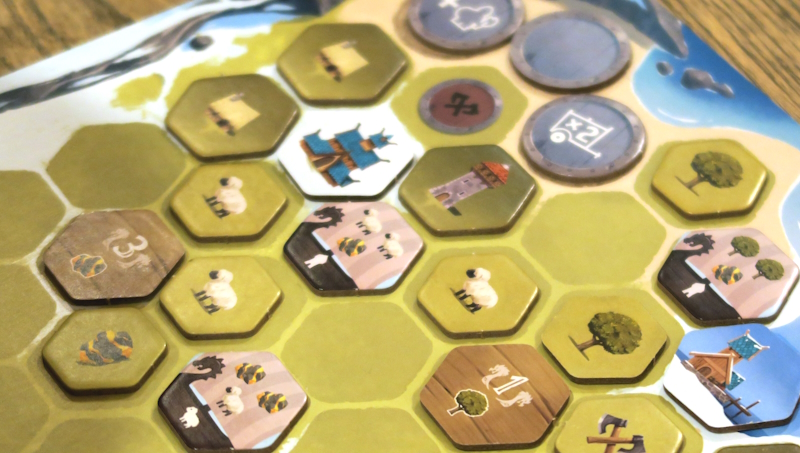
In the Footsteps of Darwin
– Image by boardGOATS

After placing the tile, the Beagle is moved round the market, with the distance dependent on the tile chosen and a new tile is drawn to fill the empty space on the journey board.  At the end of the game, the player who contributed the most to On the Origin of Species wins.  At it’s heart, In the Footsteps of Darwin is a fairly simple set collection and “make the most of what’s available” game. Players obtain an additional scoring objective when they place a tile on top of a previous one, covering up any icons, so a key part of the game is the conflict between points being gained verses points being lost.
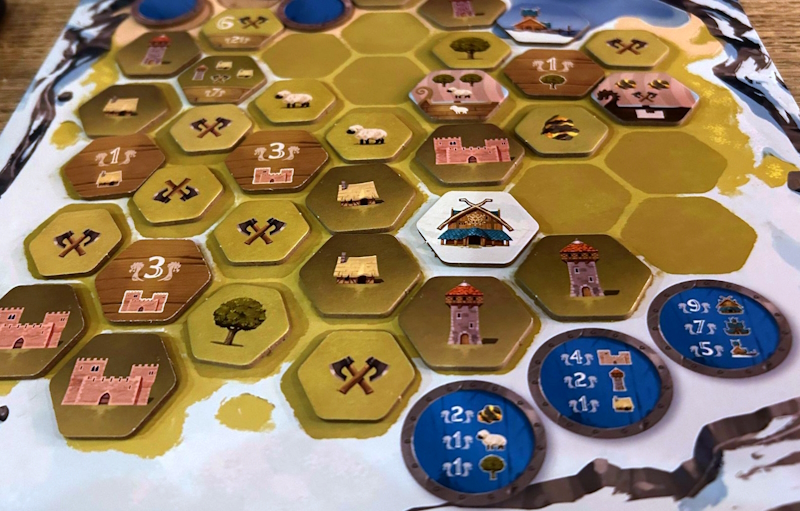
In the Footsteps of Darwin
– Image by boardGOATS

There’s also quite a bit of luck invoiced, as a player may need one or two specific tiles that don’t come out, or that get taken by someone else before they have the opportunity to do so.  The group found it was very quick to play, taking just forty minutes including teaching.  Plum’s  starting goal was points for tiles in the upper right quadrant, but in the absence of tiles that fitted that criteria she focused instead on collecting Charts and Compasses as these score points equal to the number of these multiplied together.

In the Footsteps of Darwin
– Image by boardGOATS

One advantage of these is that once a Compass has been collected, the tile can be covered without loosing any points. Cobalt didn’t worry about that at all, covering loads of tiles to get more Theories banners which give points.  Ultimately, everyone’s score was pretty similar at the end of the first game but Jade took victory as he was most effective with the Chart/Compass scoring.  As it was so quick, the group decided to give it a second try—this the scores all improved.  This time the victor was Crimson, who was again the most effective with the Charts/Compasses, but also scored well in other areas, as did Cobalt who came second again.

In the Footsteps of Darwin
– Image by boardGOATS

From there, the group moved on to a game of Looot, which is too recent a release to have been acknowledged in the Spiel des Jahres awards.  It has been popular amongst the members of the group that have played it so far, however, and may well get an award next year.  In this game, players gain points by gathering resources and capturing buildings to try to develop their Fjord, fill their long ships and complete buildings. The winner is the player with the most riches and is crowned Jarl of the Vikings. The game is played over several rounds until each player has played all their Vikings, giving a maximum of thirteen turns, each with a simple structure.

Looot
– Image by boardGOATS

Players start by placing their Viking on a Resource tile on the central board adjacent to another Viking of any colour.  They then take the associated Resource and place it on their personal board.  If possible, they then use their Resources to capture a Building and place that on their board, take a Long Ship and also place it on their board, use a Shield, or complete a Construction Site and finally grab a Trophy.  Looot is quite a light game, but with enough decision space to be interesting.  Last time was a three-player game, but this time, with four, players get another map area, which the group arranged to give a wide play area.

Looot
– Image by boardGOATS

The board layout made it easier to get to more areas of the map relatively early in the game, but there was still plenty of competition for the Towers.  Like last time, Plum decided not to worry about all the home tiles and focused on gold, which was good, but not enough on its own.  Cobalt scored massively for Castles by getting plenty of them plus the equivalent Long Boats.  Cobalt started on that strategy largely by accident, before he had got a real understanding of game-play and a full appreciation of how they increased the Castle scoring and matched the requirements he could fulfill.

Looot
– Image by boardGOATS

Crimson had a nice balance of increased score for Towers and Houses, while Jade built up a huge pile of Wood.  Unlike last time, things didn’t just come together at the end for Plum, and nobody else could compete with Cobalt’s Castles and he took victory with one hundred and twenty-one, fourteen points ahead of Crimson in second.  It had been a good game though, and as players become more experienced, they will be increasingly able to determine the best scoring opportunity from the start and how to optimise the mini game that is building their Fjord. With experienced players, this could be quite ruthless with players trying to block each other and prevent objectives.

Looot
– Image by boardGOATS

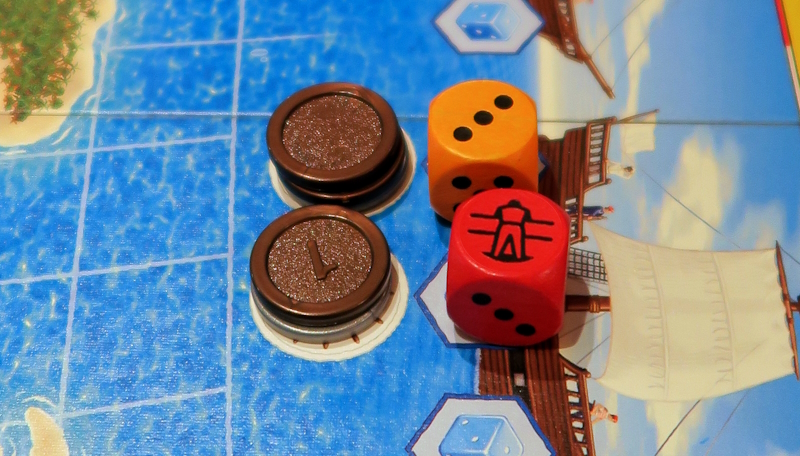
In the third group, meanwhile, Pine was introducing his new acquisition, the old game, Tonga Bonga, to Pink, Black and Purple.  This is a sailing race game a bit like the 2008 Spiel des Jahres recommended Jamaica.  In Tonga Bonga, players pilot their ship around the archipelago with the goal of visiting four of the five remote islands and returning to Tonga Bonga Bay.  Each player has room for three sailors on their ship, each of which represented by dice and indicate how fat the ship will move.  At the start of the round, players decide how much they are prepared to pay for the sailors who will serve as their captain and first mate that round (the Cabin Boy always works for nothing).

Tonga Bonga
– Image by boardGOATS

Players then simultaneously roll their dice, and take it in turns assign their dice to the other players’ ships, in return for the money offered.  In a mechanism vaguely reminiscent of that in the really rather vicious game, Vanuatu, if a player tries to place a higher value die where someone has already assigned a die, the lower value one is displaced and bumped to a lesser and usually less lucrative role.  Thus, all things being equal, the ship offering the most money will get the highest value dice and the most moves, though of course, players can work together to disrupt this behaviour. One side of each die has a Seasick Sailor (effectively zero), so the maximum value dice are five.

Tonga Bonga
– Image by boardGOATS

Once all the dice have been assigned, players move their ships racing to reach the islands, leaving one of their tokens there.  Landing on an island, earns $25 from the bank, but the player has to pay $5 to each player who landed there ahead of them.  Pine explained the rules and before long, everyone was sailing.  Pink got a bit of a lead by using his winnings to buy more moves and visit more islands.  He had been feeling that the game was maybe a bit “broken”, but as is usually the case when a game feels like that, it was all down to the “rules malfunction”, but it wasn’t until the final round that the rules were “clarified”.

Tonga Bonga
– Image by boardGOATS

Instead of the winner being the player to cross the line first with any left over money used as a tie-breaker, once a player has visited four islands they return to Tonga Bonga Bay and trigger the game end—and whoever has the most money wins.  Pink crossed the line and claimed the moral victory, as he was playing by the original rules.  Everyone else was quite happy with the “updated rules” though, which left Pine the victor with Purple in second and Black just behind.  Pink blamed “Evil Pine” for the mishap, but was eventually won round with a bottle of dubiously flavoured cider.

Tonga Bonga
– Image by boardGOATS

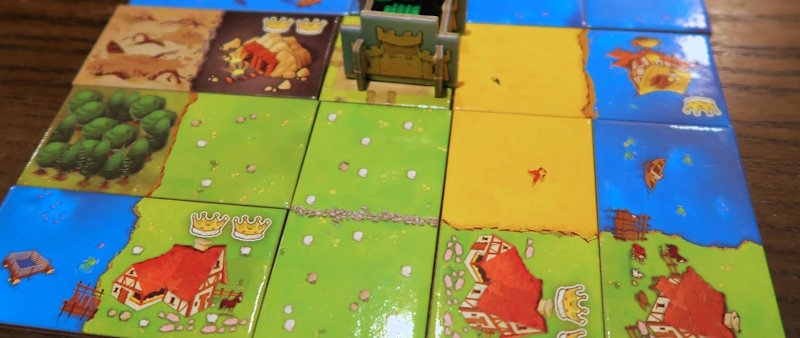
Although the debate had been audible by the players at the neighbouring tables, ultimately it was all taken in good part and the game had been a lot of fun and showed its age less than Lifeboats that was played a few weeks back and was only five years older.  From there though, the group moved on to a game of the 2021 Spiel des Jahres winner, Kingdomino.  This is a clever little game where players are building a kingdom made out of double-headed, domino-like tiles.  As in Dominoes, the ends of the tiles have to match, or at least it has to match with one tile tile already in the player’s kingdom.

Kingdomino
– Image by boardGOATS

The really clever part of the game is the double market, where the tiles are taken in reverse order of value.  The double market means that when a player takes the tile for the current round, they choose which tile they will get in the next round.  Thus, taking the lowest value tile this round means they will have first choice next round.  Players score for each contiguous area of Terrain—the number of points is equal to the number of squares multiplied by the number of Crowns featuring in it.  This time, Pink concentrated on Wheat Fields and Sea, Pine focused on Sea and Meadow while Black concentrated on Woodland with a smattering of points from Marsh, Mountain and Wheat fields.

Kingdomino
– Image by boardGOATS

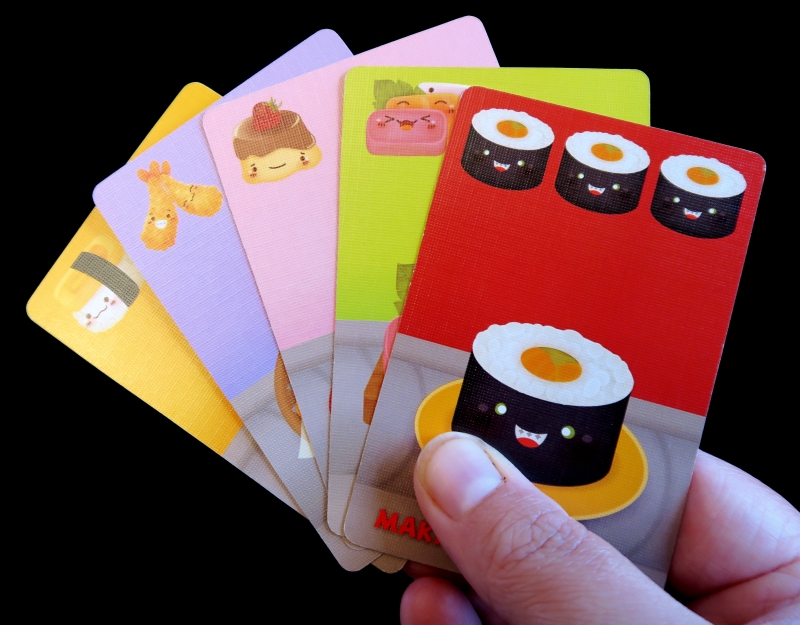
In contrast, Purple prioritised her four contiguous areas forfeiting the “Harmony” and “Middle Kingdom” bonus points for using all the tiles to give a square kingdom with a central castle.  Pine took victory with a massive seventy-three with Pink and Black tying for second with sixty points.  This group wasn’t done by any means and swiftly moved on to a quick game of Sushi Go!.  This is one of those games that takes a mechanism that is a relatively minor part of other games and distills it into its purest form in the game.  Coloretto does the same for the central market mechanism used in the 2007 Spiel des Jahres winner, Zooloretto, and Sushi Go! does it for the card drafting mechanism in the 2011 Kennerspiel des Jahres winning game, 7 Wonders.

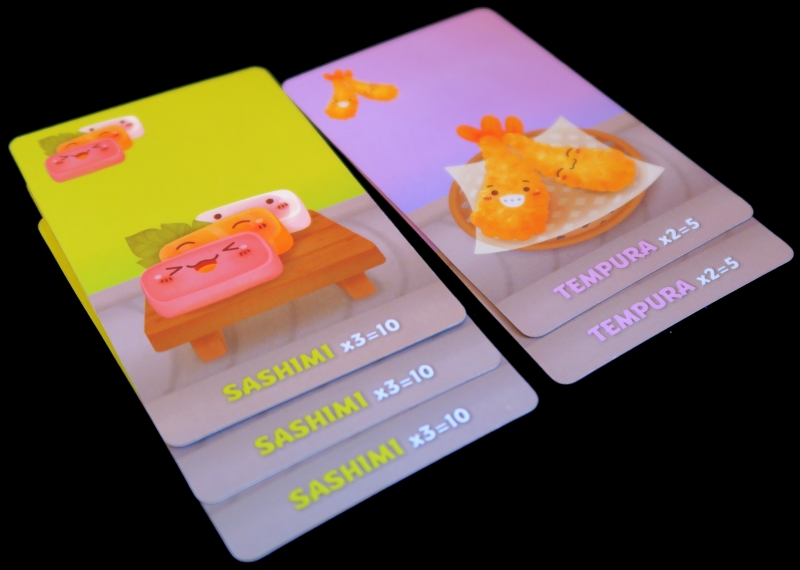
Sushi Go!
– Image by boardGOATS

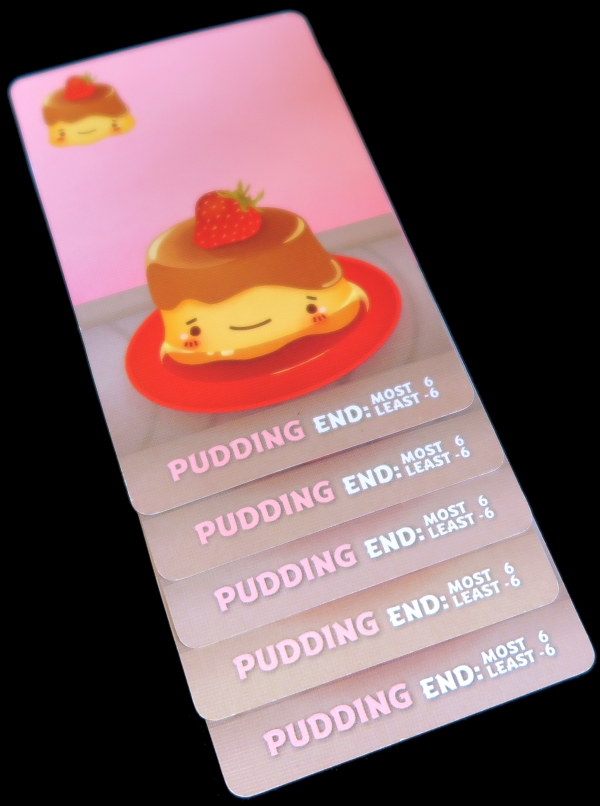
In Sushi Go!, players start with a hand of cards, keep one and pass the rest on, repeating until all the cards have been distributed.  As well as being a core mechanism in 7 Wonders, this “Card Drafting” is also often used to try to reduce the luck of the draw at the start of games like Terraforming Mars and Agricola (both also acknowledged by the Spiel des Jahres committee).  In Sushi Go!, players are using the card drafting to collect sushi and, most importantly Pudding!  The game is played over three rounds, with cards drafted to the left, then right and then left again, scoring points at the end of each round.

Sushi Go!
– Image by boardGOATS

This time, Pink and Black tied for the high-scoring first round, with Pine just behind.  Pine made up for it on the second round by taking it convincingly, however, with everyone else scoring very badly.  The third round was more even again, this time won by Black with Purple taking second.  That resulted in a three-way tie between Black, Pink and Pine, but at the end of the game, the player with the most Pudding cards gains six points, with the one with the fewest losing six points.  Unusually for Pink (as he has quite a sweet tooth), he had eschewed Puddings, while Black had the most giving him what ended up being a quite convincing victory.

Sushi Go!
– Image by boardGOATS

There was just time for a single round of Love Letter (a game from the 2014 Spiel des Jahres recommended list).  This is a sixteen card game where players start with a card, draw a second and then play one.  The idea is to try to be the last play in or the player with the highest value card when the deck runs out.  The theme is all about getting as close as possible to the Princess card, which has the highest value.  This led to a discussion about real princesses and how close people had been to them.  It turns out that Purple has met a real one, Princess Nina who lives in a massive house in Cheltenham.  During the game, Pink was the Princess, but was spotted and knocked out, leaving Black to take another win.

Love Letter
– Image by boardGOATS

Learning Outcome:  The Spiel des Jahres committee may reward lighter games, but they are good games.

Golden GOAT Award Winners – 2023

The boardGOATS love a good party, so once again, they met just before Christmas for their annual Un-Christmas Dinner and to decide the winners of the GOAT Awards.  After food, crackers and writing GOAT Christmas Cards, the group voted for two awards:  the Golden GOAT for our favourite game played during the year and the “GOAT Poo” award for our least favourite.  Everyone had the usual three points to hand out for the Golden GOAT Award (plus a bonus if wearing Festive Attire), though a maximum of two points could be given to any individual game.  Everyone could also nominate up to two individual games for the GOAT Poo Prize.

7 Wonders
– Image by boardGOATS

This year, there were a handful of games that received the unofficial “Marmite Award”, that is to say they received nominations for both the Golden GOAT and the GOAT Poo prizes.  These included Challengers!, Kites and SCOUT.  For the GOAT Poo Prize itself, this year there were no outstanding candidates, with a tie between 2019 winner 7 Wonders and Dice Hospital, with two votes each.  Nominations for “Moment of the Year included the game of Challengers!, which was likened to “Speed Dating”, and the massacre in Survive: Escape from Atlantis!, but the winner was the three way tie in the epic game of Tapestry with the Fantasies & Futures expansion.

Survive: Escape from Atlantis!
– Image by boardGOATS

And finally, there was the Golden GOAT Award for the best game played in the year.  Previous winners including Wingspan and 6 Nimmt! were ruled out, but there were plenty of options remaining. Earth, Fantastic Factories, SCOUT and Zoo Break all received three votes, but the clear winner was Tapestry.  Over the years, we’ve played this quite a bit, but it is a game that doesn’t suit a significant number of the group.  This year, however, with a slight shift in those eligible to vote, heavier games were in with a better chance and Tapestry was the beneficiary.  We will have to make sure it gets another outing in the new year.

Golden GOAT - 2023
– Image by boardGOATS

19th December 2023

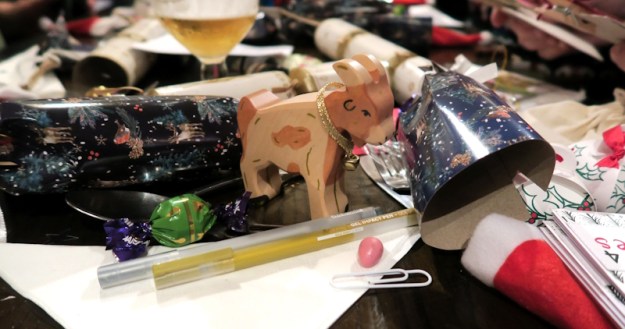
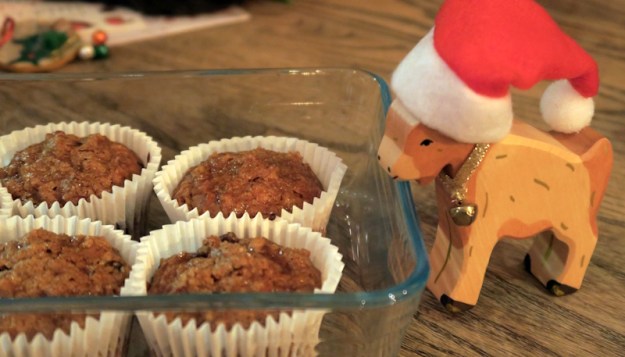
It was party time so everyone was arrived early for the Un-Christmas Dinner—everyone that is, but Blue and Pink who eventually arrived armed with piles of Christmas crackers, party poppers, tree decorations, Christmas cards, raffle prizes, GOAT Award ballot papers, mince pies and festive cake.  Opening the crackers was a necessity before food arrived to avoid the bits landing in people’s supper, so when food arrived, it nestled amongst all sorts of gaming detritus.  As the staff at The Jockey served pizzas, pies, baguettes, cheese with crudités, burgers and chips, gamers called out the awful GOATy jokes from the crackers.

"Un-Christmas Party" 2023
– Image by boardGOATS

During the interval between main courses and dessert, GOAT Award voting forms and Christmas cards were handed out and people began thinking about the games we’ve played over the year.  Ivory collected Christmas Cards and Green collated the ballots before he announced the winners.  The GOAT Poo prize, for the worst game of the year went Dice Hospital when 7 Wonders was relegated as a previous winner.  The Golden GOAT went to Tapestry, while the epic three-way tie in Tapestry won “Moment of the Year”.  With the formalities and food finally complete, there was just the raffle, a copy of Carcassonne: Winter Edition and the Ukraine Map, which were won by Sapphire, then everyone abandoned the carnage (and Purple who helped clean up), to play something festive.

"Un-Christmas Party" 2023
– Image by boardGOATS

There was a bit of the usual indecisiveness, but eventually Blue, Ivory, Pink, Green and Pine settled down to play the “Feature Game” which was Jokkmokk: The Winter Market while Black, Cobalt, Jade, Sapphire and Lime set up Snow Tails.  Jokkmokk is a very simple game that makes use of the time-track mechanism seen in Tokaido and Namiji (played last time)—that is to say, it is an extended game of leap-frog where the player at the back jumps into an empty space of their choice and then carries out the action associated with it.  Like those games, the compromise is between moving to a preferred space which may be further forward and will ultimately will give fewer turns.  It is much simpler than both Tokaido and Namiji, however.

Jokkmokk: The Winter Market
– Image by boardGOATS

Jokkmokk is a card-driven set collecting game and is made more interesting by a large number of mini-decks, five or six of which are combined for each game.  For the first game, the group chose to use the “First Game” selection of decks (Dalecarlian Horse, Antique, Hot Dog, Patchwork, Present).  Blue went for the Patchwork cards while everyone else fought over kettles (Antiques) and Hot Dogs).  Blue’s strategy nearly paid off giving her ninety-nine points and second place, but Ivory was more efficient than everyone else with his mixture of Horses, Hot Dogs and Kettles, which gave him a hundred and one points and victory.  The game was bright and breezy and, although simple, really didn’t outstay its welcome, so the group decided to “do a Lime” and play it again.

Jokkmokk: The Winter Market
– Image by boardGOATS

This time, this time the group played with the “Gift of Giving” selection of decks (Donation, Bell, Sparkler, Snowflake, Mystery Box, Presents).  Pink went for Sparklers, knowing he would lose half his points if he had the most, but hoping to have so many that it wouldn’t matter.  Green started collecting Bells, as did Blue and Ivory, going for different colours.  Lots of Gifts were given and a good time was had visiting the fair.  Pink’s ninety points were just three more than Ivory’s total, but Blue’s hundred and seven points gave her victory at the second attempt.  Meanwhile, on the next table, the others had finally started playing Snow Tails, spectated by Purple, who had finished helping clear the table after dinner.

Snow Tails
– Image by boardGOATS

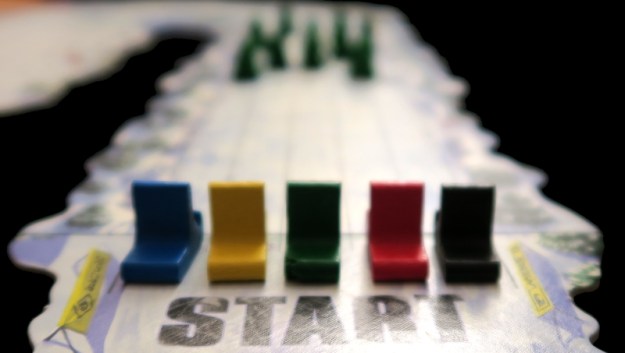
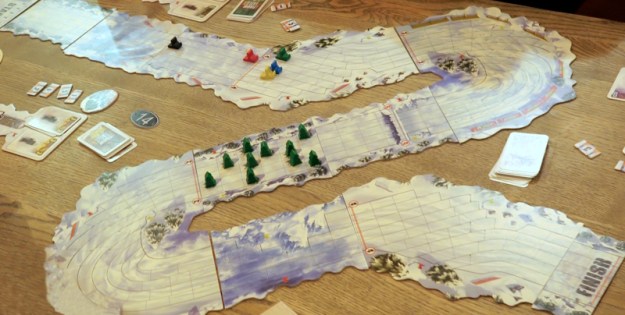
Snow Tails is a very popular game in the group, but somehow, one that is a little tricky to get to grips with.  The games is a card-driven sled-race with the winner the first to navigate the course.  Unfortunately, the course they chose was the one depicted in the main rules, which isn’t really intended to be a course design as it is quite long and features a Chasm right at the start, a couple of hairpins and some Saplings as well.  Each player starts with their own personal deck of cards, with five in hand.  On their turn, players can play up to three cards as they can so long as they are all the same value:  one for each sled dog, and one on the break.

Snow Tails
– Image by boardGOATS

The speed, the number of spaces the sled moves forward, is the total for the dogs minus the value for the Break.  Sleds will additionally drift sideways the difference between the dog speeds, and if the sled is balanced (i.e. the dogs are pulling equally), the player gets a bonus speed equal to the players position in the race.  Each time a sled exceeds the Speed Limit on a corner, hits the side of the track or a Sapling, the player takes a Dent card—a useless card that just blocks the player’s hand making things difficult.  The more Dent cards a player has, the more difficult the game gets, as Black soon demonstrated.  The first game of Jokkmokk had already finished and the sleds were only just off the Start line and through the first Chasm.

Snow Tails
– Image by boardGOATS

Lime claimed the “Big Paws” token for the player with the most “Analysis Paralysis”, though to be fair, everyone suffered a bit.  Jade commented that he’d been planning to play it with his nieces, but was now rethinking the idea.  As a result, the group shortened the track (to give them a chance to finish before midnight), and from there, the game went a bit more smoothly.  Jade was first to cross the Finish line, chased by Cobalt and then Sapphire in what had been a quite epic game.  And with that, the party was over for another year, though people lingered and chatted for quite a while before everyone left the pub staff to lock up.

"Un-Christmas Party" 2023
– Image by boardGOATS

Learning Outcome:  Always plan your Christmas shopping early.

14th Movember 2023

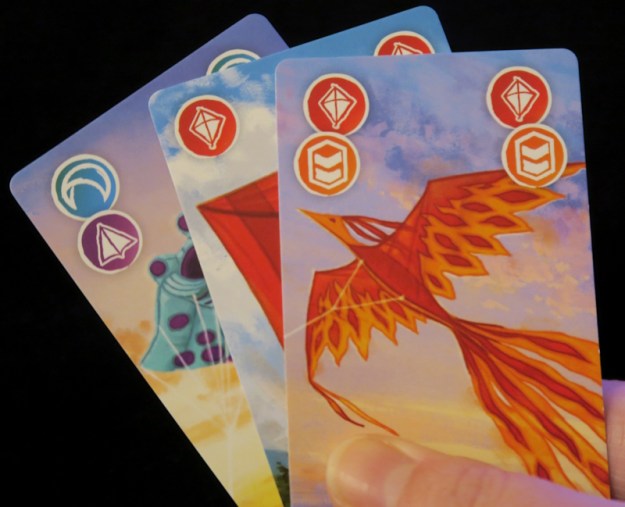
With Black, Teal, Pink, Green and Lime all away, it was looking like it was going to be a very quiet night.  In the event, however, the numbers remained good with the slightly unexpected arrival of Plum, Byzantium, Jade and Sapphire.  When Green dropped off Purple and stayed for a while, it became clear that we’d need something short to play alongside Kites, the “Feature Game“.  Kites is a real-time, cooperative game where players are playing cards and flipping egg-timers to keep the air display going.  A single play-through doesn’t take very long, but it is the sort of game that tends to get played through a couple of times in succession.

Kites
– Image by boardGOATS

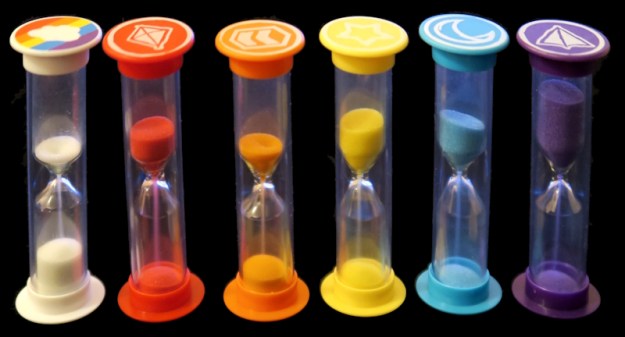
The idea is that that the Team have to launch six Kites, each represented by sand timers, and keep them flying by preventing the timers from running out.  Game play is very simple:  Players start with a hand of cards and must play one on their turn before replenishing their hand from the draw deck.  The cards all show either one or two coloured symbols on the corner, which correspond to the six coloured egg-timers in red, orange, yellow, blue, purple and white/rainbow colours that represent the different Kites.  When a card with two symbols on it is played, both egg-timers in those colours must be turned, however, a card with one just one symbol allows the active player to choose whether to turn the timer in that colour or to flip the white/rainbow coloured timer instead.

Kites
– Image by boardGOATS

The game ends when either all the cards are played out (the Team win), or when one of the timers runs out of sand (the Team loses).  There are a couple of additional “features”.  Firstly, the different coloured timers each have different amounts of sand in them—the purple lasts the longest at ninety seconds with red running fastest lasting just thirty seconds.  This catches out the unwary, and indeed it caught out the group composed of Jade, Plum, Blue, Purple, Pine and Byzantium on their first try when they succeeded in playing just four out of the fifty-three cards in the deck.  The second attempt wasn’t much better, ending with just six cards played.

Kites
– Image by boardGOATS

The game has an “easy start” mode where players start with just three coloured Kites (plus the white/rainbow one), but nobody was keen to take cards out of the deck.  So, to make things a little easier, instead of starting with three cards in hand as per the rules, the group started with a hand of four cards, giving them a little more in the way of choice on their turn.  With this “House Rule” they were a little more successful, but it was at the fourth attempt, that things clicked, and the group finished with only twelve unplayed cards.  And it was then that the second “feature” caught out the group—when the draw deck has been exhausted, players can no-longer turn the white/rainbow timer.

Kites
– Image by boardGOATS

Having done well with four cards in hand, it was then that the group decided to revert to the rules “as written” and play with three cards in hand.  This made things more difficult during the early part of the game, but had the advantage of leaving players with fewer cards to play once the draw deck had been exhausted.  At that fifth attempt, the players were left with just six cards unplayed, and on the sixth try, they had eight left.  They were so close, they could feel it, and everyone in the group was determined not to stop before they’d won, which turned out to be on the seventh play.

Kites
– Image by boardGOATS

Kites is not the usual sort of fare for many in the group, being both cooperative and featureing real-time play.  It had been interesting and fun, however, with players learning how to work together and what information they needed to share.  Two people took responsibility for turning the timers and everyone else made sure they let people know when they spotted a timer running low.  Perhaps the biggest impact was the realisation that waiting was sometimes more powerful than playing quickly, and certainly more haste often brought less speed.  With the successful game, everyone felt they’d had enough, and while the other table finished their game, the group moved on to another party-style game, the simple little memory game, That’s Not a Hat.

That's Not a Hat
– Image by boardGOATS

Each player starts with a single card and shows it to all the other players before turning it face down.  One player then draws an extra card shows it to all the other players and passes their original card to the left or right (as per the arrow on the back of the card), announcing what they think it is.  The receiving player can either accept the card as it is, or challenge the declaration.  If a challenge is incorrect, the recipient keeps the card as a penalty point, whereas a correct challenge leaves the card/penalty point with the gifter.  It seems very simple, and doesn’t sound promising when described, however, after a couple of turns, when someone realises they can’t remember the card they’ve got in front of them and is forced to guess, the tension mounts and everyone suddenly appreciates the game.

That's Not a Hat
– Image by boardGOATS

Byzantium, Plum and Jade had played the game before and knew what to expect, but it was new to everyone else.  Most people thought they knew what card everyone had, only to discover that wasn’t the case after a couple of swaps.  Blue and Purple picked up just the one penalty, while Plum and Jade picked up a couple each.  After the game, there was some discussion about challenges needed to be accompanied with the correct card identity (which is how Plum had played it it HandyCon).  With this, it actually paid to try to bluff/confuse people who couldn’t identify the correct gift.  Inspired by this, there was some discussion about a possible “House Rule” to introduce a bit more jeopardy:  the challenger could optionally attempt to name the gift with the carrot of forcing another point on their gifter, and an incorrect guess reversing the effect of the challenge.

That's Not a Hat
– Image by boardGOATS

That was for another day.  This time, the winners, were Pine and Byzantium who avoided any penalties, though whether that was by luck or judgement wasn’t entirely clear and indeed, was unimportant.  That was especially true as the game was brought to an abrupt end by the game ending on the next table.  That was 7 Wonders—Green only wanted to play something short that he was familiar with and this fitted the bill.  7 Wonders is a card-drafting game, but has a bit of a “Marmite Factor” and is very unpopular with a significant number in the group, so rarely gets played.  This time though, Cobalt, Ivory and Sapphire were all happy to join Green and give 7 Wonders an outing.

7 Wonders
– Image by boardGOATS

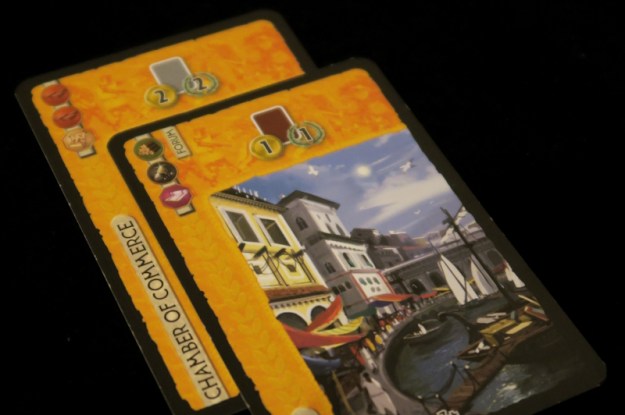
In 7 Wonders, players take the role of leader of one of the seven great cities of the Ancient World (Alexandria, Babylon, Ephesus, Giza, Halicarnassus, Olympia and Rhodes), gathering Resources, developing commercial routes, and developing their Military, build their City and erecting an architectural Wonder.  In each round or age, players receive seven cards and draft them, that is choose one card, then pass the remainder to their neighbour (much like Sushi Go! or Draftosaurus).  Players then reveal their cards simultaneously, paying Resources if required, collecting Resources or interacting with other players according to the cards played ant their player board (which gives special powers).

7 Wonders
– Image by boardGOATS

7 Wonders is essentially a card development game:  Some cards have immediate effects, while others provide bonuses or upgrades later in the game.  Some cards provide discounts on future purchases while others provide Military strength to overpower neighbors and some cards give nothing but victory points. Each card is played immediately after being drafted, so everyone knows which cards their neighbor is receiving and how their choices might affect what they’ve already built.  Players continue to draft cards until everyone has six cards (discarding the seventh).  The game ends after three rounds or ages.

7 Wonders
– Image by boardGOATS

7 Wonders is quite a famous game that Cobalt had heard about it and wanted to try, though he was the only one from the group who was unfamiliar with it.  It is one of those games where it seems like there is a lot to take in, but actually it is really quite simple and easy to pick up (though players do tend to require a round to see how it all plays, and there are only three in the whole game).  Everyone chose their respective Sides of Wonder.  Ivory who had Giza, elected to go for Side B, which has a four-piece Wonder and would give lots of points if he could complete it; Cobalt (Halicarnassus) chose to go for the simpler Side A, which would give him points and a chance to rifle through the discard deck for a card if he managed the second stage.

7 Wonders
– Image by boardGOATS

Sapphire (Ephesus) felt both sides were the same, money & points, just in different ways, while Green (Olympia) went for his Side B where he could have the option of copying a neighbour’s end game purple scoring card and the ability to buy Resources for only one coin each instead of two.  As expected the first round was a little slow as Cobalt felt his way around the cards and options, with help from the rest of the group, particularly from Ivory who was sat next to him and was initially passing his cards to Sapphire (so he could show Ivory the deck for some explanations without giving anything away).

7 Wonders
– Image by boardGOATS

The first round was gentle. Ivory and Sapphire lost out in the fight to Cobalt and Green.  In the second round Cobalt had to use his “Muppet Allowance” and swap a card he had kept when others pointed out he should have taken the other one.  Green was building up his army and building his Wonder with a lot of his own Resource (even though he had the Wonder benefit). Cobalt and Sapphire were beginning to specialise in the green Science cards.  Ivory was not really sure where he was going as he was beginning to lose out by not having access to the vast amount of Resources he needed to build his epic Wonder.

7 Wonders
– Image by boardGOATS

By the third and final round we everyone had the problems associated with trying to choose the best of a good bunch of cards.  Green and Cobalt ended up in an army fight, with six points at stake and already a reasonable army, it wasn’t a battle either of them wanted to give up on. The result was that they both let other good cards pass by.  By the end there were not many purple cards left, as it seemed a few had been used to build the Wonders, so Green’s “Copy” did not score heavily, although he did win the battle with Ivory (and subsequently with Sapphire too). Sapphire managed to get a full set of Science and a couple of single type multipliers, thus learning the power of Science in 7 Wonders (which is often hard to achieve).

7 Wonders
– Image by boardGOATS

By the end scoring, it seemed that Ivory, unusually for him, had indeed been boxed into a corner and ended up some way adrift of the rest of the group.  That aside, it was a very close contest between Cobalt, Green and Sapphire, with only a couple of points between each of them, but it was new player Cobalt who took the Laurels of victory.  Everyone enjoyed the game, so it might get another outing soon for which Green would be particularly grateful as it had always been a firm favourite of his.  With all the early games over at the same time, it was possible to swap the groups about as Green took an early night.  Jade was keen to introduce people to After Us, a game he had picked up at the UK Games Expo and hadn’t yet had the opportunity to introduce the group.

After Us
– Image by boardGOATS

After Us is a deck-building, Resource management, engine building game featuring an original card-combo mechanism.  The story is set in 2083 and mankind has died out leaving only apes which have kept evolving. As the leader of a tribe, players try to guide it towards collective intelligence, by adding new Primate Cards to their starting deck of tamarins. Primate Cards have three rows of “Effects”—the top row will award resources, the middle row will give points (often at the cost of resources) and the the bottom row will have abilities related to the primate type. At the start of a round, players draw four Primate Cards from their deck to be laid out in a row making “Connections”.

After Us
– Image by BGG contributor The Innocent

The aim is to get the most out of the Connections by closing the open ended “Frames” along the sides of the cards by butting them up against adjacent cards that also have open ended Frames. Players then resolve the now closed Frames following the order of top left to bottom right, trying to gain as many bonuses as they can.  Once everyone has simultaneously collected their Resources they can then use them to buy Primate Cards which are added to the top of the draw deck (and thus they come into use on the very next turn). In this way, they are improving the quality of their deck.  The Frames have been resolved, the players simultaneously chose one of their Action Discs denoting which primate type they want to recruit.

After Us
– Image by boardGOATS

The Action Disc chosen will also gives the player a bonus. When recruiting, players have an option to pay three or six Resource (fruit, flowers or grain) to gain a Card. Players can additionally spend two Resource during this phase to copy one of their neighbours’ Action Disc bonus.  Once everyone has resolved their Action Disks and bonuses, players discard their cards and draw four new ones and start again.  The game starts slowly with players building their tribe, but it can end in a sudden rush when one player breaks into a gallop and charges past eighty points triggering the end of the round.  In the shuffle, Cobalt joined Byzantium, Jade, Blue and Purple playing After Us.  Jade and Byzantium led the way (both being familiar with the game), while the others felt their way.

After Us
– Image by boardGOATS

Arranging the cards to make the Connections proved the biggest challenge initially, especially when frustratingly, it wasn’t possible to make use of a really good half Frame.  Blue, Purple and Cobalt just started collecting cards as well as they could, but Jade showed everyone an alternative, shedding all his starting cards until he had no tamarins at all.  It was then that  Byzantium suddenly started surging forward on the points track—having picked up a small number of good quality primate cards and shed a few tamarins he just turned the handle on his engine and it was too late for anyone else to do anything about it.  And he was the first to cross the eighty point finish line, with Blue (who had put on a bit of a spurt) in second.

After Us
– Image by boardGOATS

Meanwhile, Ivory, Plum, Pine and Sapphire settled down to to play the new Scandinavian edition of Ticket to Ride, Northern Lights.  Like all the other editions, players take it in turns to either take two coloured cards from the market, pay cards to place trains or take more ticket cards.  Like all the different versions, Norther Lights has a small number of special rules, but unfortunately, the rules in the box are in Danish, Swedish, Finish and Norwegian, and nobody in the group is a speaker, worse, although we played it about three months ago, nobody could remember the rules, so it was out with the phones to get translations.  The biggest difference boiled down to the addition of bonus cards, four of which are drawn at random at the start of the game and give extra points at the end.

Ticket to Ride: Northern Lights
– Image by boardGOATS

Additionally, there are some triple routes (which only take effect with five players) and some routes have a “+X” next to them which give players who build them X train cards from the face down pile.  Finally, for all routes Locomotive cards can replace any other card and for ferry routes Locomotive cards can be replaced with a pair of the same colour (and as a result, unlike most of the other versions, if there are three or more face-up Locomotive cards in the market, the market is not refreshed).  This time, the bonus cards drawn at random gave points for the most stations in Norway, the most stations in the arctic circle, the most successfully completed small Tickets, and the longest continuous connected train route.

Ticket to Ride: Northern Lights
– Image by boardGOATS

While everyone else seemed to be taking more and more tickets, Plum focused on completing her three starting Tickets, two fairly long ones running north-south, and a short one across the top.  It was a tight game for the podium places, though with Ivory, Pine and Plum vying for the lead.  Ticket to ride is often a high-risk, big-reward game though and if Plum had taken Tickets on her final turn instead of placing a single train for one point, she would have gained two more tickets and an additional twenty point which would likely have given her victory.  As it was, she finished in third, behind Ivory in second and Pine the worthy winner with a hundred and twenty-five points.

Ticket to Ride: Northern Lights
– Image by boardGOATS

Learning Outcome: Keeping kites flying takes teamwork.

16th May 2023

Unusually, Blue and Pink were joined early by Lime for pizza, and Pine who wasn’t eating.  So, while they were waiting for food to arrive the group squeezed in a very quick game of Coloretto. This is a popular game within the group, but somehow Lime had missed out on it.  It is quite simple to play, but one of those games that takes a couple of tries to get the hang of playing well, or as in Blue’s case, lots of tries and still not play it well.  The idea is simple enough though:  players take it in turns to either take a coloured chameleon card from the deck and add it to one of the “trucks”, or take one of the trucks and add the cards on it to their display.

Coloretto
– Image by boardGOATS

Players score points according to the triangular number series where every additional card is worth one more additional point than the previous card.  Thus, the fourth card someone gets is worth ten points, four more points than the third card (which itself is worth three more than the second and so on).  Collecting chameleons was briefly interrupted by the arrival of Hoi-sin duck pizzas, but that didn’t stop Pink winning with a total of thirty-seven points,  well ahead of a tie for second place between Blue and Pine.  By this time, Purple, Black and Teal had arrived and it was time to decide who was going to play what.

Coloretto
– Image by boardGOATS

Pink and Lime were very keen to give Zoo Break another go, having left the town of Bedlam over-run with escaped animals last time the group played.  With it being such a quiet night, there was some debate as to what the other group were going to play, but in the end they opted for the “Feature Game“, the Marina expansion to one of our most popular little games, Draftosaurus.  Pine was keen to play with the cute wooden zoo meeples and after the mayhem last time, Blue was also keen not to miss out, which left Purple, Black and Teal to play with dinosaurs.  The only problem was, none of them knew how to play it, so while Lime, Pink and Pine set up Bedlam Zoo, Blue quickly explained the rules to Draftosaurus.

Draftosaurus
– Image by boardGOATS

Draftosaurus is a very simple drafting game in the vein of Sushi Go! or 7 Wonders, but instead of drafting cards, players are drafting wooden dino-meeples.  The idea is that players start with a handful of dino-meeples and choose one to keep and pass the rest on to the next player.  The active player rolls a location die which adds restrictions on which pens players can place their chosen dinosaur in in their dino-park.  When everyone has placed their first dino, the die is passed to the next player and everyone chooses their next meeple from the pile passed to them by their neighbour.  The round is complete when each player has placed six meeples, and the game is played over two rounds (passing dino-meeples in opposite directions in each round).

Draftosaurus
– Image by boardGOATS

The Marina expansion adds brown Plesiosaurs to the yellow Triceratops, blue Stegosaurus, pink Brachiosaurus, orange Spinosaurus, green Parasaurolophus, and red Tyrannosaurus rex from the base game.  Where dinosaurs from the base game can always be placed in the river that runs through the middle of each player’s park (where they only earn a single point), Plesiosaurs all go into the river, which they travel along into an expansion board.  Each expansion board is slightly different, but when a player places the non-Plesiosaur dinosaur shown on the bridge, if they have a dinosaur immediately up-stream of the bridge, it can pass under it into the next section of the river where it will score more points.

Draftosaurus
– Image by boardGOATS

It was a close game with everyone following different tactics.  Teal concentrated on trying to fill his Meadow of Differences while Black focused on collecting pink Brachiosaurs and Purple stuffed her Forest of Sameness with blue Stegosaurs.  Black took one Plesiosaur, Purple collected two and Teal three, though only one of his made it under the first bridge and out of the main river.  Purple managed to minimise the number of non-scoring dino-meeples in her park, and that just gave her the edge, and she finished a couple of points ahead of Teal who took second place.

Draftosaurus: Marina
– Image by boardGOATS

Although Teal, Purple and Black tried to persuade her to stay (and there was even some suggestion of her playing both games simultaneously), once she had explained the rules, Blue joined the madness in Bedlam, playing Zoo Break.  In this game, players are keepers trying to prevent their charges escaping from the zoo, and to win the game, they have to return all escaped critters to their enclosures and lock the doors.  Losing is much easier—if five cuddly creatures or one dangerous one escape from the zoo, then it is all over.  Last time, only one animal escaped, but it was a cobra, so that was that.

Zoo Break
– Image by boardGOATS

On their turn, players first roll the action die to find out how many Action Points the player has to work with for that round.  Then, after they have carried out their actions, one card from the Escape deck and then one card from the Move deck are revealed.  The Escape card liberates one or more animals, while the Move card often moves animals towards the exit, but occasionally causes other things to happen, like waking up sleeping tigers, breaking barricades and generally cause more chaos.  After last time, the group decided to start by digging through the Supply deck and make sure everyone went really well equipped, then, prioritise capturing (or at least controlling) the Meerkats, as they had been so problematic last time.

Zoo Break
– Image by boardGOATS

On that occasion, the group had played with two “Phew” Cards in the Escape deck, and (following a rules malfunction) all the blank cards in in the Move deck.  In spite of all the blank cards, they still lost spectacularly.  So, this time, the group stuck with the two “Phew” Cards, but removed the blanks from the Move deck and did not add any other rules variants as they really wanted to win, though they stuck with the thematically logical variant where tigers remain tranquilised when returned to their pen. Lime had the Black Belt special power which meant he couldn’t be hurt by animals, so he got the job of dealing with snakes which hide so players have to reveal them, with the risk of being attacked if they are dangerous.
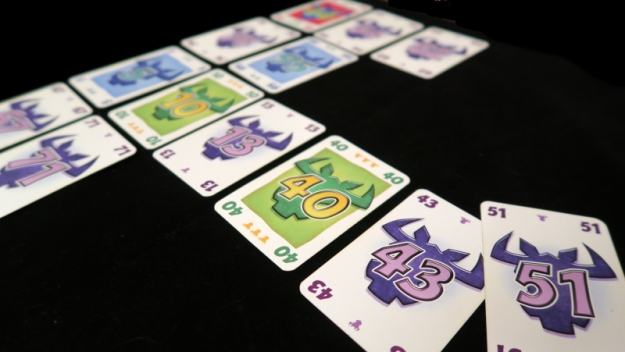
Zoo Break
– Image by boardGOATS

Pink, as usual wanted to work with the pandas, but the Capuchin monkeys were a more immediate threat, and the group made a point of dealing with the troublesome meerkats early this time, so then he went on to deal with them once the monkeys were locked up.  Blue, who had the panda enclosure key, took over trying to control them, but they kept escaping just as Blue was about to lock their cage. Blue was encouraged to capture one panda who was in the rhino’s path, but that meant she was left standing there—”You’ll be fine”, said Pink.  And Blue was immediately flattened by a charging rhino and had to spend a turn with the medic removing the hoof-prints from her forehead.  One meerkat escaped from the zoo, but was left to run free so Keepers could focus elsewhere and then lock their enclosure.

Zoo Break
– Image by boardGOATS

With two enclosures locked early, things became slightly more manageable.  The group wimped out of using the faulty lock variant however, because nobody wanted to risk failing a second time, and certainly, including it would have made things much more difficult.  As it was, one tiger got within sniffing distance of freedom, but was tranked before he could take that one final bound.  Pine made excellent use of his running skills (as Track Star he could move twice as fast as anyone else) and bravely helped Lime with snakes and wielded his dart gun—before long, the zoo was littered with big sleeping cats.  That was all very well, until they woke up at which point Pine had to do the job all over again.

Zoo Break
– Image by boardGOATS

After her run-in with the rhino, Blue tried to end her turn on hedge spaces, but that meant she was unable to swap supplies with other players as she couldn’t share her space.  Once the Pandas were vaguely under control, Blue was able to get a stretcher and another dart gun and help Pine with the tigers, making use of her Gardener ability, hiding in bushes and taking a pop at the big kitties from a place of safety.  While Pine and Blue were working on the tigers, the elephants started rampaging.  As the nearest and armed with a leash, Lime took a break from snakes and tried prevent them from causing too much damage.  This was all very well until (much to Pink’s disgust as he would have loved a black and white cuddle), Lime rolled the lowest number and got hugged by a panda leaving him unable to do anything until it was prised off him.

Zoo Break
– Image by boardGOATS

In the dying rounds, Pink’s, and indeed everyone else’s delight was evident, when another panda popped up for a cuddle and everyone cheered when Pink was the one to roll the lowest number and get a hug.  As the Lucky Duck, on his turn he was able to roll the Action Die multiple times to get more points, but he checked the rules to see if he was obliged to spend his first three points to escape from the furry cuddle or whether he could just stay there for the rest of the game.  In the end, he sent it back to its enclosure, but it probably wouldn’t have mattered.  With one last push, Pine and Lime rounded up the last of the snakes, then the group finally sorted out the charging elephants and mischievous pandas, and finally locked up the rhino, giving the group a much deserved victory.

Zoo Break
– Image by boardGOATS

Draftosaurus is a much quicker game than Zoo Break, so while they Keepers were dealing with the tigers, elephants and disobedient pandas, Teal, Black and Purple moved onto play Splendor.  This was one of Burgundy’s favourite games and he was almost unbeatable at it, so we never play it without thinking of him.  It is a very simple engine builder card game, but takes great skill to repeatedly win in the way Burgundy did.  The idea is that on their turn, players either collect gem tokens (three different colours, or two the same as long as there are at least four left), or spend tokens to buy cards from the market.  Cards act as permanent gem tokens (effectively reducing the cost of cards later in the game), but also provide Victory Points—when a player passes fifteen points, that triggers the end of the game.

Splendor
– Image by boardGOATS

In addition to the two basic actions, there is also the relatively rarely used action of reserving cards, where a player gets a wild, gold token and can reserve one card which they can pay for later.  This time, both Teal and Purple reserved cards, while Black prioritised taking high value cards.  Reserving cards can be a very effective tactic, but the game is all about the cards available in the market and surfing through them as quickly and efficiently as possible and amassing points.  As it was, Black romped away with victory, his fifteen points three times that of anyone else.  And with that, both Splendor and Zoo Break finished, leaving the group with a little time to play something else.  Teal and Lime headed off, so after some discussion, Pine, Black, Purple, Pink and Blue decided to give Draftosaurus with the Marina expansion another go as it was the “Feature Game“.

Draftosaurus
– Image by boardGOATS

It was then that the group realised the errors in the original explanation, in particular how the Solitary Isle enclosure worked.  Pine corrected Blue’s errors and the second game began.  Pine and Blue both tried to exploit the Plesiosaurs at every opportunity, and Pink tried to claim extra points for reverse parking his solitary Plesiosaur into the dock.  It turned out he didn’t need them though, as with forty-seven points he took his third win of the night.  Blue and Black tied for second place, while Purple unfortunately had to recount when she realised she had a pink Brachiosaur elsewhere in her park so couldn’t score seven points for her solitary Isle.  That left a bit of time for a chat, but everyone was tired and it wasn’t long before the last of the group headed home.

Draftosaurus: Marina
– Image by boardGOATS

Learning Outcome:  Who needs TV when you’ve got T.Rex?

22nd December 2020 (Online)

For our last meeting before Christmas, we usually meet for food and have special Christmas Crackers. This year, this wasn’t possible of course, so instead of crackers everyone had a Box of Delights to be opened simultaneously at 8pm (similar to the Birthday Boxes we’d had in October).  The boxes included a range of chocolates and sweets, home-made gingerbread meeples, a miniature cracker, a meeple magnet, and a selection of dice and other goodies.

2020 Christmas Gingerbread Meeples
– Image by boardGOATS

With several little people attending, we decided to play something straight-forward first, so we began the evening with Second Chance.  This is a very simple Tetris-style game game that we’ve played a few times this year.  Players choose one of two cards depicting shapes and draw them in their grid.  If a player cannot draw either shape, another card is revealed and if they are unable to draw that one as well, they are eliminated.

Second Chance
– Image by boardGOATS

Once the rules had been explained and everyone had been given their unique starting shape, the group settled down with their colouring pens and pencils and concentrated on trying to fill their grid.  Pink was the first one to take a second chance card, and when he couldn’t place that shape either he was the first to be eliminated and took his bonus space.  The winner is the player with the fewest empty spaces, so while being first out is not a guarantee of anything, obviously players who stay in the longest are likely to do better.  And it was a long time before anyone else was eliminated.

Second Chance
– Image by boardGOATS

As people gradually found their space was increasingly limited, there were the usual pleas for something nice, which became more desperate as people needed second chances.  Then there was jealousy as players like Pine were eliminated with outrageously large shapes while others, like Little Lime, stayed in when they got the much coveted small pieces.  Meanwhile, everyone else concentrated on beautifying their art with Christmas colours and embellishments.

Second Chance
– Image by boardGOATS

Eventually, Purple, Pine, Burgundy, Blue and lastly Green were also eliminated leaving just five when the game came to an end because the deck ran out.  Then it was just the scores.  Most people did really well, though some, not quite so much.  More than half finished with single digits though, including excellent performances from Little Lime and Little Green.  There was some beautiful artwork from Lilac (as usual), but festive offerings from Green, Purple and Black too.  There was a three-way tie for second place between Black, Blue and Green.  On his own with only one single empty space though, was Ivory.

Second Chance
– Image by boardGOATS

With the first game over, we moved on to discussing the important matter of the GOAT Awards.  Every year, we give the Golden GOAT to our favourite game played during the year and the GOAT Poo award to our least favourite game.  Last year, Wingspan won the Golden GOAT Award and 7 Wonders took the GOAT Poo Prize.  This year, the unanimous winner of the GOAT Poo was Covid and its effect on 2020—nobody could deny that Covid was definitely the worst thing to happen to games night this year.  As Covid wasn’t a game, Camel Up took the award on a tie break from Terraforming Mars and Welcome To….

Camel Up
– Image by boardGOATS

Terraforming Mars just missed out on the GOAT Poo prize, but in coming fourth in the Golden GOAT competition, won the unofficial “Marmite award”, for the most divisive game.  Kingdomino and and last year’s winner Wingspan both made the podium for the Golden GOAT, but controversially, the winner was 6 Nimmt!.  The controversy wasn’t caused by the worthiness of the game, just that Blue ensured it’s emphatic win by placing all four of her votes in its favour.

Golden GOAT - 2020
– Image by boardGOATS

Although 6 Nimmt! is an old game, we’ve played it at the end of almost every meeting on Board Game Arena since March.  In a year with little smile about, it has given us more fun and entertainment than almost all of the other games put together and was responsible for moment of the year.  That was back in May, when Lime joined a game of 6 Nimmt! with a bunch of Frenchmen by mistake.  That is just one of many memorable moments we’ve had with 6 Nimmt! this year though.  Furthermore, since we discovered the new professional variant the game has gained a new lease of life, so it seemed an entirely appropriate, if strange win for a strange gaming year.

6 Nimmt! on Board Game Arena
– Image by boardGOATS

While Pink did the count for the GOAT Awards, Blue reminded everyone of the rules for the “Feature Game” which was to be the Winter Wonderland edition of Welcome To….  The fact that Welcome To… had nearly won the GOAT Poo award was an inauspicious start, especially since the main protagonist was Pine who had struggled last time.  A lot of the ill feeling was due to the dark colour of the board for the Halloween edition which we played last time it got an outing, so the pale blue colour of the Winter Wonderland version was always going to be an improvement.

Welcome To... Halloweeen
– Image by boardGOATS

Welcome To… is one of the more complex games we’ve been playing online.  The idea is that players are developers building part of a town in 1950s USA.  Mechanistically, it is simple enough—the top card on each of three number decks is revealed and players choose one of the three numbers to play.  They mark this on one of the three streets on their player board.  The house numbers must increase from left to right and each number can only appear once in each street.

Welcome To...
– Image by boardGOATS

Each card is paired with the reverse of the previous card drawn from that deck, which gives a special power.  The special power can be rule breaking, enabling players to write a number a second time in a street, or give some flexibility in the number they must write.  Alternatively, the special power can directly provide players with extra points through the building of parks or swimming pools.  Finally, the special power can facilitate the achievement of extra points by enabling players to build fences separating their street into “Estates”, or increasing the number of points each “Estate” provides at the end of the game.

Welcome To... Winter Wonderland
– Image by boardGOATS

Aside from the colour scheme and artwork, the main difference between the base game and the Winter Wonderland Version was the addition of fairy lights as a means to get bonus points.  These are added to to a player’s board joining any houses where the numbers are consecutive.  At the end of the game, players get one point for each house in their longest string of lights.  Additionally, the third planning card selected gave a lot of points for anyone brave enough (or perhaps daft enough) to successfully connect an entire street with lights.

Welcome To... Winter Wonderland
– Image by boardGOATS

Little Lime and Lime took their leave, and Lilac and Little Green also decided to give it a miss, but that still left eight players, albeit one who was very sceptical.  Pine had nominated Welcome To… for the GOAT Poo Prize, and felt that didn’t bode well, but was prepared to give it a go.  The Plan Cards, give players points during the game as well as being a trigger for the end of the game.  As well as the street full of lights from the Winter edition, there was also one that gave points for a pair of estates (comprising three and six houses) and for players completing all six end houses.

Welcome To... Winter Wonderland
– Image by boardGOATS

The game started with a lot of “Bis” cards and quite a few high and low numbers.  It wasn’t a huge surprise then, when several people completed the end of street plan.  Ivory was first to complete the estate plan and eventually, Blue who felt that the Christmas element should be accentuated, completed the fairy lights plan.  The question was, who would be first to finish all three and when, as that was the most-likely end-game trigger.

Welcome To... Winter Wonderland
– Image by boardGOATS

It was towards the end that Purple commented that Black had been eliminated.  It wasn’t immediately clear what she was on about, but eventually it was apparent that one of his furry friends had decided that they wanted to be the subject of his attention and had firmly sat on his player board, very effectively obstructing play.  That cat-astrophe put paid to any successful involvement in the game by both Purple and Black, but it wasn’t long before Green announced that he’d finished all three of the Plans and was ending the game.

Welcome To... Winter Wonderland
– Image by boardGOATS

With that, everyone totalled up their scores.  Pine said that despite his scepticism, he had actually really enjoyed the game and felt he had done reasonably well and indeed was a long way from coming last.  It was very close for second place with Green just beating Burgundy into third by two points.  The clear winner, for the second time of the night, was Ivory who finished with an exceptional ninety-five points. And with that, he decided to quit while he was ahead and everyone else decided it was only appropriate that they should play the newly-crowned Golden GOAT6 Nimmt!.

6 Nimmt!
– Image by boardGOATS

6 Nimmt! is so very simple, yet so much fun.  Players simultaneously choose a card from their hand and these are then revealed and, starting with the lowest card, added to one of the four rows.  Cards are added to the row with the highest number that is lower than the card played, i.e. the nearest lower number.  When a sixth card is added to a row, the owner takes the first five cards into their score pile, leaving the card they played as the new starting card.  The player with the fewest Bulls’ Heads at the end is the winner.

6 Nimmt!
– Image by boardGOATS

Board Game Arena implements the game with everyone starting with sixty-six points and the game ending when someone reaches zero.  It also adds a couple of other variants, the most exciting of which is the “Professional Variant”, where players can add cards to either end of the row.  Because Board Game Arena deals with all the up-keep, it makes this variant much easier to manage, and the results often come as a complete surprise.

6 Nimmt! on Board Game Arena
– Image by boardGOATS from boardgamearena.com

The reason 6 Nimmt! won the Golden GOAT, is that in a year where there has been so much to be miserable about, this game has provided more fun than anything else.  This time, poor Burgundy went from jointly holding the lead to sixth place in just a couple of turns and threatened to beat Purple to the bottom and trigger the end of the game.  As it was, he didn’t quite make it, and left Green who had only picked up seven “nimmts” in the whole game, to win.

6 Nimmt! on Board Game Arena
– Image by boardGOATS from boardgamearena.com

With seven players, the number of options were limited to more 6 Nimmt!, Saboteur, or something we hadn’t played before.  In the end, we went for a sort of compromise in Incan Gold which most of us knew, though we’d not played it on Board Game Arena.   This is a fairly simple “Push your Luck” game where players are exploring a temple.  Simultaneously, players decide whether they are going to stay or leave the temple.  Players who are in the temple will get shares in any treasure cards that are drawn that round.  These are divided evenly between the players and any remainders are left on the card.

Incan Gold
– Image by boardGOATS

As well as fifteen treasure cards, there are also Hazard cards in the deck:  three each of five different types.  When a second Hazard card of any given type is drawn, the temple collapses and buries everyone in it and they lose any treasure they have collected.  Additionally, there are five Artefact cards in the deck—these can only be claimed by players leaving the temple.  Any players that leave before it collapses, keep the treasure they have collected hitherto, and take a share in any remainders left on cards. If they leave alone, they also take any artefacts, but only if they leave alone.  Having left the temple, however, they will get no more treasure in that round.

Incan Gold
– Image by boardGOATS

The game is played over five rounds and the winner is the player with the most treasure at the end of the game.  The game is extremely random, but can be a lot of fun with the right people.  This time it was particularly random though.  The first two cards drawn were both Hazards and the first round ending after just five cards with only Green getting out in time.  The second round was even worse with three Hazards in a row terminating the round before it had begun.  On the plus-side, having had two rounds ended by Mummies, two of the three Mummy cards were removed from the deck, making it impossible for the mummies to end another round.  There were plenty of other Hazards though…

Incan Gold on Board Game Arena
– Image by boardGOATS from boardgamearena.com

The third round wasn’t much better, lasting only three cards with a second snake ending another round and only Pink taking any treasure.  The fourth round started with an Artefact, but when Burgundy, left, he was joined by Pink and Purple, so none of them were able to take it home.  Just three cards later, a second Giant Spider card brought down the temple and everyone finished with nothing (again).  The final round lasted a little longer, but two players still managed to finish the game without any treasure.

Incan Gold on Board Game Arena
– Image by boardGOATS from boardgamearena.com

Purple made an early escape and grabbed a couple of gems from the floor.  Burgundy and Pink escaped shortly after and Black managed to sneak out as the Giant Spiders closed the temple for good.  As a result of the unusually large number of Hazard cards, the game was especially low scoring.  It ended in a tie between Pink and Green on ten, with Black two points behind in third.

Incan Gold on Board Game Arena
– Image by boardGOATS from boardgamearena.com

With Incan Gold done, there was still time for one more game and it was only fitting to close with another game of 6 Nimmt!.  Having done so well in the last two games made Green the target this time, not that anyone really had enough control to manipulate their own position, much less target anybody else.  Pink, who had also done well in recent games, made a bit of a beeline for the bottom, and it was not much of a surprise when he triggered the end of the game.  This time, Green could only manage third, and it was a two-way tie for first place between Black and Pine (who always does well in 6 Nimmt!, and always denies it).  And with that, we brought our first online Christmas Party to a close and wished everyone a Very Merry Christmas.

6 Nimmt!
– Image by boardGOATS

Learning Outcome:  A box of sugar and exciting trinkets is ideal improving your concentration.

Boardgames in the News: A Case Study of a Counterfeit Game

With Christmas just round the corner, there is a rush to buy gifts while wallets are squeezed and time is short—exactly the circumstances where counterfeiters flourish.  Previously, we commented on how reports of counterfeit games had been increasing and highlighted some of the key features to look out for.  Counterfeiting is a problem that affects a wide range of games including family friendlies like Ticket to Ride: Europe, Azul and 7 Wonders, but also more specialist fare like Terraforming Mars and Deep Sea Adventure.  Since then, a member of the boardGOATS group accidentally acquired a counterfeit copy of The Game of Life, which we thought would make a useful case study of some of the things to look out for and provide a timely reminder of the problem.

The Game of Life
– Image by boardGOATS

The Game of Life is of particular interest because there are have been many different versions and editions over the years.  This means it can be hard to spot whether a copy is a fake even if there is a genuine copy to hand.  In this particular case, the first and most obvious problem is the complete lack of a brand name or logo anywhere on the box or the components.  The English edition is published by Milton Bradley (now Hasbro), or Winning Moves in the USA, but none of this appears anywhere on the box.  Presumably this is to avoid falling foul of “Brand Piracy” laws, but if the counterfeiters think that makes their products legal, they are very wrong.

The Game of Life
– Image by boardGOATS

This is not the only indicator with this copy.  In this example, the font on the cards use western characters from a Chinese font set—these almost look like old fashioned type-writer script without serifs.  This is very unlikely to be a design choice for a genuine western board game and also don’t match the fonts elsewhere.  Additionally, the cards have squared off corners, which is now relatively unusual for modern cards in western games.  In contrast, the rules card has cut corners (and a western font), but has “nibs” where it has been punched from a larger piece of card.  The corners and “nibs” are not confirmation of a counterfeit in themselves, but would not be expected in quality product.

The Game of Life
– Image by boardGOATS

Other aspects that make this copy of The Game of Life look suspicious are associated with component quality.  For example, the game board is very thin card stock, poorly folded and the edges are not wrapped with tape or similar.  Again, these do not necessarily mean that this is a counterfeit copy: component quality does sometimes change between print-runs and it is very possible that the publisher has decided to make changes for this edition.  It is often indicative though and shows how counterfeit copies, which this certainly is, can be of inferior quality.

The Game of Life
– Image by boardGOATS

This copy of The Game of Life was bought in good faith, but came from an online auction seller.  Some of these sellers have been trading for many years and provide great deals and an excellent service, others not so much and it is not always easy to tell the difference.  The bottom line though, is the only way to guarantee that a product is genuine, is to buy from a reputable seller.