Tag Archives: Agricola

23rd July 2024

Blue and Pink were still eating when everyone else rolled in and seemed quite content to chat.  It took Blue two attempts to get the first game rolling, with Jade leading Cobalt, Crimson and Plum to the other side of the room.  Pink moved to join Pine who wanted to play his new acquisition with Black and Purple, which left Blue and Lime to lead Byzantium, Sapphire and Cyan in the “Feature Game“, the Alpine expansion for Forest Shuffle.  This is was chosen to mark the announcement of the Spiel des Jahres Awards, as Forest Shuffle, featured on the recommended list and has been popular with the group.
Forest Shuffle
– Image by boardGOATS

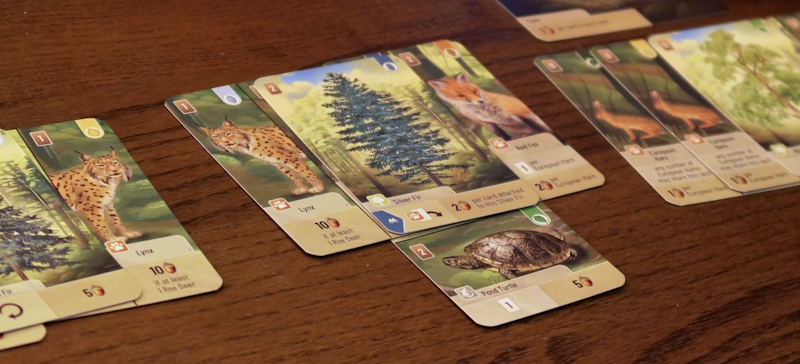
Blue made a bit of a meal of explaining the rules, but really they are very simple.  On their turn, players either take two cards from the market and add them to their hand (with a hand limit of ten), or play a card from their hand into their tableau.  There are three different types of cards.  Tree cards are the central cards around which Critter cards are played.  Then there is the first set of Critter cards which are divided into two, left and right with an animal on each half.  Finally, there are Critter cards which are divided into two, the canopy at the top and the undergrowth at the bottom.  The Critter cards are half-tucked under the Tree cards, so only one animal, flora or fauna is visible.

Forest Shuffle
– Image by boardGOATS

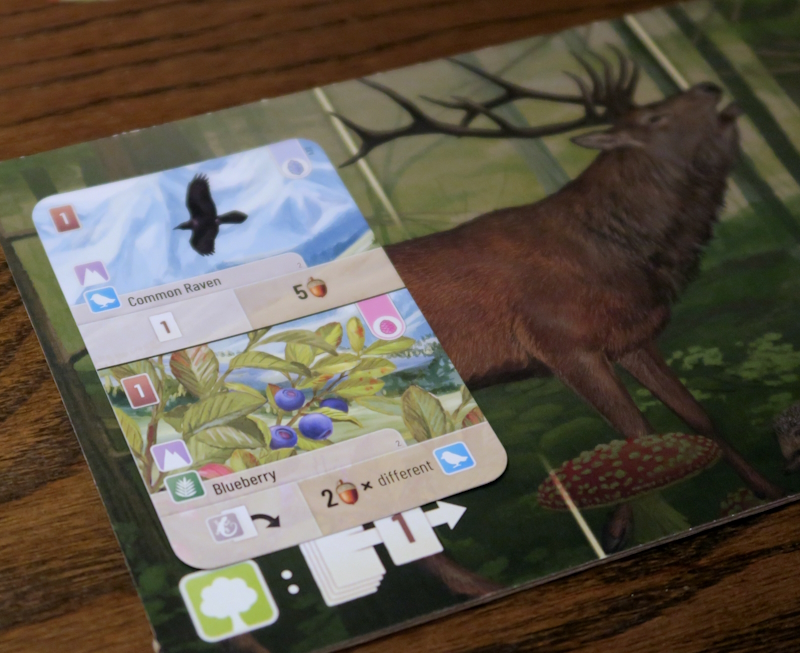
The difficult part of the game is getting the cards to work together efficiently to give extra actions and, ultimately, points.  The Alpine expansion doesn’t change the game significantly, just adding more variety to the cards, adding more opportunities for scoring.  For example, it adds an extra Butterfly which give players more points if they have a complete the set.  This time, Blue started with a hand full or Hares, making her initial strategy obvious.  Sapphire was less fortunate, so Blue and Lime suggested that starting with Trees was always a good way to go as players can’t do anything without them.  He also had some Butterflies, so that was where he went next.
Forest Shuffle: Alpine Expansion
– Image by boardGOATS

Lime built up a collection of Birds, and since he advertised his strategy to the group, everyone else was able to take cards he wanted.  This is a key part of the game:  some cards give points for the number of something you have, so having more of both multiplies the score.  For example, Hares give one point for every Hare a player has.  Thus, one Hare gives one point, but Blue’s seven Hares mean that first Hare scored seven points.  More to the point, every other Hare also scored seven points giving her forty-nine points just for her Hares.  Meanwhile, Byzantium was going Bats, and Cyan was experimenting with Deer.

Forest Shuffle: Alpine Expansion
– Image by boardGOATS

The game ends when the third Winter card is drawn from the deck, so after the second, everyone got very nervy as they tried to complete all their plans and play all the cards they wanted to.  Each time someone drew a card from the deck, it was with bated breath.  The final stage seemed to last forever, and although the third Winter card wasn’t the last card in the deck, it was close, and when it was drawn the game ended immediately. And then it was time for the scores:  everyone assumed that Blue’s husk of Hares would give her victory, but it was actually quite much closer than they thought.  Although Blue finished with a hundred and sixty-five, Byzantium was only twenty points behind.

Forest Shuffle: Alpine Expansion
– Image by boardGOATS

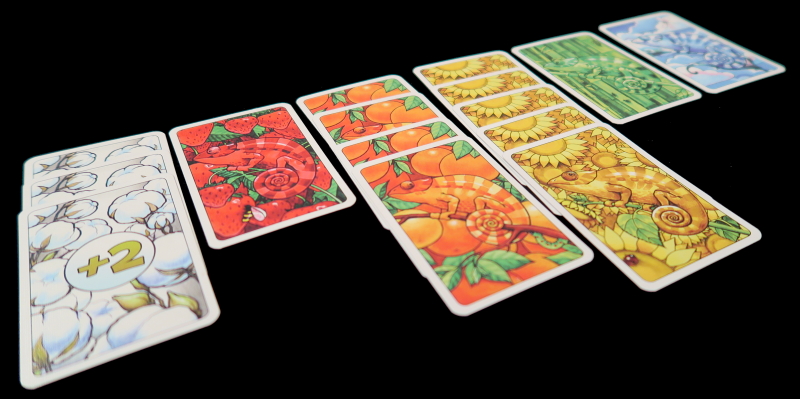
Byzantium was ready to leave, but for everyone else there was just time for something really quick.  So as everyone else was still playing, the remaining four decided on a quick game of Coloretto.  This is an old game, but one that was on the Spiel des Jahres Award “Recommended List” in 2003.  Remarkably, Cyan and Sapphire were new to it, but it is a super easy and quick game to play, but with tactical decisions to make.  It is also one that can essentially be taught as you go:  either turn over the top Chameleon card and add it to one of the Trucks, or take one Truck.  Each Truck can contain a maximum of three Chameleons and once everyone has taken a Truck, the round ends.

Coloretto
– Image by boardGOATS

At the end of the game, players score each group of coloured Chameleons, with the largest three groups giving positive points and any others scoring negatively.  There are a small number of cards that just give straight points and balancing these with Chameleons is part of the challenge.  The end is triggered when the end of game card is drawn and then the round is played to completion.  This time, everyone kept their negative scores down, while Cyan went for the pure point cards, collecting fourteen points, more than half his score, by that route.  The winner was Lime, however, who was imperious and won by some distance with a total of thirty-three.
Coloretto
– Image by boardGOATS

Meanwhile, on the next table Jade was teaching Cobalt, Crimson and Plum the Spiel des Jahres 2024 nominee, In the Footsteps of Darwin.  The premise of this is that players are naturalists aboard the Beagle helping Charles Darwin finish his book On the Origin of Species, studying animals, carrying out cartographic surveys, publishing their findings, and developing theories. On their turn, players study an animal or take inspiration from a character by choosing one of the three tiles in the row or column marked by the Beagle, and placing it onto their naturalist’s Notebook. This may be an animal to study or a character from the Beagle’s previous journey and will give an immediate bonus or a scoring bonuses.
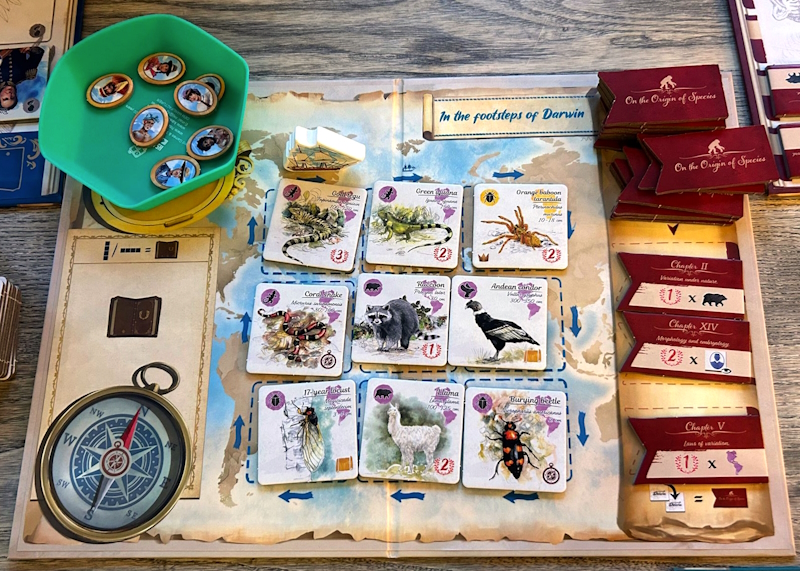
In the Footsteps of Darwin
– Image by boardGOATS

After placing the tile, the Beagle is moved round the market, with the distance dependent on the tile chosen and a new tile is drawn to fill the empty space on the journey board.  At the end of the game, the player who contributed the most to On the Origin of Species wins.  At it’s heart, In the Footsteps of Darwin is a fairly simple set collection and “make the most of what’s available” game. Players obtain an additional scoring objective when they place a tile on top of a previous one, covering up any icons, so a key part of the game is the conflict between points being gained verses points being lost.

In the Footsteps of Darwin
– Image by boardGOATS

There’s also quite a bit of luck invoiced, as a player may need one or two specific tiles that don’t come out, or that get taken by someone else before they have the opportunity to do so.  The group found it was very quick to play, taking just forty minutes including teaching.  Plum’s  starting goal was points for tiles in the upper right quadrant, but in the absence of tiles that fitted that criteria she focused instead on collecting Charts and Compasses as these score points equal to the number of these multiplied together.
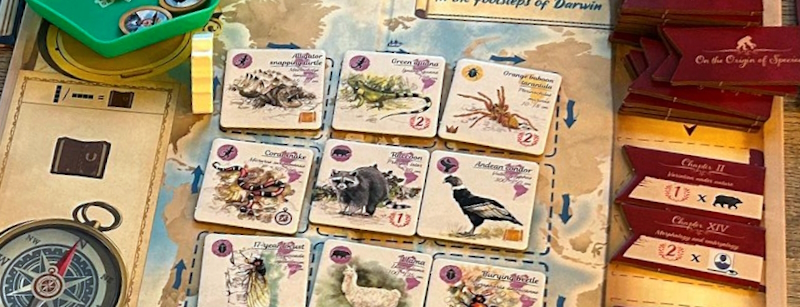
In the Footsteps of Darwin
– Image by boardGOATS

One advantage of these is that once a Compass has been collected, the tile can be covered without loosing any points. Cobalt didn’t worry about that at all, covering loads of tiles to get more Theories banners which give points.  Ultimately, everyone’s score was pretty similar at the end of the first game but Jade took victory as he was most effective with the Chart/Compass scoring.  As it was so quick, the group decided to give it a second try—this the scores all improved.  This time the victor was Crimson, who was again the most effective with the Charts/Compasses, but also scored well in other areas, as did Cobalt who came second again.

In the Footsteps of Darwin
– Image by boardGOATS

From there, the group moved on to a game of Looot, which is too recent a release to have been acknowledged in the Spiel des Jahres awards.  It has been popular amongst the members of the group that have played it so far, however, and may well get an award next year.  In this game, players gain points by gathering resources and capturing buildings to try to develop their Fjord, fill their long ships and complete buildings. The winner is the player with the most riches and is crowned Jarl of the Vikings. The game is played over several rounds until each player has played all their Vikings, giving a maximum of thirteen turns, each with a simple structure.

Looot
– Image by boardGOATS

Players start by placing their Viking on a Resource tile on the central board adjacent to another Viking of any colour.  They then take the associated Resource and place it on their personal board.  If possible, they then use their Resources to capture a Building and place that on their board, take a Long Ship and also place it on their board, use a Shield, or complete a Construction Site and finally grab a Trophy.  Looot is quite a light game, but with enough decision space to be interesting.  Last time was a three-player game, but this time, with four, players get another map area, which the group arranged to give a wide play area.
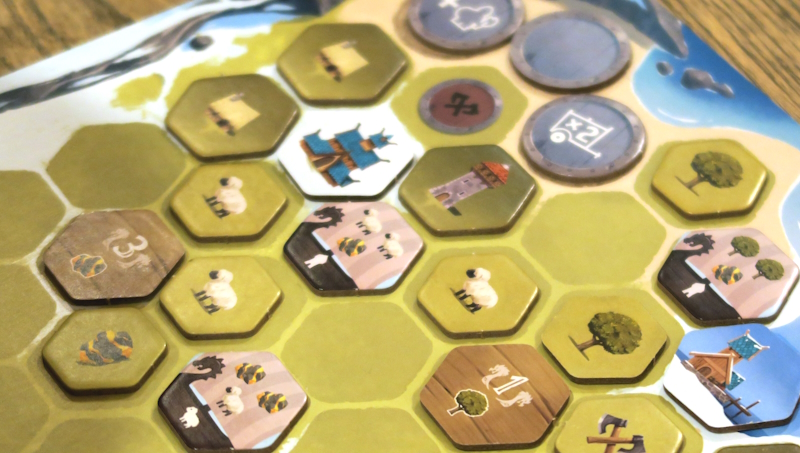
Looot
– Image by boardGOATS

The board layout made it easier to get to more areas of the map relatively early in the game, but there was still plenty of competition for the Towers.  Like last time, Plum decided not to worry about all the home tiles and focused on gold, which was good, but not enough on its own.  Cobalt scored massively for Castles by getting plenty of them plus the equivalent Long Boats.  Cobalt started on that strategy largely by accident, before he had got a real understanding of game-play and a full appreciation of how they increased the Castle scoring and matched the requirements he could fulfill.

Looot
– Image by boardGOATS

Crimson had a nice balance of increased score for Towers and Houses, while Jade built up a huge pile of Wood.  Unlike last time, things didn’t just come together at the end for Plum, and nobody else could compete with Cobalt’s Castles and he took victory with one hundred and twenty-one, fourteen points ahead of Crimson in second.  It had been a good game though, and as players become more experienced, they will be increasingly able to determine the best scoring opportunity from the start and how to optimise the mini game that is building their Fjord. With experienced players, this could be quite ruthless with players trying to block each other and prevent objectives.
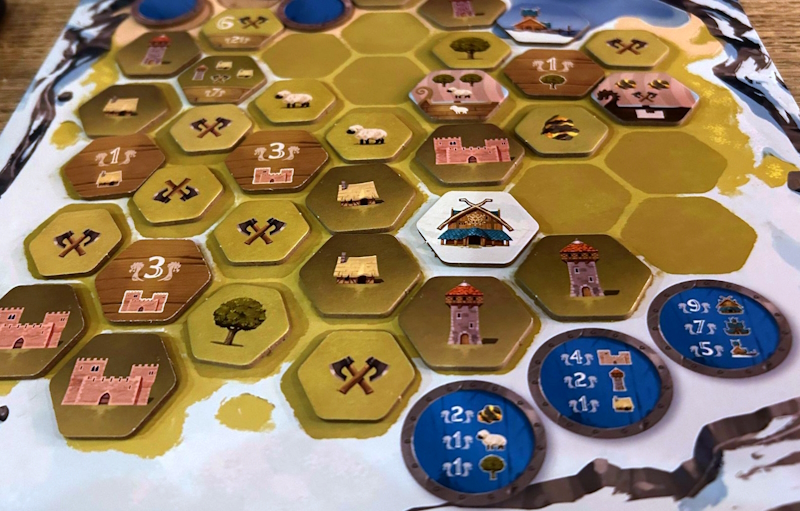
Looot
– Image by boardGOATS

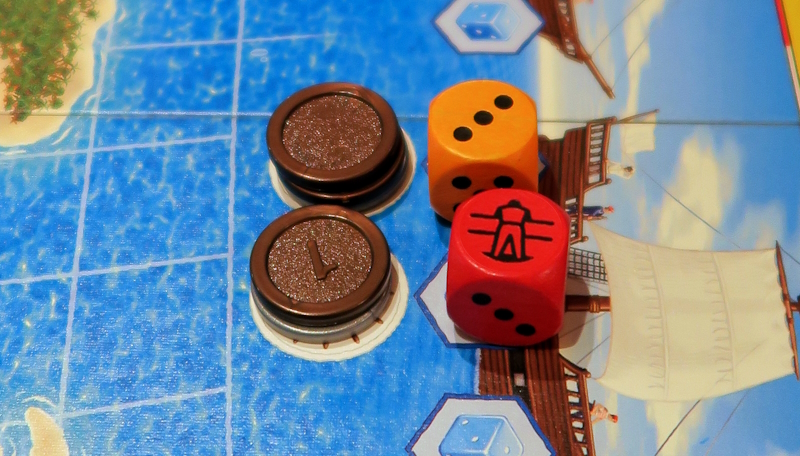
In the third group, meanwhile, Pine was introducing his new acquisition, the old game, Tonga Bonga, to Pink, Black and Purple.  This is a sailing race game a bit like the 2008 Spiel des Jahres recommended Jamaica.  In Tonga Bonga, players pilot their ship around the archipelago with the goal of visiting four of the five remote islands and returning to Tonga Bonga Bay.  Each player has room for three sailors on their ship, each of which represented by dice and indicate how fat the ship will move.  At the start of the round, players decide how much they are prepared to pay for the sailors who will serve as their captain and first mate that round (the Cabin Boy always works for nothing).

Tonga Bonga
– Image by boardGOATS

Players then simultaneously roll their dice, and take it in turns assign their dice to the other players’ ships, in return for the money offered.  In a mechanism vaguely reminiscent of that in the really rather vicious game, Vanuatu, if a player tries to place a higher value die where someone has already assigned a die, the lower value one is displaced and bumped to a lesser and usually less lucrative role.  Thus, all things being equal, the ship offering the most money will get the highest value dice and the most moves, though of course, players can work together to disrupt this behaviour. One side of each die has a Seasick Sailor (effectively zero), so the maximum value dice are five.
Tonga Bonga
– Image by boardGOATS

Once all the dice have been assigned, players move their ships racing to reach the islands, leaving one of their tokens there.  Landing on an island, earns $25 from the bank, but the player has to pay $5 to each player who landed there ahead of them.  Pine explained the rules and before long, everyone was sailing.  Pink got a bit of a lead by using his winnings to buy more moves and visit more islands.  He had been feeling that the game was maybe a bit “broken”, but as is usually the case when a game feels like that, it was all down to the “rules malfunction”, but it wasn’t until the final round that the rules were “clarified”.

Tonga Bonga
– Image by boardGOATS

Instead of the winner being the player to cross the line first with any left over money used as a tie-breaker, once a player has visited four islands they return to Tonga Bonga Bay and trigger the game end—and whoever has the most money wins.  Pink crossed the line and claimed the moral victory, as he was playing by the original rules.  Everyone else was quite happy with the “updated rules” though, which left Pine the victor with Purple in second and Black just behind.  Pink blamed “Evil Pine” for the mishap, but was eventually won round with a bottle of dubiously flavoured cider.

Tonga Bonga
– Image by boardGOATS

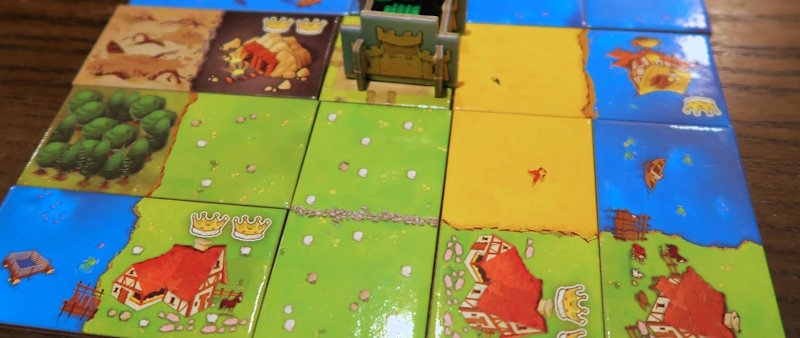
Although the debate had been audible by the players at the neighbouring tables, ultimately it was all taken in good part and the game had been a lot of fun and showed its age less than Lifeboats that was played a few weeks back and was only five years older.  From there though, the group moved on to a game of the 2021 Spiel des Jahres winner, Kingdomino.  This is a clever little game where players are building a kingdom made out of double-headed, domino-like tiles.  As in Dominoes, the ends of the tiles have to match, or at least it has to match with one tile tile already in the player’s kingdom.
Kingdomino
– Image by boardGOATS

The really clever part of the game is the double market, where the tiles are taken in reverse order of value.  The double market means that when a player takes the tile for the current round, they choose which tile they will get in the next round.  Thus, taking the lowest value tile this round means they will have first choice next round.  Players score for each contiguous area of Terrain—the number of points is equal to the number of squares multiplied by the number of Crowns featuring in it.  This time, Pink concentrated on Wheat Fields and Sea, Pine focused on Sea and Meadow while Black concentrated on Woodland with a smattering of points from Marsh, Mountain and Wheat fields.

Kingdomino
– Image by boardGOATS

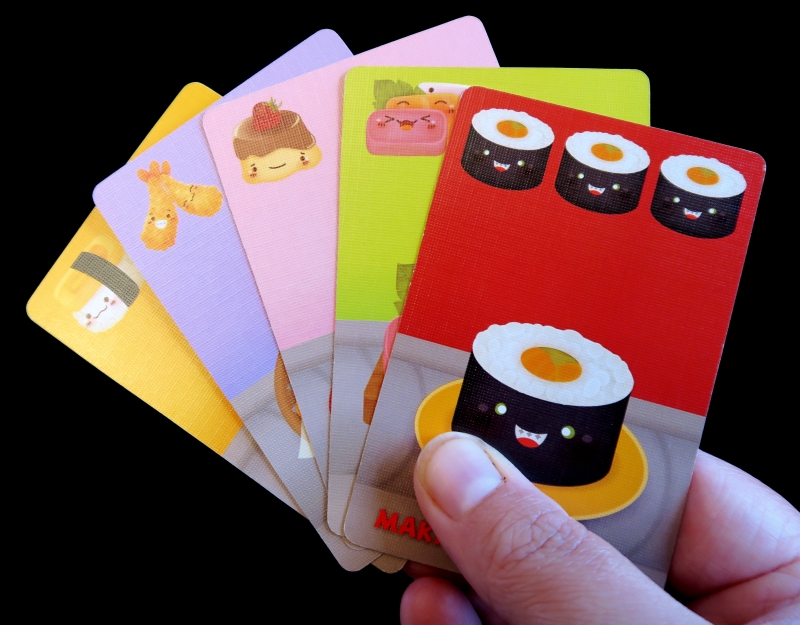
In contrast, Purple prioritised her four contiguous areas forfeiting the “Harmony” and “Middle Kingdom” bonus points for using all the tiles to give a square kingdom with a central castle.  Pine took victory with a massive seventy-three with Pink and Black tying for second with sixty points.  This group wasn’t done by any means and swiftly moved on to a quick game of Sushi Go!.  This is one of those games that takes a mechanism that is a relatively minor part of other games and distills it into its purest form in the game.  Coloretto does the same for the central market mechanism used in the 2007 Spiel des Jahres winner, Zooloretto, and Sushi Go! does it for the card drafting mechanism in the 2011 Kennerspiel des Jahres winning game, 7 Wonders.
Sushi Go!
– Image by boardGOATS

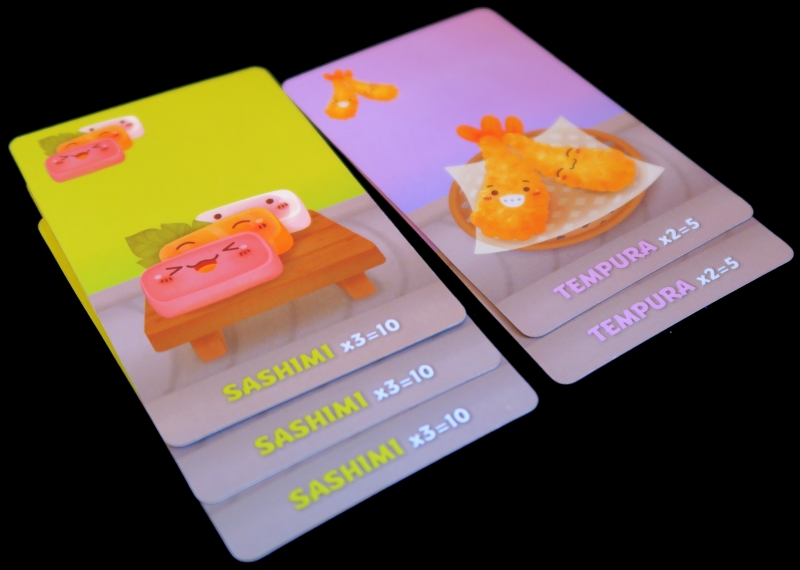
In Sushi Go!, players start with a hand of cards, keep one and pass the rest on, repeating until all the cards have been distributed.  As well as being a core mechanism in 7 Wonders, this “Card Drafting” is also often used to try to reduce the luck of the draw at the start of games like Terraforming Mars and Agricola (both also acknowledged by the Spiel des Jahres committee).  In Sushi Go!, players are using the card drafting to collect sushi and, most importantly Pudding!  The game is played over three rounds, with cards drafted to the left, then right and then left again, scoring points at the end of each round.
Sushi Go!
– Image by boardGOATS

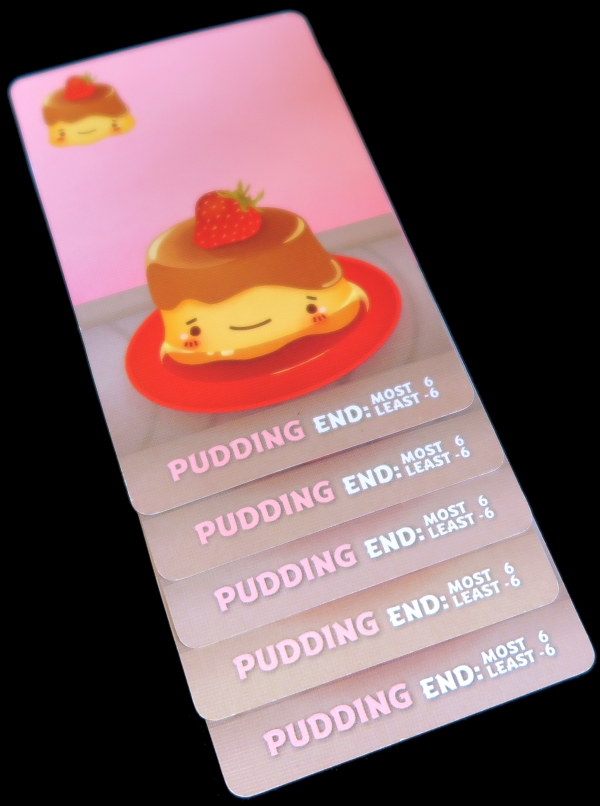
This time, Pink and Black tied for the high-scoring first round, with Pine just behind.  Pine made up for it on the second round by taking it convincingly, however, with everyone else scoring very badly.  The third round was more even again, this time won by Black with Purple taking second.  That resulted in a three-way tie between Black, Pink and Pine, but at the end of the game, the player with the most Pudding cards gains six points, with the one with the fewest losing six points.  Unusually for Pink (as he has quite a sweet tooth), he had eschewed Puddings, while Black had the most giving him what ended up being a quite convincing victory.
Sushi Go!
– Image by boardGOATS

There was just time for a single round of Love Letter (a game from the 2014 Spiel des Jahres recommended list).  This is a sixteen card game where players start with a card, draw a second and then play one.  The idea is to try to be the last play in or the player with the highest value card when the deck runs out.  The theme is all about getting as close as possible to the Princess card, which has the highest value.  This led to a discussion about real princesses and how close people had been to them.  It turns out that Purple has met a real one, Princess Nina who lives in a massive house in Cheltenham.  During the game, Pink was the Princess, but was spotted and knocked out, leaving Black to take another win.

Love Letter
– Image by boardGOATS

Learning Outcome:  The Spiel des Jahres committee may reward lighter games, but they are good games.

Jogo do Ana Nominations 2024

Although the Jogo do Ano, the Portuguese Game of the Year Award is less well known than its German counterpart, the Spiel des Jahres, it is perhaps more relevant to experienced gamers as it recognises heavier games, or “gamers’ games”.  Starting in 2006, it is chosen by members of Spiel Portugal with each choosing ten games of their choice. The five nominees of the year are then played again and are evaluated according to defined parameters, namely: production (15%); theme (10%); mechanics (10%); replayability (10%); interaction (5%); time/fun (50%).

Spiel Portugal Logo
– Image from spielportugal.org

Previous winners include Barrage, Root, Lisboa, Great Western Trail, Mombasa, La Granja, Keyflower, Agricola and Brass.  Last year the winner was Carnegie, a game inspired by the life of  nineteenth century Scottish-American benefactor and philanthropist Andrew Carnegie.  This year, the nominees are:

The winner will be announced in October.

Jogo do Ano Logo
– Image from spielportugal.org

Boardgames in the News: When is a Meeple not a Meeple?

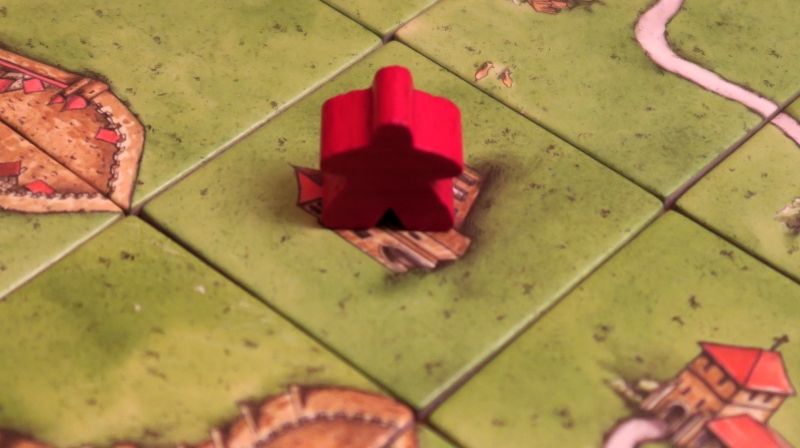
Answer:  When it’s not a Hans im Glück Meeple, apparently.  The term Meeple was allegedly coined nearly quarter of a century ago by Alison Hansel while paying the tile laying game, Carcassonne.  It was a conjunction of “my” and “people” and was used to refer to the characteristic wooden people-shaped pieces.  Since then it has been modified and the suffix “-eeple” has now come to mean game token (usually one that is wooden and shaped).

Carcassonne
– Image by boardGOATS

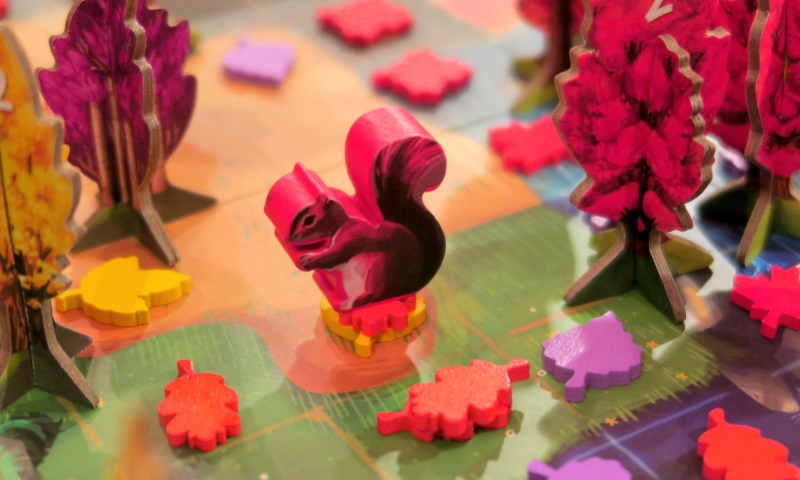
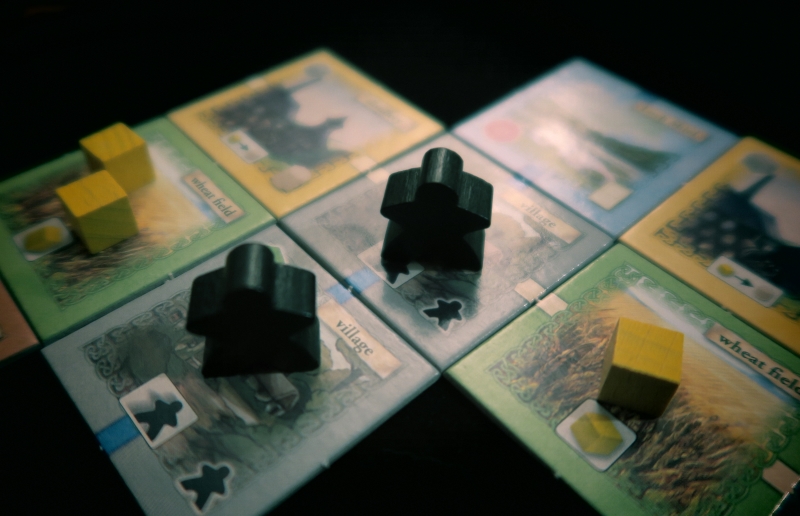
In this way, The term “Meeple” is now used to refer to all sorts of other wooden game pieces.  This includes the sheep, pigs and cows in Agricola or Keyper, which are often collectively referred to as “animeeples”; wheat and vegetable resource tokens which are commonly called “vegimeeples” (or even “vegeeples”), and players of Ice Flow or Salmon Run might talk about “fish-eeples” while those with Bosk might move their “squirreeple”.  As such, one might well be forgiven for thinking that the term Meeple is open source and can be used freely.

Bosk
– Image by boardGOATS

So Cotswold Games (formerly Cogito Ergo Meeple) might be forgiven for thinking the same when they crowdfunded their game, Meeple Inc..  That was until they received a “cease and desist” request from “a company” asking them “to remove all references to ‘meeples’ from the game as they have registered the word (and the shape) as an intellectual property in the EU.”  As a result, the a worker placement game where players compete to build the greatest board games in the world has been renamed Tabletop Inc. and now features “Mumans”.

– Image by boardGOATS

Whether this was necessary and whether Hans im Glück actually have the right to do this would need to be tested in court, but given the nature of the creation ans widespread use of the word “Meeple”, it is questionable.  Further, they only claim it as Intellectual Property in the EU—what about the rest of the world?  This point has exercised Corey Thompson (co-owner of YouTube channel Above Board TV and co-host of the industry-focused Board Games Insider podcast) and Marian McBrine (Gen Con Event Manager), who have responded by applying for the trademark in the US.

– Image by boardGOATS

Although they intend to protect the US trademark from predatory action (should they be successful in their application), Corey Thompson and Marian McBrine also plan to make it available to anyone who wishes to use it.  In the long term, this may prove unnecessary.  The trademark eventually issued in the EU in 2019 was for a range of of products (including software, jewellery, books, tableware and sporting goods), but not for toys and games.  This was limit followed an objection from board game publisher CMON, who argued (with considerable evidence) that the word was already in widespread use for general board game playing pieces.

Glen More
– Image by boardGOATS

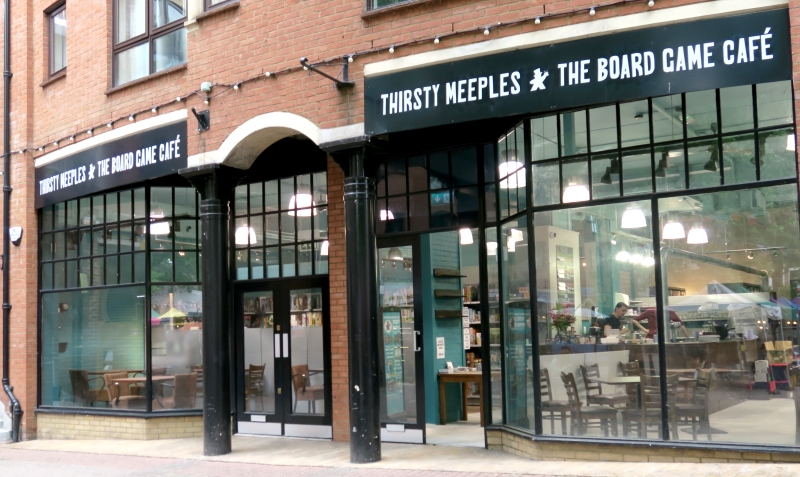
This objection was partially accepted by the EU Intellectual Property Office, but Hans im Glück has since registered “Meeple” as a trademark in Germany covering toys and games.  It was under this and the EU trademark covering the shape of the “original” Meeple figure that they issued the “Cease and Desist” to the folks at Cotswold Games/Cogito Ergo Meeple.  Although they are the first to publicly declare that they have received notification from lawyers, there are a huge number of well known games that could be affected (including Meeple Circus, A Fistful of Meeples, Meeple War, Meeple Quest and Rampage (aka Terror in Meeple City)), but also Oxford’s own board game café, Thirsty Meeples.

Thirsty Meeples
– Image by boardGOATS

There has been considerable community backlash though, so maybe Hans im Glück will adopt a gentler approach going forward.  At some point, however, it is likely that someone will test this in court and, in the meantime, there is a lot of ill-feeling which may lead to a loss of custom.

30th April 2024

Blue and Pink were unusually early and had already finished their pizzas when Pine rolled in.  He was soon followed by Black and Purple and then Lime and Teal giving a total of seven for one of the quietest nights for a long time.  With seven, the question was how to split the group and what would everyone play.   For seven players, the go-to game is generally Bohnanza, which Blue inevitably suggested.  Pink suggested playing it later, but when Teal commented that he’d never actually played it, that was the decision made.  There was no way that state of affairs could continue, so the “Feature Game” (which was to be Canvas) was put on the back burner until later, and the Beans came out.

Bohnanza
– Image by boardGOATS

Bohnanza is best part of thirty years old and is, despite him designing a huge number of excellent and popular games since, including Agricola, Caverna, Le Havre, A Feast for Odin and Patchwork, is arguably, still one of Uwe Rosenberg‘s best games.  It is a really simple game of set collecting and trading, that when explained sounds strange, but when played is great fun.  While everyone else chatted, Blue explained the rules and how to play to Teal.  The important thing is players cannot rearrange the cards in their hand (similar to recent Spiel des Jahres nominee, SCOUT).

Bohnanza
– Image by boardGOATS

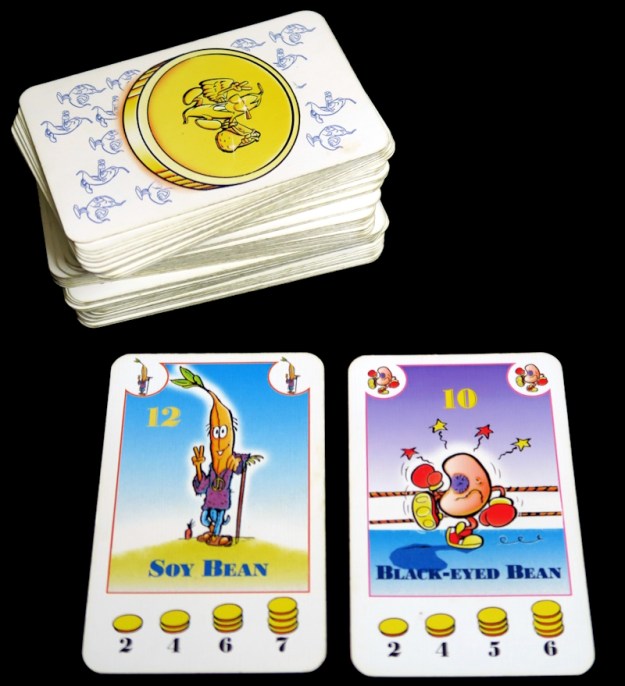
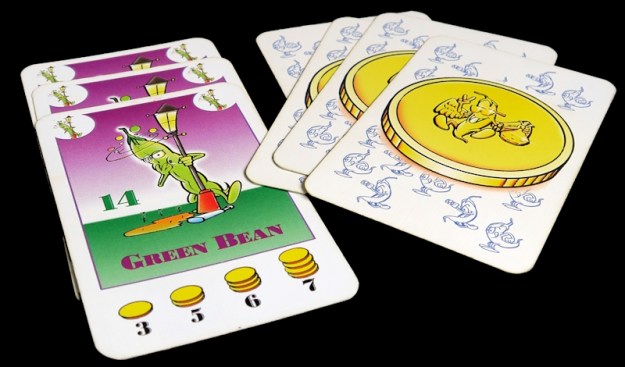
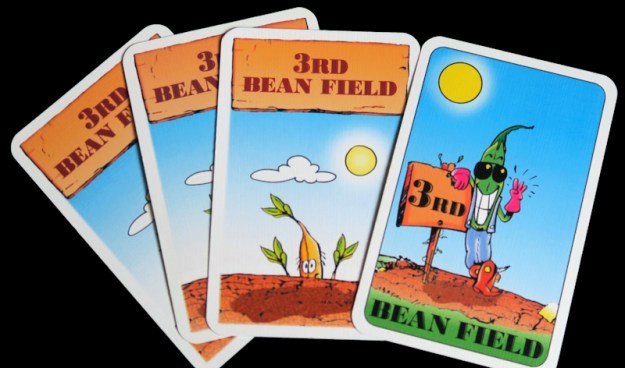
So, players start with a hand of cards, and, on their turn, must plant the first Bean card in the front of their hand into one of the two “Bean Fields” in front of them.  Then they may, if they wish plant the next Bean into one of their Fields, but each Field can only contain one type of Bean.  Once they have finished planting from their hand, the active player turns over the top two Bean cards, which must be planted, but may be traded and planted in another player’s Field if agreements can be reached.  Once these Beans have been dealt with, the active player can trade any cards from their hand, but all cards involved in any trades must be planted straight away.

Bohnanza
– Image by boardGOATS

Finally, the active player tops up their hand taking Bean cards into their hand (three in the case of the seven player game).  At any point, players can harvest one or both their Bean Fields converting some of the cards into Bean Thaler (according to the “Beanometer”), placing them face-down in their scoring pile, returning the other cards to the discard pile.  However, players cannot harvest a Field with a single single bean in it unless all their Fields have only the one Bean in them (a rule that can sometimes make things unbelievably difficult).  The game ends after three passes through the deck and the player with the most Thaler at the end is the winner.

Bohnanza
– Image by boardGOATS

There are a few, very clever things that really make the game work.  Firstly, there are different numbers of the different types of Beans in the deck—some beans are very common and give a small return, others are quite rare and give a better return.  The number of each card present in the deck at the start of the game is printed on them.  This is key, because it helps players to work out the rarity and therefore the value of different Beans when arranging trades.  However, the value also changes according to the situation in the game and how many players want each Bean type at the time.

Bohnanza
– Image by boardGOATS

Further, because the rare Beans give a larger yield, more of these are removed from the deck, which makes them increasingly rare as the game progresses.  This is because there are disproportionately fewer in the discard pile when it is shuffled to give the new deck.  Players can also buy a third Bean Field, but choosing to do this is a real gamble and only worthwhile if it can be done early in the game.  Choosing when to harvest is also critical, because harvesting a big Field just before the discard pile is shuffled will increase the length of the game.  Finally, players can be generous in their trades in the hope that the generosity will be returned, however, giving away trades too cheaply can cost a player the game.

Bohnanza
– Image by boardGOATS

Once Blue had finished explaining the game, Black started and explained his way through his turn.  Teal quickly caught on and got engaged in trading and planting Beans with everyone else.  There was a lot of debate about players buying their third Bean Fields with about half the players buying one and Teal leaving it to the second round (much against Black’s advice). Several people, including Purple, Teal and Pine got into Black-eyed Beans—quite an achievement given how few of them there are in the pack—and Blue had a couple of goes with the similarly rare Red Beans.  Pink tried for Soy with mixed success and almost everyone planted some combination of Wax, Coffee and Blue Beans at some point during the game.

Bohnanza
– Image by boardGOATS

Teal quickly realised how quick you have to be declaring an interest in a trade in a game where if you snooze, you lose.  And with seven you have to be keep an eye on what’s going on, which can be difficult given how far away some players are.  In the corner, Black quietly got on with his game eschewing the third Bean Field option as he felt there wasn’t time in the seven player game to recoup the cost, and perhaps he was proved right as he ran out the eventual winner with twelve Bean Thaler, closely followed by Pine with eleven and Blue with ten.  It had been a lot of fun, but as usual, had lasted longer than it really should, leaving little time before the first people needed to head home.

Bohnanza
– Image by boardGOATS

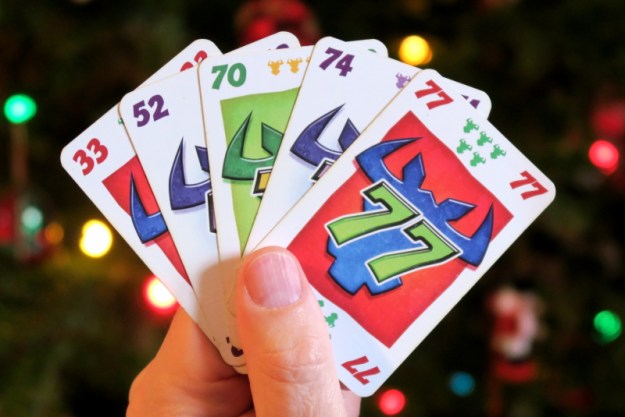
So after some discussion (where pink suggested Ticket to Ride: Northern Lights again), everyone settled down to play 6 Nimmt!.  This had recently had an outing with the new Jumping Cow mini-expansion, but this time the group chose to play it without the additional madness.  6 Nimmt! is also a simple game that is a lot of fun:  Players start with a hand of cards and simultaneously choose one to play, then, starting with the lowest value, these are added one at a time to the four rows on the table.  If a player’s card is the sixth in the row, instead, they take the first five into their scoring pile and their card becomes the first in the row.

6 Nimmt!
– Image by boardGOATS

This is another very clever game that does a lot with very little (which is probably why it is still so popular despite the fact it is thirty years old).  Different cards give a different number of points (or Nimmts), and players can also introduce a little bit of their own randomness by playing a card lower than the final card in all the available rows and thus, taking a row of their choice, upsetting everyone else’s plans.  The Jumping Cow mini-expansion adds more of this, but the group felt it didn’t really improve the game, so stuck with the chaos and fun of the original game, also eschewing the mathematical complexity of the Professional Variant.

6 Nimmt!
– Image by boardGOATS

This time, both Pink and Pine managed to avoid picking up any cards in the first round.  However, Blue only picked up two Nimmts and Teal collected seven leaving it all to play for, at least for most people—Black’s twenty Nimmts had already put him out of the game.  In the second half, Lime picked up twenty-four giving him the top score of thirty-eight (some way ahead of Purple with total twenty-nine).  Black managed a clear round, but there was nothing he could do about his pile of Nimmts from the first round.  It was tight between the top three, but Pink just took victory with ten, three fewer than Blue and Pine who tied for second place.  From there, the evening deteriorated into chatter and we decided to leave the “Feature Game“, Canvas, for another day.

6 Nimmt!
– Image by boardGOATS

Learning Outcome:  You can have a lot of fun with nothing but an old deck of cards.

7th March 2023

Plum and Blue were first to arrive and, by the time they had finished their enormous rack of ribs (or given up and had a doggy bag made up), almost everyone else had arrived.  There were a few people missing, but still enough for two games of four.  The first was the “Feature Game“, but nobody really wanted to commit to that until they knew what the other game was going to be.  As he had done the last couple of times, Green suggested Terraforming Mars.  Unlike previously, this time Ivory, Plum and Teal felt up to it, leaving Blue, Black, Purple and Lime to play their preferred choice of New York Zoo.

New York Zoo
– Image by boardGOATS

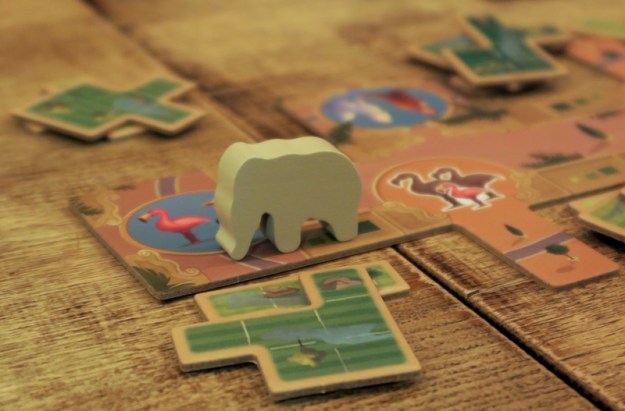
New York Zoo is a tile laying game by Uwe Rosenberg, designer of Agricola, Bohnanza, Patchwork and many other well-known games.  The idea is that players are building pens in their zoo, populating them with animals, and building attractions.  This is one of several polyomino, Tetris-like, tile-laying type games (including Cottage Garden, Spring Meadow, Indian Summer and Patchwork), but what makes this one unique and interesting is the Market.  Players move the Marker Elephant one to four spaces round the Market, landing either on an Enclosure tile space (taking the top one and adding it to their zoo) or on an animal space (taking one or both of the animals depicted).  Enclosure tiles can be placed anywhere in the player’s Zoo, then one or two identical Animals from elsewhere in their Zoo must be moved to occupy the Enclosure.

New York Zoo
– Image by boardGOATS

Each Enclosure can only hold one type of Animal, meercats, snow-foxes, kangaroos, penguins or flamingos, but when moving Animals, no pen can be left empty.  There is an advantage to pens having two or more Animals in them too—the Market also features breeding spaces, and when the Marker Elephant passes these, up to two pens containing two or more matching Animals get an extra one.  When a player moves the Elephant onto an Animal space, they take one of either or both the Animals depicted into Enclosures containing matching Animals (moving another from Storage if they can), or into the Storage space.  Moving animals is important, because when an Enclosure is completed the player removes all the animals putting one into Storage if they have space, and then takes an Attraction tile of their choice and adds it to their Zoo.

New York Zoo
– Image by boardGOATS

Attraction tiles are useful because they fill additional spaces, and at its heart, New York Zoo is a race game—the winner is the first to fill all the spaces in their Zoo.  Black and Purple had played this a few times, and once Black had explained the rules to Lime and Blue, Purple started.  Black and Purple prioritised completing Enclosures to get Attractions.  The Market is stacked so there are large tiles, heptominoes, on the top of each tile space, with hexominoes, then pentominoes and finally tetrominoes at the bottom of each pile.  Black and Purple prioritised getting breeding pairs of animals and as the Market dwindled, getting smaller enclosures because small Enclosures are easier to complete than large ones.

New York Zoo
– Image by boardGOATS

Blue, who had not played the game before, started off getting large Enclosures and fitting them tightly together.  As the game progressed, however, she realised her mistake as everyone else’s Animals were breeding and she didn’t have pairs because she was taking one out every time she added another Enclosure.  This had the additional consequence that she was starting to run out of Animals too, so she prioritised getting breeding pairs for a couple of rounds before continuing to take the biggest Enclosures she could get away with.  It was a tight game—Purple seemed to take an early lead, but it looked like Black and Lime over-took her towards the end and were in a tussle to finish the game first.

New York Zoo
– Image by boardGOATS

With everyone else concentrating on filling pens and taking Attractions, nobody was watching Blue.  So they were taken by surprise when her kangaroos bred filling their pen and she took her first Attraction.  That left one space which she promptly filled taking the only Enclosure that fitted, perfectly, and ended the game.  With everyone else so close to finishing, however, the rest of the group played on to see who would place where.  In the event, Black finished just ahead of Lime.  The group were just dissecting the different strategies when Pine arrived, fresh from his meeting teaching “cubbish-sized scouts” about waste.  Terraforming Mars was still going on, so the hunt was on for a five-player game, and the group settled on Kingdomino.

Kingdomino
– Image by boardGOATS

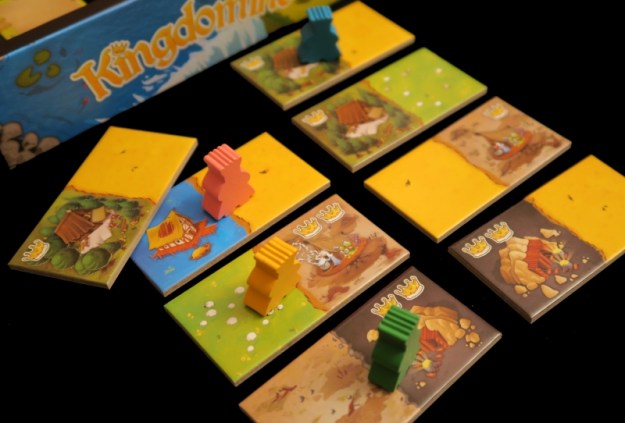
Native, Kingdomino is a four player game, however, with the Age of Giants expansion, it plays five.  The base game is simple enough, but it had been a while since most people last played it, so there was a quick run through of the rules.  On their turn, players add a terrain domino to their Kingdom; each domino comprises two squares of terrain and when placed at least one end must be adjacent to the same terrain type.  Like New York Zoo, the interesting and clever part of the game is the Market.  In Kingdomino, there are two parts, current and future—when a player takes their domino from the current market, they choose their next domino by placing their marker on it.

Kingdomino
– Image by boardGOATS

At the end of the game, players score each terrain region with points equal to the area of each region multiplied by the number of crowns on it.  The clever part is the timing of the Market.  The tiles are drawn at random from a set numbered from one to forty-eight.  The low numbers generally being the less desirable ones, those without crowns or those for terrain types where crowns are more scarce.  Since players take the tiles in numerical order (low to high), taking a low value tile in one round gives a better choice in the next.  Similarly, taking a high value tile means there will be less (or maybe no) choice in the following round.

Kingdomino: Age of Giants
– Image by boardGOATS

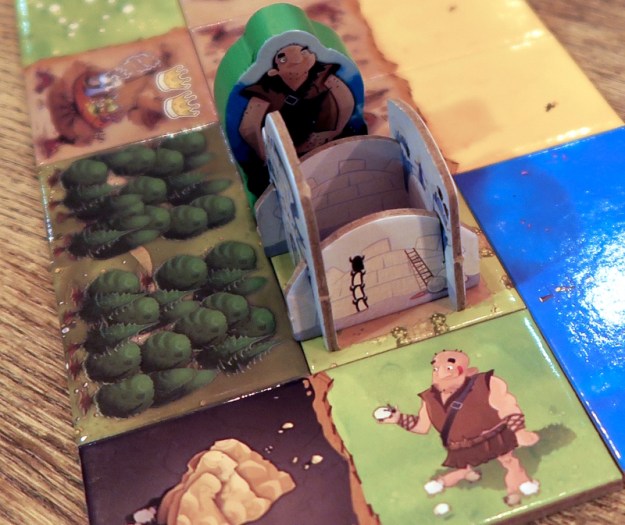
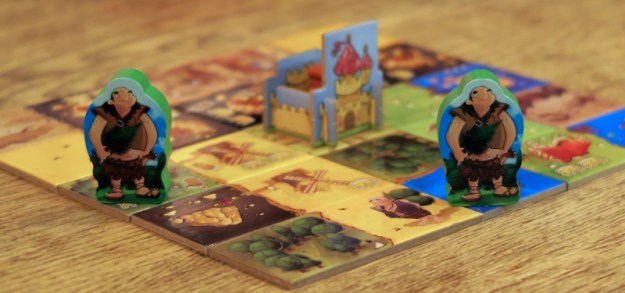
The Age of Giants expansion firstly adds twelve extra tiles (enough for a fifth player), six labeled with letters A to F and six numbered forty-nine to fifty-four.  These are ranked below one for the letters and after forty-eight for the high numbers, with the low ranking tiles featuring a Giant, and the high ranking ones featuring Footprints.  Players taking dominoes with a Giant on them, also take a Giant-eeple and place it over a crown in their Kingdom so that it doesn’t score.  Taking a Footprint domino allows the player to move a Giant from their Kingdom to a crown in someone else’s and this increase their score, making these tiles potentially very valuable.

Kingdomino: Age of Giants
– Image by boardGOATS

Unfortunately (especially for Lime and Blue who ended up with all the Giants), the Footprints seemed hard to come by in this game.  The other part of the Age of Giants expansion are the Quests.  The base game comes with two Quests, arrangement targets that give points.  These are “Middle Kingdom” and “Harmony” which respectively give ten points for a castle in the centre of a player’s Kingdom and five points for a complete five-by-five territory with no discarded tiles.  This time, the Quests drawn essentially at random were “Bleak King” and “Four Corners of the Kingdom”.  The first of these gave five points for each five square of terrain with no crowns while the second gave players five points for placing cornfields on all four corners of the five-by-five grid that defines their Kingdom.

Kingdomino: Age of Giants
– Image by boardGOATS

Although the Quests had been included in game play several times before, the Giants have only had an outing once and didn’t go down all that well.  Still, with five players all the extra tiles were needed and their values would have been unbalanced without including Giants, so the group thought they’d give it another try.  This time Blue and Purple had a really hard time getting crowns and things were so bad for Blue that she resorted to picking up twenty points, more than half her total, from the “Bleak King” Quest.  Black built a lot of sea and pasture, while Lime scored heavily for his mountains and Pine picked up lots of points for his large woodland.

Kingdomino: Age of Giants
– Image by boardGOATS

It was very close between the top three and both Lime and Pine scored forty-five points for their highest scoring terrain—Lime for nine crowns spread over five spaces, Pine for five crowns spread over nine spaces.  There were just two points between Lime and Pine in the end, but Pine’s sixty-eight points just edged Lime into second with Black four points behind that.  It had been a good game.  However, the group felt that the Giants took a positive constructive game and added a negative aspect.  Those that had been stuck with them hadn’t found that aspect particularly enjoyable, especially as it was easy to get lumbered largely through no fault of their own, so it is unlikely they’ll get another outing very soon.

Kingdomino: Age of Giants
– Image by boardGOATS

Meanwhile, on the next table, Green, Ivory, Plum and Teal were still playing Terraforming Mars.  To speed up the game they played with the Prelude start cards and also removed the Corporation cards—that turned out to be a good choice as the game only just finished before the pub closed.  In this game, players play corporations sponsored by the World Government working together in the terraforming process, but competing for victory points.  These are awarded not only for their contribution to the terraforming, but also for advancing human infrastructure throughout the solar system, and doing other generally commendable things.

Terraforming Mars
– Image by boardGOATS

The players acquire unique Project cards by buying them into their hand; these can represent anything from introducing plant life or animals, hurling asteroids at the surface, building cities, to mining the moons of Jupiter and establishing greenhouse gas industries to heat up the atmosphere. The Projects can give immediate bonuses, as well as increase production of different resources. Many cards also have requirements and become playable when the temperature, oxygen, or ocean coverage increases enough. Buying cards is costly, so there is a balance between buying cards (three MegaCredits per card) and actually playing them.

Terraforming Mars
– Image by boardGOATS

The game ends after the terraforming is complete when the three global parameters, temperature, oxygen, ocean have all reached their goal.  Players then score for their Terraform Rating with any other points they might have accrued.  This time, Green made his presence felt on the surface of Mars in the early stages with his initial starting forest, which grew a little, and seeded the oceans. He was the only one for a while.  Plum played a blue card which gave her a couple of extra Credits every time someone built a city.  This one really paid for itself in the four-player game as everyone wanted to build more than one city.  Green was first, but had mis-read the card and found himself colonizing Phobos instead.

Terraforming Mars: Prelude
– Image by boardGOATS

So, Teal was the first to actually build a city on the surface of Mars. He opted for the equator but on the other side from Green’s forests.  Later he played a blue city bonus card that gave him a Credit production bonus for each one. Although several cities had already been built by then, several more followed and he was able to enjoy the benefit of extra cash in later rounds.  Ivory meanwhile had made a different start to the game than his normal opening gambit (building a city), and completed the first Milestone: the Ecologist. However his cities did follow later as he extended down towards the south pole. Teal claimed the second milestone: the Specialist, helped on by his city Credit production bonus.

Terraforming Mars
– Image by boardGOATS

Plum was the last to claim a Milestone: the Generalist, as she was able to pay to increase her production one step each round.  She did not claim it straight away, but noticed it after Teal had claimed his, and thought she had better get in there quick.  Green was not able to claim any milestones, but instead was the first to fund an Award. A quick check around the player boards suggested he should fund Celebrity as he had three high value cards to Teal’s two, but neither Plum or Ivory had any cards over the value of twenty Credits. Later on Teal funded the second award and went for Estate Dealer as he clearly had more tiles next to oceans at this point (having planted his forests northwards around the oceans.

Terraforming Mars
– Image by boardGOATS

At the end of the game Green pulled out his wallet once more and funded Benefactor since he was ahead on the Terraform Rating track. Ivory was only one behind, but Green had a couple of options he could play on his last turn for a couple of extra Terraform Rating points. This prevented Ivory from funding the Dessert Settler award for which he had been building.  Green decided to go for outworld domination and also built Deimos city.  During the second half of the game Green realised he had forgotten his company bonus of a two MegaCredits reduction for each brown, Industrial tagged card.  He had built three, so put six Credits aside to be used in the event of a tie, (although had he remembered to claim them at the time, he may have been able to play more and better cards).

Terraforming Mars: Prelude
– Image by boardGOATS

In the final scoring it was very close indeed, although during the game Mars was regularly bombarded with meteors and nuclear bombs, so it was a wonder any one survived at all!  Ivory and Green tied for second with fifty-nine points. Even with his extra six Credits, Green still lost the tie to Ivory, who had more Credits left over from the final production.  At this point, Green realised he again had misread a card thinking he would get one point per ocean tile in the game for his capital city, but that would have given him a guaranteed nine points and would have been way too powerful. In the end, it was Teal who triumphed, but only just, with sixty-one points, in well deserved victory.

Terraforming Mars
– Image by boardGOATS

Learning Outcome:  Mama’s taking us to the zoo tomorrow, zoo tomorrow, zoo tomorrow… We can stay all day!

Boardgames in the News: The Best Game EVAR?!?!

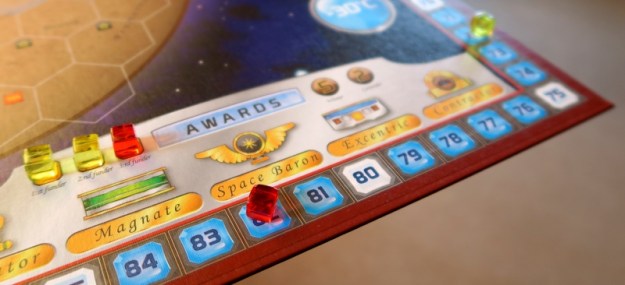
BoardGameGeek is the largest and most comprehensive website dedicated to board and card games, with a database comprising nearly a hundred and fifty thousand games.  These games have a ranking based on ratings submitted by account holders.  While these rankings are obviously skewed by the characteristics of the contributors, the number one ranking game clearly has significance.  In the twenty-two years that the rankings have been in place, there have been just ten games to achieve the top rank, but as of today, there is an eleventh, with Brass: Birmingham taking the top spot from Gloomhaven.
Brass: Birmingham
– Image from boardgamegeek.com

Of these now eleven games, three held the top rank briefly, for a day or two only.  The first of these was The Game of Life, and it’s top rank was the result of a software bug when on 25th February 2006, a User gave it a rating of sixty-five thousand five-hundred and thirty-five out of ten.  Just over a year later, as an April Fool, another User encouraged his friends to give Monkey Auto Races a rating of ten.  With just three hundred ratings, this game went from unranked to number one overnight, only to plummet back down the rankings just a day or so later.  Three years later, the site owner pulled his own April Fool stunt and set the ranking equal to the data base number, making Die Macher number one for a day.

The list of eight genuine Number One Games and the date they first achieved the top ranking are:

Brass: Birmingham
– Image by boardGOATS

Deutscher Spiele Preis – 2022

The Deutscher Spiele Preis awards recognise the “Best Children’s Game” and a top ten list of the “Best Family and Adult Games”, the results of an open vote by games clubs, gamers and people in the industry.  They are awarded annually at the Internationale Spieltage in Essen and the winners are announced in advance.  As annual awards, the games named in the Deutscher Spiele Pris lists often intersect with the winners and nominees of Spiel des Jahres Award, but in many other ways, the awards differ.

Deutscher Spiele Pries 2022
– Image from
spiel-messe.com

The Spiel des Jahres winners are chosen by a committee with a list of strict criteria whereas the Deutscher Spiele Preis is more a list of the most popular games of the preceding year.  As such, games that are not eligible for the any of the Spiel des Jahres Awards often feature in the top ten list of “Best Family and Adult Games”.  For example, games that were considered at the time to be too complex or aggressive for the Spiel des Jahres awards have ranked number one in the Deutscher Spiele Preis list.  These include Tigris & Euphrates (1998), Puerto Rico (2002), Louis XIV (2005), Caylus (2006), The Pillars of the Earth (2007), Agricola (2008), Terra Mystica (2013), Russian Railroads (2014), Voyages of Marco Polo (2015), Mombasa (2016) and Terraforming Mars (2017).

Terraforming Mars: Hellas & Elysium
– Image by boardGOATS

Of all these great games, only Terraforming Mars even received a nomination for the Kennerpiel des Jahres award (though Agricola did receive a special “Complex Game Award”).  In contrast, over the last few years, there has been much more overlap with games like Azul (2018), Wingspan (2019) and The Crew (2020) all ranking highest in the Deutscher Spiele Preis list and winning either the Spiel or Kennerspiel des Jahres award.  Further, all the other winners of both awards including MicroMacro, Cartographers, Paleo, Lost Ruins of Arnak have featured high on the Deutscher Spiele Preis list and/or received Spiel/Kennerspiel des Jahres nominations.

Ark Nova
– Image by boardGOATS

This year, while there is still a lot of overlap between the lists, the top ranked game on the Deutscher Spiele Preis list is a bit of a throwback, being too complex even for the Connoisseur or Kennerspiel des Jahres award.  The Deutscher Spiele Preis winner, Ark Nova has been extremely popular amongst gamers creating a lot of “buzz”, so it is no surprise that it did well.  The strategy revolves round building card combinations and the theme, zoo building is very appealing—everyone loves animals.

The full Deutscher Spiele Preis list is:

  1. Ark Nova
  2. Cascadia (Spiel des Jahres Award Winner)
  3. Dune: Imperium (Kennerspiel des Jahres Award Nomination)
  4. Living Forest (Kennerspiel des Jahres Award Winner)
  5. The Red Cathedral
  6. Witchstone
  7. Beyond the Sun
  8. SCOUT (Spiel des Jahres Award Nomination)
  9. Golem
  10. Terraforming Mars: Ares Expedition
Ark Nova
– Image by boardGOATS

Boardgames in the News: Games making Cameos on TV

Board games are an integral part of family life and growing up and, as such, they have a long tradition of appearing on TV programs.  For example, Kramer and Newman get wrapped up in a game of Risk in Seinfeld, Scrabble features in the second series of Hamish Macbeth and in The Simpsons, while Stratego was the game Fox Mulder was playing with his sister the night she was abducted in the X-Files.  Often, games are used to highlight something “geeky” or otherwise “cerebral”.  So, Rimmer was known to maintain a “Risk Campaign Diary” and often recounting games turn-by-turn to his crew mates in Red Dwarf, and in Star Trek: Voyager, Tom Paris and B’Elanna Torres were shown playing Quarto (though it is probably known by a different name in the twenty-fourth century).
Escape From Colditz
– Image from bbc.co.uk

More exiting games have started to appear on TV recently though.  A few years ago, we commented on how Mage Knight featured in the BBC romantic drama Last Tango in Halifax but that is by no means the only TV program to use a designer board game to create atmosphere.  The BBC has a bit of a penchant for including board games in their programs, and when they do, they often choose games that are outside the mainstream.  For example, in the 1970s police drama, Life on Mars featured people playing Escape from Colditz, and more recently, the second series of Killing Eve showed Villanelle playing Dixit.

Dixit on Killing Eve
– Image from bbc.co.uk

In this case, it is a plot device, as Villanelle’s protagonist is commented, “You are struggling with the rules of Dixit, a simple story telling game for players aged eight and upwards, and yet you claim to have two philosophy degrees.”  The BBC doesn’t have a monopoly on showing modern board games, however.  The Channel 4 program, The IT Crowd regularly featured a stack of games in the background that variously included Memoir ’44, Ticket to Ride, Shadows over Camelot, Mystery of the Abbey and War on Terror, while Settlers of Catan, Talisman, Ticket to Ride, and Race for the Galaxy are all shown on shelves in The Big Bang Theory, highlighting how games are still often seen as something for “geeks”.

Tikal
– Image from youtube.com

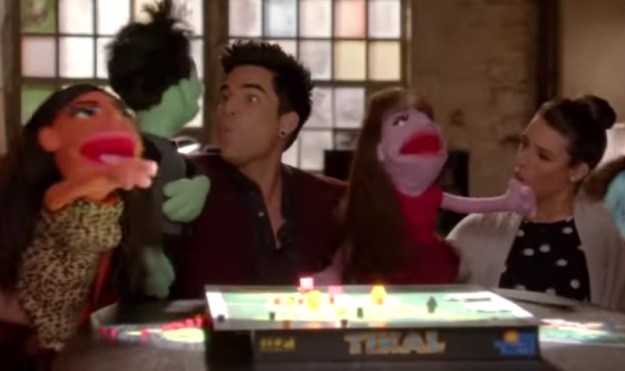
The “geeky” angle may be changing though.  The Amazon thriller Reacher shows people playing Settlers of Catan in a safe-house, and there is a game shown in every series of the Canadian thriller, Orphan Black because co-creator John Fawcett is a gamer and the show has a “Board Game Advisor” (games featured include Gloomhaven, Runewars, Agricola, Descent, Dead of Winter and Scythe)Tikal even appeared in Glee during the fifth season where the cast sing, “What does the Fox Say?”  Some of these appearances may be paid product placement, in particular Arkham Horror in Limitless and Race for the Galaxy in Silicon Valley, with Rio Grande Games allegedly having confirmed that they have paid for games to appear in shows.  That is not the reason in all cases though.

Wingspan
– Image from itv.com

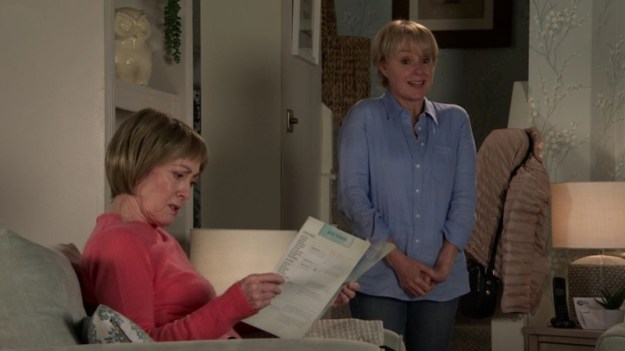
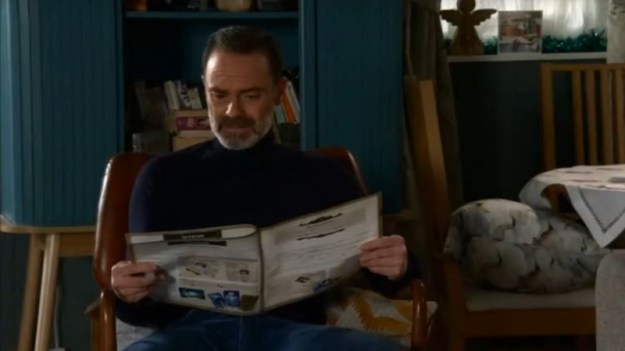
Last week, Wingspan appeared in the ITV soap-opera, Coronation Street with people shown reading the rules and references to having played later.  Designer Elizabeth Hargrave confirmed that this was not a case of product placement, commenting that the show got in touch and no money had changed hands.  It is possible that one of the script writers is a fan of modern board games as “Corrie” did something similar just over a year ago with Billy Mayhew shown struggling to fathom the rules to Mysterium shortly after Christmas. With the appearance of modern board games in programs like this, it is clear they are no longer solely the preserve of the “geeky”, though it would probably help if we could get rid of the “frowning over difficult rules” stereotype.

Mysterium
– Image from itv.com

Boardgames in the News: The Great Escape?

Over the last decade, Asmodee has swallowed most of the big names in modern family board games, including the likes of Ticket to Ride, Settlers of Catan, Star Wars: X-Wing Miniatures, 7 Wonders, Dominion, Agricola, and Pandemic amongst others.  This has been through the relentless acquisition of the companies that produce these titles, in particular, Days of Wonder, Fantasy Flight Games, Z-man Games, Mayfair, Lookout Spiele, and Repos Production.  This monopolising of the market cannot be a good thing for gamers, indeed the effects are already being felt with the introduction of Minimum Advertised Pricing (MAP) and now the loss of customer servicing for all Asmodee products.

HeidelBÄR Games Logo
– Image from twitter.com

There is perhaps a glimmer of hope, however.  Three years ago, the German publisher and distributor Heidelberger Spieleverlag was acquired by Asmodee, with the publishing part splitting off to form the Asmodee Studio, HeidelBÄR Games.  Last year, however, ownership and with it the nucleus of the HeidelBÄR team, was transferred back to the previous manager, Heiko Eller-Bilz.  The resulting enterprise is much smaller than it was, but the most important asset, the people, are in a position to develop new titles.

Plaid Hat Games Logo
– Image from plaidhatgames.com

More recently, Plaid Hat Games have made a similar, slightly slower, journey.  Around five years ago, Plaid Hat Games was bought out by Canadian company F2Z Entertainment, then the parent company of Z-Man Games, Filosofia Éditions and Pretzel Games (now known as Asmodée Canada).  However, earlier this year it was announced that Plaid Hat Games had been reacquired by Colby Dauch, the original founder, albeit without the rights to some of their biggest products, including Dead of Winter, Aftermath, and Mice and Mystics, which remain with the Asmodee Group.  Plaid Hat Games retained the rights to Summoner Wars though, and are currently developing a new product, Forgotten Waters, which will be the first game released by Plaid Hat after their Great Escape.

Forgotten Waters
– Image from plaidhatgames.com

Boardgames in the News: Who are PAI Partners and what do they want with Asmodee?

A couple of months ago, Reuters reported that according to un-named sources, investment bankers had been hired to run the sale of Asmodee.  The claim was that the sale “could value the company at over €1.5 billion”, but there was no credible information as to who the potential buyers were.  This mystery has now been solved with the announcement that PAI Partners have entered into exclusive discussions to acquire Asmodee, a company with an enterprise value of €1.2 billion.  So, who are PAI Partners and what do they want with Asmodee?  Well, PAI is a European private equity company, that grew out of the merger between the French banks, BNP and Paribas in 1993, with a management buyout completed in 2001.  They have invested in a wide range of companies covering everything from yoghurt (Yoplait) to tyres (Kwik Fit) to cargo handling (Swissport).  Obviously PAI are interested in making money from Asmodee, but at this time there is no evidence to suggest that would by by asset stripping.  Price increases would be almost inevitable however, as the Studios would be under pressure to provide a good return on the investment.

PAI Partners
– Image from paipartners.com