Tag Archives: Azul

19th February 2019

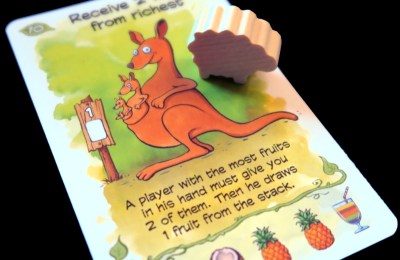
Blue, Black, Purple, Burgundy and Mulberry were just trying to squeeze in a quick game of No Thanks! before eating, when Green arrived with his parents.  They were quickly followed by the first round of food, so it wasn’t until they had finished that the carefully counted piles of chips finally got put to use.  The game is very simple:  players take it in turns to either take the card on the table or pay a chip to pass the problem on to the next player.  If they don’t have any chips left they must take the card when it is their turn (and any chips that are on it).  The game ends when the deck has been depleted and everyone scores the sum of the face value of the cards minus any remaining chips—the player with the lowest score is the winner.
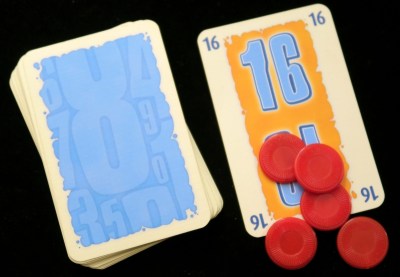
No Thanks!
– Image by boardGOATS

Last time we played this, Pine dropped a chip, but a thanks to the kind generosity of the people at  Amigo Spiele, it had not only been very swiftly replaced, but they had kindly sent spares in case the something similar happened again.  And they were almost required straight away, when Black managed to send a couple of chips flying.  Having learnt our lessen from last time, we immediately took a quick intermission to play “Hunt the Game Piece”, finding one quickly, while the other perched precariously over the same large gap that the had been so disastrous last time.  The rogue chip was rescued without further calamity, but for the avoidance of other mishaps, we might have to put tissue paper down the hole for next time…
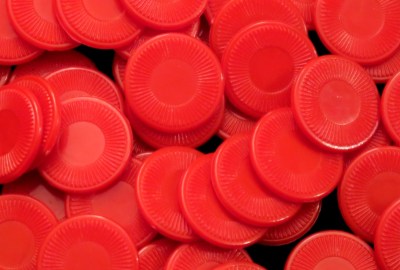
No Thanks!
– Image by boardGOATS

The game of No Thanks! was a bit incidental around all that excitement.  Burgundy took the first card in an effort to get ahead, but it wasn’t the best card to build from.  Purple and Blue were forced into trying to build runs from the ends, which is always risky, but can yield huge rewards.  This wasn’t going to be one of those times though and Purple’s problems were compounded by the fact that she only discovered the twenty-three in the middle of her long run was missing when it came to scoring.  Mulberry was very tempted by some if scoring cards, but despite the fact she was pushed to her last chip, she managed to avoid getting herself into a mess.  Black played a very canny game building a small medium value run, not tempted to take a chance on gaps.

No Thanks!
– Image by boardGOATS

With everyone finished eating, it was time to decide what to play.  Black had suggested that Dixit might be suitable for Green’s parents.  However, Green was keen to play the “Feature Game”, Celestia (a remake of the older game, Cloud 9), and as Black was the only one who knew the rules, that meant he was up for that too.  Burgundy was less keen, so in the end, as Celestia is better with more players, and to avoid too much shuffling of seats, Blue, Mulberry and Burgundy left everyone else to board the airship.  In this game there is no board, instead there are nine city tiles making a path.  Players then take on the roles of adventurers exploring the cities of Celestia by airship.  At the beginning of each journey a new captain is identified and they begin by rolling the dice to discover the challenges they will face.  Before the Captain faces these challenges, however, however, each player must decide whether to stay on board, or leave the airship.
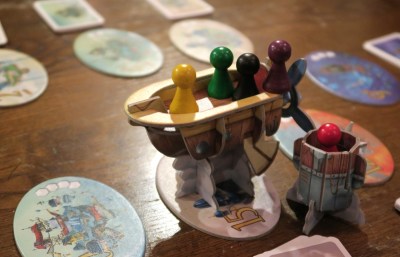
Celestia
– Image by boardGOATS

At each city there is a pile of treasure cards (mostly just victory points) which get better as the journey progresses.  When a player leaves the ship, they take a treasure card at that city, forfeiting the potential riches to come.  Once everyone has made their decision, the Captain has to deal with the challenges by playing equipment cards.  If the Captain is successful, the airship moves on to the next city where a new captain is identified who rolls the dice and so on.  If the Captain is unable to deal with the challenges they face, the airship crashes, returning to the first city and none of the passengers on board get any treasure.  Those passengers who left the ship then get back on board for the start of the new journey.  When one  player has a total of fifty points the game ends.
Celestia
– Image by boardGOATS

This time, the group added the A Little Help expansion which adds cards that players can use to help out the Captain.  There are a few extra cards like The Bandit and The Mooring Line as well, which players who are not on the ship can use to make life harder for those trying to get to the next city.  The group also added the lifeboat from the A Little Initiative expansion, which enables players to continue on their journey alone.  One of the key parts of Celestia is hand management as cards are scarce.  Players start with a hand of cards, six cards in a four or more player game and only get to draw a card when the journey ends, either due to a crash or arriving at the ninth city.  With the inclusion of the expansion cards, there seemed to be quite a bit to remember when learning the rules, but as ever, once underway the game flowed and the rules became clearer. Even so there was still a lot of double checking of which cards could be used when. Black and Purple had both played the game before and knew how quickly things could get difficult.
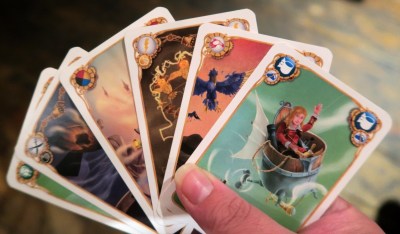
Celestia
– Image by boardGOATS

So Black and Purple cashed in their travel tickets early in the first round and hopped off the airship quite early on, leaving everyone else wondering if they were missing something as they sailed onwards. In contrast, Green and his parents (who had not played before) stayed on board and as a result took a lot of points.  This all seemed a little too easy and on rechecking the rules it became apparent that something was wrong. Players had been drawing cards after arriving at each city as the Captain changed rather than after it crashed, which meant everyone was awash with cards.  From then on the group played correctly, but the damage had already been done.  The balance of cards had been destroyed, and Green and his mum had an unassailable lead.  Green came out he victor with some canny play that allowed him to hop on and off the airship, but it was a hollow victory as those first twenty-five points were not fairly won.  The game definitely deserves another try though as it is a clever and fun game when played correctly.
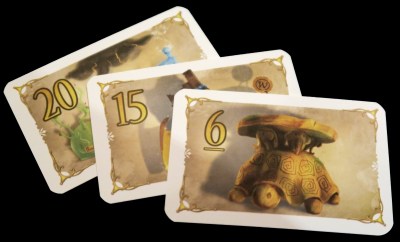
Celestia
– Image by boardGOATS

While the airship was being filled, Blue, Mulberry and Burgundy debated what they were going to play.  Orléans was very tempting, but as Celestia was supposed to be relatively quick, the trio decided to play the shorter Tokaido instead.  This is a simple, but very clever game where players are traveling the East Sea Road from Kyoto to Edo (Tokyo), meeting people, tasting fine food, collecting beautiful items, discovering great panoramas, and visiting temples and wild places.  The winner is the player who discovers the most interesting and varied things and is the most initiated traveler.  The really clever part of the game is the turn order, because the player at the back goes first.  Although this is an unusual mechanism, it is not unique and is also seen in Glen More, an out of print game that is getting a face-lift and reprint this year as Glen More II: Chronicles.

Tokaido
– Image by boardGOATS

The idea is that each location on the road can only be occupied by one player.  Players only ever move forward and the player at the back has a free choice of which empty location they move to.  They can choose to stop at the first empty location which means they will be able to maximise the number of locations they can visit, or they can choose to skip a few locations potentially gifting these to their opponents, but ensuring they stop at the locations they will profit most from.  Thus the game is all about optimising movement, compromising visiting the best locations, visiting the most locations and preventing opponents visiting the locations they want by getting there first.

Tokaido
– Image by boardGOATS

Each player starts with a character card which gives them a different start condition and a special power.  Burgundy was positioned at the front playing Yoshiyasu enabling him to draw a second card whenever he encounters someone, and choose which one to keep Encounter cards give a one-off bonus, so being able to choose instead of relying on random draw is a nice advantage.  Mulberry started in second position on the track and as Kinko, was able to pay one Yen less for her food at mealtime.  There are several stops for food along the way and money is always scarce so anything that saves money is always good.  Blue began at the back (and therefore started), playing Sasayakko who gets the cheapest souvenir for free whenever she buys two or more when visiting the Village.

Tokaido
– Image by boardGOATS

In this game, it is essential that players make the most of their special powers, so Blue visited as many Villages as she could, collecting as many sets of souvenirs as she could.  To do this though, she need lots of money and money is not easy to come by.  Similarly, Burgundy stopped to make as many encounters as he could and coupled this with visiting the Hot Springs.  Hot Springs simply give a two or three point card drawn at random from a deck, with the three point cards depicting monkeys playing in the spring.  Somehow, every time Burgundy drew a Hot Spring card, it featured monkeys, while Blue and Mulberry received no monkey-love; after his fifth card it was something they really began to resent.
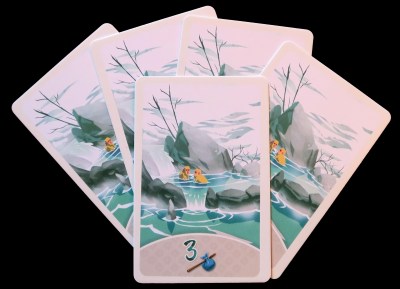
Tokaido
– Image by boardGOATS

Mulberry was the first to score points and Burgundy wasn’t far behind.  Blue was slowest off the mark, but eventually caught up and overtook the others, romping into the lead, helped by Burgundy who persisted in moving Blue’s token when he scored points.  That wasn’t the full story, however.  At the end of the game points are awarded to the players with the most Hot Spring cards, the most Encounter cards, the most Souvenirs, for donating money at the Temples, and for the player who spent the most on food.  With Burgundy taking the vast majority of these points, he caught up and, after several recounts, both Blue and Burgundy finished on eighty-one points with Mulberry not far behind.  With more achievement cards, Burgundy was the clear winner, but he’d tried to be generous with his points throughout the game and insisted on sharing victory with Blue (to go with the lack of sleep they shared).

Tokaido
– Image by boardGOATS

Celestia was still going and wasn’t looking like it was going to be finished very soon, so Blue,  Burgundy and Mulberry decided to try something else.  After a bit of discussion, they opted for a new game by the producers of the Spiel des Jahres and Deutscher Spiele Preis winner, Azul, that had been brought back from Essen late last year.  Blue had played Reef with Pink, Black and Purple after The Gallerist during a recent “Monster Games” session, but otherwise it hadn’t made it to the table.  It isn’t a complex game though and is very quick to teach:  on their turn, players can either take a card from the pool of face up cards, or play a card, adding the pieces of coral depicted in the top half to their reef and then scoring the pattern shown in the bottom half of the card.
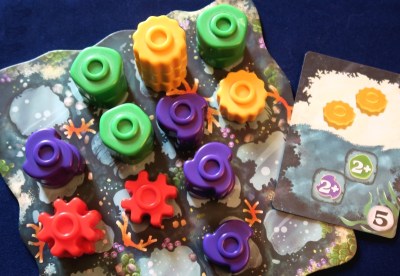
Reef
– Image by boardGOATS

The reefs are a three by four grid and the pieces of coral can be played anywhere and can stack up to a maximum height of four.  Scoring the patterns is as viewed from above, and each one can be scored several times with different patterns worth different numbers of points.  This means there are two approaches to the game, scoring low but frequently, or building to one large score.  Mulberry opted for the first approach and facilitated this with single colour piles of coral.  Blue tried the alternative strategy, building to a large twenty-plus point score, while Burgundy tried a mixture.  As a result, Mulberry quickly built up a healthy lead, and the question was whether the others would catch her or not.  It was close, very close, with just four points covering all three players.  This time though, little and often was the winner, and Mulberry finished with forty-two points, one more than Burgundy.
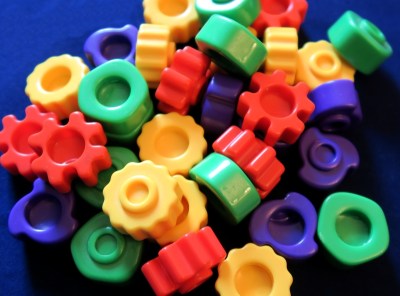
Reef
– Image by boardGOATS

Celestia was still going, so Mulberry stayed to play one last game, San Juan.  This is an old game from the Alea Small Box Series that is sometimes referred to as the card game of Puerto Rico.  The idea is that on their turn, the active player chooses a role, Builder, Producer, Trader, Prospector, Councillor and then everyone takes it in turn to carry out the associated action.  The person who chose the action gets to use the privilege of the role (pay one less for building, trade or produce one extra item etc.).  One of the clever things about the game is that cards have multiple purposes, similar to Bohnanza where cards can be money or beans.  In San Juan, each card can be played onto the table as a building, but when in hand they can be used as payment, and during the game they can be used as produce as well.  Each card has a value when built and there are a small number of special buildings whose score depends on the other buildings in play.  The game ends when a player builds their twelfth building.

San Juan
– Image by boardGOATS

Mulberry was tired and really struggled, so Blue and Burgundy tried to help explain what she could do, certain she’d get the hang of it.  They stressed the importance of not getting left behind on the building, a message Mulberry took to heart, building at every opportunity.  Blue made life difficult for everyone though, building a Guardhouse reducing everyone else’s hand limit to six.  Burgundy saw one of the valuable six point plus violet building cards early in the game, but that was it, so he ended up building lots of production facilities.  Blue on the other hand built lots of violet buildings and with it a City Hall giving her one point per violet building.  In the meantime, Mulberry kept building so when Blue failed to spot she had eleven buildings she accidentally triggered the final round.  It was very, very tight, but somehow, Blue just kept her nose in front finishing with twenty-three points, one more than Burgundy and two more than Mulberry.

San Juan
– Image by boardGOATS

In the meantime, Celestia had finally come to an end.  With Green and his parents wanting to leave and Pine finally putting in an appearance after a long day bird watching in the West Country, the group we went for a very short game, one about birds: Pick Picknic.  This game combines simultaneous card selection with bluffing and a slice of luck.  The idea is that there are six farm  yards of different colours, if someone plays the only chicken card of a given colour, they get all the grain at that coloured farm.  If multiple players go for the same coloured yard, then players can either agree to share the corn in any way that is mutually acceptable or roll the die for all of it.  Foxes don’t eat corn, however, they only eat chickens, so if someone plays a fox card, they will eat any chicken cards of that colour.  This time there seemed to be a lot of hungry foxes, and lots of fighting birds.

– Image used with permission of BGG reviewer EndersGame

These were accompanied by the usual exclamations as people realised that their attempt to grab a pile of corn was stymied by someone else’s decision.  It was a close game, with four players within four points of each other.  It was tight at the front too with just a handful of points between first and second place, but it was Purple who just edged Green’s father into second place.  With that over Family Green headed off and, as Burgundy was still occupied playing San Juan, everyone else felt it was a good opportunity to play Splendor as someone else would have a chance to win.  Splendor is a game we’ve played a lot and it is ideal for late in the evening when everyone is tired because it doesn’t need too much thought.

Splendor
– Image by boardGOATS

Splendor is very simple:  players take it in turns to take gems (chips) or use the gems to buy cards from the display.  Cards can be used to buy other cards, but some of the cards also give points, and collecting certain combinations of cards allows players to claim a Noble tile giving more points.  Essentially, it is a race to fifteen points, though as players finish the round (so everyone gets the same number of turns), it is the player with the most points who wins.  This time the game started with everyone evenly matched.  There was a lot of overlap in the colours required to claim Nobles tiles, so they were claimed at much the same time.  Then Black took the lead and although both Purple and Pine were close to adding to their respective totals, Black’s score of nineteen was unassailable.
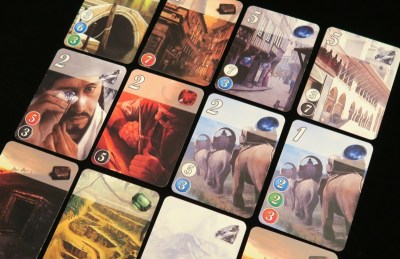
Splendor
– Image by boardGOATS

Learning Outcome:  Close Games are Good Games.

13th Movember 2018

There was a bit of a delay for food, so after Blue had handed over an exciting box of echidnas to Pine and given Burgundy and Green a selection of Splendor, Orléans, and Zooloretto promo cards from Essen, we decided to play something quick.  As there were a lot of hungry people, we decided to start with a quick game of Om Nom Nom.  This is a fabulous little double think game based on critters eating other critters further down the food chain.  The game is set up with a large handful of dice which are rolled to give either items from the bottom of the food chains (flies, carrots and cheese) or animals from the middle of the food chains (frogs, rabbits and mice).  Players start with six cards representing animals from the middle of the food chain and the predators from the top of their food chains (hedgehogs, wolves and cats).  Players simultaneously choose a card to play and then everyone reveals them and they are placed on the appropriate space on the three central player boards. before and the animals begin to feed starting at the top of the food chain.  For example, wolves eat frogs and any surviving frogs then eat flies.

Om Nom Nom
– Image by boardGOATS

If only one card of any type is played, the predator feeds and the player takes their card back with any cards/dice their animal has eaten placing everything in their scoring pile.  Where more than one card of the same type is played and there is enough food to go round it is shared equally and everyone eats (taking their cards back with their share of the prey).  If there is not enough food for everyone to get a share, they all starve and lose their cards going home with nothing.  This is repeated until there are no cards left.  Food at the bottom of a chain is worth two points at the end of the game and food from the middle of a chain and any cards are worth one point.  The game is played over three rounds and the winner is the player with the most points.

Om Nom Nom
– Image by boardGOATS

Blue won the first round with eleven, more than twice the points anyone else managed to gather.  Om Nom Nom is one of those games where a high score in one round is usually balanced by a dreadful score in the next, so everyone expected Blue to fail to score at all in the second round.  Burgundy’s twelve points in the second round looked really good, but contrary to the usual run of things, Blue somehow managed to improve her score picking up eighteen points—one less than the record for a single round in our group.  The third round was a little bit of a dead rubber, but Burgundy was keen to see Blue get her bad round and if she did, fancied his chances.  It was a much more even final round and with lots of points available, things looked good for Burgundy, but unfortunately for him, everyone else chose this round to get it together.  In the end it was all about second place, which Burgundy just managed to take ahead of Black and Mulberry as food arrived.

…Aber Bitte Mit Sahne
– Image by boardGOATS

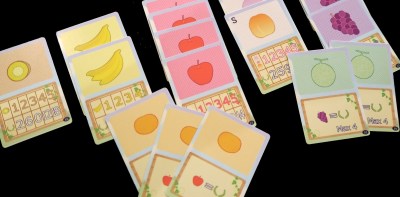
While Burgundy, Blue and Mulberry ate their belated supper, everyone else carried on the food theme, playing a little Japanese game picked up by Black and Purple at Essen called くだものフレンズ or Fruit Friends.  This is a little card drafting and set collecting game where players are collecting different types of fruit using the “I divide, you choose” mechanism.  There are a surprisingly few games that use this idea, but two of the best are …Aber Bitte Mit Sahne (aka Piece o’ Cake) and San Marco.  …Aber Bitte Mit Sahne is relatively unusual as it works well with players dividing the pie into more than three.  In contrast, San Marco is a three to four player game, but plays much better with three than four because the “I divide, you choose” mechanism generally works best when the pile is divided into three.

Fruit Friends
– Image by boardGOATS

In Fruit Friends, each player starts with a random start or “seed” card, dealt face up.  Players are then dealt seven cards which they divide into three piles of two (discarding the final card).  Beginning with the player who was dealt the apple start card, players offer the three piles to the player on their left who takes one pair; the next player then chooses from the remaining two piles leaving one pair for the active player.  Play continues in this way until everyone’s cards have been taken.  The second round is played the same way except cards are offered anti-clockwise and the player with the grapes start card goes first.  The final round is clockwise again, and the player with the kiwi start card begins.  At the end of the game, each player has eighteen fruit cards, with each type scoring differently.

1 card 2 card 3 card 4 card 5+ cards
Apples 0 points 2 points 5 points 9 points 14 points (max)
Grapes 2 points 5 points 8 points 11 points 11 points (max)
Kiwis 2 points 6 points 0 points 12 points 18 points (max)
Bananas 3 points 7 points 12 points 0 points 0 points
Peaches 2 points 5 points 9 points 14 points 20 points (max)

There are some catches, for example, peaches come in two colours, yellow and white, but only one of them scores.  Oranges score one point per apple card and similarly melons score one point per grape card (both up to a maximum of four points). The scoring intervals also offer some quirks, so while almost everyone scored twelve points for their bananas at the end of the game, Ivory went “Banana Bust” by over-shooting.  Otherwise it was close at the top and you could fit the first four players in a fruit-basket with only five points between them.  It was Purple, the “Kiwi Queen”, who just had the edge, “pipping” Green by a single point with Pine and Black finishing in joint third.

Fruit Friends
– Image by boardGOATS

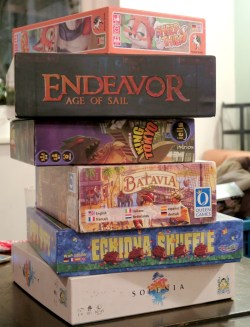
By the time the game came to an end, the eaters had mostly finished, so Black started getting out the “Feature Game”, Imaginarium (also described previously as “the one with the elephant on the box”).  Burgundy and Ivory were quick to stake a claim to play it and Purple was equally quick to opt out.  Mulberry and Blue made up the five, so Green started to collect together the games he thought the rest might play, which Pine pointed out just made it look like he was playing Jenga with boardgames.  It took a while to come to a conclusion, but eventually the trio went for Echidna Shuffle.

Jenga
– Image by boardGOATS

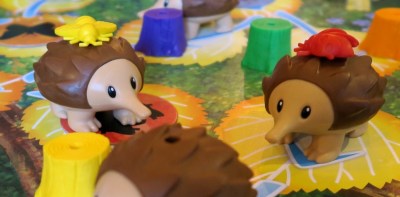
Echidna Shuffle is a game that we first discovered at the UK Games Expo back in June and since then, has been very popular with everyone who has played it.  This is partly because of the fabulous, over-produced pieces, especially the lovely echidnas with cute smiley faces.  The game is very simple:  Players have to get their bugs to their tree-stumps by moving echidnas around the board.  On their turn the active player rolls the die, and moves echidnas a total of that number of spaces.  The clever part is that players only roll the die on alternate turns with intermediate turns evaluated from the dice board giving a total over two turns of nine moves.  Thus, if someone rolls the maximum, a seven, the next turn they get just two.  Similarly, if they roll a small number, say a three, then they get a six on the next turn.  This means nobody gets screwed over by the dice, but there is still a nice, randomisation effect to the movement.

Echidna Shuffle
– Image by boardGOATS

There are two sides to the game board:  green “Summer” and snowy “Winter”.  There was some discussion as to which to play.  Pine thought the Summer side of the board rather than the Winter side was more of a challenge.  He explained that it was more confusing on the snowy side and that it is not so easy to block people.  On the other hand, the first time it was played with the Summer side, the game had become something of an epic marathon as everyone worked together to stop everyone else winning.  So this time the group started with the “advanced” Winter board and ended up with a very short game indeed.  After only about three rounds, Purple had got one of her bugs home and Green had managed two.  Then Pine surprised everyone and with a roll of seven managed to complete all three of his bugs and the game was over, almost before it had begun.

Echidna Shuffle
– Image by boardGOATS

Echidna Shuffle is really meant to be a children’s game, so perhaps it should not have been a huge surprise that it ended quite so quickly.  Maybe Pine had had a point though, so unusually the game got a second chance, this time with the Summer board.  This second game, did indeed last longer, but was still relatively quick and before too long everyone had just one bug remaining each. Green was first to get to this point, but Purple and Pine managed to successfully block his route while they also got their second bug home.  In the end Pine became the “Kingmaker” as everyone knew how many moves each player would get and he found himself in the position where he could either move the echidna out of purples way and into Green’s or do something else entirely. Either action (or inaction) would result in win for either Green or Purple and in the end he inevitably chose to open the door for Purple.

Echidna Shuffle
– Image by boardGOATS

It maybe that as a bunch of adult gamers, we have found the limit of this very pretty and lovable game.  On the other hand, the number of players also has quite an impact—the full compliment of six seems to have the effect of dragging out the Summer board, but the combination of a small number of players and the complexity of the Winter board appears to make the game too open.  Hopefully the company will bring out some new expansions or different board layouts that will give us more to explore, in the meantime, the game may get fewer outings in the weeks to come.

Echidna Shuffle
– Image by boardGOATS

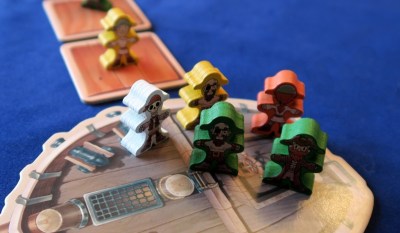
Because of the late start and the fact that Green wanted an early night, there wasn’t enough time for another medium-weight game, but it was still early enough for a short game. After some discussion, the trio agreed upon Walk the Plank!, a cute little programming game with a hefty dose of “take that”.  In programming games players choose the cards they are going to play before the round starts and then action them during the round, usually taking it in turns to reveal one card and then carry out the associated action.  One of the classic games of this type is Colt Express which won the Spiel des Jahres a few years ago, but Walk the Plank! is a quicker and simpler game.  The idea is each player has three pirate meeples on a ship and the last one remaining is the winner.  Players start each round by simultaneously choosing three cards and laying them face down in front of them.  On their turn, players turn over the top card and action it.

Walk the Plank!
– Image by boardGOATS

The cards allow players to do things like “shove” one of the meeples belonging to the player on their left, or to the player on their right.  When this is played a meeple that shares a space with one belonging to the active player is moved one step along the plank and thus closer to falling into the depths.  There are lots of other actions including “drag to ship”, “drag to sea” and “Charge!”, but the most exciting cards are probably the “retract the plank” cards.  At the start of the game the plank comprises three pieces, but usually at least one player removes one of these at the start of the game, heightening the stress levels. We usually play with a couple of house-rules too, firstly we play to the last meeple standing (the rules say the last two share victory) and we allow the plank to be completely removed (the rules say there is always one piece left).

Walk the Plank!
– Image by boardGOATS

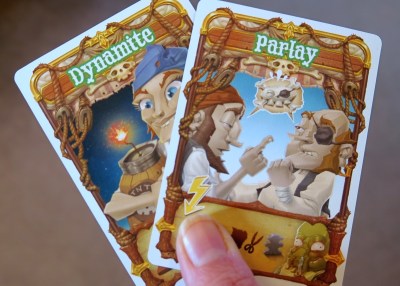
We’ve loved the game for years and have several different editions within the group—this time we played with the “limited edition” which includes some optional extra cards.  This time two of the extra single use cards were added to each player’s deck:  “Parlay”, which gives a player a chance to turn the tables via a game of Rock-Paper-Scissors, and “Dynamite”, which pushes everyone on one tile one space closer to the sea.  After a little shuffling about, Green played his “Dynamite”, but succeeded in sending two of his own men closer to the water as well as the others.  Then Purple played a “Charge!” card to try to push Green into the sea.  Green used his “Parlay” to see if he could to prevent it, but this ended up in hysterics thanks to a total inability to play the game correctly.  It started with Green playing on the count of three as agreed and Purple after the count of three (i.e. on four).  After multiple attempts including one where Purple ended up just pointing vaguely at Green everyone was in fits of giggles, but it didn’t look like the tie was anywhere nearer being resolved.

Rock-Paper-Scissors
– Image from theguardian.com

Pine suggested that perhaps they should try after the count instead.  Green duly obliged, but Purple had finally worked out how to play on the count of three and still the problem persisted.  Then Green chose stone and Purple also chose stone changing to paper at the last second, but this was spotted by Pine who ruled a “Let” and so they had to try yet again.  By this time everyone was laughing so hard that in a fit of confused giggles Purple then chose “none of the above” by using a single finger.  Pine suggested Green and Purple put their hands behind their backs, but this time it was Green’s turn to make a mess of things and he just couldn’t get the hang of it.  In the end, in an effort to stop Purple from soiling the furniture, Pine suggested they remove the counting element and play with closed eyes which was finally successful.  It was largely immaterial by this time, but Green won, so one of Purple’s pirates went charging off the plank into the sea.

Walk the Plank!
– Image by boardGOATS

Getting back to the game seemed tame by comparison. Everyone ended up back on the boat and then started moving forward again.  With the plank retracted, Green found himself with all three of his pirates on the end when Pine played his dynamite and Green was out in one go taking one of Purple’s and one of Pines own with him.  So Green became the Ghost and with two pirates versus one, it looked to be Pines game.  Two rounds later, though the Ghost shoved one of Pine’s pirates off the ship to level things up until Purple played her “Dynamite” and managed to get both dumped into the water, bringing the game to a shuddering halt, and on that note, Green headed home.

Walk the Plank!
– Image by boardGOATS

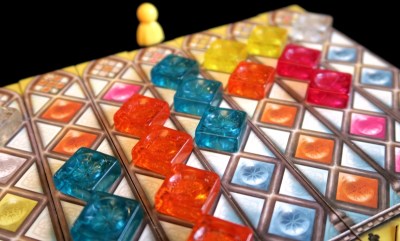
Imaginarium was still underway with no sign of finishing soon, so Pine and Purple decided to give Azul: Stained Glass of Sintra a go as Pine had missed out last time.  As in the original game, Azul, players take all the tiles of one colour from a “factory” and put the rest in the middle, or they take all the tiles of one colour from the middle. Tile placement and scoring is rather different however. All the tiles taken in a turn are placed in a single column of the player’s personal player board. This board is modular with the double-sided strips laid out at random so everyone has a different starting setup.  Tiles must be placed in the strip immediately below the Glazier meeple, or in a strip to its right.  The Glazier is then placed above the strip the tiles were placed in.  Instead of taking tiles, players can choose to reset the Glazier’s position, moving him back to the left most strip.

Azul: Stained Glass of Sintra
– Image by boardGOATS

Players get points when strips are completed scoring the sum of the score depicted below the strip and any strips to the right that have already been completed.  There is also a colour bonus—each round has a colour drawn at random at the start of the game, and any tiles that match the colour for the round score extra.  Once a strip has been completed, it is flipped over; after it has been filled a second time it is removed.  Any left over tiles that cannot be placed yield a penalty with players moving along a negative score track which has small steps at the start that get larger.  There are also end-game bonus points with two variants available, one colour dependent and the other rewarding completing adjacent strips.

Azul: Stained Glass of Sintra
– Image by boardGOATS

This is definitely a game that takes a at least one play to understand how it works and what the best way to score points is.  For example, the way the score builds, it is imperative to complete the furthest right strips early as then they score again and again.  However, they are relatively low scoring, so this is not the only important strategy. So while Pine started off well, Purple scored more later, especially when she picked up colour bonus point as well.  Early in the game, the penalty for picking up the first player token or for having left-over tiles is small, but it quickly increases, and with Pine taking the first player token more than Purple, he finished with more negative points too.  All the little extras combined to make it a bit of a landslide in Purple’s favour, but then Purple had the advantage of having played the game several times, so next time will surely be different.

Azul: Stained Glass of Sintra
– Image by boardGOATS

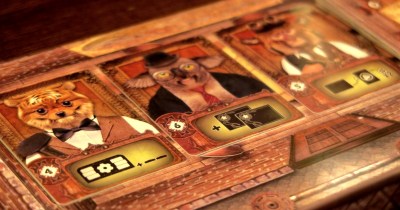
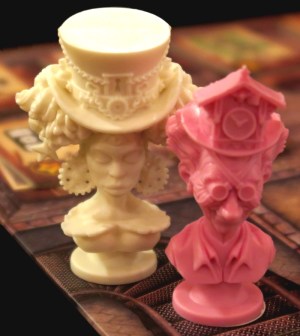
While these games had been going on, the “Feature Game”, Imaginarium was getting an outing.  Subtitled “The Dream Factory”, this game is a worker-placement, engine builder with a Steam Punk theme where players are building machines in a factory.  Beautifully produced with remarkable artwork, players first take it in turns to choose a position on the factory conveyor-belt.  They select either the broken machine card that they are going to buy or a position to collect charcoalium.  These are then carried out in “action” order which then also becomes the selection order for the next round.  At the end of the round any unused cards move long the conveyor-belt and the early positions are populated with new, exciting cards.  As the game progresses, the broken machine cards generally become more expensive, but the machines become more useful, producing more and/or higher value resources.

Imaginarium
– Image by boardGOATS

On a player’s turn, their existing “machines” first produce resources, then the player must buy the broken machine card they had chosen. The active player finally carries out two actions dictated by an unusual clock mechanism:  each player has a board with the six possible actions arranged in a circle and the hands of the clock are fixed such that players are unable to take actions that are adjacent.  As the clock hands must be moved every round, players are only able to take repeat one action in consecutive rounds.  Possible actions include hiring a character, trading resources, extracting charcoalium, repairing broken machines and reorganising or dismantling existing machines.  When a machine card is taken from the conveyor-belt, it is broken, they must be repaired before they will work and produce resources.  Once repaired, machines can be combined to make them more efficient, or dismantled to give points, the game ends when one player gets to twenty points.

Imaginarium
– Image by boardGOATS

One of Ivory’s questions before playing a new game is always, “Where are the points going to come from?” In addition to dismantling machines, points are also available for completing “projects” i.e. satisfying goals drawn at random at the start of the game, or by trading charcoalium.  There are also two points available for players who have the most of one of the four resources at the end of the game.  As the game was late starting, the group decided to end the game at fifteen points instead of twenty, though to begin with it didn’t look much like anyone was going to get to fifteen points before midnight.  Black assured everyone that people would pick up speed as the game progressed and eventually, Ivory got going completing the first of the projects and then Black and Blue followed.

Imaginarium
– Image by boardGOATS

The game is mostly multi-player solitaire, except when it’s not.  There are some machine cards that take resources from the other players.  In a game where resources are very tight and players are very reliant on resources for their plans this can be crucial.  The game also has a distinctly mean streak, as a player that is unable to pay for the card they have chosen, doesn’t get the card, but also loses all their resources, completely upsetting their plans and forcing them to start again from scratch, potentially losing them the game.  This is exactly what happened to Blue—Ivory went earlier in the turn order and bought and then repaired a machine that took all her charcoalium which meant she lost the card she was going to buy and all her resources.  She vowed to get her revenge, but the opportunities for that are few and far between.  As she waited for her chance, she gathered charcoalium to ensure she would be able to buy the right card when it came up.

Imaginarium
– Image by boardGOATS

Sadly for her, interaction in the game is minimal so there she never really got her chance.  Amassing large amounts of charcoalium wasn’t totally without use though as it enabled her to fulfill one of the projects and as they were playing to a smaller total, she started trading them in for points in an effort to avoid coming last.  Meanwhile, Ivory kept amassing points and Mullberry kept doing “the weird goat-head thing” which ensured she always had plenty of charcoalium and was starting to build a productive engine.  Black and Burgundy had also just got their engines going and were planning to score heavily when Ivory announced that he’d passed the fifteen point mark.  With Blue still to take her turn, she maximised her points and everyone added up their scores.  Sadly, for Black, Burgundy and Mullberry this wasn’t a long process as shortening the game had had the unforeseen consequence that the game ended just before their plans had come to fruition.  Much to her surprise, Blue had done rather better as she had stuck to short-term targets that lent themselves to the short game.

Imaginarium
– Image by boardGOATS

There was only one winner though and Blue’s fourteen points flattered her position as the scores did not tell the true story of the game.  It’s definitely a game to try again sometime, though perhaps with fewer people which would give players a bit more control over their own destiny.  The artwork is somehow both amazing and very disturbing at the same, and it certainly had an unforeseen effect on Blue.  She is not normally one to remember dreams or one to design games, but when she awoke the next morning she had a fleeting recollection of dreaming about playing a card only version of Om Nom Nom that she had designed called “Yum Yum Tum”.  We will have to see if that ever comes to fruition.

Imaginarium
– Image by boardGOATS

Learning Outcome:  When gamers are hungry they play games about eating.

Boardgames in the News: Does “More Mainstream” = “Less Friendly”?

Modern board gaming has always been a very inclusive and friendly hobby, if niche.  For example, people attending conventions often carry games home for friends, but more surprisingly, they also often carry games for complete strangers.  This can require trust from either or both parties: sometimes it is the “mule” who pays for the goods, sometimes items are preordered and paid for in advance and then collected by the “mule” and posted on.  Similarly trusting are those that take part in the “Maths Trades“.  These are multi-person trades which happen in a loop with everyone receiving a game from one person and giving a game to somebody different.  Obviously if one person fails to honour their part of the deal, the whole thing breaks down.  Yet these things happen on a huge scale with hundreds of people participating, and although there are occasionally problems, most people are very happy with the result and take part again and again.

M.U.L.E.
– Image from lautapelit.fi

As the hobby grows, the first signs of change are perhaps becoming visible.  For example, earlier this year voting for the Deutscher Spiele Prize was closed four days early due to attempted vote-rigging.  It seems an online video blogger claimed he had a special deal with the publishers of one of the games in the running, KLONG! (aka Clank!: A Deck-Building Adventure), Schwerkraft Verlag.  He posted a video syaing that if the game won the award, he and all the followers of his YouTube Channel would get a promo card for the game.  Schwerkraft denied any involvement, but around a hundred votes were cancelled (about half of which only placed the one game) and other people were unable to vote at all because voting was stopped prematurely.  The organisers of the Deutscher Spiele Prize say Azul‘s position at the top was never in doubt and KLONG! would not have won in any case.  It might have improved on its eventual seventh place though, perhaps threatening the positions of Heaven & Ale and Pandemic Legacy: Season 2 (which finished in fifth and sixth respectively).

Ludicreations at Essen 2016
– Image from kickstarter.com

Perhaps this could be seen merely as a gamer trying to game the system, but whatever, it leaves a nasty taste in the mouth.  More serious was the series of thefts from stalls that occurred at Essen this year.  It was not the first time money had been taken from a stand—famously, at Essen in 2016, Ludicreations had a cash box stolen, containing about €3,500.  R&R Games were also robbed that day, but the Ludicreations theft is known more widely thanks to their response.  Such a loss can be very significant for a small company, so inspired by the theft, they designed a game called Steal this Game and launched it on KickStarter, raising over $50,000.  This year the fair grew and so did the thefts.  Six companies fell victim this time, Artipia Games, FoldedSpace, Greenbrier Games, Gotha Games, Hub Games and Japanime Games.  Reportedly, the thieves got away with a total over €20,000, but not without loss themselves as staff on the Artipia stand (ironically demoing their new game A Thief’s Fortune) realised what was happening.  Although they weren’t quick enough to stop the theft, they succeeded in detaining one of the decoys.

Essen 2018
– Image by boardGOATS

There is no suggestion these crimes were carried out by boardgamers, in fact, the Police have said that they were a professional team.  Two people distracted the cashier by bombarding them with questions and a third then swiped the cash-box.  Efforts are now underway to recoup the losses which were mostly uninsured.  Japanime Games are collecting donations, while Artipia Games have launched a KickStarter campaign for five promo cards.  Attention has also turned to trying to prevent the same thing happening next year.  There have been calls for more vendors to take card payments, however that is not without its problems.  This was amply demonstrated at the UK Games Expo this year which coincided with a Europe-wide Visa systems failure leaving many gamers unable to pay for their purchases.  There is also a question mark over whether the infrastructure available at the Messe would be able support everyone moving to card transactions at such a bug fair with such a large commercial component.  For these reasons, Merz Verlag (the company who run Spiel) are focussing on increasing security and making it much more visible.  Conversation is still on-going and it remains to be seen how much these changes will alter the feel of the show.  One thing is clear, however, the wider world has discovered our little hobby and that brings some unpleasant consequences.

Essen 2018
– Image from spiel-messe.com

16th October 2018

Blue was late after an unscheduled nap, so Burgundy consumed the first half of his supper alone.  Blue was quickly followed by Ivory and Pine and then a new visitor, Navy.  With Cobalt last week (who was busy moving house this week so couldn’t come) that makes two new people in two weeks.  Navy is a more experienced gamer and is into slightly more confrontational games than those we normally play, but that’s good as it might encourage us to leave our comfort-zone of cuddly Euros set in medieval Germany.  As we were all introducing ourselves, Green, and then Black and Purple turned up and the discussion moved on to how we choose the “Feature Game” (Blue suggests something to Green who mostly replies that he’s never heard of it, but it sounds quite interesting…).  Recent discussions have centred round the new Key Flow (aka “Keyflower the card Game”) for the next meeting and maybe Imaginarium (or, “The One With The Elephant on the Front” as Navy referred to it).  With that, Green started getting out this week’s “Feature Game“, which was Greed, a card drafting game where players are crime lords trying to earn more money than anyone else through clever use of their cards.

Imaginarium
– Image by BGG contributor W Eric Martin

At it’s heart, Greed is a quite simple, card-drafting game with a healthy dose of “take that” and a gangster theme.  Players start with a hand of twelve cards and “draft” three cards  (i.e. choose a cards and pass the rest on, three times).  Players then simultaneously choose one card then together reveal this card and action it before the it is replaced with another drafted card.  A total of ten cards are played in this way per person before the players tally their holdings and the player with the highest value is the winner.  Obviously, the game is all about the cards and there are three types, Thugs, Holdings and Actions, but it is the combination of these that is critical.  Actions have a unique effect associated with them while Thugs and Holdings typically also have a cost or a condition associated with them (e.g. cash paid to the bank or a collection of symbols on cards held).  Holdings are the key however.  When a Holding is played a token is placed on that card for each symbol on it and an additional token for each symbol of that type already possessed. These tokens are worth $10,000 each at the end of the game which is added to the value of cash collected through card plays.

Greed
– Image from kickstarter.com

Although it was Green’s game he had only played it once and that was over a year ago, while Burgundy had read up on it.  Pine and Navy had joined them to make the foursome.  The game takes a few rounds to understand how it really works.  After that, it’s quite easy to play, but working out which card to take and which to play is much harder, as they all seem to be really good. Unfortunately Navy struggled a bit at the beginning and made mistakes in his first couple of plays as he either found he couldn’t actually play his chosen card and had to just ditch it, or wasn’t able to get the indicated bonus. However, as he had not accumulated any wealth early on, it also meant he didn’t lose any when Green played a couple of cards which meant everyone else lost dollars, which leveled the scores a little.  Burgundy’s preparation really helped when he played a Holding card and proceeded to place six tokens on it, so by the half way mark it was looking like a two horse race between Burgundy and Green with both Navy and Pine looking short on cards.

Greed
– Image used with permission of BGG contributor punkin312

Through the second half of the game, Pine really got the hang of it and started raking in the dollars and had quite a pile of cash. Green then played a Holding card which enabled him to add chits equaling the same number as the maximum on another players cards, which meant he was able to gain from Burgundy’s excellent earlier play.  In the final rounds, Green played another card which removed one of his holdings only to be able to play it again the following round with even more tokens than it had previously. There was a brief discussion as to whether he should get the usual amount for it as well as the removed ones and two extras, a decision that went in Green’s favour, but the real question was whether it would be enough to beat Burgundy.  In the end, it was close, but the answer was no and Green finished with $30,000 behind Burgundy’s winning total of $235,000.

Roll for the Galaxy
– Image used with permission of BGG contributor punkin312

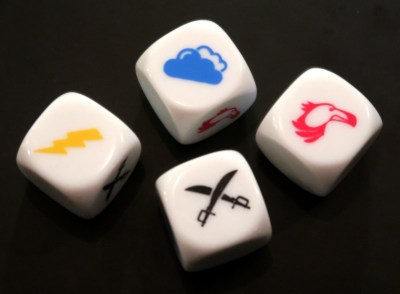
Meanwhile, on the next table everyone was being indecisive, but in the end the decision was made in favour of Roll for the Galaxy.  This is a game that really fascinated the group for a while because somehow it behaves differently to everything else we play and we really struggled to get to grips with it.  At the time, we concluded that our struggles were probably because we weren’t playing it enough so effectively had to learn it afresh every time we played.  For this reason we went through a phase of playing it quite a bit, but that was some months ago now and it was definitely time for another outing.  In principle, it is not a difficult game and the core mechanism is similar to the so-called “deck builders” (like Dominion) or “bag builders” (like Orléans or Altiplano), except instead of building a deck of cards or a bag of action tokens, players are building their supply of dice.  In Roll for the Galaxy, each different die colour reflects the different distributions of the dice, so for example, white “Home” dice feature each of the symbols for Develop, Settle, Produce and Ship once and Explore twice.  On the other hand, the yellow “Alien Technology” dice have three faces that depict the asterisk (“Wild”) and one each of Develop, Settle and Produce.  Thus, where probability affects which cards or tokens are drawn in the other games, in Roll for the Galaxy, players have more control over which dice they are using, but chance affects how those dice roll.

Roll for the Galaxy
– Image used with permission of BGG contributor punkin312

In principle, Roll for the Galaxy is not a difficult game and the basic mechanism is similar to that in Dominion or Orléans/Altiplano, except instead of building a deck or a bag of action tokens, players are building their supply of dice.  Each different die colour reflects the different distributions of the dice, so for example, white “Home” dice feature each of the symbols for Develop, Settle, Produce and Ship once and Explore twice.  On the other hand, the yellow “Alien Technology” dice have three faces that depict the asterisk (“Wild”) and one each of Develop, Settle and Produce.  Thus, where probability affects which cards or tokens are drawn in the other games, in Roll for the Galaxy, players have more control over which dice they are using, but chance affects how those dice roll.  Although the dice are important, like Greed, the game is really all about the special powers the players’ tableau, in this case made up of World tiles rather than cards.  Ultimately the game is really a race to trigger the end of the game is when the victory point chip pool runs out or a player builds their twelfth World.

Roll for the Galaxy
– Image used with permission of BGG contributor punkin312

Game play is mostly simultaneous:  players roll their dice and  allocate them to their phase strip.  Each player can choose one phase that they guarantee will happen, so in a four player game there is a maximum of four phases per round and where players choose the same phase there will be fewer, sometimes even only one.  The phases are:  Explore, Develop, Settle, Produce & Ship which correspond to draw Worlds from a bag; “spend” dice to build development Worlds;  “spend” dice to build production Worlds; place dice on production Worlds, and move dice from production Worlds in exchange for either victory points or money (which in turn can be used to speed up recycling of dice).  While we were setting up Ivory regaled us with the first few pages of Julia Donaldson’s “The Gruffalo”.  We will miss him and his stories when he takes his paternity leave in the new year.

Roll for the Galaxy
– Image by BGG contributor The Innocent

Blue began with the poor starting combination of a level six development World and a level one settlement, or a a level one development World and a level six settlement so began by rectifying the problem by exploring.  The game rocked along at a merry lick, with Black and Purple building and Ivory thrilled that he finally managed to build his first ever “Alien Technology World”, a feat he quickly followed with his second. Blue was slower building, but had a few high value developments and made good use of these before she began collecting some victory points.  This started a sudden cascade of Black and Ivory collecting points as well.  As a result, everyone focused on the number of victory point chips as the end game trigger, so much so that nobody, spotted that Purple had built her twelfth World.  As the group was just about to start the next round and everyone likes seeing their plans fulfilled, they played on anyhow.

Roll for the Galaxy
– Image by BGG contributor dodecalouise

Although it was a very tight game and everyone added to their scores, the extra round probably didn’t make any difference to the final placings.  Black and Ivory took over twenty victory points in chips alone, but they were offset by Blue’s high value Worlds and bonus points which gave her fifty-six points, just three more than Black in second place.  Everyone enjoyed the game, but there was one non-game highlight: Green’s sad little face when he looked across and broke off from setting up Greed with the sad comment, “Oh, They’re playing Roll for the Galaxy…”  Well, as everyone had a good time and with players getting quicker at it, it’s less of a labour than it used to be, so it surely won’t be long before he gets a chance to play it again.

Roll for the Galaxy
– Image by BGG contributor haslo

Greed finished first and as it was still early there time for another game, but nobody wanted to have a late night so the group picked something shorter and settled on this year’s Spiel des Jahres winner, Azul.  This was another game that was new to Navy, but it is very popular in the group and we’ve played it a lot.  Players are tiling a wall, taking tiles of one colour either from one of the factories (putting the rest in the central pool) or from the central pool.  Tiles are added to rows on the players’ boards and at the end of the round one tile from each full row is transferred to the players’ mosaics.  The aim is obviously to fill all the rows to transfer the maximum number of tiles, however, any excess tiles score negative points.

Azul
– Image used with permission of boardgamephotos

Navy quickly got the hang of this one and all the scores were close for a lot of the game, though it was noted how neat Green’s mosaic was looking as he managed to fill the first left hand vertical row and nearly completed the second as well before placing anywhere else.  Burgundy and Pine were both less tidy, but was still picking up extra points for connecting tiles when placing them. Although Navy’s board was a little more scattered, but that would help him to catch up later.  Everyone thought they were entering what would be the final final round with  three players with at least one row just one tile from completion, amazingly nobody completed them and everyone get one extra round.  This meant the group actually ran out of tiles to place on the central discs, triggering the end game in different way.  After this final round and final scoring, Pine finished on top of the podium, ahead of Burgundy in  second place with Navy in a very respectable third in a close game.

Azul
– Image by BGG Contributor styren

While Roll for the Galaxy was finished, there was a bit of chit-chat about strategy and it was clear that to do well at the game, you also need to keep a close eye on what everyone else is doing too. This can be tricky when you are struggling to work out what to do on your own board however.  Winning or losing though, Azul is a nice game that always delivers a challenge; it will be interesting to see how the new stand-alone version of the game, Stained Glass of Sintra compares and if it is as good or better than the original, or whether it “does a Queendomino or Tsuro of the Seas“.  No doubt we will find out in due course.  With that, those that wanted an early night headed for home, leaving Black, Purple, Burgundy and Blue with time for one last, shortish game.  Black suggested San Juan which had been played at the last Didcot Games Club meeting, and everyone else concurred.

San Juan
– Image used with permission of BGG contributor EndersGame

Essentially, San Juan is sometimes referred to as “Puerto Rico the Card Game”, but in truth they are very different games although the artwork and roll selection is similar.  In practice, it is actually a simpler version of the card version of Roll for the Galaxy, Race for the Galaxy.  The game uses the same multi-purpose card mechanism seen in games like Bohnanza, though in this case, cards can be buildings, goods, or money.  The idea is that players take it in turns to choose a “role” and then everyone carries out the action associated with that role, though person who chose it carries out with the “privilege”, a slight advantage.  The roles are Councillor; Prospector; Builder, Producer and Trader.  Players have a hand of cards and can use the Builder to build these cards to paying for them with other cards from their hand.  Hands are replenished directly using the Councillor or Prospector.  However, it is much more efficient to build an engine using production buildings.  These take cards from the deck and turns them into goods when a player chooses the Producer role; when the Trader role is chosen, these goods can be traded for cards according to the current value depicted on the tally stick.  The game end is triggered when someone builds their twelfth building.

San Juan
– Image by BGG contributor Aldaron

Black and Burgundy were quick out of the traps building their efficient production engine, with high value coffee and silver producers.  Purple started with “purple buildings” before also moving into sugar production and then Monuments.  Blue on the other hand started with a hand full of nice looking purple civic buildings that she didn’t want to part with and after three rounds hadn’t seen a production building, so decided to try something different and built a Tower (to increase her hand limit from seven to twelve) and started building.  Elsewhere on the table Burgundy was stealing a march on everyone else, adding a Well, Smithy, Aqueduct and Market Hall to his high value buildings.  When he added a Library which enabled him to use his privilege twice, he began turning over cards at a phenomenal rate and it looked like the writing was on the wall.  Everyone was keeping a careful eye on everyone else, trying to make sure they didn’t fall behind in the number of buildings they had, and before long, the game end was triggered and it was the final round then the scores were added up.

San Juan
– Image used with permission of BGG contributor EndersGame

After the scores had been added up, Black bemoaned the lack of the endgame scoring bonus cards that rewarded the production buildings and monuments that he had been collecting (Guild Hall and Triumphal Arch).  It was then that Blue explained that she had been stashing them under her Chapel as she had no use for them and didn’t want the others to have them.  It was possible that this tactic made the difference, as despite having only two production buildings, her City Hall and Chapel delivered a massive thirteen bonus points, just enough to offset the cheaper buildings she had been forced to build.  Remarkably, Blue finished with thirty-one points, four ahead of the “Production King” Burgundy.

San Juan
– Image used with permission of BGG contributor thatmadgirl

Learning Outcome:  Though difficult, it is important to keep a close eye on what everyone else is doing.

Deutscher Spiele Preis – 2018

This week the The Deutscher Spiele Preis, or German Game Prize list was announced with first prize going to Azul.  Typically the Deutsche Spiele Preis rewards a slightly heavier game than the the Spiel des Jahres awards, but for the first time since Dominion in 2009, one game took both awards.  This year we haven’t played many of the games on either list, but our first game of Azul was shortly after it’s release at Essen last year and our local groups have played the spots off it since.  So, it is no surprise to us that it has been recognised by both the Spiel des Jahres Jury and the voters from the industry’s stores, magazines, professionals and game clubs, as well as taking the French award at Cannes, the As d’Or and the Origins “Best Family Game of the Year”.

Azul
– Image used with permission of boardgamephotos

Other games that featured on the top ten list included the winner of the Kennerspiel des Jahres award, Die Quacksalber von Quedlinburg (currently only available in German) and one of the runners-up, Heaven & AleThe Mind, which received a nomination for the Spiel des Jahres Award, also featured in the top ten, as did the inevitable Pandemic Legacy: Season 2.  Other than Azul, the only game we’ve played is Altiplano, and that squeaked in at number ten, but Rajas of the Ganges and Clans of Caledonia may feature in the not too far distant future.  The Deutscher Spiele Preis for Best Children’s game went to Memoarrr!.  The prizes will be awarded at the Internationale Spieltage, Essen.

Azul
– Image used with permission of
BGG contributor Vacabck

4th September 2018

Blue, Red, Burgundy and newcomer, Mulberry, were finishing their food when Pink arrived after a long drive from the north-east.  While he was waiting for his food he opened a very special present Red had brought back from Spain for him.  Pink and Blue have quite a few games and for various reasons there are one or two that they have multiple copies of.  However, there is one game that they have many, many copies of.  Ironically it is a game Pink doesn’t even like playing very much, and yet, it has become a bit of “a thing” that every time Pink goes to Essen he comes back with yet another copy (ideally in a different language, but often just another German copy).  Red has strong opinions about this particular game though, and believes that by far the best language to play it in is Spanish, so kindly brought Pink a copy back from Spain to add to his burgeoning collection.  As he began to unwrap it, Pink took a few moments to realise what it was, but was really touched by this very special gift of Bohnanza.

Bohnanza
– Image by boardGOATS

There wasn’t time to play it before food arrived, then everyone else was turning up and the “who’s going to play what” debate began.  The “Feature Game”, Keyflower with the Farmers expansion had been Pink’s request and Keyflower is one of Blue’s favourite games, so they were a bit of a foregone conclusion.  They were quickly joined by Burgundy who is also very fond of the game, and Ivory who was keen to see if the expansion changed the balance and the strategies available.  Since that was likely to be the long game, they got on with it while everyone else sorted themselves out.  Keyflower itself is not a complicated game mechanistically, though it has an awful lot of depth.  Over four seasons, players are simply taking it in turns to bid for tiles to add to their village or use tiles available in the villages or the central display.  The clever part is that bidding and using tiles are both done with meeples as currency and players must “follow suite”, that is to say, use the same colour if the tile has already been activated.

Keyflower: The Farmers
– Image by boardGOATS

In Keyflower, the depth is generated by the actions available on from the tiles and their interaction, added to the fact that except when playing with a full compliment of six, only a subset are used, and these are drawn at random.  This means that one of the most important aspects of game play is to keep as many options open as possible since everything is likely to change in the final round.  This is not only because some tiles don’t appear, but also the fact that there is always someone who will make it their business obstruct even the best laid plans.  Thus it is vital to have at least two ways ways out.  Adding The Farmers expansion exacerbates this as it introduces lots more tiles so each one is less likely to be revealed.  This is a potential problem when trying to “play with the expansion” as it is perfectly possible that none of the Farmer tiles are introduced into the game.  To prevent this, some tiles were drawn explicitly from the Farmers set.

Keyflower
– Image by boardGOATS

The Farmers expansion doesn’t change game play much, it just adds depth by the addition of farm animals as another means to score points.  The idea is that animals are kept in the fields that are formed by the roads in a village.  Each field that is occupied scores points depending on the type of animal or animals in it.  Thus each field with sheep in it scores one point, each field with pigs scores two and each with with cows scores three points.  These scores are increased for villages with special tiles, like the Weaver, which increases the sheep score to three per field.  Animals in a field another of the same type breed at the end of each season and can be moved in a similar way to resources.  The expansion also introduces Corn to the game, which allows players to enhance their movement actions.  Otherwise, the game with the expansion plays in much the same way as the basic Keyflower game, takes a similar amount of time and requires a similar blend of tactical decision making and strategic planning.

Finca
– Image used with permission of BGG contributor garyjames

Meanwhile, everyone else had divided themselves into two groups of three and had begun to play.  Pine joined Red and Mulberry in a game of Finca.  Pine had played it before, but a long time ago so Blue took time out from setting up Keyflower to explain how to it worked.  It’s a very simple game of set collection with beautiful wooden fruit that’s now nearly ten years old.  At its heart is an interesting rondel mechanism.  On their turn, players choose one of three possible actions:  move around the rondel and collect fruit; use a donkey cart to deliver fruit; or carry out an action with one of the special, single use tokens that each player starts the game with.  There are some lovely features about the game.  For example, players move as many spaces round the rondel as there are workers on the space they started on and the number of fruit they get depends on the number of workers on the space they finish on.  As players have four workers each, there are lots of factors to consider when choosing which worker to move.

Finca
– Image by BGG contributor kneumann

Investing wisely is the key to the game, and Pine went for variety while Mulberry specialised more, particularly in figs and oranges.  It was the figs and oranges that won the day with Mulberry finishing with fifty-one points, just four ahead of Red who’d had lots of fruity fun with Finca.  With that finished, Red spotted Yardmaster in a bag, one of her favourite games, and decided to introduce Mulberry to it.  It is quite a simple game and was described by Mulberry as “UNO with trains”.  Players are building a locomotive by drawing cargo cards and using them to buy railcar cards from the four face up cards in the middle.  The game was very close, but it was Red’s experience that was key, giving her a two-point winning margin over Mulberry in second place.  With that done, they moved onto another old favourite, 6 Nimmt!.

Yardmaster
– Image used with permission of BGG contributor moonblogger

6 Nimmt! gets played a lot, but it’s unusual that we play it with so few players.  The idea is that everyone chooses a card and then players add them to one of the rows, in ascending order adding them to the row ending in the highest card that is below the card they are playing.  The catch is that when a sixth card is added to a row, that player picks up the first five cards.  The game really is at its best with more players where the simultaneous card selection adds mayhem.  They just played the one round; perhaps Mulberry misunderstood and thought the idea was to collect “nimmts”, but either way, she top scored with twenty-one – quite an achievement with only three players and only one round!  Red did rather better and finished the winner with just two “nimmts”.

6 Nimmt!
– Image by boardGOATS

On the neighbouring table, Green had joined Black and Purple and they started out with this year’s Spiel des Jahres winner, Azul.  This is a really an abstract game with only a loose theme of tiling a palace, but unusually, nobody seems to mind and we’ve played the game a lot with multiple copies in the group.  The game is really just a set collection game, similar to Finca and Yardmaster, but with an added spacial factor as tiles have to be placed to score points.  Tiles are chosen from “factories” with those that aren’t taken going into a central pool.  Since players can only take one colour at a time and must always take all the tiles of that colour in that location, they can easily end up with not quite enough, or even too many scoring negative points. Although it is not really an aggressive game, it is remarkable how much damage players can do to each other.  Landing too many tiles is bad, but it is arguably worse to get “not quite enough” as it inhibits options in the next round too and therefore can affect the whole game.  As we’ve played it a lot, we all have a good understanding of how to play, so unless someone gets things very wrong, games are often close, making them quite tense affairs.  This was no exception, with Purple just taking the honours with sixty-three points.

Azul
– Image used with permission of boardgamephotos

To alleviate the stress of Azul, the trio moved on to play Om Nom Nom, a light “dice-chucker”  This needs a similar sort of double think to 6 Nimmt!.  The idea is that the board is seeded with dice populating the lower levels of three separate food chains.  Then players simultaneously select an animal card to play, populating the higher levels of the food chains.  The idea is that cards played at the top of a food chain will eat those immediately beneath it.  So if there is a juicy bunch of carrots rolled, is it best to play the rabbit and risk getting eaten by a fox, or is it better to play a fox and gamble on everyone else being tempted to play rabbit cards?  Often the wisest move is not to get involved, but if everyone adopts that approach, the carrots get left and everyone is now playing in the more confined space of two food chains.  Sometimes the game is very tight, but this was not one of those times.  Black took five cheeses in one round and finished some twenty points ahead of everyone else.

Om Nom Nom
– Image used with permission of BGG contributor msaari

The other games were still going and nobody fancied anything particularly taxing, so after a brief hiatus, Splendor got the nod.  Yet another set collecting game, it is also very simple and surprisingly popular in our group.  There is a remarkable amount of thought necessary for the apparently simple choose three different tokens or buy a card.  Many people seem to think it is a trivial game, but for us, it has the right balance of strategy and tactical thinking to make it the perfect game when people are tired but still want something that provides a little bit of interest.  We’ve played it a lot, and almost inevitably, Burgundy wins.  One of the factors in choosing the game was the guarantee that he wouldn’t win this time as he was engaged elsewhere.  In the event, it was another close game, with Green and Black very close to finishing, but Purple just getting to fifteen points first and ending the game before they could catch her – her second win of the night.

Splendor
– Image used with permission of boardgamephotos

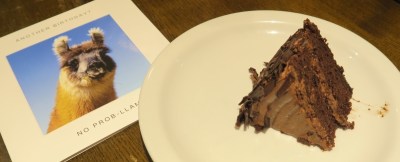
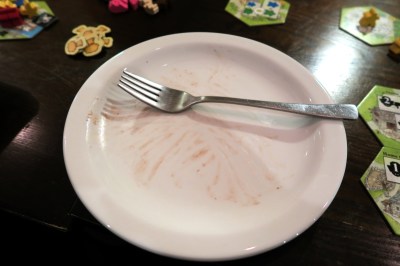
We were about an hour into our respective games and Blue was concentrating deeply on her next turn in Keyflower, when her village was suddenly and unexpectedly improved by the addition of a very fine chocolate cake complete with candles.  Much to her embarrassment, it was also accompanied by singing.  There was a brief interlude while Blue blew out her candles and cut up the cake, admired her quite a-llama-ing card, everyone consumed the really rather delicious cake (Waitrose finest no less), and Burgundy made sure there wasn’t even a pattern left on his plate.  And with all that done, the games continued.

Cake!
– Image by boardGOATS

Keyflower continued after cake and the strategies were beginning to become clear.  Ivory, Blue and Pink were going for animals, while Burgundy’s plans had been undermined by both Blue and Ivory and was trying to make something from his very, very small village.  With the arrival of Winter, players had to put in their choice of the tiles they’d been given at the start.  Much to Ivory’s disgust, someone had put in the Dairy which increases the score for fields with cows in them.  Since neither the Cow Shed tile nor the Ranch tile had been drawn in Autumn, nobody had any cows so the Dairy was a waste of a Winter tile.  This meant there was even more competition for the other tiles, and there weren’t many of those as players can put only one tile into the mix.  Burgundy got his Key Market which nobody else had any real interest in, Blue took the Hillside, but lost out on the lucrative Truffle Orchard to Pink.

Keyflower
– Image by boardGOATS

Ivory took the Mercer’s Guild and the Scribes after a brief tussle with Blue.  It was quite tight with everyone getting points from different places and it was clear the tiles everyone picked up in the final round made all the difference.  Ivory, Blue and Burgundy had spread their points about, while Pink put all his eggs (or rather pigs) in one basket, but it paid off, giving him a massive forty points and seventy-three points overall, four more than Blue in second place.  Everyone had enjoyed playing with the expansion, particularly Ivory who felt it had added more depth.  Although Ivory had to go, there was just time for a quick game of 6 Nimmt!, so Pine took his place and the foursome played a couple of hands.  In the first round Burgundy and Pine competed for the highest score with twenty-five and twenty-seven points respectively.  In the second round, Pine picked up what might be a record score of forty-five.  At the other extreme, Blue managed to keep her score down to eleven, and added to the three in the first round that gave her a clear victory—just in time for her birthday at the end of the week.

An Empty Plate!
– Image by boardGOATS

Learning Outcome:  Sometimes a pig strategy brings home the bacon!

24th July 2018

It was a quiet night, and the atmosphere was slightly subdued as our thoughts were with Green who had had a very rough day and therefore wasn’t with us.  Burgundy and Blue were still eating, so Pine, Red and Ivory began punching out Pine’s brand-spanking, new copy of the “Feature Game”, AzulThis week, Azul won the Spiel des Jahres Award, but despite the fact that it only came out at Essen last year, and has been difficult to get hold of for much of the time, we’ve still managed to play it a lot.  Even so, Red seemed to have managed to miss out, so an explanation of the rules was in order.  It is quite simple to play, if a little abstract.  The idea is that players are tile laying artists decorating a wall in the Palace of Evora with “azulejos”.  On their turn, the active player can either take all the tiles of one colour from one of the factory displays (putting the rest in the central market) or take all the tiles of one colour from the market in the centre of the table.  They then place the tiles in one of the five rows on their player board.

Azul
– Image used with permission of BGG contributor JackyTheRipper

Each row can only contain one colour, but players may have more than one row with any given colour.  The catch is that each player only has five rows, each with a set number of spaces, one to five.  Players can add tiles to a row later in the round, but once a row is full, any left-overs go into the negative scoring row.  Once all the tiles have been picked up, players evaluate their board, and, starting with the shortest row, one of the tiles from each full row is added to the player’s mosaic and scored. Players score one point for a tile that is not placed adjacent to any other tile, whereas tiles added to rows or columns score the same number of points as there are tiles in the completed row (or column).  The game continues with players choosing tiles from the factory displays and then adding them to rows, the catch is that as the mosaic fills up, it is harder to fill the rows as each row can only take each colour once.

Azul
– Image used with permission of boardgamephotos

End game bonuses, keep everyone guessing right up to the end which adds interest and occasionally it can be really nasty when someone ends up with a pile of tiles they can’t use.  Red, Ivory and Pine got going quickly, and once Burgundy and Blue had finished with their supper, they moved to a table near the door to make the most of the draught and started a second game with Black and Purple.  Having played the game quite a bit, nobody pulled their punches:  It was only the second round when Blue had to pick up ten yellow tiles netting her fourteen negative points.  She was fortunate that she didn’t have fourteen to lose, but when Black picked up seven yellow tiles a couple of rounds later he was less lucky.  On the next table Ivory was being nasty to Pine, leaving him with Hobson’s Choice and minus ten points either way.  Playing “dirty” clearly worked for Ivory as he won the first game, though there was some confusion of the scoring, which Pine blamed on his over-hot head.

Azul
– Image by BGG contributor JackyTheRipper

In the other game, there had been a lot negative points and a lot of bonuses, it was all surprisingly close.  In the last round, Purple took the tiles she needed for a full set of reds and Blue had scotched a ten point bonus for Burgundy.  Despite that, Burgundy still picked up a massive twenty-seven points in end-game bonuses, but much to everyone’s surprise he didn’t quite manage to catch Black who finished with a eighty-five.  It had been quite a stressful game, but as usual, we’d all enjoyed it, and discussion moved on to the new release coming in October: Azul: Stained Glass of Sintra, which we are all looking forward to, as long as it doesn’t “do a Queendomino“.*

Azul
– Image used with permission of BGG contributor Toynan

Red, Pine and Ivory had started their game first, and with only three players compared with four on the other table, it was no surprise that that also finished first.   As they were looking round for something to play, Red spied Yardmaster, one of her favourite games, in Blue’s bag.  Neither Pine nor Ivory had played it before, but it wasn’t difficult for Red to persuade them to give it a go.  Unlike most other train games, in Yardmaster, players are building a locomotive rather than routes.  On their turn players can do two from the three possible actions:  draw a cargo card (either blind or from the face up discard pile); buy a railcar card from the four face up cards in the middle, or swap their “Exchange Token” with any other one around the table.  To buy a railcar, players pay using sets of cargo cards, so a yellow number three railcar will cost three yellow “oil” cards.  The exchange tokens allow players to use other cargo cards at a rate of two-to-one, however, if a player only had two yellow oil cards but also had two blue “coal” cards and the blue exchange token, they would still be able to buy the yellow number three railcar.

Yardmaster
– Image used with permission of BGG contributor joeincolorado

When buying a railcar, if the number or colour match the previous car, then it must be added to the end of their locomotive.  If not, then players can park it in their personal sorting yard and add it later, when another railcar is being bought and added to the locomotive.  This is the clever part of the game as it allows players to “stack” points in their personal train yard enabling them both to take some risks and strategically remove railcars from the grasping hands of their opponents.  Players score is the total of the numbers of the on the railcars making up their locomotive at the end of the game.  Ivory started out with a really clever move, using a discarded “extra move” cargo card to take another “extra move” card and Pine and Red thought it was all over before it had begun.  It wasn’t though, and despite it being a very short game, Ivory quickly got bogged down trying to buy a high value, “Purple Four”, which gave both Red and Pine the chance to get past him.  Although he was new to the game, it was clearly one that made sense to Pine who finished four points ahead of Red.

Yardmaster
– Image used with permission of BGG contributor moonblogger

As both games finished Blue, Burgundy, Black and Purple moved back to the group’s usual table and the options were discussed.  With seven players and Red present, Bohnanza was always a possibility, but with the heat sapping everyone’s strength, nobody fancied playing anything too strenuous and the deal was sealed.  Everyone is very familiar with this, even Ivory who has played it the least, so as Burgundy shuffled the deck and removed the cocoa and garden beans, everyone else reminded each other of the rules:  must plant the first card in hand, may plant the second as well; turn over two cards from the deck which must be planted before any other deals can be finalised; trading can only be with the active player; draw four cards at the end of a turn; two coins for a third bean field; fields with only one card can’t be ploughed in unless they all have only one card, and don’t forget – you can’t rearrange your hand!

Bohnanza
– Image used with permission of BGG contributor spearjr

As usual with a large number of players, it was a tight game and everyone spent most of it telling people not to trade with everyone else as they were winning.  Three times through the deck doesn’t take long and people don’t get many turns, but it was Blue, Black and Purple who stood on the podium at the end with everyone else within a point of each other.  It was Blue who made up for her dire showing in Azul though, beating Black into second place by a massive two points.  There was still time to play something else, but the heat had clearly got to everyone as the conversation degenerated into a discussion about everyone’s favourite childhood cartoons and how many had inspired boardgames.  The late, great Peter Firmin‘s Ivor the Engine and Noggin the Nog both got a mention, but then age and nationality created a bit of a divide, and the evening ended with Pine crowing, “My name’s Pig and I like cream cakes!”  His head was definitely over-hot.

Pipkins
– Image taken from youtube.com

Learning Outcome:  Children’s TV programs were very weird in the 1970s.

* Queendomino is the follow-on to the 2017 Spiel des Jahres winner, KingdominoWhen the group played it, we found the new game replaced the smooth elegance of the original with a more clunky, complex, long-winded game that was no where near as good as the games it was trying to compete with (much like Tsuro of the Seas a couple of years before).

Spiel des Jahres Winners – 2018

The 2018 winner of the coveted German Game of the Year or Spiel des Jahres award is Azul.  This has been a very popular game within the group and to us has been the stand-out game this year since Essen.  It is very easy to teach with a surprising amount of depth and is beautifully produced, making it a game we are always happy to play.  The Kennerspiel des Jahres was awarded at the same time.  This honours more challenging games and this year was awarded to Die Quacksalber von Quedlinburg.  So far this has only been released in German, so we have not been able to play it yet.  In addition, there was a special award for for Pandemic Legacy: Season 2, which the jury felt was the benchmark against which all other legacy games should be judged.  The Kinderspiel des Jahres award was announced last month and went to Funkelschatz (aka Dragon’s Breath) which is dexterity gem collecting game.

Azul
– Image used with permission of boardgamephotos

Spiel des Jahres Nominations 2018

Almost every time we’ve played Azul, the topic of conversation has moved on to the Spiel des Jahres and how it would be a travesty if it did not receive at least a nomination. It was with this in mind that we read the Spiel des Jahres nominations when they were announced this morning.  There are three nominees in each of the three awards:  a children’s game award (Kinderspiel des Jahres), the “Advanced” or “Expert” Kennerspiel des Jahres, and the main Spiel des Jahres (often interpreted as the “Family Game” award).  In addition, for the first time since 2010, there is also a special award for Pandemic Legacy: Season 2 by Matt Leacock & Rob Daviau, reflecting Pandemic, Forbidden Island and Pandemic Legacy: Season 1 that were all nominated, but failed to win a prize, and have had a significant influence on cooperative and legacy games as a whole.  The other nominees are:

  • Kinderspiel des Jahres
    Kinderspiel des Jahres 2018Emojito! by Urtis Šulinskas
    Funkelschatz (aka Dragon’s Breath) by Lena & Günter Burkhardt
    Panic Mansion (aka Shaky Manor) by Asger Harding Granerud & Daniel Skjold Pedersen
  • Spiel des Jahres
    Spiel des Jahres 2018Azul by Michael Kiesling
    Luxor by Rüdiger Dorn
    The Mind by Wolfgang Warsch

Firstly, more than half of the nominees were designed by either Wolfgang Warsch, or Michael Kiesling, so huge congratulations to them.  In our view, Azul richly deserves it’s nomination and it would be no surprise if it ultimately wins the award.  Of the other two nominations for the “red pöppel”, The Mind has received quite a lot of attention, and is a bit like a cross between Hanabi and The Game (both of which have been acknowledged by the Jury in the past, in 2013 and 2015 respectively).  Luxor has a good pedigree as it is designed by Rüdiger Dorn (also designer of The Traders of Genoa, Goa, Istanbul, and one of our group favourites, Las Vegas), but it is a bit more of an unknown as it has only just come out.  Usually the Kennerspiel Prize winners are a good fit to our group, but this year they are also largely unknown to us, so there is clearly a lot to discover before the winners are announced in Berlin on 23rd July (Kinderspiel des Jahres winners will be announced in Hamburg on 11th June).

Spiel des Jahres
– Image from spieldesjahres.de


3rd April 2018

Blue and Pink arrived first and, as they were early, they decided to get in a quick game of NMBR 9, while they waited for food and more people.  This is a game which is rapidly becoming one of our go-to fillers primarily thanks to it’s almost non-existent setup time.  This time, Blue turned over the cards, and Pink scratched his head a lot as he tried to work out what to do with his tiles.  Once a few tiles have been placed to form a base layer, then tiles can be placed on top of other tiles as long as there are no overhanging parts, and the tile sits squarely on more than one other tile.  This is essential as the higher the tiles are placed the more they score.  Unfortunately, the rule Pink forgot about was that tiles must be placed such that at least one edge touches a previous tile on that level.  “Cheating” didn’t do him much good though, as Blue won by more than thirty finishing with a massive eighty-one thanks largely to placing a seven on the fourth tier.

NMBR 9
– Image used with permission of BGG contributor punkin312

Although a few of our regulars were missing (Green, Red and Ivory), they were ably replaced by a couple of our irregulars in Pink and Turquoise.  So while we made sure there were no more stragglers and Burgundy finished his inch thick slice of ham, we played another quick filler game, this time of 6 Nimmt!.  This has long been a favourite in the group, thanks to the fact that it plays a lot of people coupled with the hilarious way that a tenuous control of the game can catastrophically turn into chaos.  It is one of those games that is more difficult to explain than to play, but essentially each player has a hand of cards and simultaneously everyone chooses one to play.  Simultaneously, everyone then reveals their card and each card is added in turn to the end of one of the four rows of cards on the table.  Beginning with the lowest each card is added to the row with the highest number that is still lower than the active card.  The snag is, if anyone’s card is the sixth to be placed in a row, the first five are “won” and and the card becomes a new starting card.

– Image by boardGOATS

As well as a face value (one to a hundred and four), each card also has a “nimmt” value: most are one, but there are some as high as seven.  The player with the fewest nimmts at the end is the winner.  It has been somewhat neglected of late though, and has only been played once this year by the group, and then only just (it was the early hours of New Year’s Day), so it was definitely time for another outing.  Normally we play two rounds, dealing out approximately half the deck each time, but with so many of us all wanting to play, we decided to go for a single round and deal ten cards each.  This time Black and Purple were fighting it out for the unofficial wooden spoon, but that honour was reserved for Turquoise with a quite fantastic thirty-one.  At the other end, both Burgundy and Blue thought they might have got it with just three and one respectively, but it was Pink with a nice round zero who pipped them to it.

– Image by boardGOATS

Once the food and the nimmts had been dealt with and it was clear that no-one else was coming, the inevitable squabble began over who wanted to play the “Feature Game”.  This week it was Fabled Fruit, a very light worker-placement and set collecting card game with a “Legacy” element to it.  As such, the game is very simple, but develops as you play.  The idea is that the game starts with six “Locations”, each of which is formed by a deck of four cards.  On their turn the active player moves their meeple to one of the locations and either carries out the action shown on the cards in the deck or buys one card for the amount shown.  The locations provide access to “fruit cards”, which are the currency in the game and are used to buy the location cards.  Each location has a different action, for example, the first location enables the active player to draw two cards from the top of the fruit deck.

Fabled Fruit
– Image by boardGOATS

On the other hand, Location Five allows the active player to draw cards until they have a hand of three—useful if they started with no cards, but not so helpful if they had a handful. At Location Six, the active player can turn over as many cards as they like, keeping all the unique cards they turn over, but go bust in a Port Royal sort of way if they turn over a duplicate card.  Since there are five different fruits, this action quickly becomes increasingly risky.  There are other actions, some of which add a bit more interaction, like giving a player a banana card and getting two cards in return or drawing one card from the fruit deck and then exchanging three fruit cards with another player.  A little more interaction comes from the fact that visiting an occupied location costs a fruit card: since location cards typically cost four or five fruit cards, this is expensive, especially with low player counts, but playing with the full complement makes this almost unavoidable from time to time.  Aside from this though, there is very little interaction and the actions for the starting locations are quite mild.

Fabled Fruit
– Image by boardGOATS

The interesting part is how the game develops, since a new card is added to the game every time a location card is bought.  Each location holds just four cards, so for every cards that are bought, a new location is introduced, and once all the cards for one location have been bought, that location and therefore that action is no longer available.  The really clever part of the game is the “Legacy” element:  the end game condition, becomes the start condition for the next game.  For this reason, we decided to play the game three times so we could see and appreciate how it evolves.  The rules were easy enough to explain and Turquoise, Magenta and Burgundy were keen to give it a go, so they joined Blue and Pink leaving Black, Purple and Pine to find something else to play.  It wasn’t long before the Fabled Fruit players were happily collecting fruit cards and occasionally turning them into juice by buying location cards.

Fabled Fruit
– Image by boardGOATS

It is a game of very fine margins, though and it wasn’t long before almost everyone had two Location cards tucked away and were fighting for one more to win.  In truth it wasn’t a long fight as Pink made his experience with the game tell and took the first round.  Then instead of resetting the game, we checked we still had the right number of cards out, and started again with the new set up.  So this time, we started with the market which had been introduced during the first round.  This is a face up display of five cards that players can interact with.  The Locations that were available allowed players to trade cards with the market, but also trade one strawberry, for any three non-strawberry fruit cards in the market.  This hugely increased the value of strawberries and, with the high value of pineapples (which could be traded for five from the deck) and bananas (which could be used to take cards off another player), it meant that players were holding more and more cards.

Fabled Fruit
– Image by boardGOATS

This all changed in the third round, however, when Location Ten appeared which allowed the active player to take two fruits from the player with the most cards.  Nobody liked falling victim to that one very much, but everyone took advantage where they could.  With just Pink taking the second round as well as the first, it was all about trying to stop him taking a clean sweep.  In the end it was really tight.  Everyone gets the same number of turns, so when it was clear that Pink was once again in a position to trigger the end by purchasing his third card, it was a question of whether anyone could stop him.  Although Turquoise who started the round had been steadily improving, there was nothing she could do, nor Burgundy who went next.  As Pink then played his master-move and picked up third Location card, the question changed to whether Blue and Magenta would be able to join him.  Both had enough cards, but but Magenta, was unfortunately standing on the only card she could buy, so in the end, the final round was shared by Blue and Pink.

Fabled Fruit
– Image by boardGOATS

Meanwhile, on the next table, Black, Purple and Pine had started off with Azul.  This, like NMBR 9, has been an immensely popular game since it first appeared on the group’s radar at Essen last year.  The game is almost entirely abstract, with a very loose “artists decorating a wall in the Palace of Evora” theme, but somehow, that doesn’t seem to matter as the game play is good and the production values very high.  In summary, the active player can either take all the tiles of one colour from one of the factory displays (putting the rest in the central market) or take all the tiles of one colour from the market in the centre of the table.  They then place the tiles they took in one of the five rows on their player board.  The catch is that although they can add more tiles to a row later in the round, once a row is full, any left-overs go into the negative scoring row. The round ends when all the tiles have been picked up, and one tile from each full row is added to the player’s mosaic and scored.

Azul
– Image used with permission of boardgamephotos

Tiles placed singly score just one point, but if they become part of a row or column, they pick up points for each tile in the row or column, so clever players can make tiles score over and over again.  The game ends when one player gets a complete row, so it takes at least five rounds, and then bonus points are awarded for completed columns or rows and full sets of five of a colour.  Purple wasn’t concentrating, so failed to get any bonus points, while Black and Pine picked up a few negative points.  Pin had a disastrous final round when he was forced to pick up six red tiles but could only place two of them meaning the rest all scored negative points, a total of minus thirteen for that round.  It didn’t do him too much damage though as he finished with thirty-eight, ten points clear of the others who were in a battle for second that Black won by a single point.

Azul
– Image used with permission of BGG contributor Toynan

Next the trio moved on to Sagrada.  This is another popular “game of the moment”, with very similar feel to Azul, but this time using dice and players are building a stained glass window by placing dice on a grid of dice on their player board.  Each board has some restrictions on where certain coloured or numbered dice can be placed there and players take it in turns to take dice from a pool and add them to their window.  Depending on the difficulty of the starting grid, players start with a small number of favour tokens which act as “get out of jail free” options and allow them to use special tools to manipulate some of the dice, either during the “drafting” phase, or sometimes those already in their “window”.  Points are awarded for fulfilling certain criteria, depicted on cards drawn at random at the start of the game.  Although completing the window can be challenging in its own right if the dice don’t roll well, it is the objective cards that are the key to the game.

Sagrada
– Image used with permission of BGG contributor punkin312

Each player has their own private objective which scores for the number of pips displayed on dice of a given colour in that player’s window. There are also three public objectives which everyone can use to score points; this time these gave points for complete sets of all five different colours, complete sets of all six numbers, and for columns that contained different numbers.  The game starts with each player choosing a window from two double-sided cards dealt at random.  The hard ones come with a lot of favour tokens and these can be critical as they can be used to move and re-roll dice or other special actions depending on what special tools are available.  This time they were particularly important, as everyone kept rolling sixes which wasn’t what they really needed.  Purple in particular made full use of all her favour tokens which helped keep her in the game.  When it came to scoring, it was quite close, with players taking similar scores on the separate public objectives. The small differences added up, however, and Pine finished in front with a nice round fifty, a handful of points ahead of Black in second place.

Sagrada
– Image used with permission of boardgamephotos

Fabled Fruit still hadn’t finished, but was well into its third round, so Purple, Black and Pine, looked round for something familiar and quick to play, and their collective eye fell on Kingdomino.  The rules didn’t need much recap: take a domino and add to the kingdom and then place a meeple on one of the dominoes on display for the next round.  When placing the dominoes, one of the two ends must connect to terrain of the same type already in the kingdom, or connect directly to the start tile.  Points are awarded at the end of the game by multiplying the number of tiles in an area of terrain by the number of crowns in the area.  All dominoes must fit in a five-by-five space (or be discarded) and bonus points are awarded for successfully placing all tiles and finishing with the start tile in the centre.

Kingdomino
– Image used with permission of boardgamephotos

It is a very clever little game, and tile placement is clearly critical, but one of the most important aspects is the trade off between turn order and tile value.  Each domino has a numerical value and they are set out and taken, from low to high, so players going for the more valuable tiles are trading this value against their position in the turn order.  This was key for Pine who failed to get the crowns he needed and when he did couldn’t add them to the terrain he wanted.  This was exacerbated by the fact that with only three players, some tiles never appear which can upset the balance of the game.  All in all, Pine had a complete “mare” of a game, crowned by the fact that he failed to place all his tiles and didn’t get his castle in the centre of the kingdom either.  It was a game he wanted to forget, but was close between Black and Purple.  Black had the edge though and finished with a grand total of seventy.

Kingdomino
– Image used with permission of boardgamephotos

Nobody wanted a late night, but everyone fancied finishing with something light, and with so many people Las Vegas is always a good option.  This light dice game is really easy to play and doesn’t require much in the way of concentration, so is great to wind down with.  On their turn, each player begins by rolling their dice, then assigning some of them to one of the six casinos.  Each casino is numbered one to six and has a jackpot drawn at random from a deck of money;  the catch is that to place a “bet”, the player must use all the dice of one number that number.  Once everyone has placed all their dice the player who placed the most dice on a casino takes the highest value currency card. The really clever bit is that before any money is handed out, any “draws” are removed, which leads to a lot of barracking.

Las Vegas
– Image used with permission of BGG contributor joeincolorado

We also always add the Slot Machine from the 2015 Brettspiel Advent Calendar, which is like a seventh casino, except that it can hold dice of any number, but each number can only be added once (though a player must add all the dice they have of that number).  We also add some elements from the Boulevard expansion, including extra high value money cards, the “biggun” (which replaces one die per person with a larger, double weight die worth two of the little ones) and extra dice so more people can play.  Finally, we always house rule the game so we only play three rounds instead of four—although we love it, with four rounds it can outstay it’s welcome for those who feel they can’t catch up.

Las Vegas
– Image by boardGOATS

It’s never easy to tell how people are doing as the money is stored face down and the denominations vary from $10,000 to $100,000, so someone with a large pile may be very rich or just have a lot of “notes”.  And Purple certainly had a lot of notes as she popped out to the conveniences and came back to find a massive money pile.  Everyone was so impressed that several others optimistically tried the same trick, but unfortunately they didn’t quite have the knack.  It was an exciting game though; with so many people playing there were a lot of draws and lots of bids ended up cancelling out others, often with three people involved and a fourth very lucky “loser” picking up the spoils.  In the final counting, Pink proved that while he was good at collecting fruit, he was rubbish at collecting money.  At the other end of the scale meanwhile, Black and Purple were again fighting it out for first place, but a tie on $340,000 each was eventually resolved in Purple’s favour.

Las Vegas
– Image used with permission of BGG contributor ckirkman

Learning Outcome:  Aesop doesn’t have a monopoly on Fables.