Tag Archives: Bohnanza

25th July 2023

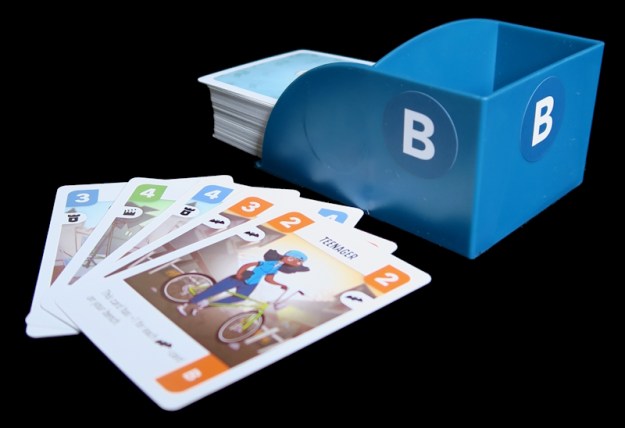
After Blue and Pink had sampled the new pizza menu at The Jockey, people started to roll up and join them for the usual chatter.  There were a total of nine, which was one more than  required for the “Feature Game“, the recently announced Kennerspiel des Jahres winner, Challengers!.  This is a deck-building, dueling “capture the flag” game where players battle head-to-head to find the winner.  It is a very light game, with a largely random element, at least on the face of it, so it was always going to be a bit of a “Marmite” game.  Green commented that he wasn’t very interested in it, but as everyone else was quite keen to give something novel a go, he sportingly joined in.

Challengers!
– Image by boardGOATS

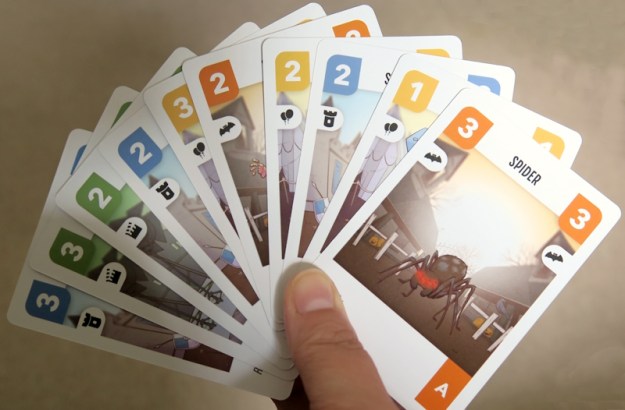
The game is very simple, and seems, at first glance to be quite random.  Players start with a hand of cards, and then draw five more and choose a set number to add to their hand.  The clever part is that (with eight players) the game is played over seven rounds, and each round the decks players draw from and/or the number of cards they can keep changes.  There are three decks, A, B and C, and the cards become increasingly powerful as the game progresses.  Once players have fettled their deck, they duel against their designated opponent by drawing the cards from their deck.  In this, one player starts by playing a card and taking the Flag, then the other plays cards until their total equals or exceeds that of their opponent.

Challengers!
– Image by boardGOATS

This initially seems quite random in that players have no agency in this element of the game.  There is a suggested variant that can change this by allowing players to draw two cards and choose one to play—this was an option for later in the game, but in the end, the group stuck to the rules as written.  The game focuses on this duel aspect, but really it is more about building card combinations during the first part of the game and deciding what cards to shed and how many.  Shedding cards is just as important as acquiring cards as, as the winner of a duel is the last player with the flag, so running out of cards can lose a match.

Challengers!
– Image by boardGOATS

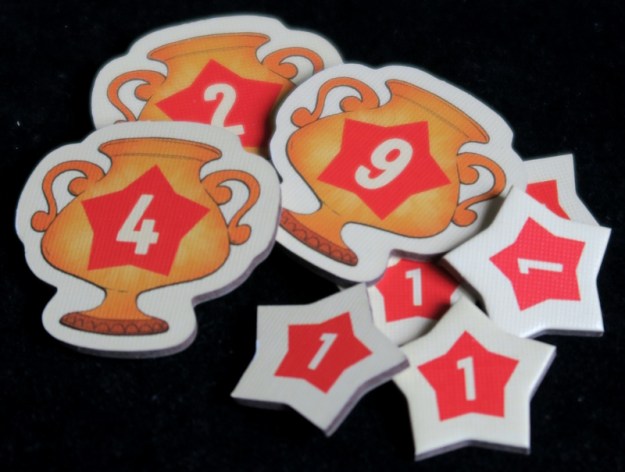
Having too many cards can be a problem as well though—when they take the Flag, players move all their cards except the last played to the “Bench”.  The Bench has six seats, and when a card needs a seat and there isn’t one, that player loses.  The winner of the match, the last player with the Flag, then takes a winner’s token which is worth points at the end of the game.  The game is all about the cards which make it less random than it seems at first; some cards have special powers, while others give points.  Additionally, identical cards can share a seat on the Bench, so effectively allow players to have more cards, however, those tend to be weaker cards from the A deck.

Challengers!
– Image by boardGOATS

As such, Challengers! should perhaps be thought of more as a programming game, more in the mold of games like Colt Express, rather than a dueling “capture the flag” game.  After each match, players play musical chairs and after seven rounds (with eight players), the players with the most points duel for overall honours.  Although the idea is very simple, it took a little while for people to get to grips with the procedure.  Blue, who was suffering with the after-effects of a bad cold, acted as much needed umpire and guide, explained the rules and demonstrated how the duel worked using Pink’s hand of cards.

Challengers!
– Image by boardGOATS

Possibly thanks to her fuzzy head, but Pink despite the fact that he was sat in front of her, was onto the second round before Blue realised that something wasn’t right.  Instead of taking his starting hand back after the demo, he had just drawn five blind cards from the A deck, making his hand immensely over-powered.  There were the usual tongue-in-cheek cries of “Cheat!”, but it was a genuine error, albeit one that wasn’t easy to fix by this time.  As a result, the quickest and easiest solution was for him to forfeit the first round and fix his hand before re-starting the second round.

Challengers!
– Image by boardGOATS

One of the nicest aspects of the game was the way everyone played against everyone else.  The GOATS are a nice, friendly group, and although some people end up playing together more often, the group always makes a point of trying to avoid cliques caused by the same people playing together all the time.  The Musical Chairs element of the game meant everyone played against everyone else which gave it a fun, party feel that we usually only experience in October (when we play Crappy Birthday).  It was clear that some people enjoyed it more than others though.  Ivory, Teal and Black, really got to grips with the deck-building element and found the game exceeded their expectations, Ivory in particular really enjoyed it.

Challengers!
– Image by boardGOATS

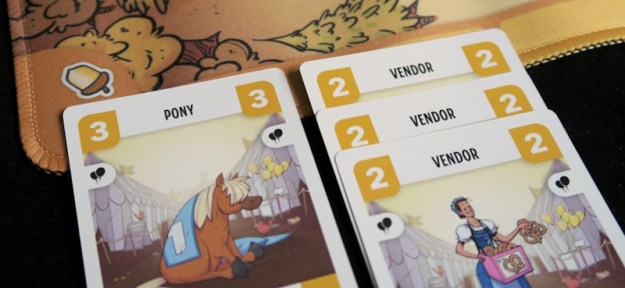
Lime, Pink, Pine and Purple were a little less enthusiastic, while Green felt it was a clever little game enjoyable for a short while, but that it out-stayed it’s welcome—too long for the game-play within it, he couldn’t wait for it to finish.  It wasn’t much of a surprise, therefore, that Ivory, Teal and Black were the winners of the “Round Robin” tournament phase, finishing with thirty-five, thirty-three and thirty-one points respectively (some way ahead of Lime in fourth with twenty-three).  The play off between Ivory and Teal, therefore, was quite close and tense, but Ivory ran out the eventual winner, largely thanks to his handful of yellow Vendor cards.

Challengers!
– Image by boardGOATS

From there, everyone was keen to play something they were familiar with, but it had to be something quite quick.  Teal suggested SCOUT, which Blue was keen to give another try (having played appallingly last time) and Ivory and Purple were very happy to join them.  This is a very simple, but clever hand management game that was nominated for the Spiel des Jahres award last year.  The theme is almost non-existant (something to do with circus performers), and isn’t even reflected in the card art, which is not unpleasant, but very functional (and therefore useful).  The idea is that players have a hand of cards which, like in Bohnanza, they cannot rearrange.

SCOUT
– Image by boardGOATS

Unlike Bohnanza, on their turn players may play any set of adjacent cards from their hand as long as they beat the current winning set, taking any cards they beat into their scoring pile.  Cards can be a a run of cards with consecutive numbers, or a meld of the same number.  Sets are ranked by size and value and a meld always beats a run of the same size.  Players take it in turns to play, and if they can’t or choose not to “Show” a set of cards that beats the current winning set, they instead “Scout”, taking one of the two cards from either end of the set on the table, adding it to their hand (paying the former owner a point from the supply).

SCOUT
– Image by boardGOATS

And this is where the game gets clever:  all the cards have two values, one for each end, so players can add any cards to their hand anywhere they like and either way up (i.e. making either value active).  In this way, players can manipulate their hand making larger melds or longer runs.  The round ends when either every body “Scouted” in succession, or where one player has run out of cards.  Players then score points for each card in their scoring pile and for each chip for cards taken by “Scouting” with negative points for any cards left in hand.  The first time we played this with the group, it had all been a bit of a voyage of discovery, and last time, Ivory gave everyone a bit of a spanking, so Teal and Blue were keen to prevent that from happening again.

SCOUT
– Image by boardGOATS

Things started off well, with Blue beating Ivory in the first round, though Teal and Purple did less well ending up with a hand of cards.  The second and third rounds went better with everyone taking positive points and it was very close going into the final round leaving it all to play for.  Sadly for everyone else, Ivory brought his A-game to the last round ending the round swiftly leaving Purple and Teal with a hand that more or less off-set their takings and Blue with a positive score, though one with fewer points than Ivory.  The end result wasn’t really very close, though it felt less of a stomping than last time:  Ivory finished with fifty-five points and Blue took second with forty-one, ahead of Purple and Teal who tied for third.

SCOUT
– Image by boardGOATS

On the next table, Green, Pink, Pine and Black played a close fought enjoyable game of Les Aventuriers du Rail Express, a variant of the Spiel des Jahres winning Ticket to Ride series, but one that is a sort of half-way house between the original full versions of the game and the mini “city” games (like Ticket to Ride: London).  The game only plays four and takes less time, but is quite a nice variant and has a couple of differences to the original, being shorter without losing too much of the main game’s challenge.  As in the original, players can either take two cards from the market (face up cards, or the draw deck), or pay cards to place trains on the board.  Unusually, however, the Locomotive “wild” cards are kept in a single pile and therefore are always available.  This is quite a nice variation, as it means that players never feel forced to take blind cards because what they need isn’t available.

Les Aventuriers du Rail Express
– Image by boardGOATS

This effectively means players are guaranteed to get at least one train card they want.  The other major difference is the presence of the long route ticket.  This is one route that everyone can claim, however the highest scores go to the first to claim it.  It additionally means that failing to complete it does not lead to negative points, so players can ignore it and concentrate on normal short route tickets if they prefer.  There was a moment when the group had three identical coloured cards in the face up market which made them whether they should be scrubbed (as with three Locomotive cards in the base game).  It couldn’t be found in the rules and it was pointed out that in the original games it is possible to have five cards of the same colour, so they stayed and someone eventually found a use for them.

Les Aventuriers du Rail Express
– Image by boardGOATS

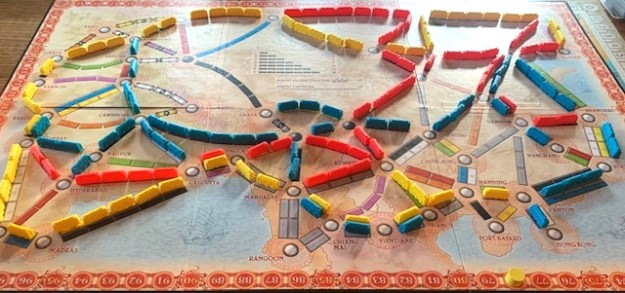
Pine took an early point lead which he maintained for quite a while until Green and Pink caught up, and not long after, Black too.  However, as the game neared its conclusion Pine pulled ahead again. Pink had completed the long route already and, at the cost of not being able lay his last two trains, Green decided to get the game finished before anyone else managed it. That long route helped Pink finish in front with sixty-four points, while Black’s slow start demonstrated that getting trains down early is no guarantee of success.  That said, he managed to pull into the station in second place with sixty-one points. Green and Pine fought to not be last and ended up tied just a couple points behind with fifty-nine points.

Ticket to Ride: Europe
– Image by boardGOATS

Learning Outcome:  Winning the Spiel des Jahres award means a game is good, but doesn’t mean it will suit everyone.

27th June 2023

Lime was the first to arrive, soon followed by Blue, Pink with Purple, then Pine, Jade, Plum, Ivory, and Teal.  Jade and Teal were armed with some of their toys from UK Games Expo, so the first two games were the “Feature Game“, the Aerial expansion to Draftosaurus and the 2022 Spiel des Jahres nominated SCOUT.  There was the usual chatter at the start while Blue and Plum tried to work out some of the details of the Draftosaurus expansion where the rules were unclear.  Then there was the usual hiatus to sort out who was playing what, but eventually Plum led Purple, Jade, Pine and Pink passing Pterodactyls round the table.

Draftosaurus
– Image by boardGOATS

Draftosaurus is a lot like Sushi Go!, but with wooden dinosaurs.  It’s one of our most popular games that we first played online in 2021 and have since played lots of times in person, drafting real, cute, miniature, wooden dinosaurs.  Instead of sushi cards, players start each round with a handful of wooden dino-meeples, choose one to keep and add to their dino-park, and pass the rest on to the next player.  The active player rolls a location die, which applies a restriction to where dinosaurs can be placed that everyone except the active player has to observe.  There are various pens, each of which score players points in different ways.  For example, the Meadow of Differences can only hold one of each type/colour and scores for each different type.

Draftosaurus: Marina
– Image by boardGOATS

In contrast, the Forest of Sameness can only hold one type/colour of dinosaur, but also scores more the higher the occupancy.  The Prairie of Love needs pairs of dinosaurs of the same type, each of which score five points, while the Woody Trio will score seven points if it contains precisely three dinosaurs at the end of the game (otherwise it scores nothing).  The King of the Jungle and the Solitary Island only hold one dinosaur each, but the King of the Jungle scores if nobody else has more of that type of dinosaur, while the Solitary Island only scores if it contains the only dinosaur of that type in the Park.

Draftosaurus
– Image by boardGOATS

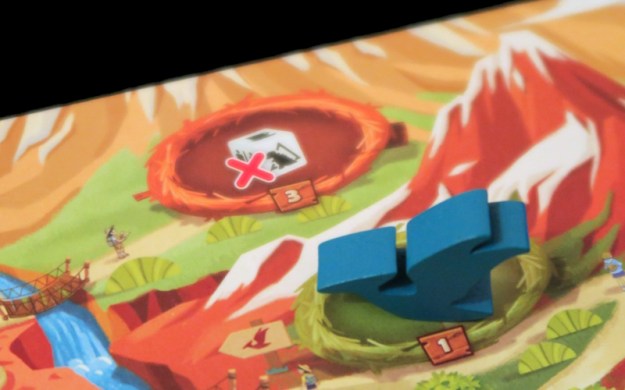
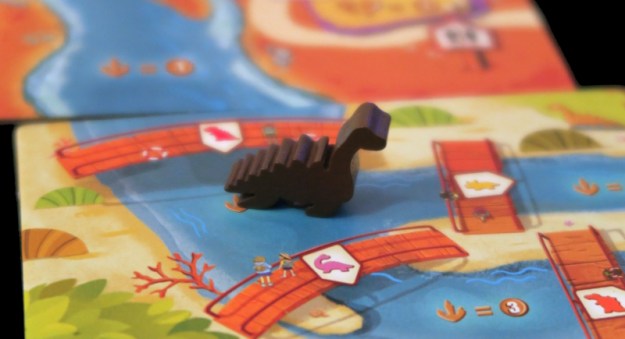
At any time, players can place dinosaurs in the River that runs through the middle of their Park instead of placing them in an enclosure.  There, they will only score a single point, except for any that are the red tyranosaurus Rex which increase the score of any pen they are in by one.  Played over two rounds (passing clockwise and then anti-clockwise, scores are calculated at the end of the game and the player with the most points is the winner.  There is a bit of variety in the base game with double-sided Park boards, though we’ve rarely if ever played the winter side.  There are also two expansions;  a month ago, we played the Marina expansion which adds an extension to the river and plesiosaurs, but this time we wanted to try the Aerial expansion which adds nests on Mountain extension boards and pterodactyls.

Draftosaurus: Aerial Show
– Image by boardGOATS

Pterodactyls can only be placed in the nests on the Mountain expansion board, but when they are placed the player gets some sort of bonus.  The nests are all numbered, one, two or three.  The rules say that before a pterodactyl can be placed in a nest numbered two, one must be placed in nest numbered one.  It was not clear, however, whether players could place dinosaurs in multiple nests numbered one, or whether a second pterodactyl had to be placed into nest numbered two (and by extension, a third should be placed in a nest numbered three).  After much searching online, Plum concluded players had to start with a nest numbered one, before they had the option to use a nest numbered two—an interpretation that was later found to be correct.

Draftosaurus: Aerial Show
– Image by boardGOATS

The Aerial extension boards are double-sided, so things were further complicated by the fact that the board chosen had two nests marked 2a and one marked 2b.  It was suggested that perhaps players had to do both the 2a nests before progressing on to the third nest, but Plum thought that was not the case and that was the choice.  After the event, it was found that the third nest could only be used once one of the 2a nests had been filled (but was not accessible via nest 2b).  Plum did best finishing with a massive thirty-eight, but as everyone was still getting to grips with the new rules and the game is not a long one, the group decided to give it another go with the reverse side of the Mountain board.

Draftosaurus: Aerial Show
– Image by boardGOATS

This time it went better for everyone except Plum and Pink (who had come second in the first game, with thirty-four).  Plum had prioritised placing three pterodactyls so she would be able to ignore the restriction imposed by the placement die, perhaps at the expense of all else.  Lime (who always likes to play games twice in quick succession) and Pine had got the hang of the game and took first and second respectively with thirty-six and thirty-two points.  Although everyone had played Draftosaurus quite a bit during 2020/2021, nobody had been familiar with the expansions.  While they certainly add something new, the Marina expansion is probably the better of the two, though it would be interesting to see how the game would play with both expansions in use too.

Draftosaurus: Marina
– Image by boardGOATS

From there, the group went on to play Mamma Mia!, which is a hand-management card game from Uwe Rosenberg, the designer of the king of all hand-management games, Bohnanza.   Mamma Mia! is quite an old game and we played it quite a bit some years back, but the last time was nearly six years ago and those that knew how to play it had forgotten, and others hadn’t played it then or since.  Purple did her best to explain the rules from memory, but was somewhat hampered by Plum and Lime who kept interjecting, trying to guess how the game might play.  Meanwhile, Pink spent the time trying to read the rules and make sense of them, that said, the game is not all that complex, though really very clever, like all of Uwe Rosenberg’s games.

Mamma Mia!
– Image by boardGOATS

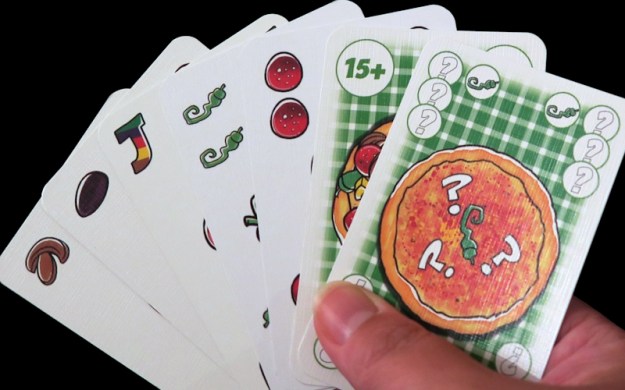
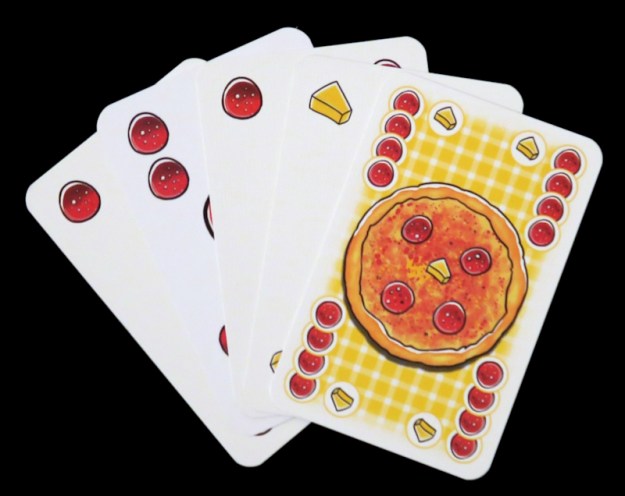
The idea is that each player starts with a hand of pizza topping cards and a deck of order cards.  On their turn, the active player puts pizzas in the oven by placing ingredients cards on top of the central pizza deck and then, optionally, follows it with an order card (which are colour coded for each player) before replenishing their hand from the supply deck.  Unfortunately, in the rushed rules reading, there were a couple of, er, malfunctions:  the group omitted to include the restriction that only one type of ingredient could be played per turn and only one order could be placed, and after placing the toppings cards.  Further, when drawing cards, a player may take them from either the central ingredient deck or from their personal order stack, but not both in the same turn—another rule that, er, malfunctioned.

Mamma Mia!
– Image by boardGOATS

Once the ingredients supply deck is empty, the pizzas are thematically taken out of the oven, by flipping the pile of cards over and placing the cards face up in separate piles for each ingredient i.e. in the order they were played.  When an order is reached the ingredients piles are examined to see if there are sufficient to fill the order.  If so, the cards are removed from the piles, if not, the owner of the order card may add any missing ingredients from their hand to ensure the order is fulfilled.  If they choose not to do so, the incomplete order card is discarded.  After three rounds, the player with the most fulfilled orders is the winner.

Mamma Mia!
– Image by boardGOATS

It was all a bit mad, and with players (incorrectly as it turned out) placing assortments of ingredients cards in the oven, they called out what cards they were adding to the deck.  The cry of “Four chilies and an olive,” was met with the comment from the next table, “That sounds like a mariachi band—who’s the olive?”  It was clear that a lot of fun was had.  Plum succeeded in completing an order of requiring fifteen ingredients that everyone else thought was very risky, but that was pretty much all she managed in the whole game.  Pink, who finished with six clearly thought he should have won, as he commented that Lime was “apparently” the winner with seven and Pine responded, that Pink was “apparently” second, “apparently” followed by Purple in third…

Mamma Mia!
– Image by boardGOATS

Pine commented that before the game started they’d had three different variations and he wasn’t sure which they were going to play, and as it turned out, the one they chose wasn’t quite right!  Despite all the rules issues, however, it had been a lot of fun.  The card-counting memory play worked well, though without a bit of luck in the ingredients department, players could keep playing cards hoping to replenish the hand with better once, without success.  Still, it is clearly fun little card game that we should play again and see if the game is better with the rules played as written.

Mamma Mia!
– Image by boardGOATS

On the next table, Ivory, Teal, Jade and Blue started with SCOUT.  This is a ladder-climbing game with a very nominal theme of circus owners collecting acts for their show.  This theme isn’t really reflected in the art or the game leading Blue to comment that it was the most theme-less game she had ever seen and she wondered why they had bothered.  Not that this made it a bad game, by any means—indeed, when the group played it last year both she and Teal had really enjoyed it.  The game is quite simple, the first player leads with either a run of consecutively numbered cards or a meld of cards of the same number.  The next player can play either a larger set of cards or has cards, or one of the same size but of a higher value (melds always beat runs of the same size).

SCOUT
– Image by boardGOATS

If they beat the cards on the table, the active player takes the beaten cards into their score pile and leads with a new set.  Alternatively, the next player can “Scout” i.e. take a card from either end of the set on the table and add it to their hand.  And this is where the game gets really clever—like Bohnanza, players can only play consecutive cards from their hand, but when they add a card to their hand, they can add it anywhere.  Further, the cards are double-headed, that is to say, they have different values depending on which way up they are.  At the start of the game, players are dealt a hand and, as in Bohnanza must not rearrange their cards, though they can choose which way up the whole hand is, and thus the quality of the hand as a whole.

SCOUT
– Image by boardGOATS

When Scouting, the player can choose which way up it goes into their hand as well as where, and it retains that value in their hand and when played.  Once per round, players can “Scout and Play”, taking a card from the display and immediately playing a set of cards for the cost of a single point.  Playing this at the right time can be critical to winning the game.  The round ends when either a player plays their last card or when play gets back to the player who last played a set and everyone else in between Scouted.  Players score for each card they have taken, but any remaining cards in their hand give negative points, often the decisive factor.

SCOUT
– Image by boardGOATS

This time, the first round was quite close.  Ivory finished the round and also took the most points.  This was the case for much of the rest of the game, and it was soon clear that everyone else was playing for second place.  In that, it was actually quite close.  Blue did particularly badly in the penultimate round, and looked to be cruising for a bruising.  However, she ended the final round very quickly with a very long run leaving both Jade and Teal with negative points (though Ivory still top-scored).  These negative point proved critical, and Blue took second with twenty-seven points, two more than both Teal and Jade.  They were all miles behind Ivory though, who finished with nearly twice that with forty-nine.

SCOUT
– Image by boardGOATS

From there, the foursome moved onto an equally theme-less card game that Jade had come back from UK Games Expo, but one that is also very good, Cat in the Box.  The game that was preceded by a quick game of Snap when Ivory pulled the same game out of his bag.  The game is essentially Hearts, but with the twist that the cards exist in all suits until they are played (analogous with Schrodinger’s cat where the it is both alive and dead until the box it is in is opened—hence the name of the game).  The cards are all black and there are five cards of each value.  As in Hearts, the first player leads with a card of there choice declaring its suit.  The players have a pile of tokens and, when they play a card they mark that card on a tally board so nobody else can play the same card.

Cat in the Box
– Image by boardGOATS

At a time of their choosing, players can declare they no-longer have cards of a suit by marking that on their cat card, but although that enables them to play a red trump card, it also limits what cards they are left with in their hand.  The round ends either when a player creates a Paradox because they cannot play any of the remaining cards in their hand, or when the last player plays their final card.  At the end of the game, players score one point for each trick they took during the round.  However, in a sort of solo-Bridge fashion, players make a contract at the start of each round, declaring how many tricks they think they will take.  If they successfully take exactly this number, they get bonus points equal to the largest contiguous group on the tally board, introducing an area control element.

Cat in the Box
– Image by boardGOATS

The catch is that if the round ends with a Paradox (and it usually does), then the player that caused the Paradox does not score any bonus points and additionally scores minus one for each trick they won.  This is particularly savage as a player can go from doing very well to doing very badly in a heartbeat, as Blue discovered in the first round. Not appreciating the risk, she made a contract for three tricks, which she achieved and with the bonus points would have taken seven or eight in the round until she went bust and ended up with minus three!  So, the risk of Paradoxes introduces a lot of tension, but there is also an element of tactics in forcing players to take tricks they don’t want to

Cat in the Box
– Image by boardGOATS

Teal was more circumspect and played very cautiously, so although he caused two paradoxes, they only cost him a total of two points.  Unfortunately for him, he only picked up one point in each of the other two rounds leaving him with a round fat zero.  Jade started cautiously, but then went for bonus points, successfully taking seven points twice, but unfortunately, for him his paradox in the third round was costly, losing him three points, he still finished with ten points, one more than Blue.  Ivory just managed to avoid triggering a Paradox, which is a key part of the game of course.  So with his moderately high, consistent scoring in the second, third and final rounds he finished with fifteen points and his second victory of the night in what was a fun, if quite nasty game.

Cat in the Box
– Image by boardGOATS

Learning Outcome: Little card games can be an awful lot of fun.

13th June 2023

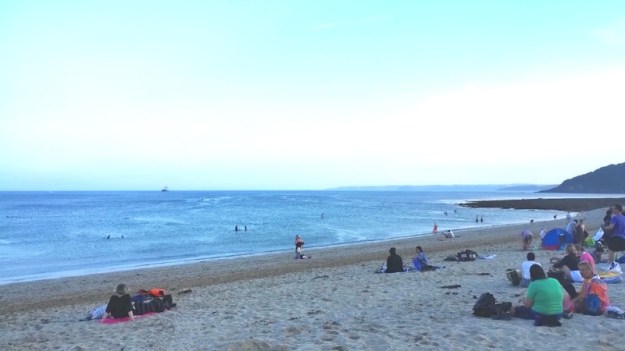
Lime was first to arrive, soon followed by Blue and Pink, and then Pine who were all delighted to see the return of our favourite bar staff.  There was a lot of chat about the recent changes at The Jockey (which is currently managed by the Healy Group who also run the Punch Bowl in Abingdon), and as everyone else arrived, people seemed more interested in gossiping than playing games.  It was a relatively quiet night with quite a few people away.  Black and Purple sent a message to say they were thinking of us, but when Green received a photo from Black and Purple of their current view, it just made everyone else jealous.

Black and Purple in Cornwall
– Image by Black

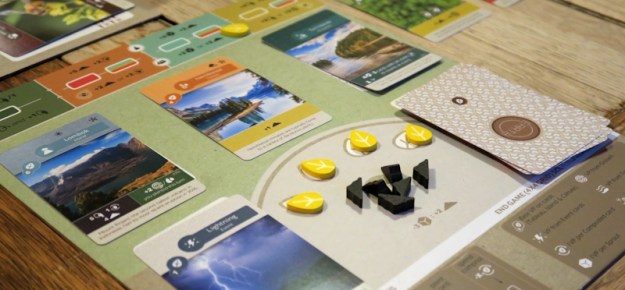
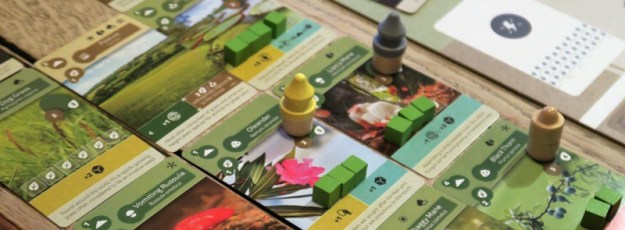
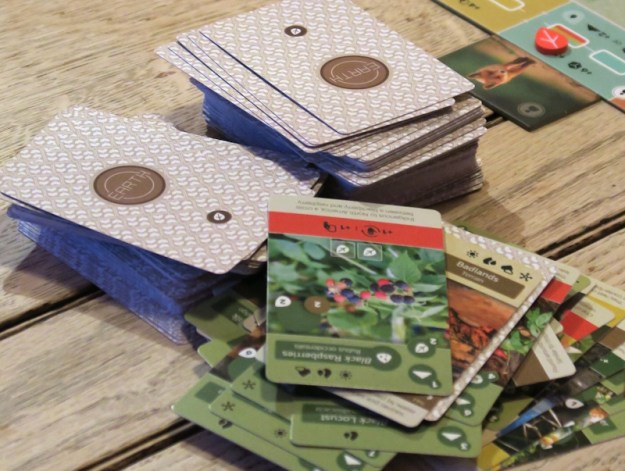
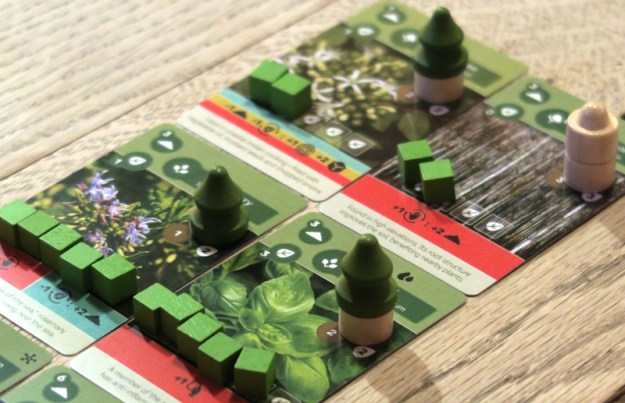
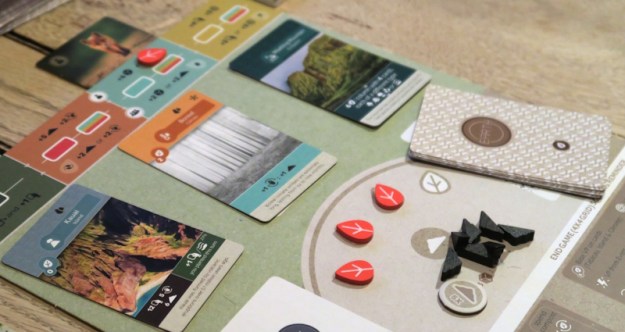
Jade arrived with his shiny new copy of Earth which he’d picked up from UK Games Expo.  It is a game where players are building themselves an ecosystem and was to be the “Feature Game“.  Earth is a sumptuously illustrated, card-driven engine-builder that is often compared to Wingspan.  We played that Last time after a bit of a break, and remembered how much we liked it, so had decided to give Earth a go this time.  The heat was getting to some people, but Ivory was quite keen to give Earth a go, and they were soon followed to the next table by Green (who had played it online) and then Teal.  Everyone was pretty new to the game:  Ivory and Teal had not played it before and Green and Jade had only played a couple of times.

Earth
– Image by boardGOATS

Although there is a lot to explain before starting, Earth itself is not actually all that complicated. Players are building a four by four grid of Flora and Terrain cards which represents their island and during the game they will plant flora, water it and allow it to grow.  On their turn, players do one of four things: Planting (paying the cost in Soil tokens), Composting (gaining Soil and placing cards from the deck in their discard pile), Watering (place Sprouts and gain Soil) & Growing (draw new cards and place growth tokens).  A bit like Puerto Rico, once the active player has chosen which action they are taking, everyone else gets to do a subsidiary, slightly weaker version of the same action.  For example, when Planting, the active player plants two cards, draws four and keeps one, while the other players plant one and draw one.

Earth
– Image by boardGOATS

Once everyone has completed the action for the turn, everyone activates all the cards in their island that match the colour of the action chosen, starting with the card in the top left and working across each row in turn.  This means, not only is it important which cards are played, but also where they are located in the player’s island.  At the end of the game (triggered when one player has completed their island), players score points for each flora card, any Trunks and Canopies they have grown, their Sprouts and their pile of “Composted” or discarded cards.  Players also score points for achieving objectives on the Fauna cards revealed at the start of the game and for completing their island first.

Earth
– Image by boardGOATS

As in Wingspan, Flora cards have actions that take effect when they are planted and when activated, many of the Terrain cards have ongoing effects and/or end-game scoring opportunities.  When Planting, players must place the cards either orthogonally or diagonally adjacent to an existing card, and although they can never exceed a four by four grid, like in Kingdomino, players can extend on either side of their island until the maximum size is reached.  Each Flora card has a maximum growth and when this is achieved the final wooden Growth token placed on it is a Canopy showing it will score extra points at the end of the game.

Earth
– Image by boardGOATS

The challenge in Earth is really in deciding what actions to do and which cards to play into your tableaux.  Teal found that simply building his tableaux was enough to think about without considering the extra goal cards and end game scoring.  Jade and Green both agreed that was the same for their first game too.  Ivory started and played his first few turns, selecting the green Plant action, so his tableaux filled up quickly. The rest of the group needed to choose other actions in order to get the soil and cards to play, so by the time it came back to ivory he was able to plant again.  He had already had his eye on the bonus cards and was quickly planting as many cards as he could, successfully—he was the first to claim a bonus.

Earth
– Image by boardGOATS

Green started with a high scoring climate card which gave him fewer cards at the start, but better in game bonuses, an approach to the game that nearly paid off. He went for the brown scoring cards, but Ivory just pipped him at the post for that particular shared bonus, which helped up his score as well.  Teal spent the first half of the game, learning and began to fall behind.  It wasn’t until Ivory claimed the first shared bonus that he remembered those cards.  Early on he gained lots of Sprouts which are worth points, however, it is possible to gain a whole lot of Sprouts in the latter stage of the game and use those early actions for other more beneficial things.

Earth
– Image by boardGOATS

Jade was quietly working away to build a tableaux engine that worked for him, but was falling behind Ivory and Green on the shared bonuses.  Jade managed to pick up some of the Fauna bonuses later, but mostly after the others so they weren’t as highly scoring.  Green went for brown scoring cards because he kept picking them up from his nearest pile (there were two draw piles), and eventually reverted to the other pile to find green Flora cards.  Unfortunately, he just couldn’t find the double powers he needed for the shared bonus.  On the opposite side of the table, Teal didn’t come across any brown scoring cards, only realising why at the end of the game—it seams the shuffling had left something to be desired. The Event cards also seemed to be clustered towards the bottom of the draw pile.

Earth
– Image by boardGOATS

Ivory came out on top with a very high score of two hundred and thirty-six with Green just eighteen points behind and Jade in third.  There was much discussion about similarities between Earth and other games. Green felt it was similar to Terraforming Mars, the others thought it was more like Wingspan.  After some thought, Green came round to this idea as it is about playing cards which then provide  more actions and bonuses that can be played on those cards (eggs in Wingspan, Sprouts in Earth; tucked cards & cached food in Wingspan, Growth in Earth).  The others could also see Green’s thoughts about Terraforming Mars though as the game has lots of pretty and individual cards that can be played or rejected, with some providing actions, some bonuses and the all important Events.  Everyone really liked it and definitely wanted to play it again, though better shuffling would be a good idea.

Earth
– Image by boardGOATS

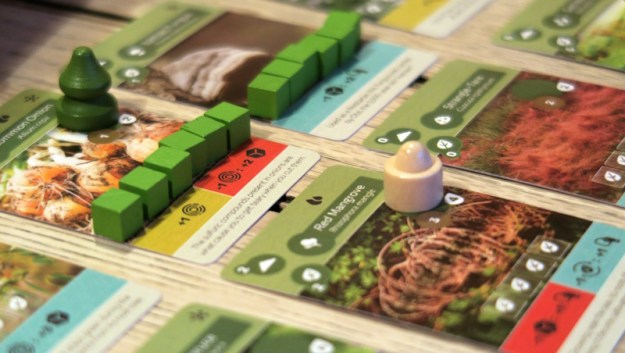
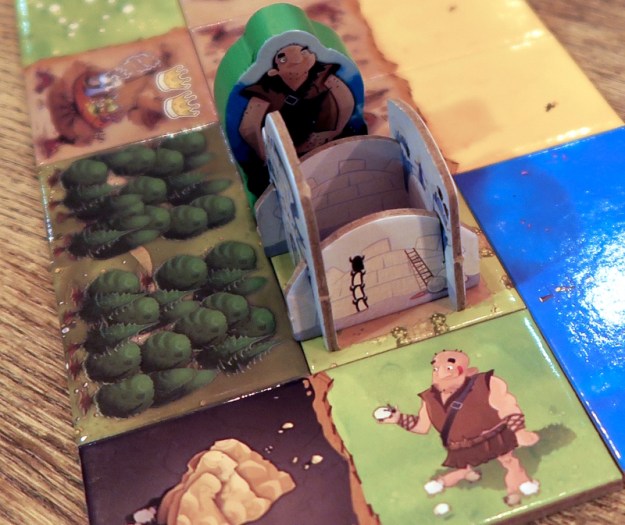
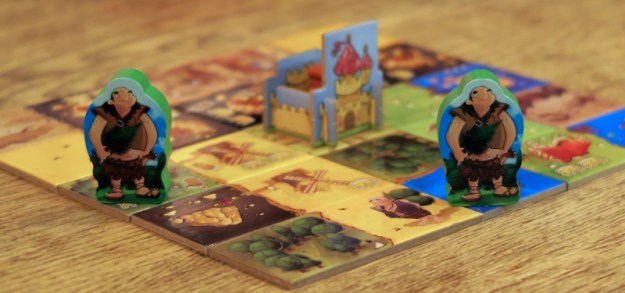
Meanwhile, the rest of the group carried on chatting all agreeing they should play something, but nobody terribly keen to commit to anything.  Eventually, Blue suggested Bohnanza, and as Pine agreed, Pink had to go along with it.  This is an old favourite, though Pink had gone off it a bit as he felt he always did badly—unfortunate really given the number of copies of the game that he owns.  The game is very simple:  keeping their cards in the order they are drawn, players must plant the first bean card from their hand and may plant the second if they have space.  They then turn over the top two cards from the deck and can play these or trade them as they prefer.

Bohnanza
– Image by boardGOATS

Finally, once both of these have been planted, the active player may trade cards from their hand before drawing three replacement cards.  Players can harvest their Bean Fields whenever they like, but the amount of money they get depends on how many Bean cards it has in it and what the beans are—scarce ones give a better return, but are harder to get.  Everyone knows the game quite well, though Lime had recently acquired and been playing a new anniversary edition and it seems some of the rules are slightly different for that.

Bohnanza
– Image by boardGOATS

This time, everyone bought a third Bean Field (which makes it easier to hang on to the rarer beans a little longer).  Indeed, Lime was so determined to use his, he ended up not trading, just so that he had something to plant!  As usual it was quite a close game with fine margins.  So little things like Blue harvesting her Red Beans only to immediately draw another and Pine gifting Pink a Wax Bean or Lime trading with Pine instead of Blue made a difference in the final score, though nobody knew it at the time.  Ultimately, Pink was the victor, beating Blue by just two Bean Thalers with Lime a couple behind her in third.  On the plus-side, Pink can’t complain that he never wins any more.

Bohnanza
– Image by boardGOATS

Earth was still underway, and for once in a way, Bohnanza had played relatively quickly, so there was plenty of time for something else.  Nobody was very focused, and eventually the group settled on the cooperative game, Forbidden Desert.  This is a sort of sequel to Forbidden Island, which itself is a simplified version of the popular gateway game, Pandemic.  All three of these games use the same mechanism as Zoo Break, which we played recently.  Essentially, the active player carries out actions and then they reveal cards from a deck which generally make life difficult: releasing wild animals, causing the island to gradually sink, spreading disease, or in the case of Forbidden Desert, burying the play area with sand.

Forbidden Desert
– Image by boardGOATS

The premise of Forbidden Desert is that the team have crash-landed in the desert and need to find the components of a flying machine and take them to the launch pad to escape.  The game is played on a five by five grid of square Tiles, with a gap in the centre representing the sand storm.  Each player has a character with special powers.  This time, Lime was the Climber, Pink was the Navigator, Pine was the Explorer, and Blue was the Water Carrier.  On their turn, players can take up to four actions:  Move (one action per Desert Tile), Remove Sand from the Desert Tile they are on or an adjacent one, Excavate a Desert Tile (i.e. turn it over), or Pick up one of the four component parts of the flying machine.

Forbidden Desert
– Image by boardGOATS

Lime started.  Once he had cleared some sand and turned over a couple of Desert Tiles, he started turning over Sand Storm Cards.  These indicate which direction Tiles should move to fill the hole, and how many Tiles should be moved, one, two or three.  Each of the Desert Tiles moved then have a Sand Tile placed on them—a single Sand Tile needs to be cleared before the Desert Tile can be Excavated, but two or more additionally obstruct players preventing them from passing (except for Lime who, as the Climber, can cross Sand Dunes of any height).

Forbidden Desert
– Image by boardGOATS

Pine went next and used his special ability—everyone else could clear orthogonally adjacent Tiles, but he could to work diagonally as well.  It wasn’t long before the first “Sun Beats Down” card appeared.  These cause everyone to use water, so as the water carrier (and the only one who could make multiple visits to the Oases and collect water, Blue topped up Lime, who had started with less water than everyone else.  The group gradually started revealing tiles, finding a Duneblaster, a Solar Shield and a Time Throttle, but the Storm picked up and before long the group were turning over more Sand Storm Cards.  Pink located the Propeller for the flying machine and then the engine, the group were making progress, but it was all too slow.

Forbidden Desert
– Image by boardGOATS

Before long it became apparent that the Sand Storm was getting the better of the group and the hiding in the Tunnels wasn’t helping.  Determinedly, the group fought against the rising tide of Sand making good use of their Duneblaster, but it only delayed the inevitable.  Blue, Pine and Lime were discussing a plan to play a Storm Tracker, but when they were briefly side-tracked, Pink played on without it and everyone suffered as a result.  So Pine labelled him as a Saboteur as a consequence.  In such a finely balanced game at such a critical point, it could have made a difference, but in all probability it only hastened the inevitable demise as the group were sadly buried under the ever growing sand dunes and ran out of Sand Tiles (one of the end game conditions).  It was a deflating end to the evening, but given the heat, probably appropriate.

Forbidden Desert
– Image by boardGOATS

Learning outcome:  Shuffling is an important skill.

30th May 2023

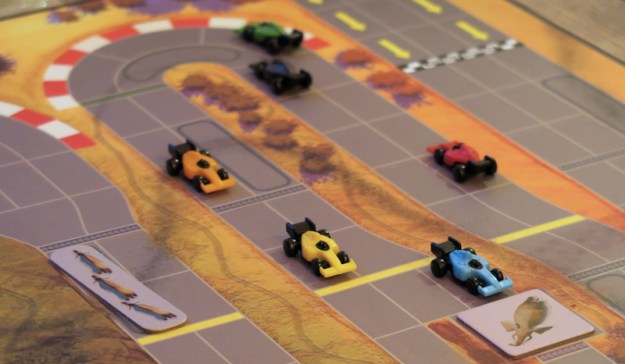
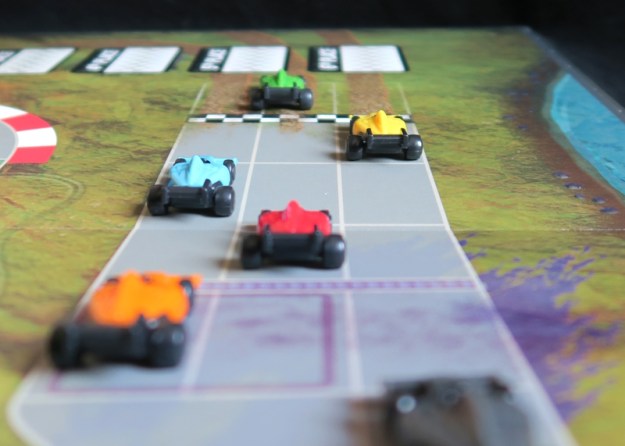
Pink and Blue were late arriving thanks to a debate as to whether the actor Gary Lewis was in the Roland Emmerich film The Day After Tomorrow.  Eventually Blue and IMDb were proved right when Pink found the guy who WAS in the film (Richard McMillan, who bore no resemblance to Gary Lewis whatsoever), but that meant they were late arriving and Plum and Byzantium were already there.  Unfortunately, due to a mix up, the Jockey wasn’t serving food, so Blue headed off to get chips for everyone from Darren at The Happy Plaice.  As the chips were consumed, everyone else arrived and it was just a question of who would play the “Feature Game“, the Wild Ride expansion to our go-to motor racing game, Downforce, and what everyone else would play.

Downforce
– Image by boardGOATS

Eventually Pink and Green committed to Downforce, and were joined by Pine (who claimed that after doing well the first time he played, he’d come last ever since), Black and Lime (as long as the other group weren’t playing Wingspan).  Pink and Green reminded people of the rules of the base game, which are simple enough:  after being dealt their hand of cards, players bid for cars, with the player who pays the most deducting the cost from their final score.  Once the bidding is over, the race takes place.  Players take it in turns to play one card from their hand, and then move all the cars depicted on it in turn.

Downforce
– Image by boardGOATS

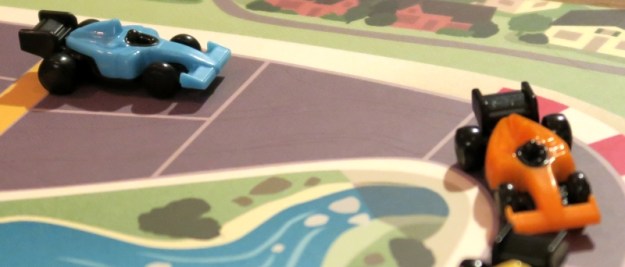
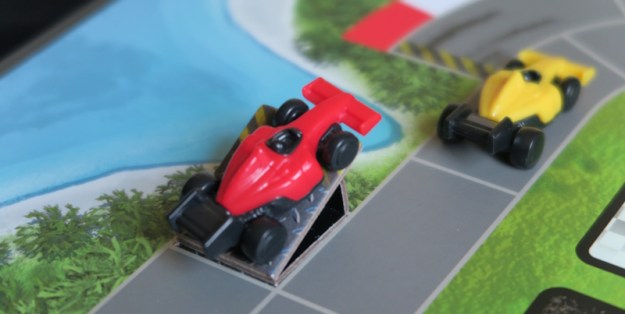
When the first car crosses a betting line, the race is paused while everyone bets on which car will win the race.  There are three betting lines, but the winnings for betting decrease the closer they are to the finish line.  At the end of the game, players total their winnings from the race with those from the betting, deducting the cost of their car and the player with the most cash is the winner.  The Wild Ride expansion adds two new tracks: Aloha Sands and Savanna Stretch. Aloha Sands adds water jumps which cars can use if they are moving fast enough. The jumps allow players to pass other cars and get round the track more efficiently, but timing is everything.

Downforce: Wild Ride
– Image by boardGOATS

In contrast, Savanna Stretch features wild animals that block the track.  Once the first car has passed an animal, they are moved to another part of the track, as such, they help to prevent the “runaway leader” problem that can sometimes be an issue in the base game.  It was this track that players chose to use this time.  The inclusion of extra animals on the track caused a little confusion initially, but the group soon worked out two of the important features of this track.  Firstly, the animal tile only moves after the first car is fully past it and all other the cars have finished their movements for that card, which means that the animal is really only an impediment for the first few cars.

Downforce: Wild Ride
– Image by boardGOATS

The other the slightly unusual aspect of this track is that the pole position car starts at the rear of the pack.  With five players and six cars, there was always a chance that someone would get two, and that someone was Lime.  While this can be a huge advantage, especially if the cars are cheap, it can also be a risky strategy as it can be difficult to manipulate two cars and they can also become a target for other players.  Unfortunately for Lime, his cars were among the most expensive, leaving him with a deficit of $11M before the racing began, compared with Pink and Green for example, who paid just $2M for theirs.  Once everyone had got to grips with the rules and the cars had been allocated, the race was underway.

Downforce: Wild Ride
– Image by boardGOATS

For a track with so many tight sections it was not surprising that there was a lot of blocking going on—most of it, to be fair, totally deliberate… Pink (in the red car) found his early push to the front to be a mistake, as he was instantly the target for blocking maneuvers from turn two until the final straight.  Green (in orange) used his online experience from Board Game Arena to keep himself in the pack, but not at the front. Luckily for him several other players selected his car to win the race at the first two check points, which helped keep him out of trouble and pushed forwards.

Downforce: Wild Ride
– Image by boardGOATS

However after the halfway mark, Black (driving the blue car) and Pink both surged forward causing Green and Pine to lose their nerve and bet on Black (instead of Green) at the last checkpoint.  However, they should not have worried, as very soon after that, Green’s car surged forward weaving between the cars in front to race for the line and victory.  Pine was close behind, followed by the first of Lime’s cars (the other brought up the rear).  With the race done, there were just the winnings to claim from the bookies.  Because Green had got away with paying little for his car and won the race, he had a significant prize pot even before betting was paid out.

Downforce
– Image by boardGOATS

There wasn’t a huge difference in the results from the betting, but it was enough for Green to extend his lead.  Pine also raked in millions as his betting pattern was the same as Green’s (perhaps someone should investigate them for race fixing).  As a result, Pine come in clear second with Black completing the podium.  Since there was still some time left for a “proper” game, the group hunted around for something that wasn’t too long and could play five.  In the end, they settled on the simple little “push your luck” game, Port Royal, as much because no one could find anything better for five players, than because anyone really wanted it specifically.

Port Royal
– Image by boardGOATS

It had been a little while since most of the group had played, though the rules are simple enough.  On their turn, the active player chooses to “twist” and turn over the top card of the deck, or “stick” and keep the current card set.  The deck of cards consist of coloured ship cards and character cards.  The first decision is to decide whether to risk a “twist” because if second ship card of a colour is drawn the player goes bust and their turn ends.  If a player “sticks” they can take a ship and add its treasure to their stash, or they can use their gold to buy the support of characters.  These give players victory points and special powers, but also can be used to claim contracts and give more points.

Port Royal
– Image by boardGOATS

Once the active player has taken a card, players round the table can take a card too.  The cards are double-sided like those in San Juan or Bohnanza, so in the same way, keeping an eye on the discard pile and the money in players’ hoard is also key.  Although Black and Green did their best to quickly explain the rules, Pine and Lime were still both a little unsure, and perhaps with good reason.  Part way through the second round Black and Green realised something was amiss and re-read the rules and spotted a “rules malfunction”:  they had forgotten that when a player takes a card on another player’s turn, they pay the active player one coin, thus encouraging players to push their luck further to give more players more choice.

Port Royal
– Image by boardGOATS

So from the second round on-wards they group started playing correctly.  Pink’s strategy involved ignoring the Sailors and trusting to luck with turning the cards while spending his money on symbols to make up Expedition cards.  That gained him the first Expedition card, but ultimately, this single minded approach wasn’t very successful, at least in this game.  Green went for a strategy of collecting fighting cards, in order to fight off the pirate ships.  This worked initially, but by the time he had five fighters (and seven points), he kept going bust on his turn as he turned up skull bearing Pirate Ships against which there is no defence!

Port Royal
– Image by boardGOATS

This meant that everyone else was able to gradually build their wealth and cards to catch him up.  Green then collected two more fighters and in preparation for one final attack, but would he get the chance?  Black had managed to accumulate a lot of points, not least because he collected money for both a large array of cards and for when it went bust thanks to the Admiral and the Jester.  If Black could collect another special symbol he could claim an expedition and win the game before Green could make his mega move with a full fighting force.  Unfortunately for Pine, he wasn’t able to collect the symbol he needed to claim a expedition as he went bust.

Port Royal
– Image by boardGOATS

So it was Green’s turn again and he started to pull out cards, with a huge line of cards.  After defeating every lower value Pirate Ship he came across, he managed a full five different coloured ships.  From there he was able to collect another five coins and purchase the two crosses on display, which gave him an expedition card and enough points for victory.  At the conclusion of the game, Pine confirmed his early feelings that he did not really like this game, and Lime felt it was all a bit too confusing, never really sure what he was doing.  This was an older game that we used to play a lot of at the club, but it seems to have lost its lustre now and will probably forever remain an occasional play game.

Port Royal
– Image by boardGOATS

Meanwhile, on the next table there was a lot of debate as to what they’d play.  With five, the options were quite restricted, Burgle Bros. almost made it, until Teal realised it only played four, which left Tiny Towns.  Plum wasn’t so keen, so in the end, the group went for the old favourite Wingspan (having said to Lime that they weren’t going to play it…  Sorry Lime!).  There was some debate as to whether there was time for the game with five players, and options of playing three rounds instead of four were briefly discussed, but since everyone knew what they were doing, the group decided to give it a go and see if they could squeeze in a full-length game.

Wingspan
– Image by boardGOATS

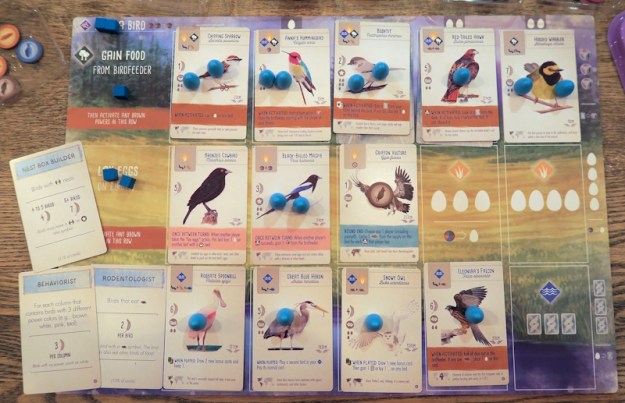
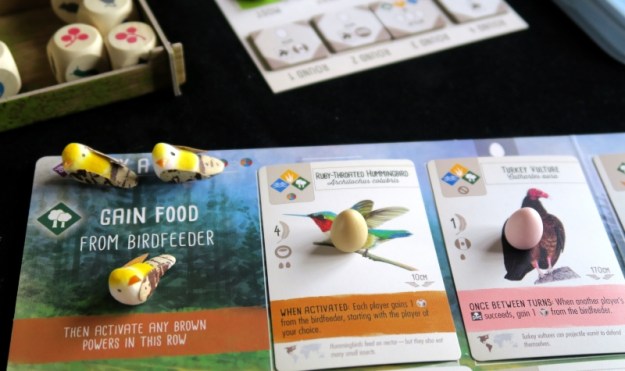
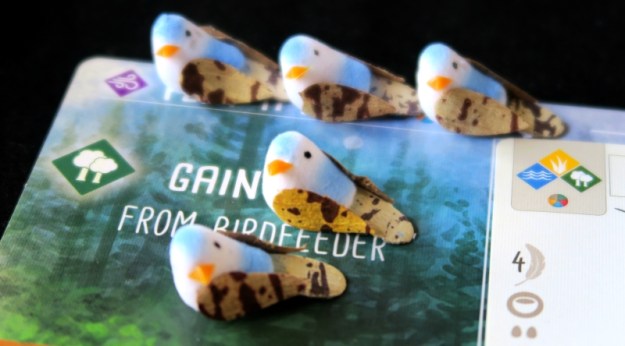
The game is an engine builder that is quite simple in theory, but quite difficult to play well.  Players are collecting birds for their sanctuary, scoring points for exciting birds, eggs, cached food and cards tucked under birds (representing flocks of birds or prey caught), as well as bonus points for achieving particular goals during the game and at the end of the game.  The idea is that, on their turn, players either play a bird card from their hand into their tableau, or carry out the action associated with one of the three habitats (Woodland, Grassland or Wetland) and then activate each bird in that habitat.  While that is all there is to it, it’s all in the cards and getting them to work together.

Wingspan
– Image by boardGOATS

Wingspan can be a little “multi-player solitaire”, that is to say, there can be very little interaction between players in some games.  For some players this is preferred as it means players don’t have their carefully laid plans destroyed by others, while others feel they might just as well be sitting alone and interaction between players is what makes playing games important.  It had been a while since it’s last outing, but the group were quick to get going and were happy to play with the European Expansion which was already mixed in.  Plum in particular, got off to a flying start with her opening hand, four of which were coloured birds and matched her chosen Bonus card (the Photographer).

Wingspan
– Image by boardGOATS

In contrast, Blue had cards that didn’t match at all.  The Rodentologist was her best Bonus card giving her two points for each bird in her sanctuary that ate a rodents, but not one card in her starting hand qualified.  Teal started out with a strategy to maximise his egg production and prioritised birds with brown powers and resource conversion to assist that aim.  The first card Plum played helped him in this, and everyone else too as it happens as it was a very generous Ruby-throated Hummingbird that gave everyone food every time it was activated.  Teal returned the favour as he laid eggs at every opportunity and Plum had a bird that rewarded “once between turns” if anyone laid eggs.

Wingspan
– Image by boardGOATS

As the game progressed, players worked on the end of round bonuses.  Three of the four birds Plum had kept from the start also happened to have bowl nests which contributed towards the fourth round goals, as long she could ensure they had eggs on them.  She didn’t really aim for anything else, but Blue, Byzantium and especially Teal did well in the early rounds.  Plum picked up some more birds with colours in their names, but also managed to play the Yellowhammer end of round card which she was able to use to great effect as it enabled her to play an extra bird card if she had used all four actions during the round.  Byzantium had issues with the dice which repeatedly wouldn’t give him what he wanted.

Wingspan
– Image by boardGOATS

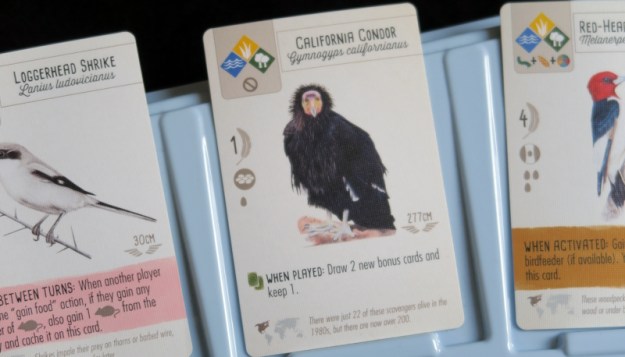
Then to compound Byzantium’s woes, he got himself in a bit of a mess when he played his migrating bird into the wrong habitat meaning he didn’t get the advantage of moving the bird straight away and costing him more eggs into the bargain.  Purple had different dice issues when she rolled five berries and called “Yahtzee!”  Blue had improved her hand and acquired some more helpful cards, including one that gave her an extra Bonus card, the Behaviourist, which gave her three points for each column with three different power colours.  As people sifted through the deck trying to find cards they liked the look of, the California Condor appeared, which everyone agreed looked like a monkey.

Wingspan
– Image by boardGOATS

Towards the end of the game, partly as a result of Plum’s Hummingbird, Byzantium ended up with a surfeit of food and nothing to spend it on.  So, he switched tactics and took the Condor hoping to get a bonus card that would improve his fortunes.  It didn’t.  Blue tried the same and didn’t do any better.  After the final round Plum activated her Yellowhammer again and was left with the choice of playing a bird that gave her a Bonus card or one that gave two extra points.  She also went for the Bonus card, the Fishery Manager, but only one of her birds ate fish.  Time was ticking on, but the game was over well within two and a half hours with just the scoring to go as last orders chimed.

Wingspan
– Image by boardGOATS

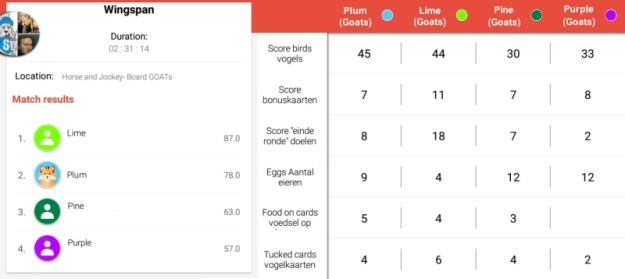
Blue had some high scoring birds, but not as many as Plum who took fifty-five points for them alone. Blue had quite a lot of eggs too, but not as many as Teal who had twenty-three.  Everyone else was concentrating on counting, when Purple (aided by Black who had come along to lend a few fingers), gave her score for her bonus cards: thirty-four points, more than twice that of anyone else.  Unfortunately for her though, prioritising her Backyard Birder Bonus which gave her points for birds scoring fewer than four points left her with lots of low scoring birds.  It was a close scoring game, but first place went to Blue who finished a handful of points ahead of Plum with Teal a little way behind in third.

<Wingspan: European Expansion
– Image by boardGOATS

Learning Outcome:  Forget snakes on a train, what about snakes on a race track?!?!

21st March 2023

Blue and Pink were just setting up Circle the Wagons when Lemon walked in.  As Circle the Wagons is a two player filler game, they quickly packed it away and got out No Thanks! instead.  Lemon hadn’t played it before (or perhaps had forgotten), so Blue gave her a quick rules explanation.  It is a very simple (if clever) game, so it didn’t take long:  the first player reveals the top card of the deck, then makes the choice, either to take it or pay a chip to pass the problem on to the next player.  At the end of the game, the player adds up the face value of all their cards and the player with the lowest total is the winner.

No Thanks!
– Image by boardGOATS

There are two catches, however.  Firstly, if a player has a run of consecutive cards, only the lowest counts to a player’s final score, which encourages players to gamble a little.  However, the second catch is that nine cards are removed from the deck at random before each game, which means the card a player is gambling on getting may not even be present in the deck.  Blue and Pink were half way through their burgers and the trio were halfway through the game when Indigo and then Pine arrived.  Indigo was also new to the game so as they finished the first game Blue explained the rules to her too.

No Thanks!
– Image by boardGOATS

The first game was really close, but Lemon, got lucky and, although everyone scored relatively highly, she had three less than Pink to take victory.  The game plays five well though, so Pine and Indigo joined the other three for a second round.  This time, the top scorer was Indigo who finished just shy of fifty points.  Everyone else was closer, but this time Blue was the winner with seventeen points, some five less then Pine.  By this time, almost everyone else had arrived and the burgers had been dispatched, so it was time to decide who was going to play what.  The “Feature Game” was to be the Visit from the Rhine Valley expansion for one of the group’s most popular games, Viticulture, and the questions were, who wanted to play that, and what would the rest play?

Viticulture
– Image by boardGOATS

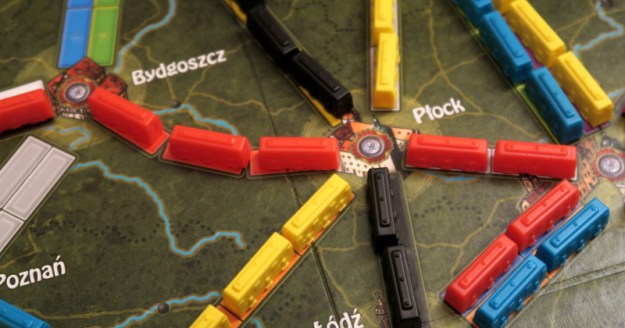
Viticulture is one of Pink’s favourite games and Teal was very keen to play it too.  Somewhat surprisingly, Ivory was open to other options, so eventually Indigo and and Green joined them to set that up.  With five people left, Lemon loving Ticket to Ride, and Pine having just acquired Burgundy‘s copy of the Europe edition, it wasn’t really a great surprise when the group decided to give that an outing in his memory.  The game is a very straight forward game of set collecting and network building with players either taking two cards on their turn, or paying sets of cards to place trains on the central map.  Players score points for placing trains on the map (with longer routes giving more points).

Ticket to Ride: Europe
– Image by boardGOATS

At the end of the game, players score extra points for any “completed tickets”, i.e. successfully connected the destinations on ticket cards dealt at the start of the game and perhaps collected during the game.  There is a risk associated with tickets, however, as any that are incomplete, score negatively.  Each version of Ticket to Ride has slightly different rules, so while everyone was very familiar with the basic game, the group had to remind themselves of the specifics of the Europe edition.  The main difference between this version and others is the inclusion of Stations—players can add one of these to a city to enable them to use one line connected to it that someone else has built to help them to complete tickets.

Ticket to Ride: Europe
– Image by boardGOATS

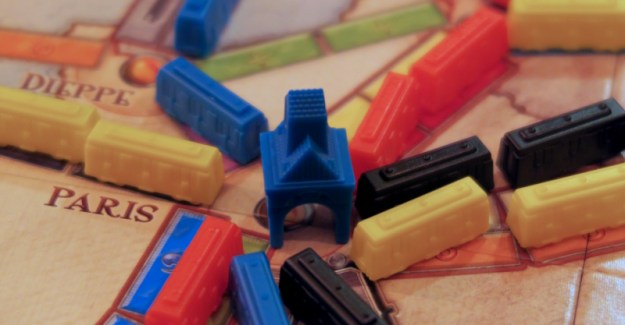
Ivory started and began the game and started on his first move by placing a single train from Bruxelles to Amsterdam.  That caused panic amongst everyone else, and turned out to be completely justified as everyone except Pine got involved in a scrap for the space in central Europe.  Largely as a result of that congestion Purple ended up forced to take tunnel routes.  These are routes where players don’t know the actual cost before they build them, since three cards are turned over from the draw deck and if any match the colour of the track being constructed, these must be matched by the player building the track (or they fail to build it).

Ticket to Ride: Europe
– Image by boardGOATS

This turned out to be costly for Purple who had a couple of attempts knocked back and some that costed considerably more than expected.  Lemon did what she often does and seemly prioritised building tracks she liked the look of, connecting them together later if possible.  Everyone else crossed their fingers and fought for the routes they wanted with most people interfering with somebody else’s plans somewhere along the way.  Ivory claimed the long tunnel route from Stockholm to Petrograd, and much to Purple’s disgust, managed it first time.  Lemon, who was after Pine in turn order kept trying to jump in front of him leading him to wonder whether he was invisible.

Ticket to Ride: Europe
– Image by boardGOATS

Blue seemed to have lots of tickets that didn’t go where her trains were and life got worse and worse as the space became increasingly crowded.  As the number of trains everyone had dwindled, everyone panicked about whether they were going to complete all their tickets.  Then, as everyone else was struggling to complete their tickets, Purple surprised everyone by taking more, and got lucky and finished it the very next turn—just as well, because Ivory had ended the game.  After the obligatory points recount (and a couple of very minor adjustments) the group started evaluating tickets.

Ticket to Ride: Europe
– Image by boardGOATS

Ivory, Pine and Blue had a lot, but Ivory had got lucky with his ticket draws which all fitted together quite nicely.  Blue had been less fortunate and only discovered that she was missing a connection for one of hers when it came to the final count.  Pine and Blue both succeeded in completing eight tickets, but Ivory had the longest continuous connected line, with all but two of his trains conga-ing neatly across the map.  Ivory, who had just been ahead throughout was the victor with a hundred and forty-seven points, twenty ahead of Blue in second and forty ahead of Pine in third.  It had been a good game though, with lots of cut and thrust and everyone (especially Blue) had engaged their inner Burgundy at some point.

Ticket to Ride: Europe
– Image by boardGOATS

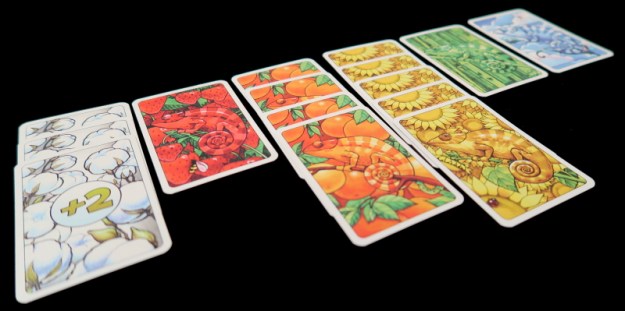
Both Ivory and Pine wanted an early night, but there was still time for something else, so long as it wasn’t too long.  Pine rejected Blue’s optimistic suggestion of Bohnanza as always taking too long, so in the end, the group settled on Coloretto.  Lemon was new to this, but it’s a quick game to teach and an easy game to learn as you play too.  Another set collection game, the idea is that players score points for collecting large sets of coloured chameleons.  So, on their turn, players either turn over the top card of the deck and place the card in one of the trucks (each of which can contain a maximum of three cards), or take a truck.

Coloretto
– Image by boardGOATS

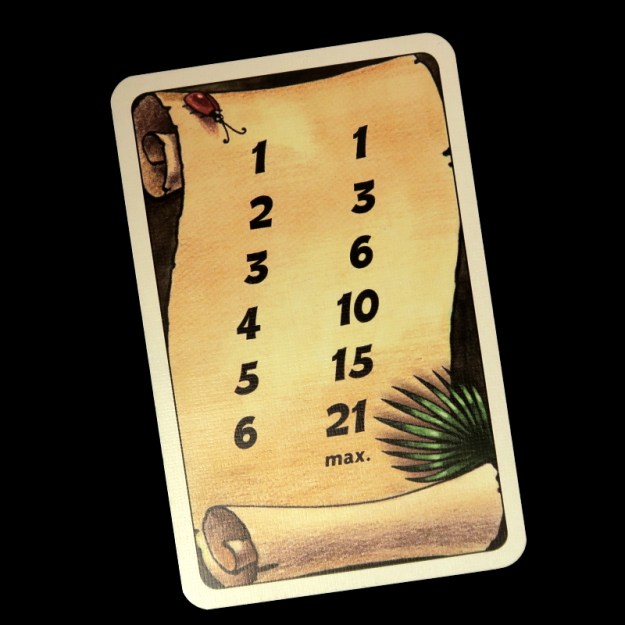
The reason this is clever is because while players score positively for the largest three colour groups, the others all give negative points.  The triangular series gives many more points for the later cards, thus, the trick is to have one large set of cards rather than two or three smaller ones.  The game plays well with five and there were lots of difficult tactical decisions with players trying to work out what everyone else would do and then force them to take cards they really didn’t want.  In the end, it was an easy victory for Ivory though, with thirty-four, four points ahead of Blue in second.  It was much tighter with a three way fight for bronze, that Purple just won.

Coloretto
– Image by boardGOATS

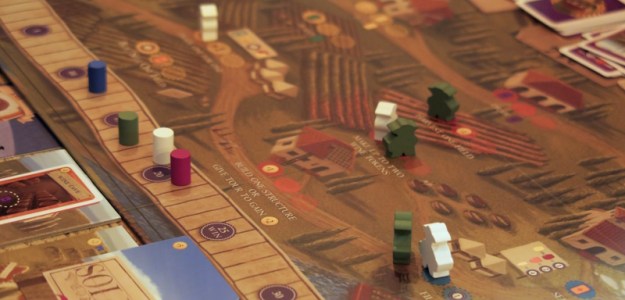
Meanwhile, on the next table, Teal, Pink, Ivory and Green were playing the “Feature Game“, the Visit from the Rhine Valley expansion for Viticulture.  Although Viticulture is much more complex than the other games being played in the room, it is a relatively straight forward worker placement game where players are developing their vineyards by building buildings, planting vines, harvesting grapes, making wine and getting help from visitors.  The game is typically a race with the winner being the player with the most points at the end of the round where a player exceeds a set number of points.  The Rhine Valley expansion is very small, just a replacement deck of Visitor cards, but it has a reputation for changing the game quite significantly, making it more about wine making than just getting points.

Viticulture
– Image by boardGOATS

Viticulture is one of Pink’s favourite games and was quite well known to Green and Teal too thanks to them playing regularly on Board Game Arena.  The Tuscany expansion was a new new variation to Green and Teal though and nobody had played with the new Rhine Valley Visitor cards.  Indigo had never Viticulture at all, but Pink and Teal explained the rules, during which Indigo received some well meant general advice on best plays from the others. When Green suggested that five workers was probably optimum, both Teal and Pink were quick to disagree suggesting that more (maximum of six) was always better.  Viticulture is always a slow burner for the first part of the game, and Pine kept looking across from the other table and remarking how the game had been going for ages, but there had only been a single point scored.

Tuscany
– Image by boardGOATS

As Pink, Teal and Indigo inched forward by a point or three, Green remained resolutely on zero for a long time, and then he sacrificed a point to go negative!  As the game progressed the points started to come eventually.  After drawing fulfillment card after fulfillment card, Pink realised he should have planted some higher value grapes rather than just the first ones that came along, which meant it took lots of turns to make them “ready for sale”.  He was the first to complete a wine order though, with Teal just behind.  Green eventually started to move forward and caught Indigo who was struggling a little to get her head around the game a little and with only three workers was really finding it difficult to get much done.

Viticulture: Visit from the Rhine Valley
– Image by boardGOATS

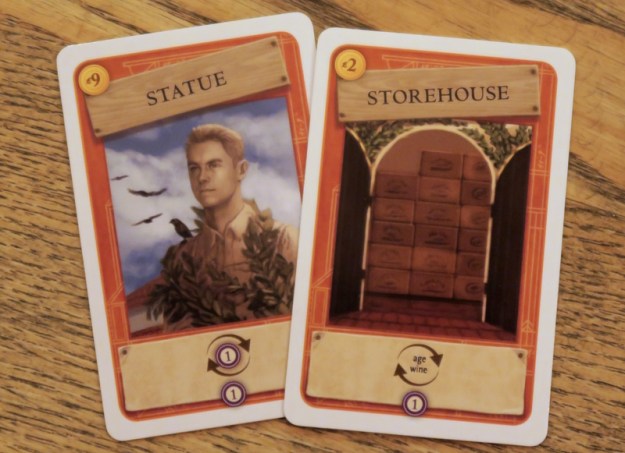
One of the interesting features of Tuscany is the additional buildings that can be constructed.  Green found a Statue which was very expensive, but not only gave him an immediate point, but also an extra point each round.  This, together with his other building, a Storehouse, he had an extra ageing step each round as well—his engine was beginning to build after a slow start.  Green then played a winter Visitor combo, which allowed him to make some wines and fulfill a big six point order with an additional two points.  With the end-game trigger at twenty-five, that was quite a haul in one go, indeed, Green, Teal and Pink were all quite close now.

Viticulture
– Image by boardGOATS

In spite of the sudden flood of points, with time running out, the group soon realised they would not be able to finish in time.  Pink’s more traditional approach of planting, harvesting, making wine and fulfilling orders had kept him at the front of the points track, and would likely have got him over the twenty-five point line in the next round.  However, the group decided that they really needed to finish, just when everyone’s engine was getting into their stride. Nobody will ever know whose would have been be the most successful and by the end of that round it was all very close on the score track.  Pink had his nose in front though, followed by Green and then Teal, but there were still the “Stars” regions to score.

Tuscany
– Image by boardGOATS

This was an area which Teal had really gone for early on in the game. Green had placed a few few early on and then mostly ignored it.  Pink came to the stars late in the game, but as was his usual strategy, made big plays when he did.  In the end Teal narrowly scored most just edging Pink although he still had enough to retain his lead with twenty-one, two ahead of Teal and four ahead of Green.  None of the group quite knew how the end of the evening had snuck up on them so suddenly, they had been so engrossed and it had seemed hardly any time at all—quite a recommendation for a game!

Tuscany
– Image by boardGOATS

Learning Outcome:  If you go into the Wine Business, make sure you know what people want to buy before planting any grapes.

7th March 2023

Plum and Blue were first to arrive and, by the time they had finished their enormous rack of ribs (or given up and had a doggy bag made up), almost everyone else had arrived.  There were a few people missing, but still enough for two games of four.  The first was the “Feature Game“, but nobody really wanted to commit to that until they knew what the other game was going to be.  As he had done the last couple of times, Green suggested Terraforming Mars.  Unlike previously, this time Ivory, Plum and Teal felt up to it, leaving Blue, Black, Purple and Lime to play their preferred choice of New York Zoo.

New York Zoo
– Image by boardGOATS

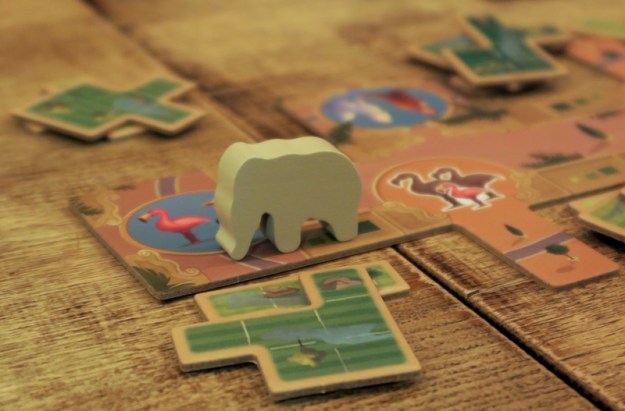
New York Zoo is a tile laying game by Uwe Rosenberg, designer of Agricola, Bohnanza, Patchwork and many other well-known games.  The idea is that players are building pens in their zoo, populating them with animals, and building attractions.  This is one of several polyomino, Tetris-like, tile-laying type games (including Cottage Garden, Spring Meadow, Indian Summer and Patchwork), but what makes this one unique and interesting is the Market.  Players move the Marker Elephant one to four spaces round the Market, landing either on an Enclosure tile space (taking the top one and adding it to their zoo) or on an animal space (taking one or both of the animals depicted).  Enclosure tiles can be placed anywhere in the player’s Zoo, then one or two identical Animals from elsewhere in their Zoo must be moved to occupy the Enclosure.

New York Zoo
– Image by boardGOATS

Each Enclosure can only hold one type of Animal, meercats, snow-foxes, kangaroos, penguins or flamingos, but when moving Animals, no pen can be left empty.  There is an advantage to pens having two or more Animals in them too—the Market also features breeding spaces, and when the Marker Elephant passes these, up to two pens containing two or more matching Animals get an extra one.  When a player moves the Elephant onto an Animal space, they take one of either or both the Animals depicted into Enclosures containing matching Animals (moving another from Storage if they can), or into the Storage space.  Moving animals is important, because when an Enclosure is completed the player removes all the animals putting one into Storage if they have space, and then takes an Attraction tile of their choice and adds it to their Zoo.

New York Zoo
– Image by boardGOATS

Attraction tiles are useful because they fill additional spaces, and at its heart, New York Zoo is a race game—the winner is the first to fill all the spaces in their Zoo.  Black and Purple had played this a few times, and once Black had explained the rules to Lime and Blue, Purple started.  Black and Purple prioritised completing Enclosures to get Attractions.  The Market is stacked so there are large tiles, heptominoes, on the top of each tile space, with hexominoes, then pentominoes and finally tetrominoes at the bottom of each pile.  Black and Purple prioritised getting breeding pairs of animals and as the Market dwindled, getting smaller enclosures because small Enclosures are easier to complete than large ones.

New York Zoo
– Image by boardGOATS

Blue, who had not played the game before, started off getting large Enclosures and fitting them tightly together.  As the game progressed, however, she realised her mistake as everyone else’s Animals were breeding and she didn’t have pairs because she was taking one out every time she added another Enclosure.  This had the additional consequence that she was starting to run out of Animals too, so she prioritised getting breeding pairs for a couple of rounds before continuing to take the biggest Enclosures she could get away with.  It was a tight game—Purple seemed to take an early lead, but it looked like Black and Lime over-took her towards the end and were in a tussle to finish the game first.

New York Zoo
– Image by boardGOATS

With everyone else concentrating on filling pens and taking Attractions, nobody was watching Blue.  So they were taken by surprise when her kangaroos bred filling their pen and she took her first Attraction.  That left one space which she promptly filled taking the only Enclosure that fitted, perfectly, and ended the game.  With everyone else so close to finishing, however, the rest of the group played on to see who would place where.  In the event, Black finished just ahead of Lime.  The group were just dissecting the different strategies when Pine arrived, fresh from his meeting teaching “cubbish-sized scouts” about waste.  Terraforming Mars was still going on, so the hunt was on for a five-player game, and the group settled on Kingdomino.

Kingdomino
– Image by boardGOATS

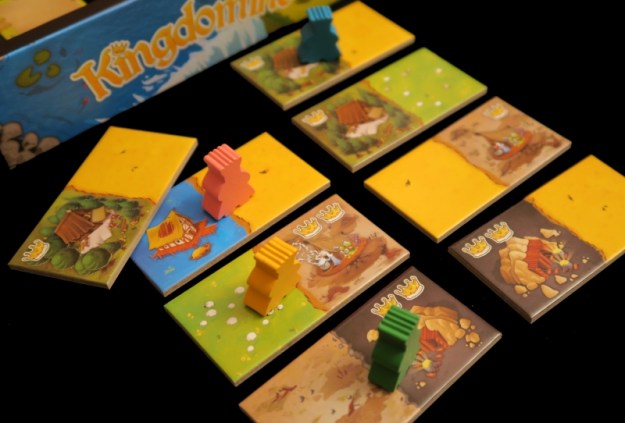
Native, Kingdomino is a four player game, however, with the Age of Giants expansion, it plays five.  The base game is simple enough, but it had been a while since most people last played it, so there was a quick run through of the rules.  On their turn, players add a terrain domino to their Kingdom; each domino comprises two squares of terrain and when placed at least one end must be adjacent to the same terrain type.  Like New York Zoo, the interesting and clever part of the game is the Market.  In Kingdomino, there are two parts, current and future—when a player takes their domino from the current market, they choose their next domino by placing their marker on it.

Kingdomino
– Image by boardGOATS

At the end of the game, players score each terrain region with points equal to the area of each region multiplied by the number of crowns on it.  The clever part is the timing of the Market.  The tiles are drawn at random from a set numbered from one to forty-eight.  The low numbers generally being the less desirable ones, those without crowns or those for terrain types where crowns are more scarce.  Since players take the tiles in numerical order (low to high), taking a low value tile in one round gives a better choice in the next.  Similarly, taking a high value tile means there will be less (or maybe no) choice in the following round.

Kingdomino: Age of Giants
– Image by boardGOATS

The Age of Giants expansion firstly adds twelve extra tiles (enough for a fifth player), six labeled with letters A to F and six numbered forty-nine to fifty-four.  These are ranked below one for the letters and after forty-eight for the high numbers, with the low ranking tiles featuring a Giant, and the high ranking ones featuring Footprints.  Players taking dominoes with a Giant on them, also take a Giant-eeple and place it over a crown in their Kingdom so that it doesn’t score.  Taking a Footprint domino allows the player to move a Giant from their Kingdom to a crown in someone else’s and this increase their score, making these tiles potentially very valuable.

Kingdomino: Age of Giants
– Image by boardGOATS

Unfortunately (especially for Lime and Blue who ended up with all the Giants), the Footprints seemed hard to come by in this game.  The other part of the Age of Giants expansion are the Quests.  The base game comes with two Quests, arrangement targets that give points.  These are “Middle Kingdom” and “Harmony” which respectively give ten points for a castle in the centre of a player’s Kingdom and five points for a complete five-by-five territory with no discarded tiles.  This time, the Quests drawn essentially at random were “Bleak King” and “Four Corners of the Kingdom”.  The first of these gave five points for each five square of terrain with no crowns while the second gave players five points for placing cornfields on all four corners of the five-by-five grid that defines their Kingdom.

Kingdomino: Age of Giants
– Image by boardGOATS

Although the Quests had been included in game play several times before, the Giants have only had an outing once and didn’t go down all that well.  Still, with five players all the extra tiles were needed and their values would have been unbalanced without including Giants, so the group thought they’d give it another try.  This time Blue and Purple had a really hard time getting crowns and things were so bad for Blue that she resorted to picking up twenty points, more than half her total, from the “Bleak King” Quest.  Black built a lot of sea and pasture, while Lime scored heavily for his mountains and Pine picked up lots of points for his large woodland.

Kingdomino: Age of Giants
– Image by boardGOATS

It was very close between the top three and both Lime and Pine scored forty-five points for their highest scoring terrain—Lime for nine crowns spread over five spaces, Pine for five crowns spread over nine spaces.  There were just two points between Lime and Pine in the end, but Pine’s sixty-eight points just edged Lime into second with Black four points behind that.  It had been a good game.  However, the group felt that the Giants took a positive constructive game and added a negative aspect.  Those that had been stuck with them hadn’t found that aspect particularly enjoyable, especially as it was easy to get lumbered largely through no fault of their own, so it is unlikely they’ll get another outing very soon.

Kingdomino: Age of Giants
– Image by boardGOATS

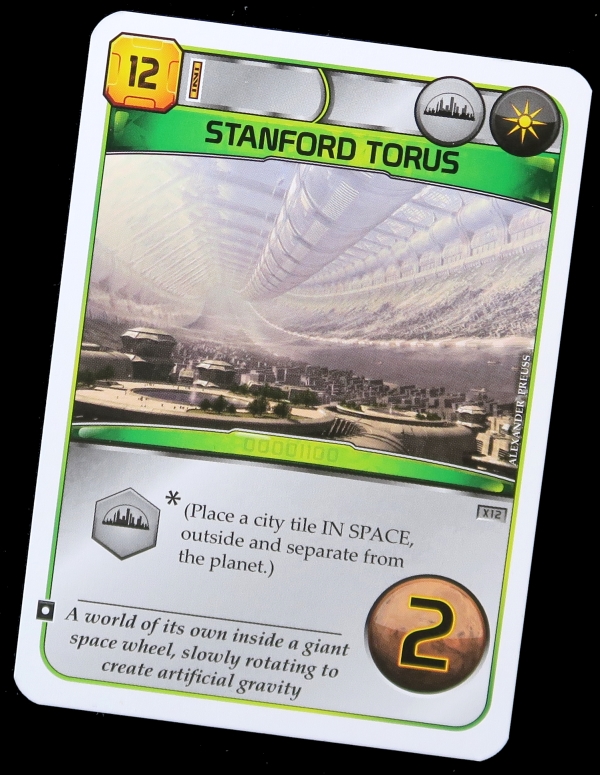
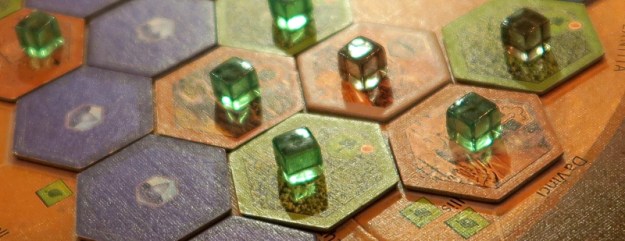
Meanwhile, on the next table, Green, Ivory, Plum and Teal were still playing Terraforming Mars.  To speed up the game they played with the Prelude start cards and also removed the Corporation cards—that turned out to be a good choice as the game only just finished before the pub closed.  In this game, players play corporations sponsored by the World Government working together in the terraforming process, but competing for victory points.  These are awarded not only for their contribution to the terraforming, but also for advancing human infrastructure throughout the solar system, and doing other generally commendable things.

Terraforming Mars
– Image by boardGOATS

The players acquire unique Project cards by buying them into their hand; these can represent anything from introducing plant life or animals, hurling asteroids at the surface, building cities, to mining the moons of Jupiter and establishing greenhouse gas industries to heat up the atmosphere. The Projects can give immediate bonuses, as well as increase production of different resources. Many cards also have requirements and become playable when the temperature, oxygen, or ocean coverage increases enough. Buying cards is costly, so there is a balance between buying cards (three MegaCredits per card) and actually playing them.

Terraforming Mars
– Image by boardGOATS

The game ends after the terraforming is complete when the three global parameters, temperature, oxygen, ocean have all reached their goal.  Players then score for their Terraform Rating with any other points they might have accrued.  This time, Green made his presence felt on the surface of Mars in the early stages with his initial starting forest, which grew a little, and seeded the oceans. He was the only one for a while.  Plum played a blue card which gave her a couple of extra Credits every time someone built a city.  This one really paid for itself in the four-player game as everyone wanted to build more than one city.  Green was first, but had mis-read the card and found himself colonizing Phobos instead.

Terraforming Mars: Prelude
– Image by boardGOATS

So, Teal was the first to actually build a city on the surface of Mars. He opted for the equator but on the other side from Green’s forests.  Later he played a blue city bonus card that gave him a Credit production bonus for each one. Although several cities had already been built by then, several more followed and he was able to enjoy the benefit of extra cash in later rounds.  Ivory meanwhile had made a different start to the game than his normal opening gambit (building a city), and completed the first Milestone: the Ecologist. However his cities did follow later as he extended down towards the south pole. Teal claimed the second milestone: the Specialist, helped on by his city Credit production bonus.

Terraforming Mars
– Image by boardGOATS

Plum was the last to claim a Milestone: the Generalist, as she was able to pay to increase her production one step each round.  She did not claim it straight away, but noticed it after Teal had claimed his, and thought she had better get in there quick.  Green was not able to claim any milestones, but instead was the first to fund an Award. A quick check around the player boards suggested he should fund Celebrity as he had three high value cards to Teal’s two, but neither Plum or Ivory had any cards over the value of twenty Credits. Later on Teal funded the second award and went for Estate Dealer as he clearly had more tiles next to oceans at this point (having planted his forests northwards around the oceans.

Terraforming Mars
– Image by boardGOATS

At the end of the game Green pulled out his wallet once more and funded Benefactor since he was ahead on the Terraform Rating track. Ivory was only one behind, but Green had a couple of options he could play on his last turn for a couple of extra Terraform Rating points. This prevented Ivory from funding the Dessert Settler award for which he had been building.  Green decided to go for outworld domination and also built Deimos city.  During the second half of the game Green realised he had forgotten his company bonus of a two MegaCredits reduction for each brown, Industrial tagged card.  He had built three, so put six Credits aside to be used in the event of a tie, (although had he remembered to claim them at the time, he may have been able to play more and better cards).

Terraforming Mars: Prelude
– Image by boardGOATS

In the final scoring it was very close indeed, although during the game Mars was regularly bombarded with meteors and nuclear bombs, so it was a wonder any one survived at all!  Ivory and Green tied for second with fifty-nine points. Even with his extra six Credits, Green still lost the tie to Ivory, who had more Credits left over from the final production.  At this point, Green realised he again had misread a card thinking he would get one point per ocean tile in the game for his capital city, but that would have given him a guaranteed nine points and would have been way too powerful. In the end, it was Teal who triumphed, but only just, with sixty-one points, in well deserved victory.

Terraforming Mars
– Image by boardGOATS

Learning Outcome:  Mama’s taking us to the zoo tomorrow, zoo tomorrow, zoo tomorrow… We can stay all day!

15th November 2022

With lots of absentees including Pink, Lemon, Orange and Plum, it was a relatively quiet night, but there were still nine and that left a difficult decision as to how to split up the group.  The “Feature Game” was Everdell, and although it only really plays four, Ivory had the new, Complete Collection which includes the Bellfaire expansion which adds two more players.  Three players seemed a little on the small side, so a four and a five it was, and the five were keen to give Everdell a go.

Everdell
– Image by boardGOATS

Although Ivory had played Everdell with Pink and Blue in the summer of 2020, nobody had seen the new, Complete Collection which was a recent acquisition for Ivory, and what a box it was—It was humongous!   Everyone wondered how Ivory stored it.  That developed into a conversation about where people store their games, and it seems pretty much everyone uses a “Kallax” (though some people didn’t know that’s what they are called). However, it turned out the Everdell box is so big, it doesn’t fit onto a Kallax and Ivory stored it under his bed!

Everdell
– Image by boardGOATS

Everdell is a very good looking game, a card-driven, tableau building and worker placement game set in a woodland glade.  Players take the role of leader of a group of critters constructing buildings, meeting characters and hosting events by placing workers to get resources and spending them to play cards.  Everyone enjoyed the opportunity to choose their own wooden meeple animals out of a selection of over twenty different types.  Ivory went for the purple Platypuss, Purple went for a light purple Owl, Lilac went for orange Foxes, Teal chose the grey Hedgehogs , and Green wanted the Brown Bats.  By random selection using a mobile app, Teal was to go first.

Everdell
– Image by boardGOATS

It took a few turns to get the hang of the game, although it is not overly complex on the face of things.  It is one of those games where there are apparently lots of choices, but in practice they are clear and relatively simple:  players either place a meeple to get a selection of resources, or play a card into their tableau.  And then, when all possible choices have been exhausted, players move onto the next “season”.  The trick is working out how to extend the possible number of turns taken each season. Ivory was the only one of the group who had played it before, so had got it worked out.  Everyone else had moved into spring while he merrily carried on taking his turns in his winter!

Everdell
– Image by boardGOATS

Teal was the first to move onto spring, and this order continued through the rest of the game. At one point it looked as though everyone else would have finished completely, while Ivory was still in summer!  It didn’t quite work out like that, but Ivory did have several more turns after everyone else had finished.  The other trick to Everdell is to pair up the Critters cards with the Construction cards. By building a Construction, a player could then build the corresponding critter for free afterwards, thus giving them extra turns and extra bonuses.  Ivory did well in this, and his starting and early meadow cards fell his way.

Everdell
– Image by boardGOATS

Green and Purple also did well getting pairs of cards and playing them during the game. Unfortunately Lilac and Teal just couldn’t seem to get the pairings they needed. So it seems there is still a certain amount of luck in this game.  The other thing which surprised everyone was how quickly the group got through a very big stack of cards from the meadow draw pile.  After last time where we nearly failed finish Endeavor before the pub closed, the group set an alarm to give them a thirty minute warning before closing time as we were worried we may have the same problem this time.

Everdell
– Image by boardGOATS

By the time the alarm went off nearly two hours later, the game was all but finished—not bad for a new five player game.  Playing it again, the same group could probably do it in ninety minutes or less.  Would it get another outing though?  It certainly has cuteness factor in spades; it is interesting, and the game-play is not overly complicated; it has challenge in random variations, and many good looking expansions to enhance and change the experience. So, it will almost certainly get another outing and Ivory had better not put the box too far under the bed, as we’ll be wanting him to bring it along again in the new year.

Everdell
– Image by boardGOATS

After too much “cards with text” with Villainous last month, it was clear that Everdell was not a game ideally suited to Lime and Pine.  Instead, Blue said she had just the game for them: Cascadia.  Cascadia won this year’s Spiel des Jahres award, and had not yet had an outing within the group.  The game is very simple though:  players have a starting three hex terrain tile, and on their turn, they take a terrain hex and a wooden wildlife token and add these to their tableau.  Each terrain tile has one, two or three types of wildlife depicted on it, and the wooden tokens have to be placed on a terrain tile with matching wildlife symbol and that is more or less all there is to it.

Cascadia
– Image by boardGOATS

The interesting part is the scoring.  Players score points for the largest area they have of each of the five different types of terrain with bonus points for the player with the largest area of each.  That is simple enough, but they also score points for each of the different types of wildlife, and their scoring is different for each game.  The scoring depends on the location of each type of wildlife, for example, this time players scored for each set of three (and only three) adjacent bears.  They also scored points for each different type of wildlife between pairs of hawks.  Ribbons of salmon and groups of elk also scored as did foxes for each different type of wildlife surrounding them.

Cascadia
– Image by boardGOATS

The game play behind Cascadia isn’t very new or terribly original, with the tile laying elements giving a feel similar to games like Kingdomino, or even Carcassonne.  The variation in the wildlife scoring (with more wildlife cards available to add more variety), however, and the fact that the wildlife tokens are finite in number and are drawn from a bag, adds just a hint of something reminiscent of bag-builder games like Orléans or Altiplano.  As the group played and Lime and Pine got into it, Blue and Black started to appreciate the subtlety a little more.  The addition of special Keystone tiles that give players nature tokens when wildlife tokens are placed on them, also help players to mitigate the luck elements.

Cascadia
– Image by boardGOATS

This time, foxes seemed to hide in the corner of the bag when players wanted them, then when they didn’t, they all came out of hiding.  Pine, inevitably put in a good showing and, despite everyone trying to persuade him, Lime succeeded in ignoring the advice to join his two groups of bears together (which would render them pointless).  The scores for the terrain were quite close with a spread of just a handful of points.  However, while Lime, Blue and Black had similar scores for their wildlife as well, Pine was eight points clear of his nearest rival giving him a final score of ninety-eight, ten points clear of Blue who was the best of the rest.  Pine and Lime had clearly enjoyed the game though and it will almost certainly get another outing soon.

Cascadia
– Image by boardGOATS

Lime excused himself, leaving Blue, Black and Pine to play something quick, taking less than an hour.  Although every time we play it, Pine points out that Bohnanza is not quick, this time he was persuaded because there were only three players and he wasn’t given time to think about it too carefully.  Bohnanza is one of the group’s most popular games, yet it hasn’t had an outing for ages.  The game play is very simple, but very interactive with a strong trading element. The active player first plays one or two bean cards from their hand into their fields taking care to keep them in the same order and only play the cards at the front.  They then turn over the top two cards from the deck and plant or trade them.  Finally when everything else has been dealt with, they can trade any cards in their hand with anybody else.

Bohnanza
– Image by boardGOATS

Cards are played into fields—with more players, each person has two fields in front of them and may buy a third, but with three, everyone starts with three fields.  This is important as each bean field can only hold one type of bean at any given time.  Beans can be harvested at any time to give coins and the game ends after three turns through the deck.  There are a few clever things about the game.  Firstly, players cannot harvest a field with a single bean in it unless all their fields have a single bean in them—this prevents players just cycling through beans they don’t want.  The really clever part of the game is that the fact that bean cards turn into coins when fields are harvested.  As the rarer beans are more valuable, this means they get increasingly rare as the game progresses.

Bohnanza
– Image by boardGOATS

This time, Blue planted two lots of Garden Beans early in the game which meant there were none available later.  Pine and Black shared the Black-eyed Beans, Stink Beans and Red Beans between them.  Blue planted lots of Green Beans and took it in turns with Pine to experiment with Soy Beans.  By the end, there were really only Wax Beans, Blue Beans, Coffee Beans and the occasional Green, Soy and Stink Beans.  With three experienced people playing, it was always going to be a tight game.  Pine finished with thirty “Bohnentaler”, a couple of more than Black, and was quite disgusted to find he was pipped by Blue by a single point.

Bohnanza
– Image by boardGOATS

Learning outcome:  Ikea need to sell a bigger Kallax.

6th September 2022

Plum and Pine were the first to arrive, shortly followed by Blue with Orange and Lemon.  With nobody eating, the group were in a position to start thinking about games straight away.  Plum had offered to lead Wingspan, with Lime in mind as he had recently acquired a copy of Wingspan and was keen to give it another go.  Pine commented that although he loves birds, he’d never really got on with the game-play of Wingspan so, sadly he’d prefer to play something else.  The “Feature Game” was to be Project L, a sort of Tetris-like, engine-building game and it sounded much more his thing.

Project L
– Image by boardGOATS

So, Plum took herself off to the other side of the pub to set up Wingspan with the European expansion.  The European expansion adds more cards including end of round cards, but doesn’t add any extra mechanisms (like the Oceania expansion), so it was felt that including it wouldn’t cause too much confusion.  As the others rolled up, there was much surprise as Teal and Ivory said they would rather give Project L a go.  Then Pine changed his mind and joined Wingspan (along with Purple and Lime), allowing Black to play the “Feature Game” as he had played Wingspan recently at Burgundy’s Birthday Event.  That left six to play Project L: Orange, Lemon, Blue, Ivory, Teal and Black.

Project L
– Image by boardGOATS

Project L is a very simple game:  players start with two small plastic pieces and use them to complete Puzzles winning more pieces enabling them to complete more complex Puzzles and thus build an engine.  On their turn the active player can do three actions from a list of five things:  upgrade a piece to a larger one, take a Puzzle from the display, recycle the Puzzle display, place a piece in a Puzzle they own, or place one piece in each of their Puzzles (or in as many different Puzzles as they can).  This last, “Master Action” can only be carried out once per turn, and is clearly very powerful once players can get it going, however, to make it work they need lots of Puzzles and lots of pieces.

Project L
– Image by boardGOATS

With six, to reduce the amount of down time there is the “Line Clear Variant” available.  In the normal game, there are two rows of four Puzzles, one of White backed Puzzles and one of slightly more advanced and therefore more rewarding, Black backed Puzzles.  In addition to winning pieces for completing Puzzles, players can also get  points—the player with the most points at the end of the game is the winner.  The game end is triggered when the draw deck of Black backed Puzzles is exhausted at which point the round is then finished and one more, final, round is played.  In the Ticket to Ride: Switzerland, there are two rows of each colour, each containing three Puzzles.  One pair of Black and White Puzzle rows are marked with a dark stone and the other pair with a colourless stone.

Project L
– Image by boardGOATS

The idea of the Line Clear Variant is that two players play simultaneously with the active players marked by a dark and a colourless stone that are passed round.  When it is their turn, players can only recycle or take Puzzles from the rows that match the colour of their their stone.  Ivory was picked as the start player (he drew the player aid marked with the start player symbol) and he began with the dark stone, so Orange, sitting opposite, started with the light stone.  Everyone began a little tentatively, but before long players were filling their Puzzles with gay abandon.  The game end is slightly less clear with the Line Clear Variant.  Still triggered by exhausting the Black Puzzle Deck, the game continues until the first player has been passed both of the markers again, in any order).

Project L
– Image by boardGOATS

The Black Puzzles ran out quite quickly—Project L really is just a “Filler Game“, but players still had to finish things off.  The start player was Ivory, which meant that Orange was a little caught out.  Once the game has finished, everyone can place any pieces they have left, but at the cost of a point for each one.  Orange was unlucky, and unable to complete any of his remaining Puzzles, neither could could Lemon.  Teal had managed to finish off all his Puzzles in his last turn, but everyone else placed three of their pieces to finish things off.  It was quite close for a first game:  Blue finished with eighteen points, but Ivory and Black tied with fifteen apiece with Ivory sneaking second place on the tie breaker (the player with the most completed Puzzles).

Project L
– Image by boardGOATS

A lot of the comment was about how nicely produced the game is and it had been enjoyable to play too although not very memorable.  It was time to move on to something else though and with six, the obvious and usual choice would be Bohnanza, but Ivory had other ideas and suggested New York Slice.  This is a reimplementation of …aber bitte mit Sahne which we played recently, but with a pizza theme instead of a cake theme.  In both games, the idea is that one player makes the cake (or pizza) and divides it up into segments equal to the number of players, then players take it in turns to choose one of the segments.

New York Slice
– Image by boardGOATS

When a player takes a segment, they can either eat slices or store them for later.  Those they will eat are worth points at the end of the game with the number dependent on the number of blobs of cream (or pepperoni slices) on top.  The pieces players keep are scored depending on who has the most of each type at the end of the game.  Each piece of cake (or pizza) has a number on it which tells players the number of that type in the game and also what the player with the most will score at the end of the game.  There are a few things that are different about New York Slice, however, which make it a little more competitive and slightly more of a “Gamers’ Game”.

New York Slice
– Image by boardGOATS

Firstly, in the case of a tie for who has the most pieces of a type of pizza, in …aber bitte mit Sahne all players score points whereas in New York Slice nobody gets anything.  Secondly, some of the pizza slices have anchovies on them and any of these that are visible at the end of the game are worth minus one (because everyone hates anchovies on pizzas right?  Well, everyone except Teal it seems…).  Probably the biggest change though, is that in New York Slice, each pizza is served with a Special—a bonus tile with rule-breaking powers.  In most cases, these are added to one of the segments for players to choose. They can be enticing and helpful, or they can be unhelpful and make players’ lives more difficult.

New York Slice
– Image by boardGOATS

Ivory cut the first pizza, leaving Blue to be the first to choose.  The first Special was “Cut in Line”, which Blue took straight away and then promptly forgot about it until the final round.  Ivory went into battle for mushroom pizza, but lost out to Teal.  The front-runner looked to be Black who stored the most BBQ and veggie pizza slices, largely thanks to his “Supersize Combos” Special which meant his two half slices became two whole slices of each type.  That only gave him joint second however, with Lemon who turned out to be quite the carnivore and finished with the most beef and meat feast pizzas.

New York Slice
– Image by boardGOATS

The winner, however, and by a single point, was Blue who picked up a lot of anchovies along with her “You Like Anchovies” Special and coupled that with winning the most lucrative pizza (pepperoni).  Full of pizza, Teal and Ivory decided it was time, leaving Black and Blue with Orange and Lime and a decision to make as to what to play next.  With Wingspan something over half-way through, they were looking for something substantial to play, but not too long.  Blue’s suggestion was Wsiąść do Pociągu: Polska, the Poland map for Ticket to Ride.  This was one that nobody around the table had played before though it had been played in the group two and a half years ago, shortly after it was released at Essen.

Wsiąść do Pociągu: Polska
– Image by boardGOATS

The Poland map works in much the same way as all the Ticket to Ride games; players collect coloured train cards and spend them to place plastic train pieces on the central map scoring points for placing trains, but also completing the route “Ticket” cards that they chose at the start of the game and maybe later too.  In addition to the usual rules, the base game maps all have a little something extra.  As well as the usual city locations, the Poland map also has countries, but unlike the Swiss map, these are not simply locations to connect to.  Instead when a player connects two countries, they collect one Country Card corresponding to each.  These are worth points at the end of the game.

Wsiąść do Pociągu: Polska
– Image by boardGOATS

When a third country is added to the “network”, the player again collects Country Cards, one for each country in the network. When Blue explained the rules, Black commented that that aspect was interesting and he was curious to see how it affected the game.  Blue started and was followed by Orange, Lemon and then Black.  Black started by collecting more Tickets—this was a tactic that was discussed briefly at Burgundy’s Birthday Memorial event.  Black had commented then that this was the way all the best players did it.  The idea is that by collecting Tickets early, players are best placed to make the most efficient use of their trains and know what coloured cards they might need.

Wsiąść do Pociągu: Polska
– Image by boardGOATS

However, it is a bit of a “Go Big or Go Home” strategy because if something critical goes wrong early, the player could get left with an armful of unfulfilled Tickets leaving them with lots of negative points.  And with the Poland map, this was far from impossible as it turned out to be quite a scrap for the centre of the board.  Lemon asked what she should do when someone had just taken a track she wanted, clearly meaning Orange who had just nabbed a critical route from Bydgoszcz to Płock.  “Kill them,” was the instant reply to much hilarity.  Lemon commented that she would get her revenge, though it was unclear whether that was planned for the game or sometime later…

Wsiąść do Pociągu: Polska
– Image by boardGOATS

Eventually, Blue claimed the first Country Cards, connecting Belarus to Germany.  When she added Russia and Lithuania, it was clear how these could add significant points to a player’s tally.  Further, the repeated nature of collecting Country Cards each time the network grew provided a good source of points of a similar magnitude to those gained from Tickets, but without the associated jeopardy.  The Country Cards are stacked in descending order of value so that the ones earnt early in the game are worth more, but although the value decreases, as more countries are added to  player’s network more tickets are picked up.  As a result, value of each additional card pick up (and therefore each country when added) remains fairly constant depending on how many players are fighting for Country Cards.

Wsiąść do Pociągu: Polska
– Image by boardGOATS

This time, Blue stole a bit of an early march on the Country Cards in the north, while Black acquired loads of Tickets and Orange got in everyone’s way.  While Blue’s primary route was in the north running east-west, Black and Orange focused on north-south and Lemon had two separate smaller networks which she unfortunately failed to connect together.  As everyone else saw how lucrative Country Cards could be, they joined in, connecting countries to the south.  Lemon pointed out the route they had taken from Ukraine through south Poland to Warsaw where they got a flight to the UK.  It was about then that the pub became an attraction in itself when one of the locals pointed out that the lease was for sale once more.

Wsiąść do Pociągu: Polska
– Image by boardGOATS

The game came to a slightly sudden end when Lemon ran out of trains—the Poland map is played with just thirty-five trains per player instead of the more usual forty-five.  Actual game play time isn’t much shorter than usual because, like the India map, there are fewer longer routes so players have to take more turns placing trains.  At the end of the game though, it was close with Lemon in the lead thanks largely to the fact she had concentrated on the lucrative long routes where possible.  Orange and Black had completed a lot of Tickets though, and when they were added on together with the Country Cards, they tied for second place with eighty-two points.  The winner was Blue, however, thanks to the huge pile of Country Cards.

Wsiąść do Pociągu: Polska
– Image by boardGOATS

Meanwhile, over the other side of the room, Plum, Pine, Lime and Purple were playing Wingspan with Blue’s pimped out set.  Wingspan is a beautiful bird-themed game where players are collecting birds in three different habitats.  On their turn, they can “plant” a bird card in one of these habitats, or activate one of the three habitats to collect food, lay eggs or collect more cards.  The clever part of the game is that when players activate a habitat, they also activate any birds within that habitat—in this way, the game is card driven. Played over four rounds, there are bonus points at the end of each round (dependent on tiles drawn at the start of the game).  Otherwise, players score for birds, eggs, tucked cards, and personal bonus cards at the end of the game.

Wingspan
– Image by boardGOATS

Players start with eight actions in the first round, but that decreases by one each round as the game progresses.  However, because players add birds to their habitats during the game, although they get fewer turns in later rounds, they are actually doing more things in each turn as they are activating more cards.  In Blue’s pimped out copy, she had replaced the wooden action cubes with little fluffy birds which are cute, but led to some initial confusion with the phrase “playing a bird” meaning variously take an action (playing a fluffy little bird) or play a bird card into a habitat.

Wingspan
– Image by boardGOATS

This time, everyone was slow to start—the start is almost always slow in Wingspan as players need cards to play and food so they can pay the cost, but this time it was especially true as players found their feet.  Lime began with a woodland bird that gave an extra food after re-setting the bird-feeder, which really helped him out throughout the game.  He also had a once-between-turns card which was triggered when another player tucked a card.   Since Purple had a bird with a tucking action, that looked like a good call.  Considerable merriment was derived from the tucking action:  who was tucking the most, watching out for people tucking etc..  Unfortunately however, Purple’s action required the tucked card to be taken from Purple’s hand so she often passed up the chance meaning she was not the most prolific tucker…

Wingspan
– Image by boardGOATS

Plum’s first two were wetland birds with one-off powers.  As her bonus card rewarded her for having cards left in hand at the end of the game, the fact these early birds increased her card drawing powers from the very start meant they could help towards that too.  Pine’s bonus card rewarded him for having birds with geographical names which he pretty much had in his starting hand. Lime’s bonus was for birds with tucked cards, but he only realised later that it meant multiple birds with tucked cards not the number of cards tucked.  He was able to pick up another bonus card later in the game, which worked slightly better for him though.

Wingspan
– Image by boardGOATS

Pine’s bird hunting for rodents largely went hungry in the early part of the game, though it did better in the later rounds.  Plum, instead of sharing her latest kitty pictures, mimicked her favourite kitty behaviour, and watched hawk-like for a successful hunt to trigger once-between-turns action.   She had a killer “three birds in one go move” set up ready to go—two birds both with a “play a second bird in the grasslands” action.  Although she was a little disappointed to have been unable to deploy it in time for the worms they ate to count towards the second round goal of most eaten worms.  This increased her egg laying power though and the final third bird allowed her to a sacrifice an egg for two new bird cards ensuring she achieved her bonus in the final round.

Wingspan
– Image by boardGOATS

With the game finally coming to an end, all that was left was the scores.  Plum and Lime took the most points for their birds while Purple and Pine had the most eggs.  While everything else was fairly close, Lime had his nose in front in most areas and this showed in the final scores which were moderately spread out.  Lime’s score of eighty-seven points was some ten points ahead of Plum in second, who was similarly ahead of Pine.  As always with Wingspan, it had been fun, though it had sadly confirmed to Pine that while he adores the theme, the game play just isn’t for him.  And on that sad note, with everyone else also finished, it was time for home.

Wingspan
– Image by boardGOATS

Learning Outcome:  Everyone loves Pizza.

Remembering Burgundy on his Birthday

Burgundy (also known as Mike Parker) was an Oxfordshire gamer who sadly passed away at the end of December 2021 and is much missed.  He would have been sixty-four on Saturday 27th August and a small group decided that we couldn’t let his birthday pass unmarked.  So, at the South Oxford Crematorium, in Garford (where his ashes had been scattered), six people met to remember him and set light to a 6 Nimmt! card in his honour. The idea was a nice one, however, it turned out that a lighter would have been better than matches in the slight breeze, and 6 Nimmt! cards are not as flammable as we thought:  Burgundy would have been highly amused watching or perhaps he was teasing us by blowing out the flames.

6 Nimmt!
– Image by boardGOATS

Eventually though, card number sixty-four was successfully burned, or rather charred (or at least most of it was), without doing too much damage to anybody’s fingers or setting fire to the tinder-dry countryside.  From there, the group went to The Fox in Steventon to honour Burgundy’s memory by playing some of his favourite games.  With six, the choices were limited without splitting into two groups, but one of Burgundy’s favourites was Ticket to Ride and the Team Asia expansion allowed everyone to play together.  It was a much tighter game than it had been earlier in the week and everyone played in the “Spirit of Burgundy” with lots of moaning when they picked up a card they didn’t want.  Team Purply-Black ran out the winners, just three points ahead of Team Pinky-Blue (who would have won had Pink let Blue take a chance and draw tickets on her last turn).

Ticket to Ride - Team Asia
– Image by Lilac

The group were going to squeeze in a quick game of 6 Nimmt! while waiting for food, but the cards (now one short of course) had barely been shuffled when food arrived.  Black, who missed out on on Ham, Egg & Chips at Burgundy’s wake, made up for it this time and then the group had to decide what to play next.  Bohnanza and 6 Nimmt! were options of course, but Green and Black were keen to play something heavier, though that would have meant splitting into two groups which somehow just didn’t seem right.  Concordia was another of Burgundy’s favourites and might have been an option with the Venus expansion, but that was moot as we didn’t have it.

Wingspan
– Image by boardGOATS

In the end, the group settled on Wingspan with the European expansion.  Although this only plays five, with two copies the group was able to make it work with an extra player.  This overpowers the “once per turn” (pink) cards, and leads to a lot of down time, but it felt the right thing to do for the occasion.  As a result of the slight unbalancing of the game, Blue got a lot of wheat, Green got an awful lot of worms, Pink and Purple Tucked a lot of cards, and Lilac was left at a bit of a disadvantage as she didn’t get a pink card at all.  Green was the eventual winner by some fifteen points, though it was very close for second with Blue just pipping Purple by a single point.  With the bar closing it was time to go home, but everyone felt that Burgundy would have approved, and would have enjoyed the evening too.

Mike Parker
– Image by Pushpendra Rishi

26th July 2022

Blue and Pink were first to arrive and were just finishing their supper when Ivory joined them soon followed by Pine.  Ivory and Pink were keen to play Ark Nova which is longer than our usual fare and therefore needed a quick and early start.  So, when Black and Purple arrived, they grabbed Black and headed over to the other side of the room.  Everyone else conformed to more typical hesitant behaviour and were a lot slower to get going.  This wasn’t helped by Blue who was explaining how Pink had managed to find the “Only Panda Themed Village in Cornwall” and when Lemon and Orange queried it, she felt the need to find the photos to prove it.

The Lanivet Inn
– Image by boardGOATS

Eventually, the group split into two with Purple, Blue, Pine and Teal playing the “Feature Game“, the Spiel des Jahres nominee, SCOUT.  Although this has a nominal and very tenuous “circus theme”, it really is well hidden and “pasted on” to what is otherwise a relatively traditional, though clever little Rummy-esque card game with a Bohnanza-type twist—players cannot change the order of the cards in their hand.  The idea is that players have a hand of cards and on their turn takes an action:  they play a run or a meld (set of cards of the same value à la Rummy), or take a card from the active set (the previously played set).  The first of these actions is called “Show” and players can only Show the set they want to play beats the previously played set (called the Active Set).  A set wins if it has more cards or the same number, but a higher value, and a meld always beats a run.

SCOUT
– Image by boardGOATS

When Showing, the cards played must be consecutive in the player’s hand, so a player can, for example, take a four, five and six from the beginning, middle or end of their hand.  It must beat the current Active Set, and it then becomes the new Active Set with the old one turned face down and added to its owner’s scoring pile.  In this way, the quality of the the Active Set is ever increasing—this mechanism makes SCOUT a ladder-climbing game, of which Tichu and Haggis are probably the best known.  The problem is that of course it will become progressively difficult to play cards (especially with the consecutive constraint), so players can also use the Scout action and take a card from the Active Set, for which it’s owner gets a Scout token as a reward.

SCOUT
– Image by boardGOATS

When Scouting, players can only take a card from the end of the Active Set, ensuring that runs retain their integrity and just become shorter and maybe of lower value.  A card that has been Scouted goes into the player’s hand, anywhere they like, so they can use this to connect two cards in a run, or enhance an already existing meld for example.  The really clever part of the game is that the cards have two values, and which value they take depends on which way up the cards are.  This is clever because it adds just enough flexibility to make the game work, while not making things trivial.

SCOUT
– Image by boardGOATS

At the start of the game, players are dealt a hand of cards and choose which way up the hand goes—not the individual cards, the whole hand.  From this point on, the hand stays the same way up, but when cards are added to a player’s hand (and only then), the added card can be rotated.  The game ends when either, one player runs out of cards, or when it gets to a player’s turn and they were the last person to Show.  In addition to Scout and Show, once during the game, players can also “Scout & Show” which is often used to bring about or prevent the game coming to an end.  Players then add up the number of scoring cards and tokens and subtract the number of cards in the their hand and the player with the most is the winner.

SCOUT
– Image by boardGOATS

The game is one of those games that is a bit odd to understand at first, so Purple (who started), began tentatively, but it wasn’t long before people were Scouting and Showing happily.  There was a bit of confusion when it came to Teal’s turn and he Scouted one of his own cards—a rules check didn’t answer the question of whether he should get a token (we called them Cadbury’s Chocolate Bars because of their colour) or not, so we decided not.  It was only later that we realised that of course players could not Scout from their own set, as a round of Scouting triggers the end of the game.  Pine was the clear winner with fourteen points, more than twice Blue in second, and in spite of forgetting he could Scout & Show which would have given him victory earlier.

SCOUT
– Image by boardGOATS

The game can be played in campaign mode where players get scoring tokens and add up the total after several rounds, however, we tend to prefer to play games like this as single, short, one-off games.  And this time, everyone wanted to “do a Lime” and give it a second go now they understood what they were doing.  It was about this time that Pine checked his phone for the first time and reported that the England versus Sweden semi-final in the Women’s European football championships was goalless, but that “Sweden were playing well”.  There was a general slightly pessimistic noise around the table and Teal began the second round.
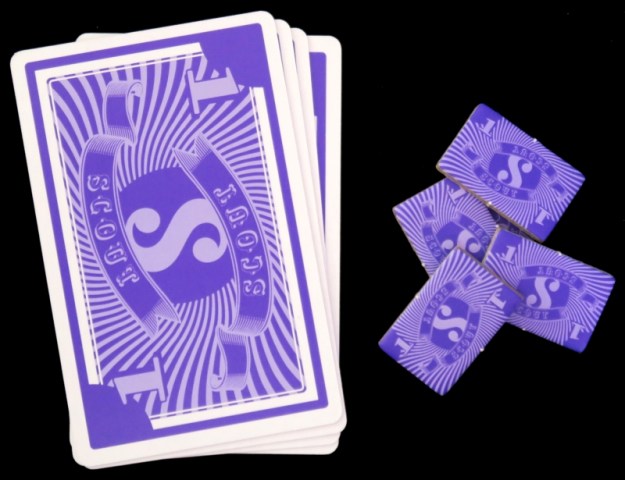
SCOUT
– Image by boardGOATS

A cheer from the bar prompted Pine to check his phone again and everyone relaxed a little when he reported that England had scored their first goal.  This second game of SCOUT was much closer than the first with scores of eleven, twelve, thirteen and fourteen, with Blue the victor, just ahead of Teal.  It had been a lot of fun and everyone really appreciated the cleverness of such a simple little game and found it had really grown on them from the two rounds they’d played.  There were other games people fancied playing, however, so the group moved on to Trek 12: Himalaya, a Roll and Write game we first enjoyed playing a few months ago and was given a “Recommendation” by the Spiel des Jahres Award committee.

Trek 12: Himalaya
– Image by boardGOATS

Trek 12 is similar to On Tour which we played several times online, but is a little more complex.  In On Tour, two d10 dice are rolled and players combine them to make a two digit number, so a five and a four can be combined to make a forty-five and a fifty-four, one of which is then written in a location on the map.  Locations are connected by “roads” and players are aiming to make the longest continuous route of numbers that only increase.  Trek 12 does something similar in that two dice are rolled and the numbers combined to give one, but as the sum, difference, or product, alternatively players may choose one single die (either the larger or the smaller).

On Tour
– Image by boardGOATS

The catch is that each of these operations can only be used just four times each during the game.  The resultant number is then written on the map, but the theme is trekking so chains of ascending or descending numbers represent ropes while groups of the same number represent camps.  Another difference is that in On Tour player can write their numbers anywhere on their map, whereas in Trek 12 numbers have to be added next each other.  This means that it is advisable to start in the centre and work out, advice that Pink eschewed at his cost last time we played.  Scoring is more complex as well, since players score for the highest value in each rope/camp plus one for each other number in the rope/camp with bonuses for the longest rope/largest camp and negative points for any isolated numbers.

Trek 12: Himalaya
– Image by boardGOATS

This time the group  used the Kagkot map, rather than the Dunai map used last time.  Teal, Purple and Pine all started at much the same place putting a five in the middle, but from there things quickly diverged despite the plague of fives that were rolled.  Blue decided to do something different and started with a zero in the middle.  Everyone got themselves into a bit of a tangle, but Purple struggled the most.  Part of the reason might have been distraction caused by the updates on the football as, during the second half of the match, there was a second goal, then a third.  Everyone was still digesting the third which was described as “Outrageous” when a fourth went in just eight minutes later to leave the final score four-nil to England.
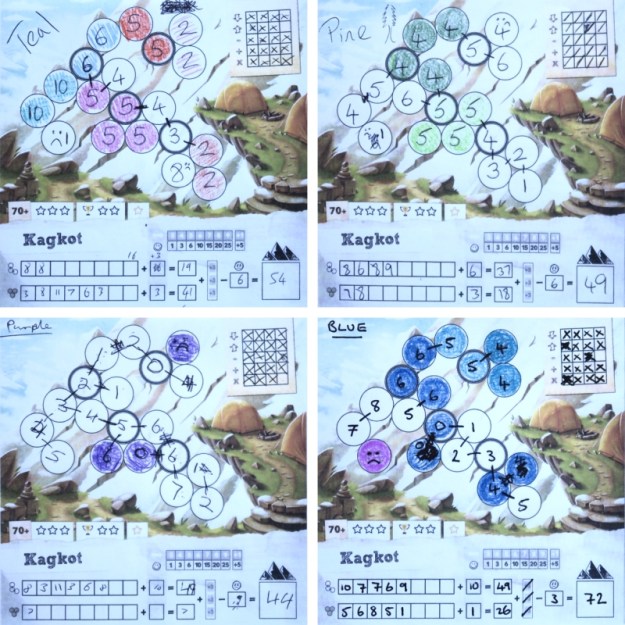
Trek 12: Himalaya
– Image by boardGOATS

Teal gambled on getting the high dice rolls he wanted, and jammily got them.  However, the game was won by Blue who put together lots and lots of very short ropes and small camps to give her high base scores, with one long rope to give a decent bonus and a final total just above the target set for the map in campaign mode.  While all this was going on, Lilac and Green were introducing Orange and Lemon to Carcassonne, an older, now classic Euro game that won the Spiel des Jahres award over twenty years ago.  The game is perhaps one of the best known tile-laying games and was the inspiration for the term “Meeple“.
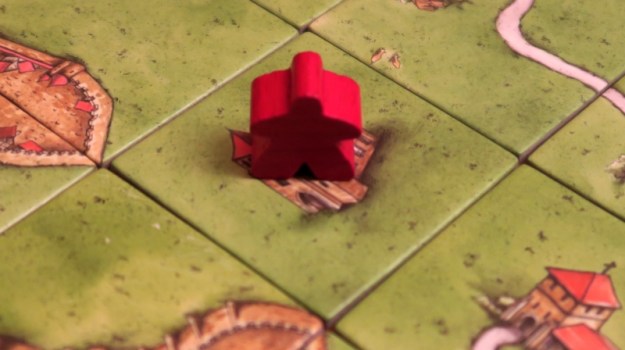
Carcassonne
– Image by boardGOATS

On their turn, players draw a tile and add it to the central map.  The tiles feature some combination of Roads, Cloisters, City and Fields.  Once the tile has been placed, the player can then add a single Meeple from their supply to the tile placing it on one of the features so it becomes a Thief, Monk, Knight or Farmer (respectively).  Finally, any features that are completed are scored and the players gets their Meeples back.  In this context, completed means Roads that end with a junction at both ends, Cloisters that are completely surrounded by other tiles, and Cities without gaps where the wall is closed).  Fields or Farms are only scored at the end of the game.

Carcassonne
– Image by boardGOATS

In this way, players score one point for each tile in a completed Road, nine points for a completed Cloister and two points for each tile in a completed city (plus two for any Pennants).  Although players can’t add a Meeple to a feature that is already occupied, it is possible to end up with shared features.  This happens when two separately owned Roads (say) are joined together.  In this situation, the player with the most Meeples scores the points, or, if there is a tie, both players get the points.  And this is really the crux of the game—players can play nicely or nastily, working together to build big Cities, or muscling in and stealing them from other players just before they score, or even playing tiles to make Features difficult to complete.

Carcassonne
– Image by boardGOATS

At the end of the game, Farms and any still incomplete Features are scored (though they only give only one point for each tile and Pennant in a city and one point for each tile in a Cloister array).  A Farm is a continuous Field, i.e. a green space that a Meeple could “walk” around that might be bordered by Roads, City walls, River or the edge of the map.  Each Farm then scores three points for each City that it “feeds”, i.e. that borders the Farm.  Since Farms can be very high scoring, early Farmers in the right place can be very valuable as they mean other players have to work hard to join fields together if they want to share the points.  On the other hand, an early farmer can be cut off and left scoring very few points.
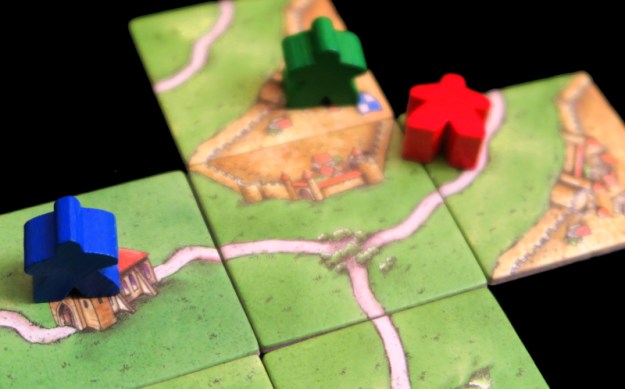
Carcassonne
– Image by boardGOATS

Additionally, since they are not recovered during the game, Farmers placed early are not scoring points during the game, so part of the skill of the game is timing when to place Farmers to maximise their value.  Scores are kept on a track, and the player with the most points at the end is the winner.  This time, although there were a number of expansions available, with Lemon and Orange were new to the game, the group only added the River expansion, which consists of a small number of tiles played at the start and helps to prevent the formation of one massive Field.  Lilac explained the rules: although it is mostly a simple game, the Farmers always cause a little confusion, in particular where the edges of the Fields were and how you might end up with more than one Farmer in a field.

Carcassonne
– Image by boardGOATS

Lilac placed the second river tile and with little other option available to her placed the first Farmer.  For the next few turns of placing River tiles, the question of when another player could place a farmer was often repeated, until Orange was able to get one with a road and bridge tile.  The River started running along the length of the table, expecting the board to develop more in the that direction than to the edges of the table. Unfortunately, fairly early on the river shifted sideways and the whole board developed across the table rather than along, so they had to shift the tiles a couple of times to make room (this was not meant to be the Discworld!).
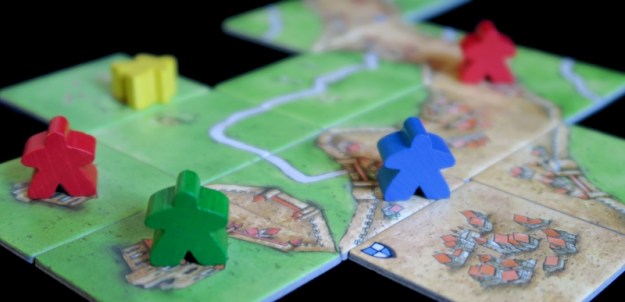
Carcassonne
– Image by boardGOATS

Lilac took an early commanding lead on the score board, with Orange next to start scoring. It seemed to take ages before Lemon got her first points and even longer for Green to get going.  However, Lilac’s lead soon disappeared as Green, Lemon and Orange shared the points for one enormous city—they thought they would never complete it, but with three people after one particular tile, it was almost inevitable really.  Lilac meanwhile was after the single bend road tile to complete a roundabout with her Meeple on it.  Everyone else got that tile, everyone except Lilac of course.  It looked like it would never happen, but in the dying moments of the game, she finally got the tile she needed. It was only worth four points, but it gave her a spare Meeple.

Carcassonne
– Image by boardGOATS

With the Farmers now understood, with his last tile, Orange was able to complete a City and then place a Meeple on the field part of that tile to be sole farmer for one complete city. It was only three points, but more than the couple he could have scored by using the tile to complete a Road. Having spotted this useful use of a final Meeple, Lemon and then Lilac both did the same.  In the mêlée of farmers, Orange came out on top, managing to knock out Lilac’s and Green’s farmers, and Lemon scored a few too.  The end result was a victory for Orange, a close second for Lemon, with the veterans of Green and Lilac well behind.  Perhaps they did not play quite as aggressively as they could have done, but mostly they just didn’t get the right tiles and were simply out-played.

Carcassonne
– Image by boardGOATS

Meanwhile, on the other side of the room, Black, Pink and Ivory were playing Ark Nova, but as it was showing no sign of finishing soon, with both Carcassonne and Trek 12 finished, the two groups had a decision to make:  play two games (maybe with a quick game of Musical Chairs first) or play one large game.  Las Vegas was suggested as a possible large game (it plays eight with the Boulevard Expansion), and Living Forest (winner of the Kennerspiel des Jahres this year) was an option if breaking into two groups.  Time marched on, and nobody in the group is very good at decision making and before long it was too late to play Living Forest and Las Vegas can take a while to play.  So in the end, the group decided to introduce Orange and Lemon to an old favourite, 6 Nimmt!.

6 Nimmt!
– Image by boardGOATS

Although 6 Nimmt! didn’t win the Spiel des Jahres Award, we certainly think it should have done; it did get a recommendation from the Jury though and of course it won the Golden GOAT in 2020 (a very difficult year for everyone).  Teal had to play taxi for his family, so headed off leaving seven to play.  The game is very simple:  players simultaneously choose a card from their hand and play it face down in front of them.  Once everyone has chosen a card, the cards are revealed and played in order from lowest to highest.  The cards are added to one of the four rows on the table—they are added to the row that ends with the highest number that is lower than the card itself.

6 Nimmt!
– Image by boardGOATS

If the card added would have been the sixth card, instead the player takes the cards in the row and their card becomes the start of the new row.  If the card is lower than all the cards at the end of the rows, instead the player chooses a row and their card replaces that row.  At the end of the game, players sum the total of Bull’s heads or “Nimmts” shown on the cards in their scoring pile and the player with the least is the winner.  There are a hundred and four cards in the deck, and we play a variant where the game is played over two rounds, each with half the cards.
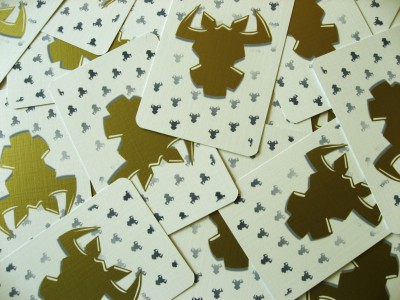
6 Nimmt!
– Image by boardGOATS

The delicious thing about 6 Nimmt! is that everyone feels that they are in control, until the moment when they aren’t.  Some people argue that it is a random game, but as the same players (like Burgundy) often seem to do well, it can’t be.  That said, and it is especially true for those that often do well (like Burgundy), when it goes wrong it can go catastrophically and spectacularly wrong.  As a result the suspense is murder and the game is loads of fun yet never seems to outstay its welcome.  Orange quickly got to grips with it and clearly quickly appreciated the jeopardy.
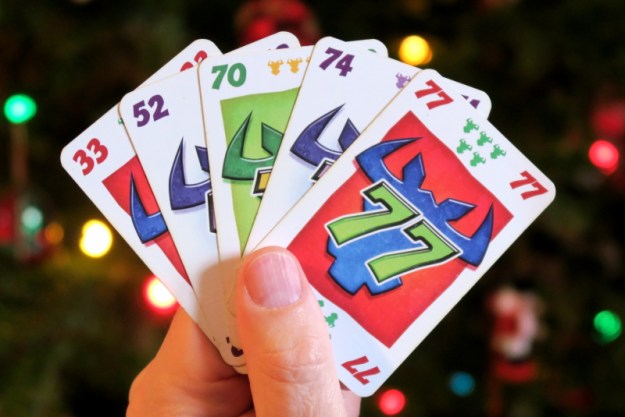
6 Nimmt!
– Image by boardGOATS

This time we played without the “Professional Variant” that had become so popular online, partly because it would not be fair on the people new to it, but mostly because everyone was tired and nobody was up to the mathematical gymnastics it required.  This time the first round was unusual, because everyone had similar scores.  Usually, at least one player manages to keep a clean or cleanish sheet and at least one player picks up lots of pretty coloured cards, but the range of scores at half way were between seven and thirteen.  That meant it was all to play for in the second half.
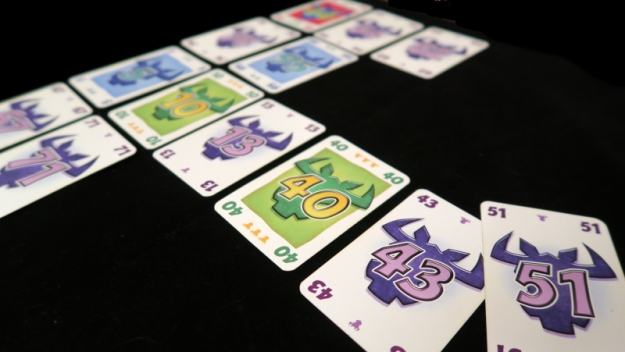
6 Nimmt!
– Image by boardGOATS

The second half was a little more varied with Green only collecting four Nimmts and Blue and Lilac collecting sixteen, but the net effect largely offset the differences in the first round.  Blue top-scored with twenty-seven, Pine was just behind with twenty-six and Lilac after him with twenty-three (she really is going to have to try harder if she is going to compete with the really high scorers).  The winner though was Purple with fifteen, one Nimmt less than the runner up, Green, in what had been a tight game, but a lot of fun, as always.

6 Nimmt!
– Image by boardGOATS

Ark Nova was still on-going, so Orange, Lemon and Lilac killed a few minutes with a quick round of Dobble.  This Snap-a-Like game is simple, but a lot of fun.  This time, players started with a single card and called a match with the central pile and grabbed a card.  Despite playing in English which is not his first language, Orange is remarkably good at this game, taking twenty-two cards, beating Lemon into second place.  From there, that side of the room just deteriorated into random chatter about random pub-type things (including the Voice of Jack and the demise of Frosts at Millets) as people ran out of steam and waited for Ark Nova to finish.

Dobble
– Image by boardGOATS

By this time, Black, Pink and Ivory were rapidly running out of time as last orders had been called some time ago.  Ark Nova is a much longer game than we usually play with an advertised playing time of upwards of two hours and reputedly considerably more with inexperienced players and setup time included.  It is all about planning and designing a modern, scientifically managed zoo—when this was first mentioned at the start of the evening, Pine looked all interested in the theme, but was quickly put off when Ivory added it was “a bit like Terraforming Mars with animals”.  That said, although it is quite complex, functionally it is not difficult to play on a turn by turn basis, though there is quite a lot to manage and keep a track of.

Ark Nova
– Image by boardGOATS

On their turn, players take one of six possible actions:  activating one of the five action cards (Cards, Build, Animals, Association and Sponsor) with a strength equal to the number above the card, or move a card back to the first space and take a cross token instead.  When activating a card players perform the action based on its power level.  The power level is dictated by its position in the row, with the level one power to the left and the level five to the right.  Once a card has been played, it is moved the first space in the player’s five card row (i.e.to the lowest power position on the left) moving the other cards to the right to replace the card removed, effectively incrementing their power by one.  During the game, players can upgrade and turn over the action cards to a more powerful second side using various bonuses.

Ark Nova
– Image by boardGOATS

The Cards action is the simplest action, which lets players draw cards from the deck (the number depending on strength) then advance the marker two spaces along the break track which defines when the round ends.  The Build action allows players to pay to construct one building on their zoo map.  Players can build basic enclosures with a size of one to five, but they can also build a petting zoo for animal storage or pavilions and kiosks (which give players appeal and money respectively based on adjacent filled enclosures).  With the upgraded build action, players can build multiple different buildings and have access to the large bird aviary and reptile house which allow the storage of multiple animals.

Ark Nova
– Image by boardGOATS

There’s no point of having enclosures without animals, and that’s where the animals action comes in:  it allows players to add animals into enclosures in their zoo. Some animals have a special requirement and need a symbol in their tableau and/or the upgraded animal card. Adding an animal to an enclosure has a cost, and then the player turns over the empty enclosure of at least the size needed or places the listed cubes into a special enclosure (an aviary or a reptile house).  The player then adds the animal card to their tableau and resolves the abilities on it and receives ticket sales along with possibly conservation points and reputation.
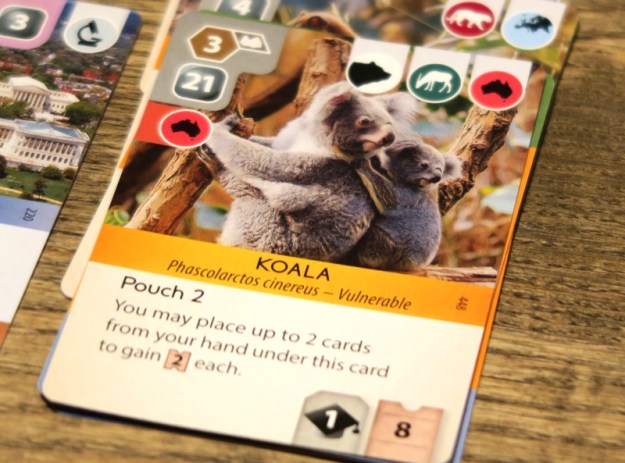
Ark Nova
– Image by boardGOATS

The association action allows players to take one task on the association board with different tasks available based on their power level.  This allows people to gain reputation points, acquire a partner zoo they don’t already own, gain a partner university, or support a conservation.  Finally the sponsor action allows players to play exactly one sponsor from their hand which offer ongoing abilities.  They can allow players to place unique tiles in their zoo and offer end game conservation point opportunities. Some Sponsor cards have conditions on their play similar to the animal cards.
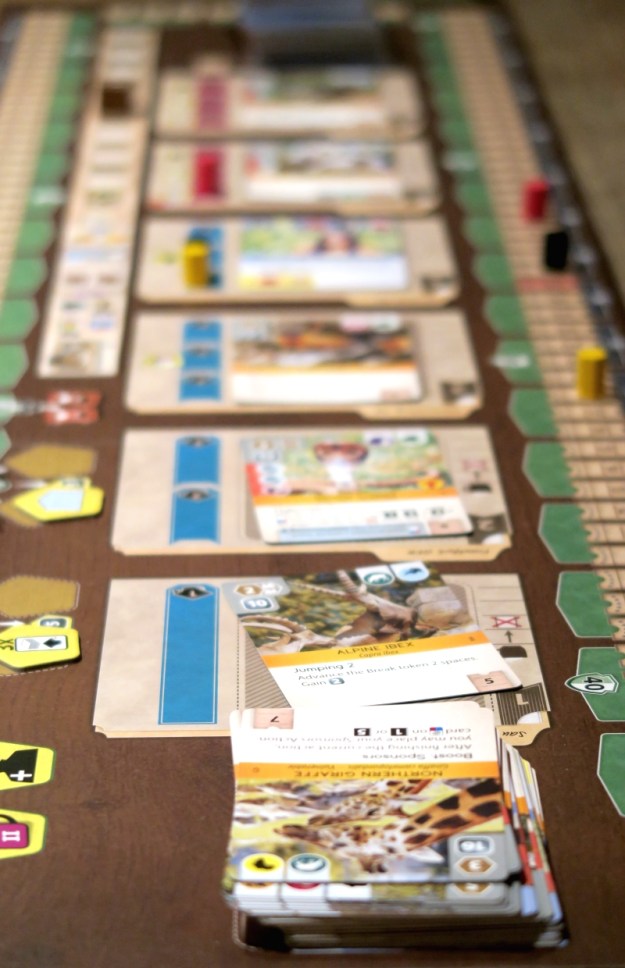
Ark Nova
– Image by boardGOATS

Players take it in turns to take actions, resetting every time a break occurs, until the end game has been triggered.  There are two tracks, Appeal (Tickets) and Conservation that follow the same course, but in opposite directions.  The game end is triggered when one player’s pair of scoring markers cross, after which, everyone gets one more turn and then the end-game cards are scored.  The player with the largest overlap between their Conservation and Appeal values is the winner.  A player’s tokens can meet and pass at any point, but Conservation points are much harder to get than Appeal, so to compensate, each step on the early part of the Conservation track is equivalent to two Tickets on the Appeal track, while each Conservation step is worth three Tickets.
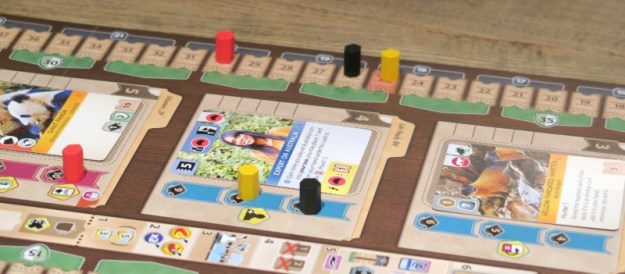
Ark Nova
– Image by boardGOATS

Pink started hard and fast with a simple animal strategy concentrating on upgrading his action cards to get the more powerful actions and getting extra workers.  In contrast, Ivory and Black started a little slower and focused on getting larger (Size five) pens, like the reptile house and the aviary.  These are more difficult to get, but are also more valuable.  Ivory then added a Stork and a Condor, while Black collected a Horse and engaged the services of a European Hobbit-like Expert.  The game was about half-way through when the other table heard a howl of delight from all three of them:  The Panda card had come out.  From this point forward, Pink’s primary aim was to get the Panda and find it a nice, cosy, bamboo-filled space in his zoo where he could love it and hug it at leisure.

Ark Nova
– Image by boardGOATS

Although Pink got a lot of Tickets early, his Conservation was very low which made him look like he wasn’t a threat.  Maybe Ivory and Black took their eye off him because of this, as they seemed surprised when Pink suddenly got ten Conservation points very quickly using the Association action which triggered the end of the game quite abruptly.  In a similar way to the recent game of Viticulture where Teal did the same thing, this meant everyone else had to make the best of things.  It was probably for the best, however, as by this time it was a real race against the clock.
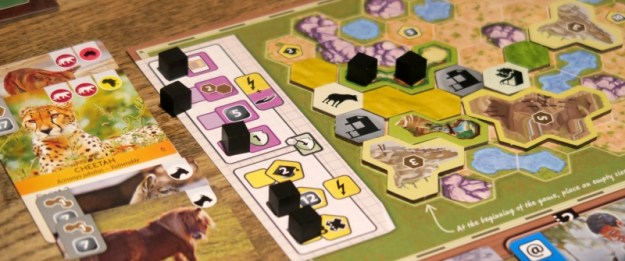
Ark Nova
– Image by boardGOATS

In the end game scoring, Ivory also managed to get his Appeal and Conservation pieces to cross over, but Black was less fortunate finishing with a negative score.  It was close between Pink and Ivory, but Ivory scored more in the end-game scoring and took victory by a single point.  Even though it finished in a bit of a rush, they had all really enjoyed the game; Black commented that rather than being like Terraforming Mars, to him it felt more like Wingspan, which was probably just as well as he’s not very fond of Terraforming Mars.   As they rushed to pack the game away, Pink gave his Panda one last hug before putting him back in the box and going home.

Ark Nova
– Image by boardGOATS

Learning Outcome:  Pink Likes Pandas.