Tag Archives: Carcassonne

13th January 2022

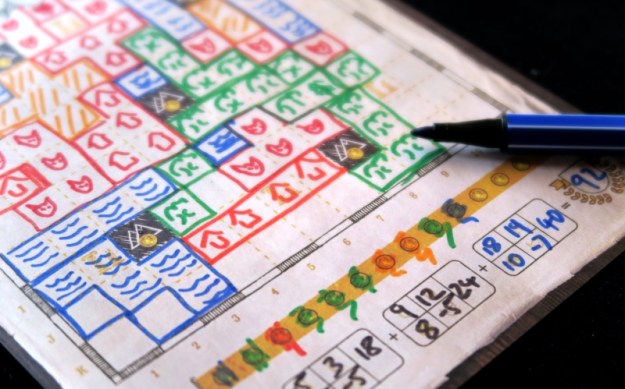
Blue and Pink were the first to arrive, soon joined by Black and Purple.  Others quickly rolled up and before long, everyone was discussing what they’d been doing over the holiday.  Teal produced a new “Roll and Write” game that everyone could play together, called Trek 12: Himalaya, a game where players are climbing a mountain.  He gave a quick summary and demonstrated how he’d raided the stationary cupboard so everyone quickly agreed to give it a go.

Trek 12: Himalaya
– Image by boardGOATS

The game has some prima facie similarities to On Tour which we played remotely a couple of times, in that two dice are rolled and their results combined.  In On Tour, the results are simply combined to make a two digit number, so a two and a three can make a twenty-three or a thirty-two.  In Trex 12, the numbers are combined by addition, subtraction or multiplication and additionally players can pick either the larger or the smaller individually, with each option available a total of four times during the game.

Trek 12: Himalaya
– Image by boardGOATS

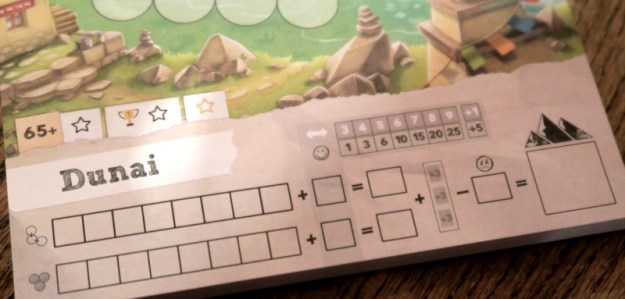
Players are trying to make chains of consecutive numbers and groups of the same number—runs and melds, which represent ropes and camps respectively.  At the end of the game, players score for the highest number in the rope (or camp), plus one additional point for every other connected point (which must be connected when they are played).  Additionally, players score bonus points for the longest rope they make, and the largest camp, and penalties for any isolated numbers that are not part of a rope or a camp.
Trek 12: Himalaya
– Image by boardGOATS

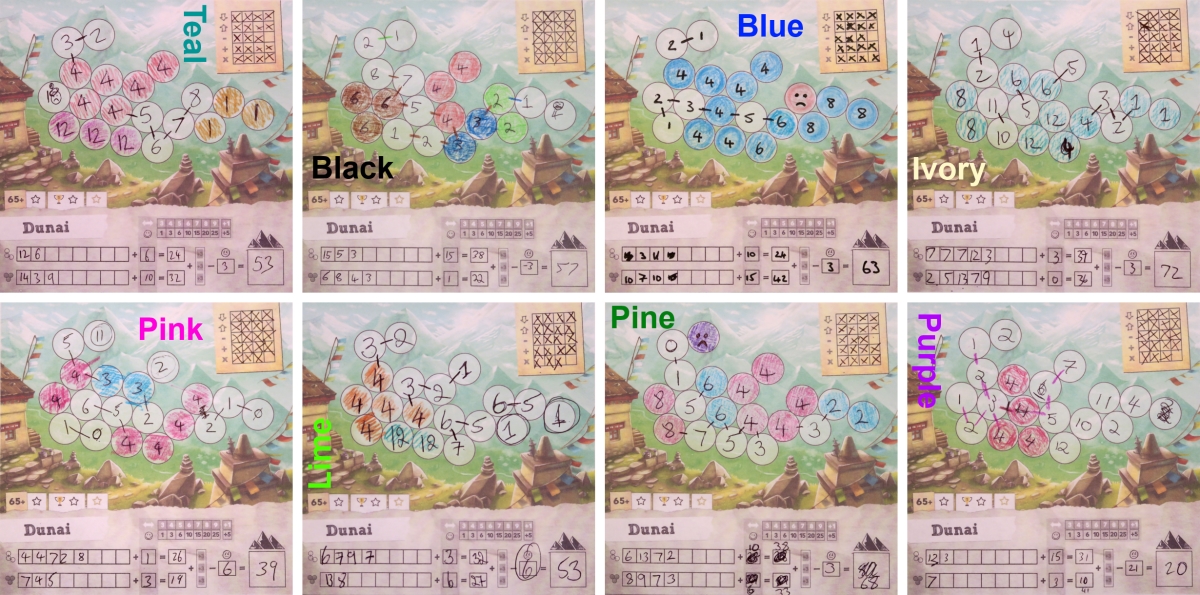
It took a couple of turns to get going, but thereafter it was quite quick.  The game has a sort of legacy element with alternative maps and envelopes that can be opened once certain challenges have been met, but we played the Dunai map and without any complications.  Teal pointed out that although the first number can go anywhere, thereafter numbers must be written next to other numbers so it was wise to keep options open.  Pink therefore started at one end, immediately demonstrating how to make the game more challenging.
Trek 12: Himalaya
– Image by boardGOATS

Pine and Blue seemed to be working to very similar strategies with a long rope and a large “Four” camp in the middle, though Pine made a better fist of it and finished in second place with sixty-eight.  Ivory was the overall winner though, with lots and lots of short bits of rope of high value and a final score of seventy-two, well clear of the total needed to beat the game.  Trex 12 had been both quick and enjoyable, so after that aperitif everyone was ready to move on to something a little more filling, and the group split into two, the first playing the “Feature Game“, Streets.
Streets
– Image by boardGOATS

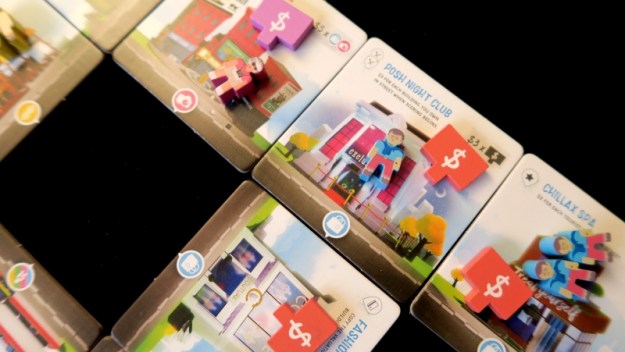
Streets is a tile laying game by the same people as the very enjoyable Villagers.  It is, perhaps, a little lighter and, rather than developing the occupants of a village, players are building a city, transforming it street by street, from a small town into a centre of culture and commerce.  The turn structure is similar to more familiar games like Carcassonne: On their turn, the active player chooses a building tile, adds it to the town, places an ownership marker on it and then scores any completed features, in this case, Streets.
Streets
– Image by boardGOATS

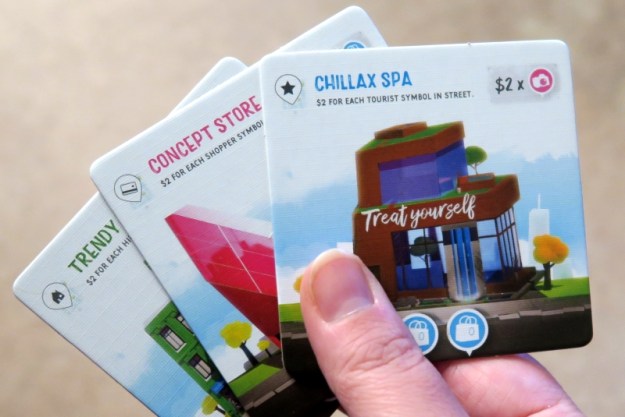
Although there are similarities, there are a lot of differences: players have a hand of three tiles all of which represent buildings; as well as ownership tokens, the active player also places people on the building, then there are the tile placement and scoring rules.  The building tiles have a road at the bottom and sky at the top and can be placed such that a Street, a row of houses, is extended by adding the tile to it in the same orientation, or terminated so that the road is perpendicular forming a junction.  When both ends of a Street finish in a junction, the Street is closed and scored.

Streets
– Image by boardGOATS

Different buildings score in different ways, for example some tiles give points for people in the Street and others for the number of building symbols in the Street.  There are a few little niggly little rules.  For example, when scoring a Street players include the symbols on the street itself, but also any on a tile that terminates the Street and points towards it.  There are other ways of scoring buildings as well, for the number of adjacent tiles or copying another building of choice in the Street for example.  In addition to the money won for the building itself, players also score for the number of people on the tile scored.
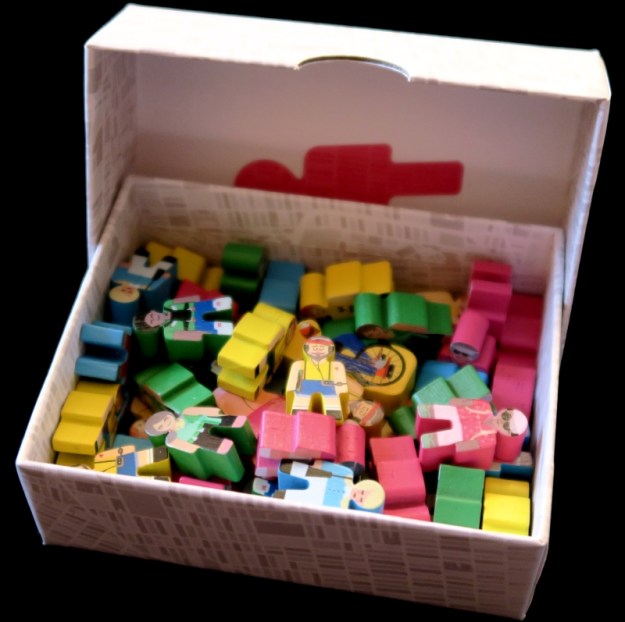
Streets
– Image by boardGOATS

When a building is scored, the active player moves the people on to different building in another, open Street.  This encourages players to terminate Streets even though they might not score themselves, because they can move people onto their own buildings elsewhere which means they will score more later in the game.  There are a few other things that contribute to the decision making dilemmas.  For example, players only have five ownership tokens, and if they run out, they have to take them from another building without scoring it.
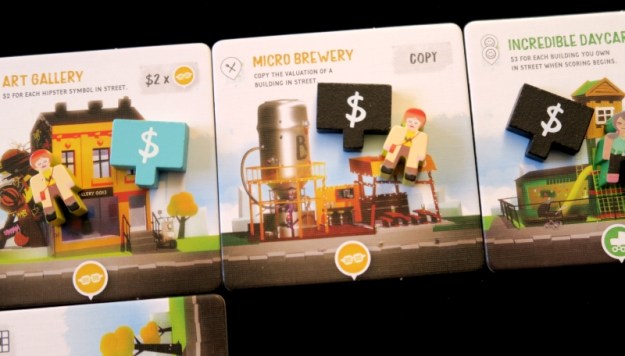
Streets
– Image by boardGOATS

The game ends when all the tiles have been played and any remaining Streets are scored, but for half points (similar to Carcassonne).  The basic game is quite straight forward, but although most people got to grips with it, the combination of small text, symbols, a little confusion of terminology and general tiredness meant others struggled with planning effective moves.  Black took what was obviously an early march when he played his micro-brewery tile to “copy” another high-scoring tile in the same street, but Purple, Blue and Pine had their moments too.

Streets
– Image by boardGOATS

In the end, Black won with a cricket score of a hundred and twenty (well, a score that would have beaten England in the recent Ashes series anyhow).  Blue, Purple and Black quite enjoyed the game and could see the its potential for adding expansions too.  Definitely one to be played again, though Pine might need some persuading.  Meanwhile, on the next table, Ivory, Pink and Teal were getting to grips with a game of Key Flow (Lime having taken an early night after another very early morning).

Key Flow
– Image by boardGOATS

Ivory and Pink have played Key Flow and its big brother, Keyflower, many times before (including relatively recently in October), but Teal was new to the game though he’d heard good things.  In both games, players are building villages and activating the buildings in their villages by playing meeples (or rather Keyples) to generate resources and score points.  The games have a lot in common including the artwork, the iconography and the fact both take place over four rounds or seasons, but the underlying game mechanism is different.  In Keyflower, players acquire tiles by auction where in Key flow players gain cards by drafting.
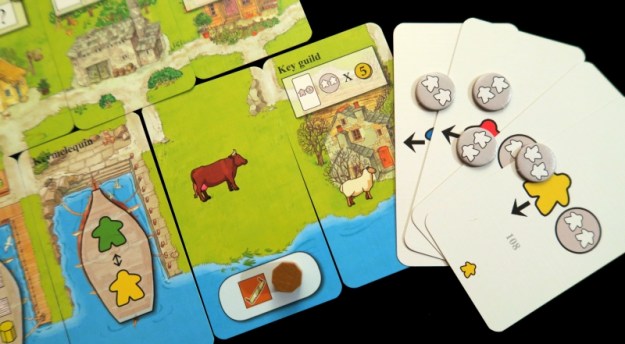
Key Flow
– Image by boardGOATS

Key Flow is surprisingly straightforward to play, though doing well is a completely different matter.  Players who start with a hand of cards, choose one and pass the rest on, adding their chosen card to their village before they get their next, slightly smaller hand.  There are three types of card:  Village cards, Riverside cards and “Keyple” cards.  Village cards are buildings that can be activated by playing Keyples above them, while Riverside cards provide instant resources and skill tiles.

Key Flow
– Image by boardGOATS

The cards have to be “connected” together and location can be important. Buildings for example are more productive if they have been upgraded, but upgrading needs resources and the resources need to be moved to the building being upgraded. Similarly, in autumn there are some buildings which score points for resources they are holding. Therefore, it is helpful if the building producing the resources is near to the one being upgraded or used for scoring as moving resources can be expensive and sometimes difficult.

Key Flow
– Image by boardGOATS

Simlar to the Keyples in Keyflower, the Keyple cards are used to activate buildings and produce resources.  Some can be played either in a neighbour’s village or the player’s own village.  Other cards can only be played in the village one side or cannot be played in one’s own village.  This is why three players is arguably the sweet-spot for Key Flow—with more players there is at least one village players cannot use, adding a level of randomness that it is difficult to deal with.  With three however, everything in play is accessible, though perhaps at a cost.
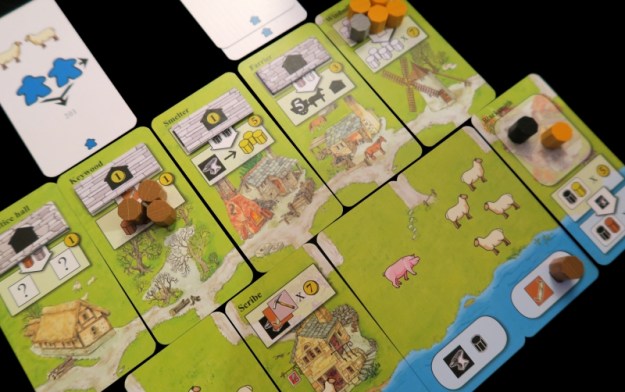
Key Flow
– Image by boardGOATS

At the start of the game players get some winter cards which can act as objectives to guide players’ strategies; at the start of the final round players get to keep one of these with the rest going into the draft.  At the end of the game, players score for any autumn cards, any buildings with upgrades as appropriate, any winter cards and finally one point for any otherwise unused gold.
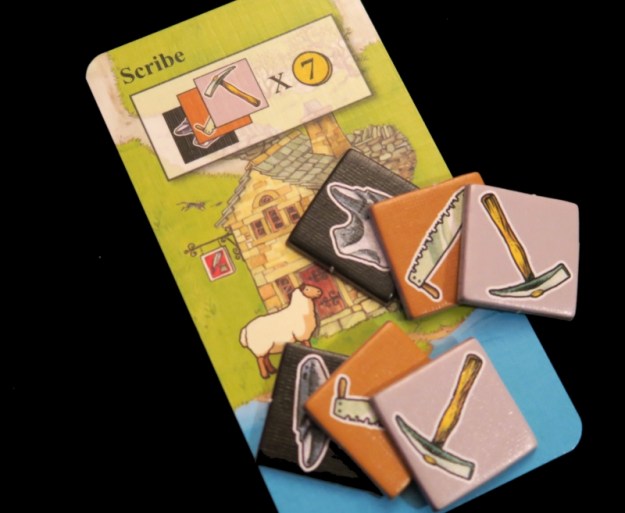
Key Flow
– Image by boardGOATS

This time, Pink went for a “Scholar Strategy”, but changed his mind at the last minute to go for the Ranch instead.  Teal went for a gold strategy with the Jeweller to double his score, and picking up both the Gold Mine and the Smelter, the latter of which he upgraded so he could exchange one skill tile for three gold.  Unfortunately, Pink found that useful too and therefore got in his way somewhat.  Ivory didn’t appear to have a strategy early on, but made sure he had plenty of resources he hoped would be useful later in the game.

Key Flow
– Image by boardGOATS

In the final round, Pink got his Scholar anyhow then lucked out and got the Trader too, while Teal’s flotilla of boats gave him a lot of options, but somehow he struggled to convert them into points.  Ivory who had been keeping all his options open with a scatter-gun approach, managed to finish with a smorgasbord of points from pigs, Keyples, travel, and of course resources.

Key Flow
– Image by boardGOATS

It was not a surprise Ivory won as he always does well in this game, but Pink was very pleased to have run him close finishing just five points behind.  With that, people started to drift off, a few people hung about for a while, just chatting, amongst other things, discussing what “Cotton Clouds and White Cashmere” smells like and whether the new soap in the Ladies really did smell of it…

Key Flow
– Image by boardGOATS

Learning Outcome:  “Roll and Write” games aren’t only the preserve of “Remote Gaming”.

16th December 2021

Ivory, always excitable when it comes to Christmas, was first to arrive, shortly followed by Blue and Pink, with armfuls of crackers, parcels, party poppers and Golden GOAT voting forms. It was our first visit to The Jockey since the retirement of the Charles and Anna, but Michelle and John made us very welcome on their first full day, and were very understanding of the noise mess we inevitably made.

"Un-Christmas Party" 2021
– Image by boardGOATS

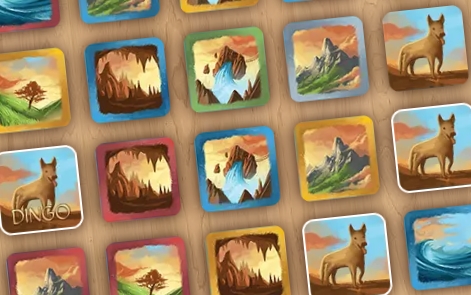
We started with the crackers, frantically chasing dice, chocolates, and meeples all over the place, and then suffering the flock of appalling goaty jokes with which they were filled. As people munched the chocolates from their crackers they filled in their Golden GOAT voting forms, then Pine and Pink collated the results.  There were lots of nominations for GOAT Poo, but the runaway winner was Dingo’s Dreams.  This is probably quite a clever game that we would normally enjoy, but we played it online with lots of people, none of whom had any idea what they were trying to do.  As a result, the complete chaos made for a very un-fun experience all round.

Dingo's Dreams
– Image by boardGOATS from boardgamearena.com

Discussion surrounding the Moment of the Year included reminiscences of the time Lime accidentally joined an online game of 6 Nimmt! with a bunch of Frenchmen, but that was last year and therefore not eligible this time round.  Pine and Pink fondly remembered the pasting they gave to Burgundy and Blue when they played Ticket to Ride: Heart of Africa, but the winner was the online game of Niagara when Pink won by stealing gems from everyone else—an event that still lingers in the the memory of those who were robbed and are even now dreaming of revenge.

Niagara
– Adapted by boardGOATS from image by
BGG Contributor El_Comandante

With all the online gaming, there was less competition than usual for the Golden GOAT award.  Indeed, the 2019 winner, Wingspan, was very nearly the first game to win the Golden GOAT award twice, but much to Green’s obvious delight, it was just pipped to victory by Praga Caput Regni – quite an achievement given that only four people in the group had even played it.  We spent our winnings from the quiz on appetizers and with some having a full three-course dinner, we weren’t finished till quite late.  There was just time for a game or two though…

Golden GOAT - 2021
– Image by boardGOATS

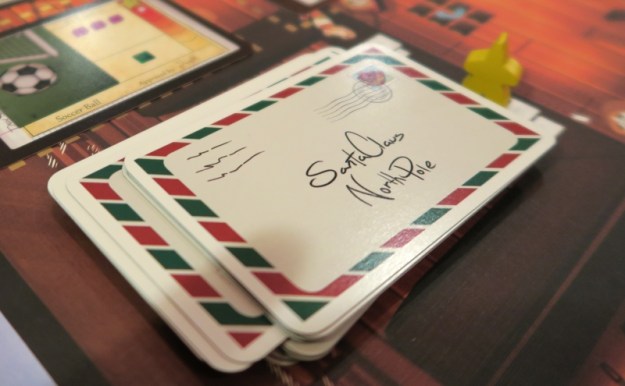
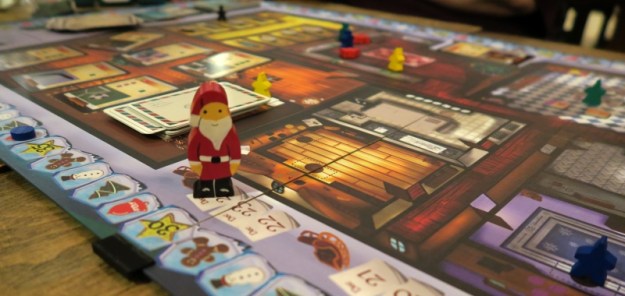
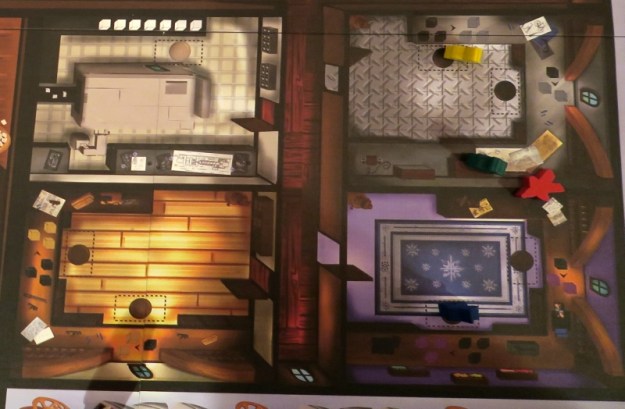
Pine was keen to play Ticket to Ride: Nordic Countries, but after the Heart of Africa experience nobody else was enthusiastic to join him.  Ivory was keen to play  the “Feature Game” which was Santa’s Workshop, so Pink, Blue and Burgundy joined him.  This is a medium-light weight worker placement game, similar to Stone Age, Lords of Waterdeep or Viticulture, but with a festive theme.  Players operate teams of elves making presents for Santa to deliver on Christmas Eve.

Santa's Workshop
– Image by boardGOATS

On their turn, players can send elves to collect wish-list items, mine for coal, visit the metal, wood, fabric, plastic and assembly workshops, or train their elves so they work more efficiently.  Players earn Cookies for every gift they make, and every three days, Santa carries out an inspection and the teams that have made the most gifts get more Cookies.  The elves can also visit the Reindeer Stables to get help and more Cookies—the player whose team of elves has earned the most Cookies by the end of Christmas Eve is the winner.

Santa's Workshop
– Image by boardGOATS

The game is played over the nine days before Christmas, appropriately from 16th December (the date of our “Un-Christmas Dinner”) up to and including Christmas Eve.  Each gift card shows what it is made of and how much assembly it will need, as well as how many Cookies it will earn when it is completed.  One of the things that makes this game a little different to other worker placement games is that players are unable to store resources:  elves must first acquire the gift card, then the materials to make the gift (wood, plastic, fabric and metal), and only then can the elves assemble the gift.

Santa's Workshop
– Image by boardGOATS

The idea is that the elf is taking the pieces to the assembly room and making it there, so timing is everything.  If a player visits receives five pieces of wood, but can only use three, the other two go to waste. Players can improve their situation by getting some of their elves trained—this costs a turn, but a visit to the School Room means they can use this additional skill to produce more material or assemble things more efficiently.  The question is whether this is worth the effort as the game is played over just nine days with only three turns per day (or four at lower player counts).

Santa's Workshop
– Image by boardGOATS

Blue and Burgundy started fast and took the bonus Cookies for the most productive team at the end of the 18th December, but by the end of the Christmas Eve, Ivory and Pink were getting the most Cookies for being the most productive while Blue and Burgundy’s attentions were elsewhere. Ivory started out making a lovely wooden music box, but then moved rapidly into making plastic tat.  Selling coal to Santa was also highly lucrative (Santa always needs coal to give to naughty children).

Santa's Workshop
– Image by boardGOATS

Blue did the reverse, starting by making Lego bricks with lots of plastic and then moving on to making dressing up clothes and a lovely teddy bear which she failed to assemble.  Burgundy also struggled with his assembly and spent quite a lot of time visiting the stable and petting Comet (to take the first player marker) or Donna (to obtain the assistance of Zelf to get extra material).  Pink similarly struggled and felt it was important to prioritise being the first player at certain points during the game.

Santa's Workshop
– Image by boardGOATS

It was a very close game and the final few turns were really critical as players tried to make sure they completed everything they could and most realised they couldn’t finish  what they wanted to.  Ivory thought he might just make it and gambled on getting enough visits to the assembly room to do what he needed.  In contrast, Blue pragmatically took the Cookies from Dasher’s stable and gave up all hope that she might be able to assemble her gifts.  And that made the difference, giving Blue victory, finishing ten Cookies ahead of Ivory, with Pink just behind in third.

Santa's Workshop
– Image by boardGOATS

Although not an exceptional game, Santa’s Workshop is unquestionably one of the best festive games we’ve played—all the more so as it has a genuine Christmas theme rather than simply being “snowy”.  Sadly, the pieces lack a little something, especially Santa, but we made up for that by stealing the bits from Christmas Penguins, which we played a couple of years ago and had great bits, but lacked something in the game-play.  The game itself was purchased in a couple of years ago and sent on by a friend in Australia, but first got caught in the bush fires there and then playing it was delayed by Covid when last year’s Christmas Event was online; the verdict was that it was worth the wait though.

Santa's Workshop
– Image by boardGOATS

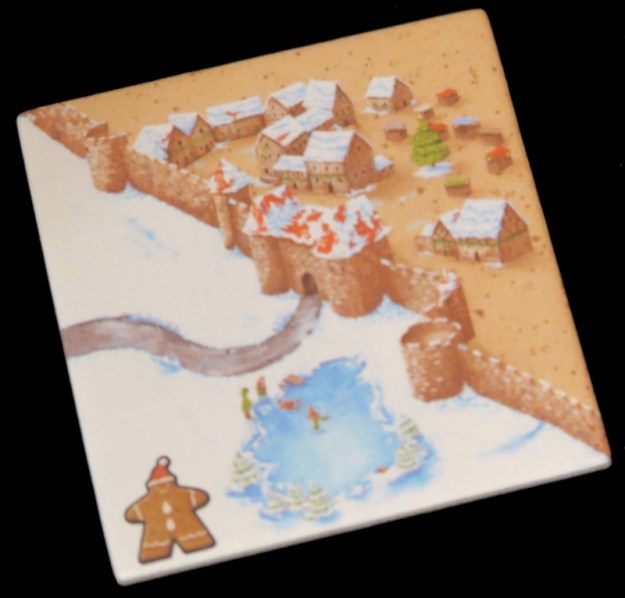
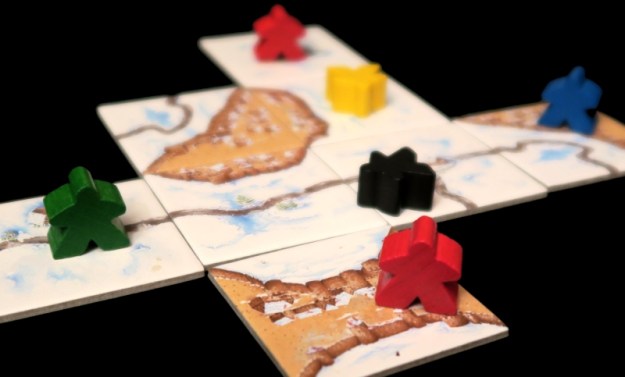
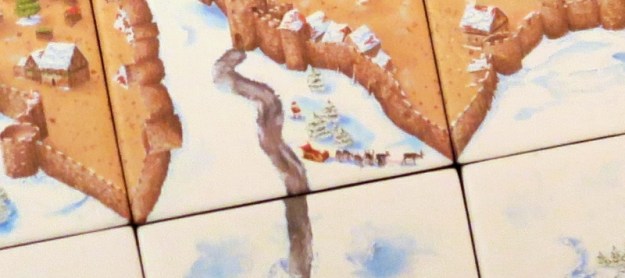
On the next table, the rest of the group settled down to play Carcassonne: Winter Edition.  This is essentially the same as the original “blue box version” of the tile playing game, Carcassonne, but with a pretty snowy scheme, which everyone agreed they preferred to the usual version.  So, as with the original, the game play is very simple:  on their turn, the active player plays a tile, adding it to the map (ensuring all the edges agree) and then optionally place a meeple on the tile before scoring any completed features.

Carcassonne: Winter Edition
– Image by boardGOATS

The features on the tiles include city segments, roads and cloisters.  Players score two points for each tile in a city or road they own if it is completed during the game, or one point at the end if incomplete.  Similarly, Cloisters score nine points when completely surrounded or one point for the central tiles and each surrounding it at the end of the game.  The clever part of the game is that while players cannot add a meeple to a feature that is already owned by another player, these can be joined together and then shared so that both players score.

Carcassonne: Winter Edition
– Image by boardGOATS

This time, the group also included the the Lebkuchenmann expansion.  This consists of additional Gingerbread Man tiles mixed in with the base game; when drawn, the player moves the brown Gingerbread Meeple to an unfinished city of their choice.  Before he is moved, however, the current city containing the Gingerbread Man is scored.   Each player receives points for the number of meeples they have in the city multiplied by the number of tiles in the city.  Thus, even players that only one meeple in the city when their opponents have more get a few points.

Carcassonne: Winter Edition
– Image by boardGOATS

The Gingerbread Man also leaves the current city when someone adds the tile that completes it and the Gingerbread Man is scored just before the normal scoring.  This means it is sometimes desirable to finish someone else’s city, in order to move the Gingerbread Man or to make them earn fewer points for it.  The clever part about the Lebkuchenmann expansion is that it can be played in both a friendly and a spiteful way.

Carcassonne: Winter Edition
– Image by boardGOATS

Very early in the game, Green, Purple and Lilac all found themselves with cities which looked all but impossible to close out.  Black went for an early “Farmer”, making snow angels and Green followed suit.  “Farmers” only score at the end of the game, giving points for the number of cities the field supplies, but they tie up the meeples for the rest of the game and, if placed early can end up being cut off yielding a poor score.  So, only time would tell whether this would prove to be a master move or a waste of a good meeple.

Carcassonne: Winter Edition
– Image by boardGOATS

Lilac was building herself a nice big city, obtained the first Gingerbread Man and placed it into her growing metropolis.  This attracted the attention of Pine who set up camp in a small city across the open divide.  On his next turn he got exactly the tile he needed (a city tile with two opposite open ends), and joined the two together.  When the city was completed shortly after, both Pine and Lilac scored, not just for the city, but for the Gingerbread Man too. This put them both out into a commanding lead on the score board, with Pine half a dozen points ahead—a lead he would not relinquish for the rest of the game.

Carcassonne: Winter Edition
– Image by boardGOATS

In the meantime, the rest of the group kept drawing road tiles.  The Gingerbread Meeple was very handy to get some of the awkward, incomplete cities to score at least something, as he hopped around the board giving out gifts.  As the snowy scene expanded and grew, more farmers were placed, more cities were completed, and roads wiggled their way round the landscape joining areas previously separated.  As one of his last moves, Green found the one tile that would fit into the gap next to his first city to complete it. This did something else, too, that would have a game-changing impact, though nobody realised it until scoring.

Carcassonne: Winter Edition
– Image by boardGOATS

With the last tile placed everyone scored their uncompleted cities, roads and cloisters.  At this point Pine was still in front, with Lilac not too far behind in second—the Farmers were going to be key.  Black and Green had managed to maneuver two Farmers each into the same massive field, but sadly Purple’s lone farmer got booted out.  Lilac had a couple of farmers on the other side of the board, one gave her two cities and the other gave her three, just enough to push her ahead of Pine (who had eschewed the whole farming in the snow business as being too cold for him).

Carcassonne: Winter Edition
– Image by boardGOATS

Green’s and Black’s Farmers had amassed a total of huge total of ten cities for their shared field, which brought them right into contention.  Scores were just about to be added to the board when Black pointed out that his (and Green’s) field went further round and actually swallowed Lilac’s farmer with three cities due to the tile placed by Green to complete that city.  So Lilac lost nine of her points and Green’s and Black’s new field total was for thirteen cities giving them thirty-nine points each.  This leapfrogged both of them ahead of Pine and Lilac, with Green coming out a few points on top.  A close game, everyone enjoyed.  This edition is a worthy edition with the Lebkuchenmann expansion a perfect little festive addition too.

"Un-Christmas Party" 2021
– Image by boardGOATS

Learning Outcome:  ‘Elf and Safety is everyone’s business.

Spiel des Jahres Nominations 2021

The nominations for the Spiel des Jahres have been announced.  There are three categories, the Kinderspiel (children’s game) , the Kennerspiel (“expert’s” game) and the most desirable of all, the family award, the Spiel des Jahres.  The nominees for this year’s awards have been announced as:

  • Kinderspiel des Jahres
    Kinderspiel des Jahres 2019Dragomino by Bruno Cathala, Marie Fort and Wilfried Fort
    Fabelwelten (aka Storytailors) by Wilfried Fort and Marie Fort
    Mia London by Antoine Bauza and Corentin Lebrat

Last year, the winner of the Spiel des Jahres was Pictures, a game where players model the picture on their card using the available components, e.g. shoelaces, coloured cubes, etc.; players get points for correctly guessing other players images and for other players guessing their image.  This is considerably lighter than some of the earlier winners, notably, Tikal and El Grande, or even some of the best known winners like The Settlers of Catan, Carcassonne or Ticket to Ride.  As the main award winners have become lighter over the years, we have found the Kennerpiel des Jahres better fits to our tastes.  The Kennerspiel nominees are not especially complex games, but are typically a step up from the light, family-friendly games of the main prize, the Spiel des Jahres.

– Image by from spiel-des-jahres.de

Last year the Kennerspiel award went to The Crew: The Quest for Planet Nine a game we have still been unable to play thanks to the global pandemic.  The Crew beat our preferred choice, Cartographers.  In contrast to The Crew, as a “Roll and Write” game, we have played Cartographers a lot.  So far, we are unfamiliar with the nominees this year and likely won’t get the chance to play any of them until some time after the winners have been announced (19th July in Berlin for the Kennerpiel and Spiel des Jahres Awards; 14th June for the Kinderspiel des Jahres).

Cartographers: A Roll Player Tale
– Image by boardGOATS


Boardgames in the News: Fake Games from a High Street Name

As reported previously, fake and counterfeit goods are not uncommon online, especially with purchases from certain auction sites.  Even companies like Amazon are not immune though, thanks to co-mingling of stock with that from other third-party sellers and returned items.  More recently, however, there have been lots of reports of issues with copies of Pandemic, Dead of Winter, Carcassonne, Catan, and Harry Potter: Hogwarts Battle bought from Zavvi.  This is of note, not because of the games (which have been targeted before), but because Zavvi is a reputable high street name.

Pandemic
– Image by BGG contributor kilroy_locke

Zavvi is owned by The Hut Group (aka THG), along with a range of other companies that sell everything from lipstick to language services.  The Hut Group also own I Want One of Those (aka IWOOT) who have recently been selling quite a lot of games at a good price including Sagrada, Horrified, and Ticket to Ride: London.  There doesn’t appear to be any question of the authenticity of these games, but IWOOT have been selling copies of Dead of Winter, Pandemic, Carcassonne and Hogwarts Battle too and these also seem to be fakes, presumably from the same, communal supply as the Zavvi games.

Harry Potter: Hogwarts Battle
– Image by BGG contributor zgabor

Both Zavvi and IWOOT have been reluctant to acknowledge that the games are fake insisting to customers that they “do not handle fake goods”, they “source all stock direct from the brand suppliers”, and “items sold by ourselves are not counterfeit”.    Neither Zavvi nor IWOOT are known for selling counterfeits.  So, assuming it is against company policy, how their supply chain became contaminated is an interesting question and it is possible that they themselves have been the subject of a deception.  It seems unlikely that these fakes were supplied through the usual UK distribution channels, but it is possible they were bought in good faith from another supplier.

Dead of Winter: A Crossroads Game
– Image by BGG contributor mikehulsebus

Perhaps the biggest issue here is the poor Customer Service people have reportedly received, including standard unhelpful replies or an offer of only a partial refund.  It seems persistence is the only answer, though reporting the company to the Trading Standards and/or the finance handling service (credit card company or PayPal), can help.  For those struggling with IWOOT, suggesting to Customer Services that they look at “ISM ticket 1195382” can also help (ISM is the Ivanti Service Manager ticketing system).

Boardgames in the News: Carcassonne Catches Catan

Board Game Geek (BGG) is arguably the foremost website for information on board games.  It includes a forum for discussion, but also an extensive database currently comprising nearly a hundred and twenty thousand games with associated reviews, photos, publication details and rules clarifications.  There are over two million registered users of the site, many of whom use the BGG to record the games they own, log each time they play, and register their ratings of games in the database.

The Settlers of Catan
– Image by boardGOATS

For many years, the most rated game according to the BGG website was The Settlers of Catan but it has now been overtaken by Carcassonne (95,496 and 95,499 ratings respectively as of 1am BST on Sunday 19th July).  Over the coming weeks the numbers will fluctuate and the tide will ebb and flow, but it looks like Catan, which was released in 1995 (five years before Carcassonne), has been caught.  The race is not over, however, Pandemic is not far behind…

Carcassonne
– Image by boardGOATS

Boardgames in the News: New Editions that aren’t an Improvement

Everyone has experienced a disappointing remake of a favourite film; while we always hope for an improvement, only occasionally do we get one.  Board games have a similar problem, but as with films, things are often not clear cut.  For example, the new version of Camel Up arguably has nicer art and a better pyramid dice shaker than the original.  The Crazy Camel mini expansion and the partnership betting (from the original Supercup expansion) also add quite a bit to the game play, especially at higher player counts, but the money isn’t as easy to handle and the dice and camels themselves are plastic and don’t feel as nice.

Camel Up
– Image by boardGOATS

Similarly, the recent editions of Glen More (Glen More II: Chronicles) and Snowdonia (the Deluxe Master set) are beautiful and include lots of extra content.  As previously discussed, this is at the expense of shelf-space though, and portability which means they are less likely to get played.  In other cases, the revision is considered a definite step back.  For example, the revised edition of Colosseum by TMG is widely believed to compare unfavourably with the original Days of Wonder edition.

– Image by boardGOATS

In a recent new edition of Monopoly, female players initially receive $1,900 with a salary of $240, while male players start with $1,500 receiving $200 when they pass “Go”.  On the plus-side, as part of the publicity, three teenage entrepreneurs received a grant of $20,580 each to invest in their own inventions.  Otherwise, Ms Monopoly is widely thought to be hugely patronising to half the population while claiming to celebrate empowering women, something that is apparent in the adverts.

– Video by Hasbro on youtube.com

These days, a lot of gaming is being done online.  One new electronic game that has been seen as a retrograde step is the new Scrabble app, Scrabble Go.  This is a new product that, thanks to changes in licensing, replaces the previous offering from Electronic Arts (EA).  The problem is that the new version seems to have been designed to appeal to the Candy Crush generation with vivid colours, treasure-style rewards and in-app purchases.  Unfortunately, Scrabble is a very traditional game and its players generally don’t appreciate that approach.  To date, nearly eight thousand of these have registered their disgust through an online petition.

Scrabble Go
– Image by boardGOATS from play.google.com

The Carcassonne app has also received a similar licensing-inspired change and although the new Asmodee version is less offensive, many seem to prefer the older, Coding Monkeys version.  So, before deciding to upgrade a game, keep in mind that a new version, often isn’t a better one.

Boardgames in the News: Covid-19, UK Games Expo and Other Stories

In all probability, the Covid-19 Pandemic will be a crisis the like of which this country hasn’t seen for eighty years.  It is estimated that Covid-19 is fatal in around 1-3% of cases;  if 50% of the world population get the disease, around 1% of the seven billion people on this planet will die.  That’s a lot of people, seventy million in fact—roughly the population of the UK.  To put it in perspective, around twenty million people died as a result of  the First World War, that’s approximately 1% of the world population at the start of the conflict (around two billion).  The death toll in World War I occurred over four years, but it is likely the impact of Covid-19 will take place over a period of months.

Covid-19
– Image from bioworld.com

So, Covid-19 is likely to be devastating, but not necessarily in ways people expect.  Yes, loved ones will die and every loss is a tragedy to those affected.  It may be the society changes that are longer lasting though.  For example, more and more people are working from home, this is better for the environment, but not necessarily good for mental health unless managed properly.  The recent Government advice to “Avoid pubs … and other such social venues” has emptied local pubs and coffee shops, and decimated the takings in businesses that already run on tight margins.  Board game cafés like The Ludoquist and Thirsty Meeples have closed and The Dice Cup, while still open, is clearly struggling.

Closed Sign
– Image from squaremeal.co.uk

All over the UK Games Clubs have been suspended or and conventions have been postponed, including Ellesmere Port and Chester Centurions, the Epsom Games Day, SpringCON, Salute 2020, Hemel Games Club, STAG, TringCon, Oxford Meeples and boardGOATS, while others like Variable Mages are considering their options.  Z-man Games have also announced the cancellation of their Carcassonne and (ironically) Pandemic tournaments.  All these use local amenities, pubs, halls and cafés that rely on the support of regular custom.  If these close, it is unlikely they will reopen, and, as Joni Mitchell once said, we won’t know what we’ve lost ’til it’s gone.

UK Games Expo Logo
– Image from ukgamesexpo.co.uk

If people work together though, we will get through this.  A shining example is that of the UK Games Expo which was originally scheduled for the last weekend in May.  The organisers have just announced that it has been rescheduled for Friday 21st to Sunday 23rd August.  Sadly, this clashes with Tabletop Scotland, but they have very graciously agreed to postpone the Perth event to allow the UKGE to take place.  It is with such understanding, cooperation and consideration that we will beat this thing.  And beat it we will, as long as we work together.

– From RetroTop10 on youtube.com


3rd March 2020

After a short, but sweet battle over who wasn’t going to have the last lamb pie and mash, Burgundy and Blue settled down to eat.  They were soon joined by Pine, Lime, and then Black and Purple bringing news of their new black and purple car.  When Ivory and Green arrived, the key players were in place for the for the “Feature Game”, the Hellas map from the Hellas & Elysium expansion to Terraforming Mars.

Terraforming Mars: Hellas & Elysium
– Image by boardGOATS

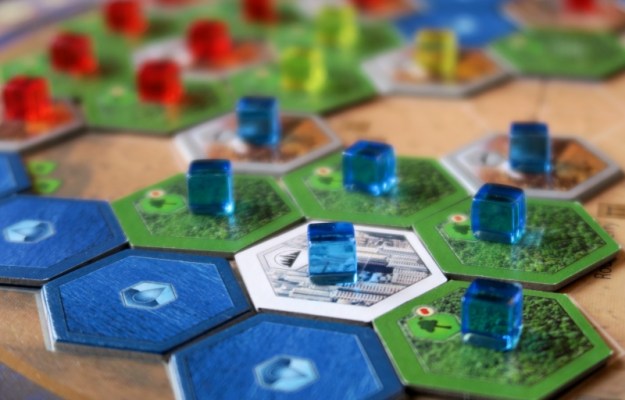
In Terraforming Mars, each person takes the role of a giant corporation, sponsored by the World Government on Earth to initiate projects to make Mars habitable.  This is by raising the temperature, increasing the oxygen level, and expanding the ocean coverage.  The Hellas map presents a new areas of Mars to explore, in particular, the Mars south pole and the enormous seven-hex Hellas crater that just begs to become a giant lake.  Building around the pole gives placement bonuses in the form of heat and possibly even water.

Terraforming Mars
– Image by boardGOATS

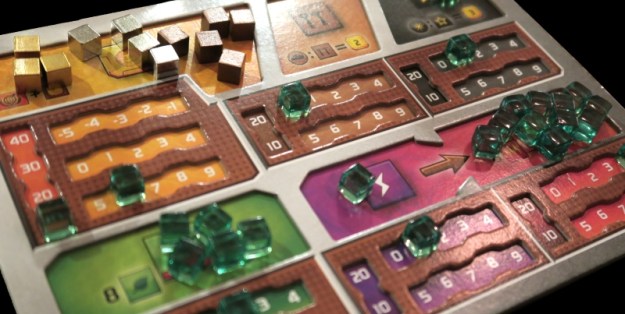
At the start of each round, players draw four cards, keeping as many as they like, but paying 3M€ per card.  Since the cards are so critical to the game-play, there is a variant where the cards are drafted, letting players see more of the cards available, but making the decisions more critical.  Players then take it turns to take one or two actions from seven possible actions.  At the end of the round, players simultaneously produce, turning any energy into heat, taking finance according to the combined total of their Terraforming Rating and their M€ production level, and finally receiving all other resources according to their production levels.

Terraforming Mars: Hellas & Elysium
– Image by boardGOATS

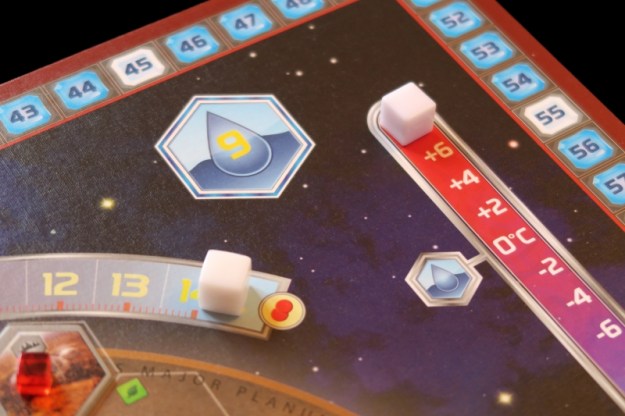
The game ends once all three Global Parameters are met:  all of the Ocean Tiles have been placed, the Temperature has reached 8°C, and the Oxygen Level is at 14%. The game is driven by the cards, but the guts of it are the actions.  These include: play a card; use a Standard Project; use an Action Card; convert eight plants into a greenery tile and raise the Oxygen Level; use eight Heat to raise the Temperature; claim a Milestone, and fund an Award.

Terraforming Mars
– Image by boardGOATS

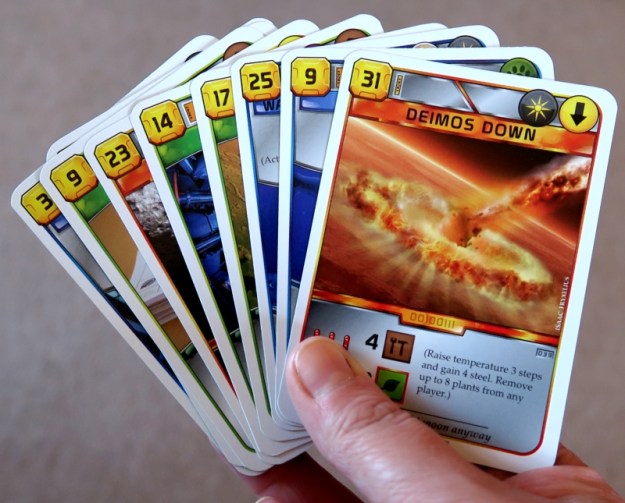
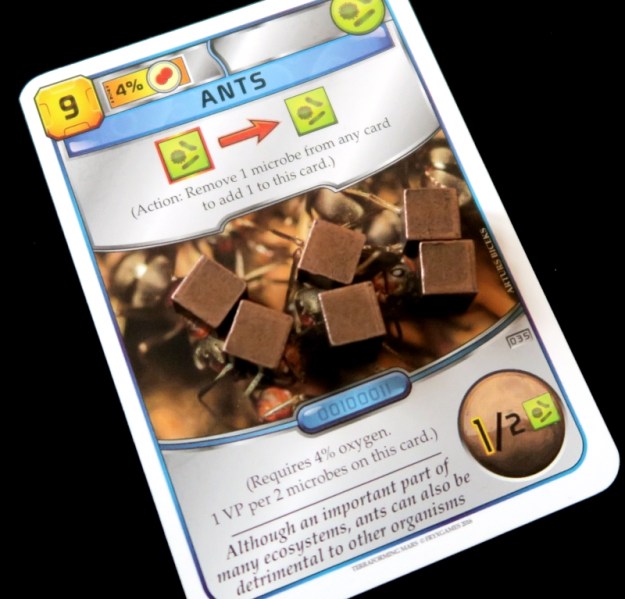
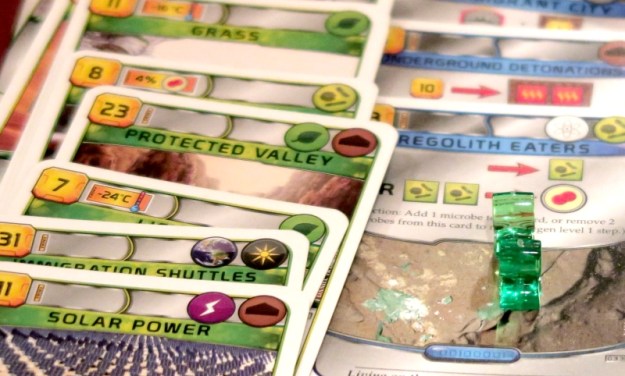
Each card has a set of requirements, for example, Grass cannot grow at very low temperatures, so the Grass Card can only be played when the Temperature is above -16°C.  Other cards may require the player to spend energy, or other resources.  They also have a financial cost, though some can be paid for using Steel and/or Titanium as well.  There are three types of cards: red Event Cards, Green Automatic Cards and Blue Action Cards.  Green and Blue cards have an effect that occurs when they are played.  Red Event Cards have  an action that takes place once and are turned face down once they have been played.  Blue Action Cards also give the player a special ability that can be activated many times during the game, but only once per round.

Terraforming Mars
– Image by boardGOATS

In addition to the actions on the cards, players can also carry out actions associated with Standard Projects.  These can be used several times per round and mostly involve spending money to increase the Temperature, add tiles to the board, or increase the player’s Energy Production.  Players can also sell cards at a rate of 1M€ per card, an expensive option as it’s less than they cost to buy, and it costs an action, but needs must when the Devil drives.  Finally, players can claim milestones (if they have played enough cards with Tags that qualify) or fund an award.  These cost money, but give Points at the end of the game.

Terraforming Mars
– Image by boardGOATS

This is the basic game play, but there are a lot of expansions and variants, so setting up was slow as the group tried to figure out which cards came from which expansion and what bits they actually needed to use.  They got there in the end and chose to add in a few extra corporations to the standard set. Only Ivory received one of them, but still chose an original corporation, Ecoline, which gave him Plant production and reduced the number of plants he needed for a new Forest tile from eight to seven.  Green went for Inventrix, which gave him three extra cards at the start of the game and reduced the restrictions on the environmental requirements.  Burgundy chose Teractor, which allowed him to play cards with Earth Tags more cheaply.

Terraforming Mars
– Image by boardGOATS

Ivory made an early play to plant a city amongst the northern green belt. He knew it was an unusual opening move and a bit of a gamble, but one he hoped would pay dividends later.  Burgundy also planted a city in the first round, nearer to the large potential ocean area in the Hellas crater. Green waited a little longer for his first city, but broke away from the others to plant it near the southern polar region, hoping to expand upon the unique scoring potential for this new board.

Terraforming Mars: Hellas & Elysium
– Image by boardGOATS

Like most games of Terraforming Mars this one progressed gradually and slowly as everyone built their “engines”.  Ivory was clearly working on a Forest growth strategy, and also looking for the bonus end game awards.  Burgundy was trying to build cities next to oceans for bonus money and also keeping the sides of his cities next to Forests for end game scoring.  Green tried to use his relaxed environmental requirements to his advantage by playing cards early, but in the process failed to do anything with his southern city goal.

Terraforming Mars: Hellas & Elysium
– Image by boardGOATS

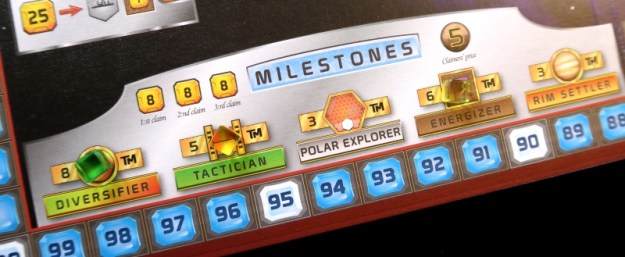
Ivory made the first Milestone claim, taking the Energizer, for increasing his Energy Production to six.  He was about to claim the second too, Diversifier, for having eight different tags played, but then realised that he couldn’t use the Red Event cards and so couldn’t claim it after all.  Very soon after Green took it instead, much to the annoyance of Burgundy who was also on the verge of taking it, and would have done so on his next turn.  Ivory later claimed the third Milestone, Tactician (five environmentally restricted cards), which both he and Burgundy had noticed Green could have claimed earlier and made noises to that effect, but weren’t specific.  Green, however, had forgotten what it was awarded for and hadn’t noticed he qualified.

Terraforming Mars: Hellas & Elysium
– Image by boardGOATS

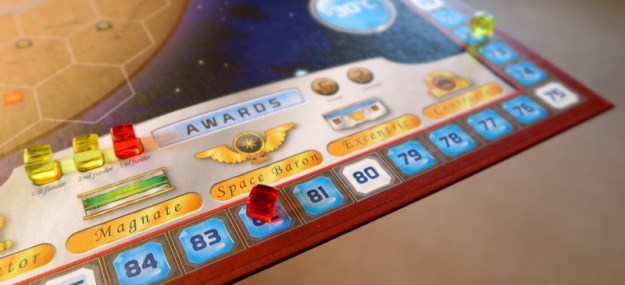
As for the Awards, Ivory again funded the first one to activate the Cultivator, obviously key to his strategy as as it rewarded most Forests.  Ivory also wanted Space Baron in play (for most Jovian tags) and Burgundy paid for the final Magnate Award, which rewards the player with the most green cards.  In the end though, Burgundy won all three awards, with Ivory taking second place in two and Green just pipping Ivory to second by one card for the Magnate Award.  When it came to the scoring, the Terraforming Ratings were quite close with Ivory just ahead of Burgundy as he had been for most of the game.  Burgundy took a lot of points for the awards though and scored heavily for his cities.  The overall winner was therefore Burgundy with eighty-three points, sneaking ahead of Ivory who took second place.

Terraforming Mars
– Image by boardGOATS

While the Terraforming Mars group began setting up, everyone else took a slightly more relaxed look at the options available, and after some discussion, the group settled on Isle of Skye.  This won the Kennerspiel des Jahres in 2016 and is a game most of the group have played before and really enjoyed.  The best way to describe it is a bit like Carcassonne, but with individual play areas and a very clever auction for the tiles.

Isle of Skye: From Chieftain to King
– Image by boardGOATS

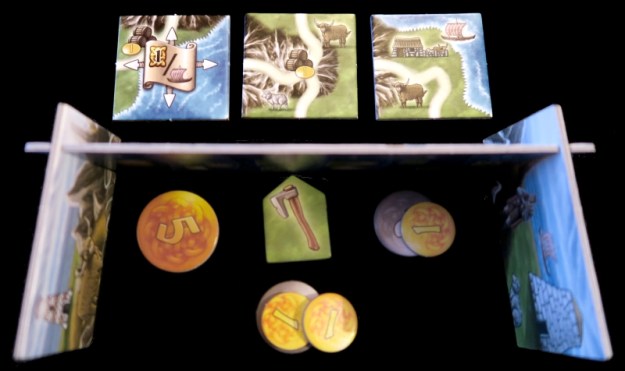
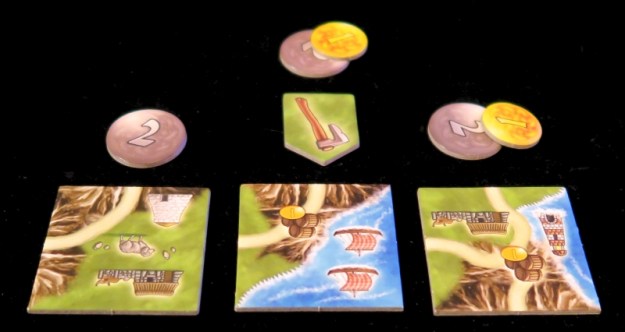
The idea is that players start with three tiles drawn randomly, and place them in front of their screen.  Behind the screen they use their own money decide the price of two of the tiles and choose one to discard.  Once everyone has revealed their prices and discards, the first player chooses a maximum of one tile to purchase from the offering.  They cannot choose one of their own, and they pay the amount shown to the owner of the tile.  Once everyone has made their purchase, players then buy any remaining tiles in front of them, paying with the money the used to indicate the price.

Isle of Skye: From Chieftain to King
– Image by boardGOATS

This auction is very clever for lots of reasons. Firstly, the player with the best tiles, does not necessarily get them.  If they think they have something valuable, then they can give it a high price and will either end up keeping it (paying the money to the bank), or end up getting a lot of money for it.  For this reason, the key thing is getting the value right—over-pricing a tile risks it failing to sell and getting landed with it at a heavy cost.  This was Ivory’s comment from the next table.  There is a more subtle aspect to the auction, however.

Isle of Skye: From Chieftain to King
– Image by boardGOATS

Although they have the widest choice, if the first player prices their tiles too high, they may not have sufficient funds to buy anyone else’s, worse, nobody else will buy their tiles which means they will end up having to pay for them themselves, leaving them short of cash in the next round as well.  On the other hand, because the money paid for tiles and the money used to indicate their cost go straight into the seller’s hand, players later in the turn order, may have less choice, but will likely have more available cash.  In this way, the advantage of turn order is self-correcting and everyone has difficult decisions to make and probabilities to consider, though the decisions are different for each player.

Isle of Skye: From Chieftain to King
– Image by boardGOATS

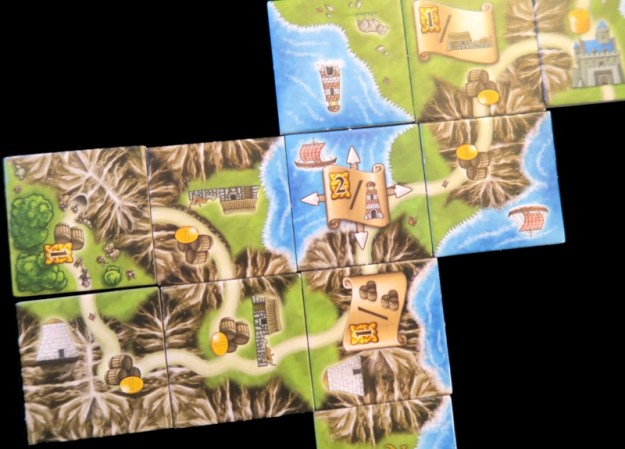
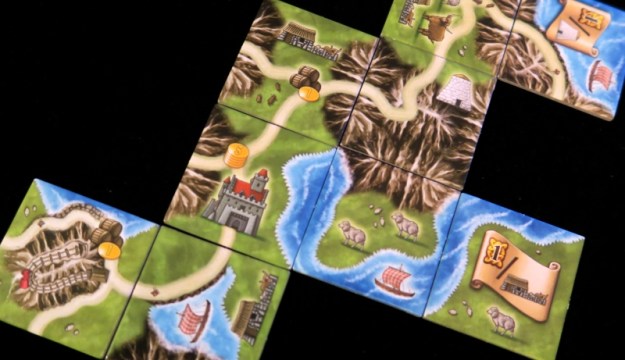
Once the tiles have been bought and paid for, players add them to their kingdom.  Like Carcassonne, the terrain type on the edges of the tiles have to match up (though roads do not), and the tiles have features that are used for scoring.  There are more different features than in Carcassonne, however, and the scoring is very different.  In each game there are four scoring conditions, and each one is used three times during the game (five rounds for the five player game).  Additionally, there are also tiles that feature scrolls which are personal scoring conditions that take effect at the end of the game.

Isle of Skye: From Chieftain to King
– Image by boardGOATS

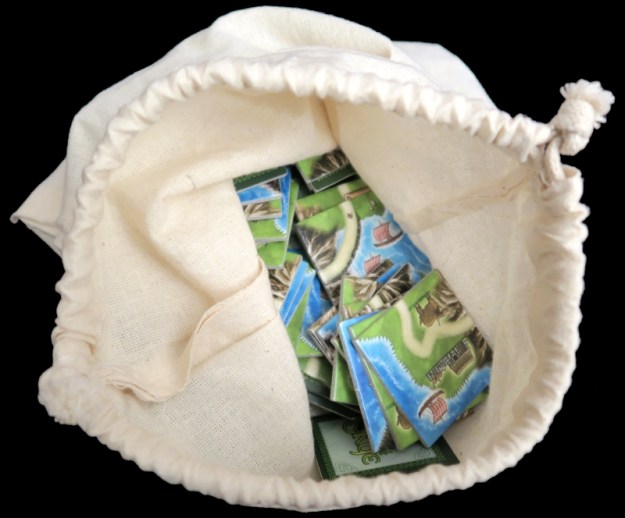
As Lime was new to the game, the group decided not to include the main components of the Journeyman or Druid expansions.  All the tiles went into the bag though, including those from both of the large expansions and the several mini expansions (the Adjacency Scrolls, both Tunnelplättchen, the Themenplättchen and the Kennerspiel des Jahres Promo), and anywhere the main feature required one of the main expansions were just rejected when they were drawn.

Isle of Skye: From Chieftain to King
– Image by boardGOATS

Pine got a flying start in the first round getting five points for his Broch/Lighthouse/Farm combo and a couple of points for a completed mountain range.  As the game progressed, more buildings fell into his lap and the points kept coming.  Black tried to collect Broch/Lighthouse/Farm sets, but couldn’t get any Brochs, so gave up and concentrated on getting diagonals instead.  This is not as easy as it looks because every tile added to a diagonal requires the fixed placement of two tiles.  Each round, players get a maximum of three tiles, so this is very restrictive.

Isle of Skye: From Chieftain to King
– Image by boardGOATS

It was a hard game:  Lime failed to complete and score any mountains and Purple struggled as there were two rounds when she failed to get any points at all.  Blue started off trying to build in a diagonal, but ended up picking up points for Barrels connected to her Castle by road, mostly at Lime’s expense.  She was aided when Pine drew a Barrel tile that Lime really fancied and had lots of money to pay for.  Not wanting to give away his plans, Lime told Pine he didn’t want the tile, so Pine, who believed him, chucked it away, leaving Blue a clear run.

Isle of Skye: From Chieftain to King
– Image by boardGOATS

Pine maintained and grew his lead, though the others did threaten to catch up towards the end.  His Brochs and enclosed scroll giving him two points for each one made all the difference though and he finished with sixty-nine points ten ahead of second place.  The battle for that was much closer with three players within six points of each other.  It was Blue who sneaked in front though, just ahead of Lime who put in a very creditable performance on his first attempt.

Isle of Skye: From Chieftain to King
– Image by boardGOATS

Terraforming Mars was still going on the next table, so although it was getting late the group decided to play something short, and considered Coloretto, but in the end settled on No Thanks!.  This is a really quick and simple “push your luck” reverse auction game.  Everyone starts with eleven chips and on their turn, either takes the card on offer (and any chips on it) or pays a chip to pass the problem on to the next person.  The aim of the game is end up with the lowest card total, subtracting any chips they have left.  The catch is that if a player has a run of cards, only the lowest is counted, however, at the start of the game nine cards are removed from the thirty-three in the deck…

No Thanks!
– Image by boardGOATS

This time, Black won a relatively uneventful first round with twenty, while Purple “top scored” with fifty-three.  It was quick and Terraforming Mars was into another round, so Lime suggested another round and everyone else concurred.  This was more remarkable.  Blue was first to take card.  Since the player who takes a card then has first dibs on the next card, when the next was close the the first, she took that too.  This continued with only a couple of breif interludes for cards she really didn’t want.  In the end, she had a remarkable run of fifteen cards from the twenty-four in play.

No Thanks!
– Image by boardGOATS

Unfortunately for her, as they were mostly low value cards and cards she needed, she had been unable to milk them to get chips from the others.  So she finished with a very reasonable thirteen, but in forth place behind Lime with twelve and, remarkably, Black with minus three and Pine who took the game with minus four, winning by virtue of the fact he played later in the round.  The Terraformers were just finishing, so the cards were shuffled for a third and final time.  This time, Lime tried the collecting cards trick, but he was not as lucky as Blue and ended with a card total of ninety-nine (and twenty-three chips).  Black and Blue both finished with a more normal nine, and tied for the win.  With everyone finished, but time was marching on, so everyone decided to say “No Thanks!” to another game and went home.

No Thanks!
– Image by boardGOATS

Learning Outcome:  Getting a lead is good, but you have to be able to keep it.

3rd September 2019

There were a lot of people feeding and food was a little delayed, so we didn’t start until gone 8pm.  At this point, people were keen to chat and almost everyone seemed interested in giving the “Feature Game”, Lords of Vegas, a go.  Although it involves dice, it is totally different to our old favourite, Las Vegas, and in fact, very different to pretty much anything else we have played too.  Although the game is very “rules-light”, it is still a bit of a “brain-burner” with the potential for inducing “analysis paralysis”.

Lords of Vegas
– Image by boardGOATS

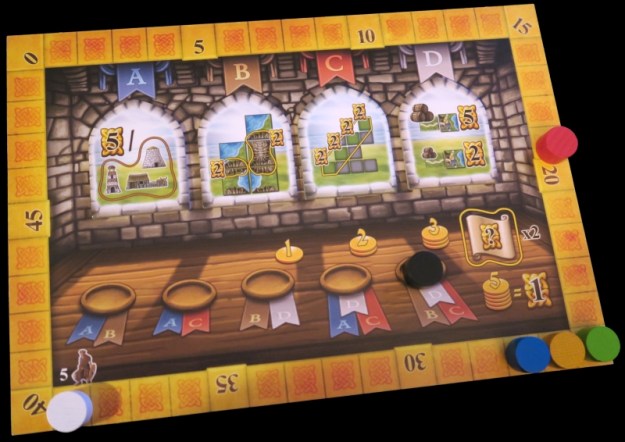
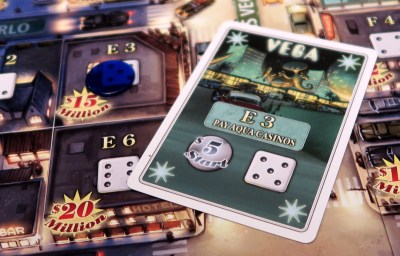
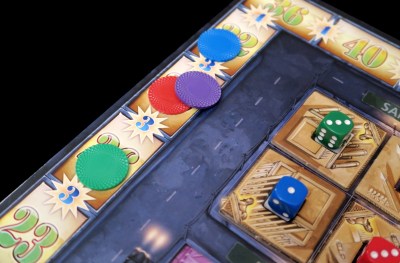
The idea of the game is that players are developers in Las Vegas in 1941.  The board depicts Highway 91, what will become known as “The Strip”, and the blocks either side, each divided into plots.  Players acquire these plots, build casinos, improve their casinos, take-over other casinos, and when desperate, gamble.  At the start of their turn, the active player turns over a card which indicates one plot and one of the five casinos.  The active player claims the plot by placing a clear plastic counter in their colour on it and then everyone receives income:  every plot owner gets $1,000,000 per plot, and then every casino that matches the card pays out cash (in our case, in poker chips) and points.

Poker Chips
– Image by boardGOATS

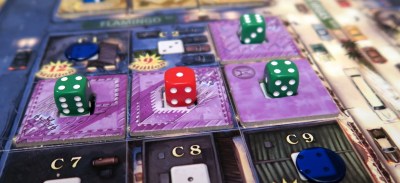
After everyone has received their income, the active player can do as many actions as they like, the only limit is what they can afford.  The first action is build on a plot they own:  they pay the amount of money listed on the board, chose a coloured casino tile and place it on the board together with a die of their colour showing the face depicted on the board.  The number shown is important for many reasons, but initially it indicates the income that the player will get when that casino pays out: one million dollars per pip shown.  The casino colour chosen can be the same as casino adjacent casinos, or different, which is a critical decision.  If it is the same, the two (or more) casinos merge and the owner of the die with the highest face value becomes The Boss of that casino.

Lords of Vegas
– Image by boardGOATS

The Boss gets victory points when that casino colour pays out, receiving points equal to the total number of plots the casino occupies.  Since The Boss controls the casino, their are things they can do that others cannot.  For example, they can choose to “remodel” the casino, changing the colour of all the tiles.  There is a cost, of course, five million dollars per space, but it can be worth it to force mergers giving more points.  The Boss can also “sprawl” their casino which means expand into neighbouring, unoccupied plots.  This is both costly and risky, but can be worth it to give a short term benefit or to merge casinos.  It is costly because the cost to build is twice the usual fee, and it is risky, because if the card that shows that plot is drawn later in the game, the player who draws the card replaces the die with one of their own.

Lords of Vegas
– Image by boardGOATS

Merging casinos are a vital part of the game because unusually, increments in the score track progressively increase.  So, at the bottom, the steps increase by a single point, but after eight, each step is two points, and after twenty the steps increase to three.  Since the points are added casino by casino (rather than summing them and adding them all at the same time), it is critical to match casino size to the current increment.  For example, two casinos of size “three” would add six points if the player were below eight points or above twenty.  However, if they were between eight and twenty, the same casinos would only be worth two each as the remainder would be lost as each casino is added.

Lords of Vegas
– Image by boardGOATS

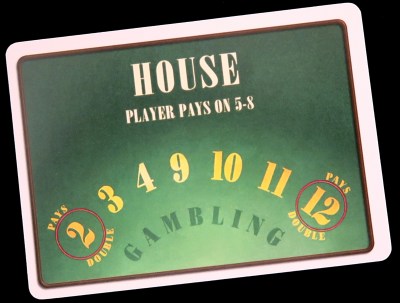
Thus, with the merging and taking over, the game is highly strategic with a sprinkle of luck from the card draw.  Perhaps the most important part of Lords of Vegas though are the gambling aspects. There are two:  firstly, once per turn, the active player can gamble at any casino by rolling two dice.  The odds are slightly in favour of The House, but it can be a good source of cash, as well as providing the opportunity to damage an opponent, as The Boss of that casino provides the pay out (though they can lay this off with the bank).  More importantly, any player can choose to “Reorganise” any casino they have a stake in, by paying a million dollars per pip to re-roll all the dice in that casino with the chance of control changing hands.

Lords of Vegas
– Image by boardGOATS

So the game is not especially difficult to understand, but small changes can have a large impact.  As well as the mix of strategy, luck and gambling, there are a number of little things that really make the game sing.  For example, almost anything can be traded for almost anything else at any time, which enables players at the back to gang up on a run-away leader and neutralise the effect of overtly bad (or good) draws and dice rolls.  The quick description had most people interested in playing it, but Burgundy (who had played before) felt that it would be very chaotic with five, so in the end, Pine, Black, Red, Lime and Ivory left Blue, Burgundy, Mulberry and Purple to their visit to Nevada.

Lords of Vegas
– Image by boardGOATS

The game started very slowly, with incomes small and investment correspondingly small.  Blue tried to increase her income by building her number of plots.  That probably wasn’t a good move, though she was able to build some cash and then invest heavily a couple of turns later.  Despite the lack of rules complexity, the groups still managed to make a mess of it:  when Reorganising, each die can only be rolled once per turn.  It was perhaps a good thing the messed this up though as otherwise Purple, Blue and Mulberry would have been deprived the chance of seeing Burgundy attempt to Reorganise a single two and re-roll a two three times.  Hilarity ensued when, a few turns later the casino had merged to form two-plot casino now with a two and a three and Burgundy chose to try Reorganising again, this time getting a two and a three and then a double three before finally settling for a one and a four!

Lords of Vegas
– Image by boardGOATS

As the game progressed, the casinos merged and grew, with one particularly large “Sphynx Casino”, occupying five plots.  Blue, Burgundy and Mulberry all had an interest and re-rolled the five dice many, many times during the game, but despite his lack of success elsewhere, Burgundy mostly retained control.  The other side of Flamingo Road, Mulberry built a lovely casino, mostly uncontested.  The “Vega Casino” cards came out a lot at the start and since some cards are removed at random, it didn’t look a good gamble.  As a result, only Purple took the risk of investing and made a killing with her “Big Purple Casino” when the group kept drawing the Vega cards ending up with all nine putting in an appearance.

Lords of Vegas
– Image by boardGOATS

Mulberry and Burgundy stole a slight early march, but when the steps in the scoring track increased it became clear that this was an illusion and it was in fact a very close game as the leader’s jersey kept changing hands.  The balance of power was held by whoever was in charge of the Big Sphinx Casino, and Blue and Mulberry ganged up on Burgundy to try to break his hold on it.  First Blue rolled the dice and gave control to Mulberry only for Burgundy to wrest if from her and Mulberry to then give control to Blue.  In what turned out to be the final turn of the game, Blue gambled in Purple’s Big Green Vega Casino, won $10,000,000 and used it to remodel her small Sphinx Casinos and sprawl the Big Sphinx Casino into one extra space.

Lords of Vegas
– Image by boardGOATS

This turned out to be critical, because the game ends when the “End of Game” card is drawn and all the casinos on the strip score for one final time.  That final sprawl gave an extra three points for the Big Sphinx which was just enough to cross the boundary from twenty-nine to thirty-two, breaking what would otherwise have been a three way tie.  Money is the tie-breaker, which meant that Burgundy just sneaked into second place $7,000,000 ahead of Purple, who would have been $20,000,000 better off if Blue had not won when she bet in her casino.

Lords of Vegas
– Image by boardGOATS

All in all, it had been a lot of fun and everyone was agreed that they’d like to play it again, and that they’d play it differently next time.  It had been a really slow burner though and while the foursome had been gambling property in Vegas, the others had had time to play two games and get up to date with the Brexit riots and discuss all the possible outcomes—some  people even had time to check out the proxy voting and postal vote options and evaluate both options!

Ticket to Ride: Europe
– Image by boardGOATS

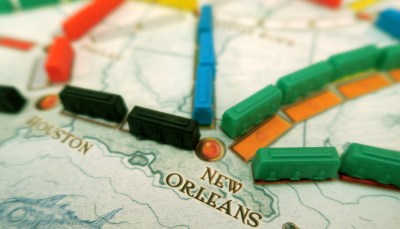
The group had started the evening with Ticket to Ride, the original USA version, rather than the more usual Europe version or the relatively new, New York edition, which had also been also an option.  It is relatively rare that the USA edition gets played because it can be quite unforgiving, this time though, everyone was quite experienced, and knew what they were letting themselves in for.  The game rules are much the same as for every other version of Ticket to Ride: on their turn players can take any two two cards from the face up market or blind from the draw deck; place some of their plastic trains to score points paying for them with appropriately coloured cards, or draw more ticket cards which score points at the end of the game if completed.

Ticket to Ride (USA)
– Image by boardGOATS

There are no tunnels, ferries or stations in the original USA version, and Locomotive cards can be used as wild under any circumstances, but only one face up Locomotive card can be drawn per turn.  It was a very tight game with everyone obstructing each other a bit, though Red got the worst of it.  Green prioritised trying to get the ten point bonus for the longest continuous set of trains, while Black was concentrated on completing his tickets from Los Angeles to Miami and Winnipeg to Boston.  It was very clear it was going to be a close, high scoring game where completed tickets were going to be essential to the final scores.

Ticket to Ride (USA)
– Image by boardGOATS

Pine completed his first two tickets and started on his third route, from Montreal to Vancouver.  As the game came to a finish, everyone put the finishing touches to their plans: Green added a couple of trains to his longest route, and Pine just managed to complete his third route before the game ended.  As players totalled up their extras, it turned out that Green had just managed to take the longest route bonus by a single carriage, and red had been Red totally stymied—someone was always likely get stuffed in a five player game that was so very, very close.  In fact, in the final accounting there was just nine points between first and fourth place.  Black topped the podium with a hundred and four points, a single point ahead of Green with Pine a few points behind him.

Ticket to Ride (USA)
– Image by boardGOATS

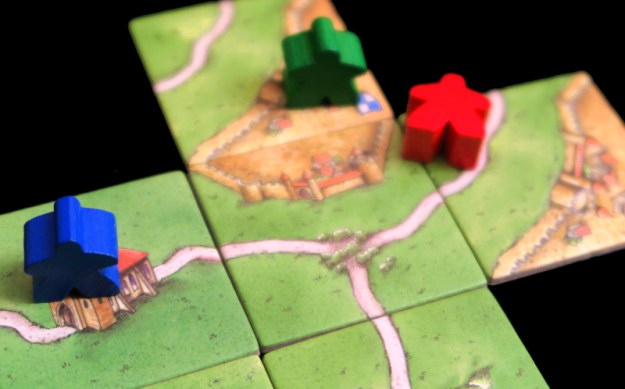
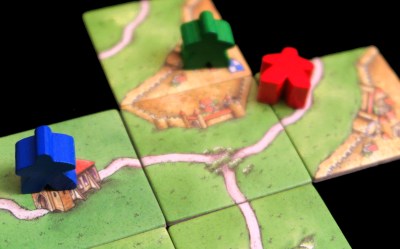
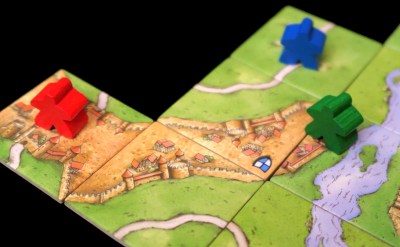
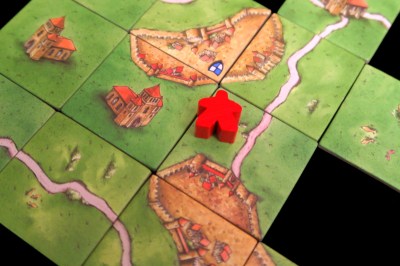
There was a bit of debate as to what to play next, but as Ivory had never played it before, the group eventually settled on Carcassonne, with the River expansion.  This is one of the most popular “gateway” game so it was quite remarkable that Ivory had managed to avoid it for so long.  The rules of the game are really simple, though they generate a surprising amount of depth, especially when played with two.  With five, there is less control, but it can still be a lot of fun.  On their turn, the active player draws a tile from one of the available stacks and adds it to the central map, making sure that any features on the edge of the map are preserved.  The active player may then place one of their Meeples on the tile they’ve just added to the tableau.

Carcassonne
– Image by boardGOATS

The Meeple is placed on a feature – a Road, a City, a Monastery or Farm.  The key rule, however, is that a Meeple cannot be placed on a feature that already has a Meeple on it.  So if the tile is added in a way that means it extends an occupied pre-existing City for example, the player cannot place his Meeple on that City, though if it were unoccupied it would be fair game.  Once the player has finished placing their tile and Meeple, any features that were completed are scored and the associated Meeples returned to their owner.  When complete, Cities score one point per tile they occupy, double for every tile with a blue and white shield on it; Roads also score one point for every tile that contributes to them.

Carcassonne
– Image by boardGOATS

Monasteries are rather different and when completely surrounded by eight tiles, score nine points.  Farms are a little different, only scoring at the end of the game, giving three points for every city it supplies.  These are usually a crucial source of points and the player who controls the biggest Farm usually wins.  Again, a Meeple cannot be added to a farm if there is already a Meeple occupying it, so this aspect of the game is all about joining Farms together and sharing or ideally, taking control of other people’s Farms.  Adding the River expansion helps to reduce the dominance of Farming by helping to prevent one single super-Farm forming, though Farms are still a very important part of the game and timing is crucial.

Carcassonne
– Image by boardGOATS

This time, the game was played very quickly, especially given who was playing.  As a result, poor Ivory, on his first experience, had no idea what was going and really struggled to follow some of the more subtle parts of the game.  The game began as the Battle of the Cities, with Red and Ivory merging their Cities to increase their points haul,, and Black and Green sharing another City to do the same.  At the end, however, it all came down to eating and praying, i.e. Farms and Monasteries, in what was also a very close game.  Again, there was just one point between first and second and again the top two places were held by Black and Green, with Black once again pipping Green to the win.  This time it was Red who took a very close third, just three points behind.  Black’s comment as Ivory left, was that the game had been “Quite vicious,” and as the group waited for Lords of Vegas to finish and caught up on the votes in the House of Commons, that would be an appropriate description for the happenings in Parliament too.

Carcassonne
– Image by boardGOATS

Learning Outcome:  It doesn’t take many rules to make a really good game, just the right rules.

Boardgames in the News: How to Spot Fake and Counterfeit Games

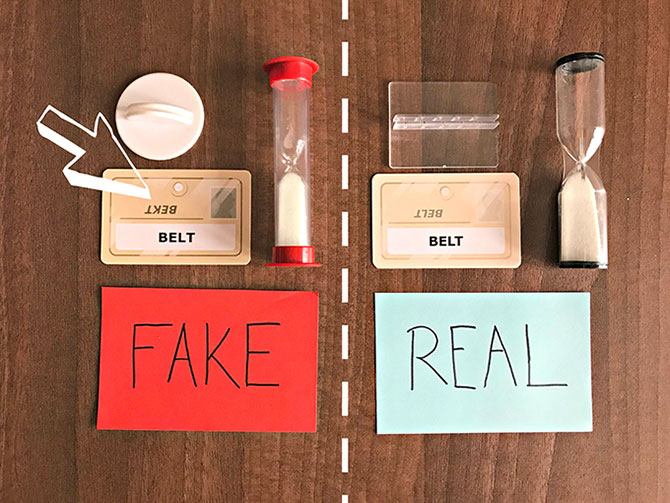
Over the last few months, there have been increasing numbers of reports of fake or counterfeit games.  The quality of these forgeries is extremely variable and a huge range of games appear to be affected, from popular gateway games like Ticket to Ride: Europe, 7 Wonders or Dominion to more complex games like Terraforming Mars.  Card games like Codenames might be thought of as an obvious target due to how simple they are to reproduce, however, one of the most affected games is Azul, and some reports suggest that it is the cardboard components that are poor quality—the plastic tiles are indistinguishable from the genuine articles.

Codenames
– Image from czechgames.com

So, how does one spot a counterfeit board game?  The answer is basically the same as for anything else.  Firstly, look at the quality.  This is probably the strongest indicator and if the quality of the fake is particularly high the buyer might not mind so much, or even notice.  Things to look out for include:

Splendor
– Image from imgur.com by BGG contributor ceephour

Some counterfeits are very high quality however.  This can be due to the so-called third shift work“, where a game is made in a factory that is nominally closed overnight, but the workers gain access and create bootleg copies with stolen material or off-cuts. Some of these are very good, but in some cases they also use parts that failed the quality control tests.  In such cases, the seller maybe more of an indication.  If buying on ebay or Amazon market place, beware if the seller has a strange name, claims to be located in the UK but isn’t, and has a very long delivery time.  In such cases, the scam is often to get payment a long time in advance, so that by the time the item is delivered (if at all), they are long gone.

Terraforming Mars
– Image from imgur.com

Thirdly, don’t imagine that Amazon is safe either:  there are three types of transaction, “Shipped from and sold by third-party seller”, “Sold by third-party seller and fulfilled by Amazon” and “Shipped and sold by Amazon”.  Amazon only “sells” authentic items, however due to “commingling“, their stock can become contaminated by fakes.  This is because when an item is sold by a third-party seller and fulfilled by Amazon, the third-party seller ships their item to Amazon who add it to their pile in their warehouse before they ship it on.  If the third-party is dodgy, the person buying from them may get lucky and get a copy from Amazon’s stock which means someone else will be unlucky…

Finally, if it sounds too good to be true, it probably is—caveat emptor: Buyer Beware!