Tag Archives: Colt Express

20th October 2015

While Burgundy, Magenta and Blue waited for their supper to arrive, they began a quick game of Bellz!, the “Feature Game”.  This is a very simple manual dexterity game, albeit one that is very well presented.  The pouch opens out to form a soft bowl containing bells in four different colours.  Each colour includes bells in three different sizes; the aim of the game is to be the first person to have picked up all the bells of just one colour using the stick which has a magnet in each end.  On a player’s turn they can pick up multiple bells or chicken out and stop at one, but if they pick up any bells that don’t match the colour of those they have already collected then that turn is forfeit.

Bellz!
– Image used with permission of BGG contributor joeincolorado

It is certainly more difficult than it looks and there is a little bit in the way of tactics as the magnetism gets weaker further away so with skill it is possible to daisy chain bells and only pick up certain bells.  There is also a strong magnet one one end of the “wand” and a weaker one on the other.  Th rules are not completely clear (and are completely in German in any case!), and gamers inevitably ask whether the bowl can be moved and how much shaking is allowed, which were things we house-ruled.  We had had about two turns each when Green arrived and joined in.  Food arrived and we were still struggling so we carried on as we ate.  Burgundy ran out the eventual winner with Blue following close behind leaving Magenta and Green to fight it out for the last bell.  Grey and Cerise promptly turned up and, as it is an eye-catching game, also had a go with Cerise taking the honours.

Bellz!
– Image used with permission of BGG contributor punkin312

This was followed by a discussion of the Essen game fair including some of the games seen and purchased by Blue and Pink.  By far the majority of the toys they picked up were expansions for games we’ve played before including:

Colt Express: Horses & Stagecoach
– Image used with permission of BGG contributor sdetavern

There were several new games too though, in particular:

There were also older games, some of which we’ve been interested in for a long time.  For example Rockwell was a big game at Essen two years ago, and Green and Blue have expressed an interest in both at the time and since.  Somehow either the price wasn’t right or it wasn’t available at the right time, until now when a good deal beckoned. Blue and Pink picked up a number of small games as well.  These are often hard to get hold of except at places like Essen and are sometimes a hit, and sometimes not so popular, but as they are relatively inexpensive and take up little space in the luggage, they are what makes the fair special.  Finally, there were the promotional items, extra copies of which Blue handed round.

Rockwell!
– Image by BGG contributor Rayreviewsgames

Eventually we decided it was time for a game, and with six the decision is always whether to split into two groups or not.  Green suggested Eketorp for six, but Blue really wasn’t keen, so eventually we opted for Codenames, a new social deduction team game based on the meanings of words which had received a lot of good reports before Essen.  Green pulled a face at the idea of “a word game” and Burgundy commented that social games were not really his thing, even Blue who bought it wasn’t terribly keen because it had sounded un-promising when she read the rules.  Cerise was almost enthusiastic though and Magenta pointed out that it shouldn’t take long, so we gave it a go.

Codenames
– Image used with permission of BGG contributor punkin312

The idea is that there is a grid of twelve cards and the players split into two teams, with even numbers of male and female, we did the childish thing and played boys vs. girls.  The leader of each team is the Spymaster, and as Grey had popped out for a second, we volunteered him to be one so it was natural that Cerise should be the other.  The Spymasters’ job is to get their team to reveal the cards/words that correspond to their team of “agents”, by giving clues.  The clue must be a single word followed by a number which reflects how many words are indicated by that clue.  For example, the clue, “trees: three” could be used to indicate the words “oak”, “ash” and “elm”.  Members of the team then touch cards that they think are their agents; they must indicate at least one, but may try up to one more than the number in the clue.

Codenames
– Image used with permission of
BGG contributor aleacarv

The Girls started off badly finding a neutral and the Boys started off well quickly getting a three card lead.  Before long, the Boys started to get a bit stuck with movie clues and the Girls began to catch up.  As Magenta pointed out afterwards, it was important to listen to both the clues and the discussion of the other team as you can get extra clues.  And so it proved in the end.  With the teams tied, the clue was “Regents; two”.  Blue and Magenta misheard and thought Cerise had said “Regions”.  The Boys struggled on their turn too though, and suddenly the Girls had another chance.  When Green had repeated Cerise’s clue during the Boys’ discussion, Blue had suddenly realised the Girls’ mistake and they were able to find “Park” and close out the game.  Although it is not really our sort of game, everyone was very complimentary about it and as a group we enjoyed it much more than we thought we would.  We could all think of people who would like playing it and now that we know how it works, it would be much quicker to play next time too, making it a surprisingly fun filler with the right group.

Codenames
– Image used with permission of BGG contributor punkin312

With that done, we had to decide what to to play next and, with too many for Cosmic Encounter, inevitably Eketorp was raised again.  Grey was very enthusiastic, but Blue really wasn’t keen, especially as it can drag with six players.  Much to Blue’s delight and eternal gratitude, Magenta tactfully suggested that, despite being a Viking, she could play something else with Blue and Burgundy.  With that, Green happily started explaining the rules.

Eketorp
– Image used with permission of BGG contributor Ceryon

Eketorp is a game where players attempt to gather resources to build their Viking stronghold on the Swedish island of Öland.  In this game players try to second guess which resources the others don’t choose, with a battle and a potential extended stay in the hospital as the reward for failure.  The game itself is played in several rounds.  First material is distributed across the board according to the card revealed at the start of the round.  The players then decide, in secret (behind their player screens), which areas to send their Vikings to.  Vikings can either go to one of the seven resource or brick areas, reinforce the defence of their own village, or attack one of the other players’ villages.   Players then reveal their choices  and place their Vikings on the central board.

Eketorp
– Image used with permission of BGG contributor cuazzel

Depending on how the various Vikings meet, peace may be preserved or battles may ensue.  Vikings on a material field live in peace if there are sufficient building bricks, i.e. there is the same number of building bricks (or more) than there are Vikings wanting them.  If there are insufficient bricks available, then there will be a battle.  Battles also take place on a siege field in front of a player’s castle for the right to lay siege if several Vikings are positioned there.  Battles always take place in a particular order. Firstly, the starting player engages in a battle, then everyone else takes turns until all battles and sieges have been resolved.

Eketorp
– Image used with permission of BGG contributor helioa

Battles are fought using cards chosen from a starting hand of four.  Each player choses a card in secret and then they reveal them simultaneously with the highest card winning.  The difference in value between the two cards determines the battle difference which indicates which area of the hospital the loser ends up in.  In the case of a tie, both parties go to the hospital.  The clever bit is that once a battle has been fought, players swap cards and place the new card face down in front of them.  Once a player has played all their cards in battles, they take the cards in front of them to form a new hand.  In this way, the game is self-balancing so that a player who has a bad card draw at the start will have a better hand later in the game and vice versa.

Eketorp
– Image used with permission of BGG contributor cuazzel

If village siege is successful, then the attacker gets to pillage bricks from the village wall.  Bricks may only be taken from the walls that are two bricks high and the  total point value of the bricks taken may not exceed the battle difference.  Bricks can only be removed from top to bottom and the attacker can then take one of these bricks home (with the remainder going back into the reserve).  Once all battles have been resolved all the winning Vikings can take their bricks home and add them to their village wall.  Each wall comes in six parts and a maximum of three bricks can be stacked in each giving a maximum of eighteen in total.  Once a brick has been used, it cannot be moved at a later date.  The bricks are nominally made of different material and are worth different amounts at the end of the game (green, or grass is worth one whereas grey or stone is worth four for example).  The end of the game is triggered when one player reaches the maximum of eighteen bricks.

Eketorp
– Image used with permission of BGG contributor
Capitaine Grappin

At the start, with no village walls to attack or defend, and all Vikings fit and healthy, the central resource pools were particularly busy places.  After many attacks and counter attacks, eventually all were either victorious and claimed resources, or were licking their wounds in differing levels of the Viking hospital (talk about a beds crisis!).  Green took the early lead at this point. Round two was much quieter, with less than half the Vikings available to go brick hunting, so everyone was relatively successful with their choices.

Eketorp
– Image used with permission of BGG contributor DrGrayrock

Over the course of the next couple of rounds, the game board became more crowded and there was even the odd cheeky raid on a village.  By this time, Grey had managed to create a nice evenly built village wall, one or two bricks high made up of both grass and wooden bricks (worth one and two points respectively) – easy pickings in a fight, but less threatening too. Green was a bit lopsided, concentrating on building with a range of brick colours mostly on one side in order to limit the attack directions.  Cerise however had quietly managed to built quite a good wall round a large part of her village with a lot of clay and stone bricks (worth three and four points).  So, the next two rounds were characterised mostly by Grey and Green attacking for Cerise’s wall.  The first attack by Green was successful, but only enough to nab the top green brick, hardly a dent at all and netted only one point.  Grey’s attack was a stalemate.

Eketorp
– Image used with permission of BGG contributor Garry

In the final round, Cerise found herself surrounded on all sides with Green and Grey attacked from one side each.  Again only Grey was successful enough to break down part of the wall though.  Then for the final battle of the game, Grey and Green had to go head to head for the right to attack Cerise from the third side – it was a draw and Cerise was safe!  As Cerise was the only one who had managed to build a wall at least three high all the way round she picked up the five point bonus and proved herself the superior Viking with a score of forty-four leaving Green and Grey some way behind, fighting it out for the wooden spoon.  In the end, Grey decided he didn’t like the game after all, because had Cerise beat him!

Eketorp
– Image used with permission of BGG contributor
Capitaine Grappin

Meanwhile Blue, Burgundy and Magenta conducted a brief audit of the games available and Burgundy’s eyes lit up at the idea of trying out the new Ticket to Ride Map Collection as he had played a lot of Ticket to Ride and prided himself on being quite good at it.  Magenta is also no slouch either however, and was also keen as she had won her last three games of Ticket to Ride: Europe.  Similarly, Blue has slightly unjustly acquired a reputation for beating people at Ticket to Ride, and although she hadn’t played it much recently, she had won her demonstration game at Essen and had enjoyed it too, so was very happy to give it another try.  Although everyone was keen to try the UK map, to avoid giving Blue an unfair advantage, the Pennsylvania side was chosen.

Ticket to Ride
– Image by boardGOATS

The basic Ticket to Ride game is really very simple.  On their turn the active player can do one of three things:  pick up two coloured train cards from the face up display or the face down draw deck; place plastic trains on the map using cards to pay and scoring points; or draw ticket cards, which name two places and give points at the end of the game if the player has built a route between them, but score negatively if not completed.  From there, each different version makes small changes to the rules, for example, some editions include tunnels and/or ferries and sometimes there are extra cards or bonus points etc..  So, the first problem was trying to remember which of the specific rules are applicable to the base game and then integrate them with the new rules for the Pennsylvania map.  In particular, this was whether we should be using the double routes and how many points the different routes should be worth since there was no score table.  Eventually, we decided to use single tracks (ala three player Ticket to Ride: Europe) and scored routes as follows:

  • Single car:  One point
  • Two cars:  Two points
  • Three cars:  Four points
  • Four cars:  Seven points
  • Five cars:  Ten points
  • Six cars:  Fifteen points
  • Seven cars:  Twenty-one points

The seven car route from Cumberland to Baltimore engendered a lot of discussion, as there aren’t any routes of that length in Ticket to Ride: Europe.  Burgundy was fairly sure they were worth eighteen points in Märklin, but the increase in points from six to seven cars seemed very uneven compared with the change from five to six cars.  In the event, it didn’t make much difference, but checking the rules online later confirmed that Burgundy was right and it should have been eighteen.
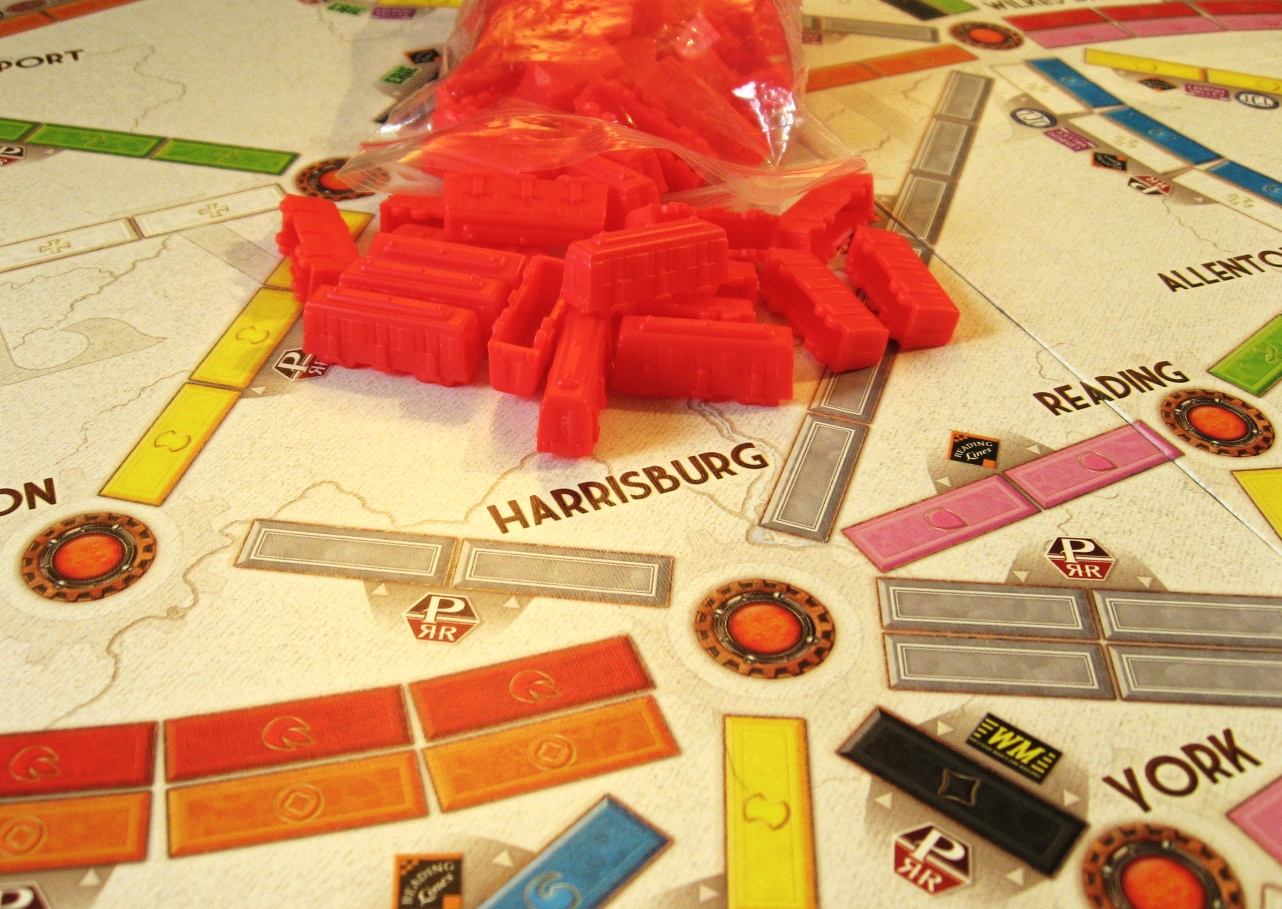
Ticket to Ride Map Collection: Volume 5 – United Kingdom & Pennsylvania
– Image by boardGOATS

Burgundy was quite pleased with his starting tickets getting three east-west routes that he thought could largely be coincidental.  His delight faded to despair, when in the first turn, Blue took the route from Altoona to Johnstown and quickly followed it by adding the Altoona to Dubois, in quickly completely scuppering his plans.  Magenta was equally unimpressed that double routes were not in use when Burgundy and Blue quickly completed all the connections to Johnstown rendering one of her tickets impossible within the first few turns.  From there, the game quickly descended into a knife-fight in a phone box with everyone scrabbling to make their starting tickets and it looking very much like nobody was going to succeed.
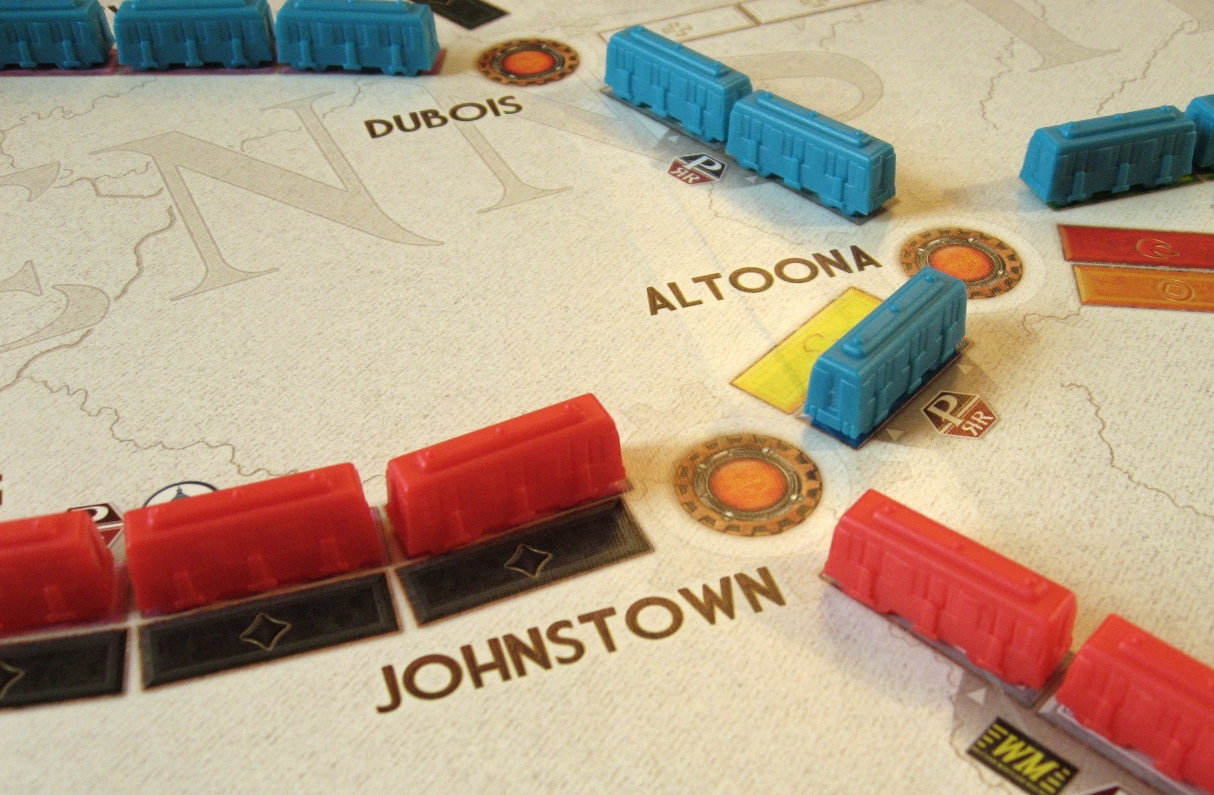
Ticket to Ride Map Collection: Volume 5 – United Kingdom & Pennsylvania
– Image by boardGOATS

As Burgundy pointed out though, tickets were not going to be so important in this game as there were a lot of points available from the Shares.  This is a new feature specific to this map.  The idea of these is that most routes also have one or more company logos shown next to them on the map.  When these routes are completed, players choose which company they would like to take a share certificate for.  The companies are different sizes with some companies having a lot of certificates available while smaller company others have fewer.  At the end of the game, each player’s stock holdings are evaluated and points awarded.  The bigger companies are worth more points, however, it is harder to get the majority stake in these.  In the case of a tie, the share certificates are numbered and the points go to the person with the one taken first.

Ticket to Ride Map Collection: Volume 5 – United Kingdom & Pennsylvania
– Image by boardGOATS

The shares certainly did have a massive impact on game play.  Normally in Ticket to Ride, players achieve their first routes and then start picking up tickets, trying to maximise the number of longer routes as these give the best points return for the cards and trains, but, that wasn’t how this game went.  Although Blue bravely picked up some more tickets and was promptly followed by everyone else, this was the only time anyone did this as everyone got in everyone else’s way so much it was just too risky.  Since achieving tickets was proving so challenging, everyone started trying to pick up share certificates which meant building small routes as these were the cheapest and easiest way to get them.  Then suddenly, Burgundy declared he was out of trains and the game came to a quick end which only left the scoring.

Ticket to Ride Map Collection: Volume 5 – United Kingdom & Pennsylvania
– Image by boardGOATS

Although Burgundy had moaned about how badly he had done, neither Magenta nor Blue realised just how badly until it came to scoring tickets.  It’s true that the first ticket scored him ten points, but all the others were incomplete losing him nearly all the points he had accrued from placing trains.  Magenta also had a ticket she had failed to achieve, but it hadn’t cost her nearly so dearly.  Blue on the other hand had somehow managed to make all her connections and therefore also picked up an extra fifteen points for the Globe Trotter Bonus.  Unfortunately for Burgundy, although he had done well on the shares, the horror-show that had been the tickets had put him right out of contention and he was nearly lapped (though not quite!).  Although Magenta had shares in more companies, the combination of the extra tickets and the fact that Blue had managed to hang on to the majority in a couple of the larger companies made the difference.  Blue finished on one hundred and ninety eight, just over thirty points ahead of Magenta in what was a very tough game.

Ticket to Ride Map Collection: Volume 5 – United Kingdom & Pennsylvania
– Image by boardGOATS

With Grey and Cerise gone, that left us with time for a quick filler to finish.  11 Nimmt! and Deep Sea Adventure were both in the frame, but Green liked the sound of Qwixx, which had been nominated for the Spiel des Jahres in 2013, but was beaten by Hanabi.  The game sounded interesting though there was very little to it.  On their turn, the active player rolls six dice, four coloured and two white.  Each player has a score sheet with four tracks:  the red and yellow tracks go from two to twelve and the blue and green tracks go from twelve to two.  Once the dice have been rolled, all the players may cross off a number of any colour that corresponds to the sum of the white dice, if they choose.  The active player may additionally cross off one number corresponding to the sum of one of the coloured dice and one of the white dice.  They can choose which of the white dice they are going to use, but the die colour must match the colour of the track.

Qwixx
– Image used with permission of BGG contributor joeincolorado

The snag is that players must progressively cross off numbers to the right, i.e. once they have crossed out the red five for example, they cannot go back and cross out the red four.  Also, while all the other players can freely choose whether or not to use the white dice, the active player must cross out something on their turn or take a penalty (minus five at the end of the game).  Finally, if someone wants to cross out the last number on any track (twelve for red and yellow, two for green and blue), they must first have crossed out at least five other numbers on that track, at which point the die corresponding to that colour is locked and the colour is closed for all players.  The game ends when two dice have been removed from the game or when one player has accrued four penalties.  Scores are awarded for the number of crosses in each row according to the triangular number sequence also used in Coloretto (one, three, six, ten, fifteen, twenty-one, twenty-eight, etc.), so every additional cross is worth an ever increasing amount.

Qwixx
– Image used with permission of BGG contributor punkin312

The game started with everyone being very cagey and not taking the option of scoring the white dice as they were too high, but eventually, some people were braver than others and different patterns began to emerge.  Initially, the game looked very promising with the potential interplay between different effects, like the probability distribution for two dice, balancing the high scoring potential with not getting stuck and picking up penalty points.  Blue was even wondering whether it would be necessary to get another scoring pad.  However, being gamers, we all played to a very similar strategy and, before long, the inevitable happened, with everyone stuck waiting for the most unlikely dice rolls (two and twelve).  As a result, Burgundy who got there first started picking up penalties closely followed by Green.  The game ended when Burgundy picked up his fourth penalty point and we added up the scores.  Magenta, who had only taken the one penalty finished five points ahead of Blue with Burgundy and Green nearly twenty points behind thanks to all their penalties.  And then the inquisition began.

Qwixx
– Image by boardGOATS

We all really like the game at first because of the way the probability interacted with the constraints on number selection, however, we quickly found that it felt very random because the game was self-balancing.  As their game finished, each player was going to be hoping for lucky dice rolls.  Since twelve and two are relatively unlikely which would have a delaying effect, during which time, anyone who had not got quite as far was going to be able to grab a couple of extra crosses.  The random nature of rolling dice meant that ultimately, the effect of any strategy or tactics applied during the game were vastly outweighed by the randomness of the dice at the end.  Although we felt it was probably a good game for children to have fun with, as a game, it was very surprising it was nominated for the Spiel des Jahres.

Qwixx
– Image used with permission of BGG contributor punkin312

Learning Outcome:  Sometimes it is good to play games outside your comfort zone.

Deutscher Spiel Preis – 2015

In 1990 the German magazine “Die Pöppel-Revue” introduced The Deutscher Spiele Preis, or German Game Prize, which is now awarded annually at the Internationale Spieltage, Essen.  Whereas the Spiel des Jahres rewards family games, the Deutscher Spiele Preis is awarded based on votes from votes from the industry’s stores, magazines, professionals and game clubs, so it tends to reflect “gamers games” and is usually more in line with the Kennerspiel des Jahres.  This year the award went to The Voyages of Marco Polo with Orléans in second, and this year’s Spiel des Jahres winner, Colt Express in third.

The Voyages of Marco Polo
– Image used with permission of BGG contributor henk.rolleman

The Voyages of Marco Polo is a worker placement type game where players are recreating Marco Polo’s thirteenth century journey to China with his father and older brother via Jerusalem, Mesopotamia and the “Silk Road”, eventually finishing at the court of Kublai Khan.  The game is consists of five rounds where the players roll their five personal dice and choose actions to perform with them.  The game ends with players receiving victory points for arriving in Beijing, fulfilling the most orders, and having reached the cities on secret city cards that each player gets at the start of the game.

The Voyages of Marco Polo
– Image used with permission of BGG contributor henk.rolleman

Essen 2015

October is the time of year when a boardgamer’s thoughts turn to Germany, specifically, Essen.  Essen is the ninth largest German city and most people in the UK have never heard of it.  Most people who are not gamers that is.  In German, the word “Essen” means “food”, but to gamers it means “Spiel”:  the largest games fair in Europe and, arguably, the world, The Internationale Spieltage is held every year in Essen.  The fair runs for four days every year and is the one of the largest and most significant of all the boardgame conventions.   As such, many of the manufacturers plan their biggest releases for October with their debut at the Fair.  This year, there are lots of exciting new games, including Richard Breese’s new game, Inhabit the Earth, Favor of the Pharaoh, and the highly acclaimed games Codenames and The Voyages of Marco Polo.  There are also a number of expansions for some of our favourite games including Castles of Mad King Ludwig, Evolution, Istanbul, Colt Express etc.  Only two of us are going this year, however, they will almost certainly bring back lots of exciting new toys to share with everyone.

Essen
– Image from merz-verlag.com

Save the Date: Mixing it in Wantage II

The Mix in Wantage town centre is a community space that can be booked for use by local groups, organisations, businesses and individuals for activities, fund-raising, meetings, workshops, and presentations etc.  This spring, we held a drop-in gaming session there to try to inspire people to play games.  With winter approaching (traditionally “the gaming season”) and Christmas on the horizon, it seemed an excellent time to do it again.

The Mix
– Image from thewantagemix.wordpress.com

We will be there from 10.30 am until 2 pm on November 21st 2015.  There isn’t an awful lot of space so, as before, the idea is to encourage people to drop in and play a short game or two, so we will be bringing along some of most eye-catching games like PitchCar, Colt Express, Dobble, Turf Horse Racing, Cube Quest, The Great Balloon Race and maybe a few of our favourite winter themed games like Snow Tails, Carcassonne: Winter Edition and The Great Downhill Ski Game.

The Mix
– Image used with permission of BGG contributor punkin312

Boardgames in the News: Twenty Awesome Games according to The Guardian

The Guardian boardgame section has produced a number of interesting articles over the last few months, including one about a French Scrabble champion who doesn’t speak French; an article discussing the impact of political boardgames, and a review of the cooperative war game, 7 Days of Westerplatte, where players take on roles of Polish defenders trying to save their city from attack in September 1939.

7 Days of Westerplatte
– Image used with permission of BGG contributor henk.rolleman

Their latest article is entitled, “20 Awesome Board Games You May Never Have Heard Of” and as well as the inevitable usual suspects, there are indeed a number of even less widely known games.  Popular franchise games are included like spin-offs from A Game of Thrones and Firefly to catch the eye of the general public, but these have a good reputation amongst gamers too.  Twilight Struggle also makes its second newsworthy appearance in a month, as well as the slightly less well known gateway games, Dominion and 7 Wonders.

Twilight Struggle
– Image used with permission of BGG contributor killy9999

More interesting are some of the other inclusions.  For example, Survive: Escape from Atlantis! is an excellent game that is very easy to teach, but has a nasty edge, with players trying to save their meeples while encouraging monsters to attack everyone else’s.  Although it is a great game to play with teenagers and students, for some reason it very rarely makes this sort of list.  Similarly, newer games like the 2014 Pandemic spin-off, Pandemic: Contagion and this years’s Spiel des Jahres winner, Colt Express also get a mention.

Colt Express
– Image used with permission of BGG contributor punkin312

It’s not all light family fare either and games like the well regarded semi-cooperative game, Dead of Winter, make an appearance as well as older “Geek Fayre” like Netrunner and Civilisation.  Perhaps the biggest surprises though are Antiquity and Euphoria: Build a Better Dystopia.  These are both much more obscure games:  Antiquity is produced in very small numbers by Splotter (and is currently out of print), and Euphoria is the product of a very successful KickStarter campaign by Stonemaier Games.  The inclusion of games off the beaten track, shows that the Guardian boardgames coverage is from people who know their subject matter much better than those at the Telegraph!  As such, these Guardian articles are always well worth a look and it will be interesting to see what comes of their quest to find the worst games people have played.

Dead of Winter: A Crossroads Game
– Image used with permission of BGG contributor mikehulsebus

28th July 2015

We started the evening splitting into three groups, the first of which played Machi Koro.  This was the “Feature Gamea couple of months back when it received a nomination for the coveted German Game of the Year, or Spiel des Jahres Award.  In essence, it is an engine building game with elements taken from The Settlers of Catan and Dominion.  Like Settlers, on their turn players first roll one or two dice, which yield resources, in this case money.  Players then use their money to buy cards like Dominion.  Each card is numbered and provides money, sometimes when the owner rolls, sometimes when someone else does, with the amount sometimes depending on the other cards a player has.

Machi Koro
– Image used with permission of BGG reviewer EndersGame

Players have five special buildings costing varying amounts and the winner is the first player to build all of them.  Red, Yellow, Orange and Cyan started setting up while people finished eating, but Red emigrated to play the hidden traitor game, Saboteur, with Teal and Violet when they arrived.  This is one of those little games that everyone always enjoys playing and plays lots of people well.  With only three players, it’s possible to have one bad dwarf, or none at all which makes everyone very twitchy, and as usual, accusations abounded.  After three rounds, Teal ran out the winner with five gold.

Saboteur
– Image used with permission of BGG contributor mothertruckin

Machi Koro and Saboteur finished together to the two groups coalesced to play Colt Express.  This had been the “Feature Game”, last time, however, none of this group had been available to play.  Red was particularly keen to give it a go as it has a lot in common with one of her favourite games, Walk the Plank!.  This style of game is sometimes refereed to as a “programming game” because players play all the cards and only after everyone has played cards, do they get to action the cards.  The effect of this is semi-organised chaos as players try to make plans to take care of all eventualities, and then find that by the time they get round to carrying out the actions the situation has completely changed and is nothing like they would have predicted.  This time, Orange took the $1,000 for the sharpest shooter and Cyan took the strongbox.  Despite this, the best thief turned out to be Yellow who finished with $2,700 some way ahead of Cyan in second place.

Colt Express
– Image used with permission of BGG contributor henk.rolleman

Meanwhile, everyone else had been playing the “Feature Game”, which was Last Will.  This is basically the boardgame equivalent of the 1985 film “Brewster’s Millions”.  The story goes that in his last will, a rich gentleman stated that all of his millions would go to the nephew who could enjoy money the most.  In order to find out who that would be, each player starts with a large amount of money, in this case £70, and whoever spends it first and declares bankruptcy is the rightful heir, and therefore the winner.

Last Will
– Image used with permission of BGG contributor PaulGrogan

The game is played over a maximum of seven rounds each comprising three phases.  First, starting with the start player, everyone chooses the characteristics of their turn for the coming round from a fixed list.  These include the number of cards they will get at the start of the round, the number of “Errand Boys” they will be able to place, the number of Actions they will get and where they will go in the turn order.  For example, a player may choose to go first when placing Errand Boys, but will then only get one card at the start of the round and crucially, only one Action.  On the other hand, a player may choose to sacrifice position in the turn order, draw no cards, only place one Errand Boy, but receive four Actions.  Since all but two cards are discarded at the end of the round and Actions must be used or lost, this decision is critical.

Last Will
– Image used with permission of BGG contributor Toynan

Next, in the revised turn order, players take it in turns to place one Errand Boy before placing their second if applicable.  Errand Boys are important as they allow players to control the cards they are drawing as well as manipulate the housing market and increase the space on their player board.  The heart of the game is the cards, however, which are played in three different ways:  as a one off (white bordered cards); on a player’s board (black bordered cards) or as a modifier (slate bordered cards) which enable players to spend more when black or white bordered cards.  Thus, White bordered cards are event cards which cost a combination of money and Actions to play, but once played, are discarded.  Black bordered cards cost at least one Action to play, but are kept and can be activated once in each round.

Last Will
– Image used with permission of BGG reviewer EndersGame

Black bordered cards come in three different types: “Expenses” which allow players to spend money; “Helpers” which additionally allow give players some sort of permanent bonus, and “Properties” which are by far the most complex cards in the game.  Properties are an excellent way of spending money as they are bought for a given amount and will either depreciate every round, or will require maintenance which can be expensive. Unfortunately, players cannot declare bankruptcy if they have property and must sell them.  This is where the property market comes in:  one of the possible errands is to adjust the property market, so if a property is bought when the market is high and sold when it is low, this is another possible avenue for losing money.

Last Will
– Image used with permission of BGG contributor bswihart

At the end of the round, everyone reduces their hand to just two cards and loses any left-over actions, which puts players under a lot of pressure as it makes it very hard to plan.  So the game is an unusual mixture of timing, building card combinations, strategy and tactics.  Only Blue had played it before and that was a long time ago, so it took a long time to explain the rules and make sure that everyone understood how the cards worked.  Even then, there were a lot of misunderstandings.  Burgundy had also read the rules quite carefully as well though and mostly managed to keep everyone on track.

Last Will
– Image used with permission of BGG contributor Toynan

Green (as the last person to the bar and therefore the last person to buy something) went first and started out with an “Old Friend” which gave him an extra action.  Burgundy went for a “lots and lots of cards which don’t cost an Action to activate” strategy while Black and Purple went into the properties market.  Meanwhile, Blue’s starting cards favoured buying farms, but by the end of the first round it was becoming clear that the cards she needed weren’t there and an Events strategy would probably be better.

Last Will
– Image used with permission of BGG reviewer EndersGame

Towards the end of the fourth round it was becoming obvious that Burgundy’s preparation (reading the rules) was paying dividends as he was systematically spending more than £12 per round – the amount needed to force an early finish to the game.  Blue on the other hand was trying to work out why her pile of poker chips didn’t seem to be decreasing.  By the end of the fifth round it was clear that Green was pressing Burgundy hard and there would only be one more round.  A quick bit of maths also suggested that there had been a “banking error”.  Although it would normally be in Blue’s favour, unfortunately, as this is game where players are trying to lose money, it didn’t help her.  Since she had been in charge of the poker chips though, it could only have been her own fault.

Poker Chips
– Image by boardGOATS

The game came to an end in round six when Green ran out of chips.  This left him with a final total of zero and everyone else trying to make the best of the final round.  Black and Purple tried selling off their properties and Blue held another couple of expensive parties, but it was Burgundy who spent £20 to finish the winner with £13 of debt.  As we put the game away, we agreed that it was quite an unusual game, though quite complicated, especially on the first play.  We also all felt that it was the sort of game that would benefit from the familiarity with the cards that comes from repeated plays, so it is quite likely that we’ll play it again soon.

Last Will
– Image used with permission of BGG contributor CellarDoor

With everyone else gone, there was just time for a few quick rounds of Love Letter.  This is a game we played a lot a year or so ago, but not so much recently.  The first of the so-called “micro games” it is played with just sixteen cards.  Each player starts with one card and on their turn, draws a second card and then plays one of them.  Each card has a value (one to eight) and an action (discard a card, swap cards with another player, compare cards, etc. etc.).  The object of the game is to have the highest card when the deck has been exhausted or, be the last person remaining, which ever is soonest.  For variety, we played with Green’s much loved, very battered, previously lost but recently re-found, home-made, “Hobbit” themed deck, complete with tiny gold rings.  So, the first problem was remembering what all the cards did and then trying to match them to the new characters…  With five, we played until the first player had two rings – everyone got one except Burgundy before Black won a second round and finished as the winner.

Love Letter
– Image by boardGOATS

Learning Outcome:  Spending money is not quite as easy as you think.

14th July 2015

It was a relatively quiet evening, which started off with food (yet again):  Blue and Burgundy finished their dinners while everyone else began a game of Om Nom Nom.  This fun little double-think game looks like it is going to be a popular filler following its two outings on one night last month. The game is quite simple with players simultaneously choosing animal cards to try to eat as much possible:  for example, a cat will eat mice.  Similarly a mouse can eat cheese, but only if it is not eaten by a cat first.

Om Nom Nom
– Image by BGG contributor jancis

There are three food chains, each with three tiers.  Dice are used to start off the bottom two tiers and cards are played to represent the top two tiers.  The simultaneous card play coupled with the random nature of the initial dice roll is what introduces the double think:  players have to decide whether to play a mouse card and go for the enticing large pile of cheese, or hope everyone else will play mouse cards and that their cat will get a good feed…  Purple, Black and Grey introduced it to Magenta and Flint and clearly did the job well as they took first and second respectively.

Om Nom Nom
– Image used with permission of BGG contributor msaari

Meanwhile, since Blue and Burgundy had finished their supper before the rules explanation was over, they decided to see if they could finish a quick game of The Game before the others.  We played this last time and since it was nominated for the Spiel des Jahres award, it seemed appropriate to try again.  The Game is a simple game:  on their turn, players have to play two cards from their hand onto one of four piles (the numbers increase for two piles and decrease for the other two).  Since the idea is to play all the cards and (although we’ve only played it a couple of times) we’ve never got more than about half-way through the deck, finishing first was thought to be quite likely.  However, ten minutes later, despite having been absolutely certain of catastrophic failure for most of the game, Burgundy played his last card leaving Blue with the just one, the unplayable sixty-four.  And just as Om Nom Nom was finishing too.

The Game
– Image used with permission of BGG contributor henk.rolleman

The “Feature Game” was to be Colt Express, which won the Spiel des Jahres award last week.  Although there were seven of us and the game plays a maximum of six, everyone was keen to give it a go, so Black and Purple teamed up.  When it came out of the box it was clear why Colt Express had won the award:  the game is played on an amazing 3D train with bandits moving from one car to another, running along the roof and dodging bullets in an effort to steal the most loot.  The game is played over five rounds, each of which is played in two parts.  First there is the planning stage where everyone takes it in turns to play a card, usually face up onto a deck of cards.  In the second phase, the deck is turned over and the cards are played one at a time by the person who played the card.

Colt Express
– Image used with permission of BGG contributor henk.rolleman

Although that sounds quite simple, there are quite a few fiddly bits which take a little bit of getting used to.  The five rounds are played according to cards:  these are drawn from a small deck at the start of the game and modify the number of action cards everyone plays and how they play them during the round.  Starting with the start player, each person places their first action card on the communal deck, then they all take it in turns to place the next and so on.  However, although the general case is that everyone plays one card face up in clockwise order, sometimes two cards are played instead of one, or it might be played face down and some are even played in reverse order.  At the end of the round, sometimes there is also an event – all this adds to the interest increasing replayability, however, it also adds to the complexity on the first play through.

Colt Express
– Image used with permission of BGG contributor punkin312

Players have ten action cards each, but they start each round with only six in hand, though they can draw an extra three instead of playing a card on the communal deck.  The action cards allow players to move along the train, between the levels (roof and carriage), shoot, steal, punch another player or move the marshal.  These actions are also a little tricky to get to grips with, especially since each player has a special ability and the card actions depend on where they are played.  For example, if a player can only move one carriage when inside the train, but up to three if on the roof.

Colt Express
– Image used with permission of BGG contributor punkin312

This is fairly straight-forward, when compared with shooting though.  Inside the train, one player can shoot a player of their choice in an adjacent carriage, however, on the roof any player within “line of sight” could be the targeted.  In this context, “line of sight” means there is no other player standing in the way.  Players cannot shoot through the roof unless they are playing the character Tuco and nobody can shoot Belle unless she is the only available target.  When a player has been shot, they receive a bullet card from the shooter and this is added to their deck potentially reducing the number of useful cards they have in their hand.  In addition, if the shooter is Django, the victim is also pushed back by the force of the shot.

Colt Express
– Image used with permission of BGG contributor henk.rolleman

Trying to plan during the first stage of the round, keep all these possibilities in mind and remembering all the cards played is impossible, especially when there are a lot of players. Since action cards are mostly played face up, however, it feels like you have some control over what is going on, until the second part of the round, that is, when even the best laid plans need rearranging!  Once everyone has got their head round the rules, the unpredictability all adds up to a lot of fun though and our first game was no exception.  Team Purple-Black (Belle) were robbed of their last gem by Grey (Cheyenne) leaving them with nothing, although they picked up the $1,000 for sharpshooter.  Magenta (Tuco) finished with $500 in purses, but failed to add to it. Blue (Ghost) did better having looted $1,850 in purses, and finished just behind Burgundy who took $1,000 for the joint sharpshooter and the same in purses.  Although Flint (Django) took the strong-box and managed to hang on to it until the end of the game, he was pipped to the post by Grey (Cheyenne) who made good use of his pick-pocket ability and ended the game with $3,100.

Colt Express
– Image used with permission of BGG contributor punkin312

We all enjoyed the game though with hindsight, we’d have set the table out slightly differently, putting the train at one end and the communal card pile in the middle of the table so that everyone could see what action cards were played (although it would have helped if we hadn’t had seven people round a six-player game of course).  It is a very well presented game, however, it would have been nice if the icons on the cards had been a little more helpful, or alternatively, the bonus player mats could have acted as a player aid.  With the number of small rules, inevitably, it turned out that we’d made a mistake.  It was not a large one, but it might have impacted the lead as Grey had been using his power to pick-pocket gems as well as purses.  We tried to work out what would have happened if he’d taken purses instead and Grey claimed he would still have won, but that just means we’ll have to play it again and make sure he doesn’t “cheat” next time!

Colt Express
– Image used with permission of BGG contributor punkin312

With Grey and Magenta leaving, we decided to introduce Flint to Coloretto, an old game, but one that has stood the test of time and that we’ve played a lot recently.  A simple set collecting game, on their turn, players can either pick up a chameleon card from the face down deck and add it to a truck, or take a truck (passing for the rest of the round).  The innovative part of the game is the scoring which uses the triangular number sequence (one point for the first card, three points for two cards, six points for three cards etc.), with positive points for three sets and negative for the rest.  It was a tight game which finished in a draw between Flint and Blue, however, on the recount, Flint finished with twenty three, one point clear of Purple and two ahead of Blue.

Coloretto
– Image by BGG contributor SergioMR

We finished with yet another go at The Game, which is proving strangely compelling.  As a group, it is clear that we are beginning to work out some of the tricks we can use to extend the game and get closer to winning.  For example, players are now watching out for cards that are ten apart so that they can use the backwards rule.  In this way, we have been able to play three or even four card combinations that do minimal damage to a pile or even leave it better than where it started.  Of course, this only works when you have the cards and, since you have to play two cards each turn, it’s not always possible to wait to play things optimally.  This time we didn’t match our current best of one card, however, that was achieved with two players and we felt it is probably more difficult with four.  We did better than our previous attempts with more players though, and finished with eleven unplayable cards.

The Game
– Image used with permission of BGG contributor henk.rolleman

Learning Outcome:  Chaos can be a lot of fun.

Boardgames in the News: Spiel des Jahres Awards

This week, Colt Express won the Spiel des Jahres Award.  Although it may seem strange, this German award is highly sought after and is the most coveted award in the world-wide world of boardgames.  The reason for this goes back nearly forty years when the “English” market was dominated by companies like Milton Bradley (who made Scrabble) and Parker Brothers (who made Cluedo and Monopoly).  These concentrated on producing a few top sellers, however, in Germany there was no such dominance.  So, the German market consisted of a large number of small manufacturers producing more varied products.  This, coupled with the traditionally strong German toy industry, encouraged the growth of a culture of families playing games together on a Sunday afternoon.

Spiel des Jahres
– Image from spieldesjahres.de

It was in this environment that the annual German Game of the Year, or Spiel des Jahres Award, began in 1978, with the stated purpose of rewarding excellence in game design, and promoting top-quality games in the German market.  The red pawn of the Spiel des Jahres logo, has since become a mark of quality, and for many German families, buying the game of the year is something they do every Christmas.  Thus, the award has been such a success that it is said a nomination can increase sales from a few hundred to tens of thousands and the winning game can be expected to sell up to half a million copies or more.

El Grande
– Image by BGG contributor Domostie

Over the last fifteen years, years, the Spiel des Jahres has generally gone from highlighting games like El Grande, Tikal and Torres (1996, 1999 & 2000), to rewarding lighter games like Dixit, Qwirkle and Camel Up (2010, 2011 & 2014).  The problem was particularly brought to light in 2002 when Puerto Rico, arguably one of the best games ever made was not rewarded because it was perceived as too complex.  The problem reared its ugly head again in 2008, but this time the jury awarded Agricola a special “Complex Game” award.  These two games are widely considered to be the pinnacle of “Euro-Games”: between them they’ve held the top position on the BoardGameGeek website for the best part of ten years, yet neither were awarded the top prize. The problem was that these games were not mainstream enough for the German family game market:  they were too complex for those families making their annual purchase. On the other hand, for frequent and dedicated boardgamers, these Spiel des Jahres games are too light.  So, for this reason, the Kennerspiel des Jahres or “Connoisseurs’ Game of the Year” was introduced in 2011 and for more serious gamers, this has largely superseded the Spiel des Jahres.  This year it was awarded to Broom Service, a reimplementation of Witch’s Brew which was itself nominated for the Spiel des Jahres in 2008.

Adel Verpflichtet
– Image by BGG contributor Henco

The Kennerspiel des Jahres is not the only prestigious award available to strategy games however.  In 1990, the German magazine “Die Pöppel-Revue”, introduced the Deutscher Spiele Preis or “German Game Prize”.  This is announced in October every year at the Internationale Spieltage in Essen.  In contrast to the Spiel des Jahres, the Deutscher Spiele Preis has gone from rewarding lighter games like Adel Verpflichtet (aka Hoity Toity, in 1990) and our group’s current favourite filler, 6 Nimmt! (winner in 1994) , to highlighting games like Russian Railroads and Terra Mystica (in the last two years).

Deutsche Spiele Preis
– Image from wikimedia.org

Spiel des Jahres Winners – 2015

The 2015 winner of the coveted German Game of the Year or Spiel des Jahres award is Colt Express which is a game about bandits robbing an amazing 3D train.  The game plays in two phases:  first everyone plays action cards cards onto a common pile and then the action cards are resolved in the order they were played. There were three games nominated for the Spiel des Jahres this year and we’ve played the other two, Machi Koro and The Game, so we’ll play Colt Express next week to see what all the fuss is about!

Colt Express
– Image used with permission of BGG contributor henk.rolleman

At the same time the Kennerspiel des Jahres was awarded, which honours more challenging games.  It was introduced in 2011 to replace the jury’s habit of intermittent special awards for games too complex for the Spiel des Jahres (notably Agricola which was awarded a special “Complex Game” prize in 2008).  The 2015 award went to Broom Service, which is a reimplementation of the 2008 Spiel des Jahres nominated game, Witch’s Brew.  It is a role selection game where players collect potions, then deliver them across the land to towers that advertise their desires with color-coded roofs.  This year we haven’t played this or either of the other nominees (Orléans and Elysium), but it probably won’t be long before we do.

Broom Service
– Image from asaboardgamer.com