Tag Archives: Downforce

21st January 2025

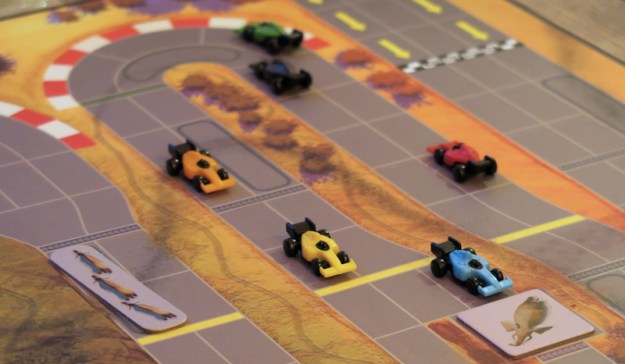
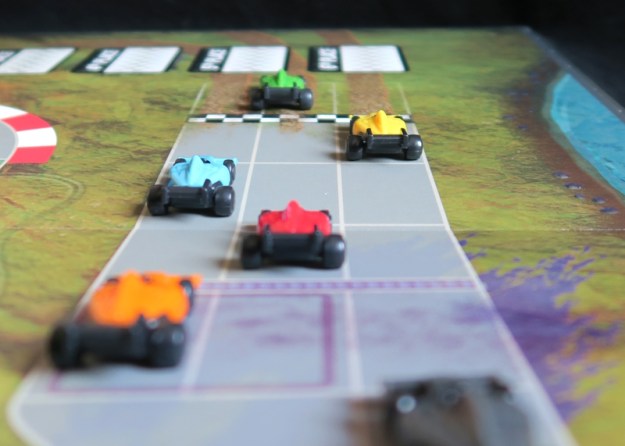
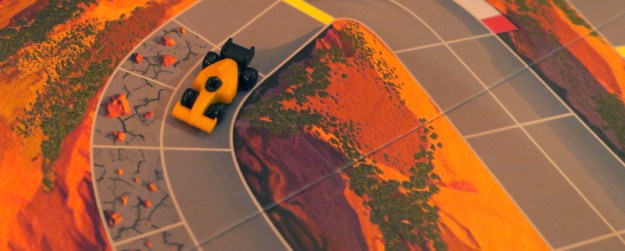
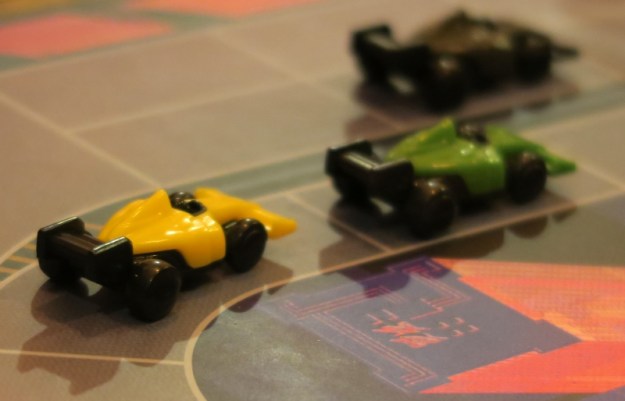
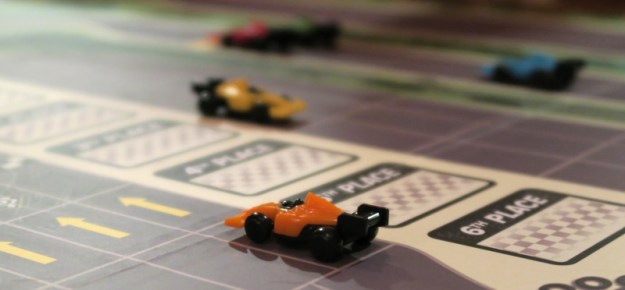
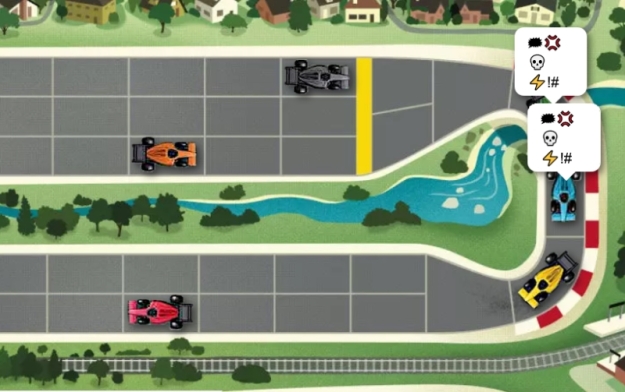
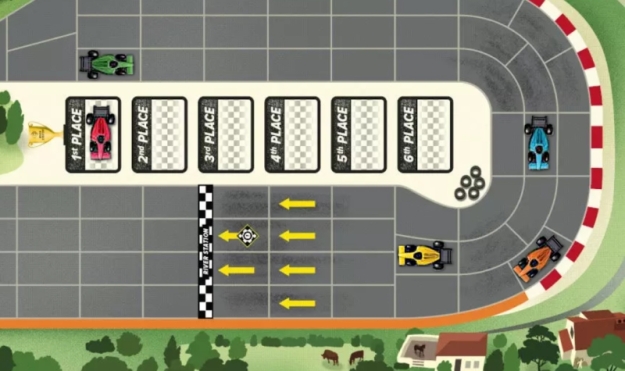
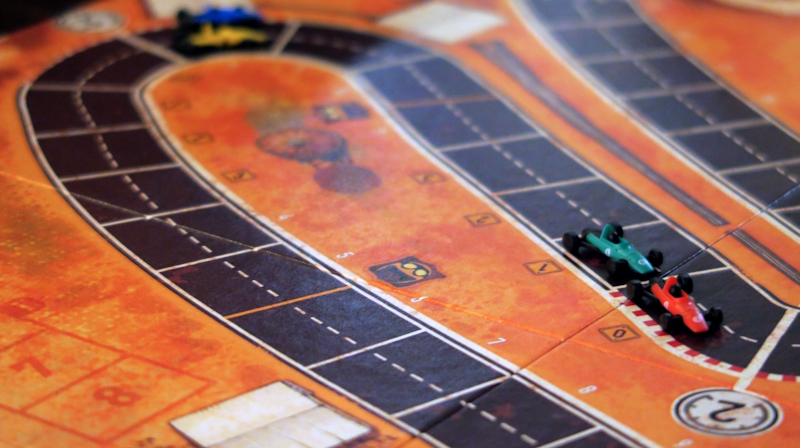
Blue and Pink were still eating as everyone else rolled up.  But as they did, like last time, there was an unusual amount of interest in the “Feature Game“, which, in a change to previous plans, was to be Heat: Pedal to the Metal.  This is a car racing game, in a similar vein to other games popular within the group like Flamme Rouge, Snow Tails, and Downforce.  Like Flamme Rouge and Snow Tails, as well as a racing game, Heat is also a hand management game.  The idea is that players simultaneously choose cards to play and then these are activated from the front of the pack (much like PitchCar).

Heat: Pedal to the Metal
– Image by boardGOATS

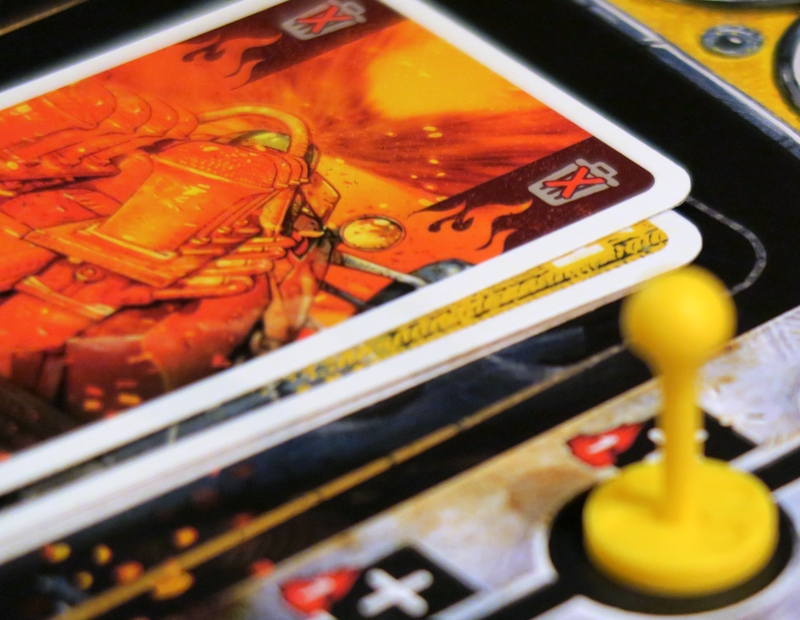
Players have a hand of seven cards drawn from their personal deck.  During the game, certain actions that are bad for their engine cause it to heat up meaning they pick up cards that block their hand.  Initially, Heat cards go into players discard pile, simulating the delayed effect engine damage can have, blocking their hand later in the game as the deck is recycled.  There are ways to cool the engine down, but these Heat cards cannot be discarded or played in the normal way.  What makes Heat slightly different to some of the other hand-management-racing games is that there is formally simultaneous play to choose cards and then players take it in turns to activate their cards and take a series of optional mini-actions.
Heat: Pedal to the Metal
– Image by boardGOATS

Players start by simultaneously adjusting their gear, staying put or shifting up or down one without penalty, or shifting two and picking up a Heat card.  The gear dictates how many cards a player must play – second gear means they have to play two cards for example.  Players then take it in turns to reveal their cards and move their car.  There are then five “situational” options: Adrenaline, React, Slipstream, Corner Check, and Discard, before the player replenishes their hand back to seven cards.  Adrenaline is a catch-up mechanism, where the player at the back can move one extra Space while adding one to their Speed value and/or gain one extra “Cool down”.

Heat: Pedal to the Metal
– Image by boardGOATS

“Cool down” is an important aspect of the game because it allows players to remove a Heat card from their hand and return it to their engine deck.  In React, players activate any additional symbols on the cards they have played or from the gear they are currently in or from the Adrenaline.  These include picking up cards because of Stress—players start the game with three Stress cards in the deck which represent lapses of concentration.  When a player plays these, they then have to draw cards from their deck to add an essentially random amount to their speed.  Of course it is not random, and a player who has an idea of what cards are still in their deck will be able to mitigate this.

Heat: Pedal to the Metal
– Image by boardGOATS

Further, Stress cards can also be used to postpone the effects of Heat, as any non-movement cards go straight into the discard pile.  Players can also control their engine heat by spending a period of time in a low gear by “Cooling down” their and removing Heat cards from their hand (three for first gear, two for second).  In contrast, players that have Heat cards available, may add an extra one to their discard pile to boost their speed by drawing an extra card as for Stress cards.  Once all these have been activated, players who end their movement along-side or immediately behind another car can Slipstream, that is move two spaces forward (this does not add to speed, it simply means the car moves further because it is moving more efficiently).

– Image by boardGOATS

If the player has crossed a Speed restriction line typically at a corner, they have to evaluate their Speed by summing the value of their cards and adding one for any Adrenaline bonus if they used it.  If this is more than the limit, players add the difference to their discard pile in Heat Cards.  Players that do not have enough Heat to pay for their excess Speed, pay all the Heat they have and then immediately spin out—move their car back to the last available space before the Speed limit line, take one or two extra Stress cards and change down to first gear.  Once all this is done, players can discard any cards they want that are not Stress or Heat cards before replenishing their hand, shuffling their discard pile if necessary.  The first player to cross the finish line triggers the end of the game and the player that travels the furthest is the winner.
Heat: Pedal to the Metal
– Image by boardGOATS

Although Blue and Ivory were keen to play, numbers meant they missed out and instead, Jade, led Teal, Pink and Lime.  A slight rules malfunction where the group were trying to play all the steps simultaneously meant the safety car did a lap before a restart, then they were off in earnest.  The group were playing on the USA track, which is generally recommended for a first play and is raced over two laps.  One thing that seems to be true for all race games is that once someone has got in front, it is very hard to haul them back, making it critical to get a good fast start.  This time, the good fast start was had by Jade and before long he had built that up and had gone one corner ahead, everyone else felt they were playing for placings and trying to work out how best to approach the corners.

Heat: Pedal to the Metal
– Image by boardGOATS

Instead of playing the end-game as written, the group decided to play it until everyone had crossed the line, so the game continued for some time after Jade had claimed victory.  Lime crossed the line second with Pink in hot pursuit, so much so that although Pink crossed the line in third, he finished his turn ahead of Lime and therefore was awarded runner-up (or first loser) status.  Teal just crossed the line, claiming a sympathy vote ensuring that everyone finished the race.  It had been a bit of a trial and Blue was still keen to give it a go, so Jade, who had been looking to pass it on, sold it to Blue on the spot, which means it will likely get a few more tries over the coming year.
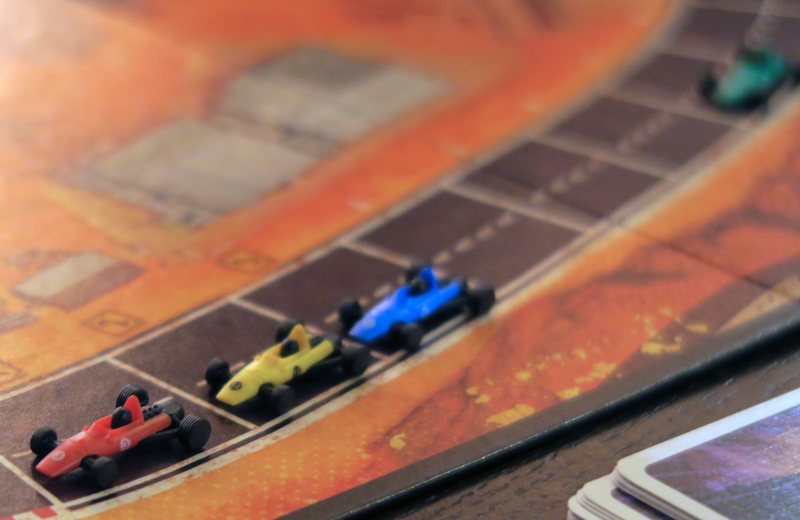
Heat: Pedal to the Metal
– Image by boardGOATS

Blue and Ivory meanwhile, although keen to play Heat, had also been tempted by Roll for the Galaxy.  So, when Byzantium had commented that he hadn’t understood his first and only play, but had enjoyed it, the decision was made.  Roll for the galaxy is a dice game based on the card game Race for the Galaxy, which is itself a sort of space themed, card game version of Puerto Rico.  The thing all these games have in common is “Role (or Action) Selection”—the games have five or six phases or Roles and each player chooses one which will happen in the round.  Thus some things happen, and others do not.  A large part of these games is correctly gambling on others picking certain Roles or Actions and making them happen, so they can be piggy-backed.

Roll for the Galaxy
– Image by boardGOATS

The smaller the number of players, the more critical this can be.  So with just three players in Roll for the Galaxy, at least two will not be happening, possibly more.  The Actions are Explore (acquire world tiles); Develop (progress on building Development worlds); Settle (progress on building Production worlds); Produce (use Production Worlds to produce Goods), and Ship (sell Goods for money, or consume them for victory points).  In this game, the actions are all carried out using dice which are rolled in secret and placed behind the players screen to choose where those dice will get used.  This placement depends on the face shown, though any one die can be used to choose which Action will happen.

Roll for the Galaxy
– Image by boardGOATS

The dice are then moved to the Development or Settlement piles of tiles in their respective phases to progress building those worlds, or placed on Production worlds as goods.  Alternatively, they can be spent to pay for Exploring or Shipping in which case, they (along with any dice from any completed building projects or shipped goods) are placed back in their Citizenry.  Dice can be purchased into the player’s cup at a rate of one dollar each, so it is important for players to ensure their finances are healthy or their game will rapidly stagnate.  The game ends when, either someone has built their twelfth World, or the the pool of victory point chips has been exhausted.
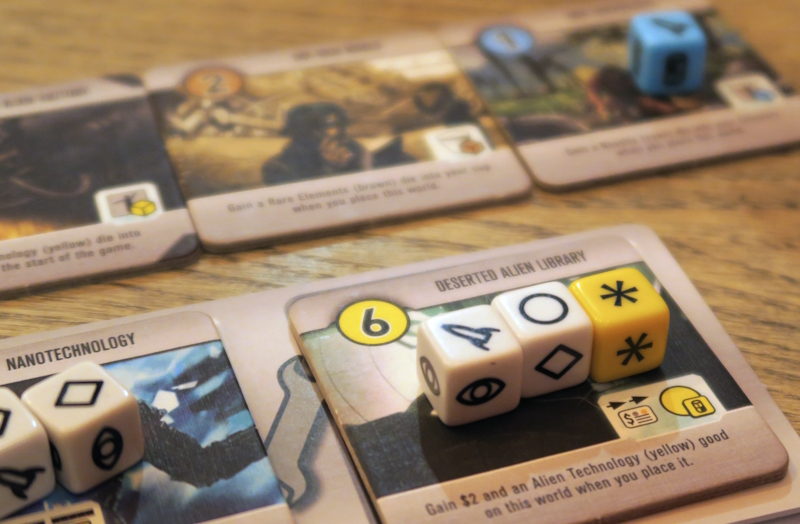
Roll for the Galaxy
– Image by boardGOATS

The game was slow to get going at the start, but then Ivory raced to an early lead getting a nice array of Worlds in his tableau leaving Blue and Byzantium trailing in his wake.  But then, instead of finishing the game by building his final World, he appeared to pull up.  This gave Blue and Byzantium the illusion of a chance, but was of course because he had a plan.  Ivory had the Galactic Reserves Development World which gave an extra victory point for every Goods item on a World at the end of the game while also allowing each Production World to hold an extra Goods item.
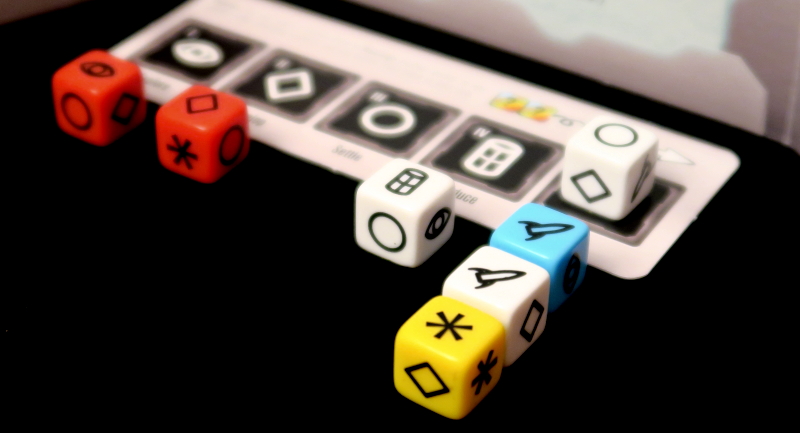
Roll for the Galaxy
– Image by boardGOATS

So, the couple of extra rounds was to enable him to fill his Production Worlds and in the end, the game was brought to a close by Byzantium building his twelfth planet, although the victory point chips were also depleted by the end of that round.  Blue had taken a sizeable twenty-four of those victory points through trading goods, but hadn’t been able to build enough.  As a result, her planets were worth only eighteen points, barely twice those of Ivory’s and Byzantium’s thirty.  Byzantium had five victory point chips and a couple of points from his New Galactic Order, but Ivory was some distance in front, thanks to his thirteen points for his Galactic Reserves and Galactic Bankers Developments together with his eight victory point chips.

Roll for the Galaxy
– Image by boardGOATS

There was time to play something else, but rather than go through rules, as Roll for the Galaxy was already out, the trio decided to give it another go.  This time, with an element of time pressure, it was arguable that some of the decisions made weren’t as sharp and the scores were all lower the second time, though that might have been partly because there were notably fewer rounds.  Blue kept dipping into the bag to try to get Rare Element (brown) Worlds to go with her Mining League, but failed repeatedly and eventually gave up.  Ivory triggered the end game with his twelfth World and this time it was Byzantium who struggled to build enough.
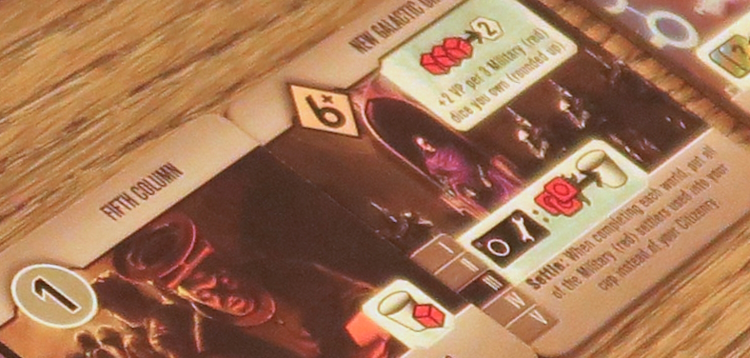
Roll for the Galaxy
– Image by boardGOATS

The scores were a bit closer on the second attempt, though the end result was still much the same, with Ivory again taking victory, though with half the winning margin.  By this time, the other games had also finished.  The first of these was Forests of Pangaia, in which Mint was joined by Pine and Plum.  This is a truly beautiful, tactile game, where players are trying to meet objectives to score Life Points; the player with the most Life Points at the end of the game is the winner.  The game has elements of set collection and area control and is played on a central map made of terrain hexagons.  Players take turns to perform three phases: Grow Seeds, take a Spirit Action, and finally add Treetops.  Once Seeds have grown and been turned into Trees, players carry out one of three possible Spirit actions.

Forests of Pangaia
– Image by boardGOATS

These are: Plant (moving their Spirit Pawn to a Lake space and planting seeds in adjacent spaces); Gather (moving their Spirit Pawn back to their player board and receiving a resource), and Prey (moving their Spirit Pawn back to their player board and playing their Ritual Card).  There are fourteen Rituals the Spirits can perform to collect Gaia’s Life Energy.  Once the Ritual card has been scored all the player’s Trees that were involved in the Ritual then partially or fully Decay (depending on the Ritual), either losing a level or rotting back to nothing and leaving a Seed.  The player then discards their Ritual card and draws a new one.  The game ends when the last Ritual card is taken by any player.

Forests of Pangaia
– Image by boardGOATS

Plum went first and spent most of the game collecting Sun tokens.  In contrast, Pine collected lots of Wind tokens inspiring lots of jokes about using wind to spread his seed.  The winner, however, was Mint with a nine point Trail Ritual due to excessive seed spreading giving her a total of twenty-eight points.  Pine just pipped Plum for second place by a single point.  It had been a really enjoyable game, however, made all the better by the gorgeous pieces. Meanwhile, on the other end of the same, albeit long table, Black, Purple and Sapphire played a game of last year’s winner of the Golden GOAT Award, Stamp Swap.
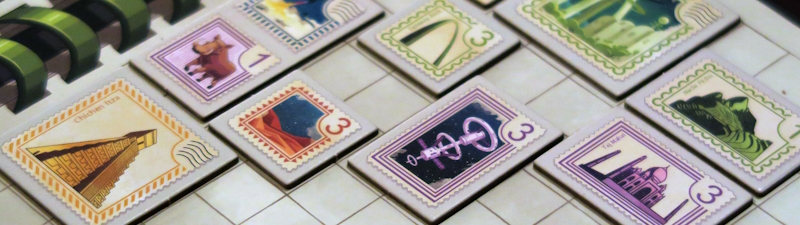
Stamp Swap
– Image by boardGOATS

This is a really smooth tile placement centred around stamp collecting.  There is a lot of simultaneous play, which is nice because it minimises down time.  First, players take it in turns to choose items from the central Pool, then simultaneously divide them into two piles of offerings.  The player with the first player token, chooses and takes one of the piles offered by their opponents.  The opponent keeps their other pile and then chooses a pile from one of their opponents and so on.  Once everyone has two piles, players arrange the Stamps in their Album and then choose which of the four available end of round cards to score this time.

Stamp Swap
– Image by boardGOATS

After three rounds, players score the end of game objective card and the player with the most points is the winner.  One of the clever parts about this game is how much difference the objective cards make to the way players arrange their Stamps.  The end-game scoring gave three points for each enclosed gap two spaces in size (i.e. a one-by-two hole).  More points were available during the game for cancelled stamps not on the edge of the page; for large square stamps; for each stamp in a player’s second most abundant theme, and for groups of a chosen colour.
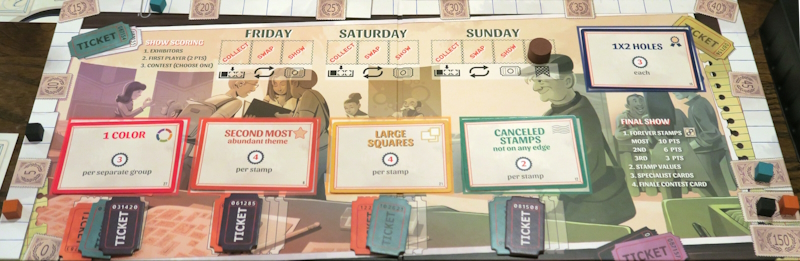
Stamp Swap
– Image by boardGOATS

This time the game was very close.  Purple (specialising in Flowers) struggled to get the stamps she needed and Sapphire (specialising Space stamps) kept getting confused which way the turn went.  It didn’t seem to inconvenience him too much however as he and Black (Monuments) fought it out for first and second place.  Black picked up a lot of his points for Special Stamps—just three accounted for a quarter of his points, which contributed to his total of one hundred and seven points, just four more than Sapphire.
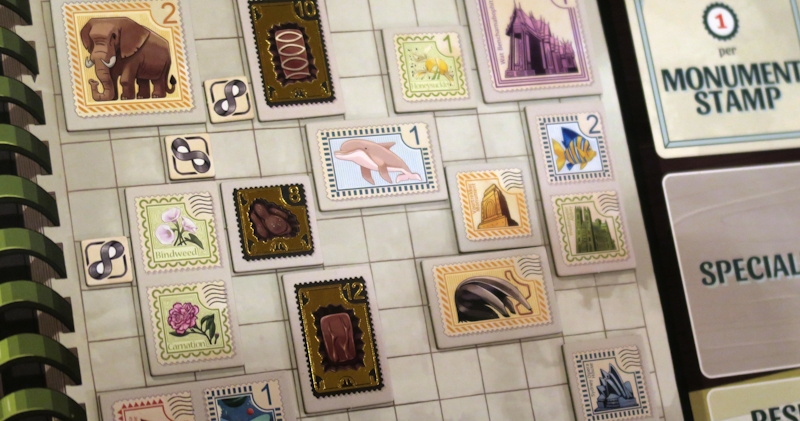
Stamp Swap
– Image by boardGOATS

While everyone else was finishing up, there was some discussion about the continuation of the Ticket to Ride Legacy campaign that Blue, Pink, Black, Purple and Pine embarked on at New Year.  The campaign is played over twelve rounds and the group had managed the first two games on the first outing with the next two more recently on Saturday evening.  Spoiler alert—hover HERE to see details. The winner of the third round was Black, very closely chased by Pink with Blue taking third.  After a break for tea (lamb and vegetable tagines with millet), the group began their fourth game. Spoiler alert—hover HERE to see details.

Ticket to Ride Legacy: Legends of the West
– Image by boardGOATS

This was much less close than the third game. The winner was Pine, with Black six dollars behind and Pink a further fourteen points behind him, in third. Spoiler alert—hover HERE to see details. While chatting with the others, out of curiosity, Pine went through The Book and totaled up the scores for the first four rounds, which gave Black a lead of some twenty dollars. Something the rest of the group need to give some thought to next time, before he gets an unassailable advantage although there is a suspicion that as the campaign progresses, the games get longer and more points will be available in each round giving players a chance to catch up.  We shall see.
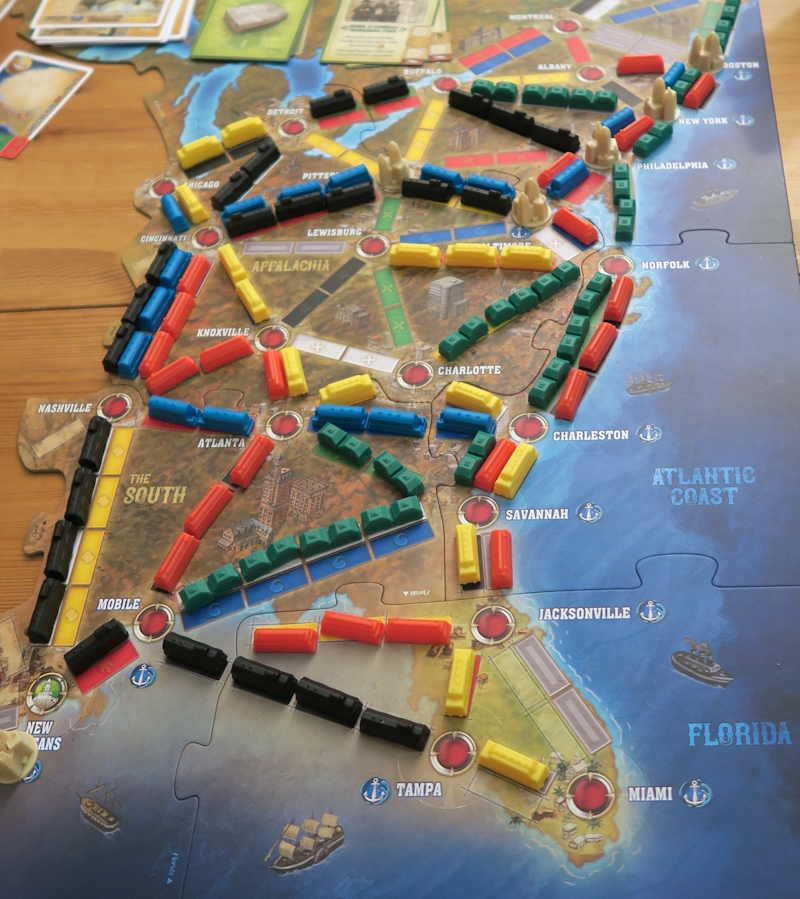
Ticket to Ride Legacy: Legends of the West
– Image by boardGOATS

Learning Outcome:  However you roll, when you race you need a fast start.
23rd December 2024

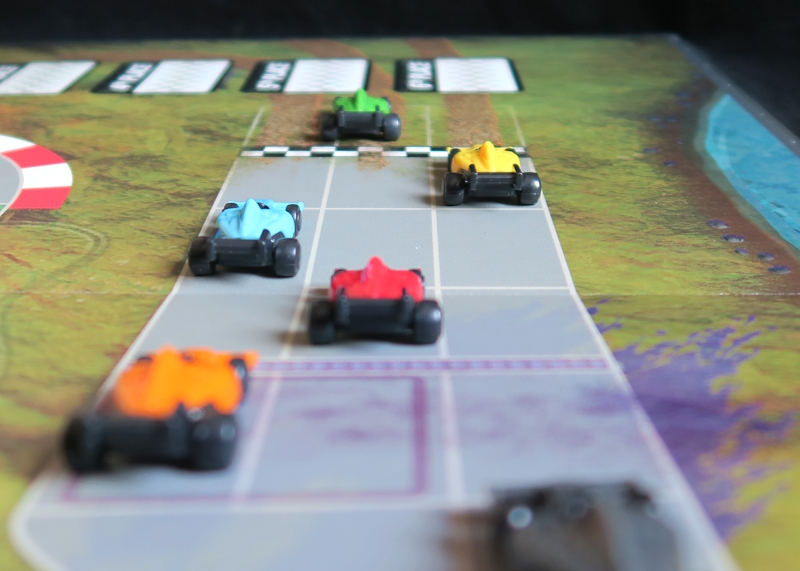
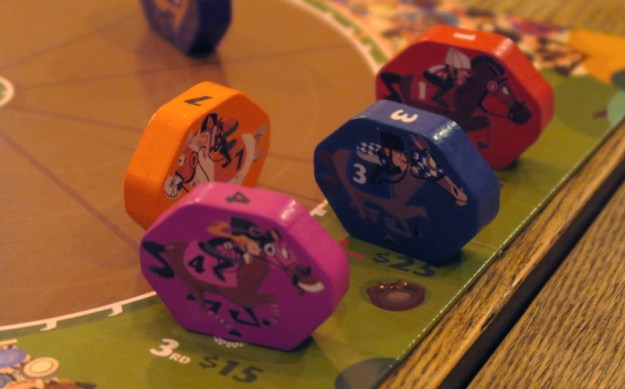
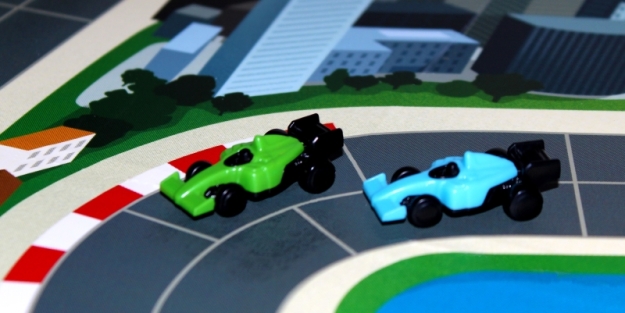
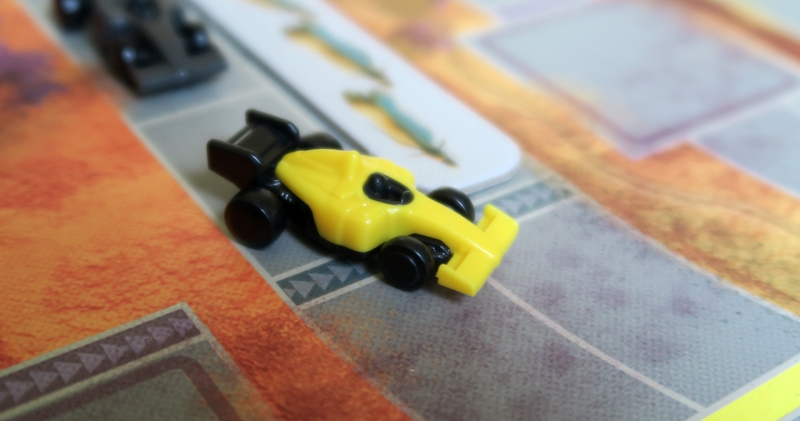
Being an extraordinary Monday meeting and only two days before Christmas, we didn’t really know who or what to expect, so didn’t have a “Feature Game” planned.  In the event, almost everyone expected turned up and we played some of our all-time favourite games.  Pink was first out of the traps, and persuaded Black, Lime and Pine to join him in a game of his favourite race game, Downforce.  This is a fun car racing game where players bet on cars as well as try to win the race.  What makes it special is that players play cards, but, whereas in other race games players can only influence their own car, in Downforce, the cards can be used to play anything from only the player’s own card, to every car on the track (depending on the card).

Downforce: Wild Ride
– Image by boardGOATS

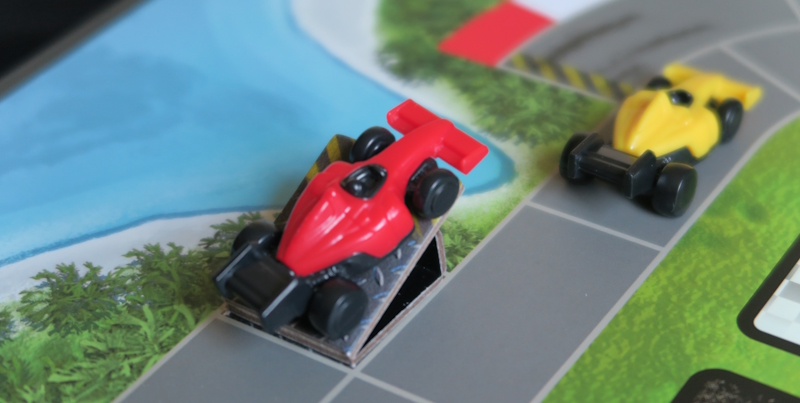
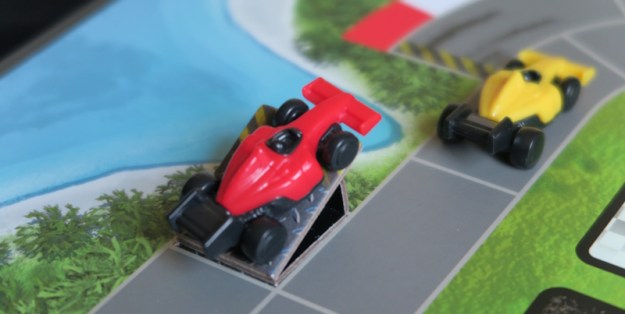
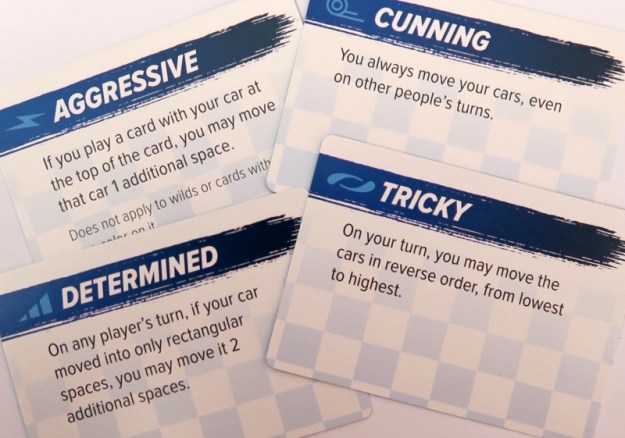
This time, the group played with the Aloha Sands track from the Wild Ride expansion which features water jumps. Cars can use these ramps if they are moving fast enough which lets players pass other cars and move more efficiently. Thus, hand management to take full advantage of the different speed cards is crucial.  The game begins with an auction of cars.  This is after players have been dealt their hand of cards, and this time, the blue car was popular and went to “determined” Lime, who outbid “cunning” Pink.  With six cars on the grid, and four players, there is the possibility of some getting more than one vehicle—although one car (green) went unclaimed, Lime ended up with orange as a second.

Downforce: Wild Ride
– Image by boardGOATS

The Aloha Sands only has two betting lines, and the group chose to use the first two featuring on the betting variant score sheet.  In this “odds” variant, players get better “odds” for a car that is at placed less well than one that is currently winning.  The red car, owned by Pine took an early lead, but by the time the cars made it to the second (and final) betting line, it had dropped to third.  Pink had a fist full of cards that favoured to the blue car, and although he had been outbid for it, he had decided to push it along anyhow and bet on it.  As a result, with both Lime and Pink favouring it, the blue car moved through the field (aided by some double jumps) and crossed the finishing line first.

Downforce: Wild Ride
– Image by boardGOATS

Second place went to Black’s little black car with Pine’s red roadster completing the podium.  Betting and car costs have a huge impact on the final scores though, as can the initial outlay for the vehicle.  In this case, despite paying for two cars at the start, the fact that Lime owned the winning car and had also bet on it, meant he had an unassailable twenty-one million dollars, eight million more than Pink in second place.  With the race over, the quartet chose to move onto a more festive game, Jokkmokk—a cute little set collecting game that went down really well when it got its first outing last year.

Jokkmokk: The Winter Market
– Image by boardGOATS

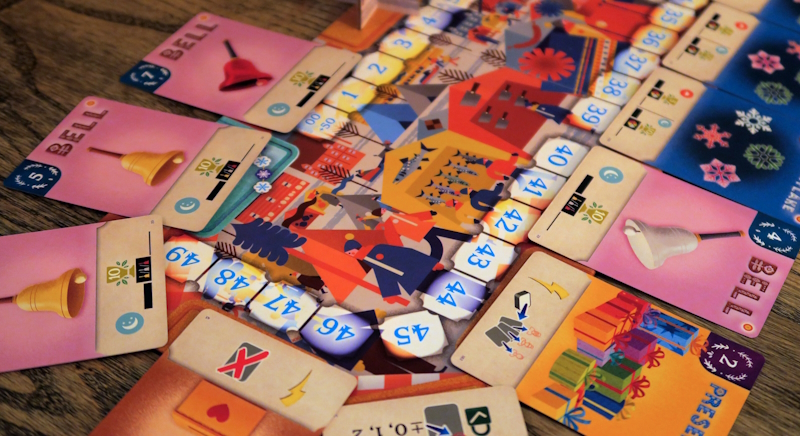
In this game, players move one of their two family members, the one furthest back, to an empty space and claim the associated card before resoling its effect and refilling the empty space.  Some cards score points in the middle, others only at the end, so the sets of cards used can really change the game.  As this was the second game, the group chose to use the “Second Game” set, featuring the Fika (a Swedish custom of enjoying a coffee and a treat with friends), Aurora Borealis, Snowflake, Patchwork, Mystery Box decks.  Of these, the Snowflake cards scored during the game giving Black and early lead with fifteen points, five more than Pine in second.

Jokkmokk: The Winter Market
– Image by boardGOATS

The mid-game points were chicken-feed compared to the end game scoring, however, with lots of points available for Fika and Patchwork scoring and for the face value of the cards themselves.  The winner was Pine with a total of one hundred and twenty-eight, eight more than Pink in second and eighteen more than Black in third.  Everyone had enjoyed the game so much, that when Lime inevitably suggested playing again, everyone else agreed.  This time the group used the “Gift of Giving” set of cards, including the Donation, Bell, Sparkler, Snowflake, Mystery Box and Presents decks.

Jokkmokk: The Winter Market
– Image by boardGOATS

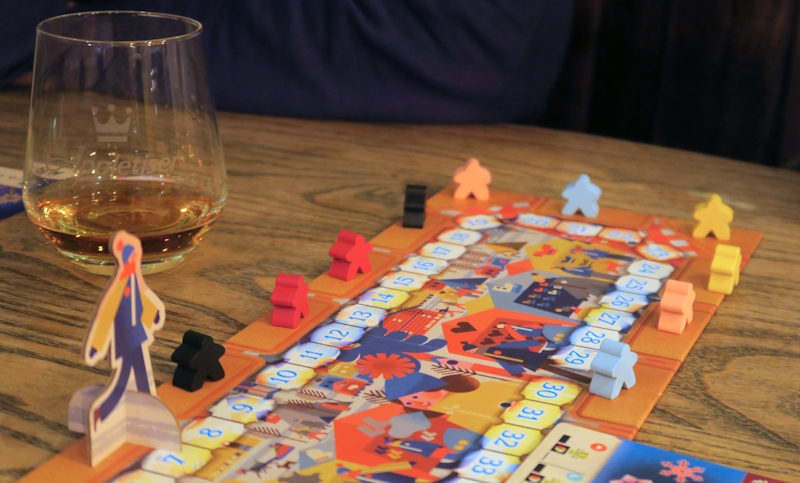
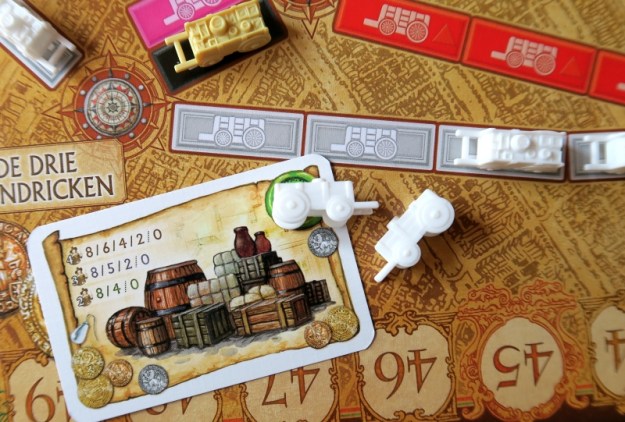
The game followed a similar pattern to the first, with Black and leading at the midpoint with Pine in second and Pine taking overall victory.  This time, Lime was the runner-up, however, with Black taking third again.  Meanwhile, on the next table, Blue, Plum, Byzantium and Purple were playing Blue’s favourite game, Keyflower.  This is it’s second outing of the year, but Plum and Byzantium had missed out last time.  They had played it before, but had felt that it didn’t shine with two players and were keen to see how it played with more.

Keyflower
– Image by boardGOATS

Keyflower is an auction and worker placement, with elements of set collection and even network building.  Although everyone had played it before, Blue went through the rules.  The idea is that players use meeples to bid on tiles, but can also use them to activate tiles to gain their benefit (usually Resources, Skill tiles or the ability to move resources around their Village).  At the end of each of the four rounds players add the tiles they have won to their Village and get any meeples back that were used to activate tiles in their own village.

Keyflower
– Image by boardGOATS

One of the key aspects of the game is the colour of the meeples, as players have to “follow” when bidding or activating a tile. As a result controlling the number of blue, red and yellow meeples they have is a key part of the game.  More, green meeples, which are special and can only be acquired by activating specific tiles, can be really valuable.  Blue had a Winter tile that gave points for having green meeples at the end of the game, so started bidding on the Peddlar which came out in Spring.  Byzantium had other ideas, however, and outbid Blue.  In fact, that was just the start of a tight game where there was a lot of competition for many tiles.


Keyflower
– Image by boardGOATS

Keyflower is a game that typically rewards players who keep their options open, but this time, Blue found her options quickly narrowed and ended up going for sets of three Skills tiles.  This can be lucrative, but can also be difficult to make work, so like many things in Keyflower is a bit of a gamble and with all her eggs in the one basket, she had no choice but to ensure she won the Scribes tile by ensuring she went first in the final round and had a large pile of red meeples to back it up.  Tension mounted as players fought for the tiles they needed.  The Keythedral changed hands several times, and the Jeweller, the Village Hall and the Watermill were all strongly contested.

Keyflower
– Image by boardGOATS

In the final scoring, it was clear that the Scribes tiles made all the difference, with Blue finishing with eighty-six points, fifteen more than Byzantium in second with Plum taking third.  As the tiles were packed away, there was some discussion about the game, with Plum and Byzantium commenting that the balance of tiles is less swingy in four-player Keyflower than with two  While they were packing up, the second of two games on the next table was coming to an end.  In the first of these, Jade led Sapphire and Cobalt in the hot-off-the-press game, Fromage, a worker placement game about cheese-making in France.

Fromage
– Image by boardGOATS

This is a clever game with a “time” element, similar in feel to Tzolk’in.  In both these games, workers left on the board for longer give more valuable actions, however, in Tzolk’in, players place their workers and the options become better the longer they stay on the board with players making the decision as to what they get when they remove workers from the board.  Players can also only place workers or remove them, not both.  In Fromage, there is more flexibility, and the action is carried out when the workers are placed and then remain on the board for longer for the more valuable actions.

Fromage
– Image by boardGOATS

Game play is simultaneous, with all players placing their workers at the same time working on their quarter of the board.  Once everyone has finished, the board is rotated, and any workers who have finished their spell on the board are returned to their owner to be placed again in the next round.  Workers can stay on the board for one, two or three turns, so a key part of the game is planning and with only three workers, making sure that players don’t end up with all of them stuck on the board.  This was another tight game with players scoring fairly evenly in the four areas of the board, the Bistro, Festival, Fromagerie and Ville.

Fromage
– Image by boardGOATS

Cobalt just edged it on Fruit and Orders, however, giving him a four-point victory over Jade in second with Sapphire not far behind.  There was just time for one last game and the choice was another recent popular game, Looot.  This is a clever management game, using a double placement mechanism where Vikings conquer territory on the central player board, allowing players to gain resources, buildings and objective tiles while they build their village on their personal board using tiles from the common board to gain victory points.  This was another tight game, especially between first and second place.

Looot
– Image by boardGOATS

It was backwards and forwards between Cobalt and Jade and finished with just two points between them.  Once again though, Cobalt just had the edge, his hundred and six points just pushing Jade into second again.  It had been a good night though and a fitting end to the evening, and the last meeting of the year at the pub.  As the last Christmas cards were handed out and final Season’s Greetings shared, people headed off into the darkness and with just two sleeps till the big day.

Santa's Workshop
– Image by boardGOATS

Learning outcome:  You don’t have to play Festive games at Christmas to have fun.

30th May 2023

Pink and Blue were late arriving thanks to a debate as to whether the actor Gary Lewis was in the Roland Emmerich film The Day After Tomorrow.  Eventually Blue and IMDb were proved right when Pink found the guy who WAS in the film (Richard McMillan, who bore no resemblance to Gary Lewis whatsoever), but that meant they were late arriving and Plum and Byzantium were already there.  Unfortunately, due to a mix up, the Jockey wasn’t serving food, so Blue headed off to get chips for everyone from Darren at The Happy Plaice.  As the chips were consumed, everyone else arrived and it was just a question of who would play the “Feature Game“, the Wild Ride expansion to our go-to motor racing game, Downforce, and what everyone else would play.

Downforce
– Image by boardGOATS

Eventually Pink and Green committed to Downforce, and were joined by Pine (who claimed that after doing well the first time he played, he’d come last ever since), Black and Lime (as long as the other group weren’t playing Wingspan).  Pink and Green reminded people of the rules of the base game, which are simple enough:  after being dealt their hand of cards, players bid for cars, with the player who pays the most deducting the cost from their final score.  Once the bidding is over, the race takes place.  Players take it in turns to play one card from their hand, and then move all the cars depicted on it in turn.

Downforce
– Image by boardGOATS

When the first car crosses a betting line, the race is paused while everyone bets on which car will win the race.  There are three betting lines, but the winnings for betting decrease the closer they are to the finish line.  At the end of the game, players total their winnings from the race with those from the betting, deducting the cost of their car and the player with the most cash is the winner.  The Wild Ride expansion adds two new tracks: Aloha Sands and Savanna Stretch. Aloha Sands adds water jumps which cars can use if they are moving fast enough. The jumps allow players to pass other cars and get round the track more efficiently, but timing is everything.

Downforce: Wild Ride
– Image by boardGOATS

In contrast, Savanna Stretch features wild animals that block the track.  Once the first car has passed an animal, they are moved to another part of the track, as such, they help to prevent the “runaway leader” problem that can sometimes be an issue in the base game.  It was this track that players chose to use this time.  The inclusion of extra animals on the track caused a little confusion initially, but the group soon worked out two of the important features of this track.  Firstly, the animal tile only moves after the first car is fully past it and all other the cars have finished their movements for that card, which means that the animal is really only an impediment for the first few cars.

Downforce: Wild Ride
– Image by boardGOATS

The other the slightly unusual aspect of this track is that the pole position car starts at the rear of the pack.  With five players and six cars, there was always a chance that someone would get two, and that someone was Lime.  While this can be a huge advantage, especially if the cars are cheap, it can also be a risky strategy as it can be difficult to manipulate two cars and they can also become a target for other players.  Unfortunately for Lime, his cars were among the most expensive, leaving him with a deficit of $11M before the racing began, compared with Pink and Green for example, who paid just $2M for theirs.  Once everyone had got to grips with the rules and the cars had been allocated, the race was underway.

Downforce: Wild Ride
– Image by boardGOATS

For a track with so many tight sections it was not surprising that there was a lot of blocking going on—most of it, to be fair, totally deliberate… Pink (in the red car) found his early push to the front to be a mistake, as he was instantly the target for blocking maneuvers from turn two until the final straight.  Green (in orange) used his online experience from Board Game Arena to keep himself in the pack, but not at the front. Luckily for him several other players selected his car to win the race at the first two check points, which helped keep him out of trouble and pushed forwards.

Downforce: Wild Ride
– Image by boardGOATS

However after the halfway mark, Black (driving the blue car) and Pink both surged forward causing Green and Pine to lose their nerve and bet on Black (instead of Green) at the last checkpoint.  However, they should not have worried, as very soon after that, Green’s car surged forward weaving between the cars in front to race for the line and victory.  Pine was close behind, followed by the first of Lime’s cars (the other brought up the rear).  With the race done, there were just the winnings to claim from the bookies.  Because Green had got away with paying little for his car and won the race, he had a significant prize pot even before betting was paid out.

Downforce
– Image by boardGOATS

There wasn’t a huge difference in the results from the betting, but it was enough for Green to extend his lead.  Pine also raked in millions as his betting pattern was the same as Green’s (perhaps someone should investigate them for race fixing).  As a result, Pine come in clear second with Black completing the podium.  Since there was still some time left for a “proper” game, the group hunted around for something that wasn’t too long and could play five.  In the end, they settled on the simple little “push your luck” game, Port Royal, as much because no one could find anything better for five players, than because anyone really wanted it specifically.

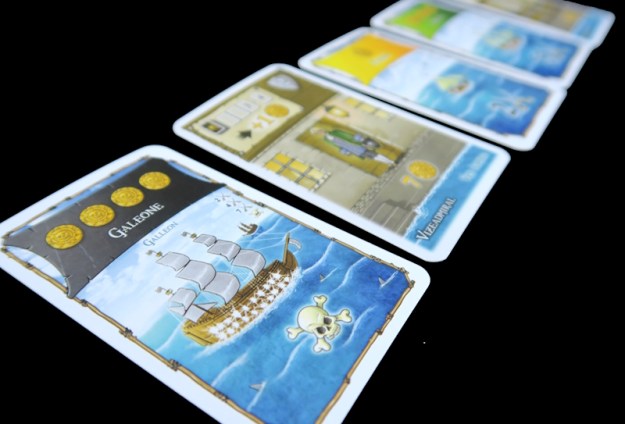
Port Royal
– Image by boardGOATS

It had been a little while since most of the group had played, though the rules are simple enough.  On their turn, the active player chooses to “twist” and turn over the top card of the deck, or “stick” and keep the current card set.  The deck of cards consist of coloured ship cards and character cards.  The first decision is to decide whether to risk a “twist” because if second ship card of a colour is drawn the player goes bust and their turn ends.  If a player “sticks” they can take a ship and add its treasure to their stash, or they can use their gold to buy the support of characters.  These give players victory points and special powers, but also can be used to claim contracts and give more points.

Port Royal
– Image by boardGOATS

Once the active player has taken a card, players round the table can take a card too.  The cards are double-sided like those in San Juan or Bohnanza, so in the same way, keeping an eye on the discard pile and the money in players’ hoard is also key.  Although Black and Green did their best to quickly explain the rules, Pine and Lime were still both a little unsure, and perhaps with good reason.  Part way through the second round Black and Green realised something was amiss and re-read the rules and spotted a “rules malfunction”:  they had forgotten that when a player takes a card on another player’s turn, they pay the active player one coin, thus encouraging players to push their luck further to give more players more choice.

Port Royal
– Image by boardGOATS

So from the second round on-wards they group started playing correctly.  Pink’s strategy involved ignoring the Sailors and trusting to luck with turning the cards while spending his money on symbols to make up Expedition cards.  That gained him the first Expedition card, but ultimately, this single minded approach wasn’t very successful, at least in this game.  Green went for a strategy of collecting fighting cards, in order to fight off the pirate ships.  This worked initially, but by the time he had five fighters (and seven points), he kept going bust on his turn as he turned up skull bearing Pirate Ships against which there is no defence!

Port Royal
– Image by boardGOATS

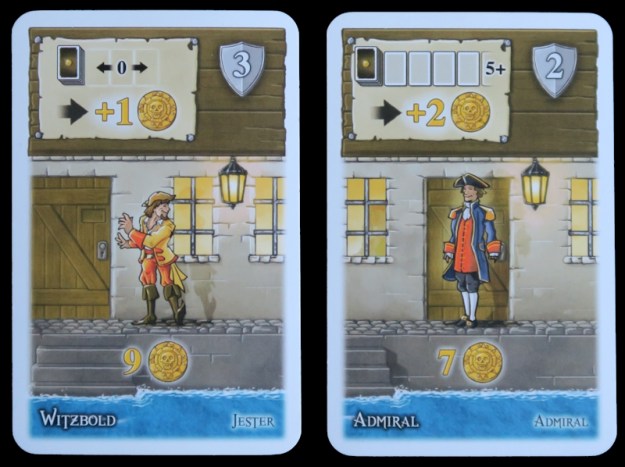
This meant that everyone else was able to gradually build their wealth and cards to catch him up.  Green then collected two more fighters and in preparation for one final attack, but would he get the chance?  Black had managed to accumulate a lot of points, not least because he collected money for both a large array of cards and for when it went bust thanks to the Admiral and the Jester.  If Black could collect another special symbol he could claim an expedition and win the game before Green could make his mega move with a full fighting force.  Unfortunately for Pine, he wasn’t able to collect the symbol he needed to claim a expedition as he went bust.

Port Royal
– Image by boardGOATS

So it was Green’s turn again and he started to pull out cards, with a huge line of cards.  After defeating every lower value Pirate Ship he came across, he managed a full five different coloured ships.  From there he was able to collect another five coins and purchase the two crosses on display, which gave him an expedition card and enough points for victory.  At the conclusion of the game, Pine confirmed his early feelings that he did not really like this game, and Lime felt it was all a bit too confusing, never really sure what he was doing.  This was an older game that we used to play a lot of at the club, but it seems to have lost its lustre now and will probably forever remain an occasional play game.

Port Royal
– Image by boardGOATS

Meanwhile, on the next table there was a lot of debate as to what they’d play.  With five, the options were quite restricted, Burgle Bros. almost made it, until Teal realised it only played four, which left Tiny Towns.  Plum wasn’t so keen, so in the end, the group went for the old favourite Wingspan (having said to Lime that they weren’t going to play it…  Sorry Lime!).  There was some debate as to whether there was time for the game with five players, and options of playing three rounds instead of four were briefly discussed, but since everyone knew what they were doing, the group decided to give it a go and see if they could squeeze in a full-length game.

Wingspan
– Image by boardGOATS

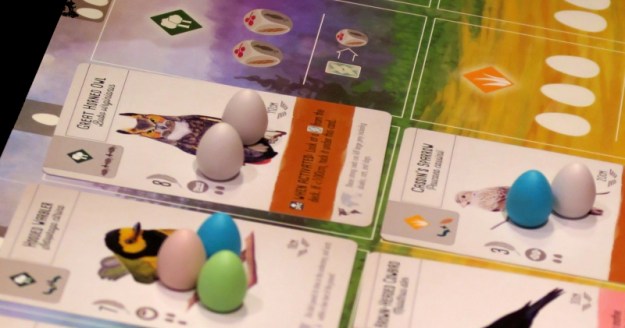
The game is an engine builder that is quite simple in theory, but quite difficult to play well.  Players are collecting birds for their sanctuary, scoring points for exciting birds, eggs, cached food and cards tucked under birds (representing flocks of birds or prey caught), as well as bonus points for achieving particular goals during the game and at the end of the game.  The idea is that, on their turn, players either play a bird card from their hand into their tableau, or carry out the action associated with one of the three habitats (Woodland, Grassland or Wetland) and then activate each bird in that habitat.  While that is all there is to it, it’s all in the cards and getting them to work together.

Wingspan
– Image by boardGOATS

Wingspan can be a little “multi-player solitaire”, that is to say, there can be very little interaction between players in some games.  For some players this is preferred as it means players don’t have their carefully laid plans destroyed by others, while others feel they might just as well be sitting alone and interaction between players is what makes playing games important.  It had been a while since it’s last outing, but the group were quick to get going and were happy to play with the European Expansion which was already mixed in.  Plum in particular, got off to a flying start with her opening hand, four of which were coloured birds and matched her chosen Bonus card (the Photographer).

Wingspan
– Image by boardGOATS

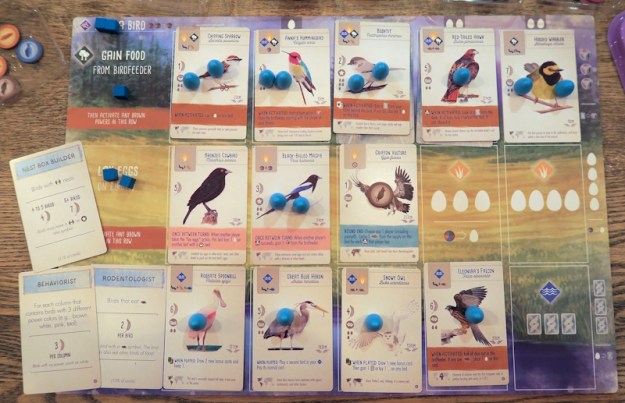
In contrast, Blue had cards that didn’t match at all.  The Rodentologist was her best Bonus card giving her two points for each bird in her sanctuary that ate a rodents, but not one card in her starting hand qualified.  Teal started out with a strategy to maximise his egg production and prioritised birds with brown powers and resource conversion to assist that aim.  The first card Plum played helped him in this, and everyone else too as it happens as it was a very generous Ruby-throated Hummingbird that gave everyone food every time it was activated.  Teal returned the favour as he laid eggs at every opportunity and Plum had a bird that rewarded “once between turns” if anyone laid eggs.

Wingspan
– Image by boardGOATS

As the game progressed, players worked on the end of round bonuses.  Three of the four birds Plum had kept from the start also happened to have bowl nests which contributed towards the fourth round goals, as long she could ensure they had eggs on them.  She didn’t really aim for anything else, but Blue, Byzantium and especially Teal did well in the early rounds.  Plum picked up some more birds with colours in their names, but also managed to play the Yellowhammer end of round card which she was able to use to great effect as it enabled her to play an extra bird card if she had used all four actions during the round.  Byzantium had issues with the dice which repeatedly wouldn’t give him what he wanted.

Wingspan
– Image by boardGOATS

Then to compound Byzantium’s woes, he got himself in a bit of a mess when he played his migrating bird into the wrong habitat meaning he didn’t get the advantage of moving the bird straight away and costing him more eggs into the bargain.  Purple had different dice issues when she rolled five berries and called “Yahtzee!”  Blue had improved her hand and acquired some more helpful cards, including one that gave her an extra Bonus card, the Behaviourist, which gave her three points for each column with three different power colours.  As people sifted through the deck trying to find cards they liked the look of, the California Condor appeared, which everyone agreed looked like a monkey.

Wingspan
– Image by boardGOATS

Towards the end of the game, partly as a result of Plum’s Hummingbird, Byzantium ended up with a surfeit of food and nothing to spend it on.  So, he switched tactics and took the Condor hoping to get a bonus card that would improve his fortunes.  It didn’t.  Blue tried the same and didn’t do any better.  After the final round Plum activated her Yellowhammer again and was left with the choice of playing a bird that gave her a Bonus card or one that gave two extra points.  She also went for the Bonus card, the Fishery Manager, but only one of her birds ate fish.  Time was ticking on, but the game was over well within two and a half hours with just the scoring to go as last orders chimed.

Wingspan
– Image by boardGOATS

Blue had some high scoring birds, but not as many as Plum who took fifty-five points for them alone. Blue had quite a lot of eggs too, but not as many as Teal who had twenty-three.  Everyone else was concentrating on counting, when Purple (aided by Black who had come along to lend a few fingers), gave her score for her bonus cards: thirty-four points, more than twice that of anyone else.  Unfortunately for her though, prioritising her Backyard Birder Bonus which gave her points for birds scoring fewer than four points left her with lots of low scoring birds.  It was a close scoring game, but first place went to Blue who finished a handful of points ahead of Plum with Teal a little way behind in third.

<Wingspan: European Expansion
– Image by boardGOATS

Learning Outcome:  Forget snakes on a train, what about snakes on a race track?!?!

Next Meeting, 30th May 2023

Our next meeting will be Tuesday 30th May 2023.  As usual, we will start playing shorter games from 7.30pm as people arrive, until 8pm when we will start something a little longer.  For those who want to eat, the table is booked from 6.45pm, for the last time under the current chef/management.

This week, the “Feature Game” will be the Wild Ride expansion (rules; video review) to our go-to motor racing game, Downforce (rules; review; how to play video).  Like Draftosaurus last time, the group first played Downforce online (in this case for our online New Year Party 2020/2021), but since then we have played it several times in person.  The Wild Ride expansion adds two new tracks, one with jumps, the other with animal obstacles.

Downforce: Wild Ride
– Image by boardGOATS

Speaking of car racing…

Jeff and Joe were chatting about one of their favourite subjects, racing cars and their drivers.

Joe commented, “I think the best driver of all time is James Hunt, he just made the 1970s for me—he was just amazing.”

Jeff thought for a moment and then asked, “Who won the 1975 F1 World Championship?”

“Lauda,” replied Joe.

Jeff took a deep breath, then shouted back, “WHO WON THE 1975 WORLD CHAMPIONSHIP?!

10th January 2023

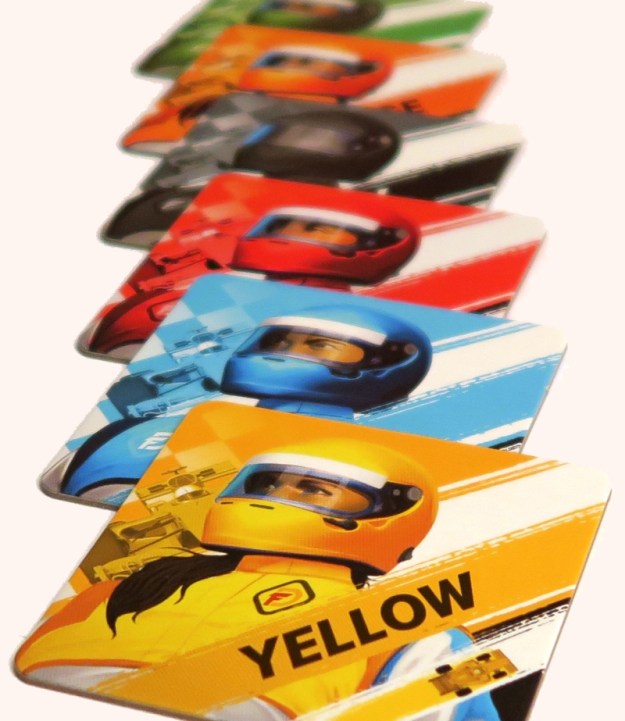
One of the first to arrive was Yellow, and it was delightful to see him after such a long time.  He was especially welcome as he was bringing a copy of Paris that he’d been looking after since UK Games Expo in August 2021.  Before long though, there were eight all ready and lined up to play the “Feature Game“, Long Shot: The Dice Game, when two more arrived and a debate began to work out who would play what and where.  As Long Shot was supposed to be quite short, eventually, Plum, Pine, Purple and Lime took themselves off to play Ticket to Ride: London, with Blue, Green, Yellow, Black, Ivory and Teal sticking around to play Long Shot:  The Dice Game.

Long Shot: The Dice Game
– Image by boardGOATS

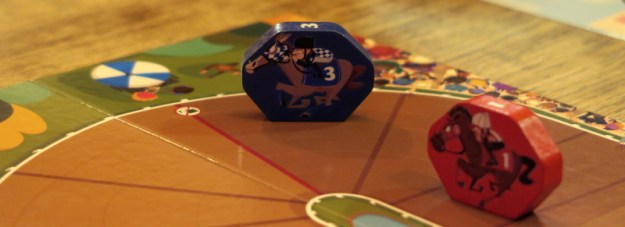
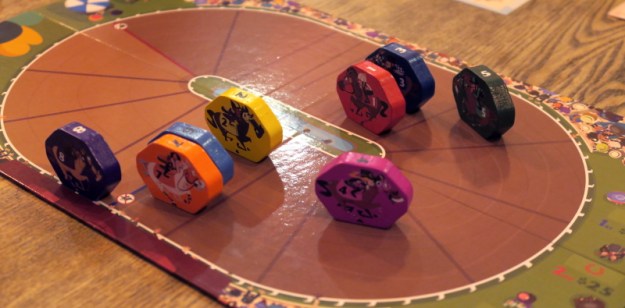
Based on the party game Long Shot, Long Shot: The Dice Game is a light horse racing and betting game in a similar mould to that of Turf Horse Racing, that featured on several people’s lists of top games from 2022.  As it is relatively quick to play, the idea was that it would leave plenty of time to play some of our other old favourites and Ticket to Ride: London was thought to be a good match in terms of length.  Inevitably, that was not quite how things turned out, however.  Long Shot (Dice) is quite simple, and Blue, assisted by Green, was explaining the necessary to the runners and riders.  Ticket to Ride is well known within the group though and was therefore quicker to get started.

Long Shot: The Dice Game
– Image by boardGOATS

The idea of Long Shot (Dice) is that the active player rolls two dice which dictate which horse moves and how far (one to three spaces).  Everyone (including the active player) then chooses an action from their card, carries it out and crosses it off.  The actions include:  placing bets, buying a horse, buying a riding cap, buying a riding jersey, crossing a horse off the concession chart to get a bonus action once a row or column has been completed.  In general, the action depends on the horse that has been rolled, i.e. if horse number two is rolled, players can bet on that horse, buy that horse, get a cap or jersey for that horse’s rider or cross that horse off the concession grid.  However, each player has three “wilds” which are opportunities to choose any horse.

Long Shot: The Dice Game
– Image by boardGOATS

At the end of the game, players score if they own or bet on a horse that is placed and for any cap/jersey combo for the same horse.  This time, Green started and rolled the blue horse number three which moved three spaces.  As did Teal.  By the time it had moved on three out of four opportunities (and a total of nine spaces), it was starting to look like the dice were loaded and this did not appeal to everyone’s sense of fair play.  The group more or less divided into those that wanted the blue horse wearing number three to win (because they had invested in it) and those who didn’t and preferred the red number one horse.

Long Shot: The Dice Game
– Image by boardGOATS

As Ticket to Ride progressed, the route planners asked how the race was going, and the gamblers, felt it would not be long, given the progress the blue number three horse had made and the lead it had built up.  After its early spurt, a few other horses managed to start to make a bit of ground and, with players starting fill out their bonus grid, players began to take bonus actions which leveled the course somewhat.  The bonuses included taking a free $7 (quite a lot of money in this game); a free $3 bet; free riding cap/jersey, but by far the most interesting were the options to move horses.

Long Shot: The Dice Game
– Image by boardGOATS

Each player has the following four bonuses:  they can move one horse three spaces (once forwards and once back) and they can move two horses two spaces (also both forwards once and both backwards once).  It was as the blue number three horse approached the three-quarters mark (after which players could no longer bet on it) that players showed their allegiance, moving it forwards, or backwards.  And with six players, everyone had potentially several bites of the cherry.  Just as it seemed that one horse had an unassailable lead, one or two players would upset the apple cart and push the leader back and something else forward.  Even the the three-legged purple number eight horse looked like it might be in with a chance of placing at one point (albeit not for long).

Long Shot: The Dice Game
– Image by boardGOATS

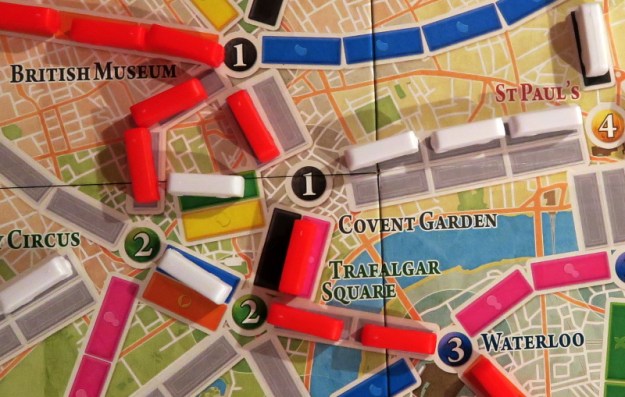
Ticket to Ride made more rapid progress.  Although Purple succeeded in completing one of her tickets (for three points), she failed to finish her other two.  That cost her ten points (effectively twenty, which is what she’d have got if she’d completed them), and she blamed Lime.  Lime had troubles of his own though as he was in a very tight battle with Pine.  Perhaps it was his comeuppance for the trouble he’d caused Purple (real or only perceived), but Pine pipped him to victory by a single point, gained when he completed one of the single carriage routes in the centre of the board in the dying moments of the game.

Ticket to Ride: London
– Image by boardGOATS

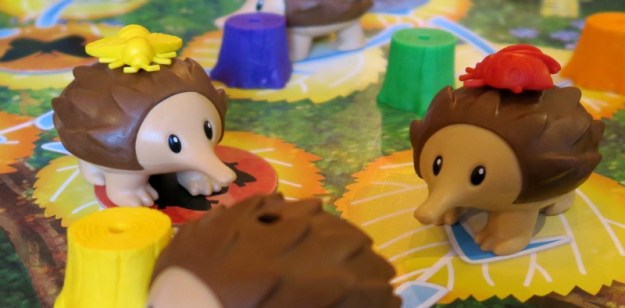
It became a bit of a running joke that the Purple/Plum/Pine/Lime group playing with their train-set asked how things were doing when they finished, and again as they packed away, and again after they’d been to the bar, and again after they’d consumed their drinks and been to the bar again, and each time were told that it was nearly done.  Eventually, Purple, Lime and Pine resorted to playing Love Letter to kill time, winning one round each.  Although Long Shot (Dice) was great fun and everyone was quite amused by the shuffling of horses backwards and forwards, Pine had a point when he commented that when gamers play a light silly game they can play it to destruction—a bit like Echidna Shuffle, which we all adored though it outstayed its welcome when one game lasted two hours!

Echidna Shuffle
– Image by boardGOATS

As players ran out of bonuses, the Long Shot horses ran out of track, and eventually, the red horse number one crossed the line, followed by the blue horse number three and finally, the pink horse number four.  Unlike in Downforce for example, however, although winning the race is useful, the betting has much, much more of an influence on the final result.  For example, the two horses Ivory had bet on, numbers five and six, didn’t come in making a severe dent in his score.  In spite of this, it was quite close—Green and Yellow tied for third  with $109 while Teal took second place with $114.  Blue claimed victory though, finishing with $122.

Long Shot: The Dice Game
– Image by boardGOATS

It was only when Green and Pine pointed out that Teal hadn’t scored his horse which gave him $2 per horse he had a bet on, and in his case, an extra $12.  Recalculating his final score, much to her chagrin, Teal just pipped Blue to victory.  From there it was simply a case of tidying up and working out what people wanted to play next.  Ivory had suggested Roll for the Galaxy at the start of the evening and there were lots of takers now, so he went off to set up with Teal, Green and Plum.  Although Teal had played Race for the Galaxy online, Roll for the Galaxy was new to him so the group started with a quick rundown of the rules.

Roll for the Galaxy
– Image by boardGOATS

The idea is that everyone starts with a couple of “Worlds” and some dice representing their population.  Players roll their dice with the faces dictating different actions.  In secret, players allocate their dice to the five different phases: Explore, Develop, Settle, Produce and Ship.  Players choose one phase that they want to happen then everyone simultaneously reveals their choices.  All the phases selected will happen, with dice that players have allocated to other phases returned to their cup and recycled.  The game is a combination of “engine builder” and “population builder” (similar to games like Orléans), with players needing the right combination of Worlds to provide their engine, and then building the right combination of dice to make them work effectively.

Roll for the Galaxy
– Image by boardGOATS

With the lighting being less than perfect, some of the dice colours were a little difficult to distinguish, particularly purple and brown.  Plum came to the rescue though, with her new Christmas present:  a portable folding lamp.  The magic of the LED gave a good strong light, enough for everyone without taking up too much room on the table.  Everyone was very impressed and many rapidly came round to the idea that it was a must have gamers’ accessory!  After a faltering start for a couple of turns, Teal soon got the hang of how to select actions and where the dice should go.

Roll for the Galaxy
– Image by boardGOATS

The first clarification needed was that players can only choose one action (though everyone’s choice will be activated), and the second was that the die used to select that action does not need to show a face that matches it. The rest of Teal’s game was one of learning:  with his mining industry, he was able to ship goods for victory points while still gaining some credits, and gained a couple of useful purple die. Unfortunately being new to the game meant he was unable to mount a serious challenge for victory points.  Plum, on the other hand, started out with a couple of red military dice and managed to obtain one more during the game along with the New Galactic Order tile which gave her a couple of extra points for those red dice.

Roll for the Galaxy
– Image by boardGOATS

Plum also made good use of her Terraforming Robots which gave her an extra credit for each World she built and two extra if it was a brown world. She managed to get three brown Worlds.  Ivory also managed to obtain the useful purple die, but his real bonus was from the Alien research ship which gave him a white and a yellow explore action whenever it was chosen.  This meant he was able to keep his credits topped up and have plenty of new tiles on the go without the expenditure of a die. As a result he was able to concentrate on building worlds and shipping/trading.

Roll for the Galaxy
– Image by boardGOATS

Green, meanwhile, quietly built his tableaux concentrating on blue worlds due to his Consumer Market which gave him an extra credit if at the end of the produce round he had  goods on a blue world. He also obtained a green and a yellow world. His Galactic Recycler meant he gained a credit every time he managed to complete a tile. He was the first and only player to build all twelve tiles which gave him the largest score for Worlds. Combined with his Free Trade Association he scored extra points for his three blue worlds and with the victory points he’d collected along the way he finished with forty-four points and a healthy lead, ahead of Ivory’s thirty-eight, just ahead of Plum thanks to his two yellow and two green worlds.

Roll for the Galaxy
– Image by boardGOATS

Meanwhile, at Purple’s request, everyone else was playing Saboteur.  This is a hidden traitor game where players take it in turns to either place tunnel cards or to play action cards.  The Good Dwarves are trying to find gold, while the Evil Saboteurs are trying to obstruct them.  In the rules as written, the game is played over several rounds with gold handed out at the end of each round.  The way the gold is distributed doesn’t really necessarily reflect the player who made the biggest contribution, so we play with the “House Rule” that each round is treated as an individual game, then we can play as many “games” as we like and/or time allows.

Saboteur
– Image by boardGOATS

This time, the group played three games.  The first one began with lots of people suspiciously checking and double-checking where the treasure was buried by playing map cards.  Purple was accused of being an Evil Saboteur, quickly followed by Black, Lime and Blue, all of which made no sense as there could only be a maximum of two.  In the end apologies were required when Pine found the gold and Blue and Purple were revealed as the Actual Saboteurs.  The second round followed a similar pattern, only this time pretty much everyone was accused of “Saboteury behaviour”.

Saboteur
– Image by boardGOATS

This time there was a Solitary Saboteur, which meant poor black had a really uphill battle and had really lost before he’d begun.  Once again, Pine was the Dwarf that found the gold, with Lime setting him up.  In the final round, things went a little differently though, particularly when Pine’s dubious behaviour signaled that he might not be trying to find the gold this time.  When Blue distracted the Dwarves by causing a massive rock-fall, it was up to Lime to try and patch the tunnel.  Things had just settled when Blue played another rock-fall and Lime patched that too.  When Blue brought down a third and fourth tunnel collapse, Lime was able to patch them too.

Saboteur
– Image by boardGOATS

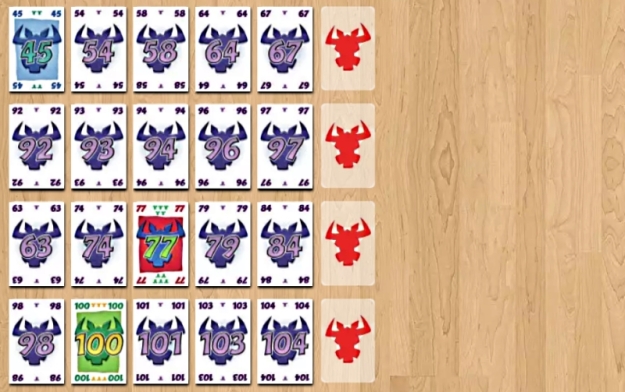
It took so much effort though, that when Pine pushed the tunnel past the gold card, although it only needed a couple of extra tunnel segments, the Dwarves couldn’t make it giving a rare victory for the Saboteurs.  As Roll for the Galaxy was still going and there was a little time left till last orders, there was just time for a quick game of 6 Nimmt!, an old favourite. Blue commented that the name was one of the infamous German joke game titles, and Yellow added that “Nimmt” was the imperative of the German verb, nehmen, to take, thus when the sixth card is played on a row, that player takes the other cards.  The player with the fewest bulls heads wins.  We’ve played it quite a bit recently with the professional variant where cards can be added to the low or high end of the rows.

6 Nimmt!
– Image by boardGOATS

This time, however, as time was pressing the group decided to stick with the simple maths.  We play over two rounds with half the deck in each.  Lime had a complete nightmare in the first round, with twenty-seven “nimmts” in the first round; Pine in contrast managed a clean sheet and Black only picked up two points, so it was all to play for, for some at least.  Lime did much better in his second round giving him a total of thirty-three, only slightly more than Yellow, while Blue managed nearly that in the second round alone, top-scoring with a nice round fifty.  Black picked up just five, but there wasn’t much anyone could do to compete with Pine, who picked up just one solitary point in the second round, his only one in the whole game.

6 Nimmt!
– Image by boardGOATS

Learning Outcome:  Betting can be a mugs game.

29th November 2022

Although the numbers were severely dented by holidays, work commitments and norovirus, there were still nine of us, and although everyone was late, timings were perfect and the whole group arrived within moments of each other.  There was the usual chatter, as people bought drinks and shared stories of the week, then everyone finally settled down to play some games.  The “Feature Game” was the shiny new Asia expansion to one of our favourite games, the multi-award-winning bird-themed card game, Wingspan.  But first we had to decide who was playing what.

Wingspan
– Image by boardGOATS

Like last time (when there were also nine people), splitting the group into two or three was quite challenging, but eventually, we decided to go with two tables with Blue, Plum, Black and Ivory playing Wingspan with Pink and Pine leading the rest in a game of Downforce. Downforce has three parts:  a car auction, a race, and betting on the race which occurs during the game.  Downforce has had a couple of outings in the last year, and after last time we played, we concluded that the betting skewed the game a little.  Essentially, when the first car crosses the first betting line which triggers players to place their bets, if several people bet on the same car that tends to lead to a runaway leader.

Downforce
– Image by boardGOATS

After a little research, we found an alternative, “Odds Betting” variant that we thought might be worth a try and Pink was keen to give it a go.  This scheme rewards riskier bets because a player’s winnings depends on the position of the car at the point in the race when the bet is made.  Thus, if a player bets on the leading car at the first betting line and it comes in first, they will win three million dollars ($3,000,000 × 1), however, if they bet on the last car and it defies the odds, they will take eighteen million dollars ($3,000,000 × 6).  Even if that last car comes in third, anyone betting on it will take six million dollars ($1,000,000 × 6)—twice that of betting on the leader if it wins.

Downforce
– Image by boardGOATS

The track chosen was Switchback Pass from the Danger Circuit expansion.  The race began and as the cars weaved around the track, players tried to muscle past each other.  Purple made good use of her power, “Tough” (from the Danger Circuit expansion).  This allowed her to move an extra two spaces every time she finished her move on a space adjacent to a “rumble strip” and she used that a lot, an awful lot.  This was in contrast to Pink who didn’t use his “Determined” power at all.  Despite using her power a lot, sadly, Purple wasn’t able to capitalise on it.  “Ambitious” Lemon was the first to cross the line, shortly followed by “Unpredictable” Orange.  However, the winner is the player with the most cash including income from bets, and in this case, that was Orange who had backed himself from the start.
Downforce: Danger Circuit
– Image by boardGOATS

The consensus was that the “Odds Betting” variant was a definite improvement on the rules as written, though they made things significantly more complicated.  As a result, they weren’t considered a perfect fix.  There are other options still to try though:  the “Simple Odds Betting” variant (where players only bet on the winner with the takings based on position at the time of the bet); the “All Bets are Off” variant (where the betting rules are as written but each player must bet on three different cars, none of which are owned by that player), and the “Three Bets” Variant (which just increases the number of cars everyone has an interest in).

Downforce: Danger Circuit
– Image by boardGOATS

While the race was ongoing, the next table were playing Wingspan.  This is one of the most popular games within the group, so we were keen to give the brand new Asia expansion an outing.  The basic game is simple enough:  on their turn, players either play a bird card in one of the three habitats, or activate one of those habitats and all the birds in it.  The three habitats are Woodland, Grassland and Wetland giving food, eggs and bird cards respectively.  Food and eggs are necessary for playing bird cards, as well as eggs being worth points in their own right at the end of the game.  The European and Oceania expansions both added more cards and the latter also added nectar as a food source.

Wingspan
– Image by boardGOATS

Wingspan: Asia is a standalone two-player game that can also be added to the base game as providing new bird and goal cards.  It also adds a new “flock” mode for playing with six or more players, but with only four players this time, the group decided to make the most of the Asia expansion.  So Ivory, Plum and Black started by removing all the other expansion bird cards from the deck and shuffling in the new ones while Blue sorted out all the other bits needed to play.  That all took longer than expected, but with everyone knowing the game well, there was no need to revise the rules before the game, with just a few edge cases that were checked during play.

Wingspan: Asia
– Image by boardGOATS

Ivory started the fastest, with more birds in his reserve than anyone else by the end of the first round.  The goal at the end of that round was the rather cool “most birds facing right”, and although Ivory won it, everyone else was close behind.  That wasn’t the case in the later rounds though, with somebody struggling to get points in each case, but Ivory taking the top bonus in every round.  Some of the new birds offered a bit more, in particular, those that allowed players to cache food, but gave them a wider choice of options.  Some allowed players to choose which food, and there was another that gave the option of caching food or tucking cards.

Wingspan: Asia
– Image by boardGOATS

Although some of the bonus cards were the same as those in the base game and the other expansions, there were also new ones.  There was one that rewarded having different nest types in the trees. Ivory and Plum both got cards that gave points for playing birds in a given habitat that increased or decreased in value.  Although these were a bit different and added variety, they didn’t fundamentally change the game. As Black pointed out, sometimes the bonuses are a bit too difficult and the other ways of accumulating points much easier.  They are good to give a steer at the start of the game though, when the range of options can be overwhelming.

Wingspan
– Image by boardGOATS

With eggs worth one point each, the final turns involved the usual round of egg-laying.  It felt like it was less of a frenzy than it sometimes is, probably because everyone had other things that they felt they needed to do that were more important.  Towards the end of the game, Plum also picked up a couple of extra goal cards, but had to choose between them.  Both gave points for having birds that increased or decreased in value in a Wetland or Woodland—she went for the Wetland as at least the values were increasing, decreasing values was not ideal at that stage of the game.  Black also picked up a couple of extra goal cards during the game, but from Blue’s perspective, Ivory was where he always was, out in front with a formidable lead.

Wingspan: Asia
– Image by boardGOATS

That was not quite how it turned out in practice, however.  Ivory said he thought Black might have it, and ultimately he was proved right.  The differences in the scores were not quite as anybody expected however.  As the scores came in, it became clear that Ivory had a lot of end of round bonus points (twenty-two in fact) and Black had a lot of points from the bonus cards (fourteen) while Blue had the most from her birds (thirty-eight) and Plum had the most cached food (nine).  Of course it is the total that counts, and in the event, Black was some way ahead of the rest with a total of seventy-seven points.

Wingspan: Asia
– Image by boardGOATS

It was much closer for second than anyone expected as Blue had made an extremely slow start, but Ivory’s total of seventy-two pipped her by a single point.  Everyone had enjoyed the game, but then we always do enjoy Wingspan.  The Asia expansion didn’t change things very much, though it did feel a little different, mainly because of the new goal cards (e.g. the cards that reward placing birds in order of points and for playing birds with different types of nests).  These were the biggest difference, though some of the bird card caching options were a little more flexible and players seemed to like that too.  It is unlikely we’ll play Asia in quite this “Asia strong” way again as it will get mixed in with the other expansions, but it was a good way to introduce it to the group.

Wingspan: Asia
– Image by boardGOATS

Downforce never takes very long to play and the other group were still only half-way through Wingspan, but rather than something longer, the racing group decided to play something lighter and eventually settled on No Thanks!.  This is a very simple game, but always a lot of fun.  Players take it in turns to either take the card on display, or pay a chip to pass the problem on to the next player.  At the end of the game, players sum up the total of their cards and subtract the number of chips they have left and the player with the lowest total is the winner.

No Thanks!
– Image by boardGOATS

The catch is that if a player has a run of cards only the lowest counts, but some of the cards have been removed…  This time, that rule was really critical.  Lemon managed to collect cards thirty-two to thirty-five, but unfortunately, that still gave her lots of points.  Orange did a bit better with his run from twenty-four to twenty-seven finishing with just thirteen points.  Sadly however, Pine did slightly better and finished with an excellent eight.  Points in the second game were much higher—Lemon’s twenty-six points gave her second place, but Pink just nicked it with twenty-three.  And as Wingspan had finally finished, that was it for the night.

No Thanks!
– Image by boardGOATS

Learning Outcome:  Playing an expansion without other expansions makes its features more obvious.

1st November 2022

Pine was the first to arrive and also the first to leave as he had just popped in to say “Hi!” while his baked potato was in the oven.  There were a few others missing as well, but still more than enough for two tables.  The “Feature Game” was Danger Circuit, an expansion for the card-driven bidding, racing, and betting game Downforce.  Downforce is based on the older game Top Race, which in turn is a reimplementation of several other games including Niki Lauda’s Formel 1. It is widely agreed to be one of the best car racing games, combining strategy and luck, especially when some of the expansion tracks are used.

Downforce
– Image by boardGOATS

Downforce comes in three parts:  a car auction, the race, and betting.  The game starts with the car auction where players bid on the cars using the cards they will use to race later.  The cards show how far the cars shown on it will move.  So when a player plays a card on their turn, they then move all the cars on it in order.  Some cards show only one car while others move more, even all six.  Before the start of the game, players are dealt the hand of cards they will use during the race and therefore know which car or cars over which they will have most control.  Using this information, they then chose a card to bid on each car, getting the card back, but making a note of the amount they “paid” to buy it.

Downforce
– Image by boardGOATS

On three occasions during the game, when the first car crosses a line, everyone makes a note of a secret bet—if the car they pick is placed in the top three, they win money.  This simultaneously makes and breaks the game, because it encourages players to help other players, however, it also means that if a player backs their own car and wins, they are almost guaranteed to finish with the most money.  For this reason, Blue was considering “House Ruling” the betting to use a variant, but as she wasn’t sure of the changes and had not printed the special betting forms, the group stuck with the rules as written.  The car auction is coupled with a Power auction.  The Powers allow players to break the rules of the game slightly to improve their chances.

Downforce
– Image by boardGOATS

The Danger Circuit expansion adds two new tracks with dangerous spaces and crossover loops as well as drivers with new skills.  This time, because most people had not played the game before, players simply drew two cards blind from the deck and picked their favourite.  Lemon won the first auction taking pole position and “Cunning”, which allowed her to control the movement her own car every time (instead of the active player moving it).  Unfortunately, she completely forgot about this in the excitement of the race, so didn’t capitalise on it.  Teal was “Defensive” so could move an extra three spaces if his car wasn’t on the card he played and Lime “Ambitious” which meant it could move an extra couple of spaces when it crossed a betting line.  Lime thought this would guarantee him an extra six spaces, but it didn’t quite play out that way.

Downforce: Danger Circuit
– Image by boardGOATS

Pink was “Experienced” which meant he was able to take advantage of slip-streaming and move a space forward whenever a car immediately in front of him moved, and Orange was “Tricky” and could move the cars in reverse order on his turn.  Blue was the last to take a car and ended up with “Reckless” as her special power which meant that if she ever squeezed through a tight space she would get to move an extra two spaces.  All of these special abilities except Tricky and Cunning were from the Danger Circuit expansion.  The group chose the Crosstown Speedway track for the race (also from the Danger Circuit expansion), which features two hazardous crossover loops and a couple of split areas of the track, where players must choose between the shorter single-lane section or the longer, more wide open section.

Downforce: Danger Circuit
– Image by boardGOATS

Lemon got a good start from pole and took an early lead and Lime, in an effort to catch up, managed to overturn his car.  Although Lemon was the first to cross it, it was all quite tight at the first betting line.  From there on, everyone was committed and the race began in earnest.  Teal made good use of his special skill a couple of times and Orange used his to great effect as well.  The race was almost all over, however, when Lemon effectively declared her bidding by moving Blue’s red car into the lead and down the first single track shortcut section.  With everyone else either stuck in the bottle-neck of the two track section with a bit of a hairpin corner or stuck behind Blue’s red car, she was able to put a bit of a spurt on.

Downforce: Danger Circuit
– Image by boardGOATS

Keeping her foot on the gas she was able to put clear distance between herself and everyone else along the back straight and make for the line.  She couldn’t do it on her own however, but as a couple of others had backed her to win early in the race, it wasn’t long before she crossed the line and the race was on for second.  That was a lot closer, but eventually Teal trundled home at the front of the pack with Lime coming in third.  The aim of Downforce isn’t to win the race, however; the aim is to finish with the most money when betting, winnings and outlay are all taken into account.

Downforce: Danger Circuit
– Image by boardGOATS

Orange was the only one not to place a bet on Blue’s little red car at any point and with significant costs at the start, despite some excellent in race moves, he suffered as a result.  Everyone else was fairly close though, with just two million dollars between Lime and Pink in second and third place and the others not far behind.  Betting on one’s own car though, is unbeatable however, as long as it comes home first of course.  And in this case, Blue had backed her little red car throughout, so winning the race and betting on her own car gave her a huge payout.  With only one million outlay (it didn’t seem right for anyone to be able to set up a racing team for free), she finished with the maximum of twenty-nine million dollars.

Downforce
– Image by boardGOATS

The game had been a lot of fun, but having played it a few times now it was becoming clear that the betting skews the game a little.  The alternative betting Blue had suggested at the start has the potential to alter that.  The problem is that with players simply getting a straight pay out for betting on the winner, the race can become a bit of a self-fulfilling prophecy:  in this case, because several people bet on the red car to win, they were invested in it and it won.  The variant betting winnings depend on the position the car is in the race at the time when the bet is placed.  In this way it increases both the risk and the reward.  Because this encourages more diversity in the betting, it can mix things up a little and, as such, is definitely something to try before too long.

Downforce: Danger Circuit
– Image by boardGOATS

The neighbouring table were still playing, so although Teal and Lime decided to take an early night, the others continued with a game of Kingdomino.  This is a lovely light game that was the deserved winner of the Spiel des Jahres Award a few years ago and has been a staple within the group ever since.  Orange and Lemon were new to the game, however, so Blue and Pink explained the rules:  Players take a tile from “Today’s Market” and place their meeple on a tile of their choice in “Tomorrow’s Market”.  The clever part of the game is that the tiles are numbered with the highest numbers going to the most “valuable” tiles.

Kingdomino
– Image by boardGOATS

Tiles starting are taken starting with the lowest value ones, which means players have to choose between taking a high value tile (and getting a late turn next time) or positioning themselves early in the turn order for the next round (by taking a low value tile).  When players take their tiles, they add them to their “Kingdom” making areas of different types of terrain.  At the end of the game, players score points for the size of each terrain multiplied by the number of crowns depicted in that terrain, with bonus points for completing a perfectly square Kingdom with their castle in the centre.

Kingdomino
– Image by boardGOATS

This time, Orange went first followed by Lemon.  She started with a small woodland, which rapidly became a large woodland.  As it grew, she took the opportunity early and picked up lots of crowns.  This meant nobody else had any incentive to collect woodland tiles so she was able to pick more and make her woodland ever larger finishing with thirteen woodland spaces and five crowns giving her sixty-five points for that alone.  Nobody was very surprised when Lemon won, finishing with a massive ninety-three points, five more than Pink in second who had focused on pasture and arable.

Kingdomino
– Image by boardGOATS

Although the bar had called last orders and the game on the next table was working through their final round, there was just time for a very quick game of No Thanks!.  This is a superb filler with almost zero setup time—just the kind of game the group loves in such circumstances.  The idea is super simple:  the top card of the deck is turned over and the active player has to choose whether to take the card or pay a chip to pass the problem on to the next person.  Eventually, someone weakens and takes the card and the chips.  At the end of the game, players add up the face value of the cards in front of them and subtract the number of chips they are left with to give their score: the lowest is the winner.

No Thanks!
– Image by boardGOATS

There are two catches:  firstly, for any runs of consecutive cards, only the lowest value card counts.  Secondly, nine cards are removed from the thirty-two card deck at random and in secret before the game begins, making the decision to take or leave a card considerably more difficult.  No Thanks! is a simply great game to teach and so much fun for the time it takes, so is ideal for a game at the end of the evening.  This is another group “staple” and yet Lemon and Orange had somehow missed out.  That was quickly rectified, and like everyone else, the realisation of the simple considerations was apparent as the game developed.

No Thanks!
– Image by boardGOATS

This time, Pink collected a lot of chips, while Orange and Blue collected a lot of cards.  Lemon almost ran out of chips at the end, but had also managed to avoid picking up any high value cards.  Lemon just managed to hold out finishing with thirty-nine points, eleven less than Pink, taking her second victory of the evening.  By this time, the bar was closed and the players on the next table were scrabbling to finish.  They had been playing Endeavor: Age of Sail, a game that was new to Plum, though Black, Purple, Green and Lilac had all played it before.  The game is relatively simple in concept, though one of those games where the interactions make the decisions challenging.

Endeavor: Age of Expansion
– Image by boardGOATS

The game is played over eight rounds, each consisting of four basic phases: Build, Populate, Payment and Action.  The four technology tracks roughly correspond to each phase and dictate what a player can do during that phase.  For example, how far along the building track a player is dictates what they can build: the further along they are, the more buildings they have to choose from.  Similarly, a player who is further along the population (or culture) track, can move more people into their harbour for use in the Action phase.  Payment also increases the number of people available as it moves population markers from the action spaces into the harbour.  More importantly, however, it makes the action spaces available again for use later in the round.

Endeavor: Age of Sail
– Image by boardGOATS

The guts of the game, however, is the Action phase.  when players place population markers on their buildings to activate them and carry out one of the five actions:  Colonise, Ship, Attack, Plunder Assets, and Pay Workers.  These are generally based round the central board which is divided up into seven regions representing the seven continents.  Each continent comprises several cities, a shipping route and a deck of cards. At the start of the game there is a Trade token on each city and each shipping space, but also on many of the connections between cities (these are taken if a player occupies both cities either side).  Players cannot Colonise a city until they have a presence in a region, which they can do by Shipping, using two markers, one to activate their building that provides the shipping action and one to place on the shipping track.

Endeavor: Age of Sail
– Image by boardGOATS

Players also need two population markers to Colonise (one for the action and one to occupy the city) and three if they are going to attack an already occupied city (one is collateral damage).  At the end of the game, after eight rounds, players score for occupied cities, connections and cards as well as points for progress on their technology tracks.  Although Green had been keen to include the last of his unplayed exploits from the Age of Expansion expansion, because Plum was new to the game, the group stuck to the base game. With hindsight that was a doubly good decision given the time constraint at the end and the table wasn’t really big enough for the extra boards anyhow.

Endeavor: Age of Sail
– Image by boardGOATS

Black put out the board while Green pulled out all the bits that were needed, Lilac randomly selected the Level Five buildings (all of them were money action ones by chance) and Plum familiarised herself with the pieces and symbols.  Then everyone helped place all ninety-six tokens onto their spaces on the board.  When finished there were three empty spaces:  one missing token was elsewhere on the board not in a spot and one was found hiding in the corner of the bag, but the last one remained elusive.  The group hunted through the box, on the floor, but nothing. They were in the process of selecting a random cardboard token (the group were playing with the Kickstarter wooden tokens) when someone finally spotted the missing piece lurking in North America.

Endeavor: Age of Sail
– Image by boardGOATS

So finally the game was set up and ready to play, just a quick run through of the rules primarily for the benefit of Plum, but also for everyone else as the game had not had an outing for a while.  The first couple of rounds were fairly quick and by the end of them everyone seemed to know what they were doing.  Throughout the game, Green found himself with more citizens than he could use, largely courtesy of going down a card route and claiming two of the Level One cards to give him extras.  Black seemed to be having the opposite problem as he proved to be the miser of the group and not able to pay his citizens enough.  Lilac was busy occupying Europe, while Plum and Purple were busy shipping and opening up India and Africa respectively.

Endeavor: Age of Sail
– Image by boardGOATS

Later in the game Black and Plum were looking to be doing well and there had been very little attacking going on—a very friendly expansion.  It was then that the group realised that they were playing with the wrong side of the board:  they were using the 2/3/4 Player board when we should have been using the other side for 4/5 Players.  The rules described the side they were one as a “High Conflict Four Player Game”, which presumably made theirs a Very High Conflict Five player game!  So what is the difference? Both boards use the same number of tokens (ie all of them), but there are more shipping routes and fewer cities on the 4/5 Player board. On the 2/3/4 board there were also more tokens in the link spaces, so those occupying had a slight advantage.

Endeavor: Age of Sail
– Image by boardGOATS

At this point the group realised they would all be needing more cannon.  Black was happy with that as he had recently acquired a Fortress Occupy/Attack.  Purple had one as well and had also managed to acquire a couple of blue Attack action tokens.  Green now realised he had boxed himself into a corner as he did not have any Occupy actions, only Shipping.  For one of his last buildings he grabbed a Fortress, as did Plum and Lilac.  The last round or two of the game involved a lot of to-ing and fro-ing as attack’s reigned down, particularly between Black and Purple as they traded blows over the America’s routes.  It was this that did for Black in the end:  looking like the player most likely to win, he became a target and lost a few points as a result.

Endeavor: Age of Sail
– Image by boardGOATS

By now the group had to rush the end, take pictures and throwing everything back in the box to be sorted later. The scores were to be calculated later from the pictures, but leaving, the group thought it would be close between Black, Plum and Lilac, although Lilac was convinced she wouldn’t be in the mix at all.  The later review of the final scoring proved that it was indeed between those three, and quite close too, although Lilac with sixty-three had a significant enough lead over the other two.  Despite the errors made and the quick finish everyone really enjoyed the game and are keen to play it again soon, perhaps with those exploits from Age of Expansion, but it’ll need a bigger table and it would probably be wise to use the correct side of the board too…

Endeavor: Age of Sail
– Image by boardGOATS

Learning outcome:  Backing yourself is sometimes a risk worth taking.

Boardgames in the News: What are “Filler” Games?

To most people, games come in two types, board games and card games.  Modern board gamer, however, have many other classifications.  For example, board gamers make the distinction between Strategy Games and Family Games.  Strategy Games typically are more complex than Family Games, which is not to say that Family Games don’t involve strategy, simply that the strategies are more involved.  Typically, a “Light Family Game” will be relatively simple in concept and take around forty-five minutes to an hour to play, where “Heavy Strategy Games” tend to take at least a couple of hours and sometimes several or more.

Niagara
– Image by boardGOATS

Examples of Family Games include Niagara, Downforce and Escape: The Curse of the Temple, while Altiplano, Keyflower and Concordia might be described as Strategy Games.  There is a third category which, can be harder to describe, Filler Games.  These are typically shorter games that often also fit the Family Game criteria, but have sufficient challenge that players of heavier Strategy Games enjoy playing them between other games.  “Shorter” is obviously in the eye of the beholder—to people who often play games that last several hours, any game that lasts less than an hour and a half might be a “Filler game”.

– Image by boardGOATS

However, if a games night lasts around three hours, a Filler Game might be one that lasts no more than around thirty minutes or so.  More importantly, and in order to save time, they have minimal setup time and are usually well known amongst gamers or at least are very quick to teach.  Popular Filler Games include card games like No Thanks! and Love Letter, but also tile laying games like NMBR9 and board games like Tsuro and Draftosaurus.  All these fit the basic criteria, but additionally are good fun and are great for warming up or down at the start or end of an evening, as well as for playing between games and while waiting for other games to finish.

No Thanks!
– Image by boardGOATS

30th December 2021

It was a quiet night, but nonetheless very enjoyable.  Blue and Pink were just finishing their dinner when Lime arrived, and after some chit-chat, they were joined by Pine.  In previous years, we’ve held a New Year Party where we play the gorgeous puck-flicking, racing game, PitchCar, so in the absence of this, the “Feature Game” was another classic car racing game, Downforce.

Downforce
– Adapted from image by BGG contributor kalchio

We played this at New Year last year, but that was remotely (through Board Game Arena).  The online rendering of the game is really very good with lots of brilliant sweary graphics when a driver finds their way blocked and we all enjoyed playing it.  Although playing online is infinitely better than not playing at all, it is a poor substitute for the real thing.  So, Pink in particular, was really looking forward to giving an outing to his brand-spanking new Christmas copy, courtesy of the Board Game Geek Secret Santa (great choice Santa—thanks!).

Downforce on Board Game Arena
– Image by boardGOATS from boardgamearena.com

Game play is quite simple, but also very clever.  Players have a hand of cards and on their turn play one and move the cars shown.  The game begins with a car auction, so the card may show their own car, but more than likely shows several and may or may not include their own.  Starting with the fastest card (the one at the top) players then move the cars one at a time.  The player with the winning car wins money, but players also have three opportunities to bet during the race.  The player with the most money at the end of the game is the winner.

Downforce
– Image by boardGOATS

There are a lot of variants and “House Rules” for Downforce, including substituting the auction for random (secret) draw, changing or omitting the betting, and including special power cards (either drawn at random or included in the car auction).  There are also several maps available, two in the base game and two in each of the Danger Circuit and Wild Ride expansions (which also have special rules).  This time we played essentially with the “Rules as Written”, and included the special power cards (auctioned with the cars at the start) and began with the River Station track from the base game.

Downforce
– Image by boardGOATS

The first hurdle was everyone trying to think up a name for their team—there was a strong feline element with Nikki Meowda, David Cat-tard and Stirling Meowss all being suggested.  Dick Dastardly, Penelope Pitstop and Pat Pending came up as people reminisced about Wacky Races and Pine-erton Fittipaldi, the Green Cross Code Man and Staying Alive all raced too during the evening.  Blue and Pine put their paws in their respective pockets and bought themselves two cars with a choice of special powers, and hoped to dominate the race.

Downforce
– Image by boardGOATS

Blue had the Cunning power and made good use of it during the game, though in truth it was rare that she really had a meaningful decision to make.  Pink made better use of his Tricky power which enabled him to move cars in reverse order on his turn—he only used it a couple of times, but made them count.  Lime’s Determined power was also really helpful enabling him to move an extra couple of spaces when he finished on a straight.  Pine, however, was less fortunate and despite winning two auctions was left with an uninspiring special power.

Downforce
– Image by boardGOATS

Crossing the first betting line in front encourages people to bet on your car and then, invested in its outcome, they tend to help it along for the rest of the race.  This is a game where a little help goes a long way so a good start is really important.  Lime’s single car and one of Blue’s two cars got away well and competed for that all important early lead.  Blue led across the first betting line, but Lime was only just behind leaving it all to race for.  And they continued to battle for the lead, leaving the others to fight it out in their wake.  Lime was the first to the all important finish line, but Blue took both the remaining podium places with her two cars, which meant it was all down to the betting and initial expenditure.

Downforce
– Image by boardGOATS

Despite professing to have failed to understand the betting rules, Lime took the magnum of champagne and twenty million, just two million more than Blue.  Pink played a blinder to take the final place on the podium with seventeen million despite his car coming in last, a total helped by his minimal initial outlay and betting on the eventual winner at every opportunity.  It had been fun, and when Lime suggested playing again, everyone was quite happy to oblige, so the map was flipped over to give the Marina Bay track a go.

Downforce
– Image by boardGOATS

Pine again picked up two cars in the auction, but this time Lime joined him with Pink again taking the last car and getting the Determined special power.  Lime once again took an early lead and used his Tricky special power to great effect at key moments.  It was clear in spite of the hidden betting that Lime was likely to be the one to beat.  There was some discussion about whether he should be helped or hindered, but eventually he crossed the line first.  Pink’s solitary, but very Determined car made it home in second and with him betting on himself that left them both of them with a final purse of twenty million and a tie for first place.

Downforce
– Image by boardGOATS

Pine’s second car was still cruising round the final corner while a steward’s inquiry established that Lime was the winner by virtue of his higher placing in the race.  It had been a lot of fun, but undoubtedly, a car that takes an early lead has a big advantage.  There are lots of “House Rules” available to try to mitigate this effect (modifying the betting, blind dealing of cars, and restrictions on when players can play their super-speed card for example), so we might try some of those next time to mix things up.  That said, the expansion maps will change things as well, so we will see.  It is certainly a game that will come out again and again for some time to come.

Downforce
– Image by boardGOATS

Time was marching on and Lime was concerned that the drawbridge over the Thames might be raised if he left too late, but there was just time for a quick game of Ticket to Ride: Amsterdam.  Everyone in the group loves Ticket to Ride and the little city versions are great in that they capture all the flavour of the full versions, but in a smaller, quicker package.  As in every other edition, on their turn, players can take cards, play cards to place pieces (in this case carts), or take new tickets.  Players score points for placing carts and for completing the routes depicted on their tickets (with any unfulfilled tickets giving negative points).

Ticket to Ride: Amsterdam
– Image by boardGOATS

Each map has its own special little feature and in the Amsterdam version has extra goods cards awarded for completing specific sections of track; these give bonus points for players with more of these at the end of the game.  Pink, Lime and Pine started hard, but Blue soon caught up making for a tight game.  Blue skirted round the north leaving the others to fight over the city centre and particularly Lime and Pine to curse when Pink grabbed a singleton and obstructed their plans from the very first turn.

Ticket to Ride: Amsterdam
– Image by boardGOATS

Towards the end of the game, Pink started picking up tickets and was quickly followed by everyone else except Lime who stuck with his starting hand and concentrated on completing them.  Pine debated whether or not to pick up tickets and in the end went for it only for Blue to promptly trigger the end of the game.  Blue had a significant lead, but as always, tickets would be critical and everyone was in with a shout.  Sadly it was not to be:  Blue had completed all hers and also finished with the most goods cards giving her the bonus for that too and with it a total of forty-five points, eight more than Pink in second place.

Ticket to Ride: Amsterdam
– Image by boardGOATS

Learning Outcome:  Santa is Awesome.

25th May 2021 (Online)

As the “Feature Game” was to be the “Roar and Write” game, Welcome to Dino World the evening began with a competition to see who could do the best T-Rex impersonation. Voting was carried out using the Vevox utility and the winner with 83% of the vote, thanks to his truly remarkable rendition of “Bang a Gong (Get it on)”, was Beige.  It was only fitting really, given his obvious disappointment a month ago when the game was postponed.  The reason for the competition was to choose who would roll the dice, because this is a game which is all about the dice and planning what to do with them.

Welcome to Dino World
– Image by boardGOATS

Welcome to Dino World is completely unrelated to the Welcome to… games we have played previously, except for the similarity in the names of course.  There are two levels, but as we hadn’t played it before, we played the “Lite Mode” and saved “Danger Mode” for another day, thus reducing the risk of there being another Isla Nublar type incident in Oxfordshire.  The basic idea of both modes though, is that a player (in this case Beige) rolls three dice and everyone spends these to take a maximum of three actions (one per die).  The unusual aspect of the game is that dice can be combined together to increase their value, so, for example a roll of one, three and four could be used separately to carry out relatively low value actions, or combined together for one larger move.

Welcome to Dino World
– Image by boardGOATS

There are three possible actions: Build a Facility, Build Path and build a Dinosaur Pen.  There are two types of Facility, Recreation and Welfare.  Recreation requires a die of value one, two or three while Welfare requires a four, five or six.  Thus, with the example roll above, a player could choose to build two Recreation Facilities and one Welfare Facility, or the might choose to combine the one and three do build two Welfare facilities.  Similarly, building Paths has a pip cost, so a die with value four, for example, could be used to build four straight or corner sections, two T-junctions or convert one straight into a crossroads.

Welcome to Dino World
– Image by boardGOATS

The guts of the game is building dinosaur pens, however.  There are six different types from the small herbivorous protoceratops to the mighty Tyrannosaurus Rex.  Each has a different die requirement and takes up a different amount of space in the player park, and some also need power to maintain their security.  Power comes from generators, which will supply up to four orthogonally adjacent pens.  They are free to build, but players can only build a maximum of twelve over all eight rounds, and unused generators are worth two points, so efficiency is the name of the game.

Welcome to Dino World
– Image by boardGOATS

The driving force of the game are the Visitors though, which are goal cards that vary from game to game.  In the conventional version of the game, these are dealt out between players, such that people who are sitting next to each other share them:  the first player to achieve the goal gets the points and the other player loses out.  This clearly makes the game much more interactive and competitive, but this simply wasn’t possible while playing online.  So, we used the “10+ Players Variant” where the Visitors are drawn from a deck and treated as end-game communal objectives.

Welcome to Dino World
– Image by boardGOATS

This time, the Visitor cards gave points for:

  • ≥3 Power Generators touching;
  • Connecting both entrances with a path;
  • ≥1 Tyrannosaurus Rex pen and ≥1 brachiosaurus pen
  • ≥3 Pens that are all containing herbivore or carnivore including two different types;
  • ≥5 Pens containing a mixture of protoceratops and composognathus;
  • Completely surrounding the Lake with Pens, Facilities and a maximum of two paths.
Welcome to Dino World
– Image by boardGOATS

There is additional variety introduced into the game with the Facility cards.  This time we played with the Picnic Area and the Hatchery. The Picnic Area gave points when next to the lake and the Hatchery gave points for each pen it was next to.  The game is played over eight rounds with the players scoring points for the dinosaurs they have in their park, the Facilities they have built, the number of visitors they have claimed and economy in building Electricity generators.

Welcome to Dino World
– Image by boardGOATS

The first thing that everyone discovered was how bad they were at drawing dinosaurs.  We had lots of woodlice, a few tadpoles, a chicken, and some fortune cookies with legs.  The next thing everyone found out was that Blue was right when she said the first few rounds were very slow as people needed to spend a lot of time planning, but the later rounds were quicker as players just had to decide how to execute those plans.  There were a lot of high value rolls in the first few rounds, in fact, there was at least one five in each of the first five rounds.

Welcome to Dino World
– Image by boardGOATS

The high values were very useful as players could build a lot of path or some big dinosaur pens, but Beige decided he didn’t trust the dice and swapped them for a different set.  Although the game was without the blood and guts of Jurassic Park, everyone enjoyed it and found it offered something a little different to some of the other “Roll and Write” games we’ve played.  The scores were fairly well spread, but both Pink and Green thought their scores which were over a hundred were enough until Ivory gave his score of a hundred and seventeen.  He thought he’d got it too until Blue’s score of a hundred and twenty had been double checked and confirmed.

Dinosaur Island
– Image by boardGOATS

As people double-checked their scores and compared notes, we also discussed how different the “Danger Mode” was and how this more advanced version sounded a lot like a “Roar and Write” version of Dinosaur Island, a game we played over two years ago.  As the evening was roaring on, we decided to move on to Board Game Arena, and with relatively few people, we were able to play Downforce, the game we played in December at our online New Year Party (as the closest we could come up with to replace our annual game of PitchCar).

PitchCar
– Image by boardGOATS

The track was picked at random on both occasions, but by chance we used the River Station track both times.  It was when everything was set up that we realised we couldn’t really remember how to play, so had to muddle through.  In practice, the game is quite straight-forward, but it is a lot easier when you know the rules.  The idea is that players are dealt movement cards and then bid for a car.  Each player gets one car, and the idea is that players try to win a car they have movement cards for. Players then take it in turns to play cards and move cars.

Downforce
– Adapted by boardGOATS
from image by BGG contributor The Innocent

There are two key things.  Firstly, the movement cards mostly move multiple cars, which means it is not as simple as choosing a card to move one’s own car.  Secondly, as well as winning prize money for their card finishing the race, players can also bet on other cars to win. As cards move more than one car per turn, it means players have an element of agency in other cars’ movement and can influence how cars do, albeit only to a small degree.  The fact players can only own one car caught some people out as did the betting when the first betting line was crossed.  But otherwise, everyone got the hang of what they were doing quite quickly.

Downforce
– Adapted by boardGOATS
from image by BGG contributor kalcio

The auction proceeded with players getting only one opportunity to bid for each car (that caught some people out too), and with several players failing to get the cars they wanted to match their movement cards.  And then, Emmerson Purpaldi started the race.  Pink’s and Blue’s cars were quickest off the grid and blocked the first corner, before Blue took a narrow lead thanks to Pine shifting her car to clear a path.  Burgundy increased Blue’s lead and her car was the first across the first betting line.  Blue’s lead was briefly threatened by Black, but she led into the first hairpin and then squatted in the narrow lane causing chaos for everyone behind and lots of cursing.

Downforce on Board Game Arena
– Image by boardGOATS from boardgamearena.com

With it in everyone else’s interest to move Blue’s stalled vehicle round the corner, Blue was able then able to use her supercharge card to accelerate into the second hairpin bend and block that instead.  As the first car to cross all three betting lines, almost everyone else had a vested interest interest in seeing Blue get to the chequered flag first, with some having bet on her from the start.  Inevitably then, Blue’s car was first round the final bend, but it was much closer at the end than it had looked for most of the race.  Black’s car put a massive spirt on and caught up with Blue just short of the line only for Blue to cross the line on the next turn.
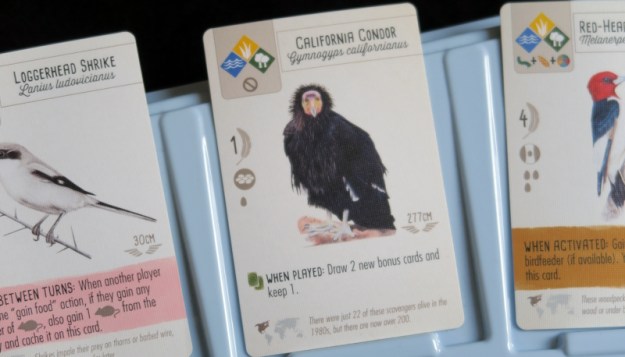
Downforce on Board Game Arena
– Image by boardGOATS from boardgamearena.com

Black therefore took second and Pine just pipped Pink to take third.  The prize money for the first four places is only one part of the game though, and betting on Blue from the start together with third in the race gave Pine a very creditable second place.  Thanks to betting on Blue from the start, Burgundy took third despite his car failing to cross the line.  There was no beating Blue though, as she had decided to put all her eggs in one basket and had bid on her own car.  On top of that, she had paid the least for her car in the auction, giving her an unassailable lead and a winning margin of $11,000,000.

Downforce on Board Game Arena
– Image by boardGOATS from boardgamearena.com

The game is great fun, and, despite the large amount of luck in the game, there is more to it than that—it is all about surfing your luck and making the best of what you have.  Burgundy for example had excellent cards that matched his car well, but got stuck at the back of the pack and couldn’t use them effectively.  It hadn’t been a short game, and with people being tired and ready for an early night, there was just time for a quick game of 6 Nimmt! before bed.

6 Nimmt!
– Image by boardGOATS

Although we have reduced our consumption a bit since New Year, it is still one of our favourite end-of-night games.  There was just time for a quick game of 6 Nimmt! before bed.  Although we have reduced our consumption a bit since New Year, it is still one of our favourite end-of-night games.  The game is so simple, yet so much fun:  the simultaneous card selection keeps everyone involved and the tension as Board Game Arena adds cards to the four rows keeps everyone entertained even once they are out of contention.

6 Nimmt! on Board Game Arena
– Image by boardGOATS from boardgamearena.com

When Blue was the first to pick up cards, and then picked up more cards, it looked like there was no chance of her making it a clean sweep for the night.  She had lost nearly half her starting points and was engaged in a race to the bottom with Purple before Pine and Black had even picked up a card.  But from there, it was a remarkable recovery.  First she was passed by Burgundy and then Black.
6 Nimmt! on Board Game Arena
– Image by boardGOATS from boardgamearena.com

By this time, Burgundy was picking up cards so fast that he’d gone from leading challenging Purple to end the game.  And then Pine (who always does well in this) started picking up cards as well—the only questions that remained where whether it would be Burgundy or Purple who would end the game and whether Pine or Blue would pick up points before they did.  In the end, Purple ended the game, and Pine just managed to hold on to win by two points.

6 Nimmt!
– Image by boardGOATS

Learning Outcome:  Beige likes dinosaurs.