Tag Archives: Love Letter

1st December 2015

Red and Blue were late thanks to a ridiculous queue at Frilford Crossroads, so food had only just been ordered when Green and Pine turned up.  We hadn’t seen Grey and Cerise for a while, so when they arrived the evening descended into gossip.  Pine manfully resisted the chips, but when he eventually succumbed, he ended up with more than he bargained for as they’d all stuck together…  Amid chips and chat, eventually, someone suggested a game and everyone else agreed, so we started with the “Feature Game”, Pandemic: Contagion.  The original game, Pandemic, is a very well known cooperative game where everyone plays together to defeat the tide of disease that is overcoming the world.  Pandemic: Contagion is a lighter game and almost the complete opposite:  players are the diseases and compete against each other to be the most effective and take over the world.

Pandemic: Contagion
– Image by boardGOATS

The game itself is fairly straightforward.  Cards are drawn to represent cities – these are coloured and are under attack from disease.  On their turn players can do any two of three possible actions: place cubes or “infect” a city, draw cards or mutate their disease.  Placing cubes cost cards and the cards must match the colour of the city they are infecting.  The number of cubes they can place or cards they can draw depend on the characteristics of their disease, and both can be increased by mutation.  Like infection, mutation must be paid for with cards, though the number of cards used depends on the level, thus going from an infection level three to level four is much more expensive than going from level one to two.

Pandemic: Contagion
– Image by boardGOATS

A city becomes overrun with disease when the total number of cubes placed on the card equals or exceeds the population.  At this point, the city is scored and the players with the most cubes get points (in the event of a tie, the disease to infect it first wins).  The person who placed the last disease cube additionally gets a bonus action that depends on the city.  At the start of each round an event card is drawn which either alters the rules of the game for the duration of that round, or otherwise disrupts everyone’s plans, by for example, causing them to lose cards or reduce their infection rate etc. etc..  Some of these cards also have a symbol on them either a city indicating that a new city should be added, or a skull and crossed bones after every second of which points are awarded to the player with the most disease cubes in each city.  The game ends when either, there are only two cities left, or the game has proceeded through all twelve event cards.

Pandemic Contagion
– Image by boardGOATS

The game went very slowly with everyone falling for “group think” and going for the cities with the largest populations which therefore score the most points when completed.  Unfortunately, this left the game somewhat mired in treacle as everyone did pretty much the same thing for the first three rounds collecting cards and infecting cities.  Blue picked up a few points at the first interim scoring, but otherwise it was pretty dull and we were all wondering what we were doing wrong.  Then it dawned on us that our disease cubes weren’t doing very much:  for all the large cities, one player had a significant majority, so there was no incentive to compete for it; worse, the winner was reluctant to commit more resources to the cause, but that meant their cubes were just sitting there, waiting.

Pandemic: Contagion
– Image by boardGOATS

Burgundy tried to get things going by increasing the number of cards he could draw, but that back fired when an event card forced him to dispose of half his cards (much to his horror, rounded up!).  It was then that everyone began to look for other things to do and attention turned to finishing off some of the smaller, weaker cities.  We’d sort of forgotten about the bonuses that come when cities are scored and it turns out that some of them are very powerful indeed.  This was amply demonstrated when Blue finished Milan that gave her a card for every city she had infected, which turned out to be quite a few.
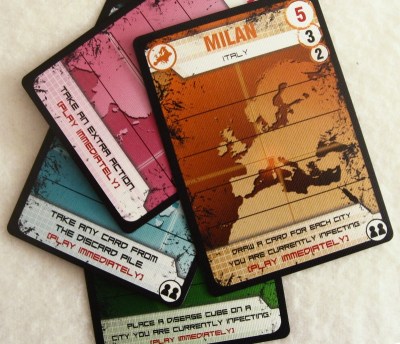
Pandemic Contagion
– Image by boardGOATS

With a little grease to oil the wheels, she was now able to use her newly liberated disease cubes to infect other cities in an effort to finish them.  Everyone else joined in and finally the game began to look a little better, however, before we’d had time to really start to appreciate it, the game was over and it was time to score the remaining cities.  Blue took the win with sixty-one points with Cerise some fifteen points behind behind just fending off Burgundy and taking second place, but everyone was frustrated at what had looked like a promising game, but had fallen so spectacularly flat.

Pandemic: Contagion
– Image by boardGOATS

On reflection, as Blue commented (much to Green’s amusement as he listened in from the next table), “If we’d played it differently it would have been a very different game.”  Although that sounds like a stupidly obvious thing to say, the problem was that everyone tried to play the same way and everyone fell into the same trap which dragged the game down badly.  If we’d realised the value of the bonuses and gone for some of the smaller cities first, the game wouldn’t have dragged so much and would have been much more enjoyable and interesting.  Unfortunately, as Pine succinctly put it, he’d enjoyed everything he’d played with us and would be happy to play any of them again, “except that.”  Which means it’s unlikely to get a second chance very soon.

Pandemic: Contagion
– Image by boardGOATS

Meanwhile, Green and Grey had decided they fancied playing something a bit more “piratey” together.  With Pandemic: Contagion supposedly taking “just half an hour”,  they decided to give Port Royal a go.  Although Green had played it a couple of times, Grey was completely new to the game.  We’ve played it quite a bit recently, but in summary, the game combines “push your luck” with strategy, the idea being that players turn over cards until there is something they want, or they go bust.  Once they’ve taken a card, the other players have their pick of what’s left (for the cost of one coin).  This means that in a two player game, the strategy changes quite a bit as players have to watch what they leave as well as be careful about taking a card and paying their opponent for the privilege.

Port Royal
– Image used with permission of BGG contributor joeincolorado

Green decided to aim to complete “expeditions”, while Grey took a more tactical approach, just doing what seemed best at the time; neither player decided to protect themselves by picking up pirate cards.  Both players really enjoyed it and the fickle hand of fate was much in evidence:  there was much hilarity when three of the four tax cards came out in the same round.  Fate wasn’t done yet either and when Green pushed for four ship cards (in order to be able to buy two cards in the round), almost two dozen cards had been drawn before he finally went bust by revealing a second of the same colour.  With no pirates in his arsenal to repel the attack, the whole lot was wiped out, much to Grey’s annoyance as he had his eye on a particular card.  In the end Green won convincingly with his expedition strategy, but he had the advantage of having played it twice before.

Port Royal
– Image used with permission of BGG contributor punkin312

Since the larger group were still playing Pandemic: Contagion and only about half way through, Grey and Green decided to give Port Royal another go. This time both players decided to mitigate some of the luck by picking up pirate cards and it was generally a very close game.  Pirate ships were repelled left, right and centre and more than once two cards were purchased in one round.  In the end Grey brought the game to an end by exchanging cards for an expedition causing him to exceed the magic twelve points, finishing on fourteen.  Since Grey had started, Green got one more round.  With eleven points, Green needed four to win.  As only two card purchases would do, he went for a four pirate line. With a fighting total of six he could easily repel anything except the skull ships.  With the odds in his favour managed to get to the necessary four ships so that he could buy two cards, but his meagre finances stopped him getting the four points and had to settle for three, leaving him with fourteen points, level with Grey.  Unfortunately for Grey, he had no money left to buy anything, and it all went down to the tie-breaker.  The rules state this is by money, and since Green had just one coin left, he took his second victory of the night.

Port Royal
– Image used with permission of BGG contributor punkin312

With Pandemic: Contagion STILL going (yes, it really DID drag on, though it was near the end by this time…) Green and Grey decided to play a very quick game of Pick Picknic. This is another game that was new to Grey, but he proved to be a natural at.  A sort of early version of one of our current favourites, Om Nom nom, the game combines simultaneous card selection with bluffing and a good slice of luck.  The idea is that there are six farm  yards of different colours, if someone plays the only chicken card of a given colour, they get all the grain at that coloured farm.  If multiple players go for the same coloured yard, then players can either agree to share the corn in any way that is mutually acceptable or roll the die for all of it.  Foxes don’t eat corn, however, they only eat chickens, so if someone plays a fox card, they will eat any chicken cards of that colour, and before long Grey was happily gobbling his way through Green’s chickens adding to his pile of captured corn.  In the end Green managed to get more corn, but the birds captured by Grey’s hungry foxes more than made up for the missing corn and Grey ran out a clear winner. Both players agreed that they preferred Pick Picknic to Om Nom Nom.  Although it doesn’t have the great dice of the newer game, they game doesn’t have the feeling that it’s all over after one poor move.

– Image used with permission of BGG reviewer EndersGame

With Pandemic: Contagion finally finished, Cerise and Grey headed off, leaving Burgundy, Green, Pine and Blue with a little over an hour to play.  After a little bit of thought, we decided to continue Pine’s “boardgame education” and introduce him to The Settlers of Catan (or simply “Catan” as it is now known).  Playing with Green’s fourth Mayfair edition, there were the inevitable comments on the new colour scheme.  Blue outlined the rules to Pine while Burgundy and Green set up the board.  At its basic level, the game is one of resource management and civilisation building.

The Settlers of Catan
– Image used with permission of BGG contributor kilroy_locke

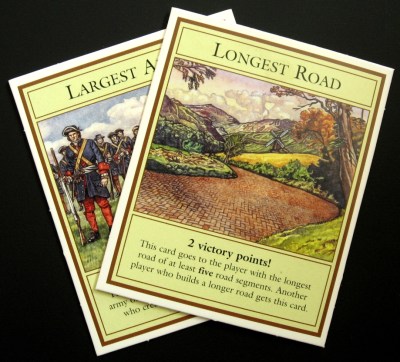
Players start with two roads and two settlements.  These are placed along the edges and on the corners of the hexagons of the modular board.  Each hexagon has a number on it, and on each player’s turn, first they roll both dice and resources are awarded to players with settlements on the corners of the hexagon that  corresponds to the total rolled.  Once the resources have been handed out, the active player can trade resources with other players and use them to build more roads and settlements, develop their settlements into cities or buy development cards.  Victory points are awarded for settlements, cities and the longest continuous road as well as via development cards (both as straight victory points and for the player with the most soldier cards, i.e. the Largest Army).  The random set up had the desert off centre and almost all the specific ports a very long way from good supplies of the necessary resources.  After much debate, we decided to let Pine go first and try to make sure he ended up with decent starting positions.  Green, who went third, decided to try something different and explore the coast hoping there would be less competition there, leaving Blue two reasonable positions in the centre of the board.

The Settlers of Catan
– Image by boardGOATS

As usual with “Settlers”, resources were poorly distributed amongst players and after a brief flurry of wood, it disappeared for the rest of the game.  On the other hand, Green was awash with ore, and Blue, who had quickly upgraded one of her settlements to a city after an early glut of wheat, suddenly found she had more brick than she could possibly work out what to do with.  Pine, once more attracted animals and had an enthusiastically breeding flock of sheep while Burgundy persistently rolled sixes – just about the only number he didn’t have a settlement on. We had a big debate as to whether a four-for-one trade with the bank had to be four identical cards.  After checking the rules, we found they should be identical, though neither Burgundy nor Blue remembered playing that way in the past.  Since we were a little tight on time, we decided to house-rule it to “any four resources” this time, though on reflection, it probably wasn’t really necessary.

The Settlers of Catan
– Image used with permission of BGG contributor
thephantomhennes

Burgundy picked up the Longest Road tile and joined Pine in the sheep farming business.  Having ensured Pine’s starting placements were reasonable, he was making an excellent job of building on it and had found a nice little bit of space to work in, building a couple of new settlements and threatening to take the Longest Road card.  Meanwhile, Green discovered that he was a bit stuffed, with few good options despite having tried to place his starting settlements to avoid being cut off.  With good access only to ore and occasional wheat, he started buying development cards and used the robber effectively to cut off the wood supply.  Blue, with a sudden influx of cards, managed to get her nose in front with a couple of settlements which she was able to upgrade quickly when she got another sudden influx of grain and brick.

The Settlers of Catan
– Image by boardGOATS

Just passing the hour mark, Blue hit eight points and was looking to extend her road and take the Longest Road from Burgundy, or build a couple more settlements.  In the event, the dice rolled in her favour and she picked up a stack of cards with no sign of the robber, which meant she was able to do both giving her eleven points.  This brought the game to a swift and sudden end and the score belied how close the game actually was.  Since we’d finished a little quicker than expected we decided to play something quick.  The suggestion of Red7 scared off Burgundy, but after some consideration, Blue and Green decided to continue Pine’s boardgame education with a quick game of Love Letter.
The Settlers of Catan
– Image by boardGOATS

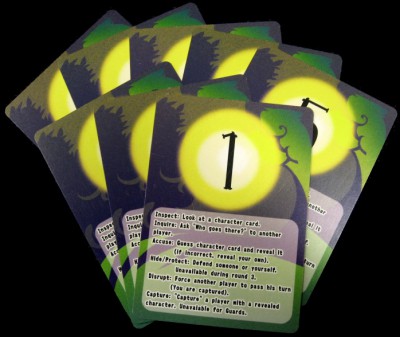
Love Letter is a game we played a lot a year or so ago, but not so much recently.  The first of the so-called “micro games” it is played with just sixteen cards.  Each player starts with one card and on their turn, draws a second card and then plays one of them.  Each card has a value (one to eight) and an action (discard a card, swap cards with another player, compare cards, etc. etc.).  The object of the game is to have the highest card when the deck has been exhausted or, be the last person remaining, which ever is soonest.  The rules say the winner is the first player to take a set number of hands, however, we tend to play far a few rounds and then decide how far to take it.  In this case, Green, Blue and Pine had one point each, so we went for one final round, which Pine took with much aplomb.

Love Letter
– Image used with permission of BGG contributor thatmadgirl

Learning Outcome:  Sometimes it is the way that you play that makes a game enjoyable.

17th Movember 2015

While Burgundy, Magenta and Blue were busy feeding, we decided to play something to keep Pine from eating too many of the chips, so for the third games night running, we had a quick mess about with magnets and bells in Bellz!.  It was another close game with some slightly borderline shaking and other sneaky efforts.  Before long though after incredible snatch taking two medium bells as he moved faster than magnetism, Burgundy had only one large bell left.  This solitary bell was very effectively trapped though and he failed to take the opportunity leaving Blue to close out.  Pine followed, despite the fact that he claimed he was no good at dexterity games.

Bellz!
– Image used with permission of BGG contributor SpeedD

With people still finishing, we looked for another light game that people could play while wielding cutlery, and No Thanks! fitted the bill.  This is a very simple game that we used to play quite a lot, but recently has languished in the box, usurped by newer fare.  The game is very simple:  from a shuffled deck of thirty-three cards (numbered three to thirty-five), nine cards are removed and the top card turned face up.  The first player has a choice they can either take the card or pay a chip and pass the problem on to the next player.  This player can either take the card and the chip or pay a chip and so on.  At the end of the game the face values of each player’s cards are totalled (offset by any remaining chips) and the player with the lowest number is the winner.  The catch is that if players have consecutive cards, only the lowest counts, which is where the fun really starts.

No Thanks!
– Image used with permission of BGG contributor msaari

The game is all about keeping your nerve and picking up the right card at the right time.  Burgundy began by picking up some high cards, while Pine started with a few cards in the twenties and teens.  Blue and Magenta stuck it out as long as they could before they were forced to take something.  Somehow Blue managed to avoid anything really horrid until the last card when Magenta persuaded Burgundy to hand it on leaving her with a whopping sixty-nine and last place.  With Burgundy unable to get the cards he needed to extend his run, that left just Magenta and Pine with Pine taking it by four points with just twenty three points.

No Thanks!
– Image used with permission of BGG contributor mikehulsebus

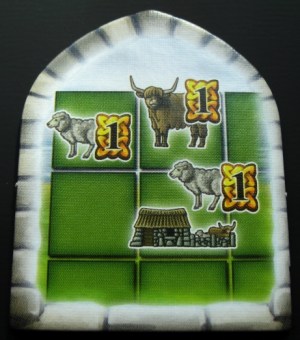
Not expecting anyone else to arrive, we decided to move onto the “Feature Game” which was Isle of Skye: From Chieftain to King.  This is a tile laying game with some similarity to Carcassonne, except that players have their own map and the tiles are auctioned.  Played over six rounds, players start by earning income for their clan’s territory, getting five gold for their castle and one for each whiskey distillery (barrels) connected to their castle by road.  Next, each player draws three tiles from a bag and places them in a row in front of their screen.  In private, the players then allocate piles of coins to two of the tiles and a mattock marker to the third.  The coins represent the cost anyone buying a tile will have to pay, while the mattock indicates which tile will be discarded.

Isle of Skye: From Chieftain to King
– Image used with permission of BGG contributor henk.rolleman

Once everyone has decided the value of their tiles, the screens are removed and the tiles marked with a mattock discarded.  Next, beginning with the start player, each player takes it in turn to buy a tile from one of the other players.  When everyone has either bought a tile or passed, all remaining tiles are bought for the assigned value by the owner.  So, when setting the value, players have to be very careful not to over-price something otherwise they will be left paying over the odds for something they don’t want.  In fact, the problem is worse than that as the difference between being forced to buy your own tile and selling it is twice the assigned value.

Isle of Skye: From Chieftain to King
– Image by boardGOATS

After all the tiles have been bought, players add them to their clan territories following the Carcassonne riles that terrain must match.  However, presumably since all roads on Skye are just dirt tracks, roads do not need to connect, something those of us who suffer with OCD found quite offensive to begin with.  At the end of the round, points are awarded according to the four scoring tiles chosen at random at the start of the game.  In our game the scoring tiles were:

  1. One point for each animal next to a farm;
  2. Three points for each lake with a ship and a lighthouse;
  3. Two points for each cow on a road connected to the castle;
  4. Five points for the person with the most barrels and two for the person with the next most barrels.
Isle of Skye: From Chieftain to King
– Image used with permission of BGG contributor henk.rolleman

At the end of the first round, just scoring tile “A” is scored, at the end of the second, just tile “B”, but at the end of the third, both “C” and “D” are scored so that each tile is scored three times during the game, at the end of different rounds, in different combinations.  At the end of the game, each player turns any residual money into points (at a rate of five to one) and players also score any scroll tiles they may have been able to add to their clan territory.  These give a set number of points for certain items, for example, one point for each pair of ships etc.  These are scored twice it the terrain the scroll is in is “complete”, i.e. it is enclosed.

Isle of Skye: From Chieftain to King
– Image used with permission of BGG contributor Punkin312

Burgundy was the only player who had played the game before and commented that he had been given a bit of a pasting so was hoping to do better, though he thought it was a hard game.  It didn’t sound hard at all, but we quickly discovered what he meant, with everyone struggling from the very beginning.  Pine and Magenta made the best starts getting farms and animals and scoring early, while Blue and Burgundy brought up the rear.  Blue, who never does well in more strategic games drew scroll tiles that rewarded players with barrels.  Unfortunately, as barrel tiles connected to the castle give players money at the start of the game, and scoring tile “D” gave points for them, they were a hot commodity and Blue was quickly left behind.

Isle of Skye: From Chieftain to King
– Image used with permission of BGG contributor henk.rolleman

As he’d found the previous time he’d played, Burgundy could see the tiles he wanted, but was struggling to acquire them or keep them.  As a result he started to drop off the pace and before long, Pine had left Magenta as well and was romping away looking like he might start to lap people.  While everyone else moaned as they struggled to do what they wanted, Pine continued happily collecting lots and lots of cows and sheep which he cleverly added to his growing conurbation of farms so that they counted multiple times.  In the later rounds, however, there is a catch-up mechanism which gives extra money to the players at the back.

Isle of Skye: From Chieftain to King
– Image by boardGOATS

From round three onwards, at the start of the round, each player gets additional money for each player in front of them.  The amount increases as the game progresses, so the player at the back gets an extra three gold coins at the start of round three, but a massive twelve additional gold at the start of the final round.  Unfortunately, we somehow managed to botch this, half-way through the game switching to handing it out at the end of the round instead of the start, so the additional wherewithal didn’t quite give people the extra buying power intended by the designers.  That said, although Pine was the clear winner by nearly thirty points with a total of eighty-five, Blue managed move from a long way behind everyone else into second place thanks to scroll scoring that capitalised on all the brochs and barrels she had acquired.  For all the moaning, everyone enjoyed the game and agreed that it needed playing again as it would probably be very different with different scoring tiles.

Isle of Skye: From Chieftain to King
– Image by boardGOATS

After some discussion about what to play and flirting briefly with the idea of Aquaretto,  we decided to play Port Royal.  Although we’d played it before, it was one of those games that it is somehow hard to remember and therefore Blue made a bit of a pig’s ear of teaching it.  That said, it isn’t a complicated game:  the game is played in turns with the active player turning over cards.  They can keep turning over cards until either they choose to stop or they draw a second ship card that they cannot repel.  Assuming they choose to stop, they can then take a ship card or buy a character card before the remaining cards are offered round the table with players paying the active player one doubloon if they choose to buy/take a card.

Port Royal
– Image used with permission of BGG contributor msaari

The key is the character cards as they are what enable players to build an engine and get an advantage over the opposition.  Unfortunately for him, Burgundy never seemed to have enough money when the cards he wanted came up.  On the other hand, Magenta took a Jester at just the right moment to give her a steady income exactly when she needed it.  Meanwhile, Blue picked up some good cards, but failed to capitalise and Pine began collecting for contracts, but couldn’t pick up the most cost effective ones.  Then, suddenly, Magenta snuck up on the inside and Pine pointed out that she had eleven points.  Blue then lost the plot a little and let her get the twelfth point which triggered the end of the game.  Nobody could improve their position much, except Magenta who rubbed salt in the wound buying another two cards.

Port Royal
– Image used with permission of BGG contributor jsper

With the evening nearing the end, we decided to give another new game a quick try as it the box said it only took five to ten minutes.  Well, an hour later, we were still playing Red7, and the landlord was subtly reminding us of the time…  So how did it go so wrong?  Well the game is fairly straight forward:  on their turn, each player can play one card from their hand into their tableau in front of them, or play a card into the centre which changes the rules of the game (a little like Fluxx), or they can do both.  If they cannot play a card or choose not to, they are out of the round.

Red7
– Image used with permission of BGG contributor punkin312

The game is played with a deck of forty-nine cards, numbered one to seven and in seven different colour suits.  Each player starts with seven cards in hand and one face up on the table.  The player with the highest value card is “winning” because the rule at the start is that the highest card wins.  In the event that there is a tie and the highest face value is displayed by more than one player, the tie is broken by the colours with red higher than orange, which is high than yellow and so on through the spectrum to violet.  The colours also dictate the rules, so any red card played in the centre will change the rules to “the highest” wins.  Similarly, any orange card played in the centre changes the rules so that the winner is the person with the most cards of the same number.

Red7
– Image used with permission of BGG reviewer EndersGame

In each case, ties are broken by the card that is highest (taking into account both number and colour) from the cards that satisfy the current rule.  Thus, if the rule is “the most even cards” and there are two players with the same number of even cards in front of them, the player with the highest even card is the winner.  At the end of their turn, the active player must be in a winning position, or they are out of the round. The round continues until there is only one player left.  Magenta took the first round with eight points and Burgundy the next with eleven.  When Magenta took the third and Blue the fourth, Pine was beginning to feel a little left out.  After Burgundy took the fifth round which took him to twenty-seven points (more than twice any one else’s total), we decided to give Pine one last chance as clearly Burgundy had it in the bag.  Sadly, for Pine, the last round was taken by Blue with a massive twenty-two points putting her just three points ahead of Burgundy.

Red7
– Image used with permission of BGG contributor punkin312

So why did the game take so much longer than advertised?  Well, obviously we had to read and understand the rules, but that didn’t account for it.  Each round does indeed take about five to ten minutes, but we didn’t feel we had really grasped it after one round and the rules for the advanced game also say that players should continue until one reaches a set number of points.  So we just played another round and then another and another… By the end we were just starting to get the hang of it, but we were also really beginning to appreciate the depth of something so very simple.  Part of the issue is getting into the mindset that enables you to quickly evaluate what cards you can play.  The next level is working out what is the best card to play that keeps the maximum level of options open.  However, by the last round we were just beginning to see that the game was really about using the rules to control what the other players could do, driving the game and ultimately, maximising the number of points won, or minimising the number of points taken by the opposition.  As a game, the structure of this has a lot in common with Love Letter and could another quick filler in a similar vein.

Red7
– Image used with permission of BGG contributor punkin312

Learning Outcome:  Simple games can turn out to be amongst the most complex.

BoardGOATS @ “The Mix” II – Saturday 21st November 2015

Following the success of our first drop-in session in April, The Mix in Wantage town centre is again hosting a gaming session on Saturday from 10.30 am until 2 pm.  Once again, members of the club will be providing games and teaching people how to play them.

The Mix
– Image from thewantagemix.wordpress.com

There isn’t very much space so we won’t be playing long games, in any case, the idea is to show people what modern boardgames are all about by demonstrating shorter games.  We will bring a few eye-catching games like PitchCar, Riff Raff, Bamboleo, Boom Boom Balloon, Toc Toc Woodman, and Saturn, but most of the gaming will be smaller filler games like Dobble, Turf Horse Racing, No Thanks!, Walk the Plank!, Love Letter, The Great Balloon Race and some of our other light favourites.  We will also be bringing some of the classic gateway games like Carcassonne, Ticket to Ride, The Settlers of Catan and Jamaica as well as a small number of deeper games, just to show people what else is out there.

Boom Boom Balloon
– Image used with permission of henk.rolleman

6th October 2015

This week we started out debating the poor performance of the England Rugby team compared with Ireland who had hitherto failed to beat a team in the top ten, but were still likely to go through to the quarter final stage of the world cup (thanks largely to the vagaries of the draw).  While Blue and Pink finished their pizza Magenta, the Dobble Queen, schooled everyone else in a quick round of Dobble, before we split into two groups.

Dobble
– Image used with permission of BGG contributor msaari

The first group played Grog Island.  This is an unusual game that it quite hard to get your head round because a lot is going on.  The theme centers on retiring pirates who are trying to work out how to spend their ill-gotten gains. The game is played on a board that represents the five peninsulas of “Grog Island”, which is where pirates that have survived to retirement can go to invest their spoils by buying pirate-like properties.  The key feature however is the innovative bidding mechanism.

Grog Island
– Image used with permission of BGG contributor henk.rolleman

On their turn, the active player rolls five coloured dice, and then places their first bid.  Bids are placed by selecting any number of the dice with the value of the bid equal to the sum of the number of pips on the upper-most face of the dice.  The bid must be less than the players total amount of gold.  The clever part of the bidding is that the dice that form the bid are placed in descending order, with each dice placed in one of the five available spaces, starting on the left with the highest value dice. If they can afford it, the next player may increase the bid, by increasing the total number of pips visible on the dice.  To do this they can add dice, replace dice, even completely rearrange the order of the dice, so long they do not change the number on any die and the dice remain arranged in descending order starting from the left.  The position and colour of the dice have a number of consequences, both for the eventual winning bidder, and for players who withdraw from the round early.

Grog Island
– Image used with permission of BGG contributor Wout

The player who eventually wins the bid gets to carry out the actions associated with the dice according to their final position.  These include placing pirates on the island and blocking spaces on the island, but the peninsula is restricted to the colour of the die placed in the location associated with that action.  Pirates’ positions on the island are important, because these are the primary way players get points during the game, but since those points depend on the victory cards handed out at the start, everyone has a different combination of goals.

Grog Island
– Image used with permission of BGG contributor PZS69

Losing a bid can be useful too, however, as players who drop out of the bidding early get resources corresponding to the colours of the dice in the current bid.  Thus, if the current bid is comprised of the yellow, blue and green dice, the player receives lemons (yellow), fish (blue), and coconuts (green).  These resources can then be used to carry out one of the options on the shipping track.  Black and Purple had played the game before, though always with four players.  Red on the other hand was new to it and felt a bit overwhelmed trying to get her head round everything that was going on.  For this reason, while Black and Purple began collecting victory point cards and planning a strategy, Red kept it simple and played tactically, gathering resources and using them as best she could.  It was really close and it went right down to the wire, Red finishing with thirty-three, with Black and Purple two and five points behind respectively.  The discussion at the end suggested that different tactics might be necessary with different player counts.  On the other hand, the winner was was the player who had no idea what she was doing last time we played too, so maybe keeping it simple is the way forward with this game.

Grog Island
– Image used with permission of BGG contributor Wout

Meanwhile, everyone else played the “Feature Game”, Tokaido.  This is a game where players take the role of pilgrims crossing the Japanese “East sea road”, meeting people, tasting fine meals, collecting beautiful items, discovering great panoramas, and visiting temples.  It had been Pink’s choice as he lives so far away that he rarely makes it to games nights and was able to come this time as he was on his way to Essen.  He chose the game because he had played it a couple of times with two and wanted to see how it played with more as he felt it was probably very different.

Tokaido
– Image used with permission of BGG contributor henk.rolleman

The game is quite simple with fairly straightforward actions, but despite this there is a surprising amount to think about.  The idea is that players are travelling along a path, but only one player can stop on each space.  Each space allows the active player to carry out a predefined action which will usually give them some combination of money and/or victory points.  Since the player at the back goes first they have to choose whether to move to the closest available space and get the maximum number of moves, or whether to pick a space for its action, either to improve their own position or to obstruct someone else’s plans.  In practice of course, it is inevitably a compromise but one that is often based on marginal decisions.

Tokaido
– Image used with permission of BGG contributor kilroy_locke

There are a number of possible actions, some of which involve drawing cards from one of the available piles with players scoring more for collecting sets.  Players can also donate money to at the temple in return for victory points, but as money is quite scarce, this can be quite difficult.  At intervals along the route there are also inns, where players have to try to buy a meal, which are worth six points, however, each meal must be different.  The first player to arrive draws a hand of meal cards which have varying costs, and they get to select which meal to buy giving them the chance to to make live very difficult for everyone else.

Tokaido: Eriku
– Image used with permission of BGG
contributor changeling

At the start of the game, each player draws a character card:  Burgundy took Sasayakko; Pink got Zen-Emon, Magenta took Umegae and Blue got Eriku.  Since nobody could work out what Eriku did (he was a promotional item and came without rules), Blue drew a second card and ended up with Hiroshiga.  Sasayakko and Zen-Emon both had special powers allowing the cheaper purchases of souvenirs from the village, which meant that Burgundy and Pink were fighting for the same spaces on the path.  Umegae allowed Magenta to take an extra point and coin every time she drew an encounter card, while Hiroshiga gave Blue a free panorama card at the three intermediate inns, which ultimately gave her two of the panorama bonuses.

Tokaido
– Image by BGG contributor asdoriak

Since the character cards drive the strategy, Burgundy and Pink both started out collecting souvenirs while Blue went for panoramas.  Magenta was the only one who was completely new to the game and, as it is very different to anything else we’ve played, she struggled to find a strategy in the first few turns.  As Umegae ensured that she had an extra source of money, Magenta managed to avoid getting into financial difficulties and quickly built up an unassailable lead at the temple and, by buying the expensive meal cards, managed to secure that bonus too.  Money was much more of an issue for Blue as she started out with less than everyone else and really struggled to ensure she had enough to buy a meal at each of the inns.  Burgundy also had a bit of a cash-flow crisis as he was buying souvenirs at every possible opportunity, but at least he was doing well picking up points.

Tokaido
– Image used with permission of BGG contributor henk.rolleman

Pink didn’t escape financial worries either and, as he was losing out to Burgundy for the village spaces, he wasn’t picking up as many points.  The game finished with a clear win for Burgundy who’s souvenir buying strategy clearly paid off giving him a lead of ten points over second place.  It was much closer than it had looked earlier in the game however, and only two points separated Pink in second and Blue at the back.  It was a game we all enjoyed though, and it does indeed play very differently with two and “lots”, for two main reasons.  Firstly, with two players, controlling the dummy player is a key part of the game, but he is not used with three or more people.  Secondly, with more than three, some of the spaces have a sort of “siding” that can be used by a second player.  This second player is remains behind the first person to arrive, which messes with the turn order and takes a little getting used to.

Tokaido
– Image used with permission of BGG contributor henk.rolleman

Tokaido finished first, so we played a quick game of Love Letter with the winner decreed as the person with the most points when Grog Island finished.  The usual hilarity ensued as one player managed to take out another by shear blind chance using the guard, or occasionally by clever deduction.  It was all level with one hand each, when Grog Island came to an end and it all came down to the last hand which was taken by Burgundy.

Love Letter
– Image by BGG contributor thatmadgirl

Red and Magenta were preparing to leave, but we managed to persuade them to stay for a quick game of one of our current favourite fillers, 6 Nimmt!.  This is such a silly game:  clearly there is more to it than just chance, but none of us can really work out what, which is why it continues to keep us intrigued.  We usually play this in two rounds, each with half a deck, and typically, whoever does really well in the first round (generally Burgundy) does appallingly badly in the second.  Everything went according to the script with Burgundy winning the first round taking just the one “nimmt”, and then starting the second round picking up cards.  However, that’s where it stopped and Burgundy finished with just eight, the clear winner.

6 Nimmt
– Image by boardGOATS

With the departure of Red and Magenta, and Blue and Pink wanting an early night because they were travelling the next day, we decided to play another short game and opted for one of our current “go-to fillers”, The Game.  We’ve played this a lot recently, but only actually won once.  This time we started very, very badly indeed with nobody really having any very high or very low cards.  Then the inevitable happened and about half of us only had very high or very low cards.  We’ve known for some time that this game is a lot more difficult with more players and with five it is especially challenging.  Nevertheless, despite doing so appallingly badly at the start, the end result was not as bad as we expected and we finished with three cards left.

The Game
– Image used with permission of BGG contributor henk.rolleman

Learning Outcome:  Some games play very differently with different numbers of players.

28th July 2015

We started the evening splitting into three groups, the first of which played Machi Koro.  This was the “Feature Gamea couple of months back when it received a nomination for the coveted German Game of the Year, or Spiel des Jahres Award.  In essence, it is an engine building game with elements taken from The Settlers of Catan and Dominion.  Like Settlers, on their turn players first roll one or two dice, which yield resources, in this case money.  Players then use their money to buy cards like Dominion.  Each card is numbered and provides money, sometimes when the owner rolls, sometimes when someone else does, with the amount sometimes depending on the other cards a player has.

Machi Koro
– Image used with permission of BGG reviewer EndersGame

Players have five special buildings costing varying amounts and the winner is the first player to build all of them.  Red, Yellow, Orange and Cyan started setting up while people finished eating, but Red emigrated to play the hidden traitor game, Saboteur, with Teal and Violet when they arrived.  This is one of those little games that everyone always enjoys playing and plays lots of people well.  With only three players, it’s possible to have one bad dwarf, or none at all which makes everyone very twitchy, and as usual, accusations abounded.  After three rounds, Teal ran out the winner with five gold.

Saboteur
– Image used with permission of BGG contributor mothertruckin

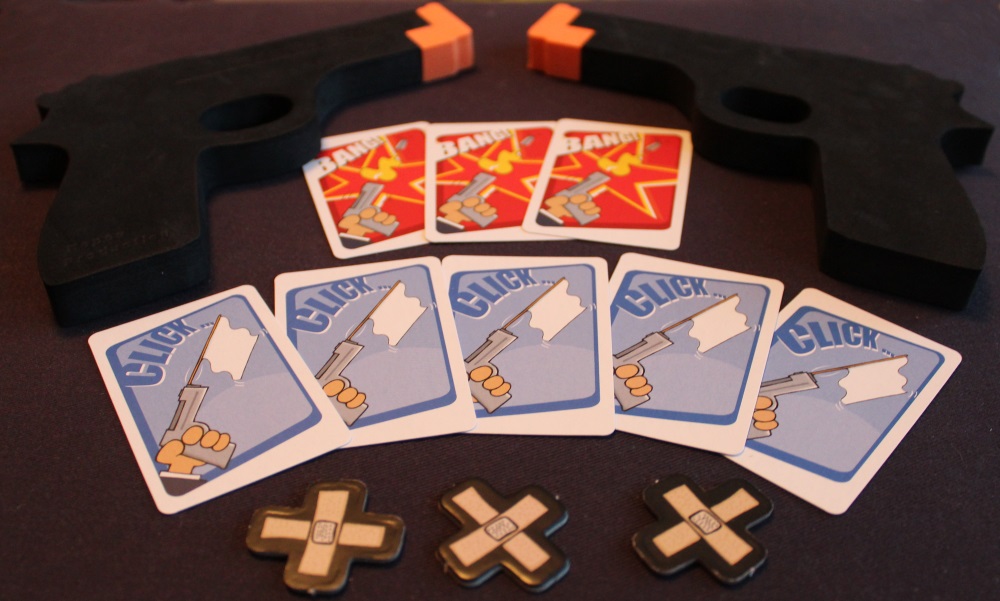
Machi Koro and Saboteur finished together to the two groups coalesced to play Colt Express.  This had been the “Feature Game”, last time, however, none of this group had been available to play.  Red was particularly keen to give it a go as it has a lot in common with one of her favourite games, Walk the Plank!.  This style of game is sometimes refereed to as a “programming game” because players play all the cards and only after everyone has played cards, do they get to action the cards.  The effect of this is semi-organised chaos as players try to make plans to take care of all eventualities, and then find that by the time they get round to carrying out the actions the situation has completely changed and is nothing like they would have predicted.  This time, Orange took the $1,000 for the sharpest shooter and Cyan took the strongbox.  Despite this, the best thief turned out to be Yellow who finished with $2,700 some way ahead of Cyan in second place.

Colt Express
– Image used with permission of BGG contributor henk.rolleman

Meanwhile, everyone else had been playing the “Feature Game”, which was Last Will.  This is basically the boardgame equivalent of the 1985 film “Brewster’s Millions”.  The story goes that in his last will, a rich gentleman stated that all of his millions would go to the nephew who could enjoy money the most.  In order to find out who that would be, each player starts with a large amount of money, in this case £70, and whoever spends it first and declares bankruptcy is the rightful heir, and therefore the winner.

Last Will
– Image used with permission of BGG contributor PaulGrogan

The game is played over a maximum of seven rounds each comprising three phases.  First, starting with the start player, everyone chooses the characteristics of their turn for the coming round from a fixed list.  These include the number of cards they will get at the start of the round, the number of “Errand Boys” they will be able to place, the number of Actions they will get and where they will go in the turn order.  For example, a player may choose to go first when placing Errand Boys, but will then only get one card at the start of the round and crucially, only one Action.  On the other hand, a player may choose to sacrifice position in the turn order, draw no cards, only place one Errand Boy, but receive four Actions.  Since all but two cards are discarded at the end of the round and Actions must be used or lost, this decision is critical.

Last Will
– Image used with permission of BGG contributor Toynan

Next, in the revised turn order, players take it in turns to place one Errand Boy before placing their second if applicable.  Errand Boys are important as they allow players to control the cards they are drawing as well as manipulate the housing market and increase the space on their player board.  The heart of the game is the cards, however, which are played in three different ways:  as a one off (white bordered cards); on a player’s board (black bordered cards) or as a modifier (slate bordered cards) which enable players to spend more when black or white bordered cards.  Thus, White bordered cards are event cards which cost a combination of money and Actions to play, but once played, are discarded.  Black bordered cards cost at least one Action to play, but are kept and can be activated once in each round.

Last Will
– Image used with permission of BGG reviewer EndersGame

Black bordered cards come in three different types: “Expenses” which allow players to spend money; “Helpers” which additionally allow give players some sort of permanent bonus, and “Properties” which are by far the most complex cards in the game.  Properties are an excellent way of spending money as they are bought for a given amount and will either depreciate every round, or will require maintenance which can be expensive. Unfortunately, players cannot declare bankruptcy if they have property and must sell them.  This is where the property market comes in:  one of the possible errands is to adjust the property market, so if a property is bought when the market is high and sold when it is low, this is another possible avenue for losing money.

Last Will
– Image used with permission of BGG contributor bswihart

At the end of the round, everyone reduces their hand to just two cards and loses any left-over actions, which puts players under a lot of pressure as it makes it very hard to plan.  So the game is an unusual mixture of timing, building card combinations, strategy and tactics.  Only Blue had played it before and that was a long time ago, so it took a long time to explain the rules and make sure that everyone understood how the cards worked.  Even then, there were a lot of misunderstandings.  Burgundy had also read the rules quite carefully as well though and mostly managed to keep everyone on track.

Last Will
– Image used with permission of BGG contributor Toynan

Green (as the last person to the bar and therefore the last person to buy something) went first and started out with an “Old Friend” which gave him an extra action.  Burgundy went for a “lots and lots of cards which don’t cost an Action to activate” strategy while Black and Purple went into the properties market.  Meanwhile, Blue’s starting cards favoured buying farms, but by the end of the first round it was becoming clear that the cards she needed weren’t there and an Events strategy would probably be better.

Last Will
– Image used with permission of BGG reviewer EndersGame

Towards the end of the fourth round it was becoming obvious that Burgundy’s preparation (reading the rules) was paying dividends as he was systematically spending more than £12 per round – the amount needed to force an early finish to the game.  Blue on the other hand was trying to work out why her pile of poker chips didn’t seem to be decreasing.  By the end of the fifth round it was clear that Green was pressing Burgundy hard and there would only be one more round.  A quick bit of maths also suggested that there had been a “banking error”.  Although it would normally be in Blue’s favour, unfortunately, as this is game where players are trying to lose money, it didn’t help her.  Since she had been in charge of the poker chips though, it could only have been her own fault.

Poker Chips
– Image by boardGOATS

The game came to an end in round six when Green ran out of chips.  This left him with a final total of zero and everyone else trying to make the best of the final round.  Black and Purple tried selling off their properties and Blue held another couple of expensive parties, but it was Burgundy who spent £20 to finish the winner with £13 of debt.  As we put the game away, we agreed that it was quite an unusual game, though quite complicated, especially on the first play.  We also all felt that it was the sort of game that would benefit from the familiarity with the cards that comes from repeated plays, so it is quite likely that we’ll play it again soon.

Last Will
– Image used with permission of BGG contributor CellarDoor

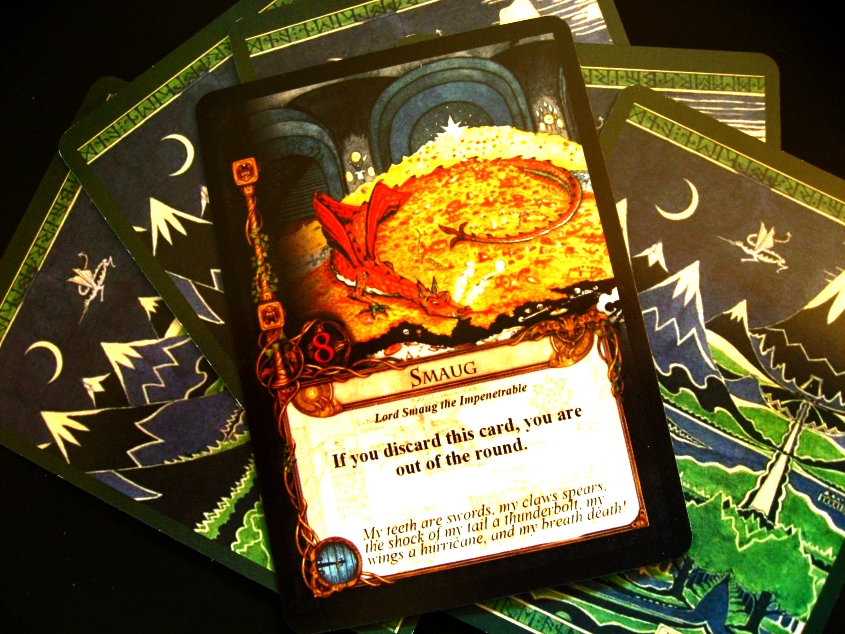
With everyone else gone, there was just time for a few quick rounds of Love Letter.  This is a game we played a lot a year or so ago, but not so much recently.  The first of the so-called “micro games” it is played with just sixteen cards.  Each player starts with one card and on their turn, draws a second card and then plays one of them.  Each card has a value (one to eight) and an action (discard a card, swap cards with another player, compare cards, etc. etc.).  The object of the game is to have the highest card when the deck has been exhausted or, be the last person remaining, which ever is soonest.  For variety, we played with Green’s much loved, very battered, previously lost but recently re-found, home-made, “Hobbit” themed deck, complete with tiny gold rings.  So, the first problem was remembering what all the cards did and then trying to match them to the new characters…  With five, we played until the first player had two rings – everyone got one except Burgundy before Black won a second round and finished as the winner.

Love Letter
– Image by boardGOATS

Learning Outcome:  Spending money is not quite as easy as you think.

10th February 2015

Getting into the mood for Saturday (St. Valentine’s Day), we started out with just a couple of quick hands of the old favourite, Love Letter.  Blue took the first hand and Grey the second, however, we were still expecting a few more, so we decided to play another quick game and after a little discussion, we went for Coup.

Love Letter
– Image used with permission of BGG contributor henk.rolleman

This is a light little card game with a lot of similarities to Mascarade, which we played last time:  on their turn, players declare they are going to take an action and other players can either claim they are a specific character and counter or challenge the active player to prove that they are who they say they are.  Basically, the actions are either: take money in various different amounts (with different risks); spend money to assassinate or perform a coup, or trade a card with the deck.  Players have two character cards face down in front of them, and when challenged correctly or assassinated/subjected to a coup, they turn one face up.  When both of a player’s cards are face up, they are out;  the winner is the last man standing.

Coup
– Image by BGG contributor jerome75

Unfortunately, Blue, who had played it quite a bit in the past got horribly muddled with the rules, largely due to the similarity between this and Mascarade, so consequently, forgot a small but quite critical rule:  when a challenge is made and the challenge is unsuccessful, the player should exchange their card with one from the deck.  Although this obviously had an impact, since everyone was playing by the same rules, it wasn’t too drastic.

Coup
– Image used with permission of BGG reviewer EndersGame

Before long, Cerise and Grey were outed as Dukes and Indigo was claiming to be a Captain and was stealing from Cerise.  “Burgundy the Brave” kept challenging, but unfortunately was wrong more than right and was soon out of the game.  When Cerise claimed to be the yet another Duke nobody believed her.  Meanwhile, Indigo was building up quite a store of cash, so Green decided it was imperative that her money supply should be cut off and assassinated Cerise proving that she had been holding two Dukes at the start.  Green’s unsuccessful attempt to assassinate Blue (who was the Contessa) left just Indigo, Grey and Blue in the game.  Indigo’s successful coup was rewarded by a prompt assassination of her final character by Blue, leaving just Blue and Grey.  Grey, as a captain was trying to collect enough money for a coup, while Blue needed just one more coin for the assassination.  So, Blue kept taking two coins in Foreign Aid and Grey immediately stole them.   It looked like Grey had it, but since Blue still had two character cards, that gave her an extra chance to collect money the game ended when she mercilessly stabbed Grey’s captain in the back.

Takenoko
– Image used with permission of BGG contributor nad24
and nonsensicalgamers.com

We then split into two groups with the first playing the “Feature Game”, Takenoko.  The back-story for this game is that a long time ago, the Chinese Emperor offered a giant panda bear as a symbol of peace to the Japanese Emperor.  Since then, the Japanese Emperor has entrusted the members of his court (the players) with the difficult task of caring for the animal by tending to his bamboo garden.  So the players have to cultivate the different plots of land, irrigate them and grow one of the three species of bamboo (Green, Yellow and Pink) with the help of the Imperial Gardener.  The winner is the player who grows the most bamboo, managing his land plots best while feeding the Panda.

Takenoko
– Image by BGG contributor woodenbricks

The play area starts with one single hexagonal “pond” tile with two characters on top:  the Imperial Gardener and the Panda.  On their turns players first determine the weather, then perform their actions.  The weather is determined by a roll of the weather die, which give the active player some sort of bonus.  For example, when the sun shines, the payer gets an extra action, and rain stimulates the bamboo of their choice to grow.

Takenoko
– Image used with permission of BGG contributor Oceluna

Once the weather has been determined, the player can perform two actions.  These must be different and the player can choose freely from the five available.  Firstly, the player can add a new bamboo plot, by drawing three hexagonal tiles from the face down stack and choosing one to place.  This tile must be placed next to the starting “pond” tile or adjacent to two plots already in play.  There are also “improvements” which are sometimes built into the plot, but can also be obtained by rolling the weather die and can be played at any time.  The second option is to take an irrigation channel.  These can be played straight away or stored for later use, but bamboo only grows on irrigated plots.  The main way to irrigate a plot is by connecting them to the pond via channels.

Takenoko
– Image by BGG contributor woodenbricks

Alternatively, a player can move one of the characters, either the Imperial Gardener or the Panda.  Both move over any number of plots, in a straight line, but when they reach their destination, their action is different.  The Panda cannot resist bamboo, so will eat one segment of bamboo from the plot he lands on (the pieces are stored on the player’s individual board); the Imperial Gardener encourages the bamboo to grow, and the bamboo on the plot he lands on grows by one segment as does every adjacent tile growing bamboo of the same colour (as long as they are irrigated).

Takenoko
– Image used with permission of BGG contributor lacxox

Finally, the active player can draw an objective card and add it to their hand;  there is a hand-limit of five and these are the only way to score points.  There are three types of objectives, those related to Plots, the Gardener and the Panda.  Plot objective cards yield points to players when certain plot configurations are irrigated; Gardener cards are achieved when bamboo of given height are grown in the right spaces and points for Panda cards are awarded when a player has managed to encourage the Panda to eat the requisite number of coloured bamboo segments.

Takenoko
– Image used with permission of BGG contributor ObeyMyBrain

When a player completes one of their objectives, they show everyone and the card is placed face up in front of them.  They can complete as many objectives as they like on their turn and end of the game is triggered when one player full-fills a set number of objectives, after which, everyone gets one last turn.  The game was really tight from start to finish and every time one player got a nose in front, the others seemed to catch up and over-take, only to be leap-frogged themselves.  The game finished with just three points separating first and last place, with Burgundy just pipping Indigo.

Lancaster
– Image used with permission of BGG contributor punkin312

While half the group were Playing with Pandas, Green persuaded everyone else to give Lancaster another go.  This is a longer game which embodies a few very clever ideas and that we played for the first time a few weeks ago.  The basics of the game are that players take it in turns to place their knights in the shires, in their castle or send them off to war.  They then vote on and evaluate “the Laws” which give players a benefit.  They then get their their rewards for knight placement.  After five rounds, the player with the most points wins.

Lancaster
– Image used with permission of BGG contributor kilroy_locke

One of the clever things about the knight placement is the way that players can usurp a knight that has already been placed, by supplementing him with a number of squires.  So, a knight of level two can be replaced by a night of level one with two squires.  However, squires are “single use”, so should the original player decide to respond with a level four knight, the other player’s squires are lost.  This is a very clever way of speeding up the bidding.  For example, in Keyflower, two players can keep bidding in increments of one which means it may take several turns for the outcome to be resolved.  In Lancaster, a failed bid that is repeated at a higher level may turn out to be considerably more costly than bidding higher the first time round.  This encourages players to be a smarter about their bidding and changes the dynamics a little too.

Lancaster
– Image used with permission of BGG contributor punkin312

One of the key parts of Lancaster is “the Laws” and managing them.  On our previous play, we didn’t really get to grips with them at all.  Although it is now clear to us how important they are, we are still only just getting to grips with them.  The game starts with a set of three Laws, with three to be voted on during the round.  Since there is a conveyor-belt system, it is possible that some Laws will remain in place for several rounds.  This means even if a particular Law does not reward a player during the round it becomes active, they may benefit in subsequent rounds.

Lancaster
– Image used with permission of BGG contributor kilroy_locke

This game was quite different to the last:  firstly, as a group, we had a better idea of rules, and secondly, there were only three of us compared with five before.  Blue was too busy worrying about the game on the next table to concentrate on the rule-reminder, and paid for it in the first round when her plan relied on the rewards coming before the Laws.  Green tried to increase his force and then generate benefits by fighting the French, however, with fewer players, it is much more difficult to win the battles which means your knights are tied up for a lot longer.  Having screwed up the first round, Blue didn’t bother trying to increase all her knights to full force and tried to be a bit more canny about how she used them instead and pick up upgrades by other means.  Meanwhile, Grey, who had not played the game before, tried to build up his stack of noblemen and played the laws.  Blue and Green were far too bothered with their own games to notice, but Grey managed to get the eight point Law for having three knights in the shires voted in.  More importantly, he managed to keep it there, and this combined with a respectable number of nobles and a few uncontested visits to Somerset (giving him six victory points each time) eventually gave him the game by a sizeable margin from Blue.

Coloretto
– Image used with permission of BGG contributor punkin312

Meanwhile, the Panda Players had finished so Burgundy and Cerise squeezed in a quick two player game of Coloretto.  Cerise and Burgundy had played this last month with Blue and Indigo, but it is not generally thought of as a good two player game.  Nevertheless, they gave it a go and found it much more enjoyable than expected.

Taluva
– Image used with permission of BGG contributor Bizowikc

With Grey and Cerise’s departure, that left just time for one last, shortish game, Taluva. This is a fairly simple tile laying game with a surprising amount of depth.  The idea is that on their turn, players place their tile, then place a building then replenish their hand.  This procedure is to that of Carcassonne, but that is where the comparison ends.  The tiles are a strange dodecagon made of three hexagonal regions or fields, one of which is always a volcano.  When placing tiles, they can be adjacent or on top of other tiles so long as the volcano sits on top of another volcano (the tile must also cover more than one tile and there cannot be an overhang).

Taluva
– Image by BGG contributor Purple

Buildings can be placed anywhere, provided that they obeys certain rules.  Unfortunately, although the game is beautiful, the theme is a bit sparse making these rules appear very arbitrary which has the consequence that they are quite difficult to remember.  A hut can be built on any unoccupied level one terrain that isn’t a volcano.  On the other hand, an existing settlement can be expanded by placing huts on all adjacent terrains of one type, with more huts placed on the higher levels (two on the level two etc.).  There are also three temples and two towers to place which can only be added to existing settlements:  temples must be added to settlements covering at least three fields, while towers must be placed on a level three field adjacent to a settlement of any size.

Taluva
– Image by BGG contributor Moviebuffs

The game ends when there are no tiles left and the winner is the player to have placed the most temples at the end of the game.  In case of a tie, the number of towers built counts and then the number of huts.  However, if a player succeeds in building all buildings from
two out of the three different types before the game end, then he immediately wins the game.  On the other hand, any player who squanders his building pieces and is unable to build any more is immediately eliminated.

Taluva
– Image used with permission of BGG contributor punkin312

We played this a while ago as a two player game, so it was interesting to see how it played with more.  As last time, we had a thorough going through of the rules with all the weird exceptions and special cases (e.g. players cannot build a temple in a settlement that already has one, however, it is OK to join two settlements with temples together; you can place a tile on top of huts, but not towers or temples etc.).  The game was very close and it looked like Blue was going to make it, however, Green and Burgundy ganged up on her and Green managed to sneak the win with the last tile.

Taluva
– Image by BGG contributor Moviebuffs

Learning Outcome:  Two three-player games are sometimes better than one six-player game.

27th January 2015

We started off with our “Feature Game”, which was the card game, SaboteurWe’ve played it a few times before, but basically the idea is that the group is split into two teams:  Dwarves and Saboteurs.  The aim of the game for the Dwarves is to lay cards forming a tunnel that leads to the gold, whereas the Saboteurs job is to stop them.  So players take it in turns to play cards.  These cards could be tunnel cards, which are added to the play area and, although they generally extend the tunnel, there are also dead-ends which can be used by Saboteurs to upset the Good Little Dwarves’ plans.  Alternatively, there are action cards, which come in several types.  There are broken tool cards, which allow players to prevent other players from laying path cards (useful if you suspect there is a Saboteur about); mended tools which are used to repair broken tools (useful when a Saboteur has been trying to slow everyone down by smashing up their tools); map cards (useful when a nasty Saboteur has been misleading everyone telling them the gold is in the wrong place), and rock-fall cards which can be used to remove tunnel cards (useful when an evil Saboteur has been causing havoc).  The round ends when the draw deck is depleted and gold cards are allocated to the winning side.

Saboteur
– Image used with permission of BGG contributor mikehulsebus

As people arrived, Blue explained the game to the people unfamiliar with it and pointed out that, despite his protestations, Green was always a Saboteur.  At which point, in walked Green, commenting, “Whatever Blue may have said, I’m NOT always the Saboteur…!”  Needless to say, it quickly became apparent that Green was very definitely a Saboteur, but despite his best efforts (assisted by Yellow and Cerise), the dwarves found the gold, though it was pretty close at the end, coming down to the last few cards.  The second round was under-way with Burgundy indicating that the central target card was gold (a fact disputed by Grey) when Black and Purple arrived.  Since they’d missed the start they began a game of Patchwork.  This is a recently released two-player game where players compete to build the most aesthetic (and high-scoring) patchwork quilt, buying Tetris-like patches with buttons.  The patches are laid out in a circle round the central time board, with a cotton reel marking the start.  On their turn players can purchase one of the three patches immediately following the cotton reel; they then pay the cost in buttons shown on the patch, and then add it to their personal “quilt board”.  In addition to the cost in buttons, the player must also advance their time token on the central time track: if the active player’s time token is behind or on top of the other player’s time token, then they take another turn, otherwise play passes to the opponent.

Patchwork
– Image used with permission of BGG contributor Percatron

Instead of purchasing a patch, players can also pass, in which case, they move their time token to the space immediately in front of their opponent’s time token and take one button from the bank for each space moved.  Players can place their patches anywhere on their quilt so long as it doesn’t overlap any other patches.  This is not the only way to get buttons; in addition to a button cost and a time cost, each patch also features 0-3 buttons.  When a player moves their time token past a button marker on the time track, they sum the number of buttons on their quilt and get this number of buttons from the bank.  The game ends when both players are in the centre of the time track.  Each player then loses two buttons for each blank square on his game board and whoever has the most buttons wins.

Patchwork
– Image used with permission of BGG contributor
greetingsfrombergen

Meanwhile, on the first table, the second and final (third) round of Saboteur had both finished with the Saboteurs making almost no impact on Dwarves’ ability to find the gold.  When the teams are drawn, there is always one card more than there are players, so one card is always left out.  The idea is that this introduces an element of ambiguity, however, we felt that this also unbalanced the teams.  For example, with eight players, the teams go from five Dwarves and three Saboteurs to six Dwarves and two Saboteurs, making it almost impossible for even a vaguely competent team of Dwarves to lose.  We discussed the options including whether it would be better to have a set-up phase where the everyone closes their eyes and the Saboteurs open them and look at each other (similar to Werewolf or The Resistance), but we felt this would give a large team of Saboteurs too much power.  In the end, we decided it would be better to remove the spare card and ensure there was the maximum number of Saboteurs.  Since Black and Purple were still going, we decided to play one extra round.  This worked much better, and thanks to a horrid distribution of cards for the Dwarves and some brilliant play by the team of Saboteurs led by Burgundy, there was nothing the Dwarves could do.  It was fitting therefore, that Burgundy finished one gold ahead of his closest competition.  On reflection, we decided there were definitely a couple of House Rules we would implement next time we play.  Firstly, we would remove the extra card when allocating players to teams, this definitely seemed to create a much more balanced game.  Secondly, we would probably also play several separate rounds and not worry about allocating gold at the end of the game.  This way, we could play one or two rounds and stop when the game had outstayed its welcome, rather than feeling that we should play to the end.

Saboteur
– Image by BGG contributor ckhiew

Patchwork was also coming to a close; scores there were quite close until the final scoring, when it turned out that Purple had more “gaps” in her quilt which lost her more points, leaving Black to take the victory.  With both games finishing we had a slight shuffling of seats, with the first group playing Mascarade.  This is a “micro” game, albeit with big cards.  The idea is that each player begins the game with a character card, but after a brief spell with them face up, everyone turns them face down and that’s the way they remain for the rest of the game.  So, the game is all about deducing which player everyone is, while trying to collect enough money to win the game.

Mascarade
– Image used with permission of BGG contributor henk.rolleman

After some initial trading, on their turn, each player can do one of three things.  Firstly, the active player can declare that they are a particular character, say, The King.  If nobody objects they can then carry out the action associated with The King, unmolested (in this case, take three coins).  On the other hand, another player may protest and claim that they are actually The King, in which case all players claiming to be The King must show their cards and whoever is correct, gets to take three coins from the bank, and all the others pay a fine of one gold coin.  A player’s second option is to “swap” their card with that of another player; since the actual exchange is done under the table, it is possible that there is no swap at all, and only the active player will know either way (or not, since everyone always seems to immediately forget which card is which).  The final option a player has, if all is complete confusion, is to look at their own card.

Mascarade
– Image used with permission of BGG contributor henk.rolleman

It always takes a little while to get the hang of the characters in play, and with people unfamiliar with the game, it was slow to get going. Orange was happy to be The Queen and collect her two gold each round, as did The King.  After a couple of turns, however, Red realised the power of The Witch and swapped her somewhat diminished fortune with that of Blue, who, as The King had managed to build a reasonably sized pile.  Meanwhile, the fines had built up and then the Judge became of interest and suddenly, the game clicked with everyone around the table, and people tried to manipulate the card they got and call others on their declarations.  Gradually, some of the piles started to get perilously close to the magic thirteen coins, especially since The Cheat was in play (if declared correctly, that player needs only to have ten coins to win).  The game finished somewhat abruptly, when Red declared that she was The Bishop and, as everyone knew she was right, there was nothing we could do.  And then it was home time for some.

Mascarade
– Image used with permission of BGG contributor pan_satyros
and pelnapara.znadplanszy.pl

Meanwhile, the second game was still going.  They were playing Colors of Kasane, one of our “Essen Specials”, but one we’ve not got round to playing until now.  It is a Japon Brand game, and they have a bit of a reputation for creating little, yet interesting games:  as Black commented, “They have a different way of thinking.”  They also have a bit of a reputation for rules that are difficult to understand; even when they seem clear, it often turns out that they aren’t, and we’ve fallen foul of this one before, most noticeably with Secret Moon (the sequel to Love Letter).  Colours of Kasane was no exception in this regard which may go some way to explaining why its taken so long to play it!

Colors of Kasane
– Image used with permission of BGG contributor punkin312

Nevertheless, the game itself is reasonably simple and beautifully rendered with pretty little Japanese fabric buttons used as player markers, reflecting the theme of a festival held at the Emperor’s court for which the players must make their own beautiful robe.  The game play is a mix of hand management and set collection.  The idea is that players take one card from the four available, and then, from their hand the active player may lay cards.  However, the cards can never be rearranged (similar to Bohnanza) and sets can only be laid from the most recent end (i.e. a “last in, first out” system) and may also include the last card laid.  Any cards laid must meet the requirements shown on one of the target cards, which also indicate the amount scored:  the more challenging the target, the more it is worth.  These target or scoring cards allow players to place of groups of even numbered cards, groups of odd numbered cards, melds with the same number, ascending or descending sets of cards, cards summing to ten etc. etc..  The key thing is that once a specific combination has been played, a glass bead is placed on it and no other player can score it.  This means it becomes increasingly difficult to play cards and score points, worse, someone else might claim something you have been building towards and render all the hard-work useless.  This is one way that players can mess with each-other’s plans, another is when picking up cards:  cards are laid out in columns so that players can see all the cards, but only the card at the bottom of each column is available to take.  Since the cards laid must necessarily include the card just picked up, a player’s plans can easily be blown out of the water by an opponent who watches carefully.  The winner is the player with the most points, with bonuses awarded for players who succeed in playing more than eight cards and either used a lot of different colours or who colour coordinated their “robe” and also for any players who managed to play all twelve of their cards.

Colors of Kasane
– Image used with permission of BGG contributor punkin312

The game began with everyone groping their way through the the first round trying to get an idea of how the game played and how players and cards interacted and what strategies should be employed.  By the time Blue joined to sneeze and spectate, it was clear that all the best plans had gone horribly awry.  Black, who had brought the game and taught everyone the rules, was struggling, but he was not alone in that.  Green and Purple were also finding other players obstructing their plans, and even Burgundy (the eventual winner) was having difficulty placing the cards he wanted.  The challenges posed by the game were reflected in the fact that nobody got the bonus for playing all twelve cards:  definitely a game that requires a second try.

Colors of Kasane
– Image by BGG contributor matador

We finished with Istanbul, a game we’ve played a couple of times recently, so didn’t require too much in the way of rule revision.  Since Burgundy was the only person who  had not played it before and everyone else had previously played it with the “short track layout”, this time we used the “large number layout”.  This puts all the Warehouses together and a long way from the Mosques, and puts the money making a long way from the Wainwright.  Black started and went straight to the Post Office before expanding his cart with a trip to the Wainwright.  Purple also made several visits to the Post Office, coupled with a few trips to the Warehouses while Burgundy and Blue attempted to improve their success rates with visits to the Mosques.  Green on the other hand, paid several trips to the Caravansary to collect bonus cards in the hope that a few of these would help him out later on.  It is unquestionably a more interesting game with five players and useful things further apart, but that didn’t stop Black delivering the rest of us a sound thrashing.  All of a sudden, he ended the game as he collected his fifth gem when nobody else had more than two.  On inspection, other players were closer than it seemed:  Green collected his third gem on his final turn, Burgundy had loads of Lira and everyone else was well on the way to getting everything they needed, however, they needed several more turns to do it.

Istanbul
– Image used with permission of BGG contributor duchamp

Learning Outcome:  It’s true, Green always IS a Saboteur!

4th Movember 2014

We were a little hesitant about pointing guns at each other in the pub, even foam ones, but that didn’t stop us starting the evening with a game of Ca$h ‘n Guns. This is a fun and silly game that we’ve not played before with the group.  It is based on the premise that the players are gangsters trying to split up the spoils of a robbery and being gangsters, they play a game of chicken to decide who gets the loot.  So, enough loot cards are set out in the middle of the table for one each, and each player starts with a magazine of bullet cards.  Most of the bullets are blanks, but a small number are “live” and everyone secretly loads their “gun” with a single bullet.  One player, “The Boss” begins a countdown that ends with everyone simultaneously pointing their gun at another player.  The Boss (being The Boss) can then order one player to point his gun at someone else, after which, everyone gets a chance to back out (also simultaneously after a countdown).  Backing out means they won’t get shot, but also won’t get any money.   Players who backed out unload their gun in secret, while everyone else reveals their bullet cards.  Players who had a live gun pointed at them get a bit of sticking plaster and are out of the round so don’t get any loot.

Ca$h 'n Guns

We were playing the new, second edition of the game, so those that didn’t chicken out and survived (i.e didn’t get shot) then divide up the loot by taking it turns to choose the choicest pickings from the loot cards on display.  The players continue to take cards until they are all gone, so if a lot of people back out or get shot, the spoils are all the richer for those that remain.  Green started off collecting art-work, while Red and Blue went for jewellery.  Yellow and Cyan concentrated on money, but seemed quite determined to take each other out and both suffered as a consequence.  Aside from when Cyan aimed for Green and  accidentally “shot” the pub landlord, the game went without hitch; Red and Blue finished with the same amount of jewellery so neither got a bonus, which left Green to take the cream of the loot with his vast art collection (on the other hand, selling stolen art is risky, so he’ll certainly get caught by the police first!).

Ca$h 'n Guns

Next, we gave the “Feature Game”,  a try.  This was a new, Japanese game, called Secret Moon.  It is a small quick card game that is the sequel to one of our most played games, Love Letter, and tells the story about what happens when the Princess receives her message and goes out to meet her young man by the light of the Secret Moon.  From the rules:

One day, by chance, a letter reached her. The letter was not filled with vibrant words of love, or poem after poem praising the fair Princess and her beauty… as one might have wished. However, the contents did touch the princess’ heart.  “I have heard of you, and travelled from faraway in search of you. If I may ask, I would like to see you and tell you the tale of my travels here.”

The Princess made her decision, wrote her reply and entrusted it to a kind priestess.  “On the next night of the new moon, I will open the back door to the garden. If you please, could you retell your tale to me there?”

But someone overheard the exchange. The castle Minister. He feared that the Princess he had worked so hard to find the perfect groom for, would have her heart stolen by some wayward, suspicious Wanderer, so he ordered the Guards to watch her closely.  What fate awaits them? Will the Princess be able to hear the Wanderer’s tale, or will the Minister and the Guards get in their way?

Secret Moon

So, this game has a lot in common with Werewolf, in that there are two teams: those on the side of the Princess, and those on the side of the Minister, but while everyone knows which side they are on, only the Wanderer and the Princess know each other.  The idea is that there are three rounds i.e. each player gets three turns.  On their turn, players can inspect anyone’s card.  This means that they know definitively who that person is, but only they know.  Players can also ask, “Who goes there?”  Different characters respond in different ways, thus the Minister replies, “You fool! I’m the Minister!” whereas the Guards respond, “It’s just me!” and the Princess and the Wanderer remain silent.  The Priestess is a curious character: When the Princess asked her for help, she was quick to accept, but officially, she is helping the Minister.  So, in reality, the Priestess is the third member of the Princess’ team, but if asked, she says the same thing as a Guard.  This allows her to buy time for the Princess by masking her whereabouts e.g. by hiding in the first round to draw false suspicion or she can accuse the Guards like the Wonderer might.

Secret Moon

We played a total of three games of this in the end.  The game begins with one player dealing out turn order cards and character cards, so Green got to go first.  The game is supposed to be played with no table-talk, but in the first game, we chatted a bit to try to understand what was going on.  The Princess’ team trapped the Minister (Green), and since he was the start player, there was nothing he could do about it.  One of the features of this game is that, like Love Letter, a card is is put to one side in order to make the game a little more unpredictable.  So, in the second game, imagine her consternation when Cyan, as the Princess found she was all on her own.  Things came to a head when she was asked, “Who goes there?” and, with no-one to hide behind, was quickly captured.  But there was something that was not right.  After some discussion we came to the conclusion that it seemed very deterministic in that it all depended on the round order.  That precipitated a quick re-reading of the rules and there, in black and white it clearly said, “Go back to step 1 with shuffling the turn order cards and play another round.”  So we gave it a third try…

Secret Moon

This time, things started badly when the Red was the first player to be asked, “Who goes there?”, thus identifying herself as either the Princess or the Wanderer.  She managed to hide for a round or so, but the Minister eventually succeeded in capturing the Princess (who was indeed Red).  It was definitely much improved with the change to the turn order every round though, but it was clear that most people were a bit unconvinced.  In truth, it is probably one of those games that needs the right group of players and most of them know what they are doing for it to really sing.  Since it is so small, however, it is a game that will be carried around readily, but it may be difficult to persuade people to play it again.

Secret Moon

Red, Cyan and Yellow had an early start so headed off, leaving the rest to discuss the viability of the group without Azure and Orange who are no longer able to make Tuesdays.  The discussion rambled on for a while getting no-where, until Black suggested we played something.  So, after a number of options were (literally) put on the table, we decided to have another go at Istanbul.  We played this last time, but only Green had been involved in the game as everyone else had been playing Castles of Mad King Ludwig.  Since we didn’t have long, we played the “short routes” like last time.

Istanbul

This time, Black tried Azure’s strategy of making money in the Tea House and buying Diamonds.  Green started the same way, with a visit to the Small Mosque to pick up the tile that allows players to alter their dice rolls.  However,  he then decided to try something different and ended up wandering around the Great Mosque/Post Office area with Purple, who had started out well, collecting enough goods to get a tile from the Great Mosque, but then lost her way a little.  Meanwhile, Blue started out avoiding everyone else with a quick trip to the Post Office then made a visit to the Wainwright to expand her cart to hold three of each goods type.  She then got very lucky in the Black Market picking up three lots of jewellery (blue goods) on each of her two visits.  This left her with a lot of collateral to trade at the Sultan’s Palace and the Large Market as well as being able to pick up both tiles from the Great Mosque quite cheaply and her first gemstone with it.

Istanbul

While all this was going on, Black was picking off the early gems at the Dealer, moving back and forth between the Tea House to collect money and the Wainwright to expand his barrow it looked like the game was his to lose.  For his fourth gem, he needed more money than he could easily get in one round, and Blue was just behind with a decision to make.  She needed sixteen Lire and an assistant, but could she get them before Black, who went before her in turn order?  If she went to the Tea House to get the money, she would have enough, but since Black’s Merchant was already there, she would have to give him two Lire which was sufficient for him to go to the Gem Dealer and end the game.  So, she went to the Post Office and then popped into the Police Station to free her Family Member and send him to the Jewellers in her stead, bringing the game to a close one gem ahead of Black.  Last time everyone enjoyed it, but this time it had a more mixed reception:  while Blue liked it, Purple actively disliked it, and everyone else agreed that it needed to be played with the more challenging layouts to make it more interesting.

Istanbul

Learning Outcome:  Games work better when you play them according to the rules!


23rd October 2014: A Post Essen Special

This was a special Thursday night meeting because we’d had to cancel Tuesday (because the pub was holding a Chinese Night) and everyone who went to the Spieltage in Essen couldn’t wait to show off their new toys!  As it was a Thursday, we couldn’t use the pub, so we spent the evening at a private house in the village, something we used to do routinely after the fire, but haven’t done since the pub reopened.

Essen 2014

Typically, almost everyone came which meant we needed a second table!  While people arrived and drinks were found, Essen was discussed and the games played and bought were presented.  New games were the order of the day, so one table opted for Castles of Mad King Ludwig, while the other began with Istanbul, the 2014 Kennerspiel des Jahres.  It was exciting to break new games out of their shrink wrapping, but something that hadn’t been appreciated, was the time it would take to punch the components and learn the rules.

Frames

Although Castles of Mad King Ludwig had a lot of components to remove from their cardboard frame, at least the rules didn’t need to reading as one of the players had played it at Essen and was prepared to teach it.  Time was also saved someone the punching by using poker chips – although the components and box are generally really nice, the small cardboard money tokens are a little fiddly.

Poker Chips

The game itself is quite a simple game in many ways:  the idea is that players buy rooms to add to their castle.  A deck of cards is used to determine which rooms are available, and game ends when this deck has been exhausted.  The active player, or Master Builder then chooses the respective value of each room.  The clever part is the sale, an idea which appears to have been borrowed from Goa, where all monies are paid to the active player except for those spent by the active player, which go to the bank.  Thus, the idea is that the Master Builder wants to arrange the tiles such that rooms desired by the other players are expensive, but generally not too expensive, and similar to Goa, having a lot of money is powerful, but when you spend it, you generally give that advantage to the active player.

Castles of Mag King Ludwig

So, each room has a cost, but also a points value when placed, a size, and some sort of bonus for “completing” it.  A room is considered complete when every door leads to another room and this is where there is a spacial element to the game, since it is necessary to ensure that doors are laid out in such a way that rooms can be completed if appropriate.  The bonuses vary from an extra turn to money to extra victory point cards that are applied at the end of the game.  Some rooms also yield bonuses for “adjacency” which is determined on a room by room basis when the room is placed.

Castles of Mad King Ludwig

Ably assisted by Purple, Black explained the rules to Blue and Pink and then play began.  All was apparently proceeding well, when we discovered that despite the fact she was in the lead, Blue was unsure when the room bonuses applied – on placing, or to rooms added after placing.  This confusion was duly rectified (it is on placing) when we discovered that Pink hadn’t quite got a complete grasp of the rules either.  And then Purple, who was suffering with post-Essen lurgy, took her turn to have a fuzzy-rule moment.  Meanwhile, Black, who was concentrating on keeping everyone else on the straight and narrow found his castle was suffering a little and was starting to fall behind, so he quickly took measures to improve his situation by building a couple of Red rooms which yield a lot of points, though have some significant penalties if you get things wrong.

Castles of Mad King Ludwig

As the game headed towards the conclusion, Black was clearly in front and pulling away, but that was without the final scoring.  At the end of the game there are points available for any bonus cards held by players as well as for winning the King’s Favour.  The King’s Favours are scored separately with points potentially available for the everyone as players are ranked and score points accordingly.  There are four competitions that change with each game, and in the four player game, first place earns eight points, with four, two and one for second, third and fourth place respectively.  In this game, the King favoured castles with the largest footprint of living and utility space, as well as those with a lot of corridors and circular rooms.   Having picked up a lot of orange utility rooms early in the game, Blue had a lot of bonus points to score as well as coming first in two of the Kings Favour competitions, taking her well clear of Black in second place.

Istanbul

Meanwhile, Green, Azure, Red and Orange battled their way through learning the rules to Istanbul.  This is also a fairly simple game where players are trying to lead their Merchant and his four Assistants through the Turkish bazaar.  There are sixteen locations each with an associated action, but to carry out an action, the Merchant needs an Assistant to help out.  The problem is, once an action has been completed, the Merchant must move on, however, the Assistant remains to complete the details of the transaction.  The play-area is made up of tiles representing each stall, so there are four possible layouts:  “Short”, where the distances between places that work well together are small making game-play easier; “Long”, where places that work well together are far apart, which forces players to plan ahead more; “Challenging”, where similar places are grouped together, and “Random”.  As nobody had played it before, we didn’t know quite what to expect, so for this game, we chose “Short”.

Istanbul

Thus, a player’s turn consists of moving their stack of pieces (with the Merchant on top) one or two stalls around the bazaar.  If the stack ends on a space where there is already an Assistant of the same colour, then the stack is placed on top of that Assistant, otherwise, the bottom Assistant in the stack is removed and placed next to the stack.  Then, if the play wants he can perform an action at that stall, for example, buy goods at the fabric, spice or fruit warehouses, sell goods at one of the markets, or buy gemstones from the dealer etc..  If the player does not have an Assistant to collect or leave, then the players turn ends straight away, similarly, if a player meets someone else’s Merchant, they must pay them two Lira each, and forfeit the right to an action.  Meeting one of the other characters in the game also has consequences:  the Governor allows players to buy bonus cards; the Smuggler allows players to buy or trade goods, and a family member can be captured and sent to the Police Station in return for a reward.  The game ends when a player has five rubies.

Istanbul

Each player tried different strategies and tactics and to begin with, everyone was quite close and before long, everyone had with two or three of the five required rubies.  At this point, Green and Red looked at the gem dealer and felt that his gems were very expensive and that it was going to be a while before anyone could get enough to end the game.  However, Orange was buying goods and then selling them in the market and then used his double buy bonus card to jump from two rubies to four. Meanwhile, Azure had gained a special bonus token that allowed her to change a dice roll and then set about visiting the “Tea House” and gambling on dice rolls.  With the ability to change dice rolls, it meant she could call higher and therefore win more money which she took next door to buy her rubies.  By the time Green and Red realised that Azure had enough to buy her remaining rubies, it was too late and Azure had secured the win.

Istanbul

Despite having to learn the game from scratch, Istanbul finished long before Castles of Mad King Ludwig, so they decided they liked the gem-stone theme and went on to play a game that is already quite well known within the group, but has been so popular that a copy was also purchased at Essen – Splendor.  From the group who had finished, only Green was familiar with it, so he took the responsibility of teaching.  Red started out collecting rubies, while Green bought onyx and diamond and Azure and Orange went for  across section.  Orange built up a stack of chips which enabled him to quickly build a good stack of non-scoring gem cards, these, in turn rapidly led to a lot of low level scoring cards. Red continued to concentrate on Rubies, but branched out a little and gaining some of the high scoring cards.  Then suddenly, one player remembered the option to reserve a card and take a gold token and before long everyone was doing it!  Green thought he was about to win and activated his saved five-point diamond card to claim three points for one of the Nobles (four onyx and four diamond) only to realise that he already had enough diamonds and it was onyx that he needed!  Meanwhile, Azure quietly got on with building a mixed set of gems cross-colour starting with low value, moving on to middle and finishing with high values and with it took the game.  No-one secured the patronage of a Noble, though Green came closest as he took second place.

Splendor

Azure and Orange, Green and Pink headed home leaving Blue, Red, Black and Purple with just time for a quick game of the Romeo and Juliet themed card game, Council of Verona.  This is another new game, but it has a lot in common with Love Letter, a quick little game that we’ve all played a lot and are very familiar with.  The idea of Council of Verona is that on their turn, they play a card (a Montague, a Capulet or a Neutral)  either in Exile or in Council.  Broadly speaking, the cards come in two categories:  cards with an action and cards with an agenda.  So once they’ve played a card, players then they choose whether to perform any action associated with that card and, if they wish, they may then play an influence token on any agenda cards in play.  Each player has three influence tokens, a zero, a three and a five.  At the end of the game, the influence tokens are evaluated for any agendas that have been successfully fulfilled and the scores totalled up accordingly.

Councils of Verona

The rules suggest that you play three rounds and draft the cards at the start, but since we were all unfamiliar with the game, all tired and two of us were suffering from post-Essen-lurgy, we decided to play just one quick game and deal the cards out randomly and try to get a feel for it.  Blue and Purple played Romeo and Juliet (who want to be together) into Council and added influence tokens, while Red played Prince Escalus (Neutral who wants council to be balanced) and added a token.  Blue then played Lord Montague (wants more Montagues on Council than Capulets) and Black, Red and Purple retaliated by shuffling things around.  Blue who went last, played Lady Montague allowing her to swap two influence tokens giving her a winning score.

Council of Verona

Learning Outcome:  New games are a lot of fun!

7th October 2014

Blue’s dinner had just arrived when two new gamers walked in, closely followed by Black and Purple.  While Blue munched her burger and chips, at Purple’s request, the others played a quick couple of rounds of Dobble.  This is a game that used to be one of our “go to” fillers, but has been somewhat neglected over the last year or so.  Being basically, glorified “Snap”, it is a good game to warm up or finish with and is very easy to teach.  Not hampered by the fact that they’d never played it before, the wins were shared between Azure (well, it’s a shade of green) and Orange.

Dobble

While we waited for Green to arrive we played a quick five player game of the “Feature Game”, Love Letter.  This small card game is supposed to play a maximum of four, but we thought we’d try it with five. The basic idea of the game is to be the player with the highest numbered card at the end of the game.  So, each player starts with a card in hand and on their turn draws a second and then chooses one to play.  Since each card has an effect and there are only sixteen cards in the deck, by playing a card, players are both gaining information about what cards other people have as well as giving away information about their remaining card.  Used correctly, this information allows players to attack others and potentially eliminate them from the game.  Everyone had won a round and we’d already concluded that although we were enjoying playing it wasn’t really a five-player game.  So, the arrival of Green meant we decided to stop when the first player reached two, which happened to be Blue.

Love Letter

Next we had the inevitable debate about what to play and whether to split into two groups.  Azure and Orange commented that they liked worker placement games which put Keyflower in the mix, one of our favourite games and one we’ve played quite a lot.  It plays six, but several of us thought it might drag, especially with players who had not played it before.  Various other options were offered, but Blue is always happy to play Keyflower and others followed, so it quickly became a single six player game.

Keyflower

The premise of the game is quite simple:  over four rounds (or seasons) tiles are auctioned using meeples (or Keyples) as currency.  The clever part is that to increase a bid, players must follow with the same colour.  Keyples can also be used to perform the action associated with a tile, any tile, it doesn’t have to be their own, but each tile can only be used three times in each round and, again, players must follow the colour.  The aim of the game is to obtain the maximum number of victory points at the end.  However, the high scoring tiles aren’t auctioned until the last round (Winter), so players have to keep their options open.  On the other hand, the tiles that are auctioned in Winter are chosen by the players from a hand of tiles dealt out at the start, so players can choose to take a steer from that.  However, for that to work, you have to win the tile at the end…

Keyflower

With six players, almost all of the tiles are used, which makes it very different to playing with the smaller numbers we are more familiar with.  Somehow, with so many players keen to to get involved from the start, the Spring tiles were highly contested and Blue lost out finishing with none.  During Summer and Autumn, players strategies started to emerge.  Green was collecting green Keyples, while Black was collecting Yellow Keyples.  Meanwhile, Azure was collecting resources, and Orange, Purple and Blue were concentrating on trying to upgrade the tiles they had.  Purple struggled because everyone else seemed to want her coal and generally managed to get there first while Blue struggled because she needed a pick-axe skill tile and couldn’t get it.

Keyflower

Winter arrived and the Apothecary and Village Hall tiles came out for Black, the Key Market tile came out for Green, the Scribe and Scholar tiles came out for Blue and Orange who had collected quite a pile of skill tiles between them.  Blue had secured the start player at the end of Summer and went first with a free choice of tiles and a massive pile of red meeples to fight with.  Although she only had one set, she decided to chance it and went for the higher earning potential of the Scribe tile which yields ten points for every set of three.  Orange went for the Scholar, Black bid for the Apothecary and Green went for the Key Market with one of his massive pile of green Keyples, leaving Purple and Azure to fight for the rest of the tiles, including the Watermill (which rewards groups of five resources) and the Keythedral (which gives a straight twelve points) amongst others.

Keyflower

Players were beginning to pass, but Green was still increasing his stock of green Keyples, leaving Blue with a decision:  keep her now much smaller supply of remaining red Keyples to defend the important Scribe tile, or try to improve her position by trading in one last tile to see if she could get another set or two.  After a quick (mis)estimate of Green’s score Blue decided she had to go for the extra points, which increased her number of sets of skill tiles from two to five.  While she popped out for a moment, Green under the impression that Blue had more remaining red Keyples, decided to use his two remaining reds to challenge for the Scribe tile in the hope that it would deplete her supply allowing him to win his choice of boats.  Unfortunately, although Blue could match his bid, she didn’t have enough to beat it.  Although Green did not fully appreciate it at the time, this did far more damage to Blue than to him and it told in the final scores.   Green finished with sixty-six points, well clear of the pack, and Blue who (without the Scribe lost fifty points), finished just ahead of Black in second place.  Despite our skepticism, Keyflower was very enjoyable with six and it turned out to be one of the best games we’ve played.

Keyflower

Learning Outcome:  Don’t over-estimate the position of the other players.