Tag Archives: Tzolk’in: The Mayan Calendar

4th February 2025

Blue and Pink were just finishing their supper when not one, but three copies of Ark Nova walked in, escorted by Ivory, Cobalt and Green.  This was because the “Feature Game” was to be its Marine Worlds expansion and, as Ark Nova is a substantial game that doesn’t get as many outings as it deserves, everyone was keen to give their copy a bit of an airing.  The game is much longer than those we usually play on a Tuesday so everyone who was keen to play was early and started setting up promptly.  Given the length, we also erred on the lower end of the player count, with just Ivory, Cobalt and Green playing.  The game is all about planning and designing a modern, scientifically managed zoo, but the game-play is more like Terraforming Mars with animals, than Zoo Break or Zooloretto.

Ark Nova
– Image by boardGOATS

Although it is quite a complex game, functionally it is not difficult to play on a turn by turn basis, though there is quite a lot to manage and keep a track of.  On their turn, players take one of six possible actions:  activating one of the five action cards (Cards, Build, Animals, Association and Sponsor) with a strength equal to the number above the card.  When activating a card players perform the action based on its power level which is dictated by its position in the row.  During the game, players can upgrade and turn over the action cards to a more powerful second side using various Bonuses.  The Marine Worlds expansion introduces several new elements to the game.
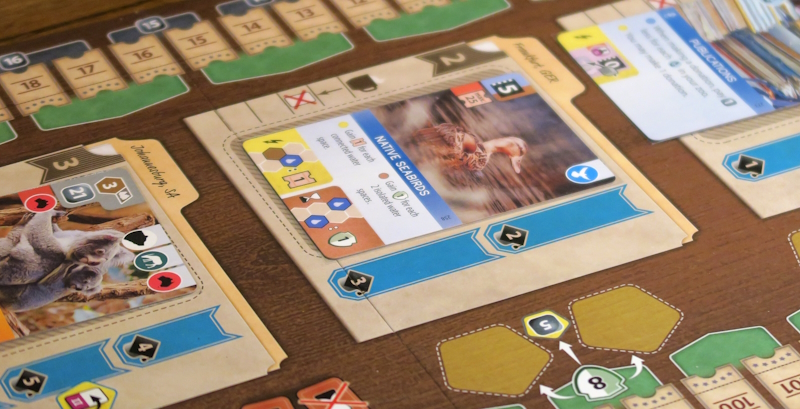
Ark Nova: Marine Worlds
– Image by boardGOATS

Firstly, there are sea animals that have to be played in new special enclosures that must be built adjacent to water.  Roughly half the sea animals are reef dwellers, and whenever a player adds a reef dweller to their zoo, they trigger the ability of all reef dwellers in that zoo. To deal with the dilution of the deck (caused by adding more cards), all sea cards feature a wave icon, and whenever it is revealed in the display, you discard the first card in the row, then replace it.  For each of the five Action cards there are four alternate versions with a little twist. Players draft these action cards at the start of play, replacing two of their standard action cards with these new ones, increasing the asymmetry in the game.
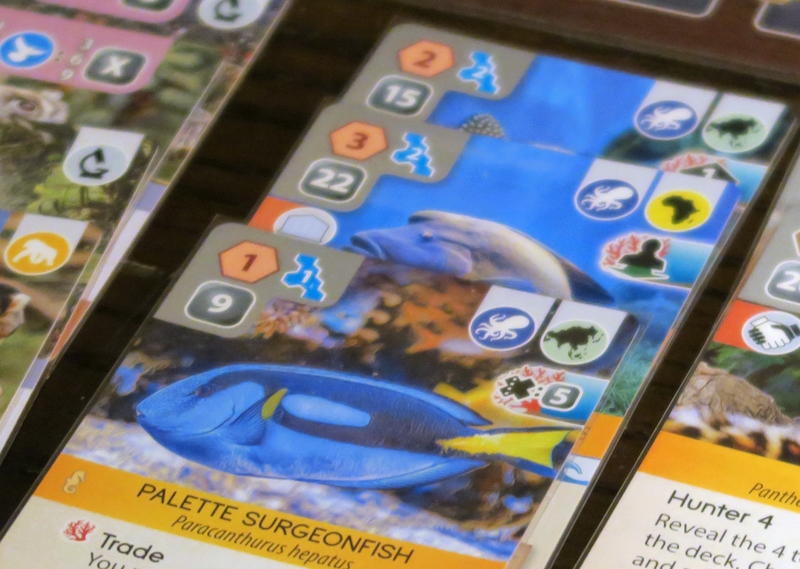
Ark Nova: Marine Worlds
– Image by boardGOATS

A new fourth University option is also available on the Association board.  If a player takes it, they claim one of six special Universities from the Reserve that feature one Research icon and one of six animal icons.  When a player takes this, they reveal Cards from the top of the deck and keep the first revealed card with an animal icon that matches their chosen University.  There are also new bonus tiles and other little bits and pieces to smooth out the game play.  Although the Marine Worlds expansion comes is modular, the group chose to play with all the components (Marine animals, asymmetric maps and drafted action cards).

Ark Nova: Marine Worlds
– Image by boardGOATS

Ivory took a Sponsor Card that gave him extra money for breaks and an Association Card that gave him the ability to hire workers.  This coupled with the lake map which gave extra money for building around the lake meant Ivory had access to lots of cash as the game developed.  Both Cobalt and Green took a Sponsor and an Animal Card, with Cobalt taking a map that allowed him to discard cards for money while Green had the map with the park restaurant.  While Cobalt was also able to build up a lot of cash, Green spent most of the game playing the poor relation, just scraping by.  The game started slowly, with initial conservation projects devoted to Australian animals, Birds, and African Animals.
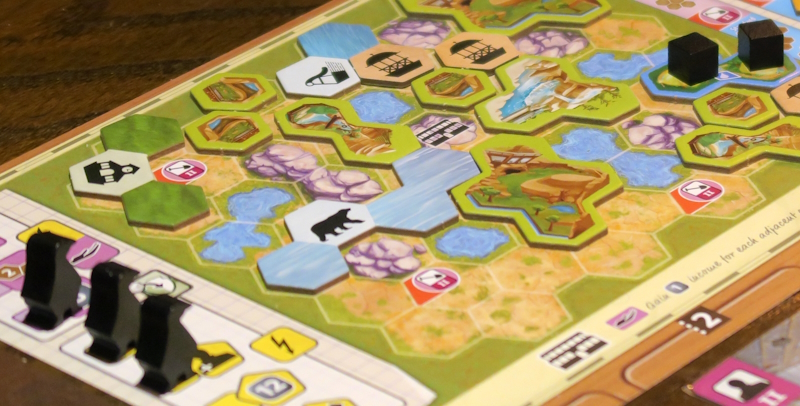
Ark Nova: Marine Worlds
– Image by boardGOATS

Both Green and Ivory wound up spending all their early money, trying to get Animals out, whereas Cobalt focused on the Association board and playing Sponsor cards.  After struggling with money for the first couple of rounds, Ivory managed to get two Australian animals, allowing him to put a token on the conservation card, giving an additional Zoo Dollars at each break/income step and from then on, money wasn’t too much of an issue for him. Green however, struggled for money for most of the game, where Cobalt continued to focus on Sponsor Cards and Association Actions, and as a result, he took an early lead on the Research track which gave him a much greater card choice. Cobalt did build an early aquarium, however, and started filling it up with fish.
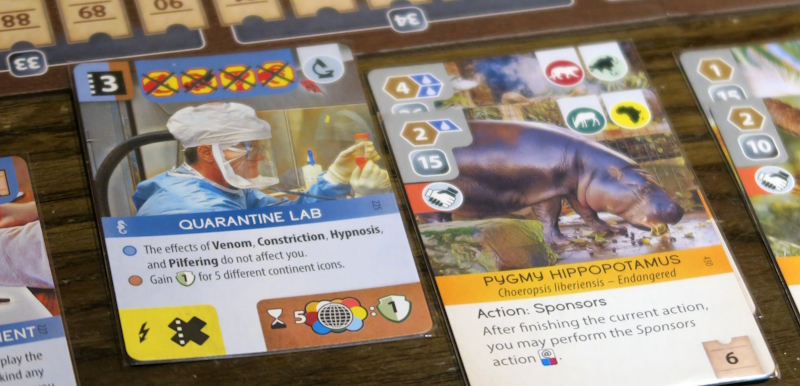
Ark Nova: Marine Worlds
– Image by boardGOATS

After a quick start, both on the conservation track and appeal track, Ivory’s game slowed down significantly—he was too focused on animals, compared to Green and Cobalt.  They had both spent time taking Association actions, leading them to Upgrade cards and progress up the Reputation track. Cobalt was able to significantly move up the Conservation track in the middle game using his Sponsor Cards, whereas Green focused on one big move by having lots of birds in his zoo.  Much to Pink’s disgust, although the panda was an option at one point in the game, the “wave” added by expansion pushed it on, so nobody got the Panda.  Instead, by the end of the game, Ivory had quite a collection of monkeys, Green had a few some birds and Cobalt had a lot of fish.
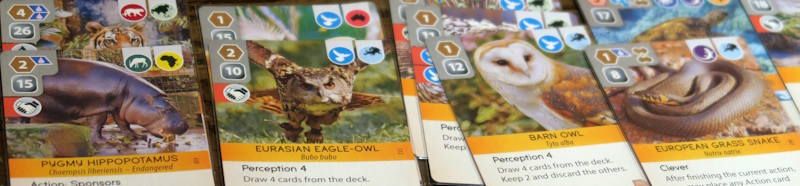
Ark Nova: Marine Worlds
– Image by boardGOATS

Going into the end game, Cobalt some way ahead on the Conservation track, followed by Green, while Green and Ivory were fairly similar in Appeal.  Cobalt then started playing lots of animals in his zoo and managed to completely fill it moving rapidly along the Appeal track.  It was clear he was soon going to bring the game to a close, due in part to both his (and Green’s) ability to make donations by upgrading the Association card. Green was also moving forwards on both tracks while Ivory was lagging behind albeit with three conservation cards in hand. Fortunately, Ivory had lots of “x tokens”, allowing him to play all his conservation cards (and gain the additional worker he needed, shooting up the conservation track, though sadly, it was too little too late.  From there, It wasn’t long before Cobalt’s Tokens to crossed, ending the game.
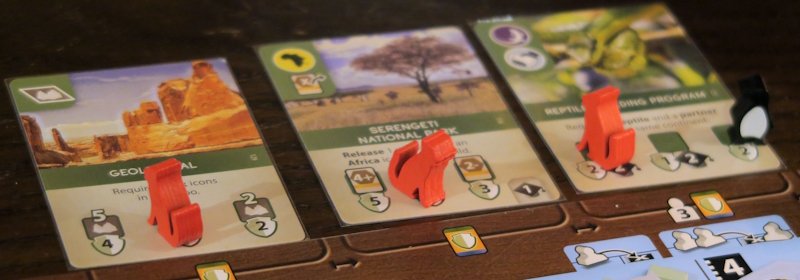
Ark Nova: Marine Worlds
– Image by boardGOATS

Everyone had made some mistakes reading their cards and/or abilities which cost a little bit, but was probably fairly balanced out.  Everyone managed to get the full four Conservation points on their personal scoring cards, but Green picked up quite a few extra points from the Sponsorship cards leaving him level with Cobalt.  Inevitably, this led to a hunt for tie-breakers—the rules state that the tied player who supported the most Conservation Projects wins the game.  As Green and Cobalt had also supported the same number of Conservation projects the rules dictated they should share the victory.  That said, Green magnanimously said he felt Cobalt had the edge by virtue of having way more coin at the end of the game.

Ark Nova: Marine Worlds
– Image by boardGOATS

On the next table, Blue, Pink and Mint had finally got underway playing Kavango.  This is a conservation, card-drafting game.  A bit like games like Sushi Go! and 7 Wonders, players draft cards to build their Reserve.  Like games like Terraforming Mars, however, cards can only be added to a player’s Reserve if they have its requirements.  These might be the food supply, or enough protection (environmental, poaching or climate).  Climate protection is unique because, as in real life, players have to work on that together.  At the end of the game, after three rounds, players add up the value of their animals, and any bonuses together with any points scored during the game for Research, and the player with the most points is the winner.

Kavango
– Image by boardGOATS

Pine joined them briefly and expressed an interest in playing another time, but decided this week he would take himself home to better acquaint himself with his C-vitamins and avoid unnecessarily sharing his bugs.  Mint was the nominal first player, though mostly the game is played simultaneously.  Blue started hard and fast building up lots of income, however, she was forced to invest heavily in Climate protection—honourable, but not necessarily lucrative.  Pink and Mint were a little slower to start, but made good progress.  Both got caught out by a very minor rules malfunction that had a significant impact:  Cards not used at the end of the round are supposed to go into a discard pile, but instead were returned to their decks.

Kavango
– Image by boardGOATS

Towards the end of the game, this suddenly became significant as some types of card are not available in the final rounds.  So, those that needed, for example, termites (like Mint), were unable to get them.  Pink and Mint were most obviously affected, though everyone got caught in some way or another.  The card draw hindered Blue as she struggled to find any migratory animals at all and had to abandon her personal objective as unachievable.  In contrast, Mint and Pink both did really well with theirs (birds and toxic creatures respectively), making the result much closer than it would otherwise have been with Blue the victor with a hundred and seventy-one, a single point more than Mint.

Kavango
– Image by boardGOATS

Meanwhile, Plum and Byzantium had kindly agreed to take Lime to the other side of the room to play the Golden GOAT Award 2024 Winner, Stamp Swap.  Somehow, despite the flurry of outings it received towards the end of last year, Lime had missed out on playing it.  This is also a drafting-type game, but this time with stamps (mostly).  The game takes place over three rounds, each split into two parts:  Firstly players take it in turns to choose from a central pool, then players divide their pile into two and the first player chooses one pile from another player to take, who keeps their other pile and chooses one from another play—and thus the piles of stamps are swapped.

Stamp Swap
– Image by boardGOATS

On previous outings, Byzantium had managed to annoy Blue by just beating her.  It had been his birthday at the weekend, so the question was whether he would get another, albeit slightly belated, birthday gift in the form of another victory.  Sadly for Byzantium, it was not to be though.  Plum took ten more points than him during the game and another ten more in the end game scoring between them, giving poor Lime quite a trampling on his first game.  Stamp Swap wasn’t the only popular new game to get an outing this evening.  On the next table, Jade and Sapphire were introducing Purple and Black to Fromage, a sort of cheesy worker placement game with simultaneous play and a time component, not completely unlike Tzolk’in.
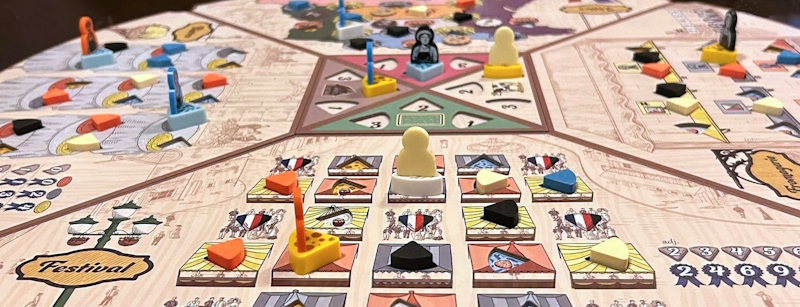
Fromage
– Image by boardGOATS

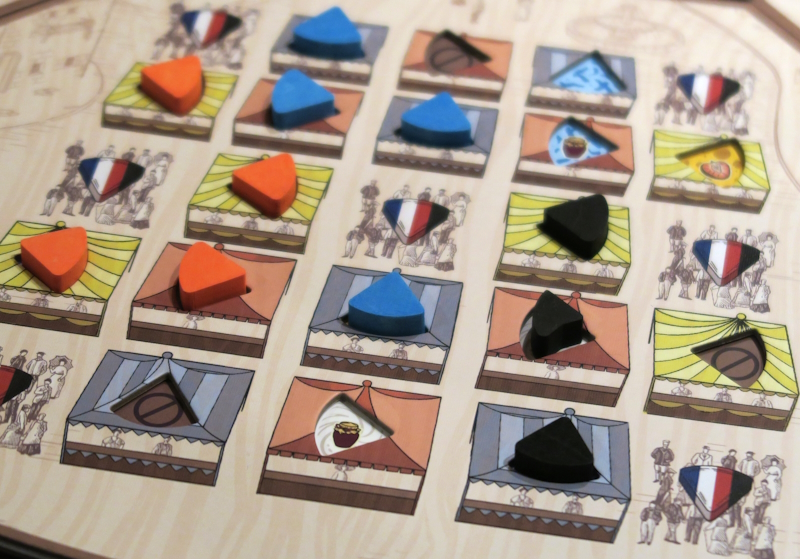
The actions are tied up in four “mini-games” which players take it in turns to participate in.  It has proven quite a popular little game because once everyone knows how to play, there is relatively little down time and despite playing different areas at different times, quite a lot of interaction.  Players simultaneously choose where to place their workers, in their quadrant of the board, and once everyone is done, the board is turned and then players retrieve any workers they can and then place workers on their next quadrant.  Players score points for occupying tables in the Bistro quadrant, holding the majority in regions in the Villes quadrant, filling different tables in the Fromagerie quadrant, occupying contiguous areas in the Festival quadrant, and for fulfilling Orders.
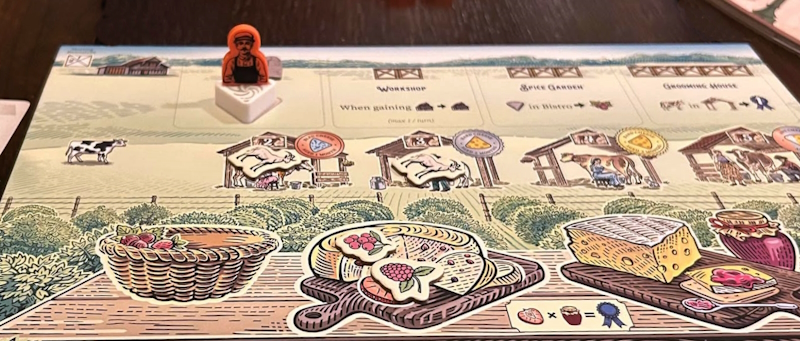
Fromage
– Image by boardGOATS

This time, Purple and Jade made a bit of a killing in the bistro taking nearly thirty points each, while Sapphire took twenty-two points in the Villes.  Black’s strategy was somewhat different, picking up points more evenly across the board and focusing particularly on fruit.  In the end, despite the differences in approaches, the scores were very similar, with only three points covering second to fourth.  The winner was Jade, however, some twenty points clear of Sapphire, who just nicked second, but a single point.  The game had been well received, and the group ended up “Doing a Lime” and playing it a second time.

Fromage
– Image by boardGOATS

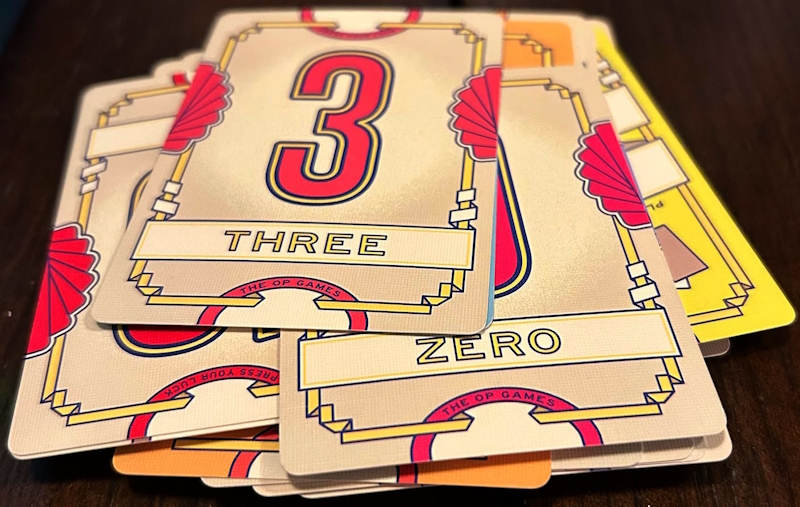
The second game was also tight, although everyone was much more even in where they scored their points.  Sapphire just edged it though, again by a single point, again from Black, pushing Jade into third.  There was still time after the second game for something else, something new, something quick—Flip 7.  This is a really simple “Push your Luck” game reminiscent of Port Royal, where players simply turn over cards and gamble on not revealing the same number twice.  The catch is that each numbered card appears in the deck that number of times (i.e there is one one, two twos and so on).  Flipping over seven in a row gives fifteen bonus points.

Flip 7
– Image by boardGOATS

There are also some action cards in the deck, “Flip Three”, “Freeze”, “Second Chance” and modifier cards which give extra points.  Players take it in turns to decide whether they want to “flip” or ” stick”.  The game ends when players have reached the pre-agreed total (two hundred, according to the rules, though games can easily be made longer or shorter as desired).  In the first round, three players scored well, but the rest of the game did not go so well.  In fact, the only player who managed to score in every round was Black with a fairly consistent total around thirty.  It was no surprise that he was the first to pass two hundred and was therefore the winner, ahead of Sapphire and Purple, who were joint second with a hundred and seventy-six.
Flip 7
– Image by boardGOATS

Learning Outcome:  Zoos are even more fun with sea creatures.
7th January 2025

Blue and Pink were early for a change and had mostly finished their supper when everyone else arrived.  The “Feature Game” was to be Concordia Venus which is a reimplementation of Concordia, but can also be played with an upgrade-expansion to the original game.  Concordia is a strategy game of economic development in Roman times and although the rules are relatively simple, the game has a lot of depth.  Plum had been super-keen to play this, and, as it turned out, there were several others who were also very keen to give it a go, so as a result, there were soon two games underway.

Concordia: Venus
– Image by boardGOATS

The first of these involved Plum, Sapphire and Teal, playing with Burgundy‘s copy of the original Concordia with the Venus expansion.  This was one of Burgundy‘s favourite games and many people in the group fondly remember being taught it by him.  Game play is super-simple:  each player has a hand of cards, so on their turn, they play one and do what it says.  And that is all there is to it.  Players start with a hand of seven Personality Cards which provide a simple array of actions:  move Colonists and build, produce Resources, trade Resources, use another player’s most recently played Card, buy more Cards, recycle their Card deck.

Concordia: Venus
– Image by boardGOATS

Players use their Consul card to buy more Personality Cards during the game.  As well as providing more and increasingly powerful options, they are also key to scoring.  Each card is related to an ancient god who rewards its owner with victory points according to different scoring criteria.  This reward is then multiplied by the number of Cards the player has that are dedicated to that god.  For example, Saturnus rewards players for having buildings in different provinces.  If a player has built in seven different provinces and has four cards dedicated to Saturnus, they receive twenty-eight points.

Concordia: Venus
– Image by boardGOATS

The game ends either after a player purchases the last card from the display, or after one player builds their fifteenth house after which everyone else completes their final turn before scoring.  One of the things that is very clever about the game is how much variety is achieved from very little variation.  Players all begin with the same starting cards and the same resources; the only change from game to game is the order the Cards appear in the market and the distribution of City Resource tiles at the start of the game which dictate which cities produce what.  With these small variations the game can change hugely as players fight to control the area that gives the most lucrative cities during the game and when combined with their Cards to give the most points.

Concordia: Venus
– Image by boardGOATS

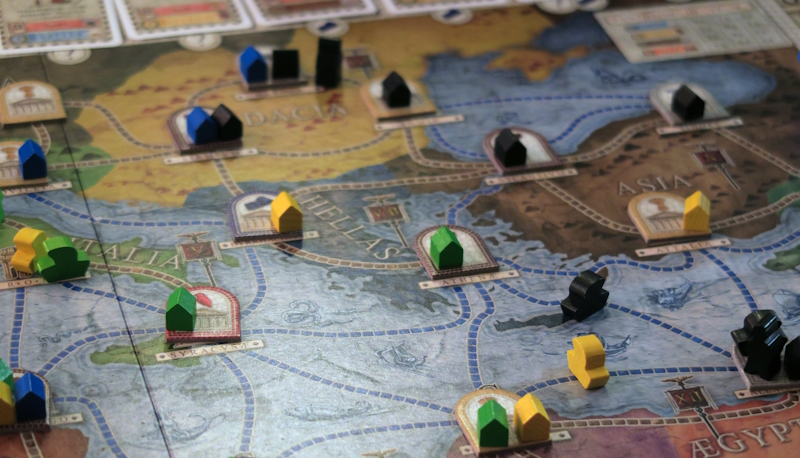
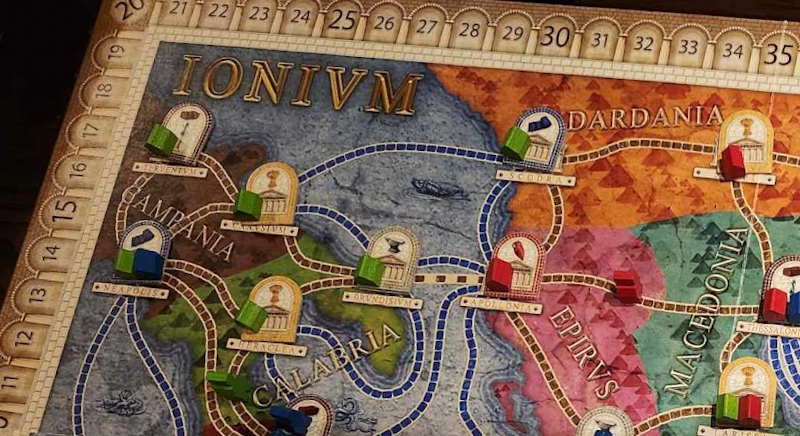
There is even more variation to be had with alternative maps, but the reimplementation of Concordia, Venus, introduces an eighth Card to the starting hand (the Magister, which allows a player to repeat their previous action), the addition of the Minerva scoring Cards (which give players extra points for each city of the type indicated by the specialist), as well as three new maps (Cyprus, Hellas and Ionium).  These can also be added to the base game using a combination of the Venus expansion and the Balearica / Cyprus expansion; this was was the version Plum, Sapphire and Teal played, which meant they started by sorting out what they needed to play the game.

Concordia: Venus
– Image by boardGOATS

The group chose to use the Ionium map from the Venus expansion as it plays well with three.  Sapphire had a positively storming game—he was perhaps helped by the fact that Teal and Plum started the game by heading east leaving Sapphire to explore the west unopposed, but he still had to make it work for him.  And make it work he did, with two turns in which he claimed four cities.  Later in the game, he made good use of his Diplomat Card to copy the Consul Plum had used.  Sapphire had a couple of Provinces to himself so Prefecting in those areas helped only him. Teal and Plum had both built in a couple of Cloth-rich areas, but Plum wasn’t always able to make the best of hers and on two occasions her storage are was full when she could have received goods.

Concordia: Venus
– Image by boardGOATS

In the end game scoring, Sapphire led in the Jupiter, Saturn and Venus scoring and jointly in the Mars scoring.  To top that, he also triggered the end of the game giving him the Concordia Card (and seven points) as well as getting fifteen points for the Minerva scoring with his Smith card.  As a result, he finished with a hundred and twenty-nine points, sixteen more than Teal who finished a very creditable third in a game where it is notoriously hard to to well in the first game.  Meanwhile, Black and Byzantium were leading another game of Concordia, with Purple and Cobalt.

Concordia
– Image by boardGOATS

As Cobalt was new to the game, this group played with the classic Imperium map and included the intermediate individual scoring for each player when they played their Tribune card for the first time.  Black spread out over the board while Purple and Byzantium were more restrained, with Byzantium only spreading his tentacles at the end of the game  Cobalt collected a lot of Cards, although Byzantium had most of the Colonist Cards.  Despite the differences in approach, this game was really tight, so much so that Black and Byzantium tied for victory on one hundred and forty-nine points with Cobalt some fifteen points behind.

Concordia
– Image by boardGOATS

As is always the case when there is a tie, there was a rummage in the rule book for a tie-break.  In this case, the tie is won by the player owning the Præfectus Magnus Card, or by the tied player who would receive him next in the course of the game.  This nominally went to Black, but it was agreed this was a rubbish tie-break rule as players can’t plan for this and just get given it when someone else plays their Prefect Card.  While all this harmony was on-going, Jade was introducing Ivory to Fromage, with the help of Blue and Pink who had both played it once before elsewhere. This is a really cool worker placement game where the actions have a time component to them.

Fromage
– Image by boardGOATS

This sort of thing is not new—Tzolk’in does something similar where players place workers on wheels which are turned at the end of each round and, the longer the workers stay, the more powerful the action they can do.  In the case of Fromage, this is sort of reversed in that players do the action and, if they do a more powerful action, then their workers stay on the board for longer.  The peril here is that, whereas in Tzolk’in players can always do a less powerful action and take workers off early if they have to, in Fromage players only have four workers and it is very easy to end up with all of them sat on the board leaving people unable to do anything at all.  Fromage has proved popular since its release just before Christmas, and as a result, it is on its second Tuesday outing already.

Fromage
– Image by boardGOATS

The actions are tied up in four “mini-games” which players take it in turns to participate in.  It has proven quite a popular little game because once everyone knows how to play, there is relatively little down time and despite playing different areas at different times, quite a lot of interaction.  Players simultaneously choose where to place their workers, in their quadrant of the board, and once everyone is done, the board is turned and then players retrieve any workers they can and then place workers on their next quadrant.  Players score points for occupying tables in the Bistro quadrant, holding the majority in regions in the Villes quadrant, filling different tables in the Fromagerie quadrant, occupying contiguous areas in the Festival quadrant, and for fulfilling Orders.

Fromage
– Image by boardGOATS

This time, the game was very close, especially between Ivory and Pink, despite there being a lot of different strategies at play.  Pink, for example, scored very heavily for the Bistro getting forty-five points (more than half his total) from the one location.  In contrast, Blue scored thirty points for her contracts and nineteen from the Fromagerie, but very little anywhere else, while Ivory and Jade scored much more evenly in the different categories.  There was only one point between Pink and Ivory in the final reckoning, however, with Pink’s eighty-one just giving him victory.  With the rest of the group remembering Burgundy while playing Concordia, it seemed only fitting that this group should move on to another of Burgundy’s favourites: Splendor.

Splendor
– Image by boardGOATS

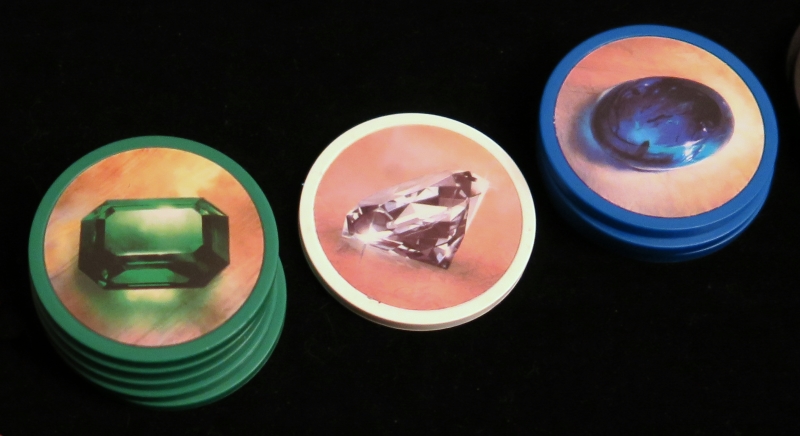
Burgundy was almost unbeatable at Splendor and at one point had a two-year unbeaten run on Tuesdays—so much so that others in the group would choose to play Splendor when he was occupied elsewhere, just to break the monotony!  The game is quite simple:  on their turn, players either take Gem-stone chips, or use them to buy Cards.  The Cards act as a perpetual source of Gems.  Thus, the aim of the game is to build a robust engine to enable players to buy the more expensive Cards that also give points, or allow players to collect Noble tiles for having sets of Cards associated with particular combinations of Gems.  This was another close game with Jade looking like he was going to end the game for a couple of rounds and Blue and Ivory looking for a couple of large turns.

Splendor
– Image by boardGOATS

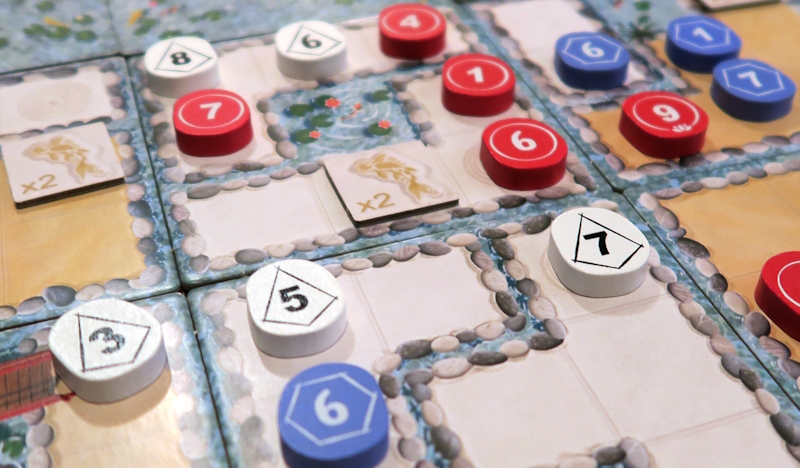
That was until Pink did it for him by ending his turn with sixteen points and as he was last in the round, that meant nobody else got another turn.  So Jade finished second with fourteen with Blue in third.  Ivory decided to call it a night there, leaving Blue, Pink and Jade to play one last game, which ended up being Hiroba.  This is a sort of area-control filler game, where players take it in turns to place one of their nine Stones in the nine-by-nine grid following some simple, Sudoku-like rules.  Each Stone is numbered one to nine, but they are numbered on both sides such that the total adds up to ten.

Hiroba
– Image by boardGOATS

After players have placed their first Stone, others must be placed in the same row or column as one they have already placed, while ensuring that none of the Stones in any row, column or Garden has the same number.  There are typically two Gardens on each of the nine, three-by-three tiles that make up the board and players are trying to win control of them.  At the end of the game, the player with the highest total face value in each Garden will score points equal to the total size of that Garden.  However, for each Koi Pond on the board, a “times two” token is awarded to the player with the lowest value orthogonally adjacent pebble.

Hiroba
– Image by boardGOATS

Players who are awarded one of these place them in any empty square in any garden on the board, where it will double the points scored for that garden.  Thus, while players want to place the highest value stones to win control of Gardens this is tensioned by the desire to place low value Stones near Ponds in order to gain the multipliers and get a good score.  This game was less close than the previous ones, well—it was close for second place, but Blue who had finally woken up manged to take a couple of large areas and winning a lot of “times two” multipliers, she finished with an unassailable total of thirty-seven points.  This was some twelve more than Pink who won the battle for second.

Hiroba
– Image by boardGOATS

Learning Outcome:  Burgundy had great taste in games.

23rd December 2024

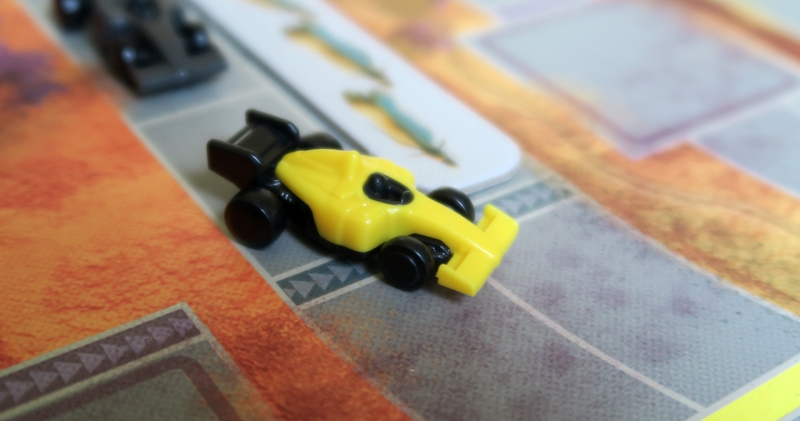
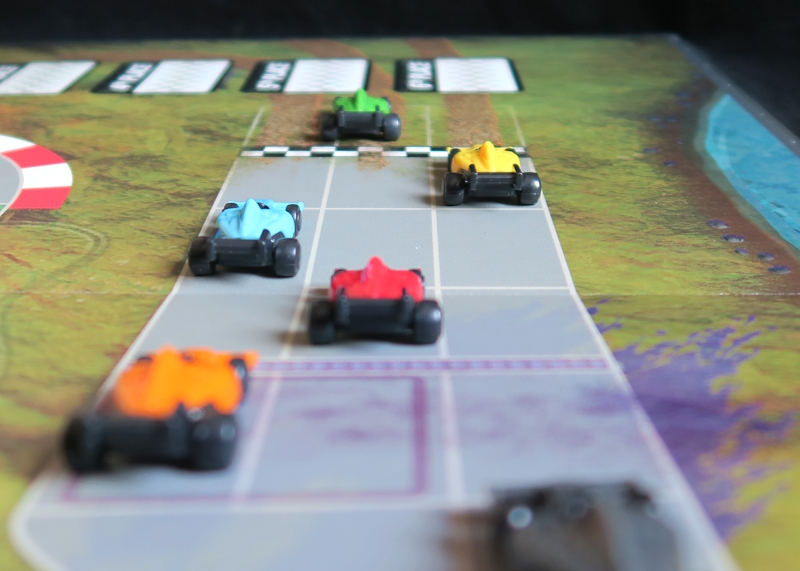
Being an extraordinary Monday meeting and only two days before Christmas, we didn’t really know who or what to expect, so didn’t have a “Feature Game” planned.  In the event, almost everyone expected turned up and we played some of our all-time favourite games.  Pink was first out of the traps, and persuaded Black, Lime and Pine to join him in a game of his favourite race game, Downforce.  This is a fun car racing game where players bet on cars as well as try to win the race.  What makes it special is that players play cards, but, whereas in other race games players can only influence their own car, in Downforce, the cards can be used to play anything from only the player’s own card, to every car on the track (depending on the card).

Downforce: Wild Ride
– Image by boardGOATS

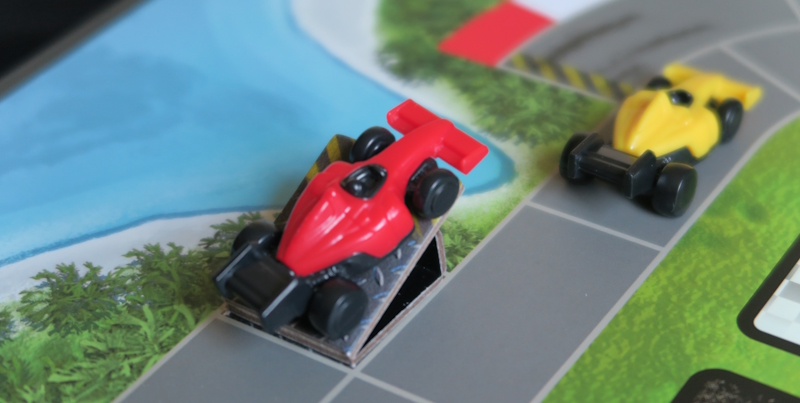
This time, the group played with the Aloha Sands track from the Wild Ride expansion which features water jumps. Cars can use these ramps if they are moving fast enough which lets players pass other cars and move more efficiently. Thus, hand management to take full advantage of the different speed cards is crucial.  The game begins with an auction of cars.  This is after players have been dealt their hand of cards, and this time, the blue car was popular and went to “determined” Lime, who outbid “cunning” Pink.  With six cars on the grid, and four players, there is the possibility of some getting more than one vehicle—although one car (green) went unclaimed, Lime ended up with orange as a second.

Downforce: Wild Ride
– Image by boardGOATS

The Aloha Sands only has two betting lines, and the group chose to use the first two featuring on the betting variant score sheet.  In this “odds” variant, players get better “odds” for a car that is at placed less well than one that is currently winning.  The red car, owned by Pine took an early lead, but by the time the cars made it to the second (and final) betting line, it had dropped to third.  Pink had a fist full of cards that favoured to the blue car, and although he had been outbid for it, he had decided to push it along anyhow and bet on it.  As a result, with both Lime and Pink favouring it, the blue car moved through the field (aided by some double jumps) and crossed the finishing line first.

Downforce: Wild Ride
– Image by boardGOATS

Second place went to Black’s little black car with Pine’s red roadster completing the podium.  Betting and car costs have a huge impact on the final scores though, as can the initial outlay for the vehicle.  In this case, despite paying for two cars at the start, the fact that Lime owned the winning car and had also bet on it, meant he had an unassailable twenty-one million dollars, eight million more than Pink in second place.  With the race over, the quartet chose to move onto a more festive game, Jokkmokk—a cute little set collecting game that went down really well when it got its first outing last year.

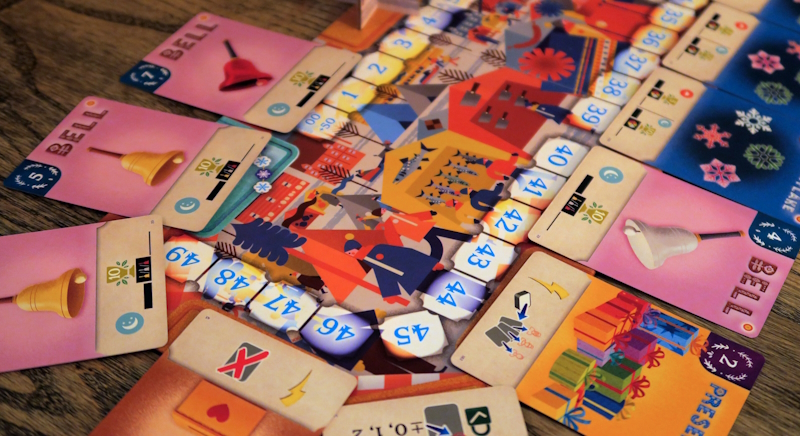
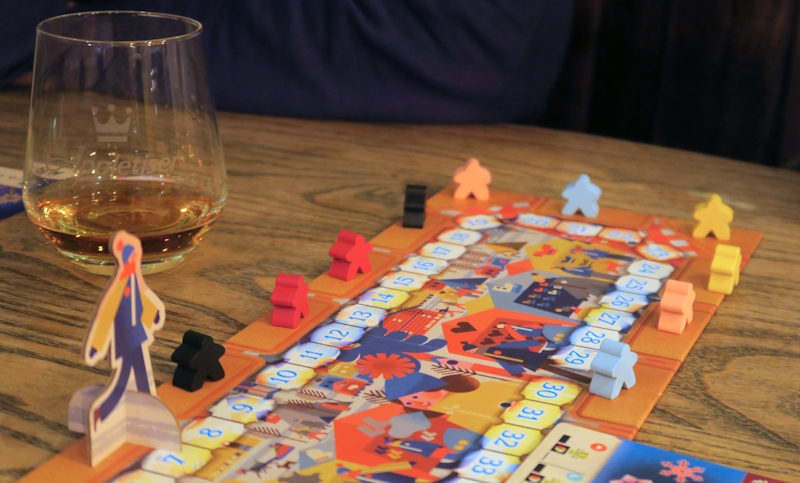
Jokkmokk: The Winter Market
– Image by boardGOATS

In this game, players move one of their two family members, the one furthest back, to an empty space and claim the associated card before resoling its effect and refilling the empty space.  Some cards score points in the middle, others only at the end, so the sets of cards used can really change the game.  As this was the second game, the group chose to use the “Second Game” set, featuring the Fika (a Swedish custom of enjoying a coffee and a treat with friends), Aurora Borealis, Snowflake, Patchwork, Mystery Box decks.  Of these, the Snowflake cards scored during the game giving Black and early lead with fifteen points, five more than Pine in second.

Jokkmokk: The Winter Market
– Image by boardGOATS

The mid-game points were chicken-feed compared to the end game scoring, however, with lots of points available for Fika and Patchwork scoring and for the face value of the cards themselves.  The winner was Pine with a total of one hundred and twenty-eight, eight more than Pink in second and eighteen more than Black in third.  Everyone had enjoyed the game so much, that when Lime inevitably suggested playing again, everyone else agreed.  This time the group used the “Gift of Giving” set of cards, including the Donation, Bell, Sparkler, Snowflake, Mystery Box and Presents decks.

Jokkmokk: The Winter Market
– Image by boardGOATS

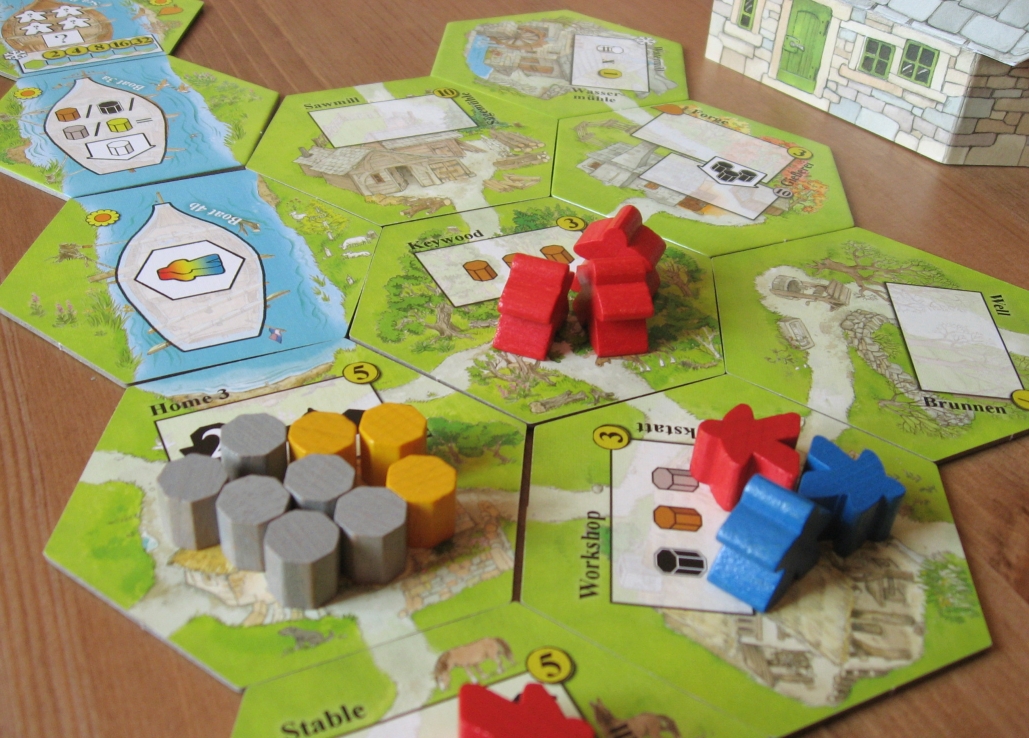
The game followed a similar pattern to the first, with Black and leading at the midpoint with Pine in second and Pine taking overall victory.  This time, Lime was the runner-up, however, with Black taking third again.  Meanwhile, on the next table, Blue, Plum, Byzantium and Purple were playing Blue’s favourite game, Keyflower.  This is it’s second outing of the year, but Plum and Byzantium had missed out last time.  They had played it before, but had felt that it didn’t shine with two players and were keen to see how it played with more.

Keyflower
– Image by boardGOATS

Keyflower is an auction and worker placement, with elements of set collection and even network building.  Although everyone had played it before, Blue went through the rules.  The idea is that players use meeples to bid on tiles, but can also use them to activate tiles to gain their benefit (usually Resources, Skill tiles or the ability to move resources around their Village).  At the end of each of the four rounds players add the tiles they have won to their Village and get any meeples back that were used to activate tiles in their own village.

Keyflower
– Image by boardGOATS

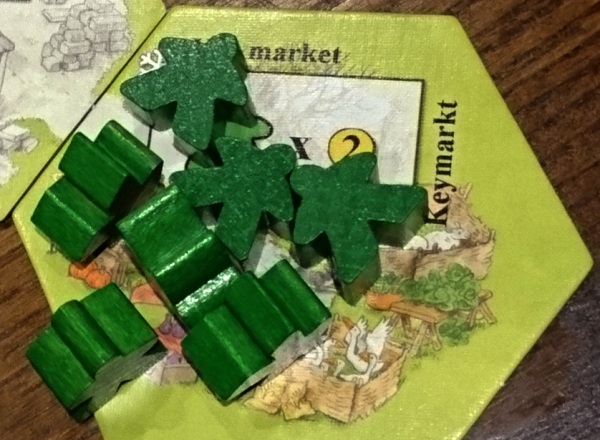
One of the key aspects of the game is the colour of the meeples, as players have to “follow” when bidding or activating a tile. As a result controlling the number of blue, red and yellow meeples they have is a key part of the game.  More, green meeples, which are special and can only be acquired by activating specific tiles, can be really valuable.  Blue had a Winter tile that gave points for having green meeples at the end of the game, so started bidding on the Peddlar which came out in Spring.  Byzantium had other ideas, however, and outbid Blue.  In fact, that was just the start of a tight game where there was a lot of competition for many tiles.


Keyflower
– Image by boardGOATS

Keyflower is a game that typically rewards players who keep their options open, but this time, Blue found her options quickly narrowed and ended up going for sets of three Skills tiles.  This can be lucrative, but can also be difficult to make work, so like many things in Keyflower is a bit of a gamble and with all her eggs in the one basket, she had no choice but to ensure she won the Scribes tile by ensuring she went first in the final round and had a large pile of red meeples to back it up.  Tension mounted as players fought for the tiles they needed.  The Keythedral changed hands several times, and the Jeweller, the Village Hall and the Watermill were all strongly contested.

Keyflower
– Image by boardGOATS

In the final scoring, it was clear that the Scribes tiles made all the difference, with Blue finishing with eighty-six points, fifteen more than Byzantium in second with Plum taking third.  As the tiles were packed away, there was some discussion about the game, with Plum and Byzantium commenting that the balance of tiles is less swingy in four-player Keyflower than with two  While they were packing up, the second of two games on the next table was coming to an end.  In the first of these, Jade led Sapphire and Cobalt in the hot-off-the-press game, Fromage, a worker placement game about cheese-making in France.

Fromage
– Image by boardGOATS

This is a clever game with a “time” element, similar in feel to Tzolk’in.  In both these games, workers left on the board for longer give more valuable actions, however, in Tzolk’in, players place their workers and the options become better the longer they stay on the board with players making the decision as to what they get when they remove workers from the board.  Players can also only place workers or remove them, not both.  In Fromage, there is more flexibility, and the action is carried out when the workers are placed and then remain on the board for longer for the more valuable actions.

Fromage
– Image by boardGOATS

Game play is simultaneous, with all players placing their workers at the same time working on their quarter of the board.  Once everyone has finished, the board is rotated, and any workers who have finished their spell on the board are returned to their owner to be placed again in the next round.  Workers can stay on the board for one, two or three turns, so a key part of the game is planning and with only three workers, making sure that players don’t end up with all of them stuck on the board.  This was another tight game with players scoring fairly evenly in the four areas of the board, the Bistro, Festival, Fromagerie and Ville.

Fromage
– Image by boardGOATS

Cobalt just edged it on Fruit and Orders, however, giving him a four-point victory over Jade in second with Sapphire not far behind.  There was just time for one last game and the choice was another recent popular game, Looot.  This is a clever management game, using a double placement mechanism where Vikings conquer territory on the central player board, allowing players to gain resources, buildings and objective tiles while they build their village on their personal board using tiles from the common board to gain victory points.  This was another tight game, especially between first and second place.

Looot
– Image by boardGOATS

It was backwards and forwards between Cobalt and Jade and finished with just two points between them.  Once again though, Cobalt just had the edge, his hundred and six points just pushing Jade into second again.  It had been a good night though and a fitting end to the evening, and the last meeting of the year at the pub.  As the last Christmas cards were handed out and final Season’s Greetings shared, people headed off into the darkness and with just two sleeps till the big day.

Santa's Workshop
– Image by boardGOATS

Learning outcome:  You don’t have to play Festive games at Christmas to have fun.

28th Movember 2023

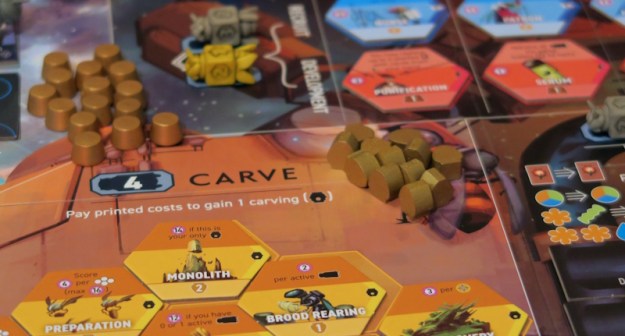
What started out threatening to be a quiet night with the absence of Green, Lilac, Purple and Black, turned out to be quite lively in the end.  As Blue and Pink finished their supper, Pine, then Jade, Sapphire, Plum and Byzantium arrived, soon followed by Teal, Ivory and Lime.  Ivory was armed with his new, shiny copy of Apiary, which was to be the “Feature Game“.  This is a worker-placement, hive-building game where players explore planets, gather resources, develop technologies, and create carvings to demonstrate their faction’s strengths before the end of the year when it is time to hibernate.

Apiary
– Image by boardGOATS

At first glance, Apiary seems to be a fairly simple Worker Placement game, where players have the Tzolk’in choice: place a Worker or retrieve Workers.  Unlike in Tzolk’in where Workers carry out their action when they are retrieved, in Apiary, players take the action and gain the associated benefits when placing a Worker, while retrieving Workers enables players to run any engine they have that relies on those recalled workers.   Unlike many other worker placement games, there is no blocking and players can add workers to any space as long as they have the power and required resources.  If a space is already occupied the existing occupant is “bumped” either to the next space (for certain areas) or sent back to the owner (with a choice to increase strength and make available straight away, or hold on to make use of income abilities).

Apiary
– Image by boardGOATS

Players start with asymmetric factions and basic resources (Pollen, Water, and Fiber) according to their faction.  The Action spaces are mostly about getting or trading Resources and Cards, or adding Tiles to improve their base.  There are five available to players at the start of the game: Explore, Advance, Grow, Research and Convert.  Explore allows players to visit planets, gaining bonuses for being the first to visit a planet, and also resources from the planets they discover while Advance allows players access tiles they can build if they have the resources to do so.  Grow enables players to gain their fourth worker (or gain a worker back from the pool once it hibernates) and allows players to build ship frames while Research gives players access to the Seed Card deck, some of which are incredibly powerful.

Apiary
– Image by boardGOATS

Wax and Honey are more advanced resources that can be created during the game using the Convert Action.  Honey, in particular, is required for the final Action, Carve (which also needs a Level Four worker).   When Workers return to the Active Pool (either by being bumped or because they have been recalled), their value increases by one. Level Four Workers trigger special bonuses when played, but instead of returning to the Active Pool when bumped or retrieved, they hibernate. In this way, the player loses that worker, but gains a bonus.   The game ends when all the hibernate spots are taken or when a player uses all seven of their hibernate tokens.

Apiary
– Image by boardGOATS

The game is beautifully produced with great art and lovely wooden resource pieces.  The QueenShip is arguably the best, looking a bit like Starbug from Red Dwarf.  With that and the theme (which had those traveling from Swindon crying, “Bees… In… Space!” à la The Muppets “Pigs in Space!” at intervals), the game was off to a good start.  The not-blocked worker space mechanism is similar to that in Euphoria: Build a Better Dystopia, which Plum, Byzantium and Jade had played at HandyCon.  Everyone starts off with a unique player “Hive Mat” and starting Faction Tile. Ivory began with “The Log” and “The Sini” which gave points for filing the Hive Mat and for each Development Tiles surrounding the Faction Tile (respectively), so he prioritised getting Development Tiles.

Apiary
– Image by boardGOATS

Cobalt’s Faction, “The Cypri”, gave him four points for each Carving adjacent to his Faction Tile, but found that hard to achieve needing a lot of Honey, so concentrated elsewhere instead.  Plum’s focus was on her Hive Mat, “The Warre”, which had spaces that progressed her along the Queen’s Favour track when she covered them, so she decided early to try and focus on that. She had some Farm Tiles that also would have helped her gain more Favour when she triggered the income for taking workers back, but she didn’t use that until later as, although her workers were bumped a lot, she kept choosing to increase their strength and have them available straight away instead.

Apiary
– Image by boardGOATS

Byzantium started with “The Lama” for his faction that gave him a point for each tile he added to his Hive which grew quite rapidly.  He also nabbed a Farm Tile from under Plum’s nose which gave him the Edge on the Queen’s Favour Track.  As the game came to a close, everyone scrabbled to try to finish things off—like filling their Hive Mat (Plum’s last space was filled for free when she covered the adjacent hex).  The lead at the end of the game was held by Plum, but that isn’t really where the points are in Apiary.  In contrast to everyone else, Ivory almost completely eschewed the Queen’s Favour, focusing on Planted Cards and Honey Pots, which gave him over thirty points alone, and as a result he charged from the back of the pack to take victory.

Apiary
– Image by boardGOATS

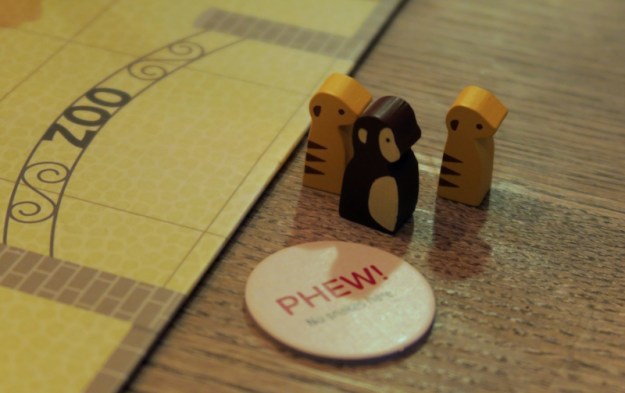
Meanwhile on the other side of the room, Pink, who had been fondly remembering his visit to the see the pandas “Down Under”, sucked Pine and Blue into a game of Zoo Break.  This is a cooperative game where players are zoo keepers trying to prevent the marauding animals escaping the zoo.  This has had a couple of outings this year the first was a disaster ended when a cobra got out, but the second was a hard-fought victory.  This time, with just three keepers, turns would come round more frequently, so to make things a little more interesting, Pink (Lucky Duck), Pine (Gardener) and Blue (Angler) decided to play with the Faulty Lock Variant, personally recommended by the designer.

Zoo Break
– Image by boardGOATS

The idea of the game is that players take it in turns to roll the Action Die to found out how many actions they get, then after carrying out the actions, players first draw an Escape card and then a Move card, to see what animals escape and move.  In the original game, once animals are locked up, however, they can’t escape, which means the game gets progressively easier.  Further, some players potentially end up lurking about with nothing much to do waiting for someone else to deal with the last couple of mischievous meerkats.  In the Faulty Lock Variant, however, when an Escape card is drawn for an enclosure that has already been locked, a die is rolled to see if the lock is faulty and whether the animal escapes or not.

Zoo Break
– Image by boardGOATS

The problem with the Faulty Lock Variant is that it can extend the game quite a bit.  That said, it didn’t look like that was going to be a problem as Pink chucked first Pine and then Blue under the Charging Rhinoceros.  Then Pink got trampled too, before Pine paid a couple more visits thanks to a mad Elephant and a venomous snake.  Eventually, the team got their act together and locked up the Rhino, and then the Capuchins, Pandas, and Elephants.  Every now and then, a lock failed and an Elephant got out, but gradually, the animals were being locked up, and eventually the last of the Meerkats was evicted from the part in the fountain locked up (aside from the two that escaped).

Zoo Break
– Image by boardGOATS

It had been a lot of fun, even though Pink was sad that he’d not been hugged by a lonely Panda, and jealous of Pine who had.  It had taken all evening though, and on the next table, Jade, Sapphire, Lime and Teal had managed two leisurely games and a bit of chit-chat.  The first game was Isle of Cats: Explore & Draw, a role and write version of the much more substantial card-drafting, polyomino cat-tile-placing game, Isle of Cats.  In Explore & Draw, instead of drafting cards before choosing tiles, players choose a set of cards each turn and then draw their “discoveries” on their boats.

Isle of Cats: Explore & Draw
– Image by boardGOATS

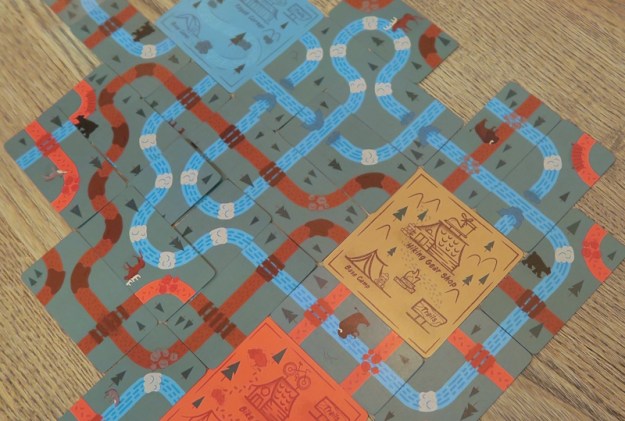
This time it was relatively close for second place, but Sapphire won by something of a landslide, his seventy-nine points was some twenty-five points ahead of Lime who took second with his neatly coloured in boat.  Once the wipe-clean boards had all been cleaned, Teal took an early night before the remaining trio played moved on to the card drafting and path building game, Trailblazers.  In this game, players start with eight Trail cards and draft two cards three times, adding them to their tableau.  The cards must either be placed adjacent to or overlapping other cards as players try to construct long and elaborate trails in three different colours.

Trailblazers
– Image by boardGOATS

Only closed loops in a single colour, that start and end at a matching campsite will score points and players also compete to fulfill “First To” and “End Game” goals.  The game ends after four rounds, when the player with the most points from closed loops and goals achieved is the winner.  This was much closer than the previous game, though the outcome was, ultimately, much the same.  The goal cards in play were “Hikers’ Quartet”, “Trail Hugs”, “Forever Float” and ” Wanderlust”, though the players only scored for the last two (giving points for the longest single blue “Kayak” route and the longest total brown “Hiking” routes.

Trailblazers
– Image by
boardGOATS

Lime and Jade tried to build trails of all three types, Hiking, Kayaking and Biking evenly, making the best of the cards they had.  However, Sapphire focused exclusively on the two that featured in the “Forever Float” and ” Wanderlust” goals, finishing with twenty-eight points for his Kayaking routes alone.  While it was very close when the trail lengths were taken into account, Sapphire took first place for both end game bonuses and Lime came second in both, which also reflected the final placing.  There was some chatter, while “Bees… In… Space!” finished and then it was time for everyone to go home to hibernate until next time.

Trailblazers
– Image by boardGOATS

Learning Outcome: Golden Honey is valuable.

Deutscher Spiele Preis – 2019

With “Essen” approaching, last week the Deutscher Spiele Preis list was announced. This is the result of an open vote by games clubs, gamers and people in the industry.  It typically rewards a slightly heavier game than the the Spiel des Jahres awards, but as the top ten are published, a range of tastes and complexities usually feature.  Last year number one on the list was Azul, the first game to win both the Deutscher Spiele Preis and the Spiel des Jahres since Dominion in 2009.  This year, the winner of the Deutscher Spiele Preis is the same as the winner of the Kennerspiel des Jahres i.e. Wingspan (Flügelschlag in Germany).  This is a great card game with fantastic production values which is well deserving of the prize.

Wingspan
– Image by boardGOATS

Other games in the top ten list include third placed Teotihuacan: City of Gods which is emotionally the sequel to the well received Tzolk’in: They Mayan Calendar and the hugely popular fifth placed Architects of the West Kingdom, both very solid “Euro Games”.  The Taverns of Tiefenthal, Underwater Cities and Newton also medium-heavy weight Euro games made the top ten too, as did the Spiel des Jahres winner, the light family game, Just One. Some slightly more unusual games were also recognised, including Spirit Island, a complex cooperative game, and in particular, Detective, which is a real-time puzzle game with an internet component. The Deutscher Spiele Preis for Best Children’s game went to Concept Kids: Tiere (Animals).  The prizes will be awarded at the Internationale Spieltage, Essen.

Wingspan
– Image by boardGOATS


21st March 2017

As usual, we started with a debate about who would play what.  Green picked out a load of games he fancied, including The Voyages of Marco Polo which he had only played the once before and fancied playing again.  Blue commented that it was the sort of game that Ivory would probably enjoy and with Black having spent quite a bit of time playing it online, he joined the others to make a trio.  The Voyages of Marco Polo, won the Deutscher Spiele Preis in 2015 and was designed by the same pairing that put together Tzolk’in: The Mayan Calendar, another game we have enjoyed recently and is a game we should play more often.  The game is played over five rounds with players recreating Marco Polo’s journey to China via Jerusalem and Mesopotamia and over the “Silk Road”.  Each player has a different character and special power in the game.  Each round, the players roll their five personal dice and can perform use them to perform one action each per turn.  The actions include:  gathering resources, gathering camels, earning money, buying purchase orders and travelling.  The game ends with players receiving victory points for arriving in Beijing, fulfilling the most purchase orders, and having visited the cities on secret city cards that each player gets at the start of the game.

The Voyages of Marco Polo
– Image used with permission of BGG contributor henk.rolleman

Last time he played, Green had been very successful with Kubilai Khan.  This time, after dice rolling to see who started, Green got to go first, but although he had the opportunity to take Kubilai Khan again, he decided to go for a different challenge.  So this time Green went for Matteo Polo giving him the white dice and the extra contract every round.  Ivory was next and went for Mercator ex Tabriz, a potentially powerful character which would give him an extra resource every time anyone else got one from the favour track or resource selection track. Black, having played often online, opted for Kubilai Khan and starting from Beijing with the immediate ten point bonus, but no other advantage. The fourth character that was rejected by all, was Wilhelm von Rubruk who allowed the player to place houses on cities they passed through without the need to stop (Black commented afterwards that this was a a very difficult character to be successful with).  Next, each player received four destination cards from which to choose two.  With many groans of dismay everyone quickly discarded one card they felt was all but impossible to complete and then had to choose the worst of the remaining cards for the second discard. No one felt very happy with their selections, but the cards dictated the strategies.

The Voyages of Marco Polo
– Image used with permission of BGG contributor jsper

For Green the strategy was simple, get as many contracts completed as possible and not worry too much about travelling.  However, some of the contracts provided extra free movement on completion, so with minimal travelling some of the cities could be completed.  For much of the game Green and Ivory laboured under the false understanding that only one contract could be completed per round. This meant that after he had secured the resources he needed for his one contract, Green was left with some “spare” actions, which he decided to use for travelling and money collection. It was only at the end of the penultimate round that Black corrected their misunderstanding and that although only one contract could be completed per turn, several could be done per round!  It was all a little too late for Green though. The extra free contract he got in the last round was a doozy, giving him another new contract when completed, but only yielding three points. Unfortunately the new contract released was also low value at only two points (although it was then easy to complete).

The Voyages of Marco Polo
– Image used with permission of BGG contributor henk.rolleman

Meanwhile, Black quietly got on with his game, regularly choosing the six camel resource and buying black dice to travel slowly from Beijing, down the board, and releasing the three action city. He used this to good effect gaining lots of purple resource bundles for contracts. It was while activating one of these city actions he revealed that the number on the die used indicated the number of times it could used. Cries of foul play came from Green and Ivory. Green had used a four spot on the “coins for houses” action before and Ivory would have used his six die on it this round instead of the five coin action space. Black scurried to the rules and discovered that for this “coins for houses” action, it was the number of houses which could be claimed for by the die. In other words, he could use a die of two to claim only two houses even if he had three.  A player would need a three spot die to claim for all.  So in the end, nothing changed for Ivory and Green, though it was something to try to remember for next time.

The Voyages of Marco Polo
– Image used with permission of BGG contributor henk.rolleman

Ivory decided that money was important and regularly placed his die in the purse and the “five coin” action. He was able to do because he was gaining so many resources from Black and Green’s actions, thanks to his special character.  This kept his contracts ticking over and he managed to travel around the board and complete all but one of his cities and get to Beijing. This left him with with a dilemma in the final round:  he needed a high value die and used his spare camels to provide a black, but only rolled a one.  Green gave him another camel (thanks to his resource collection).  So Ivory placed in the favour track for two more and bought another black die, this time rolled a three…  In the end he decided to just take coins to try to get an extra point.

The Voyages of Marco Polo
– Image used with permission of BGG contributor punkin312

It was moot in the end.  Green managed seven contracts in all, one more than Ivory and two more than Black, so Green got the seven point bonus after all. With twenty-nine coins at the end he was one short of an extra bonus point, though it wouldn’t have been enough.  Black had made a mistake in his travelling and not got the cities he meant to – he failed to get one of his cards and only built two houses.  Despite this, his ten point bonus for Beijing and several high value contracts gave him second place.  Ivory had had a great game though, picking up six contracts, taking second place in Beijing, completing one city card and taking a full 10 points from four cities in total.  It was more than enough to give him a three point lead and win the game. Ivory decided that Blue was right, he had really enjoyed The Voyages of Marco Polo.

The Voyages of Marco Polo
– Image used with permission of
BGG contributor bovbossi

On the neighbouring table, Blue, Burgundy, Purple and Pine had started off with the “Feature Game”, Habitats,  This is a very light tile laying game, which comes with small ceramic animals instead of the more usual wooden player pieces.  There are a lot of tile laying games available, but there are a couple of things that make this one a little different.  Firstly, tiles selection:  there is an array of tiles and on their turn, players move their ceramic animal one step forward, left or right and take the tile it would have landed on and add it to their park.  Players can add their tile almost anywhere they want, so long as it borders at least one other tile.  The second unusual aspect of the game is the scoring:  tiles feature an animal and a terrain, but to score they most be surrounded by a set number of other given terrain tiles.  The game is played over four rounds with bonuses after the first three and final scoring at the end of the game.  Pine, with his orange Camel started out very strongly making him a bit of a target, however, although there is plenty of interaction, it is quite difficult to interfere with their plans a lot.  Burgundy started a little slower, but soon got his “extremely correct little Zebra” picking up tiles he wanted (as Pine said, “All zebras have a Hitler mustache and pink ears, don’t they?”).

Habitats
– Image used with permission of BGG contributor punkin312

Purple and her Penguin got a little trapped in the early stages, but got herself out of the mess quite quickly.  The bonuses were for the most different landscape tiles in the first round, different numbers of areas in the second and for a small compact park in the third.  They didn’t really seem to add much to the scores though, and with hindsight, some players might have done better ignore them completely as it is possible they were more of hindrance than a help since the most anyone got was five points (Pine and his orange Camel).  That said, the final scores were quite tight, with Blue and her yellow Leopard finishing just five points ahead of Pine who took a solid second.  On reflection, the difference was Blue’s effective use of Diagonal Tower tiles which allowed her to double score a lot of her animals.  Interestingly, the most recent edition of Spielbox had had a review of Habitats and they had been decidedly unimpressed.  While we agreed that it was quite a light game and certainly wasn’t long, the over-riding view was positive and Burgundy, summed it up when he commented, “Quite liked that”.

Habitats
– Image by BGG contributor styren

The Voyages of Marco Polo was still underway on the next table, so the group decided there was time for something else.  Pink had wanted to play Cottage Garden at the last Didcot Games Club meeting, but the number of players had been all wrong, so he had played it with Blue over the weekend.  Since it was fresh in her memory, there was a good chance of getting the rules right.  In any case, like Habitats, it is a fairly light tile-laying game, basically the boardgame equivalent of Tetris.  Cottage Garden is similar to the earlier, two-player game, Patchwork, but with a slightly different front-end and scoring mechanism.  The idea is that at on their turn, the active player chooses a tile from the appropriate row of the square “market garden”, and add it to one of their two flower beds.  If they have completed one or both of their flower beds by the end of their turn, then they are scored.

Cottage Garden
– Image used with permission of boardgamephotos

Scoring is a little unusual:  each flower bed (and some flower tiles) feature plant pots and cloches these are scored separately using players personal score tracks.  Each track ends at twenty and each player has three cubes they can use for scoring.  Placing tiles is facilitated by pussy-cats;  each player starts with two sleeping moggy tiles which they can place at any point on their turn to fill up odd spaces and keep the game moving.  The “market garden” is really quite interesting, though with four it can feel a little random.  The gardener moves round the board so that players choose tiles from successive rows, the idea being that players try to take a tile and plan what they might get next time.  This planning is quite difficult with four though as there is a high chance that a player’s next tile will have to be taken from a row diagonal or orthogonal to their previous one which means it is highly likely that someone will have taken what they want.  So, for the most part, the game is quite simple, with a lot of depth.  However, the final round is a little more tricky and jars a bit.

Cottage Garden
– Image used with permission of boardgamephotos

To ensure that anyone who has just started new flower beds doesn’t have a large advantage (due to the number of extra moves they would otherwise get), any beds with two flower tiles or fewer is discarded, and from the start of the final round players painfully lose two points per turn until they finish their final bed.  Again, Pine made the early running picking up two bonus beehive points for being the first player to get one of his markers to twenty points.  Blue wasn’t far behind though and just pipped Purple and Burgundy to the other beehive bonus.  One of the really nice things about this game is its rendition and we all had a good time playing with the little wheelbarrow.  Although Purple had played Patchwork quite a bit, spacial awareness is not really her thing and she and Burgundy struggled a little.  Blue on the other hand, works a lot with symmetry and with the extra experience she soon began to catch Pine and by the end of the game had pushed him into second place.

Cottage Garden
– Image used with permission of boardgamephotos

The most recent edition of Spielbox had also included a review Cottage Garden which had received similar treatment to Habitats.  Although we enjoyed the latter more, weconcluded that Cottage Garden wasn’t a bad game, but the penultimate round dragged a little and the final round felt a bit odd.  There’s also no development of the game over it’s duration, i.e. each player is just trying to fill as many beds as possible doing the same thing over and over again, which can make it feel a little repetitive.  That said, Blue felt she had enjoyed it more as a two-player game over the weekend as there is more scope for planning, so it is possible that four is too many players.  Indeed, nearly 70% of voters on Boardgamegeek are of the opinion that the game is best with three, and that could be a fair conclusion.

Cottage Garden
– Image used with permission of boardgamephotos

With The Voyages of Marco Polo coming to an end as well and lots of people quite tired, there was just time for Blue to have another go at beating Burgundy at Splendor.  This has become and almost fortnightly grudge match, with Burgundy proving to be almost impregnable.  This simple set collecting, engine builder is often derided as boring and trivial, yet it is the simplicity coupled with the subtitles that seem to make it so compelling.  As is so often the way, Blue started off OK, but this time very quickly fell behind.  Burgundy quickly picked up a noble, and although Blue took one as well, and had plans for picking up points, the writing was on the wall long before Burgundy took the third noble and announced he had fifteen points.  Blue will have to bring her A-game if she is ever to beat her “Splendid Nemesis”.

Splendor
– Image used with permission of boardgamephotos

Learning outcome:  Spielbox isn’t always right.

31st December 2016

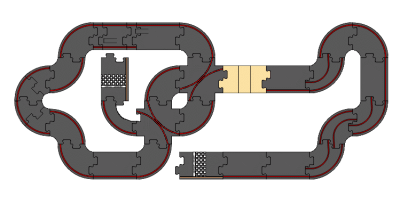
As is now traditional, we started our New Year’s Eve Party with the gorgeous, dexterity car-racing game, PitchCar, our “Feature Game”.  Everyone had played it before except Pine, and, as one of the first to arrive, he got the job of building the track.  Never having played it before, the track ended up as a single winding path rather than a circuit, but that didn’t matter, especially as there was a really short space after the chequered flag and we instigated a rule that players had to stop before they ran off the end or they would lose flick and distance in the usual way.  The track itself was really quite complex, including the bridge from the first extension, the cross roads from the fifth extension, and the new narrow bend and jump features from the latest extension.

PitchCar Track - 31/12/16
– Image by boardGOATS

Rather than the usual “flying lap” to see who starts, each player had a single flick with the longest going first.  Black went the furthest so started in pole position, but promptly caused a log-jam due to the narrow curve at the start that created a bit of a bottle-neck.  Once everyone else had got stuck, he took the opportunity on his second turn to make his get away and he did it very effectively quickly building up a commanding lead.  Things were a bit tighter in the middle of the field, but it wasn’t long before everyone had spread out a bit and it became a battle between pairs of players for individual places rather than for the race as a whole.  The arrival snacks in the form of crisps with dip and that 1970s stable cheese and pineapple on sticks, failed to distract Black who continued to lead the way, and finished well ahead of the rest despite taking a couple of shots at the finish to make sure he didn’t over-shoot.   He was followed by Green and Pink who had tussled for position briefly before settling into a steady pattern they maintained to the end.

PitchCar
– Image by BGG contributor visard

With the race over, everyone passed the pieces to Blue who packed them in the case before they crammed themselves round the table for supper of red lentil lasagne, accompanied by salad, home-made bread (onion & cheese and tomato & chorizo), pigs in blankets and devils on horse-back.  Once everyone had eaten their fill, we decided to play a second large group game and since Pink had been keen to play it again all Christmas, we went for Ca$h ‘n Guns. This is a simple party game that always goes with a bang.  The idea is that each player has a small deck of cards with three bullets and five blanks.  After choosing a card, players simultaneously point foam guns at each other.  On the count of three players have the opportunity to withdraw, before any “bullet” cards for guns pointing at people are revealed.  Anyone still “in” and not shot, then gets a share of the loot.  The player with the highest value loot at the end of the game wins.

Ca$h 'n Guns
– Image used with permission of BGG contributor punkin312

This is where the game gets just a little tactical:  there are several different types of loot.  There is cash – always good; jewelry – valuable, and the player with the most gets a $60,000 bonus, and paintings – the first isn’t worth much but the average value increases if the player acquires more.  Players can also choose to take the Godfather role (i.e. first player to choose if they are still “in”), medipacks (useful if you have picked up a bullet wound) and extra bullet cards.  There are lots of other options, but although we had extra guns and characters to choose from, with so many people, we decided to stick to the purest form of the game, not even using the character cards (which give special powers).

Ca$h 'n Guns
– Image used with permission of BGG contributor punkin312

There is something about pointing foam guns at each other that is just intrinsically funny and it brings out all sorts of peculiar traits.  The first was that from the start, everyone took the opportunity to have a go at Green which mean that he was knocked out by the end of the third round.  Purple started collecting Jewels while Pine, Magenta and Pink began working on their fine-art collections.  In the end, the battle for second place was very close with Blue taking it with $91,000, just ahead of Magenta.  Pink, however, was miles out in front with more than double the takings of anyone else, finishing with a total of $201,000.  Once Pink had finished counting his huge pile, we extricated everyone from the space they were wedged in, moved the table back and got out the second, folding table to give players a little more space.  Purple was keen to play Ulm, a game she and Black had played at Essen and liked so much they had brought a copy back with them.

Ulm
– Image by boardGOATS

The game play in Ulm is simple enough.  It is played over ten rounds, during each of which players get one turn in which they can do three actions that help them to gain points.  Ultimately players are collecting cards, city coats of arms and descendants, all of which can give them points during the game or at the end. This, in combination with the position of their barge and the number of sparrow tokens owned give the end game score, and the player with highest score wins.  The cathedral area is a three by three grid of action tiles.  On their turn, the active player slides a new action tile, randomly drawn from the bag, from the outside into the grid sliding another tile out. That tile stays in its spot on the outside of the grid and no other player can use that row or column until the tile is removed. The three tiles left in that row or column (two old ones and the new one, just added), represent the active player’s three actions for their turn.

Ulm
– Image by boardGOATS

Thus one of the actions is drawn randomly from the bag, though sparrow tokens acquired during the game enable players to exchange their random tile with one currently on the loading docks.  This is an area on the board where five actions tiles are constantly displayed and where players can get get extra tiles, or exchange tiles.  There are five different actions represented by tiles in different colours.  These are:  clear tiles on one of the four sides of the cathedral area (making more options playable), place a Seal, buy or play a card, move their barge, or take money.  Every time the active player carries out a Seal action, they place one of their Seals in a city quarter and immediately obtain a specific privilege as a bonus. These privileges vary from quarter to quarter.  The river Danube divides the city and the game board north and south.  If a player wants to carry out the Seal action, they can choose either the southern northern city quarter, adjacent to where their barge is.  The river is navigable only in one direction and a river space can’t contain more than one barge, so other players’ barges are jumped over.  This means players can move a surprisingly long way for just one step, if it is timed right.

Ulm
– Image by boardGOATS

Cards can be acquired by exchanging tiles for cards or as a byproduct of buying seals at the Town Hall or Goose Tower quarter.  When played, the active player can either discard the card for the card bonus which they can use during the game, or place the card in front of them, to obtain the points bonus at the end of the game.  Points are scored during the game through cards, Seals and Coats of Arms, but also at the end of the game for any sparrows and for the position of their barge on the Danube.  Perhaps the largest number of points are available for cards with three points per card, but it is the bonus points that are really key.  A set of three different trade cards gets a bonus of three points while three the same gives a six point bonus.  Cathedral cards are the most profitable, however, with a complete set of three cathedral cards netting a eighteen points, but they can also be difficult to get.

Ulm
– Image by boardGOATS

Carrying out a Seal action in the Oath House quarter gives players a Descendant who provides a special ability.  Purple was the only one not to get a Descendant with Black taking the Merchant (allowing him to exchange one of his action tiles for one from the docks) and Pine getting the Councilman (giving him more control over the cards he bought). Violet on the other hand took the City Guard who yielded two points for manipulating the action tiles in the cathedral area such that at least one new line of three in one color is formed in the inner grid of the Cathedral area.  This sound potentially very lucrative, but is actually quite hard to get to work, especially without compromising other scoring opportunities.  To some degree the Descendants dictated the strategies used.  Black tried to build sets of cards but was unlucky and they just didn’t fall for him.  Purple tried to capitalise on the shields and Violet went for Seals.  It was Pine who was the most successful however, very effectively coupling his Councilman with a card strategy with ultimately gave him eight more points than Purple in second place.

Ulm
– Image by boardGOATS

The down side of the random draw component is that the action grid changes constantly with players sliding new action tiles in and sliding old ones out, which makes planning very difficult.  This might explain why Black thought the game shouldn’t take too long, but was still going when midnight struck.  Cue Blue on the next table opening a bottle of fizz and covering the herself and the floor with it.  After watching other villagers setting off fireworks, Ulm continued, as did Tzolk’in on the other table.  They had begun by reminding themselves of the rules.  One of our longer, more complicated games, but one we’ve played a few times, Tzolk’in is a worker placement game built round a sumptuous system of gears.  The idea is that there is a central wheel dictating time, and five others providing actions.  On their turn, players can place workers on the action wheels and at the end of the round, the central wheel turns, moving all the workers round one step making a new action available.  In general, the longer a worker is on a wheel, the better the actions available to the player.  The really key part of the game, however, is the worker placement and removal:  on their turn, players can either take workers and carry out the associated actions, or place workers, but never both.

Tzolk'in: The Mayan Calendar
– Image used with permission of BGG contributor bkunes

There is a cost associated with placing workers:  the first worker is free, but after that, the cost rises considerably the more workers a player places.  Workers can be placed on any of the four wheels, but must be placed in the lowest available space.  Placing on the “zero” space of any wheel is free, but if this is occupied, players can place in the next space.  Since placing in higher spaces yields better rewards or saves time, for every extra space here is an additional fee, which is paid in the currency of the game, corn.  The five wheels, each named after ancient ruined Mayan cities, all provide different actions.  Palenque provides corn and wood while the mountain city of Yaxchilan provides corn, wood, stone, gold and crystal skulls. Uxmal, an ancient commercial centre, provides opportunities for players to hire additional workers , interchange corn and resources, as well as enabling them to carry out certain other actions, like build,  and pay with corn (when normally specific resources would be required).

Tzolk'in: The Mayan Calendar
– Image used with permission of BGG contributor kilroy_locke

Tikal, the ancient centre of architectural and technological development, provides players with opportunities to build monuments and buildings.  It also enables players to enhance the abilities of their workers using technology tracks.  There are four technology tracks, each one giving a bonus when players carry out certain actions.  For example, the Agriculture Technology provides extra corn or wood when a worker carries out an action that provides these items.  To move along a technology track, players typically have to carry out the appropriate action on the Tikal wheel and pay resource cubes (wood, stone or gold).  The benefits are cumulative, so further along the track a player is, the more advantage they have, but the more it costs to get there.

Tzolk'in: The Mayan Calendar
– Image used with permission of boardgamephotos

The final wheel, named after the mythical tollan Chichen Itza (known to us as chicken pizza), is a temple where players are supposed to leave crystal skulls (first obtained by visiting Yaxchilan), in return for which players get points and climb steps in the temples.  There are three temples, and the higher up the temple players are at the more points they get at the end of the ages. The other main source of points at the end of the game are Monuments and Buildings.  At the start of the game a handful of Monument tiles and Buildings tiles are revealed.  Monuments are generally very expensive and typically provide points directly, or conditional on some other factor (e.g. the number of workers a player has) at the end of the game.  Monuments are not replaced when someone takes and builds them, though a new set is put out at the end of the first age (i.e. half way through the game). Buildings, on the other hand, provide an advantage for use during the game or indirect points, are replaced once someone has taken the tile and are generally single use.  Although Farms are a type of building, they are multi-use and provide corn every food day, which can be invaluable.

Tzolk'in: The Mayan Calendar
– Image used with permission of BGG contributor kilroy_locke

Food days occur at the end of every age and again at the half-way point.  They can be crippling as players have to feed all their workers two corn each.  For this reason, a large part of the the first half-age is often spent acquiring corn to make sure nobody starves:  starving workers equals lost points.  In addition to food days, at the beginning of each round, every player must have three corn, if they don’t, they anger the gods which means they have to drop a step on one of the temples.  For this reason, and so that we don’t have to remember to check, we usually just put three corn to one side at the start of the game and then forget about it until the end.  In any case, corn is usually in high demand.  At the end of each round we place a “corn on the cog” to be taken when someone takes the start player.  This is an extra chance to get corn, and one that is usually a bit of a last resort, which means players are always tempted to wait as long as possible before they decide to take it, inevitably leaving someone disappointed.

Tzolk'in: The Mayan Calendar
– Image used with permission of BGG contributor bkunes

Unfortunately, we made a mess of the rules.  Firstly, we forgot to change the Monuments at the start of the second age, only remembering at about half way through.  This was unfortunate and may have inconvenienced Burgundy, but wasn’t the real game-breaker.  We had all played the game before, so it really shouldn’t have happened, but when we were setting up the game, Blue placed the skulls around the wheel in the action spaces.  At the time she wondered why there were so few crystal skulls in the general supply, but with so many other things going on she didn’t question it further.  This meant that instead of getting a skull from Yaxchilan and then taking it to Chichen Itza, players just went to Chichen Itza and got skulls.  At some point Pink asked what the skulls were for, but at the end of the game any left overs are worth three points so that was what we said.  It was only after we had run out of skulls and Green asked whether there was any point in Pink placing his workers on the Chichen Itza and whether the spaces could be re-used that we realised our error.

Tzolk'in: The Mayan Calendar
– Image used with permission of BGG contributor jsper

This rules error undoubtedly skewed the game giving the early adopters of the Chichen Itza wheel early success.  Pink and Burgundy were the first to go for this strategy and Blue quickly realised how effective it was and joined them.  Everyone had the opportunity to capitalise on the rules error, however, Green eschewed the chance and focused on climbing up the temples, but suffered as a result.  Blue managed to pick up a monument that rewarded wood tiles taken from Palenque and netted her thirty-two points for that alone at the end of the game.  Despite being awash with corn throughout the game she hadn’t been able to make the most of it.   Blue finished five points behind Pink and Burgundy (in spite of having almost no corn throughout) who tied for first place with eighty points.

Tzolk'in: The Mayan Calendar
– Image used with permission of BGG contributor aleacarv

Learning Outcome:  Even when you think you know the game, check the rules when things don’t seem right.

22nd March 2016

Red, Magenta, Blue, Burgundy and Green were first to arrive and decided to get the evening going with a quick light filler.  After a quick debate, we decided that the best fit to the number of players and the time we wanted to fill was …Aber Bitte Mit Sahne (which means “…But Please, With Cream”, though the game is known as “Piece o’ Cake” in English).  This is a cute little set collection game coupled with the “I divide, you choose” mechanic.  The game starts with “The Baker” taking a pile of cake slices showing a selection of different types, and then arranging them in random order to form a wheel of eleven pieces which they then divide into five slices.  Then the idea is that the other players take it in turns to choose which slice to take and how much of it to “eat”.  Points are scored at the end of the game for the player with the most kept pieces of each type of cake and for the number of “blobs” of cream on cake that has been eaten.

…Aber Bitte Mit Sahne
– Image by boardGOATS

In case of a draw, all parties win the pints, but any set that has been not been eaten and is not the largest scores nothing.  Thus, the player dividing needs to try to make sure that they are left with something useful after everyone else has chosen, but at the same time, they don’t want to give away anything that helps the opposition too much.  After dealing out the piles for each round we realised that we’d inadvertently included the wild card slice from the mini expansion, but Blue couldn’t remember the rules, so we decided to take it out and do it again. In the event, the game itself was quite close with Red and Magenta fighting it out for first place and for the most strawberry gateau.  In the end, Red took first place with thirty-two, three points ahead of Magenta with everyone else some way behind.

…Aber Bitte Mit Sahne
– Image by boardGOATS

We were just deciding what filler to play next when Black and Purple wondered in, so we decided to get on with playing something with a bit more bite.  First on the table was the  “Feature Game”, Glen More, which is a tile laying game set in the seventeenth century highlands. Black wasn’t keen as he’d played it before and had felt it was very random.  Blue said she hadn’t got that sensation from reading the rules, but she did think that it had some very different elements to it and had no feel for how to go about playing it.  Magenta and Red commented that they weren’t really selling it and wondered what the alternative might be.  Black suggested The Voyages of Marco Polo and Green was torn as he really wanted to play both.  Although Blue was very interested in playing Marco Polo too it has a reputation for being monstrously long and she has a very strong dislike for leaving games incomplete.  Burgundy had read up on Glen More, so was keen to give it a try as was Blue, so despite its poor billing, Red and Magenta joined them to make a four and they quickly got going.

Glen More
– Image by boardGOATS

Glen More is a strange mixture of mechanisms and it is initially hard to see how they fit together.  The game has an unusual turn order mechanism (similar to that in Tokaido), where the player at the back goes first moving their token along the circular track, choosing a tile the fancy and replacing it with their marker.  They then add the tile to their village and draw a new tile which is placed at the front of the row of tiles (keeping the number available the same throughout the game).  When a player adds a tile to their village they must obey two basic rules:  any road or river on the tile must connect with their existing road or river and the tile must be next to a clansman.  Tiles cannot be rotated and each player starts with a village tile comprising a clansman, a road running vertically and a river running horizontally.

Glen More
– Image by boardGOATS

Once the tile has been placed, all orthogonally and diagonally neighbouring tiles can be activated.  Each tile gives the village some kind of benefit:  yellow and green tiles provide resources, fairs and the like allow players to trade resources for victory points, village tiles allow the clansman to be moved, while distilleries allow the conversion of grain into whisky.  Resources are essential because, as well as the potential to trade them for points, about half of the tiles also have purchasing costs that has to be payed before a tile can be added to a village. Resources can be bought and sold at any time during a players turn, but any that are bought must be used straight away and the cost will depend on the Market which reflects demand.  When a player buys a resource, they place a coin on the market space and the next player must pay one more than the last up to a maximum of three after which, that resource is no longer available.  A player selling resources takes the last available aliquot until there is no money available, after which they can no-longer sell, making currency circulation a contained system.

Glen More
– Image by boardGOATS

Tiles can be activated in any order and then the new “last player” gets a turn.  Since players can move as far forward as they like, jumping lots of tiles if they choose, it is quite possible that a player may have several consecutive turns, alternatively, they may decide to sacrifice turns in order to get a particular tile that is nearer the front of the track.  There are three piles of tiles and interim scoring occurs every time one of the stacks is emptied.  Scoring is also unusual as players score based on the difference between their position and that of the person in last place in that category.  There are three scoring categories:  locations, chieftains  and whisky.  The locations are special tiles which give some special powers that have an impact during the game, but are also a a source of points.  At scoring time, players evaluate how many special tiles they have and then subtract the number of locations held by the weakest player in that category.  This difference is then compared with a scoring table and points are awarded accordingly.  Larger differences return a proportionately larger number of points.  Chieftains and whiskey are scored in a similar way, with chieftains being clansmen that players moved off the board.

GlenMore007
– Image by boardGOATS

For example, in a four player game, if the players have six, five, three and one barrel the “differences” will be five, four, two and zero which translate into eight, five, two and one victory points.  Thus, as the player in last place, picking up a distillery, may actually have a bigger impact on the scores than adding to the scoring category that they are strongest in.  This is because it reduces the number of points held by all the other players, where the difference is large, it can hurt players more efficiently too.  At the end of the game, players also get points for any remaining money, but also lose three points for every tile they have more than than the player with the smallest village.  So, when choosing which tile to take, each one has to earn its keep, in other words, the winning village has to be efficient as well as effective.

Glen More
– Image by boardGOATS

Having explained the rules, everyone was still not much the wiser.  We could all see what the mechanics did, but connecting them together was more tricky and we all felt we could only find out more by playing.  Red went first, but as she had no clue what she was trying to do, she picked a nice looking grain tile that was some way down the track and went for it.  Burgundy and Blue queried it as it meant she was likely to miss a couple of turns, but she said she was happiest that way as she didn’t feel she could make a better, more meaningful decision.  By the next turn she wasn’t  much wiser, but added a distillery to her village, no doubt making her clansmen very happy indeed as she started her whisky production.  Meanwhile, Magenta’s village was already very resource rich and Burgundy had a couple of valuable Fair tiles that he could use to convert resources into points.  Blue had no idea what she was doing, but was certain she wasn’t doing it very well whatever it was.

Glen More
– Image by boardGOATS

By the first scoring round, Red was way out in front with a handful of whisky barrels and a very small village full of very merry Scotsmen.  The lean nature of her village meant that everyone else was feeling the pressure to make every tile count as they knew it would cost them three points at the end.  Despite her huge number of resources, Magenta was  struggling to score points and Burgundy and Blue weren’t doing much better, slightly mesmerised by Red who appeared to be winning by miles despite spending most of it watching everyone else make bad decisions.  Things hadn’t changed much by the end of the second round though it was clear that Burgundy was starting to make his Fairs count by activating them frequently and buying the resources he needed if he didn’t have them.  Blue had picked up a couple of Special Location tiles and had distilled a couple of barrels of whisky, but with nothing like the efficiency of Red.  In the third and final round, Magenta now had the maximum number of resources on most of her tiles and had finally started picking up a brown tiles so that she could make use of them.  Blue managed to get herself in a mess, wanting to pick up a Special Location, but not being able to place it because her clansmen weren’t in the right place.  In trying to fix the problem she tried to be clever and discard a tile, but quickly realised she should have played it instead.  People were starting to run short of money as Magenta starved everyone else of cash by selling only the resources that were in highest demand.  In the corner, Burgundy had finally got his engine working, but it still looked like it was too late to challenge the efficiency of Red.

Glen More
– Image by boardGOATS

With just enough tiles left for one turn each, Blue promoted most of her clansmen to chieftains, Magenta managed to use her Fair to trade five resources for a massive twelve points, Burgundy picked up yet another Special Location and Red asked whether she should have been scoring three points every time she placed something next to her Tavern (which she should, and so should Blue…).  Before the final end of game scoring, Burgundy was some way out in front, but as he also had the largest village he was going to lose an awful lot of points.  Surprisingly, Blue wasn’t far behind, so it all came down to how many points people were going to lose.  In the end there was just one point between Burgundy and Blue, but Burgundy took it with forty-four points.  In the end, Red was some way behind, but as we discussed the game, we felt she had left a lot of points on the table in the final few turns, and it was certainly possible to make a lean village strategy work.  Similarly, if Magenta had been able to activate her Fair just once or twice more, she could have been way out in front.  Nobody disliked the game, but we all felt a little bit non-plused about the experience, as we’d really struggled finding a path through the maze on the first visit (though we didn’t feel it was the luck-fest that Black had described).  In the end, we decided that it definitely needed to be played again now we had a better idea of what was going on and it certainly was different to most other games we play.

Glen More
– Image by boardGOATS

Meanwhile, the other group had settled down to play The Voyages of Marco Polo, which won the Deutscher Spiele Preis last year and was designed by the same pairing that put together Tzolk’in: The Mayan Calendar.  It took a while to set up and explain the rules, especially as Black was the only one that had played it before, and even that was on-line. The game is played over five rounds with players recreating Marco Polo’s journey to China via Jerusalem and Mesopotamia and over the “Silk Road”.  Each player has a different character and special power in the game.  Each round, the players roll their five personal dice and can perform use them to perform one action each per turn.  The actions include:  gathering resources, gathering camels, earning money, buying purchase orders and travelling.  The game ends with players receiving victory points for arriving in Beijing, fulfilling the most purchase orders, and having visited the cities on secret city cards that each player gets at the start of the game.

The Voyages of Marco Polo
– Image used with permission of BGG contributor henk.rolleman

Eventually we were all kitted out with merchants, camels, currency, houses, a contract and a couple of city (mission) cards; all that was left was to choose a character. There are eight different characters to choose from providing a range of different benefits, all relating to different strategies. Black gave a quick run-down of the character abilities, quickly dismissing two of them:  Kubilal Kahn who starts in Beijing as opposed to Venezia where everyone else starts and Raschid ad-Din Sinan who can set the dice to whatever numbers he chooses at the start of the round instead of rolling them.  He dismissed Kubilal Kahn, because he does nothing else for the player, although he does guarantee ten points for placing the first house in Beijing. Raschid ad-Din Sinan was dismissed as Black explained it “broke the game”.  By that he meant that half the fun of the game is based on dealing with the dice players roll, not only must choosing the dice numbers take an age to decide, it also removes an element of luck and challenge.

The Voyages of Marco Polo
– Image used with permission of
BGG contributor bovbossi

Pine, the start player, got to choose first and went for Mercator ex Tabriz, who we had all made positive, “Oooh! That’s nice!” noises about when it was explained.  This would give Pine one resource every time someone else collected something in the market, quite handy. He thought that this would push him to a contract completing strategy.  Green was next and went for Kubilal Kahn, despite Black’s dismissal. He felt that being on the other side of the board to the others would mean he was not in competition for the bonuses, and the neighbouring city would give him a free choice bonus at the beginning of the round, a handy one to have at the start of the game. He wasn’t too sure about his plans, but placing would help gain the city-mission bonuses, so a bit of travelling looked likely.  Purple decided that the ability to teleport across the board from oasis to oasis would really help her complete her city missions and took Johannes Carprini. Since the board layout is very much east/west with very little north/south crossovers, all the pairs of cities on the mission cards were on different east/west tracks so being able to jump around the board almost at will looked to be very very useful for this strategy.  In addition, the extra three coins at the beginning of each turn was a nice little sweetener.  The experienced Black felt he was up for a challenge and chose Wilhelm von Rubruk which would allow him to place houses in every city he crossed (normally players have to finish in a city to place a house there).  As an additional goal this gave him two extra houses to place after he had exhausted his personal supply for an extra ten points, if he could manage it.  Clearly Black was also going to be doing quite a bit of travelling.

The Voyages of Marco Polo
– Image used with permission of BGG contributor henk.rolleman

Finally the game got underway with the satisfying sound of twenty dice being rolled, then studious silence as we each tried to work out what actions we could do with the different combinations we had rolled.  A reasonable first goal seemed to be to gain the resources necessary to complete our starting contracts.  The first dice placements were benign affairs. Pine was happy as collecting resources from the market proved popular and he quickly completed his first contract. Green also made use of his “free choice” bonus for reaching the small city to enable him to complete a contract.  It was about half way through the first round that the true heart of this game revealed itself:  how to place all your die actions on spaces already occupied by others.  There is cost involved in placing second, and suddenly it seemed that money (or rather the lack of it!) could be a key factor.  In most games, rolling a set of five’s and sixes would be met with squeals of pleasure – not this one.  High dice rolls might unlock some tasty options, but at a price. Finding that you had only a four and a five to place down on the travelling track when you only wanted to move once, was very annoying.  Such a move increases the cost from four (or three if you’re lucky enough to go first) for placing a single pip die to seven, and if you did decide to make use of the extra moves, that will be sixteen in total, and we’ll not consider the cost of three movements!

The Voyages of Marco Polo
– Image used with permission of BGG contributor punkin312

In the early rounds Black and Purple kept rolling fewer than fifteen in total, which gave them extra camels and/or coins to make up the difference, but it did also mean that their outlay was much less than Pine and Green who kept rolling, fours, fives and sixes.  This meant that when there was something they wanted to do, they could at least afford it. While Pine and Green were left scratching their heads as to how on earth they were to use their remaining six. Pine often just placed it “in the purse” for a measly three coins. Although Green was having similar issues, he did at least have the advantage of gaining some decent first visit bonuses, to keep his game alive. Black and purple were making rapid progress across the board, although perhaps not quite as rapid as their respective characters might suggest was possible. Pine and Green, meanwhile, kept a steady pace on wrapping up the contracts to roar into the lead on the points track.

The Voyages of Marco Polo
– Image used with permission of BGG contributor henk.rolleman

Black commented how we did not seem to be using the black dice very much. In the online games they disappear very quickly (there are only five per turn). It was only during the last part of the last round that we realised that we had not fully understood the implications of the black dice rules. We had thought players could only have one black die per round (i.e. a maximum of five all game distributed over the five rounds), but they could actually have one per turn making them a good way of increase the number of action choices. The camel cost associated with them would reduce the ability to travel, but there are plenty of other ways to trade your way to victory in the game.

The Voyages of Marco Polo
– Image used with permission of BGG contributor jsper

In the last round or two, Black and Purple really wound up their travelling elastic bands and went flying round the board, ultimately completing both of their city-mission bonus cards, which neither Pine nor Green could manage. Green did eventually complete one, but Pine had barely moved at all, preferring to concentrate on completing contracts.  When the final tally came, Green had romped away, proving Black wrong about the Kahn character. Black’s final speed-demon dash across the board netted him enough bonuses (although not his extra two house bonus) to bring him home in second place. Purple was just behind, proving that the teleportation device of the ancient east was a good way to get your presence felt, but she had neglected the contracts and did not manage to net quite enough extra points to sneak past Black. Pine’s contract strategy hadn’t been as successful as he’d hoped and we realised that his special bonus of receiving a resource every time someone else bought in the market, dwindled in later rounds as we all found other ways to get resources.

The Voyages of Marco Polo
– Image used with permission of BGG contributor henk.rolleman

In the end, despite our initial opinions we concluded that the characters are more balanced than we first thought.  Our first game also called into question the widely held BGG opinion that contracts are a better way to gain points than travelling, though we will have to see if this opinion holds over time.  Overall it was a really interesting game, with much variety in it from play to play and the dice action mechanism was also really clever and satisfying.  It did take a long time to play, but next time should be quicker, and there will certainly be a next time as we all enjoyed its first outing and others are also keen to give it a go.  Meanwhile, Glen More had long since finished, so rather than condemning Blue and Burgundy to a two player game, Red and Magenta suggested playing something quick.  Near the top of Blue’s bag was 11 Nimmt!, a game so far only released in German that Blue had picked up last year at Essen.  Designed by Wolfgang Kramer, the same person who brought us one of our favourite, 6 Nimmt!, we were keen to see if this really was five nimmts better…

11 Nimmt!
– Image by boardGOATS

The game is played with a deck of cards numbering one to a hundred, each also with some number of bulls heads, or Nimmts on it (much like 6 Nimmt!, though the distribution is different).  Each player starts with a hand of ten cards and the aim of the game is to be the first person to get rid of them all, or (since the game is played over several rounds) at least finish with a low scoring hand, i.e. as few Nimmts as possible.  In contrast to 6 Nimmt!, the game is played in turns rather than simultaneously and the game starts with one card pile.  On their turn, the active player must discard a card that is above the top card on the pile, but within ten of its face value.  If they do not have a suitable card (or choose not to play it) then they must take the stack into their hand and replace it with two new face up cards drawn from the draw deck making two new piles.  If a player takes a stack comprising three or more cards, then the player also takes a Bull Card which allows that player to play more than one card at a time on one stack so long as they are all within ten of the top card.  Should they end up with a second Bull Card, then they can play on more than one pile, and this is where it becomes an advantage to pick up lots of cards, because with several Bull Cards, players can discard a lot of cards very quickly and have more control over the game.

11 Nimmt!
– Image by boardGOATS

From the start it was apparent that 11 Nimmt! is very different to our much loved 6 Nimmt!.  There is a lot less gratuitous glee at other people’s misfortune when they are forced to take fists full of cards, but this is replaced by strategy and planning.  The lack of simultaneous play also makes it feel a lot more solitaire than 6 Nimmt! and, though there was plenty of opportunity to scupper someone else’s plans, without knowing the contents of their hand it was hard to do it in a constructive way.  It took us a few rounds to get the hang of it, but before long we were starting to see the strategic advantage of picking up cards as well as getting rid of them.  The rules suggested playing the same number of rounds as there are players, but we ended up playing six rounds just to fill time.  Despite Red and Blue both winning rounds, Magenta was the clear winner after four rounds thanks to her consistency and she added just one to her total in the extra rounds compared to everyone else’s ten and, as a result, she finished the clear winner.  Although we all enjoyed it and could see that it was probably a better game with lower player counts, we all felt that it hadn’t usurped 6 Nimmt!, which would retain its special place thanks to its fast play and generally chaotic fun.

11 Nimmt!
– Image by boardGOATS

Learning Outcome:  Sometimes subtle changes to a game make a huge difference.

20th October 2015

While Burgundy, Magenta and Blue waited for their supper to arrive, they began a quick game of Bellz!, the “Feature Game”.  This is a very simple manual dexterity game, albeit one that is very well presented.  The pouch opens out to form a soft bowl containing bells in four different colours.  Each colour includes bells in three different sizes; the aim of the game is to be the first person to have picked up all the bells of just one colour using the stick which has a magnet in each end.  On a player’s turn they can pick up multiple bells or chicken out and stop at one, but if they pick up any bells that don’t match the colour of those they have already collected then that turn is forfeit.

Bellz!
– Image used with permission of BGG contributor joeincolorado

It is certainly more difficult than it looks and there is a little bit in the way of tactics as the magnetism gets weaker further away so with skill it is possible to daisy chain bells and only pick up certain bells.  There is also a strong magnet one one end of the “wand” and a weaker one on the other.  Th rules are not completely clear (and are completely in German in any case!), and gamers inevitably ask whether the bowl can be moved and how much shaking is allowed, which were things we house-ruled.  We had had about two turns each when Green arrived and joined in.  Food arrived and we were still struggling so we carried on as we ate.  Burgundy ran out the eventual winner with Blue following close behind leaving Magenta and Green to fight it out for the last bell.  Grey and Cerise promptly turned up and, as it is an eye-catching game, also had a go with Cerise taking the honours.

Bellz!
– Image used with permission of BGG contributor punkin312

This was followed by a discussion of the Essen game fair including some of the games seen and purchased by Blue and Pink.  By far the majority of the toys they picked up were expansions for games we’ve played before including:

Colt Express: Horses & Stagecoach
– Image used with permission of BGG contributor sdetavern

There were several new games too though, in particular:

There were also older games, some of which we’ve been interested in for a long time.  For example Rockwell was a big game at Essen two years ago, and Green and Blue have expressed an interest in both at the time and since.  Somehow either the price wasn’t right or it wasn’t available at the right time, until now when a good deal beckoned. Blue and Pink picked up a number of small games as well.  These are often hard to get hold of except at places like Essen and are sometimes a hit, and sometimes not so popular, but as they are relatively inexpensive and take up little space in the luggage, they are what makes the fair special.  Finally, there were the promotional items, extra copies of which Blue handed round.

Rockwell!
– Image by BGG contributor Rayreviewsgames

Eventually we decided it was time for a game, and with six the decision is always whether to split into two groups or not.  Green suggested Eketorp for six, but Blue really wasn’t keen, so eventually we opted for Codenames, a new social deduction team game based on the meanings of words which had received a lot of good reports before Essen.  Green pulled a face at the idea of “a word game” and Burgundy commented that social games were not really his thing, even Blue who bought it wasn’t terribly keen because it had sounded un-promising when she read the rules.  Cerise was almost enthusiastic though and Magenta pointed out that it shouldn’t take long, so we gave it a go.

Codenames
– Image used with permission of BGG contributor punkin312

The idea is that there is a grid of twelve cards and the players split into two teams, with even numbers of male and female, we did the childish thing and played boys vs. girls.  The leader of each team is the Spymaster, and as Grey had popped out for a second, we volunteered him to be one so it was natural that Cerise should be the other.  The Spymasters’ job is to get their team to reveal the cards/words that correspond to their team of “agents”, by giving clues.  The clue must be a single word followed by a number which reflects how many words are indicated by that clue.  For example, the clue, “trees: three” could be used to indicate the words “oak”, “ash” and “elm”.  Members of the team then touch cards that they think are their agents; they must indicate at least one, but may try up to one more than the number in the clue.

Codenames
– Image used with permission of
BGG contributor aleacarv

The Girls started off badly finding a neutral and the Boys started off well quickly getting a three card lead.  Before long, the Boys started to get a bit stuck with movie clues and the Girls began to catch up.  As Magenta pointed out afterwards, it was important to listen to both the clues and the discussion of the other team as you can get extra clues.  And so it proved in the end.  With the teams tied, the clue was “Regents; two”.  Blue and Magenta misheard and thought Cerise had said “Regions”.  The Boys struggled on their turn too though, and suddenly the Girls had another chance.  When Green had repeated Cerise’s clue during the Boys’ discussion, Blue had suddenly realised the Girls’ mistake and they were able to find “Park” and close out the game.  Although it is not really our sort of game, everyone was very complimentary about it and as a group we enjoyed it much more than we thought we would.  We could all think of people who would like playing it and now that we know how it works, it would be much quicker to play next time too, making it a surprisingly fun filler with the right group.

Codenames
– Image used with permission of BGG contributor punkin312

With that done, we had to decide what to to play next and, with too many for Cosmic Encounter, inevitably Eketorp was raised again.  Grey was very enthusiastic, but Blue really wasn’t keen, especially as it can drag with six players.  Much to Blue’s delight and eternal gratitude, Magenta tactfully suggested that, despite being a Viking, she could play something else with Blue and Burgundy.  With that, Green happily started explaining the rules.

Eketorp
– Image used with permission of BGG contributor Ceryon

Eketorp is a game where players attempt to gather resources to build their Viking stronghold on the Swedish island of Öland.  In this game players try to second guess which resources the others don’t choose, with a battle and a potential extended stay in the hospital as the reward for failure.  The game itself is played in several rounds.  First material is distributed across the board according to the card revealed at the start of the round.  The players then decide, in secret (behind their player screens), which areas to send their Vikings to.  Vikings can either go to one of the seven resource or brick areas, reinforce the defence of their own village, or attack one of the other players’ villages.   Players then reveal their choices  and place their Vikings on the central board.

Eketorp
– Image used with permission of BGG contributor cuazzel

Depending on how the various Vikings meet, peace may be preserved or battles may ensue.  Vikings on a material field live in peace if there are sufficient building bricks, i.e. there is the same number of building bricks (or more) than there are Vikings wanting them.  If there are insufficient bricks available, then there will be a battle.  Battles also take place on a siege field in front of a player’s castle for the right to lay siege if several Vikings are positioned there.  Battles always take place in a particular order. Firstly, the starting player engages in a battle, then everyone else takes turns until all battles and sieges have been resolved.

Eketorp
– Image used with permission of BGG contributor helioa

Battles are fought using cards chosen from a starting hand of four.  Each player choses a card in secret and then they reveal them simultaneously with the highest card winning.  The difference in value between the two cards determines the battle difference which indicates which area of the hospital the loser ends up in.  In the case of a tie, both parties go to the hospital.  The clever bit is that once a battle has been fought, players swap cards and place the new card face down in front of them.  Once a player has played all their cards in battles, they take the cards in front of them to form a new hand.  In this way, the game is self-balancing so that a player who has a bad card draw at the start will have a better hand later in the game and vice versa.

Eketorp
– Image used with permission of BGG contributor cuazzel

If village siege is successful, then the attacker gets to pillage bricks from the village wall.  Bricks may only be taken from the walls that are two bricks high and the  total point value of the bricks taken may not exceed the battle difference.  Bricks can only be removed from top to bottom and the attacker can then take one of these bricks home (with the remainder going back into the reserve).  Once all battles have been resolved all the winning Vikings can take their bricks home and add them to their village wall.  Each wall comes in six parts and a maximum of three bricks can be stacked in each giving a maximum of eighteen in total.  Once a brick has been used, it cannot be moved at a later date.  The bricks are nominally made of different material and are worth different amounts at the end of the game (green, or grass is worth one whereas grey or stone is worth four for example).  The end of the game is triggered when one player reaches the maximum of eighteen bricks.

Eketorp
– Image used with permission of BGG contributor
Capitaine Grappin

At the start, with no village walls to attack or defend, and all Vikings fit and healthy, the central resource pools were particularly busy places.  After many attacks and counter attacks, eventually all were either victorious and claimed resources, or were licking their wounds in differing levels of the Viking hospital (talk about a beds crisis!).  Green took the early lead at this point. Round two was much quieter, with less than half the Vikings available to go brick hunting, so everyone was relatively successful with their choices.

Eketorp
– Image used with permission of BGG contributor DrGrayrock

Over the course of the next couple of rounds, the game board became more crowded and there was even the odd cheeky raid on a village.  By this time, Grey had managed to create a nice evenly built village wall, one or two bricks high made up of both grass and wooden bricks (worth one and two points respectively) – easy pickings in a fight, but less threatening too. Green was a bit lopsided, concentrating on building with a range of brick colours mostly on one side in order to limit the attack directions.  Cerise however had quietly managed to built quite a good wall round a large part of her village with a lot of clay and stone bricks (worth three and four points).  So, the next two rounds were characterised mostly by Grey and Green attacking for Cerise’s wall.  The first attack by Green was successful, but only enough to nab the top green brick, hardly a dent at all and netted only one point.  Grey’s attack was a stalemate.

Eketorp
– Image used with permission of BGG contributor Garry

In the final round, Cerise found herself surrounded on all sides with Green and Grey attacked from one side each.  Again only Grey was successful enough to break down part of the wall though.  Then for the final battle of the game, Grey and Green had to go head to head for the right to attack Cerise from the third side – it was a draw and Cerise was safe!  As Cerise was the only one who had managed to build a wall at least three high all the way round she picked up the five point bonus and proved herself the superior Viking with a score of forty-four leaving Green and Grey some way behind, fighting it out for the wooden spoon.  In the end, Grey decided he didn’t like the game after all, because had Cerise beat him!

Eketorp
– Image used with permission of BGG contributor
Capitaine Grappin

Meanwhile Blue, Burgundy and Magenta conducted a brief audit of the games available and Burgundy’s eyes lit up at the idea of trying out the new Ticket to Ride Map Collection as he had played a lot of Ticket to Ride and prided himself on being quite good at it.  Magenta is also no slouch either however, and was also keen as she had won her last three games of Ticket to Ride: Europe.  Similarly, Blue has slightly unjustly acquired a reputation for beating people at Ticket to Ride, and although she hadn’t played it much recently, she had won her demonstration game at Essen and had enjoyed it too, so was very happy to give it another try.  Although everyone was keen to try the UK map, to avoid giving Blue an unfair advantage, the Pennsylvania side was chosen.

Ticket to Ride
– Image by boardGOATS

The basic Ticket to Ride game is really very simple.  On their turn the active player can do one of three things:  pick up two coloured train cards from the face up display or the face down draw deck; place plastic trains on the map using cards to pay and scoring points; or draw ticket cards, which name two places and give points at the end of the game if the player has built a route between them, but score negatively if not completed.  From there, each different version makes small changes to the rules, for example, some editions include tunnels and/or ferries and sometimes there are extra cards or bonus points etc..  So, the first problem was trying to remember which of the specific rules are applicable to the base game and then integrate them with the new rules for the Pennsylvania map.  In particular, this was whether we should be using the double routes and how many points the different routes should be worth since there was no score table.  Eventually, we decided to use single tracks (ala three player Ticket to Ride: Europe) and scored routes as follows:

  • Single car:  One point
  • Two cars:  Two points
  • Three cars:  Four points
  • Four cars:  Seven points
  • Five cars:  Ten points
  • Six cars:  Fifteen points
  • Seven cars:  Twenty-one points

The seven car route from Cumberland to Baltimore engendered a lot of discussion, as there aren’t any routes of that length in Ticket to Ride: Europe.  Burgundy was fairly sure they were worth eighteen points in Märklin, but the increase in points from six to seven cars seemed very uneven compared with the change from five to six cars.  In the event, it didn’t make much difference, but checking the rules online later confirmed that Burgundy was right and it should have been eighteen.

Ticket to Ride Map Collection: Volume 5 – United Kingdom & Pennsylvania
– Image by boardGOATS

Burgundy was quite pleased with his starting tickets getting three east-west routes that he thought could largely be coincidental.  His delight faded to despair, when in the first turn, Blue took the route from Altoona to Johnstown and quickly followed it by adding the Altoona to Dubois, in quickly completely scuppering his plans.  Magenta was equally unimpressed that double routes were not in use when Burgundy and Blue quickly completed all the connections to Johnstown rendering one of her tickets impossible within the first few turns.  From there, the game quickly descended into a knife-fight in a phone box with everyone scrabbling to make their starting tickets and it looking very much like nobody was going to succeed.

Ticket to Ride Map Collection: Volume 5 – United Kingdom & Pennsylvania
– Image by boardGOATS

As Burgundy pointed out though, tickets were not going to be so important in this game as there were a lot of points available from the Shares.  This is a new feature specific to this map.  The idea of these is that most routes also have one or more company logos shown next to them on the map.  When these routes are completed, players choose which company they would like to take a share certificate for.  The companies are different sizes with some companies having a lot of certificates available while smaller company others have fewer.  At the end of the game, each player’s stock holdings are evaluated and points awarded.  The bigger companies are worth more points, however, it is harder to get the majority stake in these.  In the case of a tie, the share certificates are numbered and the points go to the person with the one taken first.

Ticket to Ride Map Collection: Volume 5 – United Kingdom & Pennsylvania
– Image by boardGOATS

The shares certainly did have a massive impact on game play.  Normally in Ticket to Ride, players achieve their first routes and then start picking up tickets, trying to maximise the number of longer routes as these give the best points return for the cards and trains, but, that wasn’t how this game went.  Although Blue bravely picked up some more tickets and was promptly followed by everyone else, this was the only time anyone did this as everyone got in everyone else’s way so much it was just too risky.  Since achieving tickets was proving so challenging, everyone started trying to pick up share certificates which meant building small routes as these were the cheapest and easiest way to get them.  Then suddenly, Burgundy declared he was out of trains and the game came to a quick end which only left the scoring.

Ticket to Ride Map Collection: Volume 5 – United Kingdom & Pennsylvania
– Image by boardGOATS

Although Burgundy had moaned about how badly he had done, neither Magenta nor Blue realised just how badly until it came to scoring tickets.  It’s true that the first ticket scored him ten points, but all the others were incomplete losing him nearly all the points he had accrued from placing trains.  Magenta also had a ticket she had failed to achieve, but it hadn’t cost her nearly so dearly.  Blue on the other hand had somehow managed to make all her connections and therefore also picked up an extra fifteen points for the Globe Trotter Bonus.  Unfortunately for Burgundy, although he had done well on the shares, the horror-show that had been the tickets had put him right out of contention and he was nearly lapped (though not quite!).  Although Magenta had shares in more companies, the combination of the extra tickets and the fact that Blue had managed to hang on to the majority in a couple of the larger companies made the difference.  Blue finished on one hundred and ninety eight, just over thirty points ahead of Magenta in what was a very tough game.

Ticket to Ride Map Collection: Volume 5 – United Kingdom & Pennsylvania
– Image by boardGOATS

With Grey and Cerise gone, that left us with time for a quick filler to finish.  11 Nimmt! and Deep Sea Adventure were both in the frame, but Green liked the sound of Qwixx, which had been nominated for the Spiel des Jahres in 2013, but was beaten by Hanabi.  The game sounded interesting though there was very little to it.  On their turn, the active player rolls six dice, four coloured and two white.  Each player has a score sheet with four tracks:  the red and yellow tracks go from two to twelve and the blue and green tracks go from twelve to two.  Once the dice have been rolled, all the players may cross off a number of any colour that corresponds to the sum of the white dice, if they choose.  The active player may additionally cross off one number corresponding to the sum of one of the coloured dice and one of the white dice.  They can choose which of the white dice they are going to use, but the die colour must match the colour of the track.

Qwixx
– Image used with permission of BGG contributor joeincolorado

The snag is that players must progressively cross off numbers to the right, i.e. once they have crossed out the red five for example, they cannot go back and cross out the red four.  Also, while all the other players can freely choose whether or not to use the white dice, the active player must cross out something on their turn or take a penalty (minus five at the end of the game).  Finally, if someone wants to cross out the last number on any track (twelve for red and yellow, two for green and blue), they must first have crossed out at least five other numbers on that track, at which point the die corresponding to that colour is locked and the colour is closed for all players.  The game ends when two dice have been removed from the game or when one player has accrued four penalties.  Scores are awarded for the number of crosses in each row according to the triangular number sequence also used in Coloretto (one, three, six, ten, fifteen, twenty-one, twenty-eight, etc.), so every additional cross is worth an ever increasing amount.
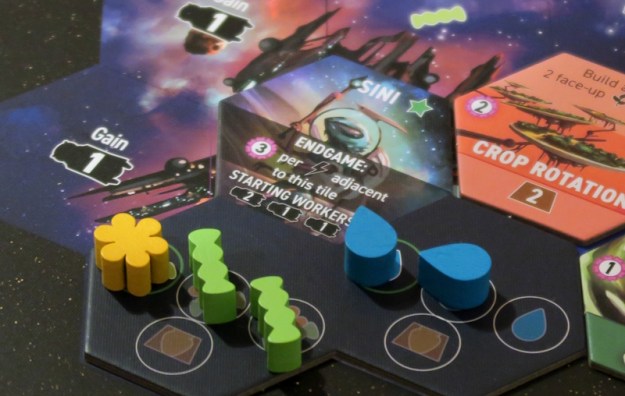
Qwixx
– Image used with permission of BGG contributor punkin312

The game started with everyone being very cagey and not taking the option of scoring the white dice as they were too high, but eventually, some people were braver than others and different patterns began to emerge.  Initially, the game looked very promising with the potential interplay between different effects, like the probability distribution for two dice, balancing the high scoring potential with not getting stuck and picking up penalty points.  Blue was even wondering whether it would be necessary to get another scoring pad.  However, being gamers, we all played to a very similar strategy and, before long, the inevitable happened, with everyone stuck waiting for the most unlikely dice rolls (two and twelve).  As a result, Burgundy who got there first started picking up penalties closely followed by Green.  The game ended when Burgundy picked up his fourth penalty point and we added up the scores.  Magenta, who had only taken the one penalty finished five points ahead of Blue with Burgundy and Green nearly twenty points behind thanks to all their penalties.  And then the inquisition began.
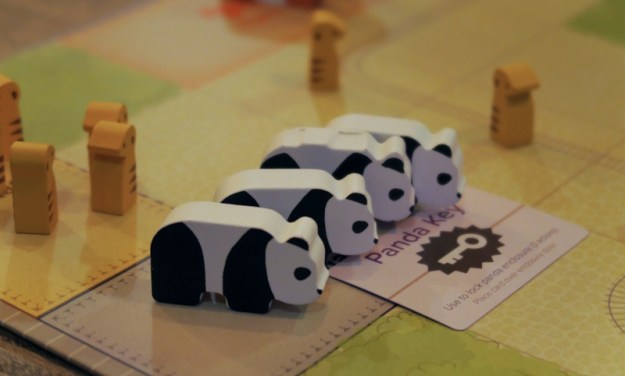
Qwixx
– Image by boardGOATS

We all really like the game at first because of the way the probability interacted with the constraints on number selection, however, we quickly found that it felt very random because the game was self-balancing.  As their game finished, each player was going to be hoping for lucky dice rolls.  Since twelve and two are relatively unlikely which would have a delaying effect, during which time, anyone who had not got quite as far was going to be able to grab a couple of extra crosses.  The random nature of rolling dice meant that ultimately, the effect of any strategy or tactics applied during the game were vastly outweighed by the randomness of the dice at the end.  Although we felt it was probably a good game for children to have fun with, as a game, it was very surprising it was nominated for the Spiel des Jahres.

Qwixx
– Image used with permission of BGG contributor punkin312

Learning Outcome:  Sometimes it is good to play games outside your comfort zone.

6th May 2014

This week, we started out with our “Feature Game”, Splendor.  This is a fairly simple game of gem (chip) collecting and card development.  On a player’s turn, they have a choice of four options:  They can collect three different gems (or chips); they can collect two identical chips (but only if there are four or more left); they can pay chips to buy a card, or they can reserve a card and get a gold chip for their troubles.  Gold chips are “wild” and can be used to replace any other colour when buying cards.  Each card also represents a gem and, once bought, can be used in any purchase thereafter.  At the start of the game a set of “noble” tiles are revealed and these are awarded to players with sets of three types of gem cards and give points at the end of the game.  In addition, some cards also give points at the end of the game and the game ends at the end of the round when one player has fifteen points.  The game was very tight with Green edging it by one point.

Splendor

Our second game was Tzolk’in:  The Mayan Calendar a game we last played back in December last year.  This is a worker-placement game with a difference:  players place their workers on the wheels of a Mayan Calendar that actually turn at the end of each round.  On their turn, players can either place workers on the wheels, or they can remove them from the wheels, but they can never do both.  Players can place as many as they can if they choose, but the more they place, the more it costs.  When workers are removed from the wheels, players perform the associated actions, however, generally, the longer the worker has remained on the wheel, the larger the rewards.

Tzolk'in:  The Mayan Calendar

Each player gets to pick from a small number of starting advantages and Green chose to start with an extra worker.  In contrast, Blue started out with a moderate supply of corn and spent her first few turns getting extra workers and a building to help her feed them.  Green was making excellent progress and also had a building to help feed his workers, and then we realised that he hadn’t made sure he had three corn at the start of each round.  The penalty (as for most things in this game) was angering the Gods, so he regressed down all three temples and we carried on, but unfortunately his rhythm was broken.

Tzolk'in:  The Mayan Calendar

Green really struggled to feed all his workers and have enough corn to do anything.  Blue stopped concentrating on what she was doing and Green stole the monument she had been working towards (which rewarded good positions on the technology tracks).  In her confusion, Blue went a little overboard harvesting corn and ended up buying her way out while Green held back by his lack of corn.  As there was no competition for placing skulls, Blue picked up a hat-full of points there, and with the bonuses provided by her positions higher up the temples, she inflicted brutal revenge for the single point defeat in the previous game.

Tzolk'in:  The Mayan Calendar

Learning Outcome:  Do not anger the Gods:  they will have their revenge.