Author Archives: nannyGOAT

3rd Movember 2021

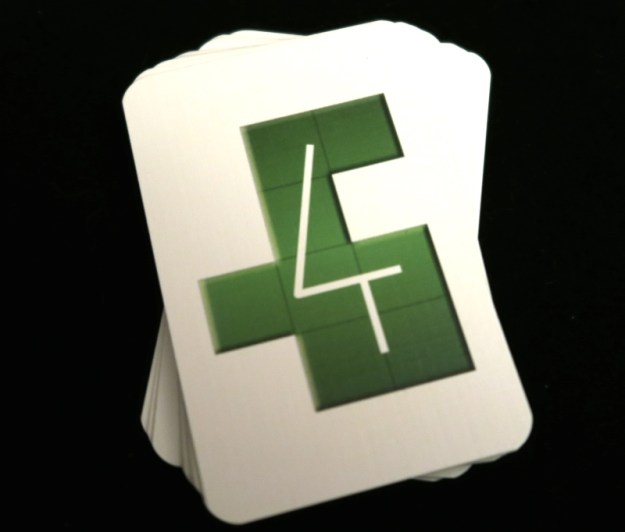
Blue and Pink were, unexpectedly, joined by Green and Lilac thanks to a clock-reading malfunction.  So while Blue and Pink were dealing with their dinner, Green introduced Lilac to Tsuro.  This is a very accessible game that we actually managed to play a little over a year ago from home, but is much better played in person.  Each player starts with a stone lined up on the edge of the board and a hand of three tiles.  On their turn, they place one of their tiles on the board next to their stone, and move their stone along the path on the tile, then replenish their hand.
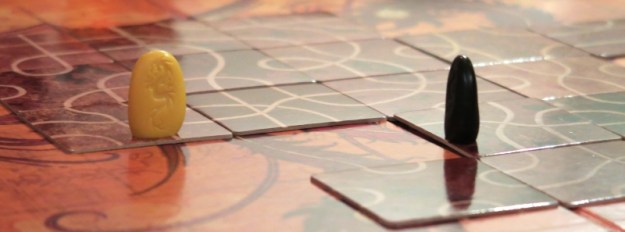
Tsuro
– Image by boardGOATS

The aim of the game is to stay on the board the longest, with the last player remaining, the winner.  It wasn’t long before Lilac had Green on the ropes and Blue and Pink urged her to take her chance and finish him off.  It’s not in Lilac’s nature to go for the jugular, however, and despite the encouragement, she didn’t make the most of her opportunity.  Inevitably, Green wriggled free and it wasn’t long before he was edging Lilac off the board himself.  With the first game over, and Blue and Pink finishing their dinner, there was a little chatter before others arrived and players were deciding what to play.
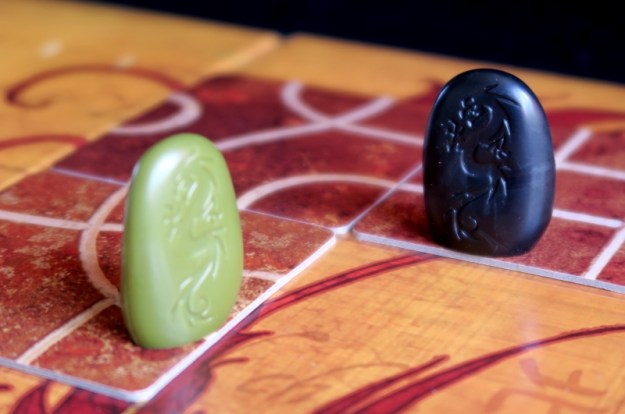
Tsuro
– Image by boardGOATS

The “Feature Game” was to be Modern Art, which is an auction game where players are buying and selling art trying to make a profit with paintings valued by the number of artworks of that type that were sold.  It is an older game, nearly thirty years old, and several people had played it before, albeit some years ago.  When Green admitted that he hadn’t really enjoyed it, Pink was shocked and suggested that not liking Modern Art was akin to not liking puppies, at which point Green, much to Pink’s horror, admitted he wasn’t that keen on them either…

Modern Art
– Image by boardGOATS

Needless to say, when settling on games, Green took himself away from the slightly offended Pink and his copy of Modern Art leaving him (with his brick and sack comments), to play the “Feature Game” with Ivory, Blue and Teal.  The game is a simple, yet clever auction game, and therein lies the problem—the group has had mixed responses to auction games.  For example, the highly regarded Ra (like Modern Art designed by Reiner Knizia) received mixed responses when that was played, however, one of the all-time favourites, Keyflower, is an auction game at its heart (though to be fair it doesn’t really feel like one).
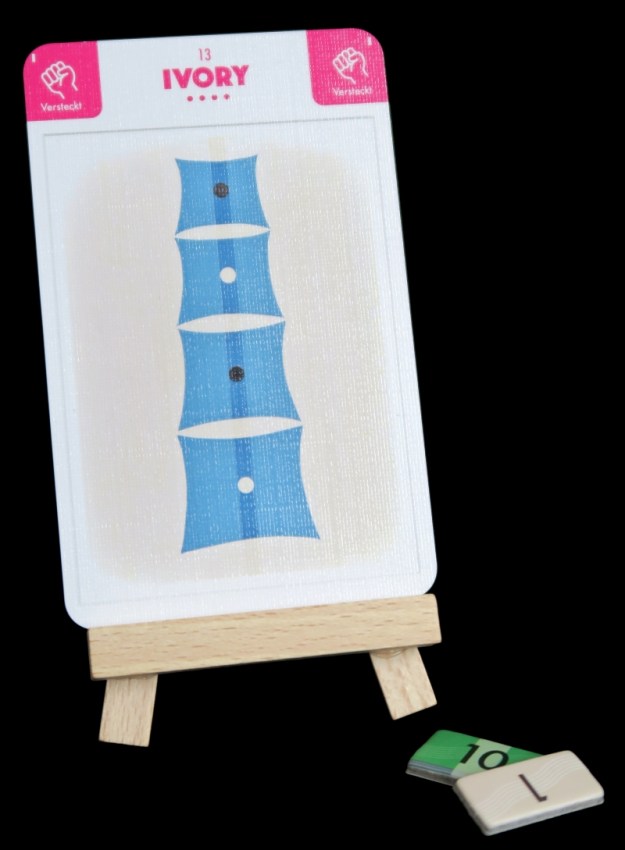
Modern Art
– Image by boardGOATS

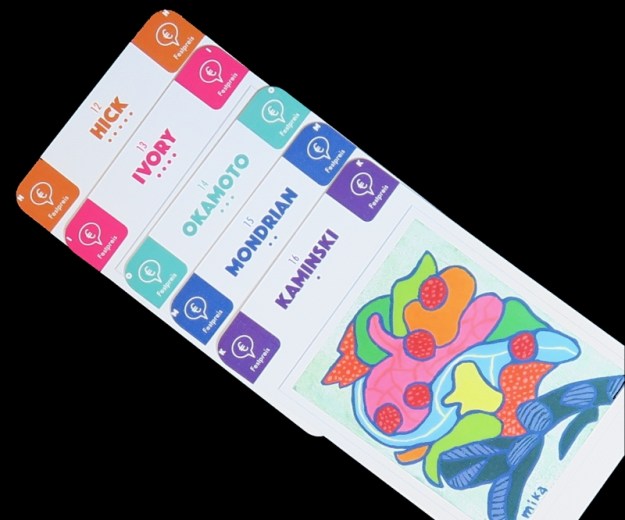
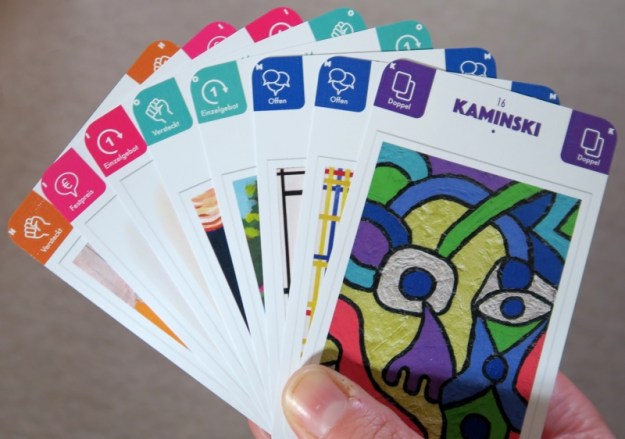
The group (aside from Pink) was therefore slightly reticent, but went for it positively, and in the event, really enjoyed it.  Each round consists of several auctions, each of which is conducted by a player.  The auctioneer chooses one card from their hand which is auctioned according to the indicator on the card.  There are five possible auction types:  Open, Fixed Price, Sealed Bid, Once Round the Table, and Double (where two pieces by the same artist are offered at the same time).
Modern Art
– Image by boardGOATS

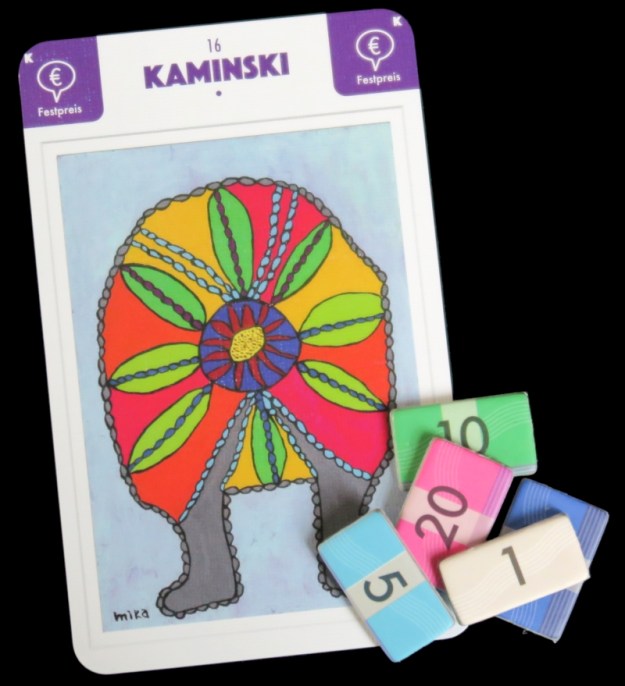
We were playing with the new Oink Games version, which features real modernist artwork from the likes of Mondrian, Kaminski and Ivory (who obviously has talent we were hitherto unaware of).  When the fifth work by an artist is offered for sale, the round ends (without the final auction), and the works valued.  The value depends on how many paintings were sold by that artist in the round, with the value increasing by $30,000 for the most popular.  Players then sell their art to the bank, but here there is a catch.  Players only get a return on art by the three most popular artists in that round—everything else is worthless.  The value of the art that is sold, however, is the cumulative total including increases over all the previous rounds.
Modern Art
– Image by boardGOATS

Thus, players sell their art giving them money to buy more, and more expensive art in the next round. Although the mechanics are clever, what makes the game fun is the auctioneer’s pitch as they try to describe the work they are selling and draw the other players’ attention to its clear and obvious assets and up-sell it.  One notable lot by Kaminski was initially described as “a cat’s pencil sharpener” and then to much hilarity as “a charming number depicting someone bending over picking up a fiver.”  The game ends after four rounds and the player with the most money at the end wins.
Modern Art
– Image by boardGOATS

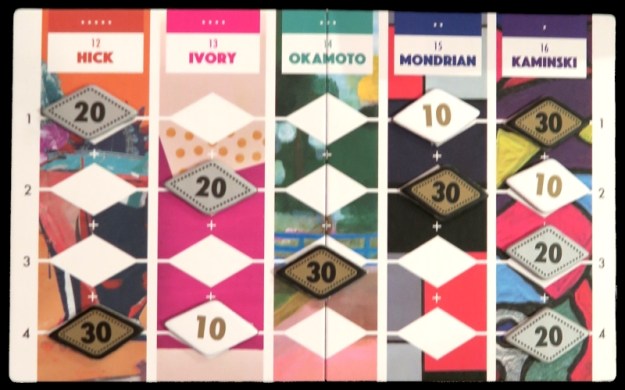
This time, players clearly had a bit of a fixation with Kaminski with his works being the most popular in the first round, with Hick and Mondrian making a distant second and third.  The initial popularity of Kaminski inflated the perceived value of his work in the second round and, although fewer works were offered for sale, it still scored, though the Mondrian age was upon us.  The third round was dominated by the works of Okamoto, putting in a brief, but valuable appearance for those that made purchases, as it provided funds for the all-important final round.  This led to a resurgence of Hick as the most popular together with poor Ivory, who’s work had hitherto only had a brief period in the limelight in the second round.

Modern Art
– Image by boardGOATS

The eternal popularity of Kaminski continued until Blue brought the game to an end with a double auction ensuring Kaminski’s works gave a return again, and having scored in every round, they were very lucrative.  Despite the game feeling like there was a lot of ebb and flow, the final scores were remarkably close with a mere twenty grand between first and third—fine margins indeed in a game where the scores were measured in hundreds of thousands and players reserves fluctuated wildly during rounds.  It was Blue though, who made the most, finishing with $392,000, just ahead of Ivory (the gamer rather than the artist).
Modern Art
– Image by boardGOATS

Meanwhile, at the other table, Green, Lilac, Purple and Black (who also expressed a dislike of Modern Art, though not of puppies), were playing the puppy related game, Snow Tails.  This is a fun race game where players are racing dog sleds along a winding track of varying complexity.  The idea is that players have a hand of cards, which they play to adjust the dogs’ speed or apply the brake.  When they play cards, they can play up to three (one for each dog and one for the brake), but they must all have the same value.  The sled speed (how many spaces it moves) is then the sum of the dogs’ speed minus the value on the brake.
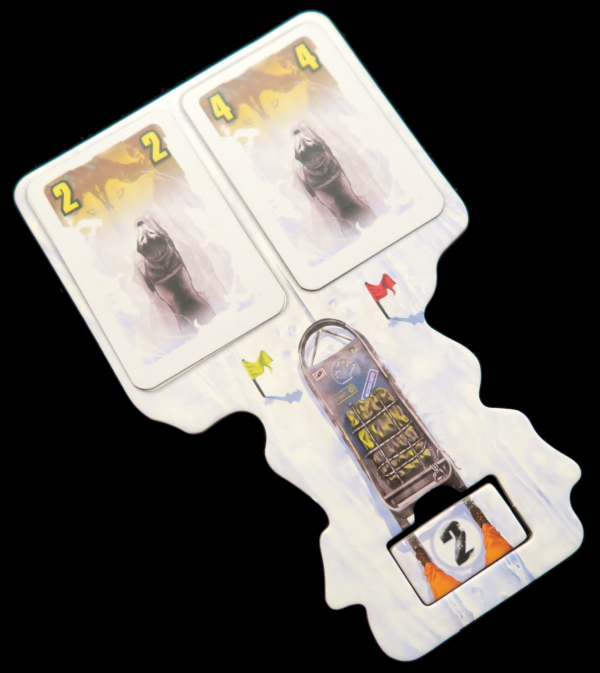
Snow Tails
– Image by boardGOATS

Additionally, the sled will drift left or right by the amount by which the two dogs’ speeds differ.  Players have to use this to negotiate corners and slalom round pine trees to get to the finish line.  The cards come from their own personal decks, and this is where the game gets clever because players have to manage the cards they play to make best use of them.  If a player crashes or goes into a corner with too much speed and exceeds the limit, they pick up a dent card.  These occupy space in the player’s hand which means they have less choice.

Snow Tails
– Image by boardGOATS

The first player to cross the line (or, in the case of a tie cross it and travel the furthest), is the winner.  The group spent far too long debating which track to use. Lilac had not played Snow Tails before so the group did not want to make it too extreme, but also not too trivial for everyone else.  In the end the group decided on a variation of “Treemendous” (chosen as it would fit on the “narrower than we would like” pub table) and swapping the first set of trees for a narrow canyon.  Through random selection, Lilac was chosen as start player, but as she wasn’t sure how the game would play she took a gentle start so Purple, Green and Black shot past her at speed.

Snow Tails
– Image by boardGOATS

Through the first corner and approaching the Canyon, Purple hit the side of the track and slowed up, while Green and Black raced forward. Lilac took her foot off the break and caught Purple, who was struggling to get her head around which side of the sled needed the higher number to move to the right to get around the corner.  With the bend successfully negotiated Black slowed for the canyon, but Green decided to let rip through it. He made it in one go without hitting anything, but was on the outside for the next corner.  Black took a steadier run through the canyon and came out on the inside of the corner behind Green.
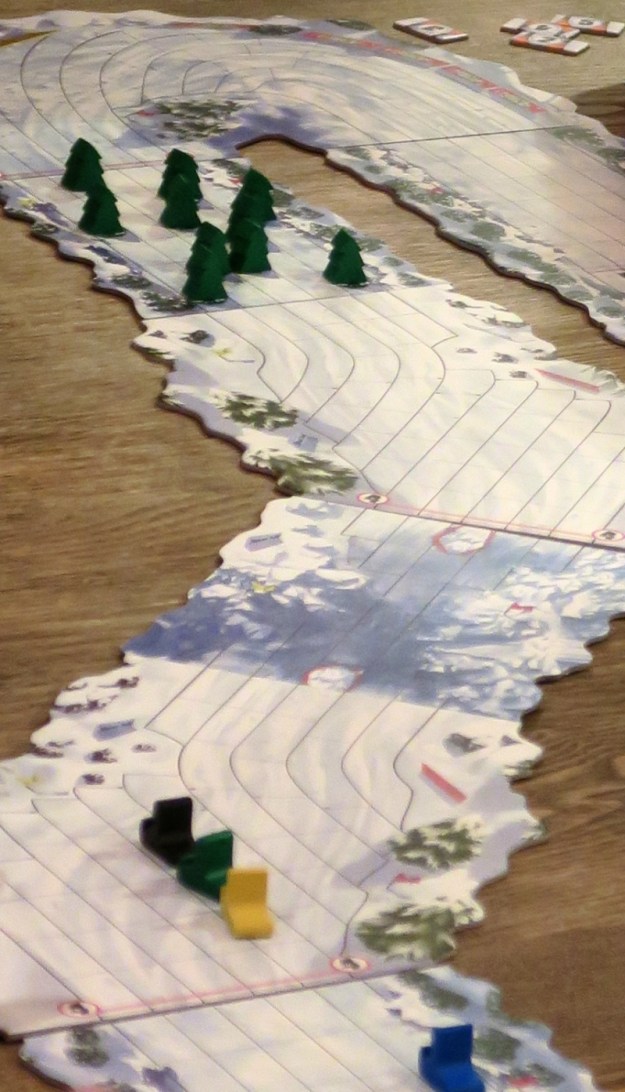
Snow Tails
– Image by boardGOATS

Lilac also maintained a steady pace taking a couple of turns for the Canyon, while Purple continued to dally at the back, hampered somewhat by her reduced hand size from her earlier crash. Black and Green raced to the forest, with Black reaching it just before Green. He “dropped an anchor” and came to an almost complete stop at the entrance right in front of Green, causing him to slow up sharply and swerve to the left instead of taking the route ahead he had planned.

Snow Tails
– Image by boardGOATS

Black managed to clear the forest first but found himself drifting towards the outside of the long hairpin bend. Green was close behind, but his direction of travel sent him to the inside.  Lilac continued her steady progress, avoiding the hazards and came through the forest unscathed in the middle of the track.  Black and Green were racing hard:  Black had the speed, but was forced to the outside of the track and wasn’t able to make progress while Green going more slowly on the inside, manage to squeeze past to get just ahead.  Then it was a straight fight to the line.
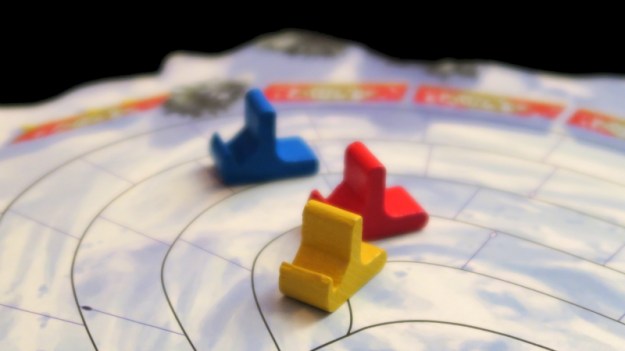
Snow Tails
– Image by boardGOATS

Black was able to lift his break to a one, but could only manage a double four, so he positioned himself less advantageously to try and block Green. It didn’t work as Green came off the corner on another track, but he was a little heavier on his break, so still on a two, and also a double four, Black managed to just slide past for the win finishing just ahead.  Lilac continued her steady progress and finished the following round while Purple took a more leisurely ride through the forest, came out on the outside of the bend.  Struggling to stay on the track on the way round the corner, she finally found her speed down the final straight and came flying off the end of the track, unfortunately a couple of rounds too late to win.
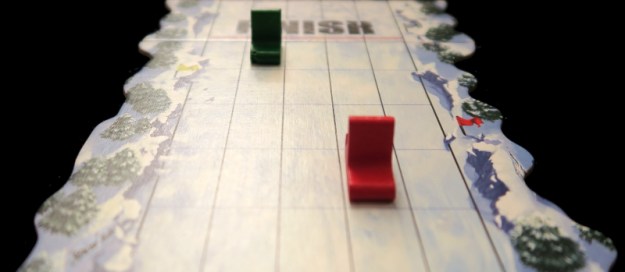
Snow Tails
– Image by boardGOATS

Snow Tails was still going when Modern Art finished, but only just, so Tsuro got a second outing of the evening.  This time, Blue was out first by killing herself and taking her piece off the board, quickly followed by Pink who committed harakiri in a similar fashion.  That left them to cheer on Teal and Ivory.  It was close and they were down to the last few tiles, but in the end, Teal took victory when he pushed Ivory off the board.  As the huskies settled down for a well-earned nap, Pine arrived just in time for one last game of Bohnanza, replacing Green and Lilac who went home as they had an early start the next day.

Bohnanza
– Image by boardGOATS

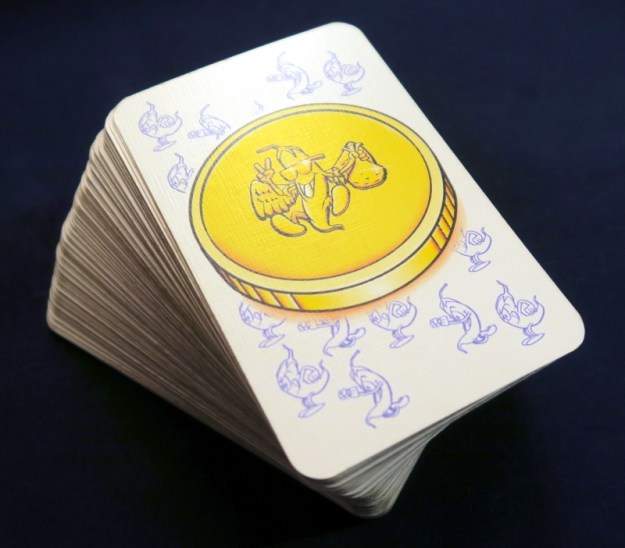
Bohnanza is one of our old favourites, and barely even needs a reminder beyond the rules that are specific for the particular player count.  With six, players start with different numbers of cards, they plant one or two beans turn over two bean cards from the deck, plant and trade, then draw four cards to replenish their hand.  Buying a third bean field is cheaper as well with six, costing two Bohnentaler instead of three.  This is important because the game is shorter with more players and some players barely get a turn in the final round.

Bohnanza
– Image by boardGOATS

As a result, buying a third field is always a bit risky, and the general consensus is that it is rarely worth it. This time was the exception that proves the rule however, with lots of people deciding to buy a third field.  This had the unintended effect of shortening the game as more beans were left in fields at the ends of the rounds.  This didn’t stop the usual hilarity when people made the occasional silly trades and players got unfeasibly lucky with the draw of the cards.  This time the winner was Ivory, two Bohnentaler ahead of Pine, but in truth, we are all winners with a game that is so much fun.
Bohnanza
– Image by boardGOATS

Learning Outcome: It is amazing how much money people will spend on tat.

Next Meetings, 3rd & 4th Movember 2021

After much discussion, in August, we moved our meeting to Thursdays.  However, the Horse and Jockey have recently brought back their quiz on the first Thursday of the month, so this week we will be meeting on WEDNESDAY 3rd Movember 2021.  As usual, we will start playing shorter games from 7.30pm as people arrive, until 8pm when we will start something a little longer (table is booked from 6.30pm for those who would like to eat first).

Some of the group are also keen to do the Quiz on Thursday 4th Movember.  So, we have booked a table from 6.30pm for those who would like food, and we’ll be playing games until the quiz starts at shortly before 9pm.

The “Feature Game” on Wednesday will be Modern Art.  This is an auction game where players are buying and selling art trying to make a profit with paintings valued by the number of artworks of that type that were sold.

Modern Art
– Image by boardGOATS

And speaking of art…

Jeff was exhibiting his work for the first time when a well known art critic turned up at the gallery.  He asked Jeff, “Would you like my opinion on your work?”

“Yes please,” replied Jeff with enthusiasm.

“It’s worthless,” stated the critic bluntly.

Jeff answered, “I know, but please tell me anyway…”

21st October 2021

The evening began with a little play-testing while people waited for their food to arrive.  The two-player game currently goes by the name of Brain Grabbers and, though simpler, has a mechanistic similarity to Sprawlopolis or Honshū.  The game was designed by one of Pink’s work colleagues, so Pink explained the rules, and then proceeded to lose, first to Blue, then to Pine, failing to take a single point to their combined total of fourteen.  The consensus was that it could be successful as a family-level game, but we weren’t fans of Cthulhu, so spent the next ten minutes coming up with exciting ways to re-theme it.

Sprawlopolis
– Image by boardGOATS

As people finished eating others began to arrive, though there was some question about whether Purple and Black would make it thanks to a serious accident on the A420.  We were discussing the treacherous nature of the A420 and its accident black spots when Purple and Black rocked up, and Purple surprised everyone by joining Green, Ivory and Burgundy to play  the “Feature Game“, Endeavor: Age of Sail with the extras from the new Age of Expansion.  Endeavor is a game we have played quite a bit over the years, initially in it’s original form and, more recently, in the new edition.  The expansion came out last year and, sadly, got lost in the mists of the endless “Roll and Write” games we were playing online.

Endeavor: Age of Expansion
– Image by boardGOATS

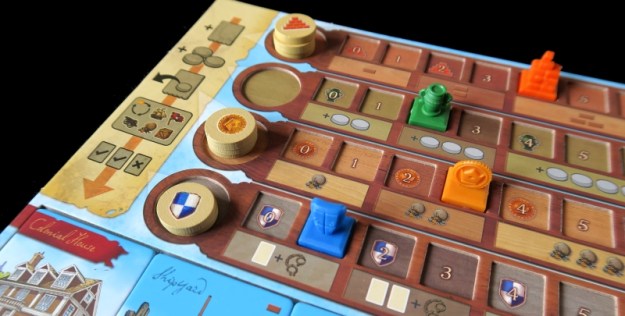
The original game is actually not terribly complicated and during play is almost completely luck-free—all the variation is in the set up.  The game is played over eight rounds, each consisting of four basic phases: Build, Populate, Payment and Action.  There are four technology tracks roughly corresponding to each phase, which dictate what a player can do during that phase.  For example, how far along the building track a player is dictates what they can build: the further along they are, the more buildings they have to choose from.

Endeavor: Age of Sail
– Image by boardGOATS

Similarly, a player who is further along the population (or culture) track, can move more people into their harbour for use in the Action phase.  Payment also increases the number of people available as it moves population markers from the action spaces into the harbour.  More importantly, however, it makes the action spaces available again for use later in the round.  The first phase consists of passing round the tray of buildings rather like a box of chocolates although in truth, at this point of the game players have very little choice.  Despite that, the decision is crucial to how players do.

Endeavor: Age of Sail
– Image by boardGOATS

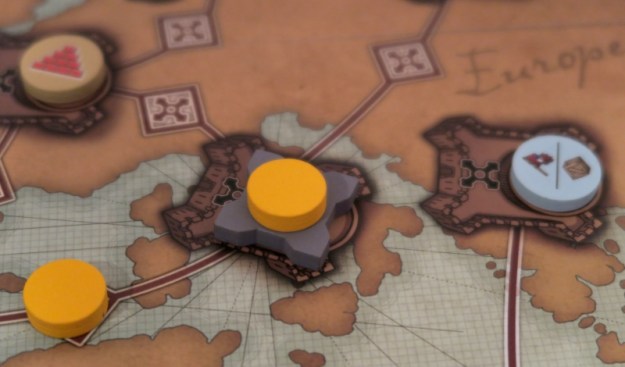
After the Building phase, the second and third phases (Population and Payment) are more or less carried out simultaneously.  The guts of the game, however, is the Action phase, when players can place population markers on their buildings to activate them and carry out one of the five actions:  Colonise, Ship, Attack, Plunder Assets, and Pay Workers.  The actions are generally based round the central board which is divided up into seven regions representing the seven continents.  Each continent comprises several cities, a shipping route and a deck of cards.

Endeavor: Age of Sail
– Image by boardGOATS

At the start of the game there is a Trade token on each city and each shipping space, but also on many of the connections between cities (these are taken if a player occupies both cities either side).  Players cannot Colonise a city until they have a presence in a region, which they can do by Shipping.  In this case, they activate their building that provides the shipping action by placing one population marker on it, then place a second population marker on the shipping track.  Thus, players need to have two markers available to be able to Ship.

Endeavor: Age of Sail
– Image by boardGOATS

The second population marker is placed in the furthest unoccupied space from the deck of Asset cards in the region of their choice, and the player takes the Trade token on that space.  Most trade tokens add to one of the four technology tracks, though a small number provide one off actions instead.  Players also need two population markers to Colonise (one for the action and one to occupy the city) and three if they are going to attack an already occupied city (one is collateral damage).  Once a player has a presence in a region they can take an Asset card, so long as the number of the top card is not higher than the number of population markers that player has in the region.

Endeavor: Age of Sail
– Image by boardGOATS

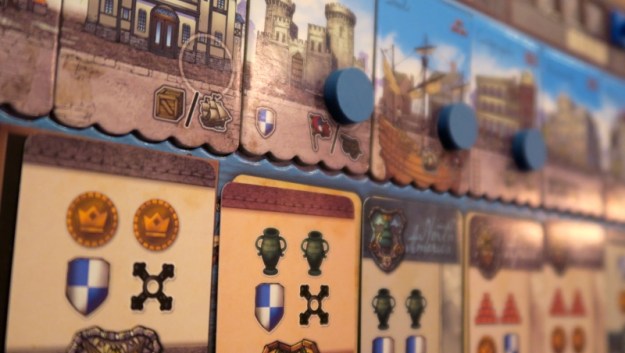
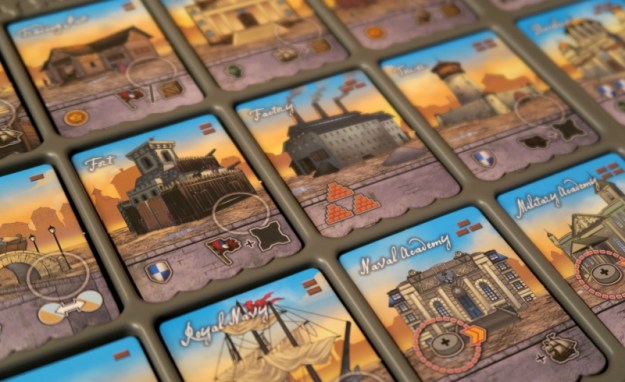
After eight rounds, players add up scores for each track and for the cities they control and the player with the most points is the winner. The new Age of Expansion adds several new components that completely mix up the game.  First there is a completely new set of buildings, many of which have actions as well as boosting the players’ economies while others have more choice.  Similarly, the first, second and fifth cards in the region decks now have more powerful and unique cards.  These are now more desirable creating more competition for them.

Endeavor: Age of Expansion
– Image by boardGOATS

The new buildings also introduce three new concepts:  Trade, Fortify, and Conscription & Mobilisation.  Trade allows players to swap one Trade token from their play area with one on the central board, while Fortify allows players to increase the protection in a city they occupy causing others to lose an extra casualty should they decide to attack.  Conscription enables players to acquire extra population which can then only be Mobilised as part of an action that has been activated in the usual way (e.g. used as a casualty during an attack, or to Settle).

Endeavor: Age of Expansion
– Image by boardGOATS

Additionally, a single Prominence tile drawn at random can be added to the game.  These provide players with new ways to gain presence in a more-competitive Europe and each one provides difference benefits and ways to score.  This time the Prominence tile was “Changing Alliances” which allows players to set up an alliance, where players cannot attack each other within Europe, in exchange for points at the end of the game.

Endeavor: Age of Sail
– Image by boardGOATS

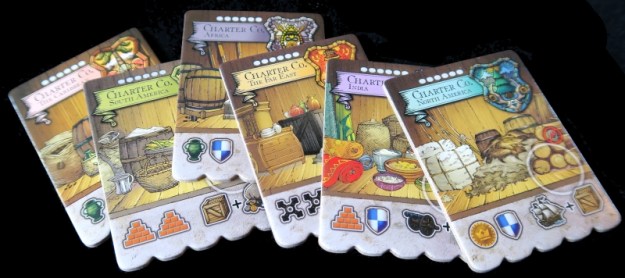
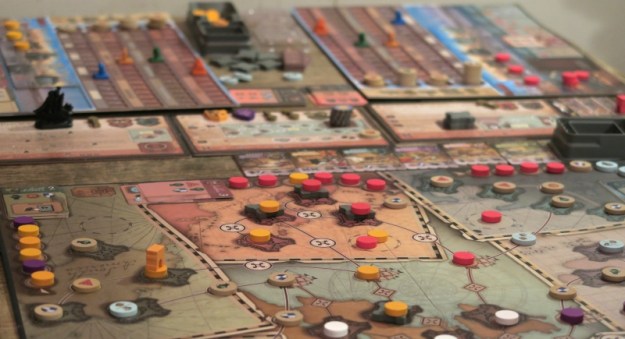
The game took a little while to set up, and although everyone had played it before, we needed a refresher of the rules and run down of the new expansions.  In addition to the new Age of Expansion updates, the group also included the Exploits from the original Age of Sail, the mini Charter Company buildings and two additional micro-expansions from Age of Expansion (Seize your Fate & Level 6 region cards), making it a mega-game.  Overall, it took about an hour for set-up and rules explanations.

Endeavor: Age of Sail - Charter Companies
– Image by boardGOATS

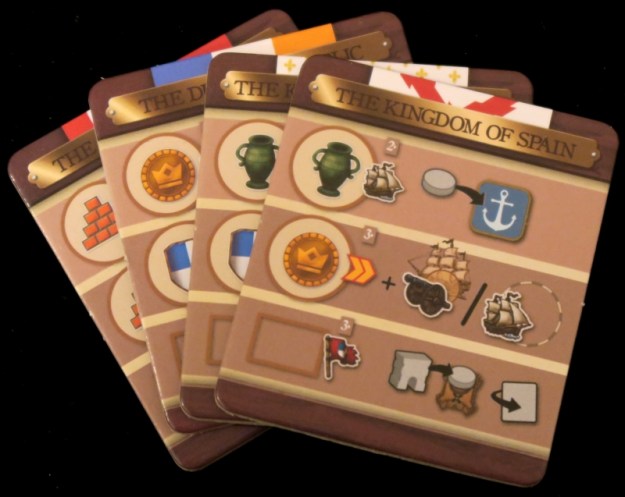
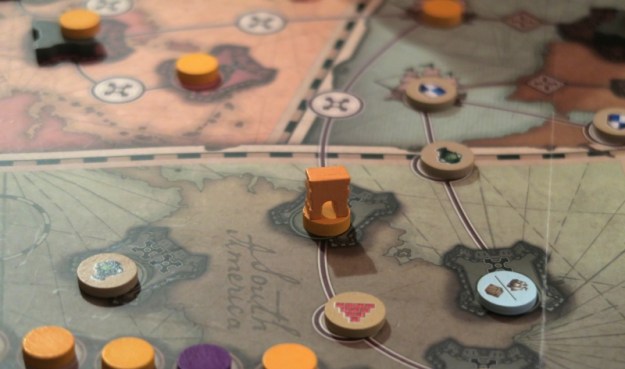
The Seize your Fate Expansion provides each player with a unique starting set-up.  Ivory was The Kingdom of France so started with a city in Europe; Purple was The Ottoman Empire, so started in the open sea of India; Green was The Kingdom of Spain so started with a city in South America; Burgundy was Great Britain and started in the open seas of North America and the Caribbean.  Coincidentally, each player was sat near the part of the board where their starting places were, so that set the stage for players’ strategies.

Endeavor: Age of Expansion
– Image by boardGOATS

Ivory quickly started taking cities in Europe and was open to a Prominence Alliance. Green was taking Fleets in Europe so joined him. No-one else wanted to form any alliances leaving Ivory to dominate Europe with and Green (to a lesser extent).  However, due to a rules malfunction, this was under the false impression that as part of the winning alliance they would score four points for each disc in the region when it was actually four points for each disc in the Alliance.  Since he was concentrating on becoming the power house in Europe Ivory left his Seize the Fate actions for much later in the game, and only expanded out of Europe to the Far East and later on Africa.

Endeavor: Age of Expansion
– Image by boardGOATS

He did however make good use of the Dutch East India Company exploit (once it was open) to upgrade his seaside buildings.  Meanwhile, Purple concentrated mostly on India and Africa, but suffered early on with not having enough population in her harbour or enough bricks to build better buildings.  The game was long though, and she managed to Seize her Fate (Round the Cape).  She also made use of the Dutch East India company in the latter rounds, and although scores weren’t calculated until the end of the game, she probably made up good ground with these latter stages.

Endeavor: Age of Expansion
– Image by boardGOATS

Elsewhere, Green was concentrating on the Caribbean, and making connections with his Fleets in Europe. He managed to amass a large population early on, but let it slip so that by the end of the game, Ivory and Burgundy had much more population to spare for attacks, even on fortified cities. Green kept an eye on Burgundy’s progress to keep a presence in South and North America. He was the first to Seize his Fate (Form the Great Armada) and used The Transit of Venus exploit, shipping up to Tahiti and using his money to increase his population.

Endeavor: Age of Expansion
– Image by boardGOATS

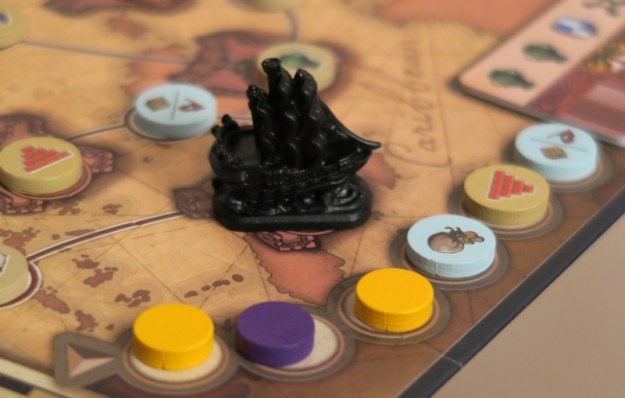
Burgundy concentrated on the America’s, and although he opened the Republic of the Pirates exploit, he never used it (and neither did Green who could also have done so). This was because he said he did not really understand it and it didn’t seem that useful. Which was a shame, as it meant the beautifully crafted big black plastic pirate ship didn’t make it onto the board. What Burgundy did do, however, was to make heavy use of Conscription buildings, which really helped him ship to almost everywhere.  Unfortunately for him, in the final round of the game there was no shipping left and he discovered that he didn’t have enough other actions to make use of the population he had.

Endeavor: Age of Expansion
– Image by boardGOATS

In the end, after a re-evaluation of the scores due to the Alliance misunderstanding, Ivory  was declared the winner with eighty-one.  Burgundy was the runner-up with seventy-three, three points ahead of Green in what turned out reasonably close game.  But what of all the expansions?  The exploits can always be relied on to add an interesting dynamic (with a couple of duds) and it is likely these will continue to feature.  The Charter companies seem to help in four and five-player games when Level five buildings have the potential to disappear quickly (especially with the Exploit we used this time), and apart from space around the board don’t intrude too much anyway.

Endeavor: Age of Expansion
– Image by boardGOATS

The Level six cards seem to be intended to be played with the Age of Expansion every time, as Slavery is Abolished on the Europe Level 6 card, whereas in the Age of Sail base game it is abolished on the Europe Level five card.  This time, none of the Level six cards actually got played.  Again, they don’t intrude, but give additional options, so are also worth playing with.  The benefits of the “Seize your Fate” was perhaps less clear. Having different starting positions certainly helped the start and gave players a steer as to strategy.  Remembering the actions were available was a problem and the extra scores were quite small (about four points for those who used them). Including this module would probably depend on the group.

Endeavor: Age of Expansion
– Image by boardGOATS

The new Conscription action seemed to open up more of the board, which counters a common complaint about the game, that in order to get a region open, players have to neglect a couple of other areas and can lose out if they made a start in them early in the game.  However, the danger seems to be in overusing Conscription.  In this game there was a lot of Fortification, and in many ways it seemed a little too much. The bonuses on the new cards were interesting and add variety to the main game, but the expansion certainly doesn’t make the Age of Sail options obsolete as they could be very valuable if a less competitive game was wanted.

Endeavor: Age of Expansion
– Image by boardGOATS

While Purple was exploring India and Africa, Black, Pine, Lime, Blue and Pink were exploring Japan with Tokaido. This is a highly tactical game, that straightens out the market mechanism at the heart of Glen More and makes it the centre of a set collecting game.  During the game, players are travelling from the ancient capital Kyoto, to Edo (now Tokyo) via the Tōkaidō road.  This was one of the five centrally administered routes, the Gokaidō, that connected the capital of Japan with the outer provinces during the Edo period (1603–1868).

Tokaido
– Image by boardGOATS

As players travel, they experience the wonders of Japan sampling food and scenery, talking to the colourful characters en route, buying souvenirs and giving thanks at the temples they pass.  The game board consists of a long track with locations marked—each location can only be visited by one player.  Players line up along the path and the player at the back goes first (in this case Pink).  They move their piece to an empty space and carry out the associated action, before the next player at the rear takes their turn.

Tokaido
– Image by boardGOATS

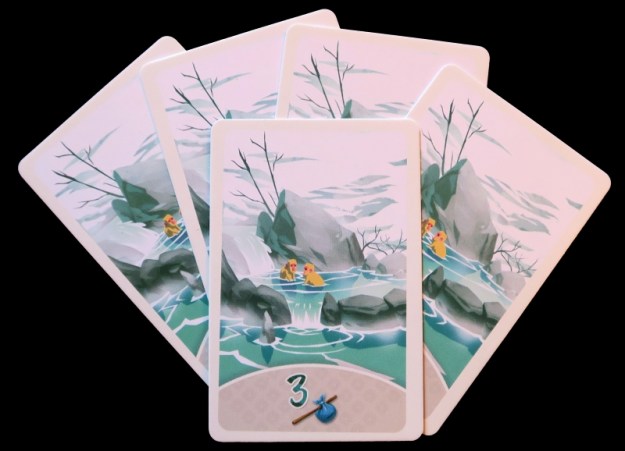
In each case, the primary decision is simple:  move to the space with the most interesting action to maximise points, or move to the first available space to get the most turns. In most cases, once that decision has been made, players simply take money or a card from the appropriate pile, the three panoramas, the hot springs, or Characters.  Panoramas and Hot Springs simply give points while Characters give other bonuses.  Stopping at a temple allows players to genuflect and pay tribute, while visiting a Village gives player the opportunity to buy souvenirs.  Both of these cost money, however.

Tokaido
– Image by boardGOATS

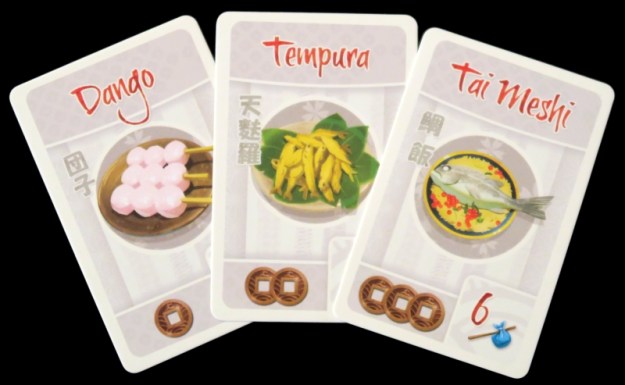
Money is really tight and there are few chances to get more, and an important source of points is sampling the varied food, but food can be expensive.  There are four stops to eat and players have to stop and wait at these.  The first person to arrive gets to choose their meal from a handful of cards—they do not have to buy food, if they choose not to or cannot afford it, but each meal is worth six points at the end of the game.  Food comes at different prices though, so arriving early means players get to choose a cheaper meal. Each meal a player takes must be different, however, so waiting to the end can end up being costly, either financially, or in points lost.

Tokaido
– Image by boardGOATS

At the end of the game, there are bonus points for almost everything:  the player who donated most to the temples, the player who spent the most on food, the player who completed each of the panoramas first, and the players who visited the most Hot Springs, met the most visitors and bought the most souvenirs.  The player with the most points at the end is deemed to have had the best journey and wins.

Tokaido
– Image by boardGOATS

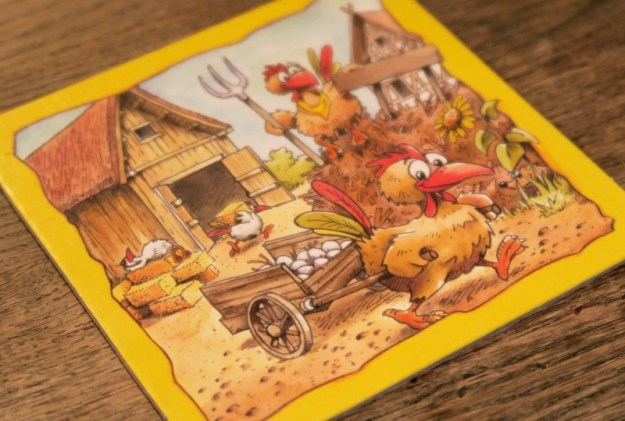
Players start by choosing their character from a pair drawn at random.  Blue was Kinto, Lime was Hirotata, Pink was Zen-emon, Pine was Mitsukuni and Black was Umegae.  Each of these gave a special power, for example, picking Kinto meant Blue paid one Ryō less for food each time she stopped to eat.  Similarly, every time Lime stopped to pay tribute at a temple, he was able to donate an extra Ryō, taking it from the main supply scoring an extra point straight way, and putting him in pole position for picking up the ten point bonus for being the most devout.
Tokaido
– Image by boardGOATS

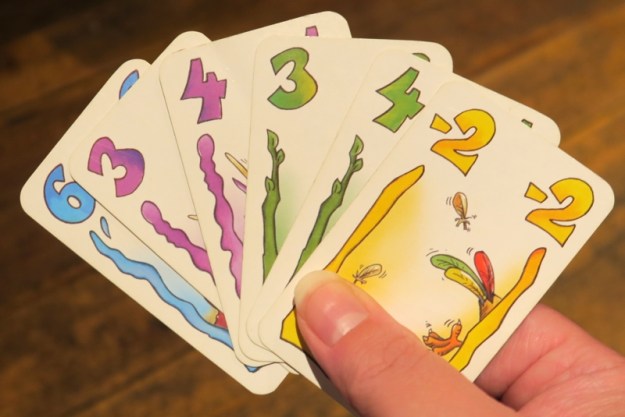
The special powers aren’t all financial though—Mitsukuni gives an extra point at the end of the game for every end-game bonus the player wins.  Most of them do involve money on some level though even if it is not directly.  Zen-emon’s special power, for example, activated when Pink visited a Village to buy souvenirs.  When buying souvenirs, the active player draws three souvenir cards and can choose to buy one, two or all three.  Whenever Pink bought one souvenir, Zen-emon enabled him to buy one souvenir for one Ryō (regardless of its marked price) and as many others as he wished at full price.
Tokaido
– Image by boardGOATS

Souvenirs are a great way to get points.  They come in different types and players are collecting mixed sets with the first card in a set being worth one point, but later being worth more—a full set gives sixteen points.  The special powers give players a steer as to which strategies might be beneficial.  To take advantage of Zen-emon’s special power, Pink needed to visit the Village as often as possible, however, there were two problems:  firstly, souvenirs are expensive, and secondly Pine kept getting there first.

Tokaido
– Image by boardGOATS

Pine got extremely lucky on his card draws when he visited the Villages too, picking up lots of cheap souvenirs and getting lots of points in return.  As if that wasn’t enough, Pine seemed to be able to harness his “inner Burgundy” and every time he visited the Hot Springs, he found monkeys and with them an extra point.  To rub salt in Pink’s wounds, he ran out of cash and found he couldn’t afford to eat, and thus he haemorrhaged points.

Tokaido
– Image by boardGOATS

Meanwhile, Black as Umegae, kept meeting people and every time he did so he gained an extra point and a Ryō.  This occasional top-up of cash meant he wasn’t as strapped as everyone else, but further, the New Encounter mini-expansion Cards were also included in the deck, and some of these are quite powerful.  Pine picked up Itamae, the especially powerful itinerant cook (who cooked him an extra meal for just one Ryō), but Black took Takuhatsuso, for example, the old priest who gave him four points in exchange for just one Ryō.

Tokaido
– Image by boardGOATS

As the players approached Edo, Pine was way out in front, though Black and Blue (thanks to spending a lot of time admiring the views) were not far behind.  There were a lot of points available from the bonuses though and it wasn’t a forgone conclusion by any means.  Lime took the ten point temple bonus, but it wasn’t really enough.  Black finished one point behind Blue, until the recount when Black finished one point ahead.  That was just enough to give Black second place, but Pine picked up enough bonuses and with the extras provided by Mitsukuni he finished seven points clear.

Tokaido
– Image by boardGOATS

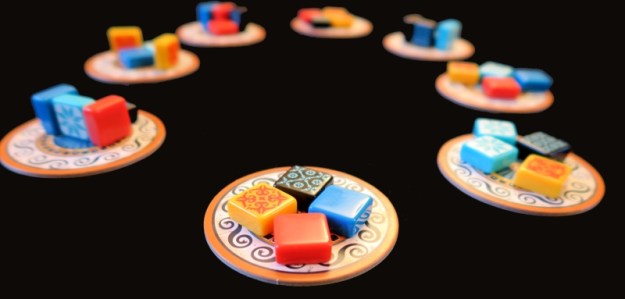
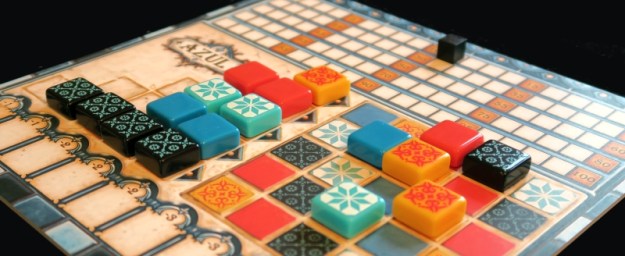
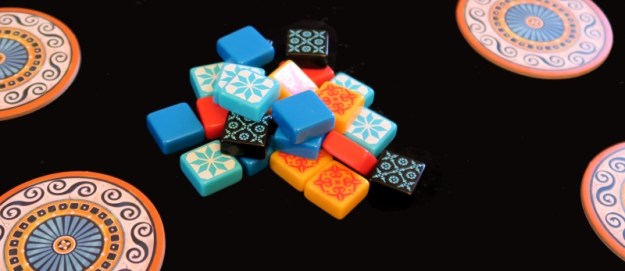
Pine and Lime went for an early night, but Endeavor was still going so Black had to wait for Purple which meant a game of Azul with Blue and Pink.  We’ve played this a lot within the group, but having effectively had over a year off has rejuvenated many of our old favourites.  The series of games use a very simple, but very clever market mechanic where players take all the tiles of one colour from a market and put the rest into a the centre, or take all the tiles of one colour from the centre.  The three different games, Azul, Stained Glass of Sintra, and Summer Pavilion, all differ in what players do with the tiles once they’ve taken them.

Azul
– Image by boardGOATS

In the original Azul, as soon as they have taken the tiles, players add them to one of the rows on their player board.  At the end of the round, one tile in each full row is moved into their mosaic.  The game ends when one player completes one full row of their mosaic.  Players score points when they add tiles to their mosaic (one point for each tile in the row and column it forms), and receive bonuses for completed rows, columns and any completed sets in their mosaic.  The catch is that each feeder row can only contain one colour and and if there are left-overs when they add to it, these score negative points.  Further, each row in a player’s mosaic can only have one tile of each colour.

Azul
– Image by boardGOATS

And that was where Pink got caught, first with seven negative points taking him to zero and then a massive eleven negative points.  Black and Blue managed to avoid that pitfall though and the game was progressing well when suddenly, Blue brought it to an abrupt end by completing two rows.  Black failed to spot it was on the cards because Blue’s finished rows, were the second and third, rather than the easier first row.  Inevitably, having his game cut short stymied him somewhat, and Blue’s final score of a nice round hundred put her some way ahead of the others.

Azul
– Image by boardGOATS

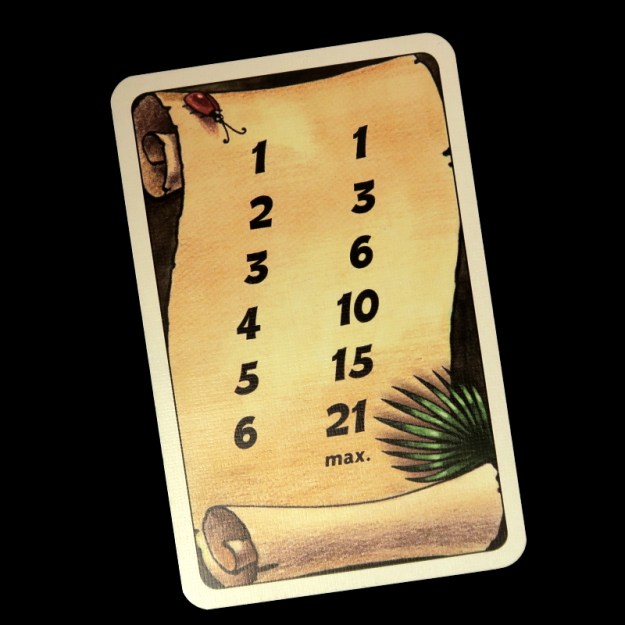
Endeavor was coming to a close, but there was just time for one final quick game while they finished up.  The game the trio settled on was Coloretto, the cute chameleon collecting game that provides the core mechanism that underpins the better known game, Zooloretto.  This is really a really simple game:  on their turn, players either draw the top chameleon card from the deck and add it to a truck, or take a truck.  The aim of the game is to collect sets of one colour, but only the largest three sets give positive scores, while the others score negatively.  The clever part is the set scoring, which uses the Triangular Number Series.

Coloretto
– Image by boardGOATS

Each additional card in a set is worth one more than the last card added with the first worth a single point, but the card that completes the set is worth six points.  As usual, there was stiff competition for the multicoloured chameleon cards, but also for the bonus point cards.  Blue went from “Azul Hero” to “Coloretto Zero” picking up too many cards of in too many different colours early on.  It was closer between Pink and Black, though Pink’s large collection of orange cards made the difference giving him victory by eight points.  And with Endeavor finally packed away, the evening came to a close.

Coloretto
– Image by boardGOATS

Learning Outcome:  Don’t spend all your money in the souvenir shop – food is important too.

Next Meeting, 21st October 2021

As the Horse and Jockey are not currently serving food on a Tuesday, we are meeting on Thursdays for the time being.  Therefore, our next meeting will be on THURSDAY 21st October 2021.  We will start playing shorter games from 7.30pm as people arrive, until 8pm when we will start something a little longer (table is booked from 6.30pm for those who would like to eat first).

This week, the “Feature Game” will be Age of Expansion, the, er, expansion to Endeavor: Age of SailEndeavor is a game we have played quite a bit over the years in both it’s original form and also the new edition, though we have yet to explore the elements of the expansion which came out last year and got lost in the mists of the endless “Roll and Write” games we were playing online.

Endeavor: Age of Sail
– Image by boardGOATS

And speaking of explorers…

Every week there was a weekly poker game between the explorers.  Vasco da Gama, Christopher Columbus, Leif Erikson, and Francisco Pizarro all took part, but they always struggled to beat the Straights of Magellan…

7th October 2021 – boardGOATS do the Quiz

There were five of us for food, and after he’d had a vat of disappointingly watery tomato soup at home, Pine joined the group to make six.  Once everyone had finished eating, there was a brief intermission while we discussed Cheddar Goats (“What, goats made out of cheese?!?!”), and we had a little over an hour before the Quiz was due to start.  Blue and Burgundy were keen to play Bohnanza, but Pink and Pine fancied something different so Green suggested Pick Picknic a simple little “push your luck” game based on chickens eating corn.

Pick Picknic
– Image by boardGOATS

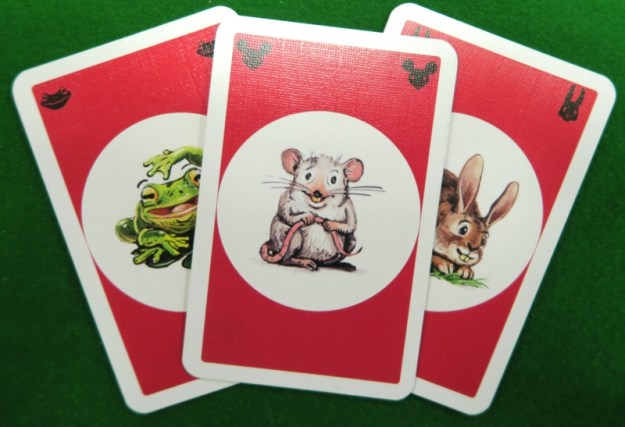
It has been a very long time since we’ve played Pick Picknic, but the rules are not difficult.  At the start of each round, the six coloured farm yards are seeded with a random corn (worth one, two or three points).  Players then simultaneously choose a card from their hand and play it.  If their card is the only card of that colour and is a chicken, it gets all the corn.  If there is more than one chicken of that colour, they can either come to an agreement to share the corn, or fight for it.  If there is a fox amongst the chickens, the fox has a good feed and the corn remains till the next round.  If someone plays a fox card and there are no chickens, the fox goes hungry.

Pick Picknic
– Image by boardGOATS

Pick Picknic is a game in a similar vein to the popular Om Nom Nom.  Both games are based round the food chain with people playing animal cards in an attempt to feed their critters without them becoming food themselves.  The principal difference between the games is that Om Nom Nom has three separate food chains, while Pick Picknic only involves foxes chickens and corn.  However, effectively Pick Picknic has six separate chains as there are six different colours.

Om Nom Nom
– Image by boardGOATS

Further, in Om Nom Nom, everyone has a complete set of cards at the start and everyone plays through their deck during the game, whereas in Pick Picknic players have a hand of five cards drawn at random from a larger deck.  This makes the game slightly less deterministic, as players could hold any card in their hand.  Also, as players’ hands are constantly being replenished and the farm-yards are constantly being reseeded, the game feels more like it is constantly rolling onwards, reaching a point where people know some animals will inevitably go hungry.

Pick Picknic
– Image by boardGOATS

The random nature of the cards certainly showed themselves this time.  Pine had an endless string of foxes, most of which went hungry.  Blue ended up with some very fat chickens who took a lot of corn, and Pink played a handful of foxes, all of which turned out to be fantastic at stealing chicken from Farmer Boggis.  It didn’t take long to work through the bag of square corn, and then it was just the counting.  Blue had a huge pile of corn, but the only chicken she had caught was a “fleet fowl” which was actually worth minus two.

Pick Picknic
– Image by boardGOATS

That almost made the difference, as Blue and Pink were well clear of the others, but there was only three points in it, with Pink proving to be a very fantastic Mr. Fox.  There wasn’t long to think about it though as Charles came round early with the Quiz sheets.  Indeed we were one chip into a game of No Thanks!, when the picture round arrived, and then group had something even more important to worry about when the questions started.

Quiz October 2021
– Image by boardGOATS

It was clear we were very rusty as we had an awful first round.  Things got much better from there though as we delightedly demonstrated out knowledge of as diverse subjects as Dr. Who, sport and what Angela Raynor allegedly called a Tory MP.  As the Quiz progressed, we slowly crawled our way up the rankings from eighth out of nine to finish second, just one point behind the eventual winners “Buggle’s Buddies”.  It was close and we were left to rue a couple of unfortunate errors.  Still, there’s always next month.

Quiz October 2021
– Image by boardGOATS

Learning Outcome:  Nobody likes the team that wins the quiz.

6th October 2021

For the first time, the group were meeting on a Wednesday to avoid clashing with the Quiz on Thursday.  As Blue and Pink waited for food they decided to squeeze in a quick game of NMBR9 to celebrate our ninth birthday.  This is a quick little tile-laying game that has almost zero setup time, so is very appealing as a filler in this sort of situation.  The tiles are poly-ominos roughly shaped like the numbers zero to nine and there is a deck of cards featuring each number, zero to nine, twice.  Players take the appropriate number from the box following a flip of a card, and add it to their personal play-space.

NMBR 9
– Image by boardGOATS

Tiles have to be placed in layers with tiles on higher layers being more valuable as the number on the tile is multiplied by the “storey” it is on.  Tiles must be placed adjacent to another tile on the same layer and, when placing tiles on higher layers they must not be wholly over one other tile and must be completely supported (no bridging gaps or overhangs).  This time, Pink managed to make it to four layers putting a seven on the top layer, his third “storey” to give twenty-one points.  As a result he was sure he was going to win.

NMBR 9
– Image by boardGOATS

Pink had fewer tiles on the second and, particularly third levels, though, where Blue had concentrated her efforts.  The effect was very similar, so much so that there was only one point in it, but much to his disappointment, even several recounts couldn’t put the deficit in Pink’s favour.  He was cheered up by the imminent arrival of his pizza though and they were still eating when Green, Lilac, and then Teal turned up.  Since Green and Lilac had missed last time, they introduced themselves to Teal and there was some general chit-chat as everyone else turned up.

NMBR 9
– Image by boardGOATS

Appropriately, as we were celebrating our ninth birthday, there were nine of us to play the traditional birthday “Feature Game“, Crappy Birthday, as we ate meeple decorated chocolate cupcakes.  Crappy Birthday is a silly little party game but is a surprising amount of fun.  As we explained the rules to Teal, we reminisced about last year, when we played it over two sessions (one wrapping our parcels and one giving them) in order to be able to play it online.  Lime expressed his astonishment that it was a year ago, and everyone concurred that it didn’t feel like a year.

2021 Birthday Cupcakes
– Image by boardGOATS

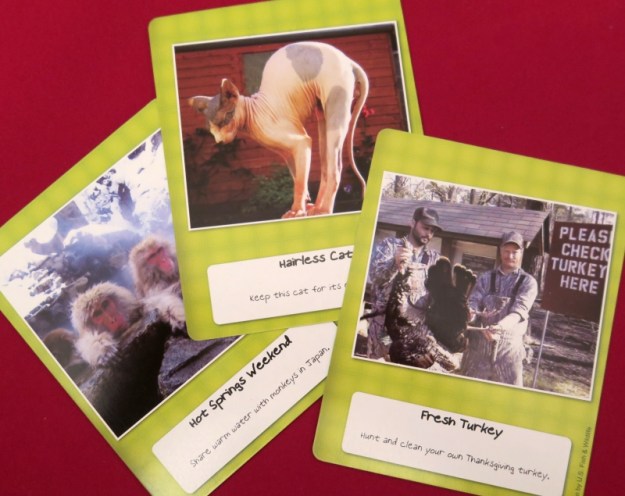
Crappy Birthday doesn’t sound like much: the game is played over one “year” and each player takes it in turns to have their birthday, with everyone else choosing a card from their hand as a “gift”.  The birthday boy or girl then chooses their favourite and least favourite gifts and the givers of these each get a point.  As such, those gifting are trying to avoid the mediocre , in a similar way to Dixit, but “not as good” as Purple opined.  While most people around the table would agree that Dixit is the better game, this group tend to get more fun out of Crappy Birthday because of the really silly gifts on the cards.

Crappy Birthday
– Image by boardGOATS

The silliness of the gifts would get stale if we played the game more frequently, but we only play Crappy Birthday once a year and we usually only use around half the cards, so most cards only come out once every two years.  It is a great way to find out about people though, so being new to the group, everyone thought Teal would be at quite a disadvantage.  This year we found out that Pink was unimpressed by 100lb of raw fish, Lilac quite fancied a trying out a wingsuit and Blue would overcome the creepiness of 3am in the Paris catacombs as apparently they were hard to get to visit.  Ivory, was torn between the opportunity to sing the National Anthem before a Major League Baseball game and getting his earlobes stretched, but went for the latter as his least favourite as it was more permanent.

Crappy Birthday
– Image by boardGOATS

We discovered that Teal likes to keep his feet on the ground, so he eschewed a flight in a fighter jet, but really liked the idea of a Viking helmet.  It was about this point that we were joined by one of the former bar staff who stuck about to help Pink with his gift selection.  It seemed she didn’t really help a lot though as he completely failed to get any of his gifts picked as best or worst.

Crappy Birthday
– Image by boardGOATS

From there, Purple nearly ended up instigating divorce proceedings when she received a set of camera scales from Black (a gift nobody else would have been prepared to give to anyone).  Instead of fully justified revenge, however, Purple gave Black’s his favourite gift a campervan.  Lime having just moved house eschewed recycled newspaper wallpaper, instead opting to decorate his new home with some modern art after some classes.  DIY seemed to be in the air, as Green chose a house that needed renovation, though he volunteered Lilac to fix the roof.

Crappy Birthday
– Image by boardGOATS

As usual, Lime’s amazing gift-giving skills meant he did well, but this time he was beaten into third place by Purple and, remarkably, Teal who tied for first place, with four—it seems Teal knows us all surprisingly well after just a couple of weeks!  As people counted their scores and decided what to play next, the group put together a special selection of gifts for Pine who was running late thanks to a group of over-enthusiastic cubs whom he had been showing round his work.  This special selection was tailor-made for a vegan who doesn’t like horses.

Crappy Birthday
– Image by boardGOATS

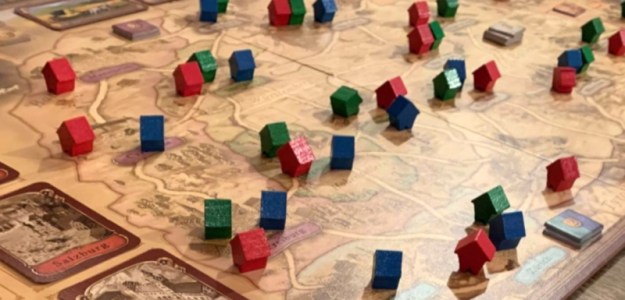
From there, the group split into three, one led by Lilac who wanted to play Thurn und Taxis, one led by Ivory who wanted to play Key Flow and one led by Green to play with something short that Pine could join in with when he arrived.  Thurn und Taxis is a slightly older, Spiel des Jahres winning game where players build postal routes connecting cities across Bavaria and surrounding regions.  Routes are built city to city to city, so that each city is adjacent to the next city on the route and there is a road connecting these two cities.

Thurn und Taxis
– Image by boardGOATS

Players are building routes by collecting cards and playing them in front of them.  Every turn, the active player takes a city card from the face-up display (or blind from the top of the deck) and then plays a card for a city connected to either end of their existing route.  The card played, must connect to their route, otherwise they have to discard their route and start again.  Then they can score their route if they choose, but each route must consist of at least three cities and players may build only one route at a time.

Thurn und Taxis
– Image by boardGOATS

If after adding to the route, the length of the route is at least three cities, the player may declare it finished and score it.  Players start with a supply of twenty post offices in their colour, each of which is worth minus one at the end of the game. When they score a route, players place post offices in cities on the board, but they have a choice.  Each city is in a region and each region has a colour, when a route is scored, the active player can either place one post office in one city in each of the region their route visits, or in all the cities on one of the regions their route goes to.

Thurn und Taxis
– Image by boardGOATS

When a route is scored, the active player can take a cart card.  These give points, however, in the general case, the cart card must be one more than the previous one and the route must be longer than the cart number.  Thus, if someone is scoring a six leg route, they can only take a level six card if their previous cart was a level five card.  If they enlist the help of the Wainwright, however, if they have a level five card, they would be able to take a level six card with a route of only four legs.  Once a route is scored, the city cards of that route are discarded, and the player begins a new route on their next turn.

Thurn und Taxis
– Image by boardGOATS

The Wainwright is not the only special character in the game: the Postman, Bailiff and Coachman are all there to offer help, allowing players to take a second card, refresh the card market and play a second card respectively.  Players can only enlist aid once per turn though, so they must choose who they call on carefully. When a player exhausts their supply of post offices or acquires a value seven carriage, the end of the game is triggered with players continuing the round—the player with the most points wins.

Thurn und Taxis
– Image by boardGOATS

In addition to points for cart cards, there are also bonus points available for players to connect all the cities in a region or to have a post office in every outer region, as well as for players completing longer routes and for the player who triggers the end of the game.  In general, bonuses score most for the first player to make the achievement with diminishing returns thereafter.  This is therefore a consideration players must take into account, but the fact that players must add at least one city to their route each turn or lose the whole route is probably the most important aspect of planning in the game.

Thurn und Taxis
– Image by boardGOATS

Although Thurn und Taxis is an older game, Purple had not played it before, and it took her a while to get her head round it.  She got to grips with it eventually, however, it was later in the game and Black and Lilac had already got a head start.  It was very close between them though with the scores neck-a-neck until the last.  Lilac triggered the end of the game by taking a level seven cart card and with it took what turned out to be the decisive bonus point, pipping Black with twenty-seven points to his twenty-six.

Thurn und Taxis
– Image by Lilac

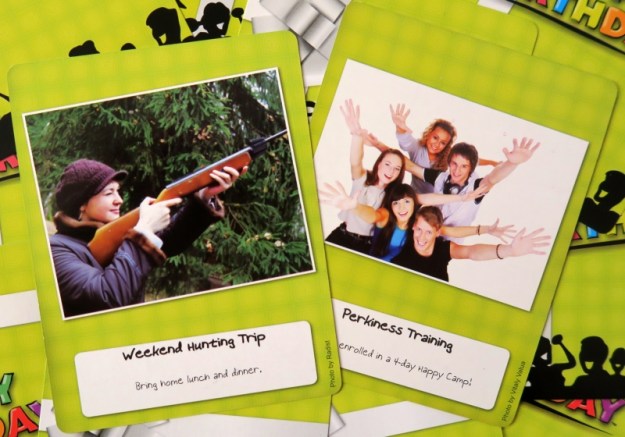
On the next table, Teal had looked in the game bags and decided Azul was one he’d like to play.  Green, Lime and Teal had just started without Pine when he inevitably arrived a couple of turns in.  He politely eschewed their kind offers to start again, instead concentrating on his healthy supper of crisps and cake and choosing his gift.  In Pine-like fashion, he chose to redefine the rules and decided his favourite gift was a hunting expedition as long as the subjects of the hunt were the people delivering the perkiness training in his other “choice” gift.

Crappy Birthday
– Image by boardGOATS

We have played a lot of Azul and its derivatives (Stained Glass of Sintra and Summer Pavilion) over the last three years, but the original is probably still the favourite across the group.  It is really very simple, and despite being an abstract game, the pieces are really nice.  On their turn, the active player either takes all the tiles of one colour from one of the “markets” putting the rest in the centre, or they take all the tiles of one colour from the central pool.  They then add the tiles to one of the rows on their player board.  The catch is that all the tiles placed in any row must be the same colour and if they over-flow, they score negatively.  Additionally, each colour can only score in each row once.

Azul
– Image by boardGOATS

Only complete rows are removed and scored, and then only at the end of the round (when all the tiles in the market and central pool have been taken).  Thus if a player has a nearly complete row at the end of a round, they carry that through to the next round leaving them with less free space to work with.  When a row is scored, one tile is moved to the player’s mosaic and scores for the number of tiles it forms a continuous row/column with.  The game ends when one or more players complete two rows.  This time it was a game of two halves, or rather two games.  It had been a while since we played the original version (or any version for that matter), but it wasn’t long before Teal, Lime and Green were happily playing, filling their boards.

Azul
– Image by boardGOATS

Lime and Teal took an early lead and were soon well ahead of Green as he had concentrated on filling his grid from the bottom up, whereas they had been working from the top down. As the game progressed Green began to catch up.  It was then that he realised that he’d forgotten what the game end trigger was.  He’d thought it was when the markets could no-longer be refilled, but checked the rules to be sure.  Only to find that two full completed rows had happened two turns earlier!  The group decided to finish the round and make it the last.  It was very close between Lime and Teal, with Lime just taking victory by three points.  The other games were still going and it was not yet late, so the group decided to give it another go, and this time finish the game correctly.

Azul
– Image by boardGOATS

In the second game, Green built his grid from the top down and the scores remained fairly similar, until around half way through when Teal began to pull away.  It was at about this point that Green noticed that one row had tiles of a colour he’d already scored for that row.  No-one was quite sure how it had happened, but the mutual decision was that he’d move these tiles down to the next row.  That turn didn’t go quite as expected, but at least it wasn’t a complete disaster.  The following round, he discovered he’d done the same thing again.  This time he worked out what he’d done:  he’d had failed to clear the remaining tiles when he moved one across to the pattern board.  So, on the previous turn, instead of moving tiles, he should have removed them.  It didn’t really matter though as Teal won by a landslide.

Azul
– Image by boardGOATS

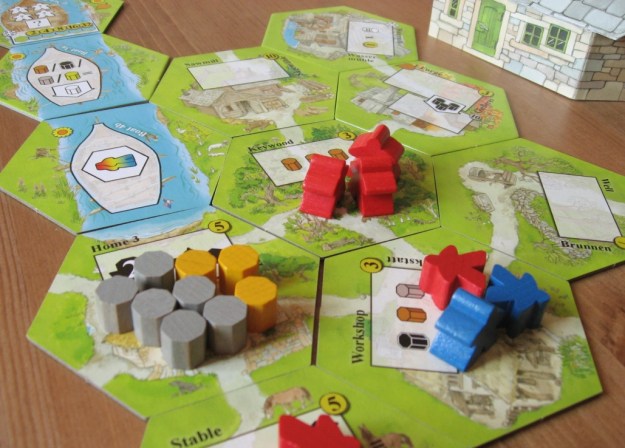
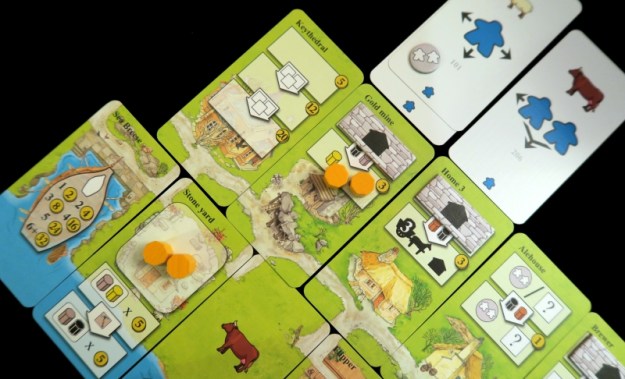
Meanwhile, Ivory, Blue and Pink had revised the rules, completed card set up for Key Flow, and had started playing.  Key Flow is the card game of one of the group’s favourite games, Keyflower.  In both games, players are building villages and activating the buildings in their villages by playing meeples (or rather Keyples) to generate resources and score points.  The games have a lot in common including the artwork, the iconography and the fact both take place over four rounds or seasons.  Fundamentally, the underlying game mechanism is different, however, with players acquiring tiles by auction in Keyflower and by card drafting in Key Flow.

Keyflower
– Image by boardGOATS

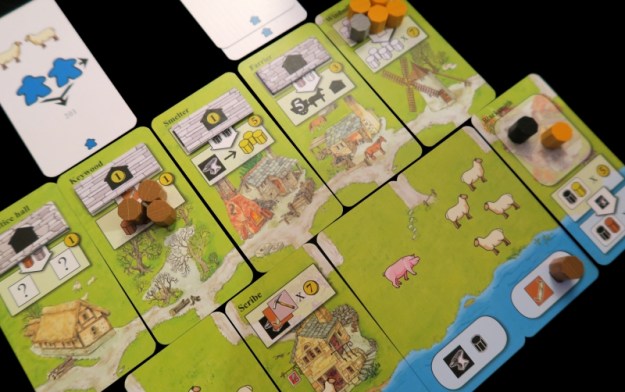
Once the card decks have been sorted out, Key Flow is quite straightforward to play, though doing well is a different matter.  Players who start with a hand of cards, choose one and pass the rest on.  They then add their chosen card to their village.  There are three types of card:  Village cards, Riverside cards and “Keyple” cards.  Village cards are buildings that can be activated by playing Keyples above them, while Riverside cards provide instant resources and skill tiles.

Key Flow
– Image by boardGOATS

The cards have to be “connected” together and location can be important.  Buildings for example are more productive if they have been upgraded, but upgrading needs resources and the resources need to be located on the building being upgraded.  Similarly, in autumn there are some buildings which score points for resources they are holding.  Therefore, it is helpful if the building producing the resources is near to the one being upgraded or used for scoring as moving resources can be expensive and sometimes difficult.

Key Flow
– Image by boardGOATS

At the start of both Keyflower and Key Flow players get some winter tiles/cards which can act as objectives to guide players’ strategies.  Whereas in Keyflower these are just added to the tile draw, in Key Flow, players get to keep one of their winter cards with the rest going into the draft.  At the end of the game, at the end of winter, players score for any autumn cards, any buildings with upgrades as appropriate, any winter cards and finally one point for any otherwise unused gold.

Key Flow
– Image by boardGOATS

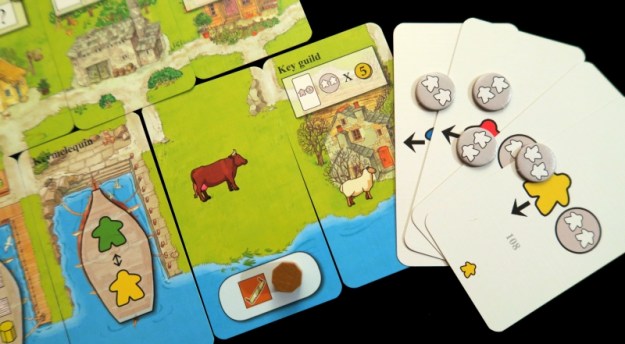
One of the biggest differences between Key Flow and Keyflower is the way Keyples work.  In Key Flow, they are cards and come in singletons and pairs.  Each card has a small Keyple at the bottom of the card, and the number of Keyples needed to activate a building is one more than the number of small Keyples already there.  So if there is one small Keeple already there, a pair would be needed to activate that building.  Further, only one card is can be played each round, so if two small Keyples are already present, the Keyple card must be augmented with a Keyple token (obtained as a bonus with some cards or from some buildings).

Key Flow
– Image by boardGOATS

Further, the Keyple cards also feature arrows which indicate where they can be played.  Some can be played either in a neighbour’s village or the player’s own village.  Other cards can only be played on one side or cannot be played in their own village.  This is why three players is arguably the sweet-spot for Key Flow—with more players there is at least one village players cannot use, adding a level of randomness that it is difficult to deal with.  With three however, everything in play is accessible, though perhaps at a cost.

Key Flow
– Image by boardGOATS

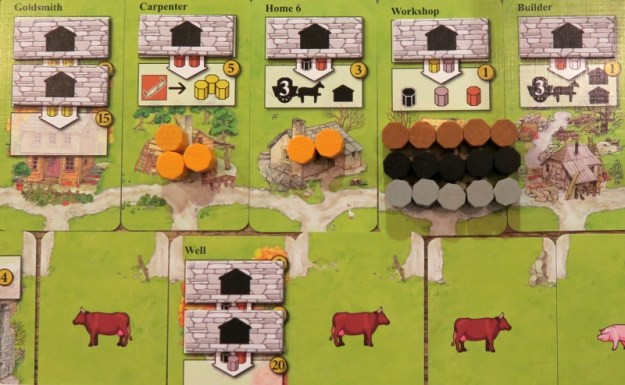
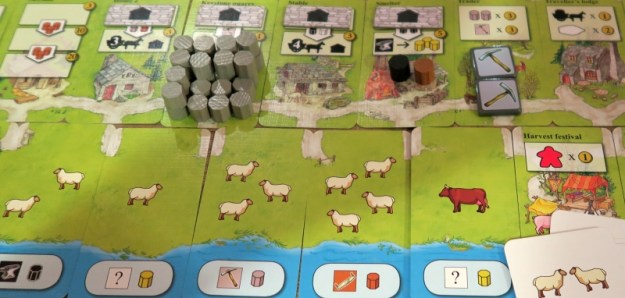
It had been a while since Key Flow had been given an outing, so although game play is functionally straightforward, it took Blue, Ivory and Pink a while to remember the little features and how to make the game work for themselves.  Pink started off early with an obvious strategy of generating stone, stone and even more stone from his Keystone Quarry.  It was very clear, even to Pine who joined in to spectate about halfway through, that Pink had a winter card that would score for stone.  And so it proved when he produced the Trader in the final round.

Key Flow
– Image by boardGOATS

Things were less clear-cut for Blue and Ivory, however.  Blue started by just playing the cards in her hand, which meant she ended up with a lot of cows (just because).  In summer, Ivory picked up a boat that allowed him to convert sheep into pigs and pigs into sheep, which went nicely with his animal scoring winter cards.  Blue, on the other hand, very out of practice with this sort of game, just played tactically, and played for points.  Her Workshop went well with the Mercer’s Guild she had in her winter cards, but the Well and Goldsmith, both fully upgraded gave her thirty-five points alone.

Key Flow
– Image by boardGOATS

Ivory had a bit of a nightmare and was unable to make the game work for him this time.  This was made worse by a rule we only spotted towards the end which meant each Keyple card could only be used towards one goal and the fact he made a mess of things when he put a Riverside card in the middle of his village and had to make it work retrospectively.  As he said sadly, although he had remembered how to play, he’d forgotten how to win.  Pink, with his massive pile of stone thought he was in with a good chance, but they were actually only worth one and a half points each, so although he had a huge pile, it only gave him thirty-nine points and had taken a lot of work to get them.

Key Flow
– Image by boardGOATS

Pink was a little bit stymied by the fact he was banking on also getting a a sheep scoring card in winter, but Ivory took it before it got round to him.  Blue on the other hand had lucked out when she picked up a lot of Keyple scoring cards that nobody else seemed interested in giving her over a hundred points and a comfortable victory.  With that, Ivory left, as did Lime and Teal, leaving Green, Pink, Blue and Pine waiting for the conclusion of Thurn und Taxis, and time to play a couple of rounds of Love Letter.  In the end, it really was just a couple of rounds and ended with a round a piece for Green and Pink, as the pub was closing and it was time to leave.

Love Letter
– Image by boardGOATS

Learning Outcome:  While camera scales may seem like a good gift idea, in reality the giver will probably end up sleeping on the couch.

Deutscher Spiele Preis – 2021

After last year, it has been refreshing to return to a semblance of normality with the announcement of the Deutscher Spiele Preis at Essen.  Unlike the Spiel des Jahres Award which is chosen by a committee with a list of strict criteria, the Deutscher Spiele Preis is the result of an open vote by games clubs, gamers and people in the industry.  Typically, slightly heavier games are rewarded, but it is a top ten list, so it caters for a range of tastes and complexities and the organisers are always keen to remind people that everyone who features is a winner.

– Image by BGG contributor Hipopotam

As usual, the games that feature in the Spiel des Jahres and Kennerspiel des Jahres Awards also feature high on the list with the winners, MicroMacro: Crime City and Paleo occupying second and fourth on the Deutscher Spiele Preis list, respectively.  The Adventures of Robin Hood, Everdell and Praga Caput Regni also make the top ten, but unusually the winner is a game that did not feature at all in the previous awards list, and is a cooperative game for children called Dodo.

Dodo
– Image used with permission
of boardgamephotos

In Dodo, the feather-brained bird has laid its egg on the highest mountain peak and let it fall out of the nest, towards the cliff edge.  Players work as a team to try to ensure the rolling egg safely reaches the foot of the mountain by collecting the building material they need, hammers and nails, and attaching bridges to the sides of the mountain.  So far it has only had a German language release and very little has been written about the game online in English.  Therefore it may be that the game owes its success to the fact that few people were playing games face-to-face when the voting was carried out.  It sounds like it might be fun though and certainly deserves a look.

Deutscher Spiele Pries 2021
– Image from
spiel-messe.com

Essen 2021

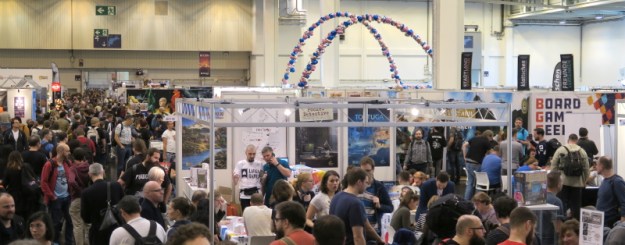
Today is the first day of this year’s Internationale Spieltage.   Known to Gamers worldwide simply as “SPIEL” or “Essen”, this is the largest games fair in Europe (and arguably the world), and is held annually in Germany.  The fair runs from Thursday to Sunday in October every year, and is of particular significance as many new releases are timed to coincide with the event just in time for Christmas sales.

Essen 2021
– Image from spiel-messe.com

It is one of the biggest and most significant of all the boardgame conventions.  Last year, like so many things, it fell victim to the global pandemic, and instead was held online, in a format that was widely considered unsatisfactory (especially to those used to visiting in person).  This year, there will again be a “virtual” event, but this time held alongside the “Real Spiel”, an event with limited ticket numbers and virus control measures in place.  Safety concerns and worries about practicalities mean the show will be much, much smaller than usual with only 60% of the usual attendees and many exhibitors noticeable by their absence.

Essen 2019
– Image by boardGOATS

Absentees include, 2F-Spiele, Cwali, Splotter, BoardGameGeek, and even the mighty Asmodee and all their subsidiaries.  As a result, this year, Essen is likely to feel more like the smaller, more intimate event of years gone by.  There are still lots of games making their debut though, including Messina 1347, Golem, Boonlake, Llamaland, It’s a Wonderful Kingdom, Cascadia and expansions for Keyper (Keper at Sea) and the 2021 Kennerspiel-winning game Paleo (Ein neuer Anfang!).  Sadly, none of the boardGOATS will be there to see them though.  Maybe next year…

Essen 2021
– Image from spiel-messe.com

Next Meetings, 6th & 7th October 2021

After much discussion, in August, we moved our meeting to Thursdays.  However, the Horse and Jockey have recently brought back their quiz on the first Thursday of the month, so this week we will be meeting on WEDNESDAY 6th October 2021.  As usual, we will start playing shorter games from 7.30pm as people arrive, until 8pm when we will start something a little longer (table is booked from 6.30pm for those who would like to eat first).

Some of the group are also keen to do the Quiz on Thursday 7th October.  So, we have booked a table from 6.30pm for those who would like food, and we’ll be playing games until the quiz starts at 9pm.

Last weekend was our nineth birthday, so as is now traditional, the “Feature Game” on Wednesday will be Crappy Birthday.  This is a silly little filler/party game that we can mess about with while people are eating cake allowing us to play something longer once everyone has arrived and finished food.

Crappy Birthday
– Image by boardGOATS

And speaking of birthdays…

It was Joe’s birthday, and his mum wanted to do something special.  She called him on the phone, but his housemate, Jeff, answered.  When Joe’s mum said she wanted to bring round a cake, Jeff was very excited.

“Oh, Mrs. Wilson,” Jeff said, “What a lovely idea – that would be great!”

That afternoon, Joe’s mum drove to the house and rang the doorbell. Jeff answered the door, but when he saw the cake, his face fell.

“Oh,” he said, clearly very disappointed. “I thought you said ‘keg’.”

23rd September 2021

Burgundy and Blue were just finishing their supper when Teal introduced himself.  The three were chatting when Lime, who hadn’t been able to come for over a month, also joined the group.  It was expected to be a quiet night with Green and Lilac away on holiday, Pine working late, and Pink stuck somewhere on the Warwick bypass.  So, there was a lot of chat, but eventually, the group decided to play something and settled on Love Letter.

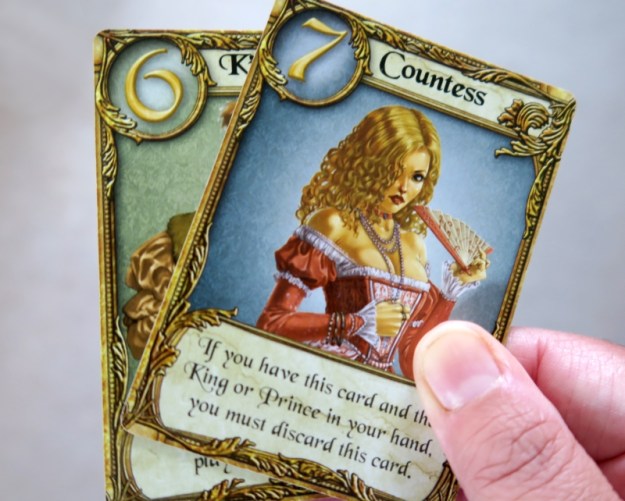
Love Letter
– Image by boardGOATS

This is a very simple little game that we’ve played a lot, but somehow Lime had missed out.  So, there was a very quick rules explanation:  players start with a hand of one card, draw a second and choose one to play and do the action on the card.  The cards are numbered and the aim of the game is to finish the round with the highest card, or more commonly, avoid being knocked out.  There are only sixteen cards in the deck (and one of those is removed at the start of the round), so it doesn’t take long.

Love Letter
– Image by boardGOATS

The group were only three rounds in when everyone else turned up (including Pink who had escaped the roadworks), so Lime was declared the winner with two tokens and everyone else was introduced to Teal and started to discuss what to play.  In the end, Burgundy took matters into his own hands and started a game of Wingspan, so while Pink waited for his pizza to arrive, Blue explained the “Feature Game“, Mini Rails.

Mini Rails
– Image by boardGOATS

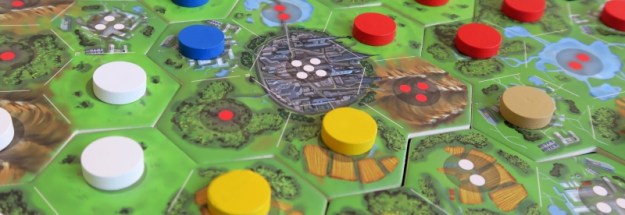
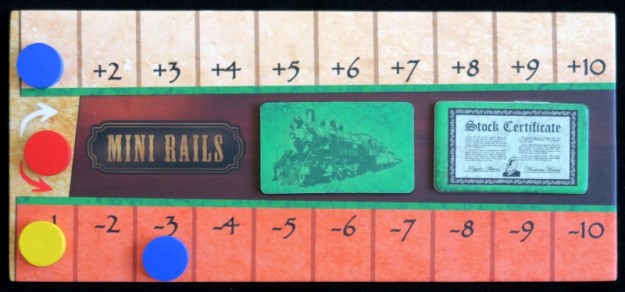
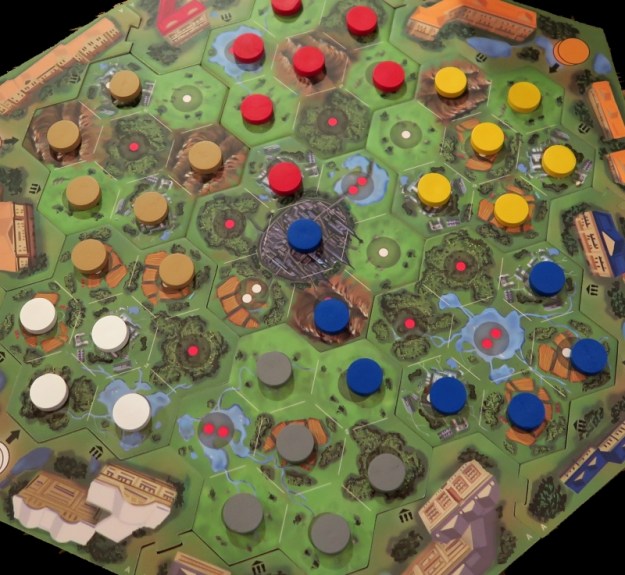
Mini Rails is a very simple little stock-buying and track-laying train game that compresses a lot of the game play of long and complicated games like the 18xx series into under an hour.  Players have two turns in each round, on one they buy shares in one of the companies and on the other they extend the “track” of one of the networks.  If it is built on a white space, players with holdings in that colour increase their value by the marked amount.  If the network is built on a red space, the stocks in that company are decreased in value.

Mini Rails
– Image by boardGOATS

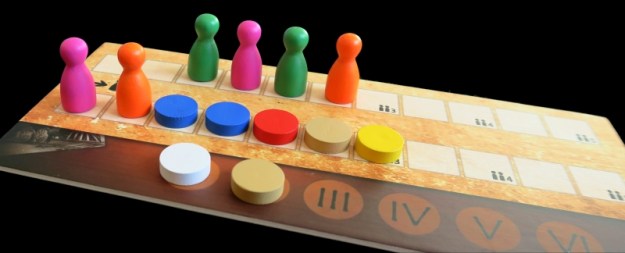
The game is very simple, but there are a couple of clever little tweaks.  Firstly, there are two “tracks”, one is the turn-order track, while the other holds train disks drawn at random from a bag.  On their turn, players choose one of tokens and decide which action to use it for, “build track”or “buy shares”.  The position of the token that is taken dictates where they will be in the turn order in the next round.  Manipulating this turn order is one key aspect of the game, as is deciding whether to buy and then build, or build and then buy.

Mini Rails
– Image by boardGOATS

Perhaps the most complicated aspect of the game is the end-game scoring.  At the start of each round train discs are drawn from a bag; one more than there are turns.  This means everyone always has a choice, but the token the last player does not use is put to one side indicating they have paid “taxes”.  For the companies that have “paid taxes” any negative dividends are erased and positive dividends are counted.  For those companies that have avoided paying their taxes the reverse is true and negative points will be scored while positive points are lost.

Mini Rails
– Image by boardGOATS

This means it is in the interest of players with both large positive or significant negative scores to forgo building track or buying shares and leave a potentially valuable token as taxes.  Similarly, if a player is left with a choice of two tokens, it may be in their interest to buy/build a relatively unfavourable track to deprive other players of points.  With three players, the game doesn’t take too long to play, and with more it would likely become quite random.

Mini Rails
– Image by boardGOATS

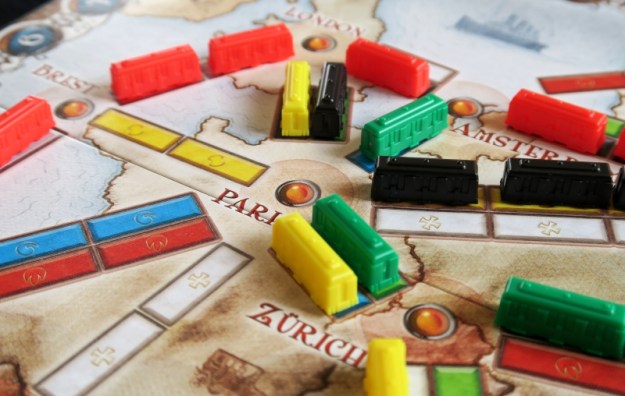
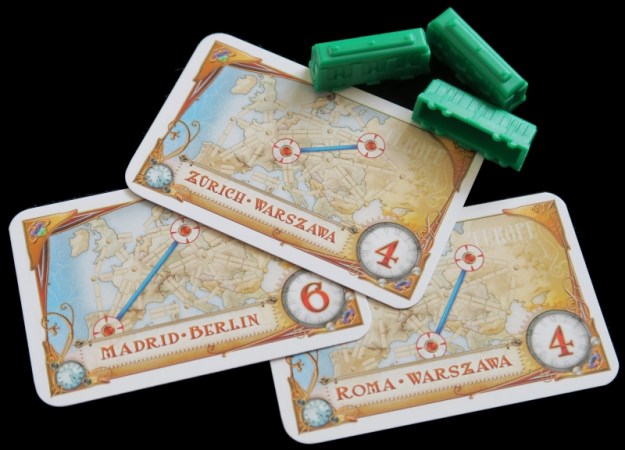
Lime took an early lead, though of course lots of early points are… pointless, if the company doesn’t pay taxes.  In the end it was extremely tight, but in the end, Blue just pipped Lime by a single point.  With just three there isn’t much downtime and the game rocks along nicely with plenty of interaction, though as Pink said, “That’s one hell of an abstraction for a train game.”  Blue pointed out that this was what a lot of gamers thought of when someone said “Train Game”.  Pink felt disappointed at the lack of actual trains and tracks so to make it up to him, the group moved on to play Ticket to Ride Demo.

Ticket to Ride Demo
– Image by boardGOATS

Ticket to Ride Demo is one of the small games based on the Spiel des Jahres winner, Ticket to Ride Europe.  The Demo game has an interesting history—it was designed as a sales tool and had only a small print run.  It was so popular though, that it ultimately spawned a new range of small “City” games, New York, London and Amsterdam.  These games are essentially played the same way as the full-sized versions, but with fewer pieces on a smaller map which means they typically take less than half the time.

Ticket to Ride Demo
– Image by boardGOATS

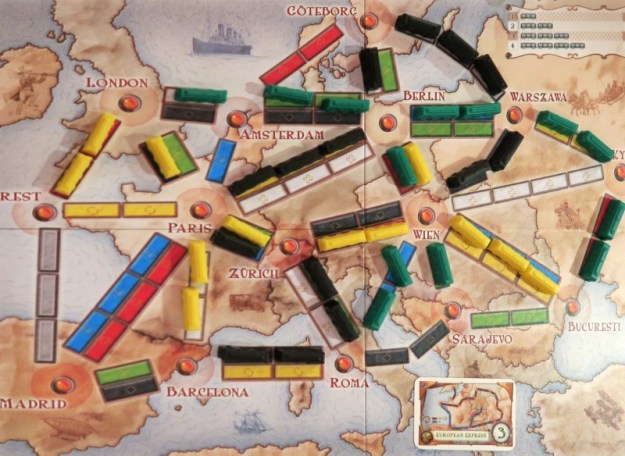
On their turn players can do one of three things:  take cards from the market, spend cards to place trains or take tickets.  Players score points for placing trains, but also for connecting the places on their tickets.  The catch is that any tickets that are not completed score negative points.  The small versions of the game are much tighter with less room for error.  Unlike the others, Ticket to Ride Demo has a double sided map, one USA and one Europe.  This time the group played the Europe map.

Ticket to Ride Demo
– Image by boardGOATS

Compared to the full-sized equivalents, all the little games are like a knife-fight in a phone-box, and this game was no exception.  Lime only completed three of his four tickets as Blue brought the game to a quick and sudden end.  Pink completed all four of his tickets and they were high-scoring too.  Blue’s tickets were less lucrative, but she managed to place all her trains and took the European Express bonus points for the longest continuous route, and with it victory, by just two points.

Ticket to Ride Demo
– Image by boardGOATS

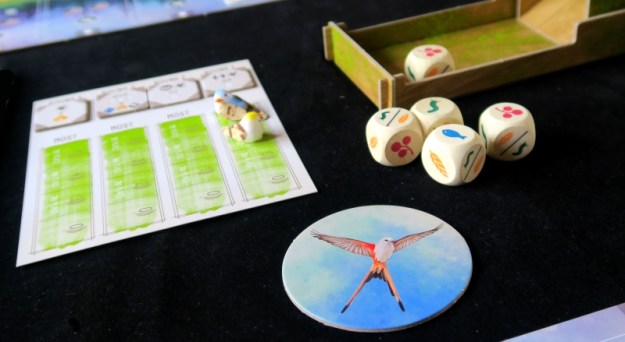
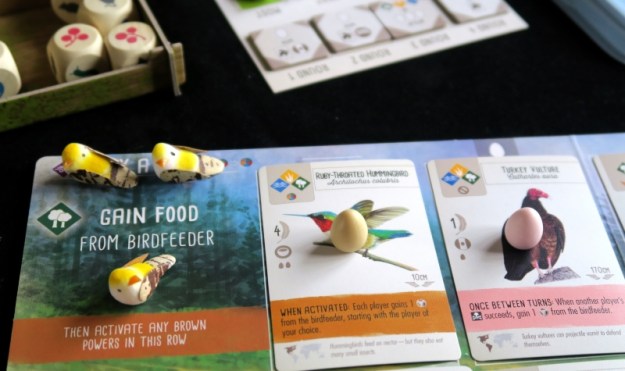
Meanwhile, on the next table an epic, five-player game of Wingspan was underway.  We’ve played Wingspan quite a bit since it came out and always found it very enjoyable.  We’ve played it enough that we’ve also explored the European expansion, but thanks to the restrictions over the last year or so, this was the first opportunity to play the new Oceania expansion.  The base game is a reasonably light, card-driven, combination building game.  On their turn, players can place a bird card from their hand in one of the three habitats, or activate all their cards in one of the habitats and carry out the associated action.

Wingspan: Oceania Expansion
– Image by boardGOATS

The habitats are Woodland, Grassland and Wetland and the actions associated with them are collecting food, laying eggs or collecting cards (respectively).  Once the action has been carried out, the active player activates each card in the habitat in turn.  The game is played over four rounds, with a decreasing number of actions per round as the game progresses.  At the end of each round there are goals and each player also starts with a personal bonus card which is evaluated at the end of the game.

Wingspan
– Image by boardGOATS

The European expansion really only adds extra cards, though this includes a number of birds with abilities that are activated at the end of rounds, and others that increase player interaction.  The new Oceania expansion also adds more cards, but additionally mixes things up a little more with the addition of a new food type, nectar.  Nectar can be used as wild food type, although some of the new bird cards have nectar specified in the cost.  Whenever players spend nectar though, they don’t put it back in the supply, instead they store it in the habitat they spent it on.

Wingspan
– Image by boardGOATS

At the end of the game, the player with the most nectar stored in each habitat scores five points at the end of the game with the player coming second scoring two points.  Nectar is therefore a very important resource giving a potential fifteen points at the end of the game, although it requires some skill to use it effectively as it can’t be carried over between rounds.  Burgundy and Black really invested in nectar and managed to make good use of it during the game as well as take the lion’s share of the nectar points at the end of the game.

Wingspan: European Expansion
– Image by boardGOATS

Burgundy and Black also prioritised valuable birds and tried to ensure they stayed in the running for the end of round bonuses.  Three out of the four of these involved eggs, which fitted with Ivory and Teal’s strategies which focused on an end-of-game egg rush.  Ivory also picked up a lot of points from his Common Starling which enabled him to discard up to five bits of food and tuck a card for each one.  With a maximum of twenty points, Ivory did well to take eighteen during the game, but it was only enough for third place this time though.

Wingspan
– Image by boardGOATS

It was very close at the top between Black and Burgundy.  Burgundy had four bonus cards one of which proved quite lucrative.  The big difference was in the value of the bird cards, however, while Black edged it in many departments Burgundy had a ten point head start.  This wasn’t simply because he had high value birds, more that he had lots of them.  In the end, Burgundy finished five points ahead of Black with ninety-five, in a good game that had been enjoyed by everyone round the table.

– Image by boardGOATS

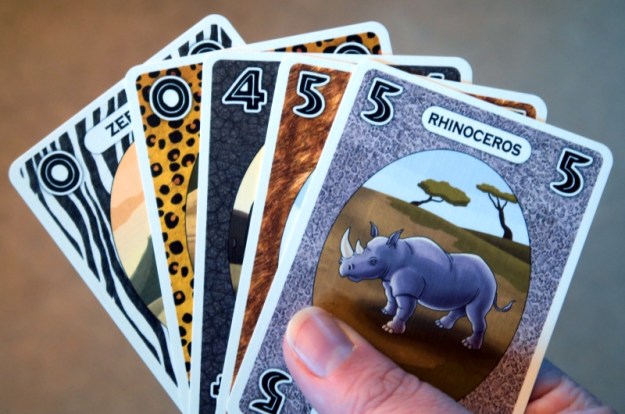
Wingspan was still only on its third round when Ticket to Ride Demo came to an end.  At around the same time, Pine pitched up, so the, now foursome settled down for something else which ended up being a game of Reiner Knitzia’s Botswana (aka Wildlife Safari).  This is an unusual auction-like game made all the better by the inclusion of plastic animals.  Played over several rounds, players are dealt a hand of cards and on their turn play a card and take an animal of their choice.  The cards are numbered zero to five and come in five different animal suits.

Botswana
– Image by boardGOATS

The cards are played in the centre of the table in suits and the game ends when all six cards of one suit have been played.  The top card in any suit is the current value of that animal.  Thus, if the top zebra card is a five, a player that has three zebras will earn fifteen points for them if the game ends.  However, if the zero just before the game ends, the zebras will become worthless.  It is a deceptively simple, yet fun little game.  Blue thought she’d won until a recount docked her ten points and she finished just two points behind a delighted Pink.

Botswana
– Image by boardGOATS

As Botswana came to an end, so did Wingspan, and although time was marching on, and Lime and Ivory took an early night, there was still time for everyone else to play one last game.  After a little discussion, we settled on 6 Nimmt!, a game we all know and love.  Players simultaneously choose a card and these are sequentially added to the end of four rows of cards, specifically the row with the highest number that is lower than the card itself.  If the card is the sixth card in the row, instead, the player takes other five and adds them to their scoring pile.  The player with the lowest score at the end of the game is the winner.

6 Nimmt!
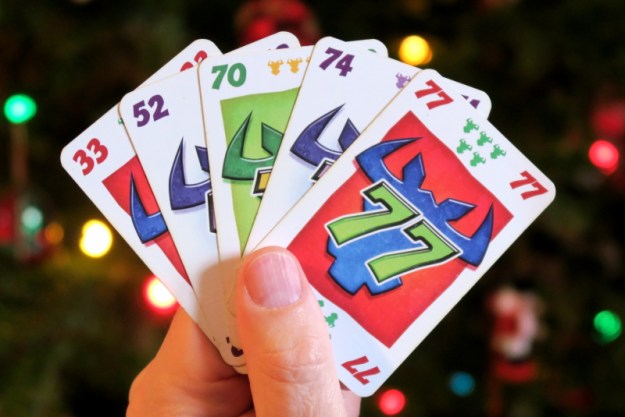
– Image by boardGOATS

We’ve all played this a lot online over the last year, but doing the maths ourselves was a little daunting, so we decided to go back to playing the non-professional version.  We play over two rounds using half the deck in first and the other half in the second.  This time Teal top-scored in the first round with nineteen, while Burgundy kept a clean sheet with Pink just behind.  Blue’s killer thirty-three in the second round gave her a total of forty-eight, but the winner for the second time in the evening was Pink with just four points.  And with that, it was bedtime.

6 Nimmt!
– Image by boardGOATS

Learning Outcome:  Today’s railway industry is no longer about trains and tracks. ☹