Author Archives: nannyGOAT

Spiel des Jahres Winners – 2021

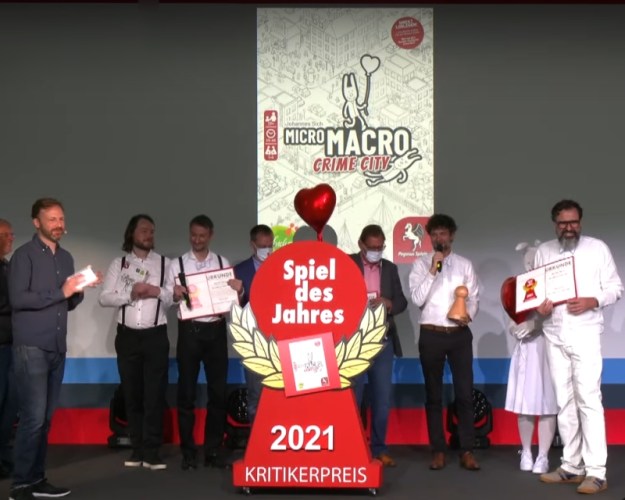
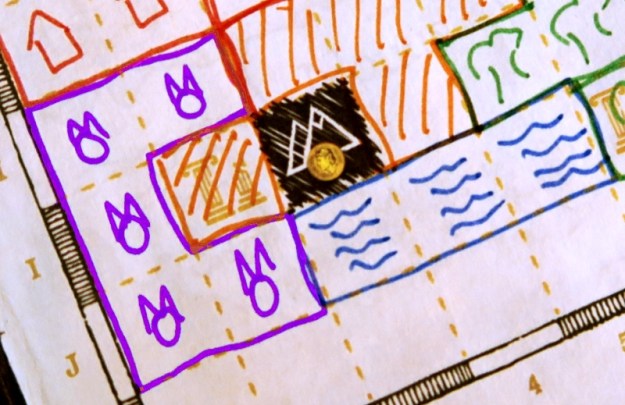
The 2021 winner of the coveted German Game of the Year or Spiel des Jahres award has been announced as MicroMacro: Crime City.  This is an unusual choice in that it is very different to most traditional games and arguably is more a cooperative crime-solving activity using the medium of “Where’s Wally?“.  The “game” is played on a large monochrome map, with a deck of cards.  The cards ask questions with the answers to the questions on the map.  In turn, these lead the players to the solution to each of the sixteen cases.

– Image by BGG contributor Hipopotam

As a family challenge, MicroMacro: Crime City can certainly be a lot of fun, though it might not be seen as a game in the traditional sense.  There has been an increasing tendency by the committee to reward games that challenge the conventional idea of a game, with notable nominees including the 2018 Spiel des Jahres nominee The Mind, 2019 Kennerspiel nominee Detective: A Modern Crime Board Game, and the 2017 Kennerspiel winner, the Exit: Das Spiel series.  While this may make games more relevant to more people, it also means the Spiel des Jahres awards increasingly are less applicable to more traditional gamers.

– Image by BGG contributor kalchio

As usual, the Kennerspiel des Jahres was awarded at the same ceremony. This award honours slightly more challenging games and this year went to Paleo. This is a co-operative campaign game, where players try to keep the human beings in their care alive while completing challenges. The Kinderspiel des Jahres award winner was announced last month and went to Dragomino, a children’s version of Kingdomino where players are hunting dragon eggs.  As usual, congratulations to all the winners and nominees, in what has been a very difficult year for everyone.

MicroMacro: Crime City
– Image adapted by boardGOATS from the
live stream video on spiel-des-jahres.de

Next Meeting, 6th July 2021 – Online!

Although it feels like the end is in sight, we have at least one more games night before we can return to the Horse and Jockey.  Therefore, our next meeting will be on Tuesday 6th July 2021; we will gather from around 7.30pm, and start playing at 8pm.

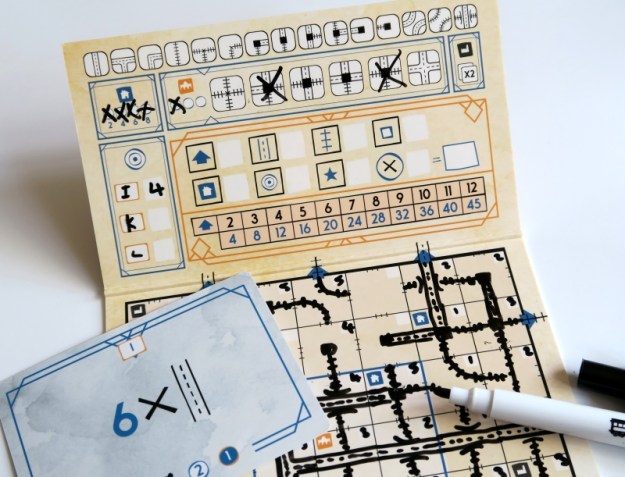
This week, the “Feature Game” will be the Railroad Ink Challenge: Shining Yellow Edition.  We have played Railroad Ink: Deep Blue Edition several times, both with and without the mini expansions and have really enjoyed it.  This new version steps it up a little with several new challenges to add to the base game.

Railroad Ink: Shining Yellow Edition
– Image by boardGOATS

And talking of challenges…

Jeff was chatting to his mate Joe about impossible questions.  As the conversation went on, Jeff said he thought he could answer all questions with just two sentences.

Joe wasn’t convinced, so Jeff explained, “Any question can be answered by either, ‘None of your business’ or ‘None of my business’.

Joe said, “Don’t you think answering questions like that make people unhappy?”

Jeff replied, “None of my business.”

Joe wasn’t impressed, “You really DO think you are the cleverest person, don’t you!?!?” he grumped.

Jeff grinned and replied, “None of your business.”

Joe took that as a challenge and sat and thought for a moment, then he smiled and said, “Did you know that I’d slept with your wife?”

22nd June 2021 (Online)

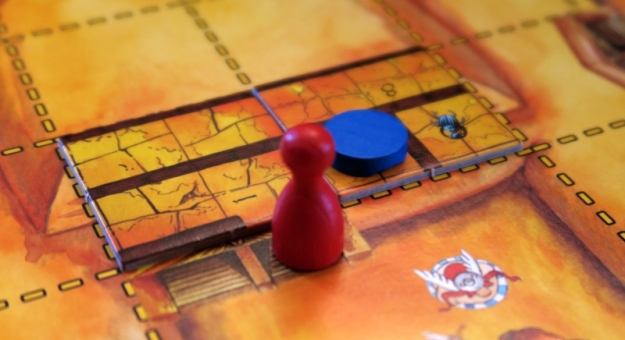
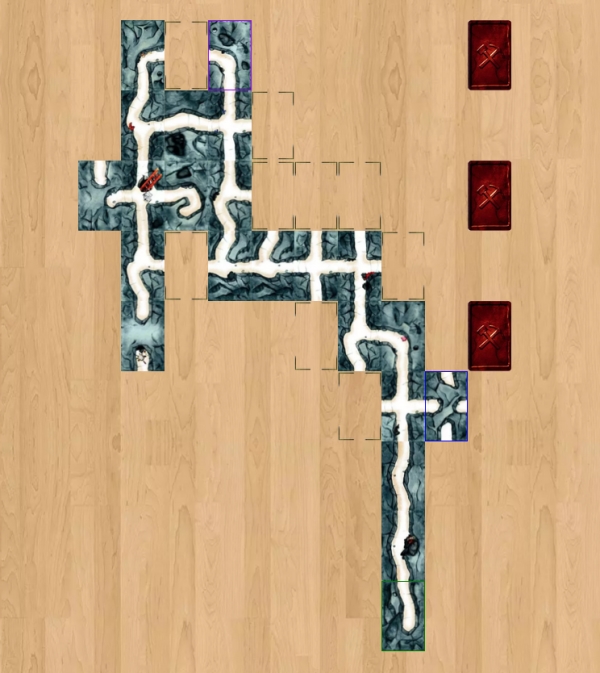
After the usual chit-chat and some special Euro 20 discussion, we began setting up the “Feature Game“, which was the Sphinx und Triamide expansion for Das Labyrinth des Pharao.  Das Labyrinth des Pharao is a tile laying game in a similar vein to Take it Easy!, which we played earlier this year, and the Spiel des Jahres nominee Karuba, which we haven’t played for ages.  Although it is a slightly older game, we first played Das Labyrinth des Pharao just a couple of months back and really enjoyed it.  The idea is that players are exploring a pyramid, placing tiles and trying to find treasure.

Das Labyrinth des Pharao
– Image by boardGOATS

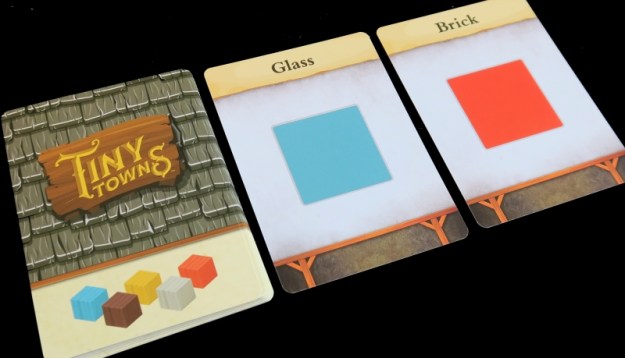
Everyone has their own player board, a meeple, some treasure cubes (in our case stolen from players’ copies of Tiny Towns)  and a set of tiles which correspond to the cards in the shared deck.  The top card in the deck is turned and everyone has to find the corresponding numbered tile and place it somewhere, anywhere on their board.  Three turns in, players have to choose which entrance they are going to use, and place their meeple as far into the temple as their path extends.  Each time a path tile has a scarab icon on it, players can choose to place a treasure on that space when they add it to their board.  Treasures must be placed in order, starting with the lowest value (worth one point) with the highest value (worth three points), only placed after all the others.

Das Labyrinth des Pharao
– Image by boardGOATS

If the treasure is entirely enclosed in a chamber by itself and the meeple’s path runs adjacent to it, the player can grab the treasure as they go past.  Thus, there are two ways to score points:  players score one point per quarter of a tile their meeple travels, and get more points for treasure they collect.  The player with the most points at the end of the game is the winner, but the catch is that three tiles aren’t used and if a player needs one of them to complete their route, they can find their score decimated by fate.

Das Labyrinth des Pharao
– Image by boardGOATS

The base game is played on a simple square pyramid board, but we were playing with the Sphinx und Triamide expansion.  This provides a double-sided alternative board, one side with a nasty looking triple pyramid featuring two very critical spaces, and the other a cool-looking sphinx with a long, thin body making it difficult to effectively join the front and back legs.  There was lot of discussion about which board, and even a vote using vevox.app was inconclusive and Blue ultimately had to make the decision, opting for the sphinx as it looked like it might be slightly easier to work with (and everyone likes cats).

Das Labyrinth des Pharao: Sphinx und Triamide
– Image by boardGOATS

That decision quickly proved baseless as the first tiles were placed and it became clear that tile positions were very critical for the sphinx too.  There were the inevitable moans and groans as people realised early mistakes and discovered how few tiles were available to do what they wanted.  It is really hard to tell how badly things are going when you can’t see everyone else’s board, but it was clear that for most people, there were key tiles they needed.  Some, like Black, were forced either to gamble on a key tiles putting in an appearance, or play safe.

Das Labyrinth des Pharao
– Image by boardGOATS

Nobody had a complete disaster this time, and when Ivory was first to announce his score of forty-one, most people felt that was competitive.  Pine therefore thought he had it with his forty-five, until Burgundy revealed his score of sixty-one.  Sadly for him, he was pipped to the win by just two points by Green.  Perhaps the most unfortunate, however, was Black, who had agonised over whether to gamble, but had decided to play safe only to be given the tile he needed on the very next turn.  Had he taken the chance, he would have finished with an unsurpassed sixty-seven.

Das Labyrinth des Pharao: Sphinx und Triamide
– Image by boardGOATS

It was still reasonably early, so we decided to play something else and after a little bit of discussion, we settled for Second Chance.  We’ve played this a lot over the last year, but it is quick and fun and everyone enjoys a little bit of competitive colouring in.  Again, the game is card driven: cards are revealed showing Tetris-like shapes which players draw on their player board.  Two cards are revealed each round and players get to choose which they use.  This means that, at least in the early stages of the game, everyone gets access to all the shapes, however, if two desired shapes come out at the same time, then players have to make a decision.

Second Chance
– Image by boardGOATS

This time, smaller shapes came out early and players were very wary of the particularly awkward “Staircase of Doom”, and getting stuck with it when they didn’t have the space.  In the event, it came out at the same time as the almost as awkward “H” (we all know how traitorous “H” is), which laid waste to large numbers of players who had lots of space, but not in the right shape.  All these players got a second chance and Burgundy went out first though most others were able to carry on.  With so many second chances so quickly, the game suddenly went from lots of cards left to almost none, leaving a few players still “in” when the deck was exhausted.

Second Chance
– Image by boardGOATS

Ivory, Green and Blue would have been able to continue, but that’s not the aim of the game—the winner is the player with the fewest empty spaces, unusually, regardless of whether they were eliminated or not.  The abrupt end had caught out some, and this time, there was a tie for first place between Pink and Ivory, with five spaces left.  Meanwhile Green and Burgundy also tied for third just one space behind, but all were unusually poor scores for us with previous winners finishing with three empty spaces or fewer.  Taking their medals with them, that was the cue for Ivory and Green to take an early night while the rest of the group moved to Board Game Arena to finish with a couple of games of 6 Nimmt!.

6 Nimmt!
– Image by boardGOATS

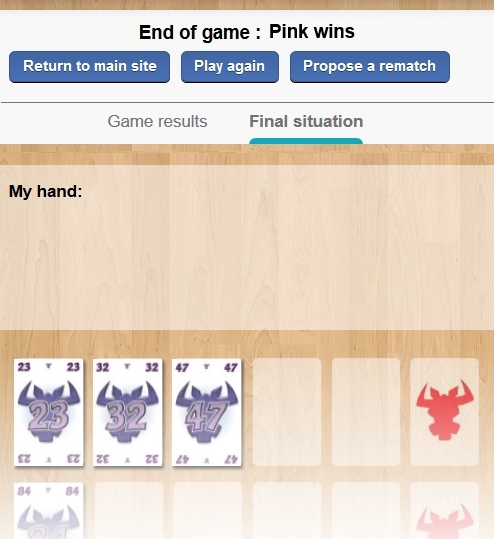
With the possibility of returning to The Jockey in the coming month or so, sadly 6 Nimmt! is a game that is unlikely to ever be quite the same again in real life.  We have always really enjoyed playing it, but over the last year, we have played this nearly thirty times—way more than anything else.  So once we are able to play in person again, we will probably take a bit of a break from it.  It has unquestionably made game nights more bearable though, and has even provided memorable experiences in a year that has mostly been devoid of happy memories (the highlight of the year being Lime getting stuck in a game against a load of French players as we all spectated and cheered him on).

6 Nimmt! on Board Game Arena
– Image by boardGOATS
from boardgamearena.com

One of the big differences between the way we play now and the way we used to play in person, is the addition of the “Professional Variant” rules.  In the basic game, players simultaneously choose a card and then, starting with the lowest these are added to the end of the row where the final card is the highest card that is lower than the card played.  In the “Professional Variant”, cards can also be added to the other end of rows if they are lower than the first card.  This has made the game more fun, but it certainly helps to have a computer to work things out.  Playing without this variant will undoubtedly lack something, but playing with it will need everyone to work hard at the maths.

6 Nimmt!
– Image by boardGOATS

This time though, were were playing online of course.  So, instead of counting who has the most “nimmts” at the end, we all started with a tally of sixty-six, and the loser is the player who wins the race to the bottom.  Blue started strongly and looked to be a shoe in, but Burgundy decided she shouldn’t be the one to hog the limelight and joined her ultimately taking the lead and then winning the race nobody wants to win.  It was very at the other end though with Pink just pipping Black by a solitary point and Pine coming home a little way behind in third.  The second game was even tighter at the top with Blue going from zero to hero to tie with Pink for first, while Purple finished just two points behind.  While some things changed, others stayed the same as Burgundy ended the game (and the evening), with a magnificent minus seventeen.

6 Nimmt! on Board Game Arena
– Image by boardGOATS
from boardgamearena.com

Learning Outcome:  Some games can be sphinx-ter tighteningly fun.

Next Meeting, 22nd June 2021 – Online!

Summer is officially here, though the weather means it doesn’t feel like it.  The restrictions are still here too, but although things are improving, people still need “remote gaming“, despite its limitations.  Therefore, our next meeting will be on Tuesday 22nd June 2021; we will gather from around 7.30pm, and start playing at 8pm.

This week, the “Feature Game” will be the Sphinx und Triamide expansion to Das Labyrinth des Pharao.  Das Labyrinth des Pharao is a tile laying game in a similar vein to Take it Easy! and the Spiel des Jahres nominee Karuba which we last played a long time ago.  This game has an Egyptian theme though, with players exploring a pyramid, or with the expansion, three pyramids/a sphinx.

Das Labyrinth des Pharao: Sphinx und Triamide
– Image by boardGOATS

And talking about Egypt…

Jeff was living in Egypt by the banks of a beautiful ancient river.  Every year the river flooded, but Jeff remained certain that the river would not destroy his house.  One year, the people of the village tried desperately to persuade him to evacuate, as the floods that year were particularly severe.  Jeff would not listen though, convinced he was right.  The floods came within the month, however, ruining his house and pulling him, and the debris, into the river.  The people, watched from the shores, shouting at him, and yelling, asking him why he didn’t listen.  Jeff continued ignoring them—he was still in de-Nile.

The evening began with the usual friendly chit-chat.  This time, it was mostly focussed on whether or not we would be able to go back to our beloved Jockey for the next meeting (spoiler: we won’t).   But we also discussed at length why Van Diemans in the village was so called, whether it had anything to do with Tasmania or U2, and who Mr. Van Dieman was anyhow (spoiler: nobody knew the answers to any of these, but the street name is spelled differently to the “land”).  We then began to set up the “Feature Game” which was the Fortune expansion for Tiny Towns.

Tiny Towns
– Image by boardGOATS

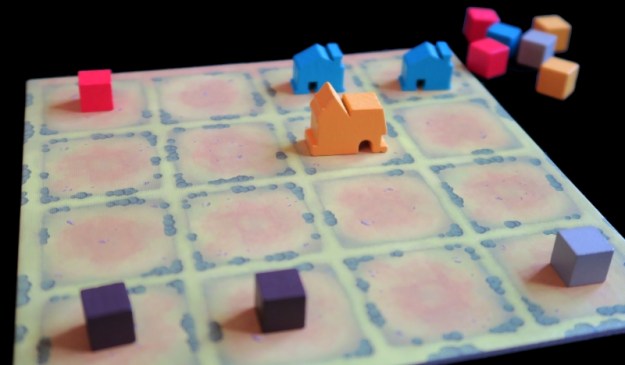
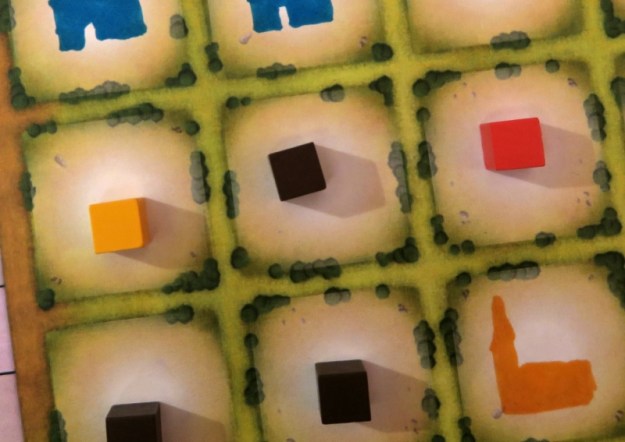
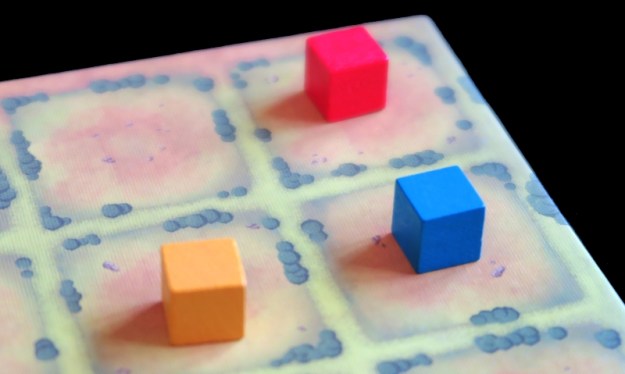
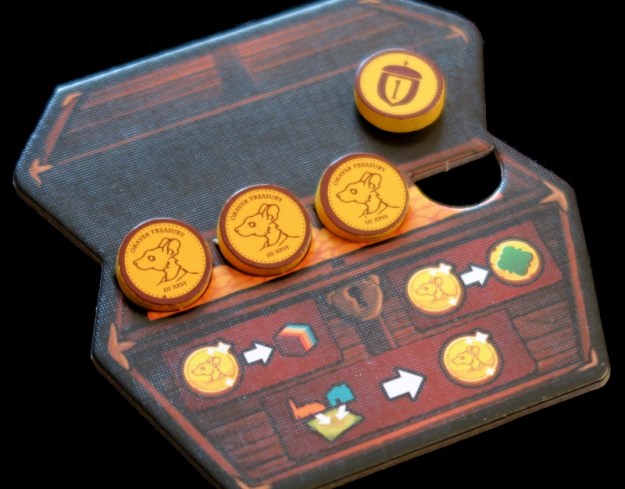
Tiny Towns is a cute little area control, resource management and town building game with a strong spacial element.  We have played the game several times: after a couple of plays of the minimalistic base game, we have since added the alternative building cards, then the Monuments, and felt we were now ready to add the first expansion, Fortune.  The basic idea is very simple:  players place resources, one per space on their four-by-four town plan.  When they have the right combination of resources in the right arrangement, they can be replaced with a building.  This frees up some spaces, but makes one unavailable for the rest of the game which makes planning essential.  Different buildings give points in different ways, and to add variety, there are alternative buildings available for each type.

Tiny Towns
– Image by boardGOATS

In person, the game plays up to four with players taking it in turns to choose the resource that everyone must place.  Playing online, we use the “Town Hall Variant” which uses a deck of cards to give two resources while every third is a free choice.  For ease with so many, we also play a sort of “Roll and Write” variant where players print their player board and draw the buildings when they build them.  Monuments are special buildings that act as a sort of private goal with everyone having their own Monument deck to draw two cards from at the start of the game, picking one to keep.

Tiny Towns
– Image by boardGOATS

The Fortune expansion allows a little additional flexibility giving players the opportunity to acquire gold and then spend it so they can choose their own resources.  Players receive gold for building two buildings in the same round.  This requires slightly more planning and leads to a little more restriction, but the reward is flexibility later in the game, or an extra point if the gold is unspent.  Players can only hold a maximum of four gold coins at any one time though (or five if they have built a Monument that provides extra storage space).

Tiny Towns: Fortune
– Image by boardGOATS

We also chose to play with the optional “Cavern” rule which is really more of a “hole in the ground” where players can throw resources.  It only holds two resources and players cannot recover these resources and use them later in the game (hence, more of a bottomless pit than a Cavern).  This time we played with both the Cavern rule and the Fortune expansion. Playing with both the Cavern and the Fortune expansion gave a lot of flexibility, perhaps too much flexibility as it took away a lot of the tension and challenge that makes the original game, though it was a lot less stressful as a result.  Playing again, we’d probably play with one or the other, but perhaps not both, as they do a similar thing.

Tiny Towns
– Image by boardGOATS

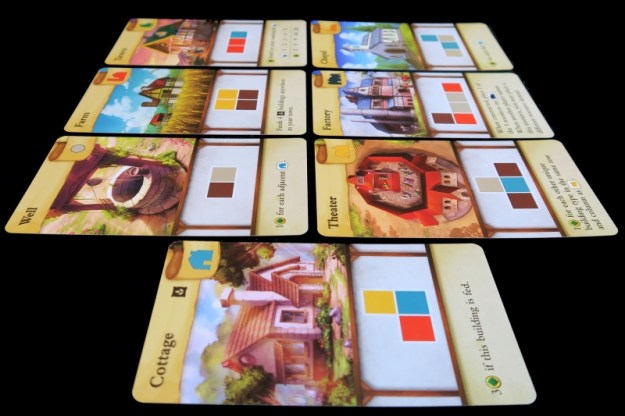
We started by drawing the cards for the buildings.  They were the Cottage (always included of course), the Farm, the Fountain, the Cathedral, the Gamblers’ Den, the Market, and the Trading Post.  The Cathedral and Gamblers’ Den were from the Fortune expansion, with most of the others being optional alternative cards from the base game.  There was some debate whether the seven points a Cathedral would give was worth the effort and how the Trading Post works.  With all the little rules niggles ironed out we started.  There were the usual complaints when people wanted one thing and got something else.

Tiny Towns
– Image by boardGOATS

The game began with a lot of stone and wood, which players were mostly able to augment with their choice in every third round.  Most people made a point of building a up a stash of coins in the early part of the game while there was space available to work with.  Players gradually drop out when they can no-longer place resources in their town.  Blue was the first to drop out and early too, having used her Trading Post to provide additional resources and her Masons’ Guild Monument to build extra buildings.

Tiny Towns
– Image by boardGOATS

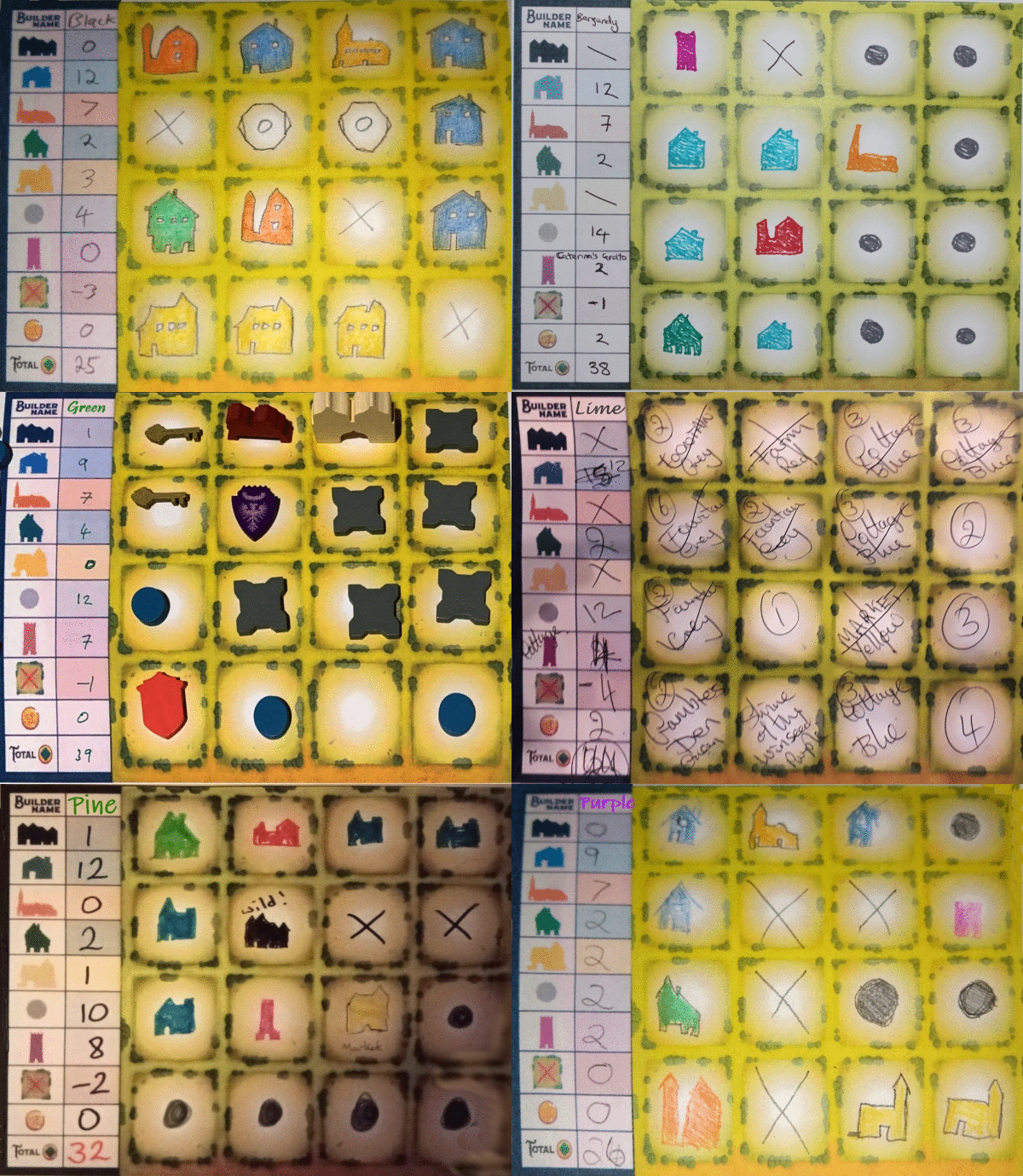
Others soon started following though, and it wasn’t long before Ivory was posting his traditionally high opening score.  At his opening bid of forty-one there were lots of agonised groans, and with good cause as it turned out.  Three others were within three points of him and several others were not much further away.  Burgundy, Pink and Blue scored thirty-eight, thirty-nine and forty respectively, but despite recounts, nobody was quite able to catch Ivory.

Tiny Towns: Fortune
– Image by boardGOATS

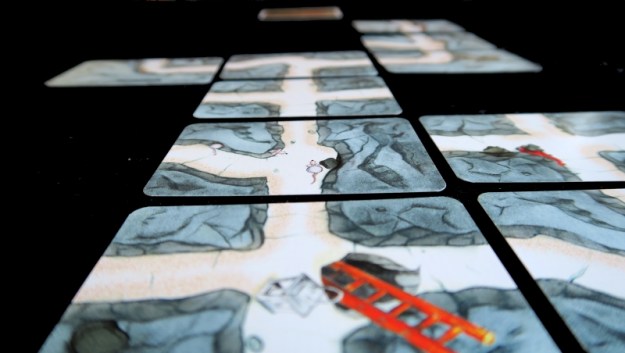
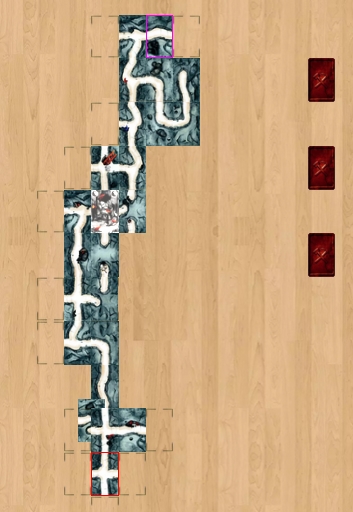
It had been a very good game and everyone had really enjoyed it, but time was marching on.  So once Lime and Ivory had taken their leave, the rest of the group moved on to Board Game Arena and after some debate, decided to play Saboteur.  This is a hidden traitor game that we have played quite a bit. The idea is that there are two teams: Lovely Loyal Dwarves and Nasty Evil Saboteurs.  The Dwarves are playing cards trying to find gold, while the Saboteurs are trying to stop them by pushing the tunnel in the wrong direction and breaking their tools.

Saboteur
– Image by boardGOATS

There is a bit of a flaw in the game, however.  In order to keep a level of ambiguity, the number of Saboteurs/Dwarves is always slightly vague.  In real life, this is done by drawing cards from a deck containing one more card than the number of players.  The problem is though, the swing of two players from the Saboteurs to the Dwarves means it goes from extremely difficult for the Saboteurs to nigh-on impossible.  This is particularly the case with the smaller numbers of players, six or seven, say.

Saboteur
– Image by boardGOATS

For this reason, we decided to see if we could include something from the Saboteur 2 expansion, to level things up.  Not wanting to introduce too much change too suddenly, we only included the “Selfish Dwarf”.  This basically gives one of the Dwarves a slightly different goal—while he is also digging for the treasure, he only wins the round if he is the one to actually find it.  At the start of the first round, it was immediately obvious that Green was a Saboteur—he is a natural Saboteur and we always assume he is anyhow, with or without evidence.  This time he was definitely a Saboteur, though and it quickly became apparent that Black was also a Saboteur.

Saboteur on Board Game Arena
– Image by boardGOATS from boardgamearena.com

It became apparent that something was amiss when Pink and Pine appeared to join them with even Purple behaving a little suspiciously.  Blue in particular was very confused as although nobody else knew it yet, she knew she was a saboteur (she checked several times just to be certain!), but there were already more Saboteurs than was possible given the number of players.  In the end, Pine decided to trust Blue and that put the final nail in the Dwarves attempts to find the wealth.  The Dwarves got nowhere close at all just heading endlessly south, which gave a rare victory for the Saboteurs, who turned out to be Pink, Green and Blue.

Saboteur on Board Game Arena
– Image by boardGOATS
from boardgamearena.com

This was only the second win for the Saboteurs since we’ve been playing online, with the previous occasion being very recent, the last time we played the game, in fact.  The Saboteurs were very pleased with themselves and their efforts, and the Selfish Dwarf, who turned out to be Burgundy, had just got nowhere too.  The second round the Dwarves made much better progress from the start.  There was a little debate about where the gold was, but once they had concluded it was at the bottom they made a bit of a beeline towards it.  Somehow, things weren’t quite that simple though.

Saboteur on Board Game Arena
– Image by boardGOATS from boardgamearena.com

The Dwarves had a lot of misfortune with the cards they had and just as it looked like they might make it, they didn’t have the cards.  And then Pine put the boot in and that was that—two wins out of two for the Saboteurs who, this time, were Pine, Pink and Purple.  The game is played over three rounds with the winning team getting gold at the end of each round.  So with one round to go everyone felt sure that the Dwarves would be able to make up for it in the final round.

Saboteur on Board Game Arena
– Image by boardGOATS
from boardgamearena.com

Once again, it became apparent early on that Pink was a Saboteur, third time in three rounds.  Despite his protestations (he always protests, Saboteur or not), Green was behaving very suspiciously and disappeared under a hail of broken tools as the Dwarves tried to limit the damage he could cause.  The real question was whether there was another Saboteur or not, and if there was, who was it?  Suspicion fell on Black thanks to the number of cards he was discarding and how generally unhelpful he was being, but nobody was quite certain.

Saboteur on Board Game Arena
– Image by boardGOATS from boardgamearena.com

In the end, the Dwarves simply ran out of cards—although they knew where they were going they didn’t quite make it giving the Evil saboteurs a completely unprecedented three wins from three with Pink winning all three rounds.  The question is, what caused it?  Well, it certainly was significant that in all three cases, the Dwarves were playing with the maximum quota.  It is possible that the Selfish Dwarf contributed slightly too, but Pink who seemed to be the architect of their success, afterwards said he felt that the Saboteurs did well because in each case he started his evil deeds early in the round instead of waiting.  It will be interesting to see if that works next time we Saboteur.

Saboteur
– Image by boardGOATS

Learning Outcome:  Saboteurs really CAN win!

Next Meeting, 8th June 2021 – Online!

Spring is here, the evenings are getting brighter and it really feels like the end is in sight, maybe.  People still need what social contact they can get though, and board games are a great medium for that.  Despite the limitations of “remote gaming“, everyone feels it is important to stay in touch, so we are persisting with online meetings.  Therefore, our next meeting will be on Tuesday 8th June 2021; we will gather from around 7.30pm, and start playing at 8pm.

This week, the “Feature Game” will be the Fortune expansion to Tiny Towns, a cute little area control, resource management and town building game.  The expansion allows a little additional flexibility giving players the opportunity to acquire gold and then spend it so they can choose their own resources.

Tiny Towns: Fortune
– Image by boardGOATS

And talking of fortunes…

After his rich uncle’s death, Jeff was very anxious about his uncle fortune.

“Am I mentioned in the will?” he repeatedly asked the solicitor.

“Of course you are,” the solicitor replied pointing, “Right here on the second page…”

Jeff read aloud, “To my niece Sally, I bequeath £123,000; to my cousin Thomas, £55,000; and to my nephew Jeff, who was always asking whether he was mentioned in my will, HELLO JEFF! I didn’t forget to mention you, did I?”

25th May 2021 (Online)

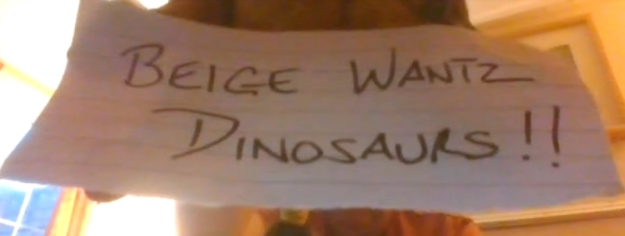
As the “Feature Game” was to be the “Roar and Write” game, Welcome to Dino World the evening began with a competition to see who could do the best T-Rex impersonation. Voting was carried out using the Vevox utility and the winner with 83% of the vote, thanks to his truly remarkable rendition of “Bang a Gong (Get it on)”, was Beige.  It was only fitting really, given his obvious disappointment a month ago when the game was postponed.  The reason for the competition was to choose who would roll the dice, because this is a game which is all about the dice and planning what to do with them.
Welcome to Dino World
– Image by boardGOATS

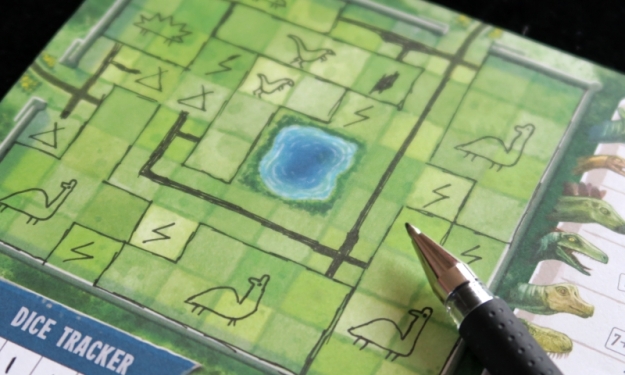
Welcome to Dino World is completely unrelated to the Welcome to… games we have played previously, except for the similarity in the names of course.  There are two levels, but as we hadn’t played it before, we played the “Lite Mode” and saved “Danger Mode” for another day, thus reducing the risk of there being another Isla Nublar type incident in Oxfordshire.  The basic idea of both modes though, is that a player (in this case Beige) rolls three dice and everyone spends these to take a maximum of three actions (one per die).  The unusual aspect of the game is that dice can be combined together to increase their value, so, for example a roll of one, three and four could be used separately to carry out relatively low value actions, or combined together for one larger move.
Welcome to Dino World
– Image by boardGOATS

There are three possible actions: Build a Facility, Build Path and build a Dinosaur Pen.  There are two types of Facility, Recreation and Welfare.  Recreation requires a die of value one, two or three while Welfare requires a four, five or six.  Thus, with the example roll above, a player could choose to build two Recreation Facilities and one Welfare Facility, or the might choose to combine the one and three do build two Welfare facilities.  Similarly, building Paths has a pip cost, so a die with value four, for example, could be used to build four straight or corner sections, two T-junctions or convert one straight into a crossroads.
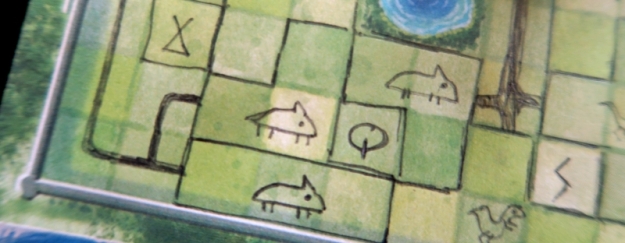
Welcome to Dino World
– Image by boardGOATS

The guts of the game is building dinosaur pens, however.  There are six different types from the small herbivorous protoceratops to the mighty Tyrannosaurus Rex.  Each has a different die requirement and takes up a different amount of space in the player park, and some also need power to maintain their security.  Power comes from generators, which will supply up to four orthogonally adjacent pens.  They are free to build, but players can only build a maximum of twelve over all eight rounds, and unused generators are worth two points, so efficiency is the name of the game.
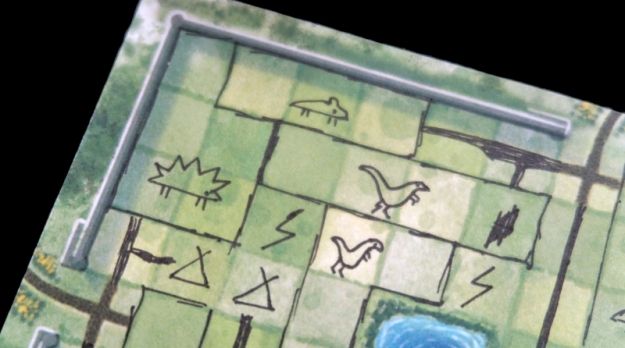
Welcome to Dino World
– Image by boardGOATS

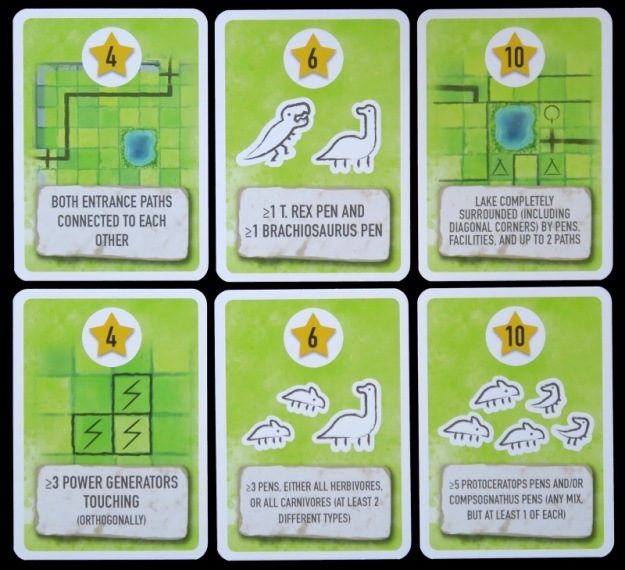
The driving force of the game are the Visitors though, which are goal cards that vary from game to game.  In the conventional version of the game, these are dealt out between players, such that people who are sitting next to each other share them:  the first player to achieve the goal gets the points and the other player loses out.  This clearly makes the game much more interactive and competitive, but this simply wasn’t possible while playing online.  So, we used the “10+ Players Variant” where the Visitors are drawn from a deck and treated as end-game communal objectives.
Welcome to Dino World
– Image by boardGOATS

This time, the Visitor cards gave points for:

  • ≥3 Power Generators touching;
  • Connecting both entrances with a path;
  • ≥1 Tyrannosaurus Rex pen and ≥1 brachiosaurus pen
  • ≥3 Pens that are all containing herbivore or carnivore including two different types;
  • ≥5 Pens containing a mixture of protoceratops and composognathus;
  • Completely surrounding the Lake with Pens, Facilities and a maximum of two paths.
Welcome to Dino World
– Image by boardGOATS

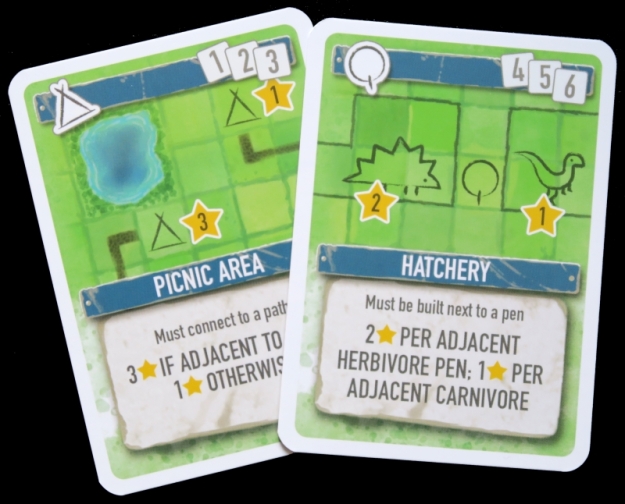
There is additional variety introduced into the game with the Facility cards.  This time we played with the Picnic Area and the Hatchery. The Picnic Area gave points when next to the lake and the Hatchery gave points for each pen it was next to.  The game is played over eight rounds with the players scoring points for the dinosaurs they have in their park, the Facilities they have built, the number of visitors they have claimed and economy in building Electricity generators.
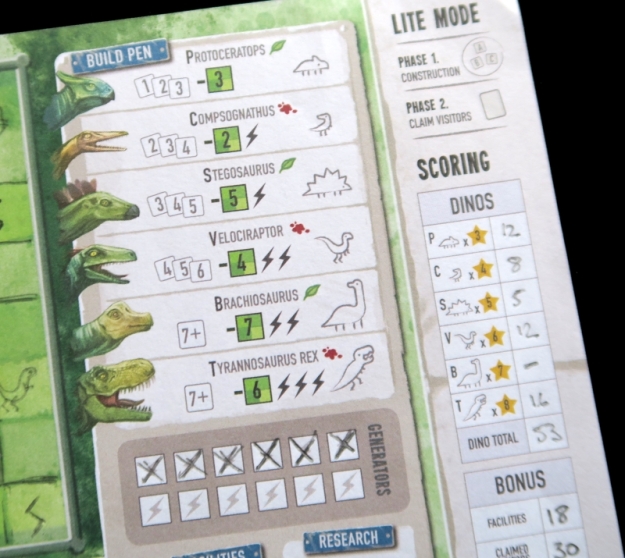
Welcome to Dino World
– Image by boardGOATS

The first thing that everyone discovered was how bad they were at drawing dinosaurs.  We had lots of woodlice, a few tadpoles, a chicken, and some fortune cookies with legs.  The next thing everyone found out was that Blue was right when she said the first few rounds were very slow as people needed to spend a lot of time planning, but the later rounds were quicker as players just had to decide how to execute those plans.  There were a lot of high value rolls in the first few rounds, in fact, there was at least one five in each of the first five rounds.
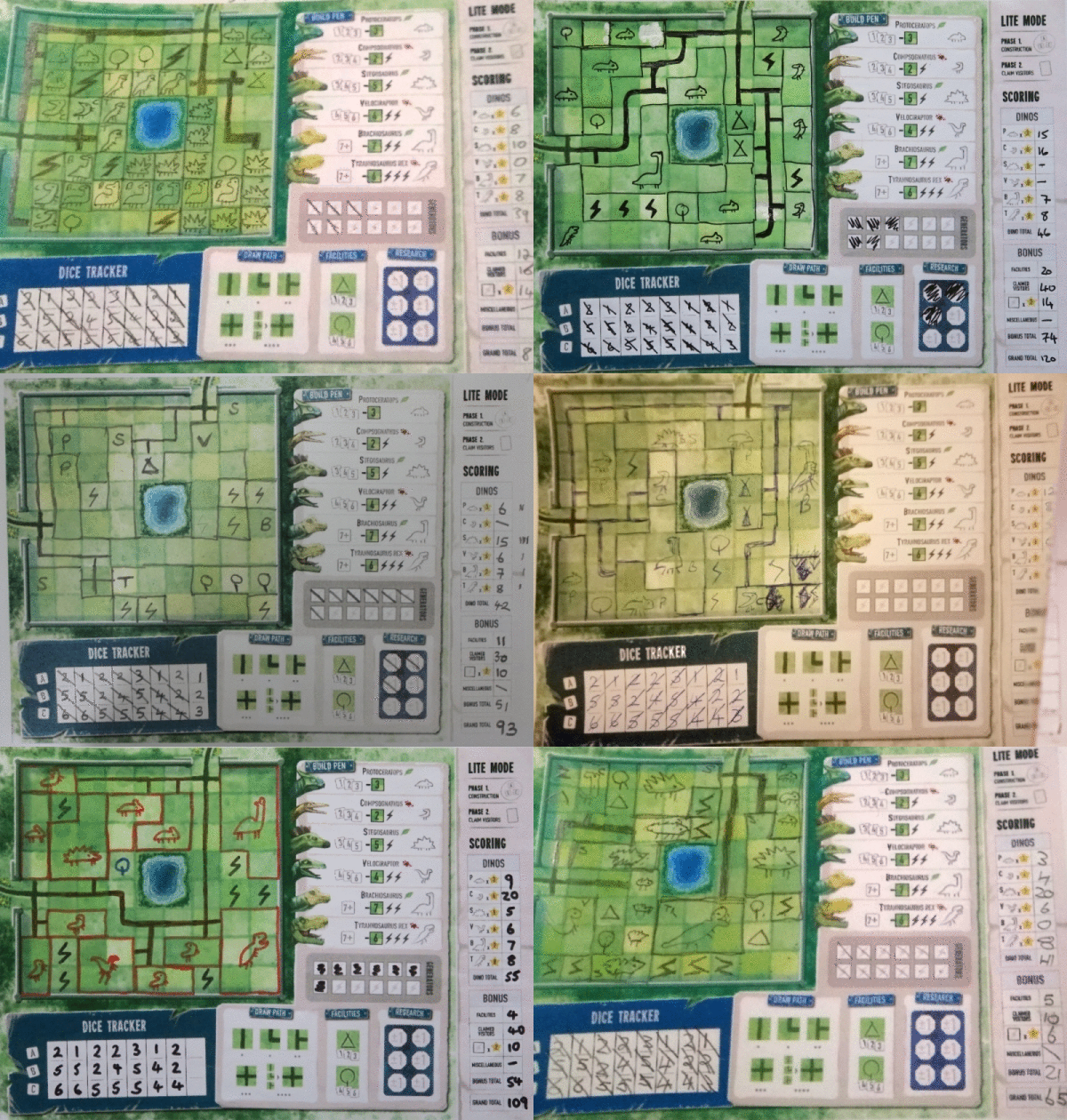
Welcome to Dino World
– Image by boardGOATS

The high values were very useful as players could build a lot of path or some big dinosaur pens, but Beige decided he didn’t trust the dice and swapped them for a different set.  Although the game was without the blood and guts of Jurassic Park, everyone enjoyed it and found it offered something a little different to some of the other “Roll and Write” games we’ve played.  The scores were fairly well spread, but both Pink and Green thought their scores which were over a hundred were enough until Ivory gave his score of a hundred and seventeen.  He thought he’d got it too until Blue’s score of a hundred and twenty had been double checked and confirmed.
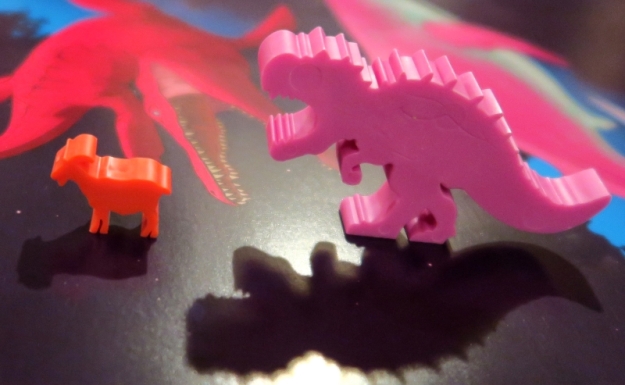
Dinosaur Island
– Image by boardGOATS

As people double-checked their scores and compared notes, we also discussed how different the “Danger Mode” was and how this more advanced version sounded a lot like a “Roar and Write” version of Dinosaur Island, a game we played over two years ago.  As the evening was roaring on, we decided to move on to Board Game Arena, and with relatively few people, we were able to play Downforce, the game we played in December at our online New Year Party (as the closest we could come up with to replace our annual game of PitchCar).
PitchCar
– Image by boardGOATS

The track was picked at random on both occasions, but by chance we used the River Station track both times.  It was when everything was set up that we realised we couldn’t really remember how to play, so had to muddle through.  In practice, the game is quite straight-forward, but it is a lot easier when you know the rules.  The idea is that players are dealt movement cards and then bid for a car.  Each player gets one car, and the idea is that players try to win a car they have movement cards for. Players then take it in turns to play cards and move cars.
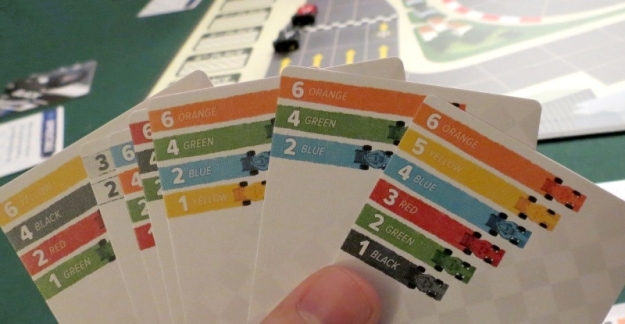
Downforce
– Adapted by boardGOATS
from image by BGG contributor The Innocent

There are two key things.  Firstly, the movement cards mostly move multiple cars, which means it is not as simple as choosing a card to move one’s own car.  Secondly, as well as winning prize money for their card finishing the race, players can also bet on other cars to win. As cards move more than one car per turn, it means players have an element of agency in other cars’ movement and can influence how cars do, albeit only to a small degree.  The fact players can only own one car caught some people out as did the betting when the first betting line was crossed.  But otherwise, everyone got the hang of what they were doing quite quickly.
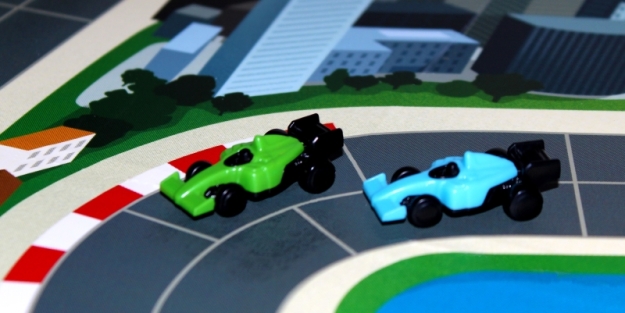
Downforce
– Adapted by boardGOATS
from image by BGG contributor kalcio

The auction proceeded with players getting only one opportunity to bid for each car (that caught some people out too), and with several players failing to get the cars they wanted to match their movement cards.  And then, Emmerson Purpaldi started the race.  Pink’s and Blue’s cars were quickest off the grid and blocked the first corner, before Blue took a narrow lead thanks to Pine shifting her car to clear a path.  Burgundy increased Blue’s lead and her car was the first across the first betting line.  Blue’s lead was briefly threatened by Black, but she led into the first hairpin and then squatted in the narrow lane causing chaos for everyone behind and lots of cursing.
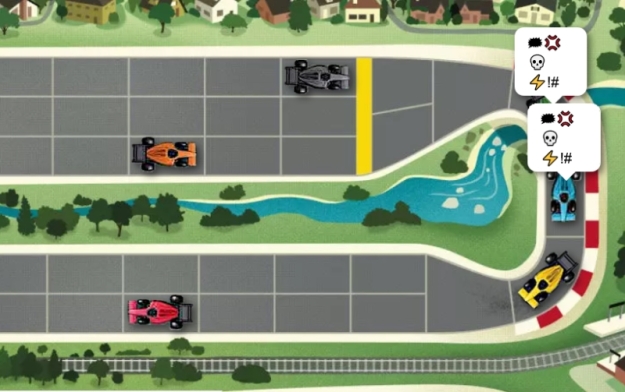
Downforce on Board Game Arena
– Image by boardGOATS from boardgamearena.com

With it in everyone else’s interest to move Blue’s stalled vehicle round the corner, Blue was able then able to use her supercharge card to accelerate into the second hairpin bend and block that instead.  As the first car to cross all three betting lines, almost everyone else had a vested interest interest in seeing Blue get to the chequered flag first, with some having bet on her from the start.  Inevitably then, Blue’s car was first round the final bend, but it was much closer at the end than it had looked for most of the race.  Black’s car put a massive spirt on and caught up with Blue just short of the line only for Blue to cross the line on the next turn.
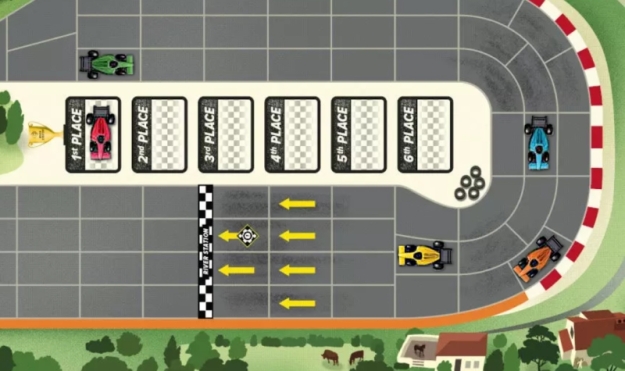
Downforce on Board Game Arena
– Image by boardGOATS from boardgamearena.com

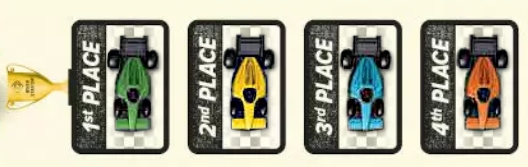
Black therefore took second and Pine just pipped Pink to take third.  The prize money for the first four places is only one part of the game though, and betting on Blue from the start together with third in the race gave Pine a very creditable second place.  Thanks to betting on Blue from the start, Burgundy took third despite his car failing to cross the line.  There was no beating Blue though, as she had decided to put all her eggs in one basket and had bid on her own car.  On top of that, she had paid the least for her car in the auction, giving her an unassailable lead and a winning margin of $11,000,000.
Downforce on Board Game Arena
– Image by boardGOATS from boardgamearena.com

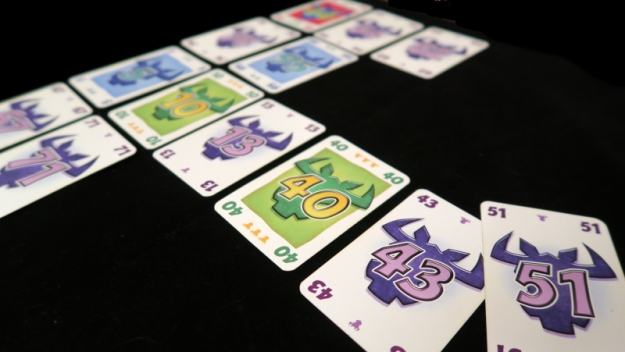
The game is great fun, and, despite the large amount of luck in the game, there is more to it than that—it is all about surfing your luck and making the best of what you have.  Burgundy for example had excellent cards that matched his car well, but got stuck at the back of the pack and couldn’t use them effectively.  It hadn’t been a short game, and with people being tired and ready for an early night, there was just time for a quick game of 6 Nimmt! before bed.
6 Nimmt!
– Image by boardGOATS

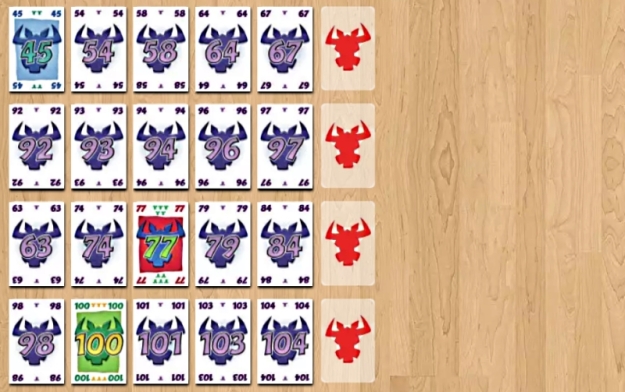
Although we have reduced our consumption a bit since New Year, it is still one of our favourite end-of-night games.  There was just time for a quick game of 6 Nimmt! before bed.  Although we have reduced our consumption a bit since New Year, it is still one of our favourite end-of-night games.  The game is so simple, yet so much fun:  the simultaneous card selection keeps everyone involved and the tension as Board Game Arena adds cards to the four rows keeps everyone entertained even once they are out of contention.
6 Nimmt! on Board Game Arena
– Image by boardGOATS from boardgamearena.com

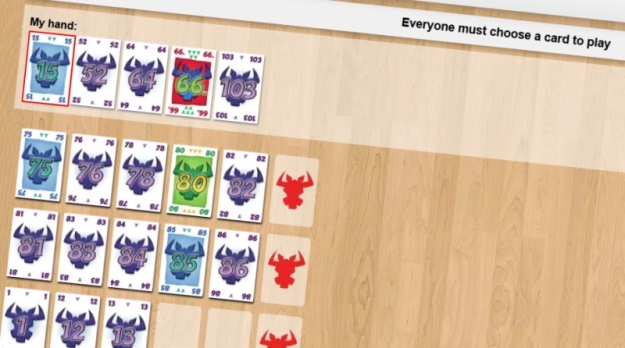
When Blue was the first to pick up cards, and then picked up more cards, it looked like there was no chance of her making it a clean sweep for the night.  She had lost nearly half her starting points and was engaged in a race to the bottom with Purple before Pine and Black had even picked up a card.  But from there, it was a remarkable recovery.  First she was passed by Burgundy and then Black.
6 Nimmt! on Board Game Arena
– Image by boardGOATS from boardgamearena.com

By this time, Burgundy was picking up cards so fast that he’d gone from leading challenging Purple to end the game.  And then Pine (who always does well in this) started picking up cards as well—the only questions that remained where whether it would be Burgundy or Purple who would end the game and whether Pine or Blue would pick up points before they did.  In the end, Purple ended the game, and Pine just managed to hold on to win by two points.
6 Nimmt!
– Image by boardGOATS

Learning Outcome:  Beige likes dinosaurs.

Next Meeting, 25th May 2021 – Online!

Spring is here, the evenings are getting brighter and it feels like the end is in sight.  People still need what social contact they can get though, and board games are a great medium for that.  Despite the limitations of “remote gaming“, everyone feels it is important to stay in touch, so we are persisting with online meetings.  Therefore, our next meeting will be on Tuesday 25th May 2021; we will gather from around 7.30pm, and start playing at 8pm.

This week, the “Feature Game” will be  the “Roar and Write” type game, Welcome to Dino World.  This is unrelated to the Welcome to… games we have played previously, except for the similarity in the names of course.  There are two levels, but as this will be the first time we have played it, we will save “Danger Mode” for another day, reducing the risk of there being an Isla Nublar type incident…

Welcome to Dino World
– Image by boardGOATS

And talking of dinosaurs…

Three dinosaurs stumbled across a magic lamp. They rubbed it, and a genie appeared.

“I have three wishes, so I’ll give one to each of you,” the genie announced.

The first dinosaur thought hard. “Alright,” he said, “I’ll have a big, juicy, piece of meat please.” Instantly, the biggest, juiciest piece of meat he’d ever seen appeared in front of him.

Not to be outdone, the second dinosaur thought even harder.  “I know!  I’ll have a shower of meat!”  Immediately, huge pieces of meat rained down around him.

The third dinosaur, certainly not to be outdone, thought even harder than the other two dinosaurs.  “I’ve got it!” he cried, “I want a MEATIER shower!”

11th May 2021 (Online)
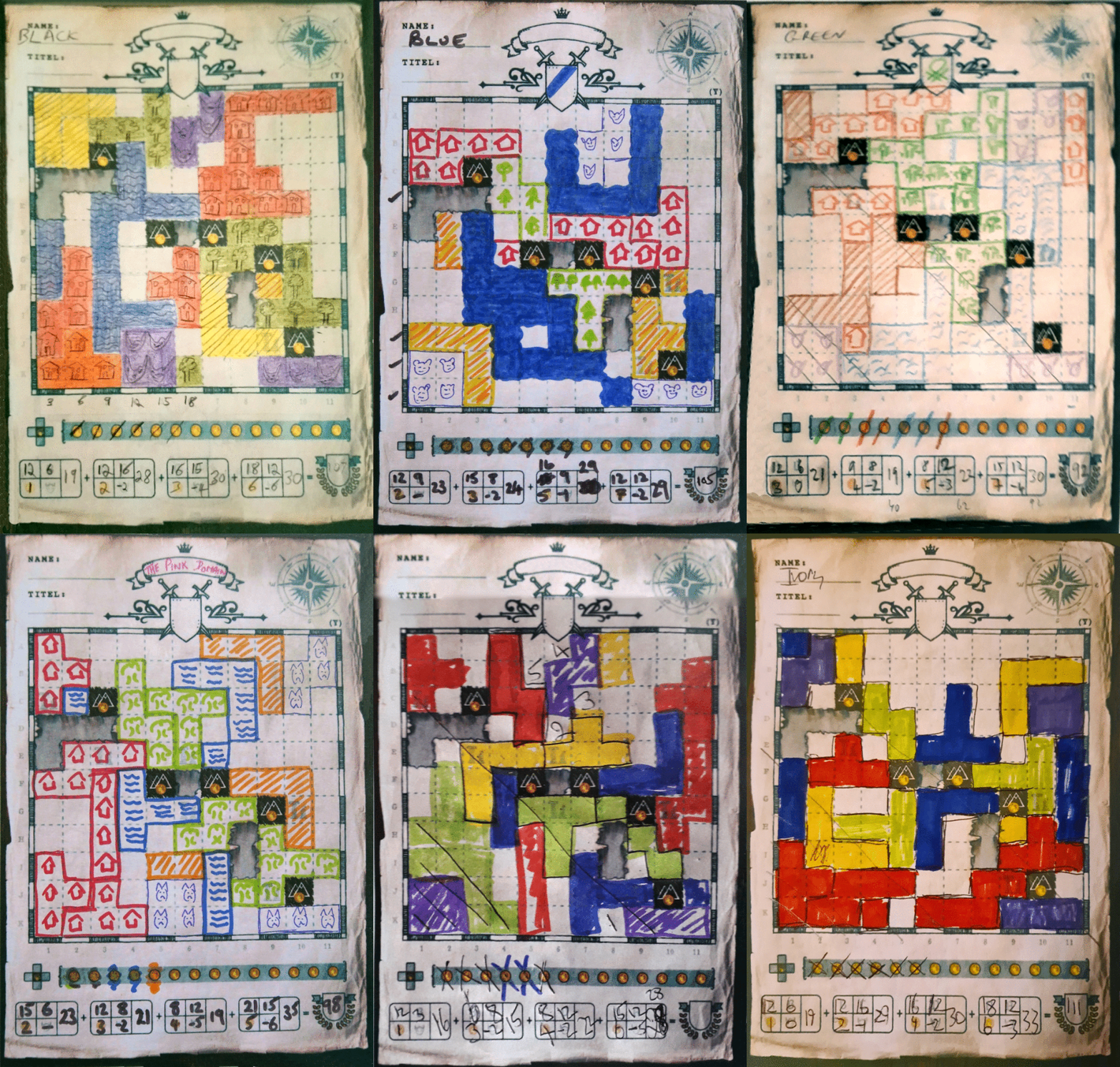
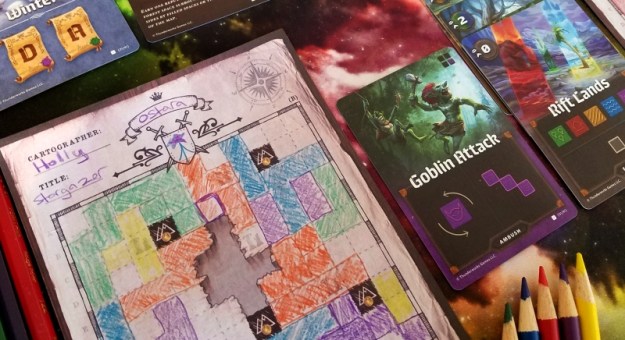
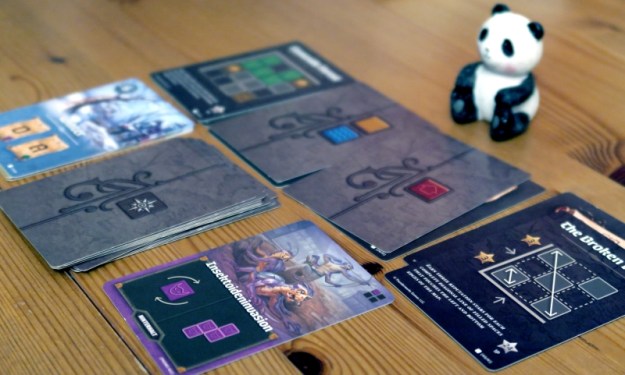
There was the usual chit-chat and community update, but eventually everyone was ready to start playing the “Feature Game” which was the Neue Entdeckungen (New Discoveries) expansion to Cartographers.  Cartographers is a “Roll and Write” game we’ve played and enjoyed quite a bit over the last year. The base game is simple enough, but unlike a lot of the games we’ve played, has more of a “gamery” feel to it than some of the simpler Tetrissy games it is related to like Second Chance or Patchwork Doodle.  The thing these games all have in common is that players are given shapes to draw on a personal player grid.  What makes Cartographers different is the addition of goal cards which give points at the end of each round, in a similar style to another game we have enjoyed playing, Isle of Skye.

Cartographers: A Roll Player Tale
– Adapted from image by BGG contributor
Johnny Dangerously

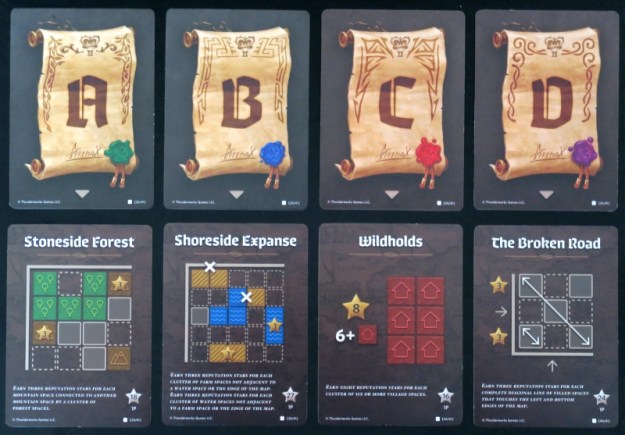
Each cards depicts a shape and terrain, giving some element of choice in either terrain type or shape.  The game is played over four rounds, each consisting of several cards.  At the end of each round two of the four goal cards are scored, such that each is scored twice during the game.  This time, the four goal cards were Stoneside Forest (A), Shoreside Expanse (B), Wildholds (C), and The Broken Road (D).  At the end of the first round the first two of these, Stoneside Forest and Shoreside Expanse were scored.  Stoneside Forest gives points for connecting the mountain spaces that are preprinted on the map.  Shoreside Expanse on the other hand rewards players for each area of lake or arable not adjacent to arable or lake (respectively) or the edge of the map.

Der Kartograph: Neue Entdeckungen
– Image by boardGOATS

Stoneside Forest was made more challenging by the fact we were playing with the Neue Entdeckungen (New Discoveries) expansion which adds new ambush cards (from the Ambush Mini Expansion) and a new map with wastelands.  Wastelands are areas that are preprinted on the maps that players are unable to use, but are considered already filled.  There is an alternate map in the base game with a large area of wasteland which we played with last time, but the Neue Entdeckungen expansion map has several smaller areas of wasteland adding a different set of challenges.  we’ve played with both Shoreside Expanse and Stoneside Forest before, so for the first round, we all knew what we were trying to do.

Cartographers: A Roll Player Tale
– Image by boardGOATS

Wildholds and The Broken Road were new to us though.  The Wildholds gives eight points for for each village area occupying six or more spaces.  Eight points is a lot, and if an area is complete in time for the first scoring phase, it will also score the second time making it very lucrative.  With this in mind, Ivory started planning for Wildholds early in the first round, while others concentrated on first round goals first. The final goal, The Broken Road, rewards players with three points for every complete diagonal that connects the left hand edge of their map with the bottom edge.  With eleven possible diagonals, everyone was of the impression that The Broken Road would be easy to score a lot of points with, but it turned out to be more difficult than most people expected.

Cartographers: A Roll Player Tale
– Image by boardGOATS

In fact, most people left it to the end assuming it would take care of itself, only to discover that it didn’t really.  That said, unusually, the arrival of the Ogeroffensive Ambush card actually did most people a favour.  This is unusual, as Ambush cards give players negative points for any unfilled spaces adjacent to their goblin spaces at the end of the round.  We play the cards using the solo rules where players place them in a given corner and, if that is already filled, slide it one space in a given direction following the edge of the map.  They continue spiralling in to the centre until they find an empty space.

Der Kartograph: Neue Entdeckungen
– Image by boardGOATS

Because the Ogeroffensive arrived as the first card in the round and starts in the bottom left corner, for many people it actually gave them twelve points (filling two diagonals and scoring for two rounds).  Arriving so early in the round, most of those who were able to benefit from it, didn’t even score many negative points as there was plenty of time to fill any empty spaces.  All three of the ambush cards we introduced came out early in the rounds which meant they added a more strategic obstacle rather than throwing an unexpected spanner in the works as they do when they come out at the end of the round.

Der Kartograph: Neue Entdeckungen
– Image by boardGOATS

The rounds get shorter as the game progresses and it wasn’t long before it was the final round and everyone was looking to maximise their final scores.  From the in-game table chatter, it was clear that Ivory and Burgundy were going to be difficult to beat and, as is so often the case, so it proved.  This time, Burgundy had the edge over Ivory and took victory by four points.  The battle for the final place on the podium was fierce too, but Black ultimately took that from Blue by just two points.  Regardless of where they ended up though, everyone had enjoyed it.  From there, we moved on to another “Roll and Write” game that we’ve played quite a bit over the last year, Railroad Ink.

Railroad Ink: Deep Blue Edition
– Image by boardGOATS

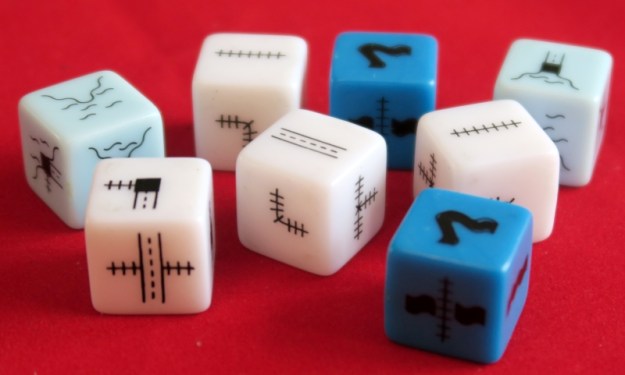
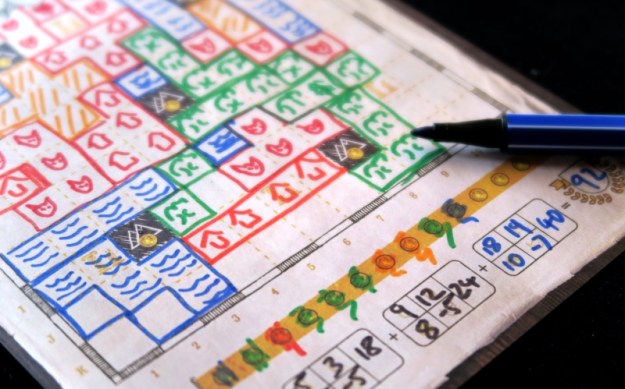
This is a fairly straight-forward game where dice are rolled and players have to write the road and rail segments on their maps.  The base game is played over seven rounds with four white dice rolled in each round.  In this game, all the dice have to be used, but players also get three chances to play special “cross-roads dice” during the game.  At the end of the game, players score for their longest rail segment, their longest road section, the spaces they have succeeded in filling in the centre of the board and the number of entrances they have managed to connect together.

Railroad Ink on Board Game Arena
– Image by boardGOATS

This time, however, we decided to play it online through Board Game Arena rather than engaging our inner artist and playing on paper.  There were advantages and disadvantages to playing the game online and people had mixed feelings about it.  It was certainly easier to correct errors, but somehow it lost… something…  It was another highly enjoyable game though and the results were also close at the top.  With Ivory taking an early night, the challengers to Burgundy’s crown were Green and Blue.  Despite their best efforts, Burgundy’s crown was too firmly wedged, and he finished four points ahead of Blue and five ahead of Green.  Although Cartographers had taken longer than many of the games we play, and time was marching on, there was still enough for one last game.  And this time, with just six, we relatively quickly (for us) settled on For Sale after a quick Vevox vote.

For Sale
– Image by boardGOATS

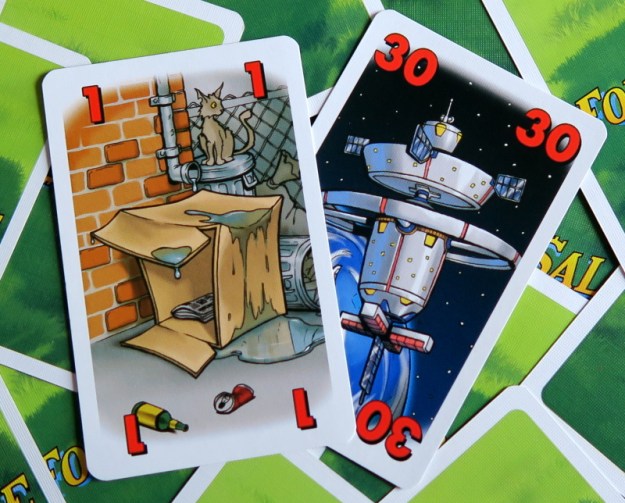
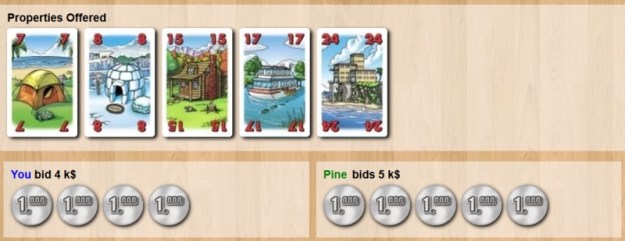
For Sale is an older game that has had a bit of a resurgence recently for us.  The idea is that the game comes in two phases:  firstly, players use their starting $14,000 to buy properties at auction, then they use these properties to “bid” for cheques in the second phase.  The winner is the player with the highest total in cheques and left over starting currency.  It is such a quick game to play that this time we played it twice.   The first time through, Pink paid $8,000 for the space station while Purple picked up the cardboard box for free.  But then, Pink sold his space station for $15,000 and Purple ended up parting with her box without return.

For Sale on Board Game Arena
– Image by boardGOATS from boardgamearena.com

That is only part of the story of course, but important to most people was that Burgundy didn’t take his third win in succession.  In the end, everyone (except Burgundy) was content as they got that part of their wish as Black topped the podium edging in front of Blue, though Burgundy was just a couple of thousand behind.  You can’t keep a good gamer down for long though and Burgundy saw the second game as his chance for revenge.  In the event, the same three were on the podium, but with Black and Burgundy swapping places.  This time it wasn’t close at all either, with Burgundy finishing $9,000 ahead of his nearest challenger.  And that was that for another week.

For Sale
– Image by boardGOATS

Learning Outcome:  Sites of Insectoid Invasions should be shown on every map.

Spiel des Jahres Nominations 2021

The nominations for the Spiel des Jahres have been announced.  There are three categories, the Kinderspiel (children’s game) , the Kennerspiel (“expert’s” game) and the most desirable of all, the family award, the Spiel des Jahres.  The nominees for this year’s awards have been announced as:

  • Kinderspiel des Jahres
    Kinderspiel des Jahres 2019Dragomino by Bruno Cathala, Marie Fort and Wilfried Fort
    Fabelwelten (aka Storytailors) by Wilfried Fort and Marie Fort
    Mia London by Antoine Bauza and Corentin Lebrat

Last year, the winner of the Spiel des Jahres was Pictures, a game where players model the picture on their card using the available components, e.g. shoelaces, coloured cubes, etc.; players get points for correctly guessing other players images and for other players guessing their image.  This is considerably lighter than some of the earlier winners, notably, Tikal and El Grande, or even some of the best known winners like The Settlers of Catan, Carcassonne or Ticket to Ride.  As the main award winners have become lighter over the years, we have found the Kennerpiel des Jahres better fits to our tastes.  The Kennerspiel nominees are not especially complex games, but are typically a step up from the light, family-friendly games of the main prize, the Spiel des Jahres.

– Image by from spiel-des-jahres.de

Last year the Kennerspiel award went to The Crew: The Quest for Planet Nine a game we have still been unable to play thanks to the global pandemic.  The Crew beat our preferred choice, Cartographers.  In contrast to The Crew, as a “Roll and Write” game, we have played Cartographers a lot.  So far, we are unfamiliar with the nominees this year and likely won’t get the chance to play any of them until some time after the winners have been announced (19th July in Berlin for the Kennerpiel and Spiel des Jahres Awards; 14th June for the Kinderspiel des Jahres).

Cartographers: A Roll Player Tale
– Image by boardGOATS