Author Archives: nannyGOAT

Next Meeting – 31st December 2020

Following the success of all the previous New Year parties, everyone wanted to have one this year too.  Obviously, we can’t play the traditional PitchCar or share a meal together, so instead, we will be starting late and running until midnight when we will be sharing a toast to the end of 2020 and to meeting again at The Jockey in 2021.

The plan is to start at 9pm with the “Feature Game”.  In the absence of PitchCar, the nearest online alternative is Downforce which we can play online using Board Game Arena.  This is a card-driven, bidding, racing, and betting game, based on the older games, Top Race and Daytona 500.

Downforce
– Adapted by boardGOATS from image
by BGG contributor kalchio

And talking of betting…

Every year, at New Year, Jeff would help the local farmer with the first of the lambing.  It had become tradition that every year, on New Year’s Eve, Jeff and the farmer would bet on which lamb would jump the highest.  They loved to gambol…

22nd December 2020 (Online)

For our last meeting before Christmas, we usually meet for food and have special Christmas Crackers. This year, this wasn’t possible of course, so instead of crackers everyone had a Box of Delights to be opened simultaneously at 8pm (similar to the Birthday Boxes we’d had in October).  The boxes included a range of chocolates and sweets, home-made gingerbread meeples, a miniature cracker, a meeple magnet, and a selection of dice and other goodies.

2020 Christmas Gingerbread Meeples
– Image by boardGOATS

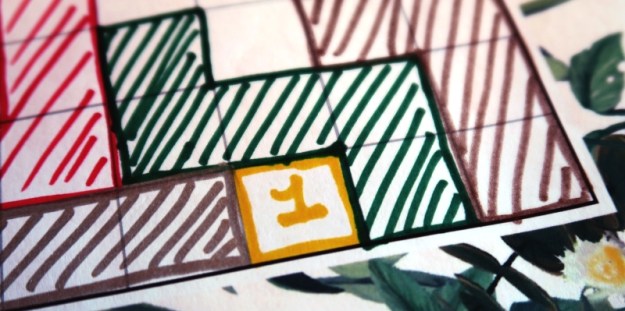
With several little people attending, we decided to play something straight-forward first, so we began the evening with Second Chance.  This is a very simple Tetris-style game game that we’ve played a few times this year.  Players choose one of two cards depicting shapes and draw them in their grid.  If a player cannot draw either shape, another card is revealed and if they are unable to draw that one as well, they are eliminated.

Second Chance
– Image by boardGOATS

Once the rules had been explained and everyone had been given their unique starting shape, the group settled down with their colouring pens and pencils and concentrated on trying to fill their grid.  Pink was the first one to take a second chance card, and when he couldn’t place that shape either he was the first to be eliminated and took his bonus space.  The winner is the player with the fewest empty spaces, so while being first out is not a guarantee of anything, obviously players who stay in the longest are likely to do better.  And it was a long time before anyone else was eliminated.
Second Chance
– Image by boardGOATS

As people gradually found their space was increasingly limited, there were the usual pleas for something nice, which became more desperate as people needed second chances.  Then there was jealousy as players like Pine were eliminated with outrageously large shapes while others, like Little Lime, stayed in when they got the much coveted small pieces.  Meanwhile, everyone else concentrated on beautifying their art with Christmas colours and embellishments.
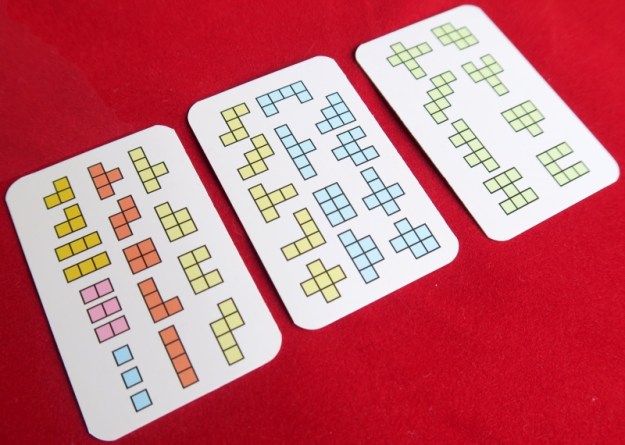
Second Chance
– Image by boardGOATS

Eventually, Purple, Pine, Burgundy, Blue and lastly Green were also eliminated leaving just five when the game came to an end because the deck ran out.  Then it was just the scores.  Most people did really well, though some, not quite so much.  More than half finished with single digits though, including excellent performances from Little Lime and Little Green.  There was some beautiful artwork from Lilac (as usual), but festive offerings from Green, Purple and Black too.  There was a three-way tie for second place between Black, Blue and Green.  On his own with only one single empty space though, was Ivory.

Second Chance
– Image by boardGOATS

With the first game over, we moved on to discussing the important matter of the GOAT Awards.  Every year, we give the Golden GOAT to our favourite game played during the year and the GOAT Poo award to our least favourite game.  Last year, Wingspan won the Golden GOAT Award and 7 Wonders took the GOAT Poo Prize.  This year, the unanimous winner of the GOAT Poo was Covid and its effect on 2020—nobody could deny that Covid was definitely the worst thing to happen to games night this year.  As Covid wasn’t a game, Camel Up took the award on a tie break from Terraforming Mars and Welcome To….

Camel Up
– Image by boardGOATS

Terraforming Mars just missed out on the GOAT Poo prize, but in coming fourth in the Golden GOAT competition, won the unofficial “Marmite award”, for the most divisive game.  Kingdomino and and last year’s winner Wingspan both made the podium for the Golden GOAT, but controversially, the winner was 6 Nimmt!.  The controversy wasn’t caused by the worthiness of the game, just that Blue ensured it’s emphatic win by placing all four of her votes in its favour.
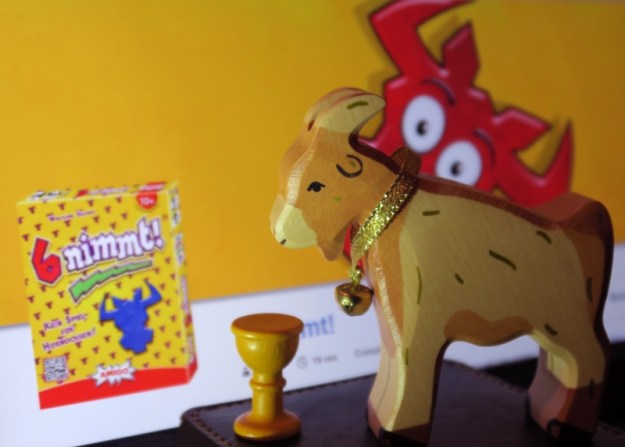
Golden GOAT - 2020
– Image by boardGOATS

Although 6 Nimmt! is an old game, we’ve played it at the end of almost every meeting on Board Game Arena since March.  In a year with little smile about, it has given us more fun and entertainment than almost all of the other games put together and was responsible for moment of the year.  That was back in May, when Lime joined a game of 6 Nimmt! with a bunch of Frenchmen by mistake.  That is just one of many memorable moments we’ve had with 6 Nimmt! this year though.  Furthermore, since we discovered the new professional variant the game has gained a new lease of life, so it seemed an entirely appropriate, if strange win for a strange gaming year.

6 Nimmt! on Board Game Arena
– Image by boardGOATS

While Pink did the count for the GOAT Awards, Blue reminded everyone of the rules for the “Feature Game” which was to be the Winter Wonderland edition of Welcome To….  The fact that Welcome To… had nearly won the GOAT Poo award was an inauspicious start, especially since the main protagonist was Pine who had struggled last time.  A lot of the ill feeling was due to the dark colour of the board for the Halloween edition which we played last time it got an outing, so the pale blue colour of the Winter Wonderland version was always going to be an improvement.

Welcome To... Halloweeen
– Image by boardGOATS

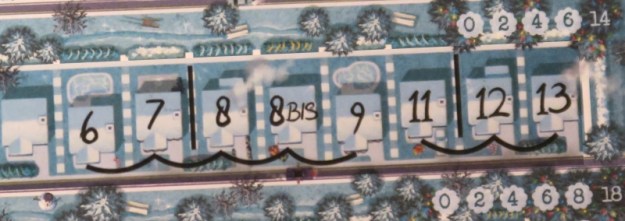
Welcome To… is one of the more complex games we’ve been playing online.  The idea is that players are developers building part of a town in 1950s USA.  Mechanistically, it is simple enough—the top card on each of three number decks is revealed and players choose one of the three numbers to play.  They mark this on one of the three streets on their player board.  The house numbers must increase from left to right and each number can only appear once in each street.

Welcome To...
– Image by boardGOATS

Each card is paired with the reverse of the previous card drawn from that deck, which gives a special power.  The special power can be rule breaking, enabling players to write a number a second time in a street, or give some flexibility in the number they must write.  Alternatively, the special power can directly provide players with extra points through the building of parks or swimming pools.  Finally, the special power can facilitate the achievement of extra points by enabling players to build fences separating their street into “Estates”, or increasing the number of points each “Estate” provides at the end of the game.

Welcome To... Winter Wonderland
– Image by boardGOATS

Aside from the colour scheme and artwork, the main difference between the base game and the Winter Wonderland Version was the addition of fairy lights as a means to get bonus points.  These are added to to a player’s board joining any houses where the numbers are consecutive.  At the end of the game, players get one point for each house in their longest string of lights.  Additionally, the third planning card selected gave a lot of points for anyone brave enough (or perhaps daft enough) to successfully connect an entire street with lights.

Welcome To... Winter Wonderland
– Image by boardGOATS

Little Lime and Lime took their leave, and Lilac and Little Green also decided to give it a miss, but that still left eight players, albeit one who was very sceptical.  Pine had nominated Welcome To… for the GOAT Poo Prize, and felt that didn’t bode well, but was prepared to give it a go.  The Plan Cards, give players points during the game as well as being a trigger for the end of the game.  As well as the street full of lights from the Winter edition, there was also one that gave points for a pair of estates (comprising three and six houses) and for players completing all six end houses.

Welcome To... Winter Wonderland
– Image by boardGOATS

The game started with a lot of “Bis” cards and quite a few high and low numbers.  It wasn’t a huge surprise then, when several people completed the end of street plan.  Ivory was first to complete the estate plan and eventually, Blue who felt that the Christmas element should be accentuated, completed the fairy lights plan.  The question was, who would be first to finish all three and when, as that was the most-likely end-game trigger.

Welcome To... Winter Wonderland
– Image by boardGOATS

It was towards the end that Purple commented that Black had been eliminated.  It wasn’t immediately clear what she was on about, but eventually it was apparent that one of his furry friends had decided that they wanted to be the subject of his attention and had firmly sat on his player board, very effectively obstructing play.  That cat-astrophe put paid to any successful involvement in the game by both Purple and Black, but it wasn’t long before Green announced that he’d finished all three of the Plans and was ending the game.
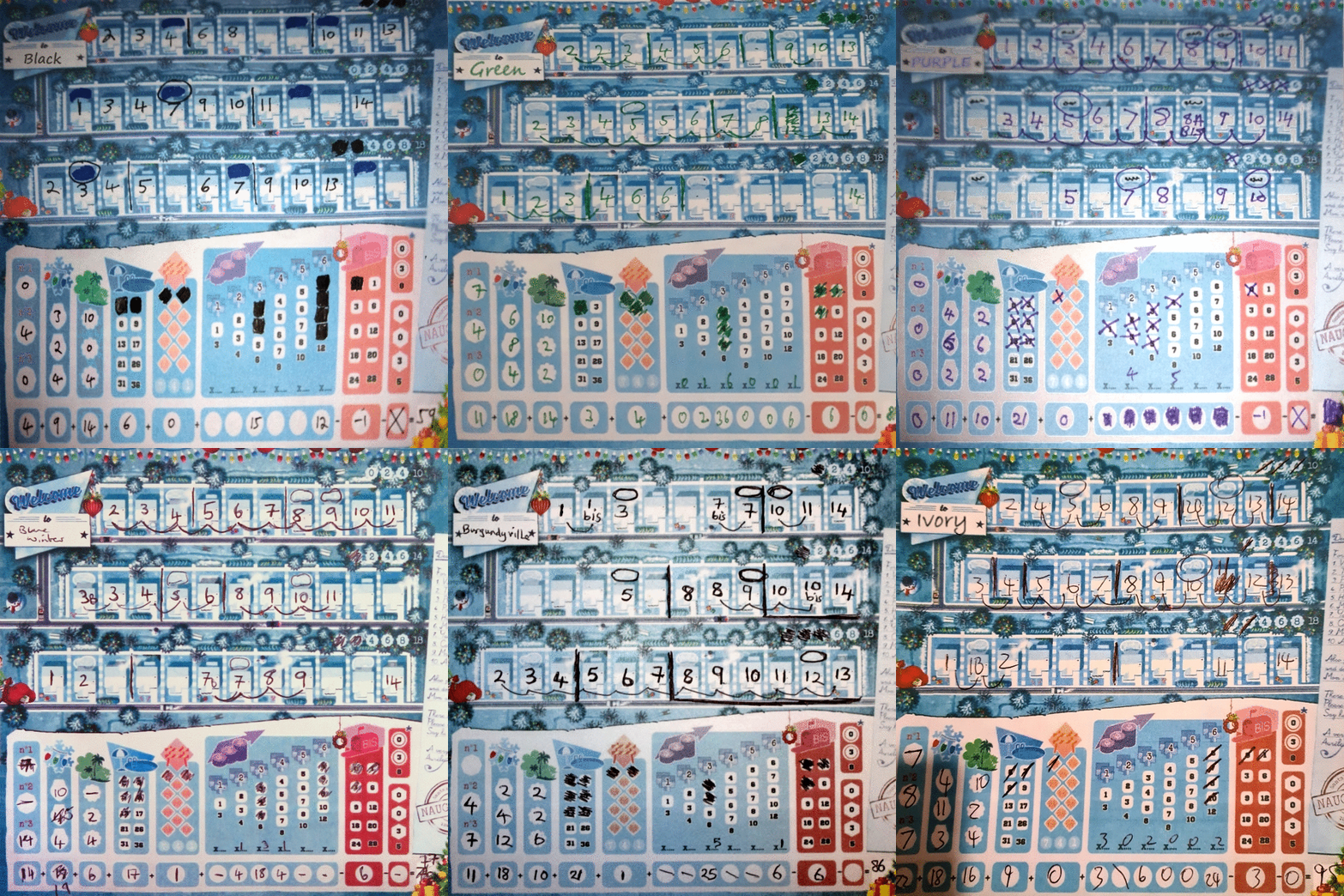
Welcome To... Winter Wonderland
– Image by boardGOATS

With that, everyone totalled up their scores.  Pine said that despite his scepticism, he had actually really enjoyed the game and felt he had done reasonably well and indeed was a long way from coming last.  It was very close for second place with Green just beating Burgundy into third by two points.  The clear winner, for the second time of the night, was Ivory who finished with an exceptional ninety-five points. And with that, he decided to quit while he was ahead and everyone else decided it was only appropriate that they should play the newly-crowned Golden GOAT6 Nimmt!.

6 Nimmt!
– Image by boardGOATS

6 Nimmt! is so very simple, yet so much fun.  Players simultaneously choose a card from their hand and these are then revealed and, starting with the lowest card, added to one of the four rows.  Cards are added to the row with the highest number that is lower than the card played, i.e. the nearest lower number.  When a sixth card is added to a row, the owner takes the first five cards into their score pile, leaving the card they played as the new starting card.  The player with the fewest Bulls’ Heads at the end is the winner.
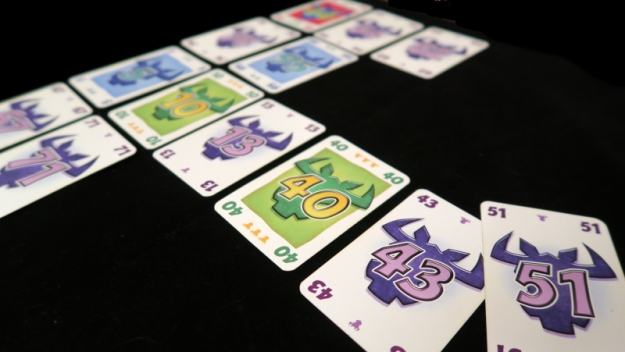
6 Nimmt!
– Image by boardGOATS

Board Game Arena implements the game with everyone starting with sixty-six points and the game ending when someone reaches zero.  It also adds a couple of other variants, the most exciting of which is the “Professional Variant”, where players can add cards to either end of the row.  Because Board Game Arena deals with all the up-keep, it makes this variant much easier to manage, and the results often come as a complete surprise.
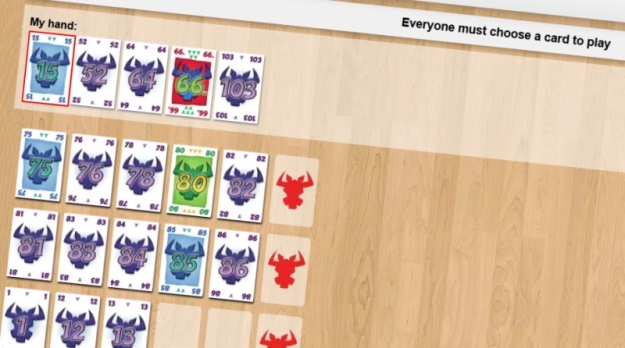
6 Nimmt! on Board Game Arena
– Image by boardGOATS from boardgamearena.com

The reason 6 Nimmt! won the Golden GOAT, is that in a year where there has been so much to be miserable about, this game has provided more fun than anything else.  This time, poor Burgundy went from jointly holding the lead to sixth place in just a couple of turns and threatened to beat Purple to the bottom and trigger the end of the game.  As it was, he didn’t quite make it, and left Green who had only picked up seven “nimmts” in the whole game, to win.
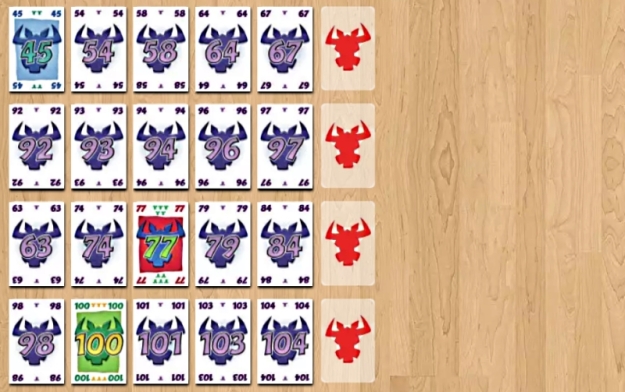
6 Nimmt! on Board Game Arena
– Image by boardGOATS from boardgamearena.com

With seven players, the number of options were limited to more 6 Nimmt!, Saboteur, or something we hadn’t played before.  In the end, we went for a sort of compromise in Incan Gold which most of us knew, though we’d not played it on Board Game Arena.   This is a fairly simple “Push your Luck” game where players are exploring a temple.  Simultaneously, players decide whether they are going to stay or leave the temple.  Players who are in the temple will get shares in any treasure cards that are drawn that round.  These are divided evenly between the players and any remainders are left on the card.
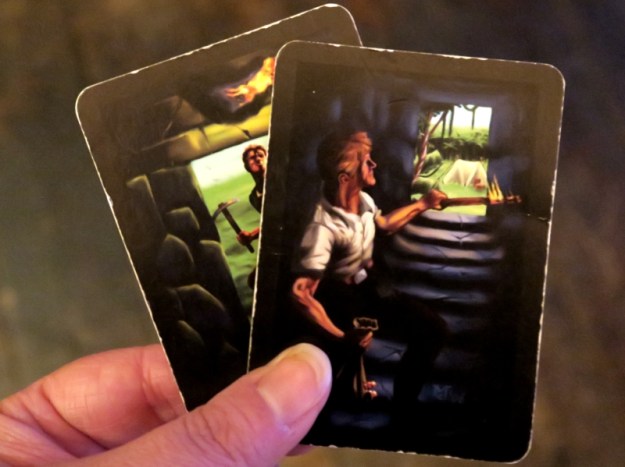
Incan Gold
– Image by boardGOATS

As well as fifteen treasure cards, there are also Hazard cards in the deck:  three each of five different types.  When a second Hazard card of any given type is drawn, the temple collapses and buries everyone in it and they lose any treasure they have collected.  Additionally, there are five Artefact cards in the deck—these can only be claimed by players leaving the temple.  Any players that leave before it collapses, keep the treasure they have collected hitherto, and take a share in any remainders left on cards. If they leave alone, they also take any artefacts, but only if they leave alone.  Having left the temple, however, they will get no more treasure in that round.
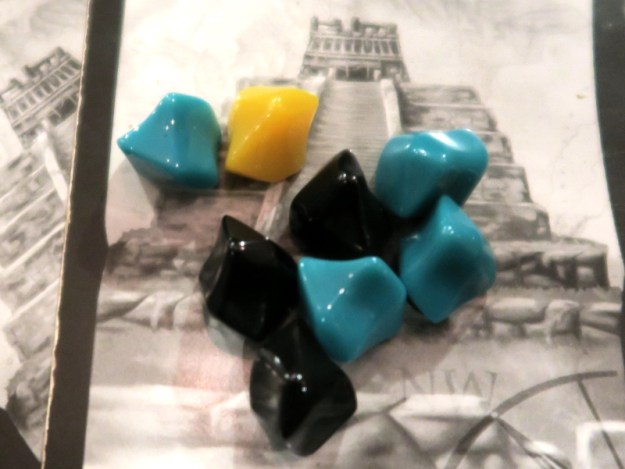
Incan Gold
– Image by boardGOATS

The game is played over five rounds and the winner is the player with the most treasure at the end of the game.  The game is extremely random, but can be a lot of fun with the right people.  This time it was particularly random though.  The first two cards drawn were both Hazards and the first round ending after just five cards with only Green getting out in time.  The second round was even worse with three Hazards in a row terminating the round before it had begun.  On the plus-side, having had two rounds ended by Mummies, two of the three Mummy cards were removed from the deck, making it impossible for the mummies to end another round.  There were plenty of other Hazards though…

Incan Gold on Board Game Arena
– Image by boardGOATS from boardgamearena.com

The third round wasn’t much better, lasting only three cards with a second snake ending another round and only Pink taking any treasure.  The fourth round started with an Artefact, but when Burgundy, left, he was joined by Pink and Purple, so none of them were able to take it home.  Just three cards later, a second Giant Spider card brought down the temple and everyone finished with nothing (again).  The final round lasted a little longer, but two players still managed to finish the game without any treasure.
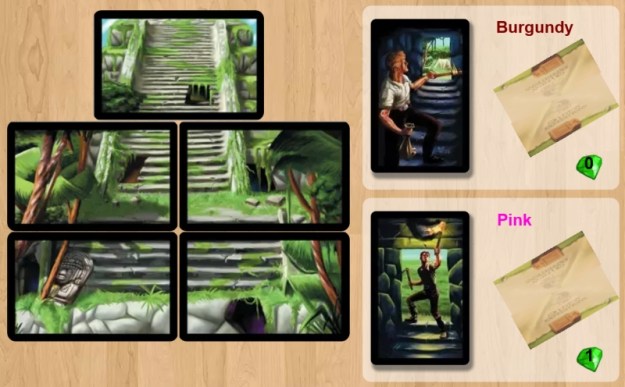
Incan Gold on Board Game Arena
– Image by boardGOATS from boardgamearena.com

Purple made an early escape and grabbed a couple of gems from the floor.  Burgundy and Pink escaped shortly after and Black managed to sneak out as the Giant Spiders closed the temple for good.  As a result of the unusually large number of Hazard cards, the game was especially low scoring.  It ended in a tie between Pink and Green on ten, with Black two points behind in third.
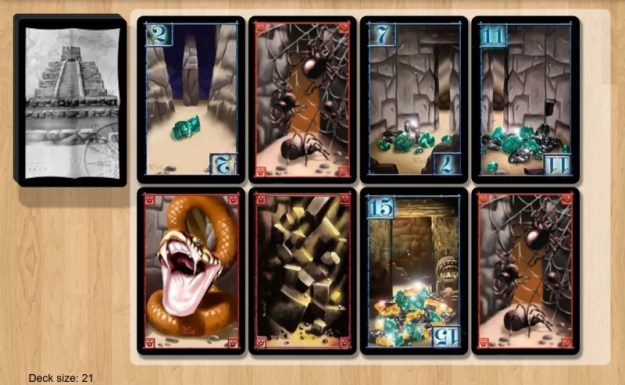
Incan Gold on Board Game Arena
– Image by boardGOATS from boardgamearena.com

With Incan Gold done, there was still time for one more game and it was only fitting to close with another game of 6 Nimmt!.  Having done so well in the last two games made Green the target this time, not that anyone really had enough control to manipulate their own position, much less target anybody else.  Pink, who had also done well in recent games, made a bit of a beeline for the bottom, and it was not much of a surprise when he triggered the end of the game.  This time, Green could only manage third, and it was a two-way tie for first place between Black and Pine (who always does well in 6 Nimmt!, and always denies it).  And with that, we brought our first online Christmas Party to a close and wished everyone a Very Merry Christmas.
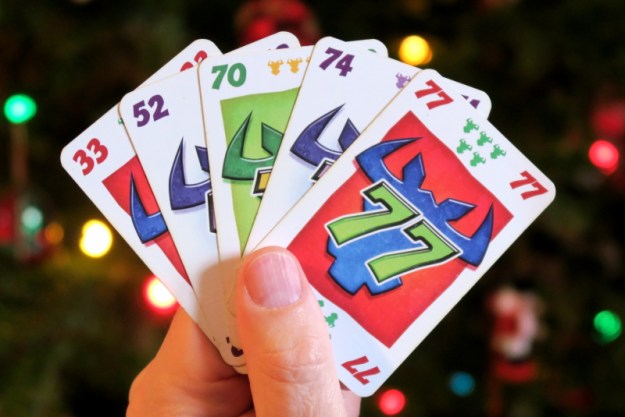
6 Nimmt!
– Image by boardGOATS

Learning Outcome:  A box of sugar and exciting trinkets is ideal improving your concentration.
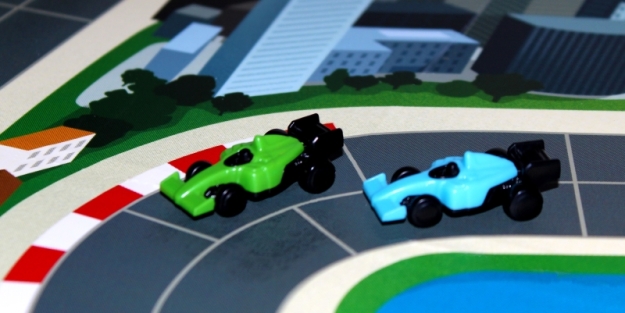
Remote Gaming: Some Learning Outcomes

With the advent of Covid-19, boardGOATS, like many other groups were left with the choice of meeting online or not meeting at all.  So, like many other groups, boardGOATS chose to try to continue with meetings.  While some groups have struggled, dwindled, and eventually given up, so far, boardGOATS has managed to keep going with almost everyone still attending regularly.  We decided that we would put together this summary of some of the reasons we think we are still meeting, and a resource companion in case anyone else is in the same boat.

Setting up for online gaming
– Image by boardGOATS

The first, and by far the most important factor is that everyone has been extremely patient and very tolerant of the limitations.  Everyone is fundamentally appreciative of the interaction meeting online offers and have been amazingly understanding of the current issues.  This is essential.  Secondly, we meet once a fortnight:  boardGOATS meetings have always been alternate weeks, but this is actually quite key when meeting online.  If meetings are too frequent everyone can get very frustrated quite quickly, but too infrequent and people lose the routine.  As it is, fortnightly means everyone makes a date to make it happen as otherwise the next one would be a month away.

Noch Mal!
– Image by boardGOATS

Finally, there’s planning and organisation.  Having a plan is vital if things are to run smoothly, and smooth is essential to avoid people becoming frustrated.  The group has always had a “Feature Game“, because we’ve always been a group that takes ages to decide what to play; having a starting option helps us to get going a bit quicker.  With remote meetings, however, the “Feature Game” has become essential.  It is also important that someone takes the lead to teach if necessary, and keep things moving to stop games dragging, but also allows the all important banter to flow when possible as well.

Tsuro on Tabletop Simulator
– Image by boardGOATS

The group have broadly used three different approaches to remote gaming, all underpinned by Microsoft Teams.  This choice of platform is largely immaterial, but our decision was made early on because of possible security issues with alternatives and the hardware that some of the group were using.  Either way, this provides sound and, where required, visuals.  We always start the meeting early and then leave a place holder in front of the game camera so everyone knows which screen to pin in advance.  In our case we usually use a stuffed panda doing something humourous, but a game box would suffice too.

The three different approaches to remote gaming we have used have been:

  • A real-life game hosted at one location, shared through Teams.
    This works well, but really only for relatively simple games like Second Chance, HexRoller or Noch Mal!, though we’ve played Cartographers and Troyes Dice as well.  It turns out that “Roll and Write” type games work exceptionally well, but other games are possible too.  The most complicated game we’ve played using this method is Las Vegas/Las Vegas Royale, which is one of the group’s favourites, but this is right on the limit of what is possible.  The key is that players need to be able to see the whole game layout with all the information.  For this, the resolution of the camera is important, but also that of the screen used for displaying it at the other end.  Video compression by the platform feeding the data can also be an issue.  Lighting is absolutely critical too—good lighting makes all the difference.
    Main Advantage:  We’ve found this feels most like playing a “real” game.
    Main Disadvantages:  One person/location does most of the manipulation, and there is a  complexity limitation.
    Cartographers: A Roll Player Tale
  • A virtual game on Tabletop Simulator manipulated by a small number of people , shared with everyone else through Teams.
    Some people can’t install software on their computers and for others sand-box type environments like Tabletop Simulator are too complex.  Piping a virtual game through Teams is a sort of half-way house.  To make this work, the person “hosting” has to set the game up with the camera view set to “overhead” with everything in view, and leave it there.  Then they share this screen through their meeting platform (in our case, Microsoft Teams).  Again, this means there is a limit on the complexity of the game:  the most complex games we’ve played using this method are Camel Up and Finstere Flure (aka Fearsome Floors)These have worked quite well, but it’s a bit more impersonal and relies on a small number of people operating the Simulator to make the game work.  Downtime is a bit of an issue too for turn based games.  For these reasons, this has been the least popular method for our group.
    Main Advantage:  We can modify and play slightly more complex games to our own house-rules.
    Main Disadvantages:  People need to be comfortable with the software and there are limitations caused by the stability of the platform as well as there being a steep learning curve for those who are not used to playing computer games.
    Tsuro on Tabletop Simulator
  • An online game played on a website (e.g. Board Game Arena) with audio provided by Teams.
    These are great because they allow players to do things like draw cards from a shared deck and keep them hidden until they play them.  This is a fairly fundamental aspect of many games and enables games like Saboteur which would not otherwise be possible.  There is a limited range of games available though, and there is no scope for modifying the game either (adding extra players or altering the end-game conditions, for example).  On the other hand, the software does a lot of the up-keep and can make even quite advanced things possible.  For example, without Board Game Arena to do the maths, we would never have discovered the delightful madness that is the “Professional Variant” of 6 Nimmt! (which recently won the 2020 Golden GOAT at our annual GOAT Awards).   It does feel very much like playing a computer game though.
    Main Advantages:  Very low maintenance and higher complexity games are possible including those with “hidden information”.
    Main Disadvantages:  Everyone needs to have an account on the platform and a device, and the games are restricted to those that are available and the rules as implemented, in particular, player counts.
    Saboteur on Board Game Arena


Each of the different modes has their limitations, but we’ve found that by mixing them up we avoid getting fed up with any specific issue.

One of the biggest challenges boardGOATS has is that we have been playing as a group of up to ten.  This is because we are all friends, even though many of us only know each other through the fortnightly meetings.  If the group were to break into two or more parts it would likely be along the lines of game “weight”, which would mean some people would never play together and it could be divisive.  This only works because those who prefer more complex games are extremely patient and understanding.  Ultimately, as a group, we feel the social aspect is the most important thing at the moment, much more important than the quality of the gaming.  We’ll definitely make sure we play lots of more complex games when we finally return to our beloved Horse and Jockey though.

The Horse and Jockey
– Image by boardGOATS

Golden GOAT Award Winners – 2020

Usually, just before Christmas, the boardGOATS meet for food, have a bit of a party, and decide the winners of the GOAT Awards.  Unfortunately, that wasn’t possible this year of course, but we still had a bit of a party online with festive treats for everyone, and chose our favourite game of the year.  As in previous years, we awarded two prizes:  the Golden GOAT for our favourite game and the “GOAT Poo” award for our least favourite.  As last year, everyone had three points to hand out for the Golden GOAT Award (plus a bonus if wearing Festive Attire), and everyone could nominate up to two individual games for the GOAT Poo Prize.

Terraforming Mars: Hellas & Elysium
– Image by boardGOATS

This year, the unanimous winner of the GOAT Poo was Covid and its effect on 2020.  As this wasn’t a game though, Camel Up officially took the GOAT Poo on a tie break.  Terraforming Mars won the unofficial “Marmite award”, just escaping the GOAT Poo, but also coming fourth overall for the Golden GOAT.  Kingdomino made the podium and last year’s winner, Wingspan, was runner up.  The winner though, was 6 Nimmt!.

Golden GOAT - 2020
– Image by boardGOATS

Although 6 Nimmt! is an old game, this year we’ve played it on Board Game Arena at the end of almost every meeting, and it has provided so much fun and entertainment in a year that has otherwise been sorely lacking in that regard.  Certainly, moment of the year went to Lime accidentally joining a game of 6 Nimmt! with a bunch of Frenchmen, but that is just one of many memorable moments we’ve had with it.  Since discovering the “Professional Variant” the game has been rejuvenated for us too, so it seemed an entirely appropriate win for a strange gaming year.

6 Nimmt! on Board Game Arena
– Image by boardGOATS
from boargamearena.com

Next Meeting, 22nd December 2020 – Online!

It is at times of stress that people need social contact more than ever, and board games are a great medium for that.  Despite the limitations of “remote gaming”, the overwhelming impression is that everyone feels it is important to stay in touch, so we are persisting with online meetings.  Therefore, our next meeting will be on Tuesday 22nd December 2020; we will gather from around 7.30pm, and start playing at 8pm.

This week, to celebrate the Festive Season, the “Feature Game” will be the Winter Wonderland edition of Welcome To….  This is a variant on the “Roll & Write” style game where players plan and build 1950s housing estates in the USA.  This game includes the addition of festive artwork and fairy lights.

Welcome To... Winer Wonderland
– Image by boardGOATS

And talking of Christmas lights…

Jeff and his wife, Jane, were putting were putting up Christmas decorations around the festive  Grotto, helped by children from the local primary school, all dressed as Santa’s helpers.

After several hours getting things just right, they were just about to start the big switch on when Jane said, “Hold on a second, I’m going to get some gaffer-tape.”

Jeff was puzzled and asked, “What for?  Everything’s very secure…”

Jane responded, “I’ve just spotted that the power cable is lying across the entrance—we’d better tape it down because it’s a bit of an elf hazard…!”

8th December 2020 (Online)

The evening started off with players discussing pirate copies of games, inspired by a copy of The Game of Life (slightly reluctantly provided by Little Lime).  From there, Green popped in just long enough for everyone to sing “Happy Birthday” to him, and for him to tell people about his new car before putting up with lots of comments about how nice his new Alfa Romeo would look on the side of the road while he was waiting for the AA to turn up…

The Game of Life
– Image by boardGOATS

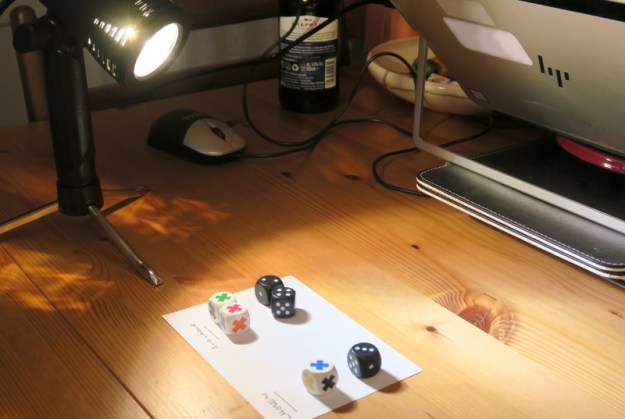
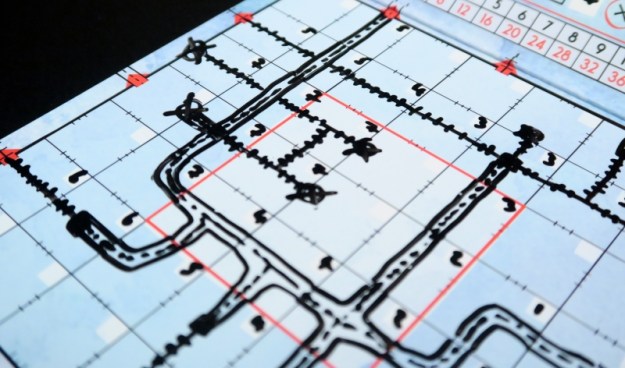
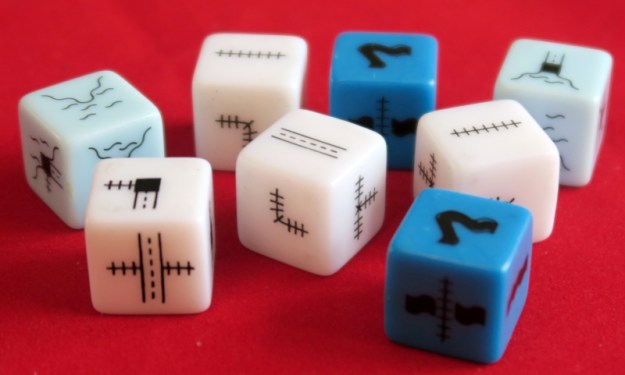
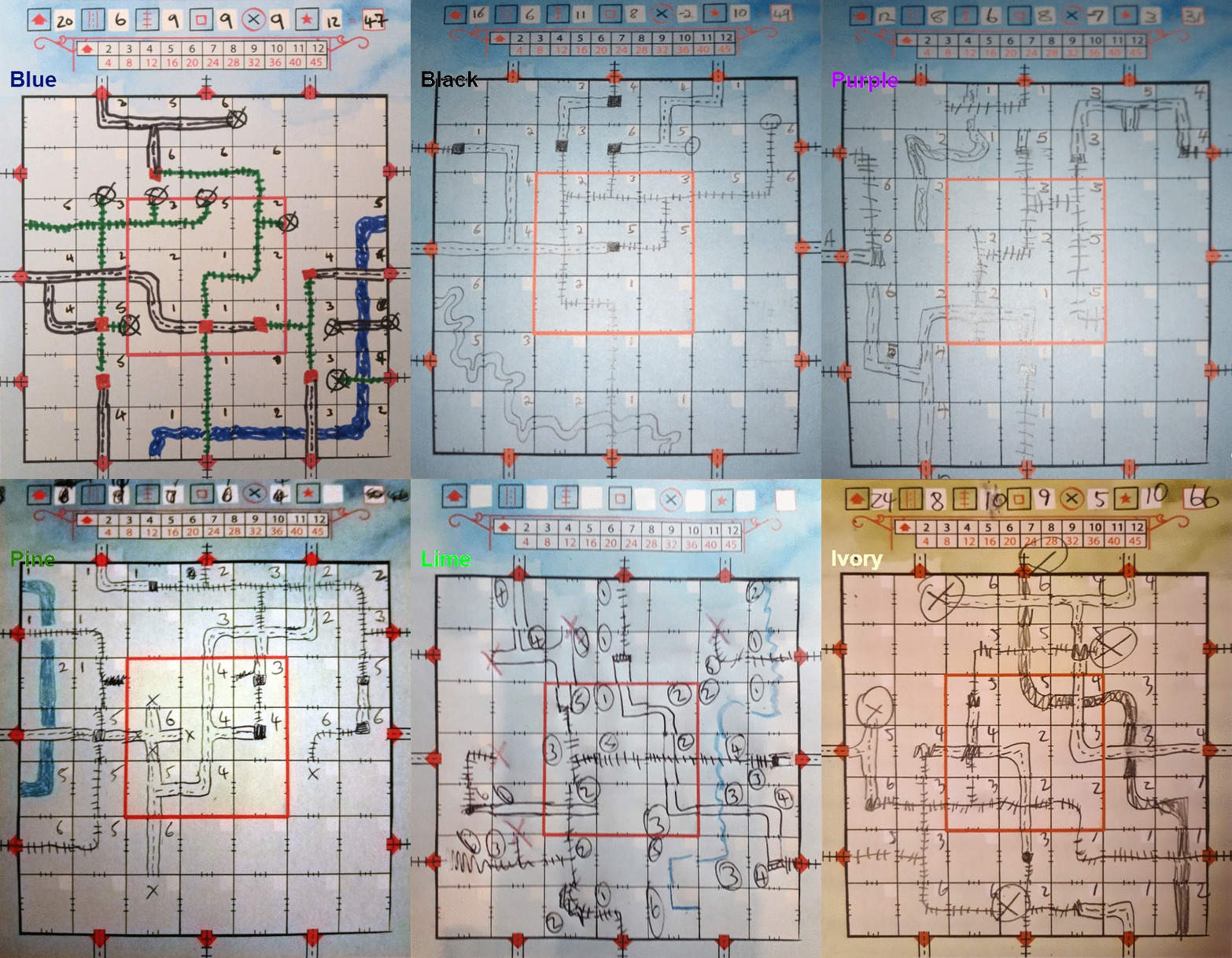
Once Green had left to open the last of his birthday pressies and eat his Birthday tea, everyone else settled down to start the “Feature Game“, the River Expansion for the “Roll and Write” game Railroad Ink.  This is a fairly simple game that we’ve played a couple of times and really enjoyed.  The idea is that four dice are rolled and players have to add all the features rolled to their map.  These features include straight and curved sections of rail and road as well as flyovers and road/rail interchanges.

Railroad Ink: Deep Blue Edition
– Image by boardGOATS

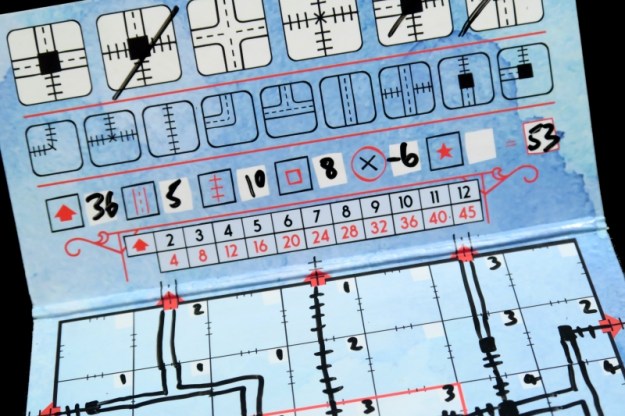
The game lasts seven rounds and players earn points for connecting together the entrances marked on the edge of the map, but also for their longest sections of road and rail, and for filling the nine spaces in the centre of the board.  The River is one of two expansions that come with the Deep Blue Edition of Railroad Ink, and adds rivers to the railway, road and intersection options.

Railroad Ink: Deep Blue Edition
– Image by boardGOATS

Unlike the white dice in the base game which have to be used, the two blue dice are optional.  They also do not have to be connected to the main network.  Pine asked why anyone would use the river because it just restricts what you can do with the rest of your network, but as Burgundy pointed out, it has the potential for giving extra points.  Most obviously this is because points are awarded for the longest section of river each player makes.

Railroad Ink: Deep Blue Edition
– Image by boardGOATS

Additionally though, some of the faces of the river dice include road and rail sections (crossing the river).  Using these can help the main network reach more of the entrances, something that is important because the game is one round shorter when played with the expansion.  However, any unconnected river sections, like any unconnected road or rail sections, i.e. any “hanging ends”, cost points, one per unconnected end.  So, players who decide to ignore rivers do so at a cost.

Railroad Ink
– Image by boardGOATS

The game hadn’t been going long before someone said, “I’ve just created a junction”.  This was almost inevitably followed by the reply, “You never thought that would happen…” and the response, “What, with you and the girl from Clapham…?”  After a couple of verses and the odd chorus of the Squeeze hit, the conversation segued smoothly on to the fact that “Those Were the Days” was actually originally a folk song.  The game only resumed after Pine had shared a version called Davni Chasy by The Wedding Present.

Railroad Ink
– Image by boardGOATS

With only six rounds with the expansion, the game did not really take very long, and everyone seemed to enjoy the added challenge of including the river.  It was a tight game with just three points covering the three podium positions, Ivory just sneaked victory, two points ahead of Pink and Pine in third.  Lime had been up since 4am and had another early start the following day, so went for a well earned early night, but everyone else carried on to give Patchwork Doodle another outing.

Patchwork Doodle
– Image by boardGOATS

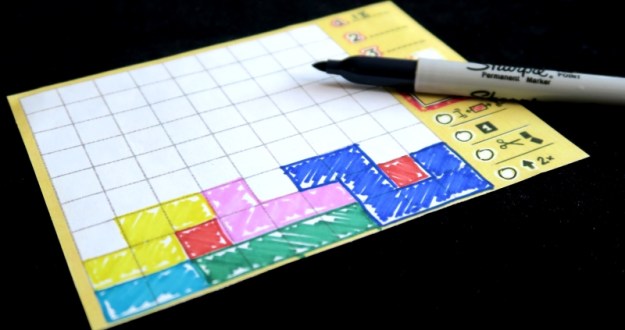
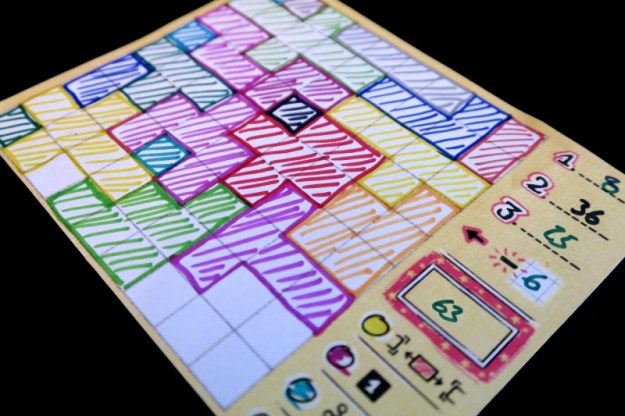
Patchwork Doodle is a fairly simple game Tetris-based game where players try to fill their player player-board with Tetris shapes shown on cards.  Although the game is similar to Second Chance, it is played over three rounds with eight cards displayed at the start of each round with six played according to a die roll.  This means that players know which cards are coming up, but not the order they will appear in.

Patchwork Doodle
– Image by boardGOATS

Each player begins with their own individual shape.  Black had the embarrassing one, which led to a discussion about how a photographer had taken revenge on Philip Green for his poor behaviour towards a journalist.  Everyone had a good laugh once someone had found the photo and shared it, then we began playing.  The end of round scoring also makes the game a little more challenging than Second Chance with players scoring most of their points for the largest contiguous square area at each point during the game.

Patchwork Doodle
– Image by boardGOATS

Pink and Ivory got off to a flying start with five-by-five squares, giving them twenty five points in the first round.  As the rounds progressed, other players started to catch up, but those early points were hard to off-set.  Blue, remarkably managed to fill every square of her grid giving her eighty-one points in the final round.  Unfortunately for her, it wasn’t quite enough to catch Pink who took victory with one hundred and thirty-seven.  That didn’t stop Blue claiming the “moral victory” for the perfect finish though, even if she was three points short.

Patchwork Doodle
– Image by boardGOATS

With that, Ivory took his leave, and everyone else moved to Board Game Arena.  As people logged on, they all received “Trophies” to mark six months active on the platform.  While this is clearly an achievement of sorts, it was bitter-sweet as it also highlighted just how long we’ve been playing online.  We decide not to stop and think about it though, and moved on to choosing a game.  With six players, there were several options.  Pine didn’t want to finish too late, while Blue was keen to play something a little different and with help from others, persuaded him to play Alhambra.

Alhambra
– Image by BGG contributor garyjames

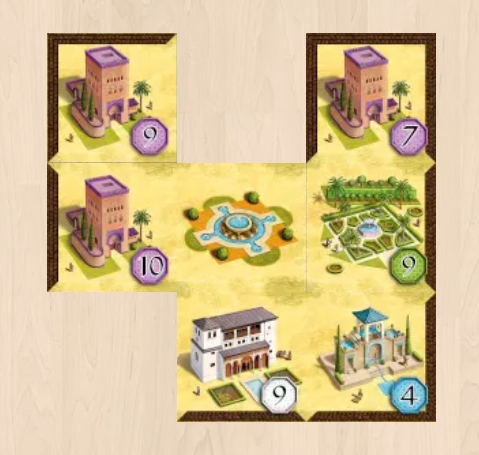
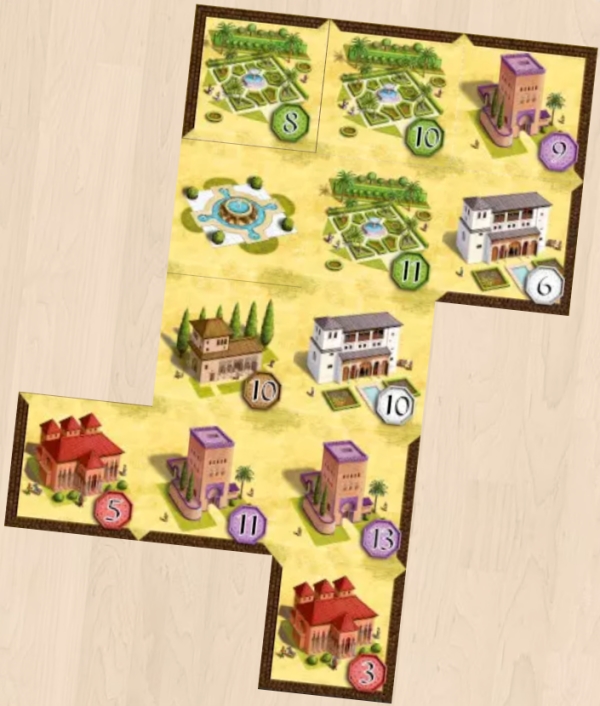
Alhambra is a classic gateway, tile laying game, based on the slightly older title, Stimmt So!.  The idea is that on their turn, players can either buy buildings (or shares in the original), or take a money card.  The catch is that there are four currencies in the game.  Players pay with whatever cards they have, but if they don’t have the exact amount they must overpay.  Obviously, it is advantageous to pay with the exact amount, but not only because they save money.  Players doubly gain when they pay with the right amount, because they get an extra turn and can make another purchase (again getting yet another turn if they pay exactly) or take money.

Alhambra
– Image by BGG contributor garion

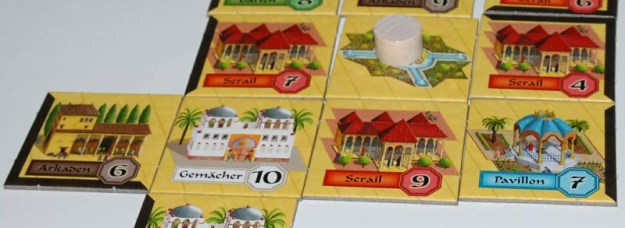
There are two scoring phases during the game, and one at the end.  In these, players with the most buildings of each of the different types score points, with the number of points depending on the type of building and the frequency of it in the game.  There is one significant difference between Alhambra and Stimmt So! that goes beyond the theme.  Some of the buildings have a wall along one, two or three sides.  Players score points for their longest external “wall” section within their complex, but the wall also has a big impact on how a player places their tiles.

Alhambra
– Adapted from Image by BGG contributor Zoroastro

Players must be able “walk” from their starting tile to all the other tiles in their complex, so walls are placed round the outside.  If a player is not careful, this can severely limit their ability to place other tiles and get them into a terrible mess.  The Board Game Arena implementation ensures that players can’t inadvertently make mistakes, but that makes the game quite unforgiving.  There is a get out clause—players can place tiles in their reserve or move tiles at a later date, but as the game is all about efficiency, this can be very costly.

Alhambra on Board Game Arena
– Image by boardGOATS from Board Game Arena

The game started very cautiously with people feeling their way.  Pink tried to build a long wall and got himself into a tangle with a very small complex surrounded by a tight wall; Blue just failed to score any points until the end of the game.  It was quite close in the fight for second place, but the runaway winner with eighty-one points was Purple.  She had the most Garden buildings and Palaces outright, shared the lead in Seraglios and Chambers and scored points in almost every other category too, positively storming to victory.

Alhambra on Board Game Arena
– Image by boardGOATS from Board Game Arena

Unfortunately, Alhambra is not at its best with six and, although the game can trot along at quite a pace with players that know what they are doing, it took quite a lot longer than it really should.  Although some had played the game before, others were new to it and even those familiar with the game were a little rusty.  The game would have been a lot quicker if people hadn’t insisted on thinking too, but as a result, it finished a lot later than planned and when it was over that was pretty much it for the evening.

Alhambra on Board Game Arena
– Image by boardGOATS
from Board Game Arena

Learning Outcome:  If you buy an Alfa Romeo you should expect jokes about it.

Boardgames in the News: A Case Study of a Counterfeit Game

With Christmas just round the corner, there is a rush to buy gifts while wallets are squeezed and time is short—exactly the circumstances where counterfeiters flourish.  Previously, we commented on how reports of counterfeit games had been increasing and highlighted some of the key features to look out for.  Counterfeiting is a problem that affects a wide range of games including family friendlies like Ticket to Ride: Europe, Azul and 7 Wonders, but also more specialist fare like Terraforming Mars and Deep Sea Adventure.  Since then, a member of the boardGOATS group accidentally acquired a counterfeit copy of The Game of Life, which we thought would make a useful case study of some of the things to look out for and provide a timely reminder of the problem.

The Game of Life
– Image by boardGOATS

The Game of Life is of particular interest because there are have been many different versions and editions over the years.  This means it can be hard to spot whether a copy is a fake even if there is a genuine copy to hand.  In this particular case, the first and most obvious problem is the complete lack of a brand name or logo anywhere on the box or the components.  The English edition is published by Milton Bradley (now Hasbro), or Winning Moves in the USA, but none of this appears anywhere on the box.  Presumably this is to avoid falling foul of “Brand Piracy” laws, but if the counterfeiters think that makes their products legal, they are very wrong.

The Game of Life
– Image by boardGOATS

This is not the only indicator with this copy.  In this example, the font on the cards use western characters from a Chinese font set—these almost look like old fashioned type-writer script without serifs.  This is very unlikely to be a design choice for a genuine western board game and also don’t match the fonts elsewhere.  Additionally, the cards have squared off corners, which is now relatively unusual for modern cards in western games.  In contrast, the rules card has cut corners (and a western font), but has “nibs” where it has been punched from a larger piece of card.  The corners and “nibs” are not confirmation of a counterfeit in themselves, but would not be expected in quality product.

The Game of Life
– Image by boardGOATS

Other aspects that make this copy of The Game of Life look suspicious are associated with component quality.  For example, the game board is very thin card stock, poorly folded and the edges are not wrapped with tape or similar.  Again, these do not necessarily mean that this is a counterfeit copy: component quality does sometimes change between print-runs and it is very possible that the publisher has decided to make changes for this edition.  It is often indicative though and shows how counterfeit copies, which this certainly is, can be of inferior quality.

The Game of Life
– Image by boardGOATS

This copy of The Game of Life was bought in good faith, but came from an online auction seller.  Some of these sellers have been trading for many years and provide great deals and an excellent service, others not so much and it is not always easy to tell the difference.  The bottom line though, is the only way to guarantee that a product is genuine, is to buy from a reputable seller.