Author Archives: nannyGOAT

Next Meeting – 16th May 2017

Our next meeting will be on Tuesday, 16th May, at the Horse and Jockey pub in Stanford-in-the-Vale.  As usual, we will be playing shorter games from 7.30pm as people arrive, until 8pm when we will start something a little longer.

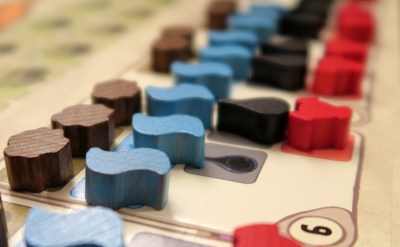
This week the “Feature Game” will be Keyflower, which is a tile laying game with an unusual auction mechanic implemented using meeples. We’ve chosen Keyflower because it is one of our favourite games, but it is a long time since we’ve played it and lots of several players seem to have missed out.

– Image by boardGOATS

And talking of auctions…

Jeff went to an auction and bought a Stradivarius and a Rembrandt.  He was very happy with them since the price he paid was remarkably low, and even he had heard the names.  Although he knew they were valuable, Jeff had no idea how much they were actually worth, so he decided ask a valuer to put a number on his windfall.

In response to his query, the valuer explained, “Well sir, this is indeed a Stradivarius and that is a Rembrandt, but it’s a great pity that Stradivarius couldn’t paint and Rembrandt couldn’t build violins…”

2nd May 2017

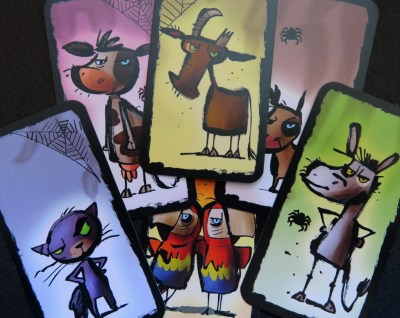
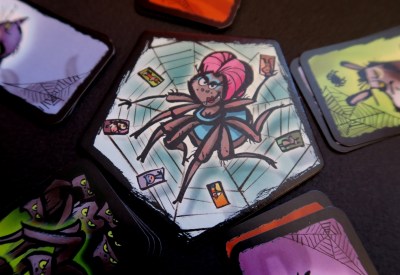
With the inevitable pizzas mostly dealt with, we started the evening with one of Red’s “silly little games from Germany”.  Tarantel Tango (aka Tarantula Tango) is a daft little “get rid of your cards” game with the addition of animal noises.  The idea is that each player starts with a deck of face down cards which will be placed face up in one of five piles located around a central pentagon.  On their turn, the active player first makes a noise in response to the animal and number of spiders on the previous player’s card before placing their own card in a location dictated by the number of animals on the previous player’s card. Thus if a player’s card depicts one donkey and a spider the next player says, “Eee-ore” and places their card on the top of the next pile.  If the card had two donkeys, the card would be placed on the next pile but one, on the other hand, if there were two spiders, the player would have to make a double animal noise, “Eee-ore, Eee-ore!”
Tarantel Tango
– Image by boardGOATS

Simple enough, but things were confused by the fact that the animal art was like something from a Tim Burton Film, so it was easy to confuse them.  Also, according to the rules, a cow says “Moo-moo” (not “Moo”), which means with two spiders the active player must say, “Moo-moo moo-moo” – something that it is easy to forget when a noise must be made and a card played in less than two seconds, under the pressure of everyone else’s gaze.  Worse, some cards have no spiders at all which means the player must remain mute.  The penalty for failing to make the correct noise or put the card in the right place is to pick up all the cards on the table.  A similar penalty awaits when a Tarantula Card is played – everyone must slap their hand on the table and woe-betide the player who is last…
Tarantel Tango
– Image by boardGOATS

Once Red had roped Pine and Ivory into her madness, they were joined by Pink and Blue who read the rules  out.  Black’s comment from the next table was that it would take ages, but neither he nor Purple could be persuaded to join in, so with Burgundy still finishing his pizza everyone else started, what they thought would be a quick bit of fun.  It seemed like ages before the first person had to pick up cards and before long it looked like Pink had it in the bag with just three cards left.  Unfortunately, the stress of being so close meant he inevitably tripped over his words and gathered a large pile of cards as a consequence.  Ivory was next and managed to reduce his hand to just one card before making his mistake.  From here everyone took it in turns to reduce their stack to small handful of cards, but fail to actually get rid of the final few, by which time Purple was in such fits of laughter she was practically soiling the furniture.  It had been a lot of fun, especially at the start, but we were all quite pleased when we could finally move on to something else, so there was relief all round when Pine finally managed to get rid of his last card successfully.

Tarantel Tango
– Image by boardGOATS

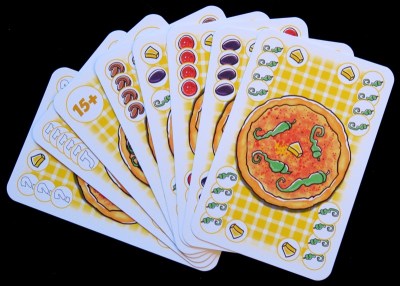
With the gratuitous silliness over, we split into two groups, the first of which consisted entirely of people who hadn’t eaten any pizza and fancied making up for it with the pizza based “Feature GameMamma Mia!.  This is an unusual little card game designed by Uwe Rosenberg of Bohnanza fame (as well as designer of games like Agricola, Le Havre and the more recent Cottage Garden).  Everyone in the group likes Bohnanza, but Red is especially fond of it and was particularly keen to give this one a go.  Uwe Rosenberg has a liking for unusual mechanisms in his card games and Mamma Mia! is no exception.  The idea is that players are trying to fulfill pizza orders by first putting toppings in the oven and then sneaking their order cards in on top before another player does the same and claims the toppings for their order.  So, each player has a deck of personal order cards and a random hand of toppings.  On their turn, each player must place at least one topping card in the oven pile (all the same type) and may follow it with an order card if they choose.
Mamma Mia!
– Image by boardGOATS

All cards are placed face down so players have to try to remember what cards have been played.  Once a player has placed cards in the oven, they draw back up to the hand limit of seven, but the catch is that cards can only be drawn from either the ingredients pile or their own personal order pile.  This is very clever because players have a hand limit of seven and this is something that needs to be handled with care: order cards are needed to give a target to aim for, but too many and there isn’t enough space to hold enough ingredients to build sets.  Just to add to the challenge, we included the Double Ingredients mini expansion which adds a small number of cards which contribute to toppings instead of one.  Black and Purple had played the game before, but it was completely new to Pine and Red and it took a little while for them to get their heads round it.

Mamma Mia!
– Image by boardGOATS

Pine (who’s special ingredient was chili) cleared himself out in the first round taking an order for “Pizza Bombastica” (with at least fifteen toppings) and struggled to get back into the game.  Black (special ingredient pepperoni) on the other hand failed to place orders for any pizza in the first two rounds, instead, as Pine pointed out, “Saved himself to make ‘Quality’ pizza!”  Meanwhile, Red (with mushroom as her special ingredient) was very confused and was struggling to understand what was going on.  This was a feeling that wasn’t helped when Pine requested a “Pineapply-looking-olive” in the final round.  Despite her evident confusion, Red was definitely proving to be the “Queen of Pizza”, a title that also earned her accusations of “card counting” (something she might have tried had she understood what was going on).  In the final accounting, Red finished with seven orders, three more than Purple who had played a quiet, but very effective game making good use of her special ingredient (olives).

Mamma Mia!
– Image by boardGOATS

While the pizzaioli were busy making pizza, the other group (consisting predominantly of pizza eaters) were settling into a game of Last Will.  This is a game we’ve played before, but that was nearly two years ago, so it required a recap of the rules.  Last Will is basically the boardgame equivalent of the 1985 film “Brewster’s Millions”.  The story goes that in his last will, a rich gentleman stated that all of his millions would go to the nephew who could enjoy money the most.  In order to find out who that would be, each player starts with a large amount of money, in this case £70, and whoever spends it first and declares bankruptcy is the rightful heir, and therefore the winner.  The game is played over a maximum of seven rounds each comprising three phases. First, starting with the start player, everyone chooses the characteristics of their turn for the coming round from a fixed list by taking it in turns to place their planner on the planning board. This dictates the number of cards they will get at the start of the round, the number of “Errand Boys” they will be able to place, the number of Actions they will get and where they will go in the turn order.

Last Will
– Image used with permission of BGG contributor PaulGrogan

Inevitably, this is a compromise, so choosing to go first when placing Errand Boys, might guarantee the action of choice, but will only give one card at the start of the round and crucially, only one Action.  On the other hand, choosing to sacrifice position in the turn order could give three or four Actions.  Since all but two cards are discarded at the end of the round and Actions must be used or lost, this decision is critical.  Actions are important, but so are Errand Boys as they allow players to control the cards they are drawing as well as manipulate the housing market and increase the space on their player board.  The heart of the game is the cards, however, which are played in three different ways:  as a one off (white bordered cards); on a player’s board where they can be used multiple times (black bordered cards) or as a modifier (slate bordered cards) which enable players to spend more when black or white bordered cards.  Thus, White bordered “Event Cards” cost a combination of money and Actions to play, but once played, are discarded. In contrast, Black bordered cards cost at least one Action to play, and occupy space on the player’s board, but are kept and can be activated once in each round.

Last Will
– Image used with permission of BGG reviewer EndersGame

Black bordered cards come in three different types: “Expenses” which allow players to spend money; “Helpers” which additionally allow give players some sort of permanent bonus, and “Properties” which are by far the most complex cards in the game.  Properties are an excellent way of spending money as they are bought for a given amount and will either depreciate every round, or will require maintenance which can be expensive. Unfortunately, players cannot declare bankruptcy if they have property and must sell them.  This is where the property market comes in:  one of the possible errands is to adjust the property market, so if a property is bought when the market is high and sold when it is low, this is another possible avenue for losing money.  At the end of the round, everyone reduces their hand to just two cards and loses any left-over actions, which puts players under a lot of pressure as it makes it very hard to plan.  So the game is an unusual mixture of timing, building card combinations, strategy and tactics.

Last Will
– Image used with permission of BGG contributor bswihart

Burgundy went first as he was the last person to pay for something – he paid for his pizza while everyone else had put their purchases on a tab.  The random draw meant everyone started with £120 (in poker chips), making for a slightly  longer game. Only Ivory hadn’t played it before, but it was such a long time since Blue, Pink and Burgundy it was only a vague memory, and none of them felt they had ever really fully understood the game.  Inevitably therefore, there was plenty of moaning and groaning from Burgundy and a lot of puzzled expressions from Pink.  Accusations of “winning moves” were aimed at Blue (accompanied by appropriate denials) when she was the first to take her dog and a chef on a Boat Trip and then bought herself a small mansion.  Property is the key, as it is expensive to buy and either costs to maintain or depreciates, however, it must be sold before a player can go bankrupt.

Last Will
– Image used with permission of BGG contributor Toynan

Maintenance costs or depreciation alone are not sufficient to ensure a player spends enough to win, so players need to find a away to make their properties cost more.  Blue first added a Steward (who enabled her to carryout maintenance on a property without needing an action) and then an Estate Agent to her portfolio.  This latter was particularly useful as it enabled her to over pay for property by £2 when buying and sell for £2 below market value.  Meanwhile, Ivory had bought a couple of valuable farms to which he added animals, then he maximised his outgoings by adding a Training Ground.  Not though want of trying, but Pink was the only one who failed to get a helper who would provide an extra action.  Instead, he had to make do with a two Hectic Days (which gave him extra actions) which he coupled with visits to the Ball.  The first of these was very effective, the second less so.  By this time he was beginning to run out of space on his player board, so Pink then decided to get an extension to his player board, but Ivory had other ideas and kept taking it first, much to Pink’s disgust.

Last Will
– Image used with permission of BGG reviewer EndersGame

While all this was going on, Burgundy was muttering away and shaking his head ominously, quietly buying properties, and making reservations at restaurants with occasional trips to the theatre or trips on the river.  As the game entered its final stages it was becoming clear that it was Ivory who had really got to grips with the game though.  The extra messenger card came up and, as everyone had other things they wanted to do, he took it cheaply which gave him a little extra flexibility in his options.  Blue and Burgundy had began selling properties first, leaving them with a lot of cash to get rid of.  In contrast, although he had no money left, Ivory still had to sell his farms and dispose of the income before he could actually go bankrupt.  Despite Burgundy and Pink’s best efforts to get in his way though, Ivory just made it, finishing £1 in debt.  Nobody else could match that, with the Blue the closest with £16 credit.

Last Will
– Image used with permission of BGG contributor CellarDoor

Mamma Mia! finished long before Last Will, and the group were looking for something else to play.  Blue (from the next table) suggested they might like to try Indigo, which she described as “a bit like Tsuro but backwards”.  Tsuro is a simple “last man standing” game where players take it in turns to place a tile in front of their stone and move it along the path.  Indigo is also a game of moving stones, however, instead of trying to keep one stone on the board, players are trying to move different coloured stones off the board through their own “gates”.  There are other differences too, for example, the tiles are hexagonal rather than square and instead of choosing which tile to lay from a hand of three, tiles are drawn at random.  To make up for the random draw, players can place tiles anywhere they like, which enables players to try to build routes from their gates to stones, rather than the other way round.

Indigo
– Image by boardGOATS

One of the cleverest parts of the game is its semi-cooperative nature – with four, players share their each of the gates with one of the other players.  This introduces an interesting tension between working with other players while simultaneously competing with them.  So, as Purple commented, players that don’t work together get nothing.  Black, on the other hand, was quite taken with the pretty patterns the tiles made on the board.  It was quite a tight game throughout – since stones are stored secretly and have different values, it wasn’t easy to be certain who was in the lead.  In the event, the lead probably swapped several times, and the game finally finished in a tie between Black and Pine, both with ten points, with Red following on in third, three points behind.

Indigo
– Image by boardGOATS

Last Will was still underway, so the hunt resumed for another game, and Blue suggested Pueblo.  Although a slightly older game, this was a recent acquisition and Pink had met pine when he collected it from the village Post Office.  Although he hadn’t known precisely what it was at the time, the rattle had given away the contents as a boardgame.  Pueblo has a very robust rattle as it consists of lots of very solid plastic pieces.  It is one of those games that is quite different to anything else; Blue and Pink had played it quite a bit out in the garden over the weekend and thought the others might like to give it a go, especially as it was simple enough to play from the rules.

Pueblo
– Image by boardGOATS

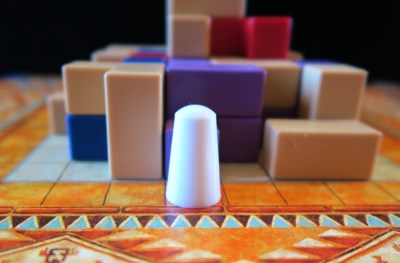
Each player has a set of coloured pieces and a matching number of neutral pieces.  These are paired up to make a cube consisting of one coloured and one neutral piece.  On their turn, the active player places any unpaired pieces they may have on the grid shown on the board.  If they don’t have any unpaired pieces, then they break up a cube and choose which half to play.  Once they have placed a piece, the active player moves the Chieftain along the track around the edge of the board.  They can choose whether to move him one, two or three spaces, after which, he looks at the building along the grid lines and scores any coloured bricks he can see.  At the end of the game, the Chieftain makes one last trip round the board and the player with the lowest score at the end wins.
Pueblo
– Image by boardGOATS

The game was quite close, and everyone felt that the idea was great but that the game play was not as exciting as it sounded.  Unfortunately, everyone also suffered a bit from “Analysis Paralysis”, and as a result, the game felt like it dragged, a problem that was undoubtedly made worse playing with four than with two.  This is because with two there is just one opponent and the game becomes one of cat and mouse; with more players this tension is diluted.  As the game progressed, it seemed to drag more and more, so the final trip round the track was dispensed with leaving Pine the winner, just two points ahead of Purple.  With that over, and Last Will coming to an end, Pine, Purple and Black headed off for an early night leaving Red to watch over the final moves before it was time to for everyone else to head home too.

Pueblo
– Image by boardGOATS

Learning Outcome:  Games that are a hit for some players are not guaranteed to work for others.

Next Meeting – 2nd May 2017

Our next meeting will be on Tuesday, 2nd May, at the Horse and Jockey pub in Stanford-in-the-Vale.  As usual, we will be playing shorter games from 7.30pm as people arrive, until 8pm when we will start something a little longer.

This week the “Feature Game” will be Mamma Mia!, a little card game with a pizza theme – something that seems wholly appropriate given how many of us now have pizza on a Tuesday at The Jockey.  Mamma Mia! was designed by Uwe Rosenberg who was also responsible for Bohnanza, one of our all-time favourite card games, so it will be interesting to see how it compares.

Mamma Mia!
– Image by boardGOATS

And talking of pizza…

Jeff was in Japan on a business trip, but after a few days he had a hankering for pizza, so he asked the concierge at his hotel if there was anywhere nearby that he could get one. The concierge told him he was in luck and a pizza place had just opened down the road, and they delivered.

The concierge gave Jeff the phone number, and he took it back to his room and ordered a pizza. Thirty minutes later, the delivery man appeared at his room door with the pizza. As Jeff took the pizza he began sneezing uncontrollably.

Jeff asked the delivery man, ”What on earth did you put on this pizza?”

The delivery man bowed deeply and replied, “We put on the pizza what you ordered: pepper only…”

18th April 2017

Blue was the first to arrive, together with Pink on one of his rare visits.  The bar was busy, so they decided to get in a couple of quick rounds of Mijnlieff before ordering food.  This is a very simple “naughts and crosses“/Connect 4 type game, with the twist that each piece a player places restricts where their opponent can play.  Blue started out getting early revenge for the various defeats over the weekend, winning the first game four points to three.  Pink quickly leveled the score, however, taking the second game two points to one.  Since Black and Purple had arrived, they settled on a draw and decided to order food before beginning a quick game of …Aber Bitte mit Sahne (aka Piece o’ Cake).

Mijnlieff
– Image used with permission of BGG contributor thepackrat

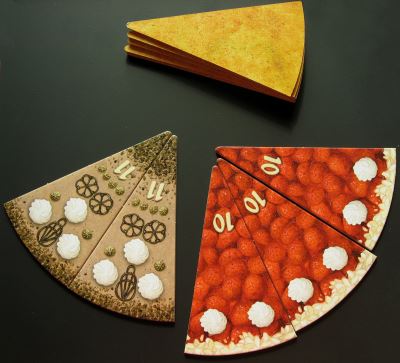
…Aber Bitte mit Sahne is a very simple little game of “I divide, you choose”, with a side order of set collecting.  Played over five rounds, the “Master Baker” divides the eleven slices of the pie into pieces and each player takes it in turns to take a piece (leaving the Master Baker with whatever’s left).  As players take their share, they can choose to keep slices or eat slices:  eating a slice guarantees points (equal to the number of blobs of cream on top), while saving it gives the opportunity for more points if the player has the most of that type stored at the end of the game.  Blue started out collecting Chocolate cake which can be highly lucrative, but as there are more slices available can be tough to make pay.  Pine, on the other hand, played safe and opted for eating his Chocolate slices and tried to make Pea Pie (or was it Gooseberry?) and Blackberry pay.  Purple had other ideas though and competed for both just shutting Pine out of the Gooseberry, and finishing in a three way tie for the Blackberry pie with Blue (all three score in full).

…Aber Bitte Mit Sahne
– Image by boardGOATS

It was a tight game with Black’s love of Strawberries, Purple’s Goose-goggs and Pine’s whipped cream fetish leaving them all within a point or so of each other.  Pink had also played safe and eaten amount of cake, but also kept his Cherry and Kiwi pies and scored both.  It wasn’t quite enough though, as Blue managed to keep her nose ahead in Chocolate and with Blackberry and Plum as well and some cream to top it off she finished with twenty-eight, four ahead of Pink in second.  With that over and the arrival of pizza (and Ivory) we had to decide what to do next.  Everyone was very keen to play the “Feature Game”, Power Grid, but although it would play six, we knew that would make it longer and it would perhaps be tight to finish in time.  Nobody was keen to play anything else though, so we decided to go for it with everyone’s agreement that we would have to keep it moving.

…Aber Bitte Mit Sahne
– Image by boardGOATS

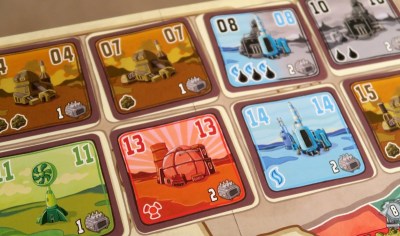
Power Grid is a slightly older game that is now nearly fifteen years old and was itself built on the slightly older Funkenschlag.  So, it is something of a classic, but only Black had actually played it before.  Although it seems complex, the game is actually a fairly simple auction game where players are power moguls building power plants and trying to supply cities with juice.  At the start of each round, players bid for power plants which have different fuel requirements and supply different numbers of cities.  Players then fuel to power their cities before adding cities to their network.  Finally, players decide how many power plants they are going to activate and thus how many of the cities in their network they are going to supply, which dictates their income for the round.  The clever part that really takes a little bit of thinking to understand, is the market.  Each power plant up for auction has a different number from 01 to 50, with the higher numbers generally the more efficient plants.  The deck of power plant cards is shuffled and the top eight cards revealed.  These are then sorted with the four with the lowest number put out for auction and the others put in the reserve row.

Power Grid Deluxe: Europe/North America
– Image by boardGOATS

Once a plant has been bought, another card is revealed and, if it’s number is higher than the lowest card in the reserve, it goes into the reserve and the lowest is made available for auction, otherwise it goes straight into auction instead.  The reason this is clever is that it provides variety between games, while effectively preventing the extremely unbalanced case where one exceptionally efficient plant is won very early.  This is particularly important because each player can only win one auction per round, thus, the last player to bid could be bidding unopposed.  Getting an efficient plant cheaply is really quite key because money is tight and there is lots of demand for it.  Firstly, there’s fuel to power the plants:  the cost of fuel ebbs and flows depending on demand.  If there is a lot of demand, the price increases and, in the extreme case, especially if players are hoarding, it can become unavailable. If possible, it is best to find a niche in the market and buy/build power plants that use a different fuel-stock to everyone else because money is also needed to pay for the infrastructure to supply cities.

Power Grid Deluxe: Europe/North America
– Image by boardGOATS

This is another key part of the game:  Each player starts with a foothold in one city.  To extend their network, they need need to pay for the infrastructure within another city, but also the connections to it.  In the early part of the game, each city can only support one “power generator”, so positioning is key.  While it’s not possible to actually get cut off, if someone else has already built in all the adjacent cities, it is necessary to pay two (or more) connection fees as well as the city infrastructure fee.  Once at least one player has connected a given number of cities to their power network, the game enters the second phase and cities can support a second power generator.  Although players cannot build a second generator in a city they already supply, it does mean players can extent their network more easily. Buying a second generator in a city is more expensive than the first however, and later in the game when it becomes possible to buy a third, it is more expensive still.

Power Grid Deluxe: Europe/North America
– Image by boardGOATS

The end of the game is triggered when at least one player has connected a given number of cities (or more) in his network.  The final scoring is slightly unusual as the winner is the player who has sufficient resources and power plants to power the most of their connected networks.  Thus, if a player mistimes their ending and has run out of money to buy sufficient fuel they can squander a promising position.  We played with the deluxe edition of Power Grid, which has slightly updated graphics and a few minor rules tweaks as well as some nice wooden pieces to represent the fuel resources and generators.  A lot has been  written about the differences between the two versions, but the most obvious is probably the replacement of “rubbish” with natural gas, though the rule changes are actually more significant, though they are small.  The deluxe edition comes with a double sided board, Europe and USA, and there are slight variations in the rules for each.

Power Grid Deluxe: Europe/North America
– Image by boardGOATS

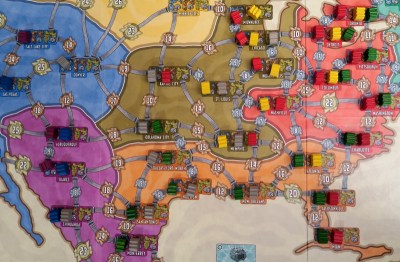
Our first decision, therefore, was which map to use.  Since the rules suggest USA is easier for beginners, despite a general preference for Europe (as Europeans), the shortage of time meant we decided to start there.  We then had to choose which areas to use, so we went for the central five, missing out the mid-Atlantic states and the north western states (Alaska, Idaho, Oregon, Washington).  Random draw put Blue first, followed by Ivory, but as Black pointed out, going first is not necessarily an advantage.  It meant that Blue had the opportunity to choose which power plant should be auctioned first, and might get it cheap if nobody else fancied a punt.  On the other hand, if there was nothing she fancied, she might get landed with something less popular with the chance that something better might be drawn to replace it.  Worse, losing means having to have another try, while going last means the there is no-one left to compete and any power plant can be bought at the minimum price.

Power Grid Deluxe: Europe/North America
– Image by boardGOATS

Since we were using the USA map, there was a slight modification where a discount token was placed on the smallest power plant  before the auction to signal that the minimum bid for this plant is reduced to one Elektro (independent of the actual number of the power plant).  This is supposed to help prevent players over-bidding for rubbish.  There was worse to come for Blue and Ivory though, as buying resources and choosing starting cities for networks are done in reverse player order, making them last and making the resources most expensive and the ensuring the most flexible places had already gone.  Black began in the deep south while Pine and Pink began building his network in the mid-west.  With Purple beginning in Las Vegas and Ivory starting in Columbus, Blue had very little space to move so she decided to go for the only double city available – Mexico City.  For the most part, we managed to keep the game moving, and if anyone stopped to think for too long, everyone reminded them that the clock was ticking.  Although Blue was able to make a quick start, despite being the sole user of uranium, she quickly began to struggle and gradually slid down the ranking.  Meanwhile, Ivory, who found himself with a nice un-congested corner to work began to pull ahead.

Power Grid Deluxe: Europe/North America
– Image by boardGOATS

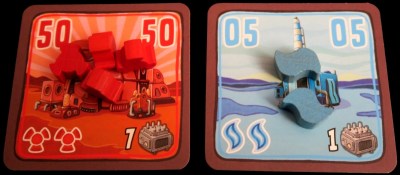
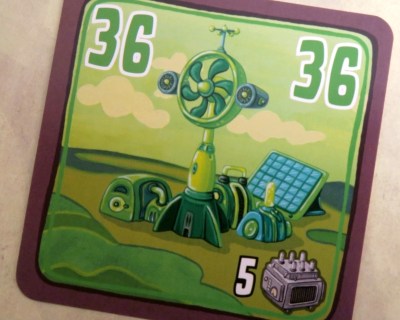
As play continued, Pine spread into Tennessee and Purple began something of a monopoly along the western seaboard.  Black and Ivory discovered the value of wind power, while everyone else was trying to work with coal and gas fired power stations (Pine’s gas is famous apparently – well, he is a vegetarian!).  As time ticked towards pumpkin o’clock, the game progressed into the final stages and we finally allowed people a little extra thinking time.  Ivory eventually triggered the end of the game when he added his fourteenth city to his network.  He could see the writing on the wall, but try as he might, Ivory was not able to stop Black taking a clear lead with fifteen cities.  This only left the question as to how many people were able to provide all their cities with power.  In the event, everybody was able to serve their entire network, which left Black in first place, one ahead of Ivory and three ahead of Pine (who’s gas obviously wasn’t all it was cracked up to be).  There was just time to take a quick snap of Black’s Glorious Win before we packed it away, discussing the game as we did so.  On reflection, we decided that although Black had a nice mix of powerful power sources, it was number 36 that was probably made the difference as it served five cities and, as it was green, there was no running cost.  Nobody will let him get that cheaply again!

Power Grid Deluxe: Europe/North America
– Image by boardGOATS

Learning Outcome:  Pine’s gas is powerful, but wind is better for the environment…

Spring 2017 Oxford Meeples Big DoG

On Saturday, April 29th, Oxford Meeples is opening the doors of Wolvercote Village Hall to the general public once more and inviting people to join them for of their quarterly Big Days of Gaming.  As usual, the Oxford Meeples will be bringing a large number of their games, but everyone is welcome to bring their own as well.  The hall opens at 10 am with gaming starts from about 10.30 am and continuing ’til late.  Entry is free, although donations towards rent of the hall and refreshments are always appreciated.  Children are welcome so long as they are accompanied by an adult.  Several of the GOATS have committed to going, but final numbers will no doubt depend on other commitments (and the weather!) as usual.

Oxford Meeples Spring DoG '17
– Image from oxfordmeeples.org

Game Plan: Rediscovering Boardgames at the V & A Museum of Childhood

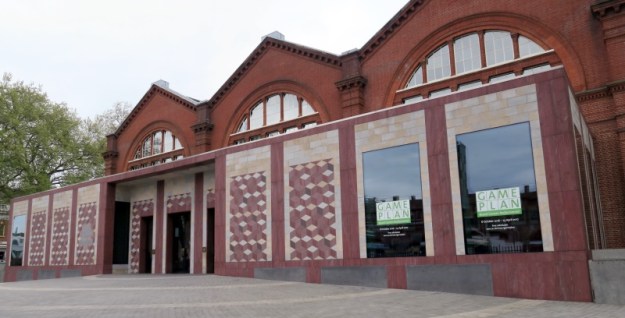
Inspired by the recent articles on Saturday Live and the Today Programme, on Easter Sunday, Pink and Blue decided to visit the V & A Museum of Childhood to see their “Game Plan: Board Games Rediscovered” exhibition.  Catching a train from Oxford Parkway and negotiating the London Underground, they arrived in Bethnal Green.  With its vaulted ceiling and exposed metal work, the Museum building looks for all the world like a re-purposed Victorian Civil building, a train station, swimming pool or maybe some sort of pumping station.  Much to their disappointment, however, after extensive discussion and investigation, it turned out that the building was designed for the purpose, albeit after relocation of parts from “Albertopolis” on Exhibition Road.

Game Plan: Board Games Rediscovered
– Image by boardGOATS

The exhibition itself was well presented and occupied a sizeable portion of the overall floor space.  Although it was located in one of the upstairs galleries, the exhibition was well advertised and, from entering the main hall, games were brought to the visitors’ attention with table space and signs offering the loan of games should people want to play.  It wasn’t an idle promise either, as there were several family groups making full use of the opportunity, albeit playing what might be called classic games rather than more modern, Euro games.

Senet
– Image by boardGOATS

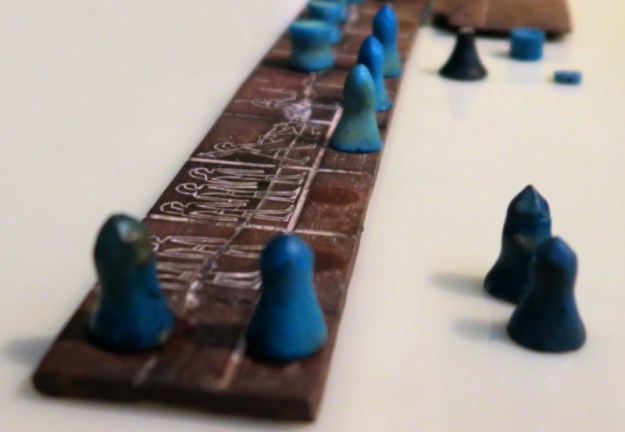
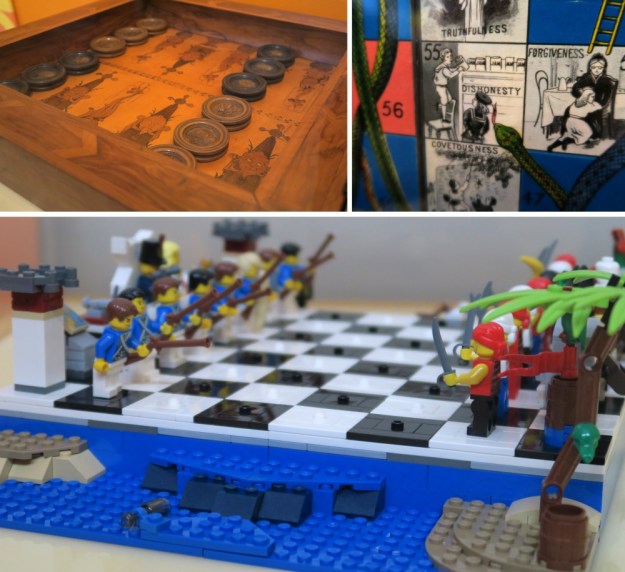
A quick look at the model train cabinet and brief spell side-tracked by one or two other exciting toys preceded entry to the exhibition which was shrouded by an eye-catching red screen.  The first exhibit was a copy of Senet, arguably one of the oldest games in the world – so old in fact that we’ve lost the rules and nobody knows how to play it.  This was followed by some traditional games including a beautiful wooden Backgammon set made in Germany in 1685 and decorated with sea monsters and a lot of fascinating Chess sets, old and new.  Next, there were some ancient copies of Pachisi (which evolved into Ludo) and Snakes and Ladders, both games that originated in India and were originally played seriously by adults.

Game Plan: Board Games Rediscovered
– Image by boardGOATS

Further round there were many other curious games, for example, The Noble Game of Swan from 1821, which was an educational game for children, itself developed from the much older, Game of the Goose.  Education was a bit of theme and there were a lot of games from the nineteenth and early twentieth century designed to teach geography in some form or another.  These included Round the Town, a game where players had to try to cross London via Charing Cross, and Coronation Scot, a game based on travelling from Glasgow to London inspired by the eponymous 1937 express train made to mark the coronation of George VI.

Game Plan: Board Games Rediscovered
– Image by boardGOATS

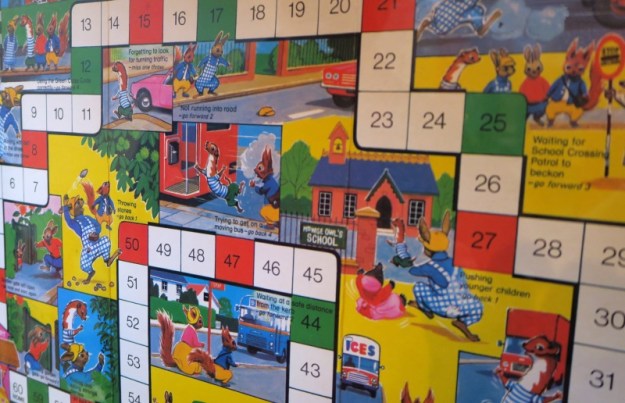
Education didn’t stop there either:  for those that had been members of RoSPA‘s “Tufty Club“, there was a game promoting road safety featuring Tufty the Squirrel and his mates Minnie Mole and the naughty Willy Weasel.  However, when designing this roll-and-move game, they clearly ran out of imaginative “adventures” with a road safety message, as they had to resort to “Picking and eating strange berries – Go back three spaces…”

Tufty Road Safety Game
– Image by boardGOATS

Progressing through the late twentieth century, there were the inevitable copies of the childhood classic games, including Game of Life, Risk, Cluedo, Mouse Trap, Trivial Pursuit, Connect 4, Scrabble and the inevitable Monopoly, all of which risked bringing a tear to the eye as visitors remembered playing them as children.  The exhibition eventually brought us up to date with modern Euro-style games, presenting copies of Ticket to Ride, Carcassonne and Settlers of Catan.

Pandemic
– Image by boardGOATS

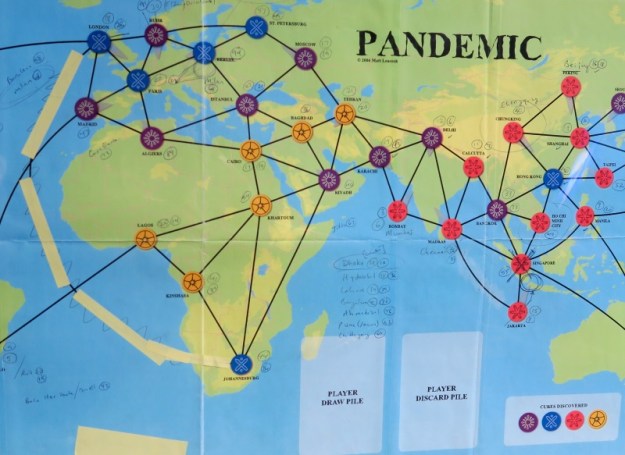
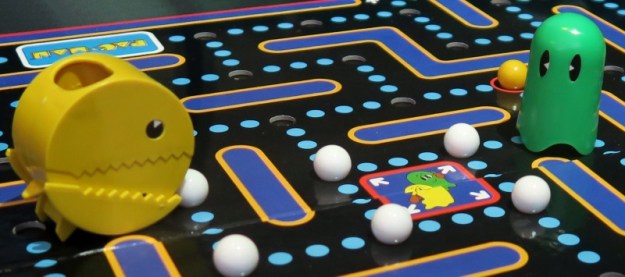
More interestingly, there was also an original prototype of Pandemic supplied by the designer, Matt Leacock, complete with his scribbles and bits of paper stuck over infection routes he decided to remove as the game developed.  One of the final display showed how the influence boardgames have had on the computer gaming industry is sometimes strangely reciprocated, with a copy of the Pac-Man game, including the title figure wrought in sunshine yellow plastic.

Pac Man
– Image by boardGOATS

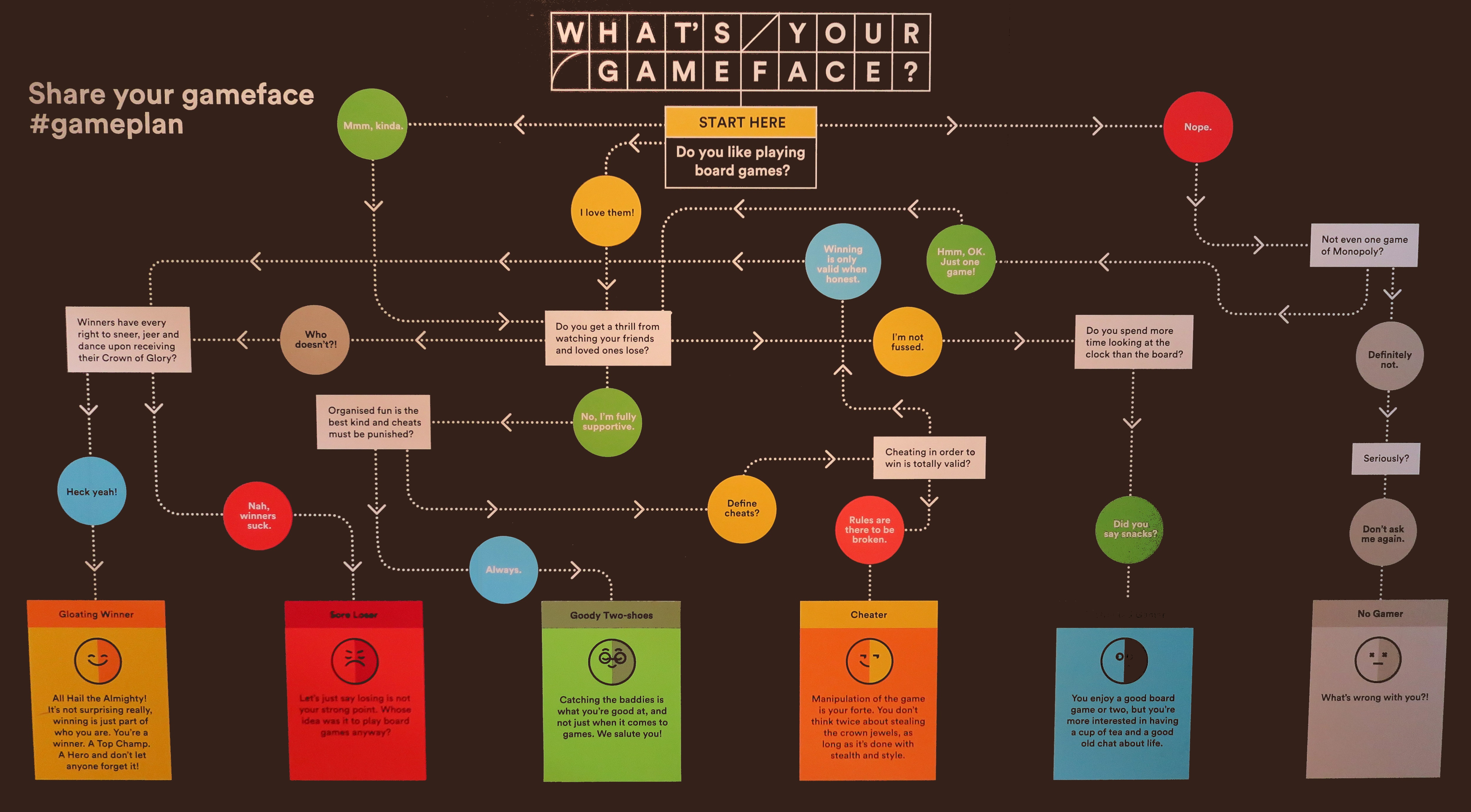
Leaving the exhibition, there was just one last game – “What’s Your Gameface?“.  This cute flow chart entertained Blue and Pink for far longer than is should have as they tested it out with all their friends, relatives and fellow gamers (nobody came out as “Cheater”).

Game Plan: Board Games Rediscovered
– Image by boardGOATS

With the exhibition done, there was still time for a wander round the rest of the museum and a quick cuppa in the cafe.  Reflecting on the exhibition, perhaps one of the best aspects had actually been the quotations that adorned the walls.  It seems luminaries from Plato to Roald Dahl have all had something to say on the subject of games.  Perhaps George Bernard Shaw supplied the most thought provoking comment though, when he said, “We don’t stop playing because we grow old; we grow old because we stop playing.”  With this in mind, we did what gamers do when they travel, so tea and cake was accompanied by two rounds of Mijnlieff, the super-cool noughts and crosses game.  With the museum closing, it was time to head home, but there was still time for a game or two of 3 Sind Eine Zu Viel! on the train back to Oxford…

Game Plan: Board Games Rediscovered
– Image by boardGOATS

The Exhibition is only open till 23rd April 2017, so there isn’t much time left and it is well worth a visit.

Boardgames in the News: More Games Reporting from the BBC

In recent years, there have been a number of short articles on the BBC especially on the radio; over the Easter weekend there was more Gaming Goodness.  Saturday Live is the Radio 4 Saturday morning magazine show presented by Aasmah Mir and the Rev. Richard ColesLast Saturday, guests included the comedian Milton Jones, the fiddle player Sam Sweeney (formerly of Bellowhead) and Catherine Howell, collections manager at the V & A Museum of Childhood. This latter guest was of particular interest as Catherine Howell curated the museum’s exhibition “Game Plan: Board Games Rediscovered”.  This traces the the history of boardgames from Senet to Pandemic: Legacy and beyond and comes to the end of its run on 23rd April 2017.

Samira Ahmed with Tom Vasel
– Image from samiraahmed.co.uk

Perhaps more interesting though was the Radio 4 documentary broadcast on Good Friday, called “Do Pass Go”.  Part of the “Seriously…” series, the half-hour program was presented by Samira Ahmed and included interviews with designers, reviewers and gamers with a visit to Spiel 2016 at Essen.  Much more than the usual five-minute clip, this is an in-depth study of the resurgence of analogue table top games in an increasingly digital world.  Both this and the Saturday Live article are available on iPlayer and for those who would like to know more there is also a blog post covering the making of “Do Pass Go”.

Next Meeting – 18th April 2017

Our next meeting will be on Easter Tuesday, 18th April, at the Horse and Jockey pub in Stanford-in-the-Vale.  As usual, we will be playing shorter games from 7.30pm as people arrive, until 8pm when we will start something a little longer.

This week the “Feature Game” will be Power Grid, which is a game where the aim is to supply the most cities with power when someone’s network reaches a predetermined size. Players mark pre-existing routes between cities for connection, then bid against each other to purchase the power plants that they need to power these cities. However, as power plants are purchased, newer, more efficient plants become available, so by merely purchasing, you’re potentially allowing others access to superior equipment.

Power Grid Deluxe: Europe/North America
– Image used with permission of boardgamephotos

And talking of electricity…

Jeff was working as an electrician rewiring a property.  After a full week of work, the homeowner was delighted with end result and all the hard work Jeff had put into his house.

“You did a great job,” he said, and handed Jeff a cheque. “Also, as a special thank-you, here’s an extra £80 to take the missus out to dinner and maybe see a film.  Show her a good time – I’m sure she deserves it.”

Later that evening, the doorbell rang and it was Jeff.  Thinking the electrician had maybe left something behind the homeowner asked, “Is everything OK?  Did you forget something?”

“No,” Jeff replied. “I’m just here to take your missus out to dinner and show her a good time, just like you asked…”

4th April 2017

As we we arrived, we were all a little thrown by the fact that we weren’t on our usual table.  We coped though (just about) and, while we waited for our food, inspired by Red’s “smiley sushi” top, we felt there was only one suitable game, Sushi Go!. This is one of the simplest, “purest” card-drafting games.  Card drafting is a mechanism that is the basis of a number of well-known and popular games including 7 Wonders and one of our favourites, Between Two Cities.  It is also a useful mechanism for evening out the vagaries of dealing in other games.  For example, a round of drafting is often added to the start of Agricola to ensure that nobody gets a particularly poor hand.

Sushi Go!
– Image used with permission of boardgamephotos

Basically, each player starts with a hand of cards, chooses one to keep and passes the rest onto their neighbour.  Everyone receives a new hand of cards, and again chooses one and passes the rest on.  This continues with the hands getting progressively smaller until all the cards have been chosen and there are no cards to pass on.  In Sushi Go!, players are collecting sets of cards with the different sets scoring points in different ways, for example, a player who collects a pair of Tempura Prawns gets five points at the end of the game.  In the first round Blue and Burgundy went for Sashimi – collecting three gives ten points; unfortunately there were only four in the round and both got two which failed to score.  We were playing with the Soy Sauce expansion, and Burgundy made up for his lack of Sashimi by taking the Soy bonus,  it was Pine who made a killing though taking the first round with a massive twenty-two points.

Sushi Go!
– Image used with permission of boardgamephotos

The second round was very confused pizza arriving and hands losing cards somehow.  Blue won the round with seventeen, but it was a much closer affair which left Pine in the driving seat going into the last round.  As they only score points at the end of the game and since the player with the fewest losing six points, everyone went for Puddings.  There were a lot in the round and Red managed to collect most of them, and the end of the game six point bonus with it.  It was a sizeable catch and with Pine in line for the penalty, it looked like Red might just have enough to snatch victory.  In the end, Pine shared the penalty with Burgundy, however, and that was just enough to give him the game, finishing three points ahead of Red.

Sushi Go!
– Image used with permission of boardgamephotos

With food finished and our usual table now empty, we split into two groups with the first foursome moving back to our normal table to play the “Feature Game”, Viticulture.  This is a worker placement game where players take on the roles of beneficiaries in rustic, pre-modern Tuscany who have inherited meager vineyards. Each player starts with a few plots of land, an old crushpad, a tiny cellar, and three workers.  Using those workers and visitors, players can expand their vineyards by building structures, planting vines, and filling wine orders.  At first glance, Viticulture appears very complicated with lots of possible actions, but in practice it is a much simpler game than it looks.  Viticulture is broken down into years or rounds with each subdivided into seasons, each with a specific purpose.  In the first round, Spring, players choose the turn order for the rest of the year.  The start player picks first and can choose to go first and pick up a meager reward, or sacrifice position in the turn order for something more enticing, in the extreme case, going last and getting an extra worker.

Viticulture
– Image used with permission of BGG contributor punkin312

Then, in the turn order decided in Spring, players take it in turn to choose an action and place a worker.  All the action takes place in Summer and Winter and it is up to the players how they divide their workers between the two.  Each action has three spaces, but only two are in use in the four player game.  The first player to take an action gets an additional bonus while the second allows the basic level action only.  Each player has a large worker, their “Grande”, which they can  use as a normal worker, or to carry out any action, even if both spaces are already occupied.  In Summer, players can add buildings to their estate; plant vines; show tourists round (to get money); collect vine cards, or play yellow Summer Visitor cards (which generally give a special action).  In contrast, in Winter, players can harvest grapes from their vines; make wine; collect wine contract cards; fulfill contracts (which is the main way to get points), or play blue Winter Visitor cards.  Sandwiched between Summer and Winter, is Autumn, where players get to take an extra Visitor card.  Game end is triggered when one player gets to twenty points.

Viticulture
– Image used with permission of BGG contributor punkin312

We were very slow to start as only Ivory was familiar with the game.  Pine in particular felt out of his depth and moaned about how this was not his sort of game.  Despite this, Pine was the first to get points on the board and he retained his lead for more than half the game thanks to the Windmill that he built at the start.  This gave a him a point each time he planted vines and, since that is an essential part of the game he was collecting points from the start where everyone else was concentrating on trying to build up the framework of their vineyard.  As the game progressed, everyone else’s grapes began to mature yielding points and the chase began.  We were into the final quarter of the game before Blue, then Ivory and eventually Green caught Pine though.  Going into the final round it was clear it was going to be close as Ivory moved ahead of Green, Blue and Pine, and triggered the end game.  Blue just managed to keep up and it finished in a tie, with both Ivory and Blue on twenty-four, four points clear of Green.  Money is the tie breaker followed by left over wine, and since Blue had more of both she claimed the victory.

Viticulture
– Image used with permission of BGG contributor punkin312

Meanwhile, at the other side of the room, Red, Purple, Black and Burgundy, had been playing Ulm.  This is a game Purple and Black picked up from Essen last year and has had a couple of outings since.  The game play in Ulm is simple enough.  It is played over ten rounds, during each of which players get one turn in which they can do three actions that help them to gain points.  Ultimately players are collecting cards, city coats of arms and descendants, all of which can give them points during the game or at the end. This, in combination with the position of their barge and the number of sparrow tokens owned give the end game score, and the player with highest score wins.  The novel part of the game is the Cathedral – a three by three grid of action tiles.  On their turn, the active player slides a new action tile, randomly drawn from the bag, from the outside into the grid sliding another tile out. That tile stays in its spot on the outside of the grid and no other player can use that row or column until the tile is removed. The three tiles left in that row or column (two old ones and the new one, just added), represent the active player’s three actions for their turn.

Ulm
– Image by boardGOATS

The game play in Ulm is simple enough.  It is played over ten rounds, during each of which players get one turn in which they can do three actions that help them to gain points.  Ultimately players are collecting cards, city coats of arms and descendants, all of which can give them points during the game or at the end. This, in combination with the position of their barge and the number of sparrow tokens owned give the end game score, and the player with highest score wins.  The cathedral area is a three by three grid of action tiles.  On their turn, the active player slides a new action tile, randomly drawn from the bag, from the outside into the grid sliding another tile out. That tile stays in its spot on the outside of the grid and no other player can use that row or column until the tile is removed. The three tiles left in that row or column (two old ones and the new one, just added), represent the active player’s three actions for their turn.

Ulm
– Image by boardGOATS

Thus, players get one random action (drawn from the bag) and choose the other two.  There are five different actions represented by tiles in different colours.  These are:  clear tiles on one of the four sides of the cathedral area (making more options playable), place a Seal, buy or play a card, move the player’s barge, or take money.  Points are scored during the game through Seals and Coats of Arms, and at the end of the game for any sparrows and for the position of their barge on the Danube.  The largest source of points though is through cards.  These can be acquired by exchanging tiles for cards or as a byproduct of buying Seals.  When played, the active player can either discard the card for the card bonus which they can use during the game, or place the card in front of them, to obtain the points bonus at the end of the game.  A set of three different trade cards gets a bonus of three points while three the same gives a six point bonus.  Cathedral cards are the most profitable, however, with a complete set of three cathedral cards netting a massive eighteen points, but they can be correspondingly difficult to get.

Ulm
– Image by boardGOATS

Red and Burgundy were new to the game so there were some blank faces during the explanation and they were totally over-awed by the two epic rules books.  It wasn’t helped by the cluttered nature of the board, though everyone agreed that the Cathedral action grid movement is very clever.  The downside of it though is that it regularly locks up leaving difficult choices, especially for Red who seemed to come off worst.  Black commented that it was very busy with four and that meant the game was very different to the two-player experience.  Purple moved furthest at first and picked up some early shields to give her a good start.  Despite her difficulties with the action grid, Red also picked up quite a lot of shields and generated a huge number of sparrows gave her lots of bonuses and the lead during the game.

Ulm
– Image by boardGOATS

Burgundy is well known in the group for sighing and moaning about how badly the game is going, shortly before pulling a master stroke that gives him a massive number of points and usually, an unassailable lead.  This game was no exception as he produced a massive eighteen points halfway through by trading lots of goods.  As he pointed out later, however, it didn’t stop him from coming last this time though.  In the event, it was quite close between first and second.  Black who made his fortune as an art collector and scored the most from the his River position, demonstrated the value of experience, just pushing Red into second place.  Finishing first, the group enjoyed a long postmortem and chit-chat, before the goings on with Viticulture piqued their interest and they wandered over to spectate and enjoy the drama of the final round.

Ulm
– Image by boardGOATS

With an early start the next day, Black, Purple, Ivory and Green then headed off, leaving Blue, Red and Pine to have yet another go at wresting Burgundy’s “Splendor Crown” from him.  Splendor is a really simple engine-building game that we’ve played a lot of late.  The idea is that players collect chips and use them to buy cards.  These cards can, in turn, be used to buy other cards and allow players to earn Nobles and victory points.  People often claim the game is trivial and highly luck dependent, but there has to be more to it otherwise Burgundy would not be as seemingly unbeatable as he is.  This time, there were relatively few ruby cards available in the early part of the game, and Red took those that were available.  Similarly, Blue took all the emerald cards she could as these were needed for the Nobles.  Given the lack of other cards, Burgundy just built his business on onyx and diamonds instead.  The paucity of other cards slowed his progress and prevented Burgundy from taking any Nobles.  It didn’t stop him taking yet another game though, finishing on fifteen, four ahead of Blue with eleven.

Splendor
– Image used with permission of boardgamephotos

Learning Outcome:  Board layout is very important – it can make an easy game appear complex or a difficult game seem straightforward.

Next Meeting – 4th April 2017

Our next meeting will be on Tuesday 4th April, at the Horse and Jockey pub in Stanford-in-the-Vale.  As usual, we will be playing shorter games from 7.30pm as people arrive, until 8pm when we will start something a little longer.

This week the “Feature Game” will be Viticulture, where players take on the roles of beneficiaries in rustic, pre-modern Tuscany who have inherited meager vineyards. Each player starts with a few plots of land, an old crushpad, a tiny cellar, and three workers.  Using those workers and visitors, players can expand their vineyards by building structures, planting vines, and filling wine orders.  The winner is the player with the most successful vineyard in Tuscany.

Viticulture
– Image used with permission of BGG reviewer EndersGame

And talking of wine…

Jeff got on a bus one morning and sat down next to a priest.  He was on his way home after a night out and stank of wine, his shirt was stained, his face was all red, and he had a half-empty bottle of wine sticking out of his pocket.  He opened his newspaper and slowly started reading.

A couple of minutes later, he asked the priest, “Father, what causes arthritis?”

The priest replied, “Mister, it’s caused by loose living, being with cheap, wicked women, too much alcohol, and contempt for your fellow man.”

“Well, imagine that,” the Jeff muttered in reply and returned to reading his paper.

The priest, thought about what he had said, and after a couple of moments, turned to Jeff and apologised.  “I’m sorry, I didn’t mean to be so judgmental. How long have you had arthritis?”

“I don’t have arthritis, Father,” Jeff replied, “But I just read in the paper that the Pope does.”