Category Archives: Games Night

20th August 2019

It was ominously gloomy and empty in pub the when Khaki and Mulberry arrived.  With Blue away for work, she had left the logbook with the landlord and it was sadly sitting on the table waiting for them.  Fearing the repercussions of ignoring the demanding tome, they ordered food and took their places at the table.  They were soon joined by Burgundy, Purple, Black, Lime and Ivory, making it a decent turn-out for a meeting that was very nearly cancelled.

The Book - 20/08/19
– Image by boardGOATS

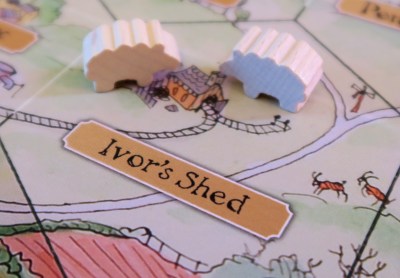
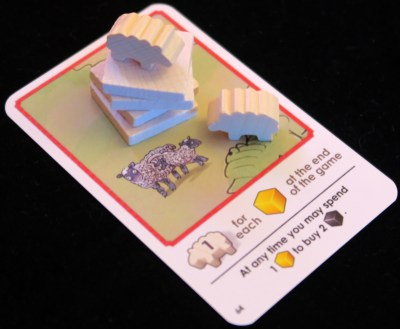
Once the feeding was over and done with, it was time to organise people to play games.  Purple, Mulberry and Lime began with the “Feature Game”, Ivor the Engine.  This is a great little game with fantastic artwork from the late, great Peter Firmin.  Although it is designed round a the children’s cartoon, the cute artwork belies the viscous little teeth the game has.  The idea is that players move their wagon round the board, playing cards to carryout errands which are paid in sheep – the player with the most sheep at the end of the game is the winner.
Ivor the Engine
– Image by boardGOATS

At the start of the game the board is randomly filled with lost sheep. On their turn, the active player begins by collecting a sheep at their current location, if one is available, receiving bonus sheep if they take the last sheep in a location. Then they play cards and move their wagon playing cards before or after they move.  There is one free movement and others can be bought with coal.  The active player can play as many or as few cards as they wish, but there is a tight hand-limit of four cards and only one card can be played at each location. The cards can be used in one of two ways:  they can provide a special action (e.g. extra moves or moving sheep about), or if the active player is at a location where there are no sheep, they can use them to complete a “Job” receiving sheep as a reward.  Finally, players take a card from the face-up display discarding a card if necessary.

Ivor the Engine
– Image by boardGOATS

It seems very gentle at first glance, but there are a couple of things that make the game quite strategic.  Firstly, only one player can be in a location at any one time, which can be surprisingly inconvenient for players who have built a plan and a hand of job cards only to be obstructed by another player squatting in the wrong place.  With cards at such a premium it is also surprisingly irritating when another player takes a desired card.  Managing these is key to being successful, but the nastiest part of the game are the event cards.  At the end of a player’s turn, they draw cards from the deck to replace any they have taken and place them face up in the display.

Ivor the Engine
– Image by boardGOATS

If an Event card is revealed, then the actions must be carried out by everyone – some are nice, some are slightly inconvenient, others are downright nasty.  For example, some Events cause players to move their wagon to the other end of the board which can be very helpful or extremely frustrating depending on the player’s plans.  Players can also be forced to forfeit sheep, or worse, hard won resources or Job cards.  Like Job cards, Event cards are also dual purpose, and (once the Event has been resolved) can be taken from the “market” at the end of a turn, like Job cards.  They are valuable though, providing a means to score more at the end of the game, so they must be bought using gold, which is very rare and difficult to come by.

Ivor the Engine
– Image by boardGOATS

Purple explained the rules very thoroughly as there are a couple of slightly fiddly exceptions, for example, it costs two coal to move along the main line, but eventually the game got going.  Everyone started on the same side of the board and got in each other’s way a bit.  Lime struggled a bit in a game that can be quite unforgiving despite it’s cute graphics and child-friendly theme.  Things improved for him as he picked up six sheep on his final turn.  Mulberry’s game started well, but in contrast to Lime, fizzled out towards the end.  Purple got lucky as she picked up sheep throughout and cards that were conveniently close to her current position.  Purple’s experience ensured she capitalised on her good fortune, finishing five points ahead of Lime, with thirty-three.
Ivor the Engine
– Image by boardGOATS

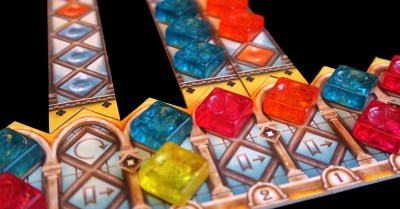
Meanwhile on the next table, “the boys” were playing Azul: Stained Glass of Sintra.  This was released last year at Essen and uses the market mechanism from the 2018 Spiel des Jahres winner, Azul.  The idea is of this is that on their turn, players take all the pieces of one colour from a market and place the left-overs in the middle, or, take all the tiles of one colour from the middle.  In Stained Glass of Sintra, instead of placing these pieces in a row and moving them onto a grid, pieces are placed directly into the player’s window.  This is modular consisting of the double-sided strips laid out at random so everyone has a different starting setup.
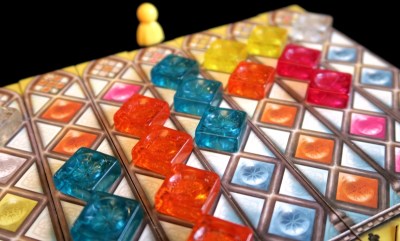
Azul: Stained Glass of Sintra
– Image by boardGOATS

There are restrictions on how the pieces can be placed though:  tiles must be placed in the strip immediately below their Glazier meeple, or in a strip to its right.  The Glazier is then placed above the strip the tiles were placed in,, so he gradually moves to the right. Instead of taking tiles, players can choose to reset the Glazier’s position, moving him back to the left most strip.  Players get points when strips are completed scoring the sum of the score depicted below the strip and any strips to the right that have already been completed. There is also a colour bonus—each round has a colour drawn at random at the start of the game, and any tiles that match the colour for the round score extra.
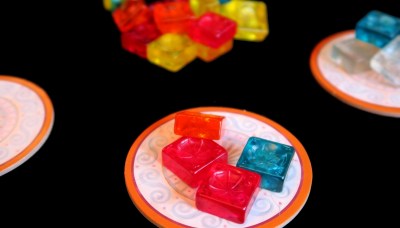
Azul: Stained Glass of Sintra
– Image by boardGOATS

Once a strip has been completed, it is flipped over; after it has been filled a second time it is removed. Any left over tiles that cannot be placed are placed into the glass tower and yield a penalty with players moving along a negative score track which has small steps at the start that gets larger. When the market is empty the round ends and the round indicator tile is also dropped into the glass tower which is emptied when the .  There are also end-game bonus points with two variants available, one colour dependent and the other rewarding completing adjacent strips.

Azul: Stained Glass of Sintra
– Image by boardGOATS

Kahki started, but was the only one new to the game and didn’t know what he was doing.  Somehow though he managed to build a lead which kept growing. Black and Burgundy weren’t far behind although there was a lot of smashed orange “glass” when Burgundy was forced to pick up eight orange pieces but only had space for four.  Ivory struggled and there was yet more broken orange glass when he picked up twelve orange pieces, only having space for two.  As a result, there were a lot of penalty points at the end, and it was only a surprise to Kahki that he was the winner by some twenty points.
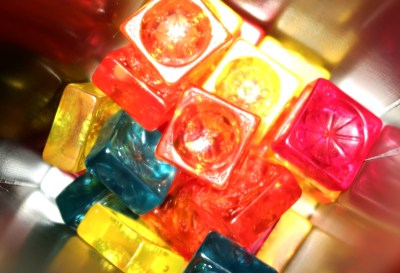
Azul: Stained Glass of Sintra
– Image by boardGOATS

The Ivor group had barely finished the rules explanation by this point, so the group moved on to play Splendor.  This is one of our most popular games, but has largely degenerated into an exercise in trying to beat Burgundy as he wins every time.  The game is a very simple engine builder, where players can either take “gem” chips on their turn, or use them to buy a card from the display.  Cards then provide a perpetual “gem” allowing players to buy more expensive cards which give points.  Points are also provided by “Noble” tiles which are revealed at the start of the game and are won by the first player to get a certain combination of gem cards.
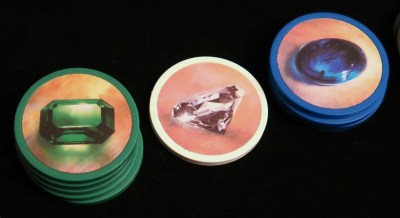
Splendor
– Image by boardGOATS

This time, all the Noble tiles needed rubies (red), but very few ruby cards came out.  Ivory started well taking an early lead with a few low scoring cards before Khaki caught up him taking a three point card. Burgundy made a very slow start, reserving a couple of cards while Black picked up a few points here and there.  Ivory took the first Noble and managed to fight his way to fourteen points, but then the inevitable happened.  Burgundy’s game suddenly snowballed and a couple of rounds later he bought his last reserved card and, as the last player in the round, brought the game to an end.  Burgundy finished on sixteen points, just two ahead of Ivory who took second place in what was a very tight game where Burgundy was pushed right to the wire, albeit with the usual result.

Splendor
– Image by boardGOATS

By this time, Ivor was finally finished, and Khaki and Mulberry headed off for an early night, leaving everyone else to play Alhambra.  This, the 2003 Spiel des Jahres winner, is a tile laying game where players are building their city.  Basically, on their turn, the active player may take money from the open money market; purchase a building from the building market and either place it in their Alhambra or their reserve, or engage in construction and re-construction projects with buildings that had been placed in the player’s Alhambra or their reserve.  The core of the game is the market, where players buy building tiles with coloured money cards and add them to their Alhambra.  This key purchasing mechanism comes from its predecessor, Stimmt So!.

Alhambra
– Image used with permission of BGG contributor EndersGame

There are four different currencies which come in different colours.  At the start of a player’s turn, there are four tiles available, each in a different coloured market, which can only be purchased with the currency that matches the market’s colour.  If the active player can pay with exactly the correct amount, they can buy another tile, but if they over-pay, they get no change and their turn ends.  While this all sounds simple enough, there is the little problem that sets Alhambra apart from Stimmt So!:  most of the tiles have walls along one, two or three edges, and when placed, these must match up without partitioning the Alhambra.  The walls are critical as poor play in the early stages can mean it is possible to get backed into a corner later in the game.

Alhambra
– Image used with permission of BGG contributor EndersGame

There are fifty-four tiles in six different types, each type in a different colour. They are Pavilions (Blue), Manors/Seraglios (Red), Mezzanines/Archades (Brown), Chambers (White), Gardens (Green) and Towers (Purple).  Most tiles have one or more walls around the edges and each tile also shows numerical value from two to thirteen, which is their cost.  Each of the six different building types in a player’s Alhambra score in each of the scoring phases, with players receiving points for having the most of each type in the first scoring round.  In the second scoring round the player in second place also scores and in the final scoring round points are also available for third place in each building type.  Points are also awarded in each scoring round for players’ longest external “wall” section within their complex.

Alhambra
– Image used with permission of BGG contributor mothertruckin

The game ends when the building market can no longer be replenished from the building tile supply, and there is a final scoring, whereupon the player with the highest score wins.  In this game, the distribution of tiles was very uneven, with all the Tower tiles coming out early and and the Manor and Garden tiles coming out late.  Ivory took an early lead after the first scoring round having picked up a lot of the early Towers.  It was not to last though.  Alhambra is a game that rewards efficiency, and Black and Burgundy both made the most of paying exactly the right amount and taking extra turns, while Ivory and Lime fell into the trap of putting tiles into their reserve which cost them an extra turn to place them in their Alhambras.

Alhambra
– Image used with permission of BGG contributor EndersGame

While Purple had the most Towers in the second scoring round, others had caught up by the third and final scoring round.  As a result, Towers finished in a three-way tie, so nobody scored well.  Lime finished with the longest wall taking a massive fifteen points in the final scoring phase, but unfortunately he did not have enough points elsewhere to trouble the leaders, Burgundy and Black.  Burgundy also had a substantial wall, giving him twelve points, and with his Gardens and Pavillions, he took a creditable second place, but was some way behind Black who finished with over a hundred points thanks to having the most Chambers and coming second in many of the other buildings and generally being efficient throughout.

Alhambra
– Image used with permission of BGG contributor EndersGame

Learning Outcome: boardGOATs can survive without Blue and Green as long as Purple is around.

6th August 2019

With a party just arriving, Blue and Khaki took a gamble on Burgundy being on his way, and ordered his ham, egg, ‘n’ chips for him on the understanding that they’d have a second course if he failed to turn up in time.  Blue, then eschewed her usual pizza in favour of fajitas which she then proceeded to throw down her front.  Pine, meanwhile, arrived fractionally too late to order food at all.  Burgundy arrived just in time to avoid everyone playing musical food and eating his dinner, so Pine ended up eating everyone else’s chips instead.  With the substantial matter of food dealt with and the arrival of Purple and Black, the group moved on to games.  There was some discussion about playing one large game or two smaller, three-player games, but the latter won out, with the “Feature Game”, Century: Spice Road, the first game on the table.

Century: Spice Road
– Image by boardGOATS

This being a similar engine builder type game to Splendor and Burgundy keen to play, Pine could see the writing on the wall and decided to leave Blue and Khaki to it.  The game itself is actually quite different to Splendor.  In Splendor, players take gems and use them to buy cards which then deliver permanent gems enabling them to buy other cards, and eventually get cards that also give points.  In Century: Spice Road, players are spice traders and take cards from a conveyor belt and then use these cards to get spices and then use the spices to buy scoring cards.

Century: Spice Road
– Image by boardGOATS

The clever part is the fact that there are four spices available, turmeric, saffron, cardamom and cinnamon, with cinnamon worth the most, and turmeric the least.  Thus, the activity cards, variously enable players to take spices, upgrade them, or convert them into other spices.  Players place their spices in their caravan, which holds a maximum of ten spices.  Like Splendor, the game is all about building an efficient engine, though in this case, it uses deck building, so a key part is making sure that as many cards as possible are used before the deck is picked up, which costs a turn.  Similarly, any conversions can be carried out as many times as desired when the card is played, so timing is everything.

Century: Spice Road
– Image by boardGOATS

Burgundy went first and it wasn’t long before he took his first points, leading Pine to comment from the next table, comparing Burgundy taking the lead to Bayern Munich taking a five-nil lead ten minutes in.  Burgundy replied that he wasn’t winning… yet.  It wasn’t long before Blue and Khaki scored themselves, though rather than equalising, it was more a case of reducing the deficit.  It was around this point that Blue made a big play, going for a card that allowed her to upgrade three spices (compared to the initial two in the cards everyone started with), but she immediately regretted it as she paid through the nose to take it (the card at the end of the conveyor belt is free, but taking newer arrivals costs one spice per card space nearer to the deck).

Century: Spice Road
– Image by boardGOATS

This mistake was compounded by the fact that Blue didn’t really use the card as she had more efficient ways upgrading her spices.  Meanwhile, Burgundy and Khaki were building up their pile of scoring cards, with Khaki ominously taking a lot of the oldest scoring cards, and with it a large number of the rather pretty bonus metal coins.  The game moved really quickly – it’s not really multi-player solitaire, but everyone had plans, so play moved on very quickly with only sporadic breaks when people had to make decisions, so it wasn’t long before everyone was getting close to taking the critical sixth scoring card which triggers the end of the game.

Century: Spice Road
– Image by boardGOATS

It turned out that all the high scoring cards had come out at the beginning and towards the end, everyone was waiting and hoping someone else would take a low scoring card and leave them with something more exciting.  Blue had the chance to kill the game early and prevent Burgundy and Khaki taking a sixth card, but she thought Burgundy was setting his sights higher than he was.  So in the end it was Burgundy who took his sixth card to trigger the final round and everyone finished with the same number scoring cards, though Burgundy’s were generally of much higher value.

Century: Spice Road
– Image by boardGOATS

It was really close for second place, with Blue taking it by just one point, but Burgundy finished eleven points clear with eighty-six, fulfilling Pine’s prophecy (based on his unbeatable prowess at Splendor) that he would win.  Blue was left ruing the fact she hadn’t ended the game when she had the chance, but in reality Burgundy would probably have won anyhow as he’d only taken a low scoring card end, giving him fewer points than his margin of victory.  However, we’d all enjoyed the game, as it plays quickly and doesn’t out-stay it’s welcome as well as being quite nicely produced.  It does look like it is going to be one of those games that nobody else will want to play with Burgundy though.

Century: Spice Road
– Image by boardGOATS

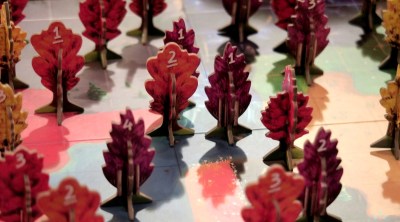
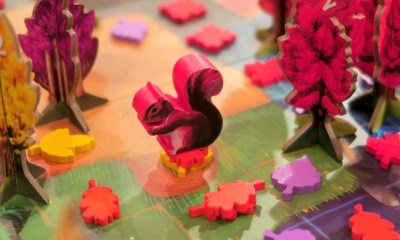
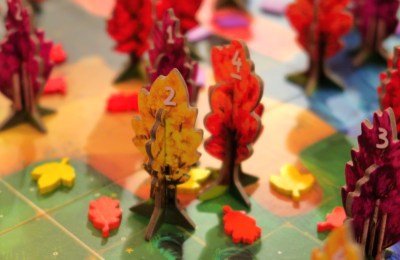
Meanwhile, on the next table, Pine had joined Black and Purple to play the rather beautiful Bosk.  This is a fairly simple little game that has had a couple of outings recently and has proven quite popular.  The game plays over two seasons, spring, where players grow their saplings, and autumn, where the trees then drop their leaves.  Summer and winter are scoring phases.  In summer, players score points for each row or column where they have the largest total and in winter, players score for having the most leaves in each area.

Bosk
– Image by boardGOATS

This time, with players becoming more familiar with how the game works, it was really tight.  Although the scoring in the first half always seems important, it isn’t really, and is usually quite close.  It is a game where small margins are always important though.  So while the wooden squirrels were doing acrobatics in the middle of the table, players’ trees were shedding leaves all all over the forest.  When it came to scoring, it was very “tit-for-tat” with one player scoring best in one area and then another playing scoring best in the next area.  In the end, it was Black who just managed to sneak the win, two points ahead of Pine.

Bosk
– Image by boardGOATS

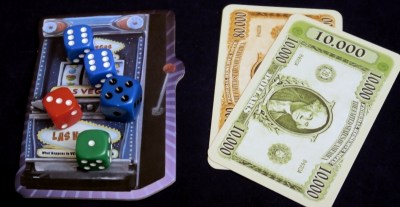
With both games finishing simultaneously, and everyone being keen to play together, we decided to introduce Khaki to one of our favorite games, Las Vegas.  This is a great betting game which is quite unlike anything else.  The idea is that there are six casinos, each with a pot of money in one or more notes.   On their turn, each player rolls a handful of D6 dice and place some on one of the casinos.  The player with the most dice on a casino once all dice have been played takes the highest denomination note in the pot.

Las Vegas
– Image by boardGOATS

As with all the best games, it is the little rules that make the difference.  In this case, there are two “catches”.  Firstly, the player must place all of one number on one of the six casinos, so if they rolled a two and six fives, the must place the two on the “Two” casino, or all six fives on the “Five” casino.  Secondly, when everyone has run out of dice, any dice that tie are eliminated, which means there could be three players with four dice each, and one player with a singleton and the singleton wins.  A new edition of the game has just been announced, Las Vegas Royale, but rather than implement the changes to the rules released with the new edition, we played in our usual, highly enjoyable way.

Las Vegas
– Image by boardGOATS

The game is supposed to be played over four rounds, but we find it can outstay it’s welcome a little for players who are out of the running, so we house-rule it to three rounds instead.  We also add “The Biggun” dice and the Slot Machine from the Boulevard expansion.  The big dice count for two in the final reckoning, which adds a little bit of variety to the game, while the Slot Machine gives players an alternative to placing dice in the casinos.  Each number can only be placed once in the slot machine, but the player must place all their dice of that number (as usual).  In the event of a tie, the total number of pips, and then the highest value dice are the deciding factors.  This a relatively relaxing game to play with friends with short burst of thought interspersed with a lot of table chat and general encouragement and exhortation to make a mess of things for someone else.

Las Vegas: The Slot Machine
– Image by boardGOATS

In the first round, Khaki rolled a handful of fours, so made a play for the “4” casino.  Following it with more fours secured his position, so when he rolled more fours in the second round he was encouraged to go for it again.  By the final third round, everyone was placing subconscious bets on whether he would try again, which of course he did, ultimately winning the “4” casino in all three rounds.  In fact the last round was the deciding factor, ultimately coming down to the last couple of dice, which lost Pine and Burgundy a lot of cash.  It was Blue and Purple, mostly flying under the radar that took the honours with $330,000 each, finishing joint first, and opting to share victory rather than invoking the tie-breaker.

Las Vegas
– Image by boardGOATS

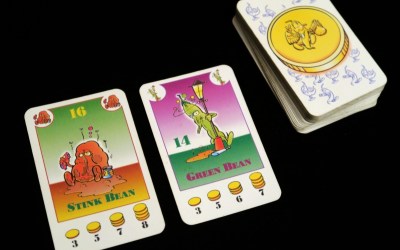
There was still plenty of time, but clearly everyone was in a holiday mood and fancied playing light fare, so we decided to finish with an old favourite, Bohnanza.  Kahki had not played it before, so was given a quick run-down of the rules.  The important thing, is that players must not re-order their hand – this is so automatic in card games that new or not, everyone always reminds everyone else immediately after the cards are dealt.  On their turn, players then play the first card from their hand into one of the two “bean fields” in front of them.  They may optionally play a second, but then the top two cards from the deck are turned over.  These must be “planted” before anything else can happen, but they can be planted in the active player’s field or can be traded for something and planted in a field belonging to another player.

Bohnanza
– Image by boardGOATS

Once the trades have been dealt with, the active player can trade with other players, swapping cards in hand, and then finally tops up their hand by drawing a set number from the deck (dependent on the number of players). There are many clever things about this game, but one of the most important is that when fields are harvested, some of the beans are turned over and become coins which are kept by the player, with the rest moving to the discard pile.  The reason this is important is because some beans are rarer than others and rare beans give a better yield.  This means the balance of the deck changes during the game with rare beans becoming rarer, while there is a glut of common beans.  The winner is the player with the most coins at the end, which is usually the player who best surfed this changing balance.

Bohnanza
– Image by boardGOATS

The game is very sociable and always played in good nature, with players generally offering and accepting reasonable trades, and not being obnoxiously obsessed with winning.  This time was no exception, although Burgundy did refuse Pine’s totally reasonable offer to take a pint for a Red Bean.  Purple made good progress early on, with a large number of Black-eyed Beans while others struggled to make much progress at all.  As a result, when the deck was depleted for the first time round, there were very few cards in the discard pile making the second round extremely short.  The third was even shorter, made worse by the fact that Blue lost the plot and shuffled the last few cards in with the discard pile

Bohnanza
– Image by boardGOATS

When, in the last turn of the game, Purple turned over two Green Beans which Blue wanted, she offered her whole hand, sizeable hand to purple in exchange.  Purple being a kind-hearted, generous sort, graciously accepted, much to Black’s disgust.  The offer was partly to make up for the screw-up with the deck in the hope that Purple would be able to score some points, but of course did Blue no harm either.  In the end it nearly cost Purple the game.  Often the game ends in a multi-way tie, sometimes for first, but more commonly for second place.  The pair of Green Beans that Blue received gave her one extra point, breaking what would have been a three way tie for second with Black and Khaki, putting her one coin behind Purple, the winner with fourteen.

Bohnanza
– Image by boardGOATS

Learning Outcome:  Don’t play Splendor OR Century with Burgundy unless you fancy a pasting.

23rd July 2019

It was a quiet, if hot night; Blue and Khaki were the first to arrive closely followed by Pine and Burgundy, and all four settled down to eat and discuss the very British subject of The Weather.  Just as they were finishing eating, Ivory turned up toting his copy of the “Feature Game”, Wingspan.  Then he started something when he ordered a desert, specifically ice cream.  Everyone else, who had struggled to finish their supper and had hitherto been replete watched with envious eyes as Ivory tucked into his two scoops, one each of Baileys and Toblerone.  Only Burgundy held out and it wasn’t long before another food order was placed, including two grown-up orders of a single scoop of raspberry sorbet and one childish order of a scoop each of chocolate orange and Toblerone.

Ice Cream
– Image from horseandjockey.org

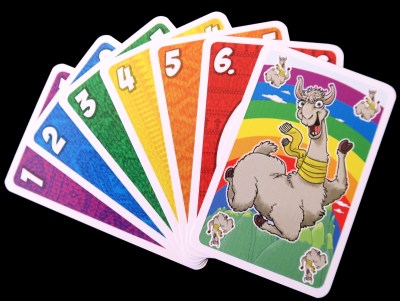
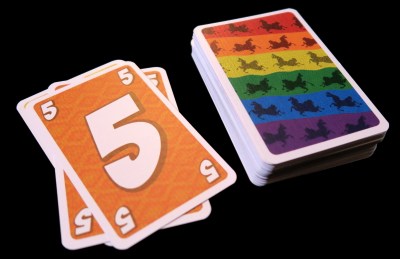
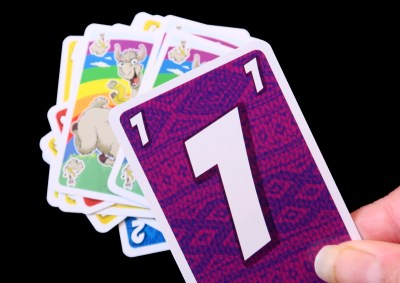
While waiting for the second round of deserts to arrive, the group decided to play something, and, given that the Spiel des Jahres awards had just been announced, decided to give L.A.M.A. a go. L.A.M.A. was nominated, but did not win (despite Reiner Knizia’s amazing outfit), however, for our group it was a much better fit than Just One, the winner.  Just One, is a word guessing game in a similar vein to the previous laureate, Codenames, which was extraordinarily unpopular with our Tuesday night group.  Word games are similarly unpopular, so Werewords was never likely to go down well either, making L.A.M.A. our group’s pick, even though we had not hitherto played any of the nominees to form a real opinion.

L.A.M.A.
– Image by boardGOATS

As Ivory commented, L.A.M.A. has a reputation of being a bit of an “UNO killer”, that is to say, it is a similar game to UNO, but perceived to be better.  L.A.M.A. is an abbreviation for “Lege alle Minuspunkte ab”, which roughly translates as “get rid of your negative points”, and indeed this is what players do, in a similar way to UNO.  The deck contains coloured cards numbered one to six, and some Llama cards.  Players take it in turns to play a single card, the same number or one higher than the last card played.  Llama cards can be played on sixes, and one’s can be played on Llamas.  If they cannot play (or choose not to), players can draw a card from the deck, or stick with what they have, and not play for the rest of the round.

L.A.M.A.
– Image by boardGOATS

When either everyone has passed, or someone has played out their hand, everyone scores points equivalent to the face value of their cards in their hand, and Llama cards score ten.  There is a catch though, in a mechanism faintly reminiscent of No Thanks!, any duplicate cards do not score, thus, a two fives and a six will only score eleven.  Players receive tokens for their score, but if a player checks out with nothing they can return a token to the pool.  Since white tokens are worth one and black worth ten, and players can return either, the advantage can  sometimes be with the player with a higher score.  For example, someone with nine points can only return one white token leaving them with eight, while someone with a single black ten can return everything they have.  The game ends when someone reaches forty.

L.A.M.A.
– Image by boardGOATS

Blue started badly, by picking up a massive twenty-four points on the first round.  Burgundy did slightly better, although the size of his total was largely thanks to Pine who repeatedly stepped up the current card value upsetting Burgundy’s plans.  This became something of a running joke, with Pine playing a one and thus preventing Burgundy playing his Llama cards.  Pine and Ivory started well remaining in single digits for several rounds, but in the end it was surprisingly close.  Fairly inevitably though, it was Blue who hit the magic forty first with Burgundy and Ivory just behind with thirty-nine each.
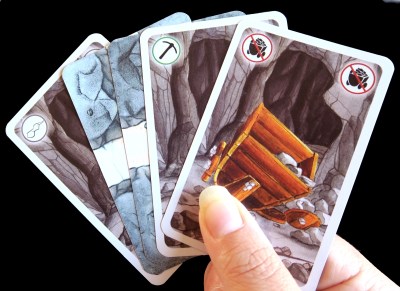
L.A.M.A.
– Image by boardGOATS

Khaki took a very creditable second place thanks to winning one round and ditching ten points as a result.  It was Pine who won the game, however, as the most consistently low scoring player, finishing with eight points fewer than Khaki, a total of only twenty.  With the ice cream desserts and the llama aperitif dealt with, it was time to move on to the main course, the “Feature Game”, Wingspan.  Ivory commented that he’d been really looking forward to this and described it as, “an engine builder like Terraforming Mars, but much prettier”.  While we set up, Pine explained that his curious order of “Yardbird” was not a reference to the game, but the IPA.  It turns out the beer is not named after the the rock group (that featured Eric Clapton among others), but actually Charlie Parker, the jazz saxophonist.

Wingspan
– Image by boardGOATS

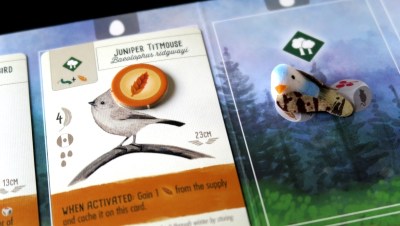
The players are bird enthusiasts seeking to discover and attract the best birds to their network of wildlife reserves.  The game itself is fairly straight forward: there are two main types of actions, introduce a new bird card, or carry out an an action and activate the associated birds.  In order to introduce a new bird card into their reserve, a player needs entice them by spending food.  Each bird is played in one of the three habitats: woodland, grassland or wetland.  Some birds, like the Common Raven, can be found in any habitat so players can choose where to play them, others birds like a Green Heron are only found in one or two habitats (in this case, wetland), so  can only be placed in those habitats.

Wingspan
– Image by boardGOATS

There are three other actions, collect food, lay eggs or acquire more cards.  In each case, players place one of their action cubes (or fluffy little birds in our pimped out copy), in the space to the right of the right most card in the associated habitat.  The more birds there are in a habitat, the better the action.  So, for example, if a player has no woodland birds and decides to take food, they can only take one food die from the bird-box dice tower receiving one food in return.  On the other hand, a player that has four bird cards in their woodland habitat can take  three food if they activate their woodland habitat.  Once the action has been completed, the player activates each bird in that habitat, in turn.  The grassland action, laying eggs, and the wetland action, taking cards work in a similar way.

Wingspan
– Image by boardGOATS

Eggs can generally be placed on any bird card as long as it has sufficient capacity.  Eggs, aside from looking a lot like Cadbury’s Mini Eggs, are very useful as they are needed when adding cards to habitats—after the first card in a habitat, in addition to food, there is a cost of one or two eggs per bird.  They are also worth points at the end of the game.  Activating the wetland action, allows the player to take a face up card from the three available, or draw blind (similar to Ticket to Ride games).  In both cases, any birds in the habitat are also activated after the action has been taken.  Some birds have a special power on activation, while others give a bonus when they are originally played and some give an advantage when other players do  a particular action.  These special actions include providing extra food, laying extra eggs or acquiring extra food.

Wingspan
– Image by boardGOATS

Some actions dictate where the food goes, so in some cases, the food is left on the bird card and cannot be used by the player, instead scoring a point at the end of the game.  Similarly, some cards are tucked under other cards, simulating flocking birds, or the prey caught by predators, and these score a point each at the end of the game.  Eggs on cards also score, and there are interim challenges, and the most successful players at these also score.  Finally, each bird is itself worth points, and each player starts with a choice of two bonus cards which provide points if that player is successful in a given category.  The game lasts four rounds with each player getting eight actions in the first round, but only five in the final round.
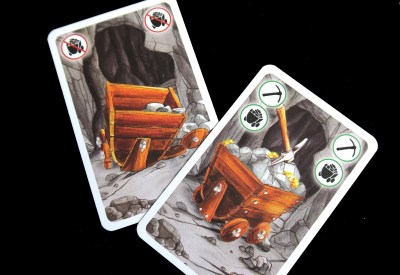
Wingspan
– Image by boardGOATS

Aside from the gorgeous artwork, there are a lot of very nice little touches in this game.  For example, although the egg capacities for the birds aren’t correct, they are proportionally right with the American White Pelican only holding one egg, while the Mourning Dove holds five.  Similarly the food requirements and habitats are correct.  Sadly, the cards are all North American birds, but there are plans in the pipeline for European birds and even Australian, African and Asian bird expansions in due course.  At the start of the game each player gets two bonus cards and keeps one of them.  These can reward players with two points for every predator they have, or give points if the player has, say, four or more birds with a large wingspan, but the probability of these is given on the card which is a nice feature too.  So, all in all, it is a very well produced game.

Wingspan
– Image by boardGOATS

Ivory started very quickly, luring a Barn Owl to his woodland, and it quickly started hunting, with any prey caught being stored on the owl card and worth points later in the game.  He quickly followed this with two cards that allowed him to draw extra bonus cards, and looked to be set up for a strong game.  Next to him, Pine was struggling—the game is not complicated, but it is a little different to anything else we’ve played.  He got the hang of things eventually though, and his Canada Goose looked a very nice card as it allowed him to tuck two cards underneath it (each worth a point at the end of the game) for the cost of one wheat when activated.  Khaki was helping everyone out though, as his Ruby-throated Hummingbird kept everyone supplied with food.

– Image by boardGOATS

Burgundy just quietly got on with things, but as he and Khaki had the most eggs in nests on the ground at the end of the first round, they took the end of round bonus points.  Meanwhile, Blue’s Yellow-Billed Cuckoo was giving her useful eggs whenever someone else laid eggs, as long as she remembered to activate it.  With Burgundy and Khaki taking the end of round bonus for the most wetland birds at the end of the second round, it was starting to look ominous.  Ivory had his eye on a bigger prize however.  The end of round bonuses increase in value throughout the game, so he was clearly after the bonus at the end of the third round, which rewarded the player with the most grassland birds.  Burgundy had his eye on that too though, as did Blue and as the number of actions decreased the game became increasingly difficult.

Wingspan
– Image by boardGOATS

Blue’s Eastern Bluebird proved very useful as it allowed her to play to birds for one action.  So in the end Burgundy, again took the points, this time tying with Blue, with Ivory just edged out.  As the final round came to a close, it was too late to improve the engines and everyone just had to concentrate maximise their points.  And after that, all that was left was the counting.  The game is a little bit “multi-player solitaire”, so nobody was sure who was going to win, though Burgundy was high on most people’s list.  Indeed, it was very close with just five points separating the podium positions, and only one point between the rest.  In the end, Burgundy on eighty-six tied for second place with Khaki, who had a lot of high value birds and had been determined not to disgrace himself (and definitely didn’t).  Blue just had the edge however, largely thanks playing her Inca Dove which allowed her to lay a lot of eggs in the final round.
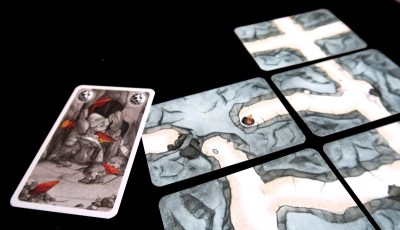
Wingspan
– Image by boardGOATS

Learning Outcome:  Tempt a hot group of gamers with ice cream and most will give in.

9th July 2019

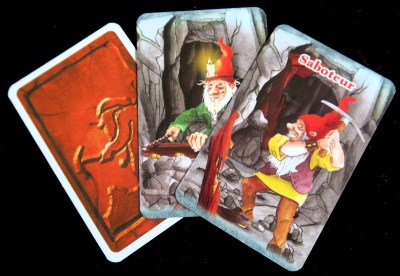
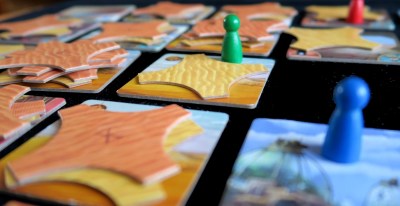
The pub was madly busy thanks to a boisterous party and a couple of large groups in the bar area, so we decided to start with a game while we waited for food.  The “Feature Game” was to be Forbidden Desert, but as most people were waiting for food, we decided to start with something we could play as a group.  6 Nimmt! was the first suggestion, but in keeping with the cooperative game theme of the Feature, we decided to start with Saboteur.  In this game, players are either Dwarves or Saboteurs, where Dwarves are collectively trying to dig a tunnel to find the Gold, while the Saboteurs are trying to stop them.
Saboteur
– Image by boardGOATS

On their turn players can play a tunnel card to extend the network, play an action card or discard a card and pass. Action cards come in several flavours.  There are red and green tool cards, with red broken tool cards stopping others from digging and green “fixed” tool cards that repair broken tools.  There are map cards that allow players to peek at one of the three target cards to see if it holds the gold, and rock-fall cards that enable players to remove a single card  from the tunnel network.  All the action cards can be used by Dwarves and Saboteurs alike to impede the other team.

Saboteur
– Image by boardGOATS

Black was the first to play and began ditching all his rubbish blocking tunnel cards while Pine started off by explaining how Burgundy was always a Saboteur and generally made Burgundy’s life a misery by besetting him with broken tools and reminding everyone how last time we played Burgundy was a Saboteur three times running.  This time, we had more players, but it wasn’t long before it became clear that Burgundy was indeed a Saboteur, along with Lime, who was playing it for the first time and was not at all secretive of his position.  Eventually, Red found the Gold on behalf of the Saboteurs, and Black was outed as the third and final Saboteur and had apparently all the cards he had been discarding had been good tunnel cards not bad ones.

Saboteur
– Image by boardGOATS

The rules as written state that there should be three rounds and players pass gold cards around in an effort to determine who will be the overall winner.  We don’t think the game needs a winner in this way, so we play with a “house-rule” that treats each round as a game in its own right.  This way, we can stop at two games if it is beginning to outstay its welcome, or carry on and play three or even four rounds, giving more people to join Burgundy as Saboteurs.  Everyone had really enjoyed the first round and was keen to go again, so cards were handed out and Pine once again accused Burgundy of a “Saboteury” first move.  Blue had loads of blocking cards, but after Black had spent almost all the previous round dumping cards, didn’t dare pass for fear that she would be accused of being a Saboteur.

Saboteur
– Image by boardGOATS

Blue asked everyone else for advice and Red suggested that the one thing she could do to convince her that she was a Good Little Dwarf was play a blocking card on Burgundy, which she obligingly did.  It didn’t work, however, and it wasn’t long before Red declared Blue a Saboteur.  In frustration Blue showed Red all the blocking cards she had and that seemed to stem the tide of accusations, at least for a few turns.  With Burgundy buried under a pile of broken tool cards, his delight was evident when Blue revealed her true colours and played a disruptive blocking card.  It was just a smidge too late though and Black brought the round to an end by finding the Gold.

Saboteur
– Image by boardGOATS

By this time food had been ordered, but was not looking like it was going to arrive immediately, so we decided to see if Burgundy could make it three in a row again.  Inevitably, we were only a couple of turns in, therefore, when food turned up and the tunnel network was obstructed by Purple’s enormous bowl of mushroom tagliatelle.  Pine confused everyone by indicating his position early, playing a blocking card right in the middle of the map.  Perhaps it was the difficulty of playing round a plate of pasta, or perhaps her mind was just elsewhere, but a very curious card placement quickly led to Purple being labeled as a Saboteur joining Burgundy and Pine.  Flying well under the radar, if only the real Saboteurs had had helpful cards to play then they might have won, however, it was not to be.

Saboteur
– Image by boardGOATS

It turned out that Blue and Black were once again the real Saboteurs (along with the more obvious Pine), but frustratingly there was nothing they could do and Red once again finished the round by finding the Gold for the Dwarf team.  By this time everyone was very hungry, so food mostly disappeared quite rapidly and while Black, Purple and Burgundy dealt with their last few mouthfuls, Blue, Lime, Pine and Mulberry took themselves off to the table by the door (ostensibly to get space to play, but partly to take advantage of the respite the cooling draught offered from the humidity), to play the “Feature Game”, Forbidden Desert.

Forbidden Desert
– Image by boardGOATS

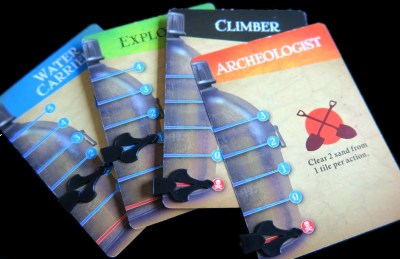
Where Saboteur is a “semi-cooperative” game because it has a traitor mechanic, Forbidden Desert is a fully cooperative game.  This means everyone plays together against the game, with the same goal.  The story is that a helicopter has crash-landed in the desert, and the survivors, in our case, an Archaeologist, a Climber, an Explorer and a very well behaved, cooperative, er, camel (“Water Carrier”), must try to find the buried, missing pieces of a historic air-ship, in order to escape.  This, with minimal water, the sun beating down and the growing sand-storm, means that players have to be quick in their hunt, and smart in keeping the keeping the storm from getting out of hand.

Forbidden Desert
– Image by boardGOATS

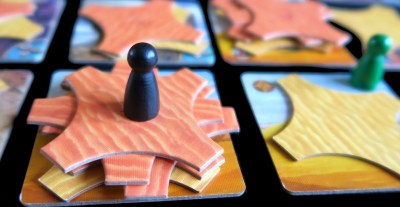
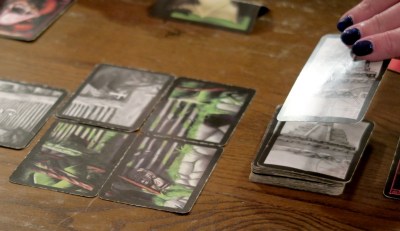
The game is played on a five by five grid made of twenty-four tiles and one gap.  The tiles all start face down and must be excavated to reveal their other side.  Some tiles will yield clues as to where the missing air ship parts are, others hide potentially useful equipment, while excavating others will yield a launch pad or the entrance to a tunnel.  Everything is useful, but all four pieces of the ship must be found together with the launch pad, before the players can escape.  On their turn players have four action points per turn which they can use freely to move, remove sand from the tile they are on (or an adjacent one), excavate a cleared tile, or pick up a piece of airship.

Forbidden Desert
– Image by boardGOATS

Once all four actions have been completed cards from the storm deck are turned over and tiles are moved in the direction indicated into the eye of the storm reflecting the shifting dunes.  As they are moved, sand tiles are placed on each one, building up the dunes and burying the antiquities in sand.  There is a finite number of sand tiles and running out triggers the end of the game with the team losing.  Running out of sand is only one way to lose however.  If any player runs out of water, the whole team loses, and the storm level increasing to its maximum also spells doom.  On the other hand, if the team manage to find all the parts and the launch pad, they will be able to escape from the desert.

Forbidden Desert
– Image by boardGOATS

One of the problems with cooperative games is “quarter-backing” also known as the “alpha gamer problem”, where one player takes control and tells everyone else what to do.  With Blue the only player to have played it before (though Lime had played Forbidden Island some time ago), it would have been easy for her assume the role of Colonel, but that sucks all the fun out of the game.  So there was a little discussion as to how we should approach the game (primarily trying to make the best use of our characters’ special abilities and trying to work quickly to excavate tiles) and then we started, with the storm level on “normal”.
Forbidden Desert
– Image by boardGOATS

The game began badly, when two of the first tiles we excavated were tunnel tiles.  These are very useful because players can use them to shelter from the sun and thus preserve water when a Sun Beats Down card is revealed.  They also enable players to travel from one part of the board to another in a single move.  Unfortunately, the tiles were adjacent which meant they were much less helpful than usual.  Prioritising, digging in order to find parts of the airship, the team found a lot potentially useful equipment, but it seemed ages before the first clue came up, a hint to where the propeller was buried.

Forbidden Desert
– Image by boardGOATS

The team soon found the second clue to the location of the propeller which turned out to be relatively conveniently located so Pine, the Climber, quickly picked it up.  It was then that Lime pointed out that the number of sand tiles available was getting critical, and something had to be done.  A couple of turns and concentrating on the sand problem and use of Mulberry’s Dune Blaster, helped, but a couple of Sun Beats Down cards in the meantime meant there was now a water shortage. so Pine and Blue (the Water Carrier), set out to rectify the situation.  Unfortunately, the first of the possible springs turned out to be a mirage.  While it didn’t lead to anyone running out of water immediately, valuable time and moves had to be used to excavate another tiles.

Forbidden Desert
– Image by boardGOATS

Once a spring had been found, Blue was able to top up her water supply and share water with Pine, before taking some back to the Lime and Magenta (who by this time was hiding in a tunnel to conserve her dwindling water supply).  With everyone settling into their roles and assuming the duties associated with their special abilities, it wasn’t long before the second part of the airship had been located.  Everyone had water and the sand situation was more or less under control, but it was all taking too long.  The storm had picked up and with it, the Sun Beats Down cards were coming round at an increasing speed.

Forbidden Desert
– Image by boardGOATS

Worse, the rate of sand deposition was also increasing. and it wasn’t long before the situation was getting desperate again, and clues to the location of the missing parts of the airship were proving impossible to find.  Forced into making difficult decisions, Pine and Lime started to take risks.  To begin with they seemed to pay off, but it wasn’t long before there was a succession of bad cards, culminating in two Sun Beats Down cards, and Pine and Lime who were left out in the sun ran out of water and sadly perished.  It had been good fun though and everyone had enjoyed playing, even though the team had ultimately failed to escape.

Forbidden Desert
– Image by boardGOATS

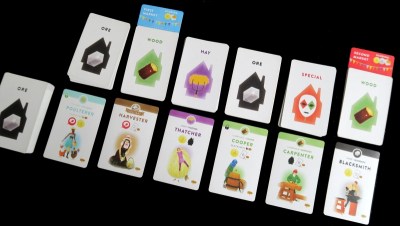
Meanwhile, the other group had been playing Villagers.  This is a new card drafting and tableau building game that first got an outing a few weeks ago and was so successful that Lime immediately bought himself a copy. The idea is that players take it in turns to take villager cards from the “road”, then add them to their village tableau.  Different villager cards have different advantages; some give money at the end of the game, while others enable players to draw more cards from the road per round or place more cards in their village per round.  The clever part of the game is the interplay between the cards caused by the conditions required before they can be played.

Villagers
– Image by boardGOATS

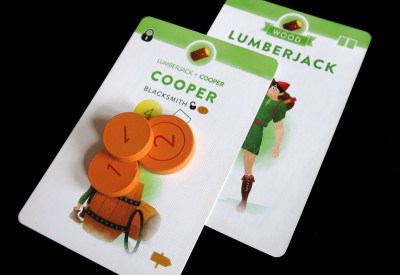
For example, a Blacksmith cannot be added to a village unless there is a Miner already present.  The cards are then played in a tree structure such that the Blacksmith is placed over the Miner card, superseding any icons depicted on it.  Many villager cards, especially the more valuable ones, also require a payment of two gold to another specific villager.  The money then sits on that villager card until a scoring round.  Ideally, the payment would be made to a villagers in the player’s own village, so that the money ultimately remains theirs, but if the active player does not have the necessary villager and someone else does then the money is paid to the opponent.

Villagers
– Image by boardGOATS

Like a lot of card games, there is a lot of luck in the game and there is a knack to surfing it.  Although many of the the group have played it before, Black had missed out, and he struggled waiting for a Grazier to become available.  In general, everyone went for a range of different types of villagers, everyone except Burgundy who went mad for Mining, because it “seemed like a good idea at the time”.  He started with a Seeker and then when he added an Ore Muler his income increased spectacularly and he looked like he was going to romp away with it.  Red and Black eventually managed to play Monks which helped to grease the wheels for them, but it was too late. Burgundy had the edge over Red in almost every department beating her into second place by twenty gold.

Villagers
– Image by boardGOATS

Villagers and Forbidden Desert finished at about the same time, and as time was getting on, Mulberry took Red home, and Pine and Lime didn’t want a late night so went their separate ways too.  That just left Blue, Burgundy, Black and Purple; Purple fancied a game of Bosk, and, as there wasn’t time to debate it, everyone else went along with her suggestion without debate.  This is a really pretty game, and although Black and Purple have played it quite a bit since they picked it up at the UK Games Expo, Blue and Burgundy were new to it.

Bosk
– Image by boardGOATS

The game is played in two parts:  first players place their trees in the forest on a grid, then each tree sheds its leaves and players try to control where the leaves fall to give them the most leaves in each of the areas of the forest.  The first phase is really just an hors d’oeuvre; the second phase is the guts of the game.  At the end of the first phase, players score for having the majority in each row or column.  Purple was at the back, so went first in the second phase, and more importantly, the direction the wind goes in.  This is important because if the wind is in the wrong direction, any player with trees of the same number wedged up against the same edge  will find their options severely restricted.

Bosk
– Image by boardGOATS

An awful lot of time was spent by all staring at the board, but this is no hardship as it really is a very picturesque game.  Blue and Burgundy were feeling their way, but it was always advantage to Black with his greater experience.  In the end, it was surprisingly close, though that was possibly due to Blue confused by the “S-shaped” score board, screwing up the scoring.  The margin of victory was still significant though as Black finished with thirty-five points while Blue and Burgundy tussled for second place with thirty-one and thirty respectively.  It was then that the group realised the half hour game had taken twice that and everyone quickly left before they out-stayed their welcome and the landlord threw them out.

Bosk
– Image by boardGOATS

Learning Outcome:  Working together is fun, though it helps to know who is on  your side.

25th June 2019

It was lovely to see Burgundy back after his long lay-off, and the staff at The Jockey were thrilled to provide him with his ham, egg and chips once more.  While people finished eating there was a bit of chit chat, which extended into lots and lots of chit chat after people had finished eating.  Green explained that this was likely his last visit until September, while Lime commented that he had enjoyed Villagers so much last time that he’d bought a copy for himself.  He hadn’t realised that it had only just been released, and this led into a discussion about KickStarter and why people might be prepared to support a project months, possibly years in advance of its arrival.  This encouraged Ivory to show off his latest acquisition, Tiny Epic Mechs, a cool little game with meeples that can hold weapons or wear mech suits, and came with some KickStarter exclusive content.

Tiny Epic Mechs
– Image by boardGOATS

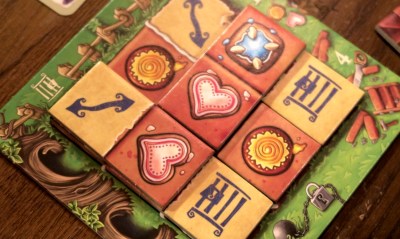
Eventually, after several attempts to get people playing games, Blue made an executive decision.  She split the group into a three and a four, with the four playing the “Feature Game”, Hook! and left the remaining three to sort themselves out.  Hook! is a very, very silly game where players are trying to place square cards over other cards, orienting them so that the holes pick out certain features and not others.  The game is played simultaneously, with each player first drawing a “target” card, taking a look at it and placing it in the middle.  Each player then chooses one of their three “aim” cards, each with a different arrangement of three holes, and places it over one of the target cards.

Hook!
– Image by boardGOATS

Cat-like, each player starts with nine lives, and, for every picture of their character that someone picks out with their aim card, they lose a life.  If they manage to hide behind a barrel or a crate, that protects them from cannon fire, but not from a grenade, which destroys all barrels and crates and causes everyone to lose a life.  Catching a “black pirate” in their sights allows the player to choose which of their opponents suffers.  Rum, on the other hand, helps to deaden the pain and restores a life, even bringing a pirate back from the brink of death if they lose their last life, but manage to take a swig of grog in the same round.  There are two aims to the game:  firstly, a player needs to survive till the end, and secondly finish with the most parrots—any target card where a parrot was visible through the sights is kept and the parrots added up at the end of the game.

Hook!
– Image by boardGOATS

The pirates come in three colours, red, blue and yellow, and two types (“sailors” and “captains”), with the colour distinction being much, much more obvious than the difference between sailors.  Thus, with the stress induced by the time pressure of the game, the potential for picking out a captain instead of a sailor is much larger than picking red instead of yellow for example.  This means that with more than three players, it is better to play with pairs of colours and team play is recommended.  Therefore, Blue and Lime played as one team, and Mulberry and Pine played as the other.  Pine commented, “I thought we didn’t do cooperative games,” which led to a discussion of what these were and the promise that one would be the “Feature Game” next time (probably Forbidden Island or maybe Flash Point: Fire Rescue).

Flash Point: Fire Rescue
– Image by BGG contributor aldoojeda

As the group played the first few rounds of Hook!, it quickly became apparent that Blue was more of a hazard to herself and her team-mate than the opposition, dropping several cannon balls on her foot and accidentally catching Lime a couple of times too.  Lime, it turned out, was quite good at catching parrots, while Mulberry and Pine had a bit of a thing for making Mojitos.  As it was the game’s first outing, it took a bit to get the hang of game play.  The idea that everyone looks at their card first and then plays meant that everyone ended up playing on their own cards.  We tried to fix this with a simultaneous count of three:  “Draw, One, Two, Three, Place!” but while that was more successful, it wasn’t perfect.

Hook!
– Image by boardGOATS

Playing again, we’d probably just skip the “preview target cards” phase and simultaneously place them in the middle without looking.  The vagaries of the game didn’t stop us having a ball though, as everyone attacked everyone in mad chaos.  Then Blue suddenly looked in real danger as her number of lives tumbled (mostly due to self-inflicted wounds).  Realising that she was at serious risk of an unscheduled visit to Davy Crockett and that Parrots aren’t known for hanging around corpses, she prioritised staying alive over parrots.  Before long, Pine was in a similarly precarious state, and he was not so lucky as Lime unceremoniously stabbed him in the back and dumped his body overboard.  As Pine’s parrots flew away, that left Mulberry with a titanic battle, the more-so as she was now also getting low on lives.

Hook!
– Image by boardGOATS

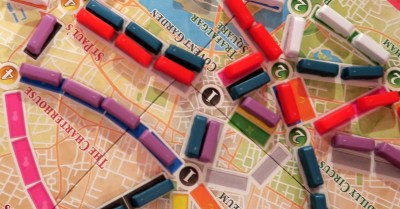
Although both Blue and Mulberry survived till the end, the winner was undoubtedly Lime who not only had more lives left than anyone else, but also had almost as many parrots as the other two put together, giving his team glorious victory.  With all the fight taken out of her and citing jet-lag, Mulberry was making noises about finding her bed, but Blue twisted her arm a little and she agreed to give Ticket to Ride: London a go before she left.  This is a cut-down version of the Spiel des Jahres winning, train game, Ticket to Ride.  This game has spawned a whole family of games and expansions, including maps of Europe, Asia, India and Africa, but the most recent are the two city specials, New York and London.

Ticket to Ride: Europe
– Image by boardGOATS

The game is very simple: on their turn, players can do one of three things, draw coloured travel cards, spend travel cards to place pieces on the board, or pick up tickets.  Points are scored for placing pieces (usually scored during the game) and for connecting the two places shown on the ticket cards (scored at the end of the game).  Any unfulfilled tickets score negative points.  Each of the variants has some other little feature, for example, Pennsylvania includes a stocks and shares element, Märklin includes passengers and Nederland includes bridge tolls that players have to pay.  The new city titles, have fewer trains (less than half), players draw two tickets instead of three, and, in the case of London, bonus points for connecting all the places in a district.

Ticket to Ride Map Collection: Volume 4 – Nederland
– Image by boardGOATS

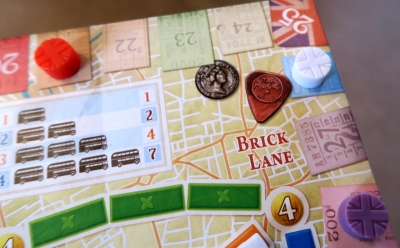
Only Blue had played this new version of the game before, but Pine had played other versions many times and Lime had also played one of them before, though it was a while ago and he wasn’t sure which it was.  The London game is really cute though and has a lot of UK references.  For example, for those of a certain vintage the box features John Steed and Mrs Peel, and the travel cards include yellow submarines and black cabs.  Perhaps the best though are the pieces where trains have been replaced with really high quality miniature Routemaster buses.  As ever, there have been lots of online criticisms, but we just liked spotting the obvious references and trying to guess what the orange car was meant to be (a Lamborghini Miura?).

Ticket to Ride: London
– Image by boardGOATS

Pine went first and started quickly by placing a couple of Routemasters.  Blue, Mulberry and Lime were a bit slower, building up their collection of cards.  With some versions of Ticket to Ride, the game is all about planning routes, gathering the necessary cards and then playing all these cards in quick succession so others don’t have a chance to block.  In other versions, this strategy doesn’t work so well as the key parts of the network are taken early in the game.  The shorter games, especially those with short routes tend to fall more into the latter camp, so Mulberry looked to be playing a dangerous game as she fell behind with the number of pieces she’d placed and amassed a huge pile of cards.

Ticket to Ride: London
– Image by boardGOATS

Pine, always one to play this game close to the wire, was the first to chance it with some tickets, drawing two and keeping one.  Then, he drew another two and kept one.  Lime and Mulberry were still working on their existing routes, but Blue decided to follow Pine’s example and drew two tickets, but kept both.  As Pine, pushed his luck once more, it turned out he’d pushed it too far this time, drawing two tickets that were almost impossible to complete.  Blue learning from Pine’s mistake (rather like last time she had played Ticket to Ride with Pine), decided not to draw any more tickets and instead, brought the game to a swift end by placing all but one of her remaining Routemasters to connect Piccadilly Circus to Baker Street.

Ticket to Ride: London
– Image by boardGOATS

Checking the scores proved that most people had managed to more or less keep on top of their scoring during the game and it was just tickets and district bonuses.  Inevitably, the bonuses were minimal, so as is common in this game, it was all about tickets.  Lime and Mulberry had both completed their tickets, so the question was whether drawing more had been a good bet for Blue and Pine.  Pine had more than Blue, but unfortunately, he’d failed to complete the last one, leaving Blue some way in front with forty-one points.  In the battle for second place, Pine had come off best demonstrating that drawing more tickets can be a good move, but only if you can complete them.

Ticket to Ride: London
– Image by boardGOATS

Meanwhile, on the next table, the trio of Burgundy, Green and Ivory had decided to give Endeavor: Age of Sail another outing.  Perhaps it was because Green wanted revenge for last time, or maybe Burgundy had missed out, or possibly it was just because Green wanted to play the game again while considering whether or not to commit to getting the new Age of Expansion buildings, but whatever the reason, out it came for the second time on the bounce.  The game is a simple game of exploration in the age of Captain Cook, played over eight rounds.  Players first build, then populate and remove workers from their buildings, all according to how far they have progressed along the associated technology track.

Endeavor: Age of Sail
– Image by boardGOATS

The guts of the game are the actions, however, which allow players to colonise cities on the central map board, engage in shipping, attack occupied cities, plunder and become slave masters. Last time, it was the “Feature Game”, specifically including the Exploits expansion.  The really change the game, giving players a different aspect to work on.  This time Exploits were included again, though different ones to last time: “The Sun Never Sets”, “Globalization”, and “Underground Railroad”.  Between them they covered most of the continents, requiring India & the Caribbean; the Far East & the Caribbean, and Africa & North America to be opened (respectively) for the three Exploits to take effect.

Endeavor: Age of Sail
– Image by boardGOATS

As before, Ivory started building a robust network of connected cities while Green once again used tried to use the Exploits as a target.  In contrast, Burgundy largely ignored the Exploits and played a traditional game concentrating on building up his technology tracks giving him a strong foundation from which to build in the colonies.   Playing with the new three-player map meant that all regions were opened up by the end of the game, though it was a bit late for Green to capitalise on the Exploits as he’d hoped.  Worse, Ivory’s city network meant he was able to sneak a hat-full of points from the “Sun Never Sets” and “Globalization” Exploits as well.

Endeavor: Age of Sail
– Image by boardGOATS

Ivory and Burgundy managed to build one of the Charter Company buildings from the mini expansion and, like Blue last time, both ended up with too many cards and had to choose what to cull.  This problem was exacerbated by the number of Governor cards they picked up.  As the game drew to a close, the last of the continents were opened up activating the final Exploit, but it was too late for anyone to occupy any of the stations on the Underground Railroad.  With the last round coming to an end, all that was left to count up the points.  Although it wasn’t actually a tie like last time, it was still a very close game.  This time, honours went to Burgundy who finished with seventy points,  just three more than Ivory who, in turn, was three ahead of Green.

Endeavor: Age of Sail
– Image by boardGOATS

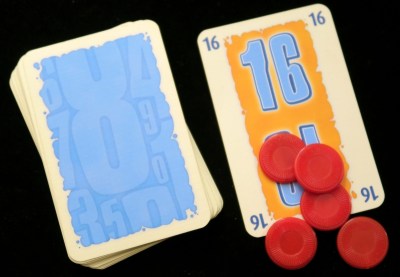
As Endeavor was just coming to an end, so Blue, Pine and Lime looked round for something quick to play.  Ivory excitedly suggested that when they were finished everyone could play Bohnanza, but Pine vetoed that and in the meantime, Blue’s beady eye moved from Biblios to settle instead on No Thanks!.  This is an old favourite, but one that Lime had not been introduced to yet.  As a really quick game, both to teach and play, this was ideal.  Everyone starts with eleven red chips, and the first player turns over the top card in the deck (which runs from three to thirty-five).  They can then either take the card or pay one chip to pass the problem on to the next player who then has the same choice.

No Thanks!
– Image by boardGOATS

The clever part is the scoring—the winner is the player with the lowest total face value once the deck has been exhausted (offset by any remaining chips).  There is a catch though, if a player has continuous sequence of cards (e.g. seven, eight, nine, ten), they only count the first card (i.e. they score seven not thirty-four).  The real gamble comes because some of the cards are removed from the pile at the start of the game.  Lime started by collecting lots and lots chips, while Blue helped by pointing out some of the things to look out for.  Although having chips is a must, and having most chips gives control of the game, once one player runs out, that control is largely lost.  This is because any player with no chips is forced to take whatever comes along.  Lime finished with a massive ninety points with Pine some way behind, with Blue cruising to victory with forty-one.

No Thanks!
– Image by boardGOATS

Although Endeavor was now finished, they were still packing up, Lime was keen to give it another go while Pine insisted he wasn’t coached this time, so the trio squeezed in another quick round.  Lime tried the same trick, and hoarded lots of chips, again putting Pine under a lot of pressure as he ran out of chips.  He managed to keep his total down though by making a very fortuitous run, and ended with two points less than Lime.  This time, Blue concentrated more on her own game and was able to just hold on to enough chips to see out the deck, while avoiding picking up too many cards, giving her a second victory.  It was much closer in the battle for second place though, with Pine taking it by just two points.

No Thanks!
– Image by boardGOATS

With Endeavor finally over and packed away, Ivory (perhaps more boisterous than usual as it was exactly six months to Christmas), once again suggested Bohnanza.  Pine once again vetoed it, this time even more grumpily following the suggestion that we should all sing some festive hits to get us in the mood.  Blue diplomatically suggested 6 Nimmt! as an alternative as everyone loves it and Lime had not yet played that either.  6 Nimmt! is a great game that gives players the illusion of control right up until the point when it all goes horribly wrong.  The idea is that everyone has a hand of cards and simultaneously chooses one to play.

6 Nimmt!
– Image by boardGOATS

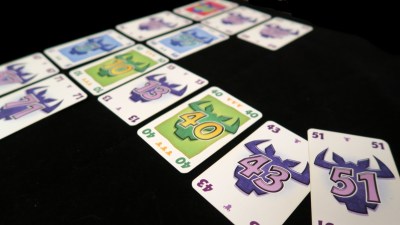
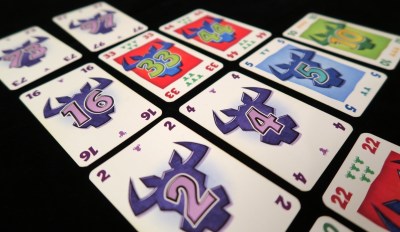
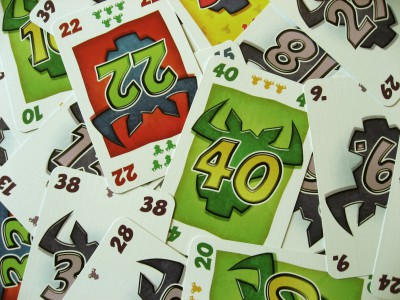
Starting with the card with the lowest face value, these cards are added to one of four rows, specifically the row with the highest value that is lower than the card played.  When a sixth card is added to the row, the five cards already on the table are taken and the new card restarts the row.  As well as a face value, each card has a number of Bulls’ Heads, most only one, but some as high as seven.  At the end of the game, the player with the fewest “nimmts” is the winner, with a special “wooden spoon” shout-out for the person whose plans went most awry landing them with a huge pile of bull.  As a group we usually play in two rounds, each with approximately half the deck (numbered one to a hundred and four).

6 Nimmt!
– Image by boardGOATS

Blue top-scored in the first round, with twenty-four nimmts, but everyone else had a far more respectable total and Green led the way with just two.  This is a game where everything can fall apart spectacularly in the second round, so there was everything to play for.  The second time round time, Lime beat Blue’s score from the first round taking twenty-five nimmts, giving him a total of thirty-two.  This was nothing compared to Pine though, who took thirty-five in the second round alone, giving him a a sizeable forty-eight.  Blue made a clear round, but for her the damage had already been done, so the honours fell to Green who was consistency itself, taking just three in the second round giving a total of five – the only one to finish in single figures.  Lime was keen to play again, but as others were leaving, it was time to pack up. There was still time for a long gossip though before we sadly said goodbye to Green after what was likely to be his last meeting until September.

6 Nimmt!
– Image by boardGOATS

Leaning Outcome:  You don’t have to play a game correctly to have fun.

11th June 2019

It was clear from the off that there were going to be two games, the “Feature Game” (the Exploits Expansion from Endeavor: Age of Sail) and something else.  That meant there were two things to establish, what the second game was going to be and who was going to play what. Red, on her first visit for ages, had brought the product of a recent successful KickStarter projectVillagers is a card game that has proven quite popular since fulfilment and Red thought the others would enjoy playing it.  Most people had played Endeavor and, although it is not usually a very long game, with the expansion there were a few people who ruled themselves out, ultimately making the groups relatively self-selecting.

Villagers
– Image by boardGOATS

There were two candidate games for the “alternative” table, but as Black pointed out, it was quite possible they would have time to play both if they got on with it, so they did.  The first game therefore was Villagers, a card-drafting and tableau building card game.  The idea is that players take it in turns to take villager cards from the “road”, then add them to their village tableau.  Different villager cards have different advantages; some give money at the end of the game, while others enable players to draw more cards from the road per round or place more cards in their village per round.

Villagers
– Image by boardGOATS

The clever part of the game are the conditions required before cards can be played.  For example, a Blacksmith cannot be added to a village unless there is a miner already present.  The cards are then played in a tree structure such that the Blacksmith is placed over the Miner card, superseding any icons depicted on it.  There are four types of card, basic villagers (the start of a tree), standard villagers (can only be played on other villager cards), solitary villagers (cards that are not played on other cards and do not support other cards, but are useful in their own right), and special cards that allow players to do special things and break all the rules.

Villagers
– Image by boardGOATS

The tree structure isn’t the only dependency players have to watch for when placing cards in their village; many villager cards, especially the more valuable ones, require a payment of two gold to another specific villager.  The required villager depends on the card, but it could, for example, be a Cooper.  The money then sits on that villager card until a scoring round.  Ideally, the Cooper would be in the player’s own village, so that the money ultimately remains theirs.  If nobody has a Cooper in their village though, the money goes to the bank.  The worst situation is where the active player does not have the necessary Cooper and someone else has one in their village, as then the money is given to the opponent,

Villagers
– Image by boardGOATS

There are two scoring rounds, one at the end, and one a third of the way through – only the simple “gold” scores in the latter, while the final scoring is more comprehensive and includes conditional scoring cards leading to potentially high scores.  So, some cards just give gold, while others give an amount of gold for, say, the number of food or cottage icons in the village.  The game started quite slowly as people struggled to get their heads round the requirements for playing villager cards.  It gradually became clear that increasing the number of cards drawn from the road per round by getting food is critical, an aspect Pine and Lime, failed to appreciate early on in the game.  Players can also get a bit stymied if they have high value cards, as they generally don’t then have anything else.  Thus, Pine’s village with with a jeweller and nothing much else was pretty useless as the Jeweller gives money (and quite a lot of it too), but only twice during the game.

Villagers
– Image by boardGOATS

The tree structure seemed to cause some frustration too, as it’s not helpful if one player has a Milkmaid and needs a Grazier (Pine, say) and the person next to them has a Grazier and needs a Milkmaid (not Pine, obviously…).  While everyone seemed to struggle, Purple just collected lots and lots of villager cards which she ultimately managed to add to her village giving her lots and lots of money totalling a score of seventy-one.  Pine, despite all his moaning about the poor quality of his village, came second with sixty-four.

Villagers
– Image by boardGOATS

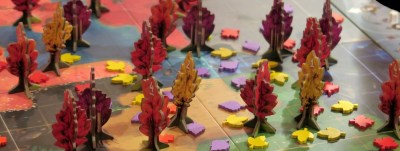
As Endeavor was still underway, the group moved on to the alternative game, Bosk.  This was an “Expo Special”, picked up a couple of weeks back at the UK Games Expo at the NEC in Birmingham.  Bosk is an archaic term for a small wood or thicket and in the game, players spend the spring, carefully growing their trees, scoring points as hikers enjoy travelling the trails during the summer months.  When autumn comes, leaves fall in the ever-changing direction of the wind, guided to cover the terrain and other players’ leaves. Points are awarded in winter for the most coverage of each area in the park.  So the game is played in two parts, the first involves placing trees on the game board at the intersections of the grid (spring).

Bosk
– Image by boardGOATS

Each player has eight trees, each numbered one to four.  At the end of spring, each row and column on the board is scored with the player with the highest total in each row or column scoring two points and the player in second place in each case gets one point.  The player in last place at this point (in our case, Pine as everyone else was joint first), chooses where to place the wind guide and then chooses one of their number one tree to start shedding its leaves.  As it does so, the player chooses one of their “leaf cards” (numbered one to eight) to decide how many leaves it drops.  Little wooden leaf-eeples are then placed to form a path from one of the squares next to the tree in the direction wind is blowing, dropping as many leaves as given on the tile, after which, the tree is removed.

Bosk
– Image by boardGOATS

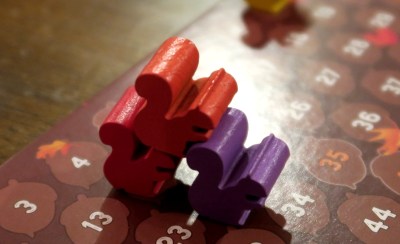
The wind blows eight times (twice in each of the four different directions), and in each case, the player who went last last time, goes first next time.  When paths cross, a leaf is placed on top of previously placed leaves, with a penalty of one leaf paid to the “bank”.  Players can also place a squirrel which means players cannot place anything on top, so much hilarity ensued when Pine commented, “I think I’m going to have to put my squirrel down,” to which someone on the next table asked, “Why? Is it ill?!?!”  When all the trees are gone, players count up the number of leaves in each of the scoring areas, with five points going to the player with the most leaves in a region, three points to the player with the second largest number of leaves in an area, and if a player is the only one with leaves in an area they get all eight points.

Bosk
– Image by boardGOATS

Bosk is really beautiful little game and plays quickly with a nice feel.  For a really very simple idea there is an awful lot of strategy to consider making it a really solid little game.  This was its first outing on a Tuesday, but it is certain it will get more.  This time round, Pine won with thirty-eight points, but he was only just ahead of Lime who finished with thirty-six.  As they packed up Pine commented that he might have screwed up the scoring or maybe he just did much better on his leaf strewing…  Meanwhile on the next table, Endeavor was just coming to an end as well.  Playing with the recent Commodore edition, this is another beautifully produced game, that has actually had a few outings in this version and the original edition.

Endeavor: Age of Sail
– Image by boardGOATS

The game is played over eight rounds, each consisting of four basic phases: Build, Populate, Payment and Action.  There are four technology tracks roughly corresponding to each phase, which dictate what a player can do during that phase.  For example, how far along the building track a player is dictates what they can build: the further along they are, the more buildings they have to choose from.  Similarly, a player who is further along the population (or culture) track, can move more people into their harbour for use in the Action phase.  Payment also increases the number of people available as it moves population markers from the action spaces into the harbour.  More importantly, however, it makes the action spaces available again for use later in the round.

Endeavor: Age of Sail
– Image by boardGOATS

The first phase consists of passing round the tray of buildings rather like a box of chocolates, but after that, the second and third phases are more or less carried out simultaneously.  The guts of the game, however, is the Action phase.  In this round, players can place population markers on their buildings to activate them and carry out one of the five actions:  Colonise, Ship, Attack, Plunder Assets, and Pay Workers.  These are generally based round the central board which is divided up into seven regions representing the seven continents.  Each continent comprises several cities, a shipping route and a deck of cards. At the start of the game there is a Trade token on each city and each shipping space, but also on many of the connections between cities (these are taken if a player occupies both cities either side).

Endeavor: Age of Sail
– Image by boardGOATS

Players cannot Colonise a city until they have a presence in a region, which they can do by Shipping.  In this case, they activate their building that provides the shipping action by placing one population marker on it, then place a second population marker on the shipping track.  Thus, players need to have two markers available to be able to Ship.  The second population marker is placed in the furthest unoccupied space from the deck of Asset cards in the region of their choice, and the player takes the Trade token on that space.  Most trade tokens add to one of the four technology tracks, though a small number provide one off actions instead.

Endeavor: Age of Sail
– Image by boardGOATS

Players also need two population markers to Colonise (one for the action and one to occupy the city) and three if they are going to attack an already occupied city (one is collateral damage).  Once a player has a presence in a region they can take an Asset card, so long as the number of the top card is not higher than the number of population markers that player has in the region.  This is one of the few areas where there has been a rule change between this edition and the first edition:  it used to be necessary for the shipping track to have been completely occupied (i.e. the region was “open”) before the Assets of a region could be plundered.  This rule changed with the new edition, and now players can plunder at will, as long as they have a presence in the region (they still cannot Colonise until the region is “open” however).

Endeavor: Age of Sail
– Image by boardGOATS

Essentially, that’s all there is to the game, but the rules are deceptively simple and, for a game with so very little randomness (only the layout of the Trade tokens on the map), there is a surprising amount of variability.  However, with the new interest in the game that came with the new edition, a new Expansion primarily comprising a new set of buildings is currently subject to a crowd funding campaign.  The new, Commodore edition came with a couple little extras though, Exploits and Charter Companies, and we wanted to try more of these before considering any new buildings. The Exploits are special conditions that only come into force when both of the regions involved are opened.  The idea is that three of these are drawn at random at the start of the game, however, we picked three that were not used last time we played on a Tuesday:  Spanish Main (North & South America); Manila Galleons (Far East & North America), and Spice Trade (Africa & India).

Endeavor: Age of Sail - Charter Companies
– Image by boardGOATS

This time, we additionally made the Charter Companies available for the first time.  These are special, powerful buildings that a player can build (instead of the usual buildings) as long as they have at least six of their population markers in the given region.  Green began by going for cards and targetted North America as it appeared on two of the Exploits and he thought everyone else would be keen to help him out.  Blue, who normally focusses on getting buildings first decided to try something a little different and instead went for Population in a very big way.  This meant she really struggled getting good buildings, but made up for it with lots of Asset cards.  In order to keep them, she had to focus on increasing her influence (the blue and white shields), but this meant she neglected both the building track and Colonising.  Black also missed the “building boat” and without the more powerful actions that come with the more advanced buildings, really struggled to make any headway.

Endeavor: Age of Sail
– Image by boardGOATS

Ivory had been a little sceptical about playing having played the original edition where the maps were not as “tight” making it less of a struggle.  This time it was clear that that was not going to be a problem.  Accelerating his Build ability meant that Ivory was able to take a Cartographer which gave him a double Ship action which he used to great effect getting a particularly strong presence in Africa, India and the Far East.  This was critical because with the exploit activated, players with one marker in the open sea space for Africa would score an extra point for each disk of his on the Africa shipping track.  Moreover, this scoring was also applied to India and the Far East, making very lucrative for him indeed.

Endeavor: Age of Sail
– Image by boardGOATS

Ivory was quite convinced that Blue had the game in the bag as she had a lot of points from her Asset cards, however, she knew she had a shortage of Colonies compared to everyone else.  As things hadn’t been going according to plan for Green, and nobody seemed to be targetting Asset cards in Europe, he resorted to Slavery so it seemed appropriate that he wasn’t quite in the running for the top spot.  Blue who was having a bit of a blonde day, recounted her scores three times, to convince herself that it was in fact a draw as she finished level with Ivory on sixty-nine points.  Although both Bosk and Endeavor finished at much the same time, it was too late to play anything else, and as the group settled their bills and packed up, someone pointed out that the next meeting is 25th June – exactly six month till Christmas.  And with that cheery thought, everyone went home.

Endeavor: Age of Sail
– Image by boardGOATS

Learning Outcome:  Some villages are very inbred.

28th May 2019

While Pink, Blue and Khaki finished their pizzas, the other early arrivals played a quick game of Coloretto.  This is a relatively short game of set collecting which is very popular with the group; it was new to Lime though so needed a quick rules explanation.  The idea of the game is that on their turn, players can either pick up a chameleon card from the face down deck and add it to a “truck”, or take a truck (passing for the rest of the round).  The innovative part of the game is the scoring which uses the triangular number sequence (one point for the first card, three points for two cards, six points for three cards etc.), with positive points for three sets and negative for the rest.  Thus, players need large sets in three different colours and small sets in all the rest.

Coloretto
– Image used with permission of BGG contributor punkin312

With five players, it was relatively hard to make trucks particularly unappealing to everyone, so the negative scores were kept to a minimum.  It was quite close at the top as a result, with Black, Lime and Mulberry all in the running.  Lime finished with the highest score for his sets totalling thirty, with Mulberry a handful of points behind, but Black had four bonus points and no negatives.  In the end, Lime pipped Black by a single point with Mulberry just a couple of points behind that.

Coloretto
– Image by BGG contributor SergioMR

With Coloretto over, everyone finished with their supper and the stragglers all arrived, there was the usual discussion over who would play what.  The “Feature Game”, Viticulture with the Tuscany expansion, was always likely to take most of the night, so the question was really who was going to play that and what else was on offer.  One of the options suggested was Ticket to Ride with the India map, which was described by Pine as an game where you “just pile people on top of the trains and pack the inside with goats!”  Clearly none of our GOATS fancied the inside of a hot carriage and the discussion continued as Ivory, Pink and Blue started setting out Viticulture and Mulberry (having spent some time as a oenologist) dragged Khaki along for the ride.

Viticulture
– Image by boardGOATS

Viticulture is a worker placement game where players plant and harvest grapes then make and trade wine.  Although there is nothing especially innovative about the game itself, it is an exceptionally good example of its type and is considered bit of a modern classic as a result.  There are two editions, the original Viticulture, and the “Essential Edition“.  We usually play with Essential Edition which includes some of the smaller expansions from the original Tuscany (like the Mama and Papa set up cards), and, as the revised edition, is considered to be the definitive version.  In this base game, the actions are split into two seasons, Summer and Winter, with visitor cards arriving in the Autumn and extra cards arriving in the Spring.  Visitor cards come in two varieties, yellow Summer and blue Winter cards which are played in the different seasons as a special action.

Tuscany
– Image by boardGOATS

The Tuscany expansion messes about with this arrangement with actions in all four seasons, so players have to eke out their meagre supply of workers to last the whole year.  In addition to the larger, “expanded” and restructured board, the Tuscany expansion also adds an extra deck of building cards that players can use to create a personal action space or increase the effectiveness of other actions.  These can be very powerful if used effectively.  Additionally, there is a “influence” board that depicts the regions which players can place “Star-eeples” on to get an instant bonus.  If they have the majority in a given region at the end of the game, they also get a small number of bonus points. Finally, Tuscany also adds workers with a special ability, these cost a little more to train, but if used efficiently can more than pay for that over the course of the game.

Tuscany
– Image by boardGOATS

The other major difference between Viticulture and Tuscany is that the game tends to start slower, with players building their vineyard getting all the pieces of their engine together.  The game is not terribly complicated in terms of taking actions, but planning is tough and as people new to the game, Mulberry and Khaki struggled a bit to get going.  Blue, on the other hand, was out of the traps like a rabbit and got vines planted and harvested with remarkable speed, but then promptly stalled as she desperately needed money, more contracts, and more space in her wine cellar.  In contrast, Ivory and Pink were slower to get going because they were carefully planning their strategies.

Viticulture
– Image by boardGOATS

In the early part of the game, nothing much seemed to happen.  Blue’s simple, but fast start, got her well in front, while Khaki began by actually going backwards, sacrificing victory points to try to build up his team of workers.  Everything else was pretty quiet though, as Ivory was collecting cards and Mulberry concentrated on building.  Pink started with the intention of building an irrigation tower and no trellis (to save money), but that was quickly scuppered when every vine he draw after the first required a visit from “Mrs. Trellis of North Wales“.  There were plenty of sarcastic comments from the next table as they felt they were well on the way to finishing, while it looked like nobody had made any positive progress except Blue, despite playing for well over an hour.

Tuscany
– Image by boardGOATS

Then suddenly, things began to happen.  Pink had sorted out the vine situation, and had purchased a large cellar (to go with the medium cellar he’d started with) which meant he could fulfil some valuable contracts, increasing his residual payments at the end of the round giving him a substantial income in a game where money is always very tight.  Then Ivory began his charge for the finish, setting his Wine Press and Guest House to work.  He was particularly adept at leveraging his Guest House for points, finding ways to take Visitor cards from other players and turn them into points, and then playing other Visitor cards that enabled him to repeat the action.  Mulberry built an Academy that would give her money whenever another player trained a worker, but it was too late in the game as most people had finished training by that point.  Khaki’s Fountain was more effective though giving him money every time someone else gave a tour.

Tuscany
– Image by boardGOATS

As the game approached the end, the question was whether Blue was going to get over the line before Pink and Ivory, really started raking in the points.  With her trained Salesman who enabled her to full-fill two contracts as part of one action, but had proved fairly useless for most of the game, it looked like she might just make it.  Pink was coming up fast and screwed up Blue’s plans on the influence board just for good measure.  Khaki and Mulberry suddenly started to make real progress as well, with Khaki making a rapid shift from negative points to lots of points over just a couple of turns.  It was Ivory though, who stormed ahead, full-filling several orders in the final round as well picking up an extra five bonus points from the influence board.  He finished with a grand total of forty points, ten more than Blue in second place who, in turn, was a single point ahead of Pink.

Viticulture
– Image by boardGOATS

Meanwhile, the second group were playing Maya, an older game where players are taking part in the construction of pyramids in places like Chichen Itza and Palenque.  The game is a combination of semi-blind bidding mechanics, special actions, and building up “influence” by building pyramids in the ancient Mayan civilization.  The greater the influence, the more gold players get from the Mayan leaders and the aim of the game is to have the greatest pile of gold.  Each player starts with an identical hand of cards, ranging from three to eight, representing workers.  Players start by using their worker cards to bid for actions.  These actions come with a pile of stones, and this is one of the clever parts of the game – players must have enough workers left to move the stones they win or forfeit some of their prize.

Maya
– Image by boardGOATS

Players then take turns placing them on the different pyramid locations, placing one stone at a time and starting on the lowest levels.  In general, players can only place a single stone per turn, though they can place a second stone if they discard a third stone back into the supply (quarry).  When a player completes a level of a pyramid and has the majority of stones on that level, they get a free stone from their supply to place on the next level of that pyramid, thus, clever players can discard a stone to play two, and then receive that discarded stone back immediately to place it higher.

Maya
– Image by boardGOATS

Once all the stones have been placed, the pyramids are evaluated. Each level of a pyramid is scored separately, and only those in first and second place receive gold. Where there is a tie, all players get the gold as if they had placed first.  At the end of the round, the pyramids decay, and all players who scored gold on any level of has to return one block from that level back to the supply. If this leaves a player with no blocks on a level, all of that player’s stones on higher levels also go back to the supply. The game ends after three rounds.

Maya
– Image by boardGOATS

Everyone started off building in Tikal, while Pine and Lime developed Copan and Black and Purple struggled in Uxmal.  Palenque was all but ignored by everyone except Purple until the last round when everyone joined her because they were unable to build in the other areas.  It was a very tight game and the nature of it meant nobody knew who was wining until the totals had been calculated.  There was just six points between first and last, but it was Pine who came out on top this time, one point ahead of Lime who took second place.

Maya
– Image by boardGOATS

Viticulture was still going on, so after enjoying a bit of heckling about how the scoreboard hadn’t changed, the group decided to re-visit Bohnanza, this time with an English deck, to reduce Lime’s confusion.  This is one of our most played games, with almost everyone very familiar with it.  The key part of the game is that players must plant their bean cards in the order they receive them.  The only way this fundamental rule can be violated is by trading bean cards with other players.  As everyone knows the game so well, it is often very tight with frequent multi-player ties.  This time it was also very close, but there was more spread than there often is.  On this occasion, the tie was for first place, and it was Black and Pine who finished top with a total of twenty.

Bohnanza
– Image by boardGOATS

Learning Outcome:  Sometimes slow and steady wins the race.

14th May 2019

A lot of the usual suspects weren’t about, so it looked like it was going to be a really quiet  night.  This was due to be offset by Pink, who was putting in one of his rare appearances from the frozen north, but at 6pm he was stuck at Leicester Services with a “limping” car.  While Pink’s arrival looked in doubt, he also lost the unofficial title of “furthest traveled” with Mulberry bringing along her other-half, newly arrived from California.  He had been awake for some forty hours traveling, so was reluctant to actually play anything, but we really appreciated his company all the same.  We were just starting the “Feature Game” when Pink arrived (thanks to a couple of very nice AA men), so as he scoffed his pizza we went through the rules for Powerships.

Powerships
– Image by boardGOATS

Powerships is not a complex game:  Black described it as “roll and move”, which is a little harsh if arguably accurate.  The game is played on a hexagonal grid representing the solar system and featuring the planets.  On their turn, players may take or return a single die, and then re-roll as many of their dice as they choose.  They may then rotate their space ship sixty degrees left or right and then move it the total number of spaces shown on their dice.

Powerships
– Image by boardGOATS

The movement rules are slightly more complex.  A crash is hitting a planets, a dust cloud or the “Trumpian” wall surrounding the solar system (there is a problem with alien immigrants in 2345 apparently).  Players may only crash if they have no choice, and if they crash, the penalties are severe: they must go in the direction that means they travel the furthest (even if that is unfavourable), they lose all their dice, and they move their damage maker left by a space for every unused movement (leading to a reduction in the maximum number of dice they can have).

Powerships
– Image by boardGOATS

Although ships can pass others, spaces cannot be occupied by more than one ship—they don’t crash though (fortunately), they just pull-up short, just behind. There are a number of special spaces:  yellow chevrons apply drift to a ship as they pass; space currents cause ships to change direction and warp speed and hyperspace enable ships to briefly go twice as fast.  What really makes the game, however, is the course:  players have to travel round three planets in a specific order and in a particular direction as marked by three orange bollards, before arriving at the finishing planet.

Powerships
– Image by boardGOATS

This time, as it was Tuesday, Mercury was the  starting planet. Random chance selected Purple as start player, but as spaceship placement is in reverse player order, Mulberry chose pole position and Blue placed her ship next.  Perhaps it was because he was still focusing on his pizza or maybe he decided to be a gentleman, but Pink placed his ship on the opposite side of the starting planet and just for good measure pointed it away from the first corner on Venus so that he was not forced to crash into Mercury on his first turn.  Green, Lime, Black and Purple placed their ships in turn order, with their start positions increasingly obstructed until Purple was left with no choice but to start on the planet itself surrounded by everyone else, and hope to avoid rolling a one on her first turn.

Powerships
– Image by boardGOATS

Purple was lucky and managed to escape from the ring of ships, parking herself squarely in front of Mulberry.  As everyone else rolled their first die and moved towards the first corner, the unfortunate consequences of Pink’s initial position became apparent.  Rolling a three, forced him to move his ship away from the first bollard and directly towards the walled edge of the solar system, where he stayed for the next few turns, trapped between some space dust, Saturn and a hard place, shuffling about in a strange many-point turn.

Powerships
– Image by boardGOATS

The rest of the fleet made good progress towards the first check-point, Venus, and then Blue foolishly rolled an extra dice and was forced to head off-course.  Green and Mulberry were pulling away a little as the pack headed into the farthest reaches of the solar system and approached the second corner located on Uranus, and that was where the mayhem really began. Purple went the wrong way round the bollard, so had to go back for a second shot; Mulberry hit the planet head on at full speed and was forced to maneuver slowly, and carryout repairs before she could build up speed again; Lime overshot and had to pirouette to get back on course while Black carefully dodged the debris, but struggled to find a clear course.

Powerships
– Image by boardGOATS

Meanwhile, Green sailed on serenely, finding the unobstructed path to the third marker on Pluto, on his first attempt.  It was perhaps just as well, as he was so busy advising Lime and fiddling with his phone that he missed his turn.  He suddenly realised he had missed out, but as everyone else unanimously agreed that turn order had been scrupulously observed and it was all in his imagination, he had no choice to but to acquiesce.  When Pink was about to taking his next move there was much hilarity when Green suddenly noticed he had missed out again! It was much harder for everyone to deny him a second time, and Green paid more attention for the rest of the game.

Powerships
– Image by boardGOATS

Pink had finally escaped from the combined gravitational pull of the starting planet and the  wall and Blue was moving back up the field as everyone else struggled to avoid calamity.  As Green headed towards the finish at Neptune, Black and Blue engaged in fierce struggle for second place (which Blue ultimately won by one turn) and Lime led the rest of the pack round the final corner.  It was coming into the home straight that Lime snatched defeat from the jaws of victory when he failed to decelerate and careered off for what looked like a second lap.  Mulberry was the beneficiary closely followed by Purple, with Pink and Lime bringing up the rear in what had been a mad, chaotic race, but a lot of fun.

Powerships
– Image by boardGOATS

With Powerships taking more than an hour longer than the advertised half-hour, Mulberry signed Pine’s birthday card and then took her jet-lagged husband home leaving six.  Inevitably as Pink was around, someone raised the subject of Bohnanza.  Other games were discussed, including 6 Nimmt! and Saboteur, but someone pulled a face for all of them, and in the end as Lime hadn’t played it, “Beans” won the day. This is one of our all-time favourite games, and everyone else was very familiar with it, especially Pink who claims to dislike the game while owning several copies of it in multiple languages.

Bohnanza
– Image by boardGOATS

Black explained the rules to Lime as everyone else tried to work out the game set up for six.  The game itself is actually very simple: each player starts with two bean fields in front of them.  On their turn, the active player must plant the first card in their hand and may plant a second before turning over the top two cards from the draw deck.  These two bean cards must be planted before play can continue, but they can be planted in the active player’s field or in someone else’s if a trade can be agreed.  Once these cards have been dealt with, the active player can freely trade as many cards as they want from their hand (all of which must be planted) before drawing cards and ending their turn.

Bohnanza
– Image by boardGOATS

At any time, a player can harvest a field of beans, at which point some of the beans are retained with the cards turned face down, becoming “money”.  The player with the most money after three trips through the deck is the winner.  There are two key rules: firstly, players cannot rearrange their hand – it has a front and a back and cards are played from the front and arrive at the back.  Thus the game is all about manipulating the order of the cards in hand by trading the unwanted ones for something more helpful.  Secondly, although players can harvest a field whenever they want, they cannot harvest a field with only one bean card unless all that player’s fields are singletons.  While the rules of the game are not difficult, things were complicated considerably by the fact that the only version available was in Spanish – a special gift from Red to Pink.

Bohnanza
– Image by boardGOATS

Although Blue’s Spanish was up to the job, the fact that everyone else (familiar with the English version) used the English names for the beans instead of those on the cards, confused Lime utterly.  Despite that, Lime got stuck in to what turned out to be a very tight game.  Green, Pink and Purple bought a third bean field; Green was adamant that he gained no advantage from his though Purple and her “Judías Colora” may have done a little better and Pink thought he might have got an extra coin out of it.  In the end, Blue and her seemingly never-ending stream of “Pochas” had the edge and she finished in first place with a total of fifteen coins, some way ahead of a five-way, eleven-point tie for second place.

Bohnanza
– Image by boardGOATS

Learning Outcome:  Pay attention or you might miss a turn (or two).

30th April 2019

For a while, it looked a lot like the “Feature Game”, Lewis & Clark , wasn’t going to happen – it’s a longer game and one that requires a specific type of gamer.  Of the usual candidates for this sort of game, Burgundy had given notice that he was feeling under the weather, so wouldn’t be coming; Blue was in attendance but was feeling a bit off-colour too; Black wasn’t in the mood for something heavy; Mulberry was recovering from jet-lag so needed an early night, and Green and Ivory hadn’t arrived by 8pm.  Inevitably though, we were just deciding what else to play when Green and Ivory turned up and looked keen to give Lewis & Clark a go.

Lewis & Clark
– Image by boardGOATS

With Blue joining them, that left Black, Purple, Mulberry and Pine (who was celebrating coming off his antibiotics again), to come up with something to play.  While everyone played musical chairs, suggested games and admired Blue’s shiny new copy of Roll for the Galaxy: Rivalry (freshly muled from the US by Mulberry), the foursome decided to play Azul: Stained Glass of Sintra.  This is the new implementation of last year’s Spiel des Jahres winner, Azul, which features the same market, but with glass pieces instead of ceramic tiles.

Azul: Stained Glass of Sintra
– Image by boardGOATS

The differences are more than cosmetic though – instead of placing their pieces in a row and moving them onto a grid, pieces are placed directly into the player’s window.  This is modular consisting of the double-sided strips laid out at random so everyone has a different starting setup.  There are restrictions on how the pieces can be placed though:  tiles must be placed in the strip immediately below their Glazier meeple, or in a strip to its right.  The Glazier is then placed above the strip the tiles were placed in,, so he gradually moves to the right. Instead of taking tiles, players can choose to reset the Glazier’s position, moving him back to the left most strip.

Azul: Stained Glass of Sintra
– Image by boardGOATS

Players get points when strips are completed scoring the sum of the score depicted below the strip and any strips to the right that have already been completed. There is also a colour bonus—each round has a colour drawn at random at the start of the game, and any tiles that match the colour for the round score extra. Once a strip has been completed, it is flipped over; after it has been filled a second time it is removed. Any left over tiles that cannot be placed are placed into the glass tower and yield a penalty with players moving along a negative score track which has small steps at the start that gets larger. When the market is empty the round ends and the round indicator tile is also dropped into the glass tower which is emptied when the .  There are also end-game bonus points with two variants available, one colour dependent and the other rewarding completing adjacent strips.

Azul: Stained Glass of Sintra
– Image by boardGOATS

Mulberry was new to the game and had not even played the original Azul, despite it having been so popular within the group.  Pine, Purple and Black had, of course, played the original game many times, but were less familiar with the Stained Glass of Sintra variation and Pine at least had played it just once.  It was a tight game and it wasn’t clear who was going to win until the end of the sixth and final round when it became apparent that Black was in a good position to make a killing and probably take an insurmountable lead.  Unfortunately, for him, he snatched defeat from the jaws of victory by putting his red glass pieces in the wrong place.  Pine meanwhile had made  a bit of a mess of things elsewhere which left him a score of minus ten for his unused tiles, but this wasn’t enough to knock him of the top of the podium where he sat two points ahead of Black in second and a few more ahead of Mulberry in third.

Azul: Stained Glass of Sintra
– Image by boardGOATS

Mulberry needed an early night to help with the jet-lag and Lewis & Clark was still underway, so the remaining three decided to play a recently released game, Gingerbread House.  In this game players are witches in the Enchanted Forest, building their gingerbread house and attracting hungry fairy tale characters with colorful gingerbread.  Each player has a player board showing a three-by-three grid of building spaces with a symbol on each space.  They also have a pile of rectangular tiles each featuring two squares showing two symbols, a bit like dominoes, which are placed face-down in a stack with the top three turned face up (a little like the train cards in Ticket to Ride).  On their turn, players draw one of the face up tiles and place it on their player board, then carry-out the effect of the symbols they covered up.  The most likely symbol is one of the four different types of gingerbread, which means they collect a token of that type.

Gingerbread House
– Image by boardGOATS

Sometimes a player wants to cover two squares on different levels, in which case “stair” tiles can be used as a spacer; players can also receive these as an effect of placing tiles, or they receive two stair tiles if they forfeit their turn.  Other effects include the opportunity to swap one type of gingerbread for another or cage a fairy tale character.  If the two symbols covered are the same, the player gets the effect three times instead of twice adding a positioning element to the tile placement.  Once a tile has been placed, the active player can use some of their gingerbread tokens to capture fairy-tale characters, either from the face up character line or from their “cage” trap near the gate of their cottage.  If placing tiles completed a level, the active player may take a bonus card (up to a maximum of three).

Gingerbread House
– Image by boardGOATS

Pine, who had not played the game before went for a very tall house combo, taking a “Chimney” bonus tiles which reward players with eight or more levels (complete or incomplete) and a “Treasure Chest” bonus which would give points if his had at least four complete levels.  Black started off capturing the most valuable fairy tale creatures and then added the “Magic Wand” bonus card which gave him even more points.  Purple meanwhile, also concentrated on the characters she was capturing, taking the “Cauldron” bonus, which rewarded her for catching non-human characters.  Black’s strategy was very effective and, although the characters are hidden once they are taken, so it was no surprise that he was well in front, scoring as many points for his characters alone as Purple and Pine scored in total.  It was really close for second place, however, but Pine just pipped Purple by a single point.

Gingerbread House
– Image by boardGOATS

Meanwhile, on the next table, Ivory, Green and Blue had been playing the “Feature Game”, Lewis & Clark.  This is a resource collecting race game, with a deck building element.  Players are explorers trying to get from St. Louis to Fort Clatsop, traveling up the Missouri River over the Rocky and Bitterroot Mountains through Montana and Idaho, and down the Columbia River to the Oregon coast.  Players do this by playing character cards from their hand which provide actions including gathering resources, traveling or converting primary resources into secondary resources.  There are several very unusual things about the game.  Firstly, each card has a power as well as an action.  Whenever a character card is played it must be empowered either by playing a second card and using it’s power rating, using natives, or a combination of both.  This dictates how many times the action is carried out (up to a maximum of three).

Lewis & Clark
– Image by boardGOATS

Once a card has been played, either as an action or to activate another card, they are placed on the player’s personal discard pile, so there is also an element of deck-building to the game, with more characters available through the “Journal” .  Of course, the most exciting cards are those with the highest rating, so using them to activate other cards may be efficient, but means that action will not be available until the deck is recycled.  This is another interesting and clever aspect of the game:  each player has their “Scout” and their “Camp”, and they move their scout along the rivers and through the mountains and then, when they “make camp”, they move the camp to join the Scout and pick up all their used cards.  This is a similar mechanism to that used in K2 where players have tents to shelter in, however, in Lewis & Clark the key part is that there are “time penalties” that penalise inefficiencies, like any unused character cards.

Lewis & Clark
– Image by boardGOATS

As well as the cost associated with inefficient use of their characters, there are also penalties for hoarding resources.  In order to travel players need buffalo (or bison…?), canoes, and horses, Acquiring canoes and horses require other resources and these must be transported to the new camp by boat—the more resources a player has when their camp moves, the more costly it will be.  Each player’s expedition also has a number of natives, and these also travel by boat.  Players start with five boats three that will hold resources and two for the natives; transporting two resources and one native is free, but the costs increase significantly when more travel.

Lewis & Clark
– Image by boardGOATS

Another interesting mechanism used in the game is way players gather some of the resources.  Each player starts with action cards that generate the four primary resources, wood, equipment, fur and food (depicted by buffalo, or bison—what’s the difference?  You can’t wash your hands in a buffalo…).  These have a brown, grey, pink or yellow icon associated with them and each character card depicts one of these.  When a player plays, for example, a lumberjack card, they get wood equivalent to the number of visible brown icons visible in front of them, but also those displayed by their each of their neighbours.  Thus, if a player has two wood icons in front of them, and their neighbours have another two each, they would get up to six wood (enough to make four canoes), and if they activated that card three times, that would increase to eighteen.  If both neighbours decided to make camp, however, they would pick up all their cards and playing that lumberjack activated once would then only yield two wood.  Thus, timing is critical and one turn can make all the difference.

Lewis & Clark
– Image by boardGOATS

Instead of playing a character card, on their turn, players can take a village action by placing a native on the board.  Some of these locations, like the Hunter space, can only hold one native, so the player can only take the action once and nobody else can visit the Hunter to get food and fur until the space has been vacated.  Other spaces like the Canoe Maker, can be visited many times, so a player who has a lot of wood can turn them into up to three canoes.  Natives can also visit the Shaman, which enables players to repeat another player’s Character card.  This turned out to be really important as spaces are only emptied when a player plays their Interpreter card.  The Interpreter calls all natives on the board to a powwow in the middle of the village and then as many of these natives as desired can be recruited for that player’s expedition.

Lewis & Clark
– Image by boardGOATS

Once per turn, before or after the compulsory action (playing a Character card or deploying a native in the village), players can make camp and recruit new Characters from the face up cards drawn from the Journal deck.  Each character has an intrinsic cost in equipment, as well as a cost in fur dependent on it’s position in the Journal.  There is a potential for hands to become full of unwanted cards, however, it is possible to use one card to pay part of the cost.  Additionally, there is a location in the village, “Farewell” that players can use to discard cards and also refresh the Journal.

Lewis & Clark
– Image by boardGOATS

Although the game seems to take an inordinately long time to play, it is not actually that complicated.  Essentially, players are trying to gather resources and use these to recruit helpful Characters and acquire secondary resources (horses and canoes) and then use these to travel along the rivers and through the mountain.  Although it seems simple, planning and timing is absolutely critical—getting it wrong can easily mean that a Scout finishes his round behind his camp so that the expedition fails to move forward.  The location of the mountains can mean that even a successful forward movement may be inefficient as The Commander (the movement Character card everyone starts with) only allows players to use canoes to move four spaces along the river and horses to move two spaces in the mountains.

Lewis & Clark
– Image by boardGOATS

Ivory went first and began by collecting resources, followed by Blue and then Green.  Blue was the first to move and headed off up the river from St. Louis and then made camp.  Ivory and Green weren’t far behind, but when they came to make camp the time penalties they accrued meant they actually went backwards.  This is not always such a bad move in this game if it is due to building a robust engine for later in the game.  So in the first few rounds it looked like Blue had a massive lead, but that didn’t last as the others began the chase.

Lewis & Clark
– Image by boardGOATS

Blue was first into the mountains and then realised she had mis-read her expedition leader  card and found that horses would only move two spaces each through in the mountains, not four (like canoes).  The mountains are key to the game and particularly changing ovement and avoiding wasting moves.  Green thought he had it sussed with his Cut Nose Character card, but hadn’t checked the rules and just assumed that it would allow him to move one space through the mountains without needing any resources.  That would have made it a very powerful card, as trading for horses to get through the mountains requires three nonequivalent primary resources per horse (which moves two spaces).  He was very disappointed and, like Blue had to completely reconsider his options.

Lewis & Clark
– Image by boardGOATS

Meanwhile, Ivory had a plan to get his expedition through the mountains.  His combination of the Black Cat and Coboway Character Cards meant he could collect any missing resources he needed easily and then use them to move fast through the mountains.  Inevitably, with Blue mired in the mess she had made, Ivory galloped into the lead, but he still had the Colorado river to negotiate before he could get past fort Clatsop and make camp.  For this he needed natives, but so did Blue.  Unfortunately for Blue, the fact that Ivory was ahead of her in the turn order meant he was able recruit more natives and it wasn’t long before his expedition paddled past the finishing line, and, despite a large time penalty, made camp on the Oregon coast, a very worthy winner in what had been a very enjoyable game.  Definitely one to play again.

Lewis & Clark
– Image by boardGOATS

Learning Outcome:  Many native Americans have unpronounceable names.

2nd April 2019

The evening began with a lot of people eating, the return of Mulberry’s daughter, Maroon, and the arrival of someone new, Lime.  So while the usual suspects finished their supper, everyone else played a game of Incan Gold (aka Diamant).  This is a light, “push-your-luck” type game, where players are exploring a mine by turning over cards, sharing any Gems these reveal.  After each card has been revealed, players simultaneously choose whether to leave the mine or stay and see another card revealed.

Incan Gold
– Image by boardGOATS

Unfortunately, as well as gem cards, the deck also includes Hazards like scorpions, snakes, poison gas, explosions and rockfalls.  When a particular Hazard is revealed for a second time, the mine collapses.  Anyone still inside the mine at this point loses all the gems they’ve collected during the round, while those that left early keep their winnings and stash them in their tent.  So, the trick is that as players leave, the share of the gems grows larger, but so does the risk of collapse. Additionally, there are also Artifact cards.  When one of these is revealed nobody gets any gems until they leave, but if they leave alone, they not only get the Artifact, but also any remainders from the division of spoils associated with the Gem cards revealed earlier in the round.

Incan Gold
– Image by boardGOATS

The game is played over five rounds, and like all push-your-like games like this, players who are unlucky in the first round often feel they are out of the game.  This is particularly true where one player does really well in the first round as they have can play safe and can afford to leave the mine early to consolidate their position.  However, this time there were a lot of players and everyone was somehow encouraged to stay in the mind keeping things close.  As the game progressed however, the pack began to split and a small group of leaders began to emerge.  In the end, Mulberry’s wind-ups failed to put Pine off his game and he finished with more than twice her total, winning the game with twenty-five Gems.  Purple was a close second though, with Maroon not far behind in third.

Incan Gold
– Image by boardGOATS

With food and the first game finished, it was time to decide who was going to play the week’s “Feature Game”, Dinosaur Island.  This is a worker placement game set in a dinosaur theme park.  Although it’s not named specifically, the colour, theme, artwork and feel is clearly intended to evoke an impression of the most famous dinosaur theme park, Jurassic Park,  despite having ten people and the Totally Liquid expansion available (which provides the pieces for a fifth player), we decided it was likely to be a long game and that sticking to four or fewer might be wise, and so it proved.  The rest of the group were half-way through their chosen game, Las Vegas, before the dino-group had even finished setting up, never mind the rules run-through.

Dinosaur Island
– Image by boardGOATS

Las Vegas is one of our most popular games, and the idea is very simple, on their turn, the active player rolls their dice and uses them to “bet” in one of the casinos.  “Betting” is done by placing all the dice of one value on the corresponding casino.  On their next turn, the player re-rolls their dice and does the same again.  Each casino has a pot of cash and after the last dice has been placed, the player with the highest “bid” at each casino (i.e. the player who placed the most dice), wins the largest denomination note.  Similarly, the player who placed the second largest bid taking the second highest denomination and so on.  The catch is that before the order is determined, any dice involved in a tie are completely removed, so a bet of a single die can win, even though there could be several higher bets, which makes the game great fun.

Las Vegas
– Image by boardGOATS

We usually play with the extra high denomination notes and the “Big Dice” from the Boulevard expansion, as well as the Slot Machine mini-expansion.  The “Big Dice” add to interest in the decision making when pacing bets, as they are double-weight, and count for two dice.  The Slot Machine, on the other hand, gives another place for players to bet, but instead of having a specific number, players can place all their dice of one number as long as each number is only placed once.  At the end of the round, the player with the most dice in the Slot Machine takes the highest denomination note from the pot, but in the case of a tie, the total number of pips on the dice are taken into account, then the highest value dice.

Las Vegas: The Slot Machine
– Image by boardGOATS

Once again, Pine was caught in a tussle, this time with Purple, which culminated in him placing four sixes to beat her “three-of-a-kind”, just to annoy her.  Green almost always does badly at this sort of game and this was no exception, although the game was reasonably close this time.  Mulberry and Maroon, mother and daughter tied for third place, but it turned out that the squabble between Purple and Pine might actually have had a real impact on the final result as they toughed it out for first place.  In the end, those four dice might have been critical as Pine beat Purple by a measly $30,000 – a substantial amount to most of us, but a relatively small sum in this game where most players win quarter of a million dollars or more.

Las Vegas
– Image by boardGOATS

Dinosaur Island was still going on and was looking like it still had some way to go (though they had finally started).  Mulberry, Maroon and Pine all wanted an early night, but Green and Lime decided to keep Purple company for another game, which eventually turned out to be Walk the Plank!  This is another popular game and Green and Purple felt it was essential to introduce Lime to it.  The game is a programming game with a pirate theme.  The idea is that each player has a hand of cards and at the start of the round “programs” their turn by deciding which cards they are going to play, then they take it in turns to action one card per turn.  The point is, although players have to choose three cards at the start of the round, by the time the final cards are played the game has changed so much that any plans made at the start will have gone completely to wrack and ruin.

Walk the Plank!
– Image by boardGOATS

So, players start with three pirate meeples each and the aim is to push everyone else off the ship, along the plank and off the end thus sending them to visit Davey Jones’ Locker.  Once again, Green was picked on by the others and was the first to lose all three of his pirateeples to the kraken, and therefore took on the role of the Ghost Meeple.  The Ghost is confined to the ship, has a restricted set of actions and only gets to carry out one per round.  Unfortunately, the game doesn’t play so well with two, and as a result when it got down to a couple of meeples each for Purple and Lime they got bogged down in a bit of a stale-mate.  This didn’t make it any less fun though.  In the end it was a Ghostly Green who helped push Purple’s final meeple off the boat and Lime did the rest giving him his first win; hopefully we can look forward to many more in the coming weeks.

Walk the Plank!
– Image by boardGOATS

Meanwhile, on the neighbouring table the other four were playing the week’s “Feature Game”, Dinosaur Island.  Although it took a long time to set up and explain, Dinosaur Island is not actually that complex a game.  The game is played over four phases.  In the first phase, a set of beautiful bespoke dice are rolled and players play their scientist meeples to choose dinosaur “designs” or DNA resources associated with the available dice, or increase their DNA storage.  In the second phase, players can use their funds to buy upgrades to their technologies from the market place, which basically improves the quality of the actions players can take in the next phase.   The third phase is the core, “worker-placement” round.  This is when players can “build” dinosaurs, reinforce their security, convert DNA into other types of DNA etc.

Dinosaur Island
– Image by boardGOATS

In the final, fourth round, players open their park to the public, drawing visitor-meeples blind, out of a bag.  The visitors come in two types, yellow, paying visitors and pink “hoodlums” who don’t pay and are very good at avoiding getting eaten.  The total number of visitors is dependent on the total excitement rating of the dinosaurs each player has in their park; the more dinosaurs a player has and the more exciting they are, the more visitors a player has and therefore the more money they receive in gate receipts.  However, the more exciting dinosaurs also need better security which is expensive.  If a park’s security is insufficient, the dinosaurs get out and start eating the visitors – each surviving visitor scores the park owner a victory point while visitors that are eaten cost victory points.

Dinosaur Island
– Image by boardGOATS

There are a couple of little tweaks that give the game a lot of replay-ability.  For example, there are eleven “plot twist” cards which introduce slight variations to the rules keeping things fresh.  For example, turn order is normally dictated by the number of points each player has, but the group played with a “plot twist” that meant the player order was always the same, with the first player progressing clockwise one place each round.  There are also thirty-nine end-game goal cards of which a small number of cards are selected for each game, when a set number of these have been completed by at least one player, this triggers the end of the game.  Any number of players can complete these objectives and receive the points associated with them, but once one player has completed an objective, it will become unavailable at the end of the round.  Thus all players who achieve an objective will do so in the same round.

Dinosaur Island
– Image by boardGOATS

This time, the group, played with the aquatic dinosaurs from the Totally Liquid expansion, partly because they alleviate the incessant “neon pink-ness” of game, but mostly just because they are cool.  Blue began by getting a bit carried away with the coolness of swimming dinos and started out taking a plan for a very exciting Megalodon largely simply because she had heard of it, and without thinking through the consequences. Having read the rules in advance, Burgundy had a much better handle on the challenges associated with the game and made a beeline for the special Dino Security upgrade which enabled him to increase the security in his park a second time per round at no extra cost.

Dinosaur Island
– Image by boardGOATS

Black also understood the importance of threat and security and decided to try to deal with the problem by keeping his threat level down.  One unfortunate side-effect of this is that most low threat dinosaurs are un-exciting and attract fewer visitors.  It all became a bit academic though as his threat level spiraled out of control.  Blue, realised she had made a bit of bish and needed to do something to enable her to start producing Megalodons without getting all her visitors eaten and hemorrhaging points.  So she decided to concentrate on upgrading her technologies hoping to net the bonus seven points from the end-game objective rewarding players for having four upgraded technologies.  Black quickly realised he couldn’t keep up with Blue’s developments and as it wasn’t going to happen for him focused his efforts elsewhere.

Dinosaur Island
– Image by boardGOATS

Meanwhile, Ivory had bagged the popular T-Rex dinosaur plan and was producing them in large numbers.  He, like Black also got heartily sick of pulling “hoodlums” out of the bag instead of paying visitors.  Black bought himself a technology to deal with the problem, but Ivory chose a different route, employing an expert who arrested any hoodlums in his park with the net effect that they became less prevalent for everyone else as well.  Experts are expensive though and not everyone could afford one, or felt they were worth the money.  Certainly they are more valuable if they are employed early in the game so players get their money’s worth

Dinosaur Island
– Image by boardGOATS

Everyone got points from the end-game objectives, but as the game came to a close it was clear who was in pole position.  Although his security wasn’t quite sufficient the huge number of visitors turning up every round put Ivory in front by some twenty-plus points.  In contrast, it was very close for second place however, with just five points between second place and the wooden spoon.  The nature of the game means keeping tabs on points, security, threat and excitement levels is quite a fiddly business. Since it was possible to throw a very small blanket over the three competing for second place, it is quite possible that the scores weren’t accurate, nevertheless, the Black finished in second place in what had been a very enjoyable game.

Dinosaur Island
– Image by boardGOATS

Learning Outcome:  Security is very important and should not be neglected.