Category Archives: Games Night

1st December 2015

Red and Blue were late thanks to a ridiculous queue at Frilford Crossroads, so food had only just been ordered when Green and Pine turned up.  We hadn’t seen Grey and Cerise for a while, so when they arrived the evening descended into gossip.  Pine manfully resisted the chips, but when he eventually succumbed, he ended up with more than he bargained for as they’d all stuck together…  Amid chips and chat, eventually, someone suggested a game and everyone else agreed, so we started with the “Feature Game”, Pandemic: Contagion.  The original game, Pandemic, is a very well known cooperative game where everyone plays together to defeat the tide of disease that is overcoming the world.  Pandemic: Contagion is a lighter game and almost the complete opposite:  players are the diseases and compete against each other to be the most effective and take over the world.
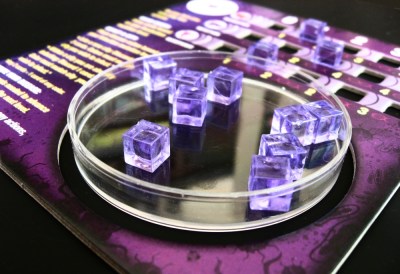
Pandemic: Contagion
– Image by boardGOATS

The game itself is fairly straightforward.  Cards are drawn to represent cities – these are coloured and are under attack from disease.  On their turn players can do any two of three possible actions: place cubes or “infect” a city, draw cards or mutate their disease.  Placing cubes cost cards and the cards must match the colour of the city they are infecting.  The number of cubes they can place or cards they can draw depend on the characteristics of their disease, and both can be increased by mutation.  Like infection, mutation must be paid for with cards, though the number of cards used depends on the level, thus going from an infection level three to level four is much more expensive than going from level one to two.

Pandemic: Contagion
– Image by boardGOATS

A city becomes overrun with disease when the total number of cubes placed on the card equals or exceeds the population.  At this point, the city is scored and the players with the most cubes get points (in the event of a tie, the disease to infect it first wins).  The person who placed the last disease cube additionally gets a bonus action that depends on the city.  At the start of each round an event card is drawn which either alters the rules of the game for the duration of that round, or otherwise disrupts everyone’s plans, by for example, causing them to lose cards or reduce their infection rate etc. etc..  Some of these cards also have a symbol on them either a city indicating that a new city should be added, or a skull and crossed bones after every second of which points are awarded to the player with the most disease cubes in each city.  The game ends when either, there are only two cities left, or the game has proceeded through all twelve event cards.

Pandemic Contagion
– Image by boardGOATS

The game went very slowly with everyone falling for “group think” and going for the cities with the largest populations which therefore score the most points when completed.  Unfortunately, this left the game somewhat mired in treacle as everyone did pretty much the same thing for the first three rounds collecting cards and infecting cities.  Blue picked up a few points at the first interim scoring, but otherwise it was pretty dull and we were all wondering what we were doing wrong.  Then it dawned on us that our disease cubes weren’t doing very much:  for all the large cities, one player had a significant majority, so there was no incentive to compete for it; worse, the winner was reluctant to commit more resources to the cause, but that meant their cubes were just sitting there, waiting.

Pandemic: Contagion
– Image by boardGOATS

Burgundy tried to get things going by increasing the number of cards he could draw, but that back fired when an event card forced him to dispose of half his cards (much to his horror, rounded up!).  It was then that everyone began to look for other things to do and attention turned to finishing off some of the smaller, weaker cities.  We’d sort of forgotten about the bonuses that come when cities are scored and it turns out that some of them are very powerful indeed.  This was amply demonstrated when Blue finished Milan that gave her a card for every city she had infected, which turned out to be quite a few.
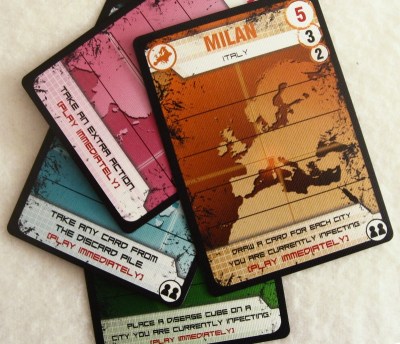
Pandemic Contagion
– Image by boardGOATS

With a little grease to oil the wheels, she was now able to use her newly liberated disease cubes to infect other cities in an effort to finish them.  Everyone else joined in and finally the game began to look a little better, however, before we’d had time to really start to appreciate it, the game was over and it was time to score the remaining cities.  Blue took the win with sixty-one points with Cerise some fifteen points behind behind just fending off Burgundy and taking second place, but everyone was frustrated at what had looked like a promising game, but had fallen so spectacularly flat.

Pandemic: Contagion
– Image by boardGOATS

On reflection, as Blue commented (much to Green’s amusement as he listened in from the next table), “If we’d played it differently it would have been a very different game.”  Although that sounds like a stupidly obvious thing to say, the problem was that everyone tried to play the same way and everyone fell into the same trap which dragged the game down badly.  If we’d realised the value of the bonuses and gone for some of the smaller cities first, the game wouldn’t have dragged so much and would have been much more enjoyable and interesting.  Unfortunately, as Pine succinctly put it, he’d enjoyed everything he’d played with us and would be happy to play any of them again, “except that.”  Which means it’s unlikely to get a second chance very soon.

Pandemic: Contagion
– Image by boardGOATS

Meanwhile, Green and Grey had decided they fancied playing something a bit more “piratey” together.  With Pandemic: Contagion supposedly taking “just half an hour”,  they decided to give Port Royal a go.  Although Green had played it a couple of times, Grey was completely new to the game.  We’ve played it quite a bit recently, but in summary, the game combines “push your luck” with strategy, the idea being that players turn over cards until there is something they want, or they go bust.  Once they’ve taken a card, the other players have their pick of what’s left (for the cost of one coin).  This means that in a two player game, the strategy changes quite a bit as players have to watch what they leave as well as be careful about taking a card and paying their opponent for the privilege.

Port Royal
– Image used with permission of BGG contributor joeincolorado

Green decided to aim to complete “expeditions”, while Grey took a more tactical approach, just doing what seemed best at the time; neither player decided to protect themselves by picking up pirate cards.  Both players really enjoyed it and the fickle hand of fate was much in evidence:  there was much hilarity when three of the four tax cards came out in the same round.  Fate wasn’t done yet either and when Green pushed for four ship cards (in order to be able to buy two cards in the round), almost two dozen cards had been drawn before he finally went bust by revealing a second of the same colour.  With no pirates in his arsenal to repel the attack, the whole lot was wiped out, much to Grey’s annoyance as he had his eye on a particular card.  In the end Green won convincingly with his expedition strategy, but he had the advantage of having played it twice before.

Port Royal
– Image used with permission of BGG contributor punkin312

Since the larger group were still playing Pandemic: Contagion and only about half way through, Grey and Green decided to give Port Royal another go. This time both players decided to mitigate some of the luck by picking up pirate cards and it was generally a very close game.  Pirate ships were repelled left, right and centre and more than once two cards were purchased in one round.  In the end Grey brought the game to an end by exchanging cards for an expedition causing him to exceed the magic twelve points, finishing on fourteen.  Since Grey had started, Green got one more round.  With eleven points, Green needed four to win.  As only two card purchases would do, he went for a four pirate line. With a fighting total of six he could easily repel anything except the skull ships.  With the odds in his favour managed to get to the necessary four ships so that he could buy two cards, but his meagre finances stopped him getting the four points and had to settle for three, leaving him with fourteen points, level with Grey.  Unfortunately for Grey, he had no money left to buy anything, and it all went down to the tie-breaker.  The rules state this is by money, and since Green had just one coin left, he took his second victory of the night.

Port Royal
– Image used with permission of BGG contributor punkin312

With Pandemic: Contagion STILL going (yes, it really DID drag on, though it was near the end by this time…) Green and Grey decided to play a very quick game of Pick Picknic. This is another game that was new to Grey, but he proved to be a natural at.  A sort of early version of one of our current favourites, Om Nom nom, the game combines simultaneous card selection with bluffing and a good slice of luck.  The idea is that there are six farm  yards of different colours, if someone plays the only chicken card of a given colour, they get all the grain at that coloured farm.  If multiple players go for the same coloured yard, then players can either agree to share the corn in any way that is mutually acceptable or roll the die for all of it.  Foxes don’t eat corn, however, they only eat chickens, so if someone plays a fox card, they will eat any chicken cards of that colour, and before long Grey was happily gobbling his way through Green’s chickens adding to his pile of captured corn.  In the end Green managed to get more corn, but the birds captured by Grey’s hungry foxes more than made up for the missing corn and Grey ran out a clear winner. Both players agreed that they preferred Pick Picknic to Om Nom Nom.  Although it doesn’t have the great dice of the newer game, they game doesn’t have the feeling that it’s all over after one poor move.

– Image used with permission of BGG reviewer EndersGame

With Pandemic: Contagion finally finished, Cerise and Grey headed off, leaving Burgundy, Green, Pine and Blue with a little over an hour to play.  After a little bit of thought, we decided to continue Pine’s “boardgame education” and introduce him to The Settlers of Catan (or simply “Catan” as it is now known).  Playing with Green’s fourth Mayfair edition, there were the inevitable comments on the new colour scheme.  Blue outlined the rules to Pine while Burgundy and Green set up the board.  At its basic level, the game is one of resource management and civilisation building.

The Settlers of Catan
– Image used with permission of BGG contributor kilroy_locke

Players start with two roads and two settlements.  These are placed along the edges and on the corners of the hexagons of the modular board.  Each hexagon has a number on it, and on each player’s turn, first they roll both dice and resources are awarded to players with settlements on the corners of the hexagon that  corresponds to the total rolled.  Once the resources have been handed out, the active player can trade resources with other players and use them to build more roads and settlements, develop their settlements into cities or buy development cards.  Victory points are awarded for settlements, cities and the longest continuous road as well as via development cards (both as straight victory points and for the player with the most soldier cards, i.e. the Largest Army).  The random set up had the desert off centre and almost all the specific ports a very long way from good supplies of the necessary resources.  After much debate, we decided to let Pine go first and try to make sure he ended up with decent starting positions.  Green, who went third, decided to try something different and explore the coast hoping there would be less competition there, leaving Blue two reasonable positions in the centre of the board.

The Settlers of Catan
– Image by boardGOATS

As usual with “Settlers”, resources were poorly distributed amongst players and after a brief flurry of wood, it disappeared for the rest of the game.  On the other hand, Green was awash with ore, and Blue, who had quickly upgraded one of her settlements to a city after an early glut of wheat, suddenly found she had more brick than she could possibly work out what to do with.  Pine, once more attracted animals and had an enthusiastically breeding flock of sheep while Burgundy persistently rolled sixes – just about the only number he didn’t have a settlement on. We had a big debate as to whether a four-for-one trade with the bank had to be four identical cards.  After checking the rules, we found they should be identical, though neither Burgundy nor Blue remembered playing that way in the past.  Since we were a little tight on time, we decided to house-rule it to “any four resources” this time, though on reflection, it probably wasn’t really necessary.

The Settlers of Catan
– Image used with permission of BGG contributor
thephantomhennes

Burgundy picked up the Longest Road tile and joined Pine in the sheep farming business.  Having ensured Pine’s starting placements were reasonable, he was making an excellent job of building on it and had found a nice little bit of space to work in, building a couple of new settlements and threatening to take the Longest Road card.  Meanwhile, Green discovered that he was a bit stuffed, with few good options despite having tried to place his starting settlements to avoid being cut off.  With good access only to ore and occasional wheat, he started buying development cards and used the robber effectively to cut off the wood supply.  Blue, with a sudden influx of cards, managed to get her nose in front with a couple of settlements which she was able to upgrade quickly when she got another sudden influx of grain and brick.

The Settlers of Catan
– Image by boardGOATS

Just passing the hour mark, Blue hit eight points and was looking to extend her road and take the Longest Road from Burgundy, or build a couple more settlements.  In the event, the dice rolled in her favour and she picked up a stack of cards with no sign of the robber, which meant she was able to do both giving her eleven points.  This brought the game to a swift and sudden end and the score belied how close the game actually was.  Since we’d finished a little quicker than expected we decided to play something quick.  The suggestion of Red7 scared off Burgundy, but after some consideration, Blue and Green decided to continue Pine’s boardgame education with a quick game of Love Letter.
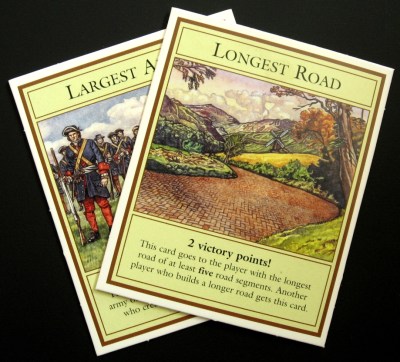
The Settlers of Catan
– Image by boardGOATS

Love Letter is a game we played a lot a year or so ago, but not so much recently.  The first of the so-called “micro games” it is played with just sixteen cards.  Each player starts with one card and on their turn, draws a second card and then plays one of them.  Each card has a value (one to eight) and an action (discard a card, swap cards with another player, compare cards, etc. etc.).  The object of the game is to have the highest card when the deck has been exhausted or, be the last person remaining, which ever is soonest.  The rules say the winner is the first player to take a set number of hands, however, we tend to play far a few rounds and then decide how far to take it.  In this case, Green, Blue and Pine had one point each, so we went for one final round, which Pine took with much aplomb.

Love Letter
– Image used with permission of BGG contributor thatmadgirl

Learning Outcome:  Sometimes it is the way that you play that makes a game enjoyable.

17th Movember 2015

While Burgundy, Magenta and Blue were busy feeding, we decided to play something to keep Pine from eating too many of the chips, so for the third games night running, we had a quick mess about with magnets and bells in Bellz!.  It was another close game with some slightly borderline shaking and other sneaky efforts.  Before long though after incredible snatch taking two medium bells as he moved faster than magnetism, Burgundy had only one large bell left.  This solitary bell was very effectively trapped though and he failed to take the opportunity leaving Blue to close out.  Pine followed, despite the fact that he claimed he was no good at dexterity games.

Bellz!
– Image used with permission of BGG contributor SpeedD

With people still finishing, we looked for another light game that people could play while wielding cutlery, and No Thanks! fitted the bill.  This is a very simple game that we used to play quite a lot, but recently has languished in the box, usurped by newer fare.  The game is very simple:  from a shuffled deck of thirty-three cards (numbered three to thirty-five), nine cards are removed and the top card turned face up.  The first player has a choice they can either take the card or pay a chip and pass the problem on to the next player.  This player can either take the card and the chip or pay a chip and so on.  At the end of the game the face values of each player’s cards are totalled (offset by any remaining chips) and the player with the lowest number is the winner.  The catch is that if players have consecutive cards, only the lowest counts, which is where the fun really starts.

No Thanks!
– Image used with permission of BGG contributor msaari

The game is all about keeping your nerve and picking up the right card at the right time.  Burgundy began by picking up some high cards, while Pine started with a few cards in the twenties and teens.  Blue and Magenta stuck it out as long as they could before they were forced to take something.  Somehow Blue managed to avoid anything really horrid until the last card when Magenta persuaded Burgundy to hand it on leaving her with a whopping sixty-nine and last place.  With Burgundy unable to get the cards he needed to extend his run, that left just Magenta and Pine with Pine taking it by four points with just twenty three points.

No Thanks!
– Image used with permission of BGG contributor mikehulsebus

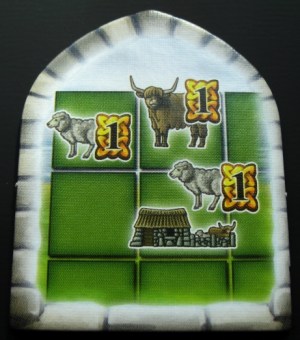
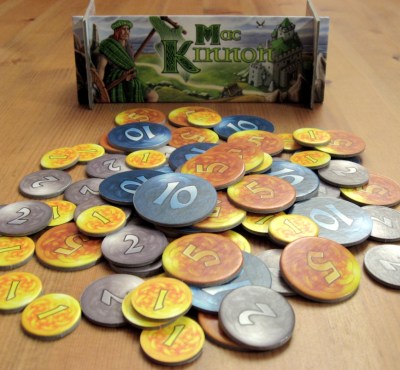
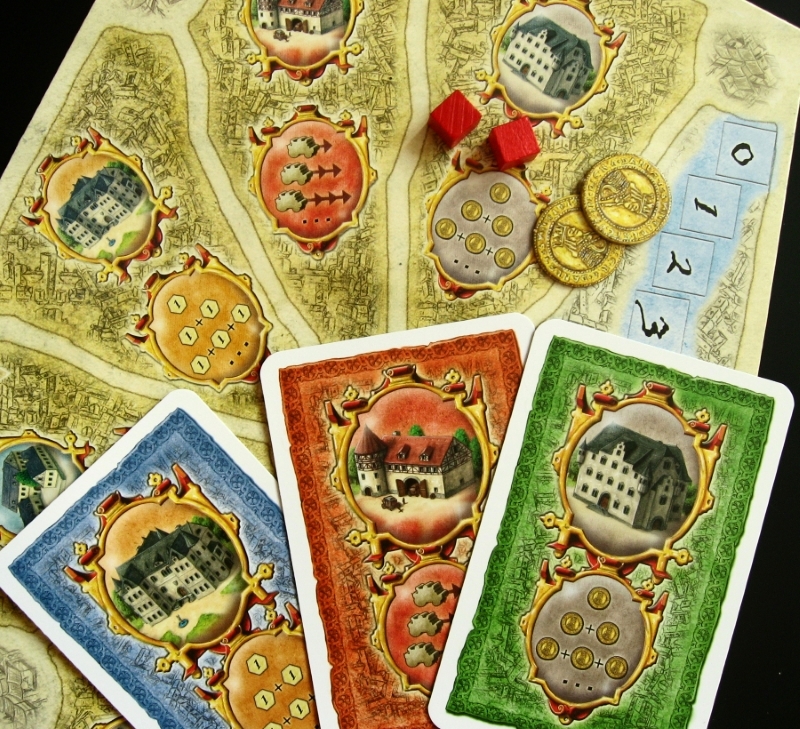
Not expecting anyone else to arrive, we decided to move onto the “Feature Game” which was Isle of Skye: From Chieftain to King.  This is a tile laying game with some similarity to Carcassonne, except that players have their own map and the tiles are auctioned.  Played over six rounds, players start by earning income for their clan’s territory, getting five gold for their castle and one for each whiskey distillery (barrels) connected to their castle by road.  Next, each player draws three tiles from a bag and places them in a row in front of their screen.  In private, the players then allocate piles of coins to two of the tiles and a mattock marker to the third.  The coins represent the cost anyone buying a tile will have to pay, while the mattock indicates which tile will be discarded.

Isle of Skye: From Chieftain to King
– Image used with permission of BGG contributor henk.rolleman

Once everyone has decided the value of their tiles, the screens are removed and the tiles marked with a mattock discarded.  Next, beginning with the start player, each player takes it in turn to buy a tile from one of the other players.  When everyone has either bought a tile or passed, all remaining tiles are bought for the assigned value by the owner.  So, when setting the value, players have to be very careful not to over-price something otherwise they will be left paying over the odds for something they don’t want.  In fact, the problem is worse than that as the difference between being forced to buy your own tile and selling it is twice the assigned value.

Isle of Skye: From Chieftain to King
– Image by boardGOATS

After all the tiles have been bought, players add them to their clan territories following the Carcassonne riles that terrain must match.  However, presumably since all roads on Skye are just dirt tracks, roads do not need to connect, something those of us who suffer with OCD found quite offensive to begin with.  At the end of the round, points are awarded according to the four scoring tiles chosen at random at the start of the game.  In our game the scoring tiles were:

  1. One point for each animal next to a farm;
  2. Three points for each lake with a ship and a lighthouse;
  3. Two points for each cow on a road connected to the castle;
  4. Five points for the person with the most barrels and two for the person with the next most barrels.
Isle of Skye: From Chieftain to King
– Image used with permission of BGG contributor henk.rolleman

At the end of the first round, just scoring tile “A” is scored, at the end of the second, just tile “B”, but at the end of the third, both “C” and “D” are scored so that each tile is scored three times during the game, at the end of different rounds, in different combinations.  At the end of the game, each player turns any residual money into points (at a rate of five to one) and players also score any scroll tiles they may have been able to add to their clan territory.  These give a set number of points for certain items, for example, one point for each pair of ships etc.  These are scored twice it the terrain the scroll is in is “complete”, i.e. it is enclosed.

Isle of Skye: From Chieftain to King
– Image used with permission of BGG contributor Punkin312

Burgundy was the only player who had played the game before and commented that he had been given a bit of a pasting so was hoping to do better, though he thought it was a hard game.  It didn’t sound hard at all, but we quickly discovered what he meant, with everyone struggling from the very beginning.  Pine and Magenta made the best starts getting farms and animals and scoring early, while Blue and Burgundy brought up the rear.  Blue, who never does well in more strategic games drew scroll tiles that rewarded players with barrels.  Unfortunately, as barrel tiles connected to the castle give players money at the start of the game, and scoring tile “D” gave points for them, they were a hot commodity and Blue was quickly left behind.

Isle of Skye: From Chieftain to King
– Image used with permission of BGG contributor henk.rolleman

As he’d found the previous time he’d played, Burgundy could see the tiles he wanted, but was struggling to acquire them or keep them.  As a result he started to drop off the pace and before long, Pine had left Magenta as well and was romping away looking like he might start to lap people.  While everyone else moaned as they struggled to do what they wanted, Pine continued happily collecting lots and lots of cows and sheep which he cleverly added to his growing conurbation of farms so that they counted multiple times.  In the later rounds, however, there is a catch-up mechanism which gives extra money to the players at the back.

Isle of Skye: From Chieftain to King
– Image by boardGOATS

From round three onwards, at the start of the round, each player gets additional money for each player in front of them.  The amount increases as the game progresses, so the player at the back gets an extra three gold coins at the start of round three, but a massive twelve additional gold at the start of the final round.  Unfortunately, we somehow managed to botch this, half-way through the game switching to handing it out at the end of the round instead of the start, so the additional wherewithal didn’t quite give people the extra buying power intended by the designers.  That said, although Pine was the clear winner by nearly thirty points with a total of eighty-five, Blue managed move from a long way behind everyone else into second place thanks to scroll scoring that capitalised on all the brochs and barrels she had acquired.  For all the moaning, everyone enjoyed the game and agreed that it needed playing again as it would probably be very different with different scoring tiles.

Isle of Skye: From Chieftain to King
– Image by boardGOATS

After some discussion about what to play and flirting briefly with the idea of Aquaretto,  we decided to play Port Royal.  Although we’d played it before, it was one of those games that it is somehow hard to remember and therefore Blue made a bit of a pig’s ear of teaching it.  That said, it isn’t a complicated game:  the game is played in turns with the active player turning over cards.  They can keep turning over cards until either they choose to stop or they draw a second ship card that they cannot repel.  Assuming they choose to stop, they can then take a ship card or buy a character card before the remaining cards are offered round the table with players paying the active player one doubloon if they choose to buy/take a card.

Port Royal
– Image used with permission of BGG contributor msaari

The key is the character cards as they are what enable players to build an engine and get an advantage over the opposition.  Unfortunately for him, Burgundy never seemed to have enough money when the cards he wanted came up.  On the other hand, Magenta took a Jester at just the right moment to give her a steady income exactly when she needed it.  Meanwhile, Blue picked up some good cards, but failed to capitalise and Pine began collecting for contracts, but couldn’t pick up the most cost effective ones.  Then, suddenly, Magenta snuck up on the inside and Pine pointed out that she had eleven points.  Blue then lost the plot a little and let her get the twelfth point which triggered the end of the game.  Nobody could improve their position much, except Magenta who rubbed salt in the wound buying another two cards.

Port Royal
– Image used with permission of BGG contributor jsper

With the evening nearing the end, we decided to give another new game a quick try as it the box said it only took five to ten minutes.  Well, an hour later, we were still playing Red7, and the landlord was subtly reminding us of the time…  So how did it go so wrong?  Well the game is fairly straight forward:  on their turn, each player can play one card from their hand into their tableau in front of them, or play a card into the centre which changes the rules of the game (a little like Fluxx), or they can do both.  If they cannot play a card or choose not to, they are out of the round.

Red7
– Image used with permission of BGG contributor punkin312

The game is played with a deck of forty-nine cards, numbered one to seven and in seven different colour suits.  Each player starts with seven cards in hand and one face up on the table.  The player with the highest value card is “winning” because the rule at the start is that the highest card wins.  In the event that there is a tie and the highest face value is displayed by more than one player, the tie is broken by the colours with red higher than orange, which is high than yellow and so on through the spectrum to violet.  The colours also dictate the rules, so any red card played in the centre will change the rules to “the highest” wins.  Similarly, any orange card played in the centre changes the rules so that the winner is the person with the most cards of the same number.

Red7
– Image used with permission of BGG reviewer EndersGame

In each case, ties are broken by the card that is highest (taking into account both number and colour) from the cards that satisfy the current rule.  Thus, if the rule is “the most even cards” and there are two players with the same number of even cards in front of them, the player with the highest even card is the winner.  At the end of their turn, the active player must be in a winning position, or they are out of the round. The round continues until there is only one player left.  Magenta took the first round with eight points and Burgundy the next with eleven.  When Magenta took the third and Blue the fourth, Pine was beginning to feel a little left out.  After Burgundy took the fifth round which took him to twenty-seven points (more than twice any one else’s total), we decided to give Pine one last chance as clearly Burgundy had it in the bag.  Sadly, for Pine, the last round was taken by Blue with a massive twenty-two points putting her just three points ahead of Burgundy.

Red7
– Image used with permission of BGG contributor punkin312

So why did the game take so much longer than advertised?  Well, obviously we had to read and understand the rules, but that didn’t account for it.  Each round does indeed take about five to ten minutes, but we didn’t feel we had really grasped it after one round and the rules for the advanced game also say that players should continue until one reaches a set number of points.  So we just played another round and then another and another… By the end we were just starting to get the hang of it, but we were also really beginning to appreciate the depth of something so very simple.  Part of the issue is getting into the mindset that enables you to quickly evaluate what cards you can play.  The next level is working out what is the best card to play that keeps the maximum level of options open.  However, by the last round we were just beginning to see that the game was really about using the rules to control what the other players could do, driving the game and ultimately, maximising the number of points won, or minimising the number of points taken by the opposition.  As a game, the structure of this has a lot in common with Love Letter and could another quick filler in a similar vein.

Red7
– Image used with permission of BGG contributor punkin312

Learning Outcome:  Simple games can turn out to be amongst the most complex.

3rd Movember 2015

Like last time, we started out messing about with the dexterity game, Bellz!.  With Blue, Magenta and Burgundy all familiar with it, it was a very tight game.  As the only person who hadn’t played it before, it took Red a couple of turns to get the hang of it before she developed a devastating new technique and came storming from the back to snaffle first place.  Next time there might be a new house rule…

Bellz!
– Image used with permission of BGG contributor W01FVF

Despite the original prognosis of an hour’s wait for food, the pub kindly rushed us through so while we munched we played a quick game of Turf Horse Racing on a very lumpy course.  It was a while since we last played it, so Green reminded us of the rules.  The idea is very simple, players have three counters to use for betting, two small and one large, double weight one.  In the first stage, players take it in turns to use these counters to bet on horses.  In the second stage, players take it in turns to roll the die and move a horse to determine the outcome of the race.  The game works because the die has three horses heads with one of each of the other icons, and each horse moves a different amount depending on what is rolled.  Since each horse has to move before a horse can be moved again, players can choose to make a positive move for one of their own horses, or nobble someone elses.

Turf Horse Racing
– Image used with permission of BGG contributor franchi

Silver Blaze had a fantastic start so for the next few rounds, but from then on, his progress was slowed by everyone who hadn’t bet on him.  Once the rest of the field had caught him up, the pack stayed together for the rest of the race until Roamin’ Emperor finally broke free with the finishing line in sight.  Then suddenly, Magenta played king-maker giving Red Baron a sudden spurt to win bringing the game to an abrupt finish with Roamin’ Emperor coming in second and Mosstown Boy third, bringing home the rest of the field.  Although Magenta had an investment in Mosstown Boy, Burgundy was the real winner as he had his double bet on the green horse and he finishing ahead of Magenta by several lengths.

Turf Horse Racing
– Image used with permission of BGG contributor franchi

With the arrival of a new player during the game, that gave us six, so we decided to play our the  Halloween-inspired “Feature Game”, Witch’s Brew.  This is a role selection card game with aspects of set collecting and bluffing that has recently been reimplemented as this year’s Kennerspiel des Jahres, Broom Service.  Each player begins each round with a deck of twelve character cards from which they choose five.  The start player then selects a card and places it on the table and declares they are that character by saying, for example, “I am the witch”.  The next player examines their hand of five chosen cards, and if they don’t have the same card, they pass.

Witch's Brew
– Image used with permission of BGG reviewer EndersGame

Play continues until there is a player who is holding the current character card, in which case they then have a choice.  They can object and declare that they are the character instead, saying, for example, “No, I am the Witch”.  In this case, they replace the first player as “the Witch” – the player who is the Witch at the end of the round gets the richest pickings and starts the next round, while everyone else gets nothing.  Alternatively, they can take the “cowardly” option and acquiesce, instead saying “so be it”.  In this case, they immediately take a lesser reward.  Although the decision is a simple binary one, the ramifications are potentially complex and far-reaching, added to which it is a lot of fun to watch player after player declaring their character only to be shouted down by their neighbour.

Witch's Brew
– Image used with permission of BGG reviewer EndersGame

The aim of the game is to collect ingredients for potions and then prepare them.  The more complex the potion, the more it is worth at the end of the game.  Thus, players might use the Snake Hunter to collect snake venom and the Herb Collector to provide them with herb juice which can then be used together to brew a potion in a silver cauldron using the Druid.  Players can also pick up points for potion shelves, but the characters used to claim these (the Cut Purse and the Begging Monk), force all the other players to pay a tithe, which will be used to cover the cost.

Witch's Brew
– Image used with permission of BGG contributor Toynan

Nobody had played it before, but Blue, having read the rules, started out well while everyone else was still working out what to do.  Pine was unlucky just failing to get enough gold/ingredients to pick up potion shelves on several occasions.  Burgundy also struggled to make the game work for him, and when he eventually succeeded in brewing his first potion it felt like a real success.  Working steadily, Blue gradually built up an unassailable lead though Green came from nowhere with his last couple of cards, finishing in second, by just a couple of points.

Colt Express
– Image by boardGOATS

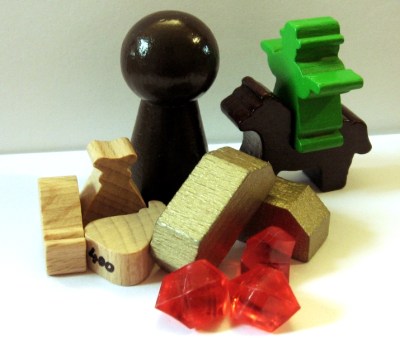
The next game up was Colt Express, newly pimped out with fancy gems, purses and a new large start “poppel” from Essen.  The game itself is quite straight forward, but it usually takes at least  round to see how it works.  The idea is that game play is in two phases:  first players take it in turns to chose which cards they are going to play, then players take it in turns to action the cards they chose in the order they chose them.  Although we’ve played Colt Express quite a bit recently, with Pine new to the game, and the chaotic nature of it, it seemed a little unfair to drop him in the deep end and include the expansion as it adds quite a bit more complexity.  So, after admiring the wooden horses and 3D stagecoach, and discussing the DeLorean mini-expansion, we decided to stick with the base game.

Colt Express
– Image used with permission of BGG contributor sdetavern

The game started out with bullets flying every where and, unusually, mostly finding their targets.  As the game progressed, even the marshal joined in the fun making Ghost (played by Magenta) a real spook for Halloween.  Burgundy (playing Belle) and Red (Cheyenne) started out well with some valuable pickings.  Magenta, starting to look like a piece of Swiss cheese, was seriously hampered by the nine bullet holes she had picked up, and Pine (Doc) was not far behind with seven, though he was giving as well as taking.  Somehow Green (playing Django) who we normally take care to make sure can’t get ahead in games like this, had largely managed to avoid being shot.  This gave him a significant advantage added to which, everyone else  foolishly left him to play his own game.  Before long he was getting away with the strong box (now upgraded to a gold bar) worth $1,000.  This, with the Sharp Shooter Bonus gave him the win, $750 ahead of Blue in second (playing Tuco) who also picked up the bonus for emptying her magazine.

Colt Express
– Image used with permission of BGG contributor punkin312

Magenta and Red were determined that Blue should get an early night to nurse her cold, but she managed to persuade them to one last quick game of one of our current favourites, 6 Nimmt!.  The first round all went according to plan with Burgundy once more picking up more Nimmts than anyone else.  As usual, he did much better in the second round, but couldn’t match Blue and Red who finished in joint first place with a total of just eight each.

6 Nimmt
– Image by boardGOATS

Learning outcome:  Organised chaos is a fun part of lots of different games.

20th October 2015

While Burgundy, Magenta and Blue waited for their supper to arrive, they began a quick game of Bellz!, the “Feature Game”.  This is a very simple manual dexterity game, albeit one that is very well presented.  The pouch opens out to form a soft bowl containing bells in four different colours.  Each colour includes bells in three different sizes; the aim of the game is to be the first person to have picked up all the bells of just one colour using the stick which has a magnet in each end.  On a player’s turn they can pick up multiple bells or chicken out and stop at one, but if they pick up any bells that don’t match the colour of those they have already collected then that turn is forfeit.

Bellz!
– Image used with permission of BGG contributor joeincolorado

It is certainly more difficult than it looks and there is a little bit in the way of tactics as the magnetism gets weaker further away so with skill it is possible to daisy chain bells and only pick up certain bells.  There is also a strong magnet one one end of the “wand” and a weaker one on the other.  Th rules are not completely clear (and are completely in German in any case!), and gamers inevitably ask whether the bowl can be moved and how much shaking is allowed, which were things we house-ruled.  We had had about two turns each when Green arrived and joined in.  Food arrived and we were still struggling so we carried on as we ate.  Burgundy ran out the eventual winner with Blue following close behind leaving Magenta and Green to fight it out for the last bell.  Grey and Cerise promptly turned up and, as it is an eye-catching game, also had a go with Cerise taking the honours.

Bellz!
– Image used with permission of BGG contributor punkin312

This was followed by a discussion of the Essen game fair including some of the games seen and purchased by Blue and Pink.  By far the majority of the toys they picked up were expansions for games we’ve played before including:

Colt Express: Horses & Stagecoach
– Image used with permission of BGG contributor sdetavern

There were several new games too though, in particular:

There were also older games, some of which we’ve been interested in for a long time.  For example Rockwell was a big game at Essen two years ago, and Green and Blue have expressed an interest in both at the time and since.  Somehow either the price wasn’t right or it wasn’t available at the right time, until now when a good deal beckoned. Blue and Pink picked up a number of small games as well.  These are often hard to get hold of except at places like Essen and are sometimes a hit, and sometimes not so popular, but as they are relatively inexpensive and take up little space in the luggage, they are what makes the fair special.  Finally, there were the promotional items, extra copies of which Blue handed round.

Rockwell!
– Image by BGG contributor Rayreviewsgames

Eventually we decided it was time for a game, and with six the decision is always whether to split into two groups or not.  Green suggested Eketorp for six, but Blue really wasn’t keen, so eventually we opted for Codenames, a new social deduction team game based on the meanings of words which had received a lot of good reports before Essen.  Green pulled a face at the idea of “a word game” and Burgundy commented that social games were not really his thing, even Blue who bought it wasn’t terribly keen because it had sounded un-promising when she read the rules.  Cerise was almost enthusiastic though and Magenta pointed out that it shouldn’t take long, so we gave it a go.

Codenames
– Image used with permission of BGG contributor punkin312

The idea is that there is a grid of twelve cards and the players split into two teams, with even numbers of male and female, we did the childish thing and played boys vs. girls.  The leader of each team is the Spymaster, and as Grey had popped out for a second, we volunteered him to be one so it was natural that Cerise should be the other.  The Spymasters’ job is to get their team to reveal the cards/words that correspond to their team of “agents”, by giving clues.  The clue must be a single word followed by a number which reflects how many words are indicated by that clue.  For example, the clue, “trees: three” could be used to indicate the words “oak”, “ash” and “elm”.  Members of the team then touch cards that they think are their agents; they must indicate at least one, but may try up to one more than the number in the clue.

Codenames
– Image used with permission of
BGG contributor aleacarv

The Girls started off badly finding a neutral and the Boys started off well quickly getting a three card lead.  Before long, the Boys started to get a bit stuck with movie clues and the Girls began to catch up.  As Magenta pointed out afterwards, it was important to listen to both the clues and the discussion of the other team as you can get extra clues.  And so it proved in the end.  With the teams tied, the clue was “Regents; two”.  Blue and Magenta misheard and thought Cerise had said “Regions”.  The Boys struggled on their turn too though, and suddenly the Girls had another chance.  When Green had repeated Cerise’s clue during the Boys’ discussion, Blue had suddenly realised the Girls’ mistake and they were able to find “Park” and close out the game.  Although it is not really our sort of game, everyone was very complimentary about it and as a group we enjoyed it much more than we thought we would.  We could all think of people who would like playing it and now that we know how it works, it would be much quicker to play next time too, making it a surprisingly fun filler with the right group.

Codenames
– Image used with permission of BGG contributor punkin312

With that done, we had to decide what to to play next and, with too many for Cosmic Encounter, inevitably Eketorp was raised again.  Grey was very enthusiastic, but Blue really wasn’t keen, especially as it can drag with six players.  Much to Blue’s delight and eternal gratitude, Magenta tactfully suggested that, despite being a Viking, she could play something else with Blue and Burgundy.  With that, Green happily started explaining the rules.

Eketorp
– Image used with permission of BGG contributor Ceryon

Eketorp is a game where players attempt to gather resources to build their Viking stronghold on the Swedish island of Öland.  In this game players try to second guess which resources the others don’t choose, with a battle and a potential extended stay in the hospital as the reward for failure.  The game itself is played in several rounds.  First material is distributed across the board according to the card revealed at the start of the round.  The players then decide, in secret (behind their player screens), which areas to send their Vikings to.  Vikings can either go to one of the seven resource or brick areas, reinforce the defence of their own village, or attack one of the other players’ villages.   Players then reveal their choices  and place their Vikings on the central board.

Eketorp
– Image used with permission of BGG contributor cuazzel

Depending on how the various Vikings meet, peace may be preserved or battles may ensue.  Vikings on a material field live in peace if there are sufficient building bricks, i.e. there is the same number of building bricks (or more) than there are Vikings wanting them.  If there are insufficient bricks available, then there will be a battle.  Battles also take place on a siege field in front of a player’s castle for the right to lay siege if several Vikings are positioned there.  Battles always take place in a particular order. Firstly, the starting player engages in a battle, then everyone else takes turns until all battles and sieges have been resolved.

Eketorp
– Image used with permission of BGG contributor helioa

Battles are fought using cards chosen from a starting hand of four.  Each player choses a card in secret and then they reveal them simultaneously with the highest card winning.  The difference in value between the two cards determines the battle difference which indicates which area of the hospital the loser ends up in.  In the case of a tie, both parties go to the hospital.  The clever bit is that once a battle has been fought, players swap cards and place the new card face down in front of them.  Once a player has played all their cards in battles, they take the cards in front of them to form a new hand.  In this way, the game is self-balancing so that a player who has a bad card draw at the start will have a better hand later in the game and vice versa.

Eketorp
– Image used with permission of BGG contributor cuazzel

If village siege is successful, then the attacker gets to pillage bricks from the village wall.  Bricks may only be taken from the walls that are two bricks high and the  total point value of the bricks taken may not exceed the battle difference.  Bricks can only be removed from top to bottom and the attacker can then take one of these bricks home (with the remainder going back into the reserve).  Once all battles have been resolved all the winning Vikings can take their bricks home and add them to their village wall.  Each wall comes in six parts and a maximum of three bricks can be stacked in each giving a maximum of eighteen in total.  Once a brick has been used, it cannot be moved at a later date.  The bricks are nominally made of different material and are worth different amounts at the end of the game (green, or grass is worth one whereas grey or stone is worth four for example).  The end of the game is triggered when one player reaches the maximum of eighteen bricks.

Eketorp
– Image used with permission of BGG contributor
Capitaine Grappin

At the start, with no village walls to attack or defend, and all Vikings fit and healthy, the central resource pools were particularly busy places.  After many attacks and counter attacks, eventually all were either victorious and claimed resources, or were licking their wounds in differing levels of the Viking hospital (talk about a beds crisis!).  Green took the early lead at this point. Round two was much quieter, with less than half the Vikings available to go brick hunting, so everyone was relatively successful with their choices.

Eketorp
– Image used with permission of BGG contributor DrGrayrock

Over the course of the next couple of rounds, the game board became more crowded and there was even the odd cheeky raid on a village.  By this time, Grey had managed to create a nice evenly built village wall, one or two bricks high made up of both grass and wooden bricks (worth one and two points respectively) – easy pickings in a fight, but less threatening too. Green was a bit lopsided, concentrating on building with a range of brick colours mostly on one side in order to limit the attack directions.  Cerise however had quietly managed to built quite a good wall round a large part of her village with a lot of clay and stone bricks (worth three and four points).  So, the next two rounds were characterised mostly by Grey and Green attacking for Cerise’s wall.  The first attack by Green was successful, but only enough to nab the top green brick, hardly a dent at all and netted only one point.  Grey’s attack was a stalemate.

Eketorp
– Image used with permission of BGG contributor Garry

In the final round, Cerise found herself surrounded on all sides with Green and Grey attacked from one side each.  Again only Grey was successful enough to break down part of the wall though.  Then for the final battle of the game, Grey and Green had to go head to head for the right to attack Cerise from the third side – it was a draw and Cerise was safe!  As Cerise was the only one who had managed to build a wall at least three high all the way round she picked up the five point bonus and proved herself the superior Viking with a score of forty-four leaving Green and Grey some way behind, fighting it out for the wooden spoon.  In the end, Grey decided he didn’t like the game after all, because had Cerise beat him!

Eketorp
– Image used with permission of BGG contributor
Capitaine Grappin

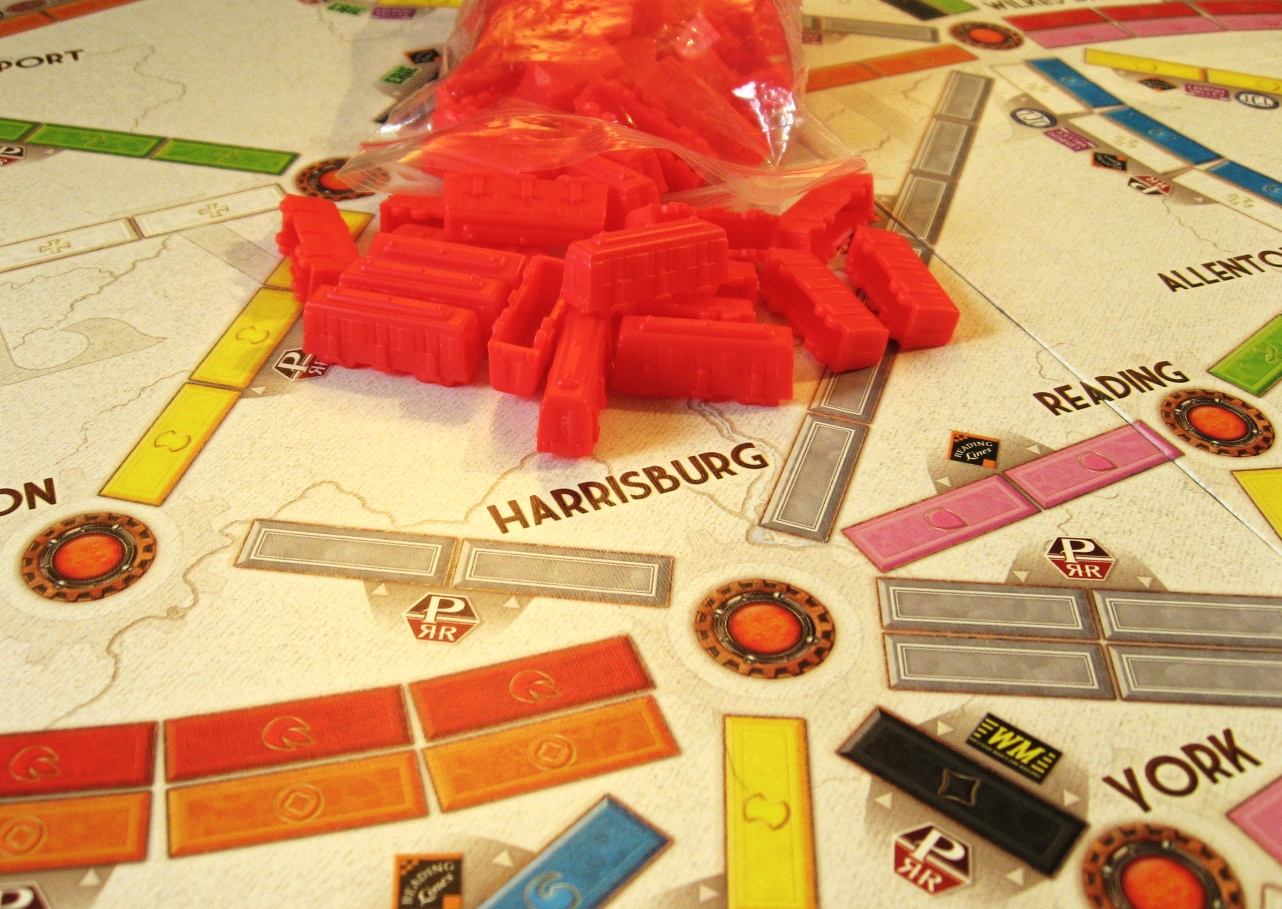
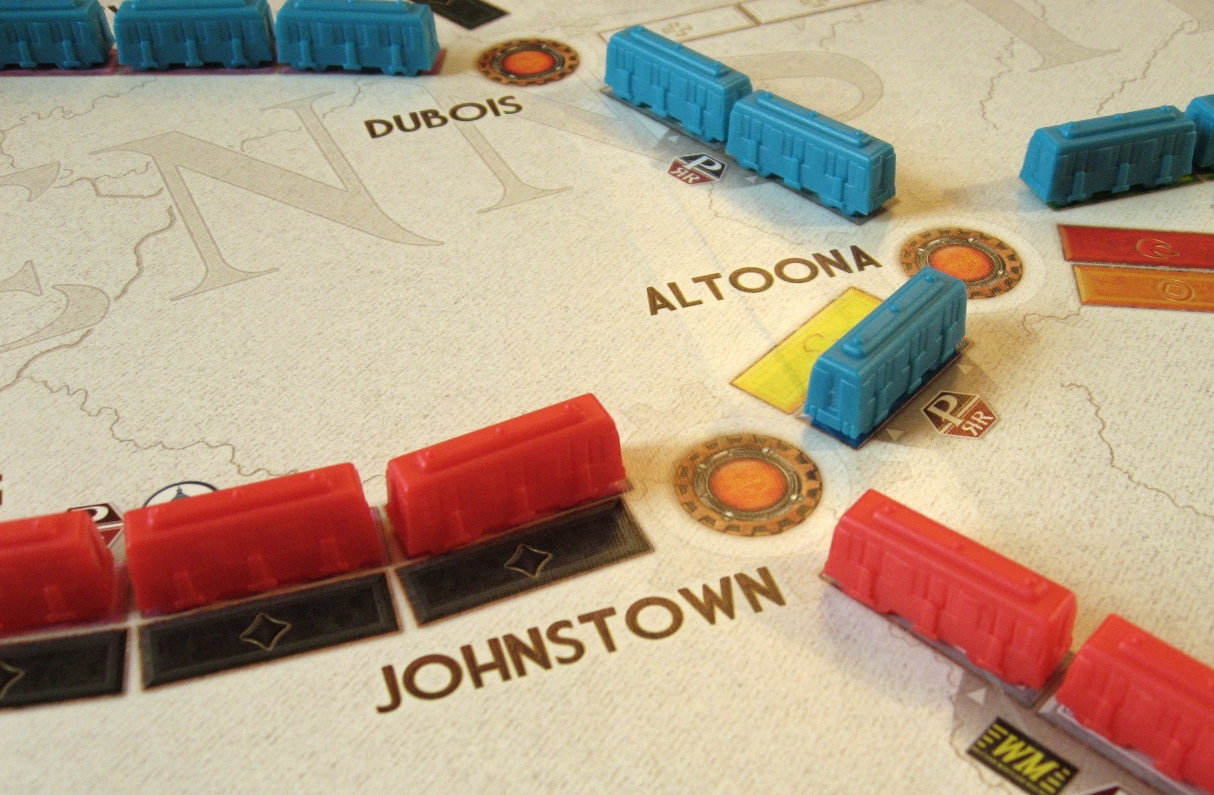
Meanwhile Blue, Burgundy and Magenta conducted a brief audit of the games available and Burgundy’s eyes lit up at the idea of trying out the new Ticket to Ride Map Collection as he had played a lot of Ticket to Ride and prided himself on being quite good at it.  Magenta is also no slouch either however, and was also keen as she had won her last three games of Ticket to Ride: Europe.  Similarly, Blue has slightly unjustly acquired a reputation for beating people at Ticket to Ride, and although she hadn’t played it much recently, she had won her demonstration game at Essen and had enjoyed it too, so was very happy to give it another try.  Although everyone was keen to try the UK map, to avoid giving Blue an unfair advantage, the Pennsylvania side was chosen.

Ticket to Ride
– Image by boardGOATS

The basic Ticket to Ride game is really very simple.  On their turn the active player can do one of three things:  pick up two coloured train cards from the face up display or the face down draw deck; place plastic trains on the map using cards to pay and scoring points; or draw ticket cards, which name two places and give points at the end of the game if the player has built a route between them, but score negatively if not completed.  From there, each different version makes small changes to the rules, for example, some editions include tunnels and/or ferries and sometimes there are extra cards or bonus points etc..  So, the first problem was trying to remember which of the specific rules are applicable to the base game and then integrate them with the new rules for the Pennsylvania map.  In particular, this was whether we should be using the double routes and how many points the different routes should be worth since there was no score table.  Eventually, we decided to use single tracks (ala three player Ticket to Ride: Europe) and scored routes as follows:

  • Single car:  One point
  • Two cars:  Two points
  • Three cars:  Four points
  • Four cars:  Seven points
  • Five cars:  Ten points
  • Six cars:  Fifteen points
  • Seven cars:  Twenty-one points

The seven car route from Cumberland to Baltimore engendered a lot of discussion, as there aren’t any routes of that length in Ticket to Ride: Europe.  Burgundy was fairly sure they were worth eighteen points in Märklin, but the increase in points from six to seven cars seemed very uneven compared with the change from five to six cars.  In the event, it didn’t make much difference, but checking the rules online later confirmed that Burgundy was right and it should have been eighteen.

Ticket to Ride Map Collection: Volume 5 – United Kingdom & Pennsylvania
– Image by boardGOATS

Burgundy was quite pleased with his starting tickets getting three east-west routes that he thought could largely be coincidental.  His delight faded to despair, when in the first turn, Blue took the route from Altoona to Johnstown and quickly followed it by adding the Altoona to Dubois, in quickly completely scuppering his plans.  Magenta was equally unimpressed that double routes were not in use when Burgundy and Blue quickly completed all the connections to Johnstown rendering one of her tickets impossible within the first few turns.  From there, the game quickly descended into a knife-fight in a phone box with everyone scrabbling to make their starting tickets and it looking very much like nobody was going to succeed.

Ticket to Ride Map Collection: Volume 5 – United Kingdom & Pennsylvania
– Image by boardGOATS

As Burgundy pointed out though, tickets were not going to be so important in this game as there were a lot of points available from the Shares.  This is a new feature specific to this map.  The idea of these is that most routes also have one or more company logos shown next to them on the map.  When these routes are completed, players choose which company they would like to take a share certificate for.  The companies are different sizes with some companies having a lot of certificates available while smaller company others have fewer.  At the end of the game, each player’s stock holdings are evaluated and points awarded.  The bigger companies are worth more points, however, it is harder to get the majority stake in these.  In the case of a tie, the share certificates are numbered and the points go to the person with the one taken first.

Ticket to Ride Map Collection: Volume 5 – United Kingdom & Pennsylvania
– Image by boardGOATS

The shares certainly did have a massive impact on game play.  Normally in Ticket to Ride, players achieve their first routes and then start picking up tickets, trying to maximise the number of longer routes as these give the best points return for the cards and trains, but, that wasn’t how this game went.  Although Blue bravely picked up some more tickets and was promptly followed by everyone else, this was the only time anyone did this as everyone got in everyone else’s way so much it was just too risky.  Since achieving tickets was proving so challenging, everyone started trying to pick up share certificates which meant building small routes as these were the cheapest and easiest way to get them.  Then suddenly, Burgundy declared he was out of trains and the game came to a quick end which only left the scoring.

Ticket to Ride Map Collection: Volume 5 – United Kingdom & Pennsylvania
– Image by boardGOATS

Although Burgundy had moaned about how badly he had done, neither Magenta nor Blue realised just how badly until it came to scoring tickets.  It’s true that the first ticket scored him ten points, but all the others were incomplete losing him nearly all the points he had accrued from placing trains.  Magenta also had a ticket she had failed to achieve, but it hadn’t cost her nearly so dearly.  Blue on the other hand had somehow managed to make all her connections and therefore also picked up an extra fifteen points for the Globe Trotter Bonus.  Unfortunately for Burgundy, although he had done well on the shares, the horror-show that had been the tickets had put him right out of contention and he was nearly lapped (though not quite!).  Although Magenta had shares in more companies, the combination of the extra tickets and the fact that Blue had managed to hang on to the majority in a couple of the larger companies made the difference.  Blue finished on one hundred and ninety eight, just over thirty points ahead of Magenta in what was a very tough game.

Ticket to Ride Map Collection: Volume 5 – United Kingdom & Pennsylvania
– Image by boardGOATS

With Grey and Cerise gone, that left us with time for a quick filler to finish.  11 Nimmt! and Deep Sea Adventure were both in the frame, but Green liked the sound of Qwixx, which had been nominated for the Spiel des Jahres in 2013, but was beaten by Hanabi.  The game sounded interesting though there was very little to it.  On their turn, the active player rolls six dice, four coloured and two white.  Each player has a score sheet with four tracks:  the red and yellow tracks go from two to twelve and the blue and green tracks go from twelve to two.  Once the dice have been rolled, all the players may cross off a number of any colour that corresponds to the sum of the white dice, if they choose.  The active player may additionally cross off one number corresponding to the sum of one of the coloured dice and one of the white dice.  They can choose which of the white dice they are going to use, but the die colour must match the colour of the track.

Qwixx
– Image used with permission of BGG contributor joeincolorado

The snag is that players must progressively cross off numbers to the right, i.e. once they have crossed out the red five for example, they cannot go back and cross out the red four.  Also, while all the other players can freely choose whether or not to use the white dice, the active player must cross out something on their turn or take a penalty (minus five at the end of the game).  Finally, if someone wants to cross out the last number on any track (twelve for red and yellow, two for green and blue), they must first have crossed out at least five other numbers on that track, at which point the die corresponding to that colour is locked and the colour is closed for all players.  The game ends when two dice have been removed from the game or when one player has accrued four penalties.  Scores are awarded for the number of crosses in each row according to the triangular number sequence also used in Coloretto (one, three, six, ten, fifteen, twenty-one, twenty-eight, etc.), so every additional cross is worth an ever increasing amount.

Qwixx
– Image used with permission of BGG contributor punkin312

The game started with everyone being very cagey and not taking the option of scoring the white dice as they were too high, but eventually, some people were braver than others and different patterns began to emerge.  Initially, the game looked very promising with the potential interplay between different effects, like the probability distribution for two dice, balancing the high scoring potential with not getting stuck and picking up penalty points.  Blue was even wondering whether it would be necessary to get another scoring pad.  However, being gamers, we all played to a very similar strategy and, before long, the inevitable happened, with everyone stuck waiting for the most unlikely dice rolls (two and twelve).  As a result, Burgundy who got there first started picking up penalties closely followed by Green.  The game ended when Burgundy picked up his fourth penalty point and we added up the scores.  Magenta, who had only taken the one penalty finished five points ahead of Blue with Burgundy and Green nearly twenty points behind thanks to all their penalties.  And then the inquisition began.

Qwixx
– Image by boardGOATS

We all really like the game at first because of the way the probability interacted with the constraints on number selection, however, we quickly found that it felt very random because the game was self-balancing.  As their game finished, each player was going to be hoping for lucky dice rolls.  Since twelve and two are relatively unlikely which would have a delaying effect, during which time, anyone who had not got quite as far was going to be able to grab a couple of extra crosses.  The random nature of rolling dice meant that ultimately, the effect of any strategy or tactics applied during the game were vastly outweighed by the randomness of the dice at the end.  Although we felt it was probably a good game for children to have fun with, as a game, it was very surprising it was nominated for the Spiel des Jahres.

Qwixx
– Image used with permission of BGG contributor punkin312

Learning Outcome:  Sometimes it is good to play games outside your comfort zone.

6th October 2015

This week we started out debating the poor performance of the England Rugby team compared with Ireland who had hitherto failed to beat a team in the top ten, but were still likely to go through to the quarter final stage of the world cup (thanks largely to the vagaries of the draw).  While Blue and Pink finished their pizza Magenta, the Dobble Queen, schooled everyone else in a quick round of Dobble, before we split into two groups.

Dobble
– Image used with permission of BGG contributor msaari

The first group played Grog Island.  This is an unusual game that it quite hard to get your head round because a lot is going on.  The theme centers on retiring pirates who are trying to work out how to spend their ill-gotten gains. The game is played on a board that represents the five peninsulas of “Grog Island”, which is where pirates that have survived to retirement can go to invest their spoils by buying pirate-like properties.  The key feature however is the innovative bidding mechanism.

Grog Island
– Image used with permission of BGG contributor henk.rolleman

On their turn, the active player rolls five coloured dice, and then places their first bid.  Bids are placed by selecting any number of the dice with the value of the bid equal to the sum of the number of pips on the upper-most face of the dice.  The bid must be less than the players total amount of gold.  The clever part of the bidding is that the dice that form the bid are placed in descending order, with each dice placed in one of the five available spaces, starting on the left with the highest value dice. If they can afford it, the next player may increase the bid, by increasing the total number of pips visible on the dice.  To do this they can add dice, replace dice, even completely rearrange the order of the dice, so long they do not change the number on any die and the dice remain arranged in descending order starting from the left.  The position and colour of the dice have a number of consequences, both for the eventual winning bidder, and for players who withdraw from the round early.

Grog Island
– Image used with permission of BGG contributor Wout

The player who eventually wins the bid gets to carry out the actions associated with the dice according to their final position.  These include placing pirates on the island and blocking spaces on the island, but the peninsula is restricted to the colour of the die placed in the location associated with that action.  Pirates’ positions on the island are important, because these are the primary way players get points during the game, but since those points depend on the victory cards handed out at the start, everyone has a different combination of goals.

Grog Island
– Image used with permission of BGG contributor PZS69

Losing a bid can be useful too, however, as players who drop out of the bidding early get resources corresponding to the colours of the dice in the current bid.  Thus, if the current bid is comprised of the yellow, blue and green dice, the player receives lemons (yellow), fish (blue), and coconuts (green).  These resources can then be used to carry out one of the options on the shipping track.  Black and Purple had played the game before, though always with four players.  Red on the other hand was new to it and felt a bit overwhelmed trying to get her head round everything that was going on.  For this reason, while Black and Purple began collecting victory point cards and planning a strategy, Red kept it simple and played tactically, gathering resources and using them as best she could.  It was really close and it went right down to the wire, Red finishing with thirty-three, with Black and Purple two and five points behind respectively.  The discussion at the end suggested that different tactics might be necessary with different player counts.  On the other hand, the winner was was the player who had no idea what she was doing last time we played too, so maybe keeping it simple is the way forward with this game.

Grog Island
– Image used with permission of BGG contributor Wout

Meanwhile, everyone else played the “Feature Game”, Tokaido.  This is a game where players take the role of pilgrims crossing the Japanese “East sea road”, meeting people, tasting fine meals, collecting beautiful items, discovering great panoramas, and visiting temples.  It had been Pink’s choice as he lives so far away that he rarely makes it to games nights and was able to come this time as he was on his way to Essen.  He chose the game because he had played it a couple of times with two and wanted to see how it played with more as he felt it was probably very different.

Tokaido
– Image used with permission of BGG contributor henk.rolleman

The game is quite simple with fairly straightforward actions, but despite this there is a surprising amount to think about.  The idea is that players are travelling along a path, but only one player can stop on each space.  Each space allows the active player to carry out a predefined action which will usually give them some combination of money and/or victory points.  Since the player at the back goes first they have to choose whether to move to the closest available space and get the maximum number of moves, or whether to pick a space for its action, either to improve their own position or to obstruct someone else’s plans.  In practice of course, it is inevitably a compromise but one that is often based on marginal decisions.

Tokaido
– Image used with permission of BGG contributor kilroy_locke

There are a number of possible actions, some of which involve drawing cards from one of the available piles with players scoring more for collecting sets.  Players can also donate money to at the temple in return for victory points, but as money is quite scarce, this can be quite difficult.  At intervals along the route there are also inns, where players have to try to buy a meal, which are worth six points, however, each meal must be different.  The first player to arrive draws a hand of meal cards which have varying costs, and they get to select which meal to buy giving them the chance to to make live very difficult for everyone else.

Tokaido: Eriku
– Image used with permission of BGG
contributor changeling

At the start of the game, each player draws a character card:  Burgundy took Sasayakko; Pink got Zen-Emon, Magenta took Umegae and Blue got Eriku.  Since nobody could work out what Eriku did (he was a promotional item and came without rules), Blue drew a second card and ended up with Hiroshiga.  Sasayakko and Zen-Emon both had special powers allowing the cheaper purchases of souvenirs from the village, which meant that Burgundy and Pink were fighting for the same spaces on the path.  Umegae allowed Magenta to take an extra point and coin every time she drew an encounter card, while Hiroshiga gave Blue a free panorama card at the three intermediate inns, which ultimately gave her two of the panorama bonuses.

Tokaido
– Image by BGG contributor asdoriak

Since the character cards drive the strategy, Burgundy and Pink both started out collecting souvenirs while Blue went for panoramas.  Magenta was the only one who was completely new to the game and, as it is very different to anything else we’ve played, she struggled to find a strategy in the first few turns.  As Umegae ensured that she had an extra source of money, Magenta managed to avoid getting into financial difficulties and quickly built up an unassailable lead at the temple and, by buying the expensive meal cards, managed to secure that bonus too.  Money was much more of an issue for Blue as she started out with less than everyone else and really struggled to ensure she had enough to buy a meal at each of the inns.  Burgundy also had a bit of a cash-flow crisis as he was buying souvenirs at every possible opportunity, but at least he was doing well picking up points.

Tokaido
– Image used with permission of BGG contributor henk.rolleman

Pink didn’t escape financial worries either and, as he was losing out to Burgundy for the village spaces, he wasn’t picking up as many points.  The game finished with a clear win for Burgundy who’s souvenir buying strategy clearly paid off giving him a lead of ten points over second place.  It was much closer than it had looked earlier in the game however, and only two points separated Pink in second and Blue at the back.  It was a game we all enjoyed though, and it does indeed play very differently with two and “lots”, for two main reasons.  Firstly, with two players, controlling the dummy player is a key part of the game, but he is not used with three or more people.  Secondly, with more than three, some of the spaces have a sort of “siding” that can be used by a second player.  This second player is remains behind the first person to arrive, which messes with the turn order and takes a little getting used to.

Tokaido
– Image used with permission of BGG contributor henk.rolleman

Tokaido finished first, so we played a quick game of Love Letter with the winner decreed as the person with the most points when Grog Island finished.  The usual hilarity ensued as one player managed to take out another by shear blind chance using the guard, or occasionally by clever deduction.  It was all level with one hand each, when Grog Island came to an end and it all came down to the last hand which was taken by Burgundy.

Love Letter
– Image by BGG contributor thatmadgirl

Red and Magenta were preparing to leave, but we managed to persuade them to stay for a quick game of one of our current favourite fillers, 6 Nimmt!.  This is such a silly game:  clearly there is more to it than just chance, but none of us can really work out what, which is why it continues to keep us intrigued.  We usually play this in two rounds, each with half a deck, and typically, whoever does really well in the first round (generally Burgundy) does appallingly badly in the second.  Everything went according to the script with Burgundy winning the first round taking just the one “nimmt”, and then starting the second round picking up cards.  However, that’s where it stopped and Burgundy finished with just eight, the clear winner.

6 Nimmt
– Image by boardGOATS

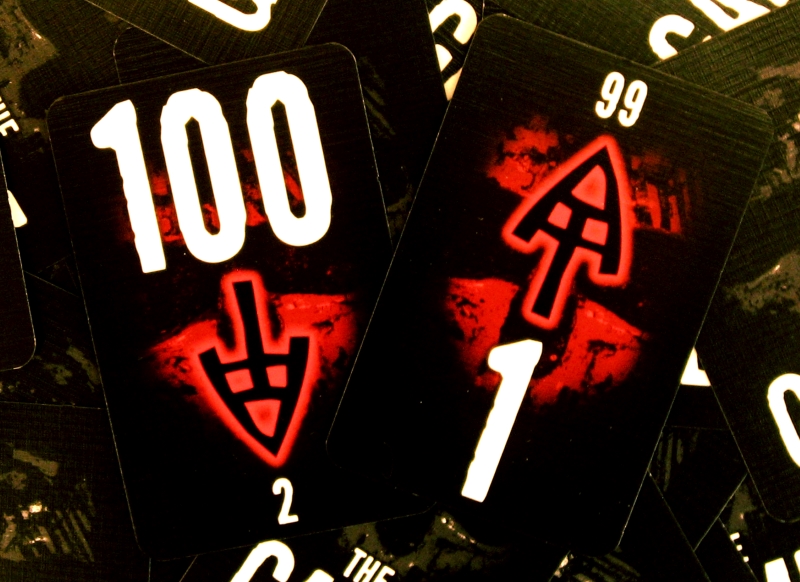
With the departure of Red and Magenta, and Blue and Pink wanting an early night because they were travelling the next day, we decided to play another short game and opted for one of our current “go-to fillers”, The Game.  We’ve played this a lot recently, but only actually won once.  This time we started very, very badly indeed with nobody really having any very high or very low cards.  Then the inevitable happened and about half of us only had very high or very low cards.  We’ve known for some time that this game is a lot more difficult with more players and with five it is especially challenging.  Nevertheless, despite doing so appallingly badly at the start, the end result was not as bad as we expected and we finished with three cards left.

The Game
– Image used with permission of BGG contributor henk.rolleman

Learning Outcome:  Some games play very differently with different numbers of players.

22nd September 2015

It was a quiet night and, like last time, while we were waiting for people to arrive, we started off with the cooperative card game, The Game.  This time it was only a three-player game and we had a terrible start when Blue’s initial hand had nothing below forty or above sixty.  Things got worse when, a few rounds later she was left with little between ten and ninety.  We struggled on manfully, but we finished with a total of twelve unplayable cards left at the end – we were not even close to matching our recent success.

The Game
– Image by boardGOATS

With the arrival of Black and Purple, we decided to move onto our “Feature Game”, Notre Dame.  This is one of the first games published by the highly prolific game designer, Stefan Feld, who also designed some of our other favourite games including The Speicherstadt and Amerigo.  Feld’s games are often referred to as “point salads” – i.e. games where players can build their score from lots of different sources and Notre Dame is one of these games.  The round starts with the revealing of three character cards which can be hired at the end of the round.  This is followed by drafting three action cards:  each player draws three action cards from a personal deck of nine, keeps one and passes the other two to the player on their left.  From the two they receive, they then choose another one to keep and pass the remaining card on so that everyone finishes with a hand of three cards, one card from each of the two players to their right.

Notre Dame
– Image by boardGOATS

Beginning with the start player, there are then two rounds where each person plays one card, discarding the third.  One way of looking at this is as worker placement where the card drafting is just a novel way of restricting choices.  The actions include things like collecting victory points, collecting money, moving the players carriage and so on.  However, in order to be able to carryout the action, players must place a “worker” (called influence cubes in this game) on the corresponding sector of their map.  The clever part is that the reward yielded (i.e. how many victory points they get, how much money they receive or how far the carriage can move etc.) depends on the total number of influence cubes in the sector.  Thus, for placing the first cube in the banking sector, a player will get one coin, but if they later add a second cube, they get two coins, and so on.

Notre Dame
– Image by boardGOATS

At the end of the round, players can then hire one of the characters for the fixed cost of one coin.  Finally, once everything else has been dealt with, everyone increases their rat population according to the number of rats shown at the bottom of the character cards (which were first displayed at the start of the round).  If a player exceeds nine rats, then nasty things happen including loss of influence cubes and victory points.  Every third round, the cathedral is scored.  This is an area of the board that everyone can place an influence cube in, in exchange for a donation to the church.  When it is scored, a set number of points is divided amongst the players depending on how many influence cubes they have in the Cathedral area.  For example, in a five-player game, twelve points are up for grabs; when four of the players each have one cube in the cathedral, they will get three points a piece, but if there is only one player with a presence in the cathedral, that player will take all the points.

Notre Dame
– Image used with permission of BGG contributor punkin312

Like most good worker-placement type games, players always want to do more things than they can.  For example, if a player does not have sufficient cubes in their personal supply, then they can move them from somewhere else.  That means the original action has one influence cube less, however, and consequently will yield less reward.  So, one of the actions is to get additional influence cubes.  For this reason, players have to try to make sure that they maintain a sufficient supply of cubes by carrying out the corresponding action.  With only two actions per round though, this is difficult.  Similarly, without money players cannot hire one the characters and at the end of the round, the rat population increases so it is essential that players stay on top of that too.  Meanwhile, the winner is the player with the most points at the end of the game, so players also have to try to collect victory points whenever they can.

Notre Dame
– Image used with permission of BGG reviewer EndersGame

Everyone started out a little unsure of what to do, but we got the hang of it quite quickly.  Black started out best, having played before he had an idea of what all the actions could do and how the game would develop.  At the end of the third round, the Cathedral points were shared evenly between Burgundy, Blue, Green and Black.  Meanwhile, Burgundy was trying to collect messages with his carriage with the idea that they would allow him to get points as well as maintain his cube supply and control his rat population.  However, this plan backfired and he got stuck without money which meant he couldn’t hire characters.  Green had a plan to try to alternate between picking up cubes and money, but somehow couldn’t quite make it work.  Blue was just picking up what she could when she could, and then got lucky picking up all the Cathedral points at the end of the sixth round.

Notre Dame
– Image used with permission of BGG contributor GogTad

Totaling up the scores showed that the game was much tighter than we all thought, but ultimately difference was caused by the Plague.  Blue and Green invested heavily in keeping their rat population under control, ensuring the plague never broke out and did best.  There were only eight points between second and last.  Being the sole beneficiary of the second batch of Cathedral points put Blue eight points clear of Green in second which annoyed him as he felt he could have shared the points if he’d spotted it (or listened to Black who had pointed it out just before his last turn).  We all really enjoyed the game, finding it a bit different with very tight  choices, especially at the end.  Definitely a game to try again sometime soon.

Notre Dame
– Image used with permission of BGG contributor punkin312

We finished the evening with a quick game of one of our current favourite “push-your-luck -fillers”, Om Nom Nom.  Burgundy won the first round with fifteen by taking a whole bunch of carrots unchallenged. Green declared that he disliked this sort of game because it was far too luck dependent.  The second round was much tighter; Green decided to try a new strategy – choosing two cards playing the one he least liked, but although this sort of worked for the first card or two, it didn’t after that.  Blue was the clear winner of the final round with sixteen, thanks to a swarm of flies.  This gave her a total of thirty-two, eight more than Burgundy in second and a clean(ish) sweep for the evening.  Green finished last – Luck?  What luck…?

Om Nom Nom
– Image used with permission of BGG contributor msaari

8th September 2015

We were late starting and, since we were expecting more, we decided to split into two groups and play something quick and light to start.  By coincidence, both groups began with cooperative card games.  Green, Grey and Cerise started with Hanabi – winner of the Spiel des Jahres a few years ago.  At the time we played it quite a bit, but Grey and Cerise had never been involved.  The idea of the game is very simple:  collectively, the players have to lay five cards in each of five colour-suits in numerical order.  The catch is that players are unable to see their own cards and instead turn their hand round so everyone else can see it.  As a group they then have to use deduction to work out which cards to play and in what order.

Hanabi
– Image used with permission of BGG reviewer EndersGame

On their turn, a player can do one of three things, play a card, give a clue or discard a card.  The number of clues is finite, though discarding cards buys extras.  When a card is played, the player doesn’t have to know what it is they are playing, so long as it can be added to one of the suits.  If it can’t, the group lose one of their three lives.  We have never been able to successfully complete the challenge of laying all twenty-five cards, so the group score is the sum of the highest card placed in each suit, or current maximum being twenty.   As a group we gelled well and through judicious use of efficient clues we were able to get lay all five cards for three colours and three cards for the other two.  This gave a total score of twenty-one, a new club record – definitely deserving of a “Very good! The audience is enthusiastic!”.

Hanabi
– Image used with permission of BGG contributor bovbossi

Meanwhile, Red, Blue, Cyan and Burgundy were playing the altogether less stressful, but equally puzzling, strangely eponymous, The Game.  Similarly, everyone has a hand of cards and they have to be played in numerical order, but in this case every card as to be played on one of four piles, two ascending and two descending.  There are two additional rules:  Players can say anything they want so long as they don’t give specific number information, and if they have a card exactly ten more or less than the top card of the pile they are playing it on, they can ignore the ascending/descending rule.  On their turn, players must play at least two cards before replenishing their hand, but can play as many as they want.

The Game
– Image used with permission of BGG contributor henk.rolleman

This was nominated for Spiel des Jahres this year and we’ve played it a few times since then.  Our best result was in a two player game a couple of months ago, when we had one solitary remaining card, however, we felt at the time that it might have been slightly easier with just two as you can plan better.  This time, it seemed were were doomed from the start with first Red, then Blue having nothing but really, really low cards and no-where to play them.  We managed to survive that though, and with a couple of really effective uses of the “Backwards Rule”, we managed to exhaust the draw deck.  Blue checked out first, quickly followed by Cyan and Burgundy leaving Red to play her last few cards and close out our first victory.  Next time we will have to play with one less card in hand…

The Game
– Image used with permission of BGG contributor joeincolorado

The games finished pretty much simultaneously and then a great debate began as to what to play next and how to split the group given that there were people who didn’t want to stay late.  Green proposed Eketorp, but this is one of Blue’s least favourite games, so she was looking for an alternative when Grey asked whether we had anything that would play everyone.  Blue mentioned Bohnanza, but although Red’s eyes lit up and Cerise looked interested, this time Green was not keen.  Grey wanted to play something with “fighting” and eventually, Green and Grey got fed up with the discussion and decided to play a head-to-head game of Carcassonne.

Carcassonne
– Image by BGG contributor ldaponte

Carcassonne is probably one of the best known of the modern, Euro-games, and is often considered to be “nice” – this is not true when it is played with just two however.  The idea of the game is that players take it in turns to draw and place tiles on an ever-growing map.  They can then add a meeple to any features on that tile before scoring any features that have been completed as a result of placing it.  Players have a finite number of meeples and, with two players, muscling in on someone else’s city is just as effective as building one yourself, making it very definitely, “nasty”.  And so it proved.  Playing with the first expansion, Inns & Cathedrals, Grey started with a few meeples on roads while Green placed a couple of early farmers. Green then took an early lead by completing a city with a cathedral, but then seemed to stutter. Grey continued to plug away eventually catching and passing Green nearly lapping him.  Green was hoping to reap the rewards of the early farmers, but with his last two tiles Grey placed a cheeky farmer and then joined it to the big field.  This cancelled out the huge farm bonus and put the game beyond doubt by sharing Green’s massive thirty-three point farm, finishing forty-one points ahead.

Carcassonne
– Image by BGG contributor Hayzuss

On the other table, discussion had finally ceased an everyone had settled down to one of our current favourite filler games, 6 Nimmt!, another “laying cards in the right order” game.  Somehow, this is a really confusing game, but it is this feeling that you sometimes have control but not being sure why that makes it so compelling.  The game is played with a deck of cards numbered from two to one hundred and four, each of which features a number of “Bulls Heads” (mostly just one, but some have as many as seven).  The idea is that everyone then simultaneously chooses and reveals a card from their hand.  Then, starting with the player who played the lowest card, players add their cards to the four rows on the table.

6 Nimmt
– Image used with permission of BGG contributor punkin312

Each card must be added to the row which has the highest card that is lower than the one to be played, i.e. if rows end with ten, twenty, thirty and forty, then card thirty-five should be added to the row containing number thirty.  If the card played would be the sixth card in that row, then the player “wins” all the cards and the played card becomes the first card in the new row.  The winner is the player with the fewest “Bulls Heads” or “Nimmts” at the end of the game.  We generally play the game in two rounds with half the cards dealt out at the start of the first round and the rest for the second.

6 Nimmt
– Image used with permission of BGG contributor punkin312

With two players new to the game, chaos was inevitable, however, it was Blue who ended most out of synch, collecting twenty-four Nimmts in the first round, and Burgundy who managed to keep it together and escape without picking up a single card.  Roles were reversed in the second round with Blue winning with just six Nimmts while Burgundy picked up thirty-two!  Overall though, it was consistency that won through for Red who finished with a total of nineteen, five ahead of Cyan in second place.

Coloretto
– Image used with permission of BGG contributor punkin312

Carcassonne was still going on the next table, so Cerise mugged Grey for the house keys and headed off with Red and Cyan, leaving Burgundy and Blue to play a quick game of Coloretto.  This push-your-luck set-collecting game has had a few outings recently, and although three or four are much better numbers, we feel it plays surprisingly well with just two.  The idea is very simple, either you draw a coloured chameleon card and add it to a truck, or take a truck.  Players score positively for three sets and negatively for the rest, so the idea is to try to load trucks with coloured cards you want.  This time Blue started badly and from there it just got worse, finishing with Burgundy giving her a comprehensive thrashing, winning by more than twenty points.

Port Royal
– Image used with permission of BGG contributor jsper

Carcassonne and Coloretto finished together and Burgundy, Green and Blue decided there was time to give Port Royal another go.  We played it about a month ago, when it took a surprisingly long time for a quick filler, everyone said they’d like to try it again, and Green worked out a strategy based on Expedition cards that he was keen to try.  In summary, the game is played in turns with the active player turning over cards.  They can keep turning over cards until either they choose to stop or they draw a second ship card that they cannot repel.  Assuming they choose to stop, they can then take a ship card or buy a character card before the remaining cards are offered round the table with players paying the active player one doubloon if they choose to buy/take a card.

Port Royal
– Image used with permission of BGG contributor punkin312

Last time we had found some issues with the rules which we had not really been able to resolve.  The question was, since the Admiral allows a player to take two cards, does that mean they apply the Jester/Governor special powers twice?  On reflection, after the last game we had felt that the way we played (by a strict reading of the rules) was incorrect as it meant the combination was exceptionally powerful.  So for our second try we didn’t allow this and subsequent checking online appears to suggest that we played the way the designer intended this time.

Port Royal
– Image used with permission of BGG contributor punkin312

Another question we’d had was, could a player repel a card if it was the first of a colour to be drawn, or is it only the second card that can be repelled?  Strict reading of the rules appeared to allow this, so this time we played this way.  Blue was the main beneficiary of this rules “change”, as she quickly added not one, but two Admiral cards to her earlier Sailor.  The ability to repel cards before it was essential makes it much more likely that a player is going to be able to draw five cards without going bust.  Since this gave Blue four doubloons every time, it meant she was never short of cash to buy the high value cards. Meanwhile, Green struggled to get his strategy to work with three (partly due to the lack of Expeditions) and Burgundy, who had wiped the floor with everyone else last time round, couldn’t get the cards he needed to get going quickly (not helped by the fact that he initially didn’t use the full power of his Jester).

Port Royal
– Image used with permission of BGG contributor punkin312

This time with just three it was a much, much quicker game and it played quite differently.  In the first couple of hands almost all the tax cards came out giving everyone extra money and it wasn’t until near the end that any of the mission cards were drawn.  It quickly seemed like Blue had the game in the bag although in the event, it wasn’t quite that cut and dried.  Blue brought the game to an end, but Green and Burgundy couldn’t quite get the cards they needed.  The game finished with Blue winning by five points and Burgundy taking second place on a tie-break.

Port Royal
– Image used with permission of BGG contributor msaari

Since Port Royal had played so quickly, we decided to give Zooloretto: The Dice Game a quick go.  This is a game that we’ve got out a couple of times, but then decided not to play because other people have arrived.  It was a while since we’d actually played it so we had to have a quick read through of the rules.  Each player rolls two dice, and like Coloretto or Zooloretto, they then place these on the trucks.  Alternatively, players can take a truck and tick off animals on their score sheet.  Bonuses are awarded for being the first player to complete an animal collection, but if the maximum is exceeded, then players lose points.  The game ends when one player has completed four of their animal collections and have only one space left in the last enclosure.

Zooloretto: The Dice Game
– Image used with permission of BGG contributor kilroy_locke

Burgundy started off well, with Blue and Green struggling to get any really helpful dice.  Burgundy both completed most sets first and also brought the game to a close, so the writing was on the wall:  he finished six points clear.  It was only when we were scoring, however, that we realised that Green hadn’t quite understood – he’d been going for lions assuming the bonus was lots more as you needed more of them to get the set.  Oops; blame the person explaining the rules…

Zooloretto: The Dice Game
– Image used with permission of BGG contributor henk.rolleman

Learning Outcome:  We like deep games, but little games can be a lot of fun too.

25th August 2015

It was a very quiet night, so we decided to leave the feature game for another occasion and started with the gorgeously produced Helios instead. This was a new one for all of us, so we had the inevitable long set-up and rules reading – it sounded both complicated and simple.  Players take the role of spiritual Guardians, tasked with forging and evolving the cultures assigned to them by Ahau, the Sun God. During the game, Players will collect resources, explore lands and build temples and other buildings.

Helios
– Image used with permission of BGG contributor punkin312

The power of the sun drives everything in the game as players try to build temples, expand cities, and generally make their civilization flourish.  Players can also harness other realms and use their power and invention to further develop their culture.  Development can only succeed, however, with sufficient raw materials which are limited and become increasingly expensive as players build their temple.  The game’s currency are Glass mana-stones, which can be used to recruit people.  Victory Points are awarded for buildings, the number of recruits, the collected energy (or mana).  Additionally, as the game progresses, the sun moves round the player’s board and bonuses are awarded depending on the way the civilisation has evolved.  The winner is the Guardian that has the most advanced culture after a given number of rounds (i.e. the player with the most Victory Points) and receives full blessing from Ahau.

Helios
– Image used with permission of BGG contributor punkin312

Every part of the game was simple, but how much we had to do and the best order to do them in seemed complicated.  We eventually found it flowed quite well, however, and we found the game easier to follow than we expected.  This did not stop the confusion over what strategies to employ and which actions were best though.  Throughout the game no-one had any inkling as to who had worked it out best and was in the lead.  Purple built many tiles and buildings, while Black eventually went for a small island with temples and thus a fast moving sun to gain the regular rotation points.

Helios
– Image used with permission of BGG contributor duchamp

Burgundy went for a mana strategy from the beginning, giving him the choice of characters.  Inevitably, he took the Treasurer which gave him extra points for remaining mana and resources at the end of the game. meanwhile, Green went for a building strategy as he gained the Architect which gave him extra points for every building and temple. This character alone, netted him twenty-seven points.  This gave a total of one hundred and seven points, just three ahead of Burgundy and six clear of Black.  Everyone was amazed at how close the final results were, and as we put the game away, we decided that we liked it, but had yet to really work out how best to approach it.  We’re all looking forward to an interesting second game.

Helios
– Image used with permission of BGG contributor punkin312

Despite the box claiming it should take less than an hour, we had taken the best part of two hours excluding set-up and rules reading!  So, we decided to play a shorter game next that everyone knew, and chose Splendor.  This is an engine building game that we’ve played quite a bit since last year when it received a Spiel des Jahres nomination.  The idea is very simple – on their turn players can either take chips, or use chips to buy cards from the display drawn from three different decks.  The cards in the display can then be used to help buy other cards and sometimes also yield victory points.  The winner is the player with the most points at the end of the round when one player reaches fourteen.

Splendor
– Image by BGG contributor duchamp

This was an intense game with close scores all the way to the end and amazingly the deck feeding the first row completely exhausted.  In the end, it was a close contest between Black and Burgundy as to who could close out the last few points.  Black just didn’t have enough in his last turn to buy anything, mostly because Green had nabbed the card he wanted.  So Burgundy took the spoils to finish the night.  Just the two games played, but both were close-fought and interesting.

Splendor
– Image used with permission of BGG contributor punkin312

Learning outcome:  Always allow at least two hours for a new game, whatever the box might say!

11th August 2015

It was a quiet week, so unsure of how many people we would be, we started out with what was supposed to be something quick, our “Feature Game”, Port Royal.  This is a fairly light card game with elements of push your luck and and deck (or rather tableaux) building.  On their turn, the active player turns over the top card from the deck:  this could be a coloured Ship, or a Person.  The player then has two options, they can turn over another card and add it to the row, or take one of the face up cards.  They can continue turning over cards either until they choose to take one or until they go bust because they draw a Ship and the colour matches one that has already been revealed.

Port Royal
– Image used with permission of BGG contributor punkin312

When taken, the coloured Ships are immediately exchanged for money according to the number of coins shown on the card.  They also have a military value which is where the People cards come in.  The People cards cost money, but in general, yield both victory points and special powers.  For example, Sailors and Pirates give players a military strength.  If their strength matches that of a Ship, the active player may repel the Ship to avoid going bust.  There are also Settlers, Captains and Priests which are used to fulfill the requirements of Expeditions.  Expeditions are cards that are immediately put to one side when drawn and allow players to increase their number of victory points by trading People cards for the higher value Expedition card.

Port Royal
– Image used with permission of BGG contributor jsper

There are other People cards too.  For example, the Governor awards players two extra coins if there are five or more cards on the table, and the Admiral allows players to take more than one card. Once the active player has taken their turn, then the next player can choose to take a card from the remaining face up cards, paying the active player one coin for the privilege.  Once everyone has had the chance to take a card, play passes to the next player.  The game end is triggered when one player hits twelve victory points and play continues until everyone has had the same number of active player turns.

Port Royal
– Image used with permission of BGG contributor punkin312

The game has obvious elements of “push your luck card turning” like Incan Gold, dual purpose cards like Bohnanza, tableau building like 7 Wonders and Dominion, and set collecting like Splendor.  However, it also has other interesting features.  One of the most interesting aspects was the way that the appearance of some cards is delayed because they are tied up as currency.  This meant that in our game, the Tax Man didn’t appear at all for the first half of the game and then appeared several times in quick succession.  Similarly to Bohnanza, the composition of the deck also changes.  In Bohnanza, the deck shrinks dramatically and as all the rare cards are turned into money their rarity increases.  In Port Royal, it is the People cards that become rarer as they are played into harbours, and ships, which start off quite scarce, become increasingly common increasing the chances of going bust.

Port Royal
– Image used with permission of BGG contributor msaari

Black and Purple started out collecting Settlers, Priests and Captain cards, hoping for an opportunity to upgrade the victory points with Expedition cards.  Blue and Burgundy eschewed Expeditions and instead went for the expensive People, with powerful actions.  That said, Burgundy struggled at the start, going bust in the first two rounds which left him penniless and hampered his ability to buy anything at all.  Meanwhile, Green was fighting just to get the cards he wanted before someone else pinched them.  Eventually, Purple took her second Expedition card and triggered the end of the game, but nobody else was close enough to threaten her position; Burgundy took second on a tie-break with Green, who both finished with nine victory points .

Port Royal
– Image used with permission of BGG contributor punkin312

The rules booklet was not the best, however, and there were a number of questions we had that went un-answered.  For example, we were unclear on how to combine the Admiral with either the Jester or the Governor.  The question was, since the Admiral allows a player to take two cards, does that mean they apply the Jester/Governor special powers twice?  On reflection, we felt the way we played (by a strict reading of the rules) was incorrect as it meant the combination was exceptionally powerful.  Similarly, could a player repel a card if it was the first of a colour to be drawn, or is it only the second card that can be repelled?  On balance, although it was a long way from being the “quick game” we expected, we all enjoyed it and felt it was a good game.  Green in particular was quite taken with the effect the dual-use of the cards had on the draw deck and everyone had had thoughts on how they could have done better, but it was fitting that the one who currently has to wear an eye-patch won the pirate game!

Snowdonia: The Daffodil Line
– Image used with permission of BGG contributor tonyboydell

After some debate, we decided that we wanted to play a deeper game next which meant we were quite limited as we didn’t have many five-player games.  We all enjoy Snowdonia, so since we’ve all played it before we thought we could fit it into the time we had left despite the prolonged setup time (not helped by the fact that Blue’s box contains most of two copies).  Unfortunately, we got side-tracked by the possibility of playing one of the alternative scenarios.  We started setting out The Daffodil Line and then we realised it only played four, so as the game is very tight anyhow we decided not to try to stretch it to five and broke the shrink-wrap on Britannia Bridge instead.

Snowdonia: Britannia Bridge
– Image used with permission of BGG contributor tonyboydell

Snowdonia is a very tight, worker placement game, where players have just two workers and an optional third if they have the required train and coal.  The game simulates building a railway, with players first choosing actions in turn order, then carrying out the actions in “action order”.  The actions include collecting resources from the stockyard, clearing rubble from the route, building track, and building stations.  There are points for most things, but one of the actions is to take contract cards which give players extra points for completing a set number of given tasks (e.g. laying three sections of track).

Snowdonia
– Image used with permission of BGG contributor ansi

There are a number of interesting aspects to the game.  Firstly, the weather.  Snowdonia is well known for its rain, fog and very occasional sun, and this has an effect on the rate players can perform tasks.  Secondly, the author, Tony Boydell, is known to dislike resource hoarding and has built in a mechanism to discourage it.  At the start of each round, resources are drawn from a bag and placed in the stockyard.  There are also a small number of white cubes in the bag – for each one that is drawn the game carries out an action.  Since resources are limited, if players hoard them, the chance of drawing white cubes increases and the game speeds up, perhaps unpredictably.

Snowdonia
– Image used with permission of BGG contributor winterplum

Britannia Bridge (or Pont Britannia in Welsh) is the bridge across the Menai Strait between the the mainland of Wales and the island of Anglesey and the scenario simulates building a railway from the mainland to Holyhead on Anglesey.  Thus, before players can build any track, they have to build the bridge.  Uncharacteristically the weather remained quite sunny, though as it was Anglesey rather than Snowdonia, perhaps that was to be expected.  This kept the dig rate up and the track-bed was cleared in record time.  However, although four white cubes came out in fairly quick succession, after that, they seemed to lurk in the corners of the bag, so much so that we checked they were there twice.

Snowdonia
– Image used with permission of BGG contributor winterplum

Black and Purple both built locomotives early giving them the distinct advantage of the optional temporary labourer.  Black used his to move his Surveyor collect contract cards and Blue decided to obstruct his plans by taking the some of the most lucrative (but most challenging) contracts.  Everyone else looked at the short track and some of the high scoring options and decided to go for points.  Blue, Green and Burgundy decided to wait until the maintenance was done before buying a train, but since the white cubes were so slow, by the time it happened they all decided the game was too far advanced for it to be worthwhile.

Snowdonia: Britannia Bridge
– Image used with permission of BGG contributor tonyboydell

Although Black got an early train (The Dawn Raider) and made good use of his extra worker, he was unable to used his special ability as it depended on white cubes being drawn.  Purple took the nine point train and also used the extra worker to move her surveyor.  Burgundy scored a massive number of points by building bits of stations and the game sort of stalled with one track left to build and nobody very keen to build it.  Green eventually got fed up and felt everyone else was picking up points faster than he was, so he decided to end the game.  Blue somehow managed to scrape it all together in the last round building the last siding she needed to fulfill her thirty-one point contract for four track sections and grabbed a six point contract which she had already fulfilled.  These, together with other bits and pieces this gave her a total of seventy-nine points, just two ahead of Black (who also completed three contracts) and someway clear of Burgundy who took third place with sixty-six points.

Snowdonia
– Image used with permission of BGG contributor winterplum

Although we enjoyed the variation and the Bridge undoubtedly changed the start, the different scenario didn’t change the game very much:  contract cards were still very powerful and ultimately made the difference though Burgundy did incredibly well just building stations.  In short, the weather and its effect on the “dig rate” together with the lack of white cubes made a much larger impact on the game than the Bridge.   And that can happen in any game of Snowdonia.

Snowdonia
– Image by BGG contributor aleacarv

Learning Outcome:  The weather has a big influence on building a railway, wherever you choose to build it.

28th July 2015

We started the evening splitting into three groups, the first of which played Machi Koro.  This was the “Feature Gamea couple of months back when it received a nomination for the coveted German Game of the Year, or Spiel des Jahres Award.  In essence, it is an engine building game with elements taken from The Settlers of Catan and Dominion.  Like Settlers, on their turn players first roll one or two dice, which yield resources, in this case money.  Players then use their money to buy cards like Dominion.  Each card is numbered and provides money, sometimes when the owner rolls, sometimes when someone else does, with the amount sometimes depending on the other cards a player has.

Machi Koro
– Image used with permission of BGG reviewer EndersGame

Players have five special buildings costing varying amounts and the winner is the first player to build all of them.  Red, Yellow, Orange and Cyan started setting up while people finished eating, but Red emigrated to play the hidden traitor game, Saboteur, with Teal and Violet when they arrived.  This is one of those little games that everyone always enjoys playing and plays lots of people well.  With only three players, it’s possible to have one bad dwarf, or none at all which makes everyone very twitchy, and as usual, accusations abounded.  After three rounds, Teal ran out the winner with five gold.

Saboteur
– Image used with permission of BGG contributor mothertruckin

Machi Koro and Saboteur finished together to the two groups coalesced to play Colt Express.  This had been the “Feature Game”, last time, however, none of this group had been available to play.  Red was particularly keen to give it a go as it has a lot in common with one of her favourite games, Walk the Plank!.  This style of game is sometimes refereed to as a “programming game” because players play all the cards and only after everyone has played cards, do they get to action the cards.  The effect of this is semi-organised chaos as players try to make plans to take care of all eventualities, and then find that by the time they get round to carrying out the actions the situation has completely changed and is nothing like they would have predicted.  This time, Orange took the $1,000 for the sharpest shooter and Cyan took the strongbox.  Despite this, the best thief turned out to be Yellow who finished with $2,700 some way ahead of Cyan in second place.

Colt Express
– Image used with permission of BGG contributor henk.rolleman

Meanwhile, everyone else had been playing the “Feature Game”, which was Last Will.  This is basically the boardgame equivalent of the 1985 film “Brewster’s Millions”.  The story goes that in his last will, a rich gentleman stated that all of his millions would go to the nephew who could enjoy money the most.  In order to find out who that would be, each player starts with a large amount of money, in this case £70, and whoever spends it first and declares bankruptcy is the rightful heir, and therefore the winner.

Last Will
– Image used with permission of BGG contributor PaulGrogan

The game is played over a maximum of seven rounds each comprising three phases.  First, starting with the start player, everyone chooses the characteristics of their turn for the coming round from a fixed list.  These include the number of cards they will get at the start of the round, the number of “Errand Boys” they will be able to place, the number of Actions they will get and where they will go in the turn order.  For example, a player may choose to go first when placing Errand Boys, but will then only get one card at the start of the round and crucially, only one Action.  On the other hand, a player may choose to sacrifice position in the turn order, draw no cards, only place one Errand Boy, but receive four Actions.  Since all but two cards are discarded at the end of the round and Actions must be used or lost, this decision is critical.

Last Will
– Image used with permission of BGG contributor Toynan

Next, in the revised turn order, players take it in turns to place one Errand Boy before placing their second if applicable.  Errand Boys are important as they allow players to control the cards they are drawing as well as manipulate the housing market and increase the space on their player board.  The heart of the game is the cards, however, which are played in three different ways:  as a one off (white bordered cards); on a player’s board (black bordered cards) or as a modifier (slate bordered cards) which enable players to spend more when black or white bordered cards.  Thus, White bordered cards are event cards which cost a combination of money and Actions to play, but once played, are discarded.  Black bordered cards cost at least one Action to play, but are kept and can be activated once in each round.

Last Will
– Image used with permission of BGG reviewer EndersGame

Black bordered cards come in three different types: “Expenses” which allow players to spend money; “Helpers” which additionally allow give players some sort of permanent bonus, and “Properties” which are by far the most complex cards in the game.  Properties are an excellent way of spending money as they are bought for a given amount and will either depreciate every round, or will require maintenance which can be expensive. Unfortunately, players cannot declare bankruptcy if they have property and must sell them.  This is where the property market comes in:  one of the possible errands is to adjust the property market, so if a property is bought when the market is high and sold when it is low, this is another possible avenue for losing money.

Last Will
– Image used with permission of BGG contributor bswihart

At the end of the round, everyone reduces their hand to just two cards and loses any left-over actions, which puts players under a lot of pressure as it makes it very hard to plan.  So the game is an unusual mixture of timing, building card combinations, strategy and tactics.  Only Blue had played it before and that was a long time ago, so it took a long time to explain the rules and make sure that everyone understood how the cards worked.  Even then, there were a lot of misunderstandings.  Burgundy had also read the rules quite carefully as well though and mostly managed to keep everyone on track.

Last Will
– Image used with permission of BGG contributor Toynan

Green (as the last person to the bar and therefore the last person to buy something) went first and started out with an “Old Friend” which gave him an extra action.  Burgundy went for a “lots and lots of cards which don’t cost an Action to activate” strategy while Black and Purple went into the properties market.  Meanwhile, Blue’s starting cards favoured buying farms, but by the end of the first round it was becoming clear that the cards she needed weren’t there and an Events strategy would probably be better.

Last Will
– Image used with permission of BGG reviewer EndersGame

Towards the end of the fourth round it was becoming obvious that Burgundy’s preparation (reading the rules) was paying dividends as he was systematically spending more than £12 per round – the amount needed to force an early finish to the game.  Blue on the other hand was trying to work out why her pile of poker chips didn’t seem to be decreasing.  By the end of the fifth round it was clear that Green was pressing Burgundy hard and there would only be one more round.  A quick bit of maths also suggested that there had been a “banking error”.  Although it would normally be in Blue’s favour, unfortunately, as this is game where players are trying to lose money, it didn’t help her.  Since she had been in charge of the poker chips though, it could only have been her own fault.

Poker Chips
– Image by boardGOATS

The game came to an end in round six when Green ran out of chips.  This left him with a final total of zero and everyone else trying to make the best of the final round.  Black and Purple tried selling off their properties and Blue held another couple of expensive parties, but it was Burgundy who spent £20 to finish the winner with £13 of debt.  As we put the game away, we agreed that it was quite an unusual game, though quite complicated, especially on the first play.  We also all felt that it was the sort of game that would benefit from the familiarity with the cards that comes from repeated plays, so it is quite likely that we’ll play it again soon.

Last Will
– Image used with permission of BGG contributor CellarDoor

With everyone else gone, there was just time for a few quick rounds of Love Letter.  This is a game we played a lot a year or so ago, but not so much recently.  The first of the so-called “micro games” it is played with just sixteen cards.  Each player starts with one card and on their turn, draws a second card and then plays one of them.  Each card has a value (one to eight) and an action (discard a card, swap cards with another player, compare cards, etc. etc.).  The object of the game is to have the highest card when the deck has been exhausted or, be the last person remaining, which ever is soonest.  For variety, we played with Green’s much loved, very battered, previously lost but recently re-found, home-made, “Hobbit” themed deck, complete with tiny gold rings.  So, the first problem was remembering what all the cards did and then trying to match them to the new characters…  With five, we played until the first player had two rings – everyone got one except Burgundy before Black won a second round and finished as the winner.

Love Letter
– Image by boardGOATS

Learning Outcome:  Spending money is not quite as easy as you think.