Category Archives: News

17th Movember 2021 @ The Women’s Institute

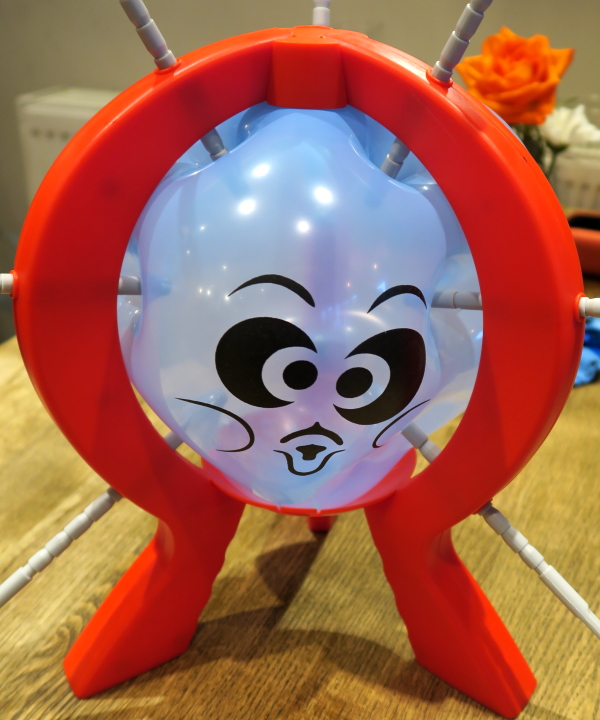
Invited to introduce the Stanford-in-the-Vale Women’s Institute to the concept of modern board games, Blue and Pink took a pile of light games to the Village Hall.  After the obligatory rendition of William Blake’s Jerusalem, in tables of four, people were introduced to No Thanks!, Coloretto, Tsuro, Indigo, Riff Raff, Second Chance, Aber Bitte mit Sahne… and Just One.  Rather inevitably, the biggest success, however, was Boom Boom Balloon—it was quite a sight to see the middle aged ladies of the WI competing to make the biggest bang!

Boom Boom Balloon
– Image by boardGOATS

3rd Movember 2021

Blue and Pink were, unexpectedly, joined by Green and Lilac thanks to a clock-reading malfunction.  So while Blue and Pink were dealing with their dinner, Green introduced Lilac to Tsuro.  This is a very accessible game that we actually managed to play a little over a year ago from home, but is much better played in person.  Each player starts with a stone lined up on the edge of the board and a hand of three tiles.  On their turn, they place one of their tiles on the board next to their stone, and move their stone along the path on the tile, then replenish their hand.
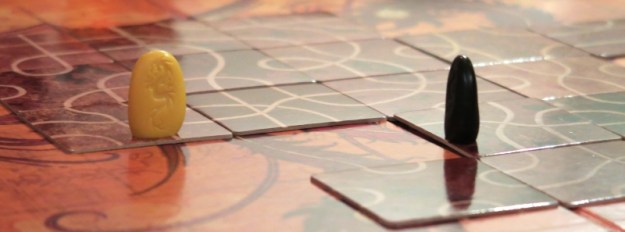
Tsuro
– Image by boardGOATS

The aim of the game is to stay on the board the longest, with the last player remaining, the winner.  It wasn’t long before Lilac had Green on the ropes and Blue and Pink urged her to take her chance and finish him off.  It’s not in Lilac’s nature to go for the jugular, however, and despite the encouragement, she didn’t make the most of her opportunity.  Inevitably, Green wriggled free and it wasn’t long before he was edging Lilac off the board himself.  With the first game over, and Blue and Pink finishing their dinner, there was a little chatter before others arrived and players were deciding what to play.
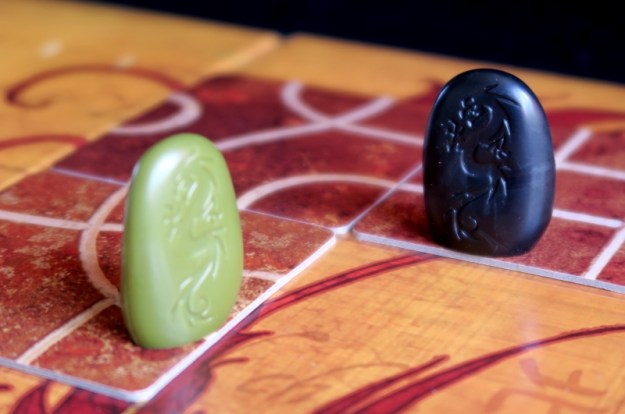
Tsuro
– Image by boardGOATS

The “Feature Game” was to be Modern Art, which is an auction game where players are buying and selling art trying to make a profit with paintings valued by the number of artworks of that type that were sold.  It is an older game, nearly thirty years old, and several people had played it before, albeit some years ago.  When Green admitted that he hadn’t really enjoyed it, Pink was shocked and suggested that not liking Modern Art was akin to not liking puppies, at which point Green, much to Pink’s horror, admitted he wasn’t that keen on them either…

Modern Art
– Image by boardGOATS

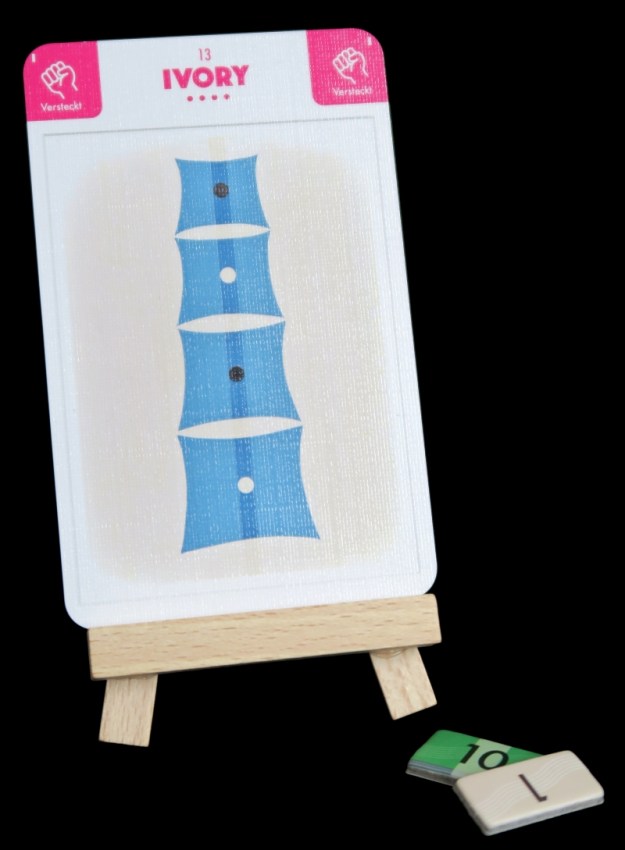
Needless to say, when settling on games, Green took himself away from the slightly offended Pink and his copy of Modern Art leaving him (with his brick and sack comments), to play the “Feature Game” with Ivory, Blue and Teal.  The game is a simple, yet clever auction game, and therein lies the problem—the group has had mixed responses to auction games.  For example, the highly regarded Ra (like Modern Art designed by Reiner Knizia) received mixed responses when that was played, however, one of the all-time favourites, Keyflower, is an auction game at its heart (though to be fair it doesn’t really feel like one).
Modern Art
– Image by boardGOATS

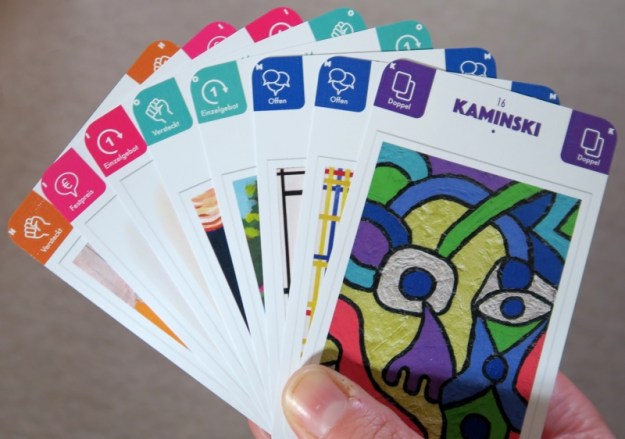
The group (aside from Pink) was therefore slightly reticent, but went for it positively, and in the event, really enjoyed it.  Each round consists of several auctions, each of which is conducted by a player.  The auctioneer chooses one card from their hand which is auctioned according to the indicator on the card.  There are five possible auction types:  Open, Fixed Price, Sealed Bid, Once Round the Table, and Double (where two pieces by the same artist are offered at the same time).

Modern Art
– Image by boardGOATS

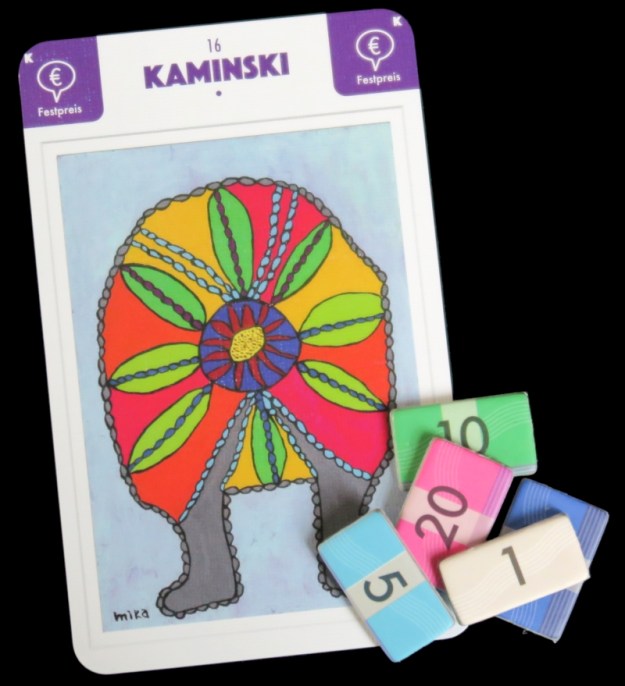
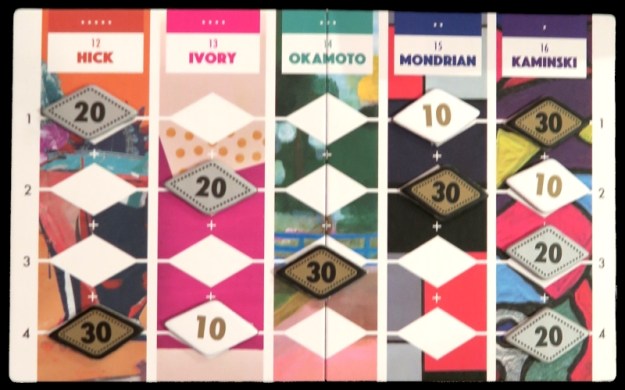
We were playing with the new Oink Games version, which features real modernist artwork from the likes of Mondrian, Kaminski and Ivory (who obviously has talent we were hitherto unaware of).  When the fifth work by an artist is offered for sale, the round ends (without the final auction), and the works valued.  The value depends on how many paintings were sold by that artist in the round, with the value increasing by $30,000 for the most popular.  Players then sell their art to the bank, but here there is a catch.  Players only get a return on art by the three most popular artists in that round—everything else is worthless.  The value of the art that is sold, however, is the cumulative total including increases over all the previous rounds.
Modern Art
– Image by boardGOATS

Thus, players sell their art giving them money to buy more, and more expensive art in the next round. Although the mechanics are clever, what makes the game fun is the auctioneer’s pitch as they try to describe the work they are selling and draw the other players’ attention to its clear and obvious assets and up-sell it.  One notable lot by Kaminski was initially described as “a cat’s pencil sharpener” and then to much hilarity as “a charming number depicting someone bending over picking up a fiver.”  The game ends after four rounds and the player with the most money at the end wins.
Modern Art
– Image by boardGOATS

This time, players clearly had a bit of a fixation with Kaminski with his works being the most popular in the first round, with Hick and Mondrian making a distant second and third.  The initial popularity of Kaminski inflated the perceived value of his work in the second round and, although fewer works were offered for sale, it still scored, though the Mondrian age was upon us.  The third round was dominated by the works of Okamoto, putting in a brief, but valuable appearance for those that made purchases, as it provided funds for the all-important final round.  This led to a resurgence of Hick as the most popular together with poor Ivory, who’s work had hitherto only had a brief period in the limelight in the second round.

Modern Art
– Image by boardGOATS

The eternal popularity of Kaminski continued until Blue brought the game to an end with a double auction ensuring Kaminski’s works gave a return again, and having scored in every round, they were very lucrative.  Despite the game feeling like there was a lot of ebb and flow, the final scores were remarkably close with a mere twenty grand between first and third—fine margins indeed in a game where the scores were measured in hundreds of thousands and players reserves fluctuated wildly during rounds.  It was Blue though, who made the most, finishing with $392,000, just ahead of Ivory (the gamer rather than the artist).
Modern Art
– Image by boardGOATS

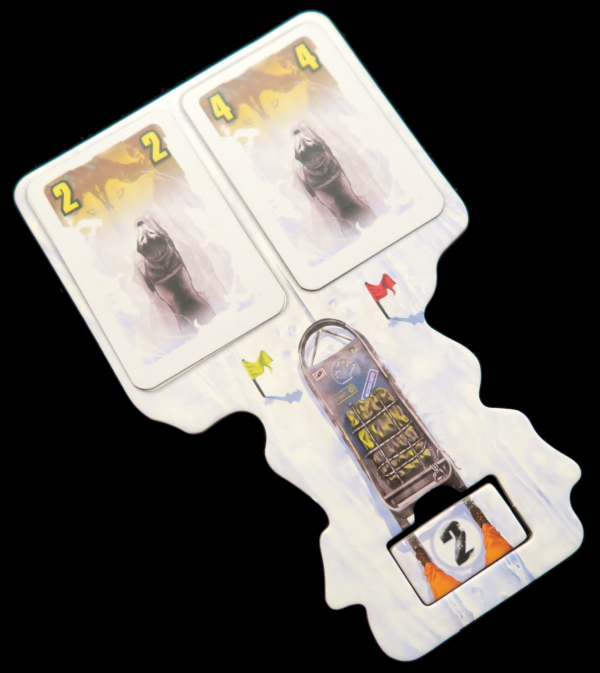
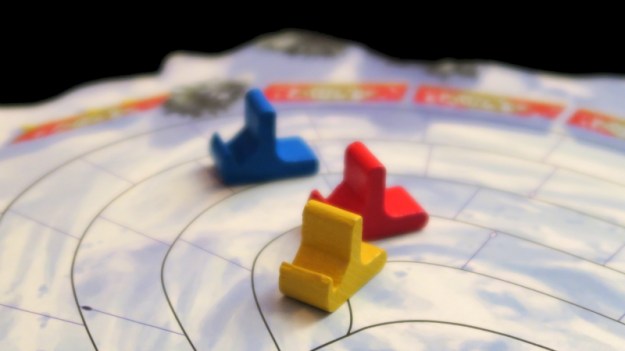
Meanwhile, at the other table, Green, Lilac, Purple and Black (who also expressed a dislike of Modern Art, though not of puppies), were playing the puppy related game, Snow Tails.  This is a fun race game where players are racing dog sleds along a winding track of varying complexity.  The idea is that players have a hand of cards, which they play to adjust the dogs’ speed or apply the brake.  When they play cards, they can play up to three (one for each dog and one for the brake), but they must all have the same value.  The sled speed (how many spaces it moves) is then the sum of the dogs’ speed minus the value on the brake.
Snow Tails
– Image by boardGOATS

Additionally, the sled will drift left or right by the amount by which the two dogs’ speeds differ.  Players have to use this to negotiate corners and slalom round pine trees to get to the finish line.  The cards come from their own personal decks, and this is where the game gets clever because players have to manage the cards they play to make best use of them.  If a player crashes or goes into a corner with too much speed and exceeds the limit, they pick up a dent card.  These occupy space in the player’s hand which means they have less choice.

Snow Tails
– Image by boardGOATS

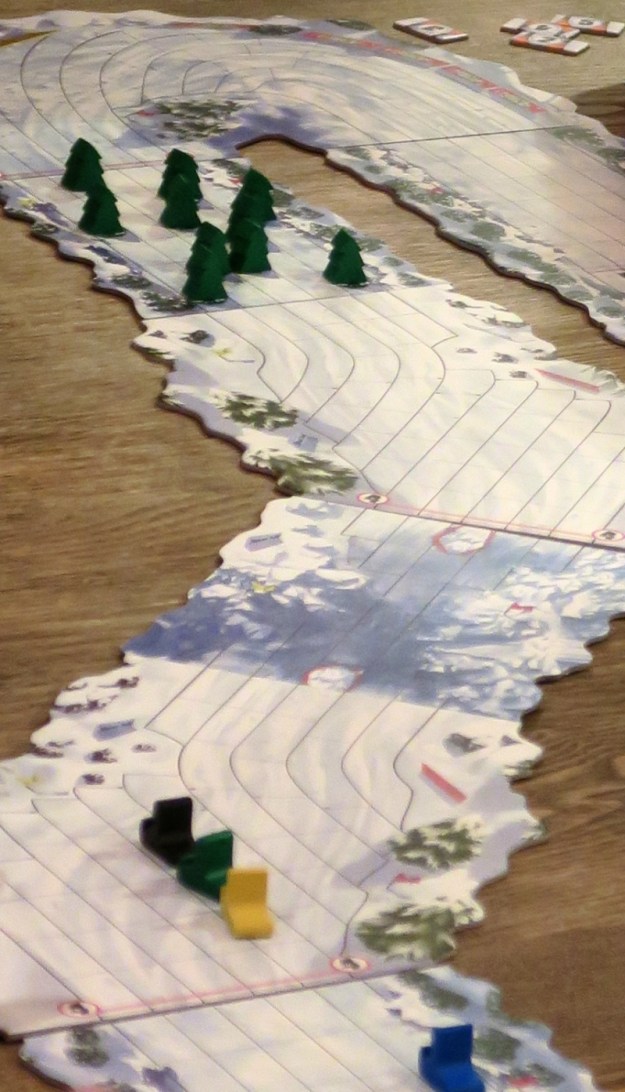
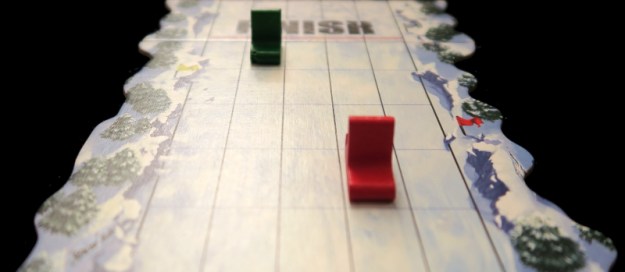
The first player to cross the line (or, in the case of a tie cross it and travel the furthest), is the winner.  The group spent far too long debating which track to use. Lilac had not played Snow Tails before so the group did not want to make it too extreme, but also not too trivial for everyone else.  In the end the group decided on a variation of “Treemendous” (chosen as it would fit on the “narrower than we would like” pub table) and swapping the first set of trees for a narrow canyon.  Through random selection, Lilac was chosen as start player, but as she wasn’t sure how the game would play she took a gentle start so Purple, Green and Black shot past her at speed.

Snow Tails
– Image by boardGOATS

Through the first corner and approaching the Canyon, Purple hit the side of the track and slowed up, while Green and Black raced forward. Lilac took her foot off the break and caught Purple, who was struggling to get her head around which side of the sled needed the higher number to move to the right to get around the corner.  With the bend successfully negotiated Black slowed for the canyon, but Green decided to let rip through it. He made it in one go without hitting anything, but was on the outside for the next corner.  Black took a steadier run through the canyon and came out on the inside of the corner behind Green.
Snow Tails
– Image by boardGOATS

Lilac also maintained a steady pace taking a couple of turns for the Canyon, while Purple continued to dally at the back, hampered somewhat by her reduced hand size from her earlier crash. Black and Green raced to the forest, with Black reaching it just before Green. He “dropped an anchor” and came to an almost complete stop at the entrance right in front of Green, causing him to slow up sharply and swerve to the left instead of taking the route ahead he had planned.

Snow Tails
– Image by boardGOATS

Black managed to clear the forest first but found himself drifting towards the outside of the long hairpin bend. Green was close behind, but his direction of travel sent him to the inside.  Lilac continued her steady progress, avoiding the hazards and came through the forest unscathed in the middle of the track.  Black and Green were racing hard:  Black had the speed, but was forced to the outside of the track and wasn’t able to make progress while Green going more slowly on the inside, manage to squeeze past to get just ahead.  Then it was a straight fight to the line.
Snow Tails
– Image by boardGOATS

Black was able to lift his break to a one, but could only manage a double four, so he positioned himself less advantageously to try and block Green. It didn’t work as Green came off the corner on another track, but he was a little heavier on his break, so still on a two, and also a double four, Black managed to just slide past for the win finishing just ahead.  Lilac continued her steady progress and finished the following round while Purple took a more leisurely ride through the forest, came out on the outside of the bend.  Struggling to stay on the track on the way round the corner, she finally found her speed down the final straight and came flying off the end of the track, unfortunately a couple of rounds too late to win.
Snow Tails
– Image by boardGOATS

Snow Tails was still going when Modern Art finished, but only just, so Tsuro got a second outing of the evening.  This time, Blue was out first by killing herself and taking her piece off the board, quickly followed by Pink who committed harakiri in a similar fashion.  That left them to cheer on Teal and Ivory.  It was close and they were down to the last few tiles, but in the end, Teal took victory when he pushed Ivory off the board.  As the huskies settled down for a well-earned nap, Pine arrived just in time for one last game of Bohnanza, replacing Green and Lilac who went home as they had an early start the next day.

Bohnanza
– Image by boardGOATS

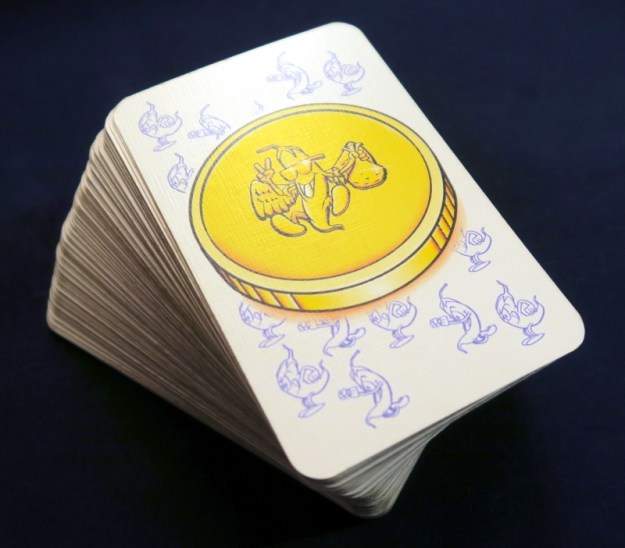
Bohnanza is one of our old favourites, and barely even needs a reminder beyond the rules that are specific for the particular player count.  With six, players start with different numbers of cards, they plant one or two beans turn over two bean cards from the deck, plant and trade, then draw four cards to replenish their hand.  Buying a third bean field is cheaper as well with six, costing two Bohnentaler instead of three.  This is important because the game is shorter with more players and some players barely get a turn in the final round.

Bohnanza
– Image by boardGOATS

As a result, buying a third field is always a bit risky, and the general consensus is that it is rarely worth it. This time was the exception that proves the rule however, with lots of people deciding to buy a third field.  This had the unintended effect of shortening the game as more beans were left in fields at the ends of the rounds.  This didn’t stop the usual hilarity when people made the occasional silly trades and players got unfeasibly lucky with the draw of the cards.  This time the winner was Ivory, two Bohnentaler ahead of Pine, but in truth, we are all winners with a game that is so much fun.
Bohnanza
– Image by boardGOATS

Learning Outcome: It is amazing how much money people will spend on tat.
Deutscher Spiele Preis – 2021

After last year, it has been refreshing to return to a semblance of normality with the announcement of the Deutscher Spiele Preis at Essen.  Unlike the Spiel des Jahres Award which is chosen by a committee with a list of strict criteria, the Deutscher Spiele Preis is the result of an open vote by games clubs, gamers and people in the industry.  Typically, slightly heavier games are rewarded, but it is a top ten list, so it caters for a range of tastes and complexities and the organisers are always keen to remind people that everyone who features is a winner.

– Image by BGG contributor Hipopotam

As usual, the games that feature in the Spiel des Jahres and Kennerspiel des Jahres Awards also feature high on the list with the winners, MicroMacro: Crime City and Paleo occupying second and fourth on the Deutscher Spiele Preis list, respectively.  The Adventures of Robin Hood, Everdell and Praga Caput Regni also make the top ten, but unusually the winner is a game that did not feature at all in the previous awards list, and is a cooperative game for children called Dodo.

Dodo
– Image used with permission
of boardgamephotos

In Dodo, the feather-brained bird has laid its egg on the highest mountain peak and let it fall out of the nest, towards the cliff edge.  Players work as a team to try to ensure the rolling egg safely reaches the foot of the mountain by collecting the building material they need, hammers and nails, and attaching bridges to the sides of the mountain.  So far it has only had a German language release and very little has been written about the game online in English.  Therefore it may be that the game owes its success to the fact that few people were playing games face-to-face when the voting was carried out.  It sounds like it might be fun though and certainly deserves a look.

Deutscher Spiele Pries 2021
– Image from
spiel-messe.com

Essen 2021

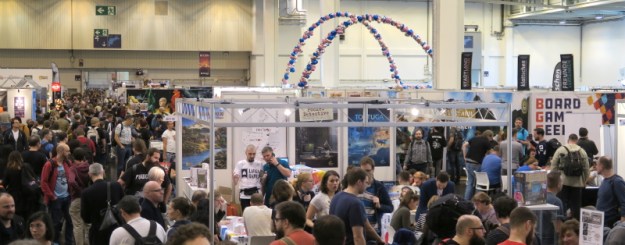
Today is the first day of this year’s Internationale Spieltage.   Known to Gamers worldwide simply as “SPIEL” or “Essen”, this is the largest games fair in Europe (and arguably the world), and is held annually in Germany.  The fair runs from Thursday to Sunday in October every year, and is of particular significance as many new releases are timed to coincide with the event just in time for Christmas sales.

Essen 2021
– Image from spiel-messe.com

It is one of the biggest and most significant of all the boardgame conventions.  Last year, like so many things, it fell victim to the global pandemic, and instead was held online, in a format that was widely considered unsatisfactory (especially to those used to visiting in person).  This year, there will again be a “virtual” event, but this time held alongside the “Real Spiel”, an event with limited ticket numbers and virus control measures in place.  Safety concerns and worries about practicalities mean the show will be much, much smaller than usual with only 60% of the usual attendees and many exhibitors noticeable by their absence.

Essen 2019
– Image by boardGOATS

Absentees include, 2F-Spiele, Cwali, Splotter, BoardGameGeek, and even the mighty Asmodee and all their subsidiaries.  As a result, this year, Essen is likely to feel more like the smaller, more intimate event of years gone by.  There are still lots of games making their debut though, including Messina 1347, Golem, Boonlake, Llamaland, It’s a Wonderful Kingdom, Cascadia and expansions for Keyper (Keper at Sea) and the 2021 Kennerspiel-winning game Paleo (Ein neuer Anfang!).  Sadly, none of the boardGOATS will be there to see them though.  Maybe next year…

Essen 2021
– Image from spiel-messe.com

Next Meetings, 6th & 7th October 2021

After much discussion, in August, we moved our meeting to Thursdays.  However, the Horse and Jockey have recently brought back their quiz on the first Thursday of the month, so this week we will be meeting on WEDNESDAY 6th October 2021.  As usual, we will start playing shorter games from 7.30pm as people arrive, until 8pm when we will start something a little longer (table is booked from 6.30pm for those who would like to eat first).

Some of the group are also keen to do the Quiz on Thursday 7th October.  So, we have booked a table from 6.30pm for those who would like food, and we’ll be playing games until the quiz starts at 9pm.

Last weekend was our nineth birthday, so as is now traditional, the “Feature Game” on Wednesday will be Crappy Birthday.  This is a silly little filler/party game that we can mess about with while people are eating cake allowing us to play something longer once everyone has arrived and finished food.

Crappy Birthday
– Image by boardGOATS

And speaking of birthdays…

It was Joe’s birthday, and his mum wanted to do something special.  She called him on the phone, but his housemate, Jeff, answered.  When Joe’s mum said she wanted to bring round a cake, Jeff was very excited.

“Oh, Mrs. Wilson,” Jeff said, “What a lovely idea – that would be great!”

That afternoon, Joe’s mum drove to the house and rang the doorbell. Jeff answered the door, but when he saw the cake, his face fell.

“Oh,” he said, clearly very disappointed. “I thought you said ‘keg’.”

Nine is Fine – Happy Birthday to Us!

Nine Today

BoardGOATS is Nine Years Old Today!

It really is nine years since our first meeting.  After a really tough year, we are finally back at The Jockey, and for the moment, we are definitely doing “fine”.  Somehow, we managed to keep things going through the challenge of remote gaming and have come out the other side.  After partying online last year, we are really looking forward to celebrating surviving another year, by meeting in person this week.

Boardgames in the News: The Museum of Board Games in Newent

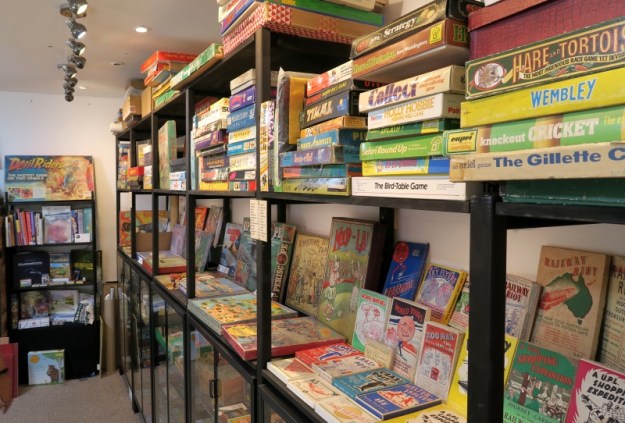
On 28th August, in the small Gloucestershire market town of Newent, The Museum of Board Games opened its doors for the first time.  The owner-curator is Tony Boydell, highly regarded designer of Snowdonia, Ivor the Engine, Guilds of London and Scandaroon amongst other games.  The exhibition is largely the boardgame ephemera he has been collecting over years of designing and playing games with friends and family.

Museum of Board Games in Newent
– Image by boardGOATS

At first sight it doesn’t seem like much—it is very compact, but actually contains a really surprising amount, and the games table front and centre, draws in unsuspecting visitors.  There are always a couple of games out on this table for people to fondle and play.  This could be anything from the fantastic War of the Daleks to Tiddley-Golf or Froschkönig.  As well as exhibits available to play, there are also little quizzes to encourage people to explore the displays and everything is labelled and tagged by the museum cat.

Museum of Board Games in Newent
– Image by boardGOATS

For the most part The Museum of Board Games comprises games from the 20th century, but there are also copies of The History of England (until George III) from 1803 and more recent games like Glory to Rome and Ticket to Ride: The Card Game.  The most unusual and rare pieces are on display in cases, but one of the nicest things about the museum are the stacks of game boxes ready to be taken off the shelf and looked at in detail.

Museum of Board Games in Newent
– Image by boardGOATS

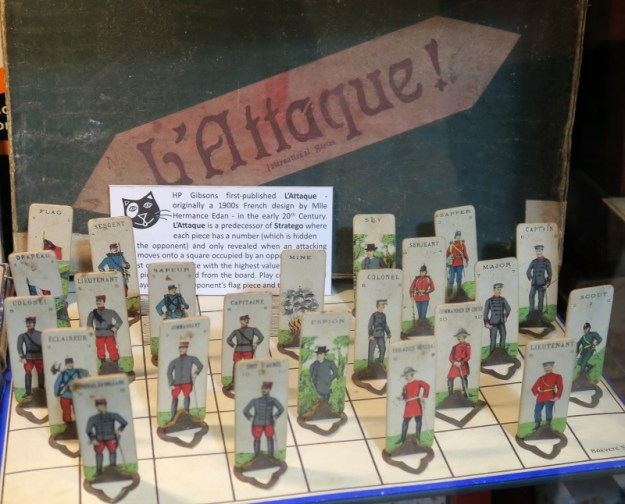
When anyone shows an interest in something, it will readily will come out of its box for closer inspection.  There is a remarkable number of games with a tie-in to TV shows, but also unusual items like a beautiful home-made copy of Monopoly themed round Richmond (London) and copies of L’Attaque! (which became better known when it was reimplemented as Stratego).

Museum of Board Games in Newent
– Image by boardGOATS

In recent years, there have been exhibitions at the V&A Museum of Childhood and The British Museum, but this is a much better experience.  Although the exhibits are (of course) the centre of the museum, what makes a visit really special is the curator, Tony Boydell himself, and his remarkable knowledge of the games on display and of games in general.  Tony can talk for hours on the subject (and he will, if you let him), and as conversation meanders, he will reveal more treasures from the nooks and crannies of the museum.

Museum of Board Games in Newent
– Image by boardGOATS

As an afternoon out, the Museum of Board Games is well worth a visit, though speculative visitors should be aware that it is currently only open on Fridays and Saturdays (10am-4pm).  It is also exceptional value, but anyone who really wants to support the venture, should visit the museum’s Patreon page.  For those who can’t visit in person, there are a couple of reports on the BBC as well as Tony’s Blog on Board Game Geek.

Museum of Board Games in Newent
– Image by boardGOATS

Goats in the News: The Danger of Goaty Selfies

Over the last couple of years, Llandudno has made the news thanks to visits from a flock of Kashmir goats.  The infamous goats are once more causing problems, but this time it is a result of their newfound fame.  The goats have returned to the Great Orme peninsula, a nature reserve in Conwy, but their notoriety has attracted tourists taking selfies inspiring the Llandudno Coastguard to comment:

We are particularly concerned about reports that people are placing themselves in danger to view the goats up close and to take photos.  The goats are safe, they aren’t trapped and are just exploring a new part of the Great Orme.  We urge you not to place yourselves in danger to view the goats and to stay on Marine Drive where it is safe and a great vantage point to see the goats.

Llandudno Goats
– Image from facebook.com

Boardgames in the News: Harshad Gothankar’s Flicking Amazing Feet

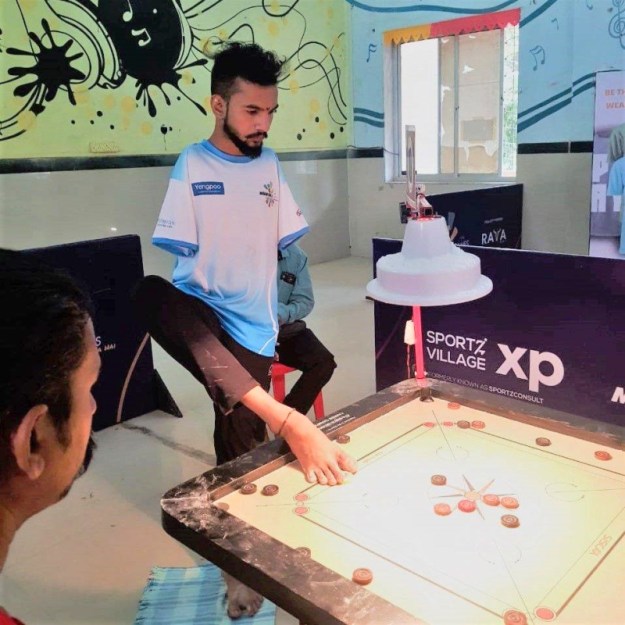
Harshad Gothankar from Mumbai was born without arms, so he does everything with his feet—including playing Carrom.  Carom is a flicking game played in south Asia that is similar to the north American/Canadian game Crokinole and more modern descendents like Flick ’em Up!, ICECOOL, Subbuteo and PitchCar (or Carabande).

Harshad Gothankar
– Image by Mumbai Games on facebook.com

Harshad Gothankar has always been a remarkable young man with a passion for playing the national sport of cricket and is now also a state Carrom champion.  He recently became an internet phenomenon, however, when cricket superstar Sachin Tendulkar highlighted his determination in a post on his social media feed.

– From twitter.com

Boardgames in the News: TMG on the Brink

One of the leading designer games companies, Tasty Minstrel Games (aka TMG) is reportedly on the brink of demise. Working closely with the Reiner Stockhausen’s dlp Games, they have been responsible for the US editions of Orléans, Yokohama, Citrus and Bohemian Villages.  Well known for their “Deluxified” editions of games, they’ve also collaborated extensively with many other European companies leading to US editions of Village, Belfort , Gùgōng, Gentes, Guilds of London, Eminent Domain and The Oracle of Delphi, and re-releases of popular games like Luna, Colosseum and At the Gates of Loyang. They have not been simply “partners” reproducing other games, developing Scoville, Captains of Industry, and Crusaders: Thy Will Be Done.

Orléans
– Image by boardGOATS

A few years ago, TMG controversially raised over $150,000 selling shares online, but it seems these funds have now run out.  According to an email sent out by TMG to stock holders discussed on a recent Dice Tower News, their “book value is in the negative” which they describe as “virtual bankruptcy”.  As a result, in an attempt to save the company they are laying off staff and have called a halt to game development for the next “two to three years”.  The most recent KickStarter campaign is also being abandoned with backers receiving a refunds.  In the immediate future, the company will be focusing on selling its existing stock hoping that they will “eventually being able to start up again”.

-Video by the Dice Tower

Indications that TMG have been struggling have been there for a while, with allegations they delayed payment to some of their designers and most recently when they failed to renew the publishing rights to their highest rated game, Orléans.  The question is, why has this happened?  Of course, the global pandemic will have played its part, as will the recent sudden increase in shipping costs.  However, these are probably only another nail in the coffin.  The underlying cause is almost certainly the increased pressure caused by a market saturated with high quality games and a lot of noise generated by a conveyor-belt of crowd-funded products.  Sadly, it looks like TMG simply ran out of road, and money.

– Image from playtmg.com