Category Archives: News

Remote Gaming: Some Learning Outcomes

With the advent of Covid-19, boardGOATS, like many other groups were left with the choice of meeting online or not meeting at all.  So, like many other groups, boardGOATS chose to try to continue with meetings.  While some groups have struggled, dwindled, and eventually given up, so far, boardGOATS has managed to keep going with almost everyone still attending regularly.  We decided that we would put together this summary of some of the reasons we think we are still meeting, and a resource companion in case anyone else is in the same boat.

Setting up for online gaming
– Image by boardGOATS

The first, and by far the most important factor is that everyone has been extremely patient and very tolerant of the limitations.  Everyone is fundamentally appreciative of the interaction meeting online offers and have been amazingly understanding of the current issues.  This is essential.  Secondly, we meet once a fortnight:  boardGOATS meetings have always been alternate weeks, but this is actually quite key when meeting online.  If meetings are too frequent everyone can get very frustrated quite quickly, but too infrequent and people lose the routine.  As it is, fortnightly means everyone makes a date to make it happen as otherwise the next one would be a month away.
Noch Mal!
– Image by boardGOATS

Finally, there’s planning and organisation.  Having a plan is vital if things are to run smoothly, and smooth is essential to avoid people becoming frustrated.  The group has always had a “Feature Game“, because we’ve always been a group that takes ages to decide what to play; having a starting option helps us to get going a bit quicker.  With remote meetings, however, the “Feature Game” has become essential.  It is also important that someone takes the lead to teach if necessary, and keep things moving to stop games dragging, but also allows the all important banter to flow when possible as well.

Tsuro on Tabletop Simulator
– Image by boardGOATS

The group have broadly used three different approaches to remote gaming, all underpinned by Microsoft Teams.  This choice of platform is largely immaterial, but our decision was made early on because of possible security issues with alternatives and the hardware that some of the group were using.  Either way, this provides sound and, where required, visuals.  We always start the meeting early and then leave a place holder in front of the game camera so everyone knows which screen to pin in advance.  In our case we usually use a stuffed panda doing something humourous, but a game box would suffice too.

The three different approaches to remote gaming we have used have been:

  • A real-life game hosted at one location, shared through Teams.
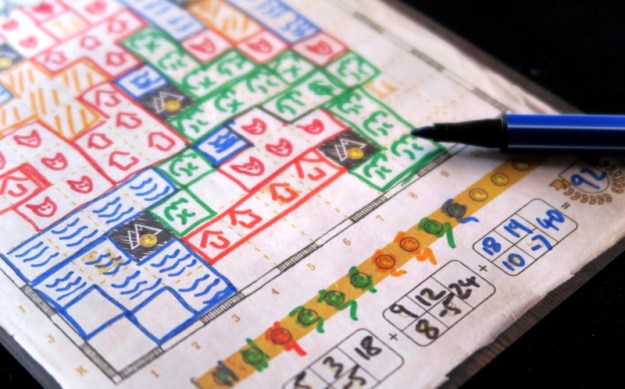
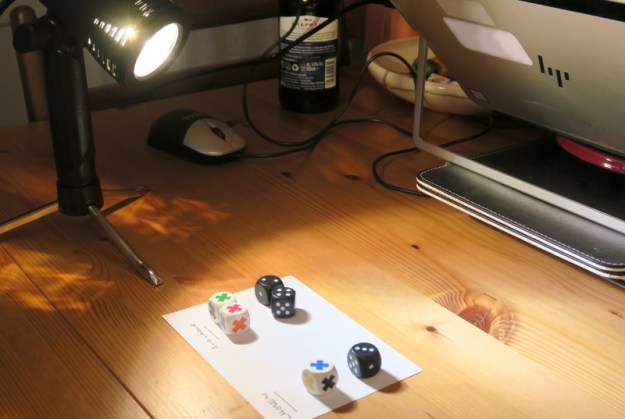
    This works well, but really only for relatively simple games like Second Chance, HexRoller or Noch Mal!, though we’ve played Cartographers and Troyes Dice as well.  It turns out that “Roll and Write” type games work exceptionally well, but other games are possible too.  The most complicated game we’ve played using this method is Las Vegas/Las Vegas Royale, which is one of the group’s favourites, but this is right on the limit of what is possible.  The key is that players need to be able to see the whole game layout with all the information.  For this, the resolution of the camera is important, but also that of the screen used for displaying it at the other end.  Video compression by the platform feeding the data can also be an issue.  Lighting is absolutely critical too—good lighting makes all the difference.
    Main Advantage:  We’ve found this feels most like playing a “real” game.
    Main Disadvantages:  One person/location does most of the manipulation, and there is a  complexity limitation.
    Cartographers: A Roll Player Tale
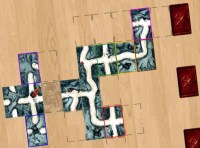
  • A virtual game on Tabletop Simulator manipulated by a small number of people , shared with everyone else through Teams.
    Some people can’t install software on their computers and for others sand-box type environments like Tabletop Simulator are too complex.  Piping a virtual game through Teams is a sort of half-way house.  To make this work, the person “hosting” has to set the game up with the camera view set to “overhead” with everything in view, and leave it there.  Then they share this screen through their meeting platform (in our case, Microsoft Teams).  Again, this means there is a limit on the complexity of the game:  the most complex games we’ve played using this method are Camel Up and Finstere Flure (aka Fearsome Floors)These have worked quite well, but it’s a bit more impersonal and relies on a small number of people operating the Simulator to make the game work.  Downtime is a bit of an issue too for turn based games.  For these reasons, this has been the least popular method for our group.
    Main Advantage:  We can modify and play slightly more complex games to our own house-rules.
    Main Disadvantages:  People need to be comfortable with the software and there are limitations caused by the stability of the platform as well as there being a steep learning curve for those who are not used to playing computer games.
    Tsuro on Tabletop Simulator
  • An online game played on a website (e.g. Board Game Arena) with audio provided by Teams.
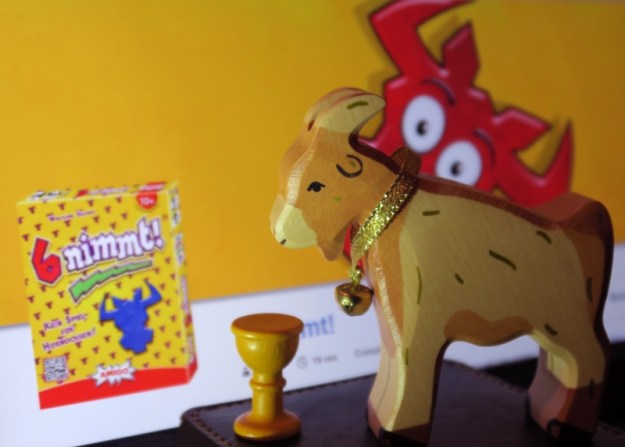
    These are great because they allow players to do things like draw cards from a shared deck and keep them hidden until they play them.  This is a fairly fundamental aspect of many games and enables games like Saboteur which would not otherwise be possible.  There is a limited range of games available though, and there is no scope for modifying the game either (adding extra players or altering the end-game conditions, for example).  On the other hand, the software does a lot of the up-keep and can make even quite advanced things possible.  For example, without Board Game Arena to do the maths, we would never have discovered the delightful madness that is the “Professional Variant” of 6 Nimmt! (which recently won the 2020 Golden GOAT at our annual GOAT Awards).   It does feel very much like playing a computer game though.
    Main Advantages:  Very low maintenance and higher complexity games are possible including those with “hidden information”.
    Main Disadvantages:  Everyone needs to have an account on the platform and a device, and the games are restricted to those that are available and the rules as implemented, in particular, player counts.
    Saboteur on Board Game Arena


Each of the different modes has their limitations, but we’ve found that by mixing them up we avoid getting fed up with any specific issue.

One of the biggest challenges boardGOATS has is that we have been playing as a group of up to ten.  This is because we are all friends, even though many of us only know each other through the fortnightly meetings.  If the group were to break into two or more parts it would likely be along the lines of game “weight”, which would mean some people would never play together and it could be divisive.  This only works because those who prefer more complex games are extremely patient and understanding.  Ultimately, as a group, we feel the social aspect is the most important thing at the moment, much more important than the quality of the gaming.  We’ll definitely make sure we play lots of more complex games when we finally return to our beloved Horse and Jockey though.

The Horse and Jockey
– Image by boardGOATS

Golden GOAT Award Winners – 2020

Usually, just before Christmas, the boardGOATS meet for food, have a bit of a party, and decide the winners of the GOAT Awards.  Unfortunately, that wasn’t possible this year of course, but we still had a bit of a party online with festive treats for everyone, and chose our favourite game of the year.  As in previous years, we awarded two prizes:  the Golden GOAT for our favourite game and the “GOAT Poo” award for our least favourite.  As last year, everyone had three points to hand out for the Golden GOAT Award (plus a bonus if wearing Festive Attire), and everyone could nominate up to two individual games for the GOAT Poo Prize.

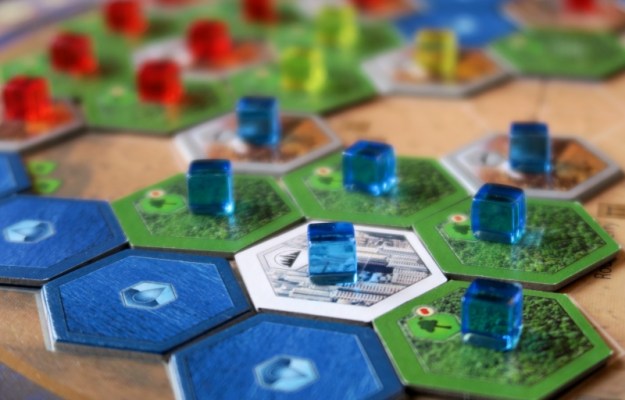
Terraforming Mars: Hellas & Elysium
– Image by boardGOATS

This year, the unanimous winner of the GOAT Poo was Covid and its effect on 2020.  As this wasn’t a game though, Camel Up officially took the GOAT Poo on a tie break.  Terraforming Mars won the unofficial “Marmite award”, just escaping the GOAT Poo, but also coming fourth overall for the Golden GOAT.  Kingdomino made the podium and last year’s winner, Wingspan, was runner up.  The winner though, was 6 Nimmt!.

Golden GOAT - 2020
– Image by boardGOATS

Although 6 Nimmt! is an old game, this year we’ve played it on Board Game Arena at the end of almost every meeting, and it has provided so much fun and entertainment in a year that has otherwise been sorely lacking in that regard.  Certainly, moment of the year went to Lime accidentally joining a game of 6 Nimmt! with a bunch of Frenchmen, but that is just one of many memorable moments we’ve had with it.  Since discovering the “Professional Variant” the game has been rejuvenated for us too, so it seemed an entirely appropriate win for a strange gaming year.

6 Nimmt! on Board Game Arena
– Image by boardGOATS
from boargamearena.com

Boardgames in the News: A Case Study of a Counterfeit Game

With Christmas just round the corner, there is a rush to buy gifts while wallets are squeezed and time is short—exactly the circumstances where counterfeiters flourish.  Previously, we commented on how reports of counterfeit games had been increasing and highlighted some of the key features to look out for.  Counterfeiting is a problem that affects a wide range of games including family friendlies like Ticket to Ride: Europe, Azul and 7 Wonders, but also more specialist fare like Terraforming Mars and Deep Sea Adventure.  Since then, a member of the boardGOATS group accidentally acquired a counterfeit copy of The Game of Life, which we thought would make a useful case study of some of the things to look out for and provide a timely reminder of the problem.

The Game of Life
– Image by boardGOATS

The Game of Life is of particular interest because there are have been many different versions and editions over the years.  This means it can be hard to spot whether a copy is a fake even if there is a genuine copy to hand.  In this particular case, the first and most obvious problem is the complete lack of a brand name or logo anywhere on the box or the components.  The English edition is published by Milton Bradley (now Hasbro), or Winning Moves in the USA, but none of this appears anywhere on the box.  Presumably this is to avoid falling foul of “Brand Piracy” laws, but if the counterfeiters think that makes their products legal, they are very wrong.

The Game of Life
– Image by boardGOATS

This is not the only indicator with this copy.  In this example, the font on the cards use western characters from a Chinese font set—these almost look like old fashioned type-writer script without serifs.  This is very unlikely to be a design choice for a genuine western board game and also don’t match the fonts elsewhere.  Additionally, the cards have squared off corners, which is now relatively unusual for modern cards in western games.  In contrast, the rules card has cut corners (and a western font), but has “nibs” where it has been punched from a larger piece of card.  The corners and “nibs” are not confirmation of a counterfeit in themselves, but would not be expected in quality product.

The Game of Life
– Image by boardGOATS

Other aspects that make this copy of The Game of Life look suspicious are associated with component quality.  For example, the game board is very thin card stock, poorly folded and the edges are not wrapped with tape or similar.  Again, these do not necessarily mean that this is a counterfeit copy: component quality does sometimes change between print-runs and it is very possible that the publisher has decided to make changes for this edition.  It is often indicative though and shows how counterfeit copies, which this certainly is, can be of inferior quality.

The Game of Life
– Image by boardGOATS

This copy of The Game of Life was bought in good faith, but came from an online auction seller.  Some of these sellers have been trading for many years and provide great deals and an excellent service, others not so much and it is not always easy to tell the difference.  The bottom line though, is the only way to guarantee that a product is genuine, is to buy from a reputable seller.

Boardgames in the News: The Truth about Covid and Board Games at Christmas

Over the last couple of days, the Government’s  Scientific Advisory Group for Emergencies (SAGE) are widely reported to have advised people to avoid playing board games this Christmas.  This has been covered by Metro, The Mirror, and The Sun, but also more reputable sources including The Evening Standard, Sky News and The BBC.  This is obviously very bad news for an industry at a time when they would be expecting to maximise their annual sales and instead are struggling.  It would also seem to be at odds with the WHO advice from April this year, which encouraged the playing of games while people were confined to their homes.  So, did SAGE really say that playing games at Christmas will put older people at risk,?

Dixit on Killing Eve
– Image from bbc.co.uk

It is hard to find, but the original article (archived) seems to be one published on 26th November entitled, “EMG and SPI-B:  Mitigating risks of SARS-CoV-2 transmission associated with household social interactions“.  It is sixteen pages long and is a report summarising current evidence on how to mitigate risks of transmission of SARS-CoV-2, with a particular focus on activities in the home when hosting a small number of visitors or larger family celebrations.

Article on Christmas Games & Covid
– Image by boardGOATS from gov.uk

The report extensively analyses the risks in such gatherings and ways these can be mitigated, including avoiding physical contact, and the difficulties associated with gatherings in a crowded, potentially poorly ventilated area, where people are sharing facilities.  The section that covers games is in the appendix, where there is a table covering “Behaviours and Activities”.  This examines a range of scenarios and how transmission may occur.  Games get a mention under “Activities involving fomites” (objects which are likely to carry infection):

“Games that may be traditionally played such as board games, cards, etc, giving of gifts, sharing of objects and vessels during religious observances. Direct evidence for fomite transmission is limited, however viral RNA has been found on high touch surfaces in close proximity to infected people and there is evidence that shared cigarettes and drinking vessels are associated transmission.”

It continues:

“Risks can be reduced through substituting activities for those that minimise sharing of objects, for example through playing quiz-based games rather than those which involved lots of shared game pieces. Any objects which are likely to have direct contact with the mouth pose a particularly high risk.”

So, far from suggesting people should avoid playing board games, the original document indicates the chance of transmission by playing games is small as most people don’t suck the pieces.  Further, this is in the context of people spending a significant amount of time in the same household, in a small space, and sharing other facilities and food so there are many, much higher risks.  Therefore, the bottom line is that if you are sharing Christmas with someone who has the virus, you are likely to caught from them it long before you get out your copy of Pandemic.

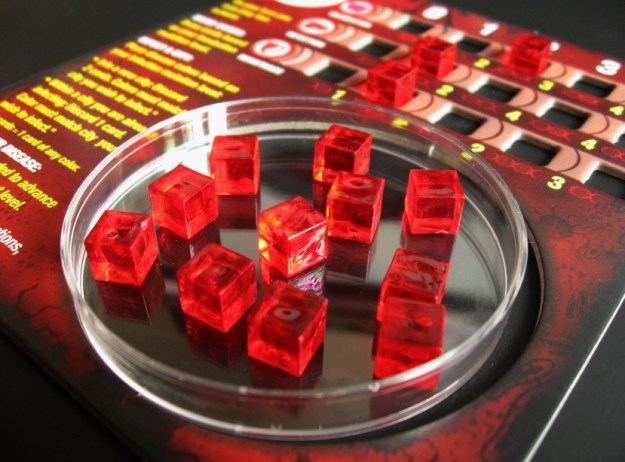
Pandemic: Contagion
– Image by boardGOATS

Boardgames in the News: Learning to Drive in Sierra Leone

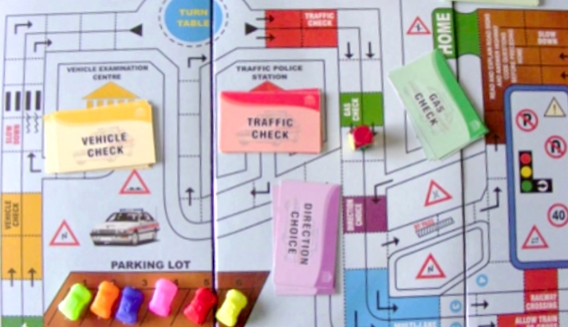
In the UK, there are two significant hurdles to learning to drive:  the theory test and the practical examination.  In Sierra Leone, there is a third step, playing the board game.  The game is called The Driver’s Way and is a “Roll and Move” type game where players to roll traffic-light-themed dice and move model cars around a board.  The game aims to teach learners the rules of the road in a more entertaining way than standard textbooks.

The Driver's Way
– Image from autoevolution.com

Sierra Leone is a country with limited infrastructure where road fatalities are high.  The creator of the game, police chief Morie Lenghor, said that ignorance of the highway code is the root cause of most crashes, and that “most drivers don’t even understand half the road signs”.  Learners are recommended to spend a few months practicing with the game, which costs less than £10 (although that doesn’t take into account differences in living costs and earning power).

Eight is Great – Happy Birthday to Us!

Eight Today

BoardGOATS is Eight Years Old Today!

Although it doesn’t feel “Great” this year, given the challenges we are all currently facing, it is perhaps even more of an achievement that we are still going.  Although we are not able to meet properly at the Horse and Jockey in Stanford-in-the-Vale, the group is still going. Five of those who were at the first meeting are still turning up fortnightly, and we are all patiently sitting through the progression of “Roll and Write” games and challenges of Tabletop Simulator that games nights have now turned into.  Let’s hope next year we can celebrate in person, and with our friends at the Jockey!

Goats in the News: Saving the Icelandic Goat

The Icelandic Goat or “settlement goat”, is an ancient breed of domestic goat thought to be of Norwegian origin and dating back to the settlement of Iceland over a thousand years ago.  Around a hundred years ago, numbers began to dwindle and the breed was on the verge of extinction.  Although numbers fluctuated, by the end of the twentieth century, numbers were in what appeared to be terminal decline.

Casanova the Icelandic Goat
– Image from indiegogo.com

That was until Jóhanna Bergmann Þorvaldsdóttir made it her mission to save them, pretty much single handedly.  She left her job as a nurse, and began breeding goats.  Although the income was small, the flock grew to several hundred.  However, following Iceland’s financial collapse, the family farm of Háafell in Borgarbyggðthe, was at risk of foreclosure.  As a last ditch effort to save the flock, the family launched a crowdfunding campaign.  Partly thanks to a starring appearance in the fourth series of Game of Thrones, nearly £90,000 was raised to keep the dragon from the door.

– Video by Shinonoiru on youtube.com

So the story has a happy ending:  the farm is now thriving with sales of milk, cheese and meat and the media flock to see the flock and report the tale.  And the numbers of Icelandic Goats have increased from less than a hundred in 1962, to nearly 1,500 today.  Even Casanova, the goat that was snatched by Drogon the Dragon, lived to tell the tale.

Jóhanna Bergmann Þorvaldsdóttir with an Icelandic Goat
– Image by Art Bicnick

Deutscher Spiele Preis – 2020

This year is very different in so many ways, but one thing that hasn’t changed is the announcement of the Deutscher Spiele Preis list.  This award is the result of an open vote by games clubs, gamers and people in the industry.  It typically rewards slightly heavier games than the Spiel des Jahres awards, but as the top ten list is published, a range of tastes and complexities often feature.  The list is usually announced in the run-up to “Essen“, but with the cancellation and then virtualisation this year, the feeling is very different:  instead of stoking the fire of anticipation, it is a sort of sad echo of what might have been.

The Crew: The Quest for Planet Nine
– Image by BGG contributor kalchio

In general, this year the games on the list are definitely on the heavier side with the winner amongst the lightest in the top ten list.  As last year, the winner of the Deutscher Spiele Preis was also awarded the Kennerspiel des Jahres Award i.e. The Crew: The Quest for Planet Nine (known as “Die Crew: Reist gemeinsam zum 9. Planeten” in Germany).  This is a co-operative trick-taking game which is played as a campaign over fifty missions.  With each mission, the game becomes more difficult, but it is not the amount of tricks the team takes, but taking the right tricks at the right time that counts.

Cartographers: A Roll Player Tale
– Image by boardGOATS

Cartographers: A Roll Player Tale, was second on the list.  It seems appropriate that it did well this year as it is one of the best “Roll and Write” games available and they play so well remotely, which has so often been the only way to play this year.  Other games in the top ten list include Maracaibo, Crystal Palace, PARKS and Paladins of the West Kingdom (the sequel to Architects of the West Kingdom which featured in last year’s prize list).  There have also been a lot of reimplementations released in the last year or so, and these were also well represented in the list, namely by Glen More II: Chronicles and Marco Polo II: In the Service of the Khan.

Deutscher Spiele Pries 2020
– Image from
spiel-messe.com

Next Meeting, 15th September 2020 – Online!

It is at times of stress that people need social contact more than ever, and board games are a great medium for that.  Despite the limitations of “remote gaming”, the overwhelming impression is that it is important to stay in touch, so we are persisting with online meetings.  Therefore, our next meeting will be on Tuesday 15th September 2020; we will gather from around 7.30pm, and start playing at 8pm.

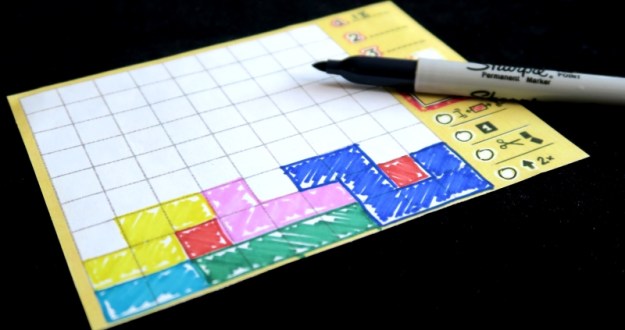
This week, the “Feature Game” will be Patchwork Doodle.  This is another “Roll and Write” style game that is quite similar to the Tetrissy Second Chance, but with different scoring and is loosely based on the idea of making a patchwork quilt.  It is quite a short game so as everyone will have their colouring pens out, we might give Cartographers another go if there is time.

Patchwork Doodle
– Image by boardGOATS

And talking of needle-work…

Jeff was out of work, and the only place within miles was a factory where they made the stuffed toys called “Tickle-Me-Elmo”.

So, he drove there the next day to offer his services and was immediately introduced to the manager. Jeff explains that he’s out of work, but has a lot of experience in the textiles business and is very neat with a needle and thread. The manager answers, “Well, this is your lucky day, we’ve just lost someone in the factory and it sounds like you would be perfect.” He goes on to explain what he will be doing and tells Jeff he can start first thing in the morning.

The next day Jeff comes in and goes straight to work. It’s not long before there are problems and the head foreman sees the line is backing up and the bottle neck is where Jeff is working.

The foreman checks what Jeff is doing and the goes straight to the factory manager. He says to his boss, “You are not going to believe what the new guy is doing! He has a bag of marbles, some red cloth, and a needle and thread.  As each Elmo comes off the line he is sewing a little red pouch between the legs and is inserting two marbles. I mean, they are kiddies toys—I just didn’t know what to say to him!”

The manager says he will take care of it and heads straight down to the factory floor.  He approaches Jeff and lets him know that they need to talk.  Jeff politely puts down his needle and thread and listens.

The manager explains, “I am really sorry, but I think you may have misunderstood me when I said that each Tickle-Me-Elmo gets two test tickles…”