Tag Archives: Agricola

5th April 2016

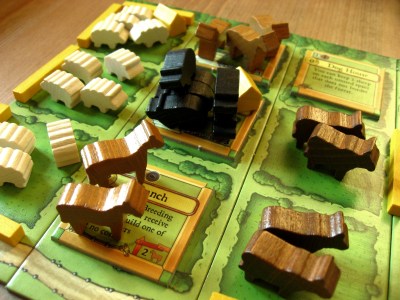
Despite a few regulars being away, there were still enough people for two games and the first group opted for the “Feature Game”, Agricola, a highly regarded game about medieval farming.  Agricola is a worker placement game where players take it in turns to deploy the members of their farming family in activities.  At the start of the game there are very few actions and each  player only has two members of their family, but as the game progresses the number of possible actions increases, but players also have the opportunity to expand their families. Each player has a farm which consists of a three by five grid of spaces and at the start of the game two of them are occupied by a two-room wooden hut.  During the game, players can expand their hut, upgrade their wooden shack to a brick or stone house, they can plough fields, enclose land to keep animals and grow vegetables and wheat.

Agricola
– Image by BGG contributor BeyondMonopoly

The game is played over fourteen rounds with harvests at intervals after which the family must be fed.  Failing to feed the family results in them going hungry and having to beg for vittles which costs points at the end of the game.  Points are awarded for almost everything, but the most successful players are usually those with a thriving farm that makes full use of all the available land and sustains a large family living in a big farmhouse.  The game can be played as a family game, or, for more experienced players, occupation and minor improvement cards can be added.  It had been quite some time since some of us had last played Agricola, and others had never played it, but those of us who were familiar with the game were keen to play with the cards.  When playing with cards it is common to “draft”, i.e. use the primary mechanism found in games like 7 Wonders, Sushi Go! and Between Two Cities where each player chooses a card from their hand before passing it on and choosing the next card from the hand they receive (passing that on until there are no cards left).  The advantage of this approach is that no single player gets all good (or bad) cards by chance, but the disadvantage is that it is very hard to choose cards when players are new to the game and unfamiliar with which cards might work well.  For this reason, drafting wasn’t really an option.  The copy of the game had been “pimped” with shaped wooden resources to replace the original cubes and discs from the base game.  This, combined with three different decks of minor improvements and tight space enhanced our initial confusion, but we did eventually get ourselves sorted and chose the basic “E” Deck.

Agricola
– Image used with permission of BGG contributor henk.rolleman

Green started off by learning a new occupation: Reed Collector; reeds are important for house building.  Having looked at his cards in hand, he had a plan:  he also had the Renovator which would reduce the cost to upgrade his farmhouse, so he thought he could expand his wooden house and then upgrade it on the cheap. He also had the Chiefs Daughter who would give him an additional three points if he successfully upgraded his house to stone. Meanwhile, the others set about collecting resources as a base from which to build their farms.  Indigo quickly learnt the second occupation of the game: the Hedge Keeper which would enable her to build three additional fences each time she built at least one – impressively powerful we thought at the time, especially at end game for filling unused spaces.

Agricola
– Image by BGG contributor lolcese

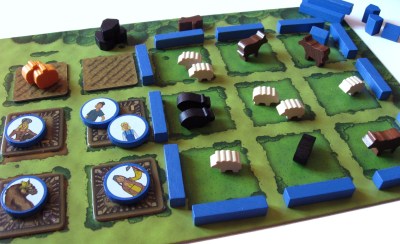
The first rounds were a lesson in frustration as resources and actions were limited and we all found ourselves unable to get what we needed and do what we wanted, a problem compounded by only having two farmers each.  Progress on the farms seemed slow; Green, Pine and burgundy seemed more interested in home improvements than actual farming and at one point it looked like we should have renamed the game, “Yuppy-ville”.  Green then invested in a canoe and went fishing a lot:  was the price of farming so high he was going into retirement before he got into a financial mess?  Despite her highly prized hedge making ability, it wasn’t Indigo who fenced in their first field but Pine, which he promptly filled with the four sheep that no-one had been able to find a home for previously.  This was especially funny since, as the vegetarian of the group, he had planned to make his and arable farm rather than a pastoral farm.  Still sheep are good for wool, so his moral stance was intact, for the moment, at least. Released from Market, Pine’s sheep quickly produced a nice spring lamb for our intrepid veggie farmer, to keep as a pet in his farmhouse.
Agricola
– Image by boardGOATS

Burgundy meanwhile had made use of his special ploughing skills to turn over two fields in one go, but that was about as far as they went for many rounds.  Although he was forced into a fallow strategy (not one that scores any points or subsidies in this game), he wasn’t complaining. That was reserved for anyone else who took the available wood before he could reach it.  This forced Burgundy into becoming a bit of a clay specialist which meant he was able to build an oven before anyone else, something he desperately needed to feed his family since there was so little actual production going on on his farm.  In keeping with his non-farming, farming strategy, Burgundy was also the first to renovate his home, twice in quick succession to a give him a grand two room stone cottage.  Pine and Green followed and extended their wooden shacks. This gave Green room to grow and he became the first player to gain an extra farmer.  Pine quickly followed suit, but his attempts to grow vegetables was being scuppered by everyone else taking the one available “Plough & Sow” space before him. So, with a tear in his eye, he was forced to build an oven and take some of his precious sheep to the abattoir.

Agricola
– Image by BGG contributor HRune

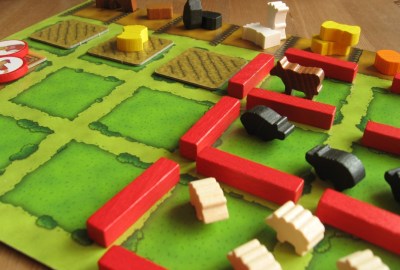
Our farms were slowly growing.  Green still only had one ploughed field and no pastures, but he had learnt several trades, built a number of improvements to his farm and extended his modest cottage to four rooms.  In one move, he upgraded his house to brick and built a clay oven (the one that Indigo had just returned after trading it in for a better model), which enabled him to bake bread and get enough food to feed his burgeoning family.  By this time, Pine had turned into a hardened livestock farmer, his earlier heartache a mere distant memory.  He enclosed his massive second pasture, moved his sheep around and expanded into cattle.  The Master Hedge Maker, Indigo, still had only one pasture and no animals, but the arable part of her mixed farm was very healthy, overflowing with wheat.  The failure of her livestock attempts did not last long either, and she emulated Pine enclosing a large second pasture and captured a couple of wild boar to place in it.

Agricola
– Image by BGG contributor sufertashu

Back on Green’s farm, he had decided that maybe he should do a little farming and finally having got some wood, he built some fences and acquired some pigs. His skill in ceramics had enabled him to get a free pottery and started turning the now unwanted clay into some strange tasting food.  Green then turned his clay house into a stone mansion and quickly fenced in another pasture and got some cattle.  With the game rapidly drawing to a conclusion he had four farmers to work with, but he was still hampered by the availability of resources and actions, often taken by others.  For example, his plans for a third pasture and some sheep were stymied by Pine who nabbed them to add to his ever growing flock.  Meanwhile, Indigo’s farm was flourishing and when she finally got some sheep, it seemed all she needed to to to be able to say she had a finger in every pie was get some some cattle – one was available and she was so keen on it that she let it live with her in her own house.
RedAgricola
– Image by boardGOATS

In contrast, Burgundy’s whole game seamed to have constantly been scuppered at every turn.  Even taking the start token usually only lasted one round and invariably he then seemed to find himself choosing at the end of the round once more. We don’t quite know how he did it, but somehow by the end of the game he had filled every space on his board – clearly he got that wood and fencing in the end.  With only two rounds left, Pine finally moved into wheat and vegetables.  Discussing the game afterwards he commented that he’d been dealt a poor set of cards at the start and on reflection they did look like a very difficult set to work with.  On the other hand, Black on the next table piped up that the cards were not really all that important.  While that may be the case, in this game Green was the winner primarily thanks to having played a great set of cards. In fact, of his forty-three points, he scored twelve from his cards, which was seven more than anyone else.  In contrast, Indigo’s balanced farm netted her a solid second place, just six points behind.  Were the cards that important?  We’ll play it again sometime soon and maybe find out.

Agricola
– Image by BGG contributor nolemonplease

On the other table, meanwhile, The Voyages of Marco Polo was getting a second outing after its introduction at our last meeting.  The game is played over five rounds with players recreating Marco Polo’s journey to China via Jerusalem and Mesopotamia and over the “Silk Road”.  Each player has a different character and special power in the game.  Each round, the players roll their five personal dice and can perform use them to perform one action each per turn.  The actions include:  gathering resources, gathering camels, earning money, buying purchase orders and travelling.  The game ends with players receiving victory points for arriving in Beijing, fulfilling the most purchase orders, and having visited the cities on secret city cards that each player gets at the start of the game.

The Voyages of Marco Polo
– Image used with permission of
BGG contributor bovbossi

Purple (who also played last time) decided to try the teleporting trader, Johannes Caprini again and work more on getting contracts.  Last time, we realised that taking an action first was a huge benefit because it avoided the problem of having to pay to take actions.  So, after that, Black chose Berke Kahn which would allow him to choose actions already taken without having to pay.   Scarlet, who was new to the game, opted for Wilhelm von Rubruk (played by Black last time) for the extra trading stations.  Also new to the game, Pink, felt that having an extra die and contract each round would give her the edge, and chose with Matteo Polo.

The Voyages of Marco Polo
– Image used with permission of BGG contributor punkin312

Despite her teleporting ability, Purple was unable to get to Beijing, but she was the only one who hadn’t made it across the board for the extra points by the end of the game.  It seemed her extra experience could not help her make full use of her special power as she failed to complete her second destination card as well.  Reading opinion of this character on BoardGameGeek, it seems Purple’s fondness of this character is rather misplaced, as it seems to be universally felt to be a poor one to get to work.  Scarlet had done rather better with his choice it seems, although he just failed to get his extra houses out, which is a tough ask in this game.  Others who play this character seem to get varied results, though perhaps for people that can make it work, it can do really well, but otherwise it can trip players up.  The general opinion on Matteo Polo also appears to be good; sometimes it can work really well, but it is never a hindrance.  Pink, however, just struggled to get the game to work for her and it just didn’t seem to fire her enthusiasm. She failed to complete either of her destinations and only managed to place three “houses” and generally found the game difficult all the way through.

The Voyages of Marco Polo
– Image used with permission of BGG contributor henk.rolleman

Looking back at the last time we played, as well as Johannes Caprini and Wilhelm von Rubrukand, we used Mercator ex Tabriz and Kublai Kahn.  Mercator ex Tabriz (who gives the player a free resource when others use the market) seems to be widely regarded as the best character, however, Pine really struggled with him. In contrast, Kublai Kahn appears to be seen as a middling character, who is very reliant on how the city bonuses fall – last time they fell well for Green who made good use of them, but the character could be a lot less effective if the bonuses were less favourable.  There are two characters we have not yet played, Raschid-ad-Din Sinan and the pairing of Niccolo and Marco Polo.  Even though Raschid-ad-Din Sinan looks good (he allows the player to choose their own dice values), it seems most players only rate him average.  Maybe it’s because poor dice rolls can be compensated for and turn into good ones, so the actual values rolled are of less consequence to the game than might be thought initially.  The pairing of Niccolo and Marco Polo can be difficult to make work as two characters does not mean twice the resources, quite the opposite and they can get stuck in a city, although with less players it is felt they might do better (as there are less opponents to steal the city bonuses first).

The Voyages of Marco Polo
– Image used with permission of BGG contributor henk.rolleman

So clearly, although some characters might have a tendency to be more useful than others, ultimately success depends on circumstances and how well the player uses that character.  This was also the case for this, our second game where Black finished first with a massive fifty-eight points, a combination of a good character played effectively. On the geek there seems to be a general consensus that Berke Khan is one of the top characters in this game, demonstrating others appreciate the power of not having to pay for actions. With Agricola still a few rounds from finishing, there was time for a quick game of Click & Crack, a game of simultaneous action selection game in which the players control two penguins each, walking around on a big ice floe – a cold arctic game to contrast with the heat of the eastern deserts.

Click & Crack
– Image used with permission of BGG contributor aleacarv

Learning Outcome:  Sometimes it is best to put even the most deep-seated moral objections to one side for the duration of a game…

Boardgames in the News: Risking Imprisonment to Play

We are very lucky:  when our little game group meet, the worst anyone risks is a telling off for staying out too late.  In some parts of the world, however, gamers could be risking their liberty or worse.  Just imagine a world in where playing Puerto Rico or Agricola risked imprisonment or torture.  It seems absurd, but for for some people this sort of response is a reality.  In February, police in the Thai resort of Pattaya arrested thirty-two elderly Bridge players when they raided their local Bridge Club.

Bridge
– Image from innontheprom.co.uk

In Thailand, there are strict anti-gambling laws, so despite the fact the Bridge players declared that they were not playing for money, they were arrested for “possessing more than one hundred and twenty unregistered playing cards” in violation of section eight of the Playing Cards Act of 1943.  In this case, the members of the club were released after twelve hours, but Bridge is not the only “risky game”.  According to the Saudi Grand Mufti, Chess is forbidden in Islam, a view which could mean that players in some parts of the world genuinely risks a fate worse than death at the hands of fundamentalists.

We are very fortunate in the UK.

Chess
– Image by BGG contributor unicoherent

Boardgames in the News: Mayfair Games – Is there a Future without Catan?

Mayfair Games began in 1981 as a small US games company based in Illinois. One of their first games was Empire Builder, their first and now the flagship of their “crayon-rails” series of games where players, using washable crayons, draw their train routes over a map of North America.  Building on this success, Mayfair then went on to play a pivotal role in bringing Euro games to the US and wider English speaking markets.

Empire Builder
– Image used with permission of BGG contributor Billythehut

In 1996, Mayfair Games picked up the license to produce an English edition of Die Siedler von Catan, The Settlers of Catan (now known simply as “Catan”).  With the huge success of the game world-wide, over the next twenty years, Mayfair brought out multiple new editions of the base game modernising and updating it, English editions of all the expansions, variants and spin-offs.  Mayfair (with Kosmos) were also behind the release of Star Trek: Catan in 2012, the first Catan game with a licensed theme.  For many, Mayfair Games has become synonymous with Catan, in the English speaking world in any case.  As such, the news yesterday that Asmodee has acquired the rights to produce the English language version of everything “Catan”, has left a lot of people wondering where that now leaves Mayfair Games.

Star Trek Catan
– Image used with permission of BGG contributor henk.rolleman

With the shear quantity and popularity of the Catan games it was inevitable that Catan would dominate the catalogue of Mayfair, but is this the beginning of the end for Mayfair Games?  Well, it’s true that no company can take such a major amputation and come out unscathed, so the loss of this part of their portfolio has inevitably led to major restructuring.  The former CEO of Mayfair, Pete Fenlon left to become the CEO of the new Asmodee owned “Catan Studio” taking a bunch of other people with him including the Director of Marketing,.  This left a hole that will be filled by a the current President, Larry Roznai; the head of Acquisition & Development, Alex Yeager; and a lot of chair shuffling.  Aside from that, shareholders received healthy payouts and there’s been a major contraction in the size of the company, to something similar to where it was in 2007-2008.

The Settlers of Catan
– Image by boardGOATS

It may be that the fact that Asmodee only took the rights to the Catan empire rather than buying the company out wholesale is indicative, and could be viewed as asset-stripping.  In which case, there is probably little hope for what remains of Mayfair Games.  If the whole-sale purchase scenario had played out, it is almost certain that the rest of the Mayfair catalogue would have been shelved and the company would have de facto become “Studio Catan” by another name.  The fact that this has not come to pass suggests that the personnel remaining believe there is more to the Mayfair than just “Catan”.

1830: Railways & Robber Barons
– Image used with permission of BGG contributor Zoroastro

So, what is Mayfair left with?  Well, there are a hundred odd games currently produced by Mayfair including some of the popular 18xx series, Martin Wallace’s Steam, the massive Caverna: The Cave Farmers and Nuns on the Run.  In 2013 Mayfair also acquired a controlling interest in the German company, Lookout Games, who historically have produced some fantastic games (including Agricola).  This partnership has already produced Grand Austria Hotel; Isle of Skye: From Chieftain to King; and Patchwork.  This suggests that where the “Old Mayfair” had stagnated a little, becoming somewhat dependent on the Catan franchise, the New Mayfair might be forced to change direction for the better, forming a leaner, more innovative company producing exciting new games.  Perhaps the future is not so bleak for Mayfair after all, but only time will really tell.

Isle of Skye: From Chieftain to King
– Image used with permission of BGG contributor henk.rolleman

Boardgames in the News: What is a Meeple?

Reading our game reports, a fairly commonly used term is “Meeple”.  The word is used so widely amongst Euro gamers, that it was adopted for the name of the Oxford boardgame café, Thirsty Meeples, however, non-gamers are completely unfamiliar with it.  So, what does it mean and where does it come from?

Carcassonne
– Image used with permission of BGG contributor wizardless

The term was allegedly coined in 2000 by Alison Hansel while paying the tile laying game, Carcassonne. In Carcassonne, players draw a tile and then add it to a growing map before placing a wooden figure on the tile. Thus, meeple was a conjunction of “my” and “people” and was used specifically to refer to the characteristic wooden people-shaped pieces used in Carcassonne and more recently, games like Keyflower. Since then, the range of game pieces available has increased hugely and the term has been adapted and broadened.

Keyflower
– Image used with permission of BGG contributor punkin312

For example, Agricola has a wide range of resource tokens, including sheep, pigs and cows, which are often collectively referred to as “animeeples”. Similarly, the wheat and vegetable resource tokens are often referred to as “vegimeeples” or even “vegeeples”. So, the suffix “-eeple” has now come to mean game token, interestingly, usually one that is shaped. Thus, people playing games like Ice Flow or Salmon Run might talk about “fish-eeples”, devotees of Caverna may discuss “dog-eeples” and “donkeeples”, and players of the Arctic Bounty expansion for Fleet might comment on “crab-eeples”, though they may also be collectively referred to, simply as meeples.

Agricola: All Creatures Big and Small
– Image by boardGOATS

So, generically, a meeple is a game piece, usually made of wood, and often, but not necessarily with two arms, two legs and a head…

Meeples
– Image by boardGOATS


Boardgames in the News: The Past, Present and Future of Z-man Games

The summer is now here which means conferences and take-overs.  Last summer, Asmodée acquired Days of Wonder and then followed it with Fantasy Flight Games, Ystari Games, Asterion Press and Pearl Games. Last week, Canadian company F2Z Entertainment announced the purchase of the U.S. company Plaid Hat Games (who are responsible for Dead of Winter and Summoner Wars).  Most people in the UK will have no idea who F2Z Entertainment are, however, they are the parent company of Pretzel Games, but perhaps more significantly, they also own Filosofia Éditions who in turn bought Z-Man Games four years ago.

Dead of Winter: A Crossroads Game
– Image by BGG contributor mikehulsebus

Z-Man Games was created in 1999 by New Yorker, Zev Shlasinger, for the sole purpose of reviving Shadowfist, the multiplayer Collectable Card Game.  From then on, the company produced a number of other American style games, including Grave Robbers from Outer Space and Ideology: The War of Ideas.  The company had a much more significant impact on Euro-games, however, by introducing many German games to the United States.  Z-man was one of the first companies to do this by actively engaging with the original European manufacturer and providing English translations.  The first game to receive this treatment was Ursuppe (a.k.a. Primordial Soup) designed and produced by Doris & Frank.   At the time, this was a very highly regarded game and the success of this reproduction quickly led to English editions of games like Santiago, Saboteur and No Thanks!.

Ursuppe (a.k.a. Primordial Soup)
– Image used with permission from BGG contributor samoan_jo

In 2007, Agricola was released in Germany to great acclaim, but as the cards are very text-heavy, it was essentially unplayable by non-native speakers.  The problem with this game was the huge number of wooden pieces adding to the expense of producing a new edition.  At the time, heavy Euro-games were perceived as a niche market and nobody was prepared to risk the capital outlay for such an expensive game.  Z-Man were only a small company and were already engaged on their own projects including the production of what was to become another hit, Pandemic, and could not take the risk either.  In the end, amid much controversy, Zev Shlasinger decided to gauge the interest of the community with one of the first boardgame pre-orders and the rest, as they say, is history.  So the impact of Z-Man on the history of modern boardgames highly significant, and arguably, they were the forerunner of the current KickStarter Craze.

Agricola
– Image by BGG contributor Simulacrum

In 2011, Z-Man Games was taken over by the French-Canadian distributor, Filosofia Éditions.  With the take-over of Plaid Hat Games last week, the company now has the “cradle to grave” of the boardgame market:  creation, publishing and distribution.  So in that sense, the deal is clearly a sensible one.  However, Z-Man Games used to be a by-word for exceptional customer service and following the take-over by Filosofia, this reputation was tarnished.  Although it seems to be picking up again, this demonstrates one of the downsides of this streamlining of the market.  More serious however, is the potential loss of innovation that comes from  agglomeration, particularly on a large scale.  That said, so far at least, all the “studios” that are part of the Asmodée group have kept their identity – the boardgamer in the pub would have no idea that Fantasy Flight Games and Days of Wonder are part of the same company.  Only time will tell whether we have seen the pinnacle of the golden age of boardgames or whether there is even better still to come.

Z-man Games Logo
– Image from zmangames.com

Boardgames in the News: So, What Are Euro-Games?

A couple of months ago at our game night, one of the gamers commented that there were a lot of good games from Europe.  This prompted a discussion about “traditional games”, “Euro-games”, “American games” and their relative merits.  Most people know all about traditional games even if they don’t know what gamers mean when they use the term:  traditional games are the games we all used to play as a child including Scrabble, Cluedo and love it or loath it, the dreaded Monopoly.  Some people also include in this list games like Chess, Go and Backgammon as well as traditional card games like Whist, Hearts and Rummy.

Go
– Image used with permission of BGG contributor ManCorte

But the front page of the boardGOATS website says, “We generally prefer to play “Euro” style games,” so, what do gamers mean by “Euro-games” or “Euro style games”?  Well, most of the traditional games we used to play as children were produced by publishers in the United States of America, companies like Milton Bradley (who made Scrabble) and Parker Brothers (who made Cluedo and Monopoly).  Incidentally, both these companies are now part of Hasbro, but the aggregation of smaller companies to form a larger one is a topic that’s been covered elsewhere.  While the “English” market was dominated by big players that concentrated on producing a few top sellers, in Germany there was no such dominance.  The effect this had was that the market consisted of a large number of small manufacturers producing more varied products.

Scrabble
– Image used with permission of BGG contributor Susie_Cat

This coupled with the traditionally strong German toy industry encouraged the growth of a culture of families playing games together on a Sunday afternoon. It was in this environment that the annual German Game of the Year, or Spiel des Jahres Award, highlighted a range of games from Rummikub in 1980, Torres in 2000 and Camel Up last year.  Over the years, the red pawn of the Spiel des Jahres logo, has become a mark of boardgaming quality, and for many German families, buying the game of the year is something they do every Christmas.  Therefore, the qualities espoused by these awards heavily influence the concept of the “Euro-game”.

Rummykub
– Image by BGG contributor OldestManOnMySpace

But what are these qualities that make a game “European”?  Well, that fount of all knowledge, Wikipedia, describes them as characterised by “simple rules, short to medium playing times, indirect player interaction and abstract physical components”.   It goes on to say, “Such games emphasize strategy, downplay luck and conflict, lean towards economic rather than military themes, and usually keep all the players in the game until it ends.”  On the whole this is not a bad summary, except that it is not very specific:  how simple are “simple rules” and how long are “short to medium playing times”?  Clearly these features are more about contrast, and although there are lots of different types of games including party games and war games, this comparison is usually between European style ames and American-style Games, aka “Ameri-Trash”.

Last Night on Earth
– Image used with permission of BGG contributor Bilben04

Although common, use of the term Ameri-Trash (or Ameritrash) is controversial as some see it as unnecessarily negative, however, although other terms have been suggested none have proved as popular or as persistent.  The term itself is over fifteen years old and was probably originally used disparagingly and applied to genuinely bad American games as a comparison with the much higher professional standards of games in Germany at the time.  Since then, the scope has been expanded and many fans of those American games have adopted the term as a badge of honour.

Merchant of Venus
– Image used with permission of BGG contributor kilroy_locke

American-style games tend to be long, usually over two hours, and classically involve a lot of luck and often feature dice rolling.  They are often considered to be a lot less “cerebral” or “puzzle-like” and, as a result, are sometimes described as “more fun”.  The reference to “trash” may in part reflect the style of the pieces which tend to include a lot of plastic pieces to go with the dice.  There is also often a lot of direct conflict in American-style games, where European games tend to be much more family friendly with indirect player interaction.  Classic Ameri-Trash games include:  Arkham Horror, Merchant of Venus, Cosmic Encounter and Last Night on Earth: The Zombie Game.  Sometimes there is also a book or film tie-in leading to games like Battlestar Galactica and Dune.  Even just comparing the titles with those of classic Euro-games like Puerto Rico, El Grande, Tikal and Agricola, the difference can clearly be felt.

Arkham Horror
– Image by BGG contributor igorigorevich

The most essential part of American-style games is the theme, however, which is often integral to the game mechanisms.  This encourages people fantasize they are part of the action when playing the game.  The miniatures, the long playing times, the complex interwoven rule-set and the interaction (often culminating in players being eliminated) all combine to draw players into the drama of the game.  In contrast, for Euro-games, the mechanisms are the focus, and the games can often be re-themed without much effort.  The theme is therefore used more as an introduction to the more abstract European strategy games, making them more accessible, rather than being an essential part of the emotional investment.

Relic Runners
– Image by BGG contributor cnidius

But things are not as simple as that.  The nature of modern boardgaming encourages cross-fertilisation.  There are more highly-themed, strategy-games available now and more long, strategic games with miniatures – these are sometimes referred to as “hybrid games”.  For example, games produced by the Days of Wonder (based in the USA), like Ticket to Ride and Relic Runners have a lot of plastic pieces, though the games themselves are quite strategic and generally run for no more than an hour.  Similarly, games like Escape: The Curse of the Temple and Space Alert use real-time and a sound-track to draw the players in, yet they are both short (Escape takes just ten minutes to play) and have no player elimination.  Vlaada Chvátil’s Dungeon Lords series of games, also have a lot of theme, but are also playable in a manageable time-frame, have a lot of strategy and a reasonably streamlined set of rules.

Dungeon Lords
– Image used with permission of BGG
contributor PaulGrogan

Confusingly however, “hybrid” has more recently also come to mean games that include some sort of mobile device application (and thus require a smart phone, tablet or similar).  Now, lots of games have Apps that help them a long a little (e.g. One Night Ultimate Werewolf), but games like Alchemists and XCOM: The Board Game don’t really function properly without them.  The question is, are these still boardgames?  In truth, they are a sort of hybrid computer-boardgame, but the point is, however appropriate the name, it is all about the game and the other people playing:  the bottom line is, if you enjoy playing it, it doesn’t matter what it is called.

Alchemists
– Image used with permission of
BGG contributor Mouseketeer

Boardgames in the News: Spiel des Jahres Awards

This week, Colt Express won the Spiel des Jahres Award.  Although it may seem strange, this German award is highly sought after and is the most coveted award in the world-wide world of boardgames.  The reason for this goes back nearly forty years when the “English” market was dominated by companies like Milton Bradley (who made Scrabble) and Parker Brothers (who made Cluedo and Monopoly).  These concentrated on producing a few top sellers, however, in Germany there was no such dominance.  So, the German market consisted of a large number of small manufacturers producing more varied products.  This, coupled with the traditionally strong German toy industry, encouraged the growth of a culture of families playing games together on a Sunday afternoon.

Spiel des Jahres
– Image from spieldesjahres.de

It was in this environment that the annual German Game of the Year, or Spiel des Jahres Award, began in 1978, with the stated purpose of rewarding excellence in game design, and promoting top-quality games in the German market.  The red pawn of the Spiel des Jahres logo, has since become a mark of quality, and for many German families, buying the game of the year is something they do every Christmas.  Thus, the award has been such a success that it is said a nomination can increase sales from a few hundred to tens of thousands and the winning game can be expected to sell up to half a million copies or more.

El Grande
– Image by BGG contributor Domostie

Over the last fifteen years, years, the Spiel des Jahres has generally gone from highlighting games like El Grande, Tikal and Torres (1996, 1999 & 2000), to rewarding lighter games like Dixit, Qwirkle and Camel Up (2010, 2011 & 2014).  The problem was particularly brought to light in 2002 when Puerto Rico, arguably one of the best games ever made was not rewarded because it was perceived as too complex.  The problem reared its ugly head again in 2008, but this time the jury awarded Agricola a special “Complex Game” award.  These two games are widely considered to be the pinnacle of “Euro-Games”: between them they’ve held the top position on the BoardGameGeek website for the best part of ten years, yet neither were awarded the top prize. The problem was that these games were not mainstream enough for the German family game market:  they were too complex for those families making their annual purchase. On the other hand, for frequent and dedicated boardgamers, these Spiel des Jahres games are too light.  So, for this reason, the Kennerspiel des Jahres or “Connoisseurs’ Game of the Year” was introduced in 2011 and for more serious gamers, this has largely superseded the Spiel des Jahres.  This year it was awarded to Broom Service, a reimplementation of Witch’s Brew which was itself nominated for the Spiel des Jahres in 2008.

Adel Verpflichtet
– Image by BGG contributor Henco

The Kennerspiel des Jahres is not the only prestigious award available to strategy games however.  In 1990, the German magazine “Die Pöppel-Revue”, introduced the Deutscher Spiele Preis or “German Game Prize”.  This is announced in October every year at the Internationale Spieltage in Essen.  In contrast to the Spiel des Jahres, the Deutscher Spiele Preis has gone from rewarding lighter games like Adel Verpflichtet (aka Hoity Toity, in 1990) and our group’s current favourite filler, 6 Nimmt! (winner in 1994) , to highlighting games like Russian Railroads and Terra Mystica (in the last two years).

Deutsche Spiele Preis
– Image from wikimedia.org

Spiel des Jahres Winners – 2015

The 2015 winner of the coveted German Game of the Year or Spiel des Jahres award is Colt Express which is a game about bandits robbing an amazing 3D train.  The game plays in two phases:  first everyone plays action cards cards onto a common pile and then the action cards are resolved in the order they were played. There were three games nominated for the Spiel des Jahres this year and we’ve played the other two, Machi Koro and The Game, so we’ll play Colt Express next week to see what all the fuss is about!

Colt Express
– Image used with permission of BGG contributor henk.rolleman

At the same time the Kennerspiel des Jahres was awarded, which honours more challenging games.  It was introduced in 2011 to replace the jury’s habit of intermittent special awards for games too complex for the Spiel des Jahres (notably Agricola which was awarded a special “Complex Game” prize in 2008).  The 2015 award went to Broom Service, which is a reimplementation of the 2008 Spiel des Jahres nominated game, Witch’s Brew.  It is a role selection game where players collect potions, then deliver them across the land to towers that advertise their desires with color-coded roofs.  This year we haven’t played this or either of the other nominees (Orléans and Elysium), but it probably won’t be long before we do.

Broom Service
– Image from asaboardgamer.com

Boardgames in the News: Are Asmodée Taking Over the World?

Asmodée is the French translation for Asmodeus, and according to Binsfeld’s classification of demons, Asmodeus is the demon of lust and is therefore responsible for twisting people’s sexual desires.  In the boardgame world though, Asmodée (originally known as Siroz) are a small French game publishing and distribution company, specialising in the family market. For example, they are well known for Dobble, Dixit, Time’s Up! and Ca$h ‘n Guns, but they also publish some more challenging games including Snow Tails, Mr. Jack, Formula D, Takenoko and 7 Wonders.

Jungle Speed
– Image used with permission of BGG contributor kilroy_locke

Asmodée was started in 1995 by Marc Nunès, a self-trained entrepreneur developing role-playing games, but quickly became France’s foremost games publisher and distributor.  One of the big early successes was Jungle Speed, launched in 1998, which has since gone on to be one of the top-selling titles in France, rivalling Monopoly, Trivial Pursuit and Pay Day.  The real turning point came in 2003, however, when Asmodée obtained the French licence to distribute Pokémon collector cards, which opened up the mass retail sector.  This development led to an 18% investment from Naxicap in 2005.  Naxicap’s stake was bought out two years later by Montefiore who acquired 60% of the company as part of a deal with management worth €40-50 million.  Montefiore invested €120 million to finance Asmodée’s international growth, funding the acquisition of the Belgian game distributor Hodin in 2008, the Spanish games developer Cromola and the German Proludo in 2009, followed by the purchase of a 60% stake in the UK-based distributor, Esdevium Games in 2010.  Asmodée also strengthened it’s portfolio with the acquisition of Abalone and partnership with Libellud (leading to the distribution rights for Dixit) in 2010.

Abalone
– Image used with permission of BGG contributor msaari

In 2012, Asmodée branched out further, setting up a subsidiary in Shanghai, China,  with the intention of expanding “into a new market taking advantage of Asmodee’s extensive line-up of games and the existing relationships with partners, thus promoting the brand in mainland China, Hong Kong and Taiwan”.  This ambition brought Asmodée to the attention of the Eurazeo, a European investment company and a deal was announced in November 2013 that valued Asmodée at €143 million.   In January, 2014, almost exactly a year ago now, Eurazeo bought 83.5% of Asmodée through an equity investment of €98 million while Asmodée’s management team and original founders reinvested €14 million of their own money.

Ticket to Ride
– Image used with permission of BGG contributor garyjames

With the backing Eurazeo provided, Asmodée then went big:  in August last year it was announced that Days of Wonder would be “merging into the Asmodée Group of game companies”.   Days of Wonder are one of the biggest names in modern boardgaming, and are often credited with the growth of the modern boardgame industry, thanks largely to their flagship Ticket to Ride games, which have sold well over two million copies to date.  This is not the only “big game” in their catalogue either, they are also responsible for Memoir ’44 and Small World, both of which are popular games, demonstrated by the number of expansions they support and which take Days of Wonder’s total number of games sold to over five million since their founding in 2002.

Small World
– Image used with permission of BGG contributor crosenkrantz

According to Forbes, Days of Wonder generates between $10 million and $20 million in revenue annually, not bad in such a niche market.  From Eurazeo/Asmodée’s point of view, such an acquisition makes sound financial sense, not just because of the commercial value, but because they already provided a lot of the distribution for Days of Wonder games.  This wasn’t enough for Asmodée however, and three months later, they acquired the U.S. publisher Fantasy Flight Games.

– Image used with permission of BGG contributor adamfeldner

This was a bit of a change of direction for Asmodée:  hitherto, all the acquisitions had been firmly in the family boardgame and distribution markets.  Fantasy Flight games are a very different animal and their headline games, Twilight Imperium and Arkham Horror are much less family friendly.   Even their X-Wing Miniatures Game which is very popular with fathers and sons, is a long way outside the normal scope of Asmodée, since it is essentially a two-player war game with a Star Wars theme.  However, there are considerable benefits for both parties, since the merger will enable Fantasy Flight to improve its distribution in Europe, while simultaneously giving the growing Asmodée Group access to Fantasy Flight’s North American sales and marketing teams.

Black Fleet
– Image used with permission BGG contributor Toynan

Asmodée weren’t stopping there, however, with Ystari Games, Asterion Press and Pearl Games also becoming “part of the Asmodée family” late last year.  The link with Ystari Games almost certainly comes from their mutual interest in Space Cowboys.  Space Cowboys is a game creation studio created in 2013 by Marc Nunès (who started Asmodée way back in 1995, remember?), Philippe Mouret and Croc (both of Asmodée), Cyril Demaegd (Ystari) and Sébastien Pauchon (GameWorks).  Space Cowboys is a very small outfit, but already has one Spiel des Jahres nomination under its belt in Splendor and looks to be trying for a second with Black Fleet, the gorgeous pirate game released at Essen last year.

Asmodee Publishing 2015
– Image from eurazeo.com

So, what are Asmodée up to?  The concern is that gamers generally like the current diversity in the market and fear that this succession of mergers and partnerships will mean a homogenisation of the games available.  The November 2014 Eurazeo “Investor Day” report spelled out the current state of Asmodée in detail and the good news is that this does not seem to be Eurazeo/Asmodée’s intention.  The report states, “Each studio has its own DNA,” and goes on to say, “Repeated success lies in the full independency granted to these studios, to keep innovating.”  So it seems the diversity is valued, however, by acquiring mid-sized publishers like Days of Wonder and Fantasy Flight, Asmodée is positioning itself to compete more effectively with multinational toy giants like Hasbro and Mattel, who publish top board game brands including Monopoly and Scrabble.

Asmodee Organisation 2015
– Image from eurazeo.com

So, is it a good thing that Asmodée are setting themselves up to rival the big boys?  Well, Asmodée is not the only company to engage in mergers:  in 2011 Filosofia purchased the U.S. publisher Z-Man Games, and U.S. publisher FRED Distribution (which releases games under the Eagle Games and Gryphon Games brands), acquired U.S. publisher Face2Face Games.  More recently, in late 2013, Mayfair Games (the U.S. partner for Catan) bought a controlling interest in Lookout Games (the company who first brought Agricola, Caverna, Le Havre and Ora et Labora to the market).

Asmodee Logo
– Image from escapistmagazine.com

Clearly a large stable company provides security for designers, as well as providing support for the individual studios who know that one poor decision is no-longer likely to bring about the end of the company, both of which have to be A Good Thing.  However, companies like Eurazeo invest for only one reason:  financial return.  With an effective monopoly, Asmodée are now in a position to squeeze the market, indeed we may already be seeing the evidence of this in the price rises announced at the start of the year.  With this in mind, it will become clear in due course whether Asmodée is good for boargaming in the UK or whether it is genuinely the demon of lust responsible for twisting our gaming desires…

18th Movember 2014

Unusually, both Blue and Green were there early, so decided to get a in quick game.  After a bit of discussion, they decided on Blueprints, a cute little dice rolling and building game.  They had set up and Blue had just finished explaining the rules when Black and Purple walked in, so it quickly became a four player game.  The idea is quite simple:  each player has the blueprint of a building and on their turn, they take one die from the central pool, add it to their construction and then replenish the used die from a bag.  Dice must be placed within the two-by-six footprint and any stacked dice must have the same number or higher than the one below.

Blueprints

Each building is scored depending on the dice used and their position.  Thus, orange dice (wood) scores highly if surrounded by other dice, whereas black dice (stone) score for being higher in a stack.  In contrast, green (recycled material) scores well the more it is used, and clear colourless dice (glass) score the face value.  At the end of the round, each building is scored and points awarded for Bronze, Silver and Gold, scoring one, two and three victory points respectively. Prizes (worth two victory points) are given out for buildings that comprise all six numbers, buildings that have four or more of the same number, buildings that are five or more dice high, and buildings that have five or more dice of one colour (they are more aesthetically pleasing, obviously).  All ties are broken by two dice that are drawn out of the bag at the start of the round.

Blueprints

Blue was the only player familiar with the game, so unsurprisingly got off to a flying start, winning Gold for the highest scoring building and a prize for a building with four dice of the same number.  Purple picked up Silver and Black took the Bronze.  As is normal with this game, after the first round there was a pleasing “Ah! Moment” as everyone suddenly simultaneously realised how it all fitted together, what the point was, and how clever the game is.  Consequently, the second round was much more keenly fought and positions were completely reversed with Blue coming out with nothing and Green, Black and Purple winning the Gold, Silver and Bronze awards respectively.

Blueprints

So it was into the final round with all to play for, and this time it was very tight indeed.  Green and Black jointly top-scored, but Black took it on a tie-breaker.  Green lost out on a second tie-breaker with Blue for the award for four dice of the same number.  With an extra prize for using five “glass” dice, Blue finished in joint first place with Black, which necessitated a quick rules check find the tie-breaker in favour of the player with the most prizes, in this case, Blue.

Blueprints

Next, we decided to play our  “Feature Game”, which was Caverna: The Cave Farmers.  Caverna is by the same designer and is closely related to Agricola, which is a game we’ve all played quite a bit.  In fact, Caverna is often described as “Agricola 2.0”, so we’ve all been quite keen to give it a go and see how the two games compare.  In Agricola, players start with two people and a hut and have to build their small-holding with points awarded at the end of the game for the most balanced farm.  Caverna has a new skin, but is a similar game:  players start with two dwarves and are trying to develop their cavern in the hillside while chopping down the forest for use for farming.  There are a lot changes to the game play, some small and some larger.  One of the biggest differences is the absence of cards.  In the advanced version of Agricola, you can start with a hand of cards, which contain “improvements” that you can choose to build to enhance your small-holding.  These add variation to the game and force players to come up with different combinations of buildings and adapt their strategies to match.  In Caverna, these cards are replaced with tiles that are available to everyone to buy; as it was our first game, we chose to use the smaller set.

Caverna: The Cave Farmers

Another one of the key differences between the games is that dwarves can go on expeditions in Caverna.  These can be highly lucrative, but also introduce challenges of their own.  The idea is that players use ore at the Blacksmith’s to forge weapons for one (or more) of their dwarves.  Some of the actions also have an expedition associated with them, so when a dwarf with weapons carries out an action with an expedition, he can also go looting.  The loot he comes back with depends on two things, the level of the expedition and the level of the dwarf’s armoury.  The dwarf’s level dictates what he comes back with and the expedition level dictates how many items.  Thus, a well armed dwarf sent on the right mission can bring back a lot of loot, but more importantly, players can mix and match the loot to suit their purpose which makes them very versatile.  Added to that, every time a dwarf goes on an expedition, he gains experience, so on his return, his level increases by one.  The disadvantage of arming dwarves is that the better armed a dwarf is, the later it goes in the turn order.  This means that players have to choose whether to play a lower level dwarf on expeditions, or whether to take a chance and hope no-one else uses that action and wait until they can play a more experienced dwarf.

Caverna: The Cave Farmers

There are a lot of smaller differences too, for example, the game has two currencies, gold and rubies.  At the end of the game, everything is converted into gold and the player with the most wins.  However, during the game, rubies are more useful as they can be used to buy other resources at any time.  They can also be used for playing dwarves out of turn, but as they are worth one gold in their own right, they are quite valuable.  Rubies and ore can be obtained with certain actions, but players can also build mines in their caverns which not only enhance their supply, but are also worth gold at the end of the game.  There are also new and different animal, principally dogs and donkeys and with them, new animal husbandry rules which we never completely got our heads round (e.g. sheep can now be kept in an unfenced meadow looked after by dogs at a rate of one more sheep than there are dogs; donkeys can be kept in mines; only pigs can be kept in a shed in the forest, but any animal can be kept in sheds in pasture or meadow-land etc.).

Caverna: The Cave Farmers

Purple, who was still suffering with her post Essen lurgy, went first and began by collecting ore, while Green went into agriculture.  Blue meanwhile, started off with wood while Black, who was the only one with a very firm plan, began collecting rubies.  Blue and Black then began to build up a stock of ore and it was only a matter of time before Blue made her first visit to the Blacksmith and Green followed in the next round.  By this time, there were harvests at the end of most rounds and Purple was beginning to struggle to feed her people (good job she picked up the Writing Chamber!).  Green had built an agricultural empire and a Cooking Cave, and Blue was feeding her people on prime Aberdeen Angus, but without a reliable, continuous food supply, Purple had to use her grain to prevent starvation, which meant she didn’t have any to plan to provide a continuous food supply…

And all the while, Black just kept collecting rubies.

As the game drew to a close, Blue had managed to develop and fill her pastures, arm all three of her dwarves, and had managed to furnish her cave with a room for Weapons Storage when Green wasn’t looking (he went to build it in the final round only to be sorely disappointed).  Green had four dwarves, plenty of spare grain and had filled all available space and include mines and other improvements.  Purple had managed to complete her cavern and develop her woodland, but was missing a lot of animals.  Black was also missing some animals and had a lot of unused spaces, but he had managed to pick up both a Ruby Supplier and, in the last round, a Weaver to make the most of his sheep.  We had been really pushed for time, so people counted points individually as others packed up.  Despite initial appearances (namely Black’s HUGE pile of rubies that double scored), it turned out to be a really close game with only a handful of points separating the first three players.  In fact, after several recounts, the game finished in another draw between Blue and Black, and, after another hasty check of the rules, we declared both to be winners.

Caverna: The Cave Farmers

As we left, we had a quick discussion about what we thought of the game and how it measured up to Agricola.  We concluded that it felt longer, possibly because of the fiddling with the expeditions, though that could also be due to our lack of familiarity with the game.  Despite that, we felt that Caverna was probably less complex, though it felt like there were more options which meant there were more ways to do what you wanted.  This meant the game was less pressured than Agricola, which might not be a good thing, though it probably makes it more forgiving for new players.  On the other hand, the extra options also makes it very confusing for the first play.  The lack of cards and the fact the same tiles are available every time meant we felt it also didn’t have the variety that Agricola offered and therefore was less deep and, probably ultimately has less replay-ability.  However, we will have to try it again a few times before coming to any real conclusions.

Caverna: The Cave Farmers

Learning Outcome:  Tie-breakers can have a large impact on both the feel and the outcome of a game.