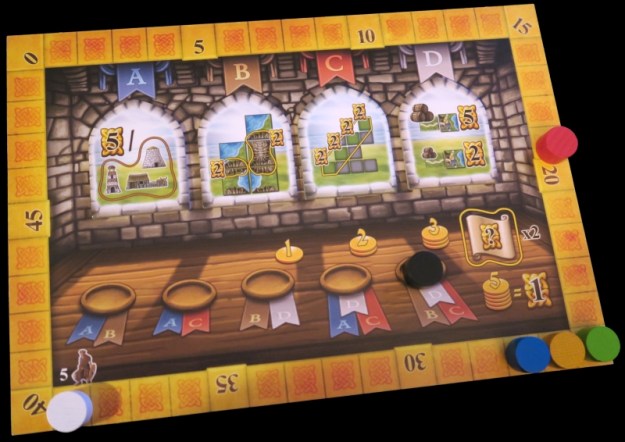
Tag Archives: Isle of Skye: From Chieftain to King

18th March 2025

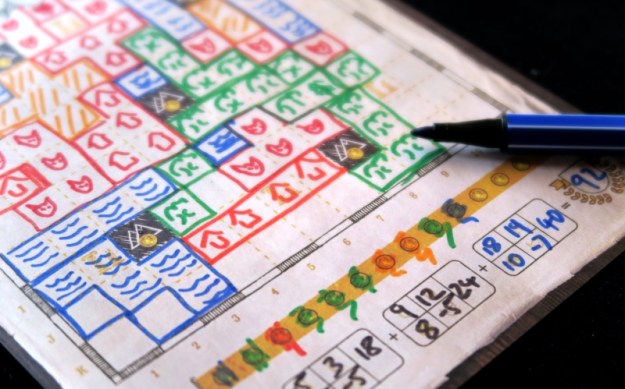
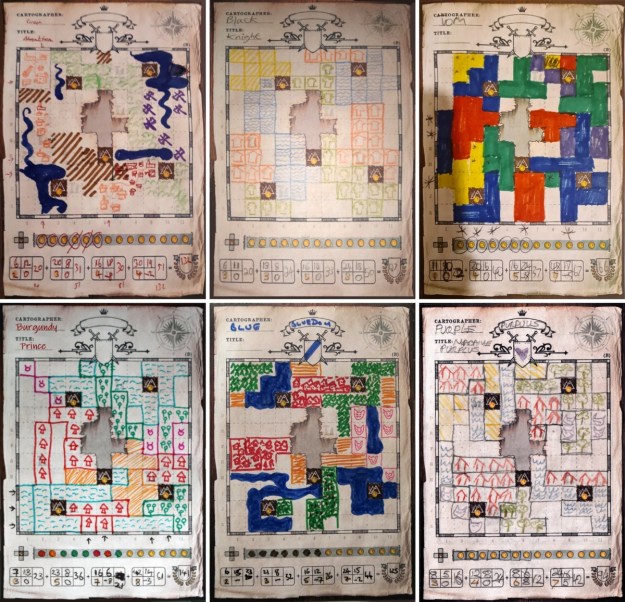
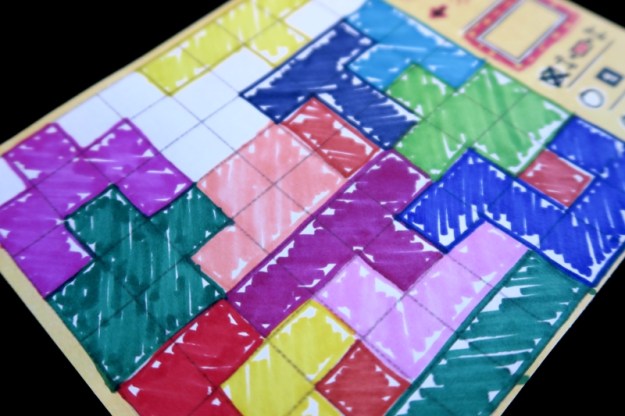
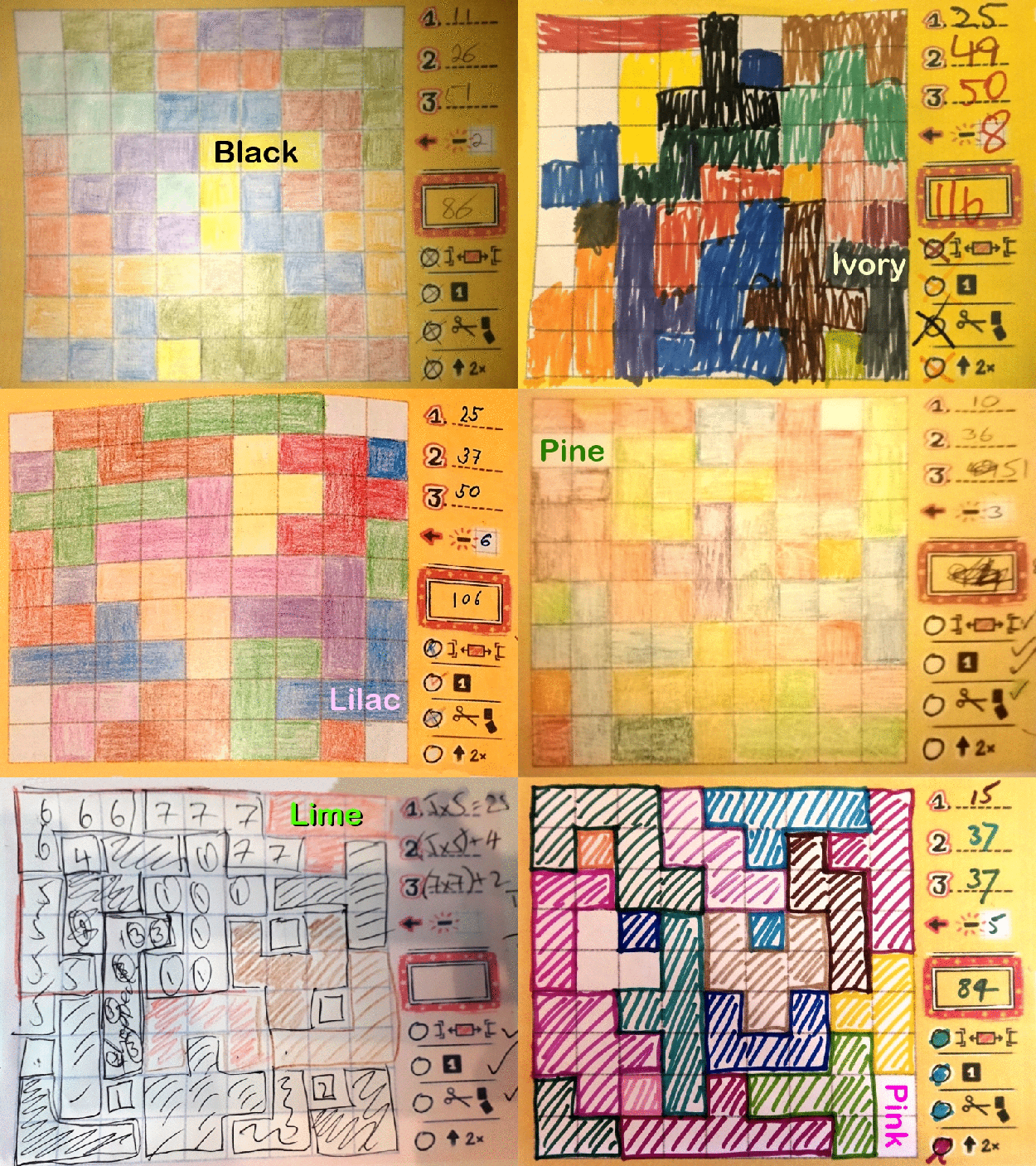
The evening began with the arrival Ruby and Flint, friends of Teal, who had come along despite the fact he wasn’t able to be there to introduce them to everyone himself.  They introduced themselves as people finished their supper and prepared to play the “Feature Game” which was to be Cartographers Heroes, the standalone sequel to Cartographers.  Cartographers was probably the best of the roll and write games the group played online during the global coronavirus pandemic, so we chose to play it to mark the fifth anniversary of our last meeting in the pub before we moved online.  It was a very difficult time for everyone, though as a group we stuck to it and tried to look after each other, continuing to meet fortnightly, online.
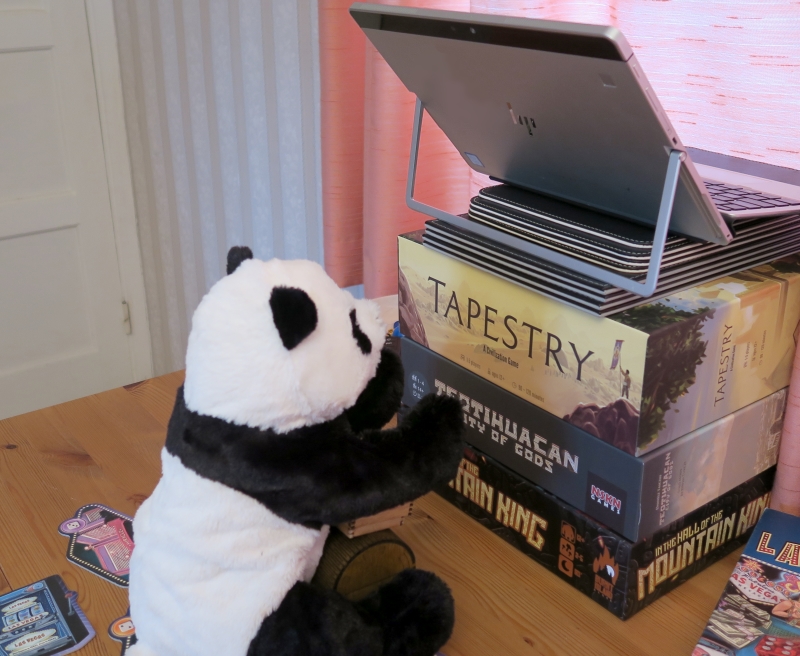
Setting up for online gaming
– Image by boardGOATS

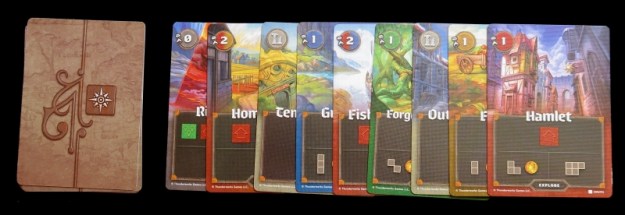
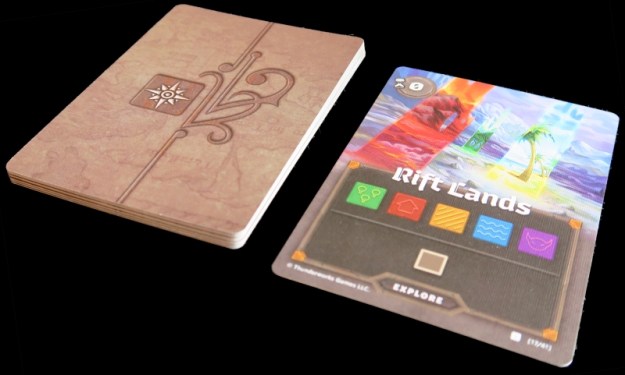
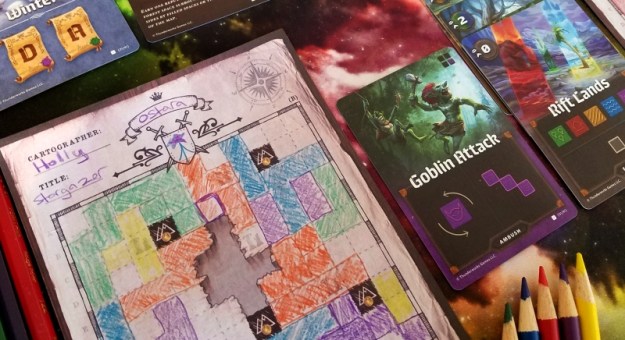
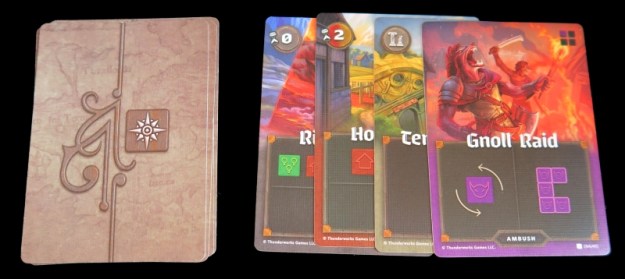
Strictly, Cartographers is a “flip” and write rather than roll and write game as it is card-driven.  Played over four seasons, cards are turned over to reveal choice of “Tetris-like” shapes and/or terrains that players draw on their map.  The game is played over four rounds, each with a different scoring criteria—a total of four during the game, with two active in each round (similar to Isle of Skye).  In addition to the normal terrain cards, there are also Ambush cards, which are nasty as they score negatively with a point lost for each empty space next to an Ambush space at the end of each round.  They can be played in two ways depending on the number of players and the circumstances of the game.
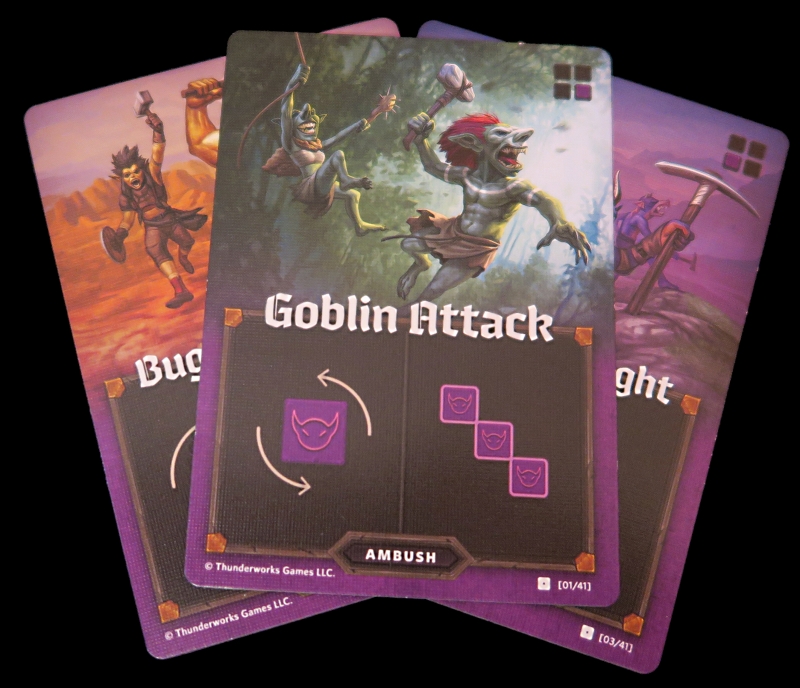
Cartographers: A Roll Player Tale
– Image by boardGOATS

Online, we played these using the Automa rules, where the Ambush “pieces” are placed via a set of rules, whereas in person, players pass their map to a neighbour who places the Ambush piece in as awkward a place as possible.  In addition to Ambush cards, the Heroes game adds Hero cards which can be used to off-set the effect of the monsters from the Ambush cards.  The distribution of cards is also slightly different and the map layout is slightly different too.  This time, although the game can play up to a hundred people simultaneously, because of the difficulty seeing the cards, the group chose to split and play two separate games.
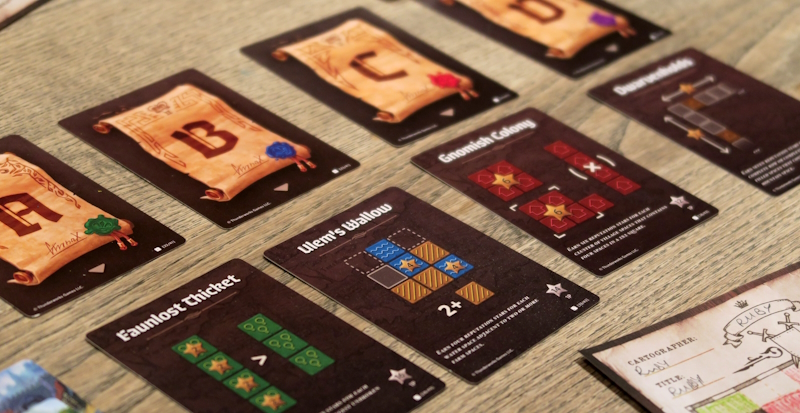
Cartographers Heroes
– Image by boardGOATS

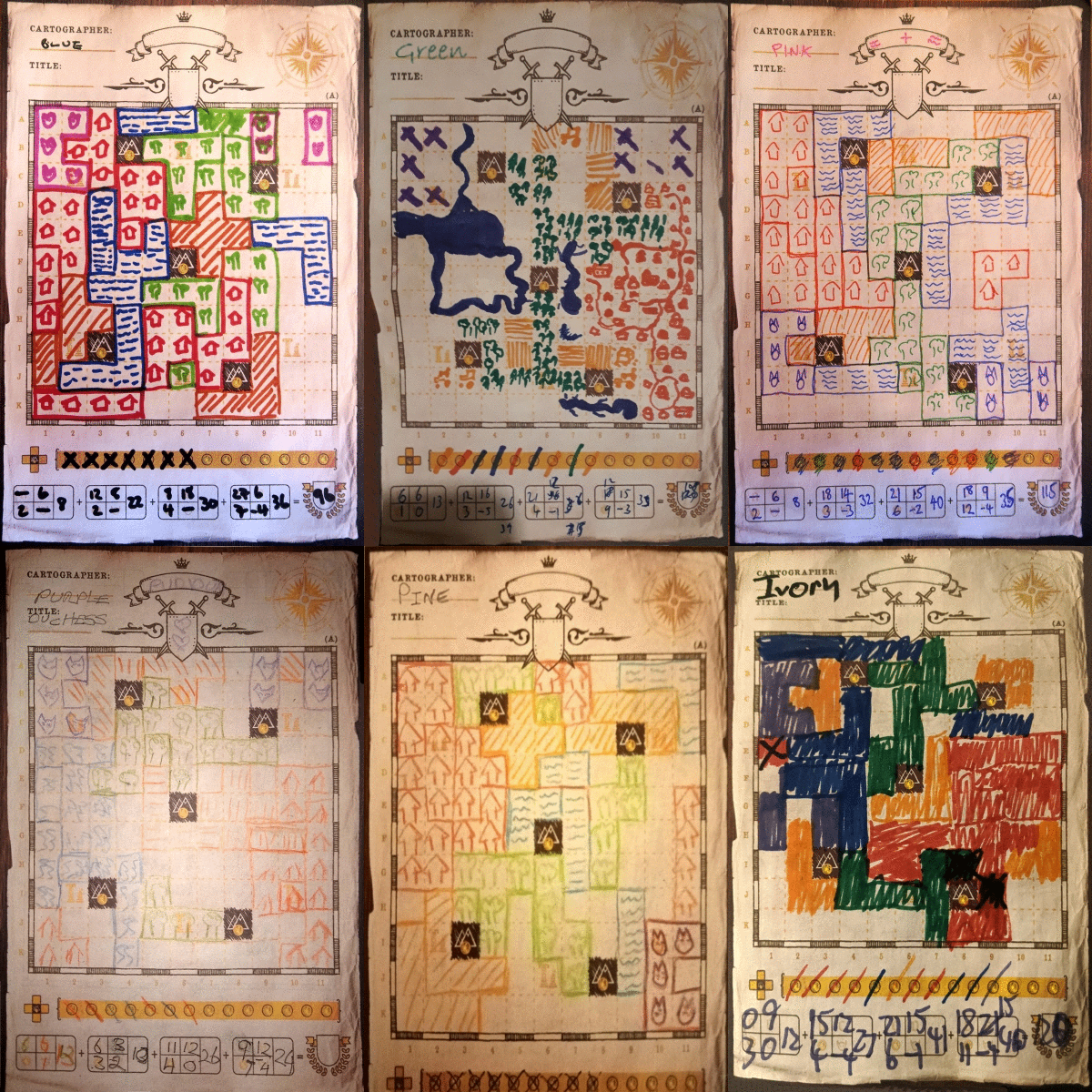
The first of these included Blue, Pink, Flint, Ruby, Purple and Lime, while the other comprised Jade, Sapphire, Pine, Byzantium and Mint.  The first group were using the Collector’s Edition which comes with pencils in colours that match the different terrains.  The second group cast envious eyes on the pretty maps as the games started, but despite offers, refused to take a set and stuck to the slightly more elegant monochrome maps relying on symbols to indicate the different terrain types.  Although the original Cartographers and the Heroes games can be mixed, both groups used the decks and maps from the Heroes game.

Cartographers Heroes
– Image by boardGOATS

The first group began with a sequence of woodland terrain, which fitted with their first objective, but the shapes wrapped nicely round the mines.  The mines give money—when surrounded by terrain, players can tick off a one of the coins marked at the bottom of the map, which gives a point at the end of each round.  Thus collecting them early makes them more valuable each giving up to four points throughout the game.  So, most people started by prioritising them as an easy way forward.  Consequently everyone’s first rounds gave similar scores, but by the second round Lime and Pink had edged a bit of a lead.  Nobody scored particularly well in the third round, so it was all down to the final round to make the real difference.

Cartographers Heroes
– Image by boardGOATS

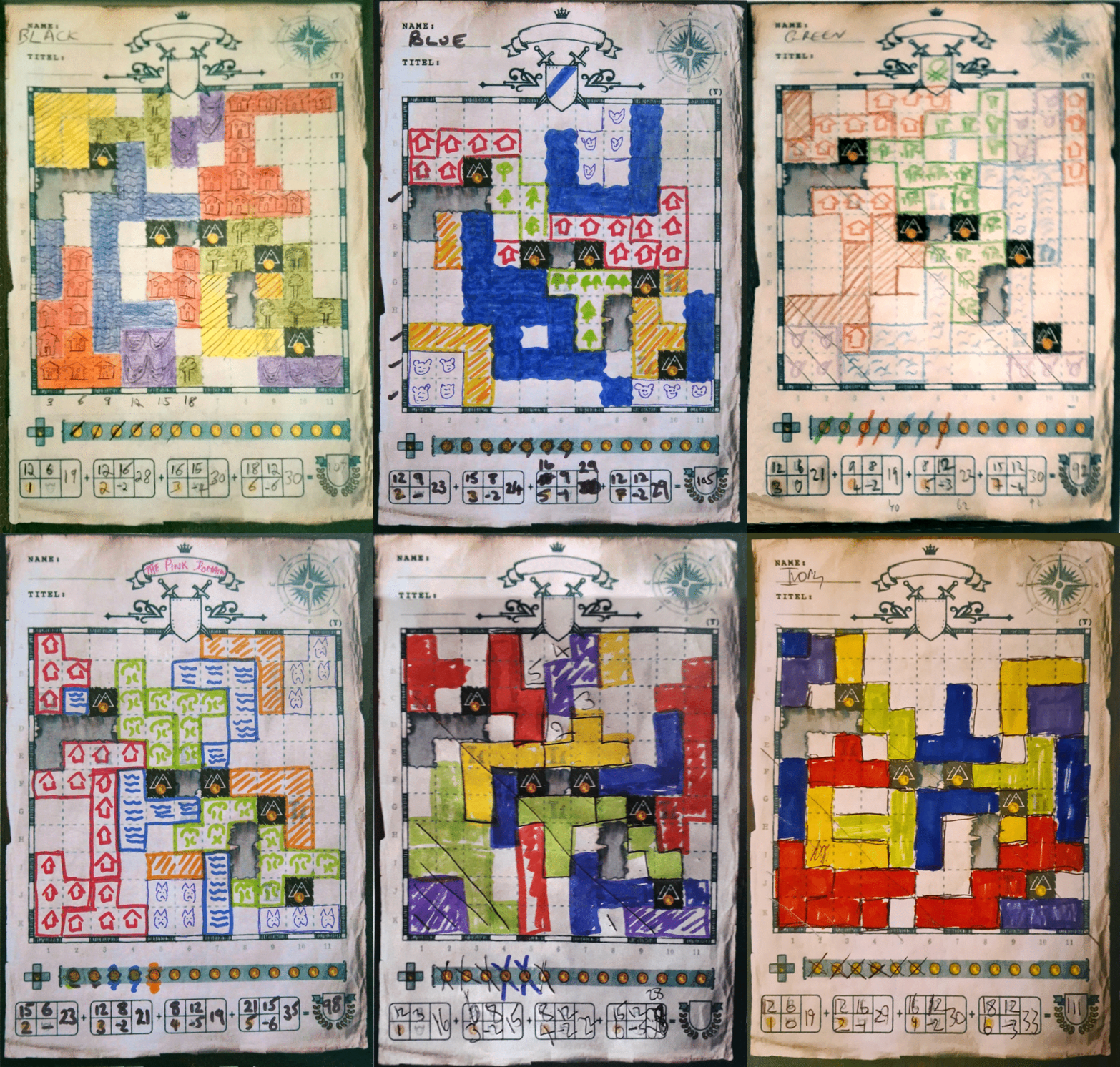
Most people scored around twice what they’d picked up in earlier rounds, but it was Pink who top scored with a massive fifty-five, giving him a bit of a landslide with a grand total of a hundred and thirteen (after a couple of recounts).  Blue just edged into second, ahead of Lime, but they were some twenty points adrift.  The second game followed a similar pattern with massive scores in the final round, though it was a much closer game, with it possible to cover the top three with a postage stamp.  The scores were generally higher than for the first game, but the victor was Mint who finished with a hundred and twenty-six, three more than Jade in second who pipped Byzantium by a single point.

Cartographers Heroes
– Image by boardGOATS

With the second game finishing first, the group moved on to play River Valley Glassworks, a re-implementation of the card game Subastral.  In River Valley Glassworks, players take the role of entrepreneurial of woodland creatures drafting glass from the market of river tiles by playing a piece from their inventory into the river. Each river tile can take only a specific shape, and players have to play into a space adjacent to where they want to draft from. After claiming their glass, the river shifts forward (in a way that is vaguely reminiscent of Niagara), revealing new pieces.
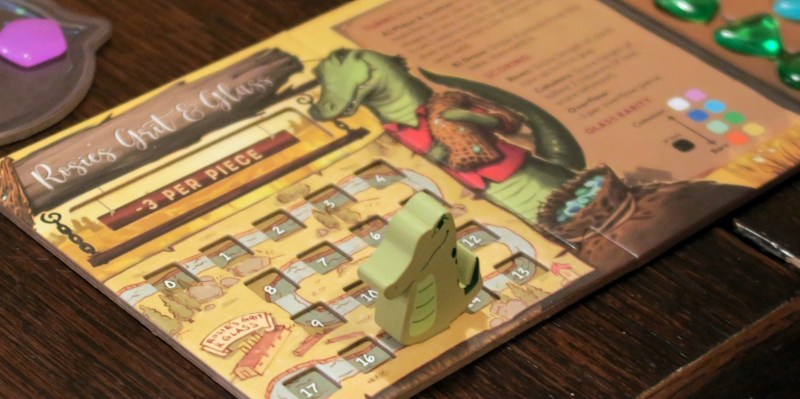
River Valley Glassworks
– Image by boardGOATS

Glass is stored in players’ shops, and the scores depend on where the glass is placed—completed rows and columns gain bonus points, but too many of one type gives negative points.  The game is generally cosy, quick and fun, and this time was no exception.  Jade explained the rules which are simple enough: either place a piece of glass onto a river tile or draw exactly four pieces from the lake with the aim of collecting a rainbow of glass pieces. Getting the balance right can be a little tricky, so it was no surprise that the most experienced players came out best with Jade taking victory with eighty points nearly ten ahead of the other person who had played it before, Sapphire.
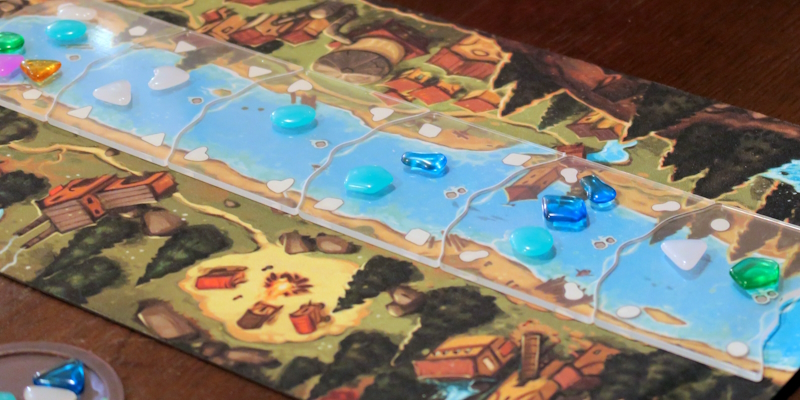
River Valley Glassworks
– Image by boardGOATS

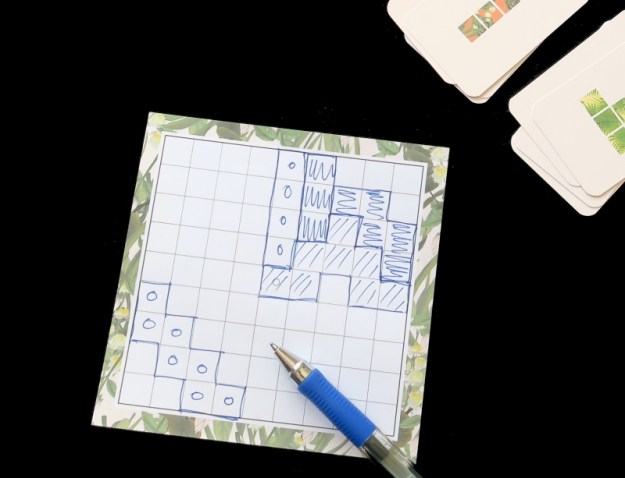
When the other game of Cartographers finished, the group continued with the roll and write theme, moving on to another game that went down well online, Second Chance.  This is a similar “Tetris-like” card driven game, but much simpler.  Everyone has a square grid and as cards are turned revealing shapes, they add them to their grid.  Players are eliminated when they can no-longer add the latest shape.  The game gets its name from the fact that when a player gets stuck, they get one card flipped, just for them, and can carry on if they can add that shape to their grid.  The player with the fewest gaps at the end, is the winner.  This time, Purple was eliminated first, but it still got quite close to the wire and the tension was palpable.  The winner was Flint, however, who very nearly managed to fill his whole grid, leaving just two spaces unfilled.

Second Chance
– Image by boardGOATS

Meanwhile, on the third table, Cobalt was joined by Black, Plum and Ivory in a game of Castles of Burgundy using the new fancy “Special Edition”.  In Castles of Burgundy, players take on the role of an aristocrat controlling a small princedom, building settlements and castles, trading along the river, mining silver, and use knowledge of travelers.  The game is a tile playing game that is played in five phases, each consisting of five rounds. At the start of each round all players roll their two dice, and first player also rolls a goods placement die.  During their turn, players carry out two of the four possible types of action.  These include: take a settlement tile from the numbered location corresponding to one of their dice and place it in storage; take a settlement tile from storage and place it on their player board on a space with a number matching one of their dice;  deliver goods with a number matching one of their dice, or take worker tokens (which allow players to adjust the roll of their dice).

Castles of Burgundy
– Image by boardGOATS

Additionally, players may buy a settlement tile from the central depot and place it in their storage area. The Settlements offer benefits, additional actions, money, advancement on the turn order track, more goods tiles, die roll adjustment or victory points with bonus points awarded for filling a region with tiles.  Cobalt and Black both started on the east side of the map, with Black building to the south with Ships to move up the turn order.  He also got a mine to start generating coins at the end of each of the four rounds. He also managed to completed an area to move up in points (Ships). Cobalt went the other way with yellow and beige buildings and managed to get a second castle (and effectively an extra turn), whilst also completing areas for early points.

Castles of Burgundy
– Image by boardGOATS

Plum started at the bottom and managed to get a Mine, setting up for the future, as well as Ships to move up the turn order, but started accruing points more slowly.  Ivory on the other hand started in the north and went for a different strategy, grabbing animals (specifically goats!) and made a faster start with regards to points, at the expense of turn order.  In the second round, Ivory continued to focus on animals, grabbing more animal tiles and end of game tiles giving points for different animals, to go along with his yellow tile from the first round giving him extra points when scoring animals. He also built his second castle and started to fill the eight beige area, needing one of each beige building in that area for a challenging thirty points.

Castles of Burgundy
– Image by boardGOATS

Plum focused on engine building, getting two more Mines, giving her significant income for the rest of the game, as well as a building which allowed her to build duplicate buildings in an area, making it much easier to achieve thirty points in the eight beige area, as well as a tile allowing her more flexibility in getting tiles (as it allowed her plus/minus one on the die).  Black was also engine building and doing a little bit of everything else, while Cobalt, Like Plum and Ivory was focusing on the beige “Eight” area.  Cobalt also had tiles that allowed him to spend workers to get a tile (as well as change die results) and also get extra workers when he took that action and gain a coin—a very efficient engine! At the end of the round, Cobalt and Ivory had taken the lead, followed by Black and then Plum.

Castles of Burgundy
– Image by boardGOATS

In the third round, Ivory managed to fill all his animal spaces and get the bonus for doing so as well as get more points from his animals, but was generally slowed down by the fact he’d stopped developing his engine.  In contrast, Plum’s engine had kicked in, giving her lots of points and bumping her up the rankings leaving her snapping at Ivory’s heels by the end of the round.  Black was continuing to do a bit of everything, but now had an end game objective for different goods while Cobalt continued to develop his engine.  In the penultimate round, Ivory continued to struggle due to his lack of engine development and his ships paucity of ships meant he had taken his turn last for most of the game, although he was “building beige” where possible for the thirty points.
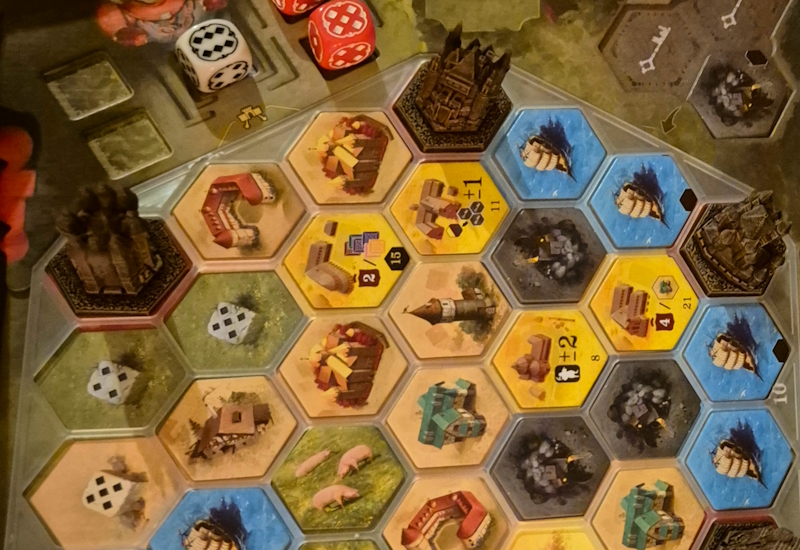
Castles of Burgundy
– Image by boardGOATS

Plum on the other hand, stormed ahead, filling the “Eight” area and taking thirty-four points as she was able to fill it with the same building.  With other scoring opportunities as well (like animals), it looked like she was a certainty to win being as she had a lead of over thirty points at the end of the round. Cobalt and Black also pushed past Ivory with Cobalt having focused on mines and Black completing all four of his castles, taking bonus points for doing so.  In the final round, Cobalt and Ivory both managed to fill their beige area for thirty-two points and Ivory finally got his first ships, albeit too little too late for anything other than a few points. Plum, having filled in the large beige area, slowed down a little, lacking a focus having done so much in the previous round, but still managed to score significantly.

Castles of Burgundy
– Image by boardGOATS

Black was still doing a bit of everything, particularly focusing on goods, but failure to score the large beige area cost him dearly.  By this time, Cobalt, on the other hand, was using his engine to maximum effect, with his ability to grab tiles using workers to give him more actions than everyone else, filling in almost all of his map. This also allowed him to slowly catch up and eventually overtake Plum, taking lots of bonus points for filling in each colour area, giving him the victory with a grand total of two-hundred and forty-four points, some fifteen more than Plum with Ivory some distance behind her.
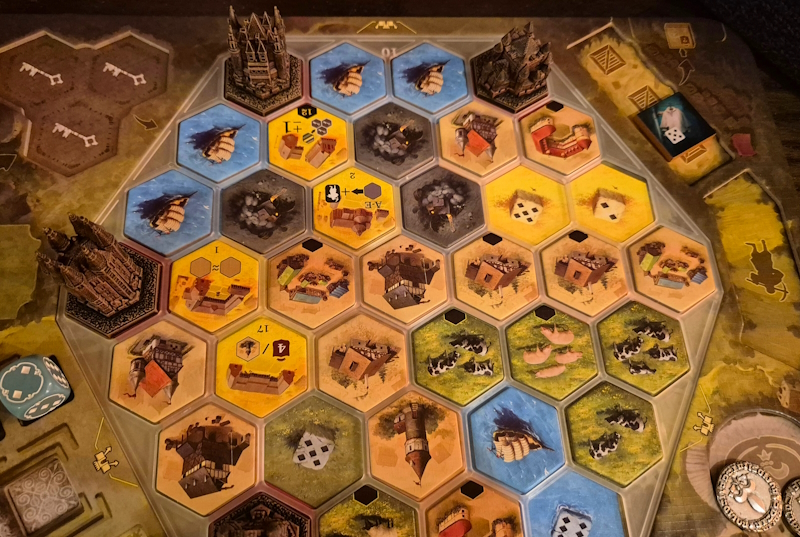
Castles of Burgundy
– Image by boardGOATS

Learning Outcome:  Some Roll and Write games are much better than our slightly tarnished memories of them.

17th September 2024

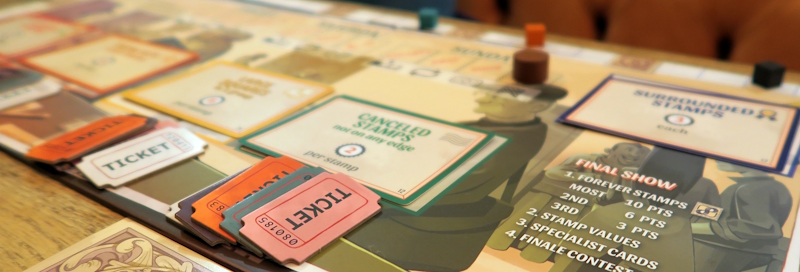
After the usual chatter and some food, the interested parties staked their claim to play the “Feature Game“, Stamp Swap.  This is a game where players take on the role of stamp collectors at a convention collecting, trading and then scoring their stamp album.  All the reviews claim it is a light game, but while it is not hugely complex, there is more to the game than appears at first glance.  At its core is the “I cut, You Choose” mechanism that is used in games like Isle of Skye and …aber bitte mit Sahne, but Stamp Swap is nothing like either of these.

Stamp Swap
– Image by boardGOATS

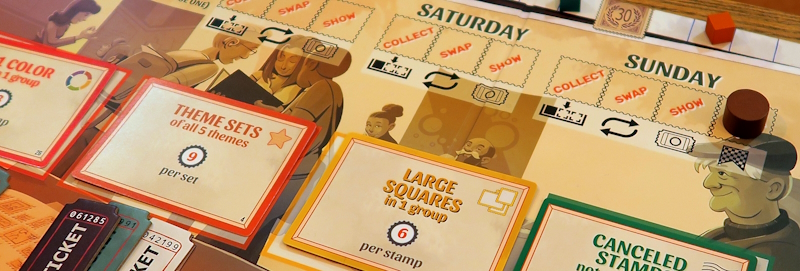
The game takes place over three rounds each with three phases:  Collect, Swap and Show.  In the collect phase, an Event card is revealed and then players take turns to take an item from the central pool.  Once everyone has six items, everyone puts one item aside to Reserve and then splits the rest into two piles for the Swap phase.  Some “I cut, You Choose” games struggle work across a range of player counts, for example, San Marco, really only plays well with three players where one splits the cards into three sets and the others choose.  While the game might work with two, the decisions would be too trivial (though there are variants with a dummy player).

Stamp Swap
– Image by boardGOATS

In contrast, dividing a pile into four would require too many cards and make the decision complex as well as make the game potentially quite “swingy”.  Thus, although the game officially plays three to four players, the mechanism really only works with three.  Stamp Swap avoids this problem with a snake-like mechanism that also negates the need for valuing the hands or the use of money as an intermediate (as in Isle of Skye).  The first player chooses one set and the owner of that set keeps their other set and chooses one from another player.  That player keeps their second set and chooses a set from another player and so on.

Stamp Swap
– Image by boardGOATS

Players then place the stamps in their album and score in the Show Phase.  There are four Goals in each game and each player can score one of these per round, but can only score each only once.  These Goals are different in each game giving a lot of variability, especially as thy combine together in different ways.  At the end of the game, players additionally earn points for the face value of each Stamp, for any Specialist cards they may have, for Stamps that match their personal Theme, and for their achievement in the Finale Contest, while receiving bonus points their place in the Forever Stamp competition.

Stamp Swap
– Image by boardGOATS

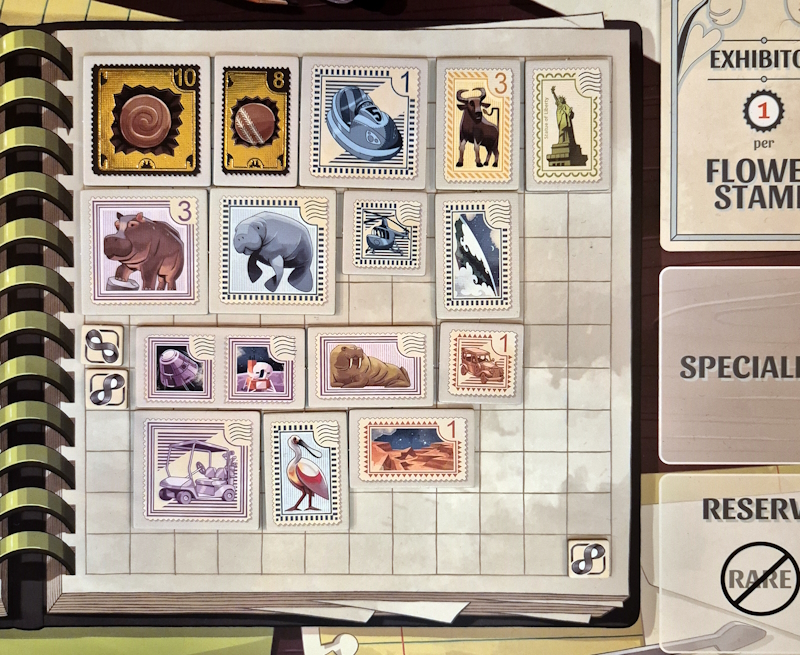
The unexpected complexity arises from the stamps themselves.  They come in five different colours, themes and size/shapes.  Some of these stamps are “Cancelled” (and have no face value) and some are “Faded” (and have a negative face value, but may be useful for claiming the Goals).  There is are special gilded Stamps with their own Chocolate theme and a high face value, but cannot be reserved at the end of the Collect phase.  Finally, there are the “Forever” Stamps.  These are Square and are the only Stamps available in the smallest size and have no face value, but are useful for filling tiny holes (should that be required for the Goals) and give bonus points at the end of the game (in much the same way as Pudding do in Sushi Go!).

Stamp Swap
– Image by boardGOATS

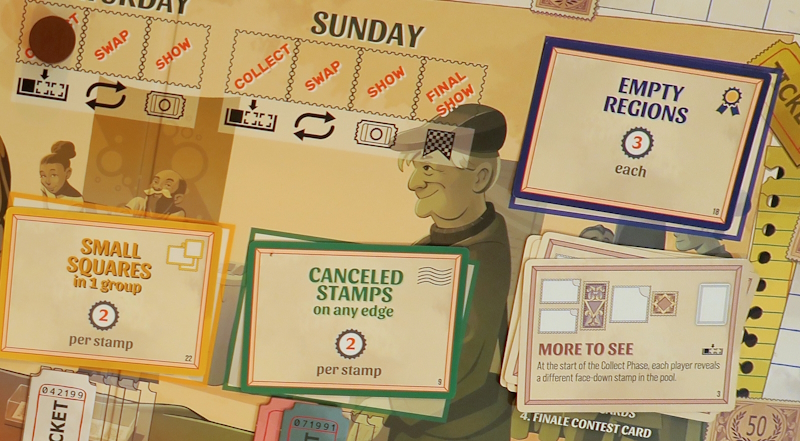
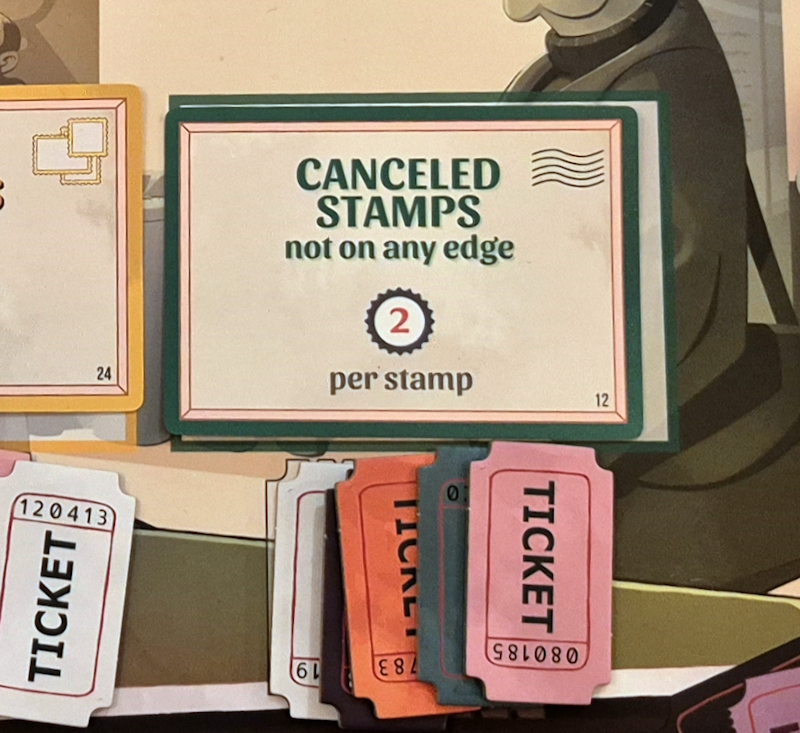
It turns out that the game takes quite a lot longer with more players, which was a bit of a surprise given that much of the game is played simultaneously.  This time Ivory led a group of five with Plum, Sapphire, Jade and Teal, while Blue led a group of four comprising Byzantium, Purple and Black.  Ivory’s group were quick off the mark and first to get going after the rules explanation.  Their Goals gave points for:  Stamps of one Colour in one Group; sets of all five Theme Stamps; Large square Stamps, and Cancelled Stamps not on the edge, while their Finale Contest gave points for the number of Stamps completely surrounded by other Stamps.  Ivory’s personal scoring objective was Space Themed Stamps, Plum’s were Animals, Sapphire’s were Vehicles, Jade’s were Monuments and Teal’s were Flowers.

Stamp Swap
– Image by boardGOATS

Everyone began by feeling their way a bit, especially as the first round added additional Specialists—cards that give extra powers for the rest of the game.  Plum made a “bee line” for these, while Jade and Teal focused on the Large Square Stamps, scoring the related bonus, and giving them an early lead.  Jade also managed to “hide a gold stamp (face down)” and ended up with it in his collect as no one took it.  Plum scored for the Cancelled Stamps first, as she had picked up a lot of them.  As nobody chose his set, Ivory ended up with all his own Stamps, which he thought was great at first, but then had second thoughts as he ended the first round at the back of the pack.

Stamp Swap
– Image by boardGOATS

In the second round, the event was “Rewarding finds” giving two points immediately for taking a face down Stamp, which everyone was keen to do, especially Plum, who quickly caught up with Jade and Teal as a result.  Plum made good use of her “Swap one for three face down Stamps before splitting your collection” to grab extra Stamps.  Teal managed to hang on to the First Player token for most of the game and also took a lead on the Forever Stamps. Sapphire grabbed an exhibitor for Yellow Stamps and proceeded to take Stamps to match wherever possible (both from the pool and from other peoples piles). Ivory made a point of collecting a full set of five different Theme Stamps, scoring nine points, as well as managing to keep a valuable face-down Gold stamp.

Stamp Swap
– Image by boardGOATS

Going into the final round, Ivory was still trailing significantly behind everyone else who were bunched tightly together.  This time the Event gave bonus points for taking Stamps that matched the Theme of their neighbours, which made the game slightly meaner as everyone was taking Stamps others wanted.  Plum was again using the additional Stamps she was getting from her Specialist to shape what she was going to end up with, managing to get three complete sets for twenty-seven points. Jade also managed to score well for this in the final round, as well as for the coloured Stamp cards he collected. Sapphire was similar with his vehicles and Yellow stamps, as well as scoring scoring for Large Square Stamps.

Stamp Swap
– Image by boardGOATS

Teal fell a little behind, taking fewer points for the Cancelled Stamps on the edge and he also failed to collect any of the Flower Stamps he needed as everyone kept taking them during the swap phase (in order to get complete sets). Ivory meanwhile focused on getting as many Large Square Stamps adding to the three he already had, giving him a massive fourty-two points taking him from behind and giving him a significantly lead.  In the final scoring, Teal took the bonus for the most Forever Stamps giving him ten points while and everyone but Plum tied for second with a single Forever Stamp, giving six points.

Stamp Swap
– Image by boardGOATS

Everyone managed to get at least one gold stamp, but Ivory had the most valuable total face value.  Plum scored most for specialists, although most people had at least one, so this made little difference to the scores. Everyone scored well for the Finale Contest, especially Jade, and Plum, but it was not enough to overhaul Ivory’s lead.  He finished with a total of a hundred and forty-eight, ten more than Plum who took second place, who was a handful of points ahead of Sapphire in third.  On the next table, Blue took longer to explain the rules, but once they got going, they soon caught up with the first group and ended up finishing just before.

Stamp Swap
– Image by boardGOATS

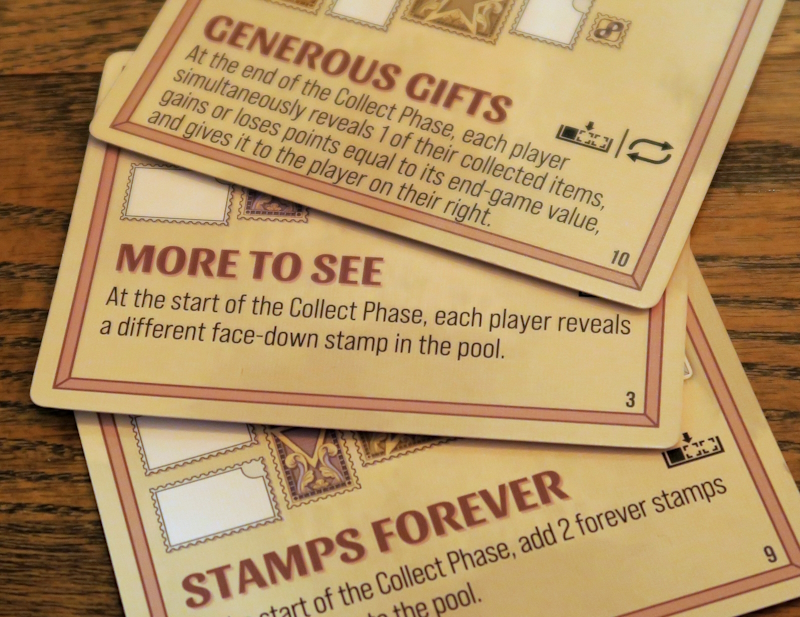
Their first Event card was “Generous Gifts” so after the Collect phase, players choose one collected items to score and then pass on to their neighbour.  Everyone quickly chose their highest scoring Stamp, then realised that meant they would lose it, so had a bit of a re-think.  It was then that the group began to really appreciate the quandary at the centre of the game:  it was all very well taking nice tiles, but they were no use if someone else took them.  This tension was particularly obvious in the final round of the first game where the “Mine not Yours” Event gave points for taking Stamps that matched a neighbour’s theme—while players lost the opportunity to pick up Stamps they wanted in the Collect Phase, they had the chance to take them in the Swap phase.
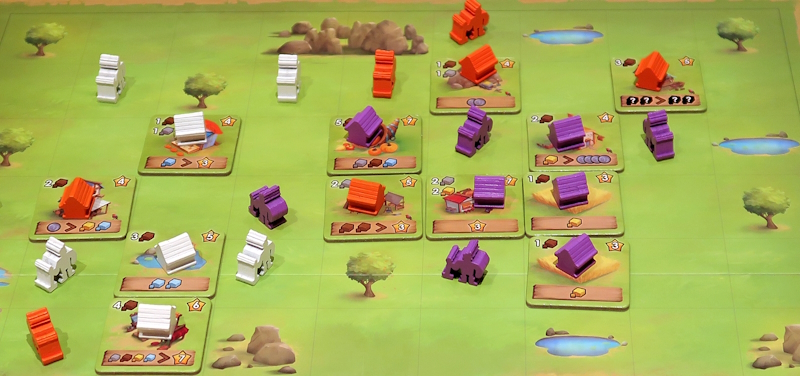
Stamp Swap
– Image by boardGOATS

The Events in the second and third rounds were “More to See” and “Stamps Forever”.  These had a much smaller impact on the game play, or at least it felt like that, though the Forever Stamps were all collected in the final round.  The Finale Contest was “Empty Regions” which gave three points for each empty region.  Black showed everyone how to to maximise this and from the end of the first round, everyone’s collections began to look like every-expanding checker boards.  Comparing the final album boards between the two games, the layouts were completely different with compact groups for the first game and gappy sprawling displays for the second game.

Stamp Swap
– Image by boardGOATS

Black picked up the bonus for having the most the Forever Stamps, and Byzantium, who by his own admission had been “pants during the game” picked up loads of points in the dying stages.  Purple had done the best with her personal Goal—Flowers, while Blue had a plethora of rare, valuable Stamps.  During the game it had been unclear who was really in the lead as the scores seesawed a bit, but Byzantium’s lunge for the line gave him the lead when it mattered and he finished with a hundred and forty-six points, seven more than the runner up, Blue.  All in all, everyone had enjoyed the game, though the overwhelming feel was that there was much more to the game than the reviews claimed, but that’s a good thing.

Stamp Swap
– Image by boardGOATS

Cobalt was the only person with a strong aversion to playing Stamp Swap, but Pine, Lime and Pink were all keep to play one of their favourite games, Zoo Break, another game that wasn’t really his type.  In he end, Cobalt graciously joined in the keepers of Bedlam Zoo, trying to keep the animals under control.  The game is a cooperative game, where players take it in turns to roll a die to determine how many actions they get, take the actions like acquiring
supplies, capturing animals, locking enclosures etc., before cards are drawn to see what animals escape and then move towards the exit.  The aim is to get all the animals back into their cages and lock them before five animals  or anything dangerous gets out.

Zoo Break
– Image by boardGOATS

The group chose to use the standard difficulty (two “Phew” cards), but with the “Faulty Lock” variant.  This is where players roll to see if the lock holds when one of the locked up animals tries to escape; it adds a but of interest to the end of the game, however, unfortunately this time, the group didn’t get that far.  They managed to lock up the Elephants, Tigers and the Rhino, but the mischievous Pandas remained rogue until the end of the game.  They weren’t the problem, however, that was the Snakes.  Three harmless Garter Snakes got out, but they were followed by a Viper, and as it left, so did the group’s zoo license…

Zoo Break
– Image by boardGOATS

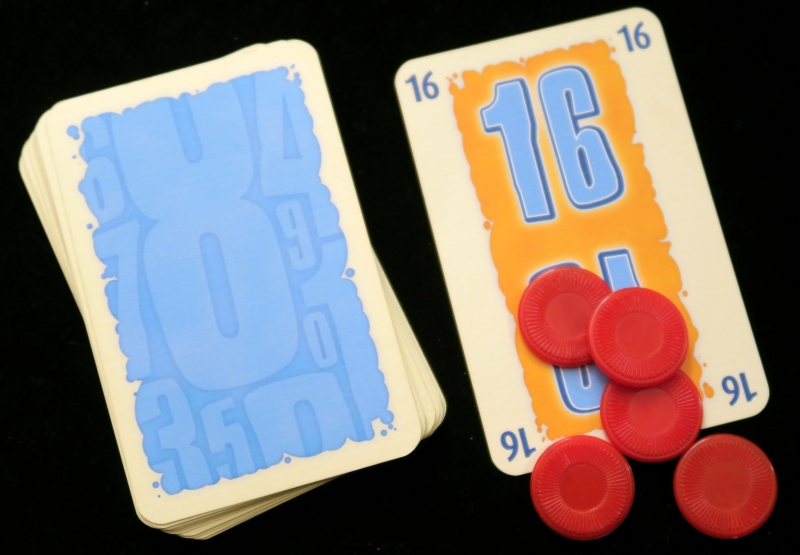
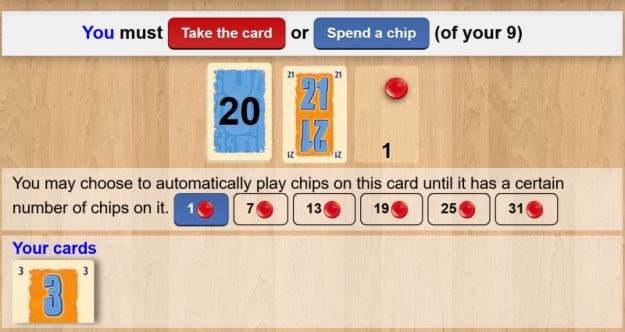
With Bedlam Zoo sadly closed prematurely, the group moved on to a couple of quick fillers.  The first of these was No Thanks!, a really clever little “cards with numbers” game.  The idea is that players either take the face up card or pay a chip to pass the problem on to the next player with the aim being to be the player with the lowest total at the end.  The clever part is that if a player has a run, only the lowest value card counts, but the deck also has some cards removed at random.  This makes it a proper gambling and “push your luck” game.  This time, Cobalt was the top scorer, but the winner with eighteen was Pink.

No Thanks!
– Image by boardGOATS

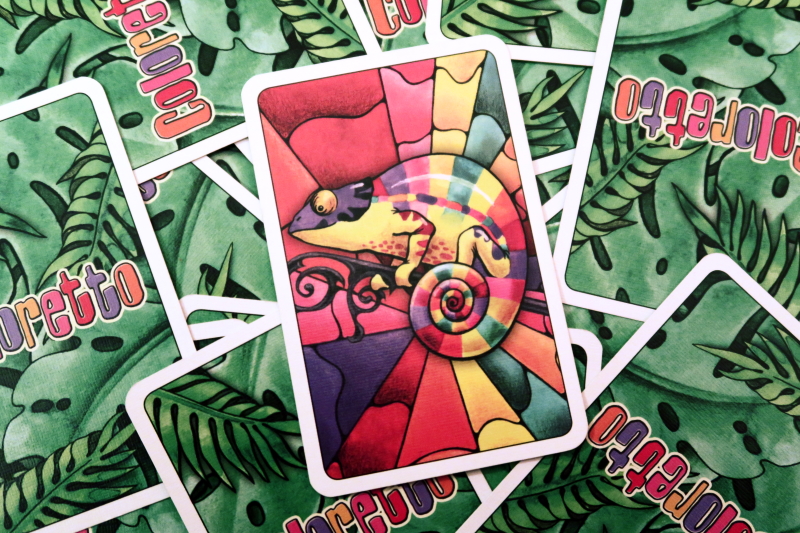
There was just time for one more game, Coloretto.  This is another simple and clever card game, this time the essence of the core mechanism in the bigger game, Zooloretto.  The idea is that players either draw a card and add it to a truck, or take a truck and add its contents to their collection.  At the end of the game players score their three largest sets positively, with negative points for any other sets.  The clever part is the use of the Triangular number sequence which means the first card in a set is worth one point, while the sixth is worth six.  There were the usual questions about Joker cards which resulted in questions being called across the room, but in spite of taking all three Jokers in the deck, Pink was just second by three points behind Lime’s total of forty.

Coloretto
– Image by boardGOATS

Learning Outcome:  A game about Philately can be more than just Stamp Collecting.

11th June 2024

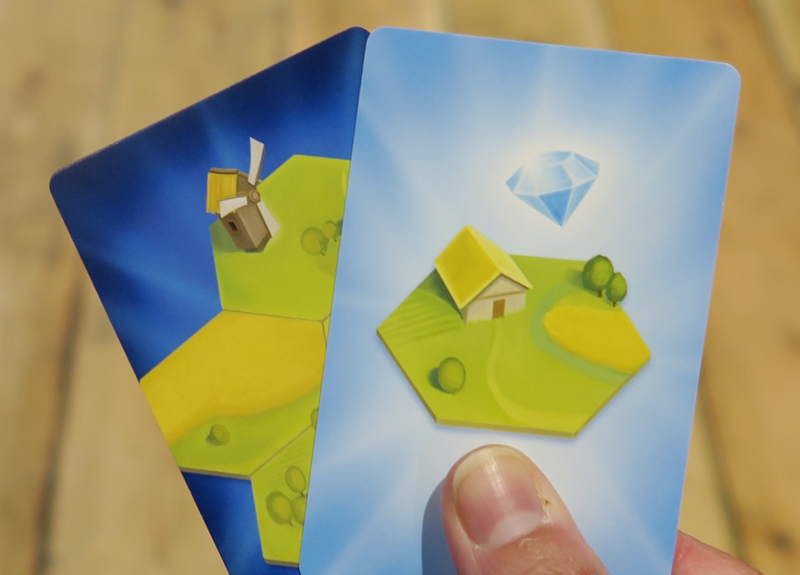
The pub was not as busy as last time, and in any case, Pink, Blue, Black and Purple were there in good time for food.  Once they had finished, they managed to squeeze in a quick game of Rome in a Day while they were waiting for food and eating.  This is a cute little tile-laying game Black and Purple picked up from UK Games Expo as few days back.  It is a bit like Kingdomino with the “I cut, you choose” mechanism to allocate the tiles.  The “I cut, you choose” mechanism is used in a number of other games like, Castles of Mad King Ludwig, Isle of Skye, and Dice Hospital, but it is a more fundamental part of games like San Marco, and particularly …aber bitte mit Sahne and New York Slice.

Dice Hospital
– Image by boardGOATS

In the case of Rome in a Day, Players start by taking five land tiles drawn at random and place two buildings on tiles one and two.  They then divide the five tiles into two groups—a bigger and a smaller one (in any ratio) and add a crystal to the smaller land set before offering them to their neighbour.  During the four rounds the game is played over this neighbour alternates, right, left, right, left.  So, each round, players choose a set from their neighbour and these and the tiles they were left with are added to their domain.  At the end of the game, any building that stands on or adjacent to land of its own colour will score for each tile in the group and then players score for the diamonds they have collected—the player with the most points is the winner.

Rome in a Day
– Image by boardGOATS

Like in Kingdomino where players score better for a medium number of crowns in a medium sized area than for a combination where one is large and the other small, players benefit more if they can surround one large area of coloured tiles with multiple buildings of the same colour.  The most successful at this was Pink who scored well for three coloured areas, the green Olive Groves, the blue-purple Vineyards and the yellow Wheat Fields, while the others didn’t score at all.  As a result of his ruthless scoring strategy, he finished with fifty four points, eight points clear of second place, which went to black by a single point.

Rome in a Day
– Image by boardGOATS

The game was just coming to an end when Jade, Sapphire, Plum and Byzantium arrived, followed by Pine, Ivory and Teal, and then the inevitable debate as to who would play what began.  In the end, Jade led a group of four including Black, Purple and Sapphire in the “Feature Game“, Courtisans (the French for Courtier as it is spelled with an “i” rather than an “e”), which also came from UK Games Expo.  The first game was essentially a learning opportunity where players tried to understand the learning the mechanics of the game.  On their turn, each player receives and plays three coloured Family cards.

Courtisans
– Image by boardGOATS

One card is played at the Queen’s table to sway a family’s influence in a positive or negative way depending on whether it is placed above the table or below—at the end of the game, those with more cards below than above will have “Fallen from Grace”.  The other two cards are then played, one in the player’s own Domain and the other in an opponent’s Domain. At the end of the game, each card a player has from an “Esteemed” Family is worth a point, while each card from an Family that has “Fallen from Grace” loses them a point.  Thus the cards can be worth positive or negative points, depending on the Family’s status at the end of the game.

Courtisans
– Image by boardGOATS

Some of the Courtier cards have a special power, for example, Nobles count as two cards, Spies are played face down and their allegiance is only revealed at the end of the game, Assassins can be used to eliminate other Courtier cards, while Guards are not affected by Assassins.  The game ends when the card deck has been exhausted and nobody has any cards left in hand.  Players then total up their score and add any points earned from successful Secret Missions (each worth three) and the player with the most points is the winner.

Courtisans
– Image by boardGOATS

Black went first chosen by an app and began feeling his way forward.  The group only realised there was a slight issue towards the end as they ran out of cards a bit early.  It was then that it was discovered that at some point Black had acquired a second hand which he had placed on the table beside him.  Despite only a few personal objectives being met mostly players scored scored well; the exception was Purple who was the only one to complete both objectives which added six points to her score at the end.  It wasn’t enough for victory though, that went to Sapphire who had fifteen points, with Jade a point behind in second.

Courtisans
– Image by boardGOATS

Having felt their way through the first game, the group decided to play again.  As the winner, Sapphire went first, and from the off, it was like everyone woke up together and all decided to attack.  This time, everyone completed at least one objective, but this second game was a lot more treacherous and this was evidenced in the scoring.  One of Jade’s objectives was to ensure at least one of the Houses had at least five cards bringing them into disrepute—Jade chose yellow which caused others problems.  It didn’t have as much of an effect as his second objective though,which was to have fewer red cards than the player to his left.  As a result of this, Black was the kind recipient of any red cards he acquired.

Courtisans
– Image by boardGOATS

While he tried to bring the reds into disrepute too, it wasn’t possible to do both.  So, despite his best efforts they still scored positively and probably helped ensure Black’s victory with seven points, four more than Jade himself.  The scores were much more diverse in the second game though with a range of sixteen points with the person at the back finishing with minus nine!  Although savage, it had been a lot of fun; Jade commented that the game felt a bit like a dance with lots of nuance.  Definitely one to play again, especially given the truly beautiful foiled cards which are a delight to play with.

Courtisans
– Image by boardGOATS

Meanwhile, Teal had picked up the Alpine expansion for one of his favourite games of the moment, Forest Shuffle, and was keen to give it its first outing.  He was therefore joined by Plum, Byzantium and Pink who were also keen to see how it changed things.  Forest Shuffle is mechanically a fairly straight-forward game, but playing it well is comparatively difficult as it requires good, robust strategies and an understanding of how to get the best from the cards.  The idea is that players start with a hand of cards and, on their turn draw two more from the market (or “Clearing”) or play one into their tableau.

Forest Shuffle: Alpine Expansion
– Image by boardGOATS

There are two sorts of card, Trees and “Critters”.  Before playing a Critter, players must have played a Tree, which then has spaces on all four sides.  Birds and Butterflies are played to the canopy (i.e. above tree cards), Fungi and Amphibians are played at the bottom of the tree (i.e. below them) and Mammals are played either side.  The clever part is that Critter cards are split so they show two critters (either left and right or top and bottom), so players choose which they would like to play, and where, tucking the other side under the tree, making the unplayed half invisible.

Forest Shuffle
– Image by boardGOATS

The new Alpine expansion for Forest Shuffle only adds some thirty six cards to the game and, since roughly twenty additional cards are removed during setup, in practice it adds just sixteen to the deck.  Of course, the cards are removed at random so many should be from the base game and the expansion adds new cards like the Mountain Hare, who scores as for the European Hare, but wants to stay alone so can’t share a space with another Hare.  There is an extra Butterfly and more Trees too, which make these easier to score and help to balance the game somewhat.  Additionally, there is the new Alpine Newt provides a new way of scoring, for players who have managed to pick up a lot of cards from the Alpine expansion cards.

Forest Shuffle: Alpine Expansion
– Image by boardGOATS

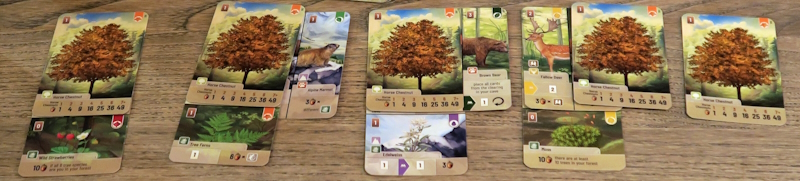
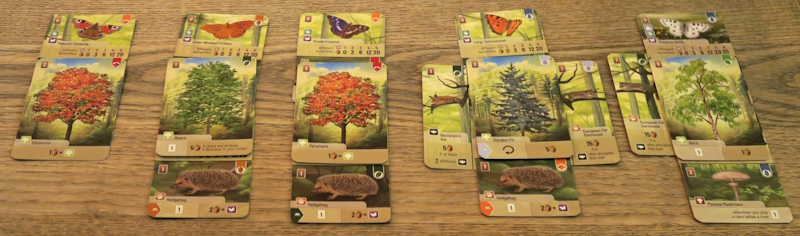
This time, Plum went for Trees in a big way with loads Horse Chestnuts which give more points the more you have on them up to forty-nine for seven or more.  While she didn’t quite make the full seven, she scored a total of forty-eight for her Trees, fifteen more than the nearest player (Byzantium) and more than double what anyone else took.  They, of course, got points elsewhere though.  Pink, for example, went for Butterflies and, with the additional Phoebus Apollo Butterfly, took thirty-five points for them alone.  Byzantium opted for a deer strategy and received a total of sixty-one points for all his Critters.

Forest Shuffle: Alpine Expansion
– Image by boardGOATS

The winner was Teal however, with everyone else totally overcome by “The Lynx-Effect”, where each Lynx he had gave ten points as long as he had a Roe Deer to keep them fed.  Perhaps his victory was to be expected as he has played the game quite a bit with family, but his finishing score of a hundred and fifty was some way ahead of Pink and Plum who tied for second place with a hundred and nineteen.  Overall, the Alpine expansion adds some pretty artwork and made a few of the alternative strategies a lot more viable, reducing the apparent dominance of Wolves and Deer which it has often been claimed are overly powerful.

Forest Shuffle: Alpine Expansion
– Image by boardGOATS

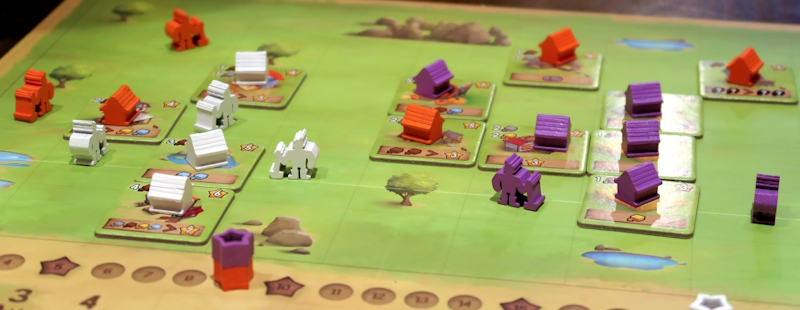
With the Courtisans and Forest Shuffle groups sorted, that left just three players without a game.  Since Ivory and Pine both missed out on playing Little Town last time and neither wanted a particularly late night the decision was made to eschew Key Flow in favour of the lighter, quicker, tile-laying game.  Play is very simple:  players take it in turns to place their Workers in a space on the central board and then activate the eight spaces around them.  These eight spaces could be Buildings, but may also be Trees, Rocks or Lakes pre-printed on the board giving resources (Wood, Rock or fish respectively).  With three players, there are four Workers in each of four rounds and the player with the most points at the end is the winner.
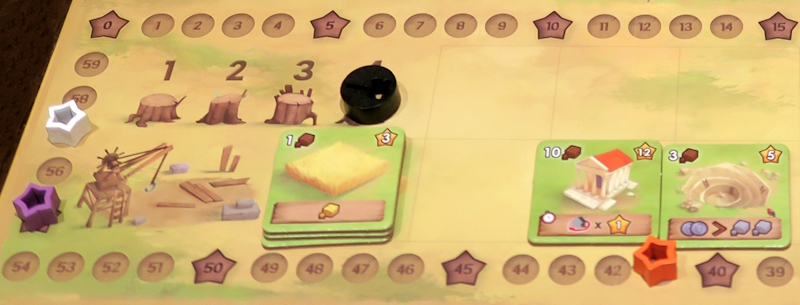
Little Town
– Image by boardGOATS

Little Town has had a few outings, but was the “Feature Gamelast time, with two games played simultaneously, both with the starting tile set up.  This time, a random tile setup was used drawn from the full set that included the Pier, the Marketplace, the Bar, from the variant set as well as the Shop, the Workshop, the Goldmine, the Bakery, the Pawnshop, the Quarry and Wheat Fields from the basic set.  The twelve Buildings were completed by the Temple, the Cornucopia, and the Sushi Bar from the Goodie Buildings mini expansion.  Blue and Pine both complained that their Objectives were considerably more difficult than Ivory’s as he claimed all his quite quickly.

Little Town
– Image by boardGOATS

Eventually though, all three managed to complete all their Objectives.  Pine misunderstood the fact that each Worker needs to be fed at the end of every round, rather than just at the end of the game.  As it was a genuine error, rather than cripple his game at the end of the first round, Blue and Ivory let him pay with other resources leaving his unfortunate workers to gnaw on bits of stone, wood and coins.  Other than that, the game proceeded according to the rules.  Ivory majored on trying to convert Fish into points, while Blue tried to do the same with Wheat and Pine played the merchant, building the Gold mine and the Shop.

Little Town
– Image by boardGOATS

As the game came to a close, Ivory had a substantial lead with forty-two, ahead of Blue in second with thirty and Pine with eighteen.  This was without any of the points from the buildings (which Blue had a lot of) or from leftover money (of which Pine had an enormous pile).  As it turned out, money is not worth much at the end of the game, and although Blue’s buildings were worth considerably more than Ivory’s, she still fell two points short of his final total of fifty-seven.  So although we’ve still not been able to use the “sixty point tokens” we were only a handful of points shy.

Little Town
– Image by boardGOATS

The others were still playing, so after some discussion, Blue, Pine and Ivory decided to give the 2022 Spiel des Jahres nominee, SCOUT, an outing.  This is a clever little card game with two key features: firstly, as in Bohnanza, players can’t rearrange their hands, and secondly, the cards have different values depending which way up they are.  Like Tichu or Haggis, SCOUT is a climbing game, that is to say, on each turn players are aiming to beat the previous score.  In SCOUT, that means players have to play a higher value or larger meld, or a longer run or one of a higher value (and a meld of the same size always beats a run).

SCOUT
– Image by boardGOATS

These cards are played from hand, but have to be consecutive.  In the event that a player can’t or doesn’t want to play cards from their hand (aka “Showing”), they may instead take a card from either end of the current winning set and add it to their hand anywhere, and either way up (aka “Scouting”).  Additionally, once per round, players can “Scout and Show” which is take a card and then also play cards.  The round ends when either nobody in the round has been able to Show or a player plays their last card and has nothing left in hand. At the end of the round, players lose a point for every card they have left, and this is taken from the total from their scoring cards and points earned when others Scout from their display.

SCOUT
– Image by boardGOATS

With three players, there were three rounds, the first of which was finished by Pine, though Ivory nearly managed to check out, leaving Blue with a large handful.  The second round was much closer with Blue playing a nine-card run (though as cards in front of players at the end don’t score, and very quickly nobody could beat it, she didn’t get the advantage she felt she deserved).  The final round was taken by Pine again, but it was also close again.  The total favoured Pine, who finished with a total of twenty-six, a clear victory with Blue just pipping Ivory to second place by a single point.

SCOUT
– Image by boardGOATS

Forest Shuffle and SCOUT were both still going when the Courtisans finished, so they quickly set about playing a light filler that Jade had picked up from the Hachette UK stand that he had worked on at UKGELine-it, is another card game, played with a deck that consists of cards in four colors, numbered one to a hundred and six “Bet” cards (numbered three to five), which are shuffled together and laid out to create a market consisting of slightly more cards than there are players.  Players then take it in turns to take a card and either add it to their hand or add it to the row of cards in front of them (their Line).  There is a hand limit of two and the row must continue either increasing or decreasing.

Line-it
– Image by boardGOATS

If a player can’t add the card to their hand or their Line (because it would break the ascending/descending pattern), they have to score their Line, then play that card to start a new Line.  After drafting a card, players may choose to add one card from their hand to their Line and then score it. When scoring, if there is a Bet card in the Line, if there are more cards added since the Bet card than the value depicted on the Bet card, players get chips equal to the value of the Bet.  If the Bet is lost, the player takes negative points instead. Finally, three cards are discarded from the Line and the others turned over and placed in the player’s scoring pile.

Line-it
– Image by boardGOATS

Once each player has had a turn, all remaining Bet cards are discarded, and the other cards are placed under the Jackpot token that corresponds to their colour—these can be claimed whenever a player adds the third card of the respective color to their Line.  The game ends when the draw deck depleted, and each player plays one last card from their hand, then scores their line and tallies their points, the player with the most points is the winner.  As he had won the second game of Courtisans, Black went first.

Line-it
– Image by boardGOATS

Black and Purple both took (and completed) Bet cards early in the game, whereas Jade didn’t even take because his Lines weren’t right when the Bet cards were available because just didn’t make sense.  Purple won the first jackpot of the game which was a tidy little stack of blue Diamond cards and Sapphire also picked up Jackpot cards later in the game.  The game plays quite quickly and smoothly and this time out, it was close, well, close between Black, Jade and Purple—Sapphire was streets ahead, finishing with twenty-six points, a long way clear of Black in second with fifteen.

Line-it
– Image by boardGOATS

Learning Outcome: UK Games Expo is a good source of new games.

24th March 2022

The evening began with Pine arriving first and wondering if he’d got the wrong night as it was gone 7pm before anyone else arrived.  While Blue ate her supper, Pine shared some “worm porn” (a video of a penis fencing flatworm) and Green shared his exploits on Board Game Arena.  Apparently he’d been playing Imhotep and had been doing rather well, rising to thirty-fifth.  After a lot of discussion about which game he was talking about, it turned out that by pure chance, a copy of Imhotep had made it to The Jockey.  In spite of Green’s enthusiastic request for someone to beat him, nobody looked keen to take him up on the offer.

Imhotep
– Image by boardGOATS

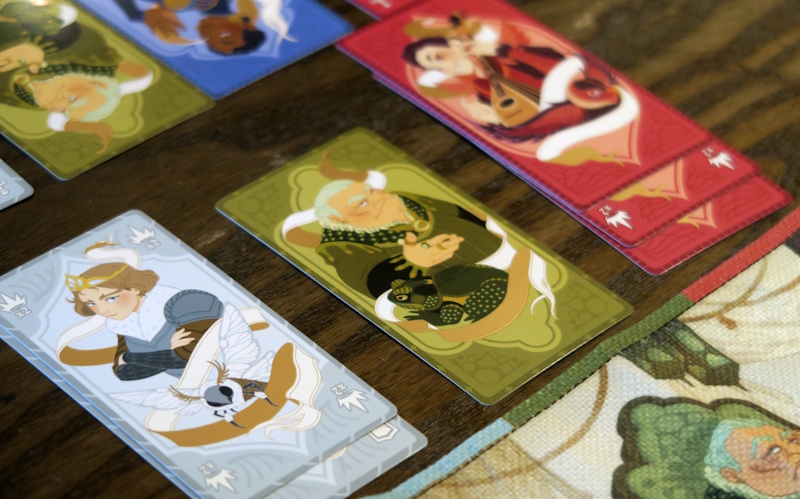
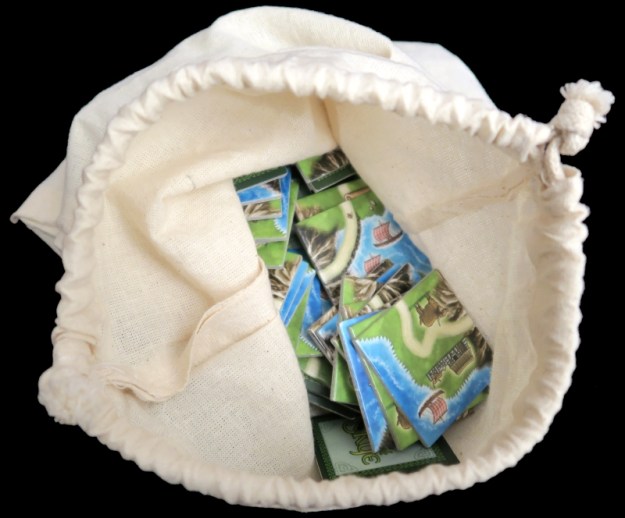
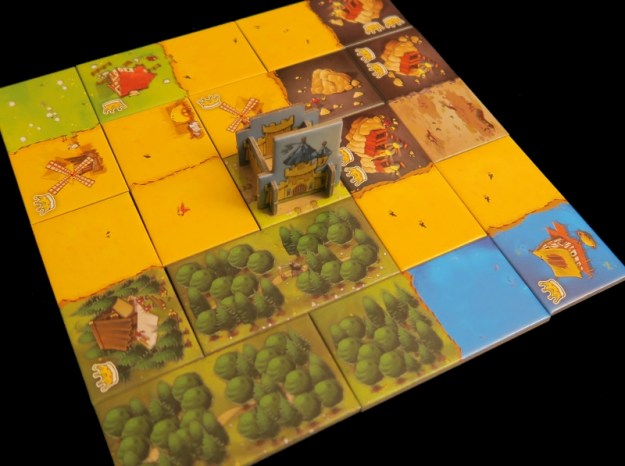
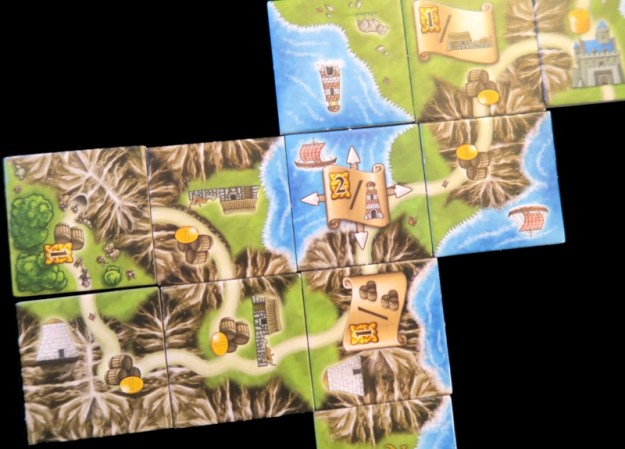
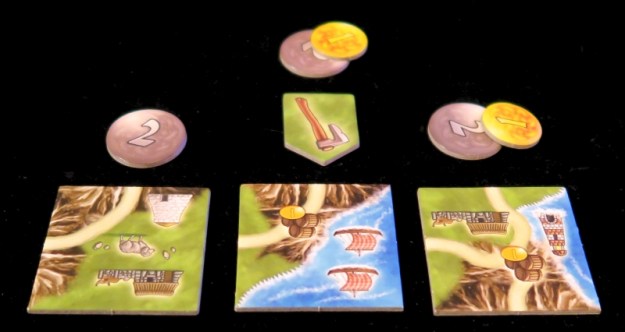
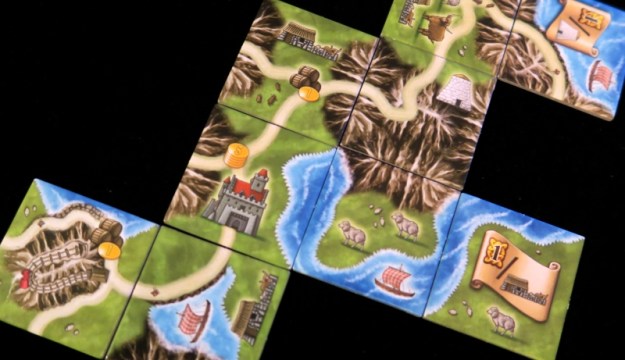
While the others discussed the options, Purple and Black joined Blue and Pine setting up the “Feature Game“.  This was the Druids expansion for an old favourite, the 2016 Kennerspiel des Jahres winner, Isle of Skye.  The base game is a tile laying game similar in nature to the popular gateway game, Carcassonne, but with an auction of tiles and objectives that give points. The auctions are extremely clever:  each player draws three tiles from a bag and privately decide how much two are worth, selecting one to be discarded.  Players use their own money to indicate the value and therefore the cost of the tiles.

Isle of Skye: From Chieftain to King
– Image by boardGOATS

After the values are revealed, each player then takes it in turns to buy one tile.  The clever part is that the money used to indicate the cost of each tile is reserved to pay for it until someone else buys it.  Any tiles that have not been bought after everyone has chosen and paid for one, must be paid for by their owner.  The reason this is clever is because of the effect it has on the amount of money that players have to spend.  For example, the first player in the round must make sure they have sufficient uncommitted funds if they want to be able to buy a tile.

Isle of Skye: From Chieftain to King
– Image by boardGOATS

On the other hand, the player at the end of the round has a different calculation to make:  if their tiles are priced to give good value they should sell at least one which will provide them with liquidity to buy other tiles.  However, being last in the round, their choice will be reduced, and if their tiles don’t sell, the fact the other tiles might be on the expensive side, could leave them unable to make a purchase.  It is not compulsory to buy a tile, but players that don’t have enough tiles are unlikely to score as well.  Thus valuing tiles is key—overvaluing their tiles is costly as nobody will buy them leaving their owner with a big bill and less money in the next round, while undervaluing them gives good tiles to an opponent and will leave their owner with less money and fewer tiles.

Isle of Skye: From Chieftain to King
– Image by boardGOATS

Once the tile auction is complete, players add the tiles to their own personal fiefdom.  At the end of the round, one or more of the objectives are scored.  Similar to Cartographers, there are four scoring objectives.  In the early rounds only one scores, with three scored in later rounds, but each one is scored the same number of times during the game.  Although this is an important source of points, it is not the only one as some tiles feature scrolls that score at the end of the game.  Players receive income at the start of each round, with players getting additional funds for each player that is in front of them, with the amount increasing as the game progresses.  As well as being a catch-up mechanism, this also importantly provides an additional channel for money to enter the game.

Isle of Skye: From Chieftain to King
– Image by boardGOATS

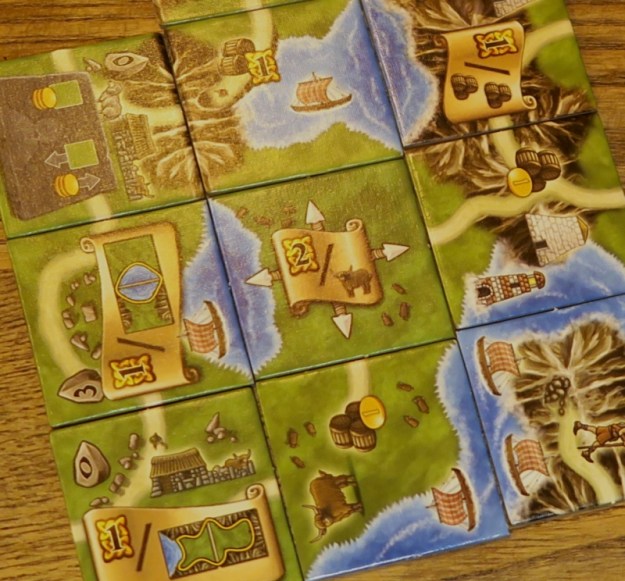
In addition to the auctions and the objectives, there are other ways Isle of Skye differs from Carcassonne.  There are no meeples, and players have their own maps instead of sharing one central one.  Even the tile placement rules are slightly different as terrain must match, but not roads (though it is generally useful if they do as it can increase players’ income).  Thus, although there is a superficial similarity with Carcassonne, Isle of Skye is distinctly more complex.  Unlike the first, Journeyman expansion (which we have not yet played), the second, Druids expansion doesn’t really increase the complexity.  It adds more strategy options though, with more scoring opportunities and additional ways to spend money (should you have any spare).

Isle of Skye: Druids
– Image by boardGOATS

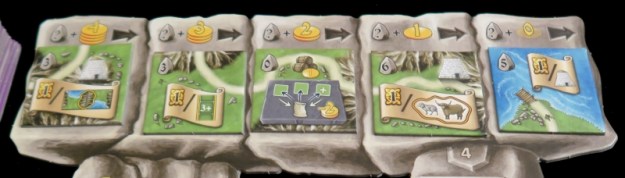
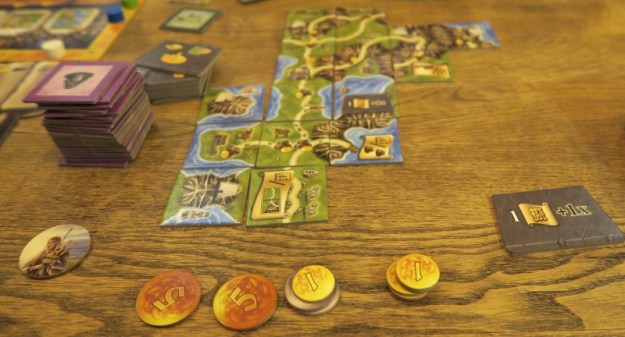
The Druids expansion adds a second part to the auction phase where players can choose to buy one from the five displayed on the dolmen board.  These are more powerful as they generally include scoring opportunities or special powers, but are correspondingly more expensive.  The end of round scoring tiles gave A) two points for each tile in players’ largest completed lake; B) a point for each cow or sheep on on or adjacent to a tile with a farm; C) two points for each set of four tiles arranged in a square, and D) one point for each row and column containing a Broch.

Isle of Skye: From Chieftain to King
– Image by boardGOATS

Pine took the first player token and Purple’s first draw gave her one of the promo tiles from the Themenplättchen mini expansion which was immediately thrown back for causing too much brain pain to work out what it did.  Pine and Blue took an early lead at the end of the first round scoring for their lakes, but it was only a handful of points and there was a long way to go.  Purple started building her long thin, rectangular kingdom prioritising income.  It wasn’t until the third round that the importance of this shape became apparent to everyone else however:  since tiles could be used to score multiple times for (C), this meant Purple picked up lots of points.

Isle of Skye: From Chieftain to King – Tunnelplättchen
– Image by boardGOATS

There was a bit of a debate about the Tunnelplättchen tiles from the two mini expansions.  Black checked on Board Game Geek and confirmed that tunnels going into the same mountain range connected together.  This helped Pine considerably, as otherwise he was in a bit of a mess.  Blue bought an exciting looking scroll tile that gave lots of points for enclosed pasture, but when Blue noticed that Black had it too, he commented that it was actually really difficult to enclose pasture, Blue took it as a challenge. It was shortly after this, about half way through the game that the group realised that they’d forgotten about the catch-up mechanism.

Isle of Skye: Druids
– Image by boardGOATS

From the third round, during the income phase at the start of the round, players get gold for every player that is ahead of them on the score track.  The amount of gold they get increases as the game progresses, so in the final round players get four gold for every player ahead of them—for the player at the back in the four player game, this comes to twelve gold, and for a player at the back until the start of the last round this comes to a total of thirty gold more than a player at the front.  Unfortunately, the group remembered this a couple of rounds too late, so everyone who wasn’t in the lead (i.e. everyone but Blue) received a nice little windfall that they could use to increase the price of their tiles or spend on the Dolman.

Isle of Skye: From Chieftain to King
– Image by boardGOATS

Black was making good use of the Dolman board and had some really juicy scoring scrolls in his tidy little kingdom and looked the one to beat, especially as he had plenty of cash too (helped by his windfall).  Pine, on the other hand was struggling to find anything useful and was resorting to using the alternative Dolman option: draw two tiles from the bag and keep one.  Unfortunately despite trying attempts, he wasn’t getting anything he wanted.  It was at the end of round five that things suddenly changed and Purple, hitherto drifting about in third and and fourth leapt forward, landing just one point behind Blue.

Isle of Skye: Druids
– Image by boardGOATS

Blue, having led throughout, knew she didn’t really have enough end-game points to challenge and was expecting Black to catch and overtake.  In the event, it was extremely tight at the front with Purple finishing with one hundred and two points, six more than Blue who just managed to hold on to second, two points ahead of Black.  All in all though, everyone liked what the Dolman board added to the game, as it gave people larger, more exciting kingdoms with something to spend money on (when they had it).

Isle of Skye: From Chieftain to King
– Image by boardGOATS

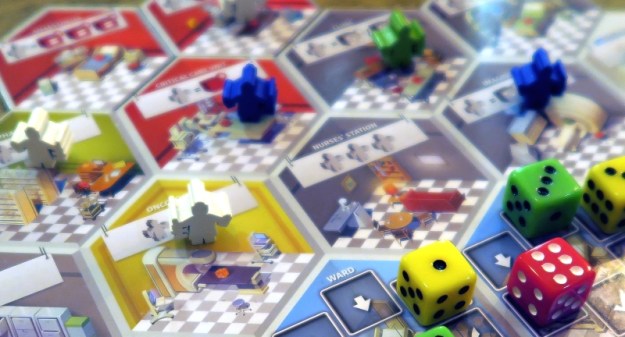
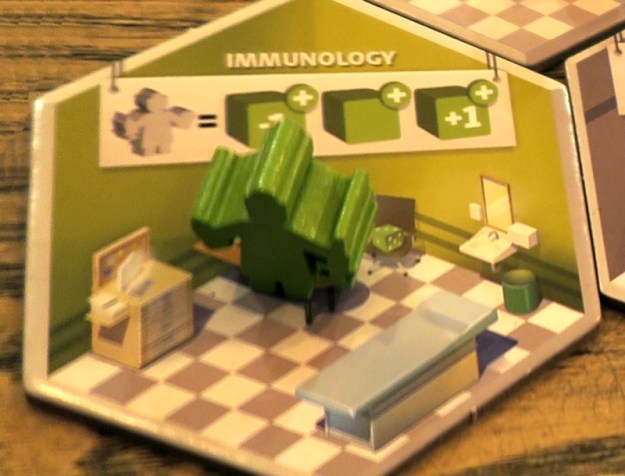
Meanwhile, the other group started by discussing what to play.  Imhotep was on the table, but Ivory spotted Dice Hospital in a bag and Green was happy to play that instead; as Lilac was familiar with it too she was happy with the switch, as was Teal, though he had not played it.   The explanation of the rules and game play took a little longer than the game itself would indicate.  The idea is that each play is the owner of a hospital and starts with an administrator which gives them a special power, three nurses, and three patients—dice drawn at random from a bag.  The colour of the dice represents their illness and the number on the face shown its severity:  six indicates they are healthy but if the number falls below one, the patient dies.

Dice Hospital
– Image by boardGOATS

At the start of each round, players take an ambulance with new patients – if there aren’t enough beds available, another patient must make space by moving to the morgue (where each body-bag is a negative point at the end of the game).  Players can then augment their own hospital by adding specialist medics and wards and finally, their medics can visit each patient and improve their health.  Different specialisms can only “heal” certain colours or numbers. Any patients not treated are “neglected” and their health deteriorates with any that fall below one moving to the morgue. In contrast, anyone who exceeded six is discharged at the end of the round, but the more that are discharged at the same time, the more points the player scores.

Dice Hospital
– Image by boardGOATS

As the game progresses, players continue to improve their hospital getting more specialists and acquiring blood bags to help treat their patients.  The game ends after eight rounds and the player with the most points is the winner.  When the group finally got underway it became clearer how to play and what actions were available.  The key to the game is knowing which specialists to get and which ambulance of patients to take – admitting healthier patients gives less choice of ward/doctor (and potentially get something which is of little use) , while curing the sickest patients is more difficult, but gives first dibs specialisms.

Dice Hospital
– Image by boardGOATS

The administrators dealt out at the start of the game can provide players with a direction for their strategy.  Teal and Green had ones that meant that they could leave one patient of a specific colour untreated per round without them declining. Teal was able to use his a few times, but Green found that he just could never seem to get enough red dice to make use of it.  Lilac was trying to get at least two red patients healed each turn as her administrator privilege gave her an extra point if she did; she managed it a few times (which was where the red dice kept going).  Ivory’s administrator would give him an extra point if he healed at least one patient of each colour which he managed to good effect several times.

Dice Hospital
– Image by boardGOATS

After a couple of rounds Green commented that he had found it was best to keep a balance of Ward’s and medics otherwise there either wasn’t enough staff to treat the number of patients, or there weren’t enough usable wards to send the your doctors to. Teal and Lilac were quite good at regularly healing patients, but at one at a time they were scoring only one point per round.  Each subsequent patient healed in a round scored an extra two points each With more than six worth three points extra.  Thus holding on to heal more per round, meant more points.  There was also a five point bonus for completely clearing the hospital, but nobody got close to that, except Ivory in the final round.

Dice Hospital
– Image by boardGOATS

Throughout the game, Teal and Lilac kept healing a steady trickle of patients. Green however was having all sorts of trouble:  he found himself with ward’s he couldn’t use, his hospital filing up rapidly, and started losing patients (minus two points)—his was definitely a Failing Trust!  Ivory, however, was romping away, keeping his hospital from getting over crowded and kept amassing points.  Although his start had been slow start and he didn’t score anything until the third round, he made up for it after that.  In the end Ivory proved to have run the best hospital trust, while Teal’s slow steady trickle worked out quite well as his hospital was the second best with Lilac was a close third.

Dice Hospital
– Image by boardGOATS

Ivory left for home, but Isle of Skye had not yet finished and, although there wasn’t time for Imhotep, there was still time for something quick.  So Teal introduced Green and Lilac to a game they’d not played before, called Diamonds.  This is a trick-taking game played with normal suited cards from one to fifteen where players are trying to win diamonds—not the suit, but the gemstones.  When players cannot follow suit they get to do a “Suit Action” based on what suit they actually play.  For example, playing a Diamond card gives one diamond gem from the supply placed into the player’s safe while playing a Heart gives one diamond from the supply to the pile in front of their safe.

Diamonds
– Image by boardGOATS

Similarly, playing a Spade allows the player to move one diamond from outside their safe into it, and on playing a Club the player steals one diamond from outside someone else’s safe and places it in front of their own. Additionally, at the end of the round of ten tricks, the player that won the most tricks in each suit gets to do that Suit Action one more time (in the case of a tie no-one does it).  With the game taking six rounds there is plenty of chances to gain diamonds.  It did not take long for the group to understand the game, although the for first few tricks the group were a little uncertain.

Diamonds
– Image by boardGOATS

Several times players found that although they had won, they couldn’t do anything as either the person they were supposed to steal from did not have any diamonds or, when they could move one diamond into their safe (from in front of it), they didn’t have any.  Plus, several times they found they had to steal from themselves so nothing happened.  The group also found that when they started to win tricks, they got control and were able to lead in suits the others didn’t have and so kept winning.  It proved to be a clever little game, but the group felt it probably plays much better with more people, so we might try it with a larger part of the group in future.  At the end of the game, however, Teal was the master diamond merchant with Green the apprentice.

Diamonds
– Image by boardGOATS

Learning Outcome:  A career in diamond trading is not for everyone.

20th July 2021 (Online)

Since last time, there had been quite a bit of debate about returning to the Horse and Jockey, but there was a little hesitancy and with the extremely hot weather, staying at home this week turned out to be the right choice all round.  As the decision had been just a little bit last-minute, we chose to keep the “Feature Game” simple and opted for the Skills Mini Expansion for Cartographers.  We have played Cartographers several times and everyone has really enjoyed it.  With the Spiel des Jahres winners announced this week, this was also the nearest we could get to playing a game to mark the occasion (it received a nomination for the Kennerspiel award last year).

Cartographers: A Roll Player Tale
– Image by boardGOATS

Cartographers is a “Roll and Write” type of game, but one with more of a “gamery” feel than most.  It is based on Tetris, with shapes revealed on the flip of a card in a similar way to other games we’ve played this year like Second Chance and Patchwork Doodle.  However, the thing that makes Cartographers more “gamery” than these is the addition of terrain and players usually have to make a choice, either of the shape or the terrain.  The terrains are tied in with goal cards, four of which are revealed at the start of the game.  Two goals are then scored at the end of each of the four seasons, in a similar way to another game we like, Isle of Skye.

Cartographers: A Roll Player Tale
– Image by boardGOATS

There are lots of other little aspects of the game that make it interesting—the presence of Ruins and Ambush Cards in the deck, for example, deliver a curved ball, just when players feel they are in control.  Players can also build their income by surrounding mountain ranges and choosing to play certain shapes; this gives more points at the end of each round.  The Skills expansion gives players a way to offset this income for special actions which potentially give players other ways of achieving their goals, further adding to the decision space.

Cartographers: A Roll Player Tale
– Image by boardGOATS

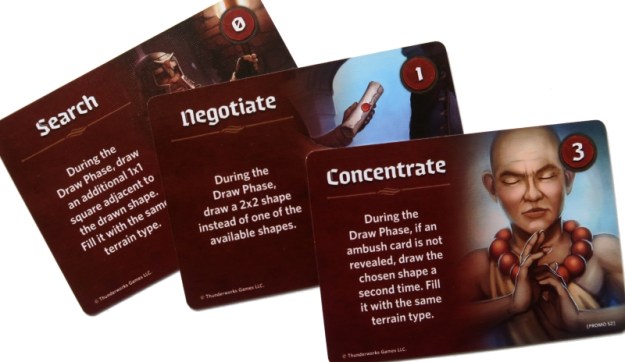
One of the most impressive things about Cartographers is the amount of variety that is built into the game, which means every play feels different and the game stays remarkably fresh.  So, there are two different player maps and four of each type of goal card.  This variety is carried through to the Skills expansion; there are eight cards of which three are chosen at random.  This time we chose the B side of the map (with empty “wasteland” spaces marked) and drew the Greenbough, Mages Valley, Wildholds and Borderlands goal cards together with the Search, Negotiate and Concentrate skills cards.  These skills cost anything from free (like Search) to three (like Concentrate), and each can be played multiple times per game although only one can be played each Season.

Cartographers: Skills Mini Expansion
– Image by boardGOATS

We quickly realised that the expensive skills like Concentrate are only likely to be played in the final round, as the cost is in “income” and that income is generated at the end of every round.  So, playing Concentrate at the start of the game will ultimately cost a player twelve points, while playing it in the final round will cost three just three points.  For this reason, the free Search skill was always likely to be used by almost everyone in almost every season (and so it proved).  Of course, the higher tariff reflects the increased power though:  Search allows players to increase the size of the shape they are drawing by a single square; Negotiate (which costs one) allows players to draw a two-by-two shape, and Concentrate allows players to draw the shape a second time.

Cartographers: A Roll Player Tale
– Image by boardGOATS

As well as the skills which we had not played with before, several of the goal cards were new to us as well, including Greenbough (which rewards gives players one point per row and column with at least one Forest square in it) and Mages Valley (which gave points for each space next to a Mountain—two points for each Lake and one point for each Arable).  We’d played with the Wildholds goal before though (which gives six points for each Village of six or more spaces) and, although Borderlands was new to us (which give points for each completed row or column), we’d played The Broken Road goal which is similar (giving points for completed diagonals).

Cartographers: A Roll Player Tale
– Image by boardGOATS

The game began much as usual, and Pink, who was watering the tomatoes in the “mini-market-garden”, commented that he could hear Burgundy muttering, sighing and generally sounding stressed from outside.  Although we had played with “Wastelands” before, we had all focussed on how the fact some of the spaces were already full would help.  We had all forgotten how much the Wastelands obstruct plans and generally make life considerably more difficult.  Blue made a bit of using the ruins spaces to give her more flexibility later, but had forgotten that it would reduce the number of spaces she would be able to fill later in the game.

Cartographers: Skills Mini Expansion
– Image by boardGOATS

It was clear after the first round that Ivory was going to be tough to beat, a feeling that was cemented after the second round.  Unusually, Burgundy was the first to post a score, with a total of one hundred and forty-one.  Although this was high enough to earn him second though, when Ivory’s score came through he was a massive twenty-five points ahead.  Once again, it had been a very enjoyable game, and as we tidied up there was a little bit of chit-chat about the skills and what they added to the game.  Since they are not compulsory, the consensus  was that we should add them every time, though it was clear that they had been widely used because of the presence of the free Search skill, which everyone had used, and some in every round.

Cartographers: Skills Mini Expansion
– Image by boardGOATS

With Cartographers over, we had a bit of a discussion about moving back to our much loved and greatly missed, Horse and Jockey.  We’d conducted some anonymous surveys over the preceding week to try to gauge opinion trying to ensure that nobody felt under pressure to do anything they weren’t comfortable with.  Some of the group had been back on occasional Thursdays, playing old favourites like The Settlers of Catan, Wingspan, and Roll for the Galaxy and new games like Red Rising, Mercado de Lisboa, Ticket to Ride: Amsterdam, Tapestry (with the Plans and Ploys expansion), Ginkgopolis, Everdell, and Draftosaurus (aka “Sushi Go with Dinosaurs”).  Others, however, had not been to the pub for nearly eighteen months.  After some discussion, we decided that we’d schedule a trial visit in ten days time, so that those who had not been out could see how they felt without committing, and those that went could report back to those that were feeling a little more reticent.

The Horse and Jockey
– Image by boardGOATS

After that, we moved onto Board Game Arena.  It was a quiet night without both Pine and Lime, and once Green and Ivory had left as well, we were down to five which gave us a lot of options.  Coloretto was one, but in the end we chose Niagara, a game we’ve all played quite a bit, but never online, and we were keen to see the new Board Game Arena implementation and whether losing the tactile moving river would leave the game lacking.  A strong element of the game is the element of simultaneous play, however, and this was a large part of the appeal this time.  Players simultaneously choose a Paddle Tile which dictates how far their canoe will move in the round.  Then, in turn order, players move their canoe up or down the river, paying two movement points to pick up a gem from the bank (or drop one off).

Niagara
– Image by BGG contributor El_Comandante
adapted by boardGOATS

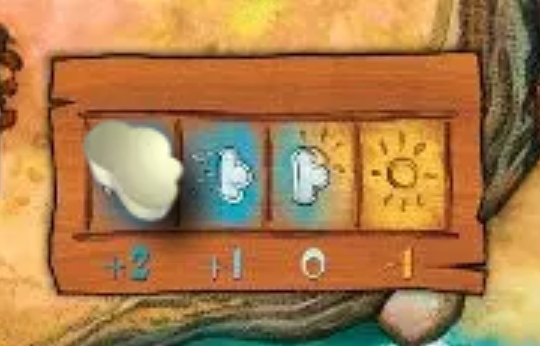
The winner is the player to get four gems of the same colour, five gems of different colours, or any seven gems safely home and into the shallows.  On the face of it, this is relatively simple, but the really clever part of the game is the movement of the river.  In general, the river moves at the speed of the slowest boat—if the lowest numbered Paddle Tile is a two, then the river moves two spaces and all the boats move with it.  However, one of the Paddle Tiles is a weather tile which enables players to increase or decrease the rate to make life harder or easier.  Since everyone has to play all their Paddle Tiles before they can recycle them, the timing of their weather tile is critical: players who leave it to the end run the risk of the river running fast and losing boats over the cascade because they can’t do anything about it.

Niagara on Board Game Arena
– Image by boardGOATS
from boardgamearena.com

And it wasn’t long before that’s exactly what happened, when both Blue and Black got their timing wrong and lost boats over the falls, so had to pay hard earned gems to get new ones.  Then, to add insult to injury, Pink sneakily crept up on Blue and stole another gem from her.  Players can only steal if they land on the same space as another boat while travelling upstream, and even then it is a choice.  There was much ill feeling especially from Blue, but she wasn’t the only one.  And with that, the gloves came off and everyone tried to redress the balance and ensure that such bad behaviour would not go unpunished.

Niagara on Board Game Arena
– Image by boardGOATS from boardgamearena.com

Pink was abreast of that though and had a plan.  Knowing his bad behaviour would make him a target he collected gems in one boat letting others take them while he stole the gems he wanted and got them to shore quickly.  Much to everyone’s disgust, he soon had five different gems and there was nothing anyone could do to stop him getting them home.  Burgundy actually had more gems giving him a nominally higher score, but his set of six did not include five different colours and Blue’s set of five included three nuggets of amber.  The victims of Pink’s grand larceny were unimpressed with his terrible behaviour, and as it was getting late, we decided to call it a night.

Niagara on Board Game Arena
– Image by boardGOATS
from boardgamearena.com

Learning Outcome:  Theft is totally unforgivable.

11th May 2021 (Online)

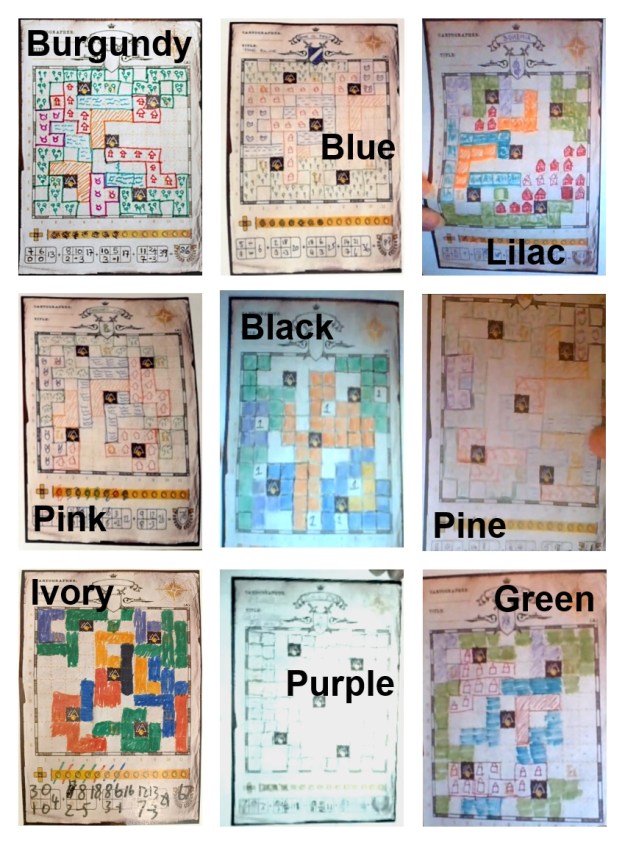
There was the usual chit-chat and community update, but eventually everyone was ready to start playing the “Feature Game” which was the Neue Entdeckungen (New Discoveries) expansion to Cartographers.  Cartographers is a “Roll and Write” game we’ve played and enjoyed quite a bit over the last year. The base game is simple enough, but unlike a lot of the games we’ve played, has more of a “gamery” feel to it than some of the simpler Tetrissy games it is related to like Second Chance or Patchwork Doodle.  The thing these games all have in common is that players are given shapes to draw on a personal player grid.  What makes Cartographers different is the addition of goal cards which give points at the end of each round, in a similar style to another game we have enjoyed playing, Isle of Skye.

Cartographers: A Roll Player Tale
– Adapted from image by BGG contributor
Johnny Dangerously

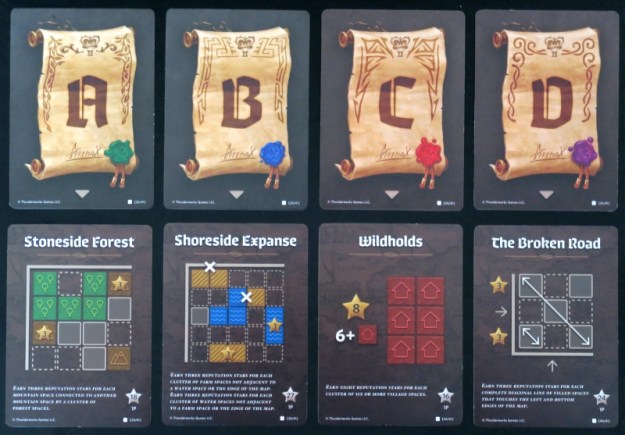
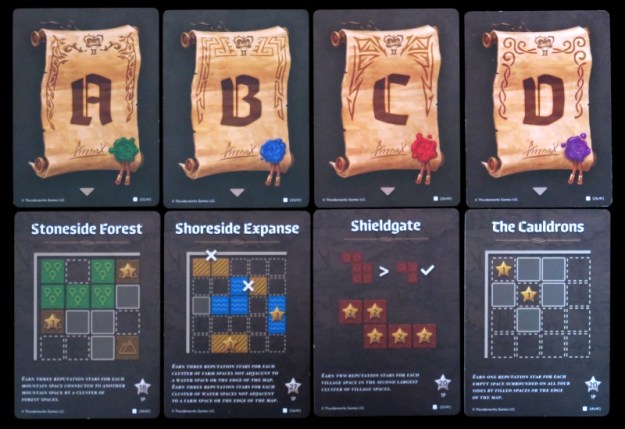
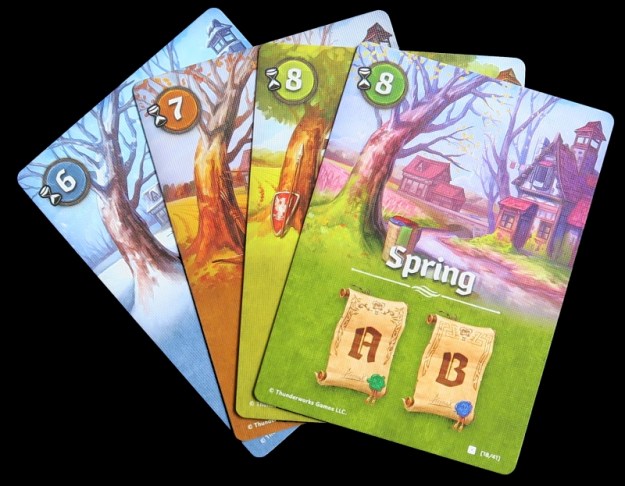
Each cards depicts a shape and terrain, giving some element of choice in either terrain type or shape.  The game is played over four rounds, each consisting of several cards.  At the end of each round two of the four goal cards are scored, such that each is scored twice during the game.  This time, the four goal cards were Stoneside Forest (A), Shoreside Expanse (B), Wildholds (C), and The Broken Road (D).  At the end of the first round the first two of these, Stoneside Forest and Shoreside Expanse were scored.  Stoneside Forest gives points for connecting the mountain spaces that are preprinted on the map.  Shoreside Expanse on the other hand rewards players for each area of lake or arable not adjacent to arable or lake (respectively) or the edge of the map.

Der Kartograph: Neue Entdeckungen
– Image by boardGOATS

Stoneside Forest was made more challenging by the fact we were playing with the Neue Entdeckungen (New Discoveries) expansion which adds new ambush cards (from the Ambush Mini Expansion) and a new map with wastelands.  Wastelands are areas that are preprinted on the maps that players are unable to use, but are considered already filled.  There is an alternate map in the base game with a large area of wasteland which we played with last time, but the Neue Entdeckungen expansion map has several smaller areas of wasteland adding a different set of challenges.  we’ve played with both Shoreside Expanse and Stoneside Forest before, so for the first round, we all knew what we were trying to do.

Cartographers: A Roll Player Tale
– Image by boardGOATS

Wildholds and The Broken Road were new to us though.  The Wildholds gives eight points for for each village area occupying six or more spaces.  Eight points is a lot, and if an area is complete in time for the first scoring phase, it will also score the second time making it very lucrative.  With this in mind, Ivory started planning for Wildholds early in the first round, while others concentrated on first round goals first. The final goal, The Broken Road, rewards players with three points for every complete diagonal that connects the left hand edge of their map with the bottom edge.  With eleven possible diagonals, everyone was of the impression that The Broken Road would be easy to score a lot of points with, but it turned out to be more difficult than most people expected.

Cartographers: A Roll Player Tale
– Image by boardGOATS

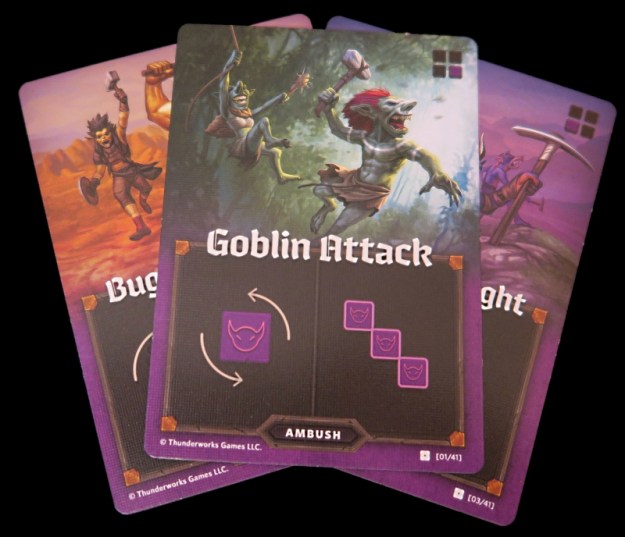
In fact, most people left it to the end assuming it would take care of itself, only to discover that it didn’t really.  That said, unusually, the arrival of the Ogeroffensive Ambush card actually did most people a favour.  This is unusual, as Ambush cards give players negative points for any unfilled spaces adjacent to their goblin spaces at the end of the round.  We play the cards using the solo rules where players place them in a given corner and, if that is already filled, slide it one space in a given direction following the edge of the map.  They continue spiralling in to the centre until they find an empty space.

Der Kartograph: Neue Entdeckungen
– Image by boardGOATS

Because the Ogeroffensive arrived as the first card in the round and starts in the bottom left corner, for many people it actually gave them twelve points (filling two diagonals and scoring for two rounds).  Arriving so early in the round, most of those who were able to benefit from it, didn’t even score many negative points as there was plenty of time to fill any empty spaces.  All three of the ambush cards we introduced came out early in the rounds which meant they added a more strategic obstacle rather than throwing an unexpected spanner in the works as they do when they come out at the end of the round.

Der Kartograph: Neue Entdeckungen
– Image by boardGOATS

The rounds get shorter as the game progresses and it wasn’t long before it was the final round and everyone was looking to maximise their final scores.  From the in-game table chatter, it was clear that Ivory and Burgundy were going to be difficult to beat and, as is so often the case, so it proved.  This time, Burgundy had the edge over Ivory and took victory by four points.  The battle for the final place on the podium was fierce too, but Black ultimately took that from Blue by just two points.  Regardless of where they ended up though, everyone had enjoyed it.  From there, we moved on to another “Roll and Write” game that we’ve played quite a bit over the last year, Railroad Ink.

Railroad Ink: Deep Blue Edition
– Image by boardGOATS

This is a fairly straight-forward game where dice are rolled and players have to write the road and rail segments on their maps.  The base game is played over seven rounds with four white dice rolled in each round.  In this game, all the dice have to be used, but players also get three chances to play special “cross-roads dice” during the game.  At the end of the game, players score for their longest rail segment, their longest road section, the spaces they have succeeded in filling in the centre of the board and the number of entrances they have managed to connect together.

Railroad Ink on Board Game Arena
– Image by boardGOATS

This time, however, we decided to play it online through Board Game Arena rather than engaging our inner artist and playing on paper.  There were advantages and disadvantages to playing the game online and people had mixed feelings about it.  It was certainly easier to correct errors, but somehow it lost… something…  It was another highly enjoyable game though and the results were also close at the top.  With Ivory taking an early night, the challengers to Burgundy’s crown were Green and Blue.  Despite their best efforts, Burgundy’s crown was too firmly wedged, and he finished four points ahead of Blue and five ahead of Green.  Although Cartographers had taken longer than many of the games we play, and time was marching on, there was still enough for one last game.  And this time, with just six, we relatively quickly (for us) settled on For Sale after a quick Vevox vote.

For Sale
– Image by boardGOATS

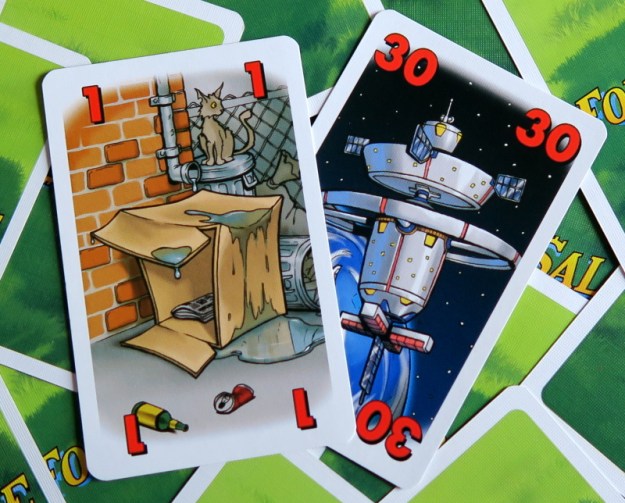
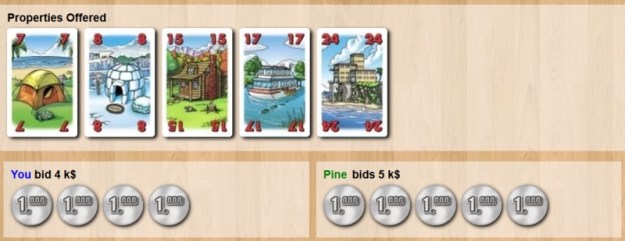
For Sale is an older game that has had a bit of a resurgence recently for us.  The idea is that the game comes in two phases:  firstly, players use their starting $14,000 to buy properties at auction, then they use these properties to “bid” for cheques in the second phase.  The winner is the player with the highest total in cheques and left over starting currency.  It is such a quick game to play that this time we played it twice.   The first time through, Pink paid $8,000 for the space station while Purple picked up the cardboard box for free.  But then, Pink sold his space station for $15,000 and Purple ended up parting with her box without return.

For Sale on Board Game Arena
– Image by boardGOATS from boardgamearena.com

That is only part of the story of course, but important to most people was that Burgundy didn’t take his third win in succession.  In the end, everyone (except Burgundy) was content as they got that part of their wish as Black topped the podium edging in front of Blue, though Burgundy was just a couple of thousand behind.  You can’t keep a good gamer down for long though and Burgundy saw the second game as his chance for revenge.  In the event, the same three were on the podium, but with Black and Burgundy swapping places.  This time it wasn’t close at all either, with Burgundy finishing $9,000 ahead of his nearest challenger.  And that was that for another week.

For Sale
– Image by boardGOATS

Learning Outcome:  Sites of Insectoid Invasions should be shown on every map.

2nd February 2021 (Online)

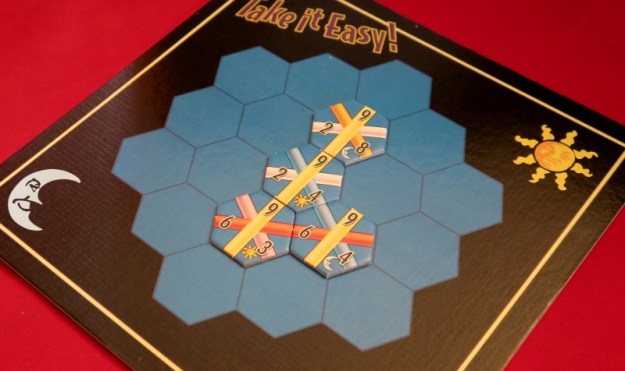
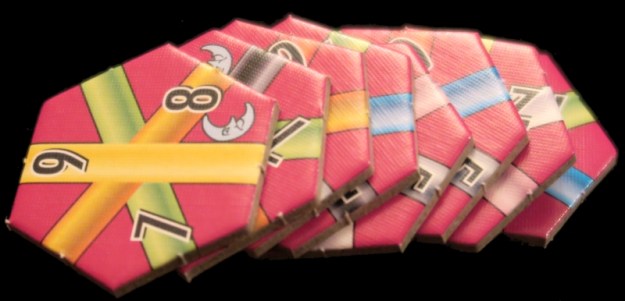
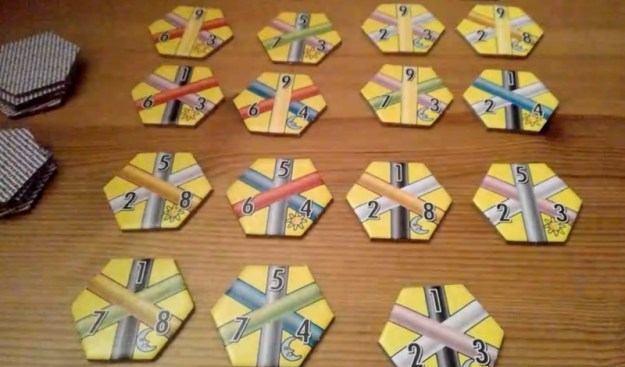
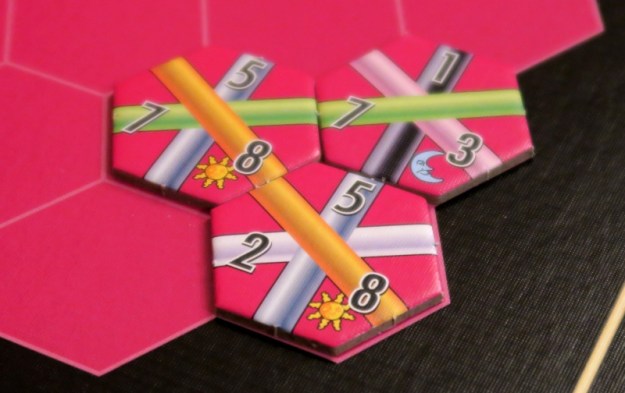
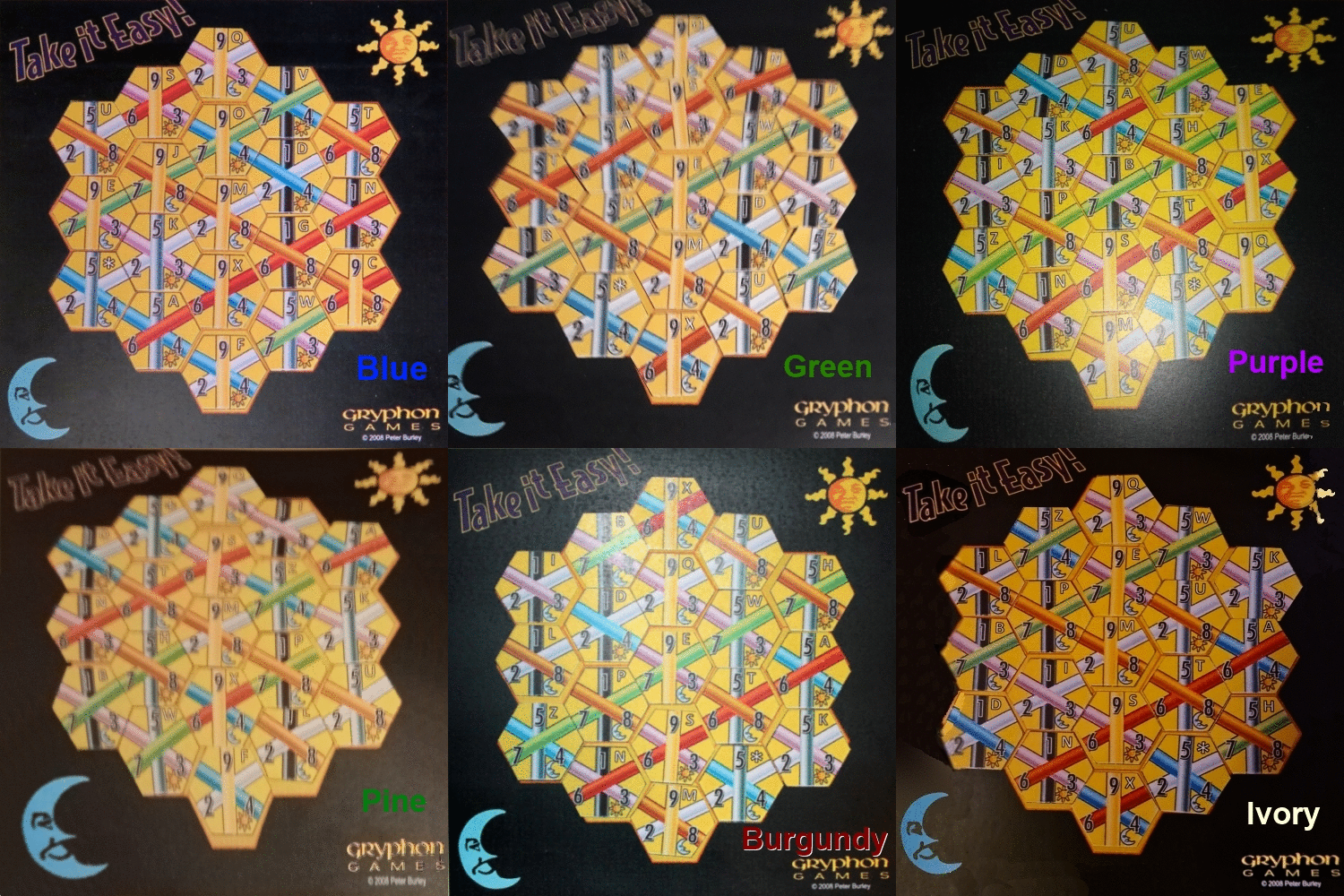
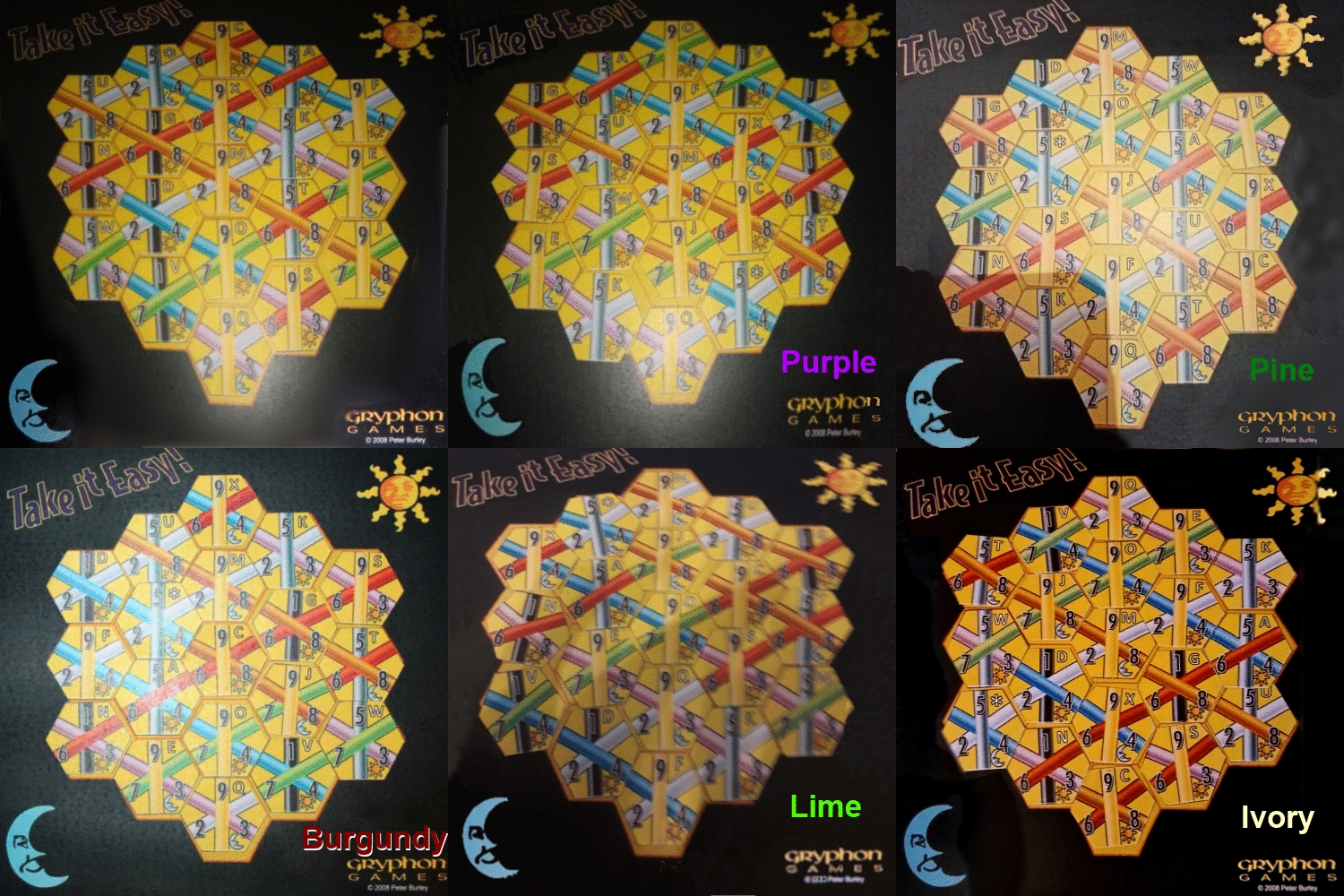
There was a bit of chit-chat as people turned up clutching their brown, manilla envelopes, delivered over the previous few days by Purple Packet-force or Pink Parcel Post.  At 8pm, everyone opened their envelope to find the bits and pieces for two games: the “Feature GameTake it Easy!, and Das Labyrinth des Pharao (with the Sphinx und Triamide expansion boards) which we will play in a month or so.  There was also a little chocolate, so as people munched, Blue explained the rules to Take it Easy!.

Take it Easy!
– Image by boardGOATS

Take it Easy! is a tile laying game where players have a pile of hexagonal tiles which they place on their hexagon player board (because hexagons are simply the bestagons).  Each tile has three pipes crossing it, in three different colours.  There are a total of nine different coloured pipes, three in each different direction.  Tiles are drawn from a stack one at a time, and each player adds them to their personal player board.  The rules are simple:  the tiles can be placed anywhere on the board but must be placed so the numbers are the right way up so that the directions of the nine different coloured pipes are fixed.

Take it Easy!
– Image by boardGOATS

Players score points for any pipes that contain only the one colour, and the number of points is dependent on the colour of the pipe (the number on the pipe) and the number of tiles in the pipe.  Thus, a yellow pipe, five tiles long going straight down the middle scores forty-five points, while a black pipe, along the edge, just three tiles long would only score three points.  There are a maximum of fifteen pipes, but it is almost impossible to complete all successfully, especially as there are some tiles that are not used, so there is an element of chance as well as hedging bets.  Blue and Pink drew tiles and displayed them for everyone to see.

Take it Easy!
– Image by boardGOATS

The pieces the players used had been modified with the addition of letters to make it slightly easier for players to uniquely identify the individual tiles.  We were about three or four tiles in, when someone’s comment suddenly made Green realise that he’d started with the wrong tile.  Having form with this sort of thing, Green got a certain amount of stick for “cheating”, but having found it early, he corrected his mistake and we carried on.  As the game drew towards a conclusion, the number of spaces players had left progressively decreased, and increasingly, players needed specific colours and then specific tiles to complete their pipes.

Take it Easy!
– Image by boardGOATS

Pink was particularly desperate, but inevitably didn’t get the yellow pipe he so desperately wanted, which ultimately cost him thirty-six points.  As everyone else was still taking off their shoes and socks to add up their scores, Ivory gave his total as one hundred and ninety-four, to howls of distress from everyone else, who clearly felt they were nowhere close.  Indeed, the closest score was a hundred and eighty-two from Green in second with Blue four points behind him.  Although everyone believed Ivory’s score, they were keen to see how he’d done it so we looked at the photo he’d sent in and admired his layout and looked sadly at their own.

Take it Easy!
– Image by boardGOATS

Take it Easy! hadn’t taken very long to play, indeed it was only quarter to nine.  Everyone had really enjoyed it and now they felt they understood the game a little better, they all fancied another chance to see if they could catch Ivory on the second attempt.  So, this time everyone had their plan and they were keen to get going.  As the tiles were drawn there were variously coos of delight when a desired tile came out and teeth sucking when the tile was difficult to place.  Again, as the game progressed, the teeth sucking and pleas for particular tiles got more desperate.

Take it Easy!
– Image by boardGOATS

When the last tile was drawn the stress was released and everyone settled down to count.  Ivory was first to finish his arithmetic, and when he commented that he’d done better than last time, everyone else’s hearts sank.  Ivory set a new target of two hundred and two, but aside from him, almost everyone else failed to improve on their first score (Lime’s excuse was that he was missing the help of his assistant).  Lilac was the most improved though, increasing her score by sixty to take an excellent second place with one hundred and ninety-six, with nobody else coming close.

Take it Easy!
– Image by boardGOATS

We had all really enjoyed Take it Easy! and we’ll definitely give the game another outing, but in the meantime it was still quite early, so although Lime took an early night, everyone else was keen to play Cartographers.  This is a game we’ve been trying to get to the table since before Christmas, but have been unsuccessful thanks to the IT gremlins last time, and On Tour and electing the Golden GOAT taking longer than expected.  However, even two plays through of Take it Easy! had not taken over-long and with everyone familiar with the rules, we thought there was time to squeeze it in.

Cartographers: A Roll Player Tale
– Image by boardGOATS

That was before the gremlins returned, this time to kybosh Ivory’s printer.  It looked like plans would have to be revised, but after a bit of poking he persuaded it to cooperate and everyone settled down to concentrate on their artwork. Cartographers is a “Roll and Write” type game or perhaps more accurately a “Flip and Colour”, as the game is driven by cards instead of dice and players are colouring terrain blocks, fitting shapes together in a Tetris-style.  This is similar to other games like Second Chance and Patchwork Doodle, but is definitely a step up thanks to goal cards revealed at the start of the game.  There are four goals two of which are scored at the end of each round in a way reminiscent of the scoring in another game that is popular with the group, the 2016 Kennerspiel des Jahres winner, Isle of Skye.

Cartographers: A Roll Player Tale
– Image by boardGOATS

This time the four goal cards were Stoneside Forest (three points for each mountain terrain connected to another with forest), Shoreside Expanse (three points for each lake or arable that is not adjacent to water, farmland or the edge of the map), Great City (one point for each space in a player’s second largest city) and The Cauldrons (one point for each single, empty space completely surrounded; the only goal card that was different to when we played the game back in September).  Goals A and B are scored at the end of the first round, Goals B and C at the end of the second and so on.  The game proceeds with players drawing their choice of shape and terrain from the card revealed, trying to score as effectively as possible for the current round, but also with an eye to scoring in later rounds.

Cartographers: A Roll Player Tale
– Image by boardGOATS

The game is made more interesting in that cards give players a choice of terrain or shape and sometimes both, increasing the decision space over games like Second Chance and Patchwork Doodle.  Additionally there are Ruins cards which restrict where players can play for a turn, and Ambush cards which force players to put negatively scoring shapes on their board.  In the past, we have used the house-rule that instead of introducing one Ambush every round we only add them from the second round onwards to give people a chance to settle into the game.  Additionally, because we are playing remotely, we play the Ambush cards using the solo player rules.

Cartographers: A Roll Player Tale
– Image by boardGOATS

Although we like the spice the Ambush cards add, they can swing the game quite a bit and add a bit of randomness.  Part of the driving-force to play Cartographers was the desire to try out the alternative, “Wastelands” map, so because of the additional challenge we thought this would add, we again used the house-rule, and only added three Ambush cards during the game.  The “Wastelands” are an area of the map that is inaccessible to the map-makers and as such is terrain already filled in, but is space that cannot be used.  It quickly became apparent that this meant players filled up their maps much more quickly so it became harder to place the bigger shapes from a much earlier point in the game.

Cartographers: A Roll Player Tale
– Image by boardGOATS

For some, this was an advantage when it came to the Ambush cards later in the game, as it meant there wasn’t sufficient space to add them to the player board.   The first round was full of Water and Farmland, which was useful for the Shoreside Expanse goal (at the end of the first and second rounds), but keeping them separate with the additional obstacle of the Wasteland was difficult.  Worse, this caused obstructions for players trying to score for connecting their Mountains using forest (Stoneside Forrest, scoring in the first and final rounds).

Cartographers: A Roll Player Tale
– Image by boardGOATS

There was also a lot of Settlement early on, with Woodland relatively scarce.  There weren’t any Ruins until later either and with the first Ambush card only appearing in the third round, players could mostly do what they wanted in the early part of the game.  When the Ruins came towards the end, some players had no choice where to place them while others benefited from being unable to place them at all.  The same was true for the Ambush cards with some players being unable to play them at all and therefore not picking up negative points at the end of the game.

Cartographers: A Roll Player Tale
– Image by boardGOATS

When everyone was feeling the pinch the Marshlands card appeared, which is one of the biggest shapes.  Purple’s distressed cry of, “It won’t fit, I can’t get it in!”, was followed by Black’s dry response, “It’s too big…” which had everyone else in stitches.  From there it wasn’t long before the game came to an end.  Ivory was once again the first to report his score, posting a massive total of one hundred and eight, which most people felt would not be surpassed.  Indeed, that was the way it stayed with nobody else exceeding a hundred (after Black’s goblin-related recount), until Pink, giving his score last, sneaked into the lead with one hundred and twelve.

Cartographers: A Roll Player Tale
– Image by boardGOATS

It was quite late, so Ivory headed off to bed as did Lilac, but there was still time for the rest to play a game of our current end of evening favourite, the Professional Variant of 6 Nimmt! on Board Game Arena.  This is so simple yet so much fun:  players simultaneously choose a card from their hand and then add them to one of the four rows in order.  The fast play, lack of down time, and the illusion of control together with the sudden disasters that befall people who are doing well, just hits the spot for the group.

6 Nimmt!
– Image by boardGOATS

This time, Burgundy started the race to the bottom, but was quickly joined by Purple.  Her efforts were outstripped by Burgundy though who had high cards when he wanted low ones and low cards when he wanted high ones.  As a result, he finished with a very impressive minus twenty-seven.  At the other end, Green, Pink, Pine and Blue were neck-and-neck, until Green started collecting nimmts.  Pine, who always does well in 6 Nimmt! held the lead for most of the game, but with the end in sight, it all went wrong for him leaving Blue to take the glory just ahead of Pink.  Thanks to Burgundy’s prowess at collecting nimmts there was still time for one last game.

6 Nimmt! on Board Game Arena
– Image by boardGOATS from boardgamearena.com

There was a lot of discussion about options, but when someone pointed out that No Thanks! had had been added to the list of games (albeit in beta), everyone was keen to give it a go.  As Blue set up the game, Pine asked whether there was a “drop a token between the floorboards option” in reference to a memorable evening that had ended with a round of Hunt the Game Piece only to find that it had dropped seamlessly through the gap to nestle in the dust under the floor of The Jockey.  That sort of diversion aside, we all know the rules and the game is (usually) quick to play, so we thought we’d give it a go.

No Thanks!
– Image by boardGOATS

No Thanks! is an extremely simple game:  the top card from the deck is revealed and the first player has a simple choice, take the card or pay a chip to pass the decision on to the next player.  When a player takes a card, they also take any chips and then turn over the next card and start again.  The cards have a face value between three and thirty-five, but nine cards are removed at random.  When the deck is depleted, players sum the face value of their cards and subtract this total from the number of chips they have to give their final score—the player with the most positive score is the winner.

No Thanks!
– Image by boardGOATS

The really clever part of the game is that players who have a run, only count the lowest card.  This means cards have different values to different players and there-in lies the tension and the fun.  Further, since the number of chips players have is kept secret, players have to decide whether the card they want will still be available when their next turn comes.  The version of the game we usually play, nominally only plays a maximum of five people.  The more recent version plays up to seven, as does the Board Game Arena implementation.

No Thanks! on Board Game Arena
– Image by boardGOATS from boardgamearena.com

The first thing we discovered was that the “Spend a Chip” button was perilously close to the top of the cards which meant it was very easy to “sausage-finger” and accidentally take a card without meaning to.  Black was the first to fall foul of this, but he was not the only one.  The second thing was that somehow, playing online somehow took away some of the tension, perhaps partly due to the automatic bidding, possibly contributed to by the fact we were playing with six, but probably mostly due to the fact that players cannot see the angst of their opponents as they try to make the simple decision.


No Thanks! on Board Game Arena
– Image by boardGOATS from boardgamearena.com

Success in this game is always achieving a rare positive score.  This time, Pink hogged all the chips finishing with nearly half the total in the game.  This put pressure on everyone else and even the winner finished in the red, albeit with a lot more than the minus sixty-four scored by the player at the bottom.  The winner was Pine, with minus six, some nine points ahead of Burgundy in second place.  Although we all enjoyed playing, somehow it didn’t have quite the same effect as 6 Nimmt!, so the search to find another game we can play at the end of the evening continues.

No Thanks!
– Image by boardGOATS

Learning Outcome:  Never assume the name of a game is a guide on how to play it.

15th September 2020 (Online)

Green and Lilac were first to roll up, with pizzas and a large basket full of wild mushrooms.  While they finished their supper, everyone else rolled in and joined the largely aimless chit-chat before Blue started to explain the rules for the “Feature Game“, Patchwork Doodle.  This is another “Roll and Write” style game in the “communal colouring in” vein.  As such it is quite similar to the Second Chance (which we played last time), but with different scoring and a little more planning.

Second Chance
– Image by boardGOATS

Both games are based on the Tetris idea where shapes depicted on cards are drawn in a grid.  In Second Chance, the cards are revealed two at a time and players choose one to draw on their grid.  If they can’t add either, they get one card just for themselves; if it fits they stay in, if they still can’t draw it, they are out.  When the last card is turned over or the final player has been eliminated, the winner is the player with the fewest empty spaces.

Second Chance
– Image by boardGOATS

In Patchwork Doodle, eight cards are revealed at the start, so everyone can see all the cards that will come out in the round.  The chief seamstress then rolls a d3 die to move the factory foreman, and players all draw the shape he lands on.  The round ends after six of the eight shapes have been used.  After each round there is a scoring phase and, the final score is the sum of the three totals minus the number of empty spaces.

Patchwork Doodle
– Image by boardGOATS

In addition to the change in scoring, everyone has three special actions: they can use a shape either side instead of the one selected, make a single cut and draw one of the two resultant shapes, or fill a single one-by-one square.  Additionally, there is a fourth action which allows everyone to use one of the other three actions a second time.

Patchwork Doodle
– Image by boardGOATS

The interesting, and indeed difficult bit to understand, is the scoring.  Players score the number of squares in (usually) their largest square, plus one point for each row or column it is extended.  Thus a five-by-three rectangle will score eleven points (nine for the three-by-three square, and two points for the extra two rows).  Usually the largest continuous rectangle will give the most points, but sometimes that is not the case and players have to work out what will give them the biggest points haul.

Patchwork Doodle
– Image by boardGOATS

Once everyone had got to grips with the scoring and asked all their questions, Pink rolled the die and silence descended as everyone concentrated on their colouring in.  At the end of the first round, Pine, Lilac and Ivory had their noses in front achieving a five-by-five square while others were struggling to get much less.  By the second round, people were getting the hang of things and it was clear that Ivory was the one to beat, although Green had a bet on Lilac as she was doing a lot better than he was.

Patchwork Doodle
– Image by boardGOATS

By the final round, there was a peaceful calm as people engaged their inner toddler.  The scores were a little bit incidental as Mulberry won the prize for “The most inventive work with just two colours” and Lilac just pipped Black and Pine for the neatest and “staying within the lines”.  Pink stumbled at the end going for artistic impression over scoring, putting the penultimate shape in the corner instead of filling the hole in the middle.  Blue top scored with one hundred and twenty, just beating Ivory, largely thanks to the fact she had only one unfilled space.

Patchwork Doodle
– Animation by boardGOATS

Mulberry commented that the communal colouring in was very calming, and Lime said that although he had really enjoyed it, the next game looked too complicated given that he had been up since 4am, and was finding it hard to focus.  The next game, Cartographers, certainly was a step up, so despite having done really well in Patchwork Doodle, Lilac also decided to duck out.  Cartographers is another “Roll and Write” game, but has slightly more of a “boardgame feel” to it.  In fact, part of the reason it we chose it was to celebrate the fact that it had just been announced that Cartographers was runner-up in the 2020 Deutscher Spiele Pries.

Cartographers: A Roll Player Tale
– Adapted from image by BGG contributor
Johnny Dangerously

The game is played over four seasons during which cards are revealed showing Tetris-like shapes which players draw on their player board.  The difference is that this time, the cards show options giving players an element of choice, either between two different shapes or in the colour to be used.  The colours represent different terrain types, and there are mountain spaces and ruins spaces also pre-printed on the map.

Cartographers: A Roll Player Tale
– Image by boardGOATS

At the beginning of the game, goal cards are identified for each season; a selection are available which gives games a lot of variety.  Two of these are scored at the end of each round in a similar way to Isle of Skye, another game that is quite popular with the group, but of course one that we can’t really play at the moment.  These scoring cards are really the driving force of the game, essentially creating a set of criteria that players try to follow when adding pieces to the map.

Cartographers: A Roll Player Tale
– Image by boardGOATS

This time the scoring cards were “Stoneside Forest”, “Shoreside Expanse”, “Great City” and “Lost Barony”.  These can be really quite variable, for example, the first of thesegave players points for each mountain space connected to another solely by forest.  In contrast, the “Shoreside Expanse” rewarded players for each block of farmland not adjacent water and for each block of lake not adjacent to arable, or the edge of the map.  The Great City, however gave points for each square in players’ largest cities and the lost Barony was reminiscent of Patchwork Doodle giving points for the largest completed area in a square.

Cartographers: A Roll Player Tale
– Image by boardGOATS

The other interesting addition is the “Ambush” cards.  In the “Rules as Written”, one of these is added at the start of each round and when they appear, players pass their map to their neighbour who adds the shape in the most inconvenient place they can.  These then give players negative points for each empty adjacent space.  This doesn’t work well with remote gaming, so we play these using the solo rules where the shape starts in one corner and and moves stars following the edge, progressively spiralling towards the centre until it finds a space that it fits in.

Cartographers: A Roll Player Tale
– Image by boardGOATS

Although we played Cartographers a few weeks back, quite a lot of people missed out, so we decided to add the “House Rule” that we wouldn’t add Ambush cards for the first round to give players a chance to get started. This works nicely, however, because they are removed from the deck once they have appeared, adding one less makes their appearance much less likely.  For this reason, in future we would probably just add two at the start of the second round as they certainly add quite a lot to the game.

Cartographers: A Roll Player Tale
– Image by boardGOATS

Once the edge case rules had been clarified, Blue started revealing cards.  Each card has a time counter in the top left corner where the number is roughly based on the number of spaces the shape fills.  This helps to control the rate the board fills at and maintains the level of tension throughout the game.  This time, the first round included quite a few large pieces, one of which was forest which enabled those who spotted it to connect two mountain squares and score a quick six points.  Otherwise, the first round was all about players trying to find good places to place lots of fields and water ensuring they didn’t touch and starting a large city to set up the next round.

Cartographers: A Roll Player Tale
– Image by boardGOATS

The next round was all about the first Ambush card: the Gnoll Raid.  Pink had a near perfect place to put it, tucked neatly round the Rift Lands space he’d placed on his ruins in the previous round.  As he looked pleased with himself, others applied the complicated Ambush rule and variously sounded please or unimpressed depending on how much work it had left them with and how many negative points they had to mitigate.

Cartographers: A Roll Player Tale
– Image by boardGOATS

The third round was fairly quiet as there was no Ambush, increasing the chance of one appearing in the final round.  The last round started very slowly and gently with lots of very “low time” cards appearing and everyone sounding initially unimpressed, then quite pleased as they discovered pleasing ways of filling spaces to help satisfy the “Lost Barony” scoring card.  Then, just when everyone was nearly nearly home safe and sound, we were ambushed by the penultimate card of the game: the Bugbear Assault.

Cartographers: A Roll Player Tale
– Image by boardGOATS

The Bugbear Assault is two one-by-two columns with a gap down the middle, making it quite hard to place at the end of the game.  Mulberry was unable to place it and therefore got away unscathed, but others like Burgundy, Purple and Black found they were suddenly four or five points worse off than they had been a moment earlier.  The final piece was also difficult to place being large and awkward, and then it was just the final scores.

Cartographers: A Roll Player Tale
– Animation by boardGOATS

It was really tight at the top, with Pine and Pink taking second and third respectively, separated by just a single point.  Ivory, however, who had lost out by four points to Blue in Patchwork Doodle, managed to take victory by the same margin, winning with the same total of one hundred and twenty points.  With that, Ivory departed for the night, and Pine and Green said they would follow.  Before he went, however, Green shared an image of kookaburra which looked a bit like a goat provided you mistook it’s beak for an ear…

Goat or Bird?
– Image by boardGOATS

The chit-chat moved on to the Jockey and what it was like there now.  Black, Purple, Blue and Pink had enjoyed a meal and a distanced game of Wingspan there and Ivory had joined Blue and Pink for games of Everdell and the new mini Ticket to Ride, Amsterdam.  In both cases the pub had been quite quiet, but had felt very safe, partly because there was so much space and partly because the staff had done an excellent job of cleaning.  The pizzas were just as good as always, and it was really good to see the staff again.

Wingspan
– Image by boardGOATS

Green commented that he was now quite bored with “colouring in”, so Pine’s parting shot was “Blue’s doing a great job”.  Blue agreed that there had been “colouring in” for two weeks running, but that it would be different next time when they would likely be playing Welcome To…, and sadly, there wasn’t really that much alternative to “Roll and Write” that we hadn’t already tried.  Burgundy added that nobody could play what they wanted all the time anyhow, especially at the moment.  And with that, there were five left to accommodate, who switched to play something more interactive on Board Game Arena.

Coloretto
– Image by boardGOATS

After a bit of discussion and general ambivalence, those left eventually opted for Coloretto.  This is a very light and simple set collecting game that we all know the rules for:  turn over a card and place it on a truck, or take a truck.  Despite the simplicity of the rules, the game itself is very clever and can be played positively, or aggressively taking cards others want.  The winner is almost always the player who best balances these two elements.

Coloretto
– Image by boardGOATS

This time, the three of the first four cards to be drawn were Rainbow coloured Jokers.  These are such valuable cards that first Black, then Blue, then Purple took them on their own leaving Burgundy and Pink without a look-in.  From there, Burgundy started collecting sets of blue and brown chameleons, while Pink started work on collecting a rainbow—totally not the point of the game.  Black took a cart that Blue wanted, so she took one that Burgundy wanted and the tit-for-tat rippled through the group.

Coloretto on Board Game Arena
– Image by boardGOATS from boardgamearena.com

It was quite tight at the end, and by that point almost everyone had joined Pink with five different colours.  Not that it did him much harm as he finished with a very creditable twenty-four to give him second place, just behind Burgundy who finished with twenty-eight.  With that, he decided it was bedtime and that left four…

Coloretto on Board Game Arena
– Image by boardGOATS from boardgamearena.com

After a bit of debate, the now dwindling group settled down to a game of Kingdomino.  We have all played this game a lot, so it was remarkable that we managed to make such a meal of it.  The game is very simple, but punches above its weight in terms of depth.  The key part is the domino market.  There are are two rows sorted by value; on their turn, the player takes their tile from the first row and moves their meeple to their chosen tile in the second row.  Since tiles are taken in order from least to most valuable, players are trading value for turn order and thus, choice in the next round.

Kingdomino
– Image by boardGOATS

In other words, if a player chooses the least valuable tile, on their next turn they will play first and therefore have first choice and can pick from four tiles.  Alternatively, if they choose the most valuable tile, they will play last in the next round and will have Hobson’s choice.  The dominoes are placed in the players’ kingdoms with players scoring points for each terrain type, where the number of points is the number of crown features multiplied by the number of squares in the area.

Kingdomino
– Image by boardGOATS

Unfortunately, Blue, who set up the table chose the rules and picked the seven-by-seven variant, and the bonuses for completing the kingdom and for placing the starting tile in the centre.  Sadly, as the expansion has not yet been implemented on Board Game Arena, the seven-by-seven variant is only available for the two-player game.  There is no warning about this, and Blue was slow to realise, screwing up one tile placement and then was unable to complete her kingdom or get her castle in the middle.

Kingdomino on Board Game Arena
– Image by boardGOATS from boardgamearena.com

Just as Blue was realising and the extent of her problems, and failing to put them right, Burgundy was busy building a very fine kingdom that would rival “Far Far Away” and when everyone else was unimpressed with the tile draw commented, “Well, all those are good for me.”  The immediate response was, “Just as well, since you don’t have a choice…”

Kingdomino on Board Game Arena
– Image by boardGOATS
from boardgamearena.com

Meanwhile, Black put a tile in the wrong place and made a wonderful growling noise, something between a cross dog and an angry bear.  Then discovered the cancel button and cheered, only to discover that the piece he wanted wouldn’t fit after all and howled with disgust.  The Silent One definitely wasn’t silent this time!  In fact, he thought he would have beaten the winner, Burgundy, if he hadn’t placed a single tile the wrong way round, so we decided to play again.

Kingdomino on Board Game Arena
– Image by boardGOATS
from boardgamearena.com

This time, Black started going for lakes but had competition from Purple who was also after lakes, but augmented them with forest.  Burgundy went for marshland and Blue actually managed to complete her kingdom and get her castle in the middle this time.  It was much closer, and all the kingdoms were much more mixed.  The winner was Purple though, who just edged Black.  Everyone was really pleased, especially when the Board Game Arena presented her with a trophy for her first win at Kingdomino.  And that seemed like a good way to end the evening.

Kingdomino on Board Game Arena
– Image by boardGOATS
from boardgamearena.com

Learning Outcome:  Colouring in nicely is an important board gaming skill.

21st July 2020 (Online)

The evening started with everyone eating their supper and chatting about where they had been out.  Pine admired Green and Lilac’s pizzas and Blue and Pink told everyone about their visits to The Jockey beer garden.  Pine shared his experience visiting the café at the Court Hill Centre on The Ridgeway, and there was a lot of discussion about how The Maybush had re-opened (again) and how it might compare to the Rose Revived over the road.  Purple commented that BBC4 was re-showing their series about the history of board games, Games Britania, which sounded quite interesting.

Llandudno
– Image by Lime

Once everyone had joined the Microsoft Teams party (minus Lime who was enjoying the view in Llandudno), we settled down to play the “Feature Game“, which was Cartographers: A Roll Player Tale.  This is a slightly more complicated “Roll and Write” game, that builds on our experience with Noch Mal! and Second Chance both of which have worked well.  Although Cartographers is a little bit more involved than some of the other games of this kind, it works well with many players.  It was nominated for the Kennerspiel des Jahres Award this year and we thought we would play it to celebrate the winners of the Spiel/Kennerspiel des Jahres winners which were announced on Monday.

Pictures
– Image adapted by boardGOATS from the
live stream video on spiel-des-jahres.de

We’ve had little chance to play any of the Spiel/Kennerspiel des Jahres nominees so were not in a position to comment on them.  That said, the winners (Pictures and The Crew: The Quest for Planet Nine respectively), were not games that are a good match for the group anyhow, though some of the runners up might have been of interest under more normal circumstances.  As it is now, Cartographers is the only game we can really play at the moment as it can be played remotely with a couple of minor tweaks.

Cartographers: A Roll Player Tale
– Image by boardGOATS

The game is another “Tetrissy” game where players can, once again, release their inner toddler and enjoy an evening of colouring in.  The idea is that players have been sent out by Queen Gimnax to map the northern territory, claiming it for the Kingdom of Nalos.  Through edicts, the Queen announces which lands she prizes the most, and meeting these demands increases players reputation – the player with the highest reputation at the end of the game is the winner.

Cartographers: A Roll Player Tale
– Image by boardGOATS

The game takes place over four seasons, a year.  During each season, Exploration cards are revealed, each depicting the terrain type (Lakes, Woodland, Farmland and Village) and shape that has been discovered which players draw on their map.  These can be rotated, or mirrored, but must be drawn so they don’t overlap with a filled space and are wholly within the borders of the map.  Some Exploration cards give players a choice of terrain, others a choice of shape, but all come with a “time”, zero, one, or two—when the total reaches the number for that season, the round is over, the cards are returned to the deck which is reshuffled, and the map is scored.

Cartographers: A Roll Player Tale
– Image by boardGOATS

At the start of the game, there are four scoring cards revealed and these are scored in pairs at the end of each round, similar to Isle of Skye.  Thus at the end of the first round, Spring, cards A and B are scored, at the end of the Summer, cards B and C are scored and so on.  This time the four scoring cards were Sentinel Wood, Canal Lake, Shieldgate and The Cauldrons.  These delivered points for Woodland adjacent to the edge of the map; Farmland and Lakes next to each other; the size of players’ second largest village and any single spaces surrounded by mapped territory.

Cartographers: A Roll Player Tale
– Image by boardGOATS

There are two maps available; for our first game, we chose to use “Side A”, which comes with five spaces already filled with Mountain terrain and six spaces marked with Ionic columns as Ruin spaces.  These act as normal spaces, though when a Ruin card is revealed, the next Exploration card revealed must cover one of those Ruin spaces.  If a shape does not fit or cannot be placed according to the rules (or over a Ruins space if required), the player fills a single, one-by-one space with the terrain of their choice.

Cartographers: A Roll Player Tale
– Image by boardGOATS

In addition to Exploration and Ruins cards there are also Ambush cards.  There are four of these special cards, and one is added to the deck in each round.  They can have a massive impact on the game, so when they are revealed, they are removed from the game.  The Ambush cards depict a shape and a direction, clockwise or anti-clockwise.  The idea is that players pass their map to the next player in the direction depicted and they add the shape to the map filling it with purple monsters.  Each space orthogonal to a Monster space, then scores minus one at the end of the round, and every round that follows.

Cartographers: A Roll Player Tale
– Image by boardGOATS

We had planned to reduce the number of Monsters (introducing the first one in the second round and seeing how it went), but holding up maps and trying to explain where the Monster terrain should go was always going to be a problem.  Burgundy, who had watched the Rahdo’s Run Through online suggested playing them with the Solo rules.  These place the Monster terrain in one corner and if it doesn’t fit, it is then moved around the map first hugging the edge and then slowly moving inwards in a spiral until there is a space it fits in.  Since we played the first round without them, and one didn’t appear, we only revealed two in the whole game, but playing this way worked well.
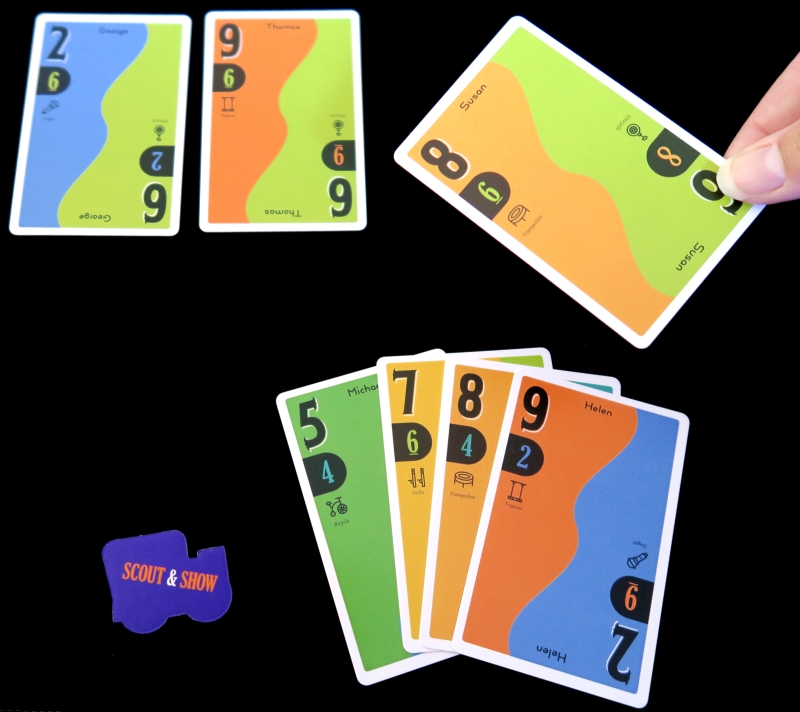
Cartographers: A Roll Player Tale
– Image by boardGOATS

The first round started with an Orchard and a decision:  with Sentinel Wood giving points for woodland round the edge of the map and Canal Lake giving points for Farmland next to Lakes and Lakes next to Farmland, was it best to start with Woodland or Farmland?  Hindsight is a wonderful thing and, when the Fishing Village and Hinterland Stream were also revealed (both providing either Lake or Farmland) it was clear that Woodland was the wrong choice.  With just four cards in the first round, it quickly became clear that placing Farmland and Lakes well could score highly, which is exactly what Green and Burgundy did.

Cartographers: A Roll Player Tale
– Image by boardGOATS

Everyone else went into the second round feeling they had lost already, and when most of the cards that came out had a timing of two and didn’t include Lake and Farmland, it looked like Green and Burgundy were just going to stretch their lead further.  There was much hilarity when Black asked what people would score if they only had one big red thing—he worked it out amid the giggles, eventually.  With time almost out, the first Ambush card, Gnoll Raid, put in an appearance.  This scuppered lots of people’s plans and gave almost everyone plenty of negative points to work on, especially since there weren’t many more cards to go in the round.

Cartographers: A Roll Player Tale
– Image by boardGOATS

The third round was relatively uneventful with players working hard to mitigate the effects of the Gnoll Raid while ensuring there were plenty of single space gaps to score in the last two rounds.  At the start of the final round, the Kobold Onslaught was revealed and with a slightly awkward profile, most people were going to have problems reducing their negative tally.  That said, with gaps giving positive points, some people found that the negative effects could be neutralised to some extent.

Cartographers: A Roll Player Tale
– Image by boardGOATS

Some of the scores in the final round were very large compared to those earlier in the game, some were in the thirties compared with single digits in the first round.  This was largely because players had been able to plan for the final round of course, in particular by lining the edge of their map with Woodland.  As players tallied up their scores it looked like Burgundy had it, especially with his thirty-nine in the final round, however, Blue had done well in the second and third rounds which was just enough to beat him by a single point.

Cartographers: A Roll Player Tale
– Image by boardGOATS

While Blue and Burgundy double-checked their maths, Pink commented that he was going up to Durham to check the house was OK.  Pine replied that he was just like Boris Johnson’s father Stanley who had been to Greece to check his holiday home, then asked whether he’d prefer to be compared with Stanley Johnson or Dominic Cummings.  Pink thought about it, then said that although Stanley Johnson was irritating, he was only marginally more irritating than Stanley Unwin and Dominic Cummings was actually evil, so it would have to be Stanley.

Stanley Unwin
– Image from televisionheaven.co.uk

There was a lot of conversation about this largely theoretical point when Pine suddenly said, “Who?  Who’s Stanley Unwin?  I think I may have got him confused with Stanley Holloway and was thinking about Albert and the Lion…” This prompted memories of the stick with a horse’s head handle and lots of tales from The North and reminiscences of holidays in Wales.  Despite this sojourn and the fact that Cartographers is more complex than the “Roll and Write” games that we’d played previously, it hadn’t taken very long to play.  So after a bit of a discussion of the options, we decided to give our old favourite 6 Nimmt! yet another outing, on Board Game Arena.

6 Nimmt!
– Image by boardGOATS

This is a simple game that we’ve played a lot, where players simultaneously choose cards and then, starting with the lowest card revealed, add them to rows of cards on the table.  The player to place the sixth card in any given row instead takes the five cards on the table, which then go in their scoring pile.  The rows always increase in in number from left to right.  In the version of the game we play, cards are added to the high end of the row where the end card is has the highest value that is lower than the card placed.

6 Nimmt!
– Image by boardGOATS

There is a variant, where players can add cards to both ends of the rows, but last time we played, Pine, the only one who had played it said it was very random so we gave it a miss.  The subject came up again, but with everyone involved, we decided to stick to the “normal version”.  This time, Purple was the first to pick up cards, taking ten “nimmts”, quickly followed by Blue, and the game was starting to look like a re-run of the last time we played.  Team Greeny-Lilac really struggled using a mobile phone, so Blue shared her screen between turns so he could better see the layout.  Despite their inability to see the cards on display properly, they were doing really well, until their vision improved when Blue started to share her screen.

6 Nimmt! on Board Game Arena
– Image by boardGOATS
from boardgamearena.com

At that point, they suddenly started to pick up cards and it all went down hill.  In fact the were going down hill so fast that they hit the fence first smashing through it with a very fine minus eight, while Black was the winner with fifty-six.  Ivory decided to call it a night there, but everyone else was happy to give it another go.  This time, Purple saved Team Greeny-Lilacs blushes by ensuring they didn’t finish two games at the bottom, and Burgundy took the honours finishing with forty-eight.  With that, Team Greeny-Lilac decided they’d had enough of fighting with the website on a mobile.  With numbers dropping to six, Pink was keen to give the “Professional” game a go.

6 Nimmt! on Board Game Arena
– Image by boardGOATS from boardgamearena.com

Six is a funny number for 6 Nimmt!, so despite Pine’s reluctance, we decided to try it.  In this variant, cards can go on either end of the row, whichever is closest.  So a twelve would normally go after a ten, say, but in this version if one of the rows starts with a thirteen, it would go before that instead, shifting all the cards along.  If this means there are now six cards in the row, then the cards move into that player’s scoring pile and the card they played forms the starting card for the row.  This game always causes a lot of moaning and groaning and cursing, though as a nice group of people, we also always say thank-you when someone else picks up a fist-full of cards on our behalf, saving blushes. The “Professional” variant, however, was absolute mayhem!

6 Nimmt! on Board Game Arena
– Image by boardGOATS from boardgamearena.com

It certainly wasn’t random, but the predicting what might happen was considerably more complex than for the standard game.  For some this made it more interesting, for others it just seemed total chaos.  Everyone was very glad the computer was working out where to place the cards though.  There were a couple of very interesting consequences of the new rules, though.  For example, low numbers, in particular single digits, are no-longer near-automatic pick-ups.  So, instead of waiting to play number one when there is a row with a singleton, it can now be used to mess everyone else about.  As it is always going to be resolved first, it will always go at the front of another row.  Additionally, cards that were previously very safe plays, are now not.

6 Nimmt!
– Image by boardGOATS

So, playing a forty-four after a forty three as the fifth card in a row was almost always safe under the normal rules, but with this variant, if someone else has played a card at the front of that row, that forty-four is now the sixth card guaranteeing a pile of nimmts.  Similarly, rows with the highest cards are usually dead and just increase the competition for the other rows making it more difficult.  With the new rules though, these rows can still be played and can become a trap for the unwary too.  As a result, the new rules made it really interesting, but could have completely unpredictable effects, and everybody felt it would be too random with more than six players.

6 Nimmt! on Board Game Arena
– Image by boardGOATS
from boardgamearena.com

Some things don’t change no matter what you do and Purple seemed to have an uncanny knack of picking a card that went in just the wrong place.  Nobody really understood how, but Pink won the first round—not to say that Pink shouldn’t have won, just that everyone was so busy trying to work out what was going on and why, that nobody was watching what Pink was doing!  It was an absolute hoot though, and when Pink said he thought it was time he went to bed Blue commented that it wasn’t fair for him to leave without giving everyone else a chance to challenge him to another game. So, only slightly reluctantly, he stayed for one more game. This was just as crazy as the first and just as much fun too.  This time it was very close between Black and Blue, with Blue just edging it.  But the winner wasn’t important, it was all about the game.

6 Nimmt!
– Image by boardGOATS

Learning Outcome:  Under the right circumstances, even a favourite can be improved.

3rd March 2020

After a short, but sweet battle over who wasn’t going to have the last lamb pie and mash, Burgundy and Blue settled down to eat.  They were soon joined by Pine, Lime, and then Black and Purple bringing news of their new black and purple car.  When Ivory and Green arrived, the key players were in place for the for the “Feature Game”, the Hellas map from the Hellas & Elysium expansion to Terraforming Mars.

Terraforming Mars: Hellas & Elysium
– Image by boardGOATS

In Terraforming Mars, each person takes the role of a giant corporation, sponsored by the World Government on Earth to initiate projects to make Mars habitable.  This is by raising the temperature, increasing the oxygen level, and expanding the ocean coverage.  The Hellas map presents a new areas of Mars to explore, in particular, the Mars south pole and the enormous seven-hex Hellas crater that just begs to become a giant lake.  Building around the pole gives placement bonuses in the form of heat and possibly even water.

Terraforming Mars
– Image by boardGOATS

At the start of each round, players draw four cards, keeping as many as they like, but paying 3M€ per card.  Since the cards are so critical to the game-play, there is a variant where the cards are drafted, letting players see more of the cards available, but making the decisions more critical.  Players then take it turns to take one or two actions from seven possible actions.  At the end of the round, players simultaneously produce, turning any energy into heat, taking finance according to the combined total of their Terraforming Rating and their M€ production level, and finally receiving all other resources according to their production levels.

Terraforming Mars: Hellas & Elysium
– Image by boardGOATS

The game ends once all three Global Parameters are met:  all of the Ocean Tiles have been placed, the Temperature has reached 8°C, and the Oxygen Level is at 14%. The game is driven by the cards, but the guts of it are the actions.  These include: play a card; use a Standard Project; use an Action Card; convert eight plants into a greenery tile and raise the Oxygen Level; use eight Heat to raise the Temperature; claim a Milestone, and fund an Award.

Terraforming Mars
– Image by boardGOATS

Each card has a set of requirements, for example, Grass cannot grow at very low temperatures, so the Grass Card can only be played when the Temperature is above -16°C.  Other cards may require the player to spend energy, or other resources.  They also have a financial cost, though some can be paid for using Steel and/or Titanium as well.  There are three types of cards: red Event Cards, Green Automatic Cards and Blue Action Cards.  Green and Blue cards have an effect that occurs when they are played.  Red Event Cards have  an action that takes place once and are turned face down once they have been played.  Blue Action Cards also give the player a special ability that can be activated many times during the game, but only once per round.

Terraforming Mars
– Image by boardGOATS

In addition to the actions on the cards, players can also carry out actions associated with Standard Projects.  These can be used several times per round and mostly involve spending money to increase the Temperature, add tiles to the board, or increase the player’s Energy Production.  Players can also sell cards at a rate of 1M€ per card, an expensive option as it’s less than they cost to buy, and it costs an action, but needs must when the Devil drives.  Finally, players can claim milestones (if they have played enough cards with Tags that qualify) or fund an award.  These cost money, but give Points at the end of the game.

Terraforming Mars
– Image by boardGOATS

This is the basic game play, but there are a lot of expansions and variants, so setting up was slow as the group tried to figure out which cards came from which expansion and what bits they actually needed to use.  They got there in the end and chose to add in a few extra corporations to the standard set. Only Ivory received one of them, but still chose an original corporation, Ecoline, which gave him Plant production and reduced the number of plants he needed for a new Forest tile from eight to seven.  Green went for Inventrix, which gave him three extra cards at the start of the game and reduced the restrictions on the environmental requirements.  Burgundy chose Teractor, which allowed him to play cards with Earth Tags more cheaply.

Terraforming Mars
– Image by boardGOATS

Ivory made an early play to plant a city amongst the northern green belt. He knew it was an unusual opening move and a bit of a gamble, but one he hoped would pay dividends later.  Burgundy also planted a city in the first round, nearer to the large potential ocean area in the Hellas crater. Green waited a little longer for his first city, but broke away from the others to plant it near the southern polar region, hoping to expand upon the unique scoring potential for this new board.

Terraforming Mars: Hellas & Elysium
– Image by boardGOATS

Like most games of Terraforming Mars this one progressed gradually and slowly as everyone built their “engines”.  Ivory was clearly working on a Forest growth strategy, and also looking for the bonus end game awards.  Burgundy was trying to build cities next to oceans for bonus money and also keeping the sides of his cities next to Forests for end game scoring.  Green tried to use his relaxed environmental requirements to his advantage by playing cards early, but in the process failed to do anything with his southern city goal.

Terraforming Mars: Hellas & Elysium
– Image by boardGOATS

Ivory made the first Milestone claim, taking the Energizer, for increasing his Energy Production to six.  He was about to claim the second too, Diversifier, for having eight different tags played, but then realised that he couldn’t use the Red Event cards and so couldn’t claim it after all.  Very soon after Green took it instead, much to the annoyance of Burgundy who was also on the verge of taking it, and would have done so on his next turn.  Ivory later claimed the third Milestone, Tactician (five environmentally restricted cards), which both he and Burgundy had noticed Green could have claimed earlier and made noises to that effect, but weren’t specific.  Green, however, had forgotten what it was awarded for and hadn’t noticed he qualified.

Terraforming Mars: Hellas & Elysium
– Image by boardGOATS

As for the Awards, Ivory again funded the first one to activate the Cultivator, obviously key to his strategy as as it rewarded most Forests.  Ivory also wanted Space Baron in play (for most Jovian tags) and Burgundy paid for the final Magnate Award, which rewards the player with the most green cards.  In the end though, Burgundy won all three awards, with Ivory taking second place in two and Green just pipping Ivory to second by one card for the Magnate Award.  When it came to the scoring, the Terraforming Ratings were quite close with Ivory just ahead of Burgundy as he had been for most of the game.  Burgundy took a lot of points for the awards though and scored heavily for his cities.  The overall winner was therefore Burgundy with eighty-three points, sneaking ahead of Ivory who took second place.

Terraforming Mars
– Image by boardGOATS

While the Terraforming Mars group began setting up, everyone else took a slightly more relaxed look at the options available, and after some discussion, the group settled on Isle of Skye.  This won the Kennerspiel des Jahres in 2016 and is a game most of the group have played before and really enjoyed.  The best way to describe it is a bit like Carcassonne, but with individual play areas and a very clever auction for the tiles.

Isle of Skye: From Chieftain to King
– Image by boardGOATS

The idea is that players start with three tiles drawn randomly, and place them in front of their screen.  Behind the screen they use their own money decide the price of two of the tiles and choose one to discard.  Once everyone has revealed their prices and discards, the first player chooses a maximum of one tile to purchase from the offering.  They cannot choose one of their own, and they pay the amount shown to the owner of the tile.  Once everyone has made their purchase, players then buy any remaining tiles in front of them, paying with the money the used to indicate the price.

Isle of Skye: From Chieftain to King
– Image by boardGOATS

This auction is very clever for lots of reasons. Firstly, the player with the best tiles, does not necessarily get them.  If they think they have something valuable, then they can give it a high price and will either end up keeping it (paying the money to the bank), or end up getting a lot of money for it.  For this reason, the key thing is getting the value right—over-pricing a tile risks it failing to sell and getting landed with it at a heavy cost.  This was Ivory’s comment from the next table.  There is a more subtle aspect to the auction, however.

Isle of Skye: From Chieftain to King
– Image by boardGOATS

Although they have the widest choice, if the first player prices their tiles too high, they may not have sufficient funds to buy anyone else’s, worse, nobody else will buy their tiles which means they will end up having to pay for them themselves, leaving them short of cash in the next round as well.  On the other hand, because the money paid for tiles and the money used to indicate their cost go straight into the seller’s hand, players later in the turn order, may have less choice, but will likely have more available cash.  In this way, the advantage of turn order is self-correcting and everyone has difficult decisions to make and probabilities to consider, though the decisions are different for each player.

Isle of Skye: From Chieftain to King
– Image by boardGOATS

Once the tiles have been bought and paid for, players add them to their kingdom.  Like Carcassonne, the terrain type on the edges of the tiles have to match up (though roads do not), and the tiles have features that are used for scoring.  There are more different features than in Carcassonne, however, and the scoring is very different.  In each game there are four scoring conditions, and each one is used three times during the game (five rounds for the five player game).  Additionally, there are also tiles that feature scrolls which are personal scoring conditions that take effect at the end of the game.
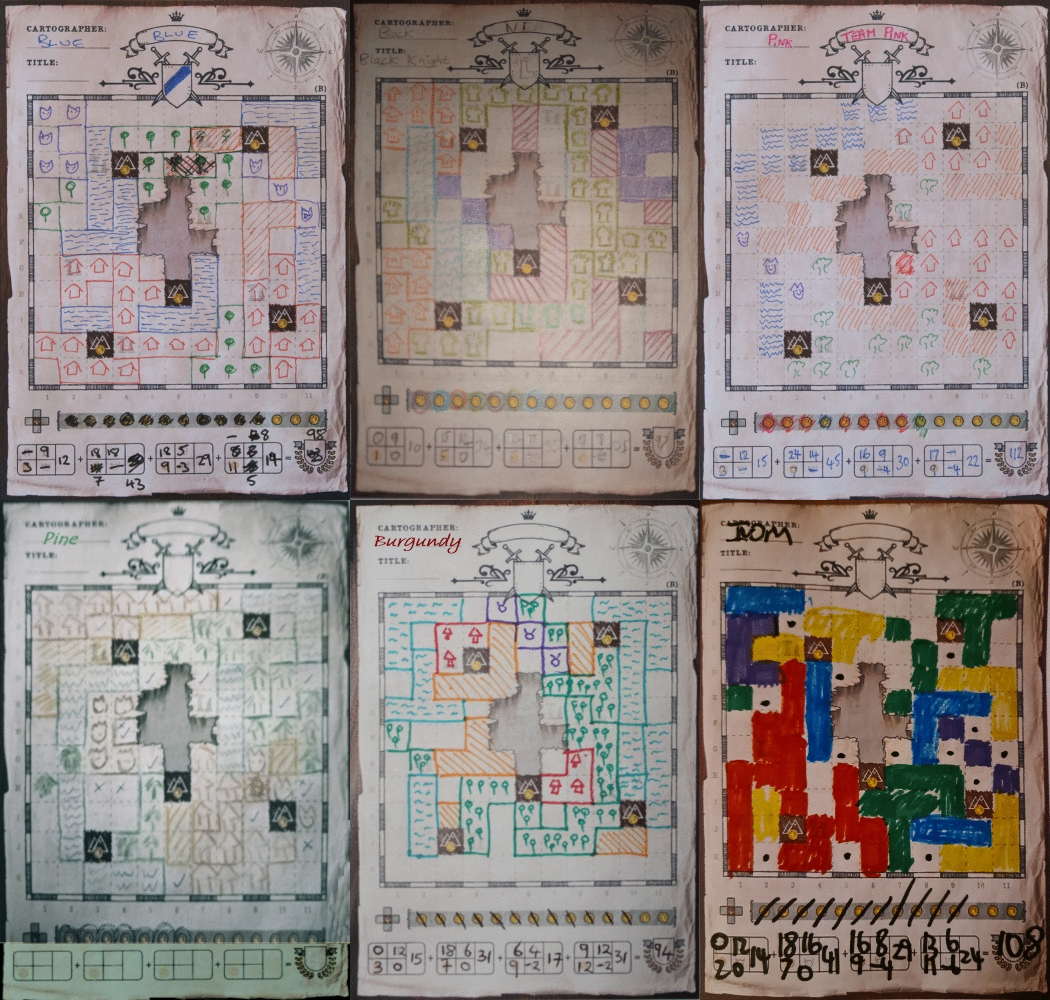
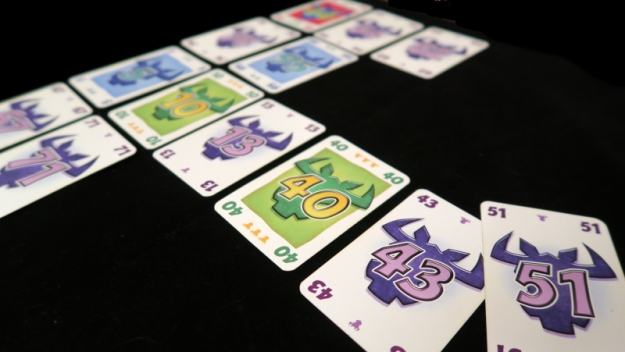
Isle of Skye: From Chieftain to King
– Image by boardGOATS

As Lime was new to the game, the group decided not to include the main components of the Journeyman or Druid expansions.  All the tiles went into the bag though, including those from both of the large expansions and the several mini expansions (the Adjacency Scrolls, both Tunnelplättchen, the Themenplättchen and the Kennerspiel des Jahres Promo), and anywhere the main feature required one of the main expansions were just rejected when they were drawn.

Isle of Skye: From Chieftain to King
– Image by boardGOATS

Pine got a flying start in the first round getting five points for his Broch/Lighthouse/Farm combo and a couple of points for a completed mountain range.  As the game progressed, more buildings fell into his lap and the points kept coming.  Black tried to collect Broch/Lighthouse/Farm sets, but couldn’t get any Brochs, so gave up and concentrated on getting diagonals instead.  This is not as easy as it looks because every tile added to a diagonal requires the fixed placement of two tiles.  Each round, players get a maximum of three tiles, so this is very restrictive.

Isle of Skye: From Chieftain to King
– Image by boardGOATS

It was a hard game:  Lime failed to complete and score any mountains and Purple struggled as there were two rounds when she failed to get any points at all.  Blue started off trying to build in a diagonal, but ended up picking up points for Barrels connected to her Castle by road, mostly at Lime’s expense.  She was aided when Pine drew a Barrel tile that Lime really fancied and had lots of money to pay for.  Not wanting to give away his plans, Lime told Pine he didn’t want the tile, so Pine, who believed him, chucked it away, leaving Blue a clear run.

Isle of Skye: From Chieftain to King
– Image by boardGOATS

Pine maintained and grew his lead, though the others did threaten to catch up towards the end.  His Brochs and enclosed scroll giving him two points for each one made all the difference though and he finished with sixty-nine points ten ahead of second place.  The battle for that was much closer with three players within six points of each other.  It was Blue who sneaked in front though, just ahead of Lime who put in a very creditable performance on his first attempt.

Isle of Skye: From Chieftain to King
– Image by boardGOATS

Terraforming Mars was still going on the next table, so although it was getting late the group decided to play something short, and considered Coloretto, but in the end settled on No Thanks!.  This is a really quick and simple “push your luck” reverse auction game.  Everyone starts with eleven chips and on their turn, either takes the card on offer (and any chips on it) or pays a chip to pass the problem on to the next person.  The aim of the game is end up with the lowest card total, subtracting any chips they have left.  The catch is that if a player has a run of cards, only the lowest is counted, however, at the start of the game nine cards are removed from the thirty-three in the deck…

No Thanks!
– Image by boardGOATS

This time, Black won a relatively uneventful first round with twenty, while Purple “top scored” with fifty-three.  It was quick and Terraforming Mars was into another round, so Lime suggested another round and everyone else concurred.  This was more remarkable.  Blue was first to take card.  Since the player who takes a card then has first dibs on the next card, when the next was close the the first, she took that too.  This continued with only a couple of breif interludes for cards she really didn’t want.  In the end, she had a remarkable run of fifteen cards from the twenty-four in play.

No Thanks!
– Image by boardGOATS

Unfortunately for her, as they were mostly low value cards and cards she needed, she had been unable to milk them to get chips from the others.  So she finished with a very reasonable thirteen, but in forth place behind Lime with twelve and, remarkably, Black with minus three and Pine who took the game with minus four, winning by virtue of the fact he played later in the round.  The Terraformers were just finishing, so the cards were shuffled for a third and final time.  This time, Lime tried the collecting cards trick, but he was not as lucky as Blue and ended with a card total of ninety-nine (and twenty-three chips).  Black and Blue both finished with a more normal nine, and tied for the win.  With everyone finished, but time was marching on, so everyone decided to say “No Thanks!” to another game and went home.

No Thanks!
– Image by boardGOATS

Learning Outcome:  Getting a lead is good, but you have to be able to keep it.