Tag Archives: Monopoly

Boardgames in the News: Are Games a Good Investment?

It might seem strange for a courier company to comment on the value of boardgames, however, David Jinks, the Head of Publications at ParcelHero (a UK courier comparison site), has been has been reported to have strong opinions on the subject.  He explains how traditional games can be worth many thousands if the edition is right; they even have a page on their website discussing collectible games.  So why are ParcelHero so interested?  Well, it turns out that buying and selling vintage copies of Monopoly is big business, most of which is done on the internet using sites like eBay (who have several buyers’ guide pages on the subject).  Thus, ParcelHero’s involvement is in shipping these items (though in truth it is probably mostly about publicity as there are a lot of other things that they can deliver too).

Container
– Image used with permission of BGG contributor Zoroastro

Now, there will always be a market for vintage copies of traditional family games, but what about the more modern classics?  Sadly, that early copy of The Settlers of Catan is not worth a lot yet, though of course it might be when the game has been around as long as Monopoly of course.  There are modern games that sell for a small fortune however.  These tend to be games where there is some combination of high demand, small print-run, popular designer and unlikely reprint.  There are a number of games that fall into this category and some are not all that old.  Container was released in 2007 by Valley Games Inc., and is an unusual production and shipping game – those who have played it claim there is nothing similar.  The recent law suit that ensnared the reprint of Up Front means a reprint is unlikely, so copies cannot be easily be obtained for less than £100.

Key Market
– Image used with permission of BGG contributor duartec

Another example, is Key Market, which was designed by David Brain and released at Essen in 2010, however, only nine hundred copies were made and it sold out very quickly.  R&D Games are a small company and have moved on to other things (including one of our favourite games, Keyflower), so it looks unlikely that Key Market will be reprinted in the near future.  This is not the only high value game from the Key Series: a set of the earlier titles Keywood, Keydom and Keytown recently went for £1,800!

Keywood, Keydom & Keytown on eBay
– Image by boardGOATS

It’s not just games from small companies that become rare and demand high prices.  Colosseum was a Days of Wonder game with a wide release, but following an alleged dispute between the designer and publisher, it seems unlikely it will be reprinted.  Witch’s Brew is in a similar boat, though it is the implementation of its central mechanism in the Spiel des Jahres winning Broom Service which is likely to prevent a reprint.  The irony is that Witch’s Brew and Broom Service are quite different even though though the publisher and designer have been saying otherwise, so demand is not likely to drop, quite the opposite.

Witch's Brew
– Image used with permission of BGG reviewer EndersGame

So clearly there is money to be made from boardgames, or at least, from some boardgames.  However, for every game that increases in value there are many that end up nearly worthless.  Worse, timing is everything; there is nothing like the announcement of a reprint to have a sudden impact on the market of a desired game.  So, before a reprint is announced the price climbs steadily as the desired item becomes increasingly rare and people continue to pay the inflated prices as “they are only going to go up”.

Mission: Red Planet
– Image used with permission of BGG contributor kilroy_locke

When a new release is announced, everyone has to take a gamble.  Many potential buyers will wait for the new edition hoping that the price will be lower and the quality will have improved in line with modern expectations.  So, demand suddenly drops and sellers are left with a tricky choice:  reduce the price and hope someone who hasn’t heard the news will bite, or sit tight and wait.  Notably, the recent Fantasy Flight Games announcement of a third edition of Fury of Dracula has led to a sudden flood of copies on the secondary market caused by people hoping to get a sale before the price drops.  Similarly, the secondary market price for Mission: Red Planet plummeted when a second edition was announced. On the other hand, waiting can turn out to be a better option in the event that the new edition is deemed inferior to the original.  This is not as uncommon as one might imagine, as artwork often changes and there are frequently also “improvements” to the rules as well and changes to some components.

Fury of Dracula - Secondary Market
– Image used with permission of BGG contributor tumorous

Sometimes changes are for the better, but it is not uncommon for buyers to prefer the original.  For example, for the second edition of one of our favourite games, Snowdonia, the wooden workers were upgraded to plastic figurines, however, our group find the first edition tokens more tactile.  Sometimes, the publicity surrounding a release of a second edition has the additional effect of reviving a market that had become stagnant due to the lack of availability.  In such cases, the reprint can actually increase the price of an already expensive edition when the new version is thought of as inferior.  Mostly, however, a reprint will cause the price to fall as the difference between editions is something only a connoisseur will really appreciate.

Snowdonia
– Image by boardGOATS

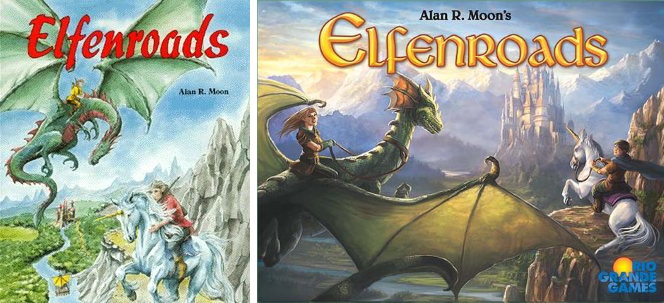
So, where does this leave us?  There are a number of facts that are undoubtedly true.  Firstly, with the exception of the most popular games, almost all modern boardgames are perpetually “between print runs”, with sufficient stock available to supply demand.  For this reason, games can suddenly become unavailable and to some degree the buyer should take the opportunity when they see it, as it may not be there for long.  That said, the best games generally remain in demand and are almost always re-released in some form or another.  The recent announcement by Rio Grande demonstrates that even long out of print classics like the 1992 game Elfenroads, do sometimes eventually get a re-print, albeit in a very different form.
Elfenroads
– Images from the manufacturers

The fact that boardgames are currently a niche market means that mature games are inevitably more likely to go out of print with a corresponding increase in demand.  So, good games ideally with high production values will rarely depreciate by more than 50% if bought for a good price and sold in the right place.  Thus, a gamer with a mature high quality collection who looks their games well, will rarely lose a lot of money if they keep them for long enough, especially if they can chose their time to sell.  Of course, spotting good games at the right price is the challenge, but very occasionally, if they have the correct edition, a gamer might make a killing.

Catan - 3D Collector's Edition
– Image by BGG contributor theotherside

Boardgames in the News: So, What Are Euro-Games?

A couple of months ago at our game night, one of the gamers commented that there were a lot of good games from Europe.  This prompted a discussion about “traditional games”, “Euro-games”, “American games” and their relative merits.  Most people know all about traditional games even if they don’t know what gamers mean when they use the term:  traditional games are the games we all used to play as a child including Scrabble, Cluedo and love it or loath it, the dreaded Monopoly.  Some people also include in this list games like Chess, Go and Backgammon as well as traditional card games like Whist, Hearts and Rummy.

Go
– Image used with permission of BGG contributor ManCorte

But the front page of the boardGOATS website says, “We generally prefer to play “Euro” style games,” so, what do gamers mean by “Euro-games” or “Euro style games”?  Well, most of the traditional games we used to play as children were produced by publishers in the United States of America, companies like Milton Bradley (who made Scrabble) and Parker Brothers (who made Cluedo and Monopoly).  Incidentally, both these companies are now part of Hasbro, but the aggregation of smaller companies to form a larger one is a topic that’s been covered elsewhere.  While the “English” market was dominated by big players that concentrated on producing a few top sellers, in Germany there was no such dominance.  The effect this had was that the market consisted of a large number of small manufacturers producing more varied products.

Scrabble
– Image used with permission of BGG contributor Susie_Cat

This coupled with the traditionally strong German toy industry encouraged the growth of a culture of families playing games together on a Sunday afternoon. It was in this environment that the annual German Game of the Year, or Spiel des Jahres Award, highlighted a range of games from Rummikub in 1980, Torres in 2000 and Camel Up last year.  Over the years, the red pawn of the Spiel des Jahres logo, has become a mark of boardgaming quality, and for many German families, buying the game of the year is something they do every Christmas.  Therefore, the qualities espoused by these awards heavily influence the concept of the “Euro-game”.

Rummykub
– Image by BGG contributor OldestManOnMySpace

But what are these qualities that make a game “European”?  Well, that fount of all knowledge, Wikipedia, describes them as characterised by “simple rules, short to medium playing times, indirect player interaction and abstract physical components”.   It goes on to say, “Such games emphasize strategy, downplay luck and conflict, lean towards economic rather than military themes, and usually keep all the players in the game until it ends.”  On the whole this is not a bad summary, except that it is not very specific:  how simple are “simple rules” and how long are “short to medium playing times”?  Clearly these features are more about contrast, and although there are lots of different types of games including party games and war games, this comparison is usually between European style ames and American-style Games, aka “Ameri-Trash”.

Last Night on Earth
– Image used with permission of BGG contributor Bilben04

Although common, use of the term Ameri-Trash (or Ameritrash) is controversial as some see it as unnecessarily negative, however, although other terms have been suggested none have proved as popular or as persistent.  The term itself is over fifteen years old and was probably originally used disparagingly and applied to genuinely bad American games as a comparison with the much higher professional standards of games in Germany at the time.  Since then, the scope has been expanded and many fans of those American games have adopted the term as a badge of honour.

Merchant of Venus
– Image used with permission of BGG contributor kilroy_locke

American-style games tend to be long, usually over two hours, and classically involve a lot of luck and often feature dice rolling.  They are often considered to be a lot less “cerebral” or “puzzle-like” and, as a result, are sometimes described as “more fun”.  The reference to “trash” may in part reflect the style of the pieces which tend to include a lot of plastic pieces to go with the dice.  There is also often a lot of direct conflict in American-style games, where European games tend to be much more family friendly with indirect player interaction.  Classic Ameri-Trash games include:  Arkham Horror, Merchant of Venus, Cosmic Encounter and Last Night on Earth: The Zombie Game.  Sometimes there is also a book or film tie-in leading to games like Battlestar Galactica and Dune.  Even just comparing the titles with those of classic Euro-games like Puerto Rico, El Grande, Tikal and Agricola, the difference can clearly be felt.

Arkham Horror
– Image by BGG contributor igorigorevich

The most essential part of American-style games is the theme, however, which is often integral to the game mechanisms.  This encourages people fantasize they are part of the action when playing the game.  The miniatures, the long playing times, the complex interwoven rule-set and the interaction (often culminating in players being eliminated) all combine to draw players into the drama of the game.  In contrast, for Euro-games, the mechanisms are the focus, and the games can often be re-themed without much effort.  The theme is therefore used more as an introduction to the more abstract European strategy games, making them more accessible, rather than being an essential part of the emotional investment.

Relic Runners
– Image by BGG contributor cnidius

But things are not as simple as that.  The nature of modern boardgaming encourages cross-fertilisation.  There are more highly-themed, strategy-games available now and more long, strategic games with miniatures – these are sometimes referred to as “hybrid games”.  For example, games produced by the Days of Wonder (based in the USA), like Ticket to Ride and Relic Runners have a lot of plastic pieces, though the games themselves are quite strategic and generally run for no more than an hour.  Similarly, games like Escape: The Curse of the Temple and Space Alert use real-time and a sound-track to draw the players in, yet they are both short (Escape takes just ten minutes to play) and have no player elimination.  Vlaada Chvátil’s Dungeon Lords series of games, also have a lot of theme, but are also playable in a manageable time-frame, have a lot of strategy and a reasonably streamlined set of rules.

Dungeon Lords
– Image used with permission of BGG
contributor PaulGrogan

Confusingly however, “hybrid” has more recently also come to mean games that include some sort of mobile device application (and thus require a smart phone, tablet or similar).  Now, lots of games have Apps that help them a long a little (e.g. One Night Ultimate Werewolf), but games like Alchemists and XCOM: The Board Game don’t really function properly without them.  The question is, are these still boardgames?  In truth, they are a sort of hybrid computer-boardgame, but the point is, however appropriate the name, it is all about the game and the other people playing:  the bottom line is, if you enjoy playing it, it doesn’t matter what it is called.

Alchemists
– Image used with permission of
BGG contributor Mouseketeer

Boardgames in the News: Spiel des Jahres Awards

This week, Colt Express won the Spiel des Jahres Award.  Although it may seem strange, this German award is highly sought after and is the most coveted award in the world-wide world of boardgames.  The reason for this goes back nearly forty years when the “English” market was dominated by companies like Milton Bradley (who made Scrabble) and Parker Brothers (who made Cluedo and Monopoly).  These concentrated on producing a few top sellers, however, in Germany there was no such dominance.  So, the German market consisted of a large number of small manufacturers producing more varied products.  This, coupled with the traditionally strong German toy industry, encouraged the growth of a culture of families playing games together on a Sunday afternoon.

Spiel des Jahres
– Image from spieldesjahres.de

It was in this environment that the annual German Game of the Year, or Spiel des Jahres Award, began in 1978, with the stated purpose of rewarding excellence in game design, and promoting top-quality games in the German market.  The red pawn of the Spiel des Jahres logo, has since become a mark of quality, and for many German families, buying the game of the year is something they do every Christmas.  Thus, the award has been such a success that it is said a nomination can increase sales from a few hundred to tens of thousands and the winning game can be expected to sell up to half a million copies or more.

El Grande
– Image by BGG contributor Domostie

Over the last fifteen years, years, the Spiel des Jahres has generally gone from highlighting games like El Grande, Tikal and Torres (1996, 1999 & 2000), to rewarding lighter games like Dixit, Qwirkle and Camel Up (2010, 2011 & 2014).  The problem was particularly brought to light in 2002 when Puerto Rico, arguably one of the best games ever made was not rewarded because it was perceived as too complex.  The problem reared its ugly head again in 2008, but this time the jury awarded Agricola a special “Complex Game” award.  These two games are widely considered to be the pinnacle of “Euro-Games”: between them they’ve held the top position on the BoardGameGeek website for the best part of ten years, yet neither were awarded the top prize. The problem was that these games were not mainstream enough for the German family game market:  they were too complex for those families making their annual purchase. On the other hand, for frequent and dedicated boardgamers, these Spiel des Jahres games are too light.  So, for this reason, the Kennerspiel des Jahres or “Connoisseurs’ Game of the Year” was introduced in 2011 and for more serious gamers, this has largely superseded the Spiel des Jahres.  This year it was awarded to Broom Service, a reimplementation of Witch’s Brew which was itself nominated for the Spiel des Jahres in 2008.

Adel Verpflichtet
– Image by BGG contributor Henco

The Kennerspiel des Jahres is not the only prestigious award available to strategy games however.  In 1990, the German magazine “Die Pöppel-Revue”, introduced the Deutscher Spiele Preis or “German Game Prize”.  This is announced in October every year at the Internationale Spieltage in Essen.  In contrast to the Spiel des Jahres, the Deutscher Spiele Preis has gone from rewarding lighter games like Adel Verpflichtet (aka Hoity Toity, in 1990) and our group’s current favourite filler, 6 Nimmt! (winner in 1994) , to highlighting games like Russian Railroads and Terra Mystica (in the last two years).

Deutsche Spiele Preis
– Image from wikimedia.org

Boardgames in the News: Confusion at The Telegraph!

Anyone who plays modern boardgames knows how our hobby has been growing and growing.  Games like Carcassonne and The Settlers of Catan are now available in Waterstones and WHSmith, there has been a series of regular comments in The Guardian, there are repeatedly TV appearances, and boardgame cafés are sprouting up all over the place.  It seems strange then that last week, Harry Wallop from The Telegraph announced that “Card games and board games are dying out and it’s no great loss”.

Snap
– Image by BGG contributor loopoocat

The basis of this report is a survey carried out by Barclaycard which apparently indicated that games like Old Maid, Happy Families and Snap are in danger of dying out.  Strangely, on the same day, Martin Chilton, the Telegraph online Culture Editor reported that 67 per cent of the children surveyed said that they would like to learn how to play traditional games.  The really annoying thing about all this is that they focus solely on “traditional games”:  Martin Chilton’s article is entitled “The five best board games” and lists them as Chess, Scrabble, Monopoly, Cluedo and Backgammon.

Scrabble
– Image used with permission of BGG contributor Susie_Cat

On closer inspection, however, Harry Wallop’s article does include a link to a more interesting list of fifteen party games, including Pandemic, Camel (C)Up and Biblios.  While their definition of “Party Games” clearly leaves a lot to be desired, it is clear that someone at The Telegraph at least has heard of modern games.  Perhaps the most reassuring aspect of this though, is the response to Martin Chilton’s article in the comments section which includes a nearly eighty passionate responses pointing out better, modern, “classic games” and where to find information about them.

Biblios
– Image by BGG contributor creatsia

Let’s hope Mr Chilton and Mr Wallop read the comments and write a better article soon!

Boardgames in the News: Thirsty Meeples on Radio 2

The growing interest in boardgames continues with an item on the Chris Evans Breakfast show on Radio 2 featuring Simon Read from Thirsty Meeples (starts at 1:47:30).  Sara Cox was sitting in for Chris Evans and conducted the short telephone interview discussing the Oxford games Cafe.  Unfortunately she was a bit obsessed with “classics” like Monopoly, Scrabble, Cluedo, Connect 4 and Mouse Trap.  Simon did his best to talk about Survive:  Escape from Atlantis! and The Settlers of Catan, but in truth, while it was a nice little bit of advertising for the Thirsty Meeple, Sara was too determined to move onto Cold Play…

Sara Cox
– Image from bbc.co.uk

Boardgames in the News: Are Asmodée Taking Over the World?

Asmodée is the French translation for Asmodeus, and according to Binsfeld’s classification of demons, Asmodeus is the demon of lust and is therefore responsible for twisting people’s sexual desires.  In the boardgame world though, Asmodée (originally known as Siroz) are a small French game publishing and distribution company, specialising in the family market. For example, they are well known for Dobble, Dixit, Time’s Up! and Ca$h ‘n Guns, but they also publish some more challenging games including Snow Tails, Mr. Jack, Formula D, Takenoko and 7 Wonders.

Jungle Speed
– Image used with permission of BGG contributor kilroy_locke

Asmodée was started in 1995 by Marc Nunès, a self-trained entrepreneur developing role-playing games, but quickly became France’s foremost games publisher and distributor.  One of the big early successes was Jungle Speed, launched in 1998, which has since gone on to be one of the top-selling titles in France, rivalling Monopoly, Trivial Pursuit and Pay Day.  The real turning point came in 2003, however, when Asmodée obtained the French licence to distribute Pokémon collector cards, which opened up the mass retail sector.  This development led to an 18% investment from Naxicap in 2005.  Naxicap’s stake was bought out two years later by Montefiore who acquired 60% of the company as part of a deal with management worth €40-50 million.  Montefiore invested €120 million to finance Asmodée’s international growth, funding the acquisition of the Belgian game distributor Hodin in 2008, the Spanish games developer Cromola and the German Proludo in 2009, followed by the purchase of a 60% stake in the UK-based distributor, Esdevium Games in 2010.  Asmodée also strengthened it’s portfolio with the acquisition of Abalone and partnership with Libellud (leading to the distribution rights for Dixit) in 2010.

Abalone
– Image used with permission of BGG contributor msaari

In 2012, Asmodée branched out further, setting up a subsidiary in Shanghai, China,  with the intention of expanding “into a new market taking advantage of Asmodee’s extensive line-up of games and the existing relationships with partners, thus promoting the brand in mainland China, Hong Kong and Taiwan”.  This ambition brought Asmodée to the attention of the Eurazeo, a European investment company and a deal was announced in November 2013 that valued Asmodée at €143 million.   In January, 2014, almost exactly a year ago now, Eurazeo bought 83.5% of Asmodée through an equity investment of €98 million while Asmodée’s management team and original founders reinvested €14 million of their own money.

Ticket to Ride
– Image used with permission of BGG contributor garyjames

With the backing Eurazeo provided, Asmodée then went big:  in August last year it was announced that Days of Wonder would be “merging into the Asmodée Group of game companies”.   Days of Wonder are one of the biggest names in modern boardgaming, and are often credited with the growth of the modern boardgame industry, thanks largely to their flagship Ticket to Ride games, which have sold well over two million copies to date.  This is not the only “big game” in their catalogue either, they are also responsible for Memoir ’44 and Small World, both of which are popular games, demonstrated by the number of expansions they support and which take Days of Wonder’s total number of games sold to over five million since their founding in 2002.

Small World
– Image used with permission of BGG contributor crosenkrantz

According to Forbes, Days of Wonder generates between $10 million and $20 million in revenue annually, not bad in such a niche market.  From Eurazeo/Asmodée’s point of view, such an acquisition makes sound financial sense, not just because of the commercial value, but because they already provided a lot of the distribution for Days of Wonder games.  This wasn’t enough for Asmodée however, and three months later, they acquired the U.S. publisher Fantasy Flight Games.

– Image used with permission of BGG contributor adamfeldner

This was a bit of a change of direction for Asmodée:  hitherto, all the acquisitions had been firmly in the family boardgame and distribution markets.  Fantasy Flight games are a very different animal and their headline games, Twilight Imperium and Arkham Horror are much less family friendly.   Even their X-Wing Miniatures Game which is very popular with fathers and sons, is a long way outside the normal scope of Asmodée, since it is essentially a two-player war game with a Star Wars theme.  However, there are considerable benefits for both parties, since the merger will enable Fantasy Flight to improve its distribution in Europe, while simultaneously giving the growing Asmodée Group access to Fantasy Flight’s North American sales and marketing teams.

Black Fleet
– Image used with permission BGG contributor Toynan

Asmodée weren’t stopping there, however, with Ystari Games, Asterion Press and Pearl Games also becoming “part of the Asmodée family” late last year.  The link with Ystari Games almost certainly comes from their mutual interest in Space Cowboys.  Space Cowboys is a game creation studio created in 2013 by Marc Nunès (who started Asmodée way back in 1995, remember?), Philippe Mouret and Croc (both of Asmodée), Cyril Demaegd (Ystari) and Sébastien Pauchon (GameWorks).  Space Cowboys is a very small outfit, but already has one Spiel des Jahres nomination under its belt in Splendor and looks to be trying for a second with Black Fleet, the gorgeous pirate game released at Essen last year.

Asmodee Publishing 2015
– Image from eurazeo.com

So, what are Asmodée up to?  The concern is that gamers generally like the current diversity in the market and fear that this succession of mergers and partnerships will mean a homogenisation of the games available.  The November 2014 Eurazeo “Investor Day” report spelled out the current state of Asmodée in detail and the good news is that this does not seem to be Eurazeo/Asmodée’s intention.  The report states, “Each studio has its own DNA,” and goes on to say, “Repeated success lies in the full independency granted to these studios, to keep innovating.”  So it seems the diversity is valued, however, by acquiring mid-sized publishers like Days of Wonder and Fantasy Flight, Asmodée is positioning itself to compete more effectively with multinational toy giants like Hasbro and Mattel, who publish top board game brands including Monopoly and Scrabble.

Asmodee Organisation 2015
– Image from eurazeo.com

So, is it a good thing that Asmodée are setting themselves up to rival the big boys?  Well, Asmodée is not the only company to engage in mergers:  in 2011 Filosofia purchased the U.S. publisher Z-Man Games, and U.S. publisher FRED Distribution (which releases games under the Eagle Games and Gryphon Games brands), acquired U.S. publisher Face2Face Games.  More recently, in late 2013, Mayfair Games (the U.S. partner for Catan) bought a controlling interest in Lookout Games (the company who first brought Agricola, Caverna, Le Havre and Ora et Labora to the market).

Asmodee Logo
– Image from escapistmagazine.com

Clearly a large stable company provides security for designers, as well as providing support for the individual studios who know that one poor decision is no-longer likely to bring about the end of the company, both of which have to be A Good Thing.  However, companies like Eurazeo invest for only one reason:  financial return.  With an effective monopoly, Asmodée are now in a position to squeeze the market, indeed we may already be seeing the evidence of this in the price rises announced at the start of the year.  With this in mind, it will become clear in due course whether Asmodée is good for boargaming in the UK or whether it is genuinely the demon of lust responsible for twisting our gaming desires…

Boardgames in the News: 20 Years of Catan and El Grande

It seems to be the year for anniversaries: arguably 2015 celebrates significant anniversaries for two of the greatest games in boardgaming history.  We are not talking about Monopoly here (though there has been a lot written about the 80th anniversary of the brand).  The games in question were both released in Germany in 1995:  The Settlers of Catan and El Grande.   The first of these, Klaus Teuber’s The Settlers of Catan, is widely known amongst gamers and many non-gamers, and is often cited as being responsible for the “gaming revolution”.  The base game of “Settlers” (or “Die Siedler”) and its expansions have appeared in thirty languages and sold more than twenty-two million copies worldwide.  At Spielwarenmesse, The International Toy Fair at, Nürnberg, Kosmos and Mayfair unveiled a new look for the entire line of Catan games.

The Settlers of Catan
– Image used with permission of BGG contributor kilroy_locke

The press release explains, “The new look will strengthen the Catan brand both domestically and internationally.  The new cover art utilized by all partners will provide a visual continuity throughout the world.  This new look is more vibrant and alluring with overall improved presentation and splendidly clean branding. The new packaging cries out… CATAN!”  It goes on to say, “As part of the growing expansion of the Catan® family of products, the base game will simply be called CATAN® in all countries and languages, along with a unification of the game’s graphic design in all territories and languages.”

The Settlers of Catan
– Image by BGG contributor herman_the_german

There are a couple of curious things about this, firstly, when Kosmos released the game twenty years ago, it was just going to be called “The Settlers” (or rather “Die Siedler” since it was released in German first).  That was until Blue Byte published a computer game by the same name, so Kosmos decided they wanted something more unique and identifiable and made up “Catan”.  Secondly, aside from the the editions released in English by Mayfair Games (who went its own way with original art and component design), the brand has already been “unified” in its look!

The Settlers of Catan
– Image by BGG contributor degamer

The second of the games mentioned above is El Grande, which was first published in Germany by Hans im Glück.   Like “Settlers” the year before (or “Catan” as we must now call it), in 1996, Wolfgang Kramer and Richard Ulrich’s El Grande was awarded both the Spiel des Jahres and the Deutscher Spiele Preis.  Although it is less widely known than its predecessor, El Grande is hugely respected by gamers often cited as “still the best area control game”.  It is so highly thought of that it continues to be higher on the BoardGameGeek ranking than The Settlers of Catan and many other well known and hugely popular games including Carcassonne, Ticket to Ride, Pandemic and Dominion.  These games are all continuously reprinted, but sadly, the nature of boardgames means that many good titles go out of print.  Unfortunately, El Grande is one such game; it had fallen out of favour with its publishers and has not been reprinted in English or German since the Decennial Edition, ten years ago.

El Grande
– Image used with permission of BGG contributor garyjames

There are a number of reasons why games like this go out of print.  Firstly, much as we hate to admit it, boardgaming is a niche market:  Hasbro recently proudly announced that Monopoly has sold 275 million copies over the eighty years, but compare this with the estimated 450 million Harry Potter books sold in a fraction of the time.  In turn, these make Catan’s 22 million copies look positively paltry by comparison and for games that fail to make the jump to the wider market, the first print run is often only a few thousand.  Whether or not one of these games gets a second print run depends on demand and sale-speed of the first impression, and ultimately, whether or not the publisher thinks it can secure a good return.  Factors that affect this, obviously include the mark-up and the Recommended Retail Price (or RRP, sometimes known as Manufacturer’s Recommended Sale Price or MRSP).  Games that have language dependent components usually suffer here.

El Grande
– Image used with permission of BGG contributor DrGrayrock

There are two main markets:  Germany and USA.  We in the UK benefit from the fact that the USA nominally speak the same language as us, but otherwise, the UK boardgame market is relatively small-fry.  Anyhow, for this reason, games are commonly released primarily in English and German, however, the margins are clearly much larger if the same game can be released to both markets with minimal reworking, and companies like Z-Man Games have made a name for themselves translating the best European games for the English market.  Other companies (e.g. Zoch, Queen and R&D Games) release games as “international” editions which include language independent components and rule booklets in multiple languages.

El Grande
– Image by BGG contributor Domostie

Obviously, it is much more difficult to release a multi-lingual edition if key components include significant text.  It is also much easier to translate a game if the only change needed is the box and the rules; El Grande clearly fell foul of this.  However, so did The Settlers of Catan, and that didn’t do so badly.  So there are obviously other factors, including game play, accessibility, approachability, appearance and marketing.  There is no question that the trading dynamic and controlled randomness in Catan are key parts of its success as they keep everyone involved between turns, but timeliness is probably the real key:  it was perhaps just the right time for a family game that felt a bit different.  So, by the time El Grande came along, well, everyone was playing Settlers, and as a result, El Grande didn’t make quite the same impact.

El Grande
– Image by BGG contributor Bernaar

That doesn’t mean it is less of a game though, so it is great news that Hans im Glück has recently announced the long-awaited return of El Grande, this time in the form of a Big Box with upgraded components.  The Big Box is a collection that, like the Decennial Edition ten years ago, will contain all the expansions that have been officially released over the years.  Z-Man Games has also confirmed that it will release a parallel Big Box in English; Dutch publisher 999 Games will be doing the same in Dutch and have also mentioned a “Jubileumuitbreiding”, or “anniversary extension”.  Clearly anniversaries are to be celebrated, especially if it means older, well-loved games become available once more.

Boardgames in the News: How Old is Monopoly Really?

There have been a number of articles in the popular press regarding the 80th Anniversary of Monopoly this year, but what are the origins of Monopoly and how old is it really?

Monopoly
– Image used with permission of
BGG reviewer EndersGame

The boardgame, Monopoly is actually based on a 1904 game called “The Landlord’s Game” designed by Elizabeth J. Magie.  Magie was inspired by American political economist Henry George, who championed progressive property taxes and the game was meant to illustrate the harm caused by land monopolies.  The game, which Magie released herself, spread by word of mouth, becoming popular in the Delaware community of Arden.

The Landlord's Game
– Image by BGG contributor sfessy

Thus, Upton Sinclair and Scott Nearing came across the game and introduced it to others throughout the north-east USA.  Nearing began calling it “Monopoly”, later writing, “the game was used to show the anti-social nature of monopoly.”  The Landlord’s Game continued to sell, and concurrently, Monopoly spread as well, with other players players making changes along the way.  For example, in the 1920s, after buying miniature houses on a trip to the Ukraine, Daniel Layman and brothers Ferdinand and Louis Thun at Williams College in Massachusetts, introduced the idea of using physical houses to mark one’s ownership.  They had a go at marketing their version of the game which they called “Finance”.  Charles Darrow heard about it from his friend Charles Todd, and further developed the game.  Darrow eventually released his version of “Monopoly“, in 1933, using materials from his own home for the pieces:  cards were handwritten, a piece of oilcloth covered the board and the original houses and hotels were made from wooden molding scraps.

Monopoly
– Image by BGG contributor zitt

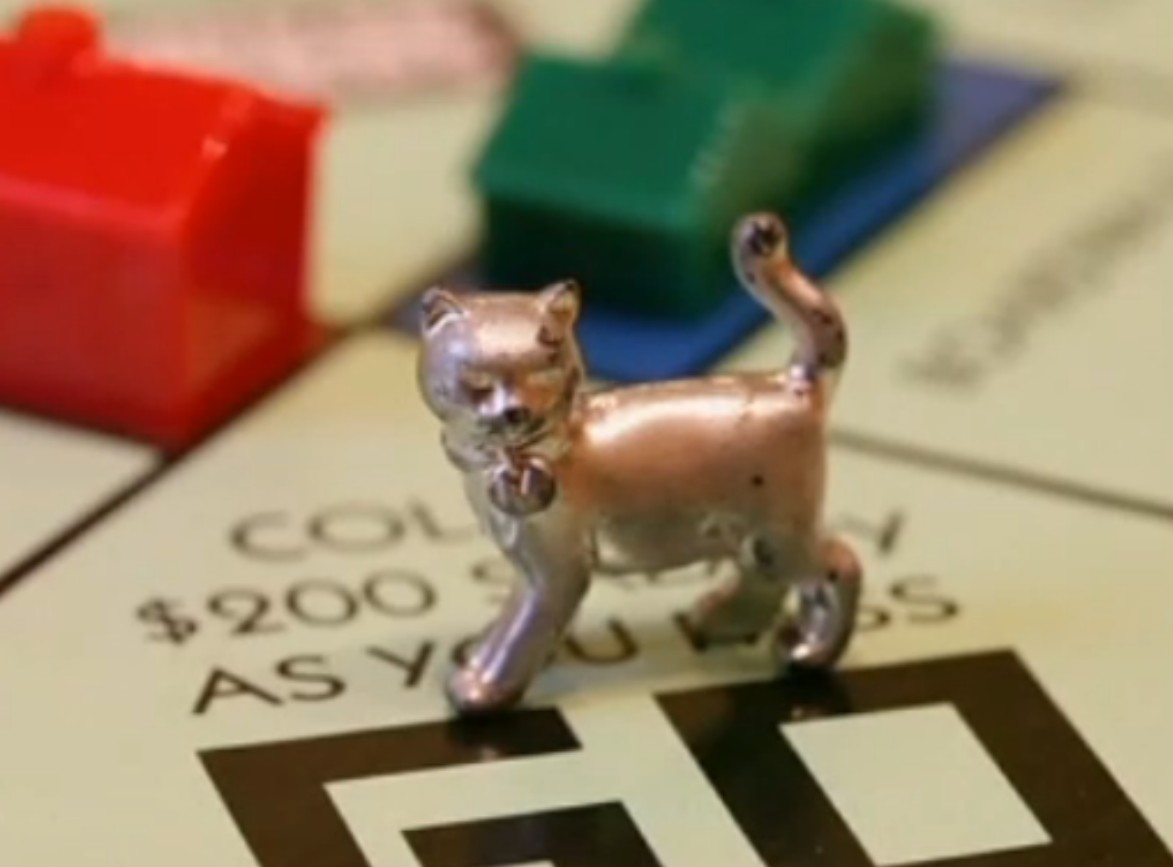
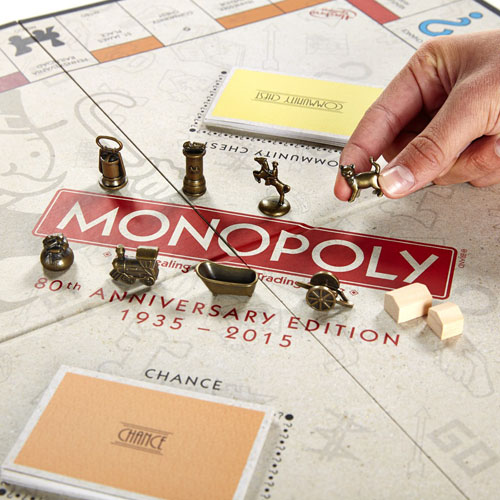
Die-cast tokens were suggested by Darrow’s niece who recommended that charms from a metal charm bracelet were used instead.  The original set included ten tokens:  the iron, the purse, the lantern, the racing car, the thimble, the shoe, the top-hat, the battleship, the cannon, and the rocking horse.  Since then, there have been more than twenty different tokens with the cat the most recent addition.

Monopoly Cat Token
– Image of unknown origin

In the early 1930s, in need of money with a young son left brain-damaged by scarlet fever, Charles Darrow presented the game to Parker Brothers.  Parker Brothers promptly rejected it because of its length, theme, and complexity, but reconsidered their decision to purchase rights to market the game after its success in local Philadelphia stores over Christmas period of 1934.  Parker Brothers acquired the rights to the game on March 19th, 1935 and their first editions were published later that year.  Almost immediately, their investment was rewarded as, within a year, they were making 35,000 copies of the board game per week.

Monopoly Flyer
– Image by BGG contributor loopoocat

In 1935, Waddingtons, received the license to distribute Monopoly in Britain who released the well known London edition.  Perhaps a more interesting edition was manufactured by Waddingtons during the second world war.  Paper maps wear out quickly and someone in MI5 suggested printing maps on silk as it’s durable, can be screwed-up folded and unfolded as often as necessary making no noise at all.  At the time, Waddingtons was the only company that had the ability to print on silk.  Since “games and pastimes” was a category of item qualified for insertion into Red Cross parcels, a plan was then hatched to mass-produce escape maps that could be folded so small that they would actually fit inside a Monopoly playing piece.  While they were at it, they also added a two piece metal file hidden in the board, a playing piece containing a tiny magnetic compass and significant amounts of genuine high-denomination German, Italian, and French currency, hidden within the piles of Monopoly money.  These special sets could be identified by a tiny red dot, one cleverly rigged to look like an ordinary printing glitch, located in the corner of the Free Parking square.

Monopoly
– Image of unknown origin

Parker Brothers secured the Monopoly trademark and Darrow became rich and famous as Monopoly’s creator;  Elizabeth Magie and the others who contributed were all but forgotten.  Then, in the 1970s, Ralph Anspach, an economics professor, brought out Anti-Monopoly. When Parker Brothers sued, the resulting lawsuit required Anspach to track down the game’s past.  After almost ten years of legal warfare, an appeals court eventually ruled in Anspach’s favour, rejecting the Monopoly trademark.  As a result, Parker Brothers lobbied the United States Congress leading to a revision of trademark legislation.

Monopoly
– Image of unknown origin

So the Monopoly Brand  is 80 this year the though the game itself is older and in turn is based on games that are much older still.  In any case, to celebrate the 80th Anniversary of the Monopoly Brand, Hasbro (who now own it) have released a list of “80 things you didn’t know about Monopoly“, as well as the inevitable special edition.


Boardgames in the News: The Hobby Grows and Grows

In the UK in the 1960s and 1970s, boardgames were only available from toy shops, and the range was limited to a relatively small number of “traditional” games, like Chess, Monopoly, Game of Life or Cluedo.  With the appearance of bigger, supermarket-like stores like Toys “R” Us in the 1980s and 1990s, a wider range became available and, occasionally, games like the early Spiel des Jahres winner, Rummikub, made their way onto our shelves.  As children grew up, they might graduate into playing Risk and eventually move onto longer, more complex games like those produced by Avalon Hill.  However, if you liked playing games, but war themes were not for you, it was quite difficult to find good alternative games to play.  They were there though:  games like Acquire and the 18xx railway games had been about for a long time, but these were the exception rather than the rule and were still an acquired taste.

Rummikub
– Image by BGG contributor OldestManOnMySpace

In contrast, in Germany, games like Scotland Yard were starting to become readily available and genuinely very popular.  The success of the Spiel des Jahres, which rewarded good games like Ra, El Grande, Tikal, and the 1995 winner, The Settlers of Catan, meant that boardgames were receiving a lot of publicity in Continental Europe.  The characteristics of these “German Games” (or “Euro Games”) typically include balance, with only a small amount of luck, and lack of player elimination.  As the market developed, beautiful boards and lots of wooden pieces also became an essential component.  Unlike war games, “Euro Games” tend to be less confrontational and much more suitable for family gaming.

The Settlers of Catan
– Image used with permission of BGG contributor kilroy_locke

In the 1990s, UK designers like Alan R. Moon and Richard Breese started publishing small numbers of “designer games”.  These were often largely assembled by hand and generally had a limited print run.  For example, only 1,200 copies of Elfenroads (precursor to the later, Spiel des Jahres winner Elfenland) were ever made and Keywood, the first of the highly acclaimed “Key Series“, was hand-made and had a print-run of just 200.  Given the exclusive nature of these games, it was not surprising then, that many teenagers either gave up on boardgames or moved on to collectable card games, like Magic: The Gathering or Role-Playing Games.

Elfenroads
– Image by BGG contributor dougadamsau

So it was with the growth of the internet that “Euro Games”, or designer boardgames became available to people in the UK.  Firstly, this was because it enabled people to find out about the games that were available, with sites like UseNet and eventually BoardGameGeek in 2000, providing a valuable source of information.  Secondly, internet shopping made “German Games” much more accessible.  The growth of the hobby meant an increase in boardgame publishers, and the appearance of designers like Reiner Knizia who were sufficiently prolific and successful to make a living from designing games.  Over the last fifteen years or so, the hobby has grown and grown and games like Carcassonne and The Settlers of Catan are now available in Waterstones and WHSmith, there are regular comments in The Guardian, there are repeatedly TV appearances, and boardgame cafés are sprouting up all over the place.  The question is, will it continue to grow, or have we reached a high water line?

Ernie
– Image from boardgamegeek.com

Boardgames in the News: Last Tango in Halifax

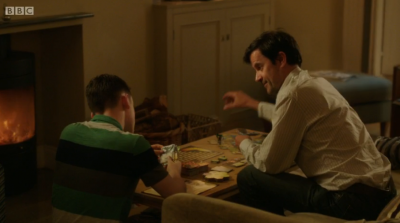
There have been a lot of comments here and elsewhere about how modern, “designer” games are becoming more widely known:  our little hobby is no-longer a secret.  We’ve had the rise of the boardgame café, various reports on the news and in the press, there’s even been an episode of The Apprentice!  One of the signs that games are becoming less niche is their increasing appearance on “normal” television programs, the latest being Last Tango in Halifax, starring Derek Jacobi, Anne Reid, Sarah Lancashire and Nicola Walker.  In this case, the boardgame was entirely incidental to the scene and almost any game would have done.  The programme makers could easily have used something more widely known like Monopoly or Risk, but instead they used Mage Knight.

Last Tango In Halifax
– Image from bbc.co.uk