Tag Archives: NMBR 9

6th February 2018

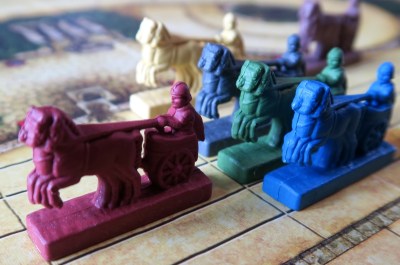
With seven of us and the “Feature Game”, Ave Caesar, only playing six, we started the evening with a small problem.  The general consensus was that the game is more fun with more people, so splitting into two small groups didn’t feel right.  Blue offered to sit out as she was still eating, as did Burgundy and almost everyone else as well, but in the end, Purple and Black teamed up so we could all play together.  An older family game dating from 1989, Ave Caesar is also a fairly simple game.  The idea is that each player has a deck of movement cards, a chariot, and a coin, and the aim of the game is to be the first player to cross the line after completing three laps of the track.  On the way round each player must pay tribute to Caesar on the way by pulling up in front of the Emperor in his dedicated pit lane, chucking their Denarius into the game box and crying “Hail Caesar!”.

Ave Caesar
– Image by boardGOATS

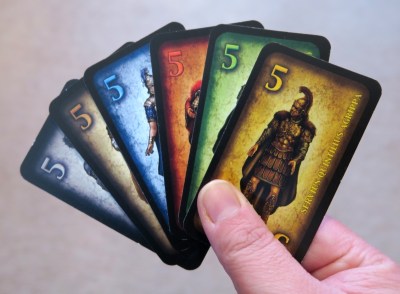
There are some nasty, unforgiving little features about this game.  For example, the track is generally a maximum of two lanes wide.  Worse, players can only use each of their cards once and don’t have lot of spare moves, so the outside lane should be used sparingly otherwise they may run out of moves before they complete their final lap.  Even worse than that, each player starts with a hand of three cards and plays one, then refreshes their hand.  The snag is that players cannot jump or move through occupied spaces and must use every space on the card they play, in other words, they cannot play a five for example if there are only three spaces they can move.  These “nasty features” can make the game very frustrating, but are also the clever part as they provide the challenge.
Ave Caesar
– Image by boardGOATS

There have been several editions of the game, but the original Ravensburger is widely believed to be the best because it has slightly longer tracks which makes for a tighter game as players have fewer moves to spare.  It is well understood that the newer version that we were playing with could be improved by removing a five card from each player’s deck.  So we started sorting and counting cards, and finding a five to remove from each deck.  With this done, all those eating had also finished and Burgundy started with a modest two.  Blue was second and, with two sixes in hand felt that it was a good idea to get rid of one of them nice and early.  The problem with sixes is that you can’t play them when you are in the lead, but they can be quite difficult to play from the back as there has to be enough space in front to play them.
Ave Caesar
– Image by boardGOATS

Burgundy’s two proved to be a mistake as everyone else promptly overtook him and left him stuck at the back for most of the rest of the lap.  In fact, he was so stuck, that he ended up missing three turns on the first lap alone.  In contrast, Blue had broken away from the pack and was looking at lapping Burgundy, but this had its own problems as she needed to get rid of her sixes, which she couldn’t do while in the lead.  Blue went to hail Caesar on her first lap to give people a chance to catch up.  After a bit of moaning that he hated Bank-holiday traffic, Pine finally managed to break away from the log-jam and take the lead giving Blue a chance to ditch a six, and everyone else a chance to make some progress too.  Everyone else that is, except Burgundy who was doing an excellent job of bringing up the rear.

Ave Caesar
– Image by boardGOATS

During the second lap, Pine just managed to nip in and pay his dues to Caesar, while Green followed and then reduced his chariot speed to a crawl and “Hailed” three times successfully causing a queue behind.  It was the third lap where things started to get interesting though with everyone jockeying for position to try to make sure that they didn’t have to waste moves.  Blue had a bigger problem though, she was miles in front, but still had to draw her final six from the deck and then play it.  She tried hanging back, reluctant to give away the size of her problem, but that card stayed in the pack.  Finally, as she drew her last card, she found her final six, but it was too late and Team Black and Purple cantered past and pipped her to the finish.  Green trotted in taking third place and leading the rest of the pack home.  Ironically, had she not suggested removing the fives at the start of the game, Blue would have won easily, but that would have been boring.

Ave Caesar
– Image by boardGOATS

It hadn’t been Ivory’s sort of game, so to placate him we offered him Yokohama, a game he’s been angling to play since before Christmas, but there wasn’t quite enough time for that, so he went for Sagrada instead and was joined by Pine and Blue.  This is a very pretty little game with many features in common with one of our current favourites, Azul.  It has simple rules, but lots of complexity and is essentially an abstract with a very thin theme, but for some reason that doesn’t seem to matter.  In Sagrada, players build a stained glass window by building up a grid of dice on their player board. Each board has some restrictions on which colour or shade (value) of die can be placed there and players take it in turns to take dice from a pool and add them to their window.  Depending on the difficulty of the starting grid, players start with a small number of favour tokens which act as “get out of jail free” options and allow them to use special tools to rearrange some of the dice, either during “drafting”, or sometimes those already in their window.

Sagrada
– Image used with permission of BGG contributor punkin312

Points are awarded for fulfilling certain criteria, depicted on cards drawn at random at the start of the game.  Although completing the window can be challenging in its own right if the dice don’t roll well, it is the objective cards that are the key to the game.  Each player has their own private objective which scores for the number of pips displayed on dice of a given colour in that player’s window. There are also three public objectives which everyone can use to score points; in this case we were scoring for coloured dice diagonally adjacent; complete sets of one to six and pairs of five and six. The game starts with each player choosing a window from two double-sided cards dealt at random.  The hard ones come with a lot of favour tokens; this time almost all the options available seemed to be the difficult ones, which made Blue especially wary given the dogs’ breakfast she made of the game at New Year playing a challenging window.

Sagrada
– Image used with permission of BGG contributor punkin312

Everyone seemed to go for different strategies this time.  Blue went for the public “diagonals” goal, making a pretty Battenburg pattern, but only managed to get one five, so struggled with the other objectives.  In contrast, Ivory did well getting pairs of five and six, but only got one three, so couldn’t score so well for the sets.  Pine completely ignored the diagonals and really concentrated on his private goal and getting complete sets of one to six.  It was a really tight game and Blue and Ivory were to rue those dice they’d failed to get as Pine finished with forty-three points, just two ahead of Ivory and three clear of Blue.  Despite finishing second, Ivory was much happier with this game than Ave Caesar and was up for giving something else a go.  Pine was keen to play Animals on Board again, and it is a nice enough little game and not long so Ivory was happy to give it a go too.  The idea is that players are collecting animals to go in their cardboard ark.  Each set of animals in the game is numbered from one to five and a selection are drawn at random and placed face up in the centre of the table.

Animals on Board
– Image used with permission of BGG contributor punkin312

On their turn the active player either divides one of the groups in the middle into two parts (and takes a box of fruit for their pains) or takes the animals from one of the groups, paying for them with boxes of fruit at a rate of one per animal.  At the end of the game (triggered when one player picks up their tenth animal) Noah claims any pairs of animals and the remaining animals are scored: singletons score their face value and sets of three or more score five per animal.  It was quite tight, Ivory collected four rhinos and Pine managed three hippos.  Blue brought the game to a sudden and unexpected end when she unexpectedly found herself with a large set she could take profitably, leaving her with two sets of three, foxes and zebras, and with it, the she took the game.

Animals on Board
– Image used with permission of BGG contributor punkin312

Meanwhile, on the neighbouring table, Black, Pink, Burgundy and Green were playing the classic, Settlers of Catan (now known simply as “Catan”).  Despite being over twenty years old now, it still holds up as a good family game in a way that some other games of the same vintage do not.  The game is played on an iconic variable tile game board on which players build settlements and cities on the nodes and roads along the edges.  One of the things that makes the game so popular is the lack of down time: a turn consists of rolling dice, trading and then buying and/or building.  Each hexagon on the board is numbered and rolling the dice gives resources to every player with a settlement on the hexagon on the number rolled.  Since each node is on the corner of three hexagons, players frequently get resources during other players’ turns.  Everyone is potentially involved in the trading of course, so the only part of anyone’s turn that is not shared is the buying and building phase, but this is usually quite short.
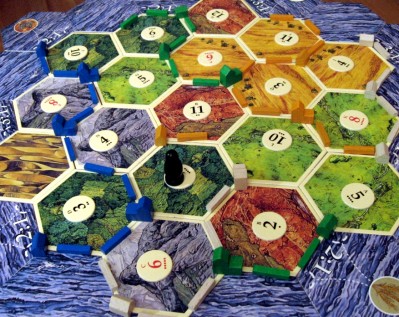
The Settlers of Catan
– Image by boardGOATS

This time, the random layout of tiles gave an even spread, but the number tokens placed on them had an unusual symmetry:  both eights were on the mountains (giving stone), both threes were on the fields (giving wheat) and both nines were on the clay beds (giving brick).  Green started and inevitably chose the choice spot with that would give him wool, wood and clay, much to Burgundy’s chagrin. Black was last to place and decided to connect his two roads and settlements, so by the time it Green got his second turn, he had very little option and ended up with a port location which would yield only two cards to everyone rather than three.  The dice seemed to be rolling according to the predicted distribution with the red numbers (six & eight) coming up often.  This gave Burgundy a lot of stone and wood, but due to his lack of brick he quickly converted a settlement to a city which only increased his supply of stone.

– Image by boardGOATS

Unfortunately for him, all these extra resources counted against him as the other number to come up regularly was seven, so meaning the robber was moved and everyone had to reduce the number of resource cards they were holding to seven.  Burgundy often was higher due to his regular double productions, but to make it worse he frequently seemed to because of his own demise since he was the one who kept rolling the sevens—three times in succession at one point! With that kind of luck he really began to wonder if he should just pack it in right then and go play something else.  While Burgundy was struggling with his own security though, Purple and Green were steadily building their kingdoms. Purple gained another settlement and converted one of her others into a city. Green had spread out from his choice spot to build another settlement on the port side of the value eight mountains and in the other direction to another port with more clay, giving him the longest road, and with it two bonus points, for the moment at least.

The Settlers of Catan
– Image by boardGOATS

Black seemed to be languishing, unable to get traction and the cards he needed for expansion. Catan requires investment for growth, but he had barely two coins to rub together to invest with at all.  Once Green had built on the mountain-side the eight rolls seemed to dry up and he struggled to get enough stone or wheat to convert his settlements to cities.  Purple’s hidden development card made everyone think she had an extra hidden point, and possibly the lead. Certainly the early rolls went in her favour and it was beginning to look like this could be her game. Green’s long road brought him into the running, and the power of Burgundy’s cities meant he wasn’t far behind. The production Burgundy’s cities provided meant he was able to go after longest road and take it from Green, thus starting a little road building war between the two.

The Settlers of Catan
– Image by boardGOATS

With nowhere else on the board worth building on, Burgundy decided on an alternative strategy and started trading for development cards. He managed to place two knights and was about to take the Largest Army, until everyone else reminded him he three army cards for that. It only delayed the inevitable though, as one round later he played a third knight card, claimed the Largest Army and two points with it. He easily built two more roads and with it retook the Longest Road card for a second time simultaneously revealing he had a one point development card in his hand.  This meant he went from five points on the board to a total of ten points in one turn and with it finished the game.  Purple and Black revealed they also had a one point development card to give them both six points and joint second place.
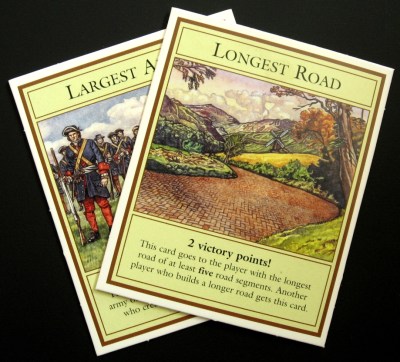
The Settlers of Catan
– Image by boardGOATS

Both tables finished at about the same time and, as Ivory headed home, Burgundy commented that he’d like to give NMBR 9 a go.  Everyone else chimed in that they’d be happy to join him , but Pine and Purple got there first and with no set up time got started quickly.  The game is very simple: one player turns over a card and calls the number and players each take one tile of that number and add it to their tableau.  All the tiles are roughly number-shaped and each player will play a total of twenty tiles, numbered zero to nine, with each one appearing twice.  Tiles must be placed such that at least one edge touches a previous tile. Tiles can be placed on top of other tiles as long as there are no overhanging parts, and the tile sits squarely on more than one other tile. At the end of the game the number tiles are multiplied by the level they sit on minus one. So, a five on the third level scores ten points (5 x (3-1)).

NMBR 9
– Image used with permission of BGG contributor punkin312

Unlike a lot of games, it is very difficult to tell who is winning, as the largest scores come late in the game when adding tiles to the higher layers.  However, the lower layers must be able to  accommodate the later tiles as and when they come out, otherwise a player can’t take advantage of the opportunities they may offer.  This time Burgundy “got lucky” and was able to squeeze a seven, an eight and a nine onto his third level giving him a massive forty-eight points for them alone and a bit of a land-slide victory.  We’ve played this game a few times now as a group and all the previous games have been quite close.  Other Bingo-type game like Take it Easy!, Das Labyrinth des Pharao or Karuba, have been relatively unpopular with the group as they feel like multiplayer solitaire, but somehow, in our group, everyone gets involved helping everyone else out, which makes this game much more enjoyable.

NMBR 9
– Image used with permission of boardgamephotos

The other three chatted for a few minutes before deciding to play a quick game of Kingdomino as it is a game we know well and can play quickly and without committing too much thought.  It  consists of dominoes featuring two terrain “tiles” with some tiles also depicting one or more crowns.  Players are building their kingdoms by placing dominoes where one end must either connect to another domino matching at least one of its terrain types or to the starting tile (which can be considered to be “wild”).  All dominoes must fit in a five-by-five space and if one or more dominoes cannot be placed according to these rules, then they are discarded. At the end of the game, each player multiplies the number of tiles in each contiguous region of terrain with the number of crowns on the tiles in that region and adds them up together with any bonuses to give their score.

Kingdomino
– Image by boardGOATS

The game was really tight with each player capitalising and building on different terrain types:  Black took forests, Green took pasture and Blue took sea.  There were three points between first and third, but it was Black who finished at the front, just one point ahead of Blue.  With three players, some tiles are removed from the game at random.  Like last time, almost all the tiles removed were  the high-scoring mountain and marshland tiles, but at least this time nobody’s game plan depended on them.  It did encourage some discussion, though with Black commenting that he didn’t like the game with three because of this uncontrolled randomness, and Blue commenting that perhaps the tiles that are taken out should be turned face up and displayed so that players can at least see what won’t be available.  Maybe a variant for another time.
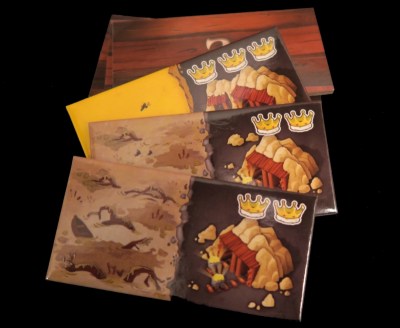
Kingdomino
– Image by boardGOATS

Learning Outcome: Some games stand the test of time, others not so much.

28th December 2017 – boardGOATS do the Quiz

As we meet at The Jockey every week, last year at Christmas we decided to enter a team for their Quiz night between Christmas and New Year.  We didn’t have a large team, but Blue, Pink, Pine, Violet and Violet’s mum were in attendance and had managed to win for the GOATS at the first attempt.  Flushed with that success, we decided to give it a go this year too. This time there were seven of us with Pine bringing along his mate, Azure.  As before, we booked a table for 8pm and, as usual, pizza was largely the order of the day with a burger, tagliatelle and scampi for those who decided not to follow the tradition.  While we were waiting for food to arrive, Green asked whether Red was going to be about over Christmas as he had some Gruyère for her. Unfortunately Azure misheard and asked who Trevor was.  Much hilarity ensued as Pine got himself in a terrible mess explaining who Red was and why he thought she wouldn’t be interested in someone called Trevor, but would love a block of cave-aged cheese!  To spare his further blushes, someone quickly suggested we played a game, which seemed like a good idea.  With so many people and so little time, the choice was limited, so we went with Tsuro.

Tsuro
– Image used with permission of BGG contributor aleacarv

Tsuro is a very simple game to teach and play, and, although it has nasties such as player elimination, it is so quick to play that these things don’t really matter.  The idea is that each player has a “Stone” which starts on a marker at the edge of the board and a hand of three tiles.  On their turn, the active player then places a tile on the next square in such a way as to create a path in front of the stone.  They then move their stone (and any others affected) along the path to the new end.  The game continues with players taking turns to place tiles and move stones trying to keep their stone on the board and avoid colliding with any other stone; the last stone left is the winner.  This time, it was a cagey start as everyone was very careful.  It wasn’t until the draw deck had been depleted, that the first players were eliminated, with Pine  forced to play a tile that caused him to collide with Blue removing both from the game.  Purple and Azure were next leaving three players until Black was forced to take himself off the board and Green with him, leaving Pink the sole survivor.

Tsuro
– Image used with permission of BGG contributor kilroy_locke

While we were eating Green asked about the “Monster Games” session the night before.  The evening had started with Kingdomino, and included NMBR 9, Azul and 6 Nimmt!.  The highlight had been El Grande, however, a game that we enjoyed on a previous “Monster Games” session.  This time, however, we decided to add the Grand Inquisitor & the Colonies expansion.  This adds an extra couple of elements to the game (but still no Portugal, much to Pink’s disgust).  Both Blue and Black quite liked the Grand Inquisitor component and would happily play with it again, but neither were very keen on the Colonies aspect, despite the fact that Blue had been able to use it to great effect towards the end of the game.  Pine had the last word on the subject though when he commented that he’d found it amusing that everyone had known before the start that Black and Blue were competing for first place, while everyone else was trying to avoid coming last.  It was perhaps just as well that the landlord chose that moment to hand out the paperwork for the picture round…

El Grande
– Image used with permission of BGG contributor kilroy_locke

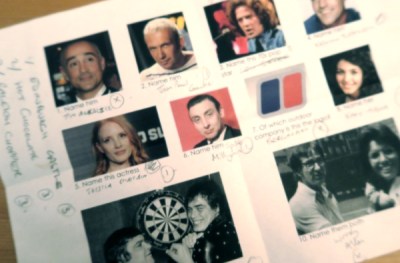
We started off badly, but quickly improved with a perfect score in the second round.  We maintained steady progress, but the team that beat the “Eggheads” would take some catching.  As the Quiz progressed it was clear that we would need a really good score in the “Who Am I?”, anagram and picture rounds to be in with a chance.  We got all three anagrams, but the “Who Am I?” was a bit of a disaster as we worked out who it was (“the big bloke from The Chase“), but couldn’t remember his name.  It turned out that that was actually enough information, but we only found that at the very end, so only got one point (his name is Mark Labbett).  Although we put in a reasonable picture round, it wasn’t good enough to make up the difference and we finished in a respectable second place.

Quiz December 2017
– Image by boardGOATS

With the Quiz over, we reverted to what we do best and went back to playing board games, or in this case, a dice game, as we finished the evening with Las Vegas.  The game itself is a very simple betting game.  Players begin their turn by rolling their dice and then assign some of them to one of six casinos (one for each dice face) each of which has a jackpot drawn at random from a deck of money.  Players must place all the dice displaying one number to bet on the casino of that number, and when done, play passes to the next player.  Once everyone has placed all their dice the player who placed the most dice on a casino takes the highest value currency card, with the person in second place taking the next and so on. The really clever bit is that before any money is handed out, any “draws” are removed.  This leads to a lot of barracking when dice are played as opponents try to encourage the active player to choose their favoured option.

Las Vegas
– Image used with permission of BGG contributor ckirkman

As usual, we included the Big Dice from the Boulevard expansion and the Slot Machine mini-expansion from the 2015 Brettspiel Advent Calendar.  The large dice are double weight and count as two in the final  reckoning.  The Slot Machine acts like a seventh casino, except that it can hold dice of any number, but dice of each number can only be added once (though a player must add all the dice they have of that number).  Since we play the game unusually slowly, we generally stop after just three rounds rather than the four recommended in the rules, and today was no exception.  Reducing the number of rounds meant that everyone had to make each round count to stay in the running, especially in such a close game.  Three players took over $300,000, with Green just $10,000 ahead of Black.  It was Blue who finished first, however, thanks largely to her judicious use of the slot machine which ensured a healthy return in the first two rounds.  And with that, it was home time for everyone, including Trevor the Cheese.

Las Vegas
– Image by boardGOATS

Learning Outcome:  Shy bairns get nowt.

28th November 2017

The “Feature Game” was to be Lords of Waterdeep, and with a nearly full turn-out, it was simply a question of who wanted to play it.  Some were a little put off by the Dungeons & Dragons theme, but Burgundy, Green, Ivory, and Purple were keen to give it a go, with Ivory and Purple new to the game.  Each player is a secret Lord of Waterdeep, who uses their agents to recruit adventurers to collect gold so that they can complete Quests to advance their cause.  Each player in turn places one of their “agents” on a building space on the board and immediately resolves the effects of that building. A player may not place his agent on a building space if it has already been taken; the round ends when all agents have been placed, and a game is exactly eight rounds long.  Most of the buildings on the board give money or adventurers. The adventurers are represented by coloured wooden cubes: orange for Fighters, black for Rogues, white for Clerics and purple for Wizards.

Lords of Waterdeep
– Image used with permission of BGG contributor mikehulsebus

The adventurers players collect are exchanged for completing Quest cards. These cards can range from only a few points (four to six), but an extra advantage or some adventurer returned (a bit like a cash-back scheme), to some that give a massive amount of points (over twenty).  This is not the only source of points as there is also a substantial reward given to each player for completing the requirements on their secret Lord of Waterdeep card.  Despite the Fighting Fantasy theme, Lords of Waterdeep is really just run of the mill worker placement game, with adventurers instead of resources.  Unlike many games of this genre, “resources” flow in quite readily, but unfortunately they also flow out just as easily too…

Lords of Waterdeep
– Image used with permission of BGG contributor mikehulsebus

When Green completed a twenty point Quest early on, he looked a long way in the lead, but although it took a couple of rounds for his advantage to be quashed, quashed it duly was. It didn’t take long for everyone to work out which Quest card types everyone had for their secret goals, with Green and Ivory both wanting Commerce, and Green and Burgundy both chasing Piety. Only Purple remained more elusive to work out which was not surprising since she was actually scoring for every building she built and not scoring for Quests completed at all. No-one guessed, even though she managed to build six out of the maximum ten built. To be fair to Green and Ivory, Green had only played the game once before and that was four years ago, and Ivory had never played at all. Burgundy was at least aware that there was such a task, but after the game commented that he never does well at this game (unusually for him), though he enjoys the challenge.

Lords of Waterdeep
– Image used with permission of BGG contributor mikehulsebus

Throughout the game, Purple employed an interesting strategy in that she built up a number of Intrigue cards without using them. She turned that round in the last two or three rounds as her pile of Intrigues got whittled down, gaining her bonuses at everyone else’s expense ( and occasionally to their benefit as well), until she ended the game with none.  Ivory put a lot of effort into trying to get the big scoring quests and at one point was holding out for one on display to use with the building that would gain him an extra four points if he could complete at the same time as picking it up. In the end he bottled it and took it a turn earlier in case it was lost. It turned out he was right to do so, as shortly after he had taken it, all the quest cards were replaced. Ivory also managed to gain a number of bonus points as he too was a prolific builder.

Lords of Waterdeep
– Image used with permission of BGG contributor kilroy_locke

Green was trying to get as many Commerce cards as he could figuring the low scores would add up (Peity cards, his other bonus challenge, were in rather short supply in this game). About half way through, he built the extra worker building that when used allows the player to choose an action before anyone else. Green then used this to great effect taking this piece regularly and combining it with the first player marker to get the first two turns.  In a game where white Clerics were in such short supply (and many of the Quests that appeared later required lots of clerics), this really scuppered the plans of Ivory and Burgundy in particular.  Peity cards need more Clerics than most, Burgundy’s game was often frustrated by the lack of white cubes, and although he kept the first player token in the early part of the game and made good use of it, he just couldn’t quite get his engine going.

Lords of Waterdeep
– Image used with permission of BGG contributor mikehulsebus

The intrigue cards added an extra layer and interaction into the game. Many of them gave a benefit, but also gave a lesser advantage to another player of choice. And some were downright mean to a player of choice, and so alliances were made and broken throughout the game. Reasoning and pleading were a regular feature—an enjoyable interaction which is not so direct in other games.  In the end, it was a close game, but Ivory came out on top, just three points ahead of Green.  Everyone enjoyed it though and would be happy to play it again, but there was general agreement that with five players it would get crowded and might begin to drag.

Lords of Waterdeep
– Image used with permission of BGG contributor mikehulsebus

Meanwhile, on the next table, they had a bit of a problem:  almost all the games they had were four player games and there were five of them!  That afternoon, Magenta had expressed an interest in playing The Climbers again and, as it plays five, it was an easy choice.  This is a great three dimensional strategy game that we first played about a year ago.  It looks like it is designed round a set of children’s building blocks, but it’s appearance belies its true nature however, and, although it looks like a kiddie’s dexterity game, it is really a strategy game with almost no dexterity component at all.  The game is played in turn order with each turn comprising three steps. Firstly, the active player can move a block, any block so long as there isn’t anything on it, and they can place it anywhere, in any orientation as long as there is sufficient space. Next the active player can move their Climber as far as they like within the rules.

– Image by boardGOATS

Climbers can climb up any step below their head height unaided as long as the face they are climbing onto is grey or their own colour. They can also use their long and/or short ladders to climb larger distances, but they are fragile and therefore single use. Before the end of their turn, the active player may place their blocking stone, which prevents a brick being moved or used until that player’s next turn.  These are also single use though, so timing is everything, in fact that is true for almost everything about this game which was amply demonstrated by Blue. Nominated to go first by random draw, she made the most of it using her long ladder and getting as high up as she could as quickly as possible, much to everyone else’s disgust.  Black got himself somewhat stuck on a ledge, but Red, Pine and Magenta quickly caught up.  Then it became a real game of chess with everyone trying to outmaneuver everyone else.   Red accused Blue of using “Dubious Tactics”, but they proved to be winning tactics as she finished just higher than Red in second.

The Climbers
– Image by boardGOATS

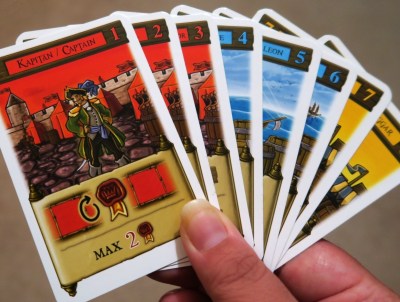
With the Matterhorn conquered, and Lords of Waterdeep still going, it was back to the search for a five-player game, and Santo Domingo fitted the bill.  This is a light card game of tactics and bluffing with a pirate theme set in the world of one of our more popular games, Port Royal.  The idea is that in each round player one character card from their hand which are activated in character order and then are placed on a personal discard pile.  The characters are designed to maximise player interaction, with their result dependent on cards that other players have chosen, similar to games like Citadels and Witch’s Brew.  For example, the first card is the Captain who can take a victory point (from a track on a central game board) up to a maximum of twice. The second character is the Admiral who also takes one victory point, but this time up to a maximum of five times, but this is only possible if there are enough points available. This means players have to play “chicken” and try to time playing their second card when other players play something other than the the Captain or the Admiral.

Santo Domingo
– Image by boardGOATS

Players have to be careful though because the third card is the Governor which gives players goods (rather than points) for every player who played either a Captain or an Admiral card. This means players are trying to maximise their return by reading everybody’s minds and saving their Governor for the round when everyone else is playing the Captain and the Admiral.  Cards four, five and six are the Frigate, Galleon and Customs are roughly analogous to the first three characters, except the Frigate and Galleon yield goods (instead of points) and the Customs card gives points (instead of goods).  Goods are very useful as they can be turned into victory points using the Trader (the seventh character card). Timing is key here too though as the potential return increases for every round that nobody uses the Trader; the return also depends on the number of people to play the card though, so even if everyone waits and then plays the Trader at the same time, players may get less than if they had played a round earlier.

Santo Domingo
– Image by boardGOATS

The final card is the Beggar which allows players to pick up their discard pile so that they can re-use them in the following rounds. At the end of each round, players check to see if anyone has passed thirty points and if so, that triggers the end of the game where any residual goods are converted to points at the minimum rate and the player left with the most points is the winner.  It was about half way through the game that Blue realised that there was something missing.  When the Trader is played, the return is dependent on the yellow track and how many players play the same card.  The problem was that once someone plays the Trader, that triggers a reset of the yellow, trader’s track.  Unfortunately, we forgot the reset bit which meant that players who were prioritising goods were finding it easy to get a good return whenever they wanted.  As a result, the game was very close and finished very quickly.

Santo Domingo
– Image by boardGOATS

Magenta took the first place with thirty-one points, just two ahead of Black in second.  As we had time, we decided to give the game another go, playing correctly this time.  Second time round was still close, though there was a better spread and the Beggar (who also gives goods for every Trader card played in the same round) suddenly became a bit more interesting.  After doing well in the fist game, Black got his timing wrong and failed to trade his goods.  Magenta was extremely efficient the second time round as well, but this time was beaten into second place by Blue.  With the game finished, Red and Magenta headed home and Blue, Black and Pine began a game of Azul.

Azul
– Image by BGG contributor JackyTheRipper

This is a new release that Pink and Blue picked up at Essen this year and so far has been popular with the group as well as receiving a lot of buzz further afield.  The idea of the game is that players are tile laying artists decorating a wall in the Palace of Evora with “azulejos”.  On their turn, the active player can either take all the tiles of one colour from one of the factory display (putting the rest in the central market) or take all the tiles of one colour from the market in the centre of the table.  They then place the tiles in one of the five rows on their player board.  The catch is that each player only has five rows, each with a set number of spaces, one to five. Players can add tiles to a row later in the round, but once a row is full, any left-overs go into the negative scoring row. Once all the tiles have been picked up, players evaluate their board, and, starting with the shortest row, one of the tiles from each full row is added to the player’s mosaic and scored.

Azul
– Image by BGG contributor JackyTheRipper

Players score one point for a tile that is not placed adjacent to any other tile, whereas tiles added to rows or columns score the same number of points as there are tiles in the completed row (or column). The game continues with players choosing tiles from the factory displays and then adding them to rows, the catch is that as the mosaic fills up, it is harder to fill the rows as each row can only take each colour once. The game is actually much more complex to explain than to actually play, and as such is just the sort of game we really appreciate.  Blue and Black had both played before, but Pine was new to the game.  Last time he played, Black had commented that this was “just the sort of game that he really liked, but wasn’t any good at”, so it was left to Blue to lead the way.  Pine didn’t need much showing however, and soon had a very fine wall of his own.  So much so in fact, that when Blue was forced to pick up five black “azulejos” she didn’t have space for he was in prime position to take a well deserved win.

Azul
– Image used with permission of boardgamephotos

While Azul was still underway, Lords of Waterdeep had come to an end, so Green, Ivory, Burgundy and Purple decided there was time for quick game of Lanterns: The Harvest Festival.  This is a straight-forward, light tile laying game, where players are decorating the palace lake with floating lanterns and competing to become the most honored artisan when the festival begins. Each tile is divided into four quarters, each of which has a colour, red, orange, blue, green, purple, black and white. On their turn, players choose a tile from their hand of three and add it to the central palace lake. Every player then receives a lantern card corresponding to the color on the side of the tile facing them, with the active player receiving bonus cards for any edges where the colours of the new tile match those of the lake. At the start of their next turn, players can gain honour tiles by dedicating sets of lantern cards, three pairs, four of a kind or seven different colours. Each tile is worth honour points and the player with the most points at the end of the game wins.

Lanterns: The Harvest Festival
– Image used with permission of boardgamephotos

Purple, Burgundy and Ivory went for trying to collect for the full colour set, while Green was content to begin targeting the “two-pairs” or four of a kind. Purple was a late starter to exchange her cards, forcing Burgundy to go for a couple of two-pairs, and Green got stuck with three orange lantern cards with none left to collect. Part way through the game, they suddenly realised that the six point scoring taken was actually a nine point scoring token and everyone had to work out who should have earned what. There weren’t too many already taken, so the correction was worked out quite easily. Purple seemed to not only hoard the cards, but was also building a large collection of bonus discs, such that the others thought that she wasn’t going to be able to use them all.  As usual there was the normal mutterings of the tiles being the wrong way round. Later on with shortages of some colours, tiles were placed in such a way to prevent some players collecting anything at all.  As the game wore on Purple started to exchange her cards and use her discs. By the end of the game she had actually used them all, and it turned out that she’d used them to perfection, proving that hoarding can sometimes be a winning strategy.

Lanterns: The Harvest Festival
– Image used with permission of BGG contributor punkin312

Just as they started, Azul finished so Blue suggested Black might like to give NMBR 9 a try since he had been quite intrigued last time when Pine, Blue and Purple had played it. Black was Keen and Pine had enjoyed it, so Blue explained the rules.  The idea is that players will play a total of twenty tiles, numbered zero to nine, with each one appearing twice.  One player turns over a card and calls the number and players each take one tile of that number and add it to their tableau.  Tiles must be placed such that at least one edge touches a previous tile.  Tiles can be placed on top of other tiles as long as there are no overhanging parts, and the tile sits squarely on more than one other tile.  At the end of the game the number tiles are multiplied by the level they sit on minus one.  So, a five on the third level scores ten points (5 x (3-1)).

NMBR 9
– Image used with permission of BGG contributor punkin312

The game followed the usual course, but it wasn’t long before the the bingo calls started.  Pine began, but Ivory on the next table soon joined in: “Number eight,  garden gate”; “On it’s own, number one”.  Pine finished with, “This number’s smaller, Ivory’s the caller!”  And finished the evening just about was, with only the maths left to be sorted out.  Both Blue and Black had managed to sneak a nine and a one onto the third story.  Pine had more than Black on the first story, but Blue had more than either of them and finished with a grand total of fifty three, some five points more than either of the others.

NMBR 9
– Image used with permission of BGG contributor punkin312

Learning Outcome: Don’t be misled by an unpromising theme.

14th November 2017

While Blue and Burgundy finished their supper, everyone else played a quick game of The Game, played with cards from The Game: Extreme.  The game is a very simple cooperative game: played with a deck of ninety-eight cards the group have to play all of them to win.  Each player starts with a hand of cards and must play at least two of their cards on one of the four piles. The first rule is that cards added to two of the piles must be higher face value than those previously played, while cards on the other two must be lower.  The second rule is “the backwards rule”, which says that if the interval is exactly ten the first rule is reversed.  The third and final rule is that players  can say anything they like so long as they don’t share specific number information about the contents of their hand.  The Extreme version has blue cards instead of red ones, but also has additional symbols on the cards which add further restrictions and make playing cards more difficult.

– Image by boardgoats

By ignoring the extra symbols the original version of The Game can be played with cards from The Extreme version.  As is often the case, the game started badly with almost everyone starting with cards between thirty and seventy.  There are two problems with this, firstly it forces players to progress the decks faster then they wanted.  Secondly, the very high and very low cards are still waiting to be revealed which causes the same problem a second time later in the game.  And this is exactly what happened.  Pine for example started with nothing below forty and only one card above sixty, and ended the game with a lots of cards in the nineties.  With such an awful hand before everyone else was ready, he ended up just playing everything and was the first to check-out.  By this time Burgundy and Blue were finished with pizza and had discovered that watching the others struggle was strangely compelling.  It wasn’t long before Purple was unable to play though, which brought the game to a close with a combined to total of seven cards unplayed.

The Game: Extreme
– Image by boardGOATS

With food finished and The Game over, the group split into two with the first group playing the “Feature Game”, Flamme Rouge.  This is a bicycle game that Blue and Pink played at Essen in 2016, but actually picked up at the fair this year.  The game is quite simple, bit even then we managed to get it slightly wrong.  The idea is that each player has two riders, a Sprinteur and a Rouleur, each of which has a deck of cards. Simultaneously, players draw four cards from one of their the rider’s deck and choosing one to play, before doing the same for their second rider.  Once everyone has chosen two cards, the riders move, starting with the rider at the front of the pack, discarding the used cards.  Once all the riders have moved, then the effect of slip-streaming and exhaustion are applied.  Exhaustion is simple enough – players simply add an exhaustion card to the deck for any rider without cyclists in the square in front of them at the end of the round.  The slip-streaming is slightly more complex, but the idea is that every pack of cyclists that has exactly one space between them and the pack in front, benefits from slip-streaming and is able to catch up that one space.

Flamme Rouge
– Image by BGG contributor mattridding

Slip-steaming is applied from the back, which means riders may be able to benefit multiple times.  The problem was, Blue had played incorrectly at Essen: they had played that a pack had to comprise at least two riders and would move forward regardless of how many spaces there were in front of them.  Ironically, the person to suffer most from this rules mishap was Blue as her Sprinteur was dropped from the pack early in the race and, although he got on to the back of the pack again, the exhaustion caused by all the early effort meant he struggled for the rest of the race and was soon dropped completely.  All the other riders managed to stay in the Peloton and, as the race drew to a close, there was some jockeying for position.  Black’s Sprinteur made a dash for the line, but got his timing very slightly wrong and didn’t quite make it.  Pine’s Sprinter on the other hand, timed his dash to perfection and pipped Black to first place.  In fact, Pine rode such a canny race, his Rouleur came in third.

Flamme Rouge
– Image used with permission of BGG contributor zombiegod

Meanwhile, on the next table, Burgundy, Purple and Green were giving Azul a go.  This is a brand new release that Pink and Blue picked up at Essen this year and played back at their hotel while they were in Germany.  It has such nice pieces and is such a clever, yet simple game, that Blue tipped it for the Spiel des Jahres award next year (or at least a nomination if something even better comes out).  The idea of the game is that players are tile laying artists decorating a wall in the Palace of Evora with “azulejos”.  On their turn, the active player can either take all the tiles of one colour from one of the factory display (putting the rest in the central market) or take all the tiles of one colour from the market in the centre of the table.  They then place the tiles in one of the five rows on their player board.

Azul
– Image by BGG contributor JackyTheRipper

Each row can only contain one colour, but players may have more than one row with any given colour.  The catch is that each player only has five rows, each with a set number of spaces, one to five.  Players can add tiles to a row later in the round, but once a row is full, any left-overs go into the negative scoring row.  Once all the tiles have been picked up, players evaluate their board, and, starting with the shortest row, one of the tiles from each full row is added to the player’s mosaic and scored. Players score one point for a tile that is not placed adjacent to any other tile, whereas tiles added to rows or columns score the same number of points as there are tiles in the completed row (or column).  The game continues with players choosing tiles from the factory displays and then adding them to rows, the catch is that as the mosaic fills up, it is harder to fill the rows as each row can only take each colour once.

Azul
– Image by BGG contributor JackyTheRipper

The game is much more complex to explain than to actually play, and as such is just the sort of game we really appreciate.  There are also end game bonuses which keep everyone guessing right up to the end.  So, although fairly simple to play, it is very clever and gives players a lot to think about.  Blue had played it with Burgundy, Black and Purple at the Didcot Games Club and everyone had enjoyed it, so Burgundy and Purple were keen to share it with Green.  The previous game had been very tight between first and second, with a tie for third, but this time, the game seemed quite tight throughout the game.  In the end, Burgundy finished the clear winner with seventy-eight points.  It remained tight for second place though, but Purple’s extra experience showed and she pipped Green by four points.  Both games finished at about the same time, so with Black, Ivory and Green keen to play 7 Wonders, and Purple and Blue not so keen, it was musical chairs while everyone else decided which group to join.

Azul
– Image used with permission of boardgamephotos

7 Wonders is a card drafting game similar to games like Sushi Go! or Between Two Cities.  Each player starts with a hand of cards and, simultaneously, each player chooses a card to play, a card to keep and then a passes the rest to the next player. The cards are played with various different aims:  players might try to build up their city and erect an architectural wonder, or attempt to have a superior military presence to neighbouring players. The game consists of three rounds, the first and third passing cards to the left, with the middle round passing cards to the right.  Black and Green went down the military route taking points from both Ivory and Burgundy and picked up additional victory points from blue cards.  Ivory and Burgundy, on the other hand, went for science points, but Ivory managed to take the most squeezing out both Burgundy and Black.  It was a close game with just five points between first place and third place, but it was Green who just finished in front.

7 Wonders
– Image by BGG contributor damnpixel

On the next table, Blue, Purple and Pine played a game of another Essen acquisition, Animals on Board.  This actually belonged to Pink, but Blue still had it in the bag from Didcot Games Club a few days before.  It is a very simple game of set collecting, with elements from Coloretto and 3 Sind Eine Zu Viel!.  Totally over produced, the game comes with fantastic cardboard arcs and thick card animal tiles.  There are five of each animal, and each set includes animals numbered from one to five and a selection are drawn at random and placed face up in the centre of the table.  On their turn the active player either divides one of the groups into two parts (and takes a box of fruit for their pains) or takes the animals from one of the groups, paying for them with boxes of fruit at a rate of one per animal.  At the end of the game (triggered when one player picks up their tenth animal) Noah claims any pairs of animals.  The remaining animals either score their face value if they are singletons, or score five if there are three or more.

Animals on Board
– Image used with permission of BGG contributor chriswray84

Blue began collecting pandas and zebras, while Purple and Pine fought over the tigers, foxes and crocodiles.  It was Blue who triggered the end of the game and everyone counted up their totals in whst turned out to be a very close game.  Everyone had at least one set of three and Purple had managed to take four foxes.  Blue had managed to pick up a total of eleven animals and that extra critter made the difference giving, her the win.  Since it had been so close and 7 Wonders was still going, they decided there was just enough time to play something else and see if revenge could be had.  Since NMBR 9, another game that came back from Essen, needs no setting up, they decided to give it a go.

NMBR 9
– Image used with permission of BGG contributor punkin312

NMBR 9 is a Bingo-type game like Take it Easy! or Karuba, where  one player calls a number and everyone plays their tile that corresponds to that number.  NMBR 9 takes the number theme one step further, since all the tiles are roughly number-shaped.  The idea is that players will play a total of twenty tiles, numbered zero to nine, with each one appearing twice.  One player turns over a card and calls the number and players each take one tile of that number and add it to their tableau.  Tiles must be placed such that at least one edge touches a previous tile.  Tiles can be placed on top of other tiles as long as there are no overhanging parts, and the tile sits squarely on more than one other tile.  At the end of the game the number tiles are multiplied by the level they sit on minus one.  So, a five on the third level scores ten points (5 x (3-1)).

NMBR 9
– Image used with permission of boardgamephotos

Blue started off well, which was unsurprising as she had played it before with Pink.  She quickly got herself into a bit of a tangle though, with the plaintive cry, “I’ve got a hole in the wrong place!”  Pine was steadily making up ground, but concurred, muttering, “There are too many sticky out bits on a four…”  With 7 Wonders finally coming to an end, Black and Burgundy found their curiosity piqued by the strange shaped tiles and tried to work out what was going on.  It wasn’t long before the last cards were turned over though and everyone had to take their shoes and socks off to work out the scores.  Pine’s smart second level placement had yielded success and he finished with score of sixty-one, a comfortable lead of five over blue in second place.

NMBR 9
– Image used with permission of BGG contributor punkin312

Learning Outcome:  Some games, make surprisingly good spectator sports.