Tag Archives: Patchwork

13th May 2025 (Report)

For some, the evening began early with fish and chips in the garden to mark a special visit from Plum’s Aunt Damson.  The evening took an even more special turn as it was the day before Pine’s Big Birthday, so there was cake.  Green also put in one of his special appearances, bringing his mum, Saffron, with him.  Salmon came for the second time, and lastly, Orange, who had acquired a motorbike and was therefore now able to travel, also came for the first time in about eighteen months.  So with all these extras as well as the usual suspects, the room was packed and the group split into four with Jade leading the “Feature Game” which was to be Moon, a card drafting game where players construct bases, vying to build the new lunar capital.

Moon
– Image by boardGOATS

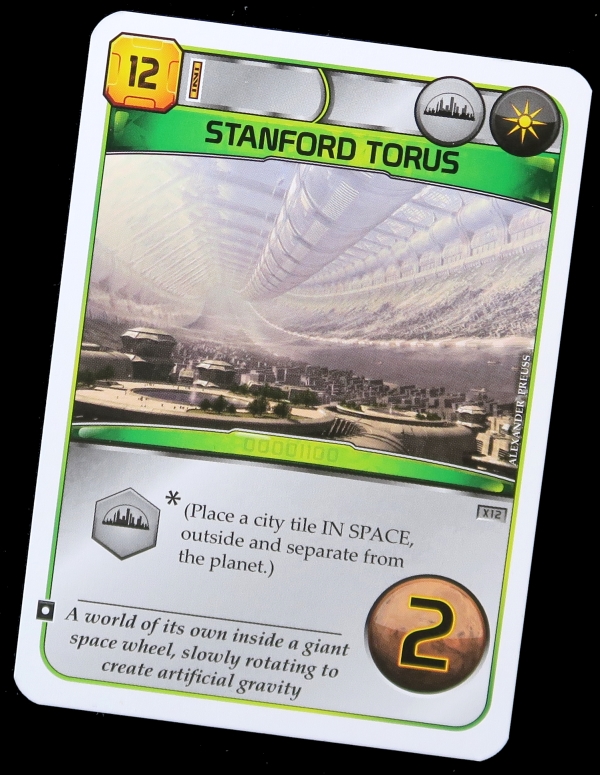
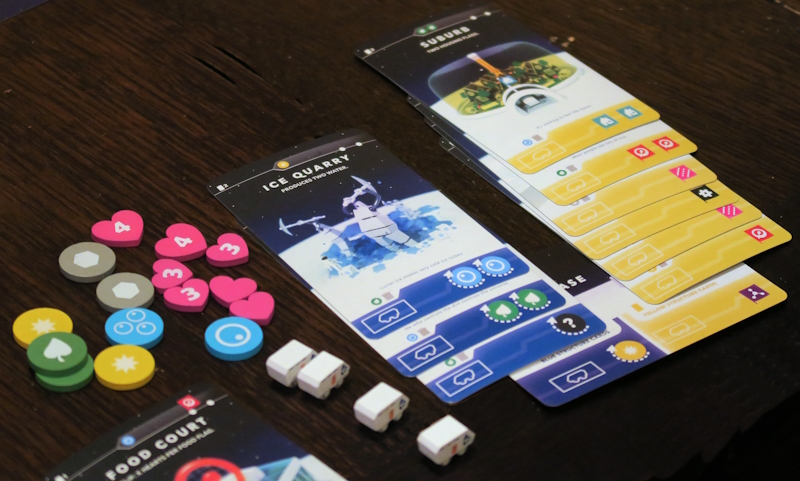
Moon is played over three rounds or Eras, collectively representing the first hundred years of populating the Moon.  Each Era is divided into three parts:  first players produce Resources, Rovers and Hearts from their Settlements.  Then comes the drafting where players choose a card from their hand to Build or discard, then pass their hand to the next player, repeating until there are no cards left.  Finally, players claim the Hearts on the central Flag Reward Board, and score any Hearts placed on their Structures and Reputation Cards.  At the start of the drafting phase, each player has one Expedition cards while the rest of the cards are Structure cards—this hand of cards represents an expedition from Earth that travels between settlements on the Moon.
Moon
– Image by boardGOATS

Unlike most card-drafting games, turns are taken sequentially with, players a Structure card from their hand and placing it in their Settlement paying any Resources and making sure any Flag Requirements are fulfilled.  Alternatively, instead of playing a card, they can discard (or “Assimilate”) a card, taking the Resources, Rovers or Hearts depicted in the discard line.  There are also four optional actions that players can carry out once each in any order before or after their mandatory action (Building or Assimilating)—use the Bonus Action on their Expedition Card; park a Rover; claim a Reputation card, or turn over a pink Action card.
Moon
– Image by boardGOATS

Once all players have taken their turn, all players pass their hands (including the Expedition card) to the player seated to their left and the player who now has the First Expedition Card starts the next round.  There are some similarities with Terraforming Mars, with cards having “Flags” (akin to the “Tags”), with some cards needing some Flags as a prerequisite while others display and therefore provide them.  There are five different Flags, Industry, Science, Food, Housing, and Transportation.  There are also four different types of Resource, Energy, Water, Biomass and Metal which are represented by wooden tokens, or Resource-eeples.
Moon
– Image by boardGOATS

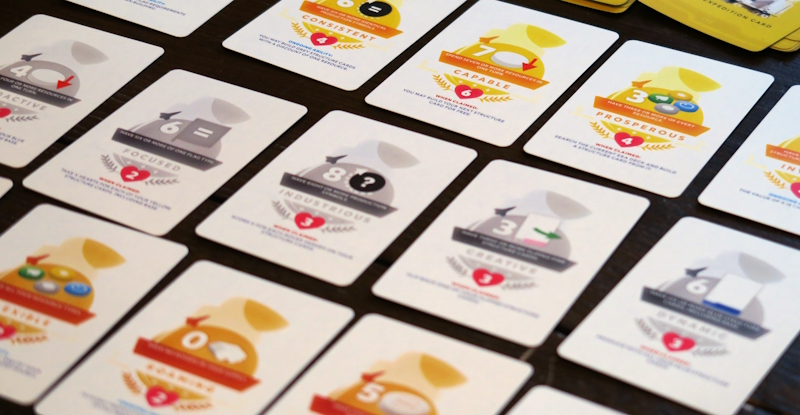
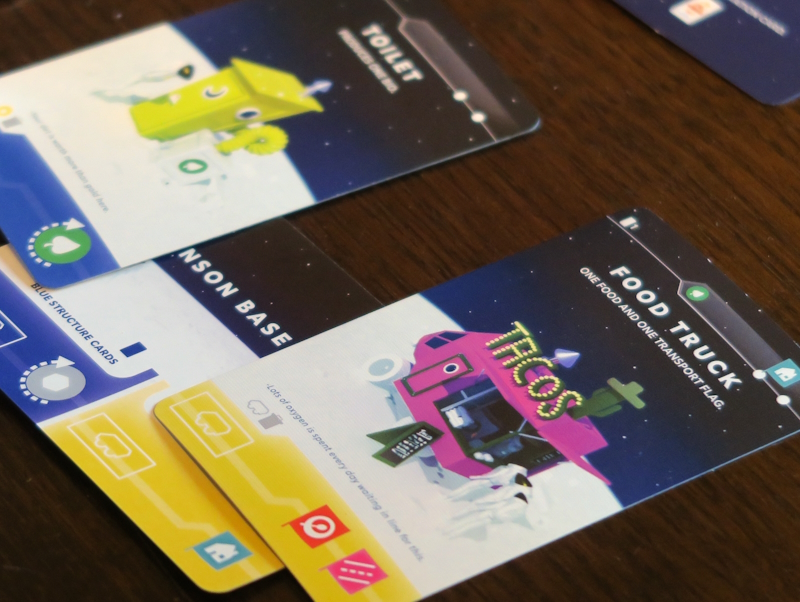
The guts of the game are the cards—there are five different types:  blue Production cards, yellow Flag cards, pink Ability cards, grey Excitement cards and red Special cards.  Blue and yellow Structure cards also display a Rover parking space.  Players begin the game with two Rover-eeples, but can acquire more during the game.  Players can park Rovers on other players’ Structures to either use the card to immediately gain its Resources (blue) or use the Flags on it to fulfill a Flag Requirement when Building (yellow). Pink Ability cards provide an ability players can use once per Era by flipping the card while grey Excitement cards provide Hearts, which are victory points—some of these just give points at the end of the game while others give Hearts during the game.
Moon
– Image by boardGOATS

There was some hilarity over the card names, especially when Orange built a Toilet right next to his food van, Just in case!  Jade who was the most familiar with the game, took an early lead in the Hearts and finished with what appeared at first glance to be an unassailable lead with fifty-six of them, fifteen more than anyone else.  There are other scoring opportunities however, with points available for Grey Structures and Reputation Cards, and Jade came off worst for both of these.  Black picked up the most points for his Grey Structures with thirty followed by Pine with twenty-seven.  Scores were much lower for Reputation with Black, Sapphire and Pine with a similar tally.  In the end, it was very close, but the victory was Sapphire with a combined total of seventy-nine, just two more than Black in second, with Jade completing the podium.

Moon
– Image by boardGOATS

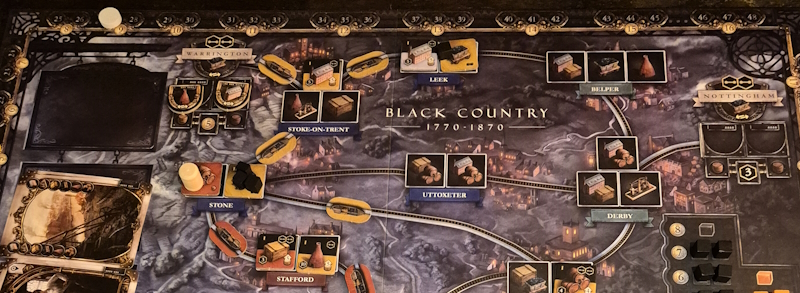
On the next table, Ivory and Byzantium were introducing Salmon to Brass: Birmingham.  There was a concern after last time that they might be a bit pushed to finish it in time (especially after last time), but with only three and with Birmingham being quicker to play than the original Lancashire version, they felt it was worth a go.  Ivory explained the rules while Byzantium set up the board.  In both games, players develop, build and establish their industries and network in an effort to exploit low or high market demands.  Players take turns according to the turn order track, paying two cards (from their hand of eight) to take any two actions from a possible six: Build, Network, Develop, Sell (cotton, manufactured goods or pottery), Borrow, and Scout.
Brass: Birmingham
– Image by boardGOATS

Building involves paying the required resources to place an industry tile while Networking is placing a Rail or Canal Link.  When Developing, players increase the point value of an industry, while Borrowing involves taking a £30 loan and a reduction in income.  The Scout action is new to the Birmingham game and replaces the Double Action Build in original, instead discarding three cards and taking a wild location and wild industry card.  Played in two halves, when the deck runs out players score, remove all the Canal Links then play on but this time building Rails.  The game ends when the deck runs out for the second time.

Brass: Birmingham
– Image by boardGOATS

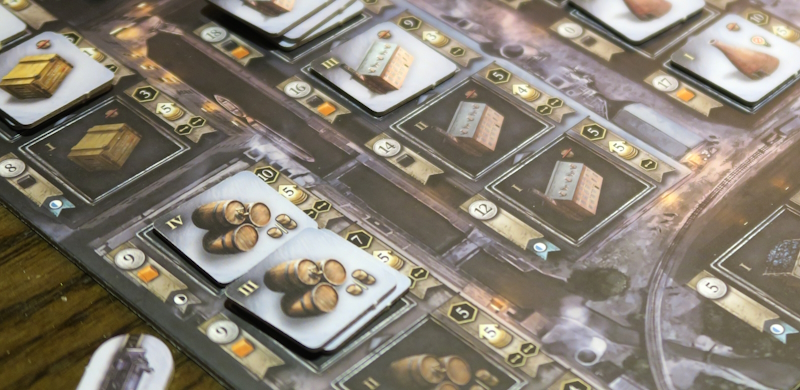
Ivory went first.  Due to Shrewsbury accepting all goods (this was randomly determined as part of set up) and selling goods being critical to scoring points, initially everyone focused on building near there and building industries that gave resources (i.e. coal and iron) that were going to be need to build further industries.  So Ivory, who went first began by building a Coal Mine in Coalbrookdale, while Byzantium added an Iron Works at the same location and Salmon placed a Coal Mine next door in Wolverhampton. At the start it looked like all three would all be competing in the same area, but once they continued building their networks (via Canals) and more industries, everyone started to spread out.  Ivory headed south, building Cotton Mills in Kidderminster and Worcester and was the first player to Sell, Selling to Shrewsbury and gaining four points for consuming Beer there (Beer being a prerequisite to Selling) and filling the tile to increase his income.
Brass: Birmingham
– Image by boardGOATS

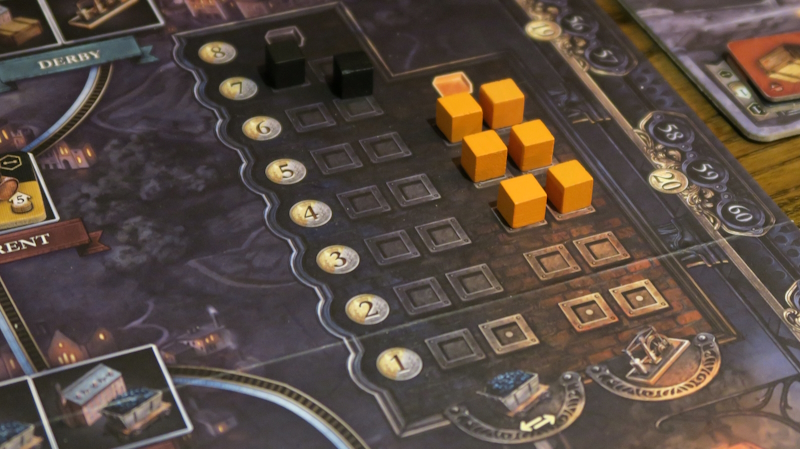
Byzantium went north and sold Cotton to Warrington, gaining £5 as his “Beer Bonus”, and increased his income. Seeing the opportunity Byzantium was building, Ivory took the opportunity using a Leek card he had which allowed him to build outside his network, to build a Cotton Mill in Leek and immediately Selling, using the remaining Beer there to also gain £5. Salmon went more central (Cannok and Walsall), focusing on Coal Mines and Iron Works, but as no one was consuming the resources (both Byzantium and Ivory were slightly self-sufficient), he was unable to flip his industries and increase his income. This became a major issue for him as the game progressed. Everyone ran out of money quite quickly and were forced to take out Loans, decreasing their income making it negative so that they had to pay money to the bank at the end of each round.

Brass: Birmingham
– Image by boardGOATS

Whereas Byzantium and Ivory promptly Sold some Goods, flipped tiles and increased their  income so it was positive again, Salmon got caught in a debt trap, having to take further Loans to take actions and service his debt. When required to take a third Loan (and then pay £9 each in upkeep), it was agreed that he should take the Loan without the drop in income, allowing him to take actions and sell goods and ultimately get back to a positive income. After a late era focus on breweries to get the Beer to Sell further goods, cotton and in Byzantium’s case, Pottery, the Canal Era came to an end. After scoring flipped tiles and Canal Links, Ivory had a slight lead.
Brass: Birmingham
– Image by boardGOATS

At the end of the Canal Era and going into the Rail Era, as well as all the Canals, all Level 1 tiles are removed from the board, representing obsolete technologies.  This wiped out everything Ivory had and most of Byzantium and Salmon’s tiles, so the start of the Rail Era was similar to the beginning of the game.  That said, Byzantium and Salmon were tied to their positions because, without a named card, players always have extend their Network from an existing position if they can.  That meant, Byzantium and Salmon always had something that was going to score twice though, where as Ivory had to build from scratch, but was free to start anywhere.
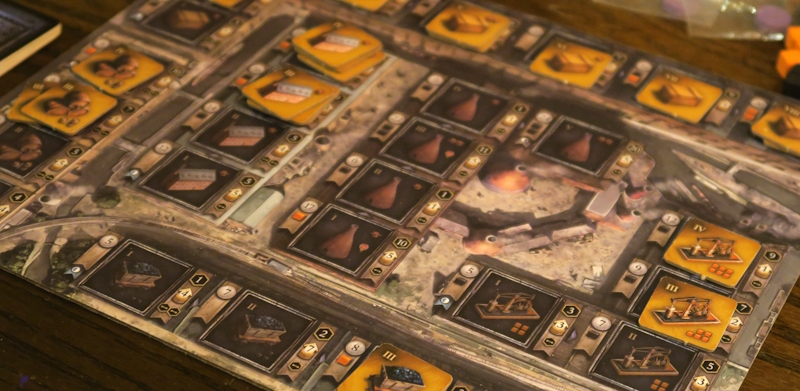
Brass: Birmingham
– Image by boardGOATS

With Rail connections requiring Coal to build, and because the cards in Ivory’s hand were all close to Shrewsbury (which that accepted all goods), he began the second Era almost exactly the same action way as he started the first, building a Coal Mine in Coalbrookdale. Although he had nothing on the board, Ivory was able to rebuild very quickly, partly because he had a good income, but also because he had taken a Loan as his very last action in the Canal Era.  Salmon and Byzantium also built their Networks in similar areas to the first Era. Byzantium’s core strategy was building and selling pottery to Warrington.
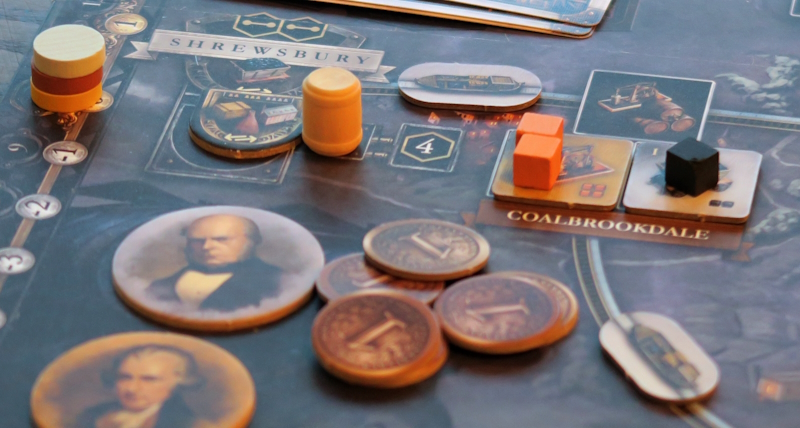
Brass: Birmingham
– Image by boardGOATS

Pottery is a unique resource in Brass: Birmingham, with the first pottery title being worth a large amount of points when flipped, the next being worth very little, the next giving big points etc.. Players are also restricted in developing Pottery, which mean they can’t skip the low point value titles. However, the big scoring tiles are worth a lot and Byzantium was able to get the highest level title out and flipped for a total of twenty points. Ivory again focused on the more standard cotton Mills, and each title being worth more points than the last, he was able to get multiple titles placed and Cotton sold, flipping the tiles to Shrewsbury. He also spent actions building lots of rail links next to his flipped tiles.
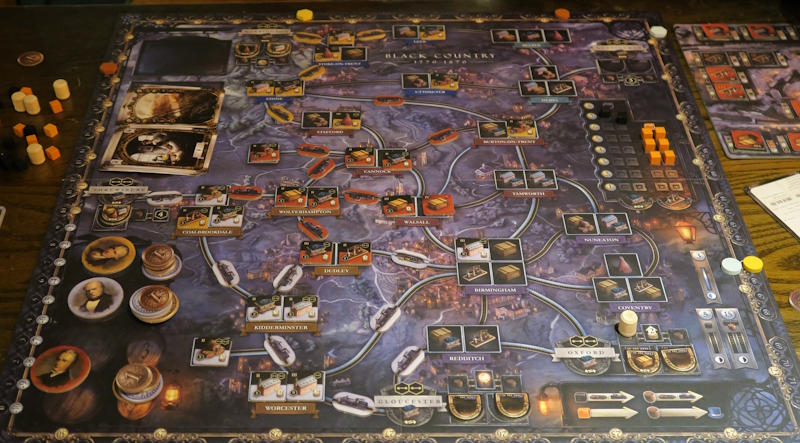
Brass: Birmingham
– Image by boardGOATS

Salmon again took a different approach, focusing on goods, the easiest to build and flip (especially as some don’t need beer), but these are not worth as many points. The game ended after all the cards had been played (for a second time), with Ivory’s focus on rail links and Cotton giving him victory over Byzantium by about twenty points.  Meanwhile, Teal beginning to explain the rules for Cottage Garden to Plum, Plum’s Aunt Damson and Blue, but then Ruby arrived.  Blue had cake to dispense and had a curiosity about Brass, so quickly offered her seat to Ruby and the Teal began again.  Cottage Garden is a fairly straight-forward Tetrissy, puzzle-type, polyomino game with a similar feel to Patchwork, but with more people.

Cottage Garden
– Image by boardGOATS

In Cottage Garden, players are competing in the art of gardening and are working two beds with a variety of flowers.  To do this, players select polyomino tiles of flower beds from a central market grid (restricted by the location of the “Gardener”), then place them on one of their two personal garden boards. Each board has several garden elements that are worth points when not planted over, and these are scored (on two different tracks) as soon as a garden has been completed. There are points “bars” on each track, and when these are passed players receive bonus tokens that can fill in empty spaces or give players a better selection of the flower bed tiles.

Cottage Garden
– Image by boardGOATS

Once a garden is finished, the player receives a new one to complete. After the Gardener completes her fifth lap around the market, the game enters its final round, after which, the player with the most points from their completed gardens is the winner.  The received wisdom is that the problem with the game is that it doesn’t change or intensify, which some people find boring.  However it also means that players have time to “get their eye in” and learn how to play without the game evolving beneath them and catching them out as they spend whole time playing chase.  As such, it was pretty much the perfect game for the occasion.

Cottage Garden
– Image by boardGOATS

Everyone did pretty well—Ruby picked up the scoring quickest, but Aunt Damson got the first beehive.  Teal wasn’t far behind though, getting the second.  In the final round, Plum just scored her current flower bed and discarded the second so that she didn’t get any negative points, something that turned out to be a critical decision in a very tight game.Plum and Teal had the edge in scoring for Pots, but that was off-set by Ruby’s scoring for her Cloches and and Aunt Damson’s Beehives.  Teal, Ruby and Aunt Damson were all within a couple of points, but the victor, was Plum with fifty-six, just three points clear of Ruby who edged second from Teal.
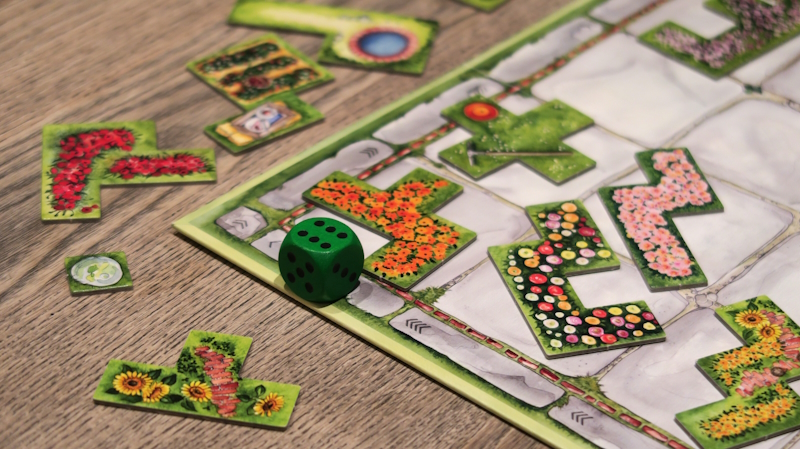
Cottage Garden
– Image by boardGOATS

In addition to Aunt Damson, Green had brought his mother, Saffron who was visiting. the area  Saffron was quite well known to some of the group so there was quite a bit of chatter before she joined Green, Lime and Purple in a game of Azul.  This is a game that is well known within the group and with everyone familiar, the rules explanation could be kept short:  the game uses a very simple, but very clever market mechanic where players take all the tiles of one colour from a market stall and put the rest into a the centre, or take all the tiles of one colour from the centre.
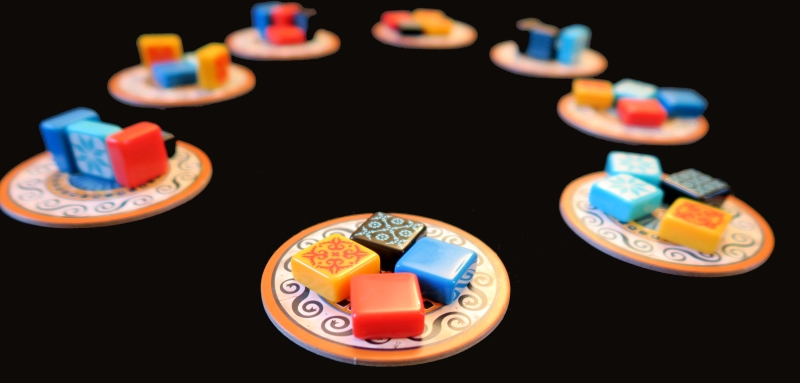
Azul
– Image by boardGOATS

As soon as they have taken the tiles, players add them to one of the rows on their player board.  At the end of the round, one tile in each full row is moved into their mosaic.  The game ends when one player completes one full row of their mosaic.  Players score points when they add tiles to their mosaic (one point for each tile in the row and column it forms), and receive bonuses for completed rows, columns and any completed sets in their mosaic.  The catch is that each feeder row can only contain one colour and and if there are left-overs when they add to it, these score negative points.  Further, each row in a player’s mosaic can only have one tile of each colour.
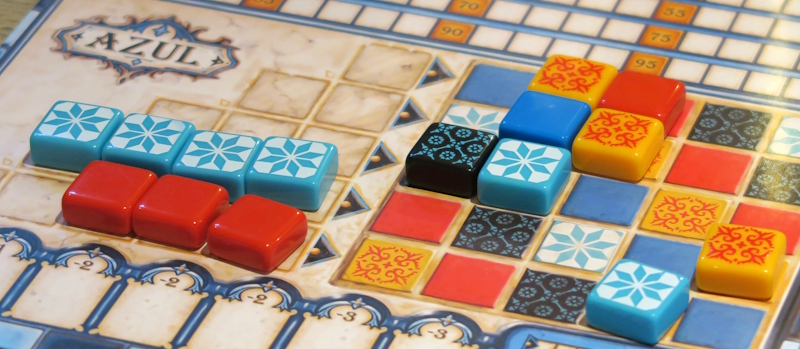
Azul
– Image by boardGOATS

This time, Lime nearly got caught out, however, after Blue was summoned for a rules adjudication.  The question was, was he able to have more than one feeder row in a colour?  If they all had to be different he would be forced to place a lot of tiles in his overflow space and pick up a pile of negative points.  As the rules are clear and players can have as many feeder rows of the same colour as they like at any point during the game (they can only put each colour in a row of the mosaic once), Lime dodged a bit of a bullet.  As a result, he just edged it taking victory by three points from Green with Saffron a few points behind him.

Azul
– Image by boardGOATS

With everything else still going, when Azul finished, Blue joined the table to introduce Saffron to another one of the groups favourite games, Draftosaurus.  This is a very simple drafting game (similar to games like Sushi Go! where players choose from a hand of cards and pass the hand on), but in this case players are drafting cool dino-meeples and adding them to their dinosaur park, with different locations scoring for different combinations of dinosaurs. The game is played over two rounds, each placing six dinosaurs.  The first game was a bit of a land-slide although it ended in a tie between Green and his mum, Saffron, both scoring thirty-seven points.
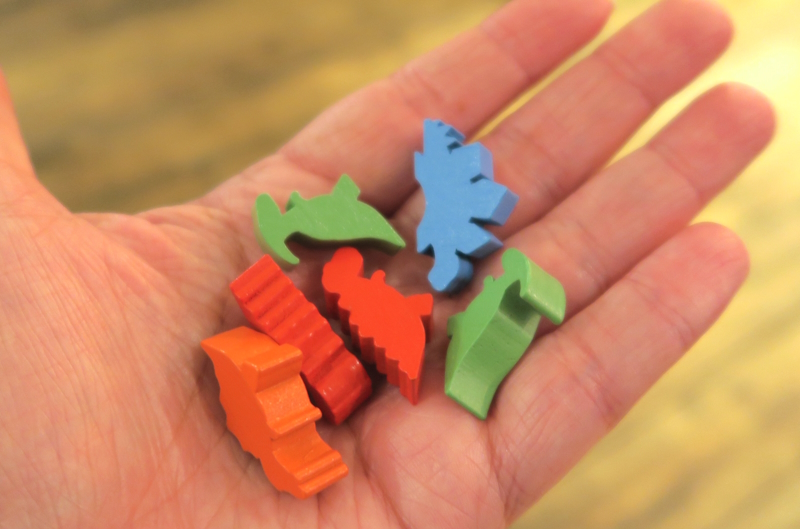
Draftosaurus
– Image by boardGOATS

It couldn’t be left there of course, so the group “did a Lime” and played again.  This time it wasn’t until the scoring that Green realised why he hadn’t seen a single T. rex—Blue sat to his right had nabbed them all before he got to see them!  T. rex is a special dinosaur in general, but especially in Draftosaurus, giving an extra point for each one, but also having some placement restrictions.  Blue is generally very bad at this game, but even a park full of dinosaur kings (and queens) didn’t help, although it was a very close game with four players within a couple of points.  The clear victory though was Purple with thirty-eight, three points ahead of Lime who led the rest of the pack.
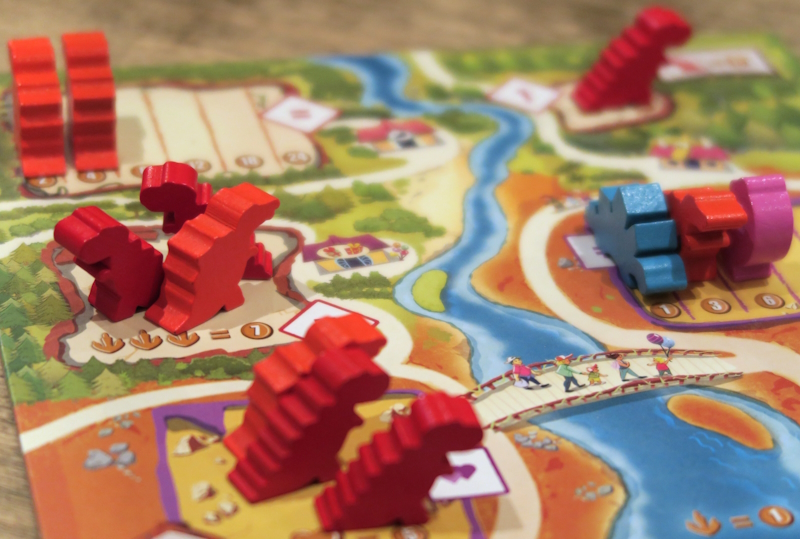
Draftosaurus
– Image by boardGOATS

From there, there was a bit of chatter, but by the time Cottage Garden had finished, Teal, Lime, Green and Saffron all decided it was time to head home, leaving Purple to join Ruby, Plum and Aunt Damson.  There was some question about that they would play, but in the end they decided on one of Purple’s favourites, the hidden traitor game, Saboteur.  In truth, this is not at its best with four, but despite that, the group really enjoyed it.  The idea of the game is that players are Dwarves building a network of Tunnels in order to find treasure.  They do this simply by playing a card to extend the Tunnel and drawing a replacement.  The catch is that there is a traitor, an Evil Saboteur, in their midst.
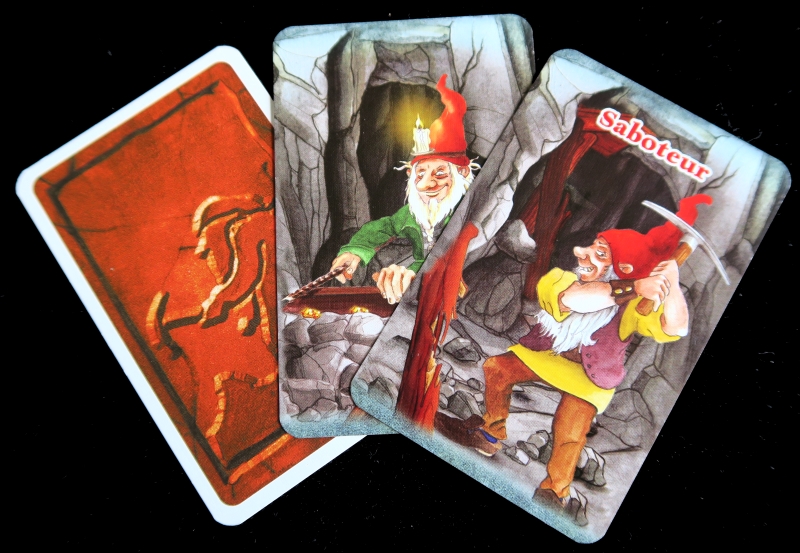
Saboteur
– Image by boardGOATS

So, if the Dwarves have not found the treasure by the time the deck runs out, then they have lost and victory goes to the Evil Saboteur.  In addition to Tunnel cards, the deck also contains Special Map, Rock Fall, Broken Tool and Fixed Tool Cards which Dwarves and Saboteurs can use as they feel appropriate.  With four players, Ruby put two Saboteur cards in the pile used to assign the roles, but as it happened only one came out—Ruby.  Plum seemed to get the all map cards and checked the target nearest her first: Coal.  She then tried the the middle target card, but finally found gold in the one furthest from her.
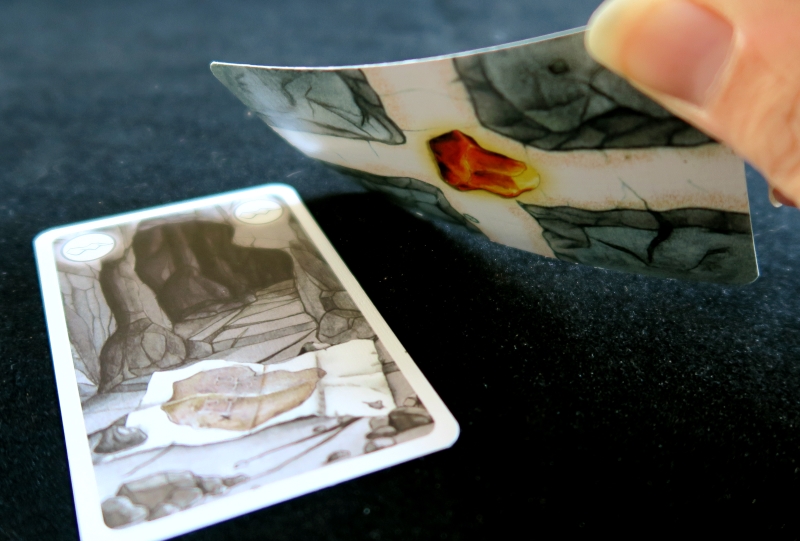
Saboteur
– Image by boardGOATS

Ruby chose to strike out at Aunt Damson first, but that left Purple and Plum to continue digging for the gold.  Ruby then played a tunnel card with a dead-end which exposed her as a Saboteur, and as the only one, the writing was on the wall.  The game is formally played over three rounds, but we don’t like the way that plays and treat one round as a game in its own right.  Everyone enjoyed the game, but Aunt Damson in particular—she had watched and enjoyed The Traitors, so the overall concept particularly appealed.  It had been a lovely evening with a slightly different set of people and lots of games played.

Saboteur
– Image by boardGOATS

Learning Outcome:  It’s lovely to host family and old friends.

30th April 2024

Blue and Pink were unusually early and had already finished their pizzas when Pine rolled in.  He was soon followed by Black and Purple and then Lime and Teal giving a total of seven for one of the quietest nights for a long time.  With seven, the question was how to split the group and what would everyone play.   For seven players, the go-to game is generally Bohnanza, which Blue inevitably suggested.  Pink suggested playing it later, but when Teal commented that he’d never actually played it, that was the decision made.  There was no way that state of affairs could continue, so the “Feature Game” (which was to be Canvas) was put on the back burner until later, and the Beans came out.

Bohnanza
– Image by boardGOATS

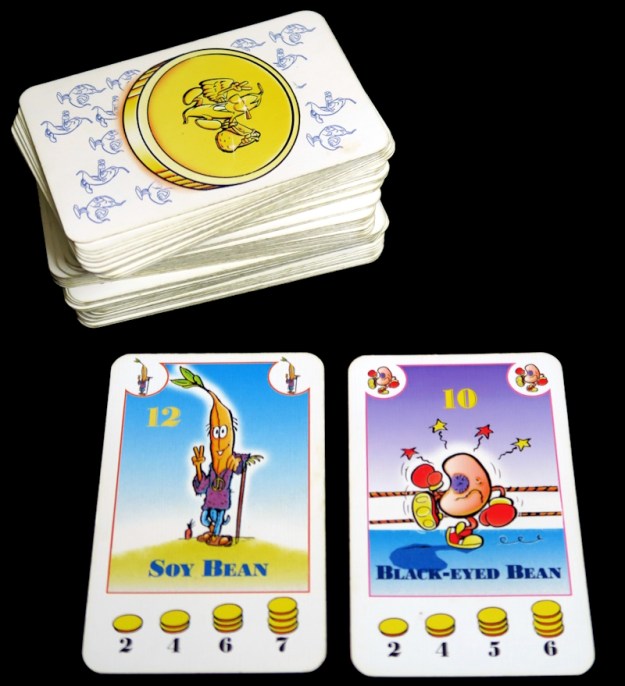
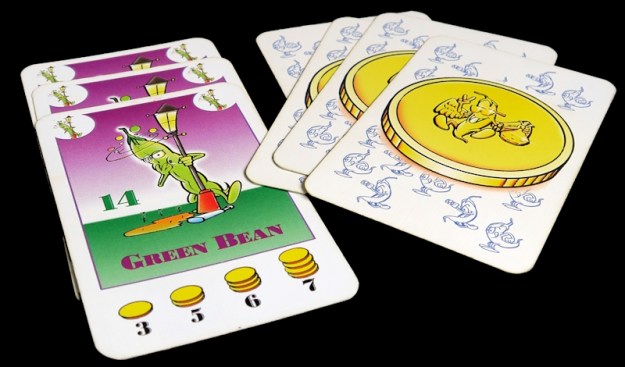
Bohnanza is best part of thirty years old and is, despite him designing a huge number of excellent and popular games since, including Agricola, Caverna, Le Havre, A Feast for Odin and Patchwork, is arguably, still one of Uwe Rosenberg‘s best games.  It is a really simple game of set collecting and trading, that when explained sounds strange, but when played is great fun.  While everyone else chatted, Blue explained the rules and how to play to Teal.  The important thing is players cannot rearrange the cards in their hand (similar to recent Spiel des Jahres nominee, SCOUT).

Bohnanza
– Image by boardGOATS

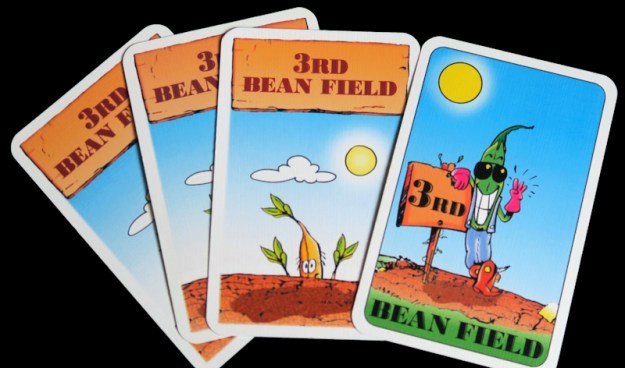
So, players start with a hand of cards, and, on their turn, must plant the first Bean card in the front of their hand into one of the two “Bean Fields” in front of them.  Then they may, if they wish plant the next Bean into one of their Fields, but each Field can only contain one type of Bean.  Once they have finished planting from their hand, the active player turns over the top two Bean cards, which must be planted, but may be traded and planted in another player’s Field if agreements can be reached.  Once these Beans have been dealt with, the active player can trade any cards from their hand, but all cards involved in any trades must be planted straight away.

Bohnanza
– Image by boardGOATS

Finally, the active player tops up their hand taking Bean cards into their hand (three in the case of the seven player game).  At any point, players can harvest one or both their Bean Fields converting some of the cards into Bean Thaler (according to the “Beanometer”), placing them face-down in their scoring pile, returning the other cards to the discard pile.  However, players cannot harvest a Field with a single single bean in it unless all their Fields have only the one Bean in them (a rule that can sometimes make things unbelievably difficult).  The game ends after three passes through the deck and the player with the most Thaler at the end is the winner.

Bohnanza
– Image by boardGOATS

There are a few, very clever things that really make the game work.  Firstly, there are different numbers of the different types of Beans in the deck—some beans are very common and give a small return, others are quite rare and give a better return.  The number of each card present in the deck at the start of the game is printed on them.  This is key, because it helps players to work out the rarity and therefore the value of different Beans when arranging trades.  However, the value also changes according to the situation in the game and how many players want each Bean type at the time.

Bohnanza
– Image by boardGOATS

Further, because the rare Beans give a larger yield, more of these are removed from the deck, which makes them increasingly rare as the game progresses.  This is because there are disproportionately fewer in the discard pile when it is shuffled to give the new deck.  Players can also buy a third Bean Field, but choosing to do this is a real gamble and only worthwhile if it can be done early in the game.  Choosing when to harvest is also critical, because harvesting a big Field just before the discard pile is shuffled will increase the length of the game.  Finally, players can be generous in their trades in the hope that the generosity will be returned, however, giving away trades too cheaply can cost a player the game.

Bohnanza
– Image by boardGOATS

Once Blue had finished explaining the game, Black started and explained his way through his turn.  Teal quickly caught on and got engaged in trading and planting Beans with everyone else.  There was a lot of debate about players buying their third Bean Fields with about half the players buying one and Teal leaving it to the second round (much against Black’s advice). Several people, including Purple, Teal and Pine got into Black-eyed Beans—quite an achievement given how few of them there are in the pack—and Blue had a couple of goes with the similarly rare Red Beans.  Pink tried for Soy with mixed success and almost everyone planted some combination of Wax, Coffee and Blue Beans at some point during the game.

Bohnanza
– Image by boardGOATS

Teal quickly realised how quick you have to be declaring an interest in a trade in a game where if you snooze, you lose.  And with seven you have to be keep an eye on what’s going on, which can be difficult given how far away some players are.  In the corner, Black quietly got on with his game eschewing the third Bean Field option as he felt there wasn’t time in the seven player game to recoup the cost, and perhaps he was proved right as he ran out the eventual winner with twelve Bean Thaler, closely followed by Pine with eleven and Blue with ten.  It had been a lot of fun, but as usual, had lasted longer than it really should, leaving little time before the first people needed to head home.

Bohnanza
– Image by boardGOATS

So after some discussion (where pink suggested Ticket to Ride: Northern Lights again), everyone settled down to play 6 Nimmt!.  This had recently had an outing with the new Jumping Cow mini-expansion, but this time the group chose to play it without the additional madness.  6 Nimmt! is also a simple game that is a lot of fun:  Players start with a hand of cards and simultaneously choose one to play, then, starting with the lowest value, these are added one at a time to the four rows on the table.  If a player’s card is the sixth in the row, instead, they take the first five into their scoring pile and their card becomes the first in the row.

6 Nimmt!
– Image by boardGOATS

This is another very clever game that does a lot with very little (which is probably why it is still so popular despite the fact it is thirty years old).  Different cards give a different number of points (or Nimmts), and players can also introduce a little bit of their own randomness by playing a card lower than the final card in all the available rows and thus, taking a row of their choice, upsetting everyone else’s plans.  The Jumping Cow mini-expansion adds more of this, but the group felt it didn’t really improve the game, so stuck with the chaos and fun of the original game, also eschewing the mathematical complexity of the Professional Variant.

6 Nimmt!
– Image by boardGOATS

This time, both Pink and Pine managed to avoid picking up any cards in the first round.  However, Blue only picked up two Nimmts and Teal collected seven leaving it all to play for, at least for most people—Black’s twenty Nimmts had already put him out of the game.  In the second half, Lime picked up twenty-four giving him the top score of thirty-eight (some way ahead of Purple with total twenty-nine).  Black managed a clear round, but there was nothing he could do about his pile of Nimmts from the first round.  It was tight between the top three, but Pink just took victory with ten, three fewer than Blue and Pine who tied for second place.  From there, the evening deteriorated into chatter and we decided to leave the “Feature Game“, Canvas, for another day.

6 Nimmt!
– Image by boardGOATS

Learning Outcome:  You can have a lot of fun with nothing but an old deck of cards.

2nd May 2023

Blue and Pink were the first to arrive and were just finishing their supper when Magenta walked in—sadly not to join in the games as she was there for a Scout meeting.  After a quick chat, she left and as Blue recapped the rules for the “Feature Game“, Zoo Break, Teal arrived and then Purple and Black.  The group had just decided to play Alles im Eimer (aka The Bucket King), when Ivory rocked up to make the full compliment of six.  Purple explained the rules with help from Black.  The idea is very simple:  each player builds a pyramid of ten bucket tokens with two of each of five colours.

Alles im Eimer
– Image by boardGOATS

One player starts, playing a coloured, numbered, animal card and each player has to follow with the same colour and a higher number before picking up a card.  Players can play multiple cards to make the total, but they only ever receive a single replacement card.  If they can’t, or choose not to follow, they lose a bucket of that colour, and any buckets above it.  Worse, if they split their pile of buckets in two, they lose one part as players can only ever have one pile.  On the plus-side, if a player can’t play (or chooses not to), they then lead with a free choice of colour and number.  The last player with buckets still standing is the winner.  With Purple shuffling, Ivory was the first to play.

Alles im Eimer
– Image by boardGOATS

It turns out that there are two things that are really critical in this game.  Firstly, how players stack their buckets—it is not as simple as playing to their hand strengths; the smart player also spreads the colours out a bit so they aren’t forced to take buckets from low down when the unexpected happens.  Secondly, as Ivory pointed out, like 6 Nimmt!, it is all about timing, which is something players may not have control of.  A few rounds in, Black spotted that Pink to his left still had a complete stack where bucket piles had been falling all over the place everywhere else.  So, Black made it his business to make Pink’s life difficult.  From there, it was gloves off and the buckets really started to tumble.  Purple was the first player to kick the last of her buckets over which left Blue to do what she could to damage Ivory’s largely unscathed pile.

Alles im Eimer
– Image by boardGOATS

Black, then Blue, then Teal, all fell, leaving just Pink and Ivory to fight it out.  With Pink’s dwindling pile, it always looked an uphill task, and so it proved, with Ivory taking victory with five buckets still standing.  By this time though, Lime and Green had arrived and with eight, the group split into two tables of four, the first for the “Feature Game“, Zoo Break.  Pink was nearly lured away at the suggestion that the alternate might be Takenoko, but despite being very torn by his love of pandas, he stuck with his original panda driven choice and was joined by Blue, Lime and Black as Keepers at Bedlam Zoo.

Zoo Break
– Image by boardGOATS

Zoo Break is an apparently light cooperative game where players are a team of zoo-keepers trying to prevent a mass break-out.  The mechanism is quite simple:  the active player rolls a die to decide how many Action Points they get, then they carry out actions, before drawing an Escape card and a Move card (to see what animals escape and move).  The game ends when either a dangerous animal (tiger, elephant, or dangerous snake) escapes, or when the fifth cute animal (panda, Capuchin monkey, meerkat or harmless snake) exits the zoo, or when there are no animals roaming about and all the cages are locked up.

Zoo Break
– Image by boardGOATS

Although the mechanism of Zoo Break is very straight-forward and the art-work implies it is a simple kiddies game, nothing could be further from the truth.  The rule book is twenty pages long, and there are a lot of details regarding escaping and recapturing animals.  For example, when an animal escapes, it doesn’t just move to the space immediately outside its Enclosure, it moves to the nearest “open” space.  Also, different animals are recaptured using different tools which have to be acquired from the supply by the Keepers.  For example, a Net can be used to capture meerkats or monkeys, while a Leash is required for pandas and elephants, and tigers need to be Tranquilised and Stretchered home (very carefully, obviously).

Zoo Break
– Image by boardGOATS

Each Keeper has a different skill.  This time, Blue had the ability to reveal snakes and capture animals from adjacent spaces (especially useful for dealing with snakes); Pink could run faster than anyone else, moving two spaces for each action point (instead of the usual one); Black, the Gardener, could move through and hide in bushes, and Lime could re-roll the die twice to try to get additional actions.  From experience with games like Forbidden Island and Forbidden Desert, the key is almost always to make good use of these special powers.  So Blue suggested she made it her business to concentrate on dealing with the snakes since she could do so without being bitten.

Zoo Break
– Image by boardGOATS

Pink with his Panda obsession, was always going to go after them, and everyone else was happy to let him get on with it.  Before any of that could happen though, the Keepers needed Supplies.  Pink started, and went straight to the Supply shed and started revealing tools.  These are drawn from a face down pile, but Keepers only have space to carry four tools in their backpack, so can choose only to take the ones they want.  This was probably the team’s first mistake:  instead of the few players just searching the whole Supply pile and making a discerning choice while taking as much as they could carry, players grabbed a couple of items and headed off.

Zoo Break
– Image by boardGOATS

This became a problem later in the game when the Keepers realised they didn’t have tools and were now on the other side of the board.  Black who had drawn the meerkat enclosure key headed off to the far corner to lock it quickly.  Lime captured the only roaming meerkat (which had been playing in the fountain) and Black was just about to lock the cage when another one escaped.  As he didn’t have a Net, despite being in the same space as it, he was left chasing about trying to grab it unsuccessfully.  And then more meerkats got out.  So Lime, Keeper without portfolio (but with both a Net and a Leash), waged war on the disobedient meerkats, while occasionally taking time out to catch an elephant or a monkey.

Zoo Break
– Image by boardGOATS

Pink, meanwhile, had his panda enclosure Key and a Leash and was trying to do something about them, but was inconvenienced by a pair of elephants, one of which knocked him flying necessitating a visit to the Medic.  Lime captured the last of the Capuchin monkeys and Blue who was close at hand with the enclosure Key managed to slam the door shut before any more got out—just as well, as the snakes were beginning to get out of hand, and as for the meerkats, well, these little blighters were causing mayhem.  Twice the Keepers had them under control before more escaped, and as they formed a long queue, the queue kept getting longer and longer as they marched inexorably towards the exit.

Zoo Break
– Image by boardGOATS

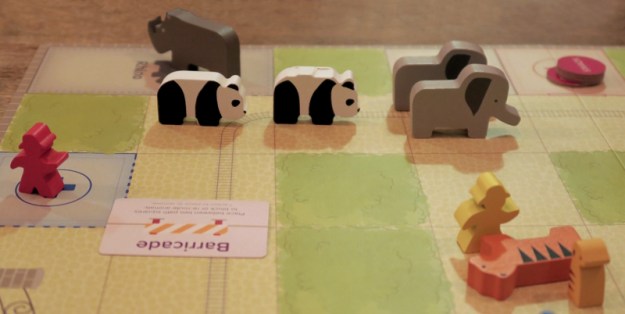
Pink used the Barricade to delay the escape of a couple of pandas and the pair marauding elephants, but it failed to hold when the Broken Barricade Move card appeared.  The rhino’s occasional charges weren’t much of an issue as they were very predictable, but once animals started to get close to the exit the rhino became more of a problem as players stayed out of its path wasting Action Points.  By this time, the tigers were becoming a problem, but Pink and Black put their Tranquiliser darts to good effect and soon the zoo was littered with sleeping tigers.  Lime had a Stretcher, but never actually used it, briefly loaning it to Blue for the only tiger returned to its enclosure (and left to peacefully sleep off the after-effects, as per one of the new variants).

Zoo Break
– Image by boardGOATS

There was a bit of a debate over whether it was more important to work on the rogue pandas or let them and meerkats escape and focus on the dangerous animals (in particular tigers and elephants).  Slowly but surely, however, the animals were taking over as there was a little procession of Keepers at the Medic’s tent, with only Lime avoiding injury.  Black was the only player to make use of the Train, because it didn’t really go where people wanted it to and players dealt with the issues nearest to them.  That was probably a good strategy; like it says in the advice, it is also important to lock stuff up early—the team didn’t.  They dealt with the monkeys, but the only other enclosure they managed to lock was the pandas, just before two meerkats and a cobra made a run for it in a single turn.

Zoo Break
– Image by boardGOATS

Although the mass escape had caused the zoo to be closed down and Pink hadn’t actually been cuddled by a panda, everyone had really enjoyed themselves.  On reflection, working in pairs might have worked better (as with Flash Point and Escape), because then the team can do things much quicker, get on top of things and lock cages making life easier all round.  Black was curious about the variants available.  The group had played on “Standard” difficulty with two “Phew!” Escape cards (where nothing gets out), but thanks to a rules malfunction, had also included the blank cards in the Move deck which provided quite a bit of respite, so everyone had a good laugh at the idea of making the game harder.

Zoo Break
– Image by boardGOATS

Despite the fact the group rarely plays cooperative games, everyone was keen to give Zoo Break another outing soon.  Zoos were popular elsewhere too—the next table had been playing New York Zoo.  This is a tile-laying game that got its first Tuesday outing only a few of weeks ago, but had been enjoyed by all.  In this game, players add pens to their zoo, populating them with animals, and building attractions.  Like Uwe Rosenberg‘s other similar games (including Cottage Garden, Spring Meadow, Indian Summer and Patchwork), it is Tetris-like but what makes this one unique and interesting is the Market.

New York Zoo
– Image by boardGOATS

Players move the Marker Elephant one to four spaces round the Market, landing either on an Enclosure tile space (taking the top one and adding it to their zoo) or on an animal space (taking one or both of the animals depicted). Enclosure tiles can be placed anywhere in the player’s Zoo, then one or two identical Animals from elsewhere in their Zoo must be moved to occupy the Enclosure.  Each Enclosure can only hold one type of Animal.  When there are two or more Animals in an Enclosure together they breed when the Elephant passes the Market’s breeding spaces.

New York Zoo
– Image by boardGOATS

When an Enclosure is full, all the animals are removed and the player takes an Attraction tile of their choice and adds it to their Zoo.  Attraction tiles are useful because they fill additional spaces, and at its heart, New York Zoo is a race game—the winner is the first to fill all the spaces in their Zoo.  Purple had played last time, and Green had played elsewhere, however, Ivory and Teal were new to the game and the rules needed explanation.  That didn’t take long though, and the Elephant was soon touring the market and everyone was building their zoo and adding animals.

New York Zoo
– Image by boardGOATS

Purple was quick to get going, as was Green.  New York Zoo is really a tactical game, but there are a couple of broad strategies—fill the zoo with large Enclosures that are harder to fill, but occupy more space, or fill it with smaller Enclosures which are easier to fill with animals giving bonus Attraction tiles.  Purple went for the latter approach, getting some of the large attractions early in the game.  Teal however, opted for the former strategy, which is harder to get to work, but can be extremely effective, as indeed it was this time, making him the first to finish his zoo, and with no Attractions at all.  Purple was the best of the rest with for spaces left to fill, with Green a little way behind.

New York Zoo
– Image by boardGOATS

The Keepers in Bedlam Zoo on the next table were still trying to get the marauding beasts back in their pens (largely unsuccessfully) so the others had to decide what to play.  Green decided to go home, and couldn’t be persuaded to stay by the opportunity to play Nidavellir despite having been very keen to play it previously.  That left Purple, Ivory and Teal, who decided to play it anyhow.  Nidavellir is a card set-collection and bidding game inspired by Norse myths. The game was created by French designer Serge Laget (who sadly passed away in January this year after a lifetime of producing some great games) and the striking black and white artwork by Jean-Marie Minguez which nicely contrasts with the coloured cardboard components.

Nidavellir
– Image by boardGOATS

The story behind the game is that the kingdom of Nidavellir is under threat from the stirrings of the Dragon Fafnir and players are tasked by the King to recruit the best army to defeat it. Appropriately for our venue, the action takes places in three Dwarvish pubs where the players must use their coins to bid for the most skillful Dwarves (in a concealed auction), recruit the most prestigious Heroes, and build the best Battalion they can to defeat the Dragon.  Players hire five different professions of Dwarves into their growing army – Warriors, Hunters, Miners, Blacksmiths and Explorers.  Each player starts with five coins with the values: zero, two, three, four and five. Players place one of their coins against each pub space on their player mat.  The coins are revealed and cards are taken from each pub starting with the highest bidder.

Nidavellir
– Image by boardGOATS

Ties are broken in favour of the player with the the highest jewel token (randomised at the start) and then these players swap jewels so the losing player has an advantage next time there is a draw. Once the three pubs have been resolved, players take back their coins, and place their cards in their tableaux.  At the game end, points are awarded in different ways for each group of Dwarves.  For example, Hunters provide points based on the number of cards squared, Blacksmiths score according to the triangular sequence (as used in Coloretto), while the Navigators are simply a total of the number of points printed on the card, and so on.  Each round of the game, random face-up dwarf cards are lined up by each pub (equal to the number of players) and players bid for their order of selection.

Nidavellir
– Image by boardGOATS

If a player plays their “zero” coin, the values of the two unused coins are added together, the highest of the pair is discarded and a new coin of the same total is added to their stash from the Royal Treasure. Thus, players can gradually increase the value of their coins, which is useful for out-bidding others, but also adds value as the total coin hoard is added to their final score.  Hero cards, which supply additional points bonuses in a variety of ways are awarded when a player manages to have five cards of different type and then each time a new set of five is achieved. Heroes are selected from, a separate deck which allows for further point scoring combinations.  The start was a little slow as Purple and Ivory were both new to the game and had to figure out what to do.

Nidavellir
– Image by boardGOATS

Teal and Ivory both started by upgrading their coins.  Ivory was the first to get a set of five cards and claimed one of the Dwerg Brothers as his Hero giving him the target of collecting the other brothers which greatly crank up the points the more that are collected.  Teal, who had played the game before, chose more complex Heroes.  Half way through the game, Purple took the King’s Hand and the King’s Great Armourer Heroes for having the most Warrior and Blacksmith cards, while Teal took the Hunting Master and Crown Jeweler (for the most Hunters and Miners respectively), leaving Ivory just the Pioneer of the Kingdom (for the most Explorers).

Nidavellir
– Image by boardGOATS

The second age (played with a new deck of cards), was similar to the first, with particular tight battles around getting cards to complete sets.  Ivory had a slight advantage in this, having upgraded his coins more aggressively early in the game, and used this to get more of the Dwerg Brothers.  In contrast, Purple and Teal focused on collecting Dwarves of one kind with Teal using his Heroes to add to their “count” in particular colours when completing a set.  In the end, Purple and Teal scored best for Blacksmiths and Hunters, while Teal also took lots of points for his Miners—something he had focused on from the start.

Nidavellir
– Image by boardGOATS

Ivory however, had more Warriors and having the majority of them meant he could add the value of his most valuable coin to his score.  Despite that and over a hundred points for his Dwergs, Ivory finished just shy of Teal’s winning total of two-hundred and seventy-seven.  The downside of his victory—the winner has to face the Dragon Fafnir!  All agreed it was a good game, not overly complex, but with lots of decisions to make; a game that didn’t out stay its welcome finishing within the forty-five minutes advertised (even with two first-time players).

Nidavellir
– Image by boardGOATS

Learning outcome: Always keep a close eye on your meerkats.

7th March 2023

Plum and Blue were first to arrive and, by the time they had finished their enormous rack of ribs (or given up and had a doggy bag made up), almost everyone else had arrived.  There were a few people missing, but still enough for two games of four.  The first was the “Feature Game“, but nobody really wanted to commit to that until they knew what the other game was going to be.  As he had done the last couple of times, Green suggested Terraforming Mars.  Unlike previously, this time Ivory, Plum and Teal felt up to it, leaving Blue, Black, Purple and Lime to play their preferred choice of New York Zoo.

New York Zoo
– Image by boardGOATS

New York Zoo is a tile laying game by Uwe Rosenberg, designer of Agricola, Bohnanza, Patchwork and many other well-known games.  The idea is that players are building pens in their zoo, populating them with animals, and building attractions.  This is one of several polyomino, Tetris-like, tile-laying type games (including Cottage Garden, Spring Meadow, Indian Summer and Patchwork), but what makes this one unique and interesting is the Market.  Players move the Marker Elephant one to four spaces round the Market, landing either on an Enclosure tile space (taking the top one and adding it to their zoo) or on an animal space (taking one or both of the animals depicted).  Enclosure tiles can be placed anywhere in the player’s Zoo, then one or two identical Animals from elsewhere in their Zoo must be moved to occupy the Enclosure.

New York Zoo
– Image by boardGOATS

Each Enclosure can only hold one type of Animal, meercats, snow-foxes, kangaroos, penguins or flamingos, but when moving Animals, no pen can be left empty.  There is an advantage to pens having two or more Animals in them too—the Market also features breeding spaces, and when the Marker Elephant passes these, up to two pens containing two or more matching Animals get an extra one.  When a player moves the Elephant onto an Animal space, they take one of either or both the Animals depicted into Enclosures containing matching Animals (moving another from Storage if they can), or into the Storage space.  Moving animals is important, because when an Enclosure is completed the player removes all the animals putting one into Storage if they have space, and then takes an Attraction tile of their choice and adds it to their Zoo.

New York Zoo
– Image by boardGOATS

Attraction tiles are useful because they fill additional spaces, and at its heart, New York Zoo is a race game—the winner is the first to fill all the spaces in their Zoo.  Black and Purple had played this a few times, and once Black had explained the rules to Lime and Blue, Purple started.  Black and Purple prioritised completing Enclosures to get Attractions.  The Market is stacked so there are large tiles, heptominoes, on the top of each tile space, with hexominoes, then pentominoes and finally tetrominoes at the bottom of each pile.  Black and Purple prioritised getting breeding pairs of animals and as the Market dwindled, getting smaller enclosures because small Enclosures are easier to complete than large ones.

New York Zoo
– Image by boardGOATS

Blue, who had not played the game before, started off getting large Enclosures and fitting them tightly together.  As the game progressed, however, she realised her mistake as everyone else’s Animals were breeding and she didn’t have pairs because she was taking one out every time she added another Enclosure.  This had the additional consequence that she was starting to run out of Animals too, so she prioritised getting breeding pairs for a couple of rounds before continuing to take the biggest Enclosures she could get away with.  It was a tight game—Purple seemed to take an early lead, but it looked like Black and Lime over-took her towards the end and were in a tussle to finish the game first.

New York Zoo
– Image by boardGOATS

With everyone else concentrating on filling pens and taking Attractions, nobody was watching Blue.  So they were taken by surprise when her kangaroos bred filling their pen and she took her first Attraction.  That left one space which she promptly filled taking the only Enclosure that fitted, perfectly, and ended the game.  With everyone else so close to finishing, however, the rest of the group played on to see who would place where.  In the event, Black finished just ahead of Lime.  The group were just dissecting the different strategies when Pine arrived, fresh from his meeting teaching “cubbish-sized scouts” about waste.  Terraforming Mars was still going on, so the hunt was on for a five-player game, and the group settled on Kingdomino.

Kingdomino
– Image by boardGOATS

Native, Kingdomino is a four player game, however, with the Age of Giants expansion, it plays five.  The base game is simple enough, but it had been a while since most people last played it, so there was a quick run through of the rules.  On their turn, players add a terrain domino to their Kingdom; each domino comprises two squares of terrain and when placed at least one end must be adjacent to the same terrain type.  Like New York Zoo, the interesting and clever part of the game is the Market.  In Kingdomino, there are two parts, current and future—when a player takes their domino from the current market, they choose their next domino by placing their marker on it.

Kingdomino
– Image by boardGOATS

At the end of the game, players score each terrain region with points equal to the area of each region multiplied by the number of crowns on it.  The clever part is the timing of the Market.  The tiles are drawn at random from a set numbered from one to forty-eight.  The low numbers generally being the less desirable ones, those without crowns or those for terrain types where crowns are more scarce.  Since players take the tiles in numerical order (low to high), taking a low value tile in one round gives a better choice in the next.  Similarly, taking a high value tile means there will be less (or maybe no) choice in the following round.

Kingdomino: Age of Giants
– Image by boardGOATS

The Age of Giants expansion firstly adds twelve extra tiles (enough for a fifth player), six labeled with letters A to F and six numbered forty-nine to fifty-four.  These are ranked below one for the letters and after forty-eight for the high numbers, with the low ranking tiles featuring a Giant, and the high ranking ones featuring Footprints.  Players taking dominoes with a Giant on them, also take a Giant-eeple and place it over a crown in their Kingdom so that it doesn’t score.  Taking a Footprint domino allows the player to move a Giant from their Kingdom to a crown in someone else’s and this increase their score, making these tiles potentially very valuable.

Kingdomino: Age of Giants
– Image by boardGOATS

Unfortunately (especially for Lime and Blue who ended up with all the Giants), the Footprints seemed hard to come by in this game.  The other part of the Age of Giants expansion are the Quests.  The base game comes with two Quests, arrangement targets that give points.  These are “Middle Kingdom” and “Harmony” which respectively give ten points for a castle in the centre of a player’s Kingdom and five points for a complete five-by-five territory with no discarded tiles.  This time, the Quests drawn essentially at random were “Bleak King” and “Four Corners of the Kingdom”.  The first of these gave five points for each five square of terrain with no crowns while the second gave players five points for placing cornfields on all four corners of the five-by-five grid that defines their Kingdom.

Kingdomino: Age of Giants
– Image by boardGOATS

Although the Quests had been included in game play several times before, the Giants have only had an outing once and didn’t go down all that well.  Still, with five players all the extra tiles were needed and their values would have been unbalanced without including Giants, so the group thought they’d give it another try.  This time Blue and Purple had a really hard time getting crowns and things were so bad for Blue that she resorted to picking up twenty points, more than half her total, from the “Bleak King” Quest.  Black built a lot of sea and pasture, while Lime scored heavily for his mountains and Pine picked up lots of points for his large woodland.

Kingdomino: Age of Giants
– Image by boardGOATS

It was very close between the top three and both Lime and Pine scored forty-five points for their highest scoring terrain—Lime for nine crowns spread over five spaces, Pine for five crowns spread over nine spaces.  There were just two points between Lime and Pine in the end, but Pine’s sixty-eight points just edged Lime into second with Black four points behind that.  It had been a good game.  However, the group felt that the Giants took a positive constructive game and added a negative aspect.  Those that had been stuck with them hadn’t found that aspect particularly enjoyable, especially as it was easy to get lumbered largely through no fault of their own, so it is unlikely they’ll get another outing very soon.

Kingdomino: Age of Giants
– Image by boardGOATS

Meanwhile, on the next table, Green, Ivory, Plum and Teal were still playing Terraforming Mars.  To speed up the game they played with the Prelude start cards and also removed the Corporation cards—that turned out to be a good choice as the game only just finished before the pub closed.  In this game, players play corporations sponsored by the World Government working together in the terraforming process, but competing for victory points.  These are awarded not only for their contribution to the terraforming, but also for advancing human infrastructure throughout the solar system, and doing other generally commendable things.

Terraforming Mars
– Image by boardGOATS

The players acquire unique Project cards by buying them into their hand; these can represent anything from introducing plant life or animals, hurling asteroids at the surface, building cities, to mining the moons of Jupiter and establishing greenhouse gas industries to heat up the atmosphere. The Projects can give immediate bonuses, as well as increase production of different resources. Many cards also have requirements and become playable when the temperature, oxygen, or ocean coverage increases enough. Buying cards is costly, so there is a balance between buying cards (three MegaCredits per card) and actually playing them.

Terraforming Mars
– Image by boardGOATS

The game ends after the terraforming is complete when the three global parameters, temperature, oxygen, ocean have all reached their goal.  Players then score for their Terraform Rating with any other points they might have accrued.  This time, Green made his presence felt on the surface of Mars in the early stages with his initial starting forest, which grew a little, and seeded the oceans. He was the only one for a while.  Plum played a blue card which gave her a couple of extra Credits every time someone built a city.  This one really paid for itself in the four-player game as everyone wanted to build more than one city.  Green was first, but had mis-read the card and found himself colonizing Phobos instead.

Terraforming Mars: Prelude
– Image by boardGOATS

So, Teal was the first to actually build a city on the surface of Mars. He opted for the equator but on the other side from Green’s forests.  Later he played a blue city bonus card that gave him a Credit production bonus for each one. Although several cities had already been built by then, several more followed and he was able to enjoy the benefit of extra cash in later rounds.  Ivory meanwhile had made a different start to the game than his normal opening gambit (building a city), and completed the first Milestone: the Ecologist. However his cities did follow later as he extended down towards the south pole. Teal claimed the second milestone: the Specialist, helped on by his city Credit production bonus.

Terraforming Mars
– Image by boardGOATS

Plum was the last to claim a Milestone: the Generalist, as she was able to pay to increase her production one step each round.  She did not claim it straight away, but noticed it after Teal had claimed his, and thought she had better get in there quick.  Green was not able to claim any milestones, but instead was the first to fund an Award. A quick check around the player boards suggested he should fund Celebrity as he had three high value cards to Teal’s two, but neither Plum or Ivory had any cards over the value of twenty Credits. Later on Teal funded the second award and went for Estate Dealer as he clearly had more tiles next to oceans at this point (having planted his forests northwards around the oceans.

Terraforming Mars
– Image by boardGOATS

At the end of the game Green pulled out his wallet once more and funded Benefactor since he was ahead on the Terraform Rating track. Ivory was only one behind, but Green had a couple of options he could play on his last turn for a couple of extra Terraform Rating points. This prevented Ivory from funding the Dessert Settler award for which he had been building.  Green decided to go for outworld domination and also built Deimos city.  During the second half of the game Green realised he had forgotten his company bonus of a two MegaCredits reduction for each brown, Industrial tagged card.  He had built three, so put six Credits aside to be used in the event of a tie, (although had he remembered to claim them at the time, he may have been able to play more and better cards).

Terraforming Mars: Prelude
– Image by boardGOATS

In the final scoring it was very close indeed, although during the game Mars was regularly bombarded with meteors and nuclear bombs, so it was a wonder any one survived at all!  Ivory and Green tied for second with fifty-nine points. Even with his extra six Credits, Green still lost the tie to Ivory, who had more Credits left over from the final production.  At this point, Green realised he again had misread a card thinking he would get one point per ocean tile in the game for his capital city, but that would have given him a guaranteed nine points and would have been way too powerful. In the end, it was Teal who triumphed, but only just, with sixty-one points, in well deserved victory.

Terraforming Mars
– Image by boardGOATS

Learning Outcome:  Mama’s taking us to the zoo tomorrow, zoo tomorrow, zoo tomorrow… We can stay all day!

UK Games Expo 2019 – Not as Hot as Last Year, but that’s a Good Thing…

Last weekend was the thirteenth UK Games Expo (sometimes known as UKGE, or simply Expo), the foremost games event.  Every year it grows bigger, and this was no exception. Historically, Expo is focused on gamers playing games rather than publishers selling new games, however, the exhibition aspect has been growing, and this year there were two halls full of vendors selling games and demoing wares.  Last year, there was an issue with the air conditioning on the Friday which, combined with the thousands of “hot water bottles” walking about looking at games, made it unbelievably hot.  This year, working facilities and a little more space made it much, much more pleasant, although Saturday was busier than ever!

UKGE 2019
– Image by boardGOATS

This year the hot games included Wingspan, copies of which were flying off the slightly wobbly shelves following it’s recent Kennerspiel des Jahres nominationFoothills, a two player Snowdonia game by UK designers Ben Bateson and Tony Boydell (designer of the original Snowdonia, Ivor the Engine and Guilds of London) was another extremely popular game.  Foothills is produced by Lookout Spiele, but there were sixty copies available from the designer’s Surprised Stare stand, which sold out in less than forty minutes (though there were a small number of copies to be had elsewhere for those that kept their eyes peeled).

Foothills
– Image by boardGOATS

Surprised Stare were also demoing Foothills and another Snowdonia-based game, Alubari, which is due for release later in the year (hopefully).  There was a new Ticket to Ride game available (London) as well as another instalment in the Catan series (Rise of the Inkas); the new expansion for Endeavor: Age of Sail was also available to see (coming to KickStarter later in June) and “old” favourites like Echidna Shuffle were there to be played and bought too.  There were some very good deals to be had from some of the third party sellers as well, including some of the Days of Wonder games for just £15.

Horticulture Master
– Image by boardGOATS

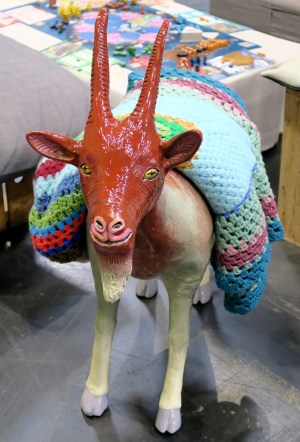
One of the reasons for attending conventions is the opportunity to see and play games that are not available elsewhere.  One example was Horticulture Master, a cute little Taiwanese game with beautiful artwork, which combined card collecting elements from Splendor with Tetris-like tile laying from games like Patchwork and Bärenpark.  Another cute little game was Titans of Quantitas from Gingerbread Games, a clever two player strategy game based round the old fashioned digital rendering of the number eighty-eight.  What really made this game special though was the fact that the stall was guarded by a fiberglass goat!  Not everything was quite as wholesome though, as one Games Master was thrown out and banned for life for including content in a role-playing game that allegedly involved sexual violence and played on the shock factor.  This is definitely the exception rather than the rule, however, and UK Games Expo is a great place for family and friends to spend a weekend.

UKGE 2019
– Image by boardGOATS

Boardgames in the News: The Consequences of Losing Catan—The Demise of Mayfair

The dramatic growth of Asmodee has been the subject of much comment over the last few years, but more recently it appeared to have slowed a little.  It would seem that perhaps the consequences are now beginning to kick in though.  Nearly two years ago, Asmodee acquired the rights to the English Language edition of the Catan series of games from Mayfair Games.  At the time there was some speculation as to the effect this would have on Mayfair as the Catan range had dominated their catalogue and provided a high proportion of their revenue.  The loss of such a large part of their portfolio inevitably led to major restructuring particularly as the then CEO of Mayfair, Pete Fenlon, left to become the CEO of the new Asmodee owned “Catan Studio” taking a bunch of other people with him.

The Settlers of Catan
– Image by boardGOATS

Thus, Mayfair not only lost the Catan franchise, but also their entire development team and graphics department. Essentially, they were left with Alex Yeager as lead developer, head of acquisitions, and marketing manager and a catalogue of about a hundred games including some of the popular 18xx series, Martin Wallace’s Steam, Caverna: The Cave Farmers, Lords of Vegas and Nuns on the Run.  Mayfair also had a controlling influence in the German company, Lookout Games which they had acquired back in 2013, and this partnership had produced games like Isle of Skye: From Chieftain to King, Costa Rica and Patchwork. The Mayfair strategy was primarily to focus on the partnership with Lookout while continuing to support their existing catalogue, and then, once that was stable, further develop the Mayfair-exclusive products.

Mayfair
– Image from twitter.com

Questions were first asked when Mayfair didn’t exhibit at PAX West or PAX Unplugged, despite featuring in the exhibitor list, though they did present as usual at BGG.CONAt the beginning of November, however, Alex Yeager announced that he had left Mayfair, and this, together with the earlier departure of Julie Yeager and Chuck Rice indicated that the chairs were being shifted on the deck of the Titanic, and there were rumours that Mayfair was in trouble.  Mayfair had not independently produced a new title since the loss of the Catan franchise, but they still had their controlling stake in Lookout Games and producing the English language version of the popular Lookout range of games seemed like the basis for a strong partnership.

Lookout Spiel
– Image from lookout-spiele.de

Lookout Spiele was a highly successful German company responsible for developing games like Agricola, and more recently Bärenpark and Grand Austria Hotel.  At Spiel in October, Mayfair and Lookout shared an extremely popular booth, and it seemed so successful that there were rumours that another merger was on the cards. Sadly however, this was not the case, and on Friday it was announced that Mayfair had sold its three remaining assets (their games inventory, the IP, and their 74% stake in Lookout GmbH) and was closing their doors after thirty-six years.  Simultaneously, Asmodee acquired the remaining 26% of Lookout from the original owner, Hanno Girk and on Friday announced their take-over of Lookout.  With that, one of the most productive and popular of the German board game companies joined the likes of Days of Wonder, Fantasy Flight Games, Space Cowboys, Z-man Games, Pearl Games, Ystari, Plaid Hat Games and of course Catan as yet another “Studio” in the great Asmodee Empire.
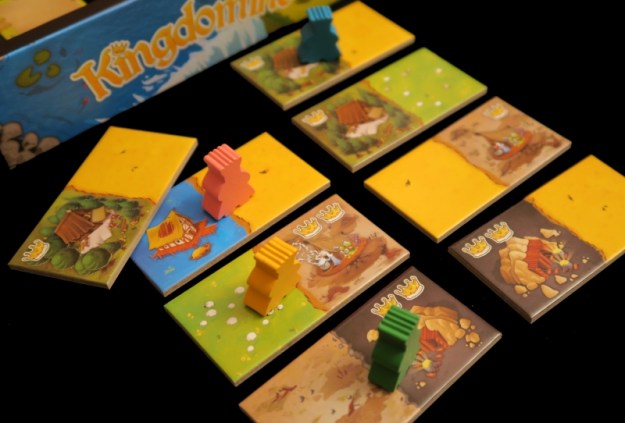
Asmodee
– Image from lookout-spiele.de

21st March 2017

As usual, we started with a debate about who would play what.  Green picked out a load of games he fancied, including The Voyages of Marco Polo which he had only played the once before and fancied playing again.  Blue commented that it was the sort of game that Ivory would probably enjoy and with Black having spent quite a bit of time playing it online, he joined the others to make a trio.  The Voyages of Marco Polo, won the Deutscher Spiele Preis in 2015 and was designed by the same pairing that put together Tzolk’in: The Mayan Calendar, another game we have enjoyed recently and is a game we should play more often.  The game is played over five rounds with players recreating Marco Polo’s journey to China via Jerusalem and Mesopotamia and over the “Silk Road”.  Each player has a different character and special power in the game.  Each round, the players roll their five personal dice and can perform use them to perform one action each per turn.  The actions include:  gathering resources, gathering camels, earning money, buying purchase orders and travelling.  The game ends with players receiving victory points for arriving in Beijing, fulfilling the most purchase orders, and having visited the cities on secret city cards that each player gets at the start of the game.

The Voyages of Marco Polo
– Image used with permission of BGG contributor henk.rolleman

Last time he played, Green had been very successful with Kubilai Khan.  This time, after dice rolling to see who started, Green got to go first, but although he had the opportunity to take Kubilai Khan again, he decided to go for a different challenge.  So this time Green went for Matteo Polo giving him the white dice and the extra contract every round.  Ivory was next and went for Mercator ex Tabriz, a potentially powerful character which would give him an extra resource every time anyone else got one from the favour track or resource selection track. Black, having played often online, opted for Kubilai Khan and starting from Beijing with the immediate ten point bonus, but no other advantage. The fourth character that was rejected by all, was Wilhelm von Rubruk who allowed the player to place houses on cities they passed through without the need to stop (Black commented afterwards that this was a a very difficult character to be successful with).  Next, each player received four destination cards from which to choose two.  With many groans of dismay everyone quickly discarded one card they felt was all but impossible to complete and then had to choose the worst of the remaining cards for the second discard. No one felt very happy with their selections, but the cards dictated the strategies.

The Voyages of Marco Polo
– Image used with permission of BGG contributor jsper

For Green the strategy was simple, get as many contracts completed as possible and not worry too much about travelling.  However, some of the contracts provided extra free movement on completion, so with minimal travelling some of the cities could be completed.  For much of the game Green and Ivory laboured under the false understanding that only one contract could be completed per round. This meant that after he had secured the resources he needed for his one contract, Green was left with some “spare” actions, which he decided to use for travelling and money collection. It was only at the end of the penultimate round that Black corrected their misunderstanding and that although only one contract could be completed per turn, several could be done per round!  It was all a little too late for Green though. The extra free contract he got in the last round was a doozy, giving him another new contract when completed, but only yielding three points. Unfortunately the new contract released was also low value at only two points (although it was then easy to complete).

The Voyages of Marco Polo
– Image used with permission of BGG contributor henk.rolleman

Meanwhile, Black quietly got on with his game, regularly choosing the six camel resource and buying black dice to travel slowly from Beijing, down the board, and releasing the three action city. He used this to good effect gaining lots of purple resource bundles for contracts. It was while activating one of these city actions he revealed that the number on the die used indicated the number of times it could used. Cries of foul play came from Green and Ivory. Green had used a four spot on the “coins for houses” action before and Ivory would have used his six die on it this round instead of the five coin action space. Black scurried to the rules and discovered that for this “coins for houses” action, it was the number of houses which could be claimed for by the die. In other words, he could use a die of two to claim only two houses even if he had three.  A player would need a three spot die to claim for all.  So in the end, nothing changed for Ivory and Green, though it was something to try to remember for next time.

The Voyages of Marco Polo
– Image used with permission of BGG contributor henk.rolleman

Ivory decided that money was important and regularly placed his die in the purse and the “five coin” action. He was able to do because he was gaining so many resources from Black and Green’s actions, thanks to his special character.  This kept his contracts ticking over and he managed to travel around the board and complete all but one of his cities and get to Beijing. This left him with with a dilemma in the final round:  he needed a high value die and used his spare camels to provide a black, but only rolled a one.  Green gave him another camel (thanks to his resource collection).  So Ivory placed in the favour track for two more and bought another black die, this time rolled a three…  In the end he decided to just take coins to try to get an extra point.

The Voyages of Marco Polo
– Image used with permission of BGG contributor punkin312

It was moot in the end.  Green managed seven contracts in all, one more than Ivory and two more than Black, so Green got the seven point bonus after all. With twenty-nine coins at the end he was one short of an extra bonus point, though it wouldn’t have been enough.  Black had made a mistake in his travelling and not got the cities he meant to – he failed to get one of his cards and only built two houses.  Despite this, his ten point bonus for Beijing and several high value contracts gave him second place.  Ivory had had a great game though, picking up six contracts, taking second place in Beijing, completing one city card and taking a full 10 points from four cities in total.  It was more than enough to give him a three point lead and win the game. Ivory decided that Blue was right, he had really enjoyed The Voyages of Marco Polo.

The Voyages of Marco Polo
– Image used with permission of
BGG contributor bovbossi

On the neighbouring table, Blue, Burgundy, Purple and Pine had started off with the “Feature Game”, Habitats,  This is a very light tile laying game, which comes with small ceramic animals instead of the more usual wooden player pieces.  There are a lot of tile laying games available, but there are a couple of things that make this one a little different.  Firstly, tiles selection:  there is an array of tiles and on their turn, players move their ceramic animal one step forward, left or right and take the tile it would have landed on and add it to their park.  Players can add their tile almost anywhere they want, so long as it borders at least one other tile.  The second unusual aspect of the game is the scoring:  tiles feature an animal and a terrain, but to score they most be surrounded by a set number of other given terrain tiles.  The game is played over four rounds with bonuses after the first three and final scoring at the end of the game.  Pine, with his orange Camel started out very strongly making him a bit of a target, however, although there is plenty of interaction, it is quite difficult to interfere with their plans a lot.  Burgundy started a little slower, but soon got his “extremely correct little Zebra” picking up tiles he wanted (as Pine said, “All zebras have a Hitler mustache and pink ears, don’t they?”).

Habitats
– Image used with permission of BGG contributor punkin312

Purple and her Penguin got a little trapped in the early stages, but got herself out of the mess quite quickly.  The bonuses were for the most different landscape tiles in the first round, different numbers of areas in the second and for a small compact park in the third.  They didn’t really seem to add much to the scores though, and with hindsight, some players might have done better ignore them completely as it is possible they were more of hindrance than a help since the most anyone got was five points (Pine and his orange Camel).  That said, the final scores were quite tight, with Blue and her yellow Leopard finishing just five points ahead of Pine who took a solid second.  On reflection, the difference was Blue’s effective use of Diagonal Tower tiles which allowed her to double score a lot of her animals.  Interestingly, the most recent edition of Spielbox had had a review of Habitats and they had been decidedly unimpressed.  While we agreed that it was quite a light game and certainly wasn’t long, the over-riding view was positive and Burgundy, summed it up when he commented, “Quite liked that”.

Habitats
– Image by BGG contributor styren

The Voyages of Marco Polo was still underway on the next table, so the group decided there was time for something else.  Pink had wanted to play Cottage Garden at the last Didcot Games Club meeting, but the number of players had been all wrong, so he had played it with Blue over the weekend.  Since it was fresh in her memory, there was a good chance of getting the rules right.  In any case, like Habitats, it is a fairly light tile-laying game, basically the boardgame equivalent of Tetris.  Cottage Garden is similar to the earlier, two-player game, Patchwork, but with a slightly different front-end and scoring mechanism.  The idea is that at on their turn, the active player chooses a tile from the appropriate row of the square “market garden”, and add it to one of their two flower beds.  If they have completed one or both of their flower beds by the end of their turn, then they are scored.

Cottage Garden
– Image used with permission of boardgamephotos

Scoring is a little unusual:  each flower bed (and some flower tiles) feature plant pots and cloches these are scored separately using players personal score tracks.  Each track ends at twenty and each player has three cubes they can use for scoring.  Placing tiles is facilitated by pussy-cats;  each player starts with two sleeping moggy tiles which they can place at any point on their turn to fill up odd spaces and keep the game moving.  The “market garden” is really quite interesting, though with four it can feel a little random.  The gardener moves round the board so that players choose tiles from successive rows, the idea being that players try to take a tile and plan what they might get next time.  This planning is quite difficult with four though as there is a high chance that a player’s next tile will have to be taken from a row diagonal or orthogonal to their previous one which means it is highly likely that someone will have taken what they want.  So, for the most part, the game is quite simple, with a lot of depth.  However, the final round is a little more tricky and jars a bit.

Cottage Garden
– Image used with permission of boardgamephotos

To ensure that anyone who has just started new flower beds doesn’t have a large advantage (due to the number of extra moves they would otherwise get), any beds with two flower tiles or fewer is discarded, and from the start of the final round players painfully lose two points per turn until they finish their final bed.  Again, Pine made the early running picking up two bonus beehive points for being the first player to get one of his markers to twenty points.  Blue wasn’t far behind though and just pipped Purple and Burgundy to the other beehive bonus.  One of the really nice things about this game is its rendition and we all had a good time playing with the little wheelbarrow.  Although Purple had played Patchwork quite a bit, spacial awareness is not really her thing and she and Burgundy struggled a little.  Blue on the other hand, works a lot with symmetry and with the extra experience she soon began to catch Pine and by the end of the game had pushed him into second place.

Cottage Garden
– Image used with permission of boardgamephotos

The most recent edition of Spielbox had also included a review Cottage Garden which had received similar treatment to Habitats.  Although we enjoyed the latter more, weconcluded that Cottage Garden wasn’t a bad game, but the penultimate round dragged a little and the final round felt a bit odd.  There’s also no development of the game over it’s duration, i.e. each player is just trying to fill as many beds as possible doing the same thing over and over again, which can make it feel a little repetitive.  That said, Blue felt she had enjoyed it more as a two-player game over the weekend as there is more scope for planning, so it is possible that four is too many players.  Indeed, nearly 70% of voters on Boardgamegeek are of the opinion that the game is best with three, and that could be a fair conclusion.

Cottage Garden
– Image used with permission of boardgamephotos

With The Voyages of Marco Polo coming to an end as well and lots of people quite tired, there was just time for Blue to have another go at beating Burgundy at Splendor.  This has become and almost fortnightly grudge match, with Burgundy proving to be almost impregnable.  This simple set collecting, engine builder is often derided as boring and trivial, yet it is the simplicity coupled with the subtitles that seem to make it so compelling.  As is so often the way, Blue started off OK, but this time very quickly fell behind.  Burgundy quickly picked up a noble, and although Blue took one as well, and had plans for picking up points, the writing was on the wall long before Burgundy took the third noble and announced he had fifteen points.  Blue will have to bring her A-game if she is ever to beat her “Splendid Nemesis”.

Splendor
– Image used with permission of boardgamephotos

Learning outcome:  Spielbox isn’t always right.

Boardgames in the News: Mayfair Games – Is there a Future without Catan?

Mayfair Games began in 1981 as a small US games company based in Illinois. One of their first games was Empire Builder, their first and now the flagship of their “crayon-rails” series of games where players, using washable crayons, draw their train routes over a map of North America.  Building on this success, Mayfair then went on to play a pivotal role in bringing Euro games to the US and wider English speaking markets.

Empire Builder
– Image used with permission of BGG contributor Billythehut

In 1996, Mayfair Games picked up the license to produce an English edition of Die Siedler von Catan, The Settlers of Catan (now known simply as “Catan”).  With the huge success of the game world-wide, over the next twenty years, Mayfair brought out multiple new editions of the base game modernising and updating it, English editions of all the expansions, variants and spin-offs.  Mayfair (with Kosmos) were also behind the release of Star Trek: Catan in 2012, the first Catan game with a licensed theme.  For many, Mayfair Games has become synonymous with Catan, in the English speaking world in any case.  As such, the news yesterday that Asmodee has acquired the rights to produce the English language version of everything “Catan”, has left a lot of people wondering where that now leaves Mayfair Games.

Star Trek Catan
– Image used with permission of BGG contributor henk.rolleman

With the shear quantity and popularity of the Catan games it was inevitable that Catan would dominate the catalogue of Mayfair, but is this the beginning of the end for Mayfair Games?  Well, it’s true that no company can take such a major amputation and come out unscathed, so the loss of this part of their portfolio has inevitably led to major restructuring.  The former CEO of Mayfair, Pete Fenlon left to become the CEO of the new Asmodee owned “Catan Studio” taking a bunch of other people with him including the Director of Marketing,.  This left a hole that will be filled by a the current President, Larry Roznai; the head of Acquisition & Development, Alex Yeager; and a lot of chair shuffling.  Aside from that, shareholders received healthy payouts and there’s been a major contraction in the size of the company, to something similar to where it was in 2007-2008.

The Settlers of Catan
– Image by boardGOATS

It may be that the fact that Asmodee only took the rights to the Catan empire rather than buying the company out wholesale is indicative, and could be viewed as asset-stripping.  In which case, there is probably little hope for what remains of Mayfair Games.  If the whole-sale purchase scenario had played out, it is almost certain that the rest of the Mayfair catalogue would have been shelved and the company would have de facto become “Studio Catan” by another name.  The fact that this has not come to pass suggests that the personnel remaining believe there is more to the Mayfair than just “Catan”.

1830: Railways & Robber Barons
– Image used with permission of BGG contributor Zoroastro

So, what is Mayfair left with?  Well, there are a hundred odd games currently produced by Mayfair including some of the popular 18xx series, Martin Wallace’s Steam, the massive Caverna: The Cave Farmers and Nuns on the Run.  In 2013 Mayfair also acquired a controlling interest in the German company, Lookout Games, who historically have produced some fantastic games (including Agricola).  This partnership has already produced Grand Austria Hotel; Isle of Skye: From Chieftain to King; and Patchwork.  This suggests that where the “Old Mayfair” had stagnated a little, becoming somewhat dependent on the Catan franchise, the New Mayfair might be forced to change direction for the better, forming a leaner, more innovative company producing exciting new games.  Perhaps the future is not so bleak for Mayfair after all, but only time will really tell.

Isle of Skye: From Chieftain to King
– Image used with permission of BGG contributor henk.rolleman

Spiel des Jahres Nominations – 2015

Each year a jury of German-speaking board game critics (from Germany, Austria, Switzerland), review all the games released in Germany in the preceding twelve months.  Their job is a really important one amongst gamers, because they award the coveted Spiel des Jahres, the German Game of the Year.  There are also other awards including the Kinderspiel and Kennerspiel des Jahres (Childrens’ and Connoisseurs’ Games of the Year).   These awards are highly lucrative for the winners as many German families look for the red logo when choosing games to buy at Christmas.

Spiel des Jahres
– Image from spieldesjahres.de

The criteria used by the judges include:

  • game concept (originality, playability, game value),
  • design (functionality, workmanship),
  • layout (box, board, rules),
  • rule structure (composition, clearness, comprehensibility).

The announcement of the Spiel and Kennerspiel des Jahres awards will be made early in July.  Last year, the winner was Camel Up with Splendor as runner-up and Istanbul taking the Kennerspiel des Jahres award.  The nominees for this year have just been announced and this year, unusually, we haven’t played any of them in the group yet.  However, one of our more popular two-player games, Patchwork was included as a recommended game and we are planning to play one of the nominees, Machi Koro, this week.

10th March 2015

Since Blue was late ordering her pizza we were late starting our first game.  It was a relatively quiet evening, but we began splitting into two groups, the first of which played the “Feature Game”, Dominion.  This is a card drafting game where the players are monarchs, ruling a small pleasant kingdom of rivers and evergreens trying to build a bigger and more pleasant kingdom, with more rivers and a wider variety of trees – a Dominion in fact.

Dominion
– Image by BGG contributor Filippos

Basically, each player starts with an identical, very small deck of cards from which they draw a hand of five.  On their turn, players do three things:  play an action card, buy cards, then discard any cards they have left and draw an new hand of five cards.  The aim of the game is to have the most points at the end.  Experience is clearly a big advantage, as the balance of the deck is critical to a player’s success.  It was no surprise, therefore, that Burgundy and Green were fighting it out for first place.  Green squeaked in ahead having picked up a lot of duchy cards in the last few rounds.

Dominion
– Image used with permission of BGG contributor garyjames

Meanwhile, Purple and Black played Patchwork.  This is a cute little two-player game that was first played on a Tuesday in January.  The idea is that players compete to build the most aesthetic (and high-scoring) patchwork quilt, buying Tetris-like patches with buttons.  The last time Black won, so Purple was hoping to redress the balance, but sadly, it was not to be.

Patchwork
– Image used with permission of BGG contributor greetingsfrombergen

Both games finished pretty much simultaneously, leaving us with the decision: play one six player game, or two three player games.  There was only one real six player option and that was Keyflower.  Green offered the decision to Grey who, much to Blue’s obvious delight, opted for the large group game.  We’ve played Keyflower an awful lot (especially considering it is one of the heavier games that we play), but only once with the full six players.  On that occasion, Blue had managed to squander a winning position when she misjudged Green’s strength – something she was determined not to do again.

Keyflower
– Image by boardGOATS

Winter tiles were handed out and Green announced that he was just going to play what came up rather than play to a strategy.  Everyone else said that that was what they always did because there was always someone else who broke any strategy they had.  And that is pretty much exactly what happened  to most players this time too.  Grey went for the Green Keyples in a big way and Black went for tiles.  Purple tried to control the game with the start meeple while Burgundy ended up with a glut of yellow Keyples so decided to try to do something useful with them by turning them into more Keyples.  Green meanwhile was struggling to do anything and Blue, who was the only person with any supply of iron, managed to pick up the Blacksmith to go with it and quietly began producing iron and moving it onto the Blacksmith tile.

Keyflower
– Image by boardGOATS

As we moved into winter, everyone was so mesmerised by Grey who managed to completely exhaust the supply of green Keyples and Burgundy who was amassing a huge number of points, that nobody spotted Blue and her Blacksmith or Black and his tile collecting.  Eventually, Burgundy stopped pulling Keyples out of the bag and we moved into scoring, and it turned out to be a surprisingly close game.  Blue’s iron meant she finished six points clear of Burgundy who took second place with Black and Grey close behind.

Keyflower
– Image used with permission of BGG contributor ilogico

Learning Outcome:  If you usually win, don’t be surprised if you lose when you change the way you play.