Tag Archives: Saboteur

13th May 2025 (Report)

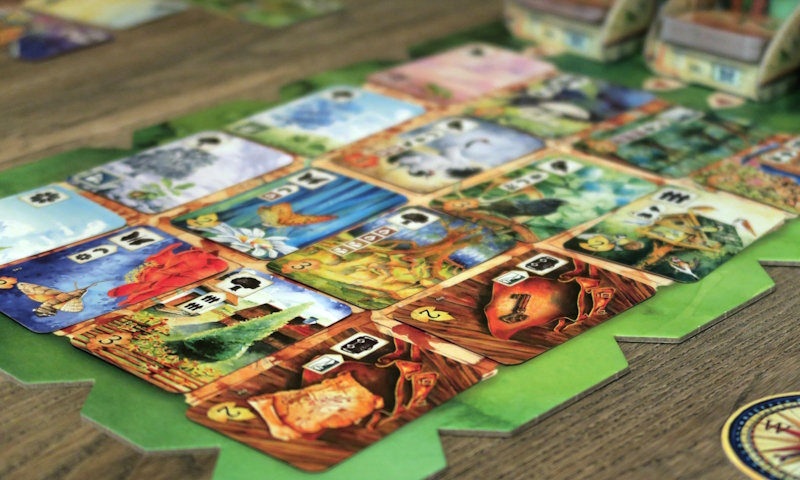
For some, the evening began early with fish and chips in the garden to mark a special visit from Plum’s Aunt Damson.  The evening took an even more special turn as it was the day before Pine’s Big Birthday, so there was cake.  Green also put in one of his special appearances, bringing his mum, Saffron, with him.  Salmon came for the second time, and lastly, Orange, who had acquired a motorbike and was therefore now able to travel, also came for the first time in about eighteen months.  So with all these extras as well as the usual suspects, the room was packed and the group split into four with Jade leading the “Feature Game” which was to be Moon, a card drafting game where players construct bases, vying to build the new lunar capital.
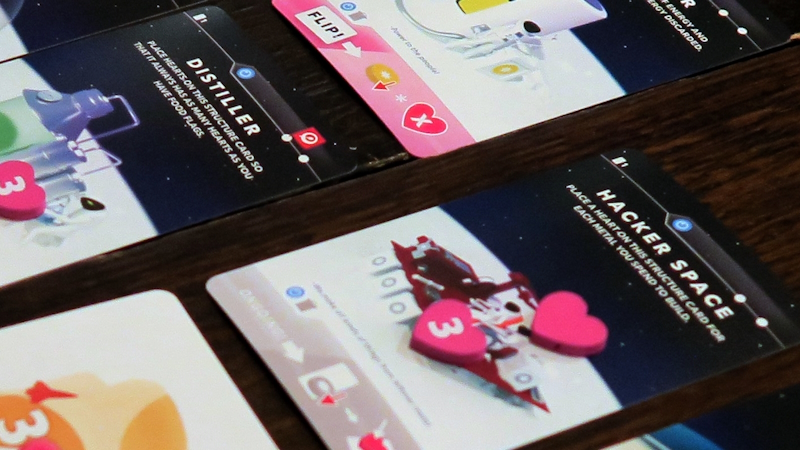
Moon
– Image by boardGOATS

Moon is played over three rounds or Eras, collectively representing the first hundred years of populating the Moon.  Each Era is divided into three parts:  first players produce Resources, Rovers and Hearts from their Settlements.  Then comes the drafting where players choose a card from their hand to Build or discard, then pass their hand to the next player, repeating until there are no cards left.  Finally, players claim the Hearts on the central Flag Reward Board, and score any Hearts placed on their Structures and Reputation Cards.  At the start of the drafting phase, each player has one Expedition cards while the rest of the cards are Structure cards—this hand of cards represents an expedition from Earth that travels between settlements on the Moon.
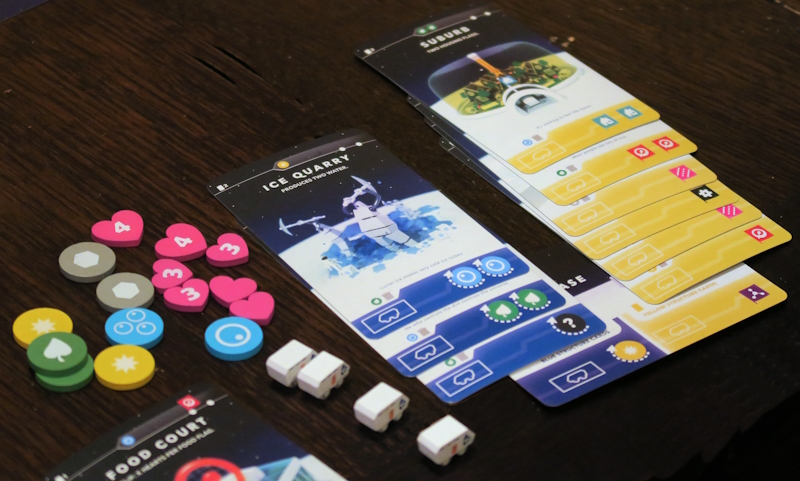
Moon
– Image by boardGOATS

Unlike most card-drafting games, turns are taken sequentially with, players a Structure card from their hand and placing it in their Settlement paying any Resources and making sure any Flag Requirements are fulfilled.  Alternatively, instead of playing a card, they can discard (or “Assimilate”) a card, taking the Resources, Rovers or Hearts depicted in the discard line.  There are also four optional actions that players can carry out once each in any order before or after their mandatory action (Building or Assimilating)—use the Bonus Action on their Expedition Card; park a Rover; claim a Reputation card, or turn over a pink Action card.
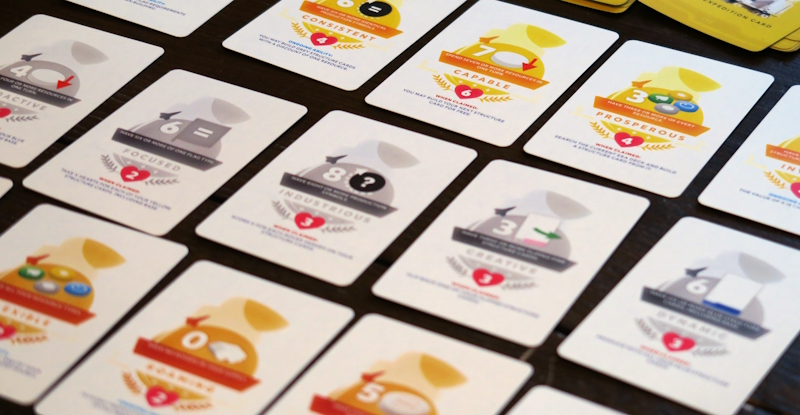
Moon
– Image by boardGOATS

Once all players have taken their turn, all players pass their hands (including the Expedition card) to the player seated to their left and the player who now has the First Expedition Card starts the next round.  There are some similarities with Terraforming Mars, with cards having “Flags” (akin to the “Tags”), with some cards needing some Flags as a prerequisite while others display and therefore provide them.  There are five different Flags, Industry, Science, Food, Housing, and Transportation.  There are also four different types of Resource, Energy, Water, Biomass and Metal which are represented by wooden tokens, or Resource-eeples.
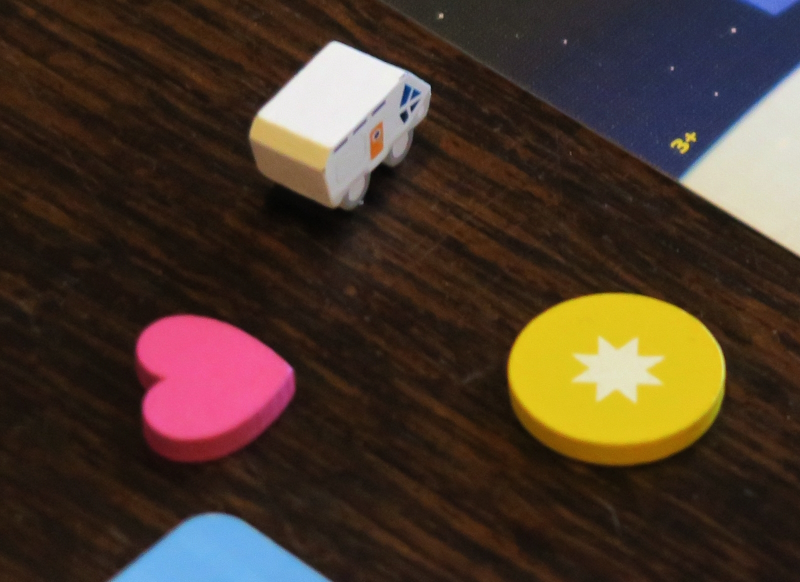
Moon
– Image by boardGOATS

The guts of the game are the cards—there are five different types:  blue Production cards, yellow Flag cards, pink Ability cards, grey Excitement cards and red Special cards.  Blue and yellow Structure cards also display a Rover parking space.  Players begin the game with two Rover-eeples, but can acquire more during the game.  Players can park Rovers on other players’ Structures to either use the card to immediately gain its Resources (blue) or use the Flags on it to fulfill a Flag Requirement when Building (yellow). Pink Ability cards provide an ability players can use once per Era by flipping the card while grey Excitement cards provide Hearts, which are victory points—some of these just give points at the end of the game while others give Hearts during the game.
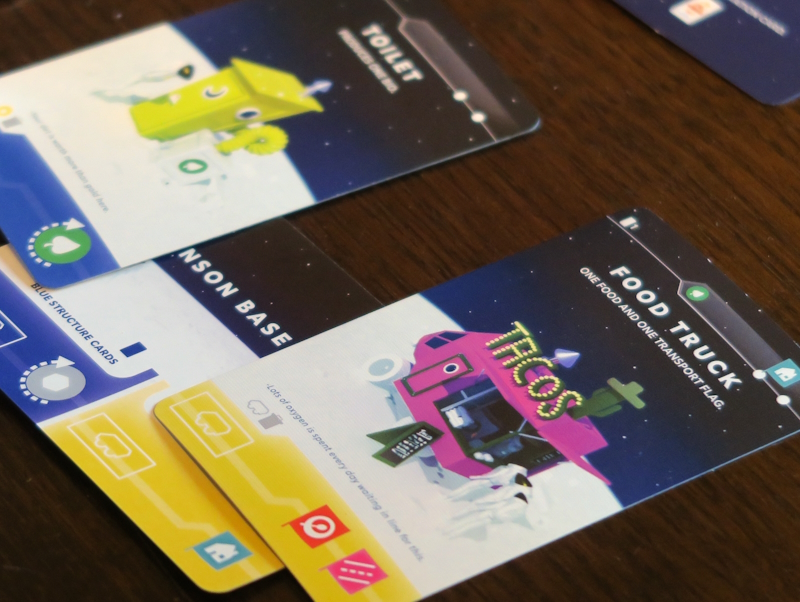
Moon
– Image by boardGOATS

There was some hilarity over the card names, especially when Orange built a Toilet right next to his food van, Just in case!  Jade who was the most familiar with the game, took an early lead in the Hearts and finished with what appeared at first glance to be an unassailable lead with fifty-six of them, fifteen more than anyone else.  There are other scoring opportunities however, with points available for Grey Structures and Reputation Cards, and Jade came off worst for both of these.  Black picked up the most points for his Grey Structures with thirty followed by Pine with twenty-seven.  Scores were much lower for Reputation with Black, Sapphire and Pine with a similar tally.  In the end, it was very close, but the victory was Sapphire with a combined total of seventy-nine, just two more than Black in second, with Jade completing the podium.

Moon
– Image by boardGOATS

On the next table, Ivory and Byzantium were introducing Salmon to Brass: Birmingham.  There was a concern after last time that they might be a bit pushed to finish it in time (especially after last time), but with only three and with Birmingham being quicker to play than the original Lancashire version, they felt it was worth a go.  Ivory explained the rules while Byzantium set up the board.  In both games, players develop, build and establish their industries and network in an effort to exploit low or high market demands.  Players take turns according to the turn order track, paying two cards (from their hand of eight) to take any two actions from a possible six: Build, Network, Develop, Sell (cotton, manufactured goods or pottery), Borrow, and Scout.
Brass: Birmingham
– Image by boardGOATS

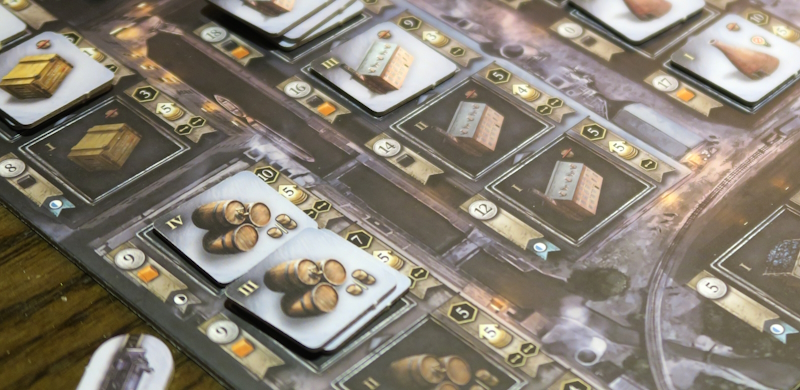
Building involves paying the required resources to place an industry tile while Networking is placing a Rail or Canal Link.  When Developing, players increase the point value of an industry, while Borrowing involves taking a £30 loan and a reduction in income.  The Scout action is new to the Birmingham game and replaces the Double Action Build in original, instead discarding three cards and taking a wild location and wild industry card.  Played in two halves, when the deck runs out players score, remove all the Canal Links then play on but this time building Rails.  The game ends when the deck runs out for the second time.

Brass: Birmingham
– Image by boardGOATS

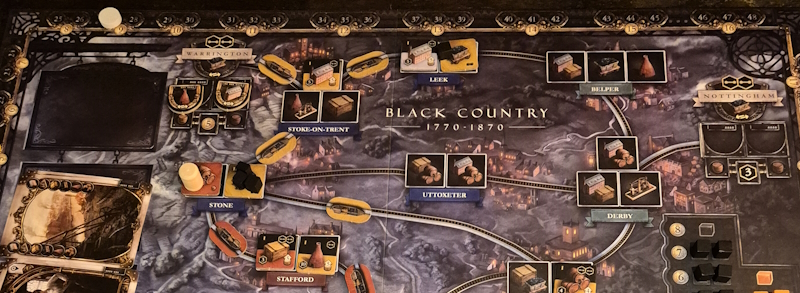
Ivory went first.  Due to Shrewsbury accepting all goods (this was randomly determined as part of set up) and selling goods being critical to scoring points, initially everyone focused on building near there and building industries that gave resources (i.e. coal and iron) that were going to be need to build further industries.  So Ivory, who went first began by building a Coal Mine in Coalbrookdale, while Byzantium added an Iron Works at the same location and Salmon placed a Coal Mine next door in Wolverhampton. At the start it looked like all three would all be competing in the same area, but once they continued building their networks (via Canals) and more industries, everyone started to spread out.  Ivory headed south, building Cotton Mills in Kidderminster and Worcester and was the first player to Sell, Selling to Shrewsbury and gaining four points for consuming Beer there (Beer being a prerequisite to Selling) and filling the tile to increase his income.
Brass: Birmingham
– Image by boardGOATS

Byzantium went north and sold Cotton to Warrington, gaining £5 as his “Beer Bonus”, and increased his income. Seeing the opportunity Byzantium was building, Ivory took the opportunity using a Leek card he had which allowed him to build outside his network, to build a Cotton Mill in Leek and immediately Selling, using the remaining Beer there to also gain £5. Salmon went more central (Cannok and Walsall), focusing on Coal Mines and Iron Works, but as no one was consuming the resources (both Byzantium and Ivory were slightly self-sufficient), he was unable to flip his industries and increase his income. This became a major issue for him as the game progressed. Everyone ran out of money quite quickly and were forced to take out Loans, decreasing their income making it negative so that they had to pay money to the bank at the end of each round.

Brass: Birmingham
– Image by boardGOATS

Whereas Byzantium and Ivory promptly Sold some Goods, flipped tiles and increased their  income so it was positive again, Salmon got caught in a debt trap, having to take further Loans to take actions and service his debt. When required to take a third Loan (and then pay £9 each in upkeep), it was agreed that he should take the Loan without the drop in income, allowing him to take actions and sell goods and ultimately get back to a positive income. After a late era focus on breweries to get the Beer to Sell further goods, cotton and in Byzantium’s case, Pottery, the Canal Era came to an end. After scoring flipped tiles and Canal Links, Ivory had a slight lead.
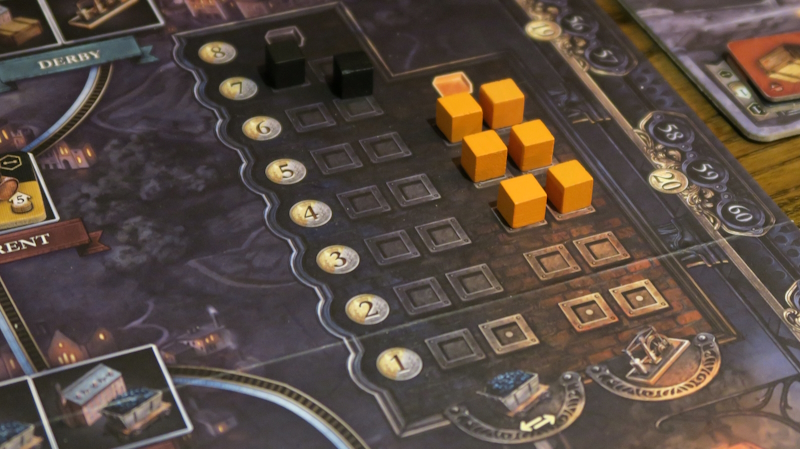
Brass: Birmingham
– Image by boardGOATS

At the end of the Canal Era and going into the Rail Era, as well as all the Canals, all Level 1 tiles are removed from the board, representing obsolete technologies.  This wiped out everything Ivory had and most of Byzantium and Salmon’s tiles, so the start of the Rail Era was similar to the beginning of the game.  That said, Byzantium and Salmon were tied to their positions because, without a named card, players always have extend their Network from an existing position if they can.  That meant, Byzantium and Salmon always had something that was going to score twice though, where as Ivory had to build from scratch, but was free to start anywhere.
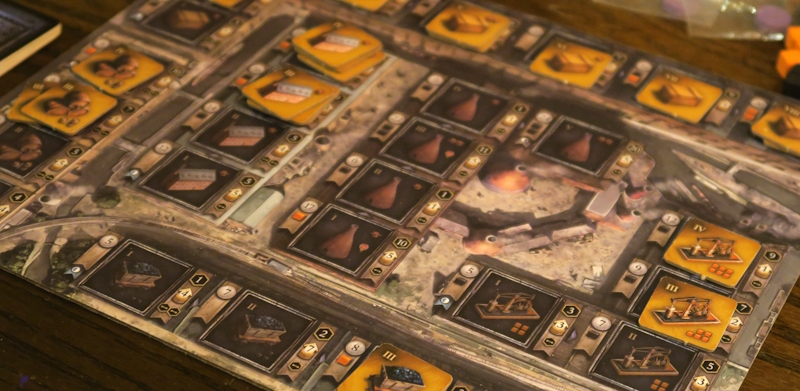
Brass: Birmingham
– Image by boardGOATS

With Rail connections requiring Coal to build, and because the cards in Ivory’s hand were all close to Shrewsbury (which that accepted all goods), he began the second Era almost exactly the same action way as he started the first, building a Coal Mine in Coalbrookdale. Although he had nothing on the board, Ivory was able to rebuild very quickly, partly because he had a good income, but also because he had taken a Loan as his very last action in the Canal Era.  Salmon and Byzantium also built their Networks in similar areas to the first Era. Byzantium’s core strategy was building and selling pottery to Warrington.
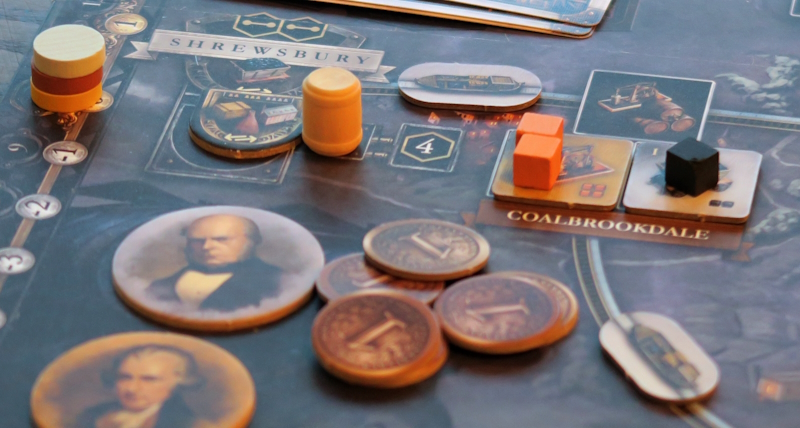
Brass: Birmingham
– Image by boardGOATS

Pottery is a unique resource in Brass: Birmingham, with the first pottery title being worth a large amount of points when flipped, the next being worth very little, the next giving big points etc.. Players are also restricted in developing Pottery, which mean they can’t skip the low point value titles. However, the big scoring tiles are worth a lot and Byzantium was able to get the highest level title out and flipped for a total of twenty points. Ivory again focused on the more standard cotton Mills, and each title being worth more points than the last, he was able to get multiple titles placed and Cotton sold, flipping the tiles to Shrewsbury. He also spent actions building lots of rail links next to his flipped tiles.
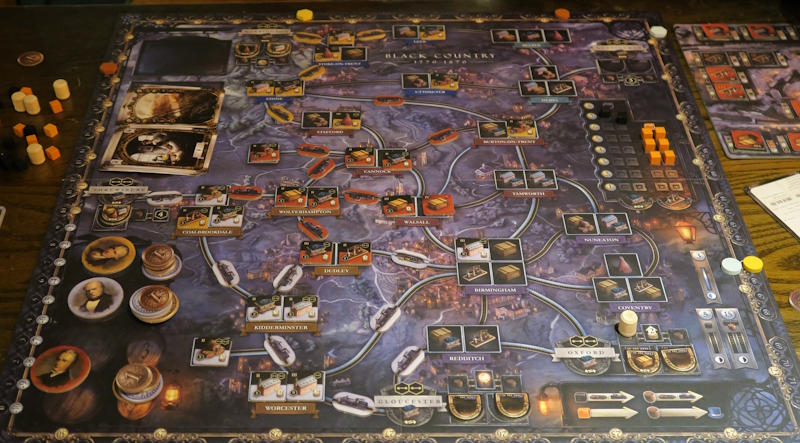
Brass: Birmingham
– Image by boardGOATS

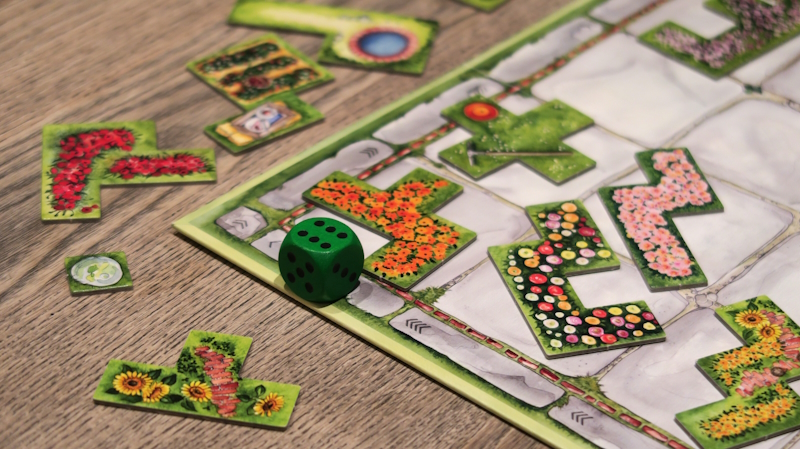
Salmon again took a different approach, focusing on goods, the easiest to build and flip (especially as some don’t need beer), but these are not worth as many points. The game ended after all the cards had been played (for a second time), with Ivory’s focus on rail links and Cotton giving him victory over Byzantium by about twenty points.  Meanwhile, Teal beginning to explain the rules for Cottage Garden to Plum, Plum’s Aunt Damson and Blue, but then Ruby arrived.  Blue had cake to dispense and had a curiosity about Brass, so quickly offered her seat to Ruby and the Teal began again.  Cottage Garden is a fairly straight-forward Tetrissy, puzzle-type, polyomino game with a similar feel to Patchwork, but with more people.

Cottage Garden
– Image by boardGOATS

In Cottage Garden, players are competing in the art of gardening and are working two beds with a variety of flowers.  To do this, players select polyomino tiles of flower beds from a central market grid (restricted by the location of the “Gardener”), then place them on one of their two personal garden boards. Each board has several garden elements that are worth points when not planted over, and these are scored (on two different tracks) as soon as a garden has been completed. There are points “bars” on each track, and when these are passed players receive bonus tokens that can fill in empty spaces or give players a better selection of the flower bed tiles.

Cottage Garden
– Image by boardGOATS

Once a garden is finished, the player receives a new one to complete. After the Gardener completes her fifth lap around the market, the game enters its final round, after which, the player with the most points from their completed gardens is the winner.  The received wisdom is that the problem with the game is that it doesn’t change or intensify, which some people find boring.  However it also means that players have time to “get their eye in” and learn how to play without the game evolving beneath them and catching them out as they spend whole time playing chase.  As such, it was pretty much the perfect game for the occasion.

Cottage Garden
– Image by boardGOATS

Everyone did pretty well—Ruby picked up the scoring quickest, but Aunt Damson got the first beehive.  Teal wasn’t far behind though, getting the second.  In the final round, Plum just scored her current flower bed and discarded the second so that she didn’t get any negative points, something that turned out to be a critical decision in a very tight game.Plum and Teal had the edge in scoring for Pots, but that was off-set by Ruby’s scoring for her Cloches and and Aunt Damson’s Beehives.  Teal, Ruby and Aunt Damson were all within a couple of points, but the victor, was Plum with fifty-six, just three points clear of Ruby who edged second from Teal.
Cottage Garden
– Image by boardGOATS

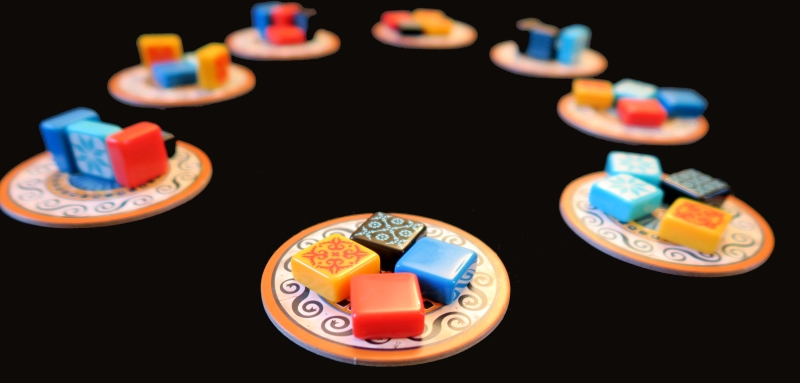
In addition to Aunt Damson, Green had brought his mother, Saffron who was visiting. the area  Saffron was quite well known to some of the group so there was quite a bit of chatter before she joined Green, Lime and Purple in a game of Azul.  This is a game that is well known within the group and with everyone familiar, the rules explanation could be kept short:  the game uses a very simple, but very clever market mechanic where players take all the tiles of one colour from a market stall and put the rest into a the centre, or take all the tiles of one colour from the centre.
Azul
– Image by boardGOATS

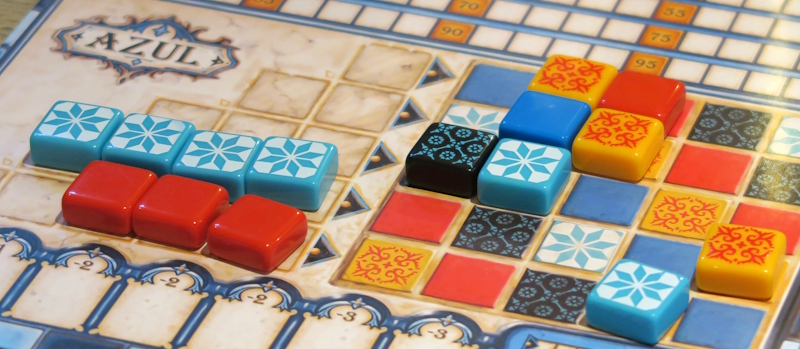
As soon as they have taken the tiles, players add them to one of the rows on their player board.  At the end of the round, one tile in each full row is moved into their mosaic.  The game ends when one player completes one full row of their mosaic.  Players score points when they add tiles to their mosaic (one point for each tile in the row and column it forms), and receive bonuses for completed rows, columns and any completed sets in their mosaic.  The catch is that each feeder row can only contain one colour and and if there are left-overs when they add to it, these score negative points.  Further, each row in a player’s mosaic can only have one tile of each colour.
Azul
– Image by boardGOATS

This time, Lime nearly got caught out, however, after Blue was summoned for a rules adjudication.  The question was, was he able to have more than one feeder row in a colour?  If they all had to be different he would be forced to place a lot of tiles in his overflow space and pick up a pile of negative points.  As the rules are clear and players can have as many feeder rows of the same colour as they like at any point during the game (they can only put each colour in a row of the mosaic once), Lime dodged a bit of a bullet.  As a result, he just edged it taking victory by three points from Green with Saffron a few points behind him.

Azul
– Image by boardGOATS

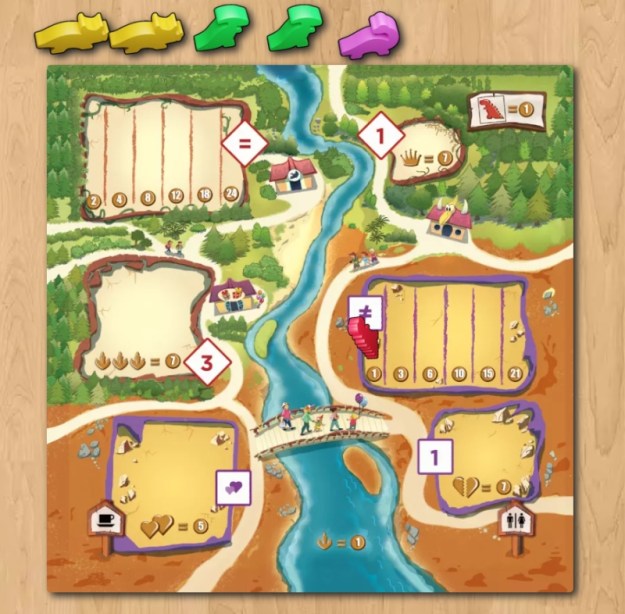
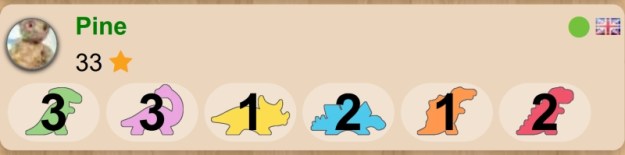
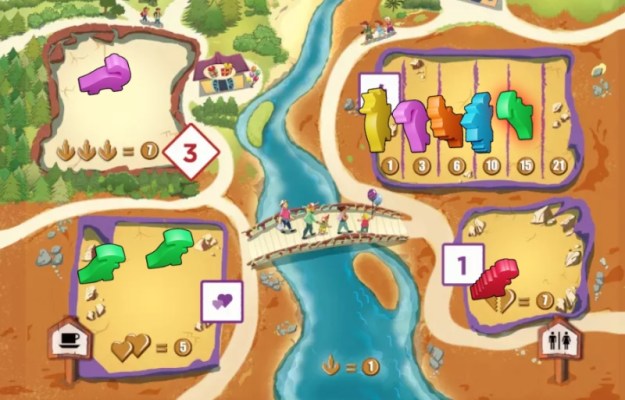
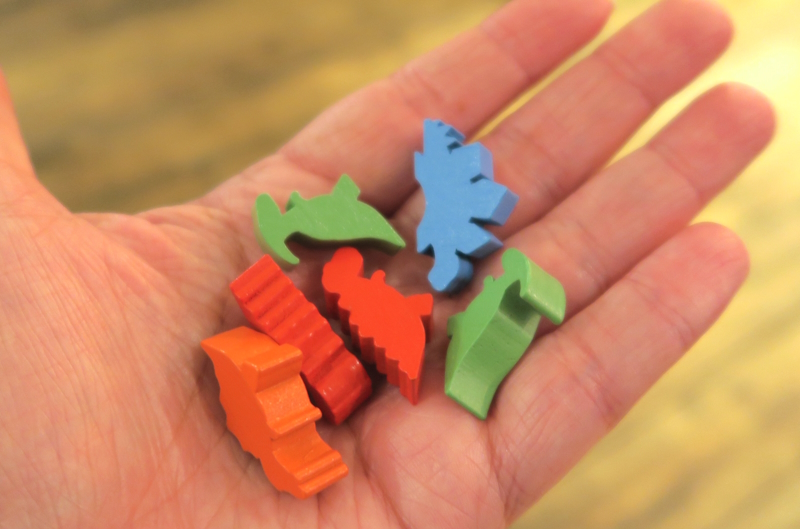
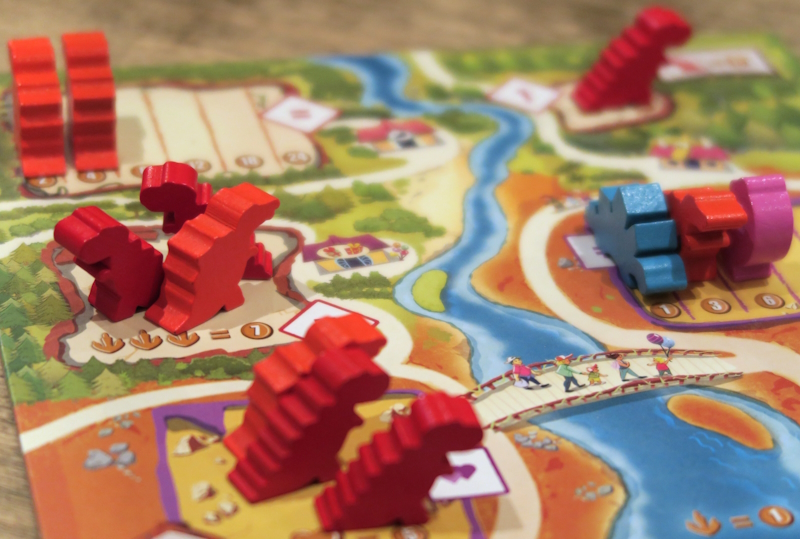
With everything else still going, when Azul finished, Blue joined the table to introduce Saffron to another one of the groups favourite games, Draftosaurus.  This is a very simple drafting game (similar to games like Sushi Go! where players choose from a hand of cards and pass the hand on), but in this case players are drafting cool dino-meeples and adding them to their dinosaur park, with different locations scoring for different combinations of dinosaurs. The game is played over two rounds, each placing six dinosaurs.  The first game was a bit of a land-slide although it ended in a tie between Green and his mum, Saffron, both scoring thirty-seven points.
Draftosaurus
– Image by boardGOATS

It couldn’t be left there of course, so the group “did a Lime” and played again.  This time it wasn’t until the scoring that Green realised why he hadn’t seen a single T. rex—Blue sat to his right had nabbed them all before he got to see them!  T. rex is a special dinosaur in general, but especially in Draftosaurus, giving an extra point for each one, but also having some placement restrictions.  Blue is generally very bad at this game, but even a park full of dinosaur kings (and queens) didn’t help, although it was a very close game with four players within a couple of points.  The clear victory though was Purple with thirty-eight, three points ahead of Lime who led the rest of the pack.
Draftosaurus
– Image by boardGOATS

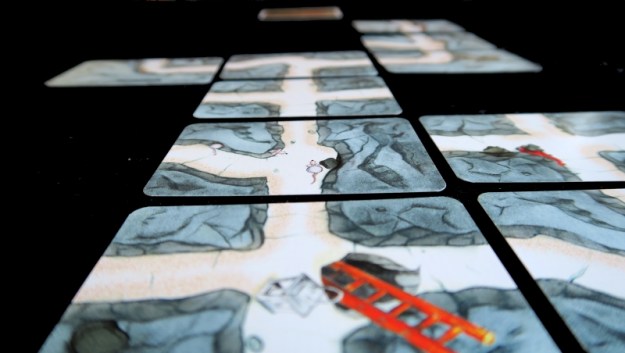
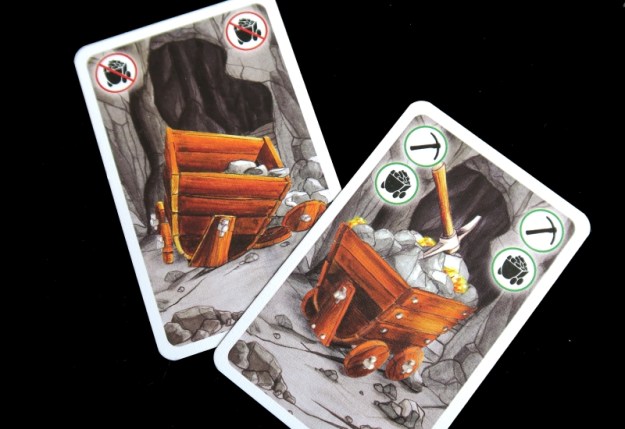
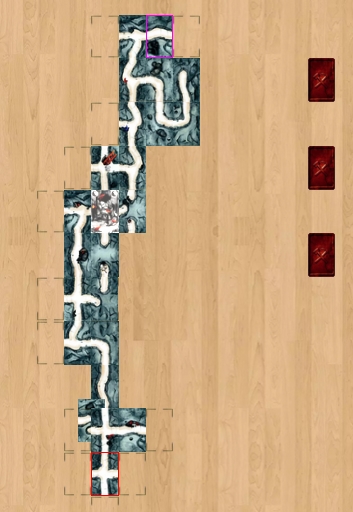
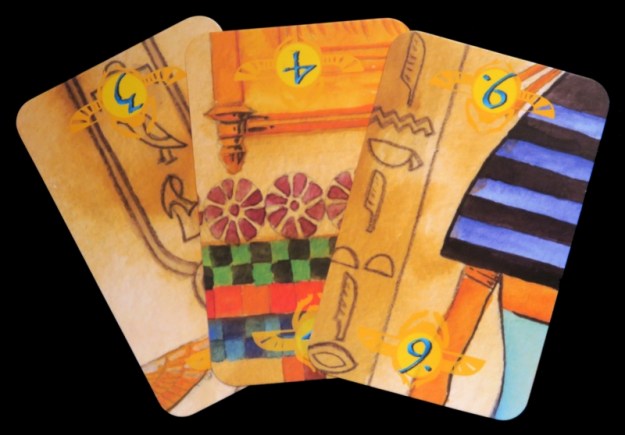
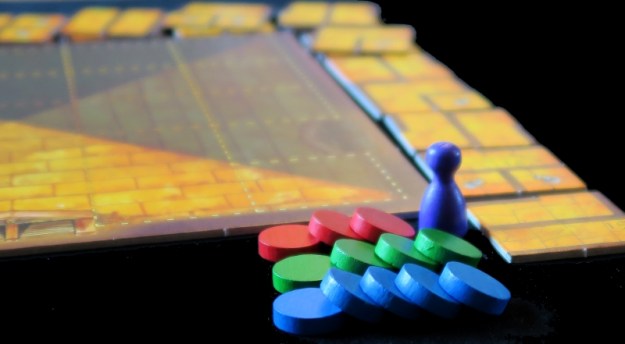
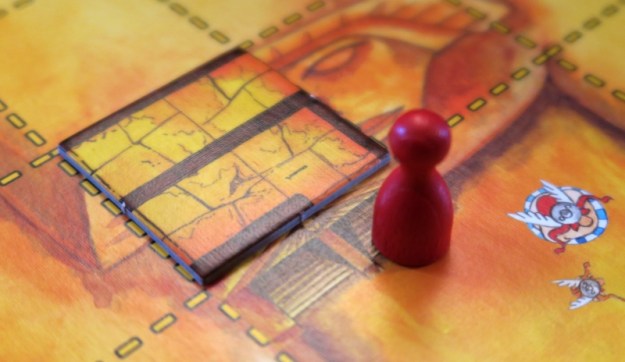
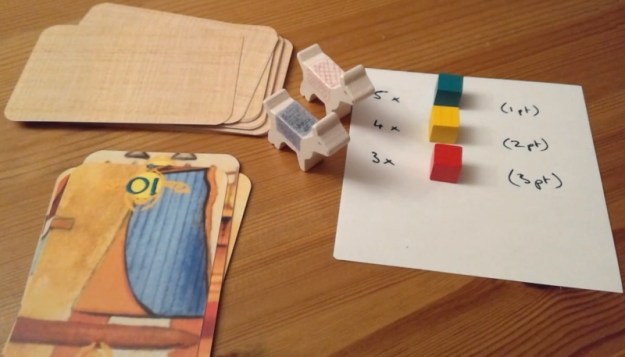
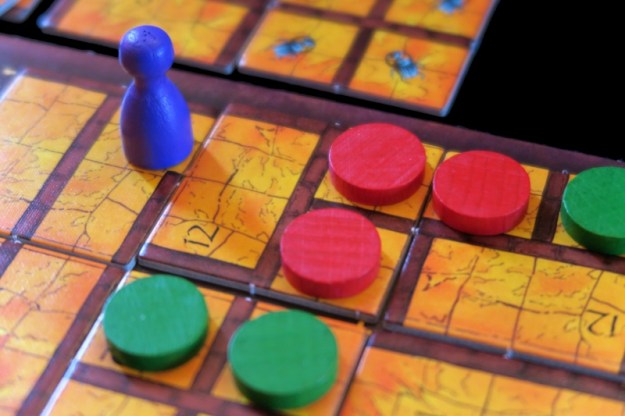
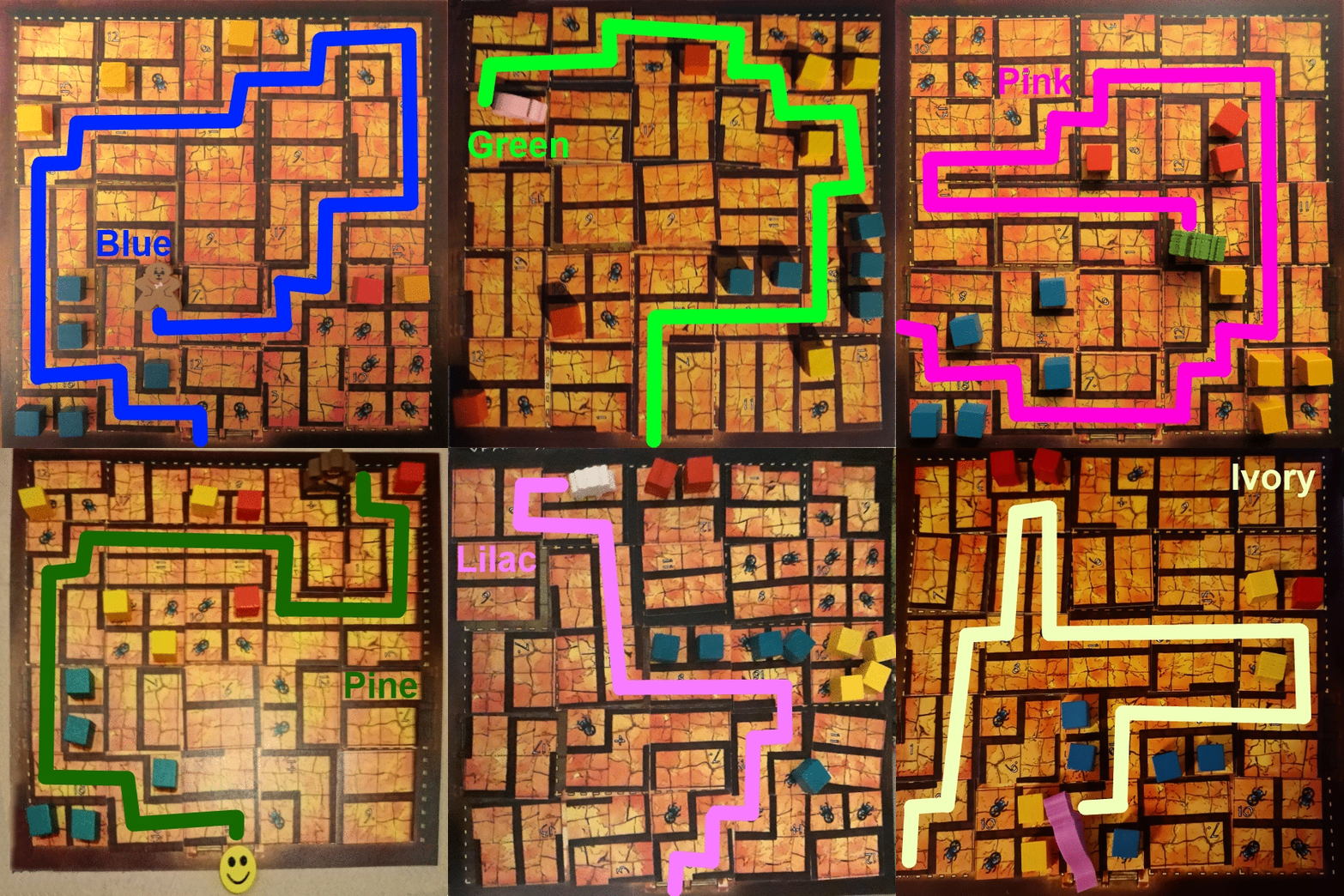
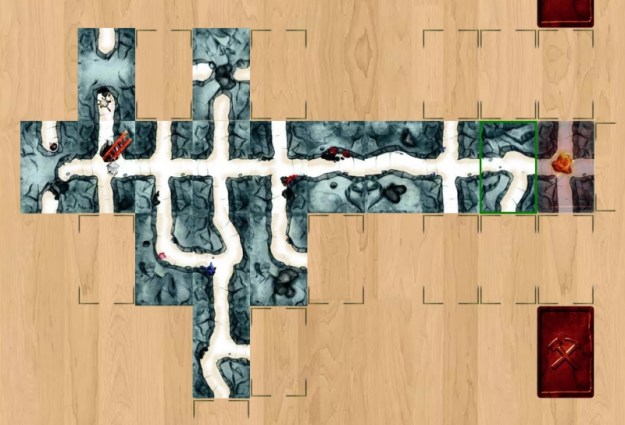
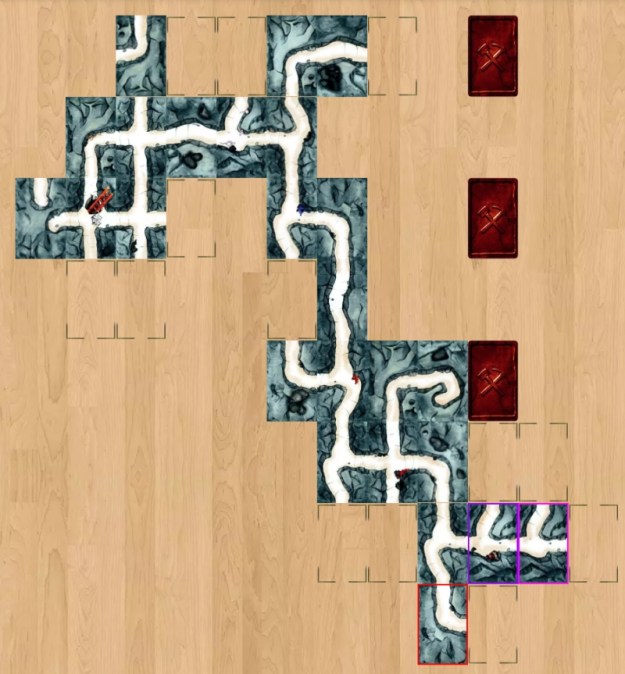
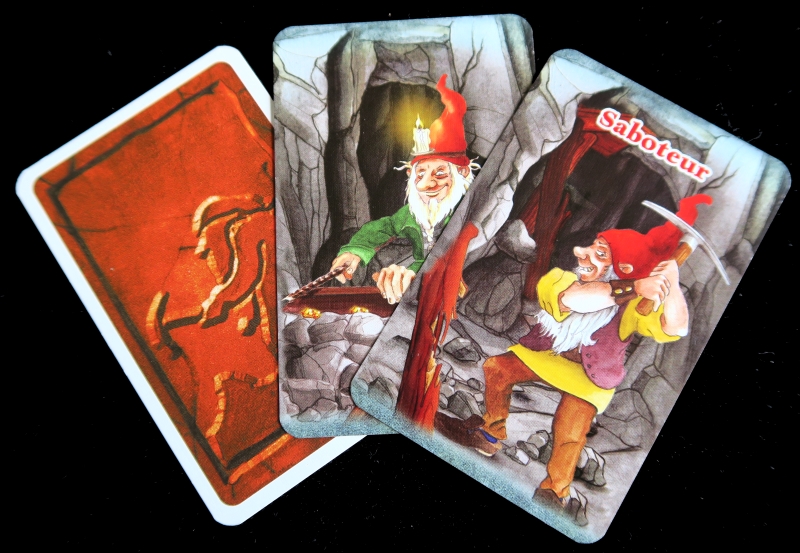
From there, there was a bit of chatter, but by the time Cottage Garden had finished, Teal, Lime, Green and Saffron all decided it was time to head home, leaving Purple to join Ruby, Plum and Aunt Damson.  There was some question about that they would play, but in the end they decided on one of Purple’s favourites, the hidden traitor game, Saboteur.  In truth, this is not at its best with four, but despite that, the group really enjoyed it.  The idea of the game is that players are Dwarves building a network of Tunnels in order to find treasure.  They do this simply by playing a card to extend the Tunnel and drawing a replacement.  The catch is that there is a traitor, an Evil Saboteur, in their midst.
Saboteur
– Image by boardGOATS

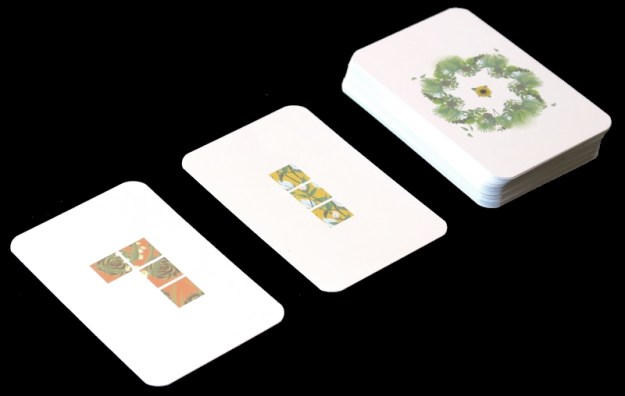
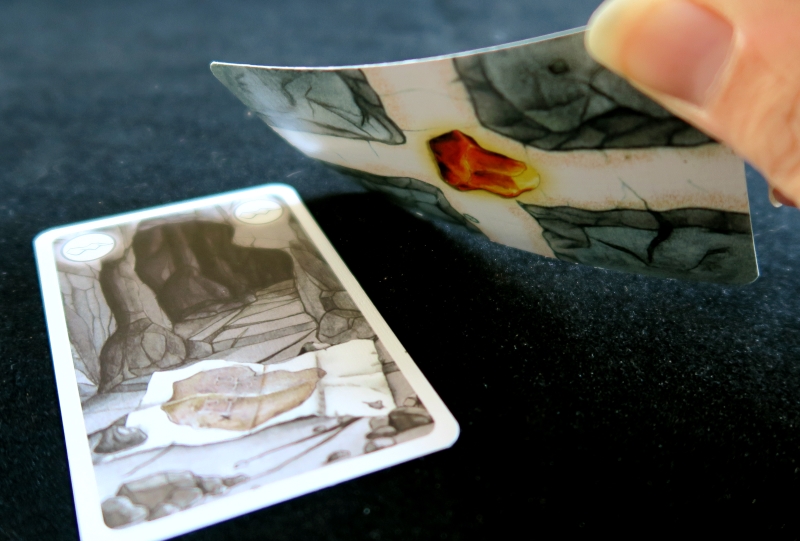
So, if the Dwarves have not found the treasure by the time the deck runs out, then they have lost and victory goes to the Evil Saboteur.  In addition to Tunnel cards, the deck also contains Special Map, Rock Fall, Broken Tool and Fixed Tool Cards which Dwarves and Saboteurs can use as they feel appropriate.  With four players, Ruby put two Saboteur cards in the pile used to assign the roles, but as it happened only one came out—Ruby.  Plum seemed to get the all map cards and checked the target nearest her first: Coal.  She then tried the the middle target card, but finally found gold in the one furthest from her.
Saboteur
– Image by boardGOATS

Ruby chose to strike out at Aunt Damson first, but that left Purple and Plum to continue digging for the gold.  Ruby then played a tunnel card with a dead-end which exposed her as a Saboteur, and as the only one, the writing was on the wall.  The game is formally played over three rounds, but we don’t like the way that plays and treat one round as a game in its own right.  Everyone enjoyed the game, but Aunt Damson in particular—she had watched and enjoyed The Traitors, so the overall concept particularly appealed.  It had been a lovely evening with a slightly different set of people and lots of games played.

Saboteur
– Image by boardGOATS

Learning Outcome:  It’s lovely to host family and old friends.

2nd April 2024

While Blue, Pink and Cobalt were finishing their supper, Plum led a quick game of Draftosaurus with Black, Purple and Cobalt (who had already finished his pizza).   Cobalt was new to the game, so after a quick rules explanation the group were passing dino-meeples left and right and building themselves exciting dino-parks.  The game is really quick and simple:  players start with a handful of wooden dino-meeples, and on each turn, they draft one, that is to say, they choose one and pass the rest on.  The chosen dino-meeples are then placed in the players’ parks, obeying the rules on the Die (the active player who rolled the Die excepted).

Draftosaurus
– Image by boardGOATS

The Die roll forces players to choose from locations in one half of the board, or restricts them to playing in an empty pen or one without a T-rex, making things considerably harder.  Players draft a hand clockwise, and then a second hand anti-clockwise, after which, points are scored for each pen and totalled up to find the winner.  This was Plum’s fiftieth game—it was one of their group’s go-to warm-up and filler games played remotely during the global pandemic on BoardGameArena.  Although her 24% success rate seems really good at first, at four players, one out of four could be seen as about par.

Draftosaurus
– Image by boardGOATS

Plum marked her milestone with a change of strategy, forced by the Dice to go for the most T-rexes, but it worked giving her victory with forty-one points.  Purple took a very respectable second with thirty-five points—one of her best scores in this game.  From there, Cobalt headed off to play Meadow with Blue, Jade and Sapphire, while everyone else joined Plum, Black and Purple to play the “Feature Game“, which to mark the thirtieth anniversary of 6 Nimmt!, was the new Jumping Cow mini-expansion.  6 Nimmt! is one of the group’s favourite games and was arguably responsible for keeping us sane when we were stuck at home in 2020 and as a result, won the Golden GOAT Award.

6 Nimmt!
– Image by boardGOATS

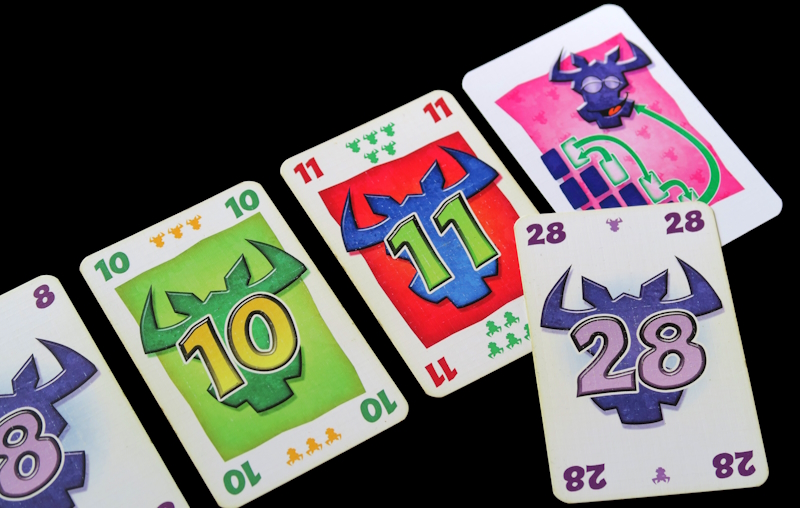
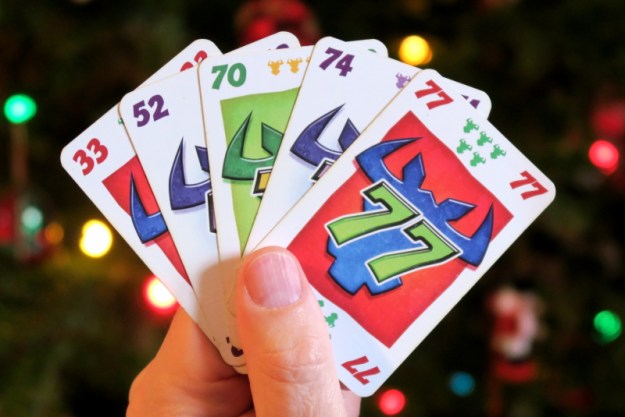
The game is super-simple:  players simultaneously choose a card from their hand and then, starting with the card with the lowest face value, they are added to one of four row.  Each card is added to the row that ends with the highest value card that is lower than the card to be placed.  If that means the row now has six cards, the active player takes the first five cards in the row into their scoring pile, with their card becoming the new first card.  The new Jumping Cow expansion is a single additional card that lurks at the end of the row.  Cards are added as normal, however, when one is added to the Jumping Cow row, the Cow jumps to another row, the one with the lowest face value at the end.

6 Nimmt!: The Jumping Cow
– Image by boardGOATS

The Jumping Cow Card does not have a value itself, but it does add to the number of cards in the row.  So if the card added is the sixth, the player takes the other four cards and then the Cow jumps.  If the row the Cow jumps to has five cards in it, the active player takes four of those too before the Cow jumps again…  Thus, as Plum discovered this time, multiple jumps can lead to collecting a lot of points!  The game was the usual entertaining fun, but although the Jumping Cow expansion adds more madness, 6 Nimmt! is a near perfect game that needs little to no improvement (although we have found the Professional Variant an occasional worthwhile addition).

6 Nimmt!
– Image by boardGOATS

This time, the top scorer (aided by the Jumping Cow) was Plum with sixty-one, closely followed by Ivory with fifty-seven.  Purple did very well to limit her takings to nineteen, but she was beaten into third place by Pink who just kept his to single figures with nine.  The winner was Teal, however, with just four from the first hand and a clear round from the second.  From there, with six, the options were limited, but the group decided to stick together and, after eschewing Bohnanza, opted for another golden oldie: For Sale.  Remarkably, Ivory had somehow not played this before, and was really taken with it, so much so that he immediately looked to see if he could get a copy and everyone was shocked to find it was out of print and the only copy available was for forty pounds on ebay!

For Sale
– Image by boardGOATS

For Sale is really simple:  Players start with a hand of cash and use this to bid for buildings, with a face value from one to thirty.  In the second half of the game, cheques are revealed and players have to choose one of their properties—the player with the highest value building then takes the highest value cheque, thus the idea is not to waste high value buildings when the takings available are low.  Pink, Plum and Teal were all really close and ended in a three-way tie for third place.  Ivory and Purple were some way in front, but separated by a single point with Purple just taking victory, with a final taking of fifty-six thousand dollars.

For Sale
– Image by boardGOATS

Casting about for another game that plays well with six, Bohnanza was passed over once again, this time in favour of Saboteur.  Saboteur is a hidden traitor game where players are Dwarves tunneling to find gold.  With six players, the rules have either one or two Saboteurs, however, as the game is always difficult for the Saboteurs and impossible alone, the group chose to forgo the ambiguity and go for a guaranteed two Saboteurs.  Once the Saboteurs knew who they were, everyone got a hand of cards: a mixture of tunnel cards and special cards.  On their turn, players play a card and draw a new one.  Tunnel cards extend the network, while special cards allow players to break or mend tools stopping other players from building tunnels (or reinstating that ability).

Saboteur
– Image by boardGOATS

Additionally, there are Treasure Map cards which allow players to look at one of the three potential gold cards to see if it is gold or coal, and Rockfall cards which allow players to collapse the tunnel by removing one card.  Usually, the Saboteurs hide for as long as possible in an effort to acquire some good “Saboteury cards” and play them with a lot of impact.  Choosing the right time for that reveal is really critical though, leaving it too late means there isn’t time to do enough damage.  This time then, Black announced his position very early by playing an obviously obstructing tunnel card and was swiftly followed by Pink who compounded the poor Dwarves’ problems by playing a Rockfall card.

Saboteur
– Image by boardGOATS

The Evil Criminal Masterminds were aided by the fact that when the Dwarves played their Treasure Map cards they struggled to find the gold.  The game turned out to be quite epic, but success just fell to the Saboteurs, giving them a rare victory.  As Teal and Ivory waved farewell, the others looked for something else to play.  Saboteur is a great game, and although it is not as old as 6 Nimmt!, this year is also Saboteur’s anniversary year. It is celebrating twenty years, as is another old favourite, No Thanks!.  In choosing this, those that had played all five games had played over a hundred years of popular games in one evening.

No Thanks!
– Image by boardGOATS

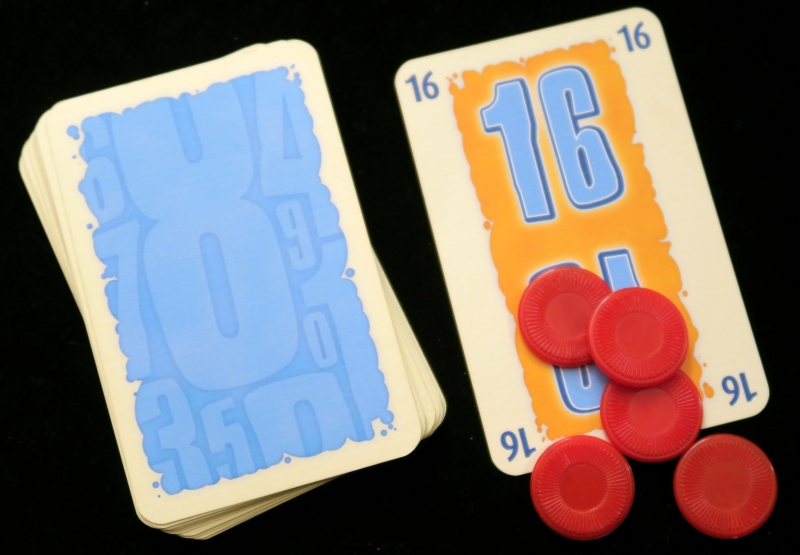
No Thanks! is a super simple, push-your-luck game, where players are trying to finish with the lowest score from the total face value of their cards minus any chips they have.  On their turn, players either take the top card and any chips on it, or pay a chip to pass the problem on to the next player.  There are thirty-three cards in the deck (numbered three to thirty-five), but nine are removed at random, which is what makes the game really tick—when scoring, players only count the lowest card of a run.  This time. Pink top-scored with forty-nine points.  Plum and Purple both took forty-eight points for their cards, but in Plum’s case this was off-set by her enormous pile of chips, leaving her with just twenty.

No Thanks!
– Image by boardGOATS

It wasn’t enough though. Black managed to just scrape through with only a single chip left at the end, giving him a total of thirteen points, and with it, victory.  While everyone else had been sampling a smorgasbord of golden oldie games, Jade, Blue, Cobalt and Sapphire were revisiting the relatively new Meadow, which they’d missed out on playing last time.  This is a fairly simple game, where the complexity is in choosing and placing tokens to get cards that combine well together.  Players take it in turns to play an Action Tokens either in the Market or round the Campfire, and complete the associated Actions. The Market consists of a four by four grid of face up cards.

Meadow
– Image by boardGOATS

Players play an Action token in the market to define a row or column with the number on the token dictating which card they will take from that row or column.  They then place a card in their play area.  This can be the card just collected or one from the player’s hand, but the prerequisites must be satisfied. Playing around the Campfire gives a special action and the option to additionally place a bonus point token on a tree-stump between any pair of symbols currently displayed in the player’s area.  At the end of the game, the total score for the cards played is added up together with any bonuses and the winner has the most points.

Meadow
– Image by boardGOATS

Last time, the general feeling was that the game dragged a little with four, so Blue suggested that instead of playing with the full eight rounds, maybe playing with six (as for the three player game) would make things easier.  Jade interpreted that as the suggestion to play with the three player board, but as quickly became apparent, the campfire circle is smaller with three, leaving fewer bonus spaces available making that element of the game very competitive.  Blue and Sapphire were already committed to their strategy as placing later bonus tokens give more points, so they went for the bonuses doubly hard.

Meadow
– Image by boardGOATS

Jade kept getting Cobalt’s name wrong in a way reminiscent of Blue with Ivory’s name some ten years ago—that lasted the best part of a year, but hopefully Jade will sort it out before then.  It didn’t seem to put Cobalt/Chromium/Cadmium off his game though.  From early on, he focused on building some Landscape cards adding some valuable Observation and Discovery cards.  Sapphire’s starting hand included a Wolf icon for his card from the North deck, and he played that nice and early giving him the opportunity to use it to claim a couple of the bonus spots giving him all three and a total of nine points.  Blue also claimed her third quite early leaving only two for Jade and Cobalt/Chromium/Cadmium to share between them.

Meadow
– Image by boardGOATS

Although she couldn’t see it, going into the final couple of rounds it was tight between Blue and Cobalt/Chromium/Cadmium.  The game is very tight though, with only four turns per round, so it is important to make sure they all count.  In the final round, Blue was fortunate in going first and was able to grab and play a couple of high value cards.  Jade and Sapphire also added a couple more cards to their tableau all of which made it really hard to call.  In the end, Jade (who had the most valuable tableau) pipped Sapphire by a single point (after a couple of recounts) and Cobalt/Chromium/Cadmium was two points clear, finishing with forty points.  The winner, however, perhaps thanks to those final couple of cards, was Blue with a total of forty-three.

Meadow
– Image by boardGOATS

Learning Outcome:  Golden Oldies are golden for a reason.

Boardgames in the News: 20 Years of Some Great Games

This year is the thirtieth anniversary of 6 Nimmt!, but also the twentieth anniversary of two more small-box card games, Saboteur and No Thanks!.  All three are light, family-friendly games that play larger numbers, but they are very different in style.  While 6 Nimmt! is a game of double-think, No Thanks! is a game of push-your-luck and Saboteur is a hidden traitor game.  Looking back, 2004 was a very good year, so these are not the only games celebrating their twentieth anniversary.  In addition to Saboteur and No Thanks!, Ticket to Ride, Power Grid, Goa and San Juan were released in the same year.  Combined, these games have given over a hundred years of great fun.

Saboteur
– Image by boardGOATS

10th January 2023

One of the first to arrive was Yellow, and it was delightful to see him after such a long time.  He was especially welcome as he was bringing a copy of Paris that he’d been looking after since UK Games Expo in August 2021.  Before long though, there were eight all ready and lined up to play the “Feature Game“, Long Shot: The Dice Game, when two more arrived and a debate began to work out who would play what and where.  As Long Shot was supposed to be quite short, eventually, Plum, Pine, Purple and Lime took themselves off to play Ticket to Ride: London, with Blue, Green, Yellow, Black, Ivory and Teal sticking around to play Long Shot:  The Dice Game.

Long Shot: The Dice Game
– Image by boardGOATS

Based on the party game Long Shot, Long Shot: The Dice Game is a light horse racing and betting game in a similar mould to that of Turf Horse Racing, that featured on several people’s lists of top games from 2022.  As it is relatively quick to play, the idea was that it would leave plenty of time to play some of our other old favourites and Ticket to Ride: London was thought to be a good match in terms of length.  Inevitably, that was not quite how things turned out, however.  Long Shot (Dice) is quite simple, and Blue, assisted by Green, was explaining the necessary to the runners and riders.  Ticket to Ride is well known within the group though and was therefore quicker to get started.

Long Shot: The Dice Game
– Image by boardGOATS

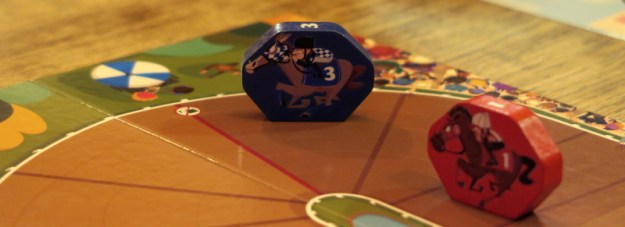
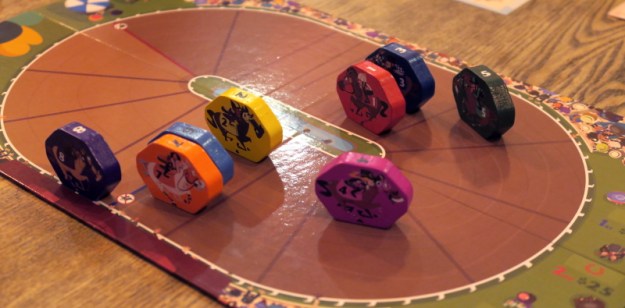
The idea of Long Shot (Dice) is that the active player rolls two dice which dictate which horse moves and how far (one to three spaces).  Everyone (including the active player) then chooses an action from their card, carries it out and crosses it off.  The actions include:  placing bets, buying a horse, buying a riding cap, buying a riding jersey, crossing a horse off the concession chart to get a bonus action once a row or column has been completed.  In general, the action depends on the horse that has been rolled, i.e. if horse number two is rolled, players can bet on that horse, buy that horse, get a cap or jersey for that horse’s rider or cross that horse off the concession grid.  However, each player has three “wilds” which are opportunities to choose any horse.

Long Shot: The Dice Game
– Image by boardGOATS

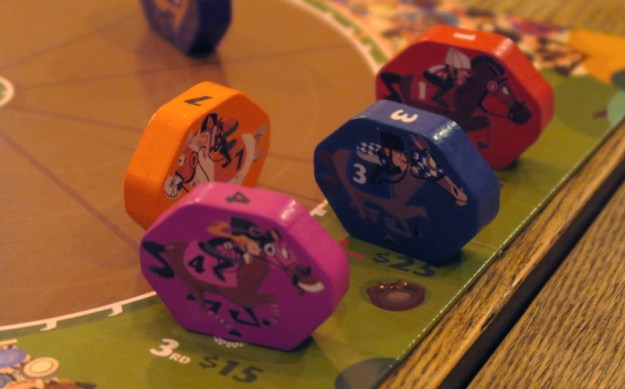
At the end of the game, players score if they own or bet on a horse that is placed and for any cap/jersey combo for the same horse.  This time, Green started and rolled the blue horse number three which moved three spaces.  As did Teal.  By the time it had moved on three out of four opportunities (and a total of nine spaces), it was starting to look like the dice were loaded and this did not appeal to everyone’s sense of fair play.  The group more or less divided into those that wanted the blue horse wearing number three to win (because they had invested in it) and those who didn’t and preferred the red number one horse.

Long Shot: The Dice Game
– Image by boardGOATS

As Ticket to Ride progressed, the route planners asked how the race was going, and the gamblers, felt it would not be long, given the progress the blue number three horse had made and the lead it had built up.  After its early spurt, a few other horses managed to start to make a bit of ground and, with players starting fill out their bonus grid, players began to take bonus actions which leveled the course somewhat.  The bonuses included taking a free $7 (quite a lot of money in this game); a free $3 bet; free riding cap/jersey, but by far the most interesting were the options to move horses.

Long Shot: The Dice Game
– Image by boardGOATS

Each player has the following four bonuses:  they can move one horse three spaces (once forwards and once back) and they can move two horses two spaces (also both forwards once and both backwards once).  It was as the blue number three horse approached the three-quarters mark (after which players could no longer bet on it) that players showed their allegiance, moving it forwards, or backwards.  And with six players, everyone had potentially several bites of the cherry.  Just as it seemed that one horse had an unassailable lead, one or two players would upset the apple cart and push the leader back and something else forward.  Even the the three-legged purple number eight horse looked like it might be in with a chance of placing at one point (albeit not for long).

Long Shot: The Dice Game
– Image by boardGOATS

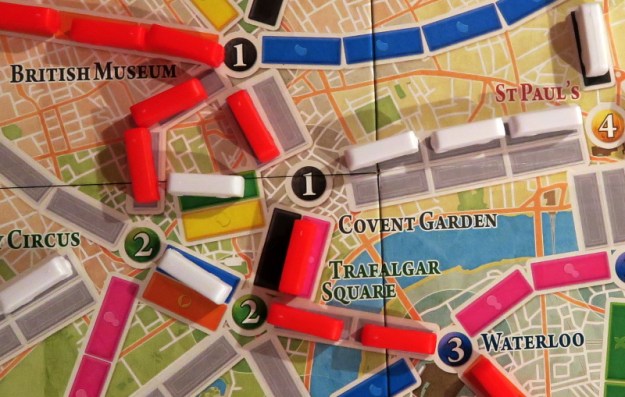
Ticket to Ride made more rapid progress.  Although Purple succeeded in completing one of her tickets (for three points), she failed to finish her other two.  That cost her ten points (effectively twenty, which is what she’d have got if she’d completed them), and she blamed Lime.  Lime had troubles of his own though as he was in a very tight battle with Pine.  Perhaps it was his comeuppance for the trouble he’d caused Purple (real or only perceived), but Pine pipped him to victory by a single point, gained when he completed one of the single carriage routes in the centre of the board in the dying moments of the game.

Ticket to Ride: London
– Image by boardGOATS

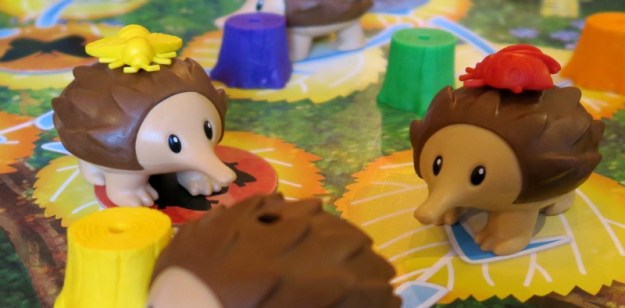
It became a bit of a running joke that the Purple/Plum/Pine/Lime group playing with their train-set asked how things were doing when they finished, and again as they packed away, and again after they’d been to the bar, and again after they’d consumed their drinks and been to the bar again, and each time were told that it was nearly done.  Eventually, Purple, Lime and Pine resorted to playing Love Letter to kill time, winning one round each.  Although Long Shot (Dice) was great fun and everyone was quite amused by the shuffling of horses backwards and forwards, Pine had a point when he commented that when gamers play a light silly game they can play it to destruction—a bit like Echidna Shuffle, which we all adored though it outstayed its welcome when one game lasted two hours!

Echidna Shuffle
– Image by boardGOATS

As players ran out of bonuses, the Long Shot horses ran out of track, and eventually, the red horse number one crossed the line, followed by the blue horse number three and finally, the pink horse number four.  Unlike in Downforce for example, however, although winning the race is useful, the betting has much, much more of an influence on the final result.  For example, the two horses Ivory had bet on, numbers five and six, didn’t come in making a severe dent in his score.  In spite of this, it was quite close—Green and Yellow tied for third  with $109 while Teal took second place with $114.  Blue claimed victory though, finishing with $122.

Long Shot: The Dice Game
– Image by boardGOATS

It was only when Green and Pine pointed out that Teal hadn’t scored his horse which gave him $2 per horse he had a bet on, and in his case, an extra $12.  Recalculating his final score, much to her chagrin, Teal just pipped Blue to victory.  From there it was simply a case of tidying up and working out what people wanted to play next.  Ivory had suggested Roll for the Galaxy at the start of the evening and there were lots of takers now, so he went off to set up with Teal, Green and Plum.  Although Teal had played Race for the Galaxy online, Roll for the Galaxy was new to him so the group started with a quick rundown of the rules.

Roll for the Galaxy
– Image by boardGOATS

The idea is that everyone starts with a couple of “Worlds” and some dice representing their population.  Players roll their dice with the faces dictating different actions.  In secret, players allocate their dice to the five different phases: Explore, Develop, Settle, Produce and Ship.  Players choose one phase that they want to happen then everyone simultaneously reveals their choices.  All the phases selected will happen, with dice that players have allocated to other phases returned to their cup and recycled.  The game is a combination of “engine builder” and “population builder” (similar to games like Orléans), with players needing the right combination of Worlds to provide their engine, and then building the right combination of dice to make them work effectively.

Roll for the Galaxy
– Image by boardGOATS

With the lighting being less than perfect, some of the dice colours were a little difficult to distinguish, particularly purple and brown.  Plum came to the rescue though, with her new Christmas present:  a portable folding lamp.  The magic of the LED gave a good strong light, enough for everyone without taking up too much room on the table.  Everyone was very impressed and many rapidly came round to the idea that it was a must have gamers’ accessory!  After a faltering start for a couple of turns, Teal soon got the hang of how to select actions and where the dice should go.

Roll for the Galaxy
– Image by boardGOATS

The first clarification needed was that players can only choose one action (though everyone’s choice will be activated), and the second was that the die used to select that action does not need to show a face that matches it. The rest of Teal’s game was one of learning:  with his mining industry, he was able to ship goods for victory points while still gaining some credits, and gained a couple of useful purple die. Unfortunately being new to the game meant he was unable to mount a serious challenge for victory points.  Plum, on the other hand, started out with a couple of red military dice and managed to obtain one more during the game along with the New Galactic Order tile which gave her a couple of extra points for those red dice.

Roll for the Galaxy
– Image by boardGOATS

Plum also made good use of her Terraforming Robots which gave her an extra credit for each World she built and two extra if it was a brown world. She managed to get three brown Worlds.  Ivory also managed to obtain the useful purple die, but his real bonus was from the Alien research ship which gave him a white and a yellow explore action whenever it was chosen.  This meant he was able to keep his credits topped up and have plenty of new tiles on the go without the expenditure of a die. As a result he was able to concentrate on building worlds and shipping/trading.

Roll for the Galaxy
– Image by boardGOATS

Green, meanwhile, quietly built his tableaux concentrating on blue worlds due to his Consumer Market which gave him an extra credit if at the end of the produce round he had  goods on a blue world. He also obtained a green and a yellow world. His Galactic Recycler meant he gained a credit every time he managed to complete a tile. He was the first and only player to build all twelve tiles which gave him the largest score for Worlds. Combined with his Free Trade Association he scored extra points for his three blue worlds and with the victory points he’d collected along the way he finished with forty-four points and a healthy lead, ahead of Ivory’s thirty-eight, just ahead of Plum thanks to his two yellow and two green worlds.

Roll for the Galaxy
– Image by boardGOATS

Meanwhile, at Purple’s request, everyone else was playing Saboteur.  This is a hidden traitor game where players take it in turns to either place tunnel cards or to play action cards.  The Good Dwarves are trying to find gold, while the Evil Saboteurs are trying to obstruct them.  In the rules as written, the game is played over several rounds with gold handed out at the end of each round.  The way the gold is distributed doesn’t really necessarily reflect the player who made the biggest contribution, so we play with the “House Rule” that each round is treated as an individual game, then we can play as many “games” as we like and/or time allows.

Saboteur
– Image by boardGOATS

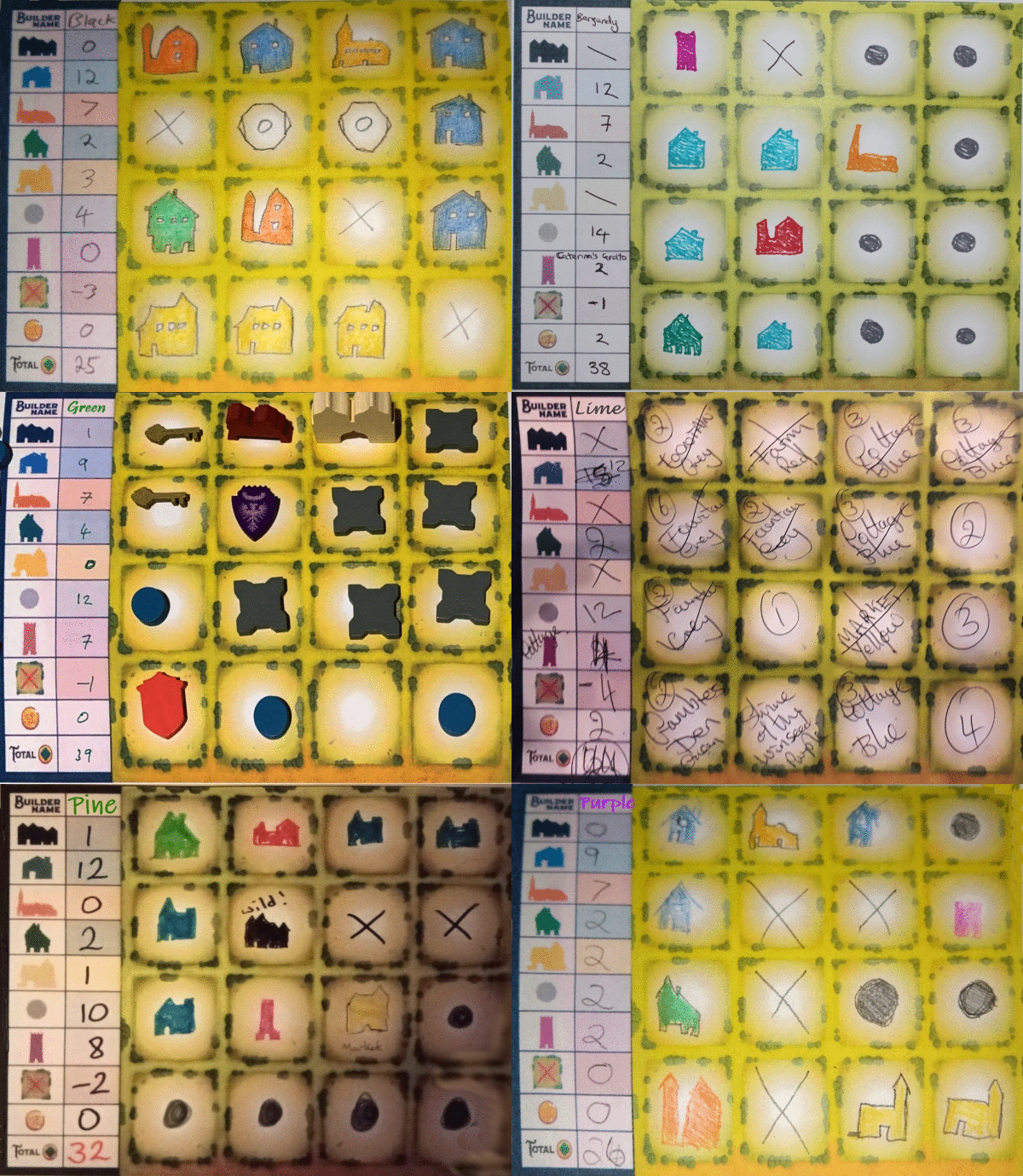
This time, the group played three games.  The first one began with lots of people suspiciously checking and double-checking where the treasure was buried by playing map cards.  Purple was accused of being an Evil Saboteur, quickly followed by Black, Lime and Blue, all of which made no sense as there could only be a maximum of two.  In the end apologies were required when Pine found the gold and Blue and Purple were revealed as the Actual Saboteurs.  The second round followed a similar pattern, only this time pretty much everyone was accused of “Saboteury behaviour”.

Saboteur
– Image by boardGOATS

This time there was a Solitary Saboteur, which meant poor black had a really uphill battle and had really lost before he’d begun.  Once again, Pine was the Dwarf that found the gold, with Lime setting him up.  In the final round, things went a little differently though, particularly when Pine’s dubious behaviour signaled that he might not be trying to find the gold this time.  When Blue distracted the Dwarves by causing a massive rock-fall, it was up to Lime to try and patch the tunnel.  Things had just settled when Blue played another rock-fall and Lime patched that too.  When Blue brought down a third and fourth tunnel collapse, Lime was able to patch them too.

Saboteur
– Image by boardGOATS

It took so much effort though, that when Pine pushed the tunnel past the gold card, although it only needed a couple of extra tunnel segments, the Dwarves couldn’t make it giving a rare victory for the Saboteurs.  As Roll for the Galaxy was still going and there was a little time left till last orders, there was just time for a quick game of 6 Nimmt!, an old favourite. Blue commented that the name was one of the infamous German joke game titles, and Yellow added that “Nimmt” was the imperative of the German verb, nehmen, to take, thus when the sixth card is played on a row, that player takes the other cards.  The player with the fewest bulls heads wins.  We’ve played it quite a bit recently with the professional variant where cards can be added to the low or high end of the rows.

6 Nimmt!
– Image by boardGOATS

This time, however, as time was pressing the group decided to stick with the simple maths.  We play over two rounds with half the deck in each.  Lime had a complete nightmare in the first round, with twenty-seven “nimmts” in the first round; Pine in contrast managed a clean sheet and Black only picked up two points, so it was all to play for, for some at least.  Lime did much better in his second round giving him a total of thirty-three, only slightly more than Yellow, while Blue managed nearly that in the second round alone, top-scoring with a nice round fifty.  Black picked up just five, but there wasn’t much anyone could do to compete with Pine, who picked up just one solitary point in the second round, his only one in the whole game.

6 Nimmt!
– Image by boardGOATS

Learning Outcome:  Betting can be a mugs game.

14th June 2022

Pink and Blue were the first to arrive, bringing guests from eastern Europe, Orange and Lemon.  Orange and Lemon were new to our sort of board gaming.  After an explanation of what mushy peas are, food and some chit chat, others started arriving.  The “Feature Game” was the Moor Visitors expansion to Viticulture.  Teal had been keen to play the Tuscany board and the plan was to play both together. So when he and Ivory had arrived, they took themselves off to the other side of the room with Pink and started setting up.

Viticulture
– Image by boardGOATS

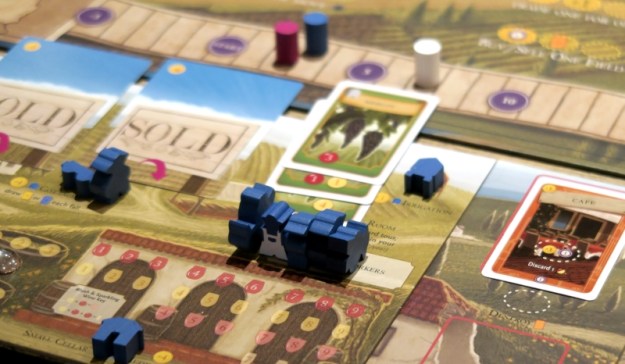
Viticulture is a worker placement game about planting vines, harvesting grapes and making wine.  The idea is that the game is broken into seasons and years, and players take it in turns to place their workers in the various locations on the board to carry out the associated actions  Although it is not in and of itself an especially innovative game, it is very polished and smooth, and a joy to play.  There are a couple of little elements within the game of note.  Firstly, each location can take a limited number of workers dependent on the number of players.  To grease the wheels a little though, each player also has a “Grande” worker that they can place anywhere, even in a “full” space.

Viticulture
– Image by boardGOATS

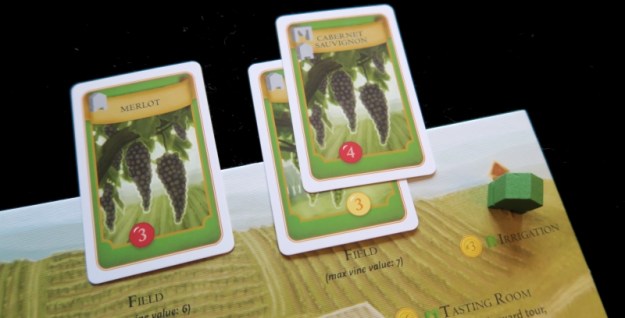
Players start the game with four cards from which they choose two, a mama and a papa and these dictate players’ starting conditions:  money, number of workers, buildings and cards.  There are four different types of card, Vines, Contracts, and summer and winter Visitors.  Players can only plant vines in the summer, and then only if they have sufficient land and any necessary buildings.  From there, grapes can be harvested in the autumn and placed in players’ crush pads and thence combined to form wine and stored and aged in their cellar.  Wine can then be used to fulfill contracts in exchange for points.  Although this is the main source of points, it is not the only one.

Tuscany
– Image by boardGOATS

Some of the Visitor cards give special actions that can be used to generate points, as can buildings like the Windmill and the Tasting Room and some of the Visitor cards.  At the end of each year, players get their workers back and age their grapes and wines as well as collecting residual payments (income).  The Moor Visitors expansion adds extra visitor cards which are just mixed into the deck providing more variety.   The Tuscany expansion mixes things up more, by changing the seasons in which the actions occur, particularly adding actions to spring and autumn.  It also provides a couple of extra mechanisms, including the “Influence” action, special buildings and specialist workers.

Tuscany
– Image by boardGOATS

This time, there was the initial random draw of the start tokens to “see who’s cock comes out first”, and then the game got under way.  Ivory and Teal both trained one of their workers to be “Special Workers”. These act as normal workers, but have a special ability when used in a particular way.   Each game, two of these are drawn at random from a deck, and when players train workers, they can make that worker a specialist for an additional fee.  The specialisms are open to all players, though each player can only have a maximum of one worker with each skill set.

Tuscany
– Image by boardGOATS

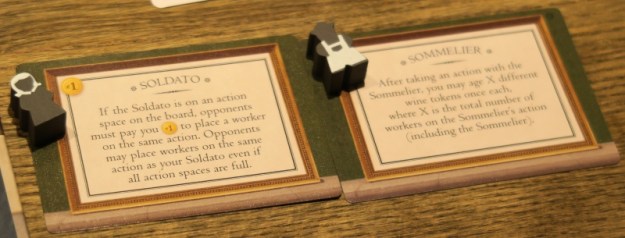
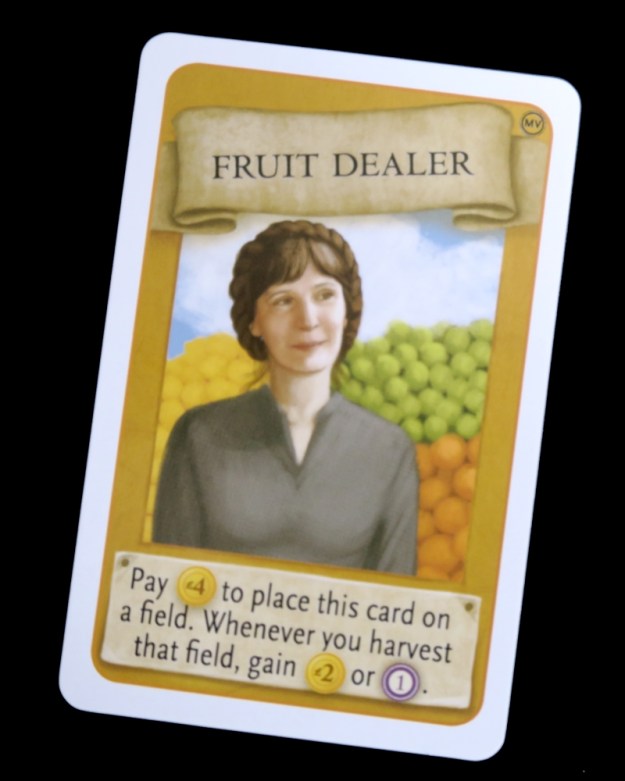
The Special Workers this time were the Soldato who bullies other players into paying to use the same action space, and the Sommelier which gives an additional opportunity to age grapes.  Ivory went for the military option while Teal selected one of his workers to learn about serving wine.  Elsewhere, Pink’s strategy was centered around the use of his Fruit Dealer card from the Moor Visitors expansion.  This gave him a point (or money) every time he harvested a specific field.  Teal built a Café which allowed him to turn grapes into money or points.  Everyone also began with what seems like the accepted strategy of selling off land to gain funds in the early part of the game, buying it back later as required.

Viticulture: Moor Visitors Expansion
– Image by boardGOATS

Ivory made an early move to stake his claim on the influence map, using the Influence action to place his Stars.  When placing Star tokens, players get a bonus reward for doing so.  In this way, it effectively provides an alternative way to access some “actions” when they are not available on the main board.  At the end of the game, the player with the most Stars in each region gets one or two bonus points.  After placing all six of their Star tokens, players can still use the Influence action by moving them to swing control of regions (but without gaining the instant reward).  As the game progressed, everyone else muscled in on the Influence action too, and by the end of the game, Pink had the edge.

Tuscany
– Image by boardGOATS

It was an extremely tight game.  With the Tuscany expansion, the end is triggered when someone passes twenty-five points. This time, everyone was very watchful, determined not to get caught out like last time when an early break by Teal unexpectedly ended the game leaving Ivory and Pink unable to play their big final plays.  As a result, everyone finished the game with exactly the same number of points—twenty-six.  That meant the advantage Pink had on the Influence map made the difference, leaving him three points ahead of Ivory and Teal who shared second place both finishing with twenty-eight points, in what had been an epic game between three experienced players.

Tuscany
– Image by boardGOATS

While Pink, Ivory and Teal took themselves off to set up Viticulture, everyone else introduced themselves to Orange and Lemon, and gaming was forgotten for the moment.  Eventually, this non-Viticulture group separated into two halves, one playing Imhotep while the other (including Orange and Lemon), beginning more slowly, with lighter introductory games.  Imhotep is a fun family game that won a nomination for the Spiel des Jahres award in 2016.  We’ve played it a few times since then, but like so many games, it had a two year hiatus thanks to the global pandemic.

Imhotep
– Image by boardGOATS

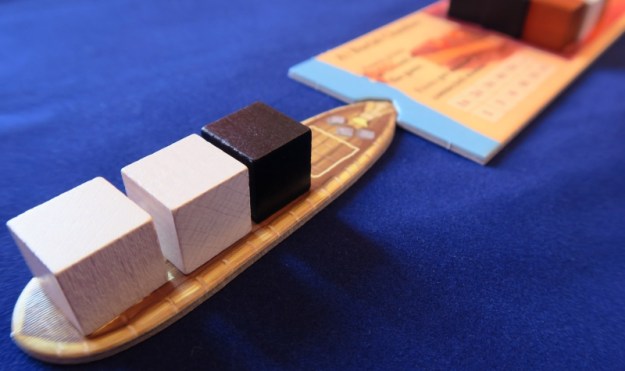
In Imhotep, players move large wooden “stone” blocks by boat to build five monuments.  The game is quite simple to play:  on their turn, the active player can acquire blocks from the quarry, load blocks onto a boat, sail a boat to a monument and add blocks to it, or play an action card.  Each monument scores points in different ways, and the player with the most points after six rounds is the winner.  The game was new to Lilac and Lime, but they quickly got the hang of it—it is quite easy to learn the functions, but deciding the best way to play is where the challenge comes in.

Imhotep
– Image by boardGOATS

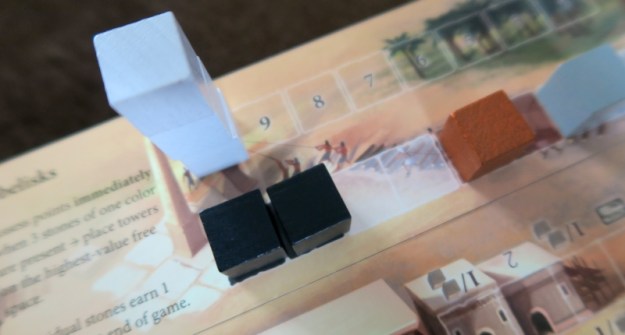
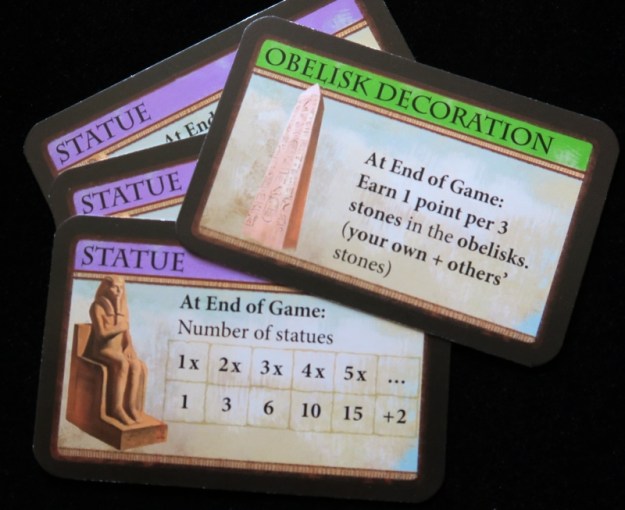
Lilac started out making a play for the Obelisks and quickly took a commanding lead there with four stones by the end of the second round, with one each to Black and Lime.  Lime decided to go for Statues in the market place, which everyone else ignored and so he too managed to get an early lead in them with three by the end of the second round. Black wanted to get his group of five stones into the Burial Chamber, which Green (who had previously announced that he was thirty-fifth world-wide in the Board Game Arena rankings) had spotted and tried hard, but ultimately unsuccessfully to block.  Green managed to get a few larger regions himself in the process though.

Imhotep
– Image by boardGOATS

The Pyramids got steadily built, but unusually for Imhotep the Temple was ignored for most of the game. It wasn’t until the sixth round that any stones were placed there.  The scores for the Pyramid (and towards the end, the Temple as well), kept everyone close together—there was usually only three or four points from first to last place, with the order changing frequently as the game progressed.  Coming to the last couple of rounds, Lilac was challenged by Lime and Black in the Obelisk, but Lime and Lilac (both new to the game), missed the stones in one of the last boats, which Black watched closely.

Imhotep
– Image by boardGOATS

On Black’s turn he moved a two stone boat with only his and Green’s stone to take the lead and give Green a bump from last place to equal third with Lime.  Lilac may have lost out in the Obelisk, but she managed to gain a full five stone region in the Burial chamber, plus a couple of other odd stones. Black got his five but no more. Everyone got a final points bonus from a green card, although Black and Lime’s were for the Temple and only scored a single point. Lilac took a big score of seven for the Burial chamber card.

Imhotep
– Image by boardGOATS

Green also scored well for the Obelisk (five point) and for the Pyramids (six points), as earlier in the game Lime had shifted a three stone boat to the already filled Pyramid preventing the other players scoring more than a single point each.  In the final tally it was very close between Lime and Green, but Green pipped him by a single point, finishing with fifty points to Lime’s forty-nine.  The game finished at exactly the same time as the other group finished their second game.

Imhotep
– Image by boardGOATS

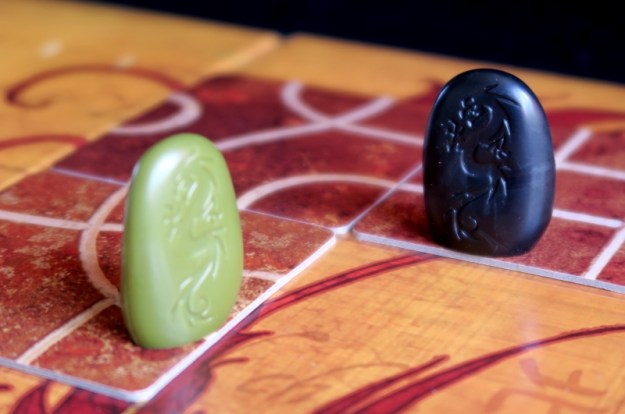
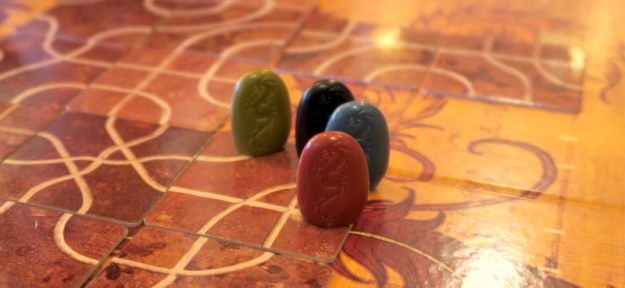
Purple and Blue had been introducing Orange and Lemon to some of the group’s favourite filler games.  They started out gently with Tsuro, aka “The game of the Path”.  This is super quick and simple, with players choosing to play one of the three cards in their hand on their turn, and placing it to extend the path their stone is on.  The winner is the last player still on the board, with players eliminated when their stone is unavoidably moved off the board or collides with someone else’s.

Tsuro
– Image by boardGOATS

There was a certain amount of people “feeling their way” at the start, but with only four players there’s a lot of space on the board at the start.  Players can exploit this and set themselves up with a nice little corner to work in, curating their tiles and avoiding getting themselves into difficulty.  That didn’t last long though, and came to an end when everyone wound up sat on the same tile.  Purple was the first to go, soon followed by Blue.  From there, there was a bit of a head to head, before Lemon “offed” Orange and claimed victory in her first game.

Tsuro
– Image by boardGOATS

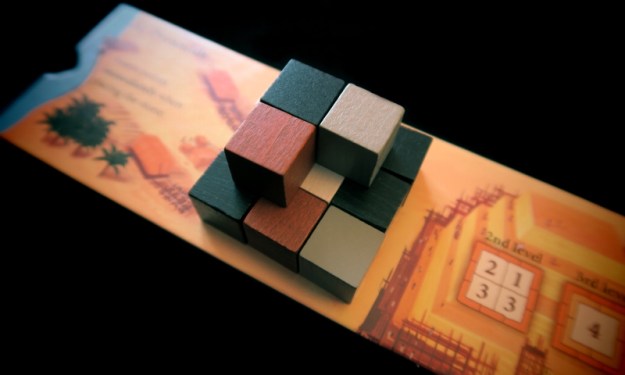
Imhotep was still going and Viticulture had only just started, so Blue and Purple decided to introduce Orange and Lemon to the tile laying game, NMBR 9.  The idea is that players take a random tile and place it in their area—tiles must be joined to the others, and if placed on top of other tiles they must additionally be entirely supported and by two or more tiles.  At the end of the game, when two of each tile, numbered zero to nine have been played, the game ends.  Players score points for each tile multiplied by the “floor” it is on.  Thus ground floor tiles score nothing, but any tiles on the second level (the first floor) will score their face value, and so on for higher levels.

NMBR 9
– Image by boardGOATS

Although the rules are quite simple, in practice the game is one that can really make your brain hurt.  In this sense, it was a significant step up from Tsuro, though still quite a short light game.  This time, the tile order did not help players at all with high numbers coming early and at inconvenient times.  Players concentrated on building a sound foundation in the hope of better tiles to follow.  In the event, this worked better for some than others, and, as a result, it was very close between first and second.  Lemon, with seventy-two points ran out the winner once again, just two points ahead of Blue in second place.

NMBR 9
– Image by boardGOATS

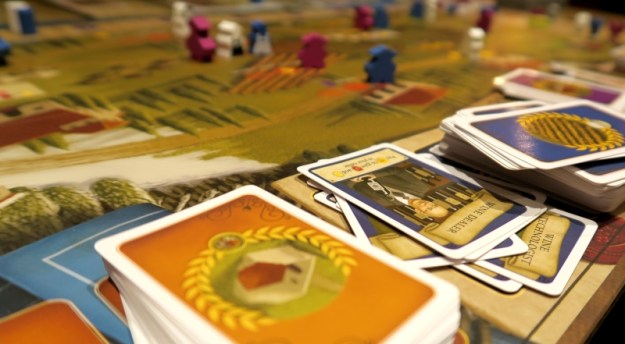
With both groups finished at the same time, there was a lot of chatter, before eventually the groups joined to play something together.  Orange had played Saboteur before, and with such a large group, it seemed an obvious game to play.  There was a quick reminder of the rules for those who had not played it before or who were new to it.  A hidden traitor card game, it is one where there is a lot of banter with players accusing each other left, right and centre.  The group is split into two teams—Lovely Dwarves and Evil Saboteurs.  The aim of the game for the Dwarves is to find the gold, while the clue is in the name for the Nasty, Evil Saboteurs, who are trying to stop them.

Saboteur
– Image by boardGOATS

On their turn, players either play a card, or discard a card.  There are two types:  tunnels and actions.  Tunnels are played in the central area and must extend the existing tunnel network.  Action cards are special cards including map cards (which allow players to take a peak at a target card and report back on whether it is gold or not), rockfall cards (which allow players to remove a troublesome tunnel card), and tool cards.  This last category is where the fun comes.  Players can prevent others from digging tunnels by “breaking” their tools.  Mostly this is because they think someone is on the opposite team, but occasionally it is just “because”.

Saboteur
– Image by boardGOATS

This time, Lime started by picking on Pine for what turned out to be no very good reason.  Pine claimed the gold was in the middle (very early) and five others checked it and concurred.  Pine had a lovely “Saboteury” hand, but emphatically claimed he wasn’t.  And indeed, he wasn’t which meant Lime had to apologise to him at the end as he’d picked on him throughout.  Blue picked on Green—because “He’s always a Saboteur, Right?”—except he wasn’t either.  The guilty parties were Lemon, Lilac and Purple, but it was a fairly easy win for the Dwarves for whom Lime brought victory home.

Saboteur
– Image by boardGOATS

It had been a lot of fun, so everyone was keen to have another go.  After she had been on Team Evil the first time round, Pine perhaps unfairly targetted Lilac who was wholly innocent the second time.  The same could not be said of Purple who was a Saboteur twice in a row.  After picking on him the first time, Blue had to make peace with Green as they were on the same side in the second game (and not the “right” one either).  It is essential for Saboteurs to work well together, and although they did and it was close, it was not quite close enough and Lemon found the gold for the Dwarves.  There was time for one last round, and if the second round was close, the final round was even closer.

Saboteur
– Image by boardGOATS

While the Dwarves were worrying about who might be the three Saboteurs, Lime and Black managed to sow the seed of confusion when with Lime claimed that the gold was in the middle and Black agreeing.  Later it turned out that this was actually coal and although Lime showed his true colours early, it wasn’t until he was joined by Black that the Dwarves realised they’d been duped.  Concerned about the third Saboteur, Blue just managed to find the Gold before they ran out of cards.  Lime and Black had done really well as Saboteurs though, especially as it turned out there were only two of them.  It had been a lot of fun, but with Viticulture at an end, several people wanting an early night and it now having got quite late, everyone decided to leave it at that.

Saboteur
– Image by boardGOATS

Learning Outcome:  It’s never too early to start making enemies.

20th April 2022

Meeting for the first time on a Wednesday, Pink and then Blue were the first to arrive, and like last time, played a game of Abandon all Artichokes (with the Rhubarb mini-expansion) while they waited for food to arrive. This is a very quick and simple “deck shredding” game: on their turn the active player takes a card from the face up market, adds it to their hand and then plays as many cards as they can before they discard the rest and draw five new cards. If this new hand contains no Artichoke cards, the player wins.  Although it is very simple, it seems the function sequence is somehow challenging.  Pink struggled last time, but seemed to have got the better of it as he won.

Abandon All Artichokes
– Image by boardGOATS

As they were finishing, Pine turned up and, while Pink went to the bar, Blue explained the rules to him and then they played again.  Pine also struggled a bit with which pile was the discard pile and which the draw pile, and where to take cards from and where they were going to.  There is hope though as, despite the arrival of food in the middle, Pink won the second game too.  Pink and Blue were just finishing their supper when Purple and Black arrived, soon followed by Green, Lime and Ivory.

Abandon All Artichokes
– Image by boardGOATS

This week, the “Feature Game” was the new edition of Libertalia, Libertalia: Winds of Galecrest, a card driven game where players are admirals commanding a crew of sky pirates in search of adventure, treasure, and glory.  Pine had watched the advertised play-through video and professed it “looked” fun, so was keen to give it a go.  Ivory and Pink joined the party, while Green shouted across from the other end of the table that he would be happy either way as he knew nothing about it.  In the end, after considerable debate, Ivory, Pink and Pine were joined by Blue and Purple, leaving Green, Black and Lime to find something else to play.

Libertalia: Winds of Galecrest
– Image by boardGOATS

Although Blue had read the rules, she had very deliberately not looked at the character cards, so Pine arguably knew most about Winds of Galecrest.  It is a rejuvenated version of the older game, Libertalia, but with new, lighter artwork, additional characters and streamlining of some of the mechanisms.  Very simply, each player starts with a deck of forty cards, of which six are drawn into their hand.  The idea is that players have the same character cards to play, but can play them in different orders.  Thus, one player (in our case Pink) shuffles their forty numbered cards and then draws six, which the the others find in their numbered and sorted decks.

Libertalia: Winds of Galecrest
– Image by boardGOATS

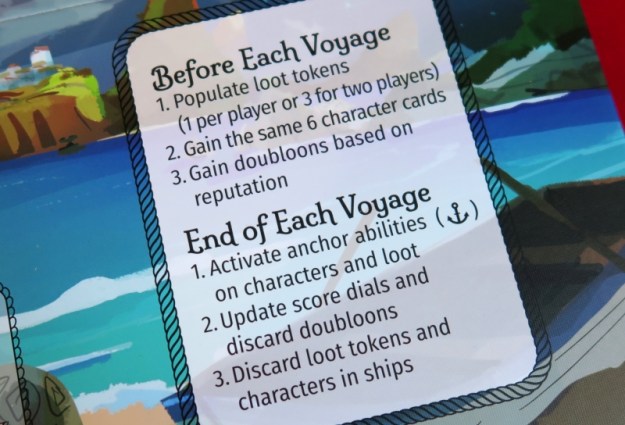
The game is played over three voyages, the first of which takes four days, the second, five days, and the final voyage takes six days.  Each day, players simultaneously choose a card to play, which when revealed are laid out in numerical order on the island.  The are then played three times: first in ascending order (daytime), next in descending order (dusk) and finally simultaneous (night).  Some cards only have actions that activate in one or two of the time-frames, but any characters still on the island, move back to that player’s ship and stay there till the end of the voyage.  At the end of the voyage, players activate any loot and characters they have with end of voyage actions.  Despite that being pretty much all there is to the game (and it being written clearly on the board), the group still managed to make a bit of a meal of it.

Libertalia: Winds of Galecrest
– Image by boardGOATS

The first hand consisted of six relatively uninteresting cards (or so it seemed at the time), which all had daytime actions.  The first voyage, and to some extent the second too, players were feeling their way.  Because the group failed to remove the Character cards from their ships at the end of the first voyage, that skewed things somewhat, especially as some players had the First Mate in their ship which in some cases scored twice giving points for the number of characters in their ship which was also artificially inflated.  Ivory knew which cards he’d played and when, but others were unsure and some had built a strategy that relied on having certain Characters in their boat at the end of the second voyage.  So rather than trying to back-track, ships were emptied for the first time at the end of the second round.

Libertalia: Winds of Galecrest
– Image by boardGOATS

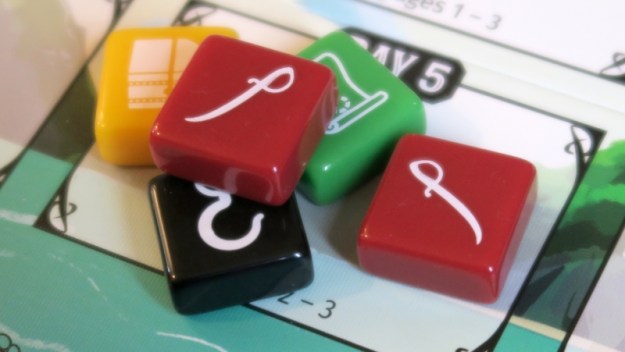
It took the group a bit of time to understand when the actions for the loot happened—most occur at the end of the voyage, but some occur on the day they are collected, during the dusk phase.  As a result, several players missed some of those dusk actions, the additional reputation gained from picking up a Barrel in particular.  At the beginning of the second round, Blue, Pine, Ivory and Pink agreed they were all playing the “obvious card”.  On revealing their cards they discovered they had differing ideas of what the obvious play was, which gave the first inkling that there was much more to the actions than had first appeared, but the players really got to grips with the planning aspects of the game in the final round.

Libertalia: Winds of Galecrest
– Image by boardGOATS

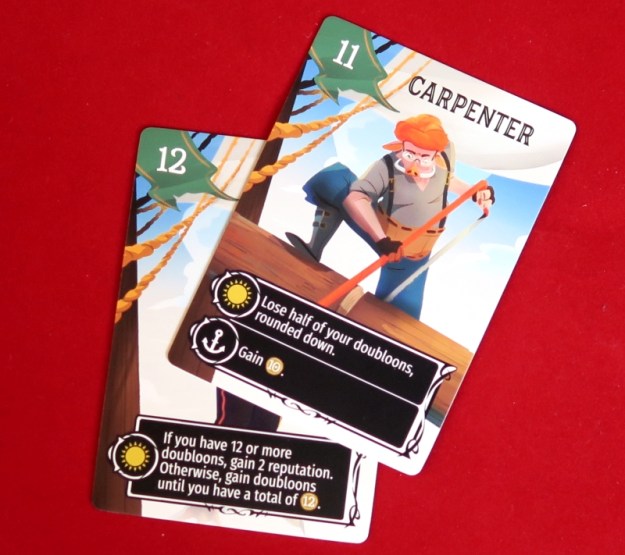
Ivory played his Carpenter, which reduced his funds by half, and immediately followed it with the Officer which increased his kitty to twelve doubloons.  Then, because he is always a threat, he was targeted by Pine and then Blue, losing first his Carpenter and then his Gambler from his ship (both give money at the end of the round).  Blue then assassinated Pink’s Carpenter and he took out her Gambler in revenge.  Pink discovered that the Saber type loot was much more dangerous than he gave it credit for as yet another of his Characters on the island bit the dust.  Meanwhile, Purple was building the contents of her treasure chest largely unmolested, mostly only suffering as collateral damage.  Pine also made killing by playing his Bodyguard with perfect timing, simultaneously taking lots of gold for discarding all the Sabers and Hooks from the loot pile, and starving everyone else of treasure.

Libertalia: Winds of Galecrest
– Image by boardGOATS

In the final accounting Blue was the most successful pirate, though she was one of the beneficiaries of the “rules malfunction” at the end of the second voyage.  Purple made an excellent second place though, picking up loads of gold from her loot while largely managing to avoid being caught in the cross-fire as the others attacked each other.  Libertalia is a much more vicious game than those we usually play, even though it was a “Calm” game and supposedly “easy and friendly”—Heaven only knows what Stormy will be like!  It was a lot of fun though, especially when the group started to get to grips with it properly during the final round.  It’s clear the game could cause a lot of relationship trouble, but that won’t stop it getting another outing soon.

Libertalia: Winds of Galecrest
– Image by boardGOATS

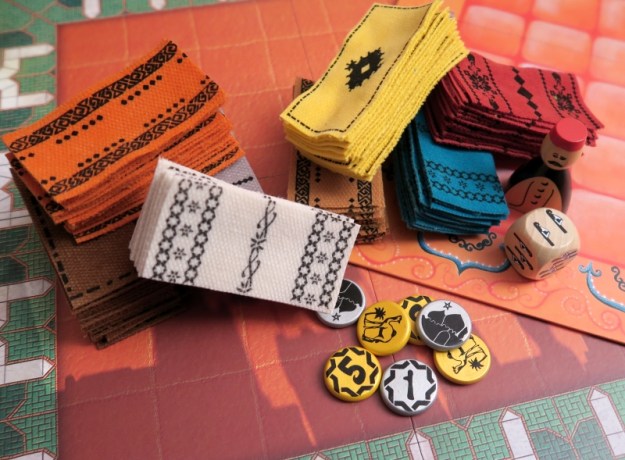
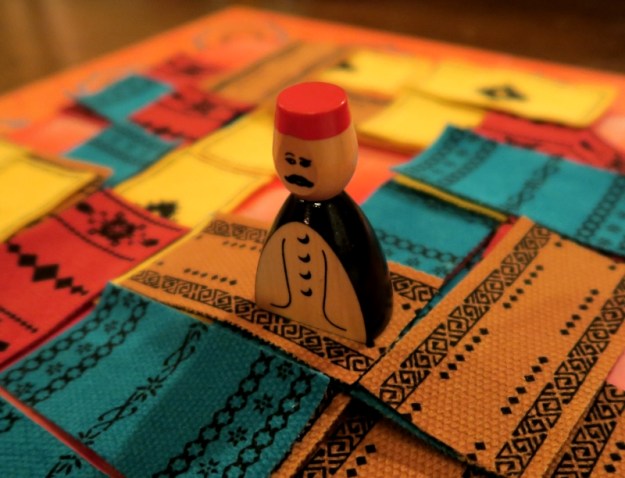
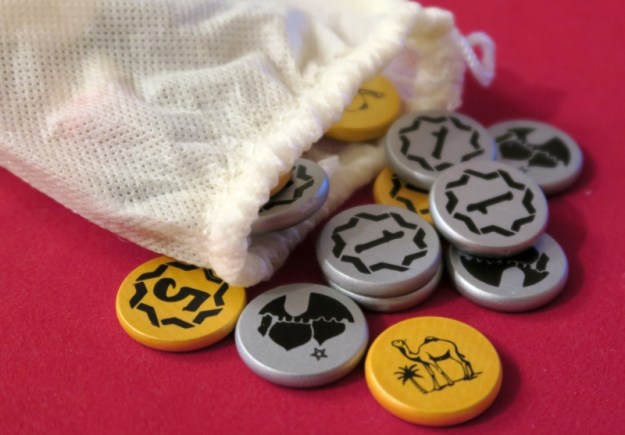
Meanwhile, on the next table things were much more peaceful with Green, Black and Lime laying carpets.  No-one felt up to anything too taxing or long tonight, so after reviewing the selection of games available Black suggested they play Marrakech, which certainly fitted the bill. Marrakech, is an unusual little game, with fantastic little rugs made of fabric and coins made out of wood, where players take the role of a rug salesman who tries to outwit the competition.  Each player starts with ten Dirhams and an equal number of carpets.  On their turn, players may rotate Assam ninety degrees, then roll the die and move him forward as many spaces as shown (up to four).

Marrakech
– Image by boardGOATS

If Assam lands on another player’s carpet, the active player must pay one Dirham per contiguous carpet square of that colour.  Finally, the active player then places one of their carpets orthogonally adjacent to Assam.  The winner is the player with the most money after the last carpet has been laid.  After a quick explanation to Lime (who hadn’t played it before), the group had to decide the Role of the Merchant.  On Board Game Arena, there are two options:  one where the player turns him himself before rolling the dice, and another where the player who just played gets to turn him at the end of their turn and before the next player.

Marrakech
– Image by boardGOATS

After a brief check of the rules, the group discovered that the first option was the original rule (move the merchant before rolling the dice) and so they went with that.  As a result it took several turns before anyone landed on anyone else’s carpet, then Black landed on a single square of Lime’s.   A couple more turns and landing on carpet became a regular activity.  When Green landed on a five square of Black’s, it became apparent that Lime had been labouring under a false understanding about what counted as a paying patch of carpet. He had thought that players have to pay for all the carpet squares connected, by any means including other people’s carpets, but of course only the patch that the Merchant is stood on counts.

Marrakech
– Image by boardGOATS

At various points in the game everyone had a large patch of carpet posing a hazard to the other players: Green had a large area in one corner, Black a large squarish patch in the middle, and Lime managed to get a zig-zag line from one corner all the way to the opposite one.  Mostly everyone managed to avoid landing on these until they were broken up, but that duck was broken when Green landed on a large Black area, shifting the coin balance heavily in Black’s favour.  At the end of the game carpet value was added to coins, and although Green had the most carpet showing, Black had significantly more coins than the others and finished as the winner by five points.

Marrakech
– Image by boardGOATS

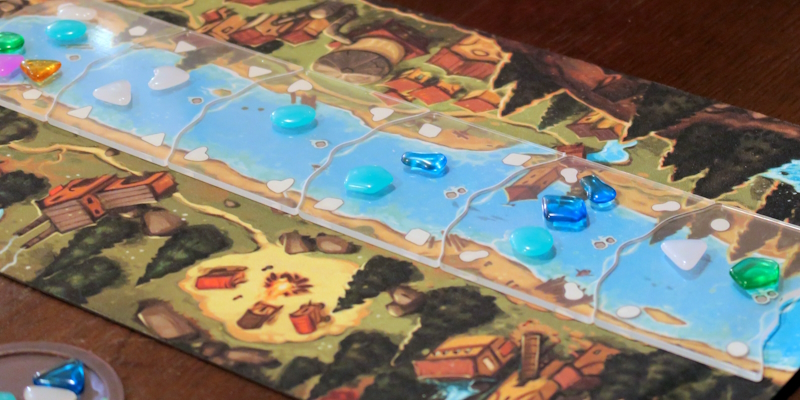
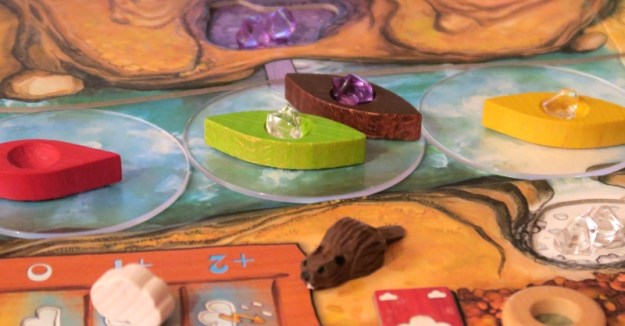
Libertalia was still ongoing, and Marrakech had served as an excellent aperitif, but it was now it was time to move on to something more substantial, and the game of choice was Niagara. This is fantastic family game, that won the Spiel des Jahres Award in 2005, but is still a lot of fun seventeen years later.  The idea is that players have two canoes that they are using to navigate up and down the river while trying to collect gems and land them safely on shore.  Players simultaneously choose a paddle card from their hand, which dictates the distance their canoes travel.  Once everyone’s boat has travelled, the river moves and any canoes that are too close to the falls take the long drop and are turned to matchwood.

Niagara
– Image by boardGOATS

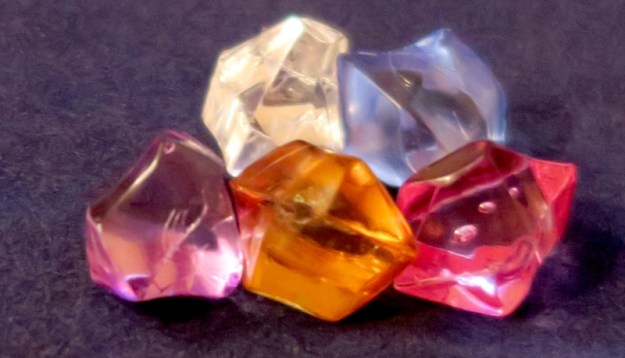
Players are trying to land five gems of the same type (or seven different colours) and the first to do so is the winner.  We last played this about nine months ago, online, through the medium of Board Game Arena.  On that occasion, Pink had betrayed everyone’s trust and stole several people’s precious loot.  The victims (in particular Burgundy), were vociferous in their grievance, and as a result, despite Pink being enthusiastic about playing again, nobody was keen to join him.  With Pink tied up in a quite different loot battle, this was a good opportunity to play again as it was still quite early and it was also an opportunity to introduce Lime to an old classic.

Niagara
– Image by boardGOATS

The first round played relatively gently and much the way it normally does with everyone holding their cloud paddle tile (which allows them to change the speed of the river) back for the last round.  Going into the second round however, Black and Green conspired to shake things up a notch. After putting a canoe onto the river, Black then moved the cloud from the plus one space it had been left on at the end of first round, to the plus two space. However, Green had also thought this was a bold move and had planned to do the same, but unfortunately, he had to move the cloud and as plus two is the maximum, the only direction to go from plus two was back to plus one.  The result was that everyone spent the rest of that round moving five steps forward and four back.

Niagara
– Image by boardGOATS

The highest cards were not enough to get players’ boats off the river and each time they just got dragged back again, with the landing stage forever out of reach.  Green tried to “go against the flow” using some lower cards earlier in the round and holding a bigger card for later, but apart from moving around on different river discs, the end result was still the same.  Everyone ended up on the same disc a couple of times too, and Lime was unfortunate when he lost one of his boats over the rapids.  At the beginning of the third round players got their boats off the river.  By this point, Black had managed to collect four different coloured gems and only needed that elusive pink. Green also had four gems, but that included two purple ones.  Lime had just two gems as he decided to trade one to get his second canoe back.

Niagara
– Image by boardGOATS

Black tried to inch down the river, sometimes choosing not to move a canoe in order to arrive at that last spot to collect his game winning pink gem. However Lime slowed the river down to minus one, and this left Black’s canoes in the wrong place.  In the meantime, Lime also collected another couple of gems and Green managed to pick up another two as well, one purple and one blue.  This left Green needing just one gem to win with seven (the fact that a pink would give him one of each did not matter—there is no double win in this game).  As the new round began, Green got on the river, collected the final purple gem and there was nothing the others could do to stop him landing it on his next turn.  And with that, the paddling was over with Green the victor.

Niagara
– Image by boardGOATS

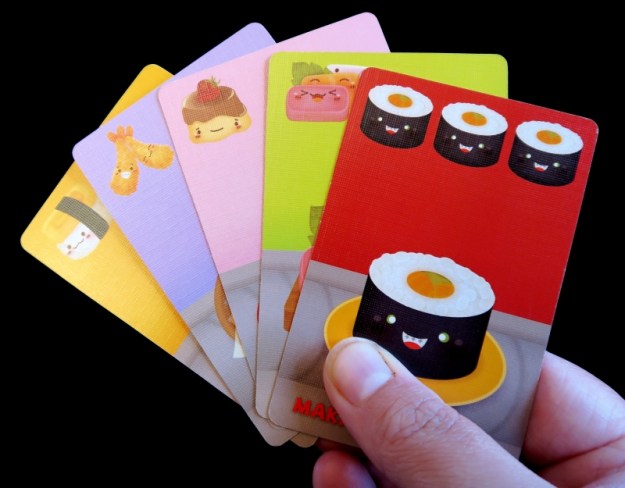
Although it was not that late, Lime and Green left for their respective homes, leaving Black to watch the final few turns of Libertalia.  When that wound up, Ivory headed home and there was still time left for something short. While everyone else discussed the options, Pink went to the bar for a “tot” of Dead Man’s Fingers Rum.  In his absence, Bohnanza was eschewed as “not short” and 6 Nimmt! and Coloretto had both been played recently.  Saboteur doesn’t play so well with smaller numbers so in the end, the game chosen was Sushi Go!.  The first thing to do was to remove the promotional expansions for its big brother Sushi Go Party! (Sukeroku, Inari, Sake and Pickled Ginger; these can be played with the original version but other cards need to be removed), however the Soy Sauce promo cards included as usual.

Dear Man's Finger Rum
– Image by Pine

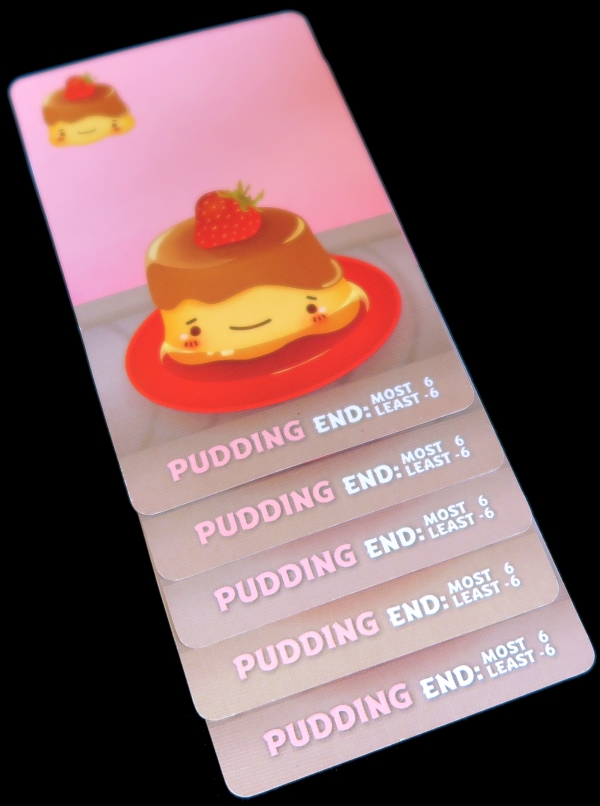
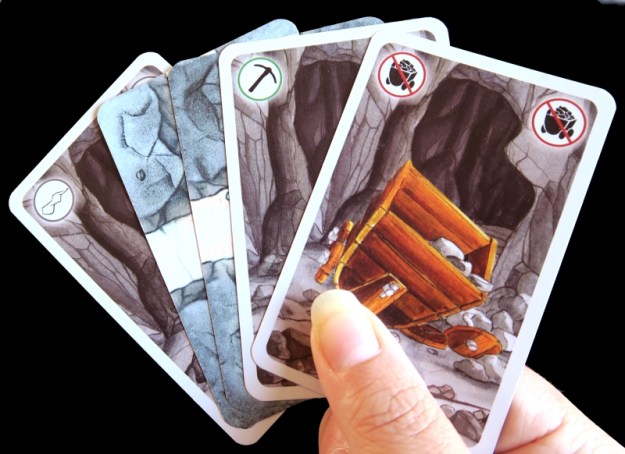
The game is really simple:  from their hand of cards, players simultaneously choose one to keep and pass the rest on before repeating until everyone has no cards.  At the end of the round the different cards are scored according to their individual characteristics.  After three rounds, puddings are evaluated and the winner is the player with the largest total number of points.  This time there was a serious shortage of puddings in the first round and Blue seemed to have more than her fair share.  It wasn’t clear whether it was because she was overly focused on deserts or whether it was just because she’s rubbish at the game, but her score was lower than everyone else except Pine.

Sushi Go!
– Image by boardGOATS

Pine made up for it in the second and third rounds.  In general, consistency is usually the winning factor in Sushi Go!, so Pink should have been in a good position, but both Black and Purple had a couple of really strong rounds, as indeed did Pine.  As a result, it was a really close game.  Pine was undone by the combination of his poor first round and the fact he was the only one with no puddings and lost six points as a result.  In contrast, Blue’s score was boosted by six points as she had a clear majority.  It was Purple and Black who were the ones to beat though, as they tied for the lead on thirty points and tied on the pudding tie break as well, so shared victory.
Sushi Go!
– Image by boardGOATS

Learning Outcome:  If you are looking for job security, don’t become a pirate.

4th Movember 2021 – boardGOATS do the Quiz

We’d had so much fun last month, we decided to give the Jockey quiz another go, all the more-so since we came second last time and had hopes of going one better. First there was food though and that was followed by a quick game of NMBR 9.  This is nominally a four player game, but with a second copy, it can play more so all five, Blue, Pink, Green, Lilac, and Burgundy could all play together.  The game is a very simple tile laying and stacking game built round shapes made from the digits zero to nine.

NMBR 9
– Image by boardGOATS

The idea is that players can place tiles on top of other tiles so long as there is no “overhang”, and the higher numbered tiles are, the more they score.  This time, Blue managed to build a massive five layers, though it was placing a nine on her fourth layer that made the difference scoring twenty-seven points on its own and ultimately giving her clear victory with just under a hundred points.

NMBR 9
– Image by boardGOATS

The previous quiz had been so successful that Purple and Black joined the group along with Pine, just in time for the second game.  With only a little time and so many players, there were really only two options, and 6 Nimmt! was preferred to Saboteur.  6 Nimmt! is so simple, but so much fun, with players choosing simultaneously choosing a card and then discovering whether they will dodge disaster, drop someone else in it, or wind up picking up a pile of cards themselves.

6 Nimmt!
– Image by boardGOATS

We have played loads of 6 Nimmt! online over the last couple of years, mostly using the Professional variant, but feeling that the maths was beyond us this time without a computer to keep us inline, we eschewed that this time.  Instead, we played with our usual face-to-face variant where we play two rounds, each with half the deck.  This time it looked like Blue was going to carry on from NMBR 9, with a clear first round.  It is consistency that is key here though and her second round score put her out of the running.  Pink, Black and Lilac kept their first round scores to single digits, and with low second round scores it was really tight between Black and Pink.

6 Nimmt!
– Image by boardGOATS

Unfortunately for Black, Pink just edged it with a total of nineteen, three less than Black.  There wasn’t time for him to grieve, however, as Charles came round with the picture round for the quiz.  It turned out that Purple was particularly good at this, and we were confident before we found we’d got them all correct.  Sadly, we did less well elsewhere, not helped by failing to spot that “LICKED LOVE HURT” is an anagram of “ORVILLE THE DUCK”.  This was particularly galling as two members of the team had independently identified “the duck” as a possibility, but had moved on as “LIEDLOV” didn’t look like anything useful.

Quiz November 2021
– Image by boardGOATS

There was much hilarity, when Green confidently announced he knew that the item on the front cover of “Fifty Shades of Grey” is a mask, only to discover it is actually a tie.  Unfortunately, although we were in the running until the end, despite Pine working out that “RICOTTA SERVICES” is an anagram of “VICTORIA’S SECRETS”, we finished joint fifth with fifty-four points, six points behind the winners, “Blah Blah blah”.  Must do better next time, possibly at the village quiz on Saturday…

Quiz November 2021
– Image by boardGOATS

Learning Outcome:  “I ‘ate that duck…”

The evening began with the usual friendly chit-chat.  This time, it was mostly focussed on whether or not we would be able to go back to our beloved Jockey for the next meeting (spoiler: we won’t).   But we also discussed at length why Van Diemans in the village was so called, whether it had anything to do with Tasmania or U2, and who Mr. Van Dieman was anyhow (spoiler: nobody knew the answers to any of these, but the street name is spelled differently to the “land”).  We then began to set up the “Feature Game” which was the Fortune expansion for Tiny Towns.

Tiny Towns
– Image by boardGOATS

Tiny Towns is a cute little area control, resource management and town building game with a strong spacial element.  We have played the game several times: after a couple of plays of the minimalistic base game, we have since added the alternative building cards, then the Monuments, and felt we were now ready to add the first expansion, Fortune.  The basic idea is very simple:  players place resources, one per space on their four-by-four town plan.  When they have the right combination of resources in the right arrangement, they can be replaced with a building.  This frees up some spaces, but makes one unavailable for the rest of the game which makes planning essential.  Different buildings give points in different ways, and to add variety, there are alternative buildings available for each type.

Tiny Towns
– Image by boardGOATS

In person, the game plays up to four with players taking it in turns to choose the resource that everyone must place.  Playing online, we use the “Town Hall Variant” which uses a deck of cards to give two resources while every third is a free choice.  For ease with so many, we also play a sort of “Roll and Write” variant where players print their player board and draw the buildings when they build them.  Monuments are special buildings that act as a sort of private goal with everyone having their own Monument deck to draw two cards from at the start of the game, picking one to keep.

Tiny Towns
– Image by boardGOATS

The Fortune expansion allows a little additional flexibility giving players the opportunity to acquire gold and then spend it so they can choose their own resources.  Players receive gold for building two buildings in the same round.  This requires slightly more planning and leads to a little more restriction, but the reward is flexibility later in the game, or an extra point if the gold is unspent.  Players can only hold a maximum of four gold coins at any one time though (or five if they have built a Monument that provides extra storage space).

Tiny Towns: Fortune
– Image by boardGOATS

We also chose to play with the optional “Cavern” rule which is really more of a “hole in the ground” where players can throw resources.  It only holds two resources and players cannot recover these resources and use them later in the game (hence, more of a bottomless pit than a Cavern).  This time we played with both the Cavern rule and the Fortune expansion. Playing with both the Cavern and the Fortune expansion gave a lot of flexibility, perhaps too much flexibility as it took away a lot of the tension and challenge that makes the original game, though it was a lot less stressful as a result.  Playing again, we’d probably play with one or the other, but perhaps not both, as they do a similar thing.

Tiny Towns
– Image by boardGOATS

We started by drawing the cards for the buildings.  They were the Cottage (always included of course), the Farm, the Fountain, the Cathedral, the Gamblers’ Den, the Market, and the Trading Post.  The Cathedral and Gamblers’ Den were from the Fortune expansion, with most of the others being optional alternative cards from the base game.  There was some debate whether the seven points a Cathedral would give was worth the effort and how the Trading Post works.  With all the little rules niggles ironed out we started.  There were the usual complaints when people wanted one thing and got something else.

Tiny Towns
– Image by boardGOATS

The game began with a lot of stone and wood, which players were mostly able to augment with their choice in every third round.  Most people made a point of building a up a stash of coins in the early part of the game while there was space available to work with.  Players gradually drop out when they can no-longer place resources in their town.  Blue was the first to drop out and early too, having used her Trading Post to provide additional resources and her Masons’ Guild Monument to build extra buildings.

Tiny Towns
– Image by boardGOATS

Others soon started following though, and it wasn’t long before Ivory was posting his traditionally high opening score.  At his opening bid of forty-one there were lots of agonised groans, and with good cause as it turned out.  Three others were within three points of him and several others were not much further away.  Burgundy, Pink and Blue scored thirty-eight, thirty-nine and forty respectively, but despite recounts, nobody was quite able to catch Ivory.

Tiny Towns: Fortune
– Image by boardGOATS

It had been a very good game and everyone had really enjoyed it, but time was marching on.  So once Lime and Ivory had taken their leave, the rest of the group moved on to Board Game Arena and after some debate, decided to play Saboteur.  This is a hidden traitor game that we have played quite a bit. The idea is that there are two teams: Lovely Loyal Dwarves and Nasty Evil Saboteurs.  The Dwarves are playing cards trying to find gold, while the Saboteurs are trying to stop them by pushing the tunnel in the wrong direction and breaking their tools.

Saboteur
– Image by boardGOATS

There is a bit of a flaw in the game, however.  In order to keep a level of ambiguity, the number of Saboteurs/Dwarves is always slightly vague.  In real life, this is done by drawing cards from a deck containing one more card than the number of players.  The problem is though, the swing of two players from the Saboteurs to the Dwarves means it goes from extremely difficult for the Saboteurs to nigh-on impossible.  This is particularly the case with the smaller numbers of players, six or seven, say.

Saboteur
– Image by boardGOATS

For this reason, we decided to see if we could include something from the Saboteur 2 expansion, to level things up.  Not wanting to introduce too much change too suddenly, we only included the “Selfish Dwarf”.  This basically gives one of the Dwarves a slightly different goal—while he is also digging for the treasure, he only wins the round if he is the one to actually find it.  At the start of the first round, it was immediately obvious that Green was a Saboteur—he is a natural Saboteur and we always assume he is anyhow, with or without evidence.  This time he was definitely a Saboteur, though and it quickly became apparent that Black was also a Saboteur.

Saboteur on Board Game Arena
– Image by boardGOATS from boardgamearena.com

It became apparent that something was amiss when Pink and Pine appeared to join them with even Purple behaving a little suspiciously.  Blue in particular was very confused as although nobody else knew it yet, she knew she was a saboteur (she checked several times just to be certain!), but there were already more Saboteurs than was possible given the number of players.  In the end, Pine decided to trust Blue and that put the final nail in the Dwarves attempts to find the wealth.  The Dwarves got nowhere close at all just heading endlessly south, which gave a rare victory for the Saboteurs, who turned out to be Pink, Green and Blue.

Saboteur on Board Game Arena
– Image by boardGOATS
from boardgamearena.com

This was only the second win for the Saboteurs since we’ve been playing online, with the previous occasion being very recent, the last time we played the game, in fact.  The Saboteurs were very pleased with themselves and their efforts, and the Selfish Dwarf, who turned out to be Burgundy, had just got nowhere too.  The second round the Dwarves made much better progress from the start.  There was a little debate about where the gold was, but once they had concluded it was at the bottom they made a bit of a beeline towards it.  Somehow, things weren’t quite that simple though.

Saboteur on Board Game Arena
– Image by boardGOATS from boardgamearena.com

The Dwarves had a lot of misfortune with the cards they had and just as it looked like they might make it, they didn’t have the cards.  And then Pine put the boot in and that was that—two wins out of two for the Saboteurs who, this time, were Pine, Pink and Purple.  The game is played over three rounds with the winning team getting gold at the end of each round.  So with one round to go everyone felt sure that the Dwarves would be able to make up for it in the final round.
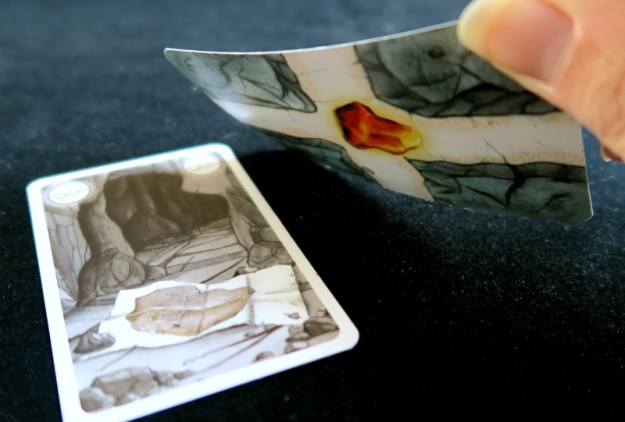
Saboteur on Board Game Arena
– Image by boardGOATS
from boardgamearena.com

Once again, it became apparent early on that Pink was a Saboteur, third time in three rounds.  Despite his protestations (he always protests, Saboteur or not), Green was behaving very suspiciously and disappeared under a hail of broken tools as the Dwarves tried to limit the damage he could cause.  The real question was whether there was another Saboteur or not, and if there was, who was it?  Suspicion fell on Black thanks to the number of cards he was discarding and how generally unhelpful he was being, but nobody was quite certain.
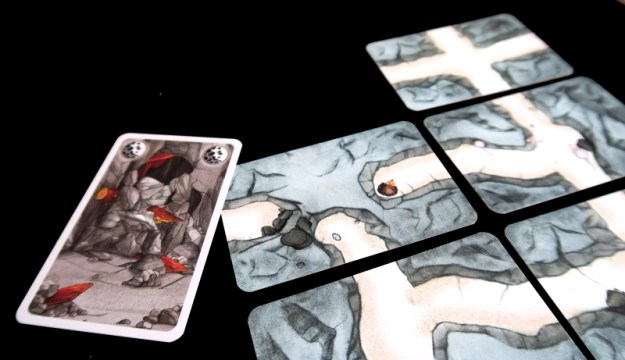
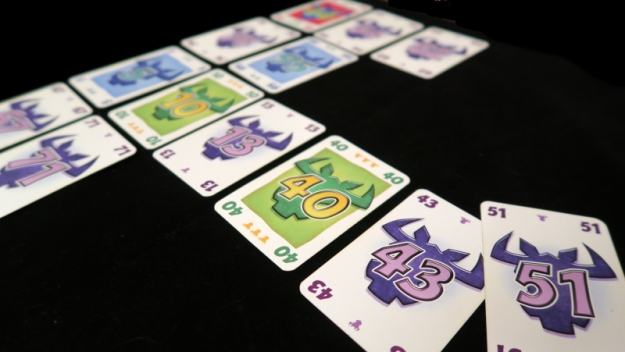
Saboteur on Board Game Arena
– Image by boardGOATS from boardgamearena.com

In the end, the Dwarves simply ran out of cards—although they knew where they were going they didn’t quite make it giving the Evil saboteurs a completely unprecedented three wins from three with Pink winning all three rounds.  The question is, what caused it?  Well, it certainly was significant that in all three cases, the Dwarves were playing with the maximum quota.  It is possible that the Selfish Dwarf contributed slightly too, but Pink who seemed to be the architect of their success, afterwards said he felt that the Saboteurs did well because in each case he started his evil deeds early in the round instead of waiting.  It will be interesting to see if that works next time we Saboteur.
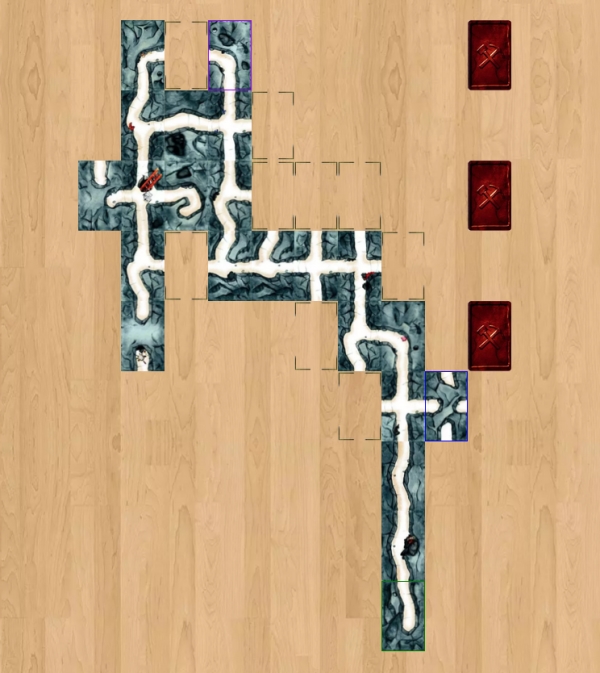
Saboteur
– Image by boardGOATS

Learning Outcome:  Saboteurs really CAN win!

16th March 2021 (Online)

Purple, Black, Pine and Green chatted while Blue reminded herself of the rules for the first game.  Green showed everyone his new game, Fossilis, which comes with little plastic dinosaur bones, tweezers, and even a tiny plastic scorpion—one to play when we get back to the pub, along with the very newly released Red Rising, the Oceania Expansion for the really popular Wingspan, and a whole host of other games that we’ve been waiting over a year to play.

Fossilis
– Image by boardGOATS

And sadly, with the realisation that it was a year and a day since a very small group met at The Jockey for the last (unofficial) games night there, we moved on to playing the “Feature Game“, Das Labyrinth des Pharao.  Das Labyrinth des Pharao is a tile laying game in a similar vein to Take it Easy! which we played a few weeks ago, or the Spiel des Jahres nominee, Karuba (which we last played about five years ago).  In Das Labyrinth des Pharao though, players are exploring a pyramid and collecting treasure.

Das Labyrinth des Pharao
– Image by boardGOATS

Although we’ve not played it on a Tuesday, some of the group have played it before at the Didcot Games Club (November 2015 and September 2016).  Like all the games that we’ve found that work well played online, Das Labyrinth des Pharao is quite simple to play, but it is a little bit “thinky” relying on planning and a little bit of luck.  Everyone had the tiles and board that were delivered a few weeks back, and they had found their Tiny Towns cubes and a meeple from one of the special Christmas crackers we’ve had at one of the unChristmas Parties during happier times.

Das Labyrinth des Pharao
– Image by boardGOATS

The first thing to do was lay out the tiles around the board, in number order—some appear more than once, so these are stacked.  Players then counted out five, four and three of their cubes as treasures.  Once everything was set up, Blue explained that Pink would turn over one of the beautifully decorated number cards (each part of a polyptych), and everyone had to place the corresponding tile on their board.

Das Labyrinth des Pharao
– Image by boardGOATS

They can place the tile anywhere on their board, in any orientation. Some of the tiles have scarabs depicted on them—players can place treasures on these, but must start with the lowest value treasures first.  So, only when all five one-point treasures had been used, could players move on to the four two-point treasures, and finally the three-point treasures (blue, green and red disks respectively, though we were playing with turquoise, yellow and red cubes).

Das Labyrinth des Pharao
– Image by boardGOATS

After the third round, players have to choose which of the six possible entrances they are going to start from and then progress their “explorer meeple” along the path as far as they can.  In the rules, players mark the path at intervals so everyone else can see how far the explorers have travelled, but given the added difficulties associated with playing remotely and the fact that players could count their own path at any time, we omitted this.

Das Labyrinth des Pharao
– Image by boardGOATS

The game ends after twenty-five of the twenty-eight cards have been revealed and then people add up their scores.  Firstly, they score one point for each quarter tile their tunnel extends along.  Next they score points for each treasure chamber their tunnel passes, that is a chamber that contains one treasure surrounded by walls on all four sides.  As usual, the player with the most points is the winner.

Das Labyrinth des Pharao
– Image by boardGOATS

The game was a bit of a tale of people missing cards and having to try to correct it, and for a change, it wasn’t just the usual suspects.  As the game progressed, it became clear that most people had tried to follow Blacks advice and tried to place as many of their treasure tokens as they could.  The problem with this is that they aren’t worth anything unless players have managed to enclose them in a chamber and ensure their route passes alongside.

Das Labyrinth des Pharao
– Image by boardGOATS

In fact, one of the biggest problems for some turned out to be connecting valuable parts of their tunnel to their chosen entrance to ensure their treasure hunter was able to explore the temple.  Pine and Pink seemed particularly afflicted, and as the game drew to a close, Burgundy and Pink in particular were getting increasingly desperate for tile number fourteen.  The final tile was number six, which did most of the job and with that, everyone had to work out their scores.

Das Labyrinth des Pharao
– Image by boardGOATS

As usual, Ivory posted his score first, setting a competitive target of fifty, made up of thirty-one from his path and nineteen in treasure.  In general, the scores were quite close, with almost everyone scoring between forty and fifty.  The longest path was thirty-seven and the most treasure collected was nineteen.  In most cases, those that had a long path (like Blue and Burgundy) had few treasures, while those with a lot of treasure (like Pine and Green) had not explored as deep into the temple.  The exception was Pink, who managed to do well at both and finished with a total of fifty-four.

Das Labyrinth des Pharao
– Image by boardGOATS

It had been a fairly short game, and as it was a while since we’d practised our colouring, we moved onto a quick game of “Roll and WriteTetris, in the form of Second Chance.  We’ve played this quite a bit since we first started playing online, but the last time was just before Christmas, so we decided to give it another go.

Second Chance
– Image by boardGOATS

The idea is that two shapes are revealed and players must draw them in their nine-by-nine grid.  The shapes come in different sizes and the game rewards efficiency in packing.  If a player is unable to play either shape, they get a second chance: one card all to themselves.  If they can play that, then they can carry on, but if they are unable to play that as well, then they are eliminated.

Second Chance
– Image by boardGOATS

Unusually, being eliminated is not necessarily a guarantee of failure in this game:  the winner is the player with the fewest unfilled spaces at the end, which is when the deck of cards runs out.  So, in this game, a player can be knocked out, but still win.  This time, there were a couple of people who threatened to need a second chance, but then suddenly in one round, nobody was able to place either shape and everyone needed a second chance.

Second Chance
– Image by boardGOATS

That round took out everyone but Green and Black, but as there were no cards left, it turned out to be the final round, and that was that.  The scores varied from eleven to two, with a tie between Lilac and Blue for first.  Pink suggested a vote based on the quality of the art-work, but nobody wanted to choose between them and a tie it remained.

Second Chance
– Image by boardGOATS

From there, Ivory and Lilac took an early night, while the rest of the group moved to Board Game Arena for a game of Saboteur.  This hidden traitor game is one we’ve played a lot online over the last year.  The idea is that players are either Good Dwarves or Evil Saboteurs, with the Dwarves trying to play cards to build a tunnel and find the treasure, while the Saboteurs try to stop them using blocking cards and by breaking the Dwarves’ tools.

Saboteur
– Image by boardGOATS

It is always extremely difficult for the Saboteurs to win, but we live in hope and everyone is always pleased to get the opportunity to try.  The first round it was Blue’s and Black’s turn to try.  With seven players, there can be two or three Saboteurs—with just two it was pretty much guaranteed to be gold for the Dwarves, and so it proved.  The Dwarves headed straight for the gold, and despite a desperate rear-guard action the round was quickly over.

Saboteur on Board Game Arena
– Image by boardGOATS from boardgamearena.com

The second round was much closer.  The evil Pine, Pink and Green made life extremely difficult for the Dwarves very effectively blocking their first route to the gold and forcing them to go all around the houses before they found the gold.  Early in the game, Pink caused chaos by disagreeing with Pine as to where the Gold was, and the ensuing confusion made it very close.  The Saboteurs had a lot of cards that worked in their favour, but they still couldn’t quite stop Purple from finding the gold in the end.  The third and final round was a different story though…

Saboteur on Board Game Arena
– Image by boardGOATS from
boardgamearena.com

Initially, the tunnels made good progress, but largely by chance, the tunnel headed towards the top card, when the treasure (it turned out) was at the bottom.  Things were made worse for the Dwarves when paranoia meant they turned on each other early.  There was more confusion about where the gold was and the Dwarves were in disarray.  Eventually, Pine revealed his colours, and then Black, and finally Burgundy.  For once, the cards went the Saboteurs’ way and they played them really well too.  Despite a desperate effort, there was nothing the Dwarves could do against such wickedness, and after a year of trying, the Saboteurs took their first victory.

Saboteur on Board Game Arena
– Image by boardGOATS from
boardgamearena.com

Time was marching on and we were looking for one last game to play, something perhaps a little different from the usual 6 Nimmt!.  After some discussion, Green and Black ducked out and everyone else played Draftosaurus—a game that Blue and Pink have very nearly picked up on several occasions, including Essen in 2019, just after it first came out and that Pine described as “Sushi Go! with dinosaurs”.  With that description, nobody could resist giving it a go.

– Image by BGG contributor kalchio

By this, Pine meant the main mechanism is drafting.  In Sushi Go! players have a hand of cards, then simultaneously, they choose one to keep and pass the rest on.  In Sushi Go!, players are collecting sets of cards, but in Draftosaurus players are drafting little wooden dinosaur meeples and placing them in their dinosaur park, on their personal player board.  The clever part, and what makes it different to Sushi Go!, is that the scoring is driven by the different park locations.

– Image by BGG contributor kalchio

Before each draft, a die is rolled that restricts where players can place their chosen dinosaur and the seven locations all score for different combinations of dinosaurs.  This means that players can want the same dinosaurs for different reasons, or different dinosaurs for the same reasons.  The game is played over two rounds, drafting six dinosaurs drawn at random from a bag, first clockwise and then anti-clockwise.  In the Board Game Arena rendering, this is all done electronically and the tactile nature is lost, however, the graphics are charming.

Draftosaurus on Board Game Arena
– Image by boardGOATS from
boardgamearena.com

For those who were new to the game, it took a couple of turns to work out where the scoring opportunities  are and how to make the best of them, and also to work out how the dinosaurs are passed round and how players could affect each other.  Pine was the only one to have played before, and therefore had a better grasp of how things worked.  Rather than use this experience to beat everyone else’s faces into the dirt, he helped keep everyone else straight and offered help and advice as required.

Draftosaurus on Board Game Arena
– Image by boardGOATS from boardgamearena.com

Draftosaurus rocks along at quite a pace, and it wasn’t long before the game was coming to an end.  Burgundy and Pink had got to grips with the game best and quickest and there was only one point in it.  Although they had mostly tried different approaches, both had also tried to collect different dinosaurs in the Meadow of Differences.  Burgundy had the edge though, and took victory with thirty-eight points.

Draftosaurus on Board Game Arena
– Image by boardGOATS from boardgamearena.com

Everyone had really enjoyed it and fallen a little bit in love with the charming graphics, quick game play, and what’s not to like about building a dinosaur park?!?!  This is definitely one to get and play once we can meet up properly again.  And on that positive note, looking forward to playing together with tactile dino-meeples after a year of gaming from home, it was time for bed.

– Image by BGG contributor kalchio

Learning Outcome:  Pharaohs and Dinosaurs, what’s not to like?

19th January 2021 (Online)

Although they started the meeting early, Blue and Pink left Pine and Green to chat while they set things up.  Lime popped in and joined the chatter, with everyone else arriving in good time for 8pm.  Blue was just starting to explain the rules for the “Feature Game“, Noch Mal So Gut!, when the gremlins first put an appearance (and no, it wasn’t Beige, though he might have been responsible for summoning them).

Beige
– Image by Pine

For the most part, we’ve been quite lucky with the technology.  We’ve had a couple of issues, once when Lime and Ivory got alternately thrown out of Microsoft Teams and another when Tabletop Simulator died on us last April in the middle of a game of Finstere Flure (aka Fearsome Floors), but otherwise the issues have been very minor.  This time the Gremlin Attack was ultimately more spectacular, although it started slowly with Black and Purple having issues with the window-in-window Teams view that wouldn’t maximise.  Eventually the problem went away and Blue explained the rules.

Finstere Flure
– Image by boardGOATS

Noch Mal So Gut! is a slightly more complex, more strategic version of Noch Mal!, a game we have played a few times (including with the first Zusatzblock) and is known within the group as “Boardgame Bingo“.  The basic version of the game is quite simple:  the active player rolls three colour and three number dice and picks one of each, using them to cross off coloured blocks on their player board.  Everyone else then picks one colour and one number from the remaining dice and uses them in the same way.  The player board consists of coloured squares in groups making blocks.  Squares can only be crossed off when they are orthogonally adjacent, match the colour on the die chosen and either start in the middle row (Row H) or are next to another square that has already been crossed off.

Noch Mal!
– Image by boardGOATS

The dice are numbered one to five with a wild for the sixth face, and the number indicates exactly how many squares must be crossed off, it is not possible to “overpay”.  Similarly, there are five colours and one wild (black)—each play only gets eight chances to use number or colour wilds during the game, so they must be used sparingly.  Points are scored for completing columns or crossing off all the squares of a colour, with the player who manages this first scoring more points than those to achieve it later in the game.  Negative points are scored for any stars that are not crossed off.  The game ends when a player crosses off all the squares of two colours.

Noch Mal!
– Image by boardGOATS

The second implementation, Noch Mal So Gut!, adds a couple of new features which add a large slice of strategy.  Firstly, there is an extra die which players can choose to use instead of the colour/number dice pair.   This special die provides actions like bombs which blow up any four squares in a two-by-two group, or the ability to cross out two squares with stars on them.  The special actions can only be used if a player has a “special die” token to spend.  These can be collected during the game, primarily by crossing off squares featuring the special symbol.  In addition to the special die, players also score points for completing rows, with the first successful player or players additionally gaining a bonus, special dice tokens, bombs or hearts.  The hearts are one of the symbols on the special die, in fact it features on two faces so comes up quite often.

Noch Mal So Gut!
– Image by boardGOATS

Hearts give players the bonus points when they complete columns; the number of bonus points they get depends on the number of hearts they have when they complete the column.  So this adds a little bit of spice to the game:  should a player spend dice rolls in the early stages on hearts and hope to be able to cash in later?  Or should they concentrate on completing rows and columns and end the game before other players can capitalise on the hearts they have collected?  The good thing about Noch Mal! (and the reimplementation) is the interaction, through the dice selection and also the scoring.  This is something that is sorely missing in many of the “Roll and Write” style games we have been playing.

Noch Mal!
– Image by boardGOATS

That said, the dice selection element does slow the game down somewhat.  It’s not too bad though, as everyone is only waiting for one player before they can make their selection simultaneously.  It didn’t take too long to get started, though first Black and Purple had technical issues and then Green dropped out for a bit too, so they all had to be filled in on the bits they missed.  A couple of others had a moment and Microsoft Teams got the blame, but we soon started playing, and as always, Ivory was quick to start collecting columns making rapid progress to the right where he started to claim lots of points.  We were making good progress when Black and Purple vanished, so we waited to see if they would come back.

Dots
– Dots by Dribbble on
pinterest.com

After some waiting, and attempts to invite them back, it was starting to look like they had a more serious problem.  Green offered to contact them by SMS and everyone else took drink, snack and litter tray breaks while the opportunity was there.  Eventually, we heard back that Black’s computer had crashed and was now doing a disk-check.  We were reluctant to admit defeat, so although we carried on without them, we took screen-shots of the dice choices they had, just in case they were able to rejoin us.  This was working fine until it was Black’s turn and it was looking like the game might have to continue without Black and Purple, when miraculously, they suddenly rejoined the meeting.  A quick flash back through the previous three or four rolls and the game continued from there.

Noch Mal So Gut!
– Image by boardGOATS

Blue picked up the first row, Green took one, Burgundy got a couple and Blue took a couple more.  Pink meanwhile had collected a full set of hearts and was starting to make hay on the bonus points.  People seemed to enjoy this implementation more than the original Noch Mal!, because it offers more in the way of strategy.  It was pushing 10pm by the time Burgundy brought the game to an end, though to be fair we’d spent nearly half of the time dealing with the gremlins. And it took a while to work out the scores too.  Like the original, the first task is to finish with a positive score, which this time, everyone managed.  As the totals came in, Burgundy, Green, Pink and Pine had all done well, but Blue was well out in front finishing with sixty-four points, more than twenty ahead of Pink in second.

Noch Mal So Gut!
– Image by boardGOATS

The lateness of the hour ruled out the possibility of playing ClipCut Parks or Cartographers (again!), and given the IT issues, we decided it was time to move to Board Game Arena.  After a bit of chit-chat about leaving up Christmas lights, Ivory and Lime said good night.  There was some discussion about what to play:  Pine commented that despite nominating it for the GOAT Poo prize before Christmas, he actually really liked Welcome To… on Board Game Arena, and for some reason found it better than playing on paper.  Green took a quick look and vetoed it as “another Roll and Write game” saying he’d had enough of them.  So eventually, we decide to play Saboteur.

Saboteur
– Image by boardGOATS

Saboteur is an old favourite which we’ve played a lot over the years, including just two weeks ago.  This is a hidden traitor type game where players are Dwarves tunnelling to find gold, or evil Saboteurs trying to prevent the Dwarves succeeding.  Players have a hand of cards which they can use to progress the tunnel or or action cards which they can use to do things like stop other players from digging, cause rock-falls or look at the target cards and help to identify where the gold is hidden.  Half the fun in this game is the banter and accusations that go along with it.

Saboteur
– Image by boardGOATS

This time, the banter started with Green accusing Blue of being a Saboteur, mostly just because.  Blue retaliated and accused Green, but when Pink played a dead-end card on the main route to the gold, Black broke Pink’s pickaxe for him and Pine followed by breaking his lamp. Green triggered a rock-fall only for his suspicions about Blue to be confirmed when she blocked the tunnel.  With Purple aligning herself on the side of the Saboteurs, by breaking Green’s pick, the three Saboteurs knew each other.  The game is always really difficult for the Saboteurs, but with three against four Dwarves and the tunnel blocked, there was just a chance that they might manage it this time.

Saboteur on Board Game Arena
– Image by boardGOATS from boardgamearena.com

Pink broke Black’s trolley only for Burgundy to repair it immediately.  Pine removed the blockage and Blue blocked it again.  Eventually Pine cleared it again and with the deck exhausted, victory for the Saboteurs was tantalisingly close.  That triggered a tsunami of tool destruction.  The Dwarves were creeping ever closer to their target though, but there was just a chance.  If Purple could play a straight tunnel past the target it would mean the Dwarves would have to tunnel that bit further, and perhaps they wouldn’t have the cards.

Saboteur on Board Game Arena
– Image by boardGOATS from boardgamearena.com

Unfortunately, Purple misunderstood and, amid much hilarity, the Dwarves gleefully claimed their treasure.  They almost certainly would have won anyhow, but it still felt a bit like an opportunity missed.  There wasn’t time to dwell on it though as it was time for the second round.  Burgundy declared his position early by playing a dead end card forcing Pink to clear it, exonerating him.  Pine joined Burgundy’s side when he caused a tunnel collapse in the middle of Route One and Purple again showed her evil side by breaking tools.  The Dwarves quickly patched up the tunnel, but the Saboteurs again put up a fight.

Saboteur on Board Game Arena
– Image by boardGOATS from boardgamearena.com

Eventually, Blue claimed some coal and the gold with a single card, and it was time for the third round.  This time, the Dwarves hedged their bets and started with a three-pronged approach, but before long, the tunnel was marching forward towards the central card.  Green revealed his true nature as an Evil Saboteur by playing a dead-end card and was joined by Purple and Pink, (again). Pine cleared his blockage enabling Black to get to the treasure before the deck was exhausted.

Saboteur on Board Game Arena
– Image by boardGOATS from boardgamearena.com

The winner depends on the distribution of “gold cards” at the end of each round.  There are the same number of cards as players, and the number of gold on the cards varies at random between one and three.  The person who finds the gold will always get the highest value card and one other, as they are doled out to the winning team, highest first, in reverse player order.  The problem is, as the Dwarves have the advantage, the “winner” will almost always be a player who has not been a Saboteur.

Saboteur
– Image by boardGOATS

This time that was not the case, with Blue and Burgundy tying for first place, both having been Saboteurs, but also both having personally found gold and also been the penultimate player (thus getting four cards).  Black was the only player not to have been Evil at some point during the game and took the bronze medal, also having taken four cards, but with a lower total value.  Poor Purple though, who had been a Saboteur in all three rounds definitely drew the short straw.  In fact, we are starting to think her friendly exterior belies an Evil lurking beneath as she has been the Saboteur on no fewer than four occasions this year already!

Saboteur
– Image by boardGOATS

As Pink and Pine signed off, eschewing our usual finale of 6 Nimmt!, this time we enticed Green to stay for one last game of Coloretto.  This is a very simple card game that forms the underlying mechanism of the perhaps better known board game, Zooloretto.  On their turn, players have a very simple choice:  Draw a coloured chameleon card and add it to a truck, or take a truck.  The chameleons come in seven different colours and players are trying to build sets, but only the largest three sets will score positively, with the rest subtracted from that total.  With five players, the game is quite short.  This time, the game started with everyone pretty much level until Blue started to lag behind.

Coloretto
– Image by boardGOATS

Forced to gamble, when she found herself the only player left “in” with an almost empty truck, she chanced her arm and turned over cards.  When she got lucky the first time, she tried gambled the second time it happened and went from the back of the pack to taking a large lead.  Black tried the same trick and also got lucky then when Burgundy decided to “take one for the team” and played “King Maker”, Black took the lead as the game came to an end and held on for a fine victory.  With that, Green decided it was definitely time for bed and after a little bit of chit-chat, everyone else went too.

Coloretto on Board Game Arena
– Image by boardGOATS from boardgamearena.com

Learning Outcome:  Being evil is harder than you might think.