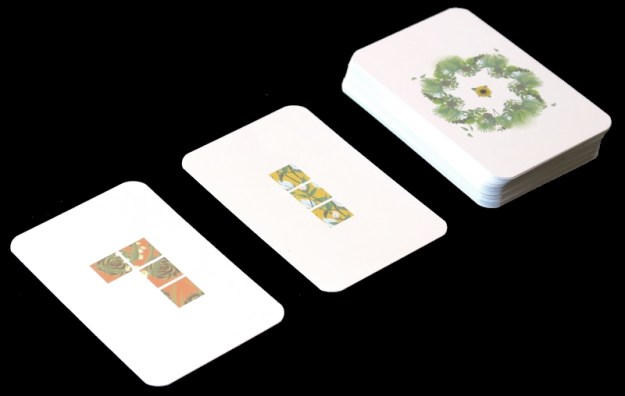
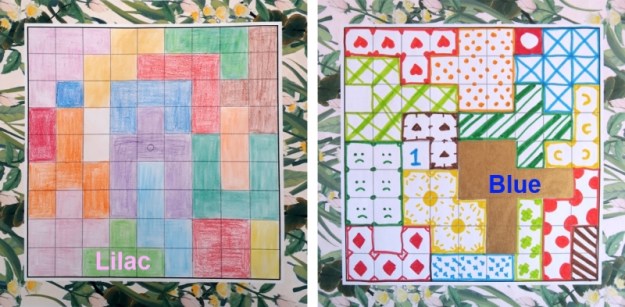
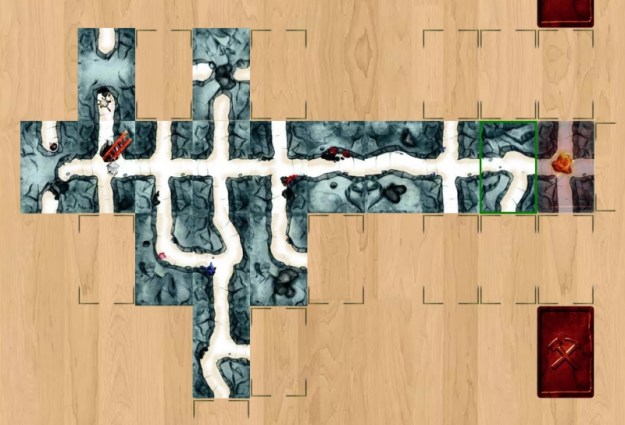
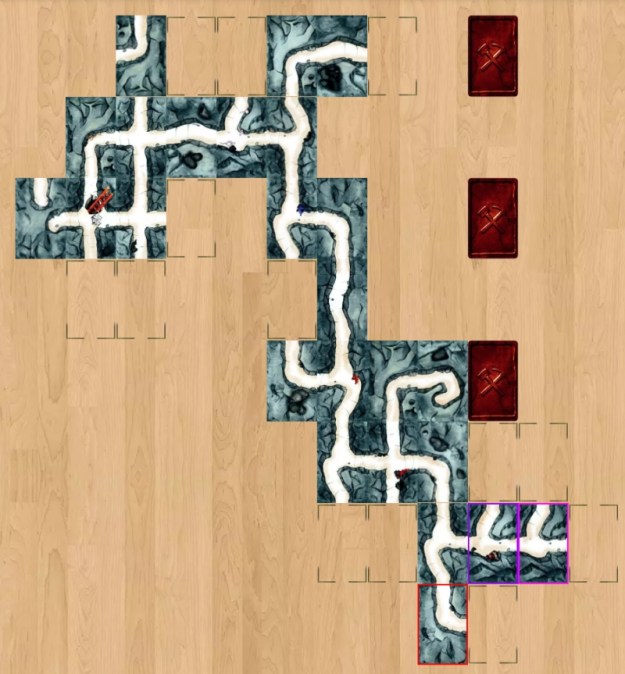
Tag Archives: Tetris

13th May 2025 (Report)

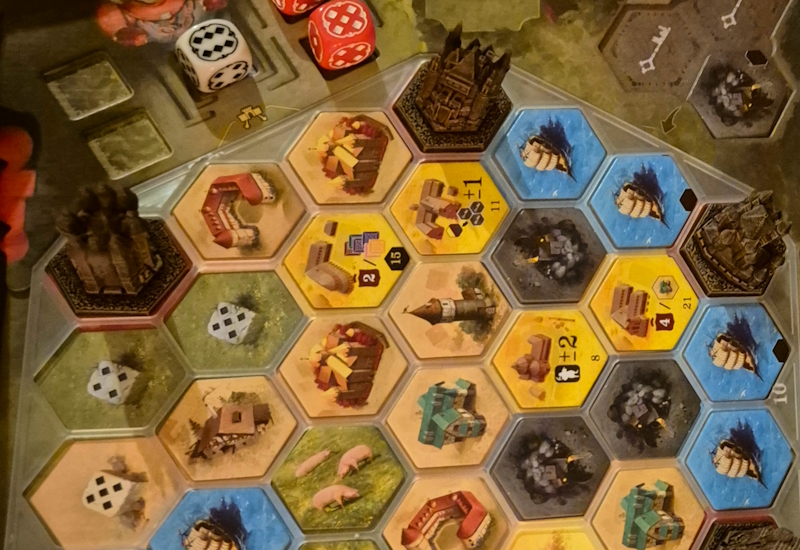
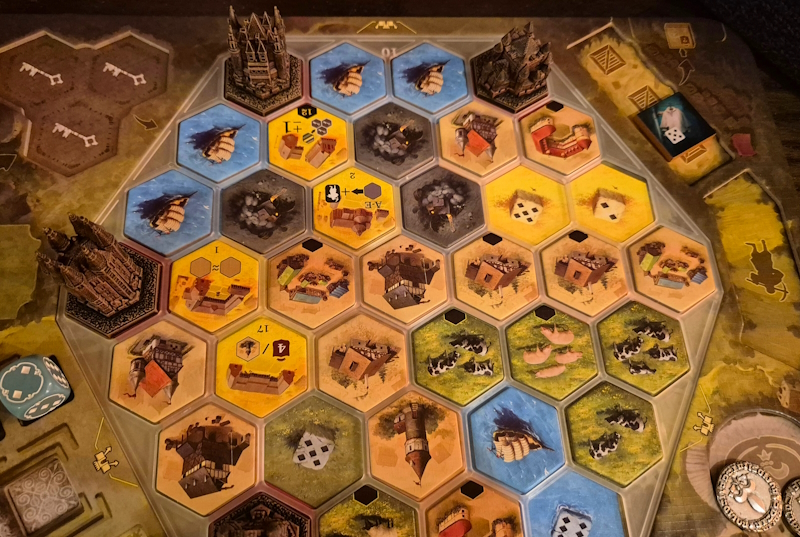
For some, the evening began early with fish and chips in the garden to mark a special visit from Plum’s Aunt Damson.  The evening took an even more special turn as it was the day before Pine’s Big Birthday, so there was cake.  Green also put in one of his special appearances, bringing his mum, Saffron, with him.  Salmon came for the second time, and lastly, Orange, who had acquired a motorbike and was therefore now able to travel, also came for the first time in about eighteen months.  So with all these extras as well as the usual suspects, the room was packed and the group split into four with Jade leading the “Feature Game” which was to be Moon, a card drafting game where players construct bases, vying to build the new lunar capital.
Moon
– Image by boardGOATS

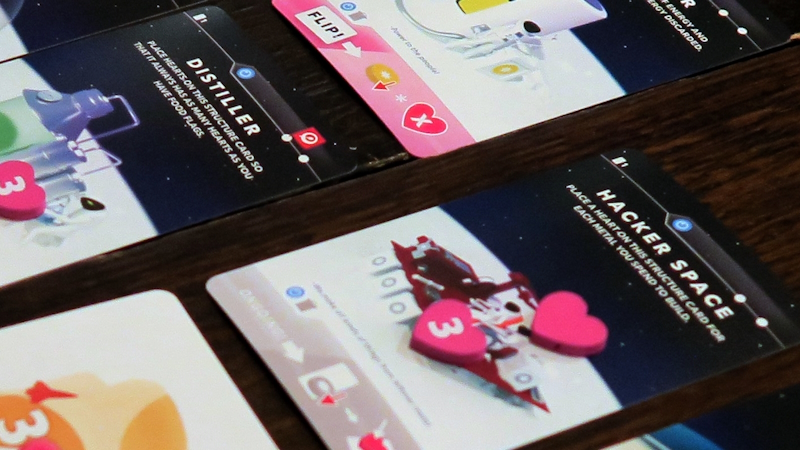
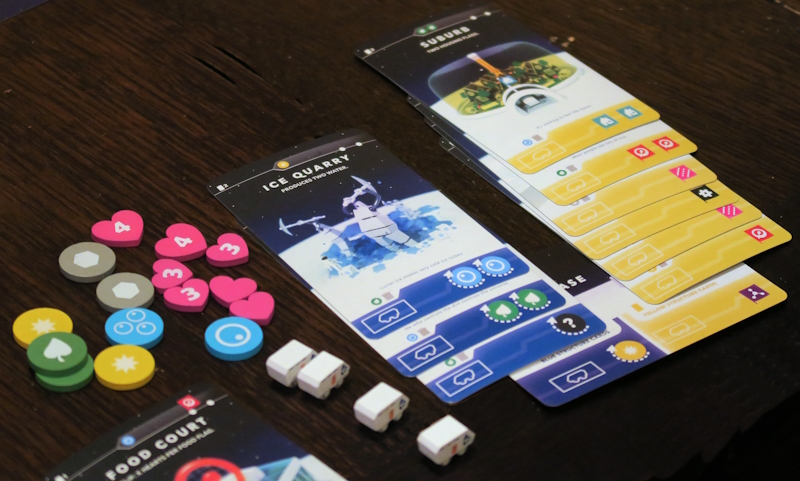
Moon is played over three rounds or Eras, collectively representing the first hundred years of populating the Moon.  Each Era is divided into three parts:  first players produce Resources, Rovers and Hearts from their Settlements.  Then comes the drafting where players choose a card from their hand to Build or discard, then pass their hand to the next player, repeating until there are no cards left.  Finally, players claim the Hearts on the central Flag Reward Board, and score any Hearts placed on their Structures and Reputation Cards.  At the start of the drafting phase, each player has one Expedition cards while the rest of the cards are Structure cards—this hand of cards represents an expedition from Earth that travels between settlements on the Moon.
Moon
– Image by boardGOATS

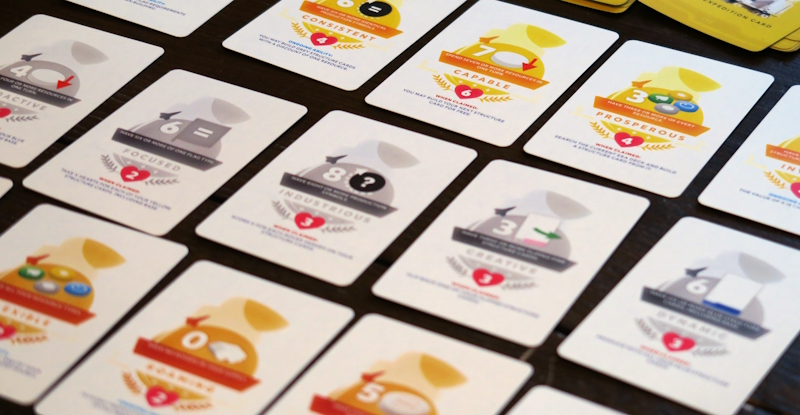
Unlike most card-drafting games, turns are taken sequentially with, players a Structure card from their hand and placing it in their Settlement paying any Resources and making sure any Flag Requirements are fulfilled.  Alternatively, instead of playing a card, they can discard (or “Assimilate”) a card, taking the Resources, Rovers or Hearts depicted in the discard line.  There are also four optional actions that players can carry out once each in any order before or after their mandatory action (Building or Assimilating)—use the Bonus Action on their Expedition Card; park a Rover; claim a Reputation card, or turn over a pink Action card.
Moon
– Image by boardGOATS

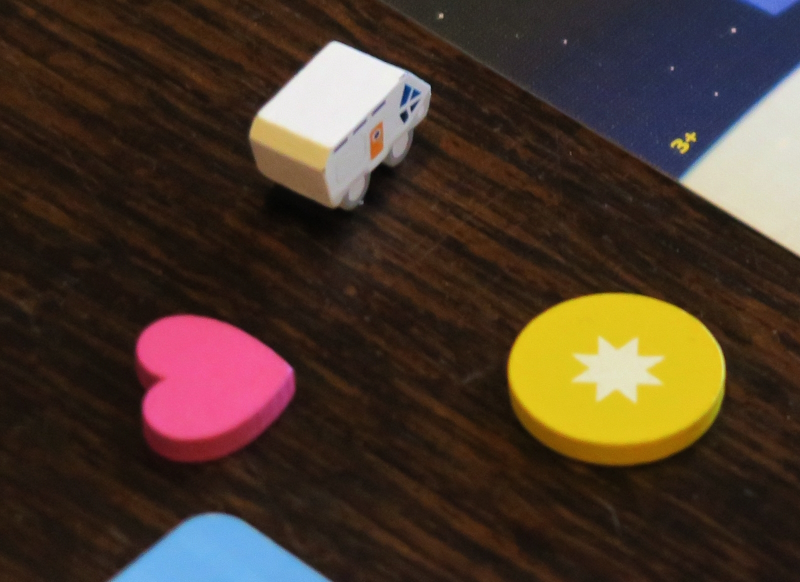
Once all players have taken their turn, all players pass their hands (including the Expedition card) to the player seated to their left and the player who now has the First Expedition Card starts the next round.  There are some similarities with Terraforming Mars, with cards having “Flags” (akin to the “Tags”), with some cards needing some Flags as a prerequisite while others display and therefore provide them.  There are five different Flags, Industry, Science, Food, Housing, and Transportation.  There are also four different types of Resource, Energy, Water, Biomass and Metal which are represented by wooden tokens, or Resource-eeples.
Moon
– Image by boardGOATS

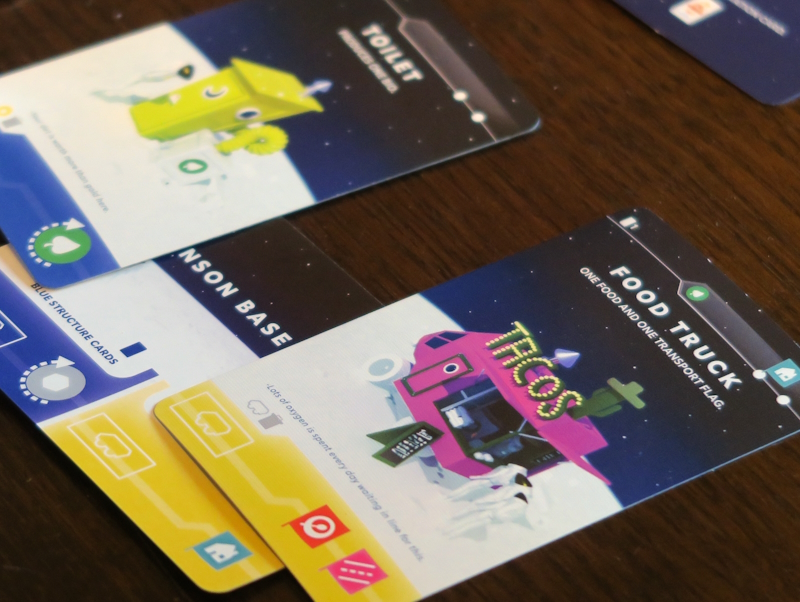
The guts of the game are the cards—there are five different types:  blue Production cards, yellow Flag cards, pink Ability cards, grey Excitement cards and red Special cards.  Blue and yellow Structure cards also display a Rover parking space.  Players begin the game with two Rover-eeples, but can acquire more during the game.  Players can park Rovers on other players’ Structures to either use the card to immediately gain its Resources (blue) or use the Flags on it to fulfill a Flag Requirement when Building (yellow). Pink Ability cards provide an ability players can use once per Era by flipping the card while grey Excitement cards provide Hearts, which are victory points—some of these just give points at the end of the game while others give Hearts during the game.
Moon
– Image by boardGOATS

There was some hilarity over the card names, especially when Orange built a Toilet right next to his food van, Just in case!  Jade who was the most familiar with the game, took an early lead in the Hearts and finished with what appeared at first glance to be an unassailable lead with fifty-six of them, fifteen more than anyone else.  There are other scoring opportunities however, with points available for Grey Structures and Reputation Cards, and Jade came off worst for both of these.  Black picked up the most points for his Grey Structures with thirty followed by Pine with twenty-seven.  Scores were much lower for Reputation with Black, Sapphire and Pine with a similar tally.  In the end, it was very close, but the victory was Sapphire with a combined total of seventy-nine, just two more than Black in second, with Jade completing the podium.

Moon
– Image by boardGOATS

On the next table, Ivory and Byzantium were introducing Salmon to Brass: Birmingham.  There was a concern after last time that they might be a bit pushed to finish it in time (especially after last time), but with only three and with Birmingham being quicker to play than the original Lancashire version, they felt it was worth a go.  Ivory explained the rules while Byzantium set up the board.  In both games, players develop, build and establish their industries and network in an effort to exploit low or high market demands.  Players take turns according to the turn order track, paying two cards (from their hand of eight) to take any two actions from a possible six: Build, Network, Develop, Sell (cotton, manufactured goods or pottery), Borrow, and Scout.
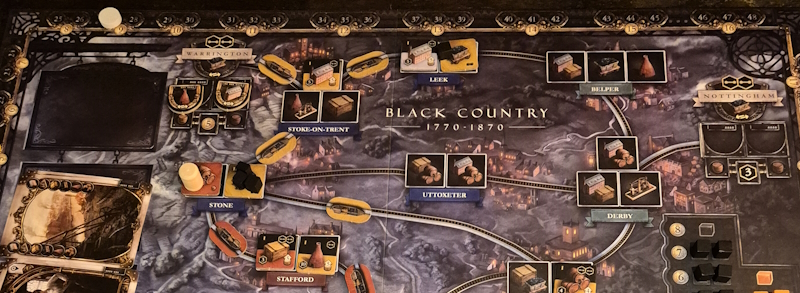
Brass: Birmingham
– Image by boardGOATS

Building involves paying the required resources to place an industry tile while Networking is placing a Rail or Canal Link.  When Developing, players increase the point value of an industry, while Borrowing involves taking a £30 loan and a reduction in income.  The Scout action is new to the Birmingham game and replaces the Double Action Build in original, instead discarding three cards and taking a wild location and wild industry card.  Played in two halves, when the deck runs out players score, remove all the Canal Links then play on but this time building Rails.  The game ends when the deck runs out for the second time.

Brass: Birmingham
– Image by boardGOATS

Ivory went first.  Due to Shrewsbury accepting all goods (this was randomly determined as part of set up) and selling goods being critical to scoring points, initially everyone focused on building near there and building industries that gave resources (i.e. coal and iron) that were going to be need to build further industries.  So Ivory, who went first began by building a Coal Mine in Coalbrookdale, while Byzantium added an Iron Works at the same location and Salmon placed a Coal Mine next door in Wolverhampton. At the start it looked like all three would all be competing in the same area, but once they continued building their networks (via Canals) and more industries, everyone started to spread out.  Ivory headed south, building Cotton Mills in Kidderminster and Worcester and was the first player to Sell, Selling to Shrewsbury and gaining four points for consuming Beer there (Beer being a prerequisite to Selling) and filling the tile to increase his income.
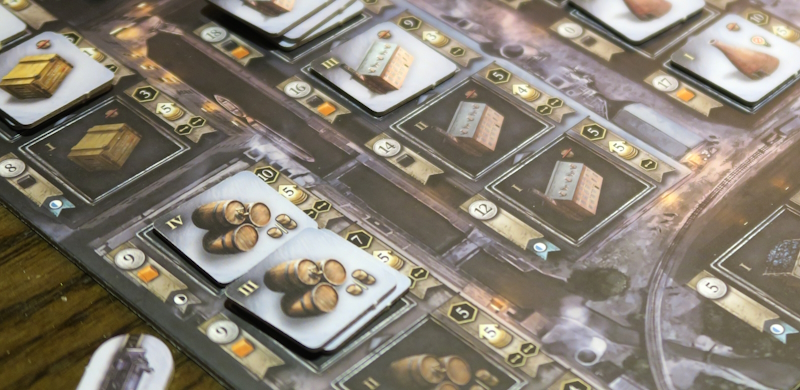
Brass: Birmingham
– Image by boardGOATS

Byzantium went north and sold Cotton to Warrington, gaining £5 as his “Beer Bonus”, and increased his income. Seeing the opportunity Byzantium was building, Ivory took the opportunity using a Leek card he had which allowed him to build outside his network, to build a Cotton Mill in Leek and immediately Selling, using the remaining Beer there to also gain £5. Salmon went more central (Cannok and Walsall), focusing on Coal Mines and Iron Works, but as no one was consuming the resources (both Byzantium and Ivory were slightly self-sufficient), he was unable to flip his industries and increase his income. This became a major issue for him as the game progressed. Everyone ran out of money quite quickly and were forced to take out Loans, decreasing their income making it negative so that they had to pay money to the bank at the end of each round.

Brass: Birmingham
– Image by boardGOATS

Whereas Byzantium and Ivory promptly Sold some Goods, flipped tiles and increased their  income so it was positive again, Salmon got caught in a debt trap, having to take further Loans to take actions and service his debt. When required to take a third Loan (and then pay £9 each in upkeep), it was agreed that he should take the Loan without the drop in income, allowing him to take actions and sell goods and ultimately get back to a positive income. After a late era focus on breweries to get the Beer to Sell further goods, cotton and in Byzantium’s case, Pottery, the Canal Era came to an end. After scoring flipped tiles and Canal Links, Ivory had a slight lead.
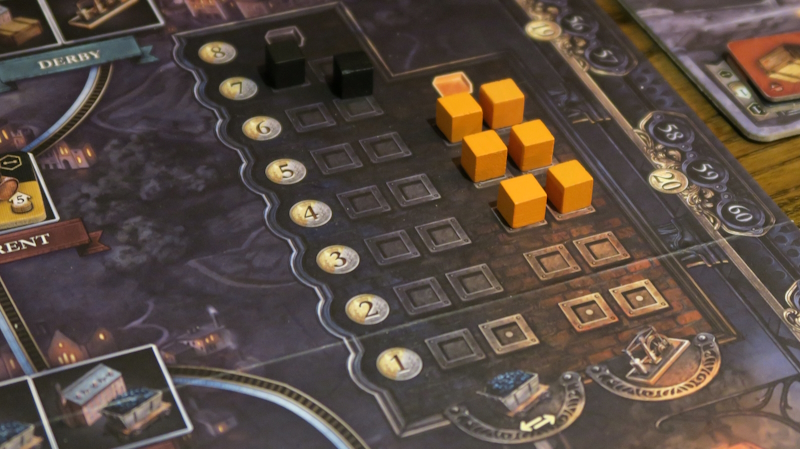
Brass: Birmingham
– Image by boardGOATS

At the end of the Canal Era and going into the Rail Era, as well as all the Canals, all Level 1 tiles are removed from the board, representing obsolete technologies.  This wiped out everything Ivory had and most of Byzantium and Salmon’s tiles, so the start of the Rail Era was similar to the beginning of the game.  That said, Byzantium and Salmon were tied to their positions because, without a named card, players always have extend their Network from an existing position if they can.  That meant, Byzantium and Salmon always had something that was going to score twice though, where as Ivory had to build from scratch, but was free to start anywhere.
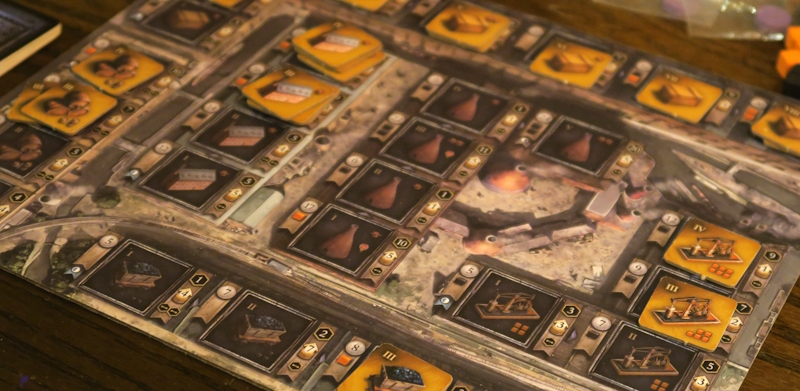
Brass: Birmingham
– Image by boardGOATS

With Rail connections requiring Coal to build, and because the cards in Ivory’s hand were all close to Shrewsbury (which that accepted all goods), he began the second Era almost exactly the same action way as he started the first, building a Coal Mine in Coalbrookdale. Although he had nothing on the board, Ivory was able to rebuild very quickly, partly because he had a good income, but also because he had taken a Loan as his very last action in the Canal Era.  Salmon and Byzantium also built their Networks in similar areas to the first Era. Byzantium’s core strategy was building and selling pottery to Warrington.
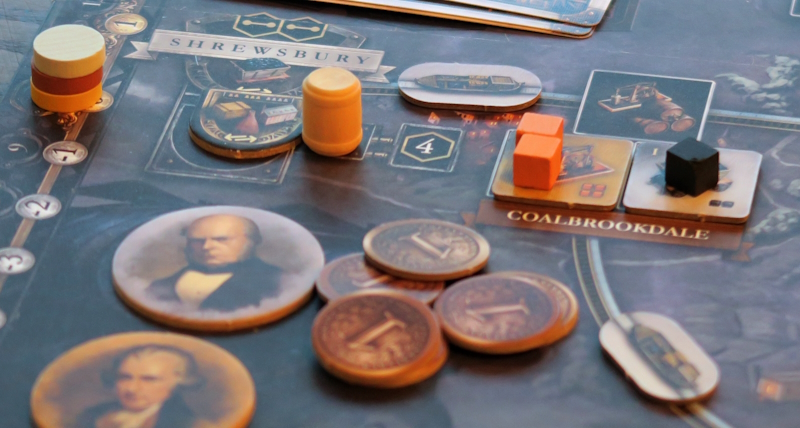
Brass: Birmingham
– Image by boardGOATS

Pottery is a unique resource in Brass: Birmingham, with the first pottery title being worth a large amount of points when flipped, the next being worth very little, the next giving big points etc.. Players are also restricted in developing Pottery, which mean they can’t skip the low point value titles. However, the big scoring tiles are worth a lot and Byzantium was able to get the highest level title out and flipped for a total of twenty points. Ivory again focused on the more standard cotton Mills, and each title being worth more points than the last, he was able to get multiple titles placed and Cotton sold, flipping the tiles to Shrewsbury. He also spent actions building lots of rail links next to his flipped tiles.
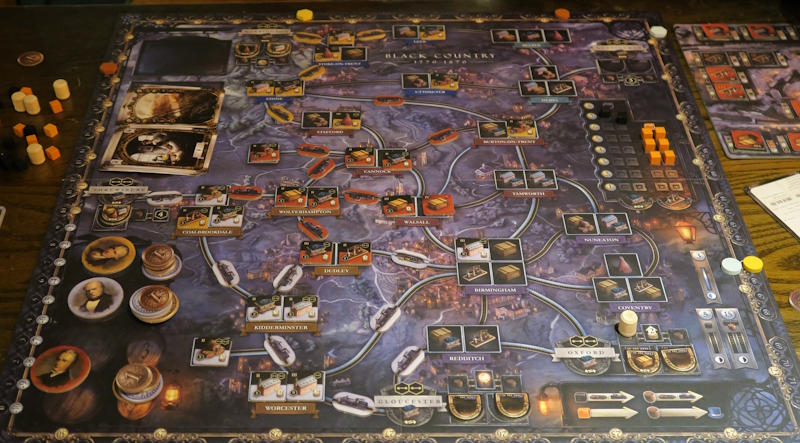
Brass: Birmingham
– Image by boardGOATS

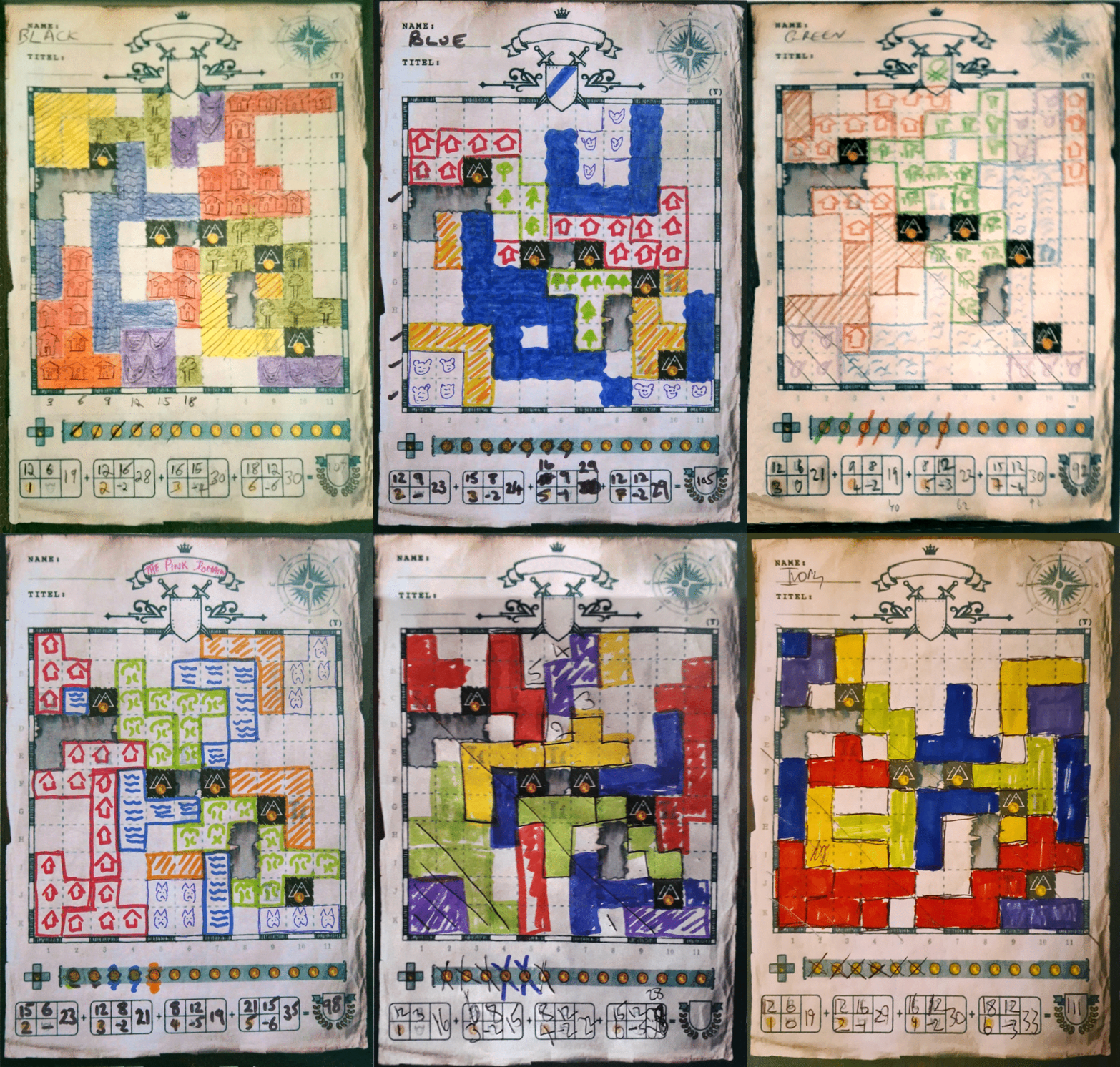
Salmon again took a different approach, focusing on goods, the easiest to build and flip (especially as some don’t need beer), but these are not worth as many points. The game ended after all the cards had been played (for a second time), with Ivory’s focus on rail links and Cotton giving him victory over Byzantium by about twenty points.  Meanwhile, Teal beginning to explain the rules for Cottage Garden to Plum, Plum’s Aunt Damson and Blue, but then Ruby arrived.  Blue had cake to dispense and had a curiosity about Brass, so quickly offered her seat to Ruby and the Teal began again.  Cottage Garden is a fairly straight-forward Tetrissy, puzzle-type, polyomino game with a similar feel to Patchwork, but with more people.

Cottage Garden
– Image by boardGOATS

In Cottage Garden, players are competing in the art of gardening and are working two beds with a variety of flowers.  To do this, players select polyomino tiles of flower beds from a central market grid (restricted by the location of the “Gardener”), then place them on one of their two personal garden boards. Each board has several garden elements that are worth points when not planted over, and these are scored (on two different tracks) as soon as a garden has been completed. There are points “bars” on each track, and when these are passed players receive bonus tokens that can fill in empty spaces or give players a better selection of the flower bed tiles.

Cottage Garden
– Image by boardGOATS

Once a garden is finished, the player receives a new one to complete. After the Gardener completes her fifth lap around the market, the game enters its final round, after which, the player with the most points from their completed gardens is the winner.  The received wisdom is that the problem with the game is that it doesn’t change or intensify, which some people find boring.  However it also means that players have time to “get their eye in” and learn how to play without the game evolving beneath them and catching them out as they spend whole time playing chase.  As such, it was pretty much the perfect game for the occasion.

Cottage Garden
– Image by boardGOATS

Everyone did pretty well—Ruby picked up the scoring quickest, but Aunt Damson got the first beehive.  Teal wasn’t far behind though, getting the second.  In the final round, Plum just scored her current flower bed and discarded the second so that she didn’t get any negative points, something that turned out to be a critical decision in a very tight game.Plum and Teal had the edge in scoring for Pots, but that was off-set by Ruby’s scoring for her Cloches and and Aunt Damson’s Beehives.  Teal, Ruby and Aunt Damson were all within a couple of points, but the victor, was Plum with fifty-six, just three points clear of Ruby who edged second from Teal.
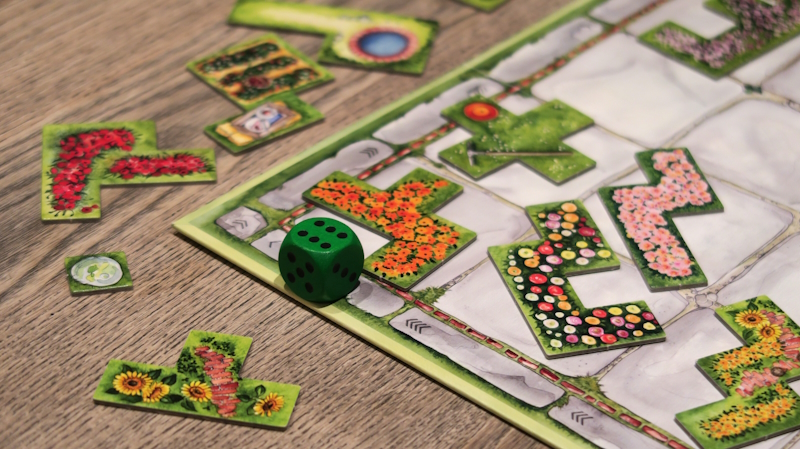
Cottage Garden
– Image by boardGOATS

In addition to Aunt Damson, Green had brought his mother, Saffron who was visiting. the area  Saffron was quite well known to some of the group so there was quite a bit of chatter before she joined Green, Lime and Purple in a game of Azul.  This is a game that is well known within the group and with everyone familiar, the rules explanation could be kept short:  the game uses a very simple, but very clever market mechanic where players take all the tiles of one colour from a market stall and put the rest into a the centre, or take all the tiles of one colour from the centre.
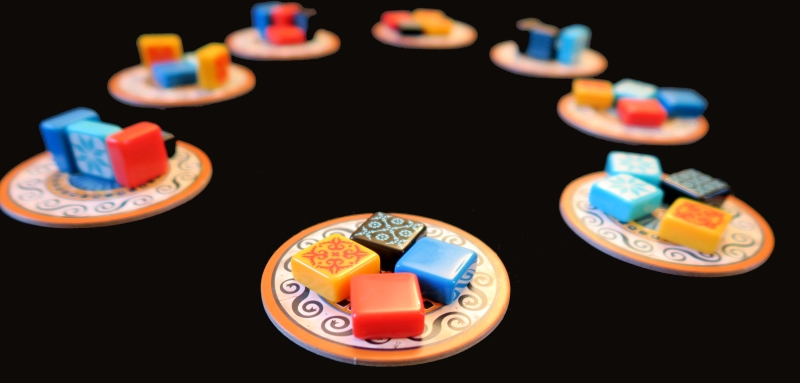
Azul
– Image by boardGOATS

As soon as they have taken the tiles, players add them to one of the rows on their player board.  At the end of the round, one tile in each full row is moved into their mosaic.  The game ends when one player completes one full row of their mosaic.  Players score points when they add tiles to their mosaic (one point for each tile in the row and column it forms), and receive bonuses for completed rows, columns and any completed sets in their mosaic.  The catch is that each feeder row can only contain one colour and and if there are left-overs when they add to it, these score negative points.  Further, each row in a player’s mosaic can only have one tile of each colour.
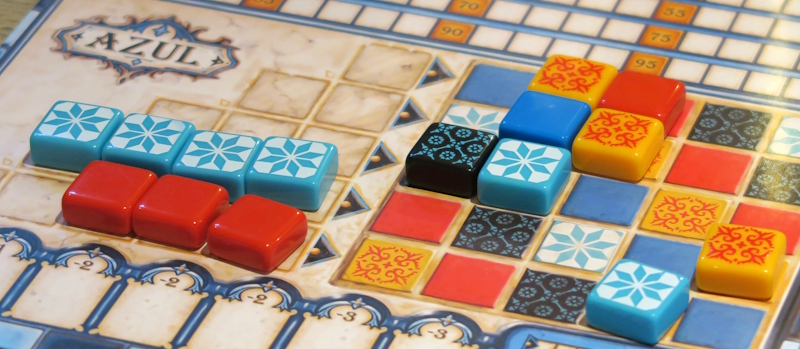
Azul
– Image by boardGOATS

This time, Lime nearly got caught out, however, after Blue was summoned for a rules adjudication.  The question was, was he able to have more than one feeder row in a colour?  If they all had to be different he would be forced to place a lot of tiles in his overflow space and pick up a pile of negative points.  As the rules are clear and players can have as many feeder rows of the same colour as they like at any point during the game (they can only put each colour in a row of the mosaic once), Lime dodged a bit of a bullet.  As a result, he just edged it taking victory by three points from Green with Saffron a few points behind him.

Azul
– Image by boardGOATS

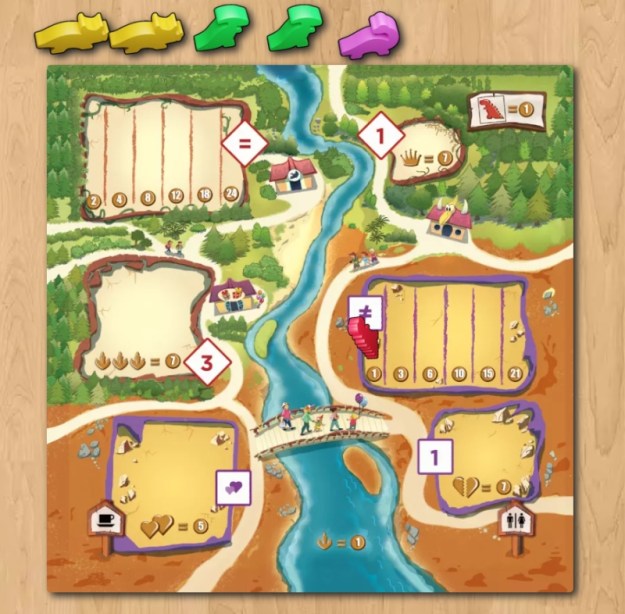
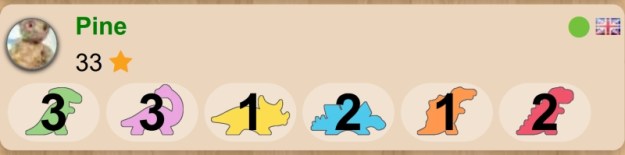
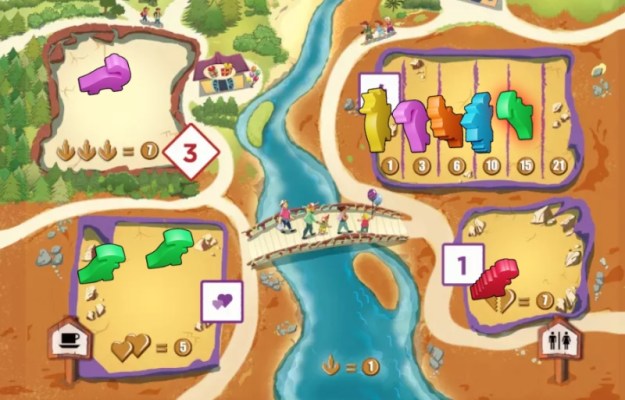
With everything else still going, when Azul finished, Blue joined the table to introduce Saffron to another one of the groups favourite games, Draftosaurus.  This is a very simple drafting game (similar to games like Sushi Go! where players choose from a hand of cards and pass the hand on), but in this case players are drafting cool dino-meeples and adding them to their dinosaur park, with different locations scoring for different combinations of dinosaurs. The game is played over two rounds, each placing six dinosaurs.  The first game was a bit of a land-slide although it ended in a tie between Green and his mum, Saffron, both scoring thirty-seven points.
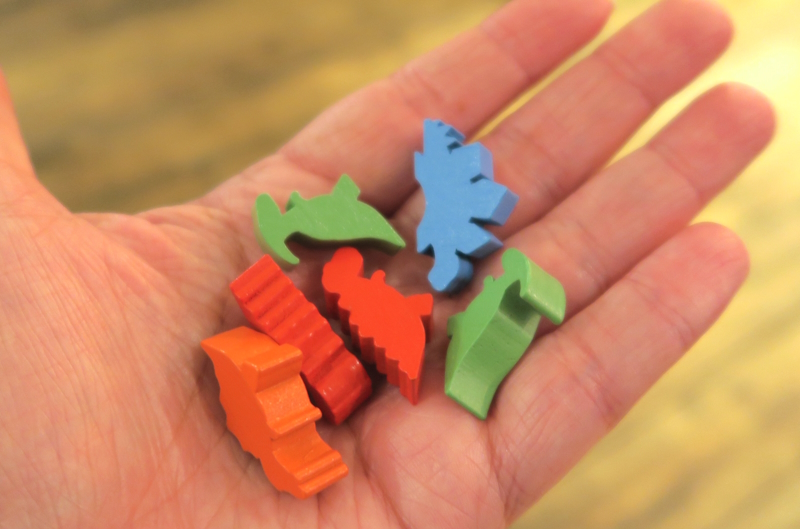
Draftosaurus
– Image by boardGOATS

It couldn’t be left there of course, so the group “did a Lime” and played again.  This time it wasn’t until the scoring that Green realised why he hadn’t seen a single T. rex—Blue sat to his right had nabbed them all before he got to see them!  T. rex is a special dinosaur in general, but especially in Draftosaurus, giving an extra point for each one, but also having some placement restrictions.  Blue is generally very bad at this game, but even a park full of dinosaur kings (and queens) didn’t help, although it was a very close game with four players within a couple of points.  The clear victory though was Purple with thirty-eight, three points ahead of Lime who led the rest of the pack.
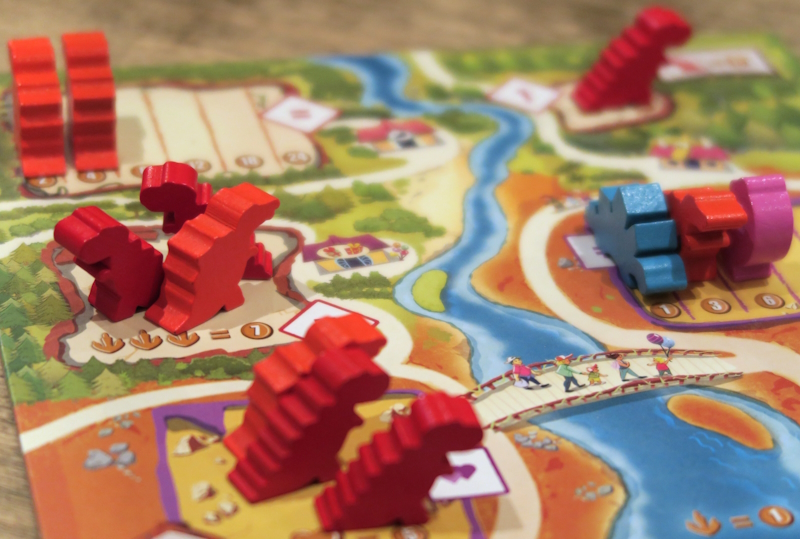
Draftosaurus
– Image by boardGOATS

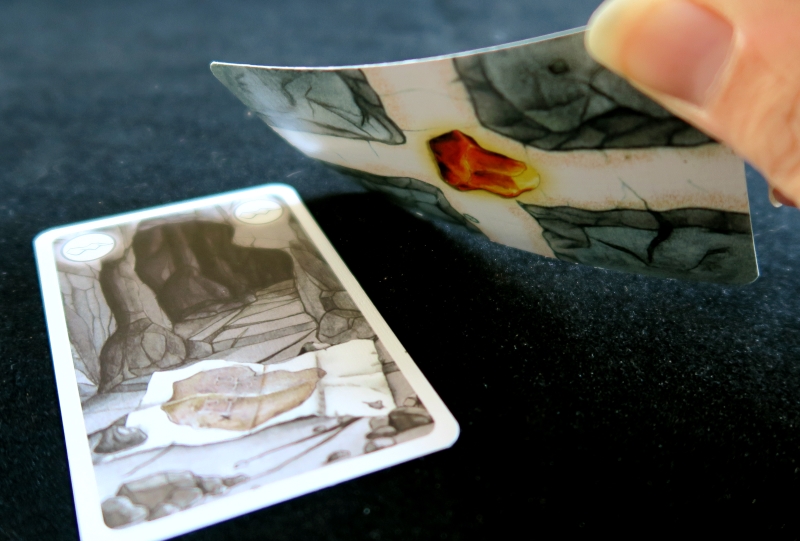
From there, there was a bit of chatter, but by the time Cottage Garden had finished, Teal, Lime, Green and Saffron all decided it was time to head home, leaving Purple to join Ruby, Plum and Aunt Damson.  There was some question about that they would play, but in the end they decided on one of Purple’s favourites, the hidden traitor game, Saboteur.  In truth, this is not at its best with four, but despite that, the group really enjoyed it.  The idea of the game is that players are Dwarves building a network of Tunnels in order to find treasure.  They do this simply by playing a card to extend the Tunnel and drawing a replacement.  The catch is that there is a traitor, an Evil Saboteur, in their midst.
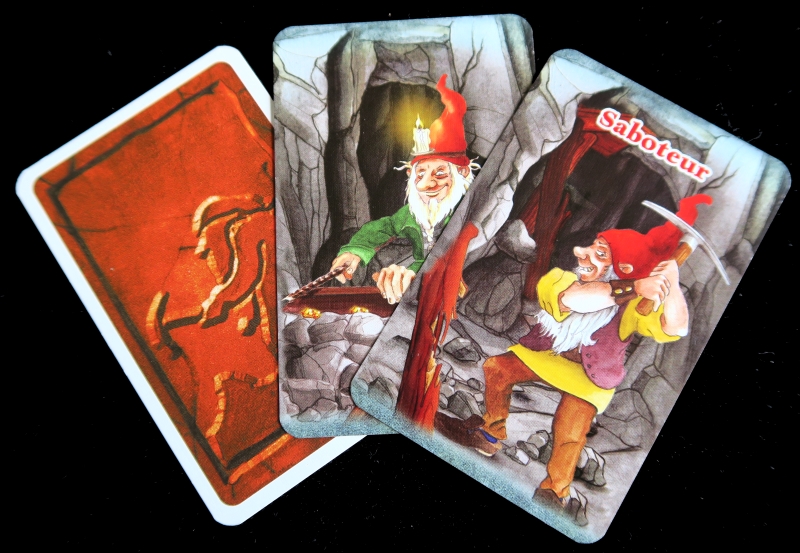
Saboteur
– Image by boardGOATS

So, if the Dwarves have not found the treasure by the time the deck runs out, then they have lost and victory goes to the Evil Saboteur.  In addition to Tunnel cards, the deck also contains Special Map, Rock Fall, Broken Tool and Fixed Tool Cards which Dwarves and Saboteurs can use as they feel appropriate.  With four players, Ruby put two Saboteur cards in the pile used to assign the roles, but as it happened only one came out—Ruby.  Plum seemed to get the all map cards and checked the target nearest her first: Coal.  She then tried the the middle target card, but finally found gold in the one furthest from her.
Saboteur
– Image by boardGOATS

Ruby chose to strike out at Aunt Damson first, but that left Purple and Plum to continue digging for the gold.  Ruby then played a tunnel card with a dead-end which exposed her as a Saboteur, and as the only one, the writing was on the wall.  The game is formally played over three rounds, but we don’t like the way that plays and treat one round as a game in its own right.  Everyone enjoyed the game, but Aunt Damson in particular—she had watched and enjoyed The Traitors, so the overall concept particularly appealed.  It had been a lovely evening with a slightly different set of people and lots of games played.

Saboteur
– Image by boardGOATS

Learning Outcome:  It’s lovely to host family and old friends.
18th March 2025

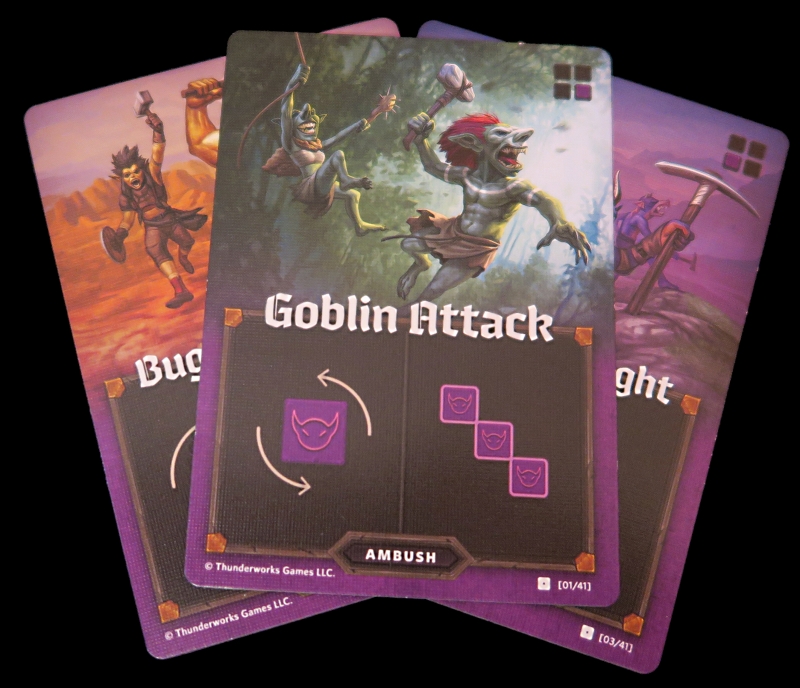
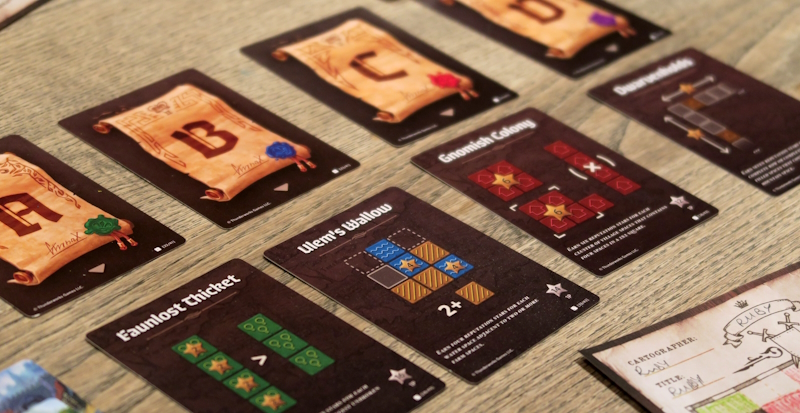
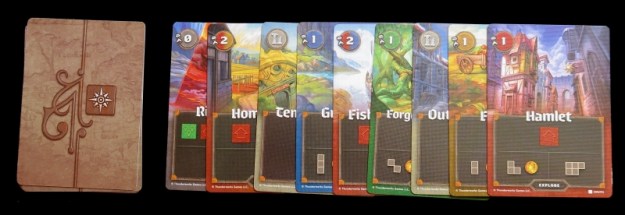
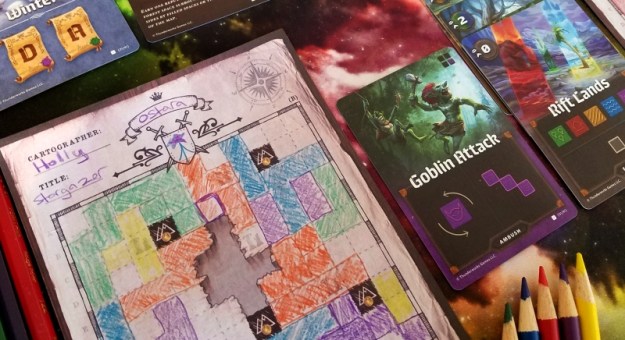
The evening began with the arrival Ruby and Flint, friends of Teal, who had come along despite the fact he wasn’t able to be there to introduce them to everyone himself.  They introduced themselves as people finished their supper and prepared to play the “Feature Game” which was to be Cartographers Heroes, the standalone sequel to Cartographers.  Cartographers was probably the best of the roll and write games the group played online during the global coronavirus pandemic, so we chose to play it to mark the fifth anniversary of our last meeting in the pub before we moved online.  It was a very difficult time for everyone, though as a group we stuck to it and tried to look after each other, continuing to meet fortnightly, online.

Setting up for online gaming
– Image by boardGOATS

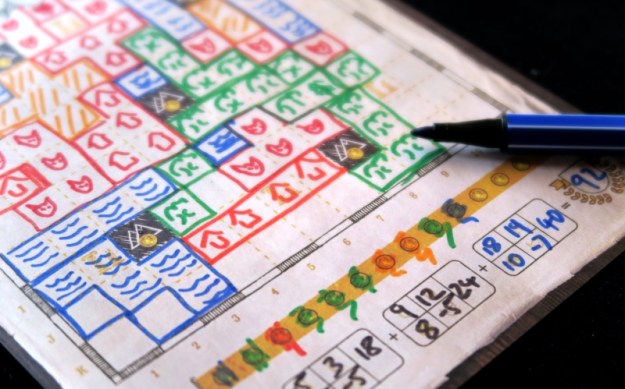
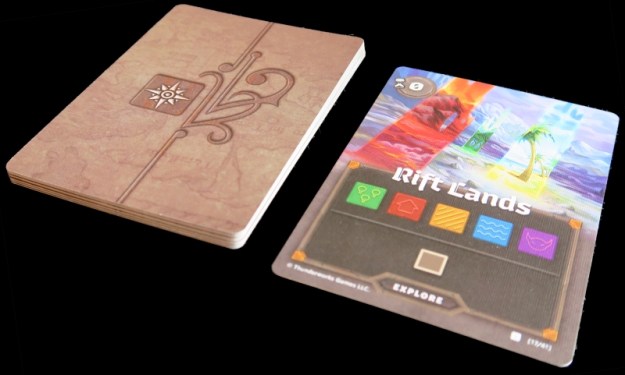
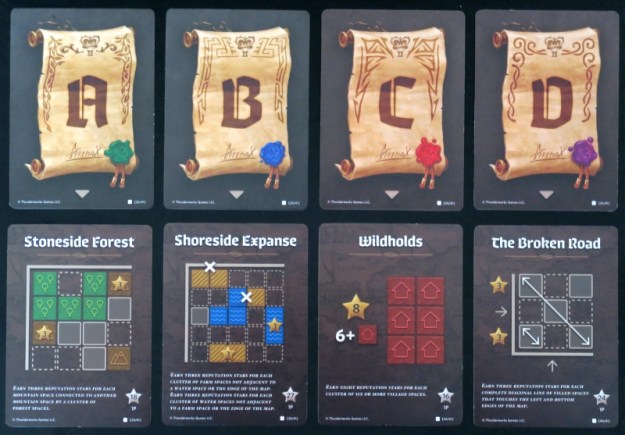
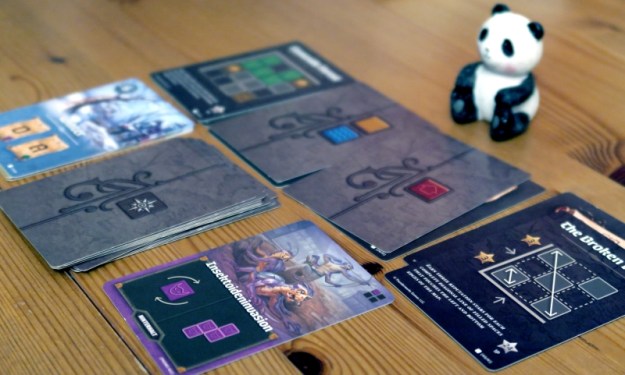
Strictly, Cartographers is a “flip” and write rather than roll and write game as it is card-driven.  Played over four seasons, cards are turned over to reveal choice of “Tetris-like” shapes and/or terrains that players draw on their map.  The game is played over four rounds, each with a different scoring criteria—a total of four during the game, with two active in each round (similar to Isle of Skye).  In addition to the normal terrain cards, there are also Ambush cards, which are nasty as they score negatively with a point lost for each empty space next to an Ambush space at the end of each round.  They can be played in two ways depending on the number of players and the circumstances of the game.

Cartographers: A Roll Player Tale
– Image by boardGOATS

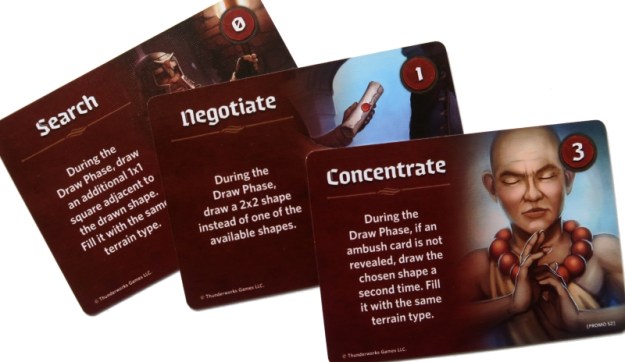
Online, we played these using the Automa rules, where the Ambush “pieces” are placed via a set of rules, whereas in person, players pass their map to a neighbour who places the Ambush piece in as awkward a place as possible.  In addition to Ambush cards, the Heroes game adds Hero cards which can be used to off-set the effect of the monsters from the Ambush cards.  The distribution of cards is also slightly different and the map layout is slightly different too.  This time, although the game can play up to a hundred people simultaneously, because of the difficulty seeing the cards, the group chose to split and play two separate games.

Cartographers Heroes
– Image by boardGOATS

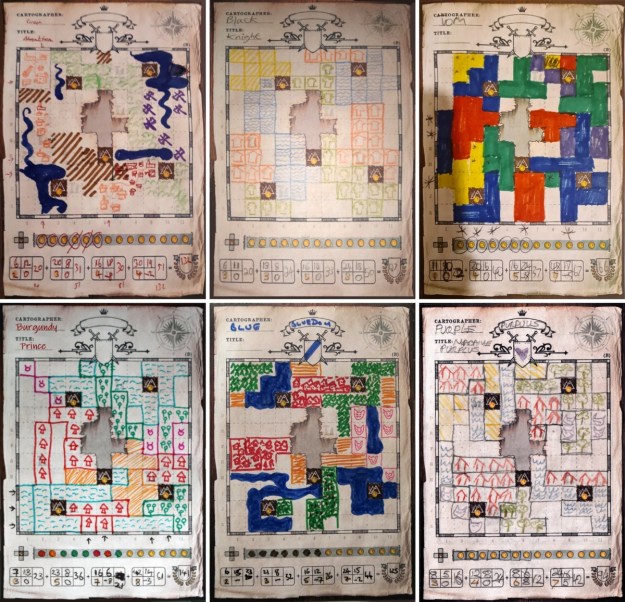
The first of these included Blue, Pink, Flint, Ruby, Purple and Lime, while the other comprised Jade, Sapphire, Pine, Byzantium and Mint.  The first group were using the Collector’s Edition which comes with pencils in colours that match the different terrains.  The second group cast envious eyes on the pretty maps as the games started, but despite offers, refused to take a set and stuck to the slightly more elegant monochrome maps relying on symbols to indicate the different terrain types.  Although the original Cartographers and the Heroes games can be mixed, both groups used the decks and maps from the Heroes game.

Cartographers Heroes
– Image by boardGOATS

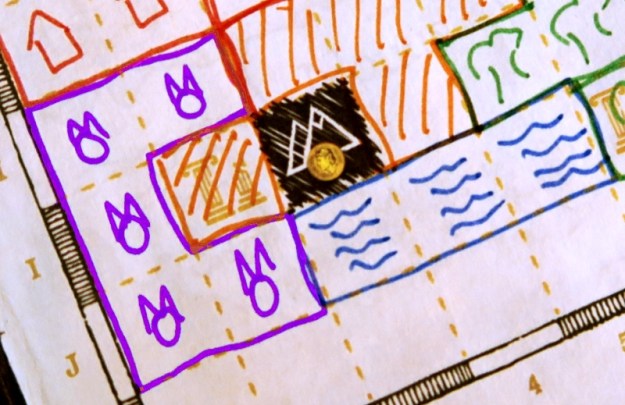
The first group began with a sequence of woodland terrain, which fitted with their first objective, but the shapes wrapped nicely round the mines.  The mines give money—when surrounded by terrain, players can tick off a one of the coins marked at the bottom of the map, which gives a point at the end of each round.  Thus collecting them early makes them more valuable each giving up to four points throughout the game.  So, most people started by prioritising them as an easy way forward.  Consequently everyone’s first rounds gave similar scores, but by the second round Lime and Pink had edged a bit of a lead.  Nobody scored particularly well in the third round, so it was all down to the final round to make the real difference.

Cartographers Heroes
– Image by boardGOATS

Most people scored around twice what they’d picked up in earlier rounds, but it was Pink who top scored with a massive fifty-five, giving him a bit of a landslide with a grand total of a hundred and thirteen (after a couple of recounts).  Blue just edged into second, ahead of Lime, but they were some twenty points adrift.  The second game followed a similar pattern with massive scores in the final round, though it was a much closer game, with it possible to cover the top three with a postage stamp.  The scores were generally higher than for the first game, but the victor was Mint who finished with a hundred and twenty-six, three more than Jade in second who pipped Byzantium by a single point.

Cartographers Heroes
– Image by boardGOATS

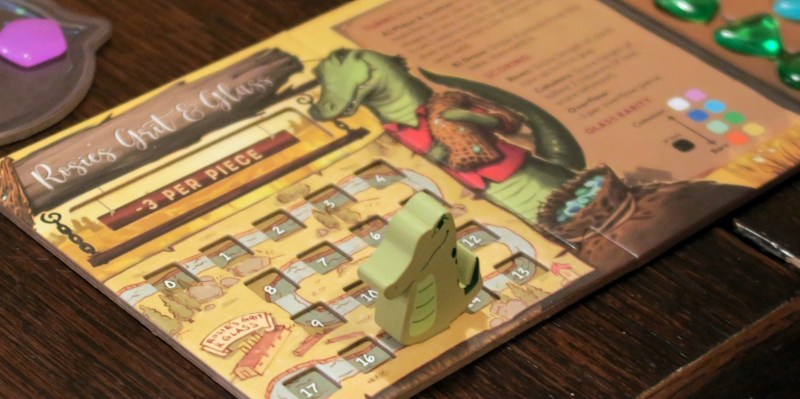
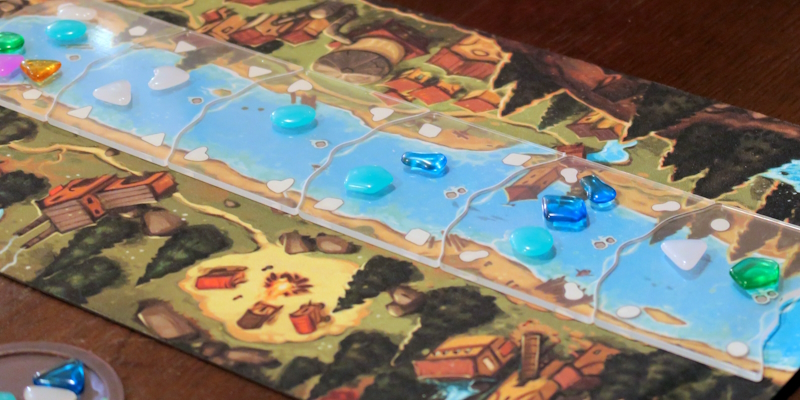
With the second game finishing first, the group moved on to play River Valley Glassworks, a re-implementation of the card game Subastral.  In River Valley Glassworks, players take the role of entrepreneurial of woodland creatures drafting glass from the market of river tiles by playing a piece from their inventory into the river. Each river tile can take only a specific shape, and players have to play into a space adjacent to where they want to draft from. After claiming their glass, the river shifts forward (in a way that is vaguely reminiscent of Niagara), revealing new pieces.

River Valley Glassworks
– Image by boardGOATS

Glass is stored in players’ shops, and the scores depend on where the glass is placed—completed rows and columns gain bonus points, but too many of one type gives negative points.  The game is generally cosy, quick and fun, and this time was no exception.  Jade explained the rules which are simple enough: either place a piece of glass onto a river tile or draw exactly four pieces from the lake with the aim of collecting a rainbow of glass pieces. Getting the balance right can be a little tricky, so it was no surprise that the most experienced players came out best with Jade taking victory with eighty points nearly ten ahead of the other person who had played it before, Sapphire.

River Valley Glassworks
– Image by boardGOATS

When the other game of Cartographers finished, the group continued with the roll and write theme, moving on to another game that went down well online, Second Chance.  This is a similar “Tetris-like” card driven game, but much simpler.  Everyone has a square grid and as cards are turned revealing shapes, they add them to their grid.  Players are eliminated when they can no-longer add the latest shape.  The game gets its name from the fact that when a player gets stuck, they get one card flipped, just for them, and can carry on if they can add that shape to their grid.  The player with the fewest gaps at the end, is the winner.  This time, Purple was eliminated first, but it still got quite close to the wire and the tension was palpable.  The winner was Flint, however, who very nearly managed to fill his whole grid, leaving just two spaces unfilled.

Second Chance
– Image by boardGOATS

Meanwhile, on the third table, Cobalt was joined by Black, Plum and Ivory in a game of Castles of Burgundy using the new fancy “Special Edition”.  In Castles of Burgundy, players take on the role of an aristocrat controlling a small princedom, building settlements and castles, trading along the river, mining silver, and use knowledge of travelers.  The game is a tile playing game that is played in five phases, each consisting of five rounds. At the start of each round all players roll their two dice, and first player also rolls a goods placement die.  During their turn, players carry out two of the four possible types of action.  These include: take a settlement tile from the numbered location corresponding to one of their dice and place it in storage; take a settlement tile from storage and place it on their player board on a space with a number matching one of their dice;  deliver goods with a number matching one of their dice, or take worker tokens (which allow players to adjust the roll of their dice).

Castles of Burgundy
– Image by boardGOATS

Additionally, players may buy a settlement tile from the central depot and place it in their storage area. The Settlements offer benefits, additional actions, money, advancement on the turn order track, more goods tiles, die roll adjustment or victory points with bonus points awarded for filling a region with tiles.  Cobalt and Black both started on the east side of the map, with Black building to the south with Ships to move up the turn order.  He also got a mine to start generating coins at the end of each of the four rounds. He also managed to completed an area to move up in points (Ships). Cobalt went the other way with yellow and beige buildings and managed to get a second castle (and effectively an extra turn), whilst also completing areas for early points.

Castles of Burgundy
– Image by boardGOATS

Plum started at the bottom and managed to get a Mine, setting up for the future, as well as Ships to move up the turn order, but started accruing points more slowly.  Ivory on the other hand started in the north and went for a different strategy, grabbing animals (specifically goats!) and made a faster start with regards to points, at the expense of turn order.  In the second round, Ivory continued to focus on animals, grabbing more animal tiles and end of game tiles giving points for different animals, to go along with his yellow tile from the first round giving him extra points when scoring animals. He also built his second castle and started to fill the eight beige area, needing one of each beige building in that area for a challenging thirty points.

Castles of Burgundy
– Image by boardGOATS

Plum focused on engine building, getting two more Mines, giving her significant income for the rest of the game, as well as a building which allowed her to build duplicate buildings in an area, making it much easier to achieve thirty points in the eight beige area, as well as a tile allowing her more flexibility in getting tiles (as it allowed her plus/minus one on the die).  Black was also engine building and doing a little bit of everything else, while Cobalt, Like Plum and Ivory was focusing on the beige “Eight” area.  Cobalt also had tiles that allowed him to spend workers to get a tile (as well as change die results) and also get extra workers when he took that action and gain a coin—a very efficient engine! At the end of the round, Cobalt and Ivory had taken the lead, followed by Black and then Plum.

Castles of Burgundy
– Image by boardGOATS

In the third round, Ivory managed to fill all his animal spaces and get the bonus for doing so as well as get more points from his animals, but was generally slowed down by the fact he’d stopped developing his engine.  In contrast, Plum’s engine had kicked in, giving her lots of points and bumping her up the rankings leaving her snapping at Ivory’s heels by the end of the round.  Black was continuing to do a bit of everything, but now had an end game objective for different goods while Cobalt continued to develop his engine.  In the penultimate round, Ivory continued to struggle due to his lack of engine development and his ships paucity of ships meant he had taken his turn last for most of the game, although he was “building beige” where possible for the thirty points.

Castles of Burgundy
– Image by boardGOATS

Plum on the other hand, stormed ahead, filling the “Eight” area and taking thirty-four points as she was able to fill it with the same building.  With other scoring opportunities as well (like animals), it looked like she was a certainty to win being as she had a lead of over thirty points at the end of the round. Cobalt and Black also pushed past Ivory with Cobalt having focused on mines and Black completing all four of his castles, taking bonus points for doing so.  In the final round, Cobalt and Ivory both managed to fill their beige area for thirty-two points and Ivory finally got his first ships, albeit too little too late for anything other than a few points. Plum, having filled in the large beige area, slowed down a little, lacking a focus having done so much in the previous round, but still managed to score significantly.

Castles of Burgundy
– Image by boardGOATS

Black was still doing a bit of everything, particularly focusing on goods, but failure to score the large beige area cost him dearly.  By this time, Cobalt, on the other hand, was using his engine to maximum effect, with his ability to grab tiles using workers to give him more actions than everyone else, filling in almost all of his map. This also allowed him to slowly catch up and eventually overtake Plum, taking lots of bonus points for filling in each colour area, giving him the victory with a grand total of two-hundred and forty-four points, some fifteen more than Plum with Ivory some distance behind her.

Castles of Burgundy
– Image by boardGOATS

Learning Outcome:  Some Roll and Write games are much better than our slightly tarnished memories of them.

2nd May 2023

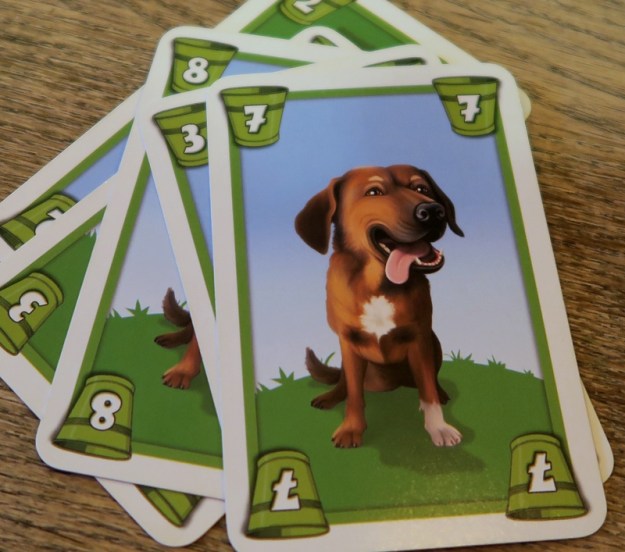
Blue and Pink were the first to arrive and were just finishing their supper when Magenta walked in—sadly not to join in the games as she was there for a Scout meeting.  After a quick chat, she left and as Blue recapped the rules for the “Feature Game“, Zoo Break, Teal arrived and then Purple and Black.  The group had just decided to play Alles im Eimer (aka The Bucket King), when Ivory rocked up to make the full compliment of six.  Purple explained the rules with help from Black.  The idea is very simple:  each player builds a pyramid of ten bucket tokens with two of each of five colours.

Alles im Eimer
– Image by boardGOATS

One player starts, playing a coloured, numbered, animal card and each player has to follow with the same colour and a higher number before picking up a card.  Players can play multiple cards to make the total, but they only ever receive a single replacement card.  If they can’t, or choose not to follow, they lose a bucket of that colour, and any buckets above it.  Worse, if they split their pile of buckets in two, they lose one part as players can only ever have one pile.  On the plus-side, if a player can’t play (or chooses not to), they then lead with a free choice of colour and number.  The last player with buckets still standing is the winner.  With Purple shuffling, Ivory was the first to play.

Alles im Eimer
– Image by boardGOATS

It turns out that there are two things that are really critical in this game.  Firstly, how players stack their buckets—it is not as simple as playing to their hand strengths; the smart player also spreads the colours out a bit so they aren’t forced to take buckets from low down when the unexpected happens.  Secondly, as Ivory pointed out, like 6 Nimmt!, it is all about timing, which is something players may not have control of.  A few rounds in, Black spotted that Pink to his left still had a complete stack where bucket piles had been falling all over the place everywhere else.  So, Black made it his business to make Pink’s life difficult.  From there, it was gloves off and the buckets really started to tumble.  Purple was the first player to kick the last of her buckets over which left Blue to do what she could to damage Ivory’s largely unscathed pile.

Alles im Eimer
– Image by boardGOATS

Black, then Blue, then Teal, all fell, leaving just Pink and Ivory to fight it out.  With Pink’s dwindling pile, it always looked an uphill task, and so it proved, with Ivory taking victory with five buckets still standing.  By this time though, Lime and Green had arrived and with eight, the group split into two tables of four, the first for the “Feature Game“, Zoo Break.  Pink was nearly lured away at the suggestion that the alternate might be Takenoko, but despite being very torn by his love of pandas, he stuck with his original panda driven choice and was joined by Blue, Lime and Black as Keepers at Bedlam Zoo.

Zoo Break
– Image by boardGOATS

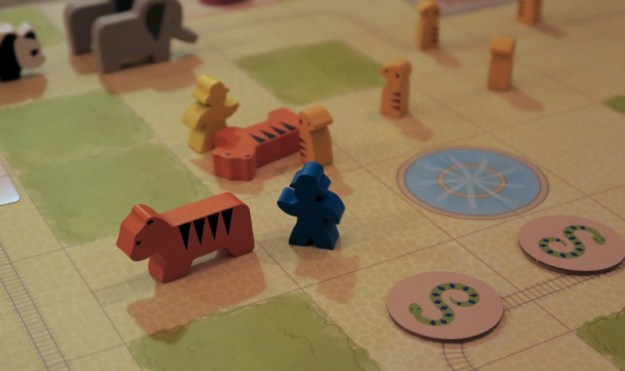
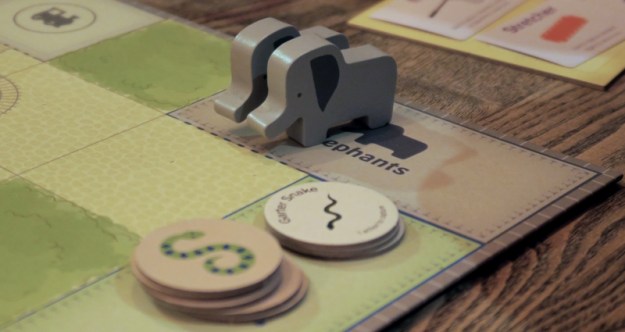
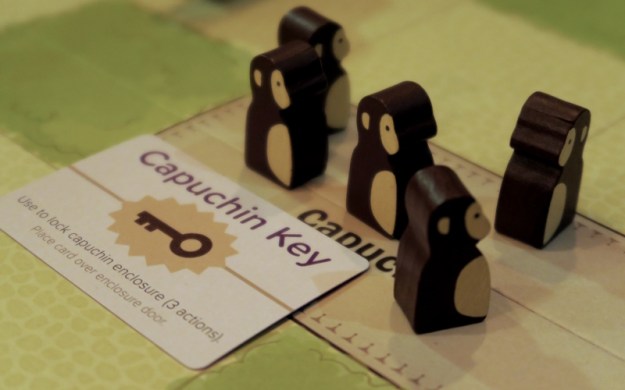
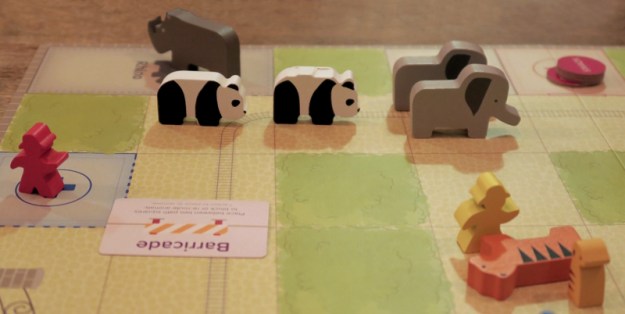
Zoo Break is an apparently light cooperative game where players are a team of zoo-keepers trying to prevent a mass break-out.  The mechanism is quite simple:  the active player rolls a die to decide how many Action Points they get, then they carry out actions, before drawing an Escape card and a Move card (to see what animals escape and move).  The game ends when either a dangerous animal (tiger, elephant, or dangerous snake) escapes, or when the fifth cute animal (panda, Capuchin monkey, meerkat or harmless snake) exits the zoo, or when there are no animals roaming about and all the cages are locked up.

Zoo Break
– Image by boardGOATS

Although the mechanism of Zoo Break is very straight-forward and the art-work implies it is a simple kiddies game, nothing could be further from the truth.  The rule book is twenty pages long, and there are a lot of details regarding escaping and recapturing animals.  For example, when an animal escapes, it doesn’t just move to the space immediately outside its Enclosure, it moves to the nearest “open” space.  Also, different animals are recaptured using different tools which have to be acquired from the supply by the Keepers.  For example, a Net can be used to capture meerkats or monkeys, while a Leash is required for pandas and elephants, and tigers need to be Tranquilised and Stretchered home (very carefully, obviously).

Zoo Break
– Image by boardGOATS

Each Keeper has a different skill.  This time, Blue had the ability to reveal snakes and capture animals from adjacent spaces (especially useful for dealing with snakes); Pink could run faster than anyone else, moving two spaces for each action point (instead of the usual one); Black, the Gardener, could move through and hide in bushes, and Lime could re-roll the die twice to try to get additional actions.  From experience with games like Forbidden Island and Forbidden Desert, the key is almost always to make good use of these special powers.  So Blue suggested she made it her business to concentrate on dealing with the snakes since she could do so without being bitten.

Zoo Break
– Image by boardGOATS

Pink with his Panda obsession, was always going to go after them, and everyone else was happy to let him get on with it.  Before any of that could happen though, the Keepers needed Supplies.  Pink started, and went straight to the Supply shed and started revealing tools.  These are drawn from a face down pile, but Keepers only have space to carry four tools in their backpack, so can choose only to take the ones they want.  This was probably the team’s first mistake:  instead of the few players just searching the whole Supply pile and making a discerning choice while taking as much as they could carry, players grabbed a couple of items and headed off.

Zoo Break
– Image by boardGOATS

This became a problem later in the game when the Keepers realised they didn’t have tools and were now on the other side of the board.  Black who had drawn the meerkat enclosure key headed off to the far corner to lock it quickly.  Lime captured the only roaming meerkat (which had been playing in the fountain) and Black was just about to lock the cage when another one escaped.  As he didn’t have a Net, despite being in the same space as it, he was left chasing about trying to grab it unsuccessfully.  And then more meerkats got out.  So Lime, Keeper without portfolio (but with both a Net and a Leash), waged war on the disobedient meerkats, while occasionally taking time out to catch an elephant or a monkey.

Zoo Break
– Image by boardGOATS

Pink, meanwhile, had his panda enclosure Key and a Leash and was trying to do something about them, but was inconvenienced by a pair of elephants, one of which knocked him flying necessitating a visit to the Medic.  Lime captured the last of the Capuchin monkeys and Blue who was close at hand with the enclosure Key managed to slam the door shut before any more got out—just as well, as the snakes were beginning to get out of hand, and as for the meerkats, well, these little blighters were causing mayhem.  Twice the Keepers had them under control before more escaped, and as they formed a long queue, the queue kept getting longer and longer as they marched inexorably towards the exit.

Zoo Break
– Image by boardGOATS

Pink used the Barricade to delay the escape of a couple of pandas and the pair marauding elephants, but it failed to hold when the Broken Barricade Move card appeared.  The rhino’s occasional charges weren’t much of an issue as they were very predictable, but once animals started to get close to the exit the rhino became more of a problem as players stayed out of its path wasting Action Points.  By this time, the tigers were becoming a problem, but Pink and Black put their Tranquiliser darts to good effect and soon the zoo was littered with sleeping tigers.  Lime had a Stretcher, but never actually used it, briefly loaning it to Blue for the only tiger returned to its enclosure (and left to peacefully sleep off the after-effects, as per one of the new variants).

Zoo Break
– Image by boardGOATS

There was a bit of a debate over whether it was more important to work on the rogue pandas or let them and meerkats escape and focus on the dangerous animals (in particular tigers and elephants).  Slowly but surely, however, the animals were taking over as there was a little procession of Keepers at the Medic’s tent, with only Lime avoiding injury.  Black was the only player to make use of the Train, because it didn’t really go where people wanted it to and players dealt with the issues nearest to them.  That was probably a good strategy; like it says in the advice, it is also important to lock stuff up early—the team didn’t.  They dealt with the monkeys, but the only other enclosure they managed to lock was the pandas, just before two meerkats and a cobra made a run for it in a single turn.

Zoo Break
– Image by boardGOATS

Although the mass escape had caused the zoo to be closed down and Pink hadn’t actually been cuddled by a panda, everyone had really enjoyed themselves.  On reflection, working in pairs might have worked better (as with Flash Point and Escape), because then the team can do things much quicker, get on top of things and lock cages making life easier all round.  Black was curious about the variants available.  The group had played on “Standard” difficulty with two “Phew!” Escape cards (where nothing gets out), but thanks to a rules malfunction, had also included the blank cards in the Move deck which provided quite a bit of respite, so everyone had a good laugh at the idea of making the game harder.

Zoo Break
– Image by boardGOATS

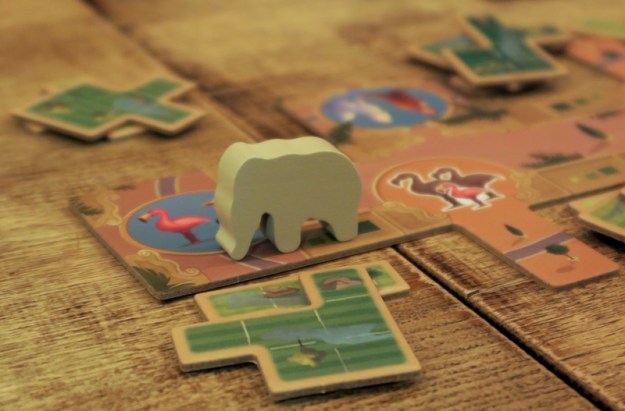
Despite the fact the group rarely plays cooperative games, everyone was keen to give Zoo Break another outing soon.  Zoos were popular elsewhere too—the next table had been playing New York Zoo.  This is a tile-laying game that got its first Tuesday outing only a few of weeks ago, but had been enjoyed by all.  In this game, players add pens to their zoo, populating them with animals, and building attractions.  Like Uwe Rosenberg‘s other similar games (including Cottage Garden, Spring Meadow, Indian Summer and Patchwork), it is Tetris-like but what makes this one unique and interesting is the Market.

New York Zoo
– Image by boardGOATS

Players move the Marker Elephant one to four spaces round the Market, landing either on an Enclosure tile space (taking the top one and adding it to their zoo) or on an animal space (taking one or both of the animals depicted). Enclosure tiles can be placed anywhere in the player’s Zoo, then one or two identical Animals from elsewhere in their Zoo must be moved to occupy the Enclosure.  Each Enclosure can only hold one type of Animal.  When there are two or more Animals in an Enclosure together they breed when the Elephant passes the Market’s breeding spaces.

New York Zoo
– Image by boardGOATS

When an Enclosure is full, all the animals are removed and the player takes an Attraction tile of their choice and adds it to their Zoo.  Attraction tiles are useful because they fill additional spaces, and at its heart, New York Zoo is a race game—the winner is the first to fill all the spaces in their Zoo.  Purple had played last time, and Green had played elsewhere, however, Ivory and Teal were new to the game and the rules needed explanation.  That didn’t take long though, and the Elephant was soon touring the market and everyone was building their zoo and adding animals.

New York Zoo
– Image by boardGOATS

Purple was quick to get going, as was Green.  New York Zoo is really a tactical game, but there are a couple of broad strategies—fill the zoo with large Enclosures that are harder to fill, but occupy more space, or fill it with smaller Enclosures which are easier to fill with animals giving bonus Attraction tiles.  Purple went for the latter approach, getting some of the large attractions early in the game.  Teal however, opted for the former strategy, which is harder to get to work, but can be extremely effective, as indeed it was this time, making him the first to finish his zoo, and with no Attractions at all.  Purple was the best of the rest with for spaces left to fill, with Green a little way behind.

New York Zoo
– Image by boardGOATS

The Keepers in Bedlam Zoo on the next table were still trying to get the marauding beasts back in their pens (largely unsuccessfully) so the others had to decide what to play.  Green decided to go home, and couldn’t be persuaded to stay by the opportunity to play Nidavellir despite having been very keen to play it previously.  That left Purple, Ivory and Teal, who decided to play it anyhow.  Nidavellir is a card set-collection and bidding game inspired by Norse myths. The game was created by French designer Serge Laget (who sadly passed away in January this year after a lifetime of producing some great games) and the striking black and white artwork by Jean-Marie Minguez which nicely contrasts with the coloured cardboard components.

Nidavellir
– Image by boardGOATS

The story behind the game is that the kingdom of Nidavellir is under threat from the stirrings of the Dragon Fafnir and players are tasked by the King to recruit the best army to defeat it. Appropriately for our venue, the action takes places in three Dwarvish pubs where the players must use their coins to bid for the most skillful Dwarves (in a concealed auction), recruit the most prestigious Heroes, and build the best Battalion they can to defeat the Dragon.  Players hire five different professions of Dwarves into their growing army – Warriors, Hunters, Miners, Blacksmiths and Explorers.  Each player starts with five coins with the values: zero, two, three, four and five. Players place one of their coins against each pub space on their player mat.  The coins are revealed and cards are taken from each pub starting with the highest bidder.

Nidavellir
– Image by boardGOATS

Ties are broken in favour of the player with the the highest jewel token (randomised at the start) and then these players swap jewels so the losing player has an advantage next time there is a draw. Once the three pubs have been resolved, players take back their coins, and place their cards in their tableaux.  At the game end, points are awarded in different ways for each group of Dwarves.  For example, Hunters provide points based on the number of cards squared, Blacksmiths score according to the triangular sequence (as used in Coloretto), while the Navigators are simply a total of the number of points printed on the card, and so on.  Each round of the game, random face-up dwarf cards are lined up by each pub (equal to the number of players) and players bid for their order of selection.

Nidavellir
– Image by boardGOATS

If a player plays their “zero” coin, the values of the two unused coins are added together, the highest of the pair is discarded and a new coin of the same total is added to their stash from the Royal Treasure. Thus, players can gradually increase the value of their coins, which is useful for out-bidding others, but also adds value as the total coin hoard is added to their final score.  Hero cards, which supply additional points bonuses in a variety of ways are awarded when a player manages to have five cards of different type and then each time a new set of five is achieved. Heroes are selected from, a separate deck which allows for further point scoring combinations.  The start was a little slow as Purple and Ivory were both new to the game and had to figure out what to do.

Nidavellir
– Image by boardGOATS

Teal and Ivory both started by upgrading their coins.  Ivory was the first to get a set of five cards and claimed one of the Dwerg Brothers as his Hero giving him the target of collecting the other brothers which greatly crank up the points the more that are collected.  Teal, who had played the game before, chose more complex Heroes.  Half way through the game, Purple took the King’s Hand and the King’s Great Armourer Heroes for having the most Warrior and Blacksmith cards, while Teal took the Hunting Master and Crown Jeweler (for the most Hunters and Miners respectively), leaving Ivory just the Pioneer of the Kingdom (for the most Explorers).

Nidavellir
– Image by boardGOATS

The second age (played with a new deck of cards), was similar to the first, with particular tight battles around getting cards to complete sets.  Ivory had a slight advantage in this, having upgraded his coins more aggressively early in the game, and used this to get more of the Dwerg Brothers.  In contrast, Purple and Teal focused on collecting Dwarves of one kind with Teal using his Heroes to add to their “count” in particular colours when completing a set.  In the end, Purple and Teal scored best for Blacksmiths and Hunters, while Teal also took lots of points for his Miners—something he had focused on from the start.

Nidavellir
– Image by boardGOATS

Ivory however, had more Warriors and having the majority of them meant he could add the value of his most valuable coin to his score.  Despite that and over a hundred points for his Dwergs, Ivory finished just shy of Teal’s winning total of two-hundred and seventy-seven.  The downside of his victory—the winner has to face the Dragon Fafnir!  All agreed it was a good game, not overly complex, but with lots of decisions to make; a game that didn’t out stay its welcome finishing within the forty-five minutes advertised (even with two first-time players).

Nidavellir
– Image by boardGOATS

Learning outcome: Always keep a close eye on your meerkats.

7th March 2023

Plum and Blue were first to arrive and, by the time they had finished their enormous rack of ribs (or given up and had a doggy bag made up), almost everyone else had arrived.  There were a few people missing, but still enough for two games of four.  The first was the “Feature Game“, but nobody really wanted to commit to that until they knew what the other game was going to be.  As he had done the last couple of times, Green suggested Terraforming Mars.  Unlike previously, this time Ivory, Plum and Teal felt up to it, leaving Blue, Black, Purple and Lime to play their preferred choice of New York Zoo.

New York Zoo
– Image by boardGOATS

New York Zoo is a tile laying game by Uwe Rosenberg, designer of Agricola, Bohnanza, Patchwork and many other well-known games.  The idea is that players are building pens in their zoo, populating them with animals, and building attractions.  This is one of several polyomino, Tetris-like, tile-laying type games (including Cottage Garden, Spring Meadow, Indian Summer and Patchwork), but what makes this one unique and interesting is the Market.  Players move the Marker Elephant one to four spaces round the Market, landing either on an Enclosure tile space (taking the top one and adding it to their zoo) or on an animal space (taking one or both of the animals depicted).  Enclosure tiles can be placed anywhere in the player’s Zoo, then one or two identical Animals from elsewhere in their Zoo must be moved to occupy the Enclosure.

New York Zoo
– Image by boardGOATS

Each Enclosure can only hold one type of Animal, meercats, snow-foxes, kangaroos, penguins or flamingos, but when moving Animals, no pen can be left empty.  There is an advantage to pens having two or more Animals in them too—the Market also features breeding spaces, and when the Marker Elephant passes these, up to two pens containing two or more matching Animals get an extra one.  When a player moves the Elephant onto an Animal space, they take one of either or both the Animals depicted into Enclosures containing matching Animals (moving another from Storage if they can), or into the Storage space.  Moving animals is important, because when an Enclosure is completed the player removes all the animals putting one into Storage if they have space, and then takes an Attraction tile of their choice and adds it to their Zoo.

New York Zoo
– Image by boardGOATS

Attraction tiles are useful because they fill additional spaces, and at its heart, New York Zoo is a race game—the winner is the first to fill all the spaces in their Zoo.  Black and Purple had played this a few times, and once Black had explained the rules to Lime and Blue, Purple started.  Black and Purple prioritised completing Enclosures to get Attractions.  The Market is stacked so there are large tiles, heptominoes, on the top of each tile space, with hexominoes, then pentominoes and finally tetrominoes at the bottom of each pile.  Black and Purple prioritised getting breeding pairs of animals and as the Market dwindled, getting smaller enclosures because small Enclosures are easier to complete than large ones.

New York Zoo
– Image by boardGOATS

Blue, who had not played the game before, started off getting large Enclosures and fitting them tightly together.  As the game progressed, however, she realised her mistake as everyone else’s Animals were breeding and she didn’t have pairs because she was taking one out every time she added another Enclosure.  This had the additional consequence that she was starting to run out of Animals too, so she prioritised getting breeding pairs for a couple of rounds before continuing to take the biggest Enclosures she could get away with.  It was a tight game—Purple seemed to take an early lead, but it looked like Black and Lime over-took her towards the end and were in a tussle to finish the game first.

New York Zoo
– Image by boardGOATS

With everyone else concentrating on filling pens and taking Attractions, nobody was watching Blue.  So they were taken by surprise when her kangaroos bred filling their pen and she took her first Attraction.  That left one space which she promptly filled taking the only Enclosure that fitted, perfectly, and ended the game.  With everyone else so close to finishing, however, the rest of the group played on to see who would place where.  In the event, Black finished just ahead of Lime.  The group were just dissecting the different strategies when Pine arrived, fresh from his meeting teaching “cubbish-sized scouts” about waste.  Terraforming Mars was still going on, so the hunt was on for a five-player game, and the group settled on Kingdomino.

Kingdomino
– Image by boardGOATS

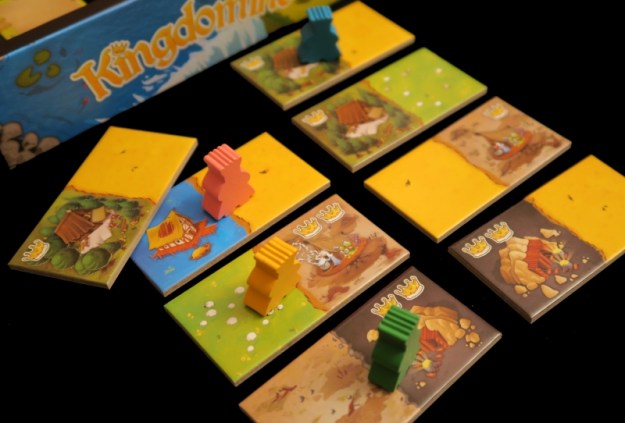
Native, Kingdomino is a four player game, however, with the Age of Giants expansion, it plays five.  The base game is simple enough, but it had been a while since most people last played it, so there was a quick run through of the rules.  On their turn, players add a terrain domino to their Kingdom; each domino comprises two squares of terrain and when placed at least one end must be adjacent to the same terrain type.  Like New York Zoo, the interesting and clever part of the game is the Market.  In Kingdomino, there are two parts, current and future—when a player takes their domino from the current market, they choose their next domino by placing their marker on it.

Kingdomino
– Image by boardGOATS

At the end of the game, players score each terrain region with points equal to the area of each region multiplied by the number of crowns on it.  The clever part is the timing of the Market.  The tiles are drawn at random from a set numbered from one to forty-eight.  The low numbers generally being the less desirable ones, those without crowns or those for terrain types where crowns are more scarce.  Since players take the tiles in numerical order (low to high), taking a low value tile in one round gives a better choice in the next.  Similarly, taking a high value tile means there will be less (or maybe no) choice in the following round.

Kingdomino: Age of Giants
– Image by boardGOATS

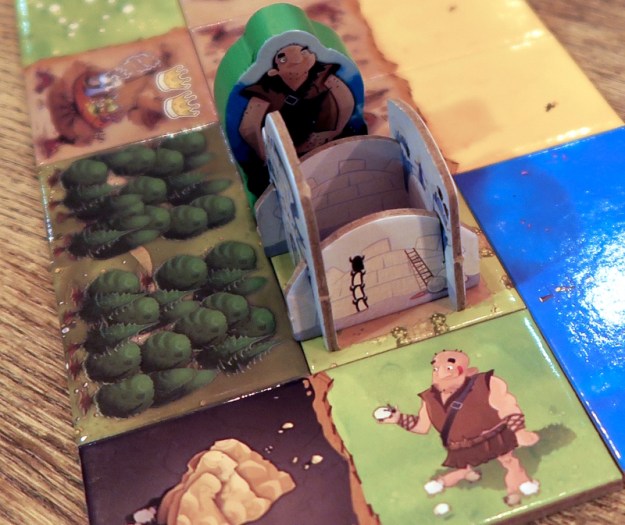
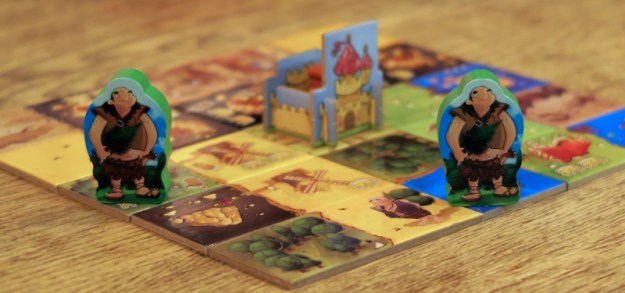
The Age of Giants expansion firstly adds twelve extra tiles (enough for a fifth player), six labeled with letters A to F and six numbered forty-nine to fifty-four.  These are ranked below one for the letters and after forty-eight for the high numbers, with the low ranking tiles featuring a Giant, and the high ranking ones featuring Footprints.  Players taking dominoes with a Giant on them, also take a Giant-eeple and place it over a crown in their Kingdom so that it doesn’t score.  Taking a Footprint domino allows the player to move a Giant from their Kingdom to a crown in someone else’s and this increase their score, making these tiles potentially very valuable.

Kingdomino: Age of Giants
– Image by boardGOATS

Unfortunately (especially for Lime and Blue who ended up with all the Giants), the Footprints seemed hard to come by in this game.  The other part of the Age of Giants expansion are the Quests.  The base game comes with two Quests, arrangement targets that give points.  These are “Middle Kingdom” and “Harmony” which respectively give ten points for a castle in the centre of a player’s Kingdom and five points for a complete five-by-five territory with no discarded tiles.  This time, the Quests drawn essentially at random were “Bleak King” and “Four Corners of the Kingdom”.  The first of these gave five points for each five square of terrain with no crowns while the second gave players five points for placing cornfields on all four corners of the five-by-five grid that defines their Kingdom.

Kingdomino: Age of Giants
– Image by boardGOATS

Although the Quests had been included in game play several times before, the Giants have only had an outing once and didn’t go down all that well.  Still, with five players all the extra tiles were needed and their values would have been unbalanced without including Giants, so the group thought they’d give it another try.  This time Blue and Purple had a really hard time getting crowns and things were so bad for Blue that she resorted to picking up twenty points, more than half her total, from the “Bleak King” Quest.  Black built a lot of sea and pasture, while Lime scored heavily for his mountains and Pine picked up lots of points for his large woodland.

Kingdomino: Age of Giants
– Image by boardGOATS

It was very close between the top three and both Lime and Pine scored forty-five points for their highest scoring terrain—Lime for nine crowns spread over five spaces, Pine for five crowns spread over nine spaces.  There were just two points between Lime and Pine in the end, but Pine’s sixty-eight points just edged Lime into second with Black four points behind that.  It had been a good game.  However, the group felt that the Giants took a positive constructive game and added a negative aspect.  Those that had been stuck with them hadn’t found that aspect particularly enjoyable, especially as it was easy to get lumbered largely through no fault of their own, so it is unlikely they’ll get another outing very soon.

Kingdomino: Age of Giants
– Image by boardGOATS

Meanwhile, on the next table, Green, Ivory, Plum and Teal were still playing Terraforming Mars.  To speed up the game they played with the Prelude start cards and also removed the Corporation cards—that turned out to be a good choice as the game only just finished before the pub closed.  In this game, players play corporations sponsored by the World Government working together in the terraforming process, but competing for victory points.  These are awarded not only for their contribution to the terraforming, but also for advancing human infrastructure throughout the solar system, and doing other generally commendable things.

Terraforming Mars
– Image by boardGOATS

The players acquire unique Project cards by buying them into their hand; these can represent anything from introducing plant life or animals, hurling asteroids at the surface, building cities, to mining the moons of Jupiter and establishing greenhouse gas industries to heat up the atmosphere. The Projects can give immediate bonuses, as well as increase production of different resources. Many cards also have requirements and become playable when the temperature, oxygen, or ocean coverage increases enough. Buying cards is costly, so there is a balance between buying cards (three MegaCredits per card) and actually playing them.

Terraforming Mars
– Image by boardGOATS

The game ends after the terraforming is complete when the three global parameters, temperature, oxygen, ocean have all reached their goal.  Players then score for their Terraform Rating with any other points they might have accrued.  This time, Green made his presence felt on the surface of Mars in the early stages with his initial starting forest, which grew a little, and seeded the oceans. He was the only one for a while.  Plum played a blue card which gave her a couple of extra Credits every time someone built a city.  This one really paid for itself in the four-player game as everyone wanted to build more than one city.  Green was first, but had mis-read the card and found himself colonizing Phobos instead.

Terraforming Mars: Prelude
– Image by boardGOATS

So, Teal was the first to actually build a city on the surface of Mars. He opted for the equator but on the other side from Green’s forests.  Later he played a blue city bonus card that gave him a Credit production bonus for each one. Although several cities had already been built by then, several more followed and he was able to enjoy the benefit of extra cash in later rounds.  Ivory meanwhile had made a different start to the game than his normal opening gambit (building a city), and completed the first Milestone: the Ecologist. However his cities did follow later as he extended down towards the south pole. Teal claimed the second milestone: the Specialist, helped on by his city Credit production bonus.

Terraforming Mars
– Image by boardGOATS

Plum was the last to claim a Milestone: the Generalist, as she was able to pay to increase her production one step each round.  She did not claim it straight away, but noticed it after Teal had claimed his, and thought she had better get in there quick.  Green was not able to claim any milestones, but instead was the first to fund an Award. A quick check around the player boards suggested he should fund Celebrity as he had three high value cards to Teal’s two, but neither Plum or Ivory had any cards over the value of twenty Credits. Later on Teal funded the second award and went for Estate Dealer as he clearly had more tiles next to oceans at this point (having planted his forests northwards around the oceans.

Terraforming Mars
– Image by boardGOATS

At the end of the game Green pulled out his wallet once more and funded Benefactor since he was ahead on the Terraform Rating track. Ivory was only one behind, but Green had a couple of options he could play on his last turn for a couple of extra Terraform Rating points. This prevented Ivory from funding the Dessert Settler award for which he had been building.  Green decided to go for outworld domination and also built Deimos city.  During the second half of the game Green realised he had forgotten his company bonus of a two MegaCredits reduction for each brown, Industrial tagged card.  He had built three, so put six Credits aside to be used in the event of a tie, (although had he remembered to claim them at the time, he may have been able to play more and better cards).

Terraforming Mars: Prelude
– Image by boardGOATS

In the final scoring it was very close indeed, although during the game Mars was regularly bombarded with meteors and nuclear bombs, so it was a wonder any one survived at all!  Ivory and Green tied for second with fifty-nine points. Even with his extra six Credits, Green still lost the tie to Ivory, who had more Credits left over from the final production.  At this point, Green realised he again had misread a card thinking he would get one point per ocean tile in the game for his capital city, but that would have given him a guaranteed nine points and would have been way too powerful. In the end, it was Teal who triumphed, but only just, with sixty-one points, in well deserved victory.

Terraforming Mars
– Image by boardGOATS

Learning Outcome:  Mama’s taking us to the zoo tomorrow, zoo tomorrow, zoo tomorrow… We can stay all day!

6th September 2022

Plum and Pine were the first to arrive, shortly followed by Blue with Orange and Lemon.  With nobody eating, the group were in a position to start thinking about games straight away.  Plum had offered to lead Wingspan, with Lime in mind as he had recently acquired a copy of Wingspan and was keen to give it another go.  Pine commented that although he loves birds, he’d never really got on with the game-play of Wingspan so, sadly he’d prefer to play something else.  The “Feature Game” was to be Project L, a sort of Tetris-like, engine-building game and it sounded much more his thing.

Project L
– Image by boardGOATS

So, Plum took herself off to the other side of the pub to set up Wingspan with the European expansion.  The European expansion adds more cards including end of round cards, but doesn’t add any extra mechanisms (like the Oceania expansion), so it was felt that including it wouldn’t cause too much confusion.  As the others rolled up, there was much surprise as Teal and Ivory said they would rather give Project L a go.  Then Pine changed his mind and joined Wingspan (along with Purple and Lime), allowing Black to play the “Feature Game” as he had played Wingspan recently at Burgundy’s Birthday Event.  That left six to play Project L: Orange, Lemon, Blue, Ivory, Teal and Black.

Project L
– Image by boardGOATS

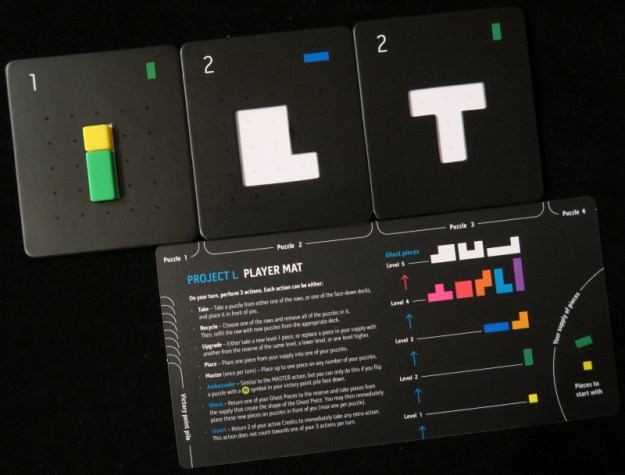
Project L is a very simple game:  players start with two small plastic pieces and use them to complete Puzzles winning more pieces enabling them to complete more complex Puzzles and thus build an engine.  On their turn the active player can do three actions from a list of five things:  upgrade a piece to a larger one, take a Puzzle from the display, recycle the Puzzle display, place a piece in a Puzzle they own, or place one piece in each of their Puzzles (or in as many different Puzzles as they can).  This last, “Master Action” can only be carried out once per turn, and is clearly very powerful once players can get it going, however, to make it work they need lots of Puzzles and lots of pieces.

Project L
– Image by boardGOATS

With six, to reduce the amount of down time there is the “Line Clear Variant” available.  In the normal game, there are two rows of four Puzzles, one of White backed Puzzles and one of slightly more advanced and therefore more rewarding, Black backed Puzzles.  In addition to winning pieces for completing Puzzles, players can also get  points—the player with the most points at the end of the game is the winner.  The game end is triggered when the draw deck of Black backed Puzzles is exhausted at which point the round is then finished and one more, final, round is played.  In the Ticket to Ride: Switzerland, there are two rows of each colour, each containing three Puzzles.  One pair of Black and White Puzzle rows are marked with a dark stone and the other pair with a colourless stone.

Project L
– Image by boardGOATS

The idea of the Line Clear Variant is that two players play simultaneously with the active players marked by a dark and a colourless stone that are passed round.  When it is their turn, players can only recycle or take Puzzles from the rows that match the colour of their their stone.  Ivory was picked as the start player (he drew the player aid marked with the start player symbol) and he began with the dark stone, so Orange, sitting opposite, started with the light stone.  Everyone began a little tentatively, but before long players were filling their Puzzles with gay abandon.  The game end is slightly less clear with the Line Clear Variant.  Still triggered by exhausting the Black Puzzle Deck, the game continues until the first player has been passed both of the markers again, in any order).

Project L
– Image by boardGOATS

The Black Puzzles ran out quite quickly—Project L really is just a “Filler Game“, but players still had to finish things off.  The start player was Ivory, which meant that Orange was a little caught out.  Once the game has finished, everyone can place any pieces they have left, but at the cost of a point for each one.  Orange was unlucky, and unable to complete any of his remaining Puzzles, neither could could Lemon.  Teal had managed to finish off all his Puzzles in his last turn, but everyone else placed three of their pieces to finish things off.  It was quite close for a first game:  Blue finished with eighteen points, but Ivory and Black tied with fifteen apiece with Ivory sneaking second place on the tie breaker (the player with the most completed Puzzles).

Project L
– Image by boardGOATS

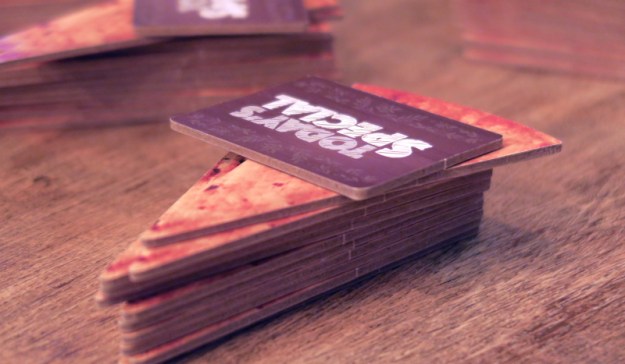
A lot of the comment was about how nicely produced the game is and it had been enjoyable to play too although not very memorable.  It was time to move on to something else though and with six, the obvious and usual choice would be Bohnanza, but Ivory had other ideas and suggested New York Slice.  This is a reimplementation of …aber bitte mit Sahne which we played recently, but with a pizza theme instead of a cake theme.  In both games, the idea is that one player makes the cake (or pizza) and divides it up into segments equal to the number of players, then players take it in turns to choose one of the segments.

New York Slice
– Image by boardGOATS

When a player takes a segment, they can either eat slices or store them for later.  Those they will eat are worth points at the end of the game with the number dependent on the number of blobs of cream (or pepperoni slices) on top.  The pieces players keep are scored depending on who has the most of each type at the end of the game.  Each piece of cake (or pizza) has a number on it which tells players the number of that type in the game and also what the player with the most will score at the end of the game.  There are a few things that are different about New York Slice, however, which make it a little more competitive and slightly more of a “Gamers’ Game”.

New York Slice
– Image by boardGOATS

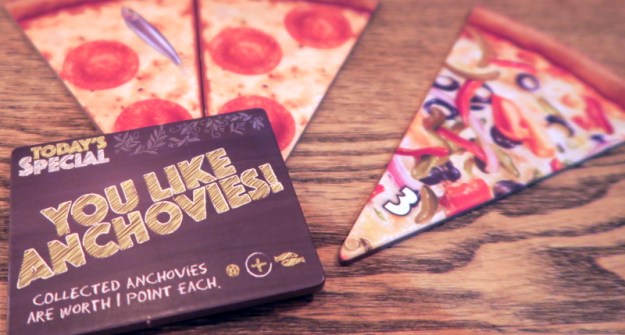
Firstly, in the case of a tie for who has the most pieces of a type of pizza, in …aber bitte mit Sahne all players score points whereas in New York Slice nobody gets anything.  Secondly, some of the pizza slices have anchovies on them and any of these that are visible at the end of the game are worth minus one (because everyone hates anchovies on pizzas right?  Well, everyone except Teal it seems…).  Probably the biggest change though, is that in New York Slice, each pizza is served with a Special—a bonus tile with rule-breaking powers.  In most cases, these are added to one of the segments for players to choose. They can be enticing and helpful, or they can be unhelpful and make players’ lives more difficult.

New York Slice
– Image by boardGOATS

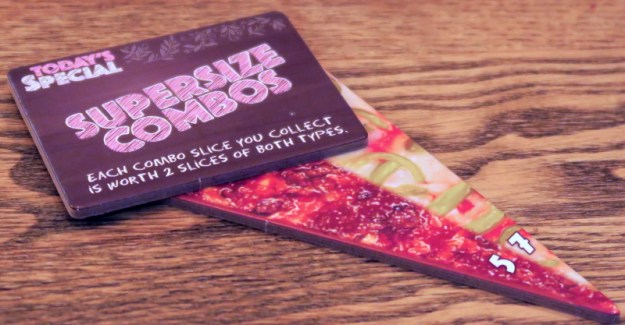
Ivory cut the first pizza, leaving Blue to be the first to choose.  The first Special was “Cut in Line”, which Blue took straight away and then promptly forgot about it until the final round.  Ivory went into battle for mushroom pizza, but lost out to Teal.  The front-runner looked to be Black who stored the most BBQ and veggie pizza slices, largely thanks to his “Supersize Combos” Special which meant his two half slices became two whole slices of each type.  That only gave him joint second however, with Lemon who turned out to be quite the carnivore and finished with the most beef and meat feast pizzas.

New York Slice
– Image by boardGOATS

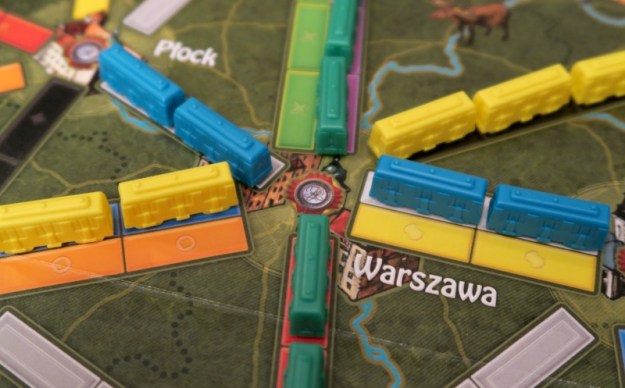
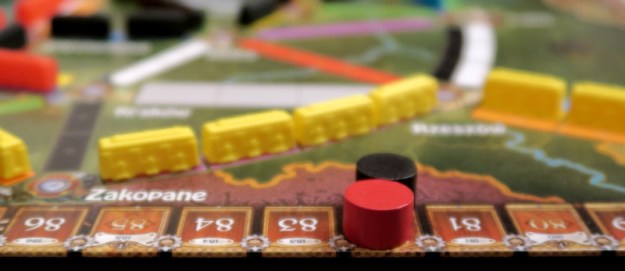
The winner, however, and by a single point, was Blue who picked up a lot of anchovies along with her “You Like Anchovies” Special and coupled that with winning the most lucrative pizza (pepperoni).  Full of pizza, Teal and Ivory decided it was time, leaving Black and Blue with Orange and Lime and a decision to make as to what to play next.  With Wingspan something over half-way through, they were looking for something substantial to play, but not too long.  Blue’s suggestion was Wsiąść do Pociągu: Polska, the Poland map for Ticket to Ride.  This was one that nobody around the table had played before though it had been played in the group two and a half years ago, shortly after it was released at Essen.

Wsiąść do Pociągu: Polska
– Image by boardGOATS

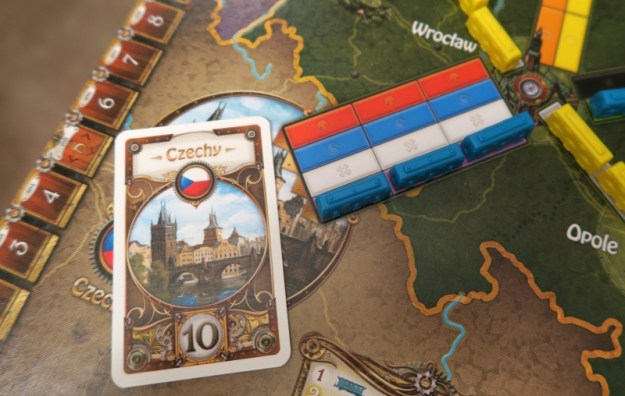
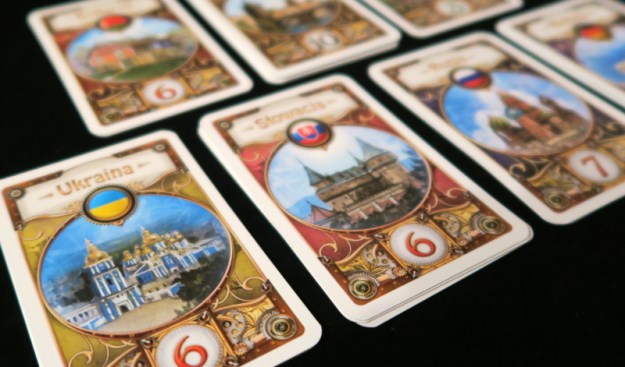
The Poland map works in much the same way as all the Ticket to Ride games; players collect coloured train cards and spend them to place plastic train pieces on the central map scoring points for placing trains, but also completing the route “Ticket” cards that they chose at the start of the game and maybe later too.  In addition to the usual rules, the base game maps all have a little something extra.  As well as the usual city locations, the Poland map also has countries, but unlike the Swiss map, these are not simply locations to connect to.  Instead when a player connects two countries, they collect one Country Card corresponding to each.  These are worth points at the end of the game.

Wsiąść do Pociągu: Polska
– Image by boardGOATS

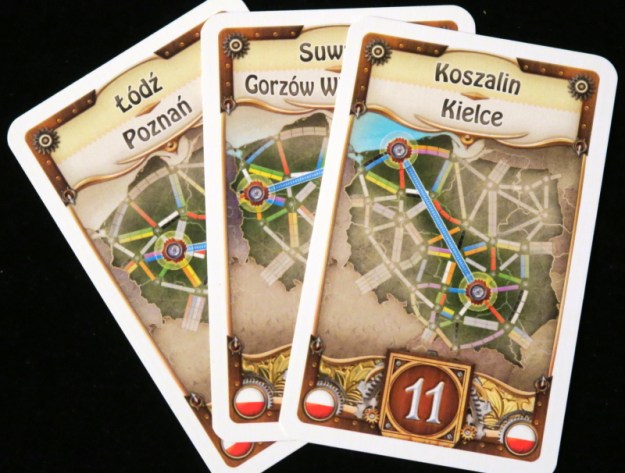
When a third country is added to the “network”, the player again collects Country Cards, one for each country in the network. When Blue explained the rules, Black commented that that aspect was interesting and he was curious to see how it affected the game.  Blue started and was followed by Orange, Lemon and then Black.  Black started by collecting more Tickets—this was a tactic that was discussed briefly at Burgundy’s Birthday Memorial event.  Black had commented then that this was the way all the best players did it.  The idea is that by collecting Tickets early, players are best placed to make the most efficient use of their trains and know what coloured cards they might need.

Wsiąść do Pociągu: Polska
– Image by boardGOATS

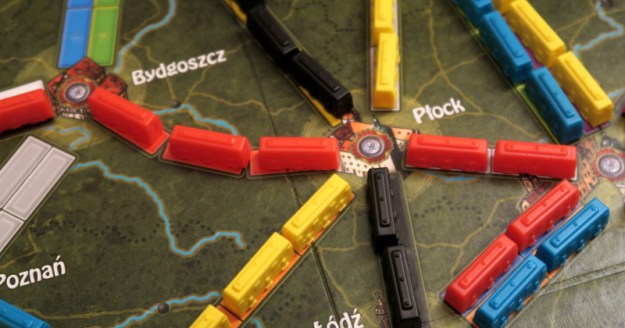
However, it is a bit of a “Go Big or Go Home” strategy because if something critical goes wrong early, the player could get left with an armful of unfulfilled Tickets leaving them with lots of negative points.  And with the Poland map, this was far from impossible as it turned out to be quite a scrap for the centre of the board.  Lemon asked what she should do when someone had just taken a track she wanted, clearly meaning Orange who had just nabbed a critical route from Bydgoszcz to Płock.  “Kill them,” was the instant reply to much hilarity.  Lemon commented that she would get her revenge, though it was unclear whether that was planned for the game or sometime later…

Wsiąść do Pociągu: Polska
– Image by boardGOATS

Eventually, Blue claimed the first Country Cards, connecting Belarus to Germany.  When she added Russia and Lithuania, it was clear how these could add significant points to a player’s tally.  Further, the repeated nature of collecting Country Cards each time the network grew provided a good source of points of a similar magnitude to those gained from Tickets, but without the associated jeopardy.  The Country Cards are stacked in descending order of value so that the ones earnt early in the game are worth more, but although the value decreases, as more countries are added to  player’s network more tickets are picked up.  As a result, value of each additional card pick up (and therefore each country when added) remains fairly constant depending on how many players are fighting for Country Cards.

Wsiąść do Pociągu: Polska
– Image by boardGOATS

This time, Blue stole a bit of an early march on the Country Cards in the north, while Black acquired loads of Tickets and Orange got in everyone’s way.  While Blue’s primary route was in the north running east-west, Black and Orange focused on north-south and Lemon had two separate smaller networks which she unfortunately failed to connect together.  As everyone else saw how lucrative Country Cards could be, they joined in, connecting countries to the south.  Lemon pointed out the route they had taken from Ukraine through south Poland to Warsaw where they got a flight to the UK.  It was about then that the pub became an attraction in itself when one of the locals pointed out that the lease was for sale once more.

Wsiąść do Pociągu: Polska
– Image by boardGOATS

The game came to a slightly sudden end when Lemon ran out of trains—the Poland map is played with just thirty-five trains per player instead of the more usual forty-five.  Actual game play time isn’t much shorter than usual because, like the India map, there are fewer longer routes so players have to take more turns placing trains.  At the end of the game though, it was close with Lemon in the lead thanks largely to the fact she had concentrated on the lucrative long routes where possible.  Orange and Black had completed a lot of Tickets though, and when they were added on together with the Country Cards, they tied for second place with eighty-two points.  The winner was Blue, however, thanks to the huge pile of Country Cards.

Wsiąść do Pociągu: Polska
– Image by boardGOATS

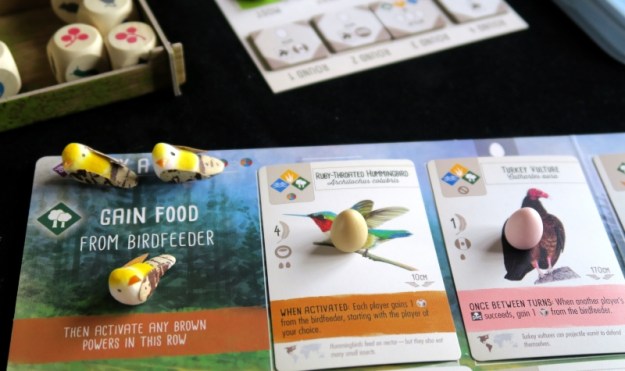
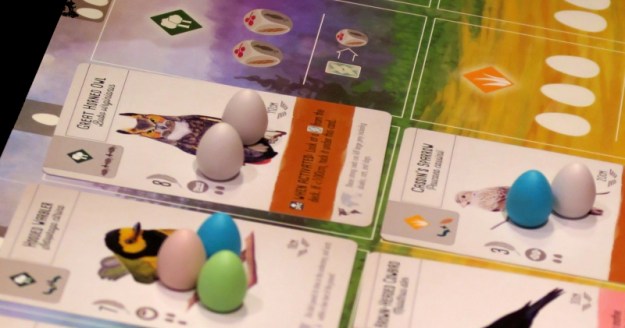
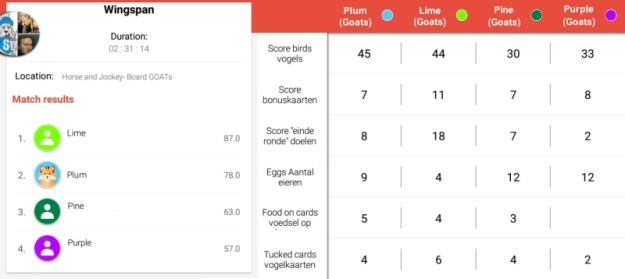
Meanwhile, over the other side of the room, Plum, Pine, Lime and Purple were playing Wingspan with Blue’s pimped out set.  Wingspan is a beautiful bird-themed game where players are collecting birds in three different habitats.  On their turn, they can “plant” a bird card in one of these habitats, or activate one of the three habitats to collect food, lay eggs or collect more cards.  The clever part of the game is that when players activate a habitat, they also activate any birds within that habitat—in this way, the game is card driven. Played over four rounds, there are bonus points at the end of each round (dependent on tiles drawn at the start of the game).  Otherwise, players score for birds, eggs, tucked cards, and personal bonus cards at the end of the game.

Wingspan
– Image by boardGOATS

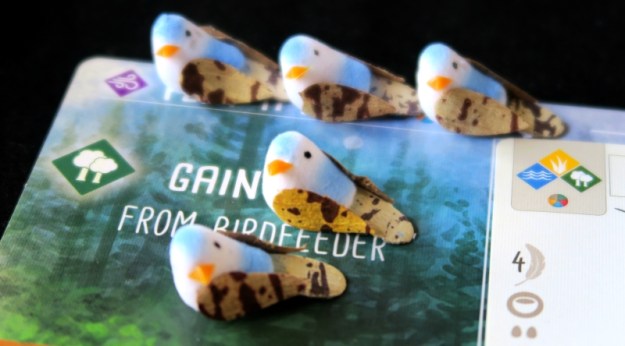
Players start with eight actions in the first round, but that decreases by one each round as the game progresses.  However, because players add birds to their habitats during the game, although they get fewer turns in later rounds, they are actually doing more things in each turn as they are activating more cards.  In Blue’s pimped out copy, she had replaced the wooden action cubes with little fluffy birds which are cute, but led to some initial confusion with the phrase “playing a bird” meaning variously take an action (playing a fluffy little bird) or play a bird card into a habitat.

Wingspan
– Image by boardGOATS

This time, everyone was slow to start—the start is almost always slow in Wingspan as players need cards to play and food so they can pay the cost, but this time it was especially true as players found their feet.  Lime began with a woodland bird that gave an extra food after re-setting the bird-feeder, which really helped him out throughout the game.  He also had a once-between-turns card which was triggered when another player tucked a card.   Since Purple had a bird with a tucking action, that looked like a good call.  Considerable merriment was derived from the tucking action:  who was tucking the most, watching out for people tucking etc..  Unfortunately however, Purple’s action required the tucked card to be taken from Purple’s hand so she often passed up the chance meaning she was not the most prolific tucker…

Wingspan
– Image by boardGOATS

Plum’s first two were wetland birds with one-off powers.  As her bonus card rewarded her for having cards left in hand at the end of the game, the fact these early birds increased her card drawing powers from the very start meant they could help towards that too.  Pine’s bonus card rewarded him for having birds with geographical names which he pretty much had in his starting hand. Lime’s bonus was for birds with tucked cards, but he only realised later that it meant multiple birds with tucked cards not the number of cards tucked.  He was able to pick up another bonus card later in the game, which worked slightly better for him though.

Wingspan
– Image by boardGOATS

Pine’s bird hunting for rodents largely went hungry in the early part of the game, though it did better in the later rounds.  Plum, instead of sharing her latest kitty pictures, mimicked her favourite kitty behaviour, and watched hawk-like for a successful hunt to trigger once-between-turns action.   She had a killer “three birds in one go move” set up ready to go—two birds both with a “play a second bird in the grasslands” action.  Although she was a little disappointed to have been unable to deploy it in time for the worms they ate to count towards the second round goal of most eaten worms.  This increased her egg laying power though and the final third bird allowed her to a sacrifice an egg for two new bird cards ensuring she achieved her bonus in the final round.

Wingspan
– Image by boardGOATS

With the game finally coming to an end, all that was left was the scores.  Plum and Lime took the most points for their birds while Purple and Pine had the most eggs.  While everything else was fairly close, Lime had his nose in front in most areas and this showed in the final scores which were moderately spread out.  Lime’s score of eighty-seven points was some ten points ahead of Plum in second, who was similarly ahead of Pine.  As always with Wingspan, it had been fun, though it had sadly confirmed to Pine that while he adores the theme, the game play just isn’t for him.  And on that sad note, with everyone else also finished, it was time for home.

Wingspan
– Image by boardGOATS

Learning Outcome:  Everyone loves Pizza.

17th May 2022

Black and Purple were first to arrive this week, but Pink and Blue were not far behind, and once food had been ordered, there was just time for a quick game of Love Letter to commemorate its recent tenth anniversary.  We used to play this quick little filler game quite a bit, but that fell victim to the global pandemic and, as a result, it’d been a while since anyone round the table had played it.  Played with just sixteen cards, the game is really simple, but is a great way to kill a few minutes.  The idea is that each player starts with one card, and on their turn draw a second from the deck and play one of the two.

Love Letter
– Image by boardGOATS

Each card has a number and an action or effect.  The actions range from number one, the Guard, which allows the player to guess what character card a player is holding and “assassinate” them if correct, to number eight, the Princess, who will win the game for the player holding it at the end, but lose it for them if they are forced to discard it before then. There was just time for three rounds before food arrived.  Black took the first round and Pink the second.  Pink then recused himself as he went to chat to some of the locals about Jubilee plans leaving Black, Purple and Blue to fight it out with Blue taking the final point.

Love Letter
– Image by boardGOATS

With the arrival of Pine and Lime, the group went on to play Moneybags, which had been the “Feature Game” a couple of weeks ago.  The idea of this is that, on their turn, players have to decide whether to rob another player’s hessian sack of gold or not.  Critically, however, they must not be too greedy.  This is because the victim can challenge the thief, and if the thief is found to have more than the victim, the victim takes the lot, but that makes them more of a target as now everyone else knows how much they have…

Moneybags
– Image by boardGOATS

This time, the game did not go according to plan.  Black played the Godfather and divvied up the loot.  Purple robbed Pine, who promptly challenged and won a huge pile of gold.  As it was his turn next, after lots of advice from everyone else, he closed his bag and stepped out.  Then Blue challenged Black and won, knocking him out too.  Although it was close between Pine and Blue, much closer than most people thought it would be, Pine’s huge stash won out.  The moral of this story is to rob someone before you in the turn order otherwise, if they challenge and win, they can kill the game by closing their bag.

Moneybags
– Image by boardGOATS

This week, the “Feature Game” was the Arts and Architecture expansion to Tapestry, which is something that Ivory in particular, had been waiting ages to play.  We wanted to give others an opportunity to play the base game first and then the (slightly less complex) Plans and Ploys expansion, which got an outing a few weeks ago.  That was enjoyed by everyone involved, so it was now time to add the second expansion.  The base game is simple in terms of what you do, but playing well is much more difficult.  The idea is that there are four advancement tracks:  Science, Technology, Exploration and Military, and on their turn, the active player progresses along one of these taking the actions for the space they land on.

Tapestry
– Image by boardGOATS

In general, players must pay resources to carry out actions and, in some cases, may pay more to carry out a bonus action.  The first player to progress along each of the tracks receives a building as they pass landmark spaces, which those players then add to their city.  Filling rows and columns of their city gives additional resources and as these are scarce, the extras can be invaluable.  Players can focus on a specific track or take a more balanced approach, but this decision is often driven by starting Civilisations which give players a special and unique ability.  Coupling the Civilisation with the right strategy is often the difference between success and failure.

Tapestry
– Image by boardGOATS

When players run out of resources, they can instead take income which means players move on to the next round at different times.  The Arts and Architecture expansion provides more civilizations, tapestry cards, technology cards and capital city plans.  The biggest change, however, is the addition of a new advancement track featuring new Art or Masterpiece cards and tiles and, of course, associated Landmark miniatures.  Each Income phase, players can activate their masterpiece power and get the benefit shown, typically resources or points allowing players to prolong their turns further, but like the Technologies, they are really a long term investment.

Tapestry: Arts & Architecture
– Image by boardGOATS

Green and Teal joined Ivory in what was a Tapestry rematch of the last game and, in addition to the Arts and Architecture expansion also included the Plans & Ploys expansion. Each player received a standard capital city and an expansion capital city, but everyone decided to try the new ones to add variety to the game.  For the Civilisations, in an effort to ensure things were balanced, the up-to-date starting adjustments were used, and players chose:

  • Craftsmen (Ivory), which gave him a new board to place his income buildings on for extra bonuses;
  • Historians (Teal), which enabled him to choose a player each round, and when that player placed a special building, Teal would gain extra resources;
  • Architects (Green), which gave his income rows double points scoring under certain conditions.
Tapestry
– Image by boardGOATS

Green’s Civilisation did not last beyond his first income phase, however, as he played the Plague Tapestry card which allowed him to draw a new one. This new one, Entertainers, gave him an extra bonus track to follow each income phase.  Ivory made his intentions clear by moving up the new purple Arts track and gained a couple of special Arts cards.  Green followed him, but also spread a bit more onto the Technology track for a Technology card.   It was Ivory who was first to take an income phase, but as he had not explored the Technology track he did not have a Technology to upgrade on his first income.  Ivory did have a couple of Arts cards to provide him with a nice little bonus though.

Tapestry: Plans and Ploys
– Image by boardGOATS

Teal went a different route and travelled up the Explore track and expanded his island.  The resources he gained on the way enabled him to take his first income much later than the others.  This pattern of Teal taking income last remained in play to the end of the game. Green took the second income first, and Ivory switched back to first for the third income. It was Ivory who took his final income first, closely followed by Green leaving Teal to play on his own at the end.  By this time, Ivory had collected all the Arts buildings, completed both the Arts and Science tracks and expanded his empire by three more hexes.

Tapestry: Arts & Architecture
– Image by boardGOATS

Ivory had also collected three Arts cards and replaced two of his income scoring tracks. He had only placed two income buildings on his Civilisation card, but had mostly completed his capital city (including a massive seven special buildings), but had only one, solitary technology card.  Teal had completed the Explore track, although two of his space hexes were very poor scoring for him, and had not progressed at all on the Arts track. His empire was seven hexes in size, including the one in the centre of the territory. He had also collected six special buildings on his way, but no Technology at all.

Tapestry: Arts & Architecture
– Image by boardGOATS

Green managed to complete the Arts and Technology track, choosing to travel up the Arts again for his technology completion bonus. He did not expand his empire at all, although he had grown the islands a little. He finished with four Arts cards and three Technology cards, but only five special buildings.  In the final scoring  Green finished with a personal best of two hundred and ninety-three points, beating the hitherto invincible Ivory who “only” managed two hundred and fifty-one, some way ahead of Teal.  Part of the reason for this was that Teal did not place his last player cube choice from his civilisation on his penultimate income.

Tapestry: Arts & Architecture
– Image by boardGOATS

This was because the game ended in a bit of a rush because time was getting on and Teal unfortunately didn’t thought the others wouldn’t get any more buildings.  As a result he missed out on a few free resources in the final round and even a few resources can make a huge difference. As ever it is difficult to find the right balance in Tapestry as players need to both specialise and be a Jack of all trades, which is very hard to do.  Although the game took longer as a result of the expansions, all three liked the added enhancements and would be keen to play again with all the extras.

Tapestry: Arts & Architecture
– Image by boardGOATS

Meanwhile, on the the other side of the room, Lime was introducing Black, Lilac and Pine to Die Wandelnden Türme, a recently released, curious little family game.  The idea is that players start with a handful of Wizards placed on top of the little Towers around the board, and a hand of three cards.  On their turn, the active player plays a card which allows them to move one of their Wizards a set number of spaces forward, or move a tower a set number of spaces.  When Towers move, they take any resident Wizards with them but can also land on top of another Tower and trap any pieces that were on the roof.  A player that catches other pieces in this way gets to fill a Potion Flask.  They can then spend the Potions to cast spells.

Die Wandelnden Türme
– Image by boardGOATS

In the base game the spells available are “move a Wizard one space forward” or “move a Tower two spaces forward”, but others are available and change the feel of the game a little.  Players are trying to land all their Wizards in the black, Raven Castle and fill all their Potion Flasks—when someone succeeds, that triggers the end of the game.  It is a fun and entertaining game where players Wizards get variously trapped and if they have a bad memory, can find they lose them in the circus of dancing towers.  And that is exactly what happened to poor Pine.  His Wizards disappeared and every time he uncovered where he thought they were, he discovered they weren’t.

Die Wandelnden Türme
– Image by boardGOATS

In the end it was a tie between Lime and Black, but it had been a lot of fun, and Pink in particular was watching with envious eyes from the next table as he’d read about the game in the Spielbox magazine and fancied giving it a go.  While eying up the Wizards, Pink was playing Calico with Purple and Blue.  This is another game that is new to the group, although it was released a couple of years ago.  It has a similar feel to Patchwork, the popular two-player tile-laying game about designing quilts, though the games are by different designers.  The most obvious difference is that Patchwork is a Tetris-like game with polyomino tiles, where all the tiles in Calico are regular hexagons.

Calico
– Image by boardGOATS

On their turn, the active player chooses a patch tile from their hand of two, and sews it into their quilt, before replenishing their hand.  If they complete a colour group with that tile, they can add a button to their quilt; if they create a pattern group that is attractive to a cat, it will come over and sit on their quilt.  At the end of the game, when the quilt is finished, players score for buttons, cats, and their own personal target.  In reality, the theme is a bit “pasted on”, but the pieces are nice, and make what is otherwise a bit of a brain-burny abstract a little more accessible.  Purple and Pink struggled with the puzzly nature of the game at the beginning, where Blue got a better start.

Calico
– Image by boardGOATS

Achieving the personal targets is difficult—these specify the number of different tiles that should surround a particular tile.  For example, the goal tile AA-BB-CC scores when surrounded by three different colours, or three different patterns, with two matching tiles in each colour/pattern.  Successfully fulfilling a target with both the colour and the pattern scores more points, but is significantly more difficult.  Despite explaining this to Purple in her rules outline and saying she had decided to give up on the extras, Blue somehow got lucky and was able to fulfill two of private goals with both the colour and the pattern.  With lots of buttons and cats, it was a bit of a runaway victory for Blue, but it was very close for second, with Pink just edging it.

Calico
– Image by boardGOATS

Die Wandelnden Türme finished first, so the foursome scratched about for something else to play and settled on The Game.  This is a simple cooperative game that was one of Burgundy‘s favourites.  The team have a deck of cards numbered from two to ninety-nine (in our case, from a copy of The Game: Extreme, but ignoring the special symbols), and they must play each card on one of four piles.  For two piles where the card played must be higher than the top card, and for two it must be lower.  There are just three rules:  on their turn, the active player can play as many cards as they like (obeying the rules of the four piles), but must play at least two cards before replenishing their hand, and players can say anything they like but must not share “specific number information”.

The Game
– Image by boardGOATS

Finally, there is the so-called “Backwards Rule” where players can reverse a deck as long as the card they play is exactly ten above or below the previous card played on that pile.  The game ends when, either all the cards have been played onto the four piles, or a player cannot play a card.  This time, things went wrong from the start and unusually, kept going wrong, so much so that there were still two cards left in the deck when the group could no-longer play.  Lilac ducked out and Pine, Lime and Black gave it a second try, but the end result was not much better.  Clearly the group keenly felt the loss of Burgundy’s special skills.

– Image by boardGOATS

While they played their second game of The Game, Calico came to an end, and Lilac joined Purple, Pink and Blue for a game of Sushi Go!, the archetypal “card drafting” game.  Players start with a hand of seven cards, and choose one to keep, passing the rest on to the player on their left. Players repeat this with the aim of the game being to end up with the set of cards that score the most points. The game is played over three rounds with the player with the highest total winning.  This time, the game was interrupted by an arrival, one some people had been waiting all evening for.  The “special guest” was the new resident at the pub, a gorgeous black Labrador puppy by the name of Winston.

Sushi Go!
– Image by boardGOATS

The game decidedly played second fiddle when cuddles were on offer.  Despite the distraction of Winston, or perhaps because of his help, Blue, who is usually appalling at this game, somehow managed to make two solid rounds.  Pink did the same in the first and third rounds, while Purple and Lilac were more consistent over the three rounds.  Purple finished with the most puddings, and Pink and Lilac shared the penalty for having the least.  Those penalty points made all the difference as Blue pipped Pink to the post.  And as Tapestry had also finished and Pink had finished admiring Teal’s copy of Root, it was time for all little puppies to go to bed.

Winston
– Image by boardGOATS

Learning Outcome: It’s hard to specialise and be a “Jack of all trades” simultaneously.

20th July 2021 (Online)

Since last time, there had been quite a bit of debate about returning to the Horse and Jockey, but there was a little hesitancy and with the extremely hot weather, staying at home this week turned out to be the right choice all round.  As the decision had been just a little bit last-minute, we chose to keep the “Feature Game” simple and opted for the Skills Mini Expansion for Cartographers.  We have played Cartographers several times and everyone has really enjoyed it.  With the Spiel des Jahres winners announced this week, this was also the nearest we could get to playing a game to mark the occasion (it received a nomination for the Kennerspiel award last year).

Cartographers: A Roll Player Tale
– Image by boardGOATS

Cartographers is a “Roll and Write” type of game, but one with more of a “gamery” feel than most.  It is based on Tetris, with shapes revealed on the flip of a card in a similar way to other games we’ve played this year like Second Chance and Patchwork Doodle.  However, the thing that makes Cartographers more “gamery” than these is the addition of terrain and players usually have to make a choice, either of the shape or the terrain.  The terrains are tied in with goal cards, four of which are revealed at the start of the game.  Two goals are then scored at the end of each of the four seasons, in a similar way to another game we like, Isle of Skye.

Cartographers: A Roll Player Tale
– Image by boardGOATS

There are lots of other little aspects of the game that make it interesting—the presence of Ruins and Ambush Cards in the deck, for example, deliver a curved ball, just when players feel they are in control.  Players can also build their income by surrounding mountain ranges and choosing to play certain shapes; this gives more points at the end of each round.  The Skills expansion gives players a way to offset this income for special actions which potentially give players other ways of achieving their goals, further adding to the decision space.

Cartographers: A Roll Player Tale
– Image by boardGOATS

One of the most impressive things about Cartographers is the amount of variety that is built into the game, which means every play feels different and the game stays remarkably fresh.  So, there are two different player maps and four of each type of goal card.  This variety is carried through to the Skills expansion; there are eight cards of which three are chosen at random.  This time we chose the B side of the map (with empty “wasteland” spaces marked) and drew the Greenbough, Mages Valley, Wildholds and Borderlands goal cards together with the Search, Negotiate and Concentrate skills cards.  These skills cost anything from free (like Search) to three (like Concentrate), and each can be played multiple times per game although only one can be played each Season.

Cartographers: Skills Mini Expansion
– Image by boardGOATS

We quickly realised that the expensive skills like Concentrate are only likely to be played in the final round, as the cost is in “income” and that income is generated at the end of every round.  So, playing Concentrate at the start of the game will ultimately cost a player twelve points, while playing it in the final round will cost three just three points.  For this reason, the free Search skill was always likely to be used by almost everyone in almost every season (and so it proved).  Of course, the higher tariff reflects the increased power though:  Search allows players to increase the size of the shape they are drawing by a single square; Negotiate (which costs one) allows players to draw a two-by-two shape, and Concentrate allows players to draw the shape a second time.

Cartographers: A Roll Player Tale
– Image by boardGOATS

As well as the skills which we had not played with before, several of the goal cards were new to us as well, including Greenbough (which rewards gives players one point per row and column with at least one Forest square in it) and Mages Valley (which gave points for each space next to a Mountain—two points for each Lake and one point for each Arable).  We’d played with the Wildholds goal before though (which gives six points for each Village of six or more spaces) and, although Borderlands was new to us (which give points for each completed row or column), we’d played The Broken Road goal which is similar (giving points for completed diagonals).

Cartographers: A Roll Player Tale
– Image by boardGOATS

The game began much as usual, and Pink, who was watering the tomatoes in the “mini-market-garden”, commented that he could hear Burgundy muttering, sighing and generally sounding stressed from outside.  Although we had played with “Wastelands” before, we had all focussed on how the fact some of the spaces were already full would help.  We had all forgotten how much the Wastelands obstruct plans and generally make life considerably more difficult.  Blue made a bit of using the ruins spaces to give her more flexibility later, but had forgotten that it would reduce the number of spaces she would be able to fill later in the game.

Cartographers: Skills Mini Expansion
– Image by boardGOATS

It was clear after the first round that Ivory was going to be tough to beat, a feeling that was cemented after the second round.  Unusually, Burgundy was the first to post a score, with a total of one hundred and forty-one.  Although this was high enough to earn him second though, when Ivory’s score came through he was a massive twenty-five points ahead.  Once again, it had been a very enjoyable game, and as we tidied up there was a little bit of chit-chat about the skills and what they added to the game.  Since they are not compulsory, the consensus  was that we should add them every time, though it was clear that they had been widely used because of the presence of the free Search skill, which everyone had used, and some in every round.

Cartographers: Skills Mini Expansion
– Image by boardGOATS

With Cartographers over, we had a bit of a discussion about moving back to our much loved and greatly missed, Horse and Jockey.  We’d conducted some anonymous surveys over the preceding week to try to gauge opinion trying to ensure that nobody felt under pressure to do anything they weren’t comfortable with.  Some of the group had been back on occasional Thursdays, playing old favourites like The Settlers of Catan, Wingspan, and Roll for the Galaxy and new games like Red Rising, Mercado de Lisboa, Ticket to Ride: Amsterdam, Tapestry (with the Plans and Ploys expansion), Ginkgopolis, Everdell, and Draftosaurus (aka “Sushi Go with Dinosaurs”).  Others, however, had not been to the pub for nearly eighteen months.  After some discussion, we decided that we’d schedule a trial visit in ten days time, so that those who had not been out could see how they felt without committing, and those that went could report back to those that were feeling a little more reticent.

The Horse and Jockey
– Image by boardGOATS

After that, we moved onto Board Game Arena.  It was a quiet night without both Pine and Lime, and once Green and Ivory had left as well, we were down to five which gave us a lot of options.  Coloretto was one, but in the end we chose Niagara, a game we’ve all played quite a bit, but never online, and we were keen to see the new Board Game Arena implementation and whether losing the tactile moving river would leave the game lacking.  A strong element of the game is the element of simultaneous play, however, and this was a large part of the appeal this time.  Players simultaneously choose a Paddle Tile which dictates how far their canoe will move in the round.  Then, in turn order, players move their canoe up or down the river, paying two movement points to pick up a gem from the bank (or drop one off).

Niagara
– Image by BGG contributor El_Comandante
adapted by boardGOATS

The winner is the player to get four gems of the same colour, five gems of different colours, or any seven gems safely home and into the shallows.  On the face of it, this is relatively simple, but the really clever part of the game is the movement of the river.  In general, the river moves at the speed of the slowest boat—if the lowest numbered Paddle Tile is a two, then the river moves two spaces and all the boats move with it.  However, one of the Paddle Tiles is a weather tile which enables players to increase or decrease the rate to make life harder or easier.  Since everyone has to play all their Paddle Tiles before they can recycle them, the timing of their weather tile is critical: players who leave it to the end run the risk of the river running fast and losing boats over the cascade because they can’t do anything about it.

Niagara on Board Game Arena
– Image by boardGOATS
from boardgamearena.com

And it wasn’t long before that’s exactly what happened, when both Blue and Black got their timing wrong and lost boats over the falls, so had to pay hard earned gems to get new ones.  Then, to add insult to injury, Pink sneakily crept up on Blue and stole another gem from her.  Players can only steal if they land on the same space as another boat while travelling upstream, and even then it is a choice.  There was much ill feeling especially from Blue, but she wasn’t the only one.  And with that, the gloves came off and everyone tried to redress the balance and ensure that such bad behaviour would not go unpunished.

Niagara on Board Game Arena
– Image by boardGOATS from boardgamearena.com

Pink was abreast of that though and had a plan.  Knowing his bad behaviour would make him a target he collected gems in one boat letting others take them while he stole the gems he wanted and got them to shore quickly.  Much to everyone’s disgust, he soon had five different gems and there was nothing anyone could do to stop him getting them home.  Burgundy actually had more gems giving him a nominally higher score, but his set of six did not include five different colours and Blue’s set of five included three nuggets of amber.  The victims of Pink’s grand larceny were unimpressed with his terrible behaviour, and as it was getting late, we decided to call it a night.

Niagara on Board Game Arena
– Image by boardGOATS
from boardgamearena.com

Learning Outcome:  Theft is totally unforgivable.

22nd June 2021 (Online)

After the usual chit-chat and some special Euro 20 discussion, we began setting up the “Feature Game“, which was the Sphinx und Triamide expansion for Das Labyrinth des Pharao.  Das Labyrinth des Pharao is a tile laying game in a similar vein to Take it Easy!, which we played earlier this year, and the Spiel des Jahres nominee Karuba, which we haven’t played for ages.  Although it is a slightly older game, we first played Das Labyrinth des Pharao just a couple of months back and really enjoyed it.  The idea is that players are exploring a pyramid, placing tiles and trying to find treasure.

Das Labyrinth des Pharao
– Image by boardGOATS

Everyone has their own player board, a meeple, some treasure cubes (in our case stolen from players’ copies of Tiny Towns)  and a set of tiles which correspond to the cards in the shared deck.  The top card in the deck is turned and everyone has to find the corresponding numbered tile and place it somewhere, anywhere on their board.  Three turns in, players have to choose which entrance they are going to use, and place their meeple as far into the temple as their path extends.  Each time a path tile has a scarab icon on it, players can choose to place a treasure on that space when they add it to their board.  Treasures must be placed in order, starting with the lowest value (worth one point) with the highest value (worth three points), only placed after all the others.
Das Labyrinth des Pharao
– Image by boardGOATS

If the treasure is entirely enclosed in a chamber by itself and the meeple’s path runs adjacent to it, the player can grab the treasure as they go past.  Thus, there are two ways to score points:  players score one point per quarter of a tile their meeple travels, and get more points for treasure they collect.  The player with the most points at the end of the game is the winner, but the catch is that three tiles aren’t used and if a player needs one of them to complete their route, they can find their score decimated by fate.

Das Labyrinth des Pharao
– Image by boardGOATS

The base game is played on a simple square pyramid board, but we were playing with the Sphinx und Triamide expansion.  This provides a double-sided alternative board, one side with a nasty looking triple pyramid featuring two very critical spaces, and the other a cool-looking sphinx with a long, thin body making it difficult to effectively join the front and back legs.  There was lot of discussion about which board, and even a vote using vevox.app was inconclusive and Blue ultimately had to make the decision, opting for the sphinx as it looked like it might be slightly easier to work with (and everyone likes cats).

Das Labyrinth des Pharao: Sphinx und Triamide
– Image by boardGOATS

That decision quickly proved baseless as the first tiles were placed and it became clear that tile positions were very critical for the sphinx too.  There were the inevitable moans and groans as people realised early mistakes and discovered how few tiles were available to do what they wanted.  It is really hard to tell how badly things are going when you can’t see everyone else’s board, but it was clear that for most people, there were key tiles they needed.  Some, like Black, were forced either to gamble on a key tiles putting in an appearance, or play safe.

Das Labyrinth des Pharao
– Image by boardGOATS

Nobody had a complete disaster this time, and when Ivory was first to announce his score of forty-one, most people felt that was competitive.  Pine therefore thought he had it with his forty-five, until Burgundy revealed his score of sixty-one.  Sadly for him, he was pipped to the win by just two points by Green.  Perhaps the most unfortunate, however, was Black, who had agonised over whether to gamble, but had decided to play safe only to be given the tile he needed on the very next turn.  Had he taken the chance, he would have finished with an unsurpassed sixty-seven.

Das Labyrinth des Pharao: Sphinx und Triamide
– Image by boardGOATS

It was still reasonably early, so we decided to play something else and after a little bit of discussion, we settled for Second Chance.  We’ve played this a lot over the last year, but it is quick and fun and everyone enjoys a little bit of competitive colouring in.  Again, the game is card driven: cards are revealed showing Tetris-like shapes which players draw on their player board.  Two cards are revealed each round and players get to choose which they use.  This means that, at least in the early stages of the game, everyone gets access to all the shapes, however, if two desired shapes come out at the same time, then players have to make a decision.

Second Chance
– Image by boardGOATS

This time, smaller shapes came out early and players were very wary of the particularly awkward “Staircase of Doom”, and getting stuck with it when they didn’t have the space.  In the event, it came out at the same time as the almost as awkward “H” (we all know how traitorous “H” is), which laid waste to large numbers of players who had lots of space, but not in the right shape.  All these players got a second chance and Burgundy went out first though most others were able to carry on.  With so many second chances so quickly, the game suddenly went from lots of cards left to almost none, leaving a few players still “in” when the deck was exhausted.

Second Chance
– Image by boardGOATS

Ivory, Green and Blue would have been able to continue, but that’s not the aim of the game—the winner is the player with the fewest empty spaces, unusually, regardless of whether they were eliminated or not.  The abrupt end had caught out some, and this time, there was a tie for first place between Pink and Ivory, with five spaces left.  Meanwhile Green and Burgundy also tied for third just one space behind, but all were unusually poor scores for us with previous winners finishing with three empty spaces or fewer.  Taking their medals with them, that was the cue for Ivory and Green to take an early night while the rest of the group moved to Board Game Arena to finish with a couple of games of 6 Nimmt!.

6 Nimmt!
– Image by boardGOATS

With the possibility of returning to The Jockey in the coming month or so, sadly 6 Nimmt! is a game that is unlikely to ever be quite the same again in real life.  We have always really enjoyed playing it, but over the last year, we have played this nearly thirty times—way more than anything else.  So once we are able to play in person again, we will probably take a bit of a break from it.  It has unquestionably made game nights more bearable though, and has even provided memorable experiences in a year that has mostly been devoid of happy memories (the highlight of the year being Lime getting stuck in a game against a load of French players as we all spectated and cheered him on).

6 Nimmt! on Board Game Arena
– Image by boardGOATS
from boardgamearena.com

One of the big differences between the way we play now and the way we used to play in person, is the addition of the “Professional Variant” rules.  In the basic game, players simultaneously choose a card and then, starting with the lowest these are added to the end of the row where the final card is the highest card that is lower than the card played.  In the “Professional Variant”, cards can also be added to the other end of rows if they are lower than the first card.  This has made the game more fun, but it certainly helps to have a computer to work things out.  Playing without this variant will undoubtedly lack something, but playing with it will need everyone to work hard at the maths.

6 Nimmt!
– Image by boardGOATS

This time though, were were playing online of course.  So, instead of counting who has the most “nimmts” at the end, we all started with a tally of sixty-six, and the loser is the player who wins the race to the bottom.  Blue started strongly and looked to be a shoe in, but Burgundy decided she shouldn’t be the one to hog the limelight and joined her ultimately taking the lead and then winning the race nobody wants to win.  It was very at the other end though with Pink just pipping Black by a solitary point and Pine coming home a little way behind in third.  The second game was even tighter at the top with Blue going from zero to hero to tie with Pink for first, while Purple finished just two points behind.  While some things changed, others stayed the same as Burgundy ended the game (and the evening), with a magnificent minus seventeen.

6 Nimmt! on Board Game Arena
– Image by boardGOATS
from boardgamearena.com

Learning Outcome:  Some games can be sphinx-ter tighteningly fun.

11th May 2021 (Online)

There was the usual chit-chat and community update, but eventually everyone was ready to start playing the “Feature Game” which was the Neue Entdeckungen (New Discoveries) expansion to Cartographers.  Cartographers is a “Roll and Write” game we’ve played and enjoyed quite a bit over the last year. The base game is simple enough, but unlike a lot of the games we’ve played, has more of a “gamery” feel to it than some of the simpler Tetrissy games it is related to like Second Chance or Patchwork Doodle.  The thing these games all have in common is that players are given shapes to draw on a personal player grid.  What makes Cartographers different is the addition of goal cards which give points at the end of each round, in a similar style to another game we have enjoyed playing, Isle of Skye.

Cartographers: A Roll Player Tale
– Adapted from image by BGG contributor
Johnny Dangerously

Each cards depicts a shape and terrain, giving some element of choice in either terrain type or shape.  The game is played over four rounds, each consisting of several cards.  At the end of each round two of the four goal cards are scored, such that each is scored twice during the game.  This time, the four goal cards were Stoneside Forest (A), Shoreside Expanse (B), Wildholds (C), and The Broken Road (D).  At the end of the first round the first two of these, Stoneside Forest and Shoreside Expanse were scored.  Stoneside Forest gives points for connecting the mountain spaces that are preprinted on the map.  Shoreside Expanse on the other hand rewards players for each area of lake or arable not adjacent to arable or lake (respectively) or the edge of the map.

Der Kartograph: Neue Entdeckungen
– Image by boardGOATS

Stoneside Forest was made more challenging by the fact we were playing with the Neue Entdeckungen (New Discoveries) expansion which adds new ambush cards (from the Ambush Mini Expansion) and a new map with wastelands.  Wastelands are areas that are preprinted on the maps that players are unable to use, but are considered already filled.  There is an alternate map in the base game with a large area of wasteland which we played with last time, but the Neue Entdeckungen expansion map has several smaller areas of wasteland adding a different set of challenges.  we’ve played with both Shoreside Expanse and Stoneside Forest before, so for the first round, we all knew what we were trying to do.
Cartographers: A Roll Player Tale
– Image by boardGOATS

Wildholds and The Broken Road were new to us though.  The Wildholds gives eight points for for each village area occupying six or more spaces.  Eight points is a lot, and if an area is complete in time for the first scoring phase, it will also score the second time making it very lucrative.  With this in mind, Ivory started planning for Wildholds early in the first round, while others concentrated on first round goals first. The final goal, The Broken Road, rewards players with three points for every complete diagonal that connects the left hand edge of their map with the bottom edge.  With eleven possible diagonals, everyone was of the impression that The Broken Road would be easy to score a lot of points with, but it turned out to be more difficult than most people expected.
Cartographers: A Roll Player Tale
– Image by boardGOATS

In fact, most people left it to the end assuming it would take care of itself, only to discover that it didn’t really.  That said, unusually, the arrival of the Ogeroffensive Ambush card actually did most people a favour.  This is unusual, as Ambush cards give players negative points for any unfilled spaces adjacent to their goblin spaces at the end of the round.  We play the cards using the solo rules where players place them in a given corner and, if that is already filled, slide it one space in a given direction following the edge of the map.  They continue spiralling in to the centre until they find an empty space.

Der Kartograph: Neue Entdeckungen
– Image by boardGOATS

Because the Ogeroffensive arrived as the first card in the round and starts in the bottom left corner, for many people it actually gave them twelve points (filling two diagonals and scoring for two rounds).  Arriving so early in the round, most of those who were able to benefit from it, didn’t even score many negative points as there was plenty of time to fill any empty spaces.  All three of the ambush cards we introduced came out early in the rounds which meant they added a more strategic obstacle rather than throwing an unexpected spanner in the works as they do when they come out at the end of the round.

Der Kartograph: Neue Entdeckungen
– Image by boardGOATS

The rounds get shorter as the game progresses and it wasn’t long before it was the final round and everyone was looking to maximise their final scores.  From the in-game table chatter, it was clear that Ivory and Burgundy were going to be difficult to beat and, as is so often the case, so it proved.  This time, Burgundy had the edge over Ivory and took victory by four points.  The battle for the final place on the podium was fierce too, but Black ultimately took that from Blue by just two points.  Regardless of where they ended up though, everyone had enjoyed it.  From there, we moved on to another “Roll and Write” game that we’ve played quite a bit over the last year, Railroad Ink.

Railroad Ink: Deep Blue Edition
– Image by boardGOATS

This is a fairly straight-forward game where dice are rolled and players have to write the road and rail segments on their maps.  The base game is played over seven rounds with four white dice rolled in each round.  In this game, all the dice have to be used, but players also get three chances to play special “cross-roads dice” during the game.  At the end of the game, players score for their longest rail segment, their longest road section, the spaces they have succeeded in filling in the centre of the board and the number of entrances they have managed to connect together.

Railroad Ink on Board Game Arena
– Image by boardGOATS

This time, however, we decided to play it online through Board Game Arena rather than engaging our inner artist and playing on paper.  There were advantages and disadvantages to playing the game online and people had mixed feelings about it.  It was certainly easier to correct errors, but somehow it lost… something…  It was another highly enjoyable game though and the results were also close at the top.  With Ivory taking an early night, the challengers to Burgundy’s crown were Green and Blue.  Despite their best efforts, Burgundy’s crown was too firmly wedged, and he finished four points ahead of Blue and five ahead of Green.  Although Cartographers had taken longer than many of the games we play, and time was marching on, there was still enough for one last game.  And this time, with just six, we relatively quickly (for us) settled on For Sale after a quick Vevox vote.

For Sale
– Image by boardGOATS

For Sale is an older game that has had a bit of a resurgence recently for us.  The idea is that the game comes in two phases:  firstly, players use their starting $14,000 to buy properties at auction, then they use these properties to “bid” for cheques in the second phase.  The winner is the player with the highest total in cheques and left over starting currency.  It is such a quick game to play that this time we played it twice.   The first time through, Pink paid $8,000 for the space station while Purple picked up the cardboard box for free.  But then, Pink sold his space station for $15,000 and Purple ended up parting with her box without return.

For Sale on Board Game Arena
– Image by boardGOATS from boardgamearena.com

That is only part of the story of course, but important to most people was that Burgundy didn’t take his third win in succession.  In the end, everyone (except Burgundy) was content as they got that part of their wish as Black topped the podium edging in front of Blue, though Burgundy was just a couple of thousand behind.  You can’t keep a good gamer down for long though and Burgundy saw the second game as his chance for revenge.  In the event, the same three were on the podium, but with Black and Burgundy swapping places.  This time it wasn’t close at all either, with Burgundy finishing $9,000 ahead of his nearest challenger.  And that was that for another week.

For Sale
– Image by boardGOATS

Learning Outcome:  Sites of Insectoid Invasions should be shown on every map.

16th March 2021 (Online)

Purple, Black, Pine and Green chatted while Blue reminded herself of the rules for the first game.  Green showed everyone his new game, Fossilis, which comes with little plastic dinosaur bones, tweezers, and even a tiny plastic scorpion—one to play when we get back to the pub, along with the very newly released Red Rising, the Oceania Expansion for the really popular Wingspan, and a whole host of other games that we’ve been waiting over a year to play.

Fossilis
– Image by boardGOATS

And sadly, with the realisation that it was a year and a day since a very small group met at The Jockey for the last (unofficial) games night there, we moved on to playing the “Feature Game“, Das Labyrinth des Pharao.  Das Labyrinth des Pharao is a tile laying game in a similar vein to Take it Easy! which we played a few weeks ago, or the Spiel des Jahres nominee, Karuba (which we last played about five years ago).  In Das Labyrinth des Pharao though, players are exploring a pyramid and collecting treasure.

Das Labyrinth des Pharao
– Image by boardGOATS

Although we’ve not played it on a Tuesday, some of the group have played it before at the Didcot Games Club (November 2015 and September 2016).  Like all the games that we’ve found that work well played online, Das Labyrinth des Pharao is quite simple to play, but it is a little bit “thinky” relying on planning and a little bit of luck.  Everyone had the tiles and board that were delivered a few weeks back, and they had found their Tiny Towns cubes and a meeple from one of the special Christmas crackers we’ve had at one of the unChristmas Parties during happier times.

Das Labyrinth des Pharao
– Image by boardGOATS

The first thing to do was lay out the tiles around the board, in number order—some appear more than once, so these are stacked.  Players then counted out five, four and three of their cubes as treasures.  Once everything was set up, Blue explained that Pink would turn over one of the beautifully decorated number cards (each part of a polyptych), and everyone had to place the corresponding tile on their board.

Das Labyrinth des Pharao
– Image by boardGOATS

They can place the tile anywhere on their board, in any orientation. Some of the tiles have scarabs depicted on them—players can place treasures on these, but must start with the lowest value treasures first.  So, only when all five one-point treasures had been used, could players move on to the four two-point treasures, and finally the three-point treasures (blue, green and red disks respectively, though we were playing with turquoise, yellow and red cubes).

Das Labyrinth des Pharao
– Image by boardGOATS

After the third round, players have to choose which of the six possible entrances they are going to start from and then progress their “explorer meeple” along the path as far as they can.  In the rules, players mark the path at intervals so everyone else can see how far the explorers have travelled, but given the added difficulties associated with playing remotely and the fact that players could count their own path at any time, we omitted this.

Das Labyrinth des Pharao
– Image by boardGOATS

The game ends after twenty-five of the twenty-eight cards have been revealed and then people add up their scores.  Firstly, they score one point for each quarter tile their tunnel extends along.  Next they score points for each treasure chamber their tunnel passes, that is a chamber that contains one treasure surrounded by walls on all four sides.  As usual, the player with the most points is the winner.

Das Labyrinth des Pharao
– Image by boardGOATS

The game was a bit of a tale of people missing cards and having to try to correct it, and for a change, it wasn’t just the usual suspects.  As the game progressed, it became clear that most people had tried to follow Blacks advice and tried to place as many of their treasure tokens as they could.  The problem with this is that they aren’t worth anything unless players have managed to enclose them in a chamber and ensure their route passes alongside.

Das Labyrinth des Pharao
– Image by boardGOATS

In fact, one of the biggest problems for some turned out to be connecting valuable parts of their tunnel to their chosen entrance to ensure their treasure hunter was able to explore the temple.  Pine and Pink seemed particularly afflicted, and as the game drew to a close, Burgundy and Pink in particular were getting increasingly desperate for tile number fourteen.  The final tile was number six, which did most of the job and with that, everyone had to work out their scores.

Das Labyrinth des Pharao
– Image by boardGOATS

As usual, Ivory posted his score first, setting a competitive target of fifty, made up of thirty-one from his path and nineteen in treasure.  In general, the scores were quite close, with almost everyone scoring between forty and fifty.  The longest path was thirty-seven and the most treasure collected was nineteen.  In most cases, those that had a long path (like Blue and Burgundy) had few treasures, while those with a lot of treasure (like Pine and Green) had not explored as deep into the temple.  The exception was Pink, who managed to do well at both and finished with a total of fifty-four.

Das Labyrinth des Pharao
– Image by boardGOATS

It had been a fairly short game, and as it was a while since we’d practised our colouring, we moved onto a quick game of “Roll and WriteTetris, in the form of Second Chance.  We’ve played this quite a bit since we first started playing online, but the last time was just before Christmas, so we decided to give it another go.

Second Chance
– Image by boardGOATS

The idea is that two shapes are revealed and players must draw them in their nine-by-nine grid.  The shapes come in different sizes and the game rewards efficiency in packing.  If a player is unable to play either shape, they get a second chance: one card all to themselves.  If they can play that, then they can carry on, but if they are unable to play that as well, then they are eliminated.

Second Chance
– Image by boardGOATS

Unusually, being eliminated is not necessarily a guarantee of failure in this game:  the winner is the player with the fewest unfilled spaces at the end, which is when the deck of cards runs out.  So, in this game, a player can be knocked out, but still win.  This time, there were a couple of people who threatened to need a second chance, but then suddenly in one round, nobody was able to place either shape and everyone needed a second chance.

Second Chance
– Image by boardGOATS

That round took out everyone but Green and Black, but as there were no cards left, it turned out to be the final round, and that was that.  The scores varied from eleven to two, with a tie between Lilac and Blue for first.  Pink suggested a vote based on the quality of the art-work, but nobody wanted to choose between them and a tie it remained.

Second Chance
– Image by boardGOATS

From there, Ivory and Lilac took an early night, while the rest of the group moved to Board Game Arena for a game of Saboteur.  This hidden traitor game is one we’ve played a lot online over the last year.  The idea is that players are either Good Dwarves or Evil Saboteurs, with the Dwarves trying to play cards to build a tunnel and find the treasure, while the Saboteurs try to stop them using blocking cards and by breaking the Dwarves’ tools.

Saboteur
– Image by boardGOATS

It is always extremely difficult for the Saboteurs to win, but we live in hope and everyone is always pleased to get the opportunity to try.  The first round it was Blue’s and Black’s turn to try.  With seven players, there can be two or three Saboteurs—with just two it was pretty much guaranteed to be gold for the Dwarves, and so it proved.  The Dwarves headed straight for the gold, and despite a desperate rear-guard action the round was quickly over.

Saboteur on Board Game Arena
– Image by boardGOATS from boardgamearena.com

The second round was much closer.  The evil Pine, Pink and Green made life extremely difficult for the Dwarves very effectively blocking their first route to the gold and forcing them to go all around the houses before they found the gold.  Early in the game, Pink caused chaos by disagreeing with Pine as to where the Gold was, and the ensuing confusion made it very close.  The Saboteurs had a lot of cards that worked in their favour, but they still couldn’t quite stop Purple from finding the gold in the end.  The third and final round was a different story though…

Saboteur on Board Game Arena
– Image by boardGOATS from
boardgamearena.com

Initially, the tunnels made good progress, but largely by chance, the tunnel headed towards the top card, when the treasure (it turned out) was at the bottom.  Things were made worse for the Dwarves when paranoia meant they turned on each other early.  There was more confusion about where the gold was and the Dwarves were in disarray.  Eventually, Pine revealed his colours, and then Black, and finally Burgundy.  For once, the cards went the Saboteurs’ way and they played them really well too.  Despite a desperate effort, there was nothing the Dwarves could do against such wickedness, and after a year of trying, the Saboteurs took their first victory.

Saboteur on Board Game Arena
– Image by boardGOATS from
boardgamearena.com

Time was marching on and we were looking for one last game to play, something perhaps a little different from the usual 6 Nimmt!.  After some discussion, Green and Black ducked out and everyone else played Draftosaurus—a game that Blue and Pink have very nearly picked up on several occasions, including Essen in 2019, just after it first came out and that Pine described as “Sushi Go! with dinosaurs”.  With that description, nobody could resist giving it a go.

– Image by BGG contributor kalchio

By this, Pine meant the main mechanism is drafting.  In Sushi Go! players have a hand of cards, then simultaneously, they choose one to keep and pass the rest on.  In Sushi Go!, players are collecting sets of cards, but in Draftosaurus players are drafting little wooden dinosaur meeples and placing them in their dinosaur park, on their personal player board.  The clever part, and what makes it different to Sushi Go!, is that the scoring is driven by the different park locations.

– Image by BGG contributor kalchio

Before each draft, a die is rolled that restricts where players can place their chosen dinosaur and the seven locations all score for different combinations of dinosaurs.  This means that players can want the same dinosaurs for different reasons, or different dinosaurs for the same reasons.  The game is played over two rounds, drafting six dinosaurs drawn at random from a bag, first clockwise and then anti-clockwise.  In the Board Game Arena rendering, this is all done electronically and the tactile nature is lost, however, the graphics are charming.

Draftosaurus on Board Game Arena
– Image by boardGOATS from
boardgamearena.com

For those who were new to the game, it took a couple of turns to work out where the scoring opportunities  are and how to make the best of them, and also to work out how the dinosaurs are passed round and how players could affect each other.  Pine was the only one to have played before, and therefore had a better grasp of how things worked.  Rather than use this experience to beat everyone else’s faces into the dirt, he helped keep everyone else straight and offered help and advice as required.

Draftosaurus on Board Game Arena
– Image by boardGOATS from boardgamearena.com

Draftosaurus rocks along at quite a pace, and it wasn’t long before the game was coming to an end.  Burgundy and Pink had got to grips with the game best and quickest and there was only one point in it.  Although they had mostly tried different approaches, both had also tried to collect different dinosaurs in the Meadow of Differences.  Burgundy had the edge though, and took victory with thirty-eight points.

Draftosaurus on Board Game Arena
– Image by boardGOATS from boardgamearena.com

Everyone had really enjoyed it and fallen a little bit in love with the charming graphics, quick game play, and what’s not to like about building a dinosaur park?!?!  This is definitely one to get and play once we can meet up properly again.  And on that positive note, looking forward to playing together with tactile dino-meeples after a year of gaming from home, it was time for bed.

– Image by BGG contributor kalchio

Learning Outcome:  Pharaohs and Dinosaurs, what’s not to like?