Tag Archives: Ticket to Ride

29th December 2016 – boardGOATS do the Quiz

Our local is the The Horse and Jockey pub in Stanford-in-the-Vale, and we meet there every fortnight on a Tuesday.  Every Thursday, they also hold a pub quiz, so as it was Christmas, we decided to get a special GOATS team together.  Blue, Pink, Pine, Violet and Violet’s mum were all up for it, so we booked a table for 8pm to have dinner first.  Unfortunately, Blue had over-indulged on turkey at lunch so had fallen asleep in the afternoon.  Although Pink had woken her, he failed to do so very effectively, so they were a bit late and by the time they arrived, there was a bit of a queue for food.  Not to worry though, we were nearly finished by the time the quiz started and were quite able to answer the first few questions and eat at the same time.

Quiz
– Image by boardGOATS

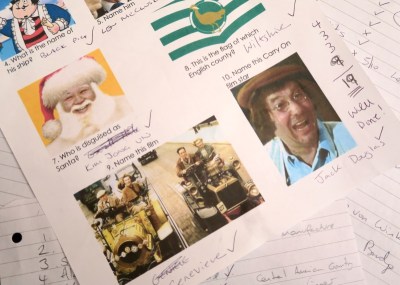
The quiz typically consists of five rounds of ten general knowledge questions, a picture round, a “Who am I” round, and two anagrams.  The “Who am I” round consists of five clues with players giving answers after each clue and teams scoring progressively less as the clues progress.  This and the anagrams (which score three points each) can be quite critical and often sort the sheep from the goats.   Only Pine and Blue had been before, and both had been part of teams that had not really troubled the scorers, so we were more than a little pleased when we got four points for the “Who am I” (Claire Balding, who apparently went to the same school as Miranda Hart) and, mostly thanks to Pine, the full six points for both anagrams!  Correctly identifying Kim Jong Un (obscured by a Santa hat, beard and glasses) as well as most of the others in the picture round meant that we finished strongly.  With a grand total of fifty-four points, we took first place, three points clear of “Something Simple” who finished second.  After a quick chat with a nice couple from Faringdon who had been marking our answers and had played Karuba and Ticket to Ride with their family over the holidays, we took care of the complicated matter of the bill (taking into account our winnings) and Violet and her mum went home.

Quiz
– Image by boardGOATS

Since Pine had his drink to finish and Blue and Pink had taken the precaution of bringing along a couple of small games, we decided to do what gamers do best and play games.  First up was No Thanks!.  This is a great little “push your luck” game where a card is turned over and players have to take the card or pay a mini poker chip to pass the problem on to the next player.  At the end of the round, players add the face values of the cards together and offset this with any remaining points to give their total – the smallest value is the winner.  The really clever part is that if a player has a run of consecutive cards, then only the lowest counts.  Spice is added by the removal of nine cards from the original thirty-two consecutive cards in the deck.  Blue did appallingly badly throughout, and while Pine won both the first two rounds, Pink won the final one by such a large margin that his aggregate total was the lowest overall, making him the winner.

No Thanks!
– Image used with permission of BGG contributor punkin312

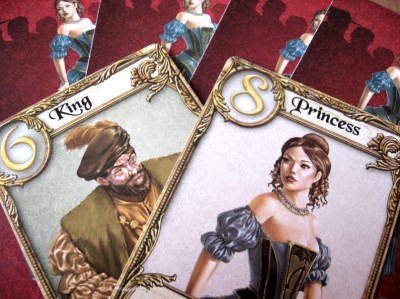
After that we played a few quick rounds of Love Letter.  This simple game played with just sixteen cards is almost the ubiquitous filler game.  Starting with one card, on their turn players draw a second and choose one to play.  Each card has a number and an action and the player left with the highest card at the end is the winner.   Pink tried to insist that Blue was always the Baron, only to get caught out as the Baron himself.  Blue started the next round as the Princess, so swapped cards with Pink and promptly caught him on the next turn.  In contrast, Pine managed to go nearly an entire round as the Princess only to be caught just before the end.  It was close and it all came down the the last game, but in a move that would have drawn allegations of match-fixing in football, Pink drew his second card face up by mistake, and then chose not to play it.  Pine gleefully assassinated Pink’s Baron once again, only to succumb himself a couple of rounds later leaving Blue to finish with three wins (to Pink’s two) and claimed victory.

LoveLetter
– Image by boardGOATS

Learning outcome:  Gamers can be good at quizzes too.

28th December 2016

Being a Wednesday, and with lots of people away for Christmas, we weren’t sure how many to expect. In the event we had a reasonable turn out, and enough for a six player game of Chicago Express (aka Wabash Cannonball), the evening’s “Feature Game“.  This is a fairly simple game, with just three possible actions per turn, but the consequences can be far-reaching.  At the start of the game there are four rail companies B&O (blue), Pennsylvania Railroad (red), C&O (yellow) and New York Central (Green), trying to build routes from the east coat to Chicago.  Unlike most train games, players don’t play the part of the railroads, instead they are investors, speculating in order to accumulate as much cash as possible.   To that end, on their turn players can auction a share of one of the companies, extend a network of a company they hold shares in or “improve” one of the hexes that a rail-line goes through.

Chicago Express
– Image used with permission of BGG contributor kilroy_locke

At the end of each round, there is a dividend where owners of shares get a pay-out.  The game is played over a maximum of eight rounds and the player with the most money at the end of the game wins.  There are a couple of clever parts of the game. Firstly, there are the three action wheels.  Each time a player takes an action, the associated dial is moved on one step. Each dial has a maximum number of steps per round and once this limit has been reached, that action is unavailable for the rest of the round.  Once two action dials have reached their maximum, the the round is over and dividends are handed out.  The dividend depends on the length of the railroad, where it goes, any upgrades along the route and the number of shares held.  The second clever aspect of the game is the economic merry-go-round. When players buy shares, the money is paid to the company and it is this money that is then used to build rail routes.  Money is gradually fed into the game via the dividend which is taken from the bank.  Since the winning condition is solely based on money at the end of the game, there is a strong incentive to minimise the amount paid for shares.  However, this can be a false economy as it can leave the company that short of funds for development.

Chicago Express
– Image used with permission of BGG contributor da pyrate

So, the balance is hard to strike, and as the game progresses, demand increases for the companies with the largest dividends.  In general, there are eight rounds, but if three companies run out of trains or three companies run out of shares, then the game ends early, so players have to watch what they spend to make sure they don’t get caught out. Only money counts at the end of the game, shares are worthless, so players can’t afford to overspend.  Chicago Express was a Christmas gift for Pink, and only Blue and Pink had played it before, and then only with two players. They explained what had happened and, as the game starts with an initial share auction they offered as much of their (albeit limited) experience as they could to help players value the shares, but the suspicion was that the game would play very differently with six.

Chicago Express
– Image used with permission of BGG contributor kilroy_locke

Blue took the first share in the Pennsylvania Railroad (PRR, red), Burgundy placed a stake in the B&O (blue), Pine invested in C&O (yellow), and Purple took the last initial offering, snapping up the New York Central share (green). That left Black and Pink with nothing at the beginning, but with their starting funds untouched.  Because funds are replenished (at least in part) by the dividend at the end of the round, it is very important for players who lose out in the initial auction to ensure they get a stake before the end of the round or they risk having to fight a rear-guard action for the whole game. To this end, Pink started out on a concerted campaign to auction off shares. By the end of the first round, Pink had joined Pine in the yellow C&O and Black had gone into partnership with Blue in the PRR. Blue on the other hand had bankrupted herself by dividing her loyalties and joined Burgundy investing in the B&O.

Chicago Express
– Image used with permission of BGG contributor Mouseketeer

After the first round, everyone could see how things we playing out and it about then that another share in the New York Central was put up for auction. The dividend had been one of the highest; hitherto, Purple had held the only share and she was very keen to keep it that way.  As the price crept up, players gradually dropped out of the bidding, eventually leaving just Burgundy and Purple.  Burgundy pushed her to the limit, but thanks to her slightly higher dividend in the first round, Purple was able to hang on to her monopoly.

Chicago Express
– Image used with permission of boardgamephotos

As the game progressed, more shares were auctioned and railroads gradually progressed westward, though the routes they took varied considerably.  Black and Blue took the PRR by the most direct route as did Burgundy (with little help from Blue, his silent partner), while Green went to the north.  In contrast, Pink and Pine took the C&O along the south coast, where there were lots of cities making it increasingly valuable and consequently, a target for takeover.  There were lots of shares available though, which simply had the effect of diluting the holding and eroding its value.  Nevertheless, Pine and Pink managed to hang on to the majority between them, so all their efforts weren’t totally wasted.  Meanwhile, Purple managed to fight off another unwanted takeover bid, with Blue forcing up the bids this time.

Chicago Express
– Image used with permission of BGG contributor Toynan

It was about this time, at the start of the fifth round that train stocks and share certificates began to run out, and suddenly everyone realised that the game could be close to the end.  Purely by chance, Blue hadn’t spent any money in the previous round having been repeatedly outbid, which meant she had more than anyone else. However, as she only had two shares she had one of the smaller shares of the dividend due, so she needed the game to end before the start of the next round. With this in mind, she began aggressively selling C&O shares, which not only brought the game to an abrupt end, but also led to a dilution of their value as others could see the writing on the wall. The tactic worked though, and after the last dividend had been handed out, everyone added up their profits and the game finished with Blue out in front with forty-two dollars, eleven dollars clear of Purple in second place.

Chicago Express
– Image by BGG contributor damnpixel

As the dust settled, players considered what had happened with the benefit of hindsight.  It was clear that although the game is unquestionably very clever, not everyone appreciated the combination of simplicity and difficulty.  In truth, it really isn’t a “train game”, more an economics game with a train theme, which could be responsible for making it less popular than, say, Ticket to Ride.  It can also be quite unforgiving, especially for players who fail to get shares in the early part of the game.  Since only four shares are auctioned before the game starts properly, the higher player counts pretty much guarantee that someone will have to fight to stay in the game.  On the other hand, if they are lucky, they may be able to get potentially valuable shares relatively cheaply by capitalising on the fact that others might have overpaid to ensure they don’t get left out.  All in all, it definitely left some players with mixed feelings.

Chicago Express
– Image used with permission of BGG contributor da pyrate

With the post-mortem out of the way, we started a game of Las Vegas.  We’ve played this simple game quite a bit, in fact, most times that it comes to games night it gets played, probably because it is an easy option.  The idea is that players begin their turn by rolling their dice and then assign some of them to one of six casinos.  Each casino is numbered one to six and has a jackpot drawn at random from a deck of money.  Players must use all the dice displaying one number to bet on the casino of that number.  Once everyone has placed all their dice the player who placed the most dice on a casino takes the highest value currency card with the person in second place taking the next and so on. The really clever bit is that before any money is handed out, any “draws” are removed, which leads to a lot of barracking.  As usual, we included the Big Dice from the Boulevard expansion and the Slot Machine mini-expansion from the 2015 Brettspiel Advent Calendar.  The Slot Machine acts like a seventh casino, except that it can hold dice of any number, but dice of each number can only be added once (though a player must add all the dice they have of that number).

Las Vegas
– Image by boardGOATS

For some reason, this game always seems to take our group ages. Black commented that it was because we all play the same way, hedging our bets at the start of the round, hoping to be the last player with dice and to be able to use them to greatest effect.  As Black pointed out though, in practice, most of the time, even when the dice roll to leave a player with the most dice at the end, it is rare they can actually use them to great influence.  With that in mind, we tried to play slightly more aggressively, and also decided to play just three rounds instead of the usual four.  In the event, game play was slightly quicker than in previous games, but not much, and in truth nobody really minded.  The thing is, Las Vegas is very relaxing to play because there is are short spells of intense thought interspersed within longish periods while others play. Although this would normally be tedious, somehow watching others roll and the anticipation while they choose what to do is strangely compelling.  This time, the first round was fairly even, but it was the second round where things got interesting. Normal service was resumed for Burgundy who got nothing and Blue didn’t do much better. Black was the real winner though, taking money from several of the casinos, many of which were quite substantial. He was less lucky during the final round, however, and it was Purple, who had been consistent throughout who finished in front with $370,000 just $20,000 ahead of Black in second.

Las Vegas
– Image used with permission of BGG contributor ckirkman

With the fog, and an early start the next day for some, Black, Purple an Burgundy headed off, leaving Blue, Pine and Pink to a game of Finca.  This is a fairly light set collecting game centered around a rondel.  The idea is that players have two options on their turn, the can move a meeple round the rondel to pick up fruit, or deliver sets of fruit to the Mallorcan villages. The rondel movement is the interesting bit: the number of meeples on its start space dictate how far the meeple moves and the number of meeples on the space at the end of its move indicates how many fruit the active player gets.  If the meeple passes one of two markers during its move, the player gets a donkey cart token which can be traded in for the opportunity to make a delivery.

Finca
– Image used with permission of BGG contributor mikehulsebus

The game has a couple of other features. Firstly, in order to stop players hoarding fruit and starving others, if there are insufficient fruit available when needed, everyone returns everything of that type that they have, before the active player gets their due. This also applies to donkey cart tokens an it forces players to deliver frequently. In any case, donkey carts are generally small and hold a maximum of six fruit, so there is rarely good reason for hoarding.  Secondly, the villages each have a pile of demand tokens, face down except for the top one. Each of these depict some number of fruit from one to six.  When a player delivers to a village, they take the demand token and the number of fruit on the token is equivalent to the number of points awarded to the player at the end of the game. Thus, a player could collect one token featuring six fruit, alternatively, they could claim two or more tokens that sum to six (or fewer – donkey carts don’t have to be full).

Finca
– Image used with permission of BGG contributor thepackrat

Finally, bonuses are available for players who collect sets of demand tiles numbering from one to six, and when all the demand tiles are taken for a village, the finca tile is evaluated which gives more points. The game ends when demand tiles have been taken for a set number of villages and points are added up. Pine was new to the game, though Blue and Pink had played it a few times before. So it was that Pink, slightly needled by his poor results in the first two games, showed the way, initially by delivering the first fruit and collecting the corresponding demand tiles, then by collecting a set of six tiles, and with it, seven bonus points.  Blue collected plenty of fruit and turned them into demand tiles, but Pine and Pink between them took all the available “three value” demand tiles preventing her from getting a bonus. Pine quickly got to grips with the game, but his problems were compounded by the fact that he kept drawing with Blue when the finca bonus tiles were evaluated.  So it was Pink led from the start, picking up both finca bonuses and set bonuses as he went and snatching tiles just before the others could take them, and he ran out the worthy winner with fifty-two points to finish the evening on a landslide.

Finca
– Image used with permission of BGG contributor punkin312

Learning outcome:  A game needs more than trains for it to be a “train game”.
Essen 2016

It is that time of year when, the leaves fall from the trees and gamers visit Germany.  No, Oktoberfest isn’t the draw (that happens in September anyhow), this is an altogether different annual German “festival” – The Internationale Spieltage, which is held in Essen.  To Gamers worldwide, Essen is synonymous with the largest games fair in Europe and, arguably, the world.  The fair runs Thursday to Sunday in mid-October every year and is the one of the largest and most significant of all the boardgame conventions.   As such, many of the manufacturers plan their biggest releases for October with their debut at the Fair.

Essen
– Image from merz-verlag.com

Last year there was a bit of a paucity of new games and it seemed to be all about expansions.  This year, while there are still plenty of expansions for well-loved games like Istanbul, Colt Express, Orléans and Ca$h ‘n Guns etc., there are also a lot of new games based on old favourites.  For example, there is Key to the City – London (which has a lot of elements of one of our favourite games, Keyflower), Jórvík (an update and re-theme of Die Speicherstadt), X Nimmt! (a variant on the popular but chaotic 6 Nimmt!), and the latest incarnation of the Ticket to Ride series, Ticket to Ride: Rails & Sails.  There will be plenty of other interesting original games too though, including The Oracle of DelphiA Feast for Odin, Cottage Garden and The Colonists.  Several members of the group are going this year, and they’ll no doubt bring back lots of exciting new toys to share with everyone.

Essen
– Image used with permission of BGG contributor Gonzaga

Boardgames in the News: The Monthly Game Guardian

In recent years it has become increasingly acceptable to play boardgames, so much so that there are now regular articles in the national press – in particular The Guardian who have had a dedicated boardgames area in their “Lifestyle” section for some time.  They now also have a regular monthly guide designed to help people “find the best games” and “steer clear of disappointing duds”.  This is written by Owen Duffy who writes for the Guardian on a range of subjects and until recently ran the tabletop gaming blog Cardboard SandwichThe first article showcases four games that even some dedicated gamers might not be aware of:  Ice Cool, Ticket to Ride: Rails & Sails, Mystic Vale and Sneaky Cards.  Owen has a real love of playing boardgames and is genuinely knowledgable about them, so the “Boarders Hoard” is definitely worth keeping an eye out for.

Ice Cool
– Image used with permission of BGG contributor punkin312

Boardgames in the News: What does Brexit mean for Eurogamers?

On Thursday, after a long and miserable campaign, the UK public voted to leave the EU.  Boardgamers are a friendly bunch, so what does the imminent divorce mean for us?  Obviously there’s lots of speculation and scare stories, but the most immediate and obvious effect is undoubtedly the cost and potentially the availability of boardgames in the UK.  A copy of Ticket to Ride: Europe bought from Germany using Amazon.de would have cost €43.92 including postage, which would have been about £33.45 on Thursday evening at 10pm.  At 5am the following morning, this had risen to £35.94, an increase of £2.50 in just seven hours.  The same game bought from the USA from Amazon.com costs $64.69 (including shipping and tax waivers etc.) which was about £43.21 at 10pm on Thursday rising to a staggering £48.25 at 5am the next morning – an increase of over £5!  The exchange rates will probably improve over time, however, it will be a while before they achieve pre-referendum levels and there will no doubt be more uncertainty to come too, no doubt.

Ticket to Ride: Europe
– Image by boardGOATS


17th May 2016

Red and Blue were late arriving, so while they fed on lamb burger and chips, everyone else settled down to a quick game of Sushi Go! (with added Soy Sauce). This is probably the quickest and simplest of the drafting games.  Drafting is very simple mechanism:  everyone begins with a hand of cards and simultaneously chooses one and passes the rest on.  Once the cards have been revealed, players pick up the hand they’ve been given and again choose a card before passing the hand on.  In this way the hands progressively get smaller with players adding cards to their display.  It is a mechanism used to great effect in more complex games like 7 Wonders and Between Two Cities, where other mechanisms are added to give the game more substance (engine building and semi-cooperative tile laying in these two examples).  In Sushi Go!, the aim of the game is to collect sets of cards, with points awarded for different achievements depending on the type of card.  For example, the player to collect the most maki rolls scores six points while anyone who collects three sashimi gets ten and so on.

Sushi Go!
– Image used with permission of BGG contributor henk.rolleman

Everyone except Burgundy did reasonably well in the first round, with Green getting his nose in front thanks to some well-timed wasabi and a pair of tempura while Purple and Pine fought for the maki roll bonus.  In the second round Burgundy managed reduce his deficit, and Green’s lead took a big dent.  With Black as his main threat, however, Green felt sure he had the situation well under control as he was sat to Black’s left so was the one passing him cards in the last round.  In the end, despite everything, it was a really tight game with almost everyone scoring thirty points before the puddings were evaluated.  As the only one, Burgundy paid the full price for failing to pick up a single pudding card.  In contrast, because of the seating order in the last round Green had been able to ensure that Black was unable to challenge him for the title of “Pudding King” leaving Green the winner by a healthy margin.

Sushi Go!
– Image used with permission of BGG contributor kladan

With the lamb burgers dealt with, we moved onto our “Feature Game” which was Cargo Noir.  We had two copies, so decide to set them up side by side so we could all play.  This game is nearly ten years old and hasn’t been as popular as other games by Days of Wonder, so most of us had not played it before.  The exact reason for the lack of enthusiasm could be the artwork which is 1950s style and quite drab in colour, so is perhaps less appealing than, for example the highly successful Ticket to Ride and Small World.  Perhaps more significant though is the game play which appears to have a bit of “Marmite Factor” with some people raving about it while others seem to loath it with equal passion.  This is curious because at it’s heart, Cargo Noir is just an auction game, built around set collecting, but with a little bit of bite.

Cargo Noir
– Image by BGG contributor fabricefab

At the beginning of the game each player has three ships and at the start of their turn, each ship will be located at one of the harbours, in the casino and the black market.  On their turn, the first evaluate the status of each of their ships and resolve any auctions; then they trade any sets of goods for cards (which are worth victory points at the end of the game), before finally repositioning any left over ships.  So, like lots of games, Cargo Noir is basically about turning money into points.  Aside from the starting handful of money, the only other source is the casino and ships placed there yield two coins (yes, it IS the only casino in the world that gives out money!).  These can be used to bid for the goods available in the harbours.

Cargo Noir
– Image used with permission of BGG contributor ronster0

Each ship can visit one harbour and takes with them a stack of money.  If it is the only ship in the harbour at the start of the players next turn, then the player gets all the goods laid out in the harbour.  If they are not alone, the player can either leave the ship there and add enough money to the stack to win the current bid, or remove the ship from the board taking nothing.  Thus, the trick is to bid enough to keep others away, but not enough to risk bankruptcy.  The final location ships can visit is the black market, which enables players to either trade one of their existing commodities for one on display, or to draw a free tile at random from the bag which can be very useful as it gives a tile without spending money.  Players get “credits” (but no money) for sets goods where all the tiles are either all the same or all different.  Since larger sets give more “credits”, the ability to trade a commodity can enable players to buy more valuable cards.

Cargo Noir
– Image by BGG contributor DaveyJJ

There are some serious limitations for players to consider, for example at the start of the game each player can only carry forward a maximum of six goods to the next round – everything else must be sold.  Similarly, having three ships can be seriously restrictive.  So, some of the victory cards yield fewer points at the end of the game, but give smugglers an edge during it, providing extra cargo ships for example, or giving them access to a warehouse to store extra goods enabling them to build up more credits and buy more valuable cards.  Players who choose to buy a syndicate card can even get money from the bank when they withdraw from a bidding war, which has the potential to provide a nice little earner while damaging opponents, if used wisely.  The game lasts a fixed number of rounds (depending on the number of players) and the player with the most points wins.

Cargo Noir
– Image used with permission of BGG contributor duchamp

With two copies and seven of us (most of whom were unfamiliar with it), we decided to split into two groups both playing the same game.  In the four player game, Pine (who started) got off to a flying start while everyone else struggled, getting caught in bidding wars.  A few rounds in, Red briefly got her nose in front, but Pine was better positioned and galloped away.  As the game came to a close, Blue fought her way back into the game quickly buying two extra ships and engaging in a “collect as much as possible and sell immediately” approach which sort of worked, but it was too little too late.  Meanwhile, Green collected a massive amount of uranium together, but couldn’t quite make enough on the last round to make a big impact leaving Pine to win with a healthy margin despite finishing with just four ships.

Cargo Noir
– Image used with permission of BGG contributor duchamp

The other game was very close with Purple doing her best to scupper the plans of Burgundy and Black, but doing more damage to herself in the process.  The game finished with Burgundy taking it by just five points which was particularly galling for Black as he was one coin away from getting the additional five he needed for the draw.  There was a lot of discussion as to whether we liked the game.  Green was of the opinion that there was too much downtime and it was time you couldn’t do very much with as the previous player had the ability to completely upset any plans made in advance.  Red also had misgivings, saying she quite liked it, but wouldn’t bother to go out and buy a copy; Blue commented that as she already had a copy the question was more whether it should be kept, and it would certainly stay for a while yet.  Pine on the other hand, had really enjoyed it (despite the faces he pulled at the start), but in general, consensus seemed to be that it was “OK”, even “quite nice”, but not a “great game”.  It was also perhaps better with three than four and the downtime would have been very significant if playing with five.

Cargo Noir
– Image by BGG contributor thornatron

Green decided to get an early night so the rest of us decided to finish with an older, large group game, Saboteur. This is a bit of an old favourite, and is one of the original hidden traitor/social deduction games.  The idea is that each player is either a Dwarf or a Saboteur and players take it in turns to play cards with the Dwarves aiming to get to the treasure, while the Saboteurs try to stop them.  There are two types of cards that can be played:  tunnels and special cards.  The tunnels come in different shapes and must be played in the correct orientation, so Dwarves try to push the path in the right direction, while Saboteurs try to play disruptive cards while trying to look like they’ve done the best they can with the hand available.  Meanwhile, special cards include “rockfall” cards which can be played to remove a tunnel card already played and maps which can be used to see where the gold is hidden.  Most importantly, however are “broken tool” cards which can be played on another player to prevent them building tunnel cards until they (or another kind-hearted soul) plays a matching “fixed tool” card to remove it.

Saboteur
– Image used with permission of BGG contributor mikehulsebus

We usually play with a few house-rules.  The rules suggest that the game should be played over three “rounds” with the winning team semi-randomly receiving “gold” cards; the overall winner is then the player whose gold cards depict the most gold pieces.  Now, we find that the game can sometimes outstay its welcome and the addition of the gold at the end of the rounds feels like an attempt to make more out of the game, but in actuality just makes it more frustrating as there is a large amount of randomness in their allocation.  So firstly we dispense with this aspect altogether and treat each round as a game in its own right.  That way, we can play one or two games/rounds and then move on, or play extras if everyone is enjoying themselves or time dictates.  Secondly, the teams are drawn from a pool cards so that there is an unknown number of Saboteurs around.  Although it’s nice to have this additional uncertainty, we’ve always found (particularly with six players) that the minimum number of Saboteurs makes the game very easy for the Dwarves, so we tend to play with a fixed number of Saboteurs.  This time, we debated whether to add the expansion, Saboteur 2, but decided against it as the characters seemed to be completely random draw and we didn’t really have time to think about the implications properly – maybe next time.

Saboteur
– Image used with permission of BGG contributor mothertruckin

The first “game” was very cagey with everyone looking very “saboteur-y” and everyone accusing everyone else of “saboteur behaviour”.  In the event, it turned out that all the dwarves had poor hands, and it was fairly clear that the Saboteurs had won when first Pine and then Blue outed themselves to ensure that the Dwarves didn’t make it home.  The accusations were already flying about as the cards were being dealt out with Pine commenting that it was highly unlikely that he would be a Saboteur twice in a row and even more unlikely that Blue would be too.  This quickly degenerated into a discussion of probability and how the probability was actually exactly the same as last time as the two events were independent, even though the probability of the identical set of Saboteurs is relatively unlikely.  Unlikely it may have been, but this time it happened.  In an effort to do something different and in the hope that her behaviour would look different, Blue outed Pine as a Saboteur since everyone was already somehow suspicious.  Nobody really fell for it however, and it was a fairly easy win for the Dwarves.

Saboteur
– Image used with permission of BGG contributor mikehulsebus

Since we’d had two games with the same Saboteurs, we decided to play a third.  This time things were going reasonably well for the Saboteurs as the Dwarves were struggling with poor cards again.  Red was already looking shifty, so when the Dwarves suddenly got it together and headed in the right direction quickly, nobody was terribly surprised when she outed herself because by playing a “rockfall” card. As she drowned under a hailstorm of “broken tool” cards, Red declared that the other Saboteur was going to have to pull their finger out or it would be all over.  Black was sat to her left, but miscounted the distance to the gold and played a map card.  This left Purple and Pine to finish the game and everyone question why Black hadn’t played his rockfall card, especially Red who was quite vehement in her criticism of Saboteurs who don’t pull their weight!  With that, much hilarity ensued and eventually everyone headed home.

Saboteur
– Image used with permission of BGG contributor mothertruckin

Learning Outcome:  If you are going to try to win, don’t leave it too late.

9th February 2016

Blue was delayed by washing machine shenanigans and Green by pancakes, so while Burgundy, Black and Purple were entertained by food, Red and Magenta distracted them with a few quick rounds of Love Letter.  Magenta took the first two rounds winning the second by drawing the princess as the penultimate card; the third round went to Black when he played a Prince and asked Purple to discard her card which turned out to be the Princess.  With the arrival of Green and Blue had finishing her pancakes, we decided to play our “Feature Game” which was Ticket to Ride and its variants.

Love Letter
– Image used with permission of BGG contributor henk.rolleman

Which variant was the subject of some debate as we had all played different versions and everyone wanted to try a different one.  For example, Blue had never played the original USA version, but all those that had didn’t want to play again; similarly while Green was interested in playing Märklin, Black and Purple weren’t keen; they were interested in Switzerland or Nordic Countries, but Magenta, Blue and Green were unenthusiastic about that.  And so it went on, in fact, the only thing everyone agreed on was that we should split into a three and a four and nobody wanted to play Europe edition (as everyone had played that a lot). In the end, the group of three was based round Black and Purple who wanted to play with the Switzerland map and setup, and were joined by Burgundy who was fairly flexible.  That left the group of four who decided to go for Nederland as none of them had played it before.

Ticket to Ride: Europe
– Image by boardGOATS

The basic Ticket to Ride game can be summarised as follows:  players take it in turns to carry out one of three possible actions and when one player has two pieces left or fewer, everyone gets one more turn before the game ends and points are tallied.  The first action is to lay trains on the map, but in order to do this, they must spend train cards in the colour featured on the map.  Thus, if a player wants to claim a four car route, they must play four cards of the corresponding colour and finally place four of their plastic carriages on the board in the correct location scoring points as they do so.  If they do not have cards to claim the route they want then they can, instead, choose two cards, either from the five face up cards next to the board, or from the face down draw pile.  “Laying trains” scores points, but a large number of a player’s points are scored at the end through tickets which give points to players that have connected several short routes together to connect two more distant cities.  Each player starts the game with some tickets (chosen from a larger number), but on their turn may, instead of drawing cards or claiming routes, draw more tickets.  At the end of the game, tickets which have been successfully completed score points, while unfulfilled tickets score negatively.

Ticket to Ride: Europe
– Image by BGG contributor stormrover

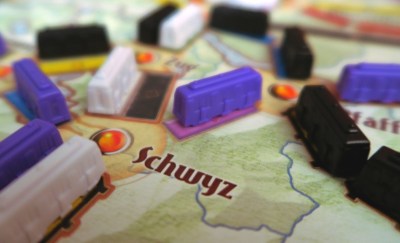
Although this is a fairly complete summary of the rules for the original base game, each different version has slight modifications and variations that change the game slightly.  The “Swiss trio” got under way first as Burgundy was quite familiar with the rule modifications:  tunnels, ferry routes and country-to-country tickets; locomotive cards can only be used for ferries and tunnels, but can be drawn from the face-up cards without penalty.  The game was very close with Purple trying to make a long route from east to west, Black travelling north to south and Burgundy doing a bit of both. The tunnels were a bit of a hindrance with everyone struggling to get through the Alps without paying extra.

Ticket to Ride: Switzerland
– Image by boardGOATS

As the ticket scoring came to a close, Burgundy had his nose in front and looked to have the win in the bag, but carefully counting up the trains gave Black the bonus for the longest route and with it, the win by just two points.  Burgundy was particularly cheesed off as he had attempted to claim a tunnel on his final turn that would have given him the longest route, but the fates conspired against him.  It was only later that we realised that there hadn’t been a recount for the points awarded as trains were placed on the map and as, invariably points tend to get missed out, a recount is generally sensible.

Ticket to Ride: Switzerland
– Image by boardGOATS

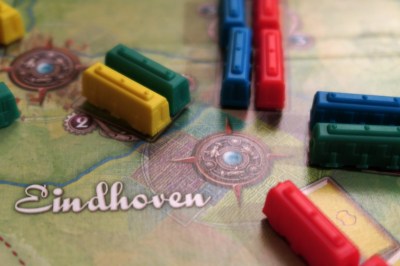
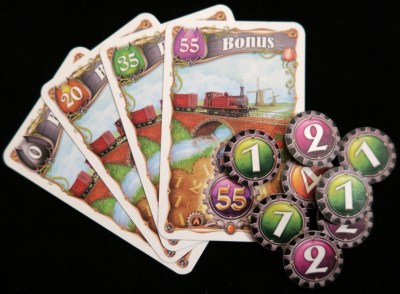
Meanwhile, Blue, Green, Red and Magenta had worked out the rules changes applicable to Nederland.  There are no ferry routes or country-to-country tickets and obviously, no tunnels, however, in this low-country with countless canals and rivers, there are bridges instead. and these have a toll.  Each player starts with “toll tokens” to a total value of thirty.  Most of the routes are double routes, so can be claimed by two different players, this feature is common with all other versions of Ticket to Ride when playing with the maximum number of players, but in this game they are used for all games.  The first player to claim a double route pays the marked toll to the bank, but the second player to claim that route pays the toll to the player who got there first.  These tolls become quite critical in the end game as there are bonus points available for players who manage to conserve toll tokens, and these bonuses are sizable with fifty-five points going to the player with the most tokens at the end of the game and thirty-five and twenty for second and third.  Players who can’t afford to build, can borrow from the bank, but that removes them from the race for bonus points as well as costing points at the end of the game.

Ticket to Ride: Nederland
– Image by boardGOATS

As is traditional, everyone began by moaning about where their starting tickets were.  Beyond that, nobody really knew quite what to expect, but it was clear that this wasn’t a game where players could ill-afford to hoard train cards and wait as they were likely to find themselves paying tolls to other players and giving them bonus points.  As such, everyone got going quickly and Red led the way placing several long routes giving her an early lead.  Everyone else caught up, and as players started to run low on trains, they realised they had to watch the number of toll tokens they had left else they would have to begin to borrow and that would put them out of the running for the bonuses.  Blue picked up extra tickets first, but they left her with a really tough decision as most of her track was in the north-west and the tickets she had were pretty much everywhere else.  After a very long time thinking, she decided to keep them all and go for broke.  The others soon followed, picking up more tickets, and Green had several goes with some corresponding to routes he had already claimed.  It was only a couple of turns after she had drawn her extra tickets that Magenta counted her trains and started to make some uncomfortable sounding noises suggestive of possible problems ahead.

Ticket to Ride: Nederland
– Image by boardGOATS

Blue triggered the end of the game and it was all too close to call with less than ten points between first and last before the tickets and bonus points were added on. Green was the first to count up and there was a stunned silence when we found he had a massive one hundred and thirty-seven points from the tickets to add to his train total of fifty-two.  Red had a couple of tickets that she had failed to complete so her ticket total took a bit of a bruising, but her problems were nothing to Magenta’s.  She only realised she didn’t have enough pieces to complete all her tickets when it was too late, so all her hard work to fulfil her initial tickets was almost completely negated as she finished with a ticket total of just one!  Blue had managed to complete all her routes and was pretty much neck-a-neck with Green which, like the other game, left it all down to the bonus points for toll tokens.  Red took the fifty-five points for the most remaining toll tokens, giving her a very respectable one-hundred and fifty-four and third place.  Blue picked up an extra thirty-five points and finished forty points ahead of Green who finished with the fewest toll tokens and therefore didn’t add to his score.

Ticket to Ride: Nederland
– Image by boardGOATS

Pine had appeared towards the end of the game and, after a brief explanation of the rules, had commented on the name of the game in German:  Zug um Zug, which translates to “step by step”, although Zug also means train.  This kind of double-entendre is not uncommon in Euro game titles and prompted a discussion of other games with similar “jokes”.  Blue mentioned Tier auf Tier which literally translates to the English title “Animal upon Animal”, a children’s game where players stack wooden animals, creating “tiers”.  Magenta brought up her favourite game, Bohnanaza, where “Bohn” is the German for bean.  Green chipped in with his offering of Citadels, which is called “Ohne Furcht und Adel” in German which literally means “without fear and noble” (colloquially translated as “without fear and nobility”).  This is actually a pun on “Ohne Furcht und Tadel”, which means “without fear or blemish”.  It is an old-fashioned expression seldom used now except perhaps when describing a perfect performance by Michael Schumacher for example, that refers to somebody being very valiant and chivalrous (ala King Arthur and the Knights of the Round Table).  Interestingly, when trying to find the correct literal translation, Green submitted “Ohne Furcht und Adel” to Google and got “Citadels” in return, perhaps a measure of how embedded games are in German life.

Animal Upon Animal
– Image by BGG contributor dr.mrow

With eight of us, and nobody terribly keen to play anything too cerebral, we decided to go for something light, 6 Nimmt got a mention, but we settled on Las Vegas, using the extra dice for more players players and the wild cards from the Boulevard expansion, and the Slot Machine from the 2015 Brettspiel Advent Calendar.  This was a Christmas gift and had its first outing in January when it was the “Feature Game”, but as a light dice game that plays a wide range of player numbers it is quite versatile.  On their turn, each player begins by rolling their dice, then assigning some of them to one of the six casinos.  Each casino is numbered one to six and has a jackpot drawn at random from a deck of money.

Las Vegas
– Image used with permission of BGG contributor ckirkman

On their turn, players must use all the dice of one number to bet on the casino of that number.  Once everyone has placed all their dice the player who placed the most dice on a casino takes the highest value currency card. The really clever bit is that before any money is handed out, any “draws” are removed, which leads to a lot of barracking.  The Slot Machine is like a seventh casino, except that it can hold dice of any number, but each number can only be added once (though a player must add all the dice they have of that number).  The game was a lot of chaotic fun with with lots of chit-chat and before long we had worked our way through the card deck and spent an hour doing it.  Although there is a lot of down-time with so many players, it didn’t seem to matter very much and it was quite relaxing to chat about things.

Las Vegas
– Image by boardGOATS

We found Slot Machine definitely added a useful extra option to the game, however, the “wild cards” were less interesting.  This inspired a discussion about the value or otherwise of expansions.  In an evening essentially devoted to expansions, it was interesting consider whether the addition of expansions took a simple game that everyone liked and made it unnecessarily more complex, or whether it breathed new life into a game people had become tired of.  In the case of Ticket to Ride at least, it was clear that with a game that players had become almost too familiar with, the extra maps provided a nice alternative.  Meanwhile, the game was providing an interesting background to the discussion and the end results were almost incidental.  Magenta redeemed herself after the disastrous ticket fiasco, finishing with $390,000 and third.  Second place went to Red with $420,000, but with her second victory of the night, Blue took home the bacon with $460,000, more than twice that of last place.

Las Vegas
– Image used with permission of BGG contributor joeincolorado

Learning outcome:  Germans *do* have a sense of humour!

Boardgames in the News: Asmodee Update – Taking Over Catan and Other Stories

A year ago, following their acquisition of Esdevium GamesLibellud, Days of Wonder, Fantasy Flight games, Ystari Games, Asterion Press and Pearl Games we discussed the sudden expansion of the hitherto small French games company, Asmodée.  More recently, following a new contract with Queen Games for exclusive distribution rights in the USA and the ensuing restructuring of its three main US operations, Days of Wonder, Fantasy Flight games and Asmodee Editions to form a single entity, Asmodee North America, we wondered whether this growing monopoly would lead to price rises.  This concern arose, in particular, as from January 2016, distribution would be restricted to “speciality retailers” that have agreed to Asmodee North America’s “Speciality Retail Policy” including the prohibition of online sales.

Asmodee North America
– Image from Asmodee North America Press Release

Asmodee followed the initial press release with a second press release clarifying their position, in the form of a series of questions with answers. This did not completely allay many of the concerns, however, to the specific question, “…will you institute or impose official price floors or “minimum advertised price” policies”, they responded, “No”.  There has been a considerable speculation, but it seems clear from this “clarification” that although they intend to restrict “speciality retailers” to face-to-face transactions, this will not affect mass market outlets, such a Amazon, Target, or Barnes and Noble.  Another way of looking at it is that the medium-sized online vendors including, CoolStuffInc and Miniature Market (who are popular with US Geeks thanks to generous discounts), will no longer be able to sell Asmodee North America products, however, players like Amazon etc. are too big to be susceptible to their bully-boy tactics.  We will see what happens in the long run, but for the time being, so much for the end of 2015 press releases.

The Settlers of Catan
– Image by boardGOATS

With the new year, there are new take-overs, and unsurprisingly, Asmodee are at the centre once again, this time announcing that they are taking over the production of the English language edition of Catan (formerly known as “The Settlers of Catan”)Celebrating its twentieth anniversary last year, The Settlers of Catan has been translated into thirty-five languages and is reported to have sold over twenty-three million copies worldwide.  As such is it one of the biggest names in the world of modern boardgames.  With this acquisition from Mayfair Games, Asmodee have also announced that they will launch a subsidiary, “Catan Studio”, dedicated to the creation of content for different media for the “Catan Universe”.  Catan Studio will be headed by Peter Fenlon, former CEO of Mayfair who will work with Catan GmbH and its partners on this development.

Ticket to Ride
– Image by boardGOATS

With this acquisition, it brings Catan, Ticket to Ride and Star Wars: X-Wing Miniatures Game as well as the very popular card game, Dobble, all under the same roof.  So, what next?  Surely bringing together such a large slice of the modern gaming market makes Asmodee themselves a potential take over target.  In fact, perhaps the only question is whether the likes of Hasbro will make a move before or after Asmodee make their next acquisition.  Any bets on the future of Filosofia/Z-man Games with Pandemic and Carcassonne…?

– Image used with permission of BGG contributor adamfeldner

Boardgames in the News: Will the Latest Consolidation Lead to Price Rises?

In February, following their acquisition of Esdevium GamesLibellud, Days of Wonder, Fantasy Flight games, Ystari Games, Asterion Press and Pearl Games we asked the question, “Are Asmodee Taking Over the World?”  As if to answer in the affirmative, in April, Asmodee announced the start of a new contract with Queen Games for exclusive distribution rights in the USA.  Since Asmodee has been the distributor for Queen Games in Germany, this made logistical sense.  However, other consequences of these consolidations are now becoming apparent.

Asmodee Logo
– Image from escapistmagazine.com

This week, Asmodee issued a press release stating that from the 1st January 2016, games made available by its three main US operations, Days of Wonder, Fantasy Flight games and Asmodee Editions will be sourced from a single entity, Asmodee North America.  Furthermore, in the New Year, Asmodee North America will be adjusting its sales terms and reducing the number of its primary customers in the USA to just five authorised distributors.  From 1st April 2016, these authorised distributors will be restricted to selling Asmodee North America’s products to “speciality retailers” that have agreed to Asmodee North America’s “Speciality Retail Policy”.

Asmodee North America
– Image from Asmodee North America Press Release

This Speciality Retail Policy states that a “retailer must not sell or transfer … other than through face-to-face commercial resale exchange with end-users in retailer’s physical retail location(s) or at a physical extension of the retailer’s location at a consumer show/convention”.  Thus, all future sales will be restricted to bricks and mortar stores, effectively preventing the selling of Asmodee North America‘s products online.  This is not an end to online sales, however, as the press release goes on to say that “Asmodee North America will allow select merchants to service the online sales channel under a separate sales policy. Such select online merchants will either be supplied directly by Asmodee North America, or by appointed distributors acting under Asmodee North America’s related policy.”

Ticket to Ride Map Collection: Volume 5 – United Kingdom & Pennsylvania
– Image by boardGOATS

Online speculation is rife that these measures have been put in place to prevent the deep discounting seen in the USA, and that the contracts the retailers will have to sign will include a commitment to sell at the list price, thus effectively price fixing by other means.  This has been carried out in the past by both Mayfair Games (the Catan brand) and Games Workshop (Warhammer etc.) who both have strict Speciality Retail Policies that restrict distribution, maintaining high prices.  This is all highly significant with the growth of modern boardgaming as Asmodee North America produce some of the most popular gateway games, in particular Ticket to Ride, 7 Wonders, Dixit, and Dobble as well as the newly reawakened Star Wars license.  It is not yet clear whether this will also have any effect on the distribution of Queen Games products in the USA.

Star Wars: X-Wing Miniatures Game
– Image used with permission of BGG contributor adamfeldner

Asmodee North America has claimed these changes are because they are “committed to brick-and-mortar hobby market speciality retailers”.  On the other hand, in the FAQ that accompanied the statement, Asmodee North America state that even physical stores with an online presence are “limited to the channel of sale involving physical retail stores only”, which appears to belie this, since online sales are often what keeps “Bricks and Mortar” stores afloat.  The FAQ also states that “These policies currently affect our business in the US. Our Canadian operations will continue unaffected until notified otherwise.”  There is no mention of the EU, but it is likely that Esdevium, who already have something of a strangle-hold on the distribution of games in the UK, will continue to assert pressure on the market as they did at the start of this year.

Esdevium Logo
– Image from asmodee.co.uk

Boardgames in the News: Ten Great Games to Play with the Family at Christmas

With the nights drawing in and the weather becoming increasingly wet and wintery, what could be nicer than an afternoon playing board games in front of the fire?  If you are new to the hobby, here are ten great modern boardgames to play over the Christmas holidays.  These are all readily available online and/or in dedicated boardgame shops.

  1. PitchCar – This superb car racing game is guaranteed to get kids of all ages playing together; the winner is the person who manages to flick their car round the track first. The game plays six people, but you can get more cars from the Ferti website and play a pursuit type game which is also good fun.  You can also get expansion packs to make your track longer and more interesting if you really like it.
    Target Audience: Families & parties; ages 2 to 102…
    Game Time: From half an hour tailor-able to the group, plus time to build the track.
    Price:  Approximately £45 from amazon.co.uk for the base game (also available in a slightly cheaper mini-version for those without a large table).

    PitchCar
    – Image used with permission of BGG contributor garyjames
  2. Tsuro – Players take it in turns to build a path for their “dragon”, creating a maze for everyone else at the same time. The game lasts just fifteen to twenty minutes and plays up to eight people.  It combines just enough strategy and luck that if you get knocked out early, there is always time to try again.  Don’t be tempted to get Tsuro of the Seas though, it takes all the really good things about Tsuro and makes them slightly less good.
    Target Audience: Friends & Families with ages 8+
    Game Time: 15-20 mins with almost no set up time.
    Price:  £20-25 from amazon.co.uk.

    Tsuro
    – Image used with permission of BGG contributor aleacarv
  3. Bohnanza – This one sounds really uninspiring on reading the rules:  players have to trade beans to make the most money from the biggest and best bean fields.  Despite the unpromising sound, you only need to play it once with a couple of other people and before you’ve gone far you will agree it is one of the best games ever made – never has bean farming been so much fun!
    Target Audience: Older children and adults; ages 10+
    Game Time: 45-60 mins
    Price:  Readily available for around £15-20.

    Bohnanza
    – Image used with permission of BGG contributor spearjr
  4. Dobble – With five games in the tin, this Snap-inspired game is excellent value.  Since it relies on reactions, it is also one of those games where children are often genuinely better than adults.  And it is so quick to play that it is an ideal game to squeeze in while the kettle is boiling or tea is brewing.
    Target Audience: 3 and up
    Game Time: 2 mins per round
    Price:  Readily available for around £10 or less.

    Dobble
    – Image used with permission of BGG contributor msaari
  5. Escape:  The Curse of the Temple – While most Euro Games don’t use dice, in this game players have five each.  This is a team game that is played against the clock, so has the advantage that everyone wins or loses together.  The team of five players simultaneously roll dice to explore the temple and activate gemstones and then try to escape together before the temple collapses around their ears.  This is also ideal for children to play with adults as they can work in pairs or groups learning communication and team working skills.  If the game seems too difficult for the group, it can also be made a little easier by reducing the number of gems the group have to activate.
    Target Audience: age 5+ as long as there are understanding adults playing
    Game Time: 10 mins per game plus a few minutes setting up
    Price:  approximately £25-30 from amazon.co.uk.

    Escape: The Curse of the Temple
    – Image used with permission of BGG contributor mikehulsebus
  6. Survive: Escape from Atlantis! – This is good fun and really, really nasty.  Not quite so easy to learn, but really not that difficult either and great fun with four people who have a competitive streak.  Each player has a number of pieces that they are trying to get from the central island to the mainland.  Players take it in turns to move a person or boat, then they take a piece from the island, finally they roll a die to move a whale, shark or sea-monster, with potentially devastating consequences…
    Target Audience: Teenagers; not recommended for children under 12 or people who can’t take getting picked on
    Game Time: 40-60 mins
    Price:  Approximately £25-30 from amazon.co.uk; a 5-6 player expansion is also available which makes things even nastier…

    Survive: Escape from Atlantis!
    – Image used with permission of BGG contributor ckirkman
  7. Dixit – This is a great game to play with the mums and grannies in the family.  Players take it in turns to be the “story teller” who chooses a card from their hand and gives a clue that everyone else tries to match.  Everyone then has to guess which card belonged to the story teller, with points awarded for good guesses as well as cards that mislead other players.  The original base game plays six well, but Dixit: Odyssey plays up to twelve with a slight tweak to the rules.  Extra decks of cards are also available.
    Target Audience: Friendly groups and parties.
    Game Time: 30-45 mins
    Price:  Approximately £15-30 from amazon.co.uk, depending on the version.

    Dixit
    – Image used with permission of BGG contributor lacxox
  8. Colt Express – For older children and younger adults, this game is a glorious mixture of controlled chaos.  Players are bandits attacking and looting a fantastic 3D train.  Rounds are broken into two parts, first players take it in turns to choose the cards they will play placing them in a communal pile the centre of the table.  Then, once everyone has chosen, players carry out the action on each card in turn.  The problem is by the time they get to the end, the plans they had at the start have gone terribly awry…  A similar feel can be got from the pirate themed Walk the Plank! which is a cheaper, smaller, easier game that packs a lot of fun into a shorter playing time.
    Target Audience: Young, and not-so-young adults.
    Game Time: 30-60 mins
    Price:  Approximately £25 from amazon.co.uk; Walk the Plank! is available for £15-20.

    Colt Express
    – Image used with permission of BGG contributor henk.rolleman
  9. Ticket to Ride: Europe – Players are collecting coloured cards and spending them to place plastic trains on map/board with the aim of trying to build routes across Europe.  This game has been around a little while now and is available in several different flavours:  for the typical UK family, the Europe edition is probably best (plays up to five players), but for a couple, the Nordic edition with its gorgeous festive artwork might be more appropriate (only two to three players though).  If it is popular, there are also a number of expansion maps available.
    Target Audience: Age 10+.
    Game Time: 30-60 mins
    Price:  Readily available for available for £25-40 depending on the version and vendor.

    Ticket to Ride: Europe
    – Image used with permission of BGG contributor kilroy_locke
  10. No Thanks! – A quick and simple little betting game anyone can play.  The game consists of a deck of cards and some red plastic chips.  The first can take the top card, or pay a chip and pass the problem onto the next player.  The aim of the game is to finish with the lowest total face value of the cards, but if woe-betide anyone who runs out of chips as they will be left at the mercy of everyone else.
    Target Audience:  Friends and families; children aged 8+.
    Game Time: 10-15 mins
    Price:  Readily available for approximately £10.

    No Thanks!
    – Image used with permission of BGG contributor ckirkman