Author Archives: nannyGOAT

Next Meeting – 6th February 2018

Our next meeting will be on Tuesday, 6th February, at the Horse and Jockey pub in Stanford-in-the-Vale.  As usual, we will be playing shorter games from 7.30pm as people arrive, until 8pm when we will start something a little longer.

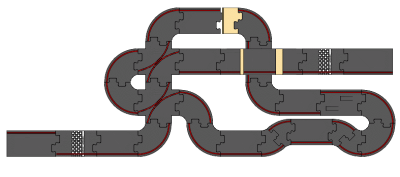
This week, the “Feature Game” will be Ave Caesar, the quick playing, savage, Roman chariot racing game.  Players are required to race three laps of the track, and must stop to “Hail Caesar” before they can finish. The game is light, wasting too many moves taking the longer, outside-routes on corners, can leave players without enough moves to finish the race…

Ave Caesar
– Adapted from image by BGG contributor Narl

And speaking of Romans…

It had been a hard fought campaign, and on his return Julius Caesar felt it was necessary to addressing his people.  A crowd gathered in the Colosseum to hear what he had to say.

“Friends, Romans and countrymen. I have returned from my campaign in France where I killed fifty thousand Gauls!”

The crowd rose to its feet cheering, “Hail almighty Caesar!”

At this point a voice pipes up, “Caesar lies!”

There’s a stunned silence as everyone looks round to see who dares suggest such a thing.  After a pause, the voice continues, it is Brutus Jeffus who continues, “I’ve discovered Caesar only killed twenty-five thousand Gauls!”

The crowd are aghast, but Caesar replies, “That maybe true, but you must remember that away Gauls count double in Europe…”

23rd January 2018

Once the inevitable pizzas were dealt with, we settled down to the “Feature Game”.  This was Cities of Splendor, the expansion to Splendor, a splendid little game that we’ve played quite a lot since its release in 2014. The base game is really quite simple, but although a lot of groups apparently find it very dull, our group seem to find quite a lot of mileage in its subtlety and trying to get the better of Burgundy who mostly seems pretty unbeatable.  According to the rulebook, players are Renaissance merchants trying to buy gem mines, transportation methods and artisans in order to acquire the most prestige points. The most wealthy merchants might even receive a visit from a noble, which will further increase their prestige.  Despite all this, the game itself is, in truth, really quite abstract.  Players have essentially have three options on their turn: they can pick up gem tokens; buy a development card, or reserve a development card (and take a Gold token).

Splendor
– Image used with permission of boardgamephotos

When picking up tokens, the active player can either take three different gems, or, as long as there are four or more available, two the same, with a hand-limit of ten.  These are then used to buy development cards which provide the player with a permanent supply of gems of a given colour and sometimes, some prestige points. The development cards come in three decks, and the Level Three cards as significantly more difficult to obtain, often requiring many gems.  Sometimes it can be a good idea to reserve a particular card, preventing another player from taking it and getting a Gold token in return, which can be used in place of any gemstone when buying a development card.  At the start of the game there is a small number of noble tiles each with with a requirement (e.g. four opals and four rubies); the first player to fulfil this requirement gets the noble and the associated number of prestige points.  The first player to fifteen prestige points is the winner.

Cities of Splendor
– Image used with permission of BGG contributor punkin312

The expansion, Cities of Splendor, consists of four small modules:  Trading Posts; Strongholds; The Orient, and the eponymous Cities.  We were a little concerned that these expansions were going to take a game we enjoyed largely because it is so very simple, and make it unnecessarily complex (a phenomenon we had experienced previously with some parts of the Between Two Cities expansion, Capitals).  However, unusually, these modules must be used independently of each other, each providing a really very small tweak to the game, but potentially changing the dynamics quite dramatically.  For example, Strongholds provides three little plastic towers for each player, which can be moved by the active player whenever they take a development card.  The active player can either place or move one of their own strongholds, or remove someone else’s, thus providing another way to reserve a development card.  Alternatively, this effectively provides a way for everyone to “gang up” on one player, so this module has been renamed the “Get Burgundy” module…

Cities of Splendor
– Image used with permission of BGG contributor punkin312

We only had one copy of the expansion, but with several copies of the base game we decided to split into two groups, each playing different modules.  The groups were split along the lines of who wanted to get beaten by Burgundy and who didn’t.  The first group to get going contained Black and Blue, who were optimistic that the changes introduced by the expansion might upset Burgundy just enough to give someone else a chance to win.  As they don’t normally get the chance to play with them, they started with nobles drawn at random from the 2016 and 2017 Brettspiel Advent calendars and the promotional set and then had to decide which expansion module to use.   Rather than opting for the “Get Burgundy” module, they decided it would be fairer to choose something else and opted for the Trading Posts module.  This provides an additional small board with five “Posts” with specific requirements, which if fulfilled give players extra options.  For example, a player with one diamond and three ruby development cards is allowed to collect a single token every time they buy a development card.

Splendor
– Image used with permission of BGG contributor punkin312

Although Splendor is normally quite a thoughtful game, it usually moves along quite quickly. However, the addition of the expansion, slowed the normal fast pace quite noticeably as everyone spent more time working through the options for each turn, especially at the start.  It wasn’t unpleasantly slow though, particularly as everyone had plenty to think about during the down time. Burgundy grabbed lots of diamonds and quickly began to claim some of the special powers available from the Trading Posts, making particularly good use of the first one which allowed him to collect a token every time he picked up a development card.  Black tried to go for the last two Trading posts, one of which gave him two a point for each other Trading Post he had claimed and another which gave him a straight five points.  Blue had started well, but was finding that all the diamond cards had evaporated which brought her game to an abrupt halt.

Splendor
– Image used with permission of boardgamephotos

It wasn’t long before Burgundy was picking up his second noble, and with Black two turns away from finishing the game himself, the game came to an end as Burgundy claimed his fifteenth point, six more than anyone else.  Meanwhile, on the neighbouring table, they were playing with The Orient Module.  This provides ten extra development cards at each of the three levels, a total of six of which are placed face up (two from each level).  These red-backed, “Orient” cards have interesting and unusual powers.  For example, there is a level one card which acts as a single use, pair of gold tokens which can be used at any time during the game.  The other card available from the level one deck is an “Association” card which is immediately associated with one other card and increases the yield of that card by one.  There are also some double gem cards and one that enables players to reserve a noble.  Everyone made good use of the double gold cards and the “money bag” Association cards (aka “onion” cards) in the first row of Orient cards.

Splendor
– Image used with permission of BGG contributor punkin312

The second row expansion cards remained in place for quite some time. Purple took a lot of development cards using gold tokens, Green plodded away with opal and sapphire development cards, while Red was trying to hold on to her double gold cards to use on those difficult to get top row cards.  Eventually Green claimed a level two Orient card, a double red gem, which got him to within a whisker of getting the first noble, but Red had other plans.  An Orient card swiftly enabled her to reserve the noble, take from under Green’s nose and thus preventing him from taking a commanding lead.  Before long, Green was back, however, having built up his opals and diamonds which enabled him to claim Isabelle of Castile (with four opals and four diamonds). Then it was only a matter of time, Red claimed her noble, but couldn’t stop Green taking a top row card to finish the game with sixteen points leaving Purple, who had started, very frustrated—she was just one turn from claiming her reserved card which would have given her the last noble and fifteen points.

Splendor
– Image used with permission of boardgamephotos

Red had really enjoyed the extra challenge and had felt that the higher level expansion cards hadn’t really come into play and fancied giving it another go.  So, unusually for the group, rather than packing up, it got a second game.  There was a brief debate whether going first in Splendor is an advantage or not and the discussion spread to the next table.  It seems to be perceived wisdom, but there was a debate about whether the fact that players at the end of the round can get an extra turn (and so play for more points) might offset that.  Ultimately, no-one felt it made much of a difference and since Purple had started last time, it was between Green and Red, so they played Rock-Paper-Scissors to decide. With the excitement building, the count began, 1, 2, 3!  Round One was a draw: both had paper.  With the tension so tight you could cut it with blunt knife they started across the table at each other and prepared for the second round; a switch from paper was likely, but which way: Green went Scissors, but Red took the game with a well timed Rock and started the second game of Splendor.

Splendor
– Image used with permission of BGG contributor punkin312

Playing for a second time did not change the amount of thought that went into each turn; it always felt like a conundrum, one where several moves looked like good ones.  Perhaps the Orient cards hadn’t been shuffled very well, but all the level one “Onion” Association cards came out first and the double gold cards seemed to be stuck at the bottom of the pile. Red claimed to not know what she was doing, but made efficient use of her “Onions” nonetheless.  Purple continued her gold token strategy making sure she took whatever looked useful to Green while Green ironically, just couldn’t get any green emerald cards.  In fact the emerald development card handicap became quite a problem, especially since the other two were holding on to their green tokens and while an “Onion” card might have helped, he still needed one emerald card to start with! Eventually, Green was forced to change his strategy and picked up a level two expansion card to reserve the noble he was after before someone else had the chance to pinch it—all the more critical since it was the only one he could get under the circumstances.

Splendor
– Image used with permission of boardgamephotos

Red took the lead when she gained her first noble, but she said it wouldn’t last long, and she was right. Purple was next and was able to reserve a noble for herself, then Green claimed his reserved noble. The game continued to be quite tight and even though Green managed to claim a second noble, it wasn’t enough to end the game. That privilege fell to Red who finished with seventeen points. Purple was left with nothing she could do to increase her score, but that led to a debate as to what Green might be able to do. With twelve points, green needed five to draw level with Red and there was a five point card he could claim on the table. However, if Purple took that he would then only be able to claim a three point card, unless the card purple took was replaced with another five point development he could claim.  Purple decided to play king-maker and took the card leaving an unhelpful replacement card leaving him two points behind Red, the winner.

Splendor
– Image used with permission of BGG contributor punkin312

Since Red, Green and Purple had gone onto a second game, Blue and Black decided to do likewise and have another pop at Burgundy.  This time, Blue went on the offensive and decided that black opals were essential to her game plan and a couple of rounds in, suddenly realised that she had almost all the black tokens and there were no attainable opal development cards available.  With the others in dire straights, Blue was able to completely strangle the game.  The problem with this strategy is that holding all the tokens of one colour is a very powerful position to be in, but that power is useless unless those tokens are spent and then the power is gone.  Additionally, the other players will inevitably build up their cards in other colours and eventually this will lead to accessible cards for the rare gem turning up.  So, timing is critical and there is a lot of luck involved as well.  Perhaps the key part is to ensure that the amount of effort put in to controlling the game doesn’t exceed the value obtained.  Inevitably, Blue didn’t have the perfect timing required and eventually Burgundy broke free, finishing the game with a massive twenty points, leaving the others standing.

Splendor
– Image used with permission of BGG contributor dotkeller

The fact that both tables wanted to give their module another go says a lot about what we thought of them.  Clearly, the changes to the rules were not enormous but added a nice little bit of variation to a game we’ve played and enjoyed a lot.  Inevitably, we felt some of the Trading Posts some seemed much more powerful than others.  For example, the second Post enabled a player to take an extra gem of a different colour when taking two gems of the same colour.  The problem with this is that taking two tokens of the same colour is only possible if there are at least four tokens available in that colour.  In the two and three player games this is relatively unusual until later on when players have a lot of cards and no-longer need tokens, by which time it is too late.  In the four player game, we felt this would become much more valuable though.  On the other table, the players still felt they had been unable to use the high value Orient cards, even after a second attempt.  This led to a lot of discussion, in particular whether raising end-game trigger from fifteen to twenty, might encourage their use.  Certainly it could be an interesting variant to try on another occasion, either way, Cities of Splendor is certainly going see the table again for lots of reasons: it has breathed new life into the old game, we have two the other two modules to try, and Burgundy went straight out and bought a copy as well!

Kingdomino
– Image used with permission of boardgamephotos

While Burgundy was finishing beating Black and Blue black and blue, the other group were looking for something to play.  Red had started the evening relating her failed attempts to acquire Kingdomino for less than a fiver.  She had been keen to get hold of it even though she had not played it, so this seemed an opportune moment for Red to be properly introduced to the game.  It’s such a simple game that the rules explanation was quickly done:  Players take a domino which they add to their kingdom and then place their meeple on one of the dominoes on display for the next round.  There are a couple of really clever bits to this game though.  Firstly, since the dominos have a numerical value and are set out and taken, from low to high, players going for the more valuable tiles are trading this value against their position in the turn order.  Secondly, the two ends of the dominos depict terrain and when placed one end must connect to terrain of the same type already in the kingdom (or connect directly to the start tile).  Since all dominoes must fit in a five-by-five space (or be discarded) keeping options open is an essential part of the game.

Kingdomino
– Image used with permission of boardgamephotos

Finally, some tiles also depict one or more crowns, which are the key to scoring as each player multiplies the number of tiles in each contiguous region of terrain with the number of crowns on the tiles in that region.  This means that no matter how big an area is, it is worthless without any crowns.  Although it is a simple little game, it is easy to make a fatal mistake, and that’s exactly what happened this time.  Somehow, Purple messed up her grid patterns, but worse was to come.  She had been targetting mountains and pastures, while both Red and Green were looking to forests and lakes to fill their kingdoms. With only three playing a dozen dominoes were removed and it was not until the end of the game (face down).  It was only at the end of the game that it became apparent why Red and Green had found it so much easier to fulfil their plans—the high scoring mines and lots of pasture (including three of the crown tiles) had been removed. The odds had been heavily stacked against Purple this time.  With the others both getting a full set of bonus points, it was very close between first and second despite the fact that Green had played the game several times.  In the end there was only two points  in it, with Green the narrow victor.

Kingdomino
– Image used with permission of boardgamephotos

On the other table, Cities of Splendor had finished and the group were looking for something to play.  Inspired by the nearby game of Kingdomino, Black spotted Queendomino which he had not yet played.  Blue commented that she was happy to play it and be proven wrong, but that she felt it took all the good things in a great little game and broke it.  In her mind, the comparison was similar to that of Tsuro and Tsuro of the Seas.  The former is a short, light game that plays lots of people and despite player elimination is still great fun with minimal downtime.  On the other hand, playing Tsuro of the Seas at the Didcot Games Club had, on one notable occasion, ended up with Burgundy getting knocked out a couple of turns in and spending the next hour and a half as a spectator.   In Blue’s eyes, Queendomino’s first offence was the fact that instead of the tidy little box that Kingdomino came in, it had a huge, Ticket to Ride sized box, mostly because there was a tile-tower included.  This offended her sense of efficiency, but wouldn’t have been so bad, if it had worked properly.  Although the magnetic closing mechanism was cool, Blue in particular had repeated difficulties getting the tiles out of the bottom, a problem that was exacerbated as the stack got smaller and the reduced mass pressed less on the tile being drawn out, making it increasingly difficult.

Queendomino
– Image used with permission of BGG contributor Toynan

As for the game, the basic mechanism is the same as Kingdomino, however, there is an extra tile type: red building plots.  These act exactly the same as the other terrain types, except that there are a number of building tiles on display that payers can buy and add to their kingdom.  This building display is only refilled at the end of the round which can make being late in the turn order more of a problem.  This can be compounded if someone chooses to bribe the dragon to burn down one of the buildings.  Amongst other things, these buildings provide knights and turrets that players can use to collect taxes and score more points.  While this has the potential to make the game deeper, the downside is that it can make the already slightly mathsy scoring even worse.  Despite all this and Blue’s really rather appalling rules explanation, everyone was surprisingly keen to give it a go.  Burgundy inevitably, tried to profit from the new components and eagerly started collecting wooden turrets.  Blue and Black were a little more circumspect, though both of them picked up a few knights and used them to good effect to collect enough in taxes to ensure they were able to build a couple of nice buildings.

Queendomino
– Image used with permission of BGG contributor Toynan

In the end, it surprisingly close, and after several re-counts, Black was deemed the winner, six points ahead of Burgundy in second place.  Looking at the scores, it turned out that both Black and Blue had made most of their points on the original terrain, and it was arguable how much the new buildings had really helped.  Burgundy’s entire game plan had revolved around the new buildings, but somehow, although it looked like he was running away with it, the game hadn’t quite panned out like that.  Blue asked what the others thought of it and Burgundy commented that he’d be happy to give it another go, but that was in complete contrast to Black, who’s one word answer, summed up Blue’s feelings, “Terrible”.  At some point point during the game, Red had asked whether Blue would feel better about the game if it didn’t have the tower, to which Blue replied that it wasn’t the tower per se, it was more that the tower was a metaphor for all all the stuff they had added to the original Kingdomino game:  it was nice to look at, but fiddly, totally un-necessary and overall made the whole experience much less enjoyable.  With that, she had removed the tiles from the tower and immediately felt better about the whole thing, but not enough to save the game from being sold at the earliest opportunity.  So, Burgundy might not get his second chance to play it after all.

Queendomino
– Image used with permission of
boardgamephotos

Meanwhile on the next table, everyone was feeling a little tired, but as the hugely complex game of Queendomino, was still going on, Red and Green decided not to leave Purple relegated to observer, and chose to play one more short game.  The game in question was Battle Kittens, primarily because it’s got kittens in it, but also because it’s quite quick.  This was a game Blue picked up on a trip to Reading with Green, and, as he had enjoyed it more than she had, he’d received it as a little gift at the GOATS New Year Party.  At it’s core, it is a card drafting game where players draft their hand of kitten cards and then send them off to battle.  Each of the three arenas will contest three of the four kittenny attributes: agility, strength, wisdom and cuteness.  Players decide which kittens they want to put into each arena and then resolve any special cards with the highest total running out the winner.  At various times, both Purple and Red had a victory cruelly snatched away from them to the benefit of Green. The first time this happened was to Red who had a high score with three kittens and had it ended there she would have won that battle.  Unfortunately, she was forced to take a King card first, and lost all her other kittens and ended up losing the battle. Similarly, in the second round, Purple managed to get some really good Crown cards and won a couple of battles quite convincingly, but they either gave more fish for coming second or gave an equal number for first and second place and thus did nothing to dent Green’s growing pile of fish as his kittens gambolled their way to victory.
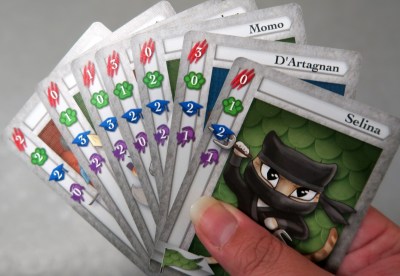
Battle Kittens
– Image by boardGOATS

Learning Outcome: Some expansions really add to the game, others can take a great game and make it “terrible”.

Next Meeting – 23rd January 2018

Our next meeting will be on Tuesday, 23rd January, at the Horse and Jockey pub in Stanford-in-the-Vale.  As usual, we will be playing shorter games from 7.30pm as people arrive, until 8pm when we will start something a little longer.

This week, the “Feature Game” will be Cities of Splendor, the expansion to Splendor, a splendid game that we’ve played quite a lot.  Cities of Splendor consists of four modules to be used independently (Cities, Trading Posts, Orient and Strongholds).  The idea is that with multiple copies of the base game we can play more than one of the modules at the same time.

Cities of Splendor
– Image used with permission of BGG contributor punkin312

And speaking of Cities…

Jeff was visiting London with his young son, Joe. They came from a very quiet village, so they were amazed by almost everything they saw. They were particularly fascinated by two shiny, silver walls that could move apart and back together again.

Joe asked his father, “What is that, Dad?”

Jeff replied, “I’ve no idea—I’ve have never seen anything like it in my life!”

While Jeff and Joe were watching wide-eyed, a very old lady in a wheelchair rolled up to the moving walls and pressed a button. The walls opened and the lady rolled between them into a small room. The walls closed and the boy and his father watched small circles of lights with numbers above the walls light up: 1…2…3…4…5…

As they watched, the circles began to light up in the reverse direction: 5…4…3…2…1…

After a moment’s pause, the walls opened up again and, Jeff’s and Joe’s eyes nearly popped out of their heads as a beautiful young woman stepped out.

There was a stunned silence, then Jeff whispered to his son, “Quick Joe, run and get your Mother…!”

9th January 2018

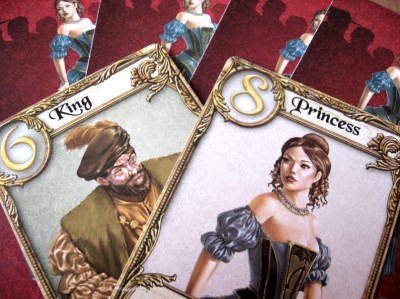
The evening started with a quick pre-pizza game of Love Letter.  We’ve played this micro game quite a bit over the years and it still comes out thanks to its amazing ability to fill tiny slivers of time.  It’s simplicity is the key though: from a deck with only sixteen cards, each player starts with only one card in hand.  On their turn, the active player draws a second card, and then chooses one to play, trying to eliminate other players from the game.  The winner is the last player remaining, or the player with the highest value card (on the rare occasion that the deck is exhausted first).  The very first card played set the tone for the whole evening, when Magenta played a Guard and correctly identified Blue as the Princess taking her out of the round without even playing a card.  Just to add insult to injury, Magenta pulled the same stunt in the third round too.  Blue got her revenge eventually, but it took several tries and in reality wasn’t all that satisfying even though she managed to prevent Magenta from winning a single hand and ensured Red took victory.

Love Letter
– Image by boardGOATS

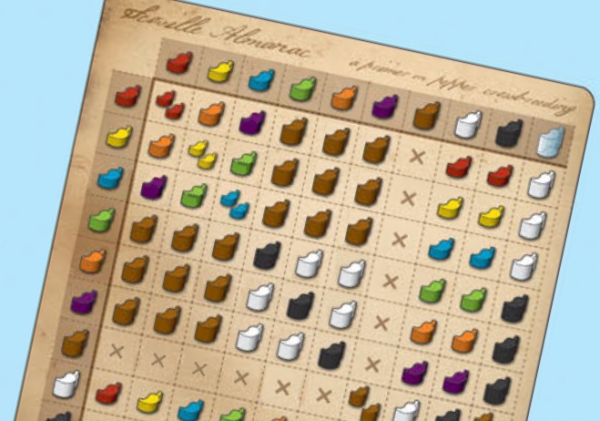
With a full compliment of gamers and pizza consumed, it was time to start gaming in earnest. The first game on the table was the “Feature Game”, Scoville.  This is an unusual game with auction, set collecting and “travelling salesman” elements, as well as a cool colour combination mechanic.  The individual elements of the game are not terribly complex, but because the rounds are quite long it is easy to lose track of things making the game a bit susceptible to analysis paralysis.  Each round starts with a blind bidding phase for turn order with the winner choosing his position on the player order track.  This is key because while the next phase, Planting takes place in turn order, the following stage, Harvest, takes place in reverse player.

Scoville
– Image used with permission of BGG contributor punkin312

During the Planting phase, each player first chooses a card from the market and gets the chili or chilis depicted on it.  Then they must plant a chili, either one they have just received, or one they already had behind their player screen.  Chilis are planted in a plot in massive communal player field on the central game board.  The position chilis are planted in is crucial, not only to the player doing the planting, but also to everyone else, as once a chili has been planted everyone can use it and nobody can remove it from the field.  Once everyone has planted a chili, then, in reverse player order, everyone takes it in turn to harvest.  Players move their Farmer meeple three steps around the field taking chilis as they go.  This is the clever part: the chili players get depend on the the cross-breed of the two chilis in the fields on either side.

Scoville
– Image by boardGOATS

Thus, if a player’s Farmer passes or stops between a red chili and a blue chili, they get a purple chili.  Similarly a combination of a yellow and a blue chili will give a green chili.  Once everyone has harvested, people get a chance to do something with their chilis:  take sell them for cash; get points for using them in a recipe, or exchange them for more chilis, points and/or cash at the farmers market.  The game is split into two halves, “morning” and “afternoon”, with the afternoon consisting of more exciting chilis available at the start of the round before planting.  When there are fewer recipe cards than there are players, the game is over and the winner is the player with the most points.

Scoville
– Image used with permission of BGG contributor punkin312

There was the usual debate as to who was going to play what, but as there were nine of us five ended up playing Scoville.  Blue got the “luck” of the draw and went first.  During setup, we’d had a discussion about the fact that going last is often a good thing as it means harvesting first, but in the early stages everyone went for planting as early as possible, leaving Burgundy to plant last and harvest first.  And harvesting first turned out to be a good thing for Burgundy because it meant he was the first to get an award for harvesting a second generation chili (i.e. a purple, orange or green one).  These awards are worth points at the end, and the earlier ones are worth the most.  It was a trick Burgundy pulled off a couple of times, netting him what felt like an unbeatable amount of points, however, the game had hardly started.

Scoville
– Image by BGG contributor chizcw

Everyone seemed to be struggling with something.  The first problem was distinguishing between the red, brown and purple chilis; there are a lot of little wooden pieces and many of them have similar colours, a problem exacerbated by the fact that a critical light-bulb had failed.  Beyond that, the game is fairly straightforward, however, it was the first time we had played it and people spent rather a long time staring blankly at the board, trying to decide where to plant their chilis.  Worse, since farmers cannot pass through or stop on a space occupied by another farmer, the amount of planning players could do in advance was severely limited.  This meant that players had a bit of a habit of getting in each others’ way and it wasn’t long before Burgundy and Magenta had managed to separate themselves from Blue, Pine and Red who had managed to wonder off in the other direction.

Scoville
– Image used with permission of BGG contributor punkin312

The problem with this was that Magenta and Burgundy had managed to acquire white, black and better yet, the clear sparkly chilis and planting these generated was more productive giving Burgundy even more awards.  At least, that was the way it started, but Magenta had other idea and cleverly managed to manipulate the turn order to ensure that she obstructed Burgundy in such a way as to beat him to the most lucrative of the high value awards.  Red, Pine and Blue could do little more than watch, feeling there was no way they could compete, but then, gradually, they began to build up collections of chilis and spend them on recipes which the found could also yield lots of points.  Unfortunately, by this time Burgundy and Magenta had run out of awards to compete for and were also turning their greedy eyes towards the points available for recipes…

Scoville
– Image used with permission of BGG contributor punkin312

With their better area of the field and only two players working it, perhaps it was inevitable that Burgundy and Magenta would be in a better position to grow the chilis needed for the most valuable recipes.  In the process, they managed to trample Pine into the ground and rub chili in his eyes by ensuring that he couldn’t take any recipe cards in the last couple of rounds because he couldn’t get the chilis he needed.  The last couple of rounds were a bit of an anti-climax, as everyone could see what was going to happen and we somehow managed to drag it out for longer than really necessary too.  No-one was in any doubt that the first and second places were going to Burgundy and Magenta, but the others hadn’t been paying enough attention to know which way round it was going to be.  In the end, Magenta finished with a massive one-hundred and eleven points, over twenty more than Burgundy in second, a difference that was almost as large as the range that covered everyone else.  It had been a much longer game than expected and everyone agreed that with fewer players it would have dragged less towards the end.

Scoville
– Image used with permission of BGG contributor punkin312

Meanwhile, on the next table, the other group were playing First Class, a modular, train-themed card drafting game, where two of five option modules are added to the basic card set, giving the game a lot of variety.  Although Black and Ivory had played it before, Green and Purple were new to the game so they needed a run-through of the rules and only the first two modules were used.  In First Class, players are competing rail line managers, working to upgrade their trains and improve their routes from Venice to Constantinople along path of the Orient Express.  Over three two-stage rounds, players select and activate action cards from a central area, each of which has their own deck of action cards.

First Class
– Image used with permission of boardgamephotos

At the start of the round players draw cards from the phase deck until there are three rows of six cards in the middle of the table.  During their turn the active player does two things: choose a card from the offer and then use it.  When the number of cards removed from one row is equal to the number of players, the row is removed from the game entirely.  The action cards allow players to extend their route; move their trains; improve their carriages; move their conductors, or expand their train.  There are also contract cards that may be drafted which have a specific condition that must be met during the game; meeting that condition may receive give bonus actions, points, or both.

First Class
– Image used with permission of boardgamephotos

After the first couple of rounds, Black and Ivory gave away what seemed to be the best tactic for this game, going for track cards and moving their Locomotive Meeple. This worked as not only did it give bonuses each time the train landed on a city space, it also gave bonuses at the end of each round (depending how far the train had got). Green had been building up his carriages and trying to get his Conductor to the end of his train as quickly as possible, since the largest bonuses seemed to be for the first person to get him to the end of their train.  However, when he looked across at Black and Ivory’s approach he felt that he had read the game completely wrongly as he had not realised that the mini-train track bonuses came up every round.

First Class
– Image used with permission of
BGG contributor ckirkman

Green continued regardless and quickly filled his train with zero point carriages, relentlessly pushing his Conductor to the end as fast as possible. He was of course rewarded for getting his Conductor there first, and so he spent the rest of the game trying to build up the value of his carriages to pick up as many points as possible. In contrast, Purple’s game plan was a little more measured and she did a little of everything, but that did mean that her Locomotive Meeple wasn’t travelling very far and neither were her guards as her long train wasn’t very long.  Black and Ivory were less interested in developing a long train and kept building up the value of their carriages, including some very useful double multiplier cards which meant that it seemed that Black and Ivory were chuffing away to victory while Green and Purple were running off the rails.

First Class
– Image by BGG contributor Wizzy Parkerir

Purple’s game was rescued in the second half by a masterful placement of a Locomotive Meeple bonus multiplier. She had applied it to the second bonus space; one which gave her two more forward movements of her Locomotive Meeple. In one go she leapt forward a total of six spaces, giving her three bonuses which would then score again for her at the end of each round.  With her Locomotive Meeple making it to the end of her track she then followed Green’s example of getting the Conductor to the end of the train taking the second place bonus on that. By the end of the game, Black and Ivory’s trains had also mostly reached their desired length and Green’s carriage values had increased.  In the final scoring, however, it was Black and Ivory that steamed home at the front with Ivory taking first place with one hundred and ninety-four.  Green had not gone into a siding as he had feared, and was only seven points behind Black, showing that this game probably does have more than one route to victory.

First Class
– Image used with permission of
BGG contributor ckirkman

Learning Outcome: Just because a game has enough pieces for five players, doesn’t mean it is a good idea for five people to play it.

Next Meeting – 9th January 2018

Our next meeting will be on Tuesday, 9th January, at the Horse and Jockey pub in Stanford-in-the-Vale.  As usual, we will be playing shorter games from 7.30pm as people arrive, until 8pm when we will start something a little longer.

This week, the “Feature Game” will be Scoville, an unusual game with auction, set collecting and “travelling salesman” elements.  Players are trying to breed and cross-breed wooden chillis to get different coloured peppers and fulfil contracts.

Scoville
– Image used with permission of
BGG contributor punkin312

And speaking of chili peppers…

Jeff was out shopping and couldn’t find what he was looking for, so he found one of the shop assistants and said, “Excuse me, I’m looking for pepper.”

“Of course sir,” the member of staff replied, “What kind of pepper did you have in mind, red pepper, green pepper, black pepper or chili pepper?”

“No, none of those,” replied Jeff, “I’m looking for toilet pepper…”

31st December 2017

Green and Burgundy were the first to arrive, and were stood on the doorstep at 7pm on the dot.  This was possibly just because they were punctual, but may have been because they knew the first people to arrive would get the chance to set up the track for the evening’s “Feature Game”, the gorgeous, dexterity car-racing game, PitchCar.  Everyone had played it before except Azure, so he had a quick run of the track while Blue put out snacks and Pink sorted everyone out with drinks.  Like last year, Green and Burgundy designed a single, long, winding path with the idea being that it was a simple sprint to the finish rather than several circuits.

PitchCar Track 31/12/14
– Image by boardGOATS

Building the track is always a challenge, but Green and Burgundy had decided to maximise the difficulty by trying to use every piece of expansion in the box, including both crosses and the new double jump.  This made the track really quite complex, featuring a wide bridge/tunnel and a couple of jumps (for those brave enough to give them a go).  Rather than the usual “flying lap” to see who starts, each player had a single flick with the longest going first.  Blue took pole, but didn’t make it as far on her second attempt and within a few turns was in the lower half of the placings.  Similarly, Purple who had started second on the grid quickly began to move backwards too.  In contrast, Pink and Green who had started at the back of the grid, began a rapid rise through the field.  There were some really spectacular flicks, some that were successful, others that were almost successful, and a few that were horrific failures and received suitable opprobrium.

PitchCar
– Image used with permission of
BGG contributor kilroy_locke

The final bridge proved to be one of the greatest sticking points though as it was built from pieces that weren’t really intended to be used in that way, making joins quite difficult to traverse.  Blue, who had gone from the front to the back and back to the front, was the first to get stuck, but was forced to watch as Pine cruised past her showing her how to do it.  She proved a slow learner, however, as Green and Pink followed a couple of rounds later, while she struggled to make it over the step.  With the bridge so close to the finishing line, it turned out to be the discriminating factor in the race, and Pine finished the clear winner, with Green finishing a short nose ahead of Pink.  Meanwhile, the rest of the field passed Blue who by now had finally made it onto the bridge, but who seemed to have run out of fuel and limped home in last place, a couple of flicks behind Burgundy, who had been convinced no-one would be challenging him for the wooden spoon.

PitchCar
– Image used with permission of BGG contributor garyjames

While everyone else participated in the game of cooperative Tetris that is packing the track back into its case, Blue put the finishing touches to the supper of Cheesy Pasta Bake with fresh vegetables and a side order of Christmas trimmings.  These included “Pigs in Blankets” (or rather “Boars in Duvets”), “Devils on Horseback” and home made crackers that went off spectacularly and sent a shower of tiny pieces all over the room. With food finished, there was a quick game of “Musical Chairs” before everyone settled into two groups for the next round of games.  The first group, Green, Pine, Purple and Burgundy, fancied a bit of piratin’ and went for Black Fleet, a fairly simple, but thematic game.  The idea is that each player has a fleet consisting of a Merchant ship and a Pirate ship; there are also two Naval ships which players also control.  So, on their turn, players choose one action card which enables them to move their two ships round the archipelago depicted on the large and sumptuous board.

Black Fleet
– Image used with permission of boardgamephotos

Before, during or after moving, ships can carry out an action.  Merchant ships can can load or sell goods at an appropriate port, while Pirate ships may attack an opposing Merchant vessel in a neighbouring space and steal one cube of cargo (earning two Doubloons for its trouble) or bury some cargo they’ve stolen.  Ships can only carryout one action on their turn, so Pirates can only steal or bury on their turn, not both.  And they must avoid the Navy frigates as they do it because they can sink Pirate ships (also earning two Doubloons).  In addition to the Action cards, players can also play as many fortune cards as they like; these break the other rules of the game and and make play a little more unpredictable.  Finally, there are the Development cards, which both give players extra powers and act as the game timer, with the game finishing when one player has paid to activate all their Development cards.

Black Fleet
– Image used with permission of BGG contributor punkin312

There was much piratin’, tradin’ and policin’ of the ocean waves. Purple was an unfortunate early target simply for being in the wrong place at the wrong time. Green tried to target Burgundy, but a wily Merchant, he maintained his distance. Initially a lot of action took place on the western side of the board, and while Green began to bring in the money, Pine and Purple struggled to gain traction. Green was the first to activate a Development card, but he was followed by Burgundy on the next turn. By now Purple and Pine were complaining loudly that they were being picked upon, but that’s the trouble with this game, it tends to reward the leaders. Green and Burgundy activated their second cards in the same turn, but Green’s was of a higher value, meaning that he then activated his third card (the one with the lowest value) the following turn.

Black Fleet
– Image by BGG contributor spielemitkinder

By now the action had shifted to the east, Purple and Pine had finally managed to earn enough to activate a card, but by this time they were so far behind their chances of winning were almost zero and so their tactics changed to “get Green and Burgundy”. Unfortunately for Burgundy his ships were closer to Purple and Pine than Green’s were so he bore the brunt of their attack. His merchant ship was attacked and raided by both their pirates in the same turn and his path was blocked. Burgundy abandoned his plans to move it and opted to becalm his ship instead taking compensation for his lack of movement.  Green and Burgundy activated their fourth cards in the same turn, but Green had eight Doubloons left while Burgundy only had two. The next turn played out as expected with Green landing a load, activating his final card with four Doubloons left. Burgundy could gain nothing on his final turn, so couldn’t activate his final Development card. Unfortunately, the reward mechanism of gives bonuses to those who activate their Development cards first, which often leads to a runaway winner that the others are unable to catch.  That said, it is a fun game and doesn’t last overlong, so is a good game when players are in the mood.

Black Fleet
– Image used with permission of BGG
contributor The_Blue_Meeple

Meanwhile on the nearby table Black, Pink, Blue and Azure we trying out a new game, Sagrada.  This is a relatively new game, that we’ve only played once in the group before, as part of a “Monster Games” session some months ago.  A bit like Terraforming Mars, it is a game that has proved very popular, but was produced by a very small company who did not have the infrastructure or commercial clout to satisfy the demand which vastly exceeded expectation.  In the case of Sagrada, however, the game is one of those games with simple rules, but lots of complexity.  Players build a stained glass window by building up a grid of dice on their player board. Each board has some restrictions on which colour or shade (value) of die can be placed there and players take it in turns to take dice from a pool and add them to their window.  Depending on the difficulty of the starting grid, players start with a small number of favour tokens which act as “get out of jail free” options and allow them to use special tools to rearrange some of the dice, either during “drafting”, or sometimes those already in their window.

Sagrada
– Image used with permission of BGG contributor punkin312

Points are awarded for fulfilling certain criteria, depicted on cards drawn at random at the start of the game.  Although completing the window can be challenging in its own right if the dice don’t roll well, it is the objective cards that are the key to the game.  Each player has their own private objective which scores for the number of pips displayed on dice of a given colour in that player’s window.  The public objectives are much more complex though.  In this case, the three objectives were:  six points for every row with all five colours; two points for every pair of dice showing one and two; four points for every set of five different colours in the final window.  Black quickly spotted the synergy between two of the objectives, noting that each row that contained all five different colours would score a massive ten points.  Meanwhile,  Blue had drawn starting grid cards that were very challenging and was forced to make the best of it, and Pink and Azure, struggled to get to grips what they could and couldn’t do.

Sagrada
– Image used with permission of BGG contributor punkin312

Each round, players draw two dice from the pool in “Settlers starting order” (i.e. 1, 2, 3, 4, 4, 3, 2, 1).  This was something we really struggled with for no very good reason, and things weren’t helped by Blue who got herself into a mess, aggravated by the fact that she kept knocking the dice in her window with her sleeve.  Through it all, Black sailed serenely, finishing with a perfect set of five rows, each with five different coloured dice giving him a massive starting score of fifty which he went on to top up to a final total of sixty three.  Nobody was going to catch him, but Azure finished in second place with a highly creditable fifty-six, some way clear of Blue and Pink.  Both games finished almost simultaneously, and just in time to toast the New Year in and admire the spectacular fireworks in the general direction of our erstwhile gaming home, The Jockey pub.

Ca$h 'n Guns
– Image used with permission of BGG contributor punkin312

With the festivities over, it was time to choose our first game of 2018, and we picked Ca$h ‘n Guns.  This is a great party game, that we’ve played at the last couple of New Year parties.  This game combines gambling with a little chance and a dash of strategy, based round the theme of gangsters divvying up their ill-gotten gains by playing a sort of multi-player Russian Roulette.  Although we used some of the standees from the Expansion, this time we didn’t use the special powers and stuck to the game play of the base game.  This is very simple:  on the count of three, each player points their foam gun at one other player; the Godfather can then ask one player to change their choice before there is a second count of three giving players a chance to withdraw from the confrontation.

Ca$h 'n Guns
– Image used with permission of BGG contributor punkin312

At this point, everyone still in the round who has a target who has not backed out, reveals whether they chose to load their gun with a blank or a bullet.  The game is played over eight rounds and each player starts with three bullets and five blanks, all of which cannot be reused.  Anyone who gets shot is out of the round and anyone who receives three wounds is eliminated from the game.  We were all quite cagey at the start, so the loot was shared out among the whole group.  This didn’t last of course, and it was amid much hilarity that Azure decided to brave the three guns pointed at him only to take three bullets and retire from the game.  It was a few more rounds before the next casualty expired, when Black took his third shot and gracefully slid down the curtain to join the choir invisible.  Meanwhile, Green and Blue were somewhat hampered by being repeatedly targeted, leaving Pink to collect a large pile of artwork and Purple a huge pile of diamonds.  The only real question which of the two was worth the most.

Ca$h 'n Guns
– Image used with permission of
BGG contributor punkin312

Despite picking up the bonus for the most jewels, giving her a total of $122,000, Purple had to settle for second place behind Pink who finished with a fortune of $175,000.  Pink, highly satisfied with his success decided to do some washing up, and Green who had to prepare a roast for the next day decided it was time for him to go to leave.  Nobody else wanted to go though, so it was only a question of what we would play.  It was gone 1am, and nobody was in the mood for anything deep, so we decided it was a good time to introduce Azure to 6 Nimmt!, one of our favourite light, filller games.  A very simple “Cards with Numbers” game, 6 Nimmt! gives players the illusion of control while everything is going well, and shatters that illusion when it all goes wrong.  We usually play the game over two rounds and it is remarkable how differently they can go.  In this case, Azure and Blue came off worst in the first round, however, Purple and Black did particularly badly in the second round, so Azure finished joint second with Burgundy, just two points behind the winner, Pine.  By this time, the rain was pouring down, but it was definitely “late”; it had been a great way to say goodbye to 2017 and welcome in 2018.

– Image by boardGOATS

Learning Outcome:  It is a great way to start the year, with a foam gun in hand and a group of friends to point it at.

Next Meeting – 31st December 2017

Following the success of previous New Year parties, we are having another one this year on Sunday 31st December.  As it is New Year’s Eve we will be meeting at Barney’s Home in Stanford and starting at 7pm with food later. Please get in touch if you would like to come along so we know how much food to make.

The plan is to start off early with the “Feature Game”, which, as has become traditional, will be the gorgeous, dexterity car-racing game, PitchCar. After that, we will be eating, playing more games and watching the village fireworks at midnight as we can’t be bothered to set off our own!

PitchCar
– Image by BGG contributor visard

And talking of cars…

A policeman sees an elderly woman driving incredibly slowly on the motorway, so he pulls along side and notices her knitting in the driver’s seat. She remains focused on the road and keeps knitting and driving.

He beeps his horn to get her attention, but she is oblivious and carries on.

Getting more frustrated, the policeman turns his siren on and, as she finally notices him, he signals for her to wind the window down.

After a time she finds the button and down goes the window.

Incensed, the cop yells, “PULL OVER!”

“Oh, no sweetie,” she replies. “It’s a scarf, see?”

28th December 2017 – boardGOATS do the Quiz

As we meet at The Jockey every week, last year at Christmas we decided to enter a team for their Quiz night between Christmas and New Year.  We didn’t have a large team, but Blue, Pink, Pine, Violet and Violet’s mum were in attendance and had managed to win for the GOATS at the first attempt.  Flushed with that success, we decided to give it a go this year too. This time there were seven of us with Pine bringing along his mate, Azure.  As before, we booked a table for 8pm and, as usual, pizza was largely the order of the day with a burger, tagliatelle and scampi for those who decided not to follow the tradition.  While we were waiting for food to arrive, Green asked whether Red was going to be about over Christmas as he had some Gruyère for her. Unfortunately Azure misheard and asked who Trevor was.  Much hilarity ensued as Pine got himself in a terrible mess explaining who Red was and why he thought she wouldn’t be interested in someone called Trevor, but would love a block of cave-aged cheese!  To spare his further blushes, someone quickly suggested we played a game, which seemed like a good idea.  With so many people and so little time, the choice was limited, so we went with Tsuro.

Tsuro
– Image used with permission of BGG contributor aleacarv

Tsuro is a very simple game to teach and play, and, although it has nasties such as player elimination, it is so quick to play that these things don’t really matter.  The idea is that each player has a “Stone” which starts on a marker at the edge of the board and a hand of three tiles.  On their turn, the active player then places a tile on the next square in such a way as to create a path in front of the stone.  They then move their stone (and any others affected) along the path to the new end.  The game continues with players taking turns to place tiles and move stones trying to keep their stone on the board and avoid colliding with any other stone; the last stone left is the winner.  This time, it was a cagey start as everyone was very careful.  It wasn’t until the draw deck had been depleted, that the first players were eliminated, with Pine  forced to play a tile that caused him to collide with Blue removing both from the game.  Purple and Azure were next leaving three players until Black was forced to take himself off the board and Green with him, leaving Pink the sole survivor.

Tsuro
– Image used with permission of BGG contributor kilroy_locke

While we were eating Green asked about the “Monster Games” session the night before.  The evening had started with Kingdomino, and included NMBR 9, Azul and 6 Nimmt!.  The highlight had been El Grande, however, a game that we enjoyed on a previous “Monster Games” session.  This time, however, we decided to add the Grand Inquisitor & the Colonies expansion.  This adds an extra couple of elements to the game (but still no Portugal, much to Pink’s disgust).  Both Blue and Black quite liked the Grand Inquisitor component and would happily play with it again, but neither were very keen on the Colonies aspect, despite the fact that Blue had been able to use it to great effect towards the end of the game.  Pine had the last word on the subject though when he commented that he’d found it amusing that everyone had known before the start that Black and Blue were competing for first place, while everyone else was trying to avoid coming last.  It was perhaps just as well that the landlord chose that moment to hand out the paperwork for the picture round…

El Grande
– Image used with permission of BGG contributor kilroy_locke

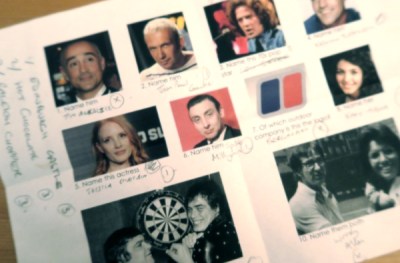
We started off badly, but quickly improved with a perfect score in the second round.  We maintained steady progress, but the team that beat the “Eggheads” would take some catching.  As the Quiz progressed it was clear that we would need a really good score in the “Who Am I?”, anagram and picture rounds to be in with a chance.  We got all three anagrams, but the “Who Am I?” was a bit of a disaster as we worked out who it was (“the big bloke from The Chase“), but couldn’t remember his name.  It turned out that that was actually enough information, but we only found that at the very end, so only got one point (his name is Mark Labbett).  Although we put in a reasonable picture round, it wasn’t good enough to make up the difference and we finished in a respectable second place.

Quiz December 2017
– Image by boardGOATS

With the Quiz over, we reverted to what we do best and went back to playing board games, or in this case, a dice game, as we finished the evening with Las Vegas.  The game itself is a very simple betting game.  Players begin their turn by rolling their dice and then assign some of them to one of six casinos (one for each dice face) each of which has a jackpot drawn at random from a deck of money.  Players must place all the dice displaying one number to bet on the casino of that number, and when done, play passes to the next player.  Once everyone has placed all their dice the player who placed the most dice on a casino takes the highest value currency card, with the person in second place taking the next and so on. The really clever bit is that before any money is handed out, any “draws” are removed.  This leads to a lot of barracking when dice are played as opponents try to encourage the active player to choose their favoured option.

Las Vegas
– Image used with permission of BGG contributor ckirkman

As usual, we included the Big Dice from the Boulevard expansion and the Slot Machine mini-expansion from the 2015 Brettspiel Advent Calendar.  The large dice are double weight and count as two in the final  reckoning.  The Slot Machine acts like a seventh casino, except that it can hold dice of any number, but dice of each number can only be added once (though a player must add all the dice they have of that number).  Since we play the game unusually slowly, we generally stop after just three rounds rather than the four recommended in the rules, and today was no exception.  Reducing the number of rounds meant that everyone had to make each round count to stay in the running, especially in such a close game.  Three players took over $300,000, with Green just $10,000 ahead of Black.  It was Blue who finished first, however, thanks largely to her judicious use of the slot machine which ensured a healthy return in the first two rounds.  And with that, it was home time for everyone, including Trevor the Cheese.

Las Vegas
– Image by boardGOATS

Learning Outcome:  Shy bairns get nowt.

12th December 2017

With this being the last GOATS Tuesday before Christmas (and the Jockey shutting on Boxing Day which would be the next one), we decided to have an early “Christmas Party” with everyone arriving for supper at the same time and home-made crackers.  Out of habit, most of us ordered pizza from their Tuesday “Pizza Special” menu, though there was also the odd portion of scampi too.  Even though it was still nearly two weeks until Christmas, we were a bit short on numbers thanks to the combination of people leaving early for the holidays and work commitments.  That didn’t stop Pine and Ivory bringing out their favourite topical Christmas Cracker jokes though:  “Why doesn’t Trump ever finish decorating his Christmas tree?  Because people keep shouting “Moron”!”  “Why didn’t Teresa May visit the baby Jesus? Because she couldn’t form a stable government…!”

Pizza at the Horse and Jockey
– Image from horseandjockey.org

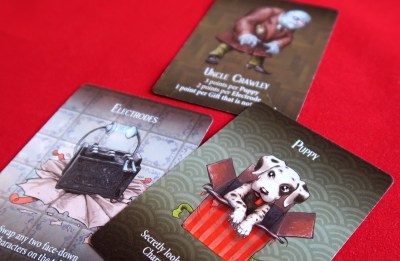
Once crackers, jokes and food had been dealt with, Magenta’s little one (who had come a long for the ride and a bit of pizza crust), found himself a friend to play with which gave everyone else the chance to get on with the “Feature Game”, Giftmas at Dungeon Abbey.  This is a short game designed by a local gamer and member of the Didcot Games Club, Rob Harper.  Blue and Pink picked up a pre-release copy at Essen in October and had saved it for a special, festive occasion, and this seemed appropriate.  The game is a fun, micro card game based in a world that is a sort of cross between Downton Abbey and the Adams Family.  The artwork is suitably gruesome, though it was very clear from the start who the Countess D’Ungeon was a caricature of!  Played over several short rounds, each player takes the role of one of the various eccentric and unpleasant family members grasping for whatever feels like the best present.  To this end, players begin with a character card and a couple of gift cards, all face down on the table in front of them.

Giftmas at Dungeon Abbey
– Image by boardGOATS

On their turn, the active player may either swap one of their face-down cards with one elsewhere on the table, or turn a card face-up, possibly activating a special action on the gift cards. The round ends when all a player’s cards are face up at the start of their turn or a bomb is revealed, at which point everyone scores points if they have collected the gifts wanted by their characters.  A lot of fun was had with everyone amused by the idea the sick combination of a set of electrodes and a puppy…  Before long, Magenta, Blue, Pine and Green had won one round a piece and Magenta’s son’s and his playmate was starting to look bored with the game they were playing, so although the we were just warming up nicely, we reluctantly decided to bring it to an early close when one player had won two rounds.  It was tight, but Green prevented Ivory and Burgundy getting in on the act and took his second round, and with it, the game.  Søn-Magenta had clearly had enough, so Mor-Magenta took him home leaving everyone else with a selection of wintery themed games to choose from.

Giftmas at Dungeon Abbey
– Image by boardGOATS

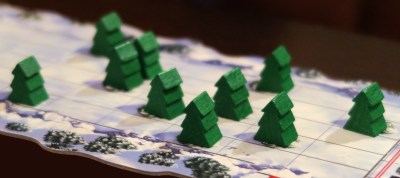
With five players left, the choice was actually rather limited and we quickly settled on an old favourite, the sled racing game, Snow Tails.  We played with the original edition, where players start by building the track which can either be from one of the suggested examples given in the rulebook, or, a home-designed one which we opted for.  On reflection, designing our own track might not have been all that clever, as we inevitably made it way more complicated than it needed to be.  The parcour began with a Chasm immediately after the start which caused an almighty bottle neck before everyone even got going.  Then there was a sweeping left hander and a short straight section followed by a right hander.  This wouldn’t have been so bad except they were immediately followed by a combination of a Crevasse (that had to be jumped at speed) and a field of saplings (adding a slalom element) just before the finish line.  As a result players had to control their speed very carefully throughout.

Snow Tails
– Image by boardGOATS

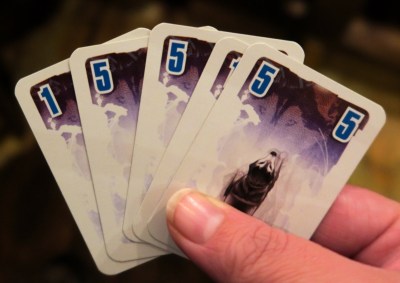
And that is what Snow Tails is all about really: controlling speed.  Players have a deck of number cards from which they draw a hand of five cards.  On their turn, cards are played on one to three of the active piles: the left husky, the right husky or the brake.  The catch is that if multiple cards are played, they must all be the same number, and once a card has been used, it can’t be used again until the player’s individual draw deck has been depleted.  The idea is that the sled’s speed is the sum of the dog cards in play, minus the current value of the brake; the speed dictates the number of spaces the sled moves forward in each turn.  Steering is carried out by adjusting the difference between the speeds of the two dogs which gives rise to “drift”, i.e. sliding movement to the left or right.  Drift occurs as a sled moves forward, with a maximum of one lane drift per forward movement.  An evenly matched pair of dogs goes faster leading to a balanced sled bonus, but for some reason we forgot about this.  It probably didn’t matter anyhow though, because the nature of the course meant that a balanced sled was a real rarity rarity and the close proximity of the obstacles meant it was unlikely that anyone would have been able to make use of the bonus as well.

Snow Tails
– Image by boardGOATS

Ivory and Blue were first out of the blocks and managed to steal a bit of march on everyone else, getting through the Chasm first and causing chaos behind as everyone else got stuck.  With nobody in his way, Ivory took an early lead and Blue gave chase, but bit by bit he continued to edge away.  It wasn’t long before Pine led the charge from the rear and those who had got jammed in the Chasm began to catch up.  This was partly because they had been able to store up a few good cards and plan their attack while they were waiting to get past the obstacle at the beginning, but also because first Blue, and then Ivory, paid the penalty for their quick start and were forced into the barriers.  Coming round the final corner, it was really tight, but Green, Burgundy and Pine were heading for home through the Saplings.  It was then that we realised the importance of positioning:  for those with no dents in their sled, it was possible just to mow through the saplings taking damage as necessary and career across the line.  There is a limit though as players got in his way, Pine stalled, allowing both Blue and Green through the gap, pipping him on the line.  Burgundy crossed the line first however, with Green finishing a close second in what had been a quite chaotic race.

Snow Tails
– Image by boardGOATS

With a shortage of five-player winter-themed games, we decide to go for one of our most popular games6 Nimmt!.  This is probably our most played game, which is strange as, even when we have a break, it always comes back into fashion again.  In the group we’ve discussed the phenomenon many times, and it is definitely a special game.  There are a combination of factors that add to it’s appeal including the time it takes to play, the number of players, the lack of down time, the simplicity etc..  Perhaps the biggest factor though is the illusion of control the game gives, until it all goes horribly wrong of course.  And of course it did this time too.  The first round was quite close with three players picking up almost exactly the same number of “Nimmts”.  It was the second round that was most amusing though as Pine and Ivory seemed to be competing to collect as many as they could, taking it in turns to pick up rows.  Unusually, as he usually has one catastrophic round, Burgundy managed to win both rounds with a clean sheet in the first and just five in the second.  This gave him a clear victory with Blue some way behind, just pipping Green to second place.  The excitement had all been far too much for Ivory and he decided it was home time, having won the unofficial “hat on the longest” competition that only he had been playing.

– Image by boardGOATS

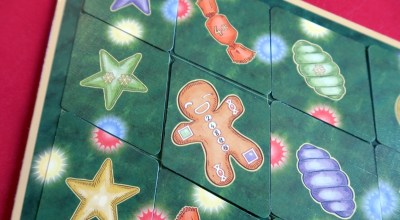
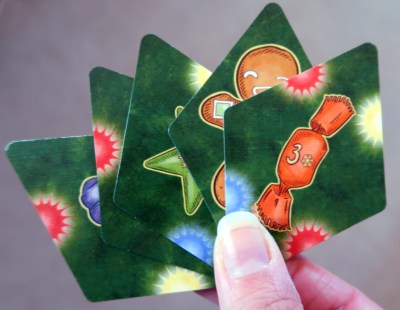
This left everyone else with time for one last festive game, Christmas Tree.  This is an apparently simple card drafting game, which turns out to be surprisingly challenging in practice (not least because shuffling diamond-shaped cards is remarkably difficult!  Each player begins with an empty Christmas tree shaped board and a hand of eight cards.  Simultaneously, everyone chooses one card to keep and passes the rest on.  They then add the card to their tree, decorating it.  Each card features a bauble of some kind, a wrapped sweet or a gingerbread cookie and some additionally have half a light on the edges.  Points are scored at the end of the game for satisfying the gingerbread men’s neighbourhood preferences, matching the half lights to make whole ones, for sweets and baubles.  The largest number of points come from the “objective cards”, however, which give points for ornaments in a particular arrangement.  At the start of the game, each player is given four objective cards and players choose one at the start of each round, which is scored at the end of that round.  As only Blue and Green had played it before (and then without the objectives) it was felt that it was fairest to draw the objective cards at random this time.

Christmas Tree
– Image by boardGOATS

It took a while for everyone to get the hang of the game, and it quickly became apparent that Green’s experience was invaluable as he took an early lead.  Blue, on the other hand, was demonstrating how not benefit from the advantage she had been given and was grubbing about at the back of the pack.  It turned out that everyone had a different strategy and was targetting different objectives, as evidenced by the changing of places in the final scoring.  Green, who was a long way out in front, remained there unchallenged, but all of a sudden, Blue made a march from the back, thanks to her large number of completed festive lights and a couple of well-timed linzer cookies (which allow players to swap decorations positions on their tree).  It was very tight for second, in fact, there were just two points in it, which given that scores ranged from one hundred and forty to over one hundred and eighty was very close and merited a recount of the final round.  The scores stood, however, and Blue just managed to edge in front of Burgundy to take second.

Christmas Tree
– Image by boardGOATS

Learning Outcome:  There are very few festive themed games that play five!

Christmas GOATS 2017

Christmas 2017
– Image from weclipart.com

The Calendar has been updated, but here is a quick summary of the key dates for GOATS and Didcot Gamers:

Christmas 2017
Tuesday 12th December 2017
(Last normal boardGOATS of the year)
Pizza & Games “Festivities” from 7.00pm at
the Horse and Jockey pub in Stanford-in-the-Vale.
Friday 22nd December 2017
(Didcot Gamers)
Games Night, location to be determined.
Wednesday 27th December 2017
(Monster Games)
Monster Games at Barney’s House
(games dependent on numbers).
Thursday 28th December 2017
(GOATS do the Quiz)
Quiz Night at the Horse and Jockey pub
in Stanford-in-the-Vale from 9pm, with possible
food before hand.
Sunday 31st December 2017
(New Year Party)
Games and food from 7pm at Barney’s House.
Friday 5th January 2018
(Didcot Gamers)
Games at The Loop in Didcot (as normal).
Tuesday 9th January 2018
(boardGOATS)
Games from 7.30pm at the Horse and Jockey pub
in Stanford-in-the-Vale (back to normal).