Author Archives: nannyGOAT

Next Meeting – 21st February 2017

Our next meeting will be on Tuesday 21st February, at the Horse and Jockey pub in Stanford-in-the-Vale.  As usual, we will be playing shorter games from 7.30pm as people arrive, until 8pm when we will start something a little longer.

This week the “Feature Game” will be Bokken Schieten (aka Ziegen Kriegen or Cliff Hanger). This is a quick little trick-taking game in which players accumulate goats.  The winner of the game is the player who collected the most goat’s heads without going over the limit dictated by the central hill.

Bokken Schieten
– Image by boardGOATS

And talking of goats…

Jeff was driving round London when a policeman pulled him over.  “What are you doing with that goat?” he exclaimed, pointing to the goat sitting in the passenger seat. “You should take it to the zoo.”

“That’s an excellent idea officer, I will do just that!” replied Jeff and the Policeman waved him on his way.

A week later, the same policeman saw Jeff again, once more with the goat in the passenger seat, but this time both were wearing sunglasses.

As before, the policeman pulled him over, “I thought you were going to take that goat to the zoo!” he said angrily.

Jeff replied, “I did. We had such a good time we are going to the beach this weekend!”

7th February 2017

It was a very quiet night, with work and family commitments and illness decimating our numbers.  In fact, for a long time it looked like there might only be two of us, but we were saved that indignity when Ivory turned up, quickly followed by Green.  After we had cheered Burgundy through his Hawaiian, we settled down to the “Feature Game”, Roll for the Galaxy.  This is a re-implementation of an older card game, Race for the Galaxy, with the addition of dice.  One of the common complaints about Race for the Galaxy is the complexity of the iconography, which was used to limit the amount of text on the cards.  This has been significantly reduced in Roll for the Galaxy (and largely replaced with text), but in its place there is a complex dice economy.

Race for the Galaxy
– Image used with permission of BGG reviewer EndersGame

In summary, players roll the dice in their cup in secret, behind their screen.  They then distribute the dice according to their symbols, matching them up to each of the five phases, Explore, Develop, Settle, Produce and Ship.  Players then, still in secret, re-position one of their dice to use it to choose one action they would like to activate.  Players can also put a die to one side for a turn to “Dictate” the symbol on another die, i.e. reassign it to a different phase.  Once everyone has positioned all their dice, the player screens are removed and players simultaneously carry out the phases that have been chosen in order.  In general, each die is used to carry out an action once, so if a player has multiple dice assigned to the same phase, the action may be carried out several times.  Any dice that are not used (or were used for the Dictate action) are returned to the players’ cups whereas dice that are used must be placed in the player’s “Citizenry”.  Dice in the Citizenry must be transferred back into the player’s dice cup before they can be used again, and this costs $1 per die.

Roll for the Galaxy
– Image used with permission of BGG contributor punkin312

The next natural question is, how do players get money?  Money comes from Trading goods:  during the Ship phase.  Goods are placed on Production Worlds during the Produce phase and can either be Traded for money (where the value depends on the type of World that produced them) or Consumed for victory points (where bonuses are received if the dice colours match that of the Worlds that produced them) during the Ship phase.  There are three types of World on double sided square tiles:  one side is a Development World and the reverse is either a Coloured Production or a Grey Non-Production World.  Worlds are all “built” by spending dice during either the Development phase or Settle phase (for Production and Non-Production Worlds) and the cost is returned in Victory Points at the end of the game.  Players draw World tiles from a bag during the Explore phase.  They choose which side they are going to try to build and therefore which stack to place them in, either the Develop or the Settle pile.

Roll for the Galaxy
– Image used with permission of BGG contributor punkin312

In general, Development Worlds give special powers and or extra points at the end of the game.  In contrast, Production and Non-production worlds give more dice and, in the case of the coloured Production Worlds can also provide Victory Points and/or money.  The clever part is controlling these piles and manipulating the worlds built in order to steer a particular strategy.  The game ends when either one player builds more than twelve Worlds, or the Victory Point chip pile is exhausted, in this way, it is a race and controlling the game length is one important aspect of play.  Inevitably in a dice game, the most important part of the game, is managing and working with luck.  The different dice colours have different distributions of the phase symbols, for example, while red (Military) dice have two Develop and two Settle symbols, blue (Novelty) dice have two Produce and two Ship symbols.  Thus, the game could be compared with a game like Orléans, where players build the contents of their bag in an effort to control luck, rather than the symbols on the dice in their cup.

Roll for the Galaxy
– Image by BGG contributor haslo

It is a game that takes a bit of getting used to and everyone struggled a bit.  Unusually though, it was Burgundy who struggled the most which made a change for the rest of us.  It was all made worse by the inevitable rules confusions though.  Before we started, Green had questioned whether it was compulsory to place one die to choose the phase or whether it was optional.  Only Blue had played before and then only with two players which made it a quite different game, and on that occasion, they had played that it was optional.  It was not glaringly obvious from the rules, though eventually we came to the conclusion that it should not be optional, so we proceeded with the game along those lines.  As the game progressed, it became apparent that this led to a logical inconsistency.  The rules specifically stated that if a player had no dice in their cup after recruiting (i.e.at the end of the round) they must recall any dice left on worlds as goods or in the process of Developing or Settling.  The problem with this was that if a player was then forced to use this die to choose a round, without dice to actually carryout the action they would be forced to spend any assets, but with no way of turning them into anything useful.

Roll for the Galaxy
– Image used with permission of BGG contributor punkin312

For this reason, we returned to playing that choosing an action was optional, which allowed players to take a chance that others would choose the action they wanted.  About half way through the game, Green, who had been fiddling with his phone looking up specifics of a World he’d built, had an “Aha!” moment when he found something on the rules forum.  The thread explained that the die that use to select a phase acts as a worker of that type during the chosen phase.  This is in “Frequently Overlooked Rules”, but somehow the use of the the term “worker” didn’t make it clear.  If the die used to select the action could also carry out that action though, not only did it prevent “single die jeopardy”, but it also meant that players were effectively guaranteed one completely unconstrained move (because the symbol on the die used to choose the action does not have to match the phase).  Even better, a player with three dice, could use the “Dictate” option to give them any two (potentially different) actions.

Roll for the Galaxy
– Image used with permission of BGG contributor punkin312

Although this clarified everything, it had the potential to make such a huge change to the game we decided to carry on playing as we had been.  We could all see how this made much more sense though and would also speed the game up.  By this time it was very clear who was going to win in any case though.  Green had started with the Genetics Lab which turned out to be extremely powerful as it gave him an extra $2 every time there was a Produce phase.  After checking the rules forum (again) it became clear that this was regardless of whether he initiated it, so long as he left his green die on a production world he had an income which effectively meant that he didn’t really need to worry about money.  Eventually, he put us out of our misery by building his twelfth World bringing the game to an end.  Totting up the scores gave a surprising result. Green was inevitably miles in front with forty-four points, but everyone else was caught in a three-way tie on twenty-two points.

Roll for the Galaxy
– Image used with permission of BGG contributor punkin312

It was clear that playing correctly would have a huge impact on game play and, although Green and Ivory had to leave everyone was keen to give it another go in a few weeks time.  Blue had the chance sooner, however.  On Sunday afternoon we had the third of our “Monster Games” sessions, and after a game of Roads & Boats, Blue, Pink, Black and Purple gave it another go.  Black and Purple were completely new to it, and Purple struggled a bit with the dice economy while Black was not sure how to control the worlds available to him.  It was clear to Blue and Pink though that playing by the rules as written, unsurprisingly, made the game work much better.

Roll for the Galaxy
– Image used with permission of BGG contributor punkin312

With Green and Ivory gone, Burgundy was keen to play something a little shorter and lighter and Blue fancied having another go at beating Burgundy at Splendor.  We play this game a lot and beating Burgundy at this game has become something of a Group Challenge, but somehow he always just gets the rub of the green.  This is a game of chip-collecting and card development where players collect chips to buy gem cards which can then be used in lieu of chips.  More expensive cards are also worth points and the game end is triggered when one player reaches fifteen points and the round is completed to give everyone the same number of turns.  Points are also awarded for “Nobles” which go to the first player to get a specific combination of gem cards and the player with the most points at the end is the winner.

Splendor
– Image used with permission of BGG contributor henk.rolleman

This time, the Nobles were opal, diamond & ruby; opal, ruby & emerald; sapphire, emerald & diamond.  At the start of the game rubies were scarce, but sapphires and emeralds in particular were scarcer.  This was not too much of a problem initially as opals and diamonds were needed for the Nobles, but it gradually became more of an issue as the game went on.  Blue and Burgundy were pretty much neck-a-neck for the first half of the game with both players picking up nobles on the same turn.  It was very tight though and the pressure from Burgundy forced Blue to reserve cards giving helpful Gold (which is wild), but is a very inefficient approach.  In the end, the game was painfully close.  Burgundy finished his turn and began re-counting his points.  It was only as Blue claimed seven points (one card and a Noble) to give her a total of sixteen points that he commented that actually he already had fifteen.  Since Blue started, that meant she wasn’t able to claim her final turn.  Normal service resumed then!

Splendor
– Image used with permission of BGG contributor henk.rolleman

Learning Outcome:  Playing by the correct rules can improve a game no end…

Next Meeting – 7th February 2017

Our next meeting will be on Tuesday 7th February, at the Horse and Jockey pub in Stanford-in-the-Vale.  As usual, we will be playing shorter games from 7.30pm as people arrive, until 8pm when we will start something a little longer.

This week the “Feature Game” will be Roll for the Galaxy, which is the dice game of the popular empire building card game, Race for the Galaxy.  The dice represent the players’ populace, which are directed to develop new technologies, settle worlds, and ship goods. The player who best manages his workers and builds the most prosperous empire wins.

Roll for the Galaxy
– Image used with permission of BGG contributor punkin312

And talking of dice…

Jeff was sitting his finals and, for the last multiple choice exam took a handful of dice with him into the hall.  As soon as the exam started, be began furiously rolling the dice to select his answers.  The invigilator gave him a long look as he passed, but it is not uncommon for students to resort to luck when they get stuck.  Jeff soon finished the paper and, tired with all the exertion, pillowed his head on his arms and went to sleep.  After about half an hour, Jeff suddenly sat up, and started furiously rolling his dice again.  The invigilator was curious and suddenly worried that maybe something was going on, so he approached the candidate.

“Excuse me, what are you doing?” he asked.  “Why are you rolling the dice again if you finished the questions earlier?”

Jeff replied, “I’m just double checking my answers…”

24th January 2017

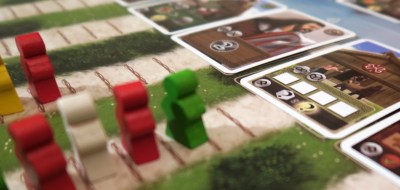
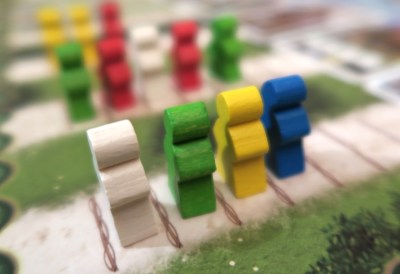
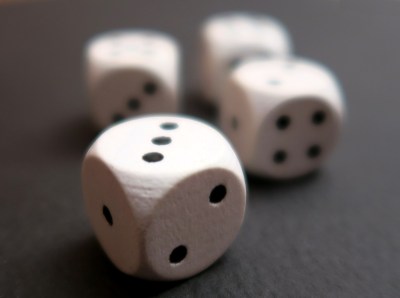
Food was a little delayed, so as it was a relatively quick game (and one that we felt we could play while eating if necessary), we decided to begin with the “Feature Game”, Bohemian Villages.  This is a fairly simple tactical dice-rolling game.  The idea is that on their turn, the active player rolls four dice and uses them to assign their meeples to buildings in the villages of Bohemia.  The dice can be used as two sets of two, a group of three (with one forfeit) or in their entirety as a group of four.  These values correspond to the different types of buildings which appear with different frequency and give different rewards.  For example, if a player rolls a six, they can place their meeple on a Flour Mill.  When the last of the Flour Mills is occupied, everyone gets their meeples back, together with two coins for each one.  Similarly, rolling a seven allows the active player to place their meeple on a Glass Factory, however, when they get them back they get three coins instead of two.
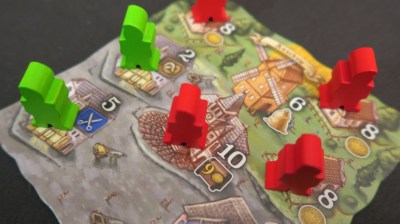
Bohemian Villages
– Image by boardGOATS

Other buildings work differently though, for example rolling a two, three, four or five allows players to put their meeple on a Shop.  There are four different types of Shops and players are rewarded increasingly large amounts of money for the more different Shops they occupy at the end of the game.  A set of four is very valuable, but the snag is that the number of Shops available is very small.  So, once they are all occupied, if another player rolls the right number they can bump someone else off costing them a lot of money in the process.  Players rolling a twelve, place their meeples on Manor Houses which give an immediate reward whereas inns (nine) give a regular income at the start of the active players turn, so long as they remember to claim it!  Farms also provide income during the game with the active player collecting one coin for each farm owned when they add a new one (i.e. roll another eight).  Churches and Town Halls (ten and eleven) provide money at the end of the game with players rewarded for occupying the most Churches or for occupying a Town Hall in a fully occupied village.
Bohemian Villages
– Image by boardGOATS

The game ends when a player runs out of meeples and the winner is the player with the most money.  We were just about to start a five-player game when Green and Ivory pitched up, so Red joined them, leaving Blue, Pine, Magenta and Burgundy to start.  With food arriving just as we started, Blue began by claiming the most lucrative Manor House with all four of her dice before turning her attention to her pizza.  Magenta started collecting Shops, but soon faced competition from Pine.  Meanwhile, Burgundy was sidetracked by his supper, Blue tried to get a regular income stream from a chain of Inns and Pine went into the church.  Somewhere along the line during her rules explanation, Blue had commented that Farms could be quite lucrative, so Magenta took the hint and before long she was engaged in a massive land-grab.  It took everyone else a while to notice, so it was very late before they attempted to reduce her income.   In what was a very close game it just played into Pine’s hands and he finished two coins ahead of Magenta when Burgundy brought the game to a slightly unexpected end.
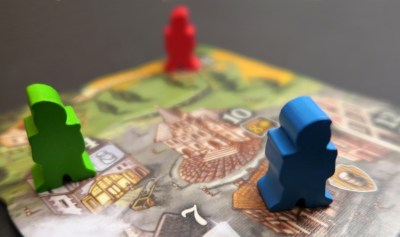
Bohemian Villages
– Image by boardGOATS

On the next table, the absence of Burgundy meant that Red, Ivory and Green fancied their chances at a game of Splendor.  This engine building game is built on a simple set-collection mechanism.  Players collect gem tokens then use them to buy gem cards.  Gem cards can then be used to buy more cards.  Some gem cards are also worth points, and they also enable players to collect Nobles which are awarded to the first player collect certain combinations of gem cards.  Splendor is one of our group’s “go-to” light filler games and in recent months Burgundy has made the game his own.  With Burgundy otherwise engaged though, he was guaranteed not to win.  With Ivory and Red fighting for the same colours, Green made the fastest progress collecting opals and diamonds and building a valuable collection quickly.  Ivory came off best in the tussle between him and Red, and he was able to pick up two Nobles with his pickings.  It was Green that took the honours, however, taking a Noble himself to bring the game to a close.

Splendor
– Image used with permission of boardgamephotos

Bohemian Villages finished first, so after a trip to the bar, Blue, Magenta, Burgundy and Pine played a few hands of Love Letter to kill time.  We play this quite a bit, because with just sixteen cards, this is a great little game to play while chatting or doing other things (like eating).  Each player starts with a card and, on on their turn, draws a second and chooses one of them to play.  Each card has a number (one to eight) and an action; players use the actions to try to eliminated each other and the player with the highest card at the end, or the last player remaining is the winner.  This time, we managed five hands before Splendor finished and it ended in a tie between Blue and Magenta who won two each.  With nobody wanting a late night we fancied something we could play as a group that wasn’t going to run on.
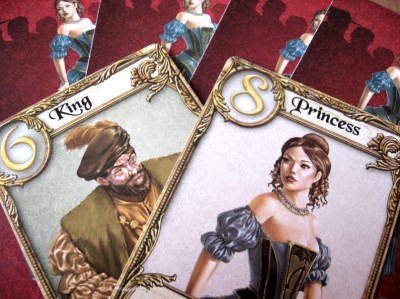
LoveLetter
– Image by boardGOATS

After a bit of a discussion, we settled on a big game of Between Two Cities, involving everyone.  This is quite popular with our group as it is both competitive, and cooperative and, as such, is totally different to anything else we play.  The idea is that, instead of each player having a personal player board that they work on in isolation, each player sits between two boards which they share with their neighbours.  The game play is based on card drafting games like Sushi Go! and 7 Wonders with scoring taking elements from tile-laying games like Carcassonne and Alhambra.  The game is played over three rounds with players placing building tiles to construct cities consisting of sixteen tiles in a four by four array.  Each player starts the first round with six tiles, of which they secretly choose two and pass the rest to the left.  Once everyone has chosen their two, everyone reveals their choices and then negotiates with their neighbours to try to to ensure they get the tiles they want in the two cities they have a share in.
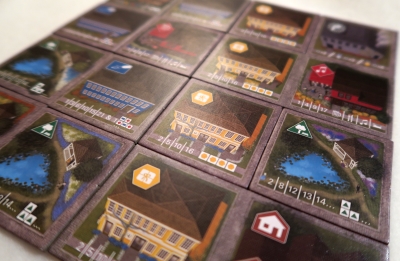
Between Two Cities
– Image by boardGOATS

Play continues with each player picking up the hand they were passed and choosing another pair of tiles etc. until there are no tiles left.  In the second round players get three double tiles of which they choose two and discard the third.  These double tiles contain two buildings in a vertical or horizontal arrangement.  This is where things can get difficult, as the final city must form a four by four square and the location of buildings can be critical to their scoring.  For example, a housing estate built in a city with lots of other different types of buildings is worth up to five points at the end of the game, unless it is next to a factory in which case it is only worth one point.  The third and final round is played the same way as the first, except that tiles are passed in the opposite direction.  The winner is the player with the highest scoring second city.

Between Two Cities
– Image by boardGOATS

As well as being a nice balance of cooperative and competitive, it also plays well at a wide range of player counts with little change to the overall game time.  With so many people involved, however, one of the down-sides is the fact that it is very difficult to see what players at the other end of the table are doing and near-impossible to influence their game-play.  Despite this, for the most part every city had it’s own distinct character, for example, Red and Magenta reproduced central London with offices surrounded by lots of pubs and entertainment venues while Blue and Burgundy built a flourishing industrial town and Pine and Ivory managed their own little recreation of Thatcher’s Britain.
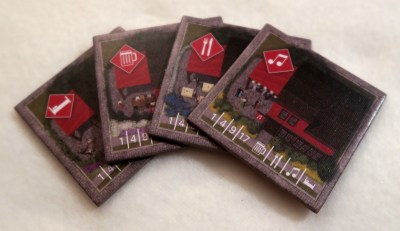
Between Two Cities
– Image by boardGOATS

In Between Two Cities, the winner is the player who’s lowest scoring city is the scores most, with their other city used as a tie-breaker.  For this reason, it is usual that the player who finishes with two most closely matched cities that wins.  By rights then, the game should have gone to Green or Red who both finished with both their cities scoring exactly fifty-four points.  This was an unusually close game though, with all cities except one finishing within four points of each other.  In the end, Blue who took second place from Burgundy on the tie-break, but it was Pine, sharing cities with Burgundy and Ivory who finished two points clear giving him his second victory of the night.
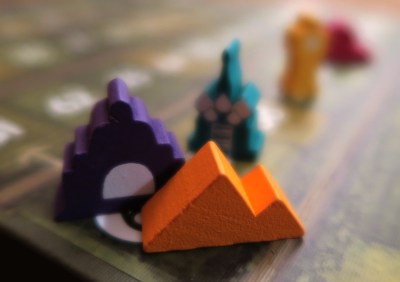
Between Two Cities
– Image by boardGOATS

With that, Red, Magenta, Ivory and Green headed off for an early night, but Blue, Burgundy and Pine felt it wasn’t yet late and that there was time for something light before bed.  Since Splendor was still out Pine and Blue decided to have another go at Burgundy and see if together, they could finally dethrone him.  It all started well with Pine and Blue successfully inconveniencing Burgundy grabbing gem cards he wanted just before he could get them.  It wasn’t long, however, before Burgundy managed to collect a large number of diamonds which allowed him to just beat Blue to a couple of nobles.  She was still in the fight though, right until she miscounted how many sapphires Burgundy had, and with it handed him the game. Still, we are definitely getting closer to beating him…

Splendor
– Image used with permission of boardgamephotos

Learning outcome:  Competition is essential in games, but working together is fun too.

Winter 2017 Oxford Meeples Big DoG

On Saturday, February 4th, Oxford Meeples is again opening the doors of Wolvercote Village Hall to the general public once more and inviting people to join them for another Big Day of Gaming.  As usual, the Oxford Meeples will be bringing a large number of their games, but everyone is welcome to bring their own too.  The hall opens at 10 am with gaming starting from about 10.30 am and continuing ’til late.  Entry is free, although donations towards rent of the hall and refreshments will be appreciated as always.  Children are welcome when accompanied by an adult.  Several of the GOATS are hoping to attend, but that will depend on weather and other commitments.

Oxford Meeples Winter DoG '17
– Image from oxfordmeeples.org

OxCon 2017

This weekend is OxCon (distinct from OxCon, the Oxford Comic Con), a weekend of gaming held every January in The Mitre pub in the middle of Oxford.  It has acquired almost mythical status since publicity hitherto has almost entirely been by word of mouth and often quite last minute.  For those who are about on Friday evening there will be a meal at Pizza Express at 6.30pm and some gaming afterwards.  As well as general gaming, there will also be the Settlers of Catan contest on the Saturday with a dexterity contest on the Sunday (to include games like Bandu, Rhino Hero, Riff Raff, and Rampage).  Entry is £3 for students and £5 for non-students, payable at the door.  Not sure how many of the GOATS will make it, that will depend on weather and family commitments, but it should be a good event.

The Mitre
– Image from pubsofoxford.co.uk

Boardgames in the News: Ant & Dec’s Trivial Takeaway

There has been a long history of trivia games including, including well known titles like Scene It? and Trivial Pursuit.  There are a number of obvious problems with this sort of game.  Firstly, it’s no fun playing when the “spod” in the corner always wins; this leads to the second problem which arises when one player decides the only way to win is to learn all the answers.  Some games designers use ingenious methods to get round this problem.  For example, the questions in Wits & Wagers have numerical answers that players are very unlikely to know, but can usually make an educated guess at.  For example, “In dollars, how much was each extra paid to run across the beach and scream in the movie Jaws?”  These questions don’t solve the problem in themselves, but in Wits & Wagers it’s not the answers that are really important, as players bet on each other’s suggestions with the pay out going to bets on the answer that most closely matches the truth, crucially, without exceeding it.

Wits & Wagers
– Image used with permission of
BGG contributor domcrap

There is another way to stop the family’s “useless-fact sponge” winning every time though, and that is to add a sprinkle of wrong answers.  This was approach accidentally exploited by Paul Lamond Games, maker of Ant & Dec’s Saturday Night Takeaway: The Board Game.  They mistakenly relocated Stonehenge in Somerset, misplaced the Moon by nearly fifteen thousand miles and killed off Albert Einstein six years early!  Paul Lamond Games have agreed to provide replacement cards for all that want them, however, a better solution might be to cut losses and replace the whole game with something better like Wits & Wagers, Codenames or one of the thousands of superb modern boardgames that are now available.

Ant & Dec's Saturday Night Takeaway: The Board Game
– Image from paul-lamond.com

Next Meeting – 24th January 2017

Our next meeting will be on Tuesday 24th January, at the Horse and Jockey pub in Stanford-in-the-Vale.  As usual, we will be playing shorter games from 7.30pm as people arrive, until 8pm when we will start something a little longer.

This week the “Feature Game” will be Bohemian Villages, which is a tactical dice-rolling game that allows you to claim different types of buildings in shared villages and use the powers of those buildings.

Bohemian Villages
– Image by boardGOATS

And talking of Villages…

The village elder was setting out to a meeting of the heads of local villages.  He had only just started on his way (on foot, of course), when Jeff called out from behind asking him to wait. When he caught up, Jeff asked where the elder was going and whether he could accompany him on his journey. The village elder explained that he was going to the nearby town to represent their village at a meeting with other village leaders.

Jeff looked impressed and fell silent for a few minutes as they continued to walk on steadily, side by side.  Then he said, thoughtfully, “That’s an awfully old coat you’re wearing. It’s worn at the elbows and, look, there’s a stain right down the front. What kind of impression will it give of our village at the regional meeting?”

The village elder was a little annoyed, but he knew that Jeff meant well so he overlooked the remarks. He merely replied in mild tones that it couldn’t be helped because he didn’t have another coat.  Jeff had an idea though, “I know, why don’t I lend you my coat? It’s brand new, and you will be able to hold up your head and our village’s reputation at the meeting.”

The village elder was going to decline, but thought better of it, especially when he saw how eagerly Jeff was making his generous offer.  So they stopped and exchanged coats right there on the road, and continued on their way.

By and by they saw a traveller coming toward them from the other direction.  As they neared each other, Jeff greeted him eagerly and with a proud, proprietary air launched in on energetic introductions.  “Good morning, sir! This is our village elder. He is going to the local town for a meeting of village elders, and the coat he’s wearing is mine!”

This embarrassed elder no end, and as soon as the traveller was out of earshot he turned on Jeff and said to him angrily, “Why did you have to mention that the coat was yours? Don’t do that again, do you hear? It is injurious to my standing as the village elder.”

Immediately contrite, Jeff readily agreed, and so they continued on their way once again. After a few more miles they saw in the distance another traveller coming slowly toward them, and the village elder looked hard at Jeff and said, “Remember, don’t tell him that the coat is yours.”

Jeff assured him that he wouldn’t make the same mistake twice, and the elder breathed a sigh of relief. As they met the traveller, Jeff again took it upon himself to introduce his illustrious companion, “Good afternoon, sir! This is our village elder. He is going to the local town for a meeting of village elders, and the coat he’s wearing is… his own.”

As soon as they were at a safe distance from the second traveller, the village elder stopped in his tracks, faced Jeff, took him by the shoulders and glared angrily into his eyes.  The elder said, “Listen here, what did you mean by that remark? You drew even more attention to the coat by saying it was mine. There is no need to mention the coat at all. If we come upon another traveller, please, please, don’t say anything about the coat again! Do you understand me?”

Jeff assured the village elder that he did indeed understand and that he would never again make the mistake. He was clearly so very sorry that the elder was soon ashamed of having lost his temper. He made his peace with the poor fellow and they set on their way once again. They were nearing their destination when they saw in the distance another traveller making his way toward them. The elder gave Jeff a meaningful look, and Jeff nodded reassuringly, as if to say, “Don’t worry, I’ve got it under control.”

Soon they were close enough for Jeff to begin his introductions, a task which he took very seriously and of which he never seemed to tire.  “Good afternoon, sir! This is our village elder. He is going to the local town for a meeting of village elders, but don’t ask me about the coat he is wearing, I don’t know anything about it!”

10th January 2017

A new year, a new log book, and a shortage of people thanks to sickness, work and problematic cars.  Pine, Magenta and Blue were the first to arrive, so while they were waiting for food they decided to get in a quick game of No Thanks!.  This used to be one of those games that got played a lot, but for some reason it fell out of favour and was replaced by games like Love Letter, 6 Nimmt! and Om Nom Nom.  No Thanks! is a very simple little game where players have to make the binary decision to take a card or pay a chip and pass the problem on to the next player.  At the end of the round, players add the face values of the cards together and offset this with any remaining chips to give their total – the smallest value is the winner.  The really clever part is that if a player has a run of consecutive cards, then only the lowest counts.  Spice is added by the removal of nine cards from the original thirty-two consecutive cards in the deck.

No Thanks!
– Image used with permission of BGG contributor ckirkman

We first introduced Pine to No Thanks! over Christmas, when he had done rather well at it, this time was a bit different, however, with Blue coming in first with twenty-five in a generally high scoring game.  As food arrived, so did the other gamers, with Ivory first and, just as we were explaining the rules to him, Green rolled up as well.  The second hand began with Ivory picking up cards.  As it went on, he picked up more cards, and more and more.  This was excellent for everyone else until it started to look like he might be able to make them into one very long run.  In the end, Ivory’s massive gamble didn’t pay off and he finished with ninety points, a massive  eighty more than anyone else.  It was Magenta who took the round though, her enormous pile of chips offsetting all her cards leaving her with minus one.

No Thanks!
– Image used with permission of BGG contributor punkin312

With food over and everyone who was expected present, we decided to move onto our “Feature Game” will be Jórvík.  This is a Viking retheme of a game we have played a few times and enjoyed called The Speicherstadt.  The game is card based and driven by a novel auction mechanism that somehow doesn’t really feel like an auction.  The idea is there is a row of cards and players use their meeples to bid with.  They take it in turns to choose which cards they would like to have the option of buying, by placing their meeples in rows below the cards they want.  The cards are then “auctioned” in turn with person who who placed their meeple below a card first getting first refusal.  The clever bit is that the cost of the card is the same number of coins as there are meeples below the card.  When it is their turn, the active player can choose not to to buy the card, but then they must remove their meeple which makes it cheaper for the next player in line.   Thus, placing first can be a good thing if you have enough money to back it up, but money is scarce, very scarce.

Jórvík
– Image by boardGOATS

The cards could be contracts (that give points at the end if fulfilled), ships containing goods (that enable players to fulfill contracts), defenders (which help score points if there is an attack of the Picts), craftsmen (which enable players to sell goods for a better price), feasts (which give points the more you have), journey cards (which just give points) or, towards the end of the game, skald cards (which yield points for some other condition).  The deck of cards is broken into several batches which ensures that while cards don’t come out in a  fixed order, early cards are less powerful than cards that appear later in the game.  The basic Jórvík game is quite light, but the new rendition includes the original Kaispeicher expansion.  This provides extra cards, though more importantly, it also adds a whole new mechanism that still has the same flavour, but turned on its head.

Jórvík

The new expansion adds a second method for players to get cards:  at the start of each round a second row of cards are displayed and, instead of using their turn to place a meeple in the auction, they can use it to reserve a card.  This card (and its meeple marker) are then moved to a new row.  At the end of the round, after the cards in the usual “auction” have been dealt with, the reserved cards are paid for in the order that they were reserved.  The snag is that the cost depends on how many cards were reserved after it.  Thus, players who reserve early have the best selection of cards to choose from, but will end up paying if they choose to buy it.  This means that players often end up reserving a card, as much as anything else, to stop the other players from getting it.  This led to Pine commenting that the game was a bit like window shopping with players standing hopefully next to items they had no hope being able to afford!

Jórvík
– Image by boardGOATS

Only two of us had played the game before (mostly in its original form as The Speicherstadt), and nobody had played with the expansion at all.  Everyone tried different strategies, with Magenta trying to collect feasting cards (largely unsuccessfully) and Green beginning by trying to collect defender cards in the hope of being able to scoop up all the points for repelling the Picts.  Ivory, Blue and Pine were slower to settle on a strategy, though Ivory was ominously collecting what looked like some very powerful cards.  Then, Pine began collecting pink resource cubes, the valuable cloth and successfully used them to fulfill a couple of lucrative contracts.  For a long time this looked like it was going to be a winning strategy, until Blue changed tack.  She had started by trying to pick up contracts and fighting with everyone else for resources, but it was gradually becoming clear to her that this wasn’t working.  Although Blue had fallen foul of the Picts in the first round, since then she had been trying to avoid losing points.  This strategy had kept her in the running, and she decided to to actively pursue the points.  In the end she finished with thirty-six points, just three ahead of Pine in second place.

Jórvík
– Image by boardGOATS

Despite winning, Blue wasn’t sure about the expansion.  She felt it added a largely random element that players had no control over.  She felt the that the fact players were reserving cards that only they could buy meant that once someone had selected a card nobody else had a chance to contest it.  The only thing they could do was force the price up.  Green, on the other hand, said he really liked it and thought it was really clever, though he agreed that with five players it probably wasn’t at its best.  In the end, we concluded that it would likely add a lot to two and three player games, which encouraged Blue to get out her copy of The Speicherstadt with Pink to try it with KaispeicherJórvík had taken longer than expected and for Ivory and Magenta it was home time.

Jórvík
– Image by boardGOATS

Living more locally, Green, Pine and Blue had time for a quick game and chose Lanterns: The Harvest Festival.  This pretty little tile-laying game was a Christmas present chosen with the group in mind, so this seemed like a good opportunity to give it a go.  The game is very simple:  players have a hand of tiles and take it in turns to add one to the central “lake”.  Each tile has up to four coloured sections and if the tile is placed in such a way that some of these match the tiles they are next to, the active player gets a lantern card of that colour.  In addition, every turn, each player gets a card that corresponds to the colour on their side of the tile placed.  At the start of their turn, players can make a devotion and trade sets of lantern cards for points tiles.  There are three stacks of points tiles, with values decreasing from top to bottom.  Each stack corresponds to different sets, with one each for three pairs, a set of seven different and four of a kind.  There are also special platform tiles that give players favour tokens.  These grease the wheels a little as pairs can be spent to allow players to swap a card for one of a different colour.

Lanterns: The Harvest Festival
– Image used with permission of BGG contributor punkin312

The winner is the player with the most points once all the tiles have been played.  This means that there are two competing factors, players want to make as many dedications as they can, but higher value dedications are better.  Tile placement was cagey at the start, but before long Green and Blue began making dedications, quickly followed by Pine.  It was Green who managed to maintain the highest frequency of dedications though Blue’s early tiles were generally slightly higher in value.  Frequency was important and his later tiles were also higher value which meant Green finished ten points clear with fifty one.  With bed calling, there was just time to discuss a new idea:  “Monster Games” sessions.  The idea is that as a group we have quite a lot of games that are too long to play on games nights, so the plan is to arrange ad hoc games afternoons in private residences, with the first one planned for 14th January.

Lanterns: The Harvest Festival
– Image used with permission of BGG contributor punkin312

Learning Outcome:  Sometimes it is better to stop others than make a purchase yourself.

Next Meeting – 10th January 2017

Our next meeting will be on Tuesday 10th January, at the Horse and Jockey pub in Stanford-in-the-Vale.  As usual, we will be playing shorter games from 7.30pm as people arrive, until 8pm when we will start something a little longer.

This week the “Feature Game” will be Jórvík, in which players assume the roles of Viking jarls. They gather prestige points by trading goods, holding big feasts, funding pillages, commissioning craftsmen and hiring soldiers to defend the city against recurring invasions.  The game is a re-theme of The Speicherstadt and its expansion, Kaispeicher.

Jórvík
– Image by boardGOATS

And talking of Vikings…

A famous Viking explorer returned home from a voyage and found his name missing from the town register.  His wife insisted on complaining to the local civic official, Jeff, who apologized profusely saying, “I must have taken Leif off my census…”