Author Archives: nannyGOAT

Next Meeting – 28th July 2015

Our next meeting will be on Tuesday 28th July, at the Horse and Jockey pub in Stanford-in-the-Vale.  As usual, we will be playing shorter games from 7.30pm as people arrive, until 8pm when we will start something a little longer.

This week the “Feature Game” will be Last Will, which is basically the boardgame equivalent of the film “Brewster’s Millions”;  the idea is that in his last will, a rich gentleman stated that all of his millions would go to the nephew who could enjoy money the most.  In order to find out who that would be, each player starts with a large amount of money and whoever spends it first is the rightful heir, and winner.

Last Will
– Image by BGG contributor cnidius

And speaking of wills…

Jeff’s latest girlfriend, Jill, was a trainee lawyer specialising in wills and probate.  One day, an elderly reclusive gentleman called the office and asked the receptionist about having a will prepared.  In the usual way, the receptionist suggested they made an appointment at a convenient time for the gentleman to come into the office.

The elderly gent replied, “You must understand, I’ve lived alone all my life, I rarely see anyone, and I don’t like to go out. Would it be possible for the lawyer to come to my house?”

The receptionist checked with Jill who agreed and she went to the gentleman’s home for the meeting to discuss her estate and the will.  Jill’s first question was, “Would you please tell me what you have in assets and how you’d like them to be distributed in the event of your passing?”

The elderly gentleman answered, “Besides the furniture and accessories you see here, I have £400,000 in savings.”

“OK,” said Jill, “So how would you like the £400,000 to be distributed?”

The gentleman replied, “Well, as I’ve told you, I’ve lived a reclusive life, people have hardly ever noticed me, so I’d like them to notice when I leave. I’d like to provide £350,000 for my funeral.”

Jill remarked, “Well, for £350,000 you will be able to have a funeral that will certainly be noticed and will leave a lasting impression on anyone who may not have taken much note of you!”  She continued, “But tell me, what would you like to do with the remaining £50,000?”

The gentleman hesitated and eventually answered, “As you know, I’ve never married, I’ve lived alone almost my entire life, and in fact I’ve never slept with a woman.  Before I die, I’d like you to use the £50,000 to arrange for a woman to sleep with me.”  Jill was aghast, but there was something about the man that indicated he was in earnest.

“This is a very unusual request,” Jill said thinking quickly, “But I’ll see what I can do to arrange it and get back to you.”

That evening, Jill was at telling her boyfriend, Jeff, about the eccentric recluse and his weird request.  After thinking about how much he could do with £50,000, Jeff persuaded Jill to agree to provide the service herself.

Jeff said, “For safety, I’ll drive you over tomorrow morning, and wait in the car until you’re finished.”  The next morning, he duly drove Jill to the recluse’s house and waited while she went inside.  He waited for over an hour, but Jill didn’t come out, so he tooted the car horn.

After a moment or two, the upstairs bedroom window opened, Jill stuck her head out and yelled, “Pick me up tomorrow – he’s going to let the state bury him!”

boardGOATS: 200 Posts

This is the 200th post on our website!

Fireworks
– Image from giphy.com

We are only a little club with a small web presence, but here are a few of our statistics:

  • Since our first post on 6th September 2012, we’ve had 6,746 views;
  • Our best month was January 2015 when we had 646 visits and 382 visitors;
  • Our best day was 5th February 2015, the day after we shared an amusing flow-chart which has since become our most popular page;
  • We have 148 followers through Facebook, Twitter, tumblr, email and WordPress;
  • Google is our most frequent referrer with 687 transfers so far this year alone;
  • Most search terms that have led to our site are hidden by the searcher’s browser, though it is reassuring to find that variations on “boardGOATS” are the most common;
  • Some of the curious search strings that have led people to our site include,
    horse racing dice lagoon group” and “jeff takenoko“;
  • We get 17% of our views on a Tuesday which presumably reflects that we meet on a Tuesday evening, however, the intersection of that group and the 11% who view the site at around 10pm must be sorry to find out they’ve missed most of it!

Boardgames in the News: So, What Are Euro-Games?

A couple of months ago at our game night, one of the gamers commented that there were a lot of good games from Europe.  This prompted a discussion about “traditional games”, “Euro-games”, “American games” and their relative merits.  Most people know all about traditional games even if they don’t know what gamers mean when they use the term:  traditional games are the games we all used to play as a child including Scrabble, Cluedo and love it or loath it, the dreaded Monopoly.  Some people also include in this list games like Chess, Go and Backgammon as well as traditional card games like Whist, Hearts and Rummy.

Go
– Image used with permission of BGG contributor ManCorte

But the front page of the boardGOATS website says, “We generally prefer to play “Euro” style games,” so, what do gamers mean by “Euro-games” or “Euro style games”?  Well, most of the traditional games we used to play as children were produced by publishers in the United States of America, companies like Milton Bradley (who made Scrabble) and Parker Brothers (who made Cluedo and Monopoly).  Incidentally, both these companies are now part of Hasbro, but the aggregation of smaller companies to form a larger one is a topic that’s been covered elsewhere.  While the “English” market was dominated by big players that concentrated on producing a few top sellers, in Germany there was no such dominance.  The effect this had was that the market consisted of a large number of small manufacturers producing more varied products.

Scrabble
– Image used with permission of BGG contributor Susie_Cat

This coupled with the traditionally strong German toy industry encouraged the growth of a culture of families playing games together on a Sunday afternoon. It was in this environment that the annual German Game of the Year, or Spiel des Jahres Award, highlighted a range of games from Rummikub in 1980, Torres in 2000 and Camel Up last year.  Over the years, the red pawn of the Spiel des Jahres logo, has become a mark of boardgaming quality, and for many German families, buying the game of the year is something they do every Christmas.  Therefore, the qualities espoused by these awards heavily influence the concept of the “Euro-game”.

Rummykub
– Image by BGG contributor OldestManOnMySpace

But what are these qualities that make a game “European”?  Well, that fount of all knowledge, Wikipedia, describes them as characterised by “simple rules, short to medium playing times, indirect player interaction and abstract physical components”.   It goes on to say, “Such games emphasize strategy, downplay luck and conflict, lean towards economic rather than military themes, and usually keep all the players in the game until it ends.”  On the whole this is not a bad summary, except that it is not very specific:  how simple are “simple rules” and how long are “short to medium playing times”?  Clearly these features are more about contrast, and although there are lots of different types of games including party games and war games, this comparison is usually between European style ames and American-style Games, aka “Ameri-Trash”.

Last Night on Earth
– Image used with permission of BGG contributor Bilben04

Although common, use of the term Ameri-Trash (or Ameritrash) is controversial as some see it as unnecessarily negative, however, although other terms have been suggested none have proved as popular or as persistent.  The term itself is over fifteen years old and was probably originally used disparagingly and applied to genuinely bad American games as a comparison with the much higher professional standards of games in Germany at the time.  Since then, the scope has been expanded and many fans of those American games have adopted the term as a badge of honour.

Merchant of Venus
– Image used with permission of BGG contributor kilroy_locke

American-style games tend to be long, usually over two hours, and classically involve a lot of luck and often feature dice rolling.  They are often considered to be a lot less “cerebral” or “puzzle-like” and, as a result, are sometimes described as “more fun”.  The reference to “trash” may in part reflect the style of the pieces which tend to include a lot of plastic pieces to go with the dice.  There is also often a lot of direct conflict in American-style games, where European games tend to be much more family friendly with indirect player interaction.  Classic Ameri-Trash games include:  Arkham Horror, Merchant of Venus, Cosmic Encounter and Last Night on Earth: The Zombie Game.  Sometimes there is also a book or film tie-in leading to games like Battlestar Galactica and Dune.  Even just comparing the titles with those of classic Euro-games like Puerto Rico, El Grande, Tikal and Agricola, the difference can clearly be felt.

Arkham Horror
– Image by BGG contributor igorigorevich

The most essential part of American-style games is the theme, however, which is often integral to the game mechanisms.  This encourages people fantasize they are part of the action when playing the game.  The miniatures, the long playing times, the complex interwoven rule-set and the interaction (often culminating in players being eliminated) all combine to draw players into the drama of the game.  In contrast, for Euro-games, the mechanisms are the focus, and the games can often be re-themed without much effort.  The theme is therefore used more as an introduction to the more abstract European strategy games, making them more accessible, rather than being an essential part of the emotional investment.

Relic Runners
– Image by BGG contributor cnidius

But things are not as simple as that.  The nature of modern boardgaming encourages cross-fertilisation.  There are more highly-themed, strategy-games available now and more long, strategic games with miniatures – these are sometimes referred to as “hybrid games”.  For example, games produced by the Days of Wonder (based in the USA), like Ticket to Ride and Relic Runners have a lot of plastic pieces, though the games themselves are quite strategic and generally run for no more than an hour.  Similarly, games like Escape: The Curse of the Temple and Space Alert use real-time and a sound-track to draw the players in, yet they are both short (Escape takes just ten minutes to play) and have no player elimination.  Vlaada Chvátil’s Dungeon Lords series of games, also have a lot of theme, but are also playable in a manageable time-frame, have a lot of strategy and a reasonably streamlined set of rules.

Dungeon Lords
– Image used with permission of BGG
contributor PaulGrogan

Confusingly however, “hybrid” has more recently also come to mean games that include some sort of mobile device application (and thus require a smart phone, tablet or similar).  Now, lots of games have Apps that help them a long a little (e.g. One Night Ultimate Werewolf), but games like Alchemists and XCOM: The Board Game don’t really function properly without them.  The question is, are these still boardgames?  In truth, they are a sort of hybrid computer-boardgame, but the point is, however appropriate the name, it is all about the game and the other people playing:  the bottom line is, if you enjoy playing it, it doesn’t matter what it is called.

Alchemists
– Image used with permission of
BGG contributor Mouseketeer

14th July 2015

It was a relatively quiet evening, which started off with food (yet again):  Blue and Burgundy finished their dinners while everyone else began a game of Om Nom Nom.  This fun little double-think game looks like it is going to be a popular filler following its two outings on one night last month. The game is quite simple with players simultaneously choosing animal cards to try to eat as much possible:  for example, a cat will eat mice.  Similarly a mouse can eat cheese, but only if it is not eaten by a cat first.

Om Nom Nom
– Image by BGG contributor jancis

There are three food chains, each with three tiers.  Dice are used to start off the bottom two tiers and cards are played to represent the top two tiers.  The simultaneous card play coupled with the random nature of the initial dice roll is what introduces the double think:  players have to decide whether to play a mouse card and go for the enticing large pile of cheese, or hope everyone else will play mouse cards and that their cat will get a good feed…  Purple, Black and Grey introduced it to Magenta and Flint and clearly did the job well as they took first and second respectively.

Om Nom Nom
– Image used with permission of BGG contributor msaari

Meanwhile, since Blue and Burgundy had finished their supper before the rules explanation was over, they decided to see if they could finish a quick game of The Game before the others.  We played this last time and since it was nominated for the Spiel des Jahres award, it seemed appropriate to try again.  The Game is a simple game:  on their turn, players have to play two cards from their hand onto one of four piles (the numbers increase for two piles and decrease for the other two).  Since the idea is to play all the cards and (although we’ve only played it a couple of times) we’ve never got more than about half-way through the deck, finishing first was thought to be quite likely.  However, ten minutes later, despite having been absolutely certain of catastrophic failure for most of the game, Burgundy played his last card leaving Blue with the just one, the unplayable sixty-four.  And just as Om Nom Nom was finishing too.

The Game
– Image used with permission of BGG contributor henk.rolleman

The “Feature Game” was to be Colt Express, which won the Spiel des Jahres award last week.  Although there were seven of us and the game plays a maximum of six, everyone was keen to give it a go, so Black and Purple teamed up.  When it came out of the box it was clear why Colt Express had won the award:  the game is played on an amazing 3D train with bandits moving from one car to another, running along the roof and dodging bullets in an effort to steal the most loot.  The game is played over five rounds, each of which is played in two parts.  First there is the planning stage where everyone takes it in turns to play a card, usually face up onto a deck of cards.  In the second phase, the deck is turned over and the cards are played one at a time by the person who played the card.

Colt Express
– Image used with permission of BGG contributor henk.rolleman

Although that sounds quite simple, there are quite a few fiddly bits which take a little bit of getting used to.  The five rounds are played according to cards:  these are drawn from a small deck at the start of the game and modify the number of action cards everyone plays and how they play them during the round.  Starting with the start player, each person places their first action card on the communal deck, then they all take it in turns to place the next and so on.  However, although the general case is that everyone plays one card face up in clockwise order, sometimes two cards are played instead of one, or it might be played face down and some are even played in reverse order.  At the end of the round, sometimes there is also an event – all this adds to the interest increasing replayability, however, it also adds to the complexity on the first play through.

Colt Express
– Image used with permission of BGG contributor punkin312

Players have ten action cards each, but they start each round with only six in hand, though they can draw an extra three instead of playing a card on the communal deck.  The action cards allow players to move along the train, between the levels (roof and carriage), shoot, steal, punch another player or move the marshal.  These actions are also a little tricky to get to grips with, especially since each player has a special ability and the card actions depend on where they are played.  For example, if a player can only move one carriage when inside the train, but up to three if on the roof.

Colt Express
– Image used with permission of BGG contributor punkin312

This is fairly straight-forward, when compared with shooting though.  Inside the train, one player can shoot a player of their choice in an adjacent carriage, however, on the roof any player within “line of sight” could be the targeted.  In this context, “line of sight” means there is no other player standing in the way.  Players cannot shoot through the roof unless they are playing the character Tuco and nobody can shoot Belle unless she is the only available target.  When a player has been shot, they receive a bullet card from the shooter and this is added to their deck potentially reducing the number of useful cards they have in their hand.  In addition, if the shooter is Django, the victim is also pushed back by the force of the shot.

Colt Express
– Image used with permission of BGG contributor henk.rolleman

Trying to plan during the first stage of the round, keep all these possibilities in mind and remembering all the cards played is impossible, especially when there are a lot of players. Since action cards are mostly played face up, however, it feels like you have some control over what is going on, until the second part of the round, that is, when even the best laid plans need rearranging!  Once everyone has got their head round the rules, the unpredictability all adds up to a lot of fun though and our first game was no exception.  Team Purple-Black (Belle) were robbed of their last gem by Grey (Cheyenne) leaving them with nothing, although they picked up the $1,000 for sharpshooter.  Magenta (Tuco) finished with $500 in purses, but failed to add to it. Blue (Ghost) did better having looted $1,850 in purses, and finished just behind Burgundy who took $1,000 for the joint sharpshooter and the same in purses.  Although Flint (Django) took the strong-box and managed to hang on to it until the end of the game, he was pipped to the post by Grey (Cheyenne) who made good use of his pick-pocket ability and ended the game with $3,100.

Colt Express
– Image used with permission of BGG contributor punkin312

We all enjoyed the game though with hindsight, we’d have set the table out slightly differently, putting the train at one end and the communal card pile in the middle of the table so that everyone could see what action cards were played (although it would have helped if we hadn’t had seven people round a six-player game of course).  It is a very well presented game, however, it would have been nice if the icons on the cards had been a little more helpful, or alternatively, the bonus player mats could have acted as a player aid.  With the number of small rules, inevitably, it turned out that we’d made a mistake.  It was not a large one, but it might have impacted the lead as Grey had been using his power to pick-pocket gems as well as purses.  We tried to work out what would have happened if he’d taken purses instead and Grey claimed he would still have won, but that just means we’ll have to play it again and make sure he doesn’t “cheat” next time!

Colt Express
– Image used with permission of BGG contributor punkin312

With Grey and Magenta leaving, we decided to introduce Flint to Coloretto, an old game, but one that has stood the test of time and that we’ve played a lot recently.  A simple set collecting game, on their turn, players can either pick up a chameleon card from the face down deck and add it to a truck, or take a truck (passing for the rest of the round).  The innovative part of the game is the scoring which uses the triangular number sequence (one point for the first card, three points for two cards, six points for three cards etc.), with positive points for three sets and negative for the rest.  It was a tight game which finished in a draw between Flint and Blue, however, on the recount, Flint finished with twenty three, one point clear of Purple and two ahead of Blue.

Coloretto
– Image by BGG contributor SergioMR

We finished with yet another go at The Game, which is proving strangely compelling.  As a group, it is clear that we are beginning to work out some of the tricks we can use to extend the game and get closer to winning.  For example, players are now watching out for cards that are ten apart so that they can use the backwards rule.  In this way, we have been able to play three or even four card combinations that do minimal damage to a pile or even leave it better than where it started.  Of course, this only works when you have the cards and, since you have to play two cards each turn, it’s not always possible to wait to play things optimally.  This time we didn’t match our current best of one card, however, that was achieved with two players and we felt it is probably more difficult with four.  We did better than our previous attempts with more players though, and finished with eleven unplayable cards.

The Game
– Image used with permission of BGG contributor henk.rolleman

Learning Outcome:  Chaos can be a lot of fun.

Next Meeting – 14th July 2015

Our next meeting will be on Tuesday 14th July, at the Horse and Jockey pub in Stanford-in-the-Vale.  As usual, we will be playing shorter games from 7.30pm as people arrive, until 8pm when we will start something a little longer.

This week the “Feature Game” will be Colt Express, which has just won the coveted Spiel des Jahres award.  This is a game that takes place in an amazing 3D train in which the bandits can move from one car to another, run along the roof, punch the other bandits, shoot them and rob the passengers.

Colt Express
– Image by BGG contributor lacxox

And speaking of train robbers…

Jeff was doing really well on “Who Wants to be a Millionaire”. Surprisingly, he’d somehow got to £125,000 with all his lifelines, when Chris Tarrant asked the question.

“For £250,000 which of the following was one of the Great train robbers.”  Chris paused, “Take your time, was it Ronnie O’Sullivan, Ronnie Biggs, Ronnie Corbett or Ronnie Wood?”

Jeff replied quickly, “I’ll take the money Chris.”

Chris Tarrant looked surprised, “Are you sure, Jeff?” he asked, “You’ve still got all three 3 lifelines intact, why don’t you phone a friend first?”

Without hesitating, Jeff replied, “I’m sure Chris, I’ll take the money.”

Chris shrugged and went on, “OK audience, give Jeff a big round of applause.”  As the clapping stopped Chris added, “But before you go Jeff, I’m sure you’d like to know the answer.”

Jeff replied, “Oh, I know the answer…”

“You know the answer?” interrupted Chris Tarrant somewhat aghast, “You’ve just turned down a quarter of a million quid, are you mad?”

Jeff responded as he began to leave, “Oh, I may be mad Chris, but I’m no grass…”

Boardgames in the News: Spiel des Jahres Awards

This week, Colt Express won the Spiel des Jahres Award.  Although it may seem strange, this German award is highly sought after and is the most coveted award in the world-wide world of boardgames.  The reason for this goes back nearly forty years when the “English” market was dominated by companies like Milton Bradley (who made Scrabble) and Parker Brothers (who made Cluedo and Monopoly).  These concentrated on producing a few top sellers, however, in Germany there was no such dominance.  So, the German market consisted of a large number of small manufacturers producing more varied products.  This, coupled with the traditionally strong German toy industry, encouraged the growth of a culture of families playing games together on a Sunday afternoon.

Spiel des Jahres
– Image from spieldesjahres.de

It was in this environment that the annual German Game of the Year, or Spiel des Jahres Award, began in 1978, with the stated purpose of rewarding excellence in game design, and promoting top-quality games in the German market.  The red pawn of the Spiel des Jahres logo, has since become a mark of quality, and for many German families, buying the game of the year is something they do every Christmas.  Thus, the award has been such a success that it is said a nomination can increase sales from a few hundred to tens of thousands and the winning game can be expected to sell up to half a million copies or more.

El Grande
– Image by BGG contributor Domostie

Over the last fifteen years, years, the Spiel des Jahres has generally gone from highlighting games like El Grande, Tikal and Torres (1996, 1999 & 2000), to rewarding lighter games like Dixit, Qwirkle and Camel Up (2010, 2011 & 2014).  The problem was particularly brought to light in 2002 when Puerto Rico, arguably one of the best games ever made was not rewarded because it was perceived as too complex.  The problem reared its ugly head again in 2008, but this time the jury awarded Agricola a special “Complex Game” award.  These two games are widely considered to be the pinnacle of “Euro-Games”: between them they’ve held the top position on the BoardGameGeek website for the best part of ten years, yet neither were awarded the top prize. The problem was that these games were not mainstream enough for the German family game market:  they were too complex for those families making their annual purchase. On the other hand, for frequent and dedicated boardgamers, these Spiel des Jahres games are too light.  So, for this reason, the Kennerspiel des Jahres or “Connoisseurs’ Game of the Year” was introduced in 2011 and for more serious gamers, this has largely superseded the Spiel des Jahres.  This year it was awarded to Broom Service, a reimplementation of Witch’s Brew which was itself nominated for the Spiel des Jahres in 2008.

Adel Verpflichtet
– Image by BGG contributor Henco

The Kennerspiel des Jahres is not the only prestigious award available to strategy games however.  In 1990, the German magazine “Die Pöppel-Revue”, introduced the Deutscher Spiele Preis or “German Game Prize”.  This is announced in October every year at the Internationale Spieltage in Essen.  In contrast to the Spiel des Jahres, the Deutscher Spiele Preis has gone from rewarding lighter games like Adel Verpflichtet (aka Hoity Toity, in 1990) and our group’s current favourite filler, 6 Nimmt! (winner in 1994) , to highlighting games like Russian Railroads and Terra Mystica (in the last two years).

Deutsche Spiele Preis
– Image from wikimedia.org

30th June 2015

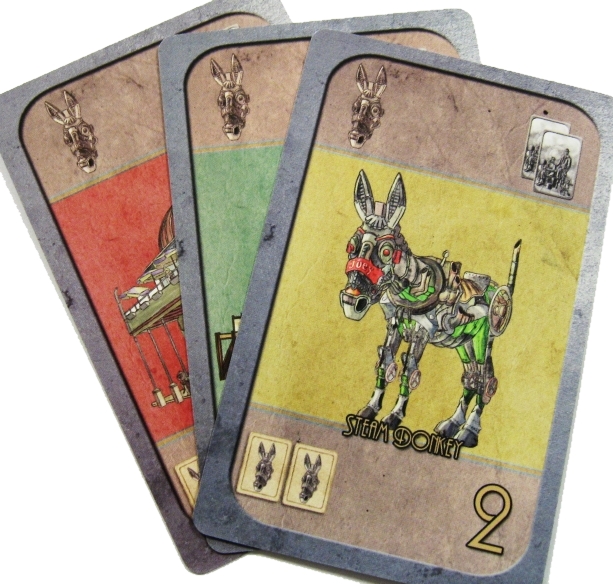
Continuing the theme from last time, food was a priority, so we didn’t get started until well after eight o’clock.  We split into two groups, the first playing Steam Donkey again as it turned out that we had played it wrong two weeks ago. This card game involves building a seaside resort consisting of a four by three grid of attraction cards.  The idea is that players build the attractions from their cards in their hand, then take passengers from the station who visit their attractions, which they then take from their tableaux to become cards in their hand.  The more popular attractions get more passengers, thus yielding more cards.  Unfortunately, it turns out that on their turn, each player can do only one of these three actions instead of all of them!  It was still a tight game though, with Burgundy and Magenta drawing for first place on fifty-two points.  As, Magenta commented though, “Playing it right is better…”

Steam Donkey
– Image by boardGOATS

Meanwhile, Grey, Green, Cerise and Blue tried an older game, Gheos, which is new to the group.  When Cerise and Grey introduced it, Blue (who had played it a very long time ago) commented that all she could remember was that it was a bit like Carcassonne, but the tiles were triangular and it was a lot nastier.  In this game, players have three tiles in their hand and on their turn place one extending the play area, or replacing one of the existing tiles.  The tiles form land rivers which make islands (land comprising two small sections of land surrounded by water) and continents (larger areas of contiguous land).  Unlike Carcassonne, all the edges are the same so every tile can go anywhere, but some places are better than others of course.

Gheos
– Image by BGG contributor Gonzaga

When a player places a tile, if the continent has not already been settled, they can choose to place a settlement receiving followers equal to the total number of wheat sheaves shown on that continent.  If a player doesn’t start a new settlement, placing a tile allows the active player to recruit a single follower of their own choice.  Followers are important because they dictate how many points players get during scoring.  Everyone scores points when epoch tiles are drawn and each player has three cups tokens which they can play at the end of their turn triggering allowing them to score alone.  Epoch scoring gives players points equal to the number of pyramids on a continent multiplied by the number of followers they have for the tribe settled on that continent.  Cups tokens work in a similar way with points awarded for every follower multiplied by the number of cups on the continent, but only the active player gets to score these.

Gheos
– Image by BGG contributor Outside Lime

Since tiles can be replaced, rivers can be moved creating islands, and merging continents, creating war, causing migration and even leading to extinction (since islands are to small to sustain a tribe and continents can only support one tribe).  This is what makes the game nasty since a players’ followers are immediately lost.  The complexity of the rules associated with migration and war coupled with the different triggers for scoring meant that it took Blue and Green a while to get their heads round it.  Despite Cerise’s protestations, she showed them the way to score taking an early lead.  Grey’s experience showed in the latter stages, however, giving him the first place, eight points ahead of Blue in second.

Gheos
– Image used with permission of BGG contributor KSensei

Green had been desperate to play his new game, Fresco, so had agreed to play Gheos with Grey on the condition that he would play Fresco next.  This is a game where players are master painters working to restore a fresco in a Renaissance church.  Each round begins with players deciding what time they would like to wake up for the day. The earlier they wake up, the earlier they are in turn order, and the better options they get.  However, if they waking up early too often, the apprentices become unhappy and stop working as efficiently. Players then decide their actions for the turn, deploying their apprentice work force to the various tasks:  buying paint, mixing paint, working on the fresco, raising money to buy paint by painting portraits, and even going to to the opera to increase the apprentices’ happiness and inspire them. Points are scored mostly by painting the fresco, which requires specific combinations of paints.  For this reason, players must purchase and mix their paints carefully and beat the other players to the store to buy the pigments and fresco segments they would like to paint.

Fresco
– Image used with permission of BGG contributor Toynan

As a new game, that claimed to take an hour, it was clear it was not going to be quick, so Blue decided to help things along by reducing the number of players and joined the other group to play something shorter before Magenta had to leave.  Although Fresco  was not difficult to explain the other group had nearly finished their first game before play actually started.  With only three market stalls in the three player game and a possible three actions in each section for each player, the game very quickly fell into a routine where the earliest player went to the market to buy paint, with each assistant closing the stall afterwards. This left the other two players painting portraits for money and visiting the theatre to enhance their mood. This rotated around as the paint buying player completed retouching the fresco for tile points and thus pushing into the lead on the score track and moving down the order to choose when to get up.  This did not feel right and the consensus was that maybe the three player game was broken and it needed a fourth player to work. Nevertheless, in a game that nobody had played before, Cerise made it her own, winning by nearly twenty points.

Fresco
– Image used with permission of BGG contributor Toynan

Meanwhile, the other group were playing another new title, confusingly called The Game, which is a cooperative card game nominated for Spiel des Jahres this year.  In this game, players have a hand of five cards from a deck containing cards numbered two to ninety-nine and there are four piles: two starting at 100 and decreasing, two starting at one and increasing.  On their turn, players must play at least two cards and can play more as long as they obey the basic rules.  The cards can be played on any pile so long as it is lower in number than the top card of a decreasing pile or higher than the top card on the increasing pile.  Alternatively, if the card is exactly ten more or less than the the top card on the pile, the “backwards rule” can be invoked and the pile can be pushed back.  The aim of the game is to place all cards on the four piles and it is much more difficult than it seems.  The Game is often compared with Hanabi because it is a cooperative card game, however, the game play and the atmosphere it is played in are very different. In Hanabi, the best games are played in near silence where everyone is trying desperately not to give away any unintended information.  In The Game, players can say anything they like, so long as they don’t give away any specific number information.  This makes it much more chatty, though it took us a while to work out what was useful information and we only got about halfway through the deck before Magenta was unable to play a card.  Clearly one to try again to see if we can do better.

The Game
– Image used with permission of BGG contributor henk.rolleman

Fresco had only just started, so down to four players, Black Fleet came out for another outing.  This is a beautiful over-produced game that we played a few weeks ago, where each player has a merchant ship which they use to collect goods from one port and take to another port earning money.  However, each player also has a pirate ship which they can use to take goods from the merchants.  This also earns players money, but they must beware of the navy vessels which every player can manipulate to sink pirates and use to try to protect their merchants.   On their turn, the active player plays one card which moves both of their ships and one of the navy ships, during which, each ship may perform one action.  The idea of the game is that players can also play fortune cards which modify their actions and also use their money to buy  advancement cards which change the rules of the game, sometimes dramatically.

Black Fleet
– Image used with permission of BGG contributor The_Blue_Meeple

This time, Black got his nose in front buying the first advancement card, but it wasn’t long before Blue and Burgundy caught up.  While Purple was struggling to get anything and kept falling victim to everyone else, Blue moved into the lead with her very effective use of her False Colours and Secret Plans advancement combo (which together allowed her to swap her pirate with one of the navy ships and then earn four doubloons for attacking a merchant).  Burgundy pushed hard with his Delivery Bonus and judicious use of the Pirate Hideout (which allowed him to move his pirate more unpredictably), but could not get enough money to buy his last card leaving Blue to win.  Despite being the first to buy advancement cards, Black finished last as his cards felt relatively under-powered.  So maybe next time, now we all know how to play, we’ll try drafting the cards at the start.  That way there is less chance of one player getting more than their share of the best cards,

Black Fleet
– Image by BGG contributor lacxox

Fresco had finished first, and Green moved over to watch the last moves of Black Fleet, commenting sadly on how the game was broken with three players, which elicited the automatic response of, “Have you checked the rules?”  Whenever anyone online says a game is “broken” that is always the response and it often turns out that they weren’t playing right.  So despite his protestations that they had played correctly, while the last ships were being sunk, Green double checked and found what was wrong. Each player may have three assistants visit the market stalls, but they all visit the same stall and buy one tile, rather than buy one tile from each stall. Thus there will always be a stall open for each player.  This made a lot more sense and will really open the game up for those difficult decisions of timing and tasks. The rules check also brought to light an error in the way the bishop moves:  he was supposed to jump to the retouched or claimed tile each time rather than just staying put.  Although that was a much more minor mistake it was enough to make the choosing of tiles less interesting.  Another game to play again, and correctly this time!

Fresco
– Image used with permission of BGG contributor Toynan

Learning Outcome:  Games are better when played according to the rules…

Spiel des Jahres Winners – 2015

The 2015 winner of the coveted German Game of the Year or Spiel des Jahres award is Colt Express which is a game about bandits robbing an amazing 3D train.  The game plays in two phases:  first everyone plays action cards cards onto a common pile and then the action cards are resolved in the order they were played. There were three games nominated for the Spiel des Jahres this year and we’ve played the other two, Machi Koro and The Game, so we’ll play Colt Express next week to see what all the fuss is about!

Colt Express
– Image used with permission of BGG contributor henk.rolleman

At the same time the Kennerspiel des Jahres was awarded, which honours more challenging games.  It was introduced in 2011 to replace the jury’s habit of intermittent special awards for games too complex for the Spiel des Jahres (notably Agricola which was awarded a special “Complex Game” prize in 2008).  The 2015 award went to Broom Service, which is a reimplementation of the 2008 Spiel des Jahres nominated game, Witch’s Brew.  It is a role selection game where players collect potions, then deliver them across the land to towers that advertise their desires with color-coded roofs.  This year we haven’t played this or either of the other nominees (Orléans and Elysium), but it probably won’t be long before we do.

Broom Service
– Image from asaboardgamer.com

Boardgames in the News: Confusion at The Telegraph!

Anyone who plays modern boardgames knows how our hobby has been growing and growing.  Games like Carcassonne and The Settlers of Catan are now available in Waterstones and WHSmith, there has been a series of regular comments in The Guardian, there are repeatedly TV appearances, and boardgame cafés are sprouting up all over the place.  It seems strange then that last week, Harry Wallop from The Telegraph announced that “Card games and board games are dying out and it’s no great loss”.

Snap
– Image by BGG contributor loopoocat

The basis of this report is a survey carried out by Barclaycard which apparently indicated that games like Old Maid, Happy Families and Snap are in danger of dying out.  Strangely, on the same day, Martin Chilton, the Telegraph online Culture Editor reported that 67 per cent of the children surveyed said that they would like to learn how to play traditional games.  The really annoying thing about all this is that they focus solely on “traditional games”:  Martin Chilton’s article is entitled “The five best board games” and lists them as Chess, Scrabble, Monopoly, Cluedo and Backgammon.

Scrabble
– Image used with permission of BGG contributor Susie_Cat

On closer inspection, however, Harry Wallop’s article does include a link to a more interesting list of fifteen party games, including Pandemic, Camel (C)Up and Biblios.  While their definition of “Party Games” clearly leaves a lot to be desired, it is clear that someone at The Telegraph at least has heard of modern games.  Perhaps the most reassuring aspect of this though, is the response to Martin Chilton’s article in the comments section which includes a nearly eighty passionate responses pointing out better, modern, “classic games” and where to find information about them.

Biblios
– Image by BGG contributor creatsia

Let’s hope Mr Chilton and Mr Wallop read the comments and write a better article soon!

Next Meeting – 30th June 2015

Our next meeting will be on Tuesday 30th June, at the Horse and Jockey pub in Stanford-in-the-Vale.  As usual, we will be playing shorter games from 7.30pm as people arrive, until 8pm when we will start something a little longer.

This week the “Feature Game” will be Batavia, which is a game about merchants visiting the trading posts of the five East India companies all over Asia.

Batavia
– Image by BGG contributor LanaDove

And speaking of traders…

A successful trader parked his brand new Porsche in front of the office ready to show it off to his colleagues.  As he prepared to get out a juggernaut went past, too close and completely tore off the driver’s side.  The trader immediately grabbed his mobile and dialled 999.  It wasn’t more than 5 minutes before a policeman pulled up, but before the policeman had a chance to ask any questions, the trader started screaming how his car, which he just picked up that day, was completely ruined and would never be the same again. After the trader finally finished his rant, the policeman shook his head in disbelief.

“I can’t believe how materialistic you traders are,” he said.  “You’re so focused on your possessions you don’t notice anything else.”

“How can you say that?” asked the trader.

The policeman replied, “Didn’t you realise that your arm is missing from your elbow down? It was looks like it was torn off when the truck hit you.”

The trader looked down in absolute horror.  “$%#*@!” he screamed, “Where’s my Rolex?!?!?!”