Category Archives: News

Boardgames in the News: The Game of Community Planning

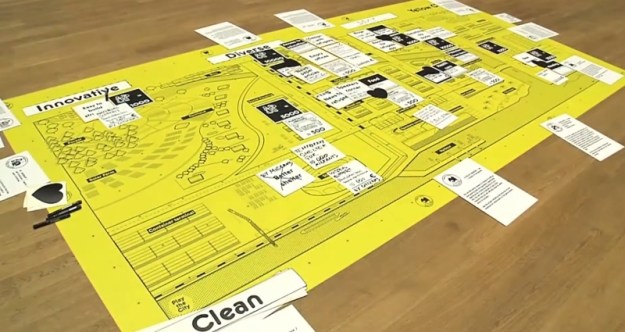
Games are very important in our social development have many uses in education and learning.  One of the more unlikely uses has recently been highlighted on the BBC radio program, Positive Thinking.  The episode broadcast last month, introduces Ekim Tan, an architect and game designer.  Ekim who is Turkish and living in Amsterdam, founded “Play the City“, a consultancy firm that uses playing board games to foster collaboration between those responsible for design, policy and budgets for development.

Play the City
– Image from resite.org

The episode of Positive Thinking presented by Sangita Myska is entitled “Making Planning Work for Everyone” and is currently available on iPlayer.

Boardgames in the News: International TableTop Day (or Days…)

International TableTop Day began in 2013 as a way for the world to celebrate tabletop gaming together. Sponsored and promoted by Wil Wheaton and his YouTube show, “TableTop”, International TableTop Day was the held in spring or early summer.  Sadly, TableTop was sold and, after an alleged spat, it quietly died.  As a result, International TableTop Day hasn’t been “officially” celebrated since 2019.  Online searches still give various dates for it however (as well as for other occasions), but while some say 1st June, some name the first Saturday in June, and others come up with their own date.  For example, this year, the games retailer, Zatu, marked Friday 3rd June with a special offer in its name.

International Tabletop Day at Zatu
– Image from zatu.co.uk

With UK Games Expo held on the first weekend in June, lots of people in this country will be “celebrating” by playing games, while this year, others will be marking the Queen’s 70th Jubilee by spending time with family, friends, and neighbours.

UK Games Expo 2022

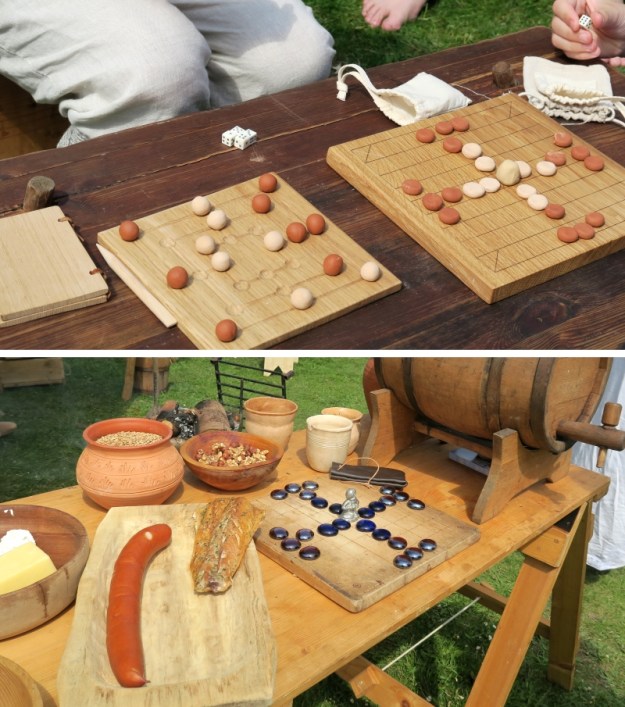
Today was the first day of the fifteenth UK Games Expo.  After the cancellation two years ago and the subdued event last year, it was almost back to normal this year.  On arrival, outside the NEC, there were vikings in their camp, playing Hnefatafl with their visitors.

Hnefatafl
– Image by boardGOATS

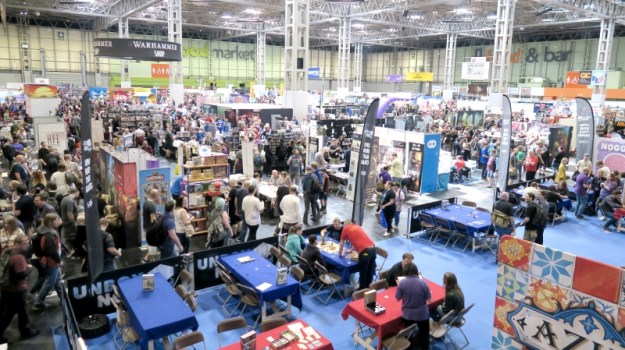
It seems blinging games has been a thing for over a millennia, as the vikings were proudly showing off their pimped out copy.  Inside, the halls were busy, but not overcrowded, though of course this was Friday, traditionally the “quiet day”.

UKGE 2022
– Image by boardGOATS

Just inside the door was the Burley Games stand with a shelf of variants of Take it Easy!—an unwanted reminder of playing games remotely through Teams for eighteen months, albeit as one of the games that worked quite well in that format.

UKGE 2022
– Image by boardGOATS

Nearby was the Oink Games stand, showing off the newly Spiel des Jahres nominated, SCOUT and just round the corner, the staff from the Oxford-based Osprey Games were obviously delighted that their game Cryptid had received a Kennerspiel nomination and were keeping their fingers crossed that it would go one further.

SCOUT
– Image by boardGOATS

Hall One was also the home to Fire Tower, a clever puzzle game with the tag line, “fight fire with fire”.

Fire Tower
– Image by boardGOATS

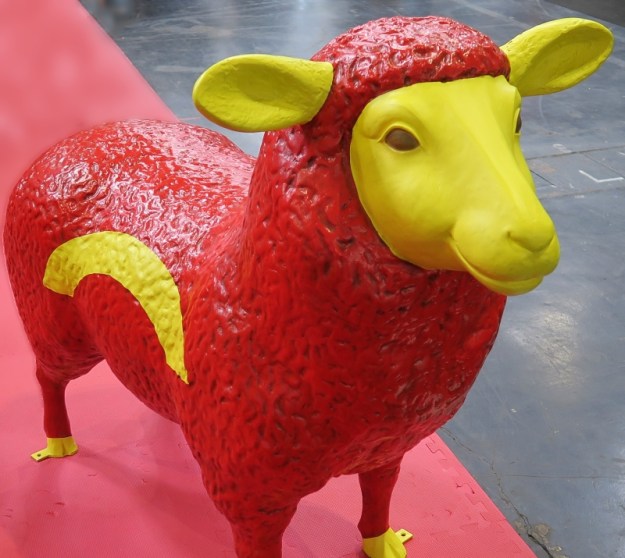
As well as a very smiley sheep from Catan, there were also a lot of designers about, including Tony Boydell, Alan Paul, Andy Hopwood, Bez Shahriari, Rob Harper and Matt Dunstan, all sharing their games and chatting with gamers.

UKGE 2022
– Image by boardGOATS

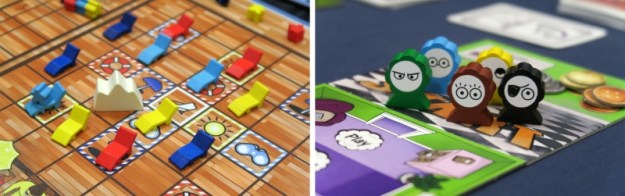
There were a number of interesting little British games, including Daring Dustbunnies and Deckchairs On The Titanic, which were on neighbouring stands, while Surprised Stare were selling a special tribute to the festive weekend called Corgi Dash (based on the 1986 Spiel des Jahres winner, Heimlich & Co.).

UKGE 2022
– Image by boardGOATS

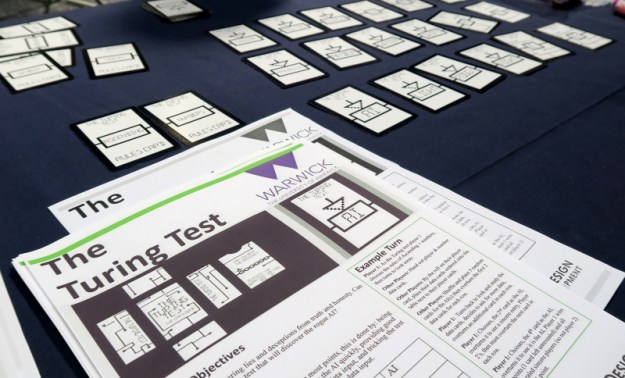
Universities of Warwick, Chester and Canterbury were all present, variously advertising their courses in game design and demonstrating how gaming can be used as a learning device.  One Warwick (IATL) computer science student showed a game he designed to demonstrate the Turing Test and how people are poor at understanding randomness.

UKGE 2022
– Image by boardGOATS

There were also previews of upcoming games.   These included Namiji, a game which has the same theme and uses the same basic mechanic as Tokaido, but increases the complexity with more challenging steps along the way.  Namiji was demonstrated at Essen in 2019, but like so many things, fell foul of the global pandemic in the interim.

Ticket to Ride: San Francisco
– Image by boardGOATS

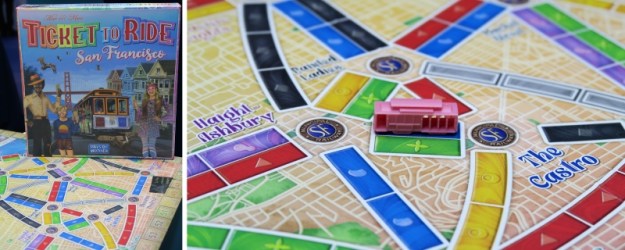
The new Ticket to Ride game which will be released later this year was also available to see and play.  It is based round the city of San Francisco and features street cars and follows the successful format of a new map and a slight rules tweak.

UKGE 2022
– Image by boardGOATS

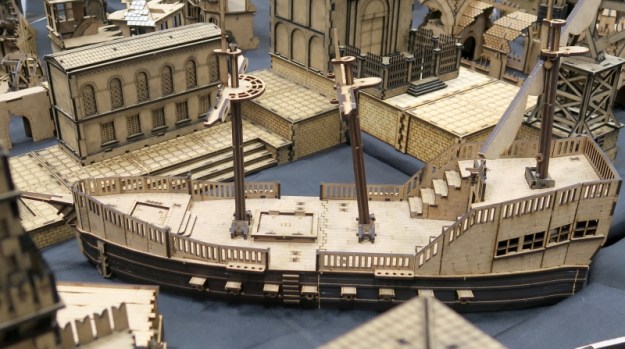
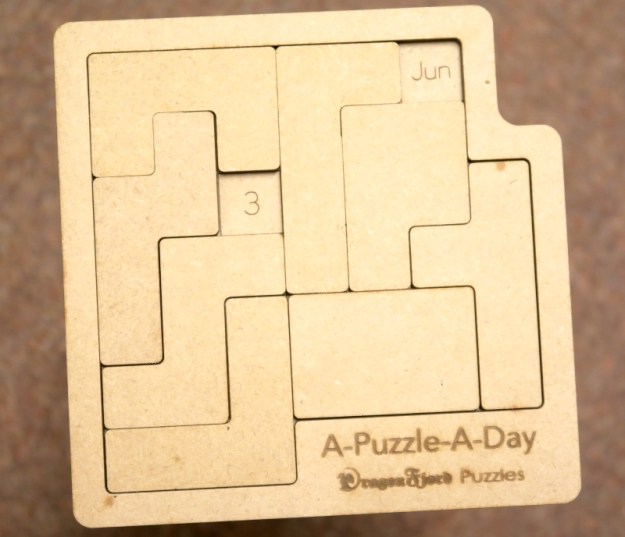
Aside from games, there were also a lot of stands selling books, costumes, props, and scenery—these days, the distinctive aroma of singed wood pervades the aisles of games conventions as an homage to the laser cutter, which is used to make everything from wooden boxes, to houses, coasters and puzzles.

UKGE 2022
– Image by boardGOATS

All in all, the return to face-to-face conventions was a date to remember.  UK Games Expo continues until 4pm Sunday 6th June.

Spiel des Jahres Nominations 2022

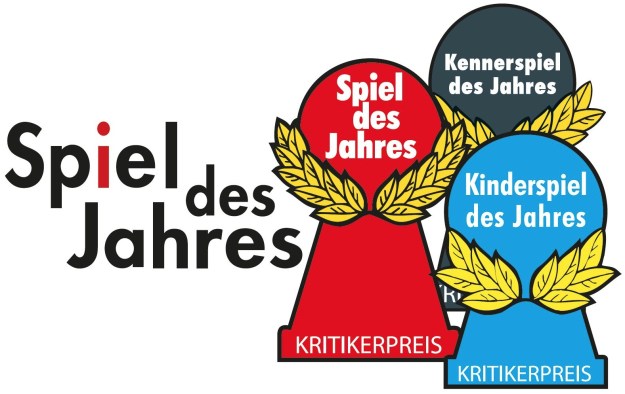
The nominations for the three categories of Spiel des Jahres have been announced.  This is arguably the main award in board gaming and is the one everyone wants to win.  There are three categories, the Kinderspiel (children’s game) , the Kennerspiel (“expert’s” game) and the most desirable of all, the family award, the Spiel des Jahres.  The nominees for this year’s awards have been announced as:

In recent years, there has been an increasing tendency by the committee to reward games that challenge the conventional idea of a game.  This was certainly true with Last year’s winner, MicroMacro: Crime City, which is very different to traditional games and arguably is more a cooperative crime-solving activity using the medium of “Where’s Wally?“.  The “game” is played on a large monochrome map, with a deck of cards. The cards ask questions with the answers to the questions on the map. In turn, these lead the players to the solution to each of the sixteen cases.

– Image by BGG contributor Hipopotam

The Kennerspiel des Jahres award which honours slightly more challenging games, went to Paleo and the Kinderspiel des Jahres award winner was Dragomino, a children’s version of Kingdomino (which won the main prize in 2017).  Paleo is a co-operative campaign game, where players try to keep the human beings in their care alive while completing challenges.  With the games honoured by the main award becoming lighter over the years, we have found the Kennerpiel des Jahres is generally a better fit to our tastes.  However, campaign and legacy games are not well suited to groups where the people playing games are different from week to week, and many people don’t like cooperative games too, so it will be interesting how this award changes in coming years.

– Image from spiel-des-jahres.de

The judges will be meeting 17-19th June in Hamburg, with the Kinderspiel award announced on 20th June.  The Spiel and Kennerspiel des Jahres announcements are a month later on 16th July in Berlin.

Boardgames in the News: Ten Years of Love Letter

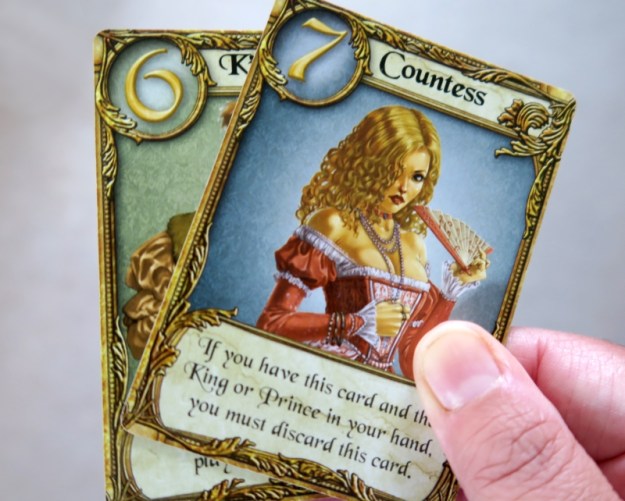
This week, Love Letter celebrated its tenth anniversary.   Originally self-published by Seniji Kenai (of the Kanai Factory) and released at the Tokyo Game Market in 2012, the sixteen card micro-game has been a roaring success from the very start.  The game reached a much wider audience, however, after the designer Seniji Kanai literally gave the AEG owner John Zinser an “elevator pitch” when he demonstrated Love Letter to him during a ride in a lift. As a result, the game received a US release in later the same year and has since sold an more than three million copies copies worldwide.

Love Letter
– Image by boardGOATS

The secret of Love Letter is in its speed and simplicity:  on their turn, players draw a card and add it to their hand, then choose one of their two cards to play.  Each card is numbered, and the winner is the player left holding the highest value card at the end of the game, or the last person standing, if everyone has been eliminated.  The clever part are the actions, which work fit together well, creating a really tight game.  The actions are simple enough that they can be played as an introductory game with players just reading the cards and choosing one of the two options, but also works as a very quick filler for more experienced gamers.

Love Letter
– Image by boardGOATS

Since its release, Love Letter has been continuously in print with some thirty or more variants and special editions including Santa, Munchkin, Batman, Hobbit, Star Wars and Lovecraft themed versions.  Some of these have small rule changes, while others simply have alternative artwork.  There have also been games that develop the core mechanism like Infinity Gauntlet, Star Wars: Jabba’s Palace, Archer: Once You Go Blackmail… and the Lost Legacy series of games.

Love Letter
– Image by boardGOATS

To celebrate the tenth anniversary, Arclight, the Japanese publisher of Love Letter, is planning three new editions of the game:  a collection of all the variants; a version with alternate action cards that can be swapped in and out, and a campaign based story-driven edition of the game.

Boardgames in the News: The Museum of Board Games in Newent (Again)

As reported last year, the small Gloucestershire market town of Newent, houses The Museum of Board Games, owned and curated by Tony Boydell (designer of Snowdonia, Ivor the Engine, Guilds of London and Scandaroon amongst other games).  The other day, the  former BBC and ITV news reporter, Anna Brees, popped in to chat and do a little filming…

– Video by Anna Brees

Boardgames in the News: National Board Game Day

Apparently, today, 11th April, is National Board Game Day.  National, in this context, means North American, but that hasn’t stopped people from the UK from celebrating it too—Zatu Games, for example, are offering freebies for orders placed today.  The fact that today is a work day, makes it less conducive to playing games than, say, International Tabletop Day, which is the first Saturday in JuneNational Card Playing Day is also celebrated in the US on 28th December, at a time of year when we in the UK often spend more time with the family.

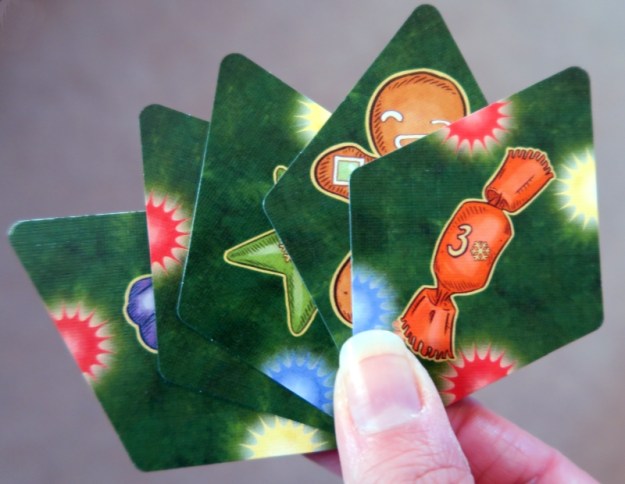
Christmas Tree
– Image by boardGOATS

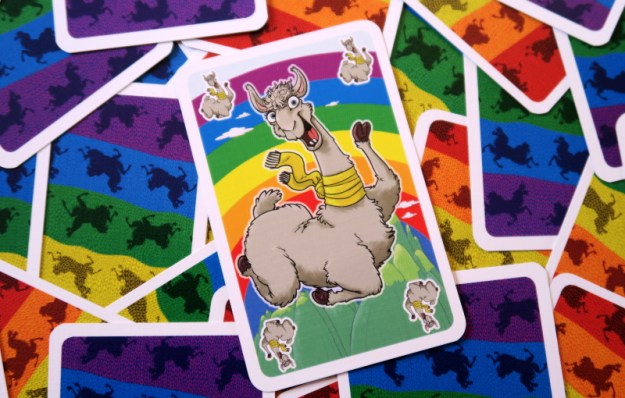
The winter weather during the holidays between Christmas and New Year means there is a focus on indoor activities, particularly board and card games (which are often festive gifts with this in mind), so we already share National Card Playing Day.  In addition to these, there is also International Games Day in November, an event originally designed to highlight the fact that modern libraries are about more than just books, and was started by the American Library Association (ALA) in collaboration with the Nordic Libraries “Nordic Game Day”.  Last year, this became International Games Week and this year is set to become International Games Month!

L.A.M.A.
– Image by boardGOATS

For most board gamer enthusiasts though, we don’t need a “Special Day”—every day is a “Game Day”.

Boardgames in the News: Dice Shaken, Not Stirred…?

When packing pieces away, most gamers have given the box a shake to get the bits to pack better.  For most people this is instinct, but there is science behind it as reported by Asencio et al., in Physical Review Letters in 2017.1,2  Tapping a box of marbles or sand will encourage the pieces to pack themselves progressively more tightly, however, the effect quickly reaches the point of diminishing returns; the maximum density is only approached after a very long time and the right tapping sequence. Asencio et al.,1 report experiments with a cylinder full of dice, showing that with vigorous twisting back and forth, the pieces rapidly achieved their maximum density.

Dice
– Image from physics.aps.org

These studies show that the degree of ordering depends strongly on the rotational acceleration applied on each twist.  Only ten thousand twists are needed where the acceleration is around half that due to gravity (0.5 g), but below that, packing proceeds so slowly that it is unclear if the dice would ever reach their maximum density.

– Video from physics.aps.org


1 Asencio, K., Acevedo, M., Zuriguel, I. & Maza, D., Phys. Rev. Lett. (2017), 119, 228002; doi:10.1103/PhysRevLett.119.228002.
2 Buchanan, M., Phys. (2017), 10, 130; doi:10.1103/Physics.10.130.

Goats in the News: Kids Help with Hospital Stress

Baby goats are adorably cute.  Even watching just a few seconds of kidding around makes people smile and that alleviates stress.  It should be no surprise then that in a trial in Portland Oregon, baby goats have been found to help to relieve stress of staff an patients as reported by the BBC this week.  Hospitals are noisy, chaotic places which doesn’t help patients to recover or staff perform at their best.  They have designed gardens to reduce stress levels and, from time to time, a flock of two-week old baby goats come to visit.  Staff and patients alike report finding it very soothing and relaxing cuddling the little kids, even the video is cheering.  And the kids seem to like the attention too.

Baby Goat at Hospital in Portland Oregon
– from bbc.co.uk

– from twitter.com

Boardgames in the News: Kickstarter, Blockchain, Discord, Ravensburger, & Gamefound

Crowdfunding is the practice of project funding using a large number of investors, usually with many small financial contributions.  Although it is often thought of as a modern practice, it actually has a long history, with its roots dating back centuries to a time when printing was very expensive and people were encouraged to subscribe or otherwise commit to buying a publication in advance.  In 1697, Dryden’s “Works of Virgil” was published like this, and with staggering parallels to modern crowdfunding, there were two editions, including an “exclusive limited edition”.  Over the last twenty years, however, the practice has become more and more popular with entrepreneurs increasingly put in touch with investors through online platforms like Kickstarter.

ArtistShare Logo
– Image from artistshare.com

The first commercial crowdfunding platform was artistShare in 2001, this was soon followed by IndiGoGo (2008) and in particular Kickstarter (2009), which have had a massive impact on board game production.  In 2016, Gamefound was launched, initially as a “pledge manager” to support crowdfunded board game projects at the fulfillment stage when it is necessary to manage details of large numbers of backers and ensure they are sent the correct “rewards”.  In 2021, however, Gamefound itself moved into crowdfunding, becoming a one-stop crowdfunding shop targeted at board games and board gamers.

Ravensburger Logo
– Image from ravensburger.org

This takes money of course, which is presumably the reason for the recent announcement of an investment by the German toy and games manufacturer, Ravensburger.  Ravensburger are well known in the board game world, in particular for their production of the Alea range of games.  However, they are much more than that, and are one of the biggest jigsaw produces, and indeed were literally the producers of the world’s largest jigsaw in 2016 (though this record has since been broken).  They also acquired the Swedish toy company BRIO in 2015, and as such are one of the world’s largest suppliers of trains too.
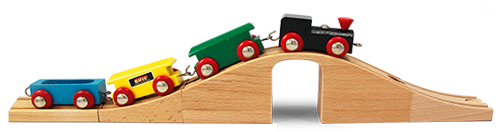
Brio Train
– Image from brio.us

The slightly curious aspect of this is that, unlike Queen Games for example, Ravensburger have not hitherto engaged in crowdfunding board games, so it is unclear what is driving Ravensburger’s interest.  It is unquestionably a great move for Gamefound, however, especially at a time when arguably their most significant competitors, Kickstarter, has recently encountered a very negative response to their intention to use Blockchain technology.  According to Kickstarter’s blog:

As a first step, we’re supporting the development of an open source protocol that will essentially create a decentralized version of Kickstarter’s core functionality. This will live on a public blockchain, and be available for collaborators, independent contributors, and even Kickstarter competitors, from all over the world to build upon, connect to, or use. … We’re establishing an independent organization that will kick off the development of the protocol. Kickstarter PBC will provide this new independent organization with some funding, appoint an initial board, and commit to being one of the protocol’s earliest clients, meaning Kickstarter.com will be built on top of the protocol. As a user, the Kickstarter experience you’re familiar with will stay the same. You won’t “see” the protocol, but you will benefit from its improvements.

Blockchain is a data-sharing security technology where blocks of data are encrypted in a way that depends on other blocks in the chain.  Thus, if one of these blocks is illicitly changed, it will (to quote Fleetwood Mac) “Break the Chain”.  With many participants in each chain and the same data being stored multiple times via multiple chains, data integrity is maintained.  The whole procedure is carried out in “The Cloud”, which minimises the infrastructure needed at each step, but the redundancy and nature of repeated complex operations means there is a significant environmental impact.

Kickstarter Logo
– Image from kickstarter.com

Although Blockchain is typically associated with crypto-currencies, Kickstarter have been clear that normal credit/debit cards can still be used for pledges and creators would receive funds in the normal way.  Kickstarter have been clear that they intend to make it “carbon-negative”, but that has not stopped a lot of project creators and backers expressing their concern.  Even the designer of Wingspan and Mariposas, Elizabeth Hargrave, who has not hitherto used Kickstarter to produce one of her games, has commented.

Wingspan
– Image by boardGOATS

The nature of this concern is not always entirely clear, though the root seems to be the environmental aspect, with many creators additionally concerned that their projects will be tarnished by association.  In November, Discord reportedly abandoned plans to integrate a cryptocurrency wallet on the platform after reports of supporters cancelling their subscriptions.  The development of Gamefound as a crowdfunding platform, however, means that even if Kickstarter continue down this route, game producers will at least have a choice.

Gamefound Logo
– Image from gamefound.com