Next Meeting, 30th March 2021 – Online!

Although the spring is definitely on its way, with the current stresses, people still need what social contact they can get, and board games are a great medium for that.  Despite the limitations of “remote gaming“, everyone feels it is important to stay in touch, so we are persisting with online meetings.  Therefore, our next meeting will be on Tuesday 30th March 2021; we will gather from around 7.30pm, and start playing at 8pm.

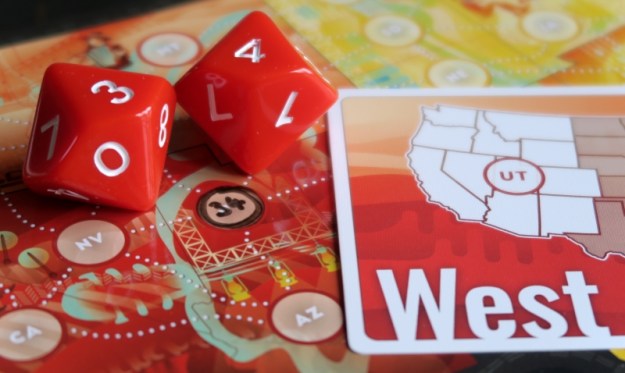
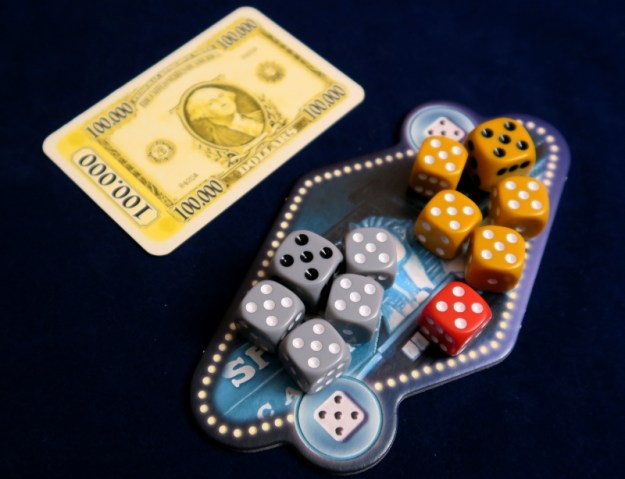
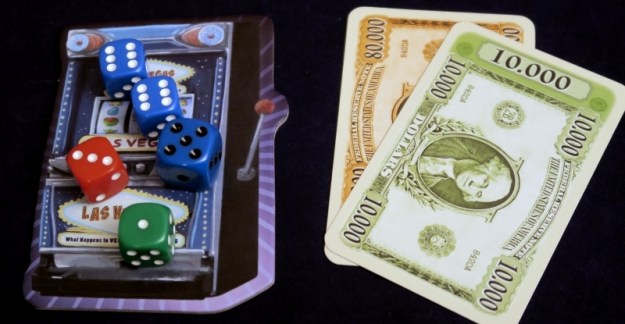
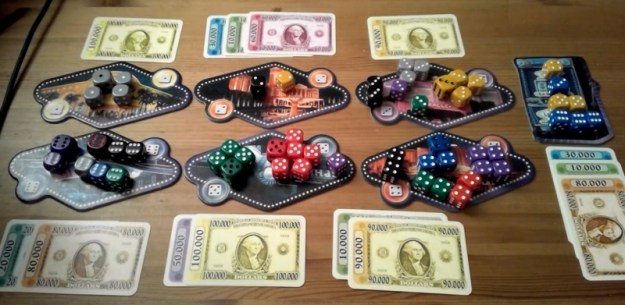
This week, the “Feature Game” will be Las Vegas, a dice chucking, betting and push your luck game that we love and played a lot before we were forced to move game nights online.  It was the first game we played online a year ago and we thought we’d play it again to mark a year of remote gaming.

Las Vegas
– Image by boardGOATS

And talking betting…

Every year, Jeff made a bet with a local farmer, as to which lamb will jump highest—He likes a gambol…

16th March 2021 (Online)

Purple, Black, Pine and Green chatted while Blue reminded herself of the rules for the first game.  Green showed everyone his new game, Fossilis, which comes with little plastic dinosaur bones, tweezers, and even a tiny plastic scorpion—one to play when we get back to the pub, along with the very newly released Red Rising, the Oceania Expansion for the really popular Wingspan, and a whole host of other games that we’ve been waiting over a year to play.

Fossilis
– Image by boardGOATS

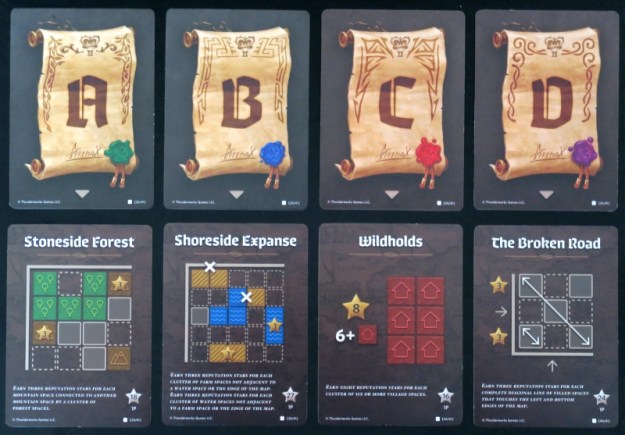
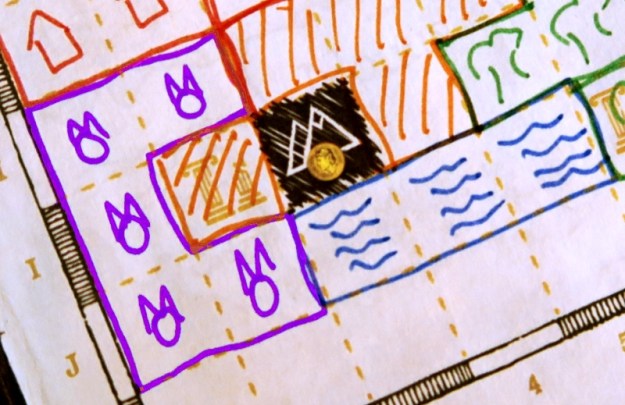
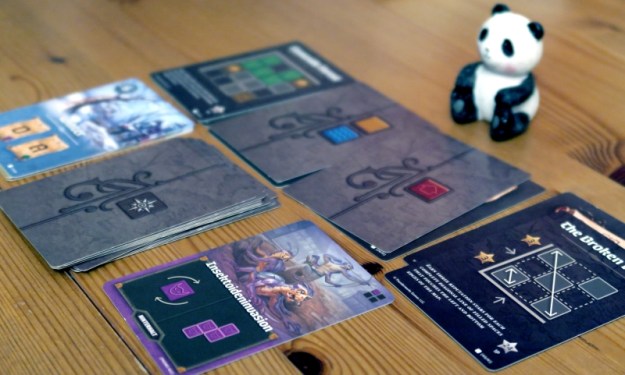
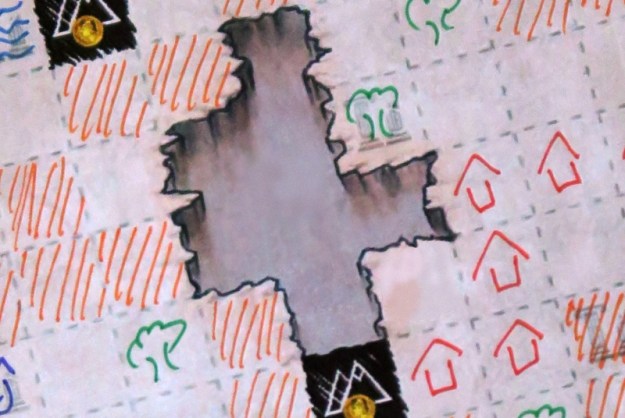
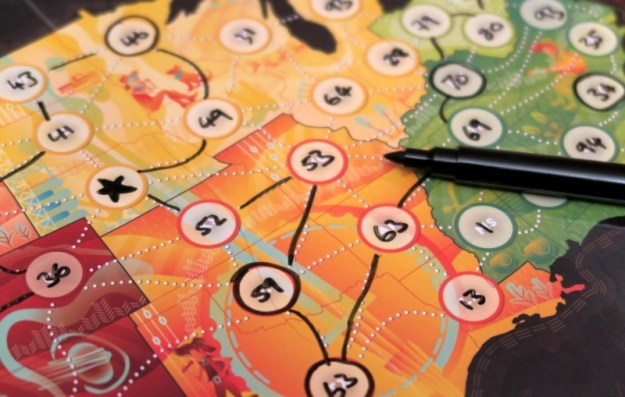
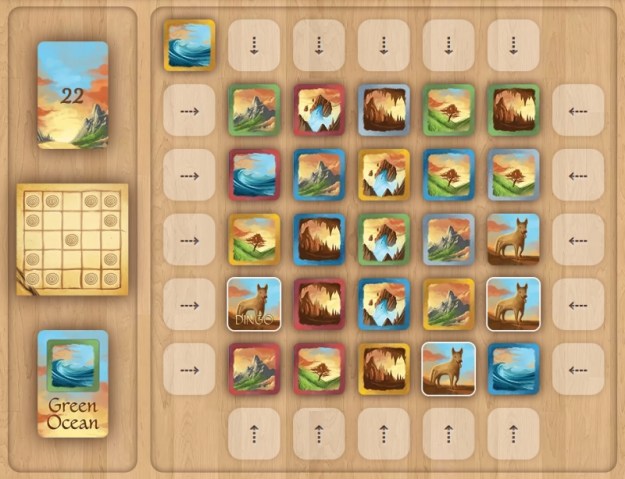
And sadly, with the realisation that it was a year and a day since a very small group met at The Jockey for the last (unofficial) games night there, we moved on to playing the “Feature Game“, Das Labyrinth des Pharao.  Das Labyrinth des Pharao is a tile laying game in a similar vein to Take it Easy! which we played a few weeks ago, or the Spiel des Jahres nominee, Karuba (which we last played about five years ago).  In Das Labyrinth des Pharao though, players are exploring a pyramid and collecting treasure.

Das Labyrinth des Pharao
– Image by boardGOATS

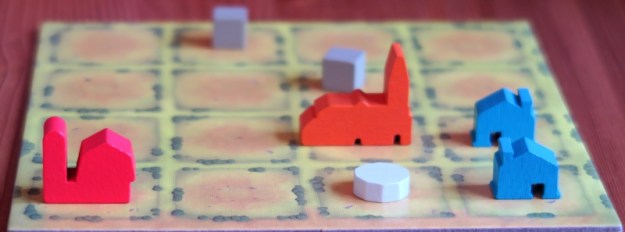
Although we’ve not played it on a Tuesday, some of the group have played it before at the Didcot Games Club (November 2015 and September 2016).  Like all the games that we’ve found that work well played online, Das Labyrinth des Pharao is quite simple to play, but it is a little bit “thinky” relying on planning and a little bit of luck.  Everyone had the tiles and board that were delivered a few weeks back, and they had found their Tiny Towns cubes and a meeple from one of the special Christmas crackers we’ve had at one of the unChristmas Parties during happier times.

Das Labyrinth des Pharao
– Image by boardGOATS

The first thing to do was lay out the tiles around the board, in number order—some appear more than once, so these are stacked.  Players then counted out five, four and three of their cubes as treasures.  Once everything was set up, Blue explained that Pink would turn over one of the beautifully decorated number cards (each part of a polyptych), and everyone had to place the corresponding tile on their board.

Das Labyrinth des Pharao
– Image by boardGOATS

They can place the tile anywhere on their board, in any orientation. Some of the tiles have scarabs depicted on them—players can place treasures on these, but must start with the lowest value treasures first.  So, only when all five one-point treasures had been used, could players move on to the four two-point treasures, and finally the three-point treasures (blue, green and red disks respectively, though we were playing with turquoise, yellow and red cubes).

Das Labyrinth des Pharao
– Image by boardGOATS

After the third round, players have to choose which of the six possible entrances they are going to start from and then progress their “explorer meeple” along the path as far as they can.  In the rules, players mark the path at intervals so everyone else can see how far the explorers have travelled, but given the added difficulties associated with playing remotely and the fact that players could count their own path at any time, we omitted this.

Das Labyrinth des Pharao
– Image by boardGOATS

The game ends after twenty-five of the twenty-eight cards have been revealed and then people add up their scores.  Firstly, they score one point for each quarter tile their tunnel extends along.  Next they score points for each treasure chamber their tunnel passes, that is a chamber that contains one treasure surrounded by walls on all four sides.  As usual, the player with the most points is the winner.

Das Labyrinth des Pharao
– Image by boardGOATS

The game was a bit of a tale of people missing cards and having to try to correct it, and for a change, it wasn’t just the usual suspects.  As the game progressed, it became clear that most people had tried to follow Blacks advice and tried to place as many of their treasure tokens as they could.  The problem with this is that they aren’t worth anything unless players have managed to enclose them in a chamber and ensure their route passes alongside.

Das Labyrinth des Pharao
– Image by boardGOATS

In fact, one of the biggest problems for some turned out to be connecting valuable parts of their tunnel to their chosen entrance to ensure their treasure hunter was able to explore the temple.  Pine and Pink seemed particularly afflicted, and as the game drew to a close, Burgundy and Pink in particular were getting increasingly desperate for tile number fourteen.  The final tile was number six, which did most of the job and with that, everyone had to work out their scores.

Das Labyrinth des Pharao
– Image by boardGOATS

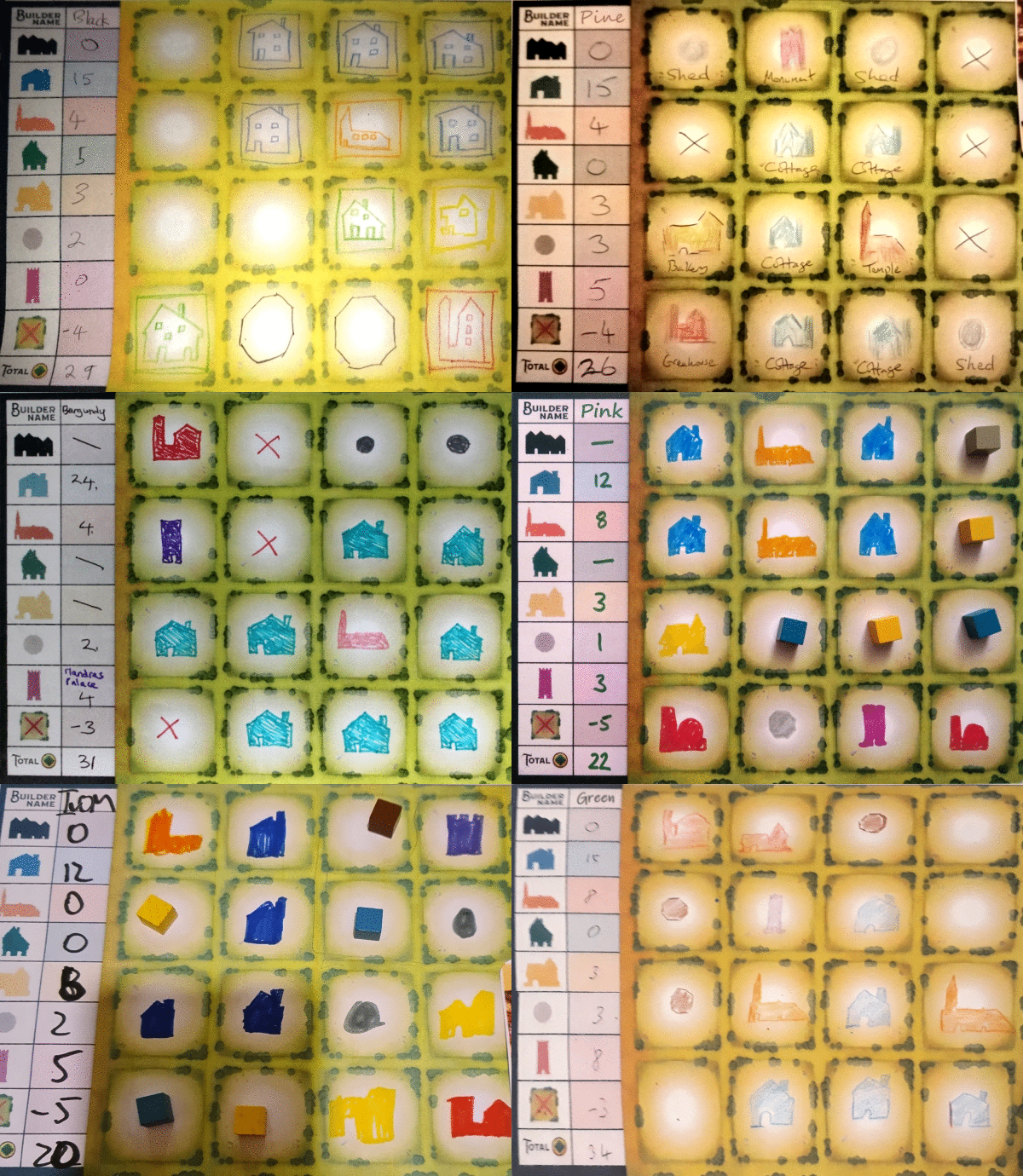
As usual, Ivory posted his score first, setting a competitive target of fifty, made up of thirty-one from his path and nineteen in treasure.  In general, the scores were quite close, with almost everyone scoring between forty and fifty.  The longest path was thirty-seven and the most treasure collected was nineteen.  In most cases, those that had a long path (like Blue and Burgundy) had few treasures, while those with a lot of treasure (like Pine and Green) had not explored as deep into the temple.  The exception was Pink, who managed to do well at both and finished with a total of fifty-four.

Das Labyrinth des Pharao
– Image by boardGOATS

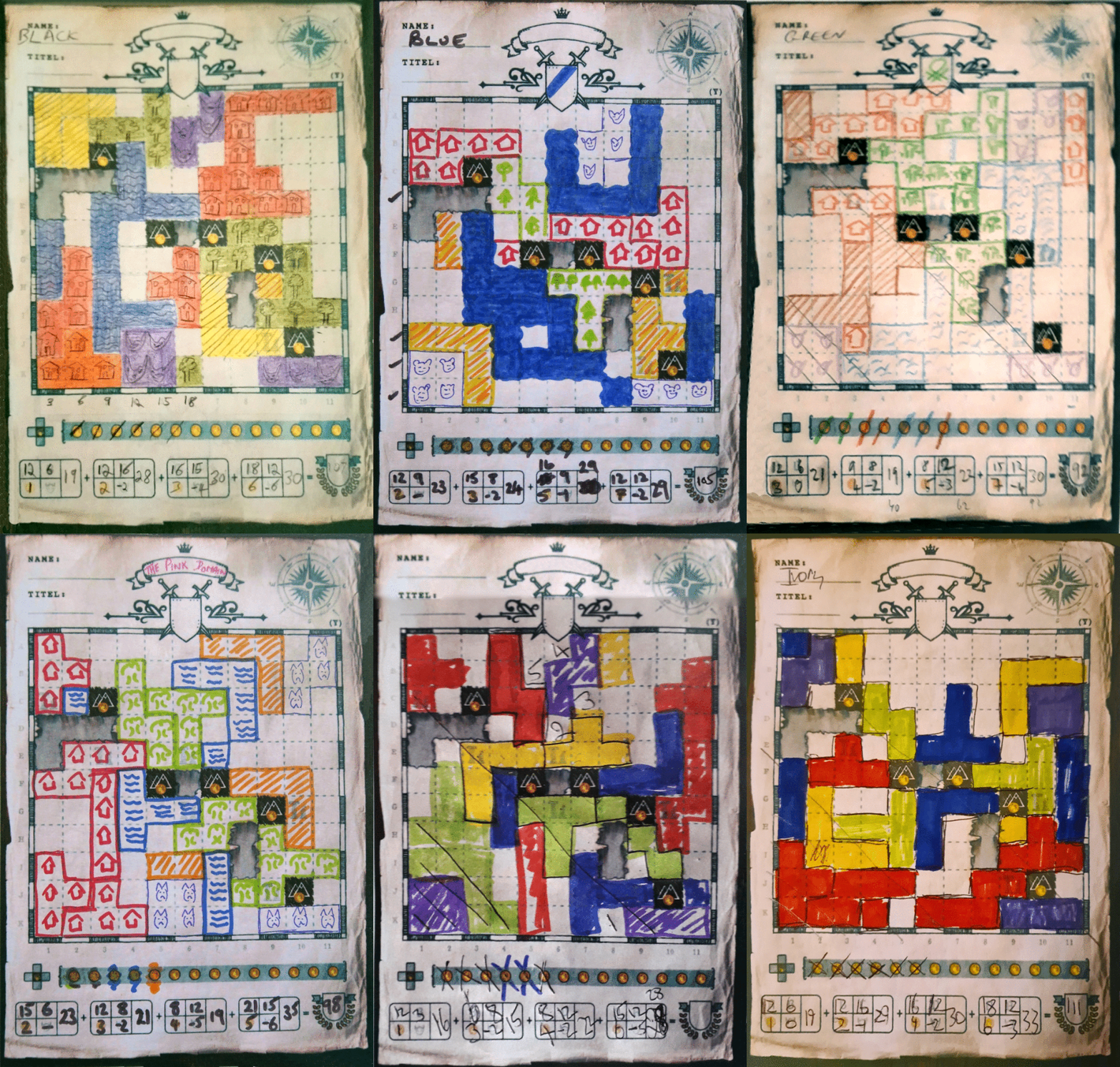
It had been a fairly short game, and as it was a while since we’d practised our colouring, we moved onto a quick game of “Roll and WriteTetris, in the form of Second Chance.  We’ve played this quite a bit since we first started playing online, but the last time was just before Christmas, so we decided to give it another go.

Second Chance
– Image by boardGOATS

The idea is that two shapes are revealed and players must draw them in their nine-by-nine grid.  The shapes come in different sizes and the game rewards efficiency in packing.  If a player is unable to play either shape, they get a second chance: one card all to themselves.  If they can play that, then they can carry on, but if they are unable to play that as well, then they are eliminated.

Second Chance
– Image by boardGOATS

Unusually, being eliminated is not necessarily a guarantee of failure in this game:  the winner is the player with the fewest unfilled spaces at the end, which is when the deck of cards runs out.  So, in this game, a player can be knocked out, but still win.  This time, there were a couple of people who threatened to need a second chance, but then suddenly in one round, nobody was able to place either shape and everyone needed a second chance.

Second Chance
– Image by boardGOATS

That round took out everyone but Green and Black, but as there were no cards left, it turned out to be the final round, and that was that.  The scores varied from eleven to two, with a tie between Lilac and Blue for first.  Pink suggested a vote based on the quality of the art-work, but nobody wanted to choose between them and a tie it remained.

Second Chance
– Image by boardGOATS

From there, Ivory and Lilac took an early night, while the rest of the group moved to Board Game Arena for a game of Saboteur.  This hidden traitor game is one we’ve played a lot online over the last year.  The idea is that players are either Good Dwarves or Evil Saboteurs, with the Dwarves trying to play cards to build a tunnel and find the treasure, while the Saboteurs try to stop them using blocking cards and by breaking the Dwarves’ tools.

Saboteur
– Image by boardGOATS

It is always extremely difficult for the Saboteurs to win, but we live in hope and everyone is always pleased to get the opportunity to try.  The first round it was Blue’s and Black’s turn to try.  With seven players, there can be two or three Saboteurs—with just two it was pretty much guaranteed to be gold for the Dwarves, and so it proved.  The Dwarves headed straight for the gold, and despite a desperate rear-guard action the round was quickly over.

Saboteur on Board Game Arena
– Image by boardGOATS from boardgamearena.com

The second round was much closer.  The evil Pine, Pink and Green made life extremely difficult for the Dwarves very effectively blocking their first route to the gold and forcing them to go all around the houses before they found the gold.  Early in the game, Pink caused chaos by disagreeing with Pine as to where the Gold was, and the ensuing confusion made it very close.  The Saboteurs had a lot of cards that worked in their favour, but they still couldn’t quite stop Purple from finding the gold in the end.  The third and final round was a different story though…

Saboteur on Board Game Arena
– Image by boardGOATS from
boardgamearena.com

Initially, the tunnels made good progress, but largely by chance, the tunnel headed towards the top card, when the treasure (it turned out) was at the bottom.  Things were made worse for the Dwarves when paranoia meant they turned on each other early.  There was more confusion about where the gold was and the Dwarves were in disarray.  Eventually, Pine revealed his colours, and then Black, and finally Burgundy.  For once, the cards went the Saboteurs’ way and they played them really well too.  Despite a desperate effort, there was nothing the Dwarves could do against such wickedness, and after a year of trying, the Saboteurs took their first victory.

Saboteur on Board Game Arena
– Image by boardGOATS from
boardgamearena.com

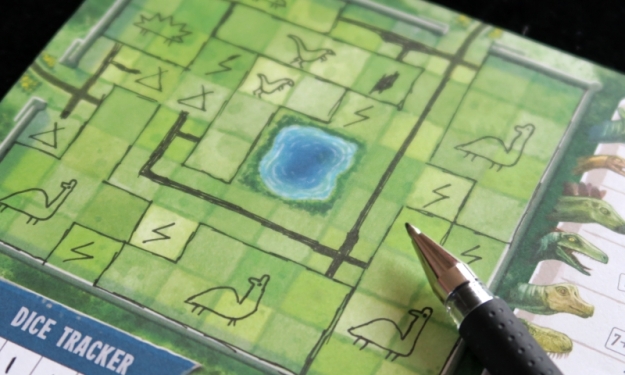
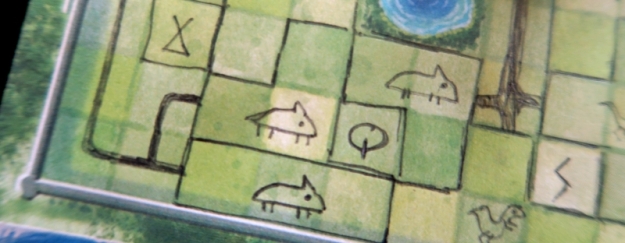
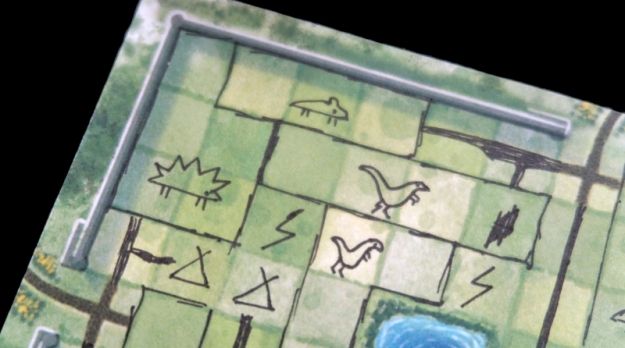
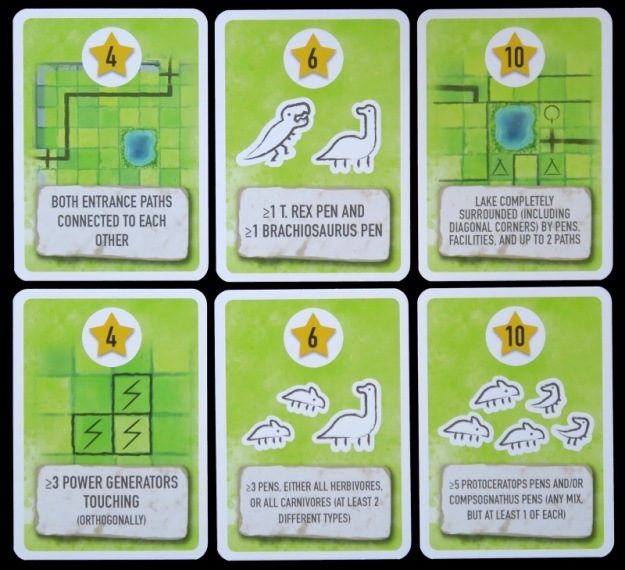
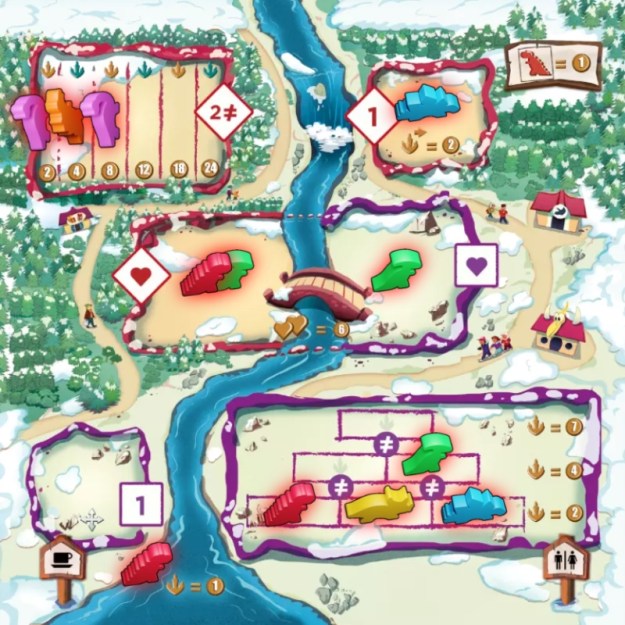
Time was marching on and we were looking for one last game to play, something perhaps a little different from the usual 6 Nimmt!.  After some discussion, Green and Black ducked out and everyone else played Draftosaurus—a game that Blue and Pink have very nearly picked up on several occasions, including Essen in 2019, just after it first came out and that Pine described as “Sushi Go! with dinosaurs”.  With that description, nobody could resist giving it a go.

– Image by BGG contributor kalchio

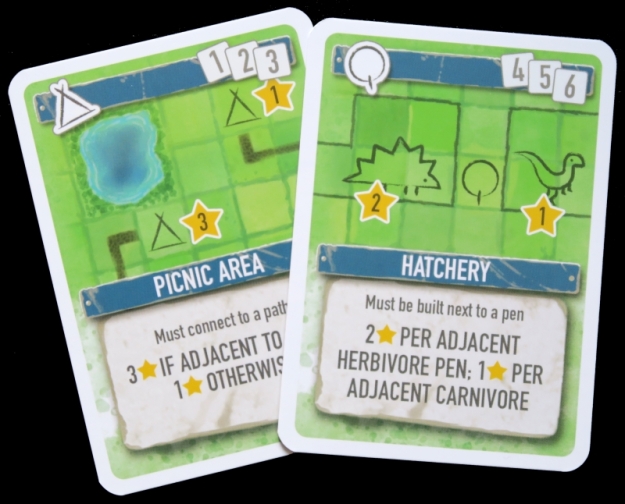
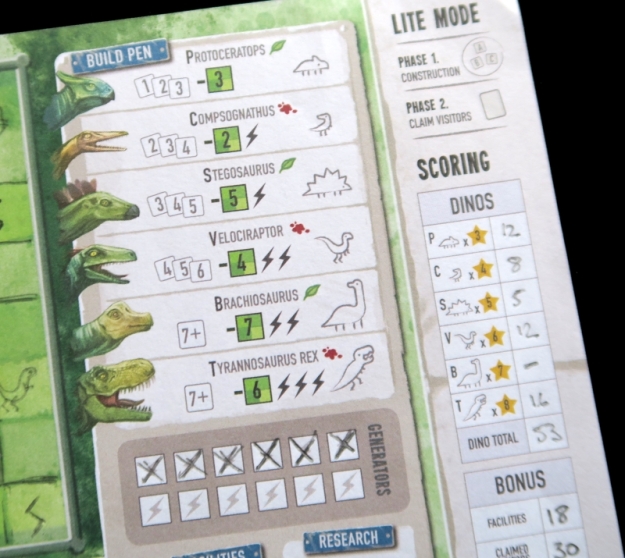
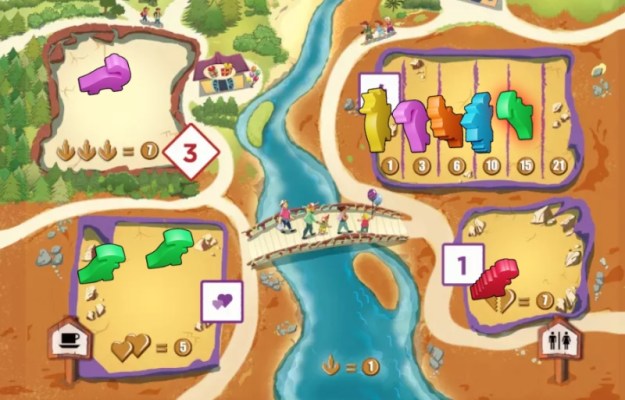
By this, Pine meant the main mechanism is drafting.  In Sushi Go! players have a hand of cards, then simultaneously, they choose one to keep and pass the rest on.  In Sushi Go!, players are collecting sets of cards, but in Draftosaurus players are drafting little wooden dinosaur meeples and placing them in their dinosaur park, on their personal player board.  The clever part, and what makes it different to Sushi Go!, is that the scoring is driven by the different park locations.

– Image by BGG contributor kalchio

Before each draft, a die is rolled that restricts where players can place their chosen dinosaur and the seven locations all score for different combinations of dinosaurs.  This means that players can want the same dinosaurs for different reasons, or different dinosaurs for the same reasons.  The game is played over two rounds, drafting six dinosaurs drawn at random from a bag, first clockwise and then anti-clockwise.  In the Board Game Arena rendering, this is all done electronically and the tactile nature is lost, however, the graphics are charming.
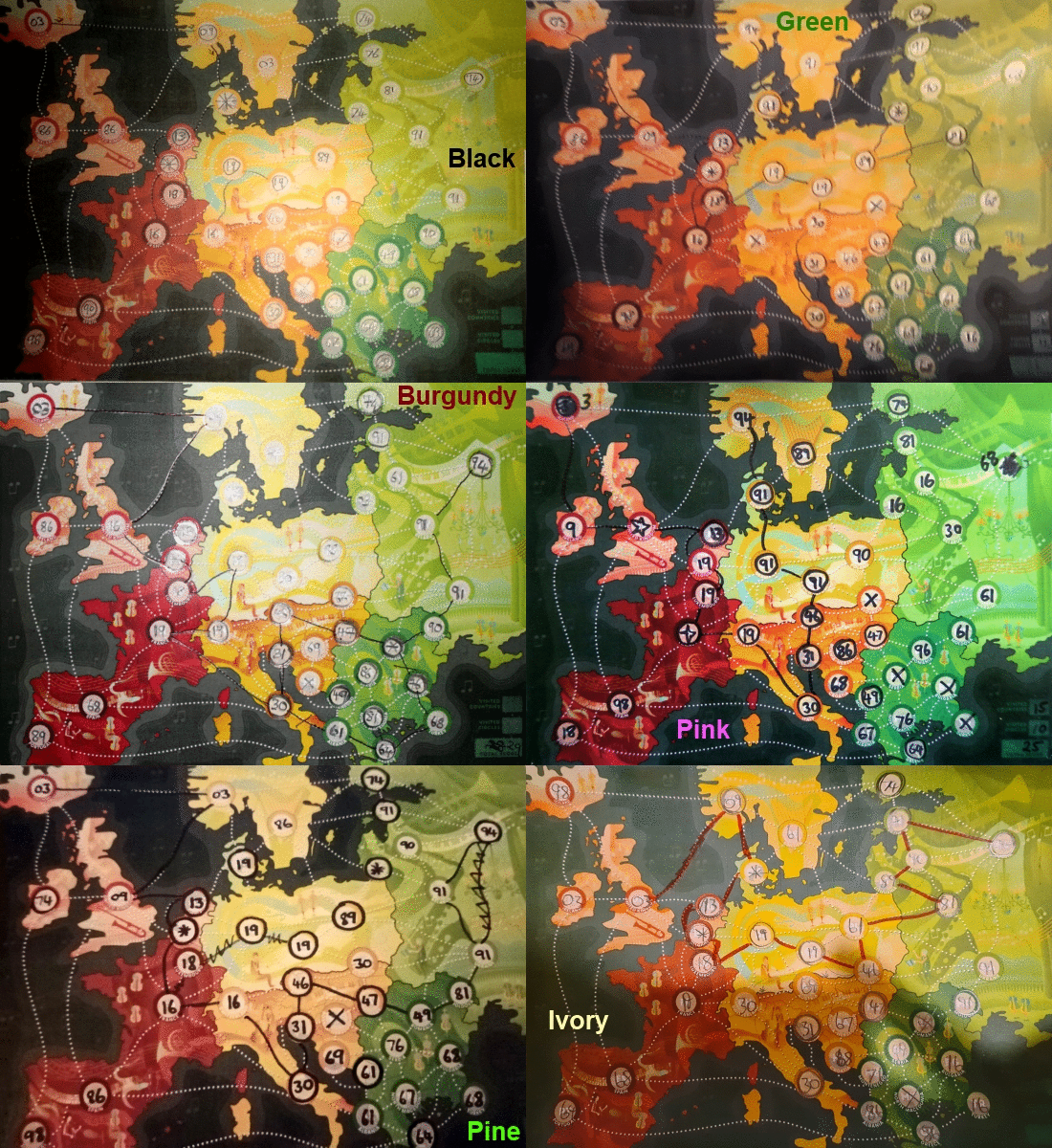
Draftosaurus on Board Game Arena
– Image by boardGOATS from
boardgamearena.com

For those who were new to the game, it took a couple of turns to work out where the scoring opportunities  are and how to make the best of them, and also to work out how the dinosaurs are passed round and how players could affect each other.  Pine was the only one to have played before, and therefore had a better grasp of how things worked.  Rather than use this experience to beat everyone else’s faces into the dirt, he helped keep everyone else straight and offered help and advice as required.

Draftosaurus on Board Game Arena
– Image by boardGOATS from boardgamearena.com

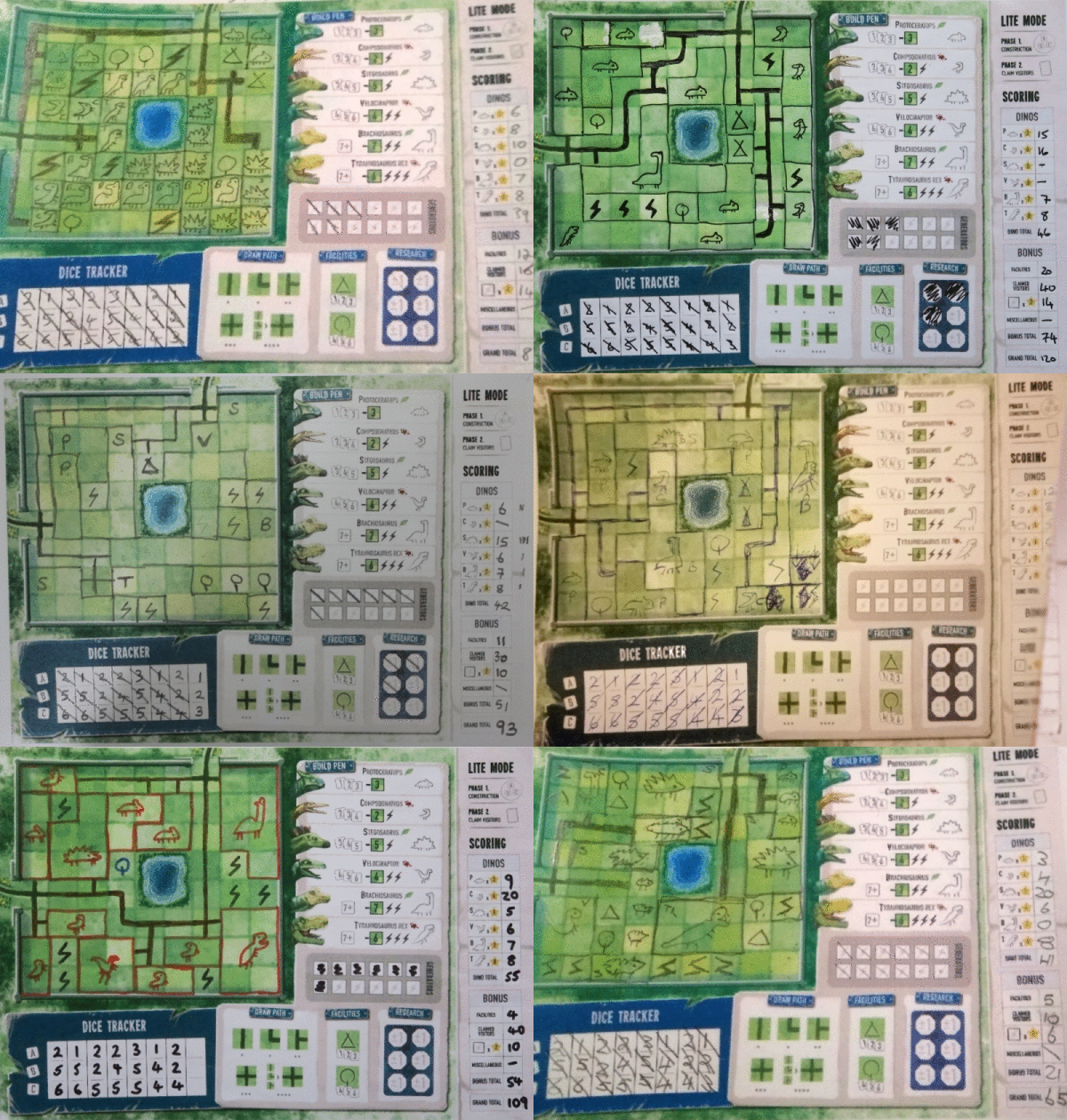
Draftosaurus rocks along at quite a pace, and it wasn’t long before the game was coming to an end.  Burgundy and Pink had got to grips with the game best and quickest and there was only one point in it.  Although they had mostly tried different approaches, both had also tried to collect different dinosaurs in the Meadow of Differences.  Burgundy had the edge though, and took victory with thirty-eight points.

Draftosaurus on Board Game Arena
– Image by boardGOATS from boardgamearena.com

Everyone had really enjoyed it and fallen a little bit in love with the charming graphics, quick game play, and what’s not to like about building a dinosaur park?!?!  This is definitely one to get and play once we can meet up properly again.  And on that positive note, looking forward to playing together with tactile dino-meeples after a year of gaming from home, it was time for bed.

– Image by BGG contributor kalchio

Learning Outcome:  Pharaohs and Dinosaurs, what’s not to like?

Goats in the News: The Goats are Back In Town…!

Last year, a group of Kashmiri goats went on the rampage in Llandudno.  It is actually not uncommon for them to visit the town when food is scarce, but now they are back, and thanks to a lack of contraception caused by the pandemic, there are more of them than ever.  Apparently they’ve been caught queuing at the chippy, waiting for a bus, and going to school—they are a very popular sight kidding around in town.

– Video by 5 News on youtube.com


Boardgames in the News: The Monopoly Community Update

As well as the variety of different editions, over the years, there have been a number of updates to the classic Monopoly game.  These include include changes to the iconic cast iron tokens including the popular addition of the cat a few years ago. In the eighty-six years of the Monopoly Brand, however, the Community Chest cards have remained unchanged.  Until now that is.

Monopoly Cat Token
– Image of unknown origin

The original Monopoly game was set in Atlantic City; according to The Monopoly Companion by Phillip Orbanes, the Community Chest was the city’s “forerunner of the United Way” and was a welfare organisation.  For this reason, the Community Chest cards mostly give players money (compared with the Chance Cards which usually move players to another space).  There are just sixteen Community Chest cards in the classic Monopoly game, and the space is marked by the iconic treasure chest logo.

Monopoly
– Image from
fineartamerica.com

The Community Chest cards currently include include “Bank error in your favour, “Hospital fees” and “You have won second prize in a beauty contest,” and do sound a little dry and out-dated.  So, yesterday, Hasbro announced that they will be changing all the cards and asking the public to vote for possible replacements with the new version available in Autumn.

Monopoly Vote
– Image by boardGOATS from
monopolycommunitychest.com

Next Meeting, 16th March 2021 – Online!

Although the spring is definitely on its way, with the current stresses, people still need what social contact they can get, and board games are a great medium for that.  Despite the limitations of “remote gaming“, everyone feels it is important to stay in touch, so we are persisting with online meetings.  Therefore, our next meeting will be on Tuesday 16th March 2021; we will gather from around 7.30pm, and start playing at 8pm.

This week, the “Feature Game” will be Das Labyrinth des Pharao.  This is a tile laying game in a similar vein to Take it Easy! which we played a few weeks ago, or the Spiel des Jahres nominee Karuba which we last played a long time ago.  This game has an Egyptian theme though, with players exploring a pyramid.

 Das Labyrinth des Pharao
– Image by boardGOATS

And talking about Egypt…

Jeff was living in Egypt by the banks of a beautiful ancient river.  Every year the river flooded, but Jeff remained certain that the river would not destroy his house.  One year, the people of the village tried desperately to persuade him to evacuate, as the floods that year were particularly severe.  Jeff would not listen though, convinced he was right.  The floods came within the month, however, ruining his house and pulling him, and the debris, into the river.  The people, watched from the shores, shouting at him, and yelling, asking him why he didn’t listen.  Jeff continued ignoring them—he was still in de-Nile.

2nd March 2021 (Online)

Blue and Pink finished a difficult couple of weeks by missing out on their fish and chips, so after cooking their own tea (shock, horror!), they joined the chatter with Purple, Black and Pine.  Once everyone else had signed in, we started the “Feature Game” which was the first Hexpansion to HexRoller.  This is another “Roll and Write” style game, but a very abstract one, though based on hexagons (which are the bestagons, obviously).

HexRoller
– Image by boardGOATS

We played the base game before Christmas and, although it is a very simple little abstract game, it went down really well.  It’s not very clear why it was such a success, although it plays especially well “remotely” and with lots of people.  Burgundy also made a good point when he commented that although it was simple, it has meaningful decisions at every step.  The idea is that a handful of dice are thrown, and grouped according to the number rolled.

HexRoller
– Image by boardGOATS

Players then choose two of the numbers and write those numbers on their board the same number of times as it has been rolled. This means if four and six are chosen and they appear once and twice respectively, the player will write four down once and six twice.  The player sheets have a play area made of hexagons, some of which have numbers written on them.  Once a player has chosen a number, they start writing in a hexagon next to a number already on the board, with every subsequent number written next to the previous, making a chain.

HexRoller
– Image by boardGOATS

The scoring is a bit of a “point salad” with points for filling all seven hexagons in one of the coloured groups; for filling all the orange hexes in the central area; for connecting pairs of pre-printed numbers, and any left over, unused special actions.  Additionally, every round a player picks two numbers and one is written in a box in the top row in the bottom left corner with the other written in the bottom row—these also give points at the end of the game.  Explained like this, the game sounds extremely complex, however the scoring is outlined on the sheet and in practice, it is actually quite easy to play, though like Burgundy commented, there are meaningful decisions to be made at every step.

HexRoller
– Image by boardGOATS

The base HexRoller game comes with two different layouts with subtly different scoring schemes, to be played with slightly different numbers of dice.  Although the dice are coloured, the original game does not use these colours, however, that changed in the first Hexpansion, where, instead of just trying to obtain straight runs of numbers, players are trying to get straight runs in each of the four colours.  Additionally, where the base game has three special actions that can each be used once during the game, the first Hexpansion changes this slightly so that each one appears twice and players must use one in each of the six rounds.
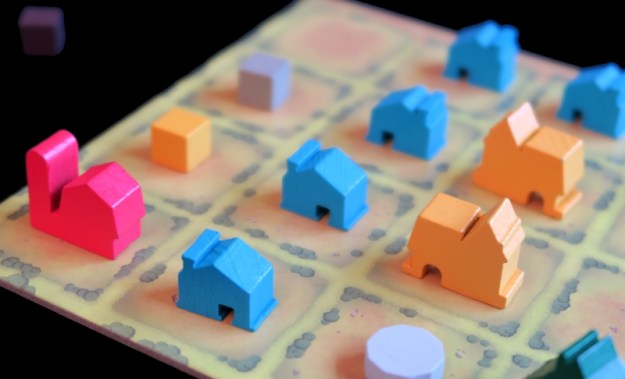
HexRoller: Hexpansion 1
– Image by boardGOATS

Like the base HexRoller game, the first Hexpansion also comes with two layouts, with different starting number layouts and slight changes to the scoring.  The remarkable thing is how these two small tweaks make a substantial difference to the game play and the decisions players have to make during the game.  Like last time, we played both layouts, starting with side “A” and moving on to side “B”.  For the first one, everyone agreed that it wasn’t possible to connect more than one or two numbers.  Although everyone agreed that connecting more was possible on side “B”, there was a big debate between the rounds as to how many could actually be connected.  In the end, we gave up on the discussion and left people to prove their point during the game.
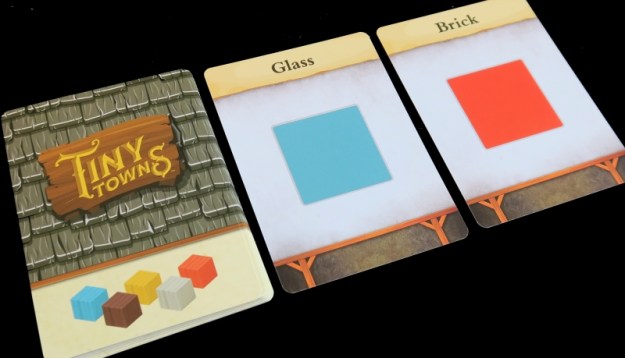
HexRoller: Hexpansion 1
– Image by boardGOATS

With only six rounds the game trots along quite quickly, and it wasn’t long before people were taking their shoes and socks off as they tried to work out their score.  As often seems to be the case, Ivory was the first up setting a target of eighty-one.  Also as often seems to be the case, it quickly became apparent that it was a target that was unlikely to be beaten though Pink thought he had a draw until he realised that he was out by ten.  In the end, Blue and Burgundy were the closest with seventy-six and seventy-three respectively.

HexRoller: Hexpansion 1
– Image by boardGOATS

The second game was even quicker, and again, Ivory was the first to post his score of eighty-two.  This time though, his target was quickly overcome with both Pink and Black scoring in the high eighties.  Green pitched in with what he thought was an unassailable round hundred, until he was disappointed by Blue who just beat him by three points.  There was a little chit-chat about how important all the little decisions were, and how misplacing a two had cost Pine sixteen points for example, then we moved on to deciding what to play next.
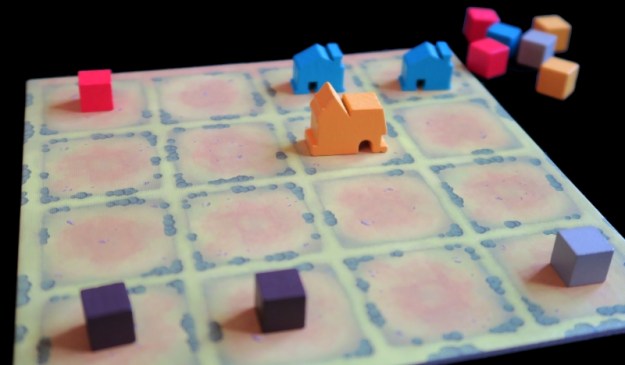
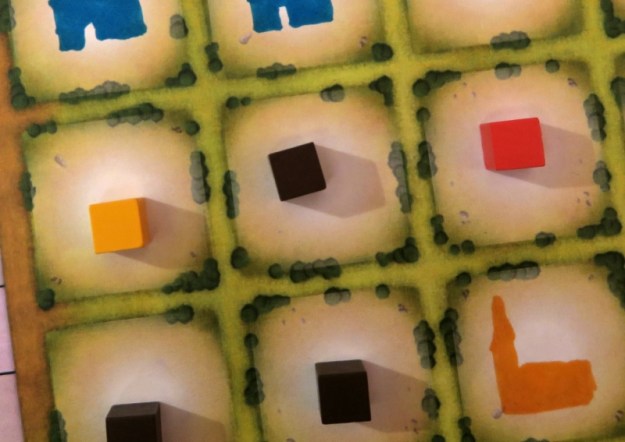
HexRoller
– Image by boardGOATS

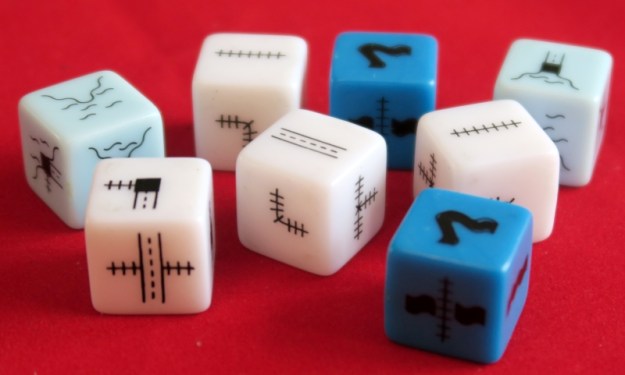
Tiny Towns was an option, this time including the monuments, but even though HexRoller was a quick game, time was marching on.  As it has been a while since we last played Tiny Towns and we’d need to revise the rules, the preferred option was Railroad Ink, a game we have played a few times.  This would have been fine, except that Blue got all excited about playing with one of the mini-expansions that comes with the Deep Blue edition.  Having played with the River last time round, her beady little eyes lit upon the Lake expansion.

Railroad Ink: Deep Blue Edition
– Image by boardGOATS

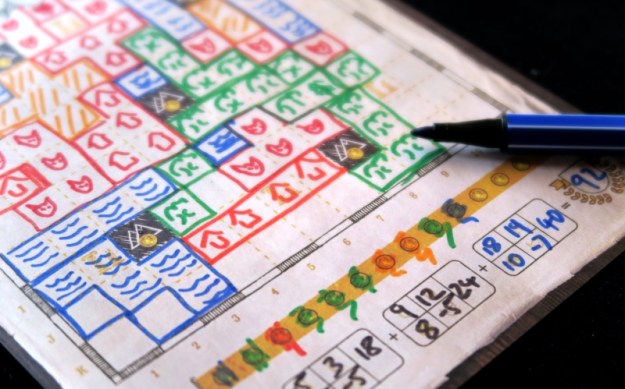
The base game itself is quite straight forward:  Four white bespoke dice are rolled and players draw the four features in squares on their player areas.  All four must be drawn, and they must connect correctly to part of the pre-exisiting travel network, or added to a starting point on the edge of the board.  On three occasions during the game, players may also fill in a fifth space from one of the special actions each of which can be used once.  The game finished after seven rounds after which players score for the longest continuous sections of rail and road, for connecting entrances onto their board, for filling in the centre nine spaces and lose points for any “hanging ends”.

Railroad Ink: Deep Blue Edition
– Image by boardGOATS

The Lakes and Rivers expansions each add two optional blue dice that are rolled with the white dice.  While the Rivers add a sort of third route, the Lakes expansion adds another way to score points and connect route together.  There were some gaps in the rule book, so rather than spend a lot of time trying to find the correct rules online, we decided to “House Rule” them.  The rules say that Lake spaces do not have to connect to other spaces, but we played that any Lake dice that had road or rail segments had to be connected to a road/rail network.

Railroad Ink: Deep Blue Edition
– Image by boardGOATS

Any road or rail that ends at a pier on lake is deemed to be connected to all other roads attached to a pier on the same lake, making it easier to score points for connecting the together starting entrances.  They also give points in their own right as players score one point for each space occupied by their smallest lake.  Inevitably, therefore, most people started with the plan to create one large lake and connect their road and rail networks to it.  Of course, in practice, his turned out to be easier said than done.

Railroad Ink: Deep Blue Edition
– Image by boardGOATS

Firstly, using the Lake dice meant that board real-estate was quickly used up making it harder to accommodate the compulsory white dice.  After three rounds Burgundy commented that we were halfway through.  Green objected and it was then that we realised he was somehow a round ahead.  It’s possible that it was because Pink had moved some dice to make it simpler for someone else, only for Green to assume it was a different round.  So, there was a brief hiatus while he rectified things and grumbled about how he didn’t understand the rules.

Railroad Ink: Deep Blue Edition
– Image by boardGOATS

It wasn’t long before we had completed all six rounds of “nipples”, “plungers” and “suction pumps” (which is what some of the faces of the Lake dice looked like to us), and everyone tried to work out their score.  Ivory once again posted his score first, a very creditable fifty-eight, but he was immediately beaten by Green with sixty.  Pink out pointed Green with sixty-nine, but he was just pipped by Blue who top scored with seventy-one.

Railroad Ink: Deep Blue Edition
– Image by boardGOATS

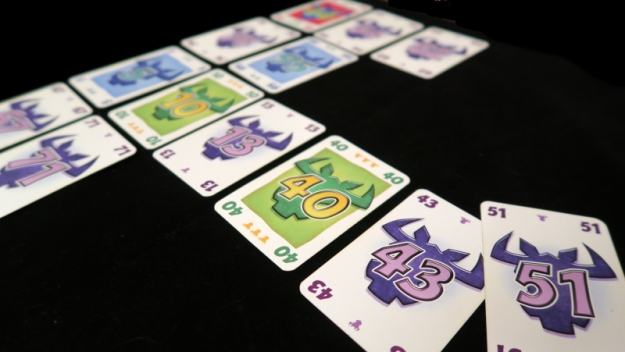
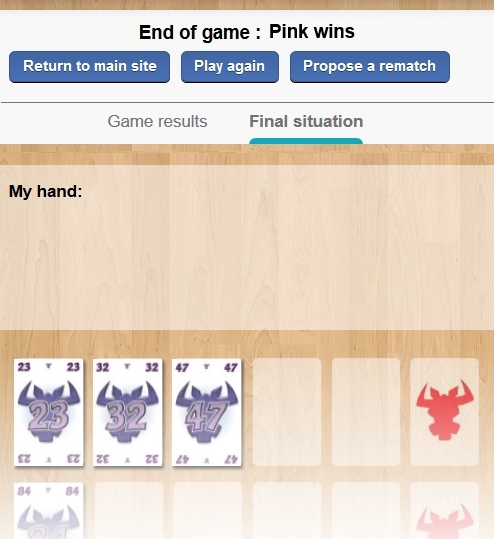
Ivory took his leave and everyone else moved onto Board Game Arena and settled down to a game of No Thanks!.  This is an old favourite that has recently been ported to the platform and fills a similar niche for us as our old favourite, 6 Nimmt!, but works better with smaller numbers of players.  The game is just as simple though:  On their turn, players take the card in the centre or pay a chip to pass the problem on to the next person.  At the end of the game, the player cards score negative points, offset by any left-over chips.

No Thanks!
– Image by boardGOATS

There are two things that make the game special.  Firstly, anyone with an unbroken sequence of cards only counts the lowest when scoring.  This turns the game on it’s head as it means that a player with twenty-five and twenty-seven actually wants the card in between, where everyone else doesn’t giving them the opportunity to try to milk everyone else for chips.  Secondly, the deck is numbered from three to thirty five, but some of the cards have been removed at random.  This introduces a nice little bit of chance into the game, which just makes it special.

No Thanks! on Board Game Arena
– Image by boardGOATS

This time, Purple managed a very impressive final total of minus fifty-seven thanks to a gap between thirty-three and thirty-five meaning that both scored.  At the other end, Pine was the only one in single figures taking victory with a score of minus four.  Pine and Pink were ready for an early night, but were persuaded into playing another game before they left.  This time, it was all a lot closer and with a complete reversal of fortunes, this time Purple finished victorious with minus six, two points clear of Pine who took second place.

No Thanks!
– Image by boardGOATS

It was just as they left that the dreaded IT gremlins returned, this time with Green as the victim. While everyone else focussed on playing Coloretto, he tried all sorts of things to fix it to no avail.  Coloretto is another simple card game, this time where players take it in turns to either reveal a chameleon card and place it on a truck, or take a truck and add the chameleons to their collection.  At the end of the game players score points for each set they collect with the three largest sets giving positive points and the rest scoring negative points—the bigger the set, the more points it is worth, which is good for the biggest three sets, and not so good for the smaller ones.

Coloretto
– Image by boardGOATS

Purple did well with only three colours, a wild and a handful of bonus cards, earning herself second place ahead of Green and Black who tied for third.  As the only one collecting green cards at the start of the game and one of only two collecting blue cards, Blue had an advantage though.  She was able to put cards together safe in the knowledge that no-one else wanted them and that gave her a full set of blue cards and a winning total of thirty-one points.  By this time, Green had rebooted his router and sorted out his internet issues, but everyone had had enough and it was time for bed.

Coloretto on Board Game Arena
– Image by boardGOATS

Learning Outcome:  You usually score better if you concentrate when the rules are explained.

Boardgames in the News: Asmodee’s Plan B

When Asmodee acquired F2Z/Filosofia/Z-Man Games etc. in 2016, the then owner of F2Z, Sophie Gravel, activated her “Plan B” and set up a new company, Plan B Games.  This company was successful almost straight away, winning the Spiel de Jahres Award & Deutscher Spiele Preis just two years later, with Azul.  Since then, Plan B has released the follow-up games Stained Glass of Sintra and Summer Pavilion which, although not as popular as the original, were still very successful in their own right.

Azul
– Image by boardGOATS

Plan B were also responsibly for the three Century Games (Spice Road, Eastern Wonders and A New World) which were all variously successful, and the more recently released games, Beez and Alma Mater.  In 2017, Plan B Games acquired German publisher Eggertspiele, the publisher responsible for many well received heavier, strategy games including Great Western Trail, Mombasa (Deutscher Spiele Preis winner), and Village (Kennerspiel des Jahres & Deutscher Spiele Preis winner), as well as the lighter Spiel des Jahres winner, Camel Up.

Century: Spice Road
– Image by boardGOATS

Given the quality of all these games, almost inevitably, just five years after they acquired F2Z, this week Asmodee announced they have now acquired Plan B and their subsidiary brands (Eggertspiel, Next Move Games and Pretzel Games).  This time Asmodee are absorbing the whole team including Sophie Gavel, perhaps avoiding the necessity of acquiring her Plan C in five years time…

Camel Up
– Image by boardGOATS

Next Meeting, 2nd March 2021 – Online!

Although the signs of spring approaching are clear, with the current stresses, people still need what social contact they can get, and board games are a great medium for that.  Despite the limitations of “remote gaming“, everyone feels it is important to stay in touch, so we are persisting with online meetings.  Therefore, our next meeting will be on Tuesday 2nd March 2021; we will gather from around 7.30pm, and start playing at 8pm.

This week, the “Feature Game” will be the first Hexpansion to HexRoller.  This is another “Roll and Write” style game, and this one is very abstract, though based on hexagons (which are the bestagons, obviously).  This game should be quite short, so will give time to play something else afterwards.

HexRoller: Hexpansion 1
– Image by boardGOATS

And talking about shapes…

When Little Jimmy came home from his first day at big school, his father Jeff, trying to be a good parent asked his son, what had happened.

Little Jimmy answered, “Well Dad, we had a geometry lesson today.”

His father responded, “That’s really interesting son, what did you learn?”

Jimmy looked a little uncomfortable for a moment and thought for a bit, but eventually replied, “We learnt πr2.”

Jeff looked at him and frowned, “Don’t be silly, everyone knows pies are round and it’s cakes that are square…”

16th February 2021 (Online)

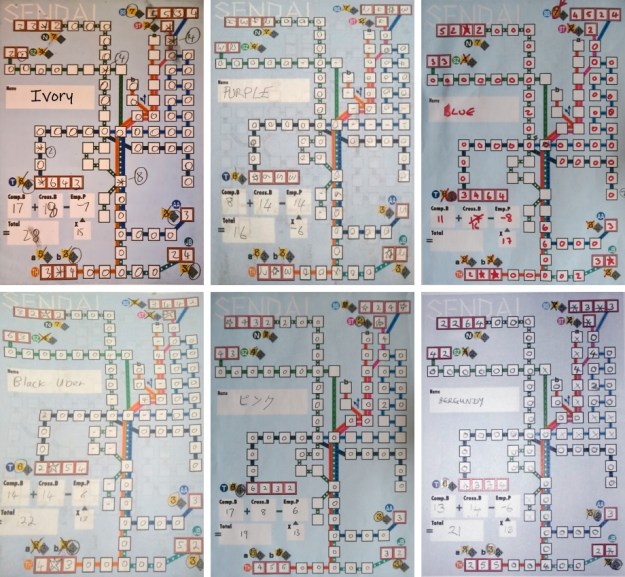
Purple and Black were the first to arrive and chatted with Pine when he popped up.  There was some chit-chat about where Mulberry and Red were at the moment and eventually Green, Lilac, Burgundy, and Ivory also joined the party.  In a return to the “Roll and Write” style of game, the “Feature Game” was to be MetroX (aka メトロックス), a game based around routes on the Tokyo and Osaka underground maps.  People were gamely mispronouncing the names of the lines when Burgundy asked which map we were going to be using, which was when Blue realised that she had sent out the wrong file.  There was a brief hiatus as people fired up their printers and Pine explained how one of his friends had said he “looked like a row of sheep’s arses”, and then with the correct paperwork, we could get started.

MetroX
– Image by boardGOATS

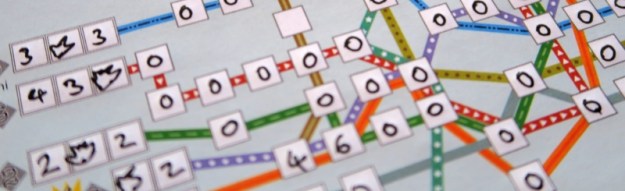
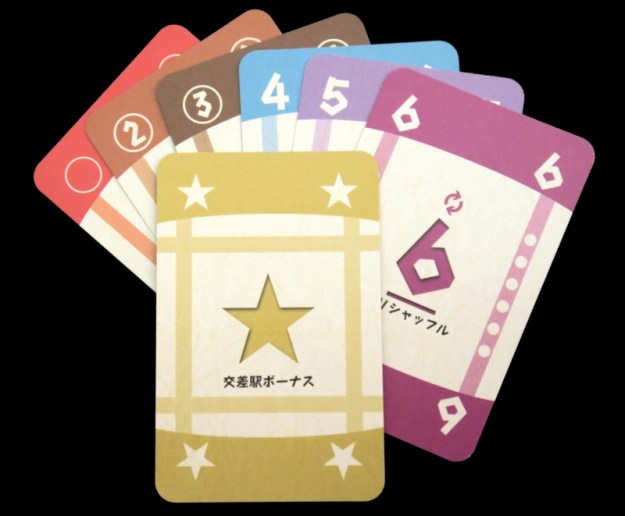
The game is quite simple:  a card is turned over and players assign the number to a line and “build” that number of stations along the line.  When a player completes a line, they score points with the first player (or players) scoring more points than those to finish the line in later rounds (similar to the scoring for columns in Noch Mal! and Noch Mal So Gut! which we played a few weeks back).  There are four different types of cards, but the most common are plain numbers which allow players to just build stations and these are numbered two to six, with fewer of the high numbers.  With each line restricted so that only two or three number cards can be assigned to it, Pine was quick to point out the obvious flaw and with it, the whole point of the game.

MetroX
– Image by boardGOATS

Each line has roughly ten to fifteen stations, so while some could be completed with three high numbers, it is not possible to complete them all outright without an awful lot of luck (and/or some very bad shuffling!).  However, most stations appear on more than one line, so the game is about using lines that run parallel creatively, sacrificing some to ensure others score well.  There are catches though.  Firstly, each line must be extended from the start end (the end with the “Indicator Boxes”, marked in red on our paperwork).  This means that although stations can be built in the middle of the line because they are part of another line, stations cannot be added beyond this point (where the lines diverge) unless all the earlier stations have been completed.

MetroX
– Image by boardGOATS

Secondly, normal number cards cannot “skip” completed stations.  In other words, in a line where the first two stations have not been completed, but the third has, if a “Six” is used to build the first two, the third cannot be jumped, and the remaining four are wasted.  So efficiency is the order of the game.  There are a small number of special cards with a circle round the number that allow players to skip completed stations, but these are few and far between and are only low numbers.  There is also a wild that allows players to fill in one station anywhere on the board without filling in an indicator box.

MetroX
– Image by boardGOATS

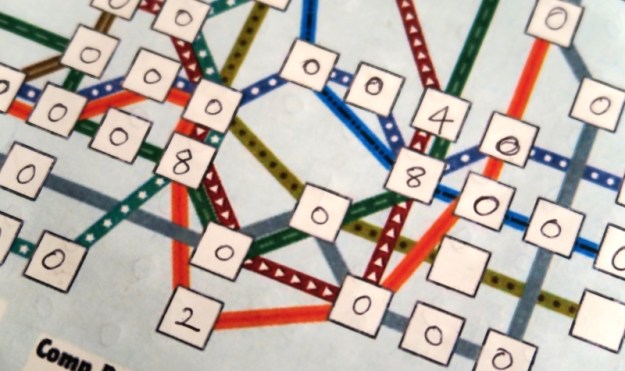
In addition to scoring points for completed lines, players can also score a lot of points for intersections.  In the deck of just twenty cards, there are three “Star Cards”.  These allow players to build just one station at the cost of one Indicator Box, but instead of writing a zero in the box, they write a number that corresponds to the number of lines that go through the station.  With some stations forming the intersection of four or five lines, these can be very lucrative, but of course these are in the middle of the board and therefore need careful planning and a bit of good fortune to be able to make them really count.

MetroX
– Image by boardGOATS

People were not really taken with the rules and particularly with the fact they couldn’t see how it was going to work, generally didn’t feel it was “possible”, and that they were going to end up with negative points.  Everyone was happy to give it a go though and we started with the Tokyo board.  We started with a lot of high numbers which made the game seem really straight forward at first.  About half way through though, we discovered that Green had misunderstood the rules (again!) and there was a bit of clarification and a pause while he tried to rectify things.

MetroX
– Image by boardGOATS

Purple was the first to complete a line, claiming Fukutoshin.  That focussed everyone’s mind a bit as they realised it wasn’t quite so impossible after all.  Drawing a six triggers shuffling in the discard pile, and although Pink shuffled the deck thoroughly, the high cards returned, at least initially.  Eventually, we drew some “Stars” and people were able to start picking up bonus points for intersections as well.  Despite all his comments about how impossible it was, Pine soon claimed Namboku and Lilac claimed Chiyoda.

MetroX
– Image by boardGOATS

The game ends when there are no Indicator boxes left, and it was as Pink and Burgundy started a count down of how many cards there were left that some players realised that they’d failed to fill them in every time.  There was a bit of a flurry as people tried to correct things and then it was all over and everyone started adding up their scores.  As usual, Ivory was first to post his score, and as usual, it was very competitive.  Pine wasn’t convinced his score of thirty-four was right, especially as it was one more than Ivory’s, but either way, they were both beaten by Pink and Black with thirty-seven and Black took it on a tie-breaker.

MetroX
– Image by boardGOATS

Now everyone had got the hang of things, we decided to give the second map, Osaka, a go.  In contrast to the last game, the first card was a “Star” and the other two came out shortly afterwards, making it very difficult for players to score lots of points for intersections.  Despite that, players still seemed to make good progress.  In fact, there were five claims for completing four different lines in one round with Pine, Green and Ivory completing Midosuji, Sakaisuji and Yotsubashi respectively, and Black finishing Yotsubashi as well and New Tram.

MetroX
– Image by boardGOATS

It was just as the game was coming to a close that the gremlins from a month ago came back to victimise Black and Purple.  Unfortunately, we weren’t quick enough to spot it this time, and Pink had shuffled the deck before we noticed.  The game was close to the end so it was sad that we couldn’t see whether Pink or Black did better in the rematch, and everyone else decided to finish up while they sorted out their problems.  Like Take it Easy! a couple of weeks back, by the end, the players were desperately begging for particular cards they needed and as they got what they wanted there were sighs of relief, while other groaned when they got something they couldn’t use.

MetroX
– Image by boardGOATS

When the last card had been revealed, everyone moved on to the scores.  Once again, Pine, was right up there finishing with a total of thirty, but Burgundy, one of the most improved finished one point ahead with thirty-one.  There was some chat about the game while Purple and Black rejoined us, and it seemed it suffered from “marmite factor” with Green saying it wasn’t for him (though if he’d got the rules right it might have helped), and Pine saying that although he’d won, he hadn’t really enjoyed it.  On the other hand, Blue, Pink, and Burgundy thought it was clever and liked it.  While we were chatting, Violet joined the group to talk about a new venture she was considering.

UKGE 2018
– Image by boardGOATS

She wondered whether there would be any interest in custom dice featuring the boardGOATS logo.  There was some discussion about weighting dice correctly so they are truly random and how the market would be, as nobody wanted Violet to spend money on something that would not give a return.  With Purple and Black back from their gremlin-bashing, Ivory took his leave and everyone else moved on to playing the inevitable 6 Nimmt! on Board Game Arena.  We normally play this at the end of the evening, but this time, with lots of people, it put in an early appearance.

Cribbage
– Image by 311matman on instagram.com

While we waited for Violet to sort herself out with an account, Pine pointed out that Green had been playing games, so Green had started investigating Pine’s profile, marvelling at the number of experience points he had.  It was then that he pointed out that Pine was 24th in the overall rankings for Cribbage.  It’s true that most people who use Board Game Arena probably play Euro games rather than traditional games, but all of a sudden we realised we had a bit of a celebrity in our midst.  Eventually though, we got over being star-struck and actually started playing…

6 Nimmt!
– Image by boardGOATS

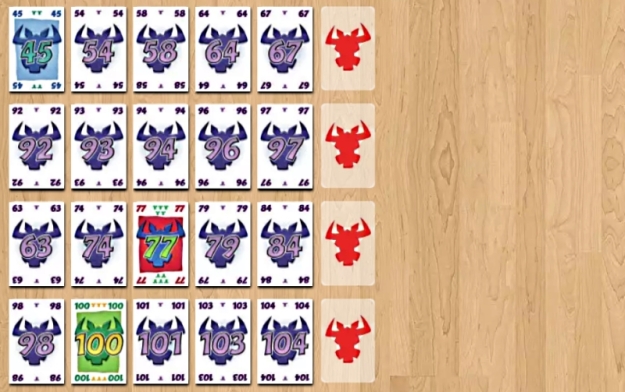
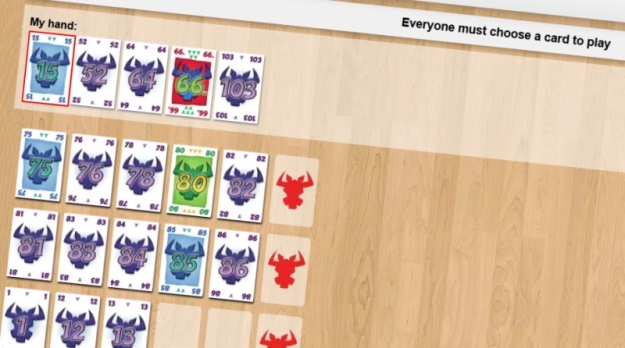
We’ve played 6 Nimmt! an awful lot, so it needs only a little introduction:  players simultaneously choose a card from their hand and they are revealed at the same time.  Starting with the lowest value card, the cards are added one at a time to four rows – the player who adds the sixth card, instead takes the other five which become their scoring pile.  On Board Game Arena, we now play the “Professional Variant”, where cards can be added to both ends of the rows, causing mayhem when least expected.


6 Nimmt!
– Image by boardGOATS

It takes a bit of time to get used to playing with the additional layer of complexity, so it wasn’t really a surprise that poor Violet won the race to the bottom, although he father, Green wasn’t really all that far behind.  The winner was Pink who picked up just ten “nimmts” and finished with fifty-six points.  Black was joint second with the inevitable Pine, who always does well at this game, though this time they were twenty points behind Pink.

6 Nimmt! on Board Game Arena
– Image by boardGOATS form boardgamearena.com

Time was marching on, and with plenty of people still about, that limited our choices of game somewhat.  Before Christmas, we had given Incan Gold (aka Diamant) a try, but strange card draws had let to a very odd game.  As the dust settled, we decided to give it another go.  The game is a fairly simple “Push your Luck” game where players are exploring a temple.  Players decide whether they are going to stay and explore, or leave the temple and take any treasure with them.

Incan Gold
– Image by boardGOATS

Players who stay in the temple will get shares in any treasure cards that are drawn that round, but if they are present when a second Hazard card of any given type is drawn, the temple collapses and buries everyone in it and they lose any treasure they have collected.  In the first round, Black left first followed by Green and then gradually everyone else except Pine and Pink decided discretion was the better part of valour.  Inevitably, they got caught, so in the second round Pink was the first to leave (quickly followed by Purple).


Incan Gold on Board Game Arena
– Image by boardGOATS from boardgamearena.com

When a treasure came out everyone else tried to leave and take it with them, but as nobody left alone nobody managed to get it.  Eventually, only Pine, Burgundy and Blue were left in and when Blue and Burgundy left too, Pine was all by himself.  When he turned one last card he got fifteen gems all to himself and left with a total of twenty and the treasure as well, much to everyone else’s chagrin.  In the third round Black managed to escape alone to take a treasure and Pine and Green got caught by a couple mummies and while everyone else escaped, nobody scored very well.

Incan Gold on Board Game Arena
– Image by boardGOATS from boardgamearena.com

In the fourth round, Burgundy almost managed to repeat Pine’s effort when he was last in the temple and turned over a fourteen so took all of it, leaving with seventeen gems.  The final round was a bit of a dud, with only Pink and Violet scoring and even they didn’t get much as they left together after the first round, so shared the seven gems left on the floor.  They did better than everyone else though because the fourth card was a second snake and that was that.  It was very close, but the winner was Burgundy, just one gem ahead of Pine.  Black made an excellent third, proving that consistency is important as well as big wins.  And with that, it was time for bed.

Incan Gold
– Image by boardGOATS

Learning Outcome:  It’s a great shame Henry Beck never worked in Japan.