Tag Archives: Ca$h ‘n Guns

10th December 2024

Everyone had already arrived and was waiting in anticipation when Blue and Pink arrived with piles of gamers crackers, Christmas tree decorations, party poppers, paper parcels, mince pies, festive cakes (with carrot meeples on top) and GOAT Award voting forms.  Food quickly followed along with a volley of noise as people tried to pull their crackers and party poppers first so the contents didn’t land in their supper.  As people munched, there was some discussion about the games played and voting forms were filled in.  In the absence of Green, Pine kindly offered to act as returning officer and collate the statistics.

"Un-Christmas Party" 2024
– Image by boardGOATS

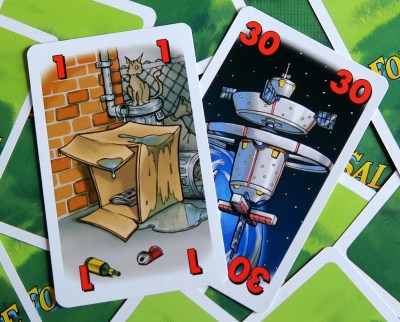
While cake and mince meat parcels were shared round, toasts were offered by Lime to the organisers, and in the memory of Burgundy.  He is much missed and will never be forgotten, but we always make a special point of remembering at this time of year, especially as the Un-Christmas Dinner was his last games night with us.  The GOAT Awards were then announced.  Moment of the Year was when Pine got the end game rule wrong for Tonga Bonga, so that Pink thought he’d won, but then didn’t.  The GOAT Poo Prize for the least popular game of the year went to Ca$h ‘n Guns—not a game the group plays often and its only outing over the last year was at the New Year Party.

"Un-Christmas Party" 2024
– Image by boardGOATS

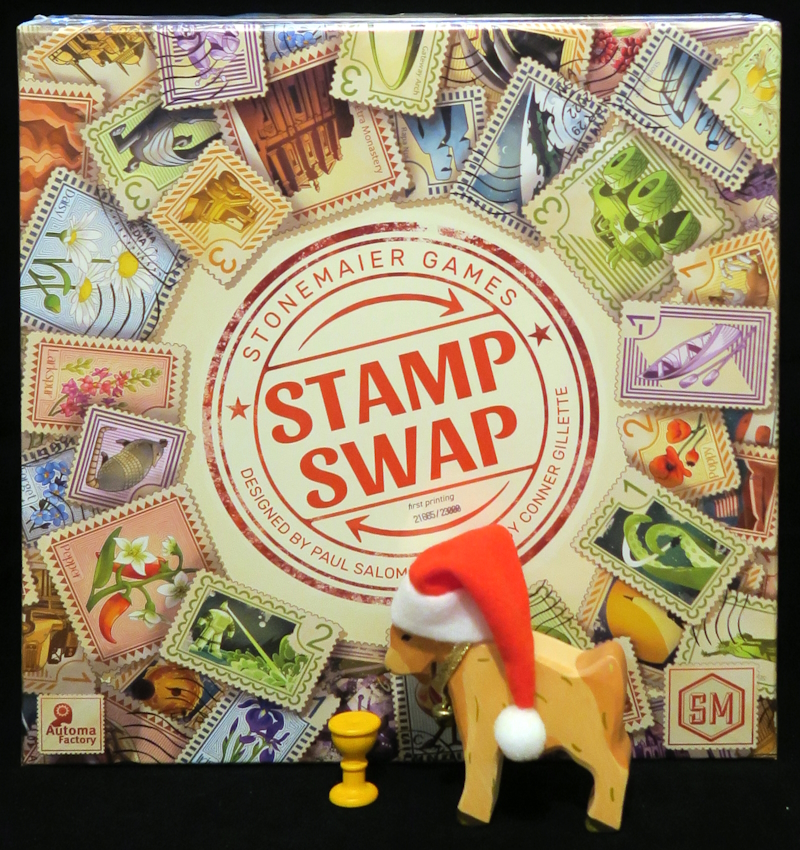
Then it was time for the Golden GOAT.  Previous winners were ruled out, but other contenders included Akropolis, Kavango, Flamme Rouge and Ticket to Ride: Rails & Sails.  The clear winner of the 2024 Golden GOAT Award, however, was Stamp Swap.  There was much discussion about how this was the third winner from Stonemaier Games (after Tapestry last year and Wingspan in 2019) and how we should invite Jamey Stegmaier, to collect the award in person.  Email correspondence over the following few days suggested that while it was unlikely he would be able to come to GOATS, he will be in the UK next year and just might make it as far as Oxford.  In the meantime, he has highlighted the award on his website.

Golden GOAT - 2024
– Image by boardGOATS

With the festive business over, the group broke into three to play some games.  Pink, Blue, Black and Jade began with the “Feature Game“, Courses De Rennes (aka Reindeer Races), a fun little game where players control a team of four reindeer, racing along four different tracks to try to get the highest-scoring tiles.  On their turn, each player can either draw two cards (with a hand limit of seven) or play as many cards of the same type as they can to move one reindeer along one of the tracks.  The cards are numbered and have suit that corresponds to one of the tracks (or are Elfy, and “wild”).  If two and a three of Gifts is played, the player may move one of its reindeer along the Gift track.

Course des Rennes
– Image by boardGOATS

If a reindeer lands on the same space as another reindeer, it slides forward a space.  If that is occupied too, it continues to slide.  If, however, the owner cries “Thump!” as it lands, the reindeer slithers an extra space forward.  The first reindeer to arrive at the end of a track claims the highest value token.  The game ends when two of the tracks have run out of tokens.  Pink too the first points, and with it a strong early lead.  A few rounds later, Jade took the last token from one of the tracks and with it ended the game.  He got very unimpressed looks from Black and Blue as he gifted victory to Pink, so once this was pointed out, Jade revised his move and play carried on.

Course des Rennes
– Image by boardGOATS

Ultimately, however, it didn’t really change things as Pink still took victory with twenty-two points.  He was long way clear of Jade who won the tight fight for second with fifteen just one point ahead of Black who, in turn, took third by a single point.  Everyone else was still playing, so the group looked for something else to play.  Black had won a copy of Ticket to Ride: Paris in the raffle and, although it wasn’t very festive, it seemed appropriate to give it an outing.  Some of the GOATS had played this mini-city variant of the popular train game earlier in the year when we marked the Olympics with sport and France themed games.  However, none of the current quartet had been part of that group.

Ticket To Ride: Paris
– Image by boardGOATS

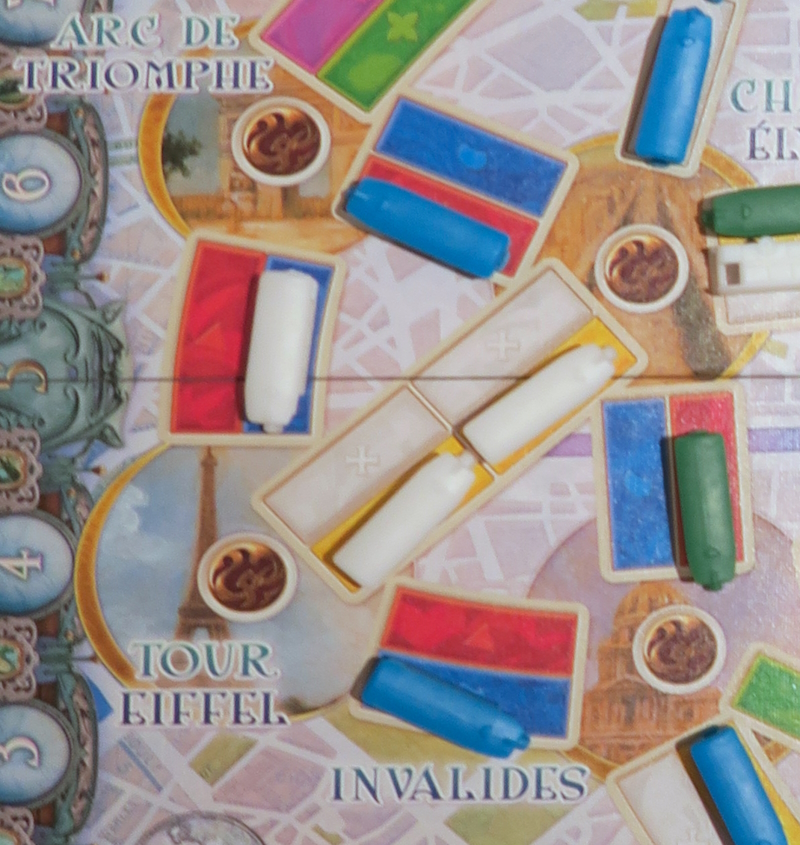
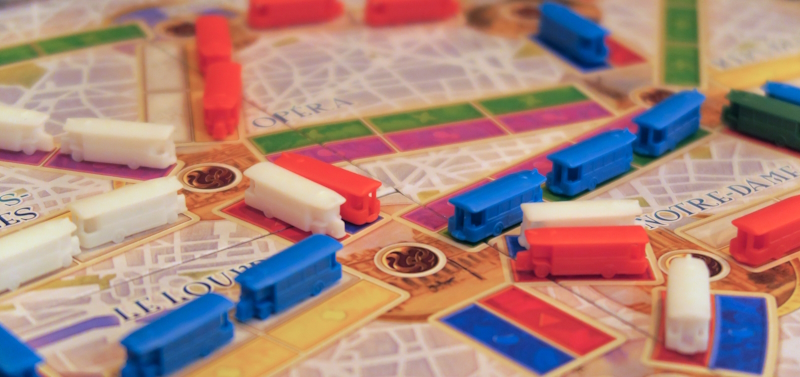
The rules are much the same as all the others (take two cards from the market; play cards to place pieces on the map; collect Ticket cards to score points at the end), but like all the variants, Paris has a special rule.  When players claim a red, white, or blue track, they get a card, when they get all three colours they get four “Tricolore” bonus points.  When the game first came out, there had been comments about how this felt very bolted on, but in practice, it was much more interesting than it sounded.  This time, the in game scoring was quite tight, though Blue, with her trains across the city centre got her nose in front and led by six points.  Tickets can make a huge difference to scores though, as they can give a lot of points, both positive and negative.

Ticket To Ride: Paris
– Image by boardGOATS

Black, Pink and Jade all picked up similar points for their completed Tickets (ten, eleven and eight respectively), though Jade was unlucky and unable to complete his last one.  Blue, however, made good use of concurrent routes and scored a massive twenty-four points for hers giving her something of a landslide victory with a total of forty-six.  It was much closer for second which went to Pink who finished with twenty-nine, two points ahead of Black.  Meanwhile, on the other side of the room, Purple was leading Ivory, Plum and Byzantium in one of her favourite Christmas themed games, Christmas Tree.

Christmas Tree
– Image by boardGOATS

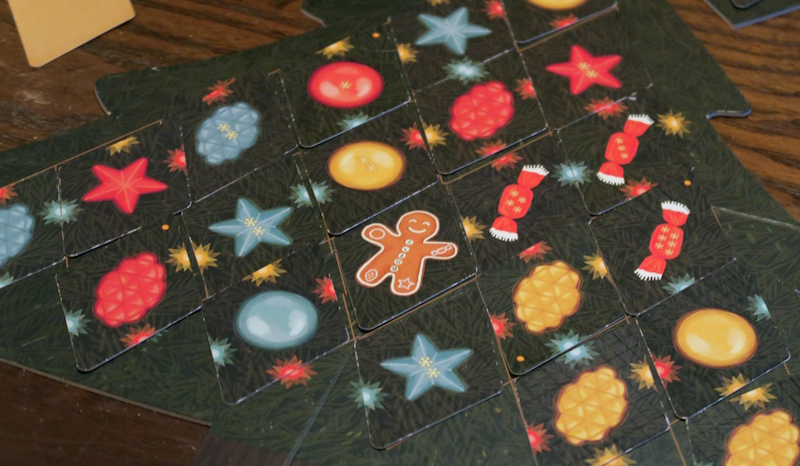
This is a fairly simple little card-drafting game played over thee rounds, where players are “decorating their Christmas Tree” with diamond-shaped cards, where players score points for the Objective cards everyone contributed to a central pool at the start of the round.  This time, the group played from the advanced set of Objective cards (including all three levels) although the first round, the cards were all levels one and two.  These gave one point for each blue or “nobbly” ornament, four points for each pair of ornaments of the same colour and shape arranged in a vertical pair and six points for three specific shapes in a given arrangement.

Christmas Tree
– Image by boardGOATS

The first round started off slowly with everyone looking to fulfill some of the Objectives—everyone was successful, but Plum and Byzantium got off to a better start.  Plum placed her first Gingerbread man and then concentrated on placing vertical pairs although she only managed that once.  In the second round the Objectives were from the more complicated sets, including six points for three specific colours in a given arrangement, six points for the same three shapes or colours in a set pattern, or eight points for four ornaments with the same point value arranged in two set formations.  This time, Byzantium significantly out scored everyone with multiple objectives scored multiple times and, as a result, built a big lead.

Christmas Tree
– Image by boardGOATS

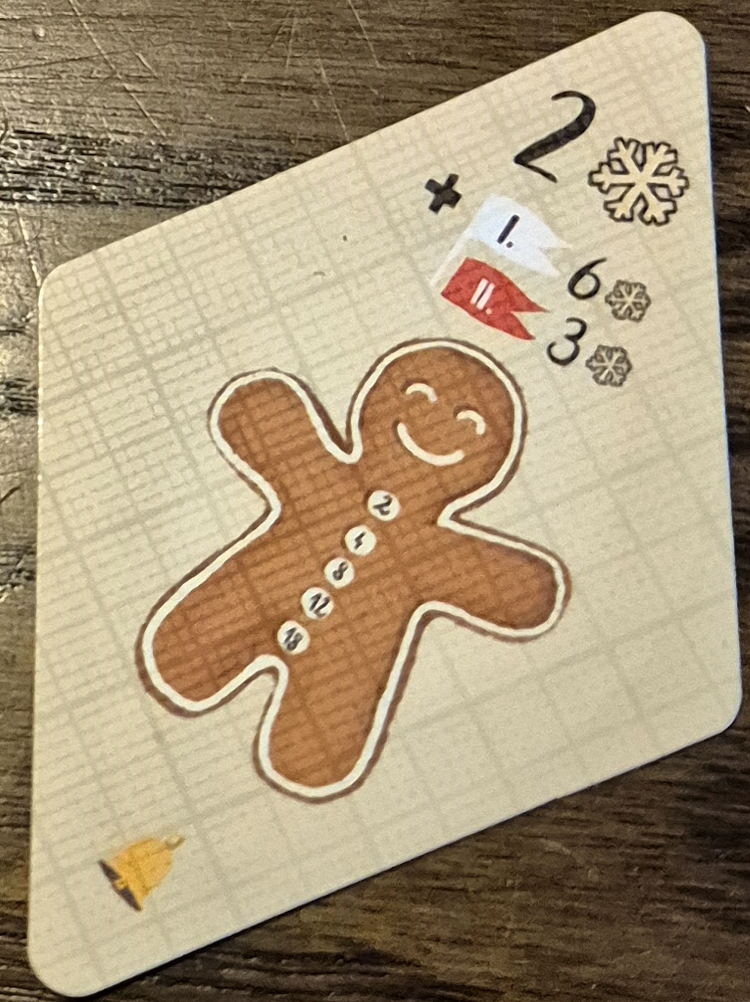
Plum used one of her Biscuits to move baubles around to make a row of four contain the three colours of glass bauble.and thus scored well, whereas Ivory was focusing on picking up high value Sweets and surrounding his Gingerbread men.  The final set of Objectives included six points for a set arrangement of certain point values, eight points for four ornaments with the same point value arranged in a particular arrangement and five points for each row in which the total points of the glass were above the given amount. Finally, there were two points for each Gingerbread man, with bonuses of six and three points for the player with the most/second most Gingerbread men.

Christmas Tree
– Image by boardGOATS

In the third and final round, Byzantium again out scored everyone, scoring multiple times for the set arrangement of certain point values.  At this point, Ivory was full committed to Sweets and Gingerbread men, especially knowing he was putting in the Gingerbread man Objective, which he scored well for.  Plum and Purple also scored well in the final round, with Plum following a strategy similar to Byzantium, whereas was Purple was collecting sweets like Ivory.  It looked like Byzantium was going to win by a large amount, as he was fifty points ahead of everyone else and was scoring more than anyone else for Lights and Baubles too.

Christmas Tree
– Image by boardGOATS

Ivory’s focus on surrounding his Gingerbread men gave him over fifty points and with more than thirty for his sweets he finished with one hundred and seventy one points, pipping Byzantium to victory by just two, with Plume in third some twenty points adrift.  The puzzly nature of the the game had gone down well and with the Christmas theme everyone had enjoyed playing Christmas Tree.  On the next table, the festive link was much more tenuous, however.  Teal, Pine, Sapphire and Indigo had chosen 6 Nimmt!, because there was a twelve in it, representing the Twelve Days of Christmas (or perhaps they had just wanted to play the game and if you can’t play a daft party game at Christmas, when can you?).

6 Nimmt!
– Image by boardGOATS

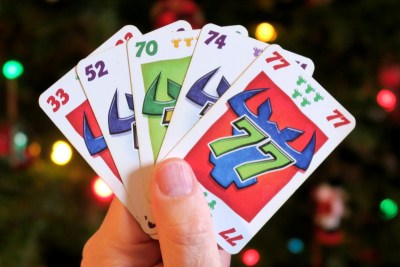
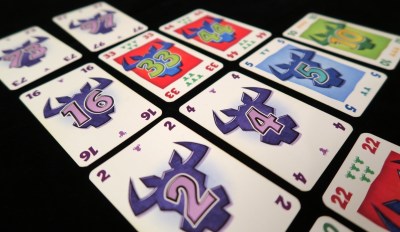
6 Nimmt! is a popular game with the group at any time of year, though it is usually played with more than four people.  Either way, the game is very simple to play, though tough to play well.  Some say this is because there is a lot of chance in the game, but they are usually the people who do badly…  The idea is that players simultaneously choose a card to play and these are then added, in order, to the rows of cards on the table.  The player adding the sixth card, instead, takes the first five cards into their scoring pile.  Usually, we deal out half the cards for the first round and the rest for the second and the winner is the player with the fewest “nimmts” (or points), at the end of the two rounds.

6 Nimmt!
– Image by boardGOATS

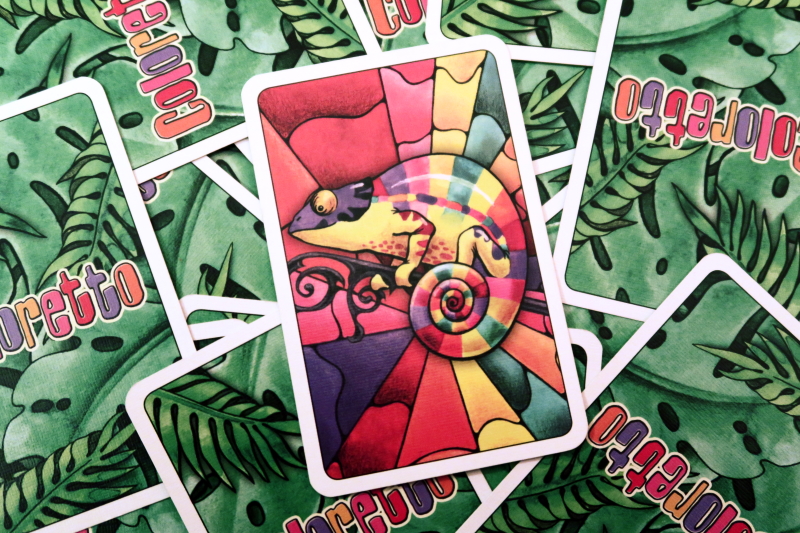
This time, however, the group decided to play the multiple-hand variant where each hand has ten cards, and the game ends when someone’s score passes sixty-six.  And that was Sapphire, who finished with an exceptional total of ninety-five.  The winner was Teal with forty-four, however, who was just two points better off than Pine.  The other games were still ongoing, but there was still time for one last game for this group (who were joined by Navy) before everyone went home warmed by the Christmas Gaming Spirit—and their choice of game was Coloretto (apparently this is a  festive game because it includes red, green and gold Chameleons).

Coloretto
– Image by boardGOATS

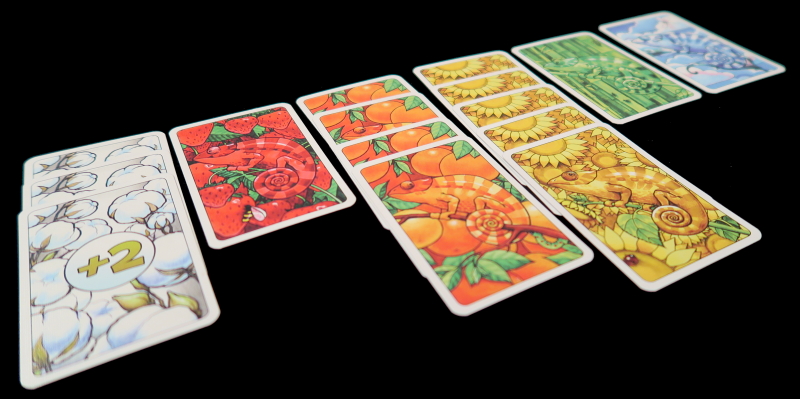
This is another simple filler game, where players either take a card and add it to a truck, or take a truck.  Each truck can take a maximum of three Chameleons, with players collecting coloured sets.  The largest three sets score positive points (according to the Triangular Number Series), while all the others score negative points.  In this way, the bigger the series the more additional cards will score, so the aim is to collect three large sets and ensure the others are as small as possible.  This game was really tight, with Sapphire claiming victory with twenty-seven and Teal and Indigo tying for second on twenty-four.  And with that, people began to drift off, many not to be seen until 2025.

Coloretto
– Image by boardGOATS

Learning outcome:  GOATS love a Cracker!

Golden GOAT Award Winners – 2024

This week was the annual boardGOATS Un-Christmas Dinner including the voting to decide the winners of the GOAT Awards.  There are two main awards:  the Golden GOAT for our favourite game played during the year and the GOAT Poo Prize for our least favourite.  Everyone had the usual three points to hand out for the Golden GOAT Award (plus a bonus if wearing Festive Attire), though a maximum of two points could be given to any individual game.  Everyone could also nominate up to two individual games for the GOAT Poo Prize.

Tonga Bonga
– Image by boardGOATS

This year, the unofficial “Marmite Award” went to Viticulture—something many people seemed to find quite a surprise as it is generally not a divisive game and one that few would usually take offense at.  There had been a lot of fun throughout the year, but one of the more memorable moments was Pine getting the end game rule wrong for Tonga Bonga, so that Pink thought he’d won, but then didn’t.  There were several nominations for the GOAT Poo Prize, including King of Tokyo, Rolling Realms and Ark Nova, but the winner was another surprise: Ca$h ‘n Guns—not a game the group plays often, indeed it doesn’t get played at all at the pub (for obvious reasons), so its only outing over the last year was at the New Year Party.  It can be a lot of fun, but it is also easy to see how some might not like the game.

Ca$h 'n Guns
– Image by boardGOATS

Then finally, there was the Golden GOAT Award for the best game played in the year.  Previous winners were ruled out, but there were plenty of other great games to choose from.  The most popular of these were Akropolis, Kavango, Flamme Rouge and Ticket to Ride: Rails & Sails.  However, the clear winner was Stamp Swap.  This is a new game, only released in September, but was an immediate hit, largely thanks to its silky-smooth game play.  As one person commented, “I wouldn’t have thought a game about stamp collecting would be up my street, and yet…”

Stamp Swap
– Image by boardGOATS

Perhaps more remarkably, this is the third winner from Stonemaier Games after Tapestry last year and Wingspan in 2019—three very different games.  This led to the perhaps slightly tongue-in-cheek suggestion that the group should invite Jamey Stegmaier to visit so we could present him with the actual Golden GOAT in the manner of the Jules Rimet Trophy

Golden GOAT - 2024
– Image by boardGOATS

31st December 2023

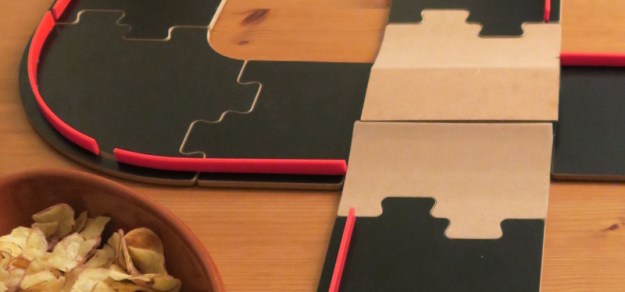
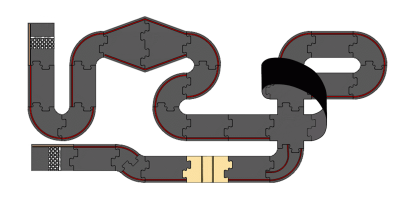
First to arrive, on the dot of 7pm, were Purple and Black together with Black’s mum, Sable.  So they got the dubious honour of setting up the PitchCar track for the “Feature Game”.  They chose one of the standard tracks from the second Extension (number five, which includes the tunnel from the first extension), and re-christened it, “Purple’s Hatch”.  They hadn’t finished setting up when Jade arrived as a scout on behalf of the party from Swindon, checking they’d got the right house.  In due course, Sapphire, Plum and Byzantium found their way round the back, eventually followed by Pine making a total of ten, and leaving so many shoes by the back door that it looked like a millipede was visiting.

PitchCar Track 31/12/23
– Image by boardGOATS

Over picky bits (Devils-on-Horseback, Pigs-in-Blankets, crisps, crudites and dips), the group began playing PitchCar.  A simple race game, starting with the player at the front, players take it in turns to flick their wooden puck-car.  The first player to cross the finish line after a set number of laps (in this case, two), is the winner.  If a player “offs it” or finishes wheel-side up, they go back to where they were (losing stroke and distance), however, if they knock someone else, the victim gains the distance, regardless of where they land or whether they are rolled.  To decide the order on the grid, there was a flick off, which was won by Sable on her debut.

PitchCar
– Image by boardGOATS

Unfortunately, although Sable started really well with a super-flick to give her pole position, she was soon over-taken as her inexperience told.  In fact, starting at the front of the grid seemed to be a bit of a poison chalice this time, and Purple who started second and Plum who started third were also quickly overtaken by the rest of the field.  Amid the mayhem, Byzantium started fourth and somehow remained in fourth place for pretty much the whole race.  Similarly, Jade started in sixth and gained a single place finishing just behind him.  The battle for the lead was therefore between Pine, Black and Sapphire the latter two starting from the very back of the grid.

PitchCar
– Image by boardGOATS

At the half-way point, Sapphire had the lead with Black in second and Pine in third, but by the end of the second lap, Black had caught and passed Sapphire to take the chequered flag, soon followed by Sapphire and Pine.  The rest of the pack eventually all crossed the line, with Purple, some way behind who suddenly started playing brilliantly after everyone else had finished, ending the game with the longest and best distance past the finish line.  By then, food was pretty much ready, so everyone engaged in the close-packing problem of re-packing PitchCar into its flight cases before settling down for Moroccan themed stews served with couscous, millet, roast cauliflower, meatballs and bread.

PitchCar
– Image by boardGOATS

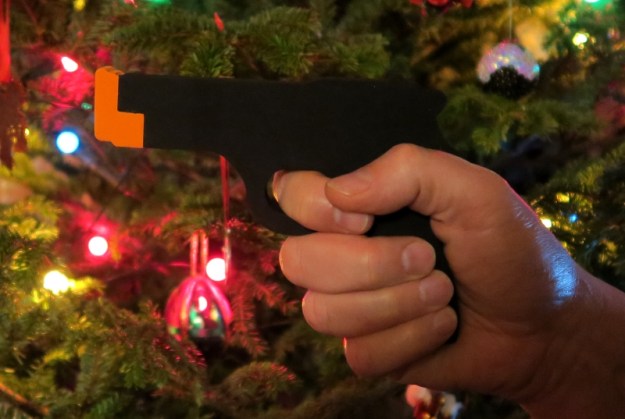
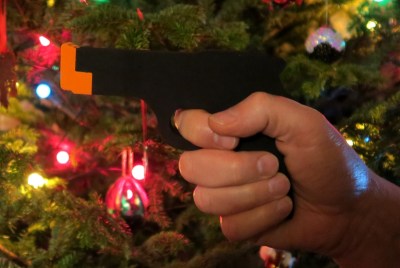
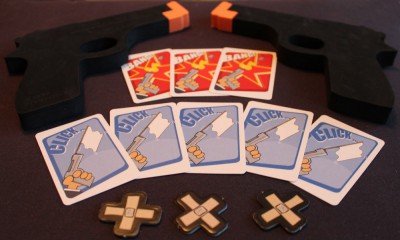
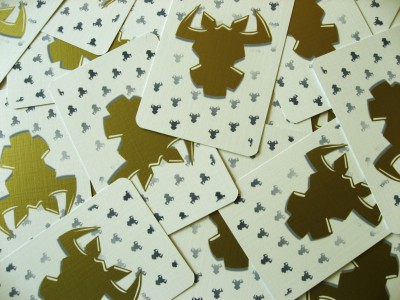
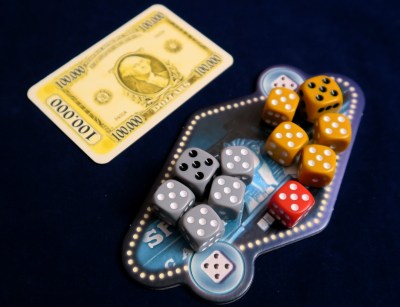
After tea there was a bit of chatter, but with an hour or so to midnight, Pink was keen to play one of his favourite party games, Ca$h ‘n Guns.  This is a silly game where players are a mafia gang dividing up their ill-gotten gains by playing a variant on “Chicken“.  After loading their guns with either blanks or live bullets, on a count-down from the Godfather, players simultaneously point their foam guns at each other.  The Godfather then gives another countdown, after which, people can back out, avoiding any bullets, but also withdrawing their claim to the loot for the round.  The remaining players reveal their bullet cards and anyone still standing after the shoot-out takes their share of the loot.  The player with the most after eight rounds is the winner.

Ca$h 'n Guns
– Image by boardGOATS

Pink started off as the Godfather, but soon lost that advantage and discovered that although people don’t gang up on the Mafia Leader, it’s shocking how they turn on you once you are no longer in power.  Black began building his art collection, until people spotted that was what he was trying to do, and then targeted him as well.  He was the first to be knocked out, taking his third and final hit in the penultimate round, round seven.  Sapphire soon followed and was taken out in the final round—it later became apparent that was not something he was going to forget quickly!  Purple and Pink amassed substantial totals, enough to give them second and third respectively.

Ca$h 'n Guns
– Image by boardGOATS

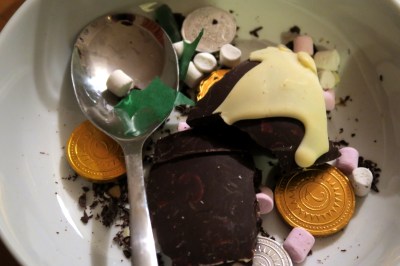
It was Pine, however, who won by a bit of a landslide, though.  He was helped along by the Gem Dealer bonus of $60,000, however, which made the majority of the difference between him and Purple, though he would have just pipped her to mafia-stardom without it.  By this time, it was just ten minutes to midnight, so Pink went to find the champagne (generously supplied by Jade), while everyone else packed away the foam firearms.  The GOATS countdown to midnight was slightly off compared to Jools Holland (who was on iPlayer and therefore lagging behind somewhat) and everyone toasted the new year and remembered those who were not able to be with us (in particular Green, Lilac, Lime and Burgundy).  Plum marked new year by fighting her way into the chocolate piñata with a ladle.

New Year 2023
– Image by boardGOATS

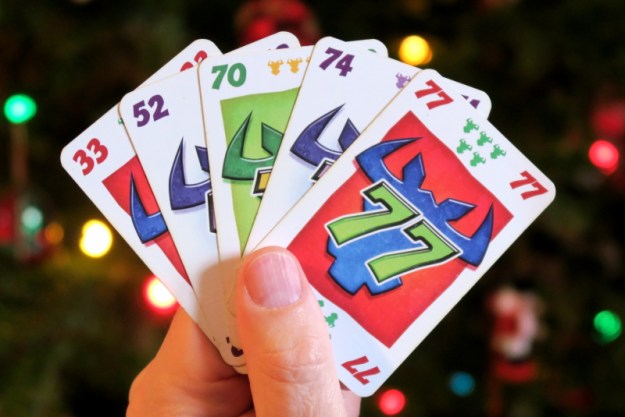
Blue and Plum stood outside on the step watching for fireworks, but although they heard some, there was a disappointing lack spectacle.  At the time, they thought they had just missed them, but it later turned out that this was at least in part due to anonymous, slightly threatening letters, from someone worried about their pooch.  Eventually, Plum and Blue gave up and came in from the cold and everyone played a mad and quite random game of 6 Nimmt! together as the first game of 2024.  In this game, everyone simultaneously chooses and then reveals a card from their hand.  In order from lowest to highest, these cards are then added to the four rows in the centre of the table.

6 Nimmt!
– Image by boardGOATS

Each card is added to the row that ends in the highest value card that is still lower than the card played.  The addition of this card makes the row longer—if it is the sixth card added, the owner takes the first five into their scoring pile.  Each card has a number of Bulls Heads (or “Nimmts”) on it, and the aim of the game is to be the player with the fewest.  Normally we play two rounds, but with so many players, we played one round with everyone starting with ten cards.  This turned out to be a strange combination of very random and slightly predictable as players could count cards, and it would probably have been better to start with hands of nine instead.

6 Nimmt!
– Image by boardGOATS

Jade and Purple competed for the highest score, but both lost out when the wooden spoon went to Black.  Blue and Pink did well only picking up five Nimmts apiece, while Pine did slightly better with four.  The clear winner was Plume, however, who somehow managed to avoid picking up any Nimmts at all, and on her first try too.  As the evening wound up, there was a lot of gentle chatter, nibbling of chocolate and sweets, and finishing off drinks, before  everyone eventually headed off to their beds having given 2024 a very warm welcome.

6 Nimmt!
– Image by boardGOATS

Learning Outcome:  GOATS can party like it’s 1999 every year.

9th August 2022

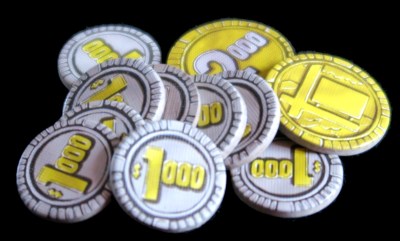
Pink, Blue, Orange and Lemon were the first to arrive, very soon followed by Plum and Jade.  While they were waiting for food, the group decided to play a couple of quick games.  First up was Moneybags, a game we played for the first time a few months ago.  This is a very quick social deduction game with a similar premise to Ca$h ‘n Guns:  players are a gang of thieves distributing their loot.  In Moneybags, the “Godfather” first distributes the loot and players then take it in turns to either steal from another player, pass, or close their money bag and recuse themselves from the rest of the game.
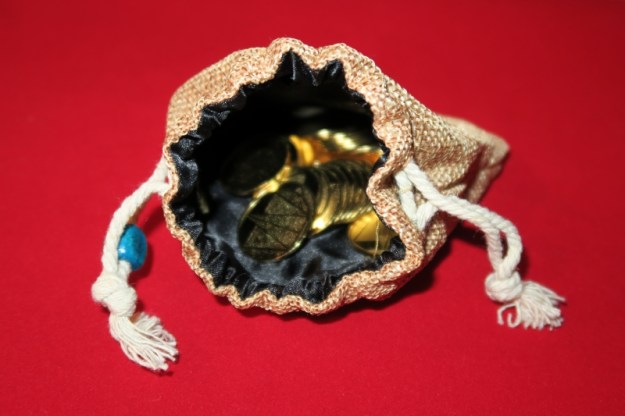
Moneybags
– Image by boardGOATS

If a player is robbed, the victim can challenge if they think the thief was too greedy.  If the victim has less than the robber, they win their challenge and take all the money for themselves, otherwise the thief wins and they take all the loot.  After two rounds, the players that have not been eliminated compare the height of their piles of cash, and the one with the tallest stack is the winner.  Pink started sharing out the cash while Blue explained the game.  Blue then started, robbing Pink to demonstrate how it is done.  It wasn’t long before the first player, Plum was eliminated, and everyone really understood how things worked.
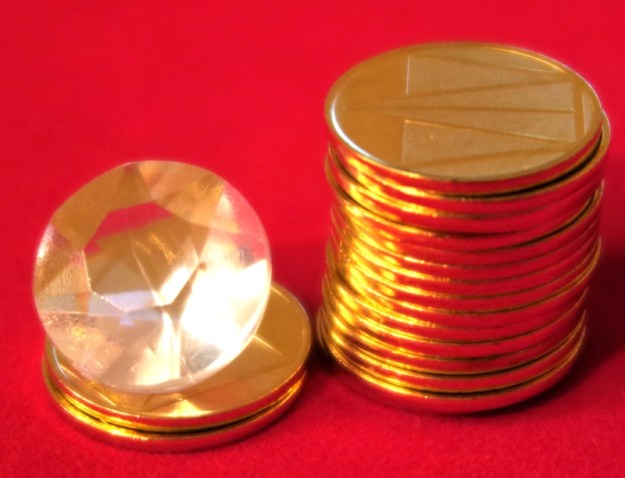
Moneybags
– Image by boardGOATS

When she was robbed, Lemon was unlucky to lose her challenge to Orange on a tie leaving only Blue, Pink and Orange left at the end of the round.  It was then a matter of comparing the three stacks to find that Orange was once again involved in a tie, but this time he lost to Pink on the tie-breaker (the winner being the player earliest in the turn-order).  Pink relinquished his right to being the Godfather though and gave it to Orange who filled the money bags for a second round.  Unfortunately, Orange failed to put any coins at all in Plum’s bag and put most of it in Lemon’s and Pink’s.  This made Lemon the first target and Pink the second.

Moneybags
– Image by boardGOATS

Ill-advised challenges left both Lemon and Blue eliminated in the first round and Orange by the end of the second.  Another three way comparison quickly pushed Pink into third leaving a close finish between Plum and Jade with Jade just sneaking in front.  Two games were enough, and Jade suggested the group move on to something new: MANTIS, a game from the same people as Exploding Kittens.  This is a simple set collecting game where, on their turn, players can choose to “Steal” or “Score”.  Players declare their plan (and their victim if they are stealing) before they turn over the top card of the deck.  When Stealing, if the colour matches cards belonging to their victim, then they take the cards and add them, face up to their array.
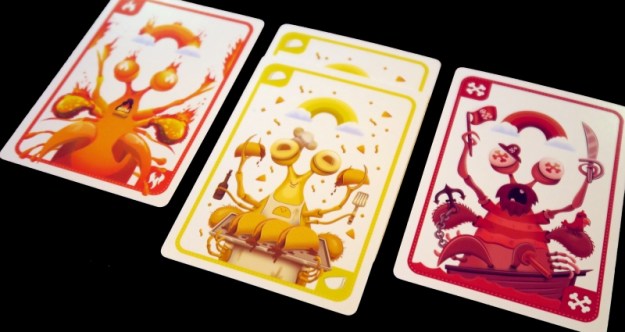
MANTIS
– Image by boardGOATS

When Scoring, if the colour matches any of their own cards, they turn over the cards and these become points—the first player to ten points is the winner.  While this sounds like pure chance, there is one thing that makes the game less random: the backs of the cards show three colours, one of which is the card colour while the others are red herrings (or herrings of another colour).  So whilst the game isn’t challenging, it rocks along nice and quickly.  Blue took points on her first turn to take an early lead, but everyone else soon caught up and overtook her.
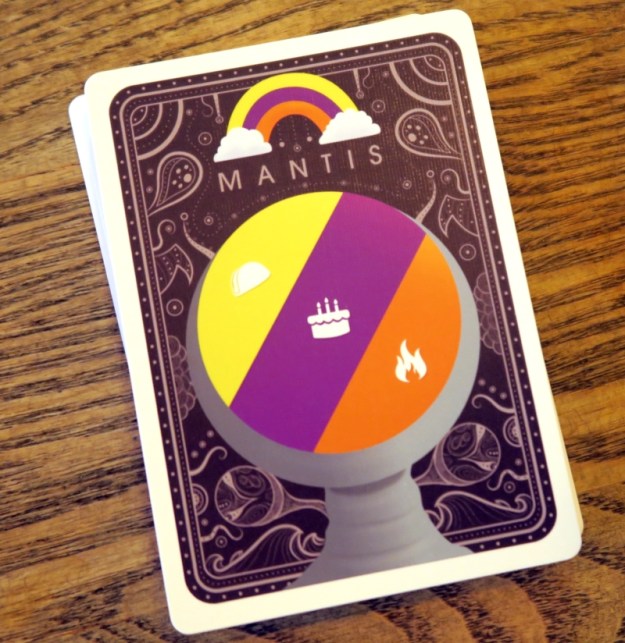
MANTIS
– Image by boardGOATS

Food started to arrive, and everyone tried (and failed) to finish before eating; it took a couple more rounds before Pink scored his tenth point.  It was very close for second with almost everyone else on six or seven, but Orange just nicked it with eight.  While everyone tucked in to their food, the rest of the group arrived.  There was some debate as to who would play the “Feature Game” which was to be Alubari: A Nice Cup of Tea, but in the end, Green and Ivory took themselves and the game to the other side of the room to set up a four player game where they were eventually joined by Black and Purple.

Alubari: A Nice Cup of Tea
– Image by boardGOATS

Alubari is a re-implementation of the popular worker-placement game, Snowdonia.  It had been a while since any of the group had played Snowdonia, so they needed a quick refresher of the rules and to learn the new aspects of Alubari. The underlying mechanisms are essentially the same, but it has a slightly smoother feel, and of course, the setting is Darjeeling (in the Indian state of West Bengal).  In this version of the game, players harvest Tea Estates and assist in the building of the Darjeeling and Himalayan Railway, from Siliguri Town to the summit at Ghum.  In addition, players use Chai (made from from harvested tea leaves) which increases the power of their actions.  Like the original game, players take it in turns to place their two workers on the action spaces available on the board.

Alubari: A Nice Cup of Tea
– Image by boardGOATS

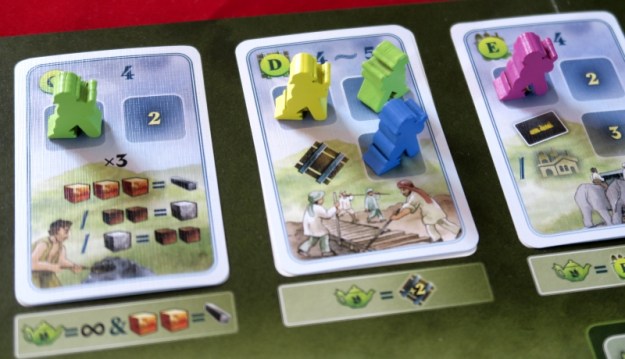
Once the workers have been placed, players carry out the actions in action order, that is to say, anyone who has a worker in Action A goes first, with the spaces within each Action numbered and activated in order.  The Actions are:  take Resources from the Stockyard; dig Rubble from the Tea Plantations; convert resources (Iron Ore into Iron Bars, Rubble into Stone or Stone into Rubble); lay Track; build Stations or buy Equipment; take Contract Cards, and finally, harvest Tea leaves or make Chai. Chai is very powerful because players can use it to to get an additional worker for the duration of one round.
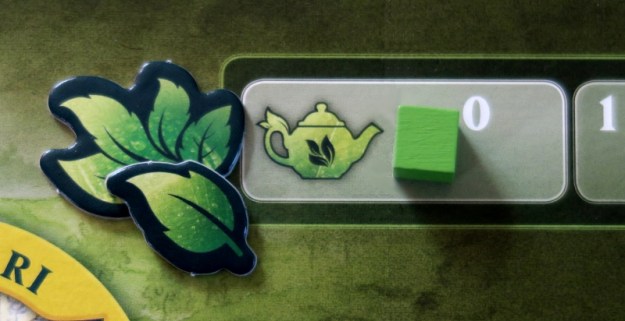
Alubari: A Nice Cup of Tea
– Image by boardGOATS

Chai can also be used to enhance actions.  For example, players can normally take three Resources from the Stockyard including one Chai; paying a Chai increases the number of Resources they can take to five with a maximum of two Chai. Some of this mirrors Coal in the original Snowdonia game, but initially, there was a little confusion amongst players over the differences between Tea and Chai.  There is a distinction here between Tea and Chai, with Tea being the raw leaf product (represented in the art by a leaf) and Chai being the refined product (represented by a teapot).  Tea Harvests are shown by a leaf with an arrow which mean players collect Tea leaves equal to the number of tea estates owned by player multiplied by the current value of the Tea Harvest Track.

Alubari: A Nice Cup of Tea
– Image by boardGOATS

The Tea Harvest Track works the same way as the Excavation Work (aka Dig) Rate and the Track Work Rate:  they depend on the Weather.  The back of the contract cards show the weather; at the start of each round the current Weather disk is removed, the other Weather disks shuffled forwards and the empty space filled with a disk that matches the back of the top card in the Contract deck.  Thus, players can see what the weather will do for the next few rounds and use that to plan when to take actions.  In general, the Excavation and Track Work Rates are increased by sun, decreased by rain and Work stops altogether when it is foggy;  in contrast, the Tea Harvest Rate increases with rain, decreases with fog and is unaffected by sun.

Alubari: A Nice Cup of Tea
– Image by boardGOATS

At the start of each round, the Stockyard is refilled with Resources which are drawn blind from a bag.  As well as Iron Ore and Stone, the bag also contains a small amount of Chai and five Event Cubes.  When one of these is drawn, from the bag, the game plays itself according to a Rondel.  This design feature is intended to prevent players from hoarding Resources and thus slowing the game—the fewer Resources there are in the bag, the more likely it is that a white Event Cube will be drawn out.  The Events include Excavate, produce Tea, build Stations and lay Track.  This last is particularly important because the game ends at the end of the round when the final Track space, on the approach to Darjeeling is completed—this could be by a player or an Event.
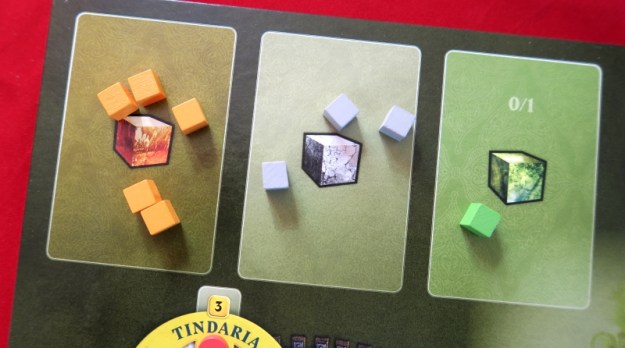
Alubari: A Nice Cup of Tea
– Image by boardGOATS

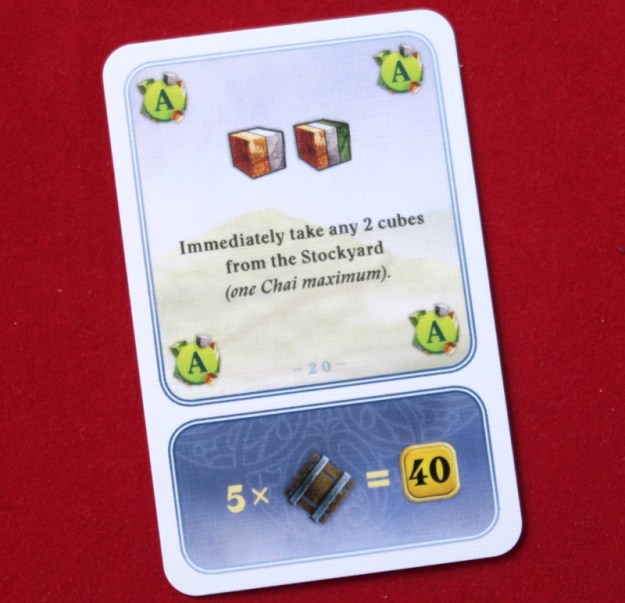
Once the rules had been run through, the game got underway.  Right from the outset Black pointed out that it was through Contracts that the big scores were really made. The Contract Cards come in two parts:  a Special Action part and an end game bonus.   The Action can be used in any round, but its use must be declared before any Actions are resolved.  Whether the Action is used or not, players can claim the bonus at the end of the game, and it was these to which Black was referring.  Ivory took note of Black’s advice and very early on went for a hefty contract which would give him forty points if he could get five rail tracks.
Alubari: A Nice Cup of Tea
– Image by boardGOATS

Considering that there are only fifteen tracks in the game, with four players and the game itself sometimes building track through the Events, the Contract for five rail segments looked like a tall order.  However, as nobody was really paying attention to Ivory’s plans, with the help of a Chai super-boost, it proved easier than it should have been.  Aside from that, Ivory, along with Black and Purple began with a fairly typical Snowdonia game approach, collecting building supplies.  Green on the other hand, decided to experiment with the new Tea/Chai mechanisms and started clearing the Tea Estates.  Although Green did get the first Tea Estate, everyone else also got one soon after.
Alubari: A Nice Cup of Tea
– Image by boardGOATS

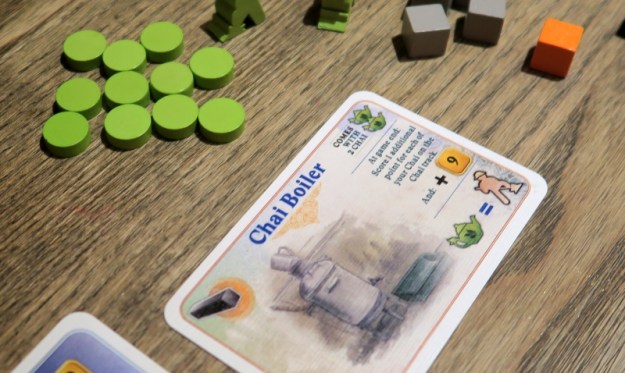
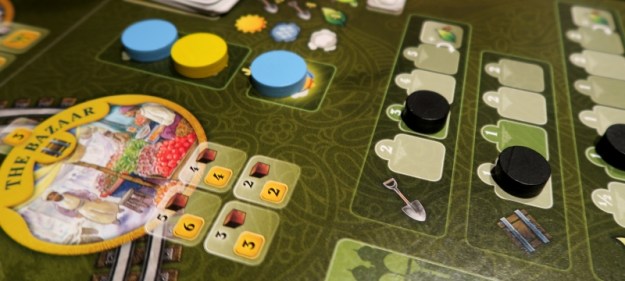
Green was able to continue this approach though, and by the first Tea Harvest, he had more estates than any one else.  Green was also the first to gain Equipment, going for a simple one, the Chai Boiler, from the Promo Pack, and gained two Chai with it. He was able to use those Chai to boost his later actions.  By halfway through the game he had built up quite a pile of Rubble, and only then realised that he could use this to build Stations.  This wasn’t the only game blunder made with Stations. It was only towards the end of the game that Black suddenly remembered the first town on the map, where players could use Tea leaves to pay to build the Station. The first space only cost three leaves, but gave a whopping twelve points and Purple make use of that as soon as it was pointed out.
Alubari: A Nice Cup of Tea
– Image by boardGOATS

Green took advantage of the Tea/Chai conversion after a very good Harvest, pushing himself to the top of the Chai track. He was then able to get a third worker and boost many of his actions the following round.  Through most of the game Ivory held the start player token, with Green and Black only taking it a couple of times with Ivory taking it back straight away.  The game was building nicely when suddenly, almost out of nowhere, it was over.  There were eight Tracks built when everyone except Purple chose to lay Tracks in the next round.  Green went first.  He needed to build two Tracks for his contract—he had the Steel but the Track Work Rate was one and he had run out of Chai so couldn’t increase it.
Alubari: A Nice Cup of Tea
– Image by boardGOATS

Next was Ivory who did have Chai, which allowed him to build two extra Track sections and he had the Steel to do it enabling him to build three in one go.  Black also had Chai, but only two steel. Seeing that he may not get another chance, he used the Chai, but still needed to lay one more track for his Contract.  So the game had gone from eight Track sections to fourteen in a single turn.  Green was primed to get his second Track section to complete his Contract, but unfortunately for him, the game had other ideas. With three white Event Cubes, the second event was Lay Track triggering the end of the game, but no Track left to be built. From there, it was just the usual calculations with players maximising points with the last workers and Chai.

Alubari: A Nice Cup of Tea
– Image by boardGOATS

Adding up the points, it turned out to be an incredibly close game. Purple and Green were within a whisker of Black who was the runner-up with sixty-nine and a half points (yes, this game does indeed give half points!).  It was Ivory who was the clear winner, however, with his five track Contract that shot his score to the dizzying heights of ninety-six.  In the post game discussion, the group agreed that some of the Chai boosts seemed more powerful than others, and the track laying bonus in particular seemed overly powerful. There also did not seem to be as many Tea Harvests as players expected (only three in the whole game including one from a Contract Card).  This was only one game though and it is highly likely that others will play out quite differently.
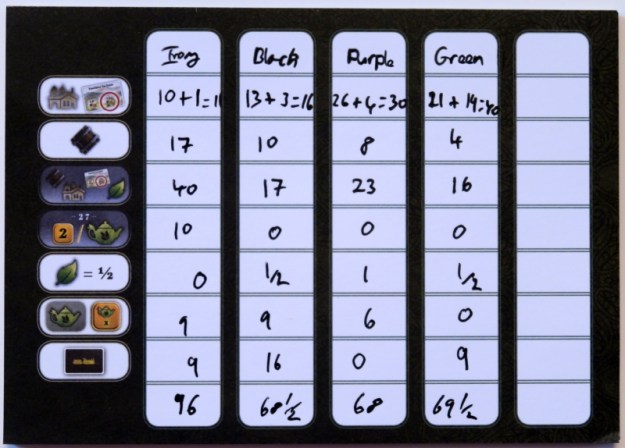
Alubari: A Nice Cup of Tea
– Image by boardGOATS

Meanwhile, on the other side of the room, after a bit of discussion, Blue swapped seats with Lime and he and Pink introduced Orange and Lemon to one of our favourite games:  Ticket to Ride.  We play this quite a bit in lots of different guises, so the plan was to start by playing a short game, the Demo edition, and then play a full sized version.  The game is very straight-forward and the basic play is the same across all editions:  on their turn, players can take train cards, build track by paying train cards, or take tickets which give end-game points.  While the basic mechanisms remain though, the map, the number of train pieces change and some editions add extra little rules.

Ticket to Ride Demo
– Image by boardGOATS

In the first, Demo game (played on the Europe map), Lemon managed to get lots of matching tickets which meant she gave everyone else a bit of a spanking.  Not being a native English speaker, Lemon queried the vernacular at which point Pink tried to explain that it was a sporting term, but everyone else including those on the next table insisted that he should explain it properly with all the meanings.  Lemon and Orange opted to spare his blushes by looking it up, only to blush themselves when they found it.  Much hilarity ensued and was shared with the neighbouring table.
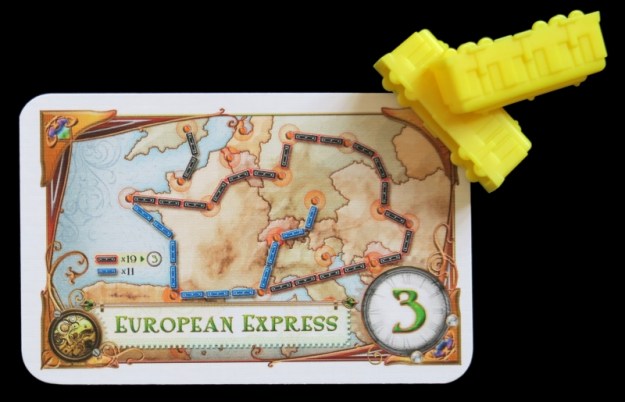
Ticket to Ride Demo
– Image by boardGOATS

After the introductory game, Pink and “the Citruses” moved onto a “full version”, but in an effort to avoid “special rules” the group played a house ruled version of Ticket to Ride: Germany.  This version of the game has its heritage in the Märklin limited edition that was the third game in the series and was published about fifteen years ago. Märklin make model railways, a bit like Hornby, but with German trains.  The Märklin version of Ticket to Ride had special art work with a different Märklin train depicted on each individual card in the deck.  More importantly, however, it introduced a passenger mechanism which made the game considerably more complex than the original.

Ticket to Ride: Märklin
– Image by boardGOATS

With the Märklin edition sold out, about ten years ago, Days of Wonder (presumably reluctant to renew the license for the Märklin branding) re-released the game for the German and Austrian market as Zug um Zug: Deutschland.  This was a simpler version that used the same map, but without the passengers, although the 1902 expansion was released a a couple of years later to reintroduce them with a new, simpler mechanism.  A few years after that, about five years ago, the German game was released for the worldwide market including both the Deutschland base game and the 1902 expansion—the only difference was the omission of two tickets.
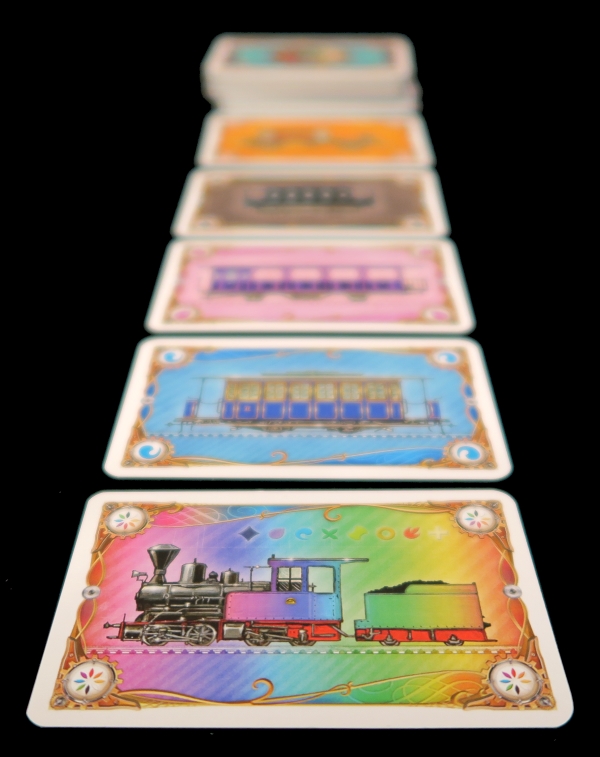
Ticket to Ride: Germany
– Image by boardGOATS

It was this newest Germany version of the game that the group played.  However, although the variant includes the passenger mechanism and there is no official variant in the rules “as written” to remove them, in order to keep things simple, the group omitted that part of the game, effectively playing Zug um Zug: Deutschland.  The game had just begun, when three rounds in, Pine arrived.  The others offered to include him, but he declined and, as a result, he didn’t play anything at all, all evening.  He did manage to recount the infamous game when he and Pink gave Blue and Burgundy a spanking over the Heart of Africa map as they got stuck in the middle blocking each other.
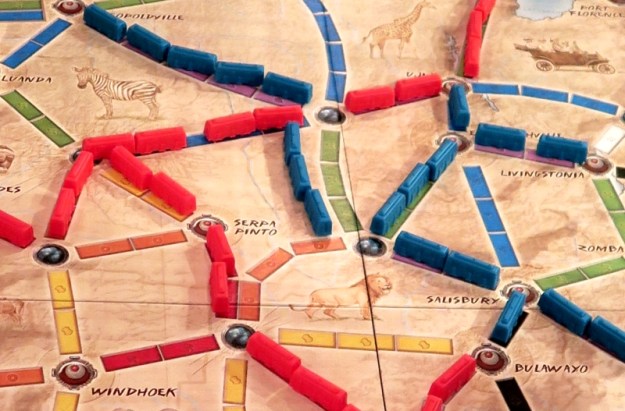
Ticket to Ride Map Collection: Volume 3 – The Heart of Africa
– Image by boardGOATS

The German version has two types of ticket:  long tickets (brown backed) and short tickets (blue backed).  At the start of the game, players choose four in any combination of the two types, but must first announce what combination of Tickets they are drawing.  Pink went for an almost exclusively long (brown) ticket strategy which he achieved with varied success, while the others went for a mixed ticket approach.  There was a little difficulty reading the tickets as the game uses a slightly gothic font which can be a little difficult to read, especially for those who’d forgotten their glasses.

Ticket to Ride: Germany
– Image by boardGOATS

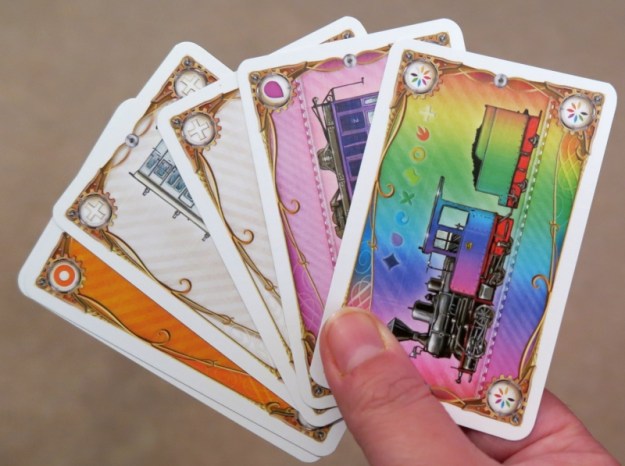
Both Lemon and Lime claimed the long train line from Berlin to Hamburg which give them eighteen points, the equivalent of a long ticket.  And tickets were very important this time.  Pink began completing routes from Kiel to Switzerland and France (via Bremen and Köln) before taking more tickets.  To fulfill these, he extended his network to Hamburg in the north, but failed to get to Karlsruhe in the south which cost him eighteen points in failed tickets.  The game can be played in a relatively friendly way, or aggressively with players trying to shut each other out.  We play in the more self-focused, less confrontational way, so failed tickets are normally relatively unusual, as such, this game was remarkable in that it was a bit of a tale of missed tickets.
Ticket to Ride: Germany
– Image by boardGOATS

In addition to Pink, Orange was particularly unfortunate this time, failing to complete any tickets as he was unintentionally badly blocked.  The game was ended somewhat unexpectedly by Lime, partly because he picked up the long route (suddenly depleting his supply of trains), but mostly because people weren’t paying attention to the number of trains he had left.  He was more fortunate in his ticket draws as well and that contributed to his hundred and fifty-four points and him giving everyone else a serious trouncing (another word for Orange and Lemon to look up).  Lemon was the best of the rest finishing with ninety, over sixty points behind Lime.

Ticket to Ride: Germany
– Image by boardGOATS

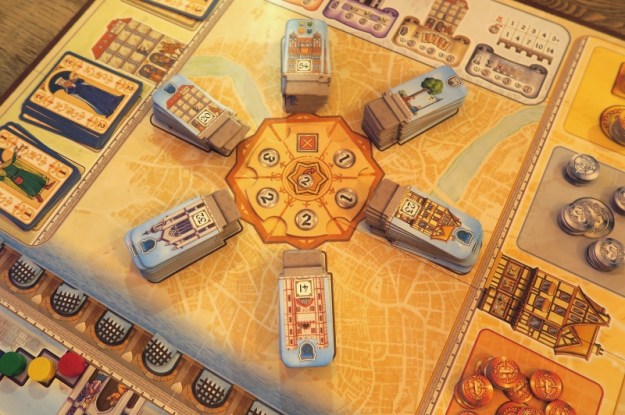
While everyone else was playing with trains, on the next table, Jade introduced Lilac and Blue to his new acquisition that he picked up from UK Games Expo back in June, Old London Bridge.  This is a fairly typical Queen Games game, with lots of pieces, but not too challenging—just what everyone wanted on a warm night.  The game is set in 1136 after the great wooden bridge across the Thames was been consumed by fire.  Players are architects, each responsible for designing and building one section of the new bridge.  On their turn, players add one of the available buildings to their bridge section.  Each building has three attributes:  Location, Colour and Number.
Old London Bridge
– Image by boardGOATS

There are six different types of building, each with a special “power”.  Thus, Haberdashers allow players to take money, the Purple Chapel buildings allow players to move along the associated track etc..  The colour is important because if that colour matches other buildings already on their bridge, they get a boost—for example, if a player takes a blue Haberdasher building, and already has two other blue buildings, they get to do that action effectively three times, taking three times as much money.  Finally, buildings must be built in descending Number order—to reset, players have to build a park, which has no additional “power”.
Old London Bridge
– Image by boardGOATS

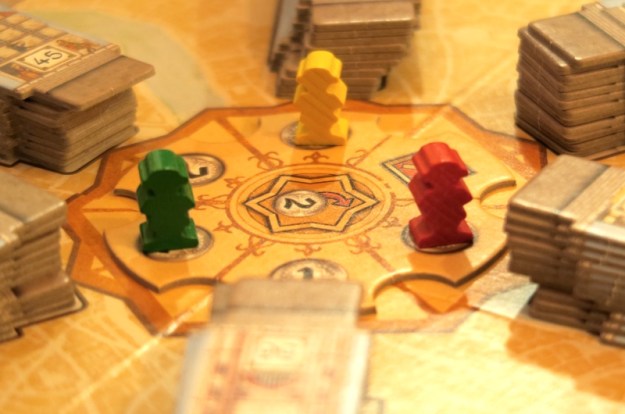
There are six building spaces on a central Rondel, each associated with a different pile of buildings and each with a money bonus that changes as the Rondel rotates at the start of each round.  Each Rondel space can only hold one player’s marker, thus each building type can only be built once per round.  One space is always deactivated (which one also changes as the Rondel moves), but the seventh space, the centre of the of the Rondel costs money, but allows players to take any building, including one that is currently unavailable (either because it has already been taken or was deactivated at the start of the round).
Old London Bridge
– Image by boardGOATS

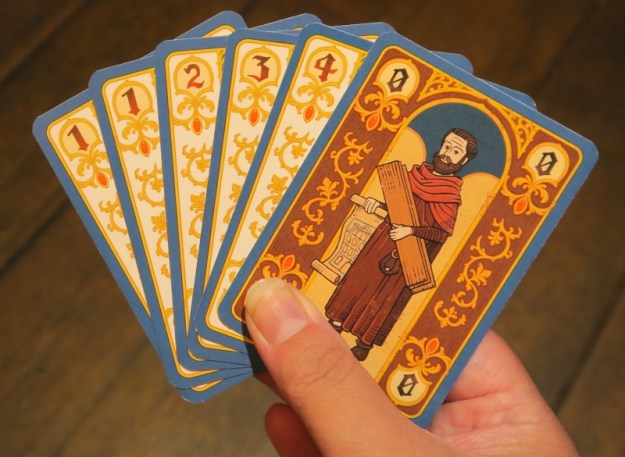
Each round, players bid with Character Cards to see who gets to choose a building first.  Character Cards which have a numerical value, zero to four.  Where there is a tie, it is broken by players’ respective positions on the Purple Chapel track. Players start with a hand of Character Cards, but can add to these by building a Hostelry building—the higher the power, the more powerful the cards they can take.  At the end of the game, the players get bonus points depending on the value of the Characters they have left over.  In addition to the Haberdasher, the Hostelry and the Parks there are also two types of buildings in the Bridge Gate:  Purple Chapel Buildings and Red Gatehouse Buildings.

Old London Bridge
– Image by boardGOATS

Each of the Bridge Gate buildings have a track associated with them.  During the game, passing milestones on these tracks give money and break ties (Chapel Track) or give special tokens that allow players to bend the rules (Gatehouse Track).  Additionally, players get bonus points at the end of the game depending on their final position on these tracks.  The final building type is the Guild House.  These have no action associated with them, but are “Colour wild”, featuring all four colours, and as such, they boost every other building type.  At the end of the game, players add their residual money to bonus points for their finishing position on the Bridge Gate tracks, for unused Characters, and for having the fullest bridge (if a player can’t obey the Number rules, they may have been unable to build a building).
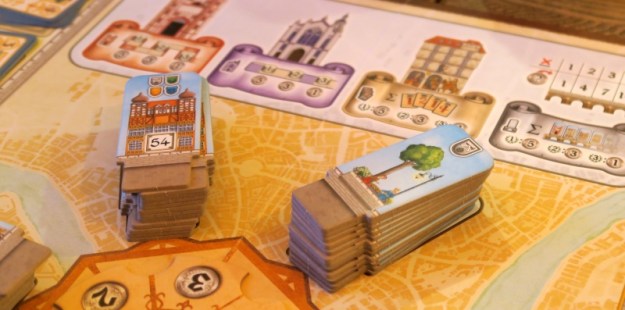
Old London Bridge
– Image by boardGOATS

Jade had only just started explaining the rules, when Plum announced that she had a “new religion”—Kittens, and shared photos.  From this point forward, every pause in the game became a “Kitty Paws” and was punctuated by more increasing levels of cuteness—definitely an improvement on the stuffed Pandas from last time.  Despite the undeniable distractions, everyone was still able to focus on the game and proceedings weren’t slowed at all.  Plum seemed to amass a vast amount of money in no time at all and after making a mess of her first turn, Blue got lots of orange buildings and lots of cards but was very slow to make any progress on the Purple Chapel track and lost every tie-breaker she was involved in as a result.
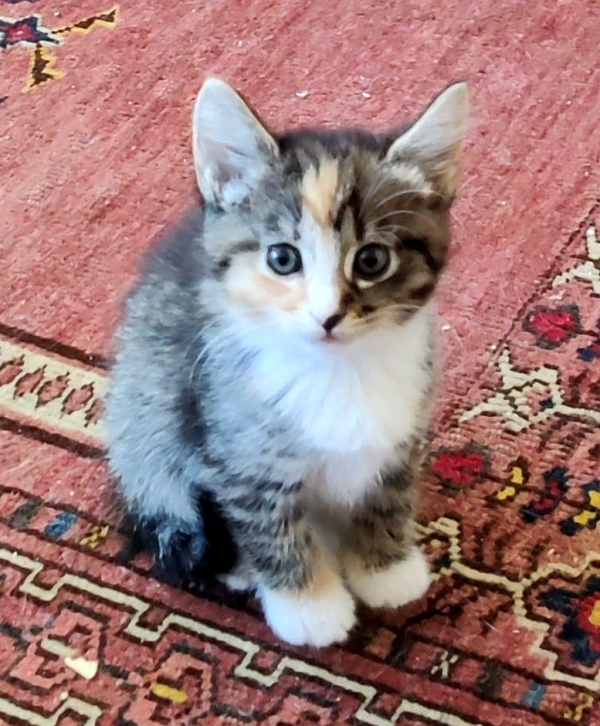
Plum's Kitty
– Image by Plum

Lilac was the first to run out of Character Cards and therefore ended up relying on her position on the Chapel track to ensure she didn’t get left with Hobson’s Choice every time.  In this she was helped by Jade who also ran out of cards.  Although Blue’s forest of Orange buildings meant she could get a lot each turn, her choice was often to do something she wanted but not get much of it, or take yet another orange building and to do something she didn’t really want and rely on probability to even things out in the end.  Things didn’t really even out, and as a result, Blue ended up with a lot of Character Cards.  Everyone else went for a much more balanced strategy focusing on one or two or maybe three Colours.  And Plum’s pile of loot grew ever larger.

Old London Bridge
– Image by boardGOATS

Towards the end of the game, Jade put on a massive spurt along the Red Gatehouse track and collected some Character Cards, while Blue finally made a move along the Purple Chapel track.  As a result, Jade who had led the Purple Chapel track for most of the game was pipped by Blue, and Blue who’d held a massive lead on the Red Gatehouse track was edged out by Jade.  Plum finished with the most cash with thirty, but in the end was only slightly ahead of Lilac and Jade.  Lilac who had just quietly got on with her game was the only player to fill all the spaces on her Bridge, despite running out of cards. In the ranking for players with the most buildings, there was a tie for second place.
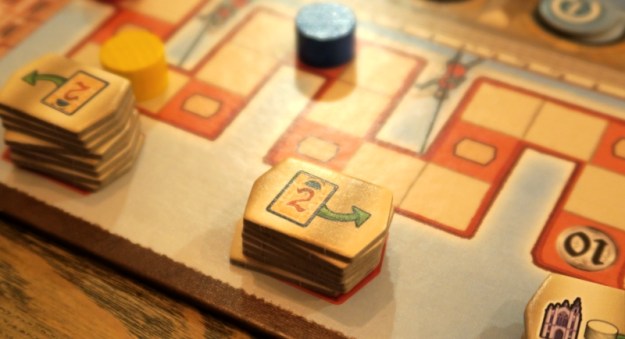
Old London Bridge
– Image by boardGOATS

Initially, the tie was resolved as a friendly tie with both Plum and Jade getting three points for their second place and Blue taking one.  On reading the rules later, it turned out that end-game ties are also broken by position on the Purple Chapel track, giving Jade three points and Plum one.  In general, bonus points are actually much less significant than money.  This is because money is absolute and turned directly into points, but the bonuses only reflect placings (not how successful someone is);  the bonuses therefore have a maximum of five points in each case whereas players can finish with as much money as they can.
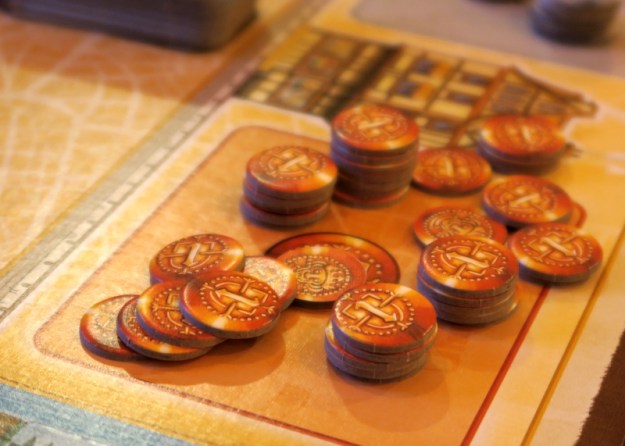
Old London Bridge
– Image by boardGOATS

In this case, however, it was very close for second place and the tie break for that bonus turned out to be critical:  Plum beat Jade on the friendly ties, but positions were reversed with the tie breaker from the rules as written.  Old London Bridge also includes alternate bonus conditions and had even one of these been in use, then the scores could have been quite different. There was no question about the winner though:  throughout, Lilac had just quietly got on with her own game doing everything well.  She was the only one to finish with all twelve buildings, finished with almost as much money as Plum, and had made good progress on both the Bridge Gate tracks.  With a final score of thirty-eight points, she was four points clear of whoever took second.  With time for just a few more “kitty pictures”, people started heading home.

Plum's Other Kitty
– Image by Plum

Learning Outcome:  Everyone Likes Train Games, and Kittens.
3rd May 2022

Like the last few games nights, this one started with Pink and Blue playing the deck-shedding game, Abandon All Artichokes.  This is a very simple game where players start with a deck of ten artichoke cards from which they draw a hand of five, then, on their turn, they take one card from the face up market, play as many cards as they can, before discarding their hand to their personal discard pile.  If, on drawing their new hand of five cards they have no artichokes, the game ends and they win.  In the first couple of games a few weeks back, Pink struggled somehow, and Blue won.

Abandon All Artichokes
– Image by boardGOATS

Then Pink got the hang of it, and won several games on the trot, but this time it was Blue’s turn to finally get back on terms, just before supper arrived.  They were just finishing when Black and Purple, and then Teal arrived.  Although it was still very early, it was a perfect opportunity to play the “Feature Game” as it was Moneybags, a quick little social deduction, filler game. The premise is similar to that of Ca$h ‘n Guns, where players are thieves dividing up the spoils from a robbery, stealing from each other and generally trying to deceive everyone so that they come out on top.

Moneybags
– Image by boardGOATS

In Moneybags, one player takes the role of the Godfather, divides the loot “evenly” amongst the players’ small hessian sacks.  Holding only the top of their sack, each player takes it in turns to Pass, Stick, or Rob another player.  Pass and Stick are simple actions (pass and remain in the game, pass and stick with the total in their sack so they can neither Rob nor be Robbed), but Rob is the interesting one.  The active player can Rob any other player that is still “in”, taking some or none of the loot from their sack.  The thief mustn’t be too greedy, however, as the victim can challenge—the protagonists compare their loot and the one with the largest stack loses, the winner takes all the loot and the loser is eliminated.

Moneybags
– Image by boardGOATS

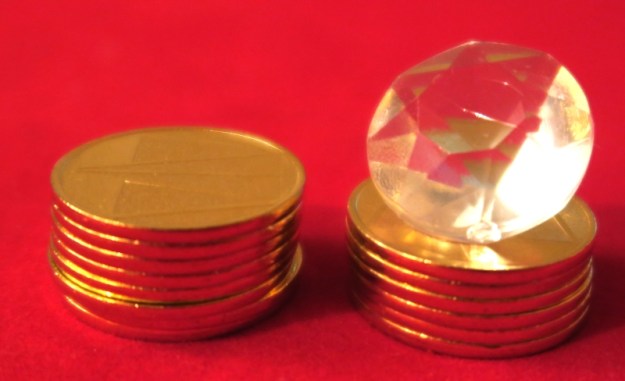
After two turns round the table, the game ends with the Godfather (or arguably Godmother), taking their second turn.  The winner is the player with the most loot.  Moneybags can be played over three rounds, though like Saboteur it is probably best when one round is considered “the game” rather than playing in campaign mode.  Pink started as the Godfather and divvied up the money.  In addition to coins, there is also a Diamond in the loot; this is worth roughly ten coins. When comparing spoils, the coins are stacked with the Diamond placed on top so that the tallest stack loses when Robbed or wins at the end of the game.  The Diamond is comparatively light, so it adds a little bit of additional ambiguity to the proceedings.
Moneybags
– Image by boardGOATS

Pink, made a point of taking note of where the Diamond went and then stole it back later in the game giving him the first round, slightly ahead of Teal in second.  Lime arrived during towards the end of the game, so the rules were explained to him.  Then Ivory joined the party so Blue swapped out and gave him a quick summary as well, while Purple, as Godmother, divided up the spoils.  With a slightly better idea of how the game played, the second round went even better with more players Robbing and challenging each other.  As a result, the Diamond went round the table several times.  There was much hilarity as players tried to guess how much cash people had, and Pink showed his age when he commented that someone’s stash “chinked like a bus conductor’s money bag”.

Moneybags
– Image by boardGOATS

Once again, the Godparent finished with the Diamond, but Purple had very little cash to go with it and therefore only made third place.  This time the winner was Ivory, in a very, very tight finish, just ahead of Black.  It had been a lot of fun and although we could easily have played another round or two, we also wanted to play some longer games.  Moneybags fills a similar role to 6 Nimmt! though, so it will get another outing soon.  In the meantime, Viticulture (Essential Edition), Roll for the Galaxy, and Brass: Birmingham were all suggested for the next game, but Pink always loves playing Viticulture and Teal has been keen for a while, so Ivory took them off to play that while the others decided what to play.

Viticulture
– Image by boardGOATS

Viticulture is a worker placement game where players plant and harvest grapes, make them into wine and fulfill contracts to get points.  The first player to reach twenty points triggers the end of the game, and at the winner is the player with the most points at the end of that round.  Although Viticulture is not particularly novel or innovative, it is widely respected as one of the best worker placement games around, succeeding in being both smooth to play and relatively easy to learn, though it takes real skill to be good at it.  This time, everyone sold land to fund worker training; although we haven’t done this when we played previously, it would seem to be an accepted tactic in most games now.

Viticulture
– Image by boardGOATS

At the start of the game, players get choice of a couple of “Mama” and “Papa” cards (taking one of each)—these give people starting resources, workers, money, Visitor cards or a starting building.  Pink took a Trellis from his Mama card which meant he could just plant grapes that needed a Trellis and not worry about building any cultivation infrastructure.  The others prioritised money. Playing two worker cards at the same time (using the on-board bonus) was a popular.  Though it required care not to overrate the feature and wind up playing some slightly naff workers, when perhaps it might have been better to wait until the next round.

Viticulture
– Image by boardGOATS

The grey, extra-worker meeple was also popular, with players seemingly happy to be last in the turn order if that meant they got an extra “turn”.  Although everyone had played the game before (though Teal only online), there were some rules that needed “ironing out” as years of playing with the Tuscany expansion meant that Pink had forgotten many of the differences between that and the base game (Tuscany will get an outing as the “Feature Game” in a few weeks). The game was brought to an unexpected (and obviously skillful) conclusion by Teal, who finished the game just before Ivory and Pink had the chance to deploy their big scores.

Viticulture
– Image by boardGOATS

On the next table, Libertalia: Winds of Galecrest got a second outing, largely as Black and Lime had missed out last time, but also as Purple and Blue had enjoyed it.  This is also a fairly simple game to play, with a lot of depth.  Players start with the same hand of Character cards chosen from a larger deck.  This provides a lot of variability, while also ensuring that nobody has an advantage caused by random card draw.  The cards are numbered from one to forty, each with different actions—some daytime, some dusk, and some nighttime.  The idea is that everyone simultaneously chooses a card to play, then the cards are activated in ascending order during the day, descending order at dusk and simultaneously at night.

Libertalia: Winds of Galecrest
– Image by boardGOATS

Some of the cards can have a huge impact on other players’ games.  For example, the Brute causes the highest value card in play to be discarded, which means the player that played that card doesn’t get actions on that round.  In addition to night time actions, any players whose characters survive the day, also get to take some loot, if there is enough available of course.  Some of the loot is extremely valuable, some of it can be used to assassinate other Characters and and some can be more of a curse than an advantage.  As a result, rounds can go well or badly.

Libertalia: Winds of Galecrest
– Image by boardGOATS

The game is played over three voyages, lasting four, five and six days respectively.  At the end of each voyage, players bank their takings and are paid a small amount based on their reputation at the start of the next round, which then acts as their kitty.  This time, Blue had an appalling first round.  This meant she was some twenty to thirty doubloons behind the others from the start, but also meant that when when others threatened, she was able to point to her lack of funds and how she was “not the threat”.  In contrast, Lime took an early lead and therefore attracted a lot of hostility, missing a lot of turns as a result.

Libertalia: Winds of Galecrest
– Image by boardGOATS

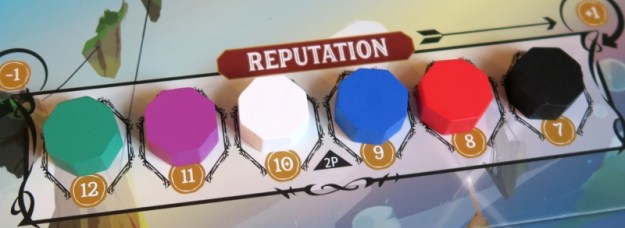
By the start of the final voyage, Blue was still some way behind, but hadn’t given up, Purple was fighting to get to the front, Lime was getting a bit fed up of being picked on and Black knew he was likely to be next in line.  It was all to play for, especially as the final voyage is the longest so players have time to plan and work card combinations.  Blue managed an amazing final round and nearly made it in what was a very tight finish—she ended just two doubloons behind Lime and Black who tied with eighty-six.  Lime could have won outright if he had played his Captain in the final round, but as it was, Black’s Aristocrat left him third on the Reputation track, one place ahead of Lime, giving him victory on the tie-breaker.

Libertalia: Winds of Galecrest
– Image by boardGOATS

Remarkably, Viticulture had finished first, so after discussing and admiring Roll for the Galaxy and comparing it with Race for the Galaxy (which Teal was more familiar with), the trio squeezed in a quick game of Love Letter.  This is a super-quick micro card game played with just sixteen cards that celebrates its tenth anniversary this year.  When it was first released it was very innovative, but since has inspired a lot of similar games, it is still great in its own right, as a simple, quick filler though.  The idea is players are trying to finish with the highest ranking card, so on their turn, they take a card from the deck adding it to their hand, then play one of their two cards.

Love Letter
– Image by boardGOATS

Each card has a rank, but also an action that takes effect when played.  For example, these allow players to look at others’ cards, force others to discard their card, or make them compare cards with the lowest being eliminated.  The last player standing wins the round, the first to three is the winner of the game.  This time, Pink and Ivory got their revenge on Teal for ending Viticulture too soon.  Between them, they shared the five rounds, with Pink just taking the balance and with it, victory as Libertalia and the evening as a whole, came to an end.

Love Letter
– Image by boardGOATS

Learning Outcome:  There’s no such thing as honour amongst thieving gamers.

Boardgames in the News: Asmodee Acquiring Again

The development of Asmodee from a small French games company primarily known for clever little kids game like Dobble and Jungle Speed, into an industrial conglomerate has been covered extensively here.  Over the last decade or so, they have acquired Days of Wonder, Fantasy Flight Games, Z-man Games, Mayfair and Lookout Spiele amongst others.  They have also leveraged control of the distribution network through the purchase of Esdevium (UK), Heidelberger Spieleverlag (Germany), Hodin (Belgium), Asterion Press (Italy), Millennium (Spain), FRED Distribution (USA) and agreements with Rebel (Poland), and Alliance Game Distributors (USA).  These acquisitions tend to come in flurries presumably as funds are made available and it seems they are in the middle of another one now.

Asmodee Logo
– Image from
escapistmagazine.com

In March last year, Asmodee signed a deal with CMON Ltd., to exclusively distribute the publisher’s board and tabletop games in North America.  Distribution agreements happen all the time because they help distribute costs between companies as well as distribute games to gamers all over the world.  What makes this agreement slightly more unusual is that CMON are a US company that have been successfully distributing their product across the USA.  Where Asmodee are concerned, a distribution agreement announcement is usually followed by more announcements, and this was no exception.  Over the Summer, Asmodee announced a similar distribution agreement with the Swiss publishing house, Helvetiq, and acquired the French-language boardgame site, Tric Trac.

CMON Logo
– Image from cmon.com

For eighteen years from 2000, Tric Trac was an independent enterprise with some 40,000 members directed by Monsieur Phal (aka Philippe Maurin).  In 2018, Flat Prod SARL (the parent company), sold Tric Trac to Plan B Games, a new company that grew out of the fallout of Asmodee’s acquisition of F2Z/Filosofia/Z-Man Games etc., in 2016, and won the Spiel de Jahres Award with Azul.  Tric Trac has been more commercial than the popular US-based, English-language website BoardGameGeek, which has been running for a similar length of time.  However, there have long been suspicions of that Asmodee have received special treatment from Tric Trac, suspicions fueled by the fact that the parent company Flat Prod SARL was formed by Philippe Maurin and the company Plume Finance, which is wholly owned by Marc Nunès, original CEO of Asmodee.  However, with Asmodee being such an important part of the French boardgame industry, it is perhaps unsurprising that their games take a lot of space on French website dedicated to boardgames. 

Tric Trac Logo
– Image from trictrac.net

With France’s foremost website in the hands of such a dominant force, there are concerns about a lack of critical objectivity and that Tric Trac could ultimately become a promotion channel for Asmodee.  It may be that with the retirement of it’s founder, Asmodee bought Tric Trac to ensure its survival and make sure the source of French-language boardgame media remains available and there is no sinister motive.  They have promised the team editorial freedom, but it is highly likely that Asmodee are the ones benefiting the most from the site anyhow, simply because they’re the biggest player in the market, especially given their history as a French company.  Since then, however, Asmodee have signed another distribution agreement, this time with Funforge, to distribute the French publisher’s titles in the U.S., and today they announced the acquisition of the Belgian publisher, Repos Production.  Repos are best known for games like 7 Wonders, Ghost Stories, Concept, Ca$h ‘n Guns and this year’s Spiel des Jahres winner, Just One.  Sometimes it seems like every successful company is a target and soon Asmodee will have a strangle-hold on the modern boardgame market.  Some people say they already have.

Repos Production
– Image from google.com

31st December 2019

Burgundy was the first to arrive and he was quickly joined by Purple, Black and Lime.  As the first to arrive, together, they began to set up the “Feature Game“, the now traditional, car-racing game, PitchCar.  When Pine joined the party, discussion turned to the “Monster Games” session which featured Bus, Ecos: First Continent and the very silly Happy Salmon, all of which had been very enjoyable in their own way and most of which will come out again soon.  Before long, an exciting-looking racing track was set up around an obstacle course of snacks and drinks.

PitchCar
– Image by boardGOATS

As we’ve done a few times recently, instead of a circuit, we set up a single section track with separate start and finish lines.  This year we included the new Loop (which got it’s first outing at Pink’s sPecial Party in October) and Upsilon expansions as well as the bridge from the first expansion.  As usual, much fun was had by all concerned, especially with the new challenge that the Loop added.  There is clearly a knack with this: it is essential to hit the puck hard and in the middle, but some have the skill naturally, while others apparently just don’t.  Lime is one who clearly does, and as a result, his car traveled the furthest in the “flick-off”, so started at the front of the grid and finished way out in front too.

PitchCar Track 31/12/19
– Image by boardGOATS

Pine, Pink and Purple, clearly don’t have the knack, and we never really found out about Burgundy either, as someone helped him largely avoid it, resulting in him to taking second place.  Elsewhere, having successfully escaped from the Loop, Black shot round the chicane and made the bridge look easy, inspiring Pink to comment that we always used to get stuck at the bridge, but now we have the Loop, the bridge is easy!  That said, stopping over the line without falling off the end of the track proved to be quite challenging.  So much so, that after half a dozen mini-flicks, Black was in danger of getting caught by Pine, who eventually made it round in fourth place.

PitchCar
– Image by boardGOATS

That just left Pink and Purple, taking it in turns to try to get round the Loop.  Eventually, Purple hit the sweet spot and started off towards the finish.  Unfortunately, after a superb single shot that took her round the ring, she ended up pointing in the wrong direction and tried to go  round the Loop backwards.  Pink meanwhile was still stuck and thanks to the way the track looped back on itself creating an intersection, managed to very effectively obstruct Purple in her quest to get to the end.

PitchCar
– Image by boardGOATS

As Purple’s and Pine’s antics entertained, everyone else consumed crudites, Devils on horsebacks, stuffed mini peppers, and large quantities of pigs in blankets (Lime commented that he now knew why JD Wetherspoon had a shortage).  When Purple and Pink finally crossed the line, it was time for supper – spicy vegetable chili, beef chili, rice and corn on the cob.  As people finished dinner we realised we’d forgotten the crackers and Christmas pressies. Unusually, this year there was desert too, so Black was given a special rolling-pin shaped knife to “cut” it, leaving everyone to wonder, before Pink delivered a Christmas pudding-shaped chocolate piñata.

New Year 2019
– Image by boardGOATS

The “Pud” resisted all Black’s initial blows, until he decided a side-swipe might have more effect.  Eventually a dent became a crack and the crack became a hole revealing the sweets inside.  As everyone picked at the chocolate, we decided to start another game, Ca$h ‘n Guns, because there’s nothing better at Christmas than pointing foam guns at each other.  This is a very simple, but very fun party game where players are gangsters dividing up their loot by a sort of controlled Russian Roulette.

Ca$h 'n Guns
– Image by boardGOATS

Each player starts the round by loading their gun with one bullet from their deck of eight bullet cards, or “clip”.  Each bullet can be used only once during the game, and three are live, while the other five are blanks.  Once everyone has chosen their bullet card, the Godfather counts to three and everyone points their weapon at someone.  The Godfather can then use his privilege to ask one player to point their gun away from him (there was some discussion as to whether a real gangster would use “please”), then there is a second count of three.  This time, players can back out, which means they won’t get shot, but they also won’t get any loot.

Ca$h 'n Guns
– Image by boardGOATS

All the remaining players then reveal their bullet cards and anyone who is shot picks up a plaster and also won’t get any loot at the end of the round.  This leaves a hard-core of gangsters to take it in turns to collect cards from the loot pool that was revealed at the start of the round.  In each round, all the loot cards are taken, so when it is a particularly brutal round, players can take several cards.  The loot includes diamonds, artworks and cash, as well as the occasional medipack or additional bullet and the opportunity to become the Godfather.  Unusually, this final option was taken several times so the Godfather changed hands quite frequently, with Burgundy, Pink, Lime, Blue, and Pine all taking the role at some point.

Ca$h 'n Guns
– Image by boardGOATS

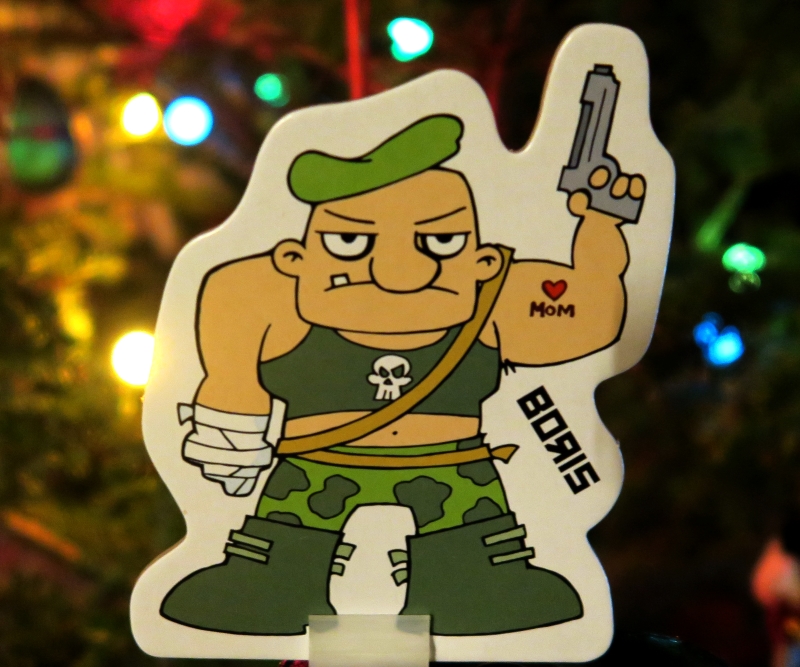
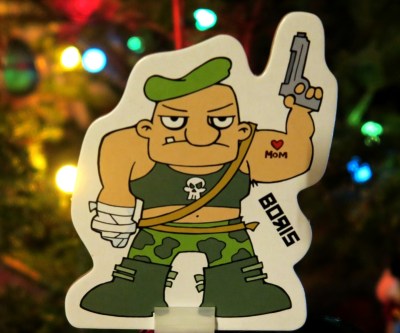
Blue was Boris, so Pink suggested that she should be the target.  This is fairly usual in this game, so Blue rarely wins.  However, it seems people didn’t like being told what to do by Pink, even if he was the Godfather, so remarkably, she survived the first round.  After a couple more rounds she’d still only picked up one plaster, while Pine, had acquired two so a third would put him out of the game.  As he had pointed out at the start, an injury tends to make you a target, but somehow, Pine managed to get himself a medipack.  Burgundy and Purple, however, were not so lucky and bought it in round six.

Ca$h 'n Guns
– Image by boardGOATS

Going into the final round, Black commented on how many painting cards Blue had picked up—the first is worth $4,000, but these score an ever increasing amount so a player with ten scores $500,000.  At that point, Blue didn’t feel she had enough, but as Pine’s final bullet proved to be a blank, she was able to stay in for the final round and pick up a couple more.  It surprised even her when she counted up and found she had seven paintings giving a total of $250,000 when her cash was added in.  Black took the $60,000 bonus for the most diamonds and with it, second place with $133,000, and not a scratch, just ahead of Pink ($110,000) who was also unharmed.

Ca$h 'n Guns
– Image by boardGOATS

With midnight fast approaching, we replaced the guns with glasses to toast the New Year and watch the fireworks (in both London and the village).  And then we had the very important decision to make: what to play for the first game of 2020.  In the end,  we decided to go for our old favourite, 6 Nimmt!.  Everyone knows how to play this by now:  players simultaneously choose a card from their hand and then, starting with the player that revealed the lowest value card, players add their cards to one of the four rows.  The player who adds the sixth card to a row, instead takes the first five into his scoring pile, where the number of bulls’ heads indicates the score.  The winner is the player with the fewest “nimmts”.

6 Nimmt!
– Image by boardGOATS

We played with our usual variant where a game takes two rounds, each played with one half of the deck.  In the first round, Pine top-scored with twenty-two closely followed by Lime with eighteen, while Pink kept a clean sheet and Purple remarkably (especially for her), had only the one card with just a single “nimmt”.  So, going into the second half, it was all to play for.  As is usually the case, those that do well in the first round typically do badly in the second.  That was exactly the way it panned out for Pink who picked up the most “nimmts” in the second round with twenty-five, almost catching up with Pine and Lime.  Purple, however, managed to buck the trend, and pulled out a clear round giving her a final total of just one and with it, clear victory—the first of the new year.

6 Nimmt!
– Image by boardGOATS

Lime suggested a second game, and as the only other game being suggested was Bohnanza, apathy from everyone else meant we played 6 Nimmt! again.  Again, Pink ended the first round with “zip”, followed by Black and Burgundy with five; again Pine had the highest score of twenty-four.  Also again, Pink failed in the second round, taking more than anyone else and finishing with a total of twenty.  Blue managed a zero in the second round, but had picked up too many points in the first to do better than second place.  It was consistency that won the game though, and Burgundy, the only one to say in single figures for both rounds, finished with thirteen and took first place.

6 Nimmt!
– Image by boardGOATS

By this time was well gone 1am, and there was some chatter before Lime decided that it was past his bedtime and left everyone else to it.  With six, there were slightly more options, and when Pink appeared with For Sale, nobody objected.  This is an older game, that we haven’t played in the group since it was the “Feature Gamenearly seven years ago, but it is a bit of an “ever-green” game that still pops up on recommendation lists from time to time.

For Sale
– Image by boardGOATS

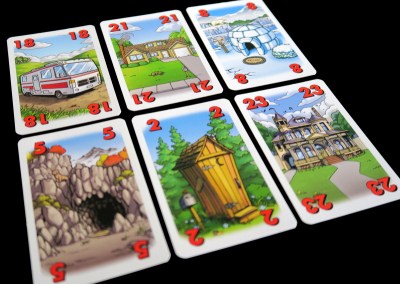
The game is very simple: players buy properties in the first part of the game and then sell them in the second half, and the player who has the most money at the end wins.  Buying properties is through auction.  Players start with $14,000 to last the whole game and take it in turns to bid for one of the property cards available on the table.  These have a nominal rating of one to thirty with fantastic pictures that reflect their value.  In each round, the bidding is continuous with players either increasing the bid by at least $1,000 or passing.  When a player passes, they take the lowest value property card and pay half their bid.  Thus, the winning player gets the highest value card, but has to pay the full amount bid.

For Sale
– Image by boardGOATS

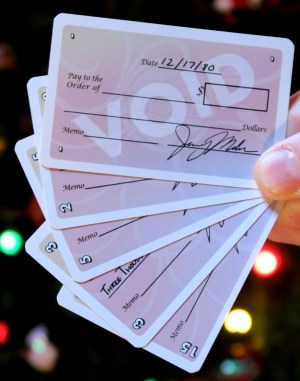
In the second part of the game, cheque cards with a value of $2,000 to $15,000 (or void) are revealed and players simultaneously select a card to play and then reveal.  The property card with the lowest numerical value takes the cheque with the smallest value.  This time, the property cards came out in bunches so it was mostly a case of players trying to avoid getting the real rubbish, and some inevitably failing.  It was such a long time since we had played the game, that it took a couple of rounds for players to really get the feel of valuing the properties and the best way to bid, by which time, in some cases, the damage had already been done.

For Sale
– Image by boardGOATS

It also took a round or two to get the hang of selling properties as we weren’t sure exactly how the money on the cheques was distributed.  In addition, the cheques came out with low values first, then high values and finally, both voids in the last round.  This meant that although Blue took the maximum return for her Space Station, she didn’t take out any of the other high value buildings.  It also meant that Burgundy and Pink got saddled with the voids in the final round.

For Sale
– Image by boardGOATS

Despite this, it was a very close game.  In the final accounting, Black won with a total of $50,000, just ahead of Burgundy in second with $47,000, the void possibly making all the difference.  By this time, it was gone 2am and although nobody was keen to leave, it was definitely pumpkin-o’clock.  So everyone headed home to bed for the first time in 2020.

New Year 2019
– Image by boardGOATS

Learning Outcome:  Thick chocolate is surprisingly hard to break.

Boardgames in the News: Another Five Great Family Games to Play at Christmas

Four years ago, we posted a list of ten great games that are ideal to play with the family at Christmas.  That list is still valid of course, but there are so many great games out there now that we decided to put together another list of ten – and these are just as good!  As before, they are all readily available online and/or in dedicated boardgame shops.

    1. ICECOOL & ICECOOL2 – This is a fantastic little chase game guaranteed to get kids of all ages involved.  Players take it in turn to try to catch the others who are flicking their “Weeble-like” penguins around the three dimensional board collecting fish.  The two versions can also be combined to give different layouts and play twice as many people for twice as much fun.
      Target Audience: Families; ages 6+
      Game Time: From half an hour up.
      Price:  Approximately £30 from amazon.co.uk.

      ICECOOL
      – Image used with permission of BGG contributor punkin312
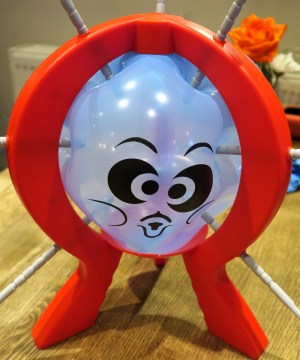
    2. Boom Boom Balloon – This is a very silly, simple game, that is a huge amount of fun for kids and adults alike.  Essentially, everyone takes it in turns to push sticks into a balloon with stress levels rising until it inevitably bursts.  The balloons are slightly toughened so they take a huge amount of punishment, ramping up the tension…
      Target Audience: Friends & Families with ages 2+
      Game Time: 5 mins though it takes a little time and puff to set up the balloon in the frame.
      Price:  £10-20 from amazon.co.uk.

      Boom Boom Balloon
      – Image by boardGOATS
    3. Ca$h ‘n Guns – Nothing says Christmas quite like waving a foam gun at Grandma!  This is a fun bluffing party game where players are gangsters and anyone left in at the end of the round shares the loot.  The player with the most loot after eight rounds is the winner.  Hilarious fun, but nowadays, the involvement of guns (even foam ones) means its not really suitable for children under ten.
      Target Audience: Older children and adults; ages 10+
      Game Time: 45-60 mins
      Price:  Readily available for around £25-30.

      Ca$h 'n Guns
      – Image by boardGOATS
    4. Azul – This is one that is likely to appeal to those who like Scrabble, but lose because they can’t be bothered to learn a dictionary off by heart.
      Target Audience: 10 and up
      Game Time: 30-45 minutes
      Price:  £30-40 from amazon.co.uk.

      Dobble
      – Image by boardgamephotos
    5. Just One – This is a clever party game where everyone plays together to do the best they can as a team.  A sort of “word charades”, in each round one person guesses which of five words is the right one, while everyone else offers clues.  With everyone working together, this is a lot of fun with a family group and ideal for families at Christmas.
      Target Audience: age 8+ though they need good literacy skills
      Game Time: 20 mins per game plus a few minutes setting up
      Price:  approximately £20 from amazon.co.uk.

      Just One
      – Adapted from image by BGG contributor kalchio

Pink’s sPecial Party

It being a very special day for Pink, he decided he wanted to spend it playing games with friends and family at the Jockey.  The early arrivals set up PitchCar, including the new “Loop” expansion and others played Loopin’ Louis, Patchwork Express, Dobble and the surprise hit, Boom Boom Balloon.  Little-Lime won PitchCar (perhaps flicking talent runs in the family as Lime himself managed to complete the  loop at least three times), and almost everyone managed to lose Boom Boom Balloon at least once.  Late in the afternoon, a game of Scotland Yard was started with Pink as the fugitive, and finished almost before it was begun when he was quickly captured.  It was then restarted with Mrs. Lime as the fugitive and turned into an epic game that went on for a couple of hours with a brief break as people tucked into the buffet supper and amazing sticky-toffee pudding cake-desert provided by the Jockey Kitchen.

Boom Boom Balloon
– Image by boardGOATS

The evening continued with more games including No Thanks!, Finstere Flure (a.k.a. Fearsome Floors), Saboteur, …Aber Bitte mit Sahne (a.k.a. Piece o’ Cake) and Ice Cool.  The team of five eventually managed to corner Mrs. Lime, freeing up Pink to play his special request, Captain Sonar, which his team fittingly won, twice.  This was followed by a game of Ca$h ‘n Guns (it is always fun entertaining the bar staff by waving foam pistols about and threatening to shoot each other), before finishing with 6 Nimmt!, a game to match Pink’s socks.  It was a great day, and we all went home tired, but very happy, with Pink and Blue keen to thank everyone for sharing Pink’s sPecial day.

6 Nimmt!
– Image by boardGOATS

31st December 2018

The evening began with Pine’s arrival, and he helped Pink rearrange the furniture for PitchCar while Blue added the finishing touches to supper.  PitchCar is a brilliantly simple, dexterity car racing game—players take it in turns to flick their wooden cars, and the first one to get round the track three times is the winner.  Before long Burgundy, Purple and Black had arrived and pieces from the base game and five of the first six expansions were all over the place and everyone was diving in trying to make an interesting looking track.  There was a problem though, the problem we always have, which is a shortage of straight sections.  It was then that Blue produced another expansion from under the sofa:  the “Long Straights“.  These are exactly what they sound like, two, very long, plank-like, straight sections that are a pain to store and difficult to transport, so rarely get used.  They have the potential to add a very fast section to the track though, so this time we used both with a tight hairpin in between them to add interest.

PitchCar Track 31/12/17
– Image by boardGOATS

Like last year, instead of making a circuit, we made a single long race track weaving around plates of crudites, mugs of tea, and trays of “pigs in blankets”.  There was a big debate whether to use The Cross as a cross-roads or back-to-back corners.  In the end, the double corners won, the track was complete and we had a push off to see who would start at the front of the grid.  Black won with a magnificent flick, followed closely by Purple.  Blue stalled on the grid and the only one to come off worst was Burgundy who came off the track and defaulted to the back of the grid.  The race began:  Black and Purple continued strongly and everyone else shuffled about in the middle order with Burgundy bringing up the rear.  Then Burgundy adjusted is driving style slightly and gradually began to work his way through the field.  Meanwhile the wheels dropped off for Purple who had briefly taken the lead, but suddenly seemed to lose the knack of flicking, and gradually, the rest of the pack overtook her one by one.

PitchCar
– Image by boardGOATS

Almost everyone had trouble going over the bridge, but particularly Blue, Pink and Purple.  Eventually they made it over though and shot down the rail to the hairpin some failed to make the corner, but the long straights added a bit of speed and excitement.  The tunnel ended up being a relay race with Black getting stuck under the bridge, only to be pushed out by Blue, who in turn also got stuck and was freed by Pink.  Similarly, he was freed by Burgundy and Burgundy was liberated by Pine.  And that order was maintained all the way to the finishing line, despite Blue needing several shots at crossing it without overshooting.  Green and his lady-friend, Lilac, had been held up though were expected any second; food wasn’t quite ready either so we ran the race in reverse starting with Purple, the last player to cross the line in  the first race.

PitchCar
– Image by boardGOATS

Inevitably, we’d only just started when Green and Lilac arrived, so they just joined in.  In fact by this time, Blue had actually managed to go backwards and was further behind the line than others were in front of it.  With the larger pack, this time round the race was even more eventful with Black managing to park his car in a plate of crudites just missing a bowl of salsa and Pink repeatedly bouncing off the edge of the mouth of the tunnel obstructing everyone else behind him.  Bizarrely, although the tunnel caused mayhem, the bridge was much less of a problem this time though with Pine leading the way by deftly bunny-hopping over it and almost everyone else just following his example.  Leading over the bridge was a huge advantage, and though Blue threatened to catch him, he maintained his position to the finish.  With food ready and waiting, the track was progressively dismantled as those bringing up the rear made their way to the finish line.  Although it only gets an outing two or three times a year, PitchCar is always great fun and the seventh expansion, “The Loop” which is due in the new year, looks like it will add even more madness to the game.

PitchCar
– Image by boardGOATS

With PitchCar over and the track in a heap in the corner, food swiftly appeared in the guise of enchiladas with corn on the cob, nachos and some strange yellow, habanero salsa that reminded Pine of wallpaper paste.  Supper was accompanied by more special crackers, little parcels, Herb Alpert and the Tujuana Brass, and finished with ice cream, and then it was on with the games; after a little debate first up was Ca$h ‘n Guns.  This is push your luck game with a gangster theme played over a series of eight multi-player duels over their ill-gotten spoils.  The player with the largest haul after eight rounds is the winner, as long as they are still alive of course.  Each player has a character standee, a foam gun, and a clip of three bullet cards and eight blank cards.

Ca$h 'n Guns
– Image by boardGOATS

At the start of each round, everyone simultaneously chooses a whether to “load” their gun with a bullet or a blank, and on the count of three, points it at one of the other players.  On a second count of three, they choose whether to remain in, or withdraw taking their shot with them.  Anyone whose target is still standing reveals whether their gun was loaded with a live bullet or a blank.  Anyone who received a shot takes a plaster signifying their wound and is out of the rest of the round; three wounds and they are eliminated from the game.  All players remaining then take it in turns to take a loot card from the centre of the table—there are eight cards, so the number of cards each player gets depends on how many players have survived the “duel”.

Ca$h 'n Guns
– Image by boardGOATS

The game can be quite brutal, and this was no exception, indeed, Black was out in the second round and Green quickly followed.  Pine pointed out that everyone on his side of the table had been injured while Blue, Pink and Burgundy were all uninjured.  Purple decided to fix that and faced off with Burgundy, both ending up injured as a result.  Lilac proved a dangerous adversary as she collected extra bullets from the loot and ended up with a full set going into the final rounds.  Blue injured Burgundy and coped a bullet in return.  After Black’s and Green’s dismissal, everyone was more circumspect and didn’t gamble as readily with their lives, so all the other players survived to the end of the game.  That just left the small matter of the scores.

Ca$h 'n Guns
– Image by boardGOATS

Pine and Purple had both been collecting gems, but had finished up with the same number so neither picked up the $60,000 bonus for having the most.  Blue had started out collecting artwork, but there wasn’t much available.  It became clear why, when the loot for the final round was revealed:  almost all of it was art.  It was tough in the final round; Blue was taken out by Burgundy, which effectively removed her from the running.  Pink had been doing well as the Godfather, but had taken a couple of hits in the latter stages and was also taken out of the final round.  Pink finished with $110,000 and second place.  The final round was attritional and there were few people left to share the swag.  Most of the artwork ended up going to Pine and with it first place overall thanks to a final total of $123,000 worth of loot.

Ca$h 'n Guns
– Image by boardGOATS

There was still time till midnight, and it was a toss-up between two of our favourite light games, 6 Nimmt! and Las Vegas, in the end we went for dice over cards and played Las Vegas.  This is a very simple game, but a lot of fun. The play area is made up of six casinos, each numbered one to six with a jackpot drawn at random from a deck of money cards.  With eight players, each jackpot totals at least $90,000 and comprises one or more notes.  On their turn, players must use all the dice of one number to bet on the casino of that number by placing them on that casino tile.  Once everyone has placed all their dice the player who placed the most dice on a casino takes the highest value currency card. The player with the most money after four rounds is the winner.  The snag is that before any money is handed out, any dice leading to a draw are removed. It is this rule that makes the game interesting, raising the decisions above the trivial.

Las Vegas
– Image by boardGOATS

We usually play with a few “House Rules”:  we replace one of each player’s dice with a big, “double weight” die from the Las Vegas Boulevard expansion; we include the Slot Machine, and only play three rounds.  The Slot Machine is a little different to the Casinos as players place all their dice of one number on the tile, but each number can only be placed once.  Unlike the Casinos, if there is a draw, then the player with the total number of pips wins, and if it’s still a tie, then the player with the highest value die wins.  The game is very robust to interruptions which is just as well as we took a break at midnight for toasts to the new year and to Ivory’s new arrival (we are looking forward to his return in March).  Prosecco and sparkling apple juice were accompanied by the village fireworks, an exceptional panettone and mince pies and eventually everyone made it back to the table and the game resumed.

Las Vegas: The Slot Machine
– Image by boardGOATS

Perhaps it was the interruptions, but Black’s game went almost as badly as it had in Ca$h ‘n Guns, and he won nothing at all in the first two rounds and not much in the third.  It turned out that Purple and Burgundy didn’t do any better as all three finished with just $100,000.  That was better than Green however, who made a paltry $20,000.  Pink started off really well, but at the start of the second round we realised he was using one more die than anyone else.  After paying a $10,000 penalty, he finished with $240,000, $10,000 more than Blue.  Lilac, on the other hand, took more in the first round than Blue or Pink took in the whole game and finished with $410,000.

Las Vegas
– Image by boardGOATS

Normally $410,000 would be more than enough to guarantee a win, but Pine, who took three $70,000 notes in the final round alone finished with a massive $510,000, a personal and probably group record.  With the game over, Green took Lilac home to nurse her sore throat and everyone else finished their drinks and chatted for a while, watching Pink and Pine demolish a bottle of Bavarian whisky picked up in Essen during the Spiel.  Everyone who had been there commented how much they had enjoyed The Gallerist at the ninth “Monster Game” session a few days earlier.  Although it had taken ages and was very complex, it wasn’t a real brain-burner and everything had been done well.  The rule book was good, the board was clearly laid out, the player-aids were helpful, the pieces were great and the box was really top quality—in fact, it was almost the complete opposite of Agra, which struggled through at the previous “Monster Games” event.  The second game, Reef, had also gone down well, but everyone was particularly keen to give The Gallerist another go.

Las Vegas
– Image by boardGOATS

Learning Outcome:  GOATS enjoy a good party just as much as the next ruminant.