Tag Archives: Carcassonne

BoardGOATS @ “The Mix” – Saturday 18th April 2015

The Mix in Wantage town centre is holding a drop-in gaming session on Saturday from 10.30 am until 2.30 pm.  Members of the club are providing games and will be teaching people how to play them.

The Mix
– Image from thewantagemix.wordpress.com

There isn’t an awful lot of space so the idea is to encourage people to drop in and play a short game or two.  We are planning to bring a few eye-catching games like PitchCar, Riff Raff, Bamboleo, Toc Toc Woodman, and Saturn, but most of the gaming will be smaller filler games like Dobble, Turf Horse Racing, No Thanks!, Walk the Plank!, The Great Balloon Race and some of our other light favourites.  We will also be bringing some classic gateway games like Carcassonne, Ticket to Ride, The Settlers of Catan and Jamaica as well as a small number of deeper games, just to show people what else is out there.

Round and About - The Mix
– Image by boardGOATS

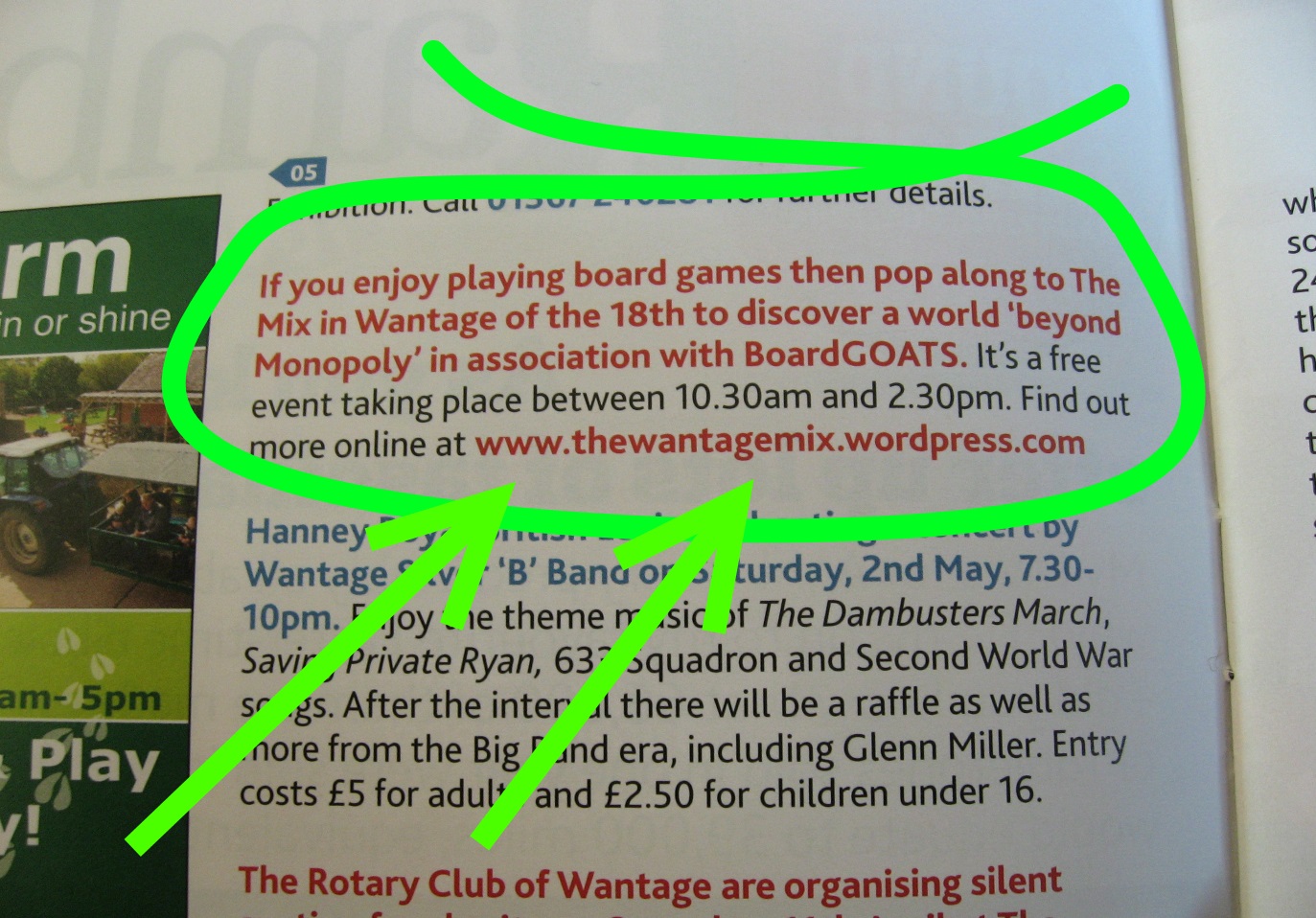
The event has been well advertised and was mentioned in the Ramblings section of the April edition of the local magazine, “Round and About”, so we are hoping for a decent turn-out.  Please pop in if you are in the area on Saturday.

10th February 2015

Getting into the mood for Saturday (St. Valentine’s Day), we started out with just a couple of quick hands of the old favourite, Love Letter.  Blue took the first hand and Grey the second, however, we were still expecting a few more, so we decided to play another quick game and after a little discussion, we went for Coup.

Love Letter
– Image used with permission of BGG contributor henk.rolleman

This is a light little card game with a lot of similarities to Mascarade, which we played last time:  on their turn, players declare they are going to take an action and other players can either claim they are a specific character and counter or challenge the active player to prove that they are who they say they are.  Basically, the actions are either: take money in various different amounts (with different risks); spend money to assassinate or perform a coup, or trade a card with the deck.  Players have two character cards face down in front of them, and when challenged correctly or assassinated/subjected to a coup, they turn one face up.  When both of a player’s cards are face up, they are out;  the winner is the last man standing.

Coup
– Image by BGG contributor jerome75

Unfortunately, Blue, who had played it quite a bit in the past got horribly muddled with the rules, largely due to the similarity between this and Mascarade, so consequently, forgot a small but quite critical rule:  when a challenge is made and the challenge is unsuccessful, the player should exchange their card with one from the deck.  Although this obviously had an impact, since everyone was playing by the same rules, it wasn’t too drastic.

Coup
– Image used with permission of BGG reviewer EndersGame

Before long, Cerise and Grey were outed as Dukes and Indigo was claiming to be a Captain and was stealing from Cerise.  “Burgundy the Brave” kept challenging, but unfortunately was wrong more than right and was soon out of the game.  When Cerise claimed to be the yet another Duke nobody believed her.  Meanwhile, Indigo was building up quite a store of cash, so Green decided it was imperative that her money supply should be cut off and assassinated Cerise proving that she had been holding two Dukes at the start.  Green’s unsuccessful attempt to assassinate Blue (who was the Contessa) left just Indigo, Grey and Blue in the game.  Indigo’s successful coup was rewarded by a prompt assassination of her final character by Blue, leaving just Blue and Grey.  Grey, as a captain was trying to collect enough money for a coup, while Blue needed just one more coin for the assassination.  So, Blue kept taking two coins in Foreign Aid and Grey immediately stole them.   It looked like Grey had it, but since Blue still had two character cards, that gave her an extra chance to collect money the game ended when she mercilessly stabbed Grey’s captain in the back.

Takenoko
– Image used with permission of BGG contributor nad24
and nonsensicalgamers.com

We then split into two groups with the first playing the “Feature Game”, Takenoko.  The back-story for this game is that a long time ago, the Chinese Emperor offered a giant panda bear as a symbol of peace to the Japanese Emperor.  Since then, the Japanese Emperor has entrusted the members of his court (the players) with the difficult task of caring for the animal by tending to his bamboo garden.  So the players have to cultivate the different plots of land, irrigate them and grow one of the three species of bamboo (Green, Yellow and Pink) with the help of the Imperial Gardener.  The winner is the player who grows the most bamboo, managing his land plots best while feeding the Panda.

Takenoko
– Image by BGG contributor woodenbricks

The play area starts with one single hexagonal “pond” tile with two characters on top:  the Imperial Gardener and the Panda.  On their turns players first determine the weather, then perform their actions.  The weather is determined by a roll of the weather die, which give the active player some sort of bonus.  For example, when the sun shines, the payer gets an extra action, and rain stimulates the bamboo of their choice to grow.

Takenoko
– Image used with permission of BGG contributor Oceluna

Once the weather has been determined, the player can perform two actions.  These must be different and the player can choose freely from the five available.  Firstly, the player can add a new bamboo plot, by drawing three hexagonal tiles from the face down stack and choosing one to place.  This tile must be placed next to the starting “pond” tile or adjacent to two plots already in play.  There are also “improvements” which are sometimes built into the plot, but can also be obtained by rolling the weather die and can be played at any time.  The second option is to take an irrigation channel.  These can be played straight away or stored for later use, but bamboo only grows on irrigated plots.  The main way to irrigate a plot is by connecting them to the pond via channels.

Takenoko
– Image by BGG contributor woodenbricks

Alternatively, a player can move one of the characters, either the Imperial Gardener or the Panda.  Both move over any number of plots, in a straight line, but when they reach their destination, their action is different.  The Panda cannot resist bamboo, so will eat one segment of bamboo from the plot he lands on (the pieces are stored on the player’s individual board); the Imperial Gardener encourages the bamboo to grow, and the bamboo on the plot he lands on grows by one segment as does every adjacent tile growing bamboo of the same colour (as long as they are irrigated).

Takenoko
– Image used with permission of BGG contributor lacxox

Finally, the active player can draw an objective card and add it to their hand;  there is a hand-limit of five and these are the only way to score points.  There are three types of objectives, those related to Plots, the Gardener and the Panda.  Plot objective cards yield points to players when certain plot configurations are irrigated; Gardener cards are achieved when bamboo of given height are grown in the right spaces and points for Panda cards are awarded when a player has managed to encourage the Panda to eat the requisite number of coloured bamboo segments.

Takenoko
– Image used with permission of BGG contributor ObeyMyBrain

When a player completes one of their objectives, they show everyone and the card is placed face up in front of them.  They can complete as many objectives as they like on their turn and end of the game is triggered when one player full-fills a set number of objectives, after which, everyone gets one last turn.  The game was really tight from start to finish and every time one player got a nose in front, the others seemed to catch up and over-take, only to be leap-frogged themselves.  The game finished with just three points separating first and last place, with Burgundy just pipping Indigo.

Lancaster
– Image used with permission of BGG contributor punkin312

While half the group were Playing with Pandas, Green persuaded everyone else to give Lancaster another go.  This is a longer game which embodies a few very clever ideas and that we played for the first time a few weeks ago.  The basics of the game are that players take it in turns to place their knights in the shires, in their castle or send them off to war.  They then vote on and evaluate “the Laws” which give players a benefit.  They then get their their rewards for knight placement.  After five rounds, the player with the most points wins.

Lancaster
– Image used with permission of BGG contributor kilroy_locke

One of the clever things about the knight placement is the way that players can usurp a knight that has already been placed, by supplementing him with a number of squires.  So, a knight of level two can be replaced by a night of level one with two squires.  However, squires are “single use”, so should the original player decide to respond with a level four knight, the other player’s squires are lost.  This is a very clever way of speeding up the bidding.  For example, in Keyflower, two players can keep bidding in increments of one which means it may take several turns for the outcome to be resolved.  In Lancaster, a failed bid that is repeated at a higher level may turn out to be considerably more costly than bidding higher the first time round.  This encourages players to be a smarter about their bidding and changes the dynamics a little too.

Lancaster
– Image used with permission of BGG contributor punkin312

One of the key parts of Lancaster is “the Laws” and managing them.  On our previous play, we didn’t really get to grips with them at all.  Although it is now clear to us how important they are, we are still only just getting to grips with them.  The game starts with a set of three Laws, with three to be voted on during the round.  Since there is a conveyor-belt system, it is possible that some Laws will remain in place for several rounds.  This means even if a particular Law does not reward a player during the round it becomes active, they may benefit in subsequent rounds.

Lancaster
– Image used with permission of BGG contributor kilroy_locke

This game was quite different to the last:  firstly, as a group, we had a better idea of rules, and secondly, there were only three of us compared with five before.  Blue was too busy worrying about the game on the next table to concentrate on the rule-reminder, and paid for it in the first round when her plan relied on the rewards coming before the Laws.  Green tried to increase his force and then generate benefits by fighting the French, however, with fewer players, it is much more difficult to win the battles which means your knights are tied up for a lot longer.  Having screwed up the first round, Blue didn’t bother trying to increase all her knights to full force and tried to be a bit more canny about how she used them instead and pick up upgrades by other means.  Meanwhile, Grey, who had not played the game before, tried to build up his stack of noblemen and played the laws.  Blue and Green were far too bothered with their own games to notice, but Grey managed to get the eight point Law for having three knights in the shires voted in.  More importantly, he managed to keep it there, and this combined with a respectable number of nobles and a few uncontested visits to Somerset (giving him six victory points each time) eventually gave him the game by a sizeable margin from Blue.

Coloretto
– Image used with permission of BGG contributor punkin312

Meanwhile, the Panda Players had finished so Burgundy and Cerise squeezed in a quick two player game of Coloretto.  Cerise and Burgundy had played this last month with Blue and Indigo, but it is not generally thought of as a good two player game.  Nevertheless, they gave it a go and found it much more enjoyable than expected.

Taluva
– Image used with permission of BGG contributor Bizowikc

With Grey and Cerise’s departure, that left just time for one last, shortish game, Taluva. This is a fairly simple tile laying game with a surprising amount of depth.  The idea is that on their turn, players place their tile, then place a building then replenish their hand.  This procedure is to that of Carcassonne, but that is where the comparison ends.  The tiles are a strange dodecagon made of three hexagonal regions or fields, one of which is always a volcano.  When placing tiles, they can be adjacent or on top of other tiles so long as the volcano sits on top of another volcano (the tile must also cover more than one tile and there cannot be an overhang).

Taluva
– Image by BGG contributor Purple

Buildings can be placed anywhere, provided that they obeys certain rules.  Unfortunately, although the game is beautiful, the theme is a bit sparse making these rules appear very arbitrary which has the consequence that they are quite difficult to remember.  A hut can be built on any unoccupied level one terrain that isn’t a volcano.  On the other hand, an existing settlement can be expanded by placing huts on all adjacent terrains of one type, with more huts placed on the higher levels (two on the level two etc.).  There are also three temples and two towers to place which can only be added to existing settlements:  temples must be added to settlements covering at least three fields, while towers must be placed on a level three field adjacent to a settlement of any size.

Taluva
– Image by BGG contributor Moviebuffs

The game ends when there are no tiles left and the winner is the player to have placed the most temples at the end of the game.  In case of a tie, the number of towers built counts and then the number of huts.  However, if a player succeeds in building all buildings from
two out of the three different types before the game end, then he immediately wins the game.  On the other hand, any player who squanders his building pieces and is unable to build any more is immediately eliminated.

Taluva
– Image used with permission of BGG contributor punkin312

We played this a while ago as a two player game, so it was interesting to see how it played with more.  As last time, we had a thorough going through of the rules with all the weird exceptions and special cases (e.g. players cannot build a temple in a settlement that already has one, however, it is OK to join two settlements with temples together; you can place a tile on top of huts, but not towers or temples etc.).  The game was very close and it looked like Blue was going to make it, however, Green and Burgundy ganged up on her and Green managed to sneak the win with the last tile.

Taluva
– Image by BGG contributor Moviebuffs

Learning Outcome:  Two three-player games are sometimes better than one six-player game.

Boardgames in the News: 20 Years of Catan and El Grande

It seems to be the year for anniversaries: arguably 2015 celebrates significant anniversaries for two of the greatest games in boardgaming history.  We are not talking about Monopoly here (though there has been a lot written about the 80th anniversary of the brand).  The games in question were both released in Germany in 1995:  The Settlers of Catan and El Grande.   The first of these, Klaus Teuber’s The Settlers of Catan, is widely known amongst gamers and many non-gamers, and is often cited as being responsible for the “gaming revolution”.  The base game of “Settlers” (or “Die Siedler”) and its expansions have appeared in thirty languages and sold more than twenty-two million copies worldwide.  At Spielwarenmesse, The International Toy Fair at, Nürnberg, Kosmos and Mayfair unveiled a new look for the entire line of Catan games.

The Settlers of Catan
– Image used with permission of BGG contributor kilroy_locke

The press release explains, “The new look will strengthen the Catan brand both domestically and internationally.  The new cover art utilized by all partners will provide a visual continuity throughout the world.  This new look is more vibrant and alluring with overall improved presentation and splendidly clean branding. The new packaging cries out… CATAN!”  It goes on to say, “As part of the growing expansion of the Catan® family of products, the base game will simply be called CATAN® in all countries and languages, along with a unification of the game’s graphic design in all territories and languages.”

The Settlers of Catan
– Image by BGG contributor herman_the_german

There are a couple of curious things about this, firstly, when Kosmos released the game twenty years ago, it was just going to be called “The Settlers” (or rather “Die Siedler” since it was released in German first).  That was until Blue Byte published a computer game by the same name, so Kosmos decided they wanted something more unique and identifiable and made up “Catan”.  Secondly, aside from the the editions released in English by Mayfair Games (who went its own way with original art and component design), the brand has already been “unified” in its look!

The Settlers of Catan
– Image by BGG contributor degamer

The second of the games mentioned above is El Grande, which was first published in Germany by Hans im Glück.   Like “Settlers” the year before (or “Catan” as we must now call it), in 1996, Wolfgang Kramer and Richard Ulrich’s El Grande was awarded both the Spiel des Jahres and the Deutscher Spiele Preis.  Although it is less widely known than its predecessor, El Grande is hugely respected by gamers often cited as “still the best area control game”.  It is so highly thought of that it continues to be higher on the BoardGameGeek ranking than The Settlers of Catan and many other well known and hugely popular games including Carcassonne, Ticket to Ride, Pandemic and Dominion.  These games are all continuously reprinted, but sadly, the nature of boardgames means that many good titles go out of print.  Unfortunately, El Grande is one such game; it had fallen out of favour with its publishers and has not been reprinted in English or German since the Decennial Edition, ten years ago.

El Grande
– Image used with permission of BGG contributor garyjames

There are a number of reasons why games like this go out of print.  Firstly, much as we hate to admit it, boardgaming is a niche market:  Hasbro recently proudly announced that Monopoly has sold 275 million copies over the eighty years, but compare this with the estimated 450 million Harry Potter books sold in a fraction of the time.  In turn, these make Catan’s 22 million copies look positively paltry by comparison and for games that fail to make the jump to the wider market, the first print run is often only a few thousand.  Whether or not one of these games gets a second print run depends on demand and sale-speed of the first impression, and ultimately, whether or not the publisher thinks it can secure a good return.  Factors that affect this, obviously include the mark-up and the Recommended Retail Price (or RRP, sometimes known as Manufacturer’s Recommended Sale Price or MRSP).  Games that have language dependent components usually suffer here.

El Grande
– Image used with permission of BGG contributor DrGrayrock

There are two main markets:  Germany and USA.  We in the UK benefit from the fact that the USA nominally speak the same language as us, but otherwise, the UK boardgame market is relatively small-fry.  Anyhow, for this reason, games are commonly released primarily in English and German, however, the margins are clearly much larger if the same game can be released to both markets with minimal reworking, and companies like Z-Man Games have made a name for themselves translating the best European games for the English market.  Other companies (e.g. Zoch, Queen and R&D Games) release games as “international” editions which include language independent components and rule booklets in multiple languages.

El Grande
– Image by BGG contributor Domostie

Obviously, it is much more difficult to release a multi-lingual edition if key components include significant text.  It is also much easier to translate a game if the only change needed is the box and the rules; El Grande clearly fell foul of this.  However, so did The Settlers of Catan, and that didn’t do so badly.  So there are obviously other factors, including game play, accessibility, approachability, appearance and marketing.  There is no question that the trading dynamic and controlled randomness in Catan are key parts of its success as they keep everyone involved between turns, but timeliness is probably the real key:  it was perhaps just the right time for a family game that felt a bit different.  So, by the time El Grande came along, well, everyone was playing Settlers, and as a result, El Grande didn’t make quite the same impact.

El Grande
– Image by BGG contributor Bernaar

That doesn’t mean it is less of a game though, so it is great news that Hans im Glück has recently announced the long-awaited return of El Grande, this time in the form of a Big Box with upgraded components.  The Big Box is a collection that, like the Decennial Edition ten years ago, will contain all the expansions that have been officially released over the years.  Z-Man Games has also confirmed that it will release a parallel Big Box in English; Dutch publisher 999 Games will be doing the same in Dutch and have also mentioned a “Jubileumuitbreiding”, or “anniversary extension”.  Clearly anniversaries are to be celebrated, especially if it means older, well-loved games become available once more.

Boardgames in the News: The Hobby Grows and Grows

In the UK in the 1960s and 1970s, boardgames were only available from toy shops, and the range was limited to a relatively small number of “traditional” games, like Chess, Monopoly, Game of Life or Cluedo.  With the appearance of bigger, supermarket-like stores like Toys “R” Us in the 1980s and 1990s, a wider range became available and, occasionally, games like the early Spiel des Jahres winner, Rummikub, made their way onto our shelves.  As children grew up, they might graduate into playing Risk and eventually move onto longer, more complex games like those produced by Avalon Hill.  However, if you liked playing games, but war themes were not for you, it was quite difficult to find good alternative games to play.  They were there though:  games like Acquire and the 18xx railway games had been about for a long time, but these were the exception rather than the rule and were still an acquired taste.

Rummikub
– Image by BGG contributor OldestManOnMySpace

In contrast, in Germany, games like Scotland Yard were starting to become readily available and genuinely very popular.  The success of the Spiel des Jahres, which rewarded good games like Ra, El Grande, Tikal, and the 1995 winner, The Settlers of Catan, meant that boardgames were receiving a lot of publicity in Continental Europe.  The characteristics of these “German Games” (or “Euro Games”) typically include balance, with only a small amount of luck, and lack of player elimination.  As the market developed, beautiful boards and lots of wooden pieces also became an essential component.  Unlike war games, “Euro Games” tend to be less confrontational and much more suitable for family gaming.

The Settlers of Catan
– Image used with permission of BGG contributor kilroy_locke

In the 1990s, UK designers like Alan R. Moon and Richard Breese started publishing small numbers of “designer games”.  These were often largely assembled by hand and generally had a limited print run.  For example, only 1,200 copies of Elfenroads (precursor to the later, Spiel des Jahres winner Elfenland) were ever made and Keywood, the first of the highly acclaimed “Key Series“, was hand-made and had a print-run of just 200.  Given the exclusive nature of these games, it was not surprising then, that many teenagers either gave up on boardgames or moved on to collectable card games, like Magic: The Gathering or Role-Playing Games.

Elfenroads
– Image by BGG contributor dougadamsau

So it was with the growth of the internet that “Euro Games”, or designer boardgames became available to people in the UK.  Firstly, this was because it enabled people to find out about the games that were available, with sites like UseNet and eventually BoardGameGeek in 2000, providing a valuable source of information.  Secondly, internet shopping made “German Games” much more accessible.  The growth of the hobby meant an increase in boardgame publishers, and the appearance of designers like Reiner Knizia who were sufficiently prolific and successful to make a living from designing games.  Over the last fifteen years or so, the hobby has grown and grown and games like Carcassonne and The Settlers of Catan are now available in Waterstones and WHSmith, there are regular comments in The Guardian, there are repeatedly TV appearances, and boardgame cafés are sprouting up all over the place.  The question is, will it continue to grow, or have we reached a high water line?

Ernie
– Image from boardgamegeek.com

9th September 2014

It was a very quiet night possibly exacerbated by the closure of the A417, which impeded everyone who comes from the south.

Taluva

We started out with a filler game called Taluva.  This is really a thinly veiled abstract, but is very pretty for all that.  On the face of it, it has a lot in common with Carcassone:  players take it in turns to play tiles and then place a meeple.  However, the tiles are twelve sided and comprise three hexagonal regions or fields, one of which is always a volcano.  When placing tiles, they can be adjacent or on top of other tiles so long as the volcano sits on top of another volcano (the tile must also cover more than one tile and there cannot be an overhang).

Taluva

The meeples are the real difference though:  in this game, they represent buildings rather than characters, and the rules for placing them are a bit arbitrary.  Players can place their building anywhere (buildings do not need to be put on the tile they’ve just placed), but the type of building dictates where you can put it and how many you can place.  Thus, a single “hut” can be placed on any level one field (excluding volcanoes) to form a settlement, that is to say, the hut cannot be placed on a tile that sits on other tiles.  On the other hand, an existing settlement can be expanded by adding huts to all adjacent fields of the same type, but in this case, the number of huts added depends on the level.  So, a level two field (i.e. one that sits on top of one other tile) would get two huts and a level three field (one that sits on top of two other tiles) would get three.

Taluva

Each player also has three temples and two towers to place, and these must be placed adjacent to settlement containing at least three huts (and no other temples) and on a level three tile in a settlement of any size respectively.  The game ends when all players but one are eliminated because they are unable to place a building, or when one player wins by exhausting two of their type of building or when there are no tiles left.  In the last case, the winner is the one who placed the most temples, then the most towers and finally the most huts.

Taluva

We started at a leisurely pace before Blue remembered that we should have started with a subset of tiles and then it all became a little more frenetic.  Having played it a few times before, Blue should have had the edge over Green, however it is one of those games that Blue has a bit of a blind spot for.  So although Green felt he was stymied at every turn, he was only ever one or two tiles from taking the lead.  The game finished with Blue and green level on towers and temples, but Blue had placed more huts, so just kept her nose in front.  We concluded that we liked it, though there was nothing in  the theme to assist remembering the rules.  We also thought is would play very differently with more players.

Darjeeling

After much debate (which ended in rolling the dice) we decided to play our “Feature Game”, Darjeeling.  This is a game about collecting and shipping crates of tea.  Each player has a tea-collector meeple which moves around an array of tiles, picking up tea.  When they have a set of complete tea chests, they can choose to ship them.  Bonuses are awarded for shipping larger loads and for shipping the type of tea that is in the greatest demand and the game ends when a player gets to a hundred points.  The demand indicator is very clever – it consists of a double set of wooden disks lined up on a sloping track:  when a tea is shipped the corresponding coloured disk is moved from the bottom to the top and the bonus is awarded according to the number of discs between the two discs of the same colour.  So, if there are two discs of the same colour at the top of at the ramp, shipping that colour will give no bonus.  As other teas are shipped, however, these two discs will gradually move down the ramp together until they are at the bottom when they will give the maximum bonus possible.

Darjeeling

The other clever part of the game is the scoring for shipping:  points are awarded at the beginning of a players round according to the number of crates still on ships multiplied by their position in the boat-stack.  When crates are shipped, they go onto a boat at at the top of the boat-stack, so a boat still at the top of the boat-stack at the start of a players turn will score points equivallent to three times the number of crates on the boat.  When Purple, Black, Blue, Green and Pink played this game a while ago and Green managed to ship six crates and unfortunately nobody was able to ship anything for at least two rounds which meant for a while Green scored eighteen points every time at the start of each of his turn and consequently gave the rest of us a bit of a hiding.  There was no way Blue was going to let that happen again…

Darjeeling

Blue started, but Green was the first to ship with four crates.  Blue followed immediately with four of her own.  Since Green had just shipped, he was not in a position to ship again for a couple of rounds and as soon as he did, Blue shipped again straight away knocking Green off the top spot.  Blue persisted with this strategy for several rounds, shipping immediately after Green even if the timing was suboptimal for her, but preventing Green from building up a commanding lead.  In fact, before long, Blue was building a sizable lead of her own and it wasn’t long before she passed one hundred points, bringing the game to a close.  A couple of poor final moves meant the score was closer than it should have been, but Blue ran out the clear winner.

Darjeeling

We were a bit tired, so we finished off with a game we’ve played before, but haven’t played for a while, Citadels.  The idea of this game is that players are trying to build a city and the game ends when the first player builds their eighth building.  To do this, players choose character cards and  then each character is called in the prearranged order.  Thus, when the late characters are played, the situation may have changed significantly from when they were originally chosen.  On a character’s turn, the active player first takes money or cards, and then (if they can) they build one of the building cards from their hand.  There are bonuses available for players who get one of each building colour, the player who gets to eight buildings first (triggering the end of the game) and any others who finish the game with eight or more buildings.

Citadels

With so few players, we included the Witch and the Wizard from the The Dark City expansion. Blue started quickly and built a valuable purple building, while Green started with cheaper buildings collecting a range of colours.  Blue then built a very cheap red building which Green promptly destroyed using the Warlord.  As the game came to a close, Green had a building of every colour while Blue had more buildings but was missing red and no matter what she did, could not replace the one that got zapped.  Blue finished first with another high scoring purple building and Green finished with the Architect building two buildings to bring him up to eight.  Blue’s valuable buildings and the extras for finishing first offset the bonus points Green picked up for a full set of colours and all eight buildings.  So the game ended thirty-three all.

Citadels

Learning Outcome:  Sometimes games play very differently with the minimum number and maximum number of players possible.

Spiel des Jahres Nominations – 2014

Every year the a jury of German-speaking board game critics (from Germany, Austria, Switzerland), review games released in Germany in the preceding twelve months and award the best the German Game of the Year, or Spiel des Jahres.  The criteria used include:

  • game concept (originality, playability, game value),
  • design (functionality, workmanship),
  • layout (box, board, rules),
  • rule structure (composition, clearness, comprehensibility).

Last year, the winner was Hanabi, and previous winners include, favourites like Ticket to Ride: Europe, Niagara, Zooloretto, Alhambra, and Carcassonne.  The nominees for this year have just been announced and include (amongst others) Splendor, which we played last time we met.

Spiel des Jahres

boardGOATS Get Thirsty!

So, we still haven’t been able to arrange our special group outing to the Oxford’s first boardgame café, the Thirsty Meeples.  However, individually, we’ve been unable to resist its lure and one by one, we have been visiting. One of the GOATS went along for during their “Week of Wonder”, and managed to snag a game of Relic Runners with its designer Matthew Dunstan.  Actually, he enjoyed it so much that he managed a sneak a second game…

Another couple of GOATS made it on Saturday evening and played Mr. Jack in New York and Carcassonne:  The Castle.  This was also a memorable event thanks to a power cut that closed all the other businesses in central Oxford, including the Cinema.  It left only the Thirsty Meeples open in the whole of Gloucester Green, thanks to its particularly effective emergency lighting.

All visitors were very impressed and resolved to visit again soon.

Thirsty Meeples

2nd April 2013

This week we had two new gamers, so we started out gently with the “Feature Game” which was Coloretto. This is a simple card game where players have to collect sets of coloured chameleons.  However, while the three largest sets contribute positively to the final score, any others are subtracted.  The game was really quite tight with only three points between first and second place.

Coloretto

Next up was Carcassonne which had its second outing in as many games nights.  In contrast to the last game, this was played very “nicely”.  We started out with a selection of tiles from the two river sets and then played with just the base game, without farmers.  The youngest player managed to draw city after city tile and built a massive, uncontested city.  Meanwhile, the other new player got meeples stuck in a city and on a road that required two tiles to infill a hole, one of which was quite specific.  In a masterpiece of courage, she waited it out and drew the last required tile in the penultimate round.  Despite these heroics, however, his seemingly never-ending stream of cloisters meant nobody was quite able to catch red, who ran out eventual winner.

Carcassonne

Given that the new players have an interest in horses, we then moved on to Turf Horse Racing.  This time, the new players ganged up, backing Roamin’ Emperor who had a one in six chance of moving 20 lengths. It started really well too, launching into the lead, only for Silver Blaze, Red Baron, and Desert Prince to eventually move ahead.  Mosstown Boy and Lagoon Lady hung on to the back of the pack while the old nag Raven Beauty seemed to be going backwards.  Lagoon Lady started to loose contact when, with a sudden burst of pace Roamin’ Emperor made a dash for the line winning by 15-20 lengths from Silver Blaze and Red Baron.

Turf Horse Racing

Finally, we finished with a few quick rounds of one of our old favourites, Dobble.  We managed three different riotous variations and honours were pretty much even.

Dobble

Learning Outcome:  When it comes to boardgames, playing on a tablecloth is a BAD idea as it moves and causes “earthquakes”.

19th March 2013

It was another quiet night as work intervened for many of us.  So first up was the “Feature Game”, Carcassonne.  This is one of the classic “modern” games where players lay tiles and play “Meeples” to score points.  Since the new gamers were unable to come, we played “nasty” rather “friendly”, with one player who kept getting road junctions and another who got all the got city ends!  It was a very close game that went twice round the scoring track and ended with only five points between first and last place.

Carcassone

The second game we decided to go with was Hamburgum which is a game set in Hamburg during the seventeenth century where players produce beer, sugar and cloth and sell them overseas. They compete for the best sites for their buildings and the best berths for their ships in the harbour, but ultimately they vie to make the most prestigious church donations, because only prestige decides the game. The game is almost completely luck free as it has no cards or dice and the actions are selected by your position on a carousel or roundel.

The game started quite slowly, until we realised we could build more than one building at a time, so, it took a while for the first church to be completed with all five donations.  The second was slightly quicker, but once we completed the third, the rest followed very quickly and the race round the roundel was on to get goods turned into money and then into resources to make the final donations to the prestigious last church. The margin of victory was much larger for this game than Carcassonne, but with about twenty-four points on that last church, the result could have been much closer.

Hamburgum

Learning Outcome:  When it comes to resources, “few but often” sometimes goes further than “lots but rarely”.

We Play “Second Generation Games”

The BBC really seems to have picked up on boardgaming recently:  in January, BBC Breakfast reported a rise in game sales over the Christmas period and now You and Yours on BBC Radio 4 are getting in on the act.  The report interviewed Joe Jaques (from Jaques of London) and Steve Buckmaster (from Esdevium Games).  It is a nice article that explains the rise of “Second Generation Games” including Carcassonne, Settlers of Catan and Ticket to Ride and discusses their origin and how many of these games have iOS versions that have led to increased interest in the real thing.  The 5 minute article starts 22 minutes and 45 seconds into the program and is available from the BBC website.  There is also an online write up in the business section of the BBC Website.

BBC Radio 4