Tag Archives: Isle of Skye: From Chieftain to King

3rd May 2016

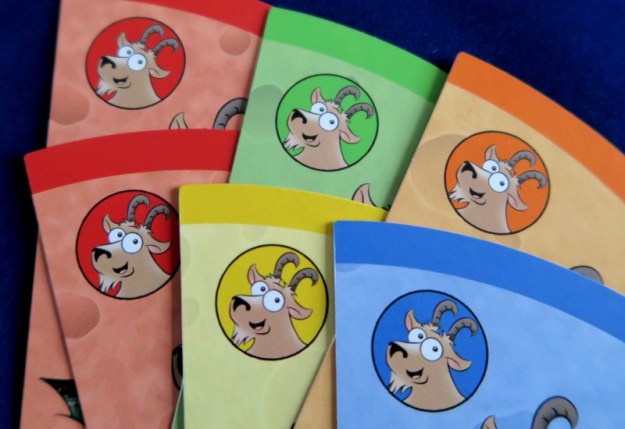
Pine, Magenta, Red and Burgundy were all keen to give the “Feature Game”,  Cheesonomics a go, especially when they saw the eye-catching truckle shaped box.  Pine was especially enthusiastic when he realised that it featured both cheese and goats!  The game itself is a fairly simple, set-collecting and hand management card game based on controlling and manipulating supply and demand of various types of cheese, all seasoned with a sprinkling of dreadful puns.  Players have a hand of five “wedge-shaped” cheese cards each with a colour suit (corresponding to country) and an animal suit (milk type).  On their turn, the active player can carry-out one of three possible actions:  churn, produce or sell.  Churning is a way a player can improve their hand.  First they declare a suit (colour or animal) and everyone else has to pass a matching card to the active player.  Once all the cards are in, the active player chooses five to keep and hands one card back to each player.
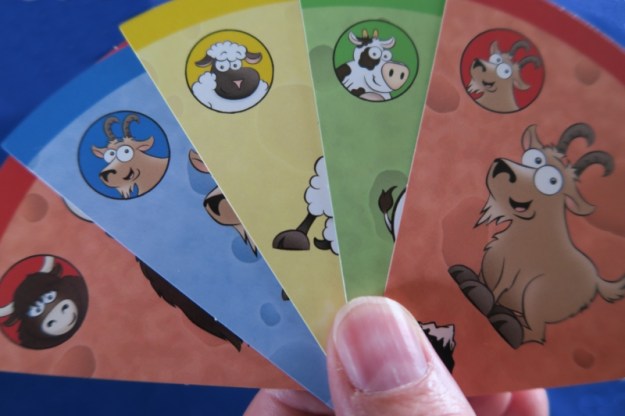
Cheesonomics
– Image by boardGOATS

Players can then place a matching set of cards in front of them to produce cheese; the cards must either have the same colour or the same animal.  The last possible action is to sell cheese:  a maximum of three cheese wedges can be sold at any one time and they must all be the same country (colour).  The cheese is valued at the market rate which is calculated from the number of wedges of that colour displayed in the market.  These wedges are different on both sides, so once a sale has been made, one market “share” is turned over (the market is “mooved”), which reduces the value for the next sale.  The clever part of the game is the scoring:  in addition to money made from selling cheese, players also get bonus points at the end of the game.  The players who sold the most of each cheese type (i.e. animal) get extra points equivalent to the number of wedges sold.  So, cheese is sold by colour, but bonus points are awarded for animals.
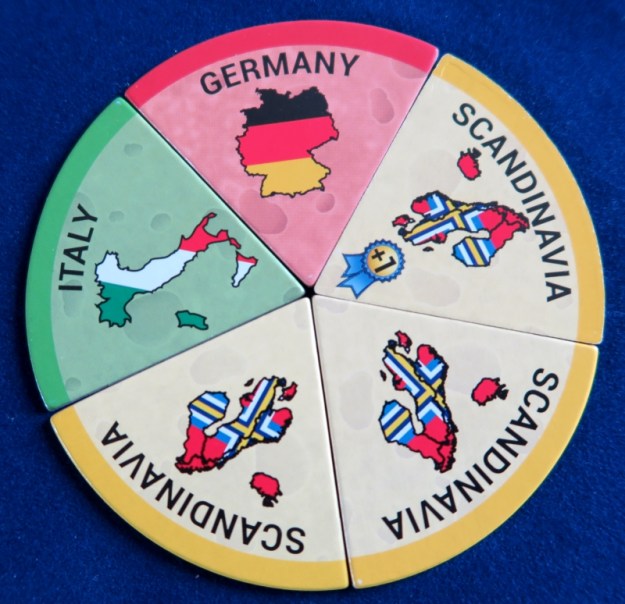
Cheesonomics
– Image by boardGOATS

Only Blue had played Cheesonomics before and that was a two-player game, so nobody really had a feel for how it would play.  Red went first and churned, followed by Pine who asked for goats.  Burgundy got a good starting hand and was able to produce a large batch of German cheese on his first turn, but otherwise we all got carried away churning cheese.  The problem was that since everyone was churning cards furiously, we were all disrupting each other’s hands which meant we ended up having to churn again on the next turn too.  Eventually, this seemed to dawn on us collectively and we all started producing what we had rather than trying to get the perfect hand first.  With a couple of good hands early on Burgundy was also the first to sell and everyone else struggled to catch up.
Cheesonomics
– Image by boardGOATS

Pine eventually managed to sell some of his goats and Blue, the last to convert cheese to cash, shifted a large batch of Scandinavian (yellow) cheese and take a massive fifteen curds.  It was all way too little and much too late though:  the game suddenly ended and Burgundy’s excellent start coupled with the fact that he’d managed to focus almost solely on both reindeer and yak yielded huge bonuses at the end.  Pine and Red had eventually spotted this and made a concerted effort to catch him, but Burgundy had just got too far ahead and won by two points with Pine in second.

Mijnlieff
– Image used with permission of BGG contributor thepackrat

Black and Purple had eschewed the opportunity to play Cheesonomics and settled down instead to play Mijnlieff (pronounced Mine-Leaf).  This “fancy noughts and crosses” game is played with beautiful little wooden tiles on a four by four wooden board.  the aim of the game is to form lines of three, but since there are different types of pieces and your opponent controlling where you can play it is much more strategic.  Each Player has eight pieces with two each of four different symbols where the different pieces dictate where the other player can put their next piece.  For example, when a Greek cross (or “+” symbol) is played, the next player must place his piece on an empty square in an orthogonal line from the piece just played.  Similarly, playing a saltire (or “×” symbol) forces the next player to place his piece in a diagonal line from the piece just played.

Mijnlieff
– Image used with permission of BGG contributor thepackrat

Black managed to get a line of three, but Purple took the game with two lines of three and one of four giving her a total of four points to Black’s one.  Since the supposedly quick little “Feature Game” was still going, Black and Purple moved onto another game we know quite well, Splendor.  This is a game of chip-collecting and card development where players collect chips to buy gem cards which can then be used in lieu of chips.  More expensive cards are also worth points and the game end is triggered when one player reaches fifteen points and the round is completed to give everyone the same number of turns.  Points are also awarded for “nobles” which go to the first player to get a specific combination of gem cards and the player with the most points at the end is the winner.

Splendor
– Image used with permission of BGG contributor henk.rolleman

The game was incredibly tight, but when Black was declared the winner, Purple looked slightly crest-fallen.  On closer inspection, they realised that they’d missed scoring one of her nobles.  Purple had managed to take two of the three available picking up both Isabel of Castille (awarded for four each of opals and diamonds) and Anne of Brittany (awarded for three each of emeralds, sapphires and diamonds).  This left them on sixteen all and a draw, though on closer inspection there is a tie-breaker, so arguably Black took it as he had the fewest cards in his display.

Splendor
– Image used with permission of BGG contributor henk.rolleman

Since Cheesonomics had finally come to an end as well, we had a lot of options on what to play next.  Half the group weren’t staying late, so we decided to play something short as a group before splitting up again into two groups (one of “light-weights” and one of “dirty late-night stop-outs”).  Looking for something to play seven, our choices were limited, and as is often the case in our group, we settled on our old favourite, 6 Nimmt!.  In the first round Black and Magenta were vying for the wooden spoon taking a total of twenty-four nimmts each.  Unusually, Burgundy, though high scoring, was some way behind the race for the bottom, only taking fifteen points.  Both Red and Blue kept a clean sheet so the question was which of them were going to be able to keep their score down in the second round too.  In the end though, both quickly started picking up cards and it was Purple who took the glory, finishing with just three nimmts over the two rounds, her second win of the evening (and only robbed of a third by a tie-breaker nobody knew existed).

6 Nimmt
– Image by boardGOATS

With the fun filler over, the “light-weights” looked for a similarly light game to finish, but in the end, settled on Splendor, as it was still out and Magenta and Red were very familiar with it.  This game was a very difficult one as all the cards in the second row needed lots of sapphires which were scarce throughout.  Magenta tried to work round the problem by collecting nobles, but everyone struggled.  For several rounds, Red was very close to the fifteen points needed to end the game and Magenta had four points available on a reserved card, but could not get the last ruby to buy it.  In the end, but it was Pine, who was new to the game, who finally put everyone out of their misery, ending the game with seventeen points, three points clear of Red.

Splendor
– Image used with permission of BGG contributor henk.rolleman

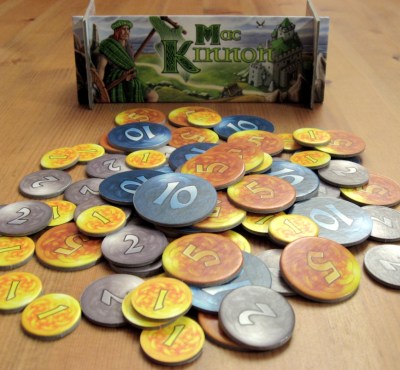
On the neighbouring table, after a short debate, the “late-night stop-outs” settled on Isle of Skye: From Chieftain to King as their longer game.  We’ve played it a couple of times before and it is hugely popular with the group.  Borrowing heavily from tile-laying games like Carcassonne, Isle of Skye is a much deeper game without adding an awful lot to the rules.  The idea is that players draw three tiles from a bag and and then secretly choose one to discard and set prices for the other two.  This is done by placing the tiles in front of a screen and a discard token and money for the player’s stash behind.  The money remains in place for the duration of the round, unless the corresponding tile is purchased by another player.  This mechanism is very clever as if nobody else wants the tile, then the player uses the money to purchase it themselves.  Thus, it is critically important to correctly evaluate the worth of the tile, depending on whether it is most desirable to sell it or keep it.

Isle of Skye: From Chieftain to King
– Image used with permission of BGG contributor henk.rolleman

The other clever part of the game is the scoring:  This is mostly carried out at the end of each of the six rounds.  At the start of the game, four scoring tiles are drawn at random and these are used in different combinations at the end of the rounds in such a way that each appears a total of three times, but only one is used in the first round while three are used in the last.  We included the the extra tiles from the 2015 Brettspiel Advent Calendar in the draw mix and one of them  came up. The four tiles were:  points for animals next to farms (A), extra scroll scoring from the Advent Calendar (B), points for each tile with a road that is connected to a castle (C) and points for each enclosed region (D).  Inevitably, everyone started out desperate for animals and farms, but since these scored in rounds one, three and five, all of a sudden they fell out of favour.

Isle Of Skye: From Chieftain to King
– Image by boardGOATS

Despite having loads of cash, Burgundy really struggled to get the tiles he wanted particularly as everyone else kept buying them off him.  In contrast, Blue didn’t do too badly for tiles, but always seemed to be running out of money.  This was exacerbated by the fact that she didn’t get any of the “catch-up cash” given out from the start of round three.  It is only the number of players in front of them that dictates how much money players get (not how far behind they lag), but the amount can really add up: a player who is consistently at the back in a four player game will net an extra thirty sovereigns over the course of the game compared with a player who leads throughout.  Theoretically, the difference in position between the first and last player could remain just one point throughout, so there is an art to being “just behind”, in the same way as there is an art to being at the back in Colosseum (which was our “Feature Gamelast time).  Clearly this time Burgundy had the knack, and Blue didn’t.

Isle of Skye: From Chieftain to King
– Image used with permission of BGG contributor henk.rolleman

While Burgundy and Blue were struggling with their respective finance issues, Purple quietly plugged away collecting barrels and brochs, while Black ended up with ships and when the corresponding scrolls turned up, they looked to be well placed, until Black ran out of money and a critical tile was taken from him in the final round.  Despite her lack of money, however, Blue didn’t over-reach herself and managed to enclose her scrolls early giving her extra points at the end, but also for the Brettspiel Advent Calendar scoring tile during the game.  Nearly bankrupting herself in the early rounds for those animals now proved worth it as she raked in the points for the scrolls she had enclosed.  Enclosing scrolls was the key in this game as the other player to succeed in this area was Purple who finished a highly creditable second after a barn-storming evening.

Isle of Skye: From Chieftain to King
– Image used with permission of BGG contributor henk.rolleman

We had a little over half an hour left, so we decided we could fit in one last game.  We couldn’t afford to spend too long thinking about it.  Since Black expressed an interest in Karuba as he’d heard good things about it and Blue assured everyone that it wouldn’t take the forty minutes claimed on the box, we decided to give it a go.  This is a game that Blue and Pink bought at Essen last year and is very similar to Das Labyrinth des Pharao which they picked up at the same time on behalf of Black and Purple.  In the event, Karuba did take just about forty minutes, but that included setting up and teaching.  The game is a bit of a cross between bingo and a tile-laying solitaire.  The idea is that every player has the same number of numbered tiles which the players simultaneously place when the number is called.  Unlike Das Labyrinth des Pharao, the tiles the orientation is fixed, which narrows down the number of possibilities and helps to reduce “analysis paralysis”.  Both games are loosely themed with explorers, but in Karuba they are crossing the jungle to find treasure rather than exploring a pyramid.

Karuba
– Image used with permission of BGG contributor punkin312

Each player has set of four coloured explorer meeples and matching coloured pyramids, with the aim being to get the explorers to the corresponding pyramids by laying tiles to make a path.  Everyone begins with the same layout (chosen collectively) and players score points for getting their meeples to their matching temples first.  Everyone draws the tiles in the same order, since the “caller” (Blue, in this case), draws their tiles at random and calls out the number for everyone else to play too.  Once the number has been called, each player can either place the tile on the board or discard it and move an explorer along a path where the distance corresponds to the number of exits on the tile discarded (i.e. two, three or four squares).  Some tiles have crystals or gold nuggets next to the path and an explorer who stops on the tile gets to pick up the treasure which are worth points at the end of the game.

Karuba
– Image used with permission of BGG contributor henk.rolleman

Our explorers all ended up a long way from their pyramids, so sharing a common route was essential and it was just the logistics of how to do it that everyone had to work out.  With time at a bit of a premium, Blue didn’t hang about and kept the tile drawing moving quickly.  Burgundy got a bit carried away picking up crystals before getting his explorers in a tangle (the paths are too narrow for meeples to pass each other).  Purple, for whom spacial awareness does not come naturally, unfortunately managed to completely cut off one of her explorers and Black got into a bit of a tangle too before he managed to extricate himself from the mess and bring them home safely.  Blue, the only one to have experience with the game neglected picking up crystals and got three of her explorers home first netting an unassailable fifteen points, in a game that definitely benefits from experience of how to balance crystals and getting to temples.  While packing up, we discussed the game and the fact that it is likely to be one of the nominees for the Spiel des Jahres award this year given the lack of other good competition.

Karuba
– Image used with permission of
BGG contributor henk.rolleman

Learning Outcome:  GOATS like cheese, but they like whisky more…
8th March 2016

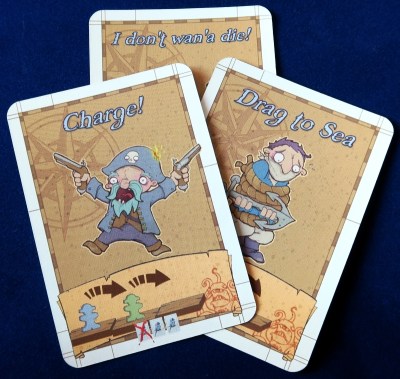
While Burgundy finished his ham, egg ‘n’ chips, the rest of us continued our political discussions from two weeks ago.  This time we discussed the length and timing of the school day, the inevitability of double-parent working households, the cost of childcare and whether or not parents should be paid to stay at home and look after their little ones.  We were expecting Black and Purple, but eventually, someone suggested playing a quick game, to which Blue commented that you could guarantee that they would arrive just as we finished setting up.  A brief debate about what to play followed before we settled on one of our old favourites, Walk the Plank!, a simple pirate themed “programming” game where players try to push each other along a plank and off the ship.

Walk thePlank!
– Image by boardGOATS

Since everyone had played Colt Express fairly recently, the rules were quick to reprise:  everyone simultaneously chooses three cards and the order in which they are going to play them, placing them face-down; starting with the first player, players then take it in turns to play one card until everyone has played all three.  With lots of aggressive options the game is always quick and fun, and the last pirate standing is the winner.  We had just finished the summary when Black and Purple arrived, but since it is only a short game we carried on.  Blue started the game by immediately shortening the plank and before long there was no plank left (a situation we allow through a “house rule”).  When Green Green played a “Drag to Sea) with only one pirate left which was perched precariously on the edge of the boat, it was inevitable that he would take Blue’s only pirate with him for company, leaving everyone else with two pirates each.
Walk the Plank!
– Image by boardGOATS

It didn’t last, however, and before long Magenta’s last pirate received the Big E from Burgundy and joined the others watching the goings on from Davy Jones’ Locker.  With all the carnage in the first round (eleven pirates down in just fifteen cards), there were just two players left with two pirates each all on the ship.  Although the rules say the last two players share the victory this seems strangely friendly end for an otherwise savage little game, so we always play to the death. The second round began a little cagily with both players extending the plank, but then Burgundy was paid out for his treachery to Magenta when, in a moment of stupidity, one of his two remaining pirates dragged his pal off the end of the plank, leaving Pine the clear victor with two pirates still standing.  It was an exceptionally short game thanks to the early vindictiveness, but in truth, it is a much more fun game when it is played that way.

Mijnlieff
– Image used with permission of BGG contributor thepackrat

Despite the compressed nature of Walk the Plank!, Black and Purple still managed to squeeze in a little two-player abstract game called Mijnlieff (pronounced “Mine-Leaf”).  This is a beautiful little game made out of wood and designed by the designer of Dodekka, Andy Hopwood (Hopwood Games).  Black described the game as “fancy Noughts and Crosses” since the aim of the game is to form lines of three, but since there are different types of pieces and your opponent controlling where you can play it is much more strategic.  The game is played by placing wooden tiles on a four by four board.  Each Player has eight pieces with two each of four different symbols where the different pieces dictate where the other player can put their next piece.  For example, when a Greek cross (or “+” symbol) is played, the next player must place his piece on an empty square in an orthogonal line from the piece just played.  Similarly, playing a saltire (or “×” symbol) forces the next player to place his piece in a diagonal line from the piece just played.

Mijnlieff
– Image used with permission of BGG contributor thepackrat

Game play is really quick, so much so that despite Walk the Plank! finishing in record time, with Purple taking it by three points to Black’s two.  With everyone finished, we had a quick show of hands as to who would like to play the “Feature Game”, Kingdom Builder.  When seven hands went up, Green asked who was very keen to play it and nobody looked interested.  The most enthusiastic was Burgundy who had played it before, so Magenta swapped seats with Green to make a foursome with Blue and Pine.  On the face of it, Kingdom Builder is also a simple game, played by placing small wooden huts (Settlements) on a board made up of different terrains laid out using a fine hexagonal grid.

Kingdom Builder
– Image used with permission of BGG contributor msaari

At the start of the game, each player is dealt a terrain card and on their turn, they have to place three settlements on that terrain type.  As far as possible, the Settlements must be adjacent.  At the end of their turn, the player discards their card and draws a replacement.  Play proceeds in clockwise order until one player has run out of Settlements, then the round is completed and scores are tallied up.  While these are the basic rules, there are also specific rules that change for each game, and since the board is made up of four modules chosen at random from a set of eight, the number of possible layouts is vast. Each module board also has three special hexes on it: two with a gold scroll-work border (Locations) and one with a silver scroll-work border (Castles).  The Castles give points for players with an adjacent building at the end of the game while the Locations give an in-game benefit.

Kingdom Builder
– Image used with permission of BGG contributor SpaceTrucker

At the start of the game, each Location has two hexagonal chits on it which are taken by the first two players to build next to it.  These chits give players extra actions that they can take on their turn, but the nature of the Location and corresponding action is dependent on the boards chosen.  In this game we had the Tower, the Tavern, the Barn and the Paddock.  These allowed players to add an extra Settlement along the edge of the board; add an extra Settlement to where a player had a row of three or more Settlements; move an existing Settlement to a space matching the active player’s current terrain tile, and move one Settlement two spaces in a line from its current position (i.e. jump).

Kingdom Builder
– Image used with permission of BGG contributor kilroy_locke

Points are awarded at the end based on the rules cards and a subset of three are drawn from a total of ten at the start of the game.  For this game, we draw the Knights, Discoverers and Citizens cards which gave two points for each settlement a player built in the horizontal row where they had the most Settlements; one point for each horizontal row in which they had at least one settlement, and one point for every two Settlements in each player’s largest settlement area.  Thus, to score one well, you needed a horizontal line, a vertical line and a clump, all with a limited number of huts.  To make the problem even more challenging the board layout had a large mountain range across the middle with a couple of awkwardly positioned rivers.  We all blamed Burgundy for his awful “choice” of boards and layout…

Kingdom Builder
– Image by BGG contributor pphh

Although the rules are prima facie quite simple we got into a bit of a tangle with the modifications caused by the Locations.  Blue kept forgetting that the Tower and the Barn were subject to adjacency restrictions and Pine struggled to see the point of the Barn at all.  Blue made an appalling start, while Burgundy’s best laid plans were stymied first by Blue and then by Magenta.  Meanwhile, Pine had got two groups of Settlements and was trying to build a vertical ribbon development to connect the two.  As Burgundy’s supply of Settlements dwindled faster than anyone else’s, Pine desperately needed to draw a desert terrain card, but kept drawing woodland cards which were nearly useless for him.  In the final round everyone tried to make the best of their limited number of remaining Settlements before totalling up the scores.  It was very, very close, but Blue finished with a round fifty, just two points ahead of Magenta, with Pine and Burgundy both within two points of her.

Kingdom Builder
– Image by boardGOATS

Kingdom Builder isn’t a long game, so Black, Green and Purple decided to opt for something short and light so settled on another old favourite, Splendor.  This is a fairly simple card game with a very loose gem merchant theme.  On their turn, a player can either collect chips (gems), or use chips to buy gem cards.  Most of the gem cards are effectively just a permanent source of chips, i.e. can be used to buy other cards, but the higher value ones also provide victory points.  Nobles can also give players points and these are claimed by the first player to collect certain combinations of gem cards (e.g. three each of onyx, sapphire and diamond).  The game finishes at the end of the round when one player gets to fifteen points, and the winner is the person with the most points.

Splendor
– Image used with permission of BGG contributor henk.rolleman

Three of the four randomly selected Noble cards required a set of three green emerald cards as part of their requirements, with differing selections of the other colours; white diamonds, red rubies, blue sapphires and black onyx. The fourth Noble required four cards of each white diamonds and black obsidian.  With the first card selections it was clear that both Black and Green had studied the distribution of cards required to win Nobles tiles and were fighting hard to get the green emeralds that were available. Unfortunately, the number available was quite small, but nothing compared to the scarcity of rubies. The first of these was nabbed by Purple and Green, who failed to get the second was left unable to get the remaining one which was an expensive, high scoring, level three card.  Early on Black marked his intentions by reserving a level three (taking the bonus “wild” gold chip).  Meanwhile Purple was busy building a large supply of diamonds while Green concentrated on the low level emeralds and sapphires. With half a dozen cards each, scores were low and close, but quick glance across to Kingdom Builder showed they were still going through the rules…

Splendor
– Image used with permission of BGG contributor henk.rolleman

Black reserved another high value card, Purple had managed a large haul of diamonds, both cards and chips and green had got his three green emeralds, now joined with three sapphires. Rubies still refused to come up with any kind of regularity which meant that players priorities usually changed quickly when one did come up.  Green was the first to obtain a noble when he got his third diamond card.  He did this with mostly non-scoring cards and so this only put his score on a par with the others.  The game entered a new tenser phase when Green quickly picked up his second noble after taking a third ruby card, though even he couldn’t quite believe he had managed to get three of them.  Black finally paid up for one of his put away cards and now the points were close to the end.

Splendor
– Image used with permission of BGG contributor henk.rolleman

Black was just two points from getting the fifteen needed to trigger the end-game, and a study of the available cards showed Green that Black could get it with a diamond card on his next turn. Green persuaded Purple that she needed to take the diamond card using her gold chip (she couldn’t afford it otherwise) as she would not get another go if she didn’t and could not afford the high value one she was saving for anyhow.  Luckily the replacement card was not one which Black could afford so he had to take chips instead pushing the game into another round.  Green grabbed a high value level three card taking the bonus gold chip (giving him all he needed to buy it on his next turn) and Purple bought her high value card. Black bought his last reserved card, which put him on sixteen points giving Green one last turn. With a flourish he paid for his reserved card card which gave him three points and claimed the final noble for another three, giving him a winning total of seventeen points.  It was a few moments, before Green noticed and the others didn’t spot it at all, but Green’s last card was not a black onyx, but a fourth ruby – he had not got the noble after all.  Perhaps it was a touch of colour blindness from the excitement of the end-game, but Black was the winner after all with Green and Purple finishing in joint second.

Splendor
– Image used with permission of BGG contributor henk.rolleman

Kingdom Builder should only take thirty to forty minutes, but for some reason it took nearly twice that, so Green, Black and Purple moved on to play Tobago, a really pretty game in which the players possess different parts of treasure maps and try to use narrow down the possible locations faster than everyone else in order get to the treasure first.  The idea is that on their turn, players can either can either play a card on one of the four Treasure Maps or move their little 4×4 truck up to three “legs” (a leg being anywhere within the current terrain, or a move from one terrain to another).  Playing a card narrows down the number of possible places that the Treasure could be, for example, “in the jungle”, “not next to a hut” or “in sight of a statue” etc..  Each clue card placed must narrow down the possible locations by at least one hex, cannot contradict a previous Clue, and cannot eliminate all possible locations for the Treasure.  Eventually there will only be one possible location, after which, the first player to get there retrieves the Treasure.

Tobago
– Image used with permission of BGG contributor Lord Warlock

When a Treasure is retrieved, everyone who helped narrow down the treasure location by playing a card gets a share proportional to the amount of effort they put in.  Initially, each player gets a Treasure card for each clue card they contributed.  They look at the card(s) secretly before they are shuffled together with one drawn blindly from the deck. A card is then drawn at random and, starting with the player who found the Treasure, it is offered to each player in turn until someone takes it.  The order corresponds to the order they made their contribution, so some players may have made multiple contributions and therefore may get multiple chances to take a Treasure card.  Once a player has taken a treasure, that contribution is considered fulfilled.  The Treasure varies in value, but there are also two “Cursed Treasure” cards (also known as “Baad Treasure”).  If one of these is turned over, the remaining Treasure cards are not distributed and anyone left in loses an amulet (if they have no Amulet, they lose their most valuable Treasure card instead).  The appearance of Amulets is triggered every time a Treasure has been found and they can be collected by players moving their 4×4.  The player with the most Treasure at the end of the game wins.

Tobago
– Image used with permission of BGG contributor Toynan

Green’s strategy was to contribute as many Clues as possible, Black went for a drive to dig up treasure and Purple complained of having a terrible set of clue cards (to be fair she had a lot of “not in …” cards, which did prove difficult to place on the “in play” Treasure maps, but for some reason she was reluctant to start a new one). It was a slow start, but after the first treasure had been found and the Amulets started to appear we got into our stride a little more.  About half way through the game, Green checked the rules on what to do with the discarded Clue cards and instead found a small rule which stated that the one who takes the last Treasure card immediately places the first Clue on the now empty treasure “map”. We felt that this might have speeded the game up a little and implemented the rule.

Tobago
– Image used with permission of BGG contributor Lord Warlock

Green and Purple were the first casualties of the “Baad Treasure”. They both had Amulets, but annoyingly a six point and a five point treasure were both lost.  The second time round we were all affected and everyone lost an Amulet, but the lost cards were not high value so it felt less of a loss somehow.  With only three treasure cards left in the deck (game ends when they are exhausted) placing Clues was quite tricky. Only one of the treasures would be found, and placing your clues on the others would result in nothing, but which one would be “found” first?  In the end it was a treasure only Green and Purple benefited from.  In the final scoring, Purple came out the richest finishing with thirty-eight, and Black came in second just four behind. So for all her complaining about her hand, she had made it work to her advantage. It also looked like Green’s strategy to spread clues thinly across all Treasure maps and let others do the actual finding, had failed as it made him almost certain to lose out when the “Baad Treasures” came up.

Tobago
– Image used with permission of BGG contributor jayboy

By the time Kingdom Builder finally finished, Tobago was well under way, with no sign of finishing soon.  Magenta took an early night, so while Pine was at the bar, Burgundy and Blue discussed the options.  Given the time available, it was a toss-up between two games that Burgundy said he couldn’t get the hang of: Isle of Skye and Blueprints. Blue gave him the choice and in the end, he chose the latter as we’d not played it for a while.  This is a clever little building game where players are architects who must use different coloured dice (representing different materials) to build different structures from their blueprints.  The idea is that on their turn, each player chooses a die from the central pool and adds it to their building.  Each die must have the same value or higher than any it is placed on top of.  At the end of their turn, they roll a replacement from a bag, thus replenishing the dice supply.  Once each player has placed six dice, their building is evaluate depending on the colour of the dice they used, how many they are and their position etc.  For example, black dice score more if they are placed high up, whereas orange dice score more if they are surrounded by lots of other dice.

Blueprints
– Image used with permission of BGG contributor kilroy_locke

The person with the best building wins the round winning the Gold Award which is worth three points at the end of the game.  Points are also available for Silver and (depending on the number of players) Bronze.  There are also Special Awards (which are worth two points at the end) which go to players who fulfil other specific criteria, such using five dice out of the six in the same colour or having a building with a height of five or more.  In the first round, Burgundy demonstrated exactly how he couldn’t get the hang of the game, but failing to make the Special Award he was trying for and also not scoring highly enough to take either the Gold or Silver awards.  The second round was notable for the number of black fours that were rolled, and how, despite that, Pine somehow managed to take the Special Award for using four dice with the same number, but with fives while Blue failed to do the same with fours.  Going into the last round, both Burgundy and Pine tried to collect green dice, leaving Blue the pick of the rest, her third Gold Award, second Special Award and a clear win with thirteen points.

Blueprints
– Image used with permission of BGG contributor dotKeller

With the evening coming to a close, there was just time for a quick filler.  Black commented that there was always “the old favourite” and since Pine claimed he’d not actually played it (though the logbook proved he had), there was no opposition to a quick closing game of 6 Nimmt!.  We reminded Pine of the rules:  players simultaneously choose a card, then simultaneously reveal them before playing them in ascending order placing each on on the highest card that is lower than the card being played.  When the sixth card is added to a row, the first five are taken and the number of heads contributes to the player’s score, lowest score wins.  The thing that makes the game so compelling is that any grip is incredibly tenuous and once it begins to go wrong it tends to escalate horribly.  In the first round, Green seemed to pick up everything and in the second it was Burgundy’s turn.  Black and Pine had two mediocre rounds and Purple made the only clean sweep.  It was Blue who got lucky this time though with two very good rounds totaling just two and four, so she took the game with a combined total of six, slightly ahead of Purple with twelve.

6 Nimmt
– Image by boardGOATS

We tend to play a variant over two rounds with half the deck in each round and not resetting the table in between.  This led to a bit of discussion as to why things tend to cascade.  The problem is that there are always some rows that get blocked off as they pick up a couple of high scoring cards as well as a finishing with a high face value card.  This means the chance of a player being forced to add something to (and take the row) is small, and nobody will take it voluntarily as the hit is too great.  In our game, three rows got blocked off early on in the first round which meant we spent nearly the whole game playing cards on one row.  The problem is that once a player has used, say, a low card that card is no-longer available, so the player is likely to be in the same position next time  too.  In the case of a six player game, things are exacerbated because it is the sixth card that triggers the pick up.  Thus, in our game, the first first player would take the singleton, leaving the next four players to add to the row and the player with the highest card to take the row and no better off for next time.  That doesn’t really detract from the fun though and it is still wonderfully stressful in a good way, so justifiably one of our favourite fillers.

6 Nimmt
– Image by boardGOATS

Learning Outcomes:  Sometimes some games just take much longer than expected.

12th January 2016

With Red, Magenta and Blue moaning about work and only Burgundy waiting for real food, when Pine rolled up we began straight away with our “Feature Game”, the light filler, Las Vegas. This is a very simple dice game, but actually quite a lot of fun.  On their turn, each player begins by rolling their dice, then assigning some of them to one of the six casinos.  Each casino is numbered one to six and has a jackpot of over $50,000, drawn at random from a deck of money.  Thus, each jackpot could be anything from $50,000 to $180,000 and comprise one to five notes.  On their turn, players must use all the dice of one number to bet on the casino of that number.

Las Vegas
– Image used with permission of BGG contributor punkin312

Once everyone has placed all their dice the player who placed the most dice on a casino takes the highest value currency card. The player with the most money after four rounds is the winner.  The snag is that before any money is handed out, any dice leading to a draw are removed. It is this rule that makes the game interesting, raising the decisions above the trivial and, in our view, making it a better and much more fun game than Qwixx which we played two weeks ago.  Although the game only plays five (without the Boulevard expansion), Blue had added an extra set of purple dice just in case, so when Green walked in just before the game started, he was able to join in.

Las Vegas
– Image used with permission of BGG contributor punkin312

In the early part of the round, each player has to decide whether to conserve dice or whether to make a statement and go in big.  As the round progresses, players must choose where to place their bets then try to finesse their position before being forced to place their last die or dice based solely on chance.  The factors that go into the decision include the value of the rewards available, the current position and the number of notes as well as the probabilities of other players interfering.  The probabilities are non-trivial too, because rolling multiples can change the number of dice available for the next roll.

Las Vegas
– Image used with permission of BGG contributor ckirkman

In the first round, everyone made the same mistake and committed too many dice too early, but after that, we all got the hang of it and the game was quite close.  Players keep their winnings hidden, but since everyone had had rounds with lean pickings as well as generous ones, we all felt we were in with a chance.  The last round began with it all to play for and everyone taking it in turns to roll lots of sixes.  At the end of the game, we announced our totals in turn:  Green finished with $260,000, Pine with $250,000, Burgundy and Blue tied with £270,000, but Magenta just pipped them with $280,000.  Red, however, took longer to count up her cash for good reason and finished well clear with $360,000.

Las Vegas
– Image used with permission of BGG contributor joeincolorado

With the arrival of Black and Purple, we decided to split into two groups.  The only game that everyone really wanted to play was Isle of Sky: From Chieftain to King, so since we only had the one copy, five went for that leaving the three others to find something else to play.  Isle of Skye is a tile laying game where players play a sort of solitaire Carcassonne, bidding for tiles and scoring a the end of each of the six rounds.  We’ve only played the game once on a Tuesday in November, but it has proven to be very popular at other local meetings too, so everyone playing had played before and the game was quick to get going.

Isle of Skye: From Chieftain to King
– Image used with permission of BGG contributor henk.rolleman

Burgundy had played it a few times and, unusually, generally seems to struggle with this game.  This time he started well, and took the lead from the start, unfortunately however, he struggled to pick up scrolls, so suffered in the end game scoring.  One of the peculiarities of this game is the fact that from round three, at the start of the round players get one extra gold coin per player in front of them on the score track, increasing to four extra coins by the final round.  This really adds up, and a player who takes advantage of this bonus can have a large impact on the score track.  Black made hay on the bonus sitting at the back for most of the game, however, he failed to use the gold and finished with fifty-one unspent coins.

Isle of Skye: From Chieftain to King
– Image used with permission of BGG contributor Punkin312

Between Burgundy at the front and Black at the rear, Purple, Pine and Magenta were jostling for position.  Without sheep and cattle featuring strongly in the scoring tiles this time, Pine felt he would struggle, but he made a surge for the front in the final scoring.  Magenta who had spent a lot of the game at the back of the pack with Black gradually moved through the field in the later rounds and finished four ahead of Burgundy in joint first with Pine on sixty-six, with Pine taking it on the tie-breaker.

Isle of Skye: From Chieftain to King
– Image by boardGOATS

Meanwhile, Blue, Green and Red were playing an aggressive game of Citadels.  This is a slightly older, role selection game.  Everyone starts with a hand of district cards and the start player, “The King”, also has a hand of eight Character cards.   The Character cards are shuffled and one is placed face down blind.  The King can then choose one Character card and pass the rest on to the next player.  The cards are drafted in this way until (in the three player game) everyone has two and the remaining card joins the first card, face down to one side.  Thus, each player has two Character cards and each Character card has a number and a special ability.  “The King” then calls the characters in turn, by number and name, and the player who has that card then immediately carries out their turn.

Citadels
– Image used with permission of BGG contributor themilkcrate

A turn consists of either taking money or drawing two cards from the deck, then paying the monetary cost to build one of the district cards from their hand.  The game ends at the end of the round in which a player builds his eighth district card.  The scores are then added up with players receiving points for their buildings equalling the total cost to build them, plus bonuses for being the first player to build eight district cards, bonuses for having at least one district in each of the five colours and for achieving a total of eight buildings before the game ends.  We played with some of the Characters from the Dark City expansion so “The Witch” replaced “The Assassin”, “The Tax Collector” replaced “The Thief” and “The Navigator” replaced “The Architect”.  We also chose a random selection of the valuable “purple buildings”, a factor that turned out to be quite critical to the game play in the end.

Citadels
– Image used with permission of BGG contributor Nodens77

Blue took an early lead, building a couple of “purple buildings”, in particular, the very annoying Ball Room.  The “purple buildings are expensive to build, but generally come with some sort of special power, in the case of the Ball Room, if the owner is also The King, every player must say “Thanks, Your Excellency” before taking their turn otherwise it is forfeit.  Without “The Thief” in play, Blue was able to let her money build up and was hoping to build the Library, when Red played “The Magician” and swapped hands with her.  Unimpressed, in the next round Blue played the same trick, giving Red the apparently rather useless Armory in exchange.  To make sure Red didn’t nick it back, Blue built the Library quickly, her third purple building giving her a healthy lead though she, like Green was struggling to get the blue cards she wanted to pick up the bonus for having a building of each colour.  Green meanwhile was having other problems of his own, compounded by the fact that he forgot to be obsequious and therefore lost a turn.

Citadels
– Image used with permission of BGG contributor kilroy_locke

Red made persistent assaults on Blue, but it was when Blue had six district cards built and was trying to find a way to close out the game that Red decided to use that “rather useless Armory” to destroy Blue’s valuable Library.   Discussion ensued as Blue had originally decided to ditch the Armory as it was too restrictive, but Red wasn’t so sure.  Green resorted to looking it up on-line and found a wealth of discussion none of which really answered our questions.  After a brief hiatus, we decided to let Red go ahead as Blue was so far in front, although it wasn’t that far as it turned out.  Both Green and Blue hadn’t seen a blue district card all game so missed out on the three point bonus and, as Red completed her eighth building first, she also took an extra two points for that, finishing on thirty-seven.  Green and Blue tied for second place though arguably Green should not have been able to take his last turn since he forgot to “Thank, Her Excellency” again…

Citadels
– Image by boardGOATS taken from boardgamegeek.com

Citadels is one of those rare games that plays a wide player count, nominally from two to eight players.  However, while there is a consensus that it does not play all numbers equally well, the on-line jury is still out as to where its “sweet spot” is.  In fact, some people appear to think it is best with small numbers, while others prefer it with more players.  We’ve played Citadels a few times on a Tuesday, a couple of times with just two players, but also with five.  Blue and Green had been involved on each occasion and Blue in particular had quite enjoyed the game with just two players, but had hated it with five.  With two she felt it was a game where players could really try to get inside the head of their opponent whereas with five she felt it was horribly chaotic and difficult to follow what was going on.  Knowing this, Green had thought three might have some of the features of the head-to-head game while adding more dimension to the game play and, despite losing, Blue agreed, that three was an excellent number of players for this game.

Citadels
– Image by BGG contributor lolcese

While Citadels was finishing, the other players filled the time with a couple of rounds of an old favourite, Dobble.  The first round was a warm up which Magenta ducked out of as she has a bit of a reputation as the “Dobble Queen”.  This was played with the conventional “Towering Inferno” variant, where players call out matches and grab cards from the central pile.  In the second round, Magenta joined in so “The Poisoned Gift” variant was chosen, otherwise known as “Gang up on Magenta”.  In this version, instead of grabbing cards from the middle for yourself, you match them and stick them on someone else’s pile (usually Magenta’s), with the aim to finish with as few cards as possible.  Everyone accordingly rained cards down on Magenta who duly lost with Black winning by one from Pine and Burgundy.

Dobble
– Image used with permission of BGG contributor msaari

Time was ticking on, so we decided to play a quick game of Saboteur.  This is a team game where you don’t know who your team mates are.  With eight players, there is a team of five or six Dwarves trying to find the treasure, and two or three Saboteurs, trying to stop them.  On their turn, the active player can play a tunnel card to progress towards the three possible treasure locations, play an action card or discard a card face down (a very Saboteur-like action).  The action cards come in a variety of flavours:  broken tool cards that are played in front of other players and prevent them from laying tunnel cards; tool cards than cancel out broken tool cards; map cards that allow players to look at one of the possible treasure locations to see whether it contains the gold or not, as well as rockfall cards that allow players to remove tunnel cards that have already been placed.

Saboteur
– Image used with permission of BGG contributor mikehulsebus

The game is supposed to consist of three rounds with the winning team taking prize cards, however, last time we played, we decided that the addition of prizes meant the game inevitably outstayed its welcome.  We felt it would be better to play one round, and if we wanted, play a second, but treat them as separate games, which is exactly what happened this time.  In the first “game”, Magenta and Purple claimed the gold was at one side, while Black and Blue claimed it was in the middle – clearly we had two of our Saboteurs, but which pair looked guilty?

Saboteur
– Image used with permission of BGG contributor mikehulsebus

After a couple of rounds, Magenta showed her true colours and played a broken tool card in a Saboteur-like manner and she and Purple were promptly stomped on.  Suitably, after everyone had doubted him for so long, Black was the one to finally find the gold.  Green had had enough and headed off, but Pine, Red and Magenta agreed to stay for one more go.  This time Red decided to have a go at Pine from the very start – maybe it was the pointiness of his ears or the way he carried his pick axe, but she claimed he was definitely a Saboteur.  Everyone else was less quick to condemn, and before long it became clear that it was Red and Purple (again!) who were guilty and, although it was closer, the Dwarves still got to the gold first.

Saboteur
– Image used with permission of BGG contributor mothertruckin

With people leaving, there was just time for Black, Purple, Burgundy and Blue to squeeze in a quick game of The Game.  We started dreadfully, and two piles were very quickly closed off.  Somehow we managed to keep going though and, despite an appalling run of luck and a couple of us making dodgy decisions, Black was eventually able to draw the last card from the deck.  Playing just one card at a time made things a little easier, but we still had over twenty cards to get rid of.  Sadly, it was not to be; the poor start had done its damage and we finished with a total of eleven cards in hand.

The Game
– Image by boardGOATS

Learning Outcome:  When a game is *that* popular, bring it again!

Boardgames in the News: Mayfair Games – Is there a Future without Catan?

Mayfair Games began in 1981 as a small US games company based in Illinois. One of their first games was Empire Builder, their first and now the flagship of their “crayon-rails” series of games where players, using washable crayons, draw their train routes over a map of North America.  Building on this success, Mayfair then went on to play a pivotal role in bringing Euro games to the US and wider English speaking markets.

Empire Builder
– Image used with permission of BGG contributor Billythehut

In 1996, Mayfair Games picked up the license to produce an English edition of Die Siedler von Catan, The Settlers of Catan (now known simply as “Catan”).  With the huge success of the game world-wide, over the next twenty years, Mayfair brought out multiple new editions of the base game modernising and updating it, English editions of all the expansions, variants and spin-offs.  Mayfair (with Kosmos) were also behind the release of Star Trek: Catan in 2012, the first Catan game with a licensed theme.  For many, Mayfair Games has become synonymous with Catan, in the English speaking world in any case.  As such, the news yesterday that Asmodee has acquired the rights to produce the English language version of everything “Catan”, has left a lot of people wondering where that now leaves Mayfair Games.

Star Trek Catan
– Image used with permission of BGG contributor henk.rolleman

With the shear quantity and popularity of the Catan games it was inevitable that Catan would dominate the catalogue of Mayfair, but is this the beginning of the end for Mayfair Games?  Well, it’s true that no company can take such a major amputation and come out unscathed, so the loss of this part of their portfolio has inevitably led to major restructuring.  The former CEO of Mayfair, Pete Fenlon left to become the CEO of the new Asmodee owned “Catan Studio” taking a bunch of other people with him including the Director of Marketing,.  This left a hole that will be filled by a the current President, Larry Roznai; the head of Acquisition & Development, Alex Yeager; and a lot of chair shuffling.  Aside from that, shareholders received healthy payouts and there’s been a major contraction in the size of the company, to something similar to where it was in 2007-2008.

The Settlers of Catan
– Image by boardGOATS

It may be that the fact that Asmodee only took the rights to the Catan empire rather than buying the company out wholesale is indicative, and could be viewed as asset-stripping.  In which case, there is probably little hope for what remains of Mayfair Games.  If the whole-sale purchase scenario had played out, it is almost certain that the rest of the Mayfair catalogue would have been shelved and the company would have de facto become “Studio Catan” by another name.  The fact that this has not come to pass suggests that the personnel remaining believe there is more to the Mayfair than just “Catan”.

1830: Railways & Robber Barons
– Image used with permission of BGG contributor Zoroastro

So, what is Mayfair left with?  Well, there are a hundred odd games currently produced by Mayfair including some of the popular 18xx series, Martin Wallace’s Steam, the massive Caverna: The Cave Farmers and Nuns on the Run.  In 2013 Mayfair also acquired a controlling interest in the German company, Lookout Games, who historically have produced some fantastic games (including Agricola).  This partnership has already produced Grand Austria Hotel; Isle of Skye: From Chieftain to King; and Patchwork.  This suggests that where the “Old Mayfair” had stagnated a little, becoming somewhat dependent on the Catan franchise, the New Mayfair might be forced to change direction for the better, forming a leaner, more innovative company producing exciting new games.  Perhaps the future is not so bleak for Mayfair after all, but only time will really tell.

Isle of Skye: From Chieftain to King
– Image used with permission of BGG contributor henk.rolleman

17th Movember 2015

While Burgundy, Magenta and Blue were busy feeding, we decided to play something to keep Pine from eating too many of the chips, so for the third games night running, we had a quick mess about with magnets and bells in Bellz!.  It was another close game with some slightly borderline shaking and other sneaky efforts.  Before long though after incredible snatch taking two medium bells as he moved faster than magnetism, Burgundy had only one large bell left.  This solitary bell was very effectively trapped though and he failed to take the opportunity leaving Blue to close out.  Pine followed, despite the fact that he claimed he was no good at dexterity games.

Bellz!
– Image used with permission of BGG contributor SpeedD

With people still finishing, we looked for another light game that people could play while wielding cutlery, and No Thanks! fitted the bill.  This is a very simple game that we used to play quite a lot, but recently has languished in the box, usurped by newer fare.  The game is very simple:  from a shuffled deck of thirty-three cards (numbered three to thirty-five), nine cards are removed and the top card turned face up.  The first player has a choice they can either take the card or pay a chip and pass the problem on to the next player.  This player can either take the card and the chip or pay a chip and so on.  At the end of the game the face values of each player’s cards are totalled (offset by any remaining chips) and the player with the lowest number is the winner.  The catch is that if players have consecutive cards, only the lowest counts, which is where the fun really starts.

No Thanks!
– Image used with permission of BGG contributor msaari

The game is all about keeping your nerve and picking up the right card at the right time.  Burgundy began by picking up some high cards, while Pine started with a few cards in the twenties and teens.  Blue and Magenta stuck it out as long as they could before they were forced to take something.  Somehow Blue managed to avoid anything really horrid until the last card when Magenta persuaded Burgundy to hand it on leaving her with a whopping sixty-nine and last place.  With Burgundy unable to get the cards he needed to extend his run, that left just Magenta and Pine with Pine taking it by four points with just twenty three points.

No Thanks!
– Image used with permission of BGG contributor mikehulsebus

Not expecting anyone else to arrive, we decided to move onto the “Feature Game” which was Isle of Skye: From Chieftain to King.  This is a tile laying game with some similarity to Carcassonne, except that players have their own map and the tiles are auctioned.  Played over six rounds, players start by earning income for their clan’s territory, getting five gold for their castle and one for each whiskey distillery (barrels) connected to their castle by road.  Next, each player draws three tiles from a bag and places them in a row in front of their screen.  In private, the players then allocate piles of coins to two of the tiles and a mattock marker to the third.  The coins represent the cost anyone buying a tile will have to pay, while the mattock indicates which tile will be discarded.

Isle of Skye: From Chieftain to King
– Image used with permission of BGG contributor henk.rolleman

Once everyone has decided the value of their tiles, the screens are removed and the tiles marked with a mattock discarded.  Next, beginning with the start player, each player takes it in turn to buy a tile from one of the other players.  When everyone has either bought a tile or passed, all remaining tiles are bought for the assigned value by the owner.  So, when setting the value, players have to be very careful not to over-price something otherwise they will be left paying over the odds for something they don’t want.  In fact, the problem is worse than that as the difference between being forced to buy your own tile and selling it is twice the assigned value.

Isle of Skye: From Chieftain to King
– Image by boardGOATS

After all the tiles have been bought, players add them to their clan territories following the Carcassonne riles that terrain must match.  However, presumably since all roads on Skye are just dirt tracks, roads do not need to connect, something those of us who suffer with OCD found quite offensive to begin with.  At the end of the round, points are awarded according to the four scoring tiles chosen at random at the start of the game.  In our game the scoring tiles were:

  1. One point for each animal next to a farm;
  2. Three points for each lake with a ship and a lighthouse;
  3. Two points for each cow on a road connected to the castle;
  4. Five points for the person with the most barrels and two for the person with the next most barrels.
Isle of Skye: From Chieftain to King
– Image used with permission of BGG contributor henk.rolleman

At the end of the first round, just scoring tile “A” is scored, at the end of the second, just tile “B”, but at the end of the third, both “C” and “D” are scored so that each tile is scored three times during the game, at the end of different rounds, in different combinations.  At the end of the game, each player turns any residual money into points (at a rate of five to one) and players also score any scroll tiles they may have been able to add to their clan territory.  These give a set number of points for certain items, for example, one point for each pair of ships etc.  These are scored twice it the terrain the scroll is in is “complete”, i.e. it is enclosed.

Isle of Skye: From Chieftain to King
– Image used with permission of BGG contributor Punkin312

Burgundy was the only player who had played the game before and commented that he had been given a bit of a pasting so was hoping to do better, though he thought it was a hard game.  It didn’t sound hard at all, but we quickly discovered what he meant, with everyone struggling from the very beginning.  Pine and Magenta made the best starts getting farms and animals and scoring early, while Blue and Burgundy brought up the rear.  Blue, who never does well in more strategic games drew scroll tiles that rewarded players with barrels.  Unfortunately, as barrel tiles connected to the castle give players money at the start of the game, and scoring tile “D” gave points for them, they were a hot commodity and Blue was quickly left behind.

Isle of Skye: From Chieftain to King
– Image used with permission of BGG contributor henk.rolleman

As he’d found the previous time he’d played, Burgundy could see the tiles he wanted, but was struggling to acquire them or keep them.  As a result he started to drop off the pace and before long, Pine had left Magenta as well and was romping away looking like he might start to lap people.  While everyone else moaned as they struggled to do what they wanted, Pine continued happily collecting lots and lots of cows and sheep which he cleverly added to his growing conurbation of farms so that they counted multiple times.  In the later rounds, however, there is a catch-up mechanism which gives extra money to the players at the back.

Isle of Skye: From Chieftain to King
– Image by boardGOATS

From round three onwards, at the start of the round, each player gets additional money for each player in front of them.  The amount increases as the game progresses, so the player at the back gets an extra three gold coins at the start of round three, but a massive twelve additional gold at the start of the final round.  Unfortunately, we somehow managed to botch this, half-way through the game switching to handing it out at the end of the round instead of the start, so the additional wherewithal didn’t quite give people the extra buying power intended by the designers.  That said, although Pine was the clear winner by nearly thirty points with a total of eighty-five, Blue managed move from a long way behind everyone else into second place thanks to scroll scoring that capitalised on all the brochs and barrels she had acquired.  For all the moaning, everyone enjoyed the game and agreed that it needed playing again as it would probably be very different with different scoring tiles.

Isle of Skye: From Chieftain to King
– Image by boardGOATS

After some discussion about what to play and flirting briefly with the idea of Aquaretto,  we decided to play Port Royal.  Although we’d played it before, it was one of those games that it is somehow hard to remember and therefore Blue made a bit of a pig’s ear of teaching it.  That said, it isn’t a complicated game:  the game is played in turns with the active player turning over cards.  They can keep turning over cards until either they choose to stop or they draw a second ship card that they cannot repel.  Assuming they choose to stop, they can then take a ship card or buy a character card before the remaining cards are offered round the table with players paying the active player one doubloon if they choose to buy/take a card.

Port Royal
– Image used with permission of BGG contributor msaari

The key is the character cards as they are what enable players to build an engine and get an advantage over the opposition.  Unfortunately for him, Burgundy never seemed to have enough money when the cards he wanted came up.  On the other hand, Magenta took a Jester at just the right moment to give her a steady income exactly when she needed it.  Meanwhile, Blue picked up some good cards, but failed to capitalise and Pine began collecting for contracts, but couldn’t pick up the most cost effective ones.  Then, suddenly, Magenta snuck up on the inside and Pine pointed out that she had eleven points.  Blue then lost the plot a little and let her get the twelfth point which triggered the end of the game.  Nobody could improve their position much, except Magenta who rubbed salt in the wound buying another two cards.

Port Royal
– Image used with permission of BGG contributor jsper

With the evening nearing the end, we decided to give another new game a quick try as it the box said it only took five to ten minutes.  Well, an hour later, we were still playing Red7, and the landlord was subtly reminding us of the time…  So how did it go so wrong?  Well the game is fairly straight forward:  on their turn, each player can play one card from their hand into their tableau in front of them, or play a card into the centre which changes the rules of the game (a little like Fluxx), or they can do both.  If they cannot play a card or choose not to, they are out of the round.

Red7
– Image used with permission of BGG contributor punkin312

The game is played with a deck of forty-nine cards, numbered one to seven and in seven different colour suits.  Each player starts with seven cards in hand and one face up on the table.  The player with the highest value card is “winning” because the rule at the start is that the highest card wins.  In the event that there is a tie and the highest face value is displayed by more than one player, the tie is broken by the colours with red higher than orange, which is high than yellow and so on through the spectrum to violet.  The colours also dictate the rules, so any red card played in the centre will change the rules to “the highest” wins.  Similarly, any orange card played in the centre changes the rules so that the winner is the person with the most cards of the same number.

Red7
– Image used with permission of BGG reviewer EndersGame

In each case, ties are broken by the card that is highest (taking into account both number and colour) from the cards that satisfy the current rule.  Thus, if the rule is “the most even cards” and there are two players with the same number of even cards in front of them, the player with the highest even card is the winner.  At the end of their turn, the active player must be in a winning position, or they are out of the round. The round continues until there is only one player left.  Magenta took the first round with eight points and Burgundy the next with eleven.  When Magenta took the third and Blue the fourth, Pine was beginning to feel a little left out.  After Burgundy took the fifth round which took him to twenty-seven points (more than twice any one else’s total), we decided to give Pine one last chance as clearly Burgundy had it in the bag.  Sadly, for Pine, the last round was taken by Blue with a massive twenty-two points putting her just three points ahead of Burgundy.

Red7
– Image used with permission of BGG contributor punkin312

So why did the game take so much longer than advertised?  Well, obviously we had to read and understand the rules, but that didn’t account for it.  Each round does indeed take about five to ten minutes, but we didn’t feel we had really grasped it after one round and the rules for the advanced game also say that players should continue until one reaches a set number of points.  So we just played another round and then another and another… By the end we were just starting to get the hang of it, but we were also really beginning to appreciate the depth of something so very simple.  Part of the issue is getting into the mindset that enables you to quickly evaluate what cards you can play.  The next level is working out what is the best card to play that keeps the maximum level of options open.  However, by the last round we were just beginning to see that the game was really about using the rules to control what the other players could do, driving the game and ultimately, maximising the number of points won, or minimising the number of points taken by the opposition.  As a game, the structure of this has a lot in common with Love Letter and could another quick filler in a similar vein.

Red7
– Image used with permission of BGG contributor punkin312

Learning Outcome:  Simple games can turn out to be amongst the most complex.

20th October 2015

While Burgundy, Magenta and Blue waited for their supper to arrive, they began a quick game of Bellz!, the “Feature Game”.  This is a very simple manual dexterity game, albeit one that is very well presented.  The pouch opens out to form a soft bowl containing bells in four different colours.  Each colour includes bells in three different sizes; the aim of the game is to be the first person to have picked up all the bells of just one colour using the stick which has a magnet in each end.  On a player’s turn they can pick up multiple bells or chicken out and stop at one, but if they pick up any bells that don’t match the colour of those they have already collected then that turn is forfeit.

Bellz!
– Image used with permission of BGG contributor joeincolorado

It is certainly more difficult than it looks and there is a little bit in the way of tactics as the magnetism gets weaker further away so with skill it is possible to daisy chain bells and only pick up certain bells.  There is also a strong magnet one one end of the “wand” and a weaker one on the other.  Th rules are not completely clear (and are completely in German in any case!), and gamers inevitably ask whether the bowl can be moved and how much shaking is allowed, which were things we house-ruled.  We had had about two turns each when Green arrived and joined in.  Food arrived and we were still struggling so we carried on as we ate.  Burgundy ran out the eventual winner with Blue following close behind leaving Magenta and Green to fight it out for the last bell.  Grey and Cerise promptly turned up and, as it is an eye-catching game, also had a go with Cerise taking the honours.

Bellz!
– Image used with permission of BGG contributor punkin312

This was followed by a discussion of the Essen game fair including some of the games seen and purchased by Blue and Pink.  By far the majority of the toys they picked up were expansions for games we’ve played before including:

Colt Express: Horses & Stagecoach
– Image used with permission of BGG contributor sdetavern

There were several new games too though, in particular:

There were also older games, some of which we’ve been interested in for a long time.  For example Rockwell was a big game at Essen two years ago, and Green and Blue have expressed an interest in both at the time and since.  Somehow either the price wasn’t right or it wasn’t available at the right time, until now when a good deal beckoned. Blue and Pink picked up a number of small games as well.  These are often hard to get hold of except at places like Essen and are sometimes a hit, and sometimes not so popular, but as they are relatively inexpensive and take up little space in the luggage, they are what makes the fair special.  Finally, there were the promotional items, extra copies of which Blue handed round.

Rockwell!
– Image by BGG contributor Rayreviewsgames

Eventually we decided it was time for a game, and with six the decision is always whether to split into two groups or not.  Green suggested Eketorp for six, but Blue really wasn’t keen, so eventually we opted for Codenames, a new social deduction team game based on the meanings of words which had received a lot of good reports before Essen.  Green pulled a face at the idea of “a word game” and Burgundy commented that social games were not really his thing, even Blue who bought it wasn’t terribly keen because it had sounded un-promising when she read the rules.  Cerise was almost enthusiastic though and Magenta pointed out that it shouldn’t take long, so we gave it a go.

Codenames
– Image used with permission of BGG contributor punkin312

The idea is that there is a grid of twelve cards and the players split into two teams, with even numbers of male and female, we did the childish thing and played boys vs. girls.  The leader of each team is the Spymaster, and as Grey had popped out for a second, we volunteered him to be one so it was natural that Cerise should be the other.  The Spymasters’ job is to get their team to reveal the cards/words that correspond to their team of “agents”, by giving clues.  The clue must be a single word followed by a number which reflects how many words are indicated by that clue.  For example, the clue, “trees: three” could be used to indicate the words “oak”, “ash” and “elm”.  Members of the team then touch cards that they think are their agents; they must indicate at least one, but may try up to one more than the number in the clue.

Codenames
– Image used with permission of
BGG contributor aleacarv

The Girls started off badly finding a neutral and the Boys started off well quickly getting a three card lead.  Before long, the Boys started to get a bit stuck with movie clues and the Girls began to catch up.  As Magenta pointed out afterwards, it was important to listen to both the clues and the discussion of the other team as you can get extra clues.  And so it proved in the end.  With the teams tied, the clue was “Regents; two”.  Blue and Magenta misheard and thought Cerise had said “Regions”.  The Boys struggled on their turn too though, and suddenly the Girls had another chance.  When Green had repeated Cerise’s clue during the Boys’ discussion, Blue had suddenly realised the Girls’ mistake and they were able to find “Park” and close out the game.  Although it is not really our sort of game, everyone was very complimentary about it and as a group we enjoyed it much more than we thought we would.  We could all think of people who would like playing it and now that we know how it works, it would be much quicker to play next time too, making it a surprisingly fun filler with the right group.

Codenames
– Image used with permission of BGG contributor punkin312

With that done, we had to decide what to to play next and, with too many for Cosmic Encounter, inevitably Eketorp was raised again.  Grey was very enthusiastic, but Blue really wasn’t keen, especially as it can drag with six players.  Much to Blue’s delight and eternal gratitude, Magenta tactfully suggested that, despite being a Viking, she could play something else with Blue and Burgundy.  With that, Green happily started explaining the rules.

Eketorp
– Image used with permission of BGG contributor Ceryon

Eketorp is a game where players attempt to gather resources to build their Viking stronghold on the Swedish island of Öland.  In this game players try to second guess which resources the others don’t choose, with a battle and a potential extended stay in the hospital as the reward for failure.  The game itself is played in several rounds.  First material is distributed across the board according to the card revealed at the start of the round.  The players then decide, in secret (behind their player screens), which areas to send their Vikings to.  Vikings can either go to one of the seven resource or brick areas, reinforce the defence of their own village, or attack one of the other players’ villages.   Players then reveal their choices  and place their Vikings on the central board.

Eketorp
– Image used with permission of BGG contributor cuazzel

Depending on how the various Vikings meet, peace may be preserved or battles may ensue.  Vikings on a material field live in peace if there are sufficient building bricks, i.e. there is the same number of building bricks (or more) than there are Vikings wanting them.  If there are insufficient bricks available, then there will be a battle.  Battles also take place on a siege field in front of a player’s castle for the right to lay siege if several Vikings are positioned there.  Battles always take place in a particular order. Firstly, the starting player engages in a battle, then everyone else takes turns until all battles and sieges have been resolved.

Eketorp
– Image used with permission of BGG contributor helioa

Battles are fought using cards chosen from a starting hand of four.  Each player choses a card in secret and then they reveal them simultaneously with the highest card winning.  The difference in value between the two cards determines the battle difference which indicates which area of the hospital the loser ends up in.  In the case of a tie, both parties go to the hospital.  The clever bit is that once a battle has been fought, players swap cards and place the new card face down in front of them.  Once a player has played all their cards in battles, they take the cards in front of them to form a new hand.  In this way, the game is self-balancing so that a player who has a bad card draw at the start will have a better hand later in the game and vice versa.

Eketorp
– Image used with permission of BGG contributor cuazzel

If village siege is successful, then the attacker gets to pillage bricks from the village wall.  Bricks may only be taken from the walls that are two bricks high and the  total point value of the bricks taken may not exceed the battle difference.  Bricks can only be removed from top to bottom and the attacker can then take one of these bricks home (with the remainder going back into the reserve).  Once all battles have been resolved all the winning Vikings can take their bricks home and add them to their village wall.  Each wall comes in six parts and a maximum of three bricks can be stacked in each giving a maximum of eighteen in total.  Once a brick has been used, it cannot be moved at a later date.  The bricks are nominally made of different material and are worth different amounts at the end of the game (green, or grass is worth one whereas grey or stone is worth four for example).  The end of the game is triggered when one player reaches the maximum of eighteen bricks.

Eketorp
– Image used with permission of BGG contributor
Capitaine Grappin

At the start, with no village walls to attack or defend, and all Vikings fit and healthy, the central resource pools were particularly busy places.  After many attacks and counter attacks, eventually all were either victorious and claimed resources, or were licking their wounds in differing levels of the Viking hospital (talk about a beds crisis!).  Green took the early lead at this point. Round two was much quieter, with less than half the Vikings available to go brick hunting, so everyone was relatively successful with their choices.

Eketorp
– Image used with permission of BGG contributor DrGrayrock

Over the course of the next couple of rounds, the game board became more crowded and there was even the odd cheeky raid on a village.  By this time, Grey had managed to create a nice evenly built village wall, one or two bricks high made up of both grass and wooden bricks (worth one and two points respectively) – easy pickings in a fight, but less threatening too. Green was a bit lopsided, concentrating on building with a range of brick colours mostly on one side in order to limit the attack directions.  Cerise however had quietly managed to built quite a good wall round a large part of her village with a lot of clay and stone bricks (worth three and four points).  So, the next two rounds were characterised mostly by Grey and Green attacking for Cerise’s wall.  The first attack by Green was successful, but only enough to nab the top green brick, hardly a dent at all and netted only one point.  Grey’s attack was a stalemate.

Eketorp
– Image used with permission of BGG contributor Garry

In the final round, Cerise found herself surrounded on all sides with Green and Grey attacked from one side each.  Again only Grey was successful enough to break down part of the wall though.  Then for the final battle of the game, Grey and Green had to go head to head for the right to attack Cerise from the third side – it was a draw and Cerise was safe!  As Cerise was the only one who had managed to build a wall at least three high all the way round she picked up the five point bonus and proved herself the superior Viking with a score of forty-four leaving Green and Grey some way behind, fighting it out for the wooden spoon.  In the end, Grey decided he didn’t like the game after all, because had Cerise beat him!

Eketorp
– Image used with permission of BGG contributor
Capitaine Grappin

Meanwhile Blue, Burgundy and Magenta conducted a brief audit of the games available and Burgundy’s eyes lit up at the idea of trying out the new Ticket to Ride Map Collection as he had played a lot of Ticket to Ride and prided himself on being quite good at it.  Magenta is also no slouch either however, and was also keen as she had won her last three games of Ticket to Ride: Europe.  Similarly, Blue has slightly unjustly acquired a reputation for beating people at Ticket to Ride, and although she hadn’t played it much recently, she had won her demonstration game at Essen and had enjoyed it too, so was very happy to give it another try.  Although everyone was keen to try the UK map, to avoid giving Blue an unfair advantage, the Pennsylvania side was chosen.

Ticket to Ride
– Image by boardGOATS

The basic Ticket to Ride game is really very simple.  On their turn the active player can do one of three things:  pick up two coloured train cards from the face up display or the face down draw deck; place plastic trains on the map using cards to pay and scoring points; or draw ticket cards, which name two places and give points at the end of the game if the player has built a route between them, but score negatively if not completed.  From there, each different version makes small changes to the rules, for example, some editions include tunnels and/or ferries and sometimes there are extra cards or bonus points etc..  So, the first problem was trying to remember which of the specific rules are applicable to the base game and then integrate them with the new rules for the Pennsylvania map.  In particular, this was whether we should be using the double routes and how many points the different routes should be worth since there was no score table.  Eventually, we decided to use single tracks (ala three player Ticket to Ride: Europe) and scored routes as follows:

  • Single car:  One point
  • Two cars:  Two points
  • Three cars:  Four points
  • Four cars:  Seven points
  • Five cars:  Ten points
  • Six cars:  Fifteen points
  • Seven cars:  Twenty-one points

The seven car route from Cumberland to Baltimore engendered a lot of discussion, as there aren’t any routes of that length in Ticket to Ride: Europe.  Burgundy was fairly sure they were worth eighteen points in Märklin, but the increase in points from six to seven cars seemed very uneven compared with the change from five to six cars.  In the event, it didn’t make much difference, but checking the rules online later confirmed that Burgundy was right and it should have been eighteen.

Ticket to Ride Map Collection: Volume 5 – United Kingdom & Pennsylvania
– Image by boardGOATS

Burgundy was quite pleased with his starting tickets getting three east-west routes that he thought could largely be coincidental.  His delight faded to despair, when in the first turn, Blue took the route from Altoona to Johnstown and quickly followed it by adding the Altoona to Dubois, in quickly completely scuppering his plans.  Magenta was equally unimpressed that double routes were not in use when Burgundy and Blue quickly completed all the connections to Johnstown rendering one of her tickets impossible within the first few turns.  From there, the game quickly descended into a knife-fight in a phone box with everyone scrabbling to make their starting tickets and it looking very much like nobody was going to succeed.

Ticket to Ride Map Collection: Volume 5 – United Kingdom & Pennsylvania
– Image by boardGOATS

As Burgundy pointed out though, tickets were not going to be so important in this game as there were a lot of points available from the Shares.  This is a new feature specific to this map.  The idea of these is that most routes also have one or more company logos shown next to them on the map.  When these routes are completed, players choose which company they would like to take a share certificate for.  The companies are different sizes with some companies having a lot of certificates available while smaller company others have fewer.  At the end of the game, each player’s stock holdings are evaluated and points awarded.  The bigger companies are worth more points, however, it is harder to get the majority stake in these.  In the case of a tie, the share certificates are numbered and the points go to the person with the one taken first.

Ticket to Ride Map Collection: Volume 5 – United Kingdom & Pennsylvania
– Image by boardGOATS

The shares certainly did have a massive impact on game play.  Normally in Ticket to Ride, players achieve their first routes and then start picking up tickets, trying to maximise the number of longer routes as these give the best points return for the cards and trains, but, that wasn’t how this game went.  Although Blue bravely picked up some more tickets and was promptly followed by everyone else, this was the only time anyone did this as everyone got in everyone else’s way so much it was just too risky.  Since achieving tickets was proving so challenging, everyone started trying to pick up share certificates which meant building small routes as these were the cheapest and easiest way to get them.  Then suddenly, Burgundy declared he was out of trains and the game came to a quick end which only left the scoring.

Ticket to Ride Map Collection: Volume 5 – United Kingdom & Pennsylvania
– Image by boardGOATS

Although Burgundy had moaned about how badly he had done, neither Magenta nor Blue realised just how badly until it came to scoring tickets.  It’s true that the first ticket scored him ten points, but all the others were incomplete losing him nearly all the points he had accrued from placing trains.  Magenta also had a ticket she had failed to achieve, but it hadn’t cost her nearly so dearly.  Blue on the other hand had somehow managed to make all her connections and therefore also picked up an extra fifteen points for the Globe Trotter Bonus.  Unfortunately for Burgundy, although he had done well on the shares, the horror-show that had been the tickets had put him right out of contention and he was nearly lapped (though not quite!).  Although Magenta had shares in more companies, the combination of the extra tickets and the fact that Blue had managed to hang on to the majority in a couple of the larger companies made the difference.  Blue finished on one hundred and ninety eight, just over thirty points ahead of Magenta in what was a very tough game.

Ticket to Ride Map Collection: Volume 5 – United Kingdom & Pennsylvania
– Image by boardGOATS

With Grey and Cerise gone, that left us with time for a quick filler to finish.  11 Nimmt! and Deep Sea Adventure were both in the frame, but Green liked the sound of Qwixx, which had been nominated for the Spiel des Jahres in 2013, but was beaten by Hanabi.  The game sounded interesting though there was very little to it.  On their turn, the active player rolls six dice, four coloured and two white.  Each player has a score sheet with four tracks:  the red and yellow tracks go from two to twelve and the blue and green tracks go from twelve to two.  Once the dice have been rolled, all the players may cross off a number of any colour that corresponds to the sum of the white dice, if they choose.  The active player may additionally cross off one number corresponding to the sum of one of the coloured dice and one of the white dice.  They can choose which of the white dice they are going to use, but the die colour must match the colour of the track.

Qwixx
– Image used with permission of BGG contributor joeincolorado

The snag is that players must progressively cross off numbers to the right, i.e. once they have crossed out the red five for example, they cannot go back and cross out the red four.  Also, while all the other players can freely choose whether or not to use the white dice, the active player must cross out something on their turn or take a penalty (minus five at the end of the game).  Finally, if someone wants to cross out the last number on any track (twelve for red and yellow, two for green and blue), they must first have crossed out at least five other numbers on that track, at which point the die corresponding to that colour is locked and the colour is closed for all players.  The game ends when two dice have been removed from the game or when one player has accrued four penalties.  Scores are awarded for the number of crosses in each row according to the triangular number sequence also used in Coloretto (one, three, six, ten, fifteen, twenty-one, twenty-eight, etc.), so every additional cross is worth an ever increasing amount.

Qwixx
– Image used with permission of BGG contributor punkin312

The game started with everyone being very cagey and not taking the option of scoring the white dice as they were too high, but eventually, some people were braver than others and different patterns began to emerge.  Initially, the game looked very promising with the potential interplay between different effects, like the probability distribution for two dice, balancing the high scoring potential with not getting stuck and picking up penalty points.  Blue was even wondering whether it would be necessary to get another scoring pad.  However, being gamers, we all played to a very similar strategy and, before long, the inevitable happened, with everyone stuck waiting for the most unlikely dice rolls (two and twelve).  As a result, Burgundy who got there first started picking up penalties closely followed by Green.  The game ended when Burgundy picked up his fourth penalty point and we added up the scores.  Magenta, who had only taken the one penalty finished five points ahead of Blue with Burgundy and Green nearly twenty points behind thanks to all their penalties.  And then the inquisition began.

Qwixx
– Image by boardGOATS

We all really like the game at first because of the way the probability interacted with the constraints on number selection, however, we quickly found that it felt very random because the game was self-balancing.  As their game finished, each player was going to be hoping for lucky dice rolls.  Since twelve and two are relatively unlikely which would have a delaying effect, during which time, anyone who had not got quite as far was going to be able to grab a couple of extra crosses.  The random nature of rolling dice meant that ultimately, the effect of any strategy or tactics applied during the game were vastly outweighed by the randomness of the dice at the end.  Although we felt it was probably a good game for children to have fun with, as a game, it was very surprising it was nominated for the Spiel des Jahres.

Qwixx
– Image used with permission of BGG contributor punkin312

Learning Outcome:  Sometimes it is good to play games outside your comfort zone.