Tag Archives: Jamaica

23rd July 2024

Blue and Pink were still eating when everyone else rolled in and seemed quite content to chat.  It took Blue two attempts to get the first game rolling, with Jade leading Cobalt, Crimson and Plum to the other side of the room.  Pink moved to join Pine who wanted to play his new acquisition with Black and Purple, which left Blue and Lime to lead Byzantium, Sapphire and Cyan in the “Feature Game“, the Alpine expansion for Forest Shuffle.  This is was chosen to mark the announcement of the Spiel des Jahres Awards, as Forest Shuffle, featured on the recommended list and has been popular with the group.
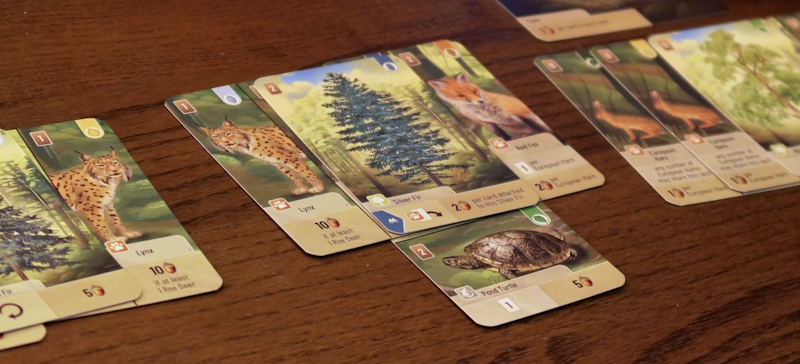
Forest Shuffle
– Image by boardGOATS

Blue made a bit of a meal of explaining the rules, but really they are very simple.  On their turn, players either take two cards from the market and add them to their hand (with a hand limit of ten), or play a card from their hand into their tableau.  There are three different types of cards.  Tree cards are the central cards around which Critter cards are played.  Then there is the first set of Critter cards which are divided into two, left and right with an animal on each half.  Finally, there are Critter cards which are divided into two, the canopy at the top and the undergrowth at the bottom.  The Critter cards are half-tucked under the Tree cards, so only one animal, flora or fauna is visible.

Forest Shuffle
– Image by boardGOATS

The difficult part of the game is getting the cards to work together efficiently to give extra actions and, ultimately, points.  The Alpine expansion doesn’t change the game significantly, just adding more variety to the cards, adding more opportunities for scoring.  For example, it adds an extra Butterfly which give players more points if they have a complete the set.  This time, Blue started with a hand full or Hares, making her initial strategy obvious.  Sapphire was less fortunate, so Blue and Lime suggested that starting with Trees was always a good way to go as players can’t do anything without them.  He also had some Butterflies, so that was where he went next.
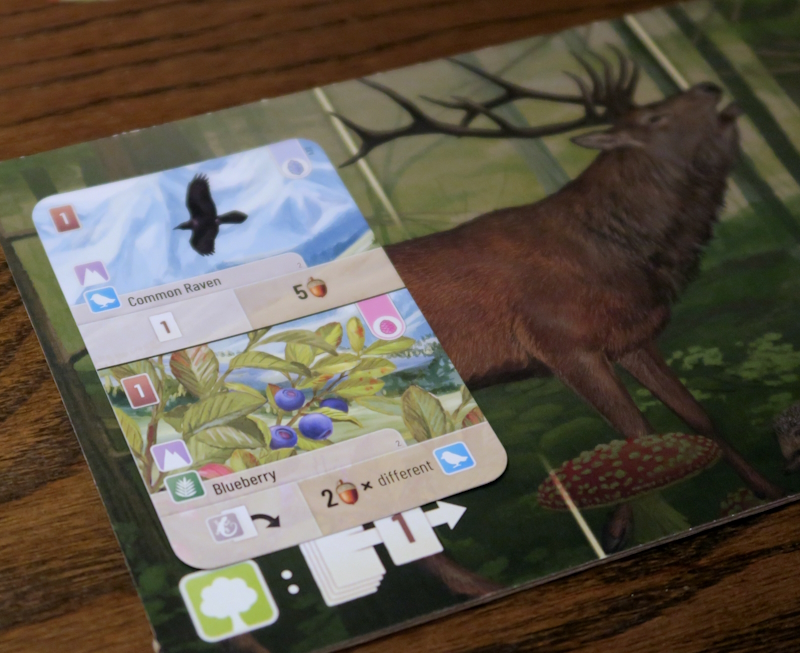
Forest Shuffle: Alpine Expansion
– Image by boardGOATS

Lime built up a collection of Birds, and since he advertised his strategy to the group, everyone else was able to take cards he wanted.  This is a key part of the game:  some cards give points for the number of something you have, so having more of both multiplies the score.  For example, Hares give one point for every Hare a player has.  Thus, one Hare gives one point, but Blue’s seven Hares mean that first Hare scored seven points.  More to the point, every other Hare also scored seven points giving her forty-nine points just for her Hares.  Meanwhile, Byzantium was going Bats, and Cyan was experimenting with Deer.

Forest Shuffle: Alpine Expansion
– Image by boardGOATS

The game ends when the third Winter card is drawn from the deck, so after the second, everyone got very nervy as they tried to complete all their plans and play all the cards they wanted to.  Each time someone drew a card from the deck, it was with bated breath.  The final stage seemed to last forever, and although the third Winter card wasn’t the last card in the deck, it was close, and when it was drawn the game ended immediately. And then it was time for the scores:  everyone assumed that Blue’s husk of Hares would give her victory, but it was actually quite much closer than they thought.  Although Blue finished with a hundred and sixty-five, Byzantium was only twenty points behind.

Forest Shuffle: Alpine Expansion
– Image by boardGOATS

Byzantium was ready to leave, but for everyone else there was just time for something really quick.  So as everyone else was still playing, the remaining four decided on a quick game of Coloretto.  This is an old game, but one that was on the Spiel des Jahres Award “Recommended List” in 2003.  Remarkably, Cyan and Sapphire were new to it, but it is a super easy and quick game to play, but with tactical decisions to make.  It is also one that can essentially be taught as you go:  either turn over the top Chameleon card and add it to one of the Trucks, or take one Truck.  Each Truck can contain a maximum of three Chameleons and once everyone has taken a Truck, the round ends.

Coloretto
– Image by boardGOATS

At the end of the game, players score each group of coloured Chameleons, with the largest three groups giving positive points and any others scoring negatively.  There are a small number of cards that just give straight points and balancing these with Chameleons is part of the challenge.  The end is triggered when the end of game card is drawn and then the round is played to completion.  This time, everyone kept their negative scores down, while Cyan went for the pure point cards, collecting fourteen points, more than half his score, by that route.  The winner was Lime, however, who was imperious and won by some distance with a total of thirty-three.
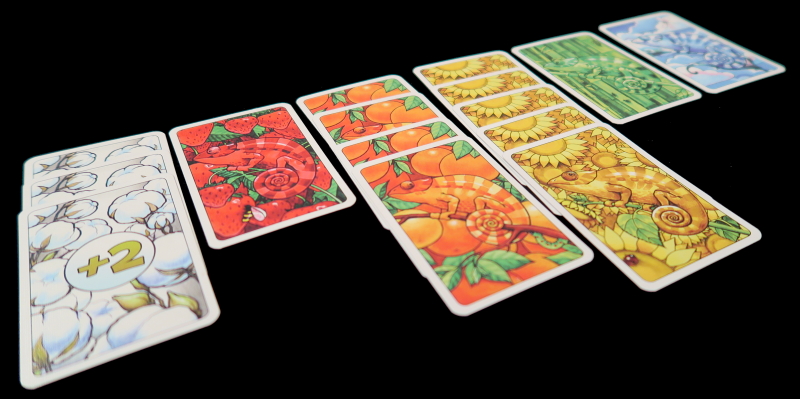
Coloretto
– Image by boardGOATS

Meanwhile, on the next table Jade was teaching Cobalt, Crimson and Plum the Spiel des Jahres 2024 nominee, In the Footsteps of Darwin.  The premise of this is that players are naturalists aboard the Beagle helping Charles Darwin finish his book On the Origin of Species, studying animals, carrying out cartographic surveys, publishing their findings, and developing theories. On their turn, players study an animal or take inspiration from a character by choosing one of the three tiles in the row or column marked by the Beagle, and placing it onto their naturalist’s Notebook. This may be an animal to study or a character from the Beagle’s previous journey and will give an immediate bonus or a scoring bonuses.
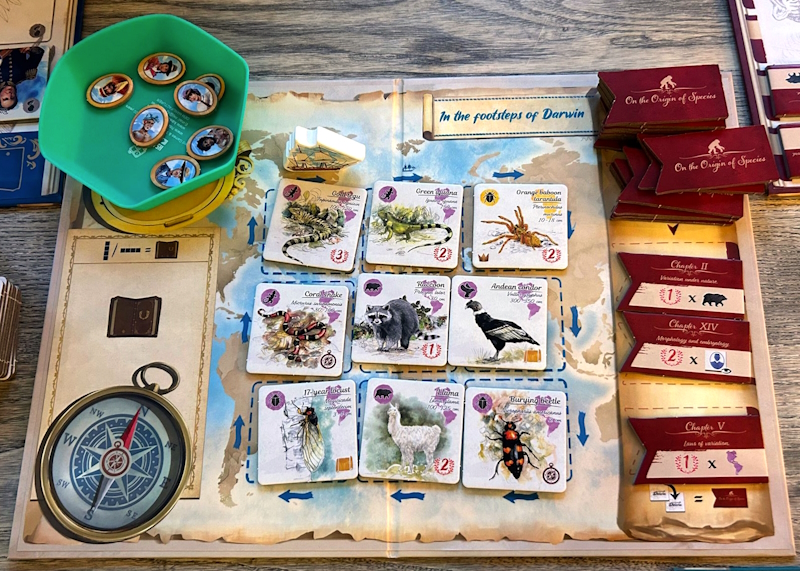
In the Footsteps of Darwin
– Image by boardGOATS

After placing the tile, the Beagle is moved round the market, with the distance dependent on the tile chosen and a new tile is drawn to fill the empty space on the journey board.  At the end of the game, the player who contributed the most to On the Origin of Species wins.  At it’s heart, In the Footsteps of Darwin is a fairly simple set collection and “make the most of what’s available” game. Players obtain an additional scoring objective when they place a tile on top of a previous one, covering up any icons, so a key part of the game is the conflict between points being gained verses points being lost.

In the Footsteps of Darwin
– Image by boardGOATS

There’s also quite a bit of luck invoiced, as a player may need one or two specific tiles that don’t come out, or that get taken by someone else before they have the opportunity to do so.  The group found it was very quick to play, taking just forty minutes including teaching.  Plum’s  starting goal was points for tiles in the upper right quadrant, but in the absence of tiles that fitted that criteria she focused instead on collecting Charts and Compasses as these score points equal to the number of these multiplied together.
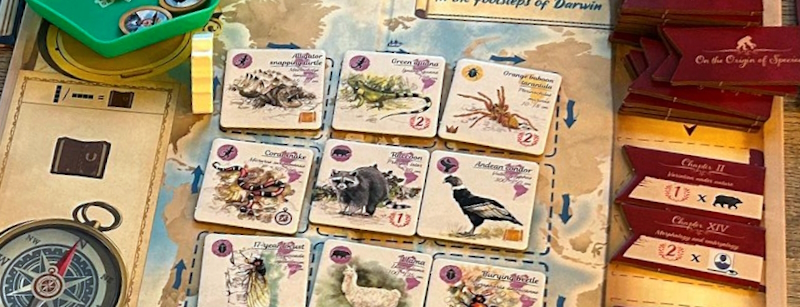
In the Footsteps of Darwin
– Image by boardGOATS

One advantage of these is that once a Compass has been collected, the tile can be covered without loosing any points. Cobalt didn’t worry about that at all, covering loads of tiles to get more Theories banners which give points.  Ultimately, everyone’s score was pretty similar at the end of the first game but Jade took victory as he was most effective with the Chart/Compass scoring.  As it was so quick, the group decided to give it a second try—this the scores all improved.  This time the victor was Crimson, who was again the most effective with the Charts/Compasses, but also scored well in other areas, as did Cobalt who came second again.

In the Footsteps of Darwin
– Image by boardGOATS

From there, the group moved on to a game of Looot, which is too recent a release to have been acknowledged in the Spiel des Jahres awards.  It has been popular amongst the members of the group that have played it so far, however, and may well get an award next year.  In this game, players gain points by gathering resources and capturing buildings to try to develop their Fjord, fill their long ships and complete buildings. The winner is the player with the most riches and is crowned Jarl of the Vikings. The game is played over several rounds until each player has played all their Vikings, giving a maximum of thirteen turns, each with a simple structure.

Looot
– Image by boardGOATS

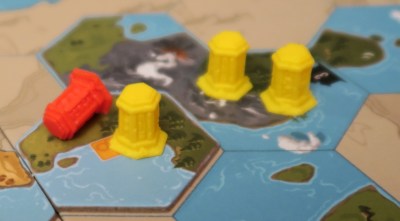
Players start by placing their Viking on a Resource tile on the central board adjacent to another Viking of any colour.  They then take the associated Resource and place it on their personal board.  If possible, they then use their Resources to capture a Building and place that on their board, take a Long Ship and also place it on their board, use a Shield, or complete a Construction Site and finally grab a Trophy.  Looot is quite a light game, but with enough decision space to be interesting.  Last time was a three-player game, but this time, with four, players get another map area, which the group arranged to give a wide play area.
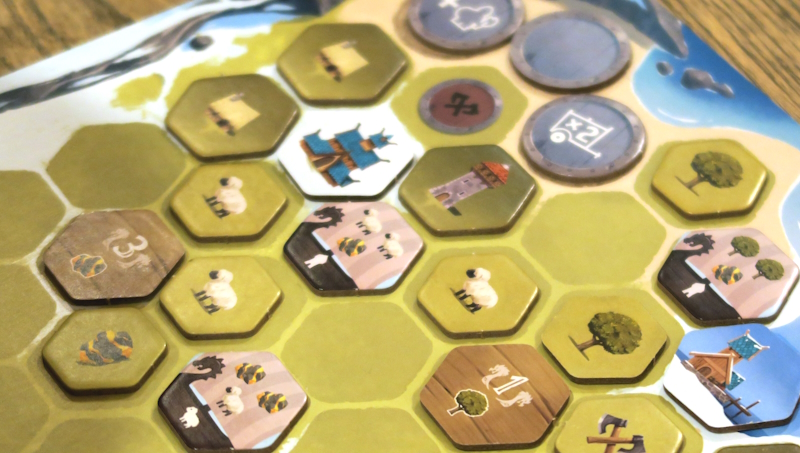
Looot
– Image by boardGOATS

The board layout made it easier to get to more areas of the map relatively early in the game, but there was still plenty of competition for the Towers.  Like last time, Plum decided not to worry about all the home tiles and focused on gold, which was good, but not enough on its own.  Cobalt scored massively for Castles by getting plenty of them plus the equivalent Long Boats.  Cobalt started on that strategy largely by accident, before he had got a real understanding of game-play and a full appreciation of how they increased the Castle scoring and matched the requirements he could fulfill.

Looot
– Image by boardGOATS

Crimson had a nice balance of increased score for Towers and Houses, while Jade built up a huge pile of Wood.  Unlike last time, things didn’t just come together at the end for Plum, and nobody else could compete with Cobalt’s Castles and he took victory with one hundred and twenty-one, fourteen points ahead of Crimson in second.  It had been a good game though, and as players become more experienced, they will be increasingly able to determine the best scoring opportunity from the start and how to optimise the mini game that is building their Fjord. With experienced players, this could be quite ruthless with players trying to block each other and prevent objectives.
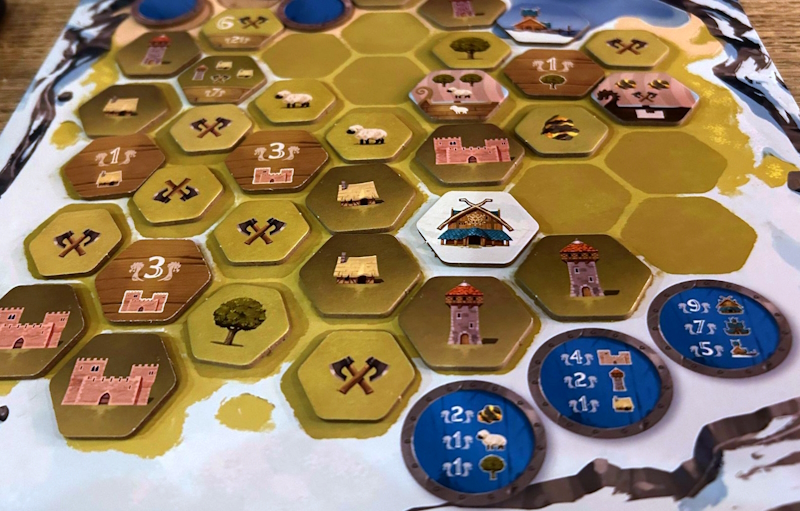
Looot
– Image by boardGOATS

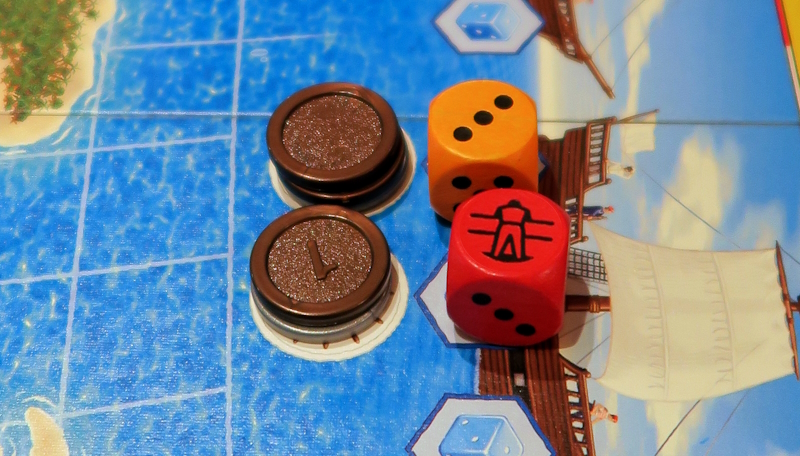
In the third group, meanwhile, Pine was introducing his new acquisition, the old game, Tonga Bonga, to Pink, Black and Purple.  This is a sailing race game a bit like the 2008 Spiel des Jahres recommended Jamaica.  In Tonga Bonga, players pilot their ship around the archipelago with the goal of visiting four of the five remote islands and returning to Tonga Bonga Bay.  Each player has room for three sailors on their ship, each of which represented by dice and indicate how fat the ship will move.  At the start of the round, players decide how much they are prepared to pay for the sailors who will serve as their captain and first mate that round (the Cabin Boy always works for nothing).

Tonga Bonga
– Image by boardGOATS

Players then simultaneously roll their dice, and take it in turns assign their dice to the other players’ ships, in return for the money offered.  In a mechanism vaguely reminiscent of that in the really rather vicious game, Vanuatu, if a player tries to place a higher value die where someone has already assigned a die, the lower value one is displaced and bumped to a lesser and usually less lucrative role.  Thus, all things being equal, the ship offering the most money will get the highest value dice and the most moves, though of course, players can work together to disrupt this behaviour. One side of each die has a Seasick Sailor (effectively zero), so the maximum value dice are five.
Tonga Bonga
– Image by boardGOATS

Once all the dice have been assigned, players move their ships racing to reach the islands, leaving one of their tokens there.  Landing on an island, earns $25 from the bank, but the player has to pay $5 to each player who landed there ahead of them.  Pine explained the rules and before long, everyone was sailing.  Pink got a bit of a lead by using his winnings to buy more moves and visit more islands.  He had been feeling that the game was maybe a bit “broken”, but as is usually the case when a game feels like that, it was all down to the “rules malfunction”, but it wasn’t until the final round that the rules were “clarified”.

Tonga Bonga
– Image by boardGOATS

Instead of the winner being the player to cross the line first with any left over money used as a tie-breaker, once a player has visited four islands they return to Tonga Bonga Bay and trigger the game end—and whoever has the most money wins.  Pink crossed the line and claimed the moral victory, as he was playing by the original rules.  Everyone else was quite happy with the “updated rules” though, which left Pine the victor with Purple in second and Black just behind.  Pink blamed “Evil Pine” for the mishap, but was eventually won round with a bottle of dubiously flavoured cider.

Tonga Bonga
– Image by boardGOATS

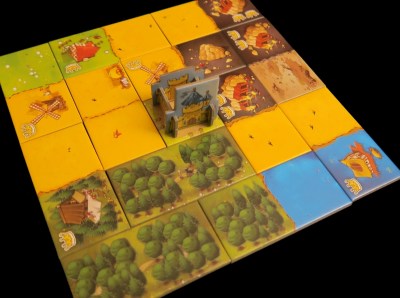
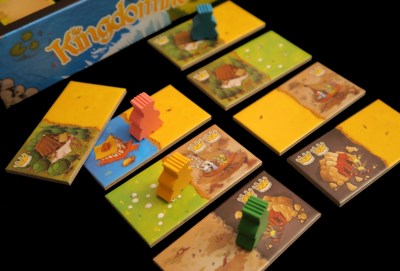
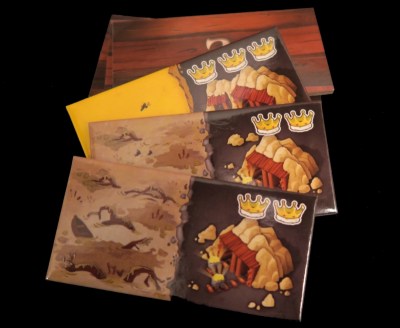
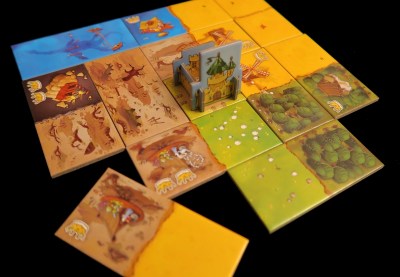
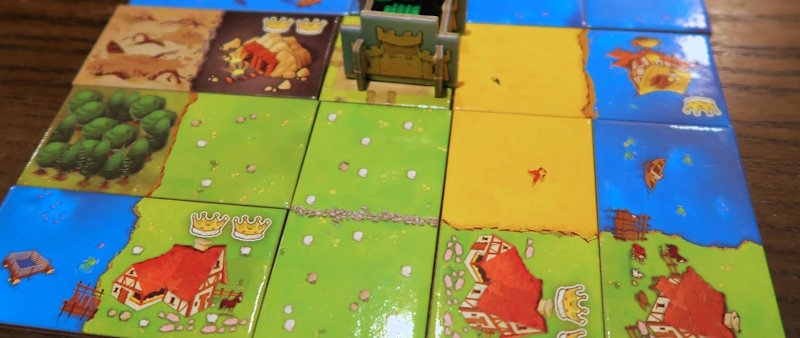
Although the debate had been audible by the players at the neighbouring tables, ultimately it was all taken in good part and the game had been a lot of fun and showed its age less than Lifeboats that was played a few weeks back and was only five years older.  From there though, the group moved on to a game of the 2021 Spiel des Jahres winner, Kingdomino.  This is a clever little game where players are building a kingdom made out of double-headed, domino-like tiles.  As in Dominoes, the ends of the tiles have to match, or at least it has to match with one tile tile already in the player’s kingdom.
Kingdomino
– Image by boardGOATS

The really clever part of the game is the double market, where the tiles are taken in reverse order of value.  The double market means that when a player takes the tile for the current round, they choose which tile they will get in the next round.  Thus, taking the lowest value tile this round means they will have first choice next round.  Players score for each contiguous area of Terrain—the number of points is equal to the number of squares multiplied by the number of Crowns featuring in it.  This time, Pink concentrated on Wheat Fields and Sea, Pine focused on Sea and Meadow while Black concentrated on Woodland with a smattering of points from Marsh, Mountain and Wheat fields.

Kingdomino
– Image by boardGOATS

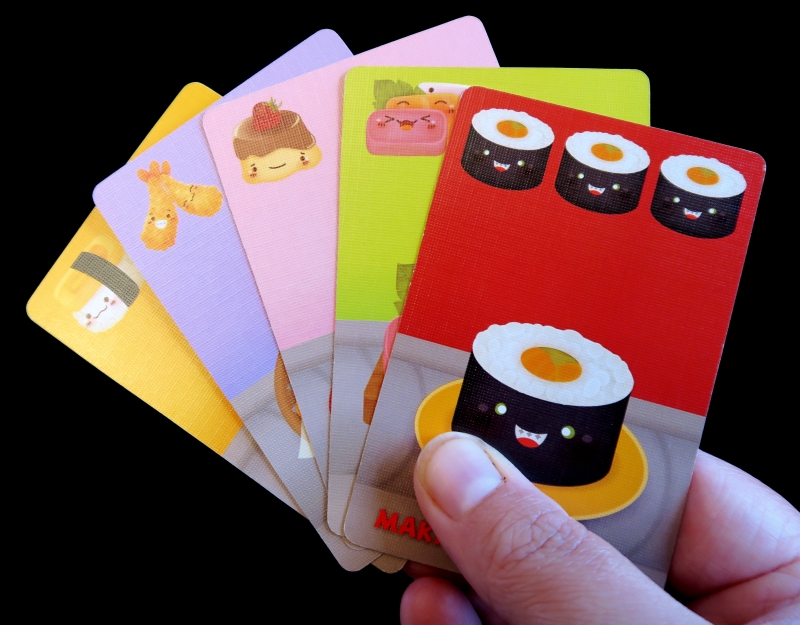
In contrast, Purple prioritised her four contiguous areas forfeiting the “Harmony” and “Middle Kingdom” bonus points for using all the tiles to give a square kingdom with a central castle.  Pine took victory with a massive seventy-three with Pink and Black tying for second with sixty points.  This group wasn’t done by any means and swiftly moved on to a quick game of Sushi Go!.  This is one of those games that takes a mechanism that is a relatively minor part of other games and distills it into its purest form in the game.  Coloretto does the same for the central market mechanism used in the 2007 Spiel des Jahres winner, Zooloretto, and Sushi Go! does it for the card drafting mechanism in the 2011 Kennerspiel des Jahres winning game, 7 Wonders.
Sushi Go!
– Image by boardGOATS

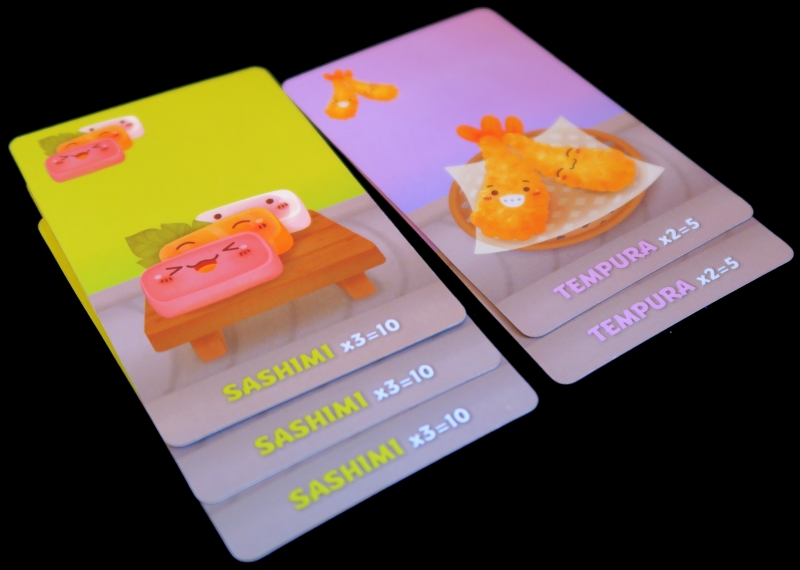
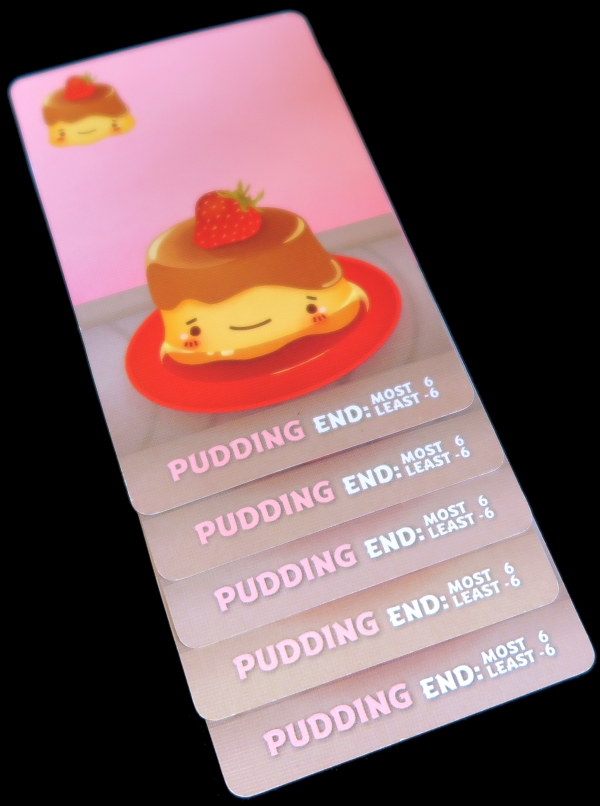
In Sushi Go!, players start with a hand of cards, keep one and pass the rest on, repeating until all the cards have been distributed.  As well as being a core mechanism in 7 Wonders, this “Card Drafting” is also often used to try to reduce the luck of the draw at the start of games like Terraforming Mars and Agricola (both also acknowledged by the Spiel des Jahres committee).  In Sushi Go!, players are using the card drafting to collect sushi and, most importantly Pudding!  The game is played over three rounds, with cards drafted to the left, then right and then left again, scoring points at the end of each round.
Sushi Go!
– Image by boardGOATS

This time, Pink and Black tied for the high-scoring first round, with Pine just behind.  Pine made up for it on the second round by taking it convincingly, however, with everyone else scoring very badly.  The third round was more even again, this time won by Black with Purple taking second.  That resulted in a three-way tie between Black, Pink and Pine, but at the end of the game, the player with the most Pudding cards gains six points, with the one with the fewest losing six points.  Unusually for Pink (as he has quite a sweet tooth), he had eschewed Puddings, while Black had the most giving him what ended up being a quite convincing victory.
Sushi Go!
– Image by boardGOATS

There was just time for a single round of Love Letter (a game from the 2014 Spiel des Jahres recommended list).  This is a sixteen card game where players start with a card, draw a second and then play one.  The idea is to try to be the last play in or the player with the highest value card when the deck runs out.  The theme is all about getting as close as possible to the Princess card, which has the highest value.  This led to a discussion about real princesses and how close people had been to them.  It turns out that Purple has met a real one, Princess Nina who lives in a massive house in Cheltenham.  During the game, Pink was the Princess, but was spotted and knocked out, leaving Black to take another win.

Love Letter
– Image by boardGOATS

Learning Outcome:  The Spiel des Jahres committee may reward lighter games, but they are good games.

15th October 2019

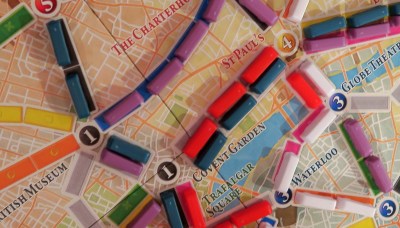
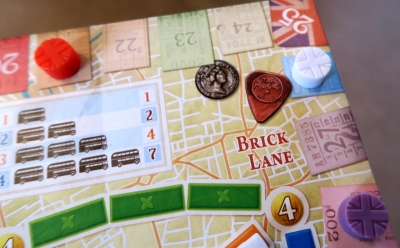
With food and Ivory both a little delayed, the “Feature Game”, Tapestry was starting to look a bit doubtful. Ivory and the food both arrived eventually though, and Burgundy made haste with his ham, egg and chips while everyone else decided what they were going to play.  To fill in time while the eaters ate, everyone else decided to squeeze in a quick game of Ticket to Ride: London.  This version of Ticket to Ride is reduced in size and is designed be quicker to play, which certainly proved to be the case.  The game play is very similar, however, with players taking it turns to draw coloured cards or use them to place pieces, but in this version the Train pieces are replaced by Routemaster Buses.

Ticket to Ride: London
– Image by boardGOATS

Although it is still high quality, the board is also smaller than in the full-sized versions, the players have fewer pieces and a maximum of four can participate.  As usual, players also start with a selection of ticket cards and successfully fulfilling these give more points, but woe betide any player who fails to complete a ticket as the points become negative, which can be very costly indeed.  In addition to these features, this new light version of the game also gives bonus points to players who manage to connect all the locations in an area. Not large numbers of points, but in a tight game it can make all the difference. And these games are often quite tight…

Ticket to Ride: London
– Image by boardGOATS

Players started placing Buses very early in the game, and it wasn’t long before it became clear that everyone was trying to claim routes in the same “south of the river” area.  Although Ivory eventually extended to the east, Lime broke ranks first and claimed a north west route.  Pine completed his routes early and went for more tickets a couple of times. Then before we knew it, the game was over as Ivory placed his last bus.  Placed Bus scores had Ivory way out in front as he had several of the long, four-bus routes, while Lime brought up the rear as he had been claiming mostly two-bus lengths routes.

Ticket to Ride: London
– Image by boardGOATS

So it was looking like a bit of a “slam dunk” for Ivory.  Everyone had managed to complete an area or two and pick up the associated bonuses, but Ivory had actually managed to get the four point area with all his long routes in the east.  When the completed route scores were added in, Pine just pipped Green, but unfortunately for Lime he had failed complete his longest route causing him to lose eleven points.  The clear winner was Ivory though, and managing to complete three high scoring routes just increased his already substantial lead giving him a dominant win.

Ticket to Ride: London
– Image by boardGOATS

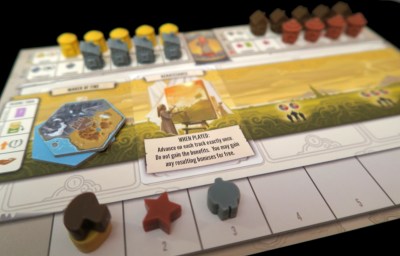
With food just about done and the first game coming to an end, there was some debate who would play the “Feature Game”, Tapestry.   This is the hot new game from Jamie Stegmaier, designer of Scythe and producer of Wingspan, so everyone knew what they were getting – amazing production values in a very solid game. In this case, the game is quite simple in terms of the number of rules, however, they combine together to make a much more complex game.  The idea is that on their turn, the active player simply either pay resources to progress their civilisation in one of the four directions (Science, Exploration, Military and Technology) and carries out the associate action, or they start a New Era for their people and collect Income.  It is how these apparently simple options interact that leads to a complex and deep game however.

Tapestry
– Image by boardGOATS

The game is played over four Eras, with each player book-ending their game with an Income phase.  Players choose when to take their own Income phases which has the unusual consequence that Civilisations can be in different Eras and even finish at very different times.  Advancing their Civilisation can have a wide range of consequences because each step along the four tracks is different and, in general, the further along the tracks the more powerful the action is.  For example, in the early stages of the game, a player taking the explore action might be able to place a tile on the central player board, which later may enable them to expand the are they control.  Later in the game, however, a player who reaches the end of the Explore track can move away from terra firma and explore Space, which can be very lucrative.

Tapestry
– Image by boardGOATS

After the usual debate over who was going to play, Black joined the inevitable trio of Burgundy, Blue and Ivory.  The game is asymmetric, so each player’s civilisation has a different special power. For example, Ivory’s civilisation, “Leaders”, were to allow him to progress along one of the tracks at the start of each Era.  Black’s “Merrymakers” also granted a bonus at the start of each Era, but this time it’s according to three private progression tracks; the further up a track that the Merrymakers move, the more potent the benefit they receive.  The bonus received by Burgundy’s “Chosen” would depend on his position on each of the four technology tracks at the start of each Era: where there were no players in front of him, he would pick up victory points equal to the number of other players in the game (three in this case).

Tapestry
– Image by boardGOATS

Not all civilisations give advantages during the income phase, however.  For instance, Blue’s “Isolationists” gave her an advantage when colonising.  The game features a central board which represents the colonies’ territories.  At the start of the game, the colonies are well separated by unexplored land.  The Explore action generally enables players to take tiles from the supply (though some are provided as part of the Income phase), and place hexes on the map next to territory they control.  When carrying out a Military action, players can take control of a neighbouring, explored hex, by placing one of their coloured markers on it.  If the tile is already occupied, it can be “attacked” with the second player simply placing one of their markers and tipping over the defeated player’s marker.

Tapestry
– Image by boardGOATS

Each hex can hold a maximum of two pieces, so there is no come-back.  In general, players are also not able to place a second marker as a defense.  This means that players are naturally reticent when it comes to expanding and controlling the border regions as expanding can leave their border regions vulnerable by providing a path for the opposition to attack.  The Isolationists colony helps to prevent this by enabling the player to place a second marker on a small number of occasions.  Occupying territory is one way of scoring points.  Another is by improving a civilisation technologically.  This is done by taking orange Technology cards.

Tapestry
– Image by boardGOATS

Technology cards give no immediate advantage, but they give a bonus when they are upgraded, either as part of the Income phase at the start of an Era or as an action.  They also give points during the Income phase, but the number of points depends how developed their Capital is.  Each player has a personal play area that includes a Capital City board as well as an area to place their Technology cards, a space at the top to store buildings and the Tapestry Cards that give the game its name.  There are four types of buildings which start the game placed on four tracks that roughly correspond to the four types of advancement and yield resources: Markets (yellow), Houses (grey), Farms (brown) and Armourers (red).

Tapestry
– Image by boardGOATS

During the game, the buildings are moved to the players’ Capital Cities, revealing bonuses that the player will get during the forthcoming income phases.  These bonuses include resources (money, people, mushrooms and power), but also victory points, additional terrain hexes, Tapestry cards and scoring multipliers.  These multipliers are critical:  players score points for the number of Technology cards, the size of the territory they control on the central map, and the number of completed rows and columns in their Capital.  The more buildings a player moves to their Capital, the more of these multipliers are revealed and the more points a player gets.

Tapestry
– Image by boardGOATS

In addition to their personal buildings, players can also enhance their cities with large buildings which are awarded to to the first player to progress onto certain spaces on the development tracks.  These special buildings are wonderfully over-produced and come pre-painted, really adding to the appearance and feel of the game.  As they are only space fillers, there is no question – they could certainly be replaced with simple card tiles and would have been had the game been produced a few years ago.  This is not a deluxe edition however; the added “bling” comes as standard and elevates the feel of the game above the ordinary (and unfortunately,  elevates the price too).  Unfortunately, these sculpts have very rounded corners which makes it a little hard to see what space they cover during play.  They are really gorgeous though!

Tapestry
– Image by boardGOATS

The key to the game is probably the resources though as progressing along the four development tracks, Science, Exploration, Military and Technology need to be paid for.  The price increases the further up the track the player gets as well, so running out of resources largely dictates when players will choose to start a New Era.  That said, if a player moves into a New Era before their neighbours, they get additional resources which can be just enough to encourage players to move on early.  Although it is clear that resources are important, the winner is likely to be the player that best leverages the advantages from their Civilisation.  Like all good engine builders, however, there are always more things to do than resources available.

Tapestry
– Image by boardGOATS

The game started slowly, with Blue taking an early lead largely thanks to her Civilisation giving her points as she explored and expanded her territory.  She was up against Ivory though, who was also progressing along the expansion track, though his progress was accelerated by his use of the Science development.  In the early stages of this development track the action is to move one space along another track dictated by by a roll of the Science die, but without taking the action.  This has the advantage of accelerating development (moving two spaces instead of one per turn), which increases the likelihood of obtaining the beautiful, big, special buildings and consequently makes filling rows and columns in the Capital easier.

Tapestry
– Image by boardGOATS

This is at the expense of increasing the cost of actions earlier in the game, on the other hand, the actions become more powerful and are therefore worth the price provided that the player can make the most of them.  One additional consequence of Ivory making an early dart up the development tracks was the damage it did to Burgundy.  Burgundy’s “Chosen” Civilisation gave him three victory points equal for every track he was ahead on.  Ivory’s rapid progress, increased by the power of his “Leaders” Civilisation, essentially annulled Burgundy’s “advantage”.  Burgundy’s game was further stymied by his struggle to get resources to move things along, a problem that only got worse as the game progressed.

Tapestry
– Image by boardGOATS

As a result, Burgundy turned to Technology cards, but it took a while to get this alternative approach going.  Black meanwhile, kept things simple, concentrating on making the most of his Merrymakers and trying to expand to the centre of the map first.  In this, his life was made difficult by being sandwiched between Blue and Ivory who squeezed his options.  Blue made it to the middle first, and used her special power to prevent anyone else taking it from her and picking up the points for getting there second.  Black made good use of his Trap cards which he initially kept in case he was attacked, but then used instead of Tapestry cards to give him points.

Tapestry
– Image by boardGOATS

He started slowly as he built his engine, but it wasn’t long before Ivory started to edge in front.  By the third era, he really started to push forward, Blue gave chase, but she was always chasing and when Ivory launched his Civilisation into space, the writing was on the wall.  He didn’t quite manage to lap the players at the back and so spared their blushes, but he wasn’t far off, finishing with a very creditable one hundred and eighty-five points.  It is clearly a game that needs multiple plays to understand and get the best out of, and everyone could see its potential, although Burgundy felt some of the Civilisations were more powerful than others.

Tapestry
– Image by boardGOATS

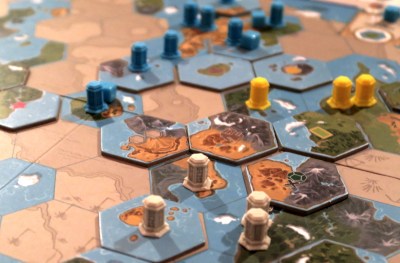
Meanwhile, on the neighbouring table, the others decided to play an old favourite,  Jamaica.  This was new to Lime and although Pine had played it once before, he couldn’t remember it.  The game is a pirate-themed tactical race with beautiful artwork and quality pieces, where the winner is the player who best balances their position in the race with success at generally being a pirate doing piratical things. Each player always has a hand of three cards, and a personal board depicting the five “holds” of their ship, into which goods can be loaded during the game. Each round, one player is designated as “Captain” and rolls two dice, examines their cards, then announces which die will correspond to the “day” and which to the “night”.

Jamaica
– Image by BGG contributor verminose

Each player then simultaneously selects and places it face down in front of them.  Each card has two symbols on it (corresponding to “day” and “night”). The symbols indicate either ship movement (forward or backward) or the loading of a type of goods.  The cards are then revealed simultaneously and resolved clockwise one by one, starting with the Captain. When it is a player’s turn to resolve their card, first the “day” part, then the “night” part, multiplying the number of pips on the appropriate die by the  icons on the card to either move forwards (or backwards) by a given amount, or to load goods.

Jamaica
– Image by BGG contributor verminos

When they take goods (gold, food or gunpowder), Players must have space to store them.  If they do not, they must throw the contents of one hold (containing something different) overboard.  When moving, players pay depending one the space they finish on:  on a deep sea space the cost is food; in a port they must pay doubloons.  At a pirate’s lair, the player can take a treasure token and draw a treasure card, (which can be good, or “stinky”, “cursed” treasure), and if they are sharing the space with another pirate ship, they must fight.

Jamaica
– Image by BGG contributor verminose

Battles are resolved with the attack die, but the attacker rolls first and adds to their total by discarding gunpowder. The defender then dies the same, though if either player rolls the special “star” it counts as a direct hit and that player wins outright and can take one holds worth of goods, a treasure card, or give away some “cursed” treasure.  The game end is triggered when a player’s ship reaches the finish line, after completing one circuit of Jamaica when players receive different amounts of gold depending how far they were from the finish line when the race concluded. This is added to any gold gathered along the way  and the player with the most total gold is declared the winner.

Jamaica
– Image used with permission of boardgamephotos

The race started very slowly (as is often the case) as players stayed in Port Royal and stocked up, but then everyone started moving forwards (and backwards) and fights very quickly broke out. With Gold and food changing ships and ships moving forwards and backwards, or in Green’s case, backwards and forwards: he crossed the finish line from the wrong direction – but no, he couldn’t win that way!   Pine was the first one to claim a treasure and then a second;  the map card enabling him to have an extra card in his hand to choose from, not that seemed to help him:  he still complained that he had poor choice of options. Lime was next, and then followed a period when everyone ended up attacking each other, so much that at least one player ended up in two battles during the same morning move.

Jamaica
– Image used with permission of boardgamephotos

Once players had got around the first corner of the island things began to speed up (again, as is usual for this game). Lime led the way and round this part of the island, Chris started to hoover up the treasures and found himself with an extra hold.  It wasn’t all good though, as became clear when he defeated a sneaky attack from Purple and took the opportunity of foisting a “stinky”, cursed treasure onto her (and the associated negative points.  As the flotilla rounded the final corner, Lime was still out in front with everyone else not far behind. While everyone had full holds, Purple’s ship looked more like a take-away van on a Saturday night, and no gold!

Jamaica
– Image used with permission of BGG contributor Toynan

Lime rolled a five and then a six when he was only three spaces away from Port Royal, but he played a double move anyway and finished the game. The rest of the salty sea-dogs were able to make use of that following wind and bring themselves across the red line into at least point scoring positions, but still some way off Port Royal.  The final scoring was looking quite good for Lime, but he insisted that he didn’t think he would win, as he knew he had a minus five point “stinky” treasure.

Jamaica
– Image used with permission of BGG contributor Ceryon

Pine and Green had finished just one space apart, had a lot of gold on ships and treasure cards.  Pine had the plus seven, and Green had three scoring treasures, but one was a minus three, so the scores were very close indeed.  Purple, unfortunately was almost lost at sea, only creeping across the line with no gold in her hold and only a negative treasure.  Otherwise, it was really close, but Green just beat Pine into second place with Lime just a couple of points behind.  Once again this proved how good a game Jamaica is, well balanced and extremely fun.

Jamaica
– Image used with permission of boardgamephotos

With Tapestry still under way, the group moved onto another, this time more recent, favourite, Kingdomino, albeit one that we’ve not played for nearly a year.  In this short game, players take a domino and add to the kingdom and then place a meeple on one of the dominoes on display for the next round.  When placing the dominoes, one of the two ends must connect to terrain of the same type already in the kingdom, or connect directly to the start tile.  Points are awarded at the end of the game by multiplying the number of tiles in an area of terrain by the number of crowns in the area.  Although we have the Age of Giants expansion, this time the group used the base game so all dominoes must fit in a five-by-five space (or be discarded) and bonus points are awarded for successfully placing all tiles and finishing with the start tile in the centre.

Kingdomino
– Image by boardGOATS

Sadly, Pine made an unfortunate placement decision partway through and thus created himself a single space gap which meant he was not complete a five-by-five kingdom with his castle in the middle.  This was because hadn’t caught the rule that the whole kingdom needed to be square so he’d ended up choosing a tile which was not as good as he’d thought and thus created even more problems for himself.  Everyone else completed their kingdoms so everyone got the full fifteen point bonus.

Kingdomino
– Image by boardGOATS

Green went for a mixture of several smaller sections (including stone and sand), but none scored highly. Purple ended up with fewer, but slightly larger regions (wheat, water and forest) and a similar score to Green.  Lime on the other hand, concentrated on a couple of larger regions, water and forest, each six or seven spaces and with three crowns each they gave a healthy score. On top of that Lime had a few low scoring space regions to top off a very good score and take the victory by twenty points.  An excellent score, especially since it was the first time he’d played the game.

Kingdomino
– Image by boardGOATS

Learning Outcome:  Game-play is very important, but component quality is important too.

25th July 2017

The evening began with Burgundy and Blue playing a non-Extreme version of The Game: ExtremeThe Game was one of our more popular games, but seems to have been somewhat neglected of late.  It is one of those simple games that we really enjoy as a group, and is unusual because it is a cooperative game, which we generally avoid.  The game consists of a deck of cards numbered two to ninety-nine, which are shuffled and everyone is dealt a hand (seven in the two player game).  On their turn, the active player must play at least two cards onto the four piles following a handful of simple rules.  Two of the piles start at one and every card there after have a higher number than the card on top; the other two start at 100 and the cards that follow must have a lower number.  The aim of the game is for all the cards to end up on the four piles, so timing is everything – play a card that is too low and someone could get shut out and be unable to play one of their cards.  This makes communication important: players can say anything they like, but must not give specific number information about the cards they hold.  There is one “get out of gaol” rule, sometimes known as “The Backwards Rule”, where players can play a card on the wrong deck, but only if the card is exactly ten different to the top card.

The Game: Extreme
– Image by boardGOATS

The Game: Extreme is just like the The Game, except that some of the cards have extra icons on them which limit the number of options available and consequently make being successful even more difficult.  Although we have played the full version, we have found that the basic game is usually quite challenging enough for us, so we chose to stick to the original game this time and ignored the extra symbols. Blue and Burgundy had just started when Pine turned up so he grabbed six cards (the number of cards in hand for three players) and joined in.  It was just as well that it was only the base game, because after Blue had an excellent start, everyone else thereafter had very middling cards, that is to say, they were all in the thirty to seventy region.  Then things got worse, because having been forced to move to the middle, everyone drew single digit cards and cards numbered in the nineties.  Everyone blamed Burgundy because he shuffled, but he had some of the worst timed cards of all.  Remarkably, the draw deck was eventually exhausted and there was a moment’s respite as layers only had to play the one card.  It wasn’t long before it was all over though, with Blue stuck with a large number of unplayable cards.  In the end there were eleven cards left unplayed – a lot worse than our best (we have beaten it in the past), but not so bad considering our truly dismal start.

The Game: Extreme
– Image by boardGOATS

With everyone who had been expected arrived, we moved on to the “Feature Game”, which, following it’s entirely predictable Spiel des Jahres win last week, was Kingdomino.  The game consists of dominoes featuring two terrain “tiles” with some tiles also depicting one or more crowns.  When the dominoes are placed, one end must either connect to another domino matching at least one of its terrain types or connect to their starting tile (which can be considered to be “wild”).  All dominoes must fit in a five-by-five space and if one or more dominoes cannot be placed according to these rules, then they are discarded. At the end of the game, each player multiplies the number of tiles in each contiguous region of terrain with the number of crowns on the tiles in that region and adds them up together with any bonuses to give their score.  We’ve played this a lot since Expo, and found it very enjoyable, so everyone was happy to give it another go.  With a total of seven people we split into two groups, the first was a group of three consisting of Black, Purple and Green.

Kingdomino
– Image by boardGOATS

With only three playing a dozen dominoes were removed and it was not until the end of the game that it became apparent that over half were pasture tiles.  As a result, it was unsurprising that Green managed to corner the market in pastures with four squares and two crowns leaving Black and Purple with only one tile and no crowns. In contrast, Purple ended up with all the swampland (with two squares and three crowns), while Black and Green only managed only a couple of tiles and no crowns.   Black’s wheat, woodland and water provided good solid scoring, while Green added two woodland areas and a small strip of water to his.  In a very close game with just four points between first and third, it was Purple’s extensive wheat field that made up the bulk of her winning score of forty-nine.  On the next table, with four players, none of the dominoes were removed, but that didn’t stop fate getting involved.  In this game, all the high numbered (and therefore valuable) dominoes came out at the start, making it very obvious who wanted what later in the game.  In the first game everyone had managed a perfect five-by-five grid with the castle in the middle so they all picked up the bonus points.  In the second game, Burgundy failed on both counts so started fifteen points adrift.  Despite this, he still finished with a very creditable fifty points and was only beaten by two points by Blue in what was also a very close game.

Kingdomino
– Image by boardGOATS

Both games finished more or less together and there was just time for a little chit-chat before we moved onto the next game.  Inevitably, people were interested in how Keyper had gone, when the group had been fortunate enough to participate in a play-testing session with the designer.  As a group, we love Keyflower and were keen to see how this one plays out.  Although the game is quite deep, it isn’t actually as complex as it seemed at first and the novel game boards that change throughout the seasons were described as “Genius” by Black while they simply fascinated Blue, reminding her of a Moomin toy she had picked up in Helsinki airport ten years before.  Pink on the other hand was captivated by the individual art on the MeepleSource Character Meeples in the deluxe edition.  The general consensus seemed to be that everyone was looking forward to playing it again on its release, which will probably be in a couple of months time.

Keyper
– Image from kickstarter.com

With drinks refilled there was the inevitable debate as to who was going to play what and eventually, Pine joined Black, Purple and Green for a game of Jamaica.  This was the group’s first ever “Feature Game” and as such is an old favourite; quick to learn and fun to play, but oh so difficult to do well in. Pine was new to it, so a run-down of the rules was in order.  Essentially a race game, the board depicts the island of Jamaica surrounded by a water race track where each space is a Port, a Pirates’ Lair, or “Deep Sea”.  For the most part, there is just one route, but there are a couple places where players can choose to cut a corner to get ahead, but there are always consequences.  Each player has a ship, a player board representing their ship’s hold a starting amount of food and gold together with a deck of action cards from which they draw three.  At the start of each round, the Captain rolls the two dice and places them in the middle of the board – one on a “morning” spot and the other on the “evening” spot. Each player then chooses one of their three action cards and places it face down in front of them.  Staring with the Captain, players then take it in turns to carry-out the two actions on their card, applying the number on the morning die to one of them and the number on the evening die to the other.

Jamaica
– Image used with permission of
BGG contributor Punkin312

The actions vary from sailing (forwards or backwards) to taking food, gunpowder or doubloons, and in each case the number of spaces or the amount of resource depends on the morning and evening dice.  When sailing the player must move their ship the exactly amount and then carry-out the action according to the space they land on: in Deep Sea, they must discard food; at a Port, they must discard gold; at a Pirate’s Lair they get to take any treasure that may be there (and they aren’t all good).  More seriously, if there is another ship on the space, there is a battle which is resolved with dice and gunpowder.  The game ends when one player makes it all the way round the island and back to Port Royal and players score points for how far they got, the number of treasures they stole and the amount gold they collected.  Random role meant he was the starting captain, but he was happy to go first.  The flotilla started slowly, but Pine and Purple soon found a little wind to get started, while Green and Black remained in port for a while longer.  Inevitably, Pine and Purple were soon fighting it out with Purple winning the first melee.

Jamaica
– Image by BGG contributor verminose

Purple also managed to steal the first treasure, which everyone quickly realised was a stinky one when she beat Black in battle and passed it along.  Black kept his ship smelling sweet by fighting and beating Pine soon after and passing it on again… From then on, even though Pine had managed to gain more bonus cards, no-one dared take one as booty, just in case!  By this time, Purple was full-sail ahead and also gained the “roll again in battle” card, Black found the luxury of an extra card in hand, and Green remained lingering far behind the others.  This soon changed within a couple of rounds, when a quick reverse for Green resulted in the plus-two cannon card and double high scoring forward brought him back into the fray.  With his eye on the treasure in the Pirate’s Lair as he sailed past, he knew he didn’t have enough to pay the harbour tax at the Port and would therefore be “forced” to go back a space to the Pirates’ Lair.  First he had to deal with Purple who was ominously lurking at the entrance to the harbour.  He bravely took her on and won, taking some gold as his prize, but then realised his mistake – now he could pay the tax and would not have to reverse to the unclaimed treasure!

Jamaica
– Image by BGG contributor verminose

Purple and Pine continued their tit-for-tat squabbling and Purple’s boat got heavier while Pine’s got lighter.  Black tactfully mostly avoided too many fights, leaving his hold almost empty for much of the middle of the game.  Green, on the other hand, took on Purple once again, and lost and with it went his plus-two cannon. Purple was beginning to look invincible with both fighting bonuses and a hold full of cannons to boot, but she did not do much fighting after that, since everyone else tried their hardest to avoid her!  Pine then came within a whisker of landing in Port Royal, which was just six spaces away, so everyone knew the end was nigh and every round was about maximising points. A six was rolled and everyone thought that would be it, but Pine decided to stay put and claim some more gold, then promptly lost some to Purple who joined him in Port.  With a three and a six rolled the end was triggered when Green just struggled across the line, gaining seven points, but losing five gold in duty at the Port.  Black stayed put and just piled in more gold while Purple and Pine both raced across the line.  It was close at the front, but Pine romped home with just enough bonuses to pip Purple by two points.

Jamaica
– Image used with permission of
BGG contributor The_Blue_Meeple

Meanwhile, on the neighbouring table, Burgundy and Blue were introducing Ivory to Orléans.  This is one of Burgundy’s favourite games and he was almost purring as he was setting up while Blue explained the rules.  The idea is that each player has a bag and, at the start of the round they draw workers from it.  Players then place their workers on it their market which has a maximum of eight spaces, before moving as many as they want onto their personal player board which dictate the actions they can carry out.  Once everyone has placed their pieces, players take it in turns to carry out their actions.  There are a variety actions, but a lot of them involve taking another worker that is added to the bag along with any workers that have been used.  Thus, the game is mechanically very simple: draw workers from a bag, plan which actions to do and then do them with points awarded at the end of the game.  This simplicity belies the depth of the game and the complexity that comes as a result of combining the different actions though.

Orléans
– Image by BGG contributor styren

In addition to taking a worker, the most actions come with a bonus; some of these help players manage their game, while others give players scoring opportunities.  For example, going to the Castle will give a player an extra “Knight”, but will also enable them to take an extra worker out of the bag on subsequent turns and so on.  Each of the Character actions has an associated track on the communal player board and the players move one step along these tracks each time they carry out an action receiving a bonus as they go; in general, the bonuses increase the further along the track players are.  Probably the biggest source of points, however, comes from a combination of traveling around France building Trading Stations, collecting “Citizens” and traveling along the development track.  This scores heavily because the total awarded is equal to the product of the number of Status Markers achieved along the development track, and the sum of the Trading Stations and Citizens.  This is not the only way to score points though, something that was very evident in this game when it came to scoring.

Orléans
– Image used with permission of BGG contributor jsper

The game started slowly, with everyone trying to fill their bag with useful characters.  Blue began by going to University which gave her a good start along the development track, though of course this meant nothing without Citizens and/or Trading Stations to act as a multiplier.  It also gave her a lot of grey Scholars, which she mostly put to good use in the Cloister to get yellow Monks, and before long her bag was a veritable monastery!  This meant she was forced to neglect other areas though.  Meanwhile, Burgundy had started by looking at the map of France and the lay out of resources and had noticed that there was a lot of wool and cloth on the eastern border, so he began moving and collecting resources with a vague plan to add a Tailor’s Shop or Wool Merchant to add more, though things didn’t work out quite like that when Ivory got in on the act and his blue Sailors decided to hide in his bag.

Orléans
– Image by boardGOATS

Ivory had begun by building the basics, starting with his Castle which gave him lots of red Knights and allowed him to draw more people out of his bag, then moving on to brown Craftsmen adding automation and then blue Sailors that provided lots of money.  This meant his development track was sorely neglected and he looked like he was going to be in trouble as places at the University ran out.  He had a plan for that though, and added the Observatory to his board which allowed him to move large distances along the Development track, something he used to great effect.   As the game drew to a close, event tiles continued to be drawn in pairs with the same event occurring in consecutive rounds – something Burgundy got the blame for again.  The fates got their revenge however, and Burgundy’s shy Sailors continued to hamper his plans while Blue headed down the west coast of France to build her final score.  In the final rounds there was a flurry of building and sending people to the Town Hall to pick up those few extra citizens.  The final score was close, very close, with everyone scoring in different areas:  Burgundy and Ivory had large piles of cash, while Blue was cash poor and made the majority of her points through the development track and Trading Stations.  Similarly, Ivory scored highly for his cloth, while Burgundy scored for his wool and Blue had the most cheese.  There were only eleven points between first and third, but Blue finished just ahead of Ivory in second place.

Orléans
– Image by boardGOATS

On the next table, Jamaica had come to an end, so with Burgundy tied up in the battle for France, Pine, Black and Purple fancied their chances at Splendor.  The game is very simple: players collect chips to buy gem cards which can, in turn, be used in lieu of chips.  More expensive cards are also worth points and the game end is triggered when one player reaches fifteen points (and the round is completed to give everyone the same number of turns).  Points are also awarded for “nobles” which go to the first player to get a specific combination of gem cards and the player with the most points at the end is the winner.  This time, although it started as a tight game, Black quickly got his nose in front and there he stayed.  Pine picked up a noble, but that was matched by Black and the writing was on the wall long before Black triggered the end of the game, finishing with a total of sixteen points, five more than Pine in second.

Splendor
– Image used with permission of BGG contributor henk.rolleman

With Orléans over, Ivory headed home leaving just enough time and people for one last quick game, another old favourite, Bohnanza.  The original bean trading game, the clever part of the game is that players cannot rearrange the cards in their hand and must play them in the order they arrive.  Thus, on their turn, the active player first plays the first card in their hand with the option of playing the second if they desire.  Once they’ve been planted, two cards are drawn which can be traded, but must be planted by someone.  The game is very free flowing with lots of table talk, which perhaps explains why it took a lot longer than planned.  Burgundy once again got the blame when cards grouped together, that didn’t stop Blue from getting in a tangle with Garden and Cocoa Beans, harvesting them only to draw one straight away.  Despite this, was a close game and finished in a three-way tie for first place, with Pine just one point behind in second.  Unusually, Burgundy trailed a long way behind, capping a hard fought evening that went unrewarded.  As he commented on the way out of the door though, while it had been an unsuccessful evening, it had still been enjoyable.

– Image by boardGOATS

Learning Outcome:  Losing can be fun, but don’t let Burgundy shuffle.

BoardGOATS @ “The Mix” II – Saturday 21st November 2015

Following the success of our first drop-in session in April, The Mix in Wantage town centre is again hosting a gaming session on Saturday from 10.30 am until 2 pm.  Once again, members of the club will be providing games and teaching people how to play them.

The Mix
– Image from thewantagemix.wordpress.com

There isn’t very much space so we won’t be playing long games, in any case, the idea is to show people what modern boardgames are all about by demonstrating shorter games.  We will bring a few eye-catching games like PitchCar, Riff Raff, Bamboleo, Boom Boom Balloon, Toc Toc Woodman, and Saturn, but most of the gaming will be smaller filler games like Dobble, Turf Horse Racing, No Thanks!, Walk the Plank!, Love Letter, The Great Balloon Race and some of our other light favourites.  We will also be bringing some of the classic gateway games like Carcassonne, Ticket to Ride, The Settlers of Catan and Jamaica as well as a small number of deeper games, just to show people what else is out there.

Boom Boom Balloon
– Image used with permission of henk.rolleman

BoardGOATS @ “The Mix” – Saturday 18th April 2015

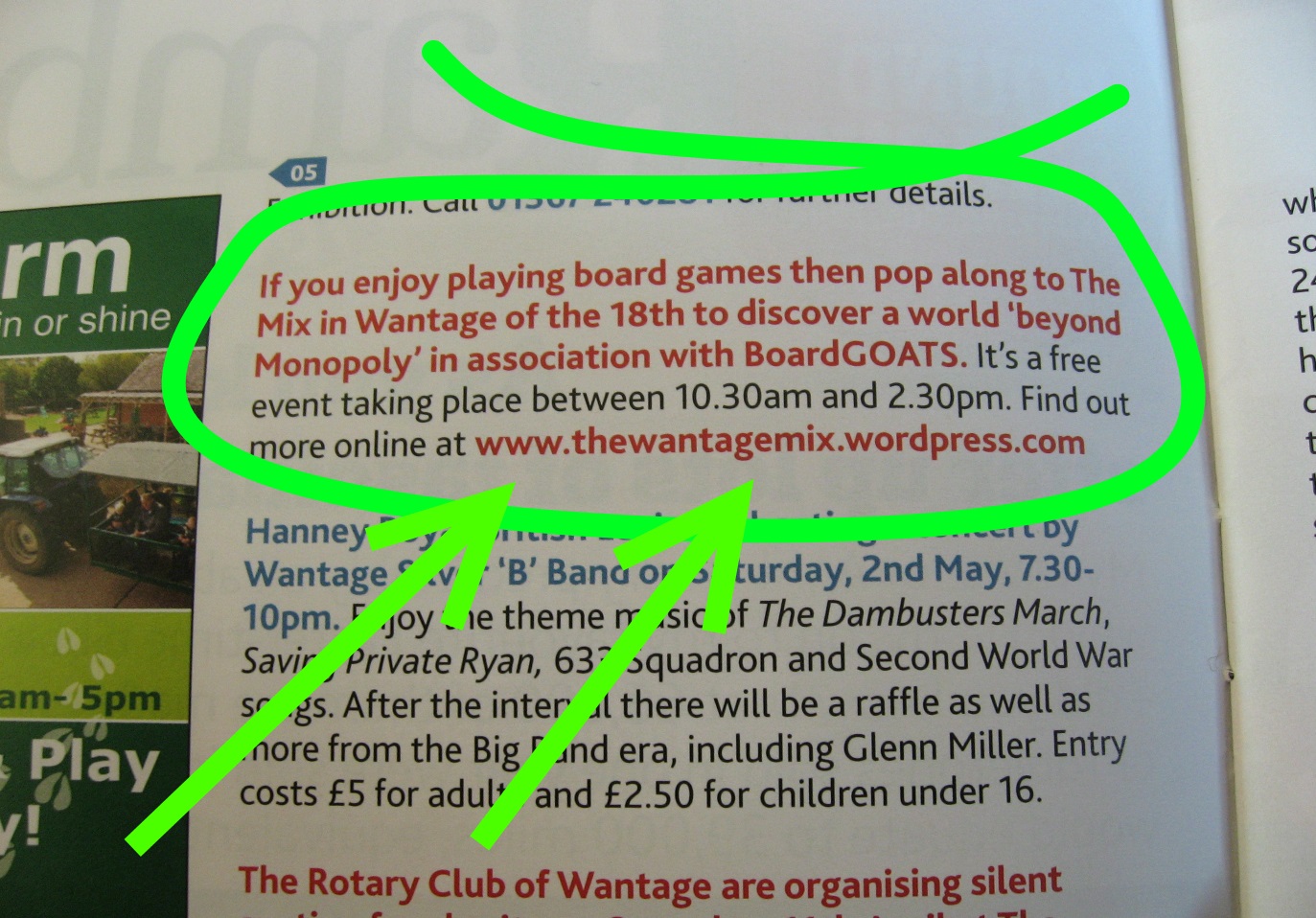
The Mix in Wantage town centre is holding a drop-in gaming session on Saturday from 10.30 am until 2.30 pm.  Members of the club are providing games and will be teaching people how to play them.

The Mix
– Image from thewantagemix.wordpress.com

There isn’t an awful lot of space so the idea is to encourage people to drop in and play a short game or two.  We are planning to bring a few eye-catching games like PitchCar, Riff Raff, Bamboleo, Toc Toc Woodman, and Saturn, but most of the gaming will be smaller filler games like Dobble, Turf Horse Racing, No Thanks!, Walk the Plank!, The Great Balloon Race and some of our other light favourites.  We will also be bringing some classic gateway games like Carcassonne, Ticket to Ride, The Settlers of Catan and Jamaica as well as a small number of deeper games, just to show people what else is out there.

Round and About - The Mix
– Image by boardGOATS

The event has been well advertised and was mentioned in the Ramblings section of the April edition of the local magazine, “Round and About”, so we are hoping for a decent turn-out.  Please pop in if you are in the area on Saturday.

billyGOAT’s Birthday Boardgame Bash

It was billyGOAT’s birthday and he decided that what he really fancied was a day playing games with his mates.  So, on a slightly damp afternoon in December, friends from far & wide converged on Challow Village Hall.

The first game up was a six player game of Pillars of the Earth.  This turned out to be a rather long game and took most of the afternoon.  However, since it was one of billyGOAT’s choice games, it was fitting that he ran out the worthy winner.  Meanwhile, games of Discworld: Ankh-Morpork, Riff Raff, Apples to Apples Kids, Dixit, Hamsterrolle, The Great Balloon Race, Ramses Pyramid, Bohnanza, Incan Gold and Shopping List all went on as the masons slowly built their cathedral and the children played with the Scalextric and decorated biscuits.

Pillars of the Earth

Shortly after 6pm, everyone sat down together for a meal of Chinese takeaway (including dumplings) which was followed by a marvellous Jamaica Cake for those who had any space left.  Then, the games recommenced with parallel games of Lord of the Rings and Formula D while games of Billy Biber (aka Log Jam), Dobble (aka Spot It!) and Loupin’ Louie kept the children occupied until it was time for them to go home to bed.  Unfortunately, Lord of the Rings had to be terminated prematurely and the Fellowship failed to make it to Mordor.

Lord of the Rings

Despite its apparently poor reputation to the contrary, the six player game of Formula D on the other hand finished in timely fashion and players moved on to a quick nine player game of The Resistance: Avalon.  With a lot of new players everyone was a little quiet and Mordred’s Minions won easily.

Avalon

By this time, the numbers were beginning to dwindle a little, but there was still time for a quick six player game of Roman chariot racing with Ave Caesar where everyone competed to show due respect to the Emperor.  billyGOAT’s horse, “Dobbin”, made a very slow start, however, it managed a late charge for the line eventually coming second behind “Glue-pot Boy”, who had led from the off.

Ave Caesar

The last game of the night was another game of Avalon, this time with only seven players and victory went to Merlin and the Loyal Servants of Arthur. Then we had to tidy up the kitchen, sweep the hall and hand the keys back.  A good time was had by all and everyone went home tired, but happy.

Finally, many thanks to everyone who helped out in the kitchen during the event, and kept food and drink flowing, while others played; it would not have been possible without them.

2nd October 2012

The first meeting of boardGOATS was held on Tuesday 2nd October.  We kicked off at 8pm with a four player game of Jamaica (the evening’s “Feature Game“).  Jamaica is a beautiful game where everyone gets to play at being pirates.  So, there was plenty of raiding, pillaging, and general skull-duggery in what was a hard fought game, that ended up with a winning margin of 24 to 13.

Jamaica
– Image by BGG contributor ennio_lombardi

Next we played a closely contested, boat-based 6-player game called Abandon Ship.  This is an unusual looking game where the aim is to prevent your rats from drowning as the S.S. Nvrsnks sinks.  In our case three of the rats failed to make it.

Abandon Ship
– Image by BGG contributor binraix

The final game of the night continued the watery theme with Kai Piranja (also known as Somethin’ Fishy).  This is a quick playing, light hearted, “press your luck” game, which (it turned out) some of us were good at and others very, very bad at indeed.

Somethin' Fishy
– Image by BGG contributor Carrotteer

Learning Outcome:  Just because you can throw a ten or an explosion dice repeatedly at will, doesn’t mean you will be able to avoid your row of fish being eaten by sharks!

Planning Stages

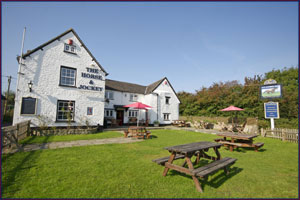
So, after a lot of deliberation and many trips to the Jockey for a quick card game and a drink (which no doubt started a lot of gossip), we have a “day”, we have a venue, and we have a name, so then we got a website – and this is it.  As the name suggests, we are going to meet on alternate Tuesdays in Stanford at the Horse and Jockey pub.  The intention is that this website will be a record of the games played as well as a way of publicising meetings, so it is only fair to mention here some of the games we played during the planning stages…!

  • Citadels
  • The Bean Game (Bohnanza)
  • Mr. Jack Pocket
  • Saturn
  • Court of the Medici
  • Jamaica
  • Dixit
  • Die Erbtante
  • Jaipur
  • Hamburgum (or perhaps Londonum?)

Yes, we spent quite a lot of time thinking about it and playing games in the pub!

Oh yes, and we have settled on Tuesday 2nd October for the big day.

The Horse and Jockey Pub