Tag Archives: MicroMacro: Crime City

10th June 2025 (Report)

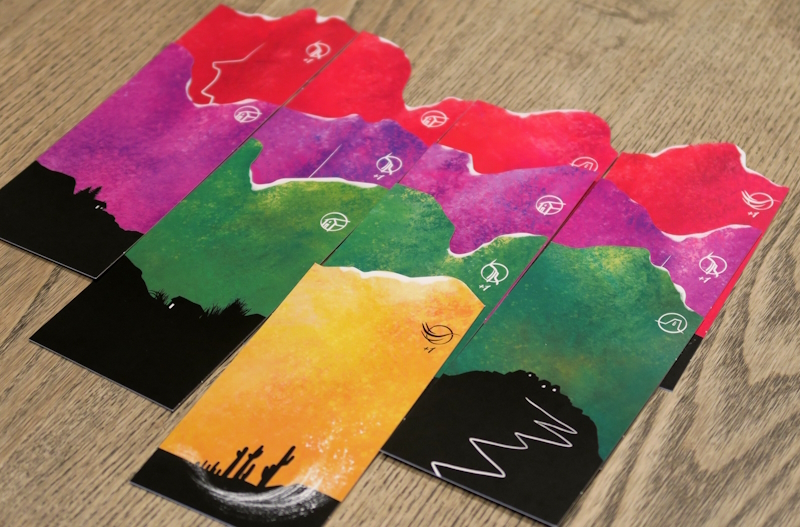
The evening started with a lot of chat about the new and used games people had picked up at UK Games Expo a few days ago, with everyone very keen to play their new acquisitions.  The “Feature Game” was to be one of these, a a shiny new pre-release copy of Sierra, flown in specially for the fair by a chap from Hachette Boardgames UK called Flavien Loisier who was recognisable by his memorable, playable, MicroMacro suit.  Sierra is card game about traveling the Andes that received a UK preview at UK Games Expo, and is a very unusual game.  There are several different ways to play the game including cooperatively and competitively, but this time the group went with working in pairs, playing with the person opposite.
Sierra
– Image by boardGOATS

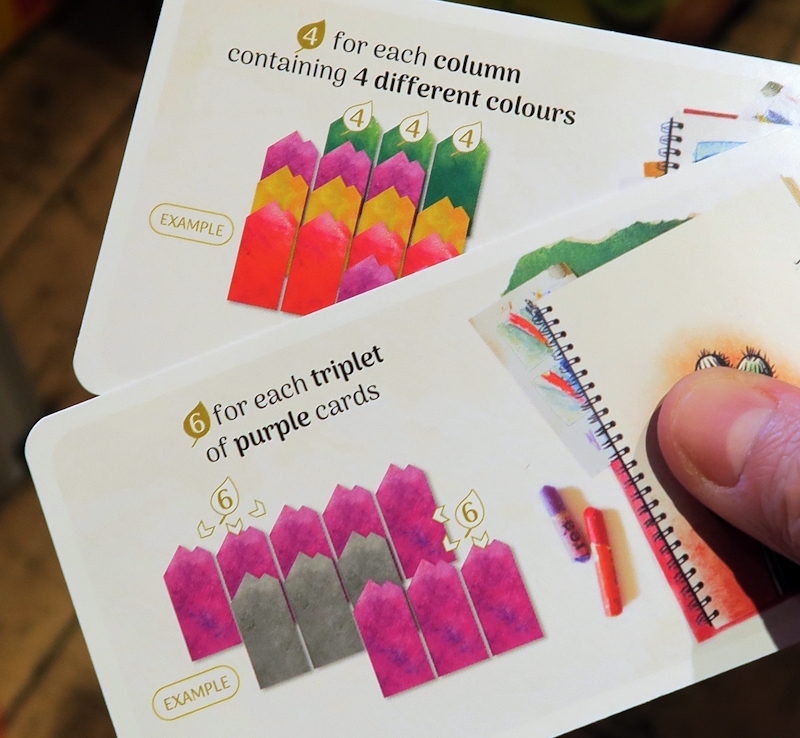
The pairs were Jade & Sapphire, Blue & Ivory, Black & Byzantium, and Purple & Plum.  The idea is that in their pairs players place cards from their shared hand to create a landscape and earn points for satisfying their objectives.  The catch is that while the Landscape cards are shared, all but one of the objectives are not.  In each round, the player with the Landscape cards draws two and plays two, while the other player draws two Objective cards and keeps one for themselves.  At the end of the round, the player with the Landscape cards passes them onto the next couple and the player who drew the Objective cards receives two Landscape cards—thus, the roles are swapped over for the next round.
Sierra
– Image by boardGOATS

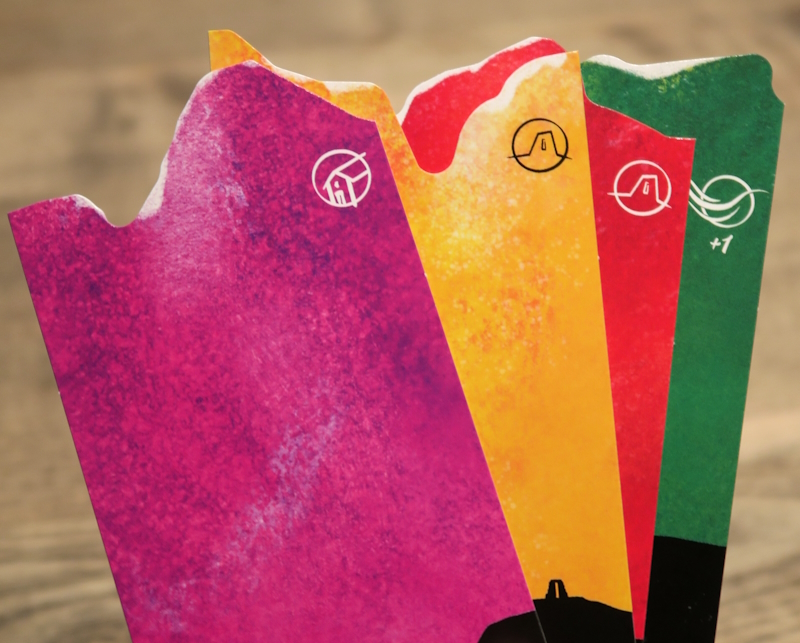
The Landscape cards come in four different colours and can be placed at either end so that the colours match, or they can start a new row.  The tops of the cards makes them look like mountain ranges, the cards form an interesting tableau.  As well as the colour, each card also has one of six symbols: Mammals, Birds, Houses, Ruins, Rivers and Wind—these are used for scoring.  After eight rounds each player will have four Objective cards and each pair’s shared Landscape will contain sixteen Landscape cards.  The game play was very different with so many players and playing in pairs.  The cards and the Landscapes the formed were beautiful.  Everyone who was new to the game started feeling their way somewhat, but eight rounds doesn’t last long and it was all over really very quickly.
Sierra
– Image by boardGOATS

The scoring turned out to be a little quirky and in the end took almost as long as the game.  Each player then scores one point for each River and Wind cards in their shared Landscape and scores for their shared Objective.  Players then count the number of points they have earned  for their individual objectives.  The player with the highest total wins, however, the partner of the player with the largest total receives a bonus of five points If, with this bonus, the partner has more points than anyone else, then the pair win as a team.  This time, Blue and Ivory scored the most for their shared Landscape.  Individually though, it was a tie between Plum and Ivory  as Plum scored much more for her personal Objectives (as indeed did Purple).

Sierra
– Image by boardGOATS

Because the individual winner was tied, there were no “team bonuses” awarded, which left the scoring feeling a little unsatisfying somehow and nobody fancied playing again straight away.  Instead, the group split into two groups with Ivory, Sapphire, Jade and Blue deciding to squeeze in a quick game of Ticket to Ride with the Japan map.  This had an outing fairly recently (when Pink hilariously took a fifty point hit when Purple played a single train claiming the route from Hiroshima to Okayama and blocked all his Tickets), but all the people involved in that game were elsewhere.

Ticket to Ride Map Collection: Volume 7 – Japan & Italy
– Image by boardGOATS

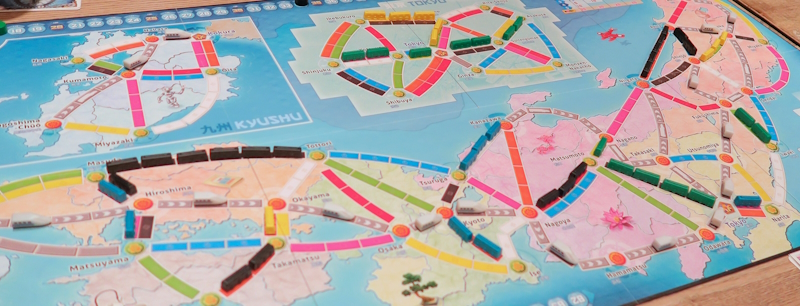
The Japan map is played exactly the same way as all the other versions of Ticket to Ride (i.e. take cards from the market or spend them to place trains in order to fulfill Tickets), but on a map of Japan and with the addition of the Shinkansen or “Bullet Train”.  Once a player has completed a section of Bullet Train, any player can use it to complete Tickets, but the player who completed that section moves along the Bullet Train Track. At the end of the game, the player who progressed the furthest, who contributed the most to this shared project receives the largest bonus, with the player who contributed least being penalised.
Ticket to Ride Map Collection: Volume 7 – Japan & Italy
– Image by boardGOATS

This time, everyone went for the Bullet Train early, so much so that there was quite a battle and by the time Sapphire realised what was going on, it was too late and he was left with the penalty.  That forced him to switch tack however, which might actually have done him a favour as he left Blue and Ivory to fight for the biggest, twenty-point bonus.  It was all really tight, but Sapphire was some way out in front as the Shinkansen points were evaluated.  And despite picking up a five point penalty, there he stayed to claim victory—Ivory who finished in third, pipped Blue on the Bullet Track, leaving her runner up with an eight point deficit (instead of a two point lead).
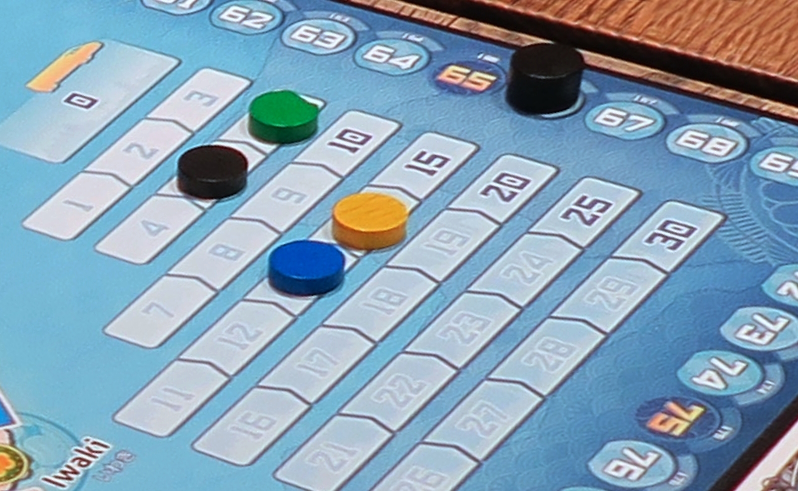
Ticket to Ride Map Collection: Volume 7 – Japan & Italy
– Image by boardGOATS

The other half of the Sierra group had moved on to play another game picked up at UK Games Expo, Tegula.  This is a very beautiful game played with beech wood hexagonal tiles with artwork based on Roman mosaics.  The idea is that players have to match the edges in order to place them.  Players can use actions to swap tiles, give tiles or play extra tiles and the first player to run out is the winner.  This time that was Black, with Purple the best of the rest (i.e. the player with the fewest tiles left, and Plum and Byzantium tied for third.

Tegula
– Image by boardGOATS

Meanwhile, Mint had also brought her new acquisition from the UK Games Expo, Intarsia, and taught it to Pink and Pine.  Although this had a most uninspiring box cover and the uninteresting theme of polishing wooden floors, the game itself is really pretty and fun to play.  Like Tegula, it is also made out of wood, the game is played over three rounds with eacvh round comprising three phases. First, each player takes the ten Material Cards depicted on their Starting Hand Card from the general supply. Players then take it in turns placing wooden elements onto their Flood Boards by paying the necessary Material Cards and taking new ones where possible and claiming and scoring Tool Tiles when their requirements are complete.

Intarsia
– Image by boardGOATS

Finally, players score points based on the number of connectors they’ve placed and choose a new Starting Hand Card to begin the next round. At the end of the game, players calculate their scores for the number of intarsias they’ve built and add them to their running total and the winner is the player with the most points.  The game was very tight… for second place!  In the end Pine pipped Pink’s ninety by a single point, but Mint took victory by a bit of a landslide with a hundred and eight, as she had four intarsias, compared with three and two for the others.  It had been a very enjoyable, lovely tactile game though and that hadn’t out-stayed its welcome.
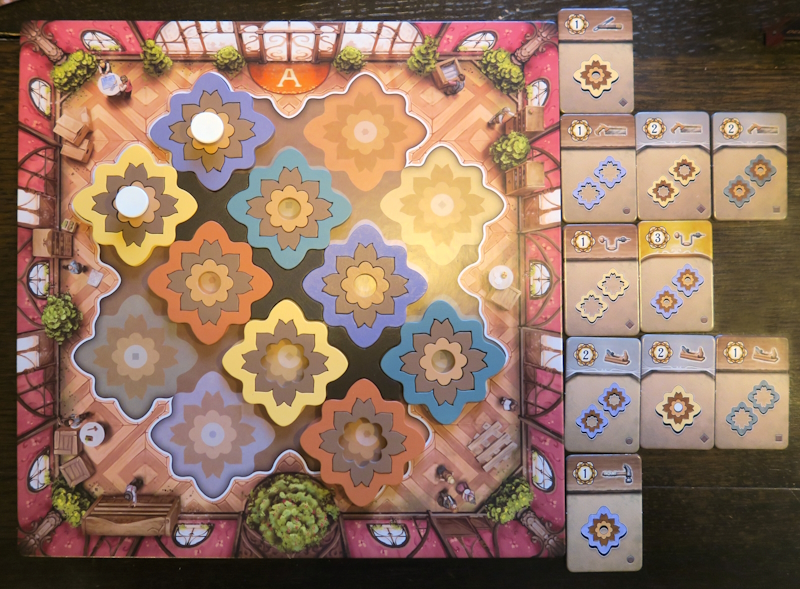
Intarsia
– Image by boardGOATS

With the floor duly polished, the trio moved on to introduce Mint to the weird and wonderful game that is Botswana.  This is a sort of stocks and shares game played with cards and plastic animals.  Players start with a hand of cards and, on their turn, choose one to play taking a plastic animal of their choice from the central supply to add to their holding.  At the end of the game, each player scores for each animal with points equal to the total number of animals of the type they hold, multiplied by the face value of the last card of that type that was played.  Thus a player with five elephants might be scoring twenty-five points until another player replaces the “Five of Elephants” with a zero and crashes their value.
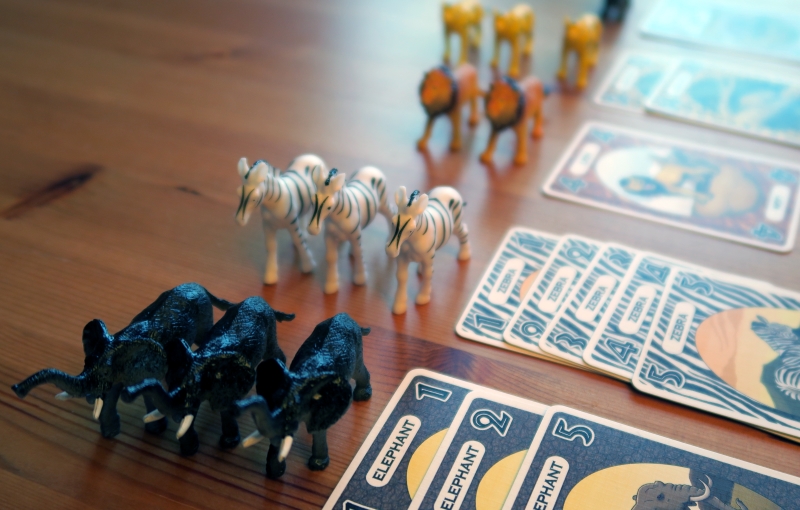
Botswana
– Image by boardGOATS

This game went down to the wire, but Pine just got his nose in front, with twenty points for his lions and fifteen for his rhinos giving him a total of thirty-five, on point more than Mint, while Pink finished a few points behind that.  There was just time for another very quick game and the game they chose was Ticket to Ride: Berlin—one of the city versions of Ticket to Ride.  These are much quicker to play, but still follow the same collect cards and spend them to place pieces in order to complete Tickets pattern. However, in Berlin, players have two different kinds of train car to place—trams and U-bahn trains.  On the board, there are specific single-space routes that can only be filled using an U-bahn train.
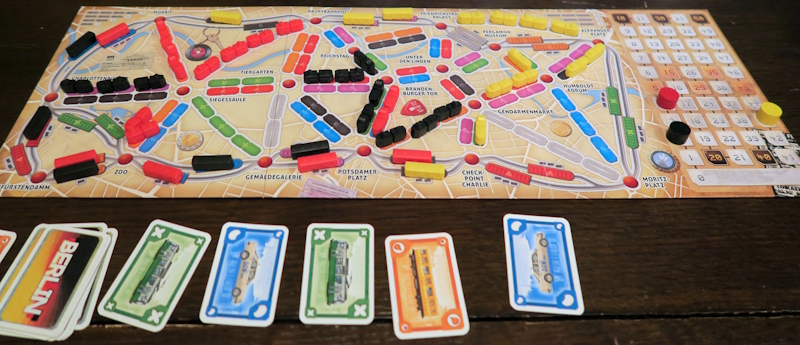
Ticket to Ride: Berlin
– Image by boardGOATS

The number of coloured cards required to complete the U-bahn is indicated on the game board (up to three), but similar to the Bullet Train in Japan, players only ever place one piece on than U-bahn route. Players only have a total of five U-bahn carriages to work with and their placement is critical, which makes Berlin one of the more interesting of the city games.  Once again, this was a close game with everyone using all their pieces.  Pink was the victor however, beating Pine into second by two points, but that meant that all three of them had won a game, so everyone went home basking in the warm glow of success.

Flavien Loisier
– Image from facebook.com
adapted by boardGOATS

Learning Outcome:  You can get some great games from UK Games Expo.

Spiel des Jahres Winners – 2025

Last weekend, this year’s Spiel des Jahres (German Game of the Year) winner was announced as Bomb Busters, by Hisashi Hayashi, the designer of Trains, MetroX (aka Voll Verplant), String Railway and Yokohama.  Based on the earlier Bomb Squad by the same designer, this is a cooperative, card driven game, where players work together to try to defuse a bomb before it explodes.  Players begin with a hand of numbered Wire cards (four each, numbered one to twelve) and then take turns pointing at each others’ wires and guessing their values.  Correct guesses lead to wires being cut, incorrect guesses and the detonator advances…

Bomb Busters
– Adapted from image by BGG contributor spiritraw

The winners of the Kinderspiel des Jahres (Children’s Game) and the Kennerspiel des Jahres (“Expert” or “Connoisseur’s” Game) were announced at the same time. The Kinderspiel des Jahres went to Topp die Torte!, which is a tile laying game by Wolfgang Warsch—a previous winner of the Kennerspiel de Jahres in 2018 with Die Quacksalber von Quedlinburg (aka The Quacks of Quedlinburg) and designer of The Mind, Ganz Schön Clever and Quacks & Co., all of which have received recognition from the jury in recent years.  This year, the Kennerspiel des Jahres award went to Endeavor: Deep Sea by New Zealand designers Carl de Visser and Jarratt Gray, a game where players explore the deep sea using the action mechanism from Endeavour: Age of Sail (and its predecessor Endeavor).

Endeavor: Deep Sea
– Image from kickstarter.com

Endeavor: Deep Sea can be played competitively or cooperatively with up to five players (using the Deluxe edition). This means that as last year, both the “senior awards” have gone to cooperative games.  Indeed, the last four Spiel des Jahres awards (Sky Team, Dorfromantic, MicroMacro and Just One) and three of the last five Kennerspiel awards (Paleo and The Crew as well as e-Mission/Daybreak) have gone to cooperative games.  This style of game is clearly very popular with families (where arguments are often best avoided), but can be less so with more traditional gamers who prefer a bit of competition.  As such, cooperative games very much have the “Marmite Factor”, but in such cases, the nominees and recommended lists cater for every taste, with games like Looot, Castle Combo, Faraway and Flip 7.

Bomb Busters
– Image from spiel-des-jahres.de

Spiel des Jahres Nominations 2025

The nominations for the 2025 Spiel des Jahres Awards have just been announced.  Although there are now other lots of other awards (including the recently announced Golden Geek Awards), this is still the most prestigious award in board gaming and certainly the one that carries the most weight when it comes to casual gamers.  There are three categories, the Kinderspiel (children’s game) , the Kennerspiel (“expert’s” game) and the most desirable of all, the family award, the Spiel des Jahres or “Red Poppel”.  The nominees for this year’s awards have been announced as:

  • Kennerspiel des Jahres
    Kennerspiel des Jahres 2025 - Nominees
    Endeavor: Die Tiefsee (aka Endeavor: Deep Sea) by Carl de Vissser
    & Laurent Escoffier
    Faraway by Johannes Goupy & Corentin Lebrat
    Neuland (aka Looot) by Charles Chevalier & Laurent Escoffier


In recent years, there has been a shift in both the family and expert awards, away from traditional Euro-style board to lighter, more innovative games.  Gone are the days of El Grande, Tikal and The Settlers of Catan (all winners from the 1990s) with recent winners including MicroMacro: Crime City (from 2021) Pictures (from 2020), Challengers! (from 2023).  It may be that there has been a concerted effort to “freshen” the brand and subvert the conventional idea of what a board game is.  Last year’s winners, were Sky Team and Daybreak which were unusual in that both are cooperative games with Sky Team also being a two-player game (unusual for a “family game”).

– Image by BGG Contributor JuiceNeutron

In addition to the nominees, there are always a number of recommendations, which in this year include Castle Combo and Cities.  The Spiel des Jahres Awards are still the industry’s headline award and therefore are of great significance; it will be interesting to see which direction the awards go in this year when they are announced on Sunday 13th July in Berlin.

The Spiel des Jahres Awards
– Image from spiel-des-jahres.de

Spiel des Jahres Nominations 2024

The 2024 nominations for the three Spiel des Jahres categories have just been announced.  Although there are now other awards, this is arguably still the most prestigious award in board gaming and, certainly the one that carries the most weight when it comes to casual gamers.  There are three categories, the Kinderspiel (children’s game) , the Kennerspiel (“expert’s” game) and the most desirable of all, the family award, the Spiel des Jahres.  The nominees for this year’s awards have been announced as:

In recent years, there has been a shift to light or innovative games.  Although the complexity of this year’s offering is not in the same league as some of the 1990s winners (e.g. El Grande, Tikal and The Settlers of Catan, all of which won the “Red Pöppel” as they preceded the inception of the Kennerspiel award), there is a marked shift away from the novel, internet or app based games of MicroMacro: Crime City (from 2021) and Detective: A Modern Crime Board Game (from 2019) and the party games like Just One (from 2019), Pictures (from 2020), Top Ten (from 2022) and Challengers! and Fun Facts (both from 2023).

Forest Shuffle
– Image by boardGOATS

In addition to the nominees, there are a number of recommended, including Harmonies and Forest Shuffle (aka Mischwald) both of which have peaked interest in the group, with the latter having been enjoyed on a Tuesday evening shortly after its release at Essen.  As always, the Deutscher Spielepreis is likely to be a better fit for more dedicated gamers, but we will no-doubt play many more of the nominations and recommendations over the coming weeks.  The Spiel des Jahres Awards are still the industry’s headline award and therefore are of great significance; it will be interesting to see what the winners are when they are announced on Sunday 21st July in Berlin.

The Spiel des Jahres Awards
– Image from spiel-des-jahres.de

Deutscher Spiele Preis – 2022

The Deutscher Spiele Preis awards recognise the “Best Children’s Game” and a top ten list of the “Best Family and Adult Games”, the results of an open vote by games clubs, gamers and people in the industry.  They are awarded annually at the Internationale Spieltage in Essen and the winners are announced in advance.  As annual awards, the games named in the Deutscher Spiele Pris lists often intersect with the winners and nominees of Spiel des Jahres Award, but in many other ways, the awards differ.

Deutscher Spiele Pries 2022
– Image from
spiel-messe.com

The Spiel des Jahres winners are chosen by a committee with a list of strict criteria whereas the Deutscher Spiele Preis is more a list of the most popular games of the preceding year.  As such, games that are not eligible for the any of the Spiel des Jahres Awards often feature in the top ten list of “Best Family and Adult Games”.  For example, games that were considered at the time to be too complex or aggressive for the Spiel des Jahres awards have ranked number one in the Deutscher Spiele Preis list.  These include Tigris & Euphrates (1998), Puerto Rico (2002), Louis XIV (2005), Caylus (2006), The Pillars of the Earth (2007), Agricola (2008), Terra Mystica (2013), Russian Railroads (2014), Voyages of Marco Polo (2015), Mombasa (2016) and Terraforming Mars (2017).

Terraforming Mars: Hellas & Elysium
– Image by boardGOATS

Of all these great games, only Terraforming Mars even received a nomination for the Kennerpiel des Jahres award (though Agricola did receive a special “Complex Game Award”).  In contrast, over the last few years, there has been much more overlap with games like Azul (2018), Wingspan (2019) and The Crew (2020) all ranking highest in the Deutscher Spiele Preis list and winning either the Spiel or Kennerspiel des Jahres award.  Further, all the other winners of both awards including MicroMacro, Cartographers, Paleo, Lost Ruins of Arnak have featured high on the Deutscher Spiele Preis list and/or received Spiel/Kennerspiel des Jahres nominations.

Ark Nova
– Image by boardGOATS

This year, while there is still a lot of overlap between the lists, the top ranked game on the Deutscher Spiele Preis list is a bit of a throwback, being too complex even for the Connoisseur or Kennerspiel des Jahres award.  The Deutscher Spiele Preis winner, Ark Nova has been extremely popular amongst gamers creating a lot of “buzz”, so it is no surprise that it did well.  The strategy revolves round building card combinations and the theme, zoo building is very appealing—everyone loves animals.

The full Deutscher Spiele Preis list is:

  1. Ark Nova
  2. Cascadia (Spiel des Jahres Award Winner)
  3. Dune: Imperium (Kennerspiel des Jahres Award Nomination)
  4. Living Forest (Kennerspiel des Jahres Award Winner)
  5. The Red Cathedral
  6. Witchstone
  7. Beyond the Sun
  8. SCOUT (Spiel des Jahres Award Nomination)
  9. Golem
  10. Terraforming Mars: Ares Expedition
Ark Nova
– Image by boardGOATS

Spiel des Jahres Winners – 2022

The 2022 Spiel des Jahres (German Game of the Year) winner has just been been announced as Cascadia.   Cascadia is a token-drafting and tile laying game featuring the habitats and wildlife of the Pacific Northwest.  Players take turns expanding their terrain area and populating it with wildlife by taking a terrain and wildlife pair of tiles and adding them to their territory.  Players are trying to create large areas of matching terrain to create wildlife corridors, while also placing wildlife tokens to achieve the goal associated with that animal type (e.g. separating hawks from other hawks, surrounding foxes with different animals and keeping bears in pairs).

– Image by BGG contributor singlemeeple

In recent years, there has been a marked change in the sort of games winning the award with a noticeable shift to lighter games with a general drift away from “traditional board games” like past winners, El Grande, Tikal, The Settlers of Catan, Carcassonne, Ticket to Ride: Europe.  This was epitomised by last year’s winner MicroMacro: Crime City, which is arguably more of an activity than a game.  Although this may make games more relevant to a wider cross-section of the public, it also means the Spiel des Jahres awards are increasingly less applicable to more traditional gamers.  This year’s winner, Cascadia is something of a throwback in this regard, being a more conventional modern board game and not as light as some of the recent winners.

– Image by Ludonaute

That said, the introduction of the Kennerspiel des Jahres or “connoisseur” award eleven years ago, was aimed at filling the gap left by the drift of the Spiel des Jahres Award, with a move towards lighter games.  As such, it is usually a better fit for the experienced gamer, though not necessarily those who enjoy classic Euro board games.  This year, all three nominees were more traditional Euro-type games, guaranteeing that the winner would be too.  The Kennerspiel des Jahres winner is announced at the same time as the winner of the “Red Poppel”, and this year it was another nature game, Living Forest, a game where players are a nature spirit trying to save the forest and its sacred tree from the flames of Onibi.

Cascadia
– Image adapted by boardGOATS from the
live stream video on spiel-des-jahres.de

The Kinderspiel des Jahres award winner was announced last month and went to Zauberberg (aka Magic Mountain), a game where players move sorcerers’ apprentices down a mountain, and ride the influence of the will-o’-the-wisp.  As usual, congratulations to all the winners and nominees.

Spiel des Jahres Nominations 2022

The nominations for the three categories of Spiel des Jahres have been announced.  This is arguably the main award in board gaming and is the one everyone wants to win.  There are three categories, the Kinderspiel (children’s game) , the Kennerspiel (“expert’s” game) and the most desirable of all, the family award, the Spiel des Jahres.  The nominees for this year’s awards have been announced as:

In recent years, there has been an increasing tendency by the committee to reward games that challenge the conventional idea of a game.  This was certainly true with Last year’s winner, MicroMacro: Crime City, which is very different to traditional games and arguably is more a cooperative crime-solving activity using the medium of “Where’s Wally?“.  The “game” is played on a large monochrome map, with a deck of cards. The cards ask questions with the answers to the questions on the map. In turn, these lead the players to the solution to each of the sixteen cases.

– Image by BGG contributor Hipopotam

The Kennerspiel des Jahres award which honours slightly more challenging games, went to Paleo and the Kinderspiel des Jahres award winner was Dragomino, a children’s version of Kingdomino (which won the main prize in 2017).  Paleo is a co-operative campaign game, where players try to keep the human beings in their care alive while completing challenges.  With the games honoured by the main award becoming lighter over the years, we have found the Kennerpiel des Jahres is generally a better fit to our tastes.  However, campaign and legacy games are not well suited to groups where the people playing games are different from week to week, and many people don’t like cooperative games too, so it will be interesting how this award changes in coming years.

– Image from spiel-des-jahres.de

The judges will be meeting 17-19th June in Hamburg, with the Kinderspiel award announced on 20th June.  The Spiel and Kennerspiel des Jahres announcements are a month later on 16th July in Berlin.

Deutscher Spiele Preis – 2021

After last year, it has been refreshing to return to a semblance of normality with the announcement of the Deutscher Spiele Preis at Essen.  Unlike the Spiel des Jahres Award which is chosen by a committee with a list of strict criteria, the Deutscher Spiele Preis is the result of an open vote by games clubs, gamers and people in the industry.  Typically, slightly heavier games are rewarded, but it is a top ten list, so it caters for a range of tastes and complexities and the organisers are always keen to remind people that everyone who features is a winner.

– Image by BGG contributor Hipopotam

As usual, the games that feature in the Spiel des Jahres and Kennerspiel des Jahres Awards also feature high on the list with the winners, MicroMacro: Crime City and Paleo occupying second and fourth on the Deutscher Spiele Preis list, respectively.  The Adventures of Robin Hood, Everdell and Praga Caput Regni also make the top ten, but unusually the winner is a game that did not feature at all in the previous awards list, and is a cooperative game for children called Dodo.

Dodo
– Image used with permission
of boardgamephotos

In Dodo, the feather-brained bird has laid its egg on the highest mountain peak and let it fall out of the nest, towards the cliff edge.  Players work as a team to try to ensure the rolling egg safely reaches the foot of the mountain by collecting the building material they need, hammers and nails, and attaching bridges to the sides of the mountain.  So far it has only had a German language release and very little has been written about the game online in English.  Therefore it may be that the game owes its success to the fact that few people were playing games face-to-face when the voting was carried out.  It sounds like it might be fun though and certainly deserves a look.

Deutscher Spiele Pries 2021
– Image from
spiel-messe.com

Spiel des Jahres Winners – 2021

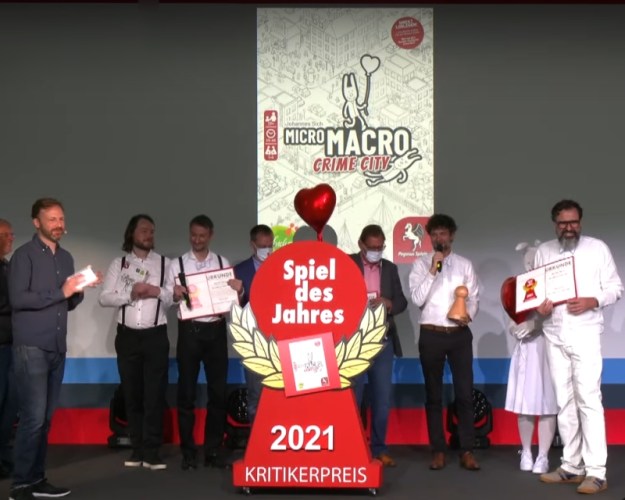
The 2021 winner of the coveted German Game of the Year or Spiel des Jahres award has been announced as MicroMacro: Crime City.  This is an unusual choice in that it is very different to most traditional games and arguably is more a cooperative crime-solving activity using the medium of “Where’s Wally?“.  The “game” is played on a large monochrome map, with a deck of cards.  The cards ask questions with the answers to the questions on the map.  In turn, these lead the players to the solution to each of the sixteen cases.

– Image by BGG contributor Hipopotam

As a family challenge, MicroMacro: Crime City can certainly be a lot of fun, though it might not be seen as a game in the traditional sense.  There has been an increasing tendency by the committee to reward games that challenge the conventional idea of a game, with notable nominees including the 2018 Spiel des Jahres nominee The Mind, 2019 Kennerspiel nominee Detective: A Modern Crime Board Game, and the 2017 Kennerspiel winner, the Exit: Das Spiel series.  While this may make games more relevant to more people, it also means the Spiel des Jahres awards increasingly are less applicable to more traditional gamers.

– Image by BGG contributor kalchio

As usual, the Kennerspiel des Jahres was awarded at the same ceremony. This award honours slightly more challenging games and this year went to Paleo. This is a co-operative campaign game, where players try to keep the human beings in their care alive while completing challenges. The Kinderspiel des Jahres award winner was announced last month and went to Dragomino, a children’s version of Kingdomino where players are hunting dragon eggs.  As usual, congratulations to all the winners and nominees, in what has been a very difficult year for everyone.

MicroMacro: Crime City
– Image adapted by boardGOATS from the
live stream video on spiel-des-jahres.de

Spiel des Jahres Nominations 2021

The nominations for the Spiel des Jahres have been announced.  There are three categories, the Kinderspiel (children’s game) , the Kennerspiel (“expert’s” game) and the most desirable of all, the family award, the Spiel des Jahres.  The nominees for this year’s awards have been announced as:

  • Kinderspiel des Jahres
    Kinderspiel des Jahres 2019Dragomino by Bruno Cathala, Marie Fort and Wilfried Fort
    Fabelwelten (aka Storytailors) by Wilfried Fort and Marie Fort
    Mia London by Antoine Bauza and Corentin Lebrat

Last year, the winner of the Spiel des Jahres was Pictures, a game where players model the picture on their card using the available components, e.g. shoelaces, coloured cubes, etc.; players get points for correctly guessing other players images and for other players guessing their image.  This is considerably lighter than some of the earlier winners, notably, Tikal and El Grande, or even some of the best known winners like The Settlers of Catan, Carcassonne or Ticket to Ride.  As the main award winners have become lighter over the years, we have found the Kennerpiel des Jahres better fits to our tastes.  The Kennerspiel nominees are not especially complex games, but are typically a step up from the light, family-friendly games of the main prize, the Spiel des Jahres.

– Image by from spiel-des-jahres.de

Last year the Kennerspiel award went to The Crew: The Quest for Planet Nine a game we have still been unable to play thanks to the global pandemic.  The Crew beat our preferred choice, Cartographers.  In contrast to The Crew, as a “Roll and Write” game, we have played Cartographers a lot.  So far, we are unfamiliar with the nominees this year and likely won’t get the chance to play any of them until some time after the winners have been announced (19th July in Berlin for the Kennerpiel and Spiel des Jahres Awards; 14th June for the Kinderspiel des Jahres).

Cartographers: A Roll Player Tale
– Image by boardGOATS