Tag Archives: The Settlers of Catan

Game Plan: Rediscovering Boardgames at the V & A Museum of Childhood

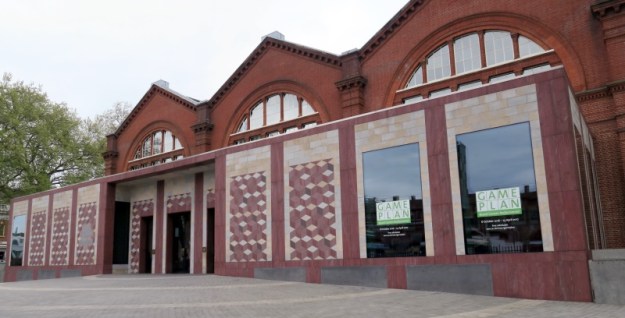
Inspired by the recent articles on Saturday Live and the Today Programme, on Easter Sunday, Pink and Blue decided to visit the V & A Museum of Childhood to see their “Game Plan: Board Games Rediscovered” exhibition.  Catching a train from Oxford Parkway and negotiating the London Underground, they arrived in Bethnal Green.  With its vaulted ceiling and exposed metal work, the Museum building looks for all the world like a re-purposed Victorian Civil building, a train station, swimming pool or maybe some sort of pumping station.  Much to their disappointment, however, after extensive discussion and investigation, it turned out that the building was designed for the purpose, albeit after relocation of parts from “Albertopolis” on Exhibition Road.

Game Plan: Board Games Rediscovered
– Image by boardGOATS

The exhibition itself was well presented and occupied a sizeable portion of the overall floor space.  Although it was located in one of the upstairs galleries, the exhibition was well advertised and, from entering the main hall, games were brought to the visitors’ attention with table space and signs offering the loan of games should people want to play.  It wasn’t an idle promise either, as there were several family groups making full use of the opportunity, albeit playing what might be called classic games rather than more modern, Euro games.

Senet
– Image by boardGOATS

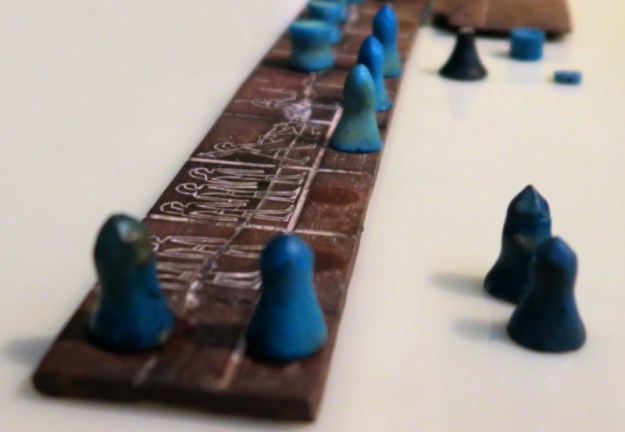
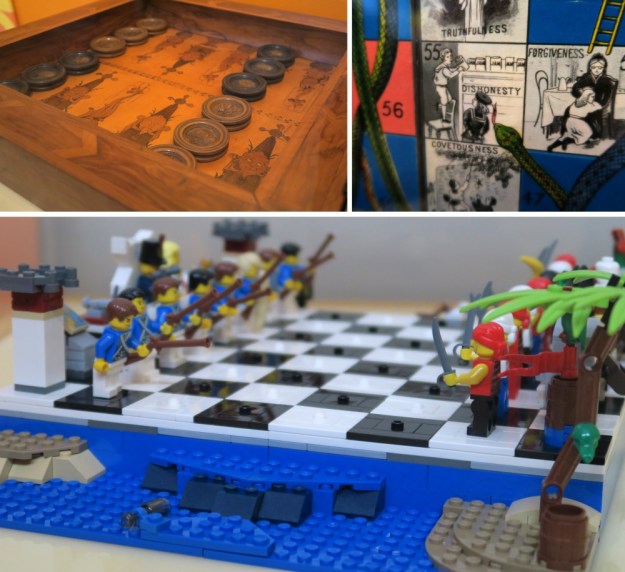
A quick look at the model train cabinet and brief spell side-tracked by one or two other exciting toys preceded entry to the exhibition which was shrouded by an eye-catching red screen.  The first exhibit was a copy of Senet, arguably one of the oldest games in the world – so old in fact that we’ve lost the rules and nobody knows how to play it.  This was followed by some traditional games including a beautiful wooden Backgammon set made in Germany in 1685 and decorated with sea monsters and a lot of fascinating Chess sets, old and new.  Next, there were some ancient copies of Pachisi (which evolved into Ludo) and Snakes and Ladders, both games that originated in India and were originally played seriously by adults.

Game Plan: Board Games Rediscovered
– Image by boardGOATS

Further round there were many other curious games, for example, The Noble Game of Swan from 1821, which was an educational game for children, itself developed from the much older, Game of the Goose.  Education was a bit of theme and there were a lot of games from the nineteenth and early twentieth century designed to teach geography in some form or another.  These included Round the Town, a game where players had to try to cross London via Charing Cross, and Coronation Scot, a game based on travelling from Glasgow to London inspired by the eponymous 1937 express train made to mark the coronation of George VI.

Game Plan: Board Games Rediscovered
– Image by boardGOATS

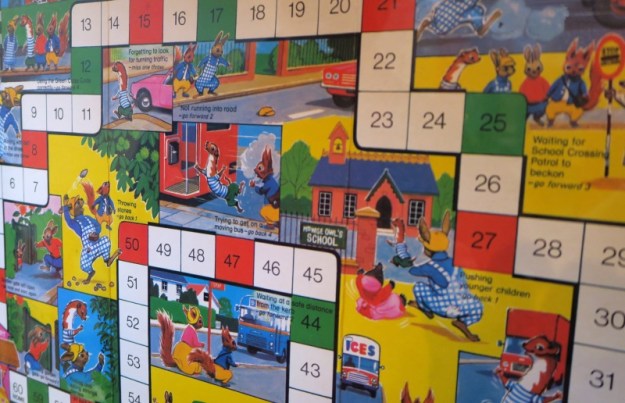
Education didn’t stop there either:  for those that had been members of RoSPA‘s “Tufty Club“, there was a game promoting road safety featuring Tufty the Squirrel and his mates Minnie Mole and the naughty Willy Weasel.  However, when designing this roll-and-move game, they clearly ran out of imaginative “adventures” with a road safety message, as they had to resort to “Picking and eating strange berries – Go back three spaces…”

Tufty Road Safety Game
– Image by boardGOATS

Progressing through the late twentieth century, there were the inevitable copies of the childhood classic games, including Game of Life, Risk, Cluedo, Mouse Trap, Trivial Pursuit, Connect 4, Scrabble and the inevitable Monopoly, all of which risked bringing a tear to the eye as visitors remembered playing them as children.  The exhibition eventually brought us up to date with modern Euro-style games, presenting copies of Ticket to Ride, Carcassonne and Settlers of Catan.

Pandemic
– Image by boardGOATS

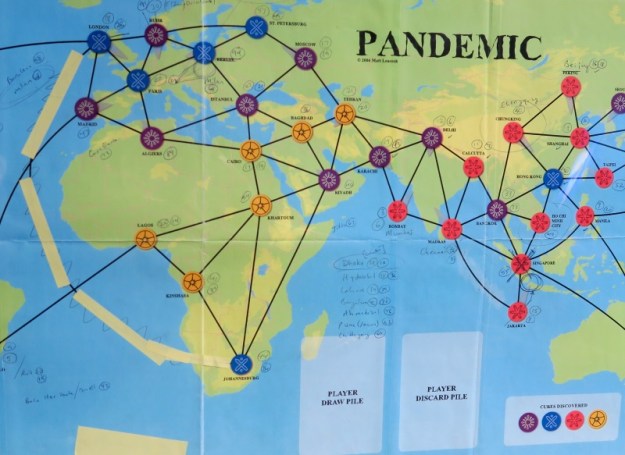
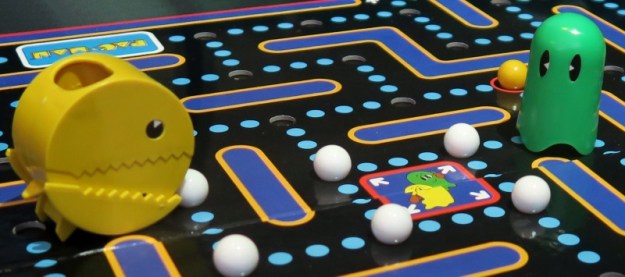
More interestingly, there was also an original prototype of Pandemic supplied by the designer, Matt Leacock, complete with his scribbles and bits of paper stuck over infection routes he decided to remove as the game developed.  One of the final display showed how the influence boardgames have had on the computer gaming industry is sometimes strangely reciprocated, with a copy of the Pac-Man game, including the title figure wrought in sunshine yellow plastic.

Pac Man
– Image by boardGOATS

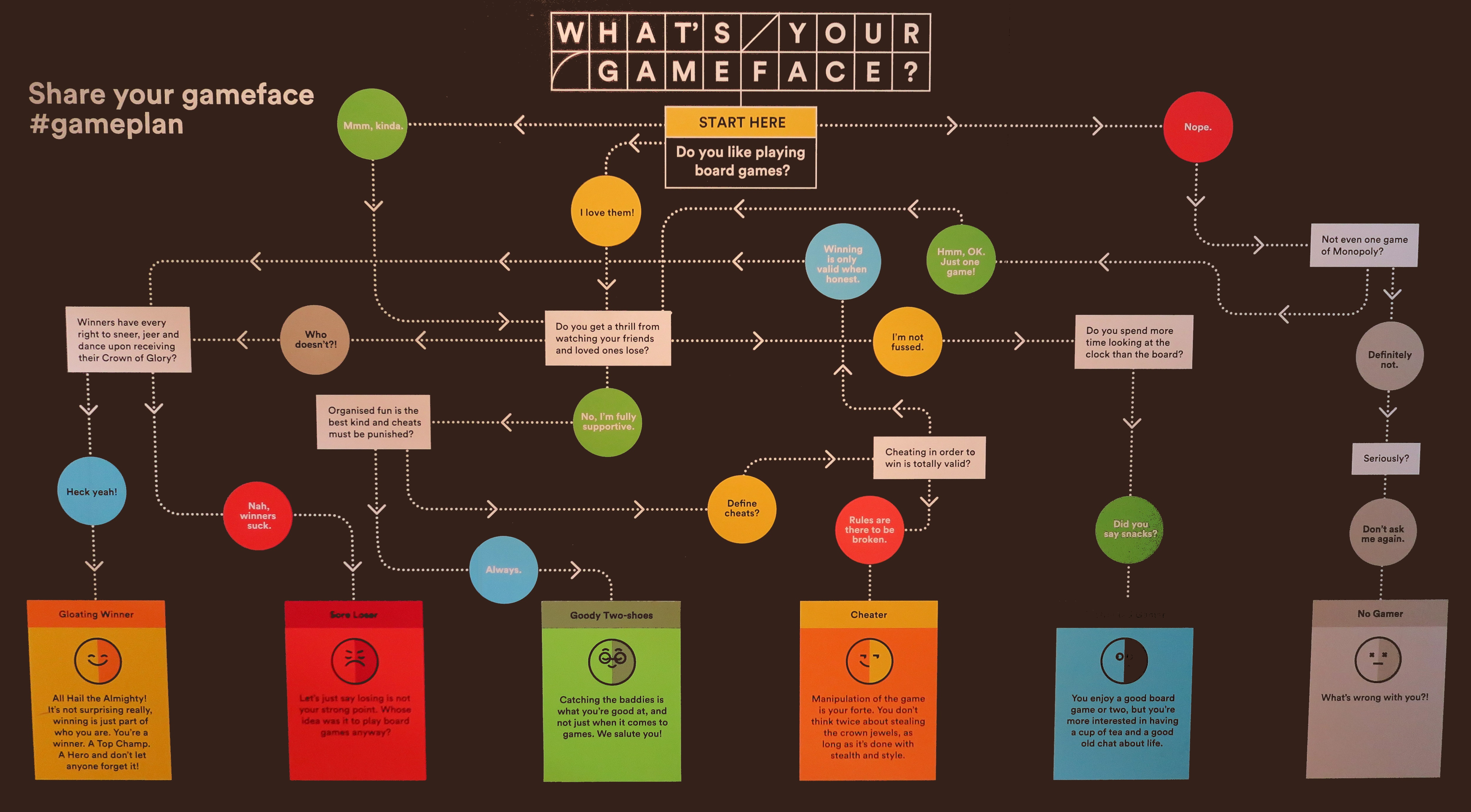
Leaving the exhibition, there was just one last game – “What’s Your Gameface?“.  This cute flow chart entertained Blue and Pink for far longer than is should have as they tested it out with all their friends, relatives and fellow gamers (nobody came out as “Cheater”).

Game Plan: Board Games Rediscovered
– Image by boardGOATS

With the exhibition done, there was still time for a wander round the rest of the museum and a quick cuppa in the cafe.  Reflecting on the exhibition, perhaps one of the best aspects had actually been the quotations that adorned the walls.  It seems luminaries from Plato to Roald Dahl have all had something to say on the subject of games.  Perhaps George Bernard Shaw supplied the most thought provoking comment though, when he said, “We don’t stop playing because we grow old; we grow old because we stop playing.”  With this in mind, we did what gamers do when they travel, so tea and cake was accompanied by two rounds of Mijnlieff, the super-cool noughts and crosses game.  With the museum closing, it was time to head home, but there was still time for a game or two of 3 Sind Eine Zu Viel! on the train back to Oxford…

Game Plan: Board Games Rediscovered
– Image by boardGOATS

The Exhibition is only open till 23rd April 2017, so there isn’t much time left and it is well worth a visit.

OxCon 2017

This weekend is OxCon (distinct from OxCon, the Oxford Comic Con), a weekend of gaming held every January in The Mitre pub in the middle of Oxford.  It has acquired almost mythical status since publicity hitherto has almost entirely been by word of mouth and often quite last minute.  For those who are about on Friday evening there will be a meal at Pizza Express at 6.30pm and some gaming afterwards.  As well as general gaming, there will also be the Settlers of Catan contest on the Saturday with a dexterity contest on the Sunday (to include games like Bandu, Rhino Hero, Riff Raff, and Rampage).  Entry is £3 for students and £5 for non-students, payable at the door.  Not sure how many of the GOATS will make it, that will depend on weather and family commitments, but it should be a good event.

The Mitre
– Image from pubsofoxford.co.uk

Boardgames in the News: Asmodee on the March Again?

It’s been quite quiet recently, but summer is now here and with it, the silly-season of take-overs and mergers, which inevitably means Asmodee are at it again.  Asmodee, (originally known as Siroz), started out as a small French game publishing and distribution company, specialising in the family market.  Their best-known product was probably Dobble, though there were others too.  In 2007, the investment firm, Montefiore acquired 60% of the company and invested €120 million to finance Asmodee’s international growth.  Their expansion history began a bit like this:

Meanwhile, the Canadian F2Z Entertainment, the parent of company of Pretzel Games, also own Filosofia Éditions (who bought Z-Man Games in 2011) and bought the U.S. company Plaid Hat Games last year.  Then, in January 2014, the private equity company Eurazeo bought 83.5% of Asmodee and the mad expansion began all over again, but this time in earnest:

Last summer we speculated how long it would be before Asmodee turned their attention to F2Z Entertainment with their enticing range of games including Pandemic and  Carcassonne.  Well, last week, Asmodee announced that it has entered into exclusive discussions to acquire F2Z Entertainment with closure of the acquisition expected to take place in the coming months.  Who will be next, Rio Grande Games perhaps?

Asmodee Logo
– Image from escapistmagazine.com

Boardgames in the News: What Britain Buys

The Channel 4 series “What Britain Buys” has turned its attention towards our hobby with a ten minute piece by Mary Portas.  Episode two includes interviews with Ben Drummond and Dean Tempest, founders of Big Potato (which produced John Lewis‘ top selling game last year, Linkee), as well as a visit to Oxford’s own boardgame café, Thirsty Meeples.  There they speak to some of the customers and “Games Sommeliers” as well as the owner, John Morgan.  There are lots of shots of gaming goodness including people playing Settlers of Catan, Riff Raff, Star Wars X-Wing, Takenoko and much more besides.  The program is available to watch on demand from channel4.com and the interesting bit starts 37:15 mins in.

Mary Portas
– Image from channel4.com

19th April 2016

Our “Feature Game” was to be Colosseum, which several people were keen to play, but there were two issues:  it plays better with four than three, and always seems to take a lot longer than it should so we wanted to get going.  We knew that Green was going to be late, but we didn’t know how late and that made a huge difference to our game plans for the evening; with six present already, should four get going and risk leaving two to play on their own all night if Green couldn’t make it at all in the end, or should we play something short together first and risk not having enough time for Colosseum?  Texts were sent and there was much discussion including the inevitable mention of 6 Nimmt!, but aside from that we seemed to have few genuinely short fillers that would play six.  Before we could actually make a decision, Green turned up and solved the problem for us and Burgundy and Blue started setting out Colosseum eventually joined by Blue, Pine and Magenta.

Colosseum
– Image used with permission of BGG contributor Toynan

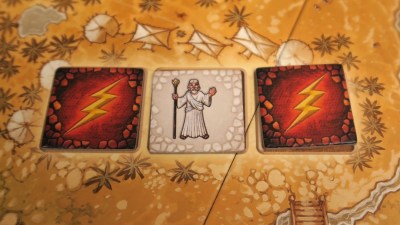
The idea of the game is that each player is a Roman impresario, producing great spectacles in his or her arena in the hopes of attracting the most spectators.  As such, the game comprises elements of auction, trading and planning with the ultimate goal of set collecting, where the sets represent groups of performers that have to match the program chosen.  A complete program will attract its maximum number of spectators, where an incomplete program can cost players severely.   There are several unusual aspects of the game, but the most obvious is the scoring; rather than summing the points during the game, a player’s final score is the number of points they scored for their most successful production, i.e. their most successful of the five rounds.  Each round is broken down into several phases.  First players can invest capital in improving their production, by for example, buying season tickets (which give a guaranteed five additional spectators for each subsequent round) or perhaps investing in a more expansive program which might increase the number of points available if it is completed successfully.  Once all the players have improved their infrastructure, next they attend the market and bid for performers.
Colosseum
– Image by boardGOATS

The auctions are unusual in that each player has an opportunity to initiate an auction (i.e. choose which of the five sets are going to sold) and if they win, then the market is restocked, otherwise the next auction is chosen from fewer options.  We decided to play what we thought was the original variant where each player can only win one auction; once they have won, they are then not able to bid on any later sales.  However, on later inspection we discovered that thanks to the different variants available we had scrambled it slightly.  Rereading the rules indicates that if a player loses an auction they initiated, they have the opportunity to try again, but with a smaller pool to choose from.  In our auctions, each player was able to initiate just one auction, and if they won, the market was restocked and the next player had a go, whereas if they lost, they had to fight it out in a later auction.  Auctions lead to all sorts of interesting dilemmas: is it better to bid and try to force someone to pay more, or is the risk of ending up with unwanted tiles too great?  With our variant, we found that it was also sometimes better to let the initiator win because a better batch of tiles might come out, but failure to win an auction after initiating it was also a problem as it risked getting left with a choice of paying for unwanted tiles or getting nothing, which really added pressure.

Colosseum
– Image by boardGOATS

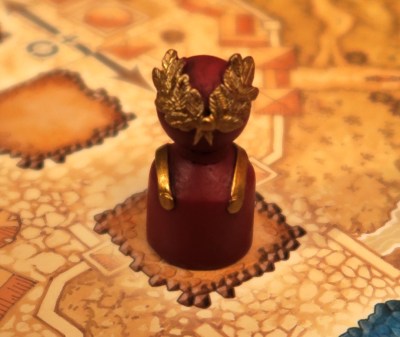
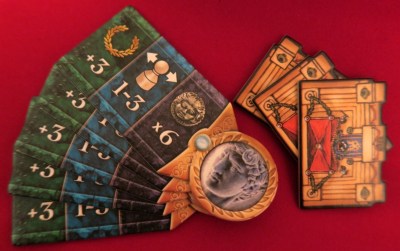
Given the relative shortage of tiles in the game, coming away with nothing is not really an option, but with a minimum bid of eight, the wrong tiles can be expensive.  That said, the next phase is an opportunity to trade, and occasionally trading away something that is highly prized by others can turn out to be particularly productive.  Like Settlers and Bohnanza, trades do not have to be symmetrical and must go through the active player, but in addition to trading tiles, money can also be used to sweeten a deal, or even buy an unwanted tile outright.  Finally, players take it in turns to produce their spectacle.  In order to do this, they roll a die (annotated with Roman numerals, obviously) which they can use to move one of the dignitaries, the Emperor, two Senators and three Consuls.  These increase a players total for that round if they are in the arena when it is scored.  If on the other hand, a player can move one of these characters onto a special “resting space” they get an “Emperor’s medal” as a reward. These can be traded in for money, the chance to move a dignitary forwards or backwards up to three spaces, three extra spectators or two can be used to get an extra investment opportunity at the start of the round.

Colosseum
– Image by boardGOATS

There are lots of components to the score of each production.  Firstly there is the basic score associated with the program:  this has a maximum potential value with points deducted for missing performers.  To this, bonuses are added for season tickets, podiums (obtained for winning a round), star performers, dignitaries, previously completed event programs and Emperor medals.  If this score is higher than the player’s previous highest total, their marker is moved to this new maximum and they receive that total in money.  Once every player has completed their spectacle, a podium is handed out to the player who is in the lead and the player who is at the back takes a performer of their choice from the leading player’s pool.  Finally, every player discards one performer token used in the round as “natural wastage”.
Colosseum
– Image by boardGOATS

Each player begins the game with two programs, a small one and a larger one.  Pine started out with no performers that matched either of his and some that weren’t even available in the market, but everyone else had at least a small degree of overlap.  The first round was a little tentative and Blue ended up as start player, so went first and invested in a season ticket.  The early investments are critical as they continue to have an effect throughout the rest of the game.  Magenta decided to do something different and expanded her arena, while Pine also picked up a season ticket and Burgundy opted for an Emperor’s Loge (pronounced “Lowj”).  The Loge is an interesting investment as it doesn’t directly yield points.  Instead, it allows the player to roll two dice and move one or two dignitaries just before producing their spectacle, potentially enabling players to gain more points that way.  Burgundy had another plan though and forfeited the opportunity to take extra points, taking an emperors medal instead.  As the most experienced player, he was of the opinion that the medals are really important.

Colosseum
– Image used with permission of BGG contributor kilroy_locke

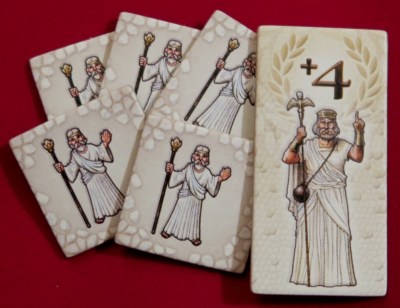
Blue was forced to produce the larger of her two programs in the first round which gave her a podium to add to her arena, but also cost her one valuable performer – a mistake she decided not to make again.  The other consequence was that she was forced to produce the lower value production in for the second round as her arena wasn’t large enough (she had bought a season ticket in the first round rather than enlarging her auditorium).  In the second round, one of the market stalls unusually had two of the rare “wild” tiles in it.  These are very powerful as they don’t need to be assigned as a particular artist giving players much more flexibility and two was very enticing.  In the first round Blue had got herself into a real mess having gone first and not won her own auction resulting in a messy scrabble to get tiles at the end of the round (a consequence of the rules change).  Having seen this, everyone else decided to play safe and opted to choose a market they needed and then won largely uncontested leaving Blue to go last and take the wilds very cheaply.  Despite this, Pine took the lead which he retained for the next couple of rounds as well.  It was at about this point that Pine commented that he thought there would have been more “gladiatorial fighting”, to which Burgundy replied that there would be plenty of that by the final round…
Colosseum
– Image by boardGOATS

In the third and fourth rounds everyone was trying to get in a position for a big push in the final round. Magenta bought a season ticket instead of expanding her auditorium in the third round and therefore ended up in the same pickle that Blue had found herself in at the start.  With only the one medal Magenta was unable to buy an extra investment opportunity which mean she was forced reproduce a medium event in the final round rather than buy a new large event.  She went into the final round with the most money though which had the potential to guarantee her a good auction.  Blue eschewed a new program in the fourth round, opting for another season ticket instead to try and set herself up for a big final round.  Pine was very keen for a trade with Blue in the penultimate round, but as she had completed her program and still didn’t know what she was going to do in the final round she declined much to his disgust.  Repeating a lower value production in the fourth round also ensured that Blue just finished last and was able to add insult to injury taking a valuable token from Pine who was well in the lead with a massive fourty-nine.
Colosseum
– Image by boardGOATS

With one round to go, Blue questioned whether Burgundy thought the Emperor’s Loge had been worth buying in the first round.  He replied that the wisdom on boardgamegeek.com is that the medals are essential and because the Loge allows players to roll two dice they really help with that strategy.  By this time, the value of the medals was becoming very obvious as trading in pairs enabled both Burgundy and Blue to make an extra investment which enabled Blue (start player again in the final round), to buy the most expensive, largest program (No. 30). Pine promptly followed by taking No. 28 and with his star performers and having so many podiums from the earlier rounds he looked in a good position, though he needed a lot of acts to complete his show.  Blue was in a slightly better position with three “wilds”, but had very few bonuses.Blue went for the market she fancied most and Magenta decided to bid against her.  Having not bought a large program in the final round, Magenta had far more money than anyone else and therefore the upper hand.  Eventually, as money is only significant in a tie-breaker, Blue bid everything she had.  Magenta, seeing other options of at least as great an interest to her decided to let her have it and Magenta took what she fancied, uncontested.

Colosseum
– Image by boardGOATS

While Pine and Burgundy were trying to work out which markets to take in order to do themselves the best favours, Blue looked at her options and Magenta’s.  Since she Pine and Burgundy’s discussions were getting complex and could not involve her, Blue got bored and decided to see if Magenta would be interested in trading one of Blue’s “wilds” and an otherwise superfluous lion for one of her “green men” and a chariot.  This would give both players one extra performer overall, and complete Magenta’s program, so she agreed.  Thus, when Pine and Burgundy had finished thrashing out all the options, Blue and Magenta’s trade went through on the nod and it was only when Pine and Burgundy came to trying to further optimise their situations that they realised that Magenta had things they wanted, but nothing to offer her in return.  Pine tried his best to get Magenta to trade, but she was steadfast that she wasn’t going to help him without getting something useful in return.  Burgundy’s offer of two horses initially looked promising as he thought it would enable Magenta to take the star-turn bonus from Blue, but it would only give a tie, so ultimately, that trade was also unsuccessful.
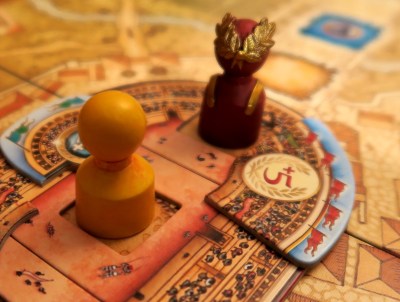
Colosseum
– Image by boardGOATS

Blue moved a Senator into her arena and scored a total of eighty-two setting the bench-mark for everyone else.  Although it sounded a lot, Blue didn’t think it would be quite enough and indeed it was very, very close, much closer than anyone had thought it would be.  In the end, the Blue just had enough to finish four points ahead of Burgundy who was just two ahead of Pine who came in third.  With the scores so very close, we had the inevitable review of the game and concluded that the the key moment was probably Blue taking the two wilds so cheaply in the second round, which would not have happened without the unintended rules revision.  The other key moment was in the final round of negotiating when Blue and Magenta agreed their critical trade.  Pine was verging on indignant that after playing for two and a half hours, it was essentially up to Magenta to choose the winner and suggested that should be the learning outcome for the week.

Colosseum
– Image by boardGOATS

Meanwhile, on the neighbouring table, Black and Purple had persuaded Green to join them playing one of their old favourites, Vikings.  This is a fast economic game, but despite the nominal “Viking” theme there is  none of the usual Norse Gods, exploration or pillaging involved.  Black and Purple had come across it again recently after a long break and fancied giving it another outing. It is a game that we’ve not really played before in the group and Green was new to it too, but was willing to give it a ago. It is one of those games where the gameplay is not complicated and yet the explanation took ages.  In summary, the game consists of six turns and on each turn, twelve tiles and twelve meeples are randomly drawn, paired together around a rondel. in each round, players take turns selecting a meeple/tile combination until they’re all taken.

Vikings
– Image used with permission of BGG reviewer EndersGame

The tiles are pieces of islands and there are left ends, right ends and middle pieces.  As players acquire these tiles, they are considering which sort of meeple would be placed on that tile, as each tile can hold only one meeple.  The rules for placing these tiles are fairly straightforward, for example, a partial island can’t connect directly to open water, etc.  The meeples come in five different colors and these colors denote their function in the game. For example, the yellow meeples are miners and they bring in money every turn; the red miners are nobles and they bring in two points apiece every time you score points, and so on.  Once the tile selection and placement has been carried out, all the yellow meeples will make the players some money. On even turns, VP will be scored. At the end of the game, players can gain bonus points for completing the most islands and/or completing the largest island.

Vikings
– Image used with permission of BGG reviewer EndersGame

It took Green a couple of rounds to work out how it all worked and ended up making a couple of little errors when laying out of his islands, which included not having an island space to place his gold Viking on and which meant he was able to get income, which was compounded by the bonus tile he had picked up which would enable him to gain an extra two coins for each gold Viking.  In the meantime, Purple had a fair few noblemen who would not only score her well, but also enabled scoring for the large number of gold Vikings and fishermen below. She managed to avoid any ships in the first couple of rounds and so gained all the bonuses available to her.  Black did have a number of ships, but he also had the warrior Vikings placed to combat them, so also gained a healthy bonus income.  Green had a ship and a warrior, but both his scoring and income were low.

Vikings
– Image used with permission of BGG reviewer EndersGame

After the first couple of rounds, the game progressed in pretty much the same pattern, except this time Green had sussed out what he was trying to do and regularly collected boatmen to redistribute his Vikings in time for scoring.  However he was hampered by a lack of funds in the middle rounds, but when he finally got the gold guys out, he suddenly started to rake in the cash.  This meant he was able to buy just what he needed in the final round, much to the others annoyance.  By the end, Purple had a very red and yellow looking board and the longest island (six tiles long giving her five bonus points). Black had a huge fleet of ships, but most were covered by warriors and those that weren’t were not powerful enough to do much damage. He also had the most complete islands (seven which gave him a seven point bonus). Green had a relatively low scoring board, but he did have the most boatmen (giving ten bonus points). It had been a very poor game for fishermen, in fact, almost all the Vikings left in the bag were fishermen, so everyone was underfed, but Purple was less underfed than Black and Green.

Vikings
– Image by BGG contributor dinaddan

So in the final scoring Black had won through, beating Purple into second place (the first time she had not won this game for some time) and Green came in third, though much closer than he thought he would be.  It was then that Black realised that Purple had forgotten to score her bonus island tile, which gave her a massive extra nine points, and with it, the win!  We discussed the bonus tiles after the game and although the rules were not clear, we felt we had probably played it wrong. We only replaced the tiles that had been taken each round, rather than swiping them all and laying out a new lot. Since there were four tiles per round for six rounds and we had two piles of twelve, it looked like what was meant to happen was a new set each round.  This would have made more choices available (and more bonus fishermen which would have been handy).  Green decided that he liked this game very much and would be happy for Black and Purple to bring it again.

Vikings
– Image used with permission of BGG contributor punkin312

The shows were still going on on the next table, so we needed another medium weight game and decided upon the cute Panda game, Takenoko.  While setting up there was a short discussion on the evolutionary dead-end of the Panda and how on earth did such a creature ever evolve in the first place. Although since they are such cute creatures, we were glad they did and they had led to the clever little game.  The play area starts with one single hexagonal “pond” tile with two characters on top:  the Imperial Gardener and the Panda.  On their turns players first determine the weather by a roll of the weather die, then perform their two actions.  These actions must be different and the player can choose freely from the five available:  add a new bamboo plot; take an irrigation channel (which can be played or stored for later use); move one of the characters (either the Imperial Gardener or the Panda), or draw an objective card and add it to their hand.  The aim of the game is to earn points by completing objectives.  When a player completes one of their objectives, they show everyone and the card is placed face up in front of them.  Players can complete as many objectives as they like on their turn and end of the game is triggered when one player full-fills a set number of objectives.

Takenoko
– Image used with permission of BGG contributor nad24
and nonsensicalgamers.com

This game was a slightly unusual one as we all placed tiles in such a way that there was only ever one large field of each of the three colours and by half way, we all had mostly stopped laying tiles at all. In typical British style, the weather was mostly awful; wind; cloud; and rain. It was ages before the sun came out, but thereafter it made enough of an appearance to keep us all happy. Purple was the first to complete a mission card and Green wasn’t far behind, both tile pattern cards. The Panda and Gardener were mostly travelling between the pink and yellow fields, leaving the largely un-irrigated green fields untouched.  This enabled Green and Purple to get some tower and bamboo chomping bonus cards, but Black was beginning to fall behind. His problem was that all his bonus cards were low scoring. He kept using his actions to take more bonus cards, but they always seemed to be low scoring, and unless he could get more points out of it he wasn’t going to win.  He completed a few objectives on the way, but didn’t want to fill all of his eight with low scoring objectives so held back on claiming some.  In the meantime, Green was rapidly claiming bonuses, mostly towers giving a healthy haul of points. Purple made a few miscalculations on which bamboos would grow and by how much and thus failed to get a card or two that she had planned.

Takenoko
– Image used with permission of BGG contributor Oceluna

As the game approached the end, Green and Purple both had claimed six bonus cards and Black still only had four.  But then with a flourish, suddenly Black finished the game.  He had given up on getting higher scoring objectives and decided the best bet would be to get the ones he had got down and stop Green winning any more points, also picking up the two point bonus for finishing first in the process.  Everyone else got one more go which was enough to give Green a seventh and Purple her eighth objectives.  Totalling up the scores showed that Black had been right about not winning with low scoring cards.  That honour went to Green, who finished nearly ten points ahead, with Black just taking second place.  In the post game discussions, Blue commented that although she had always wanted to like the game she felt it just lacked something.  Black said that he had always felt that the game was very Luck based, although Green did point out that if Black had just gone with the low scorers he would not to have wasted as many actions gaining the cards and could have finished the game earlier, before Green was able to amass all his points. However, Green and Burgundy both agreed that the tile layout bonus cards were the weakest as the points were usually low and yet did not seem any easier to get. This debate will probably run and run, much like the one about the Panda’s evolutionary dead-end…

Takenoko
– Image used with permission of BGG contributor ObeyMyBrain

Learning Outcome:  Even after playing for two and a half hours, sometimes Magenta still gets to choose the winner.
OxCon 2016

This weekend is OxCon, a weekend of gaming held every January in The Mitre pub in the middle of Oxford.  It has almost mythical status since publicity hitherto has almost entirely been by word of mouth and often quite last minute.  This year, in a break from tradition, it was advertised early.   As usual, for those who are about on Friday evening there will be a meal at Pizza Express and some gaming afterwards.  As well as general gaming, there will also be tournaments with Puerto Rico on Saturday, and Settlers of Catan on Sunday.  Not sure how many of the GOATS will make it, that will depend on weather and family commitments, but it should be a good event.

The Mitre
– Image from pubsofoxford.co.uk

Boardgames in the News: Mayfair Games – Is there a Future without Catan?

Mayfair Games began in 1981 as a small US games company based in Illinois. One of their first games was Empire Builder, their first and now the flagship of their “crayon-rails” series of games where players, using washable crayons, draw their train routes over a map of North America.  Building on this success, Mayfair then went on to play a pivotal role in bringing Euro games to the US and wider English speaking markets.

Empire Builder
– Image used with permission of BGG contributor Billythehut

In 1996, Mayfair Games picked up the license to produce an English edition of Die Siedler von Catan, The Settlers of Catan (now known simply as “Catan”).  With the huge success of the game world-wide, over the next twenty years, Mayfair brought out multiple new editions of the base game modernising and updating it, English editions of all the expansions, variants and spin-offs.  Mayfair (with Kosmos) were also behind the release of Star Trek: Catan in 2012, the first Catan game with a licensed theme.  For many, Mayfair Games has become synonymous with Catan, in the English speaking world in any case.  As such, the news yesterday that Asmodee has acquired the rights to produce the English language version of everything “Catan”, has left a lot of people wondering where that now leaves Mayfair Games.

Star Trek Catan
– Image used with permission of BGG contributor henk.rolleman

With the shear quantity and popularity of the Catan games it was inevitable that Catan would dominate the catalogue of Mayfair, but is this the beginning of the end for Mayfair Games?  Well, it’s true that no company can take such a major amputation and come out unscathed, so the loss of this part of their portfolio has inevitably led to major restructuring.  The former CEO of Mayfair, Pete Fenlon left to become the CEO of the new Asmodee owned “Catan Studio” taking a bunch of other people with him including the Director of Marketing,.  This left a hole that will be filled by a the current President, Larry Roznai; the head of Acquisition & Development, Alex Yeager; and a lot of chair shuffling.  Aside from that, shareholders received healthy payouts and there’s been a major contraction in the size of the company, to something similar to where it was in 2007-2008.

The Settlers of Catan
– Image by boardGOATS

It may be that the fact that Asmodee only took the rights to the Catan empire rather than buying the company out wholesale is indicative, and could be viewed as asset-stripping.  In which case, there is probably little hope for what remains of Mayfair Games.  If the whole-sale purchase scenario had played out, it is almost certain that the rest of the Mayfair catalogue would have been shelved and the company would have de facto become “Studio Catan” by another name.  The fact that this has not come to pass suggests that the personnel remaining believe there is more to the Mayfair than just “Catan”.

1830: Railways & Robber Barons
– Image used with permission of BGG contributor Zoroastro

So, what is Mayfair left with?  Well, there are a hundred odd games currently produced by Mayfair including some of the popular 18xx series, Martin Wallace’s Steam, the massive Caverna: The Cave Farmers and Nuns on the Run.  In 2013 Mayfair also acquired a controlling interest in the German company, Lookout Games, who historically have produced some fantastic games (including Agricola).  This partnership has already produced Grand Austria Hotel; Isle of Skye: From Chieftain to King; and Patchwork.  This suggests that where the “Old Mayfair” had stagnated a little, becoming somewhat dependent on the Catan franchise, the New Mayfair might be forced to change direction for the better, forming a leaner, more innovative company producing exciting new games.  Perhaps the future is not so bleak for Mayfair after all, but only time will really tell.

Isle of Skye: From Chieftain to King
– Image used with permission of BGG contributor henk.rolleman

Boardgames in the News: Asmodee Update – Taking Over Catan and Other Stories

A year ago, following their acquisition of Esdevium GamesLibellud, Days of Wonder, Fantasy Flight games, Ystari Games, Asterion Press and Pearl Games we discussed the sudden expansion of the hitherto small French games company, Asmodée.  More recently, following a new contract with Queen Games for exclusive distribution rights in the USA and the ensuing restructuring of its three main US operations, Days of Wonder, Fantasy Flight games and Asmodee Editions to form a single entity, Asmodee North America, we wondered whether this growing monopoly would lead to price rises.  This concern arose, in particular, as from January 2016, distribution would be restricted to “speciality retailers” that have agreed to Asmodee North America’s “Speciality Retail Policy” including the prohibition of online sales.

Asmodee North America
– Image from Asmodee North America Press Release

Asmodee followed the initial press release with a second press release clarifying their position, in the form of a series of questions with answers. This did not completely allay many of the concerns, however, to the specific question, “…will you institute or impose official price floors or “minimum advertised price” policies”, they responded, “No”.  There has been a considerable speculation, but it seems clear from this “clarification” that although they intend to restrict “speciality retailers” to face-to-face transactions, this will not affect mass market outlets, such a Amazon, Target, or Barnes and Noble.  Another way of looking at it is that the medium-sized online vendors including, CoolStuffInc and Miniature Market (who are popular with US Geeks thanks to generous discounts), will no longer be able to sell Asmodee North America products, however, players like Amazon etc. are too big to be susceptible to their bully-boy tactics.  We will see what happens in the long run, but for the time being, so much for the end of 2015 press releases.

The Settlers of Catan
– Image by boardGOATS

With the new year, there are new take-overs, and unsurprisingly, Asmodee are at the centre once again, this time announcing that they are taking over the production of the English language edition of Catan (formerly known as “The Settlers of Catan”)Celebrating its twentieth anniversary last year, The Settlers of Catan has been translated into thirty-five languages and is reported to have sold over twenty-three million copies worldwide.  As such is it one of the biggest names in the world of modern boardgames.  With this acquisition from Mayfair Games, Asmodee have also announced that they will launch a subsidiary, “Catan Studio”, dedicated to the creation of content for different media for the “Catan Universe”.  Catan Studio will be headed by Peter Fenlon, former CEO of Mayfair who will work with Catan GmbH and its partners on this development.

Ticket to Ride
– Image by boardGOATS

With this acquisition, it brings Catan, Ticket to Ride and Star Wars: X-Wing Miniatures Game as well as the very popular card game, Dobble, all under the same roof.  So, what next?  Surely bringing together such a large slice of the modern gaming market makes Asmodee themselves a potential take over target.  In fact, perhaps the only question is whether the likes of Hasbro will make a move before or after Asmodee make their next acquisition.  Any bets on the future of Filosofia/Z-man Games with Pandemic and Carcassonne…?

– Image used with permission of BGG contributor adamfeldner

Boardgames in the News: Will the Latest Consolidation Lead to Price Rises?

In February, following their acquisition of Esdevium GamesLibellud, Days of Wonder, Fantasy Flight games, Ystari Games, Asterion Press and Pearl Games we asked the question, “Are Asmodee Taking Over the World?”  As if to answer in the affirmative, in April, Asmodee announced the start of a new contract with Queen Games for exclusive distribution rights in the USA.  Since Asmodee has been the distributor for Queen Games in Germany, this made logistical sense.  However, other consequences of these consolidations are now becoming apparent.

Asmodee Logo
– Image from escapistmagazine.com

This week, Asmodee issued a press release stating that from the 1st January 2016, games made available by its three main US operations, Days of Wonder, Fantasy Flight games and Asmodee Editions will be sourced from a single entity, Asmodee North America.  Furthermore, in the New Year, Asmodee North America will be adjusting its sales terms and reducing the number of its primary customers in the USA to just five authorised distributors.  From 1st April 2016, these authorised distributors will be restricted to selling Asmodee North America’s products to “speciality retailers” that have agreed to Asmodee North America’s “Speciality Retail Policy”.

Asmodee North America
– Image from Asmodee North America Press Release

This Speciality Retail Policy states that a “retailer must not sell or transfer … other than through face-to-face commercial resale exchange with end-users in retailer’s physical retail location(s) or at a physical extension of the retailer’s location at a consumer show/convention”.  Thus, all future sales will be restricted to bricks and mortar stores, effectively preventing the selling of Asmodee North America‘s products online.  This is not an end to online sales, however, as the press release goes on to say that “Asmodee North America will allow select merchants to service the online sales channel under a separate sales policy. Such select online merchants will either be supplied directly by Asmodee North America, or by appointed distributors acting under Asmodee North America’s related policy.”

Ticket to Ride Map Collection: Volume 5 – United Kingdom & Pennsylvania
– Image by boardGOATS

Online speculation is rife that these measures have been put in place to prevent the deep discounting seen in the USA, and that the contracts the retailers will have to sign will include a commitment to sell at the list price, thus effectively price fixing by other means.  This has been carried out in the past by both Mayfair Games (the Catan brand) and Games Workshop (Warhammer etc.) who both have strict Speciality Retail Policies that restrict distribution, maintaining high prices.  This is all highly significant with the growth of modern boardgaming as Asmodee North America produce some of the most popular gateway games, in particular Ticket to Ride, 7 Wonders, Dixit, and Dobble as well as the newly reawakened Star Wars license.  It is not yet clear whether this will also have any effect on the distribution of Queen Games products in the USA.

Star Wars: X-Wing Miniatures Game
– Image used with permission of BGG contributor adamfeldner

Asmodee North America has claimed these changes are because they are “committed to brick-and-mortar hobby market speciality retailers”.  On the other hand, in the FAQ that accompanied the statement, Asmodee North America state that even physical stores with an online presence are “limited to the channel of sale involving physical retail stores only”, which appears to belie this, since online sales are often what keeps “Bricks and Mortar” stores afloat.  The FAQ also states that “These policies currently affect our business in the US. Our Canadian operations will continue unaffected until notified otherwise.”  There is no mention of the EU, but it is likely that Esdevium, who already have something of a strangle-hold on the distribution of games in the UK, will continue to assert pressure on the market as they did at the start of this year.

Esdevium Logo
– Image from asmodee.co.uk

1st December 2015

Red and Blue were late thanks to a ridiculous queue at Frilford Crossroads, so food had only just been ordered when Green and Pine turned up.  We hadn’t seen Grey and Cerise for a while, so when they arrived the evening descended into gossip.  Pine manfully resisted the chips, but when he eventually succumbed, he ended up with more than he bargained for as they’d all stuck together…  Amid chips and chat, eventually, someone suggested a game and everyone else agreed, so we started with the “Feature Game”, Pandemic: Contagion.  The original game, Pandemic, is a very well known cooperative game where everyone plays together to defeat the tide of disease that is overcoming the world.  Pandemic: Contagion is a lighter game and almost the complete opposite:  players are the diseases and compete against each other to be the most effective and take over the world.

Pandemic: Contagion
– Image by boardGOATS

The game itself is fairly straightforward.  Cards are drawn to represent cities – these are coloured and are under attack from disease.  On their turn players can do any two of three possible actions: place cubes or “infect” a city, draw cards or mutate their disease.  Placing cubes cost cards and the cards must match the colour of the city they are infecting.  The number of cubes they can place or cards they can draw depend on the characteristics of their disease, and both can be increased by mutation.  Like infection, mutation must be paid for with cards, though the number of cards used depends on the level, thus going from an infection level three to level four is much more expensive than going from level one to two.

Pandemic: Contagion
– Image by boardGOATS

A city becomes overrun with disease when the total number of cubes placed on the card equals or exceeds the population.  At this point, the city is scored and the players with the most cubes get points (in the event of a tie, the disease to infect it first wins).  The person who placed the last disease cube additionally gets a bonus action that depends on the city.  At the start of each round an event card is drawn which either alters the rules of the game for the duration of that round, or otherwise disrupts everyone’s plans, by for example, causing them to lose cards or reduce their infection rate etc. etc..  Some of these cards also have a symbol on them either a city indicating that a new city should be added, or a skull and crossed bones after every second of which points are awarded to the player with the most disease cubes in each city.  The game ends when either, there are only two cities left, or the game has proceeded through all twelve event cards.

Pandemic Contagion
– Image by boardGOATS

The game went very slowly with everyone falling for “group think” and going for the cities with the largest populations which therefore score the most points when completed.  Unfortunately, this left the game somewhat mired in treacle as everyone did pretty much the same thing for the first three rounds collecting cards and infecting cities.  Blue picked up a few points at the first interim scoring, but otherwise it was pretty dull and we were all wondering what we were doing wrong.  Then it dawned on us that our disease cubes weren’t doing very much:  for all the large cities, one player had a significant majority, so there was no incentive to compete for it; worse, the winner was reluctant to commit more resources to the cause, but that meant their cubes were just sitting there, waiting.

Pandemic: Contagion
– Image by boardGOATS

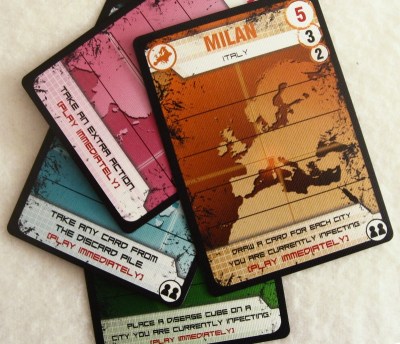
Burgundy tried to get things going by increasing the number of cards he could draw, but that back fired when an event card forced him to dispose of half his cards (much to his horror, rounded up!).  It was then that everyone began to look for other things to do and attention turned to finishing off some of the smaller, weaker cities.  We’d sort of forgotten about the bonuses that come when cities are scored and it turns out that some of them are very powerful indeed.  This was amply demonstrated when Blue finished Milan that gave her a card for every city she had infected, which turned out to be quite a few.

Pandemic Contagion
– Image by boardGOATS

With a little grease to oil the wheels, she was now able to use her newly liberated disease cubes to infect other cities in an effort to finish them.  Everyone else joined in and finally the game began to look a little better, however, before we’d had time to really start to appreciate it, the game was over and it was time to score the remaining cities.  Blue took the win with sixty-one points with Cerise some fifteen points behind behind just fending off Burgundy and taking second place, but everyone was frustrated at what had looked like a promising game, but had fallen so spectacularly flat.

Pandemic: Contagion
– Image by boardGOATS

On reflection, as Blue commented (much to Green’s amusement as he listened in from the next table), “If we’d played it differently it would have been a very different game.”  Although that sounds like a stupidly obvious thing to say, the problem was that everyone tried to play the same way and everyone fell into the same trap which dragged the game down badly.  If we’d realised the value of the bonuses and gone for some of the smaller cities first, the game wouldn’t have dragged so much and would have been much more enjoyable and interesting.  Unfortunately, as Pine succinctly put it, he’d enjoyed everything he’d played with us and would be happy to play any of them again, “except that.”  Which means it’s unlikely to get a second chance very soon.

Pandemic: Contagion
– Image by boardGOATS

Meanwhile, Green and Grey had decided they fancied playing something a bit more “piratey” together.  With Pandemic: Contagion supposedly taking “just half an hour”,  they decided to give Port Royal a go.  Although Green had played it a couple of times, Grey was completely new to the game.  We’ve played it quite a bit recently, but in summary, the game combines “push your luck” with strategy, the idea being that players turn over cards until there is something they want, or they go bust.  Once they’ve taken a card, the other players have their pick of what’s left (for the cost of one coin).  This means that in a two player game, the strategy changes quite a bit as players have to watch what they leave as well as be careful about taking a card and paying their opponent for the privilege.

Port Royal
– Image used with permission of BGG contributor joeincolorado

Green decided to aim to complete “expeditions”, while Grey took a more tactical approach, just doing what seemed best at the time; neither player decided to protect themselves by picking up pirate cards.  Both players really enjoyed it and the fickle hand of fate was much in evidence:  there was much hilarity when three of the four tax cards came out in the same round.  Fate wasn’t done yet either and when Green pushed for four ship cards (in order to be able to buy two cards in the round), almost two dozen cards had been drawn before he finally went bust by revealing a second of the same colour.  With no pirates in his arsenal to repel the attack, the whole lot was wiped out, much to Grey’s annoyance as he had his eye on a particular card.  In the end Green won convincingly with his expedition strategy, but he had the advantage of having played it twice before.

Port Royal
– Image used with permission of BGG contributor punkin312

Since the larger group were still playing Pandemic: Contagion and only about half way through, Grey and Green decided to give Port Royal another go. This time both players decided to mitigate some of the luck by picking up pirate cards and it was generally a very close game.  Pirate ships were repelled left, right and centre and more than once two cards were purchased in one round.  In the end Grey brought the game to an end by exchanging cards for an expedition causing him to exceed the magic twelve points, finishing on fourteen.  Since Grey had started, Green got one more round.  With eleven points, Green needed four to win.  As only two card purchases would do, he went for a four pirate line. With a fighting total of six he could easily repel anything except the skull ships.  With the odds in his favour managed to get to the necessary four ships so that he could buy two cards, but his meagre finances stopped him getting the four points and had to settle for three, leaving him with fourteen points, level with Grey.  Unfortunately for Grey, he had no money left to buy anything, and it all went down to the tie-breaker.  The rules state this is by money, and since Green had just one coin left, he took his second victory of the night.

Port Royal
– Image used with permission of BGG contributor punkin312

With Pandemic: Contagion STILL going (yes, it really DID drag on, though it was near the end by this time…) Green and Grey decided to play a very quick game of Pick Picknic. This is another game that was new to Grey, but he proved to be a natural at.  A sort of early version of one of our current favourites, Om Nom nom, the game combines simultaneous card selection with bluffing and a good slice of luck.  The idea is that there are six farm  yards of different colours, if someone plays the only chicken card of a given colour, they get all the grain at that coloured farm.  If multiple players go for the same coloured yard, then players can either agree to share the corn in any way that is mutually acceptable or roll the die for all of it.  Foxes don’t eat corn, however, they only eat chickens, so if someone plays a fox card, they will eat any chicken cards of that colour, and before long Grey was happily gobbling his way through Green’s chickens adding to his pile of captured corn.  In the end Green managed to get more corn, but the birds captured by Grey’s hungry foxes more than made up for the missing corn and Grey ran out a clear winner. Both players agreed that they preferred Pick Picknic to Om Nom Nom.  Although it doesn’t have the great dice of the newer game, they game doesn’t have the feeling that it’s all over after one poor move.

– Image used with permission of BGG reviewer EndersGame

With Pandemic: Contagion finally finished, Cerise and Grey headed off, leaving Burgundy, Green, Pine and Blue with a little over an hour to play.  After a little bit of thought, we decided to continue Pine’s “boardgame education” and introduce him to The Settlers of Catan (or simply “Catan” as it is now known).  Playing with Green’s fourth Mayfair edition, there were the inevitable comments on the new colour scheme.  Blue outlined the rules to Pine while Burgundy and Green set up the board.  At its basic level, the game is one of resource management and civilisation building.

The Settlers of Catan
– Image used with permission of BGG contributor kilroy_locke

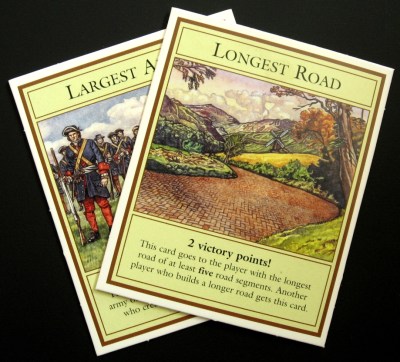
Players start with two roads and two settlements.  These are placed along the edges and on the corners of the hexagons of the modular board.  Each hexagon has a number on it, and on each player’s turn, first they roll both dice and resources are awarded to players with settlements on the corners of the hexagon that  corresponds to the total rolled.  Once the resources have been handed out, the active player can trade resources with other players and use them to build more roads and settlements, develop their settlements into cities or buy development cards.  Victory points are awarded for settlements, cities and the longest continuous road as well as via development cards (both as straight victory points and for the player with the most soldier cards, i.e. the Largest Army).  The random set up had the desert off centre and almost all the specific ports a very long way from good supplies of the necessary resources.  After much debate, we decided to let Pine go first and try to make sure he ended up with decent starting positions.  Green, who went third, decided to try something different and explore the coast hoping there would be less competition there, leaving Blue two reasonable positions in the centre of the board.

The Settlers of Catan
– Image by boardGOATS

As usual with “Settlers”, resources were poorly distributed amongst players and after a brief flurry of wood, it disappeared for the rest of the game.  On the other hand, Green was awash with ore, and Blue, who had quickly upgraded one of her settlements to a city after an early glut of wheat, suddenly found she had more brick than she could possibly work out what to do with.  Pine, once more attracted animals and had an enthusiastically breeding flock of sheep while Burgundy persistently rolled sixes – just about the only number he didn’t have a settlement on. We had a big debate as to whether a four-for-one trade with the bank had to be four identical cards.  After checking the rules, we found they should be identical, though neither Burgundy nor Blue remembered playing that way in the past.  Since we were a little tight on time, we decided to house-rule it to “any four resources” this time, though on reflection, it probably wasn’t really necessary.

The Settlers of Catan
– Image used with permission of BGG contributor
thephantomhennes

Burgundy picked up the Longest Road tile and joined Pine in the sheep farming business.  Having ensured Pine’s starting placements were reasonable, he was making an excellent job of building on it and had found a nice little bit of space to work in, building a couple of new settlements and threatening to take the Longest Road card.  Meanwhile, Green discovered that he was a bit stuffed, with few good options despite having tried to place his starting settlements to avoid being cut off.  With good access only to ore and occasional wheat, he started buying development cards and used the robber effectively to cut off the wood supply.  Blue, with a sudden influx of cards, managed to get her nose in front with a couple of settlements which she was able to upgrade quickly when she got another sudden influx of grain and brick.

The Settlers of Catan
– Image by boardGOATS

Just passing the hour mark, Blue hit eight points and was looking to extend her road and take the Longest Road from Burgundy, or build a couple more settlements.  In the event, the dice rolled in her favour and she picked up a stack of cards with no sign of the robber, which meant she was able to do both giving her eleven points.  This brought the game to a swift and sudden end and the score belied how close the game actually was.  Since we’d finished a little quicker than expected we decided to play something quick.  The suggestion of Red7 scared off Burgundy, but after some consideration, Blue and Green decided to continue Pine’s boardgame education with a quick game of Love Letter.

The Settlers of Catan
– Image by boardGOATS

Love Letter is a game we played a lot a year or so ago, but not so much recently.  The first of the so-called “micro games” it is played with just sixteen cards.  Each player starts with one card and on their turn, draws a second card and then plays one of them.  Each card has a value (one to eight) and an action (discard a card, swap cards with another player, compare cards, etc. etc.).  The object of the game is to have the highest card when the deck has been exhausted or, be the last person remaining, which ever is soonest.  The rules say the winner is the first player to take a set number of hands, however, we tend to play far a few rounds and then decide how far to take it.  In this case, Green, Blue and Pine had one point each, so we went for one final round, which Pine took with much aplomb.

Love Letter
– Image used with permission of BGG contributor thatmadgirl

Learning Outcome:  Sometimes it is the way that you play that makes a game enjoyable.