Tag Archives: Tokaido

4th March 2025

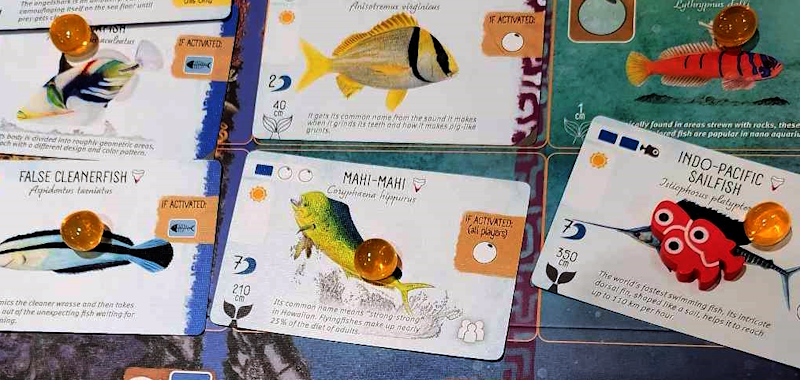
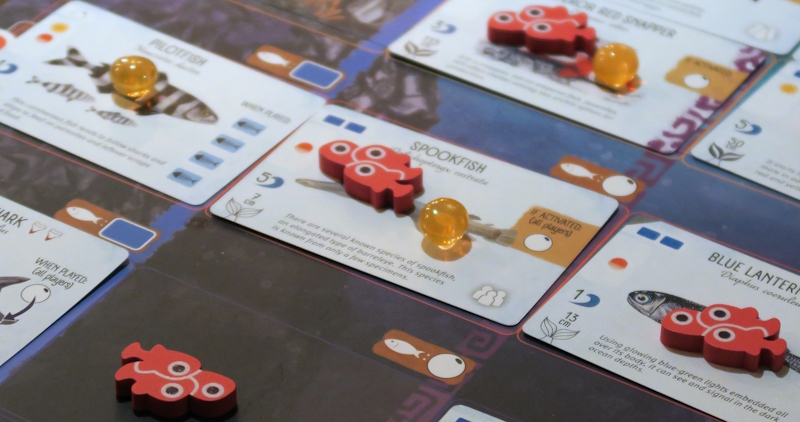
Once people had finished eating, the group settled down to play. There was quite lot interest in the “Feature Game” which was Finspan, a fish-themed version of one of the group’s favourite games, Wingspan.  It is advertised as shorter and lighter than the original, but in the event it was only slightly shorter and not much lighter though it was generally agreed to be a bit smoother and therefore perhaps easier to teach.  Like Wingspan. Finspan is card-based, though the cards are fish instead of birds, albeit just a beautifully illustrated.  As in Wingspan, players have a hand of cards (in this case open) and on their turn can choose to play one from their hand or activate one area or Dive-site of their player board (blue, purple or green), in this case representing the ocean.

Finspan
– Image by boardGOATS

In the case of Finspan, the Dive-sites are arranged vertically (instead of horizontally), but rather than placing cards in order (from left to right in the original), the Fish cards have to be placed at the correct depth for the Fish—some live in the shallows, others in the deep sea, while a small number live in the “twilight” region, between the two.  As in the original, there is a cost for playing cards—fish eggs, Young,Schools and/or other cards. Unlike the original, however, cards spent in this way are placed into players’ own personal discard pile and there are mechanisms for getting them back later in the game.

Finspan
– Image by boardGOATS

Another way that Finspan is different to the original, is the way the Dive-sites are activated. As in Wingspan, cards are activated in order, in this case, from the shallow “sunlit” zone to the “midnight” deeps. The Fish cards have “when played”, “when activated” and “end of the game” powers, but there are fewer cards that have a power on activation and many of these affect all players too. In addition to the difference in the balance of the cards, when a Dive-site is activated, the three zones each give a benefit as long as they have at least one Fish card in them.  These benefits are capped though, as multiple Fish doesn’t increase the income. The first time each player activates a Dive-site in a round, they also get a bonus benefit.

Finspan
– Image by boardGOATS

There are a small number of Fish pre-printed on players’ boards, which mean than some areas give benefits from the very start of the game.  The effect of all this is to give the game a more friendly feel than Wingspan, without reducing the challenge of the game.  There is another major change which significantly adds to the complexity. In Wingspan, a key part of the game is Egg production with Eggs worth a point each at the end of the game.  In Finspan, players also produce Eggs which are worth a point at the end of the game, but each Fish card can only be used to store one single Egg. Eggs can be hatched to give young (also worth a point) and three young on the same fish form a “School”.

Finspan
– Image by boardGOATS

Schools of fish are worth six points at the end of the game.  And this is where the game gets a little “head-hurty” as Young and Schools can be moved around, but while Young can share a Fish space, once they have formed a School, they can’t share a space with another School—one School can’t even pass through a space containing another School.  The game is played over four rounds (or Weeks) with points for achieving objectives at the end of each one.  These are added points gained for each Fish card, Eggs, Young, Schools and any end game actions to give a final total—the player with the most points is the winner.

Finspan
– Image by boardGOATS

As there was a lot of interest in the game, the group set up two tables. Jade, Sapphire, Plum and Byzantium had played it at a convention over the weekend, so Jade led one game with Blue, Ivory and Sapphire, while Plum led the second with Byzantium, Black and Pine. Jade’s group was the first to complete the rules explanation and got going. Ivory was quite excited by the idea of collecting sharks, and while Blue found Nemo, Sapphire found Dorry.  The points from the end of the Week objectives were pretty even for the first three weeks, though only Ivory got much at the end of the final week taking twenty points for his end game bonuses, largely due to having a lot of sharks.

Finspan
– Image by boardGOATS

Blue top-scored for her fish while Jade scored the most for his Schools. In the end, Blue’s hundred and fifty-five took victory with Ivory in second eleven points behind, three points ahead of Jade. Over the other side of the room, Plum’s game was slower to start, but finished at much the same time.  This game was lower scoring and closer too; almost everyone picked up some end game bonuses, but not as many as Ivory, and there were fewer Schools.  The winner was Byzantium, with one hundred and thirty-one, just two points ahead of Plum who was just a nose in front of Black.  All in all, everyone had enjoyed the game as a nice variant on the well known original.

Finspan
– Image by boardGOATS

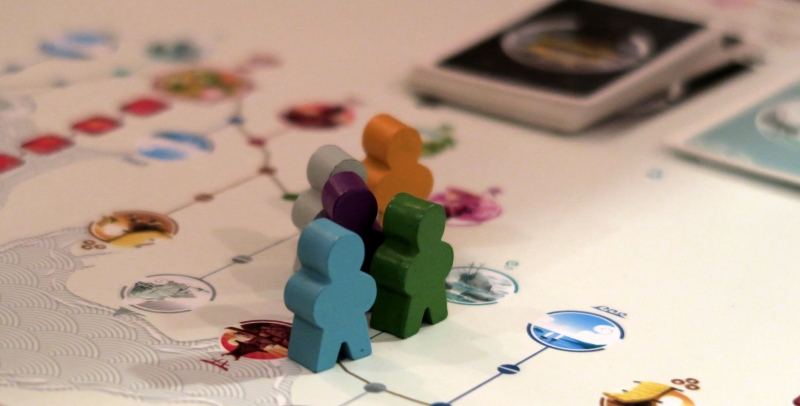
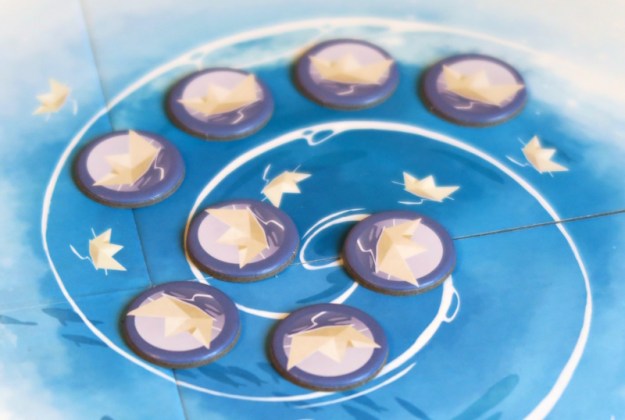
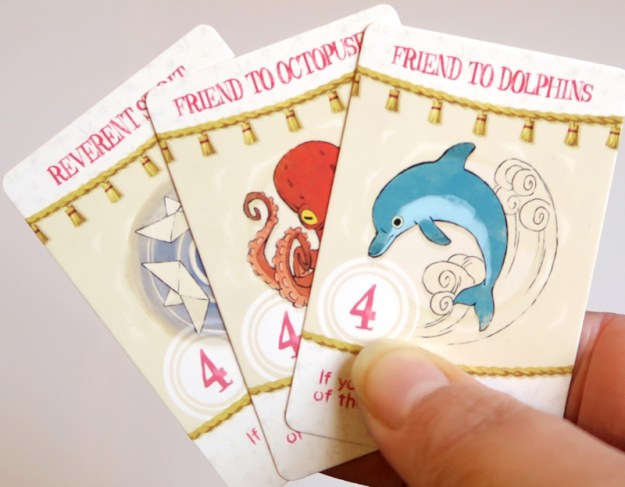
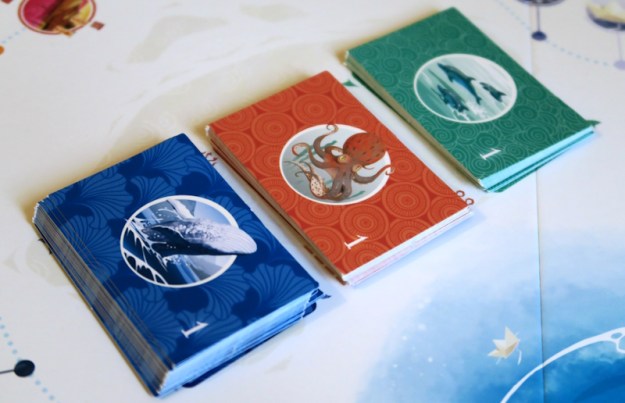
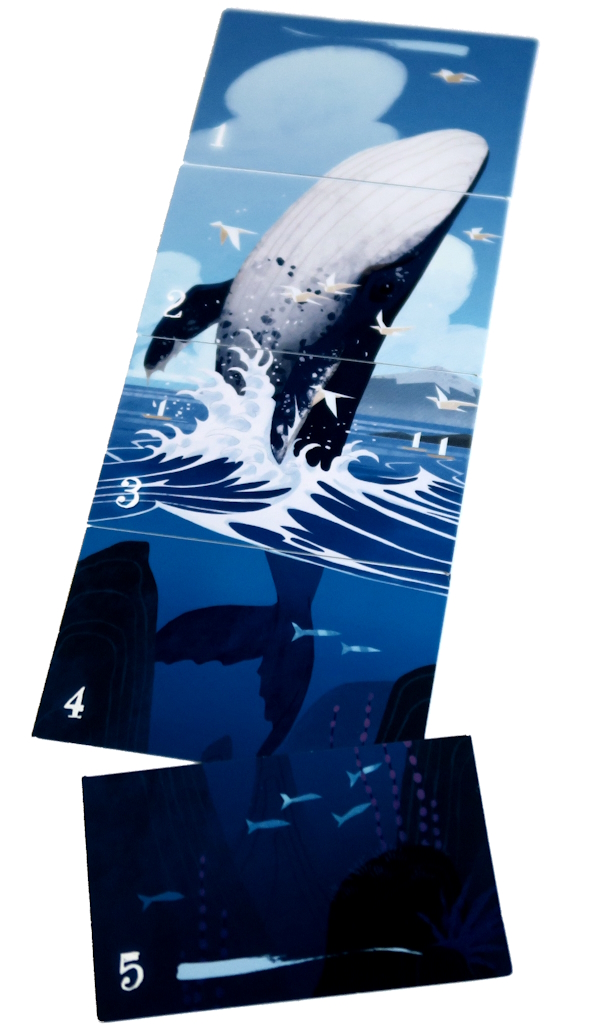
Meanwhile, on the next table, Pink, Cobalt, Lime and Purple had begun by playing Tokaido.  This is a sort of time-track game where the player at the back takes their turn moveing forward to an empty space of their choice taking turns until they are no-longer the one at the back at which point the new “Lantern Rouge” takes their turn.  Each space allows players to collect panoramas, chance it with a random draw for points, buy souvenirs, donate at a temple or work on a farm to gain cash.  At intervals, players have to stop for food which costs money, but the last player to arrive at the restaurant last gets the least choice which can be a catastrophe as these meals are usually more expensive with the risk that they are the same as those eaten on previous stops, which means they can’t eat and therefore don’t score.

Tokaido
– Image by boardGOATS

Although it is quite popular within the group, Cobalt was new to the game and commented that it was quite mean when he realised that once a space had been taken it was gone.  The group played with the choice of two character cards at the start—Pink felt that his Traveler, Hiroshige, was a poor choice as, although he got a free panorama card at each food stop, it didn’t give him much money at the start.  On reflection, he felt Purple had made a better decision in choosing Yoshiyasu, who gave her nine Yen.  Lime was the runaway winner with ninety-one, some fifteen more than Purple who just sneaked into second ahead of Pink.

Tokaido
– Image by boardGOATS

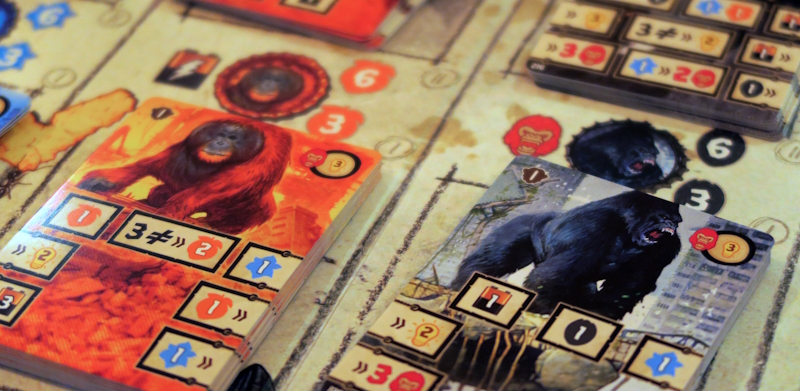
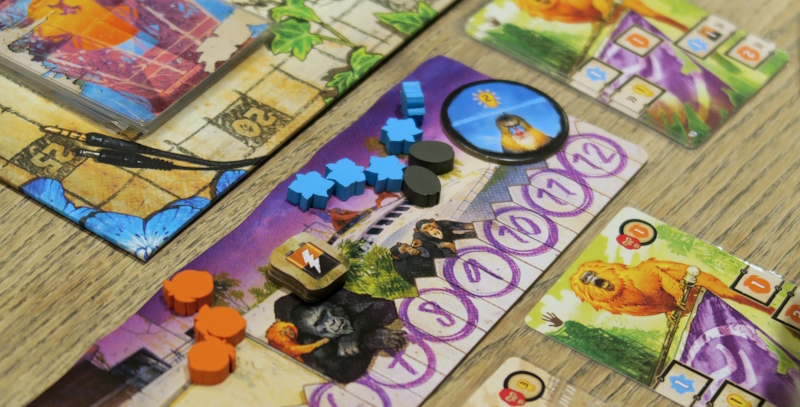
As the games of Finspan were still going, Cobalt introduced the group to After Us, aka “The Monkey Game”.  This had an outing within the group about eighteen months ago, but was new to Pink and Lime. It is a deck-building, resource management, engine building game featuring an original card-combo mechanism. The story is that mankind has died out leaving only apes which have kept evolving. As the leader of a tribe, players add new Primate Cards to their starting deck of tamarins. Primate Cards have three rows of “Effects”—the top row will award resources, the middle row will give points (often at the cost of resources) and the the bottom row will have abilities related to the primate type. At the start of a round, players draw four Primate Cards from their deck to be laid out in a row making “Connections”.

After Us
– Image by boardGOATS

The aim is to get the most out of the Connections by closing the open ended “Frames” along the sides of the cards by butting them up against adjacent cards that also have open ended Frames. Players then resolve the now closed Frames following the order of top left to bottom right, trying to gain as many bonuses as they can. Once everyone has simultaneously collected their Resources they can then use them to buy Primate Cards which are added to the top of the draw deck (and thus they come into use on the very next turn). In this way, they are improving the quality of their deck.

After Us
– Image by boardGOATS

One of the good things about the game is that if a player gets a bit “hosed” by the card draw, the frames mechanism allows them to make the best of a bad job.  The Frames have been resolved, the players simultaneously chose one of their Action Discs denoting which primate type they want to recruit.  The game starts slowly with players building their tribe, but it can end in a sudden rush when one player breaks into a gallop and charges past eighty points triggering the end of the round and this game was no exception.  Lime was again the victor, with sixty-nine points, with Pink second, some nine-points behind.

After Us
– Image by boardGOATS

Learning Outcome:  Jaws was not the only shark.

Essen 2024

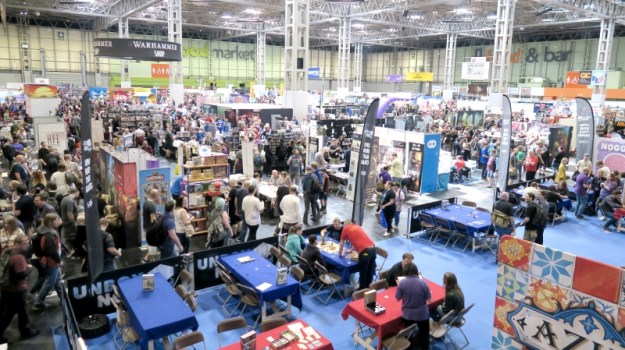
Today was the first day of the largest annual games fair in Europe and arguably the world.  The Internationale Spieltage is known to gamers worldwide simply as “SPIEL” or “Essen”.  This is a “fair” rather than a “convention” and is of particular significance as a lot of new releases are scheduled to coincide with the event, just in time for Christmas sales.  This year, for the first time, tickets were sold out for Thursday and Friday before the fair even started—partly  caused by the ever-growing numbers of attendees, but also as a result of the numbers being capped, apparently due to changes in German legislation.

Monkey Palace
– Image by boardGOATS

It has been additionally observed that whereas Thursday and Friday used to be the quieter days, in more recent years there has been a tendency for Gamers attend on these days to avoid missing the new and hottest games.  As a result, there have been a large number of games selling out early.  For example, this year, Castle Combo had sold out English language copies by 11.30am, and while more will arrive over the next few days, these will be in smaller numbers and are expected to run out even earlier.  Saltfjord, Panda Spin, The Yellow House, and Endangered Rescue! #1: Galápagos Penguins were also sold out before the end of the first day.

Meeps @ Essen 2024
– Image by boardGOATS

The Deutscher Spielepreis winner was announced at the fair as Forest Shuffle (so it was unsuprising that the the day’s quota of copies of its second expansion, Woodland Edge were also gone before the doors closed on Thursday).  It was also revealed that Stonemaier Games has acquired the Tokaido line of games from Funforge, and there will probably be other industry announcements along the same lines before the end of the fair.  One thing is for sure, and that is that there will be the usual deluge of new games and exciting expansions to known and loved games arriving in the shops over the coming weeks.  It will be fun to see what people enjoy playing over the next year.

Essen 2023
– Image from spiel-essen.de

19th December 2023

It was party time so everyone was arrived early for the Un-Christmas Dinner—everyone that is, but Blue and Pink who eventually arrived armed with piles of Christmas crackers, party poppers, tree decorations, Christmas cards, raffle prizes, GOAT Award ballot papers, mince pies and festive cake.  Opening the crackers was a necessity before food arrived to avoid the bits landing in people’s supper, so when food arrived, it nestled amongst all sorts of gaming detritus.  As the staff at The Jockey served pizzas, pies, baguettes, cheese with crudités, burgers and chips, gamers called out the awful GOATy jokes from the crackers.

"Un-Christmas Party" 2023
– Image by boardGOATS

During the interval between main courses and dessert, GOAT Award voting forms and Christmas cards were handed out and people began thinking about the games we’ve played over the year.  Ivory collected Christmas Cards and Green collated the ballots before he announced the winners.  The GOAT Poo prize, for the worst game of the year went Dice Hospital when 7 Wonders was relegated as a previous winner.  The Golden GOAT went to Tapestry, while the epic three-way tie in Tapestry won “Moment of the Year”.  With the formalities and food finally complete, there was just the raffle, a copy of Carcassonne: Winter Edition and the Ukraine Map, which were won by Sapphire, then everyone abandoned the carnage (and Purple who helped clean up), to play something festive.

"Un-Christmas Party" 2023
– Image by boardGOATS

There was a bit of the usual indecisiveness, but eventually Blue, Ivory, Pink, Green and Pine settled down to play the “Feature Game” which was Jokkmokk: The Winter Market while Black, Cobalt, Jade, Sapphire and Lime set up Snow Tails.  Jokkmokk is a very simple game that makes use of the time-track mechanism seen in Tokaido and Namiji (played last time)—that is to say, it is an extended game of leap-frog where the player at the back jumps into an empty space of their choice and then carries out the action associated with it.  Like those games, the compromise is between moving to a preferred space which may be further forward and will ultimately will give fewer turns.  It is much simpler than both Tokaido and Namiji, however.

Jokkmokk: The Winter Market
– Image by boardGOATS

Jokkmokk is a card-driven set collecting game and is made more interesting by a large number of mini-decks, five or six of which are combined for each game.  For the first game, the group chose to use the “First Game” selection of decks (Dalecarlian Horse, Antique, Hot Dog, Patchwork, Present).  Blue went for the Patchwork cards while everyone else fought over kettles (Antiques) and Hot Dogs).  Blue’s strategy nearly paid off giving her ninety-nine points and second place, but Ivory was more efficient than everyone else with his mixture of Horses, Hot Dogs and Kettles, which gave him a hundred and one points and victory.  The game was bright and breezy and, although simple, really didn’t outstay its welcome, so the group decided to “do a Lime” and play it again.

Jokkmokk: The Winter Market
– Image by boardGOATS

This time, this time the group played with the “Gift of Giving” selection of decks (Donation, Bell, Sparkler, Snowflake, Mystery Box, Presents).  Pink went for Sparklers, knowing he would lose half his points if he had the most, but hoping to have so many that it wouldn’t matter.  Green started collecting Bells, as did Blue and Ivory, going for different colours.  Lots of Gifts were given and a good time was had visiting the fair.  Pink’s ninety points were just three more than Ivory’s total, but Blue’s hundred and seven points gave her victory at the second attempt.  Meanwhile, on the next table, the others had finally started playing Snow Tails, spectated by Purple, who had finished helping clear the table after dinner.

Snow Tails
– Image by boardGOATS

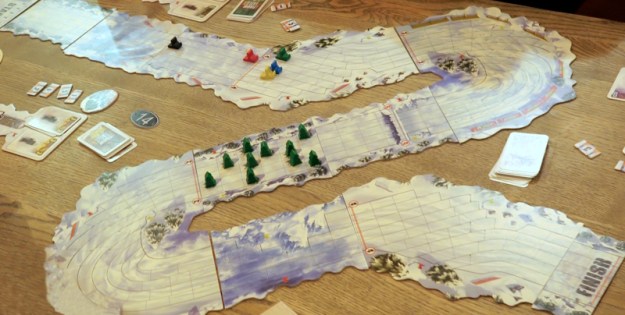
Snow Tails is a very popular game in the group, but somehow, one that is a little tricky to get to grips with.  The games is a card-driven sled-race with the winner the first to navigate the course.  Unfortunately, the course they chose was the one depicted in the main rules, which isn’t really intended to be a course design as it is quite long and features a Chasm right at the start, a couple of hairpins and some Saplings as well.  Each player starts with their own personal deck of cards, with five in hand.  On their turn, players can play up to three cards as they can so long as they are all the same value:  one for each sled dog, and one on the break.

Snow Tails
– Image by boardGOATS

The speed, the number of spaces the sled moves forward, is the total for the dogs minus the value for the Break.  Sleds will additionally drift sideways the difference between the dog speeds, and if the sled is balanced (i.e. the dogs are pulling equally), the player gets a bonus speed equal to the players position in the race.  Each time a sled exceeds the Speed Limit on a corner, hits the side of the track or a Sapling, the player takes a Dent card—a useless card that just blocks the player’s hand making things difficult.  The more Dent cards a player has, the more difficult the game gets, as Black soon demonstrated.  The first game of Jokkmokk had already finished and the sleds were only just off the Start line and through the first Chasm.

Snow Tails
– Image by boardGOATS

Lime claimed the “Big Paws” token for the player with the most “Analysis Paralysis”, though to be fair, everyone suffered a bit.  Jade commented that he’d been planning to play it with his nieces, but was now rethinking the idea.  As a result, the group shortened the track (to give them a chance to finish before midnight), and from there, the game went a bit more smoothly.  Jade was first to cross the Finish line, chased by Cobalt and then Sapphire in what had been a quite epic game.  And with that, the party was over for another year, though people lingered and chatted for quite a while before everyone left the pub staff to lock up.

"Un-Christmas Party" 2023
– Image by boardGOATS

Learning Outcome:  Always plan your Christmas shopping early.

12th December 2023

Blue and Pink were just finishing their supper when Plum and Byzantium arrived, soon followed by Pine, Black and Purple, Teal, Ivory, and finally Lime.  With ten then, the first question was whether to play two games with five each, or three games with fewer.  And then it was who would play the “Feature Game“, Namiji, and who would play something else.  The decision was pretty much made when Ivory said he’d brought Roll for the Galaxy and lots of people looked interested.  Roll for the Galaxy is somehow a game a lot of people struggle with, so who played what almost sorted itself out, with the outstanding question being whether there would be a third game.

Namiji
– Image by boardGOATS

In the end, it was easier to play two games than try to come up with a third, so Ivory took Plum, Teal, and Byzantium to the other side of the room to recap the rules for Roll for the Galaxy, while Blue taught the others Namiji.  Although this was new to everyone, it is extremely to the group favourite, Tokaido.  Both games are based on a time-track, that is to say, players are traveling along a path playing a kind of “leap-frog” where the player at the back jumps forward into an empty space and then carries out the action associated with it.  The player can move forward as far as they like, but the desire to jump into a chosen space is tensioned against the fact that the further forward a player moves, the longer it will likely be until their next turn.

Namiji
– Image by boardGOATS

Both Namiji and Tokaido have with elements of set collecting, indeed the different actions are very, very similar between the two games, and although players are Japanese fishermen, sailing south of the Japanese archipelago in Namiji, the rubric says they are just “a few miles away from the famous Tokaido road” and that games are barely that far apart.  The “Stations” in Namiji are: Angling, Net Casting, the Crustacean Trap, the Whirlpool, the Sacred Rock, the three Panoramas and the Dock.  The last four are roughly analogous to the Temple, the Hot Springs, the Panoramas and the Inn in Tokaido.  The Angling, Net Casting and Crustacean Trap stations are a little bit different.

Namiji
– Image by boardGOATS

Like the Village and the Encounters, these have set-collecting elements, but fish caught when Angling or Casting are laid out in the player’s boat with points scored for rows where the colours or types are the same.  The Crustacean Trap is a push-your-luck draw from a bag where players score a point for each Crustacean drawn (up to a maximum of five), but if two crabs are drawn in the same haul, the whole lot are lost.  The biggest difference between the two games is that there is no money, which has the effect of knocking some of the slightly rougher corners off.  For example, the Inn is much harsher in Tokaido than the Dock in Namiji.

Namiji
– Image by boardGOATS

Because Food cards have to bought at the Inn and these have different costs and duplicates cannot be bought, sometimes players have to go without which costs them six points.  This is enough to effectively put a player out of the running.  In contrast, in Namiji, they are a bit of a non-event.  There are two types of card drawn at the Dock:  Food and Upgrades.  As in Tokaido, Food gives points—fewer than in Tokaido, and variable without the cost or the limit of one type per player.  Upgrades grant players permanent abilities for the rest of the game (triggered when landing on their corresponding Station.  The game ends when everyone returns to port—as in Tokaido, there are bonus points for lots of things, and that includes being early back at port (with decreasing numbers of points as players arrive later).

Namiji
– Image by boardGOATS

Although the rules were simple and the game was mostly known, the debate started when Blue had barely left the table.  The discussion centred on whether the player chosen to be first should go at the front of the track (and thus actually “go” last) or whether they should take the first turn (and therefore actually start at the back).  Black opined that the that the turn order (randomly picked) was the order players should be placed on the track, while Pine felt the person picked should be the one start.  In the end, after studying the rules (which failed to answer the question), the group went with Pine’s view, and finally started sailing.

Namiji
– Image by boardGOATS

Pink was the first to complete the first Panorama (the Squid), soon followed by Lime who out-competed Purple and Pine to complete the lucrative Whale Panorama taking the bonus points for it too.  Black concentrated on setting his paper hats sailing into the Whirlpool to jettison negative points and top-scored for his catch (though there aren’t any bonus points for that).  Pine concentrated on collecting Cards and then was the first to get back to port.  Ultimately, Namiji is a game that rewards players for concentrating on one thing, and in this case that was Lime, who’s twenty-five points for his Panoramas made all the difference giving him clear victory ahead of Pine in second and Black and Pink jointly in third.

Namiji
– Image by boardGOATS

Meanwhile, on the other side of the room, Ivory had just about finished explaining the rules for Roll for the Galaxy when Blue arrived. In principle, the rules are quite simple, but playing the game well is much more difficult.  The game is based on the card game, Race for the Galaxy.  In both games, there are five phases, and players choose one each to activate.  This is important, because with more players more phases are likely to happen.  That is to say, while it is possible that everyone chooses the same phase which is the only one to happen, it is much more likely that two, three or four will be picked giving people more things to do in each round.

Roll for the Galaxy
– Image by boardGOATS

In Roll for the Galaxy, at the start of the round, players simultaneously “shaky-shaky” their dice in their Cup and roll in secret.  Then, behind their screen they secretly assign them to the different phases.  Most are assigned according to the face that was rolled, but any one can be used to decide which phase the player wants to happen.  Additionally, any one die can be used to “Dictate” the behaviour of one other die.  Once everyone has assigned their dice, everyone reveals their choices and the phases for the round are finalised.  Each player then gets to carry-out the actions indicated by their dice, returning unused dice to their Cup.

Roll for the Galaxy
– Image by boardGOATS

There are five phases in each round: Explore, Develop, Settle, Produce and Consume.  Explore allows players to choose tiles that they build in either the Develop or Settle phases, while Produce places goods on Production Worlds that can be turned into points or Credits in the Consume phase.  Used dice (those consumed or used to build) are then placed in a player’s Citizenry and only return to their Cup on payment of one Credit per die.  Thus, the game is very smooth with dice being assigned simultaneously, then moving to either of the player’s stacks of tiles to be used to pay for building, or onto one of their Production Worlds where it stay until it is Consumed.

Roll for the Galaxy
– Image by boardGOATS

Since what players can do depends on the roll of the dice, at first glance, it seems like the decisions are made by chance.  However, that just makes the decisions more key, if nuanced.  Which Worlds to build, which phase to choose, whether to Dictate to reassign a die, whether to consume to give points or cash, and overall, which strategy to choose.  And although the roll of the dice plays a big part, there are lots of dice and plenty of rolls, so the luck averages out, though players have to surf their luck.  The game ends at the end of the round when a player builds their twelfth World, or when the pile of Victory points runs dry, and in this sense, although the game is about rolling dice, it is still a race, a race to build an engine, score points and finish the game.

Roll for the Galaxy
– Image by boardGOATS

The game began with the rattle of the simultaneous “shaky-shaky” as dice rattled in everyone’s Cups.  At the start of the game everyone wanted to Explore and build, but what depended on strategy.  Blue started with a military strategy dictated by her first Development which gave points for red dice at the end.  Ivory also planned his game around his Developments and their bonus points, but built his engine based on reduced costs to build and to Dictate.  Teal and Sapphire chose to follow a conventional “Produce-Consume” victory point strategy, while Plum tried a bit of everything.

Roll for the Galaxy
– Image by boardGOATS

Roll for the Galaxy is a little bit “multi-player solitaire”, with everyone concentrating on their own engine and deciding what they want to do.  However, the winner has to take advantage of the fine margins and that means watching what other players are doing and anticipating and then taking advantage of their choice of phase when they can.   This time, the end was triggered by Ivory, who accelerated quickly out of the traps thanks to his early choice of Development Worlds, and ultimately finished with thirty-six points for his buildings and ten bonus points giving him a runaway victory.  A very creditable second place went to Byzantium, the only player who had never played either Roll or Race for the Galaxy before, with Blue completing the podium.

Roll for the Galaxy
– Image by boardGOATS

Learning Outcome:  Sometimes when you win you have a Whale of a time!

UK Games Expo 2022

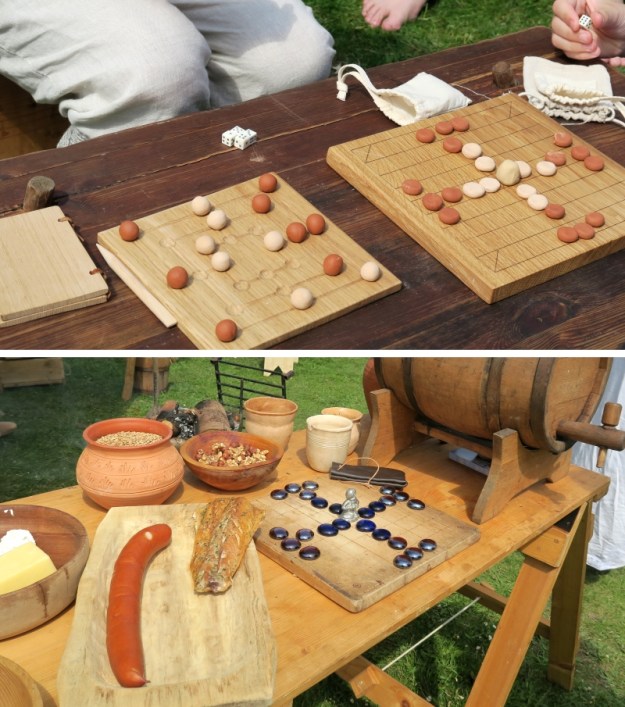
Today was the first day of the fifteenth UK Games Expo.  After the cancellation two years ago and the subdued event last year, it was almost back to normal this year.  On arrival, outside the NEC, there were vikings in their camp, playing Hnefatafl with their visitors.

Hnefatafl
– Image by boardGOATS

It seems blinging games has been a thing for over a millennia, as the vikings were proudly showing off their pimped out copy.  Inside, the halls were busy, but not overcrowded, though of course this was Friday, traditionally the “quiet day”.

UKGE 2022
– Image by boardGOATS

Just inside the door was the Burley Games stand with a shelf of variants of Take it Easy!—an unwanted reminder of playing games remotely through Teams for eighteen months, albeit as one of the games that worked quite well in that format.

UKGE 2022
– Image by boardGOATS

Nearby was the Oink Games stand, showing off the newly Spiel des Jahres nominated, SCOUT and just round the corner, the staff from the Oxford-based Osprey Games were obviously delighted that their game Cryptid had received a Kennerspiel nomination and were keeping their fingers crossed that it would go one further.

SCOUT
– Image by boardGOATS

Hall One was also the home to Fire Tower, a clever puzzle game with the tag line, “fight fire with fire”.

Fire Tower
– Image by boardGOATS

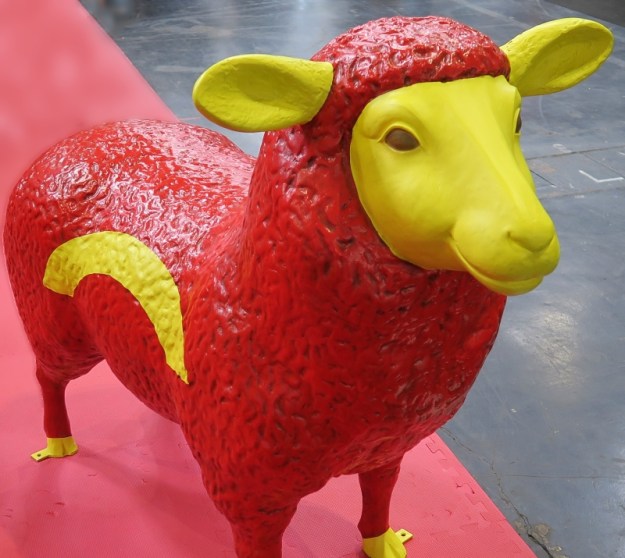
As well as a very smiley sheep from Catan, there were also a lot of designers about, including Tony Boydell, Alan Paul, Andy Hopwood, Bez Shahriari, Rob Harper and Matt Dunstan, all sharing their games and chatting with gamers.

UKGE 2022
– Image by boardGOATS

There were a number of interesting little British games, including Daring Dustbunnies and Deckchairs On The Titanic, which were on neighbouring stands, while Surprised Stare were selling a special tribute to the festive weekend called Corgi Dash (based on the 1986 Spiel des Jahres winner, Heimlich & Co.).

UKGE 2022
– Image by boardGOATS

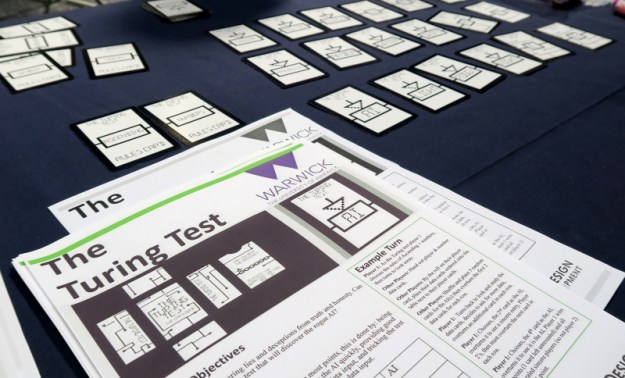
Universities of Warwick, Chester and Canterbury were all present, variously advertising their courses in game design and demonstrating how gaming can be used as a learning device.  One Warwick (IATL) computer science student showed a game he designed to demonstrate the Turing Test and how people are poor at understanding randomness.

UKGE 2022
– Image by boardGOATS

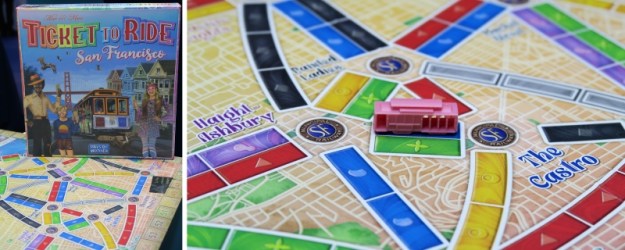
There were also previews of upcoming games.   These included Namiji, a game which has the same theme and uses the same basic mechanic as Tokaido, but increases the complexity with more challenging steps along the way.  Namiji was demonstrated at Essen in 2019, but like so many things, fell foul of the global pandemic in the interim.

Ticket to Ride: San Francisco
– Image by boardGOATS

The new Ticket to Ride game which will be released later this year was also available to see and play.  It is based round the city of San Francisco and features street cars and follows the successful format of a new map and a slight rules tweak.

UKGE 2022
– Image by boardGOATS

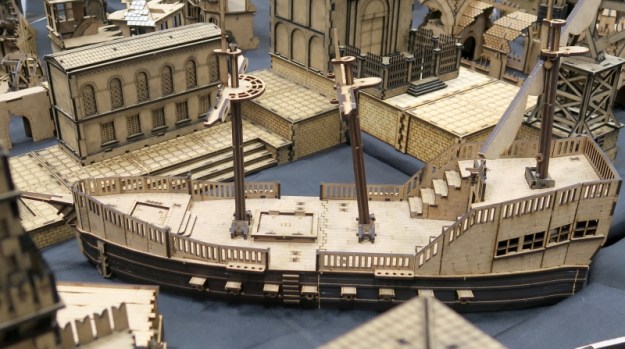
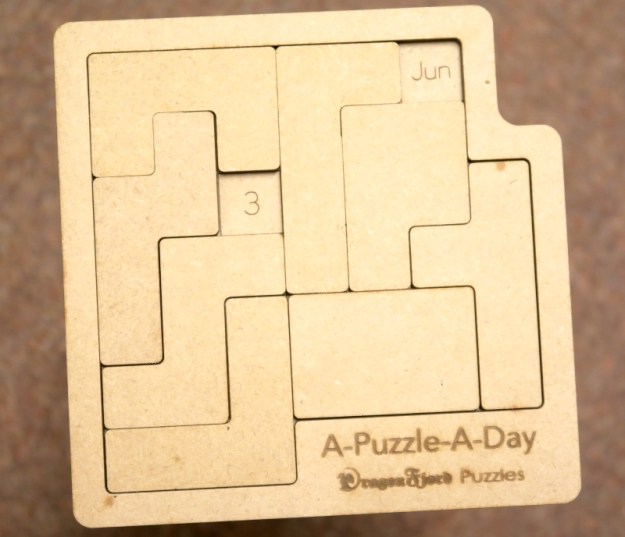
Aside from games, there were also a lot of stands selling books, costumes, props, and scenery—these days, the distinctive aroma of singed wood pervades the aisles of games conventions as an homage to the laser cutter, which is used to make everything from wooden boxes, to houses, coasters and puzzles.

UKGE 2022
– Image by boardGOATS

All in all, the return to face-to-face conventions was a date to remember.  UK Games Expo continues until 4pm Sunday 6th June.

21st October 2021

The evening began with a little play-testing while people waited for their food to arrive.  The two-player game currently goes by the name of Brain Grabbers and, though simpler, has a mechanistic similarity to Sprawlopolis or Honshū.  The game was designed by one of Pink’s work colleagues, so Pink explained the rules, and then proceeded to lose, first to Blue, then to Pine, failing to take a single point to their combined total of fourteen.  The consensus was that it could be successful as a family-level game, but we weren’t fans of Cthulhu, so spent the next ten minutes coming up with exciting ways to re-theme it.

Sprawlopolis
– Image by boardGOATS

As people finished eating others began to arrive, though there was some question about whether Purple and Black would make it thanks to a serious accident on the A420.  We were discussing the treacherous nature of the A420 and its accident black spots when Purple and Black rocked up, and Purple surprised everyone by joining Green, Ivory and Burgundy to play  the “Feature Game“, Endeavor: Age of Sail with the extras from the new Age of Expansion.  Endeavor is a game we have played quite a bit over the years, initially in it’s original form and, more recently, in the new edition.  The expansion came out last year and, sadly, got lost in the mists of the endless “Roll and Write” games we were playing online.

Endeavor: Age of Expansion
– Image by boardGOATS

The original game is actually not terribly complicated and during play is almost completely luck-free—all the variation is in the set up.  The game is played over eight rounds, each consisting of four basic phases: Build, Populate, Payment and Action.  There are four technology tracks roughly corresponding to each phase, which dictate what a player can do during that phase.  For example, how far along the building track a player is dictates what they can build: the further along they are, the more buildings they have to choose from.
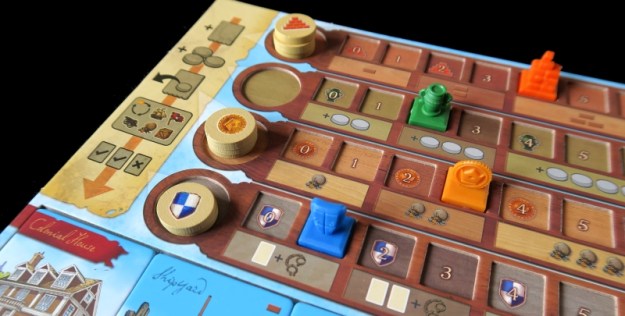
Endeavor: Age of Sail
– Image by boardGOATS

Similarly, a player who is further along the population (or culture) track, can move more people into their harbour for use in the Action phase.  Payment also increases the number of people available as it moves population markers from the action spaces into the harbour.  More importantly, however, it makes the action spaces available again for use later in the round.  The first phase consists of passing round the tray of buildings rather like a box of chocolates although in truth, at this point of the game players have very little choice.  Despite that, the decision is crucial to how players do.

Endeavor: Age of Sail
– Image by boardGOATS

After the Building phase, the second and third phases (Population and Payment) are more or less carried out simultaneously.  The guts of the game, however, is the Action phase, when players can place population markers on their buildings to activate them and carry out one of the five actions:  Colonise, Ship, Attack, Plunder Assets, and Pay Workers.  The actions are generally based round the central board which is divided up into seven regions representing the seven continents.  Each continent comprises several cities, a shipping route and a deck of cards.

Endeavor: Age of Sail
– Image by boardGOATS

At the start of the game there is a Trade token on each city and each shipping space, but also on many of the connections between cities (these are taken if a player occupies both cities either side).  Players cannot Colonise a city until they have a presence in a region, which they can do by Shipping.  In this case, they activate their building that provides the shipping action by placing one population marker on it, then place a second population marker on the shipping track.  Thus, players need to have two markers available to be able to Ship.

Endeavor: Age of Sail
– Image by boardGOATS

The second population marker is placed in the furthest unoccupied space from the deck of Asset cards in the region of their choice, and the player takes the Trade token on that space.  Most trade tokens add to one of the four technology tracks, though a small number provide one off actions instead.  Players also need two population markers to Colonise (one for the action and one to occupy the city) and three if they are going to attack an already occupied city (one is collateral damage).  Once a player has a presence in a region they can take an Asset card, so long as the number of the top card is not higher than the number of population markers that player has in the region.
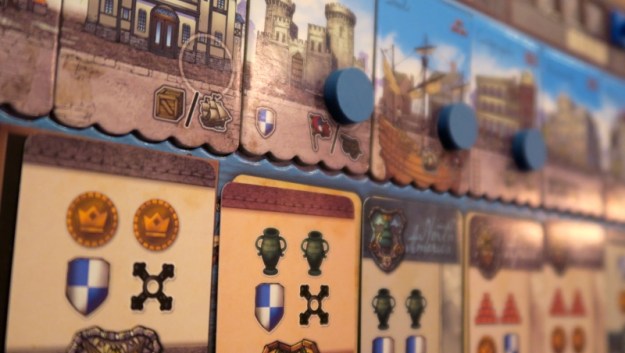
Endeavor: Age of Sail
– Image by boardGOATS

After eight rounds, players add up scores for each track and for the cities they control and the player with the most points is the winner. The new Age of Expansion adds several new components that completely mix up the game.  First there is a completely new set of buildings, many of which have actions as well as boosting the players’ economies while others have more choice.  Similarly, the first, second and fifth cards in the region decks now have more powerful and unique cards.  These are now more desirable creating more competition for them.

Endeavor: Age of Expansion
– Image by boardGOATS

The new buildings also introduce three new concepts:  Trade, Fortify, and Conscription & Mobilisation.  Trade allows players to swap one Trade token from their play area with one on the central board, while Fortify allows players to increase the protection in a city they occupy causing others to lose an extra casualty should they decide to attack.  Conscription enables players to acquire extra population which can then only be Mobilised as part of an action that has been activated in the usual way (e.g. used as a casualty during an attack, or to Settle).
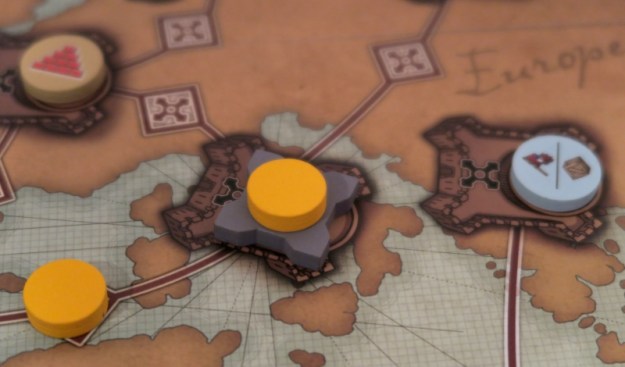
Endeavor: Age of Expansion
– Image by boardGOATS

Additionally, a single Prominence tile drawn at random can be added to the game.  These provide players with new ways to gain presence in a more-competitive Europe and each one provides difference benefits and ways to score.  This time the Prominence tile was “Changing Alliances” which allows players to set up an alliance, where players cannot attack each other within Europe, in exchange for points at the end of the game.

Endeavor: Age of Sail
– Image by boardGOATS

The game took a little while to set up, and although everyone had played it before, we needed a refresher of the rules and run down of the new expansions.  In addition to the new Age of Expansion updates, the group also included the Exploits from the original Age of Sail, the mini Charter Company buildings and two additional micro-expansions from Age of Expansion (Seize your Fate & Level 6 region cards), making it a mega-game.  Overall, it took about an hour for set-up and rules explanations.
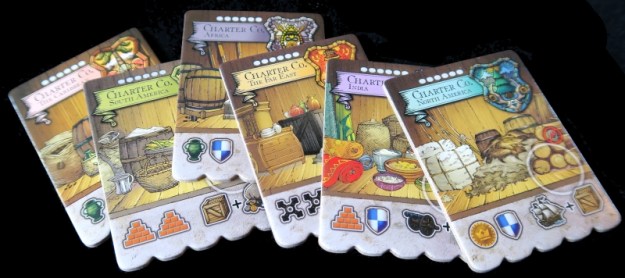
Endeavor: Age of Sail - Charter Companies
– Image by boardGOATS

The Seize your Fate Expansion provides each player with a unique starting set-up.  Ivory was The Kingdom of France so started with a city in Europe; Purple was The Ottoman Empire, so started in the open sea of India; Green was The Kingdom of Spain so started with a city in South America; Burgundy was Great Britain and started in the open seas of North America and the Caribbean.  Coincidentally, each player was sat near the part of the board where their starting places were, so that set the stage for players’ strategies.
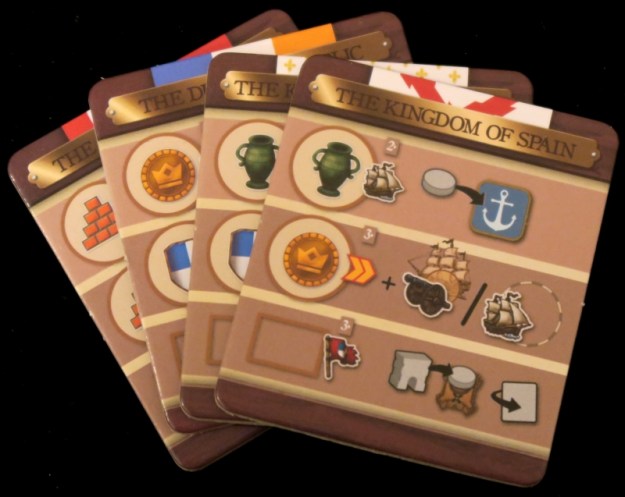
Endeavor: Age of Expansion
– Image by boardGOATS

Ivory quickly started taking cities in Europe and was open to a Prominence Alliance. Green was taking Fleets in Europe so joined him. No-one else wanted to form any alliances leaving Ivory to dominate Europe with and Green (to a lesser extent).  However, due to a rules malfunction, this was under the false impression that as part of the winning alliance they would score four points for each disc in the region when it was actually four points for each disc in the Alliance.  Since he was concentrating on becoming the power house in Europe Ivory left his Seize the Fate actions for much later in the game, and only expanded out of Europe to the Far East and later on Africa.

Endeavor: Age of Expansion
– Image by boardGOATS

He did however make good use of the Dutch East India Company exploit (once it was open) to upgrade his seaside buildings.  Meanwhile, Purple concentrated mostly on India and Africa, but suffered early on with not having enough population in her harbour or enough bricks to build better buildings.  The game was long though, and she managed to Seize her Fate (Round the Cape).  She also made use of the Dutch East India company in the latter rounds, and although scores weren’t calculated until the end of the game, she probably made up good ground with these latter stages.

Endeavor: Age of Expansion
– Image by boardGOATS

Elsewhere, Green was concentrating on the Caribbean, and making connections with his Fleets in Europe. He managed to amass a large population early on, but let it slip so that by the end of the game, Ivory and Burgundy had much more population to spare for attacks, even on fortified cities. Green kept an eye on Burgundy’s progress to keep a presence in South and North America. He was the first to Seize his Fate (Form the Great Armada) and used The Transit of Venus exploit, shipping up to Tahiti and using his money to increase his population.
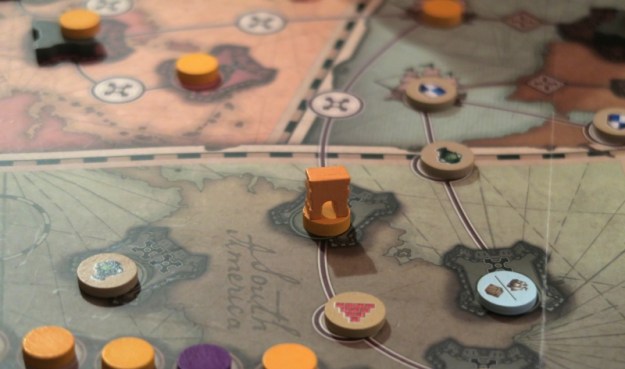
Endeavor: Age of Expansion
– Image by boardGOATS

Burgundy concentrated on the America’s, and although he opened the Republic of the Pirates exploit, he never used it (and neither did Green who could also have done so). This was because he said he did not really understand it and it didn’t seem that useful. Which was a shame, as it meant the beautifully crafted big black plastic pirate ship didn’t make it onto the board. What Burgundy did do, however, was to make heavy use of Conscription buildings, which really helped him ship to almost everywhere.  Unfortunately for him, in the final round of the game there was no shipping left and he discovered that he didn’t have enough other actions to make use of the population he had.

Endeavor: Age of Expansion
– Image by boardGOATS

In the end, after a re-evaluation of the scores due to the Alliance misunderstanding, Ivory  was declared the winner with eighty-one.  Burgundy was the runner-up with seventy-three, three points ahead of Green in what turned out reasonably close game.  But what of all the expansions?  The exploits can always be relied on to add an interesting dynamic (with a couple of duds) and it is likely these will continue to feature.  The Charter companies seem to help in four and five-player games when Level five buildings have the potential to disappear quickly (especially with the Exploit we used this time), and apart from space around the board don’t intrude too much anyway.
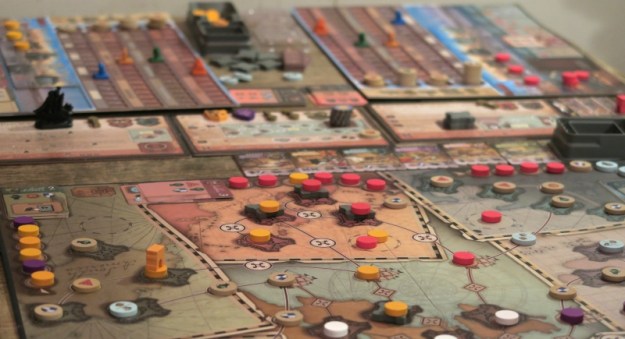
Endeavor: Age of Expansion
– Image by boardGOATS

The Level six cards seem to be intended to be played with the Age of Expansion every time, as Slavery is Abolished on the Europe Level 6 card, whereas in the Age of Sail base game it is abolished on the Europe Level five card.  This time, none of the Level six cards actually got played.  Again, they don’t intrude, but give additional options, so are also worth playing with.  The benefits of the “Seize your Fate” was perhaps less clear. Having different starting positions certainly helped the start and gave players a steer as to strategy.  Remembering the actions were available was a problem and the extra scores were quite small (about four points for those who used them). Including this module would probably depend on the group.
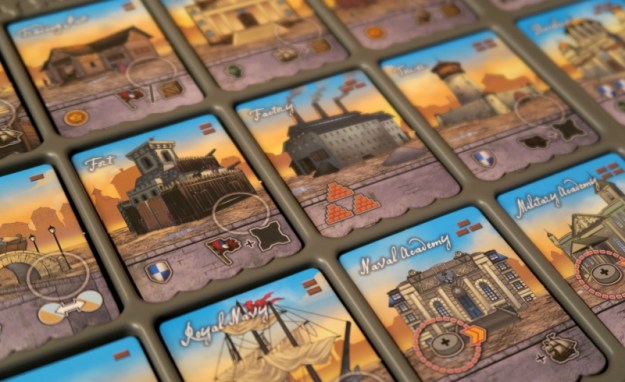
Endeavor: Age of Expansion
– Image by boardGOATS

The new Conscription action seemed to open up more of the board, which counters a common complaint about the game, that in order to get a region open, players have to neglect a couple of other areas and can lose out if they made a start in them early in the game.  However, the danger seems to be in overusing Conscription.  In this game there was a lot of Fortification, and in many ways it seemed a little too much. The bonuses on the new cards were interesting and add variety to the main game, but the expansion certainly doesn’t make the Age of Sail options obsolete as they could be very valuable if a less competitive game was wanted.
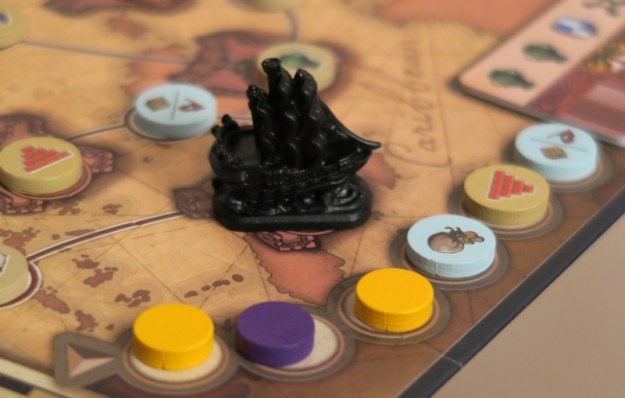
Endeavor: Age of Expansion
– Image by boardGOATS

While Purple was exploring India and Africa, Black, Pine, Lime, Blue and Pink were exploring Japan with Tokaido. This is a highly tactical game, that straightens out the market mechanism at the heart of Glen More and makes it the centre of a set collecting game.  During the game, players are travelling from the ancient capital Kyoto, to Edo (now Tokyo) via the Tōkaidō road.  This was one of the five centrally administered routes, the Gokaidō, that connected the capital of Japan with the outer provinces during the Edo period (1603–1868).
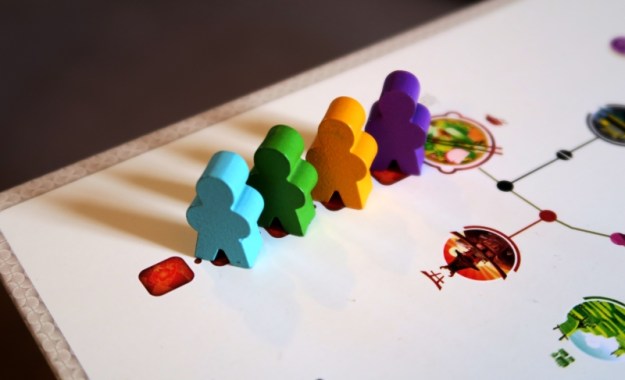
Tokaido
– Image by boardGOATS

As players travel, they experience the wonders of Japan sampling food and scenery, talking to the colourful characters en route, buying souvenirs and giving thanks at the temples they pass.  The game board consists of a long track with locations marked—each location can only be visited by one player.  Players line up along the path and the player at the back goes first (in this case Pink).  They move their piece to an empty space and carry out the associated action, before the next player at the rear takes their turn.
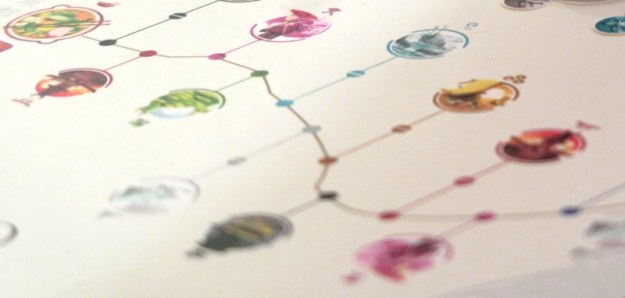
Tokaido
– Image by boardGOATS

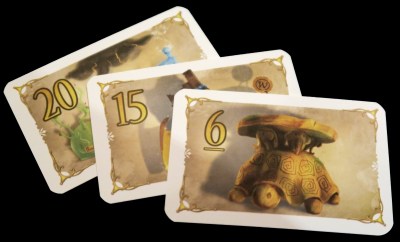
In each case, the primary decision is simple:  move to the space with the most interesting action to maximise points, or move to the first available space to get the most turns. In most cases, once that decision has been made, players simply take money or a card from the appropriate pile, the three panoramas, the hot springs, or Characters.  Panoramas and Hot Springs simply give points while Characters give other bonuses.  Stopping at a temple allows players to genuflect and pay tribute, while visiting a Village gives player the opportunity to buy souvenirs.  Both of these cost money, however.

Tokaido
– Image by boardGOATS

Money is really tight and there are few chances to get more, and an important source of points is sampling the varied food, but food can be expensive.  There are four stops to eat and players have to stop and wait at these.  The first person to arrive gets to choose their meal from a handful of cards—they do not have to buy food, if they choose not to or cannot afford it, but each meal is worth six points at the end of the game.  Food comes at different prices though, so arriving early means players get to choose a cheaper meal. Each meal a player takes must be different, however, so waiting to the end can end up being costly, either financially, or in points lost.
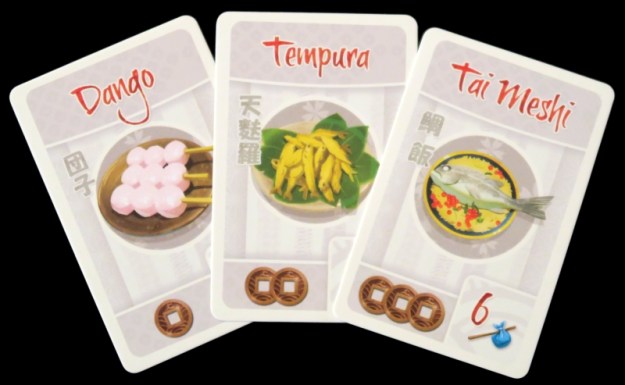
Tokaido
– Image by boardGOATS

At the end of the game, there are bonus points for almost everything:  the player who donated most to the temples, the player who spent the most on food, the player who completed each of the panoramas first, and the players who visited the most Hot Springs, met the most visitors and bought the most souvenirs.  The player with the most points at the end is deemed to have had the best journey and wins.

Tokaido
– Image by boardGOATS

Players start by choosing their character from a pair drawn at random.  Blue was Kinto, Lime was Hirotata, Pink was Zen-emon, Pine was Mitsukuni and Black was Umegae.  Each of these gave a special power, for example, picking Kinto meant Blue paid one Ryō less for food each time she stopped to eat.  Similarly, every time Lime stopped to pay tribute at a temple, he was able to donate an extra Ryō, taking it from the main supply scoring an extra point straight way, and putting him in pole position for picking up the ten point bonus for being the most devout.

Tokaido
– Image by boardGOATS

The special powers aren’t all financial though—Mitsukuni gives an extra point at the end of the game for every end-game bonus the player wins.  Most of them do involve money on some level though even if it is not directly.  Zen-emon’s special power, for example, activated when Pink visited a Village to buy souvenirs.  When buying souvenirs, the active player draws three souvenir cards and can choose to buy one, two or all three.  Whenever Pink bought one souvenir, Zen-emon enabled him to buy one souvenir for one Ryō (regardless of its marked price) and as many others as he wished at full price.

Tokaido
– Image by boardGOATS

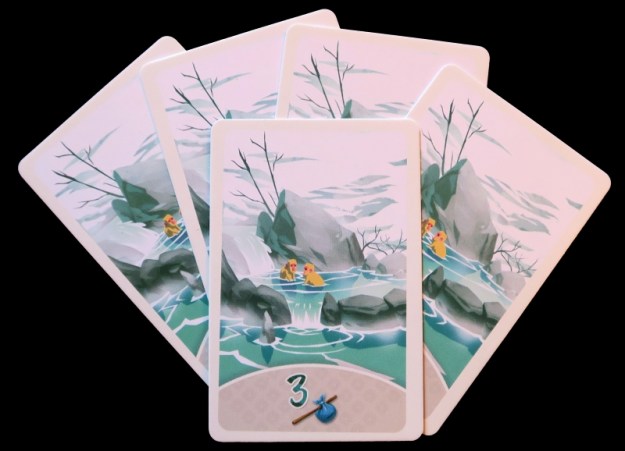
Souvenirs are a great way to get points.  They come in different types and players are collecting mixed sets with the first card in a set being worth one point, but later being worth more—a full set gives sixteen points.  The special powers give players a steer as to which strategies might be beneficial.  To take advantage of Zen-emon’s special power, Pink needed to visit the Village as often as possible, however, there were two problems:  firstly, souvenirs are expensive, and secondly Pine kept getting there first.
Tokaido
– Image by boardGOATS

Pine got extremely lucky on his card draws when he visited the Villages too, picking up lots of cheap souvenirs and getting lots of points in return.  As if that wasn’t enough, Pine seemed to be able to harness his “inner Burgundy” and every time he visited the Hot Springs, he found monkeys and with them an extra point.  To rub salt in Pink’s wounds, he ran out of cash and found he couldn’t afford to eat, and thus he haemorrhaged points.

Tokaido
– Image by boardGOATS

Meanwhile, Black as Umegae, kept meeting people and every time he did so he gained an extra point and a Ryō.  This occasional top-up of cash meant he wasn’t as strapped as everyone else, but further, the New Encounter mini-expansion Cards were also included in the deck, and some of these are quite powerful.  Pine picked up Itamae, the especially powerful itinerant cook (who cooked him an extra meal for just one Ryō), but Black took Takuhatsuso, for example, the old priest who gave him four points in exchange for just one Ryō.

Tokaido
– Image by boardGOATS

As the players approached Edo, Pine was way out in front, though Black and Blue (thanks to spending a lot of time admiring the views) were not far behind.  There were a lot of points available from the bonuses though and it wasn’t a forgone conclusion by any means.  Lime took the ten point temple bonus, but it wasn’t really enough.  Black finished one point behind Blue, until the recount when Black finished one point ahead.  That was just enough to give Black second place, but Pine picked up enough bonuses and with the extras provided by Mitsukuni he finished seven points clear.

Tokaido
– Image by boardGOATS

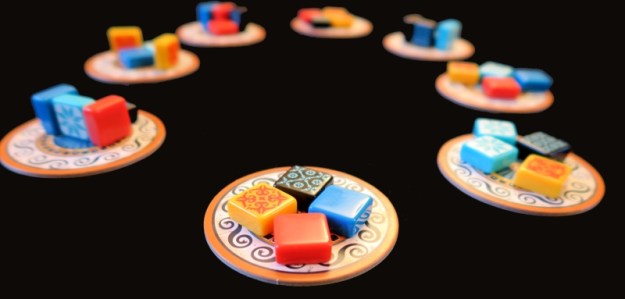
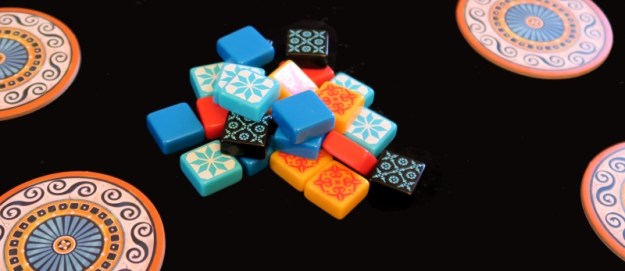
Pine and Lime went for an early night, but Endeavor was still going so Black had to wait for Purple which meant a game of Azul with Blue and Pink.  We’ve played this a lot within the group, but having effectively had over a year off has rejuvenated many of our old favourites.  The series of games use a very simple, but very clever market mechanic where players take all the tiles of one colour from a market and put the rest into a the centre, or take all the tiles of one colour from the centre.  The three different games, Azul, Stained Glass of Sintra, and Summer Pavilion, all differ in what players do with the tiles once they’ve taken them.
Azul
– Image by boardGOATS

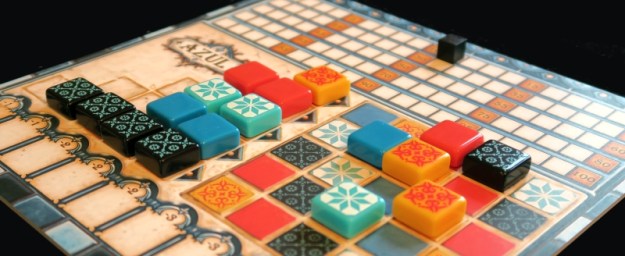
In the original Azul, as soon as they have taken the tiles, players add them to one of the rows on their player board.  At the end of the round, one tile in each full row is moved into their mosaic.  The game ends when one player completes one full row of their mosaic.  Players score points when they add tiles to their mosaic (one point for each tile in the row and column it forms), and receive bonuses for completed rows, columns and any completed sets in their mosaic.  The catch is that each feeder row can only contain one colour and and if there are left-overs when they add to it, these score negative points.  Further, each row in a player’s mosaic can only have one tile of each colour.
Azul
– Image by boardGOATS

And that was where Pink got caught, first with seven negative points taking him to zero and then a massive eleven negative points.  Black and Blue managed to avoid that pitfall though and the game was progressing well when suddenly, Blue brought it to an abrupt end by completing two rows.  Black failed to spot it was on the cards because Blue’s finished rows, were the second and third, rather than the easier first row.  Inevitably, having his game cut short stymied him somewhat, and Blue’s final score of a nice round hundred put her some way ahead of the others.
Azul
– Image by boardGOATS

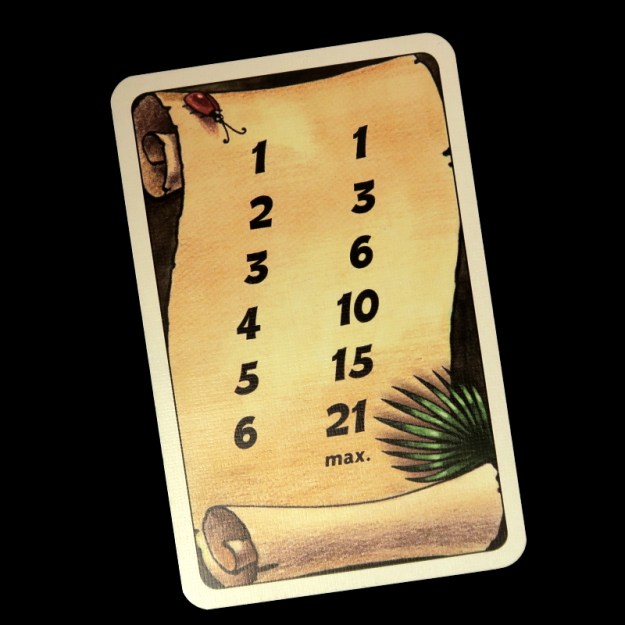
Endeavor was coming to a close, but there was just time for one final quick game while they finished up.  The game the trio settled on was Coloretto, the cute chameleon collecting game that provides the core mechanism that underpins the better known game, Zooloretto.  This is really a really simple game:  on their turn, players either draw the top chameleon card from the deck and add it to a truck, or take a truck.  The aim of the game is to collect sets of one colour, but only the largest three sets give positive scores, while the others score negatively.  The clever part is the set scoring, which uses the Triangular Number Series.

Coloretto
– Image by boardGOATS

Each additional card in a set is worth one more than the last card added with the first worth a single point, but the card that completes the set is worth six points.  As usual, there was stiff competition for the multicoloured chameleon cards, but also for the bonus point cards.  Blue went from “Azul Hero” to “Coloretto Zero” picking up too many cards of in too many different colours early on.  It was closer between Pink and Black, though Pink’s large collection of orange cards made the difference giving him victory by eight points.  And with Endeavor finally packed away, the evening came to a close.
Coloretto
– Image by boardGOATS

Learning Outcome:  Don’t spend all your money in the souvenir shop – food is important too.
12th May 2020 (Online)

Having spent the last few meetings playing online using Tabletop Simulator shared through Microsoft Teams, this time we decided to do something a little different.  One of the group’s most popular games is 6 Nimmt!, which also plays lots of people.  It has unavoidable hidden information, but is available through the online platform, Board Game Arena.

6 Nimmt!
– Image by boardGOATS

On our first online game night, a small group had had a difficult time playing Port Royal on Yucata.  Some of the group had also played rather challenging games of Snowdonia and San Juan, and, as a result, had moved to Board Game Arena for three more recent, epic games of Keyflower.  The graphics and playing environment on Board Game Arena are more up to date than those for Yucata, but like most other platforms, the servers have been struggling at peak  times with the load caused by the recent influx of new online gamers.  The folks at Board Game Arena have done a lot of work on that in the last couple of weeks though, and the performance has improved significantly as a result.  So much so, that we felt reasonably confident it would be stable enough to be the focus of games night.

Board Game Arena Logo
– Image by boardgamearena
on twitter.com

So, this week, the “Feature Game” was to be 6 Nimmt! played on Board Game Arena.  This is a game that everyone knows well, though there are a couple of minor tweaks to the rules.  The idea is that everyone starts with a hand of cards, ten on Board Game Arena (we usually play with the hand size that is dependent on the number of players).  Simultaneously, everyone chooses a card, and then, starting with the lowest numbered card, these are added to the four rows in the display.  Each card is added to the row that ends with the card with the highest number that is lower than the card played.

6 Nimmt!
– Image by boardGOATS

Placing the sixth card in the row causes the active player to take all the cards in the row, replacing them with their played card.  The clever part is that the score is the not the face value of the cards, but the number of “bull’s heads” shown on the cards.  The aim of the game is to finish with the lowest score.  When the group usually play, we split the deck into two halves and play just two rounds.  On Board Game Arena, however, everyone starts with sixty-six points and the game end is triggered when someone’s score falls to zero.

6 Nimmt!
– Image by boardGOATS

From 7pm, players began logging onto Board Game Arena and joined the MS Teams meeting.  Lime was one of the first and his chat with Blue and Pink was interrupted by a phone call from one of Blue’s relatives trying to source a set of drain rods.  Blue and Pink were quite convinced they didn’t have any, but that didn’t stop Pink having to spend the next hour hunting for some without success (so Lime kindly offered to lend his if required).  While Pink rummaged in the garage, everyone else joined the meeting and chatted.  Mulberry unfortunately wasn’t able to join us, but she was replaced by Ivory on his first online meeting.  It was great to “see” him again after so long, and good to hear that Mrs. Ivory, Little Ivory and Littler Ivory were all doing well and might be interested in OKIDO.

6 Nimmt!
– Image by boardGOATS

Eventually, Pink finished ferreting and returned to the chair kept warm by his panda and everyone settled down to play.  The Board Game Arena implementation worked nicely and everyone was able to chat in the background using MS Teams, but also through the game’s “chat” channel.  There was the usual moaning about the quality of cards and comments about how badly things were going:  it was almost like playing together in the pub, though not quite.

6 Nimmt! on Board Game Arena
– Image by boardGOATS from boardgamearena.com

Green and Purple managed to avoid picking up any cards for the first round or two, but it wasn’t long before their natural collecting mania began.  The disease spread and soon Pine, Ivory and Black were picking up lots of cards too.  It wasn’t long before Lime triggered the end of the game, and Burgundy managed to avoid picking up anything in the final round to win, ten points clear of the rest of the field.

6 Nimmt! on Board Game Arena
– Image by boardGOATS from boardgamearena.com

There is a lot of luck in the game, especially with so many players, but everyone was happy to play again and it is very easy to engage in a re-match, or so we all thought.  It wasn’t until the second game had started that we realised we’d “lost” Lime somewhere along the way.  He seemed to be playing a game, but then it dawned on him, that he’d somehow got himself involved in somebody else’s game by mistake.  He was very embarrassed and was keen to extricate himself, but Blue worked out where he’d gone and shared the link.  So, to the complete mystification of the four French gamers involved, the Brits all joined their game as excitable spectators.

6 Nimmt! on Board Game Arena
– Image by boardGOATS

Everyone boisterously cheered on our British Representative, to the blissful ignorance of the French and huge embarrassment of poor Lime.  Meanwhile, Black worked out how to abandon the incomplete game and Blue started a new one which everyone joined while still following Lime’s progress against the French.  Lime played really well and was in the lead for much of the game, but sadly, one of the French finished strongly and just beat him.  Still, we all felt he’d done an excellent job keeping the British end up, and he finished a very creditable second (especially since he was somehow also playing the group’s game and working!).

6 Nimmt! on Board Game Arena
– Image by boardGOATS from boardgamearena.com

After all that excitement, our game was something of an anticlimax.  Nobody was really paying much attention for the first part as they were distracted by Lime’s stellar performance.  But when everyone focussed on the game again, Pine, Blue, Ivory and Green were fighting it out to at the top while Pink was doing his best to end the game nice and quickly.  There were the usual smutty comments (Green: “Ivory’s got a big one there…!”) and other banter (Pine: “I had the lead for all of two seconds…!”), but eventually, Pink put everyone out of their misery, somehow leaving Blue just ahead of Pine.

6 Nimmt! on Board Game Arena
– Image by boardGOATS
from boardgamearena.com

Nobody was desperate for an early night, so everyone chose the rematch option again, and this time, everyone ended up in the same game.  It started quite close, but Black soon found the cards irresistible and quickly amassed an unassailable pile of brightly coloured cards.  At the other end, Pink went from “zero” to “hero”, going from last place to first place, with Pine and Lime tying for second place.  Nobody seemed keen to play another round and the evening degenerated into chatter.  Pink shared how to customise backgrounds on MS Teams including a selection he had downloaded from the BBC, with one from Blake’s 7 and another from Multi-coloured Swap Shop.

The Goodies Album Cover
– Image from youtube.com

This led to a discussion as to which was better: Swap Shop or ITV‘s offering, TISWAS.  From there, Pine shared some of his album collection with a quick blast of The Goodies’ Funky Gibbon and everyone started sharing weird things on YouTube including sheep playing on roundabouts; a fluffy sheep with no facial features, and the world’s biggest dogs. Pine offered Pink a copy of the soundtrack to The Sound of Music on orange vinyl, a generous offer that was politely declined.

For Sale
– Image by boardGOATS

With Lime, Ivory and Green gone, and everyone else clearly not ready for bed yet, but running out of chat, someone suggested another quick game.  Once Blue’s maths had been corrected several times (ruling out all the five-player games), the group started a game of For Sale.  This is a simple auction game of two halves.  First, there is the property sale, where players take it in turn to bid for a building or pass and take the least valuable available.  Then, players choose which properties to sell when the “buyers” reveal their offers (cheques).

For Sale
– Image by boardGOATS

The clever part of this game is that the property cards are numbered (one to thirty), so they have a relative value with those numbered close to thirty more valuable than those around one.  Everyone starts with $14,000 and bids are in $1,000 increments, but anyone passing takes the lowest value property available, but takes a rebate equal to half the value of the bid (rounded down).  This adds an interesting level of decision making towards the end of each bidding round.  In the second phase, cheques are revealed with values between zero (void) and $15,000.  The player with the highest value of cheques and any left over money once all properties have been bought and sold, is the winner.

For Sale
– Image by boardGOATS

Board Game Arena have a very nice implementation of For Sale, faithfully reproducing the original, quirky card art.  There were a lot of controversially high bids, not least from Burgundy who paid $9,000 for the space station, the highest value property.  It worked though, as Burgundy just pipped Pine to win by a mere $1,000, in what was a very tight game.  It is a game where valuing property is key, both for buying and selling, and as it plays quickly, the group decided to give it a second try.

For Sale on Board Game Arena
– Image by boardGOATS from boardgamearena.com

This time, aside from Pink propping up the table again, everyone who had done well, did badly, and everyone who had done badly did well.  So, Blue, Black and Pink were at the top this time, with Blue pushing Black into second place by $5,000.  With that, Pine left the others to decide what long and drawn-out game they were going to play over the next fortnight, and everyone else eventually settled on Tokaido and set up the table to start the next day.

Tokaido on Board Game Arena
– Image by boardGOATS from boardgamearena.com

Learning Outcome:  6 Nimmt! est imprévisible dans toutes les langues.

Golden GOAT Award Winners – 2019

The second Golden GOAT Award was announced at the boardGOATS 2019 “Un-Christmas Dinner” on Tuesday.  As last year, we also gave an award acknowledging our least favourite game of the year, known as the “GOAT Poo” prize.  Only games played at a GOATS games night since the 2018 Un-Christmas Dinner could be nominated, and, in a slight change to the rules from last year, everyone had three points to hand out for the Golden GOAT Award (plus a bonus if wearing Festive Attire), and everyone could nominate up to two individual games for the GOAT Poo Prize.

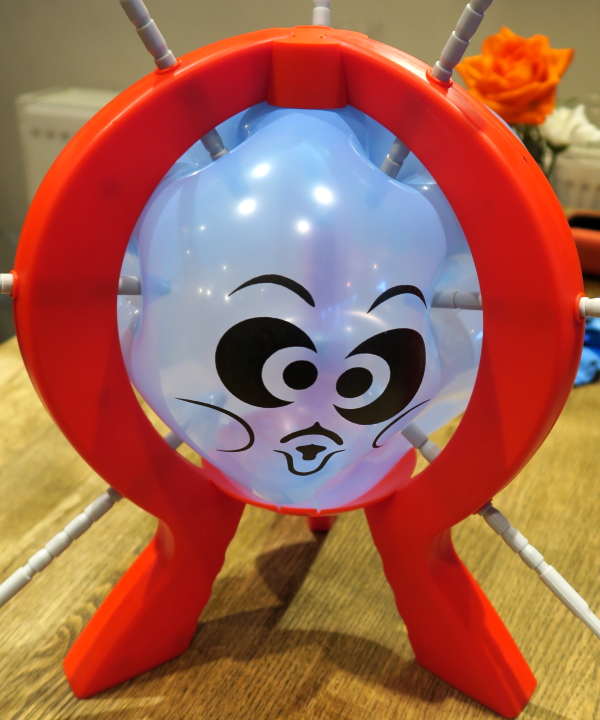
Boom Boom Balloon
– Image by boardGOATS

This year there were a number of popular nominees, including Gingerbread House, Lords of Vegas, Villagers and Tokaido, with Boom Boom Balloon getting several honourable mentions for being very silly, but a lot of fun.  There was some surprise that Terraforming Mars, Keyflower and last year’s Golden GOAT winner, Altiplano, had all not been played (we must make sure we rectify  that next year).  This was perhaps a measure of how strong the field was, and many people commented that there wasn’t a stand-out “bad game” for them.  Tapestry was a strong candidate for the unofficial “GOAT Marmite-factor” Award receiving nominations for both prizes and added controversy, with a suspicion that its nomination for the GOAT Poo Prize was based purely on the appearance of complexity rather than any actual experience.

Tapestry
– Image by boardGOATS

The winner of the “GOAT Poo” award was 7 Wonders, with nearly a third of the group nominating it; it is clearly another Marmite game though as there were plenty of people keen to jump to its defense.  The clear winner of the Golden GOAT 2019, however, was Wingspan, with Key Flow an equally clear second (the Silver GOAT perhaps?).  Both are excellent games and very deserving choices; we look forward to playing them more next year.

Golden GOAT - 2019
– Image by boardGOATS

Essen 2019 – Update

Sunday was the last day of this year’s Internationale Spieltage, the largest games fair in Europe (and arguably the world), known to gamers worldwide simply as “Essen”.  Although there was a lot of buzz about some of the hot games like Maracaibo and Cooper Island, it is the smaller, less well-known games that really make the fair what it is.  For example, Firefly Dance, is a fun little memory game with gorgeous little light-up fireflies activated with a wooden magic wand.

Firefly Dance
– Image by boardGOATS

Some games sold out within minutes: the last copy of Tapestry went in less than half an hour, and other early sell-outs included Alubari: A Nice Cup of Tea, A Fistful of Meeples and Point Salad.  There were lots of good deals to be had, including Passing Through Petra, one of the hot games from last year which was reduced from €60 to just €15.  Part of this might have been to attract attention to the Renegade Games stand because according to staff their entire supply of this year’s releases were “stuck in customs”.  This included their copies of Paladins of the West Kingdom (the sequel to last year’s smash hit, Architects of the West Kingdom).

Ticket to Ride Map Collection: Volume 7 – Japan & Italy
– Image by boardGOATS

There were also a number of other unusual games available, for example, Wsiąść do Pociągu: Polska, the new Poland map for Ticket to Ride, as well as the more widely available new Japan/Italy Map Collection.  There were other expansions as well, including the European Birds expansion to Wingspan, Sagrada: The Great Facades – Passion and Terraforming Mars: Turmoil.  In addition to expansions, there were several stand-alone re-implementations of old favourites, including the new 6 Nimmt! Brettspiel (boardgame), Glen More II: Chronicles and Azul: Summer Pavilion.

Azul: Summer Pavilion
– Image by boardGOATS

Games fairs are also about demonstrations of games that have not yet been released.  There were many of these, but one of the highlights was perhaps Namiji which is the sequel to Tokaido and will be the subject of a crowd-funding campaign in a month’s time.  So there is much to look forward to  from the Essen haul, old games as well as new, which will make the coming months very exciting indeed.

Namiji
– Image by boardGOATS

19th February 2019

Blue, Black, Purple, Burgundy and Mulberry were just trying to squeeze in a quick game of No Thanks! before eating, when Green arrived with his parents.  They were quickly followed by the first round of food, so it wasn’t until they had finished that the carefully counted piles of chips finally got put to use.  The game is very simple:  players take it in turns to either take the card on the table or pay a chip to pass the problem on to the next player.  If they don’t have any chips left they must take the card when it is their turn (and any chips that are on it).  The game ends when the deck has been depleted and everyone scores the sum of the face value of the cards minus any remaining chips—the player with the lowest score is the winner.

No Thanks!
– Image by boardGOATS

Last time we played this, Pine dropped a chip, but a thanks to the kind generosity of the people at  Amigo Spiele, it had not only been very swiftly replaced, but they had kindly sent spares in case the something similar happened again.  And they were almost required straight away, when Black managed to send a couple of chips flying.  Having learnt our lessen from last time, we immediately took a quick intermission to play “Hunt the Game Piece”, finding one quickly, while the other perched precariously over the same large gap that the had been so disastrous last time.  The rogue chip was rescued without further calamity, but for the avoidance of other mishaps, we might have to put tissue paper down the hole for next time…

No Thanks!
– Image by boardGOATS

The game of No Thanks! was a bit incidental around all that excitement.  Burgundy took the first card in an effort to get ahead, but it wasn’t the best card to build from.  Purple and Blue were forced into trying to build runs from the ends, which is always risky, but can yield huge rewards.  This wasn’t going to be one of those times though and Purple’s problems were compounded by the fact that she only discovered the twenty-three in the middle of her long run was missing when it came to scoring.  Mulberry was very tempted by some if scoring cards, but despite the fact she was pushed to her last chip, she managed to avoid getting herself into a mess.  Black played a very canny game building a small medium value run, not tempted to take a chance on gaps.

No Thanks!
– Image by boardGOATS

With everyone finished eating, it was time to decide what to play.  Black had suggested that Dixit might be suitable for Green’s parents.  However, Green was keen to play the “Feature Game”, Celestia (a remake of the older game, Cloud 9), and as Black was the only one who knew the rules, that meant he was up for that too.  Burgundy was less keen, so in the end, as Celestia is better with more players, and to avoid too much shuffling of seats, Blue, Mulberry and Burgundy left everyone else to board the airship.  In this game there is no board, instead there are nine city tiles making a path.  Players then take on the roles of adventurers exploring the cities of Celestia by airship.  At the beginning of each journey a new captain is identified and they begin by rolling the dice to discover the challenges they will face.  Before the Captain faces these challenges, however, however, each player must decide whether to stay on board, or leave the airship.
Celestia
– Image by boardGOATS

At each city there is a pile of treasure cards (mostly just victory points) which get better as the journey progresses.  When a player leaves the ship, they take a treasure card at that city, forfeiting the potential riches to come.  Once everyone has made their decision, the Captain has to deal with the challenges by playing equipment cards.  If the Captain is successful, the airship moves on to the next city where a new captain is identified who rolls the dice and so on.  If the Captain is unable to deal with the challenges they face, the airship crashes, returning to the first city and none of the passengers on board get any treasure.  Those passengers who left the ship then get back on board for the start of the new journey.  When one  player has a total of fifty points the game ends.

Celestia
– Image by boardGOATS

This time, the group added the A Little Help expansion which adds cards that players can use to help out the Captain.  There are a few extra cards like The Bandit and The Mooring Line as well, which players who are not on the ship can use to make life harder for those trying to get to the next city.  The group also added the lifeboat from the A Little Initiative expansion, which enables players to continue on their journey alone.  One of the key parts of Celestia is hand management as cards are scarce.  Players start with a hand of cards, six cards in a four or more player game and only get to draw a card when the journey ends, either due to a crash or arriving at the ninth city.  With the inclusion of the expansion cards, there seemed to be quite a bit to remember when learning the rules, but as ever, once underway the game flowed and the rules became clearer. Even so there was still a lot of double checking of which cards could be used when. Black and Purple had both played the game before and knew how quickly things could get difficult.

Celestia
– Image by boardGOATS

So Black and Purple cashed in their travel tickets early in the first round and hopped off the airship quite early on, leaving everyone else wondering if they were missing something as they sailed onwards. In contrast, Green and his parents (who had not played before) stayed on board and as a result took a lot of points.  This all seemed a little too easy and on rechecking the rules it became apparent that something was wrong. Players had been drawing cards after arriving at each city as the Captain changed rather than after it crashed, which meant everyone was awash with cards.  From then on the group played correctly, but the damage had already been done.  The balance of cards had been destroyed, and Green and his mum had an unassailable lead.  Green came out he victor with some canny play that allowed him to hop on and off the airship, but it was a hollow victory as those first twenty-five points were not fairly won.  The game definitely deserves another try though as it is a clever and fun game when played correctly.

Celestia
– Image by boardGOATS

While the airship was being filled, Blue, Mulberry and Burgundy debated what they were going to play.  Orléans was very tempting, but as Celestia was supposed to be relatively quick, the trio decided to play the shorter Tokaido instead.  This is a simple, but very clever game where players are traveling the East Sea Road from Kyoto to Edo (Tokyo), meeting people, tasting fine food, collecting beautiful items, discovering great panoramas, and visiting temples and wild places.  The winner is the player who discovers the most interesting and varied things and is the most initiated traveler.  The really clever part of the game is the turn order, because the player at the back goes first.  Although this is an unusual mechanism, it is not unique and is also seen in Glen More, an out of print game that is getting a face-lift and reprint this year as Glen More II: Chronicles.

Tokaido
– Image by boardGOATS

The idea is that each location on the road can only be occupied by one player.  Players only ever move forward and the player at the back has a free choice of which empty location they move to.  They can choose to stop at the first empty location which means they will be able to maximise the number of locations they can visit, or they can choose to skip a few locations potentially gifting these to their opponents, but ensuring they stop at the locations they will profit most from.  Thus the game is all about optimising movement, compromising visiting the best locations, visiting the most locations and preventing opponents visiting the locations they want by getting there first.
Tokaido
– Image by boardGOATS

Each player starts with a character card which gives them a different start condition and a special power.  Burgundy was positioned at the front playing Yoshiyasu enabling him to draw a second card whenever he encounters someone, and choose which one to keep Encounter cards give a one-off bonus, so being able to choose instead of relying on random draw is a nice advantage.  Mulberry started in second position on the track and as Kinko, was able to pay one Yen less for her food at mealtime.  There are several stops for food along the way and money is always scarce so anything that saves money is always good.  Blue began at the back (and therefore started), playing Sasayakko who gets the cheapest souvenir for free whenever she buys two or more when visiting the Village.

Tokaido
– Image by boardGOATS

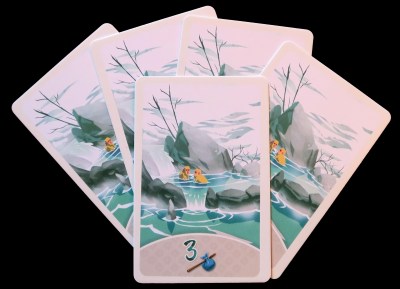
In this game, it is essential that players make the most of their special powers, so Blue visited as many Villages as she could, collecting as many sets of souvenirs as she could.  To do this though, she need lots of money and money is not easy to come by.  Similarly, Burgundy stopped to make as many encounters as he could and coupled this with visiting the Hot Springs.  Hot Springs simply give a two or three point card drawn at random from a deck, with the three point cards depicting monkeys playing in the spring.  Somehow, every time Burgundy drew a Hot Spring card, it featured monkeys, while Blue and Mulberry received no monkey-love; after his fifth card it was something they really began to resent.

Tokaido
– Image by boardGOATS

Mulberry was the first to score points and Burgundy wasn’t far behind.  Blue was slowest off the mark, but eventually caught up and overtook the others, romping into the lead, helped by Burgundy who persisted in moving Blue’s token when he scored points.  That wasn’t the full story, however.  At the end of the game points are awarded to the players with the most Hot Spring cards, the most Encounter cards, the most Souvenirs, for donating money at the Temples, and for the player who spent the most on food.  With Burgundy taking the vast majority of these points, he caught up and, after several recounts, both Blue and Burgundy finished on eighty-one points with Mulberry not far behind.  With more achievement cards, Burgundy was the clear winner, but he’d tried to be generous with his points throughout the game and insisted on sharing victory with Blue (to go with the lack of sleep they shared).

Tokaido
– Image by boardGOATS

Celestia was still going and wasn’t looking like it was going to be finished very soon, so Blue,  Burgundy and Mulberry decided to try something else.  After a bit of discussion, they opted for a new game by the producers of the Spiel des Jahres and Deutscher Spiele Preis winner, Azul, that had been brought back from Essen late last year.  Blue had played Reef with Pink, Black and Purple after The Gallerist during a recent “Monster Games” session, but otherwise it hadn’t made it to the table.  It isn’t a complex game though and is very quick to teach:  on their turn, players can either take a card from the pool of face up cards, or play a card, adding the pieces of coral depicted in the top half to their reef and then scoring the pattern shown in the bottom half of the card.

Reef
– Image by boardGOATS

The reefs are a three by four grid and the pieces of coral can be played anywhere and can stack up to a maximum height of four.  Scoring the patterns is as viewed from above, and each one can be scored several times with different patterns worth different numbers of points.  This means there are two approaches to the game, scoring low but frequently, or building to one large score.  Mulberry opted for the first approach and facilitated this with single colour piles of coral.  Blue tried the alternative strategy, building to a large twenty-plus point score, while Burgundy tried a mixture.  As a result, Mulberry quickly built up a healthy lead, and the question was whether the others would catch her or not.  It was close, very close, with just four points covering all three players.  This time though, little and often was the winner, and Mulberry finished with forty-two points, one more than Burgundy.

Reef
– Image by boardGOATS

Celestia was still going, so Mulberry stayed to play one last game, San Juan.  This is an old game from the Alea Small Box Series that is sometimes referred to as the card game of Puerto Rico.  The idea is that on their turn, the active player chooses a role, Builder, Producer, Trader, Prospector, Councillor and then everyone takes it in turn to carry out the associated action.  The person who chose the action gets to use the privilege of the role (pay one less for building, trade or produce one extra item etc.).  One of the clever things about the game is that cards have multiple purposes, similar to Bohnanza where cards can be money or beans.  In San Juan, each card can be played onto the table as a building, but when in hand they can be used as payment, and during the game they can be used as produce as well.  Each card has a value when built and there are a small number of special buildings whose score depends on the other buildings in play.  The game ends when a player builds their twelfth building.

San Juan
– Image by boardGOATS

Mulberry was tired and really struggled, so Blue and Burgundy tried to help explain what she could do, certain she’d get the hang of it.  They stressed the importance of not getting left behind on the building, a message Mulberry took to heart, building at every opportunity.  Blue made life difficult for everyone though, building a Guardhouse reducing everyone else’s hand limit to six.  Burgundy saw one of the valuable six point plus violet building cards early in the game, but that was it, so he ended up building lots of production facilities.  Blue on the other hand built lots of violet buildings and with it a City Hall giving her one point per violet building.  In the meantime, Mulberry kept building so when Blue failed to spot she had eleven buildings she accidentally triggered the final round.  It was very, very tight, but somehow, Blue just kept her nose in front finishing with twenty-three points, one more than Burgundy and two more than Mulberry.

San Juan
– Image by boardGOATS

In the meantime, Celestia had finally come to an end.  With Green and his parents wanting to leave and Pine finally putting in an appearance after a long day bird watching in the West Country, the group we went for a very short game, one about birds: Pick Picknic.  This game combines simultaneous card selection with bluffing and a slice of luck.  The idea is that there are six farm  yards of different colours, if someone plays the only chicken card of a given colour, they get all the grain at that coloured farm.  If multiple players go for the same coloured yard, then players can either agree to share the corn in any way that is mutually acceptable or roll the die for all of it.  Foxes don’t eat corn, however, they only eat chickens, so if someone plays a fox card, they will eat any chicken cards of that colour.  This time there seemed to be a lot of hungry foxes, and lots of fighting birds.

– Image used with permission of BGG reviewer EndersGame

These were accompanied by the usual exclamations as people realised that their attempt to grab a pile of corn was stymied by someone else’s decision.  It was a close game, with four players within four points of each other.  It was tight at the front too with just a handful of points between first and second place, but it was Purple who just edged Green’s father into second place.  With that over Family Green headed off and, as Burgundy was still occupied playing San Juan, everyone else felt it was a good opportunity to play Splendor as someone else would have a chance to win.  Splendor is a game we’ve played a lot and it is ideal for late in the evening when everyone is tired because it doesn’t need too much thought.

Splendor
– Image by boardGOATS

Splendor is very simple:  players take it in turns to take gems (chips) or use the gems to buy cards from the display.  Cards can be used to buy other cards, but some of the cards also give points, and collecting certain combinations of cards allows players to claim a Noble tile giving more points.  Essentially, it is a race to fifteen points, though as players finish the round (so everyone gets the same number of turns), it is the player with the most points who wins.  This time the game started with everyone evenly matched.  There was a lot of overlap in the colours required to claim Nobles tiles, so they were claimed at much the same time.  Then Black took the lead and although both Purple and Pine were close to adding to their respective totals, Black’s score of nineteen was unassailable.

Splendor
– Image by boardGOATS

Learning Outcome:  Close Games are Good Games.