Tag Archives: Carcassonne

Boardgames in the News: Asmodee Update – Taking Over Catan and Other Stories

A year ago, following their acquisition of Esdevium GamesLibellud, Days of Wonder, Fantasy Flight games, Ystari Games, Asterion Press and Pearl Games we discussed the sudden expansion of the hitherto small French games company, Asmodée.  More recently, following a new contract with Queen Games for exclusive distribution rights in the USA and the ensuing restructuring of its three main US operations, Days of Wonder, Fantasy Flight games and Asmodee Editions to form a single entity, Asmodee North America, we wondered whether this growing monopoly would lead to price rises.  This concern arose, in particular, as from January 2016, distribution would be restricted to “speciality retailers” that have agreed to Asmodee North America’s “Speciality Retail Policy” including the prohibition of online sales.

Asmodee North America
– Image from Asmodee North America Press Release

Asmodee followed the initial press release with a second press release clarifying their position, in the form of a series of questions with answers. This did not completely allay many of the concerns, however, to the specific question, “…will you institute or impose official price floors or “minimum advertised price” policies”, they responded, “No”.  There has been a considerable speculation, but it seems clear from this “clarification” that although they intend to restrict “speciality retailers” to face-to-face transactions, this will not affect mass market outlets, such a Amazon, Target, or Barnes and Noble.  Another way of looking at it is that the medium-sized online vendors including, CoolStuffInc and Miniature Market (who are popular with US Geeks thanks to generous discounts), will no longer be able to sell Asmodee North America products, however, players like Amazon etc. are too big to be susceptible to their bully-boy tactics.  We will see what happens in the long run, but for the time being, so much for the end of 2015 press releases.

The Settlers of Catan
– Image by boardGOATS

With the new year, there are new take-overs, and unsurprisingly, Asmodee are at the centre once again, this time announcing that they are taking over the production of the English language edition of Catan (formerly known as “The Settlers of Catan”)Celebrating its twentieth anniversary last year, The Settlers of Catan has been translated into thirty-five languages and is reported to have sold over twenty-three million copies worldwide.  As such is it one of the biggest names in the world of modern boardgames.  With this acquisition from Mayfair Games, Asmodee have also announced that they will launch a subsidiary, “Catan Studio”, dedicated to the creation of content for different media for the “Catan Universe”.  Catan Studio will be headed by Peter Fenlon, former CEO of Mayfair who will work with Catan GmbH and its partners on this development.

Ticket to Ride
– Image by boardGOATS

With this acquisition, it brings Catan, Ticket to Ride and Star Wars: X-Wing Miniatures Game as well as the very popular card game, Dobble, all under the same roof.  So, what next?  Surely bringing together such a large slice of the modern gaming market makes Asmodee themselves a potential take over target.  In fact, perhaps the only question is whether the likes of Hasbro will make a move before or after Asmodee make their next acquisition.  Any bets on the future of Filosofia/Z-man Games with Pandemic and Carcassonne…?

– Image used with permission of BGG contributor adamfeldner

Boardgames in the News: What is a Meeple?

Reading our game reports, a fairly commonly used term is “Meeple”.  The word is used so widely amongst Euro gamers, that it was adopted for the name of the Oxford boardgame café, Thirsty Meeples, however, non-gamers are completely unfamiliar with it.  So, what does it mean and where does it come from?

Carcassonne
– Image used with permission of BGG contributor wizardless

The term was allegedly coined in 2000 by Alison Hansel while paying the tile laying game, Carcassonne. In Carcassonne, players draw a tile and then add it to a growing map before placing a wooden figure on the tile. Thus, meeple was a conjunction of “my” and “people” and was used specifically to refer to the characteristic wooden people-shaped pieces used in Carcassonne and more recently, games like Keyflower. Since then, the range of game pieces available has increased hugely and the term has been adapted and broadened.

Keyflower
– Image used with permission of BGG contributor punkin312

For example, Agricola has a wide range of resource tokens, including sheep, pigs and cows, which are often collectively referred to as “animeeples”. Similarly, the wheat and vegetable resource tokens are often referred to as “vegimeeples” or even “vegeeples”. So, the suffix “-eeple” has now come to mean game token, interestingly, usually one that is shaped. Thus, people playing games like Ice Flow or Salmon Run might talk about “fish-eeples”, devotees of Caverna may discuss “dog-eeples” and “donkeeples”, and players of the Arctic Bounty expansion for Fleet might comment on “crab-eeples”, though they may also be collectively referred to, simply as meeples.

Agricola: All Creatures Big and Small
– Image by boardGOATS

So, generically, a meeple is a game piece, usually made of wood, and often, but not necessarily with two arms, two legs and a head…

Meeples
– Image by boardGOATS


17th Movember 2015

While Burgundy, Magenta and Blue were busy feeding, we decided to play something to keep Pine from eating too many of the chips, so for the third games night running, we had a quick mess about with magnets and bells in Bellz!.  It was another close game with some slightly borderline shaking and other sneaky efforts.  Before long though after incredible snatch taking two medium bells as he moved faster than magnetism, Burgundy had only one large bell left.  This solitary bell was very effectively trapped though and he failed to take the opportunity leaving Blue to close out.  Pine followed, despite the fact that he claimed he was no good at dexterity games.

Bellz!
– Image used with permission of BGG contributor SpeedD

With people still finishing, we looked for another light game that people could play while wielding cutlery, and No Thanks! fitted the bill.  This is a very simple game that we used to play quite a lot, but recently has languished in the box, usurped by newer fare.  The game is very simple:  from a shuffled deck of thirty-three cards (numbered three to thirty-five), nine cards are removed and the top card turned face up.  The first player has a choice they can either take the card or pay a chip and pass the problem on to the next player.  This player can either take the card and the chip or pay a chip and so on.  At the end of the game the face values of each player’s cards are totalled (offset by any remaining chips) and the player with the lowest number is the winner.  The catch is that if players have consecutive cards, only the lowest counts, which is where the fun really starts.

No Thanks!
– Image used with permission of BGG contributor msaari

The game is all about keeping your nerve and picking up the right card at the right time.  Burgundy began by picking up some high cards, while Pine started with a few cards in the twenties and teens.  Blue and Magenta stuck it out as long as they could before they were forced to take something.  Somehow Blue managed to avoid anything really horrid until the last card when Magenta persuaded Burgundy to hand it on leaving her with a whopping sixty-nine and last place.  With Burgundy unable to get the cards he needed to extend his run, that left just Magenta and Pine with Pine taking it by four points with just twenty three points.

No Thanks!
– Image used with permission of BGG contributor mikehulsebus

Not expecting anyone else to arrive, we decided to move onto the “Feature Game” which was Isle of Skye: From Chieftain to King.  This is a tile laying game with some similarity to Carcassonne, except that players have their own map and the tiles are auctioned.  Played over six rounds, players start by earning income for their clan’s territory, getting five gold for their castle and one for each whiskey distillery (barrels) connected to their castle by road.  Next, each player draws three tiles from a bag and places them in a row in front of their screen.  In private, the players then allocate piles of coins to two of the tiles and a mattock marker to the third.  The coins represent the cost anyone buying a tile will have to pay, while the mattock indicates which tile will be discarded.

Isle of Skye: From Chieftain to King
– Image used with permission of BGG contributor henk.rolleman

Once everyone has decided the value of their tiles, the screens are removed and the tiles marked with a mattock discarded.  Next, beginning with the start player, each player takes it in turn to buy a tile from one of the other players.  When everyone has either bought a tile or passed, all remaining tiles are bought for the assigned value by the owner.  So, when setting the value, players have to be very careful not to over-price something otherwise they will be left paying over the odds for something they don’t want.  In fact, the problem is worse than that as the difference between being forced to buy your own tile and selling it is twice the assigned value.

Isle of Skye: From Chieftain to King
– Image by boardGOATS

After all the tiles have been bought, players add them to their clan territories following the Carcassonne riles that terrain must match.  However, presumably since all roads on Skye are just dirt tracks, roads do not need to connect, something those of us who suffer with OCD found quite offensive to begin with.  At the end of the round, points are awarded according to the four scoring tiles chosen at random at the start of the game.  In our game the scoring tiles were:

  1. One point for each animal next to a farm;
  2. Three points for each lake with a ship and a lighthouse;
  3. Two points for each cow on a road connected to the castle;
  4. Five points for the person with the most barrels and two for the person with the next most barrels.
Isle of Skye: From Chieftain to King
– Image used with permission of BGG contributor henk.rolleman

At the end of the first round, just scoring tile “A” is scored, at the end of the second, just tile “B”, but at the end of the third, both “C” and “D” are scored so that each tile is scored three times during the game, at the end of different rounds, in different combinations.  At the end of the game, each player turns any residual money into points (at a rate of five to one) and players also score any scroll tiles they may have been able to add to their clan territory.  These give a set number of points for certain items, for example, one point for each pair of ships etc.  These are scored twice it the terrain the scroll is in is “complete”, i.e. it is enclosed.

Isle of Skye: From Chieftain to King
– Image used with permission of BGG contributor Punkin312

Burgundy was the only player who had played the game before and commented that he had been given a bit of a pasting so was hoping to do better, though he thought it was a hard game.  It didn’t sound hard at all, but we quickly discovered what he meant, with everyone struggling from the very beginning.  Pine and Magenta made the best starts getting farms and animals and scoring early, while Blue and Burgundy brought up the rear.  Blue, who never does well in more strategic games drew scroll tiles that rewarded players with barrels.  Unfortunately, as barrel tiles connected to the castle give players money at the start of the game, and scoring tile “D” gave points for them, they were a hot commodity and Blue was quickly left behind.

Isle of Skye: From Chieftain to King
– Image used with permission of BGG contributor henk.rolleman

As he’d found the previous time he’d played, Burgundy could see the tiles he wanted, but was struggling to acquire them or keep them.  As a result he started to drop off the pace and before long, Pine had left Magenta as well and was romping away looking like he might start to lap people.  While everyone else moaned as they struggled to do what they wanted, Pine continued happily collecting lots and lots of cows and sheep which he cleverly added to his growing conurbation of farms so that they counted multiple times.  In the later rounds, however, there is a catch-up mechanism which gives extra money to the players at the back.
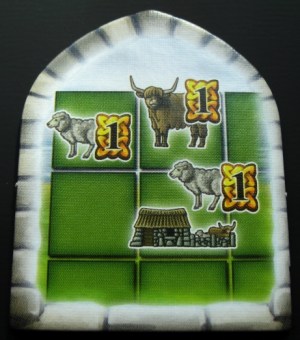
Isle of Skye: From Chieftain to King
– Image by boardGOATS

From round three onwards, at the start of the round, each player gets additional money for each player in front of them.  The amount increases as the game progresses, so the player at the back gets an extra three gold coins at the start of round three, but a massive twelve additional gold at the start of the final round.  Unfortunately, we somehow managed to botch this, half-way through the game switching to handing it out at the end of the round instead of the start, so the additional wherewithal didn’t quite give people the extra buying power intended by the designers.  That said, although Pine was the clear winner by nearly thirty points with a total of eighty-five, Blue managed move from a long way behind everyone else into second place thanks to scroll scoring that capitalised on all the brochs and barrels she had acquired.  For all the moaning, everyone enjoyed the game and agreed that it needed playing again as it would probably be very different with different scoring tiles.
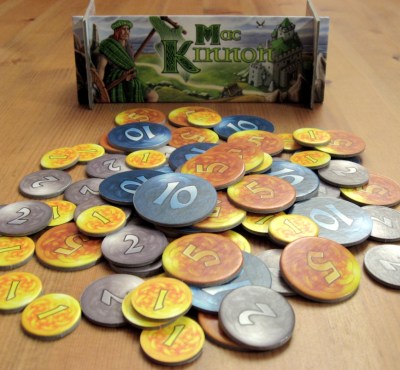
Isle of Skye: From Chieftain to King
– Image by boardGOATS

After some discussion about what to play and flirting briefly with the idea of Aquaretto,  we decided to play Port Royal.  Although we’d played it before, it was one of those games that it is somehow hard to remember and therefore Blue made a bit of a pig’s ear of teaching it.  That said, it isn’t a complicated game:  the game is played in turns with the active player turning over cards.  They can keep turning over cards until either they choose to stop or they draw a second ship card that they cannot repel.  Assuming they choose to stop, they can then take a ship card or buy a character card before the remaining cards are offered round the table with players paying the active player one doubloon if they choose to buy/take a card.

Port Royal
– Image used with permission of BGG contributor msaari

The key is the character cards as they are what enable players to build an engine and get an advantage over the opposition.  Unfortunately for him, Burgundy never seemed to have enough money when the cards he wanted came up.  On the other hand, Magenta took a Jester at just the right moment to give her a steady income exactly when she needed it.  Meanwhile, Blue picked up some good cards, but failed to capitalise and Pine began collecting for contracts, but couldn’t pick up the most cost effective ones.  Then, suddenly, Magenta snuck up on the inside and Pine pointed out that she had eleven points.  Blue then lost the plot a little and let her get the twelfth point which triggered the end of the game.  Nobody could improve their position much, except Magenta who rubbed salt in the wound buying another two cards.

Port Royal
– Image used with permission of BGG contributor jsper

With the evening nearing the end, we decided to give another new game a quick try as it the box said it only took five to ten minutes.  Well, an hour later, we were still playing Red7, and the landlord was subtly reminding us of the time…  So how did it go so wrong?  Well the game is fairly straight forward:  on their turn, each player can play one card from their hand into their tableau in front of them, or play a card into the centre which changes the rules of the game (a little like Fluxx), or they can do both.  If they cannot play a card or choose not to, they are out of the round.

Red7
– Image used with permission of BGG contributor punkin312

The game is played with a deck of forty-nine cards, numbered one to seven and in seven different colour suits.  Each player starts with seven cards in hand and one face up on the table.  The player with the highest value card is “winning” because the rule at the start is that the highest card wins.  In the event that there is a tie and the highest face value is displayed by more than one player, the tie is broken by the colours with red higher than orange, which is high than yellow and so on through the spectrum to violet.  The colours also dictate the rules, so any red card played in the centre will change the rules to “the highest” wins.  Similarly, any orange card played in the centre changes the rules so that the winner is the person with the most cards of the same number.

Red7
– Image used with permission of BGG reviewer EndersGame

In each case, ties are broken by the card that is highest (taking into account both number and colour) from the cards that satisfy the current rule.  Thus, if the rule is “the most even cards” and there are two players with the same number of even cards in front of them, the player with the highest even card is the winner.  At the end of their turn, the active player must be in a winning position, or they are out of the round. The round continues until there is only one player left.  Magenta took the first round with eight points and Burgundy the next with eleven.  When Magenta took the third and Blue the fourth, Pine was beginning to feel a little left out.  After Burgundy took the fifth round which took him to twenty-seven points (more than twice any one else’s total), we decided to give Pine one last chance as clearly Burgundy had it in the bag.  Sadly, for Pine, the last round was taken by Blue with a massive twenty-two points putting her just three points ahead of Burgundy.

Red7
– Image used with permission of BGG contributor punkin312

So why did the game take so much longer than advertised?  Well, obviously we had to read and understand the rules, but that didn’t account for it.  Each round does indeed take about five to ten minutes, but we didn’t feel we had really grasped it after one round and the rules for the advanced game also say that players should continue until one reaches a set number of points.  So we just played another round and then another and another… By the end we were just starting to get the hang of it, but we were also really beginning to appreciate the depth of something so very simple.  Part of the issue is getting into the mindset that enables you to quickly evaluate what cards you can play.  The next level is working out what is the best card to play that keeps the maximum level of options open.  However, by the last round we were just beginning to see that the game was really about using the rules to control what the other players could do, driving the game and ultimately, maximising the number of points won, or minimising the number of points taken by the opposition.  As a game, the structure of this has a lot in common with Love Letter and could another quick filler in a similar vein.

Red7
– Image used with permission of BGG contributor punkin312

Learning Outcome:  Simple games can turn out to be amongst the most complex.

BoardGOATS @ “The Mix” II – Saturday 21st November 2015

Following the success of our first drop-in session in April, The Mix in Wantage town centre is again hosting a gaming session on Saturday from 10.30 am until 2 pm.  Once again, members of the club will be providing games and teaching people how to play them.

The Mix
– Image from thewantagemix.wordpress.com

There isn’t very much space so we won’t be playing long games, in any case, the idea is to show people what modern boardgames are all about by demonstrating shorter games.  We will bring a few eye-catching games like PitchCar, Riff Raff, Bamboleo, Boom Boom Balloon, Toc Toc Woodman, and Saturn, but most of the gaming will be smaller filler games like Dobble, Turf Horse Racing, No Thanks!, Walk the Plank!, Love Letter, The Great Balloon Race and some of our other light favourites.  We will also be bringing some of the classic gateway games like Carcassonne, Ticket to Ride, The Settlers of Catan and Jamaica as well as a small number of deeper games, just to show people what else is out there.

Boom Boom Balloon
– Image used with permission of henk.rolleman

8th September 2015

We were late starting and, since we were expecting more, we decided to split into two groups and play something quick and light to start.  By coincidence, both groups began with cooperative card games.  Green, Grey and Cerise started with Hanabi – winner of the Spiel des Jahres a few years ago.  At the time we played it quite a bit, but Grey and Cerise had never been involved.  The idea of the game is very simple:  collectively, the players have to lay five cards in each of five colour-suits in numerical order.  The catch is that players are unable to see their own cards and instead turn their hand round so everyone else can see it.  As a group they then have to use deduction to work out which cards to play and in what order.

Hanabi
– Image used with permission of BGG reviewer EndersGame

On their turn, a player can do one of three things, play a card, give a clue or discard a card.  The number of clues is finite, though discarding cards buys extras.  When a card is played, the player doesn’t have to know what it is they are playing, so long as it can be added to one of the suits.  If it can’t, the group lose one of their three lives.  We have never been able to successfully complete the challenge of laying all twenty-five cards, so the group score is the sum of the highest card placed in each suit, or current maximum being twenty.   As a group we gelled well and through judicious use of efficient clues we were able to get lay all five cards for three colours and three cards for the other two.  This gave a total score of twenty-one, a new club record – definitely deserving of a “Very good! The audience is enthusiastic!”.

Hanabi
– Image used with permission of BGG contributor bovbossi

Meanwhile, Red, Blue, Cyan and Burgundy were playing the altogether less stressful, but equally puzzling, strangely eponymous, The Game.  Similarly, everyone has a hand of cards and they have to be played in numerical order, but in this case every card as to be played on one of four piles, two ascending and two descending.  There are two additional rules:  Players can say anything they want so long as they don’t give specific number information, and if they have a card exactly ten more or less than the top card of the pile they are playing it on, they can ignore the ascending/descending rule.  On their turn, players must play at least two cards before replenishing their hand, but can play as many as they want.

The Game
– Image used with permission of BGG contributor henk.rolleman

This was nominated for Spiel des Jahres this year and we’ve played it a few times since then.  Our best result was in a two player game a couple of months ago, when we had one solitary remaining card, however, we felt at the time that it might have been slightly easier with just two as you can plan better.  This time, it seemed were were doomed from the start with first Red, then Blue having nothing but really, really low cards and no-where to play them.  We managed to survive that though, and with a couple of really effective uses of the “Backwards Rule”, we managed to exhaust the draw deck.  Blue checked out first, quickly followed by Cyan and Burgundy leaving Red to play her last few cards and close out our first victory.  Next time we will have to play with one less card in hand…

The Game
– Image used with permission of BGG contributor joeincolorado

The games finished pretty much simultaneously and then a great debate began as to what to play next and how to split the group given that there were people who didn’t want to stay late.  Green proposed Eketorp, but this is one of Blue’s least favourite games, so she was looking for an alternative when Grey asked whether we had anything that would play everyone.  Blue mentioned Bohnanza, but although Red’s eyes lit up and Cerise looked interested, this time Green was not keen.  Grey wanted to play something with “fighting” and eventually, Green and Grey got fed up with the discussion and decided to play a head-to-head game of Carcassonne.

Carcassonne
– Image by BGG contributor ldaponte

Carcassonne is probably one of the best known of the modern, Euro-games, and is often considered to be “nice” – this is not true when it is played with just two however.  The idea of the game is that players take it in turns to draw and place tiles on an ever-growing map.  They can then add a meeple to any features on that tile before scoring any features that have been completed as a result of placing it.  Players have a finite number of meeples and, with two players, muscling in on someone else’s city is just as effective as building one yourself, making it very definitely, “nasty”.  And so it proved.  Playing with the first expansion, Inns & Cathedrals, Grey started with a few meeples on roads while Green placed a couple of early farmers. Green then took an early lead by completing a city with a cathedral, but then seemed to stutter. Grey continued to plug away eventually catching and passing Green nearly lapping him.  Green was hoping to reap the rewards of the early farmers, but with his last two tiles Grey placed a cheeky farmer and then joined it to the big field.  This cancelled out the huge farm bonus and put the game beyond doubt by sharing Green’s massive thirty-three point farm, finishing forty-one points ahead.

Carcassonne
– Image by BGG contributor Hayzuss

On the other table, discussion had finally ceased an everyone had settled down to one of our current favourite filler games, 6 Nimmt!, another “laying cards in the right order” game.  Somehow, this is a really confusing game, but it is this feeling that you sometimes have control but not being sure why that makes it so compelling.  The game is played with a deck of cards numbered from two to one hundred and four, each of which features a number of “Bulls Heads” (mostly just one, but some have as many as seven).  The idea is that everyone then simultaneously chooses and reveals a card from their hand.  Then, starting with the player who played the lowest card, players add their cards to the four rows on the table.

6 Nimmt
– Image used with permission of BGG contributor punkin312

Each card must be added to the row which has the highest card that is lower than the one to be played, i.e. if rows end with ten, twenty, thirty and forty, then card thirty-five should be added to the row containing number thirty.  If the card played would be the sixth card in that row, then the player “wins” all the cards and the played card becomes the first card in the new row.  The winner is the player with the fewest “Bulls Heads” or “Nimmts” at the end of the game.  We generally play the game in two rounds with half the cards dealt out at the start of the first round and the rest for the second.

6 Nimmt
– Image used with permission of BGG contributor punkin312

With two players new to the game, chaos was inevitable, however, it was Blue who ended most out of synch, collecting twenty-four Nimmts in the first round, and Burgundy who managed to keep it together and escape without picking up a single card.  Roles were reversed in the second round with Blue winning with just six Nimmts while Burgundy picked up thirty-two!  Overall though, it was consistency that won through for Red who finished with a total of nineteen, five ahead of Cyan in second place.

Coloretto
– Image used with permission of BGG contributor punkin312

Carcassonne was still going on the next table, so Cerise mugged Grey for the house keys and headed off with Red and Cyan, leaving Burgundy and Blue to play a quick game of Coloretto.  This push-your-luck set-collecting game has had a few outings recently, and although three or four are much better numbers, we feel it plays surprisingly well with just two.  The idea is very simple, either you draw a coloured chameleon card and add it to a truck, or take a truck.  Players score positively for three sets and negatively for the rest, so the idea is to try to load trucks with coloured cards you want.  This time Blue started badly and from there it just got worse, finishing with Burgundy giving her a comprehensive thrashing, winning by more than twenty points.

Port Royal
– Image used with permission of BGG contributor jsper

Carcassonne and Coloretto finished together and Burgundy, Green and Blue decided there was time to give Port Royal another go.  We played it about a month ago, when it took a surprisingly long time for a quick filler, everyone said they’d like to try it again, and Green worked out a strategy based on Expedition cards that he was keen to try.  In summary, the game is played in turns with the active player turning over cards.  They can keep turning over cards until either they choose to stop or they draw a second ship card that they cannot repel.  Assuming they choose to stop, they can then take a ship card or buy a character card before the remaining cards are offered round the table with players paying the active player one doubloon if they choose to buy/take a card.

Port Royal
– Image used with permission of BGG contributor punkin312

Last time we had found some issues with the rules which we had not really been able to resolve.  The question was, since the Admiral allows a player to take two cards, does that mean they apply the Jester/Governor special powers twice?  On reflection, after the last game we had felt that the way we played (by a strict reading of the rules) was incorrect as it meant the combination was exceptionally powerful.  So for our second try we didn’t allow this and subsequent checking online appears to suggest that we played the way the designer intended this time.

Port Royal
– Image used with permission of BGG contributor punkin312

Another question we’d had was, could a player repel a card if it was the first of a colour to be drawn, or is it only the second card that can be repelled?  Strict reading of the rules appeared to allow this, so this time we played this way.  Blue was the main beneficiary of this rules “change”, as she quickly added not one, but two Admiral cards to her earlier Sailor.  The ability to repel cards before it was essential makes it much more likely that a player is going to be able to draw five cards without going bust.  Since this gave Blue four doubloons every time, it meant she was never short of cash to buy the high value cards. Meanwhile, Green struggled to get his strategy to work with three (partly due to the lack of Expeditions) and Burgundy, who had wiped the floor with everyone else last time round, couldn’t get the cards he needed to get going quickly (not helped by the fact that he initially didn’t use the full power of his Jester).

Port Royal
– Image used with permission of BGG contributor punkin312

This time with just three it was a much, much quicker game and it played quite differently.  In the first couple of hands almost all the tax cards came out giving everyone extra money and it wasn’t until near the end that any of the mission cards were drawn.  It quickly seemed like Blue had the game in the bag although in the event, it wasn’t quite that cut and dried.  Blue brought the game to an end, but Green and Burgundy couldn’t quite get the cards they needed.  The game finished with Blue winning by five points and Burgundy taking second place on a tie-break.

Port Royal
– Image used with permission of BGG contributor msaari

Since Port Royal had played so quickly, we decided to give Zooloretto: The Dice Game a quick go.  This is a game that we’ve got out a couple of times, but then decided not to play because other people have arrived.  It was a while since we’d actually played it so we had to have a quick read through of the rules.  Each player rolls two dice, and like Coloretto or Zooloretto, they then place these on the trucks.  Alternatively, players can take a truck and tick off animals on their score sheet.  Bonuses are awarded for being the first player to complete an animal collection, but if the maximum is exceeded, then players lose points.  The game ends when one player has completed four of their animal collections and have only one space left in the last enclosure.

Zooloretto: The Dice Game
– Image used with permission of BGG contributor kilroy_locke

Burgundy started off well, with Blue and Green struggling to get any really helpful dice.  Burgundy both completed most sets first and also brought the game to a close, so the writing was on the wall:  he finished six points clear.  It was only when we were scoring, however, that we realised that Green hadn’t quite understood – he’d been going for lions assuming the bonus was lots more as you needed more of them to get the set.  Oops; blame the person explaining the rules…

Zooloretto: The Dice Game
– Image used with permission of BGG contributor henk.rolleman

Learning Outcome:  We like deep games, but little games can be a lot of fun too.

Boardgames in the News: The Best Games Featuring Maps

The “Brilliant Maps” Blog recently listed what it considered “The 28 Best Map Based Strategy Board Games You’ve Probably Never Played“.  Leaving aside the fact that most dedicated gamers will have played many of them, how valid is this list?  On closer inspection it turns out that the list is really just the top twenty-eight games listed on BoardGameGeek.com (BGG) that happen to have a map for the board.  As such, it makes no subjective judgement on the quality of the map and is simply a list of the best games according to BoardGameGeek that feature a map.

Twilight Struggle
– Image used with permission of BGG contributor killy9999

For example, the game with the highest rating on BoardGameGeek.com is Twilight Struggle which is a Euro/war game hybrid and is therefore played on a map.  The map is not particularly picturesque, however, though for those old enough to remember, its spartan nature is strongly evocative of the Cold War setting.  Is it a great map though?  It certainly captures the theme of the game and perhaps, as such, it is indeed a great map.

Terra Mystica
– Image by BGG contributor Verkisto

Unsurprisingly, many of the games mentioned are war games.  There are a fair number of Euro games too though:  high on the list are Terra Mystica at number two, Brass at four and Power Grid at six.  Number ten on the list is Concordia and eleven is El Grande – a game that is celebrating its twentieth anniversary this year.  Further down are Tigris and Euphrates, Steam, Pandemic, Ticket to Ride: Europe, Carcassonne and finally, just sneaking onto the list, The Settlers of Catan (or Catan as we are now supposed to call it).  All these games indeed include maps of some description, but overwhelmingly, they are also all well-established “classic” games.  Are they the best maps though?

Amerigo
– Image used with permission of BGG contributor Oceluna

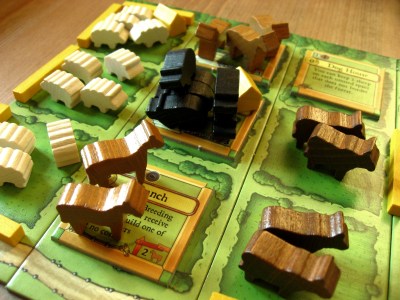
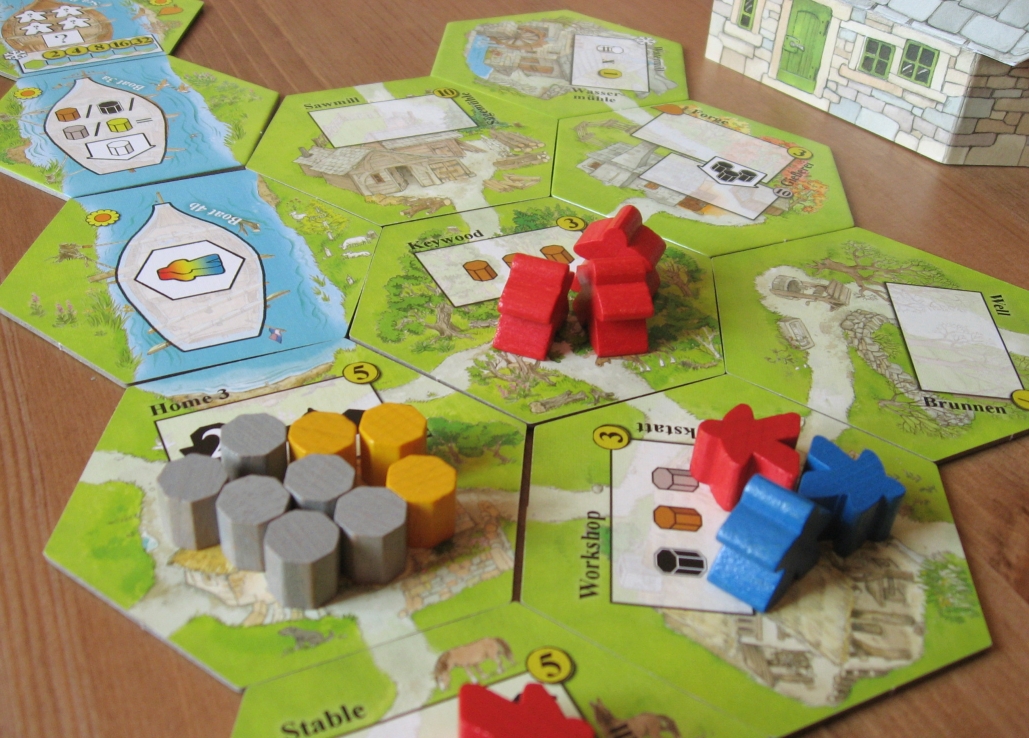
There are some stunningly beautiful games that haven’t made the list, for example, Amerigo is played on a beautiful seascape and Lancaster includes a lovely map of the England.  How do we define “map-based game” however?  Clearly, a map is is a two-dimensional play space so that excludes games where the play-area is predominantly linear i.e. “a track”.  But what about games where the map is produced as the game is played?  If Carcassonne is considered a map game, other games where the board is built during the play should also be included, like Saboteur and Takenoko.  What about one of our favourite games at boardGOATS, Keyflower?  In this game, players buy tiles and then use them to build their own personal little village map.  Should this be included too?

Keyflower
– Image by boardGOATS

Ultimately, none of this really matters of course:  a game is a game and it all comes down to how much people enjoy playing it.  One thing is clear though, while a game can be good in spite of the rendering, playing with beautiful components can only enhance the boardgame experience.

Carcassonne
– Image used with permission of BGG contributor Topdecker

Boardgames in the News: Meeples in the Dictionary

Yesterday, OxfordDictionaries.com announced that together with words like “Grexit” and “Cat café”, they had added “meeple” to their online dictionary.  They define it as  “a small figure used as a playing piece in certain board games, having a stylized human form“.  They add that the origin is “apparently a blend of my and a phonetic respelling of people and first used with reference to the board game Carcassonne“.

Carcassonne
– Image from thirstymeeples.co.uk

30th June 2015

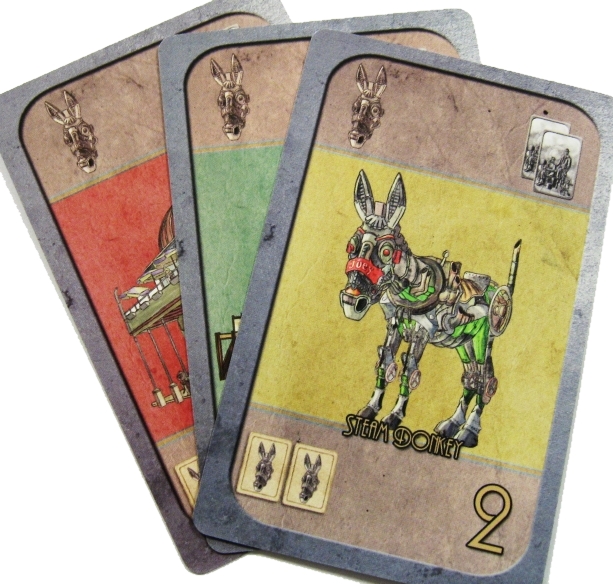
Continuing the theme from last time, food was a priority, so we didn’t get started until well after eight o’clock.  We split into two groups, the first playing Steam Donkey again as it turned out that we had played it wrong two weeks ago. This card game involves building a seaside resort consisting of a four by three grid of attraction cards.  The idea is that players build the attractions from their cards in their hand, then take passengers from the station who visit their attractions, which they then take from their tableaux to become cards in their hand.  The more popular attractions get more passengers, thus yielding more cards.  Unfortunately, it turns out that on their turn, each player can do only one of these three actions instead of all of them!  It was still a tight game though, with Burgundy and Magenta drawing for first place on fifty-two points.  As, Magenta commented though, “Playing it right is better…”

Steam Donkey
– Image by boardGOATS

Meanwhile, Grey, Green, Cerise and Blue tried an older game, Gheos, which is new to the group.  When Cerise and Grey introduced it, Blue (who had played it a very long time ago) commented that all she could remember was that it was a bit like Carcassonne, but the tiles were triangular and it was a lot nastier.  In this game, players have three tiles in their hand and on their turn place one extending the play area, or replacing one of the existing tiles.  The tiles form land rivers which make islands (land comprising two small sections of land surrounded by water) and continents (larger areas of contiguous land).  Unlike Carcassonne, all the edges are the same so every tile can go anywhere, but some places are better than others of course.

Gheos
– Image by BGG contributor Gonzaga

When a player places a tile, if the continent has not already been settled, they can choose to place a settlement receiving followers equal to the total number of wheat sheaves shown on that continent.  If a player doesn’t start a new settlement, placing a tile allows the active player to recruit a single follower of their own choice.  Followers are important because they dictate how many points players get during scoring.  Everyone scores points when epoch tiles are drawn and each player has three cups tokens which they can play at the end of their turn triggering allowing them to score alone.  Epoch scoring gives players points equal to the number of pyramids on a continent multiplied by the number of followers they have for the tribe settled on that continent.  Cups tokens work in a similar way with points awarded for every follower multiplied by the number of cups on the continent, but only the active player gets to score these.

Gheos
– Image by BGG contributor Outside Lime

Since tiles can be replaced, rivers can be moved creating islands, and merging continents, creating war, causing migration and even leading to extinction (since islands are to small to sustain a tribe and continents can only support one tribe).  This is what makes the game nasty since a players’ followers are immediately lost.  The complexity of the rules associated with migration and war coupled with the different triggers for scoring meant that it took Blue and Green a while to get their heads round it.  Despite Cerise’s protestations, she showed them the way to score taking an early lead.  Grey’s experience showed in the latter stages, however, giving him the first place, eight points ahead of Blue in second.

Gheos
– Image used with permission of BGG contributor KSensei

Green had been desperate to play his new game, Fresco, so had agreed to play Gheos with Grey on the condition that he would play Fresco next.  This is a game where players are master painters working to restore a fresco in a Renaissance church.  Each round begins with players deciding what time they would like to wake up for the day. The earlier they wake up, the earlier they are in turn order, and the better options they get.  However, if they waking up early too often, the apprentices become unhappy and stop working as efficiently. Players then decide their actions for the turn, deploying their apprentice work force to the various tasks:  buying paint, mixing paint, working on the fresco, raising money to buy paint by painting portraits, and even going to to the opera to increase the apprentices’ happiness and inspire them. Points are scored mostly by painting the fresco, which requires specific combinations of paints.  For this reason, players must purchase and mix their paints carefully and beat the other players to the store to buy the pigments and fresco segments they would like to paint.

Fresco
– Image used with permission of BGG contributor Toynan

As a new game, that claimed to take an hour, it was clear it was not going to be quick, so Blue decided to help things along by reducing the number of players and joined the other group to play something shorter before Magenta had to leave.  Although Fresco  was not difficult to explain the other group had nearly finished their first game before play actually started.  With only three market stalls in the three player game and a possible three actions in each section for each player, the game very quickly fell into a routine where the earliest player went to the market to buy paint, with each assistant closing the stall afterwards. This left the other two players painting portraits for money and visiting the theatre to enhance their mood. This rotated around as the paint buying player completed retouching the fresco for tile points and thus pushing into the lead on the score track and moving down the order to choose when to get up.  This did not feel right and the consensus was that maybe the three player game was broken and it needed a fourth player to work. Nevertheless, in a game that nobody had played before, Cerise made it her own, winning by nearly twenty points.

Fresco
– Image used with permission of BGG contributor Toynan

Meanwhile, the other group were playing another new title, confusingly called The Game, which is a cooperative card game nominated for Spiel des Jahres this year.  In this game, players have a hand of five cards from a deck containing cards numbered two to ninety-nine and there are four piles: two starting at 100 and decreasing, two starting at one and increasing.  On their turn, players must play at least two cards and can play more as long as they obey the basic rules.  The cards can be played on any pile so long as it is lower in number than the top card of a decreasing pile or higher than the top card on the increasing pile.  Alternatively, if the card is exactly ten more or less than the the top card on the pile, the “backwards rule” can be invoked and the pile can be pushed back.  The aim of the game is to place all cards on the four piles and it is much more difficult than it seems.  The Game is often compared with Hanabi because it is a cooperative card game, however, the game play and the atmosphere it is played in are very different. In Hanabi, the best games are played in near silence where everyone is trying desperately not to give away any unintended information.  In The Game, players can say anything they like, so long as they don’t give away any specific number information.  This makes it much more chatty, though it took us a while to work out what was useful information and we only got about halfway through the deck before Magenta was unable to play a card.  Clearly one to try again to see if we can do better.

The Game
– Image used with permission of BGG contributor henk.rolleman

Fresco had only just started, so down to four players, Black Fleet came out for another outing.  This is a beautiful over-produced game that we played a few weeks ago, where each player has a merchant ship which they use to collect goods from one port and take to another port earning money.  However, each player also has a pirate ship which they can use to take goods from the merchants.  This also earns players money, but they must beware of the navy vessels which every player can manipulate to sink pirates and use to try to protect their merchants.   On their turn, the active player plays one card which moves both of their ships and one of the navy ships, during which, each ship may perform one action.  The idea of the game is that players can also play fortune cards which modify their actions and also use their money to buy  advancement cards which change the rules of the game, sometimes dramatically.

Black Fleet
– Image used with permission of BGG contributor The_Blue_Meeple

This time, Black got his nose in front buying the first advancement card, but it wasn’t long before Blue and Burgundy caught up.  While Purple was struggling to get anything and kept falling victim to everyone else, Blue moved into the lead with her very effective use of her False Colours and Secret Plans advancement combo (which together allowed her to swap her pirate with one of the navy ships and then earn four doubloons for attacking a merchant).  Burgundy pushed hard with his Delivery Bonus and judicious use of the Pirate Hideout (which allowed him to move his pirate more unpredictably), but could not get enough money to buy his last card leaving Blue to win.  Despite being the first to buy advancement cards, Black finished last as his cards felt relatively under-powered.  So maybe next time, now we all know how to play, we’ll try drafting the cards at the start.  That way there is less chance of one player getting more than their share of the best cards,

Black Fleet
– Image by BGG contributor lacxox

Fresco had finished first, and Green moved over to watch the last moves of Black Fleet, commenting sadly on how the game was broken with three players, which elicited the automatic response of, “Have you checked the rules?”  Whenever anyone online says a game is “broken” that is always the response and it often turns out that they weren’t playing right.  So despite his protestations that they had played correctly, while the last ships were being sunk, Green double checked and found what was wrong. Each player may have three assistants visit the market stalls, but they all visit the same stall and buy one tile, rather than buy one tile from each stall. Thus there will always be a stall open for each player.  This made a lot more sense and will really open the game up for those difficult decisions of timing and tasks. The rules check also brought to light an error in the way the bishop moves:  he was supposed to jump to the retouched or claimed tile each time rather than just staying put.  Although that was a much more minor mistake it was enough to make the choosing of tiles less interesting.  Another game to play again, and correctly this time!

Fresco
– Image used with permission of BGG contributor Toynan

Learning Outcome:  Games are better when played according to the rules…

Boardgames in the News: Confusion at The Telegraph!

Anyone who plays modern boardgames knows how our hobby has been growing and growing.  Games like Carcassonne and The Settlers of Catan are now available in Waterstones and WHSmith, there has been a series of regular comments in The Guardian, there are repeatedly TV appearances, and boardgame cafés are sprouting up all over the place.  It seems strange then that last week, Harry Wallop from The Telegraph announced that “Card games and board games are dying out and it’s no great loss”.

Snap
– Image by BGG contributor loopoocat

The basis of this report is a survey carried out by Barclaycard which apparently indicated that games like Old Maid, Happy Families and Snap are in danger of dying out.  Strangely, on the same day, Martin Chilton, the Telegraph online Culture Editor reported that 67 per cent of the children surveyed said that they would like to learn how to play traditional games.  The really annoying thing about all this is that they focus solely on “traditional games”:  Martin Chilton’s article is entitled “The five best board games” and lists them as Chess, Scrabble, Monopoly, Cluedo and Backgammon.

Scrabble
– Image used with permission of BGG contributor Susie_Cat

On closer inspection, however, Harry Wallop’s article does include a link to a more interesting list of fifteen party games, including Pandemic, Camel (C)Up and Biblios.  While their definition of “Party Games” clearly leaves a lot to be desired, it is clear that someone at The Telegraph at least has heard of modern games.  Perhaps the most reassuring aspect of this though, is the response to Martin Chilton’s article in the comments section which includes a nearly eighty passionate responses pointing out better, modern, “classic games” and where to find information about them.

Biblios
– Image by BGG contributor creatsia

Let’s hope Mr Chilton and Mr Wallop read the comments and write a better article soon!

18th April 2015 @ “The Mix”

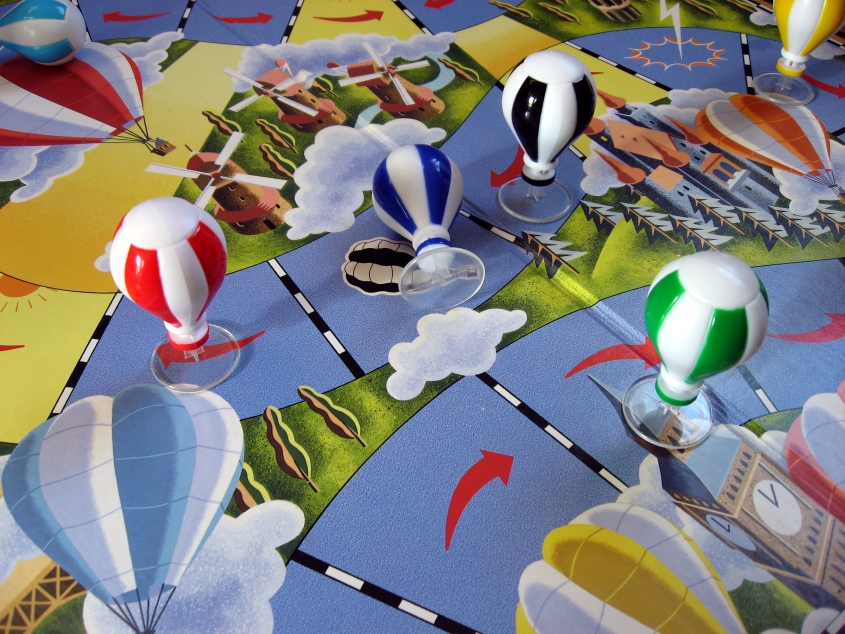
The drop in gaming session at The Mix in Wantage was a great success.   It started quietly, but there were lots of new people there and lots of games were played.  Green arrived first and was setting up tables when Blue and Pink arrived.  By the time the first punters arrived PitchCar, Riff Raff and Camel Up had been set up and other games were out ready to be tried.  Before long Purple and Black had also arrived and there was a steady stream of games being played including Toc Toc Woodman, Escape: The Curse of the Temple and Cube Quest, and a steady stream of pieces flying across the room.  Old favourites like Dobble, Incan Gold, The Great Balloon Race and Carcassonne also got an outing as well as the Lego game, UFO Attack.

The Great Balloon Race
– Image by boardGOATS

Thanks to everyone who came, both visitors and gamers – it was great to see it so well attended.  Everyone seemed to enjoy themselves, so it’s definitely something we’d be interested in doing again in a few months time.